<?xml version="1.0" encoding="ISO-8859-1"?><article xmlns:mml="http://www.w3.org/1998/Math/MathML" xmlns:xlink="http://www.w3.org/1999/xlink" xmlns:xsi="http://www.w3.org/2001/XMLSchema-instance">
<front>
<journal-meta>
<journal-id>0253-570X</journal-id>
<journal-title><![CDATA[Revista de Salud Animal]]></journal-title>
<abbrev-journal-title><![CDATA[Rev Salud Anim.]]></abbrev-journal-title>
<issn>0253-570X</issn>
<publisher>
<publisher-name><![CDATA[Centro Nacional de Sanidad Agropecuaria]]></publisher-name>
</publisher>
</journal-meta>
<article-meta>
<article-id>S0253-570X2012000100001</article-id>
<title-group>
<article-title xml:lang="en"><![CDATA[ANATOMY AND HISTOLOGY OF THE FEMALE REPRODUCTIVE SYSTEM OF Boophilus microplus (ACARI: IXODIDAE)]]></article-title>
<article-title xml:lang="es"><![CDATA[ANATOMIA E HISTOLOGIA DEL SISTEMA REPRODUCTOR FEMENINO DE Boophilus microplus (ACARI: IXODIDAE)]]></article-title>
</title-group>
<contrib-group>
<contrib contrib-type="author">
<name>
<surname><![CDATA[de la Vega]]></surname>
<given-names><![CDATA[R]]></given-names>
</name>
<xref ref-type="aff" rid="A01"/>
</contrib>
<contrib contrib-type="author">
<name>
<surname><![CDATA[Díaz]]></surname>
<given-names><![CDATA[G]]></given-names>
</name>
<xref ref-type="aff" rid="A02"/>
</contrib>
<contrib contrib-type="author">
<name>
<surname><![CDATA[Galán]]></surname>
<given-names><![CDATA[M]]></given-names>
</name>
<xref ref-type="aff" rid="A02"/>
</contrib>
<contrib contrib-type="author">
<name>
<surname><![CDATA[Fernández]]></surname>
<given-names><![CDATA[C]]></given-names>
</name>
<xref ref-type="aff" rid="A02"/>
</contrib>
</contrib-group>
<aff id="A01">
<institution><![CDATA[,LABIOFAM  ]]></institution>
<addr-line><![CDATA[Ciudad Habana ]]></addr-line>
<country>Cuba</country>
</aff>
<aff id="A02">
<institution><![CDATA[,Universidad de La Habana Facultad de Biología Dpto. Biología Animal y Humana]]></institution>
<addr-line><![CDATA[ ]]></addr-line>
<country>Cuba</country>
</aff>
<pub-date pub-type="pub">
<day>00</day>
<month>04</month>
<year>2012</year>
</pub-date>
<pub-date pub-type="epub">
<day>00</day>
<month>04</month>
<year>2012</year>
</pub-date>
<volume>34</volume>
<numero>1</numero>
<fpage>1</fpage>
<lpage>10</lpage>
<copyright-statement/>
<copyright-year/>
<self-uri xlink:href="http://scielo.sld.cu/scielo.php?script=sci_arttext&amp;pid=S0253-570X2012000100001&amp;lng=en&amp;nrm=iso"></self-uri><self-uri xlink:href="http://scielo.sld.cu/scielo.php?script=sci_abstract&amp;pid=S0253-570X2012000100001&amp;lng=en&amp;nrm=iso"></self-uri><self-uri xlink:href="http://scielo.sld.cu/scielo.php?script=sci_pdf&amp;pid=S0253-570X2012000100001&amp;lng=en&amp;nrm=iso"></self-uri><abstract abstract-type="short" xml:lang="en"><p><![CDATA[The knowledge of the anatomy and histology of the female genital system in ticks is very important as a basic tool in all species in relation to morphological sciences and evolution, physiological events like ovulation, sexual behavior, maturation and mating, and also to research the interrelation tick-hemoparasite. The anatomy and histology of the female genital system in Boophilus microplus are scarcely studied. In the present paper, the female genital system of this tick has been considered as a whole and morphological and functional interrelations between different structures and also some other related items has been presented. Unfed and partially engorged females were employed in the study. The quality and resolution of images are remarkable because of the improvement by authors of a histological technique specially for arthropods.]]></p></abstract>
<abstract abstract-type="short" xml:lang="es"><p><![CDATA[El estudio de la anatomía y la histología del sistema genital femenino en las garrapatas es de gran importancia como una herramienta básica para el conocimiento de las diferentes especies en relación con las ciencias morfológicas y la evolución, eventos fisiológicos como la ovulación, conducta sexual, maduración y apareamiento, y además para investigar la interrelación garrapata-hemoparásito. La anatomía e histología del sistema genital femenino de Boophilus microplus están escasamente estudiadas. En el presente artículo se describe de forma integral el sistema genital femenino en esta especie y se presentan interrelaciones morfológicas y funcionales entre las diferentes estructuras, así como otros aspectos relacionados. Se emplearon hembras no alimentadas y parcialmente ingurgitadas. La calidad y resolución de las imágenes son notables como resultado del perfeccionamiento de una técnica histológica específica para artrópodos, por parte de los autores.]]></p></abstract>
<kwd-group>
<kwd lng="en"><![CDATA[ticks]]></kwd>
<kwd lng="en"><![CDATA[Ixodidae]]></kwd>
<kwd lng="en"><![CDATA[Boophilus microplus]]></kwd>
<kwd lng="en"><![CDATA[anatomy and histology]]></kwd>
<kwd lng="en"><![CDATA[female genital system]]></kwd>
<kwd lng="es"><![CDATA[garrapatas]]></kwd>
<kwd lng="es"><![CDATA[Ixodidae]]></kwd>
<kwd lng="es"><![CDATA[Boophilus microplus]]></kwd>
<kwd lng="es"><![CDATA[anatomía e histología]]></kwd>
<kwd lng="es"><![CDATA[sistema genital femenino]]></kwd>
</kwd-group>
</article-meta>
</front><body><![CDATA[ <p align="right"><font face="Verdana, Arial, Helvetica, sans-serif" size="2">    <b>Art&iacute;culo original</b></font></p>     <p>&nbsp;</p>     <p>&nbsp;</p>     <p><font face="Verdana, Arial, Helvetica, sans-serif" size="2"><B><font size="4">ANATOMY    AND HISTOLOGY OF THE FEMALE REPRODUCTIVE SYSTEM OF <I>Boophilus microplus</I>    (ACARI: IXODIDAE)</font></B></font></p>     <p>&nbsp;</p>     <p> <font face="Verdana, Arial, Helvetica, sans-serif" size="2"><b><font size="3">ANATOMIA    E HISTOLOGIA DEL SISTEMA REPRODUCTOR FEMENINO DE <i>Boophilus microplus</i>    (ACARI: IXODIDAE) </font></b></font><font size="3"><b> </b></font></p>     <p>&nbsp;</p>     <p>&nbsp; </p>     <P><font face="Verdana, Arial, Helvetica, sans-serif" size="2"><B>R. de la Vega*,    G. D&iacute;az**, M. Gal&aacute;n**, C. Fern&aacute;ndez**</B> </font>     <P> <font face="Verdana, Arial, Helvetica, sans-serif" size="2"><I> *LABIOFAM,    Ave. Independencia Km16 &#189;, Boyeros, Ciudad Habana, Cuba, FAX: (537) 334857,    E-mail: <a href="mailto:delavega@infomed.sld.cu">delavega@infomed.sld.cu</a>;    **Dpto. Biolog&iacute;a Animal y Humana, Facultad de Biolog&iacute;a, Universidad    de La Habana, Cuba</I></font>      ]]></body>
<body><![CDATA[<P>&nbsp;     <P>&nbsp; <hr noshade size="1">     <P><font face="Verdana, Arial, Helvetica, sans-serif" size="2"><B>ABSTRACT</B></font>     <P><font face="Verdana, Arial, Helvetica, sans-serif" size="2">The knowledge of    the anatomy and histology of the female genital system in ticks is very important    as a basic tool in all species in relation to morphological sciences and evolution,    physiological events like ovulation, sexual behavior, maturation and mating,    and also to research the interrelation tick-hemoparasite<I>.</I> The anatomy    and histology of the female genital system in <I>Boophilus microplus</I> are    scarcely studied. In the present paper, the female genital system of this tick    has been considered as a whole and morphological and functional interrelations    between different structures and also some other related items has been presented.    Unfed and partially engorged females were employed in the study. The quality    and resolution of images are remarkable because of the improvement by authors    of a histological technique specially for arthropods. </font>      <P><font face="Verdana, Arial, Helvetica, sans-serif" size="2"><b>Key words:</b>    ticks; Ixodidae; Boophilus microplus; anatomy and histology; female genital    system.</font>  <hr noshade size="1">     <P><font face="Verdana, Arial, Helvetica, sans-serif" size="2"><b>RESUMEN</b></font>     <P><font face="Verdana, Arial, Helvetica, sans-serif" size="2">El estudio de la    anatom&iacute;a y la histolog&iacute;a del sistema genital femenino en las garrapatas    es de gran importancia como una herramienta b&aacute;sica para el conocimiento    de las diferentes especies en relaci&oacute;n con las ciencias morfol&oacute;gicas    y la evoluci&oacute;n, eventos fisiol&oacute;gicos como la ovulaci&oacute;n,    conducta sexual, maduraci&oacute;n y apareamiento, y adem&aacute;s para investigar    la interrelaci&oacute;n garrapata-hemopar&aacute;sito. La anatom&iacute;a e    histolog&iacute;a del sistema genital femenino de <I>Boophilus microplus</I>    est&aacute;n escasamente estudiadas. En el presente art&iacute;culo se describe    de forma integral el sistema genital femenino en esta especie y se presentan    interrelaciones morfol&oacute;gicas y funcionales entre las diferentes estructuras,    as&iacute; como otros aspectos relacionados. Se emplearon hembras no alimentadas    y parcialmente ingurgitadas. La calidad y resoluci&oacute;n de las im&aacute;genes    son notables como resultado del perfeccionamiento de una t&eacute;cnica histol&oacute;gica    espec&iacute;fica para artr&oacute;podos, por parte de los autores. </font>  <B></B>      <P><font face="Verdana, Arial, Helvetica, sans-serif" size="2"><b>Palabras clave:</b>    garrapatas; Ixodidae; Boophilus microplus; anatom&iacute;a e histolog&iacute;a;    sistema genital femenino.</font>  <hr noshade size="1">     <P>&nbsp;     <P>&nbsp;     ]]></body>
<body><![CDATA[<P><font face="Verdana, Arial, Helvetica, sans-serif" size="2"><B><font size="3">INTRODUCTION</font></B>    </font>      <P><font face="Verdana, Arial, Helvetica, sans-serif" size="2">The anatomy and    histology of the female genital system in ticks have been studied only in some    species by different authors (1,2,3,4,5,6). The knowledge of these subjects    is very important as a basic tool in all species in relation to morphological    sciences and evolution, physiological events like ovulation, sexual behavior,    maturation and mating, and also to research the interrelation tick-hemoparasite<i>.    </i>The midgut, salivary glands and ovary in ticks, are organs of the great    interest for their role in tick physiology and/or pathogen transmission (7).    </font>      <p><font face="Verdana, Arial, Helvetica, sans-serif" size="2">The structure of    female genital system in Ixodidae consists of a single U-shaped tubular ovary    in the </font><font face="Verdana, Arial, Helvetica, sans-serif" size="2">posterior    region of the body, paired and folded oviducts are in both extremes of the ovary    joint into a common oviduct or uterus. The uterus opens into the vagina, which    is divided in a cervical vagina and a vestibular vagina. A seminal receptacle,    absent in argasids (3,4) as well as the uterus, open also in the cervical vagina.    A pair of tubular accessory glands pours out their secretions at the level of    the union of both cervical and vestibular vagina. Surrounding the vestibular    vagina there is a glandular epithelium, the lobular accessory gland, found only    in ixodid ticks (4). </font>      <P><font face="Verdana, Arial, Helvetica, sans-serif" size="2">The anatomy and    histology of the female genital system in <I>Boophilus</I> <I>microplus</I>    are scarcely studied; only it is possible to refer to articles about oviducts    and fertilization (8,9) and studies of the ovary by Saito <I>et al. </I>(10).    In the present paper, the general objective is to consider the female genital    system of this tick as a whole and to analyze the morphological and functional    interrelations between different structures. Also, the mating process in the    species is approached and the semen transport inside the female&#180;s tract    is shown. The quality and resolution of images are remarkable because of the    improvement by authors of a histological technique specially for arthropods    and for the employ of an original procedure for feminine tract dissection that    makes it easier and saves time avoiding technical complications.</font>     <P>&nbsp;      <P> <font face="Verdana, Arial, Helvetica, sans-serif" size="2"><B> <font size="3">MATERIALS    AND METHODS</font></B></font>     <P><font face="Verdana, Arial, Helvetica, sans-serif" size="2"><b>Procedures:    Histological and dissection Techniques: </b></font>  <B></B>      <P><font face="Verdana, Arial, Helvetica, sans-serif" size="2">The histological    technique of Schneider and Rudinsky (11) modified by de la Vega and Fern&aacute;ndez    (12) was used, to accomplish good results the inicial technique needs from 8    to 9 days, whereas that present demands only from 8 to 9 hours and images retain    the same quality. Coloration was done with hematoxylin-eosine. A vertical microtome    was used; tissue thickness of 3-5&igrave; was achieved. Some serial slicing    were performed transversely and other longitudinally in horizontal or in sagittal    sense, this procedure permits a better comprehension of three-dimensional disposition    of organs inside the arthropod. Dissection of tick specimens was performed with    an original method (13) allowing a faster and secure procedure that could be    done in 10 to 15 minutes per tick with a great percentage of success and without    loss of genital structure parts. </font>     <P> <font face="Verdana, Arial, Helvetica, sans-serif" size="2"><B>Ticks: </b>    Unfed and partially engorged females of <I>B. microplus</I>, before or after    mating, were employed in the study. </font>     <P>&nbsp;      ]]></body>
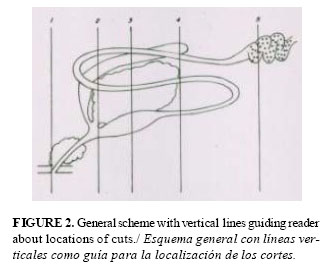
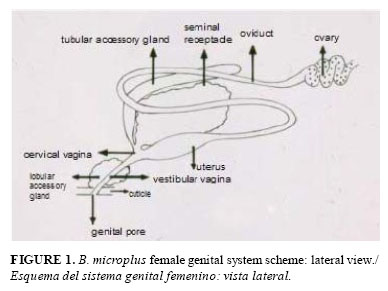
<body><![CDATA[<P><font face="Verdana, Arial, Helvetica, sans-serif" size="2"><B><font size="3">RESULTS    AND DISCUSSION</font></B></font>     <P><font face="Verdana, Arial, Helvetica, sans-serif" size="2"><b>GENERAL SCHEME    OF FEMALE GENITAL STRUCTURE </b></font>  <B></B>      <P><font face="Verdana, Arial, Helvetica, sans-serif" size="2"><a href="#f1">Figure    1</a> shows a general scheme of the principal organs that form the female genital    system of <I>B. microplus</I>, in a lateral view, based on the mentioned papers    and present results.<I> </I>As all schemes, it is a generalization from a number    of individuals; reader ought to keep in mind that variations in each item from    different specimens are actually a very frequent fact. <a href="#f2">Figure    2</a> represents the same scheme 1 with vertical lines demarcating zones, in    order to guide readers on the approximate location of a number of serial cuts.    So, next photographs will represent an approach of the anatomical location of    these shown structures in relation to these conventional lines.</font>      <P align="center"><font face="Verdana, Arial, Helvetica, sans-serif" size="2"><img src="/img/revistas/rsa/v34n1/f0101112.jpg" width="388" height="291"><a name="f1"></a>    
<BR>   </font>      <P>&nbsp;     <P align="center"><img src="/img/revistas/rsa/v34n1/f0201112.jpg" width="329" height="267">    <a name="f2"></a>     
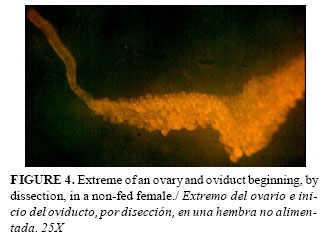
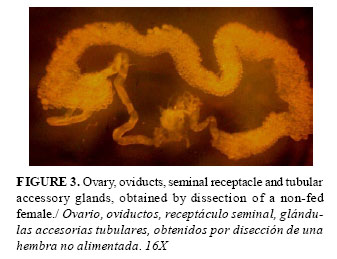
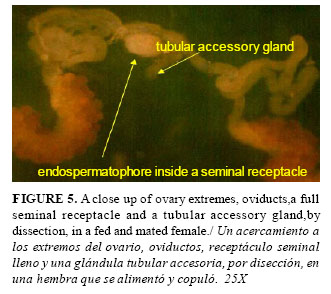
<P><font face="Verdana, Arial, Helvetica, sans-serif" size="2">    <BR>   <B>Ovary</B>, <B>oviducts</B>, <B>seminal receptacle</B> and <B>tubular accessory<I>    </I>glands</B> obtained by dissection of non-fed and fed, unmated and mated    females are shown in <a href="#f3">Figures 3</a>, <a href="#f4">4</a> and <a href="#f5">5</a><a name="f5"></a>.    </font>      <P align="center"><img src="/img/revistas/rsa/v34n1/f0301112.jpg" width="337" height="259">    <a name="f3"></a>     
]]></body>
<body><![CDATA[<P align="center"><img src="/img/revistas/rsa/v34n1/f0401112.jpg" width="328" height="239">    <a name="f4"></a>      
<P align="center"><img src="/img/revistas/rsa/v34n1/f0501112.jpg" width="331" height="294">    <a name="f5"></a>      
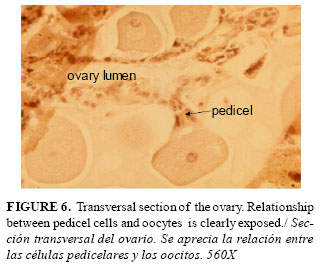
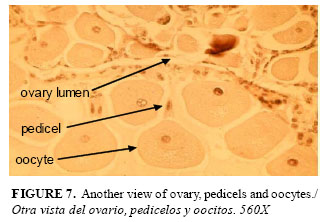
<P><font face="Verdana, Arial, Helvetica, sans-serif" size="2"><B>Ovary:</B> The    histological structure of ovary with oocytes and pedicel cells is shown in <a href="#f6">figures    6</a> and <a href="#f7">7</a>. The ovary is composed by a layer of small epithelial    cells with rounded nuclei surrounding the lumen, and oocytes in different developmental    stages: I, II, III, IV and V (10), attached through the pedicel cells to the    ovarian wall. Also, the degenerative stage VI has been described (5,10). Cells    very similar to the epithelial ones form the pedicels. Pedicel cells holding    oocytes I and II stages are cylindric with large elliptic nuclei occupying most    of the cytoplasm, there are numerous round mitochondria as well as rough endoplasmic    reticulum, instead, pedicel cells attaching oocytes IV and V show signs of degeneration    (14). In <I>Rhipicephalus sanguineus</I>, de Oliveira <I>et al.</I> (15) considered    that there are three probable sources of elements for the oocytes' growth: an    endogenous one, through synthesis processes inside the oocyte, and two exogenous    ones: the haemolymph and the pedicel cells. Results of studies in <I>Amblyomma    triste</I> by de Oliveira <I>et al</I>. (16) suggest that besides the exogenous    production of vitellogenic elements, endogenous </font><font face="Verdana, Arial, Helvetica, sans-serif" size="2">production    can take place simultaneously contributing to the development and growth of    the oocytes. </font>      <P align="center"><img src="/img/revistas/rsa/v34n1/f0601112.jpg" width="323" height="268">    <a name="f6"></a>     
<P align="center"><img src="/img/revistas/rsa/v34n1/f0701112.jpg" width="326" height="222">    <a name="f7"></a>      
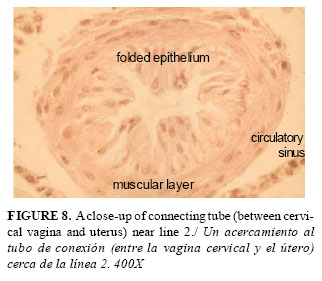
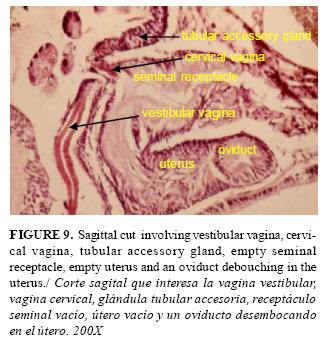
<P><font face="Verdana, Arial, Helvetica, sans-serif" size="2"><B>Central structures    of female genital system </B></font>      <P><font face="Verdana, Arial, Helvetica, sans-serif" size="2"><B> Oviducts:</b>    in both endings of the ovary there are two thin folded tubes, in <I>B.microplus</I>    the diameter of oviducts oscillated between 75 and 140&#181; in females<B> </B>feed    up to 48 hours; they fuse under the seminal receptacle to form the common oviduct    or uterus. </font>     <P><font face="Verdana, Arial, Helvetica, sans-serif" size="2"><B>Uterus:</B>    It is in communication with the cervical vagina by means of an epithelial folded    muscular tube: the <B>connecting tube</B> (<a href="#f8">Fig. 8</a>). In the    <B>cervical vagina</B> (<a href="#f9">Fig. 9</a>), besides the uterus, the <B>seminal    receptacle</B>, <B>tubular accessory glands</B> <B>(TAG)</B> and the <B>vestibular    vagina</B> converge. There are some anatomical particularities in <I>B. microplus</I>    that are evident when sections obtained in this tick (<a href="#f9">Fig. 9</a>)    are compared with schemes of other species like <I>Rhipicephalus appendiculatus    </I>and <I>Hyalomma asiaticum</I> (1,3). In <I>R. appendiculatus </I>and <I>H.    asiaticum,</I> the cervical vagina is very developed, the debouchment of the    seminal receptacle and the uterus form an angle of 180&#176; and are relatively    distant one from the other. On the contrary, in <I>B. microplus</I>, the cervical    vagina is very little, the debouchment of the seminal receptacle and the uterus    in the mentioned vagina form an angle less than 90&#176; and the seminal receptacle    is completely above the uterus. This fact could facilitate the way for spermiophores    to found the course toward the oviducts and ovary.</font>      <P align="center"><font face="Verdana, Arial, Helvetica, sans-serif" size="2"><img src="/img/revistas/rsa/v34n1/f0801112.jpg" width="322" height="281">    <a name="f8"></a>    
<BR>   </font>      ]]></body>
<body><![CDATA[<P>&nbsp;     <P align="center"><img src="/img/revistas/rsa/v34n1/f0901112.jpg" width="327" height="346">    <a name="f9"></a>     
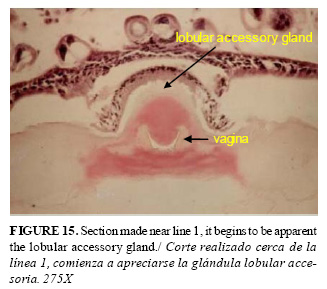
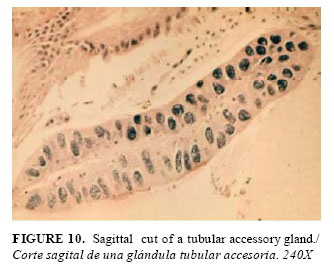
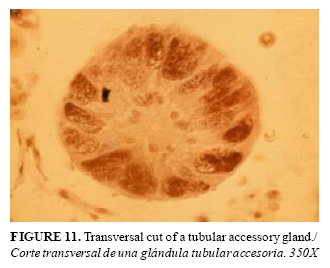
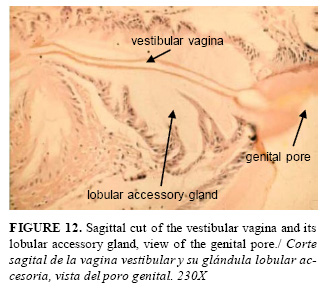
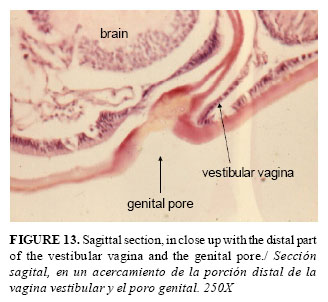
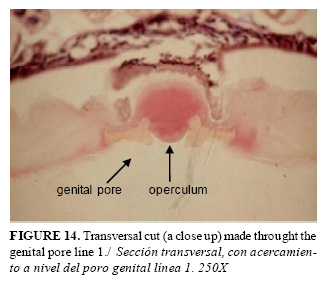
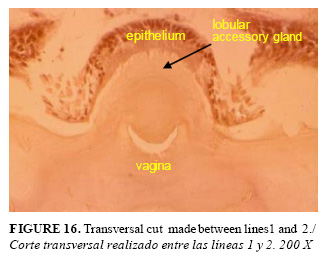
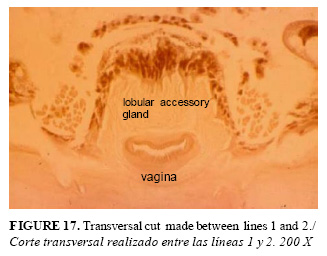
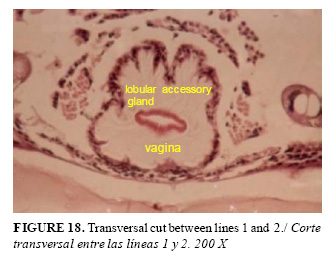
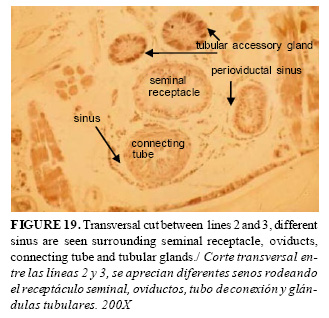
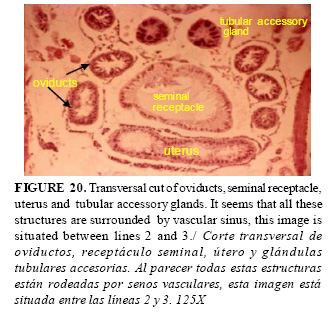
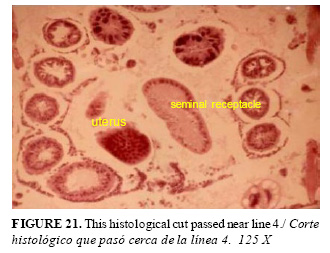
<P><font face="Verdana, Arial, Helvetica, sans-serif" size="2">    <BR>   </font>      <P><font face="Verdana, Arial, Helvetica, sans-serif" size="2">An anatomical view    of one of TAG is shown in <a href="#f5">Fig. 5</a>, and longitudinal and transversal    histological views of one of these glands are presented in <a href="#f10">Fig.    10</a> and <a href="#f11">11</a>. In the female fixed for six days to the host    and with 24 hours with a male near it, these glands have a length of 540&#181;    and 90&#181; of wide. <B>The vestibular vagina:</B> in a sagittal histological    cut (<a href="#f12">Fig. 12</a>), it is seen that it extends from the genital    pore to the cervical vagina. Also, the sagittal sections, and in close up of    the genital pore and the final part of the vestibular vagina can be seen in    <a href="#f13">Fig. 13</a>, <a href="#f14">14</a>, <a href="#f15">15</a>. The    <B>lobular accessory gland</B> is also shown in <a href="#f12">Fig 12</a>; it    is an enlargement of the vestibular vaginal epithelium which produces a secretion    for the initial waterproofing layer for the eggs and also it is the most likely    source of the genital sex pheromone (4, 17). Transversal sections of vestibular    vagina appear in <a href="#f16">Fig. 16</a>, <a href="#f17">17</a>, <a href="#f18">18</a>,    they show that this structure is irregular in shape along it. Next transversal    cuts (<a href="#f19">Fig. 19</a>, <a href="#f20">20</a>, <a href="#f21">21</a>,    <a href="#f22">22</a>) show images of the central part of the genital organs.    In these images, all structures seem to be surrounded by circulatory sinus (in    fact they were never shown in images of<I> B. microplus</I>). It is conspicuous    the likeness of the images in all photographs and this fact discards the possibility    of being a histological technic artifact.</font>      <P align="center"><img src="/img/revistas/rsa/v34n1/f1001112.jpg" width="334" height="271">    <a name="f10"></a>     
<P align="center"><img src="/img/revistas/rsa/v34n1/f1101112.jpg" width="330" height="268">    <a name="f11"></a>     
<P align="center"><font face="Verdana, Arial, Helvetica, sans-serif" size="2"><img src="/img/revistas/rsa/v34n1/f1201112.jpg" width="329" height="292"></font>    <a name="f12"></a>     
<P align="center"><font face="Verdana, Arial, Helvetica, sans-serif" size="2"><img src="/img/revistas/rsa/v34n1/f1301112.jpg" width="328" height="302"></font>    <a name="f13"></a>     
<P align="center"><font face="Verdana, Arial, Helvetica, sans-serif" size="2"><img src="/img/revistas/rsa/v34n1/f1401112.jpg" width="327" height="281"></font>    <a name="f14"></a>     
]]></body>
<body><![CDATA[<P align="center"><font face="Verdana, Arial, Helvetica, sans-serif" size="2"><img src="/img/revistas/rsa/v34n1/f1501112.jpg" width="327" height="289"></font>    <a name="f15"></a>     
<P align="center"><font face="Verdana, Arial, Helvetica, sans-serif" size="2"><img src="/img/revistas/rsa/v34n1/f1601112.jpg" width="328" height="261"></font>    <a name="f16"></a>     
<P align="center"><font face="Verdana, Arial, Helvetica, sans-serif" size="2"><img src="/img/revistas/rsa/v34n1/f1701112.jpg" width="327" height="256"></font>    <a name="f17"></a>     
<P align="center"><font face="Verdana, Arial, Helvetica, sans-serif" size="2"><img src="/img/revistas/rsa/v34n1/f1801112.jpg" width="334" height="258"></font>    <a name="f18"></a>     
<P align="center"><font face="Verdana, Arial, Helvetica, sans-serif" size="2"><img src="/img/revistas/rsa/v34n1/f1901112.jpg" width="329" height="318"></font>    <a name="f19"></a>     
<P align="center"><font face="Verdana, Arial, Helvetica, sans-serif" size="2"><img src="/img/revistas/rsa/v34n1/f2001112.jpg" width="333" height="313"></font>    <a name="f20"></a>     
<P align="center"><font face="Verdana, Arial, Helvetica, sans-serif" size="2"><img src="/img/revistas/rsa/v34n1/f2101112.jpg" width="330" height="253"></font>    <a name="f21"></a>     
<P align="center"><font face="Verdana, Arial, Helvetica, sans-serif" size="2"><img src="/img/revistas/rsa/v34n1/f2201112.jpg" width="331" height="290"><a name="f22"></a>    
<BR>   </font><font face="Verdana, Arial, Helvetica, sans-serif" size="2">    <BR>   </font>     ]]></body>
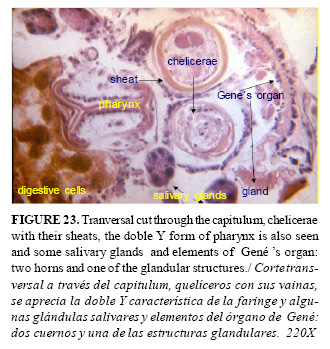
<body><![CDATA[<P align="left"><font face="Verdana, Arial, Helvetica, sans-serif" size="2"><b>Gen&eacute;'s    organ:</b> It is an organ only observed in ticks, it is located in the interior    of the body cavity near the anterior end of the scutum (2,4). It is a paired    structure formed by globular or finger like sacs sometimes called horns and    glandular tissue. Different authors (1,2,3,4) have made a full description of    this organ. When not in use, the organ is retracted within the anterior region    of the body near the capitulum. In <a href="#f23">Fig. 23</a>, a transversal    cut can be appreciated at the cheliceral level, a horn and glandular tissue    of the Gen&eacute;'s organ can be seen.</font>      <P align="center"><img src="/img/revistas/rsa/v34n1/f2301112.jpg" width="330" height="349">    <font face="Verdana, Arial, Helvetica, sans-serif" size="2"><a name="f23"></a>    
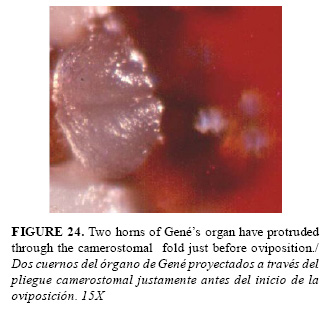
<BR>   </font>     <P align="left"><font face="Verdana, Arial, Helvetica, sans-serif" size="2">    <BR>   When oviposition begins, the swollen structure is projected forward by hydrostatic    pressure, the finger-like processes are everted from the body (4). In <a href="#f24">Fig.    24</a>, it can be appreciated an everted Gen&eacute;'s organ through the camerostomal    fold just before oviposition begins. Gen&eacute;'s organ deposits wax on each    egg as it is delivered from the vagina. The wax coat waterproofs the eggs and    causes them to stick together (17) forming huge masses that also contribute    to retard desiccation.</font>      <P align="center"><font face="Verdana, Arial, Helvetica, sans-serif" size="2"><img src="/img/revistas/rsa/v34n1/f2401112.jpg" width="331" height="309">    <a name="f24"></a>    
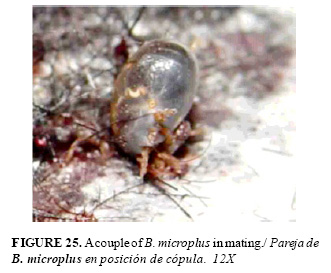
<BR>   </font><font face="Verdana, Arial, Helvetica, sans-serif" size="2">    <BR>   </font>     <P align="left"><font face="Verdana, Arial, Helvetica, sans-serif" size="2"><B>Copula    and semen transport</B> </font>      <P><font face="Verdana, Arial, Helvetica, sans-serif" size="2">Male climbs over    the back of the female and then slide down beneath the couple looking for the    genital pore (18,19) and put itself venter to venter with the female, grasping    it with its legs (<a href="#f25">Fig. 25</a>). The male bends its capitulum    toward the female genital aperture and then introduces its chelicerae which    protrude out of its shafts into the female genital pore (18,19, 20); both hypostome    and palps briefly touch the surface of the female, receptors on the palps mediate    pheromone perception, these sensilla are concentrated on the fourth segment    of the palp on hard ticks (20). A detail study of mating and sexual tick behavior    could be read in Kiszewski <I>et al.</I> (20).</font>      ]]></body>
<body><![CDATA[<P align="center"><img src="/img/revistas/rsa/v34n1/f2501112.jpg" width="331" height="273">    <a name="f25"></a>     
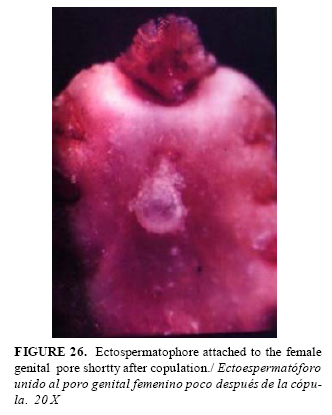
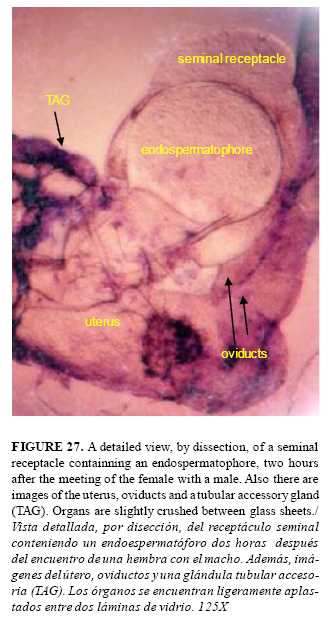
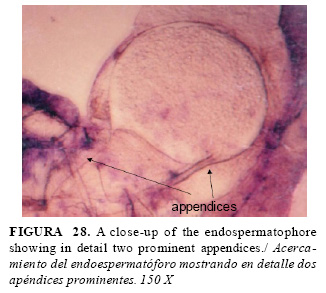
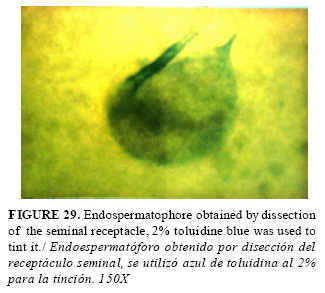
<P><font face="Verdana, Arial, Helvetica, sans-serif" size="2">Male introduces    its chelicerae inside the female genital pore and then ejaculates into a sac,    named ectospermatophore; inside it , there is another sac the endospermatophore    full of inmature seminal cells named spermatids. The male takes the ectospermatophore    with its chelicerae by the neck of the sac and introduces it into the female    genital pore (18). In <a href="#f26">Fig. 26</a>, a female with the ectospermatophore    hanguing from the genital pore can be seen, it is a weak union, and for this    reason, it is not frequent to see it. The ectospermatophore is pear-like in    shape and the maximum diameter oscillates between 400-500&#181; in this tick.    The endospermatophore has a rounded shape (350-400 &#181;) with two appendices,    one greater than the other one. These two appendices have been also described    in other ticks and are characteristic of Ixodidae, whereas in Argasidae, there    is only one (18).</font>      <P align="center"><img src="/img/revistas/rsa/v34n1/f2601112.jpg" width="332" height="415">    <a name="f26"></a>     
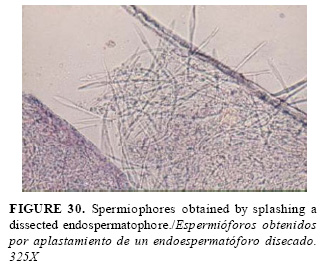
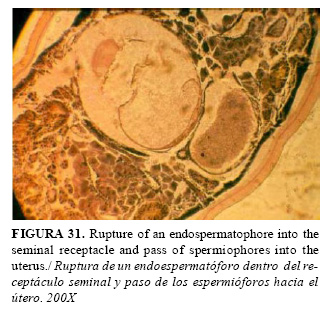
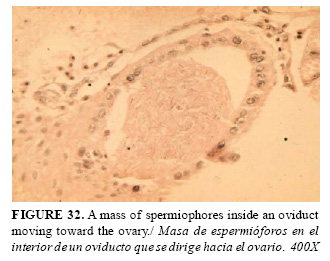
<P><font face="Verdana, Arial, Helvetica, sans-serif" size="2">Spermatids suffer    a capacitation inside the seminal receptacle in order to complete maturation;    already mature cells are called spermiophores (<a href="#f27">Fig. 27</a>, <a href="#f28">28</a>,    <a href="#f29">29</a>, <a href="#f30">30</a>). The minimum time required after    the copula is performed is seven days. When sexual cells are already mature,    the endospermatophore&#180;s wall breaks down and spermiophores form a compact    packet passing into the uterus (<a href="#f31">Fig. 31</a>). Finally in <a href="#f32">Fig.    32</a>, it can be seen how spermiophores are released inside the feminine tract.    It has been suggested (9) that fertilization takes place in the internal cylinder    which extends from the uterus to the ovary itself.</font>      <P align="center"><img src="/img/revistas/rsa/v34n1/f2701112.jpg" width="329" height="622">    <a name="f27"></a>     
<P align="center"><img src="/img/revistas/rsa/v34n1/f2801112.jpg" width="326" height="293">    <a name="f28"></a>     
<P align="center"><img src="/img/revistas/rsa/v34n1/f2901112.jpg" width="325" height="293">    <a name="f29"></a>     
<P align="center"><img src="/img/revistas/rsa/v34n1/f3001112.jpg" width="325" height="270">    <a name="f30"></a>     
<P align="center"><img src="/img/revistas/rsa/v34n1/f3101112.jpg" width="329" height="311">    <a name="f31"></a>     
<P align="center"><img src="/img/revistas/rsa/v34n1/f3201112.jpg" width="330" height="261">    <a name="f32"></a>     
]]></body>
<body><![CDATA[<P>&nbsp;     <P><font face="Verdana, Arial, Helvetica, sans-serif" size="2"><B> <font size="3">REFERENCES</font></B>    </font>      <!-- ref --><P><font face="Verdana, Arial, Helvetica, sans-serif" size="2">1. Till WM. A contribution    to the anatomy and histology of the brown ear tick <I>Rhipicephalus appendiculatus</I>    Newman. Mem Entomol Soc South Africa. 1961;6:124.     </font>      <!-- ref --><P><font face="Verdana, Arial, Helvetica, sans-serif" size="2">2. Arthur DR. Ticks    and Disease. Pergamon Press. Oxford, 1962; 445 pp.     </font>     <!-- ref --><P><font face="Verdana, Arial, Helvetica, sans-serif" size="2">3. Balashov YuS.    Bloodsucking ticks (Ixodoidea)-Vectors of Disease of Man and Animals. (English    translation) Misc Publ Entomol Soc Amer. 1972;8(5):163-376.     </font>     <!-- ref --><P><font face="Verdana, Arial, Helvetica, sans-serif" size="2">4. Sonenshine DE.    Biology of Ticks. Oxford University Press. 1991; 447 pp.     </font>      ]]></body>
<body><![CDATA[<!-- ref --><P><font face="Verdana, Arial, Helvetica, sans-serif" size="2">5. Denardi SE,    Bechara GH, de Oliveira PR, Nunes ET, Saito KC, Camargo Mathias MI. Morphological    characterization of the ovary and vitellogenesis dynamics in the tick <I>Amblyomma    cajennense</I> (Acari: Ixodidae). Vet Parasitol. 2004;125:379-395.     </font>      <!-- ref --><P><font face="Verdana, Arial, Helvetica, sans-serif" size="2">6. de Oliveira    PR, Camargo Mathias MI, Bechara GH. <I>Amblyomma</I> <I>triste</I> (Koch, 1844)    (Acari: Ixodidae): Morphological description of the ovary and of vitellogenesis.    Exp Parasitol. 2007;116:407-413.     </font>     <!-- ref --><P><font face="Verdana, Arial, Helvetica, sans-serif" size="2">7. Hajdu&#154;ek    O. Functional analysis of metabolic and imnune proteins in the tick <I>Ixodes    ricinus </I>by RNA interference. University of South Bohemia, Faculty of Science,    Department of Parasitology, Ph. D.Thesis. 2009; 62 pp.     </font>     <!-- ref --><P><font face="Verdana, Arial, Helvetica, sans-serif" size="2">8. Garc&iacute;a-Fern&aacute;ndez    C, Garc&iacute;a SML, Schneider FL, Severino AG, Winkelmann EC. Regionalization    of oviducts in <I>Boophilus microplus</I> (Canestrini, 1887) (Acari: Ixodidae)    and its potential significance for fertilization. Rev Brasil Biol. 1999;59(4):653-661.        </font>      <!-- ref --><P><font face="Verdana, Arial, Helvetica, sans-serif" size="2">9. Garc&iacute;a-Fern&aacute;ndez    C, Garc&iacute;a SML, Nunes Garc&iacute;a R, da Silva Valente VL. New histochemical    and morphological findings in the female genital tract of <I>Boophilus microplus</I>    (Acari, Ixodidae): an attempt toward the elucidation of fertilization in ticks.    Iheringia, S&eacute;r. Zool., Porto Alegre. 2005;95(3):295-303.     </font>     ]]></body>
<body><![CDATA[<!-- ref --><P><font face="Verdana, Arial, Helvetica, sans-serif" size="2">10.Saito KC, Bechara    GH, Nunes ET, de Oliveira PR, Denardi SE, Camargo Mathias MI. Morphological,    histological, and ultrastructural studies of the ovary of the cattle-tick <I>Boophilus    microplus</I> (Canestrini, 1887) (Acari: Ixodidae). Vet Parasitol. 2005;129:299-311.        </font>     <!-- ref --><P><font face="Verdana, Arial, Helvetica, sans-serif" size="2">11.Schneider I,    Rudinsky JA. Anatomical and histological changes in internal organs of adult    <I>Tripodendron lineatum</I>; <I>Gnathotrichus retusus</I> and <I>G. sulcatus</I>    (Coleoptera: Scolytidae). Ann Entomol Soc Amer. 1969;62(5):995-1003.     </font>     <!-- ref --><P><font face="Verdana, Arial, Helvetica, sans-serif" size="2">12.de la Vega R,    Fern&aacute;ndez C. M&eacute;todo r&aacute;pido de cortes de artr&oacute;podos    en parafina. Rev Cub Med Trop. 1980;32:31-34.     </font>     <!-- ref --><P><font face="Verdana, Arial, Helvetica, sans-serif" size="2">13.de la Vega R.    Una nota sobre un m&eacute;todo para la disecci&oacute;n de genitales femeninos    en garrapatas. Rev cub Cienc agric. 1980;14:293-294.     </font>     <!-- ref --><P><font face="Verdana, Arial, Helvetica, sans-serif" size="2">14.de Oliveira    PR, Camargo Mathias MI, Bechara GH. Vitellogenesis in the tick <I>Amblyomma    triste</I> (Koch, 1844) (Acari: Ixodidae) Role for pedicel cells. Vet Parasitol.    2007;4:134-139.     </font>     ]]></body>
<body><![CDATA[<!-- ref --><P><font face="Verdana, Arial, Helvetica, sans-serif" size="2">15.de Oliveira    PR, Bechara GH, Denardi SE, Nunes ET, Camargo Mathias MI. Morphological characterization    of the ovary and oocytes vitellogenesis of the tick <I>Rhipicephalus sanguineus</I>    (Latreille, 1806) (Acari:Ixodidae). Exp Parasitol. 2005;110:146-156.     </font>     <!-- ref --><P><font face="Verdana, Arial, Helvetica, sans-serif" size="2">16.de Oliveira    PR, Bechara GH, Camargo Mathias MI. <I>Amblyomma triste </I>(Koch, 1844) (Acari:    Ixodidae) Ovaries: An ultrastructural analysis. Exp Parasitol. 2007;116:407-413.        </font>     <!-- ref --><P><font face="Verdana, Arial, Helvetica, sans-serif" size="2">17.Kaufman WR.    Assuring paternity in a promiscuous world: are there lessons for ticks among    the insects? Parasitology. 2004;129:S145-S160.     </font>     <!-- ref --><P><font face="Verdana, Arial, Helvetica, sans-serif" size="2">18.Feldman-Musham    B, Borut S. Copulation in ixodid ticks. J Parasitol. 1971;57(3):630-634.     </font>     <!-- ref --><P><font face="Verdana, Arial, Helvetica, sans-serif" size="2">19.Oliver JHJr.    Symposium on reproduction of arthropods of medical and veterinary importance.    IV Reproduction in ticks (Ixodoidea). J Med Entomol. 1974;11(1):26-34.     </font>      ]]></body>
<body><![CDATA[<!-- ref --><P><font face="Verdana, Arial, Helvetica, sans-serif" size="2">20.Kiszewski AE,    Matuschka FR, Spielman A. Mating strategies and spermiogenesis in ixodid ticks.    Annu Rev Entomol. 2001;46:167-182.    </font>     <P>&nbsp;     <P>&nbsp;     <P><font face="Verdana, Arial, Helvetica, sans-serif" size="2"><B>(Recibido 10-8-2011;    Aceptado 15-11-2011)</B></font>       ]]></body><back>
<ref-list>
<ref id="B1">
<label>1</label><nlm-citation citation-type="journal">
<person-group person-group-type="author">
<name>
<surname><![CDATA[Till]]></surname>
<given-names><![CDATA[WM]]></given-names>
</name>
</person-group>
<article-title xml:lang="en"><![CDATA[A contribution to the anatomy and histology of the brown ear tick Rhipicephalus appendiculatus Newman]]></article-title>
<source><![CDATA[Mem Entomol Soc South Africa]]></source>
<year>1961</year>
<volume>6</volume>
<page-range>124</page-range></nlm-citation>
</ref>
<ref id="B2">
<label>2</label><nlm-citation citation-type="book">
<person-group person-group-type="author">
<name>
<surname><![CDATA[Arthur]]></surname>
<given-names><![CDATA[DR]]></given-names>
</name>
</person-group>
<source><![CDATA[Ticks and Disease]]></source>
<year>1962</year>
<page-range>445</page-range><publisher-loc><![CDATA[Oxford ]]></publisher-loc>
<publisher-name><![CDATA[Pergamon Press]]></publisher-name>
</nlm-citation>
</ref>
<ref id="B3">
<label>3</label><nlm-citation citation-type="journal">
<person-group person-group-type="author">
<name>
<surname><![CDATA[Balashov]]></surname>
<given-names><![CDATA[YuS]]></given-names>
</name>
</person-group>
<article-title xml:lang="en"><![CDATA[Bloodsucking ticks (Ixodoidea)-Vectors of Disease of Man and Animals]]></article-title>
<source><![CDATA[Misc Publ Entomol Soc Amer]]></source>
<year>1972</year>
<volume>8</volume>
<numero>5</numero>
<issue>5</issue>
<page-range>163-376</page-range></nlm-citation>
</ref>
<ref id="B4">
<label>4</label><nlm-citation citation-type="book">
<person-group person-group-type="author">
<name>
<surname><![CDATA[Sonenshine]]></surname>
<given-names><![CDATA[DE]]></given-names>
</name>
</person-group>
<source><![CDATA[Biology of Ticks]]></source>
<year>1991</year>
<page-range>447</page-range><publisher-name><![CDATA[Oxford University Press]]></publisher-name>
</nlm-citation>
</ref>
<ref id="B5">
<label>5</label><nlm-citation citation-type="journal">
<person-group person-group-type="author">
<name>
<surname><![CDATA[Denardi]]></surname>
<given-names><![CDATA[SE]]></given-names>
</name>
<name>
<surname><![CDATA[Bechara]]></surname>
<given-names><![CDATA[GH]]></given-names>
</name>
<name>
<surname><![CDATA[de Oliveira]]></surname>
<given-names><![CDATA[PR]]></given-names>
</name>
<name>
<surname><![CDATA[Nunes]]></surname>
<given-names><![CDATA[ET]]></given-names>
</name>
<name>
<surname><![CDATA[Saito]]></surname>
<given-names><![CDATA[KC]]></given-names>
</name>
<name>
<surname><![CDATA[Camargo Mathias]]></surname>
<given-names><![CDATA[MI]]></given-names>
</name>
</person-group>
<article-title xml:lang="en"><![CDATA[Morphological characterization of the ovary and vitellogenesis dynamics in the tick Amblyomma cajennense (Acari: Ixodidae)]]></article-title>
<source><![CDATA[Vet Parasitol]]></source>
<year>2004</year>
<volume>125</volume>
<page-range>379-395</page-range></nlm-citation>
</ref>
<ref id="B6">
<label>6</label><nlm-citation citation-type="journal">
<person-group person-group-type="author">
<name>
<surname><![CDATA[Bechara]]></surname>
<given-names><![CDATA[GH]]></given-names>
</name>
<name>
<surname><![CDATA[Denardi]]></surname>
<given-names><![CDATA[SE]]></given-names>
</name>
<name>
<surname><![CDATA[Bechara]]></surname>
<given-names><![CDATA[GH]]></given-names>
</name>
</person-group>
<article-title xml:lang="en"><![CDATA[Amblyomma triste (Koch, 1844) (Acari: Ixodidae): Morphological description of the ovary and of vitellogenesis]]></article-title>
<source><![CDATA[Exp Parasitol]]></source>
<year>2007</year>
<volume>116</volume>
<page-range>407-413</page-range></nlm-citation>
</ref>
<ref id="B7">
<label>7</label><nlm-citation citation-type="">
<person-group person-group-type="author">
<name>
<surname><![CDATA[Hajdu&#353;ek]]></surname>
<given-names><![CDATA[O]]></given-names>
</name>
</person-group>
<source><![CDATA[Functional analysis of metabolic and imnune proteins in the tick Ixodes ricinus by RNA interference]]></source>
<year></year>
</nlm-citation>
</ref>
<ref id="B8">
<label>8</label><nlm-citation citation-type="journal">
<person-group person-group-type="author">
<name>
<surname><![CDATA[García-Fernández]]></surname>
<given-names><![CDATA[C]]></given-names>
</name>
<name>
<surname><![CDATA[García]]></surname>
<given-names><![CDATA[SML]]></given-names>
</name>
<name>
<surname><![CDATA[Schneider]]></surname>
<given-names><![CDATA[FL]]></given-names>
</name>
<name>
<surname><![CDATA[Severino]]></surname>
<given-names><![CDATA[AG]]></given-names>
</name>
<name>
<surname><![CDATA[Winkelmann]]></surname>
<given-names><![CDATA[EC]]></given-names>
</name>
</person-group>
<article-title xml:lang="en"><![CDATA[Regionalization of oviducts in Boophilus microplus (Canestrini, 1887) (Acari: Ixodidae) and its potential significance for fertilization]]></article-title>
<source><![CDATA[Rev Brasil Biol]]></source>
<year>1999</year>
<volume>59</volume>
<numero>4</numero>
<issue>4</issue>
<page-range>653-661</page-range></nlm-citation>
</ref>
<ref id="B9">
<label>9</label><nlm-citation citation-type="journal">
<person-group person-group-type="author">
<name>
<surname><![CDATA[García]]></surname>
<given-names><![CDATA[SML]]></given-names>
</name>
<name>
<surname><![CDATA[García-Fernández]]></surname>
<given-names><![CDATA[C]]></given-names>
</name>
<name>
<surname><![CDATA[Nunes García]]></surname>
<given-names><![CDATA[R]]></given-names>
</name>
<name>
<surname><![CDATA[da Silva Valente]]></surname>
<given-names><![CDATA[VL]]></given-names>
</name>
</person-group>
<article-title xml:lang="en"><![CDATA[New histochemical and morphological findings in the female genital tract of Boophilus microplus (Acari, Ixodidae): an attempt toward the elucidation of fertilization in ticks]]></article-title>
<source><![CDATA[Iheringia]]></source>
<year>2005</year>
<volume>95</volume>
<numero>3</numero>
<issue>3</issue>
<page-range>295-303</page-range></nlm-citation>
</ref>
<ref id="B10">
<label>10</label><nlm-citation citation-type="journal">
<person-group person-group-type="author">
<name>
</name>
<name>
</name>
<name>
<surname><![CDATA[da Silva Valente]]></surname>
<given-names><![CDATA[VL]]></given-names>
</name>
<name>
<surname><![CDATA[Nunes García]]></surname>
<given-names><![CDATA[R]]></given-names>
</name>
<name>
<surname><![CDATA[García-Fernández]]></surname>
<given-names><![CDATA[C]]></given-names>
</name>
<name>
<surname><![CDATA[García]]></surname>
<given-names><![CDATA[SML]]></given-names>
</name>
</person-group>
<article-title xml:lang="en"><![CDATA[Morphological, histological, and ultrastructural studies of the ovary of the cattle-tick Boophilus microplus (Canestrini, 1887) (Acari: Ixodidae)]]></article-title>
<source><![CDATA[Vet Parasitol]]></source>
<year>2005</year>
<volume>129</volume>
<page-range>299-311</page-range></nlm-citation>
</ref>
<ref id="B11">
<label>11</label><nlm-citation citation-type="journal">
<person-group person-group-type="author">
<name>
<surname><![CDATA[Schneider]]></surname>
<given-names><![CDATA[I]]></given-names>
</name>
<name>
<surname><![CDATA[Rudinsky]]></surname>
<given-names><![CDATA[JA]]></given-names>
</name>
</person-group>
<article-title xml:lang="en"><![CDATA[Anatomical and histological changes in internal organs of adult Tripodendron lineatum; Gnathotrichus retusus and G. sulcatus (Coleoptera: Scolytidae)]]></article-title>
<source><![CDATA[Ann Entomol Soc Amer]]></source>
<year>1969</year>
<volume>62</volume>
<numero>5</numero>
<issue>5</issue>
<page-range>995-1003</page-range></nlm-citation>
</ref>
<ref id="B12">
<label>12</label><nlm-citation citation-type="journal">
<person-group person-group-type="author">
<name>
<surname><![CDATA[de la Vega]]></surname>
<given-names><![CDATA[R]]></given-names>
</name>
<name>
<surname><![CDATA[Fernández]]></surname>
<given-names><![CDATA[C]]></given-names>
</name>
</person-group>
<article-title xml:lang="es"><![CDATA[Método rápido de cortes de artrópodos en parafina]]></article-title>
<source><![CDATA[Rev Cub Med Trop]]></source>
<year>1980</year>
<volume>32</volume>
<page-range>31-34</page-range></nlm-citation>
</ref>
<ref id="B13">
<label>13</label><nlm-citation citation-type="journal">
<person-group person-group-type="author">
<name>
<surname><![CDATA[de la Vega]]></surname>
<given-names><![CDATA[R]]></given-names>
</name>
</person-group>
<article-title xml:lang="es"><![CDATA[Una nota sobre un método para la disección de genitales femeninos en garrapatas]]></article-title>
<source><![CDATA[Rev cub Cienc agric]]></source>
<year>1980</year>
<volume>14</volume>
<page-range>293-294</page-range></nlm-citation>
</ref>
<ref id="B14">
<label>14</label><nlm-citation citation-type="journal">
<person-group person-group-type="author">
<name>
</name>
<name>
</name>
<name>
<surname><![CDATA[de la Vega]]></surname>
<given-names><![CDATA[R]]></given-names>
</name>
</person-group>
<article-title xml:lang="en"><![CDATA[Vitellogenesis in the tick Amblyomma triste (Koch, 1844) (Acari: Ixodidae) Role for pedicel cells]]></article-title>
<source><![CDATA[Vet Parasitol]]></source>
<year>2007</year>
<volume>4</volume>
<page-range>134-139</page-range></nlm-citation>
</ref>
<ref id="B15">
<label>15</label><nlm-citation citation-type="journal">
<person-group person-group-type="author">
<name>
</name>
<name>
</name>
<name>
<surname><![CDATA[de la Vega]]></surname>
<given-names><![CDATA[R]]></given-names>
</name>
<name>
</name>
<name>
</name>
</person-group>
<article-title xml:lang="en"><![CDATA[Morphological characterization of the ovary and oocytes vitellogenesis of the tick Rhipicephalus sanguineus (Latreille, 1806) (Acari:Ixodidae)]]></article-title>
<source><![CDATA[Exp Parasitol]]></source>
<year>2005</year>
<volume>110</volume>
<page-range>146-156</page-range></nlm-citation>
</ref>
<ref id="B16">
<label>16</label><nlm-citation citation-type="journal">
<person-group person-group-type="author">
<name>
<surname><![CDATA[de la Vega]]></surname>
<given-names><![CDATA[R]]></given-names>
</name>
<name>
</name>
<name>
</name>
</person-group>
<article-title xml:lang="en"><![CDATA[Amblyomma triste (Koch, 1844) (Acari: Ixodidae) Ovaries: An ultrastructural analysis]]></article-title>
<source><![CDATA[Exp Parasitol]]></source>
<year>2007</year>
<volume>116</volume>
<page-range>407-413</page-range></nlm-citation>
</ref>
<ref id="B17">
<label>17</label><nlm-citation citation-type="journal">
<person-group person-group-type="author">
<name>
<surname><![CDATA[Kaufman]]></surname>
<given-names><![CDATA[WR]]></given-names>
</name>
</person-group>
<article-title xml:lang="en"><![CDATA[Assuring paternity in a promiscuous world: are there lessons for ticks among the insects?]]></article-title>
<source><![CDATA[Parasitology]]></source>
<year>2004</year>
<volume>129</volume>
<page-range>S145-S160</page-range></nlm-citation>
</ref>
<ref id="B18">
<label>18</label><nlm-citation citation-type="journal">
<person-group person-group-type="author">
<name>
<surname><![CDATA[Feldman-Musham]]></surname>
<given-names><![CDATA[B]]></given-names>
</name>
<name>
<surname><![CDATA[Borut]]></surname>
<given-names><![CDATA[S]]></given-names>
</name>
</person-group>
<article-title xml:lang="en"><![CDATA[Copulation in ixodid ticks]]></article-title>
<source><![CDATA[J Parasitol]]></source>
<year>1971</year>
<volume>57</volume>
<numero>3</numero>
<issue>3</issue>
<page-range>630-634</page-range></nlm-citation>
</ref>
<ref id="B19">
<label>19</label><nlm-citation citation-type="journal">
<person-group person-group-type="author">
<name>
<surname><![CDATA[Oliver]]></surname>
<given-names><![CDATA[JHJr]]></given-names>
</name>
</person-group>
<article-title xml:lang="en"><![CDATA[Symposium on reproduction of arthropods of medical and veterinary importance: IV Reproduction in ticks]]></article-title>
<source><![CDATA[J Med Entomol]]></source>
<year>1974</year>
<volume>11</volume>
<numero>1</numero>
<issue>1</issue>
<page-range>26-34</page-range></nlm-citation>
</ref>
<ref id="B20">
<label>20</label><nlm-citation citation-type="journal">
<person-group person-group-type="author">
<name>
<surname><![CDATA[Kiszewski]]></surname>
<given-names><![CDATA[AE]]></given-names>
</name>
<name>
<surname><![CDATA[Matuschka]]></surname>
<given-names><![CDATA[FR]]></given-names>
</name>
<name>
<surname><![CDATA[Spielman]]></surname>
<given-names><![CDATA[A]]></given-names>
</name>
</person-group>
<article-title xml:lang="en"><![CDATA[Mating strategies and spermiogenesis in ixodid ticks]]></article-title>
<source><![CDATA[Annu Rev Entomol]]></source>
<year>2001</year>
<volume>46</volume>
<page-range>167-182</page-range></nlm-citation>
</ref>
</ref-list>
</back>
</article>