<?xml version="1.0" encoding="ISO-8859-1"?><article xmlns:mml="http://www.w3.org/1998/Math/MathML" xmlns:xlink="http://www.w3.org/1999/xlink" xmlns:xsi="http://www.w3.org/2001/XMLSchema-instance">
<front>
<journal-meta>
<journal-id>0253-570X</journal-id>
<journal-title><![CDATA[Revista de Salud Animal]]></journal-title>
<abbrev-journal-title><![CDATA[Rev Salud Anim.]]></abbrev-journal-title>
<issn>0253-570X</issn>
<publisher>
<publisher-name><![CDATA[Centro Nacional de Sanidad Agropecuaria]]></publisher-name>
</publisher>
</journal-meta>
<article-meta>
<article-id>S0253-570X2014000100002</article-id>
<title-group>
<article-title xml:lang="en"><![CDATA[Prevalence, somatic cell count and etiology of bovine mastitis in Cuban herds from Mayabeque province using hand and machine milking]]></article-title>
<article-title xml:lang="es"><![CDATA[Prevalencia, conteo de células somáticas y etiología de la mastitis bovina en rebaños cubanos de la provincia Mayabeque con ordeño manual y mecánico]]></article-title>
</title-group>
<contrib-group>
<contrib contrib-type="author">
<name>
<surname><![CDATA[Kent Ruiz]]></surname>
<given-names><![CDATA[Amado]]></given-names>
</name>
<xref ref-type="aff" rid="A01"/>
</contrib>
<contrib contrib-type="author">
<name>
<surname><![CDATA[Peña]]></surname>
<given-names><![CDATA[Joan]]></given-names>
</name>
<xref ref-type="aff" rid="A01"/>
</contrib>
<contrib contrib-type="author">
<name>
<surname><![CDATA[González]]></surname>
<given-names><![CDATA[Dayaimi]]></given-names>
</name>
<xref ref-type="aff" rid="A01"/>
</contrib>
<contrib contrib-type="author">
<name>
<surname><![CDATA[Ponce]]></surname>
<given-names><![CDATA[Pastor]]></given-names>
</name>
<xref ref-type="aff" rid="A01"/>
</contrib>
</contrib-group>
<aff id="A01">
<institution><![CDATA[,National Center for Animal and Plant Health (CENSA) Center of Assays for Foods Quality Control (CENLAC) ]]></institution>
<addr-line><![CDATA[Mayabeque ]]></addr-line>
<country>Cuba</country>
</aff>
<pub-date pub-type="pub">
<day>00</day>
<month>04</month>
<year>2014</year>
</pub-date>
<pub-date pub-type="epub">
<day>00</day>
<month>04</month>
<year>2014</year>
</pub-date>
<volume>36</volume>
<numero>1</numero>
<fpage>7</fpage>
<lpage>13</lpage>
<copyright-statement/>
<copyright-year/>
<self-uri xlink:href="http://scielo.sld.cu/scielo.php?script=sci_arttext&amp;pid=S0253-570X2014000100002&amp;lng=en&amp;nrm=iso"></self-uri><self-uri xlink:href="http://scielo.sld.cu/scielo.php?script=sci_abstract&amp;pid=S0253-570X2014000100002&amp;lng=en&amp;nrm=iso"></self-uri><self-uri xlink:href="http://scielo.sld.cu/scielo.php?script=sci_pdf&amp;pid=S0253-570X2014000100002&amp;lng=en&amp;nrm=iso"></self-uri><abstract abstract-type="short" xml:lang="en"><p><![CDATA[Few studies have been developed to evaluate the differences of bovine mastitis situation between hand and machine milking under the American tropic conditions. Twenty dairy herds were studied, 11 using hand milking (HM) and 9 machine milking (MM), from «San José de las Lajas» municipality, Mayabeque province. Between May 2009 and March 2012, samples from 182 cows (113 MM and 69 HM) were obtained meaning a 35.1% of total milking cows, resulting in 708 quarters sampled (435 MM and 273 HM). Samples were subjected to bacteriological diagnosis and somatic cell count (SCC). There were significant differences for the prevalence of blind quarters, subclinical mastitis and intramammary infections between hand milking, 1.1; 29.4 and 59.4% and machine milking, 3.8; 59.0 and 79.9%, respectively. A significant difference was found for somatic cell count averages, with 361 000 and 984 000 cells/ml for hand and machine milking, respectively. Only Streptococcus agalactiae had a difference of statistical relevance for distribution by herds, 18.2% in hand milking and 88.9% in machine milking. In samples from herds with hand milking, the pathogens of higher frequency were: Corynebacterium bovis 24.4 %, Coagulase Negative Staphylococcus 13.3% and Staphylococcus aureus 6.6%; those in machine milking herds were: Coagulase Negative Staphylococcus 33.0%, Corynebacterium bovis 15.8 % and Streptococcus agalactiae 7.4%. The somatic cell count averages for the bacteriological diagnoses showed a significant difference between milking types, for negative quarters, Coagulase Negative Staphylococcus and Corynebacterium bovis. Bovine mastitis presented a worse situation in the herds using machine milking.]]></p></abstract>
<abstract abstract-type="short" xml:lang="es"><p><![CDATA[En el trópico americano se han realizado pocos trabajos para evaluar las diferencias de la mastitis bovina entre ordeño manual y mecánico. Fueron estudiadas 20 propiedades productoras de leche bovina, 11 con ordeño manual y 9 con ordeño mecánico, del municipio San José de las Lajas, provincia Mayabeque. Entre mayo de 2009 y marzo de 2012 se tomaron muestras de 182 vacas (113 ordeño mecánico y 69 manual); del 35.1% de las vacas en ordeño, se obtuvieron 708 muestras de cuartos (435 y 273). Las muestras fueron sometidas a diagnóstico bacteriológico y Conteo de Células Somáticas (CCS). Se encontraron diferencias significativas para la prevalencia de cuartos atrofiados, mastitis subclínica e infecciones intramamarias entre ordeño manual, 1,1; 29,4 y 59,4% y ordeño mecánico, 3,8; 59,0 y 79,9% respectivamente. Existió diferencia significativa en la media del CCS, con 361 000 y 984 000 células/ml para ordeño manual y mecánico respectivamente. Solamente Streptococcus agalactiae tuvo una diferencia de relevancia estadística en la distribución por rebaños, con 18,2 % en ordeño manual y 88,9% en mecánico. En ordeño manual los patógenos de mayor frecuencia fueron: Corynebacterium bovis 24,4%, Staphylococcus Coagulasa Negativo (SCN) 13,3% y Staphylococcus aureus 6,6%; en ordeño mecánico: SCN 33,0%, Corynebacterium bovis 15,8% y Streptococcus agalactiae 7,4%. Los CCS medios según los diagnósticos bacteriológicos solamente evidenciaron una diferencia significativa entre tipos de ordeño, para cuartos negativos, SCN y Corynebacterium bovis. En los rebaños estudiados, la mastitis bovina presenta peor situación en el ordeño mecánico.]]></p></abstract>
<kwd-group>
<kwd lng="en"><![CDATA[bovine mastitis]]></kwd>
<kwd lng="en"><![CDATA[coagulase negative Staphylococcus]]></kwd>
<kwd lng="en"><![CDATA[Corynebacterium bovis]]></kwd>
<kwd lng="en"><![CDATA[Staphylococcus aureus]]></kwd>
<kwd lng="en"><![CDATA[Streptococcus agalactiae]]></kwd>
<kwd lng="es"><![CDATA[Mastitis bovina]]></kwd>
<kwd lng="es"><![CDATA[Staphylococcus Coagulasa Negativo]]></kwd>
<kwd lng="es"><![CDATA[Corynebacterium bovis]]></kwd>
<kwd lng="es"><![CDATA[Staphylococcus aureus]]></kwd>
<kwd lng="es"><![CDATA[Streptococcus agalactiae]]></kwd>
</kwd-group>
</article-meta>
</front><body><![CDATA[ <p align="right"><font face="Verdana, Arial, Helvetica, sans-serif" size="2"><B>ORIGINAL    ARTICLE</B></font></p>     <p>&nbsp;</p>     <p><font face="Verdana, Arial, Helvetica, sans-serif" size="2"><B><font size="4">Prevalence,    somatic cell count and etiology of bovine mastitis in Cuban herds from Mayabeque    province using hand and machine milking</font></B></font></p>     <p>&nbsp;</p>     <p><font face="Verdana, Arial, Helvetica, sans-serif" size="2"><b><font size="3">Prevalencia,    conteo de c&eacute;lulas som&aacute;ticas y etiolog&iacute;a de la mastitis    bovina en reba&ntilde;os cubanos de la provincia Mayabeque con orde&ntilde;o    manual y mec&aacute;nico</font> </b></font></p>     <p>&nbsp;</p>     <p>&nbsp;</p>     <p><font face="Verdana, Arial, Helvetica, sans-serif" size="2"><b>Amado Kent Ruiz,    Joan Pe&ntilde;a, Dayaimi Gonz&aacute;lez, Pastor Ponce</b></font><b> </b></p>     <P><font face="Verdana, Arial, Helvetica, sans-serif" size="2">Center of Assays    for Foods Quality Control (CENLAC), National Center for Animal and Plant Health    (CENSA), P.O. Box 10, San Jos&eacute; de las Lajas, CP 32 700, Mayabeque, Cuba.    E-mail: <U><a href="mailto:kent@censa.edu.cu">kent@censa.edu.cu</a></U>.</font>      <P>&nbsp;     ]]></body>
<body><![CDATA[<P>&nbsp; <hr noshade size="1">     <P><font face="Verdana, Arial, Helvetica, sans-serif" size="2"><B>ABSTRACT</B></font>     <P><font face="Verdana, Arial, Helvetica, sans-serif" size="2">Few studies have    been developed to evaluate the differences of bovine mastitis situation between    hand and machine milking under the American tropic conditions. Twenty dairy    herds were studied, 11 using hand milking (HM) and 9 machine milking (MM), from    &#171;San Jos&eacute; de las Lajas&#187; municipality, Mayabeque province. Between    May 2009 and March 2012, samples from 182 cows (113 MM and 69 HM) were obtained    meaning a 35.1% of total milking cows, resulting in 708 quarters sampled (435    MM and 273 HM). Samples were subjected to bacteriological diagnosis and somatic    cell count (SCC). There were significant differences for the prevalence of blind    quarters, subclinical mastitis and intramammary infections between hand milking,    1.1; 29.4 and 59.4% and machine milking, 3.8; 59.0 and 79.9%, respectively.    A significant difference was found for somatic cell count averages, with 361    000 and 984 000 cells/ml for hand and machine milking, respectively. Only <I>Streptococcus    agalactiae</I> had a difference of statistical relevance for distribution by    herds, 18.2% in hand milking and 88.9% in machine milking. In samples from herds    with hand milking, the pathogens of higher frequency were: <I>Corynebacterium    bovis</I> 24.4 %, Coagulase Negative <I>Staphylococcus</I> 13.3% and <I>Staphylococcus    aureus</I> 6.6%; those in machine milking herds were: Coagulase Negative <I>Staphylococcus</I>    33.0%, <I>Corynebacterium bovis</I> 15.8 % and <I>Streptococcus agalactiae</I>    7.4%. The somatic cell count averages for the bacteriological diagnoses showed    a significant difference between milking types, for negative quarters, Coagulase    Negative <I>Staphylococcus</I> and <I>Corynebacterium bovis</I>. Bovine mastitis    presented a worse situation in the herds using machine milking. </font>     <P><font face="Verdana, Arial, Helvetica, sans-serif" size="2"><B>Key words:</B>    bovine mastitis, coagulase negative <I>Staphylococcus</I>, <I>Corynebacterium</I>    <I>bovis</I>, <I>Staphylococcus</I> <I>aureus</I>, <I>Streptococcus agalactiae.</I></font> <hr noshade size="1">     <p><font face="Verdana, Arial, Helvetica, sans-serif" size="2"><B>RESUMEN</b></font></p>     <p><font face="Verdana, Arial, Helvetica, sans-serif" size="2">En el tr&oacute;pico    americano se han realizado pocos trabajos para evaluar las diferencias de la    mastitis bovina entre orde&ntilde;o manual y mec&aacute;nico. Fueron estudiadas    20 propiedades productoras de leche bovina, 11 con orde&ntilde;o manual y 9    con orde&ntilde;o mec&aacute;nico, del municipio San Jos&eacute; de las Lajas,    provincia Mayabeque. Entre mayo de 2009 y marzo de 2012 se tomaron muestras    de 182 vacas (113 orde&ntilde;o mec&aacute;nico y 69 manual); del 35.1% de las    vacas en orde&ntilde;o, se obtuvieron 708 muestras de cuartos (435 y 273). Las    muestras fueron sometidas a diagn&oacute;stico bacteriol&oacute;gico y Conteo    de C&eacute;lulas Som&aacute;ticas (CCS). Se encontraron diferencias significativas    para la prevalencia de cuartos atrofiados, mastitis subcl&iacute;nica e infecciones    intramamarias entre orde&ntilde;o manual, 1,1; 29,4 y 59,4% y orde&ntilde;o    mec&aacute;nico, 3,8; 59,0 y 79,9% respectivamente. Existi&oacute; diferencia    significativa en la media del CCS, con 361 000 y 984 000 c&eacute;lulas/ml para    orde&ntilde;o manual y mec&aacute;nico respectivamente. Solamente <I>Streptococcus    agalactiae</I> tuvo una diferencia de relevancia estad&iacute;stica en la distribuci&oacute;n    por reba&ntilde;os, con 18,2 % en orde&ntilde;o manual y 88,9% en mec&aacute;nico.    En orde&ntilde;o manual los pat&oacute;genos de mayor frecuencia fueron: <I>Corynebacterium    bovis</I> 24,4%, <I>Staphylococcus</I> Coagulasa Negativo (SCN) 13,3% y <I>Staphylococcus    aureus</I> 6,6%; en orde&ntilde;o mec&aacute;nico: SCN 33,0%, <I>Corynebacterium    bovis</I> 15,8% y <I>Streptococcus</I> <I>agalactiae</I> 7,4%. Los CCS medios    seg&uacute;n los diagn&oacute;sticos bacteriol&oacute;gicos solamente evidenciaron    una diferencia significativa entre tipos de orde&ntilde;o, para cuartos negativos,    SCN y <I>Corynebacterium</I> <I>bovis</I>. En los reba&ntilde;os estudiados,    la mastitis bovina presenta peor situaci&oacute;n en el orde&ntilde;o mec&aacute;nico.    </font> </p>     <P><font face="Verdana, Arial, Helvetica, sans-serif" size="2"><B>Palabras clave:</B>    Mastitis bovina, <I>Staphylococcus</I> Coagulasa Negativo, <I>Corynebacterium</I>    <I>bovis</I>, <I>Staphylococcus</I> <I>aureus</I>, <I>Streptococcus agalactiae.</I></font> <hr noshade size="1">     <P>&nbsp;     <P>&nbsp;     <P><font face="Verdana, Arial, Helvetica, sans-serif" size="2"><B><font size="3">INTRODUCTION</font></B>    </font>     ]]></body>
<body><![CDATA[<P><font face="Verdana, Arial, Helvetica, sans-serif" size="2">Bovine mastitis    is an inflammatory response of the mammary gland. It has a major impact on animal    production, animal welfare and milk quality. Mastitis is one of the biggest    problems for dairy because of the highest morbility and significant economic    losses (1,2). </font>     <P><font face="Verdana, Arial, Helvetica, sans-serif" size="2">The results of    microbiological tests can be used for the adoption of specific control measures,    identification of emerging pathogens, culling animals with chronic infection,    evaluation of proficiency tests for treatments, and to establish antimicrobial    susceptibility profiles (3). Especially important is to identify the circulating    microorganisms and their characteristics before considering a mastitis control    program (4). The term &#171;intramammary infection&#187; (IMI) is not strictly    synonym of mastitis; IMI is commonly used in the etiology context defined, using    complex diagnostic procedures (5). </font>     <P><font face="Verdana, Arial, Helvetica, sans-serif" size="2">There are few studies    in order to evaluate differences between machine and hand milking under American    tropic conditions, however mastitis is a serious problem for both milking systems,    and prevalence is normally high (6); there are significant differences concerning    IMI, clinic, subclinical mastitis prevalence and incidence, total counts of    aerobic mesophilic and coliform bacteria and the isolated IMI pathogens; with    a higher subclinical mastitis in animals using hand milking, in Venezuela and    Mexico (7, 8). However, some preliminary results indicate the opposite situation    in Cuba (9). </font>     <P><font face="Verdana, Arial, Helvetica, sans-serif" size="2">The present study    was conducted to microbiologically and epidemiologically differentiate mastitis    in a Cuban municipality for each type of milking systems.</font>     <P>&nbsp;     <P><font face="Verdana, Arial, Helvetica, sans-serif" size="2"><B><font size="3">MATERIALS    AND METHODS</font></B> </font>     <P><font face="Verdana, Arial, Helvetica, sans-serif" size="2">The study included    20 dairy herds, 11 under hand milking system (HM) and 9 using machine milking    (MM). All herds were located in &#171;San Jos&eacute; de las Lajas&#187; municipality,    Mayabeque province. Each herd had heterogeneity in breed, animal age and stage    of lactation. Herds were visited between May 2009 and March 2012. Samples from    182 cows (113 MM and 69 HM) were obtained, meaning a 35.1 % of total milking    cows, resulting in 708 quarters sampled (435 MM and 273 HM). During sampling,    the milking routine was observed in each herd. If a quarter did not produce    milk, it would be considered blind or atrophied. The clinical mastitis diagnostic    was based on the examination of cow&#180;s, udder and forestrip test result.    The sampling methodology was according to NMC guidelines (10). Samples from    very far herds were frozen until arriving to the laboratory. </font>     <P><font face="Verdana, Arial, Helvetica, sans-serif" size="2">In each sample,    0.1ml was streaked into blood agar (Columbia agar base supplemented with 5%    defibrinated sheep blood), incubated from 48 to 72 hours at 37<SUP>o</SUP>C.    A valid isolation was considered when more than three identical colonies per    sample were found; samples with more than three types of colonies were considered    a contaminated one. Pure cultures were tested by: catalase, oxidase and Gram    stain for a presumptive diagnosis until genera level: <I>Staphylococcus</I>,    <I>Streptococcus</I>, <I>Corynebacterium</I>, <I>Bacillus</I>,<I> Candida </I>and<I>    Prototheca. </I>For <I>Corynebacterium bovis</I> identification, the differential    growth was used on unsupplemented Tryptic Soy Agar (TSA) and TSA supplemented    with 1% of Tween 80. <I>Staphylococcus</I> species differentiation was supported    by coagulase and Voges-Proskauer test; divided in to <I>S. aureus</I>, Coagulase    Positive Staphylococcus (CPS) and Coagulase Negative Staphylococcus (CNS) if    the results were positive - positive, positive - negative and negative - negative/positive    for both tests, respectively. For <I>Streptococcus agalactiae </I>identification,    Edward medium was used following the manufacturer indications. </font>     <P><font face="Verdana, Arial, Helvetica, sans-serif" size="2">Somatic cells in    milk samples were counted by the Fossomatic Minor equipment (Foss, Hiller&oslash;d,    Denmark). The resulting values were transformed into Somatic Cell Score (SCS)    (11). </font>     <P><font face="Verdana, Arial, Helvetica, sans-serif" size="2">For data analysis,    there was a comparison of binomial proportions using hypothesis testing and    t-test for comparing two sample means using the program Statgraphics Plus 5.1    for Windows.</font>     ]]></body>
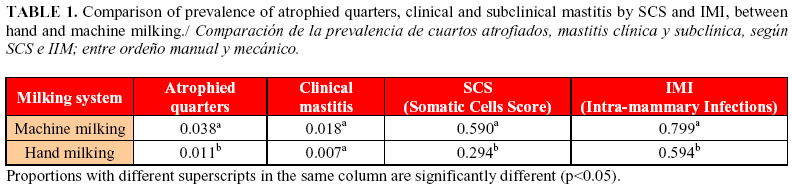
<body><![CDATA[<P>&nbsp;     <P><font face="Verdana, Arial, Helvetica, sans-serif" size="2"><B><font size="3">RESULTS    AND DISCUSSION</font></B> </font>     <P><font face="Verdana, Arial, Helvetica, sans-serif" size="2">Days under lactation    and parity averages of all herds were 157.5 and 3.7 (115.2; 3.5 for MM and 176.8;    3.9 for HM), several studies (12, 13) mention these variables as risk factors.    </font>     <P><font face="Verdana, Arial, Helvetica, sans-serif" size="2">There is a significant    difference between hand and machine milking systems regarding the prevalence    of atrophied quarters, subclinical mastitis (if SCS&gt;4) and IMI; being better    in general for hand milking (<a href="/img/revistas/rsa/v36n1/t0102114.jpg">Table    1</a>). There is no significant difference for clinical mastitis prevalence    between the milking systems. </font>      
<P><font face="Verdana, Arial, Helvetica, sans-serif" size="2">Following similar    conditions, other authors could not find significant differences regarding atrophied    quarters; i.e. 3.9 % and 3.0 % for hand and machine milking, respectively (9).    The explanation for our findings could be the non-optimal technical conditions    of milking machines, taking into account frequently electric failures, generating    more atrophied quarters. </font>     <P><font face="Verdana, Arial, Helvetica, sans-serif" size="2">The values of clinical    mastitis reported here were very inferior with respect to other studies in recent    years (6, 14, 15), all greater than 4%. </font>     <P><font face="Verdana, Arial, Helvetica, sans-serif" size="2">Subclinical mastitis    is 15-40 %, more prevalent than clinical mastitis (16). In these results, the    difference was close to 40%, a possible explanation is the underestimated diagnostic    of clinical mastitis since there was a lack of forestrip test in some herds.    </font>     <P><font face="Verdana, Arial, Helvetica, sans-serif" size="2">The highest prevalence    of subclinical mastitis was found in machine milking and can be associated to    non-well-functioning machines used in these herds, more specifically: old and    porous teat cup, out of frequency pulsation system, out of order vacuums and    lack of cleaning supplies; besides there was a delay or suspended milking by    electrical power failures. </font>     <P><font face="Verdana, Arial, Helvetica, sans-serif" size="2">Another study made    in Colombia showed smooth differences in subclinical mastitis prevalence by    comparing the milking systems, 23.6% in hand milking and 30.0% in machine milking;    the mastitis status was determined by California Mastitis Test (CMT) and less    herds were used (6). A research in Mexico showed a higher prevalence in hand    milking (57%) than in machine milking (33%), but just one herd was included    per milking system (7). The highest prevalence using machine milking (35%) over    hand milking (25.9%) was previously demonstrated in Cuba (9), but with less    numbers of herds and quarters than in this study. </font>     <P><font face="Verdana, Arial, Helvetica, sans-serif" size="2">The fact that IMI    prevalence was higher in machine milking than in hand milking was found in other    countries like Venezuela (17, 18). A possible explanation for the difference    is that milking machines become fomites and traumatic agents if the periodical    maintenance fails (17). </font>     ]]></body>
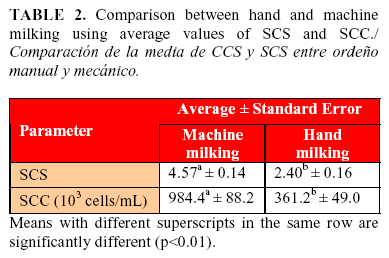
<body><![CDATA[<P><font face="Verdana, Arial, Helvetica, sans-serif" size="2">According to other    researchers, the proceedings in machine milking pre-disposed the bacteria entrance    throw the teat channel (19). Based on the mammary gland tissue reaction to the    milking machine, researchers found that the machine represented a higher risk    to get IMI, compared to the use of calf (20). Machine milking provided an opportunity    for bacterial transmission among cows and cow's quarter, due to variation in    the pressure vacuum, wear of the teat cups and over-milking (18). </font>     <P><font face="Verdana, Arial, Helvetica, sans-serif" size="2">There was a high    difference (higher than 20 units) of prevalence between subclinical mastitis    and IMI in both milking systems, but in the case of machine milking, that difference    was more reduced and both values were higher, suggesting that machine milking    contributed to the increase of mammary inflammation and predisposition of bacterial    infection. </font>     <P><font face="Verdana, Arial, Helvetica, sans-serif" size="2">The inflammatory    reaction was measured by electronic count and average values were significantly    lower in hand milking (<a href="#t2">Table 2</a>). This was the first time that    SCC was used in Cuba in order to compare both milking systems.</font>     <P align="center"><img src="/img/revistas/rsa/v36n1/t0202114.jpg" width="389" height="258">    <a name="t2"></a>      
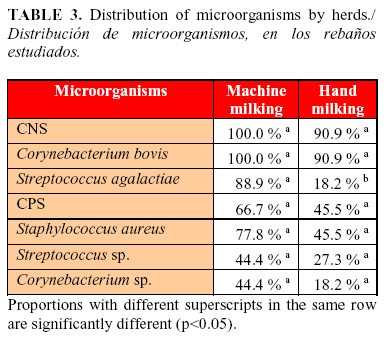
<P><font face="Verdana, Arial, Helvetica, sans-serif" size="2">SCC methodology    is very important and more effective to characterize mastitis disease and its    pathogen under our conditions, thus the increase in SCC associated to the volume    reduction in milk production; SCC has been used to measure the quality at herd    or region level and mastitis prevalence (5). SCC has been an important component    of milk in the assessment of aspects such as quality, hygiene and mastitis control    (12). </font>     <P><font face="Verdana, Arial, Helvetica, sans-serif" size="2">In Brazil, the    same difference was found in SCC between both milking systems with values very    similar to our results for hand milking (373 000 cells/mL) and lower for machine    milking (530 000 cells/ml) (21). The authors suggested as causes, the problems    in the cleaning process and the lack of equipment maintenance. These criteria    reinforced our findings and points of view. It is well known that a proper maintenance    and operation of any milking system are key aspects for a successful milking    (22). </font>     <P><font face="Verdana, Arial, Helvetica, sans-serif" size="2"><a href="#t3">Table    3</a> shows the percent of herds where each microorganism was present. For all    pathogens, there was a higher distribution in machine milking; <I>S. agalactiae</I>    was the only one with significant difference. The prevalence, biological and    epidemiological characteristics of <I>S. agalactiae</I> showed the lack of a    program for mastitis control in the herds studied.</font>      <P align="center"><img src="/img/revistas/rsa/v36n1/t0302114.jpg" width="386" height="341">    <a name="t3"></a>      
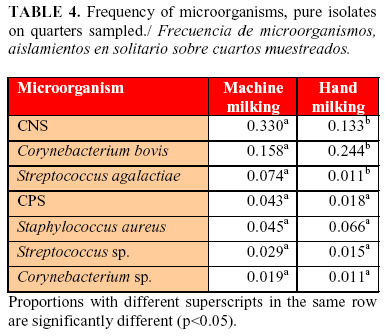
<P><font face="Verdana, Arial, Helvetica, sans-serif" size="2"><I>S. agalactiae</I>    is not present in the cow environment, it needs to be in the mammary gland to    survive; otherwise this pathogen lives in the galactoforous ducts and can be    easily eliminated by antibiotics (23). Also it is very sensitive to penicillin    and simple and routinely control measures can eliminate it from herds (24).    Actually, from the beginning of the use of antibiotics in dairy farms, <I>S.    agalactiae</I> has been taken place for <I>S. aureus</I> as a major cause of    bovine mastitis (6). </font>     <P><font face="Verdana, Arial, Helvetica, sans-serif" size="2">The more frequently    isolated microorganisms are shown in <a href="#t4">Table 4</a>. In this case,    just isolates in pure culture from the original sample were recorded. The frequency    of mixed infections was 6.7% and 9.2% for machine and hand milking, respectively.    In machine milking, the more frequent combination of mixed infection was <I>S.    agalactiae -</I> <I>C. bovis</I>, whereas CNS - <I>C. bovis</I> in hand milking.</font>      ]]></body>
<body><![CDATA[<P align="center"><img src="/img/revistas/rsa/v36n1/t0402114.jpg" width="385" height="336">    <a name="t4"></a>      
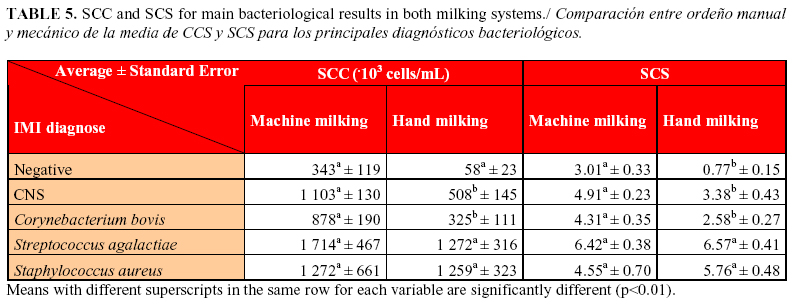
<P><font face="Verdana, Arial, Helvetica, sans-serif" size="2">It was found that    there was not a preponderance of contagious pathogens in machine milking, but    they were present in hand milking. Regarding this, <I>Karimuribo et al</I>.    (25) expressed that the predominance of contagious pathogens in developing countries    could be correlated with hand milking and/or with a poor hygiene. </font>     <P><font face="Verdana, Arial, Helvetica, sans-serif" size="2">When both milking    systems were compared by the frequency of pathogens, it was possible to find    a significant difference only in some species, with high number of isolates.    That was the case of CNS, <I>C. bovis </I>and <I>S. agalactiae</I> (<a href="#t4">Table    4</a>), the first two microorganisms were considered as minor pathogens (26).    These results are very different to others, i.e. Rodr&iacute;guez (6), who found    <I>S. agalactiae</I> as the most prevalent in hand milking and <I>S. aureus</I>    in machine milking. In Venezuela, the following pathogens were found in machine    milking: CPS, CNS and <I>Streptococcus</I> spp. in that frequency order (8).    However, in Brazil, the results concerning machine milking were similar to our    results; with: <I>Staphylococcus </I>spp., <I>Corynebacterium </I>spp., <I>Micrococcus    </I>spp. and <I>Streptococcus </I>spp. as more frequent species (27). </font>      <P><font face="Verdana, Arial, Helvetica, sans-serif" size="2">According to these    results, CNS could be the most prevalent pathogen in Cuba. This is a phenomenon    recently found in many countries with a developed dairy production (24, 28).    CNS infections might play a major role in udder health and milk quality (29).    </font>     <P><font face="Verdana, Arial, Helvetica, sans-serif" size="2">Concerning hand    milking, our results were different to those obtained in Venezuela, where CNS,    CPS and <I>Corynebacterium </I>sp. were more prevalent (8). Studies in Brazil    were closer to our results; <I>Corynebacterium </I>spp.,<I> Staphylococcus </I>spp.,    <I>Streptococcus </I>spp.<I> </I>and<I> Micrococcus </I>spp. were more prevalent    in that order (27). </font>     <P><font face="Verdana, Arial, Helvetica, sans-serif" size="2">The lack of basic    control measures justified the presence of <I>C. bovis</I> as the most isolated    species in hand milking system. This species must have a prevalence of 1% or    less when there was a teat disinfection before and after milking (30). </font>     <P><font face="Verdana, Arial, Helvetica, sans-serif" size="2">It was found that    SCC values for pathogens in machine milking were higher (<a href="/img/revistas/rsa/v36n1/t0502114.jpg">Table    5</a>), such as the results obtained by Far&iacute;a <I>et al.</I> (18). CNS    became an important pathogen in our country; showing high values of SCC and    SCS for this group. The infections by CNS were two or three time SCC of non-infected    quarters. CNS could cause persistent infections, resulting in an increased milk    SCC which affected milk quality, and may have been related to a decreased milk    production (31). In Venezuela, higher values were found in herds using machine    milking (5 550 000 cells/ml); regarding hand milking, the results were similar    to ours (410 000 cells/ml) (18). Some authors reported values inferior to 500    000 cells/mL for CNS (26) and some others values higher than 600 000 cells/mL    (32). </font>      
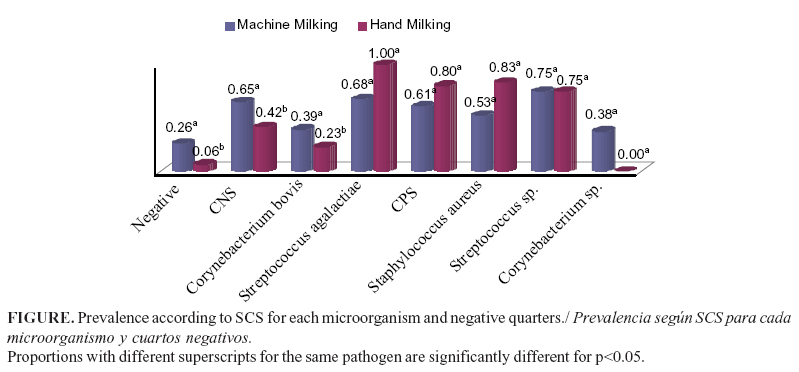
<P><font face="Verdana, Arial, Helvetica, sans-serif" size="2">Figure shows the    prevalence of subclinical mastitis for every microorganism isolated, depending    on the milking system. There was a significant difference for the milking system    in the case of negative quarters, CNS and <I>C. bovis</I>. In all cases, the    disease prevalence was lower for hand milking. For the rest of microorganisms,    it was not possible to find significance because of the lowest number of isolates.    </font>     <P><font face="Verdana, Arial, Helvetica, sans-serif" size="2">For negative quarters,    there was a significant difference between hand and machine milking. The 26%    of negative quarters (without IMI) had SCC values over 200 000 cells/mL on machine    milking, while in hand milking, it was just 6 % (<a href="/img/revistas/rsa/v36n1/f0102114.jpg">Figure</a>).    This was an evidence of inflammatory reaction without bacterial infection, explained    by the insufficient maintenance, bad state and lack of spare parts of the milking    machine.</font>      
<P>&nbsp;     ]]></body>
<body><![CDATA[<P><font face="Verdana, Arial, Helvetica, sans-serif" size="2"><B><font size="3">CONCLUSIONS</font></B>    </font>     <P><font face="Verdana, Arial, Helvetica, sans-serif" size="2">Hand milking presented    better mastitis epidemiological indicators than machine milking. The distribution    of mastitis pathogens depended on the milking system, always with higher prevalence    in machine milking and statistically different for <I>S. agalactiae</I>. Mastitis    etiology had changed with minor pathogens as the most frequent mastitis causing    microorganisms in both types of milking systems. To change the current bovine    mastitis situation, it was necessary to improve the state, performance, hygiene    and management of the milking machine.</font>     <P>&nbsp;     <P><font face="Verdana, Arial, Helvetica, sans-serif" size="2"><B><font size="3">REFERENCES</font></B>    </font>         <!-- ref --><P><font face="Verdana, Arial, Helvetica, sans-serif" size="2">1. Vel&aacute;zquez      B, Barreto G. Sensibilidad in vitro de cepas de <I>Staphylococcus aureus</I>      ante algunos antimicrobianos y tinturas de <I>Eucalyptus </I>sp. Rev prod      anim. 2011;23(2):125-30.     </font>       <!-- ref --><P><font face="Verdana, Arial, Helvetica, sans-serif" size="2">2. Fernandez      OF, Trujillo JE, Pe&ntilde;a JJ, Cerquera J, Granja Y. Mastitis bovina: generalidades      y m&eacute;todos de diagn&oacute;stico. REDVET. 2012;13(11).     </font>       <!-- ref --><P><font face="Verdana, Arial, Helvetica, sans-serif" size="2">3. Vasconcelos      M. Import&acirc;ncia do diagn&oacute;stico microbiol&oacute;gico para a detec&ccedil;&atilde;o      da mastite. III Congresso Brasileiro de Qualidade do Leite; Recife, Brasil:      PROGENE, DZ-UFRPE; 2008.     </font>       ]]></body>
<body><![CDATA[<!-- ref --><P><font face="Verdana, Arial, Helvetica, sans-serif" size="2">4. Nunes G, Vasconcelos      MA, Lange CC, Gomes C, Castro L, Feitosa JR. Qualidade do leite de rebanhos      bovinos localizados na Regi&atilde;o Sudeste: Esp&iacute;rito Santo, Minas      Gerais, Rio de Janeiro, Janeiro/2007 a Junho/2008. III Congresso Brasileiro      de Qualidade do Leite; Recife, Brasil: PROGENE, DZ-UFRPE; 2008.     </font>       <!-- ref --><P><font face="Verdana, Arial, Helvetica, sans-serif" size="2">5. Barlow JW.      Mathematical and molecular epidemiology of subclinical mastitis treatment      in lactating dairy cows. Vermont: University of Vermont; 2009.     </font>       <!-- ref --><P><font face="Verdana, Arial, Helvetica, sans-serif" size="2">6. Rodr&iacute;guez      G. Comportamiento de la mastitis bovina y su impacto econ&oacute;mico en algunos      hatos de la Sabana de Bogot&aacute;, Colombia. Revista de Medicina Veterinaria.      2006;12:35-55.     </font>       <!-- ref --><P><font face="Verdana, Arial, Helvetica, sans-serif" size="2">7. &Aacute;vila      S, Guti&eacute;rrez AJ, S&aacute;nchez JI, Canizal E. Comparaci&oacute;n del      estado de salud de la ubre y la calidad sanitaria de la leche de vacas orde&ntilde;adas      manual o mec&aacute;nicamente. Veterinaria M&eacute;xico. 2002;33(4):387-394.          </font>       <!-- ref --><P><font face="Verdana, Arial, Helvetica, sans-serif" size="2">8. Far&iacute;a      JF, Garc&iacute;a A, D'Pool G, Valero K, Allara M, Angelosante G. Detecci&oacute;n      de mastitis subcl&iacute;nica en bovinos mestizos doble prop&oacute;sito orde&ntilde;ados      en forma manual o mec&aacute;nica. Comparaci&oacute;n de tres pruebas diagn&oacute;sticas.      Revista Cient&iacute;fica. 2005;15(2):109-118.     </font>       ]]></body>
<body><![CDATA[<!-- ref --><P><font face="Verdana, Arial, Helvetica, sans-serif" size="2">9. Alfonso D,      P&eacute;rez C, Silveira EA. Evaluaci&oacute;n epizootiol&oacute;gica de la      mastitis bovina en cuatro vaquerias. REDVET. 2008;9(7).     </font>       <!-- ref --><P><font face="Verdana, Arial, Helvetica, sans-serif" size="2">10.NMC. Microbiological      Procedures for the Diagnosis of Bovine Udder Infection and Determination of      Milk Quality. 4th ed. Verona: NMC; 2004.     </font>        <!-- ref --><P><font face="Verdana, Arial, Helvetica, sans-serif" size="2">11.Shook GE. The    Gestation and Birth of Somatic Cell Score. NMC; 2008. 03-05-2010; Available    from: <U><a href="http://www.nmconline.org">http://www.nmconline.org</a></U>.        </font>      <!-- ref --><P><font face="Verdana, Arial, Helvetica, sans-serif" size="2">12.Sharma N,      Singh NK, Bhadwal MS. Relationship of Somatic Cell Count and Mastitis: An      Overview. Asian-Aust J Anim Sci. 2011;24(3):429-438.     </font>       <!-- ref --><P><font face="Verdana, Arial, Helvetica, sans-serif" size="2">13.Nielsen C.      Economic Impact of Mastitis in Dairy Cows. Uppsala: Swedish University of      Agricultural Sciences; 2009.     </font>       ]]></body>
<body><![CDATA[<!-- ref --><P><font face="Verdana, Arial, Helvetica, sans-serif" size="2">14.Armenteros      M, Ponce P, Capdevila JZ, Zald&iacute;var V, Hern&aacute;ndez R. Prevalencia      de mastitis en vacas lecheras de primer parto y patr&oacute;n de sensibilidad      de las bacterias aisladas en una lecher&iacute;a especializada. Rev Salud      Anim. 2006;28(1):8-12.     </font>        <!-- ref --><P><font face="Verdana, Arial, Helvetica, sans-serif" size="2">15.Relova D, Armenteros    M, Capdevila JZ. Caracterizaci&oacute;n de la situaci&oacute;n cl&iacute;nico-epizootiol&oacute;gica    de la mastitis bovina en vacas primerizas Holstein de una lecher&iacute;a especializada.    REDVET. serial on the Internet. 2008;9(9): Available from: <U><a href="http://www.veterinaria.org/revistas/redvet/n090908.html">http://www.veterinaria.org/revistas/redvet/n090908.html</a></U>.        </font>      <!-- ref --><P><font face="Verdana, Arial, Helvetica, sans-serif" size="2">16.Pretorius      C. The effect of corynebacterium cutis lysate to control somatic cell counts      in dairy cows. Bloemfontein: University of the Free State; 2008.     </font>       <!-- ref --><P><font face="Verdana, Arial, Helvetica, sans-serif" size="2">17.Ferraro L,      Scaramelli A, Troya H. Prevalencia de la Mastitis Subcl&iacute;nica Bovina      en Venezuela y Evaluaci&oacute;n de la Prueba de Mastitis de California (CMT)      como Prueba Diagn&oacute;stica. Revista Cient&iacute;fica. 1999;9(2):81-90.          </font>       <!-- ref --><P><font face="Verdana, Arial, Helvetica, sans-serif" size="2">18.Far&iacute;a      JF, Valero-Leal K, D'Pool G, Garc&iacute;a A, Allara M, Morales D. Agentes      bacterianos y contaje de c&eacute;lulas som&aacute;ticas en leche de cuartos      de bovinos mestizos doble prop&oacute;sito orde&ntilde;ados en forma manual      o mec&acirc;nica en cuatro fincas lecheras del estado Zulia, Venezuela. Revista      Cient&iacute;fica. 2005;15(1):64-71.     </font>       ]]></body>
<body><![CDATA[<!-- ref --><P><font face="Verdana, Arial, Helvetica, sans-serif" size="2">19.Skoufos I,      Voidarou C, Bezirtzoglou E, Tzora A. Effects of Machine-milking on the Bacterial      Flora of Teat Duct and Mammary Gland of Ewes. J Vet Med. 2006;53(10):499-501.          </font>       <!-- ref --><P><font face="Verdana, Arial, Helvetica, sans-serif" size="2">20.Hamann J,      Stanitzke U. Studies on pathogenesis of bovine mastitis by comparison of milking      conditions as calf suckling, hand milking and machine milking: reactions of      the teat tissue. Milchwissenschaft. 1990;45(10):632-637.     </font>       <!-- ref --><P><font face="Verdana, Arial, Helvetica, sans-serif" size="2">21.de Lima MdCG,      de Sena MJ, Mota RA, Mendes ES, de Almeida CC, Silva RPPE. Contagem de c&eacute;lulas      som&aacute;ticas e an&aacute;lises f&iacute;sico-qu&iacute;micas e microbiol&oacute;gicas      do leite cru tipo c produzido na regi&atilde;o agreste do estado de Pernambuco.      Arq Inst Biol. 2006;73(1):89-95.     </font>       <!-- ref --><P><font face="Verdana, Arial, Helvetica, sans-serif" size="2">22.Mein GA. The      Role of the Milking Machine in Mastitis Control. Veterinary Clinics of North      America: Food Animal Practice. 2012 April.     </font>       <!-- ref --><P><font face="Verdana, Arial, Helvetica, sans-serif" size="2">23.&Oslash;ster&aring;s      O, S&oslash;lver&oslash;d L. Norwegian mastitis control programme. Irish Veterinary      Journal. 2009;62:26-33.     </font>       ]]></body>
<body><![CDATA[<!-- ref --><P><font face="Verdana, Arial, Helvetica, sans-serif" size="2">24.Zadoks RN,      Fitzpatrick JL. Changing trends in mastitis. Irish Veterinary Journal. 2009;62:59-70.          </font>       <!-- ref --><P><font face="Verdana, Arial, Helvetica, sans-serif" size="2">25.Karimuribo      ED, Fitzpatrick JL, Swai ES, Bell C, Bryant MJ, Ogden NH, et al. Prevalence      of subclinical mastitis and associated risk factors in smallholder dairy cows      in Tanzania. Veterinary Record. 2008;163(1):16-21.     </font>       <!-- ref --><P><font face="Verdana, Arial, Helvetica, sans-serif" size="2">26.Djabri B,      Bareille N, Beaudeau F, Seegers H. Quarter Milk Somatic Cell Count in Infected      Dairy Cows: a Meta-Analysis. Vet Res. 2002;33(4):335-357.     </font>       <!-- ref --><P><font face="Verdana, Arial, Helvetica, sans-serif" size="2">27.Ruiz AK, Ponce      P, Gomes G, Mota RA, Elizabeth S, Lucena ER, et al. Prevalencia de mastitis      bovina subcl&iacute;nica y microorganismos asociados: comparaci&oacute;n entre      orde&ntilde;o manual y mec&aacute;nico, en Pernambuco, Brasil. Rev Salud Anim.      2011;33(1):57-64.     </font>       <!-- ref --><P><font face="Verdana, Arial, Helvetica, sans-serif" size="2">28.Taponen S,      Py&ouml;r&auml;l&auml; S. Coagulase-negative staphylococci as cause of bovine      mastitis-Not so different from <I>Staphylococcus aureus</I>? Veterinary Microbiology.      2009;134:29-36.     </font>       ]]></body>
<body><![CDATA[<!-- ref --><P><font face="Verdana, Arial, Helvetica, sans-serif" size="2">29.Schukken YH,      Gonz&aacute;lez RN, Tikofsky LL, Schulte HF, Santisteban CG, Welcome FL, et      al. CNS mastitis: Nothing to worry about? Vet Microbiol. 2009;134:9-14.     </font>       <!-- ref --><P><font face="Verdana, Arial, Helvetica, sans-serif" size="2">30.Barbalho TCF,      Mota RA. Isolamento de agentes bacterianos envolvidos em mastite subclinica      bovina no Estado de Pernambuco. Revista Brasileira de Sa&uacute;de e Produ&ccedil;&atilde;o      Animal. 2001;2(2):31-36.     </font>       <!-- ref --><P><font face="Verdana, Arial, Helvetica, sans-serif" size="2">31.Py&ouml;r&auml;l&auml;      S, Taponen S. Coagulase-negative staphylococci-Emerging mastitis pathogens.      Vet Microbiol. 2009;134(1):3-8.     </font>        <!-- ref --><P><font face="Verdana, Arial, Helvetica, sans-serif" size="2">32.Taponen S, Koort    J, Bj&ouml;rkroth J, Saloniemi H, Py&ouml;r&auml;l&auml; S. Bovine intramammary    infections caused by coagulase-negative staphylococci may persist throughout    lactation according to amplified fragment length polymorphism-based analysis.    J Dairy Sci. 2007;90:3301-3307.    </font>     <P>&nbsp;     <P>&nbsp;     ]]></body>
<body><![CDATA[<P><font face="Verdana, Arial, Helvetica, sans-serif" size="2">Recibido: 5-7-2013.    <br>   </font><font face="Verdana, Arial, Helvetica, sans-serif" size="2">Aceptado:    27-9-2013.</font>      ]]></body><back>
<ref-list>
<ref id="B1">
<label>1</label><nlm-citation citation-type="journal">
<person-group person-group-type="author">
<name>
<surname><![CDATA[Velázquez]]></surname>
<given-names><![CDATA[B]]></given-names>
</name>
<name>
<surname><![CDATA[Barreto]]></surname>
<given-names><![CDATA[G]]></given-names>
</name>
</person-group>
<article-title xml:lang="es"><![CDATA[Sensibilidad in vitro de cepas de Staphylococcus aureus ante algunos antimicrobianos y tinturas de Eucalyptus sp]]></article-title>
<source><![CDATA[Rev prod anim]]></source>
<year>2011</year>
<volume>23</volume>
<numero>2</numero>
<issue>2</issue>
<page-range>125-30</page-range></nlm-citation>
</ref>
<ref id="B2">
<label>2</label><nlm-citation citation-type="journal">
<person-group person-group-type="author">
<name>
<surname><![CDATA[Fernandez]]></surname>
<given-names><![CDATA[OF]]></given-names>
</name>
<name>
<surname><![CDATA[Trujillo]]></surname>
<given-names><![CDATA[JE]]></given-names>
</name>
<name>
<surname><![CDATA[Peña]]></surname>
<given-names><![CDATA[JJ]]></given-names>
</name>
<name>
<surname><![CDATA[Cerquera]]></surname>
<given-names><![CDATA[J]]></given-names>
</name>
<name>
<surname><![CDATA[Granja]]></surname>
<given-names><![CDATA[Y]]></given-names>
</name>
</person-group>
<article-title xml:lang="es"><![CDATA[Mastitis bovina: generalidades y métodos de diagnóstico]]></article-title>
<source><![CDATA[REDVET]]></source>
<year>2012</year>
<volume>13</volume>
<numero>11</numero>
<issue>11</issue>
</nlm-citation>
</ref>
<ref id="B3">
<label>3</label><nlm-citation citation-type="confpro">
<person-group person-group-type="author">
<name>
<surname><![CDATA[Vasconcelos]]></surname>
<given-names><![CDATA[M]]></given-names>
</name>
</person-group>
<article-title xml:lang="pt"><![CDATA[Importância do diagnóstico microbiológico para a detecção da mastite]]></article-title>
<source><![CDATA[]]></source>
<year></year>
<conf-name><![CDATA[ III Congresso Brasileiro de Qualidade do Leite]]></conf-name>
<conf-date>2008</conf-date>
<conf-loc>Recife </conf-loc>
</nlm-citation>
</ref>
<ref id="B4">
<label>4</label><nlm-citation citation-type="confpro">
<person-group person-group-type="author">
<name>
<surname><![CDATA[Nunes]]></surname>
<given-names><![CDATA[G]]></given-names>
</name>
<name>
<surname><![CDATA[Vasconcelos]]></surname>
<given-names><![CDATA[MA]]></given-names>
</name>
<name>
<surname><![CDATA[Lange]]></surname>
<given-names><![CDATA[CC]]></given-names>
</name>
<name>
<surname><![CDATA[Gomes]]></surname>
<given-names><![CDATA[C]]></given-names>
</name>
<name>
<surname><![CDATA[Castro]]></surname>
<given-names><![CDATA[L]]></given-names>
</name>
<name>
<surname><![CDATA[Feitosa]]></surname>
<given-names><![CDATA[JR]]></given-names>
</name>
</person-group>
<article-title xml:lang="es"><![CDATA[Qualidade do leite de rebanhos bovinos localizados na Região Sudeste: Espírito Santo, Minas Gerais, Rio de Janeiro, Janeiro/2007 a Junho/2008]]></article-title>
<source><![CDATA[]]></source>
<year></year>
<conf-name><![CDATA[ III Congresso Brasileiro de Qualidade do Leite]]></conf-name>
<conf-date>2008</conf-date>
<conf-loc>Recife </conf-loc>
</nlm-citation>
</ref>
<ref id="B5">
<label>5</label><nlm-citation citation-type="book">
<person-group person-group-type="author">
<name>
<surname><![CDATA[Barlow]]></surname>
<given-names><![CDATA[JW]]></given-names>
</name>
</person-group>
<source><![CDATA[Mathematical and molecular epidemiology of subclinical mastitis treatment in lactating dairy cows]]></source>
<year>2009</year>
<publisher-loc><![CDATA[Vermont ]]></publisher-loc>
<publisher-name><![CDATA[University of Vermont]]></publisher-name>
</nlm-citation>
</ref>
<ref id="B6">
<label>6</label><nlm-citation citation-type="journal">
<person-group person-group-type="author">
<name>
<surname><![CDATA[Rodríguez]]></surname>
<given-names><![CDATA[G]]></given-names>
</name>
</person-group>
<article-title xml:lang="es"><![CDATA[Comportamiento de la mastitis bovina y su impacto económico en algunos hatos de la Sabana de Bogotá, Colombia]]></article-title>
<source><![CDATA[Revista de Medicina Veterinaria]]></source>
<year>2006</year>
<volume>12</volume>
<page-range>35-55</page-range></nlm-citation>
</ref>
<ref id="B7">
<label>7</label><nlm-citation citation-type="journal">
<person-group person-group-type="author">
<name>
<surname><![CDATA[Ávila]]></surname>
<given-names><![CDATA[S]]></given-names>
</name>
<name>
<surname><![CDATA[Gutiérrez]]></surname>
<given-names><![CDATA[AJ]]></given-names>
</name>
<name>
<surname><![CDATA[Sánchez]]></surname>
<given-names><![CDATA[JI]]></given-names>
</name>
<name>
<surname><![CDATA[Canizal]]></surname>
<given-names><![CDATA[E]]></given-names>
</name>
</person-group>
<article-title xml:lang="es"><![CDATA[Comparación del estado de salud de la ubre y la calidad sanitaria de la leche de vacas ordeñadas manual o mecánicamente]]></article-title>
<source><![CDATA[Veterinaria México]]></source>
<year>2002</year>
<volume>33</volume>
<numero>4</numero>
<issue>4</issue>
<page-range>387-394</page-range></nlm-citation>
</ref>
<ref id="B8">
<label>8</label><nlm-citation citation-type="journal">
<person-group person-group-type="author">
<name>
<surname><![CDATA[Faría]]></surname>
<given-names><![CDATA[JF]]></given-names>
</name>
<name>
<surname><![CDATA[García]]></surname>
<given-names><![CDATA[A]]></given-names>
</name>
<name>
<surname><![CDATA[D'Pool]]></surname>
<given-names><![CDATA[G]]></given-names>
</name>
<name>
<surname><![CDATA[Valero]]></surname>
<given-names><![CDATA[K]]></given-names>
</name>
<name>
<surname><![CDATA[Allara]]></surname>
<given-names><![CDATA[M]]></given-names>
</name>
<name>
<surname><![CDATA[Angelosante]]></surname>
<given-names><![CDATA[G]]></given-names>
</name>
</person-group>
<article-title xml:lang="es"><![CDATA[Detección de mastitis subclínica en bovinos mestizos doble propósito ordeñados en forma manual o mecánica: Comparación de tres pruebas diagnósticas]]></article-title>
<source><![CDATA[Revista Científica]]></source>
<year>2005</year>
<volume>15</volume>
<numero>2</numero>
<issue>2</issue>
<page-range>109-118</page-range></nlm-citation>
</ref>
<ref id="B9">
<label>9</label><nlm-citation citation-type="journal">
<person-group person-group-type="author">
<name>
<surname><![CDATA[Alfonso]]></surname>
<given-names><![CDATA[D]]></given-names>
</name>
<name>
<surname><![CDATA[Pérez]]></surname>
<given-names><![CDATA[C]]></given-names>
</name>
<name>
<surname><![CDATA[Silveira]]></surname>
<given-names><![CDATA[EA]]></given-names>
</name>
</person-group>
<article-title xml:lang="es"><![CDATA[Evaluación epizootiológica de la mastitis bovina en cuatro vaquerias]]></article-title>
<source><![CDATA[REDVET]]></source>
<year>2008</year>
<volume>9</volume>
<numero>7</numero>
<issue>7</issue>
</nlm-citation>
</ref>
<ref id="B10">
<label>10</label><nlm-citation citation-type="">
<source><![CDATA[Microbiological Procedures for the Diagnosis of Bovine Udder Infection and Determination of Milk Quality]]></source>
<year>2004</year>
<edition>4th</edition>
<publisher-loc><![CDATA[Verona ]]></publisher-loc>
</nlm-citation>
</ref>
<ref id="B11">
<label>11</label><nlm-citation citation-type="">
<person-group person-group-type="author">
<name>
<surname><![CDATA[Shook]]></surname>
<given-names><![CDATA[GE]]></given-names>
</name>
</person-group>
<source><![CDATA[The Gestation and Birth of Somatic Cell Score]]></source>
<year>2008</year>
</nlm-citation>
</ref>
<ref id="B12">
<label>12</label><nlm-citation citation-type="journal">
<person-group person-group-type="author">
<name>
<surname><![CDATA[Sharma]]></surname>
<given-names><![CDATA[N]]></given-names>
</name>
<name>
<surname><![CDATA[Singh]]></surname>
<given-names><![CDATA[NK]]></given-names>
</name>
<name>
<surname><![CDATA[Bhadwal]]></surname>
<given-names><![CDATA[MS]]></given-names>
</name>
</person-group>
<article-title xml:lang="en"><![CDATA[Relationship of Somatic Cell Count and Mastitis: An Overview]]></article-title>
<source><![CDATA[Asian-Aust J Anim Sci]]></source>
<year>2011</year>
<volume>24</volume>
<numero>3</numero>
<issue>3</issue>
<page-range>429-438</page-range></nlm-citation>
</ref>
<ref id="B13">
<label>13</label><nlm-citation citation-type="">
<person-group person-group-type="author">
<name>
<surname><![CDATA[Nielsen]]></surname>
<given-names><![CDATA[C]]></given-names>
</name>
</person-group>
<source><![CDATA[Economic Impact of Mastitis in Dairy Cows]]></source>
<year>2009</year>
<publisher-loc><![CDATA[Uppsala ]]></publisher-loc>
</nlm-citation>
</ref>
<ref id="B14">
<label>14</label><nlm-citation citation-type="journal">
<person-group person-group-type="author">
<name>
<surname><![CDATA[Armenteros]]></surname>
<given-names><![CDATA[M]]></given-names>
</name>
<name>
<surname><![CDATA[Ponce]]></surname>
<given-names><![CDATA[P]]></given-names>
</name>
<name>
<surname><![CDATA[Capdevila]]></surname>
<given-names><![CDATA[JZ]]></given-names>
</name>
<name>
<surname><![CDATA[Zaldívar]]></surname>
<given-names><![CDATA[V]]></given-names>
</name>
<name>
<surname><![CDATA[Hernández]]></surname>
<given-names><![CDATA[R]]></given-names>
</name>
</person-group>
<article-title xml:lang="es"><![CDATA[Prevalencia de mastitis en vacas lecheras de primer parto y patrón de sensibilidad de las bacterias aisladas en una lechería especializada]]></article-title>
<source><![CDATA[Rev Salud Anim]]></source>
<year>2006</year>
<volume>28</volume>
<numero>1</numero>
<issue>1</issue>
<page-range>8-12</page-range></nlm-citation>
</ref>
<ref id="B15">
<label>15</label><nlm-citation citation-type="journal">
<person-group person-group-type="author">
<name>
<surname><![CDATA[Relova]]></surname>
<given-names><![CDATA[D]]></given-names>
</name>
<name>
<surname><![CDATA[Armenteros]]></surname>
<given-names><![CDATA[M]]></given-names>
</name>
<name>
<surname><![CDATA[Capdevila]]></surname>
<given-names><![CDATA[JZ]]></given-names>
</name>
</person-group>
<article-title xml:lang="es"><![CDATA[Caracterización de la situación clínico-epizootiológica de la mastitis bovina en vacas primerizas Holstein de una lechería especializada]]></article-title>
<source><![CDATA[REDVET]]></source>
<year>2008</year>
<volume>9</volume>
<numero>9</numero>
<issue>9</issue>
</nlm-citation>
</ref>
<ref id="B16">
<label>16</label><nlm-citation citation-type="">
<person-group person-group-type="author">
<name>
<surname><![CDATA[Pretorius]]></surname>
<given-names><![CDATA[C]]></given-names>
</name>
</person-group>
<source><![CDATA[The effect of corynebacterium cutis lysate to control somatic cell counts in dairy cows]]></source>
<year>2008</year>
<publisher-loc><![CDATA[Bloemfontein ]]></publisher-loc>
</nlm-citation>
</ref>
<ref id="B17">
<label>17</label><nlm-citation citation-type="journal">
<person-group person-group-type="author">
<name>
<surname><![CDATA[Ferraro]]></surname>
<given-names><![CDATA[L]]></given-names>
</name>
<name>
<surname><![CDATA[Scaramelli]]></surname>
<given-names><![CDATA[A]]></given-names>
</name>
<name>
<surname><![CDATA[Troya]]></surname>
<given-names><![CDATA[H]]></given-names>
</name>
</person-group>
<article-title xml:lang="es"><![CDATA[Prevalencia de la Mastitis Subclínica Bovina en Venezuela y Evaluación de la Prueba de Mastitis de California (CMT) como Prueba Diagnóstica]]></article-title>
<source><![CDATA[Revista Científica]]></source>
<year>1999</year>
<volume>9</volume>
<numero>2</numero>
<issue>2</issue>
<page-range>81-90</page-range></nlm-citation>
</ref>
<ref id="B18">
<label>18</label><nlm-citation citation-type="journal">
<person-group person-group-type="author">
<name>
<surname><![CDATA[Faría]]></surname>
<given-names><![CDATA[JF]]></given-names>
</name>
<name>
<surname><![CDATA[Valero-Leal]]></surname>
<given-names><![CDATA[K]]></given-names>
</name>
<name>
<surname><![CDATA[D'Pool]]></surname>
<given-names><![CDATA[G]]></given-names>
</name>
<name>
<surname><![CDATA[García]]></surname>
<given-names><![CDATA[A]]></given-names>
</name>
<name>
<surname><![CDATA[Allara]]></surname>
<given-names><![CDATA[M]]></given-names>
</name>
<name>
<surname><![CDATA[Morales]]></surname>
<given-names><![CDATA[D]]></given-names>
</name>
</person-group>
<article-title xml:lang="es"><![CDATA[Agentes bacterianos y contaje de células somáticas en leche de cuartos de bovinos mestizos doble propósito ordeñados en forma manual o mecânica en cuatro fincas lecheras del estado Zulia, Venezuela]]></article-title>
<source><![CDATA[Revista Científica]]></source>
<year>2005</year>
<volume>15</volume>
<numero>1</numero>
<issue>1</issue>
<page-range>64-71</page-range></nlm-citation>
</ref>
<ref id="B19">
<label>19</label><nlm-citation citation-type="journal">
<person-group person-group-type="author">
<name>
<surname><![CDATA[Skoufos]]></surname>
<given-names><![CDATA[I]]></given-names>
</name>
<name>
<surname><![CDATA[Voidarou]]></surname>
<given-names><![CDATA[C]]></given-names>
</name>
<name>
<surname><![CDATA[Bezirtzoglou]]></surname>
<given-names><![CDATA[E]]></given-names>
</name>
<name>
<surname><![CDATA[Tzora]]></surname>
<given-names><![CDATA[A]]></given-names>
</name>
</person-group>
<article-title xml:lang="en"><![CDATA[Effects of Machine-milking on the Bacterial Flora of Teat Duct and Mammary Gland of Ewes]]></article-title>
<source><![CDATA[J Vet Med]]></source>
<year>2006</year>
<volume>53</volume>
<numero>10</numero>
<issue>10</issue>
<page-range>499-501</page-range></nlm-citation>
</ref>
<ref id="B20">
<label>20</label><nlm-citation citation-type="journal">
<person-group person-group-type="author">
<name>
<surname><![CDATA[Hamann]]></surname>
<given-names><![CDATA[J]]></given-names>
</name>
<name>
<surname><![CDATA[Stanitzke]]></surname>
<given-names><![CDATA[U]]></given-names>
</name>
</person-group>
<article-title xml:lang="en"><![CDATA[Studies on pathogenesis of bovine mastitis by comparison of milking conditions as calf suckling, hand milking and machine milking: reactions of the teat tissue]]></article-title>
<source><![CDATA[Milchwissenschaft]]></source>
<year>1990</year>
<volume>45</volume>
<numero>10</numero>
<issue>10</issue>
<page-range>632-637</page-range></nlm-citation>
</ref>
<ref id="B21">
<label>21</label><nlm-citation citation-type="journal">
<person-group person-group-type="author">
<name>
<surname><![CDATA[de Lima]]></surname>
<given-names><![CDATA[MdCG]]></given-names>
</name>
<name>
<surname><![CDATA[de Sena]]></surname>
<given-names><![CDATA[MJ]]></given-names>
</name>
<name>
<surname><![CDATA[Mota]]></surname>
<given-names><![CDATA[RA]]></given-names>
</name>
<name>
<surname><![CDATA[Mendes]]></surname>
<given-names><![CDATA[ES]]></given-names>
</name>
<name>
<surname><![CDATA[de Almeida]]></surname>
<given-names><![CDATA[CC]]></given-names>
</name>
<name>
<surname><![CDATA[Silva]]></surname>
<given-names><![CDATA[RPPE]]></given-names>
</name>
</person-group>
<article-title xml:lang="pt"><![CDATA[Contagem de células somáticas e análises físico-químicas e microbiológicas do leite cru tipo c produzido na região agreste do estado de Pernambuco]]></article-title>
<source><![CDATA[Arq Inst Biol]]></source>
<year>2006</year>
<volume>73</volume>
<numero>1</numero>
<issue>1</issue>
<page-range>89-95</page-range></nlm-citation>
</ref>
<ref id="B22">
<label>22</label><nlm-citation citation-type="">
<person-group person-group-type="author">
<name>
<surname><![CDATA[Mein]]></surname>
<given-names><![CDATA[GA]]></given-names>
</name>
</person-group>
<article-title xml:lang="en"><![CDATA[The Role of the Milking Machine in Mastitis Control]]></article-title>
<source><![CDATA[Veterinary Clinics of North America: Food Animal Practice]]></source>
<year>2012</year>
<month> A</month>
<day>pr</day>
</nlm-citation>
</ref>
<ref id="B23">
<label>23</label><nlm-citation citation-type="journal">
<person-group person-group-type="author">
<name>
<surname><![CDATA[Østerås]]></surname>
<given-names><![CDATA[O]]></given-names>
</name>
<name>
<surname><![CDATA[Sølverød]]></surname>
<given-names><![CDATA[L]]></given-names>
</name>
</person-group>
<article-title xml:lang="en"><![CDATA[Norwegian mastitis control programme]]></article-title>
<source><![CDATA[Irish Veterinary Journal]]></source>
<year>2009</year>
<volume>62</volume>
<page-range>26-33</page-range></nlm-citation>
</ref>
<ref id="B24">
<label>24</label><nlm-citation citation-type="journal">
<person-group person-group-type="author">
<name>
<surname><![CDATA[Zadoks]]></surname>
<given-names><![CDATA[RN]]></given-names>
</name>
<name>
<surname><![CDATA[Fitzpatrick]]></surname>
<given-names><![CDATA[JL]]></given-names>
</name>
</person-group>
<article-title xml:lang="en"><![CDATA[Changing trends in mastitis]]></article-title>
<source><![CDATA[Irish Veterinary Journal]]></source>
<year>2009</year>
<volume>62</volume>
<page-range>59-70</page-range></nlm-citation>
</ref>
<ref id="B25">
<label>25</label><nlm-citation citation-type="journal">
<person-group person-group-type="author">
<name>
<surname><![CDATA[Karimuribo]]></surname>
<given-names><![CDATA[ED]]></given-names>
</name>
<name>
<surname><![CDATA[Fitzpatrick]]></surname>
<given-names><![CDATA[JL]]></given-names>
</name>
<name>
<surname><![CDATA[Swai]]></surname>
<given-names><![CDATA[ES]]></given-names>
</name>
<name>
<surname><![CDATA[Bell]]></surname>
<given-names><![CDATA[C]]></given-names>
</name>
<name>
<surname><![CDATA[Bryant]]></surname>
<given-names><![CDATA[MJ]]></given-names>
</name>
<name>
<surname><![CDATA[Ogden]]></surname>
<given-names><![CDATA[NH]]></given-names>
</name>
</person-group>
<article-title xml:lang="en"><![CDATA[Prevalence of subclinical mastitis and associated risk factors in smallholder dairy cows in Tanzania]]></article-title>
<source><![CDATA[Veterinary Record]]></source>
<year>2008</year>
<volume>163</volume>
<numero>1</numero>
<issue>1</issue>
<page-range>16-21</page-range></nlm-citation>
</ref>
<ref id="B26">
<label>26</label><nlm-citation citation-type="journal">
<person-group person-group-type="author">
<name>
<surname><![CDATA[Djabri]]></surname>
<given-names><![CDATA[B]]></given-names>
</name>
<name>
<surname><![CDATA[Bareille]]></surname>
<given-names><![CDATA[N]]></given-names>
</name>
<name>
<surname><![CDATA[Beaudeau]]></surname>
<given-names><![CDATA[F]]></given-names>
</name>
<name>
<surname><![CDATA[Seegers]]></surname>
<given-names><![CDATA[H]]></given-names>
</name>
</person-group>
<article-title xml:lang="en"><![CDATA[Quarter Milk Somatic Cell Count in Infected Dairy Cows: a Meta-Analysis]]></article-title>
<source><![CDATA[Vet Res]]></source>
<year>2002</year>
<volume>33</volume>
<numero>4</numero>
<issue>4</issue>
<page-range>335-357</page-range></nlm-citation>
</ref>
<ref id="B27">
<label>27</label><nlm-citation citation-type="journal">
<person-group person-group-type="author">
<name>
<surname><![CDATA[Ruiz]]></surname>
<given-names><![CDATA[AK]]></given-names>
</name>
<name>
<surname><![CDATA[Ponce]]></surname>
<given-names><![CDATA[P]]></given-names>
</name>
<name>
<surname><![CDATA[Gomes]]></surname>
<given-names><![CDATA[G]]></given-names>
</name>
<name>
<surname><![CDATA[Mota]]></surname>
<given-names><![CDATA[RA]]></given-names>
</name>
<name>
<surname><![CDATA[Elizabeth]]></surname>
<given-names><![CDATA[S]]></given-names>
</name>
<name>
<surname><![CDATA[Lucena]]></surname>
<given-names><![CDATA[ER]]></given-names>
</name>
</person-group>
<article-title xml:lang="es"><![CDATA[Prevalencia de mastitis bovina subclínica y microorganismos asociados: comparación entre ordeño manual y mecánico, en Pernambuco, Brasil]]></article-title>
<source><![CDATA[Rev Salud Anim]]></source>
<year>2011</year>
<volume>33</volume>
<numero>1</numero>
<issue>1</issue>
<page-range>57-64</page-range></nlm-citation>
</ref>
<ref id="B28">
<label>28</label><nlm-citation citation-type="journal">
<person-group person-group-type="author">
<name>
<surname><![CDATA[Taponen]]></surname>
<given-names><![CDATA[S]]></given-names>
</name>
<name>
<surname><![CDATA[Pyörälä]]></surname>
<given-names><![CDATA[S]]></given-names>
</name>
</person-group>
<article-title xml:lang="en"><![CDATA[Coagulase-negative staphylococci as cause of bovine mastitis-Not so different from Staphylococcus aureus?]]></article-title>
<source><![CDATA[Veterinary Microbiology]]></source>
<year>2009</year>
<volume>134</volume>
<page-range>29-36</page-range></nlm-citation>
</ref>
<ref id="B29">
<label>29</label><nlm-citation citation-type="journal">
<person-group person-group-type="author">
<name>
<surname><![CDATA[Schukken]]></surname>
<given-names><![CDATA[YH]]></given-names>
</name>
<name>
<surname><![CDATA[González]]></surname>
<given-names><![CDATA[RN]]></given-names>
</name>
<name>
<surname><![CDATA[Tikofsky]]></surname>
<given-names><![CDATA[LL]]></given-names>
</name>
<name>
<surname><![CDATA[Schulte]]></surname>
<given-names><![CDATA[HF]]></given-names>
</name>
<name>
<surname><![CDATA[Santisteban]]></surname>
<given-names><![CDATA[CG]]></given-names>
</name>
<name>
<surname><![CDATA[Welcome]]></surname>
<given-names><![CDATA[FL]]></given-names>
</name>
</person-group>
<article-title xml:lang="es"><![CDATA[CNS mastitis: Nothing to worry about?]]></article-title>
<source><![CDATA[Vet Microbiol]]></source>
<year>2009</year>
<volume>134</volume>
<page-range>9-14</page-range></nlm-citation>
</ref>
<ref id="B30">
<label>30</label><nlm-citation citation-type="journal">
<person-group person-group-type="author">
<name>
<surname><![CDATA[Barbalho]]></surname>
<given-names><![CDATA[TCF]]></given-names>
</name>
<name>
<surname><![CDATA[Mota]]></surname>
<given-names><![CDATA[RA]]></given-names>
</name>
</person-group>
<article-title xml:lang="pt"><![CDATA[Isolamento de agentes bacterianos envolvidos em mastite subclinica bovina no Estado de Pernambuco]]></article-title>
<source><![CDATA[Revista Brasileira de Saúde e Produção Animal]]></source>
<year>2001</year>
<volume>2</volume>
<numero>2</numero>
<issue>2</issue>
<page-range>31-36</page-range></nlm-citation>
</ref>
<ref id="B31">
<label>31</label><nlm-citation citation-type="journal">
<person-group person-group-type="author">
<name>
<surname><![CDATA[Pyörälä]]></surname>
<given-names><![CDATA[S]]></given-names>
</name>
<name>
<surname><![CDATA[Taponen]]></surname>
<given-names><![CDATA[S]]></given-names>
</name>
</person-group>
<article-title xml:lang="en"><![CDATA[Coagulase-negative staphylococci-Emerging mastitis pathogens]]></article-title>
<source><![CDATA[Vet Microbiol]]></source>
<year>2009</year>
<volume>134</volume>
<numero>1</numero>
<issue>1</issue>
<page-range>3-8</page-range></nlm-citation>
</ref>
<ref id="B32">
<label>32</label><nlm-citation citation-type="journal">
<person-group person-group-type="author">
<name>
<surname><![CDATA[Taponen]]></surname>
<given-names><![CDATA[S]]></given-names>
</name>
<name>
<surname><![CDATA[Koort]]></surname>
<given-names><![CDATA[J]]></given-names>
</name>
<name>
<surname><![CDATA[Björkroth]]></surname>
<given-names><![CDATA[J]]></given-names>
</name>
<name>
<surname><![CDATA[Saloniemi]]></surname>
<given-names><![CDATA[H]]></given-names>
</name>
<name>
<surname><![CDATA[Pyörälä]]></surname>
<given-names><![CDATA[S]]></given-names>
</name>
</person-group>
<article-title xml:lang="en"><![CDATA[Bovine intramammary infections caused by coagulase-negative staphylococci may persist throughout lactation according to amplified fragment length polymorphism-based analysis]]></article-title>
<source><![CDATA[J Dairy Sci]]></source>
<year>2007</year>
<volume>90</volume>
<page-range>3301-3307</page-range></nlm-citation>
</ref>
</ref-list>
</back>
</article>