<?xml version="1.0" encoding="ISO-8859-1"?><article xmlns:mml="http://www.w3.org/1998/Math/MathML" xmlns:xlink="http://www.w3.org/1999/xlink" xmlns:xsi="http://www.w3.org/2001/XMLSchema-instance">
<front>
<journal-meta>
<journal-id>0253-570X</journal-id>
<journal-title><![CDATA[Revista de Salud Animal]]></journal-title>
<abbrev-journal-title><![CDATA[Rev Salud Anim.]]></abbrev-journal-title>
<issn>0253-570X</issn>
<publisher>
<publisher-name><![CDATA[Centro Nacional de Sanidad Agropecuaria]]></publisher-name>
</publisher>
</journal-meta>
<article-meta>
<article-id>S0253-570X2014000200009</article-id>
<title-group>
<article-title xml:lang="en"><![CDATA[Influence of culture medium components on Mycoplasma gallisepticum growth]]></article-title>
<article-title xml:lang="es"><![CDATA[Influencia de los componentes del medio de cultivo en el crecimiento de Mycoplasma gallisepticum]]></article-title>
</title-group>
<contrib-group>
<contrib contrib-type="author">
<name>
<surname><![CDATA[Pérez Bueno]]></surname>
<given-names><![CDATA[Tania]]></given-names>
</name>
<xref ref-type="aff" rid="A01"/>
</contrib>
<contrib contrib-type="author">
<name>
<surname><![CDATA[Sánchez Miranda]]></surname>
<given-names><![CDATA[Lilian]]></given-names>
</name>
<xref ref-type="aff" rid="A01"/>
</contrib>
<contrib contrib-type="author">
<name>
<surname><![CDATA[Rosado Ruiz-Apodaca]]></surname>
<given-names><![CDATA[Ileana]]></given-names>
</name>
<xref ref-type="aff" rid="A02"/>
</contrib>
<contrib contrib-type="author">
<name>
<surname><![CDATA[Díaz Bravo]]></surname>
<given-names><![CDATA[Tito]]></given-names>
</name>
<xref ref-type="aff" rid="A03"/>
</contrib>
<contrib contrib-type="author">
<name>
<surname><![CDATA[Rodríguez Edreira]]></surname>
<given-names><![CDATA[Mercedes]]></given-names>
</name>
<xref ref-type="aff" rid="A04"/>
</contrib>
<contrib contrib-type="author">
<name>
<surname><![CDATA[Martínez Marrero]]></surname>
<given-names><![CDATA[Siomara]]></given-names>
</name>
<xref ref-type="aff" rid="A01"/>
</contrib>
</contrib-group>
<aff id="A01">
<institution><![CDATA[,National Center for Animal and Plant Health (CENSA)  ]]></institution>
<addr-line><![CDATA[Mayabeque ]]></addr-line>
<country>Cuba</country>
</aff>
<aff id="A02">
<institution><![CDATA[,National Center of Medical Genetics  ]]></institution>
<addr-line><![CDATA[La Habana ]]></addr-line>
<country>Cuba</country>
</aff>
<aff id="A03">
<institution><![CDATA[,Latin American School of Medicine  ]]></institution>
<addr-line><![CDATA[La Habana ]]></addr-line>
<country>Cuba</country>
</aff>
<aff id="A04">
<institution><![CDATA[,Higher Polytechnic Institute José A. Echeverría  ]]></institution>
<addr-line><![CDATA[La Habana ]]></addr-line>
<country>Cuba</country>
</aff>
<pub-date pub-type="pub">
<day>00</day>
<month>08</month>
<year>2014</year>
</pub-date>
<pub-date pub-type="epub">
<day>00</day>
<month>08</month>
<year>2014</year>
</pub-date>
<volume>36</volume>
<numero>2</numero>
<fpage>130</fpage>
<lpage>134</lpage>
<copyright-statement/>
<copyright-year/>
<self-uri xlink:href="http://scielo.sld.cu/scielo.php?script=sci_arttext&amp;pid=S0253-570X2014000200009&amp;lng=en&amp;nrm=iso"></self-uri><self-uri xlink:href="http://scielo.sld.cu/scielo.php?script=sci_abstract&amp;pid=S0253-570X2014000200009&amp;lng=en&amp;nrm=iso"></self-uri><self-uri xlink:href="http://scielo.sld.cu/scielo.php?script=sci_pdf&amp;pid=S0253-570X2014000200009&amp;lng=en&amp;nrm=iso"></self-uri><abstract abstract-type="short" xml:lang="en"><p><![CDATA[The composition of a culture medium produced in Cuba to grow Mycoplasma gallisepticum was evaluated using a response surface methodology. Initially, the influence of Mycoplasma base, horse serum and yeast extract on biomass production was assessed in a 2³ factorial experimental design. Then, a central composite design was applied. Mycoplasma base and horse serum factors were selected for this study. In 7 L and 35 L bioreactors, the variations carried out in the culture medium composition were estimated. The experimental results were fitted to a second order polynomial model equation. Finally, the optimal growth conditions established were at concentrations of 1,88% Mycoplasma base and 18,16% horse serum (v/v) with 0,6% of yeast extract. For the conditions tested, at a bioreactors scale, a high cellular yield of M. gallisepticum (higher than 0,5 ODu/mL) was obtained.]]></p></abstract>
<abstract abstract-type="short" xml:lang="es"><p><![CDATA[Se evaluó la composición de un medio de cultivo de producción nacional para el crecimiento de Mycoplasma gallisepticum, utilizando la metodología de superficie de respuesta. Inicialmente se estudió la influencia de los componentes Micoplasma base, suero equino y extracto de levadura para la producción de biomasa, mediante un diseño factorial 2³ y a continuación se aplicó un diseño compuesto central. Los valores de los componentes del medio de cultivo, definidos a escala de laboratorio, fueron experimentados en fermentadores de 7 L y 35 L. Los resultados del diseño compuesto central fueron ajustados en un polinomio de segundo orden, alcanzando un crecimiento óptimo a las concentraciones de 1,88% de Micoplasma base y 18,16% de suero equino (v/v) fijando el extracto de levadura en 0,6%. Se alcanzaron rendimientos celulares de M. gallisepticum superiores a 0,5 ODu/mL en fermentadores de 7 L y 35 L.]]></p></abstract>
<kwd-group>
<kwd lng="en"><![CDATA[culture medium optimization]]></kwd>
<kwd lng="en"><![CDATA[Mycoplasma gallisepticum]]></kwd>
<kwd lng="en"><![CDATA[statistical experimental design]]></kwd>
<kwd lng="es"><![CDATA[optimización de medio de cultivo]]></kwd>
<kwd lng="es"><![CDATA[Mycoplasma gallisepticum]]></kwd>
<kwd lng="es"><![CDATA[diseño estadístico experimental]]></kwd>
</kwd-group>
</article-meta>
</front><body><![CDATA[ <p align="right"><font face="Verdana, Arial, Helvetica, sans-serif" size="2"><B>SHORT    COMMUNICATION</B></font></p>     <p>&nbsp;</p>     <p><font face="Verdana, Arial, Helvetica, sans-serif" size="2"><b><font size="4">Influence    of culture medium components on <i>Mycoplasma gallisepticum</i> growth</font></b></font></p>     <p>&nbsp;</p>     <p><font face="Verdana, Arial, Helvetica, sans-serif" size="2"><b><font size="3">Influencia    de los componentes del medio de cultivo en el crecimiento de <i>Mycoplasma gallisepticum</i>    </font> </b></font> </p>     <p>&nbsp;</p>     <p>&nbsp;</p>     <p><font face="Verdana, Arial, Helvetica, sans-serif" size="2"><b>Tania P&eacute;rez    Bueno<SUP>I<a href="#autor">*</a><a name="pie"></a></SUP>, Lilian S&aacute;nchez    Miranda<SUP>I</SUP>, Ileana Rosado Ruiz-Apodaca<SUP>II</SUP>, Tito D&iacute;az    Bravo<SUP>III</SUP>, Mercedes Rodr&iacute;guez Edreira<SUP>IV</SUP>, Siomara    Mart&iacute;nez Marrero<SUP>I</SUP></b></font> <B></B> </p>     <P><font face="Verdana, Arial, Helvetica, sans-serif" size="2"><SUP>I</SUP>National    Center for Animal and Plant Health (CENSA). Carretera de Jamaica y Autopista    Nacional. Apartado 10, San Jos&eacute; de Las Lajas, Mayabeque. Cuba. <SUP>    <br>   II</SUP>National Center of Medical Genetics. Ave. 31 Esq. 146 No. 3102, Reparto    Cubanac&aacute;n, La Habana. Cuba. <SUP>     ]]></body>
<body><![CDATA[<br>   III</SUP>Latin American School of Medicine. Carretera Panamericana Km 3&#189;,    Santa Fe, La Habana. Cuba. <SUP>    <br>   IV</SUP>Higher Polytechnic Institute &#171;Jos&eacute; A. Echeverr&iacute;a&#187;.    Calle 114 e/ 119 y 129, Marianao, La Habana. Cuba.</font>     <P>&nbsp;     <P>&nbsp; <hr noshade size="1">     <P><font face="Verdana, Arial, Helvetica, sans-serif" size="2"><B>ABSTRACT</B></font>     <P><font face="Verdana, Arial, Helvetica, sans-serif" size="2">The composition    of a culture medium produced in Cuba to grow <I>Mycoplasma gallisepticum</I>    was evaluated using a response surface methodology. Initially, the influence    of Mycoplasma base, horse serum and yeast extract on biomass production was    assessed in a 2<SUP>3 </SUP>factorial experimental design. Then, a central composite    design was applied. Mycoplasma base and horse serum factors were selected for    this study. In 7 L and 35 L bioreactors, the variations carried out in the culture    medium composition were estimated. The experimental results were fitted to a    second order polynomial model equation. Finally, the optimal growth conditions    established were at concentrations of 1,88% Mycoplasma base and 18,16% horse    serum (v/v) with 0,6% of yeast extract. For the conditions tested, at a bioreactors    scale, a high cellular yield of <I>M. gallisepticum</I> (higher than 0,5 ODu/mL)    was obtained. </font>     <P><font face="Verdana, Arial, Helvetica, sans-serif" size="2"><B>Key words:</B>    culture medium optimization,<I> Mycoplasma gallisepticum</I>, statistical experimental    design.</font> <hr noshade size="1">     <p><font face="Verdana, Arial, Helvetica, sans-serif" size="2"><B>RESUMEN</b></font></p>     <p><font face="Verdana, Arial, Helvetica, sans-serif" size="2">Se evalu&oacute;    la composici&oacute;n de un medio de cultivo de producci&oacute;n nacional para    el crecimiento de <I>Mycoplasma gallisepticum</I>,<I> </I>utilizando la metodolog&iacute;a    de superficie de respuesta. Inicialmente se estudi&oacute; la influencia de    los componentes Micoplasma base, suero equino y extracto de levadura para la    producci&oacute;n de biomasa, mediante un dise&ntilde;o factorial 2<SUP>3</SUP>    y a continuaci&oacute;n se aplic&oacute; un dise&ntilde;o compuesto central.    Los valores de los componentes del medio de cultivo, definidos a escala de laboratorio,    fueron experimentados en fermentadores de 7 L y 35 L. Los resultados del dise&ntilde;o    compuesto central fueron ajustados en un polinomio de segundo orden, alcanzando    un crecimiento &oacute;ptimo a las concentraciones de 1,88% de Micoplasma base    y 18,16% de suero equino (v/v) fijando el extracto de levadura en 0,6%. Se alcanzaron    rendimientos celulares de <I>M. gallisepticum</I> superiores a 0,5 ODu/mL en    fermentadores de 7 L y 35 L. </font> </p>     <P><font face="Verdana, Arial, Helvetica, sans-serif" size="2"><B>Palabras clave:</B>    optimizaci&oacute;n de medio de cultivo,<I> Mycoplasma gallisepticum</I>, dise&ntilde;o    estad&iacute;stico experimental.</font> <hr noshade size="1">     ]]></body>
<body><![CDATA[<P>&nbsp;     <P>&nbsp;     <P><font face="Verdana, Arial, Helvetica, sans-serif" size="2"><I>Mycoplasma gallisepticum    </I>(MG) is a significant respiratory and reproductive<SUP> </SUP>pathogen of    domestic poultry (1, 2). Economic losses due to downgrading reduced feed, egg-production    efficiency and medication costs have become MG infection in one of the costliest    diseases faced by the poultry industry (3, 4). The current measures to combat    MG infection have included flock testing and eradication programs, as well as    the use of antibiotics in both prophylactic and therapeutic application and    vaccination (5, 6). </font>     <P><font face="Verdana, Arial, Helvetica, sans-serif" size="2">The Mollicutes    (mycoplasmas) are among the most nutritionally fastidious groups of microorganisms    and have been notoriously difficult to cultivate (7). The culture medium for    the cultivation of mycoplasma species requires a complex formulation of ingredients    currently regarded as essential nutrients. The most frequently used basic formulations    containing a broth base, composed by beef heart infusion, peptone and other    ingredients, yeast extract, glucose and sterol (animal serum), were added to    this broth base. </font>     <P><font face="Verdana, Arial, Helvetica, sans-serif" size="2">Varela<I> et al.    </I>(8) designed a broth base for MG growth which expressed good cell yields    compared with commercial media for mycoplasmas like DIFCO and OXOID (9). This    culture medium was used in biomass production of MG for vaccination (10). </font>     <P><font face="Verdana, Arial, Helvetica, sans-serif" size="2">In the field of    fermentation technology, study of the culture medium is a very important aspect    for improving product yield and reducing process variability, as well as for    reducing the development time and overall costs (11). Due to the complexity    of the culture medium and the difficulties to cultivate MG, the response surface    methodology (RSM) is an approach that can be used to study the effect of several    variables and to seek the better conditions for a multivariable system (12,13,14).    </font>     <P><font face="Verdana, Arial, Helvetica, sans-serif" size="2">Therefore, the    aim of this work was to study the composition of a culture medium produced in    Cuba to grow MG, by using a central composite design (CCD). </font>     <P><font face="Verdana, Arial, Helvetica, sans-serif" size="2">The strain <I>M.    gallisepticum </I>S6 (ATCC 15302), deposited in CENSA&#180;s culture collection    (15), was grown in Mycoplasma broth medium (BioCen, Cuba), supplemented with    horse serum and yeast extract (supplemented MBM) (8). The horse serum was supplied    by LABIOFAM (Cuba), and the yeast extract was obtained from BioCen (Cuba). The    horse serum was prepared by filtrating and heating for 30 minutes. </font>     <P><font face="Verdana, Arial, Helvetica, sans-serif" size="2">For the laboratory    studies, 7,5 mL of cell suspension were inoculated into the 75 mL supplemented    MBM in a 150 mL Erlenmeyer flask. This culture was incubated at 37 &#176;C and    90 rpm for 14 h (9). </font>     <P><font face="Verdana, Arial, Helvetica, sans-serif" size="2">For the fermentation    studies, the inoculum was introduced into 7 L and 35 L bioreactors (Chemap-Braun,    Germany), containing 5 L and 30 L respectively of the supplemented MBM. The    fermentation parameters controlled were: pH 7,8, temperature 37 &#176;C, 120    rpm and 0 vvm, operated in a batch-wise mode up to 20 h of culture time in both    bioreactors (9, 16). </font>     ]]></body>
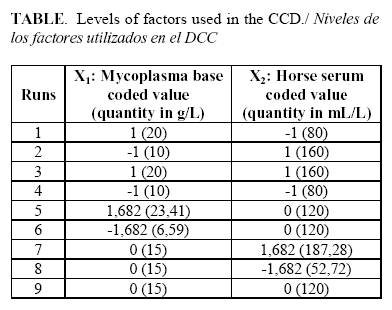
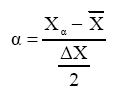
<body><![CDATA[<P><font face="Verdana, Arial, Helvetica, sans-serif" size="2">The biomass concentration    was measured by sampling the culture and reading the optical density (OD) at    a wavelength of 540 nm. </font>     <P><font face="Verdana, Arial, Helvetica, sans-serif" size="2">The number of colonies    formed (CFU) was determined by plating suitable dilutions of cultures on agar    medium and the colonies counted after incubation for 48 hours at 37&#176;C.    The procedure was performed as described in a previous paper (16). Samples were    taken in duplicate every four hours. </font>     <P><font face="Verdana, Arial, Helvetica, sans-serif" size="2">The influence of    the culture medium components was studied in shake flask experiments, specifically,    the concentration of Mycoplasma base (Mb), horse serum (Hs) and yeast extract    (Ye). </font>     <P><font face="Verdana, Arial, Helvetica, sans-serif" size="2">Factorial design:    A 2<SUP>3 </SUP>factorial experimental design and a midpoint were applied to    the screening of the variables indicating where to improve yields (17). The    variables (factors) were the concentrations of Mycoplasma base (X<SUB>1</SUB>),    horse serum (X<SUB>2</SUB>), and yeast extract (X<SUB>3</SUB>) in the supplemented    MBM. The cell concentration measured as OD was the response variable (Y). </font>     <P><font face="Verdana, Arial, Helvetica, sans-serif" size="2">The variables were    tested in three coded levels: low (-1), medium (0) and high (+1). The coded    values corresponded for the variables as follows: X<SUB>1</SUB>: -1 (20 g/L),    0 (25 g/L), +1 (30 g/L); X<SUB>2</SUB>: -1 (160 mL/L), 0 (200 mL/L), +1 (240    mL/L); X<SUB>3</SUB>: -1 (6 g/L), 0 (10 g/L), + 1 (14 g/L). The midpoint (coded    value 0) corresponded to the quantities commonly used (Control). </font>     <P><font face="Verdana, Arial, Helvetica, sans-serif" size="2">Central Composite    Design: Once the direction improving yields was known, a star design (with the    coded value a = &#177; 1,682) (18) was performed to determine a better statistical    model which described the relationship between the variables Mb and Hs. The    variable yeast extract was kept fixed at the value indicated in the factorial    design. The levels studied in the CCD are shown in <a href="#t1">Table</a>.    The X value for a (X<SUB>a</SUB>) was calculated for the <a href="#e1">equation</a>:</font>      <P align="center"><font face="Verdana, Arial, Helvetica, sans-serif" size="2">    <img src="/img/revistas/rsa/v36n2/e0109214.gif" width="118" height="93"></font>    <a name="e1"></a>     
<P><font face="Verdana, Arial, Helvetica, sans-serif" size="2">Where: </font>      <P><font face="Verdana, Arial, Helvetica, sans-serif" size="2"> 15 g/L and 120    mL/L for X<SUB>1</SUB> and X<SUB>2</SUB> respectively </font>     <P><font face="Verdana, Arial, Helvetica, sans-serif" size="2"> 5 g/L and 40 mL/L    for X<SUB>1</SUB> and X<SUB>2</SUB> respectively </font>     ]]></body>
<body><![CDATA[<P align="center"><font face="Verdana, Arial, Helvetica, sans-serif" size="2"><img src="/img/revistas/rsa/v36n2/t0109214.gif" width="392" height="310"><a name="t1"></a></font>      
<P><font face="Verdana, Arial, Helvetica, sans-serif" size="2">For calculating    the optimal point, a second order polynomial equation was fitted to the experimental    results of CCD as it represented the behavior of such a system more appropriately.    </font>      <P><font face="Verdana, Arial, Helvetica, sans-serif" size="2">This equation was:    </font>     <P><font face="Verdana, Arial, Helvetica, sans-serif" size="2">Y = b<SUB>0</SUB>    + b<SUB>1</SUB>X<SUB>1</SUB> + b<SUB>2</SUB>X<SUB>2</SUB> + b<SUB>1</SUB>b<SUB>1</SUB>X<SUB>1</SUB><SUP>2    </SUP>+ b<SUB>2</SUB>b<SUB>2</SUB>X<SUB>2</SUB><SUP>2</SUP> + b<SUB>1</SUB>b<SUB>2</SUB>X<SUB>1</SUB>X<SUB>2</SUB>    </font>     <P><font face="Verdana, Arial, Helvetica, sans-serif" size="2">Where Y was the    response variable (DO), b<SUB>0</SUB> the intercept/constant, b<SUB>1</SUB>    and b<SUB>2</SUB> the linear coefficients, b<SUB>1</SUB>b<SUB>1</SUB> and b<SUB>2</SUB>b<SUB>2</SUB>    the squared/quadratic coefficients, b<SUB>1</SUB>b<SUB>2</SUB> the interaction    coefficients, and X<SUB>1</SUB>, X<SUB>2</SUB>, X<SUB>1</SUB><SUP>2</SUP>, X<SUB>2</SUB><SUP>2</SUP>    and X<SUB>1</SUB>X<SUB>2</SUB> were the levels of the independent variables.    </font>     <P><font face="Verdana, Arial, Helvetica, sans-serif" size="2">Runs were performed    in triplicate. The whole statistical procedure of the experimental designs was    carried out with the software package Statgraphics Plus&#174; for Windows 5.1    and Microsoft Office Excel software. The quality of the fitness of the polynomial    model equation was expressed by the coefficient of determination R<SUP>2</SUP>,    and the significance was defined as p&lt;0,05. </font>     <P><font face="Verdana, Arial, Helvetica, sans-serif" size="2">The biotechnological    production process is the result of time-consuming and expensive research and    development. For most favorable returns, it is necessary to improve the culture    medium, the producer strain and other process parameters to reach a maximal    productivity or the highest production capacity (19). </font>     <P><font face="Verdana, Arial, Helvetica, sans-serif" size="2">Factorial design:    Due to the complexity of the culture medium for growing MG, a RSM was conceived    to determine the most favorable composition of the medium for the microorganism    growth. In the initial step, a 2<SUP>3</SUP> factorial design served as a test    to identify the effect of the concentration of Mb, Hs and Ye on MG yields, which    indicated that the variable Hs and its interaction with the variables Mb and    Ye were not significant in the region studied (p&lt;0,05). The direction of    the highest yields was obtained with lower concentrations of Mb and Ye. </font>     <P><font face="Verdana, Arial, Helvetica, sans-serif" size="2">Central Composite    Design: A CCD was used to continue this study. Lower concentrations of Mb and    Hs were used; additionally, Ye concentration was kept at 6 g/L. </font>     <P><font face="Verdana, Arial, Helvetica, sans-serif" size="2">A multiple regression    analysis was performed with the result that, in this region, the two variables    (Mb and Hs) evaluated and their quadratic interactions were significant, and    the mathematical model represented was: </font>     ]]></body>
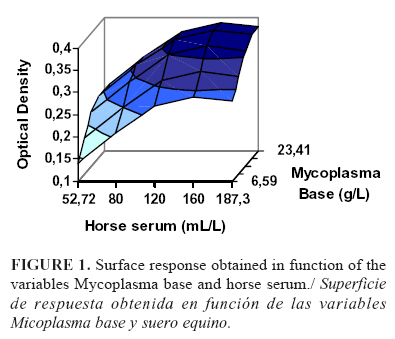
<body><![CDATA[<P><font face="Verdana, Arial, Helvetica, sans-serif" size="2">OD = 0,350 + 0,029X<SUB>1    </SUB>+ 0,040X<SUB>2 </SUB>- 0,019X<SUB>1</SUB><SUP>2 </SUP>- 0,013X<SUB>2</SUB><SUP>2</SUP>    </font>     <P><font face="Verdana, Arial, Helvetica, sans-serif" size="2">R<SUP>2</SUP>=    0,9265 p<SUB>model</SUB> = 0,0 </font>     <P><font face="Verdana, Arial, Helvetica, sans-serif" size="2">Where X<SUB>1</SUB>    and X<SUB>2</SUB> represent the coded levels of Mb and Hs, respectively. </font>     <P><font face="Verdana, Arial, Helvetica, sans-serif" size="2">As it can be seen,    the statistical model obtained was significant and indicated that the equation    could explain 92,65% of the response variability. The optimum of these two variables    in the region studied corresponded to 18,8 g/L of Mb and 181,6 mL/L of Hs using    6 g/L of Ye. The effect of the culture medium concentration on cell concentration    is shown in <a href="#f1">Figure 1</a>. </font>      <P align="center"><img src="/img/revistas/rsa/v36n2/f0109214.jpg" width="395" height="339"><a name="f1"></a>     
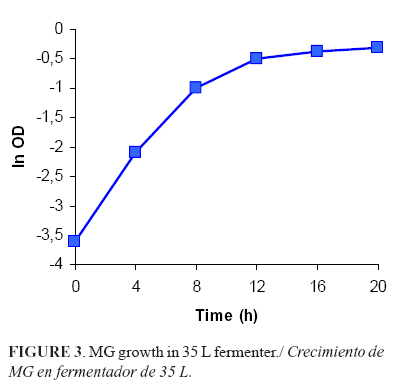
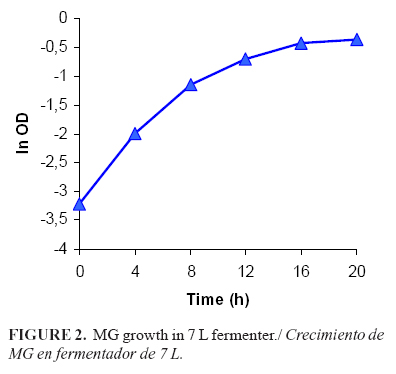
<P><font face="Verdana, Arial, Helvetica, sans-serif" size="2">The RSM applied    for this statistical study had been used for several purposes including medium    optimization, metabolites production and extraction conditions. Previously,    P&eacute;rez <I>et al.</I> (20) studied the culture medium for growing MG produced    by OXOID (England) by using this methodology, whit no effect on the expression    of antigen proteins, but the yields were low compared with the present work.    </font>     <P><font face="Verdana, Arial, Helvetica, sans-serif" size="2">Hwang <I>et al</I>.    (13) reported that the culture medium composition for biomass production of    <I>M. hyopneumoniae</I> was optimized by means of the RSM. They confirmed that    fresh yeast extract, horse serum and porcine serum were the major factors influencing    mycoplasma protein production. Other authors (21) increased the Human Epidermal    Growth Factor expression levels and reduced their degradation rate by optimizing    the culture conditions. In other case, Ruiz <I>et al.</I> (22) established a<I>    </I>method for obtaining pharmaceutical grade plasmid DNA from <I>Escherichia    coli</I> culture together with an optimized purification process. </font>     <P><font face="Verdana, Arial, Helvetica, sans-serif" size="2">In order to confirm    whether the results obtained by the model could be experimentally reproduced,    MG was grown using these conditions (modified supplemented MBM), and cell concentration    values of 0,459 &#177; 0,050 OD units were reached. </font>     <P><font face="Verdana, Arial, Helvetica, sans-serif" size="2">The modified supplemented    MBM has been proven in batch fermentation with bioreactors. The growth kinetics    in bioreactors 7 and 35 L are represented in <a href="#f2">Figures 2</a> and    <a href="#f3">3</a> respectively.</font>      <P align="center"><img src="/img/revistas/rsa/v36n2/f0209214.jpg" width="396" height="374">    <a name="f2"></a>      
]]></body>
<body><![CDATA[<P align="center"><img src="/img/revistas/rsa/v36n2/f0309214.jpg" width="401" height="391">    <a name="f3"></a>      
<P><font face="Verdana, Arial, Helvetica, sans-serif" size="2">During the first    8 hours of growth, a considerably increase of the optical density was observed.    <a href="#f2">Figures 2</a> and <a href="#f3">3</a> show that this medium reached    the end of the exponential growth phase between 8 and 12 hours with a value    of the specific growth rate (m) of 0,262 &#177; 0,002 h<SUP>-1 </SUP>in the    7 L bioreactor at 12 hours, which corresponded to a cell yield of 0,599 &#177;    0,006 OD units and 6.10<SUP>10 </SUP>&#177; 0,48 CFU/mL, higher than (p&lt;0,05)    what was obtained with the culture medium before applying the experimental optimization    techniques (16). In the 35 L bioreactor at 12 hours, the specific growth rate    was 0,213 &#177; 0,02 h<SUP>-1 </SUP>with cell yields of 0,514 &#177; 0,015    OD units and 5,8.10<SUP>10 </SUP>&#177; 0,43 CFU/mL, yields similar to those    obtained at the scale of 7 L. </font>      <P><font face="Verdana, Arial, Helvetica, sans-serif" size="2">In summary, the    composition of a Cuban culture medium for MG growth was studied with a significant    impact on increasing the biomass production at a laboratory or larger scale    fermentation process with lower costs. </font>     <P>&nbsp;     <P><font face="Verdana, Arial, Helvetica, sans-serif" size="2"><B><font size="3">REFERENCIAS</font></B>    </font>         <!-- ref --><P><font face="Verdana, Arial, Helvetica, sans-serif" size="2">1. Szczepanek      SM, Tulman ER, Gorton TS, Liao<SUP> </SUP>X, Lu Z, Zinski J, et al. Comparative      Genomic Analyses of Attenuated Strains of <I>Mycoplasma gallisepticum. </I>Infect      Immun. 2010;78(4):1760-1771.     </font>       <!-- ref --><P><font face="Verdana, Arial, Helvetica, sans-serif" size="2">2. Colas M, Merino      A, Santana<SUP> </SUP>Y, Miranda Y, Bacallao N, et al. Serological study of      agents associated to chronic respiratory syndrome in laying hens. Biotechnol      Appl.&#160;2010;27(3):232-236.     </font>       <!-- ref --><P><font face="Verdana, Arial, Helvetica, sans-serif" size="2">3. Levisohn S,      Kleven SH. Avian mycoplasmosis. Rev Sc Tech. 2000;2:425-442.     </font>       <!-- ref --><P><font face="Verdana, Arial, Helvetica, sans-serif" size="2">4. Stipkovits      L, Egyed L, Palfi V, Beres A, Pitlik E, Somogyi M, et al. Effect of low-pathogenicity      influenza virus H3N8 infection on <I>Mycoplasma gallisepticum</I> infection      of chickens. Avian Pathol. 2012;41(1):51-57.     </font>        <!-- ref --><P><font face="Verdana, Arial, Helvetica, sans-serif" size="2">5. Kleven SH. Experiences    with live vaccines for <I>Mycoplasma gallisepticum</I>. CENSA, Libro de res&uacute;menes:    Taller Internacional de Vaccinolog&iacute;a Veterinaria. La Habana (Cuba) 2001.        </font>      <!-- ref --><P><font face="Verdana, Arial, Helvetica, sans-serif" size="2">6. Gharaibeh      S, Hailat A. <I>Mycoplasma gallisepticum</I> experimental infection and tissue      distribution in chickens, sparrows and pigeons. Avian Pathol. 2011;40(4):349-354.          </font>        <!-- ref --><P><font face="Verdana, Arial, Helvetica, sans-serif" size="2">7. Miles RJ. Cell    nutrition and growth. In: Maniloff J (ed). American Society for Microbiology.    Mycoplasmas. Washington: 1992, p. 23-37.     </font>      <!-- ref --><P><font face="Verdana, Arial, Helvetica, sans-serif" size="2">8. Varela A,      Paret A, P&eacute;rez T, S&aacute;nchez L, Rosado I, Mart&iacute;nez S. Medio      de cultivo para el crecimiento de micoplasmas. Patente concedida por la Oficina      Cubana de la Propiedad Industrial. (Cuba). 2003.     </font>       <!-- ref --><P><font face="Verdana, Arial, Helvetica, sans-serif" size="2">9. P&eacute;rez      T. Desarrollo de una tecnolog&iacute;a para la obtenci&oacute;n de un candidato      vacunal contra la micoplasmosis aviar. Rev Salud Anim. 2004;26(2):143.     </font>       <!-- ref --><P><font face="Verdana, Arial, Helvetica, sans-serif" size="2">10.P&eacute;rez      T, S&aacute;nchez L, Rosado I, P&eacute;rez J, Correa H. Caracterizaci&oacute;n      de una emulsi&oacute;n oleosa de c&eacute;lulas inactivas de <I>Mycoplasma      gallisepticum.</I> Rev Mex Cienc Farmac&eacute;ut. 2008;39(2):5-10.     </font>       <!-- ref --><P><font face="Verdana, Arial, Helvetica, sans-serif" size="2">11.Mu W, Chen      C, Li X, Zhang T, Jiang B. Optimization of culture medium for the production      of phenyl lactic acid by <I>Lactobacillus</I> sp. SK007. Bioresour Technol.      2009;100:1366-1370.     </font>        <P><font face="Verdana, Arial, Helvetica, sans-serif" size="2">12.S&aacute;nchez    L, Moreno AM, P&eacute;rez T, Espinosa I. Optimizaci&oacute;n de un medio de    cultivo para el crecimiento de <I>Gardnerella vaginalis</I>. Rev Cubana Invest    Biom&eacute;d online. 2009;28(2). ISSN 1561-3011. Disponible en: <U><a href="http://scielo.sld.cu/scielo.php?script=sci_arttext&pid=S0864-03002009000200011&lng=es">http://scielo.sld.cu/scielo.php?script=sci_arttext&amp;pid=S0864-03002009000200011&amp;lng=es</a></U>.    </font>      <!-- ref --><P><font face="Verdana, Arial, Helvetica, sans-serif" size="2">13.Hwang MH, Damte    D, Cho MH, Kim YH, Park SC. Optimization of culture media of pathogenic <I>Mycoplasma    hyopneumoniae</I> by a response surface methodology.<b> </b>J Vet Sci. 2010;11(4):327-332.        </font>      ]]></body>
<body><![CDATA[<!-- ref --><P><font face="Verdana, Arial, Helvetica, sans-serif" size="2">14.Li P, Xu L,      Mou Y, Shan T, Mao Z, Lu S, et al. Medium Optimization for Exopolysaccharide      Production in Liquid Culture of Endophytic Fungus Berkleasmium sp. Dzf12.      Int J Mol Sci. 2012;13(9):11411-11426.     </font>       <!-- ref --><P><font face="Verdana, Arial, Helvetica, sans-serif" size="2">15.Chiong A,      S&aacute;nchez L, Rosado I, P&eacute;rez T. Obtenci&oacute;n del Banco de      Producci&oacute;n de <I>Mycoplasma gallisepticum</I>.<I> </I>Rev Salud Anim.      2003;25(1):62-65.     </font>       <!-- ref --><P><font face="Verdana, Arial, Helvetica, sans-serif" size="2">16.S&aacute;nchez      L, P&eacute;rez T, Rosado I. Producci&oacute;n de <I>Mycoplasma gallisepticum      </I>empleando bioreactores del tipo tanque agitado. Tecnol Ciencia Ed. 2002;17(1):42-47.          </font>       <!-- ref --><P><font face="Verdana, Arial, Helvetica, sans-serif" size="2">17.D&iacute;az      T, Pita U. La optimizaci&oacute;n experimental en la industria farmac&eacute;utica      y biotecnol&oacute;gica internacional. Experiencias en Cuba. I Encuentro Internacional      sobre ense&ntilde;anza de la Qu&iacute;mica. Editorial ISPJAE. 1996.     </font>       <!-- ref --><P><font face="Verdana, Arial, Helvetica, sans-serif" size="2">18.Barber&agrave;      E, Tom&aacute;s X, Molins MB, Moya M. Aplicaci&oacute;n del dise&ntilde;o      experimental al estudio de medios de cultivo: <I>H. salinarium</I>. Afinidad.      1991;48(431):9-31.     </font>        ]]></body>
<body><![CDATA[<!-- ref --><P><font face="Verdana, Arial, Helvetica, sans-serif" size="2">19.Vald&eacute;s    J, Mantilla E, M&aacute;rquez G, Bonilla RM, Lugo VM, P&eacute;rez M, et al.    Physiological study in <I>Saccharomyces cerevisiae</I> for overproduction of    a homogeneous human epidermal growth factor molecule. Biotechnol Appl. 2009;26(2):166-167.    &#160;    </font>      <!-- ref --><P><font face="Verdana, Arial, Helvetica, sans-serif" size="2">20.P&eacute;rez      T, S&aacute;nchez L, D&iacute;az T, Rosado I, Rodr&iacute;guez R. Aplicaci&oacute;n      del dise&ntilde;o experimental al estudio de un medio de cultivo para el crecimiento      de <I>Mycoplasma gallisepticum. </I>Rev Salud Anim. 2001;23(2):80-83.     </font>       <!-- ref --><P><font face="Verdana, Arial, Helvetica, sans-serif" size="2">21.Vald&eacute;s      J, Mantilla E, M&aacute;rquez G, Bonilla RM, Lugo VM, P&eacute;rez M, et al.      Improving the expression of Human Epidermal Growth Factor in <I>Saccharomyces      cerevisiae</I> by manipulating culture conditions. Biotechnol Appl. 2009;26(1):34-38.          </font>        <!-- ref --><P><font face="Verdana, Arial, Helvetica, sans-serif" size="2">22.Ruiz O, Limonta<SUP>    </SUP>M, Vald&eacute;s J, M&aacute;rquez G, D&iacute;az M, Fr&oacute;meta W,    et al. Physiological and nutritional studies of <I>Escherichia coli</I> and    a new combination of separation methods to obtain highly pure and homogeneous    plasmid DNA for gene therapy. Biotechnol Appl. 2012;29(4):271-274.     </font>      <P>&nbsp;     <P>&nbsp;     ]]></body>
<body><![CDATA[<P><font face="Verdana, Arial, Helvetica, sans-serif" size="2">Recibido: 22-11-2013.    <br>   Aceptado: 27-3-2014.</font>      <P>&nbsp;     <P>&nbsp;     <P><font face="Verdana, Arial, Helvetica, sans-serif" size="2"><B><a href="#pie">*</a><a name="autor"></a></B>Corresponding    author: <I>Tania P&eacute;rez Bueno.</I> Tel. (+53)47 86 3014; (+53)47 849164;    E- mail: <a href="mailto:bueno@censa.edu.cu">bueno@censa.edu.cu</a>.</font>       ]]></body><back>
<ref-list>
<ref id="B1">
<label>1</label><nlm-citation citation-type="journal">
<person-group person-group-type="author">
<name>
<surname><![CDATA[Szczepanek]]></surname>
<given-names><![CDATA[SM]]></given-names>
</name>
<name>
<surname><![CDATA[Tulman]]></surname>
<given-names><![CDATA[ER]]></given-names>
</name>
<name>
<surname><![CDATA[Gorton]]></surname>
<given-names><![CDATA[TS]]></given-names>
</name>
<name>
<surname><![CDATA[Liao]]></surname>
<given-names><![CDATA[X]]></given-names>
</name>
<name>
<surname><![CDATA[Lu]]></surname>
<given-names><![CDATA[Z]]></given-names>
</name>
<name>
<surname><![CDATA[Zinski]]></surname>
<given-names><![CDATA[J]]></given-names>
</name>
</person-group>
<article-title xml:lang="en"><![CDATA[Comparative Genomic Analyses of Attenuated Strains of Mycoplasma gallisepticum]]></article-title>
<source><![CDATA[Infect Immun]]></source>
<year>2010</year>
<volume>78</volume>
<numero>4</numero>
<issue>4</issue>
<page-range>1760-1771</page-range></nlm-citation>
</ref>
<ref id="B2">
<label>2</label><nlm-citation citation-type="journal">
<person-group person-group-type="author">
<name>
<surname><![CDATA[Colas]]></surname>
<given-names><![CDATA[M]]></given-names>
</name>
<name>
<surname><![CDATA[Merino]]></surname>
<given-names><![CDATA[A]]></given-names>
</name>
<name>
<surname><![CDATA[Santana]]></surname>
<given-names><![CDATA[Y]]></given-names>
</name>
<name>
<surname><![CDATA[Miranda]]></surname>
<given-names><![CDATA[Y]]></given-names>
</name>
<name>
<surname><![CDATA[Bacallao]]></surname>
<given-names><![CDATA[N]]></given-names>
</name>
</person-group>
<article-title xml:lang="en"><![CDATA[Serological study of agents associated to chronic respiratory syndrome in laying hens]]></article-title>
<source><![CDATA[Biotechnol Appl]]></source>
<year>2010</year>
<volume>27</volume>
<numero>3</numero>
<issue>3</issue>
<page-range>232-236</page-range></nlm-citation>
</ref>
<ref id="B3">
<label>3</label><nlm-citation citation-type="journal">
<person-group person-group-type="author">
<name>
<surname><![CDATA[Levisohn]]></surname>
<given-names><![CDATA[S]]></given-names>
</name>
<name>
<surname><![CDATA[Kleven]]></surname>
<given-names><![CDATA[SH]]></given-names>
</name>
</person-group>
<article-title xml:lang="en"><![CDATA[Avian mycoplasmosis]]></article-title>
<source><![CDATA[Rev Sc Tech]]></source>
<year>2000</year>
<volume>2</volume>
<page-range>425-442</page-range></nlm-citation>
</ref>
<ref id="B4">
<label>4</label><nlm-citation citation-type="journal">
<person-group person-group-type="author">
<name>
<surname><![CDATA[Stipkovits]]></surname>
<given-names><![CDATA[L]]></given-names>
</name>
<name>
<surname><![CDATA[Egyed]]></surname>
<given-names><![CDATA[L]]></given-names>
</name>
<name>
<surname><![CDATA[Palfi]]></surname>
<given-names><![CDATA[V]]></given-names>
</name>
<name>
<surname><![CDATA[Beres]]></surname>
<given-names><![CDATA[A]]></given-names>
</name>
<name>
<surname><![CDATA[Pitlik]]></surname>
<given-names><![CDATA[E]]></given-names>
</name>
<name>
<surname><![CDATA[Somogyi]]></surname>
<given-names><![CDATA[M]]></given-names>
</name>
</person-group>
<article-title xml:lang="en"><![CDATA[Effect of low-pathogenicity influenza virus H3N8 infection on Mycoplasma gallisepticum infection of chickens]]></article-title>
<source><![CDATA[Avian Pathol]]></source>
<year>2012</year>
<volume>41</volume>
<numero>1</numero>
<issue>1</issue>
<page-range>51-57</page-range></nlm-citation>
</ref>
<ref id="B5">
<label>5</label><nlm-citation citation-type="">
<person-group person-group-type="author">
<name>
<surname><![CDATA[Kleven]]></surname>
<given-names><![CDATA[SH]]></given-names>
</name>
</person-group>
<article-title xml:lang="en"><![CDATA[Experiences with live vaccines for Mycoplasma gallisepticum]]></article-title>
<collab>CENSA</collab>
<source><![CDATA[Libro de resúmenes: Taller Internacional de Vaccinología Veterinaria]]></source>
<year>2001</year>
<publisher-loc><![CDATA[La Habana^eCuba Cuba]]></publisher-loc>
</nlm-citation>
</ref>
<ref id="B6">
<label>6</label><nlm-citation citation-type="journal">
<person-group person-group-type="author">
<name>
<surname><![CDATA[Gharaibeh]]></surname>
<given-names><![CDATA[S]]></given-names>
</name>
<name>
<surname><![CDATA[Hailat]]></surname>
<given-names><![CDATA[A]]></given-names>
</name>
</person-group>
<article-title xml:lang="en"><![CDATA[Mycoplasma gallisepticum experimental infection and tissue distribution in chickens, sparrows and pigeons]]></article-title>
<source><![CDATA[Avian Pathol]]></source>
<year>2011</year>
<volume>40</volume>
<numero>4</numero>
<issue>4</issue>
<page-range>349-354</page-range></nlm-citation>
</ref>
<ref id="B7">
<label>7</label><nlm-citation citation-type="">
<person-group person-group-type="author">
<name>
<surname><![CDATA[Miles]]></surname>
<given-names><![CDATA[RJ]]></given-names>
</name>
</person-group>
<article-title xml:lang="en"><![CDATA[Cell nutrition and growth]]></article-title>
<person-group person-group-type="editor">
<name>
<surname><![CDATA[Maniloff]]></surname>
<given-names><![CDATA[J]]></given-names>
</name>
</person-group>
<collab>American Society for Microbiology</collab>
<source><![CDATA[Mycoplasmas]]></source>
<year>1992</year>
<page-range>23-37</page-range><publisher-loc><![CDATA[Washington ]]></publisher-loc>
</nlm-citation>
</ref>
<ref id="B8">
<label>8</label><nlm-citation citation-type="">
<person-group person-group-type="author">
<name>
<surname><![CDATA[Varela]]></surname>
<given-names><![CDATA[A]]></given-names>
</name>
<name>
<surname><![CDATA[Paret]]></surname>
<given-names><![CDATA[A]]></given-names>
</name>
<name>
<surname><![CDATA[Pérez]]></surname>
<given-names><![CDATA[T]]></given-names>
</name>
<name>
<surname><![CDATA[Sánchez]]></surname>
<given-names><![CDATA[L]]></given-names>
</name>
<name>
<surname><![CDATA[Rosado]]></surname>
<given-names><![CDATA[I]]></given-names>
</name>
<name>
<surname><![CDATA[Martínez]]></surname>
<given-names><![CDATA[S]]></given-names>
</name>
</person-group>
<source><![CDATA[Medio de cultivo para el crecimiento de micoplasmas: Patente concedida por la Oficina Cubana de la Propiedad Industrial]]></source>
<year>2003</year>
<publisher-loc><![CDATA[^eCuba Cuba]]></publisher-loc>
</nlm-citation>
</ref>
<ref id="B9">
<label>9</label><nlm-citation citation-type="journal">
<person-group person-group-type="author">
<name>
<surname><![CDATA[Pérez]]></surname>
<given-names><![CDATA[T]]></given-names>
</name>
</person-group>
<article-title xml:lang="es"><![CDATA[Desarrollo de una tecnología para la obtención de un candidato vacunal contra la micoplasmosis aviar]]></article-title>
<source><![CDATA[Rev Salud Anim]]></source>
<year>2004</year>
<volume>26</volume>
<numero>2</numero>
<issue>2</issue>
<page-range>143</page-range></nlm-citation>
</ref>
<ref id="B10">
<label>10</label><nlm-citation citation-type="journal">
<person-group person-group-type="author">
<name>
<surname><![CDATA[Pérez]]></surname>
<given-names><![CDATA[T]]></given-names>
</name>
<name>
<surname><![CDATA[Sánchez]]></surname>
<given-names><![CDATA[L]]></given-names>
</name>
<name>
<surname><![CDATA[Rosado]]></surname>
<given-names><![CDATA[I]]></given-names>
</name>
<name>
<surname><![CDATA[Pérez]]></surname>
<given-names><![CDATA[J]]></given-names>
</name>
<name>
<surname><![CDATA[Correa]]></surname>
<given-names><![CDATA[H]]></given-names>
</name>
</person-group>
<article-title xml:lang="es"><![CDATA[Caracterización de una emulsión oleosa de células inactivas de Mycoplasma gallisepticum]]></article-title>
<source><![CDATA[Rev Mex Cienc Farmacéut]]></source>
<year>2008</year>
<volume>39</volume>
<numero>2</numero>
<issue>2</issue>
<page-range>5-10</page-range></nlm-citation>
</ref>
<ref id="B11">
<label>11</label><nlm-citation citation-type="journal">
<person-group person-group-type="author">
<name>
<surname><![CDATA[Mu]]></surname>
<given-names><![CDATA[W]]></given-names>
</name>
<name>
<surname><![CDATA[Chen]]></surname>
<given-names><![CDATA[C]]></given-names>
</name>
<name>
<surname><![CDATA[Li]]></surname>
<given-names><![CDATA[X]]></given-names>
</name>
<name>
<surname><![CDATA[Zhang]]></surname>
<given-names><![CDATA[T]]></given-names>
</name>
<name>
<surname><![CDATA[Jiang]]></surname>
<given-names><![CDATA[B]]></given-names>
</name>
</person-group>
<article-title xml:lang="en"><![CDATA[Optimization of culture medium for the production of phenyl lactic acid by Lactobacillus sp: SK007]]></article-title>
<source><![CDATA[Bioresour Technol]]></source>
<year>2009</year>
<volume>100</volume>
<page-range>1366-1370</page-range></nlm-citation>
</ref>
<ref id="B12">
<label>12</label><nlm-citation citation-type="journal">
<person-group person-group-type="author">
<name>
<surname><![CDATA[Sánchez]]></surname>
<given-names><![CDATA[L]]></given-names>
</name>
<name>
<surname><![CDATA[Moreno]]></surname>
<given-names><![CDATA[AM]]></given-names>
</name>
<name>
<surname><![CDATA[Pérez]]></surname>
<given-names><![CDATA[T]]></given-names>
</name>
<name>
<surname><![CDATA[Espinosa]]></surname>
<given-names><![CDATA[I]]></given-names>
</name>
</person-group>
<article-title xml:lang="es"><![CDATA[Optimización de un medio de cultivo para el crecimiento de Gardnerella vaginalis]]></article-title>
<source><![CDATA[Rev Cubana Invest Bioméd]]></source>
<year>2009</year>
<volume>28</volume>
<numero>2</numero>
<issue>2</issue>
</nlm-citation>
</ref>
<ref id="B13">
<label>13</label><nlm-citation citation-type="journal">
<person-group person-group-type="author">
<name>
<surname><![CDATA[Hwang]]></surname>
<given-names><![CDATA[MH]]></given-names>
</name>
<name>
<surname><![CDATA[Damte]]></surname>
<given-names><![CDATA[D]]></given-names>
</name>
<name>
<surname><![CDATA[Cho]]></surname>
<given-names><![CDATA[MH]]></given-names>
</name>
<name>
<surname><![CDATA[Kim]]></surname>
<given-names><![CDATA[YH]]></given-names>
</name>
<name>
<surname><![CDATA[Park]]></surname>
<given-names><![CDATA[SC]]></given-names>
</name>
</person-group>
<article-title xml:lang="en"><![CDATA[Optimization of culture media of pathogenic Mycoplasma hyopneumoniae by a response surface methodology]]></article-title>
<source><![CDATA[J Vet Sci]]></source>
<year>2010</year>
<volume>11</volume>
<numero>4</numero>
<issue>4</issue>
<page-range>327-332</page-range></nlm-citation>
</ref>
<ref id="B14">
<label>14</label><nlm-citation citation-type="journal">
<person-group person-group-type="author">
<name>
<surname><![CDATA[Li]]></surname>
<given-names><![CDATA[P]]></given-names>
</name>
<name>
<surname><![CDATA[Xu]]></surname>
<given-names><![CDATA[L]]></given-names>
</name>
<name>
<surname><![CDATA[Mou]]></surname>
<given-names><![CDATA[Y]]></given-names>
</name>
<name>
<surname><![CDATA[Shan]]></surname>
<given-names><![CDATA[T]]></given-names>
</name>
<name>
<surname><![CDATA[Mao]]></surname>
<given-names><![CDATA[Z]]></given-names>
</name>
<name>
<surname><![CDATA[Lu]]></surname>
<given-names><![CDATA[S]]></given-names>
</name>
</person-group>
<article-title xml:lang="en"><![CDATA[Medium Optimization for Exopolysaccharide Production in Liquid Culture of Endophytic Fungus Berkleasmium sp Dzf12]]></article-title>
<source><![CDATA[Int J Mol Sci]]></source>
<year>2012</year>
<volume>13</volume>
<numero>9</numero>
<issue>9</issue>
<page-range>11411-11426</page-range></nlm-citation>
</ref>
<ref id="B15">
<label>15</label><nlm-citation citation-type="journal">
<person-group person-group-type="author">
<name>
<surname><![CDATA[Chiong]]></surname>
<given-names><![CDATA[A]]></given-names>
</name>
<name>
<surname><![CDATA[Sánchez]]></surname>
<given-names><![CDATA[L]]></given-names>
</name>
<name>
<surname><![CDATA[Rosado]]></surname>
<given-names><![CDATA[I]]></given-names>
</name>
<name>
<surname><![CDATA[Pérez]]></surname>
<given-names><![CDATA[T]]></given-names>
</name>
</person-group>
<article-title xml:lang="es"><![CDATA[Obtención del Banco de Producción de Mycoplasma gallisepticum]]></article-title>
<source><![CDATA[Rev Salud Anim]]></source>
<year>2003</year>
<volume>25</volume>
<numero>1</numero>
<issue>1</issue>
<page-range>62-65</page-range></nlm-citation>
</ref>
<ref id="B16">
<label>16</label><nlm-citation citation-type="journal">
<person-group person-group-type="author">
<name>
<surname><![CDATA[Sánchez]]></surname>
<given-names><![CDATA[L]]></given-names>
</name>
<name>
<surname><![CDATA[Pérez]]></surname>
<given-names><![CDATA[T]]></given-names>
</name>
<name>
<surname><![CDATA[Rosado]]></surname>
<given-names><![CDATA[I]]></given-names>
</name>
</person-group>
<article-title xml:lang="es"><![CDATA[Producción de Mycoplasma gallisepticum empleando bioreactores del tipo tanque agitado]]></article-title>
<source><![CDATA[Tecnol Ciencia Ed]]></source>
<year>2002</year>
<volume>17</volume>
<numero>1</numero>
<issue>1</issue>
<page-range>42-47</page-range></nlm-citation>
</ref>
<ref id="B17">
<label>17</label><nlm-citation citation-type="book">
<person-group person-group-type="author">
<name>
<surname><![CDATA[Díaz]]></surname>
<given-names><![CDATA[T]]></given-names>
</name>
<name>
<surname><![CDATA[Pita]]></surname>
<given-names><![CDATA[U]]></given-names>
</name>
</person-group>
<source><![CDATA[La optimización experimental en la industria farmacéutica y biotecnológica internacional. Experiencias en Cuba: I Encuentro Internacional sobre enseñanza de la Química]]></source>
<year>1996</year>
<publisher-name><![CDATA[ISPJAE]]></publisher-name>
</nlm-citation>
</ref>
<ref id="B18">
<label>18</label><nlm-citation citation-type="journal">
<person-group person-group-type="author">
<name>
<surname><![CDATA[Barberà]]></surname>
<given-names><![CDATA[E]]></given-names>
</name>
<name>
<surname><![CDATA[Tomás]]></surname>
<given-names><![CDATA[X]]></given-names>
</name>
<name>
<surname><![CDATA[Molins]]></surname>
<given-names><![CDATA[MB]]></given-names>
</name>
<name>
<surname><![CDATA[Moya]]></surname>
<given-names><![CDATA[M]]></given-names>
</name>
</person-group>
<article-title xml:lang="es"><![CDATA[Aplicación del diseño experimental al estudio de medios de cultivo: H salinarium]]></article-title>
<source><![CDATA[Afinidad]]></source>
<year>1991</year>
<volume>48</volume>
<numero>431</numero>
<issue>431</issue>
<page-range>9-31</page-range></nlm-citation>
</ref>
<ref id="B19">
<label>19</label><nlm-citation citation-type="journal">
<person-group person-group-type="author">
<name>
<surname><![CDATA[Valdés]]></surname>
<given-names><![CDATA[J]]></given-names>
</name>
<name>
<surname><![CDATA[Mantilla]]></surname>
<given-names><![CDATA[E]]></given-names>
</name>
<name>
<surname><![CDATA[Márquez]]></surname>
<given-names><![CDATA[G]]></given-names>
</name>
<name>
<surname><![CDATA[Bonilla]]></surname>
<given-names><![CDATA[RM]]></given-names>
</name>
<name>
<surname><![CDATA[Lugo]]></surname>
<given-names><![CDATA[VM]]></given-names>
</name>
<name>
<surname><![CDATA[Pérez]]></surname>
<given-names><![CDATA[M]]></given-names>
</name>
</person-group>
<article-title xml:lang="en"><![CDATA[Physiological study in Saccharomyces cerevisiae for overproduction of a homogeneous human epidermal growth factor molecule]]></article-title>
<source><![CDATA[Biotechnol Appl]]></source>
<year>2009</year>
<volume>26</volume>
<numero>2</numero>
<issue>2</issue>
<page-range>166-167</page-range></nlm-citation>
</ref>
<ref id="B20">
<label>20</label><nlm-citation citation-type="journal">
<person-group person-group-type="author">
<name>
<surname><![CDATA[Pérez]]></surname>
<given-names><![CDATA[T]]></given-names>
</name>
<name>
<surname><![CDATA[Sánchez]]></surname>
<given-names><![CDATA[L]]></given-names>
</name>
<name>
<surname><![CDATA[Díaz]]></surname>
<given-names><![CDATA[T]]></given-names>
</name>
<name>
<surname><![CDATA[Rosado]]></surname>
<given-names><![CDATA[I]]></given-names>
</name>
<name>
<surname><![CDATA[Rodríguez]]></surname>
<given-names><![CDATA[R]]></given-names>
</name>
</person-group>
<article-title xml:lang="es"><![CDATA[Aplicación del diseño experimental al estudio de un medio de cultivo para el crecimiento de Mycoplasma gallisepticum]]></article-title>
<source><![CDATA[Rev Salud Anim]]></source>
<year>2001</year>
<volume>23</volume>
<numero>2</numero>
<issue>2</issue>
<page-range>80-83</page-range></nlm-citation>
</ref>
<ref id="B21">
<label>21</label><nlm-citation citation-type="journal">
<person-group person-group-type="author">
<name>
<surname><![CDATA[Valdés]]></surname>
<given-names><![CDATA[J]]></given-names>
</name>
<name>
<surname><![CDATA[Mantilla]]></surname>
<given-names><![CDATA[E]]></given-names>
</name>
<name>
<surname><![CDATA[Márquez]]></surname>
<given-names><![CDATA[G]]></given-names>
</name>
<name>
<surname><![CDATA[Bonilla]]></surname>
<given-names><![CDATA[RM]]></given-names>
</name>
<name>
<surname><![CDATA[Lugo]]></surname>
<given-names><![CDATA[VM]]></given-names>
</name>
<name>
<surname><![CDATA[Pérez]]></surname>
<given-names><![CDATA[M]]></given-names>
</name>
<name>
<surname><![CDATA[et]]></surname>
<given-names><![CDATA[al]]></given-names>
</name>
</person-group>
<article-title xml:lang="en"><![CDATA[Improving the expression of Human Epidermal Growth Factor in Saccharomyces cerevisiae by manipulating culture conditions]]></article-title>
<source><![CDATA[Biotechnol Appl]]></source>
<year>2009</year>
<volume>26</volume>
<numero>1</numero>
<issue>1</issue>
<page-range>34-38</page-range></nlm-citation>
</ref>
<ref id="B22">
<label>22</label><nlm-citation citation-type="journal">
<person-group person-group-type="author">
<name>
<surname><![CDATA[Ruiz]]></surname>
<given-names><![CDATA[O]]></given-names>
</name>
<name>
<surname><![CDATA[Limonta]]></surname>
<given-names><![CDATA[M]]></given-names>
</name>
<name>
<surname><![CDATA[Valdés]]></surname>
<given-names><![CDATA[J]]></given-names>
</name>
<name>
<surname><![CDATA[Márquez]]></surname>
<given-names><![CDATA[G]]></given-names>
</name>
<name>
<surname><![CDATA[Díaz]]></surname>
<given-names><![CDATA[M]]></given-names>
</name>
<name>
<surname><![CDATA[Frómeta]]></surname>
<given-names><![CDATA[W]]></given-names>
</name>
<name>
<surname><![CDATA[et]]></surname>
<given-names><![CDATA[al]]></given-names>
</name>
</person-group>
<article-title xml:lang="en"><![CDATA[Physiological and nutritional studies of Escherichia coli and a new combination of separation methods to obtain highly pure and homogeneous plasmid DNA for gene therapy]]></article-title>
<source><![CDATA[Biotechnol Appl]]></source>
<year>2012</year>
<volume>29</volume>
<numero>4</numero>
<issue>4</issue>
<page-range>271-274</page-range></nlm-citation>
</ref>
</ref-list>
</back>
</article>