<?xml version="1.0" encoding="ISO-8859-1"?><article xmlns:mml="http://www.w3.org/1998/Math/MathML" xmlns:xlink="http://www.w3.org/1999/xlink" xmlns:xsi="http://www.w3.org/2001/XMLSchema-instance">
<front>
<journal-meta>
<journal-id>0253-570X</journal-id>
<journal-title><![CDATA[Revista de Salud Animal]]></journal-title>
<abbrev-journal-title><![CDATA[Rev Salud Anim.]]></abbrev-journal-title>
<issn>0253-570X</issn>
<publisher>
<publisher-name><![CDATA[Centro Nacional de Sanidad Agropecuaria]]></publisher-name>
</publisher>
</journal-meta>
<article-meta>
<article-id>S0253-570X2014000300002</article-id>
<title-group>
<article-title xml:lang="en"><![CDATA[Serological prevalence and risk factors of Borrelia burgdorferi in water buffaloes (Bubalus bubalis, Linnaeus, 1758) on Marajó Island, northern region of Brazil]]></article-title>
<article-title xml:lang="es"><![CDATA[Prevalencia serológica y factores de riesgo de Borrelia burgdorferi en búfalos de agua (Bubalus bubalis, Linnaeus, 1758) en la isla Marajó, región norte de Brasil]]></article-title>
</title-group>
<contrib-group>
<contrib contrib-type="author">
<name>
<surname><![CDATA[Barbosa da Silva]]></surname>
<given-names><![CDATA[Jenevaldo]]></given-names>
</name>
<xref ref-type="aff" rid="A01"/>
</contrib>
<contrib contrib-type="author">
<name>
<surname><![CDATA[Baêta]]></surname>
<given-names><![CDATA[Bruna de A.]]></given-names>
</name>
<xref ref-type="aff" rid="A02"/>
</contrib>
<contrib contrib-type="author">
<name>
<surname><![CDATA[Lopes]]></surname>
<given-names><![CDATA[Cinthia T.A.]]></given-names>
</name>
<xref ref-type="aff" rid="A03"/>
</contrib>
<contrib contrib-type="author">
<name>
<surname><![CDATA[Martins Land Manier]]></surname>
<given-names><![CDATA[Bruna Sampaio]]></given-names>
</name>
<xref ref-type="aff" rid="A02"/>
</contrib>
<contrib contrib-type="author">
<name>
<surname><![CDATA[Nunes Santana de Castro]]></surname>
<given-names><![CDATA[Gustavo]]></given-names>
</name>
<xref ref-type="aff" rid="A02"/>
</contrib>
<contrib contrib-type="author">
<name>
<surname><![CDATA[Nunes dos Santos]]></surname>
<given-names><![CDATA[Priscilla]]></given-names>
</name>
<xref ref-type="aff" rid="A02"/>
</contrib>
<contrib contrib-type="author">
<name>
<surname><![CDATA[da Fonseca]]></surname>
<given-names><![CDATA[Adivaldo Henrique]]></given-names>
</name>
<xref ref-type="aff" rid="A02"/>
</contrib>
<contrib contrib-type="author">
<name>
<surname><![CDATA[Diomedes Barbosa]]></surname>
<given-names><![CDATA[José]]></given-names>
</name>
<xref ref-type="aff" rid="A03"/>
</contrib>
</contrib-group>
<aff id="A01">
<institution><![CDATA[,Faculdade de Ciências Agrárias e Veterinárias - UNESP  ]]></institution>
<addr-line><![CDATA[Jaboticabal São Paulo]]></addr-line>
<country>Brazil</country>
</aff>
<aff id="A02">
<institution><![CDATA[,Universidade Federal Rural do Rio de Janeiro - UFRRJ  ]]></institution>
<addr-line><![CDATA[Rio de Janeiro ]]></addr-line>
<country>Brazil</country>
</aff>
<aff id="A03">
<institution><![CDATA[,Universidade Federal do Pará Centro Agropecuário Departamento de Ciência Animal]]></institution>
<addr-line><![CDATA[ ]]></addr-line>
<country>Brazil</country>
</aff>
<pub-date pub-type="pub">
<day>00</day>
<month>12</month>
<year>2014</year>
</pub-date>
<pub-date pub-type="epub">
<day>00</day>
<month>12</month>
<year>2014</year>
</pub-date>
<volume>36</volume>
<numero>3</numero>
<fpage>147</fpage>
<lpage>151</lpage>
<copyright-statement/>
<copyright-year/>
<self-uri xlink:href="http://scielo.sld.cu/scielo.php?script=sci_arttext&amp;pid=S0253-570X2014000300002&amp;lng=en&amp;nrm=iso"></self-uri><self-uri xlink:href="http://scielo.sld.cu/scielo.php?script=sci_abstract&amp;pid=S0253-570X2014000300002&amp;lng=en&amp;nrm=iso"></self-uri><self-uri xlink:href="http://scielo.sld.cu/scielo.php?script=sci_pdf&amp;pid=S0253-570X2014000300002&amp;lng=en&amp;nrm=iso"></self-uri><abstract abstract-type="short" xml:lang="en"><p><![CDATA[Sera samples were collected from 330 water buffaloes on Marajó Island, state of Pará, Brazil, to assess the presence of antibodies against Borrelia burgdorferi by indirect Enzyme Linked Immunosorbent Assay. Approximately 45% of the animals had antibodies against B. burgdoferi. The prevalence of seropositive buffaloes, 72% (85/118), was statistically higher in the city of Soure than in the other municipalities tested. Murrah breed animals were significantly more seropositive (Prevalence Ratio (PR) = 1.84, p = 0.000) than those of the Mediterranean breed. Among the animals diagnosed positive for tuberculosis, 33% (4/12), were also seropositive for B. burgdoferi. Animals positive for tuberculosis had a significantly lower level of B. burgdorferi seropositivity (PR = 1.36, p = 0.0017) than negative animals. The study showed that there was an agent immunologically close to B. burgdorferi circulating in water buffalo on Marajó Island, state of Pará, Brazil. These results demonstrate a possible role of the water buffalo in the epidemiological chain of this agent in Brazil, and are a warning of the danger this disease could pose to public health.]]></p></abstract>
<abstract abstract-type="short" xml:lang="es"><p><![CDATA[Para determinar la presencia de anticuerpos contra Borrelia burgdorferi por iELISA, se colectaron 330 muestras de suero de búfalos de agua en la Isla Marajó, estado de Pará, Brasil. Aproximadamente el 45% de los animales tuvieron anticuerpos contra B. burgdoferi. La prevalencia de búfalos seropositivos, 72% (85/118), fue estadísticamente más alta en la ciudad de Soure que en el resto de las municipalidades estudiadas. Los animales de raza Murrah fueron significativamente más positivos (radios de prevalencia (RP) = 1.84, p = 0.000) que los de la raza Mediterranean. Entre los animales diagnosticados positivos para tuberculosis, 33% (4/12) también fueron seropositivos para B. burgdoferi. Los animales positivos para tuberculosis tuvieron un nivel significativamente menor de seropositividad para B. burgdorferi (PR = 1.36, p = 0.0017) que los animales negativos. El estudio mostró que existe un agente inmunológicamente relacionado con B. burgdorferi circulando en búfalos de agua en la isla Marajó, estado de Pará, Brasil. Estos resultados demuestran el posible papel del búfalo de agua en la cadena epidemiológica de este agente en Brasil y que constituye una advertencia sobre el daño que esto puede ocasionar a la salud pública.]]></p></abstract>
<kwd-group>
<kwd lng="en"><![CDATA[spirochetes]]></kwd>
<kwd lng="en"><![CDATA[Borrelia sp.]]></kwd>
<kwd lng="en"><![CDATA[ELISA]]></kwd>
<kwd lng="en"><![CDATA[buffaloes]]></kwd>
<kwd lng="en"><![CDATA[risk factors]]></kwd>
<kwd lng="en"><![CDATA[espiroquetas]]></kwd>
<kwd lng="en"><![CDATA[Borrelia sp.]]></kwd>
<kwd lng="en"><![CDATA[ELISA]]></kwd>
<kwd lng="en"><![CDATA[búfalos]]></kwd>
<kwd lng="en"><![CDATA[factores de riesgo]]></kwd>
</kwd-group>
</article-meta>
</front><body><![CDATA[ <p align="right"><font face="Verdana, Arial, Helvetica, sans-serif" size="2"><B>ORIGINAL    ARTICLE</B> </font></p>     <p>&nbsp;</p>     <p><font face="Verdana, Arial, Helvetica, sans-serif" size="2"><b><font size="4">Serological    prevalence and risk factors of <i>Borrelia burgdorferi</i> in water buffaloes    (<i>Bubalus bubalis</i>, Linnaeus, 1758) on Maraj&oacute; Island, northern region    of Brazil </font></b></font></p>     <p>&nbsp;</p>     <p><font face="Verdana, Arial, Helvetica, sans-serif" size="2"><b><font size="3">Prevalencia    serol&oacute;gica y factores de riesgo de <i>Borrel</i>i<i>a burgdorferi</i>    en b&uacute;falos de agua (<i>Bubalus bubalis</i>, Linnaeus, 1758) en la isla    Maraj&oacute;, regi&oacute;n norte de Brasil </font></b></font> </p>     <p>&nbsp;</p>     <p>&nbsp;</p> <h3><font face="Verdana, Arial, Helvetica, sans-serif" size="2"><b>Jenevaldo Barbosa    da Silva<SUP>I</SUP><a href="#autor">*</a><a name="pie"></a>, Bruna de A. Ba&ecirc;ta<SUP>II</SUP>,    Cinthia T.A. Lopes<SUP>III</SUP>, Bruna Sampaio Martins Land Manier<SUP>II</SUP>,    Gustavo Nunes Santana de Castro<SUP>II</SUP>, Priscilla Nunes dos Santos<SUP>II</SUP>,    Adivaldo Henrique da Fonseca<SUP>II</SUP>, Jos&eacute; Diomedes Barbosa<SUP>III</SUP></b></font><b>    </b></h3>     <P><font face="Verdana, Arial, Helvetica, sans-serif" size="2"><SUP>I</SUP>Faculdade    de Ci&ecirc;ncias Agr&aacute;rias e Veterin&aacute;rias - UNESP, Rod. Carlos    Tonanni, km 05, 14870-000, Jaboticabal, S&atilde;o Paulo, Brazil. E-mail: <U><a href="mailto:jenevaldo@hotmail.com">jenevaldo@hotmail.com</a></U>.    <SUP>    <br>   II</SUP>Universidade Federal Rural do Rio de Janeiro - UFRRJ, BR465, Km 07,    23890-000, Serop&eacute;dica, Rio de Janeiro, Brazil. E-mail: <U><a href="mailto:adivaldofonseca@yahoo.com">adivaldofonseca@yahoo.com</a></U>.    <SUP>    <br>   III</SUP>Universidade Federal do Par&aacute;, Centro Agropecu&aacute;rio, Departamento    de Ci&ecirc;ncia Animal. Rua Maximino Porpino da Silva, 1000, Centro Castanhal,    PA, Brazil. 68748-080. E-mail: <U><a href="mailto:diomedes@ufpa.br">diomedes@ufpa.br</a></U>.    </font>      ]]></body>
<body><![CDATA[<P>&nbsp;     <P>&nbsp; <hr noshade size="1">     <P><font face="Verdana, Arial, Helvetica, sans-serif" size="2"><B>ABSTRACT</B></font>     <P><font face="Verdana, Arial, Helvetica, sans-serif" size="2">Sera samples were    collected from 330 water buffaloes on Maraj&oacute; Island, state of Par&aacute;,    Brazil, to assess the presence of antibodies against <I>Borrelia</I> <I>burgdorferi</I>    by indirect Enzyme Linked Immunosorbent Assay. Approximately 45% of the animals    had antibodies against <I>B. burgdoferi</I>. The prevalence of seropositive    buffaloes, 72% (85/118), was statistically higher in the city of Soure than    in the other municipalities tested. Murrah breed animals were significantly    more seropositive (Prevalence Ratio (PR) = 1.84, p = 0.000) than those of the    Mediterranean breed. Among the animals diagnosed positive for tuberculosis,    33% (4/12), were also seropositive for <I>B. burgdoferi</I>. Animals positive    for tuberculosis had a significantly lower level of <I>B. burgdorferi </I>seropositivity    (PR = 1.36, p = 0.0017) than negative animals. The study showed that there was    an agent immunologically close to <I>B. burgdorferi</I> circulating in water    buffalo on Maraj&oacute; Island, state of Par&aacute;, Brazil. These results    demonstrate a possible role of the water buffalo in the epidemiological chain    of this agent in Brazil, and are a warning of the danger this disease could    pose to public health. </font>     <P><font face="Verdana, Arial, Helvetica, sans-serif" size="2"><B>Key words: </B>spirochetes,    <I>Borrelia</I> sp., ELISA, buffaloes, risk factors.</font> <hr noshade size="1">     <p><font face="Verdana, Arial, Helvetica, sans-serif" size="2"><B>RESUMEN</b></font></p>     <p><font face="Verdana, Arial, Helvetica, sans-serif" size="2">Para determinar    la presencia de anticuerpos contra <I>Borrelia</I> <I>burgdorferi</I> por iELISA,    se colectaron 330 muestras de suero<B> </B>de b&uacute;falos de agua en la Isla    Maraj&oacute;, estado de Par&aacute;, Brasil. Aproximadamente el 45% de los    animales tuvieron anticuerpos contra <I>B. burgdoferi</I>. La prevalencia de    b&uacute;falos seropositivos, 72% (85/118), fue estad&iacute;sticamente m&aacute;s    alta en la ciudad de Soure que en el resto de las municipalidades estudiadas.    Los animales de raza Murrah fueron significativamente m&aacute;s positivos (radios    de prevalencia (RP) = 1.84, p = 0.000) que los de la raza Mediterranean. Entre    los animales diagnosticados positivos para tuberculosis, 33% (4/12) tambi&eacute;n    fueron seropositivos para <I>B. burgdoferi</I>. Los animales positivos para    tuberculosis tuvieron un nivel significativamente menor de seropositividad para    <I>B. burgdorferi </I>(PR = 1.36, p = 0.0017) que los animales negativos. El    estudio mostr&oacute; que existe un agente inmunol&oacute;gicamente relacionado    con <I>B. burgdorferi</I> circulando en b&uacute;falos de agua en la isla Maraj&oacute;,    estado de Par&aacute;, Brasil. Estos resultados demuestran el posible papel    del b&uacute;falo de agua en la cadena epidemiol&oacute;gica de este agente    en Brasil y que constituye una advertencia sobre el da&ntilde;o que esto puede    ocasionar a la salud p&uacute;blica. </font> </p>     <P><font face="Verdana, Arial, Helvetica, sans-serif" size="2"><B>Palabras clave:</B>    espiroquetas, <I>Borrelia</I> sp., ELISA, b&uacute;falos, factores de riesgo.</font> <hr noshade size="1">     <P>&nbsp;     <P>&nbsp;     ]]></body>
<body><![CDATA[<P><font face="Verdana, Arial, Helvetica, sans-serif" size="2"><B><font size="3">INTRODUCTION</font></B>    </font>     <P><font face="Verdana, Arial, Helvetica, sans-serif" size="2">In 1890, the water    buffalo arrived in Brazil at Maraj&oacute; Island, Par&aacute; state; today    they are found throughout the country and constitute the largest herd in the    West (1), with one third of the national herd still remaining on the island    of Maraj&oacute; (2). </font>     <P><font face="Verdana, Arial, Helvetica, sans-serif" size="2">The genus <I>Borrelia</I>    (Swellengrebel, 1907) consists of Gram negative, microaerophilic, mobile bacteria,    classified in the order Spirochaetales and family Spirochaetaceae. Lyme borreliosis,    caused by spirochetes belonging to the <I>Borrelia burgdorferi</I> sensu lato    complex, is an anthropozoonosis referred to as Baggio-Yoshinari syndrome in    Brazil (3). Ticks act as vectors, becoming infected upon ingestion of blood    from an infected vertebrate host, and showing transovariarial and transtadial    transmission (4, 5, 6). Wild animals, including deer, rodents and birds, represent    important reservoirs of the spirochete (7, 8). </font>     <P><font face="Verdana, Arial, Helvetica, sans-serif" size="2">Serological analysis    by Enzyme Linked Immunosorbent Assay (ELISA) has a wide application in epidemiological    studies of Lyme borreliosis because a large number of samples can be concomitantly    analized at low cost; however, it has low specificity and cross reactions may    occur (9, 10). </font>     <P><font face="Verdana, Arial, Helvetica, sans-serif" size="2">In Brazil, previous    studies have confirmed the presence of antibodies against <I>B.</I> <I>burgdorferi</I>    in several animal species such as cattle (11, 12), horses (13), and dogs (14,    15). The first report of <I>Borrelia</I> sp. in water buffaloes was from the    state of Par&aacute;, when Scofield <I>et al</I>. (16) observed morphometric    spirochetes in a buffalo with clinical suspicion of Enzootic Bovine Leukosis.    In 2012, Corr&ecirc;a <I>et al.</I> (17) found 83.9% of buffaloes seropositive    for <I>B. burgdorferi</I>; however, the possible risk factors for infection    are still unknown. Therefore, the objective of this study was to use indirect    ELISA to evaluate the presence of antibodies against <I>B. burgdorferi </I>in    water buffaloes on Maraj&oacute; Island, state of Par&aacute;, and their association    with potential risk factors.</font>     <P>&nbsp;     <P><font face="Verdana, Arial, Helvetica, sans-serif" size="2"><B><font size="3">MATERIALS    AND METHODS</font></B> </font>     <P><font face="Verdana, Arial, Helvetica, sans-serif" size="2">The study was conducted    in the municipalities of Soure, Muan&aacute;, Salvaterra, Thailand Ponta de    Pedra, and Santa Cruz Arari during the year 2012. All the municipalities belong    toMaraj&oacute; Island, Par&aacute;, located at latitude 00&#186; 43'00 &#171;south    and longitude 48&#186; 31'24 &#171;west, with an altitude of 10 meters. </font>     <P><font face="Verdana, Arial, Helvetica, sans-serif" size="2">Blood samples were    collected by coccygeal vein puncture from 330 randomly selected buffaloes aged    between two and three years. Of these animals, 156 were of Mediterranean and    174 of Murrah breed. Among all animals studied, 123 were pregnant. Twelve buffaloes    tested positive for tuberculosis, and 15 were positive for brucellosis. </font>     <P><font face="Verdana, Arial, Helvetica, sans-serif" size="2">The enzyme-linked    immunosorbent assay was based on the description of Silva <I>et al.</I> (12).    The antigen was prepared from <I>B. burgdorferi</I> sensu stricto G 39/40 of    North American origin and adjusted to 5 &#181;g/ml protein to coat plates by    overnight incubation at 4&#176;C, after which the plates were blocked for 90    minutes at 37&#176;C. Test samples were diluted 1:400 in PBS-Tween 20 with 5%    milk powder, and incubated in plates at 37&#176;C in a humid chamber for 90    minutes. After this, 100&#181;l of the alkaline phosphatase anti-bovine IgG    (Sigma Chemical Co.), diluted to 1:30000 according to manufacturer's recommendations,    was added to each well. The plates were incubated in the same conditions as    before. The substrate p-nitrophenyl phosphate (PNPP, Sigma Chemical Co.) was    added at 100&#181;l/well and the plates were incubated at room temperature for    50 minutes, after which the absorbance was read at 405 nm in a micro-ELISA reader    (Labsystems iEMS Reader MF). </font>     ]]></body>
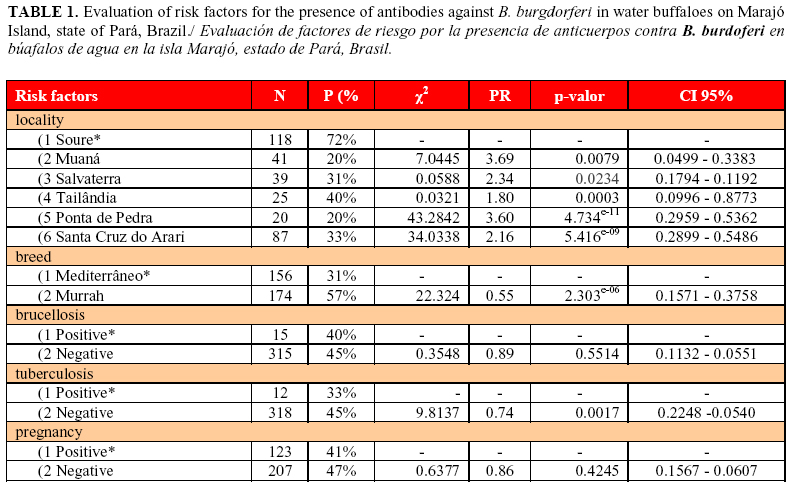
<body><![CDATA[<P><font face="Verdana, Arial, Helvetica, sans-serif" size="2">Cut-off values    were calculated based on 30 non-<I>Borrelia</I>-infected water buffalo sera    by the receiver operating characteristic (ROC) analysis with MedCalc statistical    software (version 11.4; <U><a href="http://www.medcalc.be">http://www.medcalc.be</a></U>)    (18). Thirty serum samples obtained from foals before colostrum suckling were    used as negative controls. A positive reference group consisting of 10 buffalo    serum samples tested positive for <I>B. burgdorferi </I>(titres of 1280 by IFAT)    were used as positive controls in the serological assays. </font>      <P><font face="Verdana, Arial, Helvetica, sans-serif" size="2">The chi-square    test was used to determine significant differences in the percentages of samples    tested, at a significance level of 5%. The association between seropositivity    to <I>B. burgdorferi</I> and risk factors of locality, breed, physiological    state (pregnancy) and positivity to tuberculosis and brucellosis was performed    using the chi-square (&#247;2). The analysis was performed by the statistical    software R Foundation for Statistical Computing, version 2.12.2 (2011). </font>     <P>&nbsp;     <P><font face="Verdana, Arial, Helvetica, sans-serif" size="2"><B><font size="3">RESULTS</font></B>    </font>     <P><font face="Verdana, Arial, Helvetica, sans-serif" size="2">Among the 330 buffalo    serum samples analyzed, 148 animals had antibodies against <I>B. burgdoferi</I>,    representing a prevalence of 44.8%. The number of seropositive animals varied    significantly (p&lt;0.05) depending on the location, breed and positivity for    tuberculosis (<a href="/img/revistas/rsa/v36n3/t0102314.jpg">Table 1</a>).    </font>      
<P><font face="Verdana, Arial, Helvetica, sans-serif" size="2">The prevalence    of seropositive buffalo found in the city of Soure (72%) was statistically higher    than in the other municipalities studied. Murrah animals were significantly    more seropositive (PR = 1.84, p = 0.000) than the Mediterranean breed animals.    Among animals positive for tuberculosis, 33% (4/12) were also seropositive for    <I>B. burgdoferi, </I>a significantly lower level of seropositivity (PR = 1.36,    p = 0.0017) than that seen in tuberculosis-negative animals (<a href="/img/revistas/rsa/v36n3/t0102314.jpg">Table    1</a>). </font>      
<P>&nbsp;     <P><font face="Verdana, Arial, Helvetica, sans-serif" size="2"><B><font size="3">DISCUSSION</font></B>    </font>     <P><font face="Verdana, Arial, Helvetica, sans-serif" size="2">The number of seropositive    animals observed in this study indicates the presence of a spirochete immunologically    similar to <I>B. burgdorferi</I> in buffaloes in the region studied, as previously    suggested by Scofield <I>et al</I>. (16) and Corr&ecirc;a <I>et al</I>. (17).    The frequency of seropositive buffaloes in this study was lower than the frequency    observed by Corr&ecirc;a <I>et al</I>. (17) in working with Murrah buffalo from    the mainland and Maraj&oacute; Island, in the state of Par&aacute;, Brazil.    This study showed that Murrah buffaloes were more likely to have antibodies    against <I>B. burgdorferi</I> than the Mediterranean breed, explaining the lower    rate of positive animals seen here, when both breeds were studied, compared    with Corr&ecirc;a <I>et al</I>. (17). In a study on the same region, Guedes-Junior    <I>et al</I>. (11) found a similar seroprevalence (54.9%) of <I>B. burgdorferi</I>    in cattle. </font>     <P><font face="Verdana, Arial, Helvetica, sans-serif" size="2">In a study of cattle,    Kocan <I>et al</I>. (19) found a limitation in the use of the European breed    <I>Bos taurus,</I> it does not have antibodies against tick-borne diseases.    In contrast, <I>Bos indicus</I>, of Indian origin, has a greater degree of resistance,    because of the immunity it acquired, for its greater contact with agents. The    same idea can be applied to the Mediterranean and Murrah breeds of buffalo,    since the Mediterranean breed of European origin, as with <I>Bos taurus,</I>    showed lower seropositivity, whereas Murrah animals (Indian origin) had higher    levels of seropositivity than <I>B. burgdorferi</I>. </font>     ]]></body>
<body><![CDATA[<P><font face="Verdana, Arial, Helvetica, sans-serif" size="2">The drop in immunity    caused by tuberculosis (20) impairs the immune response against other agents    - this could explain the association observed between animals positive for tuberculosis    and seronegative against <I>B. burgdorferi</I>.</font>     <P>&nbsp;     <P><font face="Verdana, Arial, Helvetica, sans-serif" size="2"><B><font size="3">CONCLUSIONS</font></B>    </font>     <P><font face="Verdana, Arial, Helvetica, sans-serif" size="2">This study demonstrates    the existence of an immunologically similar agent to <I>B. burgdorferi</I> circulating    in water buffaloes on Maraj&oacute; Island, state of Par&aacute;, Brazil. The    lower prevalence of antibodies against B. <I>bugdorferi</I> in buffaloes positive    for tuberculosis may indicate the importance of this debilitating disease in    impairing the immune response not only to borreliosis, but possibly to other    agents as well. Future studies on buffaloes should consider the importance of    mixed infections by different agents. </font>     <P><font face="Verdana, Arial, Helvetica, sans-serif" size="2">Differential breed    susceptibility is already known in cattle, but there have not been similar studies    on buffaloes. Although we observed that Murrah buffaloes were more susceptible    than the Mediterranean buffaloes, more detailed studies should be conducted    to evaluate the immunological basis of this finding. </font>     <P><font face="Verdana, Arial, Helvetica, sans-serif" size="2">These results demonstrate    the possible role of the buffalo in the epidemiological chain of this disease    in Brazil, and serve as a warning of the danger that this disease poses to public    health.</font>     <P>&nbsp;     <P><font face="Verdana, Arial, Helvetica, sans-serif" size="2"><B><font size="3">CONFLICT    OF INTEREST STATEMENT</font></B> </font>     <P><font face="Verdana, Arial, Helvetica, sans-serif" size="2">None of the authors    of this work has a financial or personal relationship with other people or organizations    that could inappropriately influence or bias the content of the paper. </font>     <P>&nbsp;     ]]></body>
<body><![CDATA[<P><font face="Verdana, Arial, Helvetica, sans-serif" size="2"><B><font size="3">ACKNOWLEDGEMENTS</font></B>    </font>     <P><font face="Verdana, Arial, Helvetica, sans-serif" size="2">We are grateful    to the Coordination for the Improvement of Higher Level of Education Personnel    (CAPES) and National Counsel of Technological and Scientific Development (CNPq)    for financial support. </font>     <P>&nbsp;     <P><font face="Verdana, Arial, Helvetica, sans-serif" size="2"><B><font size="3">REFERENCES</font></B>    </font>         <!-- ref --><P><font face="Verdana, Arial, Helvetica, sans-serif" size="2">1. Bernardes      O. A bubalinocultura no Brasil: situa&ccedil;&atilde;o e import&acirc;ncia      econ&ocirc;mica. Rev Bras Reprod Anim<I>. </I>2007;31(2):293-298.     </font>        <!-- ref --><P><font face="Verdana, Arial, Helvetica, sans-serif" size="2">2. IBGE (Instituto    Brasileiro de Geografia e Estat&iacute;stica). Dispon&iacute;vel em: &lt;<u><a href="http://www.ibge.gov.br">http://www.ibge.gov.br</a></u>&gt;    Acesso em: 01 jun 2013.     </font>      <!-- ref --><P><font face="Verdana, Arial, Helvetica, sans-serif" size="2">3. Mantovani      E, Costa IP, Gauditano G, Bonold VLN, Higuchi ML, Yoshinari NH. Description      of Lyme disease-like syndrome in Brazil. Is it a new tick borne disease or      Lyme disease variation? Braz J Med Biol Res. 2007;40(1):443-456.     </font>       ]]></body>
<body><![CDATA[<!-- ref --><P><font face="Verdana, Arial, Helvetica, sans-serif" size="2">4. Smith RD,      Brener J, Osorno M, Ristic M. Pathobiology of <I>Borrelia theileri</I> in      the tropical cattle tick, <I>Boophilus microplus</I>. J Invertebr Pathol.      1978<I>;</I>32(1):182-190.     </font>       <!-- ref --><P><font face="Verdana, Arial, Helvetica, sans-serif" size="2">5. Hoogstraal      H. Argasid and nuttalliellid ticks as parasites and vectors. Adv Parasitol<I>.      </I>1985;24(1):135-238.     </font>       <!-- ref --><P><font face="Verdana, Arial, Helvetica, sans-serif" size="2">6. Lane RS, Burgdorfer      W. Transovarial and transstadial passage of <I>Borrelia burgdorferi </I>in      the western black-legged tick, <I>Ixodes pacificus</I> Acari: Ixodidae. Am      J Med Hyg<I>.</I> 1987;37(1):188-192.     </font>       <!-- ref --><P><font face="Verdana, Arial, Helvetica, sans-serif" size="2">7. Steere AC.      Lyme disease. N Engl J Med.<I> </I>1989;31(1):586-597.     </font>        <!-- ref --><P><font face="Verdana, Arial, Helvetica, sans-serif" size="2">8. Bosler EM. Tick    vectors and hosts. In: Coyle PK. Eds. Lyme Disease. Mosby Year Book, Boston.    1993:18-26.     </font>      ]]></body>
<body><![CDATA[<!-- ref --><P><font face="Verdana, Arial, Helvetica, sans-serif" size="2">9. Rogers AB, Smith    RD, Kakoma I. Serologic cross-reactivity of antibodies against <I>Borrelia theileri,    Borrelia burgdorferi</I> and <I>Borrelia coriaceae</I> in cattle. Am J Vet Res<I>.    </I>1999;60(1):694-697.     </font>      <!-- ref --><P><font face="Verdana, Arial, Helvetica, sans-serif" size="2">10.Magnarelli LA,    Bushmich SL, Sherman BA, Fikrig E. A comparison of serologic tests for the detection    of serum antibodies to whole-cell and recombinant <I>Borrelia burgdorferi</I>    antigens in cattle. Can Vet J<I>. </I>2004;45(1):667-674.     </font>      <!-- ref --><P><font face="Verdana, Arial, Helvetica, sans-serif" size="2">11.Guedes-Junior    DS, Ara&uacute;jo FR, Silva FJM, Rangel CP, Barbosa Neto JD, Fonseca AH. Frequency    of antibodies to <I>Babesia bigemina, B. bovis, Anaplasma marginale, Trypanosoma    vivax</I> and <I>Borrelia burgdorferi</I> in cattle from the northeastern region    of the state of Par&aacute;, Brazil. Rev Bras Parasitol Vet<I>. </I>2008;17(1):105-109.        </font>      <!-- ref --><P><font face="Verdana, Arial, Helvetica, sans-serif" size="2">12.Silva JB, Ba&ecirc;ta    BA, Ribeiro CCDU, Teixeira RC, Fonseca AH. Detection of antibodies against <I>Borrelia    burgdorferi</I> in periparturient cows and calves during the first year old    by indirect enzyme-linked immunosorbent assay iELISA. GJSFR<I>. </I>2012;13(1):15-19.        </font>      <!-- ref --><P><font face="Verdana, Arial, Helvetica, sans-serif" size="2">13.Galo KR, Fonseca    AH, Madureira RC, Barbosa Neto JD. Frequ&ecirc;ncia de anticorpos hom&oacute;logos    anti- <I>Borrelia</I> <I>burgdorferi</I> em equinos na mesorregi&atilde;o metropolitana    de Bel&eacute;m, Estado do Par&aacute;. Pesq Vet Bras<I>. </I>2009<I>;</I>29(1):229-232.        </font>      ]]></body>
<body><![CDATA[<!-- ref --><P><font face="Verdana, Arial, Helvetica, sans-serif" size="2">14.Alves AL, Madureira    RC, Silva RA, Corr&ecirc;a FN, Botteon RCCM. Frequ&ecirc;ncia de anticorpos    contra <I>Borrelia burgdorferi</I> em c&atilde;es na regi&atilde;o metropolitana    do Rio de Janeiro. Pesq Vet Bras. 2004;24(1):203-206.     </font>      <!-- ref --><P><font face="Verdana, Arial, Helvetica, sans-serif" size="2">15.Cordeiro MD,    Meireles GS, Silva JB, Souza MMS, Fonseca AH. Soropreval&ecirc;ncia para <I>Borrelia</I>    spp. em c&atilde;es no munic&iacute;pio de Serop&eacute;dica, estado do Rio    de Janeiro<I>. </I>Rev Bras Med Vet. 2012;34(1):251-256.     </font>      <!-- ref --><P><font face="Verdana, Arial, Helvetica, sans-serif" size="2">16.Scofield A,    Marques CC, Barbosa JD, Fonseca AH. Ocorr&ecirc;ncia de <I>Borrelia</I> sp.    em b&uacute;falos <I>Bubalus bubalis</I> no munic&iacute;pio de Castanhal, estado    do Par&aacute;. In: Congresso Brasileiro de Buiatria, Anais. Buzios. 2005. pp.130.        </font>      <!-- ref --><P><font face="Verdana, Arial, Helvetica, sans-serif" size="2">17.Corr&ecirc;a    FN, Teixeira RC, Oliveira CMC, Barbosa JD, Fonseca AH. Detection of anti-<I>Borrelia    burgdorferi</I> antibodies in buffaloes <I>Bubalus bubalis</I> in the state    of Par&aacute;, Brazil. Rev Bras Parasitol Vet. 2012;21(1):338-341.     </font>      <!-- ref --><P><font face="Verdana, Arial, Helvetica, sans-serif" size="2">18.Terkawi MA,    Huyen NX, Shinuo C, Inpankaew T, Maklon K, Aboulaila M, et al. Molecular and    serological prevalence of <I>Babesia bovis</I> and <I>Babesia bigemina</I> in    water buffaloes in the northeast region of Thailand. Vet Parasitol. 2011;78(1):201-207.        </font>      ]]></body>
<body><![CDATA[<!-- ref --><P><font face="Verdana, Arial, Helvetica, sans-serif" size="2">19.Kocan KM, Fuente    J, Guglielmone AA, Melendez RD. Antigens and alternatives for control of <I>Anaplasma    marginale </I>infection in cattle. Clin Microbiol Rev. 2003;16(1):698-712.     </font>      <!-- ref --><P><font face="Verdana, Arial, Helvetica, sans-serif" size="2">20.Rodrigues CA,    Medeiros E, Mello GC, Favaro MR. Controle da Tuberculose Bovina. Rev Cient Eletr    Med Vet. 2008;11:1-5.     </font>      <P>&nbsp;     <P>&nbsp;     <P><font face="Verdana, Arial, Helvetica, sans-serif" size="2">Recibido: 30-1-2014.    <br>   Aceptado: 17-7-2014.</font>     <P>&nbsp;     <P>&nbsp;     ]]></body>
<body><![CDATA[<P><font size="2" face="Verdana, Arial, Helvetica, sans-serif"><a href="#pie">*</a><a name="autor"></a>Correspondencia:    <i>Jenevaldo Barbosa da Silva.</i> E-mail: <a href="mailto:jenevaldo@hotmail.com">jenevaldo@hotmail.com</a>.    </font>       ]]></body><back>
<ref-list>
<ref id="B1">
<label>1</label><nlm-citation citation-type="journal">
<person-group person-group-type="author">
<name>
<surname><![CDATA[Bernardes]]></surname>
<given-names><![CDATA[O]]></given-names>
</name>
</person-group>
<article-title xml:lang="pt"><![CDATA[A bubalinocultura no Brasil: situação e importância econômica]]></article-title>
<source><![CDATA[Rev Bras Reprod Anim]]></source>
<year>2007</year>
<volume>31</volume>
<numero>2</numero>
<issue>2</issue>
<page-range>293-298</page-range></nlm-citation>
</ref>
<ref id="B2">
<label>2</label><nlm-citation citation-type="">
<collab>Instituto Brasileiro de Geografia e Estatística</collab>
<source><![CDATA[]]></source>
<year></year>
</nlm-citation>
</ref>
<ref id="B3">
<label>3</label><nlm-citation citation-type="journal">
<person-group person-group-type="author">
<name>
<surname><![CDATA[Mantovani]]></surname>
<given-names><![CDATA[E]]></given-names>
</name>
<name>
<surname><![CDATA[Costa]]></surname>
<given-names><![CDATA[IP]]></given-names>
</name>
<name>
<surname><![CDATA[Gauditano]]></surname>
<given-names><![CDATA[G]]></given-names>
</name>
<name>
<surname><![CDATA[Bonold]]></surname>
<given-names><![CDATA[VLN]]></given-names>
</name>
<name>
<surname><![CDATA[Higuchi]]></surname>
<given-names><![CDATA[ML]]></given-names>
</name>
<name>
<surname><![CDATA[Yoshinari]]></surname>
<given-names><![CDATA[NH]]></given-names>
</name>
</person-group>
<article-title xml:lang="en"><![CDATA[Description of Lyme disease-like syndrome in Brazil: Is it a new tick borne disease or Lyme disease variation?]]></article-title>
<source><![CDATA[Braz J Med Biol Res]]></source>
<year>2007</year>
<volume>40</volume>
<numero>1</numero>
<issue>1</issue>
<page-range>443-456</page-range></nlm-citation>
</ref>
<ref id="B4">
<label>4</label><nlm-citation citation-type="journal">
<person-group person-group-type="author">
<name>
<surname><![CDATA[Smith]]></surname>
<given-names><![CDATA[RD]]></given-names>
</name>
<name>
<surname><![CDATA[Brener]]></surname>
<given-names><![CDATA[J]]></given-names>
</name>
<name>
<surname><![CDATA[Osorno]]></surname>
<given-names><![CDATA[M]]></given-names>
</name>
<name>
<surname><![CDATA[Ristic]]></surname>
<given-names><![CDATA[M]]></given-names>
</name>
</person-group>
<article-title xml:lang="en"><![CDATA[Pathobiology of Borrelia theileri in the tropical cattle tick, Boophilus microplus]]></article-title>
<source><![CDATA[J Invertebr Pathol]]></source>
<year>1978</year>
<volume>32</volume>
<numero>1</numero>
<issue>1</issue>
<page-range>182-190</page-range></nlm-citation>
</ref>
<ref id="B5">
<label>5</label><nlm-citation citation-type="journal">
<person-group person-group-type="author">
<name>
<surname><![CDATA[Hoogstraal]]></surname>
<given-names><![CDATA[H]]></given-names>
</name>
</person-group>
<article-title xml:lang="en"><![CDATA[Argasid and nuttalliellid ticks as parasites and vectors]]></article-title>
<source><![CDATA[Adv Parasitol]]></source>
<year>1985</year>
<volume>24</volume>
<numero>1</numero>
<issue>1</issue>
<page-range>135-238</page-range></nlm-citation>
</ref>
<ref id="B6">
<label>6</label><nlm-citation citation-type="journal">
<person-group person-group-type="author">
<name>
<surname><![CDATA[Lane]]></surname>
<given-names><![CDATA[RS]]></given-names>
</name>
<name>
<surname><![CDATA[Burgdorfer]]></surname>
<given-names><![CDATA[W]]></given-names>
</name>
</person-group>
<article-title xml:lang="en"><![CDATA[Transovarial and transstadial passage of Borrelia burgdorferi in the western black-legged tick, Ixodes pacificus Acari: Ixodidae]]></article-title>
<source><![CDATA[Am J Med Hyg]]></source>
<year>1987</year>
<volume>37</volume>
<numero>1</numero>
<issue>1</issue>
<page-range>188-192</page-range></nlm-citation>
</ref>
<ref id="B7">
<label>7</label><nlm-citation citation-type="journal">
<person-group person-group-type="author">
<name>
<surname><![CDATA[Steere]]></surname>
<given-names><![CDATA[AC]]></given-names>
</name>
</person-group>
<article-title xml:lang="en"><![CDATA[Lyme disease]]></article-title>
<source><![CDATA[N Engl J Med]]></source>
<year>1989</year>
<volume>31</volume>
<numero>1</numero>
<issue>1</issue>
<page-range>586-597</page-range></nlm-citation>
</ref>
<ref id="B8">
<label>8</label><nlm-citation citation-type="">
<person-group person-group-type="author">
<name>
<surname><![CDATA[Bosler]]></surname>
<given-names><![CDATA[EM]]></given-names>
</name>
</person-group>
<article-title xml:lang="en"><![CDATA[Tick vectors and hosts]]></article-title>
<person-group person-group-type="editor">
<name>
<surname><![CDATA[Coyle]]></surname>
<given-names><![CDATA[PK]]></given-names>
</name>
</person-group>
<source><![CDATA[Lyme Disease: Mosby Year Book]]></source>
<year>1993</year>
<page-range>18-26</page-range><publisher-loc><![CDATA[^eBoston Boston]]></publisher-loc>
</nlm-citation>
</ref>
<ref id="B9">
<label>9</label><nlm-citation citation-type="journal">
<person-group person-group-type="author">
<name>
<surname><![CDATA[Rogers]]></surname>
<given-names><![CDATA[AB]]></given-names>
</name>
<name>
<surname><![CDATA[Smith]]></surname>
<given-names><![CDATA[RD]]></given-names>
</name>
<name>
<surname><![CDATA[Kakoma]]></surname>
<given-names><![CDATA[I]]></given-names>
</name>
</person-group>
<article-title xml:lang="en"><![CDATA[Serologic cross-reactivity of antibodies against Borrelia theileri, Borrelia burgdorferi and Borrelia coriaceae in cattle]]></article-title>
<source><![CDATA[Am J Vet Res]]></source>
<year>1999</year>
<volume>60</volume>
<numero>1</numero>
<issue>1</issue>
<page-range>694-697</page-range></nlm-citation>
</ref>
<ref id="B10">
<label>10</label><nlm-citation citation-type="journal">
<person-group person-group-type="author">
<name>
<surname><![CDATA[Magnarelli]]></surname>
<given-names><![CDATA[LA]]></given-names>
</name>
<name>
<surname><![CDATA[Bushmich]]></surname>
<given-names><![CDATA[SL]]></given-names>
</name>
<name>
<surname><![CDATA[Sherman]]></surname>
<given-names><![CDATA[BA]]></given-names>
</name>
<name>
<surname><![CDATA[Fikrig]]></surname>
<given-names><![CDATA[E]]></given-names>
</name>
</person-group>
<article-title xml:lang="en"><![CDATA[A comparison of serologic tests for the detection of serum antibodies to whole-cell and recombinant Borrelia burgdorferi antigens in cattle]]></article-title>
<source><![CDATA[Can Vet J]]></source>
<year>2004</year>
<volume>45</volume>
<numero>1</numero>
<issue>1</issue>
<page-range>667-674</page-range></nlm-citation>
</ref>
<ref id="B11">
<label>11</label><nlm-citation citation-type="journal">
<person-group person-group-type="author">
<name>
<surname><![CDATA[Guedes-Junior]]></surname>
<given-names><![CDATA[DS]]></given-names>
</name>
<name>
<surname><![CDATA[Araújo]]></surname>
<given-names><![CDATA[FR]]></given-names>
</name>
<name>
<surname><![CDATA[Silva]]></surname>
<given-names><![CDATA[FJM]]></given-names>
</name>
<name>
<surname><![CDATA[Rangel]]></surname>
<given-names><![CDATA[CP]]></given-names>
</name>
<name>
<surname><![CDATA[Barbosa Neto]]></surname>
<given-names><![CDATA[JD]]></given-names>
</name>
<name>
<surname><![CDATA[Fonseca]]></surname>
<given-names><![CDATA[AH]]></given-names>
</name>
</person-group>
<article-title xml:lang="en"><![CDATA[Frequency of antibodies to Babesia bigemina, B. bovis, Anaplasma marginale, Trypanosoma vivax and Borrelia burgdorferi in cattle from the northeastern region of the state of Pará, Brazil]]></article-title>
<source><![CDATA[Rev Bras Parasitol Vet]]></source>
<year>2008</year>
<volume>17</volume>
<numero>1</numero>
<issue>1</issue>
<page-range>105-109</page-range></nlm-citation>
</ref>
<ref id="B12">
<label>12</label><nlm-citation citation-type="journal">
<person-group person-group-type="author">
<name>
<surname><![CDATA[Silva]]></surname>
<given-names><![CDATA[JB]]></given-names>
</name>
<name>
<surname><![CDATA[Baêta]]></surname>
<given-names><![CDATA[BA]]></given-names>
</name>
<name>
<surname><![CDATA[Ribeiro]]></surname>
<given-names><![CDATA[CCDU]]></given-names>
</name>
<name>
<surname><![CDATA[Teixeira]]></surname>
<given-names><![CDATA[RC]]></given-names>
</name>
<name>
<surname><![CDATA[Fonseca]]></surname>
<given-names><![CDATA[AH]]></given-names>
</name>
</person-group>
<article-title xml:lang="en"><![CDATA[Detection of antibodies against Borrelia burgdorferi in periparturient cows and calves during the first year old by indirect enzyme-linked immunosorbent assay iELISA]]></article-title>
<source><![CDATA[GJSFR]]></source>
<year>2012</year>
<volume>13</volume>
<numero>1</numero>
<issue>1</issue>
<page-range>15-19</page-range></nlm-citation>
</ref>
<ref id="B13">
<label>13</label><nlm-citation citation-type="journal">
<person-group person-group-type="author">
<name>
<surname><![CDATA[Galo]]></surname>
<given-names><![CDATA[KR]]></given-names>
</name>
<name>
<surname><![CDATA[Fonseca]]></surname>
<given-names><![CDATA[AH]]></given-names>
</name>
<name>
<surname><![CDATA[Madureira]]></surname>
<given-names><![CDATA[RC]]></given-names>
</name>
<name>
<surname><![CDATA[Barbosa Neto]]></surname>
<given-names><![CDATA[JD]]></given-names>
</name>
</person-group>
<article-title xml:lang="pt"><![CDATA[Frequência de anticorpos homólogos anti- Borrelia burgdorferi em equinos na mesorregião metropolitana de Belém, Estado do Pará]]></article-title>
<source><![CDATA[Pesq Vet Bras]]></source>
<year>2009</year>
<volume>29</volume>
<numero>1</numero>
<issue>1</issue>
<page-range>229-232</page-range></nlm-citation>
</ref>
<ref id="B14">
<label>14</label><nlm-citation citation-type="journal">
<person-group person-group-type="author">
<name>
<surname><![CDATA[Alves]]></surname>
<given-names><![CDATA[AL]]></given-names>
</name>
<name>
<surname><![CDATA[Madureira]]></surname>
<given-names><![CDATA[RC]]></given-names>
</name>
<name>
<surname><![CDATA[Silva]]></surname>
<given-names><![CDATA[RA]]></given-names>
</name>
<name>
<surname><![CDATA[Corrêa]]></surname>
<given-names><![CDATA[FN]]></given-names>
</name>
<name>
<surname><![CDATA[Botteon]]></surname>
<given-names><![CDATA[RCCM]]></given-names>
</name>
</person-group>
<article-title xml:lang="pt"><![CDATA[Frequência de anticorpos contra Borrelia burgdorferi em cães na região metropolitana do Rio de Janeiro]]></article-title>
<source><![CDATA[Pesq Vet Bras]]></source>
<year>2004</year>
<volume>24</volume>
<numero>1</numero>
<issue>1</issue>
<page-range>203-206</page-range></nlm-citation>
</ref>
<ref id="B15">
<label>15</label><nlm-citation citation-type="journal">
<person-group person-group-type="author">
<name>
<surname><![CDATA[Cordeiro]]></surname>
<given-names><![CDATA[MD]]></given-names>
</name>
<name>
<surname><![CDATA[Meireles]]></surname>
<given-names><![CDATA[GS]]></given-names>
</name>
<name>
<surname><![CDATA[Silva]]></surname>
<given-names><![CDATA[JB]]></given-names>
</name>
<name>
<surname><![CDATA[Souza]]></surname>
<given-names><![CDATA[MMS]]></given-names>
</name>
<name>
<surname><![CDATA[Fonseca]]></surname>
<given-names><![CDATA[AH]]></given-names>
</name>
</person-group>
<article-title xml:lang="pt"><![CDATA[Soroprevalência para Borrelia spp. em cães no município de Seropédica, estado do Rio de Janeiro]]></article-title>
<source><![CDATA[Rev Bras Med Vet]]></source>
<year>2012</year>
<volume>34</volume>
<numero>1</numero>
<issue>1</issue>
<page-range>251-256</page-range></nlm-citation>
</ref>
<ref id="B16">
<label>16</label><nlm-citation citation-type="">
<person-group person-group-type="author">
<name>
<surname><![CDATA[Scofield]]></surname>
<given-names><![CDATA[A]]></given-names>
</name>
<name>
<surname><![CDATA[Marques]]></surname>
<given-names><![CDATA[CC]]></given-names>
</name>
<name>
<surname><![CDATA[Barbosa]]></surname>
<given-names><![CDATA[JD]]></given-names>
</name>
<name>
<surname><![CDATA[Fonseca]]></surname>
<given-names><![CDATA[AH]]></given-names>
</name>
</person-group>
<article-title xml:lang="pt"><![CDATA[Ocorrência de Borrelia sp. em búfalos Bubalus bubalis no município de Castanhal, estado do Pará]]></article-title>
<source><![CDATA[Congresso Brasileiro de Buiatria, Anais. Buzios]]></source>
<year>2005</year>
<page-range>130</page-range></nlm-citation>
</ref>
<ref id="B17">
<label>17</label><nlm-citation citation-type="journal">
<person-group person-group-type="author">
<name>
<surname><![CDATA[Corrêa]]></surname>
<given-names><![CDATA[FN]]></given-names>
</name>
<name>
<surname><![CDATA[Teixeira]]></surname>
<given-names><![CDATA[RC]]></given-names>
</name>
<name>
<surname><![CDATA[Oliveira]]></surname>
<given-names><![CDATA[CMC]]></given-names>
</name>
<name>
<surname><![CDATA[Barbosa]]></surname>
<given-names><![CDATA[JD]]></given-names>
</name>
<name>
<surname><![CDATA[Fonseca]]></surname>
<given-names><![CDATA[AH]]></given-names>
</name>
</person-group>
<article-title xml:lang="en"><![CDATA[Detection of anti-Borrelia burgdorferi antibodies in buffaloes Bubalus bubalis in the state of Pará, Brazil]]></article-title>
<source><![CDATA[Rev Bras Parasitol Vet]]></source>
<year>2012</year>
<volume>21</volume>
<numero>1</numero>
<issue>1</issue>
<page-range>338-341</page-range></nlm-citation>
</ref>
<ref id="B18">
<label>18</label><nlm-citation citation-type="journal">
<person-group person-group-type="author">
<name>
<surname><![CDATA[Terkawi]]></surname>
<given-names><![CDATA[MA]]></given-names>
</name>
<name>
<surname><![CDATA[Huyen]]></surname>
<given-names><![CDATA[NX]]></given-names>
</name>
<name>
<surname><![CDATA[Shinuo]]></surname>
<given-names><![CDATA[C]]></given-names>
</name>
<name>
<surname><![CDATA[Inpankaew]]></surname>
<given-names><![CDATA[T]]></given-names>
</name>
<name>
<surname><![CDATA[Maklon]]></surname>
<given-names><![CDATA[K]]></given-names>
</name>
<name>
<surname><![CDATA[Aboulaila]]></surname>
<given-names><![CDATA[M]]></given-names>
</name>
</person-group>
<article-title xml:lang="en"><![CDATA[Molecular and serological prevalence of Babesia bovis and Babesia bigemina in water buffaloes in the northeast region of Thailand]]></article-title>
<source><![CDATA[Vet Parasitol]]></source>
<year>2011</year>
<volume>78</volume>
<numero>1</numero>
<issue>1</issue>
<page-range>201-207</page-range></nlm-citation>
</ref>
<ref id="B19">
<label>19</label><nlm-citation citation-type="journal">
<person-group person-group-type="author">
<name>
<surname><![CDATA[Kocan]]></surname>
<given-names><![CDATA[KM]]></given-names>
</name>
<name>
<surname><![CDATA[Fuente]]></surname>
<given-names><![CDATA[J]]></given-names>
</name>
<name>
<surname><![CDATA[Guglielmone]]></surname>
<given-names><![CDATA[AA]]></given-names>
</name>
<name>
<surname><![CDATA[Melendez]]></surname>
<given-names><![CDATA[RD]]></given-names>
</name>
</person-group>
<article-title xml:lang="en"><![CDATA[Antigens and alternatives for control of Anaplasma marginale infection in cattle]]></article-title>
<source><![CDATA[Clin Microbiol Rev]]></source>
<year>2003</year>
<volume>16</volume>
<numero>1</numero>
<issue>1</issue>
<page-range>698-712</page-range></nlm-citation>
</ref>
<ref id="B20">
<label>20</label><nlm-citation citation-type="journal">
<person-group person-group-type="author">
<name>
<surname><![CDATA[Rodrigues]]></surname>
<given-names><![CDATA[CA]]></given-names>
</name>
<name>
<surname><![CDATA[Medeiros]]></surname>
<given-names><![CDATA[E]]></given-names>
</name>
<name>
<surname><![CDATA[Mello]]></surname>
<given-names><![CDATA[GC]]></given-names>
</name>
<name>
<surname><![CDATA[Favaro]]></surname>
<given-names><![CDATA[MR]]></given-names>
</name>
</person-group>
<article-title xml:lang="pt"><![CDATA[Controle da Tuberculose Bovina]]></article-title>
<source><![CDATA[Rev Cient Eletr Med Vet]]></source>
<year>2008</year>
<volume>11</volume>
<page-range>1-5</page-range></nlm-citation>
</ref>
</ref-list>
</back>
</article>