<?xml version="1.0" encoding="ISO-8859-1"?><article xmlns:mml="http://www.w3.org/1998/Math/MathML" xmlns:xlink="http://www.w3.org/1999/xlink" xmlns:xsi="http://www.w3.org/2001/XMLSchema-instance">
<front>
<journal-meta>
<journal-id>0253-570X</journal-id>
<journal-title><![CDATA[Revista de Salud Animal]]></journal-title>
<abbrev-journal-title><![CDATA[Rev Salud Anim.]]></abbrev-journal-title>
<issn>0253-570X</issn>
<publisher>
<publisher-name><![CDATA[Centro Nacional de Sanidad Agropecuaria]]></publisher-name>
</publisher>
</journal-meta>
<article-meta>
<article-id>S0253-570X2015000300003</article-id>
<title-group>
<article-title xml:lang="en"><![CDATA[Genetic relationships between Cuban and Brazilian buffaloes (Bubalus bubalis) by microsatellite markers]]></article-title>
<article-title xml:lang="es"><![CDATA[Relaciones genéticas entre búfalos (Bubalus bubalis) de Cuba y de Brasil con el uso de marcadores microsatélites]]></article-title>
</title-group>
<contrib-group>
<contrib contrib-type="author">
<name>
<surname><![CDATA[Martínez Marrero]]></surname>
<given-names><![CDATA[Nadia]]></given-names>
</name>
<xref ref-type="aff" rid="A01"/>
</contrib>
<contrib contrib-type="author">
<name>
<surname><![CDATA[da Silva]]></surname>
<given-names><![CDATA[Elizabete Cristina]]></given-names>
</name>
<xref ref-type="aff" rid="A02"/>
</contrib>
<contrib contrib-type="author">
<name>
<surname><![CDATA[Mitat Valdés]]></surname>
<given-names><![CDATA[Alina]]></given-names>
</name>
<xref ref-type="aff" rid="A03"/>
</contrib>
<contrib contrib-type="author">
<name>
<surname><![CDATA[Ponce]]></surname>
<given-names><![CDATA[Giselle]]></given-names>
</name>
<xref ref-type="aff" rid="A01"/>
</contrib>
<contrib contrib-type="author">
<name>
<surname><![CDATA[Benício da Silva]]></surname>
<given-names><![CDATA[Regina C.]]></given-names>
</name>
<xref ref-type="aff" rid="A04"/>
</contrib>
<contrib contrib-type="author">
<name>
<surname><![CDATA[Paes Barbosa]]></surname>
<given-names><![CDATA[Severino Benone]]></given-names>
</name>
<xref ref-type="aff" rid="A04"/>
</contrib>
<contrib contrib-type="author">
<name>
<surname><![CDATA[Uffo Reinosa]]></surname>
<given-names><![CDATA[Odalys]]></given-names>
</name>
<xref ref-type="aff" rid="A01"/>
</contrib>
<contrib contrib-type="author">
<name>
<surname><![CDATA[Gomes Filho]]></surname>
<given-names><![CDATA[Manoel Adrião]]></given-names>
</name>
<xref ref-type="aff" rid="A05"/>
</contrib>
</contrib-group>
<aff id="A01">
<institution><![CDATA[,Centro Nacional de Sanidad Agropecuaria (CENSA) Laboratorio de Genética Molecular ]]></institution>
<addr-line><![CDATA[San José de las Lajas Mayabeque]]></addr-line>
<country>Cuba</country>
</aff>
<aff id="A02">
<institution><![CDATA[,Universidade de Brasília (UnB) Faculdade de Agronomia e Veterinária-FAV ]]></institution>
<addr-line><![CDATA[ Brasília - DF]]></addr-line>
<country>Brazil</country>
</aff>
<aff id="A03">
<institution><![CDATA[,Universidad Agraria de La Habana (UNAH) Facultad de Medicina Veterinaria ]]></institution>
<addr-line><![CDATA[San José de las Lajas Mayabeque]]></addr-line>
<country>Cuba</country>
</aff>
<aff id="A04">
<institution><![CDATA[,Universidade Federal Rural de Pernambuco (UFRPE) Departamento de Zootecnia ]]></institution>
<addr-line><![CDATA[ Recife-PE]]></addr-line>
<country>Brazil</country>
</aff>
<aff id="A05">
<institution><![CDATA[,Universidade Federal Rural de Pernambuco (UFRPE) Departamento de Morfologia e Fisiologia Animal ]]></institution>
<addr-line><![CDATA[ Recife-PE]]></addr-line>
<country>Brazil</country>
</aff>
<pub-date pub-type="pub">
<day>00</day>
<month>12</month>
<year>2015</year>
</pub-date>
<pub-date pub-type="epub">
<day>00</day>
<month>12</month>
<year>2015</year>
</pub-date>
<volume>37</volume>
<numero>3</numero>
<fpage>152</fpage>
<lpage>163</lpage>
<copyright-statement/>
<copyright-year/>
<self-uri xlink:href="http://scielo.sld.cu/scielo.php?script=sci_arttext&amp;pid=S0253-570X2015000300003&amp;lng=en&amp;nrm=iso"></self-uri><self-uri xlink:href="http://scielo.sld.cu/scielo.php?script=sci_abstract&amp;pid=S0253-570X2015000300003&amp;lng=en&amp;nrm=iso"></self-uri><self-uri xlink:href="http://scielo.sld.cu/scielo.php?script=sci_pdf&amp;pid=S0253-570X2015000300003&amp;lng=en&amp;nrm=iso"></self-uri><abstract abstract-type="short" xml:lang="en"><p><![CDATA[Researches on genetic relationships among water buffalo populations are useful in supporting conservation decisions and designing of breeding schemes. The aim of this study was to assess the genetic relationships among Cuban Buffalypso/Carabao hybrids and Murrah and Jaffarabadi Brazilian buffaloes using nine cattle microsatellite markers. During the analysis, four loci were excluded due to the presence of null alleles, stuttering and gametic disequilibrium. Mean numbers of alleles and the heterozygosities observed and expected in the three populations were not significantly different. Heterozygosities found were above 60%. All five loci were in Hardy-Weinberg equilibrium. Wright´s index for estimating inbreeding were negative in the three populations. A moderate population differentiation was found among Cuban and Brazilian populations. The AMOVA showed that only 8.3% of the total variation observed occurred among breeds (P<0.05). The multivariate factorial correspondence analysis showed low breed-specific clustering and most of Murrah and Jaffarabadi Brazilian animals plotted overlapping. UPGMA dendrogram obtained from Nei's D A genetic distance differentiated two clusters, one grouped Cuban buffaloes (bootstrap value 89%), and the other included the Brazilian populations (bootstrap value 100%). Bayesian clustering approach reinforced the previous results. The origin of Buffalypso breed and its genetic management in Cuba could be the reason to the moderate differentiation between Cuban and Brazilian populations. This study provided a preliminary analysis on genetic relationships between Cuban and Brazilian buffaloes. The research must be extended to include a higher number of microsatellite loci and buffalo populations from other geographical regions of each country.]]></p></abstract>
<abstract abstract-type="short" xml:lang="es"><p><![CDATA[Las investigaciones sobre relaciones genéticas entre poblaciones de búfalos de agua son fundamentales para las decisiones relacionadas con la conservación y el diseño de esquemas de mejora. El objetivo de este trabajo fue estimar las relaciones genéticas entre búfalos de Cuba y de Brasil a través de nueve marcadores microsatélites. Se excluyeron del análisis cuatro loci por presencia de alelos nulos, posibles errores de lectura por tartamudeo de las bandas y desequilibrio gamético. No se encontraron diferencias significativas entre las medias del número de alelos y las heterocigosidades observadas y esperadas en las tres poblaciones. Los niveles de heterocigosidad encontrados están por encima del 60%. Los cinco loci se hallaban en equilibrio de Hardy-Weinberg. El índice de Wright para estimar la endogamia de la población fue negativo en las tres. Se estimó una diferenciación moderada entre las poblaciones de búfalos de Cuba y de Brasil. El AMOVA mostró que solo el 8.3% de la variación total observada estaba entre las razas. En el análisis factorial de correspondencia se observó una baja especificidad en el agrupamiento en razas y una ubicación sobrelapada de la mayoría de los animales brasileños. El dendograma UPGMA, a partir de la distancia genética de Nei (D A), mostró dos grupos: uno agrupó a los búfalos cubanos y el otro incluyó a las poblaciones brasileñas. El agrupamiento por métodos bayesianos reforzó los resultados previos. El origen de la raza Buffalypso y su manejo genético en Cuba pueden ser las razones de la moderada diferenciación entre las poblaciones de búfalos de Cuba y de Brasil. Estos resultados constituyen un análisis preliminar de las relaciones genéticas entre búfalos de Cuba y de Brasil. La investigación debe ser ampliada para analizar un mayor número de loci microsatélite, así como para incluir más poblaciones de otras regiones geográficas en cada país.]]></p></abstract>
<kwd-group>
<kwd lng="en"><![CDATA[Bubalus bubalis]]></kwd>
<kwd lng="en"><![CDATA[Buffalypso]]></kwd>
<kwd lng="en"><![CDATA[microsatellite markers]]></kwd>
<kwd lng="en"><![CDATA[null allele]]></kwd>
<kwd lng="en"><![CDATA[genetic relationships]]></kwd>
<kwd lng="es"><![CDATA[Bubalus bubalis]]></kwd>
<kwd lng="es"><![CDATA[Buffalypso]]></kwd>
<kwd lng="es"><![CDATA[marcadores microsatélites]]></kwd>
<kwd lng="es"><![CDATA[alelos nulos]]></kwd>
<kwd lng="es"><![CDATA[relaciones genéticas]]></kwd>
</kwd-group>
</article-meta>
</front><body><![CDATA[ <p align="right"><font face="Verdana, Arial, Helvetica, sans-serif" size="2"><B>ORIGINAL    ARTICLE</B> </font> </p>     <p>&nbsp;</p>     <p><font face="Verdana, Arial, Helvetica, sans-serif" size="2"><b><font size="4">Genetic    relationships between Cuban and Brazilian buffaloes (<i>Bubalus bubalis</i>)    by microsatellite markers</font></b></font></p>     <p>&nbsp;</p>     <p><font face="Verdana, Arial, Helvetica, sans-serif" size="2"><b><font size="3">Relaciones    gen&eacute;ticas entre b&uacute;falos (<i>Bubalus bubalis</i>) de Cuba y de    Brasil con el uso de marcadores microsat&eacute;lites</font></b></font></p>     <p>&nbsp;</p>     <p>&nbsp;</p> <H1> <font face="Verdana, Arial, Helvetica, sans-serif" size="2"></font><B>        <P><font face="Verdana, Arial, Helvetica, sans-serif" size="2">Nadia Mart&iacute;nez      Marrero<SUP>I</SUP>, Elizabete Cristina da Silva<SUP>II</SUP>, Alina Mitat      Vald&eacute;s<SUP>III</SUP>, Giselle Ponce<SUP>I</SUP>, Regina C. Ben&iacute;cio      da Silva<SUP>IV</SUP>, Severino Benone Paes Barbosa<SUP>IV</SUP>, Odalys Uffo      Reinosa<SUP>I</SUP><a href="#autor">*</a><a name="pie"></a>, Manoel Adri&atilde;o      Gomes Filho<SUP>V</SUP> </font>    </B> </H1>     <P><font face="Verdana, Arial, Helvetica, sans-serif" size="2"><SUP>I</SUP>Centro    Nacional de Sanidad Agropecuaria (CENSA). Laboratorio de Gen&eacute;tica Molecular.    Apartado 10, San Jos&eacute; de las Lajas, Mayabeque, Cuba.     <br>   <SUP>II</SUP>Universidade de Bras&iacute;lia (UnB). Faculdade de Agronomia e    Veterin&aacute;ria-FAV. Campus Universit&aacute;rio Darcy Ribeiro-CEP: 70910-900.    Bras&iacute;lia - DF, Brazil. <SUP>    ]]></body>
<body><![CDATA[<br>   III</SUP>Universidad Agraria de La Habana (UNAH). Facultad de Medicina Veterinaria.    Carretera de Tapaste y Autopista Nacional. San Jos&eacute; de las Lajas. Mayabeque,    Cuba. <SUP>    <br>   IV</SUP>Universidade Federal Rural de Pernambuco (UFRPE). Departamento de Zootecnia.    Rua Dom Manoel de Medeiros, s/n, Dois Irm&atilde;os - CEP: 52171-900. Recife-PE,    Brazil. <SUP>    <br>   V</SUP>Universidade Federal Rural de Pernambuco (UFRPE). Departamento de Morfologia    e Fisiologia Animal. Rua Dom Manoel de Medeiros, s/n, Dois Irm&atilde;os - CEP:    52171-900. Recife-PE, Brazil. </font>     <P>&nbsp;     <P>&nbsp; <hr noshade size="1">     <P><font face="Verdana, Arial, Helvetica, sans-serif" size="2"><B>ABSTRACT</B></font>     <P><font face="Verdana, Arial, Helvetica, sans-serif" size="2">Researches on genetic    relationships among water buffalo populations are useful in supporting conservation    decisions and designing of breeding schemes. The aim of this study was to assess    the genetic relationships among Cuban Buffalypso/Carabao hybrids and Murrah    and Jaffarabadi<U> </U>Brazilian buffaloes using nine cattle microsatellite    markers. During the analysis, four loci were excluded due to the presence of    null alleles, stuttering and gametic disequilibrium. Mean numbers of alleles    and the heterozygosities observed and expected in the three populations were    not significantly different. Heterozygosities found were above 60%. All five    loci were in Hardy-Weinberg equilibrium. Wright&#180;s index for estimating    inbreeding were negative in the three populations. A moderate population differentiation    was found among Cuban and Brazilian populations. The AMOVA showed that only    8.3% of the total variation observed occurred among breeds (P&lt;0.05). The    multivariate factorial correspondence analysis showed low breed-specific clustering    and most of Murrah and Jaffarabadi<U> </U>Brazilian animals plotted overlapping.    UPGMA dendrogram obtained from Nei's D<SUB>A</SUB> genetic distance differentiated    two clusters, one grouped Cuban buffaloes (bootstrap value 89%), and the other    included the Brazilian populations (bootstrap value 100%). Bayesian clustering    approach reinforced the previous results. The origin of Buffalypso breed and    its genetic management in Cuba could be the reason to the moderate differentiation    between Cuban and Brazilian populations. This study provided a preliminary analysis    on genetic relationships between Cuban and Brazilian buffaloes.<U> </U>The research    must be extended to include a higher number of microsatellite loci and buffalo    populations from other geographical regions of each country. </font>     <P><font face="Verdana, Arial, Helvetica, sans-serif" size="2"><B>Key words: </B><I>Bubalus    bubalis</I>, Buffalypso, microsatellite markers, null allele, genetic relationships.</font> <hr noshade size="1">     <p><font face="Verdana, Arial, Helvetica, sans-serif" size="2"><B>RESUMEN</b></font></p>     <p><font face="Verdana, Arial, Helvetica, sans-serif" size="2">Las investigaciones    sobre relaciones gen&eacute;ticas entre poblaciones de b&uacute;falos de agua    son fundamentales para las decisiones relacionadas con la conservaci&oacute;n    y el dise&ntilde;o de esquemas de mejora. El objetivo de este trabajo fue estimar    las relaciones gen&eacute;ticas entre b&uacute;falos de Cuba y de Brasil a trav&eacute;s    de nueve marcadores microsat&eacute;lites. Se excluyeron del an&aacute;lisis    cuatro loci por presencia de alelos nulos, posibles errores de lectura por tartamudeo    de las bandas y desequilibrio gam&eacute;tico. No se encontraron diferencias    significativas entre las medias del n&uacute;mero de alelos y las heterocigosidades    observadas y esperadas en las tres poblaciones. Los niveles de heterocigosidad    encontrados est&aacute;n por encima del 60%. Los cinco loci se hallaban en equilibrio    de Hardy-Weinberg. El &iacute;ndice de Wright para estimar la endogamia de la    poblaci&oacute;n fue negativo en las tres. Se estim&oacute; una diferenciaci&oacute;n    moderada entre las poblaciones de b&uacute;falos de Cuba y de Brasil. El AMOVA    mostr&oacute; que solo el 8.3% de la variaci&oacute;n total observada estaba    entre las razas. En el an&aacute;lisis factorial de correspondencia se observ&oacute;    una baja especificidad en el agrupamiento en razas y una ubicaci&oacute;n sobrelapada    de la mayor&iacute;a de los animales brasile&ntilde;os. El dendograma UPGMA,    a partir de la distancia gen&eacute;tica de Nei (D<SUB>A</SUB>), mostr&oacute;    dos grupos: uno agrup&oacute; a los b&uacute;falos cubanos y el otro incluy&oacute;    a las poblaciones brasile&ntilde;as. El agrupamiento por m&eacute;todos bayesianos    reforz&oacute; los resultados previos. El origen de la raza Buffalypso y su    manejo gen&eacute;tico en Cuba pueden ser las razones de la moderada diferenciaci&oacute;n    entre las poblaciones de b&uacute;falos de Cuba y de Brasil. Estos resultados    constituyen un an&aacute;lisis preliminar de las relaciones gen&eacute;ticas    entre b&uacute;falos de Cuba y de Brasil. La investigaci&oacute;n debe ser ampliada    para analizar un mayor n&uacute;mero de loci<U> </U>microsat&eacute;lite, as&iacute;    como para incluir m&aacute;s poblaciones de otras regiones geogr&aacute;ficas    en cada pa&iacute;s. </font> </p>     ]]></body>
<body><![CDATA[<P><font face="Verdana, Arial, Helvetica, sans-serif" size="2"><B>Palabras clave:    </B><I>Bubalus bubalis</I>, Buffalypso, marcadores microsat&eacute;lites, alelos    nulos, relaciones gen&eacute;ticas.</font> <hr noshade size="1">     <P><font face="Verdana, Arial, Helvetica, sans-serif" size="2"> </font>     <P>&nbsp;     <P><font face="Verdana, Arial, Helvetica, sans-serif" size="2"><B><font size="3">INTRODUCTION</font></B>    </font>     <P><font face="Verdana, Arial, Helvetica, sans-serif" size="2">The water buffalo    (<I>Bubalus bubalis</I>) is a versatile species exploited from tropical to temperate    regions. Since their domestication 5000 years ago (1), these animals have become    important producers of milk, meat, hides and draught animal (2). Nowadays, water    buffalo constitute a vital species in the lives of small farmers and the economy    of many highly populated countries. According to FAO (<U><a href="http://faostat.fao.org/">http://faostat.fao.org/</a></U>)    statistics (3), there were about 199.8 million buffaloes in the world until    2013, 97.1% of which were in Asia and only 0.7% in the Americas. </font>      <P><font face="Verdana, Arial, Helvetica, sans-serif" size="2">Historically, water    buffalo has been divided into swamp and river buffalo based on morphological,    behavioral and geographical criteria (1). They are sometimes referred to as    different subspecies, river as <I>Bubalus bubalis bubalis</I> (21 breeds) (4)    and swamp as <I>Bubalus<U> </U>bubalis carabenesis</I>. </font>     <P><font face="Verdana, Arial, Helvetica, sans-serif" size="2">The introduction    of water buffalo in Cuba was relatively recent, dating from the 80s of last    century. Animals of the river breed Buffalypso were imported from Panam&aacute;    and Trinidad and Tobago Islands (5). Buffalypso is the result of crossbreeding    among several Indian breeds such as the Murrah, Surti, Jaffarabadi, Nelli, and    Bhadawari (6). This breed was used in Cuba for upgrading the larger population    composed of swamp buffaloes (Carabao) imported later from Australia (4, 5).    Current herds exceed widely the number of imported animals, which is indicative    of their adaptability to existing environmental conditions in the country (5).    </font>     <P><font face="Verdana, Arial, Helvetica, sans-serif" size="2">Research on genetic    diversity and relationships among water buffalo populations provides a useful    tool in supporting conservation decisions and designing of breeding schemes.    To date, only Acosta <I>et al.</I> (7) analyzed the genetic diversity in Cuban    buffalo populations using molecular markers. No work has been published on genetic    relationships among Cuban buffaloes and other water buffalo breeds. The aim    of this study was to assess the genetic relationships among Cuban Buffalypso/Carabao    hybrids and Murrah and Jaffarabadi Brazilian buffaloes using nine cattle microsatellite    markers. </font>     <P>&nbsp;     <P><font face="Verdana, Arial, Helvetica, sans-serif" size="2"><B><font size="3">MATERIALS    AND METHODS</font></B> </font>     ]]></body>
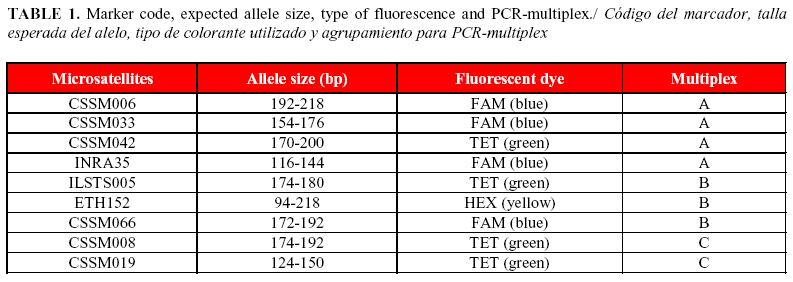
<body><![CDATA[<P><font face="Verdana, Arial, Helvetica, sans-serif" size="2"><B>Blood sampling    and DNA isolation</B> </font>     <P><font face="Verdana, Arial, Helvetica, sans-serif" size="2">Blood and hair    samples from 64 Cuban buffaloes (uncontrolled crossbreeds of Carabao and Buffalypso)    and 31 Murrah and 26 Jaffarabadi Brazilian water buffaloes were collected from    unrelated animals belonging to the respective breeds in their native breeding    tract. Cuban samples were collected in Mayabeque province while Brazilian Murrah    and Jaffarabadi samples were collected in Alagoas and Pernambuco states, respectively.    </font>     <P><font face="Verdana, Arial, Helvetica, sans-serif" size="2">Genomic DNA was    extracted using Promega Wizard&#174; Genomic DNA purification kit in accordance    with the manufacturer's suggested protocol (Promega Corp., Madison, WI). </font>     <P><font face="Verdana, Arial, Helvetica, sans-serif" size="2">The quality and    quantity of DNA (ng/&igrave;L) for each sample were analyzed using a spectrophotometer    (Nanodrop ND1000, Thermo Scientific). </font>     <P><font face="Verdana, Arial, Helvetica, sans-serif" size="2"><B>Microsatellite    genotyping</B> </font>     <P><font face="Verdana, Arial, Helvetica, sans-serif" size="2">A total of nine    heterologous bovine microsatellite marker loci (CSSM006, CSSM008, CSSM019, CSSM033,    CSSM042, CSSM066, ETH152, ILSTS005 and INRA35), evaluated for diversity analysis    in buffaloes (8, 9), were used to genotype the sampled animals. Amplification    of markers was carried out at a final volume of 5 &#181;L using the Master Mix    Kit for PCR-multiplex (Qiagen), following manufacturer's instructions, 4.5 ng    of genomic DNA and 0.2-0.5&#181;M of each primer. Amplification conditions were    as follow: 95&#176;C for 15 min, 35 cycles at 95&#176;C for 5 min, 57&#176;C    for 90 s and 72&#176;C for 1 min, followed by a final extension step of 72&#176;C    for 30 min. Information regarding expected allele sizes for each marker, fluorescent    label and multiplex are shown in <a href="/img/revistas/rsa/v37n3/t0103315.jpg">Table    1</a>. </font>      
<P><font face="Verdana, Arial, Helvetica, sans-serif" size="2">Amplified fragments    were separated in an automated sequencer (ABI Prism 3100, Applied Biosystems),    and the generated data was analyzed with GeneMapper v 4.1 software (Applied    Biosystems) for allele and genotype calling. Allelic class determination was    carried out using FlexBin v.2.0 software (10). </font>     <P><font face="Verdana, Arial, Helvetica, sans-serif" size="2"><B>Statistical    analysis</B> </font>     <P><font face="Verdana, Arial, Helvetica, sans-serif" size="2">Evidences of null    alleles, large allele dropout and scoring errors by stuttering were estimated    with MICRO-CHECKER software (11). The null allele frequency (r) was obtained    by two methods: Brookfield <I>et al.</I> (12) included in MICRO-CHECKER, and    Dempsters <I>et al. </I> (13) EM method implemented in GENEPOP v4.2 (14, 15).    </font>     <P><font face="Verdana, Arial, Helvetica, sans-serif" size="2">To ensure that    all loci were independently segregating within populations, tests of gametic    disequilibrium (GD) were conducted for all combinations of locus pairs within    populations with GENEPOP v4.2 using exact tests that employ the Markov Chain    method to estimate p-values (1 000 dememorization steps, 100 batches and 1 000    iterations). Significance values for multiple tests were adjusted with a sequential    Bonferroni correction (16). </font>     ]]></body>
<body><![CDATA[<P><font face="Verdana, Arial, Helvetica, sans-serif" size="2">Ewens-Watterson    test for neutrality was performed with 1 000 simulated samples using the algorithm    given in Manly (17), and implemented in POPGENE v 1.31 software package (18).    </font>     <P><font face="Verdana, Arial, Helvetica, sans-serif" size="2">Polymorphism information    content (PIC) was calculated by MICROSATELLITE TOOLKIT v3.1 (19). </font>     <P><font face="Verdana, Arial, Helvetica, sans-serif" size="2">Allele frequency,    number of alleles (Na), observed heterozygosity (Ho), unbiased expected heterozygosity    (uHe), Wright's Fixation Index (F<SUB>IS,</SUB> within population inbreeding    estimate) and number of private alleles across populations were all obtained    with Excell complement GenAlEx 6.5 (20, 21). The number of alleles per locus    and observed and expected heterozygosities were compared among populations using    the Kruskal-Wallis non-parametric test (22) included in SPSS (SPSS Inc., Chicago    IL). </font>     <P><font face="Verdana, Arial, Helvetica, sans-serif" size="2">Allelic Richness    (Ar) per locus and population were found using FSAT v2.9.3.2 (23). </font>     <P><font face="Verdana, Arial, Helvetica, sans-serif" size="2">Deviations from    Hardy-Weinberg Equilibrium (HWE) were assed per locus per population also with    GENEPOP v4.2 software (14, 15) and the same Markov chain settings used for GD    tests. Significance values for multiple tests were adjusted with a sequential    Bonferroni correction (16). </font>     <P><font face="Verdana, Arial, Helvetica, sans-serif" size="2">Population pairwise    values of Wright's Fixation Index <I>(</I>F<SUB>ST</SUB>, population differentiation),    with estimation of significance values based on 1 000 permutations, and analysis    of molecular variance (AMOVA) were done with ARLEQUIN v3.5.1.2 (24). Significant    values for F<SUB>ST</SUB> were corrected for multiple tests through sequential    Bonferroni correction (16). </font>     <P><font face="Verdana, Arial, Helvetica, sans-serif" size="2">Multivariate factorial    correspondence analysis (FCA) was used to condense the allelic data and identify    the population structure of the three buffalo populations on a 3-D scatter diagram    using GENETIX 4.05 software (25). </font>     <P><font face="Verdana, Arial, Helvetica, sans-serif" size="2">Nei&#180;s (26)    standard, D<SUB>S, </SUB>and Nei <I>et al.</I> (27), D<SUB>A, </SUB>genetic    distances among populations were obtained using POPULATIONS v1.2.31 software    (28). Dendrograms were constructed with the same program using Neighbor Joining    (NJ) (29) and the UPGMA method (30) for comparison. Bootstrap analyses with    1 000 replicates were used to evaluate the internal consistency of the suggested    groupings, as well as the magnitude of the sampling errors. Dendograms were    visualized with TREEVIEW 1.6.6 (31). </font>     <P><font face="Verdana, Arial, Helvetica, sans-serif" size="2">Population differentiation    was also investigated by a Bayesian clustering approach (BCA) using multilocus    genotypes, implemented in STRUCTURE v2.3.4 program (32). It assumes Hardy-Weinberg    equilibrium and linkage equilibrium between loci within each population. The    most probable number of populations (K) given the observed genotypic data was    estimated by performing 10 independent runs for each K (1 &#163; K &#163; 5)    with burn-in length and MCMC iterations of 500 000 and 1000 000, respectively.    We used the admixture model and the option of correlated allele frequencies.    Sampling locations were used as informative priors for our small data set (33).    </font>     <P><font face="Verdana, Arial, Helvetica, sans-serif" size="2">The method of Evanno    <I>et al.</I> (34) implemented in STRUCTURE HARVESTER (35) was used to identify    the most probable K by determining the modal distribution of DK. The different    values of the number of clusters (K) were also evaluated using the model choice    criterion Ln P (D), which is the posterior probability of the data for a given    K. The true number of clusters is commonly inferred as that giving the maximal    value of Ln P (D).</font>     ]]></body>
<body><![CDATA[<P>&nbsp;     <P><font face="Verdana, Arial, Helvetica, sans-serif" size="2"><B><font size="3">RESULTS</font></B>    </font>     <P><font face="Verdana, Arial, Helvetica, sans-serif" size="2"><B>Microsatellite    markers</B> </font>     <P><font face="Verdana, Arial, Helvetica, sans-serif" size="2">All markers were    found to be polymorphic in the three populations. </font>     <P><font face="Verdana, Arial, Helvetica, sans-serif" size="2">Analysis with MICRO-CHECKER    evidenced null alleles at loci INRA35 in Brazilian Murrah and CSSM006 in Cuban    Buffalypso/Carabao hybrids. The r obtained for INRA 35 by methods of Brookfield    <I>et al.</I> (12) and Dempster <I>et al.</I> (13) were 0.1778 and 0.2058, respectively.    In the case of CSSM006, the r was equal to 0.1025 and 0.0839 by the aforementioned    methods. There was not evidence for large allele dropout in any locus across    the three populations. </font>     <P><font face="Verdana, Arial, Helvetica, sans-serif" size="2">Analysis with MICRO-CHECKER    also suggested, again in Brazilian Murrah (INRA 35) and Buffalypso/Carabao hybrids    (CSSM006), that stuttering might have resulted in scoring errors, as is indicated    by the highly significant shortage of heterozygote genotypes with alleles of    one repeat unit difference at these loci. </font>     <P><font face="Verdana, Arial, Helvetica, sans-serif" size="2">Taking into account    our limited resources to make analytical and methodological corrections, and    the fact that these errors can contribute to an overestimation of observable    alleles, a decrease in observed heterozygosity, an increase in the apparent    level of inbreeding (36), and promote an overestimation of genetic differentiation    (37), loci INRA35 and CSSM006 were dropped to downstream analysis. </font>     <P><font face="Verdana, Arial, Helvetica, sans-serif" size="2">After adjustment    for multiple comparisons, tests of GD showed two locus pair namely CSSM008/CSSM066    and CSSM033/CSSM019 in significant GD (P&lt;0.05), in Cuban Buffalypso/Carabao    populations. In Brazilian Murrah and Jaffarabadi populations only one locus    pair was in significant GD in each, CSSM019/ CSSM033 and CSSM008/CSSM066, respectively.    GD creates pseudo-replication for analyses in which loci are assumed to be independent    samples of the genome. To avoid increased Type I error, one locus in the pair    should be discarded if significant disequilibrium is found consistently between    loci (38). Thus, loci CSSM008 and CSSM019 were also excluded from the subsequent    analysis. </font>     <P><font face="Verdana, Arial, Helvetica, sans-serif" size="2">The Ewens-Watterson    neutrality test for each marker suggested that all microsatellite loci studied    were neutral and unlinked to any selected trait, because the observed F values    were within the upper and lower limits of 95% confidence interval of expected    F value. </font>     <P><font face="Verdana, Arial, Helvetica, sans-serif" size="2">Marker ILSTS5 exhibited    PIC values lower than 0.5 in the three populations. ETH152 and CSSM042 showed    the same performance in Buffalypso/Carabao hybrids and Jaffarabadi populations,    respectively (<a href="/img/revistas/rsa/v37n3/t0203315.jpg">Table 2</a>).    </font>      
]]></body>
<body><![CDATA[<P><font face="Verdana, Arial, Helvetica, sans-serif" size="2"><B>Diversity analysis    </B> </font>     <P><font face="Verdana, Arial, Helvetica, sans-serif" size="2">Across the five    studied loci, a total of 88 alleles were found. The total number of alleles    per population ranged from 26 in Brazilian Murrah buffaloes to 33 in Cuban Buffalypso/Carabao    hybrids. Locus CSSM033 showed the highest Na per locus (12) while ILSTS5 showed    the lowest (2). Mean Na values were between 5.2 in Murrah and 6.6 in Buffalypso/Carabao    hybrids. Jaffarabadi population exhibited the highest mean Ar (4.880) while    Cuban hybrids showed the lowest value (4.367). Mean Ho values ranged from 0.602    &#177; 0.063 in Cuban buffaloes to 0.684 &#177; 0.066 in Brazilian Murrah population    while mean uHe values were between 0.599 &#177; 0.060 in Buffalypso/Carabao    animals and 0.649 &#177; 0.067 in Murrah buffaloes (<a href="/img/revistas/rsa/v37n3/t0203315.jpg">Table    2</a>). The mean number of alleles and mean observed and expected heterozygosities    were not significantly different among the three populations. Ten private alleles    were identified in two breeds which were distributed among four of the five    analyzed loci. Two alleles were unique to Jaffarabadi breed, both with low frequency    (1.9%). Cuban Buffalypso/Carabao hibrids exhibited the eight remaining alleles    with frequencies range from 0.8 to 10.5%. </font>      
<P><font face="Verdana, Arial, Helvetica, sans-serif" size="2">The exact test    for HWE within populations showed the five loci in equilibrium in the three    populations, after a standard Bonferroni correction. The mean value of F<SUB>IS</SUB>    was negative also in the three populations, indicating no inbreeding (<a href="/img/revistas/rsa/v37n3/t0203315.jpg">Table    2</a>). </font>      
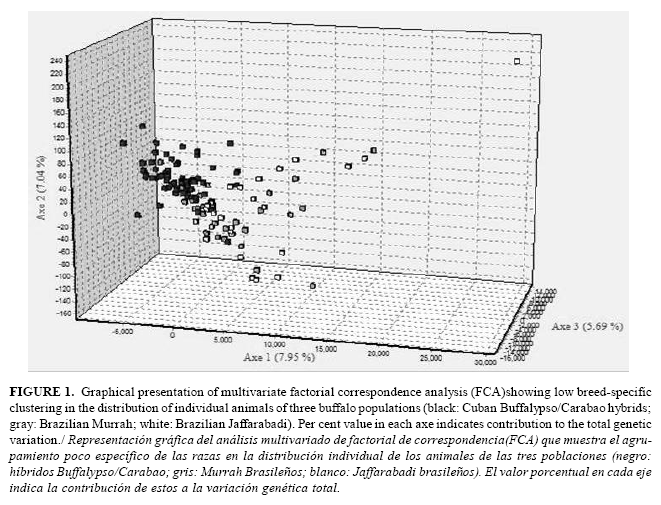
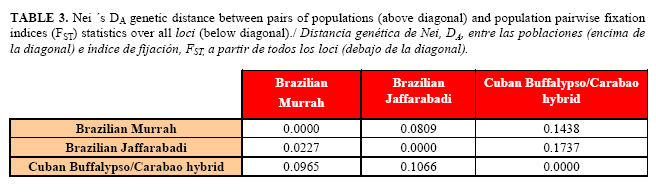
<P><font face="Verdana, Arial, Helvetica, sans-serif" size="2"><B>Population differentiation    and relationships</B> </font>     <P><font face="Verdana, Arial, Helvetica, sans-serif" size="2">In the FCA, the    first three axes together explained only the 20.93% of the overall variability    existing among the buffalo individuals. Graphical presentation of FCA plotted    some animals of the three populations in an overlapped state and exhibited low    breed-specific clustering (<a href="/img/revistas/rsa/v37n3/f0103315.gif">Fig.    1</a>). Although the 3D plot indicated close grouping of the three populations,    most of Brazilian Murrah and Jaffarabadi buffaloes overlapped and are slightly    separated from the majority of Cuban hybrids animals. In <a href="/img/revistas/rsa/v37n3/t0303315.jpg">Table    3</a> are shown values of Nei &#180;s D<SUB>A</SUB> genetic distance between    pairs of populations and F<SUB>ST</SUB> over all loci. All pairwise population    F<SUB>ST</SUB> values were significant (p&lt;0.05) after a standard Bonferroni    correction. The smallest F<SUB>ST</SUB> value (0.0227) was observed between    Murrah and Jaffarabadi buffaloes. This F<SUB>ST</SUB> value was below 0.05,    indicating low genetic differentiation between these populations (39). The largest    F<SUB>ST </SUB> (0.1066) was obtained between Cuban hybrids and Jaffarabadi    buffaloes and indicated only a moderate genetic differentiation between these    breeds (39). The AMOVA showed that 92.7% of the total variation was found to    be within individuals and the remaining 8.3% was among populations (p&lt;0.05).    </font>      
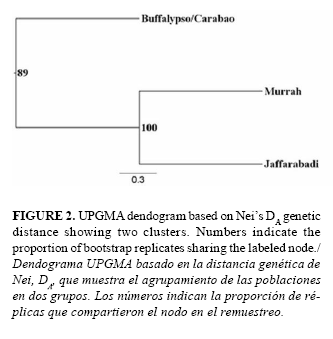
<P><font face="Verdana, Arial, Helvetica, sans-serif" size="2">Comparing the results    obtained using the matrix of D<SUB>A</SUB> distance (27) and the matrix D<SUB>S    </SUB>(26), it can be seen that the former made possible the inference of a    more representative dendogram based on UPGMA method than the Neighbor joining.    The highest genetic distance, based on the D<SUB>A</SUB> distance, was the one    found between the Cuban hybrids and Jaffarabadi buffaloes (0.1737), while the    Murrah and Jaffarabadi populations were closer to each other (0.0809).The selected    dendrogram indicated a separation into two distinct groups (<a href="/img/revistas/rsa/v37n3/f0203315.gif">Fig.    2</a>). The first cluster was formed by the Cuban Buffalypso/Carabao hybrid    population with bootstrap value of 89%. Another cluster, with a bootstrap value    of 100%, included the two Brazilian breeds (Murrah and Jaffarabadi). </font>      
<P><font face="Verdana, Arial, Helvetica, sans-serif" size="2">To confirm whether    the two inferred clusters of buffalo breeds were genetically distinct, BCA was    performed. The analysis showed division of genetic variation into two clusters.    <a href="/img/revistas/rsa/v37n3/f0303315.gif">Fig. 3</a> shows the proportion    of an individual genome from each breed that contributed to each of the two    clusters under a model with the highest posterior probability and DK. The Brazilian    Murrah and Jaffarabadi animals were almost equally shared in the first cluster    (gray), with high membership coefficient, 0.997 and 0.987, respectively. The    other cluster (black) had contribution mainly from the Cuban Buffalypso/Carabao    hybrid animals, also with high membership coefficient (0.969). </font>      
<P>&nbsp;     <P><font face="Verdana, Arial, Helvetica, sans-serif" size="2"><B><font size="3">DISCUSSION</font></B>    </font>     <P><font face="Verdana, Arial, Helvetica, sans-serif" size="2">Extensive conservation    of cattle microsatellite loci in the buffalo genome, as shown by Navani <I>et    al.</I> (9) and Nagarajan <I>et al.</I> (40), means that cattle primer pairs    can be a very cost effective and time saving resource for genetic diversity    studies. In the present work genetic diversity and relationships between Cuban    and Brazilian water buffalo populations were estimated using a panel of five    cattle microsatellite markers. </font>     ]]></body>
<body><![CDATA[<P><font face="Verdana, Arial, Helvetica, sans-serif" size="2">Errors in scoring    microsatellite data can occur at several steps of the assay, yet standard statistical    procedures to mitigate these errors are lacking (41, 42). In this study, two    loci showed evidences of null alleles and scoring errors by stuttering. Most    of the statistical tools to detect potential scoring errors operate by testing    for heterozygote deficiencies, which can be indicative of genotyping errors    (43), particularly when identified in only a few loci (44). Demographic or mating    system processes such as a Wahlund effect or inbreeding are expected to result    in excess homozygosity at all loci, whereas errors due to stuttering, large-allele    dropout and null alleles should affect only a subset of loci (36), as occur    in this case. </font>     <P><font face="Verdana, Arial, Helvetica, sans-serif" size="2">All markers used    in this work have a dinucleotide repeat motif. Interpreting patterns at stutter-prone    loci becomes particularly difficult in the case of adjacent-allele heterozygotes    at loci having a dinucleotide repeat motif (36), it could be the reason for    the detection of scoring errors in this study. </font>     <P><font face="Verdana, Arial, Helvetica, sans-serif" size="2">Two methods were    used to estimate null allele frequencies. Chapuis and Estoup (37) reported the    Dempster <I>et al.</I> (13) method provided unbiased and low variance estimates    of r compared with Chakraborty <I>et al.</I> (45) and Brookfield (12). However,    a study carried out by Kelly <I>et al.</I> (46) revealed that the method of    Brookfield (12) produced the most accurate estimates of r compared with Dempster    <I>et al.</I> (13), Chakraborty <I>et al.</I> (45) and Van Oosterhout <I>et    al.</I> (11). Despite the differences in r values obtained in this investigation    by the two methods, they are still considered as high (r &gt; 0.20) and/or intermediate    (0.05 &lt; r &lt; 0.20) (37). Ginja <I>et al.</I> (47) reported evidence of    null alleles at high frequency at INRA035 among 40 markers across several Portuguese    and other exotic cattle breeds. In other research, Acosta <I>et al.</I> (48)    using 30 markers to assess genetic diversity and differentiation of five Cuban    cattle breeds, also reported locus INRA35 showing an evidence for null alleles    with r = 0.4 by the method of Chakraborty <I>et al.</I> (45). In a study using    391 cattle microsatellite markers, Nagarajan <I>et al.</I> (40) informed that    79% of those deviated from HWE in Murrah water buffaloes showed null allele    presence. </font>     <P><font face="Verdana, Arial, Helvetica, sans-serif" size="2">Even if loci are    not linked physically on a chromosome, as occurred in this study, they can be    functionally related or under selection to be transmitted as a pair. In the    present work, significant GD was detected between some markers in the three    populations. Nagarajan <I>et al.</I> (40) studied GD between 525 cattle and    buffalo microsatellite markers using a panel of 24 unrelated Murrah buffaloes.    In the study, the authors found a substantial level of GD between the markers    used, 12.9% of pairs of cattle markers showed significant GD (p&lt;0.05). The    authors also analyzed GD for 27 cattle microsatellite markers genotyped on eight    different buffalo breeds. The investigation found that 11.4% of marker pairs    were significant at p&lt;0.05 in Murrah breed and 27.1% in Jaffarabadi. </font>     <P><font face="Verdana, Arial, Helvetica, sans-serif" size="2">Genetic markers    showing PIC values higher than 0.5 are normally considered as highly informative    in population genetic analysis (49). In this work, three of the markers (ILSTS5,    ETH152, and CSSM042) showed PIC values below 0.5, which implied to be moderately    informative (0.5 &gt; PIC &gt; 0.25) (50). Nevertheless, these markers had been    evaluated for genetic diversity analysis in cattle and buffaloes and are extensively    used in research throughout (8, 9, 50, 51, 52, 53, 54). </font>     <P><font face="Verdana, Arial, Helvetica, sans-serif" size="2">Heterozygosity    value is the most accurate way to measure the genetic diversity of populations    (55) and to get an overview of genetic variability (56). Heterozygosity values    over 0.5 (50%) indicate a high variation for the loci studied in the populations    (57). The mean heterozygosity values (over 0.6) found in this study showed the    presence of similar high levels of genetic variability within the three buffalo    populations. This result could be explained by the occurrence of low selection    pressure due to no application of improvement programs in these three populations.    The admixture of genes from various Indian buffalo breeds and Carabao present    in Cuban buffaloes, and the crossbreeding between different river buffaloes    imported to Brazil, could also support this finding. </font>     <P><font face="Verdana, Arial, Helvetica, sans-serif" size="2">Genetic diversity    studies of Cuban water buffalo population have started recently in Cuba. Acosta    <I>et al.</I> (7) reported means of Na (5.44), He (0.54) and Ho (0.46) lower    than those found in this study. They also observed a positive mean F<SUB>IS</SUB>    value (0.148), indicating inbreeding evidence. It was not found in the present    work. </font>     <P><font face="Verdana, Arial, Helvetica, sans-serif" size="2">Comparing with    some researches using microsatellite markers for Brazilian buffalo genetic diversity    analysis, Albuquerque (58) reported CSSM033 and ILST005 with higher and lower    Na values, respectively, in Murrah buffaloes. This is in accordance with the    present study. This author found a higher mean Na value in Murrah (6.53) than    the value found in this study. He value (0.616) was lower and the significant    mean F<SUB>IS</SUB> values (0.145, p&lt;0.05) indicates inbreeding, different    from the not inbreeding evidence obtained in this work. In Jaffarabadi buffaloes,    the author found a Na mean (6) almost similar to that exhibited in this study.    He value was lower (0.545) and F<SUB>IS</SUB> mean significant values (p&lt;0.05)    (0.330) also indicates inbreeding. In another study, Marques <I>et al.</I> (59)    found lower mean values of Na, He and Ho in Murrah (4.5, 0.593, and 0.514) and    Jaffarabadi (4.54, 0.5324, and 0.4756) animals. Significant F<SUB>IS </SUB>mean    values (p&lt;0.001) in Murrah (0.135) and Jaffarabadi (0.108) was also observed    by the authors, again showing differences with the results obtained in this    work. Vieira (60) reported slightly higher He (0.709), and lower Ho (0.653)    values in Murrah. In Jaffarabadi, both He and Ho were lower than the results    of this study, 0.573 and 0.496, respectively. </font>     <P><font face="Verdana, Arial, Helvetica, sans-serif" size="2">The high heterozygosity    and the absence of inbreeding observed in this Cuban buffalo population guarantee    its fitness to the environment and the maintenance of its productive and reproductive    levels. </font>     <P><font face="Verdana, Arial, Helvetica, sans-serif" size="2">The values of the    genetic differentiation between water buffalo populations in the present study    are similar to those reported for these (51, 58, 61) and other species (48,    62, 63), where the greatest variability is exhibited within breeds and is independent    of the technique used in the analysis. </font>     ]]></body>
<body><![CDATA[<P><font face="Verdana, Arial, Helvetica, sans-serif" size="2">In this work, a    correspondence among the different methods used to assess the genetic differentiation    of the studied populations was observed. MacHugh <I>et al.</I> (64) referred    that the concordance among different methods to study the genetic differentiation    between individuals or populations highlights the robustness of the results.    </font>     <P><font face="Verdana, Arial, Helvetica, sans-serif" size="2">The genetic relationship    showed among Cuban Buffalypso/Carabao hybrid animals and Brazilian breeds could    be explained taking into account the origin of Buffalypso breed and its genetic    management in Cuba. Cuban animals were expected to share alleles with Murrah    and Jaffarabadi buffaloes, as these two breeds contributed to the Buffalypso    formation. The contribution made by other Indian riverine breeds to this composite    breed, and the uncontrolled mating of Buffalypso<U> </U>animals with Australian    Carabao buffaloes, were expected to increase the genetic distance among Cuban    hybrids and Murrah and Jaffarabadi Brazilian buffaloes. However, the results    showed small genetic distances and an intermediate differentiation between Cuban    and Brazilian populations. Interestingly, pairwise F<SUB>ST </SUB>values between    Cuban Buffalypso/Carabao hybrids and each Brazilian buffalo breed are slightly    lower than the F<SUB>ST </SUB>value (0.109) reported by Marques <I>et al.</I>    (59) between Murrah and Jaffarabadi Brazilian populations. Vieira (60) also    reported higher value of Nei&#180;s D<SUB>A</SUB> genetic distance (0.234) between    Murrah and Jaffarabadi Brazilian buffaloes than those found in this study among    Cuban and Brazilian animals. These results could be related to the reduced number    of populations and loci microsatellite analyzed. </font>     <P><font face="Verdana, Arial, Helvetica, sans-serif" size="2">Genetic differentiation    studies also suggest the occurrence of allele sharing between the Murrah and    Jaffarabadi Brazilian buffaloes. As it was explained by Albuquerque (58), in    Brazil, the different buffalo groups were subjected to reciprocal crosses, especially    Murrah, Mediterranean and Jaffarabadi animals. According to Santiago (65), in    1918, 1920, and 1947, imports of animals with predominance of blood of both    Jafarabadi and Murrah, and possible crosses between these breeds might occur.    These data are also confirmed by Marcondes <I>et al.</I> (66), which reported    that Marajoara breeders held crosses between Murrah and Jafarabadi, disseminating,    thus, alleles in common between the breeds. That fact, together with a common    Indian origin of these breeds (66, 67), could explain the observed results.    However, Albuquerque <I>et al.</I> (68) explained that these alternate crossbreeding    did not alter in a significant manner the original gene pool of the Murrah and    Jaffarabadi animals which can be considered genetically distinct, despite the    existence of shared genetic groups. </font>     <P>&nbsp;     <P><font face="Verdana, Arial, Helvetica, sans-serif" size="2"><B><font size="3">CONCLUSIONS</font></B>    </font>     <P><font face="Verdana, Arial, Helvetica, sans-serif" size="2">Using five cattle    microsatellite markers, the present study provided a preliminary analysis on    genetic relationships among Cuban hybrid animals and Murrah and Jaffarabadi    Brazilian buffaloes. The obtained results increase the knowledge about the genetic    composition of the Cuban buffaloes in order to a better genetic handling of    the animals, not only to improve their productive and reproductive traits but    also to their conservation. Moreover, to get a more accurate estimate of the    genetic relationships among the considered breeds, the research must be extended    to analyze a higher number of microsatellite loci as well as to increase the    number of populations and their geographical localizations in each country.    Besides, there is a need to include Carabao animals and other river buffalo    breeds in further studies. </font>     <P><font face="Verdana, Arial, Helvetica, sans-serif" size="2">As all microsatellite    loci analyzed in this work derivate from cattle, and cross-species amplification    in buffalo could possibly lead to ascertainment bias (69), future examinations    on buffalo-isolated loci and reciprocal analyses are needed. </font>     <P>&nbsp;     <P><font face="Verdana, Arial, Helvetica, sans-serif" size="2"><B><font size="3">ACKNOWLEDGEMENTS</font></B>    </font>     <P><font face="Verdana, Arial, Helvetica, sans-serif" size="2">This work was financially    supported by the CAPES-MES/CUBA project 128/11 .The authors are grateful to    the farmers that donated biological material for the analyses: Ligia Alexandrina    Barros da Costa, FazendaRiach&atilde;o, Sair&eacute;, Pernambuco-Brazil e Alberto    Coto, FazendaCastanha Grande, Sao Luiz de Queiros, Alagoas-Brazil, and also    to Empresa Pecuaria Gen&eacute;tica &#168;El Cangre&#168;, in Mayabeque, Cuba.    Thanks are also due to Samuel Rezende Paiva, Alexandre Rodrigues Caetano and    Maria do Socorro Mau&eacute;s Albuquerque for the donation of the fluorescent    microsatellite primers and for allowing use of the ABI Automatic Analyzer. Besides,    some researchers and colleagues were fundamental on other collaborations: Ing.    Eulogio Padr&oacute;n, Dr. Patricia Lima and Dr. Georgina Espinosa. </font>     ]]></body>
<body><![CDATA[<P>&nbsp;     <P><font face="Verdana, Arial, Helvetica, sans-serif" size="2"><B><font size="3">REFERENCES</font></B>    </font>         <!-- ref --><P><font face="Verdana, Arial, Helvetica, sans-serif" size="2">1. Cockrill WR.      The water buffalo: A review. Br Vet J. 1981;137:8-16.     </font>        <!-- ref --><P><font face="Verdana, Arial, Helvetica, sans-serif" size="2">2. Michelizzi VN,    Dodson MV, Pan Z, Amaral MEJ, Michal JJ, McLean DJ, et al. Water buffalo genome    science comes of age. Int J Biol Sci. 2010;6(4):333-349.     </font>      <!-- ref --><P><font face="Verdana, Arial, Helvetica, sans-serif" size="2">3. FAO Statistics    Division (homepage on the Internet). Rome: FAO; 2015 updated 2015 Jan 15; cited    2015 Jan 26: Available from: <U><a href="http://faostat3.fao.org/browse/Q/QA/E">http://faostat3.fao.org/browse/Q/QA/E</a></U>.        </font>      <!-- ref --><P><font face="Verdana, Arial, Helvetica, sans-serif" size="2">4. Borghese A,      Mazzi M. Buffalo population and strategies in the world. In: A. Borghese,      editors. Buffalo Production and Research Rome: FAO 2005; p. 1-40.     </font>       ]]></body>
<body><![CDATA[<!-- ref --><P><font face="Verdana, Arial, Helvetica, sans-serif" size="2">5. Mitat A. B&uacute;falos      de agua en Cuba. Origen y evoluci&oacute;n. Rev ACPA. 2009;3:45-48.     </font>       <!-- ref --><P><font face="Verdana, Arial, Helvetica, sans-serif" size="2">6. Bennett SP,      Garcia GW, Lampkin P. The buffalypso: the water buffalo of Trinidad and Tobago.      Ital J Anim Sci. 2007;6 (2):179-183.     </font>       <!-- ref --><P><font face="Verdana, Arial, Helvetica, sans-serif" size="2">7. Acosta AC,      Uffo O, Sanz A, Obreg&oacute;n D, Osta R, Ronda R, <I>et al</I>.Genetic characterization      of Cuban water buffalo population using microsatellite DNA markers. Buffalo      Bull. 2014;33(1):101-106.     </font>        <!-- ref --><P><font face="Verdana, Arial, Helvetica, sans-serif" size="2">8. FAO. Molecular    genetic characterization of animal genetic resources. In: FAO. FAO Animal Production    and Health Guidelines. Rome: FAO 2011; p. 9.     </font>      <!-- ref --><P><font face="Verdana, Arial, Helvetica, sans-serif" size="2">9. Navani N,      Jain PK, Gupta S, Sisodia BS, Kumar S. A set of cattle microsatellite DNA      markers for genome analysis of riverine buffalo (<I>Bubalus bubalis</I>).      Anim Genet. 2002;33:3149-3154.     </font>       ]]></body>
<body><![CDATA[<!-- ref --><P><font face="Verdana, Arial, Helvetica, sans-serif" size="2">10.Amos W, Hoffman      JI, Frodsham A, Zhang L, Best S, Hill AVS. Automated binning of microsatellite      alleles: Problems and solutions. Mol Ecol Notes. 2006;7:10-14.     </font>        <!-- ref --><P><font face="Verdana, Arial, Helvetica, sans-serif" size="2">11.Van Oosterhout    C, Hutchinson WF, Wills DPM, Shipley P. MICRO-CHECKER: software for identifying    and correcting genotyping errors in microsatellite data. Mol Ecol Notes. 2004;4:535-538.        </font>      <!-- ref --><P><font face="Verdana, Arial, Helvetica, sans-serif" size="2">12.Brookfield      JFY. A simple new method for estimating null allele frequency from heterozygote      deficiency. Mol Ecol. 1996;5:453-455.     </font>       <!-- ref --><P><font face="Verdana, Arial, Helvetica, sans-serif" size="2">13.Dempster AP,      Laird NM, Rubin DB. Maximum likelihood from incomplete data via the EM algorithm.      J R Stat Soc B. 1977;39:1-38.     </font>       <!-- ref --><P><font face="Verdana, Arial, Helvetica, sans-serif" size="2">14.Raymond M,      Rousset F. GENEPOP (version 1.2): population genetics software for exact tests      and ecumenicism. J Heredity. 1995;86:248-249.     </font>       ]]></body>
<body><![CDATA[<!-- ref --><P><font face="Verdana, Arial, Helvetica, sans-serif" size="2">15.Rousset F.      Genepop'007: a complete reimplementation of the Genepop software for Windows      and Linux. Mol Ecol Resources. 2008;8:103-106.     </font>       <!-- ref --><P><font face="Verdana, Arial, Helvetica, sans-serif" size="2">16.Rice WR. Analyzing      tables of statistical tests. Evolution. 1989;43:223-225.     </font>        <!-- ref --><P><font face="Verdana, Arial, Helvetica, sans-serif" size="2">17.Manly BFJ, Ed.    The statistics of natural selection. London: Chapman and Hall 1985.     </font>      <!-- ref --><P><font face="Verdana, Arial, Helvetica, sans-serif" size="2">18.Yeh FC, Boyle    T, Rongcai Y, Ye Z, Xian JM. POPGENE version 1.31. 1999. Available from: <U><a href="http://www.ualberta.ca/-fyeh/fyeh">http://www.ualberta.ca/-fyeh/fyeh</a></U>    last accessed 18.06.2014.     </font>      <!-- ref --><P><font face="Verdana, Arial, Helvetica, sans-serif" size="2">19.Park S. Microsatellite    Toolkit version 3.1. 2001. Available from: <U><a href="http://oscar.gen.tcd.ie/sdepark/ms-toolkit">http://oscar.gen.tcd.ie/sdepark/ms-toolkit</a></U>    [last accessed 18.06.2014].     </font>      ]]></body>
<body><![CDATA[<!-- ref --><P><font face="Verdana, Arial, Helvetica, sans-serif" size="2">20.Peakall R,      Smouse PE.GENALEX 6: genetic analysis in Excel. Population genetic software      for teaching and research. Mol Ecol Notes. 2006;6:288-295.     </font>       <!-- ref --><P><font face="Verdana, Arial, Helvetica, sans-serif" size="2">21.Peakall R,      Smouse PE. GenAlEx 6.5: genetic analysis in Excel. Population genetic software      for teaching and research - an update. Bioinformatics. 2012;28:2537-2539.          </font>        <!-- ref --><P><font face="Verdana, Arial, Helvetica, sans-serif" size="2">22.Sokal R, Rohlf    FJ, Eds. Biometry. 1981. San Francisco: W.H. Freeman and Co. 1981.     </font>      <!-- ref --><P><font face="Verdana, Arial, Helvetica, sans-serif" size="2">23.Goudet J. FSTAT    2.9.3.2.2002. Available from: <U><a href="http://www.unil.ch/popgen/softwares/fstat.htm">http://www.unil.ch/popgen/softwares/fstat.htm</a></U>.    last accessed 03.10.2014.     </font>      <!-- ref --><P><font face="Verdana, Arial, Helvetica, sans-serif" size="2">24.Excoffier      L, Laval G, Schneider S. Arlequin version 3.0: An integrated software package      for population genetics data analysis. Evol Bioinform. 2005;1:47-50.     </font>        ]]></body>
<body><![CDATA[<!-- ref --><P><font face="Verdana, Arial, Helvetica, sans-serif" size="2">25.Belkhir K, Borsa    P, Chikhi L, Goudet J, Bonhomme F. GENETIX 4.05 Windows<SUP>TM</SUP>Software    for Sample Genetics. Laboratoire Genome, Populations, Interactions. University    of Montpellier, France, Universite Montpellier II <U><a href="http://www.univmontp2.fr/%3C%ABgenetix/genetix/genetix.htm">http://www.univmontp2.fr/&lt;&#171;genetix/genetix/genetix.htm</a></U>    //December, 2004.     </font>      <!-- ref --><P><font face="Verdana, Arial, Helvetica, sans-serif" size="2">26.Nei M. Genetic    distances between populations. Amer Nat. 1972;106:283-292.     </font>      <!-- ref --><P><font face="Verdana, Arial, Helvetica, sans-serif" size="2">27.Nei M, Tajima      F, Tateno Y. Accuracy of estimated phylogenetic trees from molecular data.      J Mol Evol. 1983;19:153-170.     </font>        <!-- ref --><P><font face="Verdana, Arial, Helvetica, sans-serif" size="2">28.Langela O. Populations    1.2.28. 2002. Available from: <u><a href="http://wwwcnrsgif.fr/pge/">http://wwwcnrsgif.fr/pge/</a></u>    last accessed 14.09.2014.     </font>      <!-- ref --><P><font face="Verdana, Arial, Helvetica, sans-serif" size="2">29.Saitou N,      Nei M. The neighbour-joining method: a new method for reconstructing phylogenetic      trees. Mol Biol Evol. 1987;4:406-425.     </font>        ]]></body>
<body><![CDATA[<!-- ref --><P><font face="Verdana, Arial, Helvetica, sans-serif" size="2">30.Sneath PHA,    Sokal RR. Eds. Numerical Taxonomy. The Principles and Practice of Numerical    Classification. San Francisco, CA: W.H. Freeman, 1973.     </font>      <!-- ref --><P><font face="Verdana, Arial, Helvetica, sans-serif" size="2">31.Page RDM.      TREEVIEW: An application to display phylogenetic trees on personal computers.      Comput Appl Biosci. 1996;12:357-358.     </font>       <!-- ref --><P><font face="Verdana, Arial, Helvetica, sans-serif" size="2">32.Pritchard      JK, Stephens M, Donnelly P. Inference of population structure using multilocus      genotype data. Genetics. 2000;155:945-959.     </font>       <!-- ref --><P><font face="Verdana, Arial, Helvetica, sans-serif" size="2">33.Hubisz M,      Falush D, Stephens M, Pritchard J. Inferring weak population structure with      the assistance of sample group information. Mol Ecol Resources. 2009;9(5):1322-1332.          </font>       <!-- ref --><P><font face="Verdana, Arial, Helvetica, sans-serif" size="2">34.Evanno G,      Regnaut S, Goudet J. Detecting the number of clusters of individuals using      the software STRUCTURE: a simulation study. Mol Ecol. 2005;14:2611-2620.     </font>       ]]></body>
<body><![CDATA[<!-- ref --><P><font face="Verdana, Arial, Helvetica, sans-serif" size="2">35.Earl DA, vonHoldt      BM. STRUCTURE HARVESTER: a website and program for visualizing STRUCTURE output      and implementing the Evanno method. Conserv Genet Resour. 2012;4(2):359-361.          </font>       <!-- ref --><P><font face="Verdana, Arial, Helvetica, sans-serif" size="2">36.Dewoody J,      Nason JD, Hipkins VD. Mitigating scoring errors in microsatellite data from      wild populations. Mol Ecol Notes. 2006;6:951-957.     </font>       <!-- ref --><P><font face="Verdana, Arial, Helvetica, sans-serif" size="2">37.Chapuis MP,      Estoup A. Microsatellite null alleles and estimation of population differentiation.      Mol Biol Evol. 2007;24:621-631.     </font>       <!-- ref --><P><font face="Verdana, Arial, Helvetica, sans-serif" size="2">38.Selkoe KA,      Toonen RJ. Microsatellites for ecologists: a practical guide to using and      evaluating microsatellite markers. Ecol Lett. 2006;9:615-629.     </font>       <!-- ref --><P><font face="Verdana, Arial, Helvetica, sans-serif" size="2">39.Hartl D, Clark      A. Principles of population genetics. Massachussets: Sinauer Associates, Inc.      Publishers Sunderland. 1997.     </font>       ]]></body>
<body><![CDATA[<!-- ref --><P><font face="Verdana, Arial, Helvetica, sans-serif" size="2">40.Nagarajan      M, Kumar N, Nishanth G, Haribaskar R, Paranthaman K, Gupta J, et al. Microsatellite      markers of water buffalo, <I>Bubalus bubalis</I> - development, characterization      and linkage disequilibrium studies. BMC Genet. 2009;10:68-75.     </font>       <!-- ref --><P><font face="Verdana, Arial, Helvetica, sans-serif" size="2">41.Bonin A, Bellemain      E, Bronken EP, Pompanon F, Brochmann C, Taberlet P. How to track and assess      genotyping errors in population genetic studies. Mol Ecol. 2004;13:3261-3273.          </font>       <!-- ref --><P><font face="Verdana, Arial, Helvetica, sans-serif" size="2">42.Dakin EE,      Avise JC. Microsatellite null alleles in parentage analysis. Heredity. 2004;93:504-509.          </font>       <!-- ref --><P><font face="Verdana, Arial, Helvetica, sans-serif" size="2">43.Paetkau D.      An empirical exploration of data quality in DNA-based population inventories.      Mol Ecol. 2003;12:1357-1387.     </font>        <!-- ref --><P><font face="Verdana, Arial, Helvetica, sans-serif" size="2">44.Gomes I, Collins    A, Lonjou C, Thomas NS, Wilkinson J, Watson M, <I>et al</I>. HardyWeinberg quality    control. Ann Hum Genet. 1999;63:535-538.     </font>      ]]></body>
<body><![CDATA[<!-- ref --><P><font face="Verdana, Arial, Helvetica, sans-serif" size="2">45.Chakraborty      R, De Andrade M, Daiger SP, Budowle B. Apparent heterozygote deficiencies      observed in DNA typing data and their implications in forensic applications.      Ann Hum Genet. 1992;56:45-57.     </font>        <!-- ref --><P><font face="Verdana, Arial, Helvetica, sans-serif" size="2">46.Kelly AC, Mateus-Pinilla    NE, Douglas M, Douglas M, Shelton P, Novakofski J. Microsatellites behaving    badly: empirical evaluation of genotyping errors and subsequent impacts on population    studies. Genet Mol Res. 2011;10(4):2534-2553.     </font>      <!-- ref --><P><font face="Verdana, Arial, Helvetica, sans-serif" size="2">47.Ginja CDA,      Gama LT, Penedo MCT. Analysis of STR Markers reveals high genetic structure      in Portuguese native cattle. J Hered. 2010;101:201-210.     </font>       <!-- ref --><P><font face="Verdana, Arial, Helvetica, sans-serif" size="2">48.Acosta AC,      Uffo O, Sanz A, Ronda R, Osta R, Rodellar C, <I>et al. </I>Genetic diversity      and differentiation of five Cuban cattle breeds using 30 microsatellite loci.      J Anim Breed Genet. 2013;130:79-86.     </font>       <!-- ref --><P><font face="Verdana, Arial, Helvetica, sans-serif" size="2">49.Botstein D,      White RL, Skolnick M, Davis RW. Construction of genetic linkage maps in man      using restriction fragment length polymorphisms. Am J Human Genet. 1980;32:314-331.          </font>       ]]></body>
<body><![CDATA[<!-- ref --><P><font face="Verdana, Arial, Helvetica, sans-serif" size="2">50.Nagamine Y,      Nirasawa K, Takahashi H, Sasaki O, Ishii K, Minezawa M, <I>et al. </I>Estimation      of the Time of Divergence between Japanese Mishima Island Cattle and Other      Cattle Populations Using Microsatellite DNA Markers. J Heredity. 2008;99(2):202-207.          </font>       <!-- ref --><P><font face="Verdana, Arial, Helvetica, sans-serif" size="2">51.Vijh RK, Tantia      MS, Mishra B, Bharni-Kumar ST. Genetic relationship and diversity analysis      of Indian Buffalo. J Anim Sci. 2008;86(7):1495-1502.     </font>       <!-- ref --><P><font face="Verdana, Arial, Helvetica, sans-serif" size="2">52.Zhang Y, Dongxiao      S, Ying Y, Zhang Y. Genetic variation and divergence among swamp buffalo,      river buffalo and Cattle: A microsatellite survey on five populations in China.      Asian-Aust J Anim Sci. 2008;21(9):1238-1243.     </font>        <!-- ref --><P><font face="Verdana, Arial, Helvetica, sans-serif" size="2">53.Thivalai C,    Sophon S. The study of microsatellite DNA marker in Thai swamp buffalo (Bubalus    bubalis). Proceedings of the 3rd International Conference on sustainable animal    agriculture for developing countries; 2011: July 26-29; Nakhon Ratchasima, Thailand;    2011. p. 692-695.     </font>      <!-- ref --><P><font face="Verdana, Arial, Helvetica, sans-serif" size="2">54.Joshi J, Salar    RK, Banerjee P, Sharma U, Tantia MS, Vijh KR. Comparative evaluation of Murrah    breeds with buffaloes of Indo-Gangetic Plains. DHR-IJBLS. 2012;3(1):93-105.        </font>      ]]></body>
<body><![CDATA[<!-- ref --><P><font face="Verdana, Arial, Helvetica, sans-serif" size="2">55.Nei M, Kumar    S. Oxford University Press, Molecular Evolution and Phylogenetics. New York.    2000.     </font>      <!-- ref --><P><font face="Verdana, Arial, Helvetica, sans-serif" size="2">56.Marson EP,      Ferraz JBS, Meirelles FV, Balieiro JCDC, Eler JP, et al. Genetic characterization      of European Zebu composite bovine using RFLP markers. Genet Mol Res. 2005;4:496-505.          </font>       <!-- ref --><P><font face="Verdana, Arial, Helvetica, sans-serif" size="2">57.Javanmard      A, Asadzadeh N, Banabazi MH, Tavakolian J. The allele and genotype frequencies      of bovine pituitary specific transcription factor and leptin genes in Iranian      cattle and buffalo populations using PCR-RFLP. Iran J Biotechnol. 2005;3:104-108.          </font>       <!-- ref --><P><font face="Verdana, Arial, Helvetica, sans-serif" size="2">58.Albuquerque      MSM. Molecular markers and genetic variability in buffaloes from Brazil. Tese      (Doutoradoem Gen&eacute;tica). Faculdade de Medicina de Ribeir&atilde;o Preto,      FMRP, S&atilde;o Paulo, Departamento de Gen&eacute;tica. 2005: p. 95.     </font>        <!-- ref --><P><font face="Verdana, Arial, Helvetica, sans-serif" size="2">59.Marques JRF,    Mart&iacute;nez AM, Costa MR, Albuquerque MSM, Quiroz J, Vega-Pla JL, et al.    Genetic diversity of Brazilian buffaloes (<I>Bubalus bubalis</I>) using DNA    microsatellites. Arch Zootec. 2011;60(232):1213-1221.     </font>      ]]></body>
<body><![CDATA[<!-- ref --><P><font face="Verdana, Arial, Helvetica, sans-serif" size="2">60.Vieira JN. Padroniza&ccedil;&atilde;o    de painel de microssat&eacute;lites para testes de identifica&ccedil;&atilde;o    gen&eacute;tica e de paternidade e caracteriza&ccedil;&atilde;o gen&eacute;tica    da estrutura populacional de b&uacute;falos criados no Brasil. Tese de doutorado.    Universidade Federal De Minas Gerais. Escola de Veterin&aacute;ria. Departamento    de Zootecnia. 2014, 72p.     </font>      <!-- ref --><P><font face="Verdana, Arial, Helvetica, sans-serif" size="2">61.Kumar S, Gupta      J, Kumar N, Dikshit K, Navani N, Jain P, et al.<I> </I>Genetic variation and      relationships among eight Indian riverine buffalo breeds. Mol Ecol. 2006;15:593-600.          </font>        <!-- ref --><P><font face="Verdana, Arial, Helvetica, sans-serif" size="2">62.Serrano GMS,    Egito AA, McManus C, da S Mariante A. Genetic diversity and population structure    of Brazilian native bovine breeds. Pesq Agropec Bras. 2004;39(6):543-549.     </font>      <!-- ref --><P><font face="Verdana, Arial, Helvetica, sans-serif" size="2">63.Sollero BP,    Paiva SR, Faria DA, Guimar&atilde;es SEF, Castro STR, Egito AA, et al. Genetic    diversity of Brazilian pig breeds evidenced by microsatellite markers. Livest    Sci. 2009;123:8-15.     </font>      <!-- ref --><P><font face="Verdana, Arial, Helvetica, sans-serif" size="2">64.MacHugh DE.      Molecular biogeography and genetic structure of domesticated cattle, Ph.D.      Theses, Dublin University, Ireland. 1996.     </font>        ]]></body>
<body><![CDATA[<!-- ref --><P><font face="Verdana, Arial, Helvetica, sans-serif" size="2">65.Santiago AA.    Hist&oacute;rico: Funda&ccedil;&atilde;o, Pioneiros, Importadores, Estudo e    Fomento. monograph on the internet. S&atilde;o Paulo: ABCB; 1960 cited 2014    Oct 15: Available from: <U><a href="http//www.bufalo.com.br/info_criador.html">http//www.bufalo.com.br/info_criador.html</a></U>.        </font>      <!-- ref --><P><font face="Verdana, Arial, Helvetica, sans-serif" size="2">66.Marcondes CR,    Marques JRF, Ara&uacute;jo CV. Estrutura&ccedil;&atilde;o de dados para avalia&ccedil;&atilde;o    gen&eacute;tica de bubalinosemrebanhos - N&uacute;cleo Par&aacute;: Resultados    preliminares. Embrapa Amaz&ocirc;nia Oriental, Bel&eacute;m, PA. 2011.     </font>      <!-- ref --><P><font face="Verdana, Arial, Helvetica, sans-serif" size="2">67.ABCB (homepage    on the Internet). Sao Paulo: ABCB; 2010, cited 2014 Mar 8: Available from: <U><a href="http://www.bufalo.com.br">http://www.bufalo.com.br</a></U>.        </font>      <!-- ref --><P><font face="Verdana, Arial, Helvetica, sans-serif" size="2">68.Albuquerque      MMS, Egito AA, Marques JRF, Ciampi Y, Mariante A da S, Castro STR, et al.      Variabilidade gen&eacute;tica em b&uacute;falos estimada por marcadores RAPD.      Pesq Agropec Bras. 2006;41:623-628.     </font>        <!-- ref --><P><font face="Verdana, Arial, Helvetica, sans-serif" size="2">69.Ellegren H,    Moore S, Robinson N, Byrne K, Ward W, Sheldon BC. Microsatellite evolution-    a reciprocal study of repeat lengths at homologous loci in cattle and sheep.    Mol Biol Evol. 1997;14:854-860.     </font>      ]]></body>
<body><![CDATA[<P>&nbsp;     <P>&nbsp;     <P><font face="Verdana, Arial, Helvetica, sans-serif" size="2">Recibido: 10-3-2015.    <br>   Aceptado: 3-9-2015.</font>     <P>&nbsp;     <P>&nbsp;     <P><font face="Verdana, Arial, Helvetica, sans-serif" size="2"><B><a href="#pie">*</a><a name="autor"></a>    </B>Corresponding author: <I>Odalys Uffo Reinosa.</I> E-mail: <U><a href="mailto:uffo@censa.edu.cu">uffo@censa.edu.cu</a></U>.    </font>      ]]></body><back>
<ref-list>
<ref id="B1">
<label>1</label><nlm-citation citation-type="journal">
<person-group person-group-type="author">
<name>
<surname><![CDATA[Cockrill]]></surname>
<given-names><![CDATA[WR]]></given-names>
</name>
</person-group>
<article-title xml:lang="en"><![CDATA[The water buffalo: A review]]></article-title>
<source><![CDATA[Br Vet J]]></source>
<year>1981</year>
<volume>137</volume>
<page-range>8-16</page-range></nlm-citation>
</ref>
<ref id="B2">
<label>2</label><nlm-citation citation-type="journal">
<person-group person-group-type="author">
<name>
<surname><![CDATA[Michelizzi]]></surname>
<given-names><![CDATA[VN]]></given-names>
</name>
<name>
<surname><![CDATA[Dodson]]></surname>
<given-names><![CDATA[MV]]></given-names>
</name>
<name>
<surname><![CDATA[Pan]]></surname>
<given-names><![CDATA[Z]]></given-names>
</name>
<name>
<surname><![CDATA[Amaral]]></surname>
<given-names><![CDATA[MEJ]]></given-names>
</name>
<name>
<surname><![CDATA[Michal]]></surname>
<given-names><![CDATA[JJ]]></given-names>
</name>
<name>
<surname><![CDATA[McLean]]></surname>
<given-names><![CDATA[DJ]]></given-names>
</name>
</person-group>
<article-title xml:lang="en"><![CDATA[Water buffalo genome science comes of age]]></article-title>
<source><![CDATA[Int J Biol Sci]]></source>
<year>2010</year>
<volume>6</volume>
<numero>4</numero>
<issue>4</issue>
<page-range>333-349</page-range></nlm-citation>
</ref>
<ref id="B3">
<label>3</label><nlm-citation citation-type="">
<collab>FAO Statistics Division</collab>
<source><![CDATA[]]></source>
<year>2015</year>
<month> J</month>
<day>an</day>
</nlm-citation>
</ref>
<ref id="B4">
<label>4</label><nlm-citation citation-type="">
<person-group person-group-type="author">
<name>
<surname><![CDATA[Borghese]]></surname>
<given-names><![CDATA[A]]></given-names>
</name>
<name>
<surname><![CDATA[Mazzi]]></surname>
<given-names><![CDATA[M]]></given-names>
</name>
</person-group>
<article-title xml:lang="en"><![CDATA[Buffalo population and strategies in the world]]></article-title>
<person-group person-group-type="editor">
<name>
<surname><![CDATA[Borghese]]></surname>
<given-names><![CDATA[A]]></given-names>
</name>
</person-group>
<source><![CDATA[Buffalo Production and Research Rome: FAO 2005]]></source>
<year></year>
<page-range>1-40</page-range></nlm-citation>
</ref>
<ref id="B5">
<label>5</label><nlm-citation citation-type="journal">
<person-group person-group-type="author">
<name>
<surname><![CDATA[Mitat]]></surname>
<given-names><![CDATA[A]]></given-names>
</name>
</person-group>
<article-title xml:lang="es"><![CDATA[Búfalos de agua en Cuba: Origen y evolución]]></article-title>
<source><![CDATA[Rev ACPA]]></source>
<year>2009</year>
<volume>3</volume>
<page-range>45-48</page-range></nlm-citation>
</ref>
<ref id="B6">
<label>6</label><nlm-citation citation-type="journal">
<person-group person-group-type="author">
<name>
<surname><![CDATA[Bennett]]></surname>
<given-names><![CDATA[SP]]></given-names>
</name>
<name>
<surname><![CDATA[Garcia]]></surname>
<given-names><![CDATA[GW]]></given-names>
</name>
<name>
<surname><![CDATA[Lampkin]]></surname>
<given-names><![CDATA[P]]></given-names>
</name>
</person-group>
<article-title xml:lang="en"><![CDATA[The buffalypso: the water buffalo of Trinidad and Tobago]]></article-title>
<source><![CDATA[Ital J Anim Sci]]></source>
<year>2007</year>
<volume>6</volume>
<numero>2</numero>
<issue>2</issue>
<page-range>179-183</page-range></nlm-citation>
</ref>
<ref id="B7">
<label>7</label><nlm-citation citation-type="journal">
<person-group person-group-type="author">
<name>
<surname><![CDATA[Acosta]]></surname>
<given-names><![CDATA[AC]]></given-names>
</name>
<name>
<surname><![CDATA[Uffo]]></surname>
<given-names><![CDATA[O]]></given-names>
</name>
<name>
<surname><![CDATA[Sanz]]></surname>
<given-names><![CDATA[A]]></given-names>
</name>
<name>
<surname><![CDATA[Obregón]]></surname>
<given-names><![CDATA[D]]></given-names>
</name>
<name>
<surname><![CDATA[Osta]]></surname>
<given-names><![CDATA[R]]></given-names>
</name>
<name>
<surname><![CDATA[Ronda]]></surname>
<given-names><![CDATA[R]]></given-names>
</name>
</person-group>
<article-title xml:lang="en"><![CDATA[Genetic characterization of Cuban water buffalo population using microsatellite DNA markers]]></article-title>
<source><![CDATA[Buffalo Bull]]></source>
<year>2014</year>
<volume>33</volume>
<numero>1</numero>
<issue>1</issue>
<page-range>101-106</page-range></nlm-citation>
</ref>
<ref id="B8">
<label>8</label><nlm-citation citation-type="">
<collab>FAO</collab>
<article-title xml:lang="en"><![CDATA[Molecular genetic characterization of animal genetic resources]]></article-title>
<collab>FAO</collab>
<source><![CDATA[FAO Animal Production and Health Guidelines]]></source>
<year>2011</year>
<page-range>9</page-range></nlm-citation>
</ref>
<ref id="B9">
<label>9</label><nlm-citation citation-type="journal">
<person-group person-group-type="author">
<name>
<surname><![CDATA[Navani]]></surname>
<given-names><![CDATA[N]]></given-names>
</name>
<name>
<surname><![CDATA[Jain]]></surname>
<given-names><![CDATA[PK]]></given-names>
</name>
<name>
<surname><![CDATA[Gupta]]></surname>
<given-names><![CDATA[S]]></given-names>
</name>
<name>
<surname><![CDATA[Sisodia]]></surname>
<given-names><![CDATA[BS]]></given-names>
</name>
<name>
<surname><![CDATA[Kumar]]></surname>
<given-names><![CDATA[S]]></given-names>
</name>
</person-group>
<article-title xml:lang="en"><![CDATA[A set of cattle microsatellite DNA markers for genome analysis of riverine buffalo (Bubalus bubalis)]]></article-title>
<source><![CDATA[Anim Genet]]></source>
<year>2002</year>
<volume>33</volume>
<page-range>3149-3154</page-range></nlm-citation>
</ref>
<ref id="B10">
<label>10</label><nlm-citation citation-type="journal">
<person-group person-group-type="author">
<name>
<surname><![CDATA[Amos]]></surname>
<given-names><![CDATA[W]]></given-names>
</name>
<name>
<surname><![CDATA[Hoffman]]></surname>
<given-names><![CDATA[JI]]></given-names>
</name>
<name>
<surname><![CDATA[Frodsham]]></surname>
<given-names><![CDATA[A]]></given-names>
</name>
<name>
<surname><![CDATA[Zhang]]></surname>
<given-names><![CDATA[L]]></given-names>
</name>
<name>
<surname><![CDATA[Best]]></surname>
<given-names><![CDATA[S]]></given-names>
</name>
<name>
<surname><![CDATA[Hill]]></surname>
<given-names><![CDATA[AVS]]></given-names>
</name>
</person-group>
<article-title xml:lang="en"><![CDATA[Automated binning of microsatellite alleles: Problems and solutions]]></article-title>
<source><![CDATA[Mol Ecol Notes]]></source>
<year>2006</year>
<volume>7</volume>
<page-range>10-14</page-range></nlm-citation>
</ref>
<ref id="B11">
<label>11</label><nlm-citation citation-type="journal">
<person-group person-group-type="author">
<name>
<surname><![CDATA[Van Oosterhout]]></surname>
<given-names><![CDATA[C]]></given-names>
</name>
<name>
<surname><![CDATA[Hutchinson]]></surname>
<given-names><![CDATA[WF]]></given-names>
</name>
<name>
<surname><![CDATA[Wills]]></surname>
<given-names><![CDATA[DPM]]></given-names>
</name>
<name>
<surname><![CDATA[Shipley]]></surname>
<given-names><![CDATA[P]]></given-names>
</name>
</person-group>
<article-title xml:lang="en"><![CDATA[MICRO-CHECKER: software for identifying and correcting genotyping errors in microsatellite data]]></article-title>
<source><![CDATA[Mol Ecol Notes]]></source>
<year>2004</year>
<volume>4</volume>
<page-range>535-538</page-range></nlm-citation>
</ref>
<ref id="B12">
<label>12</label><nlm-citation citation-type="journal">
<person-group person-group-type="author">
<name>
<surname><![CDATA[Brookfield]]></surname>
<given-names><![CDATA[JFY]]></given-names>
</name>
</person-group>
<article-title xml:lang="en"><![CDATA[A simple new method for estimating null allele frequency from heterozygote deficiency]]></article-title>
<source><![CDATA[Mol Ecol]]></source>
<year>1996</year>
<volume>5</volume>
<page-range>453-455</page-range></nlm-citation>
</ref>
<ref id="B13">
<label>13</label><nlm-citation citation-type="journal">
<person-group person-group-type="author">
<name>
<surname><![CDATA[Dempster]]></surname>
<given-names><![CDATA[AP]]></given-names>
</name>
<name>
<surname><![CDATA[Laird]]></surname>
<given-names><![CDATA[NM]]></given-names>
</name>
<name>
<surname><![CDATA[Rubin]]></surname>
<given-names><![CDATA[DB]]></given-names>
</name>
</person-group>
<article-title xml:lang="en"><![CDATA[Maximum likelihood from incomplete data via the EM algorithm]]></article-title>
<source><![CDATA[J R Stat Soc B]]></source>
<year>1977</year>
<volume>39</volume>
<page-range>1-38</page-range></nlm-citation>
</ref>
<ref id="B14">
<label>14</label><nlm-citation citation-type="journal">
<person-group person-group-type="author">
<name>
<surname><![CDATA[Raymond]]></surname>
<given-names><![CDATA[M]]></given-names>
</name>
<name>
<surname><![CDATA[Rousset]]></surname>
<given-names><![CDATA[F]]></given-names>
</name>
</person-group>
<article-title xml:lang="en"><![CDATA[GENEPOP (version 1. 2): population genetics software for exact tests and ecumenicism]]></article-title>
<source><![CDATA[J Heredity]]></source>
<year>1995</year>
<volume>86</volume>
<page-range>248-249</page-range></nlm-citation>
</ref>
<ref id="B15">
<label>15</label><nlm-citation citation-type="journal">
<person-group person-group-type="author">
<name>
<surname><![CDATA[Rousset]]></surname>
<given-names><![CDATA[F]]></given-names>
</name>
</person-group>
<article-title xml:lang="en"><![CDATA[Genepop'007: a complete reimplementation of the Genepop software for Windows and Linux]]></article-title>
<source><![CDATA[Mol Ecol Resources]]></source>
<year>2008</year>
<volume>8</volume>
<page-range>103-106</page-range></nlm-citation>
</ref>
<ref id="B16">
<label>16</label><nlm-citation citation-type="journal">
<person-group person-group-type="author">
<name>
<surname><![CDATA[Rice]]></surname>
<given-names><![CDATA[WR]]></given-names>
</name>
</person-group>
<article-title xml:lang="en"><![CDATA[Analyzing tables of statistical tests]]></article-title>
<source><![CDATA[Evolution]]></source>
<year>1989</year>
<volume>43</volume>
<page-range>223-225</page-range></nlm-citation>
</ref>
<ref id="B17">
<label>17</label><nlm-citation citation-type="book">
<person-group person-group-type="author">
<name>
<surname><![CDATA[Manly]]></surname>
<given-names><![CDATA[BFJ]]></given-names>
</name>
</person-group>
<source><![CDATA[The statistics of natural selection]]></source>
<year>1985</year>
<publisher-loc><![CDATA[London ]]></publisher-loc>
<publisher-name><![CDATA[Chapman and Hall]]></publisher-name>
</nlm-citation>
</ref>
<ref id="B18">
<label>18</label><nlm-citation citation-type="">
<person-group person-group-type="author">
<name>
<surname><![CDATA[Yeh]]></surname>
<given-names><![CDATA[FC]]></given-names>
</name>
<name>
<surname><![CDATA[Boyle]]></surname>
<given-names><![CDATA[T]]></given-names>
</name>
<name>
<surname><![CDATA[Rongcai]]></surname>
<given-names><![CDATA[Y]]></given-names>
</name>
<name>
<surname><![CDATA[Ye]]></surname>
<given-names><![CDATA[Z]]></given-names>
</name>
<name>
<surname><![CDATA[Xian]]></surname>
<given-names><![CDATA[JM]]></given-names>
</name>
</person-group>
<source><![CDATA[POPGENE version 1.31]]></source>
<year>1999</year>
</nlm-citation>
</ref>
<ref id="B19">
<label>19</label><nlm-citation citation-type="">
<person-group person-group-type="author">
<name>
<surname><![CDATA[Park]]></surname>
<given-names><![CDATA[S]]></given-names>
</name>
</person-group>
<source><![CDATA[Microsatellite Toolkit version 3.1]]></source>
<year>2001</year>
</nlm-citation>
</ref>
<ref id="B20">
<label>20</label><nlm-citation citation-type="journal">
<person-group person-group-type="author">
<name>
<surname><![CDATA[Peakall]]></surname>
<given-names><![CDATA[R]]></given-names>
</name>
<name>
<surname><![CDATA[Smouse]]></surname>
<given-names><![CDATA[PE]]></given-names>
</name>
</person-group>
<article-title xml:lang="en"><![CDATA[GENALEX 6: genetic analysis in Excel. Population genetic software for teaching and research]]></article-title>
<source><![CDATA[Mol Ecol Notes]]></source>
<year>2006</year>
<volume>6</volume>
<page-range>288-295</page-range></nlm-citation>
</ref>
<ref id="B21">
<label>21</label><nlm-citation citation-type="journal">
<person-group person-group-type="author">
<name>
<surname><![CDATA[Peakall]]></surname>
<given-names><![CDATA[R]]></given-names>
</name>
<name>
<surname><![CDATA[Smouse]]></surname>
<given-names><![CDATA[PE]]></given-names>
</name>
</person-group>
<article-title xml:lang="en"><![CDATA[GenAlEx 6.5: genetic analysis in Excel. Population genetic software for teaching and research - an update]]></article-title>
<source><![CDATA[Bioinformatics]]></source>
<year>2012</year>
<volume>28</volume>
<page-range>2537-2539</page-range></nlm-citation>
</ref>
<ref id="B22">
<label>22</label><nlm-citation citation-type="book">
<person-group person-group-type="author">
<name>
<surname><![CDATA[Sokal]]></surname>
<given-names><![CDATA[R]]></given-names>
</name>
<name>
<surname><![CDATA[Rohlf]]></surname>
<given-names><![CDATA[FJ]]></given-names>
</name>
</person-group>
<source><![CDATA[Biometry]]></source>
<year>1981</year>
<publisher-loc><![CDATA[San Francisco ]]></publisher-loc>
<publisher-name><![CDATA[W.H. Freeman and Co]]></publisher-name>
</nlm-citation>
</ref>
<ref id="B23">
<label>23</label><nlm-citation citation-type="">
<person-group person-group-type="author">
<name>
<surname><![CDATA[Goudet]]></surname>
<given-names><![CDATA[J]]></given-names>
</name>
</person-group>
<source><![CDATA[FSTAT 2.9.3.2.2002]]></source>
<year></year>
</nlm-citation>
</ref>
<ref id="B24">
<label>24</label><nlm-citation citation-type="journal">
<person-group person-group-type="author">
<name>
<surname><![CDATA[Excoffier]]></surname>
<given-names><![CDATA[L]]></given-names>
</name>
<name>
<surname><![CDATA[Laval]]></surname>
<given-names><![CDATA[G]]></given-names>
</name>
<name>
<surname><![CDATA[Schneider]]></surname>
<given-names><![CDATA[S]]></given-names>
</name>
</person-group>
<article-title xml:lang="en"><![CDATA[Arlequin version 3.0: An integrated software package for population genetics data analysis]]></article-title>
<source><![CDATA[Evol Bioinform]]></source>
<year>2005</year>
<volume>1</volume>
<page-range>47-50</page-range></nlm-citation>
</ref>
<ref id="B25">
<label>25</label><nlm-citation citation-type="">
<person-group person-group-type="author">
<name>
<surname><![CDATA[Belkhir]]></surname>
<given-names><![CDATA[K]]></given-names>
</name>
<name>
<surname><![CDATA[Borsa]]></surname>
<given-names><![CDATA[P]]></given-names>
</name>
<name>
<surname><![CDATA[Chikhi]]></surname>
<given-names><![CDATA[L]]></given-names>
</name>
<name>
<surname><![CDATA[Goudet]]></surname>
<given-names><![CDATA[J]]></given-names>
</name>
<name>
<surname><![CDATA[Bonhomme]]></surname>
<given-names><![CDATA[F]]></given-names>
</name>
</person-group>
<source><![CDATA[GENETIX 4.05 WindowsTM Software for Sample Genetics: Laboratoire Genome, Populations, Interactions]]></source>
<year></year>
</nlm-citation>
</ref>
<ref id="B26">
<label>26</label><nlm-citation citation-type="journal">
<person-group person-group-type="author">
<name>
<surname><![CDATA[Nei]]></surname>
<given-names><![CDATA[M]]></given-names>
</name>
</person-group>
<article-title xml:lang="en"><![CDATA[Genetic distances between populations]]></article-title>
<source><![CDATA[Amer Nat]]></source>
<year>1972</year>
<volume>106</volume>
<page-range>283-292</page-range></nlm-citation>
</ref>
<ref id="B27">
<label>27</label><nlm-citation citation-type="journal">
<person-group person-group-type="author">
<name>
<surname><![CDATA[Nei]]></surname>
<given-names><![CDATA[M]]></given-names>
</name>
<name>
<surname><![CDATA[Tajima]]></surname>
<given-names><![CDATA[F]]></given-names>
</name>
<name>
<surname><![CDATA[Tateno]]></surname>
<given-names><![CDATA[Y]]></given-names>
</name>
</person-group>
<article-title xml:lang="en"><![CDATA[Accuracy of estimated phylogenetic trees from molecular data]]></article-title>
<source><![CDATA[J Mol Evol]]></source>
<year>1983</year>
<volume>19</volume>
<page-range>153-170</page-range></nlm-citation>
</ref>
<ref id="B28">
<label>28</label><nlm-citation citation-type="">
<person-group person-group-type="author">
<name>
<surname><![CDATA[Langela]]></surname>
<given-names><![CDATA[O]]></given-names>
</name>
</person-group>
<source><![CDATA[Populations 1.2.28]]></source>
<year>2002</year>
</nlm-citation>
</ref>
<ref id="B29">
<label>29</label><nlm-citation citation-type="journal">
<person-group person-group-type="author">
<name>
<surname><![CDATA[Saitou]]></surname>
<given-names><![CDATA[N]]></given-names>
</name>
<name>
<surname><![CDATA[Nei]]></surname>
<given-names><![CDATA[M]]></given-names>
</name>
</person-group>
<article-title xml:lang="en"><![CDATA[The neighbour-joining method: a new method for reconstructing phylogenetic trees]]></article-title>
<source><![CDATA[Mol Biol Evol]]></source>
<year>1987</year>
<volume>4</volume>
<page-range>406-425</page-range></nlm-citation>
</ref>
<ref id="B30">
<label>30</label><nlm-citation citation-type="book">
<person-group person-group-type="author">
<name>
<surname><![CDATA[Sneath]]></surname>
<given-names><![CDATA[PHA]]></given-names>
</name>
<name>
<surname><![CDATA[Sokal]]></surname>
<given-names><![CDATA[RR]]></given-names>
</name>
</person-group>
<source><![CDATA[Numerical Taxonomy: The Principles and Practice of Numerical Classification]]></source>
<year>1973</year>
<publisher-loc><![CDATA[San Francisco ]]></publisher-loc>
<publisher-name><![CDATA[W.H. Freeman]]></publisher-name>
</nlm-citation>
</ref>
<ref id="B31">
<label>31</label><nlm-citation citation-type="journal">
<person-group person-group-type="author">
<name>
<surname><![CDATA[Page]]></surname>
<given-names><![CDATA[RDM]]></given-names>
</name>
</person-group>
<article-title xml:lang="en"><![CDATA[TREEVIEW: An application to display phylogenetic trees on personal computers]]></article-title>
<source><![CDATA[Comput Appl Biosci]]></source>
<year>1996</year>
<volume>12</volume>
<page-range>357-358</page-range></nlm-citation>
</ref>
<ref id="B32">
<label>32</label><nlm-citation citation-type="journal">
<person-group person-group-type="author">
<name>
<surname><![CDATA[Pritchard]]></surname>
<given-names><![CDATA[JK]]></given-names>
</name>
<name>
<surname><![CDATA[Stephens]]></surname>
<given-names><![CDATA[M]]></given-names>
</name>
<name>
<surname><![CDATA[Donnelly]]></surname>
<given-names><![CDATA[P]]></given-names>
</name>
</person-group>
<article-title xml:lang="en"><![CDATA[Inference of population structure using multilocus genotype data]]></article-title>
<source><![CDATA[Genetics]]></source>
<year>2000</year>
<volume>155</volume>
<page-range>945-959</page-range></nlm-citation>
</ref>
<ref id="B33">
<label>33</label><nlm-citation citation-type="journal">
<person-group person-group-type="author">
<name>
<surname><![CDATA[Hubisz]]></surname>
<given-names><![CDATA[M]]></given-names>
</name>
<name>
<surname><![CDATA[Falush]]></surname>
<given-names><![CDATA[D]]></given-names>
</name>
<name>
<surname><![CDATA[Stephens]]></surname>
<given-names><![CDATA[M]]></given-names>
</name>
<name>
<surname><![CDATA[Pritchard]]></surname>
<given-names><![CDATA[J]]></given-names>
</name>
</person-group>
<article-title xml:lang="en"><![CDATA[Inferring weak population structure with the assistance of sample group information]]></article-title>
<source><![CDATA[Mol Ecol Resources]]></source>
<year>2009</year>
<volume>9</volume>
<numero>5</numero>
<issue>5</issue>
<page-range>1322-1332</page-range></nlm-citation>
</ref>
<ref id="B34">
<label>34</label><nlm-citation citation-type="journal">
<person-group person-group-type="author">
<name>
<surname><![CDATA[Evanno]]></surname>
<given-names><![CDATA[G]]></given-names>
</name>
<name>
<surname><![CDATA[Regnaut]]></surname>
<given-names><![CDATA[S]]></given-names>
</name>
<name>
<surname><![CDATA[Goudet]]></surname>
<given-names><![CDATA[J]]></given-names>
</name>
</person-group>
<article-title xml:lang="en"><![CDATA[Detecting the number of clusters of individuals using the software STRUCTURE: a simulation study]]></article-title>
<source><![CDATA[Mol Ecol]]></source>
<year>2005</year>
<volume>14</volume>
<page-range>2611-2620</page-range></nlm-citation>
</ref>
<ref id="B35">
<label>35</label><nlm-citation citation-type="journal">
<person-group person-group-type="author">
<name>
<surname><![CDATA[Earl]]></surname>
<given-names><![CDATA[DA]]></given-names>
</name>
<name>
<surname><![CDATA[vonHoldt]]></surname>
<given-names><![CDATA[BM]]></given-names>
</name>
</person-group>
<article-title xml:lang="en"><![CDATA[STRUCTURE HARVESTER: a website and program for visualizing STRUCTURE output and implementing the Evanno method]]></article-title>
<source><![CDATA[Conserv Genet Resour]]></source>
<year>2012</year>
<volume>4</volume>
<numero>2</numero>
<issue>2</issue>
<page-range>359-361</page-range></nlm-citation>
</ref>
<ref id="B36">
<label>36</label><nlm-citation citation-type="journal">
<person-group person-group-type="author">
<name>
<surname><![CDATA[Dewoody]]></surname>
<given-names><![CDATA[J]]></given-names>
</name>
<name>
<surname><![CDATA[Nason]]></surname>
<given-names><![CDATA[JD]]></given-names>
</name>
<name>
<surname><![CDATA[Hipkins]]></surname>
<given-names><![CDATA[VD]]></given-names>
</name>
</person-group>
<article-title xml:lang="en"><![CDATA[Mitigating scoring errors in microsatellite data from wild populations]]></article-title>
<source><![CDATA[Mol Ecol Notes]]></source>
<year>2006</year>
<volume>6</volume>
<page-range>951-957</page-range></nlm-citation>
</ref>
<ref id="B37">
<label>37</label><nlm-citation citation-type="journal">
<person-group person-group-type="author">
<name>
<surname><![CDATA[Chapuis]]></surname>
<given-names><![CDATA[MP]]></given-names>
</name>
<name>
<surname><![CDATA[Estoup]]></surname>
<given-names><![CDATA[A]]></given-names>
</name>
</person-group>
<article-title xml:lang="en"><![CDATA[Microsatellite null alleles and estimation of population differentiation]]></article-title>
<source><![CDATA[Mol Biol Evol]]></source>
<year>2007</year>
<volume>24</volume>
<page-range>621-631</page-range></nlm-citation>
</ref>
<ref id="B38">
<label>38</label><nlm-citation citation-type="journal">
<person-group person-group-type="author">
<name>
<surname><![CDATA[Selkoe]]></surname>
<given-names><![CDATA[KA]]></given-names>
</name>
<name>
<surname><![CDATA[Toonen]]></surname>
<given-names><![CDATA[RJ]]></given-names>
</name>
</person-group>
<article-title xml:lang="en"><![CDATA[Microsatellites for ecologists: a practical guide to using and evaluating microsatellite markers]]></article-title>
<source><![CDATA[Ecol Lett]]></source>
<year>2006</year>
<volume>9</volume>
<page-range>615-629</page-range></nlm-citation>
</ref>
<ref id="B39">
<label>39</label><nlm-citation citation-type="book">
<person-group person-group-type="author">
<name>
<surname><![CDATA[Hartl]]></surname>
<given-names><![CDATA[D]]></given-names>
</name>
<name>
<surname><![CDATA[Clark]]></surname>
<given-names><![CDATA[A]]></given-names>
</name>
</person-group>
<source><![CDATA[Principles of population genetics]]></source>
<year>1997</year>
<publisher-name><![CDATA[Publishers Sunderland]]></publisher-name>
</nlm-citation>
</ref>
<ref id="B40">
<label>40</label><nlm-citation citation-type="journal">
<person-group person-group-type="author">
<name>
<surname><![CDATA[Nagarajan]]></surname>
<given-names><![CDATA[M]]></given-names>
</name>
<name>
<surname><![CDATA[Kumar]]></surname>
<given-names><![CDATA[N]]></given-names>
</name>
<name>
<surname><![CDATA[Nishanth]]></surname>
<given-names><![CDATA[G]]></given-names>
</name>
<name>
<surname><![CDATA[Haribaskar]]></surname>
<given-names><![CDATA[R]]></given-names>
</name>
<name>
<surname><![CDATA[Paranthaman]]></surname>
<given-names><![CDATA[K]]></given-names>
</name>
<name>
<surname><![CDATA[Gupta]]></surname>
<given-names><![CDATA[J]]></given-names>
</name>
</person-group>
<article-title xml:lang="en"><![CDATA[Microsatellite markers of water buffalo, Bubalus bubalis - development, characterization and linkage disequilibrium studies]]></article-title>
<source><![CDATA[BMC Genet]]></source>
<year>2009</year>
<volume>10</volume>
<page-range>68-75</page-range></nlm-citation>
</ref>
<ref id="B41">
<label>41</label><nlm-citation citation-type="journal">
<person-group person-group-type="author">
<name>
<surname><![CDATA[Bonin]]></surname>
<given-names><![CDATA[A]]></given-names>
</name>
<name>
<surname><![CDATA[Bellemain]]></surname>
<given-names><![CDATA[E]]></given-names>
</name>
<name>
<surname><![CDATA[Bronken]]></surname>
<given-names><![CDATA[EP]]></given-names>
</name>
<name>
<surname><![CDATA[Pompanon]]></surname>
<given-names><![CDATA[F]]></given-names>
</name>
<name>
<surname><![CDATA[Brochmann]]></surname>
<given-names><![CDATA[C]]></given-names>
</name>
<name>
<surname><![CDATA[Taberlet]]></surname>
<given-names><![CDATA[P]]></given-names>
</name>
</person-group>
<article-title xml:lang="en"><![CDATA[How to track and assess genotyping errors in population genetic studies]]></article-title>
<source><![CDATA[Mol Ecol]]></source>
<year>2004</year>
<volume>13</volume>
<page-range>3261-3273</page-range></nlm-citation>
</ref>
<ref id="B42">
<label>42</label><nlm-citation citation-type="journal">
<person-group person-group-type="author">
<name>
<surname><![CDATA[Dakin]]></surname>
<given-names><![CDATA[EE]]></given-names>
</name>
<name>
<surname><![CDATA[Avise]]></surname>
<given-names><![CDATA[JC]]></given-names>
</name>
</person-group>
<article-title xml:lang="en"><![CDATA[Microsatellite null alleles in parentage analysis]]></article-title>
<source><![CDATA[Heredity]]></source>
<year>2004</year>
<volume>93</volume>
<page-range>504-509</page-range></nlm-citation>
</ref>
<ref id="B43">
<label>43</label><nlm-citation citation-type="journal">
<person-group person-group-type="author">
<name>
<surname><![CDATA[Paetkau]]></surname>
<given-names><![CDATA[D]]></given-names>
</name>
</person-group>
<article-title xml:lang="en"><![CDATA[An empirical exploration of data quality in DNA-based population inventories]]></article-title>
<source><![CDATA[Mol Ecol]]></source>
<year>2003</year>
<volume>12</volume>
<page-range>1357-1387</page-range></nlm-citation>
</ref>
<ref id="B44">
<label>44</label><nlm-citation citation-type="journal">
<person-group person-group-type="author">
<name>
<surname><![CDATA[Gomes]]></surname>
<given-names><![CDATA[I]]></given-names>
</name>
<name>
<surname><![CDATA[Collins]]></surname>
<given-names><![CDATA[A]]></given-names>
</name>
<name>
<surname><![CDATA[Lonjou]]></surname>
<given-names><![CDATA[C]]></given-names>
</name>
<name>
<surname><![CDATA[Thomas]]></surname>
<given-names><![CDATA[NS]]></given-names>
</name>
<name>
<surname><![CDATA[Wilkinson]]></surname>
<given-names><![CDATA[J]]></given-names>
</name>
<name>
<surname><![CDATA[Watson]]></surname>
<given-names><![CDATA[M]]></given-names>
</name>
</person-group>
<article-title xml:lang="en"><![CDATA[HardyWeinberg quality control]]></article-title>
<source><![CDATA[Ann Hum Genet]]></source>
<year>1999</year>
<volume>63</volume>
<page-range>535-538</page-range></nlm-citation>
</ref>
<ref id="B45">
<label>45</label><nlm-citation citation-type="journal">
<person-group person-group-type="author">
<name>
<surname><![CDATA[Chakraborty]]></surname>
<given-names><![CDATA[R]]></given-names>
</name>
<name>
<surname><![CDATA[De Andrade]]></surname>
<given-names><![CDATA[M]]></given-names>
</name>
<name>
<surname><![CDATA[Daiger]]></surname>
<given-names><![CDATA[SP]]></given-names>
</name>
<name>
<surname><![CDATA[Budowle]]></surname>
<given-names><![CDATA[B]]></given-names>
</name>
</person-group>
<article-title xml:lang="en"><![CDATA[Apparent heterozygote deficiencies observed in DNA typing data and their implications in forensic applications]]></article-title>
<source><![CDATA[Ann Hum Genet]]></source>
<year>1992</year>
<volume>56</volume>
<page-range>45-57</page-range></nlm-citation>
</ref>
<ref id="B46">
<label>46</label><nlm-citation citation-type="journal">
<person-group person-group-type="author">
<name>
<surname><![CDATA[Kelly]]></surname>
<given-names><![CDATA[AC]]></given-names>
</name>
<name>
<surname><![CDATA[Mateus-Pinilla]]></surname>
<given-names><![CDATA[NE]]></given-names>
</name>
<name>
<surname><![CDATA[Douglas]]></surname>
<given-names><![CDATA[M]]></given-names>
</name>
<name>
<surname><![CDATA[Douglas]]></surname>
<given-names><![CDATA[M]]></given-names>
</name>
<name>
<surname><![CDATA[Shelton]]></surname>
<given-names><![CDATA[P]]></given-names>
</name>
<name>
<surname><![CDATA[Novakofski]]></surname>
<given-names><![CDATA[J]]></given-names>
</name>
</person-group>
<article-title xml:lang="en"><![CDATA[Microsatellites behaving badly: empirical evaluation of genotyping errors and subsequent impacts on population studies]]></article-title>
<source><![CDATA[Genet Mol Res]]></source>
<year>2011</year>
<volume>10</volume>
<numero>4</numero>
<issue>4</issue>
<page-range>2534-2553</page-range></nlm-citation>
</ref>
<ref id="B47">
<label>47</label><nlm-citation citation-type="journal">
<person-group person-group-type="author">
<name>
<surname><![CDATA[Ginja]]></surname>
<given-names><![CDATA[CDA]]></given-names>
</name>
<name>
<surname><![CDATA[Gama]]></surname>
<given-names><![CDATA[LT]]></given-names>
</name>
<name>
<surname><![CDATA[Penedo]]></surname>
<given-names><![CDATA[MCT]]></given-names>
</name>
</person-group>
<article-title xml:lang="en"><![CDATA[Analysis of STR Markers reveals high genetic structure in Portuguese native cattle]]></article-title>
<source><![CDATA[J Hered]]></source>
<year>2010</year>
<volume>101</volume>
<page-range>201-210</page-range></nlm-citation>
</ref>
<ref id="B48">
<label>48</label><nlm-citation citation-type="journal">
<person-group person-group-type="author">
<name>
<surname><![CDATA[Acosta]]></surname>
<given-names><![CDATA[AC]]></given-names>
</name>
<name>
<surname><![CDATA[Uffo]]></surname>
<given-names><![CDATA[O]]></given-names>
</name>
<name>
<surname><![CDATA[Sanz]]></surname>
<given-names><![CDATA[A]]></given-names>
</name>
<name>
<surname><![CDATA[Ronda]]></surname>
<given-names><![CDATA[R]]></given-names>
</name>
<name>
<surname><![CDATA[Osta]]></surname>
<given-names><![CDATA[R]]></given-names>
</name>
<name>
<surname><![CDATA[Rodellar]]></surname>
<given-names><![CDATA[C]]></given-names>
</name>
</person-group>
<article-title xml:lang="en"><![CDATA[Genetic diversity and differentiation of five Cuban cattle breeds using 30 microsatellite loci]]></article-title>
<source><![CDATA[J Anim Breed Genet]]></source>
<year>2013</year>
<volume>130</volume>
<page-range>79-86</page-range></nlm-citation>
</ref>
<ref id="B49">
<label>49</label><nlm-citation citation-type="journal">
<person-group person-group-type="author">
<name>
<surname><![CDATA[Botstein]]></surname>
<given-names><![CDATA[D]]></given-names>
</name>
<name>
<surname><![CDATA[White]]></surname>
<given-names><![CDATA[RL]]></given-names>
</name>
<name>
<surname><![CDATA[Skolnick]]></surname>
<given-names><![CDATA[M]]></given-names>
</name>
<name>
<surname><![CDATA[Davis]]></surname>
<given-names><![CDATA[RW]]></given-names>
</name>
</person-group>
<article-title xml:lang="en"><![CDATA[Construction of genetic linkage maps in man using restriction fragment length polymorphisms]]></article-title>
<source><![CDATA[Am J Human Genet]]></source>
<year>1980</year>
<volume>32</volume>
<page-range>314-331</page-range></nlm-citation>
</ref>
<ref id="B50">
<label>50</label><nlm-citation citation-type="journal">
<person-group person-group-type="author">
<name>
<surname><![CDATA[Nagamine]]></surname>
<given-names><![CDATA[Y]]></given-names>
</name>
<name>
<surname><![CDATA[Nirasawa]]></surname>
<given-names><![CDATA[K]]></given-names>
</name>
<name>
<surname><![CDATA[Takahashi]]></surname>
<given-names><![CDATA[H]]></given-names>
</name>
<name>
<surname><![CDATA[Sasaki]]></surname>
<given-names><![CDATA[O]]></given-names>
</name>
<name>
<surname><![CDATA[Ishii]]></surname>
<given-names><![CDATA[K]]></given-names>
</name>
<name>
<surname><![CDATA[Minezawa]]></surname>
<given-names><![CDATA[M]]></given-names>
</name>
</person-group>
<article-title xml:lang="en"><![CDATA[Estimation of the Time of Divergence between Japanese Mishima Island Cattle and Other Cattle Populations Using Microsatellite DNA Markers]]></article-title>
<source><![CDATA[J Heredity]]></source>
<year>2008</year>
<volume>99</volume>
<numero>2</numero>
<issue>2</issue>
<page-range>202-207</page-range></nlm-citation>
</ref>
<ref id="B51">
<label>51</label><nlm-citation citation-type="journal">
<person-group person-group-type="author">
<name>
<surname><![CDATA[Vijh]]></surname>
<given-names><![CDATA[RK]]></given-names>
</name>
<name>
<surname><![CDATA[Tantia]]></surname>
<given-names><![CDATA[MS]]></given-names>
</name>
<name>
<surname><![CDATA[Mishra]]></surname>
<given-names><![CDATA[B]]></given-names>
</name>
<name>
<surname><![CDATA[Bharni-Kumar]]></surname>
<given-names><![CDATA[ST]]></given-names>
</name>
</person-group>
<article-title xml:lang="en"><![CDATA[Genetic relationship and diversity analysis of Indian Buffalo]]></article-title>
<source><![CDATA[J Anim Sci]]></source>
<year>2008</year>
<volume>86</volume>
<numero>7</numero>
<issue>7</issue>
<page-range>1495-1502</page-range></nlm-citation>
</ref>
<ref id="B52">
<label>52</label><nlm-citation citation-type="journal">
<person-group person-group-type="author">
<name>
<surname><![CDATA[Zhang]]></surname>
<given-names><![CDATA[Y]]></given-names>
</name>
<name>
<surname><![CDATA[Dongxiao]]></surname>
<given-names><![CDATA[S]]></given-names>
</name>
<name>
<surname><![CDATA[Ying]]></surname>
<given-names><![CDATA[Y]]></given-names>
</name>
<name>
<surname><![CDATA[Zhang]]></surname>
<given-names><![CDATA[Y]]></given-names>
</name>
</person-group>
<article-title xml:lang="en"><![CDATA[Genetic variation and divergence among swamp buffalo, river buffalo and Cattle: A microsatellite survey on five populations in China]]></article-title>
<source><![CDATA[Asian-Aust J Anim Sci]]></source>
<year>2008</year>
<volume>21</volume>
<numero>9</numero>
<issue>9</issue>
<page-range>1238-1243</page-range></nlm-citation>
</ref>
<ref id="B53">
<label>53</label><nlm-citation citation-type="">
<person-group person-group-type="author">
<name>
<surname><![CDATA[Thivalai]]></surname>
<given-names><![CDATA[C]]></given-names>
</name>
<name>
<surname><![CDATA[Sophon]]></surname>
<given-names><![CDATA[S]]></given-names>
</name>
</person-group>
<article-title xml:lang="en"><![CDATA[The study of microsatellite DNA marker in Thai swamp buffalo (Bubalus bubalis)]]></article-title>
<source><![CDATA[Proceedings of the 3rd International Conference on sustainable animal agriculture for developing countries]]></source>
<year>2011</year>
<page-range>692-695</page-range><publisher-loc><![CDATA[^eThailand Thailand]]></publisher-loc>
</nlm-citation>
</ref>
<ref id="B54">
<label>54</label><nlm-citation citation-type="journal">
<person-group person-group-type="author">
<name>
<surname><![CDATA[Joshi]]></surname>
<given-names><![CDATA[J]]></given-names>
</name>
<name>
<surname><![CDATA[Salar]]></surname>
<given-names><![CDATA[RK]]></given-names>
</name>
<name>
<surname><![CDATA[Banerjee]]></surname>
<given-names><![CDATA[P]]></given-names>
</name>
<name>
<surname><![CDATA[Sharma]]></surname>
<given-names><![CDATA[U]]></given-names>
</name>
<name>
<surname><![CDATA[Tantia]]></surname>
<given-names><![CDATA[MS]]></given-names>
</name>
<name>
<surname><![CDATA[Vijh]]></surname>
<given-names><![CDATA[KR]]></given-names>
</name>
</person-group>
<article-title xml:lang="en"><![CDATA[Comparative evaluation of Murrah breeds with buffaloes of Indo-Gangetic Plains]]></article-title>
<source><![CDATA[DHR-IJBLS]]></source>
<year>2012</year>
<volume>3</volume>
<numero>1</numero>
<issue>1</issue>
<page-range>93-105</page-range></nlm-citation>
</ref>
<ref id="B55">
<label>55</label><nlm-citation citation-type="">
<person-group person-group-type="author">
<name>
<surname><![CDATA[Nei]]></surname>
<given-names><![CDATA[M]]></given-names>
</name>
<name>
<surname><![CDATA[Kumar]]></surname>
<given-names><![CDATA[S]]></given-names>
</name>
</person-group>
<collab>Oxford University Press</collab>
<source><![CDATA[Molecular Evolution and Phylogenetics]]></source>
<year>2000</year>
<publisher-loc><![CDATA[^eNew York New York]]></publisher-loc>
</nlm-citation>
</ref>
<ref id="B56">
<label>56</label><nlm-citation citation-type="journal">
<person-group person-group-type="author">
<name>
<surname><![CDATA[Marson]]></surname>
<given-names><![CDATA[EP]]></given-names>
</name>
<name>
<surname><![CDATA[Ferraz]]></surname>
<given-names><![CDATA[JBS]]></given-names>
</name>
<name>
<surname><![CDATA[Meirelles]]></surname>
<given-names><![CDATA[FV]]></given-names>
</name>
<name>
<surname><![CDATA[Balieiro]]></surname>
<given-names><![CDATA[JCDC]]></given-names>
</name>
<name>
<surname><![CDATA[Eler]]></surname>
<given-names><![CDATA[JP]]></given-names>
</name>
</person-group>
<article-title xml:lang="en"><![CDATA[Genetic characterization of European Zebu composite bovine using RFLP markers]]></article-title>
<source><![CDATA[Genet Mol Res]]></source>
<year>2005</year>
<volume>4</volume>
<page-range>496-505</page-range></nlm-citation>
</ref>
<ref id="B57">
<label>57</label><nlm-citation citation-type="journal">
<person-group person-group-type="author">
<name>
<surname><![CDATA[Javanmard]]></surname>
<given-names><![CDATA[A]]></given-names>
</name>
<name>
<surname><![CDATA[Asadzadeh]]></surname>
<given-names><![CDATA[N]]></given-names>
</name>
<name>
<surname><![CDATA[Banabazi]]></surname>
<given-names><![CDATA[MH]]></given-names>
</name>
<name>
<surname><![CDATA[Tavakolian]]></surname>
<given-names><![CDATA[J]]></given-names>
</name>
</person-group>
<article-title xml:lang="en"><![CDATA[The allele and genotype frequencies of bovine pituitary specific transcription factor and leptin genes in Iranian cattle and buffalo populations using PCR-RFLP]]></article-title>
<source><![CDATA[Iran J Biotechnol]]></source>
<year>2005</year>
<volume>3</volume>
<page-range>104-108</page-range></nlm-citation>
</ref>
<ref id="B58">
<label>58</label><nlm-citation citation-type="">
<person-group person-group-type="author">
<name>
<surname><![CDATA[Albuquerque]]></surname>
<given-names><![CDATA[MSM]]></given-names>
</name>
</person-group>
<article-title xml:lang="en"><![CDATA[Molecular markers and genetic variability in buffaloes from Brazil]]></article-title>
<source><![CDATA[]]></source>
<year></year>
<page-range>95</page-range></nlm-citation>
</ref>
<ref id="B59">
<label>59</label><nlm-citation citation-type="journal">
<person-group person-group-type="author">
<name>
<surname><![CDATA[Marques]]></surname>
<given-names><![CDATA[JRF]]></given-names>
</name>
<name>
<surname><![CDATA[Martínez]]></surname>
<given-names><![CDATA[AM]]></given-names>
</name>
<name>
<surname><![CDATA[Costa]]></surname>
<given-names><![CDATA[MR]]></given-names>
</name>
<name>
<surname><![CDATA[Albuquerque]]></surname>
<given-names><![CDATA[MSM]]></given-names>
</name>
<name>
<surname><![CDATA[Quiroz]]></surname>
<given-names><![CDATA[J]]></given-names>
</name>
<name>
<surname><![CDATA[Vega-Pla]]></surname>
<given-names><![CDATA[JL]]></given-names>
</name>
</person-group>
<article-title xml:lang="en"><![CDATA[Genetic diversity of Brazilian buffaloes (Bubalus bubalis) using DNA microsatellites]]></article-title>
<source><![CDATA[Arch Zootec]]></source>
<year>2011</year>
<volume>60</volume>
<numero>232</numero>
<issue>232</issue>
<page-range>1213-1221</page-range></nlm-citation>
</ref>
<ref id="B60">
<label>60</label><nlm-citation citation-type="">
<person-group person-group-type="author">
<name>
<surname><![CDATA[Vieira]]></surname>
<given-names><![CDATA[JN]]></given-names>
</name>
</person-group>
<article-title xml:lang="pt"><![CDATA[Padronização de painel de microssatélites para testes de identificação genética e de paternidade e caracterização genética da estrutura populacional de búfalos criados no Brasil]]></article-title>
<source><![CDATA[]]></source>
<year></year>
<page-range>72</page-range></nlm-citation>
</ref>
<ref id="B61">
<label>61</label><nlm-citation citation-type="journal">
<person-group person-group-type="author">
<name>
<surname><![CDATA[Kumar]]></surname>
<given-names><![CDATA[S]]></given-names>
</name>
<name>
<surname><![CDATA[Gupta]]></surname>
<given-names><![CDATA[J]]></given-names>
</name>
<name>
<surname><![CDATA[Kumar]]></surname>
<given-names><![CDATA[N]]></given-names>
</name>
<name>
<surname><![CDATA[Dikshit]]></surname>
<given-names><![CDATA[K]]></given-names>
</name>
<name>
<surname><![CDATA[Navani]]></surname>
<given-names><![CDATA[N]]></given-names>
</name>
<name>
<surname><![CDATA[Jain]]></surname>
<given-names><![CDATA[P]]></given-names>
</name>
</person-group>
<article-title xml:lang="en"><![CDATA[Genetic variation and relationships among eight Indian riverine buffalo breeds]]></article-title>
<source><![CDATA[Mol Ecol]]></source>
<year>2006</year>
<volume>15</volume>
<page-range>593-600</page-range></nlm-citation>
</ref>
<ref id="B62">
<label>62</label><nlm-citation citation-type="journal">
<person-group person-group-type="author">
<name>
<surname><![CDATA[Serrano]]></surname>
<given-names><![CDATA[GMS]]></given-names>
</name>
<name>
<surname><![CDATA[Egito]]></surname>
<given-names><![CDATA[AA]]></given-names>
</name>
<name>
<surname><![CDATA[McManus]]></surname>
<given-names><![CDATA[C]]></given-names>
</name>
<name>
<surname><![CDATA[da S]]></surname>
<given-names><![CDATA[Mariante A]]></given-names>
</name>
</person-group>
<article-title xml:lang="en"><![CDATA[Genetic diversity and population structure of Brazilian native bovine breeds]]></article-title>
<source><![CDATA[Pesq Agropec Bras]]></source>
<year>2004</year>
<volume>39</volume>
<numero>6</numero>
<issue>6</issue>
<page-range>543-549</page-range></nlm-citation>
</ref>
<ref id="B63">
<label>63</label><nlm-citation citation-type="journal">
<person-group person-group-type="author">
<name>
<surname><![CDATA[Sollero]]></surname>
<given-names><![CDATA[BP]]></given-names>
</name>
<name>
<surname><![CDATA[Paiva]]></surname>
<given-names><![CDATA[SR]]></given-names>
</name>
<name>
<surname><![CDATA[Faria]]></surname>
<given-names><![CDATA[DA]]></given-names>
</name>
<name>
<surname><![CDATA[Guimarães]]></surname>
<given-names><![CDATA[SEF]]></given-names>
</name>
<name>
<surname><![CDATA[Castro]]></surname>
<given-names><![CDATA[STR]]></given-names>
</name>
<name>
<surname><![CDATA[Egito]]></surname>
<given-names><![CDATA[AA]]></given-names>
</name>
</person-group>
<article-title xml:lang="en"><![CDATA[Genetic diversity of Brazilian pig breeds evidenced by microsatellite markers]]></article-title>
<source><![CDATA[Livest Sci]]></source>
<year>2009</year>
<volume>123</volume>
<page-range>8-15</page-range></nlm-citation>
</ref>
<ref id="B64">
<label>64</label><nlm-citation citation-type="">
<person-group person-group-type="author">
<name>
<surname><![CDATA[MacHugh]]></surname>
<given-names><![CDATA[DE]]></given-names>
</name>
</person-group>
<article-title xml:lang="en"><![CDATA[Molecular biogeography and genetic structure of domesticated cattle]]></article-title>
<source><![CDATA[]]></source>
<year></year>
</nlm-citation>
</ref>
<ref id="B65">
<label>65</label><nlm-citation citation-type="">
<person-group person-group-type="author">
<name>
<surname><![CDATA[Santiago]]></surname>
<given-names><![CDATA[AA]]></given-names>
</name>
</person-group>
<source><![CDATA[Histórico: Fundação, Pioneiros, Importadores, Estudo e Fomento]]></source>
<year></year>
</nlm-citation>
</ref>
<ref id="B66">
<label>66</label><nlm-citation citation-type="book">
<person-group person-group-type="author">
<name>
<surname><![CDATA[Marcondes]]></surname>
<given-names><![CDATA[CR]]></given-names>
</name>
<name>
<surname><![CDATA[Marques]]></surname>
<given-names><![CDATA[JRF]]></given-names>
</name>
<name>
<surname><![CDATA[Araújo]]></surname>
<given-names><![CDATA[CV]]></given-names>
</name>
</person-group>
<source><![CDATA[Estruturação de dados para avaliação genética de bubalinosemrebanhos - Núcleo Pará: Resultados preliminares]]></source>
<year>2011</year>
<publisher-loc><![CDATA[Belém ]]></publisher-loc>
<publisher-name><![CDATA[Embrapa Amazônia Oriental]]></publisher-name>
</nlm-citation>
</ref>
<ref id="B67">
<label>67</label><nlm-citation citation-type="">
<source><![CDATA[]]></source>
<year>2010</year>
</nlm-citation>
</ref>
<ref id="B68">
<label>68</label><nlm-citation citation-type="journal">
<person-group person-group-type="author">
<name>
<surname><![CDATA[Albuquerque]]></surname>
<given-names><![CDATA[MMS]]></given-names>
</name>
<name>
<surname><![CDATA[Egito]]></surname>
<given-names><![CDATA[AA]]></given-names>
</name>
<name>
<surname><![CDATA[Marques]]></surname>
<given-names><![CDATA[JRF]]></given-names>
</name>
<name>
<surname><![CDATA[Ciampi]]></surname>
<given-names><![CDATA[Y]]></given-names>
</name>
<name>
<surname><![CDATA[Mariante A]]></surname>
<given-names><![CDATA[da S]]></given-names>
</name>
<name>
<surname><![CDATA[Castro]]></surname>
<given-names><![CDATA[STR]]></given-names>
</name>
</person-group>
<article-title xml:lang="pt"><![CDATA[Variabilidade genética em búfalos estimada por marcadores RAPD]]></article-title>
<source><![CDATA[Pesq Agropec Bras]]></source>
<year>2006</year>
<volume>41</volume>
<page-range>623-628</page-range></nlm-citation>
</ref>
<ref id="B69">
<label>69</label><nlm-citation citation-type="journal">
<person-group person-group-type="author">
<name>
<surname><![CDATA[Ellegren]]></surname>
<given-names><![CDATA[H]]></given-names>
</name>
<name>
<surname><![CDATA[Moore]]></surname>
<given-names><![CDATA[S]]></given-names>
</name>
<name>
<surname><![CDATA[Robinson]]></surname>
<given-names><![CDATA[N]]></given-names>
</name>
<name>
<surname><![CDATA[Byrne]]></surname>
<given-names><![CDATA[K]]></given-names>
</name>
<name>
<surname><![CDATA[Ward]]></surname>
<given-names><![CDATA[W]]></given-names>
</name>
<name>
<surname><![CDATA[Sheldon]]></surname>
<given-names><![CDATA[BC]]></given-names>
</name>
</person-group>
<article-title xml:lang="en"><![CDATA[Microsatellite evolution- a reciprocal study of repeat lengths at homologous loci in cattle and sheep]]></article-title>
<source><![CDATA[Mol Biol Evol]]></source>
<year>1997</year>
<volume>14</volume>
<page-range>854-860</page-range></nlm-citation>
</ref>
</ref-list>
</back>
</article>