<?xml version="1.0" encoding="ISO-8859-1"?><article xmlns:mml="http://www.w3.org/1998/Math/MathML" xmlns:xlink="http://www.w3.org/1999/xlink" xmlns:xsi="http://www.w3.org/2001/XMLSchema-instance">
<front>
<journal-meta>
<journal-id>0253-570X</journal-id>
<journal-title><![CDATA[Revista de Salud Animal]]></journal-title>
<abbrev-journal-title><![CDATA[Rev Salud Anim.]]></abbrev-journal-title>
<issn>0253-570X</issn>
<publisher>
<publisher-name><![CDATA[Centro Nacional de Sanidad Agropecuaria]]></publisher-name>
</publisher>
</journal-meta>
<article-meta>
<article-id>S0253-570X2016000100002</article-id>
<title-group>
<article-title xml:lang="en"><![CDATA[An enzyme-linked immunosorbent assay (ELISA) for serological detection of antibodies against Borrelia in calves in Brazil]]></article-title>
<article-title xml:lang="es"><![CDATA[Un ensayo de inmunoabsorción ligado a enzimas (ELISA) para la detección serológica de anticuerpos contra Borrelia sp. en terneros en Brasil]]></article-title>
</title-group>
<contrib-group>
<contrib contrib-type="author">
<name>
<surname><![CDATA[Barbosa da Silva]]></surname>
<given-names><![CDATA[Jenevaldo]]></given-names>
</name>
<xref ref-type="aff" rid="A01"/>
</contrib>
<contrib contrib-type="author">
<name>
<surname><![CDATA[Henrique da Fonseca]]></surname>
<given-names><![CDATA[Adivaldo]]></given-names>
</name>
<xref ref-type="aff" rid="A01"/>
</contrib>
<contrib contrib-type="author">
<name>
<surname><![CDATA[dos Anjos Bomjardim]]></surname>
<given-names><![CDATA[Henrique]]></given-names>
</name>
<xref ref-type="aff" rid="A02"/>
</contrib>
<contrib contrib-type="author">
<name>
<surname><![CDATA[Diomedes Barbosa]]></surname>
<given-names><![CDATA[José]]></given-names>
</name>
<xref ref-type="aff" rid="A02"/>
</contrib>
</contrib-group>
<aff id="A01">
<institution><![CDATA[,Universidade Federal Rural de Rio de Janeiro (UFRRJ) Departamento de Epidemiologia e Saúde Pública Laboratório de Doenças Parasitárias]]></institution>
<addr-line><![CDATA[Seropédica ]]></addr-line>
<country>Brazil</country>
</aff>
<aff id="A02">
<institution><![CDATA[,Universidade Federal do Pará Instituto de Medicina Veterinária ]]></institution>
<addr-line><![CDATA[Castanhal ]]></addr-line>
<country>Brazil</country>
</aff>
<pub-date pub-type="pub">
<day>00</day>
<month>04</month>
<year>2016</year>
</pub-date>
<pub-date pub-type="epub">
<day>00</day>
<month>04</month>
<year>2016</year>
</pub-date>
<volume>38</volume>
<numero>1</numero>
<fpage>9</fpage>
<lpage>13</lpage>
<copyright-statement/>
<copyright-year/>
<self-uri xlink:href="http://scielo.sld.cu/scielo.php?script=sci_arttext&amp;pid=S0253-570X2016000100002&amp;lng=en&amp;nrm=iso"></self-uri><self-uri xlink:href="http://scielo.sld.cu/scielo.php?script=sci_abstract&amp;pid=S0253-570X2016000100002&amp;lng=en&amp;nrm=iso"></self-uri><self-uri xlink:href="http://scielo.sld.cu/scielo.php?script=sci_pdf&amp;pid=S0253-570X2016000100002&amp;lng=en&amp;nrm=iso"></self-uri><abstract abstract-type="short" xml:lang="en"><p><![CDATA[Bacteria of the genus Borrelia are described as pathogenic agents of several human and animal diseases. An infection nowadays is usually detected via determination of circulating antibodies against Borrelia-specific antigens in body fluids. Thus, the aim of this study was to detect circulating antibodies against Borrelia sp. by enzyme-linked immunosorbent assay (ELISA) in cattle. Seven hundred twenty serum samples from 20 female bovines living in tick-infested areas were collected during three years. Statistical analyses were done by qui-square or Fischer's exact tests, with a confidence level of 95%. For homologous antibodies response to Borrelia sp., the iELISA test showed 93.33% sensitivity and 86.66% specificity. The prevalence of antibodies against Borrelia sp. were 15%, 23.8%, 48.6% and 65.8% at birth, first, second and third year, respectively. The rate of animal showing antibodies to Borrelia sp. indicated the presence of the tickborne spirochaetal agent in the cattle population in the studied region. Therefore, an ELISA could be used to confirm the exposure of cattle to Borrelia sp.]]></p></abstract>
<abstract abstract-type="short" xml:lang="es"><p><![CDATA[Las bacterias del género Borrelia se describen como agentes patógenos de varias enfermedades humanas y animales. Actualmente la infección se detecta, por lo general, mediante la determinación de anticuerpos circulantes contra antígenos específicos de Borrelia en los fluidos corporales. El objetivo del presente trabajo fue detectar, anticuerpos circulantes en bovinos, contra Borrelia sp. mediante un ensayo ELISA. Se colectaron durante tres años 700 muestras de suero de 20 bovinos hembras, que viven en zonas infestadas de garrapatas Los análisis estadísticos se realizaron mediante Chi cuandrado y la prueba de Fischer, con un nivel de confianza del 95%, para una respuesta de anticuerpos homólogos a Borrelia sp. La prueba iELISA mostró 93,33% de sensibilidad y 86,66% de especificidad. La prevalencia de anticuerpos contra Borrelia sp. fue 15%, 23,8%, 48,6% y 65,8% en el nacimiento, primero, segundo y tercer años, respectivamente. La cantidad de animales que tenía anticuerpos contra Borrelia sp. indica la presencia de esta espiroqueta transmitida por garrapatas en la población bovina en la región estudiada, por lo que se plantea que el ELISA se puede utilizar para confirmar la exposición de bovinos a Borrelia sp.]]></p></abstract>
<kwd-group>
<kwd lng="en"><![CDATA[cattle]]></kwd>
<kwd lng="en"><![CDATA[diagnostics]]></kwd>
<kwd lng="en"><![CDATA[serologic testing]]></kwd>
<kwd lng="en"><![CDATA[spirochaetes]]></kwd>
<kwd lng="es"><![CDATA[ganado]]></kwd>
<kwd lng="es"><![CDATA[diagnósticos]]></kwd>
<kwd lng="es"><![CDATA[pruebas serológicas]]></kwd>
<kwd lng="es"><![CDATA[espiroquetas]]></kwd>
</kwd-group>
</article-meta>
</front><body><![CDATA[ <p align="right"><font face="Verdana, Arial, Helvetica, sans-serif" size="2"><B>ORIGINAL    ARTICLE</B></font></p>     <p>&nbsp;</p>     <p><font face="Verdana, Arial, Helvetica, sans-serif" size="2"><b><font size="4">An    enzyme-linked immunosorbent assay (ELISA) for serological detection of antibodies    against <i>Borrelia</i> in calves in Brazil</font> </b></font></p>     <p>&nbsp;</p>     <p><font face="Verdana, Arial, Helvetica, sans-serif" size="2"><b><font size="3">Un    ensayo de inmunoabsorci&oacute;n ligado a enzimas (ELISA) para la detecci&oacute;n    serol&oacute;gica de anticuerpos contra Borrelia sp. en terneros en Brasil </font></b></font>  </p>     <p>&nbsp;</p>     <p>&nbsp;</p>     <p><font face="Verdana, Arial, Helvetica, sans-serif" size="2"><b>Jenevaldo Barbosa    da Silva<SUP>I</SUP>, Adivaldo Henrique da Fonseca<SUP>I</SUP>, Henrique dos    Anjos Bomjardim<SUP>II</SUP>, Jos&eacute; Diomedes Barbosa<SUP>II</SUP></b></font></p>     <p><font face="Verdana, Arial, Helvetica, sans-serif" size="2"><SUP>I</SUP>Laborat&oacute;rio    de Doen&ccedil;as Parasit&aacute;rias, Departamento de Epidemiologia e Sa&uacute;de    P&uacute;blica, Universidade Federal Rural de Rio de Janeiro (UFRRJ), Br 465,    Km 7, 23890-000, Serop&eacute;dica, RJ, Brazil. E-mail: <a href="mailto:jenevaldo@hotmail.com">jenevaldo@hotmail.com</a>,    E-mail: <a href="mailto:adivaldo@ufrrj.br">adivaldo@ufrrj.br</a>. <SUP>    <br>   II</SUP>Instituto de Medicina Veterin&aacute;ria, Universidade Federal do Par&aacute;,    Rodovia BR 316 Km 61, Bairro Saudade, 68740-970, Castanhal, PA, Brazil. E-mail:    <a href="mailto:diomedes@ufpa.br">diomedes@ufpa.br</a>.</font></p>     ]]></body>
<body><![CDATA[<p>&nbsp;</p>     <p>&nbsp;</p> <hr noshade size="1">     <p><font face="Verdana, Arial, Helvetica, sans-serif" size="2"><B>ABSTRACT</B></font></p>     <p><font face="Verdana, Arial, Helvetica, sans-serif" size="2">Bacteria of the    genus <I>Borrelia</I> are described as pathogenic agents of several human and    animal diseases. An infection nowadays is usually detected via determination    of circulating antibodies against Borrelia-specific antigens in body fluids.    Thus, the aim of this study was to detect circulating antibodies against <I>Borrelia    </I>sp. by enzyme-linked immunosorbent assay (ELISA) in cattle. Seven hundred    twenty serum samples from 20 female bovines living in tick-infested areas were    collected during three years. Statistical analyses were done by qui-square or    Fischer's exact tests, with a confidence level of 95%. For homologous antibodies    response to <I>Borrelia </I>sp<I>.</I>, the iELISA test showed 93.33% sensitivity    and 86.66% specificity. The prevalence of antibodies against <I>Borrelia </I>sp.    were 15%, 23.8%, 48.6% and 65.8% at birth, first, second and third year, respectively.    The rate of animal showing antibodies to <I>Borrelia </I>sp.<I> </I>indicated    the presence of the tickborne spirochaetal agent in the cattle population in    the studied region. Therefore, an ELISA could be used to confirm the exposure    of cattle to <I>Borrelia </I>sp. </font></p>     <P><font face="Verdana, Arial, Helvetica, sans-serif" size="2"><B>Key words: </B>cattle,    diagnostics, serologic testing, spirochaetes.</font> <hr noshade size="1">     <p><font face="Verdana, Arial, Helvetica, sans-serif" size="2"><B>RESUMEN</b></font></p>     <p><font face="Verdana, Arial, Helvetica, sans-serif" size="2">Las bacterias del    g&eacute;nero <I>Borrelia</I> se describen como agentes pat&oacute;genos de    varias enfermedades humanas y animales. Actualmente la infecci&oacute;n se detecta,    por lo general, mediante la determinaci&oacute;n de anticuerpos circulantes    contra ant&iacute;genos espec&iacute;ficos de <I>Borrelia</I> en los fluidos    corporales. El objetivo del presente trabajo fue detectar, anticuerpos circulantes    en bovinos, contra <I>Borrelia</I> sp. mediante un ensayo ELISA. Se colectaron    durante tres a&ntilde;os 700 muestras de suero de 20 bovinos hembras, que viven    en zonas infestadas de garrapatas Los an&aacute;lisis estad&iacute;sticos se    realizaron mediante Chi cuandrado y la prueba de Fischer, con un nivel de confianza    del 95%, para una respuesta de anticuerpos hom&oacute;logos a <I>Borrelia</I>    sp. La prueba iELISA mostr&oacute; 93,33% de sensibilidad y 86,66% de especificidad.    La prevalencia de anticuerpos contra <I>Borrelia</I> sp. fue 15%, 23,8%, 48,6%    y 65,8% en el nacimiento, primero, segundo y tercer a&ntilde;os, respectivamente.    La cantidad de animales que ten&iacute;a anticuerpos contra <I>Borrelia</I>    sp. indica la presencia de esta espiroqueta transmitida por garrapatas en la    poblaci&oacute;n bovina en la regi&oacute;n estudiada, por lo que se plantea    que el ELISA se puede utilizar para confirmar la exposici&oacute;n de bovinos    a <I>Borrelia</I> sp. </font> </p>     <P><font face="Verdana, Arial, Helvetica, sans-serif" size="2"><B>Palabras clave:</B>    ganado, diagn&oacute;sticos, pruebas serol&oacute;gicas, espiroquetas.</font> <hr noshade size="1">     <P>&nbsp;     <P>&nbsp;     ]]></body>
<body><![CDATA[<P><font face="Verdana, Arial, Helvetica, sans-serif" size="2"><B><font size="3">INTRODUCTION</font></B>    </font>     <P><font face="Verdana, Arial, Helvetica, sans-serif" size="2">Lyme borreliosis    is the most common tick-borne disease in Europe and the USA and can lead to    multi-organ infections in humans and animals (1). This zoonosis is caused by    spirochaetes belonging to the <I>Borrelia burgdorferi</I> sensu lato complex,    which comprises worldwide at least 18 genospecies (2). An infection nowadays    is usually detected via determination of circulating antibodies against Borrelia-specific    antigens in body fluids. </font>     <P><font face="Verdana, Arial, Helvetica, sans-serif" size="2">Epidemiologically,    reservoir hosts in which the pathogen can be amplified, and non-competent hosts    not developing a systemic infection, are of importance (3). Ecological studies    on Lyme borreliosis have shown that certain genospecies are associated with    different host species. The prevalence of bovine borreliosis ranges from 30.0%    to 90.0% in the state of Rio de Janeiro, Brazil (4). </font>     <P><font face="Verdana, Arial, Helvetica, sans-serif" size="2">For detection of    antibodies against Borrelia, antigens purified from in vitro cultures have been    used in immunoassays, such as ELISA or immunoblot, for more than two decades.    However, the use of native preparations is hampered by their complicated cultivation    in complex and costly culture media as well as the marked variations in growth    rates and gene expression patterns (5). Thus, the aim of this study was to detect    circulating antibodies against <I>B. burgdorferi</I> by enzyme-linked immunosorbent    assay (ELISA) in cattle.</font>     <P>&nbsp;     <P><font face="Verdana, Arial, Helvetica, sans-serif" size="2"><B><font size="3">MATERIALS    AND METHODS</font></B> </font>     <P><font face="Verdana, Arial, Helvetica, sans-serif" size="2"><B>Study area</B>    </font>     <P><font face="Verdana, Arial, Helvetica, sans-serif" size="2">The field activities    were conducted in 2008 and 2010, in the dairy cow section at the Serop&eacute;dica    Experimental Station, which belongs to the Agricultural and Livestock Research    Company of the State of Rio de Janeiro, located in the Rio de Janeiro Metropolitan    microregion (latitude 22&#176;45'S, longitude 43&#186;41'W and altitude 33 meters).    This average annual temperature of the area is approximately 22,7&#176;C with    an average annual precipitation of 1291,7 mm. This region is characterized by    two well-defined seasons. The dry season (March to September) has lower temperatures    and rainfall, which leads to a reduction of vector populations; the rainy season    (October to February) has higher temperatures and rainfall, resulting in an    increased number of vectors. </font>     <P><font face="Verdana, Arial, Helvetica, sans-serif" size="2"><B>Study design    and sample size methodology</B> </font>     <P><font face="Verdana, Arial, Helvetica, sans-serif" size="2">In the herd used    in this study, the serological prevalence of <I>B. burgdorferi</I> was 70% and    no clinical cases of this disease had been observed over the preceding 3 years    (4). A longitudinal study was conducted. Twenty calves were selected from day    of birth to three years of age. The calves used were specific pathogen free    calves. The animals were bled monthly for three years to obtain a total of 240    serum samples per year. The animals were kept on pasture consisting of <I>Brachiaria    decumbens</I> and <I>Panicum maximum</I> at a density of three animals per hectare.    In both areas, the animals received water and mineral salt <I>ad libitum</I>.    </font>     ]]></body>
<body><![CDATA[<P><font face="Verdana, Arial, Helvetica, sans-serif" size="2"><B>Obtaining the    antigen for <I>Borrelia burgdorferi</I></B> </font>     <P><font face="Verdana, Arial, Helvetica, sans-serif" size="2">The antigen used    for the serological tests came from a cultivar of the G39/40 strain of <I>B.    burgdorferi</I> <I>stricto sensu</I> from North America. Spirochetes were grown    in Barbour-Stoenner-Kelly (BSK-H) medium and, at maximum bacterial growth, antigens    were produced as described by Ishikawa <I>et al.</I> (6). The <I>B. burgdorferi</I>    G39/40 strain was kindly provided by Professor Dr. Natalino Hajime Yoshinari,    of the Medical Investigation Laboratory for Rheumatology, Hospital das Cl&iacute;nicas,    School of Medicine of the University of S&atilde;o Paulo (LIM-17/HCFMUSP). </font>     <P><font face="Verdana, Arial, Helvetica, sans-serif" size="2"><B>Production of    positive and negative sera for <I>Borrelia burgdorferi</I> </B> </font>     <P><font face="Verdana, Arial, Helvetica, sans-serif" size="2">The positive control    for the serologic test was produced according to Ishikawa et al. (6). Sera were    collected from specific pathogen free Holstein calves (n = 2) experimentally    infected with <I>B. Burgdorferi</I> from day 5 to day 125 postinfection (PI).    Negative sera (n = 15) were collected from calves prior to infection and before    they suckled colostrum. </font>     <P><font face="Verdana, Arial, Helvetica, sans-serif" size="2"><B>Serological    testing </B> </font>     <P><font face="Verdana, Arial, Helvetica, sans-serif" size="2">The ELISA method    used was essentially that described in detail by Machado <I>et al.</I> (7) for    <I>Babesia bovis</I> with minor modifications. Briefly, 100 &#181;l of antigen    diluted in 0.05 M carbonate/bicarbonate buffer, pH 9.6, was added to each well    of a micro-ELISA plate (Costar 3590, Corning Co.) and the protein concentration    was adjusted to 5 &#181;g/ml<SUP>-1</SUP>, 10 &#181;g/ml<SUP>-1</SUP>, 15 &#181;g/ml<SUP>-1</SUP>,    and 20 &#181;g/ml<SUP>-1</SUP>. The plates were sealed and incubated overnight    at 4&#176;C. Plates were blocked for 1 h at 37&#176;C in a humid chamber with    3% ovalbumin in carbonate/bicarbonate buffer. After five washes with buffer    (phosphate buffered saline, pH 7.2, and 0.05% Tween 20, PBS-Tween), 100 &#181;l    of diluted bovine sera (1:400 to 1:800) in PBS-Tween plus 5% normal rabbit serum    were added in duplicate to the ELISA plate. The plates were incubated at 37&#176;C    in a humid chamber for 90 min and then washed five times with PBS-Tween. A 100    &#181;l aliquot of a 1:5000 dilution of alkaline phosphatase conjugated anti-bovine    IgG (Sigma Chemical Co.) was added to each well and the plates were incubated    at 37&#176;C under the same conditions for 90 min. The plates were washed five    times with PBS-Tween. The appropriate substrate p-nitrophenyi phosphate (PNPP;    Sigma Chemical Co.) was added and the plates were sealed and incubated for 30    min at room temperature. At the end of the incubation, the plates were read    at 405 nm wavelength on a micro-ELISA reader (Labsystems iEMS Reader MF). </font>     <P><font face="Verdana, Arial, Helvetica, sans-serif" size="2">The immunological    activity of each serum was calculated by determining the sample to positive    serum ratio (S/P) at each dilution, considering positive and negative sera as    reference, using the following <a href="/img/revistas/rsa/v38n1/e0102116.gif">equation</a>:    </font>      
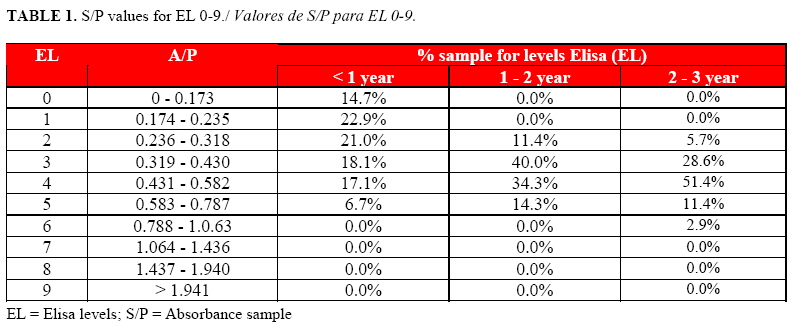
<P><font face="Verdana, Arial, Helvetica, sans-serif" size="2">S/P values were    grouped into ELISA levels (EL), which ranged from 0 (lowest level) to 9 (highest    level). The subsequent levels were determined by increment of 35% as described    by Wilson <I>et al.</I> (8) for the Newcastle system. </font>     <P><font face="Verdana, Arial, Helvetica, sans-serif" size="2"><B>Statistical    analyses</B> </font>     <P><font face="Verdana, Arial, Helvetica, sans-serif" size="2">To investigate    the influence of the variable year as a risk factor for occurrences of <I>B.    burgdorferi</I> in dairy cows, the average antibody title observed at birth,    first, second and third year were subjected to the qui-square or Fischer's exact    tests to ascertain whether any association existed between them. A qui-square    or Fischer's exact tests were used to determine significant differences in percentages    of positive results. Values of p&lt;0.05 were considered to be statistically    significant. The operational procedures were done using the R Foundation statistical    computing software, version 2.12.2 (2011).</font>     ]]></body>
<body><![CDATA[<P>&nbsp;     <P><font face="Verdana, Arial, Helvetica, sans-serif" size="2"><B><font size="3">RESULTS</font></B>    </font>     <P><font face="Verdana, Arial, Helvetica, sans-serif" size="2">Selected conditions    were as follows: (1) 15 &#181;g antigen ml<SUP>-1</SUP> in carbonate buffer,    pH 9.4; (2) negative and positive sera diluted 1:400 in TBS, giving average    absorbance of 1.013 &#177; 0.0084 for positive sera (n= 15) and 0.170 &#177;    0.0015 for negative sera (n= 15). The EL was determined as shown in <a href="/img/revistas/rsa/v38n1/t0102116.jpg">Table    1</a>. </font>      
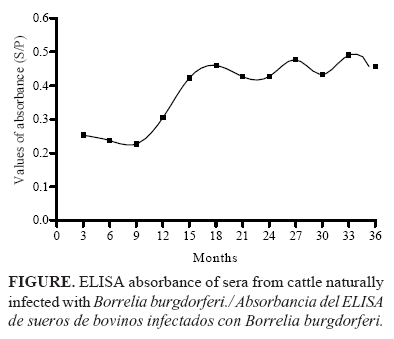
<P><font face="Verdana, Arial, Helvetica, sans-serif" size="2">As shown in <a href="#f1">Figure</a>,    sera from twenty calves naturally infected with <I>Borrelia </I>sp.<I> </I>were    screened by ELISA from day of birth to three years of age. Seven samples (7    animals) showed a higher average antibody title (EL= 6) than the low average    antibody title showed (EL= 0) by 103 samples during the three years of the study.</font>      <P align="center"><img src="/img/revistas/rsa/v38n1/f0102116.gif" width="394" height="339">    <a name="f1"></a>     
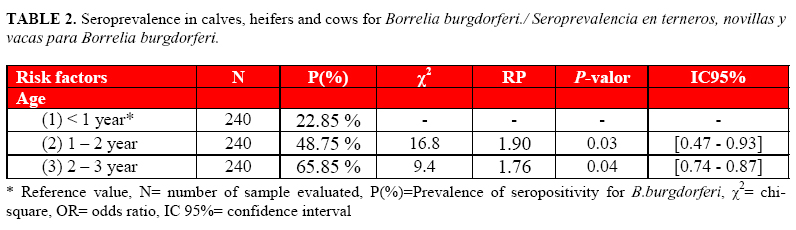
<P><font face="Verdana, Arial, Helvetica, sans-serif" size="2">For antibodies    response to <I>Borrelia </I>sp., the iELISA test showed 93.33% sensitivity and    86.66% specificity. The prevalence of antibodies against <I>Borrelia </I>sp.    were 15%, 23.8%, 48.6% and 65.8% at birth, first, second and third year, respectively    (<a href="/img/revistas/rsa/v38n1/t0202116.jpg">Table 2</a>).</font>      
<P>&nbsp;     <P><font face="Verdana, Arial, Helvetica, sans-serif" size="2"><B><font size="3">DISCUSSION</font></B>    </font>     <P><font face="Verdana, Arial, Helvetica, sans-serif" size="2">The use of highly    specific recombinant antigens in automated enzyme-linked immunosorbent assays    has improved the sensitivity and specificity of detecting antibodies to <I>B.    burgdorferi</I> in humans, dogs, and horses (9, 10). Whole-cell <I>B. burgdorferi</I>    antigens have been used in indirect fluorescent antibody (IFA) staining, immunoblotting,    and ELISA methods in studies of cattle and buffaloes (4, 11, 12), but there    is little information available on the performance and suitability of ELISA    with recombinant antigens for these animals. </font>     <P><font face="Verdana, Arial, Helvetica, sans-serif" size="2">Although a comparison    of immunoblot and ELISA results revealed discrepancies between banding patterns    and serum reactivities to <I>B. burgdorferi</I> recombinant antigens (13), each    method of antibody detection had advantages and disadvantages regarding sensitivity,    specificity, ease of standardization, and expense. Therefore, different antibody-detection    assays should be used to help determine whether hosts were exposed to <I>B.    burgdorferi.</I> </font>     ]]></body>
<body><![CDATA[<P><font face="Verdana, Arial, Helvetica, sans-serif" size="2">The occurrence    of the Lyme disease-like syndrome referred by Mantovani <I>et al.</I> (14) in    Brazil, justify the seroepidemiological study in cattle, because of the cross-reacting    antibodies between <I>Borrelia theileri </I>and other species of <I>Borrelia    </I>genus (15). The rate of cattle that showed homologues antibodies to <I>B.    burgdorferi </I>indicated the presence of the tickborne spirochaetal agent in    the herds evaluated. The rate of seropositive cattle indicated the presence    of some agent of tick-borne spirochetosis in the herd assessed, which showed    54.9% seropositivity to <I>B. burgdorferi </I>in dairy cows in the state of    Par&aacute;, Brazil (16). </font>     <P><font face="Verdana, Arial, Helvetica, sans-serif" size="2">Regarding age,    a higher seroprevalence was observed in cows than in calves. Similarly, Stefanc&iacute;kov&aacute;    <I>et al.</I> (17) found a higher seroprevalence in older cows. Lyme disease    has frequently been found in first-calf heifers when going into full milk production,    often presenting a herd problem (18). </font>     <P>&nbsp;     <P><font face="Verdana, Arial, Helvetica, sans-serif" size="2"><B><font size="3">CONCLUSION</font></B>    </font>     <P><font face="Verdana, Arial, Helvetica, sans-serif" size="2">The rate of animal    that showed homologues antibodies to <I>B. burgdorferi </I>indicated the presence    of the tickborne spirochaetal agent in the cattle population in the studied    region. Therefr\ore, an ELISA could be used to confirm the exposure of cattle    to <I>B. burgdorferi</I>. </font>     <P>&nbsp;     <P><font face="Verdana, Arial, Helvetica, sans-serif" size="2"><B><font size="3">ACKNOWLEDGEMENTS</font></B>    </font>     <P><font face="Verdana, Arial, Helvetica, sans-serif" size="2">Thanks are due    to Conselho Nacional de Desenvolvimento Cient&iacute;fico e Tecnol&oacute;gico    (CNPq) of Brazil for the financial support.</font>     <P>&nbsp;     <P><font face="Verdana, Arial, Helvetica, sans-serif" size="2"><B><font size="3">REFERENCES</font></B>    </font>         ]]></body>
<body><![CDATA[<!-- ref --><P><font face="Verdana, Arial, Helvetica, sans-serif" size="2">1. Fingerle V,      Schulte-Spechtel UC, Ruzic-Sabljic E, Leonhard S, Hofmann H, Weber K, et al.      Epidemiological aspects and molecular characterization of <I>Borrelia burgdorferi</I>      s.l. from southern Germany with special respect to the new species <I>Borrelia      spielmanii</I> sp. nov. Int J Med Microbiol. 2008;298(3-4):279-290.     </font>       <!-- ref --><P><font face="Verdana, Arial, Helvetica, sans-serif" size="2">2. Margos G,      Hojgaard A, Lane RS, Cornet M, Fingerle V, Rudenko N, et al. Multilocus sequence      analysis of <I>Borrelia bissettii</I> strains from North America reveals a      new Borrelia species, <I>Borrelia kurtenbachii</I>. Ticks Tick Borne Dis.      2010;1(4):151-158.     </font>       <!-- ref --><P><font face="Verdana, Arial, Helvetica, sans-serif" size="2">3. Gern L, Estrada-Pe&ntilde;a      A, Frandsen F, Gray JS, Jaenson TG, Jongejan F, et al. European reservoir      hosts of <I>Borrelia burgdorferi</I> sensu lato. Zentralbl Bakteriol. 1998;287(3):196-204.          </font>        <!-- ref --><P><font face="Verdana, Arial, Helvetica, sans-serif" size="2">4. Silva JB, Ba&ecirc;ta    BA, Ribeiro CCDU, Teixeira RC, Fonseca AH. Detection of Antibodies against <I>Borrelia    Burgdorferi</I> in Periparturient Cows and Calves during the First Year Old    by Indirect Enzyme-Linked Immunosorbent Assays (iELISA). Global Journals Inc.    2013;13(6):1-6.     </font>      <!-- ref --><P><font face="Verdana, Arial, Helvetica, sans-serif" size="2">5. Yang X, Popova      TG, Goldberg MS, Norgard MV. Influence of cultivation media on genetic regulatory      patterns in <I>Borrelia burgdorferi</I>. Infect Immun. 2001;69(6):4159-4163.          </font>       ]]></body>
<body><![CDATA[<!-- ref --><P><font face="Verdana, Arial, Helvetica, sans-serif" size="2">6. Ishikawa MM,      Fonseca AH, Soares CO, Massard CL, Yoshinari NH. Padroniza&ccedil;&atilde;o      de ensaio imunoenzim&aacute;tico ELISA indireto para pesquisa de anticorpos      da classe IgG contra <I>Borrelia burgdorferi</I> em bovinos. Rev Bras Med      Vet. 1997;19(4):166-168.     </font>       <!-- ref --><P><font face="Verdana, Arial, Helvetica, sans-serif" size="2">7. Machado RZ,      Montassier HJ, Pinto AA, Lemos EG, Machado MRF, Valad&atilde;o IF, et al.      An enzyme-linked immunosorbent assay (Elisa) for the detection of antibodies      against <I>Babesia bovis</I> in cattle. Vet Parasitol. 1997;71(1):17-26.     </font>       <!-- ref --><P><font face="Verdana, Arial, Helvetica, sans-serif" size="2">8. Wilson RA,      Perrota Jr C, Frey B, Eckroade RJ. An enzyme-linked immunosorbent assay that      measures protective antibody levels to Newcastle disease virus in chickens.      Avian Dis. 1984;28(4):1079-1085.     </font>       <!-- ref --><P><font face="Verdana, Arial, Helvetica, sans-serif" size="2">9. Magnarelli      LA, Flavell RA, Padula SJ, Anderson JF, Fikrig E. Serologic diagnosis of canine      and equine borreliosis: use of recombinant antigens in enzyme-linked immunosorbent      assays. J Clin Microbiol. 1997;35(1):169-173.     </font>       <!-- ref --><P><font face="Verdana, Arial, Helvetica, sans-serif" size="2">10.Schulte-Spechtel      U, Lehnert G, Liegl G, Fingerle V, Heimerl C, Johnson BJB, et al. Significant      improvement of the recombinant <I>Borrelia</I>-specific immunoglobulin G immunoblot      test by addition of VlsE and DbpA homologue derived from <I>Borrelia garinii</I>      for diagnosis of early neuroborreliosis. J Clin Microbiol. 2003;41(3):1299-1303.          </font>       ]]></body>
<body><![CDATA[<!-- ref --><P><font face="Verdana, Arial, Helvetica, sans-serif" size="2">11.Wells SJ,      Trent AM, Robinson RA, Knutson KS, Bey RF. Association between clinical lameness      and <I>Borrelia burgdorferi</I> antibody in dairy cows. Am J Vet Res. 1993;54(3):398-405.          </font>        <!-- ref --><P><font face="Verdana, Arial, Helvetica, sans-serif" size="2">12.Silva JB, Fonseca    AH, Barbosa JD. Serological survey of <I>Mycobacterium bovis</I>, <I>Brucella    abortus</I> and <I>Borrelia burgdorferi</I> in water buffaloes in the northern    region of Brazil. Rev Salud Anim. 2014;36(1):35-39.     </font>      <!-- ref --><P><font face="Verdana, Arial, Helvetica, sans-serif" size="2">13.Magnarelli      LA, Bushmich SL, Sherman BA, Fikrig E. A comparison of serologic tests for      the detection of serum antibodies to whole-cell and recombinant <I>Borrelia      burgdorferi</I> antigens in cattle. Can Vet J. 2004;45(8):667-673.     </font>       <!-- ref --><P><font face="Verdana, Arial, Helvetica, sans-serif" size="2">14.Mantovani      E, Costa IP, Gauditano G, Bonoldi VLN, Higuchi ML, Yoshinari NH. Description      of Lyme disease-like syndrome in Brazil. Is it a new tick borne disease or      Lyme disease variation?. Braz J Med Biol Res. 2007;40(4):443-456.     </font>       <!-- ref --><P><font face="Verdana, Arial, Helvetica, sans-serif" size="2">15.Rogers AB,      Smith RD, Kakoma I. Serologic cross-reactivity of antibodies against <I>Borrelia      theileri</I>, <I>Borrelia burgdorferi </I>and <I>Borrelia coriaceae </I>in      cattle. Am J Vet Res. 1999;60(6):694-697.     </font>        ]]></body>
<body><![CDATA[<!-- ref --><P><font face="Verdana, Arial, Helvetica, sans-serif" size="2">16. Guedes Junior    DS, Ara&uacute;jo FR, Silva FJM, Rangel CP, Barbosa JD, Fonseca AH. Frequency    of antibodies to <I>Babesia bigemina</I>, <I>Babesia bovis</I>, <I>Anaplasma    marginale</I>, <I>Trypanosoma vivax</I> and <I>Borrelia burgdorferi</I> in cattle    from the northeastern region of the state of Par&aacute;, Brazil. Rev Bras Parasitol    Vet. 2008;17(1):105-109.     </font>      <!-- ref --><P><font face="Verdana, Arial, Helvetica, sans-serif" size="2">17.Stefanc&iacute;kov&aacute;      A, Step&aacute;nov&aacute; G, Derd&aacute;kov&aacute; M, Pet`ko B, Kysel`ov&aacute;      J, Cig&aacute;nek J, et al. Serological evidence for <I>Borrelia burgdorferi</I>      infection associated with clinical signs in dairy cattle in Slovakia. Vet      Res Commun. 2002;26(8):601-611.     </font>        <!-- ref --><P><font face="Verdana, Arial, Helvetica, sans-serif" size="2">18.Parker JL, White    KW. Lyme borreliosis in cattle and horses: A review of the literature. Cornell    Vet. 1992;82(3):253-274.    </font>     <P>&nbsp;     <P>&nbsp;     <P><font face="Verdana, Arial, Helvetica, sans-serif" size="2">Recibido: 22-7-2015.    <br>   </font><font face="Verdana, Arial, Helvetica, sans-serif" size="2">Aceptado:    24-2-2016.</font>      ]]></body>
<body><![CDATA[ ]]></body><back>
<ref-list>
<ref id="B1">
<label>1</label><nlm-citation citation-type="journal">
<person-group person-group-type="author">
<name>
<surname><![CDATA[Fingerle]]></surname>
<given-names><![CDATA[V]]></given-names>
</name>
<name>
<surname><![CDATA[Schulte-Spechtel]]></surname>
<given-names><![CDATA[UC]]></given-names>
</name>
<name>
<surname><![CDATA[Ruzic-Sabljic]]></surname>
<given-names><![CDATA[E]]></given-names>
</name>
<name>
<surname><![CDATA[Leonhard]]></surname>
<given-names><![CDATA[S]]></given-names>
</name>
<name>
<surname><![CDATA[Hofmann]]></surname>
<given-names><![CDATA[H]]></given-names>
</name>
<name>
<surname><![CDATA[Weber]]></surname>
<given-names><![CDATA[K]]></given-names>
</name>
</person-group>
<article-title xml:lang="en"><![CDATA[Epidemiological aspects and molecular characterization of Borrelia burgdorferi s.l. from southern Germany with special respect to the new species Borrelia spielmanii sp. nov]]></article-title>
<source><![CDATA[Int J Med Microbiol]]></source>
<year>2008</year>
<volume>298</volume>
<numero>3-4</numero>
<issue>3-4</issue>
<page-range>279-290</page-range></nlm-citation>
</ref>
<ref id="B2">
<label>2</label><nlm-citation citation-type="journal">
<person-group person-group-type="author">
<name>
<surname><![CDATA[Margos]]></surname>
<given-names><![CDATA[G]]></given-names>
</name>
<name>
<surname><![CDATA[Hojgaard]]></surname>
<given-names><![CDATA[A]]></given-names>
</name>
<name>
<surname><![CDATA[Lane]]></surname>
<given-names><![CDATA[RS]]></given-names>
</name>
<name>
<surname><![CDATA[Cornet]]></surname>
<given-names><![CDATA[M]]></given-names>
</name>
<name>
<surname><![CDATA[Fingerle]]></surname>
<given-names><![CDATA[V]]></given-names>
</name>
<name>
<surname><![CDATA[Rudenko]]></surname>
<given-names><![CDATA[N]]></given-names>
</name>
</person-group>
<article-title xml:lang="en"><![CDATA[Multilocus sequence analysis of Borrelia bissettii strains from North America reveals a new Borrelia species, Borrelia kurtenbachii]]></article-title>
<source><![CDATA[Ticks Tick Borne Dis]]></source>
<year>2010</year>
<volume>1</volume>
<numero>4</numero>
<issue>4</issue>
<page-range>151-158</page-range></nlm-citation>
</ref>
<ref id="B3">
<label>3</label><nlm-citation citation-type="journal">
<person-group person-group-type="author">
<name>
<surname><![CDATA[Gern]]></surname>
<given-names><![CDATA[L]]></given-names>
</name>
<name>
<surname><![CDATA[Estrada-Peña]]></surname>
<given-names><![CDATA[A]]></given-names>
</name>
<name>
<surname><![CDATA[Frandsen]]></surname>
<given-names><![CDATA[F]]></given-names>
</name>
<name>
<surname><![CDATA[Gray]]></surname>
<given-names><![CDATA[JS]]></given-names>
</name>
<name>
<surname><![CDATA[Jaenson]]></surname>
<given-names><![CDATA[TG]]></given-names>
</name>
<name>
<surname><![CDATA[Jongejan]]></surname>
<given-names><![CDATA[F]]></given-names>
</name>
</person-group>
<article-title xml:lang="en"><![CDATA[European reservoir hosts of Borrelia burgdorferi sensu lato]]></article-title>
<source><![CDATA[Zentralbl Bakteriol]]></source>
<year>1998</year>
<volume>287</volume>
<numero>3</numero>
<issue>3</issue>
<page-range>196-204</page-range></nlm-citation>
</ref>
<ref id="B4">
<label>4</label><nlm-citation citation-type="journal">
<person-group person-group-type="author">
<name>
<surname><![CDATA[Silva]]></surname>
<given-names><![CDATA[JB]]></given-names>
</name>
<name>
<surname><![CDATA[Baêta]]></surname>
<given-names><![CDATA[BA]]></given-names>
</name>
<name>
<surname><![CDATA[Ribeiro]]></surname>
<given-names><![CDATA[CCDU]]></given-names>
</name>
<name>
<surname><![CDATA[Teixeira]]></surname>
<given-names><![CDATA[RC]]></given-names>
</name>
<name>
<surname><![CDATA[Fonseca]]></surname>
<given-names><![CDATA[AH]]></given-names>
</name>
</person-group>
<article-title xml:lang="en"><![CDATA[Detection of Antibodies against Borrelia Burgdorferi in Periparturient Cows and Calves during the First Year Old by Indirect Enzyme-Linked Immunosorbent Assays (iELISA)]]></article-title>
<source><![CDATA[Global Journals Inc]]></source>
<year>2013</year>
<volume>13</volume>
<numero>6</numero>
<issue>6</issue>
<page-range>1-6</page-range></nlm-citation>
</ref>
<ref id="B5">
<label>5</label><nlm-citation citation-type="journal">
<person-group person-group-type="author">
<name>
<surname><![CDATA[Yang]]></surname>
<given-names><![CDATA[X]]></given-names>
</name>
<name>
<surname><![CDATA[Popova]]></surname>
<given-names><![CDATA[TG]]></given-names>
</name>
<name>
<surname><![CDATA[Goldberg]]></surname>
<given-names><![CDATA[MS]]></given-names>
</name>
<name>
<surname><![CDATA[Norgard]]></surname>
<given-names><![CDATA[MV]]></given-names>
</name>
</person-group>
<article-title xml:lang="en"><![CDATA[Influence of cultivation media on genetic regulatory patterns in Borrelia burgdorferi]]></article-title>
<source><![CDATA[Infect Immun]]></source>
<year>2001</year>
<volume>69</volume>
<numero>6</numero>
<issue>6</issue>
<page-range>4159-4163</page-range></nlm-citation>
</ref>
<ref id="B6">
<label>6</label><nlm-citation citation-type="journal">
<person-group person-group-type="author">
<name>
<surname><![CDATA[Ishikawa]]></surname>
<given-names><![CDATA[MM]]></given-names>
</name>
<name>
<surname><![CDATA[Fonseca]]></surname>
<given-names><![CDATA[AH]]></given-names>
</name>
<name>
<surname><![CDATA[Soares]]></surname>
<given-names><![CDATA[CO]]></given-names>
</name>
<name>
<surname><![CDATA[Massard]]></surname>
<given-names><![CDATA[CL]]></given-names>
</name>
<name>
<surname><![CDATA[Yoshinari]]></surname>
<given-names><![CDATA[NH]]></given-names>
</name>
</person-group>
<article-title xml:lang="pt"><![CDATA[Padronização de ensaio imunoenzimático ELISA indireto para pesquisa de anticorpos da classe IgG contra Borrelia burgdorferi em bovinos]]></article-title>
<source><![CDATA[Rev Bras Med Vet]]></source>
<year>1997</year>
<volume>19</volume>
<numero>4</numero>
<issue>4</issue>
<page-range>166-168</page-range></nlm-citation>
</ref>
<ref id="B7">
<label>7</label><nlm-citation citation-type="journal">
<person-group person-group-type="author">
<name>
<surname><![CDATA[Machado]]></surname>
<given-names><![CDATA[RZ]]></given-names>
</name>
<name>
<surname><![CDATA[Montassier]]></surname>
<given-names><![CDATA[HJ]]></given-names>
</name>
<name>
<surname><![CDATA[Pinto]]></surname>
<given-names><![CDATA[AA]]></given-names>
</name>
<name>
<surname><![CDATA[Lemos]]></surname>
<given-names><![CDATA[EG]]></given-names>
</name>
<name>
<surname><![CDATA[Machado]]></surname>
<given-names><![CDATA[MRF]]></given-names>
</name>
<name>
<surname><![CDATA[Valadão]]></surname>
<given-names><![CDATA[IF]]></given-names>
</name>
</person-group>
<article-title xml:lang="en"><![CDATA[An enzyme-linked immunosorbent assay (Elisa) for the detection of antibodies against Babesia bovis in cattle]]></article-title>
<source><![CDATA[Vet Parasitol]]></source>
<year>1997</year>
<volume>71</volume>
<numero>1</numero>
<issue>1</issue>
<page-range>17-26</page-range></nlm-citation>
</ref>
<ref id="B8">
<label>8</label><nlm-citation citation-type="journal">
<person-group person-group-type="author">
<name>
<surname><![CDATA[Wilson]]></surname>
<given-names><![CDATA[RA]]></given-names>
</name>
<name>
<surname><![CDATA[Perrota]]></surname>
<given-names><![CDATA[Jr C]]></given-names>
</name>
<name>
<surname><![CDATA[Frey]]></surname>
<given-names><![CDATA[B]]></given-names>
</name>
<name>
<surname><![CDATA[Eckroade]]></surname>
<given-names><![CDATA[RJ]]></given-names>
</name>
</person-group>
<article-title xml:lang="en"><![CDATA[An enzyme-linked immunosorbent assay that measures protective antibody levels to Newcastle disease virus in chickens]]></article-title>
<source><![CDATA[Avian Dis]]></source>
<year>1984</year>
<volume>28</volume>
<numero>4</numero>
<issue>4</issue>
<page-range>1079-1085</page-range></nlm-citation>
</ref>
<ref id="B9">
<label>9</label><nlm-citation citation-type="journal">
<person-group person-group-type="author">
<name>
<surname><![CDATA[Magnarelli]]></surname>
<given-names><![CDATA[LA]]></given-names>
</name>
<name>
<surname><![CDATA[Flavell]]></surname>
<given-names><![CDATA[RA]]></given-names>
</name>
<name>
<surname><![CDATA[Padula]]></surname>
<given-names><![CDATA[SJ]]></given-names>
</name>
<name>
<surname><![CDATA[Anderson]]></surname>
<given-names><![CDATA[JF]]></given-names>
</name>
<name>
<surname><![CDATA[Fikrig]]></surname>
<given-names><![CDATA[E]]></given-names>
</name>
</person-group>
<article-title xml:lang="en"><![CDATA[Serologic diagnosis of canine and equine borreliosis: use of recombinant antigens in enzyme-linked immunosorbent assays]]></article-title>
<source><![CDATA[J Clin Microbiol]]></source>
<year>1997</year>
<volume>35</volume>
<numero>1</numero>
<issue>1</issue>
<page-range>169-173</page-range></nlm-citation>
</ref>
<ref id="B10">
<label>10</label><nlm-citation citation-type="journal">
<person-group person-group-type="author">
<name>
<surname><![CDATA[Schulte-Spechtel]]></surname>
<given-names><![CDATA[U]]></given-names>
</name>
<name>
<surname><![CDATA[Lehnert]]></surname>
<given-names><![CDATA[G]]></given-names>
</name>
<name>
<surname><![CDATA[Liegl]]></surname>
<given-names><![CDATA[G]]></given-names>
</name>
<name>
<surname><![CDATA[Fingerle]]></surname>
<given-names><![CDATA[V]]></given-names>
</name>
<name>
<surname><![CDATA[Heimerl]]></surname>
<given-names><![CDATA[C]]></given-names>
</name>
<name>
<surname><![CDATA[Johnson]]></surname>
<given-names><![CDATA[BJB]]></given-names>
</name>
</person-group>
<article-title xml:lang="en"><![CDATA[Significant improvement of the recombinant Borrelia-specific immunoglobulin G immunoblot test by addition of VlsE and DbpA homologue derived from Borrelia garinii for diagnosis of early neuroborreliosis]]></article-title>
<source><![CDATA[J Clin Microbiol]]></source>
<year>2003</year>
<volume>41</volume>
<numero>3</numero>
<issue>3</issue>
<page-range>1299-1303</page-range></nlm-citation>
</ref>
<ref id="B11">
<label>11</label><nlm-citation citation-type="journal">
<person-group person-group-type="author">
<name>
<surname><![CDATA[Wells]]></surname>
<given-names><![CDATA[SJ]]></given-names>
</name>
<name>
<surname><![CDATA[Trent]]></surname>
<given-names><![CDATA[AM]]></given-names>
</name>
<name>
<surname><![CDATA[Robinson]]></surname>
<given-names><![CDATA[RA]]></given-names>
</name>
<name>
<surname><![CDATA[Knutson]]></surname>
<given-names><![CDATA[KS]]></given-names>
</name>
<name>
<surname><![CDATA[Bey]]></surname>
<given-names><![CDATA[RF]]></given-names>
</name>
</person-group>
<article-title xml:lang="en"><![CDATA[Association between clinical lameness and Borrelia burgdorferi antibody in dairy cows]]></article-title>
<source><![CDATA[Am J Vet Res]]></source>
<year>1993</year>
<volume>54</volume>
<numero>3</numero>
<issue>3</issue>
<page-range>398-405</page-range></nlm-citation>
</ref>
<ref id="B12">
<label>12</label><nlm-citation citation-type="journal">
<person-group person-group-type="author">
<name>
<surname><![CDATA[Silva]]></surname>
<given-names><![CDATA[JB]]></given-names>
</name>
<name>
<surname><![CDATA[Fonseca]]></surname>
<given-names><![CDATA[AH]]></given-names>
</name>
<name>
<surname><![CDATA[Barbosa]]></surname>
<given-names><![CDATA[JD]]></given-names>
</name>
</person-group>
<article-title xml:lang="en"><![CDATA[Serological survey of Mycobacterium bovis, Brucella abortus and Borrelia burgdorferi in water buffaloes in the northern region of Brazil]]></article-title>
<source><![CDATA[Rev Salud Anim]]></source>
<year>2014</year>
<volume>36</volume>
<numero>1</numero>
<issue>1</issue>
<page-range>35-39</page-range></nlm-citation>
</ref>
<ref id="B13">
<label>13</label><nlm-citation citation-type="journal">
<person-group person-group-type="author">
<name>
<surname><![CDATA[Magnarelli]]></surname>
<given-names><![CDATA[LA]]></given-names>
</name>
<name>
<surname><![CDATA[Bushmich]]></surname>
<given-names><![CDATA[SL]]></given-names>
</name>
<name>
<surname><![CDATA[Sherman]]></surname>
<given-names><![CDATA[BA]]></given-names>
</name>
<name>
<surname><![CDATA[Fikrig]]></surname>
<given-names><![CDATA[E]]></given-names>
</name>
</person-group>
<article-title xml:lang="en"><![CDATA[A comparison of serologic tests for the detection of serum antibodies to whole-cell and recombinant Borrelia burgdorferi antigens in cattle]]></article-title>
<source><![CDATA[Can Vet J]]></source>
<year>2004</year>
<volume>45</volume>
<numero>8</numero>
<issue>8</issue>
<page-range>667-673</page-range></nlm-citation>
</ref>
<ref id="B14">
<label>14</label><nlm-citation citation-type="journal">
<person-group person-group-type="author">
<name>
<surname><![CDATA[Mantovani]]></surname>
<given-names><![CDATA[E]]></given-names>
</name>
<name>
<surname><![CDATA[Costa]]></surname>
<given-names><![CDATA[IP]]></given-names>
</name>
<name>
<surname><![CDATA[Gauditano]]></surname>
<given-names><![CDATA[G]]></given-names>
</name>
<name>
<surname><![CDATA[Bonoldi]]></surname>
<given-names><![CDATA[VLN]]></given-names>
</name>
<name>
<surname><![CDATA[Higuchi]]></surname>
<given-names><![CDATA[ML]]></given-names>
</name>
<name>
<surname><![CDATA[Yoshinari]]></surname>
<given-names><![CDATA[NH]]></given-names>
</name>
</person-group>
<article-title xml:lang="en"><![CDATA[Description of Lyme disease-like syndrome in Brazil: Is it a new tick borne disease or Lyme disease variation?]]></article-title>
<source><![CDATA[Braz J Med Biol Res]]></source>
<year>2007</year>
<volume>40</volume>
<numero>4</numero>
<issue>4</issue>
<page-range>443-456</page-range></nlm-citation>
</ref>
<ref id="B15">
<label>15</label><nlm-citation citation-type="journal">
<person-group person-group-type="author">
<name>
<surname><![CDATA[Rogers]]></surname>
<given-names><![CDATA[AB]]></given-names>
</name>
<name>
<surname><![CDATA[Smith]]></surname>
<given-names><![CDATA[RD]]></given-names>
</name>
<name>
<surname><![CDATA[Kakoma]]></surname>
<given-names><![CDATA[I]]></given-names>
</name>
</person-group>
<article-title xml:lang="en"><![CDATA[Serologic cross-reactivity of antibodies against Borrelia theileri, Borrelia burgdorferi and Borrelia coriaceae in cattle]]></article-title>
<source><![CDATA[Am J Vet Res]]></source>
<year>1999</year>
<volume>60</volume>
<numero>6</numero>
<issue>6</issue>
<page-range>694-697</page-range></nlm-citation>
</ref>
<ref id="B16">
<label>16</label><nlm-citation citation-type="journal">
<person-group person-group-type="author">
<name>
<surname><![CDATA[Guedes Junior]]></surname>
<given-names><![CDATA[DS]]></given-names>
</name>
<name>
<surname><![CDATA[Araújo]]></surname>
<given-names><![CDATA[FR]]></given-names>
</name>
<name>
<surname><![CDATA[Silva]]></surname>
<given-names><![CDATA[FJM]]></given-names>
</name>
<name>
<surname><![CDATA[Rangel]]></surname>
<given-names><![CDATA[CP]]></given-names>
</name>
<name>
<surname><![CDATA[Barbosa]]></surname>
<given-names><![CDATA[JD]]></given-names>
</name>
<name>
<surname><![CDATA[Fonseca]]></surname>
<given-names><![CDATA[AH]]></given-names>
</name>
</person-group>
<article-title xml:lang="en"><![CDATA[Frequency of antibodies to Babesia bigemina, Babesia bovis, Anaplasma marginale, Trypanosoma vivax and Borrelia burgdorferi in cattle from the northeastern region of the state of Pará, Brazil]]></article-title>
<source><![CDATA[Rev Bras Parasitol Vet]]></source>
<year>2008</year>
<volume>17</volume>
<numero>1</numero>
<issue>1</issue>
<page-range>105-109</page-range></nlm-citation>
</ref>
<ref id="B17">
<label>17</label><nlm-citation citation-type="journal">
<person-group person-group-type="author">
<name>
<surname><![CDATA[Stefancíková]]></surname>
<given-names><![CDATA[A]]></given-names>
</name>
<name>
<surname><![CDATA[Stepánová]]></surname>
<given-names><![CDATA[G]]></given-names>
</name>
<name>
<surname><![CDATA[Derdáková]]></surname>
<given-names><![CDATA[M]]></given-names>
</name>
<name>
<surname><![CDATA[Pet`ko]]></surname>
<given-names><![CDATA[B]]></given-names>
</name>
<name>
<surname><![CDATA[Kysel`ová]]></surname>
<given-names><![CDATA[J]]></given-names>
</name>
<name>
<surname><![CDATA[Cigánek]]></surname>
<given-names><![CDATA[J]]></given-names>
</name>
</person-group>
<article-title xml:lang="en"><![CDATA[Serological evidence for Borrelia burgdorferi infection associated with clinical signs in dairy cattle in Slovakia]]></article-title>
<source><![CDATA[Vet Res Commun]]></source>
<year>2002</year>
<volume>26</volume>
<numero>8</numero>
<issue>8</issue>
<page-range>601-611</page-range></nlm-citation>
</ref>
<ref id="B18">
<label>18</label><nlm-citation citation-type="journal">
<person-group person-group-type="author">
<name>
<surname><![CDATA[Parker]]></surname>
<given-names><![CDATA[JL]]></given-names>
</name>
<name>
<surname><![CDATA[White]]></surname>
<given-names><![CDATA[KW]]></given-names>
</name>
</person-group>
<article-title xml:lang="en"><![CDATA[Lyme borreliosis in cattle and horses: A review of the literature]]></article-title>
<source><![CDATA[Cornell Vet]]></source>
<year>1992</year>
<volume>82</volume>
<numero>3</numero>
<issue>3</issue>
<page-range>253-274</page-range></nlm-citation>
</ref>
</ref-list>
</back>
</article>