<?xml version="1.0" encoding="ISO-8859-1"?><article xmlns:mml="http://www.w3.org/1998/Math/MathML" xmlns:xlink="http://www.w3.org/1999/xlink" xmlns:xsi="http://www.w3.org/2001/XMLSchema-instance">
<front>
<journal-meta>
<journal-id>0253-570X</journal-id>
<journal-title><![CDATA[Revista de Salud Animal]]></journal-title>
<abbrev-journal-title><![CDATA[Rev Salud Anim.]]></abbrev-journal-title>
<issn>0253-570X</issn>
<publisher>
<publisher-name><![CDATA[Centro Nacional de Sanidad Agropecuaria]]></publisher-name>
</publisher>
</journal-meta>
<article-meta>
<article-id>S0253-570X2016000200009</article-id>
<title-group>
<article-title xml:lang="en"><![CDATA[Evaluation of an electrical conductivity portable device as an alternative for subclinical mastitis detection]]></article-title>
<article-title xml:lang="es"><![CDATA[Evaluación del dispositivo portátil de la conductividad eléctrica como alternativa para la detección de mastitis subclínica]]></article-title>
</title-group>
<contrib-group>
<contrib contrib-type="author">
<name>
<surname><![CDATA[da Costa Ribeiro]]></surname>
<given-names><![CDATA[Ana Beatriz]]></given-names>
</name>
<xref ref-type="aff" rid="A01"/>
</contrib>
<contrib contrib-type="author">
<name>
<surname><![CDATA[Sifuentes dos Santos]]></surname>
<given-names><![CDATA[Joice]]></given-names>
</name>
<xref ref-type="aff" rid="A01"/>
</contrib>
<contrib contrib-type="author">
<name>
<surname><![CDATA[Zanol]]></surname>
<given-names><![CDATA[Daniel]]></given-names>
</name>
<xref ref-type="aff" rid="A02"/>
</contrib>
<contrib contrib-type="author">
<name>
<surname><![CDATA[Leme Lombarde]]></surname>
<given-names><![CDATA[Letícia Neves]]></given-names>
</name>
<xref ref-type="aff" rid="A02"/>
</contrib>
<contrib contrib-type="author">
<name>
<surname><![CDATA[Bruzaroski]]></surname>
<given-names><![CDATA[Samera Rafaela]]></given-names>
</name>
<xref ref-type="aff" rid="A02"/>
</contrib>
<contrib contrib-type="author">
<name>
<surname><![CDATA[Ludovico]]></surname>
<given-names><![CDATA[Agostinho]]></given-names>
</name>
<xref ref-type="aff" rid="A01"/>
</contrib>
<contrib contrib-type="author">
<name>
<surname><![CDATA[Walter de Santana]]></surname>
<given-names><![CDATA[Elsa Helena]]></given-names>
</name>
<xref ref-type="aff" rid="A01"/>
</contrib>
</contrib-group>
<aff id="A01">
<institution><![CDATA[,Professor from Master in Science and Technology of Milk and Dairy Products  ]]></institution>
<addr-line><![CDATA[Londrina ]]></addr-line>
<country>Brazil</country>
</aff>
<aff id="A02">
<institution><![CDATA[,University North of Parana (UNOPAR)  ]]></institution>
<addr-line><![CDATA[Londrina ]]></addr-line>
<country>Brazil</country>
</aff>
<pub-date pub-type="pub">
<day>00</day>
<month>08</month>
<year>2016</year>
</pub-date>
<pub-date pub-type="epub">
<day>00</day>
<month>08</month>
<year>2016</year>
</pub-date>
<volume>38</volume>
<numero>2</numero>
<fpage>131</fpage>
<lpage>135</lpage>
<copyright-statement/>
<copyright-year/>
<self-uri xlink:href="http://scielo.sld.cu/scielo.php?script=sci_arttext&amp;pid=S0253-570X2016000200009&amp;lng=en&amp;nrm=iso"></self-uri><self-uri xlink:href="http://scielo.sld.cu/scielo.php?script=sci_abstract&amp;pid=S0253-570X2016000200009&amp;lng=en&amp;nrm=iso"></self-uri><self-uri xlink:href="http://scielo.sld.cu/scielo.php?script=sci_pdf&amp;pid=S0253-570X2016000200009&amp;lng=en&amp;nrm=iso"></self-uri><abstract abstract-type="short" xml:lang="en"><p><![CDATA[The use of efficient methods for the early diagnosis of subclinical mastitis is of great importance in milk production. By using an electrical conductivity meter (EC), the efficiency of subclinical mastitis diagnosis was evaluated in dairy farms in northern Parana, Brazil, and the results were compared with those obtained by using the California Mastitis Test and the Somatic Cell Count (SCC). Samples from 941 quarters of 259 cows of the Holstein and Jersey breeds were analyzed in four dairy farms between June and July 2014. The EC method correctly evaluated 54.8% of the samples (264 samples with subclinical mastitis) and 250 without infection when compared with the diagnosis by CMT. Of the 445 samples diagnosed as positive by EC, 19.7% were classified by CMT with score 2 and 24.7% with score 3. Of the samples with negative results (496), most of them had scores 0 and 1 (50.4% and 21.4 %). The correlations between EC and SCC (r = 0.14) and EC and CMT (r = 0.17) were positive but low, which generated false positive and false negative results of subclinical mastitis in the herd.]]></p></abstract>
<abstract abstract-type="short" xml:lang="es"><p><![CDATA[El uso de métodos eficientes para el diagnóstico rápido de la mastitis subclínica es de gran importancia en la producción de leche. Mediante el empleo de un medidor de conductividad eléctrica (CE), se evaluó la eficacia del diagnóstico de mastitis subclínica en granjas de leche del norte de Paraná, en Brasil, y se compararon los resultados con la Prueba de California para Mastitis (CMT, del inglés California Mastitis Test) y con el conteo de células somáticas (CCS). Se analizaron 941 cuartos mamarios, obtenidos de 259 vacas de las razas Holstein y Jersey en cuatro granjas lecheras, entre junio y julio de 2014. La CE evaluó correctamente 54,8% de las muestras (264 muestras con mastitis subclínica) y 250 sin infección en comparación con el diagnóstico de CMT. De las 445 muestras diagnosticadas como positiva para EC, 19,7% se clasificaron por la CMT, con una puntuación de 2 y 24,7% con una puntuación de 3. Entre los resultados negativos (496 muestras), la mayoría de las muestras tuvieron una puntuación entre 0 y 1 (50,4% y 21,4%). Hubo una correlación positiva (p <0.001); sin embargo, resultó baja entre CE y CCS (r = 0.14) y CE y CMT (r = 0.17), por lo que generaron resultados falsos positivos y falsos negativos de la mastitis subclínica en el hato.]]></p></abstract>
<kwd-group>
<kwd lng="en"><![CDATA[California Mastitis Test]]></kwd>
<kwd lng="en"><![CDATA[Somatic Cell Count]]></kwd>
<kwd lng="en"><![CDATA[milk]]></kwd>
<kwd lng="es"><![CDATA[Prueba de California]]></kwd>
<kwd lng="es"><![CDATA[Conteo de Células Somáticas]]></kwd>
<kwd lng="es"><![CDATA[leche]]></kwd>
</kwd-group>
</article-meta>
</front><body><![CDATA[ <p align="right"><font size="2" face="Verdana, Arial, Helvetica, sans-serif"><B>SHORT    COMMUNICATION</B></font></p>     <p>&nbsp;</p> <h1> <font size="2" face="Verdana, Arial, Helvetica, sans-serif"><b><font size="4">Evaluation    of an electrical conductivity portable device as an alternative for subclinical    mastitis detection</font> </b></font></h1>     <p>&nbsp;</p> <h1> <font size="2" face="Verdana, Arial, Helvetica, sans-serif"><b><font size="3">Evaluaci&oacute;n    del dispositivo port&aacute;til de la conductividad el&eacute;ctrica como alternativa    para la detecci&oacute;n de mastitis subcl&iacute;nica </font></b></font></h1>     <p>&nbsp;</p>     <p>&nbsp;</p>     <p><font size="2" face="Verdana, Arial, Helvetica, sans-serif"><b>Ana Beatriz    da Costa Ribeiro<SUP>I</SUP>, Joice Sifuentes dos Santos<SUP>I</SUP>, Daniel    Zanol<SUP>II</SUP>, Let&iacute;cia Neves Leme Lombarde<SUP>II</SUP>, Samera    Rafaela Bruzaroski<SUP>II</SUP>, Agostinho Ludovico<SUP>I</SUP>, Elsa Helena    Walter de Santana<SUP>I</SUP><a href="#autor">*</a><a name="pie"></a></b></font></p>     <P><font size="2" face="Verdana, Arial, Helvetica, sans-serif"><SUP>I </SUP>Professor    from Master in Science and Technology of Milk and Dairy Products. R. Marselha,    591, CEP 86041-140 Londrina, PR, Brazil.<SUP>     <br>   II</SUP>Undergraduate Course in Veterinary Medicine, University North of Parana    (UNOPAR), Av. Paris, 675, CEP 86041-120 Londrina, PR, Brazil.</font>     <P>&nbsp;     <P>&nbsp; <hr noshade size="1">     ]]></body>
<body><![CDATA[<P><font size="2" face="Verdana, Arial, Helvetica, sans-serif"><B>ABSTRACT</B></font>     <P><font size="2" face="Verdana, Arial, Helvetica, sans-serif">The use of efficient    methods for the early diagnosis of subclinical mastitis is of great importance    in milk production. By using an electrical conductivity meter (EC), the efficiency    of subclinical mastitis diagnosis was evaluated in dairy farms in northern Parana,    Brazil, and the results were compared with those obtained by using the California    Mastitis Test and the Somatic Cell Count (SCC). Samples from 941 quarters of    259 cows of the Holstein and Jersey breeds were analyzed in four dairy farms    between June and July 2014. The EC method correctly evaluated 54.8% of the samples    (264 samples with subclinical mastitis) and 250 without infection when compared    with the diagnosis by CMT. Of the 445 samples diagnosed as positive by EC, 19.7%    were classified by CMT with score 2 and 24.7% with score 3. Of the samples with    negative results (496), most of them had scores 0 and 1 (50.4% and 21.4 %).    The correlations between EC and SCC (r = 0.14) and EC and CMT (r = 0.17) were    positive but low, which generated false positive and false negative results    of subclinical mastitis in the herd. </font>     <P><font size="2" face="Verdana, Arial, Helvetica, sans-serif"><B>Key words:</B>    California Mastitis Test, Somatic Cell Count, milk.</font> <hr noshade size="1">     <p><font size="2" face="Verdana, Arial, Helvetica, sans-serif"><B>RESUMEN</b></font></p>     <p><font size="2" face="Verdana, Arial, Helvetica, sans-serif">El uso de m&eacute;todos    eficientes para el diagn&oacute;stico r&aacute;pido de la mastitis subcl&iacute;nica    es de gran importancia en la producci&oacute;n de leche. Mediante el empleo    de un medidor de conductividad el&eacute;ctrica (CE), se evalu&oacute; la eficacia    del diagn&oacute;stico de mastitis subcl&iacute;nica en granjas de leche del    norte de Paran&aacute;, en Brasil, y se compararon los resultados con la Prueba    de California para Mastitis (CMT, <I>del ingl&eacute;s California Mastitis Test</I>)    y con el conteo de c&eacute;lulas som&aacute;ticas (CCS). Se analizaron 941    cuartos mamarios, obtenidos de 259 vacas de las razas Holstein y Jersey en cuatro    granjas lecheras, entre junio y julio de 2014. La CE evalu&oacute; correctamente    54,8% de las muestras (264 muestras con mastitis subcl&iacute;nica) y 250 sin    infecci&oacute;n en comparaci&oacute;n con el diagn&oacute;stico de CMT. De    las 445 muestras diagnosticadas como positiva para EC, 19,7% se clasificaron    por la CMT, con una puntuaci&oacute;n de 2 y 24,7% con una puntuaci&oacute;n    de 3. Entre los resultados negativos (496 muestras), la mayor&iacute;a de las    muestras tuvieron una puntuaci&oacute;n entre 0 y 1 (50,4% y 21,4%). Hubo una    correlaci&oacute;n positiva (p &lt;0.001); sin embargo, result&oacute; baja    entre CE y CCS (r = 0.14) y CE y CMT (r = 0.17), por lo que generaron resultados    falsos positivos y falsos negativos de la mastitis subcl&iacute;nica en el hato.    </font> </p>     <P><font size="2" face="Verdana, Arial, Helvetica, sans-serif"><B>Palabras clave:</B>    Prueba de California, Conteo de C&eacute;lulas Som&aacute;ticas, leche.</font> <hr noshade size="1">     <P>&nbsp;     <P>&nbsp;     <P><font size="2" face="Verdana, Arial, Helvetica, sans-serif">Mammary gland inflammation,    usually in response to an invasive agent, is characterized by an increase in    the milk somatic cell count (SCC). A milk SCC above 200,000 cells/ml indicates    the presence of mastitis in cattle. However, counts greater than 100,000 cells/ml    are already considered as indicative of subclinical mastitis (1). Brazilian    legislation, as required by the Ministry of Agriculture, Livestock and Supply    (MAPA), through the Normative Instruction No. 62 of 2011, established maximum    SCC levels of 600,000 cells/ml for cool raw milk, until June 30.2014 and 500,000    cells/ml from July 1, 2014, to June 30, 2016 (2). </font>     <P><font size="2" face="Verdana, Arial, Helvetica, sans-serif">Subclinical mastitis    must be detected at an early stage and by a reliable method to minimize clinical    mastitis outbreaks, which can cause significant losses to the producers. With    an increased SCC, alterations in milk components such as lactose, protein, and    fat are observed. Changes in milk composition caused by mastitis allow performing    indirect tests such as SCC, California Mastitis Test (CMT), and electrical conductivity    (EC). The content of chloride and lactose can also be used to diagnose this    disorder (3). </font>     ]]></body>
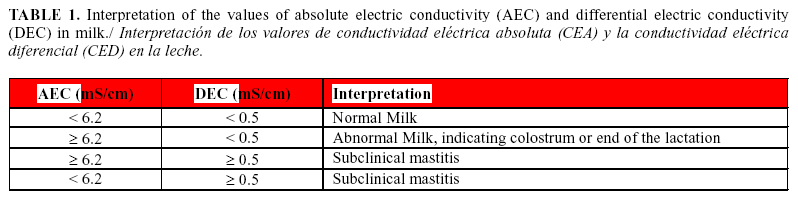
<body><![CDATA[<P><font size="2" face="Verdana, Arial, Helvetica, sans-serif">CMT is the most    widespread form of subclinical mastitis diagnosis among producers and veterinarians    in Brazil. EC measurement can be an alternative method replacing CMT because    it is easy to use in the dairy farm routine. EC evaluates the ability of a solution    to conduct an electric current between two electrodes and is given in milliSiemens    per centimeter (mS/cm). EC increases are proportional to SCC increases. When    the epithelium of the mammary gland is damaged as a result of mastitis, EC is    modified due to changes in sodium, potassium, and chlorine balance (4). </font>     <P><font size="2" face="Verdana, Arial, Helvetica, sans-serif">The use of EC measurement    as a form of diagnosis of subclinical mastitis in the routine of dairy farms    can be a valuable tool for the producer because it enables early diagnosis of    subclinical mastitis, facilitating the treatment and minimizing economic losses.    Besides, EC can be an alternative to the use of CMT. Thus, the present work    evaluated the subclinical mastitis diagnostic efficiency in dairy farms through    the use of a portable electrical conductivity (EC) meter, and comparing the    results obtained with those obtained by other methods currently available to    the producer, like the California Mastitis Test (CMT) and the Somatic Cell Count    (SCC). </font>     <P><font size="2" face="Verdana, Arial, Helvetica, sans-serif">Milk samples were    collected from the daily milking routine of four dairy farms in northern Parana,    Brazil, between June and July 2014. Those farms had mechanical milking system    parlours and a herd of Holstein and Jersey breeds. Cows in early lactation (up    to 10 days calved) and cows near to their dry period were excluded. The animals    were prepared for milking routine according to each farm prescription. Milk    samples were collected after discarding the first three strips of milk and disinfecting    the teats with a 2% sodium hypochlorite solution. The following milk was used    for analysis by CMT, the next for the EC measurement, and then, samples for    SCC were collected. A total of 941 individual quarter samples were collected    and analyzed by the three diagnostic methods. </font>     <P><font size="2" face="Verdana, Arial, Helvetica, sans-serif">The CMT was performed    with the use of a plastic tray containing four chambers, where the milk collected    was mixed with a violet base bromocresol reagent (Tadabras Industria e Com&eacute;rcio    de Produtos Veterinarios Ltda). The milk and reagent mixture was slowly stirred    for 10 seconds and the following results assigned: Negative (0), weak (1), distinct    positive (2), and strongly positive (3). </font>     <P><font size="2" face="Verdana, Arial, Helvetica, sans-serif">For SCC analysis,    the milk samples were placed in test tubes containing bromopol, and the somatic    cells were determined by electronic counting using the flow cytometry technique    in the Somacount 500&#174; equipment (Bentley Intruments Inc.). </font>     <P><font size="2" face="Verdana, Arial, Helvetica, sans-serif">The EC measurement    was performed with a commercial hand-held conductivity meter. The EC portable    meter uses a combination of two values to indicate the result of subclinical    mastitis: absolute electric conductivity (AEC) and differential electric conductivity    (DEC). The AEC refers to the actual conductivity measurement of each teat, and    the DEC is the difference of the absolute measure found and the lowest value    of AEC of the cow, considered as 0 to calculation. The combination of these    values is calculated by computer in the system known as inter quarter ratio    (IQR), which indicates the presence or absence of subclinical mastitis (<a href="/img/revistas/rsa/v38n2/t0109216.jpg">Table    1</a>). As the non mastitic milk has similar electrical conductivity in all    teats, the EC difference among all the teats of a cow may indicate mastitis    in a particular one (5). The EC portable meter has a mechanism to compensate    the possible differences in temperature of the samples and is calibrated with    a 0.05 M KCl solution. The EC values and their interpretation can be seen in    <a href="/img/revistas/rsa/v38n2/t0109216.jpg">Table 1</a>. </font>      
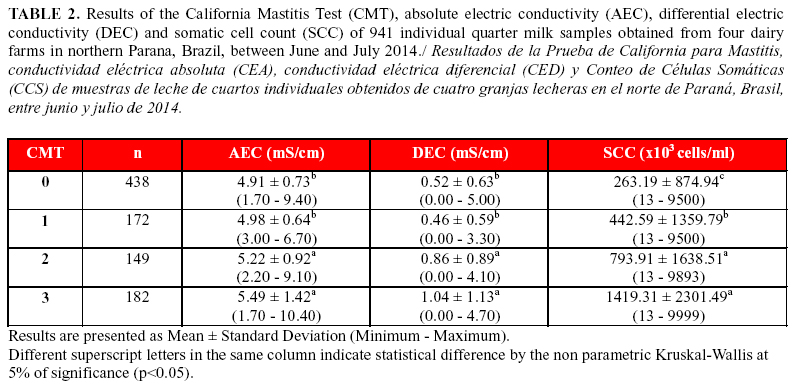
<P><font size="2" face="Verdana, Arial, Helvetica, sans-serif">The data were analyzed    by Statistical 12 software (Statsoft Inc.) through descriptive statistical analysis    and non-parametric Kruskal-Wallis at 5% significance (p&lt;0.05) to compare    the results of AEC and DEC vs. CMT, and Spearman correlation test at 5% significance    (p&lt;0.05) between CMT vs. DEC and SCC vs. DEC. </font>     <P><font size="2" face="Verdana, Arial, Helvetica, sans-serif">By comparing data    from CMT and EC, it could be stated that the EC values found for CMT 0 and 1    showed no statistical difference (p&gt;0.05; <a href="/img/revistas/rsa/v38n2/t0209216.jpg">Table    2</a>). The same was observed between scores 2 and 3 (p&gt;0.05). However, differences    in the assessments were observed in comparing the CMT scores 0 and 1 with scores    2 and 3 (p&lt;0.05) when absolute and differential values were considered. Milk    with CMT 0 is considered normal, and scores 1, 2 and 3 are indicative of subclinical    mastitis. It was observed that some samples tested with CMT score 0 presented    DEC greater than or equal to 0.5 (187 samples), which indicated the presence    of subclinical mastitis. This can be attributed to the fact that the EC detects    subclinical mastitis earlier than the CMT method routinely used in dairy farms    in the country (6). </font>      
<P><font size="2" face="Verdana, Arial, Helvetica, sans-serif">Of the 172 quarters    with CMT 1, 106 tested negative for mastitis by the EC. It is known that the    electrical conductivity measures the presence of Na<SUP>+</SUP> and Cl<SUP>-</SUP>    ions in milk, which are released in higher amounts in the presence of an inflammatory    process and tissue damage, depending on the damage extension of the affected    quarter (7). </font>     <P><font size="2" face="Verdana, Arial, Helvetica, sans-serif">It is assumed that    the milk before the removal of the first three strips and the residual milk    (milk located in the mammary gland at the end of milking), are those containing    the highest values of SCC (8). It was also confirmed that there might be variations    in Na<SUP>+</SUP> concentration depending on the milk portion collected for    the sample. Higher levels of Na<SUP>+</SUP> are present in milk before the withdrawal    of three strips and in cisternal milk (milk before starting the milking process)    and may decrease by up to 25% when measured in alveolar milk (during milking)    (9). </font>     ]]></body>
<body><![CDATA[<P><font size="2" face="Verdana, Arial, Helvetica, sans-serif">The milk samples    were collected soon after the withdrawal of the first three strips for all the    tests (EC, CMT and SCC), assuming then that the portion used was alveolar milk.    The cisternal milk, which contains higher SCC and higher EC can only be obtained    when it is not done the pre-stimulation (removal of the initial strips) (8),    which is used in Brazil to detect clinical mastitis through the strip cup test.    As the manufacturer does not indicate in its instruction manual which is the    exact time to use the portable EC measuring device, the same application protocol    for CMT was used; that is, after discarding the first three strips. Therefore,    there may be some influence of the collecting time on the measuring of the electrical    conductivity. In a research, the residual milk after the milking process removing    the milk left in the udder manually (postmilking strippings) was evaluated and    showed an increase in the accuracy of EC when compared with the first milk drawn    from the udder before proper milking (foremilk) in the same cow (10). Other    authors (11), however, indicate that the best results are achieved when the    milk is collected before milking. </font>     <P><font size="2" face="Verdana, Arial, Helvetica, sans-serif">There was a positive    correlation (p&lt;0.001) between DEC and SCC (r = 0.14) and DEC and CMT (r =    0.17). However, the correlation coefficients were low. A significant correlation    between EC and log SCC was found; however, the correlation (r = 0.21) was higher    than in the present study (10). </font>     <P><font size="2" face="Verdana, Arial, Helvetica, sans-serif">Samples with DEC    at or above 0.5 mS/cm (<a href="/img/revistas/rsa/v38n2/t0109216.jpg">Table    1</a>), an index determined by the manufacturer, were considered positive for    subclinical mastitis. Of the 941 quarter samples investigated, 445 samples (47.2%)    were diagnosed as positive and 496 (52.8%) as negative by EC. Of the 445 samples    diagnosed as positive by EC, 19.7% were classified with score 2 and 24.7% with    score 3 by CMT. Of the negative results (496 samples), most samples had scores    0 and 1 (50.4% and 21.4%, respectively). </font>      
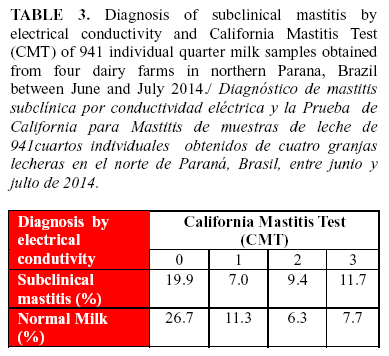
<P><font size="2" face="Verdana, Arial, Helvetica, sans-serif">When the samples    were diagnosed as positive for subclinical mastitis by EC (<a href="#t3">Table    3</a>), 19.9% had a score of 0 on CMT and could be classified as false positive,    while 25.3% of the samples were considered normal by EC and had scores 1, 2    and 3 on CMT, being considered as false negative. We can consider that 54.8%    of the samples were evaluated correctly using the portable electrical conductivity    meter. A similar frequency of false positives (16.5%) and higher of false negatives    (47.7%) were observed in the first milk taken from the quarter before the actual    milking (foremilk) (12). A correct identification of regular milk higher than    in the present work has been indicated, around 90% (13). The apparatus used    for EC evaluation was more efficient for detecting extreme change in conductivity    values, or animals that were already presenting clinical mastitis and animals    that were not showing any electrical conductivity alteration yet. </font>      <P align="center"><img src="/img/revistas/rsa/v38n2/t0309216.jpg" width="389" height="356">    <a name="t3"></a>     
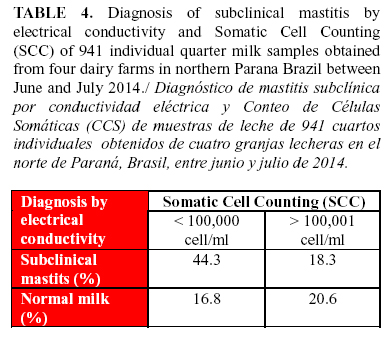
<P><font size="2" face="Verdana, Arial, Helvetica, sans-serif">Considering milk    with SCC lower than 100,000 cell/ml as normal milk, EC diagnosed 44.3% of the    samples as subclinical mastitis and 16.8% as normal milk. When considering SCC    higher than 100,001 cell/ml as subclinical mastitis, 20.6% were normal milk    by EC, being considered as false negative, and 18.3% as samples from cows with    subclinical mastitis (<a href="#t4">Table 4</a>). Cows with SCC between 200,000    and 300,000 cell/ml must be identified to start their preventive or therapeutic    treatment, like frequent milking and antibiotic therapy, to avoid new contaminations    or other herd cow problems (14). Therefore, considering up to 100,000 cell/ml    as a normal milk and SCC the pattern test, 35.1% of the samples were evaluated    correctly using electrical conductivity.</font>      <P align="center"><img src="/img/revistas/rsa/v38n2/t0409216.jpg" width="392" height="337">    <a name="t4"></a>      
<P><font size="2" face="Verdana, Arial, Helvetica, sans-serif">Therefore, it can    be concluded that the EC evaluation through the portable EC meter tested, which    can be a direct test, showed a high proportion of results differing from SCC    and CMT results, considering the latter an usual subclinical mastitis indicator.    This fact caused a low correlation with routine tests used by producers in Brazil.    So, even CMT presents some limitations like the failure to detect some types    of infection and the need for a well-trained person able to execute the test,    it interprets the results and decide, what action should be taken. The California    Mastitis Test still shows to be the cheapest and most accessible and efficient    test for the brazilian producer in comparison to the EC portable meter tested.</font>     <P>&nbsp;     <P><font size="2" face="Verdana, Arial, Helvetica, sans-serif"><B><font size="3">REFERENCES</font></B>    </font>          ]]></body>
<body><![CDATA[<!-- ref --><P><font size="2" face="Verdana, Arial, Helvetica, sans-serif">1. Bytyqi H, Zaugg    U, Sherifi K, Hamidi A, Gjonbalaj M, et al. Influence of management and physiological    factors on somatic cell count in raw cow milk in Kosova. Vet Arhiv. 2010;80(10):173-183.        </font>      <!-- ref --><P><font size="2" face="Verdana, Arial, Helvetica, sans-serif">2. Brasil. Minist&eacute;rio      da Agricultura, Pecu&aacute;ria e Abastecimento. Regulamentos t&eacute;cnicos      de produ&ccedil;&atilde;o, identidade e qualidade do leite tipo A, leite cru      refrigerado e leite pasteurizado, Instru&ccedil;&atilde;o Normativa N&#186;      62, 2011.     </font>        <!-- ref --><P><font size="2" face="Verdana, Arial, Helvetica, sans-serif">3. Ruegg PL, Reinemann    DJ. Milk quality and mastitis test. 2002. Accessed in Apr. 27, 2014. <a href="http://www.milkquality.wisc.edu/wp-content/uploads/2011/09/milk-quality-and-mastitis-diagnostic%20-tests.pdf">http://www.milkquality.wisc.edu/wp-content/uploads/2011/09/milk-quality-and-mastitis-diagnostic-tests.pdf</a>.        </font>      <!-- ref --><P><font size="2" face="Verdana, Arial, Helvetica, sans-serif">4. Biggadike      HJ, Ohnstad I, Laven RA, Hillerton JE. Evaluation of measurements of the conductivity      of quarter milk samples for the early diagnosis of mastitis. Vet Rec. 2012;150(21):655-658.          </font>        <!-- ref --><P><font size="2" face="Verdana, Arial, Helvetica, sans-serif">5. Ilie LI, Tudor    L, Galis AM. The electrical conductivity of cattle milk and the possibly of    mastitis diagnosis in Romania. Lucr&atilde;ri &#170;tiin&#179;ifice Medicin&atilde;    Veterinar&atilde;. 2010;43(2):220-227.     </font>      ]]></body>
<body><![CDATA[<!-- ref --><P><font size="2" face="Verdana, Arial, Helvetica, sans-serif">6. Beloti V,      Tamanini R. Propriedades organol&eacute;pticas e f&iacute;sico qu&iacute;micas      do leite. In: Leite: Beloti V. Leite: obten&ccedil;&atilde;o, inspe&ccedil;&atilde;o      e qualidade. Londrina: Ed. Planta. 2013; pp.51-108.     </font>       <!-- ref --><P><font size="2" face="Verdana, Arial, Helvetica, sans-serif">7. Zafalon LF,      Nader Filho A, Oliveira JV, Resende FD. Electrical conductivity and chloride      concentration of milk as auxiliary diagnostic methods in bovine subclinical      mastitis. Pesquisa Vet Brasil. 2005;25(3):150-163.     </font>       <!-- ref --><P><font size="2" face="Verdana, Arial, Helvetica, sans-serif">8. Sarikaya H,      Bruckmaier RM. Importance of sampled milk fraction for the prediction of total      quarter somatic cell count. J Dairy Sci. 2006;89(11):4246-4250.     </font>       <!-- ref --><P><font size="2" face="Verdana, Arial, Helvetica, sans-serif">9. Janzekovic      M, Brus M, Mursec B, Vinis B, Stanjko D, Cus F. Mastitis detection based on      electric conductivity of milk. <I>J Miner Materials Characterization Engineering</I>.      2009;34(1):39-46.     </font>        <!-- ref --><P><font size="2" face="Verdana, Arial, Helvetica, sans-serif">10.Woolford MW,    Williamson JH. The electrical conductivity of milk as a diagnostic of subclinical    mastitis. In Proceeding Conference Dairy Production from Pasture. Anim Res.    Stn. Hamilton, New Zealand, 1982. p. 114.     </font>      ]]></body>
<body><![CDATA[<!-- ref --><P><font size="2" face="Verdana, Arial, Helvetica, sans-serif">11.Fernando RS,    Rindsig RB, Spahr SL. Effect of length of milking interval and fat content on    milk conductivity and its use for detecting mastitis. J Dairy Sci. 1981;64(4):678-682.        </font>      <!-- ref --><P><font size="2" face="Verdana, Arial, Helvetica, sans-serif">12.Fernando RS,    Spahr SL, Jaster EH. Comparison of electrical conductivity of milk with other    indirect methods for detection of subclinical mastitis. J Dairy Sci. 1985;62(2):449-456.        </font>      <!-- ref --><P><font size="2" face="Verdana, Arial, Helvetica, sans-serif">13.Fernando RS,    Rindsig RB, Spahr SL. Electrical conductivity of milk for detection of mastitis.    J Dairy Sci. 1982;65(4):659-664.     </font>      <!-- ref --><P><font size="2" face="Verdana, Arial, Helvetica, sans-serif">14.Hamman J, Zecconi    A. Evaluation of the electrical conductivity of milk as a mastitis indicator.    International Dairy Federation. 1998;334:5-26.    </font>     <P>&nbsp;     <P>&nbsp;     ]]></body>
<body><![CDATA[<P><font size="2" face="Verdana, Arial, Helvetica, sans-serif">Recibido: 9-11-2015.    <br>   </font><font size="2" face="Verdana, Arial, Helvetica, sans-serif">Aceptado:    3-5-2016.</font>     <P>&nbsp;     <P>&nbsp;     <P><font size="2" face="Verdana, Arial, Helvetica, sans-serif"><B><a href="#pie">*</a><a name="autor"></a>    </B>Corresponding author: <I>Elsa Helena Walter de Santana.</I> Correo electr&oacute;nico:    <U><a href="mailto:elsahws@hotmail.com">elsahws@hotmail.com</a></U> </font>       ]]></body><back>
<ref-list>
<ref id="B1">
<label>1</label><nlm-citation citation-type="journal">
<person-group person-group-type="author">
<name>
<surname><![CDATA[Bytyqi]]></surname>
<given-names><![CDATA[H]]></given-names>
</name>
<name>
<surname><![CDATA[Zaugg]]></surname>
<given-names><![CDATA[U]]></given-names>
</name>
<name>
<surname><![CDATA[Sherifi]]></surname>
<given-names><![CDATA[K]]></given-names>
</name>
<name>
<surname><![CDATA[Hamidi]]></surname>
<given-names><![CDATA[A]]></given-names>
</name>
<name>
<surname><![CDATA[Gjonbalaj]]></surname>
<given-names><![CDATA[M]]></given-names>
</name>
</person-group>
<article-title xml:lang="en"><![CDATA[Influence of management and physiological factors on somatic cell count in raw cow milk in Kosova]]></article-title>
<source><![CDATA[Vet Arhiv]]></source>
<year>2010</year>
<volume>80</volume>
<numero>10</numero>
<issue>10</issue>
<page-range>173-183</page-range></nlm-citation>
</ref>
<ref id="B2">
<label>2</label><nlm-citation citation-type="">
<collab>Ministério da Agricultura, Pecuária e Abastecimento</collab>
<source><![CDATA[Regulamentos técnicos de produção, identidade e qualidade do leite tipo A, leite cru refrigerado e leite pasteurizado, Instrução Normativa Nº 62]]></source>
<year>2011</year>
</nlm-citation>
</ref>
<ref id="B3">
<label>3</label><nlm-citation citation-type="">
<person-group person-group-type="author">
<name>
<surname><![CDATA[Ruegg]]></surname>
<given-names><![CDATA[PL]]></given-names>
</name>
<name>
<surname><![CDATA[Reinemann]]></surname>
<given-names><![CDATA[DJ]]></given-names>
</name>
</person-group>
<source><![CDATA[Milk quality and mastitis test]]></source>
<year>2002</year>
</nlm-citation>
</ref>
<ref id="B4">
<label>4</label><nlm-citation citation-type="journal">
<person-group person-group-type="author">
<name>
<surname><![CDATA[Biggadike]]></surname>
<given-names><![CDATA[HJ]]></given-names>
</name>
<name>
<surname><![CDATA[Ohnstad]]></surname>
<given-names><![CDATA[I]]></given-names>
</name>
<name>
<surname><![CDATA[Laven]]></surname>
<given-names><![CDATA[RA]]></given-names>
</name>
<name>
<surname><![CDATA[Hillerton]]></surname>
<given-names><![CDATA[JE]]></given-names>
</name>
</person-group>
<article-title xml:lang="en"><![CDATA[Evaluation of measurements of the conductivity of quarter milk samples for the early diagnosis of mastitis]]></article-title>
<source><![CDATA[Vet Rec]]></source>
<year>2012</year>
<volume>150</volume>
<numero>21</numero>
<issue>21</issue>
<page-range>655-658</page-range></nlm-citation>
</ref>
<ref id="B5">
<label>5</label><nlm-citation citation-type="journal">
<person-group person-group-type="author">
<name>
<surname><![CDATA[Ilie]]></surname>
<given-names><![CDATA[LI]]></given-names>
</name>
<name>
<surname><![CDATA[Tudor]]></surname>
<given-names><![CDATA[L]]></given-names>
</name>
<name>
<surname><![CDATA[Galis]]></surname>
<given-names><![CDATA[AM]]></given-names>
</name>
</person-group>
<article-title xml:lang="en"><![CDATA[The electrical conductivity of cattle milk and the possibly of mastitis diagnosis in Romania]]></article-title>
<source><![CDATA[Lucrãri ªtiin³ifice Medicinã Veterinarã]]></source>
<year>2010</year>
<volume>43</volume>
<numero>2</numero>
<issue>2</issue>
<page-range>220-227</page-range></nlm-citation>
</ref>
<ref id="B6">
<label>6</label><nlm-citation citation-type="book">
<person-group person-group-type="author">
<name>
<surname><![CDATA[Beloti]]></surname>
<given-names><![CDATA[V]]></given-names>
</name>
<name>
<surname><![CDATA[Tamanini]]></surname>
<given-names><![CDATA[R]]></given-names>
</name>
</person-group>
<article-title xml:lang="fr"><![CDATA[Propriedades organolépticas e físico químicas do leite]]></article-title>
<person-group person-group-type="editor">
<name>
<surname><![CDATA[Beloti]]></surname>
<given-names><![CDATA[V]]></given-names>
</name>
</person-group>
<source><![CDATA[Leite: obtenção, inspeção e qualidade]]></source>
<year>2013</year>
<page-range>51-108</page-range><publisher-loc><![CDATA[^eLondrina Londrina]]></publisher-loc>
<publisher-name><![CDATA[Ed. Planta]]></publisher-name>
</nlm-citation>
</ref>
<ref id="B7">
<label>7</label><nlm-citation citation-type="journal">
<person-group person-group-type="author">
<name>
<surname><![CDATA[Zafalon]]></surname>
<given-names><![CDATA[LF]]></given-names>
</name>
<name>
<surname><![CDATA[Nader Filho]]></surname>
<given-names><![CDATA[A]]></given-names>
</name>
<name>
<surname><![CDATA[Oliveira]]></surname>
<given-names><![CDATA[JV]]></given-names>
</name>
<name>
<surname><![CDATA[Resende]]></surname>
<given-names><![CDATA[FD]]></given-names>
</name>
</person-group>
<article-title xml:lang="en"><![CDATA[Electrical conductivity and chloride concentration of milk as auxiliary diagnostic methods in bovine subclinical mastitis]]></article-title>
<source><![CDATA[Pesquisa Vet Brasil]]></source>
<year>2005</year>
<volume>25</volume>
<numero>3</numero>
<issue>3</issue>
<page-range>150-163</page-range></nlm-citation>
</ref>
<ref id="B8">
<label>8</label><nlm-citation citation-type="journal">
<person-group person-group-type="author">
<name>
<surname><![CDATA[Sarikaya]]></surname>
<given-names><![CDATA[H]]></given-names>
</name>
<name>
<surname><![CDATA[Bruckmaier]]></surname>
<given-names><![CDATA[RM]]></given-names>
</name>
</person-group>
<article-title xml:lang="en"><![CDATA[Importance of sampled milk fraction for the prediction of total quarter somatic cell count]]></article-title>
<source><![CDATA[J Dairy Sci]]></source>
<year>2006</year>
<volume>89</volume>
<numero>11</numero>
<issue>11</issue>
<page-range>4246-4250</page-range></nlm-citation>
</ref>
<ref id="B9">
<label>9</label><nlm-citation citation-type="journal">
<person-group person-group-type="author">
<name>
<surname><![CDATA[Janzekovic]]></surname>
<given-names><![CDATA[M]]></given-names>
</name>
<name>
<surname><![CDATA[Brus]]></surname>
<given-names><![CDATA[M]]></given-names>
</name>
<name>
<surname><![CDATA[Mursec]]></surname>
<given-names><![CDATA[B]]></given-names>
</name>
<name>
<surname><![CDATA[Vinis]]></surname>
<given-names><![CDATA[B]]></given-names>
</name>
<name>
<surname><![CDATA[Stanjko]]></surname>
<given-names><![CDATA[D]]></given-names>
</name>
<name>
<surname><![CDATA[Cus]]></surname>
<given-names><![CDATA[F]]></given-names>
</name>
</person-group>
<source><![CDATA[J Miner Materials Characterization Engineering]]></source>
<year>2009</year>
<volume>34</volume>
<numero>1</numero>
<issue>1</issue>
<page-range>39-46</page-range></nlm-citation>
</ref>
<ref id="B10">
<label>10</label><nlm-citation citation-type="">
<person-group person-group-type="author">
<name>
<surname><![CDATA[Woolford]]></surname>
<given-names><![CDATA[MW]]></given-names>
</name>
<name>
<surname><![CDATA[Williamson]]></surname>
<given-names><![CDATA[JH]]></given-names>
</name>
</person-group>
<article-title xml:lang="en"><![CDATA[The electrical conductivity of milk as a diagnostic of subclinical mastitis]]></article-title>
<source><![CDATA[Proceeding Conference Dairy Production from Pasture]]></source>
<year>1982</year>
<page-range>114</page-range><publisher-loc><![CDATA[^eNew Zealand New Zealand]]></publisher-loc>
</nlm-citation>
</ref>
<ref id="B11">
<label>11</label><nlm-citation citation-type="journal">
<person-group person-group-type="author">
<name>
<surname><![CDATA[Fernando]]></surname>
<given-names><![CDATA[RS]]></given-names>
</name>
<name>
<surname><![CDATA[Rindsig]]></surname>
<given-names><![CDATA[RB]]></given-names>
</name>
<name>
<surname><![CDATA[Spahr]]></surname>
<given-names><![CDATA[SL]]></given-names>
</name>
</person-group>
<article-title xml:lang="en"><![CDATA[Effect of length of milking interval and fat content on milk conductivity and its use for detecting mastitis]]></article-title>
<source><![CDATA[J Dairy Sci]]></source>
<year>1981</year>
<volume>64</volume>
<numero>4</numero>
<issue>4</issue>
<page-range>678-682</page-range></nlm-citation>
</ref>
<ref id="B12">
<label>12</label><nlm-citation citation-type="journal">
<person-group person-group-type="author">
<name>
<surname><![CDATA[Fernando]]></surname>
<given-names><![CDATA[RS]]></given-names>
</name>
<name>
<surname><![CDATA[Spahr]]></surname>
<given-names><![CDATA[SL]]></given-names>
</name>
<name>
<surname><![CDATA[Jaster]]></surname>
<given-names><![CDATA[EH]]></given-names>
</name>
</person-group>
<article-title xml:lang="en"><![CDATA[Comparison of electrical conductivity of milk with other indirect methods for detection of subclinical mastitis]]></article-title>
<source><![CDATA[J Dairy Sci]]></source>
<year>1985</year>
<volume>62</volume>
<numero>2</numero>
<issue>2</issue>
<page-range>449-456</page-range></nlm-citation>
</ref>
<ref id="B13">
<label>13</label><nlm-citation citation-type="journal">
<person-group person-group-type="author">
<name>
<surname><![CDATA[Fernando]]></surname>
<given-names><![CDATA[RS]]></given-names>
</name>
<name>
<surname><![CDATA[Rindsig]]></surname>
<given-names><![CDATA[RB]]></given-names>
</name>
<name>
<surname><![CDATA[Spahr]]></surname>
<given-names><![CDATA[SL]]></given-names>
</name>
</person-group>
<article-title xml:lang="en"><![CDATA[Electrical conductivity of milk for detection of mastitis]]></article-title>
<source><![CDATA[J Dairy Sci]]></source>
<year>1982</year>
<volume>65</volume>
<numero>4</numero>
<issue>4</issue>
<page-range>659-664</page-range></nlm-citation>
</ref>
<ref id="B14">
<label>14</label><nlm-citation citation-type="journal">
<person-group person-group-type="author">
<name>
<surname><![CDATA[Hamman]]></surname>
<given-names><![CDATA[J]]></given-names>
</name>
<name>
<surname><![CDATA[Zecconi]]></surname>
<given-names><![CDATA[A]]></given-names>
</name>
</person-group>
<article-title xml:lang="en"><![CDATA[Evaluation of the electrical conductivity of milk as a mastitis indicator]]></article-title>
<source><![CDATA[International Dairy Federation]]></source>
<year>1998</year>
<volume>334</volume>
<page-range>5-26</page-range></nlm-citation>
</ref>
</ref-list>
</back>
</article>