<?xml version="1.0" encoding="ISO-8859-1"?><article xmlns:mml="http://www.w3.org/1998/Math/MathML" xmlns:xlink="http://www.w3.org/1999/xlink" xmlns:xsi="http://www.w3.org/2001/XMLSchema-instance">
<front>
<journal-meta>
<journal-id>0253-570X</journal-id>
<journal-title><![CDATA[Revista de Salud Animal]]></journal-title>
<abbrev-journal-title><![CDATA[Rev Salud Anim.]]></abbrev-journal-title>
<issn>0253-570X</issn>
<publisher>
<publisher-name><![CDATA[Centro Nacional de Sanidad Agropecuaria]]></publisher-name>
</publisher>
</journal-meta>
<article-meta>
<article-id>S0253-570X2016000300005</article-id>
<title-group>
<article-title xml:lang="en"><![CDATA[Prevalence and molecular identification of Salmonella spp. isolated from commercialized eggs at Ibague, Colombia]]></article-title>
<article-title xml:lang="es"><![CDATA[Prevalencia e identificación molecular de Salmonella spp. aislada de huevos comercializados en Ibagué, Colombia]]></article-title>
</title-group>
<contrib-group>
<contrib contrib-type="author">
<name>
<surname><![CDATA[Mogollón Vergara]]></surname>
<given-names><![CDATA[Diana Camila]]></given-names>
</name>
<xref ref-type="aff" rid="A01"/>
</contrib>
<contrib contrib-type="author">
<name>
<surname><![CDATA[Rodríguez Gutiérrez]]></surname>
<given-names><![CDATA[Victoria Eugenia]]></given-names>
</name>
<xref ref-type="aff" rid="A01"/>
</contrib>
<contrib contrib-type="author">
<name>
<surname><![CDATA[Verjan García]]></surname>
<given-names><![CDATA[Noel]]></given-names>
</name>
<xref ref-type="aff" rid="A02"/>
</contrib>
</contrib-group>
<aff id="A01">
<institution><![CDATA[,University of Tolima Faculty of Veterinary Medicine Research Group in Poultry Science]]></institution>
<addr-line><![CDATA[Altos de Santa Helena Ibague Tolima]]></addr-line>
<country>Colombia</country>
</aff>
<aff id="A02">
<institution><![CDATA[,University of Tolima Faculty of Veterinary Medicine Immunobiology and Pathogenesis Research Group]]></institution>
<addr-line><![CDATA[Altos de Santa Helena Ibague Tolima]]></addr-line>
</aff>
<pub-date pub-type="pub">
<day>00</day>
<month>12</month>
<year>2016</year>
</pub-date>
<pub-date pub-type="epub">
<day>00</day>
<month>12</month>
<year>2016</year>
</pub-date>
<volume>38</volume>
<numero>3</numero>
<fpage>164</fpage>
<lpage>172</lpage>
<copyright-statement/>
<copyright-year/>
<self-uri xlink:href="http://scielo.sld.cu/scielo.php?script=sci_arttext&amp;pid=S0253-570X2016000300005&amp;lng=en&amp;nrm=iso"></self-uri><self-uri xlink:href="http://scielo.sld.cu/scielo.php?script=sci_abstract&amp;pid=S0253-570X2016000300005&amp;lng=en&amp;nrm=iso"></self-uri><self-uri xlink:href="http://scielo.sld.cu/scielo.php?script=sci_pdf&amp;pid=S0253-570X2016000300005&amp;lng=en&amp;nrm=iso"></self-uri><abstract abstract-type="short" xml:lang="en"><p><![CDATA[Salmonella is a Gram-negative bacterium responsible for salmonellosis, a disease transmitted by the consumption of contaminated poultry products such as eggs and raw chicken meat. The Salmonella serovars present on the surface of eggs marketed in Ibague city are currently unknown. To address this issue, an observational cross-sectional study was designed to estimate Salmonella spp. prevalence on the surface of eggs sold in Ibague city from January - August 2014. A total of 1,705 eggs were collected from stores and supermarkets, and 341 samples (pools of five eggs each) were processed for Salmonella spp. isolation, followed by serotyping and typing by multiple PCR. Salmonella spp. prevalence in egg surface was 2.93%, and S. Enteritidis and S. Paratyphi B were the main serotypes present. S. Enteritidis and S. Paratyphi B were correctly identified by three multiplex PCR directed to amplifly the rfB and wzX, fliC and fljB genes for serogroup and serovar identification, respectively. The frequency of cleaning and disinfection (OR= 19,8), the presence of long nails (OR=5,46) and storage temperature (OR=10,05) were identified as potential risk factors for Salmonella spp. contamination at the market place. It is concluded that S. Enteritidis and S. ParatyphiB, two potential human pathogens, were isolated from the surface of eggs marketed in Ibague city, and multiplex PCR-based typing correlated well with the conventional serotyping in identifying those serovars]]></p></abstract>
<abstract abstract-type="short" xml:lang="es"><p><![CDATA[Salmonella es una bacteria Gram-negativa responsable de salmonelosis, enfermedad transmitida por el consumo de productos avícolas contaminados, como huevos y carne de pollo cruda. Los serotipos de Salmonella presentes en la superficie de huevos comercializados en la ciudad de Ibagué son actualmente desconocidos. Para abordar este problema se diseñó un estudio observacional de tipo transversal con el fin de estimar la prevalencia de Salmonella spp. en la superficie de huevos comercializados en tiendas y supermercados de la ciudad Ibagué, durante el periodo de enero a agosto de 2014. Para el aislamiento de Salmonella. Se colectaron 1.705 huevos y se procesaron 341 muestras (pools de cinco huevos cada una), seguido de serotipificación y tipificación por PCR múltiple. En la superficie del huevo, la prevalencia de Salmonella spp. fue 2,93%; los serotipos S. Enteritidis y S. Paratyphi B fueron los más prevalentes, los cuales también se identificaron correctamente a través de tres PCR múltiples diseñados para la amplificación de los genes rfB y wzX, fliC y fljB, que permiten la identificación de serogrupo y serotipo, respectivamente. Como potenciales factores de riesgo de contaminación por Salmonella spp. en el lugar de expendio, se identificaron la frecuencia de la limpieza y la desinfección (OR = 19,8), la presencia de las uñas largas en operarios (OR = 5,46) y la temperatura de almacenamiento (OR = 10,05) . Se concluye que S. Enteritidis y S. Paratyphi B, dos patógenos de humano, se aislaron de la superficie de los huevos comercializados en la ciudad Ibagué y que la tipificación basada en PCR múltiple se correlaciona con la serotipificación convencional en la identificación de dichos serotipos]]></p></abstract>
<kwd-group>
<kwd lng="en"><![CDATA[Poultry]]></kwd>
<kwd lng="en"><![CDATA[eggshell]]></kwd>
<kwd lng="en"><![CDATA[serovars]]></kwd>
<kwd lng="en"><![CDATA[transmission]]></kwd>
<kwd lng="es"><![CDATA[Aves de corral]]></kwd>
<kwd lng="es"><![CDATA[cáscara de huevo]]></kwd>
<kwd lng="es"><![CDATA[serotipos]]></kwd>
<kwd lng="es"><![CDATA[transmisión]]></kwd>
</kwd-group>
</article-meta>
</front><body><![CDATA[  <span style="font-family:'Verdana','sans-serif'; font-size:10.0pt"></span>     <p align="right"><font size="2" face="Verdana, Arial, Helvetica, sans-serif"><b>ORIGINAL ARTICLE</b></font></p> <span style="font-family:'Verdana','sans-serif'; font-size:10.0pt">     <p>&nbsp;</p>     <p align="justify"><font size="4" face="Verdana, Arial, Helvetica, sans-serif"><b>Prevalence and molecular identification of <em>Salmonella </em>spp. isolated from commercialized eggs at Ibague, Colombia</b></font></p>     <p>&nbsp;</p>     <p><font size="3" face="Verdana, Arial, Helvetica, sans-serif"><b>Prevalencia e identificación molecular de <em>Salmonella</em> spp. aislada de huevos comercializados  en Ibagué, Colombia </b></font></p>     <p>&nbsp;</p>     <p>&nbsp;</p> </span>     <p><span style="font-family:'Verdana','sans-serif'; font-size:10.0pt"><font size="2" face="Verdana, Arial, Helvetica, sans-serif"><b>Diana Camila Mogollón Vergara,</b><sup><b>I</b></sup></font></span> <span style="font-family:'Verdana','sans-serif'; font-size:10.0pt"><font size="2" face="Verdana, Arial, Helvetica, sans-serif"><b> Victoria Eugenia Rodríguez Gutiérrez,</b><sup><b>I</b></sup><b><sup>,</sup></b><sup><b>II</b></sup></font></span><span style="font-family:'Verdana','sans-serif'; font-size:10.0pt"><font size="2" face="Verdana, Arial, Helvetica, sans-serif"><b> Noel Verjan García,</b><sup><b>I</b></sup><b><sup>,</sup></b><sup><b>II</b></sup></font></span></p>     <p align="justify" style="margin-bottom: 5.65pt"><font size="2" face="Verdana, Arial, Helvetica, sans-serif"><sup>I</sup><span style="font-family:'Verdana','sans-serif'; font-size:10.0pt; ">Research Group in Poultry  Science, Faculty of Veterinary Medicine, University of Tolima A.A. 546, Altos  de Santa Helena, Ibague Tolima, Colombia. </span></font>    ]]></body>
<body><![CDATA[<br> <font size="2" face="Verdana, Arial, Helvetica, sans-serif"><sup>I</sup></font><font size="2" face="Verdana, Arial, Helvetica, sans-serif"><sup>I</sup></font><span style="font-family:'Verdana','sans-serif'; font-size:10.0pt; ">Immunobiology and Pathogenesis  Research Group, Faculty of Veterinary Medicine, University of Tolima A.A. 546, Altos de Santa Helena, Ibague, Tolima.</span>     <p style="margin-bottom: 5.65pt"><font size="2" face="Verdana, Arial, Helvetica, sans-serif"><span style="font-family:'Verdana','sans-serif'; font-size:10.0pt; ">      <br>   </span></font><span style="font-family:'Verdana','sans-serif'; font-size:10.0pt">     <p>&nbsp;</p> <hr>     <p><font size="2" face="Verdana, Arial, Helvetica, sans-serif"><b>ABSTRACT</b></font></p>     <p align="justify"><font size="2" face="Verdana, Arial, Helvetica, sans-serif"><em><span style="line-height:107%; font-family:'Verdana','sans-serif'; font-size:10.0pt; ">Salmonella</span></em><span style="font-family:'Verdana','sans-serif'; font-size:10.0pt; "> is a Gram-negative  bacterium responsible for salmonellosis, a disease transmitted by the  consumption of contaminated poultry products such as eggs and raw chicken meat.  The <em>Salmonella</em> serovars present on the surface of eggs marketed in  Ibague city are currently unknown. To address this issue, an observational  cross-sectional study was designed to estimate<em> Salmonella </em>spp.  prevalence on the surface of eggs sold in Ibague city from January - August  2014. A total of 1,705 eggs were collected from stores and supermarkets, and  341 samples (pools of five eggs each) were processed for <em>Salmonella</em> spp.  isolation, followed by serotyping and typing by multiple PCR. <em>Salmonella</em> spp. prevalence in egg surface was 2.93%, and <em>S. </em>Enteritidis and <em>S. </em>Paratyphi  B were the main serotypes present. <em>S. </em>Enteritidis and <em>S. </em>Paratyphi  B were correctly identified by three multiplex PCR directed to amplifly the <em>rf</em>B  and <em>wz</em>X,<em> fli</em>C and <em>flj</em>B genes for serogroup and serovar  identification, respectively. The frequency of cleaning and disinfection (OR=  19,8), the presence of long nails (OR=5,46) and storage temperature (OR=10,05)  were identified as potential risk factors for <em>Salmonella</em> spp.  contamination at the market place. It is concluded that <em>S. </em>Enteritidis  and <em>S. </em>ParatyphiB, two potential human pathogens, were isolated  from the surface of eggs marketed in Ibague city,&nbsp; and multiplex PCR-based typing correlated  well with the conventional serotyping in identifying those serovars</span>.</font></p>     <p><font size="2" face="Verdana, Arial, Helvetica, sans-serif"><b>Key words: </b><span style="line-height:107%; font-family:'Verdana','sans-serif'; font-size:10.0pt; ">Poultry,  eggshell, serovars, transmission</span>.</font></p> <hr> </span>     <p><font size="2" face="Verdana, Arial, Helvetica, sans-serif"><b>RESUMEN</b></font></p> <span style="font-family:'Verdana','sans-serif'; font-size:10.0pt">     <p align="justify"><font size="2" face="Verdana, Arial, Helvetica, sans-serif"><em><span style="line-height:107%; font-family:'Verdana','sans-serif'; font-size:10.0pt; ">Salmonella</span></em><span style="font-family:'Verdana','sans-serif'; font-size:10.0pt; "> es una bacteria  Gram-negativa responsable de salmonelosis, enfermedad transmitida por el  consumo de productos av&iacute;colas contaminados, como huevos y carne de pollo cruda.  Los serotipos de <em>Salmonella</em> presentes en la superficie de huevos  comercializados en la ciudad de Ibagu&eacute; son actualmente desconocidos. Para  abordar este problema se&nbsp; dise&ntilde;&oacute;&nbsp; un estudio observacional de tipo transversal  con el fin de&nbsp; estimar la prevalencia de <em>Salmonella</em> spp. en la superficie de huevos comercializados en tiendas y supermercados de  la ciudad Ibagu&eacute;, durante el periodo de enero a agosto de 2014.&nbsp; Para el aislamiento de <em>Salmonella</em>. Se  colectaron 1.705 huevos y se procesaron&nbsp;  341 muestras (pools de cinco huevos cada una), seguido de  serotipificaci&oacute;n y tipificaci&oacute;n por PCR m&uacute;ltiple. En la superficie del huevo,  la prevalencia de <em>Salmonella</em> spp. fue 2,93%; los serotipos <em>S. </em>Enteritidis  y <em>S. </em>Paratyphi B fueron los m&aacute;s prevalentes, los cuales tambi&eacute;n se  identificaron correctamente a trav&eacute;s de tres PCR m&uacute;ltiples dise&ntilde;ados para la  amplificaci&oacute;n de los genes <em>rf</em>B y <em>wz</em>X, <em>fli</em>C y <em>flj</em>B,  que permiten&nbsp; la identificaci&oacute;n de  serogrupo y serotipo, respectivamente. Como potenciales factores de riesgo de  contaminaci&oacute;n por <em>Salmonella</em> spp. en el lugar de expendio, se  identificaron la frecuencia de la limpieza y la desinfecci&oacute;n (OR = 19,8), la  presencia de las u&ntilde;as largas en operarios (OR = 5,46) y la temperatura de  almacenamiento (OR = 10,05) . Se concluye que <em>S. </em>Enteritidis y <em>S. </em>Paratyphi  B, dos pat&oacute;genos de humano, se aislaron de la superficie de los huevos  comercializados en la ciudad Ibagu&eacute; y que la tipificaci&oacute;n basada en PCR  m&uacute;ltiple se correlaciona con la serotipificaci&oacute;n convencional en la  identificaci&oacute;n de dichos serotipos</span>.</font></p> </span>     <p><b><font size="2" face="Verdana, Arial, Helvetica, sans-serif">Palabras clave</font></b><span style="font-family:'Verdana','sans-serif'; font-size:10.0pt"><font size="2" face="Verdana, Arial, Helvetica, sans-serif"><b>: </b><span style="line-height:107%; font-family:'Verdana','sans-serif'; font-size:10.0pt; ">Aves  de corral, c&aacute;scara de huevo, serotipos, transmisi&oacute;n</span>.</font></span></p> <hr>     ]]></body>
<body><![CDATA[<p>&nbsp;</p>     <p>&nbsp;</p>     <p align="justify"><font size="2" face="Verdana, Arial, Helvetica, sans-serif">     <p align="justify"><font size="3" face="Verdana, Arial, Helvetica, sans-serif"><b>INTRODUCTION</b></font></p>     <p align="justify" style="margin-top:12.0pt;text-indent:0cm;">Salmonellosis is a  zoonotic disease caused by species of the genus <em>Salmonella</em>. They are  Gram-negative microorganisms that include the species <em>S. enterica </em>and <em>S.  bongori</em>, of which only the first one is of clinical relevance to humans and  animals (1, 2). <em>S. enterica</em> includes over 2,610 serovars (3, 4). It is  transmitted by direct contact with contaminated food from animal origin such as  eggs and chicken meat (5). <em>S. </em>Enteritidis is considered the principal  cause of human infection, and poultry products constitute the main source of  the bacteria (6, 7, 8). The presence of <em>Salmonella </em>spp. in eggs is  largely due to its ability to colonize the ovarian tissue and the surface of  eggs during formation (9).</p>     <p align="justify" style="margin-top:12.0pt;text-indent:0cm;"><em><span style="font-family:'Verdana','sans-serif'; ">Salmonella</span></em><span style="font-family:'Verdana','sans-serif'; "> spp. is prevalent in  many developed countries including USA, Canada, UK, Norway, and Denmark (10,  11, 12),&nbsp; where the bacterium is  responsible for high morbidity and mortality ratios, particularly in children,  aged people and immunocompromised patients (13). Nontyphoidal <em>Salmonella</em> might be responsible for about 1 million illnesses, 100,000 hospitalizations  and 731 deaths in the United States annually (14). Salmonellosis in developing  countries may also have a high prevalence; however, the disease is not properly  notified-reported to the health-care centers, and the impact of the bacteria on  public health is not accurately known. In Colombia, <em>Salmonella </em>was  isolated in 31,7% (32 outbreaks) of foodborne diseases reported between January  2008 - August 2010 (15). The National Health Institute of Colombia reported  7,219 <em>Salmonella</em> isolates from clinical cases. <em>S. Typhimurium</em> (33,7%), <em>S. Enteritidis</em> (28,6%) and <em>S. Typhi </em>(9,2%) were the most  prevalent serotypes (16). In the Tolima region, the epidemiological studies on  the presence of <em>Salmonella</em> were very limited in different segments of  the poultry industry. <em>S. </em>Enteritidisy <em>S. </em>Shannon were  found as the main serotypes present in laying hen farms in this region (17),  and subsequently a number of <em>Salmonella </em>serovarswere also  identified in chicken carcasses sold at stores and supermarkets in Ibague city  (18). This study was designed to estimate the prevalence of <em>Salmonella</em> in the surface of eggs marketed at stores of Ibague city for the period January  &ndash; August, 2014, and to compare the conventional serotyping and genoserotypig  using multiplex PCR-based typing.</span></p>     <p style="margin-top:12.0pt;margin-right:0cm;margin-bottom:5.65pt;margin-left:0cm;">&nbsp;</p>     <p align="justify"><font size="3" face="Verdana, Arial, Helvetica, sans-serif"><b>MATERIAL AND  METHODS</b></font></p>     <p align="justify"><font size="2" face="Verdana, Arial, Helvetica, sans-serif"><b>Study design</b></font></p>     <p align="justify" style="margin-top:12.0pt;text-indent:0cm;">An observational  cross-sectional study was conducted (between January - August, 2014) to  establish the prevalence of <em>Salmonella</em> spp., in the surface of eggs  marketed at stores and supermarkets in Ibague, Tolima. The sample size was  calculated by the formula described by Thrusfield (2007) (19), with a 95%  confidence level, 5% error, and an expected prevalence of 50%, given that no  systematic studies were found on <em>Salmonella</em> in commercial eggs. The  expected prevalence used in this study was based on the data from commercial  egg laying hens, where the bacterium was more prevalent on eggshells than in  feed or environmental samples (17).</p>     ]]></body>
<body><![CDATA[<p align="justify"><font size="2" face="Verdana, Arial, Helvetica, sans-serif"><b>Sample collection</b></font></p>     <p align="justify" style="margin-top:12.0pt;text-indent:0cm;">The sampling included  all the 13 communes&nbsp; belonging to Ibague  city. The number of samples per commune was proportional to the number of  stores registered at the authority (Chamber of Commerce in Ibague). Each sample  consisted on a pool of five eggs collected at each store, and a total of 341  samples was processed for <em>Salmonella</em> isolation. Thus, 1.705 eggs were  sampled from the randomly selected stores or supermarkets across the city,  where eggs were usually stored at room temperature (&gt;25&deg;C) or under cooling  condition (&lt;20&deg;C). The eggs were packaged in sterile airtight plastic bags  and transported to the Veterinary Diagnosis Laboratory for being processed  within 12 hours. In addition, three <em>S. Enteritidis</em> isolates obtained  from the egg surface in a pilot study (n=30) and six <em>S. Enteritidis </em>that  were previously isolated from crushed eggshells (17) were also included in the  study.</p>     <p align="justify"><font size="2" face="Verdana, Arial, Helvetica, sans-serif"><b>Isolation of <em>Salmonella</em> from  egg surface</b></font></p>     <p align="justify" style="margin-top:12.0pt;text-indent:0cm;"><em><span style="font-family:'Verdana','sans-serif'; ">Salmonella</span></em><span style="font-family:'Verdana','sans-serif'; "> spp. isolation followed  the the international guidelines ISO 6579:2002/Amd1:2007. Briefly, eggs were  immersed into a peptonated water solution and gentle rubbed on the shell&acute;s  surface for about five minutes to obtain a surface wash sample. A wash aliquot  was inoculated into fresh peptone-buffered water for pre-enrichment and  incubated at 37&deg;C for 24 hr. Then, 1 ml of the pre-enrichment peptone water was  sawn in 9 ml tetrathionate broth (M&uuml;ller-Kauffmann) and incubated at 37&deg;C. A  second aliquot was inoculated in 9 ml of Rappaport Vassiliadis (MERCK&reg;) broth  and incubated at 42&ordm;C for a selective enrichment. Later, bacterial colonies  were sawn on SS (<em>Salmonella-Shigella</em> - MERCK&reg;), XLD (Xylose Lysine  Desoxycholate - MERCK&reg;) and XLT4 (Xylose Lysine Tergitol 4 - MERCK&reg;) agar. The compatible  colonies were sawn in McConkey (MERCK&reg;) and Rambach (MERCK&reg;) agar and confirmed  as <em>Salmonella</em> spp by an agglutination test with&nbsp; Poli AI + Vi (Difco&reg; 222641) antibodies. The  positive colonies were also confirmed biochemically by using API&reg; 20E gallery  (Biomereux, France).</span></p>     <p align="justify"><font size="2" face="Verdana, Arial, Helvetica, sans-serif"><b>Serotyping of <em>Salmonella</em> spp.  isolates</b></font></p>     <p align="justify" style="margin-top:12.0pt;text-indent:0cm;"><em><span style="font-family:'Verdana','sans-serif'; ">Salmonella</span></em><span style="font-family:'Verdana','sans-serif'; "> spp. isolates were  serotyped by using the White-Kauffman-Le Minor scheme (20) that identified the  presence of specific somatic (O) and flagellar (H) antigens with the commercial  antisera (Difco, Becton, Dickinson and Company Sparks, MD). Serotyping was  performed based on the antigenic description established by Grimont and Weill  (1) and the nomenclature described by Tindall <em>et al.</em> (21), and the  Judicial Commission of the International Committee on Systematics of  Prokaryotes (22). The procedure was carried out at the Colombian Agriculture  Institute (ICA), following the methodology ISO 6579:2002/Amd1:2007.</span></p>     <p align="justify"><font size="2" face="Verdana, Arial, Helvetica, sans-serif"><b>Multiplex PCR-based typing of <em>Salmonella</em> spp.</b></font></p>     <p align="justify" style="margin-top:12.0pt;text-indent:0cm;">The genomic DNA was  extracted from each <em>Salmonella</em> isolate by the phenol chloroform isoamyl  alcohol (25:24:1) method (23). All <em>Salmonella</em> samples isolated from the  egg surface were subjected to 3 multiplex PCRs according to the previously  described method (24, 25, 26). Three <em>S. Enteritidis</em> isolates from the  egg surface in a pilot study (n=30) and six <em>S. Enteritidis</em> previously  isolated from crushed eggshells (17) were also included in this analysis.&nbsp; The procedure included a primary PCR reaction  using 10 primers to identify <em>Salmonella</em> spp. serogroups based on the  amplification of the genes involved in sugar biosynthesis pathways and  transferases (<em>rf</em>B, <em>wz</em>X). <em>Salmonella </em>serovars were  identified by two additional multiplex PCR reactions targeting<em> fli</em>C and <em>flj</em>B  genes encoding the phase I (H1, 13 primers) and phase II (H2, 10 primers)  flagellar antigens. The PCR reaction was performed in 25 &micro;l total volume using  the AccuPrime&trade; Taq DNA polymerase System (Invitrogen Life Technologies),  containing 2.5 &micro;l MgCl<sub>2</sub> (50 mM), 2.5 &micro;l 10 &times; buffer, 0.8 &micro;l of each  primer (10 &micro;M), 8 mM of dNTPs, 0.5 &micro;l Taq DNA polymerase and 1 &micro;l of DNA  template. Amplification was carried out in a T-100 (Bio-Rad) thermal cycler  with the following program: an initial denaturation step at 95&deg;C for 5 minutes,  followed by 35 denaturation cycles at 94&deg;C for 1 min, annealing at 55&deg;C for 30s  and extension at 68&deg;C for 30s, and a final extension step at 68 &deg;C for 7  minutes. <em>Salmonella </em>TyphimuriumATCC 14028 and <em>Salmonella </em>EnteritidisATCC 13076 were used as positive controls and the negative control did not  contain DNA template. PCR products were mixed with 2&micro;l of 10&times; loading buffer  and then resolved by electrophoresis on 2% agarose gel with 100 bp DNA ladder  (Invitrogen&reg;). The gel was stained with ethidium bromide and visualized under the  UV light by using an ENDURO<sup>TM</sup> GDS (Labnet International, Inc.) gel  documentation system. </p>     <p align="justify"><font size="2" face="Verdana, Arial, Helvetica, sans-serif"><b>Epidemiologic survey&nbsp; </b></font></p>     <p align="justify" style="margin-top:12.0pt;text-indent:0cm;">To identify the  potential risk factors for <em>Salmonella </em>spp. contamination, a  questionnaire was administered to the shop owner/administers during an  interview at the sampling time. The variables collected followed those  previously described (27), and included the presence of pets in the store,  cleaning conditions and frequency of cleaning and disinfection of the store  (one vs. more than once per week), presence of sanitary unit or sink, presence  of flies, presence of dirty (stool or dust) eggs, type of surface (smooth or  rough), presence of long nails in the staff (long vs. short nails), storage  temperature of eggs (20-25&deg;C vs. &gt;25 &deg;C),&nbsp;  and staff personal clothing. The variables were optimized in the pilot  study conducted by our research group at the University of Tolima. </p>     ]]></body>
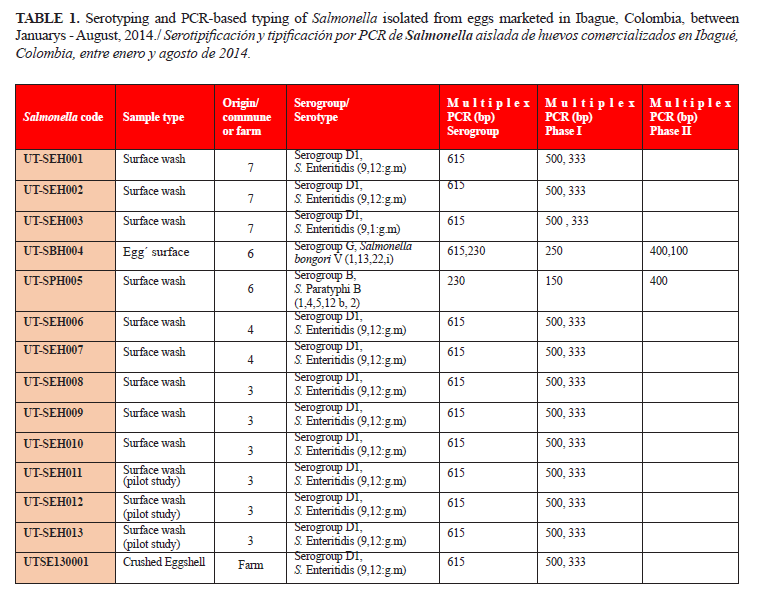
<body><![CDATA[<p align="justify"><font size="2" face="Verdana, Arial, Helvetica, sans-serif"><b>Statistical Analysis</b></font></p>     <p align="justify"><font size="2" face="Verdana, Arial, Helvetica, sans-serif">A descriptive analysis  of the epidemiologic variables evaluated at each store was conducted by using  IBM SPSS Statistics&reg; 20 version software and GraphPad Prism&reg; 5.03 version  software. The independence between the epidemiologic variable and the  positivity to <em>Salmonella</em> spp. was determined by cross tabulation  analysis. The association strength was calculated by the odds ratio. Prevalence  was determined as the proportion of positive samples over the total samples,  expressed as a percentage.</font></p>     <p align="left" style="margin-top:12.0pt;margin-right:0cm;margin-bottom:5.65pt;margin-left:0cm;text-align:left;">&nbsp;</p>     <p align="justify"><font size="3" face="Verdana, Arial, Helvetica, sans-serif"><b>RESULTS</b></font></p>     <p align="justify" style="margin-top:12.0pt;text-indent:0cm;">A total of 341 samples  was cultured for <em>Salmonella</em> isolation, and 10 different isolates were  obtained from egg surface. Thus a 2.93% prevalence of <em>Salmonella</em> in the  surface of eggs marketed at Ibague, Colombia, was estimated for the period  January - August 2014. <em>Salmonella</em> isolates were identified by  conventional serotyping as <em>S. </em>Enteritidis (n=8), <em>S. </em>ParatyphiB  (n=1) and <em>S. bongori </em>(n=1) (<a href="/img/revistas/rsa/v38n3/t0105316.gif">Table 1</a>).</p>     
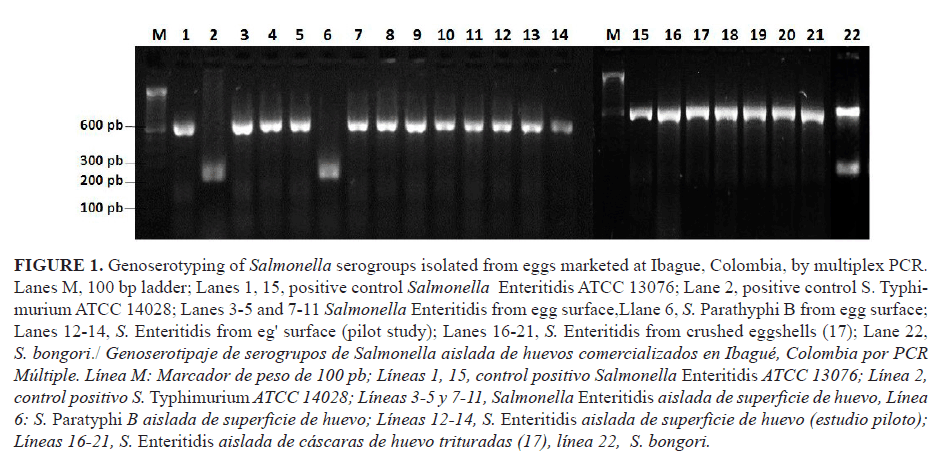
<p align="justify" style="margin-top:12.0pt;text-indent:0cm;">The multiplex PCR  targeting the genes encoding the O-antigen showed two amplification products,  one of 615 bp and the second of 230 bp (<a href="/img/revistas/rsa/v38n3/f0105316.gif">Fig. 1</a>). All <em>Salmonella </em>Enteritidis  (serogroup D1) amplified a single band of 615 bp, whereas <em>S. </em>Paratyphi B  (serogroup B) amplified a band of 230 bp. The species <em>S. bongori </em>amplified  2 bands, one of 615 bp and one of 230 bp. The positive controls <em>S.  Enteritidis</em> ATCC 13076 and <em>S. typhimurium </em>ATCC 14028 (serogroup B)  also amplified a single band of 615 bp and 230 bp, respectively.</p>     
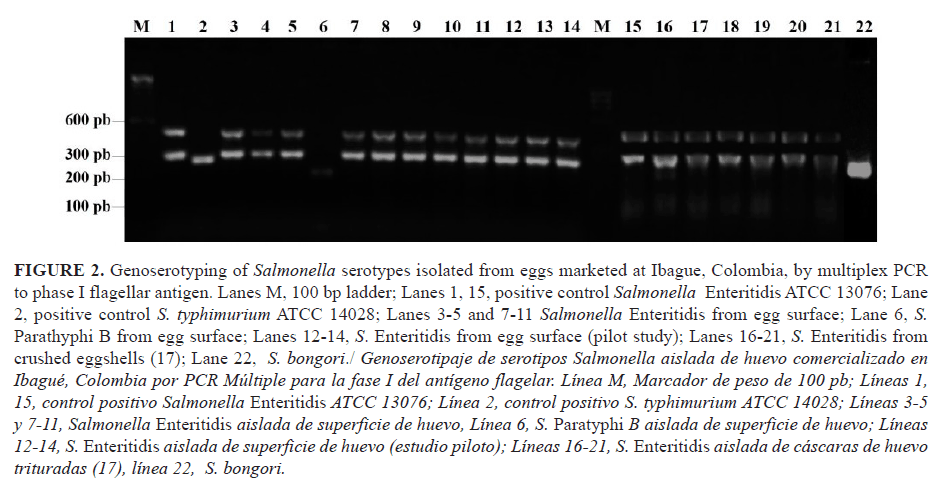
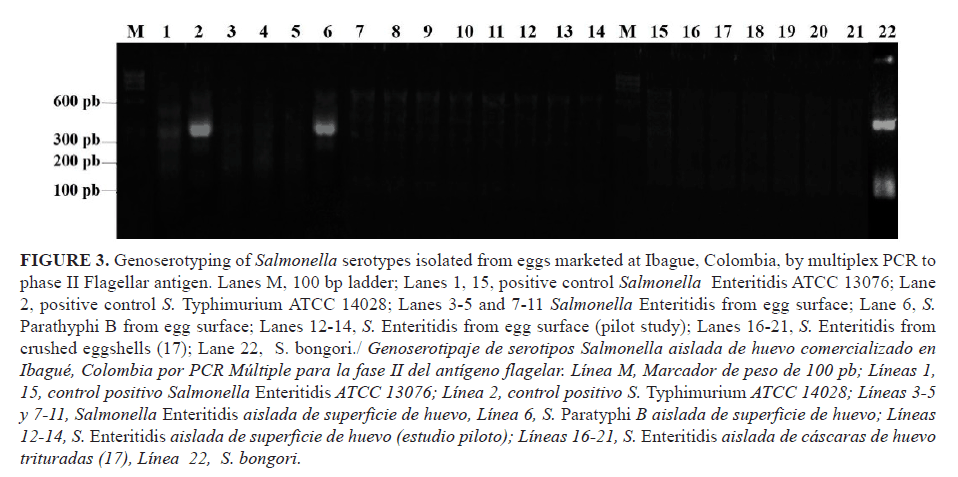
<p align="justify" style="margin-top:12.0pt;text-indent:0cm;">The multiplex PCR for  phase I flagellar antigen H1 showed amplification products of 500 and 333 bp that  correspond to the flagellar antigens H: 9, 12 and    H: b: 1, 2. All <em>Salmonella </em>Enteritidis showed 2&nbsp; bands, one of 500 bp and a second one of 333  bp. <em>S. </em>ParatyphiB showed a band of 150 bp. The positive controls <em>Salmonella </em>Enteritidis ATCC 13076 and <em>Salmonella </em>Typhimurium ATCC  14028 showed the corresponding 500 bp, 333 bp and 250 bp, respectively (<a href="/img/revistas/rsa/v38n3/f0205316.gif">Fig.  2</a>). The third multiplex PCR directed to detect phase II flagellar antigens  showed amplification products of 400 bp corresponding to the H:b:1,2 flagellar  antigens described by Herrera-Le&oacute;n <em>et al.</em> (25) and Echeita <em>et al.</em> (24). All <em>S. Enteritidis</em> showed no clear amplification products, whereas <em>S. Paratyphi</em> B showed a single amplification product of 400 bp. The  positive control <em>S. Enteritidis </em>ATCC 13076 showed no amplification  products, whereas <em>S. Typhimurium</em> ATCC 14028 showed a single band of  about 400 bp (<a href="/img/revistas/rsa/v38n3/f0305316.gif">Fig. 3</a>). The species <em>S. bongori </em>showed two bands, one of  400 bp and a second one of 100 bp.</p>     
<p align="justify" style="margin-top:12.0pt;text-indent:0cm;"><em><span style="font-family:'Verdana','sans-serif'; ">Salmonella</span></em><span style="font-family:'Verdana','sans-serif'; "> spp. was more  frequently isolated (42.85%) from eggs at stores having a frequency of cleaning  and disinfection once a week. A reduced frequency of cleaning at the store was  identified as a potential risk factor for the presence of <em>Salmonella</em> (OR: 19.84, p&lt;0.05) on eggs. The lifestyle of staff may also contribute to  the contamination of eggs by <em>Salmonella.</em> The store staff with long nails  were identified as a risk factor (OR: 5.46, p&lt;0.05) for the presence of <em>Salmonella</em> on marketed eggs. Finally, in the present study, eggs kept at temperatures less  than 25&deg;C were identified as a risk factors for being contaminated with <em>Salmonella</em> (OR: 10.05, p&lt;0.05) than eggs stored at temperatures over than 25&deg;C.</span></p>     <p style="margin-top:12.0pt;margin-right:0cm;margin-bottom:5.65pt;margin-left:0cm;">&nbsp;</p>     <p align="justify"><font size="3" face="Verdana, Arial, Helvetica, sans-serif"><b>DISCUSSION</b></font></p>     ]]></body>
<body><![CDATA[<p align="justify" style="margin-top:12.0pt;text-indent:0cm;">This study established  a prevalence of 2.93% (10/341) <em>Salmonella</em> in the surface of eggs  marketed in Ibague, Colombia, for the period January &ndash; August, 2014. The  prevalent serovars of <em>Salmonella</em> <em>enterica </em>on egg surface were <em>S.</em> Enteritidis and <em>S.</em> Paratyphi B, which were appropriately typed by a  panel of 3 multiplex PCRs that allowed a correct identification of serogroups  and serovars. Although the multiplex-PCRs were not designed to discriminate the  species <em>S. bongori</em> (26), the results obtained in this study indicated  that <em>S. bongori</em> was also present on the surface of eggs and that it  could be differentiated from some subspecies of <em>S.</em> <em>enterica</em> by  the presence of additional PCR products (<a href="/img/revistas/rsa/v38n3/t0105316.gif">Table 1</a>, <a href="/img/revistas/rsa/v38n3/f0105316.gif">Figures 1</a>,<a href="/img/revistas/rsa/v38n3/f0205316.gif">2</a>,<a href="/img/revistas/rsa/v38n3/f0305316.gif">3</a>). </p>     
<p align="justify" style="margin-top:12.0pt;text-indent:0cm;"><em><span style="font-family:'Verdana','sans-serif'; ">Salmonella</span></em><span style="font-family:'Verdana','sans-serif'; "> prevalence in eggs and  laying-hen farms may vary considerable between different countries and  geographical regions (27). In Europe, <em>Salmonella</em> prevalence in  laying-hen farms ranged from 0% to 79.5% in 2007, with an average of 30.8%. In  UK, a prevalence of 18% <em>Salmonella</em> in laying hens was reported in 2010  (28), and the frequency of <em>Salmonella</em> in eggs at the market place in  Europe may vary between 7 - 24% (29). In Argelia, a prevalence range of 7.14% -  41.17% <em>Salmonella</em> in laying hens was reported in 2012 (30). In Colombia,  a prevalence of 45.71% <em>Salmonella</em> in laying hen farms was reported in a  study that included Cundinamarca, Santander, Bolivar and San Andres regions in  2013 (31), and recently our group reported a prevalence of 33.33%<em> Salmonella</em> in egg-laying-farms in the Tolima region (17). In this study, <em>Salmonella</em> prevalence in egg surface was slightly lower than that determined in crushed  eggshells (5.16%) from eggs (8/155) in laying-hen farms in the Tolima region  (17). The difference might be due to the methodology used to isolate <em>Salmonella</em> from eggs. The authors used eggshells and therefore incubated them into peptone  water, whereas, in this study, we wanted to explore the possibility to isolate  the bacteria from the egg surface without the need of breaking the eggs and by  using a surface rinse obtained by 5 minute-incubation and rubbing the egg  surface in peptone water. The prevalence of <em>Salmonella</em> estimated in this  study is within the range (0 &ndash; 22.6%) reported in eggs for human consumption in  the European Union and the United Kingdom (32); and it was very similar to the  prevalence (3%) of <em>Salmonella enterica</em> reported in eggs from laying hen  farms in other regions of Colombia (7). The use of an egg surface rinse to  establish the <em>Salmonella</em> load in the egg surface may constitute a  practical procedure to screen large volumes of eggs from laying-hen farms  during the process of egg disinfection. </span></p>     <p align="justify" style="margin-top:12.0pt;text-indent:0cm;">This study identified<em> S.</em> Enteritidis (80%) and <em>S.</em> Paratyphi B (10%) as the main serovars  of <em>Salmonella</em> enterica present on the surface of eggs marketed in stores  and supermarkets of Ibague city (<a href="/img/revistas/rsa/v38n3/t0105316.gif">Table 1</a>). These results are in partial  agreement with the results of Rodr&iacute;guez <em>et al.</em> 015) (17), who found <em>S.</em> Enteritidis (42.85%) and <em>S.</em> Shannon (57.15%) in laying hen farms in this  region. The authors isolated most frequently <em>Salmonella</em> from crushed  eggshells (57.15%) than from feed (28.57%) or environmental (14.29%) samples  (17).&nbsp; <em>S. </em>Enteritidis was the most  prevalent serovar found on the egg surface (80%), and this is the predominant  serovar associated to <em>Salmonella </em>outbreaks in several countries. In  2012, <em>S</em>. Enteritidis accounted for 179 outbreaks and 2,177 human cases  of salmonellosis in the European Union, most of which were attributed to eggs  and egg products (168 outbreaks, 22%) (33). Given the lack of epidemiologic  data on <em>Salmonella</em> in the poultry industry of Tolima, the finding of <em>S.</em> Enteritidis in the surface of eggs commercialized in Ibague city may raise  concern on the potential transmission to egg consumers and may indicate the  need to assess its relationship with clinical cases of salmonellosis in this  region.</p>     
<p align="justify" style="margin-top:12.0pt;text-indent:0cm;">This study implemented  a series of 3 multiplex PCRs designed for typing commonly isolated <em>Salmonella</em> spp. from clinical samples that targeted the serogroups D (615 bp), C1 (483  bp), E (345 bp), B (230 bp) and C2 (154 bp) (24, 25, 26). This PCR-based method  identified O:D1 and O:B as the serogroups of <em>Salmonella</em> present in the  surface of eggs marketed in Ibague Tolima; and these results correlated with  the results obtained by the conventional serotyping (<a href="/img/revistas/rsa/v38n3/t0105316.gif">Table 1</a>). The multiplex  PCR also identified correctly a number of S. Enteritidis previously isolated  from crushed eggshells (17). Thus, the use of multiplex PCR for typing  Salmonella spp. present in eggs might be advantageous by the limited number of <em>Salmonella</em> spp. subspecies that survived in this product and might be a useful tool to  speed up the identification of Salmonella spp. in poultry products.</p>     
<p align="justify" style="margin-top:12.0pt;text-indent:0cm;">The second multiplex  PCR for phase 1 flagellar antigens allowed the identification of serovar <em>S. </em>Enteritidis  with two amplification products, one of 500 bp that corresponded to the  G-complex and a second band of 333 bp specific for this serovar (<a href="/img/revistas/rsa/v38n3/f0205316.gif">Fig. 2</a>). The  serovar <em>S.</em> Paratyphi B showed the specific 150 bp band described by  Herrera-Leon <em>et al.</em> (25). The isolate corresponding to the species <em>S.  bongori </em>showed a single band of about 250 bp, similar to the single band  amplified from the positive control <em>S. </em>Typhimurium ATCC 14028.</p>     
<p align="justify" style="margin-top:12.0pt;text-indent:0cm;">The third multiplex PCR  for phase 2 flagellar antigens showed no bands in all <em>S. </em>Enteritidis,  according to the findings of Echeita <em>et al. </em>(24). This multiplex also  showed a correct identification of <em>S.</em> Paratyphi B with an amplification  product of 400 bp and <em>S.</em> Enteritidis ATCC 13076 with no amplification  products as described by others (24), whereas <em>S. bongori</em> showed 2 bands  (400 bp and 100 bp) that could differentiate this species from <em>S. enterica.</em> However, the multiplex PCRs were developed for the identification of serogroups  and serovars mostly present in the subspecies I, and they did not take into  account subspecies of <em>S.</em> <em>bongori</em>. The results of PCR-typing  indicated that this methodology could identify <em>S.</em> Enteritidis, <em>S.</em> Typhimurium and <em>S. </em>Paratyphi B isolated from eggs commercialized at  stores in Ibague city, and the banding pattern of those serovars could  differentiate them from the members of the species <em>S. bongori</em>, another <em>Salmonella</em> that could be recovered from the egg surface but lacking association to  clinical diseases in animals and human, they are usually present in the  environment (reptiles, amphibians and fish) (34).</p>     <p align="justify" style="margin-top:12.0pt;text-indent:0cm;">The epidemiological survey  in each store and supermarket revealed that a low frequency (once per week) of  cleaning and disinfection of the stores (OR: 19.84, p &lt;0.05), the staff with  long nails (OR: 5.468, p &lt;0.05) and the storage of eggs at temperatures less  than 25&deg;C (OR 10.05, p &lt;0.05) may be potential risk factors for the presence  of <em>Salmonella</em> spp. in eggs marketed in the city of Ibague, Tolima (35).  The finding also reflected the importance of strengthening the cleaning and  disinfection procedures along the chain of egg production, as it has been  observed in the egg packing plants in Europe, where significant differences  were found between the prevalence of <em>Salmonella</em> in plants with and  without disinfection plans (36). It has also been observed that a high  frequency (21.6%) of meat plant operators with long nails was positive to <em>Salmonella</em> in Nari&ntilde;o, Colombia (37).&nbsp; Finally, at  low temperatures, <em>Salmonella</em> may slow down its metabolism and could  survive longer on the outer shell surface (38). Other possibility that could explain  this finding is that <em>Salmonella</em> may be susceptible to desiccation and  dryness of the egg surface at temperatures higher than 25&deg;C (39).&nbsp; </p>     <p align="justify" style="margin-top:12.0pt;text-indent:0cm;">Concluding, this study  estimated for the first time a prevalence of 2.93% <em>Salmonella</em> in the  surface of eggs marketed at shops and supermarkets of Ibague city. <em>S.</em> Enteritidis and <em>S.</em> Paratyphi B were the main serotypes of <em>Salmonella</em> circulating in eggs, and the use of 3 independent multiplex PCRs for the typing  of <em>Salmonella</em> showed a good correlation with serotyping and then  constituted a useful tool to speed up the identification of this pathogen at  the species level upon isolation.&nbsp; The  results may support the need to conduct studies with a larger coverage. In  addition, they reveal the need to increase awareness of poultry producers,  vendors and health authorities on the health risk imposed by <em>Salmonella</em>,  and the need to implement appropriate diagnosis and epidemiological  surveillance tools to detect and identify <em>Salmonella </em>species potentially  contaminating food products in a short time.</p>     <p align="left" style="margin-top:12.0pt;margin-right:0cm;margin-bottom:5.65pt;margin-left:0cm;text-align:left;">&nbsp;</p>     <p align="justify"><font size="3" face="Verdana, Arial, Helvetica, sans-serif"><b>ACKNOWLEDGEMENTS</b></font></p>     ]]></body>
<body><![CDATA[<p align="justify" style="margin-top:12.0pt;text-indent:0cm;">This research was  funded by grants from the Central Research Office of the University of Tolima  to Noel Verjan Garc&iacute;a (Project Nos. 760213 and 460113). The authors thank the  owners of shops and suprmarkets that participated in the study, to Luz  Clemencia Fandi&ntilde;o for the technical assistance in <em>Salmonella</em> isolation,  Luis Hernando Ortiz for preparing all necessary materials and Gissella Holguin  for the technical assistance on PCR.</p>     <p style="margin-top:12.0pt;margin-right:0cm;margin-bottom:5.65pt;margin-left:0cm;">&nbsp;</p>     <p align="justify"><font size="3" face="Verdana, Arial, Helvetica, sans-serif"><b>REFERENCES</b></font></p> </font>     <!-- ref --><p align="justify" style="margin-top:12.0pt;margin-right:0cm;margin-bottom:5.65pt;margin-left:0cm;text-align:justify;text-indent:0cm;"><font size="2" face="Verdana, Arial, Helvetica, sans-serif">1.  Grimont P, Weill F. Antigenic formulae of the  <em>Salmonella</em> serovars, 9 ed. World Health Organization, Institut Pasteur. Collaborating Centre for Reference and Research  on <em>Salmonella</em>; 2007.    </font></p>     <!-- ref --><p align="justify" style="margin-top:12.0pt;margin-right:0cm;margin-bottom:5.65pt;margin-left:0cm;text-align:justify;text-indent:0cm;"><font size="2" face="Verdana, Arial, Helvetica, sans-serif">2.  OIE World Organisation for Animal Health (OIE). Salmonellosis. In: (OIE)  Terrestrial Manual Chapter; 2010.    </font></p>     <!-- ref --><p align="justify" style="margin-top:12.0pt;margin-right:0cm;margin-bottom:5.65pt;margin-left:0cm;text-align:justify;text-indent:0cm;"><font size="2" face="Verdana, Arial, Helvetica, sans-serif">3.  Brankatschk K, Blom J, Goesmann A, Smits T,  Duffy B. Comparative genomic analysis of    Salmonella enterica subsp. enterica serovar  Weltevreden foodborne strains with other serovars. Int J Food Microbiol.  2012;155(3):247-256.    </font></p>     <!-- ref --><p align="justify" style="margin-top:12.0pt;margin-right:0cm;margin-bottom:5.65pt;margin-left:0cm;text-align:justify;text-indent:0cm;"><font size="2" face="Verdana, Arial, Helvetica, sans-serif">4.  Barrow PA, Methner U. <em>Salmonella </em>in Domestic Animals. 2nd ed. CAB  International, UK / USA; 2013.    </font></p>     <p align="justify" style="margin-top:12.0pt;margin-right:0cm;margin-bottom:5.65pt;margin-left:0cm;text-align:justify;text-indent:0cm;"><font size="2" face="Verdana, Arial, Helvetica, sans-serif">5.  Latimer HK, Jaykus LA, Morales RA, Cowen P, Crawford&ndash;Brown D. Sensitivity  analysis of <em>Salmonella</em> Enteritidis levels in contaminated eggshells using a biphasic  growth model. Int J Food Microbiol. 2002;75(1-2):71-87. </font></p>     <!-- ref --><p align="justify" style="margin-top:12.0pt;margin-right:0cm;margin-bottom:5.65pt;margin-left:0cm;text-align:justify;text-indent:0cm;"><font size="2" face="Verdana, Arial, Helvetica, sans-serif">6.  Greig JD, Ravel A. Analysis of foodborne outbreak data reported internationally  for source attribution. Int J Food Microbiol. 2009;130:77-87.    </font></p>     <!-- ref --><p align="justify" style="margin-top:12.0pt;margin-right:0cm;margin-bottom:5.65pt;margin-left:0cm;text-align:justify;text-indent:0cm;"><font size="2" face="Verdana, Arial, Helvetica, sans-serif">7.  Rinc&oacute;n DP, Vargas JC, Ram&iacute;rez RY. B&uacute;squeda de <em>Salmonella</em> sp, en huevos  para consumo humano comercializados en la ciudad de Tunja: estudio    preliminar. Rev Proy Univ. 2011;36:34-48.    </font></p>     <!-- ref --><p align="justify" style="margin-top:12.0pt;margin-right:0cm;margin-bottom:5.65pt;margin-left:0cm;text-align:justify;text-indent:0cm;"><font size="2" face="Verdana, Arial, Helvetica, sans-serif">8.  Gu W, Vieira AR, Hoekstra RM, Griffin P, Cole D. Use of random forest to  estimate population    attributable fractions from a case-control study of <em>Salmonella</em> enterica  serotype Enteritidis infections. Epidemiol Infect. 2015;143(13):2786-94.    </font></p>     <!-- ref --><p align="justify" style="margin-top:12.0pt;margin-right:0cm;margin-bottom:5.65pt;margin-left:0cm;text-align:justify;text-indent:0cm;"><font size="2" face="Verdana, Arial, Helvetica, sans-serif">9.  Gantois I, Eeckhaut V, Pasmans F, Haesebrouck F, Ducatelle R, Van Immerseel FA.  A comparative study on the pathogenesis of egg contamination by different  serotypes of Salmonella. Avian Pathol. 2008;37(4):399-406.    </font></p>     ]]></body>
<body><![CDATA[<p align="justify" style="margin-top:12.0pt;margin-right:0cm;margin-bottom:5.65pt;margin-left:0cm;text-align:justify;text-indent:0cm;"><font size="2" face="Verdana, Arial, Helvetica, sans-serif">10. Kirk  MD, Little CL, Lem M, Fyfe M,    Genobile D, Tan A, <em>et al</em>. An outbreak due to    peanuts in their shell caused by <em>Salmonella</em> serotypes    Stanley and Newport&ndash;sharing molecular    information to solve international outbreaks.  Epidemiol Infect. 2004;132:571-577.</font></p>     <!-- ref --><p align="justify" style="margin-top:12.0pt;margin-right:0cm;margin-bottom:5.65pt;margin-left:0cm;text-align:justify;text-indent:0cm;"><font size="2" face="Verdana, Arial, Helvetica, sans-serif">11. Velge  P, Cloeckaert A, Barrow P. Emergence of <em>Salmonella</em> epidemics: The  problems related to <em>Salmonella</em> enterica serotype Enteritidis in multiple  antibiotic resistance in other major serotypes. Vet Res. 2005;36:267-288.    </font></p>     <!-- ref --><p align="justify" style="margin-top:12.0pt;margin-right:0cm;margin-bottom:5.65pt;margin-left:0cm;text-align:justify;text-indent:0cm;"><font size="2" face="Verdana, Arial, Helvetica, sans-serif">12. Tauxe  RV, Doyle MP, Kuchenm&uuml;ller T, Schlundt J, Stein CE. Evolving public health  approaches to the global challenge of foodborne infections. Int J Food  Microbiol. 2010;139(S1):S16-S-28.    </font></p>     <!-- ref --><p align="justify" style="margin-top:12.0pt;margin-right:0cm;margin-bottom:5.65pt;margin-left:0cm;text-align:justify;text-indent:0cm;"><font size="2" face="Verdana, Arial, Helvetica, sans-serif">13. Gaffga  NH, Behravesh CB, Ettestad PJ, Smelser CB, Rhorer AR, Cronquist AB. Outbreak of    salmonellosis linked to live poultry from a mail-order hatchery. The N Engl J Med. 2012;366(22):2065-2073.    </font></p>     <!-- ref --><p align="justify" style="margin-top:12.0pt;margin-right:0cm;margin-bottom:5.65pt;margin-left:0cm;text-align:justify;text-indent:0cm;"><font size="2" face="Verdana, Arial, Helvetica, sans-serif">14. Scallan  E, Hoekstra RM, Angulo FJ, Tauxe RV, Widdowson MA, Roy S.L, et al. Foodborne  illness acquired in the United States - major pathogens. Emerg Infect Dis.  2011;17 (1):7-15.    </font></p>     <p align="justify" style="margin-top:12.0pt;margin-right:0cm;margin-bottom:5.65pt;margin-left:0cm;text-align:justify;text-indent:0cm;"><font size="2" face="Verdana, Arial, Helvetica, sans-serif">15. Ministerio  de la Proteccion Social; Unidad de Evaluacion de Riesgos para la Inocuidad de  los Alimentos (UERIA). Instituto Nacional de    Salud (INS). Perfil de riesgo <em>Salmonella</em> spp. (no  tifoidea) en pollo entero y en piezas. Ministerio de la Proteccion Social &ndash;  UERIA - INS. Republica de Colombia; 2011. </font></p>     ]]></body>
<body><![CDATA[<!-- ref --><p align="justify" style="margin-top:12.0pt;margin-right:0cm;margin-bottom:5.65pt;margin-left:0cm;text-align:justify;text-indent:0cm;"><font size="2" face="Verdana, Arial, Helvetica, sans-serif">16. Instituto  Nacional De Salud (INS). Caracter&iacute;sticas de los aislamientos de <em>Salmonella</em> spp. Colombia. Resultados de la vigilancia 2000-2013; 2013.     </font></p>     <!-- ref --><p align="justify" style="margin-top:12.0pt;margin-right:0cm;margin-bottom:5.65pt;margin-left:0cm;text-align:justify;text-indent:0cm;"><font size="2" face="Verdana, Arial, Helvetica, sans-serif">17. Rodr&iacute;guez  R, Fandi&ntilde;o C, Donado P, Guzman L, Verjan N. Characterization of <em>Salmonella</em> from    comercial egg-laying hen farms in central regi&oacute;n of Colombia. Avian Dis.  2015;59:57-63.    </font></p>     <!-- ref --><p align="justify" style="margin-top:12.0pt;margin-right:0cm;margin-bottom:5.65pt;margin-left:0cm;text-align:justify;text-indent:0cm;"><font size="2" face="Verdana, Arial, Helvetica, sans-serif">18. Rodr&iacute;guez  J, Rond&oacute;n I, Verjan N. Serotypes of <em>Salmonella </em>in broiler carcasses marketed at Ibagu&eacute;, Colombia. Rev Bras  Ci&ecirc;n Av&iacute;cola. 2015;17(4):545-552.    </font></p>     <!-- ref --><p align="justify" style="margin-top:12.0pt;margin-right:0cm;margin-bottom:5.65pt;margin-left:0cm;text-align:justify;text-indent:0cm;"><font size="2" face="Verdana, Arial, Helvetica, sans-serif">19. Thrusfield  M. Veterinary Epidemiology. 3 ed. Blackwell Publishing; 2007.     </font></p>     <!-- ref --><p align="justify" style="margin-top:12.0pt;margin-right:0cm;margin-bottom:5.65pt;margin-left:0cm;text-align:justify;text-indent:0cm;"><font size="2" face="Verdana, Arial, Helvetica, sans-serif">20. Brenner  FW, Villar RG, Angulo FJ, Tauxe R, Swaminathan B. <em>Salmonella</em> Nomenclature. J Clin Microbiol.  2000;38(7):2465-2467.    </font></p>     ]]></body>
<body><![CDATA[<!-- ref --><p align="justify" style="margin-top:12.0pt;margin-right:0cm;margin-bottom:5.65pt;margin-left:0cm;text-align:justify;text-indent:0cm;"><font size="2" face="Verdana, Arial, Helvetica, sans-serif">21. Tindall  BJ, Grimont PAD, Garrity GM, Euz&eacute;by JP. Nomenclature and taxonomy of the genus <em>Salmonella</em>. Int J Syst Evol Microbiol. 2005;55:521-524.    </font></p>     <!-- ref --><p align="justify" style="margin-top:12.0pt;margin-right:0cm;margin-bottom:5.65pt;margin-left:0cm;text-align:justify;text-indent:0cm;"><font size="2" face="Verdana, Arial, Helvetica, sans-serif">22. Judicial  Commission of the International    Committee on Systematics of Prokaryotes. The type species of the genus <em>Salmonella</em> <em>Lignieres</em> 1900 is <em>Salmonella</em> enterica (ex Kauffmann and    Edwards 1952) Le Minor and Popoff 1987, with the type strain LT2T, and  conservation of the epithet    enterica in <em>Salmonella</em> enterica over all earlier  epithets t. Int J Syst Evol Microbiol. 2005;55:519-520.    </font></p>     <!-- ref --><p align="justify" style="margin-top:12.0pt;margin-right:0cm;margin-bottom:5.65pt;margin-left:0cm;text-align:justify;text-indent:0cm;"><font size="2" face="Verdana, Arial, Helvetica, sans-serif">23. Sambrook  J, Russell DW. Molecular Cloning Book. A laboratory manual. Third edition. New  York, Cold spring laboratory press; 2001.    </font></p>     <!-- ref --><p align="justify" style="margin-top:12.0pt;margin-right:0cm;margin-bottom:5.65pt;margin-left:0cm;text-align:justify;text-indent:0cm;"><font size="2" face="Verdana, Arial, Helvetica, sans-serif">24. Echeita  MA, Herrera S, Garaizar J, Usera MA. Multiplex PCR-based detection and  identification of the most common <em>Salmonella</em> second-phase    flagellar antigens. Res Microbiol. 2002;153:107-113.    </font></p>     <!-- ref --><p align="justify" style="margin-top:12.0pt;margin-right:0cm;margin-bottom:5.65pt;margin-left:0cm;text-align:justify;text-indent:0cm;"><font size="2" face="Verdana, Arial, Helvetica, sans-serif">25. Herrera-Le&oacute;n  S, Mc Quiston JR, Usera MA, Fields PI, Garaizar J, Echeita MA. Multiplex PCR  for Distinguishing the Most Common Phase-1    Flagellar Antigens of <em>Salmonella</em> spp. J Clin Microbiol.  2004;42(6):2581-2586.    </font></p>     ]]></body>
<body><![CDATA[<!-- ref --><p align="justify" style="margin-top:12.0pt;margin-right:0cm;margin-bottom:5.65pt;margin-left:0cm;text-align:justify;text-indent:0cm;"><font size="2" face="Verdana, Arial, Helvetica, sans-serif">26. Herrera-Le&oacute;n  S, Ramiro R, Arroyo M, D&igrave;ez R, Usera MA, Echeita MA. Blind comparison of    traditional serotyping with three multiplex PCRs for the identification of <em>Salmonella</em> serotypes. Res Microbiol. 2007;158:122-127.    </font></p>     <!-- ref --><p align="justify" style="margin-top:12.0pt;margin-right:0cm;margin-bottom:5.65pt;margin-left:0cm;text-align:justify;text-indent:0cm;"><font size="2" face="Verdana, Arial, Helvetica, sans-serif">27. Carrasco  E, Morales A, Garc&iacute;a R. Cross-contamination and recontamination by <em>Salmonella</em> in foods: A review. Food  Res Int. 2012;45:545-556.    </font></p>     <!-- ref --><p align="justify" style="margin-top:12.0pt;margin-right:0cm;margin-bottom:5.65pt;margin-left:0cm;text-align:justify;text-indent:0cm;"><font size="2" face="Verdana, Arial, Helvetica, sans-serif">28. Arnold  ME, Carrique-Mas JJ, McLaren I, Davies RH. A comparison of pooled and  individual bird sampling for detection of <em>Salmonella</em> in commercial egg  laying flocks. Prev Med. 2011;99:176-184.    </font></p>     <!-- ref --><p align="justify" style="margin-top:12.0pt;margin-right:0cm;margin-bottom:5.65pt;margin-left:0cm;text-align:justify;text-indent:0cm;"><font size="2" face="Verdana, Arial, Helvetica, sans-serif">29. Porrero  MC, Garc&iacute;a M, Cubillo I, Rivero E, Herrera L, Marino E, et al. Salmonelosis y  huevos. Profesi&oacute;n Veterinaria 2006;28-32.    </font></p>     <!-- ref --><p align="justify" style="margin-top:12.0pt;margin-right:0cm;margin-bottom:5.65pt;margin-left:0cm;text-align:justify;text-indent:0cm;"><font size="2" face="Verdana, Arial, Helvetica, sans-serif">30. Bouzidi  N, Aoun L, Zeghdoudi M, Bensouilah M, Elgroud R,&nbsp; Oucief B, <em>et al. Salmonella</em> contamination of laying-hen flocks in two regions of Algeria. Food Res Int.  2012;45:897-904.    </font></p>     ]]></body>
<body><![CDATA[<!-- ref --><p align="justify" style="margin-top:12.0pt;margin-right:0cm;margin-bottom:5.65pt;margin-left:0cm;text-align:justify;text-indent:0cm;"><font size="2" face="Verdana, Arial, Helvetica, sans-serif">31. Pulido  M, S&aacute;nchez R, Guard J, Do Nascimento V. Presence of <em>Salmonella</em> Enteritidis and <em>Salmonella</em> Gallinarum in Commercial Laying Hens  Diagnosed with Fowl Typhoid Disease in Colombia. Avian Dis. 2014;58:165-170.    </font></p>     <!-- ref --><p align="justify" style="margin-top:12.0pt;margin-right:0cm;margin-bottom:5.65pt;margin-left:0cm;text-align:justify;text-indent:0cm;"><font size="2" face="Verdana, Arial, Helvetica, sans-serif">32. European  Food Safety Authority (EFSA).   Scientific opinion on a quantitative estimation of the public health impact of  setting a new target for the    reduction of <em>Salmonella</em> in laying hens. EFSA  Journal. 2010;8(4):1546.    </font></p>     <!-- ref --><p align="justify" style="margin-top:12.0pt;margin-right:0cm;margin-bottom:5.65pt;margin-left:0cm;text-align:justify;text-indent:0cm;"><font size="2" face="Verdana, Arial, Helvetica, sans-serif">33. European  Food Safety Authority (EFSA).    Multi-country outbreak of <em>Salmonella</em> Enteritidis infections associated  with consumption of eggs from Germany. European Food Safety Authority; EFSA  supporting publication; 2014. Avaible in: <a href="http://www.efsa.europa.eu/fr/supporting/doc/646e.pdf" target="_blank">http://www.efsa.europa.eu/fr/supporting/doc/646e.pdf</a>.    </font></p>     <!-- ref --><p align="justify" style="margin-top:12.0pt;margin-right:0cm;margin-bottom:5.65pt;margin-left:0cm;text-align:justify;text-indent:0cm;"><font size="2" face="Verdana, Arial, Helvetica, sans-serif">34. Ellermeier  CD, Slauch J.M. Genus <em>Salmonella</em>. In: Dworkin, M.D. (ed.). The  Prokaryotes: A Handbook on the Biology of Bacteria. 2006;17:111-125. New York.    </font></p>     <!-- ref --><p align="justify" style="margin-top:12.0pt;margin-right:0cm;margin-bottom:5.65pt;margin-left:0cm;text-align:justify;text-indent:0cm;"><font size="2" face="Verdana, Arial, Helvetica, sans-serif">35. Mogoll&oacute;n  DC, Rodriguez V, Verjan N. Prevalencia y factores de riesgo para la  contaminaci&oacute;n por <em>Salmonella</em> spp., en huevos comercializados en Ibagu&eacute;,  Colombia. Revista Colombiana de Ciencia Animal. 2015;8(1):20-28.    </font></p>     ]]></body>
<body><![CDATA[<!-- ref --><p align="justify" style="margin-top:12.0pt;margin-right:0cm;margin-bottom:5.65pt;margin-left:0cm;text-align:justify;text-indent:0cm;"><font size="2" face="Verdana, Arial, Helvetica, sans-serif">36. Davies  RH, Breslin M. Investigation of <em>Salmonella </em>contamination and  disinfection in farm egg-packing plants. J. Appl. Microbiol. 2003;94:191-196.    </font></p>     <!-- ref --><p align="justify" style="margin-top:12.0pt;margin-right:0cm;margin-bottom:5.65pt;margin-left:0cm;text-align:justify;text-indent:0cm;"><font size="2" face="Verdana, Arial, Helvetica, sans-serif">37. Moreno  A, Moncayo S, Caranguay M, Paz M,    Ibarra M, Trujillo-Montalvo E, <em>et al</em>. Prevalencia de <em>Salmonella</em> ssp. (no tifoideas) en el Departamento de Nari&ntilde;o, Colombia 2011. Universitas  M&eacute;dica. 2014;55(4):363-373.    </font></p>     <!-- ref --><p align="justify" style="margin-top:12.0pt;margin-right:0cm;margin-bottom:5.65pt;margin-left:0cm;text-indent:0cm;"><font size="2" face="Verdana, Arial, Helvetica, sans-serif">38. Gantois  I, Ducatelle R, Pasmans F, Haesebrouck F, Gast R, Humphrey TJ, et al.  Mechanisms of egg contamination by <em>Salmonella</em> Enteritidis.    Federation of European Microbiological Societies. 2009;33:718-738.    </font></p>     <!-- ref --><p align="justify" style="margin-top:12.0pt;margin-right:0cm;margin-bottom:5.65pt;margin-left:0cm;text-indent:0cm;"><font size="2" face="Verdana, Arial, Helvetica, sans-serif"><span style="font-family:'Verdana','sans-serif'; font-size:10.0pt; ">39. Lublin A, Sela S. The  impact of temperature    during the storage of table Eggs on the viability of<em>Salmonella</em> <em>enterica</em> serovars Enteritidis and    Virchow in the eggs. Poultry Sci. 2008;87:2208-2214</span>.    </font>     <p align="justify">&nbsp;</p>     <p align="justify">&nbsp;</p>     ]]></body>
<body><![CDATA[<p align="justify"><font size="2" face="Verdana, Arial, Helvetica, sans-serif"><span style="font-family:'Verdana','sans-serif'; font-size:10.0pt">Recibido: </span>6/09/2016<span style="font-family:'Verdana','sans-serif'; font-size:10.0pt">    <br>   Aceptado:</span></font> <font size="2" face="Verdana, Arial, Helvetica, sans-serif">1/11/2016</font></p>     <p align="justify">&nbsp;</p>     <p align="justify">&nbsp;</p>     <p align="justify"><font size="2" face="Verdana, Arial, Helvetica, sans-serif"><i>Noel Verjan García,</i> Research Group in Poultry Science, Faculty of Veterinary Medicine, University of Tolima.    Email: <a href="mailto:nverjang@ut.edu.co">nverjang@ut.edu.co</a></font></p>      ]]></body><back>
<ref-list>
<ref id="B1">
<label>1</label><nlm-citation citation-type="book">
<person-group person-group-type="author">
<name>
<surname><![CDATA[Grimont]]></surname>
<given-names><![CDATA[P]]></given-names>
</name>
<name>
<surname><![CDATA[Weill]]></surname>
<given-names><![CDATA[F]]></given-names>
</name>
</person-group>
<source><![CDATA[Antigenic formulae of the Salmonella serovars]]></source>
<year>2007</year>
<edition>9</edition>
<publisher-name><![CDATA[World Health OrganizationInstitut PasteurCollaborating Centre for Reference and Research on Salmonella]]></publisher-name>
</nlm-citation>
</ref>
<ref id="B2">
<label>2</label><nlm-citation citation-type="">
<collab>OIE World Organisation for Animal Health (OIE)</collab>
<article-title xml:lang="en"><![CDATA[Salmonellosis]]></article-title>
<source><![CDATA[Terrestrial Manual Chapter]]></source>
<year>2010</year>
</nlm-citation>
</ref>
<ref id="B3">
<label>3</label><nlm-citation citation-type="journal">
<person-group person-group-type="author">
<name>
<surname><![CDATA[Brankatschk]]></surname>
<given-names><![CDATA[K]]></given-names>
</name>
<name>
<surname><![CDATA[Blom]]></surname>
<given-names><![CDATA[J]]></given-names>
</name>
<name>
<surname><![CDATA[Goesmann]]></surname>
<given-names><![CDATA[A]]></given-names>
</name>
<name>
<surname><![CDATA[Smits]]></surname>
<given-names><![CDATA[T]]></given-names>
</name>
<name>
<surname><![CDATA[Duffy]]></surname>
<given-names><![CDATA[B]]></given-names>
</name>
</person-group>
<article-title xml:lang="en"><![CDATA[Comparative genomic analysis of Salmonella enterica subsp. enterica serovar Weltevreden foodborne strains with other serovars]]></article-title>
<source><![CDATA[Int J Food Microbiol]]></source>
<year>2012</year>
<volume>155</volume>
<numero>3</numero>
<issue>3</issue>
<page-range>247-256</page-range></nlm-citation>
</ref>
<ref id="B4">
<label>4</label><nlm-citation citation-type="book">
<person-group person-group-type="author">
<name>
<surname><![CDATA[Barrow]]></surname>
<given-names><![CDATA[PA]]></given-names>
</name>
<name>
<surname><![CDATA[Methner]]></surname>
<given-names><![CDATA[U]]></given-names>
</name>
</person-group>
<source><![CDATA[Salmonella in Domestic Animals]]></source>
<year>2013</year>
<edition>2</edition>
<publisher-name><![CDATA[CAB International]]></publisher-name>
</nlm-citation>
</ref>
<ref id="B5">
<label>5</label><nlm-citation citation-type="journal">
<person-group person-group-type="author">
<name>
<surname><![CDATA[Latimer]]></surname>
<given-names><![CDATA[HK]]></given-names>
</name>
<name>
<surname><![CDATA[Jaykus]]></surname>
<given-names><![CDATA[LA]]></given-names>
</name>
<name>
<surname><![CDATA[Morales]]></surname>
<given-names><![CDATA[RA]]></given-names>
</name>
<name>
<surname><![CDATA[Cowen]]></surname>
<given-names><![CDATA[P]]></given-names>
</name>
<name>
<surname><![CDATA[Crawford-Brown]]></surname>
<given-names><![CDATA[D]]></given-names>
</name>
</person-group>
<article-title xml:lang="en"><![CDATA[Sensitivity analysis of Salmonella Enteritidis levels in contaminated eggshells using a biphasic growth model]]></article-title>
<source><![CDATA[Int J Food Microbiol]]></source>
<year>2002</year>
<volume>75</volume>
<numero>1-2</numero>
<issue>1-2</issue>
<page-range>71-87</page-range></nlm-citation>
</ref>
<ref id="B6">
<label>6</label><nlm-citation citation-type="journal">
<person-group person-group-type="author">
<name>
<surname><![CDATA[Greig]]></surname>
<given-names><![CDATA[JD]]></given-names>
</name>
<name>
<surname><![CDATA[Ravel]]></surname>
<given-names><![CDATA[A]]></given-names>
</name>
</person-group>
<article-title xml:lang="en"><![CDATA[Analysis of foodborne outbreak data reported internationally for source attribution]]></article-title>
<source><![CDATA[Int J Food Microbiol]]></source>
<year>2009</year>
<volume>130</volume>
<page-range>77-87</page-range></nlm-citation>
</ref>
<ref id="B7">
<label>7</label><nlm-citation citation-type="journal">
<person-group person-group-type="author">
<name>
<surname><![CDATA[Rincón]]></surname>
<given-names><![CDATA[DP]]></given-names>
</name>
<name>
<surname><![CDATA[Vargas]]></surname>
<given-names><![CDATA[JC]]></given-names>
</name>
<name>
<surname><![CDATA[Ramírez]]></surname>
<given-names><![CDATA[RY]]></given-names>
</name>
</person-group>
<article-title xml:lang="es"><![CDATA[Búsqueda de Salmonella sp, en huevos para consumo humano comercializados en la ciudad de Tunja: estudio preliminar]]></article-title>
<source><![CDATA[Rev Proy Univ]]></source>
<year>2011</year>
<volume>36</volume>
<page-range>34-48</page-range></nlm-citation>
</ref>
<ref id="B8">
<label>8</label><nlm-citation citation-type="journal">
<person-group person-group-type="author">
<name>
<surname><![CDATA[Gu]]></surname>
<given-names><![CDATA[W]]></given-names>
</name>
<name>
<surname><![CDATA[Vieira]]></surname>
<given-names><![CDATA[AR]]></given-names>
</name>
<name>
<surname><![CDATA[Hoekstra]]></surname>
<given-names><![CDATA[RM]]></given-names>
</name>
<name>
<surname><![CDATA[Griffin]]></surname>
<given-names><![CDATA[P]]></given-names>
</name>
<name>
<surname><![CDATA[Cole]]></surname>
<given-names><![CDATA[D]]></given-names>
</name>
</person-group>
<article-title xml:lang="en"><![CDATA[Use of random forest to estimate population attributable fractions from a case-control study of Salmonella enterica serotype Enteritidis infections]]></article-title>
<source><![CDATA[Epidemiol Infect]]></source>
<year>2015</year>
<volume>143</volume>
<numero>13</numero>
<issue>13</issue>
<page-range>2786-94</page-range></nlm-citation>
</ref>
<ref id="B9">
<label>9</label><nlm-citation citation-type="journal">
<person-group person-group-type="author">
<name>
<surname><![CDATA[Gantois]]></surname>
<given-names><![CDATA[I]]></given-names>
</name>
<name>
<surname><![CDATA[Eeckhaut]]></surname>
<given-names><![CDATA[V]]></given-names>
</name>
<name>
<surname><![CDATA[Pasmans]]></surname>
<given-names><![CDATA[F]]></given-names>
</name>
<name>
<surname><![CDATA[Haesebrouck]]></surname>
<given-names><![CDATA[F]]></given-names>
</name>
<name>
<surname><![CDATA[Ducatelle]]></surname>
<given-names><![CDATA[R]]></given-names>
</name>
<name>
<surname><![CDATA[Van Immerseel]]></surname>
<given-names><![CDATA[FA]]></given-names>
</name>
</person-group>
<article-title xml:lang="es"><![CDATA[A comparative study on the pathogenesis of egg contamination by different serotypes of Salmonella]]></article-title>
<source><![CDATA[Avian Pathol]]></source>
<year>2008</year>
<volume>37</volume>
<numero>4</numero>
<issue>4</issue>
<page-range>399-406</page-range></nlm-citation>
</ref>
<ref id="B10">
<label>10</label><nlm-citation citation-type="journal">
<person-group person-group-type="author">
<name>
<surname><![CDATA[Kirk]]></surname>
<given-names><![CDATA[MD]]></given-names>
</name>
<name>
<surname><![CDATA[Little]]></surname>
<given-names><![CDATA[CL]]></given-names>
</name>
<name>
<surname><![CDATA[Lem]]></surname>
<given-names><![CDATA[M]]></given-names>
</name>
<name>
<surname><![CDATA[Fyfe]]></surname>
<given-names><![CDATA[M]]></given-names>
</name>
<name>
<surname><![CDATA[Genobile]]></surname>
<given-names><![CDATA[D]]></given-names>
</name>
<name>
<surname><![CDATA[Tan]]></surname>
<given-names><![CDATA[A]]></given-names>
</name>
</person-group>
<article-title xml:lang="en"><![CDATA[An outbreak due to peanuts in their shell caused by Salmonella serotypes Stanley and Newport-sharing molecular information to solve international outbreaks]]></article-title>
<source><![CDATA[Epidemiol Infect]]></source>
<year>2004</year>
<volume>132</volume>
<page-range>571-577</page-range></nlm-citation>
</ref>
<ref id="B11">
<label>11</label><nlm-citation citation-type="journal">
<person-group person-group-type="author">
<name>
<surname><![CDATA[Velge]]></surname>
<given-names><![CDATA[P]]></given-names>
</name>
<name>
<surname><![CDATA[Cloeckaert]]></surname>
<given-names><![CDATA[A]]></given-names>
</name>
<name>
<surname><![CDATA[Barrow]]></surname>
<given-names><![CDATA[P]]></given-names>
</name>
</person-group>
<article-title xml:lang="en"><![CDATA[Emergence of Salmonella epidemics: The problems related to Salmonella enterica serotype Enteritidis in multiple antibiotic resistance in other major serotypes]]></article-title>
<source><![CDATA[Vet Res]]></source>
<year>2005</year>
<volume>36</volume>
<page-range>267-288</page-range></nlm-citation>
</ref>
<ref id="B12">
<label>12</label><nlm-citation citation-type="journal">
<person-group person-group-type="author">
<name>
<surname><![CDATA[Tauxe]]></surname>
<given-names><![CDATA[RV]]></given-names>
</name>
<name>
<surname><![CDATA[Doyle]]></surname>
<given-names><![CDATA[MP]]></given-names>
</name>
<name>
<surname><![CDATA[Kuchenmüller]]></surname>
<given-names><![CDATA[T]]></given-names>
</name>
<name>
<surname><![CDATA[Schlundt]]></surname>
<given-names><![CDATA[J]]></given-names>
</name>
<name>
<surname><![CDATA[Stein]]></surname>
<given-names><![CDATA[CE]]></given-names>
</name>
</person-group>
<article-title xml:lang="en"><![CDATA[Evolving public health approaches to the global challenge of foodborne infections]]></article-title>
<source><![CDATA[Int J Food Microbiol]]></source>
<year>2010</year>
<volume>139</volume>
<numero>S1</numero>
<issue>S1</issue>
<page-range>S16-S-28</page-range></nlm-citation>
</ref>
<ref id="B13">
<label>13</label><nlm-citation citation-type="journal">
<person-group person-group-type="author">
<name>
<surname><![CDATA[Gaffga]]></surname>
<given-names><![CDATA[NH]]></given-names>
</name>
<name>
<surname><![CDATA[Behravesh]]></surname>
<given-names><![CDATA[CB]]></given-names>
</name>
<name>
<surname><![CDATA[Ettestad]]></surname>
<given-names><![CDATA[PJ]]></given-names>
</name>
<name>
<surname><![CDATA[Smelser]]></surname>
<given-names><![CDATA[CB]]></given-names>
</name>
<name>
<surname><![CDATA[Rhorer]]></surname>
<given-names><![CDATA[AR]]></given-names>
</name>
<name>
<surname><![CDATA[Cronquist]]></surname>
<given-names><![CDATA[AB]]></given-names>
</name>
</person-group>
<article-title xml:lang="en"><![CDATA[Outbreak of salmonellosis linked to live poultry from a mail-order hatchery]]></article-title>
<source><![CDATA[The N Engl J Med]]></source>
<year>2012</year>
<volume>366</volume>
<numero>22</numero>
<issue>22</issue>
<page-range>2065-2073</page-range></nlm-citation>
</ref>
<ref id="B14">
<label>14</label><nlm-citation citation-type="journal">
<person-group person-group-type="author">
<name>
<surname><![CDATA[Scallan]]></surname>
<given-names><![CDATA[E]]></given-names>
</name>
<name>
<surname><![CDATA[Hoekstra]]></surname>
<given-names><![CDATA[RM]]></given-names>
</name>
<name>
<surname><![CDATA[Angulo]]></surname>
<given-names><![CDATA[FJ]]></given-names>
</name>
<name>
<surname><![CDATA[Tauxe]]></surname>
<given-names><![CDATA[RV]]></given-names>
</name>
<name>
<surname><![CDATA[Widdowson]]></surname>
<given-names><![CDATA[MA]]></given-names>
</name>
<name>
<surname><![CDATA[Roy]]></surname>
<given-names><![CDATA[S.L]]></given-names>
</name>
</person-group>
<article-title xml:lang="en"><![CDATA[Foodborne illness acquired in the United States - major pathogens]]></article-title>
<source><![CDATA[Emerg Infect Dis]]></source>
<year>2011</year>
<volume>17</volume>
<numero>1</numero>
<issue>1</issue>
<page-range>7-15</page-range></nlm-citation>
</ref>
<ref id="B15">
<label>15</label><nlm-citation citation-type="book">
<collab>Ministerio de la Proteccion Social</collab>
<collab>Unidad de Evaluacion de Riesgos para la Inocuidad de los Alimentos (UERIA)</collab>
<collab>Instituto Nacional de Salud (INS)</collab>
<source><![CDATA[Perfil de riesgo Salmonella spp. (no tifoidea) en pollo entero y en piezas]]></source>
<year>2011</year>
<publisher-name><![CDATA[Ministerio de la Proteccion Social - UERIA - INS]]></publisher-name>
</nlm-citation>
</ref>
<ref id="B16">
<label>16</label><nlm-citation citation-type="">
<collab>Instituto Nacional De Salud (INS)</collab>
<source><![CDATA[Características de los aislamientos de Salmonella spp]]></source>
<year>2013</year>
</nlm-citation>
</ref>
<ref id="B17">
<label>17</label><nlm-citation citation-type="journal">
<person-group person-group-type="author">
<name>
<surname><![CDATA[Rodríguez]]></surname>
<given-names><![CDATA[R]]></given-names>
</name>
<name>
<surname><![CDATA[Fandiño]]></surname>
<given-names><![CDATA[C]]></given-names>
</name>
<name>
<surname><![CDATA[Donado]]></surname>
<given-names><![CDATA[P]]></given-names>
</name>
<name>
<surname><![CDATA[Guzman]]></surname>
<given-names><![CDATA[L]]></given-names>
</name>
<name>
<surname><![CDATA[Verjan]]></surname>
<given-names><![CDATA[N]]></given-names>
</name>
</person-group>
<article-title xml:lang="en"><![CDATA[Characterization of Salmonella from comercial egg-laying hen farms in central región of Colombia]]></article-title>
<source><![CDATA[Avian Dis]]></source>
<year>2015</year>
<volume>59</volume>
<page-range>57-63</page-range></nlm-citation>
</ref>
<ref id="B18">
<label>18</label><nlm-citation citation-type="journal">
<person-group person-group-type="author">
<name>
<surname><![CDATA[Rodríguez]]></surname>
<given-names><![CDATA[J]]></given-names>
</name>
<name>
<surname><![CDATA[Rondón]]></surname>
<given-names><![CDATA[I]]></given-names>
</name>
<name>
<surname><![CDATA[Verjan]]></surname>
<given-names><![CDATA[N]]></given-names>
</name>
</person-group>
<article-title xml:lang="en"><![CDATA[Serotypes of Salmonella in broiler carcasses marketed at Ibagué, Colombia]]></article-title>
<source><![CDATA[Rev Bras Ciên Avícola]]></source>
<year>2015</year>
<volume>17</volume>
<numero>4</numero>
<issue>4</issue>
<page-range>545-552</page-range></nlm-citation>
</ref>
<ref id="B19">
<label>19</label><nlm-citation citation-type="book">
<person-group person-group-type="author">
<name>
<surname><![CDATA[Thrusfield]]></surname>
<given-names><![CDATA[M]]></given-names>
</name>
</person-group>
<source><![CDATA[Veterinary Epidemiology]]></source>
<year>2007</year>
<edition>3</edition>
<publisher-name><![CDATA[Blackwell Publishing]]></publisher-name>
</nlm-citation>
</ref>
<ref id="B20">
<label>20</label><nlm-citation citation-type="journal">
<person-group person-group-type="author">
<name>
<surname><![CDATA[Brenner]]></surname>
<given-names><![CDATA[FW]]></given-names>
</name>
<name>
<surname><![CDATA[Villar]]></surname>
<given-names><![CDATA[RG]]></given-names>
</name>
<name>
<surname><![CDATA[Angulo]]></surname>
<given-names><![CDATA[FJ]]></given-names>
</name>
<name>
<surname><![CDATA[Tauxe]]></surname>
<given-names><![CDATA[R]]></given-names>
</name>
<name>
<surname><![CDATA[Swaminathan]]></surname>
<given-names><![CDATA[B]]></given-names>
</name>
</person-group>
<article-title xml:lang="en"><![CDATA[Salmonella Nomenclature]]></article-title>
<source><![CDATA[J Clin Microbiol]]></source>
<year>2000</year>
<volume>38</volume>
<numero>7</numero>
<issue>7</issue>
<page-range>2465-2467</page-range></nlm-citation>
</ref>
<ref id="B21">
<label>21</label><nlm-citation citation-type="journal">
<person-group person-group-type="author">
<name>
<surname><![CDATA[Tindall]]></surname>
<given-names><![CDATA[BJ]]></given-names>
</name>
<name>
<surname><![CDATA[Grimont]]></surname>
<given-names><![CDATA[PAD]]></given-names>
</name>
<name>
<surname><![CDATA[Garrity]]></surname>
<given-names><![CDATA[GM]]></given-names>
</name>
<name>
<surname><![CDATA[Euzéby]]></surname>
<given-names><![CDATA[JP]]></given-names>
</name>
</person-group>
<article-title xml:lang="en"><![CDATA[Nomenclature and taxonomy of the genus Salmonella]]></article-title>
<source><![CDATA[Int J Syst Evol Microbiol]]></source>
<year>2005</year>
<volume>55</volume>
<page-range>521-524</page-range></nlm-citation>
</ref>
<ref id="B22">
<label>22</label><nlm-citation citation-type="journal">
<collab>Judicial Commission of the International Committee on Systematics of Prokaryotes</collab>
<article-title xml:lang="en"><![CDATA[The type species of the genus Salmonella Lignieres 1900 is Salmonella enterica (ex Kauffmann and Edwards 1952) Le Minor and Popoff 1987, with the type strain LT2T, and conservation of the epithet enterica in Salmonella enterica over all earlier epithets t]]></article-title>
<source><![CDATA[Int J Syst Evol Microbiol]]></source>
<year>2005</year>
<volume>55</volume>
<page-range>519-520</page-range></nlm-citation>
</ref>
<ref id="B23">
<label>23</label><nlm-citation citation-type="book">
<person-group person-group-type="author">
<name>
<surname><![CDATA[Sambrook]]></surname>
<given-names><![CDATA[J]]></given-names>
</name>
<name>
<surname><![CDATA[Russell]]></surname>
<given-names><![CDATA[DW]]></given-names>
</name>
</person-group>
<source><![CDATA[Molecular Cloning Book. A laboratory manual]]></source>
<year>2001</year>
<edition>Third</edition>
<publisher-loc><![CDATA[^eNew York New York]]></publisher-loc>
<publisher-name><![CDATA[Cold spring laboratory press]]></publisher-name>
</nlm-citation>
</ref>
<ref id="B24">
<label>24</label><nlm-citation citation-type="journal">
<person-group person-group-type="author">
<name>
<surname><![CDATA[Echeita]]></surname>
<given-names><![CDATA[MA]]></given-names>
</name>
<name>
<surname><![CDATA[Herrera]]></surname>
<given-names><![CDATA[S]]></given-names>
</name>
<name>
<surname><![CDATA[Garaizar]]></surname>
<given-names><![CDATA[J]]></given-names>
</name>
<name>
<surname><![CDATA[Usera]]></surname>
<given-names><![CDATA[MA]]></given-names>
</name>
</person-group>
<article-title xml:lang="en"><![CDATA[Multiplex PCR-based detection and identification of the most common Salmonella second-phase flagellar antigens]]></article-title>
<source><![CDATA[Res Microbiol]]></source>
<year>2002</year>
<volume>153</volume>
<page-range>107-113</page-range></nlm-citation>
</ref>
<ref id="B25">
<label>25</label><nlm-citation citation-type="journal">
<person-group person-group-type="author">
<name>
<surname><![CDATA[Herrera-León]]></surname>
<given-names><![CDATA[S]]></given-names>
</name>
<name>
<surname><![CDATA[Mc Quiston]]></surname>
<given-names><![CDATA[JR]]></given-names>
</name>
<name>
<surname><![CDATA[Usera]]></surname>
<given-names><![CDATA[MA]]></given-names>
</name>
<name>
<surname><![CDATA[Fields]]></surname>
<given-names><![CDATA[PI]]></given-names>
</name>
<name>
<surname><![CDATA[Garaizar]]></surname>
<given-names><![CDATA[J]]></given-names>
</name>
<name>
<surname><![CDATA[Echeita]]></surname>
<given-names><![CDATA[MA]]></given-names>
</name>
</person-group>
<article-title xml:lang="en"><![CDATA[Multiplex PCR for Distinguishing the Most Common Phase-1 Flagellar Antigens of Salmonella spp]]></article-title>
<source><![CDATA[J Clin Microbiol]]></source>
<year>2004</year>
<volume>42</volume>
<numero>6</numero>
<issue>6</issue>
<page-range>2581-2586</page-range></nlm-citation>
</ref>
<ref id="B26">
<label>26</label><nlm-citation citation-type="journal">
<person-group person-group-type="author">
<name>
<surname><![CDATA[Herrera-León]]></surname>
<given-names><![CDATA[S]]></given-names>
</name>
<name>
<surname><![CDATA[Ramiro]]></surname>
<given-names><![CDATA[R]]></given-names>
</name>
<name>
<surname><![CDATA[Arroyo]]></surname>
<given-names><![CDATA[M]]></given-names>
</name>
<name>
<surname><![CDATA[Dìez]]></surname>
<given-names><![CDATA[R]]></given-names>
</name>
<name>
<surname><![CDATA[Usera]]></surname>
<given-names><![CDATA[MA]]></given-names>
</name>
<name>
<surname><![CDATA[Echeita]]></surname>
<given-names><![CDATA[MA]]></given-names>
</name>
</person-group>
<article-title xml:lang="en"><![CDATA[Blind comparison of traditional serotyping with three multiplex PCRs for the identification of Salmonella serotypes]]></article-title>
<source><![CDATA[Res Microbiol]]></source>
<year>2007</year>
<volume>158</volume>
<page-range>122-127</page-range></nlm-citation>
</ref>
<ref id="B27">
<label>27</label><nlm-citation citation-type="journal">
<person-group person-group-type="author">
<name>
<surname><![CDATA[Carrasco]]></surname>
<given-names><![CDATA[E]]></given-names>
</name>
<name>
<surname><![CDATA[Morales]]></surname>
<given-names><![CDATA[A]]></given-names>
</name>
<name>
<surname><![CDATA[García]]></surname>
<given-names><![CDATA[R]]></given-names>
</name>
</person-group>
<article-title xml:lang="en"><![CDATA[Cross-contamination and recontamination by Salmonella in foods: A review]]></article-title>
<source><![CDATA[Food Res Int]]></source>
<year>2012</year>
<volume>45</volume>
<page-range>545-556</page-range></nlm-citation>
</ref>
<ref id="B28">
<label>28</label><nlm-citation citation-type="journal">
<person-group person-group-type="author">
<name>
<surname><![CDATA[Arnold]]></surname>
<given-names><![CDATA[ME]]></given-names>
</name>
<name>
<surname><![CDATA[Carrique-Mas]]></surname>
<given-names><![CDATA[JJ]]></given-names>
</name>
<name>
<surname><![CDATA[McLaren]]></surname>
<given-names><![CDATA[I]]></given-names>
</name>
<name>
<surname><![CDATA[Davies]]></surname>
<given-names><![CDATA[RH]]></given-names>
</name>
</person-group>
<article-title xml:lang="en"><![CDATA[A comparison of pooled and individual bird sampling for detection of Salmonella in commercial egg laying flocks]]></article-title>
<source><![CDATA[Prev Med]]></source>
<year>2011</year>
<volume>99</volume>
<page-range>176-184</page-range></nlm-citation>
</ref>
<ref id="B29">
<label>29</label><nlm-citation citation-type="">
<person-group person-group-type="author">
<name>
<surname><![CDATA[Porrero]]></surname>
<given-names><![CDATA[MC]]></given-names>
</name>
<name>
<surname><![CDATA[García]]></surname>
<given-names><![CDATA[M]]></given-names>
</name>
<name>
<surname><![CDATA[Cubillo]]></surname>
<given-names><![CDATA[I]]></given-names>
</name>
<name>
<surname><![CDATA[Rivero]]></surname>
<given-names><![CDATA[E]]></given-names>
</name>
<name>
<surname><![CDATA[Herrera]]></surname>
<given-names><![CDATA[L]]></given-names>
</name>
<name>
<surname><![CDATA[Marino]]></surname>
<given-names><![CDATA[E]]></given-names>
</name>
</person-group>
<source><![CDATA[Salmonelosis y huevos: Profesión Veterinaria]]></source>
<year>2006</year>
<page-range>28-32</page-range></nlm-citation>
</ref>
<ref id="B30">
<label>30</label><nlm-citation citation-type="journal">
<person-group person-group-type="author">
<name>
<surname><![CDATA[Bouzidi]]></surname>
<given-names><![CDATA[N]]></given-names>
</name>
<name>
<surname><![CDATA[Aoun]]></surname>
<given-names><![CDATA[L]]></given-names>
</name>
<name>
<surname><![CDATA[Zeghdoudi]]></surname>
<given-names><![CDATA[M]]></given-names>
</name>
<name>
<surname><![CDATA[Bensouilah]]></surname>
<given-names><![CDATA[M]]></given-names>
</name>
<name>
<surname><![CDATA[Elgroud]]></surname>
<given-names><![CDATA[R]]></given-names>
</name>
<name>
<surname><![CDATA[Oucief]]></surname>
<given-names><![CDATA[B]]></given-names>
</name>
</person-group>
<article-title xml:lang="en"><![CDATA[Salmonella contamination of laying-hen flocks in two regions of Algeria]]></article-title>
<source><![CDATA[Food Res Int]]></source>
<year>2012</year>
<volume>45</volume>
<page-range>897-904</page-range></nlm-citation>
</ref>
<ref id="B31">
<label>31</label><nlm-citation citation-type="journal">
<person-group person-group-type="author">
<name>
<surname><![CDATA[Pulido]]></surname>
<given-names><![CDATA[M]]></given-names>
</name>
<name>
<surname><![CDATA[Sánchez]]></surname>
<given-names><![CDATA[R]]></given-names>
</name>
<name>
<surname><![CDATA[Guard]]></surname>
<given-names><![CDATA[J]]></given-names>
</name>
<name>
<surname><![CDATA[Do Nascimento]]></surname>
<given-names><![CDATA[V]]></given-names>
</name>
</person-group>
<article-title xml:lang="en"><![CDATA[Presence of Salmonella Enteritidis and Salmonella Gallinarum in Commercial Laying Hens Diagnosed with Fowl Typhoid Disease in Colombia]]></article-title>
<source><![CDATA[Avian Dis]]></source>
<year>2014</year>
<volume>58</volume>
<page-range>165-170</page-range></nlm-citation>
</ref>
<ref id="B32">
<label>32</label><nlm-citation citation-type="journal">
<collab>European Food Safety Authority (EFSA)</collab>
<article-title xml:lang="en"><![CDATA[Scientific opinion on a quantitative estimation of the public health impact of setting a new target for the reduction of Salmonella in laying hens]]></article-title>
<source><![CDATA[EFSA Journal]]></source>
<year>2010</year>
<volume>8</volume>
<numero>4</numero>
<issue>4</issue>
<page-range>1546</page-range></nlm-citation>
</ref>
<ref id="B33">
<label>33</label><nlm-citation citation-type="book">
<collab>European Food Safety Authority (EFSA)</collab>
<source><![CDATA[Multi-country outbreak of Salmonella Enteritidis infections associated with consumption of eggs from Germany]]></source>
<year>2014</year>
<publisher-name><![CDATA[EFSA supporting publication]]></publisher-name>
</nlm-citation>
</ref>
<ref id="B34">
<label>34</label><nlm-citation citation-type="">
<person-group person-group-type="author">
<name>
<surname><![CDATA[Ellermeier]]></surname>
<given-names><![CDATA[CD]]></given-names>
</name>
<name>
<surname><![CDATA[Slauch]]></surname>
<given-names><![CDATA[J.M]]></given-names>
</name>
</person-group>
<article-title xml:lang="en"><![CDATA[Genus Salmonella]]></article-title>
<person-group person-group-type="editor">
<name>
<surname><![CDATA[Dworkin]]></surname>
<given-names><![CDATA[M.D]]></given-names>
</name>
</person-group>
<source><![CDATA[The Prokaryotes: A Handbook on the Biology of Bacteria]]></source>
<year>2006</year>
<volume>17</volume>
<page-range>111-125</page-range></nlm-citation>
</ref>
<ref id="B35">
<label>35</label><nlm-citation citation-type="journal">
<person-group person-group-type="author">
<name>
<surname><![CDATA[Mogollón]]></surname>
<given-names><![CDATA[DC]]></given-names>
</name>
<name>
<surname><![CDATA[Rodriguez]]></surname>
<given-names><![CDATA[V]]></given-names>
</name>
<name>
<surname><![CDATA[Verjan]]></surname>
<given-names><![CDATA[N]]></given-names>
</name>
</person-group>
<article-title xml:lang="es"><![CDATA[Prevalencia y factores de riesgo para la contaminación por Salmonella spp., en huevos comercializados en Ibagué, Colombia]]></article-title>
<source><![CDATA[Revista Colombiana de Ciencia Animal]]></source>
<year>2015</year>
<volume>8</volume>
<numero>1</numero>
<issue>1</issue>
<page-range>20-28</page-range></nlm-citation>
</ref>
<ref id="B36">
<label>36</label><nlm-citation citation-type="journal">
<person-group person-group-type="author">
<name>
<surname><![CDATA[Davies]]></surname>
<given-names><![CDATA[RH]]></given-names>
</name>
<name>
<surname><![CDATA[Breslin]]></surname>
<given-names><![CDATA[M]]></given-names>
</name>
</person-group>
<article-title xml:lang="en"><![CDATA[Investigation of Salmonella contamination and disinfection in farm egg-packing plants]]></article-title>
<source><![CDATA[J. Appl. Microbiol]]></source>
<year>2003</year>
<volume>94</volume>
<page-range>191-196</page-range></nlm-citation>
</ref>
<ref id="B37">
<label>37</label><nlm-citation citation-type="journal">
<person-group person-group-type="author">
<name>
<surname><![CDATA[Moreno]]></surname>
<given-names><![CDATA[A]]></given-names>
</name>
<name>
<surname><![CDATA[Moncayo]]></surname>
<given-names><![CDATA[S]]></given-names>
</name>
<name>
<surname><![CDATA[Caranguay]]></surname>
<given-names><![CDATA[M]]></given-names>
</name>
<name>
<surname><![CDATA[Paz]]></surname>
<given-names><![CDATA[M]]></given-names>
</name>
<name>
<surname><![CDATA[Ibarra]]></surname>
<given-names><![CDATA[M]]></given-names>
</name>
<name>
<surname><![CDATA[Trujillo-Montalvo]]></surname>
<given-names><![CDATA[E]]></given-names>
</name>
</person-group>
<article-title xml:lang="en"><![CDATA[Prevalencia de Salmonella ssp. (no tifoideas) en el Departamento de Nariño, Colombia 2011]]></article-title>
<source><![CDATA[Universitas Médica]]></source>
<year>2014</year>
<volume>55</volume>
<numero>4</numero>
<issue>4</issue>
<page-range>363-373</page-range></nlm-citation>
</ref>
<ref id="B38">
<label>38</label><nlm-citation citation-type="journal">
<person-group person-group-type="author">
<name>
<surname><![CDATA[Gantois]]></surname>
<given-names><![CDATA[I]]></given-names>
</name>
<name>
<surname><![CDATA[Ducatelle]]></surname>
<given-names><![CDATA[R]]></given-names>
</name>
<name>
<surname><![CDATA[Pasmans]]></surname>
<given-names><![CDATA[F]]></given-names>
</name>
<name>
<surname><![CDATA[Haesebrouck]]></surname>
<given-names><![CDATA[F]]></given-names>
</name>
<name>
<surname><![CDATA[Gast]]></surname>
<given-names><![CDATA[R]]></given-names>
</name>
<name>
<surname><![CDATA[Humphrey]]></surname>
<given-names><![CDATA[TJ]]></given-names>
</name>
</person-group>
<article-title xml:lang="en"><![CDATA[Mechanisms of egg contamination by Salmonella Enteritidis]]></article-title>
<source><![CDATA[Federation of European Microbiological Societies]]></source>
<year>2009</year>
<volume>33</volume>
<page-range>718-738</page-range></nlm-citation>
</ref>
<ref id="B39">
<label>39</label><nlm-citation citation-type="journal">
<person-group person-group-type="author">
<name>
<surname><![CDATA[Lublin]]></surname>
<given-names><![CDATA[A]]></given-names>
</name>
<name>
<surname><![CDATA[Sela]]></surname>
<given-names><![CDATA[S]]></given-names>
</name>
</person-group>
<article-title xml:lang="en"><![CDATA[The impact of temperature during the storage of table Eggs on the viability ofSalmonella enterica serovars Enteritidis and Virchow in the eggs]]></article-title>
<source><![CDATA[Poultry Sci]]></source>
<year>2008</year>
<volume>87</volume>
<page-range>2208-2214</page-range></nlm-citation>
</ref>
</ref-list>
</back>
</article>