<?xml version="1.0" encoding="ISO-8859-1"?><article xmlns:mml="http://www.w3.org/1998/Math/MathML" xmlns:xlink="http://www.w3.org/1999/xlink" xmlns:xsi="http://www.w3.org/2001/XMLSchema-instance">
<front>
<journal-meta>
<journal-id>0253-570X</journal-id>
<journal-title><![CDATA[Revista de Salud Animal]]></journal-title>
<abbrev-journal-title><![CDATA[Rev Salud Anim.]]></abbrev-journal-title>
<issn>0253-570X</issn>
<publisher>
<publisher-name><![CDATA[Centro Nacional de Sanidad Agropecuaria]]></publisher-name>
</publisher>
</journal-meta>
<article-meta>
<article-id>S0253-570X2017000200006</article-id>
<title-group>
<article-title xml:lang="en"><![CDATA[Detection of transitory resistance in Streptococcus suis and Pasteurella multocida strains from swine origin in Cuba]]></article-title>
<article-title xml:lang="es"><![CDATA[Detección de resistencia transitoria en cepas de Streptococcus suis y Pasteurella multocida de origen porcino en Cuba]]></article-title>
</title-group>
<contrib-group>
<contrib contrib-type="author">
<name>
<surname><![CDATA[Espinosa-Castaño]]></surname>
<given-names><![CDATA[Ivette]]></given-names>
</name>
<xref ref-type="aff" rid="A01"/>
</contrib>
<contrib contrib-type="author">
<name>
<surname><![CDATA[Báez-Areas]]></surname>
<given-names><![CDATA[Michel]]></given-names>
</name>
<xref ref-type="aff" rid="A01"/>
</contrib>
<contrib contrib-type="author">
<name>
<surname><![CDATA[Hernández]]></surname>
<given-names><![CDATA[Rosa Elena]]></given-names>
</name>
<xref ref-type="aff" rid="A01"/>
</contrib>
</contrib-group>
<aff id="A01">
<institution><![CDATA[,Centro Nacional de Sanidad Agropecuaria  ]]></institution>
<addr-line><![CDATA[San José de las Lajas Mayabeque]]></addr-line>
<country>Cuba</country>
</aff>
<pub-date pub-type="pub">
<day>00</day>
<month>08</month>
<year>2017</year>
</pub-date>
<pub-date pub-type="epub">
<day>00</day>
<month>08</month>
<year>2017</year>
</pub-date>
<volume>39</volume>
<numero>2</numero>
<fpage>00</fpage>
<lpage>00</lpage>
<copyright-statement/>
<copyright-year/>
<self-uri xlink:href="http://scielo.sld.cu/scielo.php?script=sci_arttext&amp;pid=S0253-570X2017000200006&amp;lng=en&amp;nrm=iso"></self-uri><self-uri xlink:href="http://scielo.sld.cu/scielo.php?script=sci_abstract&amp;pid=S0253-570X2017000200006&amp;lng=en&amp;nrm=iso"></self-uri><self-uri xlink:href="http://scielo.sld.cu/scielo.php?script=sci_pdf&amp;pid=S0253-570X2017000200006&amp;lng=en&amp;nrm=iso"></self-uri><abstract abstract-type="short" xml:lang="en"><p><![CDATA[The acquired resistance requires a genetic change; either mutations or the acquisition by horizontal gene transfer. However, there are situations in which resistance is not driven by a genetic change and bacteria become transiently resistant to antibiotics. The transient and reversible resistance can be achieved by different mechanisms, such as the formation of biofilms or persistent cells, which are related to the physiological state of the bacteria when it is exposed to a stressful condition. Persistent cells represent a fraction in a bacterial population that begins a dormancy phase under adverse conditions. Unlike bacteria that resist antibiotics by genetic mechanisms, persistent cells are unable to grow in the presence of an antibiotic. Pasteurella multocida and Streptococcus suis are important pathogens in the respiratory disorders of swine production. These bacteria produce frequents infections that could be considered recurrent. This work was aimed at detecting events of transitory resistance in vitro in both species. Four strains, susceptible to ß-lactamic and quinolone, corresponding to each species, were selected after previously confirming their susceptibility according to the classical testing method. P. multocida strains were analyzed for surviving cells after exposure to 200 and 400 µgml-1 of Enrofloxacin and Ampicillin, respectively, while S. suis cells was treated with 100µgml-1of Penicillin and 200µgml-1Enrofloxacin during 24 and 48 hours. S. suis and P. multocida strains formed persistent cells under the action of both antibiotics until a detectable concentration of 1x10(4) ufcml-1. The level of persistence varies among the strains. This is the first time that the formation of persistent cells by P. multocida has been described and corroborates this behavior previously described by other authors in S. suis strains. The potentiation assay showed that it is possible to eradicate persistent cells in vitro through the combinations of aminoglycoside (Gentamicin) with glycerol and Gentamicin with arginine The manifestation of these transient resistance phenotypes not associated to genetic changes can explain the therapeutic failures and recurrence in respiratory infections, which usually occur subclinically, reducing lung capacity and decreasing gain in weight]]></p></abstract>
<abstract abstract-type="short" xml:lang="es"><p><![CDATA[La resistencia adquirida requiere de cambios genéticos por mutaciones o la adquisición de genes por transferencia horizontal. Sin embargo, existen situaciones en las cuales la resistencia no es producto de cambios genéticos y las bacterias se manifiestan resistentes transitoriamente. La resistencia reversible y transitoria se logra por diferentes mecanismos, como formación de biopelículas o las células persistentes, las cuales se relacionan con el estado fisiológico de la bacteria cuando se expone a una condición estresante. Las células persistentes representan una fracción en una población bacteriana que, bajo condiciones adversas, comienza una fase de dormancia. A diferencia de las bacterias que resisten a los antibióticos por mecanismos genéticos, las células persistentes son incapaces de crecer en presencia de un antibiótico. La resistencia que se caracteriza por la supervivencia de una fracción de la población bacteriana, en presencia de un antibiótico, pero sin crecimiento, se define como resistencia transitoria y juega un papel importante en la recurrencia de infecciones. Pasteurella multocida y Streptococcus suis son patógenos importantes en los trastornos respiratorios de la producción porcina; estas bacterias producen frecuentes infecciones que pueden ser consideradas recurrentes. El presente trabajo tuvo como objetivo detectar eventos de resistencia transitoria in vitro en ambas especies. Se seleccionaron cuatro cepas correspondientes a cada especie después de confirmar previamente su susceptibilidad en el ensayo de difusión en agar con disco a dos fármacos utilizados para controlar ambas infecciones (ß-lactámicos y fluoroquinolona). Las cepas de P. multocida se analizaron en busca de células supervivientes después de la exposición a 200 y 400 &#956;gml-1 de Enrofloxacina y Ampicilina, respectivamente, mientras S. suis se trató con 100 &#956;gml-1 de Penicilina y 200 &#956;gml-1 de Enrofloxacina durante 24 y 48 horas. Las cepas de S. suis y P. multocida formaron células persistentes bajo la acción de ambos antibióticos hasta una concentración detectable equivalente a 1x10(4) ufcml-1. El nivel de persistencia varió entre estas cepas. Esta es la primera vez que se describe la formación de células persistentes por P. multocida y corrobora este comportamiento previamente descrito por otros autores en cepas de S. suis. El ensayo de potenciación mostró que es posible la erradicación de células persistentes in vitro a través de las combinaciones de aminoglucósido (Gentamicina) con glicerol y Gentamicina con arginina. La manifestación de estos fenotipos de resistencia transitoria no asociados a cambios genéticos puede explicar fracasos terapéuticos y recurrencia en las infecciones respiratorias, que habitualmente ocurren subclínicamente, reducen la capacidad pulmonar y disminuyen la ganancia en el peso]]></p></abstract>
<kwd-group>
<kwd lng="en"><![CDATA[transient resistance]]></kwd>
<kwd lng="en"><![CDATA[persistent cell]]></kwd>
<kwd lng="en"><![CDATA[antibiotic tolerance]]></kwd>
<kwd lng="en"><![CDATA[Pasteurella multocida]]></kwd>
<kwd lng="en"><![CDATA[Streptococcus suis]]></kwd>
<kwd lng="es"><![CDATA[resistencia transitoria]]></kwd>
<kwd lng="es"><![CDATA[célula persistente]]></kwd>
<kwd lng="es"><![CDATA[tolerancia antibiótico]]></kwd>
<kwd lng="es"><![CDATA[Pasteurella multocida]]></kwd>
<kwd lng="es"><![CDATA[Streptococcus suis]]></kwd>
</kwd-group>
</article-meta>
</front><body><![CDATA[ <p align="right" style="text-align:right;"><strong><span style="font-family:'Verdana','sans-serif'; font-size:10.0pt; ">ORIGINAL ARTICLE</span></strong></p>     <p style="text-align:justify;">&nbsp;</p>     <p style="text-align:justify;"><strong><span style="font-family:'Verdana','sans-serif'; font-size:16.0pt; color:black; ">Detection of transitory resistance in <em>Streptococcus suis </em>and <em>Pasteurella multocida </em>strains from swine  origin in Cuba</span></strong></p>     <p style="text-align:justify;">&nbsp;</p>     <p style="text-align:justify;"><strong><span style="font-family:'Verdana','sans-serif'; font-size:14.0pt; color:black; ">Detecci&oacute;n de resistencia transitoria en cepas de <em>Streptococcus suis</em> y <em>Pasteurella multocida</em> de origen porcino  en Cuba</span></strong></p>     <p style="text-align:justify;">&nbsp;</p>     <p style="text-align:justify;">&nbsp;</p>     <p style="text-align:justify;"><strong><span style="font-family:'Verdana','sans-serif'; font-size:10.0pt; ">Ivette  Espinosa-Casta&ntilde;o</span></strong><a href="#_ftn1" name="_ftnref1" title="" id="_ftnref1"><span class="MsoFootnoteReference"><strong><span style="font-family:Wingdings; font-size:10.0pt; ">*</span></strong></span></a><strong><span style="font-family:'Verdana','sans-serif'; font-size:10.0pt; ">, Michel B&aacute;ez-Areas, Rosa Elena Hern&aacute;ndez</span></strong></p>     <p style="text-align:justify;"><span class="fontstyle01"><span style="font-family:'Verdana','sans-serif'; font-size:10.0pt; ">Centro Nacional de  Sanidad Agropecuaria (CENSA), </span></span><em><span style="font-family:'Verdana','sans-serif'; font-size:10.0pt; ">Apartado 10<span class="fontstyle01"><span style="font-family:'Verdana','sans-serif'; ">,  San Jos&eacute; de las Lajas, Mayabeque, Cuba.</span></span></span></em><span style="font-family:'Verdana','sans-serif'; font-size:10.0pt; "> </span></p>     <p style="text-align:justify;">&nbsp;</p>     ]]></body>
<body><![CDATA[<p style="text-align:justify;">&nbsp;</p> <hr />     <p style="text-align:justify;"><strong><span style="font-family:'Verdana','sans-serif'; font-size:10.0pt; color:black; ">ABSTRACT</span></strong></p>     <p style="text-align:justify;"><span style="font-family:'Verdana','sans-serif'; font-size:10.0pt; ">The acquired  resistance requires a genetic change; either mutations or the acquisition by  horizontal gene transfer. However, there are situations in which resistance is  not driven by a genetic change and bacteria become transiently resistant to  antibiotics. The transient and reversible resistance can be achieved by  different mechanisms, such as the formation of biofilms or persistent cells,  which are related to the physiological state of the bacteria when it is exposed  to a stressful condition. Persistent cells represent a fraction in a bacterial  population that begins a dormancy phase under adverse conditions. <span style="color:black; ">Unlike bacteria that resist antibiotics by genetic  mechanisms, persistent cells are unable to grow in the presence of an  antibiotic. <em>Pasteurella multocida</em> and <em>Streptococcus suis</em> are important  pathogens </span></span><span style="font-family:'Verdana','sans-serif'; font-size:10.0pt; color:black; ">in the respiratory disorders </span><span style="font-family:'Verdana','sans-serif'; font-size:10.0pt; color:black; ">of  swine production. These bacteria produce frequents infections that could be  considered recurrent. </span><span style="font-family:'Verdana','sans-serif'; font-size:10.0pt; ">This work was aimed <span style="color:black; ">at detecting events of transitory resistance <em>in vitro</em> in both species. Four strains,  susceptible to &szlig;-lactamic and quinolone, corresponding to each species, were  selected after previously confirming their susceptibility according to the  classical testing method.&nbsp; <em>P. multocida</em> strains were analyzed for  surviving cells after exposure to 200 and 400 &micro;gml<sup>-1</sup> of Enrofloxacin  and Ampicillin, respectively, while <em>S.  suis </em>cells was treated with 100&micro;gml<sup>-1</sup>of Penicillin and 200&micro;gml<sup>-1</sup>Enrofloxacin  during 24 and 48 hours. <em>S. suis</em> and <em>P. multocida</em> strains formed persistent  cells under the action of both antibiotics until a detectable concentration of  1x10<sup>4</sup> ufcml<sup>-1</sup>. </span></span><span style="font-family:'Verdana','sans-serif'; font-size:10.0pt; color:black; ">The level of persistence  varies among the strains</span><span style="font-family:'Verdana','sans-serif'; font-size:10.0pt; color:black; ">. This  is the first time that the formation of persistent cells by <em>P. multocida</em> has been described and  corroborates this behavior previously described by other authors in <em>S. suis</em> strains. The potentiation assay  showed that it is possible to eradicate persistent cells <em>in vitro</em> through the combinations of aminoglycoside (Gentamicin)  with glycerol and Gentamicin with arginine The manifestation of these transient  resistance phenotypes not associated to genetic changes can explain the  therapeutic failures and recurrence in respiratory infections, which usually  occur subclinically, reducing lung capacity and decreasing gain in weight. </span></p>     <p style="text-align:justify;"><strong><span style="font-family:'Verdana','sans-serif'; font-size:10.0pt; color:black; ">Key words:</span></strong><span style="font-family:'Verdana','sans-serif'; font-size:10.0pt; color:black; "> </span><span style="font-family:'Verdana','sans-serif'; font-size:10.0pt; color:black; ">transient resistance, persistent cell, antibiotic  tolerance</span><span style="font-family:'Verdana','sans-serif'; font-size:10.0pt; color:black; ">, <em>Pasteurella  multocida</em>, <em>Streptococcus suis.</em></span></p> <hr />     <p style="text-align:justify;"><strong><span style="font-family:'Verdana','sans-serif'; font-size:10.0pt; color:black; ">RESUMEN</span></strong></p>     <p style="text-align:justify;"><span style="font-family:'Verdana','sans-serif'; font-size:10.0pt; ">La resistencia adquirida requiere de cambios gen&eacute;ticos  por mutaciones o la adquisici&oacute;n de genes por transferencia horizontal. Sin  embargo, existen situaciones en las cuales la resistencia no es producto de  cambios gen&eacute;ticos y las bacterias se manifiestan resistentes transitoriamente.  La resistencia reversible y transitoria se logra por diferentes mecanismos,  como formaci&oacute;n de biopel&iacute;culas o las c&eacute;lulas persistentes, las cuales se  relacionan con el estado fisiol&oacute;gico de la bacteria cuando se expone a una condici&oacute;n  estresante. Las c&eacute;lulas persistentes representan una fracci&oacute;n en una poblaci&oacute;n  bacteriana que, bajo condiciones adversas, comienza una fase de dormancia. A  diferencia de las bacterias que resisten a los antibi&oacute;ticos por mecanismos  gen&eacute;ticos, las c&eacute;lulas persistentes son incapaces de crecer en presencia de un  antibi&oacute;tico. La resistencia que se caracteriza por la supervivencia de una  fracci&oacute;n de la poblaci&oacute;n bacteriana, en presencia de un antibi&oacute;tico, pero sin  crecimiento, se define como resistencia transitoria y juega un papel importante  en la recurrencia de infecciones. <em>Pasteurella  multocida</em> y <em>Streptococcus suis</em> son pat&oacute;genos importantes en los trastornos respiratorios de la producci&oacute;n porcina;  estas bacterias producen frecuentes infecciones que pueden ser consideradas  recurrentes. El presente trabajo tuvo como objetivo detectar eventos de  resistencia transitoria <em>in vitro</em> en  ambas especies. Se seleccionaron cuatro cepas correspondientes a cada especie  despu&eacute;s de confirmar previamente su susceptibilidad en el ensayo de difusi&oacute;n en  agar con disco a dos f&aacute;rmacos utilizados para controlar ambas infecciones  (&szlig;-lact&aacute;micos y fluoroquinolona). Las cepas de <em>P. multocida</em> se analizaron en busca de c&eacute;lulas supervivientes  despu&eacute;s de la exposici&oacute;n a 200 y 400 &mu;gml<sup>-1</sup> de Enrofloxacina y  Ampicilina, respectivamente, mientras <em>S.  suis</em> se trat&oacute; con 100 &mu;gml<sup>-1</sup> de Penicilina y 200 &mu;gml<sup>-1</sup> de Enrofloxacina durante 24 y 48 horas. Las cepas de <em>S. suis</em> y <em>P. multocida</em> formaron c&eacute;lulas persistentes bajo la acci&oacute;n de ambos antibi&oacute;ticos hasta una  concentraci&oacute;n detectable equivalente a 1x10<sup>4</sup> ufcml<sup>-1</sup>. El  nivel de persistencia vari&oacute; entre estas cepas. Esta es la primera vez que se  describe la formaci&oacute;n de c&eacute;lulas persistentes por <em>P</em>. <em>multocida</em> y corrobora  este comportamiento previamente descrito por otros autores en cepas de <em>S. suis</em>. El ensayo de potenciaci&oacute;n  mostr&oacute; que es posible la erradicaci&oacute;n de c&eacute;lulas persistentes <em>in vitro</em> a trav&eacute;s de las combinaciones  de aminogluc&oacute;sido (Gentamicina) con glicerol y Gentamicina con arginina.&nbsp; La manifestaci&oacute;n de estos fenotipos de  resistencia transitoria no asociados a cambios gen&eacute;ticos puede explicar  fracasos terap&eacute;uticos y recurrencia en las infecciones respiratorias, que  habitualmente ocurren subcl&iacute;nicamente, reducen &nbsp;la capacidad pulmonar y disminuyen la ganancia  en el peso.</span></p>     <p style="text-align:justify;"><strong><span style="font-family:'Verdana','sans-serif'; font-size:10.0pt; ">Palabras clave:</span></strong><span style="font-family:'Verdana','sans-serif'; font-size:10.0pt; "> resistencia transitoria, c&eacute;lula persistente, tolerancia antibi&oacute;tico, <em>Pasteurella multocida</em>, <em>Streptococcus suis</em>.</span><span style="font-family:'Verdana','sans-serif'; font-size:10.0pt; "> </span></p> <hr />     <p style="text-align:justify;">&nbsp;</p>     <p style="text-align:justify;">&nbsp;</p>     <p style="text-align:justify;"><strong><span style="font-family:'Verdana','sans-serif'; font-size:14.0pt; color:black; ">INTRODUCTION</span></strong></p>     ]]></body>
<body><![CDATA[<p style="text-align:justify;"><span style="font-family:'Verdana','sans-serif'; font-size:10.0pt; color:black; ">Actually the ability of microorganisms to  resist antibiotics is one of the most important challenges in human and  veterinary health. The consequences of the antimicrobial resistance are the  impossibility of treating infections correctly, prolonged illnesses, deaths,  production losses and negative consequences for food security (</span><span style="font-family:'Verdana','sans-serif'; font-size:10.0pt; "><a href="#r">1,2</a></span><span style="font-family:'Verdana','sans-serif'; font-size:10.0pt; color:black; ">).</span></p>     <p style="text-align:justify;"><span style="font-family:'Verdana','sans-serif'; font-size:10.0pt; color:black; ">The acquired  resistance to antibiotics is the result of insertions, deletions and mutations  in the existing genes or the acquisition of external resistance encoding  elements like plasmid and tramposones. The major research approach has been  directed to the acquired resistance (</span><span style="font-family:'Verdana','sans-serif'; font-size:10.0pt; "><a href="#r">2</a></span><span style="font-family:'Verdana','sans-serif'; font-size:10.0pt; color:black; ">). But unfortunately, the bacteria lacking of  resistance genes and </span><span style="font-family:'Verdana','sans-serif'; font-size:10.0pt; ">susceptible to  antibiotics in the laboratory test such as Agar disc diffusion <span style="color:black; ">could reveal an unexpected behavior, which was described as  &ldquo;transient resistance&rdquo; or &ldquo;tolerance antibiotic&rdquo; without the acquisition of a  genetic change. T</span>he formation of biofilms or persistent cells <span style="color:black; ">are </span><span style="color:black; ">expressions of this transient  resistance (</span></span><span style="font-family:'Verdana','sans-serif'; font-size:10.0pt; "><a href="#r">2,3</a></span><span style="font-family:'Verdana','sans-serif'; font-size:10.0pt; color:black; ">). </span></p>     <p style="text-align:justify;"><span style="font-family:'Verdana','sans-serif'; font-size:10.0pt; color:black; ">The  biofilms are microbial communities that can be formed within soft tissues or  surfaces where the bacteria are protected from the immune system or antibiotics  by a layer of exopolymers (</span><span style="font-family:'Verdana','sans-serif'; font-size:10.0pt; "><a href="#r">2,3,4</a></span><span style="font-family:'Verdana','sans-serif'; font-size:10.0pt; color:black; ">).  P</span><span style="font-family:'Verdana','sans-serif'; font-size:10.0pt; color:black; ">ersistent cells represent a small  subpopulation of cells that spontaneously enter a dormant, non dividing state, </span><span style="font-family:'Verdana','sans-serif'; font-size:10.0pt; color:black; ">therefore </span><span style="font-family:'Verdana','sans-serif'; font-size:10.0pt; color:black; ">becoming highly  tolerant to </span><span style="font-family:'Verdana','sans-serif'; font-size:10.0pt; color:black; ">kill with lethal doses of bactericidal antibiotics, reaching</span><span style="font-family:'Verdana','sans-serif'; font-size:10.0pt; color:black; "> this state without undergoing the genetic  change (</span><span style="font-family:'Verdana','sans-serif'; font-size:10.0pt; "><a href="#r">5</a></span><span style="font-family:'Verdana','sans-serif'; font-size:10.0pt; color:black; ">).Therefore, the antibiotics&nbsp; depend on the physiological activity of the  bacterial cells, interfering with the active cellular processes, such as  macromolecular synthesis, lack of effectiveness on  persistent cells, which are dormant or their metabolic activity&nbsp; is reduced. Such cells could revert to a  growing state after antibiotic treatment is ceased. Both expressions (biofilms  and persistent cells) play</span><span style="font-family:'Verdana','sans-serif'; font-size:10.0pt; color:black; "> an important role in the recalcitrance of  infections</span><span style="font-family:'Verdana','sans-serif'; font-size:10.0pt; color:black; "> (</span><span style="font-family:'Verdana','sans-serif'; font-size:10.0pt; "><a href="#r">5,6</a></span><span style="font-family:'Verdana','sans-serif'; font-size:10.0pt; color:black; ">).</span></p>     <p style="text-align:justify;"><span style="font-family:'Verdana','sans-serif'; font-size:10.0pt; color:black; ">Some bacteria that colonize the  respiratory tract produce recurrent infections, probably due to expressions of  transient resistance such as biofilms or persistent cells</span><span style="font-family:'Verdana','sans-serif'; font-size:10.0pt; color:black; "> (</span><span style="font-family:'Verdana','sans-serif'; font-size:10.0pt; "><a href="#r">2,3,5,6</a></span><span style="font-family:'Verdana','sans-serif'; font-size:10.0pt; color:black; ">). </span><span style="font-family:'Verdana','sans-serif'; font-size:10.0pt; color:black; ">Respiratory infections are one of the most  important health problems in pig herds, due to the multifactorial nature. <em>S</em>. <em>suis</em> and <em>P</em>. <em>multocida </em>species are important pathogens, involved  in causing great economic losses to the swine industry (</span><span style="font-family:'Verdana','sans-serif'; font-size:10.0pt; "><a href="#r">7,8</a></span><span style="font-family:'Verdana','sans-serif'; font-size:10.0pt; color:black; ">). <em>S.  suis</em> is also regarded as an important zoonotic agent with a significant  increase of infectious in humans (</span><span style="font-family:'Verdana','sans-serif'; font-size:10.0pt; "><a href="#r">7,9</a></span><span style="font-family:'Verdana','sans-serif'; font-size:10.0pt; color:black; ">). The tolerance to antibiotics by the formation of  persistent cells could be a possible explanation for therapeutic failures and  recurrent infections by these pathogens (</span><span style="font-family:'Verdana','sans-serif'; font-size:10.0pt; "><a href="#r">9,10</a></span><span style="font-family:'Verdana','sans-serif'; font-size:10.0pt; color:black; ">). </span><span style="font-family:'Verdana','sans-serif'; font-size:10.0pt; color:black; "> </span></p>     <p style="text-align:justify;"><span style="font-family:'Verdana','sans-serif'; font-size:10.0pt; color:black; ">Researches about persistent cells have  been focused on knowing the mechanisms that support this behavior, as well as  the strategies for their eradication. In this sense, combinations of drugs have  been used. </span><span style="font-family:'Verdana','sans-serif'; font-size:10.0pt; ">The aminoglycoside (AG) activity can be potentiated by  stimulating proton motive force generation in persistent cells through <span style="color:black; ">carbonate metabolites. This effect is known as potentiation  (</span></span><span style="font-family:'Verdana','sans-serif'; font-size:10.0pt; "><a href="#r">10,11</a></span><span style="font-family:'Verdana','sans-serif'; font-size:10.0pt; color:black; ">).</span></p>     <p style="text-align:justify;"><span style="font-family:'Verdana','sans-serif'; font-size:10.0pt; ">The formation of persistent cells was reported for <em>S. suis</em>, (</span><span style="font-family:'Verdana','sans-serif'; font-size:10.0pt; "><a href="#r">12</a></span><span style="font-family:'Verdana','sans-serif'; font-size:10.0pt; ">), but not yet for <em>P. multocida</em>.  While the effect of carbon metabolites combined with AG <em>in vitro </em>for the eradication of <em>S.  suis</em> and <em>P. multocida</em> persistent  cells has not been described yet. This work was aimed at detecting the  transient resistance events specifically the production of persistent cells in <em>S. suis</em> and <em>P. multocida</em> strains from pigs in Cuba, and to evaluate the effect  of carbonate metabolites in combination with AG for the eradication of  persistent cells <em>in vitro.</em></span></p>     <p style="text-align:justify;">&nbsp;</p>     <p style="text-align:justify;"><strong><span style="font-family:'Verdana','sans-serif'; font-size:14.0pt; color:black; ">MATERIALS AND METHODS</span></strong></p>     <p style="text-align:justify;"><strong><span style="font-family:'Verdana','sans-serif'; font-size:10.0pt; color:black; ">Strains  and culture conditions</span></strong></p>     <p style="text-align:justify;"><span style="font-family:'Verdana','sans-serif'; font-size:10.0pt; color:black; ">T</span><span style="font-family:'Verdana','sans-serif'; font-size:10.0pt; color:black; ">he bacterial strains used in this study  are part of the collection of the Animal Bacteriology Laboratory of the  National Center for Animal and Plant Health (CENSA), isolated from pig with  pneumonia. All <em>S. suis</em> and <em>P. multocida</em> strains were identified and  serotyped as previously described (</span><span style="font-family:'Verdana','sans-serif'; font-size:10.0pt; "><a href="#r">13,14,15</a></span><span style="font-family:'Verdana','sans-serif'; font-size:10.0pt; color:black; ">). The bacterial stock was stored in glycerol (20%) at  -20&deg;C, and all strains were cultured on Columbia (BIOCEN) agar plates  containing 5% sterile ovine blood at 37<sup>o</sup>C for 24 hours.</span></p>     ]]></body>
<body><![CDATA[<p style="text-align:justify;"><span style="font-family:'Verdana','sans-serif'; font-size:10.0pt; color:black; ">Eight strains were selected from the  collection, four corresponding to each species. These strains were </span><span style="font-family:'Verdana','sans-serif'; font-size:10.0pt; ">classified as susceptible according classical testing  methods for <span style="color:black; ">two drugs (&szlig;-lactamic and  fluorquinolone), usually used to control both infections (</span></span><span style="font-family:'Verdana','sans-serif'; font-size:10.0pt; "><a href="/img/revistas/rsa/v39n2/t0106217.gif">Table 1</a></span><span style="font-family:'Verdana','sans-serif'; font-size:10.0pt; color:black; ">) according to previous results (</span><span style="font-family:'Verdana','sans-serif'; font-size:10.0pt; "><a href="#r">14,16</a></span><span style="font-family:'Verdana','sans-serif'; font-size:10.0pt; color:black; ">). The cultures of each <em>P. multocida</em> and <em>S. suis </em>strain were obtained in Brain Hearth broth (BHB) and Todd  Hewit Broth (THB), respectively. </span></p>     
<p style="text-align:justify;"><strong><span style="font-family:'Verdana','sans-serif'; font-size:10.0pt; color:black; ">Reagents</span></strong></p>     <p style="text-align:justify;"><span style="font-family:'Verdana','sans-serif'; font-size:10.0pt; color:black; ">The antibiotics used were Ampicillin,  Enrofloxacin for <em>P. multocida</em>,  Penicillin- Enrofloxacin for <em>S. suis</em> and Gentamicin for both bacteria. Stock solutions were prepared from each,  following CLSI recommendations (</span><span style="font-family:'Verdana','sans-serif'; font-size:10.0pt; "><a href="#r">17</a></span><span style="font-family:'Verdana','sans-serif'; font-size:10.0pt; color:black; ">), sterilized with sterile 0.22 </span><span style="font-family:'Verdana','sans-serif'; font-size:10.0pt; color:black; ">&mu;</span><span style="font-family:'Verdana','sans-serif'; font-size:10.0pt; color:black; ">m pore diameter filters. All aliquots were  stored at -20&deg;C and protected from light. The carbon sources used (Arginine,  Fructose, Glycerol, Glucose, Manytol, Rafinose, Starch, and Trealose) were  purchased from Sigma-Aldrich.</span></p>     <p style="text-align:justify;"><strong><span style="font-family:'Verdana','sans-serif'; font-size:10.0pt; color:black; ">Minimal  Inhibition Concentration (MIC)</span></strong></p>     <p style="text-align:justify;"><span style="font-family:'Verdana','sans-serif'; font-size:10.0pt; color:black; ">MIC </span><span style="font-family:'Verdana','sans-serif'; font-size:10.0pt; color:black; ">was determined using the microdilution  method (</span><span style="font-family:'Verdana','sans-serif'; font-size:10.0pt; "><a href="#r">18</a></span><span style="font-family:'Verdana','sans-serif'; font-size:10.0pt; color:black; ">). Briefly, an overnight culture was  diluted in an inoculum of approximately 5.10<sup>5</sup> CFUml<sup>-1</sup> in  Muller Hinton Broth (<em>P. multocida</em>)  and Todd Hewith Broth (<em>S. suis</em>), and  incubated with a 2-fold antibiotic concentration range (500-1 &micro;gml<sup>-1</sup>)  from 16 to 20 h. The optical density was measured at 595 nm using a microtiter  plate reader (SUMA, PR-621, Cuba), and the lowest concentration of the  antibiotic that did not exceed an OD of 0.01was taken to be the MIC of that  antibiotic.</span></p>     <p style="text-align:justify;"><strong><span style="font-family:'Verdana','sans-serif'; font-size:10.0pt; color:black; ">Time  and concentration-dependent killing experiments</span></strong></p>     <p style="text-align:justify;"><span style="font-family:'Verdana','sans-serif'; font-size:10.0pt; color:black; ">Stationary phase cultures of all <em>S. suis</em> and <em>P. multocida </em>strains were obtained. The concentration of viable  cells was determined by counting the colony forming units (CFUs) on Columbia  agar plates supplemented with 5% ovine blood (CBA). In all cases, 0.5 ml of the  culture was transferred to microcentrifuge tube, antimicrobials were added at  100-fold MIC and cultures were incubated until 48 h. For CFU determinations,  100 </span><span style="font-family:'Verdana','sans-serif'; font-size:10.0pt; color:black; ">&mu;</span><span style="font-family:'Verdana','sans-serif'; font-size:10.0pt; color:black; ">l samples were taken during the  antimicrobial challenge after 24 and 48 hours during long-term experiments.  Cells were harvested by centrifugation and washed in 1% NaCl solution. The  number of persistent cells was determined by plaque counting. Colonies were  counted after incubation for 48h at 37&deg;C. All experiments were performed with  two independent biological replicates (</span><span style="font-family:'Verdana','sans-serif'; font-size:10.0pt; "><a href="#r">5</a></span><span style="font-family:'Verdana','sans-serif'; font-size:10.0pt; color:black; ">). </span></p>     <p style="text-align:justify;"><strong><span style="font-family:'Verdana','sans-serif'; font-size:10.0pt; color:black; ">Heritability  of persistence</span></strong></p>     <p style="text-align:justify;"><span style="font-family:'Verdana','sans-serif'; font-size:10.0pt; color:black; ">The </span><span style="font-family:'Verdana','sans-serif'; font-size:10.0pt; color:black; ">stationary phase cultures (5ml) were  exposed to 100-fold MIC of Penicillin (<em>S.  suis, strain </em>SSNT) and 100-fold MIC Ampicillin (<em>P. multocida </em>strain PM5), for 5 h. Subsequently, cells were washed  in 1% NaCl solution. Surviving cells were re-suspended into 5 ml fresh broth  without antibiotics until the stationary phase was reached again. They were  subjected to antimicrobial treatment as described and the procedure was carried  out three consecutive cycles (</span><span style="font-family:'Verdana','sans-serif'; font-size:10.0pt; "><a href="#r">19</a></span><span style="font-family:'Verdana','sans-serif'; font-size:10.0pt; color:black; ">). </span></p>     <p style="text-align:justify;"><strong><span style="font-family:'Verdana','sans-serif'; font-size:10.0pt; color:black; ">Aminoglycoside potentiation assay</span></strong></p>     ]]></body>
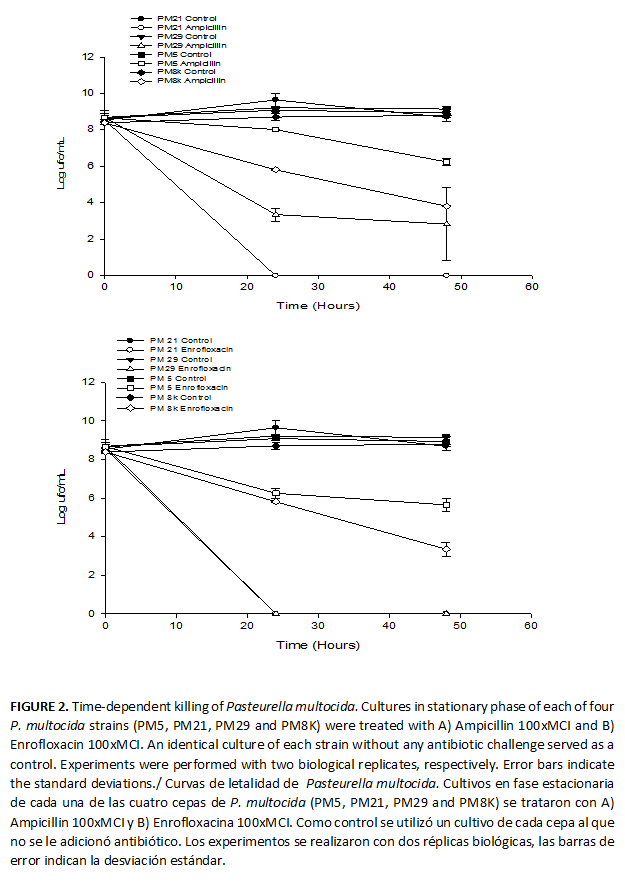
<body><![CDATA[<p style="text-align:justify;"><span style="font-family:'Verdana','sans-serif'; font-size:10.0pt; color:black; ">The persistent population was isolated  after 18 h treatment (&szlig;-lactamic) by centrifugation at 5000 <em>g </em>for 5 min.  Cells were washed with minimal medium (M9), centrifuged, and finally  re-suspended in M9 medium without any carbon source. The persistent population  was then treated with gentamicin 250&micro;gml<sup>_1</sup> and 600mM following the  carbon compounds: Arginine, Fructose, Glycerol, Glucose, Manytol, Rafinose,  Starch, and Trealose. Controls with gentamicin without carbon source were  included. Bacterial counts were carried out as previously described (</span><span style="font-family:'Verdana','sans-serif'; font-size:10.0pt; "><a href="#r">20</a></span><span style="font-family:'Verdana','sans-serif'; font-size:10.0pt; color:black; ">).The experiment was performed with three  independent biological replicates.</span></p>     <p style="text-align:justify;"><strong><span style="font-family:'Verdana','sans-serif'; font-size:10.0pt; ">Statistical  analysis</span></strong></p>     <p style="text-align:justify;"><span style="font-family:'Verdana','sans-serif'; font-size:10.0pt; ">Bacterial counts (<span style="color:black; ">CUF/ml) </span>from each biological replicate were log10 transformed  prior to statistical analysis using Microsoft Excel.<span style="color:black; "> Variance analysis and a comparison test of multiple Tukey ranges with a  significance level of 0.05 </span>were used to determine whether the number of  surviving persistent cells was significantly different upon the different  conditions <span style="color:black; ">with respect to the untreated control</span>.<span style="color:black; "> All analyses were performed using the statistical package  INfoStat 2016 (</span></span><span style="font-family:'Verdana','sans-serif'; font-size:10.0pt; "><a href="#r">21</a></span><span style="font-family:'Verdana','sans-serif'; font-size:10.0pt; color:black; ">).</span></p>     <p style="text-align:justify;">&nbsp;</p>     <p style="text-align:justify;"><strong><span style="font-family:'Verdana','sans-serif'; font-size:14.0pt; color:black; ">RESULTS AND DISCUSSION</span></strong></p>     <p style="text-align:justify;"><span style="font-family:'Verdana','sans-serif'; font-size:10.0pt; color:black; ">Although, different authors have suggested  that all bacteria species have the potential capacity to form persistent cells  (</span><span style="font-family:'Verdana','sans-serif'; font-size:10.0pt; "><a href="#r">6,22</a></span><span style="font-family:'Verdana','sans-serif'; font-size:10.0pt; color:black; ">), specific studies on the behavior of the  species and their strains should be carried out, because the molecular bases  explaining cell persistence events in bacteria are not fully known.</span></p>     <p style="text-align:justify;"><span style="font-family:'Verdana','sans-serif'; font-size:10.0pt; color:black; ">In this study, the eight strains tested  were sensitive to &szlig;-lactamic and quinolone antibiotics. The ranges of MIC  values for Penicillin were 1 &micro;gml<sup>-1</sup>- 0.5 &micro;gml<sup>-1</sup> and  Enrofloxacin (2&micro;gml<sup>-1</sup>-1&micro;gml<sup>-1</sup>) for <em>S. suis</em> strains, while for <em>P.  multocida</em> strains, the antibiotics exhibited these value ranges: Ampicillin  (2&micro;gml<sup>-1</sup>-1&micro;gml<sup>-1</sup>) and Enrofloxacin (4&micro;gml<sup>-1</sup>-2  &micro;gml<sup>-1</sup>). For the subsequent killing curve experiments, MIC values  were defined as follows for <em>S. suis</em>:Penicillin (1  &micro;gm<sup>-1</sup>) and Enrofloxacin (2 &micro;gml<sup>-1</sup>). In this definition, the data found in this work, as well  as the MIC values reported in other studies (</span><span style="font-family:'Verdana','sans-serif'; font-size:10.0pt; "><a href="#r">23,24</a></span><span style="font-family:'Verdana','sans-serif'; font-size:10.0pt; color:black; ">) for <em>S. suis</em>,  were taken into account. The MIC values established for <em>P. multocida</em> were Ampicillin (2&micro;gml<sup>-1</sup>)  and Enrofloxacin (4&micro;gml<sup>-1</sup>), which coincided with the criteria </span><span style="font-family:'Verdana','sans-serif'; font-size:10.0pt; color:black; ">of the European  Committee on Antimicrobial Susceptibility Testing (EUCAST) (</span><span style="font-family:'Verdana','sans-serif'; font-size:10.0pt; "><a href="#r">25</a></span><span style="font-family:'Verdana','sans-serif'; font-size:10.0pt; color:black; ">).</span></p>     <p style="text-align:justify;"><span style="font-family:'Verdana','sans-serif'; font-size:10.0pt; color:black; ">For isolating drug-tolerant <em>S. suis</em> and <em>P. multocida </em>persisters, bactericidal antibiotics which act on the  common bacterial target structures, such as the cell envelope (Ampicillin and  Penicillin) or topoisomerase (Enrofloxacin) (</span><span style="font-family:'Verdana','sans-serif'; font-size:10.0pt; "><a href="#r">26</a></span><span style="font-family:'Verdana','sans-serif'; font-size:10.0pt; color:black; ">), were applied. CFU count of the liquid culture did  not increase to a sizeable extent after the antibiotic challenge, and the  strains of both pathogens exhibited a biphasic killing kinetics during the  experiment. The cells, approximately (10<sup>9</sup>CFUml<sup>-1</sup>) of <em>S. suis</em>,was killed until 10<sup>7 </sup>CFUml<sup>-1</sup>, reaching a  plateau or a slow decrease of surviving cells to 10<sup>4</sup> CFU ml<sup>-1 </sup>(</span><span style="font-family:'Verdana','sans-serif'; font-size:10.0pt; "><a href="/img/revistas/rsa/v39n2/f0106217.gif">Figure 1A-B</a></span><span style="font-family:'Verdana','sans-serif'; font-size:10.0pt; color:black; ">), similar for <em>P. multocida </em>strains (</span><span style="font-family:'Verdana','sans-serif'; font-size:10.0pt; "><a href="/img/revistas/rsa/v39n2/f0206217.gif">Figure 2A-B</a></span><span style="font-family:'Verdana','sans-serif'; font-size:10.0pt; color:black; ">). Biphasic killing curves are the experimental  hallmark of persistence and are obtained when a lethal dose of a bactericidal  antibiotic is added to a bacterial population and the number of surviving cells  is followed over time (</span><span style="font-family:'Verdana','sans-serif'; font-size:10.0pt; "><a href="#r">27,28</a></span><span style="font-family:'Verdana','sans-serif'; font-size:10.0pt; color:black; ">). All <em>S.  suis</em> and <em>P. multocida </em>strains  revealed a range of tolerance cells for both antibiotics, although there was a  slight differences. This is consistent with the results of some authors who  have found that the persistence degree among strains was different (</span><span style="font-family:'Verdana','sans-serif'; font-size:10.0pt; "><a href="#r">29,30,31</a></span><span style="font-family:'Verdana','sans-serif'; font-size:10.0pt; color:black; ">). </span></p>     
<p style="text-align:justify;"><span style="font-family:'Verdana','sans-serif'; font-size:10.0pt; color:black; ">Two different types of persistent cells  have been defined, type I persistent cells from stationary growth phase cultures,  whereas type II persistent cells have their origin in exponential growth phase  cultures (</span><span style="font-family:'Verdana','sans-serif'; font-size:10.0pt; "><a href="#r">12,32,33</a></span><span style="font-family:'Verdana','sans-serif'; font-size:10.0pt; color:black; ">). In this work, the bactericidal activity  evaluated, using the concentration-killing curves and the antibiotic, were  supplied to both <em>P. multocida</em> and S<em>. suis</em> cultures in the stationary phase.  The logarithmic phase culture was not evaluated according to different previous  studies on <em>S. suis</em> and other species  where the number of the persistent cells observed was higher during the  stationary growth when compared to the exponential grown bacteria (</span><span style="font-family:'Verdana','sans-serif'; font-size:10.0pt; "><a href="#r">12,28</a></span><span style="font-family:'Verdana','sans-serif'; font-size:10.0pt; color:black; ">). </span></p>     <p style="text-align:justify;"><span style="font-family:'Verdana','sans-serif'; font-size:10.0pt; color:black; ">Previous studies have established  persistent cells are tolerant to multiple antibiotics (</span><span style="font-family:'Verdana','sans-serif'; font-size:10.0pt; "><a href="#r">5</a></span><span style="font-family:'Verdana','sans-serif'; font-size:10.0pt; color:black; ">). However in this study, the strains PM21 and PM29  failed to produce a detectable level of such cells after 48 hours of challenge  with Enrofloxacin. But when the strains were treated with ampicillin, PM29 was  tolerant, while PM21 did not survive (</span><span style="font-family:'Verdana','sans-serif'; font-size:10.0pt; "><a href="/img/revistas/rsa/v39n2/f0206217.gif">Figure 2 A-B</a></span><span style="font-family:'Verdana','sans-serif'; font-size:10.0pt; color:black; ">). This result is consistent with the studies of  Hofsteenge <em>et al</em>., 2013 (</span><span style="font-family:'Verdana','sans-serif'; font-size:10.0pt; "><a href="#r">30</a></span><span style="font-family:'Verdana','sans-serif'; font-size:10.0pt; color:black; ">), who did not find a correlation between  persistent levels for different antibiotics among environmental <em>E. coli </em>strains.&nbsp; Barth <em>et  al</em>., 2013 (</span><span style="font-family:'Verdana','sans-serif'; font-size:10.0pt; "><a href="#r">31</a></span><span style="font-family:'Verdana','sans-serif'; font-size:10.0pt; color:black; ">) neither found a correlation among the  different antibiotics and the persistent cells from <em>Acinetobacter baumannii </em>clinical  isolates.</span></p>     
]]></body>
<body><![CDATA[<p style="text-align:justify;"><span style="font-family:'Verdana','sans-serif'; font-size:10.0pt; color:black; ">Most of the transient resistance  researches have been focused on the following microbial groups (<em>Escherichia coli</em>, <em>Mycobacterium tuberculosis</em>, <em>Pseudomona  aeroginosa</em>, <em>Staphyloccus aureus</em>)<em>, </em>based on the use of strains that were  genetically manipulated previously to favor an increase or decrease in the  production of persistent cells (</span><span style="font-family:'Verdana','sans-serif'; font-size:10.0pt; "><a href="#r">35,36</a></span><span style="font-family:'Verdana','sans-serif'; font-size:10.0pt; color:black; ">). Some of these previous studies based on the use of  mutant strains have demonstrated the relative and redundant nature of  persistent cells (</span><span style="font-family:'Verdana','sans-serif'; font-size:10.0pt; "><a href="#r">32,34,35</a></span><span style="font-family:'Verdana','sans-serif'; font-size:10.0pt; color:black; ">). However the studies using collections  of non-genetically manipulated strains are scarce. A study carried out in a  collection of <em>E. coli</em> strains from  environmental origin showed that there were differences in the amount of  persistent cells derived from each strain, once they were confronted with  antibiotics from different families (</span><span style="font-family:'Verdana','sans-serif'; font-size:10.0pt; "><a href="#r">30</a></span><span style="font-family:'Verdana','sans-serif'; font-size:10.0pt; color:black; ">). In these work, <em>S.  suis</em> and <em>P. multocida </em>strains  showed variations in the frequency of persistent cells. </span></p>     <p style="text-align:justify;"><span style="font-family:'Verdana','sans-serif'; font-size:10.0pt; color:black; ">The heterogeneous behavior showing the  strains as regard the persistent cell formation may have different  explanations. First, the intrinsic properties to each strain (</span><span style="font-family:'Verdana','sans-serif'; font-size:10.0pt; "><a href="#r">34</a></span><span style="font-family:'Verdana','sans-serif'; font-size:10.0pt; color:black; ">). Second, and according to Luidalepp <em>et al</em> (</span><span style="font-family:'Verdana','sans-serif'; font-size:10.0pt; "><a href="#r">35</a></span><span style="font-family:'Verdana','sans-serif'; font-size:10.0pt; color:black; ">), the bacterial cultures genetically homogeneous can generate  subpopulations with different physiological properties. When stationary-phase  bacteria are diluted in fresh medium, some cells start growing immediately and  some later. Therefore, inoculum age had effects on the frequency of persistent  cell formation. In this study, even still when the cultures were previously  adjusted to a similar concentration, the strains differed in the persistent  range (</span><span style="font-family:'Verdana','sans-serif'; font-size:10.0pt; "><a href="#r">36,37</a></span><span style="font-family:'Verdana','sans-serif'; font-size:10.0pt; color:black; ">). </span></p>     <p style="text-align:justify;"><span style="font-family:'Verdana','sans-serif'; font-size:10.0pt; color:black; ">In order to examine the possible  heritability of phenotypic resistance, SsS3 and PM5 strains, which previously  showed high persistence levels under the effect of both antibiotics (Penicillin  and Ampicillin), were selected for the heritability assay.&nbsp; The stationary phase cultures of these  strains were treated with &szlig;-lactamics. The survival cells were inoculated in  fresh medium, and a newly fraction of initial culture survived to the  treatment. The same occurred for a third challenge with the antibiotic, showing  a biphasic curve (</span><span style="font-family:'Verdana','sans-serif'; font-size:10.0pt; "><a href="/img/revistas/rsa/v39n2/f0306217.gif">Figure 3</a></span><span style="font-family:'Verdana','sans-serif'; font-size:10.0pt; color:black; ">), </span><span style="font-family:'Verdana','sans-serif'; font-size:10.0pt; ">indicating that the resistance phenotype was transient, not being the  consequence of a genetic change. Each <span style="color:black; ">culture  obtained from the persistent cells was as sensible to &szlig;- lactamic as the  parental culture. </span>If the cells had been able to grow once the antibiotic  was retired due a genetic resistance mechanism, then such behavior would have  been different, the population would not have decreased and a biphasic curve  would not have been obtained, because the bacterial population would have  increased in each cycle.</span></p>     
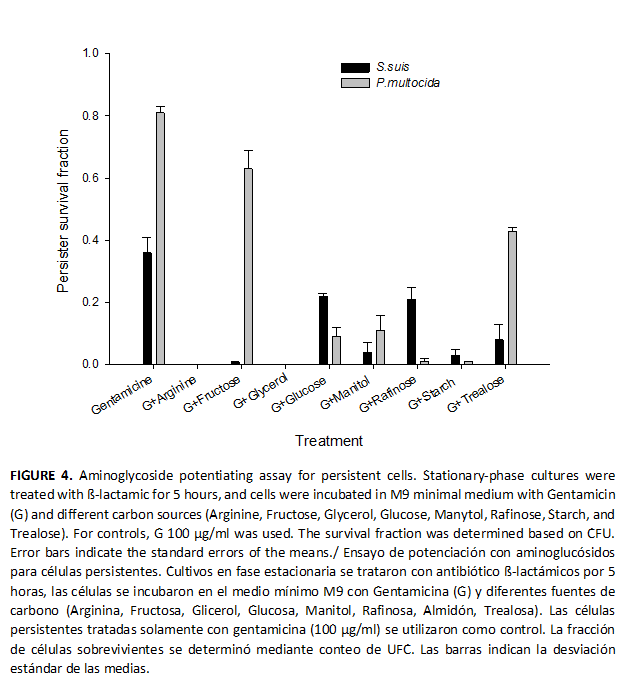
<p style="text-align:justify;"><span style="font-family:'Verdana','sans-serif'; font-size:10.0pt; color:black; ">The mechanism of  persistent cell formation is not well understood and the metabolic state of  these cells is debated. </span><span style="font-family:'Verdana','sans-serif'; font-size:10.0pt; color:black; ">The  main model that explains the  genetic basis of the formation of persistent cells consists of a  toxin-antitoxin (TA) system, inducing a dormancy state (</span><span style="font-family:'Verdana','sans-serif'; font-size:10.0pt; "><a href="#r">38,39,40</a></span><span style="font-family:'Verdana','sans-serif'; font-size:10.0pt; color:black; ">), and allowing cells to survive to the  effects of antibiotics. TA systems (</span><span style="font-family:'Verdana','sans-serif'; font-size:10.0pt; "><a href="#r">41</a></span><span style="font-family:'Verdana','sans-serif'; font-size:10.0pt; color:black; ">) generally consist of a stable toxin (protein) that  disrupts an essential cellular process (e.g., translation via mRNA degradation)  and a labile antitoxin (either RNA or a protein) that prevents toxicity (</span><span style="font-family:'Verdana','sans-serif'; font-size:10.0pt; "><a href="#r">38,39</a></span><span style="font-family:'Verdana','sans-serif'; font-size:10.0pt; color:black; ">).  Other model is the alarmoneguanosinetetraphosphate (ppGpp) that also directly  reduces DNA replication and protein synthesis (</span><span style="font-family:'Verdana','sans-serif'; font-size:10.0pt; "><a href="#r">40,41</a></span><span style="font-family:'Verdana','sans-serif'; font-size:10.0pt; color:black; ">).</span></p>     <p style="text-align:justify;"><span style="font-family:'Verdana','sans-serif'; font-size:10.0pt; color:black; ">When a culture is treated with a  bactericidal antibiotic in high doses, it is possible to find dead cells,  viable but non-culturable cells (VBNCs) and persistent cells. There are current  different techniques for the isolation and discrimination among these types of  cells (</span><span style="font-family:'Verdana','sans-serif'; font-size:10.0pt; "><a href="#r">42,43,44</a></span><span style="font-family:'Verdana','sans-serif'; font-size:10.0pt; color:black; ">). In this work, normally growing strains  of both <em>S. suis</em> and <em>P. multocida</em> were lysed with &szlig;-lactamic  (Penicillin and Ampicillin), respectively. The </span><span style="font-family:'Verdana','sans-serif'; font-size:10.0pt; ">non-lysed live cells<span style="color:black; "> were sedimented by  centrifugation and subjected to the aminoglycosides (AG) potentiation assay  with the following carbon sources (Arginine, Fructose, Glycerol, Glucose,  Mannitol, Rafinose, Starch, and Trealose). </span></span><span style="font-family:'Verdana','sans-serif'; font-size:10.0pt; "><a href="/img/revistas/rsa/v39n2/f0406217.gif">Figure 4</a></span><span style="font-family:'Verdana','sans-serif'; font-size:10.0pt; color:black; "> shows the effect of the combination of  carbonate metabolites with AG (Gentamicine) on the persistent cells previously  obtained for each of the strains of both pathogens. The persistent cells of  both microorganisms treated with gentamicine and metabolite of carbon decreased  with respect to the cultures only treated with gentamicine. Glycerol, arginine  and starch were the carbonate metabolites that most strongly potentiated the AG  activity in both Penicillin and Ampicillin persistent cells obtained from the  stationary-phase cultures of <em>S. suis</em> and <em>P. multocida </em>(</span><span style="font-family:'Verdana','sans-serif'; font-size:10.0pt; "><a href="/img/revistas/rsa/v39n2/f0406217.gif">Figure 4</a></span><span style="font-family:'Verdana','sans-serif'; font-size:10.0pt; color:black; ">). The addition of carbonate metabolites  which served to generate a proton motive, forced to conduce to the  incorporation of AG, therefore making the cells more susceptible to gentamicine  (</span><span style="font-family:'Verdana','sans-serif'; font-size:10.0pt; "><a href="#r">45</a></span><span style="font-family:'Verdana','sans-serif'; font-size:10.0pt; color:black; ">).</span></p>     
<p style="text-align:justify;"><span style="font-family:'Verdana','sans-serif'; font-size:10.0pt; ">Numerous research have corroborated that persistent  cells are metabolically inactive or predominantly dormant (</span><span style="font-family:'Verdana','sans-serif'; font-size:10.0pt; "><a href="#r">46</a></span><span style="font-family:'Verdana','sans-serif'; font-size:10.0pt; ">). Therefore the strategies to kill these sleeping  cells require compounds that enter the cell without an active transport. Some  examples include DNA-cross-linking compounds as mitomicyn C or  acyldepsipeptide, a protease that degrades many cellular proteins (</span><span style="font-family:'Verdana','sans-serif'; font-size:10.0pt; "><a href="#r">44</a></span><span style="font-family:'Verdana','sans-serif'; font-size:10.0pt; ">). Another alternative to eradicate these dormant  cells consists&nbsp;&nbsp; in waking them in order  to use traditional compounds as antibiotics, specifically AG (Gentamicin,  kanamycin and streptomycin) in combination with carbon metabolites (</span><span style="font-family:'Verdana','sans-serif'; font-size:10.0pt; "><a href="#r">41,44,45</a></span><span style="font-family:'Verdana','sans-serif'; font-size:10.0pt; ">). </span></p>     <p style="text-align:justify;"><span style="font-family:'Verdana','sans-serif'; font-size:10.0pt; ">The results indicated that Glycerol was the metabolite  that, in combination with AG gentamicine, completely eradicated the persistent  cells produced by both <em>S. suis</em> and <em>P. multocida </em>strains after the treatment  with &szlig;-lactamic (</span><span style="font-family:'Verdana','sans-serif'; font-size:10.0pt; "><a href="/img/revistas/rsa/v39n2/f0406217.gif">Figure 4</a></span><span style="font-family:'Verdana','sans-serif'; font-size:10.0pt; ">). Mehmet <em>et al</em> (</span><span style="font-family:'Verdana','sans-serif'; font-size:10.0pt; "><a href="#r">46</a></span><span style="font-family:'Verdana','sans-serif'; font-size:10.0pt; ">) found that glycerol was the metabolite that, in conjunction with AG, decreased different  metabolic types of <em>E. coli</em> persistent  cells. The combination Arginine plus G also eradicated persistent cells.  Arginine is a crucial amino acid that modulate the cellular immune response  during infection in the host. The importance of arginine metabolism has been  reported <span style="color:black; ">in many pathogens like <em>Salmonella </em><em>typhimurium</em>, <em>Helicobacter pylori,  Mycobacterium tuberculosis, </em>and <em>Streptococcus  suis,</em> as a source of energy and as a trigger for the polyamine synthesis  required for an efficient pathogenesis </span>(</span><span style="font-family:'Verdana','sans-serif'; font-size:10.0pt; "><a href="#r">47,48</a></span><span style="font-family:'Verdana','sans-serif'; font-size:10.0pt; ">).</span></p>     
<p style="text-align:justify;"><span style="font-family:'Verdana','sans-serif'; font-size:10.0pt; color:black; ">The persistence of bacteria that can  produce recalcitrant infections requires attention. This study has been focused  on testing the formation of persistent cells in <em>S. suis</em> and <em>P. multocida </em>strains.  In the case <em>S. suis</em>, its ability to  tolerate antibiotics through the formation of persistent cells had already been  informed (</span><span style="font-family:'Verdana','sans-serif'; font-size:10.0pt; "><a href="#r">12</a></span><span style="font-family:'Verdana','sans-serif'; font-size:10.0pt; color:black; ">). Although it has been considered that  all bacteria have this ability, </span><span style="font-family:'Verdana','sans-serif'; font-size:10.0pt; ">to our knowledge, <span style="color:black; ">prior to this study the formation of persistent cells for <em>P. multocida</em> had not been described.</span></span></p>     <p style="text-align:justify;"><em><span style="font-family:'Verdana','sans-serif'; font-size:10.0pt; color:black; ">S. suis</span></em><span style="font-family:'Verdana','sans-serif'; font-size:10.0pt; color:black; "> and <em>P.  multocida </em>strains formed persistent cells, but varying intensities, this  phenotype could be wide distributed among <em>S.  suis</em> and <em>P. multocida</em> isolates.  Persistence understanding may contribute to improve the strategies aiming at  the control of recurrent infections. Persistent cells should be taken into  account when <em>S. suis</em> or <em>P. multocida</em> infections are produced in  pigs and are not solved with an antimicrobial treatment.</span></p>     <p style="text-align:justify;"><span style="font-family:'Verdana','sans-serif'; font-size:10.0pt; color:black; ">It has been postulated that persistence is  an important contributor to resistance emergence because it produces a  continuous reservoir of viable cells in the presence of antibiotics (</span><span style="font-family:'Verdana','sans-serif'; font-size:10.0pt; "><a href="#r">19</a></span><span style="font-family:'Verdana','sans-serif'; font-size:10.0pt; color:black; ">). These results broaden the evidences  about pathogens in veterinary medicine producing persistent cells,  corroborating the observations on the differences in persistent levels among  species or even among strains of the same species. Finally, it has been  demonstrated that glycerol and arginine potentiated the effect of AG  gentamicine in the eradication of persistent cells.</span></p>     ]]></body>
<body><![CDATA[<p style="text-align:justify;">&nbsp;</p>     <p style="text-align:justify;"><a name="r" id="r"><strong><span style="font-family:'Verdana','sans-serif'; font-size:14.0pt; color:black; ">REFERENCES</span></strong></a><strong><span style="font-family:'Verdana','sans-serif'; font-size:10.0pt; color:black; "> </span></strong></p> <ol>       <li><span style="line-height:115%; font-family:'Verdana','sans-serif'; font-size:10.0pt; color:black; ">Verraes C, Sigrid V B, Meervenne, V ECoillie E  V, Butaye P, Catry B, Schaetzen MA, Van Huffel X, Imberechts H, Dierick K,  Daube G, Saegerman Jan De Block C, Dewulf J and Herman L. Antimicrobial  Resistance in the Food Chain: A Review </span><span style="font-family:'Verdana','sans-serif'; font-size:10.0pt; color:black; ">Int. J.  Environ. Res. Public Health.</span><span style="font-family:'Verdana','sans-serif'; font-size:10.0pt; color:black; ">2013</span><span style="font-family:'Verdana','sans-serif'; font-size:10.0pt; color:black; ">;10:643-2669. </span></li>       <li><span style="line-height:115%; font-family:'Verdana','sans-serif'; font-size:10.0pt; ">Corona F and Martinez JL. Phenotypic Resistance to  Antibiotics </span><span style="font-family:'Verdana','sans-serif'; font-size:10.0pt; ">Antibiotics.</span><span style="font-family:'Verdana','sans-serif'; font-size:10.0pt; ">2013</span><span style="font-family:'Verdana','sans-serif'; font-size:10.0pt; ">;2:237-255.<span style="color:black; "> </span></span></li>       <li><span style="font-family:'Verdana','sans-serif'; font-size:10.0pt; color:black; ">Gang Z, Shi Q, Huang X and Xie XB. . The Three  Bacterial Lines of Defense against Antimicrobial Agents. </span><span style="font-family:'Verdana','sans-serif'; font-size:10.0pt; color:black; ">Int J Mol Sci<em>. </em></span><span style="font-family:'Verdana','sans-serif'; font-size:10.0pt; color:black; ">2015</span><span style="font-family:'Verdana','sans-serif'; font-size:10.0pt; color:black; ">;16:21711-21733. </span></li>       <li><span style="font-family:'Verdana','sans-serif'; font-size:10.0pt; color:black; ">Merle E, Olson HC, Douglas WM, Buret AG and  Ronald R.</span><span style="font-family:'Verdana','sans-serif'; font-size:10.0pt; color:black; "> Read  biofilm bacteria: formation and comparative susceptibil&shy;ity to antibiotics. Can J Vet Res<em>. </em>2012;66:86-92. </span></li>       <li><span style="font-family:'Verdana','sans-serif'; font-size:10.0pt; color:black; ">Lewis K. Persister cells, dormancy and infectious disease. Nat Rev  Microbiol. 2007;5(1):48-56. </span></li>       <li><span style="font-family:'Verdana','sans-serif'; font-size:10.0pt; color:black; ">Keren I, Shah D, Spoering A, Kaldalu N,  Lewis K. Specialized persister cells and the mechanism of multidrug tolerance  in <em>Escherichia coli</em>. J Bacteriol.  2004;186(24):8172-8180.</span></li>       <li><span style="font-family:'Verdana','sans-serif'; font-size:10.0pt; color:black; ">Portis E, Lindeman C, Johansen K.  Antimicrobial susceptibility of porcine <em>Pasteurella multocida</em>, <em>Streptococcus  suis</em>, <em>Actinobacillus pleuroneumoniae </em>from the United States and  Canada, 2001 to 2010. J Swine Health Prod. 2013;21(1):30-41.</span></li>       <li><span style="font-family:'Verdana','sans-serif'; font-size:10.0pt; color:black; ">Moreno AM, Baccaro MR, Ferreira AJand Pestana de Castro AF. </span><span style="font-family:'Verdana','sans-serif'; font-size:10.0pt; color:black; ">Use of Single- Enzyme Amplified Fragment  Length Polymorphism for Typing <em>Pasteurellamultocida</em>subsp. <em>Multocida</em>Isolates  from Pigs<em>. </em>J Clin Microbiol.  2003;41(4):1743-1746.</span></li>       ]]></body>
<body><![CDATA[<li><span style="font-family:'Verdana','sans-serif'; font-size:10.0pt; color:black; ">Gottschalk M, Lacouture S, Bonifait L,  David R, Nahuel F, Daniel G. Characterization of <em>Streptococcus suis</em> isolates recovered between 2008 and 2011 from  diseased pigs in Quebec, Canada. Vet Microbiol. 2013;162(2-4):819-25.</span></li>       <li><span style="font-family:'Verdana','sans-serif'; font-size:10.0pt; ">Thomas KW. Strategies for combating persister cell and  biofilm infections Microbial Biotechnology John Wiley &amp; Sons Ltd and  Society for Applied Microbiology. 2017.<span style="color:black; "> </span></span></li>       <li><span style="font-family:'Verdana','sans-serif'; font-size:10.0pt; color:black; ">Allison KR,  Brynildsen MP, Collins JJ</span><span style="font-family:'Verdana','sans-serif'; font-size:10.0pt; color:black; ">. Metabolite-enabled eradication of bacterial persisters by  aminoglycosides. Nature .2011; 473:216&ndash;220.</span></li>       <li><span style="font-family:'Verdana','sans-serif'; font-size:10.0pt; color:black; ">Willenborg J, Willms D, Bertram R, Goethe  R and Valentin-Weigand P. Characterization of multi-drug tolerant persister  cells in <em>Streptococcus suis</em>. BMC  Microbiol. 2014;14:120.</span></li>       <li><span style="font-family:'Verdana','sans-serif'; font-size:10.0pt; ">Espinosa I, B&aacute;ez M, Corona B, Chong D, Lobo E,  Mart&iacute;nez S. <span style="color:black; ">Molecular typing of </span><em><span style="color:black; ">Streptococcus suis </span></em><span style="color:black; ">from  pigs in Cuba. </span><span style="color:black; ">Biotecnolog&iacute;a  Aplicada. 2013;30(1):39-44.</span></span></li>       <li><span style="font-family:'Verdana','sans-serif'; font-size:10.0pt; ">Espinosa I, B&aacute;ez M, Vichi J,  Mart&iacute;nez S.<span style="color:black; "> Antimicrobial resistance and genes  associated to the host-microbe interaction of <em>Pasteurella multocida </em>isolates  from swine in western Cuba. </span></span><span style="font-family:'Verdana','sans-serif'; font-size:10.0pt; color:black; ">Rev Salud Anim.  2012;34(3):151-158</span></li>       <li><span style="line-height:115%; font-family:'Verdana','sans-serif'; font-size:10.0pt; color:#231F20; ">Espinosa I,  B&aacute;ez M, Percedo MI, Lobo E, Mart&iacute;nez S, Gottschalk M.</span><span style="font-family:'Verdana','sans-serif'; font-size:10.0pt; color:black; "> Serotyping of  porcine S<em>treptococcus suis</em>recovered from diseased pigs in the western  region of Cuba. </span><span style="font-family:'Verdana','sans-serif'; font-size:10.0pt; color:black; ">Rev  Salud Anim. 2013;36(3):196-200</span><span style="font-family:'Verdana','sans-serif'; font-size:10.0pt; color:black; ">.</span><span style="font-family:'Verdana','sans-serif'; font-size:10.0pt; color:#231F20; "> </span></li>       <li><span style="font-family:'Verdana','sans-serif'; font-size:10.0pt; ">B&aacute;ez M, Espinosa I, Vichi J, Mart&iacute;nez S. Estudio de  la sensibilidad <em>in vitro </em>frente a diferentes antimicrobianos en cepas de <em>S. </em></span><em><span style="font-family:'Verdana','sans-serif'; font-size:10.0pt; ">suis</span></em><span style="font-family:'Verdana','sans-serif'; font-size:10.0pt; ">asociados a neumon&iacute;a porcina. </span><span style="font-family:'Verdana','sans-serif'; font-size:10.0pt; ">Rev Salud Anim. 2012;34(1):57-62</span><span style="font-family:'Verdana','sans-serif'; font-size:10.0pt; "> </span></li>       <li><span style="font-family:'Verdana','sans-serif'; font-size:10.0pt; color:black; ">Clinical and Laboratory Standards Institute.  Performance Standards for Antimicrobial Disk and Dilution Susceptibility Tests  for Bacteria Isolated From&nbsp; Animals;  Approved Standard, third ed., vol. CLSI document M31&ndash;A3. Clinical and  Laboratory Standards Institute, Wayne, PA.2016.</span></li>       <li><span style="font-family:'Verdana','sans-serif'; font-size:10.0pt; color:black; ">Andrews JM.</span><span style="font-family:'Verdana','sans-serif'; font-size:10.0pt; color:black; "> Determination of minimum inhibitory  concentrations. J Antimicrob Chemother. 2001;48:5-16. </span></li>       ]]></body>
<body><![CDATA[<li><span style="font-family:'Verdana','sans-serif'; font-size:10.0pt; color:black; ">Mehmet AO</span><span style="font-family:'Verdana','sans-serif'; font-size:10.0pt; color:black; ">, Wendy  WK, MokM, Brynildsen P. Aminoglycoside-Enabled Elucidation of Bacterial  Persister Metabolism. Curr Protoc Microbiol. 2006;36: 17. </span></li>       <li><span style="font-family:'Verdana','sans-serif'; font-size:10.0pt; color:black; ">Mehmet A, Bry</span><span style="font-family:'Verdana','sans-serif'; font-size:10.0pt; color:black; ">nildsen P. Esta</span><span style="font-family:'Verdana','sans-serif'; font-size:10.0pt; color:black; ">blishment of a  Method To Rapidly Assay Bacterial Persister Metabolism</span><span style="font-family:'Verdana','sans-serif'; font-size:10.0pt; color:black; "> Antimicrobial  Agents </span><span style="font-family:'Verdana','sans-serif'; font-size:10.0pt; color:black; ">and Chemoth</span><span style="font-family:'Verdana','sans-serif'; font-size:10.0pt; color:black; ">erapy. </span><span style="font-family:'Verdana','sans-serif'; font-size:10.0pt; color:black; ">2013;57(9):439</span><span style="font-family:'Verdana','sans-serif'; font-size:10.0pt; color:black; ">8-4409.</span><span style="font-family:'Verdana','sans-serif'; font-size:10.0pt; color:black; "> </span></li>       <li><span style="font-family:'Verdana','sans-serif'; font-size:10.0pt; ">InfoStat (2002). <em>InfoStat versi&oacute;n 1.1. </em>Grupo  InfoStat, FCA, Universidad Nacional de C&oacute;rdoba, Argentina.</span></li>       <li><span style="font-family:'Verdana','sans-serif'; font-size:10.0pt; color:black; ">Elie J, Van den  Bergh MB, Verstraeten N,&nbsp; </span><span style="font-family:'Verdana','sans-serif'; font-size:10.0pt; color:black; ">Michiels  J. Molecular mechanisms and clinical implications of bacterial</span><span style="font-family:'Verdana','sans-serif'; font-size:10.0pt; color:black; ">persistence.Drug Resistance Updates. 2016. </span><span style="font-family:'Verdana','sans-serif'; font-size:10.0pt; "> </span></li>       <li><span style="font-family:'Verdana','sans-serif'; font-size:10.0pt; color:black; ">Escudero JA ,  San Millan A ,Catalan A, D</span><span style="font-family:'Verdana','sans-serif'; font-size:10.0pt; color:black; ">e la Campa AG , Rivero  E,&nbsp; Lopez G, Dominguez L, Mo</span><span style="font-family:'Verdana','sans-serif'; font-size:10.0pt; color:black; ">r</span><span style="font-family:'Verdana','sans-serif'; font-size:10.0pt; color:black; ">eno MA and Gonzalez-Zorn B. First characteriz</span><span style="font-family:'Verdana','sans-serif'; font-size:10.0pt; ">ation of Fluoroquinolone Resistance in <em>Streptococcus  suis. </em>Antimicrobial Agents and Chemotherapy. 2007:51(2)777-782.</span></li>       <li><span style="font-family:'Verdana','sans-serif'; font-size:10.0pt; ">Chunping Z, Zhongqiu Z, Song  L,Fang X&nbsp; andNing Y. Antimicrobial  Resistance Profile and Genotypic Characteristics  of </span><em><span style="font-family:'Verdana','sans-serif'; font-size:10.0pt; ">Streptococcus suis</span></em><span style="font-family:'Verdana','sans-serif'; font-size:10.0pt; ">Capsular Type 2 Isolated  from Clinical Carrier Sows and Diseased Pigs in China. </span><span style="font-family:'Verdana','sans-serif'; font-size:10.0pt; ">BioMed Res Int. 2015;Volume 2015.<span style="color:black; "> </span></span></li>       <li><span style="font-family:'Verdana','sans-serif'; font-size:10.0pt; color:black; ">European Committee on antimicrobial  susceptibility testing. Breakpoints table for interpretation of MICs and zone  diameters version 6.0.2016. </span><span style="font-family:'Verdana','sans-serif'; font-size:10.0pt; "><a href="http://www.eucast.org">http://www.eucast.org</a></span><span style="font-family:'Verdana','sans-serif'; font-size:10.0pt; color:black; ">)</span><span style="font-family:'Verdana','sans-serif'; font-size:10.0pt; color:black; "> </span></li>       <li><span style="font-family:'Verdana','sans-serif'; font-size:10.0pt; ">Bassetti M, Merelli M, TemperoniCh and Astilean A. New  antibiotics for bad bugs: where are we? Annals of Clinical Microbiology and  Antimicrobials. 2013;12:22.<span style="color:black; "> </span></span></li>       <li><span style="font-family:'Verdana','sans-serif'; font-size:10.0pt; color:black; ">Balaban NQ, Merrin J, Chait R, Kowalik L,  Leibler S. Bacterial persistence as a phenotypic switch. Science.  2004;305(5690):1622-1625.</span></li>       <li><span style="font-family:'Verdana','sans-serif'; font-size:10.0pt; color:black; ">Keren I, Kaldalu N, Spoering A, Wang Y,  Lewis K.Persister cells and tolerance to antimicrobials. FEMS MicrobiolLett.  2004;230:13-18.</span></li>       ]]></body>
<body><![CDATA[<li><span style="font-family:'Verdana','sans-serif'; font-size:10.0pt; color:black; ">Wiuff C, Zappala RM, Regoes RR, Garner KN,  Baquero F, Levin BR.Phenotypic tolerance: antibiotic enrichment of noninherited  resistance in bacterial populations. Antimicrob Agents Chemother. 2005;  49:1483&ndash;1494.</span></li>       <li><span style="font-family:'Verdana','sans-serif'; font-size:10.0pt; color:black; ">Hofsteenge N, Nimwegen V, Silander E.  Quantitative analysis of persister fractions suggests different mechanisms of  formation among environmental isolates of <em>E. coli</em>. BMC Microbiol. 2013;13(25).</span></li>       <li><span style="font-family:'Verdana','sans-serif'; font-size:10.0pt; color:black; ">Barth VC, Rodriguez B&Aacute;, Bonatto GD, Gallo  SW, Pagnussatti VE, Ferreira CA, Oliveira S .Heterogeneous persister cells  formation in <em>Acinetobacterbaumannii. </em>PLoS One 2013;8(12):e84361.</span></li>       <li><span style="font-family:'Verdana','sans-serif'; font-size:10.0pt; color:black; ">Manuel J, Zhanel  G, Gand De Kievit T</span><span style="font-family:'Verdana','sans-serif'; font-size:10.0pt; color:black; ">.  Cadaverine suppresses persistence to carboxypenicillins in <em>Pseudomonas aeruginosa</em> PAO1. Antimicrob Agents Chemother. 2010;54:5173-5179.</span></li>       <li><span style="font-family:'Verdana','sans-serif'; font-size:10.0pt; color:black; ">Dorr T, Lewis K, Vulic M. SOS response  induces persistence to fluoroquinolones in <em>Escherichia  coli</em>. PLoS Genet 2009;5(12):e1000760.</span></li>       <li><span style="font-family:'Verdana','sans-serif'; font-size:10.0pt; color:black; ">Stewart B, Rozen D. Genetic variation for  antibiotic persistence in <em>Escherichia  coli</em>. Evolution. 2012;66(3):933-939.</span></li>       <li><span style="font-family:'Verdana','sans-serif'; font-size:10.0pt; color:black; ">Luidalepp H, Joers A, Kaldalu N, Tenson T.  Age of inoculum strongly influences persister frequency and can mask effects of  mutations implicated in altered persistence. J Bacteriol.  2011;193(14):3598-3605.</span></li>       <li><span style="font-family:'Verdana','sans-serif'; font-size:10.0pt; color:black; ">Lewis K. </span><span style="font-family:'Verdana','sans-serif'; font-size:10.0pt; color:black; ">Multidrug tolerance of biofilms and  persister cells. Curr Top Microbiol Immunol. 2008;322:107-131.</span></li>       <li><span style="font-family:'Verdana','sans-serif'; font-size:10.0pt; color:black; ">Jayaraman R. </span><span style="font-family:'Verdana','sans-serif'; font-size:10.0pt; color:black; ">Bacterial persistence: some new insights  into an old phenomenon. J Biosci. 2008;33:795-805.</span></li>       <li><span style="font-family:'Verdana','sans-serif'; font-size:10.0pt; color:black; ">Schuster CF,  Bertram R. </span><span style="font-family:'Verdana','sans-serif'; font-size:10.0pt; color:black; ">Toxin-antitoxin  systems are ubiquitous and versatile modulators of prokaryotic cell fate. FEMS  Microbiol Lett. 2013;340:73-85.</span></li>       ]]></body>
<body><![CDATA[<li><span style="font-family:'Verdana','sans-serif'; font-size:10.0pt; color:black; ">Melderen V L,  Saavedra De B M. </span><span style="font-family:'Verdana','sans-serif'; font-size:10.0pt; color:black; ">Bacterial  toxin-antitoxin systems: more than selfish entities? PLoS Genet.  2009;5(3):e100437.</span></li>       <li><span style="font-family:'Verdana','sans-serif'; font-size:10.0pt; color:black; ">Dalebroux ZD,  Swanson MS. </span><span style="font-family:'Verdana','sans-serif'; font-size:10.0pt; color:black; ">ppGpp:  magic beyond RNA polymerase. Nat Rev Microbiol. 2012;10:203-212.</span></li>       <li><span style="font-family:'Verdana','sans-serif'; font-size:10.0pt; color:black; ">Thomas K, Wood AB, Stephen J, Knabel C,  Brian W. Bacterial Persister Cell  Formation and Dormancy.</span><span style="font-family:'Verdana','sans-serif'; font-size:10.0pt; color:black; "> Applied and  Environmental Microbiology.&nbsp;  2013;23:7116-7121.</span></li>       <li><span style="font-family:'Verdana','sans-serif'; font-size:10.0pt; color:black; ">Lewis K. Persister cells. Annu. Rev. 950  Microbiol. 2010;64:357-372.</span></li>       <li><span style="font-family:'Verdana','sans-serif'; font-size:10.0pt; color:black; ">Cristo V, Barth VJ, Belisa A, Rodriguez V,  Bonatt GD, Gallo SW, Pagnussatti VE, Sanchez F CA, Dias de Oliveira S.  Heterogeneous Persister Cells Formation in <em>Acinetobacter  baumannii.</em> PLOS ONE. 2013;8(12):e84361.</span></li>       <li><span style="font-family:'Verdana','sans-serif'; font-size:10.0pt; "><a href="javascript:;"><span style="color:black; ">Van  den Bergh</span></a></span><span style="font-family:'Verdana','sans-serif'; font-size:10.0pt; "> B<span style="color:black; ">,&nbsp;&nbsp; </span></span><span style="font-family:'Verdana','sans-serif'; font-size:10.0pt; "><a href="javascript:;"><span style="color:black; ">FauvarM</span></a></span><span style="font-family:'Verdana','sans-serif'; font-size:10.0pt; color:black; ">,&nbsp;&nbsp; </span><span style="font-family:'Verdana','sans-serif'; font-size:10.0pt; "><a href="javascript:;"><span style="color:black; ">Michiels</span></a></span><span style="font-family:'Verdana','sans-serif'; font-size:10.0pt; "> J. <span style="color:black; ">Formation, physiology, ecology, evolution and  clinical importance of bacterial persisters. </span><span style="color:black; ">FEMS  Microbiol Rev. 2017;41(3):219-251. </span></span></li>       <li><span style="font-family:'Verdana','sans-serif'; font-size:10.0pt; color:black; ">Allison KR,  Brynildsen MP, Collins JJ. </span><span style="font-family:'Verdana','sans-serif'; font-size:10.0pt; color:black; ">Metabolite-enabled eradication of bacterial persisters by  aminoglycosides. Nature. 2011;473:216-220.</span></li>       <li><span style="font-family:'Verdana','sans-serif'; font-size:10.0pt; color:black; ">Mehmet AO, Mark PB. Establishment of a Method To Rapidly Assay Bacterial Persister  Metabolism.</span><span style="font-family:'Verdana','sans-serif'; font-size:10.0pt; color:black; "> Antimicrobial Agents and Chemotherapy.  2013;57(9):4398-4409. </span><span style="font-family:'Verdana','sans-serif'; font-size:10.0pt; color:black; "> </span></li>       <li><span style="font-family:'Verdana','sans-serif'; font-size:10.0pt; ">Gogoi M</span><span style="font-family:'Verdana','sans-serif'; font-size:10.0pt; ">, Datey A,  Keith T W and Chakravortty D. Dual Role of Arginine  Metabolism in Establishing Pathogenesis. Curr Opin Microbiol. 2016;29:43-48.<span style="color:black; "> </span></span></li>       <li><span style="font-family:'Verdana','sans-serif'; font-size:10.0pt; color:black; ">Allison KR,  Brynildsen MP, Collins JJ. </span><span style="font-family:'Verdana','sans-serif'; font-size:10.0pt; color:black; ">Metabolite-enabled eradication of bacterial persisters by aminoglycosides.  Nature .2011;473:216-220.</span></li>     ]]></body>
<body><![CDATA[</ol>     <p>&nbsp;</p>     <p>&nbsp;</p> <span style="font-family:'Verdana','sans-serif'; font-size:10.0pt; ">     <p style="text-align:justify;"><span style="font-family:'Verdana','sans-serif'; font-size:10.0pt; ">Recibido: 10/2/2017</span></p>       <p class="MsoFootnoteText"><span style="font-family:'Verdana','sans-serif'; ">Aceptado: 2/6/2017</span></p>       <p class="MsoFootnoteText">&nbsp;</p>       <p class="MsoFootnoteText">&nbsp;</p>       <p class="MsoFootnoteText"><a href="#_ftnref1" name="_ftn1" title="" id="_ftn1"><span class="MsoFootnoteReference"><span style="font-family:Wingdings; ">*</span></span></a><span style="font-family:'Verdana','sans-serif'; "> <span style="color:#221E1F; ">Autor  para correspondencia: </span></span><em><span style="font-family:'Verdana','sans-serif'; ">Ivett  Espinosa-Casta&ntilde;o</span></em><span style="font-family:'Verdana','sans-serif'; ">.  E-mail: <a href="mailto:espinosa@censa.edu.cu">espinosa@censa.edu.cu</a></span></p></span>      ]]></body><back>
<ref-list>
<ref id="B1">
<label>1</label><nlm-citation citation-type="journal">
<person-group person-group-type="author">
<name>
<surname><![CDATA[Verraes]]></surname>
<given-names><![CDATA[C]]></given-names>
</name>
<name>
<surname><![CDATA[Sigrid V]]></surname>
<given-names><![CDATA[B]]></given-names>
</name>
<name>
<surname><![CDATA[Meervenne]]></surname>
</name>
</person-group>
<collab>V ECoillie E V.Butaye P.Catry B.Schaetzen MA.Van Huffel X.Imberechts H.Dierick K.Daube G.Saegerman Jan De Block C.Dewulf J and Herman L</collab>
<article-title xml:lang="en"><![CDATA[Antimicrobial Resistance in the Food Chain: A Review Int. J. Environ. Res]]></article-title>
<source><![CDATA[Public Health]]></source>
<year>2013</year>
<volume>10</volume>
<page-range>643-2669</page-range></nlm-citation>
</ref>
<ref id="B2">
<label>2</label><nlm-citation citation-type="journal">
<collab>Corona F and Martinez JL</collab>
<article-title xml:lang="en"><![CDATA[Phenotypic Resistance to Antibiotics]]></article-title>
<source><![CDATA[Antibiotics]]></source>
<year>2013</year>
<volume>2</volume>
<page-range>237-255</page-range></nlm-citation>
</ref>
<ref id="B3">
<label>3</label><nlm-citation citation-type="journal">
<person-group person-group-type="author">
<name>
<surname><![CDATA[Gang]]></surname>
<given-names><![CDATA[Z]]></given-names>
</name>
<name>
<surname><![CDATA[Shi]]></surname>
<given-names><![CDATA[Q]]></given-names>
</name>
</person-group>
<collab>Huang X and Xie XB</collab>
<article-title xml:lang="en"><![CDATA[The Three Bacterial Lines of Defense against Antimicrobial Agents]]></article-title>
<source><![CDATA[Int J Mol Sci]]></source>
<year>2015</year>
<volume>16</volume>
<page-range>21711-21733</page-range></nlm-citation>
</ref>
<ref id="B4">
<label>4</label><nlm-citation citation-type="journal">
<person-group person-group-type="author">
<name>
<surname><![CDATA[Merle]]></surname>
<given-names><![CDATA[E]]></given-names>
</name>
<name>
<surname><![CDATA[Olson]]></surname>
<given-names><![CDATA[HC]]></given-names>
</name>
<name>
<surname><![CDATA[Douglas]]></surname>
<given-names><![CDATA[WM]]></given-names>
</name>
</person-group>
<collab>Buret AG and Ronald R</collab>
<article-title xml:lang="en"><![CDATA[Read biofilm bacteria: formation and comparative susceptibility to antibiotics]]></article-title>
<source><![CDATA[Can J Vet Res]]></source>
<year>2012</year>
<volume>66</volume>
<page-range>86-92</page-range></nlm-citation>
</ref>
<ref id="B5">
<label>5</label><nlm-citation citation-type="journal">
<person-group person-group-type="author">
<name>
<surname><![CDATA[Lewis]]></surname>
<given-names><![CDATA[K]]></given-names>
</name>
</person-group>
<article-title xml:lang="en"><![CDATA[Persister cells, dormancy and infectious disease]]></article-title>
<source><![CDATA[Nat Rev Microbiol]]></source>
<year>2007</year>
<volume>5</volume>
<numero>1</numero>
<issue>1</issue>
<page-range>48-56</page-range></nlm-citation>
</ref>
<ref id="B6">
<label>6</label><nlm-citation citation-type="journal">
<person-group person-group-type="author">
<name>
<surname><![CDATA[Keren]]></surname>
<given-names><![CDATA[I]]></given-names>
</name>
<name>
<surname><![CDATA[Shah]]></surname>
<given-names><![CDATA[D]]></given-names>
</name>
<name>
<surname><![CDATA[Spoering]]></surname>
<given-names><![CDATA[A]]></given-names>
</name>
<name>
<surname><![CDATA[Kaldalu]]></surname>
<given-names><![CDATA[N]]></given-names>
</name>
<name>
<surname><![CDATA[Lewis]]></surname>
<given-names><![CDATA[K]]></given-names>
</name>
</person-group>
<article-title xml:lang="en"><![CDATA[Specialized persister cells and the mechanism of multidrug tolerance in Escherichia coli]]></article-title>
<source><![CDATA[J Bacteriol]]></source>
<year>2004</year>
<volume>186</volume>
<numero>24</numero>
<issue>24</issue>
<page-range>8172-8180</page-range></nlm-citation>
</ref>
<ref id="B7">
<label>7</label><nlm-citation citation-type="journal">
<person-group person-group-type="author">
<name>
<surname><![CDATA[Portis]]></surname>
<given-names><![CDATA[E]]></given-names>
</name>
<name>
<surname><![CDATA[Lindeman]]></surname>
<given-names><![CDATA[C]]></given-names>
</name>
<name>
<surname><![CDATA[Johansen]]></surname>
<given-names><![CDATA[K]]></given-names>
</name>
</person-group>
<article-title xml:lang="en"><![CDATA[Antimicrobial susceptibility of porcine Pasteurella multocida, Streptococcus suis, Actinobacillus pleuroneumoniae from the United States and Canada, 2001 to 2010]]></article-title>
<source><![CDATA[J Swine Health Prod]]></source>
<year>2013</year>
<volume>21</volume>
<numero>1</numero>
<issue>1</issue>
<page-range>30-41</page-range></nlm-citation>
</ref>
<ref id="B8">
<label>8</label><nlm-citation citation-type="journal">
<person-group person-group-type="author">
<name>
<surname><![CDATA[Moreno]]></surname>
<given-names><![CDATA[AM]]></given-names>
</name>
<name>
<surname><![CDATA[Baccaro]]></surname>
<given-names><![CDATA[MR]]></given-names>
</name>
</person-group>
<collab>Ferreira AJand Pestana de Castro AF</collab>
<article-title xml:lang="en"><![CDATA[Use of Single- Enzyme Amplified Fragment Length Polymorphism for Typing Pasteurellamultocidasubsp: MultocidaIsolates from Pigs]]></article-title>
<source><![CDATA[J Clin Microbiol]]></source>
<year>2003</year>
<volume>41</volume>
<numero>4</numero>
<issue>4</issue>
<page-range>1743-1746</page-range></nlm-citation>
</ref>
<ref id="B9">
<label>9</label><nlm-citation citation-type="journal">
<person-group person-group-type="author">
<name>
<surname><![CDATA[Gottschalk]]></surname>
<given-names><![CDATA[M]]></given-names>
</name>
<name>
<surname><![CDATA[Lacouture]]></surname>
<given-names><![CDATA[S]]></given-names>
</name>
<name>
<surname><![CDATA[Bonifait]]></surname>
<given-names><![CDATA[L]]></given-names>
</name>
<name>
<surname><![CDATA[David]]></surname>
<given-names><![CDATA[R]]></given-names>
</name>
<name>
<surname><![CDATA[Nahuel]]></surname>
<given-names><![CDATA[F]]></given-names>
</name>
<name>
<surname><![CDATA[Daniel]]></surname>
<given-names><![CDATA[G]]></given-names>
</name>
</person-group>
<article-title xml:lang="en"><![CDATA[Characterization of Streptococcus suis isolates recovered between 2008 and 2011 from diseased pigs in Quebec, Canada]]></article-title>
<source><![CDATA[Vet Microbiol]]></source>
<year>2013</year>
<volume>162</volume>
<numero>2-4</numero>
<issue>2-4</issue>
<page-range>819-25</page-range></nlm-citation>
</ref>
<ref id="B10">
<label>10</label><nlm-citation citation-type="book">
<person-group person-group-type="author">
<name>
<surname><![CDATA[Thomas]]></surname>
<given-names><![CDATA[KW]]></given-names>
</name>
</person-group>
<source><![CDATA[Strategies for combating persister cell and biofilm infections]]></source>
<year>2017</year>
<publisher-name><![CDATA[John Wiley & Sons LtdSociety for Applied Microbiology]]></publisher-name>
</nlm-citation>
</ref>
<ref id="B11">
<label>11</label><nlm-citation citation-type="journal">
<person-group person-group-type="author">
<name>
<surname><![CDATA[Allison]]></surname>
<given-names><![CDATA[KR]]></given-names>
</name>
<name>
<surname><![CDATA[Brynildsen]]></surname>
<given-names><![CDATA[MP]]></given-names>
</name>
<name>
<surname><![CDATA[Collins]]></surname>
<given-names><![CDATA[JJ]]></given-names>
</name>
</person-group>
<article-title xml:lang="en"><![CDATA[Metabolite-enabled eradication of bacterial persisters by aminoglycosides]]></article-title>
<source><![CDATA[Nature]]></source>
<year>2011</year>
<volume>473</volume>
<page-range>216-220</page-range></nlm-citation>
</ref>
<ref id="B12">
<label>12</label><nlm-citation citation-type="journal">
<person-group person-group-type="author">
<name>
<surname><![CDATA[Willenborg]]></surname>
<given-names><![CDATA[J]]></given-names>
</name>
<name>
<surname><![CDATA[Willms]]></surname>
<given-names><![CDATA[D]]></given-names>
</name>
<name>
<surname><![CDATA[Bertram]]></surname>
<given-names><![CDATA[R]]></given-names>
</name>
</person-group>
<collab>Goethe R and Valentin-Weigand P</collab>
<article-title xml:lang="en"><![CDATA[Characterization of multi-drug tolerant persister cells in Streptococcus suis]]></article-title>
<source><![CDATA[BMC Microbiol]]></source>
<year>2014</year>
<volume>14</volume>
<page-range>120</page-range></nlm-citation>
</ref>
<ref id="B13">
<label>13</label><nlm-citation citation-type="journal">
<person-group person-group-type="author">
<name>
<surname><![CDATA[Espinosa]]></surname>
<given-names><![CDATA[I]]></given-names>
</name>
<name>
<surname><![CDATA[Báez]]></surname>
<given-names><![CDATA[M]]></given-names>
</name>
<name>
<surname><![CDATA[Corona]]></surname>
<given-names><![CDATA[B]]></given-names>
</name>
<name>
<surname><![CDATA[Chong]]></surname>
<given-names><![CDATA[D]]></given-names>
</name>
<name>
<surname><![CDATA[Lobo]]></surname>
<given-names><![CDATA[E]]></given-names>
</name>
<name>
<surname><![CDATA[Martínez]]></surname>
<given-names><![CDATA[S]]></given-names>
</name>
</person-group>
<article-title xml:lang="en"><![CDATA[Molecular typing of Streptococcus suis from pigs in Cuba]]></article-title>
<source><![CDATA[Biotecnología Aplicada]]></source>
<year>2013</year>
<volume>30</volume>
<numero>1</numero>
<issue>1</issue>
<page-range>39-44</page-range></nlm-citation>
</ref>
<ref id="B14">
<label>14</label><nlm-citation citation-type="journal">
<person-group person-group-type="author">
<name>
<surname><![CDATA[Espinosa]]></surname>
<given-names><![CDATA[I]]></given-names>
</name>
<name>
<surname><![CDATA[Báez]]></surname>
<given-names><![CDATA[M]]></given-names>
</name>
<name>
<surname><![CDATA[Vichi]]></surname>
<given-names><![CDATA[J]]></given-names>
</name>
<name>
<surname><![CDATA[Martínez]]></surname>
<given-names><![CDATA[S]]></given-names>
</name>
</person-group>
<article-title xml:lang="en"><![CDATA[Antimicrobial resistance and genes associated to the host-microbe interaction of Pasteurella multocida isolates from swine in western Cuba]]></article-title>
<source><![CDATA[Rev Salud Anim]]></source>
<year>2012</year>
<volume>34</volume>
<numero>3</numero>
<issue>3</issue>
<page-range>151-158</page-range></nlm-citation>
</ref>
<ref id="B15">
<label>15</label><nlm-citation citation-type="journal">
<person-group person-group-type="author">
<name>
<surname><![CDATA[Espinosa]]></surname>
<given-names><![CDATA[I]]></given-names>
</name>
<name>
<surname><![CDATA[Báez]]></surname>
<given-names><![CDATA[M]]></given-names>
</name>
<name>
<surname><![CDATA[Percedo]]></surname>
<given-names><![CDATA[MI]]></given-names>
</name>
<name>
<surname><![CDATA[Lobo]]></surname>
<given-names><![CDATA[E]]></given-names>
</name>
<name>
<surname><![CDATA[Martínez]]></surname>
<given-names><![CDATA[S]]></given-names>
</name>
<name>
<surname><![CDATA[Gottschalk]]></surname>
<given-names><![CDATA[M]]></given-names>
</name>
</person-group>
<article-title xml:lang="en"><![CDATA[Serotyping of porcine Streptococcus suisrecovered from diseased pigs in the western region of Cuba]]></article-title>
<source><![CDATA[Rev Salud Anim]]></source>
<year>2013</year>
<volume>36</volume>
<numero>3</numero>
<issue>3</issue>
<page-range>196-200</page-range></nlm-citation>
</ref>
<ref id="B16">
<label>16</label><nlm-citation citation-type="journal">
<person-group person-group-type="author">
<name>
<surname><![CDATA[Báez]]></surname>
<given-names><![CDATA[M]]></given-names>
</name>
<name>
<surname><![CDATA[Espinosa]]></surname>
<given-names><![CDATA[I]]></given-names>
</name>
<name>
<surname><![CDATA[Vichi]]></surname>
<given-names><![CDATA[J]]></given-names>
</name>
<name>
<surname><![CDATA[Martínez]]></surname>
<given-names><![CDATA[S]]></given-names>
</name>
</person-group>
<article-title xml:lang="pt"><![CDATA[Estudio de la sensibilidad in vitro frente a diferentes antimicrobianos en cepas de S: suisasociados a neumonía porcina]]></article-title>
<source><![CDATA[Rev Salud Anim]]></source>
<year>2012</year>
<volume>34</volume>
<numero>1</numero>
<issue>1</issue>
<page-range>57-62</page-range></nlm-citation>
</ref>
<ref id="B17">
<label>17</label><nlm-citation citation-type="book">
<collab>Clinical and Laboratory Standards Institute</collab>
<source><![CDATA[Performance Standards for Antimicrobial Disk and Dilution Susceptibility Tests for Bacteria Isolated From Animals]]></source>
<year>2016</year>
<edition>third</edition>
<publisher-loc><![CDATA[Wayne^ePA PA]]></publisher-loc>
<publisher-name><![CDATA[Clinical and Laboratory Standards Institute]]></publisher-name>
</nlm-citation>
</ref>
<ref id="B18">
<label>18</label><nlm-citation citation-type="journal">
<person-group person-group-type="author">
<name>
<surname><![CDATA[Andrews]]></surname>
<given-names><![CDATA[JM]]></given-names>
</name>
</person-group>
<article-title xml:lang="en"><![CDATA[Determination of minimum inhibitory concentrations]]></article-title>
<source><![CDATA[J Antimicrob Chemother]]></source>
<year>2001</year>
<volume>48</volume>
<page-range>5-16</page-range></nlm-citation>
</ref>
<ref id="B19">
<label>19</label><nlm-citation citation-type="journal">
<person-group person-group-type="author">
<name>
<surname><![CDATA[Mehmet]]></surname>
<given-names><![CDATA[AO]]></given-names>
</name>
<name>
<surname><![CDATA[Wendy]]></surname>
<given-names><![CDATA[WK]]></given-names>
</name>
<name>
<surname><![CDATA[MokM]]></surname>
</name>
<name>
<surname><![CDATA[Brynildsen]]></surname>
<given-names><![CDATA[P]]></given-names>
</name>
</person-group>
<article-title xml:lang="en"><![CDATA[Aminoglycoside-Enabled Elucidation of Bacterial Persister Metabolism]]></article-title>
<source><![CDATA[Curr Protoc Microbiol]]></source>
<year>2006</year>
<volume>36</volume>
<page-range>17</page-range></nlm-citation>
</ref>
<ref id="B20">
<label>20</label><nlm-citation citation-type="journal">
<person-group person-group-type="author">
<name>
<surname><![CDATA[Mehmet]]></surname>
<given-names><![CDATA[A]]></given-names>
</name>
<name>
<surname><![CDATA[Brynildsen]]></surname>
<given-names><![CDATA[P]]></given-names>
</name>
</person-group>
<article-title xml:lang="en"><![CDATA[Establishment of a Method To Rapidly Assay Bacterial Persister Metabolism Antimicrobial Agents and]]></article-title>
<source><![CDATA[Chemotherapy]]></source>
<year>2013</year>
<volume>57</volume>
<numero>9</numero>
<issue>9</issue>
<page-range>4398-4409</page-range></nlm-citation>
</ref>
<ref id="B21">
<label>21</label><nlm-citation citation-type="book">
<collab>InfoStat</collab>
<source><![CDATA[InfoStat]]></source>
<year>2002</year>
<publisher-name><![CDATA[Grupo InfoStat, FCA, Universidad Nacional de Córdoba]]></publisher-name>
</nlm-citation>
</ref>
<ref id="B22">
<label>22</label><nlm-citation citation-type="book">
<person-group person-group-type="author">
<name>
<surname><![CDATA[Elie]]></surname>
<given-names><![CDATA[J]]></given-names>
</name>
<name>
<surname><![CDATA[Van den Bergh]]></surname>
<given-names><![CDATA[MB]]></given-names>
</name>
<name>
<surname><![CDATA[Verstraeten]]></surname>
<given-names><![CDATA[N]]></given-names>
</name>
<name>
<surname><![CDATA[Michiels]]></surname>
<given-names><![CDATA[J]]></given-names>
</name>
</person-group>
<source><![CDATA[Molecular mechanisms and clinical implications of bacterialpersistence]]></source>
<year>2016</year>
<publisher-name><![CDATA[Drug Resistance Updates]]></publisher-name>
</nlm-citation>
</ref>
<ref id="B23">
<label>23</label><nlm-citation citation-type="journal">
<person-group person-group-type="author">
<name>
<surname><![CDATA[Escudero]]></surname>
<given-names><![CDATA[JA]]></given-names>
</name>
<name>
<surname><![CDATA[San Millan]]></surname>
<given-names><![CDATA[A]]></given-names>
</name>
<name>
<surname><![CDATA[Catalan]]></surname>
<given-names><![CDATA[A]]></given-names>
</name>
<name>
<surname><![CDATA[De la Campa]]></surname>
<given-names><![CDATA[AG]]></given-names>
</name>
<name>
<surname><![CDATA[Rivero]]></surname>
<given-names><![CDATA[E]]></given-names>
</name>
<name>
<surname><![CDATA[Lopez]]></surname>
<given-names><![CDATA[G]]></given-names>
</name>
<name>
<surname><![CDATA[Dominguez]]></surname>
<given-names><![CDATA[L]]></given-names>
</name>
<name>
<surname><![CDATA[Moreno]]></surname>
<given-names><![CDATA[MA]]></given-names>
</name>
<name>
<surname><![CDATA[Gonzalez-Zorn]]></surname>
<given-names><![CDATA[B]]></given-names>
</name>
</person-group>
<article-title xml:lang="en"><![CDATA[First characterization of Fluoroquinolone Resistance in Streptococcus suis]]></article-title>
<source><![CDATA[Antimicrobial Agents and Chemotherapy]]></source>
<year>2007</year>
<volume>51</volume>
<numero>2</numero>
<issue>2</issue>
<page-range>777-782</page-range></nlm-citation>
</ref>
<ref id="B24">
<label>24</label><nlm-citation citation-type="book">
<person-group person-group-type="author">
<name>
<surname><![CDATA[Chunping]]></surname>
<given-names><![CDATA[Z]]></given-names>
</name>
<name>
<surname><![CDATA[Zhongqiu]]></surname>
<given-names><![CDATA[Z]]></given-names>
</name>
<name>
<surname><![CDATA[Song]]></surname>
<given-names><![CDATA[L]]></given-names>
</name>
<name>
<surname><![CDATA[Fang]]></surname>
<given-names><![CDATA[X]]></given-names>
</name>
<name>
<surname><![CDATA[Ning]]></surname>
<given-names><![CDATA[Y]]></given-names>
</name>
</person-group>
<source><![CDATA[Antimicrobial Resistance Profile and Genotypic Characteristics of Streptococcus suisCapsular Type 2 Isolated from Clinical Carrier Sows and Diseased Pigs in China]]></source>
<year>2015</year>
<volume>2015</volume>
<publisher-name><![CDATA[BioMed Res Int]]></publisher-name>
</nlm-citation>
</ref>
<ref id="B25">
<label>25</label><nlm-citation citation-type="">
<collab>European Committee on antimicrobial susceptibility testing</collab>
<source><![CDATA[Breakpoints table for interpretation of MICs and zone diameters]]></source>
<year>2016</year>
</nlm-citation>
</ref>
<ref id="B26">
<label>26</label><nlm-citation citation-type="journal">
<person-group person-group-type="author">
<name>
<surname><![CDATA[Bassetti]]></surname>
<given-names><![CDATA[M]]></given-names>
</name>
<name>
<surname><![CDATA[Merelli]]></surname>
<given-names><![CDATA[M]]></given-names>
</name>
</person-group>
<collab>TemperoniCh and Astilean A</collab>
<article-title xml:lang="en"><![CDATA[New antibiotics for bad bugs: where are we?]]></article-title>
<source><![CDATA[Annals of Clinical Microbiology and Antimicrobials]]></source>
<year>2013</year>
<volume>12</volume>
<page-range>22</page-range></nlm-citation>
</ref>
<ref id="B27">
<label>27</label><nlm-citation citation-type="journal">
<person-group person-group-type="author">
<name>
<surname><![CDATA[Balaban]]></surname>
<given-names><![CDATA[NQ]]></given-names>
</name>
<name>
<surname><![CDATA[Merrin]]></surname>
<given-names><![CDATA[J]]></given-names>
</name>
<name>
<surname><![CDATA[Chait]]></surname>
<given-names><![CDATA[R]]></given-names>
</name>
<name>
<surname><![CDATA[Kowalik]]></surname>
<given-names><![CDATA[L]]></given-names>
</name>
<name>
<surname><![CDATA[Leibler]]></surname>
<given-names><![CDATA[S]]></given-names>
</name>
</person-group>
<article-title xml:lang="en"><![CDATA[Bacterial persistence as a phenotypic switch]]></article-title>
<source><![CDATA[Science]]></source>
<year>2004</year>
<volume>305</volume>
<numero>5690</numero>
<issue>5690</issue>
<page-range>1622-1625</page-range></nlm-citation>
</ref>
<ref id="B28">
<label>28</label><nlm-citation citation-type="journal">
<person-group person-group-type="author">
<name>
<surname><![CDATA[Keren]]></surname>
<given-names><![CDATA[I]]></given-names>
</name>
<name>
<surname><![CDATA[Kaldalu]]></surname>
<given-names><![CDATA[N]]></given-names>
</name>
<name>
<surname><![CDATA[Spoering]]></surname>
<given-names><![CDATA[A]]></given-names>
</name>
<name>
<surname><![CDATA[Wang]]></surname>
<given-names><![CDATA[Y]]></given-names>
</name>
<name>
<surname><![CDATA[Lewis]]></surname>
<given-names><![CDATA[K]]></given-names>
</name>
</person-group>
<article-title xml:lang="en"><![CDATA[Persister cells and tolerance to antimicrobials]]></article-title>
<source><![CDATA[FEMS MicrobiolLett]]></source>
<year>2004</year>
<volume>230</volume>
<page-range>13-18</page-range></nlm-citation>
</ref>
<ref id="B29">
<label>29</label><nlm-citation citation-type="journal">
<person-group person-group-type="author">
<name>
<surname><![CDATA[Wiuff]]></surname>
<given-names><![CDATA[C]]></given-names>
</name>
<name>
<surname><![CDATA[Zappala]]></surname>
<given-names><![CDATA[RM]]></given-names>
</name>
<name>
<surname><![CDATA[Regoes]]></surname>
<given-names><![CDATA[RR]]></given-names>
</name>
<name>
<surname><![CDATA[Garner]]></surname>
<given-names><![CDATA[KN]]></given-names>
</name>
<name>
<surname><![CDATA[Baquero]]></surname>
<given-names><![CDATA[F]]></given-names>
</name>
<name>
<surname><![CDATA[Levin]]></surname>
<given-names><![CDATA[BR]]></given-names>
</name>
</person-group>
<article-title xml:lang="en"><![CDATA[Phenotypic tolerance: antibiotic enrichment of noninherited resistance in bacterial populations]]></article-title>
<source><![CDATA[Antimicrob Agents Chemother]]></source>
<year>2005</year>
<volume>49</volume>
<page-range>1483-1494</page-range></nlm-citation>
</ref>
<ref id="B30">
<label>30</label><nlm-citation citation-type="journal">
<person-group person-group-type="author">
<name>
<surname><![CDATA[Hofsteenge]]></surname>
<given-names><![CDATA[N]]></given-names>
</name>
<name>
<surname><![CDATA[Nimwegen]]></surname>
<given-names><![CDATA[V]]></given-names>
</name>
<name>
<surname><![CDATA[Silander]]></surname>
<given-names><![CDATA[E]]></given-names>
</name>
</person-group>
<article-title xml:lang="en"><![CDATA[Quantitative analysis of persister fractions suggests different mechanisms of formation among environmental isolates of E. coli]]></article-title>
<source><![CDATA[BMC Microbiol]]></source>
<year>2013</year>
<volume>13</volume>
<numero>25</numero>
<issue>25</issue>
</nlm-citation>
</ref>
<ref id="B31">
<label>31</label><nlm-citation citation-type="journal">
<person-group person-group-type="author">
<name>
<surname><![CDATA[VC]]></surname>
</name>
<name>
<surname><![CDATA[Rodriguez]]></surname>
<given-names><![CDATA[BÁ]]></given-names>
</name>
<name>
<surname><![CDATA[Bonatto]]></surname>
<given-names><![CDATA[GD]]></given-names>
</name>
<name>
<surname><![CDATA[Gallo]]></surname>
<given-names><![CDATA[SW]]></given-names>
</name>
<name>
<surname><![CDATA[Pagnussatti]]></surname>
<given-names><![CDATA[VE]]></given-names>
</name>
<name>
<surname><![CDATA[Ferreira]]></surname>
<given-names><![CDATA[CA]]></given-names>
</name>
<name>
<surname><![CDATA[Oliveira]]></surname>
<given-names><![CDATA[S]]></given-names>
</name>
</person-group>
<article-title xml:lang="en"><![CDATA[Heterogeneous persister cells formation in Acinetobacterbaumannii]]></article-title>
<source><![CDATA[PLoS One]]></source>
<year>2013</year>
<volume>8</volume>
<numero>12</numero>
<issue>12</issue>
<page-range>e84361</page-range></nlm-citation>
</ref>
<ref id="B32">
<label>32</label><nlm-citation citation-type="journal">
<person-group person-group-type="author">
<name>
<surname><![CDATA[Manuel]]></surname>
<given-names><![CDATA[J]]></given-names>
</name>
<name>
<surname><![CDATA[Zhanel]]></surname>
<given-names><![CDATA[G]]></given-names>
</name>
</person-group>
<collab>Gand De Kievit T</collab>
<article-title xml:lang="en"><![CDATA[Cadaverine suppresses persistence to carboxypenicillins in Pseudomonas aeruginosa PAO1]]></article-title>
<source><![CDATA[Antimicrob Agents Chemother]]></source>
<year>2010</year>
<volume>54</volume>
<page-range>5173-5179</page-range></nlm-citation>
</ref>
<ref id="B33">
<label>33</label><nlm-citation citation-type="journal">
<person-group person-group-type="author">
<name>
<surname><![CDATA[Dorr]]></surname>
<given-names><![CDATA[T]]></given-names>
</name>
<name>
<surname><![CDATA[Lewis]]></surname>
<given-names><![CDATA[K]]></given-names>
</name>
<name>
<surname><![CDATA[Vulic]]></surname>
<given-names><![CDATA[M]]></given-names>
</name>
</person-group>
<article-title xml:lang="en"><![CDATA[SOS response induces persistence to fluoroquinolones in Escherichia coli]]></article-title>
<source><![CDATA[PLoS Genet]]></source>
<year>2009</year>
<volume>5</volume>
<numero>12</numero>
<issue>12</issue>
<page-range>e1000760</page-range></nlm-citation>
</ref>
<ref id="B34">
<label>34</label><nlm-citation citation-type="journal">
<person-group person-group-type="author">
<name>
<surname><![CDATA[Stewart]]></surname>
<given-names><![CDATA[B]]></given-names>
</name>
<name>
<surname><![CDATA[Rozen]]></surname>
<given-names><![CDATA[D]]></given-names>
</name>
</person-group>
<article-title xml:lang="en"><![CDATA[Genetic variation for antibiotic persistence in Escherichia coli]]></article-title>
<source><![CDATA[Evolution]]></source>
<year>2012</year>
<volume>66</volume>
<numero>3</numero>
<issue>3</issue>
<page-range>933-939</page-range></nlm-citation>
</ref>
<ref id="B35">
<label>35</label><nlm-citation citation-type="journal">
<person-group person-group-type="author">
<name>
<surname><![CDATA[Luidalepp]]></surname>
<given-names><![CDATA[H]]></given-names>
</name>
<name>
<surname><![CDATA[Joers]]></surname>
<given-names><![CDATA[A]]></given-names>
</name>
<name>
<surname><![CDATA[Kaldalu]]></surname>
<given-names><![CDATA[N]]></given-names>
</name>
<name>
<surname><![CDATA[Tenson]]></surname>
<given-names><![CDATA[T]]></given-names>
</name>
</person-group>
<article-title xml:lang="en"><![CDATA[Age of inoculum strongly influences persister frequency and can mask effects of mutations implicated in altered persistence]]></article-title>
<source><![CDATA[J Bacteriol]]></source>
<year>2011</year>
<volume>193</volume>
<numero>14</numero>
<issue>14</issue>
<page-range>3598-3605</page-range></nlm-citation>
</ref>
<ref id="B36">
<label>36</label><nlm-citation citation-type="journal">
<person-group person-group-type="author">
<name>
<surname><![CDATA[Lewis]]></surname>
<given-names><![CDATA[K]]></given-names>
</name>
</person-group>
<article-title xml:lang="en"><![CDATA[Multidrug tolerance of biofilms and persister cells]]></article-title>
<source><![CDATA[Curr Top Microbiol Immunol]]></source>
<year>2008</year>
<volume>322</volume>
<page-range>107-131</page-range></nlm-citation>
</ref>
<ref id="B37">
<label>37</label><nlm-citation citation-type="journal">
<person-group person-group-type="author">
<name>
<surname><![CDATA[Jayaraman]]></surname>
<given-names><![CDATA[R]]></given-names>
</name>
</person-group>
<article-title xml:lang="en"><![CDATA[Bacterial persistence: some new insights into an old phenomenon]]></article-title>
<source><![CDATA[J Biosci]]></source>
<year>2008</year>
<volume>33</volume>
<page-range>795-805</page-range></nlm-citation>
</ref>
<ref id="B38">
<label>38</label><nlm-citation citation-type="journal">
<person-group person-group-type="author">
<name>
<surname><![CDATA[Schuster]]></surname>
<given-names><![CDATA[CF]]></given-names>
</name>
<name>
<surname><![CDATA[Bertram]]></surname>
<given-names><![CDATA[R]]></given-names>
</name>
</person-group>
<article-title xml:lang="en"><![CDATA[Toxin-antitoxin systems are ubiquitous and versatile modulators of prokaryotic cell fate]]></article-title>
<source><![CDATA[FEMS Microbiol Lett]]></source>
<year>2013</year>
<volume>340</volume>
<page-range>73-85</page-range></nlm-citation>
</ref>
<ref id="B39">
<label>39</label><nlm-citation citation-type="journal">
<person-group person-group-type="author">
<name>
<surname><![CDATA[Melderen V]]></surname>
<given-names><![CDATA[L]]></given-names>
</name>
</person-group>
<collab>Saavedra De B M</collab>
<article-title xml:lang="en"><![CDATA[Bacterial toxin-antitoxin systems: more than selfish entities?]]></article-title>
<source><![CDATA[PLoS Genet]]></source>
<year>2009</year>
<volume>5</volume>
<numero>3</numero>
<issue>3</issue>
<page-range>e100437</page-range></nlm-citation>
</ref>
<ref id="B40">
<label>40</label><nlm-citation citation-type="journal">
<person-group person-group-type="author">
<name>
<surname><![CDATA[Dalebroux]]></surname>
<given-names><![CDATA[ZD]]></given-names>
</name>
</person-group>
<collab>Swanson MS ppGpp: magic beyond RNA polymerase</collab>
<article-title xml:lang="en"><![CDATA[Nat Rev]]></article-title>
<source><![CDATA[Microbiol]]></source>
<year>2012</year>
<volume>10</volume>
<page-range>203-212</page-range></nlm-citation>
</ref>
<ref id="B41">
<label>41</label><nlm-citation citation-type="journal">
<person-group person-group-type="author">
<name>
<surname><![CDATA[Thomas]]></surname>
<given-names><![CDATA[K]]></given-names>
</name>
<name>
<surname><![CDATA[Wood]]></surname>
<given-names><![CDATA[AB]]></given-names>
</name>
<name>
<surname><![CDATA[Stephen]]></surname>
<given-names><![CDATA[J]]></given-names>
</name>
<name>
<surname><![CDATA[Knabel]]></surname>
<given-names><![CDATA[C]]></given-names>
</name>
<name>
<surname><![CDATA[Brian]]></surname>
<given-names><![CDATA[W]]></given-names>
</name>
</person-group>
<article-title xml:lang="en"><![CDATA[Bacterial Persister Cell Formation and Dormancy]]></article-title>
<source><![CDATA[Applied and Environmental Microbiology]]></source>
<year>2013</year>
<volume>23</volume>
<page-range>7116-7121</page-range></nlm-citation>
</ref>
<ref id="B42">
<label>42</label><nlm-citation citation-type="journal">
<person-group person-group-type="author">
<name>
<surname><![CDATA[Lewis]]></surname>
<given-names><![CDATA[K]]></given-names>
</name>
</person-group>
<article-title xml:lang="en"><![CDATA[Persister cells: Annu]]></article-title>
<source><![CDATA[Rev. 950 Microbiol]]></source>
<year>2010</year>
<volume>64</volume>
<page-range>357-372</page-range></nlm-citation>
</ref>
<ref id="B43">
<label>43</label><nlm-citation citation-type="journal">
<person-group person-group-type="author">
<name>
<surname><![CDATA[Cristo]]></surname>
<given-names><![CDATA[V]]></given-names>
</name>
<name>
<surname><![CDATA[Barth]]></surname>
<given-names><![CDATA[VJ]]></given-names>
</name>
<name>
<surname><![CDATA[Belisa]]></surname>
<given-names><![CDATA[A]]></given-names>
</name>
<name>
<surname><![CDATA[Rodriguez]]></surname>
<given-names><![CDATA[V]]></given-names>
</name>
<name>
<surname><![CDATA[Bonatt]]></surname>
<given-names><![CDATA[GD]]></given-names>
</name>
<name>
<surname><![CDATA[Gallo]]></surname>
<given-names><![CDATA[SW]]></given-names>
</name>
<name>
<surname><![CDATA[Pagnussatti]]></surname>
<given-names><![CDATA[VE]]></given-names>
</name>
<name>
<surname><![CDATA[Sanchez F]]></surname>
<given-names><![CDATA[CA]]></given-names>
</name>
</person-group>
<collab>Dias de Oliveira S</collab>
<article-title xml:lang="en"><![CDATA[Heterogeneous Persister Cells Formation in Acinetobacter baumannii]]></article-title>
<source><![CDATA[PLOS ONE]]></source>
<year>2013</year>
<volume>8</volume>
<numero>12</numero>
<issue>12</issue>
<page-range>e84361</page-range></nlm-citation>
</ref>
<ref id="B44">
<label>44</label><nlm-citation citation-type="journal">
<collab>Van den Bergh B.FauvarM.Michiels J</collab>
<article-title xml:lang="en"><![CDATA[Formation, physiology, ecology, evolution and clinical importance of bacterial persisters]]></article-title>
<source><![CDATA[FEMS Microbiol Rev]]></source>
<year>2017</year>
<volume>41</volume>
<numero>3</numero>
<issue>3</issue>
<page-range>219-251</page-range></nlm-citation>
</ref>
<ref id="B45">
<label>45</label><nlm-citation citation-type="journal">
<person-group person-group-type="author">
<name>
<surname><![CDATA[Allison]]></surname>
<given-names><![CDATA[KR]]></given-names>
</name>
<name>
<surname><![CDATA[Brynildsen]]></surname>
<given-names><![CDATA[MP]]></given-names>
</name>
<name>
<surname><![CDATA[Collins]]></surname>
<given-names><![CDATA[JJ]]></given-names>
</name>
</person-group>
<article-title xml:lang="en"><![CDATA[Metabolite-enabled eradication of bacterial persisters by aminoglycosides]]></article-title>
<source><![CDATA[Nature]]></source>
<year>2011</year>
<volume>473</volume>
<page-range>216-220</page-range></nlm-citation>
</ref>
<ref id="B46">
<label>46</label><nlm-citation citation-type="journal">
<person-group person-group-type="author">
<name>
<surname><![CDATA[Mehmet]]></surname>
<given-names><![CDATA[AO]]></given-names>
</name>
<name>
<surname><![CDATA[Mark]]></surname>
<given-names><![CDATA[PB]]></given-names>
</name>
</person-group>
<article-title xml:lang="en"><![CDATA[Establishment of a Method To Rapidly Assay Bacterial Persister Metabolism]]></article-title>
<source><![CDATA[Antimicrobial Agents and Chemotherapy]]></source>
<year>2013</year>
<volume>57</volume>
<numero>9</numero>
<issue>9</issue>
<page-range>4398-4409</page-range></nlm-citation>
</ref>
<ref id="B47">
<label>47</label><nlm-citation citation-type="journal">
<person-group person-group-type="author">
<name>
<surname><![CDATA[Gogoi]]></surname>
<given-names><![CDATA[M]]></given-names>
</name>
<name>
<surname><![CDATA[Datey]]></surname>
<given-names><![CDATA[A]]></given-names>
</name>
</person-group>
<collab>Keith T W and Chakravortty D</collab>
<article-title xml:lang="en"><![CDATA[Dual Role of Arginine Metabolism in Establishing Pathogenesis]]></article-title>
<source><![CDATA[Curr Opin Microbiol]]></source>
<year>2016</year>
<volume>29</volume>
<page-range>43-48</page-range></nlm-citation>
</ref>
<ref id="B48">
<label>48</label><nlm-citation citation-type="journal">
<person-group person-group-type="author">
<name>
<surname><![CDATA[Allison]]></surname>
<given-names><![CDATA[KR]]></given-names>
</name>
<name>
<surname><![CDATA[Brynildsen]]></surname>
<given-names><![CDATA[MP]]></given-names>
</name>
<name>
<surname><![CDATA[Collins]]></surname>
<given-names><![CDATA[JJ]]></given-names>
</name>
</person-group>
<article-title xml:lang="en"><![CDATA[Metabolite-enabled eradication of bacterial persisters by aminoglycosides]]></article-title>
<source><![CDATA[Nature]]></source>
<year>2011</year>
<volume>473</volume>
<page-range>216-220</page-range></nlm-citation>
</ref>
</ref-list>
</back>
</article>