<?xml version="1.0" encoding="ISO-8859-1"?><article xmlns:mml="http://www.w3.org/1998/Math/MathML" xmlns:xlink="http://www.w3.org/1999/xlink" xmlns:xsi="http://www.w3.org/2001/XMLSchema-instance">
<front>
<journal-meta>
<journal-id>0253-570X</journal-id>
<journal-title><![CDATA[Revista de Salud Animal]]></journal-title>
<abbrev-journal-title><![CDATA[Rev Salud Anim.]]></abbrev-journal-title>
<issn>0253-570X</issn>
<publisher>
<publisher-name><![CDATA[Centro Nacional de Sanidad Agropecuaria]]></publisher-name>
</publisher>
</journal-meta>
<article-meta>
<article-id>S0253-570X2018000100002</article-id>
<title-group>
<article-title xml:lang="en"><![CDATA[In vitro antiviral activity of Rhizophora mangle L. aqueous bark extract and the butanolic fraction against Canine Distemper Virus and Bovine Herpes Virus type 1]]></article-title>
<article-title xml:lang="es"><![CDATA[Actividad antiviral in vitro del extracto acuoso de corteza de Rhizophora mangle L. y la fracción butanólica contra el virus del Moquillo Canino y el virus del Herpes Bovino Tipo 1]]></article-title>
</title-group>
<contrib-group>
<contrib contrib-type="author">
<name>
<surname><![CDATA[de Armas]]></surname>
<given-names><![CDATA[Elizabeth]]></given-names>
</name>
<xref ref-type="aff" rid="A01"/>
</contrib>
<contrib contrib-type="author">
<name>
<surname><![CDATA[Scagliarini]]></surname>
<given-names><![CDATA[Alessandra]]></given-names>
</name>
<xref ref-type="aff" rid="A02"/>
</contrib>
<contrib contrib-type="author">
<name>
<surname><![CDATA[Battilani]]></surname>
<given-names><![CDATA[Mara]]></given-names>
</name>
<xref ref-type="aff" rid="A02"/>
</contrib>
<contrib contrib-type="author">
<name>
<surname><![CDATA[Alfonso]]></surname>
<given-names><![CDATA[Pastor]]></given-names>
</name>
<xref ref-type="aff" rid="A01"/>
</contrib>
<contrib contrib-type="author">
<name>
<surname><![CDATA[Marrero]]></surname>
<given-names><![CDATA[Evangelina]]></given-names>
</name>
<xref ref-type="aff" rid="A01"/>
</contrib>
</contrib-group>
<aff id="A01">
<institution><![CDATA[,Centro Nacional de Sanidad Agropecuaria  ]]></institution>
<addr-line><![CDATA[San José de las Lajas Mayabeque]]></addr-line>
<country>Cuba</country>
</aff>
<aff id="A02">
<institution><![CDATA[,University of Bologna Department of Veterinary Medical Science ]]></institution>
<addr-line><![CDATA[ ]]></addr-line>
<country>Italy</country>
</aff>
<pub-date pub-type="pub">
<day>00</day>
<month>04</month>
<year>2018</year>
</pub-date>
<pub-date pub-type="epub">
<day>00</day>
<month>04</month>
<year>2018</year>
</pub-date>
<volume>40</volume>
<numero>1</numero>
<fpage>00</fpage>
<lpage>00</lpage>
<copyright-statement/>
<copyright-year/>
<self-uri xlink:href="http://scielo.sld.cu/scielo.php?script=sci_arttext&amp;pid=S0253-570X2018000100002&amp;lng=en&amp;nrm=iso"></self-uri><self-uri xlink:href="http://scielo.sld.cu/scielo.php?script=sci_abstract&amp;pid=S0253-570X2018000100002&amp;lng=en&amp;nrm=iso"></self-uri><self-uri xlink:href="http://scielo.sld.cu/scielo.php?script=sci_pdf&amp;pid=S0253-570X2018000100002&amp;lng=en&amp;nrm=iso"></self-uri><abstract abstract-type="short" xml:lang="en"><p><![CDATA[There is currently an increasing need for new substances or secondary metabolites from natural products with antiviral activity. The aim of this study was to determine the antiviral activity of Rhizophora mangle L. against DNA and RNA virus. With this aim, R. mangle aqueous bark extract (RMABE) and its butanolic fraction (BF-RMABE) were evaluated for the cytotoxicity and cytopathic effect inhibition assay. The selectivity index was also calculated. An in vitro antiviral activity was demonstrated for RMABE and BF-RMABE against the RNA prototype of Canine Distemper Virus (CDV) (CI50 83.30 and 86.10 &#956;g/mL, respectively) and the DNA prototype of Bovine Herpes Virus type 1 (BHV-1) (CI50 87.50 and 90.63 &#956;g/mL, respectively). The results showed the promising antiviral effect of the evaluated R. mangle extracts, suggesting the need for further tests to confirm itsin vivo activity.]]></p></abstract>
<abstract abstract-type="short" xml:lang="es"><p><![CDATA[Actualmente existe una creciente necesidad de nuevas sustancias o metabolitos secundarios a partir de productos naturales con actividad antiviral. El objetivo de este estudio fue determinar la actividad antiviral de Rhizophora mangle L. frente a virus prototipos de ADN y ARN. En este sentido, se evaluó el extracto acuoso de corteza de R. mangle (RMABE) y su fracción butanólica (BF-RMABE) mediante las pruebas de citotoxicidad e inhibición del efecto citopático. De la relación entre estas pruebas se calculó el índice de selectividad. Se demostró, además, actividad antiviral in vitro para RMABE y BF-RMABE frente al virus del moquillo canino (CDV) como prototipo de virus ARN (CI50 83,30 y 86,10 &#956;g/mL, respectivamente) y el Herpes Virus Bovino tipo 1 (BHV-1) como prototipo de ADN (CI50 87,50 y 90,63 &#956;g/mL, respectivamente). Los extractos de R. mangle evaluados, mostraron efecto antiviral, lo que sugiere la necesidad de pruebas adicionales para confirmar su actividad in vivo]]></p></abstract>
<kwd-group>
<kwd lng="en"><![CDATA[in vitro antiviral activity]]></kwd>
<kwd lng="en"><![CDATA[CDV]]></kwd>
<kwd lng="en"><![CDATA[VHB-1]]></kwd>
<kwd lng="en"><![CDATA[polyphenols]]></kwd>
<kwd lng="en"><![CDATA[Rhizophora mangle]]></kwd>
<kwd lng="es"><![CDATA[actividad antiviral in vitro]]></kwd>
<kwd lng="es"><![CDATA[CDV]]></kwd>
<kwd lng="es"><![CDATA[BHV-1]]></kwd>
<kwd lng="es"><![CDATA[polifenoles]]></kwd>
<kwd lng="es"><![CDATA[Rhizophora mangle]]></kwd>
</kwd-group>
</article-meta>
</front><body><![CDATA[ <p align="right"><font face="verdana" size="2"><strong>ART&Iacute;CULO ORIGINAL</strong></font></p>      <p align="justify">&nbsp;</p>     <p align="justify"><font face="verdana" size="4"><strong>In vitro antiviral activity of <em>Rhizophora mangle</em> L. aqueous bark extract and the butanolic fraction against Canine Distemper Virus and Bovine Herpes Virus type 1 </strong></font></p>     <p align="justify">&nbsp;</p>     <p align="justify"><font face="verdana" size="3"><strong>Actividad antiviral <em>in vitro</em> del extracto acuoso de corteza de <em>Rhizophora mangle</em> L. y la fracci&oacute;n butan&oacute;lica contra el virus del Moquillo Canino y el virus del Herpes Bovino Tipo 1</strong></font></p>     <p align="justify">&nbsp;</p>     <p align="justify">&nbsp;</p>     <p align="justify"><font face="verdana" size="2"><strong>Elizabeth de Armas<sup>1</sup>, Alessandra Scagliarini<sup>2</sup>, Mara Battilani<sup>2</sup>, Pastor Alfonso<sup>1</sup>, Evangelina Marrero<sup>1</sup></strong><a title="" href="#_ftn1" name="_ftnref1"><strong>*</strong></a></font></p>     <p align="justify"><font face="verdana" size="2"><sup>1</sup>Animal Health Direction, National Centre for Animal and Plant Health (CENSA), San Jos&eacute; de las Lajas, Apdo. 10, CP. 32700, San Jos&eacute; de las Lajas, Mayabeque, Cuba.</font></p>     <p align="justify"><font face="verdana" size="2"><sup>2</sup>Department of Veterinary Medical Science, Alma Mater Studiorum, University of Bologna, Italy.</font></p>     ]]></body>
<body><![CDATA[<p align="justify">&nbsp;</p>     <p align="justify">&nbsp;</p> <hr />     <p align="justify"><font face="verdana" size="2"><strong>ABSTRACT</strong></font></p>     <p align="justify"><font face="verdana" size="2">There is currently an increasing need for new substances or secondary metabolites from natural products with antiviral activity. The aim of this study was to determine the antiviral activity of <em>Rhizophora mangle </em>L. against DNA and RNA virus. With this aim, <em>R. mangle</em> aqueous bark extract (RMABE) and its butanolic fraction (BF-RMABE) were evaluated for the cytotoxicity and cytopathic effect inhibition assay. The selectivity index was also calculated. An <em>in vitro </em>antiviral activity was demonstrated for RMABE and BF-RMABE against the RNA prototype of Canine Distemper Virus (CDV) (CI<sub>50</sub> 83.30 and 86.10 &mu;g/mL, respectively) and the DNA prototype of Bovine Herpes Virus type 1 (BHV-1) (CI<sub>50</sub> 87.50 and 90.63 &mu;g/mL, respectively). The results showed the promising antiviral effect of the evaluated <em>R. mangle</em> extracts, suggesting the need for further tests to confirm its<em>in vivo </em>activity.</font></p>     <p align="justify"><font face="verdana" size="2"><strong>Key words:</strong><em>in vitro</em> antiviral activity, CDV, VHB-1, polyphenols, <em>Rhizophora mangle.</em></font></p> <hr />     <p align="justify"><font face="verdana" size="2"><strong>RESUMEN</strong></font></p>     <p align="justify"><font face="verdana" size="2">Actualmente existe una creciente necesidad de nuevas sustancias o metabolitos secundarios a partir de productos naturales con actividad antiviral. El objetivo de este estudio fue determinar la actividad antiviral de <em>Rhizophora mangle</em> L. frente a virus prototipos de ADN y ARN. En este sentido, se evalu&oacute; el extracto acuoso de corteza de <em>R. mangle</em> (RMABE) y su fracci&oacute;n butan&oacute;lica (BF-RMABE) mediante las pruebas de citotoxicidad e inhibici&oacute;n del efecto citop&aacute;tico. De la relaci&oacute;n entre estas pruebas se calcul&oacute; el &iacute;ndice de selectividad. Se demostr&oacute;, adem&aacute;s, actividad antiviral <em>in vitro</em> para RMABE y BF-RMABE frente al virus del moquillo canino (CDV) como prototipo de virus ARN (CI50 83,30 y 86,10 &mu;g/mL, respectivamente) y el Herpes Virus Bovino tipo 1 (BHV-1) como prototipo de ADN (CI50 87,50 y 90,63 &mu;g/mL, respectivamente). Los extractos de <em>R. mangle </em>evaluados, mostraron efecto antiviral, lo que sugiere la necesidad de pruebas adicionales para confirmar su actividad <em>in vivo</em>.</font></p>     <p align="justify"><font face="verdana" size="2"><strong>Palabras clave:</strong> actividad antiviral <em>in vitro</em>, CDV, BHV-1, polifenoles, <em>Rhizophora mangle.</em></font></p> <hr />     <p align="justify">&nbsp;</p>     <p align="justify">&nbsp;</p>     ]]></body>
<body><![CDATA[<p align="justify"><font face="verdana" size="3"><strong>INTRODUCTION</strong></font></p>     <p align="justify"><font face="verdana" size="2">Plants are a natural source of therapeutically recognized compounds with diverse biological activities offering treatment for several human and animal diseases. Viral infections represent an important research focus for the identification of new phytopharmaceuticals (<a href="#r">1</a>).</font></p>     <p align="justify"><font face="verdana" size="2">The discovery of antivirals is a relatively recent issue. At present, the antiviral therapy is mostly limited to human diseases with few applications in veterinary medicine. Currently the research carried out on antivirals against animal viruses is mostly aimed at providing new insights for the development of chemotherapeutics against phylogenetically correlated human viruses. There is in fact an increasing interest to the animals and their pathologies as possible models for human diseases. In the veterinary field, antivirals may represent an alternative when vaccination is not feasible in case of sudden epidemic outbreaks and they would offer advantages when in-contact animals need protection during emergency vaccinations. Although the primary focus has been on the synthetic products, the number of natural compounds with antiviral action for different DNA and RNA viruses that are being studied is increasing (<a href="#r">2</a>).</font></p>     <p align="justify"><font face="verdana" size="2">Tannins are secondary metabolites characterized by their polyphenol nature and they can be found in many plants as individual components or forming complex mixtures (<a href="#r">3</a>). There is a wide range of the pharmacological activity of the plants containing polyphenols as reported by Keerthi <em>et al. </em>(<a href="#r">4</a>). The wide biological activities of polyphenols have been related to their ability to bind macromolecules such as proteins and polysaccharides (<a href="#r">5,6,7</a>).</font></p>     <p align="justify"><font face="verdana" size="2">The antioxidant and radical scavenging activities of tannins are often linked to the interaction with metal ions, forming chelated complexes (<a href="#r">8</a>). The antiviral activity of the phenolic compounds against several DNA and/or RNA viruses has been well documented by Chattopadhay<em> et al</em>. (<a href="#r">9</a>), Bhanuprakash <em>et al</em>. (<a href="#r">10</a>), Elsebai <em>et al</em>. (<a href="#r">11</a>). Thus, Gamaleldin <em>et al</em>. (<a href="#r">12</a>), reported that plants, rich in chlorogenic acids (CGAs), caffeic acids and their derivatives, have been found to exert the antiviral effects against influenza virus neuraminidase. The crude and aqueous extract and the ethyl acetate fractions of <em>Trichilia catigua </em>(a Brazilian native plant) have been reported to exert the antiviral activity during the replication of the Herpes Simplex Virus (HSV-1), BHV-1 and Poliovirus (PV-1), which are responsible for important diseases in humans and animals (<a href="#r">13</a>).</font></p>     <p align="justify"><font face="verdana" size="2">The phenolic compound eugeniin (ellagitannin), extracted from <em>Geum japonicum</em> and <em>Syzygiuma romaticum, </em>clearly demonstrated the anti-HSV activity by decreasing the DNA polymerase activity (<a href="#r">14</a>).</font></p>     <p align="justify"><font face="verdana" size="2">In a systematic study of the antiviral activity of a very wide range of natural products, Van den Berghe <em>et al</em>. (<a href="#r">15</a>) concluded that polyphenols act principally by binding the virus and/or the protein of the host cell membrane being able to inhibit the absorption of several viruses. Further researches demonstrated the capability of polyphenols to inactivate proteins from the cell surface, to block the viral adsorption and to inhibit the viral enzymes such as reverse transcriptase and RNA polymeraseand poly (ADP-ribose) (<a href="#r">16</a>).</font></p>     <p align="justify"><font face="verdana" size="2">Steinmann <em>et al.</em> (<a href="#r">17</a>) reported the antiviral activity of epigallocatechin-3-gallate (EGCG), the main constituent of <em>Camellia sinensis</em> (green tea), showing different mechanisms of action on diverse families of viruses, such as <em>Retroviridae</em>, <em>Orthomyxoviridae</em> and <em>Flaviviridae</em>, as well as important human pathogens such as the human immunodeficiency, influenza A and hepatitis C viruses. Furthermore, the molecule demonstrated to be able to interfere with the replication cycle of DNA viruses like hepatitis B virus, herpes simplex virus and adenovirus.</font></p>     <p align="justify"><font face="verdana" size="2">Another example of the antiviral effect of polyphenols is that of bakuchiola phenolic isoprenoid with novel enantiomer-selective anti-influenza A virus activity involving Nrf2 activation. Compounds like (+)-(S)-bakuchiol and its enantiomer, (-)-(R)-bakuchiol, inhibit influenza A viral infection and growth and reduce the expression of viral mRNAs and proteins in these cells. Furthermore, these compounds markedly reduced the mRNA expression of the host cell influenza A virus-induced immune response genes, interferon-&beta; and myxovirus-resistant protein 1. Interestingly, (+)-(S)-bakuchiol had a greater efficacy than (-)-(R)-bakuchiol, indicating that chirality influenced the anti-influenza virus activity (<a href="#r">18</a>).</font></p>     <p align="justify"><font face="verdana" size="2"><em>Rhizophora mangle L</em>, red mangrove, is recognized in the Cuban traditional medicine and in different Caribbean countries as well (<a href="#r">19</a>). Its aqueous bark extract showed to be rich in polyphenols (<a href="#r">20</a>). <em>R. mangle </em>revealed interesting pharmacological effects with therapeutic potentiality such as: antimicrobial (<a href="#r">21</a>), wound healing promoter (<a href="#r">22</a>), anti-inflammatory (<a href="#r">23</a>), in the treatment of aphthous ulcer (<a href="#r">24</a>), antioxidant (<a href="#r">25</a>), and antiulcerogenic (<a href="#r">26</a>). The chemical composition of <em>Rhizophora mangle </em>aqueous bark extract and its fractions were also studied in previous researches (<a href="#r">26,27</a>).</font></p>     ]]></body>
<body><![CDATA[<p align="justify"><font face="verdana" size="2">It is worth mentioning that polyphenols may modulate the production of IL-2 and interferon gamma (IFN-gamma). Thus following that logic, it was confirmed that the structural diversity of polyphenols present in <em>Rhizophora mangle</em> L has a capacity to stimulate the release of IL-2, indicating that such polyphenols play an important role in the biological regulations (<a href="#r">27</a>).</font></p>     <p align="justify"><font face="verdana" size="2">Orf, commonly referred as contagious ecthyma, is a highly contagious viral disease that causes important economic losses in sheep and goats, being one of the most skin distressing diseases affecting these species. The topical application of <em>Rhizophora mangle </em>aqueous bark extract on lambs experimentally infected with Orf virus shows a faster healing than in the treated group (<a href="#r">28</a>).</font></p>     <p align="justify"><font face="verdana" size="2">The current work researched the <em>in vitro </em>antiviral activity of <em>Rhizophora mangle</em> aqueous bark extract (RMABE) and its butanolic fraction (BF-RMABE) against BHV-1 and CDV as prototypes of DNA and RNA viruses respectively.</font></p>     <p align="justify">&nbsp;</p>     <p align="justify"><font face="verdana" size="3"><strong>MATERIALS AND METHODS</strong></font></p>     <p align="justify"><font face="verdana" size="2"><strong><em>Rhizophora mangle </em></strong><strong>aqueous bark extract (RMABE) and its butanolic fraction (BF-RMABE)</strong></font></p>     <p align="justify"><font face="verdana" size="2">Fresh bark in distilled water (1:7.5 w/v) was boiled for 20 min. The plant material was separated by filtration and the supernatant (RMABE) was freeze-dried and preserved at 4-8&deg;C.</font></p>     <p align="justify"><font face="verdana" size="2">BF-RMABE fractionation was carried out with n-butanol as follow: 50 mL of distilled water and 18 g NaCl were added to 1g of RMABE. The solution was stirred, heated (78&deg;C) for 30 minutes and centrifuged at 3000 rpm for 10 minutes. The precipitate was then extracted with n-butanol using B&uuml;chi B 811 Extraction System (upper heating 4, lower heating 16, 2:00 hours) and dried by rotary evaporation (55&deg;C).</font></p>     <p align="justify"><font face="verdana" size="2"><strong>Cells and viruses</strong></font></p>     <p align="justify"><font face="verdana" size="2">VERO cells (culture collection ATCC<sup>&reg;</sup> number <strong>CCL-81&trade;</strong>) and MDBK cells (culture collection ATCC<sup>&reg;</sup> number CCL-22) were used for the <em>in vitro</em> growth of canine distemper virus (CDV) and bovine herpes virus- 1 (BHV-1) respectively. Cells were cultured at 37 &deg;C in a 5 % CO<sub>2</sub> atmosphere in Dulbecco&rsquo;s modified Eagle&rsquo;s medium (Gibco, Invitrogen Corporation) supplemented with 10 % fetal calf serum (FCS), 2 mmol/L of L-glutamine, 1 mmol/L of sodium pyruvate and 7.5 % sodium bicarbonate. All the cells, medium components and virus strains were previously tested for the absence of <em>Mycoplasma </em>spp. and <em>Bovine Viral Diarrhea virus</em> (BVDV) by PCR assays. Bussell-CDV strain and BoHV-1 have been propagated in cells using a 2 % FCS medium and they were subsequently titrated. The viral titer was expressed as the 50 % tissue culture infectious dose (TCID<sub>50</sub>/mL).</font></p>     ]]></body>
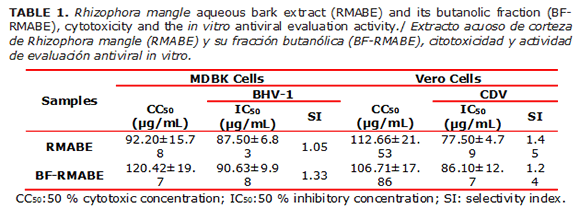
<body><![CDATA[<p align="justify"><font face="verdana" size="2"><strong>Cytotoxicity assay</strong></font></p>     <p align="justify"><font face="verdana" size="2">The cell toxicity of RMABE, BF-RMABE, ribavirin (RBV) and HPMPC (S-1-(3-hydroxy-2-phosphonylmethoxypropyl) cytosine was evaluated on the growing cell lines VERO and MDBK using a colorimetric assay based on the mitochondria metabolization of 3-(4,5-dimethylthiazol-2-yl)-2,5-diphenyltetrazolium bromide (MTT) (Sigma, Missouri). The toxicity of the compounds and DMSO used to dissolve them was measured as previously described by Scagliarini <em>et al. </em>(29). The 50 % cytotoxic concentration (CC<sub>50</sub>) was defined as the compound concentration able to reduce the number of viable cells to 50 % of cell control. The CC50 values were expressed as the mean &plusmn; the standard deviation of at least three independent experiments.</font></p>     <p align="justify"><font face="verdana" size="2"><strong>Antiviral assays</strong></font></p>     <p align="justify"><font face="verdana" size="2">The intracellular activity of the plant extracts and positive controls 1-&beta;-D-Ribofuranosyl-1,2,4-triazole-3-carboxamide (Ribavirin, RBV) and (S)-1-(3-Hydroxy-2-phosphonylmethoxypropyl) cytosine (HPMPC, Cidofovir, Vistide) against animal viruses was evaluated by the cytopathic effect (CPE) reduction assay (CPE-reduction assay) on confluent cells, using the protocol previously described by Scagliarini <em>et al</em>. (<a href="#r">29</a>).</font></p>     <p align="justify"><font face="verdana" size="2"><strong>Statistical analysis</strong></font></p>     <p align="justify"><font face="verdana" size="2">The selectivity index (SI) was obtained by calculating the calculating the ratio between the cytotoxicity and the antiviral activity values.</font></p>     <p align="justify"><font face="verdana" size="2">The 50 % inhibitory concentration (IC<sub>50</sub>), defined as the compound concentration required to reduce viral CPE by 50 % of the virus control, was calculated as the mean of three independent experiments &plusmn; the standard deviation.</font></p>     <p align="justify">&nbsp;</p>     <p align="justify"><font face="verdana" size="3"><strong>RESULTS AND DISCUSSION</strong></font></p>     <p align="justify"><font face="verdana" size="2">The cytotoxicity assays allowed determining the cytotoxic concentration (CC50) of RMABE and BF-RMABE in Vero and MDBK cells (<a href="#t1">Table 1</a>). The cytotoxicity assessment is clearly an important part of a potential antiviral agent evaluation because a useful compound should be selective for virus-specific processes with no or few effects on cellular metabolism and not showing toxicity against the host (<a href="#r">30,31</a>).Additionally, this step is critical because the virus uses the cell machinery to replicate, and it must be ensured that the virus has the ideal conditions for growth (<a href="#r">32</a>).</font></p>     ]]></body>
<body><![CDATA[<p align="center"><a name="t1" id="t1"></a></p>     <p align="center"><img src="/img/revistas/rsa/v40n1/t0102118.gif" alt="TABLE 1. Rhizophora mangle aqueous bark extract (RMABE) and its butanolic fraction (BF-RMABE), cytotoxicity and the in vitro antiviral evaluation activity./ Extracto acuoso de corteza de Rhizophora mangle (RMABE) y su fracci&oacute;n butan&oacute;lica (BF-RMABE), citotoxicidad y actividad de evaluaci&oacute;n antiviral in vitro." width="580" height="214" longdesc="/img/revistas/rsa/v40n1/t0102118.gif" /></p>     
<p align="justify"><font face="verdana" size="2">The present results showed relatively low CC<sub>50</sub> values for RMABE and BF-RMABE in Vero and MDBK cells compared to the control compounds HPMPC and RBV. These results are in accordance with previous results obtained with <em>Sesbania virgata</em> extracts showing CC<sub>50</sub> values between (3.91 and 250 &mu;g/mL) and (15.62 y 125 &mu;g/mL) for MDBK and Vero cells respectively. The polar nature of the active ingredient(s) in the antiviral activity of this plant was suggested (<a href="#r">33</a>).</font></p>     <p align="justify"><font face="verdana" size="2">Ruibal <em>et al</em>. (<a href="#r">34</a>) found high cytotoxicity for different polyphenolic fractions obtained from <em>Pinus caribaea </em>Morelet var. caribaea in MT4 cells. Fractions containing condensed tannins showed CC<sub>50</sub> = 100 &mu;g/mL; while low molecular weight phenolics were highly toxic to the cells. In this sense, it was previously demonstrated that the presence of hydroxyl groups is associated to the increment of intracellular reactive oxygen species (ROS), with consequences in the damage of the cells, although the relationship among compounds with similar structures and cytotoxicity is still unknown for particular types of cells (<a href="#r">35</a>).</font></p>     <p align="justify"><font face="verdana" size="2">Therefore, a <em>Phyllanthus orbicularis </em>extract was evaluated using MTT assay and cytotoxicity was determined for MDBK, FPH, HeLa and HEp-2 cells, showing CC<sub>50</sub> values of 262.05&plusmn;12.7, 669&plusmn;36, 212.62&plusmn;8.37 and 144.7&plusmn;3.7 &mu;g/mL, respectively (<a href="#r">36</a>).</font></p>     <p align="justify"><font face="verdana" size="2">However, compounds containing hydroxyl groups can interact with iron, copper and other metals usually present in culture media and fetal bovine sera, intensifying MTT reduction and increasing blue coloration. Some compounds can react with iron, generating blue-black complexes thatmay influence the cytotoxicity estimation through MTT assay (<a href="#r">30</a>).</font></p>     <p align="justify"><font face="verdana" size="2">The results obtained in the <em>in vitro </em>antiviral assay are shown in <a href="#t1">Table 1</a>.</font></p>     <p align="justify"><font face="verdana" size="2">Thus, current results showed antiviral activity of RMABE and BF-RMABE against BHV-1 and CDV in MDBK and Vero cells, respectively. Nevertheless, these preliminary results did not show differences between both types of viruses and IC<sub>50</sub> values were found between 83.30 and 90.63&mu;g/mL. To screen the antiviral activity of plant extracts, it is important to choose animal viruses containing the main differentiating features of viral morphology, like viruses with no envelope, those with an envelope, as well RNA and DNA viruses (<a href="#r">32</a>). In the current work, a prototype DNA virus (BHV-1) and an RNA virus, both enveloped, were used. This caused severe animal diseases. Particularly, CDV which is a Morbillivirus, is identified as an attractive target in the development of antiviral molecules, because human and animal tissues lack of a known homologue of the RNA-dependent RNA polymerase (<a href="#r">33</a>).</font></p>     <p align="justify"><font face="verdana" size="2">The current experiment also suggested that the evaluated extracts could affect viruses of the same genus or families, as well viruses with same genetic material. In fact, the topical application of <em>Rhizophora mangle</em> aqueous bark extracts RMABE and BF-RMABE in the treatment of contagious ecthyma in lambs experimentally infected with Orf virus (<em>Poxviridae </em>family), shows efficacy at the initial state of the infection (<a href="#r">28</a>).</font></p>     <p align="justify"><font face="verdana" size="2">Chattopadhay <em>et al</em>. (<a href="#r">9</a>) well documented the antiviral activity of the plant phenolic compounds against several DNA and/or RNA viruses. Cellular surface proteins are inactivated by polyphenols; they also interfere on viral adsorption, inhibit reverse-transcriptase and viral RNA polymerase, as well as DNA and RNA replication (<a href="#r">16</a>) Besides, studies related to structures and the antiviral biological activity of plants revealed that the sites and numbers of hydroxyl groups of phenols are responsible for their antiviral activity (<a href="#r">9,15</a>).</font></p>     ]]></body>
<body><![CDATA[<p align="justify"><font face="verdana" size="2"><em>Camellia sinensis </em>(green tea), catechins, epigallocatechin gallate (EGCG) have received the most attention and they have been researched deeply in its antibacterial, antiviral, and antifungal activities. EGCG was found to prevent influenza virus infections by binding the viral hemagglutinin, thereby preventing the attachment of viral particles to the target receptor cells. The antiviral action mechanisms of EGCG vary depending on its target virus (<a href="#r">38</a>).</font></p>     <p align="justify"><font face="verdana" size="2">A valuable review about the antimicrobial effect of polyphenols including the antiviral effect, by Daglia (<a href="#r">39</a>), mentioned that the activity can be attributable to both direct actions against bacteria, virus and fungi, as well as to the suppression of microbial virulence factors. <em>Rhizophora mangle</em> L shows ability to stimulate the <em>in vitro</em> release of IL-2, and such results could indicate that the polyphenols present in the plant play an important role as immune modulator as well (<a href="#r">27</a>). Gallina <em>et al. </em>(<a href="#r">40</a>) report that proanthocyanidin A2 extracted from <em>Heasculus hyppocastanum</em> exerted <em>in vitro</em> antiviral activity against CDV with a higher SI compared to Ribavirin. The <em>in vitro</em> antiviral activity of chestnut and quebracho wood extracts against avian reovirus and metapneumovirus has also been demonstrated by Lupini <em>et al</em>. (<a href="#r">41</a>).</font></p>     <p align="justify"><font face="verdana" size="2">Thus, Ikuno <em>et al. </em>(<a href="#r">34</a>) evaluated <em>Sesbania virgata</em> leaf extracts against BHV-1 and HVS-1 in MDBK and Vero cells. The results showed that all the fractions evaluated had a promising activity in MDBK cells against BHV-1. On the contrary, just two fractions (the most polar) showed moderated active in Vero cells against both BHV-1 and SHV-1 viruses. Different cell substrates were used for each virus. In this sense, the obtained results are not conclusive.</font></p>     <p align="justify"><font face="verdana" size="2">Although the massive use of antivirals in animals may be controversial over possible resistance, there are several animal diseases caused by DNA viruses like Orf and BHV-1 among others, which induce skin or mucosal erosive lesions needed to be treated with wound healing compounds. In such cases, RMABE and BF-RMABE, according to their healing properties (<a href="#r">22</a>), would be valuable therapeutic options contributing to animal welfare during infections. This is in agreement with the efficacy observed for these compounds in lambs experimental infected with contagious ecthyma (<a href="#r">28</a>). These viruses are quite stable reducing the probability of the emergence of resistant strains.</font></p>     <p align="justify"><font face="verdana" size="2">BHV-1 produces clinical manifestations characterized by pustular vulvo vaginitis and erosive skin lesions that may be treated with the evaluated compounds taking advantage of their antiviral effect combined with the wound healing properties (<a href="#r">22</a>). In fact, some other herperviruses also induce these kinds of erosive lesions that could be resolved by the potential similar mechanisms of antiviral effect.</font></p>     <p align="justify"><font face="verdana" size="2">Another factor influencing the antiviral activity is the virus strain. Thus, Savi<em> et al</em>. (<a href="#r">30</a>) reported different antiherpetic activities for epicatechin, epigaliocatechin and epigaliocatechin gallate against KOS and 29R/acyclovir resistant strains. Epicatechin showed the major activity.</font></p>     <p align="justify"><font face="verdana" size="2">Date and Destache (<a href="#r">42</a>) published data from various <em>in vitro</em> and <em>in vivo</em> studies carried out on epigallocatechin gallate, theaflavins (black tea polyphenols), resveratrol, genistein, and curcumin, highlighting their potential to prevent sexually transmitted infections caused by HIV (human immunodeficiency virus), HSV (herpes simplex virus) and HPV (human papilloma virus), confirming the potential of natural products as antiviral agents.</font></p>     <p align="justify"><font face="verdana" size="2">Moreover, the time and the moment for the plant extract sample application determine the intracellular or extracellular action. If the sample is not evaluated in an assay that is suitable for determining its mechanism of action, negative false results can be obtained and its antiviral potential could be limited. The present study evaluated RMABE and BF-RMABE against BHV-1 and CDV through an intracellular mechanism, inhibiting viral replication. This is an important issue because the severity of viral diseases and the ability of viruses to survive intracellularly pose a great challenge that is further aggravated by the non-availability of specific antiviral agents against veterinary pathogens (<a href="#r">32</a>). Other factors such as treatment time and infective viral doses could also influence the antiviral activity.</font></p>     <p align="justify"><font face="verdana" size="2">Besides, an intrinsic constituent of the antiviral testing is the determination of a selectivity index (SI) towards the supporting host cell. The SI refers to the ratio of the maximum drug concentration causing either 50 % or 90 % growth inhibition of normal cells (CC<sub>50</sub>, CC<sub>90</sub>) and the minimum drug concentration at which 50 % or 90 % of the virus is inhibited (IC<sub>50</sub>, IC<sub>90</sub>) (43).</font></p>     <p align="justify"><font face="verdana" size="2">The present results showed low SI values for RMABE and BF-RMABE compared to the chemical compounds tested for the antiviral activity against CDV (<a href="#r">43</a>). Ribavirin in Vero cells is active against CDV with a time-dependent antiviral activity. However, Ribavirin is approved for use in human, with an SI (1.2) in part justified due to its cytostatic activity (<a href="#r">29</a>). The antiviral and toxic effects are not necessarily caused by the same mix components in crude extracts; that is why SI is not as valued as when it is calculated for the pure or synthetic compounds.</font></p>     ]]></body>
<body><![CDATA[<p align="justify">&nbsp;</p>     <p align="justify"><font face="verdana" size="3"><strong><a name="r" id="r"></a>REFERENCES</strong></font></p>     <!-- ref --><p align="justify"><font face="verdana" size="2">1. Armend&aacute;riz-Barrag&aacute;n B, Zafar N, Badri W, Galindo-Rodr&iacute;guez S, Kabbaj D, Fessi H, Elaissari A. Plant extracts: from encapsulation to application. Expert Opin Drug Deliv. 2016; May 17:1-11.    </font></p>     <!-- ref --><p align="justify"><font face="verdana" size="2">2. Garro HA1, Pungitore CR. Coumarins as Potential Inhibitors of DNA Polymerases and Reverse Transcriptases. Searching New Antiretroviral and Antitumoral Drugs. Curr Drug Discov Technol. 2015;12(2):66-79.    </font></p>     <!-- ref --><p align="justify"><font face="verdana" size="2">3. Ekambaram SP, Perumal SS, Balakrishnan A. Scope of Hydrolysable Tannins as Possible Antimicrobial Agent. Phytother Res. 2016 Jul; 30(7):1035-45. doi: 10.1002/ptr.5616. Epub 2016 Apr 7.    </font></p>     <!-- ref --><p align="justify"><font face="verdana" size="2">4. Keerthi M, Lashkmi PJ, Santhosh A M, Rama RM. Review on Polyphenols as nature gift. World Journal of Pharmacy and Pharmaceutical Sciences. Review article. 2014;3(4): 445-455.    </font></p>     ]]></body>
<body><![CDATA[<!-- ref --><p align="justify"><font face="verdana" size="2">5. Zhang YB, Wu P, Zhang XL, Xia C, Li GQ, Ye WC, Wang GC, Li YL. Phenolic Compounds from the Flowers of <em>Bombax malabaricum</em> and Their Antioxidant and Antiviral Activities. Molecules. 2015;20(11):19947-19957.    </font></p>     <!-- ref --><p align="justify"><font face="verdana" size="2">6. Al-Fatimi M, Ali NA, Kilian N, Franke K, Arnold N, Kuhnt C, Schmidt J, Lindequist U. Ethnobotany, chemical constituents and biological activities of the flowers of <em>Hydnora abyssinica</em> A.Br. (Hydnoraceae). Pharmazie. 2016;71(4):222-226.    </font></p>     <!-- ref --><p align="justify"><font face="verdana" size="2">7. El-Ashmawy IM, Al-Wabel NA, Bayad AE. <em>Achillea fragrantissima</em>, rich in flavonoids and tannins, potentiates the activity of diminazine aceturate against <em>Trypanosoma evansi</em> in rats. Asian Pac J Trop Med. 2016;9(3):228-234.    </font></p>     <!-- ref --><p align="justify"><font face="verdana" size="2">8. Weidner S, Rybarczyk A, Karamac M, Kr&oacute;l A, Mostek A, Grebosz J, Amarowicz R. Differences in the phenolic composition and antioxidant properties between <em>Vitis coignetiae</em> and <em>Vitis vinifera</em> seeds extracts. Molecules. 2013;18(3):3410-26.    </font></p>     <!-- ref --><p align="justify"><font face="verdana" size="2">9. Chattopadhay D, Arunachalam G, Mandal AB, Bhatachary SK. Dose dependent therapeutic anti-infectives from ethnomedicines of Bay Islands. Chemotherapy. 2006;52:151-157.    </font></p>     ]]></body>
<body><![CDATA[<!-- ref --><p align="justify"><font face="verdana" size="2">10. Bhanuprakash V, Hosamani M, Balamurugan V, Granhale P, Singh RK, Swarup D. In vitro Antiviral Activity of Eugenia Jambolana Plant Extract of Buffalopox virus: Conventional and q PCR Methods. Intern J Trop Med. 2007; 2(1):3-9.    </font></p>     <!-- ref --><p align="justify"><font face="verdana" size="2">11. Elsebai MF, Abass K, Hakkola J, Atawia AR, Farag MA. The wild Egyptian artichoke as a promising functional food for the treatment of hepatitis C virus as revealed via UPLC-MS and clinical trials. Food Funct. 2016;7(7):3006-3016.    </font></p>     <!-- ref --><p align="justify"><font face="verdana" size="2">12. Gamaleldin KM, Matei MF, Jaiswal R, Illenberger S, Kuhnert N. Neuraminidase inhibition of Dietary chlorogenic acids and derivatives - potential antivirals from dietary sources. Food Funct. 2016;7(4):2052-2059.    </font></p>     <!-- ref --><p align="justify"><font face="verdana" size="2">13. Espada SF, Faccin-Galhardi LC, Rincao VP, Bernardi AL, Lopes N, Longhini R, de Mello JC, Linhares RE, Nozawa. Antiviral Activity of Trichiliacatigua Bark Extracts for Herpesvirus and Poliovirus. Curr Pharm Biotechnol. 2015;16(8):724-732.    </font></p>     <!-- ref --><p align="justify"><font face="verdana" size="2">14. Kurokawa M, Hosumi T, Basnet P, Nakano M, Kadota S, Namba T, Kawana T, Shiraki K. Purification and characterization of eugenin as an antiherpesvirus compound from <em>Geum japonicum</em> and <em>Syzygiuma romaticum</em>. J. Pharmacol. Exp. Ther. 1998; 284(2):728-735.    </font></p>     ]]></body>
<body><![CDATA[<!-- ref --><p align="justify"><font face="verdana" size="2">15. Vanden Berghe DA, Vlietinck AJ, Vanhoof L. Plants products as potential antiviral agents. Bull Inst Pasteur. 1986; 84:101-147.    </font></p>     <!-- ref --><p align="justify"><font face="verdana" size="2">16. Jassim SA y Naji MA. Novel antiviral agents: a medicinal plant perspective. J Appl Microbiol. 2003;95:412-427.    </font></p>     <!-- ref --><p align="justify"><font face="verdana" size="2">17. Steinmann J, Buer J, Pietschmann T, Steinmann E. Anti-infective properties of epigallocatechin-3-gallate (EGCG), a component of green tea. Br J Pharmacol. 2013;168 (5):1059-73. doi: 10.1111/bph.12009.    </font></p>     <!-- ref --><p align="justify"><font face="verdana" size="2">18. Shoji M, Arakaki Y, Esumi T, Kohnomi S, Yamamoto C, Suzuki Y, Takahashi E, Konishi S, Kido H5, Kuzuhara T. Bakuchiol Is a Phenolic Isoprenoid with Novel Enantiomer-selective Anti-influenza A Virus Activity Involving Nrf2 Activation. J Biol Chem. 2015290(46):28001-28017.    </font></p>     <!-- ref --><p align="justify"><font face="verdana" size="2">19. Roig JT. Plantas medicinales, arom&aacute;ticas o venenosas de Cuba. La Habana: Ed. Ciencia y T&eacute;cnica. 1974.    </font></p>     ]]></body>
<body><![CDATA[<!-- ref --><p align="justify"><font face="verdana" size="2">20. S&aacute;nchez LM, Melchor G, Alvarez S, Bulnes C. Caracterizaci&oacute;n qu&iacute;mica y toxicol&oacute;gica de una formulaci&oacute;n cicatrizante de <em>Rhizophora mangle</em> L. Rev. Salud Anim. 1998;20(2):69-72.    </font></p>     <!-- ref --><p align="justify"><font face="verdana" size="2">21. Melchor G, Armenteros M, Fern&aacute;ndez O, Linares E, Fragas I<em>.</em> Antibacterial activity of <em>Rhizophora mangle </em>bark. Fitoterapia. 2001; 72:698-691.    </font></p>     <!-- ref --><p align="justify"><font face="verdana" size="2">22. Fern&aacute;ndez O, Capdevila JZ, Dalla G, Melchor G. Efficacy of <em>Rhizophora mangle</em> aqueous bark extract in the healing of open surgical wounds. Fitoterapia. 2002;73:564-568.    </font></p>     <!-- ref --><p align="justify"><font face="verdana" size="2">23. Marrero E, S&aacute;nchez J, de Armas E, Escobar A, Melchor G, Abad MJ, <em>et al</em>. COX-2 and sPLA2 in vitro inhibitory activity from aqueous extract and high and low molecular weight polyphenols fractions obtained from <em>Rhizophora mangle</em> (red mangrove). Fitoterapia. 2005;77: 313-315.    </font></p>     <!-- ref --><p align="justify"><font face="verdana" size="2">24. de Armas E, Sarracent Y, Marrero E, Fern&aacute;ndez O, Branford-White C. Efficacy of <em>Rhizophora mangle</em> queous bark extract (RMABE) in the treatment of aphthous ulcers: a pilot study. Curr Med Res Opin. 2005; 21(11):1711-1715.    </font></p>     ]]></body>
<body><![CDATA[<!-- ref --><p align="justify"><font face="verdana" size="2">25. S&aacute;nchez J, Melchor G, Martinez G, Escobar A, Faure R. Antioxidant activity of Rhizophora mangle bark. Fitoterapia. 2016; 77:141-143.    </font></p>     <!-- ref --><p align="justify"><font face="verdana" size="2">26. Perera LMS, Piloto J, Canelsota D, Pelzer L, Mancebo B. Further Pharmacological Evidence Supporting the Development of an Antiulcerogenic Drug Based on <em>Rhizophora mangle</em> L. Aqueous Extract. HPLC Method Proposed for Determinating a Chemical Marker. Open Access Library Journal. 2016;3:e1625http//dx.doi.org/10.4236/oalib.1101625.    </font></p>     <!-- ref --><p align="justify"><font face="verdana" size="2">27. de Armas E, Escobar A, Faure R, Marrero E, Bligh ASW, Branford-White CJ, White KN. Stimulation of Interleukin-2 [IL] Release by <em>Rhizophora mangle</em> Bark Aqueous Extracts and its Fractions. European Journal of Medicinal Plants. 2016;15(2):1-10.    </font></p>     <!-- ref --><p align="justify"><font face="verdana" size="2">28. de Armas Sanabria E, Oliva Hern&aacute;ndez Y, P&eacute;rez Hern&aacute;ndez Z, Ayala Galindo J, Mart&iacute;nez Marrero N, Fern&aacute;ndez Limia O, Faure Garc&iacute;a R, Barreras M, Alfonso Zamora P, Marrero Faz E. Extracto acuoso de la corteza de Rhizophora mangle (RMABE) en un modelo de ectima contagioso en carneros infectados experimentalmente. REDVET Rev. Electr&oacute;n Vet. 2012;13(6). <a href="http://www.veterinaria.org/revistas/redvet/n060612.html" target="_blank">http://www.veterinaria.org/revistas/redvet/n060612.html</a></font><!-- ref --><p align="justify"><font face="verdana" size="2">29. Scaglarini A, Vaccari F, Gallina L, Dal Pozzo F, Prosperi S. <em>In Vitro</em> Evaluation of Antiviral activity of Ribavirin against Canine Distemper Virus. Vet Res Communicat. 2006;30(1): 269-272.    </font></p>     <!-- ref --><p align="justify"><font face="verdana" size="2">30. Savi AL, Barardi RC, Simoes MOC, Evaluation of antiherpetic activity and genotoxic effects of Tea Catechin derivatives. J Agric Food Chem. 2006;54(7):2552-2557.    </font></p>     <!-- ref --><p align="justify"><font face="verdana" size="2">31. Trejo-Avila LM, Morales-Mart&iacute;nez ME, Ricque-Marie D, Cruz-Suarez E, Zapata-Benavides P, Mor&aacute;n-Santiba&ntilde;ez K, <em>et al</em>. In vitro anti-canine distemper virus activity of fucoidan extracted from the brown alga <em>Cladosiphono kamuranus</em>. Virus Dis. 2014;25(4):474-480. DOI 10.1007/s13337-014-0228-6.    </font></p>     <!-- ref --><p align="justify"><font face="verdana" size="2">32. Kohn LK, Queiroga CL, Martini MC, Barata LE, Porto PSS, Souza L, <em>et al</em>. <em>In </em><em>vitro</em> antiviral activity of Brazilian plants (<em>Maytenus ilicifolia</em> and <em>Aniba rosaeodora</em>) against bovine herpesvirus type 5 and avian metapneumovirus. Pharmaceutical Biol. 2012;50(10): 1269-1275.    </font></p>     <!-- ref --><p align="justify"><font face="verdana" size="2">33. Bourhis JM, Canard B, Longhi S. Structural disorder within the replicative complex of measles virus: functional implications. Virol. 2006;344:94-110.    </font></p>     <!-- ref --><p align="justify"><font face="verdana" size="2">34. Ikuno A. Antiherpes activities of fractions from <em>Sesbania virgate </em>leave Arq. Inst. Biol. S&atilde;o Paulo. 2003;70(2):183-185.    </font></p>     <!-- ref --><p align="justify"><font face="verdana" size="2">35. Ruibal IJB, Dubed ME, Mart&iacute;nez FL, Noa ER, Vargas LMG, Santana JLR. Inhibici&oacute;n de la replicaci&oacute;n del VIH por extractos de taninos de <em>Pinus caribaea</em> Morelet. Rev Cubana de Farmacia. 2003;37(2):1-7.    </font></p>     <!-- ref --><p align="justify"><font face="verdana" size="2">36. Matsuo M, Sasaki N, Saga K, Kaneko T. Cytotoxicity of flavonoids toward culture normal human cells. Biol Pharm Bull. 2005;28:253-259.    </font></p>     <!-- ref --><p align="justify"><font face="verdana" size="2">37. del Barrio G. 1999. Actividad antiviral in vitro del extracto acuoso de <em>Phyllanthus orbicularis</em>, HBK. [Tesis presentada en opci&oacute;n al grado de Doctor en Ciencias Biol&oacute;gicas] Ciudad de la Habana.    </font></p>     <!-- ref --><p align="justify"><font face="verdana" size="2">38. Nakayama M, Suzuki K, Toda M, Okubo S, Hara Y, Shimamura T. Inhibition of infectivity of influenza virus by tea polyphenols. Antiviral Res 1993, 21:289-299.    </font></p>     <!-- ref --><p align="justify"><font face="verdana" size="2">39. Daglia M. Polyphenols as antimicrobial agents. Current Opinion in Biotechnology. 2012; 23:174-181.    </font></p>     <!-- ref --><p align="justify"><font face="verdana" size="2">40. Gallina L, Dal Pozzo F, Galligioni V, Bombardelli E, Scagliarini A. Inhibition of viral RNA synthesis in canine distemper virus infection by proanthocyanidin A2. Antiviral Research. 2011;92(3):447-452.    </font></p>     <!-- ref --><p align="justify"><font face="verdana" size="2">41. Lupini C, Cecchinato M, Scagliarini A, Graziani R, Catelli E. In vitro antiviral activity of chestnut and quebracho woods extracts against avian reovirus and metapneumovirus. Res Vet Sci. 2009;87(3):482-487.    </font></p>     <!-- ref --><p align="justify"><font face="verdana" size="2">42. Date AA, Destache CJ. Natural polyphenols: potential in the prevention of sexually transmitted viral infections. Drug Discov Today. 2016;21(2):333-341.    </font></p>     <!-- ref --><p align="justify"><font face="verdana" size="2">43. Cos P, Vlietinck AJ, Berghe DV, Maes L. Anti-infective potential of products: How to develop a stronger <em>in vitro</em> prop-of-concept. J Ethnopharmacol. 2006;106:290-302.    </font></p>     <!-- ref --><p align="justify"><font face="verdana" size="2">44. Dal Pozzo F, Galligioni V, Vaccari F, Gallina L, Battilani M, Scagliarini A. Antiviral efficacy of EICAR against canine distemper virus (CDV) <em>in vitro</em>. Res Vet Sci. 2010;88:339-344.    </font></p>      <p align="justify">&nbsp;</p>     ]]></body>
<body><![CDATA[<p align="justify">&nbsp;</p>     <p align="justify"><font face="verdana" size="2">Recibido: 10/11/2017</font></p>     <p align="justify"><font face="verdana" size="2">Aceptado: 10/1/2018</font></p>     <p align="justify">&nbsp;</p>     <p align="justify">&nbsp;</p>     <p align="justify"><font face="verdana" size="2"><a title="" href="#_ftnref1" name="_ftn1">*</a>Autor para correspondencia: <em>Evangelina Marrero-Faz</em>. E-mail: <a href="mailto:evangelinamarrerofaz@gmail.com">evangelinamarrerofaz@gmail.com</a></font></p>       ]]></body><back>
<ref-list>
<ref id="B1">
<label>1</label><nlm-citation citation-type="journal">
<person-group person-group-type="author">
<name>
<surname><![CDATA[Armendáriz-Barragán]]></surname>
<given-names><![CDATA[B]]></given-names>
</name>
<name>
<surname><![CDATA[Zafar]]></surname>
<given-names><![CDATA[N]]></given-names>
</name>
<name>
<surname><![CDATA[Badri]]></surname>
<given-names><![CDATA[W]]></given-names>
</name>
<name>
<surname><![CDATA[Galindo-Rodríguez]]></surname>
<given-names><![CDATA[S]]></given-names>
</name>
<name>
<surname><![CDATA[Kabbaj]]></surname>
<given-names><![CDATA[D]]></given-names>
</name>
<name>
<surname><![CDATA[Fessi]]></surname>
<given-names><![CDATA[H]]></given-names>
</name>
<name>
<surname><![CDATA[Elaissari]]></surname>
<given-names><![CDATA[A]]></given-names>
</name>
</person-group>
<article-title xml:lang="en"><![CDATA[Plant extracts: from encapsulation to application]]></article-title>
<source><![CDATA[Expert Opin Drug Deliv]]></source>
<year>2016</year>
<volume>17</volume>
<page-range>1-11</page-range></nlm-citation>
</ref>
<ref id="B2">
<label>2</label><nlm-citation citation-type="journal">
<collab>Garro HA1.Pungitore CR</collab>
<article-title xml:lang="en"><![CDATA[Coumarins as Potential Inhibitors of DNA Polymerases and Reverse Transcriptases: Searching New Antiretroviral and Antitumoral Drugs]]></article-title>
<source><![CDATA[Curr Drug Discov Technol]]></source>
<year>2015</year>
<volume>12</volume>
<numero>2</numero>
<issue>2</issue>
<page-range>66-79</page-range></nlm-citation>
</ref>
<ref id="B3">
<label>3</label><nlm-citation citation-type="journal">
<person-group person-group-type="author">
<name>
<surname><![CDATA[Ekambaram]]></surname>
<given-names><![CDATA[SP]]></given-names>
</name>
<name>
<surname><![CDATA[Perumal]]></surname>
<given-names><![CDATA[SS]]></given-names>
</name>
<name>
<surname><![CDATA[Balakrishnan]]></surname>
<given-names><![CDATA[A]]></given-names>
</name>
</person-group>
<article-title xml:lang="en"><![CDATA[Scope of Hydrolysable Tannins as Possible Antimicrobial Agent]]></article-title>
<source><![CDATA[Phytother Res]]></source>
<year>2016</year>
<month>07</month>
<volume>30</volume>
<numero>7</numero>
<issue>7</issue>
<page-range>1035-45</page-range></nlm-citation>
</ref>
<ref id="B4">
<label>4</label><nlm-citation citation-type="journal">
<person-group person-group-type="author">
<name>
<surname><![CDATA[Keerthi]]></surname>
<given-names><![CDATA[M]]></given-names>
</name>
<name>
<surname><![CDATA[Lashkmi]]></surname>
<given-names><![CDATA[PJ]]></given-names>
</name>
<name>
<surname><![CDATA[Santhosh A]]></surname>
<given-names><![CDATA[M]]></given-names>
</name>
<name>
<surname><![CDATA[Rama]]></surname>
<given-names><![CDATA[RM]]></given-names>
</name>
</person-group>
<article-title xml:lang="en"><![CDATA[Review on Polyphenols as nature gift]]></article-title>
<source><![CDATA[World Journal of Pharmacy and Pharmaceutical Sciences]]></source>
<year>2014</year>
<volume>3</volume>
<numero>4</numero>
<issue>4</issue>
<page-range>445-455</page-range></nlm-citation>
</ref>
<ref id="B5">
<label>5</label><nlm-citation citation-type="journal">
<person-group person-group-type="author">
<name>
<surname><![CDATA[Zhang]]></surname>
<given-names><![CDATA[YB]]></given-names>
</name>
<name>
<surname><![CDATA[Wu]]></surname>
<given-names><![CDATA[P]]></given-names>
</name>
<name>
<surname><![CDATA[Zhang]]></surname>
<given-names><![CDATA[XL]]></given-names>
</name>
<name>
<surname><![CDATA[Xia]]></surname>
<given-names><![CDATA[C]]></given-names>
</name>
<name>
<surname><![CDATA[Li]]></surname>
<given-names><![CDATA[GQ]]></given-names>
</name>
<name>
<surname><![CDATA[Ye]]></surname>
<given-names><![CDATA[WC]]></given-names>
</name>
<name>
<surname><![CDATA[Wang]]></surname>
<given-names><![CDATA[GC]]></given-names>
</name>
<name>
<surname><![CDATA[Li]]></surname>
<given-names><![CDATA[YL]]></given-names>
</name>
</person-group>
<article-title xml:lang="en"><![CDATA[Phenolic Compounds from the Flowers of Bombax malabaricum and Their Antioxidant and Antiviral Activities]]></article-title>
<source><![CDATA[Molecules]]></source>
<year>2015</year>
<volume>20</volume>
<numero>11</numero>
<issue>11</issue>
<page-range>19947-19957</page-range></nlm-citation>
</ref>
<ref id="B6">
<label>6</label><nlm-citation citation-type="journal">
<person-group person-group-type="author">
<name>
<surname><![CDATA[Al-Fatimi]]></surname>
<given-names><![CDATA[M]]></given-names>
</name>
<name>
<surname><![CDATA[Ali]]></surname>
<given-names><![CDATA[NA]]></given-names>
</name>
<name>
<surname><![CDATA[Kilian]]></surname>
<given-names><![CDATA[N]]></given-names>
</name>
<name>
<surname><![CDATA[Franke]]></surname>
<given-names><![CDATA[K]]></given-names>
</name>
<name>
<surname><![CDATA[Arnold]]></surname>
<given-names><![CDATA[N]]></given-names>
</name>
<name>
<surname><![CDATA[Kuhnt]]></surname>
<given-names><![CDATA[C]]></given-names>
</name>
<name>
<surname><![CDATA[Schmidt]]></surname>
<given-names><![CDATA[J]]></given-names>
</name>
<name>
<surname><![CDATA[Lindequist]]></surname>
<given-names><![CDATA[U]]></given-names>
</name>
</person-group>
<article-title xml:lang="en"><![CDATA[Ethnobotany, chemical constituents and biological activities of the flowers of Hydnora abyssinica A.Br. (Hydnoraceae)]]></article-title>
<source><![CDATA[Pharmazie]]></source>
<year>2016</year>
<volume>71</volume>
<numero>4</numero>
<issue>4</issue>
<page-range>222-226</page-range></nlm-citation>
</ref>
<ref id="B7">
<label>7</label><nlm-citation citation-type="journal">
<person-group person-group-type="author">
<name>
<surname><![CDATA[El-Ashmawy]]></surname>
<given-names><![CDATA[IM]]></given-names>
</name>
<name>
<surname><![CDATA[Al-Wabel]]></surname>
<given-names><![CDATA[NA]]></given-names>
</name>
<name>
<surname><![CDATA[Bayad]]></surname>
<given-names><![CDATA[AE]]></given-names>
</name>
</person-group>
<article-title xml:lang="en"><![CDATA[Achillea fragrantissima, rich in flavonoids and tannins, potentiates the activity of diminazine aceturate against Trypanosoma evansi in rats]]></article-title>
<source><![CDATA[Asian Pac J Trop Med]]></source>
<year>2016</year>
<volume>9</volume>
<numero>3</numero>
<issue>3</issue>
<page-range>228-234</page-range></nlm-citation>
</ref>
<ref id="B8">
<label>8</label><nlm-citation citation-type="journal">
<person-group person-group-type="author">
<name>
<surname><![CDATA[Weidner]]></surname>
<given-names><![CDATA[S]]></given-names>
</name>
<name>
<surname><![CDATA[Rybarczyk]]></surname>
<given-names><![CDATA[A]]></given-names>
</name>
<name>
<surname><![CDATA[Karamac]]></surname>
<given-names><![CDATA[M]]></given-names>
</name>
<name>
<surname><![CDATA[Król]]></surname>
<given-names><![CDATA[A]]></given-names>
</name>
<name>
<surname><![CDATA[Mostek]]></surname>
<given-names><![CDATA[A]]></given-names>
</name>
<name>
<surname><![CDATA[Grebosz]]></surname>
<given-names><![CDATA[J]]></given-names>
</name>
<name>
<surname><![CDATA[Amarowicz]]></surname>
<given-names><![CDATA[R]]></given-names>
</name>
</person-group>
<article-title xml:lang="en"><![CDATA[Differences in the phenolic composition and antioxidant properties between Vitis coignetiae and Vitis vinifera seeds extracts]]></article-title>
<source><![CDATA[Molecules]]></source>
<year>2013</year>
<volume>18</volume>
<numero>3</numero>
<issue>3</issue>
<page-range>3410-26</page-range></nlm-citation>
</ref>
<ref id="B9">
<label>9</label><nlm-citation citation-type="journal">
<person-group person-group-type="author">
<name>
<surname><![CDATA[Chattopadhay]]></surname>
<given-names><![CDATA[D]]></given-names>
</name>
<name>
<surname><![CDATA[Arunachalam]]></surname>
<given-names><![CDATA[G]]></given-names>
</name>
<name>
<surname><![CDATA[Mandal]]></surname>
<given-names><![CDATA[AB]]></given-names>
</name>
<name>
<surname><![CDATA[Bhatachary]]></surname>
<given-names><![CDATA[SK]]></given-names>
</name>
</person-group>
<article-title xml:lang="en"><![CDATA[Dose dependent therapeutic anti-infectives from ethnomedicines of Bay Islands]]></article-title>
<source><![CDATA[Chemotherapy]]></source>
<year>2006</year>
<volume>52</volume>
<page-range>151-157</page-range></nlm-citation>
</ref>
<ref id="B10">
<label>10</label><nlm-citation citation-type="journal">
<person-group person-group-type="author">
<name>
<surname><![CDATA[Bhanuprakash]]></surname>
<given-names><![CDATA[V]]></given-names>
</name>
<name>
<surname><![CDATA[Hosamani]]></surname>
<given-names><![CDATA[M]]></given-names>
</name>
<name>
<surname><![CDATA[Balamurugan]]></surname>
<given-names><![CDATA[V]]></given-names>
</name>
<name>
<surname><![CDATA[Granhale]]></surname>
<given-names><![CDATA[P]]></given-names>
</name>
<name>
<surname><![CDATA[Singh]]></surname>
<given-names><![CDATA[RK]]></given-names>
</name>
<name>
<surname><![CDATA[Swarup]]></surname>
<given-names><![CDATA[D]]></given-names>
</name>
</person-group>
<article-title xml:lang="en"><![CDATA[In vitro Antiviral Activity of Eugenia Jambolana Plant Extract of Buffalopox virus: Conventional and q PCR Methods]]></article-title>
<source><![CDATA[Intern J Trop Med]]></source>
<year>2007</year>
<volume>2</volume>
<numero>1</numero>
<issue>1</issue>
<page-range>3-9</page-range></nlm-citation>
</ref>
<ref id="B11">
<label>11</label><nlm-citation citation-type="journal">
<person-group person-group-type="author">
<name>
<surname><![CDATA[Elsebai]]></surname>
<given-names><![CDATA[MF]]></given-names>
</name>
<name>
<surname><![CDATA[Abass]]></surname>
<given-names><![CDATA[K]]></given-names>
</name>
<name>
<surname><![CDATA[Hakkola]]></surname>
<given-names><![CDATA[J]]></given-names>
</name>
<name>
<surname><![CDATA[Atawia]]></surname>
<given-names><![CDATA[AR]]></given-names>
</name>
<name>
<surname><![CDATA[Farag]]></surname>
<given-names><![CDATA[MA]]></given-names>
</name>
</person-group>
<article-title xml:lang="en"><![CDATA[The wild Egyptian artichoke as a promising functional food for the treatment of hepatitis C virus as revealed via UPLC-MS and clinical trials]]></article-title>
<source><![CDATA[Food Funct]]></source>
<year>2016</year>
<volume>7</volume>
<numero>7</numero>
<issue>7</issue>
<page-range>3006-3016</page-range></nlm-citation>
</ref>
<ref id="B12">
<label>12</label><nlm-citation citation-type="journal">
<person-group person-group-type="author">
<name>
<surname><![CDATA[Gamaleldin]]></surname>
<given-names><![CDATA[KM]]></given-names>
</name>
<name>
<surname><![CDATA[Matei]]></surname>
<given-names><![CDATA[MF]]></given-names>
</name>
<name>
<surname><![CDATA[Jaiswal]]></surname>
<given-names><![CDATA[R]]></given-names>
</name>
<name>
<surname><![CDATA[Illenberger]]></surname>
<given-names><![CDATA[S]]></given-names>
</name>
<name>
<surname><![CDATA[Kuhnert]]></surname>
<given-names><![CDATA[N]]></given-names>
</name>
</person-group>
<article-title xml:lang="en"><![CDATA[Neuraminidase inhibition of Dietary chlorogenic acids and derivatives - potential antivirals from dietary sources]]></article-title>
<source><![CDATA[Food Funct]]></source>
<year>2016</year>
<volume>7</volume>
<numero>4</numero>
<issue>4</issue>
<page-range>2052-2059</page-range></nlm-citation>
</ref>
<ref id="B13">
<label>13</label><nlm-citation citation-type="journal">
<person-group person-group-type="author">
<name>
<surname><![CDATA[Espada]]></surname>
<given-names><![CDATA[SF]]></given-names>
</name>
<name>
<surname><![CDATA[Faccin-Galhardi]]></surname>
<given-names><![CDATA[LC]]></given-names>
</name>
<name>
<surname><![CDATA[Rincao]]></surname>
<given-names><![CDATA[VP]]></given-names>
</name>
<name>
<surname><![CDATA[Bernardi]]></surname>
<given-names><![CDATA[AL]]></given-names>
</name>
<name>
<surname><![CDATA[Lopes]]></surname>
<given-names><![CDATA[N]]></given-names>
</name>
<name>
<surname><![CDATA[Longhini]]></surname>
<given-names><![CDATA[R]]></given-names>
</name>
<name>
<surname><![CDATA[de Mello]]></surname>
<given-names><![CDATA[JC]]></given-names>
</name>
<name>
<surname><![CDATA[Linhares]]></surname>
<given-names><![CDATA[RE]]></given-names>
</name>
<name>
<surname><![CDATA[Nozawa]]></surname>
</name>
</person-group>
<article-title xml:lang="en"><![CDATA[Antiviral Activity of Trichiliacatigua Bark Extracts for Herpesvirus and Poliovirus]]></article-title>
<source><![CDATA[Curr Pharm Biotechnol]]></source>
<year>2015</year>
<volume>16</volume>
<numero>8</numero>
<issue>8</issue>
<page-range>724-732</page-range></nlm-citation>
</ref>
<ref id="B14">
<label>14</label><nlm-citation citation-type="journal">
<person-group person-group-type="author">
<name>
<surname><![CDATA[Kurokawa]]></surname>
<given-names><![CDATA[M]]></given-names>
</name>
<name>
<surname><![CDATA[Hosumi]]></surname>
<given-names><![CDATA[T]]></given-names>
</name>
<name>
<surname><![CDATA[Basnet]]></surname>
<given-names><![CDATA[P]]></given-names>
</name>
<name>
<surname><![CDATA[Nakano]]></surname>
<given-names><![CDATA[M]]></given-names>
</name>
<name>
<surname><![CDATA[Kadota]]></surname>
<given-names><![CDATA[S]]></given-names>
</name>
<name>
<surname><![CDATA[Namba]]></surname>
<given-names><![CDATA[T]]></given-names>
</name>
<name>
<surname><![CDATA[Kawana]]></surname>
<given-names><![CDATA[T]]></given-names>
</name>
<name>
<surname><![CDATA[Shiraki]]></surname>
<given-names><![CDATA[K]]></given-names>
</name>
</person-group>
<article-title xml:lang="en"><![CDATA[Purification and characterization of eugenin as an antiherpesvirus compound from Geum japonicum and Syzygiuma romaticum]]></article-title>
<source><![CDATA[J. Pharmacol. Exp. Ther.]]></source>
<year>1998</year>
<volume>284</volume>
<numero>2</numero>
<issue>2</issue>
<page-range>728-735</page-range></nlm-citation>
</ref>
<ref id="B15">
<label>15</label><nlm-citation citation-type="journal">
<person-group person-group-type="author">
<name>
<surname><![CDATA[Vanden Berghe]]></surname>
<given-names><![CDATA[DA]]></given-names>
</name>
<name>
<surname><![CDATA[Vlietinck]]></surname>
<given-names><![CDATA[AJ]]></given-names>
</name>
<name>
<surname><![CDATA[Vanhoof]]></surname>
<given-names><![CDATA[L]]></given-names>
</name>
</person-group>
<article-title xml:lang="en"><![CDATA[Plants products as potential antiviral agents]]></article-title>
<source><![CDATA[Bull Inst Pasteur]]></source>
<year>1986</year>
<volume>84</volume>
<page-range>101-147</page-range></nlm-citation>
</ref>
<ref id="B16">
<label>16</label><nlm-citation citation-type="journal">
<person-group person-group-type="author">
<name>
<surname><![CDATA[Jassim]]></surname>
<given-names><![CDATA[SA]]></given-names>
</name>
<name>
<surname><![CDATA[Naji]]></surname>
<given-names><![CDATA[MA]]></given-names>
</name>
</person-group>
<article-title xml:lang="en"><![CDATA[Novel antiviral agents: a medicinal plant perspective]]></article-title>
<source><![CDATA[J Appl Microbiol]]></source>
<year>2003</year>
<volume>95</volume>
<page-range>412-427</page-range></nlm-citation>
</ref>
<ref id="B17">
<label>17</label><nlm-citation citation-type="journal">
<person-group person-group-type="author">
<name>
<surname><![CDATA[Steinmann]]></surname>
<given-names><![CDATA[J]]></given-names>
</name>
<name>
<surname><![CDATA[Buer]]></surname>
<given-names><![CDATA[J]]></given-names>
</name>
<name>
<surname><![CDATA[Pietschmann]]></surname>
<given-names><![CDATA[T]]></given-names>
</name>
<name>
<surname><![CDATA[Steinmann]]></surname>
<given-names><![CDATA[E]]></given-names>
</name>
</person-group>
<article-title xml:lang="en"><![CDATA[Anti-infective properties of epigallocatechin-3-gallate (EGCG), a component of green tea]]></article-title>
<source><![CDATA[Br J Pharmacol]]></source>
<year>2013</year>
<volume>168</volume>
<numero>5</numero>
<issue>5</issue>
<page-range>1059-73</page-range></nlm-citation>
</ref>
<ref id="B18">
<label>18</label><nlm-citation citation-type="journal">
<person-group person-group-type="author">
<name>
<surname><![CDATA[Shoji]]></surname>
<given-names><![CDATA[M]]></given-names>
</name>
<name>
<surname><![CDATA[Arakaki]]></surname>
<given-names><![CDATA[Y]]></given-names>
</name>
<name>
<surname><![CDATA[Esumi]]></surname>
<given-names><![CDATA[T]]></given-names>
</name>
<name>
<surname><![CDATA[Kohnomi]]></surname>
<given-names><![CDATA[S]]></given-names>
</name>
<name>
<surname><![CDATA[Yamamoto]]></surname>
<given-names><![CDATA[C]]></given-names>
</name>
<name>
<surname><![CDATA[Suzuki]]></surname>
<given-names><![CDATA[Y]]></given-names>
</name>
<name>
<surname><![CDATA[Takahashi]]></surname>
<given-names><![CDATA[E]]></given-names>
</name>
<name>
<surname><![CDATA[Konishi]]></surname>
<given-names><![CDATA[S]]></given-names>
</name>
<name>
<surname><![CDATA[Kido]]></surname>
<given-names><![CDATA[H5]]></given-names>
</name>
<name>
<surname><![CDATA[Kuzuhara]]></surname>
<given-names><![CDATA[T]]></given-names>
</name>
</person-group>
<article-title xml:lang="en"><![CDATA[Bakuchiol Is a Phenolic Isoprenoid with Novel Enantiomer-selective Anti-influenza A Virus Activity Involving Nrf2 Activation]]></article-title>
<source><![CDATA[J Biol Chem]]></source>
<year>2015</year>
<volume>290</volume>
<numero>46</numero>
<issue>46</issue>
<page-range>28001-28017</page-range></nlm-citation>
</ref>
<ref id="B19">
<label>19</label><nlm-citation citation-type="book">
<person-group person-group-type="author">
<name>
<surname><![CDATA[Roig]]></surname>
<given-names><![CDATA[JT]]></given-names>
</name>
</person-group>
<source><![CDATA[Plantas medicinales, aromáticas o venenosas de Cuba]]></source>
<year>1974</year>
<publisher-loc><![CDATA[^eLa Habana La Habana]]></publisher-loc>
<publisher-name><![CDATA[Ciencia y Técnica]]></publisher-name>
</nlm-citation>
</ref>
<ref id="B20">
<label>20</label><nlm-citation citation-type="journal">
<person-group person-group-type="author">
<name>
<surname><![CDATA[Sánchez]]></surname>
<given-names><![CDATA[LM]]></given-names>
</name>
<name>
<surname><![CDATA[Melchor]]></surname>
<given-names><![CDATA[G]]></given-names>
</name>
<name>
<surname><![CDATA[Alvarez]]></surname>
<given-names><![CDATA[S]]></given-names>
</name>
<name>
<surname><![CDATA[Bulnes]]></surname>
<given-names><![CDATA[C]]></given-names>
</name>
</person-group>
<article-title xml:lang="pt"><![CDATA[Caracterización química y toxicológica de una formulación cicatrizante de Rhizophora mangle L.]]></article-title>
<source><![CDATA[Rev. Salud Anim]]></source>
<year>1998</year>
<volume>20</volume>
<numero>2</numero>
<issue>2</issue>
<page-range>69-72</page-range></nlm-citation>
</ref>
<ref id="B21">
<label>21</label><nlm-citation citation-type="journal">
<person-group person-group-type="author">
<name>
<surname><![CDATA[Melchor]]></surname>
<given-names><![CDATA[G]]></given-names>
</name>
<name>
<surname><![CDATA[Armenteros]]></surname>
<given-names><![CDATA[M]]></given-names>
</name>
<name>
<surname><![CDATA[Fernández]]></surname>
<given-names><![CDATA[O]]></given-names>
</name>
<name>
<surname><![CDATA[Linares]]></surname>
<given-names><![CDATA[E]]></given-names>
</name>
<name>
<surname><![CDATA[Fragas]]></surname>
<given-names><![CDATA[I]]></given-names>
</name>
</person-group>
<article-title xml:lang="en"><![CDATA[Antibacterial activity of Rhizophora mangle bark]]></article-title>
<source><![CDATA[Fitoterapia]]></source>
<year>2001</year>
<volume>72</volume>
<page-range>698-691</page-range></nlm-citation>
</ref>
<ref id="B22">
<label>22</label><nlm-citation citation-type="journal">
<person-group person-group-type="author">
<name>
<surname><![CDATA[Fernández]]></surname>
<given-names><![CDATA[O]]></given-names>
</name>
<name>
<surname><![CDATA[Capdevila]]></surname>
<given-names><![CDATA[JZ]]></given-names>
</name>
<name>
<surname><![CDATA[Dalla]]></surname>
<given-names><![CDATA[G]]></given-names>
</name>
<name>
<surname><![CDATA[Melchor]]></surname>
<given-names><![CDATA[G]]></given-names>
</name>
</person-group>
<article-title xml:lang="en"><![CDATA[Efficacy of Rhizophora mangle aqueous bark extract in the healing of open surgical wounds]]></article-title>
<source><![CDATA[Fitoterapia]]></source>
<year>2002</year>
<volume>73</volume>
<page-range>564-568</page-range></nlm-citation>
</ref>
<ref id="B23">
<label>23</label><nlm-citation citation-type="journal">
<person-group person-group-type="author">
<name>
<surname><![CDATA[Marrero]]></surname>
<given-names><![CDATA[E]]></given-names>
</name>
<name>
<surname><![CDATA[Sánchez]]></surname>
<given-names><![CDATA[J]]></given-names>
</name>
<name>
<surname><![CDATA[de Armas]]></surname>
<given-names><![CDATA[E]]></given-names>
</name>
<name>
<surname><![CDATA[Escobar]]></surname>
<given-names><![CDATA[A]]></given-names>
</name>
<name>
<surname><![CDATA[Melchor]]></surname>
<given-names><![CDATA[G]]></given-names>
</name>
<name>
<surname><![CDATA[Abad]]></surname>
<given-names><![CDATA[MJ]]></given-names>
</name>
</person-group>
<article-title xml:lang="en"><![CDATA[COX-2 and sPLA2 in vitro inhibitory activity from aqueous extract and high and low molecular weight polyphenols fractions obtained from Rhizophora mangle (red mangrove)]]></article-title>
<source><![CDATA[Fitoterapia]]></source>
<year>2005</year>
<volume>77</volume>
<page-range>313-315</page-range></nlm-citation>
</ref>
<ref id="B24">
<label>24</label><nlm-citation citation-type="journal">
<person-group person-group-type="author">
<name>
<surname><![CDATA[de Armas]]></surname>
<given-names><![CDATA[E]]></given-names>
</name>
<name>
<surname><![CDATA[Sarracent]]></surname>
<given-names><![CDATA[Y]]></given-names>
</name>
<name>
<surname><![CDATA[Marrero]]></surname>
<given-names><![CDATA[E]]></given-names>
</name>
<name>
<surname><![CDATA[Fernández]]></surname>
<given-names><![CDATA[O]]></given-names>
</name>
<name>
<surname><![CDATA[Branford-White]]></surname>
<given-names><![CDATA[C]]></given-names>
</name>
</person-group>
<article-title xml:lang="en"><![CDATA[Efficacy of Rhizophora mangle queous bark extract (RMABE) in the treatment of aphthous ulcers: a pilot study]]></article-title>
<source><![CDATA[Curr Med Res Opin]]></source>
<year>2005</year>
<volume>21</volume>
<numero>11</numero>
<issue>11</issue>
<page-range>1711-1715</page-range></nlm-citation>
</ref>
<ref id="B25">
<label>25</label><nlm-citation citation-type="journal">
<person-group person-group-type="author">
<name>
<surname><![CDATA[Sánchez]]></surname>
<given-names><![CDATA[J]]></given-names>
</name>
<name>
<surname><![CDATA[Melchor]]></surname>
<given-names><![CDATA[G]]></given-names>
</name>
<name>
<surname><![CDATA[Martinez]]></surname>
<given-names><![CDATA[G]]></given-names>
</name>
<name>
<surname><![CDATA[Escobar]]></surname>
<given-names><![CDATA[A]]></given-names>
</name>
<name>
<surname><![CDATA[Faure]]></surname>
<given-names><![CDATA[R]]></given-names>
</name>
</person-group>
<article-title xml:lang="en"><![CDATA[Antioxidant activity of Rhizophora mangle bark]]></article-title>
<source><![CDATA[Fitoterapia]]></source>
<year>2016</year>
<volume>77</volume>
<page-range>141-143</page-range></nlm-citation>
</ref>
<ref id="B26">
<label>26</label><nlm-citation citation-type="journal">
<person-group person-group-type="author">
<name>
<surname><![CDATA[Perera]]></surname>
<given-names><![CDATA[LMS]]></given-names>
</name>
<name>
<surname><![CDATA[Piloto]]></surname>
<given-names><![CDATA[J]]></given-names>
</name>
<name>
<surname><![CDATA[Canelsota]]></surname>
<given-names><![CDATA[D]]></given-names>
</name>
<name>
<surname><![CDATA[Pelzer]]></surname>
<given-names><![CDATA[L]]></given-names>
</name>
<name>
<surname><![CDATA[Mancebo]]></surname>
<given-names><![CDATA[B]]></given-names>
</name>
</person-group>
<article-title xml:lang="en"><![CDATA[Further Pharmacological Evidence Supporting the Development of an Antiulcerogenic Drug Based on Rhizophora mangle L. Aqueous Extract. HPLC Method Proposed for Determinating a Chemical Marker]]></article-title>
<source><![CDATA[Open Access Library Journal]]></source>
<year>2016</year>
<volume>3</volume>
<page-range>e1625</page-range></nlm-citation>
</ref>
<ref id="B27">
<label>27</label><nlm-citation citation-type="journal">
<person-group person-group-type="author">
<name>
<surname><![CDATA[de Armas]]></surname>
<given-names><![CDATA[E]]></given-names>
</name>
<name>
<surname><![CDATA[Escobar]]></surname>
<given-names><![CDATA[A]]></given-names>
</name>
<name>
<surname><![CDATA[Faure]]></surname>
<given-names><![CDATA[R]]></given-names>
</name>
<name>
<surname><![CDATA[Marrero]]></surname>
<given-names><![CDATA[E]]></given-names>
</name>
<name>
<surname><![CDATA[Bligh]]></surname>
<given-names><![CDATA[ASW]]></given-names>
</name>
<name>
<surname><![CDATA[Branford-White]]></surname>
<given-names><![CDATA[CJ]]></given-names>
</name>
<name>
<surname><![CDATA[White]]></surname>
<given-names><![CDATA[KN]]></given-names>
</name>
</person-group>
<article-title xml:lang="en"><![CDATA[Stimulation of Interleukin-2 [IL] Release by Rhizophora mangle Bark Aqueous Extracts and its Fractions]]></article-title>
<source><![CDATA[European Journal of Medicinal Plants]]></source>
<year>2016</year>
<volume>15</volume>
<numero>2</numero>
<issue>2</issue>
<page-range>1-10</page-range></nlm-citation>
</ref>
<ref id="B28">
<label>28</label><nlm-citation citation-type="journal">
<person-group person-group-type="author">
<name>
<surname><![CDATA[de Armas Sanabria]]></surname>
<given-names><![CDATA[E]]></given-names>
</name>
<name>
<surname><![CDATA[Oliva Hernández]]></surname>
<given-names><![CDATA[Y]]></given-names>
</name>
<name>
<surname><![CDATA[Pérez Hernández]]></surname>
<given-names><![CDATA[Z]]></given-names>
</name>
<name>
<surname><![CDATA[Ayala Galindo]]></surname>
<given-names><![CDATA[J]]></given-names>
</name>
<name>
<surname><![CDATA[Martínez Marrero]]></surname>
<given-names><![CDATA[N]]></given-names>
</name>
<name>
<surname><![CDATA[Fernández Limia]]></surname>
<given-names><![CDATA[O]]></given-names>
</name>
<name>
<surname><![CDATA[Faure García]]></surname>
<given-names><![CDATA[R]]></given-names>
</name>
<name>
<surname><![CDATA[Barreras]]></surname>
<given-names><![CDATA[M]]></given-names>
</name>
<name>
<surname><![CDATA[Alfonso Zamora]]></surname>
<given-names><![CDATA[P]]></given-names>
</name>
<name>
<surname><![CDATA[Marrero Faz]]></surname>
<given-names><![CDATA[E]]></given-names>
</name>
</person-group>
<article-title xml:lang="es"><![CDATA[Extracto acuoso de la corteza de Rhizophora mangle (RMABE) en un modelo de ectima contagioso en carneros infectados experimentalmente]]></article-title>
<source><![CDATA[REDVET Rev. Electrón Vet.]]></source>
<year>2012</year>
<volume>13</volume>
<numero>6</numero>
<issue>6</issue>
</nlm-citation>
</ref>
<ref id="B29">
<label>29</label><nlm-citation citation-type="journal">
<person-group person-group-type="author">
<name>
<surname><![CDATA[Scaglarini]]></surname>
<given-names><![CDATA[A]]></given-names>
</name>
<name>
<surname><![CDATA[Vaccari]]></surname>
<given-names><![CDATA[F]]></given-names>
</name>
<name>
<surname><![CDATA[Gallina]]></surname>
<given-names><![CDATA[L]]></given-names>
</name>
<name>
<surname><![CDATA[Dal Pozzo]]></surname>
<given-names><![CDATA[F]]></given-names>
</name>
<name>
<surname><![CDATA[Prosperi]]></surname>
<given-names><![CDATA[S]]></given-names>
</name>
</person-group>
<article-title xml:lang="en"><![CDATA[In Vitro Evaluation of Antiviral activity of Ribavirin against Canine Distemper Virus]]></article-title>
<source><![CDATA[Vet Res Communicat]]></source>
<year>2006</year>
<volume>30</volume>
<numero>1</numero>
<issue>1</issue>
<page-range>269-272</page-range></nlm-citation>
</ref>
<ref id="B30">
<label>30</label><nlm-citation citation-type="journal">
<person-group person-group-type="author">
<name>
<surname><![CDATA[Savi]]></surname>
<given-names><![CDATA[AL]]></given-names>
</name>
<name>
<surname><![CDATA[Barardi]]></surname>
<given-names><![CDATA[RC]]></given-names>
</name>
<name>
<surname><![CDATA[Simoes]]></surname>
<given-names><![CDATA[MOC]]></given-names>
</name>
</person-group>
<article-title xml:lang="en"><![CDATA[Evaluation of antiherpetic activity and genotoxic effects of Tea Catechin derivatives]]></article-title>
<source><![CDATA[J Agric Food Chem]]></source>
<year>2006</year>
<volume>54</volume>
<numero>7</numero>
<issue>7</issue>
<page-range>2552-2557</page-range></nlm-citation>
</ref>
<ref id="B31">
<label>31</label><nlm-citation citation-type="journal">
<person-group person-group-type="author">
<name>
<surname><![CDATA[Trejo-Avila]]></surname>
<given-names><![CDATA[LM]]></given-names>
</name>
<name>
<surname><![CDATA[Morales-Martínez]]></surname>
<given-names><![CDATA[ME]]></given-names>
</name>
<name>
<surname><![CDATA[Ricque-Marie]]></surname>
<given-names><![CDATA[D]]></given-names>
</name>
<name>
<surname><![CDATA[Cruz-Suarez]]></surname>
<given-names><![CDATA[E]]></given-names>
</name>
<name>
<surname><![CDATA[Zapata-Benavides]]></surname>
<given-names><![CDATA[P]]></given-names>
</name>
<name>
<surname><![CDATA[Morán-Santibañez]]></surname>
<given-names><![CDATA[K]]></given-names>
</name>
</person-group>
<article-title xml:lang="en"><![CDATA[In vitro anti-canine distemper virus activity of fucoidan extracted from the brown alga Cladosiphono kamuranus]]></article-title>
<source><![CDATA[Virus Dis]]></source>
<year>2014</year>
<volume>25</volume>
<numero>4</numero>
<issue>4</issue>
<page-range>474-480</page-range></nlm-citation>
</ref>
<ref id="B32">
<label>32</label><nlm-citation citation-type="journal">
<person-group person-group-type="author">
<name>
<surname><![CDATA[Kohn]]></surname>
<given-names><![CDATA[LK]]></given-names>
</name>
<name>
<surname><![CDATA[Queiroga]]></surname>
<given-names><![CDATA[CL]]></given-names>
</name>
<name>
<surname><![CDATA[Martini]]></surname>
<given-names><![CDATA[MC]]></given-names>
</name>
<name>
<surname><![CDATA[Barata]]></surname>
<given-names><![CDATA[LE]]></given-names>
</name>
<name>
<surname><![CDATA[Porto]]></surname>
<given-names><![CDATA[PSS]]></given-names>
</name>
<name>
<surname><![CDATA[Souza]]></surname>
<given-names><![CDATA[L]]></given-names>
</name>
</person-group>
<article-title xml:lang="en"><![CDATA[In vitro antiviral activity of Brazilian plants (Maytenus ilicifolia and Aniba rosaeodora) against bovine herpesvirus type 5 and avian metapneumovirus]]></article-title>
<source><![CDATA[Pharmaceutical Biol]]></source>
<year>2012</year>
<volume>50</volume>
<numero>10</numero>
<issue>10</issue>
<page-range>1269-1275</page-range></nlm-citation>
</ref>
<ref id="B33">
<label>33</label><nlm-citation citation-type="journal">
<person-group person-group-type="author">
<name>
<surname><![CDATA[Bourhis]]></surname>
<given-names><![CDATA[JM]]></given-names>
</name>
<name>
<surname><![CDATA[Canard]]></surname>
<given-names><![CDATA[B]]></given-names>
</name>
<name>
<surname><![CDATA[Longhi]]></surname>
<given-names><![CDATA[S]]></given-names>
</name>
</person-group>
<article-title xml:lang="en"><![CDATA[Structural disorder within the replicative complex of measles virus: functional implications]]></article-title>
<source><![CDATA[Virol]]></source>
<year>2006</year>
<volume>344</volume>
<page-range>94-110</page-range></nlm-citation>
</ref>
<ref id="B34">
<label>34</label><nlm-citation citation-type="journal">
<person-group person-group-type="author">
<name>
<surname><![CDATA[Ikuno]]></surname>
<given-names><![CDATA[A]]></given-names>
</name>
</person-group>
<article-title xml:lang="en"><![CDATA[Antiherpes activities of fractions from Sesbania virgate leave Arq]]></article-title>
<source><![CDATA[São Paulo]]></source>
<year>2003</year>
<volume>70</volume>
<numero>2</numero>
<issue>2</issue>
<page-range>183-185</page-range></nlm-citation>
</ref>
<ref id="B35">
<label>35</label><nlm-citation citation-type="journal">
<person-group person-group-type="author">
<name>
<surname><![CDATA[Ruibal]]></surname>
<given-names><![CDATA[IJB]]></given-names>
</name>
<name>
<surname><![CDATA[Dubed]]></surname>
<given-names><![CDATA[ME]]></given-names>
</name>
<name>
<surname><![CDATA[Martínez]]></surname>
<given-names><![CDATA[FL]]></given-names>
</name>
<name>
<surname><![CDATA[Noa]]></surname>
<given-names><![CDATA[ER]]></given-names>
</name>
<name>
<surname><![CDATA[Vargas]]></surname>
<given-names><![CDATA[LMG]]></given-names>
</name>
<name>
<surname><![CDATA[Santana]]></surname>
<given-names><![CDATA[JLR]]></given-names>
</name>
</person-group>
<article-title xml:lang="pt"><![CDATA[Inhibición de la replicación del VIH por extractos de taninos de Pinus caribaea Morelet]]></article-title>
<source><![CDATA[Rev Cubana de Farmacia]]></source>
<year>2003</year>
<volume>37</volume>
<numero>2</numero>
<issue>2</issue>
<page-range>1-7</page-range></nlm-citation>
</ref>
<ref id="B36">
<label>36</label><nlm-citation citation-type="journal">
<person-group person-group-type="author">
<name>
<surname><![CDATA[Matsuo]]></surname>
<given-names><![CDATA[M]]></given-names>
</name>
<name>
<surname><![CDATA[Sasaki]]></surname>
<given-names><![CDATA[N]]></given-names>
</name>
<name>
<surname><![CDATA[Saga]]></surname>
<given-names><![CDATA[K]]></given-names>
</name>
<name>
<surname><![CDATA[Kaneko]]></surname>
<given-names><![CDATA[T]]></given-names>
</name>
</person-group>
<article-title xml:lang="en"><![CDATA[Cytotoxicity of flavonoids toward culture normal human cells]]></article-title>
<source><![CDATA[Biol Pharm Bull]]></source>
<year>2005</year>
<volume>28</volume>
<page-range>253-259</page-range></nlm-citation>
</ref>
<ref id="B37">
<label>37</label><nlm-citation citation-type="">
<person-group person-group-type="author">
<name>
<surname><![CDATA[del Barrio]]></surname>
<given-names><![CDATA[G]]></given-names>
</name>
</person-group>
<source><![CDATA[Actividad antiviral in vitro del extracto acuoso de Phyllanthus orbicularis, HBK]]></source>
<year>1999</year>
</nlm-citation>
</ref>
<ref id="B38">
<label>38</label><nlm-citation citation-type="journal">
<person-group person-group-type="author">
<name>
<surname><![CDATA[Nakayama]]></surname>
<given-names><![CDATA[M]]></given-names>
</name>
<name>
<surname><![CDATA[Suzuki]]></surname>
<given-names><![CDATA[K]]></given-names>
</name>
<name>
<surname><![CDATA[Toda]]></surname>
<given-names><![CDATA[M]]></given-names>
</name>
<name>
<surname><![CDATA[Okubo]]></surname>
<given-names><![CDATA[S]]></given-names>
</name>
<name>
<surname><![CDATA[Hara]]></surname>
<given-names><![CDATA[Y]]></given-names>
</name>
<name>
<surname><![CDATA[Shimamura]]></surname>
<given-names><![CDATA[T]]></given-names>
</name>
</person-group>
<article-title xml:lang="en"><![CDATA[Inhibition of infectivity of influenza virus by tea polyphenols]]></article-title>
<source><![CDATA[Antiviral Res]]></source>
<year>1993</year>
<volume>21</volume>
<page-range>289-299</page-range></nlm-citation>
</ref>
<ref id="B39">
<label>39</label><nlm-citation citation-type="journal">
<person-group person-group-type="author">
<name>
<surname><![CDATA[Daglia]]></surname>
<given-names><![CDATA[M]]></given-names>
</name>
</person-group>
<article-title xml:lang="en"><![CDATA[Polyphenols as antimicrobial agents]]></article-title>
<source><![CDATA[Current Opinion in Biotechnology]]></source>
<year>2012</year>
<volume>23</volume>
<page-range>174-181</page-range></nlm-citation>
</ref>
<ref id="B40">
<label>40</label><nlm-citation citation-type="journal">
<person-group person-group-type="author">
<name>
<surname><![CDATA[Gallina]]></surname>
<given-names><![CDATA[L]]></given-names>
</name>
<name>
<surname><![CDATA[Dal Pozzo]]></surname>
<given-names><![CDATA[F]]></given-names>
</name>
<name>
<surname><![CDATA[Galligioni]]></surname>
<given-names><![CDATA[V]]></given-names>
</name>
<name>
<surname><![CDATA[Bombardelli]]></surname>
<given-names><![CDATA[E]]></given-names>
</name>
<name>
<surname><![CDATA[Scagliarini]]></surname>
<given-names><![CDATA[A]]></given-names>
</name>
</person-group>
<article-title xml:lang="en"><![CDATA[Inhibition of viral RNA synthesis in canine distemper virus infection by proanthocyanidin A2]]></article-title>
<source><![CDATA[Antiviral Research]]></source>
<year>2011</year>
<volume>92</volume>
<numero>3</numero>
<issue>3</issue>
<page-range>447-452</page-range></nlm-citation>
</ref>
<ref id="B41">
<label>41</label><nlm-citation citation-type="journal">
<person-group person-group-type="author">
<name>
<surname><![CDATA[Lupini]]></surname>
<given-names><![CDATA[C]]></given-names>
</name>
<name>
<surname><![CDATA[Cecchinato]]></surname>
<given-names><![CDATA[M]]></given-names>
</name>
<name>
<surname><![CDATA[Scagliarini]]></surname>
<given-names><![CDATA[A]]></given-names>
</name>
<name>
<surname><![CDATA[Graziani]]></surname>
<given-names><![CDATA[R]]></given-names>
</name>
<name>
<surname><![CDATA[Catelli]]></surname>
<given-names><![CDATA[E]]></given-names>
</name>
</person-group>
<article-title xml:lang="en"><![CDATA[In vitro antiviral activity of chestnut and quebracho woods extracts against avian reovirus and metapneumovirus]]></article-title>
<source><![CDATA[Res Vet Sci]]></source>
<year>2009</year>
<volume>87</volume>
<numero>3</numero>
<issue>3</issue>
<page-range>482-487</page-range></nlm-citation>
</ref>
<ref id="B42">
<label>42</label><nlm-citation citation-type="journal">
<person-group person-group-type="author">
<name>
<surname><![CDATA[Date]]></surname>
<given-names><![CDATA[AA]]></given-names>
</name>
<name>
<surname><![CDATA[Destache]]></surname>
<given-names><![CDATA[CJ]]></given-names>
</name>
</person-group>
<article-title xml:lang="en"><![CDATA[Natural polyphenols: potential in the prevention of sexually transmitted viral infections]]></article-title>
<source><![CDATA[Drug Discov Today]]></source>
<year>2016</year>
<volume>21</volume>
<numero>2</numero>
<issue>2</issue>
<page-range>333-341</page-range></nlm-citation>
</ref>
<ref id="B43">
<label>43</label><nlm-citation citation-type="journal">
<person-group person-group-type="author">
<name>
<surname><![CDATA[Cos]]></surname>
<given-names><![CDATA[P]]></given-names>
</name>
<name>
<surname><![CDATA[Vlietinck]]></surname>
<given-names><![CDATA[AJ]]></given-names>
</name>
<name>
<surname><![CDATA[Berghe]]></surname>
<given-names><![CDATA[DV]]></given-names>
</name>
<name>
<surname><![CDATA[Maes]]></surname>
<given-names><![CDATA[L]]></given-names>
</name>
</person-group>
<article-title xml:lang="en"><![CDATA[Anti-infective potential of products: How to develop a stronger in vitro prop-of-concept]]></article-title>
<source><![CDATA[J Ethnopharmacol]]></source>
<year>2006</year>
<volume>106</volume>
<page-range>290-302</page-range></nlm-citation>
</ref>
<ref id="B44">
<label>44</label><nlm-citation citation-type="journal">
<person-group person-group-type="author">
<name>
<surname><![CDATA[Dal Pozzo]]></surname>
<given-names><![CDATA[F]]></given-names>
</name>
<name>
<surname><![CDATA[Galligioni]]></surname>
<given-names><![CDATA[V]]></given-names>
</name>
<name>
<surname><![CDATA[Vaccari]]></surname>
<given-names><![CDATA[F]]></given-names>
</name>
<name>
<surname><![CDATA[Gallina]]></surname>
<given-names><![CDATA[L]]></given-names>
</name>
<name>
<surname><![CDATA[Battilani]]></surname>
<given-names><![CDATA[M]]></given-names>
</name>
<name>
<surname><![CDATA[Scagliarini]]></surname>
<given-names><![CDATA[A]]></given-names>
</name>
</person-group>
<article-title xml:lang="en"><![CDATA[Antiviral efficacy of EICAR against canine distemper virus (CDV) in vitro]]></article-title>
<source><![CDATA[Res Vet Sci]]></source>
<year>2010</year>
<volume>88</volume>
<page-range>339-344</page-range></nlm-citation>
</ref>
</ref-list>
</back>
</article>
