<?xml version="1.0" encoding="ISO-8859-1"?><article xmlns:mml="http://www.w3.org/1998/Math/MathML" xmlns:xlink="http://www.w3.org/1999/xlink" xmlns:xsi="http://www.w3.org/2001/XMLSchema-instance">
<front>
<journal-meta>
<journal-id>0864-0300</journal-id>
<journal-title><![CDATA[Revista Cubana de Investigaciones Biomédicas]]></journal-title>
<abbrev-journal-title><![CDATA[Rev Cubana Invest Bioméd]]></abbrev-journal-title>
<issn>0864-0300</issn>
<publisher>
<publisher-name><![CDATA[ECIMED]]></publisher-name>
</publisher>
</journal-meta>
<article-meta>
<article-id>S0864-03001998000300002</article-id>
<title-group>
<article-title xml:lang="es"><![CDATA[Enzimas generadoras de especies reactivas del oxígeno: mieloperoxidasa]]></article-title>
</title-group>
<contrib-group>
<contrib contrib-type="author">
<name>
<surname><![CDATA[García Morales]]></surname>
<given-names><![CDATA[Onel H]]></given-names>
</name>
<xref ref-type="aff" rid="A01"/>
</contrib>
<contrib contrib-type="author">
<name>
<surname><![CDATA[Pereira Roche]]></surname>
<given-names><![CDATA[Nayade]]></given-names>
</name>
</contrib>
<contrib contrib-type="author">
<name>
<surname><![CDATA[Flores Sánchez]]></surname>
<given-names><![CDATA[Rosa M]]></given-names>
</name>
</contrib>
</contrib-group>
<aff id="A01">
<institution><![CDATA[,Instituto Superior de Ciencias Básicas y Preclínicas Victoria de Girón.  ]]></institution>
<addr-line><![CDATA[La Habana ]]></addr-line>
<country>Cuba</country>
</aff>
<pub-date pub-type="pub">
<day>00</day>
<month>12</month>
<year>1998</year>
</pub-date>
<pub-date pub-type="epub">
<day>00</day>
<month>12</month>
<year>1998</year>
</pub-date>
<volume>17</volume>
<numero>3</numero>
<fpage>190</fpage>
<lpage>197</lpage>
<copyright-statement/>
<copyright-year/>
<self-uri xlink:href="http://scielo.sld.cu/scielo.php?script=sci_arttext&amp;pid=S0864-03001998000300002&amp;lng=en&amp;nrm=iso"></self-uri><self-uri xlink:href="http://scielo.sld.cu/scielo.php?script=sci_abstract&amp;pid=S0864-03001998000300002&amp;lng=en&amp;nrm=iso"></self-uri><self-uri xlink:href="http://scielo.sld.cu/scielo.php?script=sci_pdf&amp;pid=S0864-03001998000300002&amp;lng=en&amp;nrm=iso"></self-uri><abstract abstract-type="short" xml:lang="es"><p><![CDATA[La defensa del organismo está mediada por las células del llamado sistema retículo endotelial, de las cuales los polimorfonucleares neutrófilos constituyen la primera línea de defensa inespecífica. La mieloperoxidasa es la proteína más abundante en los neutrófilos y es la única peroxidasa que cataliza la conversión del peróxido de hidrógeno y cloruro a ácido hipocloroso. Este es un potente agente oxidante que contribuye al mecanismo de defensa contra los agentes infecciosos; sin embargo, puede ser capaz de actuar sobre las células del hospedero en caso de activación incontrolable o excesiva e inactivar factores humorales. Dado el amplio espectro de reactividad, el ácido hipocloroso es un mediador de daño hístico en numerosos procesos inflamatorios. Se presentan algunas características físico-químicas, el mecanismo de reacción, la biosíntesis y la relación de la enzima mieloperoxidasa con diferentes procesos patológicos.]]></p></abstract>
<abstract abstract-type="short" xml:lang="en"><p><![CDATA[Organism´s defence is mediated by cells of the so-called reticuloendothelial system, of which, nautrophils polymorphonuclear, are the first line of nonspecific defense. Myeloperoxidase is the more abundant protein in neutrophils, and is the sole peroxidase catalising hydrogen peroxide and chloride donversion to hypochlorous acid. This es a powerful oxidative agent leading to defense mechanism against infectious agents; however, is able to act on host cells in case of uncontrollable or excessive activation, and in the humoral factors inactivation. In view of the ample spectrum of reactivity, hypochlorous acid is a mediator of tissue damage in many inflammatory process. Authors present some physico-chemical features, mechanism of action, biosynthesis, and relation of myeloperoxidase with different pathologic process.]]></p></abstract>
<kwd-group>
<kwd lng="es"><![CDATA[PEROXIDASA]]></kwd>
<kwd lng="es"><![CDATA[NEUTROFILOS]]></kwd>
<kwd lng="es"><![CDATA[ESPECIES DE OXIGENO REACTIVO]]></kwd>
<kwd lng="en"><![CDATA[PEROXIDASE]]></kwd>
<kwd lng="en"><![CDATA[NEUTROPHIS]]></kwd>
<kwd lng="en"><![CDATA[REACTIVE OXIGEN SPECIES]]></kwd>
</kwd-group>
</article-meta>
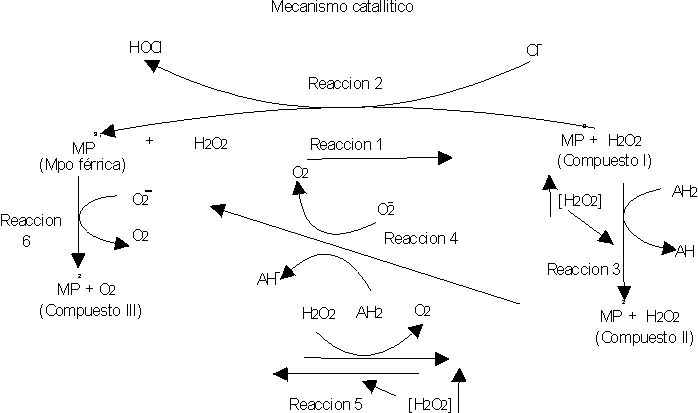
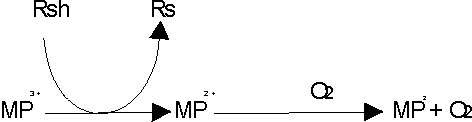
</front><body><![CDATA[ <H3> Trabajo de Revisi&oacute;n</H3>Instituto de Ciencias B&aacute;sicas y Precl&iacute;nicas  "Victoria de Gir&oacute;n" <H2> Enzimas generadoras de especies reactivas del  ox&iacute;geno: mieloperoxidasa</H2><I>Lic. Onel H. Garc&iacute;a Morales, Dra.  Nayade Pereira Roche y Dra. Rosa M. Flores S&aacute;nchez</I> <H4> RESUMEN</H4>La  defensa del organismo est&aacute; mediada por las c&eacute;lulas del llamado sistema  ret&iacute;culo endotelial, de las cuales los polimorfonucleares neutr&oacute;filos  constituyen la primera l&iacute;nea de defensa inespec&iacute;fica. La mieloperoxidasa  es la prote&iacute;na m&aacute;s abundante en los neutr&oacute;filos y es la &uacute;nica  peroxidasa que cataliza la conversi&oacute;n del per&oacute;xido de hidr&oacute;geno  y cloruro a &aacute;cido hipocloroso. Este es un potente agente oxidante que contribuye  al mecanismo de defensa contra los agentes infecciosos; sin embargo, puede ser  capaz de actuar sobre las c&eacute;lulas del hospedero en caso de activaci&oacute;n  incontrolable o excesiva e inactivar factores humorales. Dado el amplio espectro  de reactividad, el &aacute;cido hipocloroso es un mediador de da&ntilde;o h&iacute;stico  en numerosos procesos inflamatorios. Se presentan algunas caracter&iacute;sticas  f&iacute;sico-qu&iacute;micas, el mecanismo de reacci&oacute;n, la bios&iacute;ntesis  y la relaci&oacute;n de la enzima mieloperoxidasa con diferentes procesos patol&oacute;gicos.      <P>Descriptores DeCS: PEROXIDASA/metabolismo; PEROXIDASA/qu&iacute;mica; NEUTROFILOS/enzimolog&iacute;a;  ESPECIES DE OXIGENO REACTIVO.     <P>La mieloperoxidasa (MPO, per&oacute;xido de hidr&oacute;geno  oxidorreductasa, EC 1.11.1.7.) es una enzima ampliamente distribuida en el organismo  y sus fuentes fundamentales las constituyen los leucocitos (neutr&oacute;filos  y monocitos) y los macr&oacute;fagos a pesar de que ha sido aislada a partir de  diferentes fluidos biol&oacute;gicos (saliva, l&iacute;quido sinovial y semen,  entre otros)<SUP>1-3</SUP> y tambi&eacute;n de diferentes tejidos (coraz&oacute;n,  ri&ntilde;&oacute;n, piel, h&iacute;gado y placenta).<SUP>4-8</SUP> No obstante  las fuentes m&aacute;s empleadas son los neutr&oacute;filos, donde la enzima se  encuentra localizada a nivel lisosomal, en los gr&aacute;nulos azur&oacute;filos.  Constituye del 2-5 % de las prote&iacute;nas del neutr&oacute;filo,<SUP>9</SUP>  con una concentraci&oacute;n en sangre humana normal de alrededor del 1 nM.<SUP>10</SUP>      <P>Esta enzima fue aislada por primera vez por <I>Agner</I> en 1941, denomin&aacute;ndola  verdoperoxidasa.<SUP>11</SUP> Posteriormente en 1958, el propio <I>Agner </I>la  purific&oacute; en forma cristalina y en 1977 <I>Harrison </I>tuvo igual resultado.<SUP>12</SUP>  <H4> CARACTER&Iacute;STICAS F&Iacute;SICO-QU&Iacute;MICAS</H4>La MPO es una glicoprote&iacute;na  tetram&eacute;rica, constituida por 4 subunidades formando 2 homod&iacute;meros.  Cada uno de ellos contiene una subunidad <FONT FACE=Symbol>a</FONT> (pesada)  de aproximadamente 59 kDa y una subunidad &szlig; (ligera) de aproximadamente  14 kDa. El peso molecular de la enzima se estima entre 130-150 kDa.<SUP>13</SUP>  Las subunidades pesadas se unen a trav&eacute;s de un enlace bisulfuro simple  y a cada una de ellas se le une covalentemente un grupo prost&eacute;tico hemo.<SUP>13,14</SUP>  Estas subunidades son las &uacute;nicas glicosiladas y contienen entre 2-4 % de  carbohidratos.<SUP>13</SUP>     <P>Se reporta que esta prote&iacute;na es fuertemente  cati&oacute;nica con un punto isoel&eacute;ctrico mayor de 10 y su pH &oacute;ptimo  es de 5.<SUP>5,11,13</SUP>     <P>El contenido de amino&aacute;cidos se caracteriza  por presentar aproximadamente 1 150 residuos, que se corresponden con 573 amino&aacute;cidos  cada homod&iacute;mero. De ellos 466 forman la subunidad pesada y 107 la subunidad  ligera.<SUP>15</SUP>     <P>El patr&oacute;n espectrofotom&eacute;trico muestra un  m&aacute;ximo de absorbancia a 430 nm, con otros picos a 375, 575, 620 y 690 nm.<SUP>16  </SUP>Se reporta una relaci&oacute;n de absorbancia 430/280 nm entre 0,80 y 0,87  para una soluci&oacute;n de esta enzima pura.<SUP>15,17,18</SUP> <H4> MECANISMO  DE REACCI&Oacute;N</H4>Los neutr&oacute;filos contienen 4 formas de MPO, las cuales  se denominan compuesto I, compuesto II, compuesto III y MPO nativa o f&eacute;rrica,  con una similitud en su composici&oacute;n aminoac&iacute;dica y actividad, as&iacute;  como en sus propiedades &oacute;pticas. No obstante se han observado diferencias  en relaci&oacute;n con la intensidad de absorci&oacute;n a 430 nm y 620 nm.<SUP>17  </SUP>El sistema MPO-per&oacute;xido de hidr&oacute;geno (H<SUB>2</SUB>O<SUB>2</SUB>)<SUB>  </SUB>- haluro ha sido un sistema bien estudiado (fig. 1).<SUP>19-21 </SUP>La  MPO reacciona con el H<SUB>2</SUB>O<SUB>2 </SUB>proveniente de las c&eacute;lulas  fagocitarias activadas por contacto con part&iacute;culas extra&ntilde;as, formando  un complejo enzima-sustrato con una fuerte capacidad oxidativa (reacci&oacute;n  1). Este complejo se combina con el haluro, generalmente cloruro, que se oxida  para formar el &aacute;cido hipocloroso (HOCl) (reacci&oacute;n 2). El compuesto  I puede ser reducido a compuesto II por un exceso de H<SUB>2</SUB>O<SUB>2</SUB>.  Por ejemplo, concentraciones mayores a 20 <FONT FACE=Symbol>m</FONT> M lo transforma  parcialmente y mayores de 200 <FONT FACE=Symbol>m</FONT> M completamente, o  por la presencia de un agente reductor (AH<SUB>2 </SUB>) como por ejemplo el ditiotreitol,  ciste&iacute;na, glutati&oacute;n y cisteamina (reacci&oacute;n 3). Este compuesto  II, a pesar de ser bastante estable puede reducirse a MPO f&eacute;rrica en presencia  de un agente reductor o el radical super&oacute;xido (O<SUB>2 </SUB>) (reacci&oacute;n  4) o tambi&eacute;n puede oxidarse a compuesto III bajo concentraciones elevadas  de H<SUB>2</SUB>O<SUB>2</SUB> (2-3 mM) (reacci&oacute;n 5). Por otra parte la  MPO nativa puede ser oxidada por el O<SUB>2 </SUB>a oximieloperoxidasa (compuesto  III) (reacci&oacute;n 6).     <CENTER><A HREF="/img/revistas/ibi/v17n3/f0102398.gif"><IMG SRC="/img/revistas/ibi/v17n3/f0102398.gif" ALT="Figura 1" VSPACE=10 BORDER=1 HEIGHT=121 WIDTH=205></A></CENTER>    
<CENTER>Fig.  1.<I> Mecanismo de reacci&oacute;n de la mieloperoxidasa.</I></CENTER>    <P>Adem&aacute;s  puede funcionar como genuina oxidasa (fig. 2), de tal forma que va a depender  del ox&iacute;geno y no del H<SUB>2</SUB>O<SUB>2</SUB> como cosustrato para la  oxidaci&oacute;n de compuestos.<SUP>18</SUP>     ]]></body>
<body><![CDATA[<CENTER><A HREF="/img/revistas/ibi/v17n3/f0202398.gif"><IMG SRC="/img/revistas/ibi/v17n3/f0202398.gif" ALT="Figura 2" VSPACE=10 BORDER=1 HEIGHT=70 WIDTH=274></A></CENTER>    
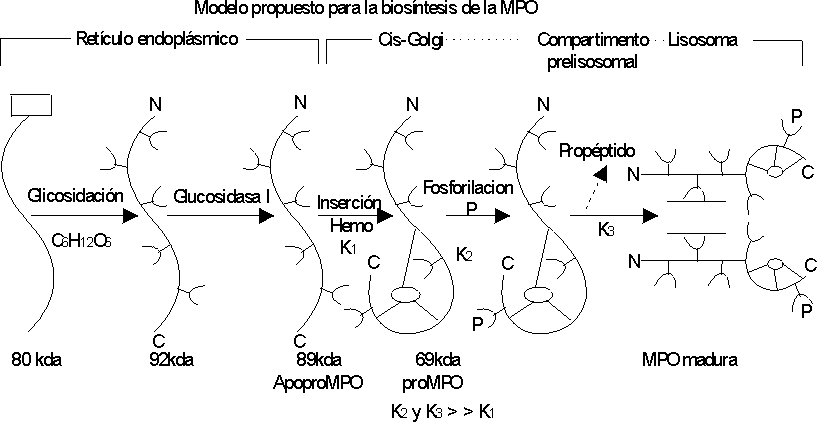
<CENTER>Fig.  2<I>. Funci&oacute;n oxidasa de la mieloperoxidasa.</I></CENTER>    <P>En presencia  de un agente reductor (RSH), la enzima se reduce a la forma ferro, que se oxida  en presencia de O<SUB>2 </SUB>para dar lugar al compuesto III que tiene capacidad  oxidante.     <P>El &aacute;cido hipocloroso (reacci&oacute;n 2) es un potente agente  oxidante que si bien contribuye al mecanismo de defensa contra los agentes infecciosos,  puede actuar sobre las c&eacute;lulas del hospedero lo que provocar&iacute;a inactivaci&oacute;n  de a <FONT FACE=Symbol>a</FONT>-antiproteinasa, entrecruzamientos de prote&iacute;nas  y reacci&oacute;n con &aacute;cidos grasos insaturados para formar clorohidrinas,  las cuales pueden desestabilizar las membranas celulares. De aqu&iacute; que el  HOCl es un candidato a causar mucho del da&ntilde;o mediado por neutr&oacute;filos  en enfermedades inflamatorias.<SUP>19 </SUP>El HOCl puede reaccionar con otra  mol&eacute;cula de H<SUB>2</SUB>O<SUB>2</SUB> y dar lugar al ox&iacute;geno singlete  (reacci&oacute;n 7) o reaccionar con aminas para formar las N-cloraminas que son  altamente reactivas y presentan un largo tiempo de vida media (reacci&oacute;n  8).<SUP>22</SUP> <DIR>HOCl + H<SUB>2</SUB>O<SUB>2 </SUB><FONT FACE=Symbol>&reg;</FONT><SUB>  </SUB>HC1 + H<SUB>2</SUB>O + O<SUB>2</SUB><SUP>*</SUP> (reacci&oacute;n 7)     <P>HOCl  + R-NH<SUB>2</SUB><SUP> </SUP><FONT FACE=Symbol>&reg;</FONT> R-NHCl + H<SUB>2</SUB>O  (reacci&oacute;n 8)</DIR><H4> INHIBIDORES</H4>Se han reportado diferentes drogas  como: la dapsone, benzoca&iacute;na, primaquina y famotidina, las cuales inhiben  a la MPO secuestrando a la enzima en forma de compuesto II;<SUP>23-25 </SUP>por  otro lado los antihipertensivos como la hidralacina, adem&aacute;s de la indometacina  y los salicilatos.<SUP>26,27 </SUP>El cianuro y la azida de sodio tambi&eacute;n  han sido reconocidos como inhibidores de la MPO, si bien no se conoce el mecanismo  por el cual la inhiben. <H4> BIOS&Iacute;NTESIS</H4>La bios&iacute;ntesis de la  MPO es un proceso complejo que incluye la formaci&oacute;n de una proenzima a  partir de una pre-proenzima. La enzima activa se obtiene a partir de la maduraci&oacute;n  de la proenzima,<SUP>28 </SUP>que tiene lugar en los lisosomas, en la fase promieloc&iacute;tica  de la diferenciaci&oacute;n del neutr&oacute;filo.<SUP>20</SUP>     <P><I>William  y otros</I> propusieron un modelo para explicar el proceso de bios&iacute;ntesis  de esta enzima (fig. 3).<SUP>28 </SUP>El producto primario de la traducci&oacute;n  del mRNA de la MPO es un p&eacute;ptido simple de 80 kDa que sufre ruptura cotraduccional  del p&eacute;ptido se&ntilde;al y glicosilaci&oacute;n en 5 sitios (residuos de  Asparagina), resultando en una especie de 92 kDa, que es r&aacute;pidamente fragmentada  por glucosidasa I para generar la apoprote&iacute;na de 89 kDa. Esta especie es  localizada en el ret&iacute;culo endopl&aacute;smico y es extremadamente estable.  Estos autores especulan que el pr&oacute;ximo evento es la inserci&oacute;n del  grupo hemo en la apopro-MPO, que ha indicado ser un evento del ret&iacute;culo  endopl&aacute;smico (RE) seg&uacute;n tinci&oacute;n espec&iacute;fica para peroxidasas.  Posteriormente la pro-MPO es fosforilada, m&aacute;s probable despu&eacute;s de  salir del RE porque los residuos fosfomanosil son generados en un compartimiento  pos-RE, pre Golgi. La pro-MPO fosforilada tiene un tiempo de vida media muy corto  y es proteol&iacute;ticamente procesado a MPO madura en un compartimiento prelisosomal,  liber&aacute;ndose el prop&eacute;ptido de la pro-MPO intracelular.     <CENTER><A HREF="/img/revistas/ibi/v17n3/f0302398.gif"><IMG SRC="/img/revistas/ibi/v17n3/f0302398.gif" ALT="Figura 3" VSPACE=10 BORDER=1 HEIGHT=126 WIDTH=245></A></CENTER>    
<CENTER>Fig.  3<I>. Mecanismo propuesto para la bios&iacute;ntesis de la mieloperoxidasa.</I></CENTER><H4>  ACTIVIDAD Y ENFERMEDAD</H4>El incremento de la actividad de la MPO se ha reportado  en varios procesos patol&oacute;gicos y est&aacute; asociada con un aumento del  riesgo al estr&eacute;s oxidativo, como en el caso de las enfermedades infecciosas  (generales o locales), las enfermedades inflamatorias (artritis reumatoidea) y  la isquemia/reperfusi&oacute;n.     <P>En estos casos se reporta un aumento significativo  de la actividad de MPO, en proporci&oacute;n directa al n&uacute;mero de neutr&oacute;filos  infiltrados en el tejido, por lo que se puede utilizar su actividad como &iacute;ndice  de migraci&oacute;n leucocitaria y por lo tanto de estr&eacute;s oxidativo.<SUP>7,29-35</SUP>  <H6> Enfermedades del sistema respiratorio</H6>En la fibrosis qu&iacute;stica,  la actividad MPO est&aacute; aumentada proporcionalmente al grado de obstrucci&oacute;n  de las v&iacute;as respiratorias que presentan estos pacientes. La enzima por  la v&iacute;a de inactivaci&oacute;n de la <FONT FACE=Symbol>a</FONT> -1 antiproteasa  contribuye a incrementar la actividad de la elastasa de los neutr&oacute;filos  sobre la elastina pulmonar, la cual desempe&ntilde;a una importante funci&oacute;n  en la fisiopatolog&iacute;a de la enfermedad.<SUP>36,37</SUP>     <P>Con respecto  al da&ntilde;o pulmonar en pacientes fumadores se reporta que en fumadores inveterados  hay un incremento de &aacute;cidos grasos saturados libres que afectan el metabolismo  oxidativo de los polimorfonucleares. Se produce un aumento de la actividad MPO  y la producci&oacute;n de HOCl, con lo que se amplifica el da&ntilde;o oxidativo  mediado por esta enzima en los pulmones.<SUP>38</SUP> <H6> Enfermedades del sistema  circulatorio</H6>La MPO es capaz de generar especies reactivas que da&ntilde;an  l&iacute;pidos y prote&iacute;nas,<SUP>39,40</SUP> y parece contribuir a la aterog&eacute;nesis  a trav&eacute;s de las reacciones oxidativas que &eacute;sta cataliza. El sistema  MPO-H<SUB>2</SUB>O<SUB>2</SUB> al tener como sustrato la L-tirosina produce el  radical tirosilo, que es capaz de estimular la peroxidaci&oacute;n lip&iacute;dica.  Esta peroxidaci&oacute;n es vital para la transformaci&oacute;n de las LDL en  part&iacute;culas aterog&eacute;nicas.<SUP>39</SUP> <H6> Enfermedades del sistema  digestivo</H6>Estudios en pacientes con cirrosis hep&aacute;tica y hepatitis cr&oacute;nica  muestran niveles aumentados de MPO. Cuando se acompa&ntilde;an de esplenomegalia  este ascenso es mayor. El incremento es siempre m&aacute;s evidente en la primera  entidad. Lo anterior sugiere la funci&oacute;n de la MPO en la fisiopatolog&iacute;a  del hiperesplenismo relacionado con estas enfermedades.<SUP>41</SUP> <H6> Enfermedades  del sistema hemolinfopoy&eacute;tico</H6>La MPO se utiliza como &iacute;ndice  de diferenciaci&oacute;n entre las leucemias linfobl&aacute;sticas y mielobl&aacute;sticas,  por el aumento de la enzima en estas &uacute;ltimas.<SUP>42</SUP>     ]]></body>
<body><![CDATA[<P>En los pacientes  sickl&eacute;micos se reportan aumentos significativos de MPO, con una correlaci&oacute;n  inversa a la concentraci&oacute;n de hemoglobina, lo que sugiere que los polimorfonucleares  y el sistema de complemento participan en los mecanismos fisiopatol&oacute;gicos  de la enfermedad.<SUP>43</SUP>     <P>Se ha encontrado que el sistema MPO-H<SUB>2</SUB>O<SUB>2  </SUB>-Cl es capaz de inactivar las c&eacute;lulas infectadas por el HIV tipo  1.<SUP>44 </SUP>En este mecanismo se utiliza el H<SUB>2</SUB>O<SUB>2</SUB> elaborado  por las propias c&eacute;lulas infectadas sin necesidad de H<SUB>2</SUB>O<SUB>2</SUB>  ex&oacute;geno. En estudios <I>in vitro</I> se demostr&oacute; que la actividad  antiviral se logra a concentraciones bajas de MPO, concentraciones mayores resultan  citot&oacute;xicas. <H6> Otras enfermedades</H6>La funci&oacute;n de la MPO en  la patog&eacute;nesis de la catarata se demostr&oacute; al evaluar el efecto de  la MPO sobre el cristalino de animales viejos, en los cuales se produjo opacidad  del lente.<SUP>45</SUP>     <P>Los niveles de lipoper&oacute;xidos (LPO) y MPO en  el v&iacute;treo de pacientes vitrectomizados con retinopat&iacute;a diab&eacute;tica  proliferativa se encuentran aumentados, lo cual sugiere que la producci&oacute;n  de especies reactivas del ox&iacute;geno (ERO) y los mecanismos inflamatorios  participan en la patog&eacute;nesis de la enfermedad.<SUP>46</SUP> Estos niveles  se encuentran elevados en la retina de pacientes con melanoma coroidal, lo que  evidencia su relaci&oacute;n con la retinopat&iacute;a asociada al tumor.<SUP>47</SUP>      <P>En los pacientes con trisom&iacute;a 21 se encuentran bajos niveles de super&oacute;xido  y una actividad reducida de MPO, por lo que se produce un desbalance en la producci&oacute;n  de ERO en los neutr&oacute;filos de esos ni&ntilde;os y hace que aumente el da&ntilde;o  oxidativo en estos pacientes.<SUP>48</SUP> <H4> SUMMARY</H4>Organism&acute;s defence  is mediated by cells of the so-called reticuloendothelial system, of which, nautrophils  polymorphonuclear, are the first line of nonspecific defense. Myeloperoxidase  is the more abundant protein in neutrophils, and is the sole peroxidase catalising  hydrogen peroxide and chloride donversion to hypochlorous acid. This es a powerful  oxidative agent leading to defense mechanism against infectious agents; however,  is able to act on host cells in case of uncontrollable or excessive activation,  and in the humoral factors inactivation. In view of the ample spectrum of reactivity,  hypochlorous acid is a mediator of tissue damage in many inflammatory process.  Authors present some physico-chemical features, mechanism of action, biosynthesis,  and relation of myeloperoxidase with different pathologic process.     <P>Subject  headings: PEROXIDASE/ metabolism; PEROXIDASE/ chemistry; NEUTROPHIS/ ensymology;  REACTIVE OXIGEN SPECIES. <H4> REFERENCIAS BIBLIOGR&Aacute;FICAS</H4><OL>     <!-- ref --><LI>  Van Den Abbeele A, Pourtois M, Courtois P. Fluoride inhibition of SCN and Cl<SUP>  </SUP>peroxidase activities in whole saliva and of recombinant myeloperoxidase.  Influence of pH and hydrogen peroxide concentration. J Biol Buccale 1992;20:219-24.</LI>    <!-- ref --><LI>  Edwards SW, Hughes V, Barlow J, Bucknall R. Inmunological detection of MPO in  synovial fluid from patients with rheumatoid arthritis. Biochem J 1988;250(1):81-5.</LI>    <!-- ref --><LI>  Wolff H, Panhans A, Zebhauser M, Meurer M. Comparison of three methods to detect  white blood cells in semen leukocyte esterase dipstick test granulocyte elastase  enzymoimmunoassay, and peroxidase cytochemistry. Fertil Steril 1992;58(6):1260-2.</LI>    <!-- ref --><LI>  Karger S, Campo GM, Squadrito F, Ioculano M, Altavilla D, Zingarelli B, et al.  Protective effects of IRFI-016, a new antioxidant agent in myocardial damage,  following coronary artery occlusion and reperfusion in the rat. Pharmacology 1994;48:157-66.</LI>    <!-- ref --><LI>  Johnson R, Couser WG, Chi EY, Adler S, Klebanoff SJ. New mechanism for glomerular  injury. J Clin Invest 1987;79(5):1379-87.</LI>    <!-- ref --><LI> Bradley PP, Priebat PA, Christensen  RD, Rothstein GR. Measurement of cutaneous inflammation: estimation of neutrophil  content with an enzyme marker. J Invest Dermatol 1982;78:206-9.</LI>    <!-- ref --><LI> Komatsu  H, Koo A, Ghadishah E, Zeng H, Kuhlenkamp JF, Inova M. Neutrophil accumulation  in ischemic reperfused rat liver evidence for a role of superoxide free radicals.  Am J Physiol 1992;262(4 Pt 1):6669-76.</LI>    <!-- ref --><LI> Joseph P, Srinivasan NS, Kulkarni  AP. Placental peroxidase further purification of the enzyme and oxidation of thiobenzamide.  Placenta 1993;14(3):309-19.</LI>    <!-- ref --><LI> M&aacute;rquez LA, Dunford HB, Wart HV. Kinetic  studies on the reaction of compound II of myeloperoxidase with ascorbic acid.  Role of ascorbic acid in myeloperoxidase function. J Biol Chem 1990;265(10):5666-70.</LI>    <!-- ref --><LI>  Svensson BE, Linduall S. Myeloperoxidase-oxidase oxidation of cysteamine. Biochem  J 1988;249(2):521-30.</LI>    <!-- ref --><LI> Agner K. Verdoperoxidase. A ferment isolated from  leukocytes. Acta Physiol Scand 1941;2(Suppl 8):1-62.</LI>    <!-- ref --><LI> Harrison JE. The  subunit structure of crystalline canine myeloperoxidase. Biochim Biophys Acta  1977;493:247-59.</LI>    <!-- ref --><LI> Nausefl WM. Myeloperoxidase biosyntesis by a human promielocytic  leukemia cell line: insight into myeloperoxidase deficiency. Blood 1986;67(4):865-72.</LI>    <!-- ref --><LI>  Morishita Y, Morishima Y, Ogura M, Nagai Y, Ohno P. Biochemical characterization  of human myeloperoxidase using three specific monoclonal antibodies. Br J Haematol  1986;63(3):435-44.</LI>    <!-- ref --><LI> Iwamoto H, Morita Y, Kobayashi T, Hasegawa E. Subunit  structures of three human myeloperoxidases. J Biochem 1988;103:688-92.</LI>    <!-- ref --><LI>  Deseer RK, Himmelhoch SR, Evans WH, Januska M, Mage M, Shelton E. Guinea pig heterophil  and eosinophil peroxidase. Arch Biochem Biophys 1972;148(2):452-65.</LI>    <!-- ref --><LI> Svensson  BE, Dome K, Linduall S, Rydell G. Peroxidase and peroxidase-oxidase activities  of isolated human myeloperoxidases. J Biochem 1987;242:673-80.</LI>    <!-- ref --><LI> Svensson  BE. Myeloperoxidase oxidation states involved in myeloperoxidase-oxidase oxidation  of thiols. J Biochem 1988;256:751-5.</LI>    <!-- ref --><LI> Kettle AJ, Winterbourn CC. Assays  for the chlorination activity of myeloperoxidase. Methods in Enzymology 1994;233:502-12.</LI>    <!-- ref --><LI>  . Superoxide modulates the activity of myeloperoxidase and optimizes the production  of hypochlorous acid. J Biochem 1988;252:529-36.</LI>    <!-- ref --><LI> Kettle AJ, Robertson  IGG, Palmer BD, Anderson RF, Patel KB, Winterbourn CC. Oxidative metabolism of  Amsacrine by the neutrophyl enzyme myeloperoxidase. Biochem Pharmacol 1992;44(9):1731-8.</LI>    <!-- ref --><LI>  Domigan NM, Charlton TS, Duncan MW, Winterbourn CC, Kettle AJ. Chlorination of  tyrosil residues in peptides by myeloperoxidase and human neutrophils. J Biol  Chem 1995;270(28):1-7.</LI>    <!-- ref --><LI> Kettle AJ, Gedye CA, Winterbourn CC. Superoxide  is an antagonist of antiinflammatory drugs that inhibit hypochlorous acid production  by myeloperoxidase. Biochem Pharmacol 1993;45(10):2003-10.</LI>    <!-- ref --><LI> Van Zyl JM.  Mechanism by which clofazimine and dapsone inhibit the MPO system. A possible  correlation with their antiinflammatory properties. Biochem Pharmacol 1991;42(3):599-608.</LI>    <!-- ref --><LI>  Zyl JM van, Kriegler A, Walt BJ van der. Anti-oxidant properties of H<SUB>2</SUB>-receptor  antagonists effects on myeloperoxidase catalysed reactions and hydroxyl radical  generation in a ferrous hydrogen peroxide system. Biochem Pharmacol 1993;45(12):2389-97.</LI>    <!-- ref --><LI>  Kettle AJ. Mechanism of inhibition of myeloperoxidase by antiinflammatory drugs.  Biochem Pharmacol 1991;41(10):1485-92.</LI>    <!-- ref --><LI> Nassberger L. The antihipertensive  compounds hidralazine, dihydralazine and cadralazine and their metabolites inhibit  MPO activity as measured by chemiluminescense. Biochem Pharmacol 1991;42(9):1844-7.</LI>    <!-- ref --><LI>  Nauseef WM, Mc Cormick S, Yi H. Roles of hemo insertion the manose-6-phosphate  receptor in processing of the human myeloid lysosomal enzyme, myeloperoxidase.  Blood 1992;80(10):2622-33.</LI>    <!-- ref --><LI> Simpson PJ, Fantone JC. Identification of  a time window for therapy to reduce experimental canine myocardial injury. Circulation  Res 1988;63(6):1070-9.</LI>    <!-- ref --><LI> Nalini S, Mathan MM, Balasubramanian KA. Oxygen  free radical induced damage during intestinal ischemia/reperfusion in normal and  Xanthine oxidase deficient rats. Mol Cell Biochem 1993;124(1):59-66.</LI>    <!-- ref --><LI>  Wilson IC, Gardner TJ, Dinatale JM, Gillinov AM, Curtis WE, Cameron DE. Temporary  leukocyte depletion reduces ventricular dysfunction during prolonged postischemic  reperfusion. J Thorac Cardiovasc Surg 1993;106(5):805-10.</LI>    <!-- ref --><LI> Peralta JG,  Llesuy S, Evelson P, Carreras MC, Flecha BG, Poderoso JJ. Oxidative stress in  skeletal muscle during sepsis in rats. Circ Shock 1993;39(2):153-9.</LI>    <!-- ref --><LI> Junger  WG, Cardoza TA, Liu FC, Hoyt DB, Goodwin R. Improved rapid photometric assay for  qualitative measurement of PMN migration. J Immunol Methods 1993;160:73-9.</LI>    <!-- ref --><LI>  Over C, Yamalik N, Yavuzyilmaz E, Ersoy F, Eratalay K. Mieloperoxidase activity  in peripheral blood, neutrophil crevicular fluid and whole saliva of patients  with periodontal disease. J Nihon Univ Sch Dent 1993;35(4):235-40.</LI>    <!-- ref --><LI> Venge  P. Eosinophil activity in bronchial asthma. Allergy Proc 1994;15(3):139-41.</LI>    <!-- ref --><LI>  Meyer KC, Zimmerman J. Neutrophil mediators. Pseudomonas and pulmonary dysfunction  in cystic fibrosis. J Lab Clin Med 1993;121(5):654-61.</LI>    <!-- ref --><LI> Koller DY, Gotz  M, Eichler I, Urbanek R. Eosinophil activation in cystic fibrosis. Thorax 1994;49(5):496-9.</LI>    <!-- ref --><LI>  Quian M, Eaton JW. Free fatty acids enhance hypochlorous acid production by activated  neutrophils. J Lab Clin Med 1994;124(1):86-95.</LI>    <!-- ref --><LI> Savenkowa ML, Mueller  DM, Heinecke JW. Tyrosyl radical generated by myeloperoxidase is a physiological  catalyst for the iniciation of lipid peroxidation in low density lipoprotein.  J Biol Chem 1994;269(32):20394-400.</LI>    <!-- ref --><LI> Heinicke JW, Li W, Fracis GA, Goldstein  JA. Tyrosyl radical generated by myeloperoxidase catalyzes the oxidative cross-linking  of proteins. J Clin Invest 1993;91(6):2866-72.</LI>    <!-- ref --><LI> Nakamuta M, Ohashi M,  Tanabe Y, Hiroshige K. Nawata H. High plasma concentration of myeloperoxidase  in cirrhosis: a possible marker of hypersplenism. Hepatology 1993;18(6):1377-83.</LI>    <!-- ref --><LI>  Schlaifer D, Cooper MR, Attal M, Sartor AO, Trepel JB, Laurent G, et al. MPO:  an enzyme envolved in intrinsic vincristine resistance in human myeloblastic leukemia.  Blood 1993;81(2):482-9.</LI>    <!-- ref --><LI> Mohamed AO, Hashim MS, Nilsson UR, Venge P. Increased  in vivo activation of neutrophils and complement in sickle cell disease. Am J  Trop Med Hyg 1993;49(6):799-803.</LI>    <!-- ref --><LI> Chochola J, Yamaguchi Y, Moquilevsky  N, Bollen A, Strosberg AD, Stanislawski M. Virocidal effect of myeloperoxidase  in an human immunodeficiency type 1-infected T cells. Antimicrob Agent Chemother  1994;38(5):969-72.</LI>    <!-- ref --><LI> Iugai MT, Formaziuk VE, Sergienko VI, Riabtseva AA,  Romashova MP. The role of Myeloperoxidase, a product of the polymorphonuclear  leukocytes, in the pathogenesis of cataract. Biull Eksp Biol Med 1992;114(10):364-6.</LI>    <!-- ref --><LI>  Augustin AJ, Boker J, Breipohl W. Increased lipid peroxide levels and myeloperoxidase  activity in the vitreous of patients suffering from proliferative diabetic retinopathy.  Graefes Arch Clin Exp Ophthalmol 1993;231(11):647-50.</LI>    <!-- ref --><LI> . Increased lipid  peroxidase and inflammatory parameters in the retina adjacent to choroidal melanoma.  Br J Ophthalmol 1994;78(2):130-2.</LI>    <!-- ref --><LI> Gabianelli R, Kantar A, Oggiano N,  Fiorini R, Falcioni G, Giorgi PL. Oxidative metabolism in polymorphonuclear granulocytes  of children with trisomy 21. Minerva Pediatr 1993;45(12):493-7.</LI>    </OL>Recibido:  26 de junio de 1997. Aprobado: 30 de octubre de 1997.     <P>Lic. <I>Onel H. Garc&iacute;a  Morales.</I> Instituto Superior de Ciencias B&aacute;sicas y Precl&iacute;nicas  "Victoria de Gir&oacute;n". Ave 146 y 31 No. 3102, Playa, La Habana 16, CP 11600,  Cuba.      ]]></body><back>
<ref-list>
<ref id="B1">
<nlm-citation citation-type="journal">
<person-group person-group-type="author">
<name>
<surname><![CDATA[Van Den Abbeele]]></surname>
<given-names><![CDATA[A]]></given-names>
</name>
<name>
<surname><![CDATA[Pourtois]]></surname>
<given-names><![CDATA[M]]></given-names>
</name>
<name>
<surname><![CDATA[Courtois]]></surname>
<given-names><![CDATA[P]]></given-names>
</name>
</person-group>
<article-title xml:lang="en"><![CDATA[Fluoride inhibition of SCN and Clperoxidase activities in whole saliva and of recombinant myeloperoxidase: Influence of pH and hydrogen peroxide concentration]]></article-title>
<source><![CDATA[J Biol Buccale]]></source>
<year>1992</year>
<volume>20</volume>
<page-range>219-24</page-range></nlm-citation>
</ref>
<ref id="B2">
<nlm-citation citation-type="journal">
<person-group person-group-type="author">
<name>
<surname><![CDATA[Edwards]]></surname>
<given-names><![CDATA[SW]]></given-names>
</name>
<name>
<surname><![CDATA[Hughes]]></surname>
<given-names><![CDATA[V]]></given-names>
</name>
<name>
<surname><![CDATA[Barlow]]></surname>
<given-names><![CDATA[J]]></given-names>
</name>
<name>
<surname><![CDATA[Bucknall]]></surname>
<given-names><![CDATA[R]]></given-names>
</name>
</person-group>
<article-title xml:lang="en"><![CDATA[Inmunological detection of MPO in synovial fluid from patients with rheumatoid arthritis]]></article-title>
<source><![CDATA[Biochem J]]></source>
<year>1988</year>
<volume>250</volume>
<numero>1</numero>
<issue>1</issue>
<page-range>81-5</page-range></nlm-citation>
</ref>
<ref id="B3">
<nlm-citation citation-type="journal">
<person-group person-group-type="author">
<name>
<surname><![CDATA[Wolff]]></surname>
<given-names><![CDATA[H]]></given-names>
</name>
<name>
<surname><![CDATA[Panhans]]></surname>
<given-names><![CDATA[A]]></given-names>
</name>
<name>
<surname><![CDATA[Zebhauser]]></surname>
<given-names><![CDATA[M]]></given-names>
</name>
<name>
<surname><![CDATA[Meurer]]></surname>
<given-names><![CDATA[M]]></given-names>
</name>
</person-group>
<article-title xml:lang="en"><![CDATA[Comparison of three methods to detect white blood cells in semen leukocyte esterase dipstick test granulocyte elastase enzymoimmunoassay, and peroxidase cytochemistry]]></article-title>
<source><![CDATA[Fertil Steril]]></source>
<year>1992</year>
<volume>58</volume>
<numero>6</numero>
<issue>6</issue>
<page-range>1260-2</page-range></nlm-citation>
</ref>
<ref id="B4">
<nlm-citation citation-type="journal">
<person-group person-group-type="author">
<name>
<surname><![CDATA[Karger]]></surname>
<given-names><![CDATA[S]]></given-names>
</name>
<name>
<surname><![CDATA[Campo]]></surname>
<given-names><![CDATA[GM]]></given-names>
</name>
<name>
<surname><![CDATA[Squadrito]]></surname>
<given-names><![CDATA[F]]></given-names>
</name>
<name>
<surname><![CDATA[Ioculano]]></surname>
<given-names><![CDATA[M]]></given-names>
</name>
<name>
<surname><![CDATA[Altavilla]]></surname>
<given-names><![CDATA[D]]></given-names>
</name>
<name>
<surname><![CDATA[Zingarelli]]></surname>
<given-names><![CDATA[B]]></given-names>
</name>
</person-group>
<article-title xml:lang="en"><![CDATA[Protective effects of IRFI-016, a new antioxidant agent in myocardial damage, following coronary artery occlusion and reperfusion in the rat]]></article-title>
<source><![CDATA[Pharmacology]]></source>
<year>1994</year>
<volume>48</volume>
<page-range>157-66</page-range></nlm-citation>
</ref>
<ref id="B5">
<nlm-citation citation-type="journal">
<person-group person-group-type="author">
<name>
<surname><![CDATA[Johnson]]></surname>
<given-names><![CDATA[R]]></given-names>
</name>
<name>
<surname><![CDATA[Couser]]></surname>
<given-names><![CDATA[WG]]></given-names>
</name>
<name>
<surname><![CDATA[Chi]]></surname>
<given-names><![CDATA[EY]]></given-names>
</name>
<name>
<surname><![CDATA[Adler]]></surname>
<given-names><![CDATA[S]]></given-names>
</name>
<name>
<surname><![CDATA[Klebanoff]]></surname>
<given-names><![CDATA[SJ]]></given-names>
</name>
</person-group>
<article-title xml:lang="en"><![CDATA[New mechanism for glomerular injury]]></article-title>
<source><![CDATA[J Clin Invest]]></source>
<year>1987</year>
<volume>79</volume>
<numero>5</numero>
<issue>5</issue>
<page-range>1379-87</page-range></nlm-citation>
</ref>
<ref id="B6">
<nlm-citation citation-type="journal">
<person-group person-group-type="author">
<name>
<surname><![CDATA[Bradley]]></surname>
<given-names><![CDATA[PP]]></given-names>
</name>
<name>
<surname><![CDATA[Priebat]]></surname>
<given-names><![CDATA[PA]]></given-names>
</name>
<name>
<surname><![CDATA[Christensen]]></surname>
<given-names><![CDATA[RD]]></given-names>
</name>
<name>
<surname><![CDATA[Rothstein]]></surname>
<given-names><![CDATA[GR]]></given-names>
</name>
</person-group>
<article-title xml:lang="en"><![CDATA[Measurement of cutaneous inflammation: estimation of neutrophil content with an enzyme marker]]></article-title>
<source><![CDATA[J Invest Dermatol]]></source>
<year>1982</year>
<volume>78</volume>
<page-range>206-9</page-range></nlm-citation>
</ref>
<ref id="B7">
<nlm-citation citation-type="journal">
<person-group person-group-type="author">
<name>
<surname><![CDATA[Komatsu]]></surname>
<given-names><![CDATA[H]]></given-names>
</name>
<name>
<surname><![CDATA[Koo]]></surname>
<given-names><![CDATA[A]]></given-names>
</name>
<name>
<surname><![CDATA[Ghadishah]]></surname>
<given-names><![CDATA[E]]></given-names>
</name>
<name>
<surname><![CDATA[Zeng]]></surname>
<given-names><![CDATA[H]]></given-names>
</name>
<name>
<surname><![CDATA[Kuhlenkamp]]></surname>
<given-names><![CDATA[JF]]></given-names>
</name>
<name>
<surname><![CDATA[Inova]]></surname>
<given-names><![CDATA[M]]></given-names>
</name>
</person-group>
<article-title xml:lang="en"><![CDATA[Neutrophil accumulation in ischemic reperfused rat liver evidence for a role of superoxide free radicals]]></article-title>
<source><![CDATA[Am J Physiol]]></source>
<year>1992</year>
<volume>262</volume>
<numero>4</numero>
<issue>4</issue>
<page-range>6669-76</page-range></nlm-citation>
</ref>
<ref id="B8">
<nlm-citation citation-type="journal">
<person-group person-group-type="author">
<name>
<surname><![CDATA[Joseph]]></surname>
<given-names><![CDATA[P]]></given-names>
</name>
<name>
<surname><![CDATA[Srinivasan]]></surname>
<given-names><![CDATA[NS]]></given-names>
</name>
<name>
<surname><![CDATA[Kulkarni]]></surname>
<given-names><![CDATA[AP]]></given-names>
</name>
</person-group>
<article-title xml:lang="en"><![CDATA[Placental peroxidase further purification of the enzyme and oxidation of thiobenzamide]]></article-title>
<source><![CDATA[Placenta]]></source>
<year>1993</year>
<volume>14</volume>
<numero>3</numero>
<issue>3</issue>
<page-range>309-19</page-range></nlm-citation>
</ref>
<ref id="B9">
<nlm-citation citation-type="journal">
<person-group person-group-type="author">
<name>
<surname><![CDATA[Márquez]]></surname>
<given-names><![CDATA[LA]]></given-names>
</name>
<name>
<surname><![CDATA[Dunford]]></surname>
<given-names><![CDATA[HB]]></given-names>
</name>
<name>
<surname><![CDATA[Wart]]></surname>
<given-names><![CDATA[HV]]></given-names>
</name>
</person-group>
<article-title xml:lang="en"><![CDATA[Kinetic studies on the reaction of compound II of myeloperoxidase with ascorbic acid: Role of ascorbic acid in myeloperoxidase function]]></article-title>
<source><![CDATA[J Biol Chem]]></source>
<year>1990</year>
<volume>265</volume>
<numero>10</numero>
<issue>10</issue>
<page-range>5666-70</page-range></nlm-citation>
</ref>
<ref id="B10">
<nlm-citation citation-type="journal">
<person-group person-group-type="author">
<name>
<surname><![CDATA[Svensson]]></surname>
<given-names><![CDATA[BE]]></given-names>
</name>
<name>
<surname><![CDATA[Linduall]]></surname>
<given-names><![CDATA[S]]></given-names>
</name>
</person-group>
<article-title xml:lang="en"><![CDATA[Myeloperoxidase-oxidase oxidation of cysteamine]]></article-title>
<source><![CDATA[Biochem J]]></source>
<year>1988</year>
<volume>249</volume>
<numero>2</numero>
<issue>2</issue>
<page-range>521-30</page-range></nlm-citation>
</ref>
<ref id="B11">
<nlm-citation citation-type="journal">
<person-group person-group-type="author">
<name>
<surname><![CDATA[Agner]]></surname>
<given-names><![CDATA[K]]></given-names>
</name>
</person-group>
<article-title xml:lang="en"><![CDATA[Verdoperoxidase: A ferment isolated from leukocytes]]></article-title>
<source><![CDATA[Acta Physiol Scand]]></source>
<year>1941</year>
<volume>2</volume>
<numero>^sSuppl 8</numero>
<issue>^sSuppl 8</issue>
<supplement>Suppl 8</supplement>
<page-range>1-62</page-range></nlm-citation>
</ref>
<ref id="B12">
<nlm-citation citation-type="journal">
<person-group person-group-type="author">
<name>
<surname><![CDATA[Harrison]]></surname>
<given-names><![CDATA[JE]]></given-names>
</name>
</person-group>
<article-title xml:lang="en"><![CDATA[The subunit structure of crystalline canine myeloperoxidase]]></article-title>
<source><![CDATA[Biochim Biophys Acta]]></source>
<year>1977</year>
<volume>493</volume>
<page-range>247-59</page-range></nlm-citation>
</ref>
<ref id="B13">
<nlm-citation citation-type="journal">
<person-group person-group-type="author">
<name>
<surname><![CDATA[Nausefl]]></surname>
<given-names><![CDATA[WM]]></given-names>
</name>
</person-group>
<article-title xml:lang="en"><![CDATA[Myeloperoxidase biosyntesis by a human promielocytic leukemia cell line: insight into myeloperoxidase deficiency]]></article-title>
<source><![CDATA[Blood]]></source>
<year>1986</year>
<volume>67</volume>
<numero>4</numero>
<issue>4</issue>
<page-range>865-72</page-range></nlm-citation>
</ref>
<ref id="B14">
<nlm-citation citation-type="journal">
<person-group person-group-type="author">
<name>
<surname><![CDATA[Morishita]]></surname>
<given-names><![CDATA[Y]]></given-names>
</name>
<name>
<surname><![CDATA[Morishima]]></surname>
<given-names><![CDATA[Y]]></given-names>
</name>
<name>
<surname><![CDATA[Ogura]]></surname>
<given-names><![CDATA[M]]></given-names>
</name>
<name>
<surname><![CDATA[Nagai]]></surname>
<given-names><![CDATA[Y]]></given-names>
</name>
<name>
<surname><![CDATA[Ohno]]></surname>
<given-names><![CDATA[P]]></given-names>
</name>
</person-group>
<article-title xml:lang="en"><![CDATA[Biochemical characterization of human myeloperoxidase using three specific monoclonal antibodies]]></article-title>
<source><![CDATA[Br J Haematol]]></source>
<year>1986</year>
<volume>63</volume>
<numero>3</numero>
<issue>3</issue>
<page-range>435-44</page-range></nlm-citation>
</ref>
<ref id="B15">
<nlm-citation citation-type="journal">
<person-group person-group-type="author">
<name>
<surname><![CDATA[Iwamoto]]></surname>
<given-names><![CDATA[H]]></given-names>
</name>
<name>
<surname><![CDATA[Morita]]></surname>
<given-names><![CDATA[Y]]></given-names>
</name>
<name>
<surname><![CDATA[Kobayashi]]></surname>
<given-names><![CDATA[T]]></given-names>
</name>
<name>
<surname><![CDATA[Hasegawa]]></surname>
<given-names><![CDATA[E]]></given-names>
</name>
</person-group>
<article-title xml:lang="en"><![CDATA[Subunit structures of three human myeloperoxidases]]></article-title>
<source><![CDATA[J Biochem]]></source>
<year>1988</year>
<volume>103</volume>
<page-range>688-92</page-range></nlm-citation>
</ref>
<ref id="B16">
<nlm-citation citation-type="journal">
<person-group person-group-type="author">
<name>
<surname><![CDATA[Deseer]]></surname>
<given-names><![CDATA[RK]]></given-names>
</name>
<name>
<surname><![CDATA[Himmelhoch]]></surname>
<given-names><![CDATA[SR]]></given-names>
</name>
<name>
<surname><![CDATA[Evans]]></surname>
<given-names><![CDATA[WH]]></given-names>
</name>
<name>
<surname><![CDATA[Januska]]></surname>
<given-names><![CDATA[M]]></given-names>
</name>
<name>
<surname><![CDATA[Mage]]></surname>
<given-names><![CDATA[M]]></given-names>
</name>
<name>
<surname><![CDATA[Shelton]]></surname>
<given-names><![CDATA[E]]></given-names>
</name>
</person-group>
<article-title xml:lang="en"><![CDATA[Guinea pig heterophil and eosinophil peroxidase]]></article-title>
<source><![CDATA[Arch Biochem Biophys]]></source>
<year>1972</year>
<volume>148</volume>
<numero>2</numero>
<issue>2</issue>
<page-range>452-65</page-range></nlm-citation>
</ref>
<ref id="B17">
<nlm-citation citation-type="journal">
<person-group person-group-type="author">
<name>
<surname><![CDATA[Svensson]]></surname>
<given-names><![CDATA[BE]]></given-names>
</name>
<name>
<surname><![CDATA[Dome]]></surname>
<given-names><![CDATA[K]]></given-names>
</name>
<name>
<surname><![CDATA[Linduall]]></surname>
<given-names><![CDATA[S]]></given-names>
</name>
<name>
<surname><![CDATA[Rydell]]></surname>
<given-names><![CDATA[G]]></given-names>
</name>
</person-group>
<article-title xml:lang="en"><![CDATA[Peroxidase and peroxidase-oxidase activities of isolated human myeloperoxidases]]></article-title>
<source><![CDATA[J Biochem]]></source>
<year>1987</year>
<volume>242</volume>
<page-range>673-80</page-range></nlm-citation>
</ref>
<ref id="B18">
<nlm-citation citation-type="journal">
<person-group person-group-type="author">
<name>
<surname><![CDATA[Svensson]]></surname>
<given-names><![CDATA[BE]]></given-names>
</name>
</person-group>
<article-title xml:lang="en"><![CDATA[Myeloperoxidase oxidation states involved in myeloperoxidase-oxidase oxidation of thiols]]></article-title>
<source><![CDATA[J Biochem]]></source>
<year>1988</year>
<volume>256</volume>
<page-range>751-5</page-range></nlm-citation>
</ref>
<ref id="B19">
<nlm-citation citation-type="journal">
<person-group person-group-type="author">
<name>
<surname><![CDATA[Kettle]]></surname>
<given-names><![CDATA[AJ]]></given-names>
</name>
<name>
<surname><![CDATA[Winterbourn]]></surname>
<given-names><![CDATA[CC]]></given-names>
</name>
</person-group>
<article-title xml:lang="en"><![CDATA[Assays for the chlorination activity of myeloperoxidase]]></article-title>
<source><![CDATA[Methods in Enzymology]]></source>
<year>1994</year>
<volume>233</volume>
<page-range>502-12</page-range></nlm-citation>
</ref>
<ref id="B20">
<nlm-citation citation-type="journal">
<article-title xml:lang="en"><![CDATA[Superoxide modulates the activity of myeloperoxidase and optimizes the production of hypochlorous acid]]></article-title>
<source><![CDATA[J Biochem]]></source>
<year>1988</year>
<volume>252</volume>
<page-range>529-36</page-range></nlm-citation>
</ref>
<ref id="B21">
<nlm-citation citation-type="journal">
<person-group person-group-type="author">
<name>
<surname><![CDATA[Kettle]]></surname>
<given-names><![CDATA[AJ]]></given-names>
</name>
<name>
<surname><![CDATA[Robertson]]></surname>
<given-names><![CDATA[IGG]]></given-names>
</name>
<name>
<surname><![CDATA[Palmer]]></surname>
<given-names><![CDATA[BD]]></given-names>
</name>
<name>
<surname><![CDATA[Anderson]]></surname>
<given-names><![CDATA[RF]]></given-names>
</name>
<name>
<surname><![CDATA[Patel]]></surname>
<given-names><![CDATA[KB]]></given-names>
</name>
<name>
<surname><![CDATA[Winterbourn]]></surname>
<given-names><![CDATA[CC]]></given-names>
</name>
</person-group>
<article-title xml:lang="en"><![CDATA[Oxidative metabolism of Amsacrine by the neutrophyl enzyme myeloperoxidase]]></article-title>
<source><![CDATA[Biochem Pharmacol]]></source>
<year>1992</year>
<volume>44</volume>
<numero>9</numero>
<issue>9</issue>
<page-range>1731-8</page-range></nlm-citation>
</ref>
<ref id="B22">
<nlm-citation citation-type="journal">
<person-group person-group-type="author">
<name>
<surname><![CDATA[Domigan]]></surname>
<given-names><![CDATA[NM]]></given-names>
</name>
<name>
<surname><![CDATA[Charlton]]></surname>
<given-names><![CDATA[TS]]></given-names>
</name>
<name>
<surname><![CDATA[Duncan]]></surname>
<given-names><![CDATA[MW]]></given-names>
</name>
<name>
<surname><![CDATA[Winterbourn]]></surname>
<given-names><![CDATA[CC]]></given-names>
</name>
<name>
<surname><![CDATA[Kettle]]></surname>
<given-names><![CDATA[AJ]]></given-names>
</name>
</person-group>
<article-title xml:lang="en"><![CDATA[Chlorination of tyrosil residues in peptides by myeloperoxidase and human neutrophils]]></article-title>
<source><![CDATA[J Biol Chem]]></source>
<year>1995</year>
<volume>270</volume>
<numero>28</numero>
<issue>28</issue>
<page-range>1-7</page-range></nlm-citation>
</ref>
<ref id="B23">
<nlm-citation citation-type="journal">
<person-group person-group-type="author">
<name>
<surname><![CDATA[Kettle]]></surname>
<given-names><![CDATA[AJ]]></given-names>
</name>
<name>
<surname><![CDATA[Gedye]]></surname>
<given-names><![CDATA[CA]]></given-names>
</name>
<name>
<surname><![CDATA[Winterbourn]]></surname>
<given-names><![CDATA[CC]]></given-names>
</name>
</person-group>
<article-title xml:lang="en"><![CDATA[Superoxide is an antagonist of antiinflammatory drugs that inhibit hypochlorous acid production by myeloperoxidase]]></article-title>
<source><![CDATA[Biochem Pharmacol]]></source>
<year>1993</year>
<volume>45</volume>
<numero>10</numero>
<issue>10</issue>
<page-range>2003-10</page-range></nlm-citation>
</ref>
<ref id="B24">
<nlm-citation citation-type="journal">
<person-group person-group-type="author">
<name>
<surname><![CDATA[Van Zyl]]></surname>
<given-names><![CDATA[JM]]></given-names>
</name>
</person-group>
<article-title xml:lang="en"><![CDATA[Mechanism by which clofazimine and dapsone inhibit the MPO system: A possible correlation with their antiinflammatory properties]]></article-title>
<source><![CDATA[Biochem Pharmacol]]></source>
<year>1991</year>
<volume>42</volume>
<numero>3</numero>
<issue>3</issue>
<page-range>599-608</page-range></nlm-citation>
</ref>
<ref id="B25">
<nlm-citation citation-type="journal">
<person-group person-group-type="author">
<name>
<surname><![CDATA[Zyl JM]]></surname>
<given-names><![CDATA[van]]></given-names>
</name>
<name>
<surname><![CDATA[Kriegler]]></surname>
<given-names><![CDATA[A]]></given-names>
</name>
<name>
<surname><![CDATA[Walt]]></surname>
<given-names><![CDATA[BJ van der]]></given-names>
</name>
</person-group>
<article-title xml:lang="en"><![CDATA[Anti-oxidant properties of H2-receptor antagonists effects on myeloperoxidase catalysed reactions and hydroxyl radical generation in a ferrous hydrogen peroxide system]]></article-title>
<source><![CDATA[Biochem Pharmacol]]></source>
<year>1993</year>
<volume>45</volume>
<numero>12</numero>
<issue>12</issue>
<page-range>2389-97</page-range></nlm-citation>
</ref>
<ref id="B26">
<nlm-citation citation-type="journal">
<person-group person-group-type="author">
<name>
<surname><![CDATA[Kettle]]></surname>
<given-names><![CDATA[AJ]]></given-names>
</name>
</person-group>
<article-title xml:lang="en"><![CDATA[Mechanism of inhibition of myeloperoxidase by antiinflammatory drugs]]></article-title>
<source><![CDATA[Biochem Pharmacol]]></source>
<year>1991</year>
<volume>41</volume>
<numero>10</numero>
<issue>10</issue>
<page-range>1485-92</page-range></nlm-citation>
</ref>
<ref id="B27">
<nlm-citation citation-type="journal">
<person-group person-group-type="author">
<name>
<surname><![CDATA[Nassberger]]></surname>
<given-names><![CDATA[L]]></given-names>
</name>
</person-group>
<article-title xml:lang="en"><![CDATA[The antihipertensive compounds hidralazine, dihydralazine and cadralazine and their metabolites inhibit MPO activity as measured by chemiluminescense]]></article-title>
<source><![CDATA[Biochem Pharmacol]]></source>
<year>1991</year>
<volume>42</volume>
<numero>9</numero>
<issue>9</issue>
<page-range>1844-7</page-range></nlm-citation>
</ref>
<ref id="B28">
<nlm-citation citation-type="journal">
<person-group person-group-type="author">
<name>
<surname><![CDATA[Nauseef]]></surname>
<given-names><![CDATA[WM]]></given-names>
</name>
<name>
<surname><![CDATA[Mc Cormick]]></surname>
<given-names><![CDATA[S]]></given-names>
</name>
<name>
<surname><![CDATA[Yi]]></surname>
<given-names><![CDATA[H]]></given-names>
</name>
</person-group>
<article-title xml:lang="en"><![CDATA[Roles of hemo insertion the manose-6-phosphate receptor in processing of the human myeloid lysosomal enzyme, myeloperoxidase]]></article-title>
<source><![CDATA[Blood]]></source>
<year>1992</year>
<volume>80</volume>
<numero>10</numero>
<issue>10</issue>
<page-range>2622-33</page-range></nlm-citation>
</ref>
<ref id="B29">
<nlm-citation citation-type="journal">
<person-group person-group-type="author">
<name>
<surname><![CDATA[Simpson]]></surname>
<given-names><![CDATA[PJ]]></given-names>
</name>
<name>
<surname><![CDATA[Fantone]]></surname>
<given-names><![CDATA[JC]]></given-names>
</name>
</person-group>
<article-title xml:lang="en"><![CDATA[Identification of a time window for therapy to reduce experimental canine myocardial injury]]></article-title>
<source><![CDATA[Circulation Res]]></source>
<year>1988</year>
<volume>63</volume>
<numero>6</numero>
<issue>6</issue>
<page-range>1070-9</page-range></nlm-citation>
</ref>
<ref id="B30">
<nlm-citation citation-type="journal">
<person-group person-group-type="author">
<name>
<surname><![CDATA[Nalini]]></surname>
<given-names><![CDATA[S]]></given-names>
</name>
<name>
<surname><![CDATA[Mathan]]></surname>
<given-names><![CDATA[MM]]></given-names>
</name>
<name>
<surname><![CDATA[Balasubramanian]]></surname>
<given-names><![CDATA[KA]]></given-names>
</name>
</person-group>
<article-title xml:lang="en"><![CDATA[Oxygen free radical induced damage during intestinal ischemia/reperfusion in normal and Xanthine oxidase deficient rats]]></article-title>
<source><![CDATA[Mol Cell Biochem]]></source>
<year>1993</year>
<volume>124</volume>
<numero>1</numero>
<issue>1</issue>
<page-range>59-66</page-range></nlm-citation>
</ref>
<ref id="B31">
<nlm-citation citation-type="journal">
<person-group person-group-type="author">
<name>
<surname><![CDATA[Wilson]]></surname>
<given-names><![CDATA[IC]]></given-names>
</name>
<name>
<surname><![CDATA[Gardner]]></surname>
<given-names><![CDATA[TJ]]></given-names>
</name>
<name>
<surname><![CDATA[Dinatale]]></surname>
<given-names><![CDATA[JM]]></given-names>
</name>
<name>
<surname><![CDATA[Gillinov]]></surname>
<given-names><![CDATA[AM]]></given-names>
</name>
<name>
<surname><![CDATA[Curtis]]></surname>
<given-names><![CDATA[WE]]></given-names>
</name>
<name>
<surname><![CDATA[Cameron]]></surname>
<given-names><![CDATA[DE]]></given-names>
</name>
</person-group>
<article-title xml:lang="en"><![CDATA[Temporary leukocyte depletion reduces ventricular dysfunction during prolonged postischemic reperfusion]]></article-title>
<source><![CDATA[J Thorac Cardiovasc Surg]]></source>
<year>1993</year>
<volume>106</volume>
<numero>5</numero>
<issue>5</issue>
<page-range>805-10</page-range></nlm-citation>
</ref>
<ref id="B32">
<nlm-citation citation-type="journal">
<person-group person-group-type="author">
<name>
<surname><![CDATA[Peralta]]></surname>
<given-names><![CDATA[JG]]></given-names>
</name>
<name>
<surname><![CDATA[Llesuy]]></surname>
<given-names><![CDATA[S]]></given-names>
</name>
<name>
<surname><![CDATA[Evelson]]></surname>
<given-names><![CDATA[P]]></given-names>
</name>
<name>
<surname><![CDATA[Carreras]]></surname>
<given-names><![CDATA[MC]]></given-names>
</name>
<name>
<surname><![CDATA[Flecha]]></surname>
<given-names><![CDATA[BG]]></given-names>
</name>
<name>
<surname><![CDATA[Poderoso]]></surname>
<given-names><![CDATA[JJ]]></given-names>
</name>
</person-group>
<article-title xml:lang="en"><![CDATA[Oxidative stress in skeletal muscle during sepsis in rats]]></article-title>
<source><![CDATA[Circ Shock]]></source>
<year>1993</year>
<volume>39</volume>
<numero>2</numero>
<issue>2</issue>
<page-range>153-9</page-range></nlm-citation>
</ref>
<ref id="B33">
<nlm-citation citation-type="journal">
<person-group person-group-type="author">
<name>
<surname><![CDATA[Junger]]></surname>
<given-names><![CDATA[WG]]></given-names>
</name>
<name>
<surname><![CDATA[Cardoza]]></surname>
<given-names><![CDATA[TA]]></given-names>
</name>
<name>
<surname><![CDATA[Liu]]></surname>
<given-names><![CDATA[FC]]></given-names>
</name>
<name>
<surname><![CDATA[Hoyt]]></surname>
<given-names><![CDATA[DB]]></given-names>
</name>
<name>
<surname><![CDATA[Goodwin]]></surname>
<given-names><![CDATA[R]]></given-names>
</name>
</person-group>
<article-title xml:lang="en"><![CDATA[Improved rapid photometric assay for qualitative measurement of PMN migration]]></article-title>
<source><![CDATA[J Immunol Methods]]></source>
<year>1993</year>
<volume>160</volume>
<page-range>73-9</page-range></nlm-citation>
</ref>
<ref id="B34">
<nlm-citation citation-type="journal">
<person-group person-group-type="author">
<name>
<surname><![CDATA[Over]]></surname>
<given-names><![CDATA[C]]></given-names>
</name>
<name>
<surname><![CDATA[Yamalik]]></surname>
<given-names><![CDATA[N]]></given-names>
</name>
<name>
<surname><![CDATA[Yavuzyilmaz]]></surname>
<given-names><![CDATA[E]]></given-names>
</name>
<name>
<surname><![CDATA[Ersoy]]></surname>
<given-names><![CDATA[F]]></given-names>
</name>
<name>
<surname><![CDATA[Eratalay]]></surname>
<given-names><![CDATA[K]]></given-names>
</name>
</person-group>
<article-title xml:lang="en"><![CDATA[Mieloperoxidase activity in peripheral blood, neutrophil crevicular fluid and whole saliva of patients with periodontal disease]]></article-title>
<source><![CDATA[J Nihon Univ Sch Dent]]></source>
<year>1993</year>
<volume>35</volume>
<numero>4</numero>
<issue>4</issue>
<page-range>235-40</page-range></nlm-citation>
</ref>
<ref id="B35">
<nlm-citation citation-type="journal">
<person-group person-group-type="author">
<name>
<surname><![CDATA[Venge]]></surname>
<given-names><![CDATA[P]]></given-names>
</name>
</person-group>
<article-title xml:lang="en"><![CDATA[Eosinophil activity in bronchial asthma]]></article-title>
<source><![CDATA[Allergy Proc]]></source>
<year>1994</year>
<volume>15</volume>
<numero>3</numero>
<issue>3</issue>
<page-range>139-41</page-range></nlm-citation>
</ref>
<ref id="B36">
<nlm-citation citation-type="journal">
<person-group person-group-type="author">
<name>
<surname><![CDATA[Meyer]]></surname>
<given-names><![CDATA[KC]]></given-names>
</name>
<name>
<surname><![CDATA[Zimmerman]]></surname>
<given-names><![CDATA[J]]></given-names>
</name>
</person-group>
<article-title xml:lang="en"><![CDATA[Neutrophil mediators: Pseudomonas and pulmonary dysfunction in cystic fibrosis]]></article-title>
<source><![CDATA[J Lab Clin Med]]></source>
<year>1993</year>
<volume>121</volume>
<numero>5</numero>
<issue>5</issue>
<page-range>654-61</page-range></nlm-citation>
</ref>
<ref id="B37">
<nlm-citation citation-type="journal">
<person-group person-group-type="author">
<name>
<surname><![CDATA[Koller]]></surname>
<given-names><![CDATA[DY]]></given-names>
</name>
<name>
<surname><![CDATA[Gotz]]></surname>
<given-names><![CDATA[M]]></given-names>
</name>
<name>
<surname><![CDATA[Eichler]]></surname>
<given-names><![CDATA[I]]></given-names>
</name>
<name>
<surname><![CDATA[Urbanek]]></surname>
<given-names><![CDATA[R]]></given-names>
</name>
</person-group>
<article-title xml:lang="en"><![CDATA[Eosinophil activation in cystic fibrosis]]></article-title>
<source><![CDATA[Thorax]]></source>
<year>1994</year>
<volume>49</volume>
<numero>5</numero>
<issue>5</issue>
<page-range>496-9</page-range></nlm-citation>
</ref>
<ref id="B38">
<nlm-citation citation-type="journal">
<person-group person-group-type="author">
<name>
<surname><![CDATA[Quian]]></surname>
<given-names><![CDATA[M]]></given-names>
</name>
<name>
<surname><![CDATA[Eaton]]></surname>
<given-names><![CDATA[JW]]></given-names>
</name>
</person-group>
<article-title xml:lang="en"><![CDATA[Free fatty acids enhance hypochlorous acid production by activated neutrophils]]></article-title>
<source><![CDATA[J Lab Clin Med]]></source>
<year>1994</year>
<volume>124</volume>
<numero>1</numero>
<issue>1</issue>
<page-range>86-95</page-range></nlm-citation>
</ref>
<ref id="B39">
<nlm-citation citation-type="journal">
<person-group person-group-type="author">
<name>
<surname><![CDATA[Savenkowa]]></surname>
<given-names><![CDATA[ML]]></given-names>
</name>
<name>
<surname><![CDATA[Mueller]]></surname>
<given-names><![CDATA[DM]]></given-names>
</name>
<name>
<surname><![CDATA[Heinecke]]></surname>
<given-names><![CDATA[JW]]></given-names>
</name>
</person-group>
<article-title xml:lang="en"><![CDATA[Tyrosyl radical generated by myeloperoxidase is a physiological catalyst for the iniciation of lipid peroxidation in low density lipoprotein]]></article-title>
<source><![CDATA[J Biol Chem]]></source>
<year>1994</year>
<volume>269</volume>
<numero>32</numero>
<issue>32</issue>
<page-range>20394-400</page-range></nlm-citation>
</ref>
<ref id="B40">
<nlm-citation citation-type="journal">
<person-group person-group-type="author">
<name>
<surname><![CDATA[Heinicke]]></surname>
<given-names><![CDATA[JW]]></given-names>
</name>
<name>
<surname><![CDATA[Li]]></surname>
<given-names><![CDATA[W]]></given-names>
</name>
<name>
<surname><![CDATA[Fracis]]></surname>
<given-names><![CDATA[GA]]></given-names>
</name>
<name>
<surname><![CDATA[Goldstein]]></surname>
<given-names><![CDATA[JA]]></given-names>
</name>
</person-group>
<article-title xml:lang="en"><![CDATA[Tyrosyl radical generated by myeloperoxidase catalyzes the oxidative cross-linking of proteins]]></article-title>
<source><![CDATA[J Clin Invest]]></source>
<year>1993</year>
<volume>91</volume>
<numero>6</numero>
<issue>6</issue>
<page-range>2866-72</page-range></nlm-citation>
</ref>
<ref id="B41">
<nlm-citation citation-type="journal">
<person-group person-group-type="author">
<name>
<surname><![CDATA[Nakamuta]]></surname>
<given-names><![CDATA[M]]></given-names>
</name>
<name>
<surname><![CDATA[Ohashi]]></surname>
<given-names><![CDATA[M]]></given-names>
</name>
<name>
<surname><![CDATA[Tanabe]]></surname>
<given-names><![CDATA[Y]]></given-names>
</name>
<name>
<surname><![CDATA[Hiroshige]]></surname>
<given-names><![CDATA[K]]></given-names>
</name>
<name>
<surname><![CDATA[Nawata]]></surname>
<given-names><![CDATA[H]]></given-names>
</name>
</person-group>
<article-title xml:lang="en"><![CDATA[High plasma concentration of myeloperoxidase in cirrhosis: a possible marker of hypersplenism]]></article-title>
<source><![CDATA[Hepatology]]></source>
<year>1993</year>
<volume>18</volume>
<numero>6</numero>
<issue>6</issue>
<page-range>1377-83</page-range></nlm-citation>
</ref>
<ref id="B42">
<nlm-citation citation-type="journal">
<person-group person-group-type="author">
<name>
<surname><![CDATA[Schlaifer]]></surname>
<given-names><![CDATA[D]]></given-names>
</name>
<name>
<surname><![CDATA[Cooper]]></surname>
<given-names><![CDATA[MR]]></given-names>
</name>
<name>
<surname><![CDATA[Attal]]></surname>
<given-names><![CDATA[M]]></given-names>
</name>
<name>
<surname><![CDATA[Sartor]]></surname>
<given-names><![CDATA[AO]]></given-names>
</name>
<name>
<surname><![CDATA[Trepel]]></surname>
<given-names><![CDATA[JB]]></given-names>
</name>
<name>
<surname><![CDATA[Laurent]]></surname>
<given-names><![CDATA[G]]></given-names>
</name>
</person-group>
<article-title xml:lang="en"><![CDATA[MPO: an enzyme envolved in intrinsic vincristine resistance in human myeloblastic leukemia]]></article-title>
<source><![CDATA[Blood]]></source>
<year>1993</year>
<volume>81</volume>
<numero>2</numero>
<issue>2</issue>
<page-range>482-9</page-range></nlm-citation>
</ref>
<ref id="B43">
<nlm-citation citation-type="journal">
<person-group person-group-type="author">
<name>
<surname><![CDATA[Mohamed]]></surname>
<given-names><![CDATA[AO]]></given-names>
</name>
<name>
<surname><![CDATA[Hashim]]></surname>
<given-names><![CDATA[MS]]></given-names>
</name>
<name>
<surname><![CDATA[Nilsson]]></surname>
<given-names><![CDATA[UR]]></given-names>
</name>
<name>
<surname><![CDATA[Venge]]></surname>
<given-names><![CDATA[P]]></given-names>
</name>
</person-group>
<article-title xml:lang="en"><![CDATA[Increased in vivo activation of neutrophils and complement in sickle cell disease]]></article-title>
<source><![CDATA[Am J Trop Med Hyg]]></source>
<year>1993</year>
<volume>49</volume>
<numero>6</numero>
<issue>6</issue>
<page-range>799-803</page-range></nlm-citation>
</ref>
<ref id="B44">
<nlm-citation citation-type="journal">
<person-group person-group-type="author">
<name>
<surname><![CDATA[Chochola]]></surname>
<given-names><![CDATA[J]]></given-names>
</name>
<name>
<surname><![CDATA[Yamaguchi]]></surname>
<given-names><![CDATA[Y]]></given-names>
</name>
<name>
<surname><![CDATA[Moquilevsky]]></surname>
<given-names><![CDATA[N]]></given-names>
</name>
<name>
<surname><![CDATA[Bollen]]></surname>
<given-names><![CDATA[A]]></given-names>
</name>
<name>
<surname><![CDATA[Strosberg]]></surname>
<given-names><![CDATA[AD]]></given-names>
</name>
<name>
<surname><![CDATA[Stanislawski]]></surname>
<given-names><![CDATA[M]]></given-names>
</name>
</person-group>
<article-title xml:lang="en"><![CDATA[Virocidal effect of myeloperoxidase in an human immunodeficiency type 1-infected T cells]]></article-title>
<source><![CDATA[Antimicrob Agent Chemother]]></source>
<year>1994</year>
<volume>38</volume>
<numero>5</numero>
<issue>5</issue>
<page-range>969-72</page-range></nlm-citation>
</ref>
<ref id="B45">
<nlm-citation citation-type="journal">
<person-group person-group-type="author">
<name>
<surname><![CDATA[Iugai]]></surname>
<given-names><![CDATA[MT]]></given-names>
</name>
<name>
<surname><![CDATA[Formaziuk]]></surname>
<given-names><![CDATA[VE]]></given-names>
</name>
<name>
<surname><![CDATA[Sergienko]]></surname>
<given-names><![CDATA[VI]]></given-names>
</name>
<name>
<surname><![CDATA[Riabtseva]]></surname>
<given-names><![CDATA[AA]]></given-names>
</name>
<name>
<surname><![CDATA[Romashova]]></surname>
<given-names><![CDATA[MP]]></given-names>
</name>
</person-group>
<article-title xml:lang="en"><![CDATA[The role of Myeloperoxidase, a product of the polymorphonuclear leukocytes, in the pathogenesis of cataract]]></article-title>
<source><![CDATA[Biull Eksp Biol Med]]></source>
<year>1992</year>
<volume>114</volume>
<numero>10</numero>
<issue>10</issue>
<page-range>364-6</page-range></nlm-citation>
</ref>
<ref id="B46">
<nlm-citation citation-type="journal">
<person-group person-group-type="author">
<name>
<surname><![CDATA[Augustin]]></surname>
<given-names><![CDATA[AJ]]></given-names>
</name>
<name>
<surname><![CDATA[Boker]]></surname>
<given-names><![CDATA[J]]></given-names>
</name>
<name>
<surname><![CDATA[Breipohl]]></surname>
<given-names><![CDATA[W]]></given-names>
</name>
</person-group>
<article-title xml:lang="en"><![CDATA[Increased lipid peroxide levels and myeloperoxidase activity in the vitreous of patients suffering from proliferative diabetic retinopathy]]></article-title>
<source><![CDATA[Graefes Arch Clin Exp Ophthalmol]]></source>
<year>1993</year>
<volume>231</volume>
<numero>11</numero>
<issue>11</issue>
<page-range>647-50</page-range></nlm-citation>
</ref>
<ref id="B47">
<nlm-citation citation-type="journal">
<article-title xml:lang="en"><![CDATA[Increased lipid peroxidase and inflammatory parameters in the retina adjacent to choroidal melanoma]]></article-title>
<source><![CDATA[Br J Ophthalmol]]></source>
<year>1994</year>
<volume>78</volume>
<numero>2</numero>
<issue>2</issue>
<page-range>130-2</page-range></nlm-citation>
</ref>
<ref id="B48">
<nlm-citation citation-type="journal">
<person-group person-group-type="author">
<name>
<surname><![CDATA[Gabianelli]]></surname>
<given-names><![CDATA[R]]></given-names>
</name>
<name>
<surname><![CDATA[Kantar]]></surname>
<given-names><![CDATA[A]]></given-names>
</name>
<name>
<surname><![CDATA[Oggiano]]></surname>
<given-names><![CDATA[N]]></given-names>
</name>
<name>
<surname><![CDATA[Fiorini]]></surname>
<given-names><![CDATA[R]]></given-names>
</name>
<name>
<surname><![CDATA[Falcioni]]></surname>
<given-names><![CDATA[G]]></given-names>
</name>
<name>
<surname><![CDATA[Giorgi]]></surname>
<given-names><![CDATA[PL]]></given-names>
</name>
</person-group>
<article-title xml:lang="en"><![CDATA[Oxidative metabolism in polymorphonuclear granulocytes of children with trisomy 21]]></article-title>
<source><![CDATA[Minerva Pediatr]]></source>
<year>1993</year>
<volume>45</volume>
<numero>12</numero>
<issue>12</issue>
<page-range>493-7</page-range></nlm-citation>
</ref>
</ref-list>
</back>
</article>