<?xml version="1.0" encoding="ISO-8859-1"?><article xmlns:mml="http://www.w3.org/1998/Math/MathML" xmlns:xlink="http://www.w3.org/1999/xlink" xmlns:xsi="http://www.w3.org/2001/XMLSchema-instance">
<front>
<journal-meta>
<journal-id>0864-084X</journal-id>
<journal-title><![CDATA[Nucleus]]></journal-title>
<abbrev-journal-title><![CDATA[Nucleus]]></abbrev-journal-title>
<issn>0864-084X</issn>
<publisher>
<publisher-name><![CDATA[CUBAENERGIA]]></publisher-name>
</publisher>
</journal-meta>
<article-meta>
<article-id>S0864-084X2007000100005</article-id>
<title-group>
<article-title xml:lang="en"><![CDATA[Jet quenching at alice]]></article-title>
</title-group>
<contrib-group>
<contrib contrib-type="author">
<name>
<surname><![CDATA[Bianchi]]></surname>
<given-names><![CDATA[]Nicola]]></given-names>
</name>
</contrib>
</contrib-group>
<aff id="A">
<institution><![CDATA[,  ]]></institution>
<addr-line><![CDATA[ ]]></addr-line>
</aff>
<pub-date pub-type="pub">
<day>00</day>
<month>06</month>
<year>2007</year>
</pub-date>
<pub-date pub-type="epub">
<day>00</day>
<month>06</month>
<year>2007</year>
</pub-date>
<numero>41</numero>
<fpage>26</fpage>
<lpage>29</lpage>
<copyright-statement/>
<copyright-year/>
<self-uri xlink:href="http://scielo.sld.cu/scielo.php?script=sci_arttext&amp;pid=S0864-084X2007000100005&amp;lng=en&amp;nrm=iso"></self-uri><self-uri xlink:href="http://scielo.sld.cu/scielo.php?script=sci_abstract&amp;pid=S0864-084X2007000100005&amp;lng=en&amp;nrm=iso"></self-uri><self-uri xlink:href="http://scielo.sld.cu/scielo.php?script=sci_pdf&amp;pid=S0864-084X2007000100005&amp;lng=en&amp;nrm=iso"></self-uri><abstract abstract-type="short" xml:lang="es"><p><![CDATA[Los resultados de RHIC en cuanto a la supresión de los principales hadrones energéticos indican que los jets producidos en procesos duros están fuertemente modificados por el medio denso creado en colisiones de iones pesados. Diversos aspectos acerca de las modificaciones de la estructura del jet por el medio no han sido todavía bien investigadas. Estos temas serán mejor estudiados en el LHC por ALICE a mayor pT y con reconstrucción completa del jet. Los resultados de ALICE para partículas de alto pT y jets pueden ser mejorados significativamente si se completa la actual configuración del experimento con un calorímetro electromagnético grande.]]></p></abstract>
<abstract abstract-type="short" xml:lang="en"><p><![CDATA[RHIC results on leading hadron suppression indicate that jets produced in hard processes are strongly quenched by the dense medium created in heavy ion collisions. Several questions on the medium modification of the jet structure have not been yet well addressed. These topics will be better studied at LHC by ALICE at higher pt and with full jet reconstruction. The performances of ALICE on high pt particles and jets can be significantly improved by completing the present set-up with a large electromagnetic calorimeter.]]></p></abstract>
<kwd-group>
<kwd lng="en"><![CDATA[attenuation]]></kwd>
<kwd lng="en"><![CDATA[energy levels]]></kwd>
<kwd lng="en"><![CDATA[gev range 10-100]]></kwd>
<kwd lng="en"><![CDATA[ion collisions]]></kwd>
<kwd lng="en"><![CDATA[particle production]]></kwd>
<kwd lng="en"><![CDATA[ALICE]]></kwd>
<kwd lng="en"><![CDATA[gluons]]></kwd>
<kwd lng="en"><![CDATA[jet model]]></kwd>
<kwd lng="en"><![CDATA[quenching]]></kwd>
</kwd-group>
</article-meta>
</front><body><![CDATA[ <p align="left"><font face="Verdana, Arial, Helvetica, sans-serif" size="2"><b>CIENCIAS    NUCLEARES</b></font></p>     <p align="right">&nbsp;</p>     <p><strong><font size="4" face="Verdana, Arial, Helvetica, sans-serif">Jet quenching    at alice</font></strong></p>     <p></p>     <p><font size="3" face="Verdana, Arial, Helvetica, sans-serif">Jet quennching    en alice    <br>   </font></p>     <p><font size="2" face="Verdana, Arial, Helvetica, sans-serif">Nicola Bianchi</font></p>     <p><font face="Verdana, Arial, Helvetica, sans-serif" size="2">INFN, Laboratori    Nazionali di Frascati, I - 00044 Frascati, Italy    <br>   bianchi@lnf.infn.it</font></p> <hr>     <p><font size="2" face="Verdana, Arial, Helvetica, sans-serif"><b>ABSTRACT</b>    ]]></body>
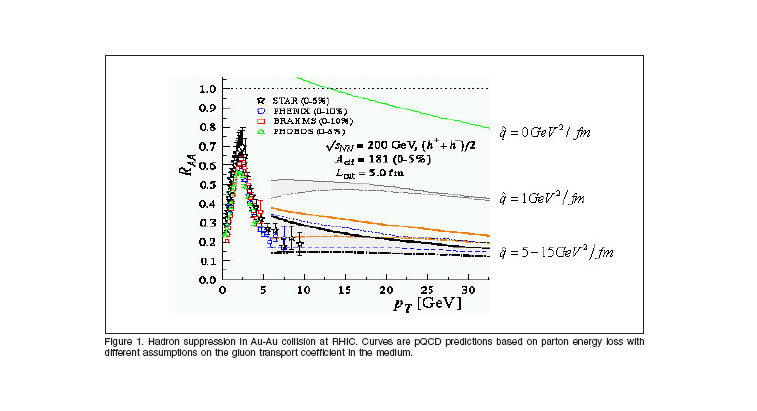
<body><![CDATA[<br>   </font></p>     <p><font size="2" face="Verdana, Arial, Helvetica, sans-serif">RHIC results on    leading hadron suppression indicate that jets produced in hard processes are    strongly quenched by the dense medium created in heavy ion collisions. Several    questions on the medium modification of the jet structure have not been yet    well addressed. These topics will be better studied at LHC by ALICE at higher    pt and with full jet reconstruction. The performances of ALICE on high pt particles    and jets can be significantly improved by completing the present set-up with    a large electromagnetic calorimeter. </font></p> <hr>     <p><font face="Verdana, Arial, Helvetica, sans-serif" size="2"><b>RESUMEN</b></font><font size="2" face="Verdana, Arial, Helvetica, sans-serif"><b></b></font></p>     <p><font size="2" face="Verdana, Arial, Helvetica, sans-serif">Los resultados    de RHIC en cuanto a la supresi&oacute;n de los principales hadrones energ&eacute;ticos    indican que los jets producidos en procesos duros est&aacute;n fuertemente modificados    por el medio denso creado en colisiones de iones pesados. Diversos aspectos    acerca de las modificaciones de la estructura del jet por el medio no han sido    todav&iacute;a bien investigadas. Estos temas ser&aacute;n mejor estudiados    en el LHC por ALICE a mayor pT y con reconstrucci&oacute;n completa del jet.    Los resultados de ALICE para part&iacute;culas de alto pT y jets pueden ser    mejorados significativamente si se completa la actual configuraci&oacute;n del    experimento con un calor&iacute;metro electromagn&eacute;tico grande.</font></p>     <p></p>     <p><font face="Verdana, Arial, Helvetica, sans-serif" size="2"><b>Key words:</b>    attenuation, energy levels, gev range 10-100, ion collisions, particle production,    ALICE, gluons, jet model, quenching    <br>   </font></p> <hr>     <p><font size="2" face="Verdana, Arial, Helvetica, sans-serif"><strong>INTRODUCTION</strong></font></p>     <p><font size="2" face="Verdana, Arial, Helvetica, sans-serif"><b>1 - Hadron suppression    at RHIC</b></font></p>     <p><font face="Verdana, Arial, Helvetica, sans-serif" size="2">Two of the most    outstanding results from RICH are the leading hadron suppression at high pT    (see [1] for a review) and the large washing out of the jet-like azimuthal correlations    [2]. Figure 1 shows the suppression of inclusive hadrons in central 200 GeV    Au-Au collisions. The data are compared with pQCD predictions where the created    medium is characterized by a gluon transport coefficient q=m2/l where m is the    typical momentum transfer and l is the gluon mean free path. The huge hadron    suppression indicates that a medium of high density is formed in the early stage    after the collision. It is to point out that, in the same pT range, the non-QCD    particles like the photons are not suppressed like the hadrons. The curves are    results of a radiative energy loss calculation that reproduces the measured    suppression for an initial gluon density about 30 times the density of cold    matter [3,4]. Unfortunately, the pT-range explored by RHIC is quite limited    and is not sufficient to study the pQCD evolution of the process, since for    pT lower than 6 GeV, non-perturbative phenomena are still important. In addition,    the RHIC limitation to measure just the leading hadron inside a jet can provide    only an approximate lower limit on the parton energy loss since detected hadrons    are mainly generated on the surface of the hot matter.</font></p>     ]]></body>
<body><![CDATA[<p><img src="/img/revistas/nuc/n41/f01054107.jpg" width="757" height="411"></p>     
<p></p>     <p><font face="Verdana, Arial, Helvetica, sans-serif" size="2">The study of azimuthal    correlations of jet-like events (see figure 2 for a pictorial view) also shows    that the hadrons produced in the opposite direction of the detected leading    high-pT hadron are strongly suppressed by the dense medium while hadrons produced    in the same jet-cone of the leading hadrons are not.</font></p>     <p><img src="/img/revistas/nuc/nuc41/images/f02054107.jpg" width="761" height="441"></p>     
<p></p>     <p><font face="Verdana, Arial, Helvetica, sans-serif" size="2">The picture emerging    from the experimental results at RHIC is that the state produced in nucleus-nucleus    collision at these energies shows a behaviour hardly compatible with the one    expected for an ideal gas of free quarks and gluons. It rather looks like a    liquid, with a short mean free-path and a large opacity as shown by the suppression    of particle production at high pT. This scenario is also supported by recent    lattice QCD calculations indicating that substantial interactions are still    present even above the critical temperature of the phase transition.</font></p>     <p><font face="Verdana, Arial, Helvetica, sans-serif" size="2"><b>2 - Jet quenching    at ALICE</b></font></p>     <p><font face="Verdana, Arial, Helvetica, sans-serif" size="2">The large energy    gap makes extrapolations form RHIC to LHC non-trivial and the system that will    be formed in Pb-Pb collisions at LHC might show substantial differences compared    with the one formed at RHIC. Expectations from LHC are:</font></p>     <p><font face="Verdana, Arial, Helvetica, sans-serif" size="2">&#149; fireball    hotter and denser, lifetime longer    <br>   &#149; more weakly interacting Quark Gluon Plasma    ]]></body>
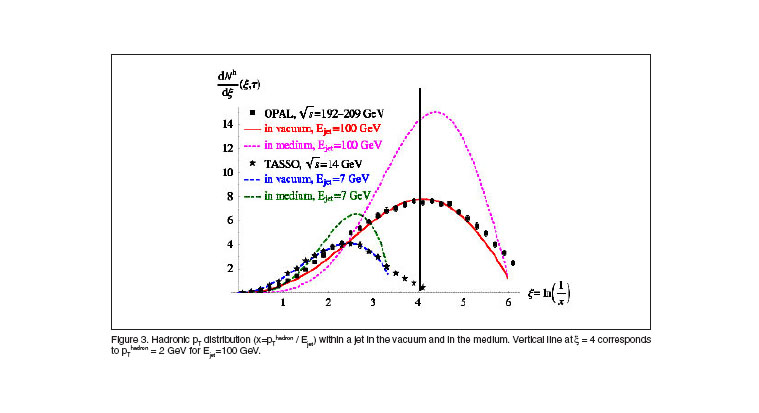
<body><![CDATA[<br>   &#149; initial gluon density 5-10 times larger    <br>   &#149; dynamics dominated by partonic degrees of freedom    <br>   &#149; particle production dominated by hard scattering at low x with huge increase    of hard probes    <br>   RHIC results on leading hadron suppression indicate that most of the energy    lost by the leading parton remains within the jet cone, but several questions    on the medium modification of the jet structure have not been addressed. These    include the longitudinal and transverse structures of the quenched jet, the    associated radiation observables, the dependence on the parton flavor. These    topics will be studied by ALICE thanks to both the robustness of its tracking    (excellent performance for charged particles both at low and high pT from the    Time Projection Chamber) and the charged particle identification systems.    <br>   </font></p>     <p><font face="Verdana, Arial, Helvetica, sans-serif" size="2">Figure 3 shows    the expected medium modification of the pT distribution of particles in jets    of different energies. As it is seen, large effects are expected in both the    low pT (where the other LHC experiments have modest efficiencies) and in the    high pT regions. To make ALICE [5,6] better suited for jet physics, the performances    on high pT particles and jets can be significantly improved by completing the    present set-up with a large Electromagnetic Calorimeter (EmCal) [7]. This would    significantly improve the resolution on the jet energy and on the particle composition    (with the detection of both charged and neutral particles). It would also allow    to calibrate the jet energy by measuring the high energy photon emitted in the    opposite direction (g-jet physics). EmCal would be used to trigger on the jet    energy itself, thus allowing a significant improvement of the statistics achievable    for jets of high energy.</font></p>     <p><img src="/img/revistas/nuc/n41/f03054107.jpg" width="759" height="413"></p>     
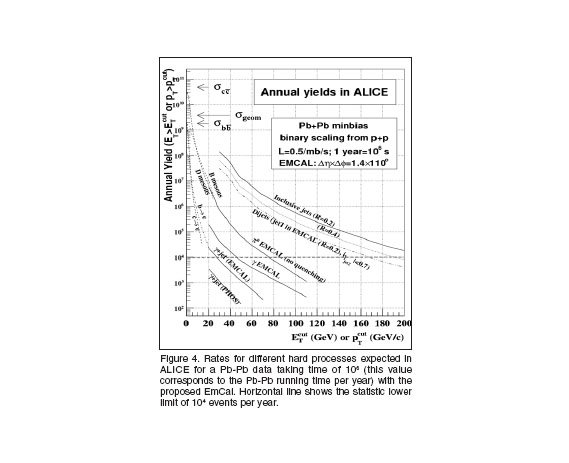
<p></p>     <p><font face="Verdana, Arial, Helvetica, sans-serif" size="2">Finally, due too    both the g/p0 and the electron/hadron discrimination, EmCal will enhance the    ALICE capabilities at high pT for direct photon and heavy quarks (c, b decays    into e+ e-) measurements. Figure 4 shows the annual yields expected in one year    of Pb-Pb minimum bias events. Assuming a required statistics of 104 events to    be collected, the inclusive jet can be studied up to pT of about 200 GeV, while    events with two jets (one triggered by the EMCal and the other partially reconstructed    only in the TPC) up to 170 GeV. The g-jet rate is statistically robust up to    40 GeV. Single p0 and g can be measured up to about 75 and 45 GeV, respectively,    while positrons and electrons from charm and bottom semi-leptonic decay up to    about 25 GeV. Study of heavy quark jet production is of interest because the    energy loss is expected to be different from that of light quark and gluon jets.</font></p>     <p><img src="/img/revistas/nuc/n41/f04054107.jpg" width="569" height="463"></p>     
]]></body>
<body><![CDATA[<p></p>     <p><font face="Verdana, Arial, Helvetica, sans-serif" size="2">    <br>   <b>3 - The EMCal project for ALICE</b></font></p>     <p><font face="Verdana, Arial, Helvetica, sans-serif" size="2">The proposed EMCal    will cover the rapidity range of -0.7&lt;h&lt;+0.7 and the azimuthal angle DF=    110o. It will be positioned within the ALICE solenoidal magnet back to back    to the smaller PHOS calorimeter (see figure 5). The EMCal will be compose by    more than 1.2.104 channels since a high granularity and a large angular coverage    are required for the complete jet reconstruction. The technology will be the    Shashlik sampling calorimetry with alternate thin layers of lead and scintillator    tiles of 1.44 and 1.72 mm respectively. Each counter will be tapered of about    1.5o in order to achieve a projective configuration in the rapidity variable.    The detector thickness will be of 20.1 radiation length in order to limit the    longitudinal leakage of high energy e.m. showers.</font></p>     <p><img src="/img/revistas/nuc/n41/f05054107.jpg" width="756" height="509"></p>     
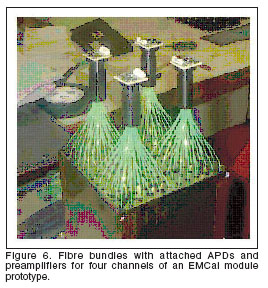
<p></p>     <p><font face="Verdana, Arial, Helvetica, sans-serif" size="2">The optical readout    will be performed with double cladding Wave Length Shifter fibres coupled with    Avalanche Photo Diodes (see figure 6). The preamplifiers and the front end electronics    will be derived from the ones already planned for the PHOS detector. The expected    performances for e.m. showers are an energy resolution better than 10%/&Ouml;E    (GeV) and a spatial resolution better than 1 cm. A charged pion rejection factor    of about 400 will be feasible with an electron efficiency of about 90%. The    g/p0 separation will be performed by using different techniques: two-photon    invariant mass reconstruction for pT up to about 10 GeV, event by event shower    shape pT for up to about 30 GeV and isolation cuts for higher pT. Finally the    EMCal will provide a fast, efficient trigger for high pT jets, and single g,    p0 or electrons with recorded yields enhanced by factors ranging from about    10 (for jets in Pb-Pb collisions) up to 60 (for single particles in p-p collisions).</font></p>     <p><img src="/img/revistas/nuc/n41/f06054107.jpg" width="268" height="288"></p>     
<p></p>     <p><font face="Verdana, Arial, Helvetica, sans-serif" size="2">EMCal Collaboration    is composed by several groups from CERN, France, Italy, Russia and USA. R&amp;D    programs have been already approved and funded by the respective funding agencies.    Since jet physics is foreseen to be addressed during the first five years of    LHC, EMCal should be completed and commissioned in 2010, but with small (large)    fraction already to be installed for the 2008 (2009) run.</font></p>     ]]></body>
<body><![CDATA[<p><font face="Verdana, Arial, Helvetica, sans-serif" size="2"><b>REFERENCES</b></font></p>     <!-- ref --><p><font face="Verdana, Arial, Helvetica, sans-serif" size="2">[1] KLAY JL. J    Phys G. 2005;( 31): S451.    <!-- ref --><br>   [2] ADAMS J, et al. Phys Rev Lett. 2003;( 91): 072304.    <!-- ref --><br>   [3] WANG E, WANG XN. Phys Rev Lett. 2002;( 8): 162301-2.    <!-- ref --><br>   [4] AIRAPETIAN A, HERMES Collaboration. Eur Phys J C. 2001;( 20): 479.    <!-- ref --><br>   [5] AIRAPETIAN A, HERMES Collaboration. Eur Phys JD. 2004;( 29): 21-2.    <!-- ref --><br>   [6] ALICE Collaboration. CERN/LHCC 95-71.    <!-- ref --><br>   [7] ALICE Collaboration. J Phys G. 2004;( 30): 517.    <!-- ref --><br>   [8] ALICE Collaboration. J Phys G. 2006;( 32): 1295-8. </font>    <!-- ref --><br>   [9] ALICE Collaboration. CERN/LHCC 06-014.    <br> </p>     <p>&nbsp;</p>      ]]></body><back>
<ref-list>
<ref id="B1">
<label>1</label><nlm-citation citation-type="journal">
<person-group person-group-type="author">
<name>
<surname><![CDATA[KLAY]]></surname>
<given-names><![CDATA[]JL]]></given-names>
</name>
</person-group>
<source><![CDATA[J Phys G.]]></source>
<year>2005</year>
<numero>31</numero>
<issue>31</issue>
<page-range>S451</page-range></nlm-citation>
</ref>
<ref id="B2">
<label>2</label><nlm-citation citation-type="journal">
<person-group person-group-type="author">
<name>
<surname><![CDATA[ADAMS]]></surname>
<given-names><![CDATA[J]]></given-names>
</name>
</person-group>
<source><![CDATA[Phys Rev Lett.]]></source>
<year>2003</year>
<numero>91</numero>
<issue>91</issue>
<page-range>072304</page-range></nlm-citation>
</ref>
<ref id="B3">
<label>3</label><nlm-citation citation-type="journal">
<person-group person-group-type="author">
<name>
<surname><![CDATA[WANG]]></surname>
<given-names><![CDATA[]E]]></given-names>
</name>
<name>
<surname><![CDATA[WANG]]></surname>
<given-names><![CDATA[]XN]]></given-names>
</name>
</person-group>
<source><![CDATA[Phys Rev Lett.]]></source>
<year>2002</year>
<numero>8</numero>
<issue>8</issue>
<page-range>162301-2</page-range></nlm-citation>
</ref>
<ref id="B4">
<label>4</label><nlm-citation citation-type="journal">
<person-group person-group-type="author">
<name>
<surname><![CDATA[AIRAPETIAN]]></surname>
<given-names><![CDATA[A]]></given-names>
</name>
</person-group>
<collab>HERMES Collaboration</collab>
<source><![CDATA[Eur Phys J C.]]></source>
<year>2001</year>
<numero>20</numero>
<issue>20</issue>
<page-range>479</page-range></nlm-citation>
</ref>
<ref id="B5">
<label>5</label><nlm-citation citation-type="journal">
<person-group person-group-type="author">
<name>
<surname><![CDATA[AIRAPETIAN]]></surname>
<given-names><![CDATA[A]]></given-names>
</name>
</person-group>
<source><![CDATA[  Eur Phys JD.]]></source>
<year>2004</year>
<numero>29</numero>
<issue>29</issue>
<page-range>21-2</page-range></nlm-citation>
</ref>
<ref id="B6">
<label>6</label><nlm-citation citation-type="">
<collab>ALICE Collaboration</collab>
<source><![CDATA[CERN/LHCC 95-71]]></source>
<year></year>
</nlm-citation>
</ref>
<ref id="B7">
<label>7</label><nlm-citation citation-type="journal">
<collab>ALICE Collaboration</collab>
<source><![CDATA[J Phys G.]]></source>
<year>2004</year>
<numero>30</numero>
<issue>30</issue>
<page-range>517</page-range></nlm-citation>
</ref>
<ref id="B8">
<label>8</label><nlm-citation citation-type="journal">
<collab>ALICE Collaboration</collab>
<source><![CDATA[J Phys G.]]></source>
<year>2006</year>
<numero>32</numero>
<issue>32</issue>
<page-range>1295-8</page-range></nlm-citation>
</ref>
<ref id="B9">
<label>9</label><nlm-citation citation-type="">
<collab>ALICE Collaboration</collab>
<source><![CDATA[CERN/LHCC 06-014]]></source>
<year></year>
</nlm-citation>
</ref>
</ref-list>
</back>
</article>