<?xml version="1.0" encoding="ISO-8859-1"?><article xmlns:mml="http://www.w3.org/1998/Math/MathML" xmlns:xlink="http://www.w3.org/1999/xlink" xmlns:xsi="http://www.w3.org/2001/XMLSchema-instance">
<front>
<journal-meta>
<journal-id>0864-084X</journal-id>
<journal-title><![CDATA[Nucleus]]></journal-title>
<abbrev-journal-title><![CDATA[Nucleus]]></abbrev-journal-title>
<issn>0864-084X</issn>
<publisher>
<publisher-name><![CDATA[CUBAENERGIA]]></publisher-name>
</publisher>
</journal-meta>
<article-meta>
<article-id>S0864-084X2007000100008</article-id>
<title-group>
<article-title xml:lang="en"><![CDATA[Calculation of the displacement cross sections and the dpa distribution in hydrogenated amorphous silicon semiconductors detectors in medical digital imaging applications]]></article-title>
<article-title xml:lang="es"><![CDATA[Cálculo de la sección transversal de desplazamiento y la distribución de los dpa en detectores semiconductores de silicio amorfo hidrogenado en aplicaciones de imagenología digital médica]]></article-title>
</title-group>
<contrib-group>
<contrib contrib-type="author">
<name>
<surname><![CDATA[Leyva Fabelo]]></surname>
<given-names><![CDATA[Antonio]]></given-names>
</name>
<xref ref-type="aff" rid="A01"/>
</contrib>
<contrib contrib-type="author">
<name>
<surname><![CDATA[Piñera Hernández]]></surname>
<given-names><![CDATA[Ibrahin]]></given-names>
</name>
<xref ref-type="aff" rid="A01"/>
</contrib>
<contrib contrib-type="author">
<name>
<surname><![CDATA[Shtejer Díaz]]></surname>
<given-names><![CDATA[Katerin]]></given-names>
</name>
<xref ref-type="aff" rid="A01"/>
</contrib>
<contrib contrib-type="author">
<name>
<surname><![CDATA[Abreu Alfonso]]></surname>
<given-names><![CDATA[Yamiel]]></given-names>
</name>
<xref ref-type="aff" rid="A01"/>
</contrib>
<contrib contrib-type="author">
<name>
<surname><![CDATA[Cruz Inclán]]></surname>
<given-names><![CDATA[Carlos Manuel]]></given-names>
</name>
<xref ref-type="aff" rid="A01"/>
</contrib>
</contrib-group>
<aff id="A01">
<institution><![CDATA[,Centro de Aplicaciones Tecnológicas y Desarrollo Nuclear (CEADEN)  ]]></institution>
<addr-line><![CDATA[Ciudad de La Habana ]]></addr-line>
<country>Cuba</country>
</aff>
<pub-date pub-type="pub">
<day>00</day>
<month>06</month>
<year>2007</year>
</pub-date>
<pub-date pub-type="epub">
<day>00</day>
<month>06</month>
<year>2007</year>
</pub-date>
<numero>41</numero>
<fpage>45</fpage>
<lpage>49</lpage>
<copyright-statement/>
<copyright-year/>
<self-uri xlink:href="http://scielo.sld.cu/scielo.php?script=sci_arttext&amp;pid=S0864-084X2007000100008&amp;lng=en&amp;nrm=iso"></self-uri><self-uri xlink:href="http://scielo.sld.cu/scielo.php?script=sci_abstract&amp;pid=S0864-084X2007000100008&amp;lng=en&amp;nrm=iso"></self-uri><self-uri xlink:href="http://scielo.sld.cu/scielo.php?script=sci_pdf&amp;pid=S0864-084X2007000100008&amp;lng=en&amp;nrm=iso"></self-uri><abstract abstract-type="short" xml:lang="es"><p><![CDATA[Utilizando la aproximación de Mott-McKinley-Feshbach en el trabajo se calculó la dependencia de la sección transversal de desplazamiento para cada especie de átomo de la estructura del a-Si:H en los intervalos de energía típicos de los electrones secundarios generados por los rayos X empleados en aplicaciones de imagenología médica. Se observó que para energías de los electrones superiores a 1,52 keV son posibles los desplazamientos de átomos de hidrógeno, mientras que la energía umbral de desplazamiento de los átomos de silicio resultó de 126 keV. Estos resultados se compararon con los obtenidos para detectores similares pero fabricados de silicio cristalino. Con el empleo de la simulación matemática del transporte de la radiación en la materia se calculó el especto energético de los electrones secundarios con el objetivo de estimar el número de desplazamientos por átomos que tienen lugar en el dispositivo amorfo semiconductor en régimen de trabajo. La distribución espacial de los dpa en el volumen del detector, así como su comportamiento con la profundidad son presentados y discutidos en el texto.]]></p></abstract>
<abstract abstract-type="short" xml:lang="en"><p><![CDATA[In present paper the dependence of the displacement cross sections of the different species of atoms in the a-Si:H structure, with the energy of the secondary electrons generated by the X-rays of the typical energies using in medical imaging applications, was calculated using the Mott-McKinley-Feshbach approach. It was verified that for electron energies higher than 1.52 keV it is possible the occurrence of hydrogen atoms displacements, while for the silicon atoms the threshold energy is 126 keV. These results were compared with those obtained for similar detectors but developed with crystalline silicon. With the use of the mathematical simulation of the radiation transport in the matter, the energy spectrum of the secondary electrons was calculated in order to estimate the number of atomic displacements, which take place in the semiconducting amorphous device in working regime. The spatial distribution of the dpa in the detectors volume, as well as its behavior with the depth in the work region are presented and discussed in the text.]]></p></abstract>
<kwd-group>
<kwd lng="en"><![CDATA[cross sections]]></kwd>
<kwd lng="en"><![CDATA[atomic displacements]]></kwd>
<kwd lng="en"><![CDATA[semiconductor detectors]]></kwd>
<kwd lng="en"><![CDATA[simulation]]></kwd>
<kwd lng="en"><![CDATA[amorphous states]]></kwd>
<kwd lng="en"><![CDATA[silicon, x radiation]]></kwd>
<kwd lng="en"><![CDATA[images]]></kwd>
</kwd-group>
</article-meta>
</front><body><![CDATA[ <p align="left"><font face="Verdana, Arial, Helvetica, sans-serif" size="2"><b>CIENCIAS    NUCLEARES</b></font></p>     <p align="left">&nbsp;</p>     <p><strong><font size="4" face="Verdana, Arial, Helvetica, sans-serif">Calculation    of the displacement cross sections and the </font><font size="4" face="Verdana, Arial, Helvetica, sans-serif"><b>DPA</b>    distribution in hydrogenated amorphous silicon semiconductors detectors in medical    digital imaging applications    <br>   </font></strong></p>     <p><font size="3" face="Verdana, Arial, Helvetica, sans-serif">C&aacute;lculo    de la secci&oacute;n transversal de desplazamiento y la distribuci&oacute;n    de los DPA    <br>   en detectores semiconductores de silicio amorfo hidrogenado en aplicaciones        <br>   de imagenolog&iacute;a digital m&eacute;dica    <br>   </font></p>     <p></p>     <p><font size="2" face="Verdana, Arial, Helvetica, sans-serif">Antonio Leyva Fabelo,    Ibrahin Pi&ntilde;era Hern&aacute;ndez, Katerin Shtejer D&iacute;az, Yamiel    Abreu Alfonso, Carlos Manuel Cruz Incl&aacute;n    ]]></body>
<body><![CDATA[<br>   </font></p>     <p><font size="2" face="Verdana, Arial, Helvetica, sans-serif">Centro de Aplicaciones    Tecnol&oacute;gicas y Desarrollo Nuclear (CEADEN)    <br>   Calle 30 No 502 e/ 5ta Ave. y 7ma. Playa, Ciudad de La Habana, Cuba    <br>   aleyva@ceaden.edu.cu</font></p> <hr>     <p><font face="Verdana, Arial, Helvetica, sans-serif" size="2"><b>ABSTRACT</b></font></p>     <p><font size="2" face="Verdana, Arial, Helvetica, sans-serif">In present paper    the dependence of the displacement cross sections of the different species of    atoms in the a-Si:H structure, with the energy of the secondary electrons generated    by the X-rays of the typical energies using in medical imaging applications,    was calculated using the Mott-McKinley-Feshbach approach. It was verified that    for electron energies higher than 1.52 keV it is possible the occurrence of    hydrogen atoms displacements, while for the silicon atoms the threshold energy    is 126 keV. These results were compared with those obtained for similar detectors    but developed with crystalline silicon. With the use of the mathematical simulation    of the radiation transport in the matter, the energy spectrum of the secondary    electrons was calculated in order to estimate the number of atomic displacements,    which take place in the semiconducting amorphous device in working regime.    <br>   The spatial distribution of the dpa in the detectors volume, as well as its    behavior with the depth in the    <br>   work region are presented and discussed in the text.</font></p> <hr>     <p><font face="Verdana, Arial, Helvetica, sans-serif" size="2"><b>RESUMEN</b></font></p>     <p><font size="2" face="Verdana, Arial, Helvetica, sans-serif">Utilizando la aproximaci&oacute;n    de Mott-McKinley-Feshbach en el trabajo se calcul&oacute; la dependencia de    la secci&oacute;n transversal de desplazamiento para cada especie de &aacute;tomo    de la estructura del a-Si:H en los intervalos de energ&iacute;a t&iacute;picos    de los electrones secundarios generados por los rayos X empleados en aplicaciones    de imagenolog&iacute;a m&eacute;dica. Se observ&oacute; que para energ&iacute;as    de los electrones superiores a 1,52 keV son posibles los desplazamientos de    &aacute;tomos de hidr&oacute;geno, mientras que la energ&iacute;a umbral de    desplazamiento de los &aacute;tomos de silicio result&oacute; de 126 keV. Estos    resultados se compararon con los obtenidos para detectores similares pero fabricados    de silicio cristalino. Con el empleo de la simulaci&oacute;n matem&aacute;tica    del transporte de la radiaci&oacute;n en la materia se calcul&oacute; el especto    energ&eacute;tico de los electrones secundarios con el objetivo de estimar el    n&uacute;mero de desplazamientos por &aacute;tomos que tienen lugar en el dispositivo    amorfo semiconductor en r&eacute;gimen de trabajo. La distribuci&oacute;n espacial    de    ]]></body>
<body><![CDATA[<br>   los dpa en el volumen del detector, as&iacute; como su comportamiento con la    profundidad son presentados    <br>   y discutidos en el texto.</font></p>     <p><font face="Verdana, Arial, Helvetica, sans-serif" size="2"><b>Key words:</b>    cross sections, atomic displacements, semiconductor detectors, simulation, amorphous        <br>   states, silicon, x radiation, images</font></p> <hr>     <p><font size="2" face="Verdana, Arial, Helvetica, sans-serif"><strong>INTRODUCTION</strong></font></p>     <p><font size="2" face="Verdana, Arial, Helvetica, sans-serif">The use of radiation    detectors manufactured with hydrogenated amorphous silicon extends quickly in    many fields of science and technology, because its low production cost, the    possibility to grow large areas, its appropriate sensibility operating at high    temperatures and the possibility to grown thin layers directly over the read-out    electronics.    <br>   </font></p>     <p><font size="2" face="Verdana, Arial, Helvetica, sans-serif">Another of their    most important advantages over the crystalline detectors, is the existent compatibility    between the characteristics of their structure and the radiacional damage [1],    question of maximum importance when the application requires of high operation    stability, still after high exposition dose, like it happens in the experiments    <br>   of high energies physics and in the medical radiology.</font></p>     <p><font face="Verdana, Arial, Helvetica, sans-serif" size="2">The radiacional    damage can be characterized through the quantity of atomic displacements (dpa)    of certain atoms specie. For photons irradiation this type of damage can only    be produced in an indirect way by means of the secondary electrons that are    generated after the primary interactions of the radiation with the matter (photoeffect).        ]]></body>
<body><![CDATA[<br>   </font></p>     <p><font face="Verdana, Arial, Helvetica, sans-serif" size="2">The range of energies    for most of the medical digital radiology applications is among some few eV    until the 150 keV, although in some applications like mammography and angiography    the maximum energy doesn&#146;t exceed the 50 keV.    <br>   </font></p>     <p><font face="Verdana, Arial, Helvetica, sans-serif" size="2">These relatively    low energies are the employees in this paper to determine the X rays effects    on the structure of the pin hydrogenated amorphous silicon (a-Si:H) detectors    in applications of radiological diagnosis.    <br>   </font></p>     <p><font face="Verdana, Arial, Helvetica, sans-serif" size="2"><b>Determination    of the displacement cross section</b> </font></p>     <p><font face="Verdana, Arial, Helvetica, sans-serif" size="2">The determination    of the displacement per atom (dpa) cross section <img src="/img/revistas/nuc/n41/e01084107.jpg" width="19" height="17">is    an indispensable step to determine of the radiacional damage. Knowing <img src="/img/revistas/nuc/n41/e01084107.jpg" width="19" height="17">    and the energies spectrum of the particles flow is possible to calculate the    total number of atoms that can be displaced of its positions per unit fluence    per a target atom. The approach of Mott-McKinley-Feshbach [2] has been used    for the <img src="/img/revistas/nuc/n41/e01084107.jpg" width="19" height="17">    calculation. This approach supposes that the atom is bonded to the material    with an energy <img src="/img/revistas/nuc/n41/e01084107.jpg" width="19" height="17">,    and for electrons incident energies smaller than <img src="/img/revistas/nuc/n41/e02084107.jpg" width="19" height="21">,    <img src="/img/revistas/nuc/n41/e01084107.jpg" width="19" height="17">    = 0, while for the contrary case it is determined by:    
<br>   </font></p>     <p><img src="/img/revistas/nuc/n41/e11084107.jpg" width="561" height="86"></p>     
<p><font face="Verdana, Arial, Helvetica, sans-serif" size="2">where Z is the    atomic number of target atom, <img src="/img/revistas/nuc/n41/e09084107.jpg" width="14" height="15">    - the Bohr radius, <img src="/img/revistas/nuc/n41/e05084107.jpg" width="15" height="14">    - Rydberg energy, <img src="/img/revistas/nuc/nuc41/images/e06084107.jpg" width="11" height="11">    = Z/137, <img src="/img/revistas/nuc/n41/e10084107.jpg" width="10" height="14">-    ratio of electron velocity to light velocity, <img src="/img/revistas/nuc/n41/e07084107.jpg" width="15" height="16">    - maximum kinetic energy of recoil atom, M - mass of target atom, m - mass of    electron, and <img src="/img/revistas/nuc/n41/e02084107.jpg" width="20" height="20">    - displacement energy.     
]]></body>
<body><![CDATA[<br>   </font></p>     <p><font face="Verdana, Arial, Helvetica, sans-serif" size="2">This approach has    been considered exact with a margin of error of 1% for Z <img src="/img/revistas/nuc/nuc41/images/e08084107.jpg" width="11" height="13">    40 [3].    
<br>   </font></p>     <p><font face="Verdana, Arial, Helvetica, sans-serif" size="2">In Ec. (1) all    the parameters are known, with the exception of the displacement threshold energy    of the target atom in the structure of the material,<img src="/img/revistas/nuc/n41/e02084107.jpg" width="19" height="21">    .     
<br>   </font></p>     <p><font face="Verdana, Arial, Helvetica, sans-serif" size="2">For the case of    the a-Si:H the values of <img src="/img/revistas/nuc/n41/e02084107.jpg" width="19" height="21">    appear in the literature with certain dispersion. For example, in [4] it is    reported that for the hydrogen, <img src="/img/revistas/nuc/n41/e03084107.jpg" width="19" height="18">Ed    H = 3.4 eV, in [5] Ed H = 3.3 eV and in [6] <img src="/img/revistas/nuc/n41/e03084107.jpg" width="19" height="18">=    3.6 eV. The authors of [7] assume that the displacement threshold energy of    Si is 20 eV, while in [8] they take <img src="/img/revistas/nuc/n41/e04084107.jpg" width="19" height="16">    = 22 eV and in [9] they report that the energy required to remove a silicon    atom that is bonded with three other silicon atoms is approximately 25 eV.    
<br>   </font></p>     <p><font face="Verdana, Arial, Helvetica, sans-serif" size="2">We use <img src="/img/revistas/nuc/n41/e03084107.jpg" width="19" height="18">    = 3.3 eV taking into account that this value is reported as the bonding energy    of H to the Si in the a-Si:H structure and for monovalent atoms the cohesive    energy coincides with the displacement threshold energy [10]. For the case of    the silicon we use <img src="/img/revistas/nuc/n41/e04084107.jpg" width="19" height="16">    = 22 eV, an average of the reported values.    
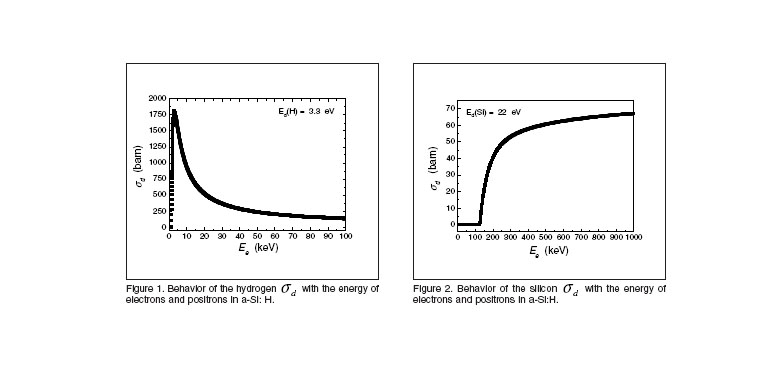
<br>   </font></p>     <p><font face="Verdana, Arial, Helvetica, sans-serif" size="2">The figures 1 and    2 show the founded dependences for the displacement cross-sections for hydrogen    and silicon atoms respectively, with the electrons and positrons energy.</font></p>     ]]></body>
<body><![CDATA[<p><img src="/img/revistas/nuc/n41/f01084107.jpg" width="780" height="376"></p>     
<p><font face="Verdana, Arial, Helvetica, sans-serif" size="2">The analysis of    both figures show that, in our experimental conditions (<img src="/img/revistas/nuc/n41/e13084107.jpg" width="31" height="15">&lt;    50 keV, typical maximum energy in the most of medical radiographic applications)    the probability of H atoms of being displaced from their position is nonzero    only for energies higher than 1.52 keV, while the Si atoms are insensitive to    the displacement effects because to achieve its displacement from the bonded    position there are required electrons with <img src="/img/revistas/nuc/n41/e12084107.jpg" width="15" height="17"><img src="/img/revistas/nuc/n41/e14084107.jpg" width="13" height="12">126    keV. This result allows concluding that in the a-Si:H detector the structural    displacement defects are only possible for the hydrogen atoms that passivate    the dangling silicon bonds.     
<br>   </font></p>     <p><font face="Verdana, Arial, Helvetica, sans-serif" size="2">For c-Si the <img src="/img/revistas/nuc/n41/e01084107.jpg" width="19" height="17">    was also calculated using the same code and <img src="/img/revistas/nuc/n41/e02084107.jpg" width="19" height="21">    = 25 eV reported in [11,12]. Figure 3 shows the <img src="/img/revistas/nuc/n41/e01084107.jpg" width="19" height="17">    behaviour with the electron energy in this crystalline material. As is observed,    the differences between the calculated results for a-Si:H and c-Si are very    small, because of the similar displacement threshold energy. For example, in    [13] was reported that the d s for silicon in c-Si irradiated with 1 MeV electrons    is 68 barn, while for identical energy our results were 70.3 barn for the same    material and 67.2 barn for hydrogenated amorphous silicon. Also, the displacement    threshold energies for silicon in c-Si reported in the literature, 133 keV [14]    and 150 keV [15], are very close to our results, 126 keV for a-Si:H and 141    keV for c-Si.</font></p>     
<p><img src="/img/revistas/nuc/n41/f03084107.jpg" width="269" height="236"></p>     
<p><font face="Verdana, Arial, Helvetica, sans-serif" size="2"><b>Hydrogen dpa    determination</b>    <br>   </font></p>     <p><font face="Verdana, Arial, Helvetica, sans-serif" size="2">Having the values    of <img src="/img/revistas/nuc/n41/e01084107.jpg" width="19" height="17">    as a function of the secondary electrons energy, to calculate the dpa, it is    required to determine the energy spectrum of the secondary electrons in the    volume of interest.    
<br>   </font></p>     <p><font face="Verdana, Arial, Helvetica, sans-serif" size="2">To calculate this    flow spectrum the code system MCNP-4C [16] based on Monte Carlo method was employed.    MCNP-4C simulates the transport of photons and electrons in matter.</font></p>     ]]></body>
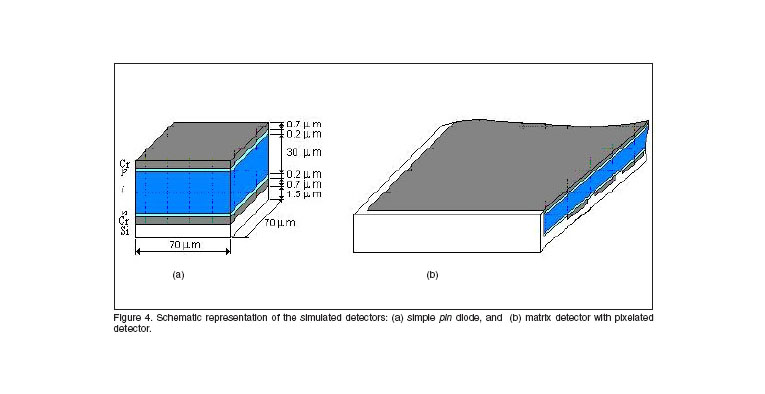
<body><![CDATA[<p><font face="Verdana, Arial, Helvetica, sans-serif" size="2">In the simulation    were taken into account all material and geometric details of both detectors    (simple pin detector and matrix detector based in pin diode with pixelated electrode,    figures 4(a) and 4(b) [17]).</font></p>     <p><font face="Verdana, Arial, Helvetica, sans-serif" size="2"><img src="/img/revistas/nuc/n41/f04084107.jpg" width="765" height="394">    
<br>   </font></p>     <p><font face="Verdana, Arial, Helvetica, sans-serif" size="2">As X-rays source,    a parallel photons beam generator with the Mo emission spectrum (17.6 keV and    19.7 keV) was modeled. </font></p>     <p><font face="Verdana, Arial, Helvetica, sans-serif" size="2">The distance between    the source and the detector was selected l = 60 cm. The histories numbers for    each experiment was selected according to the required statistic. In all the    cases the relative error of the calculated values was lower than 10%. The results    of simulation were obtained using the tally F4, which deliver the values of    the differential energy flow in (<img src="/img/revistas/nuc/n41/e17084107.jpg" width="49" height="12">).    
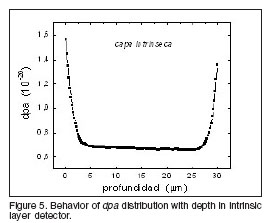
<br>   This spectrum is multiplied by the corresponding cross sections and integrated    in the interesting energies interval, determining by this way the total number    of dpa that take place as consequence of the transport in the device of each    incident photon.    <br>   </font></p>     <p><font face="Verdana, Arial, Helvetica, sans-serif" size="2">When irradiating    the detector with photons coming from the Mo source (<img src="/img/revistas/nuc/n41/e18084107.jpg" width="18" height="14">    photons) it is observed that the distribution of the calculated atomic displacements    in the intrinsic layer as a function of the depth presents a behavior, just    as it is shown in figure 5.    
<br>   </font></p>     <p><img src="/img/revistas/nuc/n41/f05084107.jpg" width="272" height="223"></p>     
]]></body>
<body><![CDATA[<p><font face="Verdana, Arial, Helvetica, sans-serif" size="2">The obtained distribution    is characterized by very high values of dpa in the adjacent regions to the Cr    electrodes, as a consequence of the higher Z of Cr with respect to the Z of    the intrinsic material, which lead to the increment of the number of generated    secondary photoelectrons <img src="/img/revistas/nuc/n41/e19084107.jpg" width="71" height="20">particles    with the ability to provoke atomic displacement on the hydrogen atoms.    
<br>   The highest value of dpa is reached near the front surface, 1.56 x <img src="/img/revistas/nuc/n41/e20084107.jpg" width="24" height="13">,    while in the center of the active intrinsic volume the number of dpa is 6.65    x 10-21. It means that for each <img src="/img/revistas/nuc/n41/e20084107.jpg" width="24" height="13">-<img src="/img/revistas/nuc/n41/e21084107.jpg" width="24" height="14">    photons that impact in the sensor of 70x70x30 <img src="/img/revistas/nuc/n41/e22084107.jpg" width="26" height="13">    only will take place between 1 and 7 hydrogen atomic displacements.</font></p>     
<p><font face="Verdana, Arial, Helvetica, sans-serif" size="2">This number of    structural defects is very small and completely negligible keeping in mind that    the average number of photons incident in a similar detector working in conditions    of clinical operation in one year is ~ 1 x <img src="/img/revistas/nuc/nuc41/images/e16084107.jpg" width="20" height="12">.    This annual number of photons was calculated using the data of deposited dose    (2 x <img src="/img/revistas/nuc/n41/e15084107.jpg" width="18" height="12">    Gy) reported in [18] in a similar detector.    
<br>   </font></p>     <p><font face="Verdana, Arial, Helvetica, sans-serif" size="2">By the same way,    using in the calculation the dose data reported [19], the maximum number of    photons that impact in our detector under real diagnostic exploitation in one    year doesn&#146;t exceed the <img src="/img/revistas/nuc/n41/e24084107.jpg" width="22" height="12">    photons, still smaller value.    
<br>   Besides this, some authors, as example [20, 21], demonstrate experimentally    that in a-Si:H the recombination processes of defects are very improved thanks    to the characteristics of the own structure. This natural process contributes,    as these authors report, to the reversion of the generated defects by the recombination    simply by a 5-10 h room temperature annealing.    <br>   </font></p>     <p><font face="Verdana, Arial, Helvetica, sans-serif" size="2">Previous experimental    studies [18, 22] demonstrated that these low dose levels do not have a significant    effect in the values of the carrier mobility, linearity and other noise properties    in a-Si:H detectors or FET. This way they conclude that the devices based on    the a-Si:H has the appropriate and necessary resistance to the radiacional damages    indispensable for these applications.    <br>   </font></p>     <p><font face="Verdana, Arial, Helvetica, sans-serif" size="2">In the case of    the a-Si:H matrix detector, given their large dimensions, the calculation shows    a higher dispersion of the results although 2.5 x <img src="/img/revistas/nuc/n41/e23084107.jpg" width="21" height="13">    histories were run. Nevertheless the relative error stayed inferior to 10%.    
]]></body>
<body><![CDATA[<br>   </font></p>     <p><font face="Verdana, Arial, Helvetica, sans-serif" size="2">The figure 6 shows    the obtained results for the dpa distribution in the intrinsic volume of three    different pixels (lateral, corner and a center) as a function of the depth.    Observe the same behavior that in the figure 5 with very little difference relative    to the position that occupies the pixel in the matrix arrangement. </font></p>     <p><img src="/img/revistas/nuc/n41/f06084107.jpg" width="278" height="246"></p>     
<p><font face="Verdana, Arial, Helvetica, sans-serif" size="2"><b>CONCLUSIONS</b>    <br>   </font></p>     <p><font face="Verdana, Arial, Helvetica, sans-serif" size="2">Using the Mott-McKinley-Feshbach    approach the displacement cross sections of H and Si in a-Si:H were calculated    as a function of the secondary electrons energy. It was determined that the    probability of occurrence of hydrogen atoms displacements from the structure    is possible for energy superiors to the 1.52 keV, while for the silicon atoms    it is possible for energies that surpass the 126 keV.    <br>   </font></p>     <p><font face="Verdana, Arial, Helvetica, sans-serif" size="2">The number of defects    generated as consequence of the H atoms displacements, according to the calculation,    is totally negligible in order to affect the efficient work of the device under    operation conditions.    <br>   </font></p>     <p><font face="Verdana, Arial, Helvetica, sans-serif" size="2">These results,    supported by the reports about the amplified defects recombination properties    of this material and the effective and fast restoration of the radioinduced    damages after the device annealing at room temperature, contribute to support    the idea that the devices based on the a-Si:H have the appropriate and necessary    resistance to the radiacional damages, indispensable for the applications of    digital medical radiology.    ]]></body>
<body><![CDATA[<br>   </font></p>     <p><font face="Verdana, Arial, Helvetica, sans-serif" size="2"><b>REFERENCES</b></font></p>     <!-- ref --><p><font face="Verdana, Arial, Helvetica, sans-serif" size="2">[1] MOARES D. Advance    solid state detector Technology for particle detection. 10th Workshop on Electronics    for LHC and Future Experiments. Boston, 2004. 13-17 September.    <!-- ref --><br>   [2] MCKINLEY WA, FESHBACH H. Phys. Rev. 1948; 74: 1759.    <!-- ref --><br>   [3] CURR RM. Proc. Phys. Soc. A. 1955; 68: 156.    <!-- ref --><br>   [4] TAKAHASHI M, KONAGAI M. Amorphous Silicon Solar Cells. London: North Oxford    Academic Publisher Ltd, 1986.    <!-- ref --><br>   [5] WEAST RC. Handbook of Chemistry and Physics. Boca Raton: Chemical Rubber    Corp, 1998.    <!-- ref --><br>   [6] KOSTESKI T. Tritiated Amorphous Silicon Films and Devices. Thesis for the    degree of Doctor of Philosophy. University of Toronto. 2001.    <!-- ref --><br>   [7] VAN SWAAIJ RACMM, ANNIS AD, SEALY BJ. J. Appl. Phys. 1997; 82 (10): 4800-4804.    <!-- ref --><br>   [8] WEHRSPOHN RB, DEANE SC, FRENCH ID, et al. J. Appl. Phys. 2000; 87 (11):    144-154.    <!-- ref --><br>   [9] SCHNEIDER U, SCHODER B. Amorphous Silicon and Related Materials. Singapore:    World Scientific, 1988.    <!-- ref --><br>   [10] MOLLER W. Appl Phys A. 1993; 56: 527.    <!-- ref --><br>   [11] HACKLER WA, KIKUCHI CH. Study of Lituium mobility in ittadiated silicon.    Technical Report ORA Project 04381, NASA. 1966.    <!-- ref --><br>   [12] HIRAIWA A, KOBAYASHI T. J. Appl. Phys. 1991; 70: 309.    <!-- ref --><br>   [13] TADA HY, CARTER JR, ANSPAUGH JRBE, DOWNING RG. Solar Cell Radiation. Handbook.    Third Edition. JPL Publication, 1982; 82-69.    <!-- ref --><br>   [14] HAN M, BENNETT JC, ZHANG Q, et al. Thin Solid Films. 2006; 514: 58-62.    <!-- ref --><br>   [15] SUMMERS A, et al. Trans Nucl Sci. 1993;( 40): 1372.    <br>   [16] SUMMERS A, et al. Trans Nucl Sci. 1993;( 40): 1372. B    <!-- ref --><br>   [17] LEYVA A. Informe T&eacute;cnico de la Salida contratada en octubre de 2005.    PRN/7-2/11. AENTA. 2005.    <!-- ref --><br>   [18] BOUDRY LM, ANTONUK LE. Med. Phys. 1996; 23 (5): 743-753.    <!-- ref --><br>   [19] ROHR P. Amorphous silicon based matrix detectors for X-ray Imaging. User    Meeting Workshop. ESRF. Grenoble, Febrary 2003.    <!-- ref --><br>   [20] SHIMIZU T, MAEHARA T, MASAHIRO M, et al. Jpn.J.Appl.Phys. 2001; 40: 1244-1245.    <!-- ref --><br>   [21] IMAGAWA O, YASUDA K, YOSHIDA A. Jpn. J. Appl. Phys. 1989; 66 (10): 4719-4722.    <!-- ref --><br>   [22] ANTONUK LE, BOUDRY LM, YORKSTON J, et al. Nucl. Inst. Meth. A. 1990; 299:    143-146.</font><p><font face="Verdana, Arial, Helvetica, sans-serif" size="2">    <br>   Recidido: 14 de abril de 2007    <br>   Aceptado: 28 de mayo de 2007</font>    <br> </p>      ]]></body><back>
<ref-list>
<ref id="B1">
<label>[1]</label><nlm-citation citation-type="">
<person-group person-group-type="author">
<name>
<surname><![CDATA[MOARES]]></surname>
<given-names><![CDATA[D]]></given-names>
</name>
</person-group>
<article-title xml:lang="en"><![CDATA[Advance solid state detector Technology for particle detection]]></article-title>
<source><![CDATA[10th Workshop on Electronics for LHC and Future Experiments]]></source>
<year>2004</year>
<publisher-loc><![CDATA[Boston ]]></publisher-loc>
</nlm-citation>
</ref>
<ref id="B2">
<label>[2]</label><nlm-citation citation-type="journal">
<person-group person-group-type="author">
<name>
<surname><![CDATA[MCKINLEY]]></surname>
<given-names><![CDATA[WA]]></given-names>
</name>
<name>
<surname><![CDATA[FESHBACH]]></surname>
<given-names><![CDATA[H]]></given-names>
</name>
</person-group>
<source><![CDATA[Phys. Rev.]]></source>
<year>1948</year>
<volume>74</volume>
<page-range>1759</page-range></nlm-citation>
</ref>
<ref id="B3">
<label>[3]</label><nlm-citation citation-type="journal">
<person-group person-group-type="author">
<name>
<surname><![CDATA[CURR]]></surname>
<given-names><![CDATA[RM]]></given-names>
</name>
</person-group>
<source><![CDATA[Proc. Phys. Soc. A.]]></source>
<year>1955</year>
<volume>68</volume>
<page-range>156</page-range></nlm-citation>
</ref>
<ref id="B4">
<label>[4]</label><nlm-citation citation-type="book">
<person-group person-group-type="author">
<name>
<surname><![CDATA[TAKAHASHI]]></surname>
<given-names><![CDATA[M]]></given-names>
</name>
<name>
<surname><![CDATA[KONAGAI]]></surname>
<given-names><![CDATA[M]]></given-names>
</name>
</person-group>
<source><![CDATA[Amorphous Silicon Solar Cells]]></source>
<year>1986</year>
<publisher-loc><![CDATA[London ]]></publisher-loc>
<publisher-name><![CDATA[North Oxford Academic Publisher Ltd]]></publisher-name>
</nlm-citation>
</ref>
<ref id="B5">
<label>[5]</label><nlm-citation citation-type="book">
<person-group person-group-type="author">
<name>
<surname><![CDATA[WEAST]]></surname>
<given-names><![CDATA[RC]]></given-names>
</name>
</person-group>
<source><![CDATA[Handbook of Chemistry and Physics]]></source>
<year>1998</year>
<publisher-loc><![CDATA[Boca Raton ]]></publisher-loc>
<publisher-name><![CDATA[Chemical Rubber Corp]]></publisher-name>
</nlm-citation>
</ref>
<ref id="B6">
<label>[6]</label><nlm-citation citation-type="">
<person-group person-group-type="author">
<name>
<surname><![CDATA[KOSTESKI]]></surname>
<given-names><![CDATA[T]]></given-names>
</name>
</person-group>
<source><![CDATA[Tritiated  Amorphous Silicon Films and Devices]]></source>
<year></year>
</nlm-citation>
</ref>
<ref id="B7">
<label>[7]</label><nlm-citation citation-type="journal">
<person-group person-group-type="author">
<name>
<surname><![CDATA[VAN SWAAIJ]]></surname>
<given-names><![CDATA[RACMM]]></given-names>
</name>
<name>
<surname><![CDATA[ANNIS]]></surname>
<given-names><![CDATA[AD]]></given-names>
</name>
<name>
<surname><![CDATA[SEALY]]></surname>
<given-names><![CDATA[BJ]]></given-names>
</name>
</person-group>
<source><![CDATA[J. Appl. Phys.]]></source>
<year>1997</year>
<volume>82</volume>
<numero>(10)</numero>
<issue>(10)</issue>
<page-range>4800-4804</page-range></nlm-citation>
</ref>
<ref id="B8">
<label>[8]</label><nlm-citation citation-type="journal">
<person-group person-group-type="author">
<name>
<surname><![CDATA[WEHRSPOHN]]></surname>
<given-names><![CDATA[RB]]></given-names>
</name>
<name>
<surname><![CDATA[DEANE]]></surname>
<given-names><![CDATA[SC]]></given-names>
</name>
<name>
<surname><![CDATA[FRENCH]]></surname>
<given-names><![CDATA[ID]]></given-names>
</name>
</person-group>
<source><![CDATA[J. Appl. Phys]]></source>
<year>2000</year>
<volume>87</volume>
<numero>(11)</numero>
<issue>(11)</issue>
<page-range>144-154</page-range></nlm-citation>
</ref>
<ref id="B9">
<label>[9]</label><nlm-citation citation-type="book">
<person-group person-group-type="author">
<name>
<surname><![CDATA[SCHNEIDER]]></surname>
<given-names><![CDATA[U]]></given-names>
</name>
<name>
<surname><![CDATA[SCHODER]]></surname>
<given-names><![CDATA[B]]></given-names>
</name>
</person-group>
<source><![CDATA[Amorphous Silicon and Related Materials]]></source>
<year>1988</year>
<publisher-loc><![CDATA[Singapore ]]></publisher-loc>
<publisher-name><![CDATA[World Scientific]]></publisher-name>
</nlm-citation>
</ref>
<ref id="B10">
<label>10</label><nlm-citation citation-type="journal">
<person-group person-group-type="author">
<name>
<surname><![CDATA[MOLLER]]></surname>
<given-names><![CDATA[W]]></given-names>
</name>
</person-group>
<source><![CDATA[Appl Phys A.]]></source>
<year>1993</year>
<volume>56</volume>
<page-range>527</page-range></nlm-citation>
</ref>
<ref id="B11">
<label>[11]</label><nlm-citation citation-type="">
<person-group person-group-type="author">
<name>
<surname><![CDATA[HACKLER]]></surname>
<given-names><![CDATA[WA]]></given-names>
</name>
<name>
<surname><![CDATA[KIKUCHI]]></surname>
<given-names><![CDATA[CH]]></given-names>
</name>
</person-group>
<source><![CDATA[Study of Lituium mobility in ittadiated silicon]]></source>
<year>1966</year>
</nlm-citation>
</ref>
<ref id="B12">
<label>[12]</label><nlm-citation citation-type="journal">
<person-group person-group-type="author">
<name>
<surname><![CDATA[HIRAIWA]]></surname>
</name>
<name>
<surname><![CDATA[KOBAYASHI]]></surname>
<given-names><![CDATA[T]]></given-names>
</name>
</person-group>
<source><![CDATA[J. Appl. Phys.]]></source>
<year>1991</year>
<volume>70</volume>
<page-range>309</page-range></nlm-citation>
</ref>
<ref id="B13">
<label>[13]</label><nlm-citation citation-type="book">
<person-group person-group-type="author">
<name>
<surname><![CDATA[TADA]]></surname>
<given-names><![CDATA[HY]]></given-names>
</name>
<name>
<surname><![CDATA[CARTER]]></surname>
<given-names><![CDATA[JR]]></given-names>
</name>
<name>
<surname><![CDATA[ANSPAUGH]]></surname>
<given-names><![CDATA[JRBE]]></given-names>
</name>
<name>
<surname><![CDATA[DOWNING]]></surname>
<given-names><![CDATA[RG]]></given-names>
</name>
</person-group>
<source><![CDATA[Solar Cell Radiation. Handbook]]></source>
<year>1982</year>
<edition>Third Edition</edition>
<page-range>82-69</page-range><publisher-name><![CDATA[JPL Publication]]></publisher-name>
</nlm-citation>
</ref>
<ref id="B14">
<label>[14]</label><nlm-citation citation-type="journal">
<person-group person-group-type="author">
<name>
<surname><![CDATA[HAN]]></surname>
<given-names><![CDATA[M]]></given-names>
</name>
<name>
<surname><![CDATA[BENNETT]]></surname>
<given-names><![CDATA[JC]]></given-names>
</name>
<name>
<surname><![CDATA[ZHANG]]></surname>
<given-names><![CDATA[Q]]></given-names>
</name>
</person-group>
<source><![CDATA[Thin Solid Films]]></source>
<year>2006</year>
<volume>514</volume>
<page-range>58-62</page-range></nlm-citation>
</ref>
<ref id="B15">
<label>15</label><nlm-citation citation-type="journal">
<person-group person-group-type="author">
<name>
<surname><![CDATA[SUMMERS]]></surname>
<given-names><![CDATA[A]]></given-names>
</name>
</person-group>
<source><![CDATA[Trans Nucl Sci.]]></source>
<year>1993</year>
<numero>40</numero>
<issue>40</issue>
<page-range>1372</page-range></nlm-citation>
</ref>
<ref id="B16">
<label>[16]</label><nlm-citation citation-type="">
<person-group person-group-type="author">
<name>
<surname><![CDATA[BRIESMEISTER]]></surname>
<given-names><![CDATA[JF]]></given-names>
</name>
</person-group>
<source><![CDATA[MCNP-4C. Monte Carlo N-Particle Transport Code System]]></source>
<year>2000</year>
</nlm-citation>
</ref>
<ref id="B17">
<label>[17]</label><nlm-citation citation-type="">
<person-group person-group-type="author">
<name>
<surname><![CDATA[LEYVA]]></surname>
<given-names><![CDATA[A]]></given-names>
</name>
</person-group>
<source><![CDATA[]]></source>
<year>2005</year>
</nlm-citation>
</ref>
<ref id="B18">
<label>[18]</label><nlm-citation citation-type="journal">
<person-group person-group-type="author">
<name>
<surname><![CDATA[BOUDRY]]></surname>
<given-names><![CDATA[LM]]></given-names>
</name>
<name>
<surname><![CDATA[ANTONUK]]></surname>
<given-names><![CDATA[LE]]></given-names>
</name>
</person-group>
<source><![CDATA[Med. Phys]]></source>
<year>1996</year>
<volume>23</volume>
<numero>(5)</numero>
<issue>(5)</issue>
<page-range>743-753</page-range></nlm-citation>
</ref>
<ref id="B19">
<label>[19]</label><nlm-citation citation-type="">
<person-group person-group-type="author">
<name>
<surname><![CDATA[ROHR]]></surname>
<given-names><![CDATA[P]]></given-names>
</name>
</person-group>
<source><![CDATA[Amorphous silicon based matrix detectors for X-ray Imaging. User Meeting Workshop. ESRF]]></source>
<year>Febr</year>
<month>ar</month>
<day>y </day>
<publisher-loc><![CDATA[Grenoble ]]></publisher-loc>
</nlm-citation>
</ref>
<ref id="B20">
<label>[20]</label><nlm-citation citation-type="journal">
<person-group person-group-type="author">
<name>
<surname><![CDATA[SHIMIZU]]></surname>
<given-names><![CDATA[T]]></given-names>
</name>
<name>
<surname><![CDATA[MAEHARA]]></surname>
<given-names><![CDATA[T]]></given-names>
</name>
<name>
<surname><![CDATA[MASAHIRO]]></surname>
<given-names><![CDATA[M]]></given-names>
</name>
</person-group>
<source><![CDATA[Jpn.J.Appl.Phys]]></source>
<year>2001</year>
<volume>40</volume>
<page-range>1244-1245</page-range></nlm-citation>
</ref>
<ref id="B21">
<label>[21]</label><nlm-citation citation-type="journal">
<person-group person-group-type="author">
<name>
<surname><![CDATA[IMAGAWA]]></surname>
<given-names><![CDATA[O]]></given-names>
</name>
<name>
<surname><![CDATA[YASUDA]]></surname>
<given-names><![CDATA[K]]></given-names>
</name>
<name>
<surname><![CDATA[YOSHIDA]]></surname>
<given-names><![CDATA[A]]></given-names>
</name>
</person-group>
<source><![CDATA[Jpn. J. Appl. Phys]]></source>
<year>1989</year>
<volume>66</volume>
<numero>(10)</numero>
<issue>(10)</issue>
<page-range>4719-4722</page-range></nlm-citation>
</ref>
<ref id="B22">
<label>[22]</label><nlm-citation citation-type="journal">
<person-group person-group-type="author">
<name>
<surname><![CDATA[ANTONUK]]></surname>
<given-names><![CDATA[LE]]></given-names>
</name>
<name>
<surname><![CDATA[BOUDRY]]></surname>
<given-names><![CDATA[LM]]></given-names>
</name>
<name>
<surname><![CDATA[YORKSTON]]></surname>
<given-names><![CDATA[J]]></given-names>
</name>
</person-group>
<source><![CDATA[Nucl. Inst. Meth. A]]></source>
<year>1990</year>
<volume>299</volume>
<page-range>143-146</page-range></nlm-citation>
</ref>
</ref-list>
</back>
</article>