<?xml version="1.0" encoding="ISO-8859-1"?><article xmlns:mml="http://www.w3.org/1998/Math/MathML" xmlns:xlink="http://www.w3.org/1999/xlink" xmlns:xsi="http://www.w3.org/2001/XMLSchema-instance">
<front>
<journal-meta>
<journal-id>0864-084X</journal-id>
<journal-title><![CDATA[Nucleus]]></journal-title>
<abbrev-journal-title><![CDATA[Nucleus]]></abbrev-journal-title>
<issn>0864-084X</issn>
<publisher>
<publisher-name><![CDATA[CUBAENERGIA]]></publisher-name>
</publisher>
</journal-meta>
<article-meta>
<article-id>S0864-084X2008000100001</article-id>
<title-group>
<article-title xml:lang="en"><![CDATA[Radiation induced graft copolymerization of acrylamide onto poly (3-hydroxybutyrate)]]></article-title>
<article-title xml:lang="es"><![CDATA[Copolimerización por injerto radioinducido de acrilamida en el poli (3-hidroxibutirato)]]></article-title>
</title-group>
<contrib-group>
<contrib contrib-type="author">
<name>
<surname><![CDATA[González Torres]]></surname>
<given-names><![CDATA[Maykel]]></given-names>
</name>
<xref ref-type="aff" rid="A01"/>
</contrib>
<contrib contrib-type="author">
<name>
<surname><![CDATA[Rapado Paneque]]></surname>
<given-names><![CDATA[Manuel]]></given-names>
</name>
<xref ref-type="aff" rid="A02"/>
</contrib>
<contrib contrib-type="author">
<name>
<surname><![CDATA[Paredes Zaldívar]]></surname>
<given-names><![CDATA[Mayte]]></given-names>
</name>
<xref ref-type="aff" rid="A02"/>
</contrib>
<contrib contrib-type="author">
<name>
<surname><![CDATA[Altanés Valentín]]></surname>
<given-names><![CDATA[Sonia]]></given-names>
</name>
<xref ref-type="aff" rid="A02"/>
</contrib>
<contrib contrib-type="author">
<name>
<surname><![CDATA[Barrera González]]></surname>
<given-names><![CDATA[Gisela]]></given-names>
</name>
<xref ref-type="aff" rid="A02"/>
</contrib>
</contrib-group>
<aff id="A01">
<institution><![CDATA[,Instituto de Ciencia y Tecnología de Materiales (IMRE) Universidad de La Habana ]]></institution>
<addr-line><![CDATA[ ]]></addr-line>
<country>Cuba</country>
</aff>
<aff id="A02">
<institution><![CDATA[,Centro de Aplicaciones Tecnológicas y Desarrollo Nuclear (CEADEN)  ]]></institution>
<addr-line><![CDATA[Ciudad de La Habana ]]></addr-line>
<country>Cuba</country>
</aff>
<pub-date pub-type="pub">
<day>00</day>
<month>06</month>
<year>2008</year>
</pub-date>
<pub-date pub-type="epub">
<day>00</day>
<month>06</month>
<year>2008</year>
</pub-date>
<numero>43</numero>
<fpage>3</fpage>
<lpage>8</lpage>
<copyright-statement/>
<copyright-year/>
<self-uri xlink:href="http://scielo.sld.cu/scielo.php?script=sci_arttext&amp;pid=S0864-084X2008000100001&amp;lng=en&amp;nrm=iso"></self-uri><self-uri xlink:href="http://scielo.sld.cu/scielo.php?script=sci_abstract&amp;pid=S0864-084X2008000100001&amp;lng=en&amp;nrm=iso"></self-uri><self-uri xlink:href="http://scielo.sld.cu/scielo.php?script=sci_pdf&amp;pid=S0864-084X2008000100001&amp;lng=en&amp;nrm=iso"></self-uri><abstract abstract-type="short" xml:lang="en"><p><![CDATA[The graft copolymer poly (3-hydroxybutyrate)-g- polyacrylamide[P (HB-g-AAm)] was synthesized by radiation induced graft copolymerization of acrylamide onto poly (3-hydroxybutyrate). The study was conducted by the simultaneous irradiation method. The structure of [P (HB-g-AAm)] was identified by Fourier Transform Infrared (FTIR) spectroscopy. Thermal behavior of the graft copolymer was also studied by Thermal Gravimetric Analysis (TGA) and Differential Scanning Calorimetry (DSC). According to the results, FTIR studies showed new signals (stretching-N-H) as an important evidence of grafting. The grafting degree, determined by ATG, was 10% and changes in thermodynamic parameter obtained from the DSC were detected. Such changes show a decrease in crystallinity and an increase in the glass transition temperature. These results demonstrate that the gamma radiation-induced graft copolymerization reaction of acrylamide onto PHB was successively achieved.]]></p></abstract>
<abstract abstract-type="short" xml:lang="es"><p><![CDATA[En el trabajo se realizó la síntesis del copolímero por injerto poli (3-hidroxibutirato)-g- poliacrilamida [P (HB-g-AAm)] por copolimerización de injerto radioinducido del monómero acrilamidaen el PHB. El estudio se llevó a cabo por el método de la irradiación simultánea. La estructura del copolímero se identificó por espectroscopía Infrarrojo por Transformada de Fourier (FTIR). Además, se realizó el estudio térmico del compuesto obtenido por análisis termogravimétrico (TGA) y calorimetría diferencial de barrido (DSC). De los resultados se encontraron señales (vibraciones de valencia -N-H) por FTIR que constituyen una importante evidencia de la reacción de injerto. El grado de injerto determinado por ATG fue de 10% y se detectaron cambios en los parámetros termodinámicos estudiados por DSC, que muestran una disminución de la cristalinidad y un aumento de la temperatura de transición vítrea. Los resultados demostraron la formación del copolímero por injerto inducido por radiaciones gamma.]]></p></abstract>
<kwd-group>
<kwd lng="en"><![CDATA[acrylamide]]></kwd>
<kwd lng="en"><![CDATA[graft polymers]]></kwd>
<kwd lng="en"><![CDATA[irradiation procedures]]></kwd>
<kwd lng="en"><![CDATA[fourier transform spectrometers]]></kwd>
<kwd lng="en"><![CDATA[thermal gravimetric analysis]]></kwd>
<kwd lng="en"><![CDATA[copolymers]]></kwd>
<kwd lng="en"><![CDATA[radiation doses]]></kwd>
<kwd lng="en"><![CDATA[gamma radiation]]></kwd>
</kwd-group>
</article-meta>
</front><body><![CDATA[ <p align="right"><font face="Verdana, Arial, Helvetica, sans-serif" size="2"><b>CIENCIAS NUCLEARES</b></font></p>     <p align="right">&nbsp;</p>     <p align="left"><strong><font size="4" face="Verdana, Arial, Helvetica, sans-serif">Radiation induced graft copolymerization of acrylamide onto poly (3-hydroxybutyrate) </font></strong></p>     <p align="left"><font size="3" face="Verdana, Arial, Helvetica, sans-serif">Copolimerizaci&oacute;n por injerto radioinducido de acrilamida en el poli (3-hidroxibutirato)</font></p>     <p><font size="2" face="Verdana, Arial, Helvetica, sans-serif">Maykel Gonz&aacute;lez Torres1, Manuel Rapado Paneque2, Mayte Paredes Zald&iacute;var2,     <br>   Sonia Altan&eacute;s Valent&iacute;n2, Gisela Barrera Gonz&aacute;lez2</font></p>     <p><font size="2" face="Verdana, Arial, Helvetica, sans-serif">1Instituto de Ciencia y Tecnolog&iacute;a de Materiales (IMRE), Universidad de La Habana, Cuba    <br>   2Centro de Aplicaciones Tecnol&oacute;gicas y Desarrollo Nuclear (CEADEN)    <br>   Calle 30 No 502 e/ 5ta Ave. y 7ma, Playa, Ciudad de La Habana, Cuba</font></p>     <p>&nbsp;</p> <hr>     ]]></body>
<body><![CDATA[<p><font face="Verdana, Arial, Helvetica, sans-serif" size="2"><b>ABSTRACT</b></font></p>     <p><font size="2" face="Verdana, Arial, Helvetica, sans-serif">The graft copolymer poly (3-hydroxybutyrate)-g- polyacrylamide [P (HB-g-AAm)] was synthesized by radiation induced graft copolymerization of acrylamide onto poly (3-hydroxybutyrate). The study was conducted by the simultaneous irradiation method. The structure of [P (HB-g-AAm)] was identified by Fourier Transform Infrared (FTIR) spectroscopy. Thermal behavior of the graft copolymer was also studied by Thermal Gravimetric Analysis (TGA) and Differential Scanning Calorimetry (DSC). According to the results, FTIR studies showed new signals (stretching-N-H) as an important evidence of grafting. The grafting degree, determined by ATG, was 10% and changes in thermodynamic parameter obtained from the DSC were detected. Such changes show a decrease in crystallinity and an increase in the glass transition temperature. These results demonstrate that the gamma radiation-induced graft copolymerization reaction of acrylamide onto PHB was successively achieved.</font></p> <hr>     <p><font face="Verdana, Arial, Helvetica, sans-serif" size="2"><b>RESUMEN</b></font></p>     <p><font size="2" face="Verdana, Arial, Helvetica, sans-serif">En el trabajo se realiz&oacute; la s&iacute;ntesis del copol&iacute;mero por injerto poli (3-hidroxibutirato)-g- poliacrilamida [P (HB-g-AAm)] por copolimerizaci&oacute;n de injerto radioinducido del mon&oacute;mero acrilamida en el PHB. El estudio se llev&oacute; a cabo por el m&eacute;todo de la irradiaci&oacute;n simult&aacute;nea. La estructura del copol&iacute;mero se identific&oacute; por espectroscop&iacute;a Infrarrojo por Transformada de Fourier (FTIR). Adem&aacute;s, se realiz&oacute; el estudio t&eacute;rmico del compuesto obtenido por an&aacute;lisis termogravim&eacute;trico (TGA) y calorimetr&iacute;a diferencial de barrido (DSC). De los resultados se encontraron se&ntilde;ales (vibraciones de valencia -N-H) por FTIR que constituyen una importante evidencia de la reacci&oacute;n de injerto. El grado de injerto determinado por ATG fue de 10% y se detectaron cambios en los par&aacute;metros termodin&aacute;micos estudiados por DSC, que muestran una disminuci&oacute;n de la cristalinidad y un aumento de la temperatura de transici&oacute;n v&iacute;trea. Los resultados demostraron la formaci&oacute;n del copol&iacute;mero por injerto inducido por radiaciones gamma.</font></p>     <p><font face="Verdana, Arial, Helvetica, sans-serif" size="2"><b>Key words:</b> acrylamide, graft polymers, irradiation procedures, fourier transform spectrometers, thermal gravimetric analysis, copolymers, radiation doses, gamma radiation</font></p> <hr>     <p>&nbsp;</p>     <p><font face="Verdana, Arial, Helvetica, sans-serif" size="2"><b>INTRODUCCION  </b></font></p>     <p><font size="2" face="Verdana, Arial, Helvetica, sans-serif">    <br> </font><font size="2" face="Verdana, Arial, Helvetica, sans-serif">Poly (3-hydroxybutyrate) (PHB) has received considerable attention in the last decade as biodegradable and biocompatible biomaterial. PHB is a thermoplastic material with physical properties similar to polypropylene (PP) [1]. Its various properties make it suitable for a variety of applications in the field of medicine [2]. However, the PHB homopolymer main drawbacks are its relatively hydrophobicity, brittleness and thermal instability. It is known that these problems can be solved by the incorporation of new molecules to the PHB backbone by graft copolymerization.     <br> On the other hand, polyacrylamide has shown to be &laquo;biocompatible&raquo;, although some controversy exists with respect to its blood biocompatibility [3, 4]. The covalent grafting of hydrophilic polymers onto hydrophobic substrates is widespread.  Graft polymerization is a well-known method to modify the chemical properties of polymers for specific application [5-9].     ]]></body>
<body><![CDATA[<br>   Lee et al studied graft copolymerization of acrylamide onto poly (hydroxybutyrate-co-hydroxyvalerate) film to test the application of the grafted film on permselectivity [10].     <br> Hydrophilic monomers, including methyl methacrylate (MMA), 2-hydroxyethyl methacrylate (HEMA) and acrylic acid (AAc) have been grafted onto PHB and its copolymers P (HB-co-HV) through radiation induced graft copolymerization [11-13]. Other monomer such as styrene (St) was grafted by using the simultaneous radiation and pre-irradiation techniques from a 60Co g-ray source [14]. In addition Hu et al reported the graft copolymerization of isoprene (Ip) obtained by directly irradiating the polymer immersed in isoprene solution [15]. </font></p>     <p><font size="2" face="Verdana, Arial, Helvetica, sans-serif">In previous paper the radiation induced graft copolymerization of vinyl acetate onto PHB was performed [16, 17]. The study reported here is concerned with the radiation induced graft copolymerization of typical acrylamide onto PHB by the simultaneous irradiation method. Simultaneous irradiation is the simplest irradiation technique for preparation of graft copolymers. In this method a polymer backbone is irradiated in the presence of a monomer available in different forms: vapor, liquid or in bulk solution. The purpose of grafting AAm onto PHB is to improve its hydrophilic characteristics. The product obtained in this work has not been reported before by any authors. It was characterized by means of several techniques to verify the graft copolymer synthesis. </font></p>     <p><font size="2" face="Verdana, Arial, Helvetica, sans-serif"><strong>MATERIALS AND METHODS</strong></font></p>     <p><strong><font size="2" face="Verdana, Arial, Helvetica, sans-serif">Materials</font></strong></p>     <p><font size="2" face="Verdana, Arial, Helvetica, sans-serif">Poly (3-hydroxybutyrate) (PHB) was available from the Institute of Research and Technology, Biotechnology Section (Brazil). It was purified by precipitation in ethanol from chloroform solutions. The molecular weights were determined by GPC at room temperature with a PUMP 64 HPLC (KNAUER), equipped with a series of five columns PL-Gel and KNAUER differential refractometer. Tetrahydrofuran (THF) solvent was used at              1 mL/min flow rate, and it was also used injection volumes of 20 mL. Polystyrene standards with low polydispersity were used to generate a calibration curve. The results were: Mn = 27000, Mw = 60000; Mz = 98000; Polydispersity = 2.22.    <br>   Acrylamide was available from Merck (Ge) and was previously purified by recrystallization method.</font></p>     <p><strong><font size="2" face="Verdana, Arial, Helvetica, sans-serif">Graft copolymer synthesis (P (HB-g-AAm))</font></strong></p>     <p><font size="2" face="Verdana, Arial, Helvetica, sans-serif">The irradiation experiment was carried out in glass sealed vacuum ampoules at room temperature. PHB (200 mg) was immersed in AAm (1g) and 1 mL of the solvent (acetone). The mixture was subjected to 60Co &atilde;-ray at a dose rate of 1. 62 kGy/h and a dose of 10 kGy.  The grafted PHB so obtained was extracted in a Soxhlet apparatus with ethanol and acetone for 72 h, to remove any acrylamide monomer and PAAm homopolymer obtained as collateral products. The copolymer P (HB-g-AAm) was dried under vacuum, at 40o C, to constant weight. </font></p>     <p><font size="2" face="Verdana, Arial, Helvetica, sans-serif">The following equation to determine the degree of grafting (W (%)) in the graft copolymerization reactions is often used:</font></p>     ]]></body>
<body><![CDATA[<p><font size="2" face="Verdana, Arial, Helvetica, sans-serif">(W (%)) = (mg &ndash; mi) / mi x 100</font></p>     <p><font size="2" face="Verdana, Arial, Helvetica, sans-serif">Where mi (g) is the initial weight of the original base backbone polymer and mg (g) is the graft copolymer weight after grafting. This variable is an alternative to elucidate the graft % by means of the mass increase.     <br>       <br>   <strong>Characterization</strong></font></p>     <p><strong><font size="2" face="Verdana, Arial, Helvetica, sans-serif">Thermal analysis</font></strong><font size="2" face="Verdana, Arial, Helvetica, sans-serif"></font></p>     <p><font size="2" face="Verdana, Arial, Helvetica, sans-serif">The study of the graft copolymer (P (HB-g-AAm)) obtained by radiation induced graft copolymerization was conducted by Thermal Gravimetric Analyses (TGA) in a Q500 TA Instruments, at a heating rate of 10o C/min at nitrogen atmosphere. The samples weight was of 5-15 mg and the temperature range of 50- 600o C at atmosphere.</font></p>     <p><font size="2" face="Verdana, Arial, Helvetica, sans-serif">Thermal properties were also investigated using Differential Scanning Calorimetry (DSC), on a TA Instrument 2920 under nitrogen atmosphere. In the DSC experiments, at first, at the heating rate of 10o C/min, the sample was heated from -30 to 180o C (first heating scan), and keep for few minutes at 180o C. After eliminating the thermal history, the sample was cooled to -30o C  (-10o C/min) and finally the sample was heated from -30 to 180o C at the heating rate of 10o C/min (second heating scan). The enthalpy and the transition temperatures were determined from exothermic and endothermic peaks in the second run. </font></p>     <p><strong><font size="2" face="Verdana, Arial, Helvetica, sans-serif">FTIR studies</font></strong></p>     <p><font size="2" face="Verdana, Arial, Helvetica, sans-serif">Fourier Transform Infrared (FTIR) transmittance spectra (520 scans, 4 cm- resolution, wave number range 400-4000 cm-), were recorded using a Bruker Vertex 70 FTIR Spectrometer. All spectra were baseline corrected. The sample was prepared in KBr pellets. The study was performed with the diffuse reflectance accessory (EasiDiff).</font></p>     <p><img src="/img/revistas/nuc/n43/f01014308.jpg" width="569" height="146"></p>     
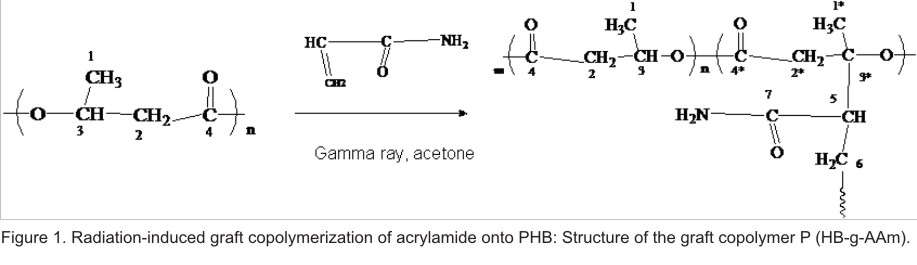
]]></body>
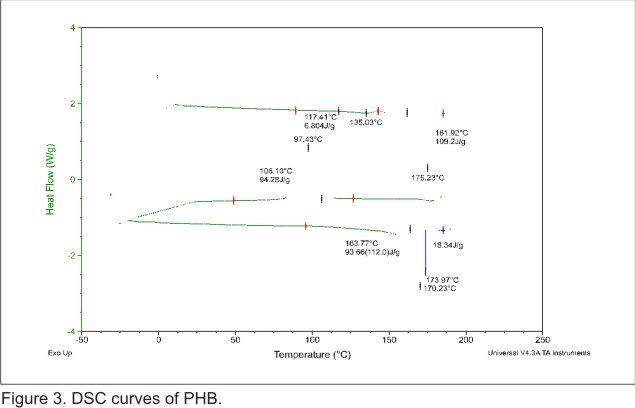
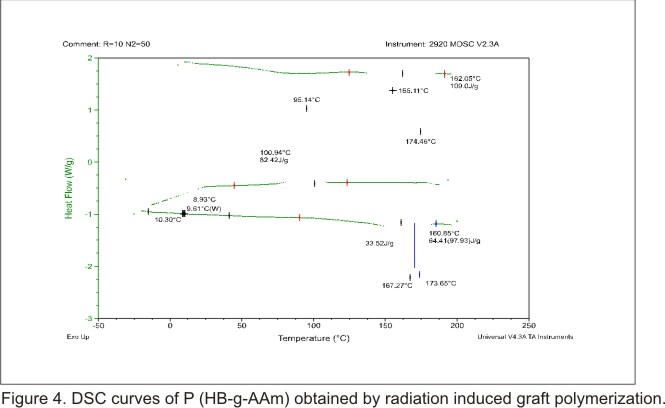
<body><![CDATA[<p><strong><font size="2" face="Verdana, Arial, Helvetica, sans-serif">RESULTS AND DISCUSSION</font></strong></p>     <p><font size="2" face="Verdana, Arial, Helvetica, sans-serif">Figure 1 show the radiation induced graft copolymerization reaction of acrylamide onto PHB. The simultaneous irradiation technique with 60Co gamma-ray was used. The dose rate was              1. 62 kGy/h and the dose was 10 kGy at room temperature. The selection of the source, dose rate and dose used are based on the results obtained in the radiation induced graft copolymerization of other monomers onto PHB synthesized by the authors. For instance the P (HB-g-VAc). These parameters have also been used in the syntheses of the graft copolymers found in the literature [11-15]. It is important to mention here that generally, higher irradiation doses lead to higher degrees of grafting. This is due to the enhancement of free radical formation. But the graft copolymer is always obtained at doses over 5 KGy. We have chosen 10 KGy because it was verified experimentally that this value is appropriate to be used.</font></p>     <p><font size="2" face="Verdana, Arial, Helvetica, sans-serif">The structure shown in the figure suggested that the graft occurs through the tertiary PHB carbon. This can be considered because of previous studies [18]. Sevilla et al reported that the tertiary radical formed by the exposition of PHB to gamma-radiation would be favored with respect to the rest possible radicals formed. In our previous studies, the P (HB-g-VAc) was reported [19]. Spectroscopic studies showed that quaternary substituted carbons were obtained.  This result is in agreement with the propose structure given for P (HB-g-AAm).  On the other hand, Grushevskaya et al reported that acetone is the more convenient solvent to be used in the radiation induced graft copolymerization of acrylamide onto PE. From this finding acetone was used as diluent in this work [20].</font></p>     <p><font size="2" face="Verdana, Arial, Helvetica, sans-serif"><strong>FTIR</strong> </font></p>     <p><font size="2" face="Verdana, Arial, Helvetica, sans-serif">FTIR studies were performed in order to confirm the syntheses of a graft copolymer. Evidence of grafting was obtained by using this technique. Figure 2 shows the transmittance mode FTIR spectra of pure PHB and P (HB-g-AAm). From the IR spectra, it was obvious that PHB showed the bands at 1185, 1228 and 1279 cm-1 characteristic of na (C-O-C) and the band at 1382 cm-1 characteristic of ds (CH3). In the ester carbonyl region, it can be considered the band of the C=O stretching (1729 cm-1). All this mentioned signals are common for both materials. However in the graft copolymer, apart of the previous peaks, four additional peaks were present. Two peaks at   3300 cm- (broad peak) and 3182 cm- were for the NH2 groups, corresponding to symmetrical and antisymmetrical stretching -N-H bonds. The peak position at 1676 cm- is probably caused by the amide carbonyl group and the 1608 cm- peak represents the adsorption of d (NH). The absorption frequency of carbonyl stretching vibrating of the amide group is well separated from that of the ester group. The new peaks observed are a strong evidence of grafting and clearly indicate the formation of a graft copolymer. </font></p>     <p><strong><font size="2" face="Verdana, Arial, Helvetica, sans-serif">Differential Scanning Calorimetry (DSC) investigation</font></strong></p>     <p><font size="2" face="Verdana, Arial, Helvetica, sans-serif">Thermal properties of the grafted PHB (figure 3) and the P (HB-g-AAm) were investigated by DSC with the purpose to demonstrate the graft copolymer formation by means of the differences observed among both materials. Figure 4 is the thermogram of graft copolymer. In the DSC thermogram of the first scan was observed the fist anomaly among both materials. The graft copolymer showed bimodal peaks at 175.11o C and 174.46o C with respect to PHB endothermic melting (175.23o C). In addition in the DSC of the second scan was observed that the crystallization temperature changed its value from 97.4o C (PHB) to 95.4o C (P (HB-g-AAm)) and the enthalpies of crystallization ( DHc) changed its value from     94.28 J/g (PHB) to 82.42 J/g (P (HB-g-AAm)). What is more, in the DSC thermogram of the third scan was also observed anomalies. The thermogram of the product showed bimodal peaks in the melting region. Surprisingly the melting point (Tm) of the graft copolymer was three degrees up and down the value of the Tm given for PHB. Consequently, the enthalpies of melting (DHm) of the plain PHB and the graft copolymer differed in about 15 units (J/g). The decrease of the DHm for the graft copolymer indicated that the cristallinity decreased after the introduction of AAm chains onto the PHB backbone by radiation induced graft copolymerization. It is of interest to mention here that the Tg of plain PHB changed from -2o C to  9.61o C in the graft copolymer, laying between those of the two homopolymers. This result is consistent with the fact that is natural that the introduction of AAm chains onto PHB increases the glass transition temperature. </font></p>     <p><img src="/img/revistas/nuc/n43/f02014308.jpg" width="501" height="416"></p>     
<p><img src="/img/revistas/nuc/n43/f03014308.jpg" width="444" height="284"></p>     
<p><img src="/img/revistas/nuc/n43/f04014308.jpg" width="464" height="297"></p>     
]]></body>
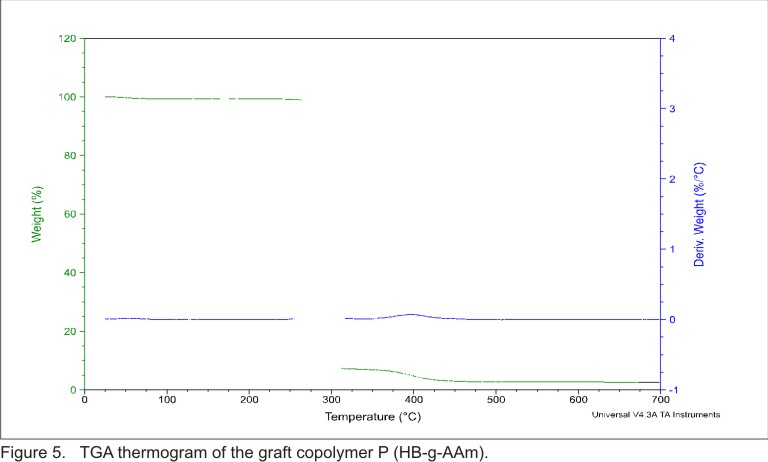
<body><![CDATA[<p>&nbsp;</p>     <p><font size="2" face="Verdana, Arial, Helvetica, sans-serif">Table lists the thermodynamic parameters obtained from the DSC thermogram of the experiment sample. It was summarized the melting point (Tm), the enthalpies of melting (DHm), the enthalpies of melting (DHm)corr  corrected by the weigh fraction of the polymer that conform the graft copolymer, calculated according to the following equation: </font></p>     <p><font size="2" face="Verdana, Arial, Helvetica, sans-serif">(DHm) corr = (DHm) (1+ (W (%))</font></p>     <p><font size="2" face="Verdana, Arial, Helvetica, sans-serif">the crystallization temperature (Tc) and the enthalpies of crystallization (DHc). From the results obtained by the DSC experiments a strong evidence of grafting is given. </font></p>     <p><strong><font size="2" face="Verdana, Arial, Helvetica, sans-serif">Thermogravimetric analysis (TGA)</font></strong></p>     <p><font size="2" face="Verdana, Arial, Helvetica, sans-serif">Figure 5 illustrates TGA thermogram of the graft copolymer P (HB-g-AAm). The TGA was conducted to show the difference in the thermal behavior of the obtained product with respect to the base polymer (PHB) and the grafting degree calculus. The TG curve of PHB grafted with AAm shows two steps in its smooth weight loss curve because the decomposition temperature of PHB and AAm are not the same.  The first step represents the plain PHB material and the second step represents the grafted PAAm. In addition, the DTGA shows two rates of weight loss (dW/dt) peaks defining the temperature of each step. The first step at 395o C belongs to PHB characteristic temperature. The others step at 395o C correspond to PAAm decomposition. From figure 5 can be seen that the PHB composition in the graft copolymer can be calculated by dividing the weight loss of the first step to the total weight loss. This result indicates that the copolymer grafting degree (W (%)) is 10% (This percentage represent the quantities in mass of PAAm grafted onto PHB with respect to the total mass of the sample) (see table).</font></p>     <p><font size="2" face="Verdana, Arial, Helvetica, sans-serif"><img src="/img/revistas/nuc/n43/t01014308.jpg" width="691" height="114">    
<br>       <br> <strong>CONCLUSIONS</strong> </font></p>     <p><font size="2" face="Verdana, Arial, Helvetica, sans-serif">The radiation induced graft copolymerization reaction of AAm onto PHB has been studied by the simultaneous irradiation method. The results obtained can be summarized as follows:</font></p>     ]]></body>
<body><![CDATA[<p><font size="2" face="Verdana, Arial, Helvetica, sans-serif">1- In spite of the PHB inactive structure, AAm can be grafted onto PHB by directly irradiating PHB and AAm immersed in acetone solution, using a       60Co g-ray source.    <br>   2- The synthesized material was characterized by means of several techniques such as FTIR, ATG and DSC    <br>   3- FTIR studies showed new signals that strongly confirm the synthesis of P(HB-g-AAm), such as the peaks at 3300 cm- and 3182 cm- assigned for the NH2 groups, corresponding to symmetrical and antisymmetrical stretching -N-H bonds. In addition, the absorption frequency of carbonyl stretching vibrating of the amide group is well separated from that of the ester group.     <br>   4- TGA results showed that graft degree (W (%)) in the graft copolymer is about 10% calculated by dividing the weight loss of the second step to the total weight loss of the sample.     <br>   5- From DSC results, the melting enthalpy (DHm) slightly decreased. The decrease of the DHm for the graft copolymer indicated that the cristallinity decreased after the introduction of AAm chains onto the PHB backbone by radiation induced graft copolymerization. Some experiments displayed bimodal peaks during the DSC in the third scan, which could be caused by recrystallization processes. Consequently, the glass transition temperature increased its value as a result of the grafting.    <br>   6- These results demonstrate that the radiation induced graft copolymerization reaction of acrylamide onto PHB was successively achieved. </font></p>     <p><font size="2" face="Verdana, Arial, Helvetica, sans-serif"><img src="/img/revistas/nuc/n43/f05014308.jpg" width="540" height="367"></font></p>     
<p>&nbsp;</p>     <p><font size="2" face="Verdana, Arial, Helvetica, sans-serif"><strong>Acknowledgment</strong></font></p>     <p><font size="2" face="Verdana, Arial, Helvetica, sans-serif">The authors are grateful to: Dr Ramiro Guerrero, Dr Enrique Sald&iacute;var, Silvia Sol&iacute;s, Blanca Huerta Guadalupe Mendez and Judith Cabello from CIQA (Centro de Investigaci&oacute;n en Qu&iacute;mica Aplicada, M&eacute;xico) for their assistance with TGA and DSC data collection. We would also thank to Dr Judith Percino and Dr V.M Chapela from the Benem&eacute;rita Universidad Aut&oacute;noma de Puebla (BUAP), Joaqu&iacute;n Iglesias (Glass technician specialist) from Biomat (UH-Cuba), and Dr Ricardo Aroca from the Windsor University of Canada. </font></p>     ]]></body>
<body><![CDATA[<p><font size="2" face="Verdana, Arial, Helvetica, sans-serif"><strong>REFERENCES</strong></font></p>     <!-- ref --><p><font size="2" face="Verdana, Arial, Helvetica, sans-serif">[1] SUDESH K, ABE H, DOI Y. Syntheses, structure and properties of polyhydroxyalkanoates: biological polyester. Prog. Polym. Sci. 2000; 5: 1503-1555.    <br>   [2] ZINN M, WITHOLT B, EGLI T. Occurrence, syntheses and bacterial application of bacterial polyhydroxyalkanoate.  Advanced Drug Delivery Reviews 2001; 53: 5&ndash;21.    <!-- ref --><br>   [3] HOFFMAN AS, BUDDY RD. The radiation grafting of acrylamide to polymer substrates in the precence of cupric ion-I. A preliminary study. Radiat. Phys. Chem.  1979; 14: 831-840.    <br>   [4] DESSOUKI AM, HEGAZY EA, EL-ASSY NB,  EL-BOOHY HA. Radiation-induced graft polymerization of acrylamide: reverse osmosis properties of polyethylene-g-polyacrylamide membrane. Radiat. Phys. Chem. Int. Jnl. Radiat. Applic. Instrum, Part C. 27(6), 1986; 431-436.    <br>   [5] GRUSHEVSKAYA LN, ALIYEV RE, KABANOV VY. Radiation induced graft polymerization of acrylamide and acrylic acid onto polyethylene. Int. Jnl. Radiat. Applic. Instrum Part C. 1990; 36 (3): 475-479.    <br>   [6] GUPTA B, ANJUM N. Surface Structure of Radiation-Grafted Polyethylene-g-Polyacrylamide Films. J Appl Polym Sci. 2002; 86: 1118&ndash;1122.     <br>   [7] FAYEK SA, EL SAYED SM, EL-ARNAOUTY MB. Study the effect of gamma irradiation on optical and morphological properties of grafted low density polyethylene. Polymer Testing. 2000; (19): 435&ndash;443.    <br>   [8] DESSOUKI AM, TALLER NH, EL-BOOHY HA. Radiation-induced graft polymermization of acrylamide onto     <br>   poly (tetrafluoroethylene/hexafluoropropylene/vinylidene fluoride) (tfb) films.    ]]></body>
<body><![CDATA[<br>   Radiat. Phys. Chem. Int. Jnl. Radiat. Applic. Instrum, Part C.  1990; 36 (3): 371-375.    <br>   [9] KE Y, WANG Y, REN L, et al. Polymerization of Polyacrylamide on PHBV Films (I).  Appl Polym Sci 2007; 104: 4088&ndash;4095.    <!-- ref --><br>   [10] SUP LEE H, YOUN LEE T. Graft polymerization of acrylamide onto poly( hyd ro xyb utyrate- co- hyd ro xyvalerate) films. Polymer. 1997; 38 (17): 4505-4511.    <!-- ref --><br>   [11] MITOMO H, ENJ&Ocirc;JI T, WATANABE Y, et al.  Radiation induced graft polymerization of poly (3-hydroxybutyrate) and its copolymer. Pure Appl. Chem. 1995&nbsp;; A32(3): 429-442.    <!-- ref --><br>   [12] GR&Oslash;NDAHL L, CHANDLER-TEMPLE A, TRAU M. Polymeric Grafting of Acrylic Acid ontoPoly (3-hydroxybutyrate-co-3-hydroxyvalerate): SurfaceFunctionalization for Tissue Engineering Applications. Biomacromolecules. 2005: 2197-2203.    <br>   [13] WADA Y, MITOMO H, et al. Control of biodegradability of poly(3-hydroxybutyric acid) film with grafting acrylic acid and thermal remolding. J Appl Polym Sci. 2006&nbsp;; 101: 3856&ndash;3861.    <!-- ref --><br>   [14] BAHARI, K, MITOMO, H, ENJOJI, T, et al. Radiation induced graft polymerization od styrene onto poly (3-hydroxybutyrate) and its copolymer with 3-hydroxyvalerate. Die Angewandte Makromolekulare Chemie. 1997; 250(4352): 31-44.    <!-- ref --><br>   [15] JIANG T, HU P. Radiation-Induced Graft Polymerization of Isoprene onto Polyhydroxybutyrate. Polymer Journal, 2001; 33(9): 647-653.    <!-- ref --><br>   [16] GONZ&Aacute;LEZ M, GALEGO N, ORTIZ DEL TORO P,  RAPADO M. Espectroscopia Raman del poli(3-hidroxibutirato), modificado con poliacetato de vinilo por copolimerizaci&oacute;n radioinducida. Nucleus, 2007&nbsp;; (42): 40-44.    <!-- ref --><br>   [17] WADA Y, SEKO N, NAGASAWA N, TOMADA M, KASUYA K,  MITOMO H. Biodegradability of poly (3-hydroxybutyrate) film grafted with vinyl acetate: effect of grafting and saponification Radiation Physics and Chemistry. 2007; (76): 1075-1083.    <!-- ref --><br>   [18] CARSWELL T, HILL DJT. An electron spin resonance study of the radiation chemistry of poly (3-hydroxybutyrate). Radiat. Phys. Chem. 1995; 45(5): 737-744.    <!-- ref --><br>   [19] GONZ&Aacute;LEZ M, GALEGO N, ORTIZ DEL TORO P, RAPADO M. Radiation induced graft copolymerization of vinyl acetate onto poly (3-hydroxybutyrate). Paper summitted to JPSCH. 2008.    <!-- ref --><br>   [20] GRUSHEVSKAYA LN, ALIYEV RE, KABANOV VY. Radiation induced graft copolymerization of acrylamide onto polyethylene. Polymer Science U.S.S.R. 1989; 31(7): 1530-1534.</font><p><font size="2" face="Verdana, Arial, Helvetica, sans-serif">Recibido: 25 de febrero de 2008.    <br>   Aceptado: 26 de marzo de 2008. </font></p>     <p><font size="2" face="Verdana, Arial, Helvetica, sans-serif"><a href="mailto:mikegcu@gmail.com">mikegcu@gmail.com</a>,    <a href="mailto:rapado@ceaden.edu.cu">rapado@ceaden.edu.cu</a></font></p>      ]]></body><back>
<ref-list>
<ref id="B1">
<label>[1]</label><nlm-citation citation-type="journal">
<person-group person-group-type="author">
<name>
<surname><![CDATA[SUDESH]]></surname>
<given-names><![CDATA[K]]></given-names>
</name>
<name>
<surname><![CDATA[ABE]]></surname>
<given-names><![CDATA[H]]></given-names>
</name>
<name>
<surname><![CDATA[DOI]]></surname>
<given-names><![CDATA[Y]]></given-names>
</name>
</person-group>
<article-title xml:lang="en"><![CDATA[Syntheses, structure and properties of polyhydroxyalkanoates: biological polyester]]></article-title>
<source><![CDATA[Prog. Polym. Sci]]></source>
<year>2000</year>
<volume>5</volume>
<page-range>1503-1555</page-range></nlm-citation>
</ref>
<ref id="B2">
<label>[2]</label><nlm-citation citation-type="journal">
<person-group person-group-type="author">
<name>
<surname><![CDATA[ZINN]]></surname>
<given-names><![CDATA[M]]></given-names>
</name>
<name>
<surname><![CDATA[WITHOLT]]></surname>
<given-names><![CDATA[B]]></given-names>
</name>
<name>
<surname><![CDATA[EGLI]]></surname>
<given-names><![CDATA[T]]></given-names>
</name>
</person-group>
<article-title xml:lang="en"><![CDATA[Occurrence, syntheses and bacterial application of bacterial polyhydroxyalkanoate]]></article-title>
<source><![CDATA[Advanced Drug Delivery Reviews]]></source>
<year>2001</year>
<volume>53</volume>
<page-range>5-21</page-range></nlm-citation>
</ref>
<ref id="B3">
<label>[3]</label><nlm-citation citation-type="journal">
<person-group person-group-type="author">
<name>
<surname><![CDATA[HOFFMAN]]></surname>
<given-names><![CDATA[AS]]></given-names>
</name>
<name>
<surname><![CDATA[BUDDY]]></surname>
<given-names><![CDATA[RD]]></given-names>
</name>
</person-group>
<article-title xml:lang="en"><![CDATA[The radiation grafting of acrylamide to polymer substrates in the precenceof cupric ion-I. A preliminary study]]></article-title>
<source><![CDATA[Radiat. Phys. Chem]]></source>
<year>1979</year>
<volume>14</volume>
<page-range>831-840</page-range></nlm-citation>
</ref>
<ref id="B4">
<label>4</label><nlm-citation citation-type="journal">
<person-group person-group-type="author">
<name>
<surname><![CDATA[DESSOUKI]]></surname>
<given-names><![CDATA[AM]]></given-names>
</name>
<name>
<surname><![CDATA[HEGAZY]]></surname>
<given-names><![CDATA[EA]]></given-names>
</name>
<name>
<surname><![CDATA[EL-ASSY]]></surname>
<given-names><![CDATA[NB]]></given-names>
</name>
<name>
<surname><![CDATA[EL-BOOHY]]></surname>
<given-names><![CDATA[HA]]></given-names>
</name>
</person-group>
<article-title xml:lang="en"><![CDATA[Radiation-induced graft polymerization of acrylamide: reverse osmosis properties of polyethylene-g-polyacrylamide membrane]]></article-title>
<source><![CDATA[Radiat. Phys. Chem. Int. Part C.]]></source>
<year>1986</year>
<volume>27</volume>
<numero>6</numero>
<issue>6</issue>
<page-range>431-436</page-range></nlm-citation>
</ref>
<ref id="B5">
<label>5</label><nlm-citation citation-type="journal">
<person-group person-group-type="author">
<name>
<surname><![CDATA[GRUSHEVSKAYA]]></surname>
<given-names><![CDATA[LN]]></given-names>
</name>
<name>
<surname><![CDATA[ALIYEV]]></surname>
<given-names><![CDATA[RE]]></given-names>
</name>
<name>
<surname><![CDATA[KABANOV]]></surname>
<given-names><![CDATA[VY]]></given-names>
</name>
</person-group>
<article-title xml:lang="en"><![CDATA[Radiation induced graft polymerization of acrylamide and acrylic acid onto polyethylene]]></article-title>
<source><![CDATA[Radiat Applic. Instrum Part C.]]></source>
<year>1990</year>
<volume>36</volume>
<numero>3</numero>
<issue>3</issue>
<page-range>475-479</page-range></nlm-citation>
</ref>
<ref id="B6">
<label>[6]</label><nlm-citation citation-type="journal">
<person-group person-group-type="author">
<name>
<surname><![CDATA[GUPTA]]></surname>
<given-names><![CDATA[B]]></given-names>
</name>
<name>
<surname><![CDATA[ANJUM]]></surname>
<given-names><![CDATA[N]]></given-names>
</name>
</person-group>
<article-title xml:lang="en"><![CDATA[Surface Structure of Radiation-Grafted Polyethylene-g-Polyacrylamide Films]]></article-title>
<source><![CDATA[J Appl PolymSci]]></source>
<year>2002</year>
<volume>86</volume>
<page-range>1118-1122</page-range></nlm-citation>
</ref>
<ref id="B7">
<label>[7]</label><nlm-citation citation-type="journal">
<person-group person-group-type="author">
<name>
<surname><![CDATA[FAYEK]]></surname>
<given-names><![CDATA[SA]]></given-names>
</name>
<name>
<surname><![CDATA[EL SAYED]]></surname>
<given-names><![CDATA[SM]]></given-names>
</name>
<name>
<surname><![CDATA[EL-ARNAOUTY]]></surname>
<given-names><![CDATA[MB]]></given-names>
</name>
</person-group>
<article-title xml:lang="en"><![CDATA[Study the effect of gamma irradiation on optical and morphological properties of grafted low density polyethylene]]></article-title>
<source><![CDATA[Polymer Testing]]></source>
<year>2000</year>
<numero>(19)</numero>
<issue>(19)</issue>
<page-range>435-443</page-range></nlm-citation>
</ref>
<ref id="B8">
<label>8</label><nlm-citation citation-type="journal">
<person-group person-group-type="author">
<name>
<surname><![CDATA[DESSOUKI]]></surname>
<given-names><![CDATA[AM]]></given-names>
</name>
<name>
<surname><![CDATA[TALLER]]></surname>
<given-names><![CDATA[NH]]></given-names>
</name>
<name>
<surname><![CDATA[EL-BOOHY]]></surname>
<given-names><![CDATA[HA]]></given-names>
</name>
</person-group>
<article-title xml:lang="en"><![CDATA[Radiation-induced graft polymermization of acrylamideonto poly (tetrafluoroethylene/hexafluoropropylene/vinylidenefluoride) (tfb) films]]></article-title>
<source><![CDATA[Radiat Phys. Chem. Int. Part C]]></source>
<year>1990</year>
<volume>36</volume>
<numero>3</numero>
<issue>3</issue>
<page-range>371-375</page-range></nlm-citation>
</ref>
<ref id="B9">
<label>[9]</label><nlm-citation citation-type="journal">
<person-group person-group-type="author">
<name>
<surname><![CDATA[KE]]></surname>
<given-names><![CDATA[Y]]></given-names>
</name>
<name>
<surname><![CDATA[WANG]]></surname>
<given-names><![CDATA[Y]]></given-names>
</name>
<name>
<surname><![CDATA[REN]]></surname>
<given-names><![CDATA[L]]></given-names>
</name>
</person-group>
<article-title xml:lang="en"><![CDATA[Polymerization of Polyacrylamide on PHBV Films (I)]]></article-title>
<source><![CDATA[Appl Polym Sci]]></source>
<year>2007</year>
<volume>104</volume>
<page-range>4088-4095</page-range></nlm-citation>
</ref>
<ref id="B10">
<label>[10]</label><nlm-citation citation-type="journal">
<person-group person-group-type="author">
<name>
<surname><![CDATA[SUP LEE]]></surname>
<given-names><![CDATA[H]]></given-names>
</name>
<name>
<surname><![CDATA[YOUN LEE]]></surname>
<given-names><![CDATA[T]]></given-names>
</name>
</person-group>
<article-title xml:lang="en"><![CDATA[Graft polymerization of acrylamide onto poly( hydroxy butyrate- co- hydro xyvalerate ) films]]></article-title>
<source><![CDATA[Polymer]]></source>
<year>1997</year>
<volume>38</volume>
<numero>(17)</numero>
<issue>(17)</issue>
<page-range>4505-4511</page-range></nlm-citation>
</ref>
<ref id="B11">
<label>[11]</label><nlm-citation citation-type="journal">
<person-group person-group-type="author">
<name>
<surname><![CDATA[MITOMO]]></surname>
<given-names><![CDATA[H]]></given-names>
</name>
<name>
<surname><![CDATA[ENJÔJI]]></surname>
<given-names><![CDATA[T]]></given-names>
</name>
<name>
<surname><![CDATA[WATANABE]]></surname>
<given-names><![CDATA[Y]]></given-names>
</name>
</person-group>
<article-title xml:lang="en"><![CDATA[Radiation induced graft polymerization of poly (3-hydroxybutyrate) and its copolymer]]></article-title>
<source><![CDATA[Pure Appl. Chem]]></source>
<year>1995</year>
<volume>A32</volume>
<numero>(3)</numero>
<issue>(3)</issue>
<page-range>429-442</page-range></nlm-citation>
</ref>
<ref id="B12">
<label>[12]</label><nlm-citation citation-type="journal">
<person-group person-group-type="author">
<name>
<surname><![CDATA[GRØNDAHL]]></surname>
<given-names><![CDATA[L]]></given-names>
</name>
<name>
<surname><![CDATA[CHANDLER-TEMPLE]]></surname>
<given-names><![CDATA[A]]></given-names>
</name>
<name>
<surname><![CDATA[TRAU]]></surname>
<given-names><![CDATA[M]]></given-names>
</name>
</person-group>
<article-title xml:lang="en"><![CDATA[Polymeric Grafting of Acrylic Acid ontoPoly (3-hydroxybutyrate-co-3-hydroxyvalerate): SurfaceFunctionalization for Tissue Engineering Applications]]></article-title>
<source><![CDATA[Biomacromolecules]]></source>
<year>2005</year>
<page-range>2197-2203</page-range></nlm-citation>
</ref>
<ref id="B13">
<label>[13]</label><nlm-citation citation-type="journal">
<person-group person-group-type="author">
<name>
<surname><![CDATA[WADA]]></surname>
<given-names><![CDATA[Y]]></given-names>
</name>
<name>
<surname><![CDATA[MITOMO]]></surname>
<given-names><![CDATA[H]]></given-names>
</name>
</person-group>
<article-title xml:lang="en"><![CDATA[Control of biodegradability of poly(3-hydroxybutyric acid) film with grafting acrylic acid and thermal remolding]]></article-title>
<source><![CDATA[J Appl Polym Sci]]></source>
<year>2006</year>
<volume>101</volume>
<page-range>3856-3861</page-range></nlm-citation>
</ref>
<ref id="B14">
<label>[14]</label><nlm-citation citation-type="journal">
<person-group person-group-type="author">
<name>
<surname><![CDATA[BAHARI]]></surname>
<given-names><![CDATA[K]]></given-names>
</name>
<name>
<surname><![CDATA[MITOMO]]></surname>
<given-names><![CDATA[H]]></given-names>
</name>
<name>
<surname><![CDATA[ENJOJI]]></surname>
<given-names><![CDATA[T]]></given-names>
</name>
</person-group>
<article-title xml:lang="en"><![CDATA[Radiation induced graft polymerization od styrene onto poly (3-hydroxybutyrate) and its copolymer with 3-hydroxyvalerate]]></article-title>
<source><![CDATA[Die Angewandte Makromolekulare Chemie]]></source>
<year>1997</year>
<volume>250</volume>
<numero>(4352)</numero>
<issue>(4352)</issue>
<page-range>31-44</page-range></nlm-citation>
</ref>
<ref id="B15">
<label>[15]</label><nlm-citation citation-type="journal">
<person-group person-group-type="author">
<name>
<surname><![CDATA[JIANG]]></surname>
<given-names><![CDATA[T]]></given-names>
</name>
<name>
<surname><![CDATA[HU]]></surname>
<given-names><![CDATA[P]]></given-names>
</name>
</person-group>
<article-title xml:lang="en"><![CDATA[Radiation-Induced Graft Polymerization of Isoprene onto Polyhydroxybutyrate]]></article-title>
<source><![CDATA[Polymer Journal]]></source>
<year>2001</year>
<volume>33</volume>
<numero>(9)</numero>
<issue>(9)</issue>
<page-range>647-653</page-range></nlm-citation>
</ref>
<ref id="B16">
<label>[16]</label><nlm-citation citation-type="journal">
<person-group person-group-type="author">
<name>
<surname><![CDATA[GONZÁLEZ]]></surname>
<given-names><![CDATA[M]]></given-names>
</name>
<name>
<surname><![CDATA[GALEGO]]></surname>
<given-names><![CDATA[N]]></given-names>
</name>
<name>
<surname><![CDATA[ORTIZ DEL TORO]]></surname>
<given-names><![CDATA[P]]></given-names>
</name>
<name>
<surname><![CDATA[RAPADO]]></surname>
<given-names><![CDATA[M]]></given-names>
</name>
</person-group>
<article-title xml:lang="en"><![CDATA[Espectroscopia Raman del poli(3-hidroxibutirato), modificado con poliacetato de vinilo por copolimerización radioinducida]]></article-title>
<source><![CDATA[Nucleus]]></source>
<year>2007</year>
<numero>(42)</numero>
<issue>(42)</issue>
<page-range>40-44</page-range></nlm-citation>
</ref>
<ref id="B17">
<label>[17]</label><nlm-citation citation-type="journal">
<person-group person-group-type="author">
<name>
<surname><![CDATA[WADA]]></surname>
<given-names><![CDATA[Y]]></given-names>
</name>
<name>
<surname><![CDATA[SEKO]]></surname>
<given-names><![CDATA[N]]></given-names>
</name>
<name>
<surname><![CDATA[NAGASAWA]]></surname>
<given-names><![CDATA[N]]></given-names>
</name>
<name>
<surname><![CDATA[TOMADA]]></surname>
<given-names><![CDATA[M]]></given-names>
</name>
<name>
<surname><![CDATA[KASUYA]]></surname>
<given-names><![CDATA[K]]></given-names>
</name>
<name>
<surname><![CDATA[MITOMO]]></surname>
<given-names><![CDATA[H]]></given-names>
</name>
</person-group>
<article-title xml:lang="en"><![CDATA[Biodegradability of poly (3-hydroxybutyrate) film grafted with vinyl acetate: effect of grafting and saponification]]></article-title>
<source><![CDATA[Radiation Physics and Chemistry]]></source>
<year>2007</year>
<numero>(76)</numero>
<issue>(76)</issue>
<page-range>1075-1083</page-range></nlm-citation>
</ref>
<ref id="B18">
<label>[18]</label><nlm-citation citation-type="journal">
<person-group person-group-type="author">
<name>
<surname><![CDATA[CARSWELL]]></surname>
<given-names><![CDATA[T]]></given-names>
</name>
<name>
<surname><![CDATA[HILL]]></surname>
<given-names><![CDATA[DJT]]></given-names>
</name>
</person-group>
<article-title xml:lang="en"><![CDATA[An electron spin resonance study of the radiation chemistry of poly (3-hydroxybutyrate)]]></article-title>
<source><![CDATA[Radiat. Phys. Chem]]></source>
<year>1995</year>
<volume>45</volume>
<numero>(5)</numero>
<issue>(5)</issue>
<page-range>737-744</page-range></nlm-citation>
</ref>
<ref id="B19">
<label>[19]</label><nlm-citation citation-type="">
<person-group person-group-type="author">
<name>
<surname><![CDATA[GONZÁLEZ]]></surname>
<given-names><![CDATA[M]]></given-names>
</name>
<name>
<surname><![CDATA[GALEGO]]></surname>
<given-names><![CDATA[N]]></given-names>
</name>
<name>
<surname><![CDATA[ORTIZ DEL TORO]]></surname>
<given-names><![CDATA[P]]></given-names>
</name>
<name>
<surname><![CDATA[RAPADO]]></surname>
<given-names><![CDATA[M]]></given-names>
</name>
</person-group>
<article-title xml:lang="en"><![CDATA[Radiation induced graft copolymerization of vinyl acetate onto poly (3-hydroxybutyrate)]]></article-title>
<source><![CDATA[]]></source>
<year>2008</year>
</nlm-citation>
</ref>
<ref id="B20">
<label>[20]</label><nlm-citation citation-type="journal">
<person-group person-group-type="author">
<name>
<surname><![CDATA[GRUSHEVSKAYA]]></surname>
<given-names><![CDATA[LN]]></given-names>
</name>
<name>
<surname><![CDATA[ALIYEV]]></surname>
<given-names><![CDATA[RE]]></given-names>
</name>
<name>
<surname><![CDATA[KABANOV]]></surname>
<given-names><![CDATA[VY]]></given-names>
</name>
</person-group>
<article-title xml:lang="en"><![CDATA[Radiation induced graft copolymerization of acrylamide onto polyethylene]]></article-title>
<source><![CDATA[Polymer Science U.S.S.R]]></source>
<year>1989</year>
<volume>31</volume>
<numero>(7)</numero>
<issue>(7)</issue>
<page-range>1530-1534</page-range></nlm-citation>
</ref>
</ref-list>
</back>
</article>