<?xml version="1.0" encoding="ISO-8859-1"?><article xmlns:mml="http://www.w3.org/1998/Math/MathML" xmlns:xlink="http://www.w3.org/1999/xlink" xmlns:xsi="http://www.w3.org/2001/XMLSchema-instance">
<front>
<journal-meta>
<journal-id>0864-084X</journal-id>
<journal-title><![CDATA[Nucleus]]></journal-title>
<abbrev-journal-title><![CDATA[Nucleus]]></abbrev-journal-title>
<issn>0864-084X</issn>
<publisher>
<publisher-name><![CDATA[CUBAENERGIA]]></publisher-name>
</publisher>
</journal-meta>
<article-meta>
<article-id>S0864-084X2009000100004</article-id>
<title-group>
<article-title xml:lang="en"><![CDATA[Experimental and Monte Carlo determination of mass absorption coefficients for <img width=30 height=13 src="http:/img/revistas/nuc/n45/e03044509.jpg">/ <img width=30 height=13 src="http:/img/revistas/nuc/n45/e02044509.jpg">beta particles in organic compounds]]></article-title>
<article-title xml:lang="es"><![CDATA[Determinación experimental y por Monte Carlo de coeficientes de absorción másicos para partículas beta de <img width=30 height=13 src="http:/img/revistas/nuc/n45/e03044509.jpg">/ <img width=30 height=13 src="http:/img/revistas/nuc/n45/e02044509.jpg">en compuestos orgánicos]]></article-title>
</title-group>
<contrib-group>
<contrib contrib-type="author">
<name>
<surname><![CDATA[Heredia Carmona]]></surname>
<given-names><![CDATA[Julio]]></given-names>
</name>
</contrib>
<contrib contrib-type="author">
<name>
<surname><![CDATA[Díaz Rizo]]></surname>
<given-names><![CDATA[Oscar]]></given-names>
</name>
</contrib>
</contrib-group>
<aff id="A01">
<institution><![CDATA[,Instituto Superior de Tecnologías y Ciencias Aplicadas (InSTEC)  ]]></institution>
<addr-line><![CDATA[Ciudad de La Habana ]]></addr-line>
<country>Cuba</country>
</aff>
<pub-date pub-type="pub">
<day>00</day>
<month>06</month>
<year>2009</year>
</pub-date>
<pub-date pub-type="epub">
<day>00</day>
<month>06</month>
<year>2009</year>
</pub-date>
<numero>45</numero>
<fpage>26</fpage>
<lpage>31</lpage>
<copyright-statement/>
<copyright-year/>
<self-uri xlink:href="http://scielo.sld.cu/scielo.php?script=sci_arttext&amp;pid=S0864-084X2009000100004&amp;lng=en&amp;nrm=iso"></self-uri><self-uri xlink:href="http://scielo.sld.cu/scielo.php?script=sci_abstract&amp;pid=S0864-084X2009000100004&amp;lng=en&amp;nrm=iso"></self-uri><self-uri xlink:href="http://scielo.sld.cu/scielo.php?script=sci_pdf&amp;pid=S0864-084X2009000100004&amp;lng=en&amp;nrm=iso"></self-uri><abstract abstract-type="short" xml:lang="en"><p><![CDATA[ABSTRACT In order to investigate the bparticles absorption in organic compounds, an experimental arrangement was designed. A Monte Carlo transport code was also used to simulate this process. This allowed reporting for the first time m (<img width=30 height=13 src="http:/img/revistas/nuc/n45/e02044509.jpg">) values in several organic compounds for <img width=30 height=13 src="http:/img/revistas/nuc/n45/e03044509.jpg">/ <img width=30 height=13 src="http:/img/revistas/nuc/n45/e02044509.jpg">isotopic sources. The obtained experimental and calculated values showed a good concordance. Methodological aspects of the µ (<img width=30 height=13 src="http:/img/revistas/nuc/n45/e02044509.jpg">) determination concerning the range of the absorber&#8217;s superficial density are discussed.]]></p></abstract>
<abstract abstract-type="short" xml:lang="es"><p><![CDATA[RESUMEN Se estudia la absorción de partículas beta en compuestos orgánicos en una instalación diseñada al efecto. El proceso de absorción es además simulado mediante el código de Monte Carlo. Se reportan, por primera vez, los coeficientes de absorción másicos para partículas beta de <img width=30 height=13 src="http:/img/revistas/nuc/n45/e03044509.jpg">/ <img width=30 height=13 src="http:/img/revistas/nuc/n45/e02044509.jpg">en varios compuestos orgánicos. Se obtiene una buena correspondencia entre los resultados experimentales y los simulados. Se discuten aspectos metodológicos de la determinación del coeficiente de absorción másico, relacionado con el intervalo de densidad de absorción superficial.]]></p></abstract>
<kwd-group>
<kwd lng="en"><![CDATA[Monte Carlo method]]></kwd>
<kwd lng="en"><![CDATA[organic compounds]]></kwd>
<kwd lng="en"><![CDATA[adsorption]]></kwd>
<kwd lng="en"><![CDATA[strontium 90]]></kwd>
<kwd lng="en"><![CDATA[yttrium 90]]></kwd>
<kwd lng="en"><![CDATA[beta particles]]></kwd>
<kwd lng="en"><![CDATA[strontium compounds]]></kwd>
<kwd lng="en"><![CDATA[yttrium compounds]]></kwd>
<kwd lng="en"><![CDATA[experimental data]]></kwd>
</kwd-group>
</article-meta>
</front><body><![CDATA[ <p align="left"><font face="Verdana, Arial, Helvetica, sans-serif" size="2"><b>CIENCIAS    NUCLEARES</b></font></p>     <p align="right">&nbsp;</p>     <p><font face="Verdana, Arial, Helvetica, sans-serif"><strong><font size="4">Experimental    and Monte Carlo determination of mass absorption coefficients for <img src="/img/revistas/nuc/n45/e03044509.jpg" width="23" height="14">/    <img src="/img/revistas/nuc/n45/e02044509.jpg" width="19" height="14">    beta particles in organic compounds</font></strong></font></p>     
<p><font size="3" face="Verdana, Arial, Helvetica, sans-serif">Determinaci&oacute;n    experimental y por Monte Carlo de coeficientes de absorci&oacute;n m&aacute;sicos    <br>   para part&iacute;culas beta de <img src="/img/revistas/nuc/n45/e03044509.jpg" width="23" height="14">/    <img src="/img/revistas/nuc/n45/e02044509.jpg" width="19" height="14">    en compuestos org&aacute;nicos    
<br>   </font></p>     <p align="left"><font size="2" face="Verdana, Arial, Helvetica, sans-serif">Julio    Heredia Carmona, Oscar D&iacute;az Rizo    <br>   Instituto Superior de Tecnolog&iacute;as y Ciencias Aplicadas (InSTEC)    <br>   Ave. Salvador Allende, esq. Luaces, Plaza, Ciudad de La Habana, Cuba    <br>   <a href="mailto:odrizo@instec.cu">odrizo@instec.cu</a></font></p> <hr>     ]]></body>
<body><![CDATA[<p><font face="Verdana, Arial, Helvetica, sans-serif" size="2"><b>ABSTRACT</b></font></p>     <p><font size="2" face="Verdana, Arial, Helvetica, sans-serif">In order to investigate    the bparticles absorption in organic compounds, an experimental arrangement    was designed. A Monte Carlo transport code was also used to simulate this process.    This allowed reporting for the first time m (<img src="/img/revistas/nuc/n45/e02044509.jpg" width="19" height="14">)    values in several organic compounds for <img src="/img/revistas/nuc/n45/e03044509.jpg" width="23" height="14">/    <img src="/img/revistas/nuc/n45/e02044509.jpg" width="19" height="14">    isotopic sources. The obtained experimental and calculated values showed a good    concordance. Methodological aspects of the &micro; (<img src="/img/revistas/nuc/n45/e02044509.jpg" width="19" height="14">)    determination concerning the range of the absorber&#146;s superficial density    are discussed.</font></p> <hr>     
<p><font face="Verdana, Arial, Helvetica, sans-serif" size="2"><b>RESUMEN</b></font></p>     <p><font size="2" face="Verdana, Arial, Helvetica, sans-serif">Se estudia la absorci&oacute;n    de part&iacute;culas beta en compuestos org&aacute;nicos en una instalaci&oacute;n    dise&ntilde;ada al efecto. El proceso de absorci&oacute;n es adem&aacute;s simulado    mediante el c&oacute;digo de Monte Carlo. Se reportan, por primera vez, los    coeficientes de absorci&oacute;n m&aacute;sicos para part&iacute;culas beta    de <img src="/img/revistas/nuc/n45/e03044509.jpg" width="23" height="14">/    <img src="/img/revistas/nuc/n45/e02044509.jpg" width="19" height="14">    en varios compuestos org&aacute;nicos. Se obtiene una buena correspondencia    entre los resultados experimentales y los simulados. Se discuten aspectos metodol&oacute;gicos    de la determinaci&oacute;n del coeficiente de absorci&oacute;n m&aacute;sico,    relacionado con el intervalo de densidad de absorci&oacute;n superficial.</font></p>     
<p><font face="Verdana, Arial, Helvetica, sans-serif" size="2"><b>Key words: </b>Monte    Carlo method, organic compounds, adsorption, strontium 90, yttrium 90, beta    particles, strontium compounds, yttrium compounds, experimental data</font></p> <hr>     <p><font face="Verdana, Arial, Helvetica, sans-serif" size="2"><b>Introduction</b>    <br>   </font></p>     <p><font face="Verdana, Arial, Helvetica, sans-serif" size="2">The knowledge of    isotopic <img src="/img/revistas/nuc/n45/e01044509.jpg" width="11" height="17">-particles    behavior in matter is of great importance due to its applications in nuclear    and solid state physics and dosimetry studies[1]. The <img src="/img/revistas/nuc/n45/e01044509.jpg" width="11" height="17">-particles    are continuous-energy electrons, which are emitted by radioactive decay. Over    a limited penetration range, their observed transmission curves are of characteristic    exponential shape (1), which implies that the attenuation of <img src="/img/revistas/nuc/n45/e01044509.jpg" width="11" height="17">-particles    is of the same form as that of photons. When a <img src="/img/revistas/nuc/n45/e01044509.jpg" width="11" height="17">emitting    radionuclide is counted through an absorber an exponential relationship of the    type [2]:</font></p>     

<p><img src="/img/revistas/nuc/n45/e04044509.jpg" width="257" height="38"></p>     
<p><font face="Verdana, Arial, Helvetica, sans-serif" size="2">is valid over a    large range of absorber thickness, where <img src="/img/revistas/nuc/n45/e05044509.jpg" width="11" height="18">    - counting rate without absorber <img src="/img/revistas/nuc/n45/e06044509.jpg" width="24" height="17">,    I&#150; counting    
]]></body>
<body><![CDATA[<br>   rate with absorber <img src="/img/revistas/nuc/n45/e06044509.jpg" width="24" height="17">,    &micro; - mass absorption coefficient <img src="/img/revistas/nuc/n45/e07044509.jpg" width="53" height="17">    and x - absorber thickness <img src="/img/revistas/nuc/n45/e10044509.jpg" width="44" height="18">.</font></p>     
<p><font face="Verdana, Arial, Helvetica, sans-serif" size="2">In the case of    <img src="/img/revistas/nuc/n45/e01044509.jpg" width="11" height="17">-particles    the mass absorption coefficient (&micro;) is sometimes, over a limited penetration    range, a more useful and interesting parameter than the range for such studies.    This parameter is nothing more than a mathematical craft of purely empirical    origin. It measures the average number of absorbed particles that occur in a    given mass per unit area thickness of material encountered [3]. </font></p>     
<p><font face="Verdana, Arial, Helvetica, sans-serif" size="2">There is an empirical    relationship between the mass absorption coefficient, &micro;, and the maximum    energy of the <img src="/img/revistas/nuc/n45/e01044509.jpg" width="11" height="17">-    emitter, <img src="/img/revistas/nuc/n45/e11044509.jpg" width="17" height="17">    , of the form [2]:</font></p>     
<p><font face="Verdana, Arial, Helvetica, sans-serif" size="2"><img src="/img/revistas/nuc/n45/e12044509.jpg" width="267" height="28">    
<br>   </font></p>     <p><font face="Verdana, Arial, Helvetica, sans-serif" size="2">K and a are constants    and their values depend not only on the material of the absorber, but also on    the geometry of the counting arrangement and the type of counter used. </font></p>     <p><font face="Verdana, Arial, Helvetica, sans-serif" size="2">In the literature,    there are many reported values of &micro; for several metals (Pb, Cu, Zn, Al,    etc.)[2], but there are practically none for light elements or organic compounds.    Therefore, the studying of theabsorption of <img src="/img/revistas/nuc/n45/e01044509.jpg" width="11" height="17">-particles    (through &micro; determination) is a good first step towards the understanding    of the <img src="/img/revistas/nuc/n45/e01044509.jpg" width="11" height="17">-particles    radiation interaction with organic compounds. </font></p>     
<p><font face="Verdana, Arial, Helvetica, sans-serif" size="2">The solution, using    deterministic methods, to the <img src="/img/revistas/nuc/n45/e01044509.jpg" width="11" height="17">-particles    transport problem, in an experimental array, can prove to be very complex. Therefore,    the use of a computational transport code based on the Monte Carlo method [4]    is a very useful tool in order to simulate the <img src="/img/revistas/nuc/n45/e01044509.jpg" width="11" height="17">-particles    transport in the experiment. </font></p>     
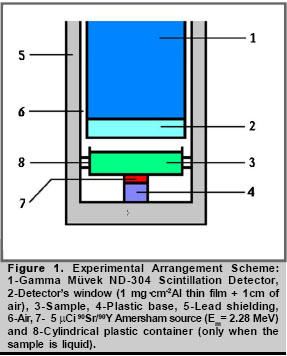
<p><font face="Verdana, Arial, Helvetica, sans-serif" size="2"><b>Materials and    Methods</b></font></p>     <p><font face="Verdana, Arial, Helvetica, sans-serif" size="2"><b>Experimental    Arrangement and Samples:</b> The experimental arrangement shown in <a href="#f1">figure 1</a>  was designed in order to experimentally measure and afterwards simulate (with    the MCNP-4C transport code) the <img src="/img/revistas/nuc/n45/e01044509.jpg" width="11" height="17">-    particles attenuation in organic compounds. The detector was coupled to a NP-363    Gamma M&uuml;vek counting system.</font></p>     
]]></body>
<body><![CDATA[<p><a name="f1"></a><img src="/img/revistas/nuc/n45/f01044509.jpg" width="287" height="356"></p>     
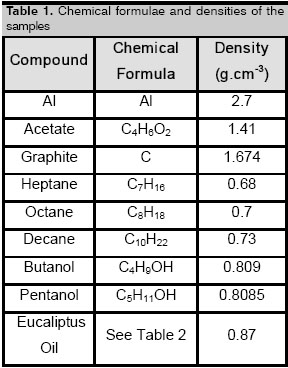
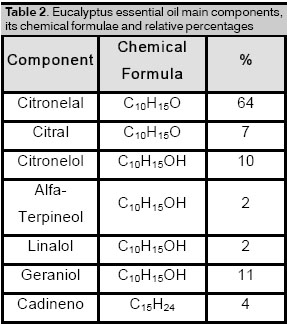
<p><font face="Verdana, Arial, Helvetica, sans-serif" size="2">The Aluminium (E-3a    Absorbers, Tracerlab. Inc.) and Carbone (nuclear reactor-grade graphite) samples    were cylindrical whereas the polyvinyl acetate samples (plastic) were rectangular    parallelepipeds (see <a href="#t1">table 1</a>). Alkenes and Alcohols were purchased from Merck.    The Eucalyptus essential oil was obtained in Cuba by the InSTEC. Its main components    are shown in <a href="#t2">table 2</a>.</font></p>     <p><a name="t1"></a><img src="/img/revistas/nuc/n45/t01044509.jpg" width="288" height="368"></p>     
<p><a name="t2"></a><img src="/img/revistas/nuc/n45/t02044509.jpg" width="287" height="324"></p>     
<p><font face="Verdana, Arial, Helvetica, sans-serif" size="2"><b>Monte Carlo    simulation:</b> MCNP-4C is a computational general code that allows the simulation    of the transport process for electrons, photons and neutrons using the Monte    Carlo method. It is a numerical procedure that simulates sequentially probabilistic    individual events starting from the statistical sampling of the probability    distributions governing these events. This sampling is based on the selection    of random numbers. In the particular case of the transport process for <img src="/img/revistas/nuc/n45/e01044509.jpg" width="11" height="17">-particles    (electrons), multiple-scattering theories are used (Goudsmit-Saunderson theory    for angular deflections [5], Landau theory of energy-loss fluctuations [6],    Blunck-Leisegang enhancements of the Landau theory [7]). These theories rely    on a variety of approximations that restrict their applicability. In par- ticular,    it is assumed that the energy loss is small compared to the kinetic energy of    the electron. In order to follow an electron through a significant energy loss,    it is necessary to break the electron&#146;s path into many steps (each step    representing an 8.3% kinetic energy loss). These steps are chosen to be long    enough to encompass many collisions (so that multiple-scattering theories are    valid) but short enough that the mean energy loss in any one step is small (so    that the approximations necessary for the multiple-scattering theories are satisfied).    The energy loss and angular deflection of the electron during each of the steps    can then be sampled from probability distributions based on the appropriate    multiple-scattering theories. This subsumption of the effects of many individual    collisions into single steps that are sampled probabilistically constitutes    the &laquo;condensed history&raquo; Monte Carlo method. However, the representation    of the electron&#146;s trajectory as the result of many small steps will be    more accurate if the angular deflections are also required to be small. Therefore,    MCNP further breaks the electron steps into smaller substeps. The sampling of    Bremsstrahlung photons is based on the Bethe-Heitler- Born approximation results    [8]. </font></p>     
<p><font face="Verdana, Arial, Helvetica, sans-serif" size="2">Experimental considerations    were taken into account. Some constructive elements that had no implications    in the transport processes (such as the lead shielding) didn&#146;t need to    be modelled. The other elements of the experimental arrangement were modelled    as accurately as possible regarding position and composition. </font></p>     <p><font face="Verdana, Arial, Helvetica, sans-serif" size="2">The source was    modelled as a disc-shaped surface that emitted isotropically in 2p towards the    absorber. The theoretical energetic spectrum of emission of a <img src="/img/revistas/nuc/n45/e03044509.jpg" width="23" height="14">/    <img src="/img/revistas/nuc/n45/e02044509.jpg" width="19" height="14">    source was calculated individually using a FORTRAN code supplied by Chang [9].    </font></p>     
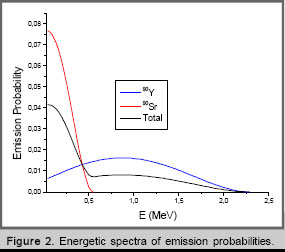
<p><font face="Verdana, Arial, Helvetica, sans-serif" size="2">Radionuclide <img src="/img/revistas/nuc/n45/e03044509.jpg" width="23" height="14">    (<img src="/img/revistas/nuc/n45/e08044509.jpg" width="20" height="18">    = 28.64, <img src="/img/revistas/nuc/n45/e11044509.jpg" width="17" height="17">    = 525 keV) and <img src="/img/revistas/nuc/n45/e02044509.jpg" width="19" height="14">    (<img src="/img/revistas/nuc/n45/e08044509.jpg" width="20" height="18">    = 64.10 h, <img src="/img/revistas/nuc/n45/e11044509.jpg" width="17" height="17">    = 2.28 MeV) are pure <img src="/img/revistas/nuc/n45/e01044509.jpg" width="11" height="17">-emitters.    As observed, the <img src="/img/revistas/nuc/n45/e03044509.jpg" width="23" height="14">    half-lifeis much longer than the <img src="/img/revistas/nuc/n45/e02044509.jpg" width="19" height="14">    half-life, establishing a secular equilibrium. Therefore in the total population    of electrons, one half has the energetic distribution of the <img src="/img/revistas/nuc/n45/e03044509.jpg" width="23" height="14">    and the other one has the distribution of the <img src="/img/revistas/nuc/n45/e02044509.jpg" width="19" height="14">.    Furthermore, as the distributions are independent, the probability to find an    electron in the range included between E and E+dE shall be the sum of both distributions    after normalizing and is the one used in the calculi. <a href="#f2">Figure 2</a> shows the normalized    energetic spectrum of emission probabilities for the modelled source.</font></p>     
<p><a name="f2"></a><img src="/img/revistas/nuc/n45/f02044509.jpg" width="285" height="252"></p>     
<p></p>     ]]></body>
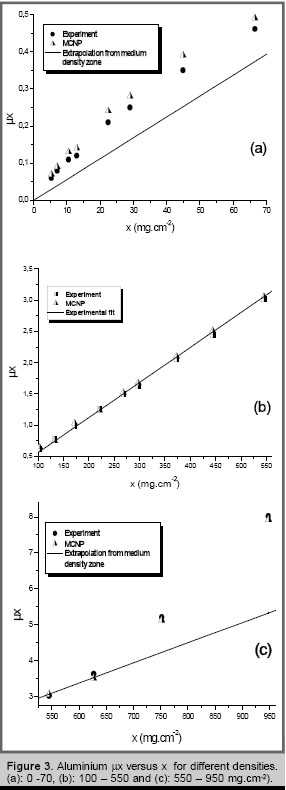
<body><![CDATA[<p><font face="Verdana, Arial, Helvetica, sans-serif" size="2">The MCNP transport    code was set to EP (electrons + photons) mode, in order to simulate not only    the electrons but also the Bremsstrahlung produced photons that could be counted    by the detector. The output file (tally) used was of type 1. It corresponds    to the number of electrons and photons that go through the detector&#146;s scintillator    surface. As an approximation, the detection efficiency of the scintillator was    set to 100%. </font></p>     <p><font face="Verdana, Arial, Helvetica, sans-serif" size="2"><b>Results and    Discussion</b>    <br>   </font></p>     <p><font face="Verdana, Arial, Helvetica, sans-serif" size="2">The results of    the experimental measurements and the MCNP simulation for the Aluminium were    separated in 3 zones accordingly to the absorber&#146;s superficial density:    0&#150;70 mg.<img src="/img/revistas/nuc/n45/e09044509.jpg" width="29" height="13">    , 100&#150;550 mg.<img src="/img/revistas/nuc/n45/e09044509.jpg" width="29" height="13">    -2 and 550&#150;950 mg.<img src="/img/revistas/nuc/n45/e09044509.jpg" width="29" height="13">    .Using (1), if one plot</font></p>     
<p><font face="Verdana, Arial, Helvetica, sans-serif" size="2"><img src="/img/revistas/nuc/n45/e13044509.jpg" width="292" height="27">    
<br>   </font></p>     <p><font face="Verdana, Arial, Helvetica, sans-serif" size="2">the slope is equal    to &micro; <img src="/img/revistas/nuc/n45/e07044509.jpg" width="53" height="17">.    Here, I f is the background counting rate of the experimental arrangement.</font></p>     
<p><font face="Verdana, Arial, Helvetica, sans-serif" size="2">In the zone of    lower densities (<a href="#f3">figure 3a</a>), the superposition of the two spectra (<img src="/img/revistas/nuc/n45/e03044509.jpg" width="23" height="14">    and <img src="/img/revistas/nuc/n45/e02044509.jpg" width="19" height="14">)    leads to the following well-known result: the experimentally measured and the    MCNP calculated points are well above the extrapolated experimental points from    the second zone (medium densities). This is explained by the fact that &micro;(    <img src="/img/revistas/nuc/n45/e03044509.jpg" width="23" height="14">)    has a much higher value than &micro;(<img src="/img/revistas/nuc/n45/e02044509.jpg" width="19" height="14">)    accordingly to (2). So, in fact, in the first zone, the obtained points are    the result of the superposition of &micro;(<img src="/img/revistas/nuc/n45/e03044509.jpg" width="23" height="14">)    and &micro;(<img src="/img/revistas/nuc/n45/e02044509.jpg" width="19" height="14">)    for Aluminium. On the contrary, in the zone of medium densities (<a href="#f3">figure 3b</a>)    the electrons from <img src="/img/revistas/nuc/n45/e03044509.jpg" width="23" height="14">    aren&#146;t energetic enough to arrive to the detector, in comparison with the    <img src="/img/revistas/nuc/n45/e02044509.jpg" width="19" height="14">    electrons that have no problem in getting to the detector as they are much more    energetic (see <a href="#f2">figure 2</a>). The <img src="/img/revistas/nuc/n45/e03044509.jpg" width="23" height="14">    electrons are absorbed by the thicker absorber and thus aren&#146;t counted.    </font></p>     
<p><a name="f3"></a><img src="/img/revistas/nuc/n45/f03044509.jpg" width="286" height="790"></p>     
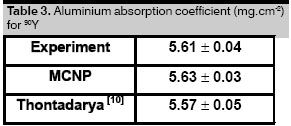
<p><font face="Verdana, Arial, Helvetica, sans-serif" size="2">The Aluminium absorption    coefficient &micro;(<img src="/img/revistas/nuc/n45/e02044509.jpg" width="19" height="14">)    obtained from the second zone (of medium densities) by the experimental measurements    and the MCNP simulations (<a href="#t3">table 3</a>) agree quite well with the reported in the    literature. This shows that the geometry of the experimental arrangement is    adequate and that the approximations used in the MCNP simulation were valid.</font></p>     
]]></body>
<body><![CDATA[<p><a name="t3"></a><img src="/img/revistas/nuc/n45/t03044509.jpg" width="291" height="126"></p>     
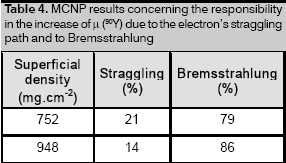
<p><font face="Verdana, Arial, Helvetica, sans-serif" size="2">    <br>   </font></p>     <p><font face="Verdana, Arial, Helvetica, sans-serif" size="2">In the zone of    higher densities (<a href="#f3">figure 3c</a>) one observes that the experimentally measured and    the MCNP calculated points are well above the extrapolated experimental points    from the second zone (medium densities). This was expected, as (1) is only a    restricted empirical relationship and it is known that for higher absorber&#146;s    densities the electron&#146;s straggling path leads to non-compliance with (1).    But, as we observed the results from the MCNP simulation we found out that the    Bremsstrahlung photons produced by the incoming electrons were the main responsible    for the increase of&micro;in this zone, as they were detected and counted as    electrons and not photons. One can certainly not eliminate the electron&#146;s    straggling path as cause for the increase of &micro;, but one can say with certainty    that it isn&#146;t its main cause (see <a href="#t4">table 4</a>).</font></p>     <p><a name="t4"></a><img src="/img/revistas/nuc/n45/t04044509.jpg" width="286" height="163"></p>     
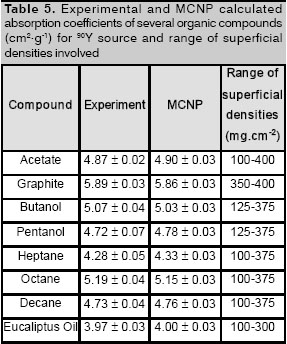
<p><font face="Verdana, Arial, Helvetica, sans-serif" size="2">The experimental    and MCNP calculated mass attenuation coefficients for the studied organic compounds    are reported in <a href="#t5">table 5</a>. Unfortunately, the comparison with previously reported    values was impossible.</font></p>     <p><a name="t5"></a><img src="/img/revistas/nuc/n45/t05044509.jpg" width="287" height="344"></p>     
<p><font face="Verdana, Arial, Helvetica, sans-serif" size="2">The pattern of    behavior followed by the Aluminium was also observed for the organic compounds.    That is to say the superposition of the spectra ( <img src="/img/revistas/nuc/n45/e02044509.jpg" width="19" height="14">    + <img src="/img/revistas/nuc/n45/e03044509.jpg" width="23" height="14">)    for light absorber&#146;s densities (0-100 mg.<img src="/img/revistas/nuc/n45/e09044509.jpg" width="29" height="13">),    the m measuring of <img src="/img/revistas/nuc/n45/e02044509.jpg" width="19" height="14">    alone for medium densities (100-400 mg.<img src="/img/revistas/nuc/n45/e09044509.jpg" width="29" height="13">)    and the non-compliance with (1) due to the presence of Bremsstrahlung photons    counted as electrons and the electrons&#146; straggling paths for such high    densities (above 400 mg.<img src="/img/revistas/nuc/n45/e09044509.jpg" width="29" height="13">    ).</font></p>     
<p><font face="Verdana, Arial, Helvetica, sans-serif" size="2">The &micro;(<img src="/img/revistas/nuc/n45/e02044509.jpg" width="19" height="14">)    values obtained from the intermediate zone (100-400 mg.<img src="/img/revistas/nuc/n45/e09044509.jpg" width="29" height="13">)    by the experimental measurements and the MCNP calculations agree quite well.    This shows that the geometry of the experimental arrangement is adequate and    that the approximations used in the MCNP simulation were also valid for the    studied organic compounds. This good concordance will allow the subsequent calculus    with the MCNP transport code of absorbed doses, an important parameter when    studying irradiation damages in more complex organic compounds (biological tissues,    DNA, etc.). </font></p>     
<p><font face="Verdana, Arial, Helvetica, sans-serif" size="2">The result concerning    the Bremsstrahlung photons was obtained thanks to the MCNP simulation. This    is interesting if one wants to irradiate a sample of one of the organic compounds    found intable5with electrons only, since one knows that the superficial density    of the absorber should not exceed 400mg.<img src="/img/revistas/nuc/n45/e09044509.jpg" width="29" height="13">    .</font></p>     
]]></body>
<body><![CDATA[<p><font face="Verdana, Arial, Helvetica, sans-serif" size="2"><b>Conclusions</b>    <br>   </font></p>     <p><font face="Verdana, Arial, Helvetica, sans-serif" size="2">The designed experimental    arrangement allow report, for the first time, &micro; (<img src="/img/revistas/nuc/n45/e02044509.jpg" width="19" height="14">)    values for <img src="/img/revistas/nuc/n45/e03044509.jpg" width="23" height="14">/    <img src="/img/revistas/nuc/n45/e02044509.jpg" width="19" height="14">    isotopic sources in several organic compounds and in more complex organic macromolecule    (Eucalyptus essential oil). On the other hand, Monte Carlo simulation permits    to estimate the strong&szlig;-particles absorption dependency on sample superficial    density in organic compounds. </font></p>     
<p><font face="Verdana, Arial, Helvetica, sans-serif" size="2"><b>References</b>    <br>   </font></p>     <!-- ref --><p><font face="Verdana, Arial, Helvetica, sans-serif" size="2">[1] OZMUTLU C,    CENGIZ A. Mass-attenuation coefficients of beta particles. Appl. Radiat. Isot.    1990; 41(6): 545- 549.    <!-- ref --><br>   [2] BALTAKMENS T. A simple method for determining the maximum energy of beta    emitters by absorption measurements. Nucl. Instrum. Meth. 1970; 82: 264- 268.    <!-- ref --><br>   [3] BARRY NT, KUYATT CE. Guidelines for evaluating and expressing the uncertainty    of NIST Measurement Results. NITS Technical Note 1297. 1993.    <!-- ref --><br>   [4] BRIESMEISTER JF. MCNP-A general Monte Carlo N- Particle Transport Code,    version 4C. Report LA-13709- M. Los Alamos National Laboratory, 2000.    <!-- ref --><br>   [5] GOUDSMIT S, SAUNDERSON JL. Multiple Scattering of Electrons. Phys. Rev.    C. 1940; 57(24).    <!-- ref --><br>   [6] LANDAU L. On the Energy Loss of Fast Particles by Ionization. USSR J. Phys.    1944; 8: 201.    <!-- ref --><br>   [7] BLUNCK O, LEISEGANG S. Zum Energieverlust schneller Elektronen in duennen    Schichten. Z. Physik. 1950; 128: 500.    <!-- ref --><br>   [8] HEITLER W. The Quantum Theory of Radiation. London: Oxford University Press,    1944.    <!-- ref --><br>   [9] CHANG JH. Fortran Code for Beta Sources Theoretical Energetic Spectrum Calculation    KAERI. Korea, 2002.    <!-- ref --><br>   [10]THONTADARYA SR. Effect of Geometry on Mass Attenuation Coefficient of Beta-Particles.    Appl. Radiat. Isot. 1984; 35(10): 981-982.</font>    <br> </p>     <p><font face="Verdana, Arial, Helvetica, sans-serif" size="2">Recibido:3 de noviembre    de 2008. Aceptado:14 de mayo de 2009.</font></p>      ]]></body><back>
<ref-list>
<ref id="B1">
<label>[1]</label><nlm-citation citation-type="journal">
<person-group person-group-type="author">
<name>
<surname><![CDATA[OZMUTLU]]></surname>
<given-names><![CDATA[C]]></given-names>
</name>
<name>
<surname><![CDATA[CENGIZ]]></surname>
<given-names><![CDATA[A]]></given-names>
</name>
</person-group>
<article-title xml:lang="en"><![CDATA[Mass-attenuation coefficients of beta particles]]></article-title>
<source><![CDATA[Appl. Radiat. Isot]]></source>
<year>1990</year>
<volume>41</volume>
<numero>(6)</numero>
<issue>(6)</issue>
<page-range>545- 549</page-range></nlm-citation>
</ref>
<ref id="B2">
<label>[2]</label><nlm-citation citation-type="journal">
<person-group person-group-type="author">
<name>
<surname><![CDATA[BALTAKMENS]]></surname>
<given-names><![CDATA[T]]></given-names>
</name>
</person-group>
<article-title xml:lang="en"><![CDATA[A simple method for determining the maximum energy of beta emitters by absorption measurements]]></article-title>
<source><![CDATA[Nucl. Instrum. Meth]]></source>
<year>1970</year>
<volume>82</volume>
<page-range>264- 268</page-range></nlm-citation>
</ref>
<ref id="B3">
<label>[3]</label><nlm-citation citation-type="">
<person-group person-group-type="author">
<name>
<surname><![CDATA[BARRY]]></surname>
<given-names><![CDATA[NT]]></given-names>
</name>
<name>
<surname><![CDATA[KUYATT]]></surname>
<given-names><![CDATA[CE]]></given-names>
</name>
</person-group>
<source><![CDATA[Guidelines for evaluating and expressing the uncertainty of NIST Measurement Results. NITS Technical Note 1297]]></source>
<year>1993</year>
</nlm-citation>
</ref>
<ref id="B4">
<label>[4]</label><nlm-citation citation-type="">
<person-group person-group-type="author">
<name>
<surname><![CDATA[BRIESMEISTER]]></surname>
<given-names><![CDATA[JF]]></given-names>
</name>
</person-group>
<source><![CDATA[MCNP-A general Monte Carlo N- Particle Transport Code, version 4C. Report LA-13709- M]]></source>
<year>2000</year>
<publisher-loc><![CDATA[Los Alamos National Laboratory ]]></publisher-loc>
</nlm-citation>
</ref>
<ref id="B5">
<label>[5]</label><nlm-citation citation-type="journal">
<person-group person-group-type="author">
<name>
<surname><![CDATA[GOUDSMIT]]></surname>
<given-names><![CDATA[S]]></given-names>
</name>
<name>
<surname><![CDATA[SAUNDERSON]]></surname>
<given-names><![CDATA[JL]]></given-names>
</name>
</person-group>
<article-title xml:lang="en"><![CDATA[Multiple Scattering of Electrons]]></article-title>
<source><![CDATA[Phys. Rev. C]]></source>
<year>1940</year>
<volume>57</volume>
<numero>(24)</numero>
<issue>(24)</issue>
</nlm-citation>
</ref>
<ref id="B6">
<label>[6]</label><nlm-citation citation-type="journal">
<person-group person-group-type="author">
<name>
<surname><![CDATA[LANDAU]]></surname>
<given-names><![CDATA[L]]></given-names>
</name>
</person-group>
<article-title xml:lang="en"><![CDATA[On the Energy Loss of Fast Particles by Ionization]]></article-title>
<source><![CDATA[USSR J. Phys]]></source>
<year>1944</year>
<volume>8</volume>
<page-range>201</page-range></nlm-citation>
</ref>
<ref id="B7">
<label>[7]</label><nlm-citation citation-type="journal">
<person-group person-group-type="author">
<name>
<surname><![CDATA[BLUNCK]]></surname>
<given-names><![CDATA[O]]></given-names>
</name>
<name>
<surname><![CDATA[LEISEGANG]]></surname>
<given-names><![CDATA[S]]></given-names>
</name>
</person-group>
<article-title xml:lang="de"><![CDATA[Zum Energieverlust schneller Elektronen in duennen Schichten]]></article-title>
<source><![CDATA[Z. Physik]]></source>
<year>1950</year>
<volume>128</volume>
<page-range>500</page-range></nlm-citation>
</ref>
<ref id="B8">
<label>[8]</label><nlm-citation citation-type="book">
<person-group person-group-type="author">
<name>
<surname><![CDATA[HEITLER]]></surname>
<given-names><![CDATA[W]]></given-names>
</name>
</person-group>
<source><![CDATA[Quantum Theory of Radiation]]></source>
<year>1944</year>
<publisher-loc><![CDATA[London ]]></publisher-loc>
<publisher-name><![CDATA[Oxford University Press]]></publisher-name>
</nlm-citation>
</ref>
<ref id="B9">
<label>[9]</label><nlm-citation citation-type="">
<person-group person-group-type="author">
<name>
<surname><![CDATA[CHANG]]></surname>
<given-names><![CDATA[JH]]></given-names>
</name>
</person-group>
<source><![CDATA[Fortran Code for Beta Sources Theoretical Energetic Spectrum Calculation KAERI]]></source>
<year>2002</year>
<publisher-loc><![CDATA[Korea ]]></publisher-loc>
</nlm-citation>
</ref>
<ref id="B10">
<label>[10]</label><nlm-citation citation-type="journal">
<person-group person-group-type="author">
<name>
<surname><![CDATA[THONTADARYA]]></surname>
<given-names><![CDATA[SR]]></given-names>
</name>
</person-group>
<article-title xml:lang="en"><![CDATA[Effect of Geometry on Mass Attenuation Coefficient of Beta-Particles]]></article-title>
<source><![CDATA[Appl. Radiat. Isot]]></source>
<year>1984</year>
<volume>35</volume>
<numero>(10)</numero>
<issue>(10)</issue>
<page-range>981-982</page-range></nlm-citation>
</ref>
</ref-list>
</back>
</article>