<?xml version="1.0" encoding="ISO-8859-1"?><article xmlns:mml="http://www.w3.org/1998/Math/MathML" xmlns:xlink="http://www.w3.org/1999/xlink" xmlns:xsi="http://www.w3.org/2001/XMLSchema-instance">
<front>
<journal-meta>
<journal-id>0864-084X</journal-id>
<journal-title><![CDATA[Nucleus]]></journal-title>
<abbrev-journal-title><![CDATA[Nucleus]]></abbrev-journal-title>
<issn>0864-084X</issn>
<publisher>
<publisher-name><![CDATA[CUBAENERGIA]]></publisher-name>
</publisher>
</journal-meta>
<article-meta>
<article-id>S0864-084X2009000100005</article-id>
<title-group>
<article-title xml:lang="en"><![CDATA[Radiation damage study in CZT matrix detectors exposed to gamma rays]]></article-title>
<article-title xml:lang="es"><![CDATA[Estudio del daño radiacional en detectores matriciales de CZT expuestos a los rayos gamma]]></article-title>
</title-group>
<contrib-group>
<contrib contrib-type="author">
<name>
<surname><![CDATA[Leyva Fabelo]]></surname>
<given-names><![CDATA[Antonio]]></given-names>
</name>
</contrib>
<contrib contrib-type="author">
<name>
<surname><![CDATA[Piñera Hernández]]></surname>
<given-names><![CDATA[Ibrahin]]></given-names>
</name>
</contrib>
<contrib contrib-type="author">
<name>
<surname><![CDATA[Dona Lemus]]></surname>
<given-names><![CDATA[Olga]]></given-names>
</name>
</contrib>
<contrib contrib-type="author">
<name>
<surname><![CDATA[Díaz García]]></surname>
<given-names><![CDATA[Angelina]]></given-names>
</name>
</contrib>
<contrib contrib-type="author">
<name>
<surname><![CDATA[Cruz Inclán]]></surname>
<given-names><![CDATA[Carlos Manuel]]></given-names>
</name>
</contrib>
<contrib contrib-type="author">
<name>
<surname><![CDATA[Abreu Alfonso]]></surname>
<given-names><![CDATA[Yamiel]]></given-names>
</name>
</contrib>
<contrib contrib-type="author">
<name>
<surname><![CDATA[Montaño Zétina]]></surname>
<given-names><![CDATA[Luis Manuel]]></given-names>
</name>
</contrib>
</contrib-group>
<aff id="A01">
<institution><![CDATA[,Centro de Aplicaciones Tecnológicas y Desarrollo Nuclear (CEADEN)  ]]></institution>
<addr-line><![CDATA[Ciudad de La Habana ]]></addr-line>
<country>Cuba</country>
</aff>
<aff id="A02">
<institution><![CDATA[,Centro Nacional de Seguridad Nuclear (CNSN)  ]]></institution>
<addr-line><![CDATA[ ]]></addr-line>
</aff>
<aff id="A03">
<institution><![CDATA[,Agencia de Energía Nuclear y Tecnologías de Avanzada (AENTA)  ]]></institution>
<addr-line><![CDATA[ ]]></addr-line>
</aff>
<aff id="A04">
<institution><![CDATA[,Centro de Investigación y Estudios Avanzados del IPN (CINVESTAV)  ]]></institution>
<addr-line><![CDATA[México D.F. ]]></addr-line>
</aff>
<pub-date pub-type="pub">
<day>00</day>
<month>06</month>
<year>2009</year>
</pub-date>
<pub-date pub-type="epub">
<day>00</day>
<month>06</month>
<year>2009</year>
</pub-date>
<numero>45</numero>
<fpage>36</fpage>
<lpage>32</lpage>
<copyright-statement/>
<copyright-year/>
<self-uri xlink:href="http://scielo.sld.cu/scielo.php?script=sci_arttext&amp;pid=S0864-084X2009000100005&amp;lng=en&amp;nrm=iso"></self-uri><self-uri xlink:href="http://scielo.sld.cu/scielo.php?script=sci_abstract&amp;pid=S0864-084X2009000100005&amp;lng=en&amp;nrm=iso"></self-uri><self-uri xlink:href="http://scielo.sld.cu/scielo.php?script=sci_pdf&amp;pid=S0864-084X2009000100005&amp;lng=en&amp;nrm=iso"></self-uri><abstract abstract-type="short" xml:lang="es"><p><![CDATA[RESUMEN El daño radiacional en términos de desplazamientos atómicos en un típico detector de CZT empleado en aplicaciones de imagenología médica fue estudiado utilizando el método estadístico de Monte Carlo. Se tuvieron en cuenta todas las características estructurales y geométricas del detector, así como las diferentes energías de los fotones usualmente empleados en la aplicación. Considerando la aproximación clásica de Mott-McKinley-Feshbach se calcularon las secciones eficaces de desplazamiento, así como el número de desplazamientos por átomo para cada especie atómica presente en el material y para cada energía considerada de los fotones. Estos resultados se analizan y comparan entre sí y finalmente se establece la comparación entre el daño radiacional que tiene lugar en el detector de CZT con el que se manifiesta en un detector similar, pero fabricado con otros materiales semiconductores.]]></p></abstract>
<abstract abstract-type="short" xml:lang="en"><p><![CDATA[ABSTRACT Radiation damage in terms of atomic displacements in a typical CZT detector used in medical imaging applications was studied using the Monte Carlo statistical method. All detector structural and geometric features as well as different energies of the photons usually used in the application were taken into account. Considering the Mott-McKinley-Feshbach classical approach, effective cross sections of the displacements were calculated, including the number of displacements per atom for each atomic species present in the material and each photon energy considered. These results are analyzed and compared. Finally, the radiation damage on CZT detector is compared to that calculated in a similar detector manufactured with other semiconducting materials.]]></p></abstract>
<kwd-group>
<kwd lng="en"><![CDATA[Monte Carlo method]]></kwd>
<kwd lng="en"><![CDATA[positron computed tomography]]></kwd>
<kwd lng="en"><![CDATA[semiconductor detectors]]></kwd>
<kwd lng="en"><![CDATA[mathematical models]]></kwd>
<kwd lng="en"><![CDATA[atomic displacements]]></kwd>
<kwd lng="en"><![CDATA[cross sections]]></kwd>
</kwd-group>
</article-meta>
</front><body><![CDATA[ <p align="left"><font face="Verdana, Arial, Helvetica, sans-serif" size="2"><b>CIENCIAS    NUCLEARES</b></font></p>     <p align="right">&nbsp;</p>     <p><font face="Verdana, Arial, Helvetica, sans-serif"><strong><font size="4">Radiation    damage study in CZT matrix detectors exposed to gamma rays</font></strong></font></p>     <p><font size="3" face="Verdana, Arial, Helvetica, sans-serif">Estudio del da&ntilde;o    radiacional en detectores matriciales de CZT expuestos a los rayos gamma    <br>   </font></p>     <p align="left"><font size="2" face="Verdana, Arial, Helvetica, sans-serif">Antonio    Leyva Fabelo1 , Ibrahin Pi&ntilde;era Hern&aacute;ndez 1 , Olga Dona Lemus2    , Angelina D&iacute;az Garc&iacute;a3, Carlos Manuel Cruz Incl&aacute;n1 , Yamiel    Abreu Alfonso1 , Luis Manuel Monta&ntilde;o Z&eacute;tina4</font></p>     <p align="left"><font size="2" face="Verdana, Arial, Helvetica, sans-serif">    <br>   1 Centro de Aplicaciones Tecnol&oacute;gicas y Desarrollo Nuclear (CEADEN)    <br>   Calle 30, No 502, entre 5 ta y 7 ma , Miramar, Playa, Ciudad de La Habana, Cuba    <br>   2 Centro Nacional de Seguridad Nuclear (CNSN)    ]]></body>
<body><![CDATA[<br>   3 Agencia de Energ&iacute;a Nuclear y Tecnolog&iacute;as de Avanzada (AENTA)    <br>   4 Centro de Investigaci&oacute;n y Estudios Avanzados del IPN (CINVESTAV), M&eacute;xico    D.F.    <br>   <a href="mailto:aleyva@ceaden.edu.cu">aleyva@ceaden.edu.cu</a></font></p> <hr>     <p><font face="Verdana, Arial, Helvetica, sans-serif" size="2"><b>RESUMEN</b></font></p>     <p><font size="2" face="Verdana, Arial, Helvetica, sans-serif">El da&ntilde;o    radiacional en t&eacute;rminos de desplazamientos at&oacute;micos en un t&iacute;pico    detector de CZT empleado en aplicaciones de imagenolog&iacute;a m&eacute;dica    fue estudiado utilizando el m&eacute;todo estad&iacute;stico de Monte Carlo.    Se tuvieron en cuenta todas las caracter&iacute;sticas estructurales y geom&eacute;tricas    del detector, as&iacute; como las diferentes energ&iacute;as de los fotones    usualmente empleados en la aplicaci&oacute;n. Considerando la aproximaci&oacute;n    cl&aacute;sica de Mott-McKinley-Feshbach    <br>   se calcularon las secciones eficaces de desplazamiento, as&iacute; como el n&uacute;mero    de desplazamientos por &aacute;tomo para cada especie at&oacute;mica presente    en el material y para cada energ&iacute;a considerada de los fotones. Estos        <br>   resultados se analizan y comparan entre s&iacute; y finalmente se establece    la comparaci&oacute;n entre el da&ntilde;o radiacional que tiene lugar en el    detector de CZT con el que se manifiesta en un detector similar, pero fabricado    con otros materiales semiconductores.</font></p> <hr>     <p><font face="Verdana, Arial, Helvetica, sans-serif" size="2"><b>ABSTRACT</b></font></p>     <p><font size="2" face="Verdana, Arial, Helvetica, sans-serif">Radiation damage    in terms of atomic displacements in a typical CZT detector used in medical imaging    applications was studied using the Monte Carlo statistical method. All detector    structural and geometric features as well as different energies of the photons    usually used in the application were taken into account. Considering the Mott-McKinley-Feshbach    classical approach, effective cross sections of the displacements were calculated,    including the number of displacements per atom for each atomic species present    in the material and each photon energy considered. These results are analyzed    and compared. Finally, the radiation damage on CZT detector is compared    <br>   to that calculated in a similar detector manufactured with other semiconducting        ]]></body>
<body><![CDATA[<br>   materials.</font></p>     <p><font face="Verdana, Arial, Helvetica, sans-serif" size="2"><b>Key words: </b>Monte    Carlo method, positron computed tomography, semiconductor detectors, mathematical    models, atomic displacements, cross sections</font></p> <hr>     <p><font size="2" face="Verdana, Arial, Helvetica, sans-serif"><b>Introduction</b></font></p>     <p><font face="Verdana, Arial, Helvetica, sans-serif" size="2">The study of the    radiation detectors is a never- ending field in the experimental nuclear physics,    determined not only by the constant growing applications spectrum, but for the    permanent development of new materials with more advanced properties. </font></p>     <p><font face="Verdana, Arial, Helvetica, sans-serif" size="2">In the last decade    the use of <img src="/img/revistas/nuc/n45/e01054509.jpg" width="60" height="16">    (CZT) in semiconducting radiation detectors fabrication has constituted an important    technological step [1]. One of the fields where CZT detectors had found and    extensive application is in medical imaging, as for example in Digital Mammography    and Angiography or in Positron Emission Tomography (PET) [2, 3]. </font></p>     
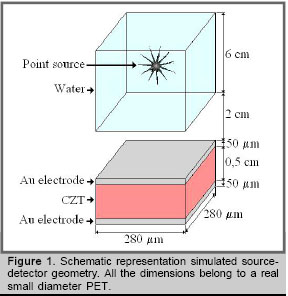
<p><font face="Verdana, Arial, Helvetica, sans-serif" size="2">In this research    we study some aspects of possible gamma radiation damage in CZT detectors working    at room temperature as a consequence of its utilization in imaging applications,    specifically in PET. </font></p>     <p><font face="Verdana, Arial, Helvetica, sans-serif" size="2">To reach this objective    the mathematical simulation of the interaction processes between radiation and    matter was used. The Monte Carlo statistical method and some physical approaches    were employed.</font></p>     <p><font face="Verdana, Arial, Helvetica, sans-serif" size="2"><b>Materials and    methods</b></font></p>     <p><font face="Verdana, Arial, Helvetica, sans-serif" size="2"><a href="#f1">Figure 1</a> shows    schematically the basic detecting geometry typically employed in researching    small animal PET imaging system. One pixel (280 &micro;m x 280 &micro;m) of    the CZT matrix detectors (5 mm thickness) with gold electrodes is irradiated    by a point radiation source placed inside a water octahedron, which simulates    a mammal body.</font></p>     <p><font face="Verdana, Arial, Helvetica, sans-serif" size="2"><a name="f1"></a><img src="/img/revistas/nuc/n45/f01054509.jpg" width="288" height="296">    
]]></body>
<body><![CDATA[<br>   </font></p>     <p><font face="Verdana, Arial, Helvetica, sans-serif" size="2">Two different energies    for photon point sources were selected for simulation: 1274 keV - source energy    used in the real experiment ( <img src="/img/revistas/nuc/n45/e02054509.jpg" width="25" height="13">)    and 511 keV - photons energy due to positron annihilation.    
<br>   </font></p>     <p><font face="Verdana, Arial, Helvetica, sans-serif" size="2">For gamma rays    transport simulation through the different experimental system details, the    code Monte Carlo N-Particle version 2.6.B (MCNPX) [4] was used. This code system,    based on the Monte Carlo statistical method, allows the study of spatial distribution    of the radiation energy deposition in detectors and the calculation of secondary    electron fluxes necessaries to evaluate the radiation damage. The transmitted    electron spectrum was calculated using the *F4 tally.    <br>   </font></p>     <p><font face="Verdana, Arial, Helvetica, sans-serif" size="2">All the geometric    details of the system, as well as constituent materials particularities were    taken into account in the simulation.    <br>   </font></p>     <p><font face="Verdana, Arial, Helvetica, sans-serif" size="2">The data obtained    from the simulation are normalized by number of particles emitted by the source,    and all results have a relative error below 1%, which is guaranteed using <img src="/img/revistas/nuc/n45/e03054509.jpg" width="19" height="13">    incident photons in each simulation experiment.    
<br>   </font></p>     <p><font face="Verdana, Arial, Helvetica, sans-serif" size="2">The primary knock-on    atom (PKA) displacement cross sections <img src="/img/revistas/nuc/n45/e04054509.jpg" width="25" height="15">    for each atomic species were calculated using the Mott-McKinley-Feshbach approach    [5]:</font></p>     

]]></body>
<body><![CDATA[<p><img src="/img/revistas/nuc/n45/e05054509.jpg" width="611" height="65"></p>     
<p>&nbsp;</p>     <p><font face="Verdana, Arial, Helvetica, sans-serif" size="2">where Z is the    atomic number of displaced atom, <img src="/img/revistas/nuc/n45/e10054509.jpg" width="17" height="16">    the hydrogen atom Bohr radius, <img src="/img/revistas/nuc/n45/e06054509.jpg" width="19" height="17">    the Rydberg energy, <img src="/img/revistas/nuc/n45/e08054509.jpg" width="14" height="11">=v/c,<img src="/img/revistas/nuc/n45/e07054509.jpg" width="11" height="17">=    Z/137, <img src="/img/revistas/nuc/n45/e09054509.jpg" width="18" height="15">    the maximum energy transferred to the atom, <i>m</i> the electron mass and <img src="/img/revistas/nuc/n45/e11054509.jpg" width="15" height="14">the    threshold displacement energy.</font></p>     
<p><font face="Verdana, Arial, Helvetica, sans-serif" size="2"><b>Results: </b></font></p>     <p><font face="Verdana, Arial, Helvetica, sans-serif" size="2">Obtained values    of calculated secondary electrons maximum kinetic energy, using the photoelectric    and Compton effects and pair-formation interaction equations (<img src="/img/revistas/nuc/n45/e12054509.jpg" width="24" height="16">    , <img src="/img/revistas/nuc/n45/e13054509.jpg" width="27" height="19">    and <img src="/img/revistas/nuc/n45/e14054509.jpg" width="26" height="18">    respectively), are presented in table 1. Using these data and applying the energy    and momentum conservation laws it is possible to calculate the maximum transferred    by the electron to the atom energy (<img src="/img/revistas/nuc/n45/e09054509.jpg" width="18" height="18">)    which values are also showed in table.</font></p>     
<p><img src="/img/revistas/nuc/n45/t01054509.jpg" width="609" height="122"></p>     
<p>&nbsp;</p>     <p><font face="Verdana, Arial, Helvetica, sans-serif" size="2"> The threshold    displacement energies of the different atoms in the CZT do not appear reported    explicitly in the literature. Taking into account that some authors consider    that strictly speaking CZT is an alloy of binary    <br>   compounds CdTe and ZnTe, we will considerate in simulation the values of <img src="/img/revistas/nuc/n45/e11054509.jpg" width="15" height="17">    reported for these two compounds: 8.9 eV for the Cd, 7.35 eV for Zn and 7.25    eV for Te [6-8].    
<br>   </font></p>     ]]></body>
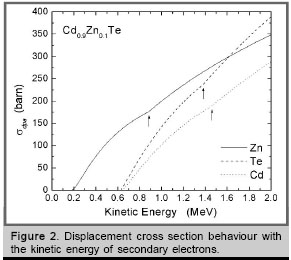
<body><![CDATA[<p><font face="Verdana, Arial, Helvetica, sans-serif" size="2">Introducing the    <img src="/img/revistas/nuc/n45/e11054509.jpg" width="15" height="18">    values and the calculated <img src="/img/revistas/nuc/n45/e09054509.jpg" width="18" height="17">    in (1) and taking in to account the Kinchin-Pease approximation for the damage    function n(T) [9], the behaviours of effective displacement cross sections <img src="/img/revistas/nuc/n45/e04054509.jpg" width="25" height="15">    with the secondary electrons kinetic energy were obtained and are presented    in <a href="#f2">figure 2</a>.</font></p>     
<p><a name="f2"></a><img src="/img/revistas/nuc/n45/f02054509.jpg" width="291" height="260"></p>     
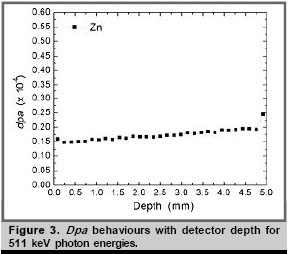
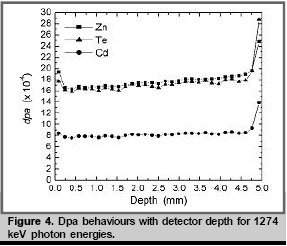
<p><font face="Verdana, Arial, Helvetica, sans-serif" size="2">This figure shows    that probability of atomic displacements event is possible only for secondary    electrons energies higher than 187 keV for Zn, 629 keV for Te and 645 keV for    Cd atoms. It means that for the studied sources, atom displacements will be    expected in all atomic species only for 1274 keV.    <br>   </font></p>     <p><font face="Verdana, Arial, Helvetica, sans-serif" size="2">When the photon    energy overcomes the 880 keV for Zn it begins to take place the multiple displacements    phenomenon, which happens when the primary knockon atom (PKA) has enough energy    to displace another atom by atom-atom collisions. The mentioned phenomenon is    manifested by an obvious change in the curves behaviour. This threshold energy    is 1380 keV for Te and 1450 keV for Cd, as it is observed in the figure 2, where    the curve inflexion points are indicated by black arrows.    <br>   </font></p>     <p><font face="Verdana, Arial, Helvetica, sans-serif" size="2">The <i>dpa</i>    (displacements per atom) distributions with the detector depth were calculated    starting from the secondary electrons flux values obtained by Monte Carlo simulation.    Behaviours of in-depth <i>dpa</i> for the two used gamma energies are presented    in <a href="#f3">figures 3</a> and <a href="#f4">4</a>.</font></p>     <p><a name="f3"></a><img src="/img/revistas/nuc/n45/f03054509.jpg" width="288" height="254"></p>     
<p><a name="f4"></a><img src="/img/revistas/nuc/n45/f04054509.jpg" width="287" height="246"></p>     
<p><font face="Verdana, Arial, Helvetica, sans-serif" size="2">In correspondence    with its lower displacement cross section, the Cd atoms show smaller number    of atomic displacement defects. The highest radiation damage in the detector    is observed for the source of 1274 keV ( <img src="/img/revistas/nuc/n45/e02054509.jpg" width="20" height="13">).    This damage in <i>dpa</i> terms is two orders higher than obtained for 511 keV    ones.    
]]></body>
<body><![CDATA[<br>   </font></p>     <p><font face="Verdana, Arial, Helvetica, sans-serif" size="2">In up showed behaviours    in the vicinity of the interfaces CZT-electrode a radiation damage increment    is observed. This phenomenon is a consequence of the backscattering in Au electrodes    electrons. These secondary electrons previously leaved the CZT, scatter in electrodes    atoms returning to the active material contributing to the new displacements    formation.</font></p>     <p><font face="Verdana, Arial, Helvetica, sans-serif" size="2">The study of the    radiation detectors is a neverending field in the experimental nuclear physics,    determined not only by the constant growing applications spectrum, but for the    permanent development of new materials with more advanced properties.    <br>   </font></p>     <p><font face="Verdana, Arial, Helvetica, sans-serif" size="2">In the last decade    the use of <img src="/img/revistas/nuc/n45/e01054509.jpg" width="60" height="16">    (CZT) in semiconducting radiation detectors fabrication has constituted an important    technological step [1]. One of the fields where CZT detectors had found and    extensive application is in medical imaging, as for example in Digital Mammography    and Angiography or in Positron Emission Tomography (PET) [2, 3].    
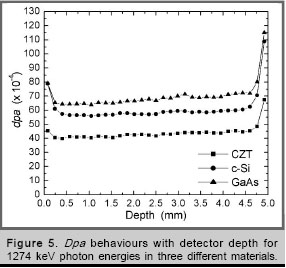
<br>   </font></p>     <p><font face="Verdana, Arial, Helvetica, sans-serif" size="2">In this research    we study some aspects of possible gamma radiation damage in CZT detectors working    at room temperature as a consequence of its utilization in imaging applications,    specifically in PET.    <br>   </font></p>     <p><font face="Verdana, Arial, Helvetica, sans-serif" size="2">The calculated    CZT dpa values become lower compared with similar calculations carried out with    the same detector but based on other materials as crystalline silicon and gallium    arsenide (see the <a href="#f5">figure 5</a>). This indicates that CZT is more resistant material    to the gamma radiation damage. Quantitatively this affirmation is evidenced    in facts that the <i>dpa</i> number obtained for CZT is 28% smaller than for    c-Si and 38% smaller than for GaAs. </font></p>     <p><a name="f5"></a><img src="/img/revistas/nuc/n45/f05054509.jpg" width="286" height="268"></p>     
]]></body>
<body><![CDATA[<p><font face="Verdana, Arial, Helvetica, sans-serif" size="2">In these results    the defects recombination process have not beentaken into account. These mechanisms    are amplified at high work detector temperature, then the real number of displacements    will depressed even more. </font></p>     <p><font face="Verdana, Arial, Helvetica, sans-serif" size="2">The radiation damage    study in CZT material as consequence of the photons irradiation is reported    for the first time. </font></p>     <p></p>     <p><font face="Verdana, Arial, Helvetica, sans-serif" size="2"><b>Conclusions</b>    <br>   </font></p>     <p><font face="Verdana, Arial, Helvetica, sans-serif" size="2">The radiation damage    taking place in CZT detectors used in medical imaging applications was studied    using Monte Carlo simulation and some classical approaches. The effective atomic    displacement cross- sections and the number of <i>dpa</i> were calculated for    all atomic species and two relevant photon energies. The highest radiation damage    in CZT detector is observed for 1274 keV source, where the damage indpaterms    is two orders stronger than for the other evaluated energy. Comparing with other    detector materials, it was observed that in CZT the radiation damage is lower.    </font></p>     <p><font face="Verdana, Arial, Helvetica, sans-serif" size="2"><b>Acknowledgments</b>    <br>   </font></p>     <p><font face="Verdana, Arial, Helvetica, sans-serif" size="2">This research was    supported by the Nuclear Energy and Advanced Technologies Agency of the Ministry    of Science, Technology and Environment of Cuba through the project PRN/6-1/2.    </font></p>     <p><font face="Verdana, Arial, Helvetica, sans-serif" size="2"><b>References</b>    ]]></body>
<body><![CDATA[<br>   </font></p>     <!-- ref --><p><font face="Verdana, Arial, Helvetica, sans-serif" size="2">[1] WAGENAAR DJ,    PARNHAM K, SUNDAL B, et. al. Advantages of semiconductor CZT for medical imaging.    Penetrating Radiation Systems and Applications VIII. Edited by Doty F. P., Barber    HBr. and Roehrig H. Proceedings of the SPIE. vol. 6707. 2007. p.67070I.    <!-- ref --><br>   [2] PISANO ED, YAFFE MJ, KUZMIAK CM. Digital Mammography, Lippincott Williams    &amp; Wilkins (LWW). 1st Edition. 2003.    <!-- ref --><br>   [3] BAILEY DL, TOWNSEND DW, VALK PE, et. al. Positron Emission Tomography: Basic    Sciences. First edition. London: Springer-Verlag, 2005.    <!-- ref --><br>   [4] HENDRICKS JS, MCKINNEY GW, TRELLUE HR, et. al. MCNPX TM Version 2.6.B. Report.    LA-UR-06-3248. Los Alamos National Laboratory, June 2006.    <!-- ref --><br>   [5] MCKINLEY WA, FESHBACH H. The Coulomb Scattering of Relativistic Electrons    by Nuclei. Phys Rev. 1948; 74(12): 1759-1763.    <!-- ref --><br>   [6] BRYANT FJ, WEBSTER E. Threshold Energy for Atomic Displacement in Cadmium    Telluride. Physica Status Solidi (b). 1967; 21(1): 315-321.    <!-- ref --><br>   [7] BRYANT FJ, BAKER ATJ. Threshold energy for tellurium displacement in zinc    telluride. J. Phys. C: Solid State Phys. 1972; 5(16): 2283-2288.    <!-- ref --><br>   [8] MEESE JM. Zn displacement threshold in ZnTe. Appl. Phys. Lett. 1971; 19:    86-87.    <!-- ref --><br>   [9] KINCHIN GH, PEASE RS. The displacement of atoms in solids by radiation.    Rep. Prog. Phys. 1955; 18: 1-51.    <br>   </font></p>     <p><font face="Verdana, Arial, Helvetica, sans-serif" size="2">Recibido: 07 de    abril de 2009. Aceptado: 14 de mayo de 2009.</font></p>      ]]></body><back>
<ref-list>
<ref id="B1">
<label>[1]</label><nlm-citation citation-type="confpro">
<person-group person-group-type="author">
<name>
<surname><![CDATA[WAGENAAR]]></surname>
<given-names><![CDATA[DJ]]></given-names>
</name>
<name>
<surname><![CDATA[PARNHAM]]></surname>
<given-names><![CDATA[K]]></given-names>
</name>
<name>
<surname><![CDATA[SUNDAL]]></surname>
<given-names><![CDATA[B]]></given-names>
</name>
</person-group>
<source><![CDATA[Advantages of semiconductor CZT for medical imaging. Penetrating Radiation Systems and Applications VIII]]></source>
<year></year>
<conf-name><![CDATA[ Proceedings of the SPIE]]></conf-name>
<conf-date>2007</conf-date>
<conf-loc> </conf-loc>
<page-range>p.67070I</page-range></nlm-citation>
</ref>
<ref id="B2">
<label>[2]</label><nlm-citation citation-type="book">
<person-group person-group-type="author">
<name>
<surname><![CDATA[PISANO]]></surname>
<given-names><![CDATA[ED]]></given-names>
</name>
<name>
<surname><![CDATA[YAFFE]]></surname>
<given-names><![CDATA[MJ]]></given-names>
</name>
<name>
<surname><![CDATA[KUZMIAK]]></surname>
<given-names><![CDATA[CM]]></given-names>
</name>
</person-group>
<source><![CDATA[Digital Mammography]]></source>
<year>2003</year>
<edition>1st Edition</edition>
<publisher-name><![CDATA[Lippincott Williams & Wilkins (LWW)]]></publisher-name>
</nlm-citation>
</ref>
<ref id="B3">
<label>[3]</label><nlm-citation citation-type="book">
<person-group person-group-type="author">
<name>
<surname><![CDATA[BAILEY]]></surname>
<given-names><![CDATA[DL]]></given-names>
</name>
<name>
<surname><![CDATA[TOWNSEND]]></surname>
<given-names><![CDATA[DW]]></given-names>
</name>
<name>
<surname><![CDATA[VALK]]></surname>
<given-names><![CDATA[PE]]></given-names>
</name>
</person-group>
<source><![CDATA[Positron Emission Tomography: Basic Sciences]]></source>
<year>2005</year>
<edition>First edition</edition>
<publisher-loc><![CDATA[London ]]></publisher-loc>
<publisher-name><![CDATA[Springer-Verlag]]></publisher-name>
</nlm-citation>
</ref>
<ref id="B4">
<label>[4]</label><nlm-citation citation-type="book">
<person-group person-group-type="author">
<name>
<surname><![CDATA[HENDRICKS]]></surname>
<given-names><![CDATA[JS]]></given-names>
</name>
<name>
<surname><![CDATA[MCKINNEY]]></surname>
<given-names><![CDATA[GW]]></given-names>
</name>
<name>
<surname><![CDATA[TRELLUE]]></surname>
<given-names><![CDATA[HR]]></given-names>
</name>
</person-group>
<source><![CDATA[MCNPX TM Version 2.6.B. Report. LA-UR-06-3248]]></source>
<year>June</year>
<month> 2</month>
<day>00</day>
<publisher-name><![CDATA[Los Alamos National Laboratory]]></publisher-name>
</nlm-citation>
</ref>
<ref id="B5">
<label>[5]</label><nlm-citation citation-type="journal">
<person-group person-group-type="author">
<name>
<surname><![CDATA[MCKINLEY]]></surname>
<given-names><![CDATA[WA]]></given-names>
</name>
<name>
<surname><![CDATA[FESHBACH]]></surname>
<given-names><![CDATA[H]]></given-names>
</name>
</person-group>
<article-title xml:lang="en"><![CDATA[The Coulomb Scattering of Relativistic Electrons by Nuclei]]></article-title>
<source><![CDATA[Phys Rev]]></source>
<year>1948</year>
<volume>74</volume>
<numero>(12)</numero>
<issue>(12)</issue>
<page-range>1759-1763</page-range></nlm-citation>
</ref>
<ref id="B6">
<label>[6]</label><nlm-citation citation-type="journal">
<person-group person-group-type="author">
<name>
<surname><![CDATA[BRYANT]]></surname>
<given-names><![CDATA[FJ]]></given-names>
</name>
<name>
<surname><![CDATA[WEBSTER]]></surname>
<given-names><![CDATA[E]]></given-names>
</name>
</person-group>
<article-title xml:lang="en"><![CDATA[Threshold Energy for Atomic Displacement in Cadmium Telluride]]></article-title>
<source><![CDATA[Physica Status Solidi (b)]]></source>
<year>1967</year>
<volume>21</volume>
<numero>(1)</numero>
<issue>(1)</issue>
<page-range>315-321</page-range></nlm-citation>
</ref>
<ref id="B7">
<label>[7]</label><nlm-citation citation-type="journal">
<person-group person-group-type="author">
<name>
<surname><![CDATA[BRYANT]]></surname>
<given-names><![CDATA[FJ]]></given-names>
</name>
<name>
<surname><![CDATA[BAKER]]></surname>
<given-names><![CDATA[ATJ]]></given-names>
</name>
</person-group>
<article-title xml:lang="en"><![CDATA[Threshold energy for tellurium displacement in zinc telluride]]></article-title>
<source><![CDATA[J. Phys. C: Solid State Phys]]></source>
<year>1972</year>
<volume>5</volume>
<numero>(16)</numero>
<issue>(16)</issue>
<page-range>2283-2288</page-range></nlm-citation>
</ref>
<ref id="B8">
<label>[8]</label><nlm-citation citation-type="journal">
<person-group person-group-type="author">
<name>
<surname><![CDATA[MEESE]]></surname>
<given-names><![CDATA[JM]]></given-names>
</name>
</person-group>
<article-title xml:lang="en"><![CDATA[Zn displacement threshold in ZnTe]]></article-title>
<source><![CDATA[Appl. Phys. Lett]]></source>
<year>1971</year>
<volume>19</volume>
<page-range>86-87</page-range></nlm-citation>
</ref>
<ref id="B9">
<label>[9]</label><nlm-citation citation-type="journal">
<person-group person-group-type="author">
<name>
<surname><![CDATA[KINCHIN]]></surname>
<given-names><![CDATA[GH]]></given-names>
</name>
<name>
<surname><![CDATA[PEASE]]></surname>
<given-names><![CDATA[RS]]></given-names>
</name>
</person-group>
<article-title xml:lang="en"><![CDATA[The displacement of atoms in solids by radiation]]></article-title>
<source><![CDATA[Rep. Prog. Phys]]></source>
<year>1955</year>
<volume>18</volume>
<page-range>1-51</page-range></nlm-citation>
</ref>
</ref-list>
</back>
</article>