and jets predictions with PYTHIA and HERWIG in p-p collisions at √S = 14 TeV at LHC
 High pT and jets predictions with PYTHIA and HERWIG in p-p collisions at √S = 14 TeV at LHC
Predicciones de producción de fotones directos y hadrones de alto momento en colisiones p-p a √S = 14 TEV en el LHC, usando PYTHIA y HERWIG
Amaya Casanova Díaz1,2, Gustavo Conesa Balbastre1, Cesar García Trápaga2
1Laboratori Nazionali di Frascati, INFN, Frascati, Italy
2Instituto Superior de Teconologías y Ciencias Aplicadas) InSTEC, La Habana, Cuba
ABSTRACT
High momentum direct photons and hadrons are produced at the LHC and the ALICE experiment measures and identifies them with the help of its calorimeters and tracking system. This studydeals with the production of such particles in p-p collisions at √S = 14 TeVby using two Monte Carlo generators (PYTHIA and HERWIG) and Next to Leading Order (NLO) predictions. The results show a good agreement among them. Special attention was given to the production of direct prompt photons and the use of isolation cutsfortheir identification.
Key words: CERN LHC, proton-proton interactions, Monte Carlo method, particle production.
Fotones directos y hadrones de alto momento se producen en el LHG y se detectan con el sistema de trazas y calorímetros del experimento ALICE. Se presenta el estudio de la producción de dichas partículas en colisiones de dos protones a √S = 14 TeV, con dos generadores de Monte Carlo (PYTHIA
y HERWIG) y con predicciones Next to Leading Order. Los resultados obtenidos por estos cálculos son consistentes. Se prestó especial atención en la producción de fotones directos del sistema y el uso de cortes por aislamiento para su identificación.
Palabras claves: CERN LHC, interacciones protón-protón, método de Monte Carlo, producción de partículas.
1. Introduction
The Large Hadron Collider (LHC) will collide two protons (p-p) at 14 TeV in the center of mass system (√S = 14 TeV) and two nuclei of lead (Pb-Pb) at 5.5 TeV per nucleon in the center of mass (= 5.5 TeV). At such energies, heavy ion collisions will produce a hot and dense matter with almost free quarks and gluons, the Quark-Gluon Plasma [1 ]. High energy partons traversing the dense colored plasma will lose energy radiating gluons, this will be translated into a modification of the final jet structure and a suppression of the particles with high transversal momentum (pT). These effects have been observed at the Relativistic Heavy Ion Collider (RHIC) in Au-Au collisions at = 200 GeV [2,3] and at LHC in Pb-Pb collisions at = 2.76 TeV [4]. In order to observe such modifi cations we need to compare to a reference, p-p collisions. A good understanding of particle and jet production in p-p collisions is needed. Quantum Chromo-Dynamics (QCD) theory predicts the particle and jet production in p-p collisions collider experiment energies. To estimate any systematical error from QCD Monte-Carlo generators predictions and compare to data is better compare several generators.
The most used Monte-Carlo p-p generators based on QCD at Leading Order (LO) are PYTHIA [5] and HERWIG [6]. In this article, is compared at generator level the production of high  particles and jets in p-p collisions with both generators. Specifically, the direct photons are also compared with NLO QCD calculations [7]. They are an interesting observable in heavy ions studies since they traverse the plasma without modification [7].
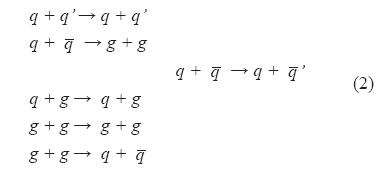
Particularly the prompt photons, which are produced in the LO processes:
have a jet on the opposite side with a similar energy. Since these photons have a small hadronic activity around them, Isolation Cut Methods [8,9] can be used to separate them from other photon sources, specially decay photons and other Next to Leading Order photon sources like fragmentation photons. A possible generator dependency in the isolation efficiencies is studied.
]]> 2. Generators settings and events producedPYTHIA and HERWIG are used in this report as Monte Carlo generators. We want to compare their predictions for high particles and jets productions and some of them with NLO theoretical calculations obtained with the Inclusive NLO program (INCNLO) [10]. Both, PYTHIA and HERWIG are LO approximation generators but based on different theoretical models; PYTHIA is based on a string model and HERWIG on a clustering model. Both generators have been tuned to reproduce some NLO predictions. We use here the default settings for HERWIG and the Tune A settings for PYTHIA [11]. The INCNLO program allows to calculate perturbatively the photon production cross-section at the NLO accuracy in the QCD coupling  .
.
In order to produce the expected high (1) particles and jet spectra with PYTHIA and HERWIG, prompt photon-jet events and dijet events are generated. Since the production cross sections of jets and prompt photons drops quickly with , events were sampled in different  , each bin with around 100 k events. The following lines show the main characteristics of the productions:
• jet-jet events: PYTHIA process  = 1 [5]; HERWIG process 1500 [6]. It consists of hard QCD 2 → 2 processes in the leading perturbative QCD order,
17 were generated (units are GeV/c): (2-12), (12-16), (16-20), (20-24), (24-29), (29-35), (35-41), (41- 50), (50-60), (60-72), (72-86), (86-104), (104-124), (124- 149), (149-179), (179-215), (215-258).
• -jet events: Pythia process MSEL = 10 [5]; HERWIG process 1800 [6]. It consists of the processes of Eq. (1). 11 were generated: (5-10), (10-20), (20-30), (30-40), (40-50), (50-60), (60-70), (70-80), (80-90), (90-100), ( > 100). Each bin was generated with about 100k events.
No acceptance cuts on the production of the partons, jets or particles were used. All this work was done using the ALICE simulation software AliRoot [12].
3. Photons and neutral pion predictions
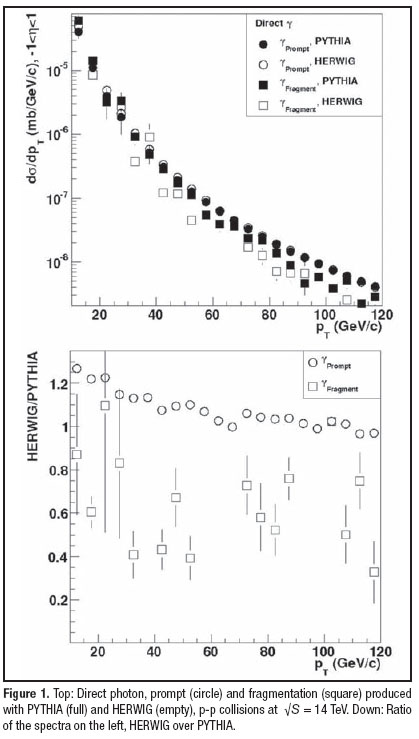
]]> The plots in figure 1 show the obtained differential production cross section for direct photons, prompt and fragmentation, from PYTHIA and HERWIG and their corresponding ratio. Fragmentation photons are produced in dijet events. It is seen that both generators predict a similar yield of direct prompt photons, a 20% more with HERWIG at 10 GeV/c and decreasing with the momentum. For direct fragmentation photons, the prediction is a factor 2 smaller with HERWIG, within the large statistical errors due to the generation. It is hard to produce a large amount of fragmentation photons since their cross section is small compared to the jet cross section. This lower number of fragmentation photons is related to the fact that also the rate of jets is about a factor 2 smaller in HERWIG than in PYTHIA as discussed below in Sec. 5.Figure 2-left, shows a comparison of the predictions for the  and direct photon (sum of prompt and fragmentation) with both Monte Carlo generators, and also an NLO prediction for direct photons calculated with the INCNLO program. We can see that the NLO prediction for direct photons and the generators predictions are close. The yield predicted by HERWIG is about 40% higher than in PYTHIA. This is mostly due to the fact that the two generators consider different resonances (which can decay into ) as stable or unstable particles. This complicates the comparison between these generators and with NLO predictions unless all the particles are decayed, which was not done here. Figure 2-right shows the NLO prediction calculated with INCNLO for the ratio direct photons to for different colliding systems. We can see that the amount of is one to two orders of magnitude larger than the direct photons depending on the colliding system.
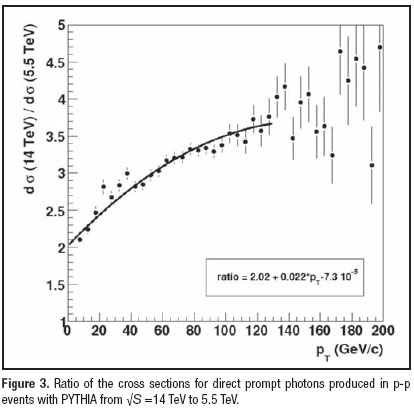
The LHC plans to produce p-p collisions at √S =14 TeV and Pb-Pb collisions at = 5.5 TeV. Since the energy of the collision of our reference measurement, the p-p events is different, it is necessary to know well enough the change in the cross section of the processes. Figure 3 shows the ratio of the cross sections for direct prompt photons produced in p-p events with PYTHIA from √S = 14 TeV to 5.5 TeV.
4. Charged hadrons predictions
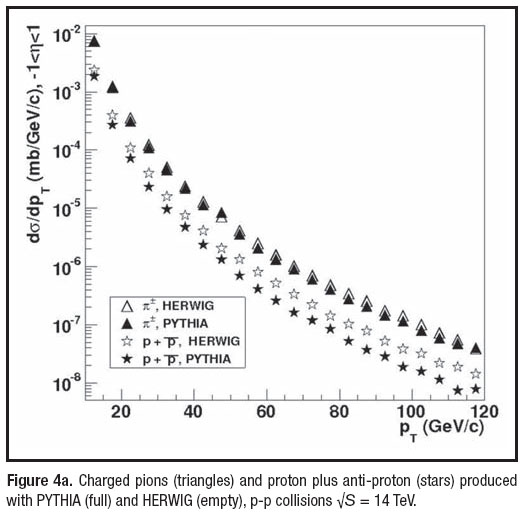
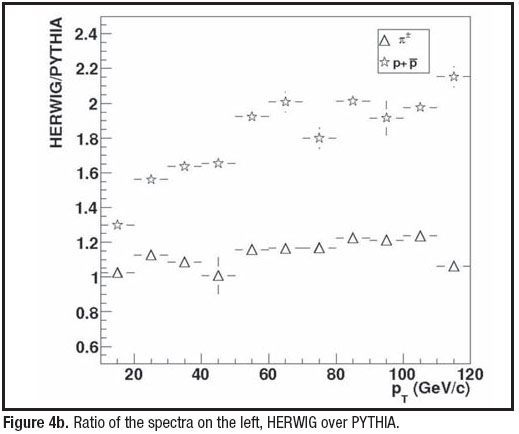
Figures 4a and 4b show the prediction for charged hadrons, pions and protons, from PYTHIA and HERWIG and their corresponding ratio. There is a good agreement between pions but protons diverge up to a factor 2 at high momenta.
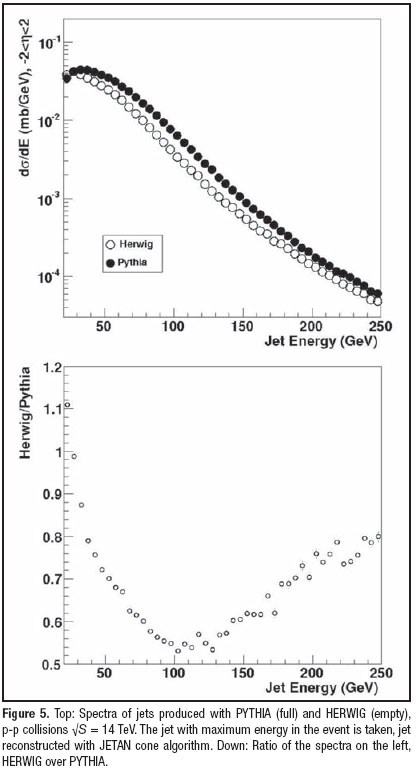
]]> 5. Jet predictions and fragmentation functionOne of the main physics programs at the LHC and ALICE is the jet measurement and its modifications due to the heavy-ion medium. For this kind of studies, we need a precise measurement of the jet and its particle structure [13]. We also wanted to compare the predictions of HERWIG and PYTHIA for the jet production and its fragmentation function. We took the dijet events and reconstructed the jets with UA cone algorithm (default algorithm in JETAN package [12] with jet energy seed  = 4 GeV and Cone size R = 1. The cone size is defined by the radius R in the ( ( , ( ) space,
The jet with the highest energy in the event was selected. It is observed 20% to 50% more jets in PYTHIA than in HERWIG for  > 30 GeV. The higher the energy the better the agreement for > 100 GeV.
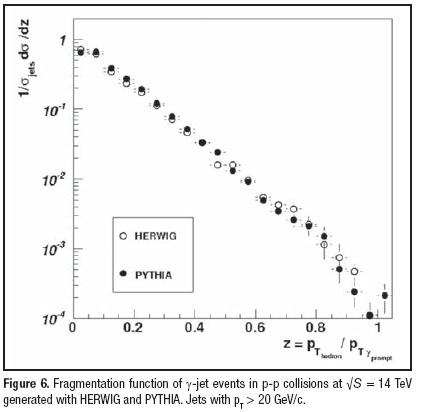
Figure 6 shows a comparison between the fragmentation function of -jet events in PYTHIA and HERWIG for p-p collisions at √S = 14 TeV. Prompt photons have the same energy as the jet, therefore a direct measurement of the jet energy can be obtained with the measurement of the photon [8]. In this figure, jets were reconstructed with the jet cone algorithm, same settings as in previous paragraph, and particles around the jet axis were collected to calculate the fragmentation function, within a cone of size R =1 and with > 0.5 GeV/c. We constructed the fragmentation function as the charged jet hadrons distribution as a function of the fraction of the momentum of the hadrons with respect to the direct prompt photon momentum, 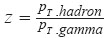 , normalized to the number of direct prompt photons. The underlying event was not subtracted. Similar fragmentation function for both generators is observed.
6. Particle isolation predictions
The main idea behind the Isolation Cut methods is that prompt photons and partons produced in parton collisions are emitted in opposite directions. As there is no hadron from the parton jet flying in the same direction as the photon, the latter should appear isolated. However, the underlying event, in particular the one generated by the heavy-ion collision, may perturb this ideal topology. To overcome this difficulty, we could use isolation cuts as in [8,9]. The isolation cut method searches for hadrons inside a cone centered around the direction  of high- photon candidates, being the cone size defi nition the same as for the jets, Eq. 3. The multiplicity inside the cone depends on the cone size and on the event type. For -jet events in p-p collisions, there is almost no particle inside the cone around the photon, independently of the energy of the prompt photon, but for jet-jet events there is a clear dependence of the multiplicity with the jet energy. Thus, applying cuts to the particles inside a cone around a photon candidate helps us to distinguish between -jet and jet-jet events. In this report, the particle is isolated if there is no hadron with above a given threshold inside the cone. Other selection methods have been studied but give similar results in p-p collisions. From the results in [8], we have selected a cone size R = 0.5 and a
  = 1 GeV/c (a smaller value would isolate more but we wanted to use a parameter intermediate between p-p and Pb-Pb).
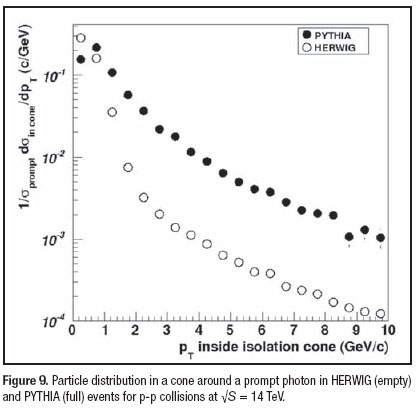
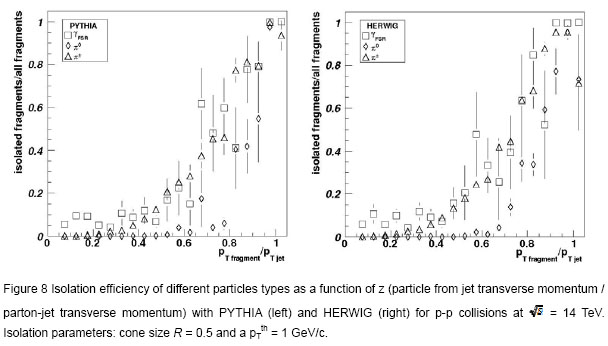
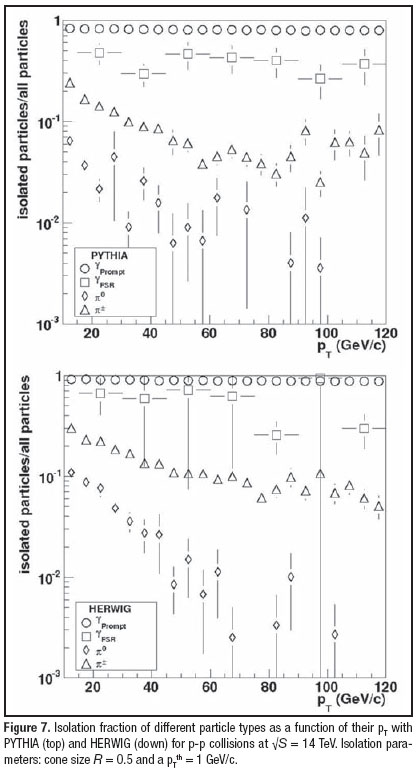
The ratio of isolated particles of a given type to all particles of the same type as a function of their momentum is shown in figure 7, and as a function of the fraction of jet energy that the particles carries in figure 8. The particles under study are prompt , fragmentationγ, neutral pions and charged pions. Prompt are isolated as expected. It is observed 10% more isolation in HERWIG than in PYTHIA. Looking to the particle distribution in the cone around the prompt photon, showed in figure 9 is possible to see that the underlying event in PYTHIA is larger than in HERWIG, what explains this difference. The effect of the isolation cuts on hadrons is to select the jet leading particles with energy close to the jet energy as can be seen in the lower ratios, this situation is rare and less than 10% of the pions are isolated. Like for prompt , hadrons are more isolated in HERWIG. For PYTHIA, fragmentationγ has an isolation efficiency around 50%, for HERWIG they seem to be even more isolated. If we compare charged pions and neutral pions, neutral pions are less suppressed, this is because charged pions are produced in pairs (opposite charges) and both will likely be in the isolation cone.
7. Conclusion
Predictions of PYTHIA and HERWIG for the production of high particles and jets at the LHC were studied. Both generators show similar predictions for prompt but jets, and then fragmentation , are suppressed in HERWIG compared with PYTHIA, a factor 2 at maximum for 100 GeV jets. Comparison of NLO calculations with both generators shows good agreement for direct photon production. Was also studied the effect of the isolation cut analysis on high particles produced with both generators, HERWIG has a smaller underlying event, what makes that the isolation fractions are about a 10% larger in HERWIG. Prompt in both generators are mostly isolated as expected, more than 90% of the photons pass the cuts, compared to hadrons which less than 10% pass the cuts.
8. Acknowledgements
The authors would like to thank to the ALICE collaboration for their support and the tools provided and used for this study.
9. References
1. VAN HEE H, GREKO V, RAPP R. Heavy-quark probes of the guarkgluon plasma and interpretation of recent data taken at the BNL Relativistic Heavy Ion Collider. Physical Review C. 2006; 3: 034913.
2. ADLER SS, et. al. High-pT charged hadron suppression in Au+Au collisions at √sNN=200 GeV. Phys. Rev. C. 2004; 69: 034910. ]]>
3. ADAMS J, et. al. Transverse-Momentum and Collision-Energy Dependence of High-pT Hadron Suppression in Au+Au Collisions at Ultrarelativistic Energies. Phys. Rev. Lett. 2003; 91(17): 172302.
4. AAMONDT K, et. al. Suppression of Charged Particle Production at Large Transverse Momentum in Central Pb-Pb Collisions at √sNN = 2.76 TeV. Phys. Lett. B. 2011; 696 (1-4): 30-39.
5. SJOSTRAND T, et. al. High-energy physics event generation with PYTHIA 6.1. Comput. Phys. Commun. 2001; 135(2): 238-259.
6. CORCELLA G, KNOWLES IG, MARCHESINI G, et. al. HERWIG 6: An Event generator for hadron emission reactions with interfering gluons (including supersymmetric processes) JHEP. 2001; 01: 010.
7. ARLEO F, et. al. Photon physics in heavy-ion collisions at the LHC. High Energy Physics – Phenom. 2004. Preprint hep-ph/0311131.
8. CONESA G, et. al. Prompt photon identifcation in the ALICE experiment: Isolation Cut Method. Nucl. Instr. and Meth. A. 2007; 580(3): 1446-1459.
9. CASANOVA A, CONESA G. Prompt photon identifcation in the ALICEEMCAL calorimeter: The Isolation Cut Method at the generation level.
ALICE Internal note ALICE-INT-2009-02 [en línea]. <https://edms.cern. ch/document/983344/1> [12 de junio 2011]
10. AURENCHE P, et. al. NLL Monte-Carlo approach in 1 or 2 jets photoproduction. Eur. Phys. J. C. 2000: 17, (3): 413-421.
11. ALBROW MG, et. al. TeV4LHC QCD Working Group. 2006. High Energy Physics – Phenom. 2006. hep-ph/0610012. ]]>
12. ALICE software framework . [software en línea]. <http://aliceinfo.cern. ch/Offl ine> [12 de junio 2011]
13. ACCARDI A, et. al. Hard probes in heavy ion collisions at the LHC: Jet physics. High Energy Physics – Phenom. 2004. hep-ph/0310274.
____________________
1Here refers to the transverse momentum of the hard 2 → 2 processes in their center-of-mass system.
2A switch to select between full user control and some preprogrammed alternatives.
Recibido: 13 de septiembre de 2011
Aceptado: 27 de octubre de 2011