<?xml version="1.0" encoding="ISO-8859-1"?><article xmlns:mml="http://www.w3.org/1998/Math/MathML" xmlns:xlink="http://www.w3.org/1999/xlink" xmlns:xsi="http://www.w3.org/2001/XMLSchema-instance">
<front>
<journal-meta>
<journal-id>0864-084X</journal-id>
<journal-title><![CDATA[Nucleus]]></journal-title>
<abbrev-journal-title><![CDATA[Nucleus]]></abbrev-journal-title>
<issn>0864-084X</issn>
<publisher>
<publisher-name><![CDATA[CUBAENERGIA]]></publisher-name>
</publisher>
</journal-meta>
<article-meta>
<article-id>S0864-084X2012000100004</article-id>
<title-group>
<article-title xml:lang="en"><![CDATA[Monte Carlo calculation of carbon atom displacement damage in C60 fullerene bulk materials irradiated with gamma rays]]></article-title>
<article-title xml:lang="es"><![CDATA[Cálculo por Monte Carlo del daño por desplazamientos de los átomos de carbono en materiales masivos basados en fullerenos C60 irradiados con rayos gamma]]></article-title>
</title-group>
<contrib-group>
<contrib contrib-type="author">
<name>
<surname><![CDATA[Leyva Fabelo]]></surname>
<given-names><![CDATA[Antonio]]></given-names>
</name>
<xref ref-type="aff" rid="A01"/>
</contrib>
<contrib contrib-type="author">
<name>
<surname><![CDATA[Piñera Hernández]]></surname>
<given-names><![CDATA[Ibrahin]]></given-names>
</name>
<xref ref-type="aff" rid="A01"/>
</contrib>
<contrib contrib-type="author">
<name>
<surname><![CDATA[Leyva Pernía]]></surname>
<given-names><![CDATA[Diana]]></given-names>
</name>
<xref ref-type="aff" rid="A01"/>
</contrib>
<contrib contrib-type="author">
<name>
<surname><![CDATA[Cruz Inclán]]></surname>
<given-names><![CDATA[Carlos M.]]></given-names>
</name>
<xref ref-type="aff" rid="A01"/>
</contrib>
<contrib contrib-type="author">
<name>
<surname><![CDATA[Abreu Alfonso]]></surname>
<given-names><![CDATA[Yamiel]]></given-names>
</name>
<xref ref-type="aff" rid="A01"/>
</contrib>
<contrib contrib-type="author">
<name>
<surname><![CDATA[Díaz García]]></surname>
<given-names><![CDATA[Angelina]]></given-names>
</name>
<xref ref-type="aff" rid="A01"/>
</contrib>
<contrib contrib-type="author">
<name>
<surname><![CDATA[Martínez Turtós]]></surname>
<given-names><![CDATA[Rosana]]></given-names>
</name>
<xref ref-type="aff" rid="A01"/>
</contrib>
</contrib-group>
<aff id="A01">
<institution><![CDATA[,Centro de Aplicaciones Tecnológicas y Desarrollo Nuclear (CEADEN)  ]]></institution>
<addr-line><![CDATA[La Habana ]]></addr-line>
<country>Cuba</country>
</aff>
<pub-date pub-type="pub">
<day>00</day>
<month>06</month>
<year>2012</year>
</pub-date>
<pub-date pub-type="epub">
<day>00</day>
<month>06</month>
<year>2012</year>
</pub-date>
<numero>51</numero>
<fpage>20</fpage>
<lpage>25</lpage>
<copyright-statement/>
<copyright-year/>
<self-uri xlink:href="http://scielo.sld.cu/scielo.php?script=sci_arttext&amp;pid=S0864-084X2012000100004&amp;lng=en&amp;nrm=iso"></self-uri><self-uri xlink:href="http://scielo.sld.cu/scielo.php?script=sci_abstract&amp;pid=S0864-084X2012000100004&amp;lng=en&amp;nrm=iso"></self-uri><self-uri xlink:href="http://scielo.sld.cu/scielo.php?script=sci_pdf&amp;pid=S0864-084X2012000100004&amp;lng=en&amp;nrm=iso"></self-uri><abstract abstract-type="short" xml:lang="en"><p><![CDATA[The displacement per carbon atom cross-sections behaviors with the secondary electron and positron kinetic energy for spherical fullerene C60 molecules are calculated. To accomplish this, the McKinley-Feshbach approach and the Kinchin-Pease approximation were taking into account, using two different displacement threshold energies. The total displacements per atom number generated indirectly by the photons in bulk samples composed of C60 fullerenes is also calculated. Besides, the behaviors of secondary particles contributions with the used displacement threshold energies and incident photon energies are determined. The in-depth distribution of electron and positron contributions and their relationship with the total displacements number are presented and debated. It was found that the positrons contribution to the total atom displacements number is very significant in processes involving the interaction of gamma quanta with energy up to 100 MeV in C60 fullerenes bulk samples.]]></p></abstract>
<abstract abstract-type="short" xml:lang="es"><p><![CDATA[Teniendo en cuenta las aproximaciones de McKinley-Feshbach y Kinchin-Pease se calcularon los comportamientos de las secciones eficaces de desplazamientos de los átomos de carbono en moléculas esféricas de fullereno C60, en función de la energía cinética de los electrones y positrones secundarios para dos valores de energía umbral de desplazamiento. También se calcularon el número total de desplazamientos atómicos generados de manera indirecta por los fotones en las muestras masivas de fullerenos C60 estudiadas. Además, se estudió el comportamiento de las contribuciones electrónicas y positrónicas, determinando sus dependencias con las energías de desplazamientoutilizadas y la energía de los fotones incidentes. Se presentan y debaten la distribución en profundidad de las contribuciones de los electrones y positrones, así como la relación entre ellos y el número total de desplazamientos. El aporte de la contribución de los positrones al número total de desplazamientos atómicos generados durante el proceso de interacción de los cuantos gamma de energías hasta 100 MeV con muestras masivas de fullerenos C60 se discutió lo que este resulta muy significativo.]]></p></abstract>
<kwd-group>
<kwd lng="en"><![CDATA[fullerenes]]></kwd>
<kwd lng="en"><![CDATA[atomic displacements]]></kwd>
<kwd lng="en"><![CDATA[cross sections]]></kwd>
<kwd lng="en"><![CDATA[radiation effects]]></kwd>
<kwd lng="en"><![CDATA[Monte Carlo method]]></kwd>
<kwd lng="en"><![CDATA[gamma radiation]]></kwd>
<kwd lng="es"><![CDATA[radiación gamma]]></kwd>
<kwd lng="es"><![CDATA[desplazamientos atómicos]]></kwd>
<kwd lng="es"><![CDATA[secciones eficaces]]></kwd>
<kwd lng="es"><![CDATA[efectos de las radiaciones]]></kwd>
<kwd lng="es"><![CDATA[método de Monte Carlo]]></kwd>
<kwd lng="es"><![CDATA[radiación gamma]]></kwd>
</kwd-group>
</article-meta>
</front><body><![CDATA[ <p align="right"><font face="Verdana, Arial, Helvetica, sans-serif" size="2"><b>CIENCIAS  NUCLEARES</b></font></p>    <p align="left">&nbsp;</p>    <p align="left"><font size="4" face="Verdana, Arial, Helvetica, sans-serif"><strong>Monte  Carlo calculation of carbon atom displacement damage in c60 fullerene bulk</strong>  <strong>materials</strong> <strong>irradiated with gamma rays</strong> </font></p>    <p>&nbsp;</p>    <p align="left"><font size="3" face="Verdana, Arial, Helvetica, sans-serif"><strong>C&aacute;lculo  por Monte Carlo del da&ntilde;o por desplazamientos de los &aacute;tomos de carbono  en materiales masivos basados en fullerenos c60 irradiados con rayos gamma</strong></font></p>    <p align="left">&nbsp;</p>    <p align="left">&nbsp;</p>    <p align="left"><font size="2" face="Verdana, Arial, Helvetica, sans-serif"><B>Antonio  Leyva Fabelo</B>, <B>Ibrahin Pi&ntilde;era Hern&aacute;ndez</B>, <B>Diana Leyva  Pern&iacute;a</B>, <B>Carlos M. Cruz Incl&aacute;n</B>, <B>Yamiel Abreu Alfonso</B>,  <B>Angelina D&iacute;az Garc&iacute;a</B>, <B>Rosana Mart&iacute;nez Turtos</B></font></p>    <p align="left"><font size="2" face="Verdana, Arial, Helvetica, sans-serif">Centro  de Aplicaciones Tecnol&oacute;gicas y Desarrollo Nuclear (CEADEN)    <br> Calle 30,  No. 502, entre 5ta y 7ma, Miramar, Playa. La Habana, Cuba</font></p>    ]]></body>
<body><![CDATA[<p align="left"><font size="2" face="Verdana, Arial, Helvetica, sans-serif"><A HREF="mailto:aleyva@ceaden.edu.cu">aleyva@ceaden.edu.cu</A></font></p><hr>      <p><font face="Verdana, Arial, Helvetica, sans-serif" size="2"><b>ABSTRACT</b></font></p>    <p><font size="2" face="Verdana, Arial, Helvetica, sans-serif">The  displacement per carbon atom cross-sections behaviors with the secondary electron  and positron kinetic energy for spherical fullerene C60 molecules are calculated.  To accomplish this, the McKinley&ndash;Feshbach approach and the Kinchin-Pease  approximation were taking into account, using two different displacement threshold  energies. The total displacements per atom number generated indirectly by the  photons in bulk samples composed of C60 fullerenes is also calculated. Besides,  the behaviors of secondary particles contributions with the used displacement  threshold energies and incident photon energies are determined. The in-depth distribution  of electron and positron contributions and their relationship with the total displacements  number are presented and debated. It was found that the positrons contribution  to the total atom displacements number is very significant in processes involving  the interaction of gamma quanta with energy up to 100 MeV in C60 fullerenes bulk  samples.</font></p>    <p><font size="2" face="Verdana, Arial, Helvetica, sans-serif"><strong>Palabras  claves:</strong> fullerenes, atomic displacements, cross sections, radiation effects,  Monte Carlo method, gamma radiation.</font></p><hr>     <p><font face="Verdana, Arial, Helvetica, sans-serif" size="2"><b>RESUMEN</b></font></p>    <p><font size="2" face="Verdana, Arial, Helvetica, sans-serif">Teniendo  en cuenta las aproximaciones de <em>McKinley-Feshbach y Kinchin-Pease</em> se  calcularon los comportamientos de las secciones eficaces de desplazamientos de  los &aacute;tomos de carbono en mol&eacute;culas esf&eacute;ricas de fullereno  C60, en funci&oacute;n de la energ&iacute;a cin&eacute;tica de los electrones  y positrones secundarios para dos valores de energ&iacute;a umbral de desplazamiento.  Tambi&eacute;n se calcularon el n&uacute;mero total de desplazamientos at&oacute;micos  generados de manera indirecta por los fotones en las muestras masivas de fullerenos  C60 estudiadas. Adem&aacute;s, se estudi&oacute; el comportamiento de las contribuciones  electr&oacute;nicas y positr&oacute;nicas, determinando sus dependencias con las  energ&iacute;as de desplazamientoutilizadas y la energ&iacute;a de los fotones  incidentes. Se presentan y debaten la distribuci&oacute;n en profundidad de las  contribuciones de los electrones y positrones, as&iacute; como la relaci&oacute;n  entre ellos y el n&uacute;mero total de desplazamientos. El aporte de la contribuci&oacute;n  de los positrones al n&uacute;mero total de desplazamientos at&oacute;micos generados  durante el proceso de interacci&oacute;n de los cuantos gamma de energ&iacute;as  hasta 100 MeV con muestras masivas de fullerenos C60 se discuti&oacute; lo que  este resulta muy significativo.</font></p>    <p><font size="2" face="Verdana, Arial, Helvetica, sans-serif"><strong>Key  words:</strong> radiation gamma, desplazamientos at&oacute;micos, secciones eficaces,  efectos de las radiaciones, m&eacute;todo de Monte Carlo, radiaci&oacute;n gamma.</font></p><hr>  <h1 align="left">&nbsp;</h1>    <p align="left">&nbsp;</p>    <p align="left"><font size="2" face="Verdana, Arial, Helvetica, sans-serif"><strong><FONT SIZE="3">INTRODUCTION</FONT></strong>  </font></p>    <p><font size="2" face="Verdana, Arial, Helvetica, sans-serif">The  carbon-based nanostructured materials are in a privileged position within the  scope of scientists and engineers around the world as a result of its unusual  properties and almost unlimited current and future applications in practically  all areas of science and technology [1-4].</font></p>    ]]></body>
<body><![CDATA[<p><font size="2" face="Verdana, Arial, Helvetica, sans-serif">  One of these surprising materials is the so-called buckminsterfullerene, or simply  buckyball, which consists in a roughly spherical cage of 60 carbon atoms arranged  in interlocking hexagons and pentagons (C60). Since its discovery in 1985 [5],  C60 had captured a great attention as consequence of their unique chemical and  physical properties. C60 fullerenes are potentially useful in several applications,  such as hydrogen storage for fuel cells, classical and painted-on solar cells,  development of lubricants for friction reductions to decrease the energy consumption,  nonlinear optics, photonics and molecular electronics, biological and medical  applications, etc. [6-8].</font></p>    <p><font size="2" face="Verdana, Arial, Helvetica, sans-serif">  In the development process of many of these applications, chemical groups must  be attached to a fullerene carbon atom, a procedure called functionalization,  modifying C60 properties. This functionalization process is supported by different  techniques, one of which is gamma-ray irradiation [9,10], required to facilitate  the generation of free bonds to which are linked the chemical interesting groups.  This method, together with some of previous cited applications, involves radiation  aggressive environments. This makes strategically important to evaluate the effect  that may cause gamma rays on the C60 structure and properties from the radiation  damage point of view. </font></p>    <p><font size="2" face="Verdana, Arial, Helvetica, sans-serif">The  aim of this paper is to calculate the displacements per carbon atoms cross-section  dependence on the secondary electron and positron energies in C60 fullerenes,  using a classical formalism and the displacement threshold energies reported in  literature. Also the authors determine the in-depth distribution of the displacements  per atom (dpa) number, which are generated when gamma rays of selected energies  interact with bulk C60 materials (BC60M).</font></p>    <p><font size="2" face="Verdana, Arial, Helvetica, sans-serif">  There is very limited information in the scientific literature about this paper  subject [11-13], and the analysis of the positrons contribution to the atom displacement  cross-section in C60 and to the atom displacements number in BC60M is always excluded.</font></p>    <p>&nbsp;</p>    <p><font size="2" face="Verdana, Arial, Helvetica, sans-serif"><strong><FONT SIZE="3">MATERIALS  AND METHODS</FONT></strong></font></p>    <p><font size="2" face="Verdana, Arial, Helvetica, sans-serif">One  of the basic parameters on studying radiation damage in crystals is the displacement  threshold energy (<img src="/img/revistas/nuc/n51/e01045112.jpg" width="17" height="16">),  which is defined as the kinetic energy a Primary Knock-on Atom (PKA) must have  to leave its equilibrium site on the structure.<img src="/img/revistas/nuc/n51/e01045112.jpg" width="17" height="16"><em>  </em>for C60 appears reported in the literaturewith a lot of dispersion, not existing  consensus in an exact value, fundamentally because<img src="/img/revistas/nuc/n51/e01045112.jpg" width="17" height="16"><em>  </em>has a strong angular dependence. In this work we will use two of the average  values reported, both calculated by means of molecular dynamics methods: <em>  </em><img src="/img/revistas/nuc/n51/e01045112.jpg" width="17" height="16">=  15 eV [14] and<em> </em><img src="/img/revistas/nuc/n51/e01045112.jpg" width="17" height="16">=  29.1 eV [15].</font></p>    
<p><font size="2" face="Verdana, Arial, Helvetica, sans-serif">  The total displacements per atom cross-section, <img src="/img/revistas/nuc/n51/e02045112.jpg" width="29" height="18">,  is defined by <a href="#e03045112">equation</a> (1).</font></p>    
<p><img src="/img/revistas/nuc/n51/e03045112.jpg" width="336" height="36"><a name="e03045112"></a></p>    
<p><font size="2" face="Verdana, Arial, Helvetica, sans-serif">where  <em>E</em> is the particle kinetic energy, <em>T</em> is the atom recoil kinetic  energy, &nbsp;<img src="/img/revistas/nuc/n51/e04045112.jpg" width="62" height="21">  is the PKA cross-section, and <em><img src="/img/revistas/nuc/n51/e12045112.jpg" width="24" height="16"></em>  is the damage function.</font></p>    
]]></body>
<body><![CDATA[<p><font size="2" face="Verdana, Arial, Helvetica, sans-serif">  As known,<img src="/img/revistas/nuc/n51/e02045112.jpg" width="29" height="18">  is a hypothetical area which describes the likelihood of structural atom being  displaced by a particle, and then this parameter may be associated with the sensitivity  of the target material to be damaged by the incident radiation. </font></p>    
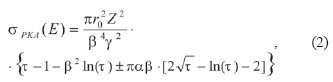
<p><font size="2" face="Verdana, Arial, Helvetica, sans-serif">  The <a href="#e05045112">PKA cross-section</a> is obtained from the McKinley-Feshbach  approximation [16], extended to include the positrons case [17]:</font></p>    <p><img src="/img/revistas/nuc/n51/e05045112.jpg" width="333" height="82"><a name="e05045112"></a></p>    
<p><font size="2" face="Verdana, Arial, Helvetica, sans-serif">with  <em>Z</em> being the atomic number, <img src="/img/revistas/nuc/n51/e06045112.jpg" width="13" height="20">  is the electron classic radius, <em><img src="/img/revistas/nuc/n51/e07045112.jpg" width="14" height="12">=  Z/137</em>, <img src="/img/revistas/nuc/n51/e08045112.jpg" width="12" height="17"><em>  </em>is the ratio of the electron velocity to the velocity of light, <img src="/img/revistas/nuc/n51/e09045112.jpg" width="15" height="17"><em>  = </em><em><img src="/img/revistas/nuc/n51/e10045112.jpg" width="53" height="16"></em>,  <img src="/img/revistas/nuc/n51/e11045112.jpg" width="70" height="22"> <a href="#e13045112">being</a></font></p>    
<p><img src="/img/revistas/nuc/n51/e13045112.jpg" width="334" height="51"><a name="e13045112"></a></p>    
<p><font size="2" face="Verdana, Arial, Helvetica, sans-serif">the  maximum kinetic energy of the corresponding recoil atom with mass <em>M</em>.  The sign of term <em><img src="/img/revistas/nuc/n51/e30045112.jpg" width="26" height="15"></em>  in <a href="#e05045112">(2)</a> is positive for electrons and negative for positrons.</font></p>    
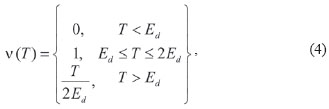
<p><font size="2" face="Verdana, Arial, Helvetica, sans-serif">  The <a href="#e14045112">damage function</a> <em><img src="/img/revistas/nuc/n51/e12045112.jpg" width="24" height="16"></em>  in <a href="#e03045112">eq. (1)</a> allows including the atom displacement cascades  phenomenon in the calculation, which was expressed according to the Kinchin-Pease  model [18]:</font></p>    
<p><img src="/img/revistas/nuc/n51/e14045112.jpg" width="329" height="109"><a name="e14045112"></a></p>    
<p><font size="2" face="Verdana, Arial, Helvetica, sans-serif">To  evaluate <a href="#e16045112">this function</a> the average atom recoil kinetic  energy (<em><img src="/img/revistas/nuc/n51/e15045112.jpg" width="19" height="17"></em>)  is used, given by</font></p>    
<p><img src="/img/revistas/nuc/n51/e16045112.jpg" width="430" height="42"><a name="e16045112"></a><a></a></p>    
]]></body>
<body><![CDATA[<p><font size="2" face="Verdana, Arial, Helvetica, sans-serif">A  more complete explanation of this procedure can be found additionally in [19].  There are also explained the details of the MCCM (Monte Carlo assisted Classical  Method) code system, created on the above mentioned bases and used for whole calculations  in this work.</font></p>    <p> <font size="2" face="Verdana, Arial, Helvetica, sans-serif">  The radiation damage calculations resulting from the action of gamma rays on BC60M  were performed in a cylindrical shape sample (diameter 100 &micro;m and thickness  10 &micro;m), which is irradiated with monochromatic photons of a given energy.  The photons impact perpendicularly and homogeneously distributed over the top  surface of the cylinder. The atom displacement profile determination is performed  in a voxel (10 &mu;m x 10 &mu;m x 10 &mu;m) located exactly in the cylinder center.  The mass density of the sample was set <em><img src="../img/e17045112.jpg" width="12" height="14"></em>  = 1.65 g <img src="../img/e18045112.jpg" width="30" height="13"> [20]. </font></p>    <p><font size="2" face="Verdana, Arial, Helvetica, sans-serif">  The energy flux distributions <em><img src="/img/revistas/nuc/n51/e19045112.jpg" width="50" height="20"></em>  at a given depth <em>z</em> of secondary electrons and positrons resulting from  the interaction of photons with the BC60M were calculated within the selected  voxel using the MCNPX (Monte Carlos n - Particles Transport Code) software [21].  The flux values are normalized to source particle number. </font></p>    
<p><font size="2" face="Verdana, Arial, Helvetica, sans-serif">These  results were processed by the MCCM program to determine the number of <a href="#e21045112">atom  displacements</a> (<em><img src="/img/revistas/nuc/n51/e20045112.jpg" width="28" height="18"></em>)  for each particle type according to the classical method [19]:</font></p>    

<p><img src="/img/revistas/nuc/n51/e21045112.jpg" width="337" height="53"><a name="e21045112"></a></p>    
<p><font size="2" face="Verdana, Arial, Helvetica, sans-serif">where  <img src="/img/revistas/nuc/n51/e22045112.jpg" width="37" height="21">&nbsp;is  the number of atoms displaced per electron or positron with kinetic energy <em><img src="/img/revistas/nuc/n51/e23045112.jpg" width="14" height="21"></em>  calculated following Oen-Holmes <a href="#e24045112">expression</a> [22]:</font></p>    
<p><img src="/img/revistas/nuc/n51/e24045112.jpg" width="332" height="56"><a name="e24045112"></a></p>    
<p><font size="2" face="Verdana, Arial, Helvetica, sans-serif">where  <em><img src="/img/revistas/nuc/n51/e25045112.jpg" width="17" height="22"></em>  is the cutoff kinetic energy of electrons (or positrons) in order to displace  an atom from its crystalline site, <img src="/img/revistas/nuc/n51/e26045112.jpg" width="21" height="18">is  the number of atoms per volume unit in the sample, (-dE/dx) is the electron stopping  power, and <img src="/img/revistas/nuc/n51/e02045112.jpg" width="29" height="18">(E)  is given by equation (1).</font></p>    
<p><font size="2" face="Verdana, Arial, Helvetica, sans-serif">  All Monte Carlo simulation results are reported with a relative statistical error  lower than 1%, which was ensured using a large number <img src="/img/revistas/nuc/n51/e27045112.jpg" width="31" height="17">  of histories (simulated incident photons and its secondary particles).</font></p>    
<p>&nbsp;</p>    ]]></body>
<body><![CDATA[<p><FONT SIZE="3" FACE="Verdana, Arial, Helvetica, sans-serif"><strong>RESULTS  AND DISCUTION</strong></FONT></p>    <p><font size="2" face="Verdana, Arial, Helvetica, sans-serif">The  behaviors of the displacements per carbon atom cross-sections with the secondary  electrons and positrons kinetic energies for<em> </em><img src="/img/revistas/nuc/n51/e01045112.jpg" width="17" height="16">=  15 eV and <img src="/img/revistas/nuc/n51/e01045112.jpg" width="17" height="16">=  29.1 eV are presented in <a href="#f01045112">figures 1</a> and <a href="#f02045112">2</a>  respectively. In the first figure it is clearly observed that for the lowest <img src="/img/revistas/nuc/n51/e01045112.jpg" width="17" height="16">  the displacement processes in the C60 are energetically suitable for particle  energy higher than 76 keV. This fact indicates that the interaction processes,  which should occur with energy transfers well below 15 eV, are not harmful to  the C60 molecules. For the highest<em> </em><img src="/img/revistas/nuc/n51/e01045112.jpg" width="17" height="16"><em>  </em>the generation of stable point defects by displacement processes starts at  particle energy of 141 keV for both electrons and positrons.</font></p>    
<p ALIGN="CENTER"><img src="/img/revistas/nuc/n51/f01045112.jpg" width="339" height="302"><a name="f01045112"></a></p>    
<p ALIGN="CENTER"><img src="/img/revistas/nuc/n51/f02045112.jpg" width="336" height="304"><a name="f02045112"></a></p>    
<p><font size="2" face="Verdana, Arial, Helvetica, sans-serif">  The curves that describe the displacement cross-section behaviors for both particles  monotonically increase throughout all the studied energy range, except for the  case of<em> </em><img src="/img/revistas/nuc/n51/e01045112.jpg" width="17" height="16">=  15 eV, which shows a slight drop in <em><img src="/img/revistas/nuc/n51/e02045112.jpg" width="29" height="18"></em>(<em>E</em>)  values just before the displacement cascades process beginning. This behavior  is associated with the existing strong competition between the electron scattering  angle dependence of the energy transferred to the target atom and the <img src="/img/revistas/nuc/n51/e04045112.jpg" width="56" height="19">  dependence with the particle energy. </font></p>    
<p><font size="2" face="Verdana, Arial, Helvetica, sans-serif">  It is observed that the electrons cross section values are in average ~ 4.4% higher  than the positrons ones. At 100 MeV particles energy, the difference between both  distributions is only 2.6 % favoring electron contribution. </font></p>    <p><font size="2" face="Verdana, Arial, Helvetica, sans-serif">  As the particle energy increases, the probability of creating secondary displacements  growths, so the cascade contribution to damage also increases. The beginning of  the displacement cascades process is perfectly observed in <a href="#f01045112">figures  1</a> and <a href="#f02045112">2</a> in the points where an abrupt curve slope  change takes place. This occurs at 390 keV for the bulk material where has been  considered<em> </em><img src="/img/revistas/nuc/n51/e01045112.jpg" width="17" height="16">=  15 eV, and at 696 keV for <img src="/img/revistas/nuc/n51/e01045112.jpg" width="17" height="16">=  29.1 eV. These particles energy values can be considered the thresholds for electron  and positron for having the possibility to transfer to the target atoms enough  energy to be able by themselves to displace other atoms from their structural  positions.</font></p>    
<p><font size="2" face="Verdana, Arial, Helvetica, sans-serif">  In the analysis of these processes is important to note that, although present  study concerns with carbon nanostructures, whose dimensionality is not favorable  to stimulate the occurrence of cascade processes, in this paper we are dealing  with a massive material having 10 &micro;m thick. For example, this may be a thick  layer deposited on a given substrate, or a buckypaper, or other application. At  10 &micro;m thick layer can be linearly placed an average of 10 000 fullerene  C60 molecules, considering the diameter of each molecule equal to 1.01 nm and  an ideally zero porosity. Consequently there is a high probability that primary  displaced atoms with high enough kinetic energies displace other atoms from their  stable crystallographic positions. Even in C60 monolayers these processes are  still viable because the spherical characteristics of fullerene molecule, but  with a low probability. </font></p>    <p><font size="2" face="Verdana, Arial, Helvetica, sans-serif">  The <img src="/img/revistas/nuc/n51/e02045112.jpg" width="29" height="18">(<em>E</em>)  values calculated with the first and smaller<em> <img src="/img/revistas/nuc/n51/e01045112.jpg" width="17" height="19">  </em>are twice higher than those calculated with the second higher one. This correlation  is a consequence of the existing dependence of the displacement cross-section  with the threshold displacement energy (<a href="#e05045112">eq. (2)</a>). As  lower the displacement energy is, higher is the probability that an atom could  be moved out from their equilibrium position when it is impacted by an energetic  particle.</font></p>    
<p><font size="2" face="Verdana, Arial, Helvetica, sans-serif">  The presented figures show that both electrons and positrons have very similar  probabilities for producing atom displacements (slightly higher for electrons)  in the studied material. </font></p>    ]]></body>
<body><![CDATA[<p><font size="2" face="Verdana, Arial, Helvetica, sans-serif">  The total displacements number (<em><img src="/img/revistas/nuc/n51/e28045112.jpg" width="49" height="18"></em>)  behaviors with the incident photon energies, which take place in the selected  target sample voxel for both <img src="/img/revistas/nuc/n51/e01045112.jpg" width="17" height="16"><em>  </em>values, are presented in <a href="#f03045112">figure 3</a>. Here, the reported  <em><img src="/img/revistas/nuc/n51/e28045112.jpg" width="48" height="18"></em>  values refer to the total number of stable defects generated by gamma rays in  1 &micro;m thick parallel layers located continuously within the evaluated voxel  and perpendicular to the incident photons direction. <em><img src="/img/revistas/nuc/n51/e28045112.jpg" width="48" height="18"></em>  values are also normalized by the primary incident photons number.</font></p>    
<p ALIGN="CENTER"><img src="/img/revistas/nuc/n51/f03045112.jpg" width="343" height="300"><a name="f03045112"></a>  </p>    
<p><font size="2" face="Verdana, Arial, Helvetica, sans-serif"> <a href="#f03045112">Figure  3</a> shows that <em><img src="/img/revistas/nuc/n51/e28045112.jpg" width="48" height="18"></em>  for both threshold displacement energies monotonically increase with the gamma  energy. The calculated ratios of both curves are practically constant in the whole  energy interval (~ 4.35), favorable for the case with the lowest average displacement  threshold energy, as its atoms are more weakly bounded to the structure.</font></p>    
<p><font size="2" face="Verdana, Arial, Helvetica, sans-serif">  Frequently, in gamma radiation damage studies in materials exposed to photons  with energies higher than 1.02 MeV, the positron contribution to the generated  damage is completely ignored, considering that these particles after it creation  will be immediately annihilated by combining with electrons [12].</font></p>    <p><font size="2" face="Verdana, Arial, Helvetica, sans-serif">  However, as discussed above, according to the electron and positron <img src="/img/revistas/nuc/n51/e02045112.jpg" width="29" height="18"><em>(E)</em>  behaviors, the probabilities of generating displacements are very close for both  particles. Furthermore, it is known that the tracks of positrons in a material  are similar to those of electrons, and the stopping powers and range are also  roughly the same, for the same initial energies. Using the code system GAMOS [23]  we additionally calculated the positrons range, <em>R</em>, for different kinetic  particle energies inside the studied material. For positron energy of 1 keV, <em>R</em>  reaches value of 0.02 &micro;m, for 100 keV, <em>R</em> is 100 &micro;m, and for  1, 10 and 100 MeV, <em>R</em> = 3.3 mm, 168 mm and 336 mm, respectively. </font></p>    
<p><font size="2" face="Verdana, Arial, Helvetica, sans-serif">  As can be seen the positron range increases significant with its energy, especially  at high energy values, where <em>R</em> can reach the order of tenths of meters.  With these lengthy paths followed by positrons in the material, the probability  to interact with atoms producing displacements is very high. Taking into account  the exposed facts, the dismissal of the positron contribution to the radiation  damage apparently is not a good assumption.</font></p>    <p><font size="2" face="Verdana, Arial, Helvetica, sans-serif">  To evaluate the positrons contribution to the <em><img src="/img/revistas/nuc/n51/e28045112.jpg" width="48" height="18"></em>  values the <a href="#f04045112">figures 4</a> <a href="#f04045112">(a-d)</a> are  presented. They show the in-depth distribution of the two components (electron  and positron) of atom displacements number calculated within the studied sample  for four selected photon energy values. Here the positron component refers only  to the atom displacements contribution which is only caused by the interaction  of positrons with target atoms. </font></p>    
<p ALIGN="CENTER"><img src="/img/revistas/nuc/n51/f04045112.jpg" width="580" height="436"><a name="f04045112"></a></p>    
<p><font size="2" face="Verdana, Arial, Helvetica, sans-serif">Photons  resulting from the positron annihilation, as the primary photons, are not able  to produce <em>dpa</em>, except through the secondary electrons and positrons  generated through their interactions with matter.</font></p>    <p><font size="2" face="Verdana, Arial, Helvetica, sans-serif">  For <img src="/img/revistas/nuc/n51/e29045112.jpg" width="16" height="16">  = 1 MeV, <a href="#f04045112">figure 4 (a)</a>, the photon energy is still not  enough to energetically allow the occurrence of the &quot;pairs formation&quot;  interaction phenomenon, so there will be no positron generation neither its transport  in the target. Due this in <a href="#f04045112">figure 4 (a)</a> is only observed  the single electrons contribution, which have a linear and increasing with depth  behavior, with higher slope for the case of the smallest <img src="/img/revistas/nuc/n51/e01045112.jpg" width="17" height="16">.  Such increasing behavior with depth is observed also in the other cases given  below.</font></p>    
]]></body>
<body><![CDATA[<p><font size="2" face="Verdana, Arial, Helvetica, sans-serif">  For photons energy above 1.02 MeV positrons appear as a result of the pairs formation.  <a href="#f04045112">Figure 4 (b)</a> shows that, at photon energy 10 MeV, the  positron contribution to the total displacements is very small, not exceeding  11% of the total, corresponding the other 89% to the electrons contribution; independently  of the <img src="/img/revistas/nuc/n51/e01045112.jpg" width="17" height="16">  In <a href="#f04045112">Figures 4 (c)</a> and <a href="#f04045112">4 (d)</a> for  gamma energy 50 and 100 MeV respectively, presented behaviors show that with increasing  photon energy, the positrons contribution to the total displacements continues  growing, reaching significant values with respect to the electrons contribution.  </font></p>    
<p><font size="2" face="Verdana, Arial, Helvetica, sans-serif"> <a href="#t01045112">Table</a>  presents the calculated values for the total number of <em>dpa</em>, its electron  and positron contributions, and the ratio between both contributions, complementing  the results showed in <a href="#f03045112">figures 3</a> and <a href="#f04045112">4  (a-d)</a>. In table it can be observed that with increasing photon energy the  contribution of positrons to the total number of <em>dpa</em> also increases significantly.  If for <img src="/img/revistas/nuc/n51/e29045112.jpg" width="16" height="16">=  10 MeV the positrons contribution to the total displacements is only 11%, at 50  MeV it reach 36%, while at <img src="/img/revistas/nuc/n51/e29045112.jpg" width="16" height="16">=  100 MeV the positron contribution is 42%, i.e. the weight of the positron contribution  to <em><img src="/img/revistas/nuc/n51/e28045112.jpg" width="48" height="18"></em>  is very significant and close to the electrons one at the highest studied energies.  </font></p>    
<p ALIGN="CENTER"><img src="/img/revistas/nuc/n51/t01045112.jpg" width="580" height="184"><a name="t01045112"></a></p>    
<p><font size="2" face="Verdana, Arial, Helvetica, sans-serif">  Another conclusion from table, is that the ratio between the two particles contribution  to the total number of <em>dpa</em> is almost independent of the target carbon  atom displacement threshold energy.</font></p>    <p><font size="2" face="Verdana, Arial, Helvetica, sans-serif">  These results confirm the positron contribution importance to the total number  of atom displacements in processes which involve the interaction of gamma quanta  up to 100 MeV energy with nanostructured bulk samples composed of C60 fullerenes.  </font></p>    <p>&nbsp;</p>    <p><font size="2" face="Verdana, Arial, Helvetica, sans-serif"><strong><FONT SIZE="3">CONCLUSIONS</FONT></strong></font></p>    <p><font size="2" face="Verdana, Arial, Helvetica, sans-serif">The  behaviors of displacements per carbon atom cross-sections for spherical fullerene  C60 molecules with the kinetic energy of electrons and positrons were calculated  for two different displacement threshold energies. The <img src="/img/revistas/nuc/n51/e02045112.jpg" width="29" height="18"><em>(E)</em>  increasing behaviors show an average difference between the electrons and positrons  curves only in 4.4% higher for electrons. The threshold energy values of the displacement  processes beginning and the displacement cascades startup for the bulk C60 material  were determined, observing that they were the same for both electron and positron,  but different for each displacement energy value.</font></p>    
<p><font size="2" face="Verdana, Arial, Helvetica, sans-serif">  The <em><img src="/img/revistas/nuc/n51/e28045112.jpg" width="48" height="15"></em>  calculated for both <img src="/img/revistas/nuc/n51/e01045112.jpg" width="17" height="16"><em>  </em>show a monotonically increasing behavior with the gamma energy, maintaining  a practically constant ratio in the whole energy interval, favorable for the case  with the lowest average displacement threshold energy. </font></p>    
<p><font size="2" face="Verdana, Arial, Helvetica, sans-serif">  The in-depth <em><img src="/img/revistas/nuc/n51/e31045112.jpg" width="26" height="19"></em>  distributions of the electron and positron contributions show that at low energy  the positron contribution is very slight, but with increasing photon energy, it  begins to grow in importance, becoming responsible for the 42% of all atoms displacements  occurring in the material at photon energy 100 MeV. This confirms the importance  of the positrons contribution to the total number of atom displacements in processes  which involve the interaction of gamma radiation with bulk C60 fullerenes material.</font></p>    
]]></body>
<body><![CDATA[<p>&nbsp;</p><h1 align="left"><FONT SIZE="3" FACE="Verdana, Arial, Helvetica, sans-serif">Acknowledgements</FONT><font size="2" face="Verdana, Arial, Helvetica, sans-serif">  </font></h1>    <p><font size="2" face="Verdana, Arial, Helvetica, sans-serif">This  work was supported by the Agencia de Energ&iacute;a Nuclear y Tecnolog&iacute;as  de Avanzada of Cuba through the project PRN/6-2/3.</font></p>    <p>&nbsp;</p>    <p><strong><FONT SIZE="3" FACE="Verdana, Arial, Helvetica, sans-serif">REFERENCES</FONT></strong></p>    <!-- ref --><p><font size="2" face="Verdana, Arial, Helvetica, sans-serif">1.  Progress in Nanotechnology: Applications. The American Ceramic Society. John Wiley  &amp; Sons,     2009.    <!-- ref --><br> 2. FULEKAR MH. Nanotechnology: Importance and Applications.  International Pvt Ltd., 2010.    <!-- ref --><br> 3. AMBROSIO M, ARAMO C, CARILLO V, et. al. A  novel photon detector made of silicon and carbon nanotubes. Nuclear Instruments  and Methods in Physics Research A. 2010; 617(1-2): 378-380.    <!-- ref --><br> 4. HEISTER E,  NEVES V, LAMPRECHT C, et. al. Drug loading, dispersion stability, and therapeutic  efficacy in targeted drug delivery with carbon nanotubes. Carbon. 2012; 50(2):  622-632.    <!-- ref --><br> 5. KROTO H, HEATH JR, O'BRIEN S, et. al. C60: Buckminsterfullerene.  Nature. 1985; 318(6042): 162-163.    <!-- ref --><br> 6. Langa De La Puente F, Nierengarten JF.  Fullerenes: Principles and Application. 2nd edition. RSC Publishing, 2011.    <!-- ref --><br>  7. SAWAMURA M, KAWAI KI, MATSUO Y, et. al. Stacking of conical molecules with  a fullerene apex into polar columns in crystals and liquid crystals. Nature. 2002;  419: 702- 705.    <!-- ref --><br> 8. PARTHA R, CONYERS JL. Biomedical applications of functionalized  fullerene-based nanomaterials. Int J Nanomedicine. 2009; (4): 261-275.    <!-- ref --><br> 9.  JOVANOVIC SP, MARKOVIC ZM, KLEUT DN, et. al. A novel method for the functionalization  of gamma-irradiated single wall carbon nanotubes with DNA. Nanotechnology. 2009;  20(44): 4456021-4456028.    <!-- ref --><br> 10. CATALDO F, GOBBINO M, RAGNI P. Radiation-induced  trichloromethylation of C60 fullerene in carbon tetrachloride. Fullerenes, Nanotubes  and Carbon Nanoestructures, 2007; 15(5): 379-393.    <!-- ref --><br> 11. BANHAR F. Irradiation  effects in carbon nanostructures. Rep. Prog. Phys. 1999; 62(8): 1181-1221.    <!-- ref --><br>  12. KWON J, MOTTA AT. Gamma displacement cross-sections in various materials.  Annals Nucl Energy. 2000; 27(18): 1627-1642.    <!-- ref --><br> 13. GERASIMOV GY. Radiation stability  of carbon nanostructures. J Eng Phys Thermophys. 2010; 83(2): 393-400.    <!-- ref --><br> 14.  DMYTRENKO OP, KULISH NP, BELYI NM, et. al. Dose dependences of the optical properties  of fullerene films subjected to the electron irradiation. Thin Solid Films. 2006;  495(1-2): 365-367.    <!-- ref --><br> 15. CUI FZ, LI HD, HUANG X Y. Atomistic simulation of radiation  damage to C60. Phys. Rev. B, 1994; 49(14): 9962-9965.    <!-- ref --><br> 16. MCKINLEY WA, FESHBACH  H. The coulomb scattering of relativistic electrons by nuclei. Phys. Rev. 1948;  74(12): 1759-1763.    <!-- ref --><br> 17. PI&Ntilde;ERA I, Cruz CM, ABREU Y, LEYVA A. Monte Carlo  simulation study of the positron contribution to displacements per atom production  in YBCO superconductors. Nucl Instr and Meth in Phys Res B. 2008; 266(22): 4899-4902.    <!-- ref --><br>  18. KINCHIN GH, PEASE RS. The displacement of atoms in solids by radiation. Rep.  Prog. Phys. 1955; 18(1): 1-51.    <br> 19. PI&Ntilde;ERA I, CRUZ C, ABREU Y, et. al.  Monte Carlo assisted classical method for the calculation of dpa distribution  in solid materials. IEEE Nuclear Science Symposium Conference Record 2008 NSS&rsquo;08.  19-25 Oct. p. 2557-2560. doi: 10.1109/NSSMIC.2008.4774878.    <br> 20. ARTRU X, FOMINB  SP, SHUL&rsquo;GA NF, et. al. Carbon nanotubes and fullerites in highenergy and  X-ray physics. Physics Reports. 2005; 412(2-3): 89-189.     <!-- ref --><br> 21. HENDRICKS JS,  MCKINNEY GW, TRELLUE HR, et. al. MCNPXTM Version 2.6.B LAUR- 06-3248. Los Alamos  National Laboratory Report, 2006.    <!-- ref --><br> 22. OEN OS, HOLMES DK. Cross-sections of  atomic displacements in solids by gamma rays. J. Appl. Phys. 1959; 30(8): 1289-1295.    <!-- ref --><br>  23. ARCE P, RATO P, LAGARES JI. GAMOS: an easy and flexible framework for Geant4  simulations. IEEE Proc. Nuc. Sci. Symp. Conf. Rec. 2008. p.3162 - 3168. Art. no.  4775023</font><p>&nbsp;</p>    <p>&nbsp;</p>     ]]></body>
<body><![CDATA[<p><strong><font size="2" face="Verdana, Arial, Helvetica, sans-serif">Recibido:    </font></strong><font size="2" face="Verdana, Arial, Helvetica, sans-serif">12    de febrero de 2012    <br>   <strong>Aceptado:</strong> 10 de mayo de 2012</font></p>      ]]></body><back>
<ref-list>
<ref id="B1">
<label>1</label><nlm-citation citation-type="book">
<source><![CDATA[Progress in Nanotechnology: Applications. The American Ceramic Society]]></source>
<year>2009</year>
<publisher-name><![CDATA[John Wiley & Sons]]></publisher-name>
</nlm-citation>
</ref>
<ref id="B2">
<label>2</label><nlm-citation citation-type="book">
<person-group person-group-type="author">
<name>
<surname><![CDATA[FULEKAR]]></surname>
<given-names><![CDATA[MH]]></given-names>
</name>
</person-group>
<source><![CDATA[Nanotechnology: Importance and Applications]]></source>
<year>2010</year>
<publisher-name><![CDATA[International Pvt Ltd.,]]></publisher-name>
</nlm-citation>
</ref>
<ref id="B3">
<label>3</label><nlm-citation citation-type="journal">
<person-group person-group-type="author">
<name>
<surname><![CDATA[AMBROSIO]]></surname>
<given-names><![CDATA[M]]></given-names>
</name>
<name>
<surname><![CDATA[ARAMO]]></surname>
<given-names><![CDATA[C]]></given-names>
</name>
<name>
<surname><![CDATA[CARILLO]]></surname>
<given-names><![CDATA[V]]></given-names>
</name>
</person-group>
<article-title xml:lang="en"><![CDATA[A novel photon detector made of silicon and carbon nanotubes]]></article-title>
<source><![CDATA[Nuclear Instruments and Methods in Physics Research A]]></source>
<year>2010</year>
<volume>617</volume>
<numero>(1-2)</numero>
<issue>(1-2)</issue>
<page-range>378-380</page-range></nlm-citation>
</ref>
<ref id="B4">
<label>4</label><nlm-citation citation-type="journal">
<person-group person-group-type="author">
<name>
<surname><![CDATA[HEISTER]]></surname>
<given-names><![CDATA[E]]></given-names>
</name>
<name>
<surname><![CDATA[NEVES]]></surname>
<given-names><![CDATA[V]]></given-names>
</name>
<name>
<surname><![CDATA[LAMPRECHT]]></surname>
<given-names><![CDATA[C]]></given-names>
</name>
</person-group>
<article-title xml:lang="en"><![CDATA[Drug loading, dispersion stability, and therapeutic efficacy in targeted drug delivery with carbon nanotubes]]></article-title>
<source><![CDATA[Carbon]]></source>
<year>2012</year>
<volume>50</volume>
<numero>(2)</numero>
<issue>(2)</issue>
<page-range>622-632</page-range></nlm-citation>
</ref>
<ref id="B5">
<label>5</label><nlm-citation citation-type="journal">
<person-group person-group-type="author">
<name>
<surname><![CDATA[KROTO]]></surname>
<given-names><![CDATA[H]]></given-names>
</name>
<name>
<surname><![CDATA[HEATH]]></surname>
<given-names><![CDATA[JR]]></given-names>
</name>
<name>
<surname><![CDATA[O'BRIEN]]></surname>
<given-names><![CDATA[S]]></given-names>
</name>
</person-group>
<article-title xml:lang="en"><![CDATA[C60: Buckminsterfullerene]]></article-title>
<source><![CDATA[Nature]]></source>
<year>1985</year>
<volume>318</volume>
<numero>(6042)</numero>
<issue>(6042)</issue>
<page-range>162-163</page-range></nlm-citation>
</ref>
<ref id="B6">
<label>6</label><nlm-citation citation-type="book">
<person-group person-group-type="author">
<name>
<surname><![CDATA[Langa De La Puente]]></surname>
<given-names><![CDATA[F]]></given-names>
</name>
<name>
<surname><![CDATA[Nierengarten]]></surname>
<given-names><![CDATA[JF]]></given-names>
</name>
</person-group>
<source><![CDATA[Fullerenes: Principles and Application]]></source>
<year>2011</year>
<edition>2nd edition</edition>
<publisher-name><![CDATA[RSC Publishing]]></publisher-name>
</nlm-citation>
</ref>
<ref id="B7">
<label>7</label><nlm-citation citation-type="journal">
<person-group person-group-type="author">
<name>
<surname><![CDATA[SAWAMURA]]></surname>
<given-names><![CDATA[M]]></given-names>
</name>
<name>
<surname><![CDATA[KAWAI]]></surname>
<given-names><![CDATA[KI]]></given-names>
</name>
<name>
<surname><![CDATA[MATSUO]]></surname>
<given-names><![CDATA[Y]]></given-names>
</name>
</person-group>
<article-title xml:lang="en"><![CDATA[Stacking of conical molecules with a fullerene apex into polar columns in crystals and liquid crystals]]></article-title>
<source><![CDATA[Nature]]></source>
<year>2002</year>
<volume>419</volume>
<page-range>702- 705</page-range></nlm-citation>
</ref>
<ref id="B8">
<label>8</label><nlm-citation citation-type="journal">
<person-group person-group-type="author">
<name>
<surname><![CDATA[PARTHA]]></surname>
<given-names><![CDATA[R]]></given-names>
</name>
<name>
<surname><![CDATA[CONYERS]]></surname>
<given-names><![CDATA[JL]]></given-names>
</name>
</person-group>
<article-title xml:lang="en"><![CDATA[Biomedical applications of functionalized fullerene-based nanomaterials]]></article-title>
<source><![CDATA[Int J Nanomedicine]]></source>
<year>2009</year>
<numero>(4)</numero>
<issue>(4)</issue>
<page-range>261-275</page-range></nlm-citation>
</ref>
<ref id="B9">
<label>9</label><nlm-citation citation-type="journal">
<person-group person-group-type="author">
<name>
<surname><![CDATA[JOVANOVIC]]></surname>
<given-names><![CDATA[SP]]></given-names>
</name>
<name>
<surname><![CDATA[MARKOVIC]]></surname>
<given-names><![CDATA[ZM]]></given-names>
</name>
<name>
<surname><![CDATA[KLEUT]]></surname>
<given-names><![CDATA[DN]]></given-names>
</name>
</person-group>
<article-title xml:lang="en"><![CDATA[A novel method for the functionalization of gamma-irradiated single wall carbon nanotubes with DNA]]></article-title>
<source><![CDATA[Nanotechnology]]></source>
<year>2009</year>
<volume>20</volume>
<numero>(44)</numero>
<issue>(44)</issue>
<page-range>4456021-4456028</page-range></nlm-citation>
</ref>
<ref id="B10">
<label>10</label><nlm-citation citation-type="journal">
<person-group person-group-type="author">
<name>
<surname><![CDATA[CATALDO]]></surname>
<given-names><![CDATA[F]]></given-names>
</name>
<name>
<surname><![CDATA[GOBBINO]]></surname>
<given-names><![CDATA[M]]></given-names>
</name>
<name>
<surname><![CDATA[RAGNI]]></surname>
<given-names><![CDATA[P]]></given-names>
</name>
</person-group>
<article-title xml:lang="en"><![CDATA[Radiation-induced trichloromethylation of C60 fullerene in carbon tetrachloride]]></article-title>
<source><![CDATA[Fullerenes, Nanotubes and Carbon Nanoestructures]]></source>
<year>2007</year>
<volume>15</volume>
<numero>(5)</numero>
<issue>(5)</issue>
<page-range>379-393</page-range></nlm-citation>
</ref>
<ref id="B11">
<label>11</label><nlm-citation citation-type="journal">
<person-group person-group-type="author">
<name>
<surname><![CDATA[BANHAR]]></surname>
<given-names><![CDATA[F]]></given-names>
</name>
</person-group>
<article-title xml:lang="en"><![CDATA[Irradiation effects in carbon nanostructures]]></article-title>
<source><![CDATA[Rep. Prog. Phys]]></source>
<year>1999</year>
<volume>62</volume>
<numero>(8)</numero>
<issue>(8)</issue>
<page-range>1181-1221</page-range></nlm-citation>
</ref>
<ref id="B12">
<label>12</label><nlm-citation citation-type="journal">
<person-group person-group-type="author">
<name>
<surname><![CDATA[KWON]]></surname>
<given-names><![CDATA[J]]></given-names>
</name>
<name>
<surname><![CDATA[MOTTA]]></surname>
<given-names><![CDATA[AT]]></given-names>
</name>
</person-group>
<article-title xml:lang="en"><![CDATA[Gamma displacement cross-sections in various materials]]></article-title>
<source><![CDATA[Annals Nucl Energy]]></source>
<year>2000</year>
<volume>27</volume>
<numero>(18)</numero>
<issue>(18)</issue>
<page-range>1627-1642</page-range></nlm-citation>
</ref>
<ref id="B13">
<label>13</label><nlm-citation citation-type="journal">
<person-group person-group-type="author">
<name>
<surname><![CDATA[GERASIMOV]]></surname>
<given-names><![CDATA[GY]]></given-names>
</name>
</person-group>
<article-title xml:lang="en"><![CDATA[Radiation stability of carbon nanostructures]]></article-title>
<source><![CDATA[J Eng Phys Thermophys]]></source>
<year>2010</year>
<volume>83</volume>
<numero>(2)</numero>
<issue>(2)</issue>
<page-range>393-400</page-range></nlm-citation>
</ref>
<ref id="B14">
<label>14</label><nlm-citation citation-type="journal">
<person-group person-group-type="author">
<name>
<surname><![CDATA[DMYTRENKO]]></surname>
<given-names><![CDATA[OP]]></given-names>
</name>
<name>
<surname><![CDATA[KULISH]]></surname>
<given-names><![CDATA[NP]]></given-names>
</name>
<name>
<surname><![CDATA[BELYI]]></surname>
<given-names><![CDATA[NM]]></given-names>
</name>
</person-group>
<article-title xml:lang="en"><![CDATA[Dose dependences of the optical properties of fullerene films subjected to the electron irradiation]]></article-title>
<source><![CDATA[Solid Films]]></source>
<year>2006</year>
<volume>495</volume>
<numero>(1-2)</numero>
<issue>(1-2)</issue>
<page-range>365-367</page-range></nlm-citation>
</ref>
<ref id="B15">
<label>15</label><nlm-citation citation-type="journal">
<person-group person-group-type="author">
<name>
<surname><![CDATA[CUI]]></surname>
<given-names><![CDATA[FZ]]></given-names>
</name>
<name>
<surname><![CDATA[LI]]></surname>
<given-names><![CDATA[HD]]></given-names>
</name>
<name>
<surname><![CDATA[HUANG]]></surname>
<given-names><![CDATA[XY]]></given-names>
</name>
</person-group>
<article-title xml:lang="en"><![CDATA[Atomistic simulation of radiation damage to C60]]></article-title>
<source><![CDATA[Phys. Rev. B]]></source>
<year>1994</year>
<volume>49</volume>
<numero>(14)</numero>
<issue>(14)</issue>
<page-range>9962-9965</page-range></nlm-citation>
</ref>
<ref id="B16">
<label>16</label><nlm-citation citation-type="journal">
<person-group person-group-type="author">
<name>
<surname><![CDATA[MCKINLEY]]></surname>
<given-names><![CDATA[WA]]></given-names>
</name>
<name>
<surname><![CDATA[FESHBACH]]></surname>
<given-names><![CDATA[H]]></given-names>
</name>
</person-group>
<article-title xml:lang="en"><![CDATA[The coulomb scattering of relativistic electrons by nuclei]]></article-title>
<source><![CDATA[Phys. Rev]]></source>
<year>1948</year>
<volume>74</volume>
<numero>(12)</numero>
<issue>(12)</issue>
<page-range>1759-1763</page-range></nlm-citation>
</ref>
<ref id="B17">
<label>17</label><nlm-citation citation-type="journal">
<person-group person-group-type="author">
<name>
<surname><![CDATA[PIÑERA]]></surname>
<given-names><![CDATA[I]]></given-names>
</name>
<name>
<surname><![CDATA[CRUZ]]></surname>
<given-names><![CDATA[CM]]></given-names>
</name>
<name>
<surname><![CDATA[ABREU]]></surname>
<given-names><![CDATA[Y]]></given-names>
</name>
<name>
<surname><![CDATA[LEYVA]]></surname>
<given-names><![CDATA[A]]></given-names>
</name>
</person-group>
<article-title xml:lang="en"><![CDATA[Monte Carlo simulation study of the positron contribution to displacements per atom production in YBCO superconductors]]></article-title>
<source><![CDATA[Nucl Instr and Meth in Phys Res B]]></source>
<year>2008</year>
<volume>266</volume>
<numero>(22)</numero>
<issue>(22)</issue>
<page-range>4899-4902</page-range></nlm-citation>
</ref>
<ref id="B18">
<label>18</label><nlm-citation citation-type="journal">
<person-group person-group-type="author">
<name>
<surname><![CDATA[KINCHIN]]></surname>
<given-names><![CDATA[GH]]></given-names>
</name>
<name>
<surname><![CDATA[PEASE]]></surname>
<given-names><![CDATA[RS]]></given-names>
</name>
</person-group>
<article-title xml:lang="en"><![CDATA[The displacement of atoms in solids by radiation]]></article-title>
<source><![CDATA[Rep. Prog. Phys]]></source>
<year>1955</year>
<volume>18</volume>
<numero>(1)</numero>
<issue>(1)</issue>
<page-range>1-51</page-range></nlm-citation>
</ref>
<ref id="B19">
<label>19</label><nlm-citation citation-type="confpro">
<person-group person-group-type="author">
<name>
<surname><![CDATA[PIÑERA]]></surname>
<given-names><![CDATA[I]]></given-names>
</name>
<name>
<surname><![CDATA[CRUZ]]></surname>
<given-names><![CDATA[C]]></given-names>
</name>
<name>
<surname><![CDATA[ABREU]]></surname>
<given-names><![CDATA[Y]]></given-names>
</name>
</person-group>
<source><![CDATA[Monte Carlo assisted classical method for the calculation of dpa distribution in solid materials]]></source>
<year></year>
<conf-name><![CDATA[ IEEE Nuclear Science Symposium Conference Record 2008 NSS’08]]></conf-name>
<conf-date>19-25 Oct</conf-date>
<conf-loc> </conf-loc>
</nlm-citation>
</ref>
<ref id="B20">
<label>20</label><nlm-citation citation-type="journal">
<person-group person-group-type="author">
<name>
<surname><![CDATA[ARTRU]]></surname>
<given-names><![CDATA[X]]></given-names>
</name>
<name>
<surname><![CDATA[FOMINB]]></surname>
<given-names><![CDATA[SP]]></given-names>
</name>
<name>
<surname><![CDATA[SHUL’GA]]></surname>
<given-names><![CDATA[NF]]></given-names>
</name>
</person-group>
<article-title xml:lang="en"><![CDATA[Carbon nanotubes and fullerites in highenergy and X-ray physics]]></article-title>
<source><![CDATA[Physics Reports]]></source>
<year>2005</year>
<volume>412</volume>
<numero>(2-3)</numero>
<issue>(2-3)</issue>
<page-range>89-189</page-range></nlm-citation>
</ref>
<ref id="B21">
<label>21</label><nlm-citation citation-type="book">
<person-group person-group-type="author">
<name>
<surname><![CDATA[HENDRICKS]]></surname>
<given-names><![CDATA[JS]]></given-names>
</name>
<name>
<surname><![CDATA[MCKINNEY]]></surname>
<given-names><![CDATA[GW]]></given-names>
</name>
<name>
<surname><![CDATA[TRELLUE]]></surname>
<given-names><![CDATA[HR]]></given-names>
</name>
</person-group>
<source><![CDATA[MCNPXTM Version 2.6.B LAUR- 06-3248]]></source>
<year>2006</year>
<publisher-name><![CDATA[Los Alamos National Laboratory Report]]></publisher-name>
</nlm-citation>
</ref>
<ref id="B22">
<label>22</label><nlm-citation citation-type="journal">
<person-group person-group-type="author">
<name>
<surname><![CDATA[OEN]]></surname>
<given-names><![CDATA[OS]]></given-names>
</name>
<name>
<surname><![CDATA[HOLMES]]></surname>
<given-names><![CDATA[DK]]></given-names>
</name>
</person-group>
<article-title xml:lang="en"><![CDATA[Cross-sections of atomic displacements in solids by gamma rays]]></article-title>
<source><![CDATA[J. Appl. Phys]]></source>
<year>1959</year>
<volume>30</volume>
<numero>(8)</numero>
<issue>(8)</issue>
<page-range>1289-1295</page-range></nlm-citation>
</ref>
<ref id="B23">
<label>23</label><nlm-citation citation-type="confpro">
<person-group person-group-type="author">
<name>
<surname><![CDATA[ARCE]]></surname>
<given-names><![CDATA[P]]></given-names>
</name>
<name>
<surname><![CDATA[RATO]]></surname>
<given-names><![CDATA[P]]></given-names>
</name>
<name>
<surname><![CDATA[LAGARES]]></surname>
<given-names><![CDATA[JI]]></given-names>
</name>
</person-group>
<source><![CDATA[GAMOS: an easy and flexible framework for Geant4 simulations]]></source>
<year></year>
<conf-name><![CDATA[ IEEE Proc. Nuc. Sci. Symp. Conf. Rec]]></conf-name>
<conf-date>2008</conf-date>
<conf-loc> </conf-loc>
<page-range>p.3162 - 3168</page-range></nlm-citation>
</ref>
</ref-list>
</back>
</article>