), in contrast with the other elements studied. The application of modified degree of contamination () classifies as moderate the contamination of Nuevitas Bay. The comparison with Sediment Quality Guidelines (SQGs) and toxicity mean quotients shows that 100 % of the sediments are associated with the occasional presence of possible adverse effects to human health]]>
) en las estaciones estudiadas. La aplicación del grado de contaminación modificado () clasificó la contaminación de los sedimentos de la Bahía de Nuevitas como de “grado moderado”. La comparación con las Guías de Calidad de Sedimentos y del cociente promedio de toxicidad, mostró que el 100 % de los sedimentos estudiados están asociados a la presencia ocasional de posibles efectos adversos a la salud humana]]>
CIENCIAS NUCLEARES
XRF analysis of sediments from Nuevitas Bay (Cuba): assessment of current heavy metal contamination
Análisis por FRX de sedimentos de la Bahía de Nuevitas (Cuba): evaluación de la contaminación actual por metales pesados
Oscar DíazRizo1, Alina Gelen Rudnikas1,Ruslán D. Lavin Pérez1,Gustavo Arencibia Caraballo2,Katia D´Alessandro Rodríguez1
1Instituto Superior de Tecnologías y Ciencias Aplicadas (InSTEC) ]]>
Ave. Salvador Allende y Luaces. La Habana, Cuba 2Centro de Investigaciones Pesqueras 5ta Avenida y 246, Playa. La Habana, Cuba
Concentrations of chromium, nickel, copper, zinc and lead in surface sediments from six stations located in Nuevitas Bay (Cuba) were estimated by X-ray fluorescence analysis. The Cr content in sediments shows a strong variation across the studied stations (89-513 ), in contrast with the other elements studied. The application of modified degree of contamination () classifies as moderate the contamination of Nuevitas Bay. The comparison with Sediment Quality Guidelines (SQGs) and toxicity mean quotients shows that 100 % of the sediments are associated with the occasional presence of possible adverse effects to human health.
]]>
Se determinan, mediante el análisis por fluorescencia de rayos X, las concentraciones de cromo, níquel, cobre, zinc y plomo en sedimentos superficiales de seis estaciones de la Bahía de Nuevitas en Cuba. El contenido de cromo se determinó con un intervalo de gran variación (89-513 ) en las estaciones estudiadas. La aplicación del grado de contaminación modificado () clasificó la contaminación de los sedimentos de la Bahía de Nuevitas como de “grado moderado”. La comparación con las Guías de Calidad de Sedimentos y del cociente promedio de toxicidad, mostró que el 100 % de los sedimentos estudiados están asociados a la presencia ocasional de posibles efectos adversos a la salud humana.
Palabras claves: sedimentos, Cuba, control de la contaminación, análisis por fluorescencia de rayos x, metales pesados.
INTRODUCTION
Anthropogenic activities and natural sources can discharge different metals to marine water in both dissolved and suspended solid forms. Normally, such metals tend to accumulate in the sediments by superficial adsorption or precipitation. These sedimentation processes of metals (and other pollutants) initially can be considered beneficial as potentially toxic compounds are relatively passivated (and concentrated) in the sediments. Nevertheless, this can also cause long-term problems as they may interact and alter the benthic population. More importantly, it has been recently shown that toxic metals play an important role modifying the biochemical parameters of bottom water in coastal marine areas with a strong impact on benthic foraminifera [1].
From the analytical point of view, concentration patterns in sediments differ from concentration patterns in water [2], and for this reason, sediments can be considered, in contrast with water, a much more consistent pollution tracer and valuable indicators of the impact of the different human activities on the marine environment. In this sense, information on trends and periodicity can be obtained using time series analysis techniques [3]. In addition, sediment analysis can also inform on mechanisms of transport, as well as sites of preferred accumulation [4]. Consequently, sediment analysis plays an important role in the assessment of pollution status of the marine environment, and moreover, sediments can also be used to differentiate sources of pollution because of their accumulation rates (high concentration of metals can accumulate in sediments within a relatively short time) and preservation [5].
Nuevitas is a 185 years old city (57 662 inhabitants [6]), located in the Camaguey province northern coast. Besides being one of the main Cuban harbours (160 , with 49 m of maximal depth), several industries are located in Nuevitas, including some considered as potential pollution sources, such as power plants, cement, food and fertilizers. Most of the generated wastes (domestic and industrial) are frequently discharged directly into the sea coast, or indirectly through some rivers with waters flowing into the bay. For this reason, the Engineering Center for Environmental Management of Bays and Coasts (CIMAB) carried out systematic studies on the heavy metal pollution levels in Nuevitas Bay. The last CIMAB study was performed in 2003, considering Nuevitas Bay as unpolluted [7]. Taking into account the reactivation of the previously mentioned industries in the last decade, and the current plan to develop a marine cultivation area of marine species of high relevance in the Fishery Industry, a new study is necessary, in order to assess the current sediment environmental quality in terms of metal contamination and possible risk to the area's biota and consequently, to human health.
MATERIALS AND METHODS
]]>
Surface sediments from the same six stations studied in Nuevitas Bay in 2003 [7] (Figure 1) were collected during the same journey using a Van Veen snapper. All samples were dried at 60ºC. Large rock debris, mollusc skeletons and organic debris were removed before sieving. The fine fraction (< 63 µm) was extracted by sieving and newly dried at 60ºC until obtaining a constant weight.
Metal concentrations were determined by external standard method of X-ray fluorescence analysis (XRF) using the Certified Reference Materials (CRM) IAEA-356, IAEA-Soil-5, IAEA Soil-7, BCR-2 and BCSS-1 “Marine sediment” as standards. All samples and CRM were mixed with cellulose (analytical quality) in proportion 4:1 and pressed at 15 tons into 5 grams pellets of 25 mm in diameter and 4-5 mm in height. Pellets were studied using Canberra Si(Li) detector (150 eV energy resolution at 5.9 keV, Be window thickness = 12.0 µm) coupled to a multi channel analyzer. A (1.1 GBq) excitation source with ring geometry was used. All spectra were processed with WinAxil code [8]. Detection Limits were determined according to Padilla et al. [9] (in concentration units) as = 3 /mt, where m is the sensibility in per concentration unit, is the standard deviation of the area of the background windows (peak window at 1.17 times the FWHM) and t is the measuring time (4 hours).
The accuracy was evaluated using the SR criterion, proposed by McFarrell et al. [10]:
where – experimental value, – certified value and is the standard deviation of . On the basis of this criterion the similarity between the certified value and the analytical data obtained by proposed methods is divided into three categories: SR ≤ 25% = excellent; 25 < SR ≤ 50 % = acceptable, SR > 50 % = unacceptable. The analysis of five replica of the CRM IAEA-SL-1 is presented in Table 1. All heavy metals determined by XRF analysis are “excellent” (SR ≤ 25 %) and the obtained results show a very good correlation (R = 0.9999) between certified and measured values.
where n is the number of analysed elements, i the element and the contamination factor, determined as
]]>
where and are the metal content in studied sample and baseline, respectively. The classification of the sediments according to the modified degree of contamination () is the following: < 1.5 – very low degree of contamination; 1.5 << 2 - low degree of contamination; 2 << 4 – moderate degree of contamination; 4 << 8 – high degree of contamination; 8 << 16 – very high degree of contamination; 16 << 32 – extremely high degree of contamination;≥ 32 – ultra-high degree of contamination.
In order to assess the possible risk to human health, numerical sediment quality guidelines (SQGs) were used. SQGs have been developed for many potentially toxic substances, i.e., trace elements, chlorinated organics, and polynuclear aromatic hydrocarbons [12]. Sediments are thus classified as non-polluted, moderately polluted and heavily polluted, based on the SQG of US EPA with the threshold effect level (TEL) and probable effect level (PEL) values [13,14]. In order to obtain a more realistic measure of the sediments toxicity, mean quotients were introduced according to the following equation:
where is the concentration of element i in sediments, the guideline value for the element i and n the number of metals. These mean quotients can be used in case of existence of multiple contaminants in the sediment where the adverse effects caused by each chemical are additive and not antagonistic [15]. The classification of sediments according to PEL-Q is as follows: PEL-Q values of <0.1, 0.11–1.5, 1.51–2 .3 and > 2.3 coincide with 10, 25, 50 and 76 %, of toxicity, respectively [16]. Consequently, four relative levels of contamination have been created (high, medium high, medium low and low).
RESULTS AND DISCUSSION
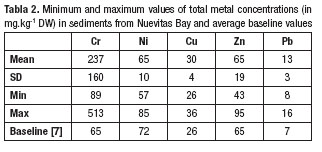
Mean concentrations, standard deviations, range and average baseline values of the studied heavy metals in sediments from Nuevitas bay are presented in Table 2. Mean concentrations in the studied sediments decreased following this order: Cr > Zn = Ni > Cu > Pb. Furthermore, they were all comparable to the baseline values with the exception of Cr and Pb, which mean contents were 3.7 and 1.9 fold higher than their corresponding baseline values, respectively. The concentration of Cr considerably varied while concentrations of the remaining metals were quite homogeneous across the bay.
]]>
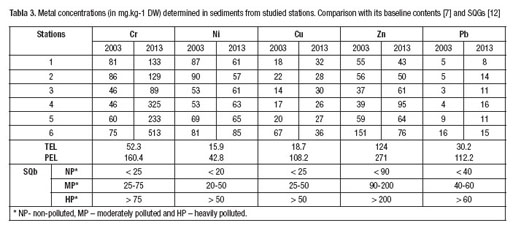
The comparison with SQGs (Table 3) shows those Cr concentrations in sediments from stations 4-6 are potentially toxic, exceeding the Cr-PEL value in 1.45-3.20 folds. The highest Cr content (Table 3) was determined in station 6, located close to Nuevitas city, indicating that important Cr pollution sources must be located in its vicinity. Moreover, other possible Cr pollution sources must be located upstream of the Cascorro and Saramaguacan Rivers, considering the high Cr contents determined in stations 4 and 5, respectively (see Figure 1).
On the other hand, sediments from all studied stations are heavily polluted with Ni and moderately polluted with Cu, independently of the similarity with baseline values. Ni content exceed the Ni-PEL value in 1.3-2.0 fold, which is not surprising given that it is well known the natural high Ni content present in Cuban soils and coastal sediments, especially those located in the eastern part of the country [17-19].
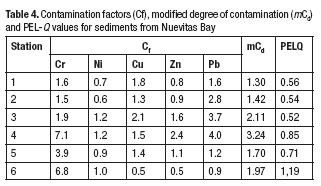
The contamination factors , modified degree of contamination () and probable effect level quotient (PEL-Q) values are shown in Table 4. The estimated values indicate that sediments from stations 3-4 are moderately contaminated with Pb (stations 3-4) and Cr (station 4), while sediments from stations 5 and 6 are lowly contaminated with Cr due to obtained contamination factors. Independently of the results for , the estimated PEL-Q values show a medium low contamination for the sediments collected from all studied stations in Nuevitas Bay, i.e., the 100 % of the sediments are associated with occasional observation of possible adverse effects.
Domestic and industrial sewages are rich in Cr [20], especially those from fertilizer industries and food processing plants, both industries being present in Nuevitas surroundings. Moreover, the study of Cr bioavailability is difficult given its speciation and redox behavior. Chromium exists mainly in two major valency states: as the particle reactive form Cr (III), and as the more soluble hexavalent form Cr (VI). Chromates [Cr (VI)] are more toxic than Cr (III) species, which are relatively non-toxic to organisms and is an essential micronutrient [21]. Due to this fact, in order to evaluate the sediment Cr real impact to Nuevitas fishery plans, a sediment Cr speciation is recommended.
CONCLUSIONS
In conclusion, the sediments collected from Nuevitas Bay have shown higher Cr and Pb contents compared to those collected in the same stations in 2003. In particular, Cr is the predominant element in sediments collected from the western area of the bay, whereas Ni is abundant in all of the studied sediments. The application of index classifies as moderate the contamination of Nuevitas Bay, with chromium and lead as main contributors. The application of SQGs and toxicity mean quotients show that 100 % of the sediments are associated with occasional observation of possible adverse effects, especially for Cr, Ni and Cu (based on the TEL/PEL ratios). Taking into account that, by XRF analysis, only the total metal content is estimated, a sediment Cr speciation is recommended.
]]>
REFERENCES
1. CARUSO A, COSENTINO C, TRANCHINA L, BRAI M. Response of benthic foraminifera to heavy metal contamination in marine sediments (Sicilian coast, Mediterranean Sea). Chemistry and Ecology. 2011; 27(1): 9-30. 2. GUTIERREZ M. Trace element concentration patterns in sediments of the lower Rio Conchos, Mexico. Wat Air Soil Pollut. 2011; 121(1): 259-270. 3. BASILE S, BRAI M, RIZZO S, SPANÒ M, TRANCHINA L. Cyclic influences on the heavy metal chronology in a Central Mediterranean area (Palermo Gulf, Italy). J Soils Sed. 2011; 11(1): 174-184. 4. ENNOURI R, CHOUBA L, MAGNI P, KRAIEM MM. Spatial distribution of trace metals (Cd, Pb, Hg, Cu, Zn, Fe and Mn) and oligo-elements (Mg, Ca, Na and K) in surface sediments of the Gulf of Tunis (Northern Tunisia). Environ Monit Assess. 2010; 163(1-4): 229–239. 5. MOUKHCHAN F, MARCH JG, CERDÁ V. Distribution of trace metals in marine sediments of the Bay of Palma de Mallorca (Mallorca Island, Spain). Environ Monit Assess. 2013; 185(1): 695–706. 6. CUBAN NATIONAL STATISTICAL OFFICE. Cuban Population at Dec. 31, 2012 [on-line]. Available in http://www.one.cu/EstadisticaPoblacion/. [accessed July 29, 2013]. 7. RUIZ F, PEREZ TUR A, GARCIA R. Resultado 18. Bahía de Nuevitas. Informe Final. CiMAB, 2003. 62 p. 8. WinAxil code.Version 4.5.2. WinAxil [software]. CANBERRA: MiTAC, 2005. 9. PADILLA R, MARKOWICZ A, WEGRZYNEK D, et. al. Quality management and method validation in EDXRF analysis. X-Ray Spectrom. 2007; 36(1): 27-34. 10. QUEVAUVILLER PH, MARRIER E. Quality assurance and quality control for environmental monitoring. Weinheim: VCH, 1995. 11. ABRAHIM G, PARKER R. Assessment of heavy metal enrichment factors and the degree of contamination in marine sediments from Tamaki Estuary, Auckland, New Zealand. Environ Monit Assess. 2008; 136(1-3): 227-238. 12. MACDONALD DD, INGERSOLL CG, BERGER TA. Development and evaluation of consensus-based sediment quality guidelines for freshwater ecosystems. Arch Environ Contam Toxicol. 2000; 39(1): 20-31. 13. LONG ER, MACDONALD DD, SMITH SL, CALDER FD. Incidence of adverse biological effects within ranges of chemical concentrations in marine and estuarine sediments. Environ Manag. 1995, 19(1): 81-97. 14. United States Environmental Protection Agency. Office of Science and Technology. National Sediment Quality Survey EPA-823-R-04-007. Second ed. Washington DC, 2004. 15. VIOLINTZIS C, ARDITSOGLOU A, VOUTSA D. Elemental composition of suspended particulate matter and sediments in the coastal environment of Thermaikos Bay, Greece: delineating the impact of inland waters and wastewaters. J Haz Mat. 2009; 166(2-3): 1250-1260. 16. McCREADY S, BIRCH GF, LONG ER. Metallic and organic contaminants in sediments of Sydney Harbour, Australia and vicinity—a chemical dataset for evaluating sediment quality guidelines. Environ Inter. 2006; 32(4): 455-465. 17. DÍAZ RIZO O, COTO HERNÁNDEZ I, ARADO LÓPEZ JO, et. al. Chromium, Cobalt and Nickel content in urban soils from Moa, northeastern Cuba. Bull Environ Contam Toxicol. 2011; 86(2): 189-193. 18. DÍAZ RIZO O, FONTICIELLA MORELL D, ARADO LÓPEZ JO, et. al. Spatial distribution and contamination assessment of heavy metals in urban topsoils from Las Tunas city, Cuba. Bull Environ Contam Toxicol. 2013; 91(1): 29-35. 19. ARENCIBIA G, CAPETILLO A, PÉREZ I, et. al. Metales pesados y Ba en sedimentos superficiales de la Bahía de Nipe, Cuba. Rev Invest Pesq. 2006; 24: 15-19. 20. SHIN PKS, LAM WKC. Development of a Marine Sediment Pollution Index. Environ Pollut. 2001; 113(3): 281-291. 21. GHREFAT HA, ABU-RUKAH Y, ROSEN MA. Application of geoaccumulation index and enrichment factor for assessing metal contamination in the sediments of Kafrain Dam. Jordan. Environ Monit Assess. 2011; 178(1-4): 95–109.
Recibido: 8 de abril de 2014 Aceptado: 8 de mayo de 2014
]]>201127119-30201112111259-27020111111174-18420101631-41-4229-239201318511695-706CUBAN NATIONAL STATISTICAL OFFICE20036220052007361127-34199520081361-31-3227-2382000391120-311995191181-97United States Environmental Protection Agency^dOffice of Science and Technology2004Second ed20091662-32-31250-126020063244455-46520118622189-1932013911129-3520062415-19200111333281-29120111781-41-495-109
 ) classifies as moderate the contamination of Nuevitas Bay. The comparison with Sediment Quality Guidelines (SQGs) and toxicity mean quotients shows that 100 % of the sediments are associated with the occasional presence of possible adverse effects to human health]]>
 ), in contrast with the other elements studied. The application of modified degree of contamination (
 ) classifies as moderate the contamination of Nuevitas Bay. The comparison with Sediment Quality Guidelines (SQGs) and toxicity mean quotients shows that 100 % of the sediments are associated with the occasional presence of possible adverse effects to human health.
 , with 49 m of maximal depth), several industries are located in Nuevitas, including some considered as potential pollution sources, such as power plants, cement, food and fertilizers. Most of the generated wastes (domestic and industrial) are frequently discharged directly into the sea coast, or indirectly through some rivers with waters flowing into the bay. For this reason, the Engineering Center for Environmental Management of Bays and Coasts (CIMAB) carried out systematic studies on the heavy metal pollution levels in Nuevitas Bay. The last CIMAB study was performed in 2003, considering Nuevitas Bay as unpolluted [7]. Taking into account the reactivation of the previously mentioned industries in the last decade, and the current plan to develop a marine cultivation area of marine species of high relevance in the Fishery Industry, a new study is necessary, in order to assess the current sediment environmental quality in terms of metal contamination and possible risk to the area's biota and consequently, to human health.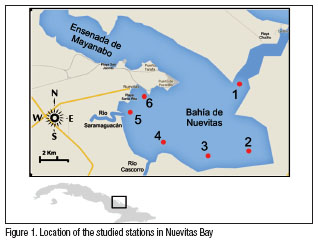
 (1.1 GBq) excitation source with ring geometry was used. All spectra were processed with WinAxil code [8]. Detection Limits were determined according to Padilla et al. [9] (in concentration units) as
  = 3
= 3  /mt, where m is the sensibility in
  per concentration unit,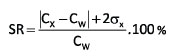
 – experimental value,
  – certified value and
  is the standard deviation of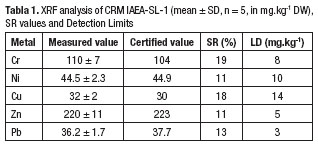


 are the metal content in studied sample and baseline, respectively. The classification of the sediments according to the modified degree of contamination (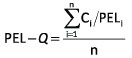
 is the concentration of element i in sediments,
  the guideline value for the element i and n the number of metals. These mean quotients can be used in case of existence of multiple contaminants in the sediment where the adverse effects caused by each chemical are additive and not antagonistic [15]. The classification of sediments according to PEL-Q is as follows: PEL-Q values of <0.1, 0.11–1.5, 1.51–2 .3 and > 2.3 coincide with 10, 25, 50 and 76 %, of toxicity, respectively [16]. Consequently, four relative levels of contamination have been created (high, medium high, medium low and low).