<?xml version="1.0" encoding="ISO-8859-1"?><article xmlns:mml="http://www.w3.org/1998/Math/MathML" xmlns:xlink="http://www.w3.org/1999/xlink" xmlns:xsi="http://www.w3.org/2001/XMLSchema-instance">
<front>
<journal-meta>
<journal-id>0864-084X</journal-id>
<journal-title><![CDATA[Nucleus]]></journal-title>
<abbrev-journal-title><![CDATA[Nucleus]]></abbrev-journal-title>
<issn>0864-084X</issn>
<publisher>
<publisher-name><![CDATA[CUBAENERGIA]]></publisher-name>
</publisher>
</journal-meta>
<article-meta>
<article-id>S0864-084X2016000200004</article-id>
<title-group>
<article-title xml:lang="en"><![CDATA[The mile-stone of PET radiopharmaceuticals development]]></article-title>
<article-title xml:lang="es"><![CDATA[Hitos en el desarrollo de los radiofármacos PET]]></article-title>
</title-group>
<contrib-group>
<contrib contrib-type="author">
<name>
<surname><![CDATA[Ido]]></surname>
<given-names><![CDATA[Tatsuo]]></given-names>
</name>
</contrib>
<contrib contrib-type="author">
<name>
<surname><![CDATA[Valdés]]></surname>
<given-names><![CDATA[Tania]]></given-names>
</name>
</contrib>
</contrib-group>
<aff id="A01">
<institution><![CDATA[,Theragnostic Compound R & D Center Neuroscience Research Institute Gachon University]]></institution>
<addr-line><![CDATA[Sendai ]]></addr-line>
<country>Japan</country>
</aff>
<aff id="A02">
<institution><![CDATA[,Centro de Aplicaciones Tecnológicas y Desarrollo Nuclear, (Ceaden)  ]]></institution>
<addr-line><![CDATA[ ]]></addr-line>
<country>Cuba</country>
</aff>
<pub-date pub-type="pub">
<day>00</day>
<month>12</month>
<year>2016</year>
</pub-date>
<pub-date pub-type="epub">
<day>00</day>
<month>12</month>
<year>2016</year>
</pub-date>
<numero>60</numero>
<fpage>13</fpage>
<lpage>17</lpage>
<copyright-statement/>
<copyright-year/>
<self-uri xlink:href="http://scielo.sld.cu/scielo.php?script=sci_arttext&amp;pid=S0864-084X2016000200004&amp;lng=en&amp;nrm=iso"></self-uri><self-uri xlink:href="http://scielo.sld.cu/scielo.php?script=sci_abstract&amp;pid=S0864-084X2016000200004&amp;lng=en&amp;nrm=iso"></self-uri><self-uri xlink:href="http://scielo.sld.cu/scielo.php?script=sci_pdf&amp;pid=S0864-084X2016000200004&amp;lng=en&amp;nrm=iso"></self-uri><abstract abstract-type="short" xml:lang="en"><p><![CDATA[The positron emitting nuclides were already tried in 1940's as in vivo radio-tracers in the research field of medical biology. In 1976, the discovery of 18FDG with the developing of a positron imaging device, allowed to obtain the image of the human brain by PET technology. Today, 18FDG is widely used in tumour diagnosis by a metabolic trapping mechanism, which is a new concept for functional imaging and makes possible the monitoring of the therapy process. This is first milestone of PET radiopharmaceutical development. The second milestone is the establishment of a molecular imaging method in nuclear medicine and third, is the development of the theragnostic concept of radiopharmaceuticals. At present highlight works are focused in tau protein imaging for Alzheimer disease diagnosis and inflammation imaging]]></p></abstract>
<abstract abstract-type="short" xml:lang="es"><p><![CDATA[Los núclidos emisores de positrones fueron tratados en 1940 como radiotrazadores in vivo en el campo de las investigaciones biomédicas. En 1976, el descubrimiento de 18FDG, con el desarrollo de un equipo de imagenología positrónica, facilitó la obtención de imágenes del cerebro humano mediante la aplicación de la tecnología PET. En la actualidad, el 18FDG tiene amplia utilización en el diagnóstico de tumores mediante el mecanismo de captura metabólica. Este mecanismo es un concepto nuevo para la obtención de imágenes funcionales lo que permite realizar el monitoreo de los procesos terapéuticos. Este es el primer hito del desarrollo de radiofármacos PET. El segundo hito lo constituye el establecimiento del método de imagen molecular en la medicina nuclear. El tercer hito es el desarrollo del concepto teragnóstico de los radiofármacos. En el momento actual los trabajos principales están enfocados a la imagen de proteínas tau para el diagnóstico de la enfermedad de Alzheimer y las imágenes de inflamaciones]]></p></abstract>
<kwd-group>
<kwd lng="en"><![CDATA[positron computed tomography]]></kwd>
<kwd lng="en"><![CDATA[radiopharmaceuticals]]></kwd>
<kwd lng="en"><![CDATA[radiotherapy]]></kwd>
<kwd lng="en"><![CDATA[single photon emission computed tomography]]></kwd>
<kwd lng="en"><![CDATA[biological functions]]></kwd>
<kwd lng="en"><![CDATA[molecules, images]]></kwd>
<kwd lng="es"><![CDATA[tomografía computarizada con positrón]]></kwd>
<kwd lng="es"><![CDATA[radiofármacos]]></kwd>
<kwd lng="es"><![CDATA[radioterapia]]></kwd>
<kwd lng="es"><![CDATA[tomografía de emisión computarizada de fotón único]]></kwd>
<kwd lng="es"><![CDATA[funciones biológicas]]></kwd>
<kwd lng="es"><![CDATA[moléculas, imágenes]]></kwd>
</kwd-group>
</article-meta>
</front><body><![CDATA[ <p align="right"><font face="Verdana, Arial, Helvetica, sans-serif" size="2"><b>CIENCIAS NUCLEARES</b></font></p>     <p align="left">&nbsp;</p>     <p><font face="Verdana, Arial, Helvetica, sans-serif"><font size="4"><strong>The  mile-stone of PET radiopharmaceuticals development</strong> </font></font><font size="4"></font></p>     <p><font face="Verdana, Arial, Helvetica, sans-serif"><strong><font size="3">Hitos en el desarrollo de los radiof&aacute;rmacos PET </font></strong>     </font></p>      <p>&nbsp;</p>      <p>&nbsp;</p>      <p><font face="Verdana, Arial, Helvetica, sans-serif" size="2"><strong>Tatsuo Ido<sup>1</sup>, </strong></font> <strong><font size="2" face="Verdana, Arial, Helvetica, sans-serif">Tania Vald&eacute;s</font></strong><font size="2" face="Verdana, Arial, Helvetica, sans-serif"><strong><sup>2</sup></strong></font></p>        <p><font size="2" face="Verdana, Arial, Helvetica, sans-serif"><sup>1 </sup>Theragnostic Compound R&amp;D Center, Neuroscience Research Institute, Gachon University, Incheon, South Korea Tohoku University, Sendai, Japan</font></p>      <p><font size="2" face="Verdana, Arial, Helvetica, sans-serif"><sup>2 </sup>Centro de Aplicaciones Tecnol&oacute;gicas y Desarrollo Nuclear, (Ceaden), Cuba    <br>   <em>    ]]></body>
<body><![CDATA[<br>   </em><a href="mailto:desdin@ceaden.edu.cu">tidojapan@yahoo.com</a></font></p>  <hr>     <p><font face="Verdana, Arial, Helvetica, sans-serif" size="2"><b>ABSTRACT</b></font></p>     <p><font size="2" face="Verdana, Arial, Helvetica, sans-serif">The positron emitting nuclides  were already tried in 1940's as <em>in vivo</em> radio-tracers in the research  field of medical biology. In 1976, the discovery of 18FDG with the developing  of a positron imaging device, allowed to obtain the image of&nbsp; the human brain by PET technology. Today,  18FDG is widely used in tumour diagnosis by a metabolic trapping mechanism,  which is a new concept for functional imaging and makes possible the monitoring  of the therapy process. This is first milestone of PET&nbsp; &nbsp;radiopharmaceutical development. The second milestone&nbsp;is  the establishment of a molecular imaging method in nuclear medicine and third,  is the development of the theragnostic concept of radiopharmaceuticals. At  present highlight works are focused in tau protein imaging for Alzheimer  disease diagnosis and inflammation imaging.</font></p>     <p><font size="2" face="Verdana, Arial, Helvetica, sans-serif"><strong>Key words: </strong>positron computed tomography, radiopharmaceuticals, radiotherapy, single photon emission computed tomography, biological functions, molecules, images. </font></p> <hr>     <p><font size="2" face="Verdana, Arial, Helvetica, sans-serif"><b>RESUMEN</b></font></p>     <p><font size="2" face="Verdana, Arial, Helvetica, sans-serif">Los n&uacute;clidos emisores de positrones fueron tratados en 1940 como radiotrazadores in vivo en el campo de las investigaciones biom&eacute;dicas. En 1976, el descubrimiento de 18FDG, con el desarrollo de un equipo de imagenolog&iacute;a positr&oacute;nica, facilit&oacute; la obtenci&oacute;n de im&aacute;genes del cerebro humano mediante la aplicaci&oacute;n de la tecnolog&iacute;a PET. En la actualidad, el 18FDG tiene amplia utilizaci&oacute;n en el diagn&oacute;stico de tumores mediante el mecanismo de captura metab&oacute;lica. Este mecanismo es un concepto nuevo para la obtenci&oacute;n de im&aacute;genes funcionales lo que permite realizar el monitoreo de los procesos terap&eacute;uticos. Este es el primer hito del desarrollo de radiof&aacute;rmacos PET. El segundo hito lo constituye el establecimiento del m&eacute;todo de imagen molecular en la medicina nuclear. El tercer hito es el desarrollo del concepto teragn&oacute;stico de los radiof&aacute;rmacos. En el momento actual los trabajos principales est&aacute;n enfocados a la imagen de prote&iacute;nas tau para el diagn&oacute;stico de la enfermedad de Alzheimer y las im&aacute;genes de inflamaciones. </font></p>     <p><font size="2" face="Verdana, Arial, Helvetica, sans-serif"><strong>Palabras  claves: </strong>tomograf&iacute;a computarizada con positr&oacute;n, radiof&aacute;rmacos, radioterapia, tomograf&iacute;a de emisi&oacute;n computarizada de fot&oacute;n &uacute;nico, funciones biol&oacute;gicas, mol&eacute;culas, im&aacute;genes</font>.</p> <hr>     <p>&nbsp;</p>     <p>&nbsp;</p>     <p><font size="3" face="Verdana, Arial, Helvetica, sans-serif"><strong>INTRODUCTION</strong></font></p>     ]]></body>
<body><![CDATA[<p><font size="2" face="Verdana, Arial, Helvetica, sans-serif">The radioactive nuclides used for radiopharmaceuticals are detected with very high sensitivity and are suitable as in-vivo biomarkers tracers. These properties make them useful for in-vitro radioimmunoassay and in-vivo imaging in Nuclear Medicine. </font></p>     <p><font size="2" face="Verdana, Arial, Helvetica, sans-serif">In the 40's, several radionuclides were tried for animal and human behavior research. In the 1950's, the nuclides <img src="/img/revistas/nuc/n60/img/e01046016.jpg" width="23" height="18">, <img src="/img/revistas/nuc/n60/img/e02046016.jpg" width="25" height="18"> and <img src="/img/revistas/nuc/n60/img/e03046016.jpg" width="31" height="16"> were used for diagnosis and treatment of diseases in nuclear medicine. In the 1960's -1970's, <img src="/img/revistas/nuc/n60/img/e04046016.jpg" width="38" height="17"> (daughter of <img src="/img/revistas/nuc/n60/img/e05046016.jpg" width="35" height="17">) with the gamma camera was introduced as a practical method for nuclear medicine and was applied in various chemical forms to visualize organ degeneration in the body.  The development of the single photon emission computed tomography (SPECT) in the 1980's led to the wide use of <img src="/img/revistas/nuc/n60/img/e04046016.jpg" width="38" height="17">- radiopharmaceuticals. At present, the most commonly used single photon emitting nuclides are <img src="/img/revistas/nuc/n60/img/e04046016.jpg" width="38" height="17">, <img src="/img/revistas/nuc/n60/img/e06046016.jpg" width="22" height="18">, <img src="/img/revistas/nuc/n60/img/e01046016.jpg" width="23" height="18">, <img src="/img/revistas/nuc/n60/img/e07046016.jpg" width="31" height="16">, <img src="/img/revistas/nuc/n60/img/e08046016.jpg" width="34" height="15">, <img src="/img/revistas/nuc/n60/img/e09046016.jpg" width="32" height="18"> and <img src="/img/revistas/nuc/n60/img/e10046016.jpg" width="35" height="17">.</font></p>     
<p><font size="2" face="Verdana, Arial, Helvetica, sans-serif">Positron emitting short half-life nuclides (<img src="/img/revistas/nuc/n60/img/e11046016.jpg" width="23" height="17">, <img src="/img/revistas/nuc/n60/img/e12046016.jpg" width="24" height="17">, <img src="/img/revistas/nuc/n60/img/e13046016.jpg" width="24" height="17"> and <img src="/img/revistas/nuc/n60/img/e14046016.jpg" width="22" height="16">) were introduced in nuclear medicine in the late 1960's and used to study functional imaging with labeled biological organic compounds. Positron emission computed tomography (PET), developed in the late  1970's-1980's allowed to obtain better quantitative images than SPECT. In August 1976, the firsthuman brain functional image had been successfully obtained with <img src="/img/revistas/nuc/n60/img/e14046016.jpg" width="22" height="16">-FDG (2-deoxy-2-fluoo -D-glucose) in a collaboration among of BNL, NIH and Pen-Univ. This was a big epic in nuclear medicine and the society of nuclear medicine in USA has just celebrated 40 anniversary of FDG at the 2016 annual conference in San Diego.</font></p>     
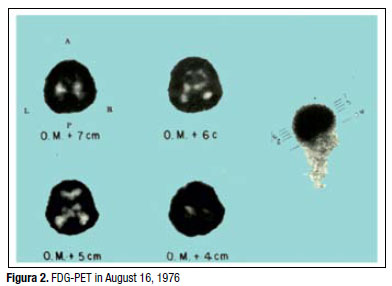
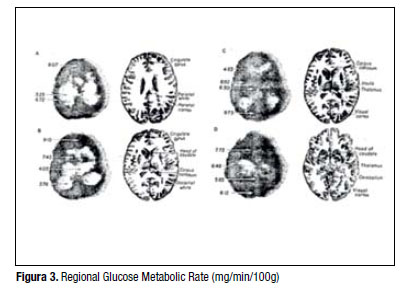
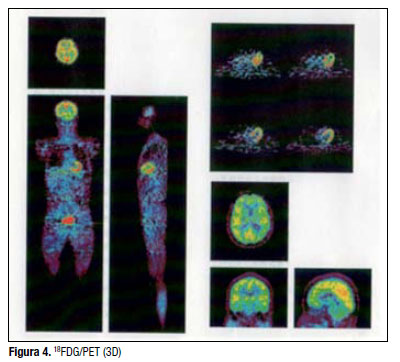
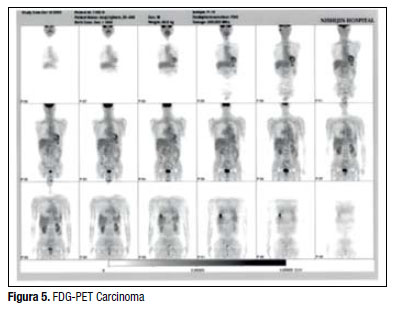
<p><font size="2" face="Verdana, Arial, Helvetica, sans-serif"><strong>FDG discover: First milestone </strong></font></p>     <p><font size="2" face="Verdana, Arial, Helvetica, sans-serif">FDG is the molecule of glucose analogue to which fluorine is introduced at 2 position and is synthesized by the <img src="/img/revistas/nuc/n60/img/e15046016.jpg" width="30" height="21"> insertion reaction to triacetyl glucal and the later hydrolysis. <img src="/img/revistas/nuc/n60/img/e15046016.jpg" width="30" height="21"> is produced by <img src="/img/revistas/nuc/n60/img/e16046016.jpg" width="32" height="17"> (d,<img src="/img/revistas/nuc/n60/img/e18046016.jpg" width="13" height="14">)<img src="/img/revistas/nuc/n60/img/e14046016.jpg" width="22" height="16"> on Ne-<img src="/img/revistas/nuc/n60/img/e17046016.jpg" width="18" height="20"> gas mixture target ( 0,1% <img src="/img/revistas/nuc/n60/img/e17046016.jpg" width="18" height="20"> in Ne) [1,2]. The bio-behaviour of FDG showed it as good substitute for glucose transporters and hexokinase activity to convert FDG-6-phosphate, but it is a very poor substitute for further metabolic pathways (metabolic trapping) and cannot be reuptaked by active transport at kidney. These parameters are simplified for the calculation of the regional cerebral glucose metabolic rate by the three compartment mathematic model (radioactivity of FDG in blood, radioactivity of FDG and radioactivity of FDG-6 phosphate in brain). In <a href="#f01046016">Figure 1</a> <a href="#f02046016">to</a> <a href="#f03046016">Figure 3</a> the first trial images of human regional glucose metabolic rate [3] are shown.  This result is a great successful example of collaboration between different institutes and different research fields (Brookhaven National Laboratory- chemistry, National Institute of Mental Health- neuro-physiology, Pennsylvania University- nuclear medicine). This methodology was applied to brain functional analysis. The motor cortex, the sensory cortex and the frontal cortex showed relatively high uptake. The tumour tissue also showed high uptake of FDG in contrast to normal tissue because of its active glucose consumptions. This is different from the inflamations due to a quick accumulation pattern in case of  infammation (activated macrophage also uptake FDG). At present, FDG is mostly used for the imaging diagnosis of various tumours (lung, coronal, blood, bone, etc.) and to validate the effectiveness of a treatment (<a href="#f04046016">Figures 4</a>, <a href="#f05046016">5</a>).</font></p>     
<p align="center"><img src="/img/revistas/nuc/n60/img/f01046016.jpg" width="579" height="359"><a name="f01046016"></a></p>     
<p align="center"><img src="/img/revistas/nuc/n60/img/f02046016.jpg" width="392" height="286"><a name="f02046016"></a></p>     
<p align="center"><img src="/img/revistas/nuc/n60/img/f03046016.jpg" width="407" height="292"><a name="f03046016"></a></p>     
<p align="center"><img src="/img/revistas/nuc/n60/img/f04046016.jpg" width="400" height="362"><a name="f04046016"></a></p>     
<p align="center"><img src="/img/revistas/nuc/n60/img/f05046016.jpg" width="398" height="309"><a name="f05046016"></a></p>     
]]></body>
<body><![CDATA[<p><font size="2" face="Verdana, Arial, Helvetica, sans-serif">The synthesis of <img src="/img/revistas/nuc/n60/img/e14046016.jpg" width="22" height="16">-FDG has been improved during 40 years. The nuclear reaction <img src="/img/revistas/nuc/n60/img/e19046016.jpg" width="24" height="17">(p,n)<img src="/img/revistas/nuc/n60/img/e14046016.jpg" width="22" height="16"> is the most widely used for <img src="/img/revistas/nuc/n60/img/e14046016.jpg" width="22" height="16"> production because of the high yield at low energy proton (10-12 MeV) in a compact cyclotron and the easy supply of commercial  enriched target (<img src="/img/revistas/nuc/n60/img/e20046016.jpg" width="38" height="19">). The synthesis pathway also changed to the nucleophilic substitution by <img src="/img/revistas/nuc/n60/img/e14046016.jpg" width="22" height="16">- with kryptofixon 2-tosyl-mannopyranose with high yield and no carrier added state. The chemical synthesis modules are also commercially available, which allow fully computer control and remote operation, suitable for GMP production. These factors make possible the commercial supply of <img src="/img/revistas/nuc/n60/img/e14046016.jpg" width="22" height="16">-FDG.</font></p>     
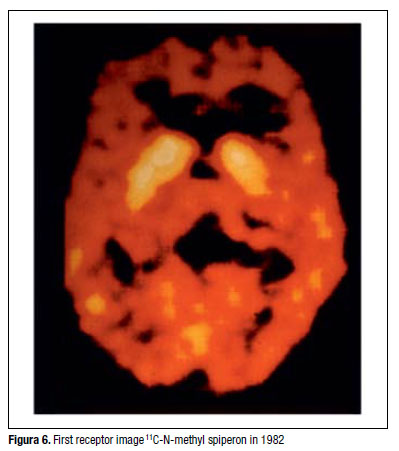
<p><font size="2" face="Verdana, Arial, Helvetica, sans-serif">The metabolic trapping method of PET functional imaging has been applied to amino acids and fatty acids as well. The <img src="/img/revistas/nuc/n60/img/e14046016.jpg" width="22" height="16">-2-fluoo-4-boron-L-phenylalanine has been developed as a tracer for amino acid transporter to be used on BNCT (Boron Neutron Capture Therapy) for cancer therapy [4, 5]. The <img src="/img/revistas/nuc/n60/img/e14046016.jpg" width="22" height="16">-betamethyl fatty acids (against beta oxidation of fatty acids) has been used for tumour imaging and imaging analysis of myocardial diseases [6, 7]. In 1982, the first neuroreceptor imaging of human brain with <img src="/img/revistas/nuc/n60/img/e21046016.jpg" width="24" height="17">-Methyl spiperon succeeded in the collaborative work between Johns Hopkins Medical School and Uppsala University (<a href="#f06046016">Figure 6</a>). This was the beginning of molecular imaging.</font></p>     
<p align="center"><img src="/img/revistas/nuc/n60/img/f06046016.jpg" width="399" height="451"><a name="f06046016"></a></p>     
<p><font size="2" face="Verdana, Arial, Helvetica, sans-serif"><strong>Molecular imaging: Second milestone </strong></font></p>     <p><font size="2" face="Verdana, Arial, Helvetica, sans-serif">The successful result stimulated the research of receptor and transporter imaging and a tremendous number of radiopharmaceuticals (more than 100) were synthesized for imaging analysis of receptor density and affinity(dopamine [8], serotonin, acetylcholine, benzodiazepine [9], histamine [10,11], etc.), and not only neu-roreceptors, but also hormone receptors.</font></p>     <p><font size="2" face="Verdana, Arial, Helvetica, sans-serif">The results led to a new concept within the imaging analysis research, the molecular imaging, which is based on the analysis of molecular /molecular interactions by an imaging technique, and made a great contribution to bio-organic chemistry and drug discovery research fields.</font></p>     <p><font size="2" face="Verdana, Arial, Helvetica, sans-serif">The synthesis of labelled compounds by <img src="/img/revistas/nuc/n60/img/e21046016.jpg" width="24" height="17">-alkyla-tion or <img src="/img/revistas/nuc/n60/img/e14046016.jpg" width="22" height="16">-fluooalkylation requires very high specific radioactivity because of the limitation of receptor density. <img src="/img/revistas/nuc/n60/img/e21046016.jpg" width="24" height="17"> labelling is undergoing 10 000 times lower than theoretical specific activity by the influenceof <img src="/img/revistas/nuc/n60/img/e22046016.jpg" width="23" height="17"> contaminations while <img src="/img/revistas/nuc/n60/img/e14046016.jpg" width="22" height="16"> labelling is 100-1 000 times lower. A champion data on specificactivity of <img src="/img/revistas/nuc/n60/img/e03036016.jpg" width="23" height="17">-compounds has been reported by NIRS group (Chiba, Japan), only  1 000 times lower than theoretical, which made possible to get receptor PET image of <img src="/img/revistas/nuc/n60/img/e23046016.jpg" width="23" height="18"> n/<img src="/img/revistas/nuc/n60/img/e24046016.jpg" width="25" height="13"> density.</font></p>     
<p><font size="2" face="Verdana, Arial, Helvetica, sans-serif">The success of FDG and molecular imaging by PET stimulated also <img src="/img/revistas/nuc/n60/img/e04046016.jpg" width="38" height="17"> chemistry and led to the development of  bi-functional chelate agents which have affinity to biomarker and chelate binding to metal ion such as <img src="/img/revistas/nuc/n60/img/e04046016.jpg" width="38" height="17">, <img src="/img/revistas/nuc/n60/img/e09046016.jpg" width="32" height="18">. This new technique is applied to the labelling of monoclonal antibody for tumour imaging. In a feedback to PET, <img src="/img/revistas/nuc/n60/img/e25046016.jpg" width="34" height="17"> (daughter of <img src="/img/revistas/nuc/n60/img/e26046016.jpg" width="35" height="19">) has been used in combination to <img src="/img/revistas/nuc/n60/img/e08046016.jpg" width="34" height="15"> for tumour detection and internal radiation therapy purposes. This new concept defineda new word as &ldquo;theragnostic or theranostic&rdquo; in oncology.</font></p>     
<p><font size="2" face="Verdana, Arial, Helvetica, sans-serif"><strong>Theragnostic radiopharmaceuticals:  Third milestone</strong></font></p>     <p><font size="2" face="Verdana, Arial, Helvetica, sans-serif">The <img src="/img/revistas/nuc/n60/img/e25046016.jpg" width="34" height="17"> is a positron emitting nuclide (68 min half life) which is generated from <img src="/img/revistas/nuc/n60/img/e26046016.jpg" width="35" height="19"> (half life 270 days) by a <img src="/img/revistas/nuc/n60/img/e27046016.jpg" width="35" height="20"> column generator system (commercially available). It allows obtaining PET imaging without cyclotron. Anti-tumour monoclonal antibody or shortened peptide linked DOTA was used as a bi-functional labelling agent. The combination with <img src="/img/revistas/nuc/n60/img/e08046016.jpg" width="34" height="15"> (3,3 day half life, EC) make possible both purposes, the PET diagnosis and radiation therapy of tumour, so called theragnostic radiopharmaceuticals. In some trials <img src="/img/revistas/nuc/n60/img/e25046016.jpg" width="34" height="17"> compound only has been used for both purposes, but included technical difficuties because of its short half life. In this case, <img src="/img/revistas/nuc/n60/img/e28046016.jpg" width="29" height="18"> ( 78,4 hr half life, &beta;+.EC) which is produced by <img src="/img/revistas/nuc/n60/img/e29046016.jpg" width="23" height="16">(p,n)<img src="/img/revistas/nuc/n60/img/e28046016.jpg" width="29" height="18">r  with 15 MeV proton [12-14] is more suitable. Other candidate for theragnostic nuclides are <img src="/img/revistas/nuc/n60/img/e30046016.jpg" width="22" height="16">  (16 day half life, &beta;+.EC), <img src="/img/revistas/nuc/n60/img/e31046016.jpg" width="32" height="16"> (12,7 hr half life, &beta;+.EC), <img src="/img/revistas/nuc/n60/img/e32046016.jpg" width="29" height="17"> (57 hr half life, &beta;+.EC), and <img src="/img/revistas/nuc/n60/img/e33046016.jpg" width="22" height="15"> (79,8 hr half life, &beta;+.EC), Radiopharmaceuticals for internal radiation therapy now focus on short half life alpha emitting nuclides such as <img src="/img/revistas/nuc/n60/img/e34046016.jpg" width="33" height="15"> (7,2 hr half life, &alpha;.EC), <img src="/img/revistas/nuc/n60/img/e35046016.jpg" width="38" height="15"> (11,4 day half life,<img src="/img/revistas/nuc/n60/img/e18046016.jpg" width="13" height="14">).</font></p>     
]]></body>
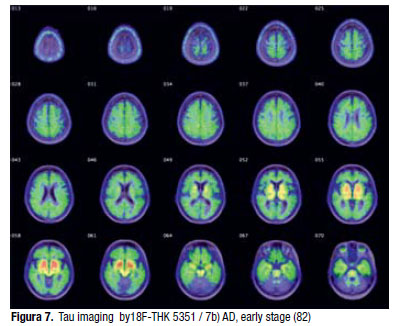
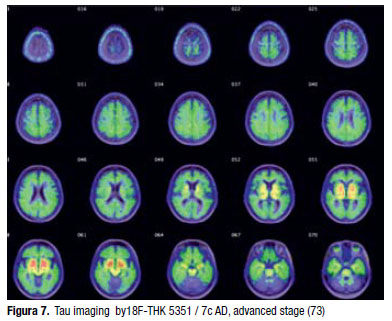
<body><![CDATA[<p><font size="2" face="Verdana, Arial, Helvetica, sans-serif"><strong>Highlight of PET radiopharmaceuticals </strong></font></p>     <p><font size="2" face="Verdana, Arial, Helvetica, sans-serif">Recent highlight works in PET research are the imaging of amyloidal plaque and active tau protein for Alzheimer's disease (AD). <img src="/img/revistas/nuc/n60/img/e11046016.jpg" width="23" height="17">- or <img src="/img/revistas/nuc/n60/img/e14046016.jpg" width="22" height="16">- labelled thiofavin analogues have been developed as amyloidal plaque marker. High uptake is always observed in AD cases, but sometimes high uptake is also present in the cortex of aged normal subjects. This mismatch makes difficult the confirmatory diagnosis and the evaluation of compounds for the AD treatment or prevention. Active tau protein image by <img src="/img/revistas/nuc/n60/img/e14046016.jpg" width="22" height="16">-THK compounds (quinoline derivative) is a good match to clinical syndrome and to FDG diagnosis in AD [15-17]. The image of active tau is closer related to cell death than amyloidal plaque image (See <a href="#f7a046016">Figures 7a</a>, <a href="#f7b046016">7b</a>, <a href="#f7c046016">7c</a>); numbers in parenthesis are the age of patients. The prevention treatment requires more early stage images of brain degeneration.  </font></p>     
<p align="center"><img src="/img/revistas/nuc/n60/img/f7a046016.jpg" width="397" height="332"><a name="f7a046016"></a></p>     
<p align="center"><img src="/img/revistas/nuc/n60/img/f7b046016.jpg" width="399" height="326"><a name="f7b046016"></a></p>     
<p align="center"><img src="/img/revistas/nuc/n60/img/f7c046016.jpg" width="392" height="321"><a name="f7c046016"></a></p>     
<p>&nbsp;</p>     <p><font size="2" face="Verdana, Arial, Helvetica, sans-serif">Another highlight work is the imaging of inflammation. In many cases inflammation is followed by the denature of tissue functions and finally cell death. FDG is a good inflammation biomarker in various organs because of the hyper glucose metabolism that occurs in inflammation. Neuroinflammation images may be important to find tissue denature at early stages in Parkinson Disease (PD), AD and other neurodegenerative diseases. For this purpose, TSPO (translocator protein) ligand will be developed by <img src="/img/revistas/nuc/n60/img/e11046016.jpg" width="23" height="17"> or <img src="/img/revistas/nuc/n60/img/e14046016.jpg" width="22" height="16"> labelling as phenoxyphenyl acetamide and oxopurine derivatives. These works will link direct to preventive therapy of dementia and will lead to a new stage of theragnostic methodology in the near future. </font></p>     
<p>&nbsp;</p>     <p><font size="2" face="Verdana, Arial, Helvetica, sans-serif"><strong>Acknowledgments</strong></font></p>     <p><font size="2" face="Verdana, Arial, Helvetica, sans-serif">Authors appreciate to Ms. Luisa Aniuska Betancourt Hern&aacute;ndez (former president of Nuclear Agency) for giving us the opportunity to make this review in the special anniversary edition of &ldquo;Nucleus&rdquo; and give many thanks to our research colleagues.</font></p>     ]]></body>
<body><![CDATA[<p>&nbsp;</p>     <p>&nbsp;</p>     <p><font size="3"><strong><font face="Verdana, Arial, Helvetica, sans-serif">REFERENCES</font></strong></font></p>     <!-- ref --><p><font size="2" face="Verdana, Arial, Helvetica, sans-serif">[1] IDO T, WON CN,  FOWLER JS, WOLF AP. Fluorination with F2. A Convenient Synthesis of  2-Deoxy-2-fluoo-D-glucose. J. Org. Chem. 1977; 42 (13): 2341-2342.    <!-- ref --><br> [2] IDO T, WON CN, CASELLA V, et. al. Labeled 2-deoxy-D-glucose analog. 18F-labeled  2-deoxy-2-fuluoro-D-glucose, 2-deoxy-2-fluoo-D-mannose and  14C-2-deoxy-2-fuluoro-D-glucose. J of Labelled Comp. and Radiopharm. 1978;  16(2): 175-183.    <br> [3] REIVICH M, KUHL D,  WOLF A, GREENBERG J, PHELPS M, IDO T, et. al. The [18F]Fluorodeoxyglucose  method for the measurement of local cerebral glucose utilization in man.  Circulation Research. 1979; 44(1): 127-137.    <!-- ref --><br> [4] ISHIWATA K, IDO T,  KAWAMURA M, et. al. 4-Boron-2-[18F]Fluoro-D,L-phenylalanine as a target  compound for boron neutron capture therapy: tumour imaging potential with  positron emission tomography. Nucl. Med. Biol. 1991; 18(7): 745-751.    <!-- ref --><br> [5] IMAHORI Y, UEDA S,  OHMORI Y, KUSAKI T, ONO K, FUJII R, IDO T. Fruorine-18-labeled  fluooboronophenylalanine PET in patients with glioma. J. Nucl. Med. 1998;  39(2): 325-333.    <br> [6] TAKAHASHI T, IDO  T, IWATA R. Synthesis of 17-[18F]fluoo-5-methylpentadecanoic Acid. Appl.  Radiat. Isot. 1992; 43(6): 822-824.    <br> [7] TAKAHASHI T,  NISHIMURA S, IDO T, ISHIWATA K, IWATA R. Biological evaluation of  5-Methyl-branched-chain &omega;-[18F]Fluorofatty  acid: a potencial myocardial imaging tracer for positron emission tomography.  Nucl. Med. Biol. 1996; 23(3): 303-308.    ]]></body>
<body><![CDATA[<!-- ref --><br> [8] HATANO K, ISHIWATA  K, KAWASHIMA K, HATAZAWA J, ITOH M, IDO T. D2-Dopamine receptor specificbrain  uptake of carbon-11-labeled YM-09151-2. J. NUC. Med. 1989; 30(4): 515-522.    <br> [9] ISHIWATA K, YANAI  K, IDO T, MIURA Y, KAWASHMA K. Synthesis and biodistribution of [11C]  fludiazepam for imaging benzodiazepine receptors. Nucl. Med. Biol. 1988; 15(4):  365-371.    <br> [10] YANAI K, WATANABE  T, YOKOYAMA H, MEGRO K, HATAZAWA J, ITOH M, et.al. Histamine H1 receptors in  human brain visualized in vivo by [11C]doxepin and emission tomography.  Neuroscience Letters. 1992; 137(2): 145-148.    <!-- ref --><br> [11] YANAI K, RYU JH,  WATANABE T, IWATA R, IDO T, SAWAI Y, et. al. Histamine H1 receptor occupancy in  human brain after single doses of histamine H1 antagonist measured by positron  emission tomography. British J Pharmacology. 1995; 116(1): 1649-1655.    <!-- ref --><br> [12] HOLLAND JP, SHEH  Y, LEWIS JS. Standardized methods for the production of high  specific-activity zirconium-89. Nucl. Med. Biol. 2009; 36(7): 729-739.    <!-- ref --><br> [13] HOLLAND JP,  DIVILOV V, BANDER NH, SMIS-JONES PM, LAR-SO N SM, LEVIS JS. 89Zr-DFO-J591 for  immunoPET of prostate-specific membrane antigen expression in vivo. J. Nucl.  Med. 2010; 51(8): 1293-1300.    <!-- ref --><br> [14] van de WATERRING  FCJ, RIJPKEMA M, PERK L, BRINKMANN U, OYEN WJG, BOERMAN OC. Zirconium-89  labeled antibodies: a new tool for molecular imaging in cancer patients  (review). BioMed Res Int. 2014; Article ID 203601 http://www.hindawi.com/journals/bmri/2014/203601.    <br> [15] XIA CF, ARTEAGA J, CHEN G, GANGADHARMATH U, GOMEZ LF, et. al. [18F]T807, a novel tau positron  emission tomography imaging agent for Alzheimer's disease. Alzheimer&rsquo;s and  Dementia. 2013; 9(6): 666-676.    <!-- ref --><br> [16] VILLEMAGNE VL,  OKAMURA N. In vivo tau imaging: obstacle and progress. Alzheimer's and  Dementia. 2014; 10(3): 254-264.    <br> [17] HARADA R, OKAMURA N, FURUMOTO S, FURUKAWA K, ISHIKI A, TOMITA N,  et. al. [18F]THK-5117 PET for  assessing neurofibrillary pathology in Alzheimer's disease. Eur. J.  Nucl. Med. Mol. Imaging. 2015; 42(7): 1052-1061.</font></p>     ]]></body>
<body><![CDATA[<p><font size="2" face="Verdana, Arial, Helvetica, sans-serif"><strong>Recibido:</strong> 2 de julio de 2016    <br> <strong>Aceptado:</strong> 28 de julio de 2016</font></p>     <p>&nbsp;</p>      ]]></body><back>
<ref-list>
<ref id="B1">
<label>1</label><nlm-citation citation-type="journal">
<person-group person-group-type="author">
<name>
<surname><![CDATA[IDO]]></surname>
<given-names><![CDATA[T]]></given-names>
</name>
<name>
<surname><![CDATA[WON]]></surname>
<given-names><![CDATA[CN]]></given-names>
</name>
<name>
<surname><![CDATA[FOWLER]]></surname>
<given-names><![CDATA[JS]]></given-names>
</name>
<name>
<surname><![CDATA[WOLF]]></surname>
<given-names><![CDATA[AP]]></given-names>
</name>
</person-group>
<article-title xml:lang="en"><![CDATA[Fluorination with F2. A Convenient Synthesis of 2-Deoxy-2-fluoo-D-glucose]]></article-title>
<source><![CDATA[J. Org. Chem]]></source>
<year>1977</year>
<volume>42</volume>
<numero>13</numero>
<issue>13</issue>
<page-range>2341-2342</page-range></nlm-citation>
</ref>
<ref id="B2">
<label>2</label><nlm-citation citation-type="journal">
<person-group person-group-type="author">
<name>
<surname><![CDATA[IDO]]></surname>
<given-names><![CDATA[T]]></given-names>
</name>
<name>
<surname><![CDATA[WON]]></surname>
<given-names><![CDATA[CN]]></given-names>
</name>
<name>
<surname><![CDATA[CASELLA]]></surname>
<given-names><![CDATA[V]]></given-names>
</name>
</person-group>
<article-title xml:lang="en"><![CDATA[Labeled 2-deoxy-D-glucose analog. 18F-labeled 2-deoxy-2-fuluoro-D-glucose, 2-deoxy-2-fluoo-D-mannose and 14C-2-deoxy-2-fuluoro-D-glucose]]></article-title>
<source><![CDATA[J of Labelled Comp. and Radiopharm]]></source>
<year>1978</year>
<volume>16</volume>
<numero>2</numero>
<issue>2</issue>
<page-range>175-183</page-range></nlm-citation>
</ref>
<ref id="B3">
<label>3</label><nlm-citation citation-type="journal">
<person-group person-group-type="author">
<name>
<surname><![CDATA[REIVICH]]></surname>
<given-names><![CDATA[M]]></given-names>
</name>
<name>
<surname><![CDATA[KUHL]]></surname>
<given-names><![CDATA[D]]></given-names>
</name>
<name>
<surname><![CDATA[WOLF]]></surname>
<given-names><![CDATA[A]]></given-names>
</name>
<name>
<surname><![CDATA[GREENBERG]]></surname>
<given-names><![CDATA[J]]></given-names>
</name>
<name>
<surname><![CDATA[PHELPS]]></surname>
<given-names><![CDATA[M]]></given-names>
</name>
<name>
<surname><![CDATA[IDO]]></surname>
<given-names><![CDATA[T]]></given-names>
</name>
</person-group>
<article-title xml:lang="en"><![CDATA[The &#091;18F]Fluorodeoxyglucose method for the measurement of local cerebral glucose utilization in man]]></article-title>
<source><![CDATA[Circulation Research]]></source>
<year>1979</year>
<volume>44</volume>
<numero>1</numero>
<issue>1</issue>
<page-range>127-137</page-range></nlm-citation>
</ref>
<ref id="B4">
<label>4</label><nlm-citation citation-type="journal">
<person-group person-group-type="author">
<name>
<surname><![CDATA[ISHIWATA]]></surname>
<given-names><![CDATA[K]]></given-names>
</name>
<name>
<surname><![CDATA[IDO]]></surname>
<given-names><![CDATA[T]]></given-names>
</name>
<name>
<surname><![CDATA[KAWAMURA]]></surname>
<given-names><![CDATA[M]]></given-names>
</name>
</person-group>
<article-title xml:lang="en"><![CDATA[4-Boron-2-[18F]Fluoro-D,L-phenylalanine as a target compound for boron neutron capture therapy: tumour imaging potential with positron emission tomography]]></article-title>
<source><![CDATA[Nucl. Med. Biol]]></source>
<year>1991</year>
<volume>18</volume>
<numero>7</numero>
<issue>7</issue>
<page-range>745-751</page-range></nlm-citation>
</ref>
<ref id="B5">
<label>5</label><nlm-citation citation-type="journal">
<person-group person-group-type="author">
<name>
<surname><![CDATA[IMAHORI]]></surname>
<given-names><![CDATA[Y]]></given-names>
</name>
<name>
<surname><![CDATA[UEDA]]></surname>
<given-names><![CDATA[S]]></given-names>
</name>
<name>
<surname><![CDATA[OHMORI]]></surname>
<given-names><![CDATA[Y]]></given-names>
</name>
<name>
<surname><![CDATA[KUSAKI]]></surname>
<given-names><![CDATA[T]]></given-names>
</name>
<name>
<surname><![CDATA[ONO]]></surname>
<given-names><![CDATA[K]]></given-names>
</name>
<name>
<surname><![CDATA[FUJII]]></surname>
<given-names><![CDATA[R]]></given-names>
</name>
<name>
<surname><![CDATA[IDO]]></surname>
<given-names><![CDATA[T]]></given-names>
</name>
</person-group>
<article-title xml:lang="en"><![CDATA[Fruorine-18-labeled fluooboronophenylalanine PET in patients with glioma]]></article-title>
<source><![CDATA[J. Nucl. Med]]></source>
<year>1998</year>
<volume>39</volume>
<numero>2</numero>
<issue>2</issue>
<page-range>325-333</page-range></nlm-citation>
</ref>
<ref id="B6">
<label>6</label><nlm-citation citation-type="journal">
<person-group person-group-type="author">
<name>
<surname><![CDATA[TAKAHASHI]]></surname>
<given-names><![CDATA[T]]></given-names>
</name>
<name>
<surname><![CDATA[IDO]]></surname>
<given-names><![CDATA[T]]></given-names>
</name>
<name>
<surname><![CDATA[IWATA]]></surname>
<given-names><![CDATA[R]]></given-names>
</name>
</person-group>
<article-title xml:lang="en"><![CDATA[Synthesis of 17-&#091;18F]fluoo-5-methylpentadecanoic Acid]]></article-title>
<source><![CDATA[Appl. Radiat. Isot]]></source>
<year>1992</year>
<volume>43</volume>
<numero>6</numero>
<issue>6</issue>
<page-range>822-824</page-range></nlm-citation>
</ref>
<ref id="B7">
<label>7</label><nlm-citation citation-type="journal">
<person-group person-group-type="author">
<name>
<surname><![CDATA[TAKAHASHI]]></surname>
<given-names><![CDATA[T]]></given-names>
</name>
<name>
<surname><![CDATA[NISHIMURA]]></surname>
<given-names><![CDATA[S]]></given-names>
</name>
<name>
<surname><![CDATA[IDO]]></surname>
<given-names><![CDATA[T]]></given-names>
</name>
<name>
<surname><![CDATA[ISHIWATA]]></surname>
<given-names><![CDATA[K]]></given-names>
</name>
<name>
<surname><![CDATA[IWATA]]></surname>
<given-names><![CDATA[R]]></given-names>
</name>
</person-group>
<article-title xml:lang="en"><![CDATA[Biological evaluation of 5-Methyl-branched-chain &#969;-&#091;18F]Fluorofatty acid: a potencial myocardial imaging tracer for positron emission tomography]]></article-title>
<source><![CDATA[Nucl. Med. Biol]]></source>
<year>1996</year>
<volume>23</volume>
<numero>3</numero>
<issue>3</issue>
<page-range>303-308</page-range></nlm-citation>
</ref>
<ref id="B8">
<label>8</label><nlm-citation citation-type="journal">
<person-group person-group-type="author">
<name>
<surname><![CDATA[HATANO]]></surname>
<given-names><![CDATA[K]]></given-names>
</name>
<name>
<surname><![CDATA[ISHIWATA]]></surname>
<given-names><![CDATA[K]]></given-names>
</name>
<name>
<surname><![CDATA[KAWASHIMA]]></surname>
<given-names><![CDATA[K]]></given-names>
</name>
<name>
<surname><![CDATA[HATAZAWA]]></surname>
<given-names><![CDATA[J]]></given-names>
</name>
<name>
<surname><![CDATA[ITOH]]></surname>
<given-names><![CDATA[M]]></given-names>
</name>
<name>
<surname><![CDATA[IDO]]></surname>
<given-names><![CDATA[T]]></given-names>
</name>
</person-group>
<article-title xml:lang="en"><![CDATA[D2-Dopamine receptor specific brain uptake of carbon-11-labeled YM-09151-2]]></article-title>
<source><![CDATA[J. NUC. Med]]></source>
<year>1989</year>
<volume>30</volume>
<numero>4</numero>
<issue>4</issue>
<page-range>515-522</page-range></nlm-citation>
</ref>
<ref id="B9">
<label>9</label><nlm-citation citation-type="journal">
<person-group person-group-type="author">
<name>
<surname><![CDATA[ISHIWATA]]></surname>
<given-names><![CDATA[K]]></given-names>
</name>
<name>
<surname><![CDATA[YANAI]]></surname>
<given-names><![CDATA[K]]></given-names>
</name>
<name>
<surname><![CDATA[IDO]]></surname>
<given-names><![CDATA[T]]></given-names>
</name>
<name>
<surname><![CDATA[MIURA]]></surname>
<given-names><![CDATA[Y]]></given-names>
</name>
<name>
<surname><![CDATA[KAWASHMA]]></surname>
<given-names><![CDATA[K]]></given-names>
</name>
</person-group>
<article-title xml:lang="en"><![CDATA[Synthesis and biodistribution of &#091;11C] fludiazepam for imaging benzodiazepine receptors]]></article-title>
<source><![CDATA[Nucl. Med. Biol]]></source>
<year>1988</year>
<volume>15</volume>
<numero>4</numero>
<issue>4</issue>
<page-range>365-371</page-range></nlm-citation>
</ref>
<ref id="B10">
<label>10</label><nlm-citation citation-type="journal">
<person-group person-group-type="author">
<name>
<surname><![CDATA[YANAI]]></surname>
<given-names><![CDATA[K]]></given-names>
</name>
<name>
<surname><![CDATA[WATANABE]]></surname>
<given-names><![CDATA[T]]></given-names>
</name>
<name>
<surname><![CDATA[YOKOYAMA]]></surname>
<given-names><![CDATA[H]]></given-names>
</name>
<name>
<surname><![CDATA[MEGRO]]></surname>
<given-names><![CDATA[K]]></given-names>
</name>
<name>
<surname><![CDATA[HATAZAWA]]></surname>
<given-names><![CDATA[J]]></given-names>
</name>
<name>
<surname><![CDATA[ITOH]]></surname>
<given-names><![CDATA[M]]></given-names>
</name>
</person-group>
<article-title xml:lang="en"><![CDATA[Histamine H1 receptors in human brain visualized in vivo by &#091;11C]doxepin and emission tomography]]></article-title>
<source><![CDATA[Neuroscience Letters]]></source>
<year>1992</year>
<volume>137</volume>
<numero>2</numero>
<issue>2</issue>
<page-range>145-148</page-range></nlm-citation>
</ref>
<ref id="B11">
<label>11</label><nlm-citation citation-type="journal">
<person-group person-group-type="author">
<name>
<surname><![CDATA[YANAI]]></surname>
<given-names><![CDATA[K]]></given-names>
</name>
<name>
<surname><![CDATA[RYU]]></surname>
<given-names><![CDATA[JH]]></given-names>
</name>
<name>
<surname><![CDATA[WATANABE]]></surname>
<given-names><![CDATA[T]]></given-names>
</name>
<name>
<surname><![CDATA[IWATA]]></surname>
<given-names><![CDATA[R]]></given-names>
</name>
<name>
<surname><![CDATA[IDO]]></surname>
<given-names><![CDATA[T]]></given-names>
</name>
<name>
<surname><![CDATA[SAWAI]]></surname>
<given-names><![CDATA[Y]]></given-names>
</name>
</person-group>
<article-title xml:lang="en"><![CDATA[Histamine H1 receptor occupancy in human brain after single doses of histamine H1 antagonist measured by positron emission tomography]]></article-title>
<source><![CDATA[British J Pharmacology]]></source>
<year>1995</year>
<volume>116</volume>
<numero>1</numero>
<issue>1</issue>
<page-range>1649-1655</page-range></nlm-citation>
</ref>
<ref id="B12">
<label>12</label><nlm-citation citation-type="journal">
<person-group person-group-type="author">
<name>
<surname><![CDATA[HOLLAND]]></surname>
<given-names><![CDATA[JP]]></given-names>
</name>
<name>
<surname><![CDATA[SHEH]]></surname>
<given-names><![CDATA[Y]]></given-names>
</name>
<name>
<surname><![CDATA[LEWIS]]></surname>
<given-names><![CDATA[JS]]></given-names>
</name>
</person-group>
<article-title xml:lang="en"><![CDATA[Standardized methods for the production of high specific-activity zirconium-89]]></article-title>
<source><![CDATA[Nucl. Med. Biol]]></source>
<year>2009</year>
<volume>36</volume>
<numero>7</numero>
<issue>7</issue>
<page-range>729-739</page-range></nlm-citation>
</ref>
<ref id="B13">
<label>13</label><nlm-citation citation-type="journal">
<person-group person-group-type="author">
<name>
<surname><![CDATA[HOLLAND]]></surname>
<given-names><![CDATA[JP]]></given-names>
</name>
<name>
<surname><![CDATA[DIVILOV]]></surname>
<given-names><![CDATA[V]]></given-names>
</name>
<name>
<surname><![CDATA[BANDER]]></surname>
<given-names><![CDATA[NH]]></given-names>
</name>
<name>
<surname><![CDATA[SMIS-JONES]]></surname>
<given-names><![CDATA[PM]]></given-names>
</name>
<name>
<surname><![CDATA[LARSON]]></surname>
<given-names><![CDATA[SM]]></given-names>
</name>
<name>
<surname><![CDATA[LEVIS]]></surname>
<given-names><![CDATA[JS]]></given-names>
</name>
</person-group>
<article-title xml:lang="en"><![CDATA[89Zr-DFO-J591 for immunoPET of prostate-specific membrane antigen expression in vivo]]></article-title>
<source><![CDATA[J. Nucl. Med]]></source>
<year>2010</year>
<volume>51</volume>
<numero>8</numero>
<issue>8</issue>
<page-range>1293-1300</page-range></nlm-citation>
</ref>
<ref id="B14">
<label>14</label><nlm-citation citation-type="journal">
<person-group person-group-type="author">
<name>
<surname><![CDATA[van de WATERRING]]></surname>
<given-names><![CDATA[FCJ]]></given-names>
</name>
<name>
<surname><![CDATA[RIJPKEMA]]></surname>
<given-names><![CDATA[M]]></given-names>
</name>
<name>
<surname><![CDATA[PERK]]></surname>
<given-names><![CDATA[L]]></given-names>
</name>
<name>
<surname><![CDATA[BRINKMANN]]></surname>
<given-names><![CDATA[U]]></given-names>
</name>
<name>
<surname><![CDATA[OYEN]]></surname>
<given-names><![CDATA[WJG]]></given-names>
</name>
<name>
<surname><![CDATA[BOERMAN]]></surname>
<given-names><![CDATA[OC]]></given-names>
</name>
</person-group>
<article-title xml:lang="en"><![CDATA[Zirconium-89 labeled antibodies: a new tool for molecular imaging in cancer patients (review)]]></article-title>
<source><![CDATA[BioMed Res Int]]></source>
<year>2014</year>
<numero>Article ID 203601</numero>
<issue>Article ID 203601</issue>
</nlm-citation>
</ref>
<ref id="B15">
<label>15</label><nlm-citation citation-type="journal">
<person-group person-group-type="author">
<name>
<surname><![CDATA[XIA]]></surname>
<given-names><![CDATA[CF]]></given-names>
</name>
<name>
<surname><![CDATA[ARTEAGA]]></surname>
<given-names><![CDATA[J]]></given-names>
</name>
<name>
<surname><![CDATA[CHEN]]></surname>
<given-names><![CDATA[G]]></given-names>
</name>
<name>
<surname><![CDATA[GANGADHARMATH]]></surname>
<given-names><![CDATA[U]]></given-names>
</name>
<name>
<surname><![CDATA[GOMEZ]]></surname>
<given-names><![CDATA[LF]]></given-names>
</name>
</person-group>
<article-title xml:lang="en"><![CDATA[&#091;18F]T807, a novel tau positron emission tomography imaging agent for Alzheimer's disease]]></article-title>
<source><![CDATA[Alzheimer’s and Dementia]]></source>
<year>2013</year>
<volume>9</volume>
<numero>6</numero>
<issue>6</issue>
<page-range>666-676</page-range></nlm-citation>
</ref>
<ref id="B16">
<label>16</label><nlm-citation citation-type="journal">
<person-group person-group-type="author">
<name>
<surname><![CDATA[VILLEMAGNE]]></surname>
<given-names><![CDATA[VL]]></given-names>
</name>
<name>
<surname><![CDATA[OKAMURA]]></surname>
<given-names><![CDATA[N]]></given-names>
</name>
</person-group>
<article-title xml:lang="en"><![CDATA[In vivo tau imaging: obstacle and progress]]></article-title>
<source><![CDATA[Alzheimer's and Dementia]]></source>
<year>2014</year>
<volume>10</volume>
<numero>3</numero>
<issue>3</issue>
<page-range>254-264</page-range></nlm-citation>
</ref>
<ref id="B17">
<label>17</label><nlm-citation citation-type="journal">
<person-group person-group-type="author">
<name>
<surname><![CDATA[HARADA]]></surname>
<given-names><![CDATA[R]]></given-names>
</name>
<name>
<surname><![CDATA[OKAMURA]]></surname>
<given-names><![CDATA[N]]></given-names>
</name>
<name>
<surname><![CDATA[FURUMOTO]]></surname>
<given-names><![CDATA[S]]></given-names>
</name>
<name>
<surname><![CDATA[FURUKAWA]]></surname>
<given-names><![CDATA[K]]></given-names>
</name>
<name>
<surname><![CDATA[ISHIKI]]></surname>
<given-names><![CDATA[A]]></given-names>
</name>
<name>
<surname><![CDATA[TOMITA]]></surname>
<given-names><![CDATA[N]]></given-names>
</name>
</person-group>
<article-title xml:lang="en"><![CDATA[&#091;18F]THK-5117 PET for assessing neurofibrillary pathology in Alzheimer's disease]]></article-title>
<source><![CDATA[Eur. J. Nucl. Med. Mol. Imaging]]></source>
<year>2015</year>
<volume>42</volume>
<numero>7</numero>
<issue>7</issue>
<page-range>1052-1061</page-range></nlm-citation>
</ref>
</ref-list>
</back>
</article>