<?xml version="1.0" encoding="ISO-8859-1"?><article xmlns:mml="http://www.w3.org/1998/Math/MathML" xmlns:xlink="http://www.w3.org/1999/xlink" xmlns:xsi="http://www.w3.org/2001/XMLSchema-instance">
<front>
<journal-meta>
<journal-id>1010-2752</journal-id>
<journal-title><![CDATA[Revista de Protección Vegetal]]></journal-title>
<abbrev-journal-title><![CDATA[Rev. Protección Veg.]]></abbrev-journal-title>
<issn>1010-2752</issn>
<publisher>
<publisher-name><![CDATA[Centro Nacional de Sanidad Agropecuaria]]></publisher-name>
</publisher>
</journal-meta>
<article-meta>
<article-id>S1010-27522013000200011</article-id>
<title-group>
<article-title xml:lang="en"><![CDATA[Impact of entomopathogenic nematode applications on diamond back moth population]]></article-title>
<article-title xml:lang="es"><![CDATA[Impacto de aplicaciones de nematodos entomopatógenos en una población de pollilla dorso de diamante]]></article-title>
</title-group>
<contrib-group>
<contrib contrib-type="author">
<name>
<surname><![CDATA[Rodríguez]]></surname>
<given-names><![CDATA[Mayra G]]></given-names>
</name>
<xref ref-type="aff" rid="A01"/>
</contrib>
<contrib contrib-type="author">
<name>
<surname><![CDATA[Enrique]]></surname>
<given-names><![CDATA[Roberto]]></given-names>
</name>
<xref ref-type="aff" rid="A01"/>
</contrib>
<contrib contrib-type="author">
<name>
<surname><![CDATA[Gómez]]></surname>
<given-names><![CDATA[Lucila]]></given-names>
</name>
<xref ref-type="aff" rid="A01"/>
</contrib>
<contrib contrib-type="author">
<name>
<surname><![CDATA[Hernández-Ochandía]]></surname>
<given-names><![CDATA[Dainé]]></given-names>
</name>
<xref ref-type="aff" rid="A01"/>
</contrib>
<contrib contrib-type="author">
<name>
<surname><![CDATA[Miranda]]></surname>
<given-names><![CDATA[Ileana]]></given-names>
</name>
<xref ref-type="aff" rid="A01"/>
</contrib>
<contrib contrib-type="author">
<name>
<surname><![CDATA[Hernández]]></surname>
<given-names><![CDATA[Alexei]]></given-names>
</name>
<xref ref-type="aff" rid="A02"/>
</contrib>
<contrib contrib-type="author">
<name>
<surname><![CDATA[Díaz-Viruliche]]></surname>
<given-names><![CDATA[Luisa]]></given-names>
</name>
<xref ref-type="aff" rid="A02"/>
</contrib>
<contrib contrib-type="author">
<name>
<surname><![CDATA[González]]></surname>
<given-names><![CDATA[Esteban]]></given-names>
</name>
<xref ref-type="aff" rid="A01"/>
</contrib>
<contrib contrib-type="author">
<name>
<surname><![CDATA[Rosales]]></surname>
<given-names><![CDATA[Ligia Carolina]]></given-names>
</name>
<xref ref-type="aff" rid="A03"/>
</contrib>
</contrib-group>
<aff id="A01">
<institution><![CDATA[,Centro Nacional de Sanidad Agropecuaria (CENSA) Dirección de Protección de Plantas ]]></institution>
<addr-line><![CDATA[Mayabeque ]]></addr-line>
<country>Cuba</country>
</aff>
<aff id="A02">
<institution><![CDATA[,Universidad Agraria de La Habana Facultad de Agronomía ]]></institution>
<addr-line><![CDATA[Mayabeque ]]></addr-line>
<country>Cuba</country>
</aff>
<aff id="A03">
<institution><![CDATA[,Instituto Nacional de Investigaciones Agrícolas Centro Nacional de Investigaciones Agropecuarias (INIA-CENIAP) ]]></institution>
<addr-line><![CDATA[Maracay ]]></addr-line>
<country>Venezuela</country>
</aff>
<pub-date pub-type="pub">
<day>00</day>
<month>08</month>
<year>2013</year>
</pub-date>
<pub-date pub-type="epub">
<day>00</day>
<month>08</month>
<year>2013</year>
</pub-date>
<volume>28</volume>
<numero>2</numero>
<fpage>158</fpage>
<lpage>160</lpage>
<copyright-statement/>
<copyright-year/>
<self-uri xlink:href="http://scielo.sld.cu/scielo.php?script=sci_arttext&amp;pid=S1010-27522013000200011&amp;lng=en&amp;nrm=iso"></self-uri><self-uri xlink:href="http://scielo.sld.cu/scielo.php?script=sci_abstract&amp;pid=S1010-27522013000200011&amp;lng=en&amp;nrm=iso"></self-uri><self-uri xlink:href="http://scielo.sld.cu/scielo.php?script=sci_pdf&amp;pid=S1010-27522013000200011&amp;lng=en&amp;nrm=iso"></self-uri><abstract abstract-type="short" xml:lang="en"><p><![CDATA[The aim of this work was to determine the impact of entomopathogenic nematode (EPN) applications on diamond-back moth (DBM) populations and cabbage (Brassica oleraceaL.) yields in a farm of the western region of Cuba. The experiment was carried out in «Doña Amalia» Farm in the western Province of Mayabeque (Cuba). Two treatments were used: EPN (Heterorhabditis bacteriophora Pionar strain HC1) and chemical control (Clorpirifos (0,48-0,72kg ai.ha-1), both applied weekly. Each week, the DBM larvae population was evaluated. At the final of the crop, ten plants were randomly harvested from each experimental plot and the head fresh weight determined; the final yields (in t.ha-1) were calculated by the farmers. The infestation Index (referred as the mean numbers of DBM larvae for two different treatments: EPN and Chemical) over time showed statistic differences, with a low population in the biological treatment, from 0,4 larvae.plant-1 at the beginning of the experiment to 0,1 larvae.plant-1 at the end, meanwhile, in the chemical treatment, the population increased up to 0,88 larvae.plant-1, with a very high damaged crop. The head fresh weight was statistically higher in the biological treatment than in the chemical one. The total volume of production in both experimental block were 7,02t in the EPN treatment and 6,7t in the chemical block, which corresponded to 26t.ha-1 and 16,75t.ha-1, respectively. The results confirmed the potentialities of EPN in DBM management in Cuba.]]></p></abstract>
<abstract abstract-type="short" xml:lang="es"><p><![CDATA[El estudio tuvo como objetivo determinar el impacto de aplicaciones de nematodos entomopatógenos (NEP) en las poblaciones de Polilla Dorso de Diamante (PDD) y los rendimientos en col de repollo (Brassica oleracea L.). El experimento fue desarrollado en la finca «Doña Amalia» en la occidental Provincia Mayabeque (Cuba). Dos tratamientos fueron utilizados: NEP (Heterorhabditis bacteriophora Pionar cepa HC1) y control químico (0,48-0,72kg ia.ha-1), ambos aplicados semanalmente. Cada semana la población de larvas de la PDD fue evaluada. Al final del cultivo, diez plantas de cada bloque experimental fueron tomadas al azar para determinar la masa fresca del repollo y los productores estimaron el rendimiento de cada parcela experimental. El índice de infestación (referidos como la media de larvas de PDD para los dos tratamientos: NEP y químico) en el tiempo mostró diferencias significativas, con bajas poblaciones en el tratamiento biológico, de 0,4 larvas.planta-1, al inicio del experimento a 1 larvas.planta-1 al final, mientras que en el tratamiento químico, la población aumentó hasta 0,88 larvas.planta-1, valor muy alto para el cultivo. La masa fresca de los repollos del tratamiento biológico fue estadísticamente superior a los valores del tratamiento químico. El volumen total de producción en ambas parcelas fue de 7,02t en el tratamiento con NEP y 6,7t en el bloque con químico, lo que se corresponde con valores de 26t.ha-1 y 16,75t.ha-1, respectivamente. Los resultados confirman las potencialidades de los NEP en el manejo de PDD en Cuba.]]></p></abstract>
<kwd-group>
<kwd lng="en"><![CDATA[Heterorhabditis bacteriophora]]></kwd>
<kwd lng="en"><![CDATA[Plutella xylostella]]></kwd>
<kwd lng="en"><![CDATA[Brassica oleracea]]></kwd>
<kwd lng="es"><![CDATA[Heterorhabditis bacteriophora]]></kwd>
<kwd lng="es"><![CDATA[Plutella xylostella]]></kwd>
<kwd lng="es"><![CDATA[Brassica oleracea]]></kwd>
</kwd-group>
</article-meta>
</front><body><![CDATA[ <p align="right"><font face="Verdana, Arial, Helvetica, sans-serif" size="2"><B>TECHNICAL    NOTE</B></font></p>     <p>&nbsp;</p> <H1> <font face="Verdana, Arial, Helvetica, sans-serif" size="2"><B><font size="4">Impact    of entomopathogenic nematode applications on diamond back moth population<SUP><a href="#titulo">1</a><a name="pie"></a></SUP></font></B></font></H1>     <p>&nbsp;</p>     <p><font face="Verdana, Arial, Helvetica, sans-serif" size="2"><b><font size="3">Impacto    de aplicaciones de nematodos entomopat&oacute;genos en una poblaci&oacute;n    de pollilla dorso de diamante</font></b> </font></p>     <p>&nbsp;</p>     <p>&nbsp;</p>     <p><font face="Verdana, Arial, Helvetica, sans-serif" size="2"><b>Mayra G. Rodr&iacute;guez<SUP>I</SUP>,    Roberto Enrique<SUP>I</SUP>, Lucila G&oacute;mez<SUP>I</SUP>, Dain&eacute; Hern&aacute;ndez-Ochand&iacute;a<SUP>I</SUP>,    Ileana Miranda<SUP>I</SUP>, Alexei Hern&aacute;ndez<SUP>II</SUP>, Luisa D&iacute;az-Viruliche<SUP>II</SUP>,    Esteban Gonz&aacute;lez<SUP>I</SUP>, Ligia Carolina Rosales<SUP>III</SUP></b></font>    <B></B> </p>     <P><font face="Verdana, Arial, Helvetica, sans-serif" size="2"><SUP>I</SUP>Direcci&oacute;n    de Protecci&oacute;n de Plantas. Centro Nacional de Sanidad Agropecuaria (CENSA).    Apartado 10, San Jos&eacute; de las Lajas. CP 32700. Mayabeque, Cuba. Email:    <U><a href="mailto:mrguez@censa.edu.cu">mrguez@censa.edu.cu</a></U>. <SUP>    <br>   II</SUP>Facultad de Agronom&iacute;a, Universidad Agraria de La Habana, Mayabeque,    Cuba.<SUP>     <br>   III</SUP>Instituto Nacional de Investigaciones Agr&iacute;colas- Centro Nacional    de Investigaciones Agropecuarias (INIA-CENIAP), Maracay, Venezuela.</font>     ]]></body>
<body><![CDATA[<P>&nbsp;     <P>&nbsp; <hr noshade size="1">     <P><font face="Verdana, Arial, Helvetica, sans-serif" size="2"><B>ABSTRACT</B></font>     <P><font face="Verdana, Arial, Helvetica, sans-serif" size="2">The aim of this    work was to determine the impact of entomopathogenic nematode (EPN) applications    on diamond-back moth (DBM) populations and cabbage (<I>Brassica oleracea</I>L.)    yields in a farm of the western region of Cuba. The experiment was carried out    in &#171;Do&ntilde;a Amalia&#187; Farm in the western Province of Mayabeque    (Cuba). Two treatments were used: EPN (<I>Heterorhabditis bacteriophora </I>Pionar    strain HC1) and chemical control (Clorpirifos (0,48-0,72kg ai.ha<SUP>-1</SUP>),    both applied weekly. Each week, the DBM larvae population was evaluated. At    the final of the crop, ten plants were randomly harvested from each experimental    plot and the head fresh weight determined; the final yields (in t.ha<SUP>-1</SUP>)    were calculated by the farmers. The infestation Index (referred as the mean    numbers of DBM larvae for two different treatments: EPN and Chemical) over time    showed statistic differences, with a low population in the biological treatment,    from 0,4 larvae.plant<SUP>-1</SUP> at the beginning of the experiment to 0,1    larvae.plant<SUP>-1</SUP> at the end, meanwhile, in the chemical treatment,    the population increased up to 0,88 larvae.plant<SUP>-1</SUP>, with a very high    damaged crop. The head fresh weight was statistically higher in the biological    treatment than in the chemical one. The total volume of production in both experimental    block were 7,02t in the EPN treatment and 6,7t in the chemical block, which    corresponded to 26t.ha<SUP>-1 </SUP>and 16,75t.ha<SUP>-1</SUP>, respectively.    The results confirmed the potentialities of EPN in DBM management in Cuba. </font>      <P><font face="Verdana, Arial, Helvetica, sans-serif" size="2"><B>Key words: </B><I>Heterorhabditis    bacteriophora</I>, <I>Plutella xylostella, Brassica oleracea</I>.</font> <hr noshade size="1">     <P><font face="Verdana, Arial, Helvetica, sans-serif" size="2"><B>RESUMEN</B></font>     <P><font face="Verdana, Arial, Helvetica, sans-serif" size="2">El estudio tuvo    como objetivo determinar el impacto de aplicaciones de nematodos entomopat&oacute;genos    (NEP) en las poblaciones de Polilla Dorso de Diamante (PDD) y los rendimientos    en col de repollo (<I>Brassica oleracea </I>L.). El experimento fue desarrollado    en la finca &#171;Do&ntilde;a Amalia&#187; en la occidental Provincia Mayabeque    (Cuba). Dos tratamientos fueron utilizados: NEP (<I>Heterorhabditis bacteriophora    </I>Pionar cepa HC1) y control qu&iacute;mico (0,48-0,72kg ia.ha<SUP>-1</SUP>),    ambos aplicados semanalmente. Cada semana la poblaci&oacute;n de larvas de la    PDD fue evaluada. Al final del cultivo, diez plantas de cada bloque experimental    fueron tomadas al azar para determinar la masa fresca del repollo y los productores    estimaron el rendimiento de cada parcela experimental. El &iacute;ndice de infestaci&oacute;n    (referidos como la media de larvas de PDD para los dos tratamientos: NEP y qu&iacute;mico)    en el tiempo mostr&oacute; diferencias significativas, con bajas poblaciones    en el tratamiento biol&oacute;gico, de 0,4 larvas.planta<SUP>-1</SUP>, al inicio    del experimento a 1 larvas.planta<SUP>-1</SUP> al final, mientras que en el    tratamiento qu&iacute;mico, la poblaci&oacute;n aument&oacute; hasta 0,88 larvas.planta<SUP>-1</SUP>,    valor muy alto para el cultivo. La masa fresca de los repollos del tratamiento    biol&oacute;gico fue estad&iacute;sticamente superior a los valores del tratamiento    qu&iacute;mico. El volumen total de producci&oacute;n en ambas parcelas fue    de 7,02t en el tratamiento con NEP y 6,7t en el bloque con qu&iacute;mico, lo    que se corresponde con valores de 26t.ha<SUP>-1 </SUP>y 16,75t.ha<SUP>-1</SUP>,    respectivamente. Los resultados confirman las potencialidades de los NEP en    el manejo de PDD en Cuba. </font>      <P><font face="Verdana, Arial, Helvetica, sans-serif" size="2"><B>Palabras clave:    </B><I>Heterorhabditis bacteriophora</I>, <I>Plutella xylostella</I>, <I>Brassica    oleracea</I>.</font> <hr noshade size="1">     <P>&nbsp;     <P>&nbsp;     ]]></body>
<body><![CDATA[<P><font face="Verdana, Arial, Helvetica, sans-serif" size="2">Cabbage (<I>Brassica    oleracea</I> L.) is one of the most highly consumed vegetable in the world,    because of characteristics such as its vitamin and mineral contents, and also    because of the medicinal properties it has. For this reason, more than three    millions of hectares per year are used for its production. It represents the    most popular cruciferous in Cuba, grown in all the country, mainly in gardens    and open fields (1, 2). In the last years, its yields have been increasingly    affected by the diamond- back moth (DBM) (<I>Plutella xylostella</I> L.) (1),    which is quite difficult to control. </font>      <P><font face="Verdana, Arial, Helvetica, sans-serif" size="2">Some biological    control agents have been used in the DBM management in several parts of the    world, including fungi, bacteria, parasitoids and others (1,2). Entomopathogenic    nematodes (EPN) belonging to Steinernematidae and Heterorhabditidae have been    studied and used as effective biological control agents against DBM (3), but    their effects depend on the nematode species/strain , the susceptible host stage    and ecological factors, among others. </font>     <P><font face="Verdana, Arial, Helvetica, sans-serif" size="2">The aim of this    work was to determine the impact of EPN applications on DBM populations and    cabbage yields in a farm of the western region of Cuba. </font>     <P><font face="Verdana, Arial, Helvetica, sans-serif" size="2">The experiment    was carried out in &#171;Do&ntilde;a Amalia&#187; Farm (22&#176; 56' 58&quot;    N 82&#176; 24' 32&quot; E), in the western Province of Mayabeque (Cuba). </font>     <P><font face="Verdana, Arial, Helvetica, sans-serif" size="2">For the experimental    work, two plots were grown with cabbage (<I>B. oleracea</I> cv. KK-Cross). One    of the plots, with 0,40ha, was used for the biological treatment and the other,    with 1,27ha, as the chemical area (traditional way of DBM control in the farm)    was used as control; both plots were separated by a 15m buffer area. </font>     <P><font face="Verdana, Arial, Helvetica, sans-serif" size="2">The cabbage seedlings    were produced in the farm, and they were planted in rows at 0,70x 0,40m spacing.    The cultural practices were done following the technological guide for the crop    in Cuba (2). Irrigation was by spraying, and the fertilization applied consisted    of Urea, FITOMAS-E&#174; (Cuban bio-nutrient), and Complete Formulae, following    the instructions of the manufacturers. </font>     <P><font face="Verdana, Arial, Helvetica, sans-serif" size="2">After seedling    planting, the DBM population was followed once a week, examining 50 plants per    block, in diagonal, as it is established by the Cuban National Plant Protection    Service Methodology (4), which considers the following scale as appropriate:    Low infestation: until 0,4larvae.plant<SUP>-1</SUP>; medium level, with 0,5larvae.plant<SUP>-1</SUP>    and intense infestation, with more than 0,5 larvae.plant<SUP>-1</SUP>. </font>     <P><font face="Verdana, Arial, Helvetica, sans-serif" size="2">The chemical pesticide    used was Clorpirifos (0,48 - 0,72kg ai.ha<SUP>-1</SUP>), weekly (4 to 5 applications    in the crop cycle). Meanwhile, in the biological treatment, EPN were used. They    were applied at weekly intervals for 5 weeks, at a rate of 1,5x10<SUP>5</SUP>    Infective Juveniles (IJ). m-<SUP>1</SUP>, using a back-pack sprayers(diaphragm    pump, cone nozzle, 16L capacity). In order to minimize the risk of desiccation,    the nematodes were applied in the evening between 17:00 and 19:00h. </font>     <P><font face="Verdana, Arial, Helvetica, sans-serif" size="2">The EPN (<I>Heterorhabditis    bacteriophora </I>Poinar strain HC1) came from the batches Number 33 to 48/2010    and were obtained by an <I>in vivo</I> mass rearing methodology using <I>Galleria    mellonella</I> (5) in the National Centre for Animal and Plant Health (CENSA)    in Mayabeque. </font>     <P><font face="Verdana, Arial, Helvetica, sans-serif" size="2">The applications    (both treatments) began when <I>P. xylostella</I> showed a low infestation level    (0,4 larvae.plant<SUP>-1</SUP>). Each week, after the day of treatment applications,    the DBM larvae per plant were counted in 50 plants taken randomly from each    block to determine their infestation levels. </font>     ]]></body>
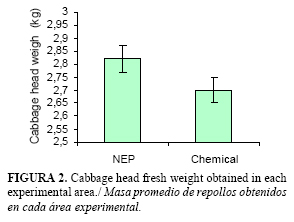
<body><![CDATA[<P><font face="Verdana, Arial, Helvetica, sans-serif" size="2">At the final of    the crop, ten plants randomly selected from each experimental plot were harvested    and weighed in the field using a portable scale, and the head fresh weight was    determined. The final yields of the plots were determined, being the yield per    ha (in t.ha<SUP>-1</SUP>) estimated by the farmers. The data (of infestation    levels and head fresh weights) were statistically processed by an analysis of    variance (ANOVA) and the difference of media were determined by Duncan&#180;s    Test (p&lt;0,05), using a statistic package INFOSTAT Version 2.1. </font>     <P><font face="Verdana, Arial, Helvetica, sans-serif" size="2">Four weeks after    planting, <I>P. xylostella</I> was present in cabbage in both areas in the farm,    in correspondence with the high temperatures of September in Cuba. This confirms    the importance of farm monitoring and checking of the pest levels for an appropriate    management. In our case, for Cuba, 0,5 larvae.plant<SUP>-1</SUP> of <I>P. xylostella</I>,    represents the critical index for cabbage crop. </font>     <P><font face="Verdana, Arial, Helvetica, sans-serif" size="2">The <a href="#f1">figure    1</a> shows the Infestation Index (referred as the mean numbers of larvae DBM    for two different treatments (EPN and Chemical) over time.</font>     <P align="center"><img src="/img/revistas/rpv/v28n2/f0111213.jpg" width="300" height="232">    <a name="f1"></a>      
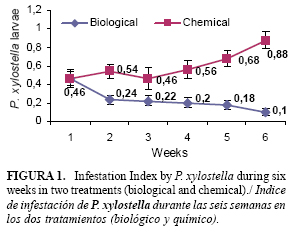
<P><font face="Verdana, Arial, Helvetica, sans-serif" size="2">In each week, the    infestation index of DBM showed statistic differences between treatments. The    infestation levels in the biological treatment (EPN) were low according to the    scale (4), with plants very low damaged, whereas in the plot with the chemical    treatment, the level was very high (up to 0,88 larvae.plant<SUP>-1</SUP>) at    the end of crop, with a crop significantly damaged . </font>     <P><font face="Verdana, Arial, Helvetica, sans-serif" size="2">The values of the    fresh head weight varied significantly (<a href="#f2">Fig. 2</a>). This is an    important element for the farmers, because in Cuba, the cabbage head is commercialized    by the fresh weight, and an increment of this parameter becomes in higher profits    for growers.</font>     <P align="center"><img src="/img/revistas/rpv/v28n2/f0211213.jpg" width="294" height="222">    <a name="f2"></a>      
<P><font face="Verdana, Arial, Helvetica, sans-serif" size="2">The reduction of    DBM larvae in the biological treatment was related to EPN applications. Because    of the DBM population increases in the chemical treatment, EPN potential for    controlling this pest is shown. </font>     <P><font face="Verdana, Arial, Helvetica, sans-serif" size="2">Some authors have    indicated the satisfactory effect of the entomopathogenic nematodes in DBM management    (6,7). Corresponding with the good results of this trial, the farmers in &#171;Do&ntilde;a    Amalia&#187; have been using EPN for <I>P. xylostella</I> management since 2010.    Aiming at increasing the acceptation of the biological control by these farmers,    new experiments using EPN, entomopathogenic fungi and bacteria, as well as parasitoids,    must be conducted in the future.</font>     <P>&nbsp;  <H1> <font face="Verdana, Arial, Helvetica, sans-serif" size="2"><B><font size="3">ACKNOWLEDGMENTS</font></B>    </font></H1>     ]]></body>
<body><![CDATA[<P><font face="Verdana, Arial, Helvetica, sans-serif" size="2">Thanks are due    to the managers and farmers of &#171;Do&ntilde;a Amalia&#187; Farm for their    collaboration. To Miss Yenelys Ramirez and Mr. Justin Petricks, students from    the Agricultural University of Havana, for their help in the experimental work.</font>     <P>&nbsp;  <H1> <font face="Verdana, Arial, Helvetica, sans-serif" size="2"><B><font size="3">REFERENCES</font></B>    </font></H1>     <!-- ref --><P><font face="Verdana, Arial, Helvetica, sans-serif" size="2">1. Mart&iacute;nez    E, Barrios G, Rovesti L, Santos R. Manejo Integrado de Plagas. Manual Pr&aacute;ctico.    Centro Nacional de Sanidad Vegetal, 2007. Cuba. 167-175.     </font>      <!-- ref --><P><font face="Verdana, Arial, Helvetica, sans-serif" size="2">2. Ben&iacute;tez    ME, Rivero PP, Gil JF, Marrero C, Mart&iacute;nez Y, Soto JA. Manual T&eacute;cnico    para el cultivo y la producci&oacute;n de semillas de la col en Cuba. ACTAF.    2010: 20pp. Cuba.     </font>      <!-- ref --><P><font face="Verdana, Arial, Helvetica, sans-serif" size="2">3. Nyasania JO,    Kimenjua JW, Olubayoa FM, Wilson MJ. Laboratory and field investigations using    indigenous entomopathogenic nematodes for biological control of <I>Plutella    xylostella</I> in Kenya. International Jour Pest Management. 2008;54(4):355-361.        </font>      <!-- ref --><P><font face="Verdana, Arial, Helvetica, sans-serif" size="2">4. Centro Nacional    de Sanidad Vegetal (CNSV). 2007. Resumen de metodolog&iacute;as de se&ntilde;alizaci&oacute;n.    Cuba. 6pp.     </font>     ]]></body>
<body><![CDATA[<!-- ref --><P><font face="Verdana, Arial, Helvetica, sans-serif" size="2">5. S&aacute;nchez    L. <I>Heterorhabditis bacteriophora </I>HC1. Estrategia de desarrollo como agente    de control biol&oacute;gico de plagas insectiles. Tesis en opci&oacute;n al    Grado de Doctor en Ciencias Agr&iacute;colas. Universidad Agraria de La Habana,    Cuba. 100 pp. 2002.     </font>      <!-- ref --><P><font face="Verdana, Arial, Helvetica, sans-serif" size="2">6. Asare-Bediako    E, Addo-Quaye AA, Mohammed A. Control of diamondback moth (<I>Plutella xylostella</I>)    on cabbage (<I>Brassica oleracea </I>var <I>capitata</I>) using intercropping    with non-host crops. Am J Food Technol. 2010;5:269-274.     </font>      <!-- ref --><P><font face="Verdana, Arial, Helvetica, sans-serif" size="2">7. Marrero MA.    Nematodos entomopat&oacute;genos (<I>Heterorhabditis </I>spp.) para el control    de <I>Spodoptera frugiperda </I>(JE Smith), <I>Plutella xylostella </I>(Linnaeus)    y <I>Heliothis virescens </I>(Fabricius). Centro Agr&iacute;cola. 2006;33(2):90.    </font>      <P>&nbsp;     <P>&nbsp;     <P><font face="Verdana, Arial, Helvetica, sans-serif" size="2">Recibido: 28-9-2012.    <br>   </font><font face="Verdana, Arial, Helvetica, sans-serif" size="2">Aceptado:    17-1-2013.</font>     ]]></body>
<body><![CDATA[<P>&nbsp;     <P>&nbsp;     <P><font face="Verdana, Arial, Helvetica, sans-serif" size="2"><SUP><a href="#pie">1</a><a name="titulo"></a></SUP>Project    &#171;Mass rearing of entomopathogenic nematodes for pest management in Venezuela&#187;.    Financial support by Cuba-Venezuela Cooperative Agreement.</font>       ]]></body><back>
<ref-list>
<ref id="B1">
<label>1</label><nlm-citation citation-type="">
<person-group person-group-type="author">
<name>
<surname><![CDATA[Martínez]]></surname>
<given-names><![CDATA[E]]></given-names>
</name>
<name>
<surname><![CDATA[Barrios]]></surname>
<given-names><![CDATA[G]]></given-names>
</name>
<name>
<surname><![CDATA[Rovesti]]></surname>
<given-names><![CDATA[L]]></given-names>
</name>
<name>
<surname><![CDATA[Santos]]></surname>
<given-names><![CDATA[R]]></given-names>
</name>
</person-group>
<article-title xml:lang="es"><![CDATA[Manejo Integrado de Plagas: Manual Práctico]]></article-title>
<collab>Centro Nacional de Sanidad Vegetal</collab>
<source><![CDATA[]]></source>
<year>2007</year>
<page-range>167-175</page-range><publisher-loc><![CDATA[^eCuba Cuba]]></publisher-loc>
</nlm-citation>
</ref>
<ref id="B2">
<label>2</label><nlm-citation citation-type="journal">
<person-group person-group-type="author">
<name>
<surname><![CDATA[Benítez]]></surname>
<given-names><![CDATA[ME]]></given-names>
</name>
<name>
<surname><![CDATA[Rivero]]></surname>
<given-names><![CDATA[PP]]></given-names>
</name>
<name>
<surname><![CDATA[Gil]]></surname>
<given-names><![CDATA[JF]]></given-names>
</name>
<name>
<surname><![CDATA[Marrero]]></surname>
<given-names><![CDATA[C]]></given-names>
</name>
<name>
<surname><![CDATA[Martínez]]></surname>
<given-names><![CDATA[Y]]></given-names>
</name>
<name>
<surname><![CDATA[Soto]]></surname>
<given-names><![CDATA[JA]]></given-names>
</name>
</person-group>
<article-title xml:lang="es"><![CDATA[Manual Técnico para el cultivo y la producción de semillas de la col en Cuba]]></article-title>
<source><![CDATA[ACTAF]]></source>
<year>2010</year>
<page-range>20</page-range></nlm-citation>
</ref>
<ref id="B3">
<label>3</label><nlm-citation citation-type="journal">
<person-group person-group-type="author">
<name>
<surname><![CDATA[Nyasania]]></surname>
<given-names><![CDATA[JO]]></given-names>
</name>
<name>
<surname><![CDATA[Kimenjua]]></surname>
<given-names><![CDATA[JW]]></given-names>
</name>
<name>
<surname><![CDATA[Olubayoa]]></surname>
<given-names><![CDATA[FM]]></given-names>
</name>
<name>
<surname><![CDATA[Wilson]]></surname>
<given-names><![CDATA[MJ]]></given-names>
</name>
</person-group>
<article-title xml:lang="en"><![CDATA[Laboratory and field investigations using indigenous entomopathogenic nematodes for biological control of Plutella xylostella in Kenya]]></article-title>
<source><![CDATA[International Jour Pest Management]]></source>
<year>2008</year>
<volume>54</volume>
<numero>4</numero>
<issue>4</issue>
<page-range>355-361</page-range></nlm-citation>
</ref>
<ref id="B4">
<label>4</label><nlm-citation citation-type="">
<collab>Centro Nacional de Sanidad Vegetal (CNSV)</collab>
<source><![CDATA[Resumen de metodologías de señalización]]></source>
<year>2007</year>
<page-range>6</page-range><publisher-loc><![CDATA[^eCuba Cuba]]></publisher-loc>
</nlm-citation>
</ref>
<ref id="B5">
<label>5</label><nlm-citation citation-type="">
<person-group person-group-type="author">
<name>
<surname><![CDATA[Sánchez]]></surname>
<given-names><![CDATA[L]]></given-names>
</name>
</person-group>
<article-title xml:lang="es"><![CDATA[Heterorhabditis bacteriophora HC1: Estrategia de desarrollo como agente de control biológico de plagas insectiles]]></article-title>
<source><![CDATA[]]></source>
<year></year>
</nlm-citation>
</ref>
<ref id="B6">
<label>6</label><nlm-citation citation-type="journal">
<person-group person-group-type="author">
<name>
<surname><![CDATA[Asare-Bediako]]></surname>
<given-names><![CDATA[E]]></given-names>
</name>
<name>
<surname><![CDATA[Addo-Quaye]]></surname>
<given-names><![CDATA[AA]]></given-names>
</name>
<name>
<surname><![CDATA[Mohammed]]></surname>
<given-names><![CDATA[A]]></given-names>
</name>
</person-group>
<article-title xml:lang="es"><![CDATA[Control of diamondback moth (Plutella xylostella) on cabbage (Brassica oleracea var capitata) using intercropping with non-host crops]]></article-title>
<source><![CDATA[Am J Food Technol]]></source>
<year>2010</year>
<volume>5</volume>
<page-range>269-274</page-range></nlm-citation>
</ref>
<ref id="B7">
<label>7</label><nlm-citation citation-type="journal">
<person-group person-group-type="author">
<name>
<surname><![CDATA[Marrero]]></surname>
<given-names><![CDATA[MA]]></given-names>
</name>
</person-group>
<article-title xml:lang="es"><![CDATA[Nematodos entomopatógenos (Heterorhabditis spp.) para el control de Spodoptera frugiperda (JE Smith), Plutella xylostella (Linnaeus) y Heliothis virescens (Fabricius)]]></article-title>
<source><![CDATA[Centro Agrícola.]]></source>
<year>2006</year>
<volume>33</volume>
<numero>2</numero>
<issue>2</issue>
<page-range>90</page-range></nlm-citation>
</ref>
</ref-list>
</back>
</article>