<?xml version="1.0" encoding="ISO-8859-1"?><article xmlns:mml="http://www.w3.org/1998/Math/MathML" xmlns:xlink="http://www.w3.org/1999/xlink" xmlns:xsi="http://www.w3.org/2001/XMLSchema-instance">
<front>
<journal-meta>
<journal-id>1010-2752</journal-id>
<journal-title><![CDATA[Revista de Protección Vegetal]]></journal-title>
<abbrev-journal-title><![CDATA[Rev. Protección Veg.]]></abbrev-journal-title>
<issn>1010-2752</issn>
<publisher>
<publisher-name><![CDATA[Centro Nacional de Sanidad Agropecuaria]]></publisher-name>
</publisher>
</journal-meta>
<article-meta>
<article-id>S1010-27522014000200011</article-id>
<title-group>
<article-title xml:lang="en"><![CDATA[A mathematic model for the interaction between Meloidogyne spp. and Pasteuria penetrans]]></article-title>
<article-title xml:lang="es"><![CDATA[Modelo matemático de la interacción entre Meloidogyne spp. y Pasteuria penetrans]]></article-title>
</title-group>
<contrib-group>
<contrib contrib-type="author">
<name>
<surname><![CDATA[Miranda]]></surname>
<given-names><![CDATA[Ileana]]></given-names>
</name>
<xref ref-type="aff" rid="A01"/>
</contrib>
<contrib contrib-type="author">
<name>
<surname><![CDATA[Gómez]]></surname>
<given-names><![CDATA[Lucila]]></given-names>
</name>
<xref ref-type="aff" rid="A01"/>
</contrib>
<contrib contrib-type="author">
<name>
<surname><![CDATA[Benítez]]></surname>
<given-names><![CDATA[Hugo L.]]></given-names>
</name>
<xref ref-type="aff" rid="A01"/>
</contrib>
<contrib contrib-type="author">
<name>
<surname><![CDATA[Castillo]]></surname>
<given-names><![CDATA[Yoannia]]></given-names>
</name>
<xref ref-type="aff" rid="A01"/>
</contrib>
<contrib contrib-type="author">
<name>
<surname><![CDATA[Hernández-Ochandía]]></surname>
<given-names><![CDATA[Dainé]]></given-names>
</name>
<xref ref-type="aff" rid="A01"/>
</contrib>
<contrib contrib-type="author">
<name>
<surname><![CDATA[Rodríguez]]></surname>
<given-names><![CDATA[Mayra G.]]></given-names>
</name>
<xref ref-type="aff" rid="A01"/>
</contrib>
</contrib-group>
<aff id="A01">
<institution><![CDATA[,Centro Nacional de Sanidad Agropecuaria (CENSA)  ]]></institution>
<addr-line><![CDATA[Mayabeque San José de las Lajas]]></addr-line>
<country>Cuba</country>
</aff>
<pub-date pub-type="pub">
<day>00</day>
<month>08</month>
<year>2014</year>
</pub-date>
<pub-date pub-type="epub">
<day>00</day>
<month>08</month>
<year>2014</year>
</pub-date>
<volume>29</volume>
<numero>2</numero>
<fpage>145</fpage>
<lpage>149</lpage>
<copyright-statement/>
<copyright-year/>
<self-uri xlink:href="http://scielo.sld.cu/scielo.php?script=sci_arttext&amp;pid=S1010-27522014000200011&amp;lng=en&amp;nrm=iso"></self-uri><self-uri xlink:href="http://scielo.sld.cu/scielo.php?script=sci_abstract&amp;pid=S1010-27522014000200011&amp;lng=en&amp;nrm=iso"></self-uri><self-uri xlink:href="http://scielo.sld.cu/scielo.php?script=sci_pdf&amp;pid=S1010-27522014000200011&amp;lng=en&amp;nrm=iso"></self-uri><abstract abstract-type="short" xml:lang="en"><p><![CDATA[Some aspects of Meloidogyne spp. (root-knot nematode) growth regulation by the gram-negative bacterium Pasteuria penetrans were reviewed. The study allowed the construction of a mathematical model to predict the dynamics of both organisms. The model includes 11 differential equations and 31biological constants describing the life-cycle of the nematode and its relationship with the bacterium. To simulate the real behavior of the populations, the constants, which represent biological parameters, have to be evaluated under controlled conditions similar to those of soil microcosm.]]></p></abstract>
<abstract abstract-type="short" xml:lang="es"><p><![CDATA[El estudio de algunos aspectos de la regulación del crecimiento de los nematodos agalleros del género Meloidogyne Goeldi por la acción de la bacteria Pasteuria penetrans, permitió proponer un modelo matemático para predecir la dinámica de ambos organismos. El modelo incluye 11 ecuaciones diferenciales y 31 constantes biológicas que describen las fases de desarrollo del nematodo y su relación con la bacteria. Para simular el comportamiento real de las poblaciones, las constantes, que representan parámetros biológicos, deberán ser evaluadas en condiciones controladas similares a la del microcosmo del suelo.]]></p></abstract>
<kwd-group>
<kwd lng="en"><![CDATA[bio-mathematics]]></kwd>
<kwd lng="en"><![CDATA[Meloidogyne]]></kwd>
<kwd lng="en"><![CDATA[Pasteuria penetrans]]></kwd>
<kwd lng="en"><![CDATA[biological control]]></kwd>
<kwd lng="en"><![CDATA[biomatemática]]></kwd>
<kwd lng="en"><![CDATA[Meloidogyne]]></kwd>
<kwd lng="en"><![CDATA[Pasteuria penetrans]]></kwd>
<kwd lng="en"><![CDATA[control biológico]]></kwd>
</kwd-group>
</article-meta>
</front><body><![CDATA[ <p align="right"><font face="Verdana, Arial, Helvetica, sans-serif" size="2"><B>TECHNICAL    NOTE</B> </font> </p>     <p>&nbsp;</p> <h1> <font face="Verdana, Arial, Helvetica, sans-serif" size="2"><b><font size="4">A    mathematic model for the interaction between <i>Meloidogyne </i>spp. and <i>Pasteuria    penetrans</i> </font> </b></font></h1>     <p>&nbsp;</p> <h1> <font face="Verdana, Arial, Helvetica, sans-serif" size="2"><b><font size="3">Modelo    matem&aacute;tico de la interacci&oacute;n entre <i>Meloidogyne </i>spp. y <i>Pasteuria    penetrans</i> </font> </b></font></h1>     <p>&nbsp;</p>     <p>&nbsp;</p>     <p><font face="Verdana, Arial, Helvetica, sans-serif" size="2"><b>Ileana Miranda,    Lucila G&oacute;mez, Hugo L. Ben&iacute;tez, Yoannia Castillo, Dain&eacute;    Hern&aacute;ndez-Ochand&iacute;a, Mayra G. Rodr&iacute;guez</b></font><b> </b></p>     <P><font face="Verdana, Arial, Helvetica, sans-serif" size="2">Centro Nacional    de Sanidad Agropecuaria (CENSA), Apartado 10, San Jos&eacute; de las Lajas,    Mayabeque, Cuba. Email:<I> </I><U><a href="mailto:ileanam@censa.edu.cu">ileanam@censa.edu.cu</a></U>.    </font>      <P>&nbsp;     <P>&nbsp; <hr noshade size="1">     <P><font face="Verdana, Arial, Helvetica, sans-serif" size="2"><B>ABSTRACT</B></font>     ]]></body>
<body><![CDATA[<P><font face="Verdana, Arial, Helvetica, sans-serif" size="2">Some aspects of    <I>Meloidogyne</I> spp. (root-knot nematode) growth regulation by the <I>g</I>ram-negative    bacterium <I>Pasteuria penetrans </I>were reviewed. The study allowed the construction    of a mathematical model to predict the dynamics of both organisms. The model    includes 11 differential equations and 31biological constants describing the    life-cycle of the nematode and its relationship with the bacterium. To simulate    the real behavior of the populations, the constants, which represent biological    parameters, have to be evaluated under controlled conditions similar to those    of soil microcosm. </font>     <P><font face="Verdana, Arial, Helvetica, sans-serif" size="2"><B>Key words:</B>    bio-mathematics, <I>Meloidogyne</I>, <I>Pasteuria penetrans</I>, biological    control. </font> <hr noshade size="1">         <P><font face="Verdana, Arial, Helvetica, sans-serif" size="2"><B>RESUMEN</b></font>      <P><font face="Verdana, Arial, Helvetica, sans-serif" size="2">El estudio de algunos    aspectos de la regulaci&oacute;n del crecimiento de los nematodos agalleros    del g&eacute;nero <I>Meloidogyne</I> Goeldi por la acci&oacute;n de la bacteria    <I>Pasteuria penetrans,</I> permiti&oacute; proponer un modelo matem&aacute;tico    para predecir la din&aacute;mica de ambos organismos. El modelo incluye 11 ecuaciones    diferenciales y 31 constantes biol&oacute;gicas que describen las fases de desarrollo    del nematodo y su relaci&oacute;n con la bacteria. Para simular el comportamiento    real de las poblaciones, las constantes, que representan par&aacute;metros biol&oacute;gicos,    deber&aacute;n ser evaluadas en condiciones controladas similares a la del microcosmo    del suelo. </font>      <P><font face="Verdana, Arial, Helvetica, sans-serif" size="2"><B>Palabras clave</B>:    biomatem&aacute;tica, <I>Meloidogyne</I>, <I>Pasteuria penetrans</I>, control    biol&oacute;gico.</font> <hr noshade size="1">     <P>&nbsp;     <P>&nbsp;     <P><font face="Verdana, Arial, Helvetica, sans-serif" size="2">Root-knot nematodes    (<I>Meloidogyne </I>spp.) are severe pests of food crops in many agricultural    systems, worldwide. They produce several economic losses when feeding on plants    roots (1). To counteract their effects, different control practices (chemical,    cultural, including resistance, physical barriers, and others) have been used;    however, the practical use of biological control agents has been recently introduced    (2). </font>      <P><font face="Verdana, Arial, Helvetica, sans-serif" size="2">The bacteria <I>Pasteuria    penetrans</I> is an endospore-forming parasite of nematodes, and has shown a    great potential as a biological control agent of root-knot species. This bacterium    has been reported to provide an effective control when used alone or combined    with other tactics, both in the open field (3) and in greenhouses or micro-plots    (4, 5). </font>     <P><font face="Verdana, Arial, Helvetica, sans-serif" size="2">In the last years,    considerable progress have been achieved in the studies on <I>P. penetrans </I>contributing    to understand its biology and importance as a biocontrol agent, and the knowledge    regarding its ecology, life-cycle and host adhesion mechanisms has increased    (6). </font>     ]]></body>
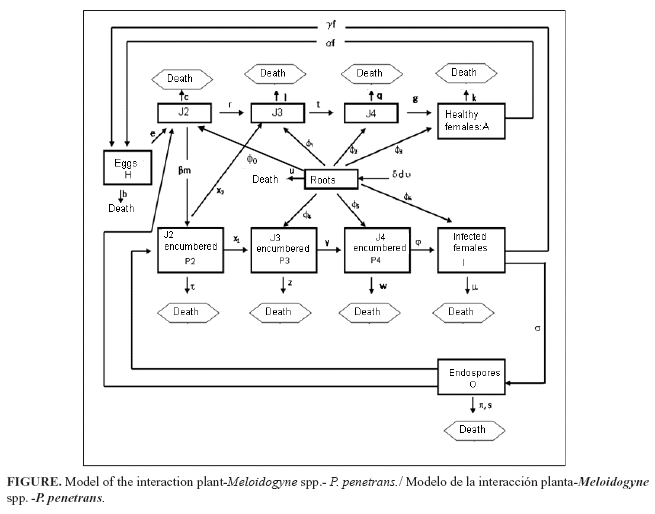
<body><![CDATA[<P><font face="Verdana, Arial, Helvetica, sans-serif" size="2"><I>P. penetrans    </I>parasitism begins with the adhesion of one to hundreds endospores to the    infective stage of the nematode (second stage juveniles) (J2), where they germinate    through the nematode cuticle (7). Penetration of J2s into the root decreases    according to the number of spore adhered (8). After parasitized, the nematode    continues with the endospores adhered until becomes adult female, when the endospores    are released to the soil. </font>     <P><font face="Verdana, Arial, Helvetica, sans-serif" size="2">Nevertheless, there    are some questions concerning the proportion in which the development rate of    the nematode population may be affected once the endospores have adhered to    the J2s, and understanding the factors which influence the nematode population    reduction is important to increase the efficacy of the bacterium as a biocontrol    agent. A mathematical model describing a density-dependent relationship with    the nematode as a host for the bacteria can help to solve this query (9), keeping    in mind that the parameters involved will need to be experimentally determined    for each soil microcosm, also considering the density-dependence factors not    been included in the implementation of the model. </font>     <P><font face="Verdana, Arial, Helvetica, sans-serif" size="2">The model was constructed    from the basic nematode life-cycle (10), incorporating what was known about    its interactions with <I>P. penetrans</I> (11). The eggs (H) hatch (at rate    <I>e</I>) yielding immature stages (infestive juveniles, J2), which after going    through stages J3 and J4, eventually become females without bacterial infection,    which produce eggs at rate a<I> </I>at a fertility level. The nematodes without    endospore encumbrance can die because of the abrupt changes in temperatures    or by an interruption in the complete cycle of the crop. From the holistic point    of view the population level of any <I>Meloidogyne</I> sp. is the product of    the food supply, adaptation to the physical and biological environment and the    compatibility of the plant and nematode (12). For that, the model includes different    constants indicating a natural mortality (r, l, q, and k). Due to the matching    (at transmission rate b) of the J2 with the <I>P. penetrans</I> endospores released    in soil (at rate<I>s</I>) by nematode infected females, some J2 nematodes are    unable to enter the root system due to endospore encumbrance, whereas others    can complete the cycle (P2, P3, P4) until becoming infested females (I), which    can still produce a minor number of eggs (at rate ) and then release news endospores.    Some of these endospores can be eliminated by the effect of some ecosystem factors(<I>s</I>    subtraction factor), for example the runoff water, or can adhere to the J2s,    bearing or not endospores. A small quantity of J2s (<I>x<SUB>2</SUB></I>) withless    than three spores adhered is able to pass to the third larval stage without    infestation (J3), because the spores do not germinate. Although the endospores    can persist for many years in soil, they have a certain mortality rate (<I>p</I>).The    J2s that are able to penetrate the root produce a certain degree of damage in    the plant root, and other nematode stages (J3, J4, A) produce a negative effect    on the plant too (<a href="/img/revistas/rpv/v29n2/f0111214.gif">Figure</a>).    </font>      
<P><font face="Verdana, Arial, Helvetica, sans-serif" size="2">The biological    parameters were considered as constants because the external factors were not    included (<a href="/img/revistas/rpv/v29n2/t0111214.jpg">Table</a>). These    constants are specific to any soil microcosm and have to be calculated under    experimental controlled conditions considering the optimum temperature for growth    and reproduction of <I>Meloidogyne</I> spp. is 25-30&#176;C (12). </font>      
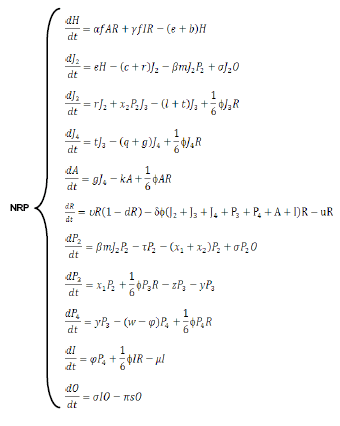
<P><font face="Verdana, Arial, Helvetica, sans-serif" size="2">Soil texture and    structure, as well as the soil matrix, are important factors that act upon the    flow and adsorption of the spores (13). Soil with 10-30% of clay is the ideal    soil for the best balance of adsorption and retention of the <I>P. penetrans</I>    endospores. The interactions occurring in this soil may exert direct control    on the dispersion and adhesion capacity of the endospores to the nematode cuticle.    The irrigation level of the soil must also be known, since with an appropriate    irrigation, the nematode populations increase and an increasing number of endospores    adhere to J2 cuticles. However, an intense irrigation can cause the endospores    to be lost due to dilution and percolation to deeper soil layers (14). </font>     <P><font face="Verdana, Arial, Helvetica, sans-serif" size="2">Another important    factor is soil pH, whose effects on the nematode and bacteria are diverse and    of difficult interpretation. <I>Meloidogyne</I> spp. survives, hatch and reproduce    over a wide pH range, 4-8. As with other soil solution factors, pH fluctuates    with changes in soil moisture and soil salinity. As with soil texture, increased    crop damage from <I>Meloidogyne</I> spp. is often associated with alkaline soils    (12). Apparently favorable pH for endospore adhesion to the host nematodes oscillates    from neuter to alkaline too (15). </font>     <P><font face="Verdana, Arial, Helvetica, sans-serif" size="2">To estimate the    parameters that allow simulating the dynamics under optimal conditions, it is    necessary to know not only the favorable conditions to <I>P. penetrans, </I>but    also those favorable conditions for the nematode growth and development of the    host crop. </font>     <P><font face="Verdana, Arial, Helvetica, sans-serif" size="2">The biological    model can be simulated using a system of differential <a href="#e1">equations</a>:    </font>      <P align="center"><img src="/img/revistas/rpv/v29n2/e0111214.gif" width="340" height="426">    <a name="e1"></a>     
<P><font face="Verdana, Arial, Helvetica, sans-serif" size="2">In a further study,    the parameters of the model will be estimated and the system stability analyzed    using the Lapuniov&#180;s theorem (16). Simulations, even when the evolution    in time of a natural system cannot be &#171;forecasted&#187; due to its external    perturbations and the presence of its own chaotic components, may allow understanding    some details of the mechanisms of nematode natural regulation or suppression.    The simulations of the NRP model will show that the behavior and dynamics of    a simple system including a host and a bacterial parasite population are not    only affected by the biological constants characterizing the two organisms,    but also by the densities at which they occur. In some cases, changes in one    or more constant/components of a model during a simulation (including the initial    points used to start the model) may yield a cycle path leading to the extinction    of one or both components, i.e. a local extinction may be considered when the    cycle orbit becomes wide enough to reach one of the axes. Furthermore, by this    way it is possible to estimate the doses and the time required to reach equilibrium    between host and parasite, or to induce a local extinction, when routine treatments    with biocontrol agents are possible (11). </font>      ]]></body>
<body><![CDATA[<P>&nbsp;     <P><font face="Verdana, Arial, Helvetica, sans-serif" size="2"><B><font size="3">ACKNOWLEDGEMENTS</font></B>    </font>     <P><font face="Verdana, Arial, Helvetica, sans-serif" size="2">First author thanks    CNR (Italy) for a Short-Term Mobility Programme grant. Research partially funded    by EU Project ICA4-CT-2002-10044, MicoSpa: Microbial pest control for sustainable    peri-urban/urban agriculture in Latin America (Mexico and Cuba). We especially    thank Aurelio Ciancio (IPP, CNR) for editing and suggestions and Dr. Eduardo    Sistachs for his English revision. </font>      <P>&nbsp;     <P><font face="Verdana, Arial, Helvetica, sans-serif" size="2"><B><font size="3">REFERENCES</font></B>    </font>          <!-- ref --><P><font face="Verdana, Arial, Helvetica, sans-serif" size="2">1. Moens M, Perry    RN, Starr JL. <I>Meloidogyne</I> Species - a diverse group of novel and important    Plant Parasites. En Moens M, RN Perry, JL Starr (Eds). CAB International. Root-knot    Nematodes. 2009. Pp. 1-17.     </font>      <!-- ref --><P><font face="Verdana, Arial, Helvetica, sans-serif" size="2">2. Matielle T,    Koumborb RD, Sabine F, Mamadou T. Host- parasite soil communities and environmental    constraints: Modelling of soil functions involved in interactions between plant-parasitic    nematodes and <I>Pasteuria penetrans</I>. Soil Biology &amp; Biochemistry. 2010;42:1193-1199.        </font>      <!-- ref --><P><font face="Verdana, Arial, Helvetica, sans-serif" size="2">3. Tian B, Yang      J, Zhang KQ. Transfer and Development of <I>Pasteuria penetrans</I>. J Nematol.      2007;39(1):55-61.     </font>        <!-- ref --><P><font face="Verdana, Arial, Helvetica, sans-serif" size="2">4. Darban DA,      Pembroke Barbara, Gowen SR. The relationships of time and temperature to body      weight and numbers of endospores in <I>Pasteuria penetrans</I>-infected <I>Meloidogyne      javanica </I>females Nematology. 2004;6(1):33-36.     </font>        <!-- ref --><P><font face="Verdana, Arial, Helvetica, sans-serif" size="2">5. Javed N, El-Hassan      S, Gowen S, Pemproke Barbara, Inam-ul -Haq M. The potential of combining <I>Pasteuria      penetrans</I> and neem (<I>Azadirachta indica</I>) formulations as a management      system for root-knot nematodes on tomato. Eur J Plant Pathol. 2008;120:53-60.          </font>         <!-- ref --><P><font face="Verdana, Arial, Helvetica, sans-serif" size="2">6. G&oacute;mez    L, Gandarilla H, Rodr&iacute;guez M. <I>Pasteuria penetrans</I> como agente    de control biol&oacute;gico de <I>Meloidogyne</I> spp. Rev Protecci&oacute;n    Veg. 2010;25(3):137-149.     </font>      <!-- ref --><P><font face="Verdana, Arial, Helvetica, sans-serif" size="2">7. Bird DM, Opperman    CH, Davies KG. Interactions between bacteria and plant-parasitic nematodes:    now and then. Int J Parasitol. 2003;33:1269-1276.     </font>      <!-- ref --><P><font face="Verdana, Arial, Helvetica, sans-serif" size="2">8.Davies KG,      Fargette M, Balla G. Cuticle heterogeneity as exhibited by <I>Pasteuria</I>      spore attachment is not linked to the phylogeny of parthenogenetic root-knot      nematode (<I>Meloidogyne</I> spp.). Parasitology. 2000;122:111-120.     </font>         <!-- ref --><P><font face="Verdana, Arial, Helvetica, sans-serif" size="2">9. Ciancio A, Bourijate    M. Relationship between <I>Pasteuriapenetrans</I> infection levels and density    of <I>Meloidogyne javanica</I>. Nematol Medit. 1995;23:43-49.     </font>      <!-- ref --><P><font face="Verdana, Arial, Helvetica, sans-serif" size="2">10.Hern&aacute;ndez-Ochand&iacute;a      D, Arias Y, G&oacute;mez L, Peteira B, Miranda I, Rodr&iacute;guez M. Elementos      del ciclo de vida de poblaci&oacute;n cubana de <I>Meloidogyne incognita </I>(Kofoid      y White) Chitwood en <I>Solanum lycopersicum</I> L. Rev Protecci&oacute;n      Veg. 2012;27(3):188-193.     </font>         <!-- ref --><P><font face="Verdana, Arial, Helvetica, sans-serif" size="2">11.Ciancio A. Modeling    nematodes regulation by bacterial endoparasites. En Mukerji K.G. (eds.). Springer.    Integrated Management and Biocontrol of Vegetable and Grain Crops Nematodes.    2008. Pp 321-337.    </font>      <!-- ref --><P><font face="Verdana, Arial, Helvetica, sans-serif" size="2">12.Van Gundy SD.    Ecology of <I>Meloidogyne </I>spp. Emphasis on environmental factors affecting    survival and pathogenicity. En Sasser and Carter (eds). North Carolina Stage    University Graphics. An Advanced Treatise on <I>Meloidogyne</I> Volume I: Biology    and Control. 1985. </font> <font face="Verdana, Arial, Helvetica, sans-serif" size="2">Pp    177-182.     </font>     <!-- ref --><P><font face="Verdana, Arial, Helvetica, sans-serif" size="2">13.Dabir&eacute;      KR, Ndiaye S, Mounport D, Mateille T. Relationships between abiotic soil factors      and epidemiology of the biocontrol bacterium <I>Pasteuriapenetrans</I> in      a root-knot nematode <I>Meloidogynejavanica</I> -infested Weld. Biological      Control. 2007;40:22-29.     </font>        <!-- ref --><P><font face="Verdana, Arial, Helvetica, sans-serif" size="2">14.Dabir&eacute;      KR, Mateille T. Soil texture and irrigation influence the transport and the      development of <I>Pasteuria penetrans</I>, a bacterial parasite of root-knot      nematodes. Soil Biol Biochem. 2004;36:539-543.     </font>        <!-- ref --><P><font face="Verdana, Arial, Helvetica, sans-serif" size="2">15.Davies KG.      Interactions between nematodes and microorganisms: bridging ecological and      molecular approaches. Adv Appl Microbiol. 2005;57:53-78.     </font>         <P><font face="Verdana, Arial, Helvetica, sans-serif" size="2">16.Sharov AA. Course    Quantitative Population Ecology. Department of Entomology Virginiatech, Blacksbug.    1999: 240p. Disponible en: <U><a href="http://www.ento.vt.edu/sharov/pop%20ecol/">http://www.ento.vt.edu/sharov/pop    ecol/</a></U> (Consulta: 8-4-2013). </font>      <P>&nbsp;     <P>&nbsp;     <P><font face="Verdana, Arial, Helvetica, sans-serif" size="2">Recibido: 25-10-2013.    <br>   </font><font face="Verdana, Arial, Helvetica, sans-serif" size="2">Aceptado:    28-3-2014.</font>      ]]></body>
<body><![CDATA[ ]]></body><back>
<ref-list>
<ref id="B1">
<label>1</label><nlm-citation citation-type="">
<person-group person-group-type="author">
<name>
<surname><![CDATA[Moens]]></surname>
<given-names><![CDATA[M]]></given-names>
</name>
<name>
<surname><![CDATA[Perry]]></surname>
<given-names><![CDATA[RN]]></given-names>
</name>
<name>
<surname><![CDATA[Starr]]></surname>
<given-names><![CDATA[JL]]></given-names>
</name>
</person-group>
<article-title xml:lang="en"><![CDATA[Meloidogyne Species - a diverse group of novel and important Plant Parasites]]></article-title>
<person-group person-group-type="editor">
<name>
<surname><![CDATA[Moens]]></surname>
<given-names><![CDATA[M]]></given-names>
</name>
<name>
<surname><![CDATA[Perry]]></surname>
<given-names><![CDATA[RN]]></given-names>
</name>
<name>
<surname><![CDATA[Starr]]></surname>
<given-names><![CDATA[JL]]></given-names>
</name>
</person-group>
<collab>CAB International</collab>
<source><![CDATA[Root-knot Nematodes]]></source>
<year>2009</year>
<page-range>1-17</page-range></nlm-citation>
</ref>
<ref id="B2">
<label>2</label><nlm-citation citation-type="journal">
<person-group person-group-type="author">
<name>
<surname><![CDATA[Matielle]]></surname>
<given-names><![CDATA[T]]></given-names>
</name>
<name>
<surname><![CDATA[Koumborb]]></surname>
<given-names><![CDATA[RD]]></given-names>
</name>
<name>
<surname><![CDATA[Sabine]]></surname>
<given-names><![CDATA[F]]></given-names>
</name>
<name>
<surname><![CDATA[Mamadou]]></surname>
<given-names><![CDATA[T]]></given-names>
</name>
</person-group>
<article-title xml:lang="en"><![CDATA[Host- parasite soil communities and environmental constraints: Modelling of soil functions involved in interactions between plant-parasitic nematodes and Pasteuria penetrans]]></article-title>
<source><![CDATA[Soil Biology & Biochemistry]]></source>
<year>2010</year>
<volume>42</volume>
<page-range>1193-1199</page-range></nlm-citation>
</ref>
<ref id="B3">
<label>3</label><nlm-citation citation-type="journal">
<person-group person-group-type="author">
<name>
<surname><![CDATA[Tian]]></surname>
<given-names><![CDATA[B]]></given-names>
</name>
<name>
<surname><![CDATA[Yang]]></surname>
<given-names><![CDATA[J]]></given-names>
</name>
<name>
<surname><![CDATA[Zhang]]></surname>
<given-names><![CDATA[KQ]]></given-names>
</name>
</person-group>
<article-title xml:lang="en"><![CDATA[Transfer and Development of Pasteuria penetrans]]></article-title>
<source><![CDATA[J Nematol]]></source>
<year>2007</year>
<volume>39</volume>
<numero>1</numero>
<issue>1</issue>
<page-range>55-61</page-range></nlm-citation>
</ref>
<ref id="B4">
<label>4</label><nlm-citation citation-type="journal">
<person-group person-group-type="author">
<name>
<surname><![CDATA[Darban]]></surname>
<given-names><![CDATA[DA]]></given-names>
</name>
<name>
<surname><![CDATA[Pembroke]]></surname>
<given-names><![CDATA[Barbara]]></given-names>
</name>
<name>
<surname><![CDATA[Gowen]]></surname>
<given-names><![CDATA[SR]]></given-names>
</name>
</person-group>
<article-title xml:lang="en"><![CDATA[The relationships of time and temperature to body weight and numbers of endospores in Pasteuria penetrans-infected Meloidogyne javanica females]]></article-title>
<source><![CDATA[Nematology.]]></source>
<year>2004</year>
<volume>6</volume>
<numero>1</numero>
<issue>1</issue>
<page-range>33-36</page-range></nlm-citation>
</ref>
<ref id="B5">
<label>5</label><nlm-citation citation-type="journal">
<person-group person-group-type="author">
<name>
<surname><![CDATA[Javed]]></surname>
<given-names><![CDATA[N]]></given-names>
</name>
<name>
<surname><![CDATA[El-Hassan]]></surname>
<given-names><![CDATA[S]]></given-names>
</name>
<name>
<surname><![CDATA[Gowen]]></surname>
<given-names><![CDATA[S]]></given-names>
</name>
<name>
<surname><![CDATA[Pemproke]]></surname>
<given-names><![CDATA[Barbara]]></given-names>
</name>
<name>
<surname><![CDATA[Inam-ul -Haq]]></surname>
<given-names><![CDATA[M]]></given-names>
</name>
</person-group>
<article-title xml:lang="en"><![CDATA[The potential of combining Pasteuria penetrans and neem (Azadirachta indica) formulations as a management system for root-knot nematodes on tomato]]></article-title>
<source><![CDATA[Eur J Plant Pathol]]></source>
<year>2008</year>
<volume>120</volume>
<page-range>53-60</page-range></nlm-citation>
</ref>
<ref id="B6">
<label>6</label><nlm-citation citation-type="journal">
<person-group person-group-type="author">
<name>
<surname><![CDATA[Gómez]]></surname>
<given-names><![CDATA[L]]></given-names>
</name>
<name>
<surname><![CDATA[Gandarilla]]></surname>
<given-names><![CDATA[H]]></given-names>
</name>
<name>
<surname><![CDATA[Rodríguez]]></surname>
<given-names><![CDATA[M]]></given-names>
</name>
</person-group>
<article-title xml:lang="en"><![CDATA[Pasteuria penetrans como agente de control biológico de Meloidogyne spp]]></article-title>
<source><![CDATA[Rev Protección Veg]]></source>
<year>2010</year>
<volume>25</volume>
<numero>3</numero>
<issue>3</issue>
<page-range>137-149</page-range></nlm-citation>
</ref>
<ref id="B7">
<label>7</label><nlm-citation citation-type="journal">
<person-group person-group-type="author">
<name>
<surname><![CDATA[Bird]]></surname>
<given-names><![CDATA[DM]]></given-names>
</name>
<name>
<surname><![CDATA[Opperman]]></surname>
<given-names><![CDATA[CH]]></given-names>
</name>
<name>
<surname><![CDATA[Davies]]></surname>
<given-names><![CDATA[KG]]></given-names>
</name>
</person-group>
<article-title xml:lang="en"><![CDATA[Interactions between bacteria and plant-parasitic nematodes: now and then]]></article-title>
<source><![CDATA[Int J Parasitol]]></source>
<year>2003</year>
<volume>33</volume>
<page-range>1269-1276</page-range></nlm-citation>
</ref>
<ref id="B8">
<label>8</label><nlm-citation citation-type="journal">
<person-group person-group-type="author">
<name>
<surname><![CDATA[Davies]]></surname>
<given-names><![CDATA[KG]]></given-names>
</name>
<name>
<surname><![CDATA[Fargette]]></surname>
<given-names><![CDATA[M]]></given-names>
</name>
<name>
<surname><![CDATA[Balla]]></surname>
<given-names><![CDATA[G]]></given-names>
</name>
</person-group>
<article-title xml:lang="en"><![CDATA[Cuticle heterogeneity as exhibited by Pasteuria spore attachment is not linked to the phylogeny of parthenogenetic root-knot nematode (Meloidogyne spp.)]]></article-title>
<source><![CDATA[Parasitology]]></source>
<year>2000</year>
<volume>122</volume>
<page-range>111-120</page-range></nlm-citation>
</ref>
<ref id="B9">
<label>9</label><nlm-citation citation-type="journal">
<person-group person-group-type="author">
<name>
<surname><![CDATA[Ciancio]]></surname>
<given-names><![CDATA[A]]></given-names>
</name>
<name>
<surname><![CDATA[Bourijate]]></surname>
<given-names><![CDATA[M]]></given-names>
</name>
</person-group>
<article-title xml:lang="en"><![CDATA[Relationship between Pasteuriapenetrans infection levels and density of Meloidogyne javanica]]></article-title>
<source><![CDATA[Nematol Medit]]></source>
<year>1995</year>
<volume>23</volume>
<page-range>43-49</page-range></nlm-citation>
</ref>
<ref id="B10">
<label>10</label><nlm-citation citation-type="journal">
<person-group person-group-type="author">
<name>
<surname><![CDATA[Hernández-Ochandía]]></surname>
<given-names><![CDATA[D]]></given-names>
</name>
<name>
<surname><![CDATA[Arias]]></surname>
<given-names><![CDATA[Y]]></given-names>
</name>
<name>
<surname><![CDATA[Gómez]]></surname>
<given-names><![CDATA[L]]></given-names>
</name>
<name>
<surname><![CDATA[Peteira]]></surname>
<given-names><![CDATA[B]]></given-names>
</name>
<name>
<surname><![CDATA[Miranda]]></surname>
<given-names><![CDATA[I]]></given-names>
</name>
<name>
<surname><![CDATA[Rodríguez]]></surname>
<given-names><![CDATA[M]]></given-names>
</name>
</person-group>
<article-title xml:lang="es"><![CDATA[Elementos del ciclo de vida de población cubana de Meloidogyne incognita (Kofoid y White) Chitwood en Solanum lycopersicum L]]></article-title>
<source><![CDATA[Rev Protección Veg]]></source>
<year>2012</year>
<volume>27</volume>
<numero>3</numero>
<issue>3</issue>
<page-range>188-193</page-range></nlm-citation>
</ref>
<ref id="B11">
<label>11</label><nlm-citation citation-type="book">
<person-group person-group-type="author">
<name>
<surname><![CDATA[Ciancio]]></surname>
<given-names><![CDATA[A]]></given-names>
</name>
</person-group>
<article-title xml:lang="en"><![CDATA[Modeling nematodes regulation by bacterial endoparasites]]></article-title>
<person-group person-group-type="editor">
<name>
<surname><![CDATA[Mukerji]]></surname>
<given-names><![CDATA[K.G.]]></given-names>
</name>
</person-group>
<source><![CDATA[Integrated Management and Biocontrol of Vegetable and Grain Crops Nematodes]]></source>
<year>2008</year>
<page-range>321-337</page-range><publisher-name><![CDATA[Springer]]></publisher-name>
</nlm-citation>
</ref>
<ref id="B12">
<label>12</label><nlm-citation citation-type="">
<person-group person-group-type="author">
<name>
<surname><![CDATA[Van Gundy]]></surname>
<given-names><![CDATA[SD]]></given-names>
</name>
</person-group>
<article-title xml:lang="en"><![CDATA[Ecology of Meloidogyne spp. Emphasis on environmental factors affecting survival and pathogenicity]]></article-title>
<person-group person-group-type="editor">
<name>
<surname><![CDATA[Sasser]]></surname>
</name>
<name>
<surname><![CDATA[Carter]]></surname>
</name>
</person-group>
<collab>North Carolina Stage University Graphics</collab>
<source><![CDATA[An Advanced Treatise on Meloidogyne Volume I: Biology and Control]]></source>
<year>1985</year>
<page-range>177-182</page-range></nlm-citation>
</ref>
<ref id="B13">
<label>13</label><nlm-citation citation-type="journal">
<person-group person-group-type="author">
<name>
<surname><![CDATA[Dabiré]]></surname>
<given-names><![CDATA[KR]]></given-names>
</name>
<name>
<surname><![CDATA[Ndiaye]]></surname>
<given-names><![CDATA[S]]></given-names>
</name>
<name>
<surname><![CDATA[Mounport]]></surname>
<given-names><![CDATA[D]]></given-names>
</name>
<name>
<surname><![CDATA[Mateille]]></surname>
<given-names><![CDATA[T]]></given-names>
</name>
</person-group>
<article-title xml:lang="en"><![CDATA[Relationships between abiotic soil factors and epidemiology of the biocontrol bacterium Pasteuriapenetrans in a root-knot nematode Meloidogynejavanica -infested Weld]]></article-title>
<source><![CDATA[Biological Control]]></source>
<year>2007</year>
<volume>40</volume>
<page-range>22-29</page-range></nlm-citation>
</ref>
<ref id="B14">
<label>14</label><nlm-citation citation-type="journal">
<person-group person-group-type="author">
<name>
<surname><![CDATA[Dabiré]]></surname>
<given-names><![CDATA[KR]]></given-names>
</name>
<name>
<surname><![CDATA[Mateille]]></surname>
<given-names><![CDATA[T]]></given-names>
</name>
</person-group>
<article-title xml:lang="en"><![CDATA[Soil texture and irrigation influence the transport and the development of Pasteuria penetrans, a bacterial parasite of root-knot nematodes]]></article-title>
<source><![CDATA[Soil Biol Biochem]]></source>
<year>2004</year>
<volume>36</volume>
<page-range>539-543</page-range></nlm-citation>
</ref>
<ref id="B15">
<label>15</label><nlm-citation citation-type="journal">
<person-group person-group-type="author">
<name>
<surname><![CDATA[Davies]]></surname>
<given-names><![CDATA[KG]]></given-names>
</name>
</person-group>
<article-title xml:lang="en"><![CDATA[Interactions between nematodes and microorganisms: bridging ecological and molecular approaches]]></article-title>
<source><![CDATA[Adv Appl Microbiol]]></source>
<year>2005</year>
<volume>57</volume>
<page-range>53-78</page-range></nlm-citation>
</ref>
<ref id="B16">
<label>16</label><nlm-citation citation-type="">
<person-group person-group-type="author">
<name>
<surname><![CDATA[Sharov]]></surname>
<given-names><![CDATA[AA]]></given-names>
</name>
</person-group>
<collab>Department of Entomology Virginiatech, Blacksbug</collab>
<source><![CDATA[Course Quantitative Population Ecology]]></source>
<year>1999</year>
<page-range>240</page-range></nlm-citation>
</ref>
</ref-list>
</back>
</article>
