<?xml version="1.0" encoding="ISO-8859-1"?><article xmlns:mml="http://www.w3.org/1998/Math/MathML" xmlns:xlink="http://www.w3.org/1999/xlink" xmlns:xsi="http://www.w3.org/2001/XMLSchema-instance">
<front>
<journal-meta>
<journal-id>1024-9435</journal-id>
<journal-title><![CDATA[ACIMED]]></journal-title>
<abbrev-journal-title><![CDATA[ACIMED]]></abbrev-journal-title>
<issn>1024-9435</issn>
<publisher>
<publisher-name><![CDATA[Centro Nacional de Información de Ciencias Médicas]]></publisher-name>
</publisher>
</journal-meta>
<article-meta>
<article-id>S1024-94352009000600006</article-id>
<title-group>
<article-title xml:lang="en"><![CDATA[Collocations in the vocabulary English teaching as a foreign language]]></article-title>
<article-title xml:lang="es"><![CDATA[Las colocaciones en la enseñanza del vocabulario del idioma inglés como lengua extranjera]]></article-title>
</title-group>
<contrib-group>
<contrib contrib-type="author">
<name>
<surname><![CDATA[Forteza Fernández]]></surname>
<given-names><![CDATA[Rafael]]></given-names>
</name>
<xref ref-type="aff" rid="A01"/>
</contrib>
<contrib contrib-type="author">
<name>
<surname><![CDATA[Rao Prahlad]]></surname>
<given-names><![CDATA[Sandal Ranga]]></given-names>
</name>
<xref ref-type="aff" rid="A02"/>
</contrib>
<contrib contrib-type="author">
<name>
<surname><![CDATA[Rubtsova]]></surname>
<given-names><![CDATA[Elena]]></given-names>
</name>
<xref ref-type="aff" rid="A03"/>
</contrib>
<contrib contrib-type="author">
<name>
<surname><![CDATA[Sabitov]]></surname>
<given-names><![CDATA[Oabekr]]></given-names>
</name>
<xref ref-type="aff" rid="A04"/>
</contrib>
</contrib-group>
<aff id="A02">
<institution><![CDATA[,Central Institute of English and Foreing Languages University ]]></institution>
<addr-line><![CDATA[Hyderabad ]]></addr-line>
<country>India</country>
</aff>
<aff id="A03">
<institution><![CDATA[,Ekaterinburg University  ]]></institution>
<addr-line><![CDATA[ ]]></addr-line>
<country>Russia</country>
</aff>
<aff id="A04">
<institution><![CDATA[,Medical Academy  ]]></institution>
<addr-line><![CDATA[Tashkent ]]></addr-line>
<country>Uzbekistan</country>
</aff>
<aff id="A01">
<institution><![CDATA[,Facultad de Enfermería  ]]></institution>
<addr-line><![CDATA[Holguín. ]]></addr-line>
</aff>
<pub-date pub-type="pub">
<day>00</day>
<month>06</month>
<year>2009</year>
</pub-date>
<pub-date pub-type="epub">
<day>00</day>
<month>06</month>
<year>2009</year>
</pub-date>
<volume>19</volume>
<numero>6</numero>
<fpage>0</fpage>
<lpage>0</lpage>
<copyright-statement/>
<copyright-year/>
<self-uri xlink:href="http://scielo.sld.cu/scielo.php?script=sci_arttext&amp;pid=S1024-94352009000600006&amp;lng=en&amp;nrm=iso"></self-uri><self-uri xlink:href="http://scielo.sld.cu/scielo.php?script=sci_abstract&amp;pid=S1024-94352009000600006&amp;lng=en&amp;nrm=iso"></self-uri><self-uri xlink:href="http://scielo.sld.cu/scielo.php?script=sci_pdf&amp;pid=S1024-94352009000600006&amp;lng=en&amp;nrm=iso"></self-uri></article-meta>
</front><body><![CDATA[ <p></p>       <p align="right"><font face="Verdana, Arial, Helvetica, sans-serif" size="2"><b>CARTAS</b></font></p>     <p>&nbsp;</p>     <p><b><font face="Verdana, Arial, Helvetica, sans-serif" size="2"><font size="4">Collocations    in the vocabulary English teaching as a foreign language </font></font></b></p>     <p><font face="Verdana, Arial, Helvetica, sans-serif" size="2"><B><font size="3">Las    colocaciones en la ense&ntilde;anza del vocabulario del idioma ingl&eacute;s    como lengua extranjera </font></B></font></p> <B>      <p> </p>     <p> </p>     <p> </p>     <p><font face="Verdana, Arial, Helvetica, sans-serif" size="2">    <br>       ]]></body>
<body><![CDATA[<br>   </font></p>     <p> </p>     <p> </p>     <p> </p>     <p> </p>     <p><font face="Verdana, Arial, Helvetica, sans-serif" size="2">    <br>       <br>   Rafael Forteza Fern&aacute;ndez,<SUP>I</SUP> Sandal Ranga Rao Prahlad,<SUP>II    </SUP>Elena Rubtsova,<SUP>III</SUP> Oabekr Sabitov<SUP>IV</SUP></font></p> </B>      <p> </p>     <p> </p>     ]]></body>
<body><![CDATA[<p><font face="Verdana, Arial, Helvetica, sans-serif" size="2"><SUP>I</SUP>Doctor    in Pedagogical Sciences. Associate Professor of Research Methodology and English.    Facultad de Enfermer&iacute;a. Universidad M&eacute;dica &#171;Mariana Grajales    Coello&#187;. Holgu&iacute;n, Cuba.    <br>   <SUP>II<B>    </B></SUP>Philosophical Doctor in English Language Teaching<B>.</B> Reading    Professor. Central Institute of English and Foreign Languages University. Hyderabad,    India.    <br>   <SUP>III</SUP>Doctor    Candidate in Humanistic Sciences. Assistant Professor of Art Philosophy. Ekaterinburg    University. Russia.    <br>   <SUP>IV</SUP> Assistant Professor of English. Medical Academy. Tashkent, Uzbekistan.    </font></p>     <p> </p>     <p> </p>     <p> </p>     <p> </p>     <p> </p>     <p> </p>     ]]></body>
<body><![CDATA[<p><font face="Verdana, Arial, Helvetica, sans-serif" size="2">    <br>       <br>   </font></p> <hr size="1" noshade>     <p><font face="Verdana, Arial, Helvetica, sans-serif" size="2">    <br>       <br>   The teaching of a foreign language entails, among other things, dealing with    the system of the language, i.e. the cultural, grammatical, lexical and phonological    subsystems. In practice, most foreign language lessons dedicate extensive treatment    to grammar and pronunciation, while vocabulary and the culture intrinsic to    the language are often neglected. It is thought that with making clear the meaning    of words and explaining some cultural concepts, it is enough for the learner.    </font></p>     <p> </p>     <p><font face="Verdana, Arial, Helvetica, sans-serif" size="2">However, both culture    and vocabulary are very closely related aspects in any language. Culture is    expressed through language, and no expression of language can occur without    words. It is through words that the culture of a language is transmitted from    generation to generation. Therefore, learning vocabulary is also learning culture.    At the same time, vocabulary is also connected with the other subsystems. Grammar    would be empty without words, and word forms are governed by grammatical function.    As a whole, all the subsystems together configure any language. </font></p>     <p> </p>     <p><font face="Verdana, Arial, Helvetica, sans-serif" size="2">Derived from studies    in computational linguistics, text, and discourse analysis, English language    teaching (ELT) today is focusing its attention on the teaching of vocabulary    from a different perspective. Dictionary makers, for example, are not only dedicating    attention to a word's function, pronunciation and basic meaning, but to other    important aspects related to words such as their multiple meanings, synonymy,    connotations, register, and how the word collocates with others as well. </font></p>     ]]></body>
<body><![CDATA[<p> </p>     <p><font face="Verdana, Arial, Helvetica, sans-serif" size="2">This paper is aimed    at raising English as a foreign language teachers' awareness on the need to    take into consideration collocation patterns when dealing with new and known    vocabulary in the classroom. The authors will argue the significance of teaching    English collocations through examples and how this will further enhance the    students' potential to communicate effectively. </font></p>     <p> </p>     <p> </p>     <p><font face="Verdana, Arial, Helvetica, sans-serif" size="3"><B>    <br>   COLLOCATIONS</B> </font></p>     <p> </p>     <p><font face="Verdana, Arial, Helvetica, sans-serif" size="2">From the linguistic    point of view, collocations are defined as &#171;a combination of words in a    language that happens very often, and more frequently than would happen by chance&#187;.1    In     <BR>   other words, a collocation is an expression consisting of two or more words    that correspond to some conventional way of saying things. The words together    can mean more than their sum of parts (<I>e.g. The New York Times, USB port</I>).    As a result, there may be valid and invalid collocations. </font></p>     <p> </p>     ]]></body>
<body><![CDATA[<p><font face="Verdana, Arial, Helvetica, sans-serif" size="2">It is Firth who    is widely regarded as the father of collocation and the developer of a lexical    and the most traditional approach to this phenomenon. Advocates of the lexical    approach claim that the meaning of a word is determined by the co-occurring    words. Consequently, lexis is considered to be independent and separable from    grammar. Thus, a part of the meaning of a word is the fact that it collocates    with another word.2 However, those combinations are often strictly limited,    e.g. <I>make an omelette </I>but <I>do your homework</I>,<I> </I>while both    the verbs <I>do </I>and <I>make </I>have only one Spanish equivalent <I>hacer.    </I>One of the Firth's revolutionary concepts was to perceive lexical relations    as syntagmatic rather than paradigmatic ones. </font></p>     <p> </p>     <p><font face="Verdana, Arial, Helvetica, sans-serif" size="2">McCarthy and O'Dell    state that &#171;words are used with each other (or collocate) in fairly fixed    ways in English&#187;, and exemplify this point by means of the word <I>fair</I>.    <I>Fair </I>is synonymous with <I>light</I>,<I> blonde</I>,<I> pale</I>,<I>    colourless </I>and <I>bleached</I>. Therefore, it is possible to describe <I>hair</I>    as <I>fair</I>, <I>light</I>, <I>blonde</I> or <I>bleached</I>; but not as<I>    pale</I> or <I>colourless</I>. <I>Skin</I>, for example, can be <I>fair</I>,    <I>light</I> and<I> pale</I>, but cannot be described as <I>blonde</I>, <I>colourless</I>    or <I>bleached</I>. <I>Colourless</I> would be a perfect quality of a gas or    liquid.3 </font></p>     <p> </p>     <p><font face="Verdana, Arial, Helvetica, sans-serif" size="2">Collocations usually    cannot be translated into other languages word by word. A phrase can be a collocation    even if it is not consecutive (e.g.: <I>ram</I> something <I>down</I> someone's    <I>throat</I>).The typical criteria for collocations are non-compositionality,    non-substitutability and non-modifiability. </font></p>     <p> </p>     <p><font face="Verdana, Arial, Helvetica, sans-serif" size="2">A phrase is compositional    if the meaning can be predicted from the meaning of the parts (e.g.: <I>new    products</I>). It is non-compositional if the meaning cannot be predicted from    the meaning of the parts (e.g.:<I> hot dog</I>, <I>desktop publishing</I>, <I>soft    skills</I>). Collocations are not necessarily fully compositional in that there    is usually an element of meaning added to the combination (e.g.: <I>strong tea</I>,    <I>soft drink</I>)<I>.</I> Idioms are the most extreme examples of non-compositionality    (e. g. <I>a kick in the teeth</I> for someone,<I> to draw the line </I>at something)    </font></p>     <p> </p>     <p><font face="Verdana, Arial, Helvetica, sans-serif" size="2">Near-synonyms cannot    substitute for the components of a collocation; for example, though <I>shout</I>,    <I>scream</I>, <I>call</I> and<I> bawl </I>are synonymous, it is not possible    <I>to bawl for help</I>, whereas <I>for help</I> collocates perfectly well with    the other three verbs. At the same time, many collocations cannot be freely    modified with additional lexical material or through grammatical transformations;    for example, it is possible to say <I>hot chilli sauce</I> but not <I>hotter    chilli sauce</I>. By the same token, one can say <I>brother- in-law</I>, but    not <I>brother-in-laws</I>. </font></p>     <p> </p>     ]]></body>
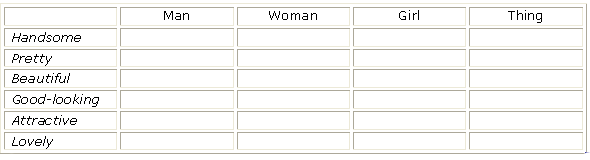
<body><![CDATA[<p><font face="Verdana, Arial, Helvetica, sans-serif" size="2">In addition, collocations    can be divided into different linguistic subclasses. Among them, it is possible    to find light verbs with little semantic content like <I>make</I> and <I>do    </I>in <I>make a mistake</I> and <I>do the homework</I>; verb particle constructions    or phrasal verbs like <I>go down</I>, but not <I>go apart</I>; proper nouns    such as <I>Noam Chomsky </I>and<I> </I>terminological expressions that<I> </I>refer    to concepts and objects in technical domains like<I> congestive heart failure</I>    and <I>personality trends</I>. </font></p>     <p> </p>     <p><font face="Verdana, Arial, Helvetica, sans-serif" size="2"><I>Collocational    restriction</I> is a linguistic term used in morphology. The term refers to    the fact that in certain two-word phrases the meaning of an individual word    is restricted to that particular phrase. For instance: the adjective <I>dry</I>    can only mean <I>`not sweet'</I> in combination with the noun <I>wine</I>. Other    illustrative examples are w<I>hite wine</I>, <I>white coffee</I>, <I>white noise</I>    and <I>white man</I>. All four instances of <I>white</I> are idiomatic because    in combination with certain nouns the meaning of <I>white</I> changes. In none    of the examples does <I>white</I> have its usual meaning. Instead, in the examples    above it means `yellowish', `brownish', `containing many frequencies with about    equal amplitude', and `pinkish' or `pale brown', respectively. </font></p>     <p><font face="Verdana, Arial, Helvetica, sans-serif" size="2">Another clarifying    illustration in reference to collocations is that <I>bad</I> has always been    taught as the antonym of <I>good </I>as in <I>good/bad news. </I>Nevertheless,    it is incorrect to talk about a <I>bad performance</I>. <I>Poor performance    </I>is the correct collocation. Instead of <I>bad</I>, the following expressions    meaning <I>bad</I> are used <I>an unpleasant/a foul/a disgusting </I>smell,    <I>appalling/dreadful/severe </I>weather<I>, an appalling/a frightening/a traumatic    </I>experience, <I>poor/weak </I>eyesight, <I>in difficult/appalling working    </I>conditions. </font></p>     <p> </p>     <p><font face="Verdana, Arial, Helvetica, sans-serif" size="2">In reference to    collocations, many educated speakers of English would not be aware of the concept;    however, they would very likely tell if a two-word phrase form a common expression.    Therefore, awareness of language expressions is an essential point in learning    correct collocations. If the expression is heard often, the words become `glued'    together in our minds<B><I>. `Crystal clear', `middle management' `nuclear family'    </I></B>and <B><I>`cosmetic surgery</I></B>' are examples of collocated pairs    of words. Some words are often found together because they make up a compound    noun, for example<B> <I>`riding boots</I></B>' or<B> <I>`motor cyclist</I></B>'.    </font></p>     <p> </p>     <p><font face="Verdana, Arial, Helvetica, sans-serif" size="2">Examples of other    well-collocated phrases could be: a person can be <B>`<I>locked in mortal combat</I></B>',    meaning involved in a serious fight, or<B> <I>`bright eyed and bushy tailed</I></B>',    meaning fresh and ready to go;&#160; `<B><I>red in the face</I></B>', meaning    <I>`embarrassed'</I>, or<B><I> `blue in the face</I>'</B> meaning <I>`angry'.</I>    It is not a common expression for someone to be <I>`yellow in the face'</I>    or <I>`green in the face'</I> however. Therefore <I>`red'</I> and <I>`blue'</I>    collocate with <I>`in the face'</I>, but <I>`yellow in the face'</I> or <I>`green    in the face'</I> are very probably mistakes. </font></p>     <p> </p>     <p><font face="Verdana, Arial, Helvetica, sans-serif" size="2">Experts in ELT    point out that the correct use of collocations by the learner is a sign of growth    and maturity in the use of the foreign language. The following exercise<SUP><FONT  COLOR="#0000ff"><a href="#pie">*</a></FONT><font face="Verdana, Arial, Helvetica, sans-serif" size="2"><sup><font  color="#0000ff"> </font><a href="#asterisco"></a><font face="Verdana, Arial, Helvetica, sans-serif" size="2"><sup><font face="Verdana, Arial, Helvetica, sans-serif" size="2"><sup><font  color="#0000ff"><a name="#asterisco"></a></font></sup></font></sup></font></sup></font></SUP>    further illustrates how a group of synonyms usually taught at basic level can    enrich the advanced learner's command of the English language. Which adjectives    collocate with which nouns?: </font></p>     ]]></body>
<body><![CDATA[<p align="center"><img src="/img/revistas/aci/v19n6/c0106609.gif" width="590" height="160" align="middle"></p>     
<p><font face="Verdana, Arial, Helvetica, sans-serif" size="2">Another possible    exercise to teach collocational restrictions is the following: </font></p>     <p></p>     <p align="center"><img src="/img/revistas/aci/v19n6/c0206609.gif" width="415" height="122">    
<br> </p>     <p><font face="Verdana, Arial, Helvetica, sans-serif" size="2">In sum, lexical    errors can lead to confusion, but that is not exactly the same as collocational    errors, most of which will be comprehensible. Claims that collocation learning    offers the learner with prefabricated lexical items for specific functions could    seem a bit excessive. The case for making collocation so central a part of language    learning does not take into account the learning aims, needs of many students    and teaching programmes. It places the native speaker right at the centre, though    for many programms and students the aim is not to reach that level, but simply    to communicate in a way that they can be understood. In such cases, there is    no driving need to combine words in exactly the same way as native speakers.    </font></p>     <p> </p>     <p><font face="Verdana, Arial, Helvetica, sans-serif" size="2">One criticism of    grammar based methods is that pragmatics suggests that perfection is not necessary.    The same could equally apply to collocation. Random lists of arbitrary pairings    and groupings do not in themselves constitute the missing link in language teaching.    However, an awareness of the issue, and knowledge of how checks can be made    through dictionaries, internet searches and concordance searches are all very    useful tools. Encouraging students to expose themselves as widely as possible    to written and oral texts as a way of meeting as many collocations as possible    will also help. </font></p>     <p></p>     <p></p>     ]]></body>
<body><![CDATA[<p>    <br>   <font face="Verdana, Arial, Helvetica, sans-serif" size="2"><B><font size="3">BIBLIOGRAPHIC    REFERENCES</font></B> </font></p>     <p> </p>     <!-- ref --><p><font face="Verdana, Arial, Helvetica, sans-serif" size="2">1. Oxford advanced    learner&#180;s dictionary. 7 ed. Oxford: Oxford University Press; 2005. </font><p> </p>     <!-- ref --><p><font face="Verdana, Arial, Helvetica, sans-serif" size="2">2. Martynska M.    Do English language learners know collocations? Investigationes. </font><font face="Verdana, Arial, Helvetica, sans-serif" size="2">    Linguisticae 2004;11:1-12. </font><p> </p>     <!-- ref --><p><font face="Verdana, Arial, Helvetica, sans-serif" size="2">3. McCarthy M,    O'Dell F. English vocabulary in use: advanced. Cambridge: Cambridge University    Press; 2008.    <br>       <br>       ]]></body>
<body><![CDATA[<br>       <br>       <br>       <br>   </font></p>     <p> </p>     <p> </p>     <p> </p>     <p> </p>     <p> </p>     <p><font face="Verdana, Arial, Helvetica, sans-serif" size="2">Received: 15 April    2007.    ]]></body>
<body><![CDATA[<br>   </font><font face="Verdana, Arial, Helvetica, sans-serif" size="2">Accepted:    30 April 2007. </font></p>     <p>    <br>       <br>       <br> </p>     <p> </p>     <p> </p>     <p> </p>     <p> </p>     <p><font face="Verdana, Arial, Helvetica, sans-serif" size="2">Ph. D. <I>Rafael    Forteza Fern&aacute;ndez</I>. Facultad de Enfermer&iacute;a.<B> </B>Carretera    del Valle, Pueblo Nuevo. Holgu&iacute;n. CP 80500. E-mail: <U><FONT  COLOR="#0000ff"><a href="mailto:forteza@enfer.hlg.sld.cu" target="_blank">forteza@enfer.hlg.sld.cu    </a></FONT></U> </font></p>     ]]></body>
<body><![CDATA[<p><font face="Verdana, Arial, Helvetica, sans-serif" size="2">    <br>       <br>   Processing Card&#160; </font></p>     <p><font face="Verdana, Arial, Helvetica, sans-serif" size="2">Terms suggested    for the indexation&#160; </font></p>     <p> </p>     <p><font face="Verdana, Arial, Helvetica, sans-serif" size="2">According to DeCS<SUP>1    <br>   </SUP></font><font face="Verdana, Arial, Helvetica, sans-serif" size="2">EDUCATION,    MEDICAL; STUDENTS, MEDICAL.    <br>   </font><font face="Verdana, Arial, Helvetica, sans-serif" size="2">EDUCACI&Oacute;N    M&Eacute;DICA; ESTUDIANTES DE MEDICINA. </font></p>     <p> </p>     <p><font face="Verdana, Arial, Helvetica, sans-serif" size="2">According to DeCI<SUP>2    ]]></body>
<body><![CDATA[<br>   </SUP></font><font face="Verdana, Arial, Helvetica, sans-serif" size="2">TECHNICAL    EDUCATION; LEARNING.    <br>   </font><font face="Verdana, Arial, Helvetica, sans-serif" size="2">ENSE&Ntilde;ANZA    TECNICA; APRENDIZAJE. </font></p>     <p> </p>     <p><font face="Verdana, Arial, Helvetica, sans-serif" size="2"><SUP>1</SUP>BIREME.    Descriptores en Ciencias de la Salud (DeCS). Sao Paulo: BIREME, 2004.    <br>   </font><font face="Verdana, Arial, Helvetica, sans-serif" size="2">Available    from: <U><FONT COLOR="#0000ff"><a href="http://decs.bvs.br/E/homepagee.htm" target="_blank">http://decs.bvs.br/E/homepagee.htm    </a></FONT></U> </font></p>     <p><font face="Verdana, Arial, Helvetica, sans-serif" size="2"><SUP>2</SUP>D&iacute;az    del Campo S. Propuesta de t&eacute;rminos para la indizaci&oacute;n en Ciencias    de la Informaci&oacute;n. Descriptores en Ciencias de la Informaci&oacute;n    (DeCI). Available from: <U><FONT  COLOR="#0000ff"><a href="http://cis.sld.cu/E/tesauro.pdf" target="_blank">http://cis.sld.cu/E/tesauro.pdf    </a></FONT></U> </font></p>     <p> </p>     <p><font face="Verdana, Arial, Helvetica, sans-serif" size="2">    <br>       <br>       ]]></body>
<body><![CDATA[<br>       <br>   Copyright: &#169; ECIMED. Open Access contribution, distributed under the terms    of the Creative Commons Non-Commercial Shareware License 2.0, which allows the    consultation, reproduction, public display and use of the results on practice    as well as all of its derivates, without commercial purposes and with an identical    license, as long as the author or authors is adequately cited as well as the    source. </font></p>     <p>    <br>       <br> </p>     <p><font face="Verdana, Arial, Helvetica, sans-serif" size="2">Cite (Vancouver):    Forteza Fern&aacute;ndez R, Prahlad SRR,<B> </B>Rubtsova E, Sabitov O. Collocations    in the vocabulary English teaching as a foreign language. Acimed 2009;16(6).    Available from: [Consulted: day/month/year]. </font></p>     <p> </p>     <p> </p>     <p></p>     <p><a href="#asterisco" target="_blank"><font color="#0000ff" face="Verdana, Arial, Helvetica, sans-serif" size="2">*From    Paul Gunashekar's advanced grammar lesson (Central Institute of English and    Foreign Languages University -Hyderabad, India). </font></a><a name="#pie"></a></p> <FONT COLOR="#0000ff">     ]]></body>
<body><![CDATA[<p>&nbsp; </p> </FONT>       ]]></body><back>
<ref-list>
<ref id="B1">
<label>1</label><nlm-citation citation-type="book">
<source><![CDATA[Oxford advanced learner´s dictionary. 7 ed.]]></source>
<year>2005</year>
<publisher-loc><![CDATA[Oxford: ]]></publisher-loc>
<publisher-name><![CDATA[Oxford University Press]]></publisher-name>
</nlm-citation>
</ref>
<ref id="B2">
<label>2</label><nlm-citation citation-type="journal">
<person-group person-group-type="author">
<name>
<surname><![CDATA[Martynska]]></surname>
<given-names><![CDATA[M.]]></given-names>
</name>
</person-group>
<article-title xml:lang="en"><![CDATA[Do English language learners know collocations?]]></article-title>
<source><![CDATA[Linguisticae]]></source>
<year>2004</year>
<volume>11</volume>
<page-range>1-12</page-range></nlm-citation>
</ref>
<ref id="B3">
<label>3</label><nlm-citation citation-type="book">
<person-group person-group-type="author">
<name>
<surname><![CDATA[McCarthy]]></surname>
<given-names><![CDATA[M]]></given-names>
</name>
<name>
<surname><![CDATA[O'Dell]]></surname>
<given-names><![CDATA[F.]]></given-names>
</name>
</person-group>
<source><![CDATA[English vocabulary in use:: advanced.]]></source>
<year>2008</year>
<publisher-loc><![CDATA[Cambridge: ]]></publisher-loc>
<publisher-name><![CDATA[Cambridge University Press]]></publisher-name>
</nlm-citation>
</ref>
</ref-list>
</back>
</article>