<?xml version="1.0" encoding="ISO-8859-1"?><article xmlns:mml="http://www.w3.org/1998/Math/MathML" xmlns:xlink="http://www.w3.org/1999/xlink" xmlns:xsi="http://www.w3.org/2001/XMLSchema-instance">
<front>
<journal-meta>
<journal-id>1025-028X</journal-id>
<journal-title><![CDATA[Vaccimonitor]]></journal-title>
<abbrev-journal-title><![CDATA[Vaccimonitor]]></abbrev-journal-title>
<issn>1025-028X</issn>
<publisher>
<publisher-name><![CDATA[Finlay Ediciones]]></publisher-name>
</publisher>
</journal-meta>
<article-meta>
<article-id>S1025-028X2009000200006</article-id>
<title-group>
<article-title xml:lang="es"><![CDATA[Respuesta inmune mucosal inducida por proteoliposoma y cocleato derivados de N. meningitidis serogrupo B.]]></article-title>
<article-title xml:lang="en"><![CDATA[Mucosal immune response induced by proteoliposome and cochleate derived from serogroups B N. meningitidis]]></article-title>
</title-group>
<contrib-group>
<contrib contrib-type="author">
<name>
<surname><![CDATA[del Campo]]></surname>
<given-names><![CDATA[Judith]]></given-names>
</name>
<xref ref-type="aff" rid="A01"/>
</contrib>
<contrib contrib-type="author">
<name>
<surname><![CDATA[Lastre]]></surname>
<given-names><![CDATA[Miriam]]></given-names>
</name>
<xref ref-type="aff" rid="A01"/>
</contrib>
<contrib contrib-type="author">
<name>
<surname><![CDATA[Zayas]]></surname>
<given-names><![CDATA[Caridad]]></given-names>
</name>
<xref ref-type="aff" rid="A01"/>
</contrib>
<contrib contrib-type="author">
<name>
<surname><![CDATA[Acevedo]]></surname>
<given-names><![CDATA[Reinaldo]]></given-names>
</name>
<xref ref-type="aff" rid="A01"/>
</contrib>
<contrib contrib-type="author">
<name>
<surname><![CDATA[González]]></surname>
<given-names><![CDATA[Elizabeth]]></given-names>
</name>
<xref ref-type="aff" rid="A01"/>
</contrib>
<contrib contrib-type="author">
<name>
<surname><![CDATA[Romeu]]></surname>
<given-names><![CDATA[Belkis]]></given-names>
</name>
<xref ref-type="aff" rid="A01"/>
</contrib>
<contrib contrib-type="author">
<name>
<surname><![CDATA[Cuello]]></surname>
<given-names><![CDATA[Maribel]]></given-names>
</name>
<xref ref-type="aff" rid="A01"/>
</contrib>
<contrib contrib-type="author">
<name>
<surname><![CDATA[Cabrera]]></surname>
<given-names><![CDATA[Osmir]]></given-names>
</name>
<xref ref-type="aff" rid="A01"/>
</contrib>
<contrib contrib-type="author">
<name>
<surname><![CDATA[Balboa]]></surname>
<given-names><![CDATA[Julio]]></given-names>
</name>
<xref ref-type="aff" rid="A01"/>
</contrib>
<contrib contrib-type="author">
<name>
<surname><![CDATA[Sarandi]]></surname>
<given-names><![CDATA[Ali M.]]></given-names>
</name>
<xref ref-type="aff" rid="A02"/>
</contrib>
<contrib contrib-type="author">
<name>
<surname><![CDATA[Pérez]]></surname>
<given-names><![CDATA[Oliver]]></given-names>
</name>
<xref ref-type="aff" rid="A01"/>
</contrib>
</contrib-group>
<aff id="A01">
<institution><![CDATA[,Finlay institute  ]]></institution>
<addr-line><![CDATA[Havana ]]></addr-line>
<country>Cuba</country>
</aff>
<aff id="A02">
<institution><![CDATA[,Institute of Biomedicine University of Gothenburg  ]]></institution>
<addr-line><![CDATA[ ]]></addr-line>
<country>Sweden</country>
</aff>
<pub-date pub-type="pub">
<day>00</day>
<month>08</month>
<year>2009</year>
</pub-date>
<pub-date pub-type="epub">
<day>00</day>
<month>08</month>
<year>2009</year>
</pub-date>
<volume>18</volume>
<numero>2</numero>
<fpage>71</fpage>
<lpage>74</lpage>
<copyright-statement/>
<copyright-year/>
<self-uri xlink:href="http://scielo.sld.cu/scielo.php?script=sci_arttext&amp;pid=S1025-028X2009000200006&amp;lng=en&amp;nrm=iso"></self-uri><self-uri xlink:href="http://scielo.sld.cu/scielo.php?script=sci_abstract&amp;pid=S1025-028X2009000200006&amp;lng=en&amp;nrm=iso"></self-uri><self-uri xlink:href="http://scielo.sld.cu/scielo.php?script=sci_pdf&amp;pid=S1025-028X2009000200006&amp;lng=en&amp;nrm=iso"></self-uri><abstract abstract-type="short" xml:lang="en"><p><![CDATA[Mucosal vaccination offers attractive advantages to conventional systemic vaccination. Most pathogens enter or establish infection at mucosal surfaces. This represents an enormous challenge for vaccine development. Nevertheless, the availability of safe and effective adjuvants that function mucosally is the major limitation. Therefore, we investigated the impact of mucosal immunization with the Neisseria meningitidis B proteoliposome (AFPL1, Adjuvant Finlay Proteoliposome 1) and its-derived cochleate (Co, AFCo1). They contain multiple PAMPs as immunopotentiators and have delivery system ability as well as Th1 polarization activity. Groups of female mice were immunized by nasal, oral, intravaginal, or intramuscular routes with three doses with AFPL1/AFCo1 alone or containing ovalbumin or glycoprotein (g) D2 from Herpes Simplex Virus type 2 (HSV-2). High levels of specific IgG antibodies were detected in sera of mice vaccinated with either route. However, specific IgA antibodies were produced in saliva and vaginal wash only following mucosal delivering. The polarization to a Th1 pattern was confirmed by testing the induction of IgG2a/IgG2c antibody, positive delayed-type hypersensitivity reactions, and gIFN production. Additionally, AFCo1gD2 showed practically no vaginal HSV-2 replication and 100% protection against lethal vaginal HSV-2 challenge. In conclusion, the results support the use of AFCo1 as potent Th1 adjuvant for mucosal vaccines, particularly for nasal route.]]></p></abstract>
<kwd-group>
<kwd lng="en"><![CDATA[Neisseria meningitidis]]></kwd>
<kwd lng="en"><![CDATA[Adjuvants]]></kwd>
<kwd lng="en"><![CDATA[Mucosal vaccines]]></kwd>
</kwd-group>
</article-meta>
</front><body><![CDATA[ <p align="right"><font size="2" face="Verdana, Arial, Helvetica, sans-serif"><b>ARTICULOS    ORIGINALES</b></font></p>     <p align="left"><font size="2" face="Verdana, Arial, Helvetica, sans-serif">    <br>   </font></p>     <p align="left"><font size="2" face="Verdana, Arial, Helvetica, sans-serif"><b><font size="4">Respuesta    inmune mucosal inducida por proteoliposoma y cocleato derivados de N. meningitidis    serogrupo B.</font><font size="4">    <br>   </font></b></font></p>     <p align="left"><font size="2" face="Verdana, Arial, Helvetica, sans-serif"><b><font size="3">Mucosal    immune response induced by proteoliposome and cochleate derived from serogroups    B N. meningitidis.</font></b></font></p>     <p align="left"><font size="2" face="Verdana, Arial, Helvetica, sans-serif"><b>    <br>   Judith del Campo1, Miriam Lastre1, Caridad Zayas1, Reinaldo Acevedo1, Elizabeth    Gonz&aacute;lez1, Belkis Romeu1, Maribel Cuello1, Osmir Cabrera1, Julio Balboa,    Ali M. Sarandi 2and Oliver P&eacute;rez1</b>     <br>       <br>   1 Immunology Department, Research Vice-presidency, Finlay Institute, P.O. Box    16017, Havana, Cuba.</font></p>     ]]></body>
<body><![CDATA[<p><font size="2" face="Verdana, Arial, Helvetica, sans-serif"> 2 Department of    Microbiology &amp; Immunology, Institute of Biomedicine University of Gothenburg,    Sweden. </font></p>     <p><font size="2" face="Verdana, Arial, Helvetica, sans-serif">email: j<a href="emailto:udithc@finlay.edu.cu">udithc@finlay.edu.cu    </a>    <br>       <br>       <br> </font></p> <hr>     <p><font size="2" face="Verdana, Arial, Helvetica, sans-serif"> <b><font size="3">Abstract</font></b></font></p>     <p><font size="2" face="Verdana, Arial, Helvetica, sans-serif">Mucosal vaccination    offers attractive advantages to conventional systemic vaccination. Most pathogens    enter or establish infection at mucosal surfaces. This represents an enormous    challenge for vaccine development. Nevertheless, the availability of safe and    effective adjuvants that function mucosally is the major limitation. Therefore,    we investigated the impact of mucosal immunization with the Neisseria meningitidis    B proteoliposome (AFPL1, Adjuvant Finlay Proteoliposome 1) and its-derived cochleate    (Co, AFCo1). They contain multiple PAMPs as immunopotentiators and have delivery    system ability as well as Th1 polarization activity. Groups of female mice were    immunized by nasal, oral, intravaginal, or intramuscular routes with three doses    with AFPL1/AFCo1 alone or containing ovalbumin or glycoprotein (g) D2 from Herpes    Simplex Virus type 2 (HSV-2). High levels of specific IgG antibodies were detected    in sera of mice vaccinated with either route. However, specific IgA antibodies    were produced in saliva and vaginal wash only following mucosal delivering.    The polarization to a Th1 pattern was confirmed by testing the induction of    IgG2a/IgG2c antibody, positive delayed-type hypersensitivity reactions, and    gIFN production. Additionally, AFCo1gD2 showed practically no vaginal HSV-2    replication and 100% protection against lethal vaginal HSV-2 challenge. In conclusion,    the results support the use of AFCo1 as potent Th1 adjuvant for mucosal vaccines,    particularly for nasal route.     <br>   </font></p>     <p><font size="2" face="Verdana, Arial, Helvetica, sans-serif"><b>keywords</b>:    Neisseria meningitidis, Adjuvants, Mucosal vaccines    <br>   </font></p> <hr>     ]]></body>
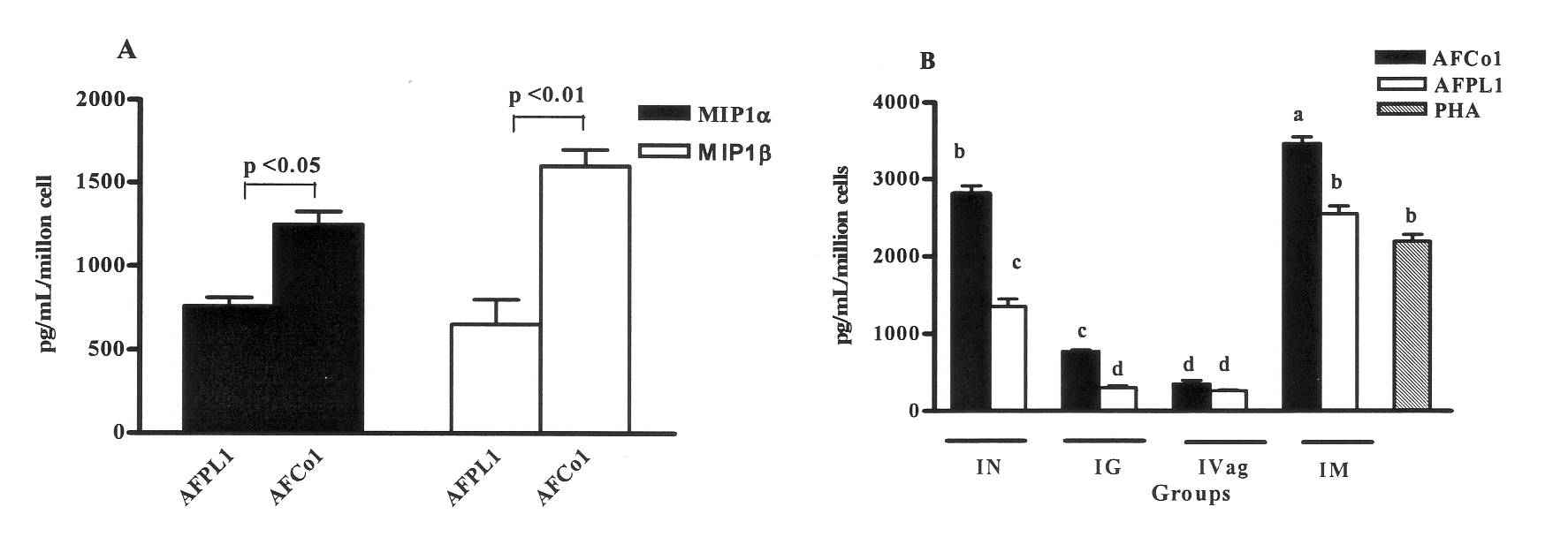
<body><![CDATA[<p><font size="3" face="Verdana, Arial, Helvetica, sans-serif"><b>Introduction    </b></font></p>     <p><font size="2" face="Verdana, Arial, Helvetica, sans-serif">Mucosal surfaces    are prominent in the gastrointestinal, urogenital, and respiratory tracts, and    provide portals of entry for pathogens (1). There are also important logistic    reasons that have made mucosal immunization attractive for public health services,    especially in developing countries (2). Currently, a major obstacle to developing    a mucosal vaccine in humans is finding a safe and effective adjuvant (2-6).    Neisseria meningitidis is a major cause of bacterial meningitis in the human,    especially among young children. Meningococcal serogroup B based in outer membrane    vesicles (Proteoliposome, PL) vaccine induces protective response (7). An attractive    vaccine strategy is therefore to induce immunological response at the mucosal    surfaces, with the possibility of blocking microbial invasion, as well as to    induce systemic immunity with the capacity of inactivating the microbes. AF    (Adjuvant Finlay) PL1, is a nanoparticle and contains multiples pathogen-associated    molecular patterns (PAMPs). Additionally, we have transformed AFPL1 into a Cochleate    (AFCo1) microparticle, that showed high stability and antigen delivering capacity    and that contain the same main components of AFPL1 including their PAMPs (8,    9). </font></p>     <p><font size="2" face="Verdana, Arial, Helvetica, sans-serif">    <br>   <b><font size="3">Materials and Methods</font></b> </font></p>     <p><font size="2" face="Verdana, Arial, Helvetica, sans-serif">PLs were obtained    from the outer membranes of N. meningitidis serogroup B Cu 385-83 strain (B:4:P1.19.15;    L3,7,9) and were produced on industrial scale under GMP conditions at the Finlay    Institute, Havana, Cuba. Cochleate structures were obtained from this PL (8).    Female Balb/c or C57BL6 mice were inoculated intranasally (IN), intrag&aacute;strica    (IG). Intravaginally routes (IVag) with AFPL1 or AFCo1 (50 &micro;g per dose    per mouse). Mice received three inoculations for mucosal routes, separated by    a 7 days interval. For intramuscular (IM) immunization, groups of five mice    received two doses of AFPL1 or AFCo1. Specific antibodies titers (IgG, IgA,    and IgG subclasses) in sera, saliva, and vaginal secretions of immunized mice    were determined by capture enzyme-linked immunosorbent assay (ELISA) (9). The    ability of AFPL1 or AFCo1 to induce MIP-a, MIP-1b, gIFN or IL-5 productions    was determinate on spleen cells from immunized mice. Concentrations of chemokines    (MIP-1a and MIP-1b) or cytokine (IFN-g and IL-5) in the cell culture supernatants    were determined using Douset chemokine ELISA kits (R&amp;D Systems, Abingdon,    United Kingdom). Challenge virus experiments were conducted as previously reported    (10). Six days later, the mice were challenged by an intravaginal administration    of 9x10⁴ PFU (200 50% lethal doses [LD50]) of HSV-2 strain 333. Mice were examined    daily for vaginal inflammation, neurological illness and death after HSV-2 infection.    Following intravaginal HSV-2 challenge, vaginal fluids were collected. The differences    between the groups were evaluated by a Tukey multiple comparison test and by    a Student's t test using Graph Pad Prism 4 software (CA, USA). </font></p>     <p><font size="3" face="Verdana, Arial, Helvetica, sans-serif"><b>Results </b></font></p>     <p><font size="2" face="Verdana, Arial, Helvetica, sans-serif">Notably, the IN,    or IG immunization of mice with AFCo1 or AFPL1 induce IgA antibodies in saliva    and vaginal washes.As expected, IN administration induced measurable levels    of specific IgA (p&lt;0.001). Neither of the AFCo1 or AFPL1 for IVag or IM immunized    groups had not detectable levels of specific IgA in saliva, but for the vaginal    washes the AFCo1 or AFPL1 groups had significant (p&lt;0.05) levels of PL-specific    IgA. Also, we examined anti PL IgG antibody responses in sera and vaginal lavages.    Mice immunized with AFPL1 or AFCo1 by any routes developed high levels of systemic    PL specific IgG antibody response. AFCo1 resulted in stronger anti PL IgG responses    (p&lt; 0.001) and longer persistence time in sera (up to 6 month) than AFPL1.    (Tab. 1). </font></p>     <p><font size="2" face="Verdana, Arial, Helvetica, sans-serif">In addition, the    presence of high levels of IgG2a in sera using IN, IG, IVag, or IM routes of    immunization constitutes indirect evidence of Th1 pattern induction. The data    demonstrates that those animals immunized with either AFCo1 or AFPL1 had the    good bactericidal activity against the Cu385-83 strain. The sera from the group    immunized with the AFCo1 for IN or IM were more effective at killing Cu385-83    serogroup B N. meningitidis strain than were the AFPL1 sera. Next, we evaluated,    the MIP-1a levels for both adjuvants were significantly higher responses than    control mice groups. Likewise, the MIP-1b production was significantly greater    in the AFCo1 or AFPL1 immunized group. Interestingly, the AFCo1 produced higher    levels of CC chemokines in spleen cells than AFPL1 (Figure 1A). We determined    the gIFN and IL-5 production by spleen cells from immunized mice with AFCo1    or AFPL1 for IN, IG, IVag, or IM, and found these routes produced considerable    amounts of gIFN (p&lt; 0.001, p&lt; 0.01, p&lt; 0.05. But no detectable IL-5    compared with those of naive mice (Figure 1B). </font></p>     <p><font size="2" face="Verdana, Arial, Helvetica, sans-serif">This is a direct    prove than AFCo1 induce a Th1 pattern. Overall, the AFCo1 immunized mice by    IN or IM routes had significantly higher responses than those of the AFPL1 immunized    mice or for IG and IVag routes. </font></p>     <p><font size="2" face="Verdana, Arial, Helvetica, sans-serif">The adjuvant capacity    of AFCo1 and AFPL1 was also addressed by immunizing mice with a model antigen,    a poorly immunogenic soluble antigen such as OVA and a viral antigen as by IVag    and IG routes and we compared these results with IN and IM routes. The same    result was obtained with either for all the routes immunized mice with OVA incorporated    in AFCo1 or AFPL1. </font></p>     ]]></body>
<body><![CDATA[<p><font size="2" face="Verdana, Arial, Helvetica, sans-serif">The results showed    that IN and IG administration of AFCo1-OVA and AFPL1-OVA also stimulate the    production of OVA-specific IgA in saliva and in vaginal washes significantly    higher than the groups immunized with OVA alone and enhanced the specific IgG    response against OVA for all routes explored and also resulted in sustained    systemic (anti-OVA IgG1 and IgG2a) antibody responses in the sera. As well as,    we demonstrate for the first time that the application of AFPL1 or AFCo1 by    nasal route, with a non replicating gD antigen included, elicited a strong antigen-specific    Th1-type cell-mediated immunity and total protection against an otherwise lethal    vaginal challenge with HSV-2. Interestingly, the intramuscular only confer a    60% of protection meanwhile the intravaginal route induce. </font></p>     <p><font size="3" face="Verdana, Arial, Helvetica, sans-serif"><b>Discussion</b></font><font size="2" face="Verdana, Arial, Helvetica, sans-serif">    </font></p>     <p><font size="2" face="Verdana, Arial, Helvetica, sans-serif">Mucosal surfaces    are enormous surface areas that are vulnerable to infection by pathogenic microorganisms.    Several investigations indicated a slight reduction in carriage rate among the    vaccinated individuals. Mucosal immunization would be a direct approach to stimulating    a mucosal response, since the human nasopharyngeal region is the natural habitat    for meningococci, and it is believed that nasopharyngeal carriage leads to natural    immunization. In the present study we evaluated other mucosal vaccination routes    to determine the most effective immune responses to AFPL1 or AFCo1, for this    propose we compared different mucosal routes against N. meningitidis antigens    on PLs. </font></p>     <p><font size="2" face="Verdana, Arial, Helvetica, sans-serif">This study suggested    that IN immunization induced relatively higher levels of mucosal specific IgA    and IgG in saliva, vaginal secretions, and sera than IG or IVag immunizations,    which support previous results (6) showing that IG route induce potent response    in the gastrointestinal-tract tissues and in IVag immunization had a local behavior    of the immune response, which could be important for protection against pathogens    that colonize vaginal mucosae and which is supported too, by animal studies    using other antigens coupled to Cholera Toxin B given by various routes(13).    We show here that the local mucosal administration of AFCo1 is associated with    a strong increase in the CC chemokines MIP-1a, MIP-1b. In addition, CC-chemokines    also link activation of the Th1 adaptive cellular immunity in the tissue to    the innate immune response (11, 12). Also, Spleen cell from AFCo1 or AFPL1 immunized    mice produced high levels of gIFN.     <br>       <br>   <a href="/img/revistas/vac/v18n2/t0106209.jpg">Table 1</a>. PL specific antibody responses induced    by different routes immunized mice. Groups of female Balb/c mice were vaccinated    with AFPL1, AFCo1. PL specific IgA or IgG levels in their saliva, sera or vaginal    washes, were determined using a specific ELISA. Significant differences between    the means of different groups were determined by a Tukey multiple comparison    test using the Graph Pad Prism 4 software (Calif.). A P-value of &lt;0.05 was    considered statistically significant and it is represent by different letters.        
<br>       <br>       <br>   <a href="/img/revistas/vac/v18n2/f0106209.JPG">Figure 1</a>. PL-specific cell-mediated immune    response. Groups of female Balb/c were immunized with AFPL1, AFCo1. Four weeks    after the last immunization, the mice were sacrificed and the spleen cells or    purified CD4+ T spleen cells were co-cultured with CD11c+ dendritic cells pulsed    with PL protein. (A) Shows PL-specific MIP-1a, MIP-1b contents by ELISA. (B)    Shows IFN-g concentration in co-cultures' supernatants. Significant differences    between the means of different groups were determined by a Tukey multiple comparison    test using statistical analyses with Graph Pad Prism 4 software.     
<br>       ]]></body>
<body><![CDATA[<br>       <br>   This result clearly indicates that in vivo AFCo1 induce the activation of T    cells and their differentiation into Th1 cells. Thus, the presence of gIFN producing    T cell clones is direct evidence of dendritic cells presentation of AFCo1 antigens.    AFCo1 is a very effective adjuvant that may be useful for the development of    such vaccines. The same result was obtained with either route immunized mice    with OVA or gD2 incorporated into AFCo1 or AFPL1. </font></p>     <p><font size="2" face="Verdana, Arial, Helvetica, sans-serif">Previous studies    have shown IN immunization to be an effective means for the induction of serum    and mucosal antigen specific antibodies (11-14). On the other hand, IN route    may be an effective alternative that is more convenient and acceptable, has    been more promising in terms of eliciting genital-tract antigen-specific IgA    and IgG in mice, primates, and human, too can avoid degradation of vaccine antigen    caused by digestive enzymes, and so requires a smaller dose of antigen than    oral immunization. In addition, the genital-tract antibodies generated as a    function of IN immunization have been demonstrated to be long lasting in mice    (11-14). </font></p>     <p><font size="2" face="Verdana, Arial, Helvetica, sans-serif">Finally, we observed    promising results with IN administration of AFCo1 containing gD2 of HSV for    induction of protective immunity against genital herpes, AFCo1gD confers a total    protection measured by elimination of virus. It is important to highlight to    know if both adjuvants are effective at inducing protection when we compare    the classical route of immunization, because all currently vaccine candidate    are parenteral vaccines. In summary, AFCo1 or AFPL1 have proved to function    very well both as nasal vaccine per se and as a mucosal adjuvant for nasal vaccine    such as HSV-2, human immunodeficiency virus, and human papilloma virus. </font></p>     <p><font size="2" face="Verdana, Arial, Helvetica, sans-serif">    <br>   <b><font size="3">References </font></b></font></p>     <!-- ref --><p><font size="2" face="Verdana, Arial, Helvetica, sans-serif">1. He Q, Mitchell    A, Morcol T, and Bell SJD. Calcium Phosphate Nanoparticles Induce Mucosal Immunity    and Protection against Herpes Simplex Virus Type 2. Clinical and Diagnostic    Laboratory Immunology 2002;9:1021_24. </font><!-- ref --><p><font size="2" face="Verdana, Arial, Helvetica, sans-serif">2. Neutra MR and    Kozlowski PA. Nature Reviews. Immunology 2006; 6:148-58. </font><!-- ref --><p><font size="2" face="Verdana, Arial, Helvetica, sans-serif">3. Mestecky J,    Russell MW, and Elson CO. Perspectives on Mucosal Vaccines: Is Mucosal Tolerance    a Barrier?. The Journal of Immunology: BRIEF REVIEW 2007: 5633-38. </font><!-- ref --><p><font size="2" face="Verdana, Arial, Helvetica, sans-serif">4. Johansen FE,    Baekkevold ES, Carlsen HS, Farstad IN, Soler D, and Brandtzaeg P. Regional induction    of adhesion molecules and chemokine receptors explains disparate homing of human    B cells to systemic and mucosal effector sites: dispersion from tonsils. Blood    2005;106:503-600. </font><!-- ref --><p><font size="2" face="Verdana, Arial, Helvetica, sans-serif">5. Alcon V, Baca-Estrada    M, Vega-L&oacute;pez M, Willson P, Babiuk LA, Kumar P, Hecker R and Foldvari    M. Mucosal Delivery of Bacterial Antigens and CpG Oligonucleotides Formulated    in Biphasic Lipid Vesicles in Pigs. The AAPS Journal 2005;7 (3) Article 57 (<a href="http://www.aapsj.org">http://www.aapsj.org</a>).    </font><!-- ref --><p><font size="2" face="Verdana, Arial, Helvetica, sans-serif">6. Holmgren J,    Czerkinsky C, Eriksson K, and Harandi A. Mucosal immunization and adjuvants:    a brief overview of recent advances and challenges. Vaccine 2003;21(Suppl 2):89-95.    </font><p><font size="2" face="Verdana, Arial, Helvetica, sans-serif">7. Sierra G, Campa    HC, Varcacel NM, Izquierdo PL, Sotolongo PF, Casanueva GV, et al. Vaccine against    group B Neisseria meningitidis: Protection trial and mass vaccination results    in Cuba. NIPH. Ann. 1991;14. </font></p>     <!-- ref --><p><font size="2" face="Verdana, Arial, Helvetica, sans-serif">8. Campa C, Sierra    VG, Guti&eacute;rrez M M. et al. Method of producing Neisseria meningitidis    B vaccine, and vaccine produced by method. United States Patent 1997. Patent    number 5 597 572. </font><!-- ref --><p><font size="2" face="Verdana, Arial, Helvetica, sans-serif">9. P&eacute;rez    O, Lastre M, Cabrera O, del Campo J, Bracho G, Cuello M, Balboa J, Acevedo R,    Zayas C, Gil D, Mora N, Gonz&aacute;lez D, P&eacute;rez R, Gonz&aacute;lez E,    Barbera R, Fajardo ME, Sierra G, Sol&iacute;s RL, and Campa C. New Vaccines    Require Potent Adjuvants like AFPL1 and AFCo1. Scandinavian Journal of Immunology    2007;66: 271-77. </font><!-- ref --><p><font size="2" face="Verdana, Arial, Helvetica, sans-serif">10. Rodr&iacute;guez    T, P&eacute;rez O, Menager N, Ugrinovic S, Bracho G, and Mastroeni P. Interactions    of proteoliposomes from serogroup B Neisseria meningitidis with bone marrow-derived    dendritic cells and macrophages: adjuvant effects and antigen delivery. Vaccine    2005;26:1312-21. </font><!-- ref --><p><font size="2" face="Verdana, Arial, Helvetica, sans-serif">11. S. Tengvall,    A. Josefsson, J. Holmgren and A. M. Harandi. CpG oligodeoxynucleotide augments    HSV-2 glycoprotein D DNA vaccine efficacy to generate T helper 1 response and    subsequent protection against primary genital herpes infection in mice. J Reproduct    Immunol 2005; 68:53_69. </font><!-- ref --><p><font size="2" face="Verdana, Arial, Helvetica, sans-serif">12. Singh D, O'Hagan.    Advances in vaccine adjuvants. Nat Biotechnol 1999;17:1075_81.    <!-- ref --><br>   13. J. Holmgrem, C. Czerkinsky. Mucosal immunity and vaccines. Nature Medicine    2005;11(4):45-52. </font><!-- ref --><p><font size="2" face="Verdana, Arial, Helvetica, sans-serif">14. Haneberg B,    Dalseg R, Wedege E, H&oslash;iby EA, Haugen IL, Oftung F, Andersen SR, Naess    LM, Aase A, Michaelsen TE, and Holst J. Intranasal administration of a meningococcal    outer membrane vesicle vaccine induces persistent local mucosal antibodies and    serum antibodies with strong bactericidal activity in humans. Infect Immun 1998;66:    1334_4.1.    <br>       <br>       <br>       <br>       <br>       <br>       <br>       <br>       <br>   </font></p>      ]]></body><back>
<ref-list>
<ref id="B1">
<label>1</label><nlm-citation citation-type="journal">
<person-group person-group-type="author">
<name>
<surname><![CDATA[He]]></surname>
<given-names><![CDATA[Q]]></given-names>
</name>
<name>
<surname><![CDATA[Mitchell]]></surname>
<given-names><![CDATA[A]]></given-names>
</name>
<name>
<surname><![CDATA[Morcol]]></surname>
<given-names><![CDATA[T]]></given-names>
</name>
<name>
<surname><![CDATA[Bell]]></surname>
<given-names><![CDATA[SJD]]></given-names>
</name>
</person-group>
<article-title xml:lang="en"><![CDATA[Calcium Phosphate Nanoparticles Induce Mucosal Immunity and Protection against Herpes Simplex Virus Type 2]]></article-title>
<source><![CDATA[Clinical and Diagnostic Laboratory Immunology]]></source>
<year>2002</year>
<volume>9</volume>
<page-range>1021_24</page-range></nlm-citation>
</ref>
<ref id="B2">
<label>2</label><nlm-citation citation-type="journal">
<person-group person-group-type="author">
<name>
<surname><![CDATA[Neutra]]></surname>
<given-names><![CDATA[MR]]></given-names>
</name>
<name>
<surname><![CDATA[Kozlowski]]></surname>
<given-names><![CDATA[PA]]></given-names>
</name>
</person-group>
<article-title xml:lang="en"><![CDATA[Nature Reviews]]></article-title>
<source><![CDATA[Immunology]]></source>
<year>2006</year>
<volume>6</volume>
<page-range>148-58</page-range></nlm-citation>
</ref>
<ref id="B3">
<label>3</label><nlm-citation citation-type="">
<person-group person-group-type="author">
<name>
<surname><![CDATA[Mestecky]]></surname>
<given-names><![CDATA[J]]></given-names>
</name>
<name>
<surname><![CDATA[Russell]]></surname>
<given-names><![CDATA[MW]]></given-names>
</name>
<name>
<surname><![CDATA[Elson]]></surname>
<given-names><![CDATA[CO]]></given-names>
</name>
</person-group>
<source><![CDATA[Perspectives on Mucosal Vaccines: Is Mucosal Tolerance a Barrier]]></source>
<year>2007</year>
<page-range>5633-38</page-range></nlm-citation>
</ref>
<ref id="B4">
<label>4</label><nlm-citation citation-type="journal">
<person-group person-group-type="author">
<name>
<surname><![CDATA[Johansen]]></surname>
<given-names><![CDATA[FE]]></given-names>
</name>
<name>
<surname><![CDATA[Baekkevold]]></surname>
<given-names><![CDATA[ES]]></given-names>
</name>
<name>
<surname><![CDATA[Carlsen]]></surname>
<given-names><![CDATA[HS]]></given-names>
</name>
<name>
<surname><![CDATA[Farstad]]></surname>
<given-names><![CDATA[IN]]></given-names>
</name>
<name>
<surname><![CDATA[Soler]]></surname>
<given-names><![CDATA[D]]></given-names>
</name>
<name>
<surname><![CDATA[Brandtzaeg]]></surname>
<given-names><![CDATA[P]]></given-names>
</name>
</person-group>
<article-title xml:lang="en"><![CDATA[Regional induction of adhesion molecules and chemokine receptors explains disparate homing of human B cells to systemic and mucosal effector sites: dispersion from tonsils]]></article-title>
<source><![CDATA[Blood]]></source>
<year>2005</year>
<volume>106</volume>
<page-range>503-600</page-range></nlm-citation>
</ref>
<ref id="B5">
<label>5</label><nlm-citation citation-type="">
<person-group person-group-type="author">
<name>
<surname><![CDATA[Alcon]]></surname>
<given-names><![CDATA[V]]></given-names>
</name>
<name>
<surname><![CDATA[Baca-Estrada]]></surname>
<given-names><![CDATA[M]]></given-names>
</name>
<name>
<surname><![CDATA[Vega-López]]></surname>
<given-names><![CDATA[M]]></given-names>
</name>
<name>
<surname><![CDATA[Willson]]></surname>
<given-names><![CDATA[P]]></given-names>
</name>
<name>
<surname><![CDATA[Babiuk]]></surname>
<given-names><![CDATA[LA]]></given-names>
</name>
<name>
<surname><![CDATA[Kumar]]></surname>
<given-names><![CDATA[P]]></given-names>
</name>
<name>
<surname><![CDATA[Hecker]]></surname>
<given-names><![CDATA[R]]></given-names>
</name>
<name>
<surname><![CDATA[Foldvari]]></surname>
<given-names><![CDATA[M]]></given-names>
</name>
</person-group>
<source><![CDATA[Mucosal Delivery of Bacterial Antigens and CpG Oligonucleotides Formulated in Biphasic Lipid Vesicles in Pigs]]></source>
<year>2005</year>
<edition>Article 57</edition>
</nlm-citation>
</ref>
<ref id="B6">
<label>6</label><nlm-citation citation-type="journal">
<person-group person-group-type="author">
<name>
<surname><![CDATA[Holmgren]]></surname>
<given-names><![CDATA[J]]></given-names>
</name>
<name>
<surname><![CDATA[Czerkinsky]]></surname>
<given-names><![CDATA[C]]></given-names>
</name>
<name>
<surname><![CDATA[Eriksson]]></surname>
<given-names><![CDATA[K]]></given-names>
</name>
<name>
<surname><![CDATA[Harandi]]></surname>
<given-names><![CDATA[A]]></given-names>
</name>
</person-group>
<article-title xml:lang="en"><![CDATA[Mucosal immunization and adjuvants: a brief overview of recent advances and challenges]]></article-title>
<source><![CDATA[Vaccine]]></source>
<year>2003</year>
<volume>21</volume>
<numero>^sSuppl 2</numero>
<issue>^sSuppl 2</issue>
<supplement>Suppl 2</supplement>
<page-range>89-95</page-range></nlm-citation>
</ref>
<ref id="B7">
<label>7</label><nlm-citation citation-type="journal">
<person-group person-group-type="author">
<name>
<surname><![CDATA[Sierra]]></surname>
<given-names><![CDATA[G]]></given-names>
</name>
<name>
<surname><![CDATA[Campa]]></surname>
<given-names><![CDATA[HC]]></given-names>
</name>
<name>
<surname><![CDATA[Varcacel]]></surname>
<given-names><![CDATA[NM]]></given-names>
</name>
<name>
<surname><![CDATA[Izquierdo]]></surname>
<given-names><![CDATA[PL]]></given-names>
</name>
<name>
<surname><![CDATA[Sotolongo]]></surname>
<given-names><![CDATA[PF]]></given-names>
</name>
<name>
<surname><![CDATA[Casanueva]]></surname>
<given-names><![CDATA[GV]]></given-names>
</name>
</person-group>
<article-title xml:lang="en"><![CDATA[Vaccine against group B Neisseria meningitidis: Protection trial and mass vaccination results in Cuba]]></article-title>
<source><![CDATA[NIPH. Ann]]></source>
<year>1991</year>
<volume>14</volume>
<page-range>pages195-207</page-range></nlm-citation>
</ref>
<ref id="B8">
<label>8</label><nlm-citation citation-type="">
<person-group person-group-type="author">
<name>
<surname><![CDATA[Campa]]></surname>
<given-names><![CDATA[C]]></given-names>
</name>
<name>
<surname><![CDATA[Sierra]]></surname>
<given-names><![CDATA[VG]]></given-names>
</name>
<name>
<surname><![CDATA[Gutiérrez]]></surname>
<given-names><![CDATA[M M]]></given-names>
</name>
</person-group>
<source><![CDATA[Method of producing Neisseria meningitidis B vaccine, and vaccine produced by method]]></source>
<year></year>
</nlm-citation>
</ref>
<ref id="B9">
<label>9</label><nlm-citation citation-type="journal">
<person-group person-group-type="author">
<name>
<surname><![CDATA[Pérez]]></surname>
<given-names><![CDATA[O]]></given-names>
</name>
<name>
<surname><![CDATA[Lastre]]></surname>
<given-names><![CDATA[M]]></given-names>
</name>
<name>
<surname><![CDATA[Cabrera]]></surname>
<given-names><![CDATA[O]]></given-names>
</name>
<name>
<surname><![CDATA[del Campo]]></surname>
<given-names><![CDATA[J]]></given-names>
</name>
<name>
<surname><![CDATA[Bracho]]></surname>
<given-names><![CDATA[G]]></given-names>
</name>
<name>
<surname><![CDATA[Cuello]]></surname>
<given-names><![CDATA[M]]></given-names>
</name>
<name>
<surname><![CDATA[Balboa]]></surname>
<given-names><![CDATA[J]]></given-names>
</name>
<name>
<surname><![CDATA[Acevedo]]></surname>
<given-names><![CDATA[R]]></given-names>
</name>
<name>
<surname><![CDATA[Zayas]]></surname>
<given-names><![CDATA[C]]></given-names>
</name>
<name>
<surname><![CDATA[Gil]]></surname>
<given-names><![CDATA[D]]></given-names>
</name>
<name>
<surname><![CDATA[Mora]]></surname>
<given-names><![CDATA[N]]></given-names>
</name>
<name>
<surname><![CDATA[González]]></surname>
<given-names><![CDATA[D]]></given-names>
</name>
<name>
<surname><![CDATA[Pérez]]></surname>
<given-names><![CDATA[R]]></given-names>
</name>
<name>
<surname><![CDATA[González]]></surname>
<given-names><![CDATA[E]]></given-names>
</name>
<name>
<surname><![CDATA[Barbera]]></surname>
<given-names><![CDATA[R]]></given-names>
</name>
<name>
<surname><![CDATA[Fajardo]]></surname>
<given-names><![CDATA[ME]]></given-names>
</name>
<name>
<surname><![CDATA[Sierra]]></surname>
<given-names><![CDATA[G]]></given-names>
</name>
<name>
<surname><![CDATA[Solís]]></surname>
<given-names><![CDATA[RL]]></given-names>
</name>
<name>
<surname><![CDATA[Campa]]></surname>
<given-names><![CDATA[C]]></given-names>
</name>
</person-group>
<article-title xml:lang="en"><![CDATA[New Vaccines Require Potent Adjuvants like AFPL1 and AFCo1]]></article-title>
<source><![CDATA[Scandinavian Journal of Immunology]]></source>
<year>2007</year>
<volume>66</volume>
<page-range>271-77</page-range></nlm-citation>
</ref>
<ref id="B10">
<label>10.</label><nlm-citation citation-type="journal">
<person-group person-group-type="author">
<name>
<surname><![CDATA[Rodríguez]]></surname>
<given-names><![CDATA[T]]></given-names>
</name>
<name>
<surname><![CDATA[Pérez]]></surname>
<given-names><![CDATA[O]]></given-names>
</name>
<name>
<surname><![CDATA[Menager]]></surname>
<given-names><![CDATA[N]]></given-names>
</name>
<name>
<surname><![CDATA[Ugrinovic]]></surname>
<given-names><![CDATA[S]]></given-names>
</name>
<name>
<surname><![CDATA[Bracho]]></surname>
<given-names><![CDATA[G]]></given-names>
</name>
<name>
<surname><![CDATA[Mastroeni]]></surname>
<given-names><![CDATA[P]]></given-names>
</name>
</person-group>
<article-title xml:lang="en"><![CDATA[Interactions of proteoliposomes from serogroup B Neisseria meningitidis with bone marrow-derived dendritic cells and macrophages: adjuvant effects and antigen delivery]]></article-title>
<source><![CDATA[Vaccine]]></source>
<year>2005</year>
<volume>26</volume>
<page-range>1312-21</page-range></nlm-citation>
</ref>
<ref id="B11">
<label>11</label><nlm-citation citation-type="journal">
<person-group person-group-type="author">
<name>
<surname><![CDATA[Tengval]]></surname>
<given-names><![CDATA[S.]]></given-names>
</name>
<name>
<surname><![CDATA[Josefsson]]></surname>
<given-names><![CDATA[A.]]></given-names>
</name>
<name>
<surname><![CDATA[Holmgren]]></surname>
<given-names><![CDATA[J.]]></given-names>
</name>
<name>
<surname><![CDATA[Harandi]]></surname>
<given-names><![CDATA[A. M]]></given-names>
</name>
</person-group>
<article-title xml:lang="en"><![CDATA[CpG oligodeoxynucleotide augments HSV-2 glycoprotein D DNA vaccine efficacy to generate T helper 1 response and subsequent protection against primary genital herpes infection in mice]]></article-title>
<source><![CDATA[J Reproduct Immunol]]></source>
<year>2005</year>
<volume>68</volume>
<page-range>53_69</page-range></nlm-citation>
</ref>
<ref id="B12">
<label>12</label><nlm-citation citation-type="journal">
<person-group person-group-type="author">
<name>
<surname><![CDATA[Singh]]></surname>
<given-names><![CDATA[D]]></given-names>
</name>
<name>
<surname><![CDATA[Hagan]]></surname>
<given-names><![CDATA[O']]></given-names>
</name>
</person-group>
<article-title xml:lang="en"><![CDATA[Advances in vaccine adjuvants]]></article-title>
<source><![CDATA[Nat Biotechnol]]></source>
<year>1999</year>
<volume>17</volume>
<page-range>1075_81</page-range></nlm-citation>
</ref>
<ref id="B13">
<label>13</label><nlm-citation citation-type="journal">
<person-group person-group-type="author">
<name>
<surname><![CDATA[Holmgrem]]></surname>
<given-names><![CDATA[J]]></given-names>
</name>
<name>
<surname><![CDATA[Czerkinsky]]></surname>
<given-names><![CDATA[C]]></given-names>
</name>
</person-group>
<article-title xml:lang="en"><![CDATA[Mucosal immunity and vaccines]]></article-title>
<source><![CDATA[Nature Medicine]]></source>
<year>2005</year>
<volume>11</volume>
<page-range>45-52</page-range></nlm-citation>
</ref>
<ref id="B14">
<label>14</label><nlm-citation citation-type="journal">
<person-group person-group-type="author">
<name>
<surname><![CDATA[Haneberg]]></surname>
<given-names><![CDATA[B]]></given-names>
</name>
<name>
<surname><![CDATA[Dalseg]]></surname>
<given-names><![CDATA[R]]></given-names>
</name>
<name>
<surname><![CDATA[Wedege]]></surname>
<given-names><![CDATA[E]]></given-names>
</name>
<name>
<surname><![CDATA[Høiby]]></surname>
<given-names><![CDATA[EA]]></given-names>
</name>
<name>
<surname><![CDATA[Haugen]]></surname>
<given-names><![CDATA[IL]]></given-names>
</name>
<name>
<surname><![CDATA[Oftung]]></surname>
<given-names><![CDATA[F]]></given-names>
</name>
<name>
<surname><![CDATA[Andersen]]></surname>
<given-names><![CDATA[SR]]></given-names>
</name>
<name>
<surname><![CDATA[Naess]]></surname>
<given-names><![CDATA[LM]]></given-names>
</name>
<name>
<surname><![CDATA[Aase]]></surname>
<given-names><![CDATA[A]]></given-names>
</name>
<name>
<surname><![CDATA[Michaelsen]]></surname>
<given-names><![CDATA[TE]]></given-names>
</name>
<name>
<surname><![CDATA[Holst]]></surname>
<given-names><![CDATA[J]]></given-names>
</name>
</person-group>
<article-title xml:lang="en"><![CDATA[Intranasal administration of a meningococcal outer membrane vesicle vaccine induces persistent local mucosal antibodies and serum antibodies with strong bactericidal activity in humans]]></article-title>
<source><![CDATA[Infect Immun]]></source>
<year>1998</year>
<volume>66</volume>
<page-range>1334_41</page-range></nlm-citation>
</ref>
</ref-list>
</back>
</article>