<?xml version="1.0" encoding="ISO-8859-1"?><article xmlns:mml="http://www.w3.org/1998/Math/MathML" xmlns:xlink="http://www.w3.org/1999/xlink" xmlns:xsi="http://www.w3.org/2001/XMLSchema-instance">
<front>
<journal-meta>
<journal-id>1025-028X</journal-id>
<journal-title><![CDATA[Vaccimonitor]]></journal-title>
<abbrev-journal-title><![CDATA[Vaccimonitor]]></abbrev-journal-title>
<issn>1025-028X</issn>
<publisher>
<publisher-name><![CDATA[Finlay Ediciones]]></publisher-name>
</publisher>
</journal-meta>
<article-meta>
<article-id>S1025-028X2009000200007</article-id>
<title-group>
<article-title xml:lang="es"><![CDATA[Respuesta inmune sistémica y mucosal contra Neisseria meningitidis B inducida por estrategia de vacunación simultánea mucosal y parental]]></article-title>
<article-title xml:lang="en"><![CDATA[Mucosal and systemic immune response against Neisseria meningitidis b induced by single time vaccination strategy]]></article-title>
</title-group>
<contrib-group>
<contrib contrib-type="author">
<name>
<surname><![CDATA[González]]></surname>
<given-names><![CDATA[E]]></given-names>
</name>
<xref ref-type="aff" rid="A01"/>
</contrib>
<contrib contrib-type="author">
<name>
<surname><![CDATA[Romeu]]></surname>
<given-names><![CDATA[B]]></given-names>
</name>
<xref ref-type="aff" rid="A01"/>
</contrib>
<contrib contrib-type="author">
<name>
<surname><![CDATA[del Campo]]></surname>
<given-names><![CDATA[J]]></given-names>
</name>
<xref ref-type="aff" rid="A01"/>
</contrib>
<contrib contrib-type="author">
<name>
<surname><![CDATA[Acevedo]]></surname>
<given-names><![CDATA[R]]></given-names>
</name>
<xref ref-type="aff" rid="A01"/>
</contrib>
<contrib contrib-type="author">
<name>
<surname><![CDATA[Lastre]]></surname>
<given-names><![CDATA[M]]></given-names>
</name>
<xref ref-type="aff" rid="A01"/>
</contrib>
<contrib contrib-type="author">
<name>
<surname><![CDATA[Zayas]]></surname>
<given-names><![CDATA[C]]></given-names>
</name>
<xref ref-type="aff" rid="A01"/>
</contrib>
<contrib contrib-type="author">
<name>
<surname><![CDATA[Cuello]]></surname>
<given-names><![CDATA[M]]></given-names>
</name>
<xref ref-type="aff" rid="A01"/>
</contrib>
<contrib contrib-type="author">
<name>
<surname><![CDATA[Cabrera]]></surname>
<given-names><![CDATA[O]]></given-names>
</name>
<xref ref-type="aff" rid="A01"/>
</contrib>
<contrib contrib-type="author">
<name>
<surname><![CDATA[Balboa]]></surname>
<given-names><![CDATA[J]]></given-names>
</name>
<xref ref-type="aff" rid="A01"/>
</contrib>
<contrib contrib-type="author">
<name>
<surname><![CDATA[Nuñez]]></surname>
<given-names><![CDATA[N]]></given-names>
</name>
<xref ref-type="aff" rid="A01"/>
</contrib>
<contrib contrib-type="author">
<name>
<surname><![CDATA[Valdez]]></surname>
<given-names><![CDATA[Y]]></given-names>
</name>
<xref ref-type="aff" rid="A01"/>
</contrib>
<contrib contrib-type="author">
<name>
<surname><![CDATA[Fariñas]]></surname>
<given-names><![CDATA[M]]></given-names>
</name>
<xref ref-type="aff" rid="A01"/>
</contrib>
<contrib contrib-type="author">
<name>
<surname><![CDATA[Pérez]]></surname>
<given-names><![CDATA[O]]></given-names>
</name>
<xref ref-type="aff" rid="A01"/>
</contrib>
</contrib-group>
<aff id="A01">
<institution><![CDATA[,Finlay Institute  ]]></institution>
<addr-line><![CDATA[ ]]></addr-line>
</aff>
<pub-date pub-type="pub">
<day>00</day>
<month>08</month>
<year>2009</year>
</pub-date>
<pub-date pub-type="epub">
<day>00</day>
<month>08</month>
<year>2009</year>
</pub-date>
<volume>18</volume>
<numero>2</numero>
<fpage>75</fpage>
<lpage>77</lpage>
<copyright-statement/>
<copyright-year/>
<self-uri xlink:href="http://scielo.sld.cu/scielo.php?script=sci_arttext&amp;pid=S1025-028X2009000200007&amp;lng=en&amp;nrm=iso"></self-uri><self-uri xlink:href="http://scielo.sld.cu/scielo.php?script=sci_abstract&amp;pid=S1025-028X2009000200007&amp;lng=en&amp;nrm=iso"></self-uri><self-uri xlink:href="http://scielo.sld.cu/scielo.php?script=sci_pdf&amp;pid=S1025-028X2009000200007&amp;lng=en&amp;nrm=iso"></self-uri><abstract abstract-type="short" xml:lang="en"><p><![CDATA[Immunization is one of the most successful and cost-effective health interventions ever. Immunization have been helping to reduce child mortality, improving maternal health and combating infectious diseases. In spite of its, undisputed past success and promising future, however, immunization remains an unfinished agenda because of them inadequate coverage. Several factors have been largely responsible of a difficulty to attain immunization coverage and have been recognized as a problems of current vaccines, such as: the number of dose, excessive use of parenteral route, a small number of adjuvants approve for use in human, higher reactogenicity and unavailability against intracellular pathogens, infected or altered cells and scanty feasibility to combined more than one antigen in the same formulation. For bacterial meningitis WHO estimates that 1.2 million cases occur annually and Neisseria meningitidis is the etiological agent in more than 40% of these cases although some meningococcal vaccines are available. To bear in mind these principals problems, a novel protocol for vaccination against N. meningitidis called Single Time Vaccination Strategy (SinTimVaS) is proposed. Using female BALB/c mice, we induce systemic and mucosal immune responses against N. meningitidis with only one parenteral and one mucosal dose at the same time, employing the Finlay Adjuvants derivate from N. meningitidis, AFPL1 and AFCo1, respectively. In conclusion, SinTimVaS could increase the vaccination coverage and reduce the time-cost of vaccine campaigns, adding the possibility to increase the herd immunity by mucosal specific response induction.]]></p></abstract>
<kwd-group>
<kwd lng="en"><![CDATA[Neisseria meningitidis]]></kwd>
<kwd lng="en"><![CDATA[SinTimVaS]]></kwd>
<kwd lng="en"><![CDATA[Adjuvants]]></kwd>
</kwd-group>
</article-meta>
</front><body><![CDATA[ <p align="right"><font face="Verdana, Arial, Helvetica, sans-serif" size="2"><b>ARTICULOS    ORIGINALES</b></font></p>     <p><font face="Verdana, Arial, Helvetica, sans-serif" size="2">    <br>   </font></p>     <p><font face="Verdana, Arial, Helvetica, sans-serif" size="2"><b><font size="4">Respuesta    inmune sist&eacute;mica y mucosal contra Neisseria meningitidis B inducida por    estrategia de vacunaci&oacute;n simult&aacute;nea mucosal y parental.</font>    <br>   </b></font></p>     <p><font face="Verdana, Arial, Helvetica, sans-serif" size="2"><b><font size="3">Mucosal    and systemic immune response against Neisseria meningitidis B induced by single    time vaccination strategy.</font>    <br>       <br>   Gonz&aacute;lez E, Romeu B, del Campo J, Acevedo R, Lastre M, Zayas C, Cuello    M, Cabrera O, Balboa J, Nu&ntilde;ez N, Valdez Y1, Fari&ntilde;as M1, and P&eacute;rez    O </b>    <br>       <br>   Immunology Department and 1Animal Models Department, Vice presidency of Research,    Finlay Institute. </font></p>     ]]></body>
<body><![CDATA[<p><font face="Verdana, Arial, Helvetica, sans-serif" size="2">email: <a href="emailto:elygonzalez@finlay.edu.cu">elygonzalez@finlay.edu.cu</a>      <br>       <br> </font></p> <hr>     <p><font face="Verdana, Arial, Helvetica, sans-serif" size="2"> <font size="3"><b>Abstract</b></font></font></p>     <p><font face="Verdana, Arial, Helvetica, sans-serif" size="2">Immunization is    one of the most successful and cost-effective health interventions ever. Immunization    have been helping to reduce child mortality, improving maternal health and combating    infectious diseases. In spite of its, undisputed past success and promising    future, however, immunization remains an unfinished agenda because of them inadequate    coverage. Several factors have been largely responsible of a difficulty to attain    immunization coverage and have been recognized as a problems of current vaccines,    such as: the number of dose, excessive use of parenteral route, a small number    of adjuvants approve for use in human, higher reactogenicity and unavailability    against intracellular pathogens, infected or altered cells and scanty feasibility    to combined more than one antigen in the same formulation. For bacterial meningitis    WHO estimates that 1.2 million cases occur annually and Neisseria meningitidis    is the etiological agent in more than 40% of these cases although some meningococcal    vaccines are available. To bear in mind these principals problems, a novel protocol    for vaccination against N. meningitidis called Single Time Vaccination Strategy    (SinTimVaS) is proposed. Using female BALB/c mice, we induce systemic and mucosal    immune responses against N. meningitidis with only one parenteral and one mucosal    dose at the same time, employing the Finlay Adjuvants derivate from N. meningitidis,    AFPL1 and AFCo1, respectively. In conclusion, SinTimVaS could increase the vaccination    coverage and reduce the time-cost of vaccine campaigns, adding the possibility    to increase the herd immunity by mucosal specific response induction.     <br>   </font></p>     <p><font face="Verdana, Arial, Helvetica, sans-serif" size="2"><b>keywords</b>:    Neisseria meningitidis, SinTimVaS, Adjuvants.    <br>       <br>   </font></p> <hr>     <p><font face="Verdana, Arial, Helvetica, sans-serif" size="2"> <b><font size="3">Introduction    </font></b></font></p>     ]]></body>
<body><![CDATA[<p><font face="Verdana, Arial, Helvetica, sans-serif" size="2">Vaccination is    considered by the World Health Organization (WHO) to be the most cost-effective    strategy for controlling infectious diseases but a successful immunization program    can contribute much more than just vaccines (1). Epidemiologically targeted    implementation of vaccines has diminished morbidity and mortality from many    infectious diseases that previously were scourges and economic burdens (such    as measles, polio, diphtheria, Haemophilus influenzae type b, meningococcal,    and pneumococcal infections) (2). In spite of great successes with these existing    vaccines, they are still leading killers, because of they inadequate coverage    estimated at: DPT, 89%; TT, 69%; Hep B, 60%; Hib, 22%; Polio, 80%, and Yellow    fever, 48%, showing that although these coverages have been increased every    year, they are still inefficient (2, 3). </font></p>     <p><font face="Verdana, Arial, Helvetica, sans-serif" size="2">In the case of    bacterial meningitis the WHO estimates that 1.2 million cases of bacterial meningitis    occur annually, with 135000 deaths. In spite of current vaccines, Neisseria    meningitidis is the etiological agent in more than 40% of these cases (4). </font></p>     <p><font face="Verdana, Arial, Helvetica, sans-serif" size="2">Several factors    have been largely responsible of a difficulty to attain immunization coverage    and have been recognized as a problems of current vaccines, such as: the number    of dose in the immunization schedule, the excessive use of parenteral route    over mucosal route, the inadequate progress in the field of adjuvants for use    in human vaccines, higher reactogenicity and unavailability of these vaccines    against     <br>   intracellular pathogens, infected or altered cells such as malaria and HIV,    which rely on cell-mediated immunity and scanty feasibility to combined more    than one antigen in the same formulation (5). </font></p>     <p><font face="Verdana, Arial, Helvetica, sans-serif" size="2">For meningococcal    vaccines, others factors have been added, like the majority of available vaccines    protect against some but not all forms of meningitis, and they provide an efficient    systemic immune response modify but not eliminate the nasopharyngeal carriage    and with this the disease transmissibility. </font></p>     <p><font face="Verdana, Arial, Helvetica, sans-serif" size="2">To bear in mind    these principal problems of current vaccines and in light of the ambitious aim    of future vaccines, a novel protocol for vaccination named Single Time Vaccination    Strategy (SinTimVaS) is proposed. Using AFPL1 (Adjuvant Finlay Proteoliposome    1, a detergent-extracted of outer membrane vesicle from N. meningitidis B) and    AFCo1 (Adjuvant Finlay cochlear structure derived from PL in interaction with    Ca2+), we demonstrated that is possible to induce similar systemic immune response    against N. meningitidis B than parenteral immunization, but adding mucosal immune    response only with one parenteral dose of AFPL1 and one mucosal dose of AFCo1    at the same time in mice. </font></p>     <p><font face="Verdana, Arial, Helvetica, sans-serif" size="2"><b><font size="3">Materials    and Methods </font></b> </font></p>     <p><font face="Verdana, Arial, Helvetica, sans-serif" size="2"><b>AFPL1.</b> Outer    membrane vesicles (called proteoliposome or PL when used as antigen and AFPL1,    when used as adjuvant)     <br>   were produced at industrial scale under GMP conditions at Finlay Institute,    Havana, Cuba (6). </font></p>     <p><font face="Verdana, Arial, Helvetica, sans-serif" size="2"><b>AFCo1</b>. Adjuvant    Finlay Cochleate 1 and the incorporation of non-related antigens were carried    out at development scale under GMP conditions at Finlay Institute as previously    described (7). </font></p>     ]]></body>
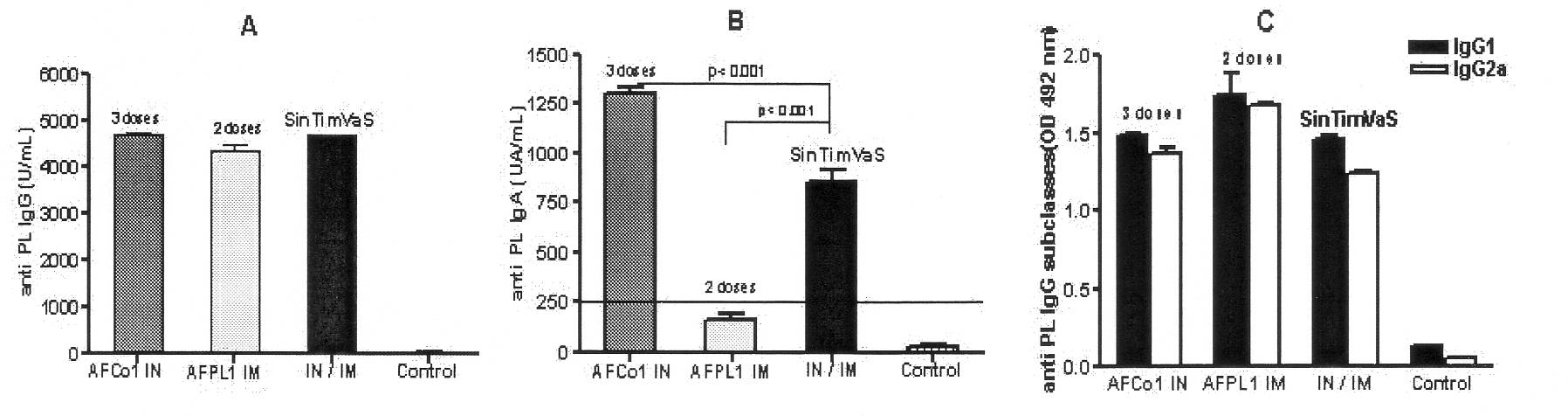
<body><![CDATA[<p><font face="Verdana, Arial, Helvetica, sans-serif" size="2"><b>Animals</b>:    Female BALB/c mice (CENPALAB), 6-8 weeks old and weighing 18-20 g was used to    carried out the objectives. </font></p>     <p><font face="Verdana, Arial, Helvetica, sans-serif" size="2"><b>Immunization    regiments</b>. Balb/C mice (n = 3) were distributed in 3 immunized groups and    one of control. The first group was immunized with three nasal (IN) dose of    AFCo1 (50 &micro;g in 25 &micro;L, 12.5 &micro;L in each nostril) with 7-day    interval. The second group was immunized with two intramuscular (IM) doses respectively    of AFPL1 (12.5 &micro;g in 50 &micro;L) with 14-day interval. The last group    was immunized with one IN dose of AFCo1 (100 &micro;g in 25 &micro;L, 12.5 &micro;L    in each nostril) and one IM dose of AFPL1 (25 &micro;g in 50 &micro;L) at the    same time. </font></p>     <p><font face="Verdana, Arial, Helvetica, sans-serif" size="2"><b>Collection of    samples</b>. Saliva and serum were collected to determinate anti PL IgA and    IgG titres, respectively. Saliva was collected at day 7 after the immunization    schedules and serum on day 21 as previously described (8). </font></p>     <p><font face="Verdana, Arial, Helvetica, sans-serif" size="2"><b>Analysis of    immune response</b>. Anti PL IgA titers in saliva and anti PL IgG, IgG1 / IgG2a    in serum were measured by direct ELISA using polystyrene 96-well plates (MaxiSorp    F96; Nunc, Roskilde, Denmark) as previously described (8). Anti PL IgG and IgA    titres are expressed as unit/mL and arbitrary unit/mL, respectively + standard    deviation of the mean from three independent experiments. The anti PL IgG subclasses    are expressed in optical density units (OD). </font></p>     <p><font face="Verdana, Arial, Helvetica, sans-serif" size="2"><b>Statistical    analysis</b>. Significant differences between the means of different groups    were determined by a Tukey multiple comparison tests using the Graph Pad Prism    4 Software (CA, USA).     <br>   </font></p>     <p><font face="Verdana, Arial, Helvetica, sans-serif" size="2"><a href="/img/revistas/vac/v18n2/f0107209.jpg">Figure    1</a>. Anti PL immune response induced by SinTimVaS. Balb/C mice (n = 3) were    distributed in 3 immunized groups and one of control. The first group was immunized    with three IN dose of AFCo1 (50 &micro;g in 25 &micro;L, 12.5 &micro;L in each    nostril) with 7-day interval. The second group was immunized with two IM doses    respectively of AFPL1 (12.5 &micro;g in 50 &micro;L) with 14-day interval. The    last group was immunized with one IN dose of AFCo1 (100 &micro;g in 25 &micro;L,    12.5 &micro;L in each nostril) and one IM dose of AFPL1 (25 &micro;g in 50 &micro;L)    at the same time. Anti PL specific IgG (A), and IgG subclasses (C) antibodies    titters in serum and IgA (B) in saliva were measured by direct ELISA. A P-value    &lt;0.05 was considered statistically significant.     
<br> </font></p>     <p><font face="Verdana, Arial, Helvetica, sans-serif" size="2"><b><font size="3">Results    and Discussion </font></b> </font></p>     <p><font face="Verdana, Arial, Helvetica, sans-serif" size="2">We have been demonstrated    in previous studies, the benefits of use our derivates from N. meningitidis    B (AFPL1 and AFCo1) in the induction of immune response against this agent (8).    Both structures induce an efficient mucosal and systemic immune response with    specific IgA response on mucosal secretions by IN rout and specific IgG, IgG1,    and IgG2a subclasses responses in serum by all routes, although AFCo1 induces    a significant greater mucosal immune response than AFPL1 mainly by mucosal rout    (8). </font></p>     ]]></body>
<body><![CDATA[<p><font face="Verdana, Arial, Helvetica, sans-serif" size="2">In addition, it    has been confirmed for many researches that in general, systemically administered    vaccines, although inducing good systemic T cell responses rarely induce optimal    mucosal immune responses (9, 10). However others studies had confirmed that    parenteral routes can boost the mucosal immune response induced by mucosal vaccination.    Many studies combine nasal or/and oral routs with intramuscular routs, using    mucosal rout for priming dose and parenteral rout for booster dose (traditional    prime-boosts spaced doses) inducing systemic and mucosal immune response (11).    </font></p>     <p><font face="Verdana, Arial, Helvetica, sans-serif" size="2">In SinTimVaS using    the Finlay Adjuvants and combining mucosal with parenteral rout at the same    time, both systemic and mucosal immune responses were induced. With this proprietary    new strategy of vaccination (12) against N. meningitidis B, one IN dose of AFCo1    simultaneously with one IM dose of AFPL1, induce similar anti PL specific IgG    and IgG subclasses antibodies titters in serum than two IM AFPL1 doses or three    IN AFCo1 doses, but in addition it induces mucosal specific IgA response (Figure    1). </font></p>     <p><font face="Verdana, Arial, Helvetica, sans-serif" size="2">In conclusion,    SinTimVaS induces an efficient systemic immune response as well as mucosal immune    response at least in mice.     <br>       <br>       <br>   <font size="3"><b>References </b></font></font></p>     <!-- ref --><p><font face="Verdana, Arial, Helvetica, sans-serif" size="2">1. WHO-UNICEF,    GIVS (Global Immunization Vision and Strategy) 2006-2015. </font><!-- ref --><p><font face="Verdana, Arial, Helvetica, sans-serif" size="2">2. WHO-UNICEF,    Global Immunization Data, January 2008. </font><!-- ref --><p><font face="Verdana, Arial, Helvetica, sans-serif" size="2">3. Levine MM and    Sztein MB. Vaccine development strategies for improving immunization: the role    of modern immunology. Nature Immunology 2004; 5: 460-4. </font><!-- ref --><p><font face="Verdana, Arial, Helvetica, sans-serif" size="2">4. Tikhomirove    E, Santamaria M, Esteves K. Meningococcal disease: public health burden and    control. World Health Stat Q 1997;50:170-7. </font><!-- ref --><p><font face="Verdana, Arial, Helvetica, sans-serif" size="2">5. Jianga W, Guptab    RK, Deshpandec MC, et al, Biodegradable poly(lactic-co-glycolic acid) microparticles    for injectable delivery of vaccine antigens, Advanced Drug Delivery Reviews    2005;57:391_ 410 </font><!-- ref --><p><font face="Verdana, Arial, Helvetica, sans-serif" size="2">6. Campa C, Sierra    VG, Gutierrez MM et al. Method of producing Neisseria meningitidis B vaccine,    and vaccine produced by method. United States Patent 1997, Patent Number: 5,597,572.    </font><!-- ref --><p><font face="Verdana, Arial, Helvetica, sans-serif" size="2">7. P&eacute;rez    O, Bracho G, Lastre M et al. Novel adjuvant based on a proteoliposome- derived    cochleate structure containing native lipopolysaccharide as a pathogen-associated    molecular pattern. Immunol Cell Biol 2004; 82:603-10. </font><p><font face="Verdana, Arial, Helvetica, sans-serif" size="2">8. P&eacute;rez    O, M. Lastre M, Cabrera O, et al. New Vaccines Require Potent Adjuvants like    AFPL1 and AFCo1 Journal compilation     <br>   2007 Blackwell Publishing Ltd. Scandinavian Journal of Immunology 2007;66: 271-7.    </font></p>     <!-- ref --><p><font face="Verdana, Arial, Helvetica, sans-serif" size="2">9. Kozlowski PA,    Neutra MR. The role of mucosal immunity in prevention of HIV transmission. Curr    Mol Med 2003; 3:217-28. </font><!-- ref --><p><font face="Verdana, Arial, Helvetica, sans-serif" size="2">10. Mitchell EA,    Bergmeier LA, Doyle C, et al. Homing of mononuclear cells from iliac lymph nodes    to the genital and rectal mucosa in non-human primates. Eur J Immunol 1998;    28:3066-74. </font><!-- ref --><p><font face="Verdana, Arial, Helvetica, sans-serif" size="2">11. Mestecky J,    Michalek SM, Moldoveanu Z, Russell MW. Routes of immunization and antigen delivery    systems for optimal mucosal immune responses in humans. Behring Inst Mitt. 1997;    (98):33-43. </font><!-- ref --><p><font face="Verdana, Arial, Helvetica, sans-serif" size="2">12. P&eacute;rez    O, Gonz&aacute;lez E, Romeu B, del Campo J, Acevedo R, Lastre M, Zayas C, Cuello    M, Cabrera O, Nu&ntilde;ez N y Balboa J. Vacunas Unitemporales. Patent applied    OCPI, CU/P/2008/215. November 19, 2008.    <br>       ]]></body>
<body><![CDATA[<br>       <br>       <br>       <br>       <br>       <br>       <br>   </font></p>      ]]></body><back>
<ref-list>
<ref id="B1">
<label>1</label><nlm-citation citation-type="">
<collab>WHO-UNICEF</collab>
<source><![CDATA[]]></source>
<year></year>
</nlm-citation>
</ref>
<ref id="B2">
<label>2.</label><nlm-citation citation-type="">
<collab>WHO-UNICEF</collab>
<source><![CDATA[]]></source>
<year>2008</year>
</nlm-citation>
</ref>
<ref id="B3">
<label>3</label><nlm-citation citation-type="journal">
<person-group person-group-type="author">
<name>
<surname><![CDATA[Levine]]></surname>
<given-names><![CDATA[MM]]></given-names>
</name>
<name>
<surname><![CDATA[Sztein]]></surname>
<given-names><![CDATA[MB]]></given-names>
</name>
</person-group>
<article-title xml:lang="en"><![CDATA[Vaccine development strategies for improving immunization: the role of modern immunology]]></article-title>
<source><![CDATA[Nature Immunology]]></source>
<year>2004</year>
<volume>5</volume>
<page-range>460-4</page-range></nlm-citation>
</ref>
<ref id="B4">
<label>4</label><nlm-citation citation-type="journal">
<person-group person-group-type="author">
<name>
<surname><![CDATA[Tikhomirove]]></surname>
<given-names><![CDATA[E]]></given-names>
</name>
<name>
<surname><![CDATA[Santamaria]]></surname>
<given-names><![CDATA[M]]></given-names>
</name>
<name>
<surname><![CDATA[Esteves]]></surname>
<given-names><![CDATA[K]]></given-names>
</name>
</person-group>
<article-title xml:lang="en"><![CDATA[Meningococcal disease: public health burden and control]]></article-title>
<source><![CDATA[World Health Stat Q]]></source>
<year>1997</year>
<volume>50</volume>
<page-range>170-7</page-range></nlm-citation>
</ref>
<ref id="B5">
<label>5</label><nlm-citation citation-type="journal">
<person-group person-group-type="author">
<name>
<surname><![CDATA[Jianga]]></surname>
<given-names><![CDATA[W]]></given-names>
</name>
<name>
<surname><![CDATA[Guptab]]></surname>
<given-names><![CDATA[RK]]></given-names>
</name>
<name>
<surname><![CDATA[Deshpandec]]></surname>
<given-names><![CDATA[MC]]></given-names>
</name>
</person-group>
<article-title xml:lang="en"><![CDATA[Biodegradable poly(lactic-co-glycolic acid) microparticles for injectable delivery of vaccine antigens]]></article-title>
<source><![CDATA[Advanced Drug Delivery Reviews]]></source>
<year>2005</year>
<volume>57</volume>
<page-range>391_ 410</page-range></nlm-citation>
</ref>
<ref id="B6">
<label>6</label><nlm-citation citation-type="">
<person-group person-group-type="author">
<name>
<surname><![CDATA[Campa]]></surname>
<given-names><![CDATA[C]]></given-names>
</name>
<name>
<surname><![CDATA[Sierra]]></surname>
<given-names><![CDATA[VG]]></given-names>
</name>
<name>
<surname><![CDATA[Gutierrez]]></surname>
<given-names><![CDATA[MM]]></given-names>
</name>
</person-group>
<source><![CDATA[Method of producing Neisseria meningitidis B vaccine, and vaccine produced by method]]></source>
<year>1997</year>
</nlm-citation>
</ref>
<ref id="B7">
<label>7</label><nlm-citation citation-type="journal">
<person-group person-group-type="author">
<name>
<surname><![CDATA[Pérez]]></surname>
<given-names><![CDATA[O]]></given-names>
</name>
<name>
<surname><![CDATA[Bracho]]></surname>
<given-names><![CDATA[G]]></given-names>
</name>
<name>
<surname><![CDATA[Lastre]]></surname>
<given-names><![CDATA[M]]></given-names>
</name>
</person-group>
<article-title xml:lang="en"><![CDATA[Novel adjuvant based on a proteoliposome- derived cochleate structure containing native lipopolysaccharide as a pathogen-associated molecular pattern]]></article-title>
<source><![CDATA[Immunol Cell Biol]]></source>
<year>2004</year>
<volume>82</volume>
<page-range>603-10</page-range></nlm-citation>
</ref>
<ref id="B8">
<label>8</label><nlm-citation citation-type="journal">
<person-group person-group-type="author">
<name>
<surname><![CDATA[Pérez]]></surname>
<given-names><![CDATA[O]]></given-names>
</name>
<name>
<surname><![CDATA[Lastre]]></surname>
<given-names><![CDATA[M]]></given-names>
</name>
<name>
<surname><![CDATA[Cabrera]]></surname>
<given-names><![CDATA[O]]></given-names>
</name>
</person-group>
<article-title xml:lang="en"><![CDATA[New Vaccines Require Potent Adjuvants like AFPL1 and AFCo1 Journal compilation 2007 Blackwell Publishing Ltd]]></article-title>
<source><![CDATA[Scandinavian Journal of Immunology]]></source>
<year>2007</year>
<volume>66</volume>
<page-range>271-7</page-range></nlm-citation>
</ref>
<ref id="B9">
<label>9</label><nlm-citation citation-type="journal">
<person-group person-group-type="author">
<name>
<surname><![CDATA[Kozlowski]]></surname>
<given-names><![CDATA[PA]]></given-names>
</name>
<name>
<surname><![CDATA[Neutra]]></surname>
<given-names><![CDATA[MR]]></given-names>
</name>
</person-group>
<article-title xml:lang="en"><![CDATA[The role of mucosal immunity in prevention of HIV transmission]]></article-title>
<source><![CDATA[Curr Mol Med]]></source>
<year>2003</year>
<volume>3</volume>
<page-range>217-28</page-range></nlm-citation>
</ref>
<ref id="B10">
<label>10</label><nlm-citation citation-type="journal">
<person-group person-group-type="author">
<name>
<surname><![CDATA[Mitchell]]></surname>
<given-names><![CDATA[EA]]></given-names>
</name>
<name>
<surname><![CDATA[Bergmeier]]></surname>
<given-names><![CDATA[LA]]></given-names>
</name>
<name>
<surname><![CDATA[Doyle]]></surname>
<given-names><![CDATA[C]]></given-names>
</name>
</person-group>
<article-title xml:lang="en"><![CDATA[Homing of mononuclear cells from iliac lymph nodes to the genital and rectal mucosa in non-human primates]]></article-title>
<source><![CDATA[Eur J Immunol]]></source>
<year>1998</year>
<volume>28</volume>
<page-range>3066-74</page-range></nlm-citation>
</ref>
<ref id="B11">
<label>11</label><nlm-citation citation-type="journal">
<person-group person-group-type="author">
<name>
<surname><![CDATA[Mestecky]]></surname>
<given-names><![CDATA[J]]></given-names>
</name>
<name>
<surname><![CDATA[Michalek]]></surname>
<given-names><![CDATA[SM]]></given-names>
</name>
<name>
<surname><![CDATA[Moldoveanu]]></surname>
<given-names><![CDATA[Z]]></given-names>
</name>
<name>
<surname><![CDATA[Russell]]></surname>
<given-names><![CDATA[MW]]></given-names>
</name>
</person-group>
<article-title xml:lang="en"><![CDATA[Routes of immunization and antigen delivery systems for optimal mucosal immune responses in humans]]></article-title>
<source><![CDATA[Behring Inst Mitt]]></source>
<year>1997</year>
<volume>98</volume>
<page-range>33-43</page-range></nlm-citation>
</ref>
<ref id="B12">
<label>12</label><nlm-citation citation-type="">
<person-group person-group-type="author">
<name>
<surname><![CDATA[Pérez]]></surname>
<given-names><![CDATA[O]]></given-names>
</name>
<name>
<surname><![CDATA[González]]></surname>
<given-names><![CDATA[E]]></given-names>
</name>
<name>
<surname><![CDATA[Romeu]]></surname>
<given-names><![CDATA[B]]></given-names>
</name>
<name>
<surname><![CDATA[del Campo]]></surname>
<given-names><![CDATA[J]]></given-names>
</name>
<name>
<surname><![CDATA[Acevedo]]></surname>
<given-names><![CDATA[R]]></given-names>
</name>
<name>
<surname><![CDATA[Lastre]]></surname>
<given-names><![CDATA[M]]></given-names>
</name>
<name>
<surname><![CDATA[Zayas]]></surname>
<given-names><![CDATA[C]]></given-names>
</name>
<name>
<surname><![CDATA[Cuello]]></surname>
<given-names><![CDATA[M]]></given-names>
</name>
<name>
<surname><![CDATA[Cabrera]]></surname>
<given-names><![CDATA[O]]></given-names>
</name>
<name>
<surname><![CDATA[Nuñez]]></surname>
<given-names><![CDATA[N]]></given-names>
</name>
<name>
<surname><![CDATA[Balboa]]></surname>
<given-names><![CDATA[J]]></given-names>
</name>
</person-group>
<article-title xml:lang="en"><![CDATA[Vacunas Unitemporales]]></article-title>
<source><![CDATA[]]></source>
<year></year>
</nlm-citation>
</ref>
</ref-list>
</back>
</article>