<?xml version="1.0" encoding="ISO-8859-1"?><article xmlns:mml="http://www.w3.org/1998/Math/MathML" xmlns:xlink="http://www.w3.org/1999/xlink" xmlns:xsi="http://www.w3.org/2001/XMLSchema-instance">
<front>
<journal-meta>
<journal-id>1025-028X</journal-id>
<journal-title><![CDATA[Vaccimonitor]]></journal-title>
<abbrev-journal-title><![CDATA[Vaccimonitor]]></abbrev-journal-title>
<issn>1025-028X</issn>
<publisher>
<publisher-name><![CDATA[Finlay Ediciones]]></publisher-name>
</publisher>
</journal-meta>
<article-meta>
<article-id>S1025-028X2009000200009</article-id>
<title-group>
<article-title xml:lang="es"><![CDATA[Inmunización intranasal con AFCo1 induce respuesta inmune de memoria, sistemica y mucosal en ratones neonatal]]></article-title>
<article-title xml:lang="en"><![CDATA[Intranasal immunization with AFCo1 induce systemic, mucosal and memory immune response in neonatal mice]]></article-title>
</title-group>
<contrib-group>
<contrib contrib-type="author">
<name>
<surname><![CDATA[Balboa]]></surname>
<given-names><![CDATA[Julio A.]]></given-names>
</name>
<xref ref-type="aff" rid="A01"/>
</contrib>
<contrib contrib-type="author">
<name>
<surname><![CDATA[Romeu]]></surname>
<given-names><![CDATA[Belkis]]></given-names>
</name>
<xref ref-type="aff" rid="A01"/>
</contrib>
<contrib contrib-type="author">
<name>
<surname><![CDATA[Cuello]]></surname>
<given-names><![CDATA[Maribel]]></given-names>
</name>
<xref ref-type="aff" rid="A01"/>
</contrib>
<contrib contrib-type="author">
<name>
<surname><![CDATA[Zayas]]></surname>
<given-names><![CDATA[Caridad]]></given-names>
</name>
<xref ref-type="aff" rid="A01"/>
</contrib>
<contrib contrib-type="author">
<name>
<surname><![CDATA[del Campo]]></surname>
<given-names><![CDATA[Judith]]></given-names>
</name>
<xref ref-type="aff" rid="A01"/>
</contrib>
<contrib contrib-type="author">
<name>
<surname><![CDATA[González]]></surname>
<given-names><![CDATA[Elizabeth]]></given-names>
</name>
<xref ref-type="aff" rid="A01"/>
</contrib>
<contrib contrib-type="author">
<name>
<surname><![CDATA[Acevedo]]></surname>
<given-names><![CDATA[Reynaldo]]></given-names>
</name>
<xref ref-type="aff" rid="A01"/>
</contrib>
<contrib contrib-type="author">
<name>
<surname><![CDATA[Lastre]]></surname>
<given-names><![CDATA[Miriam]]></given-names>
</name>
<xref ref-type="aff" rid="A01"/>
</contrib>
<contrib contrib-type="author">
<name>
<surname><![CDATA[Cabrera]]></surname>
<given-names><![CDATA[Osmir]]></given-names>
</name>
<xref ref-type="aff" rid="A01"/>
</contrib>
<contrib contrib-type="author">
<name>
<surname><![CDATA[Pére]]></surname>
<given-names><![CDATA[Oliver]]></given-names>
</name>
<xref ref-type="aff" rid="A01"/>
</contrib>
</contrib-group>
<aff id="A01">
<institution><![CDATA[,Finlay Institute  ]]></institution>
<addr-line><![CDATA[Havana ]]></addr-line>
<country>Cuba</country>
</aff>
<pub-date pub-type="pub">
<day>00</day>
<month>08</month>
<year>2009</year>
</pub-date>
<pub-date pub-type="epub">
<day>00</day>
<month>08</month>
<year>2009</year>
</pub-date>
<volume>18</volume>
<numero>2</numero>
<fpage>81</fpage>
<lpage>83</lpage>
<copyright-statement/>
<copyright-year/>
<self-uri xlink:href="http://scielo.sld.cu/scielo.php?script=sci_arttext&amp;pid=S1025-028X2009000200009&amp;lng=en&amp;nrm=iso"></self-uri><self-uri xlink:href="http://scielo.sld.cu/scielo.php?script=sci_abstract&amp;pid=S1025-028X2009000200009&amp;lng=en&amp;nrm=iso"></self-uri><self-uri xlink:href="http://scielo.sld.cu/scielo.php?script=sci_pdf&amp;pid=S1025-028X2009000200009&amp;lng=en&amp;nrm=iso"></self-uri><abstract abstract-type="short" xml:lang="en"><p><![CDATA[Neonates have a poorly developed immune system. Respiratory pathogens cause disease during early periods of live. Consequently, it is important to develop protective vaccines that induce immunity and immunological memory against respiratory pathogens early in life. Intranasal (i.n.) route could be an effective via for immunization. Therefore, we explored the effectiveness of AF (Adjuvant Finlay) PL1 (Proteoliposome) from Neisseria meningitidis serogroup B and its derivate Cochleate (AFCo1) by nasal route in neonatal mice. They were immunized i.n. 3 times 7 days apart and anti PL systemic and mucosal antibody response were measured by ELISA. In addition, a prime-boost strategy was used to evaluate the humoral immune response in neonate mice. The 3 doses of AFPL1 or AFCo1 induced significant levels of anti PL IgG antibodies in comparison whit control, but AFCo1 (2017 U/mL) was significantly higher than AFPL1 (1107 U/mL). AFCo1 and AFPL1 induced a predominant Th1 pattern with IgG2a/IgG1 >1 by i.n. immunization and AFCo1 induced a high anti PL IgA saliva response in saliva. Interestingly, one nasally prime at 7 days of born and a memory one boost i.n. dose 9 weeks later with AFCo1 or AFPL1 showed similar specific IgG levels and IgG2a/IgG1 relation than 3 i.n. doses in adult mice. In conclusion, these results represent the first report of neonatal intranasal vaccination using AFCo1 capable to induce systemic and mucosal immunity and priming for memory.]]></p></abstract>
<kwd-group>
<kwd lng="en"><![CDATA[Neisseria meningitidis]]></kwd>
<kwd lng="en"><![CDATA[Outer membrane vesicle]]></kwd>
<kwd lng="en"><![CDATA[Proteoliposome]]></kwd>
<kwd lng="en"><![CDATA[AFCo1]]></kwd>
<kwd lng="en"><![CDATA[AFPL1]]></kwd>
<kwd lng="en"><![CDATA[Neonatal immunization]]></kwd>
</kwd-group>
</article-meta>
</front><body><![CDATA[ <p align="right"><font face="Verdana, Arial, Helvetica, sans-serif" size="2"><b>ARTICULOS    ORIGINALES</b></font></p>     <p><font face="Verdana, Arial, Helvetica, sans-serif" size="2">    <br>   </font></p>     <p><font face="Verdana, Arial, Helvetica, sans-serif" size="4"><b>Inmunizaci&oacute;n    intranasal con AFCo1 induce respuesta inmune de memoria, sistemica y mucosal    en ratones neonatal.</b></font><font face="Verdana, Arial, Helvetica, sans-serif" size="2">    <br>   </font></p>     <p><font face="Verdana, Arial, Helvetica, sans-serif" size="2"><b><font size="3">Intranasal    immunization with AFCo1 induce systemic, mucosal and memory immune response    in neonatal mice     <br>   </font>    <br>   Julio A. Balboa, Belkis Romeu, Maribel Cuello, Caridad Zayas, Judith del Campo,    Elizabeth Gonz&aacute;lez, Reynaldo Acevedo, Miriam Lastre, Osmir Cabrera, and    Oliver P&eacute;rez </b>    <br>       <br>   Immunology Department, Research Vice-presidency, Finlay Institute, P.O. Box    16017, Havana, Cuba </font></p>     ]]></body>
<body><![CDATA[<p><font face="Verdana, Arial, Helvetica, sans-serif" size="2">email: <a href="emailto:jbalboa@finlay.edu.cu">jbalboa@finlay.edu.cu    </a>    <br>       <br> </font></p> <hr>     <p><font face="Verdana, Arial, Helvetica, sans-serif" size="2"> <font size="3"><b>Abstract</b></font></font></p>     <p><font face="Verdana, Arial, Helvetica, sans-serif" size="2">Neonates have a    poorly developed immune system. Respiratory pathogens cause disease during early    periods of live. Consequently, it is important to develop protective vaccines    that induce immunity and immunological memory against respiratory pathogens    early in life. Intranasal (i.n.) route could be an effective via for immunization.    Therefore, we explored the effectiveness of AF (Adjuvant Finlay) PL1 (Proteoliposome)    from Neisseria meningitidis serogroup B and its derivate Cochleate (AFCo1) by    nasal route in neonatal mice. They were immunized i.n. 3 times 7 days apart    and anti PL systemic and mucosal antibody response were measured by ELISA. In    addition, a prime-boost strategy was used to evaluate the humoral immune response    in neonate mice. The 3 doses of AFPL1 or AFCo1 induced significant levels of    anti PL IgG antibodies in comparison whit control, but AFCo1 (2017 U/mL) was    significantly higher than AFPL1 (1107 U/mL). AFCo1 and AFPL1 induced a predominant    Th1 pattern with IgG2a/IgG1 &gt;1 by i.n. immunization and AFCo1 induced a high    anti PL IgA saliva response in saliva. Interestingly, one nasally prime at 7    days of born and a memory one boost i.n. dose 9 weeks later with AFCo1 or AFPL1    showed similar specific IgG levels and IgG2a/IgG1 relation than 3 i.n. doses    in adult mice. In conclusion, these results represent the first report of neonatal    intranasal vaccination using AFCo1 capable to induce systemic and mucosal immunity    and priming for memory. </font></p>     <p><font face="Verdana, Arial, Helvetica, sans-serif" size="2"><b>Keywords</b>:    Neisseria meningitidis,Outer membrane vesicle, Proteoliposome, AFCo1, AFPL1,    Neonatal immunization. </font></p> <hr>     <p><font face="Verdana, Arial, Helvetica, sans-serif" size="3"><b>Introduction    </b></font></p>     <p><font face="Verdana, Arial, Helvetica, sans-serif" size="2">It is becoming    increasing clear that both human and mice neonates mount various responses,    ranging from deficient or deviant to fully mature, depending on the conditions    of antigen exposure and it was demonstrated that the strong Th1-cell promoting    adjuvant, the complete Freund's adjuvant elicited similar response than adult    mice (1). </font></p>     <p><font face="Verdana, Arial, Helvetica, sans-serif" size="2">The impairment    of CD4 and CD8 T-cell function in early life results can be overcome by specific    adjuvants/delivery systems. It is also important to circumvent maternal antibodies    inhibition of vaccine response. An alternative strategy includes the development    of mucosal vaccine. </font></p>     <p><font face="Verdana, Arial, Helvetica, sans-serif" size="2">Neisseria meningitidis    outer membrane vesicles (OMV, Proteoliposome, PL) has been widely used as a    core antigen for meningococcal vaccination in the Cuban using Meningococcal    BC vaccine VA-MENGOC-BC&reg; (2). Intraperitoneal (i.p.) immunization of neonatal    mice with N. meningitidis PL obtained from the epidemic meningococcal strain    Cu385 (B:4:P1.19,15) induced a significant antibody response, conferred protection    against bacteremia to mice challenged with meningococci and elicited a significant    increase in antibody levels to a subsequent antigen dose, compared to unprimed    mice. However, intranasal (i.n.) immunization was less effective and did not    generate a protective immune response (3).     ]]></body>
<body><![CDATA[<br>   The structural transformation of the PL into cochleate structures (AFCo1) provides    additional properties to PL as higher stability and better induction of mucosal    immune response (4). </font></p>     <p><font face="Verdana, Arial, Helvetica, sans-serif" size="2">The aim of this    work was to demonstrate the capacity of AFCo1 to induce systemic and mucosal    response in neonatal mice. In parallel, the priming for memory was also evaluated.</font></p>     <p><font face="Verdana, Arial, Helvetica, sans-serif" size="3"><b>Materials and    methods </b> </font></p>     <p><font face="Verdana, Arial, Helvetica, sans-serif" size="2">PL of the epidemic    meningococcal strain Cu385 (B:4:P1.19,15) was supplied as ethanol precipitate    by the manufacturing plant of Finlay Institute, Cuba. It was dissolved in Tris    Cl buffer 30 mM and sodium deoxicolate 0.5 mM at 1 mg/mL. AFCo1 was prepared    from this PL by rotational dialysis (4). Pregnant female BALB/c (H-2d) mice    and newborn mice (1 to 3 days) were obtained from The National Center for the    Production of Laboratory Animals, Havana, Cuba and housed in the Animal Care    Unit during the experiments. Newborn mice were caged with their mothers during    lactation, which lasted for 3 weeks. </font></p>     <p><font face="Verdana, Arial, Helvetica, sans-serif" size="2">Neonatal (7 days    old) mice were immunized with AFCo1 or PL (50 &micro;g per dose per mouse).    Mice received three inoculations for mucosal routes, separated by a 7 day interval.    Age-matched mice inoculated with sterile Tris-Cl buffer were used as controls.    Antibodies specific titers (IgG, IgA and IgG subclasses) in sera and saliva    of immunized mice were determined by capture enzyme-linked immunosorbent assay    (ELISA) (5). The differences between the groups were evaluated by a Tukey multiple    comparison test and by a Student's t test using Graph Pad Prism 4 software (CA,    USA). </font></p>     <p><font face="Verdana, Arial, Helvetica, sans-serif" size="3"><b>Results and    discussion </b> </font></p>     <p><font face="Verdana, Arial, Helvetica, sans-serif" size="2">Previous studies    from our group suggest that AFPL1 has a strong immunomodulatory activity over    the immune cells involved in the initiation of immune responses and has the    potential to deliver antigens to the immune system. Also, AFCo1 are immunogenic    when administered via intramuscular or nasal routes and can activate mucosal    immunity only through the latter (6) Bearing in mind these previous results,    we used the immunomodulatory activity and the delivery system capacity of AFPL1,    a nanoparticle, and its derivative microparticle cochleate structure AFCo1,    which is more stable and could improve antigen presentation to the immune system.    </font></p>     <p><font face="Verdana, Arial, Helvetica, sans-serif" size="2">It was previously    demonstrated that i.n. immunization of adult mice with AFCo1 and AFPL1 induced    strong specific IgG response in sera against PL antigens, significantly higher    in AFCo1 immunized groups. AFCo1 enhanced the IgG response and the IgG2a subclass    (7). </font></p>     <p><font face="Verdana, Arial, Helvetica, sans-serif" size="2">Intranasal immunization    of neonatal mice with AFCo1 induced significantly (p&lt;0.05) higher anti-PL    specific serum IgG response than those observed in the group received i.n AFPL1    (Figure 1). In addition, both groups induced saliva anti-PL IgA response, but    AFCo1 induced nine times more anti-PL IgA response than the AFPL1 group. J.    Campo et al.(8) reported that AFCo1 was considerably more potent than AFPL1    for inducing IgA in saliva and vaginal washes, which it is in correspondence    with the results that we obtained in neonatal mice. </font></p>     <p><font face="Verdana, Arial, Helvetica, sans-serif" size="2">The relation IgG2a/IgG1    was &gt;1 for AFCo1 and AFPL1 i.n. immunized groups of neonatal mice similar    than those observed in adults mice, both formulations induced a predominant    Th1 pattern. </font></p>     ]]></body>
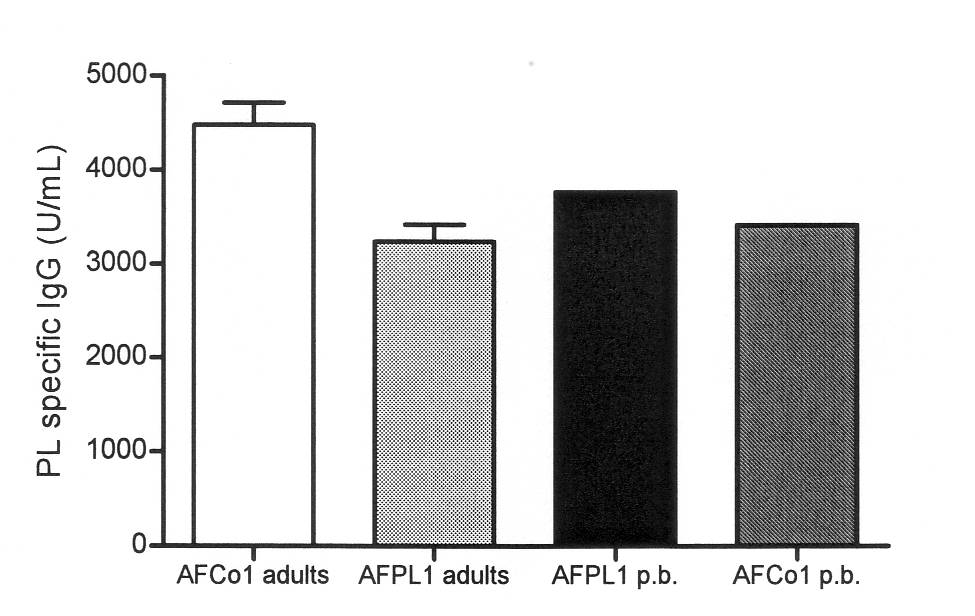
<body><![CDATA[<p><font face="Verdana, Arial, Helvetica, sans-serif" size="2">To assess the safety    of AFCo1 and AFPL1 in neonatal mice, weight gain and the number of deaths were    monitored weekly and compared to age-matched mice given sterile Tris Cl buffer.    No deaths occurred, and no effect was observed on weight gain in infant and    neonatal mice immunized i.n. with AFCo1 or AFPL1 compared to unimmunized mice    (data not shown), indicating that AFCo1 and PL are safe and have a low reactogenicity    profile already in early life. </font></p>     <p><font face="Verdana, Arial, Helvetica, sans-serif" size="2">To explore the    potential for priming mucosal immunization in early murine life, neonatal mice    (7 days old) were immunized once with AFCo1 or AFPL1. Nine weeks after priming,    mice were boosted with the similar corresponding dose and route than prime dose.    The serum IgG response was comparable to that induced by AFCo1 and AFPL1 in    adults groups. The IgG response in neonatal mice was compared with the media    specific IgG (Figure 2) and the specific IgG2a/IgG1 ratio obtained in adult    mice. Neonatal immunization does not generally lead to early and strong antibody    response, this could be from suboptimal antigen presenting cell -T cell interaction,    and can be overcome by use of specific adjuvants and delivery systems. Neonatal    triggered Th2 responses are more difficult to fully redirect toward Th1 responses    than responses induced in adults (9). However, the use of strong Th1-driving    adjuvants or formulations could redirect fully the neonatal Th2 responses. The    responses pattern induced in neonate mice after a prime-boost strategy with    AFCo1 and AFPL1 corresponded with a full redirect Th2 pattern into Th1 response    pattern. Thus, the development of optimal neonatal priming-early boosting strategies    appears as promising, enhance subsequent responses and/or contribute to protection.        <br>       <br>   <a href="/img/revistas/vac/v18n2/f0109209.jpg">Figure 1</a>. AFCo1 enhance PL-specific antibody    response in neonatal mice. Anti-PL IgG antibodies in serum 21 days after the    i.n. immunization with tree doses (50 &micro;g per dose) of AFCo1 or PL at 7,    14, and 21 days after birth. Denotes significance statistical difference (p&lt;0.05)    between the antibody levels in the indicated groups to Student's t test using    Graph Pad Prism 4 software.     
<br>       <br>   <a href="/img/revistas/vac/v18n2/f0209209.jpg">Figure 2.</a> Anti-PL IgG antibodies responses    in serum after i.n. immunization with tree doses (50 &micro;g per dose) of AFCo1    or AFPL1 at 0, 7, and 14 days in adult mice. Neonatal mice was prime (p) i.n.    at 7 days of born and 9 weeks later they were i.n. boost (b) with the homologous    compaund.     
<br>       <br>       <br>   <b><font size="3">References </font></b></font></p>     <!-- ref --><p><font face="Verdana, Arial, Helvetica, sans-serif" size="2">1. Adkins B, Leclerc    C, Marshall-Clarke S. Neonatal adaptive immunity comes of age. Nature Reviews/Immunology    2004;4:553-64. </font><!-- ref --><p><font face="Verdana, Arial, Helvetica, sans-serif" size="2">2. Sierra GVG,    Campa HC, Varcacel NM, Garc&iacute;a IL, Izquierdo PL, Sotolongo PF, et. al.    Vaccine against group B Neisseria meningitidis: Protection trial and mass vaccination    results in Cuba. NIPH Annals 1991;14:195-210. </font><!-- ref --><p><font face="Verdana, Arial, Helvetica, sans-serif" size="2">3. Gonz&aacute;lez    S, Caballero E, Soria Y, Cobas K, Granadillo M, Paj&oacute;n R. Immunization    with Neisseria meningitidis outer membrane vesicles prevents bacteremia in neonatal    mice. Vaccine 2006;24:1633-43. </font><!-- ref --><p><font face="Verdana, Arial, Helvetica, sans-serif" size="2">4. P&eacute;rez    O, Bracho G, Lastre M, Mora N, Del campo, J, Gil D, et al. Novel adjuvant base    on a proteoliposome-derived cochleate structure containing native lipopolysaccharide    as a pathogen-associated molecular pattern Immunol. Cell Biol 2004;82:603-10.    </font><!-- ref --><p><font face="Verdana, Arial, Helvetica, sans-serif" size="2">5. P&eacute;rez    O, Lastre M, Cabrera O, del Campo J, Bracho G, Cuello M, et. al. New Vaccines    Require Potent Adjuvants like AFPL1 and AFCo1. Scandinavian Journal of Immunology    2007;66:271-7.    <!-- ref --><br>   6. Rodr&iacute;guez T, P&eacute;rez O, Menager N, Ugrinovic S, Bracho G., Mastroeni    P. Interactions of proteoliposomes from serogroup B Neisseria meningitidis with    bone marrow-derived dendritic cells and macrophages: adjuvant effects and antigen    delivery. Vaccine 2005;26:1312-21. </font><!-- ref --><p><font face="Verdana, Arial, Helvetica, sans-serif" size="2">7. Bracho G, Lastre    M, Del Campo J, Zayas C, Gonz&aacute;lez D, Gil D et. al. Proteoliposome derived    cochleate as novel adjuvant. Vaccine. 2006;24(S2):30-1. </font><!-- ref --><p><font face="Verdana, Arial, Helvetica, sans-serif" size="2">8. del Campo J,    Zayas C; Romeo B; Acevedo R; Gonz&aacute;lez E; Bracho G; Gonz&aacute;lez L;    Cuello M; Cabrera O; Balboa J; Lastre M. Mucosal immunization using proteoliposome    and cochleate structures from Neisseria meningitis serogroup B induce mucosal    and systemic responses.    <!-- ref --> METHODS-D-09-00010R1. 2009 Accepted. 9. Siegrist CA.    Neonatal and early life vaccinology. Vaccine 2001;19:3331-46.    <br>       <br>       ]]></body>
<body><![CDATA[<br>       <br>       <br>       <br>       <br>       <br>   </font></p>      ]]></body><back>
<ref-list>
<ref id="B1">
<label>1</label><nlm-citation citation-type="journal">
<person-group person-group-type="author">
<name>
<surname><![CDATA[Adkins]]></surname>
<given-names><![CDATA[B]]></given-names>
</name>
<name>
<surname><![CDATA[Leclerc]]></surname>
<given-names><![CDATA[C]]></given-names>
</name>
<name>
<surname><![CDATA[Marshall-Clarke]]></surname>
<given-names><![CDATA[S]]></given-names>
</name>
</person-group>
<article-title xml:lang="en"><![CDATA[Neonatal adaptive immunity comes of age]]></article-title>
<source><![CDATA[Nature Reviews/Immunology]]></source>
<year>2004</year>
<volume>4</volume>
<page-range>553-64</page-range></nlm-citation>
</ref>
<ref id="B2">
<label>2</label><nlm-citation citation-type="journal">
<person-group person-group-type="author">
<name>
<surname><![CDATA[Sierra]]></surname>
<given-names><![CDATA[GVG]]></given-names>
</name>
<name>
<surname><![CDATA[Campa]]></surname>
<given-names><![CDATA[HC]]></given-names>
</name>
<name>
<surname><![CDATA[Varcacel]]></surname>
<given-names><![CDATA[NM]]></given-names>
</name>
<name>
<surname><![CDATA[García]]></surname>
<given-names><![CDATA[IL]]></given-names>
</name>
<name>
<surname><![CDATA[Izquierdo]]></surname>
<given-names><![CDATA[PL]]></given-names>
</name>
<name>
<surname><![CDATA[Sotolongo]]></surname>
<given-names><![CDATA[PF]]></given-names>
</name>
</person-group>
<article-title xml:lang="en"><![CDATA[Vaccine against group B Neisseria meningitidis: Protection trial and mass vaccination results in Cuba]]></article-title>
<source><![CDATA[NIPH Annals]]></source>
<year>1991</year>
<volume>14</volume>
<page-range>195-210</page-range></nlm-citation>
</ref>
<ref id="B3">
<label>3</label><nlm-citation citation-type="journal">
<person-group person-group-type="author">
<name>
<surname><![CDATA[González]]></surname>
<given-names><![CDATA[S]]></given-names>
</name>
<name>
<surname><![CDATA[Caballero]]></surname>
<given-names><![CDATA[E]]></given-names>
</name>
<name>
<surname><![CDATA[Soria]]></surname>
<given-names><![CDATA[Y]]></given-names>
</name>
<name>
<surname><![CDATA[Cobas]]></surname>
<given-names><![CDATA[K]]></given-names>
</name>
<name>
<surname><![CDATA[Granadillo]]></surname>
<given-names><![CDATA[M]]></given-names>
</name>
<name>
<surname><![CDATA[Pajón]]></surname>
<given-names><![CDATA[R]]></given-names>
</name>
</person-group>
<article-title xml:lang="en"><![CDATA[Immunization with Neisseria meningitidis outer membrane vesicles prevents bacteremia in neonatal mice]]></article-title>
<source><![CDATA[Vaccine]]></source>
<year>2006</year>
<volume>24</volume>
<page-range>1633-43</page-range></nlm-citation>
</ref>
<ref id="B4">
<label>4</label><nlm-citation citation-type="journal">
<person-group person-group-type="author">
<name>
<surname><![CDATA[Pérez]]></surname>
<given-names><![CDATA[O]]></given-names>
</name>
<name>
<surname><![CDATA[Bracho]]></surname>
<given-names><![CDATA[G]]></given-names>
</name>
<name>
<surname><![CDATA[Lastre]]></surname>
<given-names><![CDATA[M]]></given-names>
</name>
<name>
<surname><![CDATA[Mora]]></surname>
<given-names><![CDATA[N]]></given-names>
</name>
<name>
<surname><![CDATA[Del campo]]></surname>
<given-names><![CDATA[J]]></given-names>
</name>
<name>
<surname><![CDATA[Gil]]></surname>
<given-names><![CDATA[D]]></given-names>
</name>
</person-group>
<article-title xml:lang="en"><![CDATA[Novel adjuvant base on a proteoliposome-derived cochleate structure containing native lipopolysaccharide as a pathogen-associated molecular pattern Immunol]]></article-title>
<source><![CDATA[Cell Biol]]></source>
<year>2004</year>
<volume>82</volume>
<page-range>603-10</page-range></nlm-citation>
</ref>
<ref id="B5">
<label>5</label><nlm-citation citation-type="journal">
<person-group person-group-type="author">
<name>
<surname><![CDATA[Pérez]]></surname>
<given-names><![CDATA[O]]></given-names>
</name>
<name>
<surname><![CDATA[Lastre]]></surname>
<given-names><![CDATA[M]]></given-names>
</name>
<name>
<surname><![CDATA[Cabrera]]></surname>
<given-names><![CDATA[O]]></given-names>
</name>
<name>
<surname><![CDATA[del Campo]]></surname>
<given-names><![CDATA[J]]></given-names>
</name>
<name>
<surname><![CDATA[Bracho]]></surname>
<given-names><![CDATA[G]]></given-names>
</name>
<name>
<surname><![CDATA[Cuello]]></surname>
<given-names><![CDATA[M]]></given-names>
</name>
</person-group>
<article-title xml:lang="en"><![CDATA[New Vaccines Require Potent Adjuvants like AFPL1 and AFCo1]]></article-title>
<source><![CDATA[Scandinavian Journal of Immunology]]></source>
<year>2007</year>
<volume>66</volume>
<page-range>271-7</page-range></nlm-citation>
</ref>
<ref id="B6">
<label>6</label><nlm-citation citation-type="journal">
<person-group person-group-type="author">
<name>
<surname><![CDATA[Rodríguez]]></surname>
<given-names><![CDATA[T]]></given-names>
</name>
<name>
<surname><![CDATA[Pérez]]></surname>
<given-names><![CDATA[O]]></given-names>
</name>
<name>
<surname><![CDATA[Menager]]></surname>
<given-names><![CDATA[N]]></given-names>
</name>
<name>
<surname><![CDATA[Ugrinovic]]></surname>
<given-names><![CDATA[S]]></given-names>
</name>
<name>
<surname><![CDATA[Bracho]]></surname>
<given-names><![CDATA[G]]></given-names>
</name>
<name>
<surname><![CDATA[Mastroeni]]></surname>
<given-names><![CDATA[P]]></given-names>
</name>
</person-group>
<article-title xml:lang="en"><![CDATA[Interactions of proteoliposomes from serogroup B Neisseria meningitidis with bone marrow-derived dendritic cells and macrophages: adjuvant effects and antigen delivery]]></article-title>
<source><![CDATA[Vaccine]]></source>
<year>2005</year>
<volume>26</volume>
<page-range>1312-21</page-range></nlm-citation>
</ref>
<ref id="B7">
<label>7</label><nlm-citation citation-type="journal">
<person-group person-group-type="author">
<name>
<surname><![CDATA[Bracho]]></surname>
<given-names><![CDATA[G]]></given-names>
</name>
<name>
<surname><![CDATA[Lastre]]></surname>
<given-names><![CDATA[M]]></given-names>
</name>
<name>
<surname><![CDATA[Del Campo]]></surname>
<given-names><![CDATA[J]]></given-names>
</name>
<name>
<surname><![CDATA[Zayas]]></surname>
<given-names><![CDATA[C]]></given-names>
</name>
<name>
<surname><![CDATA[González]]></surname>
<given-names><![CDATA[D]]></given-names>
</name>
<name>
<surname><![CDATA[Gil]]></surname>
<given-names><![CDATA[D]]></given-names>
</name>
</person-group>
<article-title xml:lang="en"><![CDATA[Proteoliposome derived cochleate as novel adjuvant]]></article-title>
<source><![CDATA[Vaccine]]></source>
<year>2006</year>
<volume>24</volume>
<numero>^sS2</numero>
<issue>^sS2</issue>
<supplement>S2</supplement>
<page-range>30-1</page-range></nlm-citation>
</ref>
<ref id="B8">
<label>8.</label><nlm-citation citation-type="">
<person-group person-group-type="author">
<name>
<surname><![CDATA[del Campo]]></surname>
<given-names><![CDATA[J]]></given-names>
</name>
<name>
<surname><![CDATA[Zayas]]></surname>
<given-names><![CDATA[C]]></given-names>
</name>
<name>
<surname><![CDATA[Romeo]]></surname>
<given-names><![CDATA[B]]></given-names>
</name>
<name>
<surname><![CDATA[Acevedo]]></surname>
<given-names><![CDATA[R]]></given-names>
</name>
<name>
<surname><![CDATA[González]]></surname>
<given-names><![CDATA[E]]></given-names>
</name>
<name>
<surname><![CDATA[Bracho]]></surname>
<given-names><![CDATA[G]]></given-names>
</name>
<name>
<surname><![CDATA[González]]></surname>
<given-names><![CDATA[L]]></given-names>
</name>
<name>
<surname><![CDATA[Cuello]]></surname>
<given-names><![CDATA[M]]></given-names>
</name>
<name>
<surname><![CDATA[Cabrera]]></surname>
<given-names><![CDATA[O]]></given-names>
</name>
<name>
<surname><![CDATA[Balboa]]></surname>
<given-names><![CDATA[J]]></given-names>
</name>
<name>
<surname><![CDATA[Lastre]]></surname>
<given-names><![CDATA[M]]></given-names>
</name>
</person-group>
<source><![CDATA[Mucosal immunization using proteoliposome and cochleate structures from Neisseria meningitis serogroup B induce mucosal and systemic responses]]></source>
<year></year>
</nlm-citation>
</ref>
<ref id="B9">
<label>9</label><nlm-citation citation-type="journal">
<person-group person-group-type="author">
<name>
<surname><![CDATA[Siegrist]]></surname>
<given-names><![CDATA[CA]]></given-names>
</name>
</person-group>
<article-title xml:lang="en"><![CDATA[Neonatal and early life vaccinology]]></article-title>
<source><![CDATA[Vaccine]]></source>
<year>2001</year>
<volume>19</volume>
<page-range>3331-46</page-range></nlm-citation>
</ref>
</ref-list>
</back>
</article>