<?xml version="1.0" encoding="ISO-8859-1"?><article xmlns:mml="http://www.w3.org/1998/Math/MathML" xmlns:xlink="http://www.w3.org/1999/xlink" xmlns:xsi="http://www.w3.org/2001/XMLSchema-instance">
<front>
<journal-meta>
<journal-id>1027-2852</journal-id>
<journal-title><![CDATA[Biotecnología Aplicada]]></journal-title>
<abbrev-journal-title><![CDATA[Biotecnol Apl]]></abbrev-journal-title>
<issn>1027-2852</issn>
<publisher>
<publisher-name><![CDATA[Editorial Elfos Scientiae]]></publisher-name>
</publisher>
</journal-meta>
<article-meta>
<article-id>S1027-28522009000200002</article-id>
<title-group>
<article-title xml:lang="en"><![CDATA[Methodology for guidelines development for biopharmaceuticals obtained from transgenic plants in Cuba]]></article-title>
<article-title xml:lang="es"><![CDATA[Metodología para la elaboración de las pautas reguladoras para productos biofarmacéuticos obtenidos de plantas transgénicas en Cuba]]></article-title>
</title-group>
<contrib-group>
<contrib contrib-type="author">
<name>
<surname><![CDATA[Hechavarría-Nuñez]]></surname>
<given-names><![CDATA[Yanet]]></given-names>
</name>
<xref ref-type="aff" rid="A01"/>
</contrib>
<contrib contrib-type="author">
<name>
<surname><![CDATA[Martínez-Muñoz]]></surname>
<given-names><![CDATA[Lázara]]></given-names>
</name>
<xref ref-type="aff" rid="A01"/>
</contrib>
<contrib contrib-type="author">
<name>
<surname><![CDATA[Pérez-Massipe]]></surname>
<given-names><![CDATA[Rodrigo O]]></given-names>
</name>
<xref ref-type="aff" rid="A01"/>
</contrib>
<contrib contrib-type="author">
<name>
<surname><![CDATA[Martínez-Gzegozewska]]></surname>
<given-names><![CDATA[Yohanka]]></given-names>
</name>
<xref ref-type="aff" rid="A01"/>
</contrib>
<contrib contrib-type="author">
<name>
<surname><![CDATA[Jacobo-Casanueva]]></surname>
<given-names><![CDATA[Olga L]]></given-names>
</name>
<xref ref-type="aff" rid="A01"/>
</contrib>
<contrib contrib-type="author">
<name>
<surname><![CDATA[Domínguez-Morales]]></surname>
<given-names><![CDATA[Rolando B]]></given-names>
</name>
<xref ref-type="aff" rid="A01"/>
</contrib>
</contrib-group>
<aff id="A01">
<institution><![CDATA[,Centro para el Control Estatal de la Calidad de los Medicamentos  ]]></institution>
<addr-line><![CDATA[Ciudad de La Habana ]]></addr-line>
<country>Cuba</country>
</aff>
<pub-date pub-type="pub">
<day>00</day>
<month>06</month>
<year>2009</year>
</pub-date>
<pub-date pub-type="epub">
<day>00</day>
<month>06</month>
<year>2009</year>
</pub-date>
<volume>26</volume>
<numero>2</numero>
<fpage>122</fpage>
<lpage>126</lpage>
<copyright-statement/>
<copyright-year/>
<self-uri xlink:href="http://scielo.sld.cu/scielo.php?script=sci_arttext&amp;pid=S1027-28522009000200002&amp;lng=en&amp;nrm=iso"></self-uri><self-uri xlink:href="http://scielo.sld.cu/scielo.php?script=sci_abstract&amp;pid=S1027-28522009000200002&amp;lng=en&amp;nrm=iso"></self-uri><self-uri xlink:href="http://scielo.sld.cu/scielo.php?script=sci_pdf&amp;pid=S1027-28522009000200002&amp;lng=en&amp;nrm=iso"></self-uri><abstract abstract-type="short" xml:lang="en"><p><![CDATA[Molecular farming is an evolving field in Cuba; therefore, establishing the guidelines guaranteeing the quality, safety and efficacy of biopharmaceutical products is a challenge for the National Regulatory Agency (Center for State Control on the Quality of Drugs; CECMED). The methodology to elaborate guidelines for this type of products was mainly based on the revision of the legal and regulatory international framework, the evaluation of the current and prospective developmental stage of the technology in Cuba and the comparative analysis among the manufacturing process steps of a biotechnological product obtained in traditional expression systems and that derived from transgenic plants. A first draft of the regulatory document was compared to guidance drafts issued by other regulatory agencies (such as FDA and EMEA) and extensively reviewed by CECMED specialists as well as by experts of the local biotech industry. As a result, a regulation project was elaborated, and its applicability tested while the assessment of an application for scientific advisory, related to product obtained by this technology. Finally, the regulation was approved, being applicable for products generated in genetically modified plants. It is also valid for edible vaccines and other compounds which do not constitute active pharmaceutical ingredients.]]></p></abstract>
<abstract abstract-type="short" xml:lang="es"><p><![CDATA[La obtención de productos biofarmacéuticos a partir de plantas transgénicas es un campo en evolución en Cuba, por lo que la elaboración de pautas reguladoras que garanticen su calidad, seguridad y eficacia constituye un reto para la Autoridad Reguladora de Medicamentos, el Centro para el Control Estatal de la Calidad de los Medicamentos, CECMED. La metodología para establecer las pautas reguladoras para estos productos se basó fundamentalmente en la revisión del entorno legal y regulador internacional, la evaluación del estado de desarrollo actual y prospectivo de la tecnología en Cuba, y en la comparación de las diferentes etapas del proceso de obtención de un producto biotecnológico en sistemas tradicionales de expresión y a partir de plantas transgénicas. La primera versión del documento normativo se comparó con las guías preliminares emitidas por otras autoridades reguladoras, como la Administración de Alimentos y Medicamentos (FDA) y la Agencia Europea para la Evaluación de Medicamentos (EMEA) y la revisaron especialistas del CECMED y de la industria. Como resultado, se elaboró un proyecto de regulación, cuya aplicabilidad se comprobó mediante la evaluación de un trámite de registro de un producto cubano obtenido utilizando esta tecnología. Finalmente, se aprobó un documento normativo aplicable a proteínas obtenidas de plantas genéticamente modificadas, válido también para la obtención de vacunas comestibles y de otros compuestos que no constituyan el principio activo.]]></p></abstract>
<kwd-group>
<kwd lng="en"><![CDATA[transgenic plants]]></kwd>
<kwd lng="en"><![CDATA[biopharmaceuticals]]></kwd>
<kwd lng="en"><![CDATA[guidance]]></kwd>
<kwd lng="en"><![CDATA[regulatory guidelines]]></kwd>
<kwd lng="en"><![CDATA[CECMED]]></kwd>
<kwd lng="es"><![CDATA[plantas transgénicas]]></kwd>
<kwd lng="es"><![CDATA[productos biofarmacéuticos]]></kwd>
<kwd lng="es"><![CDATA[documento regulador]]></kwd>
<kwd lng="es"><![CDATA[pautas reguladoras]]></kwd>
<kwd lng="es"><![CDATA[CECMED]]></kwd>
</kwd-group>
</article-meta>
</front><body><![CDATA[ <div class=Section1>      <div>      <p align=right style='text-align:right'><b><span lang=EN-US style='font-size: 10.0pt;font-family:"Verdana","sans-serif"'>REVIEW</span></b></p>      <p align=right style='text-align:right'><span lang=EN-US>&nbsp;</span></p>      <p><span lang=EN-US style='font-size:11.0pt;font-family:"Arial","sans-serif"; color:red'>&nbsp;</span><b><span lang=EN-US style='font-size:13.5pt;font-family: "Verdana","sans-serif";color:#211E1E'>Methodology for guidelines development for biopharmaceuticals obtained from transgenic plants in Cuba</span></b></p>      <p><b><span lang=EN-US style='font-size:13.5pt'>&nbsp;</span></b></p>      <p><b><span style='font-family:"Verdana","sans-serif"'>Metodología para la elaboración de las pautas reguladoras para productos biofarmacéuticos obtenidos de plantas transgénicas en Cuba</span></b><span style='font-family:"Verdana","sans-serif"'> </span></p>      <p><span style='font-size:13.5pt;color:#211E1E'>&nbsp;</span></p>      <p><span style='font-size:13.5pt;color:#211E1E'>&nbsp;</span></p>      <p><span style='font-size:11.0pt;font-family:"Arial","sans-serif";color:blue'>&nbsp;</span><b><span style='font-size:10.0pt;font-family:"Verdana","sans-serif";color:#211E1E'>Yanet Hechavarría-Nuñez, Lázara Martínez-Muñoz, Rodrigo O Pérez-Massipe, Yohanka Martínez-Gzegozewska, Olga L Jacobo-Casanueva, Rolando B Domínguez-Morales</span></b><span style='font-size:11.0pt;font-family:"Arial","sans-serif";color:red'> </span></p>      ]]></body>
<body><![CDATA[<p><span style='font-size:10.0pt;font-family:"Verdana","sans-serif";color:#211E1E'>Centro para el Control Estatal de la Calidad de los Medicamentos, CECMED Calle 200 No. 1706 e/ 17 y 19, Reparto Siboney, CP 11600, AP 16065, Ciudad de La Habana, Cuba </span></p>      <p><span style='font-size:13.5pt;color:#211E1E'>&nbsp;</span></p>      <p><span style='font-size:13.5pt;color:#211E1E'>&nbsp;</span></p>      <div class=MsoNormal align=center style='text-align:center'>  <hr size=2 width="100%" align=center>  </div>      <p><b><span lang=EN-US style='font-size:10.0pt;font-family:"Verdana","sans-serif"; color:#211E1E'>ABSTRACT </span></b></p>      <p><span lang=EN-US style='font-size:10.0pt;font-family:"Verdana","sans-serif"; color:#211E1E'>Molecular farming is an evolving field in Cuba; therefore, establishing the guidelines guaranteeing the quality, safety and efficacy of biopharmaceutical products is a challenge for the National Regulatory Agency (Center for State Control on the Quality of Drugs; CECMED). The methodology to elaborate guidelines for this type of products was mainly based on the revision of the legal and regulatory international framework, the evaluation of the current and prospective developmental stage of the technology in Cuba and the comparative analysis among the manufacturing process steps of a biotechnological product obtained in traditional expression systems and that derived from transgenic plants. A first draft of the regulatory document was compared to guidance drafts issued by other regulatory agencies (such as FDA and EMEA) and extensively reviewed by CECMED specialists as well as by experts of the local biotech industry. As a result, a regulation project was elaborated, and its applicability tested while the assessment of an application for scientific advisory, related to product obtained by this technology. Finally, the regulation was approved, being applicable for products generated in genetically modified plants. It is also valid for edible vaccines and other compounds which do not constitute active pharmaceutical ingredients.</span></p>      <p class=MsoNormal><b><span lang=EN-US style='font-size:10.0pt;font-family: "Verdana","sans-serif";color:#211E1E'>Keywords:</span></b><span lang=EN-US style='font-size:10.0pt;font-family:"Verdana","sans-serif";color:#211E1E'> transgenic plants, biopharmaceuticals, guidance, regulatory guidelines, CECMED.</span></p>      <div class=MsoNormal align=center style='text-align:center'>  <hr size=2 width="100%" align=center>  </div>      <p><b><span style='font-size:10.0pt;font-family:"Verdana","sans-serif"; color:#211E1E'>RESUMEN </span></b></p>      <p><span style='font-size:10.0pt;font-family:"Verdana","sans-serif";color:#211E1E'>La obtención de productos biofarmacéuticos a partir de plantas transgénicas es un campo en evolución en Cuba, por lo que la elaboración de pautas reguladoras que garanticen su calidad, seguridad y eficacia constituye un reto para la Autoridad Reguladora de Medicamentos, el Centro para el Control Estatal de la Calidad de los Medicamentos, CECMED. La metodología para establecer las pautas reguladoras para estos productos se basó fundamentalmente en la revisión del entorno legal y regulador internacional, la evaluación del estado de desarrollo actual y prospectivo de la tecnología en Cuba, y en la comparación de las diferentes etapas del proceso de obtención de un producto biotecnológico en sistemas tradicionales de expresión y a partir de plantas transgénicas. La primera versión del documento normativo se comparó con las guías preliminares emitidas por otras autoridades reguladoras, como la Administración de Alimentos y Medicamentos (FDA) y la Agencia Europea para la Evaluación de Medicamentos (EMEA) y la revisaron especialistas del CECMED y de la industria. Como resultado, se elaboró un proyecto de regulación, cuya aplicabilidad se comprobó mediante la evaluación de un trámite de registro de un producto cubano obtenido utilizando esta tecnología. Finalmente, se aprobó un documento normativo aplicable a proteínas obtenidas de plantas genéticamente modificadas, válido también para la obtención de vacunas comestibles y de otros compuestos que no constituyan el principio activo.</span></p>      ]]></body>
<body><![CDATA[<p class=MsoNormal><b><span style='font-size:10.0pt;font-family:"Verdana","sans-serif"; color:#211E1E'>Palabras clave:</span></b><span style='font-size:10.0pt; font-family:"Verdana","sans-serif";color:#211E1E'> plantas transgénicas, productos biofarmacéuticos, documento regulador, pautas reguladoras, CECMED.</span><span style='font-size:11.0pt;font-family:"Arial","sans-serif";color:red'> </span></p>      <div class=MsoNormal align=center style='text-align:center'>  <hr size=2 width="100%" align=center>  </div>      <p><span lang=EN-US style='font-size:13.5pt'>&nbsp;</span></p>      <p><span lang=EN-US style='font-size:13.5pt'>&nbsp;</span></p>      <p><b><span lang=EN-US style='font-family:"Verdana","sans-serif";color:#211E1E'>INTRODUCTION </span></b></p>      <p><span lang=EN-US style='font-size:10.0pt;font-family:"Verdana","sans-serif"; color:#211E1E'>The use of genetically modified crops to obtained pharmaceutically active molecules increased over the last years. Among their multiple advantages to produce active pharmaceutical ingredients are the production of a wide range of proteins and the considerable reduction of investment-operational costs, while minimizing contamination risks with pathogens harmful to mankind (1). </span></p>      <p><span lang=EN-US style='font-size:10.0pt;font-family:"Verdana","sans-serif"; color:#211E1E'>As a system designed to produce pharmaceutically active molecules, the process to obtain proteins in transgenic plants should comply with regulatory guidelines to guarantee quality, safety and efficacy of the product. Some of the regulations formerly established for pharmaceutical production process in microorganisms and mammalian cells could be applied to some steps of this novel technology. However, other production steps are unattended, due to the properties of the host system employed (2). </span></p>      <p><span lang=EN-US style='font-size:10.0pt;font-family:"Verdana","sans-serif"; color:#211E1E'>Research projects are under development to produce biopharmaceutical products in transgenic plants in Cuba. Thus, the elaboration of regulatory guidelines has become a challenge for the National Regulatory Agency (NRA), because there are no harmonized regulations internationally available in this field. For this reason, the Center for State Control on the Quality of Drugs (CECMED), the Cuban National Regulatory Agency, has established the main aspects to be considered for documenting the approval of biopharmaceutical products obtained in transgenic plants. These aspects are in agreement with the development achieved by the Cuban biotech-pharmaceutical industry. </span></p>      <p><b><span lang=EN-US style='font-family:"Verdana","sans-serif";color:#211E1E'>IDENTIFYING THE NATIONAL AND INTERNATIONAL FRAMEWORK </span></b></p>      <p><span lang=EN-US style='font-size:10.0pt;font-family:"Verdana","sans-serif"; color:#211E1E'>A precise regulatory environment is required to pharmacologically active biomolecules, obtained in plants by using them as bioreactors in order to protect human health. Only FDA and EMEA have issued regulatory documents on this type of productions (3, 4), which are currently reviewed. The World Health Organization held an informal consultation on regulatory evaluation of candidate human vaccines from plants, in January 2005, for industry and NRAs experts. As a result, a report was issued summarizing the topics discussed and conclusions include the points to be considered to elaborate a regulatory document in this field (5). </span></p>      ]]></body>
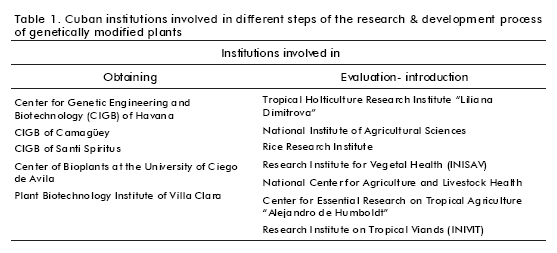
<body><![CDATA[<p><span lang=EN-US style='font-size:10.0pt;font-family:"Verdana","sans-serif"; color:#211E1E'>For the present work, it was necessary to identify the Cuban scientific institutions involved at the different phases of the research &amp; development process of genetically modified plants (</span><span style='font-size:10.0pt;font-family:"Verdana","sans-serif";color:#211E1E'><a href="#tab1"><span lang=EN-US>Table 1</span></a></span><span lang=EN-US style='font-size:10.0pt;font-family:"Verdana","sans-serif";color:#211E1E'>). The Centers for Genetic Engineering and Biotechnology (CIGB) of Havana, Santi Spiritus and Camagüey, the Center for Bioplants at the University of Ciego de Avila and the Plant Biotechnology Institute of Villa Clara constitute the leading front for the development of this technology in Cuba. Other institutions related to the evaluation and field introduction of transgenic plants as collateral activities, depending on their missions, are summarized in </span><span style='font-size:10.0pt;font-family:"Verdana","sans-serif"; color:#211E1E'><a href="#tab1"><span lang=EN-US>table 1</span></a></span><span lang=EN-US style='font-size:10.0pt;font-family:"Verdana","sans-serif"; color:#211E1E'>. This also evidences the tight collaboration among the Cuban scientific institutions. </span></p>      <p align=center style='text-align:center'><span style='font-size:13.5pt; color:#211E1E'><img border=0 width=557 height=253 src="/img/revistas/bta/v26n2/t0104209.gif"></span><a name=tab1></a></p>      
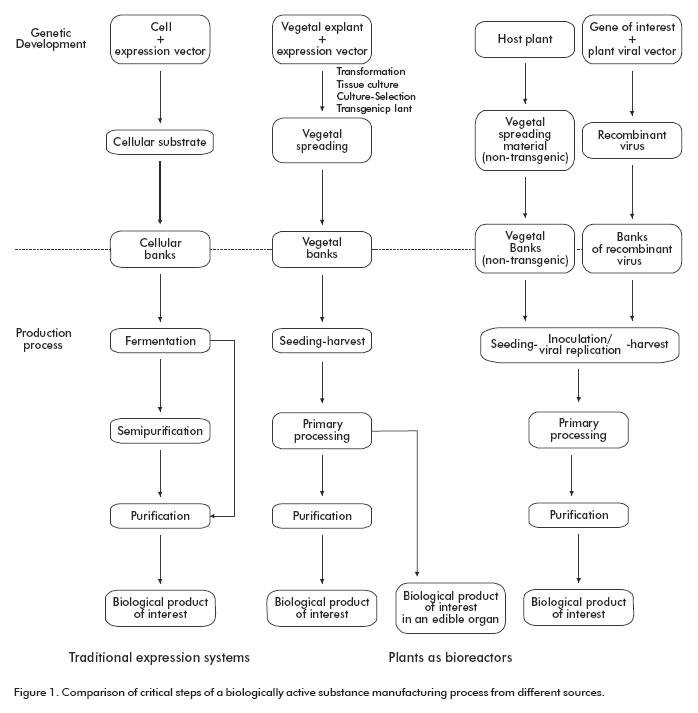
<p><span lang=EN-US style='font-size:10.0pt;font-family:"Verdana","sans-serif"; color:#211E1E'>The working strategies are mainly directed to obtain economically relevant crops (sweet potato, pineapple, sugar cane, potato, tomato, corn, papaya, coffee, citrus, rice and banana) resistant to herbicides and pathogens (6). Only the CIGB of Havana and Santi Spiritus have research projects on the expression of pharmacologically active proteins in transgenic plants to be used as active ingredients or biological reagents in the biopharmaceutical industry. For example, the CIGB of Havana produces a monoclonal antibody (MAb) in tobacco (<i>Nicotiana tabacum</i>) transgenic plants (7). This MAb is employed for the purification of the active pharmaceutical ingredient (API) of the Heberbiovac HB® recombinant anti-hepatitis B vaccine. </span></p>      <p><span lang=EN-US style='font-size:10.0pt;font-family:"Verdana","sans-serif"; color:#211E1E'>Besides, the scope of the National Program for Biotechnology of Agriculture and Livestock (8) comprises the production of drugs and oral vaccines for animals and humans through efficient genetic transformation methods. </span></p>      <p><span lang=EN-US style='font-size:10.0pt;font-family:"Verdana","sans-serif"; color:#211E1E'>The National Center for Biological Safety (the regulatory authority for biosafety) has established legal dispositions ruling the use, management, storage, transport, import and export of genetically-modified organisms (9-12). However, there is an urgent need for specific regulations guaranteeing the quality, safety and efficacy of biopharmaceutical products obtained in transgenic plants for human use. </span></p>      <p><b><span lang=EN-US style='font-family:"Verdana","sans-serif";color:#211E1E'>ELABORATION OF THE DRAFT GUIDANCE </span></b></p>      <p><span lang=EN-US style='font-size:10.0pt;font-family:"Verdana","sans-serif"; color:#211E1E'>A definition of the legal category was required to design the draft regulating the steps for the approval of biopharmaceutical products obtained in transgenic plants. First, the national requirements established for marketing authorization of pharmaceutical products, “<i>Requisitos para las solicitudes de inscripción, renovación y modificación del registro de medicamentos de uso humano</i>” (13), were analyzed, particularly chapters related to products obtained by the recombinant DNA technology. We concluded that these requirements did not cover the regulation of transgenic plant biotechnological products, particularly because of not dealing with the cellular substrates used as starting materials in the process. Moreover, the need for an introductory chapter bringing general information for the applicants was evident, as well as a chapter of definitions for specific terms of this technology and other chapters regarding the regulatory claims. Consequently, and considering what established in the institutional documentation of the CECMED, the legal document should be adopted in the format of a regulation ruling the formalities for marketing authorization of biopharmaceutical products obtained in transgenic plants. This document will complement marketing authorization requirements in force. </span></p>      <p><span lang=EN-US style='font-size:10.0pt;font-family:"Verdana","sans-serif"; color:#211E1E'>The document was elaborated following what established in the standard operation procedure (SOP): “<i>Metodología para la elaboración, aprobación y revision de regulaciones</i>” of the CECMED (14); the different chapters of regulatory contents were defined from the analyses of the regulatory guidelines on the Common Technical Document (15); but the order of the sections described in the Quality Module III was adapted to comply with the Cuban marketing authorization requirements in force, accordingly. </span></p>          <p><span lang=EN-US style='font-size:10.0pt;font-family:"Verdana","sans-serif"; color:#211E1E'>The regulatory requirements were established on the basis of identifying        critical steps, by comparing the diagrams of recombinant DNA products’ manufacturing        process in transgenic plants and in traditional host systems (microorganisms        and eukaryotic cells) (</span><span style='font-size: 10.0pt;font-family:"Verdana","sans-serif";color:#211E1E'><a href="/img/revistas/bta/v26n2/f0104209.gif"><span lang=EN-US>Figure 1</span></a></span><span lang=EN-US style='font-size:10.0pt; font-family:"Verdana","sans-serif";color:#211E1E'>). The critical steps to be        controlled within predetermined criteria, to guarantee an API complying        with quality specifications (16), were identified taking as standards the        critical steps established in traditional host system-based process for        bipharmaceutical production. Similarities between the purposes for each        step were also considered. Besides, parameters to be monitored during the        entire process were identified, and other variants of this technology were        analyzed, such as the use of viral vectors. </span></p>         
<p><span lang=EN-US style='font-size:10.0pt;font-family:"Verdana","sans-serif"; color:#211E1E'>Due to the lack of specific international regulations for this        technology at the beginning of this investigation, a vast regulatory documentation        was consulted during the drafting phase of the document, such as regulations        on the process to obtain biologicals/biotechnological products from recombinant        microorganisms and eukaryotic cells (17-21); regulations concerning natural        products, because this technology shares an agricultural phase (22, 23);        regulations for the environmental protection and the introduction of genetically        modified organisms (24), and others established for transgenic foods (25),        because of the possibility to use vegetables or fruits as drug delivery        systems (<i>e.g. </i>“edible” vaccines). </span></p>      ]]></body>
<body><![CDATA[<p><span lang=EN-US style='font-size:10.0pt;font-family:"Verdana","sans-serif"; color:#211E1E'>The proposed guideline was compared to the draft guidance issued by the FDA (3) and EMEA (26), to harmonize criteria and considering their experience on this topic, due to participation on scientific debates and also due to the majority of the research projects are being carried out in developed countries. Additionally, we examined the comments of the FDA draft guidance expressed by the Biotechnology Industry Organization on behalf of the industrial sector (27), and also those from the Monsanto (28), ProdiGene (29) and Meristem Therapeutics (30) companies, respectively. The draft was submitted to an internal evaluation process by CECMED specialists, to analyze and determine if the information requested was enough or if additional data were required, also contributing to the correct style of the document. Subsequently, the document was completed and subjected to external evaluation by researchers, production specialists and the Regulatory Affairs group and management staff of the Agriculture and Livestock Division at the CIGB of Havana. Once received the comments, the regulation project was ready to be prepared. </span></p>      <p><b><span lang=EN-US style='font-family:"Verdana","sans-serif";color:#211E1E'>PREPARATION OF GUIDANCE PROJECT </span></b></p>      <p><span lang=EN-US style='font-size:10.0pt;font-family:"Verdana","sans-serif"; color:#211E1E'>A debate with the Industry allowed the use of harmonized terms and regulatory language in the guidelines, in agreement with the national situation and international tendencies. Most relevant observations concerned the scope of the document, <i>i.e.</i>, if the document was applicable for molecules used as reagents, the need for a section about edible vaccines and the inclusion of new and more appropriate terms and definitions. Other comments were about the number of lots required for consistency demonstration and about parameters to characterize vegetal banks, particularly the bioburden. </span></p>      <p><span lang=EN-US style='font-size:10.0pt;font-family:"Verdana","sans-serif"; color:#211E1E'>The project was structured accordingly, comprising the possible methods to obtain biopharmaceuticals in genetically modified plants and including additional information and definitions. </span></p>      <p><span lang=EN-US style='font-size:10.0pt;font-family:"Verdana","sans-serif"; color:#211E1E'>The guideline drafted was put to the consideration of specialists from the CECMED and other institutions such as the CIGB of Havana, the Institute for Food Hygiene and Health, the Ministry of Agriculture and the National Center for Biological Safety. </span></p>      <p><span lang=EN-US style='font-size:10.0pt;font-family:"Verdana","sans-serif"; color:#211E1E'>It was also simultaneously challenged against through the assessment of an application for scientific advisory. </span></p>      <p><b><span lang=EN-US style='font-family:"Verdana","sans-serif";color:#211E1E'>PRELIMINARY EVALUATION OF GUIDANCE PROJECT’S IMPACT</span></b><b><span lang=EN-US style='font-size:10.0pt;font-family:"Verdana","sans-serif";color:#211E1E'> </span></b></p>      <p><span lang=EN-US style='font-size:10.0pt;font-family:"Verdana","sans-serif"; color:#211E1E'>The project was finally applied to a scientific advisory dossier for the production of a monoclonal antibody in <i>Nicotiana tabacum </i>transgenic plants. This monoclonal antibody is used to purify the hepatitis B surface antigen. </span></p>      <p><span lang=EN-US style='font-size:10.0pt;font-family:"Verdana","sans-serif"; color:#211E1E'>As a result of this practical exercise, it was concluded that the document complies with the regulatory purposes it was intended for, involving the main aspects of production and control of a product obtained in transgenic plants. During scientific meetings with the applicant, it was demonstrated that the document constitutes an agreed regulating solution to the national scenario. </span></p>      <p><b><span lang=EN-US style='font-family:"Verdana","sans-serif";color:#211E1E'>PREPARATION OF THE FINAL REGULATORY DOCUMENT </span></b></p>      ]]></body>
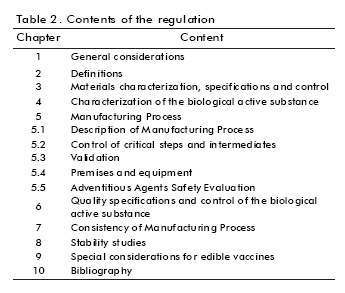
<body><![CDATA[<p><span lang=EN-US style='font-size:10.0pt;font-family:"Verdana","sans-serif"; color:#211E1E'>The regulatory document was elaborated considering results from previous stage, external opinions as well as the state on this subject at the time of writing the document. The structure of the final document is shown in </span><span style='font-size:10.0pt;font-family:"Verdana","sans-serif";color:#211E1E'><a href="#tab2"><span lang=EN-US>table 2</span></a></span><span lang=EN-US style='font-size:10.0pt;font-family:"Verdana","sans-serif";color:#211E1E'>. </span></p>      <p align=center style='text-align:center'><span style='font-size:13.5pt; color:#211E1E'><img border=0 width=345 height=293 src="/img/revistas/bta/v26n2/t0204209.gif"></span><a name=tab2></a></p>      
<p><span lang=EN-US style='font-size:10.0pt;font-family:"Verdana","sans-serif"; color:#211E1E'>The document includes among regulatory aspects those related to the main concerns identified during the revision of the national and international framework (31-37), which are related as follows: </span></p>      <p><span lang=EN-US style='font-size:10.0pt;font-family:"Verdana","sans-serif"; color:#211E1E'>a) The existence of two different ways for the expression of heterologous proteins in plants: stable integration of the transgene(s) into the plant´s genome, and the transient expression by using plant viral vectors. </span></p>      <p><span lang=EN-US style='font-size:10.0pt;font-family:"Verdana","sans-serif"; color:#211E1E'>b) The need of establishing a banking system from structures of easy reproduction and storage to guarantee production consistency. </span></p>      <p><span lang=EN-US style='font-size:10.0pt;font-family:"Verdana","sans-serif"; color:#211E1E'>c) Factors influencing plant´s growth and development, such as soil, irrigation, fertilization, incidence of pests, sunlight and other climatic factors. </span></p>      <p><span lang=EN-US style='font-size:10.0pt;font-family:"Verdana","sans-serif"; color:#211E1E'>d) Measures to avoid the flux of pollen and seeds between plants and the environment. </span></p>      <p><span lang=EN-US style='font-size:10.0pt;font-family:"Verdana","sans-serif"; color:#211E1E'>e) Measures to minimize fungal and bacterial contamination levels. </span></p>      <p><span lang=EN-US style='font-size:10.0pt;font-family:"Verdana","sans-serif"; color:#211E1E'>f) Procedures to obtain the compound of interest: extraction and purification from the harvested vegetal material or its expression in plant edible organs. </span></p>      <p><span lang=EN-US style='font-size:10.0pt;font-family:"Verdana","sans-serif"; color:#211E1E'>g) Possible functional and structural differences in the protein obtained, in respect to its native conformation, especially for glycosylated proteins. </span></p>      ]]></body>
<body><![CDATA[<p><span lang=EN-US style='font-size:10.0pt;font-family:"Verdana","sans-serif"; color:#211E1E'>h) The presence of contaminants from the host plant (proteins, DNA, alkaloids), the culture media (heavy metals, pesticides traces, fertilizers) and productassociated impurities (aggregates, truncated and modified molecular species). </span></p>      <p><span lang=EN-US style='font-size:10.0pt;font-family:"Verdana","sans-serif"; color:#211E1E'>i) Expression levels variability and compliance with quality specifications among production lots. </span></p>      <p><span lang=EN-US style='font-size:10.0pt;font-family:"Verdana","sans-serif"; color:#211E1E'>j) Presence of new toxic compounds or their increase, or higher anti-nutrients levels in plant edible organs. </span></p>      <p><span lang=EN-US style='font-size:10.0pt;font-family:"Verdana","sans-serif"; color:#211E1E'>The regulatory document was approved on April 2006 (38) and used in the assessment of a marketing authorization application related to the alternate use of a Mab produced in <i>Nicotiana</i> transgenic plants, for the purification of the Hepatitis B surface antigen (39-41). </span></p>      <p><span lang=EN-US style='font-size:10.0pt;font-family:"Verdana","sans-serif"; color:#211E1E'>In summary, a regulatory document, applicable to biopharmaceutical products obtained in transgenic plants is available at the CECMED to fulfill our national regulatory needs. This document can be used as reference to design research &amp; development projects, also including regulatory requirements since the beginning of research to guarantee the proper development of new products. </span></p>      <p><span lang=EN-US style='font-size:10.0pt;font-family:"Verdana","sans-serif"; color:#211E1E'>Noteworthy, because of the novelty of this technology and its incipient exploitation by Cuban institutions, these guidelines can be modified as part of the updating process according to the state of the art. This seems to be the most common scenario faced by the NRAs throughout the world (41, 42), since every host plant system and biological product becomes a new challenge due to their unique properties. Collaboration between the industry, the regulatory agencies and the specialists involved is the only way to solve the evolving problems of technological development. </span></p>      <p><b><span lang=EN-US style='font-family:"Verdana","sans-serif"'>&nbsp;</span></b></p>      <p><span lang=EN-US style='font-size:11.0pt;font-family:"Arial","sans-serif"; color:red'>&nbsp;</span><b><span lang=EN-US style='font-family:"Verdana","sans-serif"'>REFERENCES </span></b></p>      <!-- ref --><p><span lang=EN-US style='font-size:10.0pt;font-family:"Verdana","sans-serif"; color:#211E1E'>1. Twyman RM, Schillberg S, Fisher R. Transgenic plants in the biopharmaceutical market. Expert Op Emerg Drugs</span><span lang=EN-US style='font-size:11.0pt;font-family:"Arial","sans-serif";color:red'> </span><span lang=EN-US style='font-size:10.0pt;font-family:"Verdana","sans-serif"; color:#211E1E'>2005;10</span><span lang=EN-US style='font-size:10.0pt; font-family:"Arial","sans-serif"'>(</span><span lang=EN-US style='font-size: 10.0pt;font-family:"Verdana","sans-serif";color:#211E1E'>1):185-218.</span><!-- ref --><p><span lang=EN-US style='font-size:10.0pt;font-family:"Verdana","sans-serif"; color:#211E1E'>2. CPMP/BWP/1711/00</span><span lang=SV style='font-size:10.0pt; font-family:"Verdana","sans-serif";color:windowtext'>.</span><span lang=SV style='font-size:10.0pt;font-family:"Verdana","sans-serif"'> </span><span lang=EN-US style='font-size:10.0pt;font-family:"Verdana","sans-serif"; color:#211E1E'>Concept paper on the development of a Committee for Propietary Medicinal Products (CPMP) points to consider on the use of transgenic plants in the manufacture of biological medicinal products for human use.2001 march. </span><span style='font-size:10.0pt;font-family:"Verdana","sans-serif";color:#211E1E'>(En línea) Disponible en: </span><span style='font-size:10.0pt;font-family:"Verdana","sans-serif"'><a href="http://www.emea.europa.eu/pdfs/human/bwp171100en.pdf">http://www.emea.europa.eu/pdfs/human/bwp171100en.pdf</a></span><span style='font-family:"Arial","sans-serif";color:teal'> </span><!-- ref --><p><span lang=EN-US style='font-size:10.0pt;font-family:"Verdana","sans-serif"; color:#211E1E'>3. Food and Drugs Administration</span><span lang=EN-US style='font-family:"Arial","sans-serif";color:gray'> </span><span lang=EN-US style='font-size:10.0pt;font-family:"Verdana","sans-serif";color:#211E1E'>&nbsp;(FDA). Guidance for Industry Drugs, Biologics and Medical Devices Derived from Bioengineered Plants for Use in Humans and Animals. </span><span style='font-size:10.0pt;font-family:"Verdana","sans-serif";color:#211E1E'>Draft guidance</span><span style='font-family:"Arial","sans-serif";color:gray'> </span><span style='font-size:10.0pt;font-family:"Verdana","sans-serif";color:#211E1E'>&nbsp;2002) sept. (En línea) Disponible en: </span><span style='font-size:10.0pt; font-family:"Verdana","sans-serif"'><a href="http://www.fda.gov/cber/guidelines.htm">www.fda.gov/cber/guidelines.htm</a></span><span lang=SV style='font-size:10.0pt;font-family:"Verdana","sans-serif"'>.</span><span lang=SV style='font-family:"Arial","sans-serif";color:navy'> </span><!-- ref --><p><span lang=EN-US style='font-size:10.0pt;font-family:"Verdana","sans-serif"; color:#211E1E'>4. EMEA/CHMP/BWP/48316/2006. Guideline on the quality of biological active substances produced by stable transgene expression in higher plants. </span><span style='font-size:10.0pt;font-family:"Verdana","sans-serif"; color:#211E1E'>Draft guidance-2 2006) jul. (En línea) Disponible en: </span><span style='font-size:10.0pt;font-family:"Verdana","sans-serif"'><a href="http://www.emea.europa.eu/htms/human/humanguidelinesbiologicals.htm">http://www.emea.europa.eu/htms/human/humanguidelinesbiologicals.htm</a></span><span lang=SV style='font-size:10.0pt;font-family:"Verdana","sans-serif"'>.</span><span lang=SV style='font-family:"Arial","sans-serif";color:navy'> </span><!-- ref --><p><span lang=EN-US style='font-size:10.0pt;font-family:"Verdana","sans-serif"; color:#211E1E'>5. World Health Organization</span><span lang=SV style='font-size:10.0pt;font-family:"Verdana","sans-serif"'>.</span><span lang=SV style='font-family:"Arial","sans-serif";color:gray'> </span><span lang=EN-US style='font-size:10.0pt;font-family:"Verdana","sans-serif"; color:#211E1E'>(WHO). Report: WHO informal consultation on scientific basis for regulatory evaluation of candidate human vaccines from plants</span><span lang=EN-US style='font-family:"Arial","sans-serif";color:gray'> </span><span lang=EN-US style='font-size:10.0pt;font-family:"Verdana","sans-serif"; color:#211E1E'>2005 jan. </span><span style='font-size:10.0pt;font-family:"Verdana","sans-serif"; color:#211E1E'>(En línea) Disponible en: </span><span style='font-size:10.0pt; font-family:"Verdana","sans-serif"'><a href="http://www.who.int/biologicalspublications/meetings/areas/vaccines/plants/en/index.html">http://www.who.int/biologicalspublications/</a></span><span style='font-size:10.0pt;font-family:"Verdana","sans-serif";color:#211E1E'><a href="http://www.who.int/biologicalspublications/meetings/areas/vaccines/plants/en/index.html"><span style='color:black'>meetings/areas/vaccines/plants/en/index.html</span></a></span><span lang=SV style='font-size:10.0pt;font-family:"Verdana","sans-serif"'>.</span><span lang=SV style='font-family:"Arial","sans-serif";color:navy'> </span><!-- ref --><p><span style='font-size:10.0pt;font-family:"Verdana","sans-serif";color:#211E1E'>6. Arrieta</span><span style='font-family:"Arial","sans-serif";color:blue'> </span><span style='font-size:10.0pt;font-family:"Verdana","sans-serif";color:#211E1E'>J, Torres</span><span style='font-family:"Arial","sans-serif";color:blue'> </span><span style='font-size:10.0pt;font-family:"Verdana","sans-serif";color:#211E1E'>V</span><span style='font-family:"Arial","sans-serif";color:gray'> </span><span style='font-size:10.0pt;font-family:"Verdana","sans-serif";color:#211E1E'>&nbsp;(editor-compilador). Biotecnología Habana 2005. Resúmenes. La Habana: Elfos Scientiae,2005. </span><!-- ref --><p><span style='font-size:10.0pt;font-family:"Verdana","sans-serif";color:#211E1E'>7. Pujol M, Ramírez NI, Ayala M, Gavilondo JV, Valdés R, Rodríguez M, et al. </span><span lang=EN-US style='font-size:10.0pt;font-family:"Verdana","sans-serif"; color:#211E1E'>An intregral approach towards a practical application for a plant-made monoclonal antibody in vaccine purification. </span><span style='font-size:10.0pt;font-family:"Verdana","sans-serif";color:#211E1E'>Vaccine</span><span style='font-size:11.0pt;font-family:"Arial","sans-serif";color:red'> </span><span style='font-size:10.0pt;font-family:"Verdana","sans-serif";color:#211E1E'>2005;23:1333-7.</span><!-- ref --><p><span style='font-size:10.0pt;font-family:"Verdana","sans-serif";color:#211E1E'>8. Borroto</span><span style='font-family:"Arial","sans-serif";color:blue'> </span><span style='font-size:10.0pt;font-family:"Verdana","sans-serif";color:#211E1E'>C, Pérez</span><span style='font-family:"Arial","sans-serif";color:blue'> </span><span style='font-size:10.0pt;font-family:"Verdana","sans-serif";color:#211E1E'>MC, Cornide</span><span style='font-family:"Arial","sans-serif";color:blue'> </span><span style='font-size:10.0pt;font-family:"Verdana","sans-serif";color:#211E1E'>MT, Peralta</span><span style='font-family:"Arial","sans-serif";color:blue'> </span><span style='font-size:10.0pt;font-family:"Verdana","sans-serif";color:#211E1E'>LE, Fernández-Larrea</span><span style='font-family:"Arial","sans-serif"; color:blue'> </span><span style='font-size:10.0pt;font-family:"Verdana","sans-serif"; color:#211E1E'>O, Fundora</span><span style='font-family:"Arial","sans-serif"; color:blue'> </span><span style='font-size:10.0pt;font-family:"Verdana","sans-serif"; color:#211E1E'>Z, <i>et al</i>. Programa Nacional de Biotecnología Agropecuaria. Programas Nacionales Científicos. (En línea) Disponible en: </span><span style='font-size:10.0pt;font-family:"Verdana","sans-serif"'><a href="http://www.geprop.cu">www.geprop.cu</a></span><span lang=SV style='font-size:10.0pt;font-family:"Verdana","sans-serif"'>.&nbsp; </span><!-- ref --><p><span style='font-size:10.0pt;font-family:"Verdana","sans-serif";color:#211E1E'>9. Centro Nacional de Seguridad Biológica</span><span style='font-family:"Arial","sans-serif"; color:gray'> </span>&nbsp;<span style='font-size:10.0pt;font-family:"Verdana","sans-serif"; color:#211E1E'>(CNSB). Decreto ley 190 de la Seguridad Biológica. (En línea) Disponible en: </span><span style='font-size:10.0pt;font-family:"Verdana","sans-serif"'><a href="http://www.medioambiente.cu/oregulatoria/cnsb/legislaci%F3n/legislaci%F3n1.htm">www.medioambiente.cu/oregulatoria/cnsb/legislación/legislación1.htm</a></span><span lang=SV style='font-size:10.0pt;font-family:"Verdana","sans-serif"'>.</span><span lang=SV style='font-family:"Arial","sans-serif";color:navy'> </span><!-- ref --><p><span style='font-size:10.0pt;font-family:"Verdana","sans-serif";color:#211E1E'>10. Ministerio de Ciencia, Tecnología y Medioambiente</span><span style='font-family: "Arial","sans-serif";color:gray'> </span><span style='font-size:10.0pt; font-family:"Verdana","sans-serif";color:#211E1E'>&nbsp;(CITMA). Resolución 8/ 2000: “Reglamento general de seguridad biológica para las instalaciones en las que se manipulan agentes biológicos y sus productos, organismos y fragmentos de estos con información genética”.</span><span style='font-family:"Arial","sans-serif"; color:navy'> </span><!-- ref --><p><span style='font-size:10.0pt;font-family:"Verdana","sans-serif";color:#211E1E'>11. Ministerio de Ciencia, Tecnología y Medioambiente</span><span style='font-family: "Arial","sans-serif";color:gray'> </span><span style='font-size:10.0pt; font-family:"Verdana","sans-serif";color:#211E1E'>&nbsp;(CITMA). Resolución 76/ 2000: “Reglamento para el otorgamiento de las autorizaciones de seguridad biológica”.</span><span style='font-family:"Arial","sans-serif";color:navy'> </span><!-- ref --><p><span style='font-size:10.0pt;font-family:"Verdana","sans-serif";color:#211E1E'>12. Ministerio de Ciencia, Tecnología y Medioambiente</span><span style='font-family: "Arial","sans-serif";color:gray'> </span><span style='font-size:10.0pt; font-family:"Verdana","sans-serif";color:#211E1E'>&nbsp;(CITMA). Resolución 103/ 2002: “Reglamento para el establecimiento de los requisitos y procedimientos de seguridad biológica en las instalaciones en las que se hace uso de agentes biológicos y sus productos, organismos y fragmentos de estos con información genética“.&nbsp; </span><!-- ref --><p><span style='font-size:10.0pt;font-family:"Verdana","sans-serif";color:#211E1E'>13. Ministerio de Salud Pública</span><span style='font-family:"Arial","sans-serif"; color:gray'> </span><span style='font-size:10.0pt;font-family:"Verdana","sans-serif"; color:#211E1E'>&nbsp;(MINSAP). Resolución 168: “Requisitos para las solicitudes de inscripción, renovación y modificación en el registro de medicamentos de uso humano“ (anexos 5 y 6)</span><span style='font-family:"Arial","sans-serif"; color:gray'> </span><span style='font-size:10.0pt;font-family:"Verdana","sans-serif"; color:#211E1E'>2000 oct 4. (En línea) Disponible en: </span><span style='font-size:10.0pt;font-family:"Verdana","sans-serif"'><a href="http://www.cecmed.sld.cu/Docs/RegFarm/DRA/Lic%20Prod/1992-2000/Reg/ReqSol_IRMR.pdf">http://www.cecmed.sld.cu/Docs/RegFarm/DRA/Lic Prod/1992-2000/Reg/ReqSol_IRMR.pdf</a></span><span style='font-size:10.0pt; font-family:"Verdana","sans-serif";color:#211E1E'>. </span><span style='font-size:10.0pt;font-family:"Verdana","sans-serif"'>&nbsp;</span><!-- ref --><p><span style='font-size:10.0pt;font-family:"Verdana","sans-serif";color:#211E1E'>14. Centro para el Control Estatal de la Calidad de los Medicamentos</span><span style='font-family:"Arial","sans-serif";color:gray'> </span><span style='font-size:10.0pt;font-family:"Verdana","sans-serif";color:#211E1E'>&nbsp;(CECMED). PNO 07.001: “Metodología para la elaboración, aprobación y revisión de regulaciones”, 1ra ed.,1995 nov 29.&nbsp;&nbsp; </span><!-- ref --><p><span lang=EN-US style='font-size:10.0pt;font-family:"Verdana","sans-serif"; color:#211E1E'>15. ICH. M4Q: The CTD-Quality Guidance for Industry</span><span lang=EN-US style='font-family:"Arial","sans-serif";color:gray'> </span><span lang=EN-US style='font-size:10.0pt;font-family:"Verdana","sans-serif"; color:#211E1E'>2001 aug. </span><span style='font-size:10.0pt;font-family:"Verdana","sans-serif"; color:#211E1E'>(En línea) Disponible en: </span><span style='font-size:10.0pt; font-family:"Verdana","sans-serif"'><a href="http://www.ich.org/cache/compo/276-254-1.html">http://www.ich.org/cache/compo/276-254-1.html</a></span><span style='font-size:10.0pt;font-family:"Verdana","sans-serif";color:#211E1E'>.&nbsp;&nbsp; </span><span style='font-size:10.0pt;font-family:"Verdana","sans-serif"'>&nbsp;</span><!-- ref --><p><span lang=EN-US style='font-size:10.0pt;font-family:"Verdana","sans-serif"; color:#211E1E'>16. ICH. Good Manufacturing Practice Guide for Active Pharmaceutical Ingredients (Q7A)</span><span lang=EN-US style='font-family: "Arial","sans-serif";color:blue'> </span><span lang=EN-US style='font-size: 10.0pt;font-family:"Verdana","sans-serif";color:#211E1E'>2000. </span><span style='font-size:10.0pt;font-family:"Verdana","sans-serif";color:#211E1E'>(En línea) Disponible en: </span><span style='font-size:10.0pt;font-family:"Verdana","sans-serif"'><a href="http://www.ich.org/cache/compo/276-254-1.html">http://www.ich.org/cache/compo/276-254-1.html</a></span><span style='font-size:10.0pt;font-family:"Verdana","sans-serif";color:#211E1E'>.&nbsp;&nbsp; </span><span style='font-size:10.0pt;font-family:"Verdana","sans-serif"'>&nbsp;</span><!-- ref --><p><span lang=EN-US style='font-size:10.0pt;font-family:"Verdana","sans-serif"; color:#211E1E'>17. ICH. Quality of Biotechnological Products: Analysis of the expression construct in cells used for production of rDNA derived products (Q5B)</span><span lang=EN-US style='font-family:"Arial","sans-serif"; color:blue'> </span><span lang=EN-US style='font-size:10.0pt;font-family:"Verdana","sans-serif"; color:#211E1E'>1997. </span><span style='font-size:10.0pt;font-family:"Verdana","sans-serif"; color:#211E1E'>(En línea) Disponible en: </span><span style='font-size:10.0pt; font-family:"Verdana","sans-serif"'><a href="http://www.ich.org/cache/compo/276-254-1.html">http://www.ich.org/cache/compo/276-254-1.html</a></span><span style='font-size:10.0pt;font-family:"Verdana","sans-serif";color:#211E1E'>.&nbsp;&nbsp; </span><span style='font-size:10.0pt;font-family:"Verdana","sans-serif"'>&nbsp;&nbsp;</span><!-- ref --><p><span lang=EN-US style='font-size:10.0pt;font-family:"Verdana","sans-serif"; color:#211E1E'>18. ICH. Derivation and characterization of cell substrates used for production of biotechnological/biological products (Q5D)</span><span lang=EN-US style='font-family:"Arial","sans-serif";color:blue'> </span><span lang=EN-US style='font-size:10.0pt;font-family:"Verdana","sans-serif"; color:#211E1E'>1997. </span><span style='font-size:10.0pt;font-family:"Verdana","sans-serif"; color:#211E1E'>(En línea) Disponible en: </span><span style='font-size:10.0pt; font-family:"Verdana","sans-serif"'><a href="http://www.ich.org/cache/compo/276-254-1.html">http://www.ich.org/cache/compo/276-254-1.html</a></span><span style='font-size:10.0pt;font-family:"Verdana","sans-serif";color:#211E1E'>.&nbsp;&nbsp; </span><span style='font-size:10.0pt;font-family:"Verdana","sans-serif"'>&nbsp;&nbsp;&nbsp;</span><!-- ref --><p><span lang=EN-US style='font-size:10.0pt;font-family:"Verdana","sans-serif"; color:#211E1E'>19. ICH. Specifications: Test procedures and acceptance criteria for biotechnological / biological products (Q6B)</span><span lang=EN-US style='font-family:"Arial","sans-serif";color:gray'> </span><span lang=EN-US style='font-size:10.0pt;font-family:"Verdana","sans-serif";color:#211E1E'>1999. </span><span style='font-size:10.0pt;font-family:"Verdana","sans-serif"; color:#211E1E'>(En línea) Disponible en: </span><span style='font-size:10.0pt; font-family:"Verdana","sans-serif"'><a href="http://www.ich.org/cache/compo/276-254-1.htm">http://www.ich.org/cache/compo/276-254-1.htm</a>l</span><span style='font-size:10.0pt;font-family:"Verdana","sans-serif";color:#211E1E'>.&nbsp;&nbsp; </span><span style='font-size:10.0pt;font-family:"Verdana","sans-serif"'>&nbsp;&nbsp;&nbsp;</span><!-- ref --><p><span style='font-size:10.0pt;font-family:"Verdana","sans-serif";color:#211E1E'>20. Organización Mundial de la Salud</span><span style='font-family:"Arial","sans-serif"; color:gray'> </span><span style='font-size:10.0pt;font-family:"Verdana","sans-serif"; color:#211E1E'>&nbsp;(OMS). Anexo 3: Pautas para el Control de la Calidad de los productos farmacéuticos y biológicos preparados mediante técnicas del ADNr. </span><span lang=EN-US style='font-size:10.0pt;font-family:"Verdana","sans-serif"; color:#211E1E'>Serie de Informes Técnicos; 814. 1991.&nbsp;&nbsp;&nbsp; </span><!-- ref --><p><span lang=EN-US style='font-size:10.0pt;font-family:"Verdana","sans-serif"; color:#211E1E'>21. Food and Drug Administration</span><span lang=EN-US style='font-family:"Arial","sans-serif";color:gray'> </span><span lang=EN-US style='font-size:10.0pt;font-family:"Verdana","sans-serif";color:#211E1E'>&nbsp;(FDA). Content and format of Chemistry, Manufacturing and Controls Information and Establisment Description Information for a Vaccine or Related Product. </span><span style='font-size:10.0pt;font-family:"Verdana","sans-serif";color:#211E1E'>Guidance for Industry</span><span style='font-family:"Arial","sans-serif";color:gray'> </span><span style='font-size:10.0pt;font-family:"Verdana","sans-serif";color:#211E1E'>&nbsp;1999). (En línea) Disponible en: <a href="http://www.fda.gov/cber/guidelines.htm">www.fda.gov/cber/guidelines.htm</a>.&nbsp;&nbsp;&nbsp; </span><p><span lang=EN-US style='font-size:10.0pt;font-family:"Verdana","sans-serif"; color:#211E1E'>22. EMEA/HMPWP/31/99 Rev.3. Points to Consider on Good Agricultural and Collection Practice for Starting Materials of Herbal Origin</span><span lang=EN-US style='font-family:"Arial","sans-serif";color:gray'> </span><span lang=EN-US style='font-size:10.0pt;font-family:"Verdana","sans-serif"; color:#211E1E'>2002 may. </span><span style='font-size:10.0pt;font-family:"Verdana","sans-serif"; color:#211E1E'>(En línea) Disponible en: <a href="http://www.emea.eu.int/">www.emea.eu.int</a>.&nbsp;&nbsp;&nbsp; </span></p>      ]]></body>
<body><![CDATA[<!-- ref --><p><span style='font-size:10.0pt;font-family:"Verdana","sans-serif";color:#211E1E'>23. Centro para el Control Estatal de la Calidad de los Medicamentos</span><span style='font-family:"Arial","sans-serif";color:gray'> </span><span style='font-size:10.0pt;font-family:"Verdana","sans-serif";color:#211E1E'>&nbsp;(CECMED). Regulación 28/2002: “Requisitos para las solicitudes de inscripción, renovación y modificación en el registro de medicamentos de origen natural de uso humano”</span><span style='font-family:"Arial","sans-serif";color:gray'> </span><span style='font-size:10.0pt;font-family:"Verdana","sans-serif";color:#211E1E'>2002 may. (En línea) Disponible en: </span><span style='font-size:10.0pt;font-family: "Verdana","sans-serif"'><a href="http://www.cecmed.sld.cu/Docs/RegFarm/DRA/LicProd/2001-2002/Reg/Reg_28-02.pdf">http://www.cecmed.sld.cu/Docs/RegFarm/DRA/LicProd/2001-2002/Reg/Reg_28-02.pdf</a></span><span style='font-size:10.0pt;font-family:"Verdana","sans-serif";color:#211E1E'>.&nbsp;&nbsp;&nbsp; </span><span style='font-size:10.0pt;font-family:"Verdana","sans-serif"'>&nbsp;</span><!-- ref --><p><span lang=EN-US style='font-size:10.0pt;font-family:"Verdana","sans-serif"; color:#211E1E'>24. CFIA. Guidelines for the Enviromental Release of Plants with Novel Traits within Confined Field Trials in Canada</span><span lang=EN-US style='font-family:"Arial","sans-serif";color:gray'> </span><span lang=EN-US style='font-size:10.0pt;font-family:"Verdana","sans-serif";color:#211E1E'>2000 jul. </span><span style='font-size:10.0pt;font-family:"Verdana","sans-serif"; color:#211E1E'>(En línea) Disponible en: </span><span style='font-size:10.0pt; font-family:"Verdana","sans-serif"'><a href="http://www.inspection.gc.ca/english/plaveg/biol/dirdir0007e.shtml">www.inspection.gc.ca/english/plaveg/biol/dirdir0007e.shtml</a></span><span style='font-size:10.0pt;font-family:"Verdana","sans-serif";color:#211E1E'>.&nbsp;&nbsp; </span><span style='font-size:10.0pt;font-family:"Verdana","sans-serif"'>&nbsp;</span><!-- ref --><p><span lang=EN-US style='font-size:10.0pt;font-family:"Verdana","sans-serif"; color:#211E1E'>25. Health Protection Branch/</span><span lang=EN-US style='font-family:"Arial","sans-serif";color:blue'> </span><span lang=EN-US style='font-size:10.0pt;font-family:"Verdana","sans-serif";color:#211E1E'>Food Directorate. Guideline for the safety assesment of novel foods. Volume II Genetically Modified Microorganisms and Plants</span><span lang=EN-US style='font-family:"Arial","sans-serif";color:gray'> </span><span lang=EN-US style='font-size:10.0pt;font-family:"Verdana","sans-serif";color:#211E1E'>1994 sept. (En línea) Disponible en: </span><span style='font-size:10.0pt; font-family:"Verdana","sans-serif"'><a href="http://www.hc-sc.gc.ca/%20fn-an/legislation/guide-ld/nvvlii01_e.html"><span lang=EN-US>http://www.hc-sc.gc.ca/ fn-an/legislation/guide-ld/nvvlii01_e.html</span></a></span><span lang=EN-US style='font-size:10.0pt;font-family:"Verdana","sans-serif"; color:#211E1E'>.&nbsp;&nbsp; </span><span lang=EN-US style='font-size:10.0pt; font-family:"Verdana","sans-serif"'>&nbsp;</span><!-- ref --><p><span lang=EN-US style='font-size:10.0pt;font-family:"Verdana","sans-serif"; color:#211E1E'>26. CPMP/BWP/764/02. Points to Consider on Quality Aspects of Medicinal Products Containing Active Substances Produced by Stable Transgene Expression in Higher Plants. </span><span style='font-size:10.0pt;font-family: "Verdana","sans-serif";color:#211E1E'>Draft guideline-12002 march. (En línea) Disponible en: <a href="http://www.emea.eu.int/">www.emea.eu.int</a>.&nbsp;&nbsp;&nbsp; </span><!-- ref --><p><span lang=EN-US style='font-size:10.0pt;font-family:"Verdana","sans-serif"; color:#211E1E'>27. BIO. Comments in response to the Draft Guidance for Industry Drugs, Biologics and Medical Devices Derived from Bioengineered Plants for Use in Humans and Animals</span><span lang=EN-US style='font-family:"Arial","sans-serif"; color:gray'> </span><span lang=EN-US style='font-size:10.0pt;font-family:"Verdana","sans-serif"; color:#211E1E'>2003 feb. </span><span style='font-size:10.0pt;font-family:"Verdana","sans-serif"; color:#211E1E'>(En línea) Disponible en: </span><span style='font-size:10.0pt; font-family:"Verdana","sans-serif"'><a href="http://www.fda.gov/ohrms/dockets/dailys/03/Feb03021903/02d-0324-c000607-01-vol13.pdf">http://www.fda.gov/ohrms/dockets/dailys/03/Feb03021903/02d-0324-c000607-01-vol13.pdf</a></span><span style='font-size:10.0pt;font-family:"Verdana","sans-serif";color:#211E1E'>.&nbsp;&nbsp; </span><span style='font-size:10.0pt;font-family:"Verdana","sans-serif"'>&nbsp;</span><!-- ref --><p><span lang=EN-US style='font-size:10.0pt;font-family:"Verdana","sans-serif"; color:#211E1E'>28. Monsanto. Monsanto Company Response to Draft Guidance for Industry Drugs, Biologics and Medical Devices Derived from Bioengineered Plants for Use in Humans and Animals</span><span lang=EN-US style='font-family:"Arial","sans-serif"; color:gray'> </span><span lang=EN-US style='font-size:10.0pt;font-family:"Verdana","sans-serif"; color:#211E1E'>2003 jan. </span><span style='font-size:10.0pt;font-family:"Verdana","sans-serif"; color:#211E1E'>(En línea) Disponible en: </span><span style='font-size:10.0pt; font-family:"Verdana","sans-serif"'><a href="http://www.fda.gov/ohrms/dockets/dailys/03/Jan03/010703/800467db.pdf">http://www.fda.gov/ohrms/dockets/dailys/03/Jan03/010703/800467db.pdf</a></span><span style='font-size:10.0pt;font-family:"Verdana","sans-serif";color:#211E1E'>. &nbsp;&nbsp;</span><span style='font-size:10.0pt;font-family:"Verdana","sans-serif"'>&nbsp;</span><!-- ref --><p><span lang=EN-US style='font-size:10.0pt;font-family:"Verdana","sans-serif"; color:#211E1E'>29. ProdiGene. Comments on the Draft Guidance for Industry Drugs, Biologics and Medical Devices Derived from Bioengineered plants for Use in Humans and Animals</span><span lang=EN-US style='font-family:"Arial","sans-serif"; color:gray'> </span><span lang=EN-US style='font-size:10.0pt;font-family:"Verdana","sans-serif"; color:#211E1E'>2003 jan. </span><span style='font-size:10.0pt;font-family:"Verdana","sans-serif"; color:#211E1E'>(En línea) Disponible en: </span><span style='font-size:10.0pt; font-family:"Verdana","sans-serif"'><a href="http://www.fda.gov/ohrms/dockets/dailys/03/Jan03/012103/8004a378.htm">http://www.fda.gov/ohrms/dockets/dailys/03/Jan03/012103/8004a378.htm</a>l</span><span style='font-size:10.0pt;font-family:"Verdana","sans-serif";color:#211E1E'>.&nbsp;&nbsp; </span><span style='font-size:10.0pt;font-family:"Verdana","sans-serif"'>&nbsp;</span><!-- ref --><p><span lang=EN-US style='font-size:10.0pt;font-family:"Verdana","sans-serif"; color:#211E1E'>30. Meristems Therapeutics. Comments on the Draft Guidance for Industry Drugs, Biologics and Medical Devices Derived from Bioengineered Plants for Use in Humans and Animals</span><span lang=EN-US style='font-family:"Arial","sans-serif"; color:gray'> </span><span lang=EN-US style='font-size:10.0pt;font-family:"Verdana","sans-serif"; color:#211E1E'>2003 jan. </span><span style='font-size:10.0pt;font-family:"Verdana","sans-serif"; color:#211E1E'>(En línea) Disponible en: </span><span style='font-size:10.0pt; font-family:"Verdana","sans-serif"'><a href="http://www.fda.gov/ohrms/dockets/dailys/03/Jan03/011603/8004ac98.pdf">http://www.fda.gov/ohrms/dockets/dailys/03/Jan03/011603/8004ac98.pdf</a></span><span style='font-size:10.0pt;font-family:"Verdana","sans-serif";color:#211E1E'>.&nbsp;&nbsp; </span><span style='font-size:10.0pt;font-family:"Verdana","sans-serif"'>&nbsp;</span><!-- ref --><p><span lang=EN-US style='font-size:10.0pt;font-family:"Verdana","sans-serif"; color:#211E1E'>31. Miele L. Plants as biorreactors for biopharmaceuticals: regulatory considerations. Trends Biotechnol</span><span lang=EN-US style='font-size:11.0pt;font-family:"Arial","sans-serif";color:red'> </span><span lang=EN-US style='font-size:10.0pt;font-family:"Verdana","sans-serif"; color:#211E1E'>1997;15</span><span lang=EN-US style='font-size:10.0pt; font-family:"Arial","sans-serif"'>(</span><span lang=EN-US style='font-size: 10.0pt;font-family:"Verdana","sans-serif";color:#211E1E'>2):45-50.</span><span lang=EN-US style='font-size:11.0pt;font-family:"Arial","sans-serif";color:blue'> </span><!-- ref --><p><span lang=EN-US style='font-size:10.0pt;font-family:"Verdana","sans-serif"; color:#211E1E'>32. Stein KE, Webber KO. The regulation of biologic products derived from bioengineered plants. Curr Op Biotechnol</span><span lang=EN-US style='font-size:11.0pt;font-family:"Arial","sans-serif";color:red'> </span><span lang=EN-US style='font-size:10.0pt;font-family:"Verdana","sans-serif"; color:#211E1E'>2001;12</span><span lang=EN-US style='font-size:10.0pt; font-family:"Arial","sans-serif"'>(</span><span lang=EN-US style='font-size: 10.0pt;font-family:"Verdana","sans-serif";color:#211E1E'>3):308-311.</span><!-- ref --><p><span lang=EN-US style='font-size:10.0pt;font-family:"Verdana","sans-serif"; color:#211E1E'>33. Cramer</span><span lang=EN-US style='font-family:"Arial","sans-serif"; color:blue'> </span><span lang=EN-US style='font-size:10.0pt;font-family:"Verdana","sans-serif"; color:#211E1E'>C. Genetic Stability. Plant-Derived Biologics Meeting</span><span lang=EN-US style='font-family:"Arial","sans-serif";color:gray'> </span><span lang=EN-US style='font-size:10.0pt;font-family:"Verdana","sans-serif"; color:#211E1E'>2000 apr. </span><span style='font-size:10.0pt;font-family:"Verdana","sans-serif"; color:#211E1E'>(En línea) Disponible en: </span><span style='font-size:10.0pt; font-family:"Verdana","sans-serif"'><a href="http://www.fda.gov/cber/minutes/plnt1040500.pdf">http://www.fda.gov/cber/minutes/plnt1040500.pdf</a></span><span style='font-size:10.0pt;font-family:"Verdana","sans-serif";color:#211E1E'>. </span><span style='font-size:10.0pt;font-family:"Verdana","sans-serif"'>&nbsp;</span><!-- ref --><p><span lang=EN-US style='font-size:10.0pt;font-family:"Verdana","sans-serif"; color:#211E1E'>34. Hammond</span><span lang=EN-US style='font-family:"Arial","sans-serif"; color:blue'> </span><span lang=EN-US style='font-size:10.0pt;font-family:"Verdana","sans-serif"; color:#211E1E'>J. Shed and Spread of transgenes. Plant-Derived Biologics Meeting</span><span lang=EN-US style='font-family:"Arial","sans-serif"; color:gray'> </span><span lang=EN-US style='font-size:10.0pt;font-family:"Verdana","sans-serif"; color:#211E1E'>2000 apr. </span><span style='font-size:10.0pt;font-family:"Verdana","sans-serif"; color:#211E1E'>(En línea) Disponible en: </span><span style='font-size:10.0pt; font-family:"Verdana","sans-serif"'><a href="http://www.fda.gov/cber/minutes/plnt1040500.pdf">http://www.fda.gov/cber/minutes/plnt1040500.pdf</a></span><span style='font-size:10.0pt;font-family:"Verdana","sans-serif";color:#211E1E'>. </span><span style='font-size:10.0pt;font-family:"Verdana","sans-serif"'>&nbsp;</span><!-- ref --><p><span lang=EN-US style='font-size:10.0pt;font-family:"Verdana","sans-serif"; color:#211E1E'>35. Cardineau</span><span lang=EN-US style='font-family:"Arial","sans-serif"; color:blue'> </span><span lang=EN-US style='font-size:10.0pt;font-family:"Verdana","sans-serif"; color:#211E1E'>G. Engineered Plants. Plant-Derived Biologics Meeting</span><span lang=EN-US style='font-family:"Arial","sans-serif";color:gray'> </span><span lang=EN-US style='font-size:10.0pt;font-family:"Verdana","sans-serif"; color:#211E1E'>2000 apr. </span><span style='font-size:10.0pt;font-family:"Verdana","sans-serif"; color:#211E1E'>(En línea) Disponible en: </span><span style='font-size:10.0pt; font-family:"Verdana","sans-serif"'><a href="http://www.fda.gov/cber/minutes/plnt1040500.pdf">http://www.fda.gov/cber/minutes/plnt1040500.pdf</a></span><span style='font-size:10.0pt;font-family:"Verdana","sans-serif";color:#211E1E'>. </span><span style='font-size:10.0pt;font-family:"Verdana","sans-serif"'>&nbsp;&nbsp;</span><!-- ref --><p><span lang=EN-US style='font-size:10.0pt;font-family:"Verdana","sans-serif"; color:#211E1E'>36. Richter</span><span lang=EN-US style='font-family:"Arial","sans-serif"; color:blue'> </span><span lang=EN-US style='font-size:10.0pt;font-family:"Verdana","sans-serif"; color:#211E1E'>L. Potency, Consistency and Stability. Plant-Derived Biologics Meeting</span><span lang=EN-US style='font-family:"Arial","sans-serif"; color:gray'> </span><span lang=EN-US style='font-size:10.0pt;font-family:"Verdana","sans-serif"; color:#211E1E'>2000 apr. </span><span style='font-size:10.0pt;font-family:"Verdana","sans-serif"; color:#211E1E'>(En línea) Disponible en: </span><span style='font-size:10.0pt; font-family:"Verdana","sans-serif"'><a href="http://www.fda.gov/cber/minutes/plnt1040500.pdf%20">http://www.fda.gov/cber/minutes/plnt1040500.pdf<span style='color:#211E1E;text-decoration:none'>. </span><span style='color:black; text-decoration:none'>&nbsp;&nbsp;</span>&nbsp;</a></span><!-- ref --><p><span style='font-size:10.0pt;font-family:"Verdana","sans-serif";color:#211E1E'>37. Sasson</span><span style='font-family:"Arial","sans-serif";color:blue'> </span><span style='font-size:10.0pt;font-family:"Verdana","sans-serif";color:#211E1E'>A. Cultivos Transgénicos: hechos y desafíos. 1ra. edición. La Habana: Elfos Scientiae 2001). </span><!-- ref --><p><span style='font-size:10.0pt;font-family:"Verdana","sans-serif";color:#211E1E'>38. CECMED. Regulación 40/2006: “Requisitos químico-farmacéuticos y biológicos para el registro de productos biofarmacéuticos obtenidos a partir de plantas transgénicas”, 2006 abr. (En línea) Disponible en: </span><span style='font-size:10.0pt;font-family:"Verdana","sans-serif"'><a href="http://www.cecmed.sld.cu/Docs/RegFarm/DRA/LicProd/2003-2006/Reg/Reg_40-06.pdf">http://www.cecmed.sld.cu/Docs/RegFarm/DRA/LicProd/2003-2006/Reg/Reg_40-06.pdf</a>.&nbsp; </span><!-- ref --><p><span style='font-size:10.0pt;font-family:"Verdana","sans-serif";color:#211E1E'>39. Agencia de Información Nacional. Aprueban anticuerpo monoclonal obtenido a partir de plantas transgénicas. Periódico <i>Granma</i></span><span style='font-family:"Arial","sans-serif";color:gray'> </span><i><span style='font-size:10.0pt;font-family:"Verdana","sans-serif";color:#211E1E'>&nbsp;</span></i><span style='font-size:10.0pt;font-family:"Verdana","sans-serif";color:#211E1E'>(nota de prensa emitida por el CECMED),2006 jun 21. (En línea) Disponible en: </span><span style='font-size:10.0pt;font-family:"Verdana","sans-serif"'><a href="http://www.granma.cubaweb.cu/2006/06/21/nacional/artic09.html">http://www.granma.cubaweb.cu/2006/06/21/nacional/artic09.html</a></span><span lang=SV style='font-size:10.0pt;font-family:"Verdana","sans-serif"'>.</span><span lang=SV style='font-family:"Arial","sans-serif";color:navy'> </span><!-- ref --><p><span lang=EN-US style='font-size:10.0pt;font-family:"Verdana","sans-serif"; color:#211E1E'>40. Knäblein J, Pujol M, Borroto C. Plantibodies for human therapeutic use. BioWordl Europe</span><span lang=EN-US style='font-size:11.0pt; font-family:"Arial","sans-serif";color:red'> </span><span lang=EN-US style='font-size:10.0pt;font-family:"Verdana","sans-serif";color:#211E1E'>2007;1:14-7.</span><span lang=EN-US style='font-size:11.0pt;font-family:"Arial","sans-serif";color:blue'> </span><!-- ref --><p><span lang=EN-US style='font-size:10.0pt;font-family:"Verdana","sans-serif"; color:#211E1E'>41. Sparrow PAC, Irwin JA, Dale PJ, Twyman RM, Ma JKC. Pharma-Planta: Road testing the developing regulatory guidelines for plant-made pharmaceuticals. Transgenic Res</span><span lang=EN-US style='font-size:11.0pt; font-family:"Arial","sans-serif";color:red'> </span><span lang=EN-US style='font-size:10.0pt;font-family:"Verdana","sans-serif";color:#211E1E'>2007;16:147-61.</span><span lang=EN-US style='font-size:11.0pt;font-family:"Arial","sans-serif";color:blue'> </span><!-- ref --><p><span lang=EN-US style='font-size:10.0pt;font-family:"Verdana","sans-serif"; color:#211E1E'>42. SpöK A. Molecular farming on the rise-GMO regulators still working a tightrope. TRENDS Biotechnol</span><span lang=EN-US style='font-size: 11.0pt;font-family:"Arial","sans-serif";color:red'> </span><span lang=EN-US style='font-size:10.0pt;font-family:"Verdana","sans-serif";color:#211E1E'>2007;25</span><span lang=EN-US style='font-size:10.0pt;font-family:"Arial","sans-serif"'>(</span><span lang=EN-US style='font-size:10.0pt;font-family:"Verdana","sans-serif"; color:#211E1E'>2):74-82.</span><span lang=EN-US style='font-size:11.0pt; font-family:"Arial","sans-serif";color:green'> </span><p><span lang=EN-US style='font-size:13.5pt'>&nbsp;</span></p>      <p><span lang=EN-US style='font-size:11.0pt;font-family:"Arial","sans-serif"; color:blue'>&nbsp;</span><span lang=EN-US style='font-size:10.0pt;font-family: "Verdana","sans-serif";color:#211E1E'>Received in October, 2008.     <br> Accepted for publication in October, 2008.</span><span lang=EN-US style='font-size:11.0pt;font-family:"Arial","sans-serif";color:red'> </span></p>      <p><span style='font-size:10.0pt;font-family:"Verdana","sans-serif";color:#211E1E'>Yanet Hechavarría Nuñez. Centro para el Control Estatal de la Calidad de los Medicamentos, CECMED Calle 200 No. 1706 e/ 17 y 19, Reparto Siboney, CP 11600, AP 16065, Ciudad de La Habana, Cuba. E-mail: <a href="mailto:yanet@cecmed.sld.cu">yanet@cecmed.sld.cu</a></span><span style='font-size:11.0pt;font-family:"Arial","sans-serif";color:#FF6600'> </span></p>      <p><span style='font-size:13.5pt'>&nbsp;</span></p>  </div>  </div>       ]]></body><back>
<ref-list>
<ref id="B1">
<label>1</label><nlm-citation citation-type="journal">
<person-group person-group-type="author">
<name>
<surname><![CDATA[Twyman]]></surname>
<given-names><![CDATA[RM]]></given-names>
</name>
<name>
<surname><![CDATA[Schillberg]]></surname>
<given-names><![CDATA[S]]></given-names>
</name>
<name>
<surname><![CDATA[Fisher]]></surname>
<given-names><![CDATA[R]]></given-names>
</name>
</person-group>
<article-title xml:lang="en"><![CDATA[Transgenic plants in the biopharmaceutical market]]></article-title>
<source><![CDATA[Expert Op Emerg Drugs]]></source>
<year>2005</year>
<volume>10</volume>
<numero>1</numero>
<issue>1</issue>
<page-range>185-218</page-range></nlm-citation>
</ref>
<ref id="B2">
<label>2</label><nlm-citation citation-type="">
<source><![CDATA[CPMP/BWP/1711/00: Concept paper on the development of a Committee for Propietary Medicinal Products (CPMP) points to consider on the use of transgenic plants in the manufacture of biological medicinal products for human use]]></source>
<year>2001</year>
</nlm-citation>
</ref>
<ref id="B3">
<label>3</label><nlm-citation citation-type="">
<collab>Food and Drugs Administration</collab>
<source><![CDATA[Guidance for Industry Drugs, Biologics and Medical Devices Derived from Bioengineered Plants for Use in Humans and Animals: Draft guidance]]></source>
<year>2002</year>
</nlm-citation>
</ref>
<ref id="B4">
<label>4</label><nlm-citation citation-type="">
<source><![CDATA[EMEA/CHMP/BWP/48316/2006: Guideline on the quality of biological active substances produced by stable transgene expression in higher plants]]></source>
<year>2006</year>
</nlm-citation>
</ref>
<ref id="B5">
<label>5</label><nlm-citation citation-type="">
<collab>World Health Organization.</collab>
<source><![CDATA[Report: WHO informal consultation on scientific basis for regulatory evaluation of candidate human vaccines from plants]]></source>
<year>2005</year>
</nlm-citation>
</ref>
<ref id="B6">
<label>6</label><nlm-citation citation-type="book">
<person-group person-group-type="author">
<name>
<surname><![CDATA[Arrieta]]></surname>
<given-names><![CDATA[J]]></given-names>
</name>
<name>
<surname><![CDATA[Torres]]></surname>
<given-names><![CDATA[V]]></given-names>
</name>
</person-group>
<source><![CDATA[Biotecnología Habana 2005]]></source>
<year>2005</year>
<publisher-loc><![CDATA[La Habana ]]></publisher-loc>
<publisher-name><![CDATA[Elfos Scientiae]]></publisher-name>
</nlm-citation>
</ref>
<ref id="B7">
<label>7</label><nlm-citation citation-type="journal">
<person-group person-group-type="author">
<name>
<surname><![CDATA[Pujol]]></surname>
<given-names><![CDATA[M]]></given-names>
</name>
<name>
<surname><![CDATA[Ramírez]]></surname>
<given-names><![CDATA[NI]]></given-names>
</name>
<name>
<surname><![CDATA[Ayala]]></surname>
<given-names><![CDATA[M]]></given-names>
</name>
<name>
<surname><![CDATA[Gavilondo]]></surname>
<given-names><![CDATA[JV]]></given-names>
</name>
<name>
<surname><![CDATA[Valdés]]></surname>
<given-names><![CDATA[R]]></given-names>
</name>
<name>
<surname><![CDATA[Rodríguez]]></surname>
<given-names><![CDATA[M]]></given-names>
</name>
</person-group>
<article-title xml:lang="en"><![CDATA[An intregral approach towards a practical application for a plant-made monoclonal antibody in vaccine purification]]></article-title>
<source><![CDATA[Vaccine]]></source>
<year>2005</year>
<volume>23</volume>
<page-range>1333-7</page-range></nlm-citation>
</ref>
<ref id="B8">
<label>8</label><nlm-citation citation-type="">
<person-group person-group-type="author">
<name>
<surname><![CDATA[Borroto]]></surname>
<given-names><![CDATA[C]]></given-names>
</name>
<name>
<surname><![CDATA[Pérez]]></surname>
<given-names><![CDATA[MC]]></given-names>
</name>
<name>
<surname><![CDATA[Cornide]]></surname>
<given-names><![CDATA[MT]]></given-names>
</name>
<name>
<surname><![CDATA[Peralta]]></surname>
<given-names><![CDATA[LE]]></given-names>
</name>
<name>
<surname><![CDATA[Fernández-Larrea]]></surname>
<given-names><![CDATA[O]]></given-names>
</name>
<name>
<surname><![CDATA[Fundora]]></surname>
<given-names><![CDATA[Z]]></given-names>
</name>
</person-group>
<source><![CDATA[Programa Nacional de Biotecnología Agropecuaria: Programas Nacionales Científicos]]></source>
<year></year>
</nlm-citation>
</ref>
<ref id="B9">
<label>9</label><nlm-citation citation-type="">
<collab>Centro Nacional de Seguridad Biológica</collab>
<source><![CDATA[Decreto ley 190 de la Seguridad Biológica]]></source>
<year></year>
</nlm-citation>
</ref>
<ref id="B10">
<label>10</label><nlm-citation citation-type="">
<collab>Ministerio de Ciencia, Tecnología y Medioambiente</collab>
<source><![CDATA[Resolución 8/ 2000: “Reglamento general de seguridad biológica para las instalaciones en las que se manipulan agentes biológicos y sus productos, organismos y fragmentos de estos con información genética”]]></source>
<year></year>
</nlm-citation>
</ref>
<ref id="B11">
<label>11</label><nlm-citation citation-type="">
<collab>Ministerio de Ciencia, Tecnología y Medioambiente</collab>
<source><![CDATA[Resolución 76/ 2000: “Reglamento para el otorgamiento de las autorizaciones de seguridad biológica”]]></source>
<year></year>
</nlm-citation>
</ref>
<ref id="B12">
<label>12</label><nlm-citation citation-type="">
<collab>Ministerio de Ciencia, Tecnología y Medioambiente</collab>
<source><![CDATA[Resolución 103/ 2002: “Reglamento para el establecimiento de los requisitos y procedimientos de seguridad biológica en las instalaciones en las que se hace uso de agentes biológicos y sus productos, organismos y fragmentos de estos con información genética“]]></source>
<year></year>
</nlm-citation>
</ref>
<ref id="B13">
<label>13</label><nlm-citation citation-type="">
<collab>Ministerio de Salud Pública</collab>
<source><![CDATA[Resolución 168: “Requisitos para las solicitudes de inscripción, renovación y modificación en el registro de medicamentos de uso humano“ (anexos 5 y 6)]]></source>
<year>2000</year>
<month> o</month>
<day>ct</day>
</nlm-citation>
</ref>
<ref id="B14">
<label>14</label><nlm-citation citation-type="">
<collab>Centro para el Control Estatal de la Calidad de los Medicamentos</collab>
<source><![CDATA[PNO 07.001: “Metodología para la elaboración, aprobación y revisión de regulaciones”]]></source>
<year>1995</year>
<month> n</month>
<day>ov</day>
<edition>1</edition>
</nlm-citation>
</ref>
<ref id="B15">
<label>15</label><nlm-citation citation-type="">
<collab>ICH</collab>
<source><![CDATA[M4Q: The CTD-Quality Guidance for Industry]]></source>
<year>2001</year>
<month> a</month>
<day>ug</day>
</nlm-citation>
</ref>
<ref id="B16">
<label>16</label><nlm-citation citation-type="">
<collab>ICH</collab>
<source><![CDATA[Good Manufacturing Practice Guide for Active Pharmaceutical Ingredients (Q7A)]]></source>
<year>2000</year>
</nlm-citation>
</ref>
<ref id="B17">
<label>17</label><nlm-citation citation-type="">
<collab>ICH</collab>
<source><![CDATA[Quality of Biotechnological Products: Analysis of the expression construct in cells used for production of rDNA derived products (Q5B)]]></source>
<year>1997</year>
</nlm-citation>
</ref>
<ref id="B18">
<label>18</label><nlm-citation citation-type="">
<collab>ICH</collab>
<source><![CDATA[Derivation and characterization of cell substrates used for production of biotechnological/biological products (Q5D)]]></source>
<year>1997</year>
</nlm-citation>
</ref>
<ref id="B19">
<label>19</label><nlm-citation citation-type="">
<collab>ICH</collab>
<source><![CDATA[Specifications: Test procedures and acceptance criteria for biotechnological / biological products (Q6B)]]></source>
<year>1999</year>
</nlm-citation>
</ref>
<ref id="B20">
<label>20</label><nlm-citation citation-type="">
<collab>Organización Mundial de la Salud</collab>
<source><![CDATA[Anexo 3: Pautas para el Control de la Calidad de los productos farmacéuticos y biológicos preparados mediante técnicas del ADNr. Serie de Informes Técnicos]]></source>
<year></year>
</nlm-citation>
</ref>
<ref id="B21">
<label>21</label><nlm-citation citation-type="">
<collab>Food and Drug Administration</collab>
<source><![CDATA[Content and format of Chemistry, Manufacturing and Controls Information and Establisment Description Information for a Vaccine or Related Product: Guidance for Industry]]></source>
<year>1999</year>
</nlm-citation>
</ref>
<ref id="B22">
<label>22</label><nlm-citation citation-type="">
<source><![CDATA[]]></source>
<year></year>
</nlm-citation>
</ref>
<ref id="B23">
<label>23</label><nlm-citation citation-type="">
<collab>Centro para el Control Estatal de la Calidad de los Medicamentos</collab>
<source><![CDATA[Regulación 28/2002: “Requisitos para las solicitudes de inscripción, renovación y modificación en el registro de medicamentos de origen natural de uso humano”]]></source>
<year>2002</year>
<month> m</month>
<day>ay</day>
</nlm-citation>
</ref>
<ref id="B24">
<label>24</label><nlm-citation citation-type="">
<collab>CFIA</collab>
<source><![CDATA[Guidelines for the Enviromental Release of Plants with Novel Traits within Confined Field Trials in Canada]]></source>
<year>2000</year>
<month> j</month>
<day>ul</day>
</nlm-citation>
</ref>
<ref id="B25">
<label>25</label><nlm-citation citation-type="">
<collab>Health Protection Branch^dFood Directorate</collab>
<source><![CDATA[Guideline for the safety assesment of novel foods: Volume II Genetically Modified Microorganisms and Plants]]></source>
<year>1994</year>
<month> s</month>
<day>ep</day>
</nlm-citation>
</ref>
<ref id="B26">
<label>26</label><nlm-citation citation-type="">
<source><![CDATA[CPMP/BWP/764/02: Points to Consider on Quality Aspects of Medicinal Products Containing Active Substances Produced by Stable Transgene Expression in Higher Plants]]></source>
<year>2002</year>
<month> m</month>
<day>ar</day>
</nlm-citation>
</ref>
<ref id="B27">
<label>27</label><nlm-citation citation-type="">
<collab>BIO</collab>
<source><![CDATA[Comments in response to the Draft Guidance for Industry Drugs, Biologics and Medical Devices Derived from Bioengineered Plants for Use in Humans and Animals]]></source>
<year>2003</year>
<month> f</month>
<day>eb</day>
</nlm-citation>
</ref>
<ref id="B28">
<label>28</label><nlm-citation citation-type="">
<collab>Monsanto</collab>
<source><![CDATA[Monsanto Company Response to Draft Guidance for Industry Drugs, Biologics and Medical Devices Derived from Bioengineered Plants for Use in Humans and Animals]]></source>
<year>2003</year>
<month> j</month>
<day>an</day>
</nlm-citation>
</ref>
<ref id="B29">
<label>29</label><nlm-citation citation-type="">
<collab>ProdiGene</collab>
<source><![CDATA[Comments on the Draft Guidance for Industry Drugs, Biologics and Medical Devices Derived from Bioengineered plants for Use in Humans and Animals]]></source>
<year>2003</year>
<month> j</month>
<day>an</day>
</nlm-citation>
</ref>
<ref id="B30">
<label>30</label><nlm-citation citation-type="">
<collab>Meristems Therapeutics</collab>
<source><![CDATA[Comments on the Draft Guidance for Industry Drugs, Biologics and Medical Devices Derived from Bioengineered Plants for Use in Humans and Animals]]></source>
<year>2003</year>
<month> j</month>
<day>an</day>
</nlm-citation>
</ref>
<ref id="B31">
<label>31</label><nlm-citation citation-type="journal">
<person-group person-group-type="author">
<name>
<surname><![CDATA[Miele]]></surname>
<given-names><![CDATA[L]]></given-names>
</name>
</person-group>
<article-title xml:lang="en"><![CDATA[Plants as biorreactors for biopharmaceuticals: regulatory considerations]]></article-title>
<source><![CDATA[Trends Biotechnol]]></source>
<year>1997</year>
<volume>15</volume>
<numero>2</numero>
<issue>2</issue>
<page-range>45-50</page-range></nlm-citation>
</ref>
<ref id="B32">
<label>32</label><nlm-citation citation-type="journal">
<person-group person-group-type="author">
<name>
<surname><![CDATA[Stein]]></surname>
<given-names><![CDATA[KE]]></given-names>
</name>
<name>
<surname><![CDATA[Webber]]></surname>
<given-names><![CDATA[KO]]></given-names>
</name>
</person-group>
<article-title xml:lang="en"><![CDATA[The regulation of biologic products derived from bioengineered plants]]></article-title>
<source><![CDATA[Curr Op Biotechnol]]></source>
<year>2001</year>
<volume>12</volume>
<numero>3</numero>
<issue>3</issue>
<page-range>308-311</page-range></nlm-citation>
</ref>
<ref id="B33">
<label>33</label><nlm-citation citation-type="">
<person-group person-group-type="author">
<name>
<surname><![CDATA[Cramer]]></surname>
<given-names><![CDATA[C]]></given-names>
</name>
</person-group>
<source><![CDATA[Genetic Stability: Plant-Derived Biologics Meeting]]></source>
<year>2000</year>
<month> a</month>
<day>pr</day>
</nlm-citation>
</ref>
<ref id="B34">
<label>34</label><nlm-citation citation-type="">
<person-group person-group-type="author">
<name>
<surname><![CDATA[Hammond]]></surname>
<given-names><![CDATA[J]]></given-names>
</name>
</person-group>
<source><![CDATA[Shed and Spread of transgenes: Plant-Derived Biologics Meeting]]></source>
<year>2000</year>
<month> a</month>
<day>pr</day>
</nlm-citation>
</ref>
<ref id="B35">
<label>35</label><nlm-citation citation-type="">
<person-group person-group-type="author">
<name>
<surname><![CDATA[Cardineau]]></surname>
<given-names><![CDATA[G]]></given-names>
</name>
</person-group>
<source><![CDATA[Engineered Plants: Plant-Derived Biologics Meeting]]></source>
<year>2000</year>
<month> a</month>
<day>pr</day>
</nlm-citation>
</ref>
<ref id="B36">
<label>36</label><nlm-citation citation-type="">
<person-group person-group-type="author">
<name>
<surname><![CDATA[Richter]]></surname>
<given-names><![CDATA[L]]></given-names>
</name>
</person-group>
<source><![CDATA[Potency, Consistency and Stability: Plant-Derived Biologics Meeting]]></source>
<year>2000</year>
<month> a</month>
<day>pr</day>
</nlm-citation>
</ref>
<ref id="B37">
<label>37</label><nlm-citation citation-type="book">
<person-group person-group-type="author">
<name>
<surname><![CDATA[Sasson]]></surname>
<given-names><![CDATA[A]]></given-names>
</name>
</person-group>
<source><![CDATA[Cultivos Transgénicos: hechos y desafíos]]></source>
<year>2001</year>
<edition>1</edition>
<publisher-loc><![CDATA[La Habana ]]></publisher-loc>
<publisher-name><![CDATA[Elfos Scientiae]]></publisher-name>
</nlm-citation>
</ref>
<ref id="B38">
<label>38</label><nlm-citation citation-type="">
<collab>CECMED</collab>
<source><![CDATA[Regulación 40/2006: “Requisitos químico-farmacéuticos y biológicos para el registro de productos biofarmacéuticos obtenidos a partir de plantas transgénicas”]]></source>
<year>2006</year>
<month> a</month>
<day>br</day>
</nlm-citation>
</ref>
<ref id="B39">
<label>39</label><nlm-citation citation-type="">
<collab>Agencia de Información Nacional</collab>
<article-title xml:lang="es"><![CDATA[Aprueban anticuerpo monoclonal obtenido a partir de plantas transgénicas]]></article-title>
<source><![CDATA[Periódico Granma]]></source>
<year>2006</year>
<month> j</month>
<day>un</day>
</nlm-citation>
</ref>
<ref id="B40">
<label>40</label><nlm-citation citation-type="journal">
<person-group person-group-type="author">
<name>
<surname><![CDATA[Knäblein]]></surname>
<given-names><![CDATA[J]]></given-names>
</name>
<name>
<surname><![CDATA[Pujol]]></surname>
<given-names><![CDATA[M]]></given-names>
</name>
<name>
<surname><![CDATA[Borroto]]></surname>
<given-names><![CDATA[C]]></given-names>
</name>
</person-group>
<article-title xml:lang="en"><![CDATA[Plantibodies for human therapeutic use]]></article-title>
<source><![CDATA[BioWordl Europe]]></source>
<year>2007</year>
<volume>1</volume>
<page-range>14-7</page-range></nlm-citation>
</ref>
<ref id="B41">
<label>41</label><nlm-citation citation-type="journal">
<person-group person-group-type="author">
<name>
<surname><![CDATA[Sparrow]]></surname>
<given-names><![CDATA[PAC]]></given-names>
</name>
<name>
<surname><![CDATA[Irwin]]></surname>
<given-names><![CDATA[JA]]></given-names>
</name>
<name>
<surname><![CDATA[Dale]]></surname>
<given-names><![CDATA[PJ]]></given-names>
</name>
<name>
<surname><![CDATA[Twyman]]></surname>
<given-names><![CDATA[RM]]></given-names>
</name>
<name>
<surname><![CDATA[Ma]]></surname>
<given-names><![CDATA[JKC]]></given-names>
</name>
</person-group>
<article-title xml:lang="en"><![CDATA[Pharma-Planta: Road testing the developing regulatory guidelines for plant-made pharmaceuticals]]></article-title>
<source><![CDATA[Transgenic Res]]></source>
<year>2007</year>
<volume>16</volume>
<page-range>147-61</page-range></nlm-citation>
</ref>
<ref id="B42">
<label>42</label><nlm-citation citation-type="journal">
<person-group person-group-type="author">
<name>
<surname><![CDATA[SpöK]]></surname>
<given-names><![CDATA[A]]></given-names>
</name>
</person-group>
<article-title xml:lang="en"><![CDATA[Molecular farming on the rise-GMO regulators still working a tightrope]]></article-title>
<source><![CDATA[TRENDS Biotechnol]]></source>
<year>2007</year>
<volume>25</volume>
<numero>2</numero>
<issue>2</issue>
<page-range>74-82</page-range></nlm-citation>
</ref>
</ref-list>
</back>
</article>