<?xml version="1.0" encoding="ISO-8859-1"?><article xmlns:mml="http://www.w3.org/1998/Math/MathML" xmlns:xlink="http://www.w3.org/1999/xlink" xmlns:xsi="http://www.w3.org/2001/XMLSchema-instance">
<front>
<journal-meta>
<journal-id>1027-2852</journal-id>
<journal-title><![CDATA[Biotecnología Aplicada]]></journal-title>
<abbrev-journal-title><![CDATA[Biotecnol Apl]]></abbrev-journal-title>
<issn>1027-2852</issn>
<publisher>
<publisher-name><![CDATA[Editorial Elfos Scientiae]]></publisher-name>
</publisher>
</journal-meta>
<article-meta>
<article-id>S1027-28522009000200003</article-id>
<title-group>
<article-title xml:lang="en"><![CDATA[Transgenic tobacco cells: a permissive system for the assessment of resistance strategies against Tomato yellow leaf curl virus]]></article-title>
<article-title xml:lang="es"><![CDATA[Células de tabaco transgénico: sistema permisivo para la evaluación de estrategias de resistencia al virus del enrollamiento foliar amarillo del tomate]]></article-title>
</title-group>
<contrib-group>
<contrib contrib-type="author">
<name>
<surname><![CDATA[Fuentes]]></surname>
<given-names><![CDATA[Alejandro D]]></given-names>
</name>
<xref ref-type="aff" rid="A01"/>
</contrib>
<contrib contrib-type="author">
<name>
<surname><![CDATA[Ramos]]></surname>
<given-names><![CDATA[Pedro L]]></given-names>
</name>
<xref ref-type="aff" rid="A01"/>
</contrib>
<contrib contrib-type="author">
<name>
<surname><![CDATA[Fernández]]></surname>
<given-names><![CDATA[Ana I]]></given-names>
</name>
<xref ref-type="aff" rid="A01"/>
</contrib>
<contrib contrib-type="author">
<name>
<surname><![CDATA[Tiel]]></surname>
<given-names><![CDATA[Kenia]]></given-names>
</name>
<xref ref-type="aff" rid="A01"/>
</contrib>
<contrib contrib-type="author">
<name>
<surname><![CDATA[Callard]]></surname>
<given-names><![CDATA[Danay]]></given-names>
</name>
<xref ref-type="aff" rid="A01"/>
</contrib>
<contrib contrib-type="author">
<name>
<surname><![CDATA[Sánchez]]></surname>
<given-names><![CDATA[Yadira]]></given-names>
</name>
<xref ref-type="aff" rid="A01"/>
</contrib>
<contrib contrib-type="author">
<name>
<surname><![CDATA[Pujol]]></surname>
<given-names><![CDATA[Merardo]]></given-names>
</name>
<xref ref-type="aff" rid="A01"/>
</contrib>
</contrib-group>
<aff id="A01">
<institution><![CDATA[,Center for Genetic Engineering and Biotechnology Plant Department Plant Virology Laboratory]]></institution>
<addr-line><![CDATA[Havana ]]></addr-line>
<country>Cuba</country>
</aff>
<pub-date pub-type="pub">
<day>00</day>
<month>06</month>
<year>2009</year>
</pub-date>
<pub-date pub-type="epub">
<day>00</day>
<month>06</month>
<year>2009</year>
</pub-date>
<volume>26</volume>
<numero>2</numero>
<fpage>122</fpage>
<lpage>126</lpage>
<copyright-statement/>
<copyright-year/>
<self-uri xlink:href="http://scielo.sld.cu/scielo.php?script=sci_arttext&amp;pid=S1027-28522009000200003&amp;lng=en&amp;nrm=iso"></self-uri><self-uri xlink:href="http://scielo.sld.cu/scielo.php?script=sci_abstract&amp;pid=S1027-28522009000200003&amp;lng=en&amp;nrm=iso"></self-uri><self-uri xlink:href="http://scielo.sld.cu/scielo.php?script=sci_pdf&amp;pid=S1027-28522009000200003&amp;lng=en&amp;nrm=iso"></self-uri><abstract abstract-type="short" xml:lang="en"><p><![CDATA[Tomato yellow leaf curl virus (TYLCV) is a major threat to tomato production in the tropics and sub-tropics around the world. The application of genetic engineering and pathogen derived resistance mechanisms to obtain tomatoes that are resistant to this pathogen is considered a promising alternative to the current protective practice against the virus. However, the development of transgenic tomato plants that are resistant to the virus is a resourceconsuming and time-consuming procedure, often with unpredictable efficiency, which hinders the evaluation of genetic designs. For this reason an assessment of the strategies against TYLCV replication preceding transgenic tomato development would ensure the protective potential of the candidate transgene. Attempting to circumvent this issue, the present study demonstrated the feasibility of using tobacco cell lines to study the consequences of c1 antisense expression on TYLCV replication. As a result, the transgenic tobacco cell lines were able to produce siRNA that is complementary to the c1 sequence and inhibited TYLCV multiplication, forecasting what would happen in transgenic plants harboring this antiviral strategy.]]></p></abstract>
<abstract abstract-type="short" xml:lang="es"><p><![CDATA[Tomato yellow leaf curl virus (TYLCV) constituye el mayor peligro para la producción de tomate en el mundo, principalmente en las regiones tropicales y subtropicales. La aplicación de la ingeniería genética y los mecanismos de resistencia derivada del patógeno para obtener tomates resistentes a este patógeno es considerada una alternativa promisoria en la práctica corriente de protección contra este virus. Sin embargo, el desarrollo de plantas transgénicas de tomate resistentes a virus es un procedimiento que consume mucho tiempo y recursos, y en la mayoría de las veces resulta impredecible su eficiencia, lo cual dificulta la evaluación de los diseños antivirales. Por ello la evaluación de las estrategias que inhiban la replicación de TYLCV en un sistema previo a la obtención de plantas de tomate transgénicas aseguraría el potencial protectivo del transgén candidato. En un intento por evadir el proceso de transformación de tomate en el presente trabajo se demostró la factibilidad de utilizar líneas celulares de tabaco para estudiar las consecuencias de la expresión del gen c1 en antisentido sobre la replicación de TYLCV. Como resultado las líneas celulares de tabaco fueron capaces de producir ARN de interferencia, complementarios a la secuencia del gen c1, e inhibieron la multiplicación de TYLCV, previendo lo que sucedería en las plantas transgénicas portadoras de esta estrategia antiviral.]]></p></abstract>
<kwd-group>
<kwd lng="en"><![CDATA[begomovirus]]></kwd>
<kwd lng="en"><![CDATA[TYLCV]]></kwd>
<kwd lng="en"><![CDATA[tobacco]]></kwd>
<kwd lng="en"><![CDATA[post-transcriptional gene silencing]]></kwd>
<kwd lng="en"><![CDATA[pathogen derived resistance]]></kwd>
<kwd lng="en"><![CDATA[tomato]]></kwd>
<kwd lng="es"><![CDATA[begomovirus]]></kwd>
<kwd lng="es"><![CDATA[TYCCU]]></kwd>
<kwd lng="es"><![CDATA[tabaco]]></kwd>
<kwd lng="es"><![CDATA[silenciamiento génico post-transcripcional]]></kwd>
<kwd lng="es"><![CDATA[resistencia derivada del patógeno]]></kwd>
<kwd lng="es"><![CDATA[tomate]]></kwd>
</kwd-group>
</article-meta>
</front><body><![CDATA[ <div class=Section1>      <div>      <p align=right style='text-align:right'><b><span lang=EN-US style='font-size: 10.0pt;font-family:"Verdana","sans-serif"'>RESEARCH</span></b></p>      <p align=right style='text-align:right'><span lang=EN-US>&nbsp;</span></p>      <p><span lang=EN-US style='font-size:11.0pt;font-family:"Arial","sans-serif"; color:red'> </span><b><span lang=EN-US style='font-size:13.5pt;font-family: "Verdana","sans-serif";color:#211E1E'>Transgenic tobacco cells: a permissive system for the assessment of resistance strategies against Tomato yellow leaf curl virus </span></b></p>      <p><span lang=EN-US style='font-size:13.5pt'>&nbsp;</span></p>      <p><b><span style='font-family:"Verdana","sans-serif";color:#211E1E'>Células de tabaco transgénico: sistema permisivo para la evaluación de estrategias de resistencia al virus del enrollamiento foliar amarillo del tomate </span></b></p>      <p><b><span style='font-size:13.5pt;color:#211E1E'>&nbsp;</span></b></p>      <p><b><span style='font-size:13.5pt;color:#211E1E'>&nbsp;</span></b></p>      <p><span style='font-size:11.0pt;font-family:"Arial","sans-serif";color:blue'> </span><b><span lang=EN-US style='font-size:10.0pt;font-family:"Verdana","sans-serif"; color:#211E1E'>Alejandro D Fuentes, Pedro L Ramos, Ana I Fernández, Kenia Tiel, Danay Callard, Yadira Sánchez, Merardo Pujol</span></b><span lang=EN-US style='font-size:11.0pt;font-family:"Arial","sans-serif";color:red'> </span></p>      ]]></body>
<body><![CDATA[<p><span lang=EN-US style='font-size:10.0pt;font-family:"Verdana","sans-serif"'>Plant Virology Laboratory, Plant Department, Center for Genetic Engineering and Biotechnology, CIGB. Ave. 31 / 158 and 190, Cuabanacán, Playa, PO Box 6162, CP 10600, Havana, Cuba </span></p>      <p><span lang=EN-US style='font-size:13.5pt'>&nbsp;</span></p>      <p><span lang=EN-US style='font-size:13.5pt'>&nbsp;</span></p>      <div class=MsoNormal align=center style='text-align:center'>  <hr size=2 width="100%" align=center>  </div>      <p><b><span lang=EN-US style='font-size:10.0pt;font-family:"Verdana","sans-serif"; color:#211E1E'>ABSTRACT </span></b></p>      <p><i><span lang=EN-US style='font-size:10.0pt;font-family:"Verdana","sans-serif"; color:#211E1E'>Tomato yellow leaf curl virus </span></i><span lang=EN-US style='font-size:10.0pt;font-family:"Verdana","sans-serif";color:#211E1E'>(TYLCV) is a major threat to tomato production in the tropics and sub-tropics around the world. The application of genetic engineering and pathogen derived resistance mechanisms to obtain tomatoes that are resistant to this pathogen is considered a promising alternative to the current protective practice against the virus. However, the development of transgenic tomato plants that are resistant to the virus is a resourceconsuming and time-consuming procedure, often with unpredictable efficiency, which hinders the evaluation of genetic designs. For this reason an assessment of the strategies against TYLCV replication preceding transgenic tomato development would ensure the protective potential of the candidate transgene. Attempting to circumvent this issue, the present study demonstrated the feasibility of using tobacco cell lines to study the consequences of <i>c1 <sub>antisense</sub></i> expression on TYLCV replication. As a result, the transgenic tobacco cell lines were able to produce siRNA that is complementary to the <i>c1 </i>sequence and inhibited TYLCV multiplication, forecasting what would happen in transgenic plants harboring this antiviral strategy.</span></p>      <p class=MsoNormal><b><span lang=EN-US style='font-size:10.0pt;font-family: "Verdana","sans-serif";color:#211E1E'>Keywords:</span></b><span lang=EN-US style='font-size:10.0pt;font-family:"Verdana","sans-serif";color:#211E1E'> begomovirus, TYLCV, tobacco, post-transcriptional gene silencing, pathogen derived resistance, tomato.</span></p>      <div class=MsoNormal align=center style='text-align:center'>  <hr size=2 width="100%" align=center>  </div>      <p><b><span style='font-size:10.0pt;font-family:"Verdana","sans-serif"; color:#211E1E'>RESUMEN </span></b></p>      <p><i><span style='font-size:10.0pt;font-family:"Verdana","sans-serif"; color:#211E1E'>Tomato yellow leaf curl virus </span></i><span style='font-size: 10.0pt;font-family:"Verdana","sans-serif";color:#211E1E'>(TYLCV) constituye el mayor peligro para la producción de tomate en el mundo, principalmente en las regiones tropicales y subtropicales. La aplicación de la ingeniería genética y los mecanismos de resistencia derivada del patógeno para obtener tomates resistentes a este patógeno es considerada una alternativa promisoria en la práctica corriente de protección contra este virus. Sin embargo, el desarrollo de plantas transgénicas de tomate resistentes a virus es un procedimiento que consume mucho tiempo y recursos, y en la mayoría de las veces resulta impredecible su eficiencia, lo cual dificulta la evaluación de los diseños antivirales. Por ello la evaluación de las estrategias que inhiban la replicación de TYLCV en un sistema previo a la obtención de plantas de tomate transgénicas aseguraría el potencial protectivo del transgén candidato. En un intento por evadir el proceso de transformación de tomate en el presente trabajo se demostró la factibilidad de utilizar líneas celulares de tabaco para estudiar las consecuencias de la expresión del gen <i>c1 </i>en antisentido sobre la replicación de TYLCV. Como resultado las líneas celulares de tabaco fueron capaces de producir ARN de interferencia, complementarios a la secuencia del gen <i>c1</i>, e inhibieron la multiplicación de TYLCV, previendo lo que sucedería en las plantas transgénicas portadoras de esta estrategia antiviral.</span></p>      ]]></body>
<body><![CDATA[<p class=MsoNormal><b><span lang=EN-US style='font-size:10.0pt;font-family: "Verdana","sans-serif";color:#211E1E'>Palabras clave:</span></b><span lang=EN-US style='font-size:10.0pt;font-family:"Verdana","sans-serif"; color:#211E1E'> begomovirus, TYCCU, tabaco, silenciamiento génico post-transcripcional, resistencia derivada del patógeno, tomate.</span><span lang=EN-US style='font-size:11.0pt;font-family:"Arial","sans-serif";color:red'> </span></p>      <div class=MsoNormal align=center style='text-align:center'>  <hr size=2 width="100%" align=center>  </div>      <p><span lang=EN-US style='font-size:13.5pt'>&nbsp;</span></p>      <p><span lang=EN-US style='font-size:13.5pt'>&nbsp;</span></p>      <p><b><span lang=EN-US style='font-family:"Verdana","sans-serif";color:#211E1E'>INTRODUCTION </span></b></p>      <p><span lang=EN-US style='font-size:10.0pt;font-family:"Verdana","sans-serif"; color:#211E1E'>The tomato yellow leaf curl disease is a major threat to tomato production in tropical and subtropical areas of the world (1). This disease is caused by several closely related begomoviruses, among them the <i>Tomato yellow leaf curl virus </i>(TYLCV), <i>Tomato yellow leaf curl Axarquia virus</i>, <i>Tomato yellow leaf curl China virus</i>, <i>Tomato yellow leaf curl Guandong virus</i>, <i>Tomato yellow leaf curl Kanchanaburi virus</i>, <i>Tomato yellow leaf curl Malaga virus</i>, <i>Tomato yellow leaf curl Mali virus</i>, <i>Tomato yellow leaf curl Sardinia virus </i>and <i>Tomato yellow leaf curl Thailand virus</i>. The use of resistant plants is considered the most reliable and economica-lly practicable strategy to control this whitefly trans-mitted disease (2, 3). </span></p>      <p><span lang=EN-US style='font-size:10.0pt;font-family:"Verdana","sans-serif"; color:#211E1E'>Breeding programs to develop TYLCV resistant varieties have enabled the recognition of plant genes which are involved in the inhibition or attenuation of the symptoms produced by begomoviruses (2, 4-6). However, the transfer of resistance gene from wild tomato species to commercials ones is accompanied by changes in the agronomical properties of recipient cultivars, which could limit the recovery of the commercial standards (6, 7). On the other hand, although the resistant lines produced do not show any symptoms, they are still a source of TYLCV inoculants, since they can not block virus replication. With this resistant phenotype the plants remain in a healthy and optimal physiological state, feeding and increasing the whitefly population. As an alternative to these inconveniences, genetic engineering allows the application of <i>pathogen derived resistance</i>, a mechanism described in 1985 (8) that allows the plants carrying a specific pathogen-derived genomic sequence to withstand viral infection (9). However, plant transformation and regeneration methodologies are still not a routine process for many important tomato cultivars, and transgenic plant production is a resource consuming and time consuming procedure, often with unpredictable efficiency (10), which complicates the evaluation of genetic designs. </span></p>      <p><span lang=EN-US style='font-size:10.0pt;font-family:"Verdana","sans-serif"; color:#211E1E'>The development of simple, reliable and demonstrative systems for assessing virus replication preceding transgenic plant production would facilitate the analysis of the protective potential of a candidate transgene. Certain experimental models have been described, in which suspension cells or protoplasts are inoculated with the genomes of some geminiviruses (11-16). A large part of previous studies were focused on the replication of the bipartite begomoviruses <i>Tomato golden mosaic virus </i>(TGMV), <i>African cassava mosaic virus </i>(ACMV) and <i>Bean golden mosaic virus </i>(BGMV) in tobacco cell lines. </span></p>      <p><span lang=EN-US style='font-size:10.0pt;font-family:"Verdana","sans-serif"; color:#211E1E'>To date, no data is available on the behavior of the monopartite begomovirus TYLCV in replication studies on suspension cells as alternatives, which could simulate conditions for the analysis of inhibition and multiplication, avoiding transgenic plant generation. Here, the tobacco NT1 cell line (17) was assessed as a system, to study TYLCV replication. The research was focused on the inhibition of TYLCV multiplication by generating siRNA derived from the expression of the TYLCV replication associated protein gene (<i>c1</i>) in <i><sub>antisense</sub></i> orientation. As a result, we demonstrated the feasibility of using tobacco NT1 cell line to simulate conditions for TYLCV replication and to forecast what would happen in transgenic plants harboring this antiviral strategy. </span></p>      <p><b><span lang=EN-US style='font-family:"Verdana","sans-serif";color:#211E1E'>MATERIALS AND METHODS </span></b></p>      ]]></body>
<body><![CDATA[<p><b><span lang=EN-US style='font-size:10.0pt;font-family:"Verdana","sans-serif"; color:#211E1E'>Maintenance of tobacco cell suspension culture </span></b></p>      <p><span lang=EN-US style='font-size:10.0pt;font-family:"Verdana","sans-serif"; color:#211E1E'>NT1 cell suspension line was maintained as described previously (17), in a liquid Murashige and Skoog (MS) medium (18) supplemented with 2,4-dichlorophenoxyacetic acid (2 mg/L), sub-culturing every week by inoculating 10 mL of the suspension to 100 mL of the fresh medium. </span></p>      <p><b><span lang=EN-US style='font-size:10.0pt;font-family:"Verdana","sans-serif"; color:#211E1E'>Gene constructions </span></b></p>      <p><span lang=EN-US style='font-size:10.0pt;font-family:"Verdana","sans-serif"; color:#211E1E'>To generate a 2 mer TYLCV-&#091;CU) genomic clone, the plasmid pZTYL (1 mer TYLCV-&#091;CU&#093;) previously obtained in our laboratory at CIGB in Cuba, by cloning the TYLCV-&#091;CU&#093; genome into the pZeroTM-2.1 plasmid (Invitrogen, San Diego, CA), was partially digested with <i>Sac </i>I for 20 min. At the same time a copy of the TYLCV-&#091;CU&#093; genome was generated by a complete digestion with the same enzyme for one hour. The 6.2 kb product of the partial digestion (pZero + TYLCV-&#091;CU&#093;) was treated with alkaline phosphatase and ligated for 4 hours at room temperature to the 2.8 kb fragment of TYLCV-&#091;CU&#093;, obtained from a complete digestion (generation of the plasmid pZ2TYL). After transforming <i>Escherichia coli </i>cells, XL1-blue strain, a head to tail clone was selected. The dimer of the TYLCV-&#091;CU&#093; was digested from pZ2TYL by <i>Hind </i>III/<i>Bam</i>H I enzymes and ligated into the binary vector pPZP200, previously digested with <i>Hind</i>III/<i>BamH</i>I (generation of the p2TYL plasmid). </span></p>      <p><span lang=EN-US style='font-size:10.0pt;font-family:"Verdana","sans-serif"; color:#211E1E'>The TYLCV-&#091;CU&#093; <i>c1 </i>gene was amplified by polymerase chain reaction (PCR) from the 2 mer TYLCV genomic clone (plasmid p2TYL). Primers were designed to add convenient restriction sites to the end of the amplicons. The <i>c1 </i>gene was amplified with primers A (TCTCTCGAGTTACGCCTTATTGGTTTC) and B (CGCGGATCCATGCCTCGTTTTATTTAAA) (1 min at 94 ºC, 1 min at 46 ºC and 3 min at 72 ºC, in 35 cycles), digested with <i>Xho</i>I-<i>BamH</i>I restriction enzymes and cloned into the pBPU8 plasmid (19) digested with <i>Xho</i>I and <i>BamH</i>I (generation of the plasmid pBP<i>c1<sub>antisense</sub></i>). The fragment containing the <i>c1<sub>antisense</sub></i> under the 35S promoter and the tNOS terminator was digested from pBP<i>c1<sub>antisense</sub></i> with <i>Hind </i>III and cloned into the binary vector pPZP200 digested with <i>Hind </i>III (generation of the plasmid pPZP<i>c1<sub>antisense</sub></i>. </span></p>      <p><b><span lang=EN-US style='font-size:10.0pt;font-family:"Verdana","sans-serif"; color:#211E1E'>Agroinoculation of tomato plants </span></b></p>      <p><span lang=EN-US style='font-size:10.0pt;font-family:"Verdana","sans-serif"; color:#211E1E'>Tomato plants were grown up to the four to five leaves stage. Under the temperature of 24 ºC and a daylight regime the plants were subjected to a longitudinal incision using a scalpel, at the lower part of the stem. A 100 </span><span style='font-size:10.0pt;font-family:"Verdana","sans-serif"; color:#211E1E'>&#956;</span><span lang=EN-US style='font-size:10.0pt; font-family:"Verdana","sans-serif";color:#211E1E'>L of <i>Agrobacterium tumefaciens </i>suspension, strain C58C1 (pGV2260) (20) harboring the p2TYL plasmid and conditioned for tomato transformation as described previously (10), was inoculated within the injured tissues. The agroinoculated plants were grown for several weeks under the same environmental conditions until the TYLCV replication assays were carried out. </span></p>      <p><b><span lang=EN-US style='font-size:10.0pt;font-family:"Verdana","sans-serif"; color:#211E1E'>Transformation of tobacco cells </span></b></p>      <p><span lang=EN-US style='font-size:10.0pt;font-family:"Verdana","sans-serif"; color:#211E1E'>The NT1 cell line was transformed using the gene bombardment system designed by Finer <i>et al</i>. (21). Cells at the exponential growth state (4<sup>th</sup> day after the sub-culture) were harvested in a number of 5 x 10<sup>5</sup> units and plated on Whatman #1 discs with the aid of a Buchner funnel. Before the bombardment, discs were incubated in the dark for 6 hours at 24 ºC on the MS medium (18) containing sorbitol and mannitol 0.2 M. Gold particles (1-3 µm) carrying each plasmid were prepared according the procedure described by Sanford (22). Particle mixtures for bombardment contained 50 µL of gold particles (60 mg/mL), 10 mL of the plasmid (3 µg/µL), 50 µL CaCL<sub>2</sub> (2.5 M), and 20 µL spermidine (0.1 M). After incubation for 10 min at room temperature, the particles were rinsed in 140 µL of ethanol 95% and resuspended in 25 µL of ethanol 95%. For bombardment, 3 µL of the mixtures were used per shot. After shots, samples were incubated for two days in a liquid NT1 medium. To generate transgenic cell lines, the bombarded discs were placed on a solid NT1 medium (solidified with Phytagel 2 g/L) containing kanamycin 25 mg/L, and 20 days later, antibiotic concentration was adjusted to 150 mg/L. Kanamycin resistant calluses were propagated in the same medium or disaggregated in the liquid NT1 medium for 15-20 days to develop the cell suspension. </span></p>      <p><b><span lang=EN-US style='font-size:10.0pt;font-family:"Verdana","sans-serif"; color:#211E1E'>Analysis of TYLCV-&#091;CU&#093; replication in tobacco cells </span></b></p>      ]]></body>
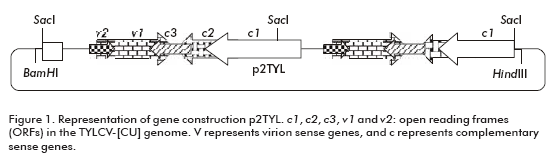
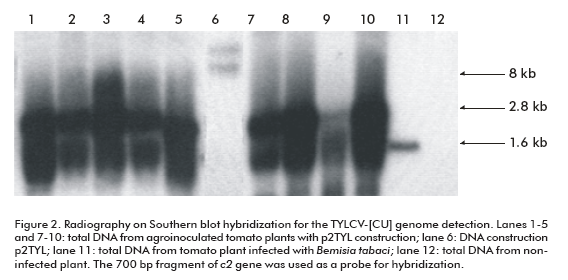
<body><![CDATA[<p><span lang=EN-US style='font-size:10.0pt;font-family:"Verdana","sans-serif"; color:#211E1E'>After the first two days of bombardment, total DNA of the NT1 line cells was extracted by grinding in </span></p>      <p><span lang=EN-US style='font-size:10.0pt;font-family:"Verdana","sans-serif"; color:#211E1E'>liquid nitrogen, using 500 µL of the extraction buffer containing urea 7 M, NaCl 5 M, Tris-HCl 1 M pH 8, ethylenediaminetetra-acetic acid (EDTA) 0.5 M, Sarcosyl 0.7%. Extracts were incubated for 30 min at room temperature and shaken periodically. Later, mixtures were treated with phenol/chloroform (v/v) and total DNA was obtained after precipitation in isopropanol. </span></p>      <p><span lang=EN-US style='font-size:10.0pt;font-family:"Verdana","sans-serif"; color:#211E1E'>The DNA digested with the <i>Mung Bean </i>or <i>Mbo </i>I nucleases was analyzed by Southern blot. Briefly, fifteen micrograms of DNA were fractionated in 0.8% agarose gel and transferred onto Hybond N+ membranes (Amersham Pharmacia Biotech, USA) using a TE 80, Vacuum Blotting Unit (Amersham Pharmacia Biotech, USA). DNA was cross-linked to the membrane using an Ultraviolet Crooslinker device (Amersham Pharmacia Biotech, USA). Hybridizations were done at 60 ºC using the &#091;</span><span style='font-size:10.0pt;font-family:"Verdana","sans-serif";color:#211E1E'>&#945;</span><span lang=EN-US style='font-size:10.0pt;font-family:"Verdana","sans-serif"; color:#211E1E'>-<sup>32</sup>P&#093;dATP-labelled TYLCV <i>c2 </i>gene (capsid protein gene) or the entire viral genome. </span></p>      <p><b><span lang=EN-US style='font-size:10.0pt;font-family:"Verdana","sans-serif"; color:#211E1E'>Extraction of RNA from transgenic tobacco cells and siRNA detection </span></b></p>      <p><span lang=EN-US style='font-size:10.0pt;font-family:"Verdana","sans-serif"; color:#211E1E'>For total RNA extraction, 0.5 g of NT1 cells were ground in the presence of liquid N2. After the addition of the extraction buffer (LiCL 0.1 M, Tris-HCL 100 mM pH 8, EDTA 10 mM and sodium dodecyl sulfate (SDS) 1%) and saturated phenol pH 4.4, the mixtures were homogenized by vortex for 30 s and 250 mL of chloroform-isoamylalcohol (24:1, v/v) was added. The water phase was removed after centrifugation and a volume of LiCL 4 M was added. RNAs were allowed to precipitate at -20 ºC and later collected by centrifugation. The pellets were dissolved in water and precipitated in the presence of NaOAc 3 M pH 5.2 and 2 volumes of cold 95% ethanol. Later, the pellets were washed with 75% ethanol and resuspended in water. High molecular weight RNA was discarded after the precipitation of 10 µg of total RNA with polyethylene glycol (MW 8000) 5% and NaCL 0.5 M. Low molecular weight RNAs were precipitated in the presence of 0.1 volume of NaOAc 3 M pH 5.2 and 3 volumes of ethanol 95%. For blotting, both RNAs were denatured at 65 ºC and fractionated in denatured conditions. Fractionation of low molecular weight RNA was performed on 15% polyacrylamide gel containing 7 M urea and transferred to the Hybond N+ membrane (Amersham Pharmacia Biotech, USA) using a TE 80, Vacuum Blotting Unit (Amersham Pharmacia Biotech, USA). In the case of high molecular weight RNA, the fractionation was carried out in 1% agarose gels containing 6.84% formaldehyde. RNAs were crosslinked to the membrane using an ultraviolet Crosslinker device (Amersham Pharmacia Biotech, USA). Hybridizations were done at 50 ºC using the &#091;</span><span style='font-size:10.0pt;font-family: "Verdana","sans-serif";color:#211E1E'>&#945;</span><span lang=EN-US style='font-size:10.0pt;font-family:"Verdana","sans-serif";color:#211E1E'>-32P&#093;dATP-labelled <i>c1 </i>gene as the probe, prepared by the random primer procedure according to the Prime-a-Gene Labeling System (Promega, USA) instructions. </span></p>      <p><b><span lang=EN-US style='font-family:"Verdana","sans-serif";color:#211E1E'>RESULTS </span></b></p>      <p><span lang=EN-US style='font-size:10.0pt;font-family:"Verdana","sans-serif"; color:#211E1E'>To demonstrate the replicating capacity of the NT1 tobacco cell line for TYLCV, the 2-mer TYLCV-&#091;CU&#093; construction (p2TYL, </span><span style='font-size:10.0pt;font-family:"Verdana","sans-serif";color:#211E1E'><a href="#fig1"><span lang=EN-US>Figure 1</span></a></span><span lang=EN-US style='font-size:10.0pt;font-family:"Verdana","sans-serif";color:#211E1E'>) was transfected into cells applying a particle bombardment procedure. Previously, replication activity of the generated p2TYL was confirmed by agroinoculation into tomato plants. The agroinoculated tomato plants were able to produce double and single strand viral genome DNA corresponding to 2.8 and 1.6 kb respectively, associated to replicative intermediate and viral genome DNA of the new synthesis (lanes 1-5 and 7-10; </span><span style='font-size:10.0pt; font-family:"Verdana","sans-serif";color:#211E1E'><a href="#fig2"><span lang=EN-US>Figure 2</span></a></span><span lang=EN-US style='font-size:10.0pt; font-family:"Verdana","sans-serif";color:#211E1E'>). </span></p>      <p align=center style='text-align:center'><span style='font-size:13.5pt; color:#211E1E'><img border=0 width=557 height=161 src="/img/revistas/bta/v26n2/f0105209.gif"></span><a name=fig1></a></p>      
<p align=center style='text-align:center'><span style='font-size:13.5pt; color:#211E1E'><img border=0 width=568 height=280 src="/img/revistas/bta/v26n2/f0205209.gif"></span><a name=fig2></a></p>      
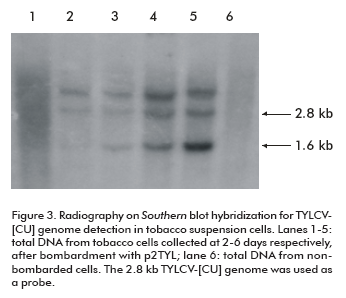
<p><span lang=EN-US style='font-size:10.0pt;font-family:"Verdana","sans-serif"; color:#211E1E'>The time course process of viral replication was followed by Southern blot hybridization on total DNA extracted from transfected NT1 cells. As observed on X-ray film, a band of approximately 1.6 kb corresponding to the TYLCV single strand genomic DNA was synthesized after four days of tobacco cell incubation (lanes 3, 4 and 5; </span><span style='font-size:10.0pt;font-family: "Verdana","sans-serif";color:#211E1E'><a href="#fig3"><span lang=EN-US>Figure 3</span></a></span><span lang=EN-US style='font-size:10.0pt;font-family:"Verdana","sans-serif"; color:#211E1E'>). Concentrations of TYLCV- &#091;CU&#093; single strand and double strand viral DNA increased daily, and reached the maximum level at the last day of the trial (lane 5; </span><span style='font-size:10.0pt; font-family:"Verdana","sans-serif";color:#211E1E'><a href="#fig3"><span lang=EN-US>Figure 3</span></a></span><span lang=EN-US style='font-size:10.0pt; font-family:"Verdana","sans-serif";color:#211E1E'>). </span></p>      ]]></body>
<body><![CDATA[<p align=center style='text-align:center'><span style='font-size:13.5pt; color:#211E1E'><img border=0 width=346 height=298 src="/img/revistas/bta/v26n2/f0305209.gif"></span><a name=fig3></a></p>      
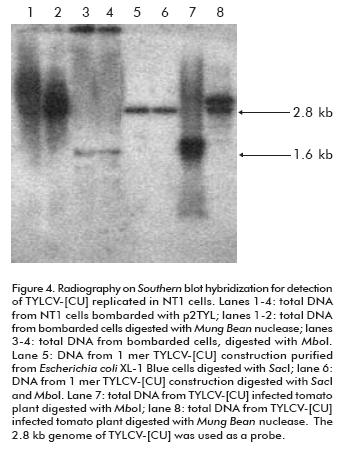
<p><span lang=EN-US style='font-size:10.0pt;font-family:"Verdana","sans-serif"; color:#211E1E'>To verify that the 1.6 kb signal corresponds to the TYLCV-&#091;CU&#093; single strand genome, and to evaluate it as an evidence of the new viral genome replicated from the 2 mer construction, total DNAs extracted from bombarded cells were digested with <i>Mung Bean </i>nuclease before the Southern blot hybridization. Since the activity of this enzyme is specific for single strand DNA, the 1.6 Kb signal in treated cell DNA extracts was missing from the autoradiography (lane 1 and 2; </span><span style='font-size:10.0pt;font-family:"Verdana","sans-serif";color:#211E1E'><a href="#fig4"><span lang=EN-US>Figure 4</span></a></span><span lang=EN-US style='font-size:10.0pt;font-family:"Verdana","sans-serif";color:#211E1E'>). In parallel, to confirm the <i>de novo </i>synthesis of the double TYLCV-&#091;CU&#093; strand, total DNAs from inoculated NT1 cells were digested with <i>Mbo </i>I nuclease. <i>Mbo </i>I restriction analysis allows to identify, in a general way, the organism that is the source of a given DNA. <i>Mbo </i>I-recognized DNA sequences harboring a GATC palindrome which is also recognized by Dam methylase in <i>E. coli</i>. The DNA used to transform NT1 tobacco cells was purified from <i>Escherichia coli </i>XL-1 Blue strain which is characterized by Dam methylation (23). Hence, the cloned TYLCV-&#091;CU&#093; genome from <i>E. coli </i>is methylated at <i>Mbo</i>I restriction sites and could not be digested by this enzyme (lanes 5 and 6; </span><span style='font-size:10.0pt;font-family:"Verdana","sans-serif";color:#211E1E'><a href="#fig4"><span lang=EN-US>Figure 4</span></a></span><span lang=EN-US style='font-size:10.0pt;font-family:"Verdana","sans-serif";color:#211E1E'>). In contrast, the <i>de novo </i>TYLCV-&#091;CU&#093; genome synthesized in NT1 cells is <i>Mbo </i>I susceptible (lanes 3 and 4; </span><span style='font-size:10.0pt;font-family:"Verdana","sans-serif";color:#211E1E'><a href="#fig4"><span lang=EN-US>Figure 4</span></a></span><span lang=EN-US style='font-size:10.0pt;font-family:"Verdana","sans-serif";color:#211E1E'>). Hence, it was demonstrated that the hydrolyzed double strand TYLCV-&#091;CU&#093; genome molecule has been replicated in NT1 tobacco cells. </span></p>      <p align=center style='text-align:center'><span style='font-size:13.5pt; color:#211E1E'><img border=0 width=343 height=453 src="/img/revistas/bta/v26n2/f0405209.gif"></span><a name=fig4></a></p>      
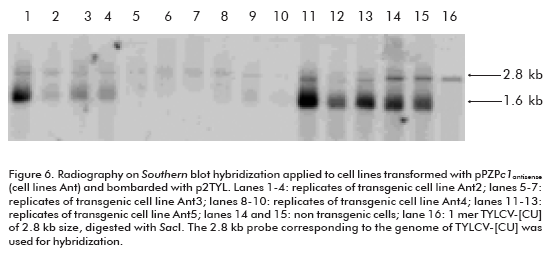
<p><span lang=EN-US style='font-size:10.0pt;font-family:"Verdana","sans-serif"; color:#211E1E'>Once the replication of the TYLCV-&#091;CU&#093; genome in the NT1 cell line was established, the next goal of this investigation was to develop transgenic cell lines harboring the antiviral strategy. We chose the construction carrying the <i>c1 <sub>antisense</sub></i> sequence (pPZP<i>c1<sub>antisense</sub></i>; </span><span style='font-size:10.0pt;font-family:"Verdana","sans-serif"; color:#211E1E'><a href="#fig5"><span lang=EN-US>Figure 5</span></a></span><span lang=EN-US style='font-size:10.0pt;font-family:"Verdana","sans-serif"; color:#211E1E'>) to induce post-transcriptional gene silencing against TYLCV-&#091;CU&#093; in NT1 cells. The development of transgenic lines was performed by particle bombardment. More than 10 transgenic lines were established in the selective NT1 medium, and all of them were bombarded with p2TYL. Among the transfected transgenic lines there were two that were not able to replicate TYLCV-&#091;CU&#093; (lanes 5-7 and 8-10, corresponding to three replicates of transgenic cell lines Ant3 and Ant4 respectively; </span><span style='font-size:10.0pt;font-family:"Verdana","sans-serif";color:#211E1E'><a href="#fig6"><span lang=EN-US>Figure 6</span></a></span><span lang=EN-US style='font-size:10.0pt;font-family:"Verdana","sans-serif";color:#211E1E'>). Whereas, the rest of the cell lines were able to produce both the double (2.8 kb) and single (1.6 kb) strand viral DNA (lanes 1-4 and 11-13; </span><span style='font-size:10.0pt;font-family:"Verdana","sans-serif";color:#211E1E'><a href="#fig6"><span lang=EN-US>Figure 6</span></a></span><span lang=EN-US style='font-size:10.0pt;font-family:"Verdana","sans-serif";color:#211E1E'>), resembling what had occurred in non transgenic NT1 cells bombarded with the p2TYL construction (lanes 14 and 15; </span><span style='font-size:10.0pt;font-family: "Verdana","sans-serif";color:#211E1E'><a href="#fig6"><span lang=EN-US>Figure 6</span></a></span><span lang=EN-US style='font-size:10.0pt;font-family:"Verdana","sans-serif"; color:#211E1E'>). Northern hybridization for the detection of small RNA specific to the <i>c1 </i>sequence evidenced the production of siRNA in the two resistant lines Ant3 and Ant4 (lanes 3 and 4; </span><span style='font-size: 10.0pt;font-family:"Verdana","sans-serif";color:#211E1E'><a href="#fig7"><span lang=EN-US>Figure 7</span></a></span><span lang=EN-US style='font-size:10.0pt; font-family:"Verdana","sans-serif";color:#211E1E'>). </span></p>      <p align=center style='text-align:center'><span style='font-size:13.5pt; color:#211E1E'><img border=0 width=555 height=195 src="/img/revistas/bta/v26n2/f0505209.gif"></span><a name=fig5></a></p>      
<p align=center style='text-align:center'><span style='font-size:13.5pt; color:#211E1E'><img border=0 width=554 height=253 src="/img/revistas/bta/v26n2/f0605209.gif"></span><a name=fig6></a></p>      
<p align=center style='text-align:center'><span style='font-size:13.5pt; color:#211E1E'><img border=0 width=342 height=230 src="/img/revistas/bta/v26n2/f0705209.gif"></span><a name=fig7></a></p>      
<p><b><span lang=EN-US style='font-family:"Verdana","sans-serif";color:#211E1E'>DISCUSSION </span></b></p>      <p><b><span lang=EN-US style='font-size:10.0pt;font-family:"Verdana","sans-serif"; color:#211E1E'>Tobacco NT1 cell line allows TYLCV replication </span></b></p>      <p><span lang=EN-US style='font-size:10.0pt;font-family:"Verdana","sans-serif"; color:#211E1E'>The NT1 cell line was selected as a model to analyze the consequences of the TYLCV <i>c1 <sub>antisense</sub></i> transgene expression on TYLCV replication due to several practical features: high propagation rate at a low cost, little demand for <i>in vitro </i>manipulation, possibility of being transformed by direct and indirect methods and the short time required to establish transgenic cell lines (22, 24, 25). Probably, the high reproductive capacity of the NT1 cell line favors its competency for its genetic transformation, similar to that suggested for several plant species when they were transformed via <i>Agrobacterium tumefaciens </i>(26-28). As NT1 cells can grow continuously, they should be a good target for systems requiring high transformation frequencies such as the case of our study. </span></p>      ]]></body>
<body><![CDATA[<p><span lang=EN-US style='font-size:10.0pt;font-family:"Verdana","sans-serif"; color:#211E1E'>The first step in begomovirus replication consists of an intermediary double stranded DNA (dsDNA) synthesis from a single stranded (SSDNA) genome (29, 30). This process is entirely executed by host enzymes. Afterwards, the start of the rolling cycle replication requires a joint action between viral Rep and REn proteins and cell factors to produce new dsDNAs and ssDNA progenies (31). For several geminiviruses the amount of intermediary dsDNA has been correlated with the occurrence of the S-phase (32-34), and the activation of mitosis and the S-phase entry of the cell is due to the release of the E2F transcription factor. E2F is released through hyperphosphorylation and subsequent inactivation of the retinoblastoma related protein (RBR) that represses it (35). Actually, two geminiviral proteins, Rep and RepA, inactivate the cell RBR, which promotes cell DNA replication necessary for viral genome multiplication (36). Probably the NT1 cell line carries all the necessary elements for the replication of TYLCV by its perennial division state and it could be predicted that no interactions between the geminivirus Rep protein and the repressor of E2F are required. As a supporting fact for this idea other authors have demonstrated the replication of bipartite begomoviruses <i>Tomato golden mosaic virus </i>(TGMV), <i>African cassava mosaic virus </i>(ACMV), <i>Bean golden mosaic virus </i>(BGMV) (13, 14, 16, 37), and monopartite mastrevirus <i>Bean yellow dwarf virus </i>(BeYDV) (38) in tobacco plant cells. </span></p>      <p><span lang=EN-US style='font-size:10.0pt;font-family:"Verdana","sans-serif"; color:#211E1E'>Correspondingly, the NT1 cell line resulted attractive for the establishment of the TYLCV replication model. Therefore, after a two-day incubation period the transfected NT1 cells with the p2TYL construction supported TYLCV replication, which was evidenced by the fact that the dsDNA and ssDNA corresponding signals from the bombarded cells were intensified (</span><span style='font-size:10.0pt;font-family:"Verdana","sans-serif";color:#211E1E'><a href="#fig3"><span lang=EN-US>figure 3</span></a></span><span lang=EN-US style='font-size:10.0pt;font-family:"Verdana","sans-serif";color:#211E1E'> and </span><span style='font-size:10.0pt;font-family:"Verdana","sans-serif";color:#211E1E'><a href="#fig4"><span lang=EN-US>figure 4</span></a></span><span lang=EN-US style='font-size:10.0pt;font-family:"Verdana","sans-serif";color:#211E1E'>). </span></p>      <p><span lang=EN-US style='font-size:10.0pt;font-family:"Verdana","sans-serif"; color:#211E1E'>As a conclusion we can state that the tobacco NT1 cells contain the necessary elements for TYLCV replication and are therefore an appropriate host for an <i>in vitro </i>model for TYLCV multiplication assays. </span></p>      <p><b><span lang=EN-US style='font-size:10.0pt;font-family:"Verdana","sans-serif"; color:#211E1E'>Virus challenge: transgenic NT1 tobacco cell line carrying <i>c1 antisense</i> sequence inhibited TYLCV replication </span></b></p>      <p><span lang=EN-US style='font-size:10.0pt;font-family:"Verdana","sans-serif"; color:#211E1E'>As soon as the NT1 ability for TYLCV replication was demonstrated, we proceeded to assess its capacity to be used in studies on the inhibition of TYLCV multiplication. The cells carrying the <i>c1 <sub>antisense</sub></i> construction (</span><span style='font-size:10.0pt;font-family:"Verdana","sans-serif"; color:#211E1E'><a href="#fig5"><span lang=EN-US>Figure 5</span></a></span><span lang=EN-US style='font-size:10.0pt;font-family:"Verdana","sans-serif"; color:#211E1E'>) were bombarded with 2 mer TYLCV-&#091;CU&#093;. With the aim of detecting the <i>de novo </i>synthesis of the viral genome, total DNA from the bombarded cells was analyzed by Southern hybridization, using the TYLCV genome as the probe. </span></p>      <p><span lang=EN-US style='font-size:10.0pt;font-family:"Verdana","sans-serif"; color:#211E1E'>Two transgenic lines out of ten grown on NT1 solid medium supplemented with kanamycin 150 mg/L showed the capacity to inhibit TYLCV replication; the cell lines Ant3 and Ant4 (</span><span style='font-size:10.0pt;font-family: "Verdana","sans-serif";color:#211E1E'><a href="#fig6"><span lang=EN-US>Figure 6</span></a></span><span lang=EN-US style='font-size:10.0pt;font-family:"Verdana","sans-serif"; color:#211E1E'>). This result is evidenced by the absence of autoradiographic signals corresponding to viral dsDNA and ssDNA in comparison to nontransgenic lines. </span></p>      <p><span lang=EN-US style='font-size:10.0pt;font-family:"Verdana","sans-serif"; color:#211E1E'>Previously, an induced post-transcriptional gene silencing (PTGS) against the Rep transcripts aimed to inhibit the ACMV replication in a protoplast system was described (16). For that purpose, the authors introduced specific Small interfering RNA (siRNA) molecules from replication associated gene <i>ac1 </i>sequence into protoplasts of tobacco BY-2 cells, in the presence of ACMV. As a result, partial inhibition of ACMV replication in protoplast, co-transfected with the mixture of siRNA was obtained (16). Although this system has the advantage of giving a rapid demonstration of the suitability of PTGS to inhibit ACMV replication in a protoplast system (in 3-4 days), only a partial effect on ACMV genome multiplication was evidenced in comparison to the transfected samples without siRNA. In addition, ACMV replication still took place, which seems to be controversial since the Rep protein is required for virus replication, although the authors were not able to detect the mRNA specific for Rep by Northern hybridization. In our study the cell transgenic lines Ant3 and Ant4 totally inhibited the TYLCV genome replication (</span><span style='font-size:10.0pt;font-family:"Verdana","sans-serif"; color:#211E1E'><a href="#fig6"><span lang=EN-US>Figure 6</span></a></span><span lang=EN-US style='font-size:10.0pt;font-family:"Verdana","sans-serif"; color:#211E1E'>), which could prevent the multiplication of TYLCV. </span></p>      <p><span lang=EN-US style='font-size:10.0pt;font-family:"Verdana","sans-serif"; color:#211E1E'>The genetic design to provoke <i>c1 </i>gene silencing was focused on the promotion of double strand RNA (dsRNA) which is expected to induce post-transcriptional gene silencing against the target sequence. To obtain this design the <i>c1 <sub>antisense</sub></i> sequence was ligated downstream of the 35S promoter of the <i>Cauliflower mosaic virus </i>(CaMV) and upstream to the nopaline synthetase terminator of the <i>Agrobacterium tumefaciens</i>. This construction, known for its capacity to diminish TYLCV infection in <i>Nicotiana benthamiana </i>transgenic plants (39), should originate complementary transcripts to those produced from the <i>c1 </i>gene of the TYLCV genome. Complementary transcripts could form dsRNA molecules which would constitute the substrate for ARNase type III (Dicer) specific for dsRNA. As a result, fragments of 21 to 25 bp siRNA should be produced (40). </span></p>      <p><span lang=EN-US style='font-size:10.0pt;font-family:"Verdana","sans-serif"; color:#211E1E'>Consistently, transgenic cell lines Ant3 and Ant4 are those producing siRNA complementary to the <i>c1 </i>gene (</span><span style='font-size:10.0pt;font-family:"Verdana","sans-serif";color:#211E1E'><a href="#fig7"><span lang=EN-US>Figure 7</span></a></span><span lang=EN-US style='font-size:10.0pt;font-family:"Verdana","sans-serif";color:#211E1E'>). The inhibition of TYLCV replication in these two lines reflects the capacity of the PTGS mechanism, directed against the Rep, to diminish TYLCV multiplication, and, on the other hand, the capacity of tobacco NT1 cell line to develop the PTGS against the <i>c1 </i>gene. </span></p>      <p><span lang=EN-US style='font-size:10.0pt;font-family:"Verdana","sans-serif"; color:#211E1E'>Nevertheless, transgenic cell lines Ant3 and Ant4 produced siRNA that was complementary to the <i>c1 </i>gene sequence even when not inoculated with TYLCV. The PTGS process in these two lines could be started from a single aberrant strand of RNA which are converted to dsRNA by the action of cell RNA dependent RNA polymerase (RdRP) (41, 42). The siRNA complementary to the <i>c1 </i>gene may be derived from transcripts without the 5´ cap structure or poly A tail at the 3´ end, originated under a high 35S promoter activity (43, 44), as a substrate for RdRP. Also, multiple copies of the <i>c1 <sub>antisense</sub></i> sequences may have occurred at high frequencies after the particle bombardment procedure (45, 46) (not demonstrated in the present study) triggering, through an excess of mRNAs, the formation of secondary structures which could be diced into siRNA molecules (47). Consequently, the advantage of the system proposed in the present work consists of the stable production, <i>a priori</i>, of the siRNA molecules complementary to the <i>c1 </i>sequence as the consequence of the transgene integration. Therefore, the synthesis of the Rep protein once the virus is inside the cell is unlikely to occur, which could be explained by the immediate degradation of the viral <i>c1 </i>transcript. In this way, our system closely resembles what could occur in plants carrying this antiviral design. Besides, our model circumvents the lack of the stability evaluation of the silencing effect through successive cell generations in transiently evaluated antiviral designs. </span></p>      ]]></body>
<body><![CDATA[<p><span lang=EN-US style='font-size:10.0pt;font-family:"Verdana","sans-serif"; color:#211E1E'>In conclusion, transgenic tobacco NT1 cell lines capable to stably generate siRNA molecules specific for the <i>c1 </i>sequence inhibited the replication of TYLCV. This fact was confirmed later in transgenic tomato lines that harbour double strand RNA forming construction design specific for <i>c1</i>, which became immune with TYLCV inoculation under high whitefly population conditions (48). </span></p>      <p><span lang=EN-US style='font-size:10.0pt;font-family:"Verdana","sans-serif"; color:#211E1E'>The proposed transgenic system of NT1 tobacco cells demonstrated its suitability for replication studies in TYLCV. In addition, the capacity of these cells to generate siRNA and, subsequently, to induce PTGS against viral genes make them an attractive system for studies on viral functions. </span></p>      <p><b><span lang=EN-US style='font-family:"Verdana","sans-serif";color:#211E1E'>ACKNOWLEDGMENTS </span></b></p>      <p><span lang=EN-US style='font-size:10.0pt;font-family:"Verdana","sans-serif"; color:#211E1E'>This work was funded by the State Council of the Republic of Cuba. </span></p>      <p><b><span lang=EN-US style='font-family:"Verdana","sans-serif"'>&nbsp;</span></b></p>      <p><span lang=EN-US style='font-size:11.0pt;font-family:"Arial","sans-serif"; color:red'> </span><b><span lang=EN-US style='font-family:"Verdana","sans-serif"'>REFERENCES</span></b><b><span lang=EN-US style='font-size:10.0pt;font-family:"Verdana","sans-serif"'> </span></b></p>      <!-- ref --><p><span lang=EN-US style='font-size:10.0pt;font-family:"Verdana","sans-serif"; color:#211E1E'>1. Polston JE, Anderson PK. The emergence of whitefly-transmitted geminiviruses in tomato in the western hemisphere. Plant Dis</span><span lang=EN-US style='font-size:11.0pt;font-family:"Arial","sans-serif"; color:red'> </span><span lang=EN-US style='font-size:10.0pt;font-family:"Verdana","sans-serif"; color:#211E1E'>1997;81:1358-69.</span><!-- ref --><p><span lang=EN-US style='font-size:10.0pt;font-family:"Verdana","sans-serif"; color:#211E1E'>2. Friedmann M, Lapidot M, Cohen S, Pilowsky M. A novel source of resistance to Tomato Yellow Leaf Curl Virus exhibiting a symptomless reaction to viral Infection. J Amer Soc Hort Sci</span><span lang=EN-US style='font-size:11.0pt;font-family:"Arial","sans-serif";color:red'> </span><span lang=EN-US style='font-size:10.0pt;font-family:"Verdana","sans-serif"; color:#211E1E'>1998;123:1004-7.</span><!-- ref --><p><span lang=EN-US style='font-size:10.0pt;font-family:"Verdana","sans-serif"; color:#211E1E'>3. Lapidot M, Friedmann M. Breeding for resistance to whitefly-transmitted geminiviruses. Ann Appl Biol</span><span lang=EN-US style='font-size:11.0pt;font-family:"Arial","sans-serif";color:red'> </span><span lang=EN-US style='font-size:10.0pt;font-family:"Verdana","sans-serif"; color:#211E1E'>2002;140</span><span lang=EN-US style='font-size:10.0pt; font-family:"Arial","sans-serif";color:black'>(</span><span lang=EN-US style='font-size:10.0pt;font-family:"Verdana","sans-serif";color:#211E1E'>2</span><span lang=EN-US style='font-size:11.0pt;font-family:"Arial","sans-serif";color:windowtext'>)</span><span lang=EN-US style='font-size:10.0pt;font-family:"Verdana","sans-serif"; color:#211E1E'>:109-27.</span><!-- ref --><p><span lang=EN-US style='font-size:10.0pt;font-family:"Verdana","sans-serif"; color:#211E1E'>4. Kasrawi M. Inheritance of resistance to tomato yellow leaf curl virus (TYLCV) in <i>Lycopersicon pimpinellifolium</i>. Plant Dis</span><span lang=EN-US style='font-size:11.0pt;font-family:"Arial","sans-serif";color:red'> </span><span lang=EN-US style='font-size:10.0pt;font-family:"Verdana","sans-serif"; color:#211E1E'>1989;73:435-7.</span><!-- ref --><p><span lang=EN-US style='font-size:10.0pt;font-family:"Verdana","sans-serif"; color:#211E1E'>5. Picó B, Diez MJ, Nuez F. Viral diseases causing the greatest economic losses to the tomato crop. II. The tomato yellow leaf curl virus-</span><span style='font-size:10.0pt;font-family:"Verdana","sans-serif";color:#211E1E'>&#945;</span><span lang=EN-US style='font-size:10.0pt;font-family:"Verdana","sans-serif"; color:#211E1E'> review. Scientia Horticulturae</span><span lang=EN-US style='font-size:11.0pt;font-family:"Arial","sans-serif";color:red'> </span><span lang=EN-US style='font-size:10.0pt;font-family:"Verdana","sans-serif"; color:#211E1E'>1996;67:151-196.</span><!-- ref --><p><span lang=EN-US style='font-size:10.0pt;font-family:"Verdana","sans-serif"; color:#211E1E'>6. Vidavsky F, Czosnek H. Tomato breeding lines immune and tolerant to tomato yellow leaf curl virus (TYLCV) issued from <i>Lycopersicon hirsutum</i>. Phytophatology</span><span lang=EN-US style='font-size:11.0pt; font-family:"Arial","sans-serif";color:red'> </span><span lang=EN-US style='font-size:10.0pt;font-family:"Verdana","sans-serif";color:#211E1E'>1998;88:910-914.</span><!-- ref --><p><span lang=EN-US style='font-size:10.0pt;font-family:"Verdana","sans-serif"; color:#211E1E'>7. Vidavsky F, Leviatov S, Milo J, Rabinowitch H, Kedar N, Czosnek H. Response of tolerant breeding lines of tomato <i>Lycopersicon esculentum</i>, originating from three different sources <i>L. peruvianum</i>, <i>L. pimpinellifolium </i>and <i>L. chilense </i>to early controlled inoculation by Tomato yellow leaf curl virus (TYLCV). Plant Breeding</span><span lang=EN-US style='font-size:11.0pt;font-family:"Arial","sans-serif";color:red'> </span><span lang=EN-US style='font-size:10.0pt;font-family:"Verdana","sans-serif"; color:#211E1E'>1998;117:165-9.</span><!-- ref --><p><span lang=EN-US style='font-size:10.0pt;font-family:"Verdana","sans-serif"; color:#211E1E'>8. Sanford J, Johnston S. The concept of parasite-derived resistance: deriving resistance genes from the parasite´s own genome. J Theor Biol</span><span lang=EN-US style='font-size:11.0pt;font-family:"Arial","sans-serif"; color:red'> </span><span lang=EN-US style='font-size:10.0pt;font-family:"Verdana","sans-serif"; color:#211E1E'>1985;113:395-405.</span><!-- ref --><p><span lang=EN-US style='font-size:10.0pt;font-family:"Verdana","sans-serif"; color:#211E1E'>9. Beachy RN. Mechanisms and applications of pathogen-derived resistance in transgenic plants. Curr Opin Biotechnol</span><span lang=EN-US style='font-size:11.0pt;font-family:"Arial","sans-serif";color:red'> </span><span lang=EN-US style='font-size:10.0pt;font-family:"Verdana","sans-serif"; color:#211E1E'>1997;8:215-20.</span><p><span lang=EN-US style='font-size:10.0pt;font-family:"Verdana","sans-serif"; color:#211E1E'>10. Fuentes A, Ramos P, Sánchez Y, Callard D, Ferreira A, Tiel K <i>et</i> <i>al. </i>A transformation procedure for recalcitrant tomato by addressing transgenic plant-recovery limiting factors. Biotechnol J</span><span lang=EN-US style='font-size:11.0pt;font-family:"Arial","sans-serif";color:red'> </span><span lang=EN-US style='font-size:10.0pt;font-family:"Verdana","sans-serif"; color:#211E1E'>2008;3:1088-93.</span></p>      <!-- ref --><p><span lang=EN-US style='font-size:10.0pt;font-family:"Verdana","sans-serif"; color:#211E1E'>11. Fontes EP, Eagle PA, Sipe PS, Luckow VA, Hanley-Bowdoin L. Interaction between a geminivirus replication protein and origin DNA is essential for viral replication. J Biol Chem</span><span lang=EN-US style='font-size:11.0pt; font-family:"Arial","sans-serif";color:red'> </span><span lang=EN-US style='font-size:10.0pt;font-family:"Verdana","sans-serif";color:#211E1E'>1994;269</span><span lang=EN-US style='font-size:10.0pt;font-family:"Arial","sans-serif";color:black'>(</span><span lang=EN-US style='font-size:10.0pt;font-family:"Verdana","sans-serif"; color:#211E1E'>11):8459-65.</span><!-- ref --><p><span lang=EN-US style='font-size:10.0pt;font-family:"Verdana","sans-serif"; color:#211E1E'>12. Hanson SF, Maxwell DP. trans-Dominant inhibition of geminiviral DNA replication by bean golden mosaic geminivirus rep gene mutants. Phytopathology</span><span lang=EN-US style='font-size:11.0pt;font-family:"Arial","sans-serif";color:red'> </span><span lang=EN-US style='font-size:10.0pt;font-family:"Verdana","sans-serif"; color:#211E1E'>1999;89:480-6.</span><!-- ref --><p><span lang=EN-US style='font-size:10.0pt;font-family:"Verdana","sans-serif"; color:#211E1E'>13. Ha C, Coombs S, Revill P, Harding R, Vu M, Dale J. <i>Corchorus yellow vein virus</i>, a New World geminivirus from the Old World. J Gen Virol</span><span lang=EN-US style='font-size:11.0pt;font-family:"Arial","sans-serif";color:red'> </span><span lang=EN-US style='font-size:10.0pt;font-family:"Verdana","sans-serif"; color:#211E1E'>2006;87:997-1003.</span><!-- ref --><p><span lang=EN-US style='font-size:10.0pt;font-family:"Verdana","sans-serif"; color:#211E1E'>14. Chatterji A, Beachy RN, Fauquet CM. Expression of the oligomerization domain of the replication-associated protein (Rep) of Tomato leaf curl New Delhi virus interferes with DNA accumulation of heterologous geminiviruses. J Biol Chem</span><span lang=EN-US style='font-size:11.0pt; font-family:"Arial","sans-serif";color:red'> </span><span lang=EN-US style='font-size:10.0pt;font-family:"Verdana","sans-serif";color:#211E1E'>2001;276</span><span lang=EN-US style='font-size:10.0pt;font-family:"Arial","sans-serif";color:black'>(</span><span lang=EN-US style='font-size:10.0pt;font-family:"Verdana","sans-serif"; color:#211E1E'>27):25631-8.</span><!-- ref --><p><span lang=EN-US style='font-size:10.0pt;font-family:"Verdana","sans-serif"; color:#211E1E'>15. Hou YM, Paplomatas EJ, Gilbertson RL. Host adaptation and replication properties of two bipartite geminiviruses and their pseudorecombinants. Mol Plant Microbe Interact</span><span lang=EN-US style='font-size:11.0pt; font-family:"Arial","sans-serif";color:red'> </span><span lang=EN-US style='font-size:10.0pt;font-family:"Verdana","sans-serif";color:#211E1E'>1998;11</span><span lang=EN-US style='font-size:10.0pt;font-family:"Arial","sans-serif";color:black'>(</span><span lang=EN-US style='font-size:10.0pt;font-family:"Verdana","sans-serif"; color:#211E1E'>3):208-17.</span><!-- ref --><p><span lang=EN-US style='font-size:10.0pt;font-family:"Verdana","sans-serif"; color:#211E1E'>16. Vanitharani R, Chellappan P, Fauquet CM. Short interfering RNA-mediated interference of gene expression and viral DNA accumulation in cultured plant cells. Proc Natl Acad Sci USA</span><span lang=EN-US style='font-size:11.0pt;font-family:"Arial","sans-serif";color:red'> </span><span lang=EN-US style='font-size:10.0pt;font-family:"Verdana","sans-serif"; color:#211E1E'>2003;100</span><span lang=EN-US style='font-size:10.0pt; font-family:"Arial","sans-serif";color:black'>(</span><span lang=EN-US style='font-size:10.0pt;font-family:"Verdana","sans-serif";color:#211E1E'>16):9632-6.</span><!-- ref --><p><span lang=EN-US style='font-size:10.0pt;font-family:"Verdana","sans-serif"; color:#211E1E'>17. Paszty C, Lurquin P. Improved plant protoplast plating/selection technique for quantitation of transformation frequencies. BioTechniques</span><span lang=EN-US style='font-size:11.0pt;font-family:"Arial","sans-serif";color:red'> </span><span lang=EN-US style='font-size:10.0pt;font-family:"Verdana","sans-serif"; color:#211E1E'>1987;5:716-8.</span><!-- ref --><p><span lang=EN-US style='font-size:10.0pt;font-family:"Verdana","sans-serif"; color:#211E1E'>18. Murashige T, Skoog F. A revised medium for rapid growth and bioassays with tobacco tissue culture. Physiol Plant</span><span lang=EN-US style='font-size:11.0pt;font-family:"Arial","sans-serif";color:red'> </span><span lang=EN-US style='font-size:10.0pt;font-family:"Verdana","sans-serif"; color:#211E1E'>1962;15:473-97.</span><!-- ref --><p><span lang=EN-US style='font-size:10.0pt;font-family:"Verdana","sans-serif"; color:#211E1E'>19. Coego A, Vázques R, Alfonso R, Coll Y, Pujol M, Ménendez E, et al. Effect of promoter-stimulatory element combination on transient reporter gene expression in tobacco protoplast using PEG-treatment. Biotecnol Apl</span><span lang=EN-US style='font-size:11.0pt;font-family:"Arial","sans-serif";color:red'> </span><span lang=EN-US style='font-size:10.0pt;font-family:"Verdana","sans-serif"; color:#211E1E'>1996;13</span><span lang=EN-US style='font-size:10.0pt; font-family:"Arial","sans-serif";color:black'>(</span><span lang=EN-US style='font-size:10.0pt;font-family:"Verdana","sans-serif";color:#211E1E'>2):147.</span><p><span lang=EN-US style='font-size:10.0pt;font-family:"Verdana","sans-serif"; color:#211E1E'>20. Deblaere R, Bytebier B, DeGreve H, Deboeck F, Schell J, Van Montagu M, et al. Efficient octopine Ti plasmid vectors for <i>Agrobacterium</i>-mediated gene transfer to plants. Nucleic Acids Res</span><span lang=EN-US style='font-size:11.0pt;font-family:"Arial","sans-serif";color:red'> </span><span lang=EN-US style='font-size:10.0pt;font-family:"Verdana","sans-serif"; color:#211E1E'>1985;13:4777-88.</span></p>      <!-- ref --><p><span lang=EN-US style='font-size:10.0pt;font-family:"Verdana","sans-serif"; color:#211E1E'>21. Finer JJ, Vain P, Jones MW, McMullen MD. Development of the particle inflow gun for DNA delivery to plant cells. Plant Cell Report</span><span lang=EN-US style='font-size:11.0pt;font-family:"Arial","sans-serif";color:red'> </span><span lang=EN-US style='font-size:10.0pt;font-family:"Verdana","sans-serif"; color:#211E1E'>1992;11:323-8.</span><!-- ref --><p><span lang=EN-US style='font-size:10.0pt;font-family:"Verdana","sans-serif"; color:#211E1E'>22. Sanford JC, Smith FD, Russell JA. Optimizing the biolistic process for different biological applications. Methods Enzymol</span><span lang=EN-US style='font-size:11.0pt;font-family:"Arial","sans-serif";color:red'> </span><span lang=EN-US style='font-size:10.0pt;font-family:"Verdana","sans-serif"; color:#211E1E'>1993;217:483-509.</span><!-- ref --><p><span lang=EN-US style='font-size:10.0pt;font-family:"Verdana","sans-serif"; color:#211E1E'>23. Bullock WO, Fernandez JM, Short JM. XL1-Blue, high efficiency plasmid transforming <i>rec</i>A <i>Escherichia coli </i>strain with beta-galatosidase selection. BioTechniques</span><span lang=EN-US style='font-size:11.0pt;font-family:"Arial","sans-serif";color:red'> </span><span lang=EN-US style='font-size:10.0pt;font-family:"Verdana","sans-serif"; color:#211E1E'>1987;5:376-378.</span><!-- ref --><p><span lang=EN-US style='font-size:10.0pt;font-family:"Verdana","sans-serif"; color:#211E1E'>24. Fuentes A, Ramos P, Ayra C, Rodríguez M, Ramírez N, Pujol M. Development of a highly efficient system for assessing recombinant gene expression in plant cell suspensions via <i>Agrobacterium tumefaciens </i>transformation. Biotechnol Appl Biochem</span><span lang=EN-US style='font-size:11.0pt; font-family:"Arial","sans-serif";color:red'> </span><span lang=EN-US style='font-size:10.0pt;font-family:"Verdana","sans-serif";color:#211E1E'>2004;39:355-61.</span><!-- ref --><p><span lang=EN-US style='font-size:10.0pt;font-family:"Verdana","sans-serif"; color:#211E1E'>25. Gynheung A. High efficiency transformation of cultured tobacco cells. Plant Physiology</span><span lang=EN-US style='font-size:11.0pt; font-family:"Arial","sans-serif";color:red'> </span><span lang=EN-US style='font-size:10.0pt;font-family:"Verdana","sans-serif";color:#211E1E'>1985;79:568-70.</span><!-- ref --><p><span lang=EN-US style='font-size:10.0pt;font-family:"Verdana","sans-serif"; color:#211E1E'>26. Lai Y, Chen L. Flow cytometric analysis of nuclear cell cycle phases in relation to plant regeneration in <i>Petunia hybrida</i>. J Genet Mol Biol</span><span lang=EN-US style='font-size:11.0pt;font-family:"Arial","sans-serif"; color:red'> </span><span lang=EN-US style='font-size:10.0pt;font-family:"Verdana","sans-serif"; color:#211E1E'>2002;13:13-20.</span><!-- ref --><p><span lang=EN-US style='font-size:10.0pt;font-family:"Verdana","sans-serif"; color:#211E1E'>27. Peña L, Pérez R, Cervera M, Juárez J, Navarro L. Early events in <i>Agrobacterium-</i>mediated genetic transformation of citrus explants. Ann Botany</span><span lang=EN-US style='font-size:11.0pt;font-family: "Arial","sans-serif";color:red'> </span><span lang=EN-US style='font-size:10.0pt; font-family:"Verdana","sans-serif";color:#211E1E'>2004;94:67-74.</span><!-- ref --><p><span lang=EN-US style='font-size:10.0pt;font-family:"Verdana","sans-serif"; color:#211E1E'>28. Villemont E, Dubois F, Sangwan R, Vasseur G, Bourgeois Y, Sangwan-Norreel B. Role of the host cell cycle in the <i>Agrobacterium</i>- mediated genetic transformation of <i>Petunia: </i>evidence of an S-phase control mechanism for T-DNA transfer. Planta</span><span lang=EN-US style='font-size:11.0pt; font-family:"Arial","sans-serif";color:red'> </span><span lang=EN-US style='font-size:10.0pt;font-family:"Verdana","sans-serif";color:#211E1E'>1997;201:160-172.</span><!-- ref --><p><span lang=EN-US style='font-size:10.0pt;font-family:"Verdana","sans-serif"; color:#211E1E'>29. Kammann M, Schalk HJ, Matzeit V, Schaefer S, Schell J, Gronenborn B. DNA replication of wheat dwarf virus, a geminivirus, requires two cis-acting signals. Virology</span><span lang=EN-US style='font-size:11.0pt;font-family: "Arial","sans-serif";color:red'> </span><span lang=EN-US style='font-size:10.0pt; font-family:"Verdana","sans-serif";color:#211E1E'>1991;184</span><span lang=EN-US style='font-size:10.0pt;font-family:"Arial","sans-serif";color:black'>(</span><span lang=EN-US style='font-size:10.0pt;font-family:"Verdana","sans-serif"; color:#211E1E'>2):786-90.</span><!-- ref --><p><span lang=EN-US style='font-size:10.0pt;font-family:"Verdana","sans-serif"; color:#211E1E'>30. Saunders K, Lucy A, Stanley J. RNA-primed complementary-sense DNA synthesis of the geminivirus African cassava mosaic virus. Nucleic Acids Res</span><span lang=EN-US style='font-size:11.0pt; font-family:"Arial","sans-serif";color:red'> </span><span lang=EN-US style='font-size:10.0pt;font-family:"Verdana","sans-serif";color:#211E1E'>1992;20</span><span lang=EN-US style='font-size:10.0pt;font-family:"Arial","sans-serif";color:black'>(</span><span lang=EN-US style='font-size:10.0pt;font-family:"Verdana","sans-serif"; color:#211E1E'>23):6311-5.</span><!-- ref --><p><span lang=EN-US style='font-size:10.0pt;font-family:"Verdana","sans-serif"; color:#211E1E'>31. Stanley J. Analysis of African cassava mosaic virus recombinants suggests strand nicking occurs within the conserved nonanucleotide motif during the initiation of rolling circle DNA replication. Virology</span><span lang=EN-US style='font-size:11.0pt;font-family:"Arial","sans-serif";color:red'> </span><span lang=EN-US style='font-size:10.0pt;font-family:"Verdana","sans-serif"; color:#211E1E'>1995;206</span><span lang=EN-US style='font-size:10.0pt; font-family:"Arial","sans-serif";color:black'>(</span><span lang=EN-US style='font-size:10.0pt;font-family:"Verdana","sans-serif";color:#211E1E'>1):707-12.</span><!-- ref --><p><span lang=EN-US style='font-size:10.0pt;font-family:"Verdana","sans-serif"; color:#211E1E'>32. Accotto GP, Mullineaux PM, Brown SC, Marie D. Digitaria streak geminivirus replicative forms are abundant in S-phase nuclei of infected cells. Virology</span><span lang=EN-US style='font-size:11.0pt;font-family: "Arial","sans-serif";color:red'> </span><span lang=EN-US style='font-size:10.0pt; font-family:"Verdana","sans-serif";color:#211E1E'>1993;195</span><span lang=EN-US style='font-size:10.0pt;font-family:"Arial","sans-serif";color:black'>(</span><span lang=EN-US style='font-size:10.0pt;font-family:"Verdana","sans-serif"; color:#211E1E'>1):257-9.</span><!-- ref --><p><span lang=EN-US style='font-size:10.0pt;font-family:"Verdana","sans-serif"; color:#211E1E'>33. Grafi G, Burnett RJ, Helentjaris T, Larkins BA, DeCaprio JA, Sellers WR, et al. A maize cDNA encoding a member of the retinoblastoma protein family: involvement in endoreduplication. Proc Natl Acad Sci USA</span><span lang=EN-US style='font-size:11.0pt;font-family:"Arial","sans-serif";color:red'> </span><span lang=EN-US style='font-size:10.0pt;font-family:"Verdana","sans-serif"; color:#211E1E'>1996;93</span><span lang=EN-US style='font-size:10.0pt; font-family:"Arial","sans-serif";color:black'>(</span><span lang=EN-US style='font-size:10.0pt;font-family:"Verdana","sans-serif";color:#211E1E'>17):8962-7.</span><!-- ref --><p><span lang=EN-US style='font-size:10.0pt;font-family:"Verdana","sans-serif"; color:#211E1E'>34. Xie Q, Sanz-Burgos AP, Hannon GJ, Gutierrez C. Plant cells contain a novel member of the retinoblastoma family of growth regulatory proteins. EMBO J</span><span lang=EN-US style='font-size:11.0pt;font-family:"Arial","sans-serif"; color:red'> </span><span lang=EN-US style='font-size:10.0pt;font-family:"Verdana","sans-serif"; color:#211E1E'>1996;15</span><span lang=EN-US style='font-size:10.0pt; font-family:"Arial","sans-serif";color:black'>(</span><span lang=EN-US style='font-size:10.0pt;font-family:"Verdana","sans-serif";color:#211E1E'>18):4900-8.</span><!-- ref --><p><span lang=EN-US style='font-size:10.0pt;font-family:"Verdana","sans-serif"; color:#211E1E'>35. de Jager S, Maughan S, Dewitte W, Scofield S, Murray A. The developmental context of cell-cycle control in plants. Semin Cell Dev Biol</span><span lang=EN-US style='font-size:11.0pt;font-family:"Arial","sans-serif";color:red'> </span><span lang=EN-US style='font-size:10.0pt;font-family:"Verdana","sans-serif"; color:#211E1E'>2005;16:385-96.</span><!-- ref --><p><span lang=EN-US style='font-size:10.0pt;font-family:"Verdana","sans-serif"; color:#211E1E'>36. Gutierrez C. DNA replication and cell cycle in plants: learning from geminiviruses. EMBO J</span><span lang=EN-US style='font-size:11.0pt; font-family:"Arial","sans-serif";color:red'> </span><span lang=EN-US style='font-size:10.0pt;font-family:"Verdana","sans-serif";color:#211E1E'>2000;19</span><span lang=EN-US style='font-size:10.0pt;font-family:"Arial","sans-serif";color:black'>(</span><span lang=EN-US style='font-size:10.0pt;font-family:"Verdana","sans-serif"; color:#211E1E'>5):792-799.</span><!-- ref --><p><span lang=EN-US style='font-size:10.0pt;font-family:"Verdana","sans-serif"; color:#211E1E'>37. Orozco BM, Hanley-Bowdoin L. Conserved sequence and structural motifs contribute to the DNA binding and cleavage activities of a geminivirus replication protein. J Biol Chem</span><span lang=EN-US style='font-size:11.0pt;font-family:"Arial","sans-serif";color:red'> </span><span lang=EN-US style='font-size:10.0pt;font-family:"Verdana","sans-serif"; color:#211E1E'>1998;273</span><span lang=EN-US style='font-size:10.0pt; font-family:"Arial","sans-serif";color:black'>(</span><span lang=EN-US style='font-size:10.0pt;font-family:"Verdana","sans-serif";color:#211E1E'>38):24448-56.</span><!-- ref --><p><span lang=EN-US style='font-size:10.0pt;font-family:"Verdana","sans-serif"; color:#211E1E'>38. Mor TS, Moon YS, Palmer KE, Mason HS. Geminivirus vectors for high-level expression of foreign proteins in plant cells. Biotechnol Bioeng</span><span lang=EN-US style='font-size:11.0pt;font-family:"Arial","sans-serif";color:red'> </span><span lang=EN-US style='font-size:10.0pt;font-family:"Verdana","sans-serif"; color:#211E1E'>2003;81</span><span lang=EN-US style='font-size:10.0pt; font-family:"Arial","sans-serif";color:black'>(</span><span lang=EN-US style='font-size:10.0pt;font-family:"Verdana","sans-serif";color:#211E1E'>4</span><span lang=EN-US style='font-family:"Arial","sans-serif";color:windowtext'>)</span><span lang=EN-US style='font-size:10.0pt;font-family:"Verdana","sans-serif"; color:#211E1E'>:430-7.</span><!-- ref --><p><span lang=EN-US style='font-size:10.0pt;font-family:"Verdana","sans-serif"; color:#211E1E'>39. Bendahmane M, Gronenborn B. Engineering resistance against tomato yellow leaf curl virus (TYLCV) using <i><sub>antisense</sub></i> RNA. Plant Mol Biol</span><span lang=EN-US style='font-size:11.0pt;font-family:"Arial","sans-serif"; color:red'> </span><span lang=EN-US style='font-size:10.0pt;font-family:"Verdana","sans-serif"; color:#211E1E'>1997;33</span><span lang=EN-US style='font-size:10.0pt; font-family:"Arial","sans-serif";color:black'>(</span><span lang=EN-US style='font-size:10.0pt;font-family:"Verdana","sans-serif";color:#211E1E'>2):351-7.</span><!-- ref --><p><span lang=EN-US style='font-size:10.0pt;font-family:"Verdana","sans-serif"; color:#211E1E'>40. Aravin A, Tuschl T. Identification and characterization of small RNAs involved in RNA silencing. FEBS Lett</span><span lang=EN-US style='font-size:11.0pt;font-family:"Arial","sans-serif";color:red'> </span><span lang=EN-US style='font-size:10.0pt;font-family:"Verdana","sans-serif"; color:#211E1E'>2005;579:5830-40.</span><!-- ref --><p><span lang=EN-US style='font-size:10.0pt;font-family:"Verdana","sans-serif"; color:#211E1E'>41. Ahlquist P. RNA-dependent RNA polymerases, viruses, and RNA silencing. Science</span><span lang=EN-US style='font-size:11.0pt;font-family: "Arial","sans-serif";color:red'> </span><span lang=EN-US style='font-size:10.0pt; font-family:"Verdana","sans-serif";color:#211E1E'>2002;296:1270-3.</span><!-- ref --><p><span lang=EN-US style='font-size:10.0pt;font-family:"Verdana","sans-serif"; color:#211E1E'>42. Dalmay T. An RNA-dependent RNA polymerase gene in <i>Arabidopsis </i>is required for posttranscriptional gene silencing mediated by a transgene but not by a virus. Cell</span><span lang=EN-US style='font-size:11.0pt; font-family:"Arial","sans-serif";color:red'> </span><span lang=EN-US style='font-size:10.0pt;font-family:"Verdana","sans-serif";color:#211E1E'>2000;101:543-53.</span><!-- ref --><p><span lang=EN-US style='font-size:10.0pt;font-family:"Verdana","sans-serif"; color:#211E1E'>43. Baulcombe D. RNA silencing in plants. Nature</span><span lang=EN-US style='font-size:11.0pt;font-family:"Arial","sans-serif";color:red'> </span><span lang=EN-US style='font-size:10.0pt;font-family:"Verdana","sans-serif"; color:#211E1E'>2004;431:356-363.</span><!-- ref --><p><span lang=EN-US style='font-size:10.0pt;font-family:"Verdana","sans-serif"; color:#211E1E'>44. Luo Z, Chen Z. Improperly terminated, unpolyadenylated mRNA of sense transgenes is targeted by RDR6-mediated RNA silencing in Arabidopsis. Plant Cell</span><span lang=EN-US style='font-size:11.0pt;font-family:"Arial","sans-serif"; color:red'> </span><span lang=EN-US style='font-size:10.0pt;font-family:"Verdana","sans-serif"; color:#211E1E'>2007;19:943-958.</span><!-- ref --><p><span lang=EN-US style='font-size:10.0pt;font-family:"Verdana","sans-serif"; color:#211E1E'>45. Emani C, Sunilkumar G, Rathore K. Transgene silencing and reactivation in sorghum. Plant Sci</span><span lang=EN-US style='font-size: 11.0pt;font-family:"Arial","sans-serif";color:red'> </span><span lang=EN-US style='font-size:10.0pt;font-family:"Verdana","sans-serif";color:#211E1E'>2002;162:181-2.</span><!-- ref --><p><span lang=EN-US style='font-size:10.0pt;font-family:"Verdana","sans-serif"; color:#211E1E'>46. Voinnet O, Vain P, Angell S, Baulcombe DC. Systemic spread of sequence-specific transgene RNA degradation in plants is initiated by localized introduction of ectopic promoterless DNA. Cell</span><span lang=EN-US style='font-size:11.0pt;font-family:"Arial","sans-serif";color:red'> </span><span lang=EN-US style='font-size:10.0pt;font-family:"Verdana","sans-serif"; color:#211E1E'>1998;95</span><span lang=EN-US style='font-size:10.0pt; font-family:"Arial","sans-serif";color:black'>(</span><span lang=EN-US style='font-size:10.0pt;font-family:"Verdana","sans-serif";color:#211E1E'>2):177-87.</span><!-- ref --><p><span lang=EN-US style='font-size:10.0pt;font-family:"Verdana","sans-serif"; color:#211E1E'>47. Vanitharani R, Chellappan P, Fauquet C. Geminivirus and RNA silencing. Trends Plant Sci</span><span lang=EN-US style='font-size:11.0pt; font-family:"Arial","sans-serif";color:red'> </span><span lang=EN-US style='font-size:10.0pt;font-family:"Verdana","sans-serif";color:#211E1E'>2005;10</span><span lang=EN-US style='font-size:10.0pt;font-family:"Arial","sans-serif";color:black'>(</span><span lang=EN-US style='font-size:10.0pt;font-family:"Verdana","sans-serif"; color:#211E1E'>3):144-51.</span><!-- ref --><p><span lang=EN-US style='font-size:10.0pt;font-family:"Verdana","sans-serif"; color:#211E1E'>48. Fuentes A, Ramos P, Fiallo E, Callard D, Sánchez Y, Peral R, et al. Intron-hairpin RNA derived from replication associated protein C1 gene confers immunity to <i>Tomato yellow leaf curl virus </i>infection in transgenic tomato plants. Transgenic Res</span><span lang=EN-US style='font-size:11.0pt;font-family:"Arial","sans-serif";color:red'> </span><span lang=EN-US style='font-size:10.0pt;font-family:"Verdana","sans-serif"; color:#211E1E'>2006;15:291-304.</span><span lang=EN-US style='font-size:11.0pt; font-family:"Arial","sans-serif";color:green'> </span><p><span lang=EN-US style='font-size:13.5pt'>&nbsp;</span></p>      <p><span lang=EN-US style='font-size:11.0pt;font-family:"Arial","sans-serif"; color:blue'> </span><span lang=EN-US style='font-size:10.0pt;font-family:"Verdana","sans-serif"; color:#211E1E'>Received in March, 2009.     <br> Accepted for publication in June, 2009.</span><span lang=EN-US style='font-size:11.0pt;font-family:"Arial","sans-serif";color:red'> </span></p>      <p><span lang=EN-US style='font-size:10.0pt;font-family:"Verdana","sans-serif"; color:#211E1E'>Alejandro D Fuentes. Plant Virology Laboratory, Plant Department, Center for Genetic Engineering and Biotechnology, CIGB Ave. 31 / 158 and 190, Cubanacán, Playa, PO Box 6162, CP 10600, Havana, Cuba. E-mail: <a href="mailto:alejandro.fuentes@cigb.edu.cu">alejandro.fuentes@cigb.edu.cu</a></span><span lang=EN-US style='font-size:11.0pt;font-family:"Arial","sans-serif";color:#FF6600'> </span></p>      <p><span lang=EN-US style='font-size:13.5pt'>&nbsp;</span></p>  </div>  </div>       ]]></body><back>
<ref-list>
<ref id="B1">
<label>1</label><nlm-citation citation-type="journal">
<person-group person-group-type="author">
<name>
<surname><![CDATA[Polston]]></surname>
<given-names><![CDATA[JE]]></given-names>
</name>
<name>
<surname><![CDATA[Anderson]]></surname>
<given-names><![CDATA[PK]]></given-names>
</name>
</person-group>
<article-title xml:lang="en"><![CDATA[The emergence of whitefly-transmitted geminiviruses in tomato in the western hemisphere]]></article-title>
<source><![CDATA[Plant Dis]]></source>
<year>1997</year>
<volume>81</volume>
<page-range>1358-69</page-range></nlm-citation>
</ref>
<ref id="B2">
<label>2</label><nlm-citation citation-type="journal">
<person-group person-group-type="author">
<name>
<surname><![CDATA[Friedmann]]></surname>
<given-names><![CDATA[M]]></given-names>
</name>
<name>
<surname><![CDATA[Lapidot]]></surname>
<given-names><![CDATA[M]]></given-names>
</name>
<name>
<surname><![CDATA[Cohen]]></surname>
<given-names><![CDATA[S]]></given-names>
</name>
<name>
<surname><![CDATA[Pilowsky]]></surname>
<given-names><![CDATA[M]]></given-names>
</name>
</person-group>
<article-title xml:lang="en"><![CDATA[A novel source of resistance to Tomato Yellow Leaf Curl Virus exhibiting a symptomless reaction to viral Infection]]></article-title>
<source><![CDATA[J Amer Soc Hort Sci]]></source>
<year>1998</year>
<volume>123</volume>
<page-range>1004-7</page-range></nlm-citation>
</ref>
<ref id="B3">
<label>3</label><nlm-citation citation-type="journal">
<person-group person-group-type="author">
<name>
<surname><![CDATA[Lapidot]]></surname>
<given-names><![CDATA[M]]></given-names>
</name>
<name>
<surname><![CDATA[Friedmann]]></surname>
<given-names><![CDATA[M]]></given-names>
</name>
</person-group>
<article-title xml:lang="en"><![CDATA[Breeding for resistance to whitefly-transmitted geminiviruses]]></article-title>
<source><![CDATA[Ann Appl Biol]]></source>
<year>2002</year>
<volume>140</volume>
<numero>2</numero>
<issue>2</issue>
<page-range>109-27</page-range></nlm-citation>
</ref>
<ref id="B4">
<label>4</label><nlm-citation citation-type="journal">
<person-group person-group-type="author">
<name>
<surname><![CDATA[Kasrawi]]></surname>
<given-names><![CDATA[M]]></given-names>
</name>
</person-group>
<article-title xml:lang="en"><![CDATA[Inheritance of resistance to tomato yellow leaf curl virus (TYLCV) in Lycopersicon pimpinellifolium]]></article-title>
<source><![CDATA[Plant Dis]]></source>
<year>1989</year>
<volume>73</volume>
<page-range>435-7</page-range></nlm-citation>
</ref>
<ref id="B5">
<label>5</label><nlm-citation citation-type="journal">
<person-group person-group-type="author">
<name>
<surname><![CDATA[Picó]]></surname>
<given-names><![CDATA[B]]></given-names>
</name>
<name>
<surname><![CDATA[Diez]]></surname>
<given-names><![CDATA[MJ]]></given-names>
</name>
<name>
<surname><![CDATA[Nuez]]></surname>
<given-names><![CDATA[F]]></given-names>
</name>
</person-group>
<article-title xml:lang=""><![CDATA[Viral diseases causing the greatest economic losses to the tomato crop: II. The tomato yellow leaf curl virus-&#945; review]]></article-title>
<source><![CDATA[Scientia Horticulturae]]></source>
<year>1996</year>
<volume>67</volume>
<page-range>151-196</page-range></nlm-citation>
</ref>
<ref id="B6">
<label>6</label><nlm-citation citation-type="journal">
<person-group person-group-type="author">
<name>
<surname><![CDATA[Vidavsky]]></surname>
<given-names><![CDATA[F]]></given-names>
</name>
<name>
<surname><![CDATA[Czosnek]]></surname>
<given-names><![CDATA[H]]></given-names>
</name>
</person-group>
<article-title xml:lang="en"><![CDATA[Tomato breeding lines immune and tolerant to tomato yellow leaf curl virus (TYLCV) issued from Lycopersicon hirsutum]]></article-title>
<source><![CDATA[Phytophatology]]></source>
<year>1998</year>
<volume>88</volume>
<page-range>910-914</page-range></nlm-citation>
</ref>
<ref id="B7">
<label>7</label><nlm-citation citation-type="journal">
<person-group person-group-type="author">
<name>
<surname><![CDATA[Vidavsky]]></surname>
<given-names><![CDATA[F]]></given-names>
</name>
<name>
<surname><![CDATA[Leviatov]]></surname>
<given-names><![CDATA[S]]></given-names>
</name>
<name>
<surname><![CDATA[Milo]]></surname>
<given-names><![CDATA[J]]></given-names>
</name>
<name>
<surname><![CDATA[Rabinowitch]]></surname>
<given-names><![CDATA[H]]></given-names>
</name>
<name>
<surname><![CDATA[Kedar]]></surname>
<given-names><![CDATA[N]]></given-names>
</name>
<name>
<surname><![CDATA[Czosnek]]></surname>
<given-names><![CDATA[H]]></given-names>
</name>
</person-group>
<article-title xml:lang="en"><![CDATA[Response of tolerant breeding lines of tomato Lycopersicon esculentum, originating from three different sources L: peruvianum, L. pimpinellifolium and L. chilense to early controlled inoculation by Tomato yellow leaf curl virus (TYLCV)]]></article-title>
<source><![CDATA[Plant Breeding]]></source>
<year>1998</year>
<volume>117</volume>
<page-range>165-9</page-range></nlm-citation>
</ref>
<ref id="B8">
<label>8</label><nlm-citation citation-type="journal">
<person-group person-group-type="author">
<name>
<surname><![CDATA[Sanford]]></surname>
<given-names><![CDATA[J]]></given-names>
</name>
<name>
<surname><![CDATA[Johnston]]></surname>
<given-names><![CDATA[S]]></given-names>
</name>
</person-group>
<article-title xml:lang="en"><![CDATA[The concept of parasite-derived resistance: deriving resistance genes from the parasite´s own genome]]></article-title>
<source><![CDATA[J Theor Biol]]></source>
<year>1985</year>
<volume>113</volume>
<page-range>395-405</page-range></nlm-citation>
</ref>
<ref id="B9">
<label>9</label><nlm-citation citation-type="journal">
<person-group person-group-type="author">
<name>
<surname><![CDATA[Beachy]]></surname>
<given-names><![CDATA[RN]]></given-names>
</name>
</person-group>
<article-title xml:lang="en"><![CDATA[Mechanisms and applications of pathogen-derived resistance in transgenic plants]]></article-title>
<source><![CDATA[Curr Opin Biotechnol]]></source>
<year>1997</year>
<volume>8</volume>
<page-range>215-20</page-range></nlm-citation>
</ref>
<ref id="B10">
<label>10</label><nlm-citation citation-type="journal">
<person-group person-group-type="author">
<name>
<surname><![CDATA[Fuentes]]></surname>
<given-names><![CDATA[A]]></given-names>
</name>
<name>
<surname><![CDATA[Ramos]]></surname>
<given-names><![CDATA[P]]></given-names>
</name>
<name>
<surname><![CDATA[Sánchez]]></surname>
<given-names><![CDATA[Y]]></given-names>
</name>
<name>
<surname><![CDATA[Callard]]></surname>
<given-names><![CDATA[D]]></given-names>
</name>
<name>
<surname><![CDATA[Ferreira]]></surname>
<given-names><![CDATA[A]]></given-names>
</name>
<name>
<surname><![CDATA[Tiel]]></surname>
<given-names><![CDATA[K]]></given-names>
</name>
</person-group>
<article-title xml:lang="en"><![CDATA[A transformation procedure for recalcitrant tomato by addressing transgenic plant-recovery limiting factors]]></article-title>
<source><![CDATA[Biotechnol J]]></source>
<year>2008</year>
<volume>3</volume>
<page-range>1088-93</page-range></nlm-citation>
</ref>
<ref id="B11">
<label>11</label><nlm-citation citation-type="journal">
<person-group person-group-type="author">
<name>
<surname><![CDATA[Fontes]]></surname>
<given-names><![CDATA[EP]]></given-names>
</name>
<name>
<surname><![CDATA[Eagle]]></surname>
<given-names><![CDATA[PA]]></given-names>
</name>
<name>
<surname><![CDATA[Sipe]]></surname>
<given-names><![CDATA[PS]]></given-names>
</name>
<name>
<surname><![CDATA[Luckow]]></surname>
<given-names><![CDATA[VA]]></given-names>
</name>
<name>
<surname><![CDATA[Hanley-Bowdoin]]></surname>
<given-names><![CDATA[L]]></given-names>
</name>
</person-group>
<article-title xml:lang="en"><![CDATA[Interaction between a geminivirus replication protein and origin DNA is essential for viral replication]]></article-title>
<source><![CDATA[J Biol Chem]]></source>
<year>1994</year>
<volume>269</volume>
<numero>11</numero>
<issue>11</issue>
<page-range>8459-65</page-range></nlm-citation>
</ref>
<ref id="B12">
<label>12</label><nlm-citation citation-type="journal">
<person-group person-group-type="author">
<name>
<surname><![CDATA[Hanson]]></surname>
<given-names><![CDATA[SF]]></given-names>
</name>
<name>
<surname><![CDATA[Maxwell]]></surname>
<given-names><![CDATA[DP]]></given-names>
</name>
</person-group>
<article-title xml:lang="en"><![CDATA[trans-Dominant inhibition of geminiviral DNA replication by bean golden mosaic geminivirus rep gene mutants]]></article-title>
<source><![CDATA[Phytopathology]]></source>
<year>1999</year>
<volume>89</volume>
<page-range>480-6</page-range></nlm-citation>
</ref>
<ref id="B13">
<label>13</label><nlm-citation citation-type="journal">
<person-group person-group-type="author">
<name>
<surname><![CDATA[Ha]]></surname>
<given-names><![CDATA[C]]></given-names>
</name>
<name>
<surname><![CDATA[Coombs]]></surname>
<given-names><![CDATA[S]]></given-names>
</name>
<name>
<surname><![CDATA[Revill]]></surname>
<given-names><![CDATA[P]]></given-names>
</name>
<name>
<surname><![CDATA[Harding]]></surname>
<given-names><![CDATA[R]]></given-names>
</name>
<name>
<surname><![CDATA[Vu]]></surname>
<given-names><![CDATA[M]]></given-names>
</name>
<name>
<surname><![CDATA[Dale]]></surname>
<given-names><![CDATA[J]]></given-names>
</name>
</person-group>
<article-title xml:lang="en"><![CDATA[Corchorus yellow vein virus, a New World geminivirus from the Old World]]></article-title>
<source><![CDATA[J Gen Virol]]></source>
<year>2006</year>
<volume>87</volume>
<page-range>997-1003</page-range></nlm-citation>
</ref>
<ref id="B14">
<label>14</label><nlm-citation citation-type="journal">
<person-group person-group-type="author">
<name>
<surname><![CDATA[Chatterji]]></surname>
<given-names><![CDATA[A]]></given-names>
</name>
<name>
<surname><![CDATA[Beachy]]></surname>
<given-names><![CDATA[RN]]></given-names>
</name>
<name>
<surname><![CDATA[Fauquet]]></surname>
<given-names><![CDATA[CM]]></given-names>
</name>
</person-group>
<article-title xml:lang="en"><![CDATA[Expression of the oligomerization domain of the replication-associated protein (Rep) of Tomato leaf curl New Delhi virus interferes with DNA accumulation of heterologous geminiviruses]]></article-title>
<source><![CDATA[J Biol Chem]]></source>
<year>2001</year>
<volume>276</volume>
<numero>27</numero>
<issue>27</issue>
<page-range>25631-8</page-range></nlm-citation>
</ref>
<ref id="B15">
<label>15</label><nlm-citation citation-type="journal">
<person-group person-group-type="author">
<name>
<surname><![CDATA[Hou]]></surname>
<given-names><![CDATA[YM]]></given-names>
</name>
<name>
<surname><![CDATA[Paplomatas]]></surname>
<given-names><![CDATA[EJ]]></given-names>
</name>
<name>
<surname><![CDATA[Gilbertson]]></surname>
<given-names><![CDATA[RL]]></given-names>
</name>
</person-group>
<article-title xml:lang="en"><![CDATA[Host adaptation and replication properties of two bipartite geminiviruses and their pseudorecombinants]]></article-title>
<source><![CDATA[Mol Plant Microbe Interact]]></source>
<year>1998</year>
<volume>11</volume>
<numero>3</numero>
<issue>3</issue>
<page-range>208-17</page-range></nlm-citation>
</ref>
<ref id="B16">
<label>16</label><nlm-citation citation-type="journal">
<person-group person-group-type="author">
<name>
<surname><![CDATA[Vanitharani]]></surname>
<given-names><![CDATA[R]]></given-names>
</name>
<name>
<surname><![CDATA[Chellappan]]></surname>
<given-names><![CDATA[P]]></given-names>
</name>
<name>
<surname><![CDATA[Fauquet]]></surname>
<given-names><![CDATA[CM]]></given-names>
</name>
</person-group>
<article-title xml:lang="en"><![CDATA[Short interfering RNA-mediated interference of gene expression and viral DNA accumulation in cultured plant cells]]></article-title>
<source><![CDATA[Proc Natl Acad Sci USA]]></source>
<year>2003</year>
<volume>100</volume>
<numero>16</numero>
<issue>16</issue>
<page-range>9632-6</page-range></nlm-citation>
</ref>
<ref id="B17">
<label>17</label><nlm-citation citation-type="journal">
<person-group person-group-type="author">
<name>
<surname><![CDATA[Paszty]]></surname>
<given-names><![CDATA[C]]></given-names>
</name>
<name>
<surname><![CDATA[Lurquin]]></surname>
<given-names><![CDATA[P]]></given-names>
</name>
</person-group>
<article-title xml:lang="en"><![CDATA[Improved plant protoplast plating/selection technique for quantitation of transformation frequencies]]></article-title>
<source><![CDATA[BioTechniques]]></source>
<year>1987</year>
<volume>5</volume>
<page-range>716-8</page-range></nlm-citation>
</ref>
<ref id="B18">
<label>18</label><nlm-citation citation-type="journal">
<person-group person-group-type="author">
<name>
<surname><![CDATA[Murashige]]></surname>
<given-names><![CDATA[T]]></given-names>
</name>
<name>
<surname><![CDATA[Skoog]]></surname>
<given-names><![CDATA[F]]></given-names>
</name>
</person-group>
<article-title xml:lang="en"><![CDATA[A revised medium for rapid growth and bioassays with tobacco tissue culture]]></article-title>
<source><![CDATA[Physiol Plant]]></source>
<year>1962</year>
<volume>15</volume>
<page-range>473-97</page-range></nlm-citation>
</ref>
<ref id="B19">
<label>19</label><nlm-citation citation-type="journal">
<person-group person-group-type="author">
<name>
<surname><![CDATA[Coego]]></surname>
<given-names><![CDATA[A]]></given-names>
</name>
<name>
<surname><![CDATA[Vázques]]></surname>
<given-names><![CDATA[R]]></given-names>
</name>
<name>
<surname><![CDATA[Alfonso]]></surname>
<given-names><![CDATA[R]]></given-names>
</name>
<name>
<surname><![CDATA[Coll]]></surname>
<given-names><![CDATA[Y]]></given-names>
</name>
<name>
<surname><![CDATA[Pujol]]></surname>
<given-names><![CDATA[M]]></given-names>
</name>
<name>
<surname><![CDATA[Ménendez]]></surname>
<given-names><![CDATA[E]]></given-names>
</name>
</person-group>
<article-title xml:lang="en"><![CDATA[Effect of promoter-stimulatory element combination on transient reporter gene expression in tobacco protoplast using PEG-treatment]]></article-title>
<source><![CDATA[Biotecnol Apl]]></source>
<year>1996</year>
<volume>13</volume>
<numero>2</numero>
<issue>2</issue>
<page-range>147</page-range></nlm-citation>
</ref>
<ref id="B20">
<label>20</label><nlm-citation citation-type="journal">
<person-group person-group-type="author">
<name>
<surname><![CDATA[Deblaere]]></surname>
<given-names><![CDATA[R]]></given-names>
</name>
<name>
<surname><![CDATA[Bytebier]]></surname>
<given-names><![CDATA[B]]></given-names>
</name>
<name>
<surname><![CDATA[DeGreve]]></surname>
<given-names><![CDATA[H]]></given-names>
</name>
<name>
<surname><![CDATA[Deboeck]]></surname>
<given-names><![CDATA[F]]></given-names>
</name>
<name>
<surname><![CDATA[Schell]]></surname>
<given-names><![CDATA[J]]></given-names>
</name>
<name>
<surname><![CDATA[Van]]></surname>
<given-names><![CDATA[Montagu]]></given-names>
</name>
</person-group>
<article-title xml:lang="en"><![CDATA[Efficient octopine Ti plasmid vectors for Agrobacterium-mediated gene transfer to plants]]></article-title>
<source><![CDATA[Nucleic Acids Res]]></source>
<year>1985</year>
<volume>13</volume>
<page-range>4777-88</page-range></nlm-citation>
</ref>
<ref id="B21">
<label>21</label><nlm-citation citation-type="journal">
<person-group person-group-type="author">
<name>
<surname><![CDATA[Finer]]></surname>
<given-names><![CDATA[JJ]]></given-names>
</name>
<name>
<surname><![CDATA[Vain]]></surname>
<given-names><![CDATA[P]]></given-names>
</name>
<name>
<surname><![CDATA[Jones]]></surname>
<given-names><![CDATA[MW]]></given-names>
</name>
<name>
<surname><![CDATA[McMullen]]></surname>
<given-names><![CDATA[MD]]></given-names>
</name>
</person-group>
<article-title xml:lang="en"><![CDATA[Development of the particle inflow gun for DNA delivery to plant cells]]></article-title>
<source><![CDATA[Plant Cell Report]]></source>
<year>1992</year>
<volume>11</volume>
<page-range>323-8</page-range></nlm-citation>
</ref>
<ref id="B22">
<label>22</label><nlm-citation citation-type="journal">
<person-group person-group-type="author">
<name>
<surname><![CDATA[Sanford]]></surname>
<given-names><![CDATA[JC]]></given-names>
</name>
<name>
<surname><![CDATA[Smith]]></surname>
<given-names><![CDATA[FD]]></given-names>
</name>
<name>
<surname><![CDATA[Russell]]></surname>
<given-names><![CDATA[JA]]></given-names>
</name>
</person-group>
<article-title xml:lang="en"><![CDATA[Optimizing the biolistic process for different biological applications]]></article-title>
<source><![CDATA[Methods Enzymol]]></source>
<year>1993</year>
<volume>217</volume>
<page-range>483-509</page-range></nlm-citation>
</ref>
<ref id="B23">
<label>23</label><nlm-citation citation-type="journal">
<person-group person-group-type="author">
<name>
<surname><![CDATA[Bullock]]></surname>
<given-names><![CDATA[WO]]></given-names>
</name>
<name>
<surname><![CDATA[Fernandez]]></surname>
<given-names><![CDATA[JM]]></given-names>
</name>
<name>
<surname><![CDATA[Short]]></surname>
<given-names><![CDATA[JM]]></given-names>
</name>
</person-group>
<article-title xml:lang="en"><![CDATA[XL1-Blue, high efficiency plasmid transforming recA Escherichia coli strain with beta-galatosidase selection]]></article-title>
<source><![CDATA[BioTechniques]]></source>
<year>1987</year>
<volume>5</volume>
<page-range>376-378</page-range></nlm-citation>
</ref>
<ref id="B24">
<label>24</label><nlm-citation citation-type="journal">
<person-group person-group-type="author">
<name>
<surname><![CDATA[Fuentes]]></surname>
<given-names><![CDATA[A]]></given-names>
</name>
<name>
<surname><![CDATA[Ramos]]></surname>
<given-names><![CDATA[P]]></given-names>
</name>
<name>
<surname><![CDATA[Ayra]]></surname>
<given-names><![CDATA[C]]></given-names>
</name>
<name>
<surname><![CDATA[Rodríguez]]></surname>
<given-names><![CDATA[M]]></given-names>
</name>
<name>
<surname><![CDATA[Ramírez]]></surname>
<given-names><![CDATA[N]]></given-names>
</name>
<name>
<surname><![CDATA[Pujol]]></surname>
<given-names><![CDATA[M]]></given-names>
</name>
</person-group>
<article-title xml:lang="en"><![CDATA[Development of a highly efficient system for assessing recombinant gene expression in plant cell suspensions via Agrobacterium tumefaciens transformation]]></article-title>
<source><![CDATA[Biotechnol Appl Biochem]]></source>
<year>2004</year>
<volume>39</volume>
<page-range>355-61</page-range></nlm-citation>
</ref>
<ref id="B25">
<label>25</label><nlm-citation citation-type="journal">
<person-group person-group-type="author">
<name>
<surname><![CDATA[Gynheung]]></surname>
<given-names><![CDATA[A]]></given-names>
</name>
</person-group>
<article-title xml:lang="en"><![CDATA[High efficiency transformation of cultured tobacco cells]]></article-title>
<source><![CDATA[Plant Physiology]]></source>
<year>1985</year>
<volume>79</volume>
<page-range>568-70</page-range></nlm-citation>
</ref>
<ref id="B26">
<label>26</label><nlm-citation citation-type="journal">
<person-group person-group-type="author">
<name>
<surname><![CDATA[Lai]]></surname>
<given-names><![CDATA[Y]]></given-names>
</name>
<name>
<surname><![CDATA[Chen]]></surname>
<given-names><![CDATA[L]]></given-names>
</name>
</person-group>
<article-title xml:lang="en"><![CDATA[Flow cytometric analysis of nuclear cell cycle phases in relation to plant regeneration in Petunia hybrida]]></article-title>
<source><![CDATA[J Genet Mol Biol]]></source>
<year>2002</year>
<volume>13</volume>
<page-range>13-20</page-range></nlm-citation>
</ref>
<ref id="B27">
<label>27</label><nlm-citation citation-type="journal">
<person-group person-group-type="author">
<name>
<surname><![CDATA[Peña]]></surname>
<given-names><![CDATA[L]]></given-names>
</name>
<name>
<surname><![CDATA[Pérez]]></surname>
<given-names><![CDATA[R]]></given-names>
</name>
<name>
<surname><![CDATA[Cervera]]></surname>
<given-names><![CDATA[M]]></given-names>
</name>
<name>
<surname><![CDATA[Juárez]]></surname>
<given-names><![CDATA[J]]></given-names>
</name>
<name>
<surname><![CDATA[Navarro]]></surname>
<given-names><![CDATA[L]]></given-names>
</name>
</person-group>
<article-title xml:lang="en"><![CDATA[Early events in Agrobacterium-mediated genetic transformation of citrus explants]]></article-title>
<source><![CDATA[Ann Botany]]></source>
<year>2004</year>
<volume>94</volume>
<page-range>67-74</page-range></nlm-citation>
</ref>
<ref id="B28">
<label>28</label><nlm-citation citation-type="journal">
<person-group person-group-type="author">
<name>
<surname><![CDATA[Villemont]]></surname>
<given-names><![CDATA[E]]></given-names>
</name>
<name>
<surname><![CDATA[Dubois]]></surname>
<given-names><![CDATA[F]]></given-names>
</name>
<name>
<surname><![CDATA[Sangwan]]></surname>
<given-names><![CDATA[R]]></given-names>
</name>
<name>
<surname><![CDATA[Vasseur]]></surname>
<given-names><![CDATA[G]]></given-names>
</name>
<name>
<surname><![CDATA[Bourgeois]]></surname>
<given-names><![CDATA[Y]]></given-names>
</name>
<name>
<surname><![CDATA[Sangwan-Norreel]]></surname>
<given-names><![CDATA[B]]></given-names>
</name>
</person-group>
<article-title xml:lang="en"><![CDATA[Role of the host cell cycle in the Agrobacterium- mediated genetic transformation of Petunia: evidence of an S-phase control mechanism for T-DNA transfer]]></article-title>
<source><![CDATA[Planta]]></source>
<year>1997</year>
<volume>201</volume>
<page-range>160-172</page-range></nlm-citation>
</ref>
<ref id="B29">
<label>29</label><nlm-citation citation-type="journal">
<person-group person-group-type="author">
<name>
<surname><![CDATA[Kammann]]></surname>
<given-names><![CDATA[M]]></given-names>
</name>
<name>
<surname><![CDATA[Schalk]]></surname>
<given-names><![CDATA[HJ]]></given-names>
</name>
<name>
<surname><![CDATA[Matzeit]]></surname>
<given-names><![CDATA[V]]></given-names>
</name>
<name>
<surname><![CDATA[Schaefer]]></surname>
<given-names><![CDATA[S]]></given-names>
</name>
<name>
<surname><![CDATA[Schell]]></surname>
<given-names><![CDATA[J]]></given-names>
</name>
<name>
<surname><![CDATA[Gronenborn]]></surname>
<given-names><![CDATA[B]]></given-names>
</name>
</person-group>
<article-title xml:lang="en"><![CDATA[DNA replication of wheat dwarf virus, a geminivirus, requires two cis-acting signals]]></article-title>
<source><![CDATA[Virology]]></source>
<year>1991</year>
<volume>184</volume>
<numero>2</numero>
<issue>2</issue>
<page-range>786-90</page-range></nlm-citation>
</ref>
<ref id="B30">
<label>30</label><nlm-citation citation-type="journal">
<person-group person-group-type="author">
<name>
<surname><![CDATA[Saunders]]></surname>
<given-names><![CDATA[K]]></given-names>
</name>
<name>
<surname><![CDATA[Lucy]]></surname>
<given-names><![CDATA[A]]></given-names>
</name>
<name>
<surname><![CDATA[Stanley]]></surname>
<given-names><![CDATA[J]]></given-names>
</name>
</person-group>
<article-title xml:lang="en"><![CDATA[RNA-primed complementary-sense DNA synthesis of the geminivirus African cassava mosaic virus]]></article-title>
<source><![CDATA[Nucleic Acids Res]]></source>
<year>1992</year>
<volume>20</volume>
<numero>23</numero>
<issue>23</issue>
<page-range>6311-5</page-range></nlm-citation>
</ref>
<ref id="B31">
<label>31</label><nlm-citation citation-type="journal">
<person-group person-group-type="author">
<name>
<surname><![CDATA[Stanley]]></surname>
<given-names><![CDATA[J]]></given-names>
</name>
</person-group>
<article-title xml:lang="en"><![CDATA[Analysis of African cassava mosaic virus recombinants suggests strand nicking occurs within the conserved nonanucleotide motif during the initiation of rolling circle DNA replication]]></article-title>
<source><![CDATA[Virology]]></source>
<year>1995</year>
<volume>206</volume>
<numero>1</numero>
<issue>1</issue>
<page-range>707-12</page-range></nlm-citation>
</ref>
<ref id="B32">
<label>32</label><nlm-citation citation-type="journal">
<person-group person-group-type="author">
<name>
<surname><![CDATA[Accotto]]></surname>
<given-names><![CDATA[GP]]></given-names>
</name>
<name>
<surname><![CDATA[Mullineaux]]></surname>
<given-names><![CDATA[PM]]></given-names>
</name>
<name>
<surname><![CDATA[Brown]]></surname>
<given-names><![CDATA[SC]]></given-names>
</name>
<name>
<surname><![CDATA[Marie]]></surname>
<given-names><![CDATA[D]]></given-names>
</name>
</person-group>
<article-title xml:lang="en"><![CDATA[Digitaria streak geminivirus replicative forms are abundant in S-phase nuclei of infected cells]]></article-title>
<source><![CDATA[Virology]]></source>
<year>1993</year>
<volume>195</volume>
<numero>1</numero>
<issue>1</issue>
<page-range>257-9</page-range></nlm-citation>
</ref>
<ref id="B33">
<label>33</label><nlm-citation citation-type="journal">
<person-group person-group-type="author">
<name>
<surname><![CDATA[Grafi]]></surname>
<given-names><![CDATA[G]]></given-names>
</name>
<name>
<surname><![CDATA[Burnett]]></surname>
<given-names><![CDATA[RJ]]></given-names>
</name>
<name>
<surname><![CDATA[Helentjaris]]></surname>
<given-names><![CDATA[T]]></given-names>
</name>
<name>
<surname><![CDATA[Larkins]]></surname>
<given-names><![CDATA[BA]]></given-names>
</name>
<name>
<surname><![CDATA[DeCaprio]]></surname>
<given-names><![CDATA[JA]]></given-names>
</name>
<name>
<surname><![CDATA[Sellers]]></surname>
<given-names><![CDATA[WR]]></given-names>
</name>
</person-group>
<article-title xml:lang="en"><![CDATA[A maize cDNA encoding a member of the retinoblastoma protein family: involvement in endoreduplication]]></article-title>
<source><![CDATA[Proc Natl Acad Sci USA]]></source>
<year>1996</year>
<volume>93</volume>
<numero>17</numero>
<issue>17</issue>
<page-range>8962-7</page-range></nlm-citation>
</ref>
<ref id="B34">
<label>34</label><nlm-citation citation-type="journal">
<person-group person-group-type="author">
<name>
<surname><![CDATA[Xie]]></surname>
<given-names><![CDATA[Q]]></given-names>
</name>
<name>
<surname><![CDATA[Sanz-Burgos]]></surname>
<given-names><![CDATA[AP]]></given-names>
</name>
<name>
<surname><![CDATA[Hannon]]></surname>
<given-names><![CDATA[GJ]]></given-names>
</name>
<name>
<surname><![CDATA[Gutierrez]]></surname>
<given-names><![CDATA[C]]></given-names>
</name>
</person-group>
<article-title xml:lang="en"><![CDATA[Plant cells contain a novel member of the retinoblastoma family of growth regulatory proteins]]></article-title>
<source><![CDATA[EMBO J]]></source>
<year>1996</year>
<volume>15</volume>
<numero>18</numero>
<issue>18</issue>
<page-range>4900-8</page-range></nlm-citation>
</ref>
<ref id="B35">
<label>35</label><nlm-citation citation-type="journal">
<person-group person-group-type="author">
<name>
<surname><![CDATA[de Jager]]></surname>
<given-names><![CDATA[S]]></given-names>
</name>
<name>
<surname><![CDATA[Maughan]]></surname>
<given-names><![CDATA[S]]></given-names>
</name>
<name>
<surname><![CDATA[Dewitte]]></surname>
<given-names><![CDATA[W]]></given-names>
</name>
<name>
<surname><![CDATA[Scofield]]></surname>
<given-names><![CDATA[S]]></given-names>
</name>
<name>
<surname><![CDATA[Murray]]></surname>
<given-names><![CDATA[A]]></given-names>
</name>
</person-group>
<article-title xml:lang="en"><![CDATA[The developmental context of cell-cycle control in plants]]></article-title>
<source><![CDATA[Semin Cell Dev Biol]]></source>
<year>2005</year>
<volume>16</volume>
<page-range>385-96</page-range></nlm-citation>
</ref>
<ref id="B36">
<label>36</label><nlm-citation citation-type="journal">
<person-group person-group-type="author">
<name>
<surname><![CDATA[Gutierrez]]></surname>
<given-names><![CDATA[C]]></given-names>
</name>
</person-group>
<article-title xml:lang="en"><![CDATA[DNA replication and cell cycle in plants: learning from geminiviruses]]></article-title>
<source><![CDATA[EMBO J]]></source>
<year>2000</year>
<volume>19</volume>
<numero>5</numero>
<issue>5</issue>
<page-range>792-799</page-range></nlm-citation>
</ref>
<ref id="B37">
<label>37</label><nlm-citation citation-type="journal">
<person-group person-group-type="author">
<name>
<surname><![CDATA[Orozco]]></surname>
<given-names><![CDATA[BM]]></given-names>
</name>
<name>
<surname><![CDATA[Hanley-Bowdoin]]></surname>
<given-names><![CDATA[L]]></given-names>
</name>
</person-group>
<article-title xml:lang="en"><![CDATA[Conserved sequence and structural motifs contribute to the DNA binding and cleavage activities of a geminivirus replication protein]]></article-title>
<source><![CDATA[J Biol Chem]]></source>
<year>1998</year>
<volume>273</volume>
<numero>38</numero>
<issue>38</issue>
<page-range>24448-56</page-range></nlm-citation>
</ref>
<ref id="B38">
<label>38</label><nlm-citation citation-type="journal">
<person-group person-group-type="author">
<name>
<surname><![CDATA[Mor]]></surname>
<given-names><![CDATA[TS]]></given-names>
</name>
<name>
<surname><![CDATA[Moon]]></surname>
<given-names><![CDATA[YS]]></given-names>
</name>
<name>
<surname><![CDATA[Palmer]]></surname>
<given-names><![CDATA[KE]]></given-names>
</name>
<name>
<surname><![CDATA[Mason]]></surname>
<given-names><![CDATA[HS]]></given-names>
</name>
</person-group>
<article-title xml:lang="en"><![CDATA[Geminivirus vectors for high-level expression of foreign proteins in plant cells]]></article-title>
<source><![CDATA[Biotechnol Bioeng]]></source>
<year>2003</year>
<volume>81</volume>
<numero>4</numero>
<issue>4</issue>
<page-range>430-7</page-range></nlm-citation>
</ref>
<ref id="B39">
<label>39</label><nlm-citation citation-type="journal">
<person-group person-group-type="author">
<name>
<surname><![CDATA[Bendahmane]]></surname>
<given-names><![CDATA[M]]></given-names>
</name>
<name>
<surname><![CDATA[Gronenborn]]></surname>
<given-names><![CDATA[B]]></given-names>
</name>
</person-group>
<article-title xml:lang="en"><![CDATA[Engineering resistance against tomato yellow leaf curl virus (TYLCV) using antisense RNA]]></article-title>
<source><![CDATA[Plant Mol Biol]]></source>
<year>1997</year>
<volume>33</volume>
<numero>2</numero>
<issue>2</issue>
<page-range>351-7</page-range></nlm-citation>
</ref>
<ref id="B40">
<label>40</label><nlm-citation citation-type="journal">
<person-group person-group-type="author">
<name>
<surname><![CDATA[Aravin]]></surname>
<given-names><![CDATA[A]]></given-names>
</name>
<name>
<surname><![CDATA[Tuschl]]></surname>
<given-names><![CDATA[T]]></given-names>
</name>
</person-group>
<article-title xml:lang="en"><![CDATA[Identification and characterization of small RNAs involved in RNA silencing]]></article-title>
<source><![CDATA[FEBS Lett]]></source>
<year>2005</year>
<volume>579</volume>
<page-range>5830-40</page-range></nlm-citation>
</ref>
<ref id="B41">
<label>41</label><nlm-citation citation-type="journal">
<person-group person-group-type="author">
<name>
<surname><![CDATA[Ahlquist]]></surname>
<given-names><![CDATA[P]]></given-names>
</name>
</person-group>
<article-title xml:lang="en"><![CDATA[RNA-dependent RNA polymerases, viruses, and RNA silencing]]></article-title>
<source><![CDATA[Science]]></source>
<year>2002</year>
<volume>296</volume>
<page-range>1270-3</page-range></nlm-citation>
</ref>
<ref id="B42">
<label>42</label><nlm-citation citation-type="journal">
<person-group person-group-type="author">
<name>
<surname><![CDATA[Dalmay]]></surname>
<given-names><![CDATA[T]]></given-names>
</name>
</person-group>
<article-title xml:lang="en"><![CDATA[An RNA-dependent RNA polymerase gene in Arabidopsis is required for posttranscriptional gene silencing mediated by a transgene but not by a virus]]></article-title>
<source><![CDATA[Cell]]></source>
<year>2000</year>
<volume>101</volume>
<page-range>543-53</page-range></nlm-citation>
</ref>
<ref id="B43">
<label>43</label><nlm-citation citation-type="journal">
<person-group person-group-type="author">
<name>
<surname><![CDATA[Baulcombe]]></surname>
<given-names><![CDATA[D]]></given-names>
</name>
</person-group>
<article-title xml:lang="en"><![CDATA[RNA silencing in plants]]></article-title>
<source><![CDATA[Nature]]></source>
<year>2004</year>
<volume>431</volume>
<page-range>356-363</page-range></nlm-citation>
</ref>
<ref id="B44">
<label>44</label><nlm-citation citation-type="journal">
<person-group person-group-type="author">
<name>
<surname><![CDATA[Luo]]></surname>
<given-names><![CDATA[Z]]></given-names>
</name>
<name>
<surname><![CDATA[Chen]]></surname>
<given-names><![CDATA[Z]]></given-names>
</name>
</person-group>
<article-title xml:lang="en"><![CDATA[Improperly terminated, unpolyadenylated mRNA of sense transgenes is targeted by RDR6-mediated RNA silencing in Arabidopsis]]></article-title>
<source><![CDATA[Plant Cell]]></source>
<year>2007</year>
<volume>19</volume>
<page-range>943-958</page-range></nlm-citation>
</ref>
<ref id="B45">
<label>45</label><nlm-citation citation-type="journal">
<person-group person-group-type="author">
<name>
<surname><![CDATA[Emani]]></surname>
<given-names><![CDATA[C]]></given-names>
</name>
<name>
<surname><![CDATA[Sunilkumar]]></surname>
<given-names><![CDATA[G]]></given-names>
</name>
<name>
<surname><![CDATA[Rathore]]></surname>
<given-names><![CDATA[K]]></given-names>
</name>
</person-group>
<article-title xml:lang="en"><![CDATA[Transgene silencing and reactivation in sorghum]]></article-title>
<source><![CDATA[Plant Sci]]></source>
<year>2002</year>
<volume>162</volume>
<page-range>181-2</page-range></nlm-citation>
</ref>
<ref id="B46">
<label>46</label><nlm-citation citation-type="journal">
<person-group person-group-type="author">
<name>
<surname><![CDATA[Voinnet]]></surname>
<given-names><![CDATA[O]]></given-names>
</name>
<name>
<surname><![CDATA[Vain]]></surname>
<given-names><![CDATA[P]]></given-names>
</name>
<name>
<surname><![CDATA[Angell]]></surname>
<given-names><![CDATA[S]]></given-names>
</name>
<name>
<surname><![CDATA[Baulcombe]]></surname>
<given-names><![CDATA[DC]]></given-names>
</name>
</person-group>
<article-title xml:lang="en"><![CDATA[Systemic spread of sequence-specific transgene RNA degradation in plants is initiated by localized introduction of ectopic promoterless DNA]]></article-title>
<source><![CDATA[Cell]]></source>
<year>1998</year>
<volume>95</volume>
<numero>2</numero>
<issue>2</issue>
<page-range>177-87</page-range></nlm-citation>
</ref>
<ref id="B47">
<label>47</label><nlm-citation citation-type="journal">
<person-group person-group-type="author">
<name>
<surname><![CDATA[Vanitharani]]></surname>
<given-names><![CDATA[R]]></given-names>
</name>
<name>
<surname><![CDATA[Chellappan]]></surname>
<given-names><![CDATA[P]]></given-names>
</name>
<name>
<surname><![CDATA[Fauquet]]></surname>
<given-names><![CDATA[C]]></given-names>
</name>
</person-group>
<article-title xml:lang="en"><![CDATA[Geminivirus and RNA silencing]]></article-title>
<source><![CDATA[Trends Plant Sci]]></source>
<year>2005</year>
<volume>10</volume>
<numero>3</numero>
<issue>3</issue>
<page-range>144-51</page-range></nlm-citation>
</ref>
<ref id="B48">
<label>48</label><nlm-citation citation-type="journal">
<person-group person-group-type="author">
<name>
<surname><![CDATA[Fuentes]]></surname>
<given-names><![CDATA[A]]></given-names>
</name>
<name>
<surname><![CDATA[Ramos]]></surname>
<given-names><![CDATA[P]]></given-names>
</name>
<name>
<surname><![CDATA[Fiallo]]></surname>
<given-names><![CDATA[E]]></given-names>
</name>
<name>
<surname><![CDATA[Callard]]></surname>
<given-names><![CDATA[D]]></given-names>
</name>
<name>
<surname><![CDATA[Sánchez]]></surname>
<given-names><![CDATA[Y]]></given-names>
</name>
<name>
<surname><![CDATA[Peral]]></surname>
<given-names><![CDATA[R]]></given-names>
</name>
</person-group>
<article-title xml:lang="en"><![CDATA[Intron-hairpin RNA derived from replication associated protein C1 gene confers immunity to Tomato yellow leaf curl virus infection in transgenic tomato plants]]></article-title>
<source><![CDATA[Transgenic Res]]></source>
<year>2006</year>
<volume>15</volume>
<page-range>291-304</page-range></nlm-citation>
</ref>
</ref-list>
</back>
</article>