<?xml version="1.0" encoding="ISO-8859-1"?><article xmlns:mml="http://www.w3.org/1998/Math/MathML" xmlns:xlink="http://www.w3.org/1999/xlink" xmlns:xsi="http://www.w3.org/2001/XMLSchema-instance">
<front>
<journal-meta>
<journal-id>1027-2852</journal-id>
<journal-title><![CDATA[Biotecnología Aplicada]]></journal-title>
<abbrev-journal-title><![CDATA[Biotecnol Apl]]></abbrev-journal-title>
<issn>1027-2852</issn>
<publisher>
<publisher-name><![CDATA[Editorial Elfos Scientiae]]></publisher-name>
</publisher>
</journal-meta>
<article-meta>
<article-id>S1027-28522009000200010</article-id>
<title-group>
<article-title xml:lang="en"><![CDATA[Physiological study in Saccharomyces cerevisiae for overproduction of a homogeneous human epidermal growth factor molecule]]></article-title>
</title-group>
<contrib-group>
<contrib contrib-type="author">
<name>
<surname><![CDATA[Valdés]]></surname>
<given-names><![CDATA[Jorge]]></given-names>
</name>
<xref ref-type="aff" rid="A01"/>
</contrib>
<contrib contrib-type="author">
<name>
<surname><![CDATA[Mantilla]]></surname>
<given-names><![CDATA[Ernesto]]></given-names>
</name>
<xref ref-type="aff" rid="A01"/>
</contrib>
<contrib contrib-type="author">
<name>
<surname><![CDATA[Márquez]]></surname>
<given-names><![CDATA[Gabriel]]></given-names>
</name>
<xref ref-type="aff" rid="A01"/>
</contrib>
<contrib contrib-type="author">
<name>
<surname><![CDATA[Bonilla]]></surname>
<given-names><![CDATA[Regla M]]></given-names>
</name>
<xref ref-type="aff" rid="A01"/>
</contrib>
<contrib contrib-type="author">
<name>
<surname><![CDATA[Proenza]]></surname>
<given-names><![CDATA[Yanay]]></given-names>
</name>
<xref ref-type="aff" rid="A01"/>
</contrib>
<contrib contrib-type="author">
<name>
<surname><![CDATA[Díaz]]></surname>
<given-names><![CDATA[Michel]]></given-names>
</name>
<xref ref-type="aff" rid="A01"/>
</contrib>
<contrib contrib-type="author">
<name>
<surname><![CDATA[Martínez]]></surname>
<given-names><![CDATA[Saily]]></given-names>
</name>
<xref ref-type="aff" rid="A01"/>
</contrib>
<contrib contrib-type="author">
<name>
<surname><![CDATA[Frometa]]></surname>
<given-names><![CDATA[Willy]]></given-names>
</name>
<xref ref-type="aff" rid="A01"/>
</contrib>
<contrib contrib-type="author">
<name>
<surname><![CDATA[Martínez]]></surname>
<given-names><![CDATA[Yanara]]></given-names>
</name>
<xref ref-type="aff" rid="A01"/>
</contrib>
<contrib contrib-type="author">
<name>
<surname><![CDATA[Narciandi]]></surname>
<given-names><![CDATA[Emilio]]></given-names>
</name>
<xref ref-type="aff" rid="A02"/>
</contrib>
</contrib-group>
<aff id="A02">
<institution><![CDATA[,Center for Genetic Engineering and Biotechnology Transfer Department ]]></institution>
<addr-line><![CDATA[Havana ]]></addr-line>
<country>Cuba</country>
</aff>
<aff id="A01">
<institution><![CDATA[,Center for Genetic Engineering and Biotechnology Technological Development ]]></institution>
<addr-line><![CDATA[Havana ]]></addr-line>
<country>Cuba</country>
</aff>
<pub-date pub-type="pub">
<day>00</day>
<month>06</month>
<year>2009</year>
</pub-date>
<pub-date pub-type="epub">
<day>00</day>
<month>06</month>
<year>2009</year>
</pub-date>
<volume>26</volume>
<numero>2</numero>
<fpage>166</fpage>
<lpage>167</lpage>
<copyright-statement/>
<copyright-year/>
<self-uri xlink:href="http://scielo.sld.cu/scielo.php?script=sci_arttext&amp;pid=S1027-28522009000200010&amp;lng=en&amp;nrm=iso"></self-uri><self-uri xlink:href="http://scielo.sld.cu/scielo.php?script=sci_abstract&amp;pid=S1027-28522009000200010&amp;lng=en&amp;nrm=iso"></self-uri><self-uri xlink:href="http://scielo.sld.cu/scielo.php?script=sci_pdf&amp;pid=S1027-28522009000200010&amp;lng=en&amp;nrm=iso"></self-uri><abstract abstract-type="short" xml:lang="en"><p><![CDATA[The epidermal growth factor (EGF) is a molecule of potent mitogenic activity that accelerates the healing of wounds and ulcers of different tissues in the human body. Over the last years, some institutions of the Havana Western Scientific Pole in Cuba have been developing novel therapeutic products and projects using the human EGF (hEGF) like Heberprot-P® (CIGB) and Cimavax EGF® (CIM). Currently, the growing demand for this molecule has led to strategies being focused on a significant increase in the production capacity of the hEGF. The aim of this work was to increase productivity in the hEGF fermentation process by a combined study of physiological variables, cultivation media and bioreactor operation mode. The influence of culture medium components and the operation during fermentation on the homogeneous production of hEGF and the producer strain growth characteristics were evaluated. A 3.5-fold increase in EGF productivity was obtained by using high cell density fed-batch fermentation process. This fermentation process allowed reaching a cell concentration of 241.6 ± 18.8 g/L (wet mass) and hEGF production of 259.2 ± 37.2 mg/L. This is the first report of hEGF fermentation process expressed in yeasts with productivity of 4.82 ± 0.57 mg/L·h. As part of the analysis, we also discuss the impact of maintaining the highest hEGF expression on productivity in the fermentation process.]]></p></abstract>
</article-meta>
</front><body><![CDATA[ <div class=Section1>      <div>      <p align=right style='text-align:right'><b><span lang=EN-US style='font-size: 10.0pt;font-family:"Verdana","sans-serif";color:#211E1E'>REPORT </span></b></p>      <p><b><span lang=EN-US style='font-size:13.5pt;color:#211E1E'>&nbsp;</span></b></p>      <p><b><span lang=EN-US style='font-size:13.5pt;font-family:"Verdana","sans-serif"; color:#211E1E'>Physiological study in <i>Saccharomyces cerevisiae</i> for overproduction of a homogeneous human epidermal growth factor molecule</span></b><b><span style='font-size:13.5pt;font-family:"Verdana","sans-serif";color:#211E1E'><a href="#award"><span lang=EN-US>*</span></a></span></b></p>      <p><b><span lang=EN-US style='font-size:13.5pt;color:#211E1E'>&nbsp;</span></b></p>      <p><b><span lang=EN-US style='font-size:13.5pt;color:#211E1E'>&nbsp;</span></b></p>      <p><b><span style='font-size:10.0pt;font-family:"Verdana","sans-serif"; color:#211E1E'>Jorge Valdés<sup>1</sup>, Ernesto Mantilla<sup>1</sup>, Gabriel Márquez<sup>1</sup>, Regla M Bonilla<sup>1</sup>, Yanay Proenza<sup>1</sup>, Michel Díaz<sup>1</sup>, Saily Martínez<sup>1</sup>, Willy Frometa<sup>1</sup>, Yanara Martínez<sup>1</sup>, Emilio Narciandi<sup>2</sup></span></b></p>      <p><sup><span lang=EN-US style='font-size:10.0pt;font-family:"Verdana","sans-serif"; color:#211E1E'>1</span></sup><span lang=EN-US style='font-size:10.0pt; font-family:"Verdana","sans-serif";color:#211E1E'>Technological Development    <br> <sup>2</sup>Technology Transfer Department    ]]></body>
<body><![CDATA[<br> Center for Genetic Engineering and Biotechnology, CIGB Ave. 31 /158 and 190, Cubanacan, Playa, PO Box 6332, Havana, Cuba</span><span lang=EN-US style='font-size:11.0pt;font-family:"Arial","sans-serif";color:#FF6600'> </span></p>      <p><span lang=EN-US style='font-size:13.5pt;color:#211E1E'>&nbsp;</span></p>      <p><span lang=EN-US style='font-size:13.5pt;color:#211E1E'>&nbsp;</span></p>      <div class=MsoNormal align=center style='text-align:center'>  <hr size=2 width="100%" align=center>  </div>      <p><b><span lang=EN-US style='font-size:10.0pt;font-family:"Verdana","sans-serif"; color:#211E1E'>ABSTRACT </span></b></p>      <p class=MsoNormal><span lang=EN-US style='font-size:10.0pt;font-family:"Verdana","sans-serif"; color:#211E1E'>The epidermal growth factor (EGF) is a molecule of potent mitogenic activity that accelerates the healing of wounds and ulcers of different tissues in the human body. Over the last years, some institutions of the Havana Western Scientific Pole in Cuba have been developing novel therapeutic products and projects using the human EGF (hEGF) like Heberprot-P® (CIGB) and Cimavax EGF® (CIM). Currently, the growing demand for this molecule has led to strategies being focused on a significant increase in the production capacity of the hEGF. The aim of this work was to increase productivity in the hEGF fermentation process by a combined study of physiological variables, cultivation media and bioreactor operation mode. The influence of culture medium components and the operation during fermentation on the homogeneous production of hEGF and the producer strain growth characteristics were evaluated. A 3.5-fold increase in EGF productivity was obtained by using high cell density fed-batch fermentation process. This fermentation process allowed reaching a cell concentration of 241.6 ± 18.8 g/L (wet mass) and hEGF production of 259.2 ± 37.2 mg/L. This is the first report of hEGF fermentation process expressed in yeasts with productivity of 4.82 ± 0.57 mg/L·h. As part of the analysis, we also discuss the impact of maintaining the highest hEGF expression on productivity in the fermentation process.</span><span lang=EN-US style='font-size:11.0pt;font-family:"Arial","sans-serif";color:red'> </span></p>      <div class=MsoNormal align=center style='text-align:center'>  <hr size=2 width="100%" align=center>  </div>      <p><span lang=EN-US style='font-size:13.5pt'>&nbsp;</span></p>      <p><span lang=EN-US style='font-size:13.5pt'>&nbsp;</span></p>      <p><b><span lang=EN-US style='font-family:"Verdana","sans-serif";color:#211E1E'>INTRODUCTION </span></b></p>      ]]></body>
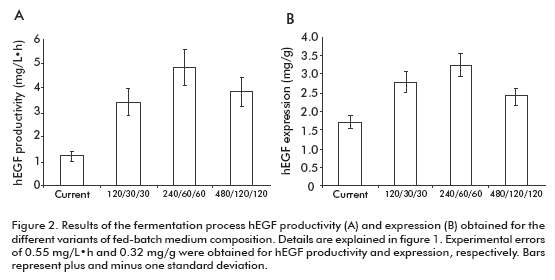
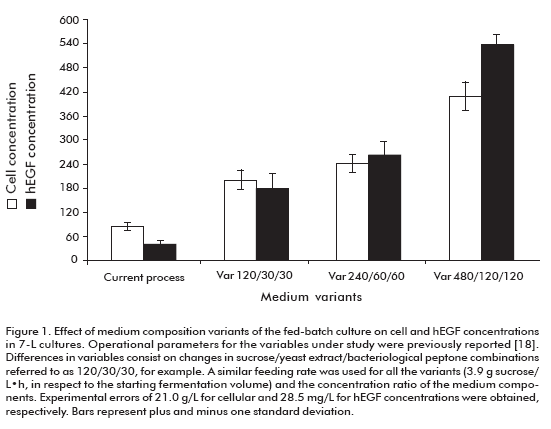
<body><![CDATA[<p><span lang=EN-US style='font-size:10.0pt;font-family:"Verdana","sans-serif"; color:#211E1E'>A biotechnological production comprises a long and expensive process of research and development, currently estimated around 450-800 million USD. Several basic and key aspects need to be improved to increase benefits and profits, such as producer strain development, culture media design and process parameter optimization able to operate with high production rate and capacity. </span></p>      <p><span lang=EN-US style='font-size:10.0pt;font-family:"Verdana","sans-serif"; color:#211E1E'>The production levels for recombinant proteins depend on the environmental fermentation variables such as: pH, temperature, agitation speed, air flow, and others. There are few reports in the literature of studies analyzing the influence of the culture medium on growth and expression of recombinant proteins (1-5), most of them offering mainly an academic perspective. </span></p>      <p><span lang=EN-US style='font-size:10.0pt;font-family:"Verdana","sans-serif"; color:#211E1E'>In Cuba, the recombinant human epidermal growth factor protein (hEGF) has been obtained extracellularly in cultures of <i>Pichia pastoris </i>and <i>Saccharomyces cerevisiae </i>yeasts, the last one being selected as the appropriate host system for industrial production based on its best results (6). The hEGF is a polypeptide of 53 amino acids with 3 disulphur bridges. It was formerly isolated from submaxillary glands in adult mice and extensively studied as mitogenic agent for epithelial cells (7-10). Its growing demand has led to the design of strategies for significantly increasing its production capacity. </span></p>      <p><span lang=EN-US style='font-size:10.0pt;font-family:"Verdana","sans-serif"; color:#211E1E'>One of the worldwide trends in the developing high productivity of the fermentation processes is the use of fed-batch operation mode at high cell density (over 200 g/L of wet weight or 50 g/L of dry weight) and up to the maximum protein expression potential of the microorganism used (3, 11-13). This has allowed to establish yeast fermentation processes of 6 mg/L·h and 160 mg/L·h for extracellular and intracellular proteins, respectively. More precisely, reports on the expression of hEGF in yeast (6, 14-17) refer to a maximum of 1.98 mg/L·h, also show increased degradation of hEGF at its carboxyl terminus rendering mixed populations of 49- to 52-amino acids molecules (14, 15). Here we describe, for the first time, the over-production of a homogeneous preparation of hEGF by combining the composition of culture medium, process parameters and operation mode for a high productivity of the fermentation process. </span></p>      <p><b><span lang=EN-US style='font-family:"Verdana","sans-serif";color:#211E1E'>RESULTS AND DISCUSSION </span></b></p>      <p><span lang=EN-US style='font-size:10.0pt;font-family:"Verdana","sans-serif"; color:#211E1E'>The effect of culture medium concentration (sucrose, bacteriological peptone and yeast extract) on the cell and hEGF concentrations, hEGF productivity and expression are shown in </span><span style='font-size: 10.0pt;font-family:"Verdana","sans-serif";color:#211E1E'><a href="#fig1"><span lang=EN-US>figure 1</span></a></span><span lang=EN-US style='font-size:10.0pt; font-family:"Verdana","sans-serif";color:#211E1E'> and </span><span style='font-size:10.0pt;font-family:"Verdana","sans-serif";color:#211E1E'><a href="#fig2"><span lang=EN-US>figure 2</span></a></span><span lang=EN-US style='font-size:10.0pt;font-family:"Verdana","sans-serif";color:#211E1E'>. The cellular density increased to levels above 200 g/L of wet weight by increasing the concentration of culture media components. The hEGF concentration was increased over 250 mg/L for the variants 240/60/60 (sucrose/yeast extract/bacteriological peptone concentrations, respectively) and 480/120/120, compared to the current variant used as control. Noteworthy, significant differences (95% probability) were observed for both parameters among studied variants. </span></p>      <p align=center style='text-align:center'><span style='font-size:13.5pt; color:#211E1E'><img border=0 width=551 height=429 src="/img/revistas/bta/v26n2/f0113209.gif"></span><a name=fig1></a></p>      
<p align=center style='text-align:center'><span style='font-size:13.5pt; color:#211E1E'><img border=0 width=555 height=280 src="/img/revistas/bta/v26n2/f0213209.gif"></span><a name=fig2></a></p>      
<p><span lang=EN-US style='font-size:10.0pt;font-family:"Verdana","sans-serif"; color:#211E1E'>The fermentation productivity of hEGF reached a maximum of 4.82 ± 0.57 mg/L·h for the variant 240/ 60/60, 3.95-fold the variant of the current process (</span><span style='font-size:10.0pt;font-family:"Verdana","sans-serif"; color:#211E1E'><a href="#fig2"><span lang=EN-US>Figure 2A</span></a></span><span lang=EN-US style='font-size:10.0pt;font-family:"Verdana","sans-serif"; color:#211E1E'>). Significant differences were detected for the 240/60/60 variant compared to all others, except for 480/120/120 variant. </span></p>      <p><span lang=EN-US style='font-size:10.0pt;font-family:"Verdana","sans-serif"; color:#211E1E'>In the case of hEGF expression (</span><span style='font-size: 10.0pt;font-family:"Verdana","sans-serif";color:#211E1E'><a href="#fig2"><span lang=EN-US>Figure 2B</span></a></span><span lang=EN-US style='font-size:10.0pt; font-family:"Verdana","sans-serif";color:#211E1E'>), significant differences were detected for the 240/60/60 variant compared to the 480/120/120 and current one, but not for the 120/30/30 variant. </span></p>      ]]></body>
<body><![CDATA[<p><span lang=EN-US style='font-size:10.0pt;font-family:"Verdana","sans-serif"; color:#211E1E'>These results allowed us to select the 240/60/60 variant as optimal to establish the fed-batch fermentation process, due to its higher productivity and expression of hEGF. Significantly, this fed-batch culture variant supports the high expression level of hEGF expression of the batch process (18) where culture medium, pH and temperature conditions were optimized with decreased hEGF degradation. The maximum productivity ever reported for hEGF in yeast were of 1.98 mg/L·h in <i>Pichia pastoris </i>(15, 19). Meanwhile, in this work we obtained a 4.82 mg/L·h productivity in <i>S. cerevisiae</i>, 2.4-fold the value previously reported. </span></p>      <p><span lang=EN-US style='font-size:10.0pt;font-family:"Verdana","sans-serif"; color:#211E1E'>The hEGF molecule obtained by using this process was characterized (data not shown), evidencing no degradation at all. </span></p>      <p><b><span lang=EN-US style='font-family:"Verdana","sans-serif";color:#211E1E'>CONCLUSIONS </span></b></p>      <p><span lang=EN-US style='font-size:10.0pt;font-family:"Verdana","sans-serif"; color:#211E1E'>This study demonstrated a productivity of 4.82 mg/ L·h in the hEGF fermentation process, which is a breakthrough considering the maximum values previously reported in the literature; could thus be achieved by optimizing the physiology of the microorganism, optimizing the concentration of peptone and bacteriological peptone in the culture medium, and establishing the high density (over 200 g/L), fed-batch operation mode during the fermentation process. The use of the 240/60/60 (sucrose/yeast extract/bacteriological peptone concentrations, respectively) variant supported fermentation at the highest expression levels (3.2 mg/g) and an effective control of hEGF degradation in the culture medium (data not shown). </span></p>      <p><span lang=EN-US style='font-size:10.0pt;font-family:"Verdana","sans-serif"; color:#211E1E'>Finally, this fermentation process was successfully scaled up to a 300-L volume and the process change was approved by the Cuban National Regulatory Authority (CECMED). A production capacity, 5-fold higher than the previous one, was achieved in the same industrial facility.</span></p>      <p><b><span lang=EN-US style='font-family:"Verdana","sans-serif"'>&nbsp;</span></b></p>      <p><span lang=EN-US style='font-size:11.0pt;font-family:"Arial","sans-serif"; color:red'>&nbsp;</span><b><span lang=EN-US style='font-family:"Verdana","sans-serif"'>REFERENCES </span></b></p>      <!-- ref --><p><span lang=EN-US style='font-size:10.0pt;font-family:"Verdana","sans-serif"; color:#211E1E'>1. Nowruzi K, Elkamel A, Scharer J, Cossar D, Moo-Young M. Development of a minimal defined medium for recombinant hIL- 3 production by <i>Streptomyces lividans </i>66. Biotechnol Bioeng</span><span lang=EN-US style='font-size: 11.0pt;font-family:"Arial","sans-serif";color:red'> </span><span lang=EN-US style='font-size:10.0pt;font-family:"Verdana","sans-serif";color:#211E1E'>2008;99:214-22.</span><span lang=EN-US style='font-size:11.0pt;font-family:"Arial","sans-serif";color:blue'> </span><!-- ref --><p><span lang=EN-US style='font-size:10.0pt;font-family:"Verdana","sans-serif"; color:#211E1E'>2. Chen PT and Chao YP. Enhanced production of recombinant nattokinase in <i>Bacillus subtilis </i>by the elimination of limiting factors. Biotechnol Lett</span><span lang=EN-US style='font-size:11.0pt;font-family: "Arial","sans-serif";color:red'> </span><span lang=EN-US style='font-size:10.0pt; font-family:"Verdana","sans-serif";color:#211E1E'>2006;28:1595- 1600.</span><span lang=EN-US style='font-size:11.0pt;font-family:"Arial","sans-serif";color:blue'> </span><!-- ref --><p><span lang=EN-US style='font-size:10.0pt;font-family:"Verdana","sans-serif"; color:#211E1E'>3. Görgens JF, Passoth V, van Zyl W, Knoetze JH, Hanh-Hägerdal B. Amino acid supplementation, controlled oxygen limitation and sequential double induction improves heterologous xylanase production by <i>Pichia stipitis</i>. FEMS Yeast Res</span><span lang=EN-US style='font-size:11.0pt; font-family:"Arial","sans-serif";color:red'> </span><span lang=EN-US style='font-size:10.0pt;font-family:"Verdana","sans-serif";color:#211E1E'>2005;5:677-83.</span><span lang=EN-US style='font-size:11.0pt;font-family:"Arial","sans-serif";color:blue'> </span><!-- ref --><p><span lang=EN-US style='font-size:10.0pt;font-family:"Verdana","sans-serif"; color:#211E1E'>4. Wang ZW, Chen Y, Chao YP. Enhancement of recombinant protein production in <i>Escherichia coli </i>by coproduction of aspartase. J Biotechnol</span><span lang=EN-US style='font-size:11.0pt;font-family:"Arial","sans-serif"; color:red'> </span><span lang=EN-US style='font-size:10.0pt;font-family:"Verdana","sans-serif"; color:#211E1E'>2006;124:403-11.</span><span lang=EN-US style='font-size:11.0pt; font-family:"Arial","sans-serif";color:blue'> </span><p><span lang=EN-US style='font-size:10.0pt;font-family:"Verdana","sans-serif"; color:#211E1E'>5. Hahn-Hagerdal B, Karhumaa K, Larsson C, Gorwa-Grauslund M, Gorgens J, van Zyl W. Role of cultivation media in the development yeast strains for large-scale industrial use. </span><span style='font-size:10.0pt; font-family:"Verdana","sans-serif";color:#211E1E'>Microb Cell Fact</span><span style='font-size:11.0pt;font-family:"Arial","sans-serif";color:red'> </span><span style='font-size:10.0pt;font-family:"Verdana","sans-serif";color:#211E1E'>2005;4:1-16.</span><span style='font-size:11.0pt;font-family:"Arial","sans-serif";color:blue'> </span></p>      <!-- ref --><p><span style='font-size:10.0pt;font-family:"Verdana","sans-serif";color:#211E1E'>6. Cinza AM, Quintana M, Lombardero J, Poutou R, Perez E, Perez LC, et al. Establecimiento de un cultivo discontinuo para la producción de factor de crecimiento epidérmico humano en levaduras. </span><span lang=EN-US style='font-size:10.0pt; font-family:"Verdana","sans-serif";color:#211E1E'>Caracterización del producto. Biotecnol Apl</span><span lang=EN-US style='font-size:11.0pt;font-family:"Arial","sans-serif"; color:red'> </span><span lang=EN-US style='font-size:10.0pt;font-family:"Verdana","sans-serif"; color:#211E1E'>1991;8:166-73.</span><span lang=EN-US style='font-size:11.0pt; font-family:"Arial","sans-serif";color:blue'> </span><!-- ref --><p><span lang=EN-US style='font-size:10.0pt;font-family:"Verdana","sans-serif"; color:#211E1E'>7. Nakagawa S, Yoshida S, Hirao Y, Kasuga S, Fuwa T. Biological effects of biosynthetic hEGF on the growth of mammalian cells <i>in vitro</i>. Differentiation</span><span lang=EN-US style='font-size:11.0pt;font-family: "Arial","sans-serif";color:red'> </span><span lang=EN-US style='font-size:10.0pt; font-family:"Verdana","sans-serif";color:#211E1E'>1985;29:284-8.</span><span lang=EN-US style='font-size:11.0pt;font-family:"Arial","sans-serif";color:blue'> </span><!-- ref --><p><span lang=EN-US style='font-size:10.0pt;font-family:"Verdana","sans-serif"; color:#211E1E'>8. Carpenter G and Cohen S. Epidermal growth factor. Ann Rev Biochem</span><span lang=EN-US style='font-size:11.0pt;font-family:"Arial","sans-serif"; color:red'> </span><span lang=EN-US style='font-size:10.0pt;font-family:"Verdana","sans-serif"; color:#211E1E'>1979;48:193-216.</span><span lang=EN-US style='font-size:11.0pt; font-family:"Arial","sans-serif";color:blue'> </span><!-- ref --><p><span lang=EN-US style='font-size:10.0pt;font-family:"Verdana","sans-serif"; color:#211E1E'>9. Carpenter G and Cohen S. Epidermal growth factor. J Biol Chem</span><span lang=EN-US style='font-size:11.0pt;font-family:"Arial","sans-serif";color:red'> </span><span lang=EN-US style='font-size:10.0pt;font-family:"Verdana","sans-serif"; color:#211E1E'>1990;265:7709-12.</span><span lang=EN-US style='font-size:11.0pt; font-family:"Arial","sans-serif";color:blue'> </span><!-- ref --><p><span lang=EN-US style='font-size:10.0pt;font-family:"Verdana","sans-serif"; color:#211E1E'>10. Lee DN, Kuo TY, Chen MC, Tang TY, Liu FH, Cheng CF. Expression of porcine Epidermal Growth Factor in <i>Pichia pastoris </i>and its biology activity in early-weaned piglets. Life Sci</span><span lang=EN-US style='font-size:11.0pt;font-family:"Arial","sans-serif";color:red'> </span><span lang=EN-US style='font-size:10.0pt;font-family:"Verdana","sans-serif"; color:#211E1E'>2006;78:649-54.</span><span lang=EN-US style='font-size:11.0pt; font-family:"Arial","sans-serif";color:blue'> </span><!-- ref --><p><span lang=EN-US style='font-size:10.0pt;font-family:"Verdana","sans-serif"; color:#211E1E'>11. Jahic M, Gustavsson M, Jansen AK, Martinelle M, Enfors SO. Analysis and control of proteolysis of a fusion protein in <i>Pichia pastoris </i>fed-batch processes. J Biotechnol</span><span lang=EN-US style='font-size:11.0pt; font-family:"Arial","sans-serif";color:red'> </span><span lang=EN-US style='font-size:10.0pt;font-family:"Verdana","sans-serif";color:#211E1E'>2003;102:45-53.</span><span lang=EN-US style='font-size:11.0pt;font-family:"Arial","sans-serif";color:blue'> </span><!-- ref --><p><span lang=EN-US style='font-size:10.0pt;font-family:"Verdana","sans-serif"; color:#211E1E'>12. Jahic M, Wallberg F, Bollok M, Garcia P, Enfors SO. Temperature limited fed-batch technique for control of proteolysis in <i>Pichia pastoris </i>bioreactor cultures. Microb Cell Fact</span><span lang=EN-US style='font-size:11.0pt;font-family:"Arial","sans-serif";color:red'> </span><span lang=EN-US style='font-size:10.0pt;font-family:"Verdana","sans-serif"; color:#211E1E'>2003;2:6-16.</span><span lang=EN-US style='font-size:11.0pt; font-family:"Arial","sans-serif";color:blue'> </span><!-- ref --><p><span lang=EN-US style='font-size:10.0pt;font-family:"Verdana","sans-serif"; color:#211E1E'>13. Ohya T, Morita M, Miura M, Kuwae S, Kobayashi K. High-level production of prourokinase-annexin V chimeras in the methylotrophic yeast <i>Pichia pastoris</i>. J Biosci Bioeng</span><span lang=EN-US style='font-size:11.0pt; font-family:"Arial","sans-serif";color:red'> </span><span lang=EN-US style='font-size:10.0pt;font-family:"Verdana","sans-serif";color:#211E1E'>2002;94:467-73.</span><span lang=EN-US style='font-size:11.0pt;font-family:"Arial","sans-serif";color:blue'> </span><!-- ref --><p><span lang=EN-US style='font-size:10.0pt;font-family:"Verdana","sans-serif"; color:#211E1E'>14. Clare JJ, Romanos MA, Rayment FB, Rowedder JE, Smith MA, Payne MM, et al. Production of mouse epidermal growth factor in yeast: highevel secretion using <i>Pichia pastoris </i>strains containing multiple gene copies. Gene</span><span lang=EN-US style='font-size:11.0pt;font-family:"Arial","sans-serif"; color:red'> </span><span lang=EN-US style='font-size:10.0pt;font-family:"Verdana","sans-serif"; color:#211E1E'>1991;105:205-12.</span><span lang=EN-US style='font-size:11.0pt; font-family:"Arial","sans-serif";color:blue'> </span><!-- ref --><p><span lang=EN-US style='font-size:10.0pt;font-family:"Verdana","sans-serif"; color:#211E1E'>15. Clare J, Scorer C, Buckholz R, Romanos M. Expression of EGF and HIV envelope glycoprotein. Methods Mol Biol</span><span lang=EN-US style='font-size:11.0pt;font-family:"Arial","sans-serif";color:red'> </span><span lang=EN-US style='font-size:10.0pt;font-family:"Verdana","sans-serif"; color:#211E1E'>1998;103:209-25.</span><span lang=EN-US style='font-size:11.0pt; font-family:"Arial","sans-serif";color:blue'> </span><!-- ref --><p><span lang=EN-US style='font-size:10.0pt;font-family:"Verdana","sans-serif"; color:#211E1E'>16. Hong S, Moon H, Kim H, Rhee S, Choi E, Kim I. Optimal strategy of pH control in the production of recombinant human epidermal growth factor by <i>Hansenula polymorpha</i>. Proc Biochem</span><span lang=EN-US style='font-size:11.0pt;font-family:"Arial","sans-serif";color:red'> </span><span lang=EN-US style='font-size:10.0pt;font-family:"Verdana","sans-serif"; color:#211E1E'>2002;38:487-95.</span><span lang=EN-US style='font-size:11.0pt; font-family:"Arial","sans-serif";color:blue'> </span><!-- ref --><p><span lang=EN-US style='font-size:10.0pt;font-family:"Verdana","sans-serif"; color:#211E1E'>17. Coppella S, Dhujarti P. A mathematical description of recombinant yeast. </span><span style='font-size:10.0pt;font-family:"Verdana","sans-serif"; color:#211E1E'>Biotechnol Bioeng</span><span style='font-size:11.0pt; font-family:"Arial","sans-serif";color:red'> </span><span style='font-size: 10.0pt;font-family:"Verdana","sans-serif";color:#211E1E'>1990;35:359-74.</span><span style='font-size:11.0pt;font-family:"Arial","sans-serif";color:blue'> </span><!-- ref --><p><span style='font-size:10.0pt;font-family:"Verdana","sans-serif";color:#211E1E'>18. Valdés J, Mantilla E, Márquez G, Bonilla R, Lugo V, Pérez M, et al. </span><span lang=EN-US style='font-size:10.0pt;font-family:"Verdana","sans-serif"; color:#211E1E'>Improving the expression of Human Epidermal Growth Factor in <i>Saccharomyces cerevisiae </i>by manipulating culture conditions. Biotecnol Apl</span><span lang=EN-US style='font-size:11.0pt;font-family:"Arial","sans-serif";color:red'> </span><span lang=EN-US style='font-size:10.0pt;font-family:"Verdana","sans-serif"; color:#211E1E'>2009;26</span><span lang=EN-US style='font-size:10.0pt; font-family:"Arial","sans-serif"'>(</span><span lang=EN-US style='font-size: 10.0pt;font-family:"Verdana","sans-serif";color:#211E1E'>1):1-9.</span><span lang=EN-US style='font-size:11.0pt;font-family:"Arial","sans-serif";color:blue'> </span><!-- ref --><p><span lang=EN-US style='font-size:10.0pt;font-family:"Verdana","sans-serif"; color:#211E1E'>19. Hong F, Meinander NQ, Jönsson LJ. Fermentation strategies for improved heterologous expression of laccase in <i>Pichia pastoris</i>. Biotechnol Bioeng</span><span lang=EN-US style='font-size:11.0pt;font-family: "Arial","sans-serif";color:red'> </span><span lang=EN-US style='font-size:10.0pt; font-family:"Verdana","sans-serif";color:#211E1E'>2002;79:438-49.</span><span lang=EN-US style='font-size:11.0pt;font-family:"Arial","sans-serif";color:green'> </span><p><span lang=EN-US style='font-size:13.5pt;color:#211E1E'>&nbsp;</span></p>      <p class=MsoNormal><a name=award></a><b><i><span lang=EN-US style='font-size: 10.0pt;font-family:"Verdana","sans-serif";color:#211E1E'>*This work received the Award of the National Academy of Sciences of Cuba for the year 2008.</span></i></b><span lang=EN-US style='font-size:13.5pt;color:#211E1E'> </span></p>      <p><span lang=EN-US style='font-size:13.5pt;color:#211E1E'>&nbsp;</span></p>      <p><span lang=EN-US style='font-size:10.0pt;font-family:"Verdana","sans-serif"; color:#211E1E'>Jorge Valdés. Technological Development, Center for Genetic Engineering and Biotechnology, CIGB Ave. 31 /158 and 190, Cubanacan, Playa, PO Box 6332, Havana, Cuba E-mail: </span><span style='font-size:10.0pt;font-family: "Verdana","sans-serif";color:#211E1E'><a href="mailto:jorge.valdes@cigb.edu.cu"><span lang=EN-US>jorge.valdes@cigb.edu.cu</span></a></span><span style='font-size: 11.0pt;font-family:"Arial","sans-serif";color:#FF6600'> </span></p>      ]]></body>
<body><![CDATA[<p><span lang=EN-US style='font-size:13.5pt'>&nbsp;</span></p>  </div>  </div>       ]]></body><back>
<ref-list>
<ref id="B1">
<label>1</label><nlm-citation citation-type="journal">
<person-group person-group-type="author">
<name>
<surname><![CDATA[Nowruzi]]></surname>
<given-names><![CDATA[K]]></given-names>
</name>
<name>
<surname><![CDATA[Elkamel]]></surname>
<given-names><![CDATA[A]]></given-names>
</name>
<name>
<surname><![CDATA[Scharer]]></surname>
<given-names><![CDATA[J]]></given-names>
</name>
<name>
<surname><![CDATA[Cossar]]></surname>
<given-names><![CDATA[D]]></given-names>
</name>
<name>
<surname><![CDATA[Moo-Young]]></surname>
<given-names><![CDATA[M]]></given-names>
</name>
</person-group>
<article-title xml:lang="en"><![CDATA[Development of a minimal defined medium for recombinant hIL- 3 production by Streptomyces lividans 66]]></article-title>
<source><![CDATA[Biotechnol Bioeng]]></source>
<year>2008</year>
<volume>99</volume>
<page-range>214-22</page-range></nlm-citation>
</ref>
<ref id="B2">
<label>2</label><nlm-citation citation-type="journal">
<person-group person-group-type="author">
<name>
<surname><![CDATA[Chen]]></surname>
<given-names><![CDATA[PT]]></given-names>
</name>
<name>
<surname><![CDATA[Chao]]></surname>
<given-names><![CDATA[YP]]></given-names>
</name>
</person-group>
<article-title xml:lang="en"><![CDATA[Enhanced production of recombinant nattokinase in Bacillus subtilis by the elimination of limiting factors]]></article-title>
<source><![CDATA[Biotechnol Lett]]></source>
<year>2006</year>
<volume>28</volume>
<page-range>1595- 1600</page-range></nlm-citation>
</ref>
<ref id="B3">
<label>3</label><nlm-citation citation-type="journal">
<person-group person-group-type="author">
<name>
<surname><![CDATA[Görgens]]></surname>
<given-names><![CDATA[JF]]></given-names>
</name>
<name>
<surname><![CDATA[Passoth]]></surname>
<given-names><![CDATA[V]]></given-names>
</name>
<name>
<surname><![CDATA[van Zyl]]></surname>
<given-names><![CDATA[W]]></given-names>
</name>
<name>
<surname><![CDATA[Knoetze]]></surname>
<given-names><![CDATA[JH]]></given-names>
</name>
<name>
<surname><![CDATA[Hanh-Hägerdal]]></surname>
<given-names><![CDATA[B]]></given-names>
</name>
</person-group>
<article-title xml:lang="en"><![CDATA[Amino acid supplementation, controlled oxygen limitation and sequential double induction improves heterologous xylanase production by Pichia stipitis]]></article-title>
<source><![CDATA[FEMS Yeast Res]]></source>
<year>2005</year>
<volume>5</volume>
<page-range>677-83</page-range></nlm-citation>
</ref>
<ref id="B4">
<label>4</label><nlm-citation citation-type="journal">
<person-group person-group-type="author">
<name>
<surname><![CDATA[Wang]]></surname>
<given-names><![CDATA[ZW]]></given-names>
</name>
<name>
<surname><![CDATA[Chen]]></surname>
<given-names><![CDATA[Y]]></given-names>
</name>
<name>
<surname><![CDATA[Chao]]></surname>
<given-names><![CDATA[YP]]></given-names>
</name>
</person-group>
<article-title xml:lang="en"><![CDATA[Enhancement of recombinant protein production in Escherichia coli by coproduction of aspartase]]></article-title>
<source><![CDATA[J Biotechnol]]></source>
<year>2006</year>
<volume>124</volume>
<page-range>403-11</page-range></nlm-citation>
</ref>
<ref id="B5">
<label>5</label><nlm-citation citation-type="journal">
<person-group person-group-type="author">
<name>
<surname><![CDATA[Hahn-Hagerdal]]></surname>
<given-names><![CDATA[B]]></given-names>
</name>
<name>
<surname><![CDATA[Karhumaa]]></surname>
<given-names><![CDATA[K]]></given-names>
</name>
<name>
<surname><![CDATA[Larsson]]></surname>
<given-names><![CDATA[C]]></given-names>
</name>
<name>
<surname><![CDATA[Gorwa-Grauslund]]></surname>
<given-names><![CDATA[M]]></given-names>
</name>
<name>
<surname><![CDATA[Gorgens]]></surname>
<given-names><![CDATA[J]]></given-names>
</name>
<name>
<surname><![CDATA[van]]></surname>
<given-names><![CDATA[Zyl]]></given-names>
</name>
</person-group>
<article-title xml:lang="en"><![CDATA[Role of cultivation media in the development yeast strains for large-scale industrial use]]></article-title>
<source><![CDATA[Microb Cell Fact]]></source>
<year>2005</year>
<volume>4</volume>
<page-range>1-16</page-range></nlm-citation>
</ref>
<ref id="B6">
<label>6</label><nlm-citation citation-type="journal">
<person-group person-group-type="author">
<name>
<surname><![CDATA[Cinza]]></surname>
<given-names><![CDATA[AM]]></given-names>
</name>
<name>
<surname><![CDATA[Quintana]]></surname>
<given-names><![CDATA[M]]></given-names>
</name>
<name>
<surname><![CDATA[Lombardero]]></surname>
<given-names><![CDATA[J]]></given-names>
</name>
<name>
<surname><![CDATA[Poutou]]></surname>
<given-names><![CDATA[R]]></given-names>
</name>
<name>
<surname><![CDATA[Perez]]></surname>
<given-names><![CDATA[E]]></given-names>
</name>
<name>
<surname><![CDATA[Perez]]></surname>
<given-names><![CDATA[LC]]></given-names>
</name>
</person-group>
<article-title xml:lang="en"><![CDATA[Establecimiento de un cultivo discontinuo para la producción de factor de crecimiento epidérmico humano en levaduras: Caracterización del producto]]></article-title>
<source><![CDATA[Biotecnol Apl]]></source>
<year>1991</year>
<volume>8</volume>
<page-range>166-73</page-range></nlm-citation>
</ref>
<ref id="B7">
<label>7</label><nlm-citation citation-type="journal">
<person-group person-group-type="author">
<name>
<surname><![CDATA[Nakagawa]]></surname>
<given-names><![CDATA[S]]></given-names>
</name>
<name>
<surname><![CDATA[Yoshida]]></surname>
<given-names><![CDATA[S]]></given-names>
</name>
<name>
<surname><![CDATA[Hirao]]></surname>
<given-names><![CDATA[Y]]></given-names>
</name>
<name>
<surname><![CDATA[Kasuga]]></surname>
<given-names><![CDATA[S]]></given-names>
</name>
<name>
<surname><![CDATA[Fuwa]]></surname>
<given-names><![CDATA[T]]></given-names>
</name>
</person-group>
<article-title xml:lang="en"><![CDATA[Biological effects of biosynthetic hEGF on the growth of mammalian cells in vitro]]></article-title>
<source><![CDATA[Differentiation]]></source>
<year>1985</year>
<volume>29</volume>
<page-range>284-8</page-range></nlm-citation>
</ref>
<ref id="B8">
<label>8</label><nlm-citation citation-type="journal">
<person-group person-group-type="author">
<name>
<surname><![CDATA[Carpenter]]></surname>
<given-names><![CDATA[G]]></given-names>
</name>
<name>
<surname><![CDATA[Cohen]]></surname>
<given-names><![CDATA[S]]></given-names>
</name>
</person-group>
<article-title xml:lang="en"><![CDATA[Epidermal growth factor]]></article-title>
<source><![CDATA[Ann Rev Biochem]]></source>
<year>1979</year>
<volume>48</volume>
<page-range>193-216</page-range></nlm-citation>
</ref>
<ref id="B9">
<label>9</label><nlm-citation citation-type="journal">
<person-group person-group-type="author">
<name>
<surname><![CDATA[Carpenter]]></surname>
<given-names><![CDATA[G]]></given-names>
</name>
<name>
<surname><![CDATA[Cohen]]></surname>
<given-names><![CDATA[S]]></given-names>
</name>
</person-group>
<article-title xml:lang="en"><![CDATA[Epidermal growth factor]]></article-title>
<source><![CDATA[J Biol Chem]]></source>
<year>1990</year>
<volume>265</volume>
<page-range>7709-12</page-range></nlm-citation>
</ref>
<ref id="B10">
<label>10</label><nlm-citation citation-type="journal">
<person-group person-group-type="author">
<name>
<surname><![CDATA[Lee]]></surname>
<given-names><![CDATA[DN]]></given-names>
</name>
<name>
<surname><![CDATA[Kuo]]></surname>
<given-names><![CDATA[TY]]></given-names>
</name>
<name>
<surname><![CDATA[Chen]]></surname>
<given-names><![CDATA[MC]]></given-names>
</name>
<name>
<surname><![CDATA[Tang]]></surname>
<given-names><![CDATA[TY]]></given-names>
</name>
<name>
<surname><![CDATA[Liu]]></surname>
<given-names><![CDATA[FH]]></given-names>
</name>
<name>
<surname><![CDATA[Cheng]]></surname>
<given-names><![CDATA[CF]]></given-names>
</name>
</person-group>
<article-title xml:lang="en"><![CDATA[Expression of porcine Epidermal Growth Factor in Pichia pastoris and its biology activity in early-weaned piglets]]></article-title>
<source><![CDATA[Life Sci]]></source>
<year>2006</year>
<volume>78</volume>
<page-range>649-54</page-range></nlm-citation>
</ref>
<ref id="B11">
<label>11</label><nlm-citation citation-type="journal">
<person-group person-group-type="author">
<name>
<surname><![CDATA[Jahic]]></surname>
<given-names><![CDATA[M]]></given-names>
</name>
<name>
<surname><![CDATA[Gustavsson]]></surname>
<given-names><![CDATA[M]]></given-names>
</name>
<name>
<surname><![CDATA[Jansen]]></surname>
<given-names><![CDATA[AK]]></given-names>
</name>
<name>
<surname><![CDATA[Martinelle]]></surname>
<given-names><![CDATA[M]]></given-names>
</name>
<name>
<surname><![CDATA[Enfors]]></surname>
<given-names><![CDATA[SO]]></given-names>
</name>
</person-group>
<article-title xml:lang="en"><![CDATA[Analysis and control of proteolysis of a fusion protein in Pichia pastoris fed-batch processes]]></article-title>
<source><![CDATA[J Biotechnol]]></source>
<year>2003</year>
<volume>102</volume>
<page-range>45-53</page-range></nlm-citation>
</ref>
<ref id="B12">
<label>12</label><nlm-citation citation-type="journal">
<person-group person-group-type="author">
<name>
<surname><![CDATA[Jahic]]></surname>
<given-names><![CDATA[M]]></given-names>
</name>
<name>
<surname><![CDATA[Wallberg]]></surname>
<given-names><![CDATA[F]]></given-names>
</name>
<name>
<surname><![CDATA[Bollok]]></surname>
<given-names><![CDATA[M]]></given-names>
</name>
<name>
<surname><![CDATA[Garcia]]></surname>
<given-names><![CDATA[P]]></given-names>
</name>
<name>
<surname><![CDATA[Enfors]]></surname>
<given-names><![CDATA[SO]]></given-names>
</name>
</person-group>
<article-title xml:lang="en"><![CDATA[Temperature limited fed-batch technique for control of proteolysis in Pichia pastoris bioreactor cultures]]></article-title>
<source><![CDATA[Microb Cell Fact]]></source>
<year>2003</year>
<volume>2</volume>
<page-range>6-16</page-range></nlm-citation>
</ref>
<ref id="B13">
<label>13</label><nlm-citation citation-type="journal">
<person-group person-group-type="author">
<name>
<surname><![CDATA[Ohya]]></surname>
<given-names><![CDATA[T]]></given-names>
</name>
<name>
<surname><![CDATA[Morita]]></surname>
<given-names><![CDATA[M]]></given-names>
</name>
<name>
<surname><![CDATA[Miura]]></surname>
<given-names><![CDATA[M]]></given-names>
</name>
<name>
<surname><![CDATA[Kuwae]]></surname>
<given-names><![CDATA[S]]></given-names>
</name>
<name>
<surname><![CDATA[Kobayashi]]></surname>
<given-names><![CDATA[K]]></given-names>
</name>
</person-group>
<article-title xml:lang="en"><![CDATA[High-level production of prourokinase-annexin V chimeras in the methylotrophic yeast Pichia pastoris]]></article-title>
<source><![CDATA[J Biosci Bioeng]]></source>
<year>2002</year>
<volume>94</volume>
<page-range>467-73</page-range></nlm-citation>
</ref>
<ref id="B14">
<label>14</label><nlm-citation citation-type="journal">
<person-group person-group-type="author">
<name>
<surname><![CDATA[Clare]]></surname>
<given-names><![CDATA[JJ]]></given-names>
</name>
<name>
<surname><![CDATA[Romanos]]></surname>
<given-names><![CDATA[MA]]></given-names>
</name>
<name>
<surname><![CDATA[Rayment]]></surname>
<given-names><![CDATA[FB]]></given-names>
</name>
<name>
<surname><![CDATA[Rowedder]]></surname>
<given-names><![CDATA[JE]]></given-names>
</name>
<name>
<surname><![CDATA[Smith]]></surname>
<given-names><![CDATA[MA]]></given-names>
</name>
<name>
<surname><![CDATA[Payne]]></surname>
<given-names><![CDATA[MM]]></given-names>
</name>
</person-group>
<article-title xml:lang="en"><![CDATA[Production of mouse epidermal growth factor in yeast: highevel secretion using Pichia pastoris strains containing multiple gene copies]]></article-title>
<source><![CDATA[Gene]]></source>
<year>1991</year>
<volume>105</volume>
<page-range>205-12</page-range></nlm-citation>
</ref>
<ref id="B15">
<label>15</label><nlm-citation citation-type="journal">
<person-group person-group-type="author">
<name>
<surname><![CDATA[Clare]]></surname>
<given-names><![CDATA[J]]></given-names>
</name>
<name>
<surname><![CDATA[Scorer]]></surname>
<given-names><![CDATA[C]]></given-names>
</name>
<name>
<surname><![CDATA[Buckholz]]></surname>
<given-names><![CDATA[R]]></given-names>
</name>
<name>
<surname><![CDATA[Romanos]]></surname>
<given-names><![CDATA[M]]></given-names>
</name>
</person-group>
<article-title xml:lang="en"><![CDATA[Expression of EGF and HIV envelope glycoprotein]]></article-title>
<source><![CDATA[Methods Mol Biol]]></source>
<year>1998</year>
<volume>103</volume>
<page-range>209-25</page-range></nlm-citation>
</ref>
<ref id="B16">
<label>16</label><nlm-citation citation-type="journal">
<person-group person-group-type="author">
<name>
<surname><![CDATA[Hong]]></surname>
<given-names><![CDATA[S]]></given-names>
</name>
<name>
<surname><![CDATA[Moon]]></surname>
<given-names><![CDATA[H]]></given-names>
</name>
<name>
<surname><![CDATA[Kim]]></surname>
<given-names><![CDATA[H]]></given-names>
</name>
<name>
<surname><![CDATA[Rhee]]></surname>
<given-names><![CDATA[S]]></given-names>
</name>
<name>
<surname><![CDATA[Choi]]></surname>
<given-names><![CDATA[E]]></given-names>
</name>
<name>
<surname><![CDATA[Kim]]></surname>
<given-names><![CDATA[I]]></given-names>
</name>
</person-group>
<article-title xml:lang="en"><![CDATA[Optimal strategy of pH control in the production of recombinant human epidermal growth factor by Hansenula polymorpha]]></article-title>
<source><![CDATA[Proc Biochem]]></source>
<year>2002</year>
<volume>38</volume>
<page-range>487-95</page-range></nlm-citation>
</ref>
<ref id="B17">
<label>17</label><nlm-citation citation-type="journal">
<person-group person-group-type="author">
<name>
<surname><![CDATA[Coppella]]></surname>
<given-names><![CDATA[S]]></given-names>
</name>
<name>
<surname><![CDATA[Dhujarti]]></surname>
<given-names><![CDATA[P]]></given-names>
</name>
</person-group>
<article-title xml:lang="en"><![CDATA[A mathematical description of recombinant yeast]]></article-title>
<source><![CDATA[Biotechnol Bioeng]]></source>
<year>1990</year>
<volume>35</volume>
<page-range>359-74</page-range></nlm-citation>
</ref>
<ref id="B18">
<label>18</label><nlm-citation citation-type="journal">
<person-group person-group-type="author">
<name>
<surname><![CDATA[Valdés]]></surname>
<given-names><![CDATA[J]]></given-names>
</name>
<name>
<surname><![CDATA[Mantilla]]></surname>
<given-names><![CDATA[E]]></given-names>
</name>
<name>
<surname><![CDATA[Márquez]]></surname>
<given-names><![CDATA[G]]></given-names>
</name>
<name>
<surname><![CDATA[Bonilla]]></surname>
<given-names><![CDATA[R]]></given-names>
</name>
<name>
<surname><![CDATA[Lugo]]></surname>
<given-names><![CDATA[V]]></given-names>
</name>
<name>
<surname><![CDATA[Pérez]]></surname>
<given-names><![CDATA[M]]></given-names>
</name>
</person-group>
<article-title xml:lang="en"><![CDATA[Improving the expression of Human Epidermal Growth Factor in Saccharomyces cerevisiae by manipulating culture conditions]]></article-title>
<source><![CDATA[Biotecnol Apl]]></source>
<year>2009</year>
<volume>26</volume>
<numero>1</numero>
<issue>1</issue>
<page-range>1-9</page-range></nlm-citation>
</ref>
<ref id="B19">
<label>19</label><nlm-citation citation-type="journal">
<person-group person-group-type="author">
<name>
<surname><![CDATA[Hong]]></surname>
<given-names><![CDATA[F]]></given-names>
</name>
<name>
<surname><![CDATA[Meinander]]></surname>
<given-names><![CDATA[NQ]]></given-names>
</name>
<name>
<surname><![CDATA[Jönsson]]></surname>
<given-names><![CDATA[LJ]]></given-names>
</name>
</person-group>
<article-title xml:lang="en"><![CDATA[Fermentation strategies for improved heterologous expression of laccase in Pichia pastoris]]></article-title>
<source><![CDATA[Biotechnol Bioeng]]></source>
<year>2002</year>
<volume>79</volume>
<page-range>438-49</page-range></nlm-citation>
</ref>
</ref-list>
</back>
</article>