<?xml version="1.0" encoding="ISO-8859-1"?><article xmlns:mml="http://www.w3.org/1998/Math/MathML" xmlns:xlink="http://www.w3.org/1999/xlink" xmlns:xsi="http://www.w3.org/2001/XMLSchema-instance">
<front>
<journal-meta>
<journal-id>1027-2852</journal-id>
<journal-title><![CDATA[Biotecnología Aplicada]]></journal-title>
<abbrev-journal-title><![CDATA[Biotecnol Apl]]></abbrev-journal-title>
<issn>1027-2852</issn>
<publisher>
<publisher-name><![CDATA[Editorial Elfos Scientiae]]></publisher-name>
</publisher>
</journal-meta>
<article-meta>
<article-id>S1027-28522009000300001</article-id>
<title-group>
<article-title xml:lang="en"><![CDATA[Therapies and clinical trials with vaccine candidates against HIV-1]]></article-title>
<article-title xml:lang="es"><![CDATA[Los tratamientos antirretrovirales y los candidatos vacunales terapéuticos contra el VIH-1]]></article-title>
</title-group>
<contrib-group>
<contrib contrib-type="author">
<name>
<surname><![CDATA[Iglesias]]></surname>
<given-names><![CDATA[Enrique]]></given-names>
</name>
<xref ref-type="aff" rid="A01"/>
</contrib>
</contrib-group>
<aff id="A01">
<institution><![CDATA[,Centro de Ingeniería Genética y Biotecnología  ]]></institution>
<addr-line><![CDATA[Ciudad de La Habana ]]></addr-line>
<country>Cuba</country>
</aff>
<pub-date pub-type="pub">
<day>00</day>
<month>09</month>
<year>2009</year>
</pub-date>
<pub-date pub-type="epub">
<day>00</day>
<month>09</month>
<year>2009</year>
</pub-date>
<volume>26</volume>
<numero>3</numero>
<fpage>190</fpage>
<lpage>198</lpage>
<copyright-statement/>
<copyright-year/>
<self-uri xlink:href="http://scielo.sld.cu/scielo.php?script=sci_arttext&amp;pid=S1027-28522009000300001&amp;lng=en&amp;nrm=iso"></self-uri><self-uri xlink:href="http://scielo.sld.cu/scielo.php?script=sci_abstract&amp;pid=S1027-28522009000300001&amp;lng=en&amp;nrm=iso"></self-uri><self-uri xlink:href="http://scielo.sld.cu/scielo.php?script=sci_pdf&amp;pid=S1027-28522009000300001&amp;lng=en&amp;nrm=iso"></self-uri><abstract abstract-type="short" xml:lang="en"><p><![CDATA[Antiretroviral therapies combining three or more compounds frequently diminish the viral load (VL) in blood to undetectable levels (< 50 copies of RNA/mL), being considered as optimal. In contrast, more than 100 clinical studies with different vaccine candidates have barely achieved modest results and some studies have been discouraging. Therapies are, however, unable to eliminate viral infection. At the same time, they are a threat to the health of patients because of the accumulated toxicity derived from their prolonged use. Many researchers, therefore, believe that an effective (or even partially effective) vaccine might substitute therapies, eliminating the virus or at least controlling the VL through immune-mediated mechanisms. However, immune correlates for protection remain unknown requiring a strategy to evaluate the clinical effectiveness of vaccine candidates. Hence, the experience accumulated with therapies is highly valuable. This paper gives an update on some of the main results of antiretroviral therapies and therapeutic vaccination, giving recommendations in the field of vaccination against HIV-1.]]></p></abstract>
<abstract abstract-type="short" xml:lang="es"><p><![CDATA[Las terapias antirretrovirales que combinan tres o más compuestos, muchas veces reducen la carga viral en sangre a valores no detectables (< 50 copias de ARN/mL), por lo que se consideran muy efectivas. En contraste, más de 100 ensayos clínicos con diferentes candidatos vacunales contra el virus de inmunodeficiencia humana (VIH), solo han alcanzado modestos resultados y algunos estudios han sido decepcionantes. No obstante, las terapias no eliminan la infección viral, por lo que deben administrarse de por vida. Al mismo tiempo, el consumo prolongado eleva la toxicidad a niveles que ponen en riesgo la salud de los pacientes. Por eso, muchos investigadores creen que una vacuna efectiva (incluso parcialmente efectiva) podría sustituir tales terapias. Esa vacuna eliminaría el virus o, al menos, mantendría la carga viral controlada mediante mecanismos inmunes. Sin embargo, los correlatos inmunológicos de protección se desconocen. Por ello, es necesaria una estrategia que permita evaluar la efectividad clínica de los candidatos vacunales. En tal sentido, la experiencia con las terapias antirretrovirales es de gran valor. Se analizaron algunos de los principales resultados de estas terapias y de la vacunación anti-VIH, para emitir recomendaciones en este segundo campo.]]></p></abstract>
<kwd-group>
<kwd lng="en"><![CDATA[antiretroviral treatment]]></kwd>
<kwd lng="en"><![CDATA[AIDS]]></kwd>
<kwd lng="en"><![CDATA[therapeutic vaccine]]></kwd>
<kwd lng="en"><![CDATA[HIV-1]]></kwd>
<kwd lng="es"><![CDATA[tratamiento antirretroviral]]></kwd>
<kwd lng="es"><![CDATA[SIDA]]></kwd>
<kwd lng="es"><![CDATA[vacuna terapéutica]]></kwd>
<kwd lng="es"><![CDATA[VIH-1]]></kwd>
</kwd-group>
</article-meta>
</front><body><![CDATA[ <div class=Section1>      <div>      <p align=right style='text-align:right'><b><span lang=EN-US style='font-size: 10.0pt;font-family:"Verdana","sans-serif"'>REVIEW</span></b></p>      <p><span lang=EN-US style='font-size:13.5pt'>&nbsp;</span></p>      <p><b><span lang=EN-US style='font-size:13.5pt;font-family:"Verdana","sans-serif"'>Therapies and clinical trials with vaccine candidates against HIV-1</span></b></p>      <p><span lang=EN-US style='font-size:13.5pt'>&nbsp;</span></p>      <p><b><span style='font-family:"Verdana","sans-serif"'>Los tratamientos antirretrovirales y los candidatos vacunales terapéuticos contra el VIH-1</span></b><b><span style='font-size:10.0pt;font-family:"Verdana","sans-serif"'> </span></b></p>      <p><b><span style='font-size:13.5pt'>&nbsp;</span></b></p>      <p><b><span style='font-size:13.5pt'>&nbsp;</span></b></p>      <p><b><span style='font-size:10.0pt;font-family:"Verdana","sans-serif"'>Enrique Iglesias</span></b><span style='font-size:11.0pt;font-family:"Arial","sans-serif"; color:red'> </span></p>      ]]></body>
<body><![CDATA[<p><span style='font-size:10.0pt;font-family:"Verdana","sans-serif"'>Centro de Ingeniería Genética y Biotecnología, CIGB Ave. 31 entre 158 y 190, Cubanacán, Playa, CP 10 400, AP 6162, Ciudad de La Habana, Cuba </span></p>      <p><span style='font-size:13.5pt'>&nbsp;</span></p>      <p><span style='font-size:13.5pt'>&nbsp;</span></p>      <div class=MsoNormal align=center style='text-align:center'>  <hr size=2 width="100%" align=center>  </div>      <p><b><span lang=EN-US style='font-size:10.0pt;font-family:"Verdana","sans-serif"'>ABSTRACT </span></b></p>      <p><span lang=EN-US style='font-size:10.0pt;font-family:"Verdana","sans-serif"'>Antiretroviral therapies combining three or more compounds frequently diminish the viral load </span><span lang=EN-US style='font-size:10.0pt;font-family:"Verdana","sans-serif"; color:windowtext'>(</span><span lang=EN-US style='font-size:10.0pt;font-family: "Verdana","sans-serif"'>VL) in blood to undetectable levels </span><span lang=EN-US style='font-size:10.0pt;font-family:"Verdana","sans-serif"; color:windowtext'>(</span><span lang=EN-US style='font-size:10.0pt;font-family: "Verdana","sans-serif"'>&lt; 50 copies of RNA/mL), being considered as optimal. In contrast, more than 100 clinical studies with different vaccine candidates have barely achieved modest results and some studies have been discouraging. Therapies are, however, unable to eliminate viral infection. At the same time, they are a threat to the health of patients because of the accumulated toxicity derived from their prolonged use. Many researchers, therefore, believe that an effective </span><span lang=EN-US style='font-size:10.0pt;font-family:"Verdana","sans-serif"; color:windowtext'>(</span><span lang=EN-US style='font-size:10.0pt;font-family: "Verdana","sans-serif"'>or even partially effective) vaccine might substitute therapies, eliminating the virus or at least controlling the VL through immune-mediated mechanisms. However, immune correlates for protection remain unknown requiring a strategy to evaluate the clinical effectiveness of vaccine candidates. Hence, the experience accumulated with therapies is highly valuable. This paper gives an update on some of the main results of antiretroviral therapies and therapeutic vaccination, giving recommendations in the field of vaccination against HIV-1.</span></p>      <p><b><span lang=EN-US style='font-size:10.0pt;font-family:"Verdana","sans-serif"'>Keywords:</span></b><span lang=EN-US style='font-size:10.0pt;font-family:"Verdana","sans-serif"'> antiretroviral treatment, AIDS, therapeutic vaccine, HIV-1.</span></p>      <div class=MsoNormal align=center style='text-align:center'>  <hr size=2 width="100%" align=center>  </div>      <p><b><span style='font-size:10.0pt;font-family:"Verdana","sans-serif"'>RESUMEN </span></b></p>      <p><span style='font-size:10.0pt;font-family:"Verdana","sans-serif"'>Las terapias antirretrovirales que combinan tres o más compuestos, muchas veces reducen la carga viral en sangre a valores no detectables </span><span style='font-size:10.0pt;font-family:"Verdana","sans-serif";color:windowtext'>(</span><span style='font-size:10.0pt;font-family:"Verdana","sans-serif"'>&lt; 50 copias de ARN/mL), por lo que se consideran muy efectivas. En contraste, más de 100 ensayos clínicos con diferentes candidatos vacunales contra el virus de inmunodeficiencia humana </span><span style='font-size:10.0pt;font-family:"Verdana","sans-serif"; color:windowtext'>(</span><span style='font-size:10.0pt;font-family:"Verdana","sans-serif"'>VIH), solo han alcanzado modestos resultados y algunos estudios han sido decepcionantes. No obstante, las terapias no eliminan la infección viral, por lo que deben administrarse de por vida. Al mismo tiempo, el consumo prolongado eleva la toxicidad a niveles que ponen en riesgo la salud de los pacientes. Por eso, muchos investigadores creen que una vacuna efectiva </span><span style='font-size:10.0pt;font-family:"Verdana","sans-serif";color:windowtext'>(</span><span style='font-size:10.0pt;font-family:"Verdana","sans-serif"'>incluso parcialmente efectiva) podría sustituir tales terapias. Esa vacuna eliminaría el virus o, al menos, mantendría la carga viral controlada mediante mecanismos inmunes. Sin embargo, los correlatos inmunológicos de protección se desconocen. Por ello, es necesaria una estrategia que permita evaluar la efectividad clínica de los candidatos vacunales. En tal sentido, la experiencia con las terapias antirretrovirales es de gran valor. Se analizaron algunos de los principales resultados de estas terapias y de la vacunación anti-VIH, para emitir recomendaciones en este segundo campo.</span></p>      ]]></body>
<body><![CDATA[<p><b><span style='font-size:10.0pt;font-family:"Verdana","sans-serif"'>Palabras clave:</span></b><span style='font-size:10.0pt;font-family:"Verdana","sans-serif"'> tratamiento antirretroviral, SIDA, vacuna terapéutica, VIH-1.</span><span style='font-size:11.0pt;font-family:"Arial","sans-serif";color:red'> </span></p>      <div class=MsoNormal align=center style='text-align:center'>  <hr size=2 width="100%" align=center>  </div>      <p><b><span lang=EN-US style='font-size:13.5pt'>&nbsp;</span></b></p>      <p><b><span lang=EN-US style='font-size:13.5pt'>&nbsp;</span></b></p>      <p><b><span lang=EN-US style='font-family:"Verdana","sans-serif"'>INTRODUCTION </span></b></p>      <p><span lang=EN-US style='font-size:10.0pt;font-family:"Verdana","sans-serif"'>UNAIDS, the United Nations Program to fight AIDS, has recently estimated that 30 to 36 millions of people in the world are infected with the Human Immunodeficiency Virus </span><span lang=EN-US style='font-size:10.0pt;font-family:"Verdana","sans-serif"; color:windowtext'>(</span><span lang=EN-US style='font-size:10.0pt;font-family: "Verdana","sans-serif"'>HIV) </span><span lang=EN-US style='font-size:10.0pt; font-family:"Verdana","sans-serif";color:windowtext'>(</span><span lang=EN-US style='font-size:10.0pt;font-family:"Verdana","sans-serif"'>1). They estimate that between 1.8 and 2.3 million infected persons have died, and there are 2.2 to 3.2 million new seropositive cases. It is discouraging that all the efforts made to increase the access to antiretroviral therapies </span><span lang=EN-US style='font-size:10.0pt;font-family:"Verdana","sans-serif"; color:windowtext'>(</span><span lang=EN-US style='font-size:10.0pt;font-family: "Verdana","sans-serif"'>ART), in the year 2007 only reached a quarter of the total number of people infected that year. Therefore, this led to a geometric shortfall every year in the number of people who need antiretroviral treatment and; consequently, most of the seropositives die as a consequence of the impossibility of accessing these therapies. The UNAIDS report expressed that “While the percentage of people living with HIV has been stabilized since 2000, the overall number &#091;…&#093; has steadily increased as new infections occur each year, since HIV treatments extend life as new infections still outnumber AIDS deaths”. This explains why the therapeutic scenario becomes more relevant in the context of fighting AIDS and HIV transmission. </span></p>      <p><span lang=EN-US style='font-size:10.0pt;font-family:"Verdana","sans-serif"'>Currently, ART are the only effective tool against persistent HIV-1 infection </span><span lang=EN-US style='font-size:10.0pt;font-family:"Verdana","sans-serif"; color:windowtext'>(</span><span lang=EN-US style='font-size:10.0pt;font-family: "Verdana","sans-serif"'>2). Hence, demands should be maintained to politicians and pharmaceutical companies to make these drugs more accessible to patients. The limited success of these treatments cannot be neglected since they do not eradicate viral infection </span><span lang=EN-US style='font-size:10.0pt; font-family:"Verdana","sans-serif";color:windowtext'>(</span><span lang=EN-US style='font-size:10.0pt;font-family:"Verdana","sans-serif"'>3, 4), while causing long-term metabolic disorders </span><span lang=EN-US style='font-size: 10.0pt;font-family:"Verdana","sans-serif";color:windowtext'>(</span><span lang=EN-US style='font-size:10.0pt;font-family:"Verdana","sans-serif"'>5, 6) making it necessary to interrupt the treatment. </span></p>      <p><span lang=EN-US style='font-size:10.0pt;font-family:"Verdana","sans-serif"'>When this time comes, no other therapeutic alternative exists and the disease inevitably progresses, leading to death. An alternative option is the development of immunotherapies to clear the viral infection or to control the infection if the virus cannot be eradicated. Anti- HIV immunotherapies are intended to substitute ART to avoid the negative effects of its continued use. </span></p>      <p><span lang=EN-US style='font-size:10.0pt;font-family:"Verdana","sans-serif"'>The aim of this paper is to show the most significant advances in the fields of ART and vaccination against HIV, as starting point to design a strategy for the clinical testing of future vaccine candidates against this virus. </span></p>      <p><b><span lang=EN-US style='font-family:"Verdana","sans-serif"'>THERAPIES AGAINST HIV </span></b></p>      ]]></body>
<body><![CDATA[<p><span lang=EN-US style='font-size:10.0pt;font-family:"Verdana","sans-serif"'>ART against AIDS is perhaps the field of medical practice with the most impressive advances in recent years. Since the discovery of the syndrome in 1981 until the end of the 1980’s, the therapy was limited to the specific treatment of the numerous and unusual opportunistic infections commonly causing death. An AIDS diagnosis was equivalent to a death sentence, and certainly, 85% of seropositive persons would die within five years of being diagnosed </span><span lang=EN-US style='font-size:10.0pt;font-family:"Verdana","sans-serif"; color:windowtext'>(</span><span lang=EN-US style='font-size:10.0pt;font-family: "Verdana","sans-serif"'>7). A few years later, however, together with the enormous number of studies in molecular biology on HIV-1, the first therapeutic compound, zidovudine </span><span lang=EN-US style='font-size:10.0pt; font-family:"Verdana","sans-serif";color:windowtext'>(</span><span lang=EN-US style='font-size:10.0pt;font-family:"Verdana","sans-serif"'>AZT), was available. This is a nucleotide analogue inhibiting the reverse transcriptase </span><span lang=EN-US style='font-size:10.0pt;font-family:"Verdana","sans-serif"; color:windowtext'>(</span><span lang=EN-US style='font-size:10.0pt;font-family: "Verdana","sans-serif"'>NRTI), which was approved in 1987 by the Food and Drug Administration </span><span lang=EN-US style='font-size:10.0pt;font-family: "Verdana","sans-serif";color:windowtext'>(</span><span lang=EN-US style='font-size:10.0pt;font-family:"Verdana","sans-serif"'>FDA) of the USA </span><span lang=EN-US style='font-size:10.0pt;font-family:"Verdana","sans-serif"; color:windowtext'>(</span><span lang=EN-US style='font-size:10.0pt;font-family: "Verdana","sans-serif"'>8). After three years of great expectation the results were discouraging. The CONCORDE study demonstrated that monotherapy results were transient </span><span lang=EN-US style='font-size:10.0pt;font-family: "Verdana","sans-serif";color:windowtext'>(</span><span lang=EN-US style='font-size:10.0pt;font-family:"Verdana","sans-serif"'>9). Other nucleoside analogues, such as ddC, ddI and d4T followed a similar fate in the 1990´s. Significant advances were, however, made in treating opportunistic infections after the introduction of co-trimoxazole, pentadimine, gancyclovir, foscarnet, and fluconazole, among other drugs. </span></p>      <p><span lang=EN-US style='font-size:10.0pt;font-family:"Verdana","sans-serif"'>At the end of 1995, results from two clinical trials completely changed the conception of ART. Both the DELTA and ACTG175 studies showed that combination therapy with the simultaneous use of two nucleoside analogues was much more effective than monotherapies </span><span lang=EN-US style='font-size:10.0pt;font-family:"Verdana","sans-serif"; color:windowtext'>(</span><span lang=EN-US style='font-size:10.0pt;font-family: "Verdana","sans-serif"'>significantly increasing survival) </span><span lang=EN-US style='font-size:10.0pt;font-family:"Verdana","sans-serif"; color:windowtext'>(</span><span lang=EN-US style='font-size:10.0pt;font-family: "Verdana","sans-serif"'>10, 11). Also in 1995, a new class of inhibitors targeting another viral enzyme </span><span lang=EN-US style='font-size:10.0pt; font-family:"Verdana","sans-serif";color:windowtext'>(</span><span lang=EN-US style='font-size:10.0pt;font-family:"Verdana","sans-serif"'>protease) was introduced </span><span lang=EN-US style='font-size:10.0pt;font-family:"Verdana","sans-serif"; color:windowtext'>(</span><span lang=EN-US style='font-size:10.0pt;font-family: "Verdana","sans-serif"'>12, 13). They bind to the active site of this enzyme and prevent the final maturing process of viral particles, making them noninfectious </span><span lang=EN-US style='font-size:10.0pt;font-family:"Verdana","sans-serif"; color:windowtext'>(</span><span lang=EN-US style='font-size:10.0pt;font-family: "Verdana","sans-serif"'>14, 15). Between December 1995 and March 1996, the FDA readily approved saquinavir, ritonavir and indinavir. In June 1996, at the World AIDS Conference held in Vancouver, the expression “highly active antiretroviral therapy” was first mentioned, which rapidly spread and was used together with the term tritherapy. The latter refers to a therapy combining three antiviral compounds that markedly decreases mortality </span><span lang=EN-US style='font-size:10.0pt;font-family:"Verdana","sans-serif"; color:windowtext'>(</span><span lang=EN-US style='font-size:10.0pt;font-family: "Verdana","sans-serif"'>16) and suppresses the viral load </span><span lang=EN-US style='font-size:10.0pt;font-family:"Verdana","sans-serif"; color:windowtext'>(</span><span lang=EN-US style='font-size:10.0pt;font-family: "Verdana","sans-serif"'>VL) in the plasma </span><span lang=EN-US style='font-size:10.0pt;font-family:"Verdana","sans-serif";color:windowtext'>(</span><span lang=EN-US style='font-size:10.0pt;font-family:"Verdana","sans-serif"'>17). During that same month </span><span lang=EN-US style='font-size:10.0pt; font-family:"Verdana","sans-serif";color:windowtext'>(</span><span lang=EN-US style='font-size:10.0pt;font-family:"Verdana","sans-serif"'>June 1996) with the approval of nevirapine a new type of antiviral drugs was introduced: the nonnucleosidic reverse transcriptase inhibitors </span><span lang=EN-US style='font-size:10.0pt;font-family:"Verdana","sans-serif";color:windowtext'>(</span><span lang=EN-US style='font-size:10.0pt;font-family:"Verdana","sans-serif"'>NNRTI). The NNRTI are structurally different compounds that bind to a region far from the active site of that enzyme but provoking changes on its structure, blocking catalysis. Also in 1996 a new protease inhibitor was licensed: nelfinavir. </span></p>      <p><span lang=EN-US style='font-size:10.0pt;font-family:"Verdana","sans-serif"'>Once the tritherapy was introduced and new compounds synthesized, the scenario completely changed. In just four years, from 1994 to 1998, the incidence of AIDS in Europe decreased from almost 31 cases every 100 patients to less than three, and the opportunistic infections practically disappeared </span><span lang=EN-US style='font-size:10.0pt;font-family:"Verdana","sans-serif"; color:windowtext'>(</span><span lang=EN-US style='font-size:10.0pt;font-family: "Verdana","sans-serif"'>18). Unfortunately, this is not possible in poor countries where the effects of the pandemic are catastrophic because ART are not available, in spite of important agreements made to reduce the prices </span><span lang=EN-US style='font-size:10.0pt;font-family:"Verdana","sans-serif"; color:windowtext'>(</span><span lang=EN-US style='font-size:10.0pt;font-family: "Verdana","sans-serif"'>19). Besides, the cost of the CD4+ T cell counts test and VL determinations are unaffordable, so the treatment can not be guided based on these criteria. </span></p>      <p><span lang=EN-US style='font-size:10.0pt;font-family:"Verdana","sans-serif"'>The success of the tritherapy led to think about the eradication of the virus. But, the existence of viral reservoirs was observed. It was shown that some blood cells are latently infected and low viral replication levels were reported even after tritherapy </span><span lang=EN-US style='font-size:10.0pt;font-family: "Verdana","sans-serif";color:windowtext'>(</span><span lang=EN-US style='font-size:10.0pt;font-family:"Verdana","sans-serif"'>20-22); similar to tissues where the virus persists in spite of therapy </span><span lang=EN-US style='font-size:10.0pt;font-family:"Verdana","sans-serif";color:windowtext'>(</span><span lang=EN-US style='font-size:10.0pt;font-family:"Verdana","sans-serif"'>23). All attempts to activate these latent viral reservoirs to favor the antiviral activity of the therapies have failed </span><span lang=EN-US style='font-size: 10.0pt;font-family:"Verdana","sans-serif";color:windowtext'>(</span><span lang=EN-US style='font-size:10.0pt;font-family:"Verdana","sans-serif"'>24, 25). Even worst, it was estimated that more than 70 years of continuous treatment would be required to eradicate these reservoirs </span><span lang=EN-US style='font-size:10.0pt;font-family:"Verdana","sans-serif";color:windowtext'>(</span><span lang=EN-US style='font-size:10.0pt;font-family:"Verdana","sans-serif"'>26). This is unlikely since it was evidenced since 1996 that tritherapy lead to many side effects and sometimes fatal metabolic complications, such as lactic acidosis, diabetes mellitus, lipodystrophy, pancreatitis and others </span><span lang=EN-US style='font-size:10.0pt;font-family:"Verdana","sans-serif"; color:windowtext'>(</span><span lang=EN-US style='font-size:10.0pt;font-family: "Verdana","sans-serif"'>5, 27-29). </span></p>      <p><b><span lang=EN-US style='font-size:10.0pt;font-family:"Verdana","sans-serif"'>Achievements and failures following tritherapy</span></b><span lang=EN-US style='font-size: 10.0pt;font-family:"Verdana","sans-serif"'> </span></p>      <p><span lang=EN-US style='font-size:10.0pt;font-family:"Verdana","sans-serif"'>The aim of antiviral therapies is to prolong life while improving its quality. Its success or failure may be evaluated according to virological, immunological and clinical parameters. </span></p>      <p><span lang=EN-US style='font-size:10.0pt;font-family:"Verdana","sans-serif"'>Currently, the methods for VL quantification have a detection limit of 50 copies of viral RNA/mL. For that reason this value of VL was arbitrarily set as the threshold value to assess virological failure. Nevertheless, today it is impossible to assure that 100 or 400 copies of viral RNA/mL can represent a higher risk than 50 copies. After three or four months, ART may reduce VL below the detection level, although it could last somewhat longer in cases with very high VL. But if after six months under treatment the VL persists above detection limits it will be considered virological failure, and physicians would probably consider a change to second line drugs. The decrease of VL in response to tritherapy follows a biphasic pattern. </span></p>      <p><span lang=EN-US style='font-size:10.0pt;font-family:"Verdana","sans-serif"'>First, it quickly drops in three to six weeks, slowly decreasing afterwards </span><span lang=EN-US style='font-size:10.0pt;font-family:"Verdana","sans-serif"; color:windowtext'>(</span><span lang=EN-US style='font-size:10.0pt;font-family: "Verdana","sans-serif"'>30). It has been reported that a VL of 106 viral RNA copies/mL takes approximately four months to decline under undetectable levels </span><span lang=EN-US style='font-size:10.0pt;font-family:"Verdana","sans-serif"; color:windowtext'>(</span><span lang=EN-US style='font-size:10.0pt;font-family: "Verdana","sans-serif"'>31). Astonishingly, mutant viruses can arise during the first month of the tritherapy, which could limit the effects of some of the drugs in up to 40% of the patients </span><span lang=EN-US style='font-size: 10.0pt;font-family:"Verdana","sans-serif";color:windowtext'>(</span><span lang=EN-US style='font-size:10.0pt;font-family:"Verdana","sans-serif"'>32). Resistant viruses arising from a previous therapy and the poor adherence to the treatment are the main factors contributing to virological failure for a given therapy </span><span lang=EN-US style='font-size:10.0pt;font-family:"Verdana","sans-serif"; color:windowtext'>(</span><span lang=EN-US style='font-size:10.0pt;font-family: "Verdana","sans-serif"'>33). </span></p>      <p><span lang=EN-US style='font-size:10.0pt;font-family:"Verdana","sans-serif"'>It is common that VL in patients under tritherapy transiently rises up to 500 copies of viral RNA/mL and spontaneously declines to undetectable levels. This can be observed in 20 to 40% of the patients, irrespective of the therapy </span><span lang=EN-US style='font-size:10.0pt;font-family:"Verdana","sans-serif"; color:windowtext'>(</span><span lang=EN-US style='font-size:10.0pt;font-family: "Verdana","sans-serif"'>34). Moreover, it does not seem to increase the risk of virological failure </span><span lang=EN-US style='font-size:10.0pt;font-family: "Verdana","sans-serif";color:windowtext'>(</span><span lang=EN-US style='font-size:10.0pt;font-family:"Verdana","sans-serif"'>35). </span></p>      <p><span lang=EN-US style='font-size:10.0pt;font-family:"Verdana","sans-serif"'>The immunological success is normally, and simply defined as the increase in blood CD4+ T cells counts. It is difficult to predict the immunological success for a given therapy because of the patient variability. It was observed that the regeneration capacity of the immune system for naïve CD4+ T cells is heavily impaired in patients over 50 years old </span><span lang=EN-US style='font-size:10.0pt;font-family:"Verdana","sans-serif";color:windowtext'>(</span><span lang=EN-US style='font-size:10.0pt;font-family:"Verdana","sans-serif"'>36, 37). Curiously, the kinetics of an increase in CD4+ T cells also follows a biphasic pattern. Similarly during the first 3 to 4 months after the treatment, a 20 cells/</span><span style='font-size:10.0pt;font-family:"Verdana","sans-serif"'>&#956;</span><span lang=EN-US style='font-size:10.0pt;font-family:"Verdana","sans-serif"'>L per month increase can be achieved, followed by a more discrete increase of only 5 cells/</span><span style='font-size:10.0pt;font-family:"Verdana","sans-serif"'>&#956;</span><span lang=EN-US style='font-size:10.0pt;font-family:"Verdana","sans-serif"'>L each month </span><span lang=EN-US style='font-size:10.0pt;font-family:"Verdana","sans-serif"; color:windowtext'>(</span><span lang=EN-US style='font-size:10.0pt;font-family: "Verdana","sans-serif"'>38). </span></p>      ]]></body>
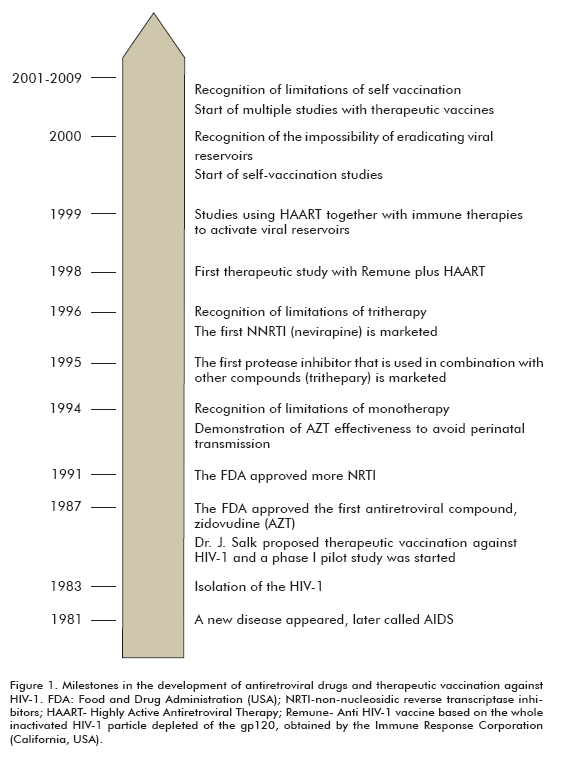
<body><![CDATA[<p><span lang=EN-US style='font-size:10.0pt;font-family:"Verdana","sans-serif"'>On the other hand, clinical failure is related to the progression to AIDS and finally death. In the practical sense, clinical success is the most relevant achievement, but it is difficult to assess it and it takes even longer to be unquestionably established. However, several studies have evidenced that clinical success depends in the long-term on virological aspects </span><span lang=EN-US style='font-size:10.0pt;font-family:"Verdana","sans-serif"; color:windowtext'>(</span><span lang=EN-US style='font-size:10.0pt;font-family: "Verdana","sans-serif"'>39- 41). On the other side, a curious relationship between virological and immunological success has been noticed. </span></p>      <p><span lang=EN-US style='font-size:10.0pt;font-family:"Verdana","sans-serif"'>Immunological success </span><span lang=EN-US style='font-size:10.0pt;font-family:"Verdana","sans-serif"; color:windowtext'>(</span><span lang=EN-US style='font-size:10.0pt;font-family: "Verdana","sans-serif"'>increase in the CD4+ T cell counts) can be achieved at detectable VL </span><span lang=EN-US style='font-size:10.0pt;font-family:"Verdana","sans-serif"; color:windowtext'>(</span><span lang=EN-US style='font-size:10.0pt;font-family: "Verdana","sans-serif"'>42-44). However, the risk of drop in CD4+ T cells and progression to AIDS is proportional to the increase in VL </span><span lang=EN-US style='font-size:10.0pt;font-family:"Verdana","sans-serif"; color:windowtext'>(</span><span lang=EN-US style='font-size:10.0pt;font-family: "Verdana","sans-serif"'>45-47). It is noteworthy that this risk starts at certain VL values. In fact, CD4+ T cell counts should not decrease if VL remains below 10 000 RNA copies/mL or 1.5 log under the relatively steady viral set point that has been established during the asymptomatic period </span><span lang=EN-US style='font-size:10.0pt;font-family:"Verdana","sans-serif"; color:windowtext'>(</span><span lang=EN-US style='font-size:10.0pt;font-family: "Verdana","sans-serif"'>44). Based on all the above, the success of therapies can be assessed based on the virological response. In this sense, the physician has a simple and effective tool to draw conclusions about any therapeutic treatment. </span></p>      <p><b><span lang=EN-US style='font-family:"Verdana","sans-serif"'>THERAPEUTIC VACCINATION </span></b></p>      <p><span lang=EN-US style='font-size:10.0pt;font-family:"Verdana","sans-serif"'>The success/failure ratio of therapeutics against HIV establishes a practical niche for vaccination </span><span lang=EN-US style='font-size:10.0pt;font-family: "Verdana","sans-serif";color:windowtext'>(</span><span style='font-size:10.0pt; font-family:"Verdana","sans-serif"'><a href="#fig1"><span lang=EN-US>Figure 1</span></a></span><span lang=EN-US style='font-size:10.0pt;font-family:"Verdana","sans-serif"'>). This would not be required if there were a therapy able to eradicate the virus, or at least hamper the development of the escape mutant viruses, while stabilizing VL at low levels and keeping it under control in the blood with low toxicity. Many concepts formerly applied to ART have been extrapolated to the therapeutic vaccination field against HIV </span><span lang=EN-US style='font-size:10.0pt; font-family:"Verdana","sans-serif";color:windowtext'>(</span><span lang=EN-US style='font-size:10.0pt;font-family:"Verdana","sans-serif"'>such as the success and failure criteria). </span></p>      <p align=center style='text-align:center'><span style='font-size:13.5pt'><img border=0 width=564 height=760 src="/img/revistas/bta/v26n3/f0102309.gif"></span><a name=fig1></a></p>      
<p><b><span lang=EN-US style='font-size:10.0pt;font-family:"Verdana","sans-serif"'>Scheduled treatment interruptions and self-vaccination </span></b></p>      <p><span lang=EN-US style='font-size:10.0pt;font-family:"Verdana","sans-serif"'>Tritherapy allows the patients to recover their immunity against several pathogenic agents </span><span lang=EN-US style='font-size:10.0pt;font-family:"Verdana","sans-serif"; color:windowtext'>(</span><span lang=EN-US style='font-size:10.0pt;font-family: "Verdana","sans-serif"'>48, 49) but the immune response against HIV remains low </span><span lang=EN-US style='font-size:10.0pt;font-family:"Verdana","sans-serif"; color:windowtext'>(</span><span lang=EN-US style='font-size:10.0pt;font-family: "Verdana","sans-serif"'>50-52). This could come from the very low amount of circulating virus, which is insufficient to activate the immune system </span><span lang=EN-US style='font-size:10.0pt;font-family:"Verdana","sans-serif"; color:windowtext'>(</span><span lang=EN-US style='font-size:10.0pt;font-family: "Verdana","sans-serif"'>53). That is the reason supporting the research on self-vaccination during scheduled ART interruptions, which transiently increase VL. </span></p>      <p><span lang=EN-US style='font-size:10.0pt;font-family:"Verdana","sans-serif"'>Several pilot studies conducted with very few patients, and also in animals, reported encouraging results </span><span lang=EN-US style='font-size:10.0pt;font-family: "Verdana","sans-serif";color:windowtext'>(</span><span lang=EN-US style='font-size:10.0pt;font-family:"Verdana","sans-serif"'>54-58), but they did not include a control group. Besides, whichever model was used, the studies only covered subjects with acute infection. </span></p>      <p><span lang=EN-US style='font-size:10.0pt;font-family:"Verdana","sans-serif"'>Based on these drawbacks, the SSITT and DART studies were designed and carried out to test the socalled immune and virological benefits of scheduled treatment interruptions at regular time periods in chronic patients, but their results were not too encouraging </span><span lang=EN-US style='font-size:10.0pt; font-family:"Verdana","sans-serif";color:windowtext'>(</span><span lang=EN-US style='font-size:10.0pt;font-family:"Verdana","sans-serif"'>59-61). These studies have demonstrated that a partial recovery of the immune response is possible without a detectable control of viral replication </span><span lang=EN-US style='font-size:10.0pt;font-family:"Verdana","sans-serif"; color:windowtext'>(</span><span lang=EN-US style='font-size:10.0pt;font-family: "Verdana","sans-serif"'>55, 61-64). This could be explained by that fact that self-vaccination only re-stimulates T cell clones which were generated during the process of infection and remain uninfected </span><span lang=EN-US style='font-size:10.0pt;font-family:"Verdana","sans-serif";color:windowtext'>(</span><span lang=EN-US style='font-size:10.0pt;font-family:"Verdana","sans-serif"'>65), among other factors. The general consensus establishes that scheduled treatment interruptions in HIV patients at regular time periods can be dangerous in clinical practice. </span></p>      <p><span lang=EN-US style='font-size:10.0pt;font-family:"Verdana","sans-serif"'>Another practice consists of the interruption of the tritherapy based on blood T CD4+ cell counts. These counts, together with VL, are the most relevant markers of the progression to AIDS </span><span lang=EN-US style='font-size:10.0pt; font-family:"Verdana","sans-serif";color:windowtext'>(</span><span lang=EN-US style='font-size:10.0pt;font-family:"Verdana","sans-serif"'>45-47, 66, 67). In patients with high viral CD4+ T cell counts, tritherapy is interrupted and resumed when this parameter drops below a defined threshold. There are reports of studies using this therapeutic alternative. In general, they have been non-randomized studies with different threshold values and applied in heterogeneous populations. Their authors have concluded that such interruptions are safe and make it possible to reduce the exposure to other therapies </span><span lang=EN-US style='font-size:10.0pt;font-family:"Verdana","sans-serif"; color:windowtext'>(</span><span lang=EN-US style='font-size:10.0pt;font-family: "Verdana","sans-serif"'>68-71). However, the most relevant results come from the large randomized studies TIBET, STACCATO, ACGT5170, LOTTI, TRIVACAN and SMART. Tritherapy interruptions based on CD4+ T cell counts are safe when VL is under control, according to the results of the TIBET </span><span lang=EN-US style='font-size:10.0pt;font-family:"Verdana","sans-serif";color:windowtext'>(</span><span lang=EN-US style='font-size:10.0pt;font-family:"Verdana","sans-serif"'>72), STACCATO </span><span lang=EN-US style='font-size:10.0pt;font-family:"Verdana","sans-serif"; color:windowtext'>(</span><span lang=EN-US style='font-size:10.0pt;font-family: "Verdana","sans-serif"'>73), ACGT5170 </span><span lang=EN-US style='font-size: 10.0pt;font-family:"Verdana","sans-serif";color:windowtext'>(</span><span lang=EN-US style='font-size:10.0pt;font-family:"Verdana","sans-serif"'>74) and LOTTI </span><span lang=EN-US style='font-size:10.0pt;font-family:"Verdana","sans-serif"; color:windowtext'>(</span><span lang=EN-US style='font-size:10.0pt;font-family: "Verdana","sans-serif"'>75) studies, which evaluated 1127 patients under the criterion of CD4+ T cell counts lower than or equal to 350 cells/</span><span style='font-size:10.0pt;font-family:"Verdana","sans-serif"'>&#956;</span><span lang=EN-US style='font-size:10.0pt;font-family:"Verdana","sans-serif"'>L to resume the treatment. In contrast, the TRIVACAN </span><span lang=EN-US style='font-size:10.0pt;font-family:"Verdana","sans-serif";color:windowtext'>(</span><span lang=EN-US style='font-size:10.0pt;font-family:"Verdana","sans-serif"'>76) and SMART </span><span lang=EN-US style='font-size:10.0pt;font-family:"Verdana","sans-serif"; color:windowtext'>(</span><span lang=EN-US style='font-size:10.0pt;font-family: "Verdana","sans-serif"'>77) studies pointed out the opposite direction, but their criteria to resume and stop the therapy were CD4+ T cell counts below 250 and above 350 cells/</span><span style='font-size:10.0pt;font-family:"Verdana","sans-serif"'>&#956;</span><span lang=EN-US style='font-size:10.0pt;font-family:"Verdana","sans-serif"'>L, respectively. </span></p>      ]]></body>
<body><![CDATA[<p><span lang=EN-US style='font-size:10.0pt;font-family:"Verdana","sans-serif"'>The largest randomized studies up to now, SMART and LOTTI, demand a more detailed analysis. Results of the SMART study, involving 5000 patients in more than 50 countries, have convinced many physicians on how unsafe these interruptions are </span><span lang=EN-US style='font-size:10.0pt;font-family:"Verdana","sans-serif"; color:windowtext'>(</span><span lang=EN-US style='font-size:10.0pt;font-family: "Verdana","sans-serif"'>78). However, inconsistencies arise from a careful analysis of these results. For example, the increased risk of AIDS and the death of patients could not be related to their CD4+ T cell counts at the beginning of the study. Neither the CD4+ T cell counts nadir, nor the incidence of AIDS were predictive. On the other hand, the risk of becoming ill was low; although of high statistical significance </span><span lang=EN-US style='font-size:10.0pt;font-family:"Verdana","sans-serif";color:windowtext'>(</span><span lang=EN-US style='font-size:10.0pt;font-family:"Verdana","sans-serif"'>due to the high statistic power). The LOTTI study, comprising 329 patients, evidenced that neither the risk of progression nor the detection of resistant mutant viruses increase when resuming therapy at CD4+ T cell counts lower than or equal to 350 cells/</span><span style='font-size:10.0pt;font-family:"Verdana","sans-serif"'>&#956;</span><span lang=EN-US style='font-size:10.0pt;font-family:"Verdana","sans-serif"'>L </span><span lang=EN-US style='font-size:10.0pt;font-family:"Verdana","sans-serif"; color:windowtext'>(</span><span lang=EN-US style='font-size:10.0pt;font-family: "Verdana","sans-serif"'>75). Considering the results of these studies, treatment interruptions based on the T CD4+ cells are not detrimental within certain range of this parameter and under controlled VL, and may be useful to delay or mitigate the appearance of undesired side-effects of therapies </span><span lang=EN-US style='font-size:10.0pt;font-family:"Verdana","sans-serif"; color:windowtext'>(</span><span lang=EN-US style='font-size:10.0pt;font-family: "Verdana","sans-serif"'>79-80). </span></p>      <p><b><span lang=EN-US style='font-size:10.0pt;font-family:"Verdana","sans-serif"'>Risks associated to the interruption of the treatment against HIV</span></b><span lang=EN-US style='font-size:10.0pt;font-family:"Verdana","sans-serif"'> </span></p>      <p><span lang=EN-US style='font-size:10.0pt;font-family:"Verdana","sans-serif"'>The treatment interruption studies have shown that VL quickly increases after the interruption. In fact, viremia becomes detectable within 2 or 3 weeks </span><span lang=EN-US style='font-size:10.0pt;font-family:"Verdana","sans-serif"; color:windowtext'>(</span><span lang=EN-US style='font-size:10.0pt;font-family: "Verdana","sans-serif"'>64, 81, 82); stabilizing at values observed before the treatment </span><span lang=EN-US style='font-size:10.0pt;font-family:"Verdana","sans-serif"; color:windowtext'>(</span><span lang=EN-US style='font-size:10.0pt;font-family: "Verdana","sans-serif"'>or the viral set point) </span><span lang=EN-US style='font-size:10.0pt;font-family:"Verdana","sans-serif";color:windowtext'>(</span><span lang=EN-US style='font-size:10.0pt;font-family:"Verdana","sans-serif"'>83). Similarly, CD4+ T cell counts drop to values closer to the count observed before the treatment. In this case, the lower the CD4+ T cells nadir, the faster the drop in CD4+ T cell counts in the off therapy period, reaching the viral set point in just a few weeks </span><span lang=EN-US style='font-size: 10.0pt;font-family:"Verdana","sans-serif";color:windowtext'>(</span><span lang=EN-US style='font-size:10.0pt;font-family:"Verdana","sans-serif"'>68). </span></p>      <p><span lang=EN-US style='font-size:10.0pt;font-family:"Verdana","sans-serif"'>Symptoms similar to those reported during acute HIV-1 infection commonly appear after therapy interruption, e.g.: lymphadenopathies, fever, asthenia and discomfort </span><span lang=EN-US style='font-size:10.0pt;font-family:"Verdana","sans-serif"; color:windowtext'>(</span><span lang=EN-US style='font-size:10.0pt;font-family: "Verdana","sans-serif"'>84-86). Thrombocytopenia has been also reported </span><span lang=EN-US style='font-size:10.0pt;font-family:"Verdana","sans-serif"; color:windowtext'>(</span><span lang=EN-US style='font-size:10.0pt;font-family: "Verdana","sans-serif"'>87), indicating the need for monitoring blood parameters. </span></p>      <p><span lang=EN-US style='font-size:10.0pt;font-family:"Verdana","sans-serif"'>The main concern of physicians after treatment interruption is the increase in viruses resistant to these therapies. It is widely considered that the higher the VL and the lower the CD4+ T cell count, the higher the risk of virological failure </span><span lang=EN-US style='font-size:10.0pt;font-family:"Verdana","sans-serif"; color:windowtext'>(</span><span lang=EN-US style='font-size:10.0pt;font-family: "Verdana","sans-serif"'>the rise of viruses resistant to therapy), immune failure and the appearance of AIDS. This is essentially true, but it should be limited to CD4+ T cell counts below 350 cells/</span><span style='font-size: 10.0pt;font-family:"Verdana","sans-serif"'>&#956;</span><span lang=EN-US style='font-size:10.0pt;font-family:"Verdana","sans-serif"'>L </span><span lang=EN-US style='font-size:10.0pt;font-family:"Verdana","sans-serif"; color:windowtext'>(</span><span lang=EN-US style='font-size:10.0pt;font-family: "Verdana","sans-serif"'>as mentioned in the previous section). Above that threshold and after a single treatment interruption, the risk of virological failure is almost inexistent. One of the first studies evidencing this was the French COMET study </span><span lang=EN-US style='font-size:10.0pt;font-family: "Verdana","sans-serif";color:windowtext'>(</span><span lang=EN-US style='font-size:10.0pt;font-family:"Verdana","sans-serif"'>88). Unfortunately, this study was non-randomized, thereby limiting the implications of its results. There have been other cohort studies in patients naïve to therapy that were treated; treatment was interrupted and, once resuming therapy, the rate of virological failure was not higher than that shown by patients treated without interruption </span><span lang=EN-US style='font-size:10.0pt;font-family:"Verdana","sans-serif"; color:windowtext'>(</span><span lang=EN-US style='font-size:10.0pt;font-family: "Verdana","sans-serif"'>89-92). These studies demonstrate that virological success is hardly compromised when patients have not accumulated previous therapeutic failures. Besides, the risk of developing AIDS is also low </span><span lang=EN-US style='font-size:10.0pt;font-family:"Verdana","sans-serif"; color:windowtext'>(</span><span lang=EN-US style='font-size:10.0pt;font-family: "Verdana","sans-serif"'>for a single interruption) as shown in the SWISS </span><span lang=EN-US style='font-size:10.0pt;font-family:"Verdana","sans-serif"; color:windowtext'>(</span><span lang=EN-US style='font-size:10.0pt;font-family: "Verdana","sans-serif"'>93, 94) and AMELIA </span><span lang=EN-US style='font-size:10.0pt;font-family:"Verdana","sans-serif";color:windowtext'>(</span><span lang=EN-US style='font-size:10.0pt;font-family:"Verdana","sans-serif"'>71) cohort studies. </span></p>      <p><b><span lang=EN-US style='font-size:10.0pt;font-family:"Verdana","sans-serif"'>Therapeutic vaccines </span></b></p>      <p><span lang=EN-US style='font-size:10.0pt;font-family:"Verdana","sans-serif"'>Therapeutic vaccination was proposed to prevent AIDS by Prof. Jonas Salk in 1987 </span><span lang=EN-US style='font-size:10.0pt;font-family:"Verdana","sans-serif"; color:windowtext'>(</span><span lang=EN-US style='font-size:10.0pt;font-family: "Verdana","sans-serif"'>95), and the first phase I pilot study was started in that very year, in 25 patients who were immunized with Remune </span><span lang=EN-US style='font-size:10.0pt;font-family:"Verdana","sans-serif"; color:windowtext'>(</span><span lang=EN-US style='font-size:10.0pt;font-family: "Verdana","sans-serif"'>a whole inactivated HIV-1 virus vaccine depleted of gp120 glycoprotein)</span><span lang=EN-US style='font-size:10.0pt;font-family: "Verdana","sans-serif";color:windowtext'>(</span><span lang=EN-US style='font-size:10.0pt;font-family:"Verdana","sans-serif"'>96). This study provided poor but encouraging results in regard to viral control. Nevertheless, the efficacy of this type of treatment was questioned because of the lack of a control group. Other similar studies were carried out using different vaccine candidates, but all of them had the same limitations as the Remune study </span><span lang=EN-US style='font-size:10.0pt;font-family:"Verdana","sans-serif"; color:windowtext'>(</span><span lang=EN-US style='font-size:10.0pt;font-family: "Verdana","sans-serif"'>reviewed in </span><span lang=EN-US style='font-size: 10.0pt;font-family:"Verdana","sans-serif";color:windowtext'>(</span><span lang=EN-US style='font-size:10.0pt;font-family:"Verdana","sans-serif"'>97)) and gave no encouraging results. Besides, patients were exposed to an unacceptable risk by facing immunizations when there is not virological control </span><span lang=EN-US style='font-size:10.0pt;font-family:"Verdana","sans-serif"; color:windowtext'>(</span><span lang=EN-US style='font-size:10.0pt;font-family: "Verdana","sans-serif"'>further discussed in Vaccination-associated risks in seropositive patients). This mostly promoted the interruption of clinical studies evaluating therapeutic vaccines. Fortunately, ART were developed shortly afterwards, with its subsequent and encouraging results in VL. In the 12<sup>th </sup>World Conference on AIDS, held in Geneva in 1998, a group of researchers showed that a number of seropositive patients subjected to HAART and further immunized with Remune developed a significant proliferative response against p24 </span><span lang=EN-US style='font-size:10.0pt; font-family:"Verdana","sans-serif";color:windowtext'>(</span><span lang=EN-US style='font-size:10.0pt;font-family:"Verdana","sans-serif"'>98). This result re-launched the studies using therapeutic vaccines. </span></p>      <p><span lang=EN-US style='font-size:10.0pt;font-family:"Verdana","sans-serif"'>Therapeutic vaccination began earlier than the development of the tritherapy and self-vaccination with scheduled treatment interruptions against HIV-1. ART do not eradicate viral reservoirs, having very limited effects when resistant viral mutants appear, and are toxic in the long-term. Because treatment interruptions </span><span lang=EN-US style='font-size:10.0pt;font-family:"Verdana","sans-serif"; color:windowtext'>(</span><span lang=EN-US style='font-size:10.0pt;font-family: "Verdana","sans-serif"'>self-vaccination) failed to stimulate a protective immunity an intense work has been carried out in recent years to substitute ART by the combination of therapeutic vaccination with tritherapy. In this new scenario, therapeutic vaccination is aimed to stimulate the protective components of antiviral immunity, when ART keeps the viral replication under control. Viral control by immune mechanisms after interrupting therapy should be the final outcome </span><span lang=EN-US style='font-size:10.0pt; font-family:"Verdana","sans-serif";color:windowtext'>(</span><span lang=EN-US style='font-size:10.0pt;font-family:"Verdana","sans-serif"'>99). At least two studies in the simian immunodeficiency virus </span><span lang=EN-US style='font-size:10.0pt;font-family:"Verdana","sans-serif";color:windowtext'>(</span><span lang=EN-US style='font-size:10.0pt;font-family:"Verdana","sans-serif"'>SIV) model suggest the feasibility of this strategy </span><span lang=EN-US style='font-size:10.0pt;font-family:"Verdana","sans-serif";color:windowtext'>(</span><span lang=EN-US style='font-size:10.0pt;font-family:"Verdana","sans-serif"'>100, 101). In fact, many researchers believe that vaccination is the best choice for a long-term virological control after interrupting ART </span><span lang=EN-US style='font-size:10.0pt;font-family:"Verdana","sans-serif";color:windowtext'>(</span><span lang=EN-US style='font-size:10.0pt;font-family:"Verdana","sans-serif"'>102-104). </span></p>      <p><span lang=EN-US style='font-size:10.0pt;font-family:"Verdana","sans-serif"'>Very recent studies suggest that therapeutic vaccination could help reduce the variability of HIV-1 quasi- species </span><span lang=EN-US style='font-size: 10.0pt;font-family:"Verdana","sans-serif";color:windowtext'>(</span><span lang=EN-US style='font-size:10.0pt;font-family:"Verdana","sans-serif"'>105) and to expand the functional response of antiviral CD4+ and CD8+ T cells </span><span lang=EN-US style='font-size:10.0pt;font-family:"Verdana","sans-serif"; color:windowtext'>(</span><span lang=EN-US style='font-size:10.0pt;font-family: "Verdana","sans-serif"'>106-107). </span></p>      <p><span lang=EN-US style='font-size:10.0pt;font-family:"Verdana","sans-serif"'>Numerous human clinical trials to enhance cellular immunity with a variety of therapeutic regimes </span><span lang=EN-US style='font-size:10.0pt;font-family: "Verdana","sans-serif";color:windowtext'>(</span><span lang=EN-US style='font-size:10.0pt;font-family:"Verdana","sans-serif"'>reviewed in </span><span lang=EN-US style='font-size:10.0pt;font-family:"Verdana","sans-serif"; color:windowtext'>(</span><span lang=EN-US style='font-size:10.0pt;font-family: "Verdana","sans-serif"'>97)), have evaluated essentially four types of vaccine candidates: 1) subunit vaccine candidates, comprising immunogens based on the viral envelope proteins, Tat toxoid, lipopeptides and p24 virus-like particles, among others; 2) inactivated virus, as Remune; 3) viral vectors, such as ALVAC; and 4) naked DNA. All these strategies have shown that it is possible to stimulate new specificities of the anti-HIV-1 CD4+ and CD8+ T cell responses without producing severe secondary effects </span><span lang=EN-US style='font-size: 10.0pt;font-family:"Verdana","sans-serif";color:windowtext'>(</span><span lang=EN-US style='font-size:10.0pt;font-family:"Verdana","sans-serif"'>108-117). Unfortunately, it is impossible to predict the efficacy of vaccine candidates from the results of their immunological tests, since the mechanisms mediating protection against HIV-1 remain unknown. </span></p>      ]]></body>
<body><![CDATA[<p><b><span lang=EN-US style='font-size:10.0pt;font-family:"Verdana","sans-serif"'>Vaccination-associated risks in seropositive patients</span></b><span lang=EN-US style='font-size: 10.0pt;font-family:"Verdana","sans-serif"'> </span></p>      <p><span lang=EN-US style='font-size:10.0pt;font-family:"Verdana","sans-serif"'>Vaccination can induce a transient peak in the VL of HIV-1 ART naïve seropositive patients, from 2 to 30 times the initial levels. This increase is maximal within 3 to 28 days </span><span lang=EN-US style='font-size:10.0pt;font-family:"Verdana","sans-serif"; color:windowtext'>(</span><span lang=EN-US style='font-size:10.0pt;font-family: "Verdana","sans-serif"'>with a mean of 13 days), later decreasing up to the initial VL levels in approximately six weeks. This has been demonstrated for other vaccines, such as influenza </span><span lang=EN-US style='font-size: 10.0pt;font-family:"Verdana","sans-serif";color:windowtext'>(</span><span lang=EN-US style='font-size:10.0pt;font-family:"Verdana","sans-serif"'>118), pneumococci </span><span lang=EN-US style='font-size:10.0pt;font-family:"Verdana","sans-serif"; color:windowtext'>(</span><span lang=EN-US style='font-size:10.0pt;font-family: "Verdana","sans-serif"'>119, 120) and tetanus toxoid </span><span lang=EN-US style='font-size:10.0pt;font-family:"Verdana","sans-serif";color:windowtext'>(</span><span lang=EN-US style='font-size:10.0pt;font-family:"Verdana","sans-serif"'>121). It has been possible to establish that the stimulation of CD4+ T cells by vaccination further increases the viral replication rate through the action of cellular transcription factors </span><span lang=EN-US style='font-size:10.0pt; font-family:"Verdana","sans-serif";color:windowtext'>(</span><span lang=EN-US style='font-size:10.0pt;font-family:"Verdana","sans-serif"'>122, 123). It is noteworthy that another series of studies have reported no increases in the VL after vaccination </span><span lang=EN-US style='font-size:10.0pt;font-family: "Verdana","sans-serif";color:windowtext'>(</span><span lang=EN-US style='font-size:10.0pt;font-family:"Verdana","sans-serif"'>124-126) that could be explained by the differences in the time points and frequency of laboratory determinations between studies. Nevertheless, and based on such results, the international scientific community has concluded that it is risky to vaccinate HIV-1 seropositive patients who have a high </span><span lang=EN-US style='font-size:10.0pt;font-family:"Verdana","sans-serif";color:windowtext'>(</span><span lang=EN-US style='font-size:10.0pt;font-family:"Verdana","sans-serif"'>uncontrolled) VL. </span></p>      <p><span lang=EN-US style='font-size:10.0pt;font-family:"Verdana","sans-serif"'>Further studies have been conducted in patients under tritherapy and with controlled VL. Results from Kolber and co-workers, with a small number of patients having a VL lower than 200 copies of RNA/mL and having been vaccinated against influenza, suggest that vaccination induces an increase in plasma virus after two to three weeks, with a relatively high frequency among patients without previous treatment </span><span lang=EN-US style='font-size:10.0pt;font-family: "Verdana","sans-serif";color:windowtext'>(</span><span lang=EN-US style='font-size:10.0pt;font-family:"Verdana","sans-serif"'>5/26; 19%) and even higher in those who had previous therapeutic failure </span><span lang=EN-US style='font-size:10.0pt;font-family:"Verdana","sans-serif";color:windowtext'>(</span><span lang=EN-US style='font-size:10.0pt;font-family:"Verdana","sans-serif"'>3/8; 38%) </span><span lang=EN-US style='font-size:10.0pt;font-family:"Verdana","sans-serif"; color:windowtext'>(</span><span lang=EN-US style='font-size:10.0pt;font-family: "Verdana","sans-serif"'>127). Viral mutants were reported in some patients, but the authors did not present results allowing to evaluate the impact of these mutants, and in most of the cases they did not discriminate whether the mutant was present or not before vaccination. The study was further limited by the lack of a negative control group of patients under tritherapy. </span></p>      <p><span lang=EN-US style='font-size:10.0pt;font-family:"Verdana","sans-serif"'>Two other studies indicated that vaccination against influenza decreases T CD4+ cell counts </span><span lang=EN-US style='font-size:10.0pt;font-family:"Verdana","sans-serif"; color:windowtext'>(</span><span lang=EN-US style='font-size:10.0pt;font-family: "Verdana","sans-serif"'>125, 128), although this parameter was only significant in one of them </span><span lang=EN-US style='font-size:10.0pt;font-family: "Verdana","sans-serif";color:windowtext'>(</span><span lang=EN-US style='font-size:10.0pt;font-family:"Verdana","sans-serif"'>128). </span></p>      <p><span lang=EN-US style='font-size:10.0pt;font-family:"Verdana","sans-serif"'>Another study on vaccination against influenza in a group of HIV-1 seropositive patients with VL lower than 50 copies of viral RNA/mL evidenced an increase of VL in 3 out of 11 patients </span><span lang=EN-US style='font-size:10.0pt;font-family: "Verdana","sans-serif";color:windowtext'>(</span><span lang=EN-US style='font-size:10.0pt;font-family:"Verdana","sans-serif"'>27%), which was transient </span><span lang=EN-US style='font-size:10.0pt;font-family:"Verdana","sans-serif"; color:windowtext'>(</span><span lang=EN-US style='font-size:10.0pt;font-family: "Verdana","sans-serif"'>returning to values prior to vaccination) and never rising above 100 RNA copies/mL </span><span lang=EN-US style='font-size:10.0pt; font-family:"Verdana","sans-serif";color:windowtext'>(</span><span lang=EN-US style='font-size:10.0pt;font-family:"Verdana","sans-serif"'>129). It was also observed that the absolute counts of CD4+ T cells and the proportion of naïve cells in those patients were similar to those of the uninfected control groups. </span></p>      <p><span lang=EN-US style='font-size:10.0pt;font-family:"Verdana","sans-serif"'>This was not the case for the other groups studied, in which VLs were higher than 50 copies of viral RNA/ mL. The immune response after vaccination was significantly higher in the group showing total suppression of the VL, compared to the groups with a partial control of the VL. Other researchers achieved similar results </span><span lang=EN-US style='font-size:10.0pt;font-family: "Verdana","sans-serif";color:windowtext'>(</span><span lang=EN-US style='font-size:10.0pt;font-family:"Verdana","sans-serif"'>130). Vaccination of seropositive patients has been able to establish that it is not enough to reach normal CD4+ T cell counts after ART; instead, a nadir of CD4+ T cell counts higher than 350-400 cells/</span><span style='font-size:10.0pt; font-family:"Verdana","sans-serif"'>&#956;</span><span lang=EN-US style='font-size:10.0pt;font-family:"Verdana","sans-serif"'>L is absolutely required to generate new specificities and to develop a functional T cell response </span><span lang=EN-US style='font-size:10.0pt;font-family:"Verdana","sans-serif"; color:windowtext'>(</span><span lang=EN-US style='font-size:10.0pt;font-family: "Verdana","sans-serif"'>131). </span></p>      <p><span lang=EN-US style='font-size:10.0pt;font-family:"Verdana","sans-serif"'>On the other hand, there are several studies on therapeutic vaccination against HIV-1 in patients under ART showing an increase in VL after vaccination. This increase is infrequent, and never higher than 600 copies of viral RNA/mL, returning to previous levels within few weeks </span><span lang=EN-US style='font-size:10.0pt;font-family:"Verdana","sans-serif";color:windowtext'>(</span><span lang=EN-US style='font-size:10.0pt;font-family:"Verdana","sans-serif"'>116, 117). They also showed only mild and transient adverse events associated to vaccination </span><span lang=EN-US style='font-size:10.0pt;font-family:"Verdana","sans-serif"; color:windowtext'>(</span><span lang=EN-US style='font-size:10.0pt;font-family: "Verdana","sans-serif"'>109-117), even when the vaccine is administered together with immuno-stimulatory molecules </span><span lang=EN-US style='font-size:10.0pt;font-family:"Verdana","sans-serif";color:windowtext'>(</span><i><span lang=EN-US style='font-size:10.0pt;font-family:"Verdana","sans-serif"'>i. e.</span></i><span lang=EN-US style='font-size:10.0pt;font-family:"Verdana","sans-serif"'>, cytokines and others) </span><span lang=EN-US style='font-size:10.0pt; font-family:"Verdana","sans-serif";color:windowtext'>(</span><span lang=EN-US style='font-size:10.0pt;font-family:"Verdana","sans-serif"'>108, 132). </span></p>      <p><b><span lang=EN-US style='font-size:10.0pt;font-family:"Verdana","sans-serif"'>Clinical Trial Designs </span></b></p>      <p><span lang=EN-US style='font-size:10.0pt;font-family:"Verdana","sans-serif"'>The clinical efficacy of any treatment against HIV can be assessed as: 1) the cure or eradication of the virus; 2) a significant increase in progression time to AIDS; or 3) at least an improvement in the quality of life of the patient when goals 1 and 2 are not reached. </span></p>      <p><span lang=EN-US style='font-size:10.0pt;font-family:"Verdana","sans-serif"'>However, to achieve statistical significant for the clinical efficacy a large number of patients must be recruited and observed for a long period of time Therefore, the international scientific community and regulatory agencies </span><span lang=EN-US style='font-size:10.0pt;font-family:"Verdana","sans-serif"; color:windowtext'>(</span><span lang=EN-US style='font-size:10.0pt;font-family: "Verdana","sans-serif"'>such as FDA) have accepted the decrease in plasma VL as a surrogate marker of clinical efficacy </span><span lang=EN-US style='font-size:10.0pt;font-family:"Verdana","sans-serif";color:windowtext'>(</span><span lang=EN-US style='font-size:10.0pt;font-family:"Verdana","sans-serif"'>133, 134). This is valid for vaccine candidates that can induce cellular immunity, because their mechanisms of action are analogous to those of ART. Studies on these therapies have shown that VL effectively predicts the rate of progression to AIDS </span><span lang=EN-US style='font-size:10.0pt;font-family:"Verdana","sans-serif"; color:windowtext'>(</span><span lang=EN-US style='font-size:10.0pt;font-family: "Verdana","sans-serif"'>45-47). </span></p>      ]]></body>
<body><![CDATA[<p><span lang=EN-US style='font-size:10.0pt;font-family:"Verdana","sans-serif"'>There was also a consensus on the most efficient design of clinical trials. This allows assessing the clinical efficacy after a short observation period </span><span lang=EN-US style='font-size:10.0pt;font-family:"Verdana","sans-serif"; color:windowtext'>(</span><span lang=EN-US style='font-size:10.0pt;font-family: "Verdana","sans-serif"'>135, 136). A minimal design would comprise a group with HAART and placebo </span><span lang=EN-US style='font-size:10.0pt;font-family: "Verdana","sans-serif";color:windowtext'>(</span><span lang=EN-US style='font-size:10.0pt;font-family:"Verdana","sans-serif"'>control group; CG), to be compared to another group receiving HAART and with immunotherapy </span><span lang=EN-US style='font-size:10.0pt;font-family:"Verdana","sans-serif"; color:windowtext'>(</span><span lang=EN-US style='font-size:10.0pt;font-family: "Verdana","sans-serif"'>study group; SG). After ending the immunotherapy of SG, HAART will be stopped in both groups. VL and CD4+ T lymphocyte counts will be periodically determined to assess the number of patients who need to resume therapy. The latter is required when the CD4+ T cell counts are below 350 cells/</span><span style='font-size:10.0pt;font-family:"Verdana","sans-serif"'>&#956;</span><span lang=EN-US style='font-size:10.0pt;font-family:"Verdana","sans-serif"'>L and if VL is above 50 000 viral RNA copies/mL within 4 weeks after therapy interruption, or if VL is higher than 10 000 copies/mL after 8 weeks. The patient’s health is not at a high risk during the study when applying these criteria. If the immunotherapy is effective, it would be possible to statistically demonstrate that the off therapy period of patients in the SG was significantly higher than those in the CG. Plasma VL is also a very useful parameter, and the FDA issues an expedite approval for a given drug if it maintains the VL under control for 16 to 24 weeks </span><span lang=EN-US style='font-size:10.0pt; font-family:"Verdana","sans-serif";color:windowtext'>(</span><span lang=EN-US style='font-size:10.0pt;font-family:"Verdana","sans-serif"'>133). Other designs have been used, without tritherapy interruption and not evaluating efficacy. Small scale phase I studies can be carried out under the first design, including 20 to 30 patients </span><span lang=EN-US style='font-size:10.0pt; font-family:"Verdana","sans-serif";color:windowtext'>(</span><span lang=EN-US style='font-size:10.0pt;font-family:"Verdana","sans-serif"'>10 to 15 on each CG and SG group, respectively), which would permit strategic decisions at low costs. The results would support product development or redirecting research strategies. </span></p>      <p><span lang=EN-US style='font-size:10.0pt;font-family:"Verdana","sans-serif"'>A study with the above mentioned design was the QUEST using the vCP1452 </span><span lang=EN-US style='font-size:10.0pt;font-family:"Verdana","sans-serif"; color:windowtext'>(</span><span lang=EN-US style='font-size:10.0pt;font-family: "Verdana","sans-serif"'>ALVAC) candidate, alone and combined with Remune. This demonstrated that the immunization strategy of ALVAC plus Remune generated an anti-HIV-1 cellular response. In contrast, there was not any improvement in the virological control once HAART was discontinued </span><span lang=EN-US style='font-size:10.0pt;font-family:"Verdana","sans-serif";color:windowtext'>(</span><span lang=EN-US style='font-size:10.0pt;font-family:"Verdana","sans-serif"'>137). </span></p>      <p><span lang=EN-US style='font-size:10.0pt;font-family:"Verdana","sans-serif"'>The last result halted the research being made with the previous approach. Better results were obtained in other studies, such as the STIR-2102 </span><span lang=EN-US style='font-size:10.0pt;font-family:"Verdana","sans-serif"; color:windowtext'>(</span><span lang=EN-US style='font-size:10.0pt;font-family: "Verdana","sans-serif"'>108) and the ANRS 093 </span><span lang=EN-US style='font-size:10.0pt;font-family:"Verdana","sans-serif";color:windowtext'>(</span><span lang=EN-US style='font-size:10.0pt;font-family:"Verdana","sans-serif"'>114). Together, they demonstrated that the treated groups were benefitted with the therapeutic intervention because patients remain off-therapy a longer period of time compared to the placebo groups. </span></p>      <p><span lang=EN-US style='font-size:10.0pt;font-family:"Verdana","sans-serif"'>Obtaining a therapeutic vaccine against AIDS is a priority. Walensky and co-workers have predicted through a mathematical model that even partially effective vaccines could have a considerable impact on the patients’ quality of life, generating a substantial saving in tritherapy expenses of thousands of dollars per patient </span><span lang=EN-US style='font-size:10.0pt;font-family:"Verdana","sans-serif"; color:windowtext'>(</span><span lang=EN-US style='font-size:10.0pt;font-family: "Verdana","sans-serif"'>138). Underdeveloped countries need it desperately. </span></p>      <p><b><span lang=EN-US style='font-family:"Verdana","sans-serif"'>PERSPECTIVES OF VACCINATION AGAINST HIV </span></b></p>      <p><span lang=EN-US style='font-size:10.0pt;font-family:"Verdana","sans-serif"'>The production of a vaccine against HIV has encountered insurmountable drawbacks; among them the lack of an animal model that effectively resembles the human disease and the ignorance of the correlates of protection. There is, however, no absolute need to overcome those obstacles to obtain a vaccine. </span></p>      <p><span lang=EN-US style='font-size:10.0pt;font-family:"Verdana","sans-serif"'>It is more difficult to obtain a prophylactic than a therapeutic vaccine. This holds true because the HIV-1 directly attacks the immune system causing overwhelming damages, also infecting immunoprivileged sites. It is possible that a vaccine candidate inducing an immune response that can transiently control VL in a therapeutic scenario would be as effective as a prophylactic vaccine for preventing infection or inducing a slower evolution towards the disease. </span></p>      <p><span lang=EN-US style='font-size:10.0pt;font-family:"Verdana","sans-serif"'>Classically, when mentioning studies to obtain a prophylactic vaccine, it is considered to be mandatory to successfully surpass phase I and II clinical trials to reach a phase III stage for testing efficacy. Evidently, these studies demand more funds and numerous human resources, all of which delay the evaluation process of vaccine candidates. Consequently, the urgent need for a vaccine against AIDS and the scarce financial resources of some countries are compromised. There is an international commitment to accelerate the evaluation process of anti-HIV-1 vaccine candidates, with several propositions being discussed </span><span lang=EN-US style='font-size:10.0pt;font-family:"Verdana","sans-serif"; color:windowtext'>(</span><span lang=EN-US style='font-size:10.0pt;font-family: "Verdana","sans-serif"'>139, 140), and fast-track regulations in many countries </span><span lang=EN-US style='font-size:10.0pt;font-family:"Verdana","sans-serif"; color:windowtext'>(</span><span lang=EN-US style='font-size:10.0pt;font-family: "Verdana","sans-serif"'>as the CECMED Regulation 27-2000 in Cuba). </span></p>      <p><span lang=EN-US style='font-size:10.0pt;font-family:"Verdana","sans-serif"'>Considering all the above mentioned, an algorithm can be envisaged in which all the vaccine candidates </span><span lang=EN-US style='font-size:10.0pt;font-family:"Verdana","sans-serif"; color:windowtext'>(</span><span lang=EN-US style='font-size:10.0pt;font-family: "Verdana","sans-serif"'>even the prophylactic ones) and those especially designed to induce an antiviral cellular response could be assessed in a therapeutic scenario for safety and validation of the hypothesis when possible </span><span lang=EN-US style='font-size:10.0pt;font-family:"Verdana","sans-serif"; color:windowtext'>(</span><span style='font-size:10.0pt;font-family:"Verdana","sans-serif"'><a href="#fig2"><span lang=EN-US>Figure 2</span></a></span><span lang=EN-US style='font-size:10.0pt;font-family:"Verdana","sans-serif"'>). </span></p>      <p align=center style='text-align:center'><span style='font-size:13.5pt'><img border=0 width=561 height=726 src="/img/revistas/bta/v26n3/f0202309.gif"></span><a name=fig2></a></p>      
]]></body>
<body><![CDATA[<p><span lang=EN-US style='font-size:10.0pt;font-family:"Verdana","sans-serif"'>Clinical trials will start after the preclinical phase in experimentation animals. These therapeutic vaccination studies, aimed to test safety and to find efficacy evidences, could be run under a design as that proposed in the section of <i>Design of clinical studies</i>, using both CG and SG, treating the seropositive patients having an undetectable VL </span><span lang=EN-US style='font-size: 10.0pt;font-family:"Verdana","sans-serif";color:windowtext'>(</span><span lang=EN-US style='font-size:10.0pt;font-family:"Verdana","sans-serif"'>or low and controlled VL) under therapy and evaluating the control of the VL once stopping therapy. </span></p>      <p><span lang=EN-US style='font-size:10.0pt;font-family:"Verdana","sans-serif"'>Of course, it would be needed the compromise of the community of seropositive patients to support the clinical studies. At the same time, this represents an unprecedented ethical challenge for the scientific community, which should guarantee the maximum safety to the volunteers. The hemochemistry, virological and immunological parameters of the volunteers should be closely monitored during those studies. </span></p>      <p><span lang=EN-US style='font-size:10.0pt;font-family:"Verdana","sans-serif"'>After this analysis, it can be considered that studies testing vaccine candidates against AIDS by immunizing patients receiving ART and with undetectable </span><span lang=EN-US style='font-size:10.0pt;font-family:"Verdana","sans-serif"; color:windowtext'>(</span><span lang=EN-US style='font-size:10.0pt;font-family: "Verdana","sans-serif"'>or low and controlled) VL represents a small risk for the patient’s health once ART is interrupted. This could be assumed as far as their CD4+ T cell counts never decrease below 350 cells/</span><span style='font-size:10.0pt;font-family:"Verdana","sans-serif"'>&#956;</span><span lang=EN-US style='font-size:10.0pt;font-family:"Verdana","sans-serif"'>L and the VL will be lower than 50 000 copies of viral RNA/mL after the first four weeks of therapy interruption or lower than 10 000 copies after eight weeks. Evidences of efficacy can be found under these conditions and non-promising vaccine candidates can be ruled out quickly. </span></p>      <p><span lang=EN-US style='font-size:10.0pt;font-family:"Verdana","sans-serif"'>Evidently, such studies should be unbiased to obtain reliable efficacy results. For this purpose, randomized studies ought to be implemented, also favoring the inclusion of male volunteers in the first stages of clinical research due to the unknown potential teratogenic effects of the vaccine candidate and the adverse reactions been reported more frequently in women </span><span lang=EN-US style='font-size:10.0pt;font-family:"Verdana","sans-serif";color:windowtext'>(</span><span lang=EN-US style='font-size:10.0pt;font-family:"Verdana","sans-serif"'>141). Moreover, the thymus regresses with age </span><span lang=EN-US style='font-size:10.0pt;font-family:"Verdana","sans-serif";color:windowtext'>(</span><span lang=EN-US style='font-size:10.0pt;font-family:"Verdana","sans-serif"'>142- 144) and markedly in seropositive patients at advanced phases of immune dysfunction </span><span lang=EN-US style='font-size:10.0pt;font-family:"Verdana","sans-serif"; color:windowtext'>(</span><span lang=EN-US style='font-size:10.0pt;font-family: "Verdana","sans-serif"'>nadir of CD4+ T cell counts below 100 cells/</span><span style='font-size:10.0pt;font-family:"Verdana","sans-serif"'>&#956;</span><span lang=EN-US style='font-size:10.0pt;font-family:"Verdana","sans-serif"'>L)</span><span lang=EN-US style='font-size:10.0pt;font-family:"Verdana","sans-serif"; color:windowtext'>(</span><span lang=EN-US style='font-size:10.0pt;font-family: "Verdana","sans-serif"'>145), compromising the regenerating capacity for T cells of the immune system. Considering all these, it is recommended to preferably enroll subjects immunocompetent and younger than 45 years, immunocompetence is guaranteed when the nadir of CD4+ T cell counts is higher than or equal to 350 cells/</span><span style='font-size:10.0pt;font-family:"Verdana","sans-serif"'>&#956;</span><span lang=EN-US style='font-size:10.0pt;font-family:"Verdana","sans-serif"'>L </span><span lang=EN-US style='font-size:10.0pt;font-family:"Verdana","sans-serif"; color:windowtext'>(</span><span lang=EN-US style='font-size:10.0pt;font-family: "Verdana","sans-serif"'>146). </span></p>      <p><span lang=EN-US style='font-size:10.0pt;font-family:"Verdana","sans-serif"'>Other criteria should be considered. Significant inter-racial and inter-ethnic differences should be avoided between the control and treatment groups, because interracial differences have been reported in the anti-HIV-1 immune response </span><span lang=EN-US style='font-size:10.0pt;font-family:"Verdana","sans-serif"; color:windowtext'>(</span><span lang=EN-US style='font-size:10.0pt;font-family: "Verdana","sans-serif"'>147). Following the first efficacy evidences with the vaccine candidate, it would be convenient to replicate the study in female patients, to assess the influence of the genus on the immune response, pharmacodynamic and pharmacokinetic </span><span lang=EN-US style='font-size: 10.0pt;font-family:"Verdana","sans-serif";color:windowtext'>(</span><span lang=EN-US style='font-size:10.0pt;font-family:"Verdana","sans-serif"'>148). Such studies could be also conducted in young people, children and also in patients coinfected with other viruses of high prevalence in seropositive HIV patients, such as hepatitis B and C viruses. </span></p>      <p><span lang=EN-US style='font-size:10.0pt;font-family:"Verdana","sans-serif"'>If there would be a prophylactic vaccine candidate inducing an immune response able to transiently control the VL in the therapeutic scenario, it will have to be evaluated in seronegative patients. The first studies should be phase I for testing safety. Afterwards, some immunization parameters may be optimized, if required prior to testing it in highly exposed seronegative persons to accelerate obtaining efficacy results </span><span lang=EN-US style='font-size: 10.0pt;font-family:"Verdana","sans-serif";color:windowtext'>(</span><span lang=EN-US style='font-size:10.0pt;font-family:"Verdana","sans-serif"'>phase IIb or “proof of concept” studies)</span><span lang=EN-US style='font-size: 10.0pt;font-family:"Verdana","sans-serif";color:windowtext'>(</span><span lang=EN-US style='font-size:10.0pt;font-family:"Verdana","sans-serif"'>139). Those people would be intravenous drug addicts, sex workers and seronegative partners of seropositive patients, among others. Due to the high incidence of HIV infection in these persons a low number of volunteers can be enrolled to achieve a statistical significance. In my opinion, this strategy may guarantee a rational use of human and financial resources and would accelerate the studies aimed to obtain a vaccine against HIV-1. </span></p>      <p><b><span lang=EN-US style='font-family:"Verdana","sans-serif"'>CONCLUSIONS </span></b></p>      <p><span lang=EN-US style='font-size:10.0pt;font-family:"Verdana","sans-serif"'>AIDS pandemic continue to grow and it is not plausible that an effective vaccine to fight HIV would appear in the upcoming years. Some people are pessimist on the possibility to obtain a vaccine because of the failure of the STEP assay using the Ad5 candidate developed by Merck. However, this failure does not rule out the rationale of vaccines aimed at inducing T cell responses. The facts indicating that it is possible to obtain a vaccine are still valid. The knowledge coming from implementing therapies can be relevant and experience from failures of the vaccine candidates studied so far must also be considered. A greater financial support is required to fund research in the public sector and a more rational use of resources. </span></p>      <p><span lang=EN-US style='font-size:10.0pt;font-family:"Verdana","sans-serif"'>Four main reasons justify the algorithm discussed in this paper: 1) the lack of an animal model for the disease; 2) the immune correlates of protection are unknown; 3) AIDS is a disease of global impact; and 4) the algorithm currently used to test vaccine efficacy requires too much time. Therefore, a new algorithm is required to quickly discard any unpromising vaccine candidate and simultaneously provide the necessary elements for the registration and rapid extension of vaccination to those who need it the most. </span></p>      <p><span lang=EN-US style='font-size:10.0pt;font-family:"Verdana","sans-serif"'>A proposal has been given that would make possible to rule out an unpromising vaccine candidate in a short period of time of 4 to 5 years. This period is three times shorter than the current working time </span><span lang=EN-US style='font-size:10.0pt;font-family:"Verdana","sans-serif";color:windowtext'>(</span><span lang=EN-US style='font-size:10.0pt;font-family:"Verdana","sans-serif"'>11 to 14 years) </span><span lang=EN-US style='font-size:10.0pt;font-family:"Verdana","sans-serif"; color:windowtext'>(</span><span lang=EN-US style='font-size:10.0pt;font-family: "Verdana","sans-serif"'>140). We hope these ideas are useful not only in the field of vaccination against HIV, but also against pathogens of other diseases complying with the four reasons mentioned above. </span></p>      ]]></body>
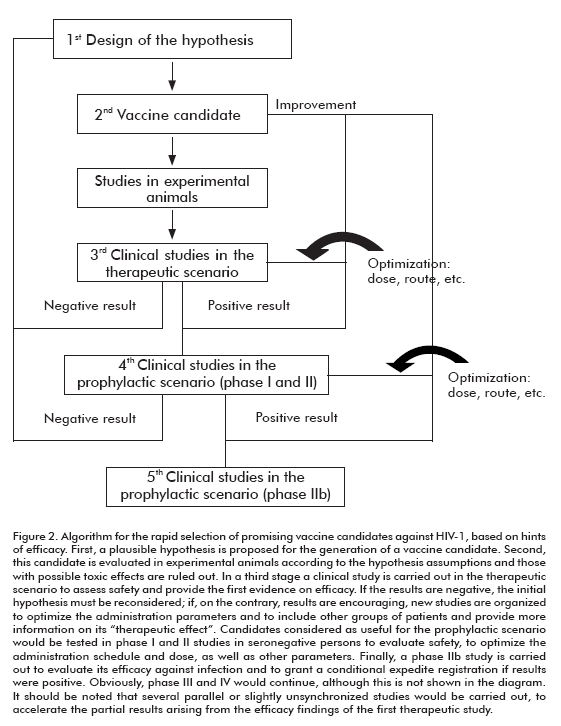
<body><![CDATA[<p><b><span lang=EN-US style='font-family:"Verdana","sans-serif"'>ACKNOWLEDGEMENT </span></b></p>      <p><span lang=EN-US style='font-size:10.0pt;font-family:"Verdana","sans-serif"'>The author is very grateful to Dr. Arístides Aguilar for his useful suggestions. </span></p>      <p><b><span lang=EN-US style='font-family:"Verdana","sans-serif"'>&nbsp;</span></b></p>      <p><b><span style='font-family:"Verdana","sans-serif"'>REFERENCES </span></b></p>      <!-- ref --><p><span style='font-size:10.0pt;font-family:"Verdana","sans-serif"'>1. ONUSIDA/OMS. Informe sobre la epidemia mundial de sida. Génova: Programa Conjunto de las Naciones Unidas sobre el VIH/Sida </span><span style='font-size:10.0pt;font-family:"Verdana","sans-serif";color:windowtext'>(</span><span style='font-size:10.0pt;font-family:"Verdana","sans-serif"'>ONUSIDA) y Organización Mundial de la Salud </span><span style='font-size:10.0pt; font-family:"Verdana","sans-serif";color:windowtext'>(</span><span style='font-size:10.0pt;font-family:"Verdana","sans-serif"'>OMS), diciembre 2008.</span><span style='font-family:"Arial","sans-serif";color:navy'> </span><!-- ref --><p class=MsoNormal><span lang=EN-US style='font-size:10.0pt;font-family:"Verdana","sans-serif"'>2. Palella FJ Jr, Delaney KM, Moorman AC, Loveless MO, Fuhrer J, Satten GA, et al. Declining morbidity and mortality among patients with advanced human immunodeficiency virus infection. HIV Outpatient Study Investigators. N Engl J Med</span><span lang=EN-US style='font-size:11.0pt;font-family:"Arial","sans-serif";color:red'> </span><span lang=EN-US style='font-size:10.0pt;font-family:"Verdana","sans-serif"'>1998;338:853-60.</span><p class=MsoNormal><span lang=EN-US style='font-size:11.0pt;font-family:"Arial","sans-serif"; color:blue'>&nbsp;</span></p>      <!-- ref --><p class=MsoNormal><span lang=EN-US style='font-size:10.0pt;font-family:"Verdana","sans-serif"'>3. Finzi D, Blankson J, Siliciano JD, Margolick JB, Chadwick K, Pierson T, et al. Latent infection of CD4+ T cells provides a mechanism for lifelong persistence of HIV-1, even in patients on effective combination therapy</span><span lang=EN-US style='font-size:11.0pt;font-family:"Arial","sans-serif";color:red'>. </span><span lang=EN-US style='font-size:10.0pt;font-family:"Verdana","sans-serif"'>Nat Med</span><span lang=EN-US style='font-size:11.0pt;font-family:"Arial","sans-serif"; color:red'> </span><span lang=EN-US style='font-size:10.0pt;font-family:"Verdana","sans-serif"'>1999;5:512-7.</span><p class=MsoNormal><span lang=EN-US style='font-size:11.0pt;font-family:"Arial","sans-serif"; color:blue'>&nbsp;</span></p>      <!-- ref --><p class=MsoNormal><span lang=EN-US style='font-size:10.0pt;font-family:"Verdana","sans-serif"'>4. Chun TW, Stuyver L, Mizell SB, Ehler LA, Mican JA, Baseler M, et al. Presence of an inducible HIV-1 latent reservoir during highly active antiretroviral therapy</span><span lang=EN-US style='font-size:11.0pt;font-family:"Arial","sans-serif"; color:red'>. </span><span lang=EN-US style='font-size:10.0pt;font-family:"Verdana","sans-serif"'>Proc Natl Acad Sci USA</span><span lang=EN-US style='font-size:11.0pt;font-family: "Arial","sans-serif";color:red'> </span><span lang=EN-US style='font-size:10.0pt; font-family:"Verdana","sans-serif"'>1997;94:13193-7.</span><p class=MsoNormal><span lang=EN-US style='font-size:11.0pt;font-family:"Arial","sans-serif"; color:blue'>&nbsp;</span></p>      <p class=MsoNormal><span lang=EN-US style='font-size:10.0pt;font-family:"Verdana","sans-serif"'>5. Carr A, Samaras K, Burton S, Law M, Freund J, Chisholm DJ, et al. A syndrome of peripheral lipodystrophy, hyperlipidaemia and insulin resistance in patients receiving HIV protease inhibitors</span><span lang=EN-US style='font-size:11.0pt; font-family:"Arial","sans-serif";color:red'>. </span><span lang=EN-US style='font-size:10.0pt;font-family:"Verdana","sans-serif"'>AIDS </span><span lang=EN-US style='font-size:10.0pt;font-family:"Verdana","sans-serif"; color:windowtext'>(</span><span lang=EN-US style='font-size:10.0pt;font-family: "Verdana","sans-serif"'>London, England)</span><span lang=EN-US style='font-family:"Arial","sans-serif";color:red'> </span><span lang=EN-US style='font-size:10.0pt;font-family:"Verdana","sans-serif"'>1998;12:F51-8.</span></p>      <p class=MsoNormal><span lang=EN-US style='font-size:11.0pt;font-family:"Arial","sans-serif"; color:blue'>&nbsp;</span></p>      <p class=MsoNormal><span lang=EN-US style='font-size:10.0pt;font-family:"Verdana","sans-serif"'>6. Friis-Moller N, Sabin CA, Weber R, D’Arminio Monforte A, El-Sadr WM, Reiss P, et al. Combination antiretroviral therapy and the risk of myocardial infarction</span><span lang=EN-US style='font-size:11.0pt;font-family:"Arial","sans-serif";color:red'>. </span><span lang=EN-US style='font-size:10.0pt;font-family:"Verdana","sans-serif"'>N Engl J Med</span><span lang=EN-US style='font-size:11.0pt;font-family:"Arial","sans-serif"; color:red'> </span><span lang=EN-US style='font-size:10.0pt;font-family:"Verdana","sans-serif"'>2003;349:1993-2003.</span></p>      <p class=MsoNormal><span lang=EN-US style='font-size:11.0pt;font-family:"Arial","sans-serif"; color:blue'>&nbsp;</span></p>      <!-- ref --><p class=MsoNormal><span lang=EN-US style='font-size:10.0pt;font-family:"Verdana","sans-serif"'>7. Rothenberg R, Woelfel M, Stoneburner R, Milberg J, Parker R, Truman B. Survival with the acquired immunodeficiency syndrome. Experience with 5833 cases in New York City</span><span lang=EN-US style='font-size:11.0pt;font-family:"Arial","sans-serif"; color:red'>. </span><span lang=EN-US style='font-size:10.0pt;font-family:"Verdana","sans-serif"'>N Engl J Med</span><span lang=EN-US style='font-size:11.0pt;font-family:"Arial","sans-serif"; color:red'> </span><span lang=EN-US style='font-size:10.0pt;font-family:"Verdana","sans-serif"'>1987;317:1297-302.</span><p class=MsoNormal><span lang=EN-US style='font-size:11.0pt;font-family:"Arial","sans-serif"; color:blue'>&nbsp;</span></p>      <!-- ref --><p class=MsoNormal><span lang=EN-US style='font-size:10.0pt;font-family:"Verdana","sans-serif"'>8. Ezzell C. AIDS drug gets green light</span><span lang=EN-US style='font-size: 11.0pt;font-family:"Arial","sans-serif";color:red'>. </span><span lang=EN-US style='font-size:10.0pt;font-family:"Verdana","sans-serif"'>Nature</span><span lang=EN-US style='font-size:11.0pt;font-family:"Arial","sans-serif";color:red'> </span><span lang=EN-US style='font-size:10.0pt;font-family:"Verdana","sans-serif"'>1987;329:751.</span><!-- ref --><p><span lang=EN-US style='font-size:10.0pt;font-family:"Verdana","sans-serif"'>9. Concorde: MRC/ANRS randomised double-blind controlled trial of immediate and deferred zidovudine in symptom-free HIV infection. Concorde Coordinating Committee. Lancet</span><span lang=EN-US style='font-size:11.0pt;font-family: "Arial","sans-serif";color:red'> </span><span lang=EN-US style='font-size:10.0pt; font-family:"Verdana","sans-serif"'>1994;</span><span lang=EN-US style='font-size:11.0pt;font-family:"Arial","sans-serif";color:red'> </span><span lang=EN-US style='font-size:10.0pt;font-family:"Verdana","sans-serif"'>43:871-81.<span style='background:yellow'> </span></span><p><span lang=EN-US style='font-size:10.0pt;font-family:"Verdana","sans-serif"'>10. Delta: a randomised double-blind controlled trial comparing combinations of zidovudine &nbsp;plus didanosine or zalcitabine with zidovudine alone in HIV-infected individuals. Delta Coordinating Committee. Lancet</span><span lang=EN-US style='font-size:11.0pt;font-family:"Arial","sans-serif";color:red'> </span><span lang=EN-US style='font-size:10.0pt;font-family:"Verdana","sans-serif"'>1996;283-91.</span></p>      ]]></body>
<body><![CDATA[<!-- ref --><p class=MsoNormal><span lang=EN-US style='font-size:10.0pt;font-family:"Verdana","sans-serif"'>11. Hammer SM, Katzenstein DA, Hughes MD, Gundacker H, Schooley RT, Haubrich RH, et al. A trial comparing nucleoside monotherapy with combination therapy in HIV-infected adults with CD4 cell counts from 200 to 500 per cubic millimeter. AIDS Clinical Trials Group Study 175 Study Team</span><span lang=EN-US style='font-size:11.0pt;font-family:"Arial","sans-serif";color:red'>. </span><span lang=EN-US style='font-size:10.0pt;font-family:"Verdana","sans-serif"'>N Engl J Med</span><span lang=EN-US style='font-size:11.0pt;font-family:"Arial","sans-serif"; color:red'> </span><span lang=EN-US style='font-size:10.0pt;font-family:"Verdana","sans-serif"'>1996;335:1081-90.</span><p class=MsoNormal><span lang=EN-US style='font-size:11.0pt;font-family:"Arial","sans-serif"; color:blue'>&nbsp;</span></p>      <!-- ref --><p class=MsoNormal><span lang=EN-US style='font-size:10.0pt;font-family:"Verdana","sans-serif"'>12. Dorsey BD, Levin RB, McDaniel SL, Vacca JP, Guare JP, Darke PL, et al. L-735,524: the design of a potent and orally bioavailable HIV protease inhibitor</span><span lang=EN-US style='font-size:11.0pt;font-family:"Arial","sans-serif"; color:red'>. </span><span lang=EN-US style='font-size:10.0pt;font-family:"Verdana","sans-serif"'>J Med Chem</span><span lang=EN-US style='font-size:11.0pt;font-family:"Arial","sans-serif"; color:red'> </span><span lang=EN-US style='font-size:10.0pt;font-family:"Verdana","sans-serif"'>1994;37:3443-51.</span><p class=MsoNormal><span lang=EN-US style='font-size:11.0pt;font-family:"Arial","sans-serif"; color:blue'>&nbsp;</span></p>      <!-- ref --><p class=MsoNormal><span lang=EN-US style='font-size:10.0pt;font-family:"Verdana","sans-serif"'>13. Vacca JP, Dorsey BD, Schleif WA, Levin RB, McDaniel SL, Darke PL, et al. L-735,524: an orally bioavailable human immunodeficiency virus type 1 protease inhibitor</span><span lang=EN-US style='font-size:11.0pt;font-family:"Arial","sans-serif"; color:red'>. </span><span lang=EN-US style='font-size:10.0pt;font-family:"Verdana","sans-serif"'>Proc Natl Acad Sci USA</span><span lang=EN-US style='font-size:11.0pt;font-family: "Arial","sans-serif";color:red'> </span><span lang=EN-US style='font-size:10.0pt; font-family:"Verdana","sans-serif"'>1994;91:4096-100.</span><p class=MsoNormal><span lang=EN-US style='font-size:11.0pt;font-family:"Arial","sans-serif"; color:blue'>&nbsp;</span></p>      <!-- ref --><p class=MsoNormal><span lang=EN-US style='font-size:10.0pt;font-family:"Verdana","sans-serif"'>14. Richman DD. HIV chemotherapy</span><span lang=EN-US style='font-size:11.0pt; font-family:"Arial","sans-serif";color:red'>. </span><span lang=EN-US style='font-size:10.0pt;font-family:"Verdana","sans-serif"'>Nature</span><span lang=EN-US style='font-size:11.0pt;font-family:"Arial","sans-serif";color:red'> </span><span lang=EN-US style='font-size:10.0pt;font-family:"Verdana","sans-serif"'>2001;410:995-1001.</span><p class=MsoNormal><span lang=EN-US style='font-size:11.0pt;font-family:"Arial","sans-serif"; color:blue'>&nbsp;</span></p>      <!-- ref --><p class=MsoNormal><span lang=EN-US style='font-size:10.0pt;font-family:"Verdana","sans-serif"'>15. Venaud S, Yahi N, Fehrentz JL, Guettari N, Nisato D, Hirsch I, et al. Inhibition of HIV by an anti-HIV protease synthetic peptide blocks an early step of viral replication</span><span lang=EN-US style='font-size:11.0pt;font-family:"Arial","sans-serif"; color:red'>. </span><span lang=EN-US style='font-size:10.0pt;font-family:"Verdana","sans-serif"'>Res Virol</span><span lang=EN-US style='font-size:11.0pt;font-family:"Arial","sans-serif"; color:red'> </span><span lang=EN-US style='font-size:10.0pt;font-family:"Verdana","sans-serif"'>1992;143:311-9.</span><p class=MsoNormal><span lang=EN-US style='font-size:11.0pt;font-family:"Arial","sans-serif"; color:blue'>&nbsp;</span></p>      ]]></body>
<body><![CDATA[<!-- ref --><p class=MsoNormal><span lang=EN-US style='font-size:10.0pt;font-family:"Verdana","sans-serif"'>16. Hammer SM, Squires KE, Hughes MD, Grimes JM, Demeter LM, Currier JS, et al. A controlled trial of two nucleoside analogues plus indinavir in persons with human immunodeficiency virus infection and CD4 cell counts of 200 per cubic millimeter or less. AIDS Clinical Trials Group 320 Study Team</span><span lang=EN-US style='font-size:11.0pt;font-family:"Arial","sans-serif";color:red'>. </span><span lang=EN-US style='font-size:10.0pt;font-family:"Verdana","sans-serif"'>N Engl J Med</span><span lang=EN-US style='font-size:11.0pt;font-family:"Arial","sans-serif"; color:red'> </span><span lang=EN-US style='font-size:10.0pt;font-family:"Verdana","sans-serif"'>1997;337:725-33.</span><p class=MsoNormal><span lang=EN-US style='font-size:11.0pt;font-family:"Arial","sans-serif"; color:blue'>&nbsp;</span></p>      <!-- ref --><p class=MsoNormal><span lang=EN-US style='font-size:10.0pt;font-family:"Verdana","sans-serif"'>17. Hirsch M, Steigbigel R, Staszewski S, Mellors J, Scerpella E, Hirschel B, et al. A randomized, controlled trial of indinavir, zidovudine, and lamivudine in adults with advanced human immunodeficiency virus type 1 infection and prior antiretroviral therapy</span><span lang=EN-US style='font-size:11.0pt; font-family:"Arial","sans-serif";color:red'>. </span><span lang=EN-US style='font-size:10.0pt;font-family:"Verdana","sans-serif"'>J Infect Dis</span><span lang=EN-US style='font-size:11.0pt;font-family:"Arial","sans-serif";color:red'> </span><span lang=EN-US style='font-size:10.0pt;font-family:"Verdana","sans-serif"'>1999;180:659-65.</span><p class=MsoNormal><span lang=EN-US style='font-size:11.0pt;font-family:"Arial","sans-serif"; color:blue'>&nbsp;</span></p>      <!-- ref --><p class=MsoNormal><span lang=EN-US style='font-size:10.0pt;font-family:"Verdana","sans-serif"'>18. Mocroft A, Katlama C, Johnson AM, Pradier C, Antunes F, Mulcahy F, et al. AIDS across Europe, 1994-98: the EuroSIDA study</span><span lang=EN-US style='font-size:11.0pt;font-family:"Arial","sans-serif";color:red'>. </span><span lang=EN-US style='font-size:10.0pt;font-family:"Verdana","sans-serif"'>Lancet</span><span lang=EN-US style='font-size:11.0pt;font-family:"Arial","sans-serif";color:red'> </span><span lang=EN-US style='font-size:10.0pt;font-family:"Verdana","sans-serif"'>2000;356:291-6.</span><p class=MsoNormal><span lang=EN-US style='font-size:11.0pt;font-family:"Arial","sans-serif"; color:blue'>&nbsp;</span></p>      <p class=MsoNormal><span lang=EN-US style='font-size:10.0pt;font-family:"Verdana","sans-serif"'>19. Hill A, Wood E. Balancing effectiveness and access to HIV treatment in the developing world</span><span lang=EN-US style='font-size:11.0pt;font-family: "Arial","sans-serif";color:red'>. </span><span lang=EN-US style='font-size: 10.0pt;font-family:"Verdana","sans-serif"'>AIDS </span><span lang=EN-US style='font-size:10.0pt;font-family:"Verdana","sans-serif";color:windowtext'>(</span><span lang=EN-US style='font-size:10.0pt;font-family:"Verdana","sans-serif"'>London, England)</span><span lang=EN-US style='font-family:"Arial","sans-serif"; color:red'> </span><span lang=EN-US style='font-size:10.0pt;font-family:"Verdana","sans-serif"'>2007;21:361-3.</span></p>      <p class=MsoNormal><span lang=EN-US style='font-size:11.0pt;font-family:"Arial","sans-serif"; color:blue'>&nbsp;</span></p>      <p class=MsoNormal><span lang=EN-US style='font-size:10.0pt;font-family:"Verdana","sans-serif"'>20. Pomerantz RJ. Residual HIV-1 infection during antiretroviral therapy: the challenge of viral persistence</span><span lang=EN-US style='font-size:11.0pt; font-family:"Arial","sans-serif";color:red'>. </span><span lang=EN-US style='font-size:10.0pt;font-family:"Verdana","sans-serif"'>AIDS </span><span lang=EN-US style='font-size:10.0pt;font-family:"Verdana","sans-serif"; color:windowtext'>(</span><span lang=EN-US style='font-size:10.0pt;font-family: "Verdana","sans-serif"'>London, England)</span><span lang=EN-US style='font-family:"Arial","sans-serif";color:red'> </span><span lang=EN-US style='font-size:10.0pt;font-family:"Verdana","sans-serif"'>2001;15:1201-11.</span></p>      <p class=MsoNormal><span lang=EN-US style='font-size:11.0pt;font-family:"Arial","sans-serif"; color:blue'>&nbsp;</span></p>      ]]></body>
<body><![CDATA[<!-- ref --><p class=MsoNormal><span lang=EN-US style='font-size:10.0pt;font-family:"Verdana","sans-serif"'>21. Finzi D, Hermankova M, Pierson T, Carruth LM, Buck C, Chaisson RE, et al. Identification of a reservoir for HIV-1 in patients on highly active antiretroviral therapy</span><span lang=EN-US style='font-size:11.0pt; font-family:"Arial","sans-serif";color:red'>. </span><span lang=EN-US style='font-size:10.0pt;font-family:"Verdana","sans-serif"'>Science</span><span lang=EN-US style='font-size:11.0pt;font-family:"Arial","sans-serif";color:red'> </span><span lang=EN-US style='font-size:10.0pt;font-family:"Verdana","sans-serif"'>1997;278:1295-300.</span><p class=MsoNormal><span lang=EN-US style='font-size:11.0pt;font-family:"Arial","sans-serif"; color:blue'>&nbsp;</span></p>      <!-- ref --><p class=MsoNormal><span lang=EN-US style='font-size:10.0pt;font-family:"Verdana","sans-serif"'>22. Wong JK, Hezareh M, Gunthard HF, Havlir DV, Ignacio CC, Spina CA, et al. Recovery of replication-competent HIV despite prolonged suppression of plasma viremia</span><span lang=EN-US style='font-size:11.0pt;font-family:"Arial","sans-serif"; color:red'>. </span><span lang=EN-US style='font-size:10.0pt;font-family:"Verdana","sans-serif"'>Science</span><span lang=EN-US style='font-size:11.0pt;font-family:"Arial","sans-serif";color:red'> </span><span lang=EN-US style='font-size:10.0pt;font-family:"Verdana","sans-serif"'>1997;278:1291-5.</span><p class=MsoNormal><span lang=EN-US style='font-size:11.0pt;font-family:"Arial","sans-serif"; color:blue'>&nbsp;</span></p>      <p class=MsoNormal><span lang=EN-US style='font-size:10.0pt;font-family:"Verdana","sans-serif"'>23. Zhang H, Dornadula G, Beumont M, Livornese L Jr, Van Uitert B, Henning K, et al. Human immunodeficiency virus type 1 in the semen of men receiving highly active antiretroviral therapy</span><span lang=EN-US style='font-size:11.0pt; font-family:"Arial","sans-serif";color:red'>. </span><span lang=EN-US style='font-size:10.0pt;font-family:"Verdana","sans-serif"'>N Engl J Med</span><span lang=EN-US style='font-size:11.0pt;font-family:"Arial","sans-serif";color:red'> </span><span lang=EN-US style='font-size:10.0pt;font-family:"Verdana","sans-serif"'>1998;339:1803-9.</span></p>      <p class=MsoNormal><span lang=EN-US style='font-size:11.0pt;font-family:"Arial","sans-serif"; color:blue'>&nbsp;</span></p>      <!-- ref --><p class=MsoNormal><span lang=EN-US style='font-size:10.0pt;font-family:"Verdana","sans-serif"'>24. Pomerantz RJ. Reservoirs of human immunodeficiency virus type 1: the main obstacles to viral eradication</span><span lang=EN-US style='font-size:11.0pt; font-family:"Arial","sans-serif";color:red'>. </span><span lang=EN-US style='font-size:10.0pt;font-family:"Verdana","sans-serif"'>Clin Infect Dis</span><span lang=EN-US style='font-size:11.0pt;font-family:"Arial","sans-serif";color:red'> </span><span lang=EN-US style='font-size:10.0pt;font-family:"Verdana","sans-serif"'>2002;34:91-7.</span><p class=MsoNormal><span lang=EN-US style='font-size:11.0pt;font-family:"Arial","sans-serif"; color:blue'>&nbsp;</span></p>      <!-- ref --><p class=MsoNormal><span lang=EN-US style='font-size:10.0pt;font-family:"Verdana","sans-serif"'>25. Kulkosky J, Nunnari G, Otero M, Calarota S, Dornadula G, Zhang H, et al. Intensification and stimulation therapy for human immunodeficiency virus type 1 reservoirs in infected persons receiving virally suppressive highly active antiretroviral therapy</span><span lang=EN-US style='font-size:11.0pt; font-family:"Arial","sans-serif";color:red'>. </span><span lang=EN-US style='font-size:10.0pt;font-family:"Verdana","sans-serif"'>J Infect Dis</span><span lang=EN-US style='font-size:11.0pt;font-family:"Arial","sans-serif";color:red'> </span><span lang=EN-US style='font-size:10.0pt;font-family:"Verdana","sans-serif"'>2002;186:1403-11.</span><p class=MsoNormal><span lang=EN-US style='font-size:11.0pt;font-family:"Arial","sans-serif"; color:blue'>&nbsp;</span></p>      ]]></body>
<body><![CDATA[<!-- ref --><p class=MsoNormal><span lang=EN-US style='font-size:10.0pt;font-family:"Verdana","sans-serif"'>26. Siliciano JD, Kajdas J, Finzi D, Quinn TC, Chadwick K, Margolick JB, et al. Long-term follow-up studies confirm the stability of the latent reservoir for HIV-1 in resting CD4+ T cells</span><span lang=EN-US style='font-size:11.0pt; font-family:"Arial","sans-serif";color:red'>. </span><span lang=EN-US style='font-size:10.0pt;font-family:"Verdana","sans-serif"'>Nat Med</span><span lang=EN-US style='font-size:11.0pt;font-family:"Arial","sans-serif";color:red'> </span><span lang=EN-US style='font-size:10.0pt;font-family:"Verdana","sans-serif"'>2003;9:727-8.</span><p class=MsoNormal><span lang=EN-US style='font-size:11.0pt;font-family:"Arial","sans-serif"; color:blue'>&nbsp;</span></p>      <p class=MsoNormal><span lang=EN-US style='font-size:10.0pt;font-family:"Verdana","sans-serif"'>27. Carr A, Miller J, Law M, Cooper DA. A syndrome of lipoatrophy, lactic acidaemia and liver dysfunction associated with HIV nucleoside analogue therapy: contribution to protease inhibitor-related lipodystrophy syndrome</span><span lang=EN-US style='font-size:11.0pt;font-family:"Arial","sans-serif";color:red'>. </span><span lang=EN-US style='font-size:10.0pt;font-family:"Verdana","sans-serif"'>AIDS </span><span lang=EN-US style='font-size:10.0pt;font-family:"Verdana","sans-serif"; color:windowtext'>(</span><span lang=EN-US style='font-size:10.0pt;font-family: "Verdana","sans-serif"'>London, England)</span><span lang=EN-US style='font-family:"Arial","sans-serif";color:red'> </span><span lang=EN-US style='font-size:10.0pt;font-family:"Verdana","sans-serif"'>2000;14:F25-32.</span></p>      <p class=MsoNormal><span lang=EN-US style='font-size:11.0pt;font-family:"Arial","sans-serif"; color:blue'>&nbsp;</span></p>      <p class=MsoNormal><span lang=EN-US style='font-size:10.0pt;font-family:"Verdana","sans-serif"'>28. Safrin S, Grunfeld C. Fat distribution and metabolic changes in patients with HIV infection</span><span lang=EN-US style='font-size:11.0pt;font-family:"Arial","sans-serif"; color:red'>. </span><span lang=EN-US style='font-size:10.0pt;font-family:"Verdana","sans-serif"'>AIDS </span><span lang=EN-US style='font-size:10.0pt;font-family:"Verdana","sans-serif"; color:windowtext'>(</span><span lang=EN-US style='font-size:10.0pt;font-family: "Verdana","sans-serif"'>London, England)</span><span lang=EN-US style='font-family:"Arial","sans-serif";color:red'> </span><span lang=EN-US style='font-size:10.0pt;font-family:"Verdana","sans-serif"'>1999;13:2493-505.</span></p>      <p class=MsoNormal><span lang=EN-US style='font-size:11.0pt;font-family:"Arial","sans-serif"; color:blue'>&nbsp;</span></p>      <!-- ref --><p class=MsoNormal><span lang=EN-US style='font-size:10.0pt;font-family:"Verdana","sans-serif"'>29. Carr A, Samaras K, Thorisdottir A, Kaufmann GR, Chisholm DJ, Cooper DA. Diagnosis, prediction, and natural course of HIV-1 protease-inhibitor-associated lipodystrophy, hyperlipidaemia, and diabetes mellitus: a cohort study</span><span lang=EN-US style='font-size:11.0pt;font-family:"Arial","sans-serif";color:red'>. </span><span lang=EN-US style='font-size:10.0pt;font-family:"Verdana","sans-serif"'>Lancet</span><span lang=EN-US style='font-size:11.0pt;font-family:"Arial","sans-serif";color:red'> </span><span lang=EN-US style='font-size:10.0pt;font-family:"Verdana","sans-serif"'>1999;353:2093-9.</span><p class=MsoNormal><span lang=EN-US style='font-size:11.0pt;font-family:"Arial","sans-serif"; color:blue'>&nbsp;</span></p>      <!-- ref --><p class=MsoNormal><span lang=EN-US style='font-size:10.0pt;font-family:"Verdana","sans-serif"'>30. Wu H, Kuritzkes DR, McClernon DR, Kessler H, Connick E, Landay A, et al. Characterization of viral dynamics in human immunodeficiency virus type 1-infected patients treated with combination antiretroviral therapy: relationships to host factors, cellular restoration, and virologic end points</span><span lang=EN-US style='font-size:11.0pt;font-family:"Arial","sans-serif";color:red'>. </span><span lang=EN-US style='font-size:10.0pt;font-family:"Verdana","sans-serif"'>J Infect Dis</span><span lang=EN-US style='font-size:11.0pt;font-family:"Arial","sans-serif"; color:red'> </span><span lang=EN-US style='font-size:10.0pt;font-family:"Verdana","sans-serif"'>1999;179:799- 807.</span><p class=MsoNormal><span lang=EN-US style='font-size:11.0pt;font-family:"Arial","sans-serif"; color:blue'>&nbsp;</span></p>      ]]></body>
<body><![CDATA[<!-- ref --><p class=MsoNormal><span lang=EN-US style='font-size:10.0pt;font-family:"Verdana","sans-serif"'>31. Rizzardi GP, De Boer RJ, Hoover S, Tambussi G, Chapuis A, Halkic N, et al. Predicting the duration of antiviral treatment needed to suppress plasma HIV-1 RNA</span><span lang=EN-US style='font-size:11.0pt;font-family:"Arial","sans-serif"; color:red'>. </span><span lang=EN-US style='font-size:10.0pt;font-family:"Verdana","sans-serif"'>J Clin Invest</span><span lang=EN-US style='font-size:11.0pt;font-family:"Arial","sans-serif"; color:red'> </span><span lang=EN-US style='font-size:10.0pt;font-family:"Verdana","sans-serif"'>2000;105:777-82.</span><p class=MsoNormal><span lang=EN-US style='font-size:11.0pt;font-family:"Arial","sans-serif"; color:blue'>&nbsp;</span></p>      <p class=MsoNormal><span lang=EN-US style='font-size:10.0pt;font-family:"Verdana","sans-serif"'>32. Metzner KJ, Allers K, Rauch P, Harrer T. Rapid selection of drug-resistant HIV-1 during the first months of suppressive ART in treatment-naive patients</span><span lang=EN-US style='font-size:11.0pt;font-family:"Arial","sans-serif";color:red'>. </span><span lang=EN-US style='font-size:10.0pt;font-family:"Verdana","sans-serif"'>AIDS </span><span lang=EN-US style='font-size:10.0pt;font-family:"Verdana","sans-serif"; color:windowtext'>(</span><span lang=EN-US style='font-size:10.0pt;font-family: "Verdana","sans-serif"'>London, England)</span><span lang=EN-US style='font-family:"Arial","sans-serif";color:red'> </span><span lang=EN-US style='font-size:10.0pt;font-family:"Verdana","sans-serif"'>2007;21:703-11.</span></p>      <p class=MsoNormal><span lang=EN-US style='font-size:11.0pt;font-family:"Arial","sans-serif"; color:blue'>&nbsp;</span></p>      <p class=MsoNormal><span lang=EN-US style='font-size:10.0pt;font-family:"Verdana","sans-serif"'>33. Deeks SG. Determinants of virological response to antiretroviral therapy: implications for long-term strategies</span><span lang=EN-US style='font-size: 11.0pt;font-family:"Arial","sans-serif";color:red'>. </span><span lang=EN-US style='font-size:10.0pt;font-family:"Verdana","sans-serif"'>Clin Infect Dis</span><span lang=EN-US style='font-size:11.0pt;font-family:"Arial","sans-serif";color:red'> </span><span lang=EN-US style='font-size:10.0pt;font-family:"Verdana","sans-serif"'>2000;30</span><span lang=EN-US style='font-family:"Arial","sans-serif";color:red'> </span><span lang=EN-US style='font-size:10.0pt;font-family:"Verdana","sans-serif"; color:windowtext'>Suppl</span><span lang=EN-US style='font-family:"Arial","sans-serif"; color:red'> </span><span lang=EN-US style='font-size:10.0pt;font-family:"Verdana","sans-serif"; color:windowtext'>2</span><span lang=EN-US style='font-size:10.0pt;font-family: "Verdana","sans-serif"'>:S177-84.</span></p>      <p class=MsoNormal><span lang=EN-US style='font-size:11.0pt;font-family:"Arial","sans-serif"; color:blue'>&nbsp;</span></p>      <!-- ref --><p class=MsoNormal><span lang=EN-US style='font-size:10.0pt;font-family:"Verdana","sans-serif"'>34. Sungkanuparph S, Overton ET, Seyfried W, Groger RK, Fraser VJ, Powderly WG. Intermittent episodes of detectable HIV viremia in patients receiving nonnucleoside reverse-transcriptase inhibitor-based or protease inhibitor-based highly active antiretroviral therapy regimens are equivalent in incidence and prognosis</span><span lang=EN-US style='font-size:11.0pt;font-family:"Arial","sans-serif"; color:red'>. </span><span lang=EN-US style='font-size:10.0pt;font-family:"Verdana","sans-serif"'>Clin Infect Dis</span><span lang=EN-US style='font-size:11.0pt;font-family:"Arial","sans-serif"; color:red'> </span><span lang=EN-US style='font-size:10.0pt;font-family:"Verdana","sans-serif"'>2005;41:1326-32.</span><p class=MsoNormal><span lang=EN-US style='font-size:11.0pt;font-family:"Arial","sans-serif"; color:blue'>&nbsp;</span></p>      <p class=MsoNormal><span lang=EN-US style='font-size:10.0pt;font-family:"Verdana","sans-serif"'>35. Martínez V, Marcelin AG, Morini JP, Deleuze J, Krivine A, Gorin I, et al. HIV-1 intermittent viraemia in patients treated by non-nucleoside reverse transcriptase inhibitor-based regimen</span><span lang=EN-US style='font-size: 11.0pt;font-family:"Arial","sans-serif";color:red'>. </span><span lang=EN-US style='font-size:10.0pt;font-family:"Verdana","sans-serif"'>AIDS </span><span lang=EN-US style='font-size:10.0pt;font-family:"Verdana","sans-serif"; color:windowtext'>(</span><span lang=EN-US style='font-size:10.0pt;font-family: "Verdana","sans-serif"'>London, England)</span><span lang=EN-US style='font-family:"Arial","sans-serif";color:red'> </span><span lang=EN-US style='font-size:10.0pt;font-family:"Verdana","sans-serif"'>2005;19:1065-9.</span></p>      <p class=MsoNormal><span lang=EN-US style='font-size:11.0pt;font-family:"Arial","sans-serif"; color:blue'>&nbsp;</span></p>      ]]></body>
<body><![CDATA[<p class=MsoNormal><span lang=EN-US style='font-size:10.0pt;font-family:"Verdana","sans-serif"'>36. Grabar S, Kousignian I, Sobel A, Le Bras P, Gasnault J, Enel P, et al. Immunologic and clinical responses to highly active antiretroviral therapy over 50 years of age. Results from the French Hospital Database on HIV</span><span lang=EN-US style='font-size:11.0pt;font-family:"Arial","sans-serif";color:red'>. </span><span lang=EN-US style='font-size:10.0pt;font-family:"Verdana","sans-serif"'>AIDS </span><span lang=EN-US style='font-size:10.0pt;font-family:"Verdana","sans-serif"; color:windowtext'>(</span><span lang=EN-US style='font-size:10.0pt;font-family: "Verdana","sans-serif"'>London, England)</span><span lang=EN-US style='font-family:"Arial","sans-serif";color:red'> </span><span lang=EN-US style='font-size:10.0pt;font-family:"Verdana","sans-serif"'>2004;18:2029-38.</span></p>      <p class=MsoNormal><span lang=EN-US style='font-size:11.0pt;font-family:"Arial","sans-serif"; color:blue'>&nbsp;</span></p>      <p class=MsoNormal><span lang=EN-US style='font-size:10.0pt;font-family:"Verdana","sans-serif"'>37. Lederman MM, McKinnis R, Kelleher D, Cutrell A, Mellors J, Neisler M, et al. Cellular restoration in HIV infected persons treated with abacavir and a protease inhibitor: age inversely predicts naive CD4 cell count increase</span><span lang=EN-US style='font-size:11.0pt;font-family:"Arial","sans-serif";color:red'>. </span><span lang=EN-US style='font-size:10.0pt;font-family:"Verdana","sans-serif"'>AIDS </span><span lang=EN-US style='font-size:10.0pt;font-family:"Verdana","sans-serif"; color:windowtext'>(</span><span lang=EN-US style='font-size:10.0pt;font-family: "Verdana","sans-serif"'>London, England)</span><span lang=EN-US style='font-family:"Arial","sans-serif";color:red'> </span><span lang=EN-US style='font-size:10.0pt;font-family:"Verdana","sans-serif"'>2000;14:2635-42.</span></p>      <p class=MsoNormal><span lang=EN-US style='font-size:11.0pt;font-family:"Arial","sans-serif"; color:blue'>&nbsp;</span></p>      <p class=MsoNormal><span lang=EN-US style='font-size:10.0pt;font-family:"Verdana","sans-serif"'>38. Le Moing V, Thiebaut R, Chene G, Leport C, Cailleton V, Michelet C, et al. Predictors of long-term increase in CD4</span><span lang=EN-US style='font-size:10.0pt;font-family:"Verdana","sans-serif";color:windowtext'>(</span><span lang=EN-US style='font-size:10.0pt;font-family:"Verdana","sans-serif"'>+) cell counts in human immunodeficiency virus-infected patients receiving a protease inhibitor-containing antiretroviral regimen</span><span lang=EN-US style='font-size:11.0pt;font-family:"Arial","sans-serif";color:red'>. </span><span lang=EN-US style='font-size:10.0pt;font-family:"Verdana","sans-serif"'>J Infect Dis</span><span lang=EN-US style='font-size:11.0pt;font-family:"Arial","sans-serif"; color:red'> </span><span lang=EN-US style='font-size:10.0pt;font-family:"Verdana","sans-serif"'>2002;185:471-80.</span></p>      <p class=MsoNormal><span lang=EN-US style='font-size:11.0pt;font-family:"Arial","sans-serif"; color:blue'>&nbsp;</span></p>      <p class=MsoNormal><span lang=EN-US style='font-size:10.0pt;font-family:"Verdana","sans-serif"'>39. Thiebaut R, Morlat P, Jacqmin-Gadda H, Neau D, Mercie P, Dabis F, et al. Clinical progression of HIV-1 infection according to the viral response during the first year of antiretroviral treatment. Groupe d’Epidemiologie du SIDA en Aquitaine </span><span lang=EN-US style='font-size:10.0pt;font-family:"Verdana","sans-serif"; color:windowtext'>(</span><span lang=EN-US style='font-size:10.0pt;font-family: "Verdana","sans-serif"'>GECSA)</span><span lang=EN-US style='font-size:11.0pt; font-family:"Arial","sans-serif";color:red'>. </span><span lang=EN-US style='font-size:10.0pt;font-family:"Verdana","sans-serif"'>AIDS </span><span lang=EN-US style='font-size:10.0pt;font-family:"Verdana","sans-serif"; color:windowtext'>(</span><span lang=EN-US style='font-size:10.0pt;font-family: "Verdana","sans-serif"'>London, England)</span><span lang=EN-US style='font-family:"Arial","sans-serif";color:red'> </span><span lang=EN-US style='font-size:10.0pt;font-family:"Verdana","sans-serif"'>2000;14:971-8.</span></p>      <p class=MsoNormal><span lang=EN-US style='font-size:11.0pt;font-family:"Arial","sans-serif"; color:blue'>&nbsp;</span></p>      <!-- ref --><p class=MsoNormal><span lang=EN-US style='font-size:10.0pt;font-family:"Verdana","sans-serif"'>40. Salzberger B, Rockstroh J, Wieland U, Franzen C, Schwenk A, Jutte A, et al. Clinical efficacy of protease inhibitor based antiretroviral combination therapy-a prospective cohort study</span><span lang=EN-US style='font-size: 11.0pt;font-family:"Arial","sans-serif";color:red'>. </span><span lang=EN-US style='font-size:10.0pt;font-family:"Verdana","sans-serif"'>Eur J Med Res</span><span lang=EN-US style='font-size:11.0pt;font-family:"Arial","sans-serif";color:red'> </span><span lang=EN-US style='font-size:10.0pt;font-family:"Verdana","sans-serif"'>1999;4:449-55.</span><p class=MsoNormal><span lang=EN-US style='font-size:11.0pt;font-family:"Arial","sans-serif"; color:blue'>&nbsp;</span></p>      ]]></body>
<body><![CDATA[<!-- ref --><p class=MsoNormal><span lang=EN-US style='font-size:10.0pt;font-family:"Verdana","sans-serif"'>41. Ledergerber B, Egger M, Erard V, Weber R, Hirschel B, Furrer H, et al. AIDS-related opportunistic illnesses occurring after initiation of potent antiretroviral therapy: the Swiss HIV Cohort Study</span><span lang=EN-US style='font-size:11.0pt;font-family:"Arial","sans-serif";color:red'>. </span><span style='font-size:10.0pt;font-family:"Verdana","sans-serif"'>JAMA</span><span style='font-size:11.0pt;font-family:"Arial","sans-serif";color:red'> </span><span style='font-size:10.0pt;font-family:"Verdana","sans-serif"'>1999;282:2220-6.</span><p class=MsoNormal><span style='font-size:11.0pt;font-family:"Arial","sans-serif"; color:blue'>&nbsp;</span></p>      <!-- ref --><p class=MsoNormal><span style='font-size:10.0pt;font-family:"Verdana","sans-serif"'>42. Mezzaroma I, Carlesimo M, Pinter E, Muratori DS, Di Sora F, Chiarotti F, et al. </span><span lang=EN-US style='font-size:10.0pt;font-family:"Verdana","sans-serif"'>Clinical and immunologic response without decrease in virus load in patients with AIDS after 24 months of highly active antiretroviral therapy</span><span lang=EN-US style='font-size:11.0pt;font-family:"Arial","sans-serif";color:red'>. </span><span lang=EN-US style='font-size:10.0pt;font-family:"Verdana","sans-serif"'>Clin Infect Dis</span><span lang=EN-US style='font-size:11.0pt;font-family:"Arial","sans-serif"; color:red'> </span><span lang=EN-US style='font-size:10.0pt;font-family:"Verdana","sans-serif"'>1999;29:1423-30.</span><p class=MsoNormal><span lang=EN-US style='font-size:11.0pt;font-family:"Arial","sans-serif"; color:blue'>&nbsp;</span></p>      <!-- ref --><p class=MsoNormal><span lang=EN-US style='font-size:10.0pt;font-family:"Verdana","sans-serif"'>43. Kaufmann D, Pantaleo G, Sudre P, Telenti A. CD4-cell count in HIV-1-infected individuals remaining viraemic with highly active antiretroviral therapy </span><span lang=EN-US style='font-size:10.0pt;font-family:"Verdana","sans-serif"; color:windowtext'>(</span><span lang=EN-US style='font-size:10.0pt;font-family: "Verdana","sans-serif"'>HAART). Swiss HIV Cohort Study</span><span lang=EN-US style='font-size:11.0pt;font-family:"Arial","sans-serif";color:red'>. </span><span lang=EN-US style='font-size:10.0pt;font-family:"Verdana","sans-serif"'>Lancet</span><span lang=EN-US style='font-size:11.0pt;font-family:"Arial","sans-serif";color:red'> </span><span lang=EN-US style='font-size:10.0pt;font-family:"Verdana","sans-serif"'>1998;351:723-4.</span><p class=MsoNormal><span lang=EN-US style='font-size:11.0pt;font-family:"Arial","sans-serif"; color:blue'>&nbsp;</span></p>      <!-- ref --><p class=MsoNormal><span lang=EN-US style='font-size:10.0pt;font-family:"Verdana","sans-serif"'>44. Ledergerber B, Lundgren JD, Walker AS, Sabin C, Justice A, Reiss P, et al. Predictors of trend in CD4-positive T-cell count and mortality among HIV-1-infected individuals with virological failure to all three antiretroviral-drug classes</span><span lang=EN-US style='font-size:11.0pt; font-family:"Arial","sans-serif";color:red'>. </span><span lang=EN-US style='font-size:10.0pt;font-family:"Verdana","sans-serif"'>Lancet</span><span lang=EN-US style='font-size:11.0pt;font-family:"Arial","sans-serif";color:red'> </span><span lang=EN-US style='font-size:10.0pt;font-family:"Verdana","sans-serif"'>2004;364:51-62.</span><p class=MsoNormal><span lang=EN-US style='font-size:11.0pt;font-family:"Arial","sans-serif"; color:blue'>&nbsp;</span></p>      <p class=MsoNormal><span lang=EN-US style='font-size:10.0pt;font-family:"Verdana","sans-serif"'>45. Phillips A. Short-term risk of AIDS according to current CD4 cell count and viral load in antiretroviral drug-naive individuals and those treated in the monotherapy era</span><span lang=EN-US style='font-size:11.0pt;font-family: "Arial","sans-serif";color:red'>. </span><span lang=EN-US style='font-size: 10.0pt;font-family:"Verdana","sans-serif"'>AIDS </span><span lang=EN-US style='font-size:10.0pt;font-family:"Verdana","sans-serif";color:windowtext'>(</span><span lang=EN-US style='font-size:10.0pt;font-family:"Verdana","sans-serif"'>London, England)</span><span lang=EN-US style='font-family:"Arial","sans-serif"; color:red'> </span><span lang=EN-US style='font-size:10.0pt;font-family:"Verdana","sans-serif"'>2004;18:51-8.</span></p>      <p class=MsoNormal><span lang=EN-US style='font-size:11.0pt;font-family:"Arial","sans-serif"; color:blue'>&nbsp;</span></p>      ]]></body>
<body><![CDATA[<!-- ref --><p class=MsoNormal><span lang=EN-US style='font-size:10.0pt;font-family:"Verdana","sans-serif"'>46. Mellors JW, Munoz A, Giorgi JV, Margolick JB, Tassoni CJ, Gupta P, et al. Plasma viral load and CD4+ lymphocytes as prognostic markers of HIV-1 infection</span><span lang=EN-US style='font-size:11.0pt;font-family:"Arial","sans-serif";color:red'>. </span><span lang=EN-US style='font-size:10.0pt;font-family:"Verdana","sans-serif"'>Ann Intern Med</span><span lang=EN-US style='font-size:11.0pt;font-family:"Arial","sans-serif"; color:red'> </span><span lang=EN-US style='font-size:10.0pt;font-family:"Verdana","sans-serif"'>1997;126:946-54.</span><p class=MsoNormal><span lang=EN-US style='font-size:11.0pt;font-family:"Arial","sans-serif"; color:blue'>&nbsp;</span></p>      <!-- ref --><p class=MsoNormal><span lang=EN-US style='font-size:10.0pt;font-family:"Verdana","sans-serif"'>47. Lyles RH, Munoz A, Yamashita TE, Bazmi H, Detels R, Rinaldo CR, et al. Natural history of human immunodeficiency virus type 1 viremia after seroconversion and proximal to AIDS in a large cohort of homosexual men. Multicenter AIDS Cohort Study</span><span lang=EN-US style='font-size:11.0pt;font-family:"Arial","sans-serif"; color:red'>. </span><span lang=EN-US style='font-size:10.0pt;font-family:"Verdana","sans-serif"'>J Infect Dis</span><span lang=EN-US style='font-size:11.0pt;font-family:"Arial","sans-serif"; color:red'> </span><span lang=EN-US style='font-size:10.0pt;font-family:"Verdana","sans-serif"'>2000;181:872-80.</span><p class=MsoNormal><span lang=EN-US style='font-size:11.0pt;font-family:"Arial","sans-serif"; color:blue'>&nbsp;</span></p>      <!-- ref --><p class=MsoNormal><span lang=EN-US style='font-size:10.0pt;font-family:"Verdana","sans-serif"'>48. Lederman MM, Connick E, Landay A, Kuritzkes DR, Spritzler J, St Clair M, et al. Immunologic responses associated with 12 weeks of combination antiretroviral therapy consisting of zidovudine, lamivudine, and ritonavir: results of AIDS Clinical Trials Group Protocol 315</span><span lang=EN-US style='font-size: 11.0pt;font-family:"Arial","sans-serif";color:red'>. </span><span lang=EN-US style='font-size:10.0pt;font-family:"Verdana","sans-serif"'>J Infect Dis</span><span lang=EN-US style='font-size:11.0pt;font-family:"Arial","sans-serif";color:red'> </span><span lang=EN-US style='font-size:10.0pt;font-family:"Verdana","sans-serif"'>1998;178:70-9.</span><p class=MsoNormal><span lang=EN-US style='font-size:11.0pt;font-family:"Arial","sans-serif"; color:blue'>&nbsp;</span></p>      <!-- ref --><p class=MsoNormal><span lang=EN-US style='font-size:10.0pt;font-family:"Verdana","sans-serif"'>49. Autran B, Carcelain G, Li TS, Blanc C, Mathez D, Tubiana R, et al. Positive effects of combined antiretroviral therapy on CD4+ T cell homeostasis and function in advanced HIV disease</span><span lang=EN-US style='font-size:11.0pt; font-family:"Arial","sans-serif";color:red'>. </span><span lang=EN-US style='font-size:10.0pt;font-family:"Verdana","sans-serif"'>Science</span><span lang=EN-US style='font-size:11.0pt;font-family:"Arial","sans-serif";color:red'> </span><span lang=EN-US style='font-size:10.0pt;font-family:"Verdana","sans-serif"'>1997;277:112-6.</span><p class=MsoNormal><span lang=EN-US style='font-size:11.0pt;font-family:"Arial","sans-serif"; color:blue'>&nbsp;</span></p>      <!-- ref --><p class=MsoNormal><span lang=EN-US style='font-size:10.0pt;font-family:"Verdana","sans-serif"'>50. Gray CM, Lawrence J, Schapiro JM, Altman JD, Winters MA, Crompton M, et al. Frequency of class I HLA-restricted anti-HIV CD8+ T cells in individuals receiving highly active antiretroviral therapy </span><span lang=EN-US style='font-size:10.0pt;font-family:"Verdana","sans-serif";color:windowtext'>(</span><span lang=EN-US style='font-size:10.0pt;font-family:"Verdana","sans-serif"'>HAART)</span><span lang=EN-US style='font-size:11.0pt;font-family:"Arial","sans-serif";color:red'>. </span><span lang=EN-US style='font-size:10.0pt;font-family:"Verdana","sans-serif"'>J Immunol</span><span lang=EN-US style='font-size:11.0pt;font-family:"Arial","sans-serif"; color:red'> </span><span lang=EN-US style='font-size:10.0pt;font-family:"Verdana","sans-serif"'>1999;162:1780-8.</span><p class=MsoNormal><span lang=EN-US style='font-size:11.0pt;font-family:"Arial","sans-serif"; color:blue'>&nbsp;</span></p>      ]]></body>
<body><![CDATA[<!-- ref --><p class=MsoNormal><span lang=EN-US style='font-size:10.0pt;font-family:"Verdana","sans-serif"'>51. Ogg GS, Jin X, Bonhoeffer S, Moss P, Nowak MA, Monard S, et al. Decay kinetics of human immunodeficiency virus-specific effector cytotoxic T lymphocytes after combination antiretroviral therapy</span><span lang=EN-US style='font-size: 11.0pt;font-family:"Arial","sans-serif";color:red'>. </span><span lang=EN-US style='font-size:10.0pt;font-family:"Verdana","sans-serif"'>J Virol</span><span lang=EN-US style='font-size:11.0pt;font-family:"Arial","sans-serif";color:red'> </span><span lang=EN-US style='font-size:10.0pt;font-family:"Verdana","sans-serif"'>1999;73:797-800.</span><p class=MsoNormal><span lang=EN-US style='font-size:11.0pt;font-family:"Arial","sans-serif"; color:blue'>&nbsp;</span></p>      <!-- ref --><p class=MsoNormal><span lang=EN-US style='font-size:10.0pt;font-family:"Verdana","sans-serif"'>52. Pitcher CJ, Quittner C, Peterson DM, Connors M, Koup RA, Maino VC, et al. HIV-1-specific CD4+ T cells are detectable in most individuals with active HIV-1 infection, but decline with prolonged viral suppression</span><span lang=EN-US style='font-size:11.0pt;font-family:"Arial","sans-serif";color:red'>. </span><span lang=EN-US style='font-size:10.0pt;font-family:"Verdana","sans-serif"'>Nat Med</span><span lang=EN-US style='font-size:11.0pt;font-family:"Arial","sans-serif"; color:red'> </span><span lang=EN-US style='font-size:10.0pt;font-family:"Verdana","sans-serif"'>1999;5:518-25.</span><p class=MsoNormal><span lang=EN-US style='font-size:11.0pt;font-family:"Arial","sans-serif"; color:blue'>&nbsp;</span></p>      <!-- ref --><p class=MsoNormal><span lang=EN-US style='font-size:10.0pt;font-family:"Verdana","sans-serif"'>53. Jin X, Ogg G, Bonhoeffer S, Safrit J, Vesanen M, Bauer D, et al. An antigenic threshold for maintaining human immunodeficiency virus type 1-specific cytotoxic T lymphocytes</span><span lang=EN-US style='font-size:11.0pt; font-family:"Arial","sans-serif";color:red'>. </span><span lang=EN-US style='font-size:10.0pt;font-family:"Verdana","sans-serif"'>Mol Med</span><span lang=EN-US style='font-size:11.0pt;font-family:"Arial","sans-serif";color:red'> </span><span lang=EN-US style='font-size:10.0pt;font-family:"Verdana","sans-serif"'>2000;6:803-9.</span><p class=MsoNormal><span lang=EN-US style='font-size:11.0pt;font-family:"Arial","sans-serif"; color:blue'>&nbsp;</span></p>      <p class=MsoNormal><span lang=EN-US style='font-size:10.0pt;font-family:"Verdana","sans-serif"'>54. Garcia F, Plana M, Ortiz GM, Bonhoeffer S, Soriano A, Vidal C, et al. The virological and immunological consequences of structured treatment interruptions in chronic HIV-1 infection</span><span lang=EN-US style='font-size:11.0pt;font-family:"Arial","sans-serif";color:red'>. </span><span lang=EN-US style='font-size:10.0pt;font-family:"Verdana","sans-serif"'>AIDS </span><span lang=EN-US style='font-size:10.0pt;font-family:"Verdana","sans-serif"; color:windowtext'>(</span><span lang=EN-US style='font-size:10.0pt;font-family: "Verdana","sans-serif"'>London, England)</span><span lang=EN-US style='font-family:"Arial","sans-serif";color:red'> </span><span lang=EN-US style='font-size:10.0pt;font-family:"Verdana","sans-serif"'>2001;15:F29-40.</span></p>      <p class=MsoNormal><span lang=EN-US style='font-size:11.0pt;font-family:"Arial","sans-serif"; color:blue'>&nbsp;</span></p>      <!-- ref --><p class=MsoNormal><span lang=EN-US style='font-size:10.0pt;font-family:"Verdana","sans-serif"'>55. Ortiz GM, Nixon DF, Trkola A, Binley J, Jin X, Bonhoeffer S, et al. HIV-1-specific immune responses in subjects who temporarily contain virus replication after discontinuation of highly active antiretroviral therapy</span><span lang=EN-US style='font-size:11.0pt;font-family:"Arial","sans-serif";color:red'>. </span><span lang=EN-US style='font-size:10.0pt;font-family:"Verdana","sans-serif"'>J Clin Invest</span><span lang=EN-US style='font-size:11.0pt;font-family:"Arial","sans-serif"; color:red'> </span><span lang=EN-US style='font-size:10.0pt;font-family:"Verdana","sans-serif"'>1999;104:R13-8.</span><p class=MsoNormal><span lang=EN-US style='font-size:11.0pt;font-family:"Arial","sans-serif"; color:blue'>&nbsp;</span></p>      ]]></body>
<body><![CDATA[<!-- ref --><p class=MsoNormal><span lang=EN-US style='font-size:10.0pt;font-family:"Verdana","sans-serif"'>56. Haslett PA, Nixon DF, Shen Z, Larsson M, Cox WI, Manandhar R, et al. Strong human immunodeficiency virus </span><span lang=EN-US style='font-size:10.0pt; font-family:"Verdana","sans-serif";color:windowtext'>(</span><span lang=EN-US style='font-size:10.0pt;font-family:"Verdana","sans-serif"'>HIV)-specific CD4+ T cell responses in a cohort of chronically infected patients are associated with interruptions in anti-HIV chemotherapy</span><span lang=EN-US style='font-size:11.0pt;font-family:"Arial","sans-serif";color:red'>. </span><span style='font-size:10.0pt;font-family:"Verdana","sans-serif"'>J Infect Dis</span><span style='font-size:11.0pt;font-family:"Arial","sans-serif";color:red'> </span><span style='font-size:10.0pt;font-family:"Verdana","sans-serif"'>2000;181:1264-72.</span><p class=MsoNormal><span style='font-size:11.0pt;font-family:"Arial","sans-serif"; color:blue'>&nbsp;</span></p>      <!-- ref --><p class=MsoNormal><span style='font-size:10.0pt;font-family:"Verdana","sans-serif"'>57. Ruiz L, Ribera E, Bonjoch A, Romeu J, Martínez-Picado J, Paredes R, et al. </span><span lang=EN-US style='font-size:10.0pt;font-family:"Verdana","sans-serif"'>Role of structured treatment interruption before a 5-drug salvage antiretroviral regimen: the Retrogene Study</span><span lang=EN-US style='font-size:11.0pt; font-family:"Arial","sans-serif";color:red'>. </span><span lang=EN-US style='font-size:10.0pt;font-family:"Verdana","sans-serif"'>J Infect Dis</span><span lang=EN-US style='font-size:11.0pt;font-family:"Arial","sans-serif";color:red'> </span><span lang=EN-US style='font-size:10.0pt;font-family:"Verdana","sans-serif"'>2003;188:977-85.</span><p class=MsoNormal><span lang=EN-US style='font-size:11.0pt;font-family:"Arial","sans-serif"; color:blue'>&nbsp;</span></p>      <!-- ref --><p class=MsoNormal><span lang=EN-US style='font-size:10.0pt;font-family:"Verdana","sans-serif"'>58. Lori F, Lewis MG, Xu J, Varga G, Zinn DE Jr, Crabbs C, et al. Control of SIV rebound through structured treatment interruptions during early infection</span><span lang=EN-US style='font-size:11.0pt;font-family:"Arial","sans-serif";color:red'>. </span><span lang=EN-US style='font-size:10.0pt;font-family:"Verdana","sans-serif"'>Science</span><span lang=EN-US style='font-size:11.0pt;font-family:"Arial","sans-serif";color:red'> </span><span lang=EN-US style='font-size:10.0pt;font-family:"Verdana","sans-serif"'>2000;290:1591-3.</span><p><span lang=EN-US style='font-size:10.0pt;font-family:"Verdana","sans-serif"'>59. Fixed duration interruptions are inferior to continuous treatment in African adults starting therapy with CD4 cell counts &lt; 200 cells/microl. AIDS</span><span lang=EN-US style='font-size:11.0pt;font-family:"Arial","sans-serif";color:red'> </span><span lang=EN-US style='font-size:10.0pt;font-family:"Verdana","sans-serif"'>&nbsp;</span><span lang=EN-US style='font-size:10.0pt;font-family:"Verdana","sans-serif"; color:windowtext'>(</span><span lang=EN-US style='font-size:10.0pt;font-family: "Verdana","sans-serif"'>London, England)2008;22:237-47. </span></p>      <p class=MsoNormal><span lang=EN-US style='font-size:10.0pt;font-family:"Verdana","sans-serif"'>60. Fagard C, Bandelier CY, Ananworanich J, Le Braz M, Gunthard H, Perneger T, et al. Biphasic decline of CD4 cell count during scheduled treatment interruptions</span><span lang=EN-US style='font-size:11.0pt;font-family:"Arial","sans-serif";color:red'>. </span><span lang=EN-US style='font-size:10.0pt;font-family:"Verdana","sans-serif"'>AIDS </span><span lang=EN-US style='font-size:10.0pt;font-family:"Verdana","sans-serif"; color:windowtext'>(</span><span lang=EN-US style='font-size:10.0pt;font-family: "Verdana","sans-serif"'>London, England)</span><span lang=EN-US style='font-family:"Arial","sans-serif";color:red'> </span><span lang=EN-US style='font-size:10.0pt;font-family:"Verdana","sans-serif"'>2005;19:439-41.</span></p>      <p class=MsoNormal><span lang=EN-US style='font-size:11.0pt;font-family:"Arial","sans-serif"; color:blue'>&nbsp;</span></p>      <!-- ref --><p class=MsoNormal><span lang=EN-US style='font-size:10.0pt;font-family:"Verdana","sans-serif"'>61. Oxenius A, Price DA, Gunthard HF, Dawson SJ, Fagard C, Perrin L, et al. Stimulation of HIV-specific cellular immunity by structured treatment interruption fails to enhance viral control in chronic HIV infection</span><span lang=EN-US style='font-size:11.0pt;font-family:"Arial","sans-serif";color:red'>. </span><span lang=EN-US style='font-size:10.0pt;font-family:"Verdana","sans-serif"'>Proc Natl Acad Sci USA</span><span lang=EN-US style='font-size:11.0pt;font-family: "Arial","sans-serif";color:red'> </span><span lang=EN-US style='font-size:10.0pt; font-family:"Verdana","sans-serif"'>2002;99:13747-52.</span><p class=MsoNormal><span lang=EN-US style='font-size:11.0pt;font-family:"Arial","sans-serif"; color:blue'>&nbsp;</span></p>      ]]></body>
<body><![CDATA[<p class=MsoNormal><span lang=EN-US style='font-size:10.0pt;font-family:"Verdana","sans-serif"'>62. Ruiz L, Carcelain G, Martinez-Picado J, Frost S, Marfil S, Paredes R, et al. HIV dynamics and T-cell immunity after three structured treatment interruptions in chronic HIV-1 infection</span><span lang=EN-US style='font-size:11.0pt; font-family:"Arial","sans-serif";color:red'>. </span><span lang=EN-US style='font-size:10.0pt;font-family:"Verdana","sans-serif"'>AIDS </span><span lang=EN-US style='font-size:10.0pt;font-family:"Verdana","sans-serif"; color:windowtext'>(</span><span lang=EN-US style='font-size:10.0pt;font-family: "Verdana","sans-serif"'>London, England)</span><span lang=EN-US style='font-family:"Arial","sans-serif";color:red'> </span><span lang=EN-US style='font-size:10.0pt;font-family:"Verdana","sans-serif"'>2001;15:F19-27.</span></p>      <p class=MsoNormal><span lang=EN-US style='font-size:11.0pt;font-family:"Arial","sans-serif"; color:blue'>&nbsp;</span></p>      <!-- ref --><p class=MsoNormal><span lang=EN-US style='font-size:10.0pt;font-family:"Verdana","sans-serif"'>63. Carcelain G, Tubiana R, Samri A, Calvez V, Delaugerre C, Agut H, et al. Transient mobilization of human immunodeficiency virus </span><span lang=EN-US style='font-size:10.0pt;font-family:"Verdana","sans-serif";color:windowtext'>(</span><span lang=EN-US style='font-size:10.0pt;font-family:"Verdana","sans-serif"'>HIV)-specific CD4 T-helper cells fails to control virus rebounds during intermittent antiretroviral therapy in chronic HIV type 1 infection</span><span lang=EN-US style='font-size:11.0pt;font-family:"Arial","sans-serif";color:red'>. </span><span lang=EN-US style='font-size:10.0pt;font-family:"Verdana","sans-serif"'>J Virol</span><span lang=EN-US style='font-size:11.0pt;font-family:"Arial","sans-serif";color:red'> </span><span lang=EN-US style='font-size:10.0pt;font-family:"Verdana","sans-serif"'>2001;75:234-41.</span><p class=MsoNormal><span lang=EN-US style='font-size:11.0pt;font-family:"Arial","sans-serif"; color:blue'>&nbsp;</span></p>      <!-- ref --><p class=MsoNormal><span lang=EN-US style='font-size:10.0pt;font-family:"Verdana","sans-serif"'>64. Davey RT Jr, Bhat N, Yoder C, Chun TW, Metcalf JA, Dewar R, et al. HIV-1 and T cell dynamics after interruption of highly active antiretroviral therapy </span><span lang=EN-US style='font-size:10.0pt;font-family:"Verdana","sans-serif"; color:windowtext'>(</span><span lang=EN-US style='font-size:10.0pt;font-family: "Verdana","sans-serif"'>HAART) in patients with a history of sustained viral suppression</span><span lang=EN-US style='font-size:11.0pt;font-family:"Arial","sans-serif"; color:red'>. </span><span lang=EN-US style='font-size:10.0pt;font-family:"Verdana","sans-serif"'>Proc Natl Acad Sci USA</span><span lang=EN-US style='font-size:11.0pt;font-family: "Arial","sans-serif";color:red'> </span><span lang=EN-US style='font-size:10.0pt; font-family:"Verdana","sans-serif"'>1999;96:15109-14.</span><p class=MsoNormal><span lang=EN-US style='font-size:11.0pt;font-family:"Arial","sans-serif"; color:blue'>&nbsp;</span></p>      <!-- ref --><p class=MsoNormal><span lang=EN-US style='font-size:10.0pt;font-family:"Verdana","sans-serif"'>65. Mollet L, Li TS, Samri A, Tournay C, Tubiana R, Calvez V, et al. Dynamics of HIV specific CD8+ T lymphocytes with changes in viral load. The RESTIM and COMET Study Groups</span><span lang=EN-US style='font-size:11.0pt;font-family: "Arial","sans-serif";color:red'>. </span><span lang=EN-US style='font-size: 10.0pt;font-family:"Verdana","sans-serif"'>J Immunol</span><span lang=EN-US style='font-size:11.0pt;font-family:"Arial","sans-serif";color:red'> </span><span lang=EN-US style='font-size:10.0pt;font-family:"Verdana","sans-serif"'>2000;165:1692-704.</span><p class=MsoNormal><span lang=EN-US style='font-size:11.0pt;font-family:"Arial","sans-serif"; color:blue'>&nbsp;</span></p>      <!-- ref --><p class=MsoNormal><span lang=EN-US style='font-size:10.0pt;font-family:"Verdana","sans-serif"'>66. Hughes MD, Johnson VA, Hirsch MS, Bremer JW, Elbeik T, Erice A, et al. Monitoring plasma HIV-1 RNA levels in addition to CD4+ lymphocyte count improves assessment of antiretroviral therapeutic response. ACTG 241 Protocol Virology Substudy Team</span><span lang=EN-US style='font-size:11.0pt;font-family:"Arial","sans-serif"; color:red'>. </span><span lang=EN-US style='font-size:10.0pt;font-family:"Verdana","sans-serif"'>Ann Intern Med</span><span lang=EN-US style='font-size:11.0pt;font-family:"Arial","sans-serif"; color:red'> </span><span lang=EN-US style='font-size:10.0pt;font-family:"Verdana","sans-serif"'>1997;126:929-38.</span><p class=MsoNormal><span lang=EN-US style='font-size:11.0pt;font-family:"Arial","sans-serif"; color:blue'>&nbsp;</span></p>      ]]></body>
<body><![CDATA[<!-- ref --><p class=MsoNormal><span lang=EN-US style='font-size:10.0pt;font-family:"Verdana","sans-serif"'>67. Ghani AC, de Wolf F, Ferguson NM, Donnelly CA, Coutinho R, Miedema F, et al. Surrogate markers for disease progression in treated HIV infection</span><span lang=EN-US style='font-size:11.0pt;font-family:"Arial","sans-serif";color:red'>. </span><span lang=EN-US style='font-size:10.0pt;font-family:"Verdana","sans-serif"'>J Acquir Immune Defic Syndr</span><span lang=EN-US style='font-size:11.0pt; font-family:"Arial","sans-serif";color:red'> </span><span lang=EN-US style='font-size:10.0pt;font-family:"Verdana","sans-serif"'>2001;28:226-31.</span><p class=MsoNormal><span lang=EN-US style='font-size:11.0pt;font-family:"Arial","sans-serif"; color:blue'>&nbsp;</span></p>      <p class=MsoNormal><span lang=EN-US style='font-size:10.0pt;font-family:"Verdana","sans-serif"'>68. Maggiolo F, Ripamonti D, Gregis G, Quinzan G, Callegaro A, Suter F. Effect of prolonged discontinuation of successful antiretroviral therapy on CD4 T cells: a controlled, prospective trial</span><span lang=EN-US style='font-size:11.0pt; font-family:"Arial","sans-serif";color:red'>. </span><span lang=EN-US style='font-size:10.0pt;font-family:"Verdana","sans-serif"'>AIDS </span><span lang=EN-US style='font-size:10.0pt;font-family:"Verdana","sans-serif"; color:windowtext'>(</span><span lang=EN-US style='font-size:10.0pt;font-family: "Verdana","sans-serif"'>London, England)</span><span lang=EN-US style='font-family:"Arial","sans-serif";color:red'> </span><span lang=EN-US style='font-size:10.0pt;font-family:"Verdana","sans-serif"'>2004;18:439-46.</span></p>      <p class=MsoNormal><span lang=EN-US style='font-size:11.0pt;font-family:"Arial","sans-serif"; color:blue'>&nbsp;</span></p>      <p class=MsoNormal><span lang=EN-US style='font-size:10.0pt;font-family:"Verdana","sans-serif"'>69. Mussini C, Bedini A, Borghi V, Guaraldi G, Esposito R, Barchi E, et al. CD4 cell-monitored treatment interruption in patients with a CD4 cell count &gt; 500 x 10<sup>6</sup> cells/l</span><span lang=EN-US style='font-size:11.0pt; font-family:"Arial","sans-serif";color:red'>. </span><span lang=EN-US style='font-size:10.0pt;font-family:"Verdana","sans-serif"'>AIDS </span><span lang=EN-US style='font-size:10.0pt;font-family:"Verdana","sans-serif"; color:windowtext'>(</span><span lang=EN-US style='font-size:10.0pt;font-family: "Verdana","sans-serif"'>London, England)</span><span lang=EN-US style='font-family:"Arial","sans-serif";color:red'> </span><span lang=EN-US style='font-size:10.0pt;font-family:"Verdana","sans-serif"'>2005;19:287-94.</span></p>      <p class=MsoNormal><span lang=EN-US style='font-size:11.0pt;font-family:"Arial","sans-serif"; color:blue'>&nbsp;</span></p>      <p class=MsoNormal><span lang=EN-US style='font-size:10.0pt;font-family:"Verdana","sans-serif"'>70. Fernández Guerrero ML, Rivas P, Molina M, García R, De Gorgolas M. Long-term follow-up of asymptomatic HIV-infected patients who discontinued antiretroviral therapy</span><span lang=EN-US style='font-size:11.0pt;font-family:"Arial","sans-serif"; color:red'>. </span><span lang=EN-US style='font-size:10.0pt;font-family:"Verdana","sans-serif"'>Clin Infect Dis</span><span lang=EN-US style='font-size:11.0pt;font-family:"Arial","sans-serif"; color:red'> </span><span lang=EN-US style='font-size:10.0pt;font-family:"Verdana","sans-serif"'>2005;41:390-4.</span></p>      <p class=MsoNormal><span lang=EN-US style='font-size:11.0pt;font-family:"Arial","sans-serif"; color:blue'>&nbsp;</span></p>      <!-- ref --><p class=MsoNormal><span lang=EN-US style='font-size:10.0pt;font-family:"Verdana","sans-serif"'>71. Skiest DJ, Morrow P, Allen B, McKinsey J, Crosby C, Foster B, et al. It is safe to stop antiretroviral therapy in patients with pre-antiretroviral CD4 cell counts &gt;250 cells/microL</span><span lang=EN-US style='font-size:11.0pt; font-family:"Arial","sans-serif";color:red'>. </span><span style='font-size: 10.0pt;font-family:"Verdana","sans-serif"'>J Acquir Immune Defic Syndr</span><span style='font-size:11.0pt;font-family:"Arial","sans-serif";color:red'> </span><span style='font-size:10.0pt;font-family:"Verdana","sans-serif"'>2004;37:1351-7.</span><p class=MsoNormal><span style='font-size:11.0pt;font-family:"Arial","sans-serif"; color:blue'>&nbsp;</span></p>      ]]></body>
<body><![CDATA[<p class=MsoNormal><span style='font-size:10.0pt;font-family:"Verdana","sans-serif"'>72. Ruiz L, Paredes R, Gómez G, Romeu J, Domingo P, Pérez-Alvarez N, et al. </span><span lang=EN-US style='font-size:10.0pt;font-family:"Verdana","sans-serif"'>Antiretroviral therapy interruption guided by CD4 cell counts and &nbsp;plasma HIV-1 RNA levels in chronically HIV-1-infected patients</span><span lang=EN-US style='font-size:11.0pt;font-family:"Arial","sans-serif";color:red'>. </span><span lang=EN-US style='font-size:10.0pt;font-family:"Verdana","sans-serif"'>AIDS </span><span lang=EN-US style='font-size:10.0pt;font-family:"Verdana","sans-serif"; color:windowtext'>(</span><span lang=EN-US style='font-size:10.0pt;font-family: "Verdana","sans-serif"'>London, England)</span><span lang=EN-US style='font-family:"Arial","sans-serif";color:red'> </span><span lang=EN-US style='font-size:10.0pt;font-family:"Verdana","sans-serif"'>2007;21:169-78.</span></p>      <p class=MsoNormal><span lang=EN-US style='font-size:11.0pt;font-family:"Arial","sans-serif"; color:blue'>&nbsp;</span></p>      <!-- ref --><p class=MsoNormal><span lang=EN-US style='font-size:10.0pt;font-family:"Verdana","sans-serif"'>73. Ananworanich J, Gayet-Ageron A, Le Braz M, Prasithsirikul W, Chetchotisakd P, Kiertiburanakul S, et al. CD4-guided scheduled treatment interruptions compared with continuous therapy for patients infected with HIV-1: results of the Staccato randomised trial</span><span lang=EN-US style='font-size:11.0pt; font-family:"Arial","sans-serif";color:red'>. </span><span lang=EN-US style='font-size:10.0pt;font-family:"Verdana","sans-serif"'>Lancet</span><span lang=EN-US style='font-size:11.0pt;font-family:"Arial","sans-serif";color:red'> </span><span lang=EN-US style='font-size:10.0pt;font-family:"Verdana","sans-serif"'>2006;368:459-65.</span><!-- ref --><p><span lang=EN-US style='font-size:10.0pt;font-family:"Verdana","sans-serif"'>74. Skiest D</span><span lang=SV style='font-size:10.0pt;font-family:"Verdana","sans-serif"'>, </span><span lang=EN-US style='font-size:10.0pt;font-family:"Verdana","sans-serif"'>Havlir D</span><span lang=SV style='font-size:10.0pt;font-family:"Verdana","sans-serif"'>, </span><span lang=EN-US style='font-size:10.0pt;font-family:"Verdana","sans-serif"'>Coombs R</span><span lang=SV style='font-size:10.0pt;font-family:"Verdana","sans-serif"'>, </span><span lang=EN-US style='font-size:10.0pt;font-family:"Verdana","sans-serif"'>Adams E</span><span lang=SV style='font-size:10.0pt;font-family:"Verdana","sans-serif"'>, </span><span lang=EN-US style='font-size:10.0pt;font-family:"Verdana","sans-serif"'>Cain P</span><span lang=SV style='font-size:10.0pt;font-family:"Verdana","sans-serif"'>, </span><span lang=EN-US style='font-size:10.0pt;font-family:"Verdana","sans-serif"'>Petersen T, et al. Predictors of HIV Disease Progression in Patients Who Stop ART with CD4 Cell Counts &gt;350 cells/mm3</span><span lang=EN-US style='font-size:11.0pt; font-family:"Arial","sans-serif";color:red'> </span><span lang=EN-US style='font-size:10.0pt;font-family:"Verdana","sans-serif"'>&nbsp;</span><span lang=EN-US style='font-size:10.0pt;font-family:"Verdana","sans-serif"; color:windowtext'>(</span><span lang=EN-US style='font-size:10.0pt;font-family: "Verdana","sans-serif"'>Session 23 Oral Abstract # 101). 13th Conference on Retroviruses and Opportunistic Infections. Colorado Convention Center, Denver, Colorado,2006.</span><span lang=EN-US style='font-family:"Arial","sans-serif"; color:navy'> </span><p class=MsoNormal><span style='font-size:10.0pt;font-family:"Verdana","sans-serif"'>75. Maggiolo F, Airoldi M, Callegaro A, Martinelli C, Dolara A, Bini T, et al. </span><span lang=EN-US style='font-size:10.0pt;font-family:"Verdana","sans-serif"'>CD4 cell-guided scheduled treatment interruptions in HIV-infected patients with sustained immunologic response to HAART</span><span lang=EN-US style='font-size:11.0pt;font-family:"Arial","sans-serif";color:red'>. </span><span lang=EN-US style='font-size:10.0pt;font-family:"Verdana","sans-serif"'>AIDS </span><span lang=EN-US style='font-size:10.0pt;font-family:"Verdana","sans-serif"; color:windowtext'>(</span><span lang=EN-US style='font-size:10.0pt;font-family: "Verdana","sans-serif"'>London, England)</span><span lang=EN-US style='font-family:"Arial","sans-serif";color:red'> </span><span lang=EN-US style='font-size:10.0pt;font-family:"Verdana","sans-serif"'>2009;23:799-807.</span></p>      <p class=MsoNormal><span lang=EN-US style='font-size:11.0pt;font-family:"Arial","sans-serif"; color:blue'>&nbsp;</span></p>      <!-- ref --><p class=MsoNormal><span lang=EN-US style='font-size:10.0pt;font-family:"Verdana","sans-serif"'>76. Danel C, Moh R, Minga A, Anzian A, Ba-Gomis O, Kanga C, et al. CD4-guided structured antiretroviral treatment interruption strategy in HIV-infected adults in west Africa </span><span lang=EN-US style='font-size:10.0pt; font-family:"Verdana","sans-serif";color:windowtext'>(</span><span lang=EN-US style='font-size:10.0pt;font-family:"Verdana","sans-serif"'>Trivacan ANRS 1269 trial): a randomised trial</span><span lang=EN-US style='font-size:11.0pt; font-family:"Arial","sans-serif";color:red'>. </span><span lang=EN-US style='font-size:10.0pt;font-family:"Verdana","sans-serif"'>Lancet</span><span lang=EN-US style='font-size:11.0pt;font-family:"Arial","sans-serif";color:red'> </span><span lang=EN-US style='font-size:10.0pt;font-family:"Verdana","sans-serif"'>2006;367:1981-9.</span><p class=MsoNormal><span lang=EN-US style='font-size:11.0pt;font-family:"Arial","sans-serif"; color:blue'>&nbsp;</span></p>      <!-- ref --><p class=MsoNormal><span lang=EN-US style='font-size:10.0pt;font-family:"Verdana","sans-serif"'>77. El-Sadr WM, Lundgren JD, Neaton JD, Gordin F, Abrams D, Arduino RC, et al. CD4+ count-guided interruption of antiretroviral treatment</span><span lang=EN-US style='font-size:11.0pt;font-family:"Arial","sans-serif";color:red'>. </span><span lang=EN-US style='font-size:10.0pt;font-family:"Verdana","sans-serif"'>N Engl J Med</span><span lang=EN-US style='font-size:11.0pt;font-family:"Arial","sans-serif"; color:red'> </span><span lang=EN-US style='font-size:10.0pt;font-family:"Verdana","sans-serif"'>2006;355:2283-96.</span><p class=MsoNormal><span lang=EN-US style='font-size:11.0pt;font-family:"Arial","sans-serif"; color:blue'>&nbsp;</span></p>      ]]></body>
<body><![CDATA[<p class=MsoNormal><span lang=EN-US style='font-size:10.0pt;font-family:"Verdana","sans-serif"'>78. Ananworanich J, Hirschel B. Intermittent therapy for the treatment of chronic HIV infection</span><span lang=EN-US style='font-size:11.0pt;font-family:"Arial","sans-serif"; color:red'>. </span><span lang=EN-US style='font-size:10.0pt;font-family:"Verdana","sans-serif"'>AIDS </span><span lang=EN-US style='font-size:10.0pt;font-family:"Verdana","sans-serif"; color:windowtext'>(</span><span lang=EN-US style='font-size:10.0pt;font-family: "Verdana","sans-serif"'>London, England)</span><span lang=EN-US style='font-family:"Arial","sans-serif";color:red'> </span><span lang=EN-US style='font-size:10.0pt;font-family:"Verdana","sans-serif"'>2007;21:123-34.</span></p>      <p class=MsoNormal><span lang=EN-US style='font-size:11.0pt;font-family:"Arial","sans-serif"; color:blue'>&nbsp;</span></p>      <!-- ref --><p class=MsoNormal><span lang=EN-US style='font-size:10.0pt;font-family:"Verdana","sans-serif"'>79. Camacho R. What have we learned from recent CD4-guided treatment interruption studies</span><span lang=EN-US style='font-size:11.0pt;font-family:"Arial","sans-serif"; color:red'>. </span><span lang=EN-US style='font-size:10.0pt;font-family:"Verdana","sans-serif"'>AIDS Rev</span><span lang=EN-US style='font-size:11.0pt;font-family:"Arial","sans-serif"; color:red'> </span><span lang=EN-US style='font-size:10.0pt;font-family:"Verdana","sans-serif"'>2006;8:171-5.</span><p class=MsoNormal><span lang=EN-US style='font-size:11.0pt;font-family:"Arial","sans-serif"; color:blue'>&nbsp;</span></p>      <!-- ref --><p class=MsoNormal><span lang=EN-US style='font-size:10.0pt;font-family:"Verdana","sans-serif"'>80. Hirschel B, Flanigan T. Is it smart to continue to study treatment interruptions?</span><span lang=EN-US style='font-size:11.0pt;font-family:"Arial","sans-serif"; color:red'> </span><span lang=EN-US style='font-size:10.0pt;font-family:"Verdana","sans-serif"'>AIDS </span><span lang=EN-US style='font-size:10.0pt;font-family:"Verdana","sans-serif"; color:windowtext'>(</span><span lang=EN-US style='font-size:10.0pt;font-family: "Verdana","sans-serif"'>London, England)</span><span lang=EN-US style='font-family:"Arial","sans-serif";color:red'> </span><span lang=EN-US style='font-size:10.0pt;font-family:"Verdana","sans-serif"'>2009;23:757-9.</span><p class=MsoNormal><span lang=EN-US style='font-size:11.0pt;font-family:"Arial","sans-serif"; color:blue'>&nbsp;</span></p>      <p class=MsoNormal><span lang=EN-US style='font-size:10.0pt;font-family:"Verdana","sans-serif"'>81. García F, Plana M, Vidal C, Cruceta A, O’Brien WA, Pantaleo G, et al. Dynamics of viral load rebound and immunological changes after stopping effective antiretroviral therapy</span><span lang=EN-US style='font-size:11.0pt; font-family:"Arial","sans-serif";color:red'>. </span><span lang=EN-US style='font-size:10.0pt;font-family:"Verdana","sans-serif"'>AIDS </span><span lang=EN-US style='font-size:10.0pt;font-family:"Verdana","sans-serif"; color:windowtext'>(</span><span lang=EN-US style='font-size:10.0pt;font-family: "Verdana","sans-serif"'>London, England) 1999;13:F79-86.</span></p>      <p class=MsoNormal><span lang=EN-US style='font-size:11.0pt;font-family:"Arial","sans-serif"; color:blue'>&nbsp;</span></p>      <p class=MsoNormal><span lang=EN-US style='font-size:10.0pt;font-family:"Verdana","sans-serif"'>82. Harrigan PR, Whaley M, Montaner JS. Rate of HIV-1 RNA rebound upon stopping antiretroviral therapy</span><span lang=EN-US style='font-size:11.0pt; font-family:"Arial","sans-serif";color:red'>. </span><span lang=EN-US style='font-size:10.0pt;font-family:"Verdana","sans-serif"'>AIDS </span><span lang=EN-US style='font-size:10.0pt;font-family:"Verdana","sans-serif"; color:windowtext'>(</span><span lang=EN-US style='font-size:10.0pt;font-family: "Verdana","sans-serif"'>London, England)</span><span lang=EN-US style='font-family:"Arial","sans-serif";color:red'> </span><span lang=EN-US style='font-size:10.0pt;font-family:"Verdana","sans-serif"'>1999;13:F59-62.</span></p>      <p class=MsoNormal><span lang=EN-US style='font-size:11.0pt;font-family:"Arial","sans-serif"; color:blue'>&nbsp;</span></p>      ]]></body>
<body><![CDATA[<p class=MsoNormal><span lang=EN-US style='font-size:10.0pt;font-family:"Verdana","sans-serif"'>83. Hatano H, Vogel S, Yoder C, Metcalf JA, Dewar R, Davey RT Jr, et al. Pre-HAART HIV burden approximates post-HAART viral levels following interruption of therapy in patients with sustained viral suppression</span><span lang=EN-US style='font-size:11.0pt;font-family:"Arial","sans-serif";color:red'>. </span><span lang=EN-US style='font-size:10.0pt;font-family:"Verdana","sans-serif"'>AIDS </span><span lang=EN-US style='font-size:10.0pt;font-family:"Verdana","sans-serif"; color:windowtext'>(</span><span lang=EN-US style='font-size:10.0pt;font-family: "Verdana","sans-serif"'>London, England)</span><span lang=EN-US style='font-family:"Arial","sans-serif";color:red'> </span><span lang=EN-US style='font-size:10.0pt;font-family:"Verdana","sans-serif"'>2000;14:1357-63.</span></p>      <p class=MsoNormal><span lang=EN-US style='font-size:11.0pt;font-family:"Arial","sans-serif"; color:blue'>&nbsp;</span></p>      <!-- ref --><p class=MsoNormal><span lang=EN-US style='font-size:10.0pt;font-family:"Verdana","sans-serif"'>84. Colven R, Harrington RD, Spach DH, Cohen CJ, Hooton TM. Retroviral rebound syndrome after cessation of suppressive antiretroviral therapy in three patients with chronic HIV infection</span><span lang=EN-US style='font-size: 11.0pt;font-family:"Arial","sans-serif";color:red'>. </span><span lang=EN-US style='font-size:10.0pt;font-family:"Verdana","sans-serif"'>Ann Intern Med</span><span lang=EN-US style='font-size:11.0pt;font-family:"Arial","sans-serif";color:red'> </span><span lang=EN-US style='font-size:10.0pt;font-family:"Verdana","sans-serif"'>2000;133:430-4.</span><p class=MsoNormal><span lang=EN-US style='font-size:11.0pt;font-family:"Arial","sans-serif"; color:blue'>&nbsp;</span></p>      <!-- ref --><p class=MsoNormal><span lang=EN-US style='font-size:10.0pt;font-family:"Verdana","sans-serif"'>85. Kilby JM, Goepfert PA, Miller AP, Gnann JW Jr, Sillers M, Saag MS, et al. Recurrence of the acute HIV syndrome after interruption of antiretroviral therapy in a patient with chronic HIV infection: A case report</span><span lang=EN-US style='font-size:11.0pt;font-family:"Arial","sans-serif";color:red'>. </span><span lang=EN-US style='font-size:10.0pt;font-family:"Verdana","sans-serif"'>Ann Intern Med</span><span lang=EN-US style='font-size:11.0pt;font-family:"Arial","sans-serif"; color:red'> </span><span lang=EN-US style='font-size:10.0pt;font-family:"Verdana","sans-serif"'>2000;133:435-8.</span><p class=MsoNormal><span lang=EN-US style='font-size:11.0pt;font-family:"Arial","sans-serif"; color:blue'>&nbsp;</span></p>      <!-- ref --><p class=MsoNormal><span lang=EN-US style='font-size:10.0pt;font-family:"Verdana","sans-serif"'>86. Zeller V, Charlois C, Duvivier C, Bricaire F, Katlama C. Pseudo-primary infection syndrome following discontinuation of antiretroviral therapy</span><span lang=EN-US style='font-size:11.0pt;font-family:"Arial","sans-serif";color:red'>. </span><span lang=EN-US style='font-size:10.0pt;font-family:"Verdana","sans-serif"'>Antivir Ther</span><span lang=EN-US style='font-size:11.0pt;font-family:"Arial","sans-serif"; color:red'> </span><span lang=EN-US style='font-size:10.0pt;font-family:"Verdana","sans-serif"'>2001;6:191-3.</span><p class=MsoNormal><span lang=EN-US style='font-size:11.0pt;font-family:"Arial","sans-serif"; color:blue'>&nbsp;</span></p>      <!-- ref --><p class=MsoNormal><span lang=EN-US style='font-size:10.0pt;font-family:"Verdana","sans-serif"'>87. Ananworanich J, Phanuphak N, Nuesch R, Apateerapong W, Rojnuckarin P, Ubolyam S, et al. Recurring thrombocytopenia associated with structured treatment interruption in patients with human immunodeficiency virus infection</span><span lang=EN-US style='font-size:11.0pt;font-family:"Arial","sans-serif";color:red'>. </span><span lang=EN-US style='font-size:10.0pt;font-family:"Verdana","sans-serif"'>Clin Infect Dis</span><span lang=EN-US style='font-size:11.0pt;font-family:"Arial","sans-serif"; color:red'> </span><span lang=EN-US style='font-size:10.0pt;font-family:"Verdana","sans-serif"'>2003;37:723-5.</span><p class=MsoNormal><span lang=EN-US style='font-size:10.0pt;font-family:"Verdana","sans-serif"'>&nbsp;</span></p>      ]]></body>
<body><![CDATA[<p class=MsoNormal><span lang=EN-US style='font-size:10.0pt;font-family:"Verdana","sans-serif"'>&nbsp;</span></p>      <p class=MsoNormal><span lang=EN-US style='font-size:10.0pt;font-family:"Verdana","sans-serif"'>88. Neumann AU, Tubiana R, Calvez V, Robert C, Li TS, Agut H, et al. HIV-1 rebound during interruption of highly active antiretroviral therapy has no deleterious effect on reinitiated treatment. Comet Study Group</span><span lang=EN-US style='font-size:11.0pt;font-family:"Arial","sans-serif";color:red'>. </span><span lang=EN-US style='font-size:10.0pt;font-family:"Verdana","sans-serif"'>AIDS </span><span lang=EN-US style='font-size:10.0pt;font-family:"Verdana","sans-serif"; color:windowtext'>(</span><span lang=EN-US style='font-size:10.0pt;font-family: "Verdana","sans-serif"'>London, England)</span><span lang=EN-US style='font-family:"Arial","sans-serif";color:red'> </span><span lang=EN-US style='font-size:10.0pt;font-family:"Verdana","sans-serif"'>1999;13:677-83.</span></p>      <p class=MsoNormal><span lang=EN-US style='font-size:11.0pt;font-family:"Arial","sans-serif"; color:blue'>&nbsp;</span></p>      <p class=MsoNormal><span lang=EN-US style='font-size:10.0pt;font-family:"Verdana","sans-serif"'>89. Cozzi Lepri A, Phillips AN, d’Arminio Monforte A, Castelli F, Antinori A, deLuca A, et al. When to start highly active antiretroviral therapy in chronically HIV-infected patients: evidence from the ICONA study</span><span lang=EN-US style='font-size:11.0pt;font-family:"Arial","sans-serif";color:red'>. </span><span lang=EN-US style='font-size:10.0pt;font-family:"Verdana","sans-serif"'>AIDS </span><span lang=EN-US style='font-size:10.0pt;font-family:"Verdana","sans-serif"; color:windowtext'>(</span><span lang=EN-US style='font-size:10.0pt;font-family: "Verdana","sans-serif"'>London, England)</span><span lang=EN-US style='font-family:"Arial","sans-serif";color:red'> </span><span lang=EN-US style='font-size:10.0pt;font-family:"Verdana","sans-serif"'>2001;15:983-90.</span></p>      <p class=MsoNormal><span lang=EN-US style='font-size:11.0pt;font-family:"Arial","sans-serif"; color:blue'>&nbsp;</span></p>      <p class=MsoNormal><span lang=EN-US style='font-size:10.0pt;font-family:"Verdana","sans-serif"'>90. Le Moing V, Chene G, Carrieri MP, Alioum A, Brun-Vezinet F, Piroth L, et al. Predictors of virological rebound in HIV-1-infected patients initiating a protease inhibitor-containing regimen</span><span lang=EN-US style='font-size: 11.0pt;font-family:"Arial","sans-serif";color:red'>. </span><span lang=EN-US style='font-size:10.0pt;font-family:"Verdana","sans-serif"'>AIDS </span><span lang=EN-US style='font-size:10.0pt;font-family:"Verdana","sans-serif"; color:windowtext'>(</span><span lang=EN-US style='font-size:10.0pt;font-family: "Verdana","sans-serif"'>London, England)</span><span lang=EN-US style='font-family:"Arial","sans-serif";color:red'> </span><span lang=EN-US style='font-size:10.0pt;font-family:"Verdana","sans-serif"'>2002;16:21-9.</span></p>      <p class=MsoNormal><span lang=EN-US style='font-size:11.0pt;font-family:"Arial","sans-serif"; color:blue'>&nbsp;</span></p>      <!-- ref --><p class=MsoNormal><span lang=EN-US style='font-size:10.0pt;font-family:"Verdana","sans-serif"'>91. Holmberg SD, Hamburger ME, Moorman AC, Wood KC, Palella FJ Jr. Factors associated with maintenance of long-term plasma human immunodeficiency virus RNA suppression</span><span lang=EN-US style='font-size:11.0pt;font-family: "Arial","sans-serif";color:red'>. </span><span lang=EN-US style='font-size: 10.0pt;font-family:"Verdana","sans-serif"'>Clin Infect Dis</span><span lang=EN-US style='font-size:11.0pt;font-family:"Arial","sans-serif";color:red'> </span><span lang=EN-US style='font-size:10.0pt;font-family:"Verdana","sans-serif"'>2003;37:702-7.</span><p class=MsoNormal><span lang=EN-US style='font-size:11.0pt;font-family:"Arial","sans-serif"; color:blue'>&nbsp;</span></p>      <!-- ref --><p class=MsoNormal><span lang=EN-US style='font-size:10.0pt;font-family:"Verdana","sans-serif"'>92. Phillips AN, Staszewski S, Weber R, Kirk O, Francioli P, Miller V, et al. HIV viral load response to antiretroviral therapy according to the baseline CD4 cell count and viral load</span><span lang=EN-US style='font-size:11.0pt;font-family: "Arial","sans-serif";color:red'>. </span><span lang=EN-US style='font-size: 10.0pt;font-family:"Verdana","sans-serif"'>JAMA</span><span lang=EN-US style='font-size:11.0pt;font-family:"Arial","sans-serif";color:red'> </span><span lang=EN-US style='font-size:10.0pt;font-family:"Verdana","sans-serif"'>2001;286:2560-7.</span><p class=MsoNormal><span lang=EN-US style='font-size:11.0pt;font-family:"Arial","sans-serif"; color:blue'>&nbsp;</span></p>      <p class=MsoNormal><span lang=EN-US style='font-size:10.0pt;font-family:"Verdana","sans-serif"'>93. Taffe P, Rickenbach M, Hirschel B, Opravil M, Furrer H, Janin P, et al. Impact of occasional short interruptions of HAART on the progression of HIV infection: results from a cohort study</span><span lang=EN-US style='font-size:11.0pt; font-family:"Arial","sans-serif";color:red'>. </span><span lang=EN-US style='font-size:10.0pt;font-family:"Verdana","sans-serif"'>AIDS </span><span lang=EN-US style='font-size:10.0pt;font-family:"Verdana","sans-serif"; color:windowtext'>(</span><span lang=EN-US style='font-size:10.0pt;font-family: "Verdana","sans-serif"'>London, England)</span><span lang=EN-US style='font-family:"Arial","sans-serif";color:red'> </span><span lang=EN-US style='font-size:10.0pt;font-family:"Verdana","sans-serif"'>2002;16:747-55.</span></p>      <p class=MsoNormal><span lang=EN-US style='font-size:11.0pt;font-family:"Arial","sans-serif"; color:blue'>&nbsp;</span></p>      <!-- ref --><p class=MsoNormal><span lang=EN-US style='font-size:10.0pt;font-family:"Verdana","sans-serif"'>94. Wolf E, Hoffmann C, Procaccianti M, Mosthaf F, Gersbacher E, Ulmer A, et al. Long-term consequences of treatment interruptions in chronically HIV-1-infected patients</span><span lang=EN-US style='font-size:11.0pt;font-family:"Arial","sans-serif"; color:red'>. </span><span lang=EN-US style='font-size:10.0pt;font-family:"Verdana","sans-serif"'>Eur J Med Res</span><span lang=EN-US style='font-size:11.0pt;font-family:"Arial","sans-serif"; color:red'> </span><span lang=EN-US style='font-size:10.0pt;font-family:"Verdana","sans-serif"'>2005;10:56-62.</span><p class=MsoNormal><span lang=EN-US style='font-size:11.0pt;font-family:"Arial","sans-serif"; color:blue'>&nbsp;</span></p>      <!-- ref --><p class=MsoNormal><span lang=EN-US style='font-size:10.0pt;font-family:"Verdana","sans-serif"'>95. Salk J. Prospects for the control of AIDS by immunizing seropositive individuals</span><span lang=EN-US style='font-size:11.0pt;font-family:"Arial","sans-serif"; color:red'>. </span><span lang=EN-US style='font-size:10.0pt;font-family:"Verdana","sans-serif"'>Nature</span><span lang=EN-US style='font-size:11.0pt;font-family:"Arial","sans-serif";color:red'> </span><span lang=EN-US style='font-size:10.0pt;font-family:"Verdana","sans-serif"'>1987;327:473-6.</span><p class=MsoNormal><span lang=EN-US style='font-size:11.0pt;font-family:"Arial","sans-serif"; color:blue'>&nbsp;</span></p>      <!-- ref --><p class=MsoNormal><span lang=EN-US style='font-size:10.0pt;font-family:"Verdana","sans-serif"'>96. Levine AM, Groshen S, Allen J, Munson KM, Carlo DJ, Daigle AE, et al. Initial studies on active immunization of HIV-infected subjects using a gp120-depleted HIV-1 Immunogen: long-term follow-up</span><span lang=EN-US style='font-size: 11.0pt;font-family:"Arial","sans-serif";color:red'>. </span><span lang=EN-US style='font-size:10.0pt;font-family:"Verdana","sans-serif"'>J Acquir Immune Defic Syndr Hum Retrovirol</span><span lang=EN-US style='font-size:11.0pt; font-family:"Arial","sans-serif";color:red'> </span><span lang=EN-US style='font-size:10.0pt;font-family:"Verdana","sans-serif"'>1996;11:351-64.</span><p class=MsoNormal><span lang=EN-US style='font-size:11.0pt;font-family:"Arial","sans-serif"; color:blue'>&nbsp;</span></p>      <!-- ref --><p class=MsoNormal><span lang=EN-US style='font-size:10.0pt;font-family:"Verdana","sans-serif"'>97. Egan MA. Current prospects for the development of a therapeutic vaccine for the treatment of HIV type 1 infection</span><span lang=EN-US style='font-size:11.0pt; font-family:"Arial","sans-serif";color:red'>. </span><span lang=EN-US style='font-size:10.0pt;font-family:"Verdana","sans-serif"'>AIDS Res Hum Retrovir</span><span lang=EN-US style='font-size:11.0pt;font-family:"Arial","sans-serif"; color:red'> </span><span lang=EN-US style='font-size:10.0pt;font-family:"Verdana","sans-serif"'>2004;20:794-806.</span><!-- ref --><p><span lang=EN-US style='font-size:10.0pt;font-family:"Verdana","sans-serif"'>98. Valentine FT</span><span lang=SV style='font-size:10.0pt;font-family:"Verdana","sans-serif"'>, </span><span lang=EN-US style='font-size:10.0pt;font-family:"Verdana","sans-serif"'>DeGruttola VMK. Effects of HAART compared to HAART plus an inactivated HIV immunogen on lymphocyte proliferative responses </span><span lang=EN-US style='font-size: 10.0pt;font-family:"Verdana","sans-serif";color:windowtext'>(</span><span lang=EN-US style='font-size:10.0pt;font-family:"Verdana","sans-serif"'>LPR) to HIV antigens. Conference Supplement 12th World AIDS Conference;1998 June 28-July 3;<span style='background:yellow'> </span>Geneva, Switzerland;1998. p. abstr B31227.</span><span lang=EN-US style='font-family:"Arial","sans-serif"; color:navy'> </span><!-- ref --><p class=MsoNormal><span lang=EN-US style='font-size:10.0pt;font-family:"Verdana","sans-serif"'>99. Autran B, Costagliola D, Murphy R, Katlama C. Evaluating therapeutic vaccines in patients infected with HIV</span><span lang=EN-US style='font-size:11.0pt; font-family:"Arial","sans-serif";color:red'>. </span><span lang=EN-US style='font-size:10.0pt;font-family:"Verdana","sans-serif"'>Expert Rev Vaccines</span><span lang=EN-US style='font-size:11.0pt;font-family:"Arial","sans-serif";color:red'> </span><span lang=EN-US style='font-size:10.0pt;font-family:"Verdana","sans-serif"'>2004;3:S169-77.</span><p class=MsoNormal><span lang=EN-US style='font-size:10.0pt;font-family:"Verdana","sans-serif"'>&nbsp;</span></p>      <!-- ref --><p class=MsoNormal><span lang=EN-US style='font-size:10.0pt;font-family:"Verdana","sans-serif"'>100. Tryniszewska E, Nacsa J, Lewis MG, Silvera P, Montefiori D, Venzon D, et al. Vaccination of macaques with long-standing SIVmac251 infection lowers the viral set point after cessation of antiretroviral therapy</span><span lang=EN-US style='font-size:11.0pt;font-family:"Arial","sans-serif";color:red'>. </span><span lang=EN-US style='font-size:10.0pt;font-family:"Verdana","sans-serif"'>J Immunol</span><span lang=EN-US style='font-size:11.0pt;font-family:"Arial","sans-serif"; color:red'> </span><span lang=EN-US style='font-size:10.0pt;font-family:"Verdana","sans-serif"'>2002;169:5347-57.</span><p class=MsoNormal><span lang=EN-US style='font-size:11.0pt;font-family:"Arial","sans-serif"; color:blue'>&nbsp;</span></p>      <!-- ref --><p class=MsoNormal><span lang=EN-US style='font-size:10.0pt;font-family:"Verdana","sans-serif"'>101. Hel Z, Venzon D, Poudyal M, Tsai WP, Giuliani L, Woodward R, et al. Viremia control following antiretroviral treatment and therapeutic immunization during primary SIV251 infection of macaques. Nat Med</span><span lang=EN-US style='font-size:11.0pt;font-family:"Arial","sans-serif";color:red'> </span><span lang=EN-US style='font-size:10.0pt;font-family:"Verdana","sans-serif"'>2000;6:1140-6.</span><p class=MsoNormal><span lang=EN-US style='font-size:11.0pt;font-family:"Arial","sans-serif"; color:blue'>&nbsp;</span></p>      <p class=MsoNormal><span lang=EN-US style='font-size:10.0pt;font-family:"Verdana","sans-serif"'>102. Kalams SA, Goulder PJ, Shea AK, Jones NG, Trocha AK, Ogg GS, et al. Levels of human immunodeficiency virus type 1-specific cytotoxic T-lymphocyte effector and memory responses decline after suppression of viremia with highly active antiretroviral therapy. J Virol</span><span lang=EN-US style='font-size:11.0pt; font-family:"Arial","sans-serif";color:red'> </span><span lang=EN-US style='font-size:10.0pt;font-family:"Verdana","sans-serif"'>1999;73:6721-8.</span></p>      <p class=MsoNormal><span lang=EN-US style='font-size:11.0pt;font-family:"Arial","sans-serif"; color:blue'>&nbsp;</span></p>      <!-- ref --><p class=MsoNormal><span lang=EN-US style='font-size:10.0pt;font-family:"Verdana","sans-serif"'>103. Hoff R, McNamara J. Therapeutic vaccines for preventing AIDS: their use with HAART</span><span lang=EN-US style='font-size:11.0pt;font-family:"Arial","sans-serif"; color:red'>. </span><span lang=EN-US style='font-size:10.0pt;font-family:"Verdana","sans-serif"'>Lancet</span><span lang=EN-US style='font-size:11.0pt;font-family:"Arial","sans-serif";color:red'> </span><span lang=EN-US style='font-size:10.0pt;font-family:"Verdana","sans-serif"'>1999;353:1723-4.</span><p class=MsoNormal><span lang=EN-US style='font-size:11.0pt;font-family:"Arial","sans-serif"; color:blue'>&nbsp;</span></p>      <!-- ref --><p class=MsoNormal><span lang=EN-US style='font-size:10.0pt;font-family:"Verdana","sans-serif"'>104. Autran B, Carcelain G. AIDS. Boosting immunity to HIV- can the virus help?</span><span lang=EN-US style='font-size:11.0pt;font-family:"Arial","sans-serif";color:red'>. </span><span lang=EN-US style='font-size:10.0pt;font-family:"Verdana","sans-serif"'>Science</span><span lang=EN-US style='font-size:11.0pt;font-family:"Arial","sans-serif";color:red'> </span><span lang=EN-US style='font-size:10.0pt;font-family:"Verdana","sans-serif"'>2000;290:946-9.</span><p class=MsoNormal><span lang=EN-US style='font-size:11.0pt;font-family:"Arial","sans-serif"; color:blue'>&nbsp;</span></p>      <!-- ref --><p class=MsoNormal><span lang=EN-US style='font-size:10.0pt;font-family:"Verdana","sans-serif"'>105. Hoffmann D, Seebach J, Cosma A, Goebel FD, Strimmer K, Schtzl HM, et al. Therapeutic vaccination reduces HIV sequence variability</span><span lang=EN-US style='font-size:11.0pt;font-family:"Arial","sans-serif";color:red'>. </span><span lang=EN-US style='font-size:10.0pt;font-family:"Verdana","sans-serif"'>FASEB J</span><span lang=EN-US style='font-size:11.0pt;font-family:"Arial","sans-serif"; color:red'> </span><span lang=EN-US style='font-size:10.0pt;font-family:"Verdana","sans-serif"'>2008;22:437-44.</span><p class=MsoNormal><span lang=EN-US style='font-size:11.0pt;font-family:"Arial","sans-serif"; color:blue'>&nbsp;</span></p>      <!-- ref --><p class=MsoNormal><span lang=EN-US style='font-size:10.0pt;font-family:"Verdana","sans-serif"'>106. Yang H, Dong T, Turnbull E, Ranasinghe S, Ondondo B, Goonetilleke N, et al. Broad TCR usage in functional HIV-1-specific CD8+ T cell expansions driven by vaccination during highly active antiretroviral therapy</span><span lang=EN-US style='font-size:11.0pt;font-family:"Arial","sans-serif";color:red'>. </span><span style='font-size:10.0pt;font-family:"Verdana","sans-serif"'>J Immunol</span><span style='font-size:11.0pt;font-family:"Arial","sans-serif";color:red'> </span><span style='font-size:10.0pt;font-family:"Verdana","sans-serif"'>2007;179:597-606.</span><p class=MsoNormal><span style='font-size:11.0pt;font-family:"Arial","sans-serif"; color:blue'>&nbsp;</span></p>      <!-- ref --><p class=MsoNormal><span style='font-size:10.0pt;font-family:"Verdana","sans-serif"'>107. Valor L, Navarro J, Carbone J, Rodríguez-Sinz C, Gil J, López F, et al. </span><span lang=EN-US style='font-size:10.0pt;font-family:"Verdana","sans-serif"'>Immunization with an HIV-1 immunogen induces CD4+ and CD8+ HIV-1-specific polyfunctional responses in patients with chronic HIV-1 infection receiving antiretroviral therapy</span><span lang=EN-US style='font-size:11.0pt;font-family:"Arial","sans-serif"; color:red'>. </span><span lang=EN-US style='font-size:10.0pt;font-family:"Verdana","sans-serif"'>Vaccine</span><span lang=EN-US style='font-size:11.0pt;font-family:"Arial","sans-serif";color:red'> </span><span lang=EN-US style='font-size:10.0pt;font-family:"Verdana","sans-serif"'>2008;26:2738-45.</span><p class=MsoNormal><span lang=EN-US style='font-size:11.0pt;font-family:"Arial","sans-serif"; color:blue'>&nbsp;</span></p>      <!-- ref --><p class=MsoNormal><span lang=EN-US style='font-size:10.0pt;font-family:"Verdana","sans-serif"'>108. Levy Y, Gahery-Segard H, Durier C, Lascaux AS, Goujard C, Meiffredy V, et al. Immunological and virological efficacy of a therapeutic immunization combined with interleukin- 2 in chronically HIV-1 infected patients</span><span lang=EN-US style='font-size:11.0pt;font-family:"Arial","sans-serif";color:red'>. </span><span lang=EN-US style='font-size:10.0pt;font-family:"Verdana","sans-serif"'>AIDS </span><span lang=EN-US style='font-size:10.0pt;font-family:"Verdana","sans-serif"; color:windowtext'>(</span><span lang=EN-US style='font-size:10.0pt;font-family: "Verdana","sans-serif"'>London, England)</span><span lang=EN-US style='font-size:11.0pt;font-family:"Arial","sans-serif";color:red'> </span><span lang=EN-US style='font-size:10.0pt;font-family:"Verdana","sans-serif"'>2005;19:279-86.</span><p class=MsoNormal><span lang=EN-US style='font-size:11.0pt;font-family:"Arial","sans-serif"; color:blue'>&nbsp;</span></p>      <p class=MsoNormal><span lang=EN-US style='font-size:10.0pt;font-family:"Verdana","sans-serif"'>109. Robbins GK, Addo MM, Troung H, Rathod A, Habeeb K, Davis B, et al. Augmentation of HIV-1-specific T helper cell responses in chronic HIV-1 infection by therapeutic immunization</span><span lang=EN-US style='font-size:11.0pt; font-family:"Arial","sans-serif";color:red'>. </span><span lang=EN-US style='font-size:10.0pt;font-family:"Verdana","sans-serif"'>AIDS </span><span lang=EN-US style='font-size:10.0pt;font-family:"Verdana","sans-serif"; color:windowtext'>(</span><span lang=EN-US style='font-size:10.0pt;font-family: "Verdana","sans-serif"'>London, England)</span><span lang=EN-US style='font-size:11.0pt;font-family:"Arial","sans-serif";color:red'> </span><span lang=EN-US style='font-size:10.0pt;font-family:"Verdana","sans-serif"'>2003;17:1121-6.</span></p>      <p class=MsoNormal><span lang=EN-US style='font-size:11.0pt;font-family:"Arial","sans-serif"; color:blue'>&nbsp;</span></p>      <!-- ref --><p class=MsoNormal><span lang=EN-US style='font-size:10.0pt;font-family:"Verdana","sans-serif"'>110. Gahery H, Daniel N, Charmeteau B, Ourth L, Jackson A, Andrieu M, et al. New CD4+ and CD8+ T cell responses induced in chronically HIV type-1-infected patients after immunizations with an HIV type 1 lipopeptide vaccine</span><span lang=EN-US style='font-size:11.0pt;font-family:"Arial","sans-serif";color:red'>. </span><span lang=EN-US style='font-size:10.0pt;font-family:"Verdana","sans-serif"'>AIDS Res Hum Retrovir</span><span lang=EN-US style='font-size:11.0pt;font-family: "Arial","sans-serif";color:red'> </span><span lang=EN-US style='font-size:10.0pt; font-family:"Verdana","sans-serif"'>2006;22:684-94.</span><p class=MsoNormal><span lang=EN-US style='font-size:11.0pt;font-family:"Arial","sans-serif"; color:blue'>&nbsp;</span></p>      <!-- ref --><p class=MsoNormal><span lang=EN-US style='font-size:10.0pt;font-family:"Verdana","sans-serif"'>111. Hejdeman B, Bostrom AC, Matsuda R, Calarota S, Lenkei R, Fredriksson EL, et al. DNA immunization with HIV early genes in HIV type 1-infected patients on highly active antiretroviral therapy</span><span lang=EN-US style='font-size:11.0pt; font-family:"Arial","sans-serif";color:red'>. </span><span lang=EN-US style='font-size:10.0pt;font-family:"Verdana","sans-serif"'>AIDS Res Hum Retrovir</span><span lang=EN-US style='font-size:11.0pt;font-family:"Arial","sans-serif"; color:red'> </span><span lang=EN-US style='font-size:10.0pt;font-family:"Verdana","sans-serif"'>2004;20:860-70.</span><p class=MsoNormal><span lang=EN-US style='font-size:11.0pt;font-family:"Arial","sans-serif"; color:blue'>&nbsp;</span></p>      <!-- ref --><p class=MsoNormal><span lang=EN-US style='font-size:10.0pt;font-family:"Verdana","sans-serif"'>112. Sandstrom E, Wahren B. Therapeutic immunisation with recombinant gp160 in HIV-1 infection: a randomised double-blind placebo-controlled trial. Nordic VAC-04 Study Group</span><span lang=EN-US style='font-size:11.0pt;font-family:"Arial","sans-serif"; color:red'>. </span><span lang=EN-US style='font-size:10.0pt;font-family:"Verdana","sans-serif"'>Lancet</span><span lang=EN-US style='font-size:11.0pt;font-family:"Arial","sans-serif";color:red'> </span><span lang=EN-US style='font-size:10.0pt;font-family:"Verdana","sans-serif"'>1999;353:1735-42.</span><p class=MsoNormal><span lang=EN-US style='font-size:11.0pt;font-family:"Arial","sans-serif"; color:blue'>&nbsp;</span></p>      <!-- ref --><p class=MsoNormal><span lang=EN-US style='font-size:10.0pt;font-family:"Verdana","sans-serif"'>113. Kundu SK, Katzenstein D, Moses LE, Merigan TC. Enhancement of human immunodeficiency virus </span><span lang=EN-US style='font-size:10.0pt; font-family:"Verdana","sans-serif";color:windowtext'>(</span><span lang=EN-US style='font-size:10.0pt;font-family:"Verdana","sans-serif"'>HIV)-specific CD4+ and CD8+ cytotoxic T-lymphocyte activities in HIV-infected asymptomatic patients given recombinant gp160 vaccine</span><span lang=EN-US style='font-size:11.0pt;font-family:"Arial","sans-serif";color:red'>. </span><span style='font-size:10.0pt;font-family:"Verdana","sans-serif"'>Proc Natl Acad Sci USA</span><span style='font-size:11.0pt;font-family:"Arial","sans-serif"; color:red'> </span><span style='font-size:10.0pt;font-family:"Verdana","sans-serif"'>1992;89:11204-8.</span><p class=MsoNormal><span style='font-size:11.0pt;font-family:"Arial","sans-serif"; color:blue'>&nbsp;</span></p>      <!-- ref --><p class=MsoNormal><span style='font-size:10.0pt;font-family:"Verdana","sans-serif"'>114. Fernández-Cruz E, Moreno S, Navarro J, Clotet B, Bouza E, Carbone J, et al. </span><span lang=EN-US style='font-size:10.0pt;font-family:"Verdana","sans-serif"'>Therapeutic immunization with an inactivated HIV-1 Immunogen plus antiretrovirals versus antiretroviral therapy alone in asymptomatic HIV-infected subjects</span><span lang=EN-US style='font-size:11.0pt;font-family:"Arial","sans-serif";color:red'>. </span><span lang=EN-US style='font-size:10.0pt;font-family:"Verdana","sans-serif"'>Vaccine</span><span lang=EN-US style='font-size:11.0pt;font-family:"Arial","sans-serif";color:red'> </span><span lang=EN-US style='font-size:10.0pt;font-family:"Verdana","sans-serif"'>2004;22:2966-73.</span><p class=MsoNormal><span lang=EN-US style='font-size:11.0pt;font-family:"Arial","sans-serif"; color:blue'>&nbsp;</span></p>      <!-- ref --><p class=MsoNormal><span lang=EN-US style='font-size:10.0pt;font-family:"Verdana","sans-serif"'>115. Kran AM, Sommerfelt MA, Sorensen B, Nyhus J, Baksaas I, Bruun JN, et al. Reduced viral burden amongst high responder patients following HIV-1 p24 peptide-based therapeutic immunization</span><span lang=EN-US style='font-size: 11.0pt;font-family:"Arial","sans-serif";color:red'>. </span><span lang=EN-US style='font-size:10.0pt;font-family:"Verdana","sans-serif"'>Vaccine</span><span lang=EN-US style='font-size:11.0pt;font-family:"Arial","sans-serif";color:red'> </span><span lang=EN-US style='font-size:10.0pt;font-family:"Verdana","sans-serif"'>2005;23:4011-5.</span><p class=MsoNormal><span lang=EN-US style='font-size:11.0pt;font-family:"Arial","sans-serif"; color:blue'>&nbsp;</span></p>      <!-- ref --><p class=MsoNormal><span lang=EN-US style='font-size:10.0pt;font-family:"Verdana","sans-serif"'>116. MacGregor RR, Boyer JD, Ugen KE, Tebas P, Higgins TJ, Baine Y, et al. Plasmid vaccination of stable HIV-positive subjects on antiviral treatment results in enhanced CD8 T-cell immunity and increased control of viral “blips”</span><span lang=EN-US style='font-size:11.0pt;font-family:"Arial","sans-serif";color:red'>. </span><span lang=EN-US style='font-size:10.0pt;font-family:"Verdana","sans-serif"'>Vaccine</span><span lang=EN-US style='font-size:11.0pt;font-family:"Arial","sans-serif";color:red'> </span><span lang=EN-US style='font-size:10.0pt;font-family:"Verdana","sans-serif"'>2005;23:2066-73.</span><p class=MsoNormal><span lang=EN-US style='font-size:11.0pt;font-family:"Arial","sans-serif"; color:blue'>&nbsp;</span></p>      <!-- ref --><p class=MsoNormal><span lang=EN-US style='font-size:10.0pt;font-family:"Verdana","sans-serif"'>117. Tubiana R, Carcelain G, Vray M, Gourlain K, Dalban C, Chermak A, et al. Therapeutic immunization with a human immunodeficiency virus </span><span lang=EN-US style='font-size:10.0pt;font-family:"Verdana","sans-serif"; color:windowtext'>(</span><span lang=EN-US style='font-size:10.0pt;font-family: "Verdana","sans-serif"'>HIV) type 1-recombinant canarypox vaccine in chronically HIV-infected patients: The Vacciter Study </span><span lang=EN-US style='font-size:10.0pt;font-family:"Verdana","sans-serif";color:windowtext'>(</span><span lang=EN-US style='font-size:10.0pt;font-family:"Verdana","sans-serif"'>ANRS 094)</span><span lang=EN-US style='font-size:11.0pt;font-family:"Arial","sans-serif"; color:red'>. </span><span lang=EN-US style='font-size:10.0pt;font-family:"Verdana","sans-serif"'>Vaccine</span><span lang=EN-US style='font-size:11.0pt;font-family:"Arial","sans-serif";color:red'> </span><span lang=EN-US style='font-size:10.0pt;font-family:"Verdana","sans-serif"'>2005;23:4292-301.</span><p class=MsoNormal><span lang=EN-US style='font-size:11.0pt;font-family:"Arial","sans-serif"; color:blue'>&nbsp;</span></p>      <!-- ref --><p class=MsoNormal><span lang=EN-US style='font-size:10.0pt;font-family:"Verdana","sans-serif"'>118. O’Brien WA, Grovit-Ferbas K, Namazi A, Ovcak-Derzic S, Wang HJ, Park J, et al. Human immunodeficiency virus-type 1 replication can be increased in peripheral blood of seropositive patients after influenza vaccination</span><span lang=EN-US style='font-size:11.0pt;font-family:"Arial","sans-serif";color:red'>. </span><span lang=EN-US style='font-size:10.0pt;font-family:"Verdana","sans-serif"'>Blood</span><span lang=EN-US style='font-size:11.0pt;font-family:"Arial","sans-serif";color:red'> </span><span lang=EN-US style='font-size:10.0pt;font-family:"Verdana","sans-serif"'>1995;86:1082-9.</span><p class=MsoNormal><span lang=EN-US style='font-size:11.0pt;font-family:"Arial","sans-serif"; color:blue'>&nbsp;</span></p>      <!-- ref --><p class=MsoNormal><span lang=EN-US style='font-size:10.0pt;font-family:"Verdana","sans-serif"'>119. Farber CM, Barath AA, Dieye T. The effects of immunization in human immunodeficiency virus type 1 infection</span><span lang=EN-US style='font-size:11.0pt;font-family:"Arial","sans-serif";color:red'>. </span><span lang=EN-US style='font-size:10.0pt;font-family:"Verdana","sans-serif"'>N Engl J Med</span><span lang=EN-US style='font-size:11.0pt;font-family:"Arial","sans-serif"; color:red'> </span><span lang=EN-US style='font-size:10.0pt;font-family:"Verdana","sans-serif"'>1996;335:817;author reply 8-9.</span><p class=MsoNormal><span lang=EN-US style='font-size:11.0pt;font-family:"Arial","sans-serif"; color:blue'>&nbsp;</span></p>      <p class=MsoNormal><span lang=EN-US style='font-size:10.0pt;font-family:"Verdana","sans-serif"'>120. Kroon FP, Van Furth R, Bruisten SM. The effects of immunization in human immunodeficiency virus type 1 infection</span><span lang=EN-US style='font-size:11.0pt; font-family:"Arial","sans-serif";color:red'>. </span><span lang=EN-US style='font-size:10.0pt;font-family:"Verdana","sans-serif"'>N Engl J Med</span><span lang=EN-US style='font-size:11.0pt;font-family:"Arial","sans-serif";color:red'> </span><span lang=EN-US style='font-size:10.0pt;font-family:"Verdana","sans-serif"'>1996;335:817-8;author reply 8-9.</span></p>      <p class=MsoNormal><span lang=EN-US style='font-size:11.0pt;font-family:"Arial","sans-serif"; color:blue'>&nbsp;</span></p>      <!-- ref --><p class=MsoNormal><span lang=EN-US style='font-size:10.0pt;font-family:"Verdana","sans-serif"'>121. Stanley SK, Ostrowski MA, Justement JS, Gantt K, Hedayati S, Mannix M, et al. Effect of immunization with a common recall antigen on viral expression in patients infected with human immunodeficiency virus type 1</span><span lang=EN-US style='font-size:11.0pt;font-family:"Arial","sans-serif";color:red'>. </span><span lang=EN-US style='font-size:10.0pt;font-family:"Verdana","sans-serif"'>N Engl J Med</span><span lang=EN-US style='font-size:11.0pt;font-family:"Arial","sans-serif"; color:red'> </span><span lang=EN-US style='font-size:10.0pt;font-family:"Verdana","sans-serif"'>1996;334:1222-30.</span><p class=MsoNormal><span lang=EN-US style='font-size:11.0pt;font-family:"Arial","sans-serif"; color:blue'>&nbsp;</span></p>      <!-- ref --><p class=MsoNormal><span lang=EN-US style='font-size:10.0pt;font-family:"Verdana","sans-serif"'>122. García JA, Wu FK, Mitsuyasu R, Gaynor RB. Interactions of cellular proteins involved in the transcriptional regulation of the human immunodeficiency virus</span><span lang=EN-US style='font-size:11.0pt;font-family:"Arial","sans-serif";color:red'>. </span><span lang=EN-US style='font-size:10.0pt;font-family:"Verdana","sans-serif"'>EMBO J</span><span lang=EN-US style='font-size:11.0pt;font-family:"Arial","sans-serif"; color:red'> </span><span lang=EN-US style='font-size:10.0pt;font-family:"Verdana","sans-serif"'>1987;6:3761-70.</span><p class=MsoNormal><span lang=EN-US style='font-size:11.0pt;font-family:"Arial","sans-serif"; color:blue'>&nbsp;</span></p>      <!-- ref --><p class=MsoNormal><span lang=EN-US style='font-size:10.0pt;font-family:"Verdana","sans-serif"'>123. Nabel G, Baltimore D. An inducible transcription factor activates expression of human immunodeficiency virus in T cells</span><span lang=EN-US style='font-size:11.0pt;font-family:"Arial","sans-serif";color:red'>. </span><span lang=EN-US style='font-size:10.0pt;font-family:"Verdana","sans-serif"'>Nature</span><span lang=EN-US style='font-size:11.0pt;font-family:"Arial","sans-serif";color:red'> </span><span lang=EN-US style='font-size:10.0pt;font-family:"Verdana","sans-serif"'>1987;326:711-3.</span><p class=MsoNormal><span lang=EN-US style='font-size:11.0pt;font-family:"Arial","sans-serif"; color:blue'>&nbsp;</span></p>      <p class=MsoNormal><span lang=EN-US style='font-size:10.0pt;font-family:"Verdana","sans-serif"'>124. Yerly S, Wunderli W, Wyler CA, Kaiser L, Hirschel B, Suter S, et al. Influenza immunization of HIV-1-infected patients does not increase HIV-1 viral load</span><span lang=EN-US style='font-size:11.0pt;font-family:"Arial","sans-serif";color:red'>. </span><span lang=EN-US style='font-size:10.0pt;font-family:"Verdana","sans-serif"'>AIDS </span><span lang=EN-US style='font-size:10.0pt;font-family:"Verdana","sans-serif"; color:windowtext'>(</span><span lang=EN-US style='font-size:10.0pt;font-family: "Verdana","sans-serif"'>London, England) 1994;8:1503-4.</span></p>      <p class=MsoNormal><span lang=EN-US style='font-size:11.0pt;font-family:"Arial","sans-serif"; color:blue'>&nbsp;</span></p>      <!-- ref --><p class=MsoNormal><span lang=EN-US style='font-size:10.0pt;font-family:"Verdana","sans-serif"'>125. Glesby MJ, Hoover DR, Farzadegan H, Margolick JB, Saah AJ. The effect of influenza vaccination on human immunodeficiency virus type 1 load: a randomized, doubleblind, &nbsp;placebo-controlled study</span><span lang=EN-US style='font-size:11.0pt;font-family:"Arial","sans-serif";color:red'>. </span><span lang=EN-US style='font-size:10.0pt;font-family:"Verdana","sans-serif"'>J Infect Dis</span><span lang=EN-US style='font-size:11.0pt;font-family:"Arial","sans-serif"; color:red'> </span><span lang=EN-US style='font-size:10.0pt;font-family:"Verdana","sans-serif"'>1996;174:1332-6.</span><p class=MsoNormal><span lang=EN-US style='font-size:11.0pt;font-family:"Arial","sans-serif"; color:blue'>&nbsp;</span></p>      <!-- ref --><p class=MsoNormal><span lang=EN-US style='font-size:10.0pt;font-family:"Verdana","sans-serif"'>126. Jackson CR, Vavro CL, Valentine ME, Pennington KN, Lanier ER, Katz SL, et al. Effect of influenza immunization on immunologic and virologic characteristics of pediatric patients infected with human immunodeficiency virus</span><span lang=EN-US style='font-size:11.0pt;font-family:"Arial","sans-serif";color:red'>. </span><span style='font-size:10.0pt;font-family:"Verdana","sans-serif"'>Pediatr Infect Dis J</span><span style='font-size:11.0pt;font-family:"Arial","sans-serif"; color:red'> </span><span style='font-size:10.0pt;font-family:"Verdana","sans-serif"'>1997;16:200-4.</span><p class=MsoNormal><span style='font-size:11.0pt;font-family:"Arial","sans-serif"; color:blue'>&nbsp;</span></p>      <p class=MsoNormal><span style='font-size:10.0pt;font-family:"Verdana","sans-serif"'>127. Kolber MA, Gabr AH, De La Rosa A, Glock JA, Jayaweera D, Miller N, et al. </span><span lang=EN-US style='font-size:10.0pt;font-family:"Verdana","sans-serif"'>Genotypic analysis of plasma HIV-1 RNA after influenza vaccination of patients with previously undetectable viral loads</span><span lang=EN-US style='font-size:11.0pt; font-family:"Arial","sans-serif";color:red'>. </span><span lang=EN-US style='font-size:10.0pt;font-family:"Verdana","sans-serif"'>AIDS </span><span lang=EN-US style='font-size:10.0pt;font-family:"Verdana","sans-serif"; color:windowtext'>(</span><span lang=EN-US style='font-size:10.0pt;font-family: "Verdana","sans-serif"'>London, England) 2002;6:537-42.</span></p>      <p class=MsoNormal><span lang=EN-US style='font-size:11.0pt;font-family:"Arial","sans-serif"; color:blue'>&nbsp;</span></p>      <!-- ref --><p class=MsoNormal><span lang=EN-US style='font-size:10.0pt;font-family:"Verdana","sans-serif"'>128</span><span lang=EN-US style='font-size:11.0pt;font-family:"Arial","sans-serif";color:red'>. </span><span lang=EN-US style='font-size:10.0pt;font-family:"Verdana","sans-serif"'>Tasker SA, O’Brien WA, Treanor JJ, Weiss PJ, Olson PE, Kaplan AH, et al. Effects of influenza vaccination in HIV-infected adults: a double-blind, placebo-controlled trial</span><span lang=EN-US style='font-size:11.0pt; font-family:"Arial","sans-serif";color:red'>.</span><span lang=EN-US style='font-size:10.0pt;font-family:"Verdana","sans-serif"'>&nbsp; Vaccine</span><span lang=EN-US style='font-size:11.0pt;font-family:"Arial","sans-serif";color:red'> </span><span lang=EN-US style='font-size:10.0pt;font-family:"Verdana","sans-serif"'>1998;16:1039-42.</span><p class=MsoNormal><span lang=EN-US style='font-size:11.0pt;font-family:"Arial","sans-serif"; color:blue'>&nbsp;</span></p>      <!-- ref --><p class=MsoNormal><span lang=EN-US style='font-size:10.0pt;font-family:"Verdana","sans-serif"'>129. Gunthard HF, Wong JK, Spina CA, Ignacio C, Kwok S, Christopherson C, </span><span lang=EN-US style='font-size:10.0pt;font-family:"Verdana","sans-serif"; color:windowtext'>et al</span><span lang=EN-US style='font-size:10.0pt; font-family:"Verdana","sans-serif"'>. Effect of influenza vaccination on viral replication and immune response in persons infected with human immunodeficiency virus receiving potent antiretroviral therapy</span><span lang=EN-US style='font-size:11.0pt;font-family:"Arial","sans-serif";color:red'>. </span><span lang=EN-US style='font-size:10.0pt;font-family:"Verdana","sans-serif"'>J Infect Dis</span><span lang=EN-US style='font-size:11.0pt;font-family:"Arial","sans-serif"; color:red'> </span><span lang=EN-US style='font-size:10.0pt;font-family:"Verdana","sans-serif"'>2000;181:522-31.</span><p class=MsoNormal><span lang=EN-US style='font-size:11.0pt;font-family:"Arial","sans-serif"; color:blue'>&nbsp;</span></p>      <!-- ref --><p class=MsoNormal><span lang=EN-US style='font-size:10.0pt;font-family:"Verdana","sans-serif"'>130. Fuller JD, Craven DE, Steger KA, Cox N, Heeren TC, Chernoff D. Influenza vaccination of human immunodeficiency virus </span><span lang=EN-US style='font-size:10.0pt;font-family:"Verdana","sans-serif";color:windowtext'>(</span><span lang=EN-US style='font-size:10.0pt;font-family:"Verdana","sans-serif"'>HIV)-infected adults: impact on plasma levels of HIV type 1 RNA and determinants of antibody response</span><span lang=EN-US style='font-size:11.0pt;font-family:"Arial","sans-serif"; color:red'>. </span><span lang=EN-US style='font-size:10.0pt;font-family:"Verdana","sans-serif"'>Clin Infect Dis</span><span lang=EN-US style='font-size:11.0pt;font-family:"Arial","sans-serif"; color:red'> </span><span lang=EN-US style='font-size:10.0pt;font-family:"Verdana","sans-serif"'>1999;28:541-7.</span><p class=MsoNormal><span lang=EN-US style='font-size:11.0pt;font-family:"Arial","sans-serif"; color:blue'>&nbsp;</span></p>      <p class=MsoNormal><span lang=EN-US style='font-size:10.0pt;font-family:"Verdana","sans-serif"'>131. Lange CG, Lederman MM, Medvik K, Asaad R, Wild M, Kalayjian R, </span><span lang=EN-US style='font-size:10.0pt;font-family:"Verdana","sans-serif"; color:windowtext'>et al</span><span lang=EN-US style='font-size:10.0pt; font-family:"Verdana","sans-serif"'>. Nadir CD4+ T-cell count and numbers of CD28+ CD4+ T-cells predict functional responses to immunizations in chronic HIV-1 infection</span><span lang=EN-US style='font-size:11.0pt;font-family: "Arial","sans-serif";color:red'>. </span><span lang=EN-US style='font-size: 10.0pt;font-family:"Verdana","sans-serif"'>AIDS </span><span lang=EN-US style='font-size:10.0pt;font-family:"Verdana","sans-serif";color:windowtext'>(</span><span lang=EN-US style='font-size:10.0pt;font-family:"Verdana","sans-serif"'>London, England) 2003;17:2015-23.</span></p>      <p class=MsoNormal><span lang=EN-US style='font-size:11.0pt;font-family:"Arial","sans-serif"; color:blue'>&nbsp;</span></p>      <!-- ref --><p class=MsoNormal><span lang=EN-US style='font-size:10.0pt;font-family:"Verdana","sans-serif"'>132. Emery S, Workman C, Puls RL, Bloch M, Baker D, Bodsworth N, </span><span lang=EN-US style='font-size:10.0pt;font-family:"Verdana","sans-serif"; color:windowtext'>et al</span><span lang=EN-US style='font-size:10.0pt; font-family:"Verdana","sans-serif"'>. Randomized, placebo-controlled, phase I/IIa evaluation of the safety and immunogenicity of fowlpox virus expressing HIV gag-pol and interferongamma in HIV-1 infected subjects</span><span lang=EN-US style='font-size:11.0pt;font-family:"Arial","sans-serif";color:red'>. </span><span lang=EN-US style='font-size:10.0pt;font-family:"Verdana","sans-serif"'>Hum Vaccin</span><span lang=EN-US style='font-size:11.0pt;font-family:"Arial","sans-serif"; color:red'> </span><span lang=EN-US style='font-size:10.0pt;font-family:"Verdana","sans-serif"'>2005;1:232-8.</span><p class=MsoNormal><span lang=EN-US style='font-size:11.0pt;font-family:"Arial","sans-serif"; color:blue'>&nbsp;</span></p>      <p class=MsoNormal><span lang=EN-US style='font-size:10.0pt;font-family:"Verdana","sans-serif"'>133. Murray JS, Elashoff MR, Iacono-Connors LC, Cvetkovich TA, Struble KA. The use of plasma HIV RNA as a study endpoint in efficacy trials of antiretroviral drugs</span><span lang=EN-US style='font-size:11.0pt;font-family:"Arial","sans-serif"; color:red'>. </span><span lang=EN-US style='font-size:10.0pt;font-family:"Verdana","sans-serif"'>AIDS </span><span lang=EN-US style='font-size:10.0pt;font-family:"Verdana","sans-serif"; color:windowtext'>(</span><span lang=EN-US style='font-size:10.0pt;font-family: "Verdana","sans-serif"'>London, England) 1999;13:797-804.</span></p>      ]]></body>
<body><![CDATA[<p class=MsoNormal><span lang=EN-US style='font-size:11.0pt;font-family:"Arial","sans-serif"; color:blue'>&nbsp;</span></p>      <!-- ref --><p class=MsoNormal><span lang=EN-US style='font-size:10.0pt;font-family:"Verdana","sans-serif"'>134. Follmann D, Duerr A, Tabet S, Gilbert P, Moodie Z, Fast P, </span><span lang=EN-US style='font-size:10.0pt;font-family:"Verdana","sans-serif"; color:windowtext'>et al</span><span lang=EN-US style='font-size:10.0pt; font-family:"Verdana","sans-serif"'>. Endpoints and regulatory issues in HIV vaccine clinical trials: lessons from a workshop</span><span lang=EN-US style='font-size:11.0pt;font-family:"Arial","sans-serif";color:red'>. </span><span lang=EN-US style='font-size:10.0pt;font-family:"Verdana","sans-serif"'>J Acquir Immune Defic Syndr</span><span lang=EN-US style='font-size:11.0pt;font-family: "Arial","sans-serif";color:red'> </span><span lang=EN-US style='font-size:10.0pt; font-family:"Verdana","sans-serif"'>2007;44:49-60.</span><p class=MsoNormal><span lang=EN-US style='font-size:11.0pt;font-family:"Arial","sans-serif"; color:blue'>&nbsp;</span></p>      <!-- ref --><p class=MsoNormal><span lang=EN-US style='font-size:10.0pt;font-family:"Verdana","sans-serif"'>135. Smith KA. To cure chronic HIV infection, a new therapeutic strategy is needed</span><span lang=EN-US style='font-size:11.0pt;font-family:"Arial","sans-serif";color:red'>. </span><span lang=EN-US style='font-size:10.0pt;font-family:"Verdana","sans-serif"'>Curr Opin Immunol</span><span lang=EN-US style='font-size:11.0pt;font-family:"Arial","sans-serif"; color:red'> </span><span lang=EN-US style='font-size:10.0pt;font-family:"Verdana","sans-serif"'>2001;13:617-24.</span><p class=MsoNormal><span lang=EN-US style='font-size:11.0pt;font-family:"Arial","sans-serif"; color:blue'>&nbsp;</span></p>      <p class=MsoNormal><span lang=EN-US style='font-size:10.0pt;font-family:"Verdana","sans-serif"'>136. Verrier B. Therapeutic vaccination for chronic infectious diseases: lessons from HIV-1</span><span lang=EN-US style='font-size:11.0pt;font-family:"Arial","sans-serif"; color:red'>. </span><span lang=EN-US style='font-size:10.0pt;font-family:"Verdana","sans-serif"'>J Clin Virol</span><span lang=EN-US style='font-size:11.0pt;font-family:"Arial","sans-serif"; color:red'> </span><span lang=EN-US style='font-size:10.0pt;font-family:"Verdana","sans-serif"'>2005;34</span><span lang=EN-US style='font-size:11.0pt;font-family:"Arial","sans-serif";color:red'> </span><span lang=EN-US style='font-size:10.0pt;font-family:"Verdana","sans-serif"'>Suppl 1:S9-S12.</span></p>      <p class=MsoNormal><span lang=EN-US style='font-size:11.0pt;font-family:"Arial","sans-serif"; color:blue'>&nbsp;</span></p>      <!-- ref --><p class=MsoNormal><span lang=EN-US style='font-size:10.0pt;font-family:"Verdana","sans-serif"'>137. Kinloch-de Loes S, Hoen B, Smith DE, Autran B, Lampe FC, Phillips AN, </span><span lang=EN-US style='font-size:10.0pt;font-family:"Verdana","sans-serif"; color:windowtext'>et al</span><span lang=EN-US style='font-size:10.0pt; font-family:"Verdana","sans-serif"'>. Impact of therapeutic immunization on HIV-1 viremia after discontinuation of antiretroviral therapy initiated during acute infection</span><span lang=EN-US style='font-size:11.0pt;font-family: "Arial","sans-serif";color:red'>. </span><span lang=EN-US style='font-size: 10.0pt;font-family:"Verdana","sans-serif"'>J Infect Dis</span><span lang=EN-US style='font-size:11.0pt;font-family:"Arial","sans-serif";color:red'> </span><span lang=EN-US style='font-size:10.0pt;font-family:"Verdana","sans-serif"'>2005;192:607-17.</span><p class=MsoNormal><span lang=EN-US style='font-size:11.0pt;font-family:"Arial","sans-serif"; color:blue'>&nbsp;</span></p>      <!-- ref --><p class=MsoNormal><span lang=EN-US style='font-size:10.0pt;font-family:"Verdana","sans-serif"'>138. Walensky RP, Paltiel AD, Goldie SJ, Gandhi RT, Weinstein MC, Seage GR 3rd, </span><span lang=EN-US style='font-size:10.0pt;font-family:"Verdana","sans-serif"; color:windowtext'>et al</span><span lang=EN-US style='font-size:10.0pt; font-family:"Verdana","sans-serif"'>. A therapeutic HIV vaccine: how good is good enough?</span><span lang=EN-US style='font-size:11.0pt;font-family:"Arial","sans-serif"; color:red'> </span><span lang=EN-US style='font-size:10.0pt;font-family:"Verdana","sans-serif"'>Vaccine</span><span lang=EN-US style='font-size:11.0pt;font-family:"Arial","sans-serif";color:red'> </span><span lang=EN-US style='font-size:10.0pt;font-family:"Verdana","sans-serif"'>2004;22:4044-53.</span><p><span lang=EN-US style='font-size:10.0pt;font-family:"Verdana","sans-serif"'>139. Executive summary and recommendations from the WHO/UNAIDS/IAVI expert group consultation on Phase IIB-TOC trials as a novel strategy for evaluation of preventive HIV vaccines , 31 January-2 February 2006, IAVI, New York, USA</span><span lang=EN-US style='font-size:10.0pt;font-family:"Verdana","sans-serif"; color:windowtext'>.</span><span lang=EN-US style='font-size:10.0pt;font-family: "Verdana","sans-serif"'> AIDS</span><span lang=EN-US style='font-size:11.0pt; font-family:"Arial","sans-serif";color:red'> </span><span lang=EN-US style='font-size:10.0pt;font-family:"Verdana","sans-serif"'>&nbsp;</span><span lang=EN-US style='font-size:10.0pt;font-family:"Verdana","sans-serif"; color:windowtext'>(</span><span lang=EN-US style='font-size:10.0pt;font-family: "Verdana","sans-serif"'>London, England)2007;</span><span lang=EN-US style='font-size:11.0pt;font-family:"Arial","sans-serif";color:red'> </span><span lang=EN-US style='font-size:10.0pt;font-family:"Verdana","sans-serif"'>1:539-46. </span></p>      <!-- ref --><p class=MsoNormal><span lang=EN-US style='font-size:10.0pt;font-family:"Verdana","sans-serif"'>140. Excler JL, Rida W, Priddy F, Fast P, Koff W. A strategy for accelerating the development of preventive AIDS vaccines</span><span lang=EN-US style='font-size:11.0pt;font-family:"Arial","sans-serif";color:red'>. </span><span lang=EN-US style='font-size:10.0pt;font-family:"Verdana","sans-serif"'>AIDS </span><span lang=EN-US style='font-size:10.0pt;font-family:"Verdana","sans-serif"; color:windowtext'>(</span><span lang=EN-US style='font-size:10.0pt;font-family: "Verdana","sans-serif"'>London, England) 2007;21:2259-63.</span><p class=MsoNormal><span lang=EN-US style='font-size:11.0pt;font-family:"Arial","sans-serif"; color:blue'>&nbsp;</span></p>      <!-- ref --><p class=MsoNormal><span lang=EN-US style='font-size:10.0pt;font-family:"Verdana","sans-serif"'>141. Rademaker M. Do women have more adverse drug reactions?</span><span lang=EN-US style='font-size:11.0pt;font-family:"Arial","sans-serif";color:red'> </span><span lang=EN-US style='font-size:10.0pt;font-family:"Verdana","sans-serif"'>Am J Clin Dermatol</span><span lang=EN-US style='font-size:11.0pt;font-family:"Arial","sans-serif"; color:red'> </span><span lang=EN-US style='font-size:10.0pt;font-family:"Verdana","sans-serif"'>2001;2:349-51.</span><p class=MsoNormal><span lang=EN-US style='font-size:11.0pt;font-family:"Arial","sans-serif"; color:blue'>&nbsp;</span></p>      <p class=MsoNormal><span lang=EN-US style='font-size:10.0pt;font-family:"Verdana","sans-serif"'>142. Goetz MB, Boscardin WJ, Wiley D, Alkasspooles S. Decreased recovery of CD4 lymphocytes in older HIV-infected patients beginning highly active antiretroviral therapy</span><span lang=EN-US style='font-size:11.0pt; font-family:"Arial","sans-serif";color:red'>. </span><span lang=EN-US style='font-size:10.0pt;font-family:"Verdana","sans-serif"'>AIDS </span><span lang=EN-US style='font-size:10.0pt;font-family:"Verdana","sans-serif"; color:windowtext'>(</span><span lang=EN-US style='font-size:10.0pt;font-family: "Verdana","sans-serif"'>London, England)</span><span lang=EN-US style='font-family:"Arial","sans-serif";color:red'> </span><span lang=EN-US style='font-size:10.0pt;font-family:"Verdana","sans-serif"'>2001;15:1576-9.</span></p>      <p class=MsoNormal><span lang=EN-US style='font-size:11.0pt;font-family:"Arial","sans-serif"; color:blue'>&nbsp;</span></p>      <p class=MsoNormal><span lang=EN-US style='font-size:10.0pt;font-family:"Verdana","sans-serif"'>143. Teixeira L, Valdez H, McCune JM, Koup RA, Badley AD, Hellerstein MK, </span><span lang=EN-US style='font-size:10.0pt;font-family:"Verdana","sans-serif"; color:windowtext'>et al</span><span lang=EN-US style='font-size:10.0pt; font-family:"Verdana","sans-serif"'>. Poor CD4 T cell restoration after suppression of HIV-1 replication may reflect lower thymic function</span><span lang=EN-US style='font-size:11.0pt;font-family:"Arial","sans-serif";color:red'>. </span><span lang=EN-US style='font-size:10.0pt;font-family:"Verdana","sans-serif"'>AIDS </span><span lang=EN-US style='font-size:10.0pt;font-family:"Verdana","sans-serif"; color:windowtext'>(</span><span lang=EN-US style='font-size:10.0pt;font-family: "Verdana","sans-serif"'>London, England)</span><span lang=EN-US style='font-family:"Arial","sans-serif";color:red'> </span><span lang=EN-US style='font-size:10.0pt;font-family:"Verdana","sans-serif"'>2001;15:1749-56.</span></p>      <p class=MsoNormal><span lang=EN-US style='font-size:11.0pt;font-family:"Arial","sans-serif"; color:blue'>&nbsp;</span></p>      <!-- ref --><p class=MsoNormal><span lang=EN-US style='font-size:10.0pt;font-family:"Verdana","sans-serif"'>144. Marimoutou C, Chne G, Merci P, Neau D, Farbos S, Morlat P, </span><span lang=EN-US style='font-size:10.0pt;font-family:"Verdana","sans-serif"; color:windowtext'>et al</span><span lang=EN-US style='font-size:10.0pt; font-family:"Verdana","sans-serif"'>. Prognostic factors of combined viral load and CD4+ cell count responses under triple antiretroviral therapy, Aquitaine cohort, 1996-1998</span><span lang=EN-US style='font-size:11.0pt;font-family: "Arial","sans-serif";color:red'>. </span><span lang=EN-US style='font-size: 10.0pt;font-family:"Verdana","sans-serif"'>J Acquir Immune Defic Syndr</span><span lang=EN-US style='font-size:11.0pt;font-family:"Arial","sans-serif";color:red'> </span><span lang=EN-US style='font-size:10.0pt;font-family:"Verdana","sans-serif"'>2001;27:161-7.</span><p class=MsoNormal><span lang=EN-US style='font-size:11.0pt;font-family:"Arial","sans-serif"; color:blue'>&nbsp;</span></p>      <!-- ref --><p class=MsoNormal><span lang=EN-US style='font-size:10.0pt;font-family:"Verdana","sans-serif"'>145. Fernández S, Nolan RC, Price P, Krueger R, Wood C, Cameron D, </span><span lang=EN-US style='font-size:10.0pt;font-family:"Verdana","sans-serif"; color:windowtext'>et al</span><span lang=EN-US style='font-size:10.0pt; font-family:"Verdana","sans-serif"'>. Thymic function in severely immunodeficient HIV type 1-infected patients receiving stable and effective antiretroviral therapy</span><span lang=EN-US style='font-size:11.0pt; font-family:"Arial","sans-serif";color:red'>. </span><span lang=EN-US style='font-size:10.0pt;font-family:"Verdana","sans-serif"'>AIDS Res Hum Retrovir</span><span lang=EN-US style='font-size:11.0pt;font-family:"Arial","sans-serif"; color:red'> </span><span lang=EN-US style='font-size:10.0pt;font-family:"Verdana","sans-serif"'>2006;22:163-70.</span><p class=MsoNormal><span lang=EN-US style='font-size:11.0pt;font-family:"Arial","sans-serif"; color:blue'>&nbsp;</span></p>      <!-- ref --><p class=MsoNormal><span lang=EN-US style='font-size:10.0pt;font-family:"Verdana","sans-serif"'>146. Robbins GK, Spritzler JG, Chan ES, Asmuth DM, Gandhi RT, Rodriguez BA, </span><span lang=EN-US style='font-size:10.0pt;font-family:"Verdana","sans-serif"; color:windowtext'>et al</span><span lang=EN-US style='font-size:10.0pt; font-family:"Verdana","sans-serif"'>. Incomplete reconstitution of T cell subsets on combination antiretroviral therapy in the AIDS Clinical Trials Group protocol 384</span><span lang=EN-US style='font-size:11.0pt;font-family:"Arial","sans-serif"; color:red'>. </span><span style='font-size:10.0pt;font-family:"Verdana","sans-serif"'>Clin Infect Dis</span><span style='font-size:11.0pt;font-family:"Arial","sans-serif"; color:red'> </span><span style='font-size:10.0pt;font-family:"Verdana","sans-serif"'>2009;48:350-61.</span><p class=MsoNormal><span style='font-size:11.0pt;font-family:"Arial","sans-serif"; color:blue'>&nbsp;</span></p>      <!-- ref --><p class=MsoNormal><span style='font-size:10.0pt;font-family:"Verdana","sans-serif"'>147. Kolber MA, Saenz MO, Gmez-Marn O, Tamariz LJ. </span><span lang=EN-US style='font-size:10.0pt;font-family:"Verdana","sans-serif"'>Race and ethnicity impact on the maximum proliferative response in peripheral blood lymphocytes from HIV-seropositive individuals</span><span lang=EN-US style='font-size:11.0pt; font-family:"Arial","sans-serif";color:red'>. </span><span lang=EN-US style='font-size:10.0pt;font-family:"Verdana","sans-serif"'>HIV Med</span><span lang=EN-US style='font-size:11.0pt;font-family:"Arial","sans-serif";color:red'> </span><span lang=EN-US style='font-size:10.0pt;font-family:"Verdana","sans-serif"'>2007;8:401-5.</span><p class=MsoNormal><span lang=EN-US style='font-size:11.0pt;font-family:"Arial","sans-serif"; color:blue'>&nbsp;</span></p>      <!-- ref --><p class=MsoNormal><span lang=EN-US style='font-size:10.0pt;font-family:"Verdana","sans-serif"'>148. Gandhi M, Aweeka F, Greenblatt RM, Blaschke TF. Sex differences in pharmacokinetics and pharmacodynamics</span><span lang=EN-US style='font-size: 11.0pt;font-family:"Arial","sans-serif";color:red'>. </span><span lang=EN-US style='font-size:10.0pt;font-family:"Verdana","sans-serif"'>Annu Rev Pharmacol Toxicol</span><span lang=EN-US style='font-size:11.0pt;font-family:"Arial","sans-serif"; color:red'> </span><span lang=EN-US style='font-size:10.0pt;font-family:"Verdana","sans-serif"'>2004;44:499-523.</span><span lang=EN-US style='font-size:11.0pt;font-family:"Arial","sans-serif";color:green'> </span><p class=MsoNormal><span lang=EN-US>&nbsp;</span></p>      <p><span lang=EN-US style='font-size:10.0pt;font-family:"Verdana","sans-serif"'>Received in January, 2009.</span><span lang=EN-US style='font-size:13.5pt'>    ]]></body>
<body><![CDATA[<br> </span><span lang=EN-US style='font-size:10.0pt;font-family:"Verdana","sans-serif"'>Accepted for publication in September, 2009.</span><span lang=EN-US style='font-size: 11.0pt;font-family:"Arial","sans-serif";color:red'> </span></p>      <p><span style='font-size:10.0pt;font-family:"Verdana","sans-serif"'>Enrique Iglesias. Centro de Ingeniería Genética y Biotecnología, CIGB. Ave. 31 entre 158 y 190, Cubanacán, Playa, CP 10 400, AP 6162, Ciudad de La Habana, Cuba. E-mail: <a href="mailto:enrique.iglesias@cigb.edu.cu">enrique.iglesias@cigb.edu.cu</a></span><span style='font-size:11.0pt;font-family:"Arial","sans-serif";color:#FF6600'> </span></p>      <p><span style='font-size:13.5pt'>&nbsp;</span></p>  </div>  </div>       ]]></body><back>
<ref-list>
<ref id="B1">
<label>1</label><nlm-citation citation-type="">
<collab>ONUSIDA/OMS</collab>
<source><![CDATA[Informe sobre la epidemia mundial de sida. Génova: Programa Conjunto de las Naciones Unidas sobre el VIH/Sida (ONUSIDA) y Organización Mundial de la Salud (OMS)]]></source>
<year>dici</year>
<month>em</month>
<day>br</day>
</nlm-citation>
</ref>
<ref id="B2">
<label>2</label><nlm-citation citation-type="journal">
<person-group person-group-type="author">
<name>
<surname><![CDATA[Palella]]></surname>
<given-names><![CDATA[FJ]]></given-names>
</name>
<name>
<surname><![CDATA[Delaney]]></surname>
<given-names><![CDATA[KM]]></given-names>
</name>
<name>
<surname><![CDATA[Moorman]]></surname>
<given-names><![CDATA[AC]]></given-names>
</name>
<name>
<surname><![CDATA[Loveless]]></surname>
<given-names><![CDATA[MO]]></given-names>
</name>
<name>
<surname><![CDATA[Fuhrer]]></surname>
<given-names><![CDATA[J]]></given-names>
</name>
<name>
<surname><![CDATA[Satten]]></surname>
<given-names><![CDATA[GA]]></given-names>
</name>
</person-group>
<article-title xml:lang="en"><![CDATA[Declining morbidity and mortality among patients with advanced human immunodeficiency virus infection: HIV Outpatient Study Investigators]]></article-title>
<source><![CDATA[N Engl J Med]]></source>
<year>1998</year>
<volume>338</volume>
<page-range>853-60</page-range></nlm-citation>
</ref>
<ref id="B3">
<label>3</label><nlm-citation citation-type="journal">
<person-group person-group-type="author">
<name>
<surname><![CDATA[Finzi]]></surname>
<given-names><![CDATA[D]]></given-names>
</name>
<name>
<surname><![CDATA[Blankson]]></surname>
<given-names><![CDATA[J]]></given-names>
</name>
<name>
<surname><![CDATA[Siliciano]]></surname>
<given-names><![CDATA[JD]]></given-names>
</name>
<name>
<surname><![CDATA[Margolick]]></surname>
<given-names><![CDATA[JB]]></given-names>
</name>
<name>
<surname><![CDATA[Chadwick]]></surname>
<given-names><![CDATA[K]]></given-names>
</name>
<name>
<surname><![CDATA[Pierson]]></surname>
<given-names><![CDATA[T]]></given-names>
</name>
</person-group>
<article-title xml:lang="en"><![CDATA[Latent infection of CD4+ T cells provides a mechanism for lifelong persistence of HIV-1, even in patients on effective combination therapy]]></article-title>
<source><![CDATA[Nat Med]]></source>
<year>1999</year>
<volume>5</volume>
<page-range>512-7</page-range></nlm-citation>
</ref>
<ref id="B4">
<label>4</label><nlm-citation citation-type="journal">
<person-group person-group-type="author">
<name>
<surname><![CDATA[Chun]]></surname>
<given-names><![CDATA[TW]]></given-names>
</name>
<name>
<surname><![CDATA[Stuyver]]></surname>
<given-names><![CDATA[L]]></given-names>
</name>
<name>
<surname><![CDATA[Mizell]]></surname>
<given-names><![CDATA[SB]]></given-names>
</name>
<name>
<surname><![CDATA[Ehler]]></surname>
<given-names><![CDATA[LA]]></given-names>
</name>
<name>
<surname><![CDATA[Mican]]></surname>
<given-names><![CDATA[JA]]></given-names>
</name>
<name>
<surname><![CDATA[Baseler]]></surname>
<given-names><![CDATA[M]]></given-names>
</name>
</person-group>
<article-title xml:lang="en"><![CDATA[Presence of an inducible HIV-1 latent reservoir during highly active antiretroviral therapy]]></article-title>
<source><![CDATA[Proc Natl Acad Sci USA]]></source>
<year>1997</year>
<volume>94</volume>
<page-range>13193-7</page-range></nlm-citation>
</ref>
<ref id="B5">
<label>5</label><nlm-citation citation-type="journal">
<person-group person-group-type="author">
<name>
<surname><![CDATA[Carr]]></surname>
<given-names><![CDATA[A]]></given-names>
</name>
<name>
<surname><![CDATA[Samaras]]></surname>
<given-names><![CDATA[K]]></given-names>
</name>
<name>
<surname><![CDATA[Burton]]></surname>
<given-names><![CDATA[S]]></given-names>
</name>
<name>
<surname><![CDATA[Law]]></surname>
<given-names><![CDATA[M]]></given-names>
</name>
<name>
<surname><![CDATA[Freund]]></surname>
<given-names><![CDATA[J]]></given-names>
</name>
<name>
<surname><![CDATA[Chisholm]]></surname>
<given-names><![CDATA[DJ]]></given-names>
</name>
</person-group>
<article-title xml:lang="en"><![CDATA[A syndrome of peripheral lipodystrophy, hyperlipidaemia and insulin resistance in patients receiving HIV protease inhibitors]]></article-title>
<source><![CDATA[AIDS]]></source>
<year>1998</year>
<volume>12</volume>
<page-range>F51-8</page-range></nlm-citation>
</ref>
<ref id="B6">
<label>6</label><nlm-citation citation-type="journal">
<person-group person-group-type="author">
<name>
<surname><![CDATA[Friis-Moller]]></surname>
<given-names><![CDATA[N]]></given-names>
</name>
<name>
<surname><![CDATA[Sabin]]></surname>
<given-names><![CDATA[CA]]></given-names>
</name>
<name>
<surname><![CDATA[Weber]]></surname>
<given-names><![CDATA[R]]></given-names>
</name>
<name>
<surname><![CDATA[D’Arminio]]></surname>
<given-names><![CDATA[Monforte]]></given-names>
</name>
<name>
<surname><![CDATA[El-Sadr]]></surname>
<given-names><![CDATA[WM]]></given-names>
</name>
<name>
<surname><![CDATA[Reiss]]></surname>
<given-names><![CDATA[P]]></given-names>
</name>
</person-group>
<article-title xml:lang="en"><![CDATA[Combination antiretroviral therapy and the risk of myocardial infarction]]></article-title>
<source><![CDATA[N Engl J Med]]></source>
<year>2003</year>
<volume>349</volume>
<page-range>1993-2003</page-range></nlm-citation>
</ref>
<ref id="B7">
<label>7</label><nlm-citation citation-type="journal">
<person-group person-group-type="author">
<name>
<surname><![CDATA[Rothenberg]]></surname>
<given-names><![CDATA[R]]></given-names>
</name>
<name>
<surname><![CDATA[Woelfel]]></surname>
<given-names><![CDATA[M]]></given-names>
</name>
<name>
<surname><![CDATA[Stoneburner]]></surname>
<given-names><![CDATA[R]]></given-names>
</name>
<name>
<surname><![CDATA[Milberg]]></surname>
<given-names><![CDATA[J]]></given-names>
</name>
<name>
<surname><![CDATA[Parker]]></surname>
<given-names><![CDATA[R]]></given-names>
</name>
<name>
<surname><![CDATA[Truman]]></surname>
<given-names><![CDATA[B]]></given-names>
</name>
</person-group>
<article-title xml:lang=""><![CDATA[Survival with the acquired immunodeficiency syndrome: Experience with 5833 cases in New York City]]></article-title>
<source><![CDATA[N Engl J Med]]></source>
<year>1987</year>
<volume>317</volume>
<page-range>1297-302</page-range></nlm-citation>
</ref>
<ref id="B8">
<label>8</label><nlm-citation citation-type="journal">
<person-group person-group-type="author">
<name>
<surname><![CDATA[Ezzell]]></surname>
<given-names><![CDATA[C]]></given-names>
</name>
</person-group>
<article-title xml:lang="en"><![CDATA[AIDS drug gets green light]]></article-title>
<source><![CDATA[Nature]]></source>
<year>1987</year>
<volume>329</volume>
<page-range>751</page-range></nlm-citation>
</ref>
<ref id="B9">
<label>9</label><nlm-citation citation-type="">
<article-title xml:lang="en"><![CDATA[Concorde: MRC/ANRS randomised double-blind controlled trial of immediate and deferred zidovudine in symptom-free HIV infection. Concorde Coordinating Committee]]></article-title>
<source><![CDATA[]]></source>
<year></year>
</nlm-citation>
</ref>
<ref id="B10">
<label>10</label><nlm-citation citation-type="">
<article-title xml:lang="en"><![CDATA[Delta: a randomised double-blind controlled trial comparing combinations of zidovudine plus didanosine or zalcitabine with zidovudine alone in HIV-infected individuals. Delta Coordinating Committee[ign][vtitle][ign]. [viserial][ign][vstitle][ign][stitle]Lancet[ign][ign] [date dateiso="19960000"]1996[ign];[volid348[ign]:[pages]283-91[ign][ign].]]></article-title>
<source><![CDATA[]]></source>
<year></year>
</nlm-citation>
</ref>
<ref id="B11">
<label>11</label><nlm-citation citation-type="journal">
<person-group person-group-type="author">
<name>
<surname><![CDATA[Hammer]]></surname>
<given-names><![CDATA[SM]]></given-names>
</name>
<name>
<surname><![CDATA[Katzenstein]]></surname>
<given-names><![CDATA[DA]]></given-names>
</name>
<name>
<surname><![CDATA[Hughes]]></surname>
<given-names><![CDATA[MD]]></given-names>
</name>
<name>
<surname><![CDATA[Gundacker]]></surname>
<given-names><![CDATA[H]]></given-names>
</name>
<name>
<surname><![CDATA[Schooley]]></surname>
<given-names><![CDATA[RT]]></given-names>
</name>
<name>
<surname><![CDATA[Haubrich]]></surname>
<given-names><![CDATA[RH]]></given-names>
</name>
</person-group>
<article-title xml:lang=""><![CDATA[A trial comparing nucleoside monotherapy with combination therapy in HIV-infected adults with CD4 cell counts from 200 to 500 per cubic millimeter: AIDS Clinical Trials Group Study 175 Study Team]]></article-title>
<source><![CDATA[N Engl J Med]]></source>
<year>1996</year>
<volume>335</volume>
<page-range>1081-90</page-range></nlm-citation>
</ref>
<ref id="B12">
<label>12</label><nlm-citation citation-type="journal">
<person-group person-group-type="author">
<name>
<surname><![CDATA[Dorsey]]></surname>
<given-names><![CDATA[BD]]></given-names>
</name>
<name>
<surname><![CDATA[Levin]]></surname>
<given-names><![CDATA[RB]]></given-names>
</name>
<name>
<surname><![CDATA[McDaniel]]></surname>
<given-names><![CDATA[SL]]></given-names>
</name>
<name>
<surname><![CDATA[Vacca]]></surname>
<given-names><![CDATA[JP]]></given-names>
</name>
<name>
<surname><![CDATA[Guare]]></surname>
<given-names><![CDATA[JP]]></given-names>
</name>
<name>
<surname><![CDATA[Darke]]></surname>
<given-names><![CDATA[PL]]></given-names>
</name>
</person-group>
<article-title xml:lang="en"><![CDATA[L-735,524: the design of a potent and orally bioavailable HIV protease inhibitor]]></article-title>
<source><![CDATA[J Med Chem]]></source>
<year>1994</year>
<volume>37</volume>
<page-range>3443-51</page-range></nlm-citation>
</ref>
<ref id="B13">
<label>13</label><nlm-citation citation-type="journal">
<person-group person-group-type="author">
<name>
<surname><![CDATA[Vacca]]></surname>
<given-names><![CDATA[JP]]></given-names>
</name>
<name>
<surname><![CDATA[Dorsey]]></surname>
<given-names><![CDATA[BD]]></given-names>
</name>
<name>
<surname><![CDATA[Schleif]]></surname>
<given-names><![CDATA[WA]]></given-names>
</name>
<name>
<surname><![CDATA[Levin]]></surname>
<given-names><![CDATA[RB]]></given-names>
</name>
<name>
<surname><![CDATA[McDaniel]]></surname>
<given-names><![CDATA[SL]]></given-names>
</name>
<name>
<surname><![CDATA[Darke]]></surname>
<given-names><![CDATA[PL]]></given-names>
</name>
</person-group>
<article-title xml:lang="en"><![CDATA[L-735,524: an orally bioavailable human immunodeficiency virus type 1 protease inhibitor]]></article-title>
<source><![CDATA[Proc Natl Acad Sci USA]]></source>
<year>1994</year>
<volume>91</volume>
<page-range>4096-100</page-range></nlm-citation>
</ref>
<ref id="B14">
<label>14</label><nlm-citation citation-type="journal">
<person-group person-group-type="author">
<name>
<surname><![CDATA[Richman]]></surname>
<given-names><![CDATA[DD]]></given-names>
</name>
</person-group>
<article-title xml:lang="en"><![CDATA[HIV chemotherapy]]></article-title>
<source><![CDATA[Nature]]></source>
<year>2001</year>
<volume>410</volume>
<page-range>995-1001</page-range></nlm-citation>
</ref>
<ref id="B15">
<label>15</label><nlm-citation citation-type="journal">
<person-group person-group-type="author">
<name>
<surname><![CDATA[Venaud]]></surname>
<given-names><![CDATA[S]]></given-names>
</name>
<name>
<surname><![CDATA[Yahi]]></surname>
<given-names><![CDATA[N]]></given-names>
</name>
<name>
<surname><![CDATA[Fehrentz]]></surname>
<given-names><![CDATA[JL]]></given-names>
</name>
<name>
<surname><![CDATA[Guettari]]></surname>
<given-names><![CDATA[N]]></given-names>
</name>
<name>
<surname><![CDATA[Nisato]]></surname>
<given-names><![CDATA[D]]></given-names>
</name>
<name>
<surname><![CDATA[Hirsch]]></surname>
<given-names><![CDATA[I]]></given-names>
</name>
</person-group>
<article-title xml:lang="en"><![CDATA[Inhibition of HIV by an anti-HIV protease synthetic peptide blocks an early step of viral replication]]></article-title>
<source><![CDATA[Res Virol]]></source>
<year>1992</year>
<volume>143</volume>
<page-range>311-9</page-range></nlm-citation>
</ref>
<ref id="B16">
<label>16</label><nlm-citation citation-type="journal">
<person-group person-group-type="author">
<name>
<surname><![CDATA[Hammer]]></surname>
<given-names><![CDATA[SM]]></given-names>
</name>
<name>
<surname><![CDATA[Squires]]></surname>
<given-names><![CDATA[KE]]></given-names>
</name>
<name>
<surname><![CDATA[Hughes]]></surname>
<given-names><![CDATA[MD]]></given-names>
</name>
<name>
<surname><![CDATA[Grimes]]></surname>
<given-names><![CDATA[JM]]></given-names>
</name>
<name>
<surname><![CDATA[Demeter]]></surname>
<given-names><![CDATA[LM]]></given-names>
</name>
<name>
<surname><![CDATA[Currier]]></surname>
<given-names><![CDATA[JS]]></given-names>
</name>
</person-group>
<article-title xml:lang="en"><![CDATA[A controlled trial of two nucleoside analogues plus indinavir in persons with human immunodeficiency virus infection and CD4 cell counts of 200 per cubic millimeter or less: AIDS Clinical Trials Group 320 Study Team]]></article-title>
<source><![CDATA[N Engl J Med]]></source>
<year>1997</year>
<volume>337</volume>
<page-range>725-33</page-range></nlm-citation>
</ref>
<ref id="B17">
<label>17</label><nlm-citation citation-type="journal">
<person-group person-group-type="author">
<name>
<surname><![CDATA[Hirsch]]></surname>
<given-names><![CDATA[M]]></given-names>
</name>
<name>
<surname><![CDATA[Steigbigel]]></surname>
<given-names><![CDATA[R]]></given-names>
</name>
<name>
<surname><![CDATA[Staszewski]]></surname>
<given-names><![CDATA[S]]></given-names>
</name>
<name>
<surname><![CDATA[Mellors]]></surname>
<given-names><![CDATA[J]]></given-names>
</name>
<name>
<surname><![CDATA[Scerpella]]></surname>
<given-names><![CDATA[E]]></given-names>
</name>
<name>
<surname><![CDATA[Hirschel]]></surname>
<given-names><![CDATA[B]]></given-names>
</name>
</person-group>
<article-title xml:lang="en"><![CDATA[A randomized, controlled trial of indinavir, zidovudine, and lamivudine in adults with advanced human immunodeficiency virus type 1 infection and prior antiretroviral therapy]]></article-title>
<source><![CDATA[J Infect Dis]]></source>
<year>1999</year>
<volume>180</volume>
<page-range>659-65</page-range></nlm-citation>
</ref>
<ref id="B18">
<label>18</label><nlm-citation citation-type="journal">
<person-group person-group-type="author">
<name>
<surname><![CDATA[Mocroft]]></surname>
<given-names><![CDATA[A]]></given-names>
</name>
<name>
<surname><![CDATA[Katlama]]></surname>
<given-names><![CDATA[C]]></given-names>
</name>
<name>
<surname><![CDATA[Johnson]]></surname>
<given-names><![CDATA[AM]]></given-names>
</name>
<name>
<surname><![CDATA[Pradier]]></surname>
<given-names><![CDATA[C]]></given-names>
</name>
<name>
<surname><![CDATA[Antunes]]></surname>
<given-names><![CDATA[F]]></given-names>
</name>
<name>
<surname><![CDATA[Mulcahy]]></surname>
<given-names><![CDATA[F]]></given-names>
</name>
</person-group>
<article-title xml:lang="en"><![CDATA[AIDS across Europe, 1994-98: the EuroSIDA study]]></article-title>
<source><![CDATA[Lancet]]></source>
<year>2000</year>
<volume>356</volume>
<page-range>291-6</page-range></nlm-citation>
</ref>
<ref id="B19">
<label>19</label><nlm-citation citation-type="journal">
<person-group person-group-type="author">
<name>
<surname><![CDATA[Hill]]></surname>
<given-names><![CDATA[A]]></given-names>
</name>
<name>
<surname><![CDATA[Wood]]></surname>
<given-names><![CDATA[E]]></given-names>
</name>
</person-group>
<article-title xml:lang="en"><![CDATA[Balancing effectiveness and access to HIV treatment in the developing world]]></article-title>
<source><![CDATA[AIDS]]></source>
<year>2007</year>
<volume>21</volume>
<page-range>361-3</page-range></nlm-citation>
</ref>
<ref id="B20">
<label>20</label><nlm-citation citation-type="journal">
<person-group person-group-type="author">
<name>
<surname><![CDATA[Pomerantz]]></surname>
<given-names><![CDATA[RJ]]></given-names>
</name>
</person-group>
<article-title xml:lang="en"><![CDATA[Residual HIV-1 infection during antiretroviral therapy: the challenge of viral persistence]]></article-title>
<source><![CDATA[AIDS]]></source>
<year>2001</year>
<volume>15</volume>
<page-range>1201-11</page-range></nlm-citation>
</ref>
<ref id="B21">
<label>21</label><nlm-citation citation-type="journal">
<person-group person-group-type="author">
<name>
<surname><![CDATA[Finzi]]></surname>
<given-names><![CDATA[D]]></given-names>
</name>
<name>
<surname><![CDATA[Hermankova]]></surname>
<given-names><![CDATA[M]]></given-names>
</name>
<name>
<surname><![CDATA[Pierson]]></surname>
<given-names><![CDATA[T]]></given-names>
</name>
<name>
<surname><![CDATA[Carruth]]></surname>
<given-names><![CDATA[LM]]></given-names>
</name>
<name>
<surname><![CDATA[Buck]]></surname>
<given-names><![CDATA[C]]></given-names>
</name>
<name>
<surname><![CDATA[Chaisson]]></surname>
<given-names><![CDATA[RE]]></given-names>
</name>
</person-group>
<article-title xml:lang="en"><![CDATA[Identification of a reservoir for HIV-1 in patients on highly active antiretroviral therapy]]></article-title>
<source><![CDATA[Science]]></source>
<year>1997</year>
<volume>278</volume>
<page-range>1295-300</page-range></nlm-citation>
</ref>
<ref id="B22">
<label>22</label><nlm-citation citation-type="journal">
<person-group person-group-type="author">
<name>
<surname><![CDATA[Wong]]></surname>
<given-names><![CDATA[JK]]></given-names>
</name>
<name>
<surname><![CDATA[Hezareh]]></surname>
<given-names><![CDATA[M]]></given-names>
</name>
<name>
<surname><![CDATA[Gunthard]]></surname>
<given-names><![CDATA[HF]]></given-names>
</name>
<name>
<surname><![CDATA[Havlir]]></surname>
<given-names><![CDATA[DV]]></given-names>
</name>
<name>
<surname><![CDATA[Ignacio]]></surname>
<given-names><![CDATA[CC]]></given-names>
</name>
<name>
<surname><![CDATA[Spina]]></surname>
<given-names><![CDATA[CA]]></given-names>
</name>
</person-group>
<article-title xml:lang="en"><![CDATA[Recovery of replication-competent HIV despite prolonged suppression of plasma viremia]]></article-title>
<source><![CDATA[Science]]></source>
<year>1997</year>
<volume>278</volume>
<page-range>1291-5</page-range></nlm-citation>
</ref>
<ref id="B23">
<label>23</label><nlm-citation citation-type="journal">
<person-group person-group-type="author">
<name>
<surname><![CDATA[Zhang]]></surname>
<given-names><![CDATA[H]]></given-names>
</name>
<name>
<surname><![CDATA[Dornadula]]></surname>
<given-names><![CDATA[G]]></given-names>
</name>
<name>
<surname><![CDATA[Beumont]]></surname>
<given-names><![CDATA[M]]></given-names>
</name>
<name>
<surname><![CDATA[Livornese]]></surname>
<given-names><![CDATA[L]]></given-names>
</name>
<name>
<surname><![CDATA[Van]]></surname>
<given-names><![CDATA[Uitert]]></given-names>
</name>
<name>
<surname><![CDATA[Henning]]></surname>
<given-names><![CDATA[K]]></given-names>
</name>
</person-group>
<article-title xml:lang="en"><![CDATA[Human immunodeficiency virus type 1 in the semen of men receiving highly active antiretroviral therapy]]></article-title>
<source><![CDATA[N Engl J Med]]></source>
<year>1998</year>
<volume>339</volume>
<page-range>1803-9</page-range></nlm-citation>
</ref>
<ref id="B24">
<label>24</label><nlm-citation citation-type="journal">
<person-group person-group-type="author">
<name>
<surname><![CDATA[Pomerantz]]></surname>
<given-names><![CDATA[RJ]]></given-names>
</name>
</person-group>
<article-title xml:lang="en"><![CDATA[Reservoirs of human immunodeficiency virus type 1: the main obstacles to viral eradication]]></article-title>
<source><![CDATA[Clin Infect Dis]]></source>
<year>2002</year>
<volume>34</volume>
<page-range>91-7</page-range></nlm-citation>
</ref>
<ref id="B25">
<label>25</label><nlm-citation citation-type="journal">
<person-group person-group-type="author">
<name>
<surname><![CDATA[Kulkosky]]></surname>
<given-names><![CDATA[J]]></given-names>
</name>
<name>
<surname><![CDATA[Nunnari]]></surname>
<given-names><![CDATA[G]]></given-names>
</name>
<name>
<surname><![CDATA[Otero]]></surname>
<given-names><![CDATA[M]]></given-names>
</name>
<name>
<surname><![CDATA[Calarota]]></surname>
<given-names><![CDATA[S]]></given-names>
</name>
<name>
<surname><![CDATA[Dornadula]]></surname>
<given-names><![CDATA[G]]></given-names>
</name>
<name>
<surname><![CDATA[Zhang]]></surname>
<given-names><![CDATA[H]]></given-names>
</name>
</person-group>
<article-title xml:lang="en"><![CDATA[Intensification and stimulation therapy for human immunodeficiency virus type 1 reservoirs in infected persons receiving virally suppressive highly active antiretroviral therapy]]></article-title>
<source><![CDATA[J Infect Dis]]></source>
<year>2002</year>
<volume>186</volume>
<page-range>1403-11</page-range></nlm-citation>
</ref>
<ref id="B26">
<label>26</label><nlm-citation citation-type="journal">
<person-group person-group-type="author">
<name>
<surname><![CDATA[Siliciano]]></surname>
<given-names><![CDATA[JD]]></given-names>
</name>
<name>
<surname><![CDATA[Kajdas]]></surname>
<given-names><![CDATA[J]]></given-names>
</name>
<name>
<surname><![CDATA[Finzi]]></surname>
<given-names><![CDATA[D]]></given-names>
</name>
<name>
<surname><![CDATA[Quinn]]></surname>
<given-names><![CDATA[TC]]></given-names>
</name>
<name>
<surname><![CDATA[Chadwick]]></surname>
<given-names><![CDATA[K]]></given-names>
</name>
<name>
<surname><![CDATA[Margolick]]></surname>
<given-names><![CDATA[JB]]></given-names>
</name>
</person-group>
<article-title xml:lang="en"><![CDATA[Long-term follow-up studies confirm the stability of the latent reservoir for HIV-1 in resting CD4+ T cells]]></article-title>
<source><![CDATA[Nat Med]]></source>
<year>2003</year>
<volume>9</volume>
<page-range>727-8</page-range></nlm-citation>
</ref>
<ref id="B27">
<label>27</label><nlm-citation citation-type="journal">
<person-group person-group-type="author">
<name>
<surname><![CDATA[Carr]]></surname>
<given-names><![CDATA[A]]></given-names>
</name>
<name>
<surname><![CDATA[Miller]]></surname>
<given-names><![CDATA[J]]></given-names>
</name>
<name>
<surname><![CDATA[Law]]></surname>
<given-names><![CDATA[M]]></given-names>
</name>
<name>
<surname><![CDATA[Cooper]]></surname>
<given-names><![CDATA[DA]]></given-names>
</name>
</person-group>
<article-title xml:lang="en"><![CDATA[A syndrome of lipoatrophy, lactic acidaemia and liver dysfunction associated with HIV nucleoside analogue therapy: contribution to protease inhibitor-related lipodystrophy syndrome]]></article-title>
<source><![CDATA[AIDS]]></source>
<year>2000</year>
<volume>14</volume>
<page-range>F25-32</page-range></nlm-citation>
</ref>
<ref id="B28">
<label>28</label><nlm-citation citation-type="journal">
<person-group person-group-type="author">
<name>
<surname><![CDATA[Safrin]]></surname>
<given-names><![CDATA[S]]></given-names>
</name>
<name>
<surname><![CDATA[Grunfeld]]></surname>
<given-names><![CDATA[C]]></given-names>
</name>
</person-group>
<article-title xml:lang="en"><![CDATA[Fat distribution and metabolic changes in patients with HIV infection]]></article-title>
<source><![CDATA[AIDS]]></source>
<year>1999</year>
<volume>13</volume>
<page-range>2493-505</page-range></nlm-citation>
</ref>
<ref id="B29">
<label>29</label><nlm-citation citation-type="journal">
<person-group person-group-type="author">
<name>
<surname><![CDATA[Carr]]></surname>
<given-names><![CDATA[A]]></given-names>
</name>
<name>
<surname><![CDATA[Samaras]]></surname>
<given-names><![CDATA[K]]></given-names>
</name>
<name>
<surname><![CDATA[Thorisdottir]]></surname>
<given-names><![CDATA[A]]></given-names>
</name>
<name>
<surname><![CDATA[Kaufmann]]></surname>
<given-names><![CDATA[GR]]></given-names>
</name>
<name>
<surname><![CDATA[Chisholm]]></surname>
<given-names><![CDATA[DJ]]></given-names>
</name>
<name>
<surname><![CDATA[Cooper]]></surname>
<given-names><![CDATA[DA]]></given-names>
</name>
</person-group>
<article-title xml:lang="en"><![CDATA[Diagnosis, prediction, and natural course of HIV-1 protease-inhibitor-associated lipodystrophy, hyperlipidaemia, and diabetes mellitus: a cohort study]]></article-title>
<source><![CDATA[Lancet]]></source>
<year>1999</year>
<volume>353</volume>
<page-range>2093-9</page-range></nlm-citation>
</ref>
<ref id="B30">
<label>30</label><nlm-citation citation-type="journal">
<person-group person-group-type="author">
<name>
<surname><![CDATA[Wu]]></surname>
<given-names><![CDATA[H]]></given-names>
</name>
<name>
<surname><![CDATA[Kuritzkes]]></surname>
<given-names><![CDATA[DR]]></given-names>
</name>
<name>
<surname><![CDATA[McClernon]]></surname>
<given-names><![CDATA[DR]]></given-names>
</name>
<name>
<surname><![CDATA[Kessler]]></surname>
<given-names><![CDATA[H]]></given-names>
</name>
<name>
<surname><![CDATA[Connick]]></surname>
<given-names><![CDATA[E]]></given-names>
</name>
<name>
<surname><![CDATA[Landay]]></surname>
<given-names><![CDATA[A]]></given-names>
</name>
</person-group>
<article-title xml:lang="en"><![CDATA[Characterization of viral dynamics in human immunodeficiency virus type 1-infected patients treated with combination antiretroviral therapy: relationships to host factors, cellular restoration, and virologic end points]]></article-title>
<source><![CDATA[J Infect Dis]]></source>
<year>1999</year>
<volume>179</volume>
<page-range>799- 807</page-range></nlm-citation>
</ref>
<ref id="B31">
<label>31</label><nlm-citation citation-type="journal">
<person-group person-group-type="author">
<name>
<surname><![CDATA[Rizzardi]]></surname>
<given-names><![CDATA[GP]]></given-names>
</name>
<name>
<surname><![CDATA[De Boer]]></surname>
<given-names><![CDATA[RJ]]></given-names>
</name>
<name>
<surname><![CDATA[Hoover]]></surname>
<given-names><![CDATA[S]]></given-names>
</name>
<name>
<surname><![CDATA[Tambussi]]></surname>
<given-names><![CDATA[G]]></given-names>
</name>
<name>
<surname><![CDATA[Chapuis]]></surname>
<given-names><![CDATA[A]]></given-names>
</name>
<name>
<surname><![CDATA[Halkic]]></surname>
<given-names><![CDATA[N]]></given-names>
</name>
</person-group>
<article-title xml:lang="en"><![CDATA[Predicting the duration of antiviral treatment needed to suppress plasma HIV-1 RNA]]></article-title>
<source><![CDATA[J Clin Invest]]></source>
<year>2000</year>
<volume>105</volume>
<page-range>777-82</page-range></nlm-citation>
</ref>
<ref id="B32">
<label>32</label><nlm-citation citation-type="journal">
<person-group person-group-type="author">
<name>
<surname><![CDATA[Metzner]]></surname>
<given-names><![CDATA[KJ]]></given-names>
</name>
<name>
<surname><![CDATA[Allers]]></surname>
<given-names><![CDATA[K]]></given-names>
</name>
<name>
<surname><![CDATA[Rauch]]></surname>
<given-names><![CDATA[P]]></given-names>
</name>
<name>
<surname><![CDATA[Harrer]]></surname>
<given-names><![CDATA[T]]></given-names>
</name>
</person-group>
<article-title xml:lang="en"><![CDATA[Rapid selection of drug-resistant HIV-1 during the first months of suppressive ART in treatment-naive patients]]></article-title>
<source><![CDATA[AIDS]]></source>
<year>2007</year>
<volume>21</volume>
<page-range>703-11</page-range></nlm-citation>
</ref>
<ref id="B33">
<label>33</label><nlm-citation citation-type="journal">
<person-group person-group-type="author">
<name>
<surname><![CDATA[Deeks]]></surname>
<given-names><![CDATA[SG]]></given-names>
</name>
</person-group>
<article-title xml:lang="en"><![CDATA[Determinants of virological response to antiretroviral therapy: implications for long-term strategies]]></article-title>
<source><![CDATA[Clin Infect Dis]]></source>
<year>2000</year>
<volume>30</volume>
<page-range>S177-84</page-range></nlm-citation>
</ref>
<ref id="B34">
<label>34</label><nlm-citation citation-type="journal">
<person-group person-group-type="author">
<name>
<surname><![CDATA[Sungkanuparph]]></surname>
<given-names><![CDATA[S]]></given-names>
</name>
<name>
<surname><![CDATA[Overton]]></surname>
<given-names><![CDATA[ET]]></given-names>
</name>
<name>
<surname><![CDATA[Seyfried]]></surname>
<given-names><![CDATA[W]]></given-names>
</name>
<name>
<surname><![CDATA[Groger]]></surname>
<given-names><![CDATA[RK]]></given-names>
</name>
<name>
<surname><![CDATA[Fraser]]></surname>
<given-names><![CDATA[VJ]]></given-names>
</name>
<name>
<surname><![CDATA[Powderly]]></surname>
<given-names><![CDATA[WG]]></given-names>
</name>
</person-group>
<article-title xml:lang="en"><![CDATA[Intermittent episodes of detectable HIV viremia in patients receiving nonnucleoside reverse-transcriptase inhibitor-based or protease inhibitor-based highly active antiretroviral therapy regimens are equivalent in incidence and prognosis]]></article-title>
<source><![CDATA[Clin Infect Dis]]></source>
<year>2005</year>
<volume>41</volume>
<page-range>1326-32</page-range></nlm-citation>
</ref>
<ref id="B35">
<label>35</label><nlm-citation citation-type="journal">
<person-group person-group-type="author">
<name>
<surname><![CDATA[Martínez]]></surname>
<given-names><![CDATA[V]]></given-names>
</name>
<name>
<surname><![CDATA[Marcelin]]></surname>
<given-names><![CDATA[AG]]></given-names>
</name>
<name>
<surname><![CDATA[Morini]]></surname>
<given-names><![CDATA[JP]]></given-names>
</name>
<name>
<surname><![CDATA[Deleuze]]></surname>
<given-names><![CDATA[J]]></given-names>
</name>
<name>
<surname><![CDATA[Krivine]]></surname>
<given-names><![CDATA[A]]></given-names>
</name>
<name>
<surname><![CDATA[Gorin]]></surname>
<given-names><![CDATA[I]]></given-names>
</name>
</person-group>
<article-title xml:lang="en"><![CDATA[HIV-1 intermittent viraemia in patients treated by non-nucleoside reverse transcriptase inhibitor-based regimen]]></article-title>
<source><![CDATA[AIDS]]></source>
<year>2005</year>
<volume>19</volume>
<page-range>1065-9</page-range></nlm-citation>
</ref>
<ref id="B36">
<label>36</label><nlm-citation citation-type="journal">
<person-group person-group-type="author">
<name>
<surname><![CDATA[Grabar]]></surname>
<given-names><![CDATA[S]]></given-names>
</name>
<name>
<surname><![CDATA[Kousignian]]></surname>
<given-names><![CDATA[I]]></given-names>
</name>
<name>
<surname><![CDATA[Sobel]]></surname>
<given-names><![CDATA[A]]></given-names>
</name>
<name>
<surname><![CDATA[Le Bras]]></surname>
<given-names><![CDATA[P]]></given-names>
</name>
<name>
<surname><![CDATA[Gasnault]]></surname>
<given-names><![CDATA[J]]></given-names>
</name>
<name>
<surname><![CDATA[Enel]]></surname>
<given-names><![CDATA[P]]></given-names>
</name>
</person-group>
<article-title xml:lang=""><![CDATA[Immunologic and clinical responses to highly active antiretroviral therapy over 50 years of age: Results from the French Hospital Database on HIV]]></article-title>
<source><![CDATA[AIDS]]></source>
<year>2004</year>
<volume>18</volume>
<page-range>2029-38</page-range></nlm-citation>
</ref>
<ref id="B37">
<label>37</label><nlm-citation citation-type="journal">
<person-group person-group-type="author">
<name>
<surname><![CDATA[Lederman]]></surname>
<given-names><![CDATA[MM]]></given-names>
</name>
<name>
<surname><![CDATA[McKinnis]]></surname>
<given-names><![CDATA[R]]></given-names>
</name>
<name>
<surname><![CDATA[Kelleher]]></surname>
<given-names><![CDATA[D]]></given-names>
</name>
<name>
<surname><![CDATA[Cutrell]]></surname>
<given-names><![CDATA[A]]></given-names>
</name>
<name>
<surname><![CDATA[Mellors]]></surname>
<given-names><![CDATA[J]]></given-names>
</name>
<name>
<surname><![CDATA[Neisler]]></surname>
<given-names><![CDATA[M]]></given-names>
</name>
</person-group>
<article-title xml:lang="en"><![CDATA[Cellular restoration in HIV infected persons treated with abacavir and a protease inhibitor: age inversely predicts naive CD4 cell count increase]]></article-title>
<source><![CDATA[AIDS]]></source>
<year>2000</year>
<volume>14</volume>
<page-range>2635-42</page-range></nlm-citation>
</ref>
<ref id="B38">
<label>38</label><nlm-citation citation-type="journal">
<person-group person-group-type="author">
<name>
<surname><![CDATA[Le]]></surname>
<given-names><![CDATA[Moing]]></given-names>
</name>
<name>
<surname><![CDATA[Thiebaut]]></surname>
<given-names><![CDATA[R]]></given-names>
</name>
<name>
<surname><![CDATA[Chene]]></surname>
<given-names><![CDATA[G]]></given-names>
</name>
<name>
<surname><![CDATA[Leport]]></surname>
<given-names><![CDATA[C]]></given-names>
</name>
<name>
<surname><![CDATA[Cailleton]]></surname>
<given-names><![CDATA[V]]></given-names>
</name>
<name>
<surname><![CDATA[Michelet]]></surname>
<given-names><![CDATA[C]]></given-names>
</name>
</person-group>
<article-title xml:lang="en"><![CDATA[Predictors of long-term increase in CD4(+) cell counts in human immunodeficiency virus-infected patients receiving a protease inhibitor-containing antiretroviral regimen]]></article-title>
<source><![CDATA[J Infect Dis]]></source>
<year>2002</year>
<volume>185</volume>
<page-range>471-80</page-range></nlm-citation>
</ref>
<ref id="B39">
<label>39</label><nlm-citation citation-type="journal">
<person-group person-group-type="author">
<name>
<surname><![CDATA[Thiebaut]]></surname>
<given-names><![CDATA[R]]></given-names>
</name>
<name>
<surname><![CDATA[Morlat]]></surname>
<given-names><![CDATA[P]]></given-names>
</name>
<name>
<surname><![CDATA[Jacqmin-Gadda]]></surname>
<given-names><![CDATA[H]]></given-names>
</name>
<name>
<surname><![CDATA[Neau]]></surname>
<given-names><![CDATA[D]]></given-names>
</name>
<name>
<surname><![CDATA[Mercie]]></surname>
<given-names><![CDATA[P]]></given-names>
</name>
<name>
<surname><![CDATA[Dabis]]></surname>
<given-names><![CDATA[F]]></given-names>
</name>
</person-group>
<article-title xml:lang=""><![CDATA[Clinical progression of HIV-1 infection according to the viral response during the first year of antiretroviral treatment: Groupe d’Epidemiologie du SIDA en Aquitaine (GECSA)]]></article-title>
<source><![CDATA[AIDS]]></source>
<year>2000</year>
<volume>14</volume>
<page-range>971-8</page-range></nlm-citation>
</ref>
<ref id="B40">
<label>40</label><nlm-citation citation-type="journal">
<person-group person-group-type="author">
<name>
<surname><![CDATA[Salzberger]]></surname>
<given-names><![CDATA[B]]></given-names>
</name>
<name>
<surname><![CDATA[Rockstroh]]></surname>
<given-names><![CDATA[J]]></given-names>
</name>
<name>
<surname><![CDATA[Wieland]]></surname>
<given-names><![CDATA[U]]></given-names>
</name>
<name>
<surname><![CDATA[Franzen]]></surname>
<given-names><![CDATA[C]]></given-names>
</name>
<name>
<surname><![CDATA[Schwenk]]></surname>
<given-names><![CDATA[A]]></given-names>
</name>
<name>
<surname><![CDATA[Jutte]]></surname>
<given-names><![CDATA[A]]></given-names>
</name>
</person-group>
<article-title xml:lang="en"><![CDATA[Clinical efficacy of protease inhibitor based antiretroviral combination therapy-a prospective cohort study]]></article-title>
<source><![CDATA[Eur J Med Res]]></source>
<year>1999</year>
<volume>4</volume>
<page-range>449-55</page-range></nlm-citation>
</ref>
<ref id="B41">
<label>41</label><nlm-citation citation-type="journal">
<person-group person-group-type="author">
<name>
<surname><![CDATA[Ledergerber]]></surname>
<given-names><![CDATA[B]]></given-names>
</name>
<name>
<surname><![CDATA[Egger]]></surname>
<given-names><![CDATA[M]]></given-names>
</name>
<name>
<surname><![CDATA[Erard]]></surname>
<given-names><![CDATA[V]]></given-names>
</name>
<name>
<surname><![CDATA[Weber]]></surname>
<given-names><![CDATA[R]]></given-names>
</name>
<name>
<surname><![CDATA[Hirschel]]></surname>
<given-names><![CDATA[B]]></given-names>
</name>
<name>
<surname><![CDATA[Furrer]]></surname>
<given-names><![CDATA[H]]></given-names>
</name>
</person-group>
<article-title xml:lang="en"><![CDATA[AIDS-related opportunistic illnesses occurring after initiation of potent antiretroviral therapy: the Swiss HIV Cohort Study]]></article-title>
<source><![CDATA[JAMA]]></source>
<year>1999</year>
<volume>282</volume>
<page-range>2220-6</page-range></nlm-citation>
</ref>
<ref id="B42">
<label>42</label><nlm-citation citation-type="journal">
<person-group person-group-type="author">
<name>
<surname><![CDATA[Mezzaroma]]></surname>
<given-names><![CDATA[I]]></given-names>
</name>
<name>
<surname><![CDATA[Carlesimo]]></surname>
<given-names><![CDATA[M]]></given-names>
</name>
<name>
<surname><![CDATA[Pinter]]></surname>
<given-names><![CDATA[E]]></given-names>
</name>
<name>
<surname><![CDATA[Muratori]]></surname>
<given-names><![CDATA[DS]]></given-names>
</name>
<name>
<surname><![CDATA[Di Sora]]></surname>
<given-names><![CDATA[F]]></given-names>
</name>
<name>
<surname><![CDATA[Chiarotti]]></surname>
<given-names><![CDATA[F]]></given-names>
</name>
</person-group>
<article-title xml:lang="en"><![CDATA[Clinical and immunologic response without decrease in virus load in patients with AIDS after 24 months of highly active antiretroviral therapy]]></article-title>
<source><![CDATA[Clin Infect Dis]]></source>
<year>1999</year>
<volume>29</volume>
<page-range>1423-30</page-range></nlm-citation>
</ref>
<ref id="B43">
<label>43</label><nlm-citation citation-type="journal">
<person-group person-group-type="author">
<name>
<surname><![CDATA[Kaufmann]]></surname>
<given-names><![CDATA[D]]></given-names>
</name>
<name>
<surname><![CDATA[Pantaleo]]></surname>
<given-names><![CDATA[G]]></given-names>
</name>
<name>
<surname><![CDATA[Sudre]]></surname>
<given-names><![CDATA[P]]></given-names>
</name>
<name>
<surname><![CDATA[Telenti]]></surname>
<given-names><![CDATA[A]]></given-names>
</name>
</person-group>
<article-title xml:lang="en"><![CDATA[CD4-cell count in HIV-1-infected individuals remaining viraemic with highly active antiretroviral therapy (HAART): Swiss HIV Cohort Study]]></article-title>
<source><![CDATA[Lancet]]></source>
<year>1998</year>
<volume>351</volume>
<page-range>723-4</page-range></nlm-citation>
</ref>
<ref id="B44">
<label>44</label><nlm-citation citation-type="journal">
<person-group person-group-type="author">
<name>
<surname><![CDATA[Ledergerber]]></surname>
<given-names><![CDATA[B]]></given-names>
</name>
<name>
<surname><![CDATA[Lundgren]]></surname>
<given-names><![CDATA[JD]]></given-names>
</name>
<name>
<surname><![CDATA[Walker]]></surname>
<given-names><![CDATA[AS]]></given-names>
</name>
<name>
<surname><![CDATA[Sabin]]></surname>
<given-names><![CDATA[C]]></given-names>
</name>
<name>
<surname><![CDATA[Justice]]></surname>
<given-names><![CDATA[A]]></given-names>
</name>
<name>
<surname><![CDATA[Reiss]]></surname>
<given-names><![CDATA[P]]></given-names>
</name>
</person-group>
<article-title xml:lang="en"><![CDATA[Predictors of trend in CD4-positive T-cell count and mortality among HIV-1-infected individuals with virological failure to all three antiretroviral-drug classes]]></article-title>
<source><![CDATA[Lancet]]></source>
<year>2004</year>
<volume>364</volume>
<page-range>51-62</page-range></nlm-citation>
</ref>
<ref id="B45">
<label>45</label><nlm-citation citation-type="journal">
<person-group person-group-type="author">
<name>
<surname><![CDATA[Phillips]]></surname>
<given-names><![CDATA[A]]></given-names>
</name>
</person-group>
<article-title xml:lang="en"><![CDATA[Short-term risk of AIDS according to current CD4 cell count and viral load in antiretroviral drug-naive individuals and those treated in the monotherapy era]]></article-title>
<source><![CDATA[AIDS]]></source>
<year>2004</year>
<volume>18</volume>
<page-range>51-8</page-range></nlm-citation>
</ref>
<ref id="B46">
<label>46</label><nlm-citation citation-type="journal">
<person-group person-group-type="author">
<name>
<surname><![CDATA[Mellors]]></surname>
<given-names><![CDATA[JW]]></given-names>
</name>
<name>
<surname><![CDATA[Munoz]]></surname>
<given-names><![CDATA[A]]></given-names>
</name>
<name>
<surname><![CDATA[Giorgi]]></surname>
<given-names><![CDATA[JV]]></given-names>
</name>
<name>
<surname><![CDATA[Margolick]]></surname>
<given-names><![CDATA[JB]]></given-names>
</name>
<name>
<surname><![CDATA[Tassoni]]></surname>
<given-names><![CDATA[CJ]]></given-names>
</name>
<name>
<surname><![CDATA[Gupta]]></surname>
<given-names><![CDATA[P]]></given-names>
</name>
</person-group>
<article-title xml:lang="en"><![CDATA[Plasma viral load and CD4+ lymphocytes as prognostic markers of HIV-1 infection]]></article-title>
<source><![CDATA[Ann Intern Med]]></source>
<year>1997</year>
<volume>126</volume>
<page-range>946-54</page-range></nlm-citation>
</ref>
<ref id="B47">
<label>47</label><nlm-citation citation-type="journal">
<person-group person-group-type="author">
<name>
<surname><![CDATA[Lyles]]></surname>
<given-names><![CDATA[RH]]></given-names>
</name>
<name>
<surname><![CDATA[Munoz]]></surname>
<given-names><![CDATA[A]]></given-names>
</name>
<name>
<surname><![CDATA[Yamashita]]></surname>
<given-names><![CDATA[TE]]></given-names>
</name>
<name>
<surname><![CDATA[Bazmi]]></surname>
<given-names><![CDATA[H]]></given-names>
</name>
<name>
<surname><![CDATA[Detels]]></surname>
<given-names><![CDATA[R]]></given-names>
</name>
<name>
<surname><![CDATA[Rinaldo]]></surname>
<given-names><![CDATA[CR]]></given-names>
</name>
</person-group>
<article-title xml:lang="en"><![CDATA[Natural history of human immunodeficiency virus type 1 viremia after seroconversion and proximal to AIDS in a large cohort of homosexual men: Multicenter AIDS Cohort Study]]></article-title>
<source><![CDATA[J Infect Dis]]></source>
<year>2000</year>
<volume>181</volume>
<page-range>872-80</page-range></nlm-citation>
</ref>
<ref id="B48">
<label>48</label><nlm-citation citation-type="journal">
<person-group person-group-type="author">
<name>
<surname><![CDATA[Lederman]]></surname>
<given-names><![CDATA[MM]]></given-names>
</name>
<name>
<surname><![CDATA[Connick]]></surname>
<given-names><![CDATA[E]]></given-names>
</name>
<name>
<surname><![CDATA[Landay]]></surname>
<given-names><![CDATA[A]]></given-names>
</name>
<name>
<surname><![CDATA[Kuritzkes]]></surname>
<given-names><![CDATA[DR]]></given-names>
</name>
<name>
<surname><![CDATA[Spritzler]]></surname>
<given-names><![CDATA[J]]></given-names>
</name>
<name>
<surname><![CDATA[St Clair]]></surname>
<given-names><![CDATA[M]]></given-names>
</name>
</person-group>
<article-title xml:lang="en"><![CDATA[Immunologic responses associated with 12 weeks of combination antiretroviral therapy consisting of zidovudine, lamivudine, and ritonavir: results of AIDS Clinical Trials Group Protocol 315]]></article-title>
<source><![CDATA[J Infect Dis]]></source>
<year>1998</year>
<volume>178</volume>
<page-range>70-9</page-range></nlm-citation>
</ref>
<ref id="B49">
<label>49</label><nlm-citation citation-type="journal">
<person-group person-group-type="author">
<name>
<surname><![CDATA[Autran]]></surname>
<given-names><![CDATA[B]]></given-names>
</name>
<name>
<surname><![CDATA[Carcelain]]></surname>
<given-names><![CDATA[G]]></given-names>
</name>
<name>
<surname><![CDATA[Li]]></surname>
<given-names><![CDATA[TS]]></given-names>
</name>
<name>
<surname><![CDATA[Blanc]]></surname>
<given-names><![CDATA[C]]></given-names>
</name>
<name>
<surname><![CDATA[Mathez]]></surname>
<given-names><![CDATA[D]]></given-names>
</name>
<name>
<surname><![CDATA[Tubiana]]></surname>
<given-names><![CDATA[R]]></given-names>
</name>
</person-group>
<article-title xml:lang="en"><![CDATA[Positive effects of combined antiretroviral therapy on CD4+ T cell homeostasis and function in advanced HIV disease]]></article-title>
<source><![CDATA[Science]]></source>
<year>1997</year>
<volume>277</volume>
<page-range>112-6</page-range></nlm-citation>
</ref>
<ref id="B50">
<label>50</label><nlm-citation citation-type="journal">
<person-group person-group-type="author">
<name>
<surname><![CDATA[Gray]]></surname>
<given-names><![CDATA[CM]]></given-names>
</name>
<name>
<surname><![CDATA[Lawrence]]></surname>
<given-names><![CDATA[J]]></given-names>
</name>
<name>
<surname><![CDATA[Schapiro]]></surname>
<given-names><![CDATA[JM]]></given-names>
</name>
<name>
<surname><![CDATA[Altman]]></surname>
<given-names><![CDATA[JD]]></given-names>
</name>
<name>
<surname><![CDATA[Winters]]></surname>
<given-names><![CDATA[MA]]></given-names>
</name>
<name>
<surname><![CDATA[Crompton]]></surname>
<given-names><![CDATA[M]]></given-names>
</name>
</person-group>
<article-title xml:lang="en"><![CDATA[Frequency of class I HLA-restricted anti-HIV CD8+ T cells in individuals receiving highly active antiretroviral therapy (HAART)]]></article-title>
<source><![CDATA[J Immunol]]></source>
<year>1999</year>
<volume>162</volume>
<page-range>1780-8</page-range></nlm-citation>
</ref>
<ref id="B51">
<label>51</label><nlm-citation citation-type="journal">
<person-group person-group-type="author">
<name>
<surname><![CDATA[Ogg]]></surname>
<given-names><![CDATA[GS]]></given-names>
</name>
<name>
<surname><![CDATA[Jin]]></surname>
<given-names><![CDATA[X]]></given-names>
</name>
<name>
<surname><![CDATA[Bonhoeffer]]></surname>
<given-names><![CDATA[S]]></given-names>
</name>
<name>
<surname><![CDATA[Moss]]></surname>
<given-names><![CDATA[P]]></given-names>
</name>
<name>
<surname><![CDATA[Nowak]]></surname>
<given-names><![CDATA[MA]]></given-names>
</name>
<name>
<surname><![CDATA[Monard]]></surname>
<given-names><![CDATA[S]]></given-names>
</name>
</person-group>
<article-title xml:lang="en"><![CDATA[Decay kinetics of human immunodeficiency virus-specific effector cytotoxic T lymphocytes after combination antiretroviral therapy]]></article-title>
<source><![CDATA[J Virol]]></source>
<year>1999</year>
<volume>73</volume>
<page-range>797-800</page-range></nlm-citation>
</ref>
<ref id="B52">
<label>52</label><nlm-citation citation-type="journal">
<person-group person-group-type="author">
<name>
<surname><![CDATA[Pitcher]]></surname>
<given-names><![CDATA[CJ]]></given-names>
</name>
<name>
<surname><![CDATA[Quittner]]></surname>
<given-names><![CDATA[C]]></given-names>
</name>
<name>
<surname><![CDATA[Peterson]]></surname>
<given-names><![CDATA[DM]]></given-names>
</name>
<name>
<surname><![CDATA[Connors]]></surname>
<given-names><![CDATA[M]]></given-names>
</name>
<name>
<surname><![CDATA[Koup]]></surname>
<given-names><![CDATA[RA]]></given-names>
</name>
<name>
<surname><![CDATA[Maino]]></surname>
<given-names><![CDATA[VC]]></given-names>
</name>
</person-group>
<article-title xml:lang="en"><![CDATA[HIV-1-specific CD4+ T cells are detectable in most individuals with active HIV-1 infection, but decline with prolonged viral suppression]]></article-title>
<source><![CDATA[Nat Med]]></source>
<year>1999</year>
<volume>5</volume>
<page-range>518-25</page-range></nlm-citation>
</ref>
<ref id="B53">
<label>53</label><nlm-citation citation-type="journal">
<person-group person-group-type="author">
<name>
<surname><![CDATA[Jin]]></surname>
<given-names><![CDATA[X]]></given-names>
</name>
<name>
<surname><![CDATA[Ogg]]></surname>
<given-names><![CDATA[G]]></given-names>
</name>
<name>
<surname><![CDATA[Bonhoeffer]]></surname>
<given-names><![CDATA[S]]></given-names>
</name>
<name>
<surname><![CDATA[Safrit]]></surname>
<given-names><![CDATA[J]]></given-names>
</name>
<name>
<surname><![CDATA[Vesanen]]></surname>
<given-names><![CDATA[M]]></given-names>
</name>
<name>
<surname><![CDATA[Bauer]]></surname>
<given-names><![CDATA[D]]></given-names>
</name>
</person-group>
<article-title xml:lang="en"><![CDATA[An antigenic threshold for maintaining human immunodeficiency virus type 1-specific cytotoxic T lymphocytes]]></article-title>
<source><![CDATA[Mol Med]]></source>
<year>2000</year>
<volume>6</volume>
<page-range>803-9</page-range></nlm-citation>
</ref>
<ref id="B54">
<label>54</label><nlm-citation citation-type="journal">
<person-group person-group-type="author">
<name>
<surname><![CDATA[Garcia]]></surname>
<given-names><![CDATA[F]]></given-names>
</name>
<name>
<surname><![CDATA[Plana]]></surname>
<given-names><![CDATA[M]]></given-names>
</name>
<name>
<surname><![CDATA[Ortiz]]></surname>
<given-names><![CDATA[GM]]></given-names>
</name>
<name>
<surname><![CDATA[Bonhoeffer]]></surname>
<given-names><![CDATA[S]]></given-names>
</name>
<name>
<surname><![CDATA[Soriano]]></surname>
<given-names><![CDATA[A]]></given-names>
</name>
<name>
<surname><![CDATA[Vidal]]></surname>
<given-names><![CDATA[C]]></given-names>
</name>
</person-group>
<article-title xml:lang="en"><![CDATA[The virological and immunological consequences of structured treatment interruptions in chronic HIV-1 infection]]></article-title>
<source><![CDATA[AIDS]]></source>
<year>2001</year>
<volume>15</volume>
<page-range>F29-40</page-range></nlm-citation>
</ref>
<ref id="B55">
<label>55</label><nlm-citation citation-type="journal">
<person-group person-group-type="author">
<name>
<surname><![CDATA[Ortiz]]></surname>
<given-names><![CDATA[GM]]></given-names>
</name>
<name>
<surname><![CDATA[Nixon]]></surname>
<given-names><![CDATA[DF]]></given-names>
</name>
<name>
<surname><![CDATA[Trkola]]></surname>
<given-names><![CDATA[A]]></given-names>
</name>
<name>
<surname><![CDATA[Binley]]></surname>
<given-names><![CDATA[J]]></given-names>
</name>
<name>
<surname><![CDATA[Jin]]></surname>
<given-names><![CDATA[X]]></given-names>
</name>
<name>
<surname><![CDATA[Bonhoeffer]]></surname>
<given-names><![CDATA[S]]></given-names>
</name>
</person-group>
<article-title xml:lang="en"><![CDATA[HIV-1-specific immune responses in subjects who temporarily contain virus replication after discontinuation of highly active antiretroviral therapy]]></article-title>
<source><![CDATA[J Clin Invest]]></source>
<year>1999</year>
<volume>104</volume>
<page-range>R13-8</page-range></nlm-citation>
</ref>
<ref id="B56">
<label>56</label><nlm-citation citation-type="journal">
<person-group person-group-type="author">
<name>
<surname><![CDATA[Haslett]]></surname>
<given-names><![CDATA[PA]]></given-names>
</name>
<name>
<surname><![CDATA[Nixon]]></surname>
<given-names><![CDATA[DF]]></given-names>
</name>
<name>
<surname><![CDATA[Shen]]></surname>
<given-names><![CDATA[Z]]></given-names>
</name>
<name>
<surname><![CDATA[Larsson]]></surname>
<given-names><![CDATA[M]]></given-names>
</name>
<name>
<surname><![CDATA[Cox]]></surname>
<given-names><![CDATA[WI]]></given-names>
</name>
<name>
<surname><![CDATA[Manandhar]]></surname>
<given-names><![CDATA[R]]></given-names>
</name>
</person-group>
<article-title xml:lang="en"><![CDATA[Strong human immunodeficiency virus (HIV)-specific CD4+ T cell responses in a cohort of chronically infected patients are associated with interruptions in anti-HIV chemotherapy]]></article-title>
<source><![CDATA[J Infect Dis]]></source>
<year>2000</year>
<volume>181</volume>
<page-range>1264-72</page-range></nlm-citation>
</ref>
<ref id="B57">
<label>57</label><nlm-citation citation-type="journal">
<person-group person-group-type="author">
<name>
<surname><![CDATA[Ruiz]]></surname>
<given-names><![CDATA[L]]></given-names>
</name>
<name>
<surname><![CDATA[Ribera]]></surname>
<given-names><![CDATA[E]]></given-names>
</name>
<name>
<surname><![CDATA[Bonjoch]]></surname>
<given-names><![CDATA[A]]></given-names>
</name>
<name>
<surname><![CDATA[Romeu]]></surname>
<given-names><![CDATA[J]]></given-names>
</name>
<name>
<surname><![CDATA[Martínez-Picado]]></surname>
<given-names><![CDATA[J]]></given-names>
</name>
<name>
<surname><![CDATA[Paredes]]></surname>
<given-names><![CDATA[R]]></given-names>
</name>
</person-group>
<article-title xml:lang="en"><![CDATA[Role of structured treatment interruption before a 5-drug salvage antiretroviral regimen: the Retrogene Study]]></article-title>
<source><![CDATA[J Infect Dis]]></source>
<year>2003</year>
<volume>188</volume>
<page-range>977-85</page-range></nlm-citation>
</ref>
<ref id="B58">
<label>58</label><nlm-citation citation-type="journal">
<person-group person-group-type="author">
<name>
<surname><![CDATA[Lori]]></surname>
<given-names><![CDATA[F]]></given-names>
</name>
<name>
<surname><![CDATA[Lewis]]></surname>
<given-names><![CDATA[MG]]></given-names>
</name>
<name>
<surname><![CDATA[Xu]]></surname>
<given-names><![CDATA[J]]></given-names>
</name>
<name>
<surname><![CDATA[Varga]]></surname>
<given-names><![CDATA[G]]></given-names>
</name>
<name>
<surname><![CDATA[Zinn]]></surname>
<given-names><![CDATA[DE Jr]]></given-names>
</name>
<name>
<surname><![CDATA[Crabbs]]></surname>
<given-names><![CDATA[C]]></given-names>
</name>
</person-group>
<article-title xml:lang="en"><![CDATA[Control of SIV rebound through structured treatment interruptions during early infection]]></article-title>
<source><![CDATA[Science]]></source>
<year>2000</year>
<volume>290</volume>
<page-range>1591-3</page-range></nlm-citation>
</ref>
<ref id="B59">
<label>59</label><nlm-citation citation-type="journal">
<article-title xml:lang="en"><![CDATA[Fixed duration interruptions are inferior to continuous treatment in African adults starting therapy with CD4 cell counts < 200 cells/microl]]></article-title>
<source><![CDATA[AIDS]]></source>
<year>2008</year>
<volume>22</volume>
<page-range>237-47</page-range></nlm-citation>
</ref>
<ref id="B60">
<label>60</label><nlm-citation citation-type="journal">
<person-group person-group-type="author">
<name>
<surname><![CDATA[Fagard]]></surname>
<given-names><![CDATA[C]]></given-names>
</name>
<name>
<surname><![CDATA[Bandelier]]></surname>
<given-names><![CDATA[CY]]></given-names>
</name>
<name>
<surname><![CDATA[Ananworanich]]></surname>
<given-names><![CDATA[J]]></given-names>
</name>
<name>
<surname><![CDATA[Le Braz]]></surname>
<given-names><![CDATA[M]]></given-names>
</name>
<name>
<surname><![CDATA[Gunthard]]></surname>
<given-names><![CDATA[H]]></given-names>
</name>
<name>
<surname><![CDATA[Perneger]]></surname>
<given-names><![CDATA[T]]></given-names>
</name>
</person-group>
<article-title xml:lang="en"><![CDATA[Biphasic decline of CD4 cell count during scheduled treatment interruptions]]></article-title>
<source><![CDATA[AIDS]]></source>
<year>2005</year>
<volume>19</volume>
<page-range>439-41</page-range></nlm-citation>
</ref>
<ref id="B61">
<label>61</label><nlm-citation citation-type="journal">
<person-group person-group-type="author">
<name>
<surname><![CDATA[Oxenius]]></surname>
<given-names><![CDATA[A]]></given-names>
</name>
<name>
<surname><![CDATA[Price]]></surname>
<given-names><![CDATA[DA]]></given-names>
</name>
<name>
<surname><![CDATA[Gunthard]]></surname>
<given-names><![CDATA[HF]]></given-names>
</name>
<name>
<surname><![CDATA[Dawson]]></surname>
<given-names><![CDATA[SJ]]></given-names>
</name>
<name>
<surname><![CDATA[Fagard]]></surname>
<given-names><![CDATA[C]]></given-names>
</name>
<name>
<surname><![CDATA[Perrin]]></surname>
<given-names><![CDATA[L]]></given-names>
</name>
</person-group>
<article-title xml:lang="en"><![CDATA[Stimulation of HIV-specific cellular immunity by structured treatment interruption fails to enhance viral control in chronic HIV infection]]></article-title>
<source><![CDATA[Proc Natl Acad Sci USA]]></source>
<year>2002</year>
<volume>99</volume>
<page-range>13747-52</page-range></nlm-citation>
</ref>
<ref id="B62">
<label>62</label><nlm-citation citation-type="journal">
<person-group person-group-type="author">
<name>
<surname><![CDATA[Ruiz]]></surname>
<given-names><![CDATA[L]]></given-names>
</name>
<name>
<surname><![CDATA[Carcelain]]></surname>
<given-names><![CDATA[G]]></given-names>
</name>
<name>
<surname><![CDATA[Martinez-Picado]]></surname>
<given-names><![CDATA[J]]></given-names>
</name>
<name>
<surname><![CDATA[Frost]]></surname>
<given-names><![CDATA[S]]></given-names>
</name>
<name>
<surname><![CDATA[Marfil]]></surname>
<given-names><![CDATA[S]]></given-names>
</name>
<name>
<surname><![CDATA[Paredes]]></surname>
<given-names><![CDATA[R]]></given-names>
</name>
</person-group>
<article-title xml:lang="en"><![CDATA[HIV dynamics and T-cell immunity after three structured treatment interruptions in chronic HIV-1 infection]]></article-title>
<source><![CDATA[AIDS]]></source>
<year>2001</year>
<volume>15</volume>
<page-range>F19-27</page-range></nlm-citation>
</ref>
<ref id="B63">
<label>63</label><nlm-citation citation-type="journal">
<person-group person-group-type="author">
<name>
<surname><![CDATA[Carcelain]]></surname>
<given-names><![CDATA[G]]></given-names>
</name>
<name>
<surname><![CDATA[Tubiana]]></surname>
<given-names><![CDATA[R]]></given-names>
</name>
<name>
<surname><![CDATA[Samri]]></surname>
<given-names><![CDATA[A]]></given-names>
</name>
<name>
<surname><![CDATA[Calvez]]></surname>
<given-names><![CDATA[V]]></given-names>
</name>
<name>
<surname><![CDATA[Delaugerre]]></surname>
<given-names><![CDATA[C]]></given-names>
</name>
<name>
<surname><![CDATA[Agut]]></surname>
<given-names><![CDATA[H]]></given-names>
</name>
</person-group>
<article-title xml:lang="en"><![CDATA[Transient mobilization of human immunodeficiency virus (HIV)-specific CD4 T-helper cells fails to control virus rebounds during intermittent antiretroviral therapy in chronic HIV type 1 infection]]></article-title>
<source><![CDATA[J Virol]]></source>
<year>2001</year>
<volume>75</volume>
<page-range>234-41</page-range></nlm-citation>
</ref>
<ref id="B64">
<label>64</label><nlm-citation citation-type="journal">
<person-group person-group-type="author">
<name>
<surname><![CDATA[Davey]]></surname>
<given-names><![CDATA[RT]]></given-names>
</name>
<name>
<surname><![CDATA[Bhat]]></surname>
<given-names><![CDATA[N]]></given-names>
</name>
<name>
<surname><![CDATA[Yoder]]></surname>
<given-names><![CDATA[C]]></given-names>
</name>
<name>
<surname><![CDATA[Chun]]></surname>
<given-names><![CDATA[TW]]></given-names>
</name>
<name>
<surname><![CDATA[Metcalf]]></surname>
<given-names><![CDATA[JA]]></given-names>
</name>
<name>
<surname><![CDATA[Dewar]]></surname>
<given-names><![CDATA[R]]></given-names>
</name>
</person-group>
<article-title xml:lang="en"><![CDATA[HIV-1 and T cell dynamics after interruption of highly active antiretroviral therapy (HAART) in patients with a history of sustained viral suppression]]></article-title>
<source><![CDATA[Proc Natl Acad Sci USA]]></source>
<year>1999</year>
<volume>96</volume>
<page-range>15109-14</page-range></nlm-citation>
</ref>
<ref id="B65">
<label>65</label><nlm-citation citation-type="journal">
<person-group person-group-type="author">
<name>
<surname><![CDATA[Mollet]]></surname>
<given-names><![CDATA[L]]></given-names>
</name>
<name>
<surname><![CDATA[Li]]></surname>
<given-names><![CDATA[TS]]></given-names>
</name>
<name>
<surname><![CDATA[Samri]]></surname>
<given-names><![CDATA[A]]></given-names>
</name>
<name>
<surname><![CDATA[Tournay]]></surname>
<given-names><![CDATA[C]]></given-names>
</name>
<name>
<surname><![CDATA[Tubiana]]></surname>
<given-names><![CDATA[R]]></given-names>
</name>
<name>
<surname><![CDATA[Calvez]]></surname>
<given-names><![CDATA[V]]></given-names>
</name>
</person-group>
<article-title xml:lang="en"><![CDATA[Dynamics of HIV specific CD8+ T lymphocytes with changes in viral load: The RESTIM and COMET Study Groups]]></article-title>
<source><![CDATA[J Immunol]]></source>
<year>2000</year>
<volume>165</volume>
<page-range>1692-704</page-range></nlm-citation>
</ref>
<ref id="B66">
<label>66</label><nlm-citation citation-type="journal">
<person-group person-group-type="author">
<name>
<surname><![CDATA[Hughes]]></surname>
<given-names><![CDATA[MD]]></given-names>
</name>
<name>
<surname><![CDATA[Johnson]]></surname>
<given-names><![CDATA[VA]]></given-names>
</name>
<name>
<surname><![CDATA[Hirsch]]></surname>
<given-names><![CDATA[MS]]></given-names>
</name>
<name>
<surname><![CDATA[Bremer]]></surname>
<given-names><![CDATA[JW]]></given-names>
</name>
<name>
<surname><![CDATA[Elbeik]]></surname>
<given-names><![CDATA[T]]></given-names>
</name>
<name>
<surname><![CDATA[Erice]]></surname>
<given-names><![CDATA[A]]></given-names>
</name>
</person-group>
<article-title xml:lang="en"><![CDATA[Monitoring plasma HIV-1 RNA levels in addition to CD4+ lymphocyte count improves assessment of antiretroviral therapeutic response: ACTG 241 Protocol Virology Substudy Team]]></article-title>
<source><![CDATA[Ann Intern Med]]></source>
<year>1997</year>
<volume>126</volume>
<page-range>929-38</page-range></nlm-citation>
</ref>
<ref id="B67">
<label>67</label><nlm-citation citation-type="journal">
<person-group person-group-type="author">
<name>
<surname><![CDATA[Ghani]]></surname>
<given-names><![CDATA[AC]]></given-names>
</name>
<name>
<surname><![CDATA[de Wolf]]></surname>
<given-names><![CDATA[F]]></given-names>
</name>
<name>
<surname><![CDATA[Ferguson]]></surname>
<given-names><![CDATA[NM]]></given-names>
</name>
<name>
<surname><![CDATA[Donnelly]]></surname>
<given-names><![CDATA[CA]]></given-names>
</name>
<name>
<surname><![CDATA[Coutinho]]></surname>
<given-names><![CDATA[R]]></given-names>
</name>
<name>
<surname><![CDATA[Miedema]]></surname>
<given-names><![CDATA[F]]></given-names>
</name>
</person-group>
<article-title xml:lang="en"><![CDATA[Surrogate markers for disease progression in treated HIV infection]]></article-title>
<source><![CDATA[J Acquir Immune Defic Syndr]]></source>
<year>2001</year>
<volume>28</volume>
<page-range>226-31</page-range></nlm-citation>
</ref>
<ref id="B68">
<label>68</label><nlm-citation citation-type="journal">
<person-group person-group-type="author">
<name>
<surname><![CDATA[Maggiolo]]></surname>
<given-names><![CDATA[F]]></given-names>
</name>
<name>
<surname><![CDATA[Ripamonti]]></surname>
<given-names><![CDATA[D]]></given-names>
</name>
<name>
<surname><![CDATA[Gregis]]></surname>
<given-names><![CDATA[G]]></given-names>
</name>
<name>
<surname><![CDATA[Quinzan]]></surname>
<given-names><![CDATA[G]]></given-names>
</name>
<name>
<surname><![CDATA[Callegaro]]></surname>
<given-names><![CDATA[A]]></given-names>
</name>
<name>
<surname><![CDATA[Suter]]></surname>
<given-names><![CDATA[F]]></given-names>
</name>
</person-group>
<article-title xml:lang="en"><![CDATA[Effect of prolonged discontinuation of successful antiretroviral therapy on CD4 T cells: a controlled, prospective trial]]></article-title>
<source><![CDATA[AIDS]]></source>
<year>2004</year>
<volume>18</volume>
<page-range>439-46</page-range></nlm-citation>
</ref>
<ref id="B69">
<label>69</label><nlm-citation citation-type="journal">
<person-group person-group-type="author">
<name>
<surname><![CDATA[Mussini]]></surname>
<given-names><![CDATA[C]]></given-names>
</name>
<name>
<surname><![CDATA[Bedini]]></surname>
<given-names><![CDATA[A]]></given-names>
</name>
<name>
<surname><![CDATA[Borghi]]></surname>
<given-names><![CDATA[V]]></given-names>
</name>
<name>
<surname><![CDATA[Guaraldi]]></surname>
<given-names><![CDATA[G]]></given-names>
</name>
<name>
<surname><![CDATA[Esposito]]></surname>
<given-names><![CDATA[R]]></given-names>
</name>
<name>
<surname><![CDATA[Barchi]]></surname>
<given-names><![CDATA[E]]></given-names>
</name>
</person-group>
<article-title xml:lang="en"><![CDATA[CD4 cell-monitored treatment interruption in patients with a CD4 cell count > 500 x 10(6) cells/l]]></article-title>
<source><![CDATA[AIDS]]></source>
<year>2005</year>
<volume>19</volume>
<page-range>287-94</page-range></nlm-citation>
</ref>
<ref id="B70">
<label>70</label><nlm-citation citation-type="journal">
<person-group person-group-type="author">
<name>
<surname><![CDATA[Fernández]]></surname>
<given-names><![CDATA[Guerrero]]></given-names>
</name>
<name>
<surname><![CDATA[Rivas]]></surname>
<given-names><![CDATA[P]]></given-names>
</name>
<name>
<surname><![CDATA[Molina]]></surname>
<given-names><![CDATA[M]]></given-names>
</name>
<name>
<surname><![CDATA[García]]></surname>
<given-names><![CDATA[R]]></given-names>
</name>
<name>
<surname><![CDATA[De]]></surname>
<given-names><![CDATA[Gorgolas]]></given-names>
</name>
</person-group>
<article-title xml:lang="en"><![CDATA[Long-term follow-up of asymptomatic HIV-infected patients who discontinued antiretroviral therapy]]></article-title>
<source><![CDATA[Clin Infect Dis]]></source>
<year>2005</year>
<volume>41</volume>
<page-range>390-4</page-range></nlm-citation>
</ref>
<ref id="B71">
<label>71</label><nlm-citation citation-type="journal">
<person-group person-group-type="author">
<name>
<surname><![CDATA[Skiest]]></surname>
<given-names><![CDATA[DJ]]></given-names>
</name>
<name>
<surname><![CDATA[Morrow]]></surname>
<given-names><![CDATA[P]]></given-names>
</name>
<name>
<surname><![CDATA[Allen]]></surname>
<given-names><![CDATA[B]]></given-names>
</name>
<name>
<surname><![CDATA[McKinsey]]></surname>
<given-names><![CDATA[J]]></given-names>
</name>
<name>
<surname><![CDATA[Crosby]]></surname>
<given-names><![CDATA[C]]></given-names>
</name>
<name>
<surname><![CDATA[Foster]]></surname>
<given-names><![CDATA[B]]></given-names>
</name>
</person-group>
<article-title xml:lang="en"><![CDATA[It is safe to stop antiretroviral therapy in patients with pre-antiretroviral CD4 cell counts >250 cells/microL]]></article-title>
<source><![CDATA[J Acquir Immune Defic Syndr]]></source>
<year>2004</year>
<volume>37</volume>
<page-range>1351-7</page-range></nlm-citation>
</ref>
<ref id="B72">
<label>72</label><nlm-citation citation-type="journal">
<person-group person-group-type="author">
<name>
<surname><![CDATA[Ruiz]]></surname>
<given-names><![CDATA[L]]></given-names>
</name>
<name>
<surname><![CDATA[Paredes]]></surname>
<given-names><![CDATA[R]]></given-names>
</name>
<name>
<surname><![CDATA[Gómez]]></surname>
<given-names><![CDATA[G]]></given-names>
</name>
<name>
<surname><![CDATA[Romeu]]></surname>
<given-names><![CDATA[J]]></given-names>
</name>
<name>
<surname><![CDATA[Domingo]]></surname>
<given-names><![CDATA[P]]></given-names>
</name>
<name>
<surname><![CDATA[Pérez-Alvarez]]></surname>
<given-names><![CDATA[N]]></given-names>
</name>
</person-group>
<article-title xml:lang="en"><![CDATA[Antiretroviral therapy interruption guided by CD4 cell counts and plasma HIV-1 RNA levels in chronically HIV-1-infected patients]]></article-title>
<source><![CDATA[AIDS]]></source>
<year>2007</year>
<volume>21</volume>
<page-range>169-78</page-range></nlm-citation>
</ref>
<ref id="B73">
<label>73</label><nlm-citation citation-type="journal">
<person-group person-group-type="author">
<name>
<surname><![CDATA[Ananworanich]]></surname>
<given-names><![CDATA[J]]></given-names>
</name>
<name>
<surname><![CDATA[Gayet-Ageron]]></surname>
<given-names><![CDATA[A]]></given-names>
</name>
<name>
<surname><![CDATA[Le Braz]]></surname>
<given-names><![CDATA[M]]></given-names>
</name>
<name>
<surname><![CDATA[Prasithsirikul]]></surname>
<given-names><![CDATA[W]]></given-names>
</name>
<name>
<surname><![CDATA[Chetchotisakd]]></surname>
<given-names><![CDATA[P]]></given-names>
</name>
<name>
<surname><![CDATA[Kiertiburanakul]]></surname>
<given-names><![CDATA[S]]></given-names>
</name>
</person-group>
<article-title xml:lang="en"><![CDATA[CD4-guided scheduled treatment interruptions compared with continuous therapy for patients infected with HIV-1: results of the Staccato randomised trial]]></article-title>
<source><![CDATA[Lancet]]></source>
<year>2006</year>
<volume>368</volume>
<page-range>459-65</page-range></nlm-citation>
</ref>
<ref id="B74">
<label>74</label><nlm-citation citation-type="confpro">
<person-group person-group-type="author">
<name>
<surname><![CDATA[Skiest]]></surname>
<given-names><![CDATA[D]]></given-names>
</name>
<name>
<surname><![CDATA[Havlir]]></surname>
<given-names><![CDATA[D]]></given-names>
</name>
<name>
<surname><![CDATA[Coombs]]></surname>
<given-names><![CDATA[R]]></given-names>
</name>
<name>
<surname><![CDATA[Adams]]></surname>
<given-names><![CDATA[E]]></given-names>
</name>
<name>
<surname><![CDATA[Cain]]></surname>
<given-names><![CDATA[P]]></given-names>
</name>
<name>
<surname><![CDATA[Petersen]]></surname>
<given-names><![CDATA[T]]></given-names>
</name>
</person-group>
<source><![CDATA[Predictors of HIV Disease Progression in Patients Who Stop ART with CD4 Cell Counts >350 cells/mm3]]></source>
<year></year>
<conf-name><![CDATA[ 13th Conference on Retroviruses and Opportunistic Infections]]></conf-name>
<conf-date>2006</conf-date>
<conf-loc>Denver </conf-loc>
</nlm-citation>
</ref>
<ref id="B75">
<label>75</label><nlm-citation citation-type="journal">
<person-group person-group-type="author">
<name>
<surname><![CDATA[Maggiolo]]></surname>
<given-names><![CDATA[F]]></given-names>
</name>
<name>
<surname><![CDATA[Airoldi]]></surname>
<given-names><![CDATA[M]]></given-names>
</name>
<name>
<surname><![CDATA[Callegaro]]></surname>
<given-names><![CDATA[A]]></given-names>
</name>
<name>
<surname><![CDATA[Martinelli]]></surname>
<given-names><![CDATA[C]]></given-names>
</name>
<name>
<surname><![CDATA[Dolara]]></surname>
<given-names><![CDATA[A]]></given-names>
</name>
<name>
<surname><![CDATA[Bini]]></surname>
<given-names><![CDATA[T]]></given-names>
</name>
</person-group>
<article-title xml:lang="en"><![CDATA[CD4 cell-guided scheduled treatment interruptions in HIV-infected patients with sustained immunologic response to HAART]]></article-title>
<source><![CDATA[AIDS]]></source>
<year>2009</year>
<volume>23</volume>
<page-range>799-807</page-range></nlm-citation>
</ref>
<ref id="B76">
<label>76</label><nlm-citation citation-type="journal">
<person-group person-group-type="author">
<name>
<surname><![CDATA[Danel]]></surname>
<given-names><![CDATA[C]]></given-names>
</name>
<name>
<surname><![CDATA[Moh]]></surname>
<given-names><![CDATA[R]]></given-names>
</name>
<name>
<surname><![CDATA[Minga]]></surname>
<given-names><![CDATA[A]]></given-names>
</name>
<name>
<surname><![CDATA[Anzian]]></surname>
<given-names><![CDATA[A]]></given-names>
</name>
<name>
<surname><![CDATA[Ba-Gomis]]></surname>
<given-names><![CDATA[O]]></given-names>
</name>
<name>
<surname><![CDATA[Kanga]]></surname>
<given-names><![CDATA[C]]></given-names>
</name>
</person-group>
<article-title xml:lang="en"><![CDATA[CD4-guided structured antiretroviral treatment interruption strategy in HIV-infected adults in west Africa (Trivacan ANRS 1269 trial): a randomised trial]]></article-title>
<source><![CDATA[Lancet]]></source>
<year>2006</year>
<volume>367</volume>
<page-range>1981-9</page-range></nlm-citation>
</ref>
<ref id="B77">
<label>77</label><nlm-citation citation-type="journal">
<person-group person-group-type="author">
<name>
<surname><![CDATA[El-Sadr]]></surname>
<given-names><![CDATA[WM]]></given-names>
</name>
<name>
<surname><![CDATA[Lundgren]]></surname>
<given-names><![CDATA[JD]]></given-names>
</name>
<name>
<surname><![CDATA[Neaton]]></surname>
<given-names><![CDATA[JD]]></given-names>
</name>
<name>
<surname><![CDATA[Gordin]]></surname>
<given-names><![CDATA[F]]></given-names>
</name>
<name>
<surname><![CDATA[Abrams]]></surname>
<given-names><![CDATA[D]]></given-names>
</name>
<name>
<surname><![CDATA[Arduino]]></surname>
<given-names><![CDATA[RC]]></given-names>
</name>
</person-group>
<article-title xml:lang="en"><![CDATA[CD4+ count-guided interruption of antiretroviral treatment]]></article-title>
<source><![CDATA[N Engl J Med]]></source>
<year>2006</year>
<volume>355</volume>
<page-range>2283-96</page-range></nlm-citation>
</ref>
<ref id="B78">
<label>78</label><nlm-citation citation-type="journal">
<person-group person-group-type="author">
<name>
<surname><![CDATA[Ananworanich]]></surname>
<given-names><![CDATA[J]]></given-names>
</name>
<name>
<surname><![CDATA[Hirschel]]></surname>
<given-names><![CDATA[B]]></given-names>
</name>
</person-group>
<article-title xml:lang="en"><![CDATA[Intermittent therapy for the treatment of chronic HIV infection]]></article-title>
<source><![CDATA[AIDS]]></source>
<year>2007</year>
<volume>21</volume>
<page-range>123-34</page-range></nlm-citation>
</ref>
<ref id="B79">
<label>79</label><nlm-citation citation-type="journal">
<person-group person-group-type="author">
<name>
<surname><![CDATA[Camacho]]></surname>
<given-names><![CDATA[R]]></given-names>
</name>
</person-group>
<article-title xml:lang="en"><![CDATA[What have we learned from recent CD4-guided treatment interruption studies]]></article-title>
<source><![CDATA[AIDS Rev]]></source>
<year>2006</year>
<volume>8</volume>
<page-range>171-5</page-range></nlm-citation>
</ref>
<ref id="B80">
<label>80</label><nlm-citation citation-type="">
<person-group person-group-type="author">
<name>
<surname><![CDATA[Hirschel]]></surname>
<given-names><![CDATA[B]]></given-names>
</name>
<name>
<surname><![CDATA[Flanigan]]></surname>
<given-names><![CDATA[T]]></given-names>
</name>
</person-group>
<article-title xml:lang="en"><![CDATA[Is it smart to continue to study treatment interruptions?]]></article-title>
<source><![CDATA[]]></source>
<year></year>
</nlm-citation>
</ref>
<ref id="B81">
<label>81</label><nlm-citation citation-type="journal">
<person-group person-group-type="author">
<name>
<surname><![CDATA[García]]></surname>
<given-names><![CDATA[F]]></given-names>
</name>
<name>
<surname><![CDATA[Plana]]></surname>
<given-names><![CDATA[M]]></given-names>
</name>
<name>
<surname><![CDATA[Vidal]]></surname>
<given-names><![CDATA[C]]></given-names>
</name>
<name>
<surname><![CDATA[Cruceta]]></surname>
<given-names><![CDATA[A]]></given-names>
</name>
<name>
<surname><![CDATA[O’Brien]]></surname>
<given-names><![CDATA[WA]]></given-names>
</name>
<name>
<surname><![CDATA[Pantaleo]]></surname>
<given-names><![CDATA[G]]></given-names>
</name>
</person-group>
<article-title xml:lang="en"><![CDATA[Dynamics of viral load rebound and immunological changes after stopping effective antiretroviral therapy]]></article-title>
<source><![CDATA[AIDS]]></source>
<year>1999</year>
<volume>13</volume>
<page-range>F79-86</page-range></nlm-citation>
</ref>
<ref id="B82">
<label>82</label><nlm-citation citation-type="journal">
<person-group person-group-type="author">
<name>
<surname><![CDATA[Harrigan]]></surname>
<given-names><![CDATA[PR]]></given-names>
</name>
<name>
<surname><![CDATA[Whaley]]></surname>
<given-names><![CDATA[M]]></given-names>
</name>
<name>
<surname><![CDATA[Montaner]]></surname>
<given-names><![CDATA[JS]]></given-names>
</name>
</person-group>
<article-title xml:lang="en"><![CDATA[Rate of HIV-1 RNA rebound upon stopping antiretroviral therapy]]></article-title>
<source><![CDATA[AIDS]]></source>
<year>1999</year>
<volume>13</volume>
<page-range>F59-62</page-range></nlm-citation>
</ref>
<ref id="B83">
<label>83</label><nlm-citation citation-type="journal">
<person-group person-group-type="author">
<name>
<surname><![CDATA[Hatano]]></surname>
<given-names><![CDATA[H]]></given-names>
</name>
<name>
<surname><![CDATA[Vogel]]></surname>
<given-names><![CDATA[S]]></given-names>
</name>
<name>
<surname><![CDATA[Yoder]]></surname>
<given-names><![CDATA[C]]></given-names>
</name>
<name>
<surname><![CDATA[Metcalf]]></surname>
<given-names><![CDATA[JA]]></given-names>
</name>
<name>
<surname><![CDATA[Dewar]]></surname>
<given-names><![CDATA[R]]></given-names>
</name>
<name>
<surname><![CDATA[Davey]]></surname>
<given-names><![CDATA[RT]]></given-names>
</name>
</person-group>
<article-title xml:lang="en"><![CDATA[Pre-HAART HIV burden approximates post-HAART viral levels following interruption of therapy in patients with sustained viral suppression]]></article-title>
<source><![CDATA[AIDS]]></source>
<year>2000</year>
<volume>14</volume>
<page-range>1357-63</page-range></nlm-citation>
</ref>
<ref id="B84">
<label>84</label><nlm-citation citation-type="journal">
<person-group person-group-type="author">
<name>
<surname><![CDATA[Colven]]></surname>
<given-names><![CDATA[R]]></given-names>
</name>
<name>
<surname><![CDATA[Harrington]]></surname>
<given-names><![CDATA[RD]]></given-names>
</name>
<name>
<surname><![CDATA[Spach]]></surname>
<given-names><![CDATA[DH]]></given-names>
</name>
<name>
<surname><![CDATA[Cohen]]></surname>
<given-names><![CDATA[CJ]]></given-names>
</name>
<name>
<surname><![CDATA[Hooton]]></surname>
<given-names><![CDATA[TM]]></given-names>
</name>
</person-group>
<article-title xml:lang="en"><![CDATA[Retroviral rebound syndrome after cessation of suppressive antiretroviral therapy in three patients with chronic HIV infection]]></article-title>
<source><![CDATA[Ann Intern Med]]></source>
<year>2000</year>
<volume>133</volume>
<page-range>430-4</page-range></nlm-citation>
</ref>
<ref id="B85">
<label>85</label><nlm-citation citation-type="journal">
<person-group person-group-type="author">
<name>
<surname><![CDATA[Kilby]]></surname>
<given-names><![CDATA[JM]]></given-names>
</name>
<name>
<surname><![CDATA[Goepfert]]></surname>
<given-names><![CDATA[PA]]></given-names>
</name>
<name>
<surname><![CDATA[Miller]]></surname>
<given-names><![CDATA[AP]]></given-names>
</name>
<name>
<surname><![CDATA[Gnann]]></surname>
<given-names><![CDATA[JW]]></given-names>
</name>
<name>
<surname><![CDATA[Sillers]]></surname>
<given-names><![CDATA[M]]></given-names>
</name>
<name>
<surname><![CDATA[Saag]]></surname>
<given-names><![CDATA[MS]]></given-names>
</name>
</person-group>
<article-title xml:lang="en"><![CDATA[Recurrence of the acute HIV syndrome after interruption of antiretroviral therapy in a patient with chronic HIV infection: A case report]]></article-title>
<source><![CDATA[Ann Intern Med]]></source>
<year>2000</year>
<volume>133</volume>
<page-range>435-8</page-range></nlm-citation>
</ref>
<ref id="B86">
<label>86</label><nlm-citation citation-type="journal">
<person-group person-group-type="author">
<name>
<surname><![CDATA[Zeller]]></surname>
<given-names><![CDATA[V]]></given-names>
</name>
<name>
<surname><![CDATA[Charlois]]></surname>
<given-names><![CDATA[C]]></given-names>
</name>
<name>
<surname><![CDATA[Duvivier]]></surname>
<given-names><![CDATA[C]]></given-names>
</name>
<name>
<surname><![CDATA[Bricaire]]></surname>
<given-names><![CDATA[F]]></given-names>
</name>
<name>
<surname><![CDATA[Katlama]]></surname>
<given-names><![CDATA[C]]></given-names>
</name>
</person-group>
<article-title xml:lang="en"><![CDATA[Pseudo-primary infection syndrome following discontinuation of antiretroviral therapy]]></article-title>
<source><![CDATA[Antivir Ther]]></source>
<year>2001</year>
<volume>6</volume>
<page-range>191-3</page-range></nlm-citation>
</ref>
<ref id="B87">
<label>87</label><nlm-citation citation-type="journal">
<person-group person-group-type="author">
<name>
<surname><![CDATA[Ananworanich]]></surname>
<given-names><![CDATA[J]]></given-names>
</name>
<name>
<surname><![CDATA[Phanuphak]]></surname>
<given-names><![CDATA[N]]></given-names>
</name>
<name>
<surname><![CDATA[Nuesch]]></surname>
<given-names><![CDATA[R]]></given-names>
</name>
<name>
<surname><![CDATA[Apateerapong]]></surname>
<given-names><![CDATA[W]]></given-names>
</name>
<name>
<surname><![CDATA[Rojnuckarin]]></surname>
<given-names><![CDATA[P]]></given-names>
</name>
<name>
<surname><![CDATA[Ubolyam]]></surname>
<given-names><![CDATA[S]]></given-names>
</name>
</person-group>
<article-title xml:lang="en"><![CDATA[Recurring thrombocytopenia associated with structured treatment interruption in patients with human immunodeficiency virus infection]]></article-title>
<source><![CDATA[Clin Infect Dis]]></source>
<year>2003</year>
<volume>37</volume>
<page-range>723-5</page-range></nlm-citation>
</ref>
<ref id="B88">
<label>88</label><nlm-citation citation-type="journal">
<person-group person-group-type="author">
<name>
<surname><![CDATA[Neumann]]></surname>
<given-names><![CDATA[AU]]></given-names>
</name>
<name>
<surname><![CDATA[Tubiana]]></surname>
<given-names><![CDATA[R]]></given-names>
</name>
<name>
<surname><![CDATA[Calvez]]></surname>
<given-names><![CDATA[V]]></given-names>
</name>
<name>
<surname><![CDATA[Robert]]></surname>
<given-names><![CDATA[C]]></given-names>
</name>
<name>
<surname><![CDATA[Li]]></surname>
<given-names><![CDATA[TS]]></given-names>
</name>
<name>
<surname><![CDATA[Agut]]></surname>
<given-names><![CDATA[H]]></given-names>
</name>
</person-group>
<article-title xml:lang="en"><![CDATA[HIV-1 rebound during interruption of highly active antiretroviral therapy has no deleterious effect on reinitiated treatment: Comet Study Group]]></article-title>
<source><![CDATA[AIDS]]></source>
<year>1999</year>
<volume>13</volume>
<page-range>677-83</page-range></nlm-citation>
</ref>
<ref id="B89">
<label>89</label><nlm-citation citation-type="journal">
<person-group person-group-type="author">
<name>
<surname><![CDATA[Cozzi]]></surname>
<given-names><![CDATA[Lepri]]></given-names>
</name>
<name>
<surname><![CDATA[Phillips]]></surname>
<given-names><![CDATA[AN]]></given-names>
</name>
<name>
<surname><![CDATA[d’Arminio]]></surname>
<given-names><![CDATA[Monforte]]></given-names>
</name>
<name>
<surname><![CDATA[Castelli]]></surname>
<given-names><![CDATA[F]]></given-names>
</name>
<name>
<surname><![CDATA[Antinori]]></surname>
<given-names><![CDATA[A]]></given-names>
</name>
<name>
<surname><![CDATA[deLuca]]></surname>
<given-names><![CDATA[A]]></given-names>
</name>
</person-group>
<article-title xml:lang="en"><![CDATA[When to start highly active antiretroviral therapy in chronically HIV-infected patients: evidence from the ICONA study]]></article-title>
<source><![CDATA[AIDS]]></source>
<year>2001</year>
<volume>15</volume>
<page-range>983-90</page-range></nlm-citation>
</ref>
<ref id="B90">
<label>90</label><nlm-citation citation-type="journal">
<person-group person-group-type="author">
<name>
<surname><![CDATA[Le]]></surname>
<given-names><![CDATA[Moing]]></given-names>
</name>
<name>
<surname><![CDATA[Chene]]></surname>
<given-names><![CDATA[G]]></given-names>
</name>
<name>
<surname><![CDATA[Carrieri]]></surname>
<given-names><![CDATA[MP]]></given-names>
</name>
<name>
<surname><![CDATA[Alioum]]></surname>
<given-names><![CDATA[A]]></given-names>
</name>
<name>
<surname><![CDATA[Brun-Vezinet]]></surname>
<given-names><![CDATA[F]]></given-names>
</name>
<name>
<surname><![CDATA[Piroth]]></surname>
<given-names><![CDATA[L]]></given-names>
</name>
</person-group>
<article-title xml:lang="en"><![CDATA[Predictors of virological rebound in HIV-1-infected patients initiating a protease inhibitor-containing regimen]]></article-title>
<source><![CDATA[AIDS]]></source>
<year>2002</year>
<volume>16</volume>
<page-range>21-9</page-range></nlm-citation>
</ref>
<ref id="B91">
<label>91</label><nlm-citation citation-type="journal">
<person-group person-group-type="author">
<name>
<surname><![CDATA[Holmberg]]></surname>
<given-names><![CDATA[SD]]></given-names>
</name>
<name>
<surname><![CDATA[Hamburger]]></surname>
<given-names><![CDATA[ME]]></given-names>
</name>
<name>
<surname><![CDATA[Moorman]]></surname>
<given-names><![CDATA[AC]]></given-names>
</name>
<name>
<surname><![CDATA[Wood]]></surname>
<given-names><![CDATA[KC]]></given-names>
</name>
<name>
<surname><![CDATA[Palella]]></surname>
<given-names><![CDATA[FJ]]></given-names>
</name>
</person-group>
<article-title xml:lang="en"><![CDATA[Factors associated with maintenance of long-term plasma human immunodeficiency virus RNA suppression]]></article-title>
<source><![CDATA[Clin Infect Dis]]></source>
<year>2003</year>
<volume>37</volume>
<page-range>702-7</page-range></nlm-citation>
</ref>
<ref id="B92">
<label>92</label><nlm-citation citation-type="journal">
<person-group person-group-type="author">
<name>
<surname><![CDATA[Phillips]]></surname>
<given-names><![CDATA[AN]]></given-names>
</name>
<name>
<surname><![CDATA[Staszewski]]></surname>
<given-names><![CDATA[S]]></given-names>
</name>
<name>
<surname><![CDATA[Weber]]></surname>
<given-names><![CDATA[R]]></given-names>
</name>
<name>
<surname><![CDATA[Kirk]]></surname>
<given-names><![CDATA[O]]></given-names>
</name>
<name>
<surname><![CDATA[Francioli]]></surname>
<given-names><![CDATA[P]]></given-names>
</name>
<name>
<surname><![CDATA[Miller]]></surname>
<given-names><![CDATA[V]]></given-names>
</name>
</person-group>
<article-title xml:lang="en"><![CDATA[HIV viral load response to antiretroviral therapy according to the baseline CD4 cell count and viral load]]></article-title>
<source><![CDATA[JAMA]]></source>
<year>2001</year>
<volume>286</volume>
<page-range>2560-7</page-range></nlm-citation>
</ref>
<ref id="B93">
<label>93</label><nlm-citation citation-type="journal">
<person-group person-group-type="author">
<name>
<surname><![CDATA[Taffe]]></surname>
<given-names><![CDATA[P]]></given-names>
</name>
<name>
<surname><![CDATA[Rickenbach]]></surname>
<given-names><![CDATA[M]]></given-names>
</name>
<name>
<surname><![CDATA[Hirschel]]></surname>
<given-names><![CDATA[B]]></given-names>
</name>
<name>
<surname><![CDATA[Opravil]]></surname>
<given-names><![CDATA[M]]></given-names>
</name>
<name>
<surname><![CDATA[Furrer]]></surname>
<given-names><![CDATA[H]]></given-names>
</name>
<name>
<surname><![CDATA[Janin]]></surname>
<given-names><![CDATA[P]]></given-names>
</name>
</person-group>
<article-title xml:lang="en"><![CDATA[Impact of occasional short interruptions of HAART on the progression of HIV infection: results from a cohort study]]></article-title>
<source><![CDATA[AIDS]]></source>
<year>2002</year>
<volume>16</volume>
<page-range>747-55</page-range></nlm-citation>
</ref>
<ref id="B94">
<label>94</label><nlm-citation citation-type="journal">
<person-group person-group-type="author">
<name>
<surname><![CDATA[Wolf]]></surname>
<given-names><![CDATA[E]]></given-names>
</name>
<name>
<surname><![CDATA[Hoffmann]]></surname>
<given-names><![CDATA[C]]></given-names>
</name>
<name>
<surname><![CDATA[Procaccianti]]></surname>
<given-names><![CDATA[M]]></given-names>
</name>
<name>
<surname><![CDATA[Mosthaf]]></surname>
<given-names><![CDATA[F]]></given-names>
</name>
<name>
<surname><![CDATA[Gersbacher]]></surname>
<given-names><![CDATA[E]]></given-names>
</name>
<name>
<surname><![CDATA[Ulmer]]></surname>
<given-names><![CDATA[A]]></given-names>
</name>
</person-group>
<article-title xml:lang="en"><![CDATA[Long-term consequences of treatment interruptions in chronically HIV-1-infected patients]]></article-title>
<source><![CDATA[Eur J Med Res]]></source>
<year>2005</year>
<volume>10</volume>
<page-range>56-62</page-range></nlm-citation>
</ref>
<ref id="B95">
<label>95</label><nlm-citation citation-type="journal">
<person-group person-group-type="author">
<name>
<surname><![CDATA[Salk]]></surname>
<given-names><![CDATA[J]]></given-names>
</name>
</person-group>
<article-title xml:lang="en"><![CDATA[Prospects for the control of AIDS by immunizing seropositive individuals]]></article-title>
<source><![CDATA[Nature]]></source>
<year>1987</year>
<volume>327</volume>
<page-range>473-6</page-range></nlm-citation>
</ref>
<ref id="B96">
<label>96</label><nlm-citation citation-type="journal">
<person-group person-group-type="author">
<name>
<surname><![CDATA[Levine]]></surname>
<given-names><![CDATA[AM]]></given-names>
</name>
<name>
<surname><![CDATA[Groshen]]></surname>
<given-names><![CDATA[S]]></given-names>
</name>
<name>
<surname><![CDATA[Allen]]></surname>
<given-names><![CDATA[J]]></given-names>
</name>
<name>
<surname><![CDATA[Munson]]></surname>
<given-names><![CDATA[KM]]></given-names>
</name>
<name>
<surname><![CDATA[Carlo]]></surname>
<given-names><![CDATA[DJ]]></given-names>
</name>
<name>
<surname><![CDATA[Daigle]]></surname>
<given-names><![CDATA[AE]]></given-names>
</name>
</person-group>
<article-title xml:lang="en"><![CDATA[Initial studies on active immunization of HIV-infected subjects using a gp120-depleted HIV-1 Immunogen: long-term follow-up]]></article-title>
<source><![CDATA[J Acquir Immune Defic Syndr Hum Retrovirol]]></source>
<year>1996</year>
<volume>11</volume>
<page-range>351-64</page-range></nlm-citation>
</ref>
<ref id="B97">
<label>97</label><nlm-citation citation-type="journal">
<person-group person-group-type="author">
<name>
<surname><![CDATA[Egan]]></surname>
<given-names><![CDATA[MA]]></given-names>
</name>
</person-group>
<article-title xml:lang="en"><![CDATA[Current prospects for the development of a therapeutic vaccine for the treatment of HIV type 1 infection]]></article-title>
<source><![CDATA[AIDS Res Hum Retrovir]]></source>
<year>2004</year>
<volume>20</volume>
<page-range>794-806</page-range></nlm-citation>
</ref>
<ref id="B98">
<label>98</label><nlm-citation citation-type="confpro">
<person-group person-group-type="author">
<name>
<surname><![CDATA[Valentine]]></surname>
<given-names><![CDATA[FT]]></given-names>
</name>
<name>
<surname><![CDATA[DeGruttola]]></surname>
<given-names><![CDATA[VMK]]></given-names>
</name>
</person-group>
<source><![CDATA[Effects of HAART compared to HAART plus an inactivated HIV immunogen on lymphocyte proliferative responses (LPR) to HIV antigens]]></source>
<year></year>
<conf-name><![CDATA[ 12th World AIDS Conference]]></conf-name>
<conf-date>1998 June 28</conf-date><conf-date>1998</conf-date>
<conf-loc>Geneva </conf-loc>
</nlm-citation>
</ref>
<ref id="B99">
<label>99</label><nlm-citation citation-type="journal">
<person-group person-group-type="author">
<name>
<surname><![CDATA[Autran]]></surname>
<given-names><![CDATA[B]]></given-names>
</name>
<name>
<surname><![CDATA[Costagliola]]></surname>
<given-names><![CDATA[D]]></given-names>
</name>
<name>
<surname><![CDATA[Murphy]]></surname>
<given-names><![CDATA[R]]></given-names>
</name>
<name>
<surname><![CDATA[Katlama]]></surname>
<given-names><![CDATA[C]]></given-names>
</name>
</person-group>
<article-title xml:lang="en"><![CDATA[Evaluating therapeutic vaccines in patients infected with HIV]]></article-title>
<source><![CDATA[Expert Rev Vaccines]]></source>
<year>2004</year>
<volume>3</volume>
<page-range>S169-77</page-range></nlm-citation>
</ref>
<ref id="B100">
<label>100</label><nlm-citation citation-type="journal">
<person-group person-group-type="author">
<name>
<surname><![CDATA[Tryniszewska]]></surname>
<given-names><![CDATA[E]]></given-names>
</name>
<name>
<surname><![CDATA[Nacsa]]></surname>
<given-names><![CDATA[J]]></given-names>
</name>
<name>
<surname><![CDATA[Lewis]]></surname>
<given-names><![CDATA[MG]]></given-names>
</name>
<name>
<surname><![CDATA[Silvera]]></surname>
<given-names><![CDATA[P]]></given-names>
</name>
<name>
<surname><![CDATA[Montefiori]]></surname>
<given-names><![CDATA[D]]></given-names>
</name>
<name>
<surname><![CDATA[Venzon]]></surname>
<given-names><![CDATA[D]]></given-names>
</name>
</person-group>
<article-title xml:lang="en"><![CDATA[Vaccination of macaques with long-standing SIVmac251 infection lowers the viral set point after cessation of antiretroviral therapy]]></article-title>
<source><![CDATA[J Immunol]]></source>
<year>2002</year>
<volume>169</volume>
<page-range>5347-57</page-range></nlm-citation>
</ref>
<ref id="B101">
<label>101</label><nlm-citation citation-type="">
<person-group person-group-type="author">
<name>
<surname><![CDATA[Hel]]></surname>
<given-names><![CDATA[Z]]></given-names>
</name>
<name>
<surname><![CDATA[Venzon]]></surname>
<given-names><![CDATA[D]]></given-names>
</name>
<name>
<surname><![CDATA[Poudyal]]></surname>
<given-names><![CDATA[M]]></given-names>
</name>
<name>
<surname><![CDATA[Tsai]]></surname>
<given-names><![CDATA[WP]]></given-names>
</name>
<name>
<surname><![CDATA[Giuliani]]></surname>
<given-names><![CDATA[L]]></given-names>
</name>
<name>
<surname><![CDATA[Woodward]]></surname>
<given-names><![CDATA[R]]></given-names>
</name>
</person-group>
<source><![CDATA[]]></source>
<year></year>
</nlm-citation>
</ref>
<ref id="B102">
<label>102</label><nlm-citation citation-type="">
<person-group person-group-type="author">
<name>
<surname><![CDATA[Kalams]]></surname>
<given-names><![CDATA[SA]]></given-names>
</name>
<name>
<surname><![CDATA[Goulder]]></surname>
<given-names><![CDATA[PJ]]></given-names>
</name>
<name>
<surname><![CDATA[Shea]]></surname>
<given-names><![CDATA[AK]]></given-names>
</name>
<name>
<surname><![CDATA[Jones]]></surname>
<given-names><![CDATA[NG]]></given-names>
</name>
<name>
<surname><![CDATA[Trocha]]></surname>
<given-names><![CDATA[AK]]></given-names>
</name>
<name>
<surname><![CDATA[Ogg]]></surname>
<given-names><![CDATA[GS]]></given-names>
</name>
</person-group>
<article-title xml:lang="en"><![CDATA[Levels of human immunodeficiency virus type 1-specific cytotoxic T-lymphocyte effector and memory responses decline after suppression of viremia with highly active antiretroviral therapy. [viserial][ign][vstitle][ign][stitle]J Virol[ign][ign] [date dateiso="19990000"]1999[ign];[volid]73[ign]:[pages]6721-8[ign][ign].]]></article-title>
<source><![CDATA[]]></source>
<year></year>
</nlm-citation>
</ref>
<ref id="B103">
<label>103</label><nlm-citation citation-type="journal">
<person-group person-group-type="author">
<name>
<surname><![CDATA[Hoff]]></surname>
<given-names><![CDATA[R]]></given-names>
</name>
<name>
<surname><![CDATA[McNamara]]></surname>
<given-names><![CDATA[J]]></given-names>
</name>
</person-group>
<article-title xml:lang="en"><![CDATA[Therapeutic vaccines for preventing AIDS: their use with HAART]]></article-title>
<source><![CDATA[Lancet]]></source>
<year>1999</year>
<volume>353</volume>
<page-range>1723-4</page-range></nlm-citation>
</ref>
<ref id="B104">
<label>104</label><nlm-citation citation-type="journal">
<person-group person-group-type="author">
<name>
<surname><![CDATA[Autran]]></surname>
<given-names><![CDATA[B]]></given-names>
</name>
<name>
<surname><![CDATA[Carcelain]]></surname>
<given-names><![CDATA[G]]></given-names>
</name>
</person-group>
<article-title xml:lang="en"><![CDATA[AIDS: Boosting immunity to HIV- can the virus help?]]></article-title>
<source><![CDATA[Science]]></source>
<year>2000</year>
<volume>290</volume>
<page-range>946-9</page-range></nlm-citation>
</ref>
<ref id="B105">
<label>105</label><nlm-citation citation-type="journal">
<person-group person-group-type="author">
<name>
<surname><![CDATA[Hoffmann]]></surname>
<given-names><![CDATA[D]]></given-names>
</name>
<name>
<surname><![CDATA[Seebach]]></surname>
<given-names><![CDATA[J]]></given-names>
</name>
<name>
<surname><![CDATA[Cosma]]></surname>
<given-names><![CDATA[A]]></given-names>
</name>
<name>
<surname><![CDATA[Goebel]]></surname>
<given-names><![CDATA[FD]]></given-names>
</name>
<name>
<surname><![CDATA[Strimmer]]></surname>
<given-names><![CDATA[K]]></given-names>
</name>
<name>
<surname><![CDATA[Schtzl]]></surname>
<given-names><![CDATA[HM]]></given-names>
</name>
</person-group>
<article-title xml:lang="en"><![CDATA[Therapeutic vaccination reduces HIV sequence variability]]></article-title>
<source><![CDATA[FASEB J]]></source>
<year>2008</year>
<volume>22</volume>
<page-range>437-44</page-range></nlm-citation>
</ref>
<ref id="B106">
<label>106</label><nlm-citation citation-type="journal">
<person-group person-group-type="author">
<name>
<surname><![CDATA[Yang]]></surname>
<given-names><![CDATA[H]]></given-names>
</name>
<name>
<surname><![CDATA[Dong]]></surname>
<given-names><![CDATA[T]]></given-names>
</name>
<name>
<surname><![CDATA[Turnbull]]></surname>
<given-names><![CDATA[E]]></given-names>
</name>
<name>
<surname><![CDATA[Ranasinghe]]></surname>
<given-names><![CDATA[S]]></given-names>
</name>
<name>
<surname><![CDATA[Ondondo]]></surname>
<given-names><![CDATA[B]]></given-names>
</name>
<name>
<surname><![CDATA[Goonetilleke]]></surname>
<given-names><![CDATA[N]]></given-names>
</name>
</person-group>
<article-title xml:lang="en"><![CDATA[Broad TCR usage in functional HIV-1-specific CD8+ T cell expansions driven by vaccination during highly active antiretroviral therapy]]></article-title>
<source><![CDATA[J Immunol]]></source>
<year>2007</year>
<volume>179</volume>
<page-range>597-606</page-range></nlm-citation>
</ref>
<ref id="B107">
<label>107</label><nlm-citation citation-type="journal">
<person-group person-group-type="author">
<name>
<surname><![CDATA[Valor]]></surname>
<given-names><![CDATA[L]]></given-names>
</name>
<name>
<surname><![CDATA[Navarro]]></surname>
<given-names><![CDATA[J]]></given-names>
</name>
<name>
<surname><![CDATA[Carbone]]></surname>
<given-names><![CDATA[J]]></given-names>
</name>
<name>
<surname><![CDATA[Rodríguez-Sinz]]></surname>
<given-names><![CDATA[C]]></given-names>
</name>
<name>
<surname><![CDATA[Gil]]></surname>
<given-names><![CDATA[J]]></given-names>
</name>
<name>
<surname><![CDATA[López]]></surname>
<given-names><![CDATA[F]]></given-names>
</name>
</person-group>
<article-title xml:lang="en"><![CDATA[Immunization with an HIV-1 immunogen induces CD4+ and CD8+ HIV-1-specific polyfunctional responses in patients with chronic HIV-1 infection receiving antiretroviral therapy]]></article-title>
<source><![CDATA[Vaccine]]></source>
<year>2008</year>
<volume>26</volume>
<page-range>2738-45</page-range></nlm-citation>
</ref>
<ref id="B108">
<label>108</label><nlm-citation citation-type="journal">
<person-group person-group-type="author">
<name>
<surname><![CDATA[Levy]]></surname>
<given-names><![CDATA[Y]]></given-names>
</name>
<name>
<surname><![CDATA[Gahery-Segard]]></surname>
<given-names><![CDATA[H]]></given-names>
</name>
<name>
<surname><![CDATA[Durier]]></surname>
<given-names><![CDATA[C]]></given-names>
</name>
<name>
<surname><![CDATA[Lascaux]]></surname>
<given-names><![CDATA[AS]]></given-names>
</name>
<name>
<surname><![CDATA[Goujard]]></surname>
<given-names><![CDATA[C]]></given-names>
</name>
<name>
<surname><![CDATA[Meiffredy]]></surname>
<given-names><![CDATA[V]]></given-names>
</name>
</person-group>
<article-title xml:lang="en"><![CDATA[Immunological and virological efficacy of a therapeutic immunization combined with interleukin- 2 in chronically HIV-1 infected patients]]></article-title>
<source><![CDATA[AIDS]]></source>
<year>2005</year>
<volume>19</volume>
<page-range>279-86</page-range></nlm-citation>
</ref>
<ref id="B109">
<label>109</label><nlm-citation citation-type="journal">
<person-group person-group-type="author">
<name>
<surname><![CDATA[Robbins]]></surname>
<given-names><![CDATA[GK]]></given-names>
</name>
<name>
<surname><![CDATA[Addo]]></surname>
<given-names><![CDATA[MM]]></given-names>
</name>
<name>
<surname><![CDATA[Troung]]></surname>
<given-names><![CDATA[H]]></given-names>
</name>
<name>
<surname><![CDATA[Rathod]]></surname>
<given-names><![CDATA[A]]></given-names>
</name>
<name>
<surname><![CDATA[Habeeb]]></surname>
<given-names><![CDATA[K]]></given-names>
</name>
<name>
<surname><![CDATA[Davis]]></surname>
<given-names><![CDATA[B]]></given-names>
</name>
</person-group>
<article-title xml:lang="en"><![CDATA[Augmentation of HIV-1-specific T helper cell responses in chronic HIV-1 infection by therapeutic immunization]]></article-title>
<source><![CDATA[AIDS]]></source>
<year>2003</year>
<volume>17</volume>
<page-range>1121-6</page-range></nlm-citation>
</ref>
<ref id="B110">
<label>110</label><nlm-citation citation-type="journal">
<person-group person-group-type="author">
<name>
<surname><![CDATA[Gahery]]></surname>
<given-names><![CDATA[H]]></given-names>
</name>
<name>
<surname><![CDATA[Daniel]]></surname>
<given-names><![CDATA[N]]></given-names>
</name>
<name>
<surname><![CDATA[Charmeteau]]></surname>
<given-names><![CDATA[B]]></given-names>
</name>
<name>
<surname><![CDATA[Ourth]]></surname>
<given-names><![CDATA[L]]></given-names>
</name>
<name>
<surname><![CDATA[Jackson]]></surname>
<given-names><![CDATA[A]]></given-names>
</name>
<name>
<surname><![CDATA[Andrieu]]></surname>
<given-names><![CDATA[M]]></given-names>
</name>
</person-group>
<article-title xml:lang="en"><![CDATA[New CD4+ and CD8+ T cell responses induced in chronically HIV type-1-infected patients after immunizations with an HIV type 1 lipopeptide vaccine]]></article-title>
<source><![CDATA[AIDS Res Hum Retrovir]]></source>
<year>2006</year>
<volume>22</volume>
<page-range>684-94</page-range></nlm-citation>
</ref>
<ref id="B111">
<label>111</label><nlm-citation citation-type="journal">
<person-group person-group-type="author">
<name>
<surname><![CDATA[Hejdeman]]></surname>
<given-names><![CDATA[B]]></given-names>
</name>
<name>
<surname><![CDATA[Bostrom]]></surname>
<given-names><![CDATA[AC]]></given-names>
</name>
<name>
<surname><![CDATA[Matsuda]]></surname>
<given-names><![CDATA[R]]></given-names>
</name>
<name>
<surname><![CDATA[Calarota]]></surname>
<given-names><![CDATA[S]]></given-names>
</name>
<name>
<surname><![CDATA[Lenkei]]></surname>
<given-names><![CDATA[R]]></given-names>
</name>
<name>
<surname><![CDATA[Fredriksson]]></surname>
<given-names><![CDATA[EL]]></given-names>
</name>
</person-group>
<article-title xml:lang="en"><![CDATA[DNA immunization with HIV early genes in HIV type 1-infected patients on highly active antiretroviral therapy]]></article-title>
<source><![CDATA[AIDS Res Hum Retrovir]]></source>
<year>2004</year>
<volume>20</volume>
<page-range>860-70</page-range></nlm-citation>
</ref>
<ref id="B112">
<label>112</label><nlm-citation citation-type="journal">
<person-group person-group-type="author">
<name>
<surname><![CDATA[Sandstrom]]></surname>
<given-names><![CDATA[E]]></given-names>
</name>
<name>
<surname><![CDATA[Wahren]]></surname>
<given-names><![CDATA[B]]></given-names>
</name>
</person-group>
<article-title xml:lang="en"><![CDATA[Therapeutic immunisation with recombinant gp160 in HIV-1 infection: a randomised double-blind placebo-controlled trial. Nordic VAC-04 Study Group]]></article-title>
<source><![CDATA[Lancet]]></source>
<year>1999</year>
<volume>353</volume>
<page-range>1735-42</page-range></nlm-citation>
</ref>
<ref id="B113">
<label>113</label><nlm-citation citation-type="journal">
<person-group person-group-type="author">
<name>
<surname><![CDATA[Kundu]]></surname>
<given-names><![CDATA[SK]]></given-names>
</name>
<name>
<surname><![CDATA[Katzenstein]]></surname>
<given-names><![CDATA[D]]></given-names>
</name>
<name>
<surname><![CDATA[Moses]]></surname>
<given-names><![CDATA[LE]]></given-names>
</name>
<name>
<surname><![CDATA[Merigan]]></surname>
<given-names><![CDATA[TC]]></given-names>
</name>
</person-group>
<article-title xml:lang="en"><![CDATA[Enhancement of human immunodeficiency virus (HIV)-specific CD4+ and CD8+ cytotoxic T-lymphocyte activities in HIV-infected asymptomatic patients given recombinant gp160 vaccine]]></article-title>
<source><![CDATA[Proc Natl Acad Sci USA]]></source>
<year>1992</year>
<volume>89</volume>
<page-range>11204-8</page-range></nlm-citation>
</ref>
<ref id="B114">
<label>114</label><nlm-citation citation-type="journal">
<person-group person-group-type="author">
<name>
<surname><![CDATA[Fernández-Cruz]]></surname>
<given-names><![CDATA[E]]></given-names>
</name>
<name>
<surname><![CDATA[Moreno]]></surname>
<given-names><![CDATA[S]]></given-names>
</name>
<name>
<surname><![CDATA[Navarro]]></surname>
<given-names><![CDATA[J]]></given-names>
</name>
<name>
<surname><![CDATA[Clotet]]></surname>
<given-names><![CDATA[B]]></given-names>
</name>
<name>
<surname><![CDATA[Bouza]]></surname>
<given-names><![CDATA[E]]></given-names>
</name>
<name>
<surname><![CDATA[Carbone]]></surname>
<given-names><![CDATA[J]]></given-names>
</name>
</person-group>
<article-title xml:lang="en"><![CDATA[Therapeutic immunization with an inactivated HIV-1 Immunogen plus antiretrovirals versus antiretroviral therapy alone in asymptomatic HIV-infected subjects]]></article-title>
<source><![CDATA[Vaccine]]></source>
<year>2004</year>
<volume>22</volume>
<page-range>2966-73</page-range></nlm-citation>
</ref>
<ref id="B115">
<label>115</label><nlm-citation citation-type="journal">
<person-group person-group-type="author">
<name>
<surname><![CDATA[Kran]]></surname>
<given-names><![CDATA[AM]]></given-names>
</name>
<name>
<surname><![CDATA[Sommerfelt]]></surname>
<given-names><![CDATA[MA]]></given-names>
</name>
<name>
<surname><![CDATA[Sorensen]]></surname>
<given-names><![CDATA[B]]></given-names>
</name>
<name>
<surname><![CDATA[Nyhus]]></surname>
<given-names><![CDATA[J]]></given-names>
</name>
<name>
<surname><![CDATA[Baksaas]]></surname>
<given-names><![CDATA[I]]></given-names>
</name>
<name>
<surname><![CDATA[Bruun]]></surname>
<given-names><![CDATA[JN]]></given-names>
</name>
</person-group>
<article-title xml:lang="en"><![CDATA[Reduced viral burden amongst high responder patients following HIV-1 p24 peptide-based therapeutic immunization]]></article-title>
<source><![CDATA[Vaccine]]></source>
<year>2005</year>
<volume>23</volume>
<page-range>4011-5</page-range></nlm-citation>
</ref>
<ref id="B116">
<label>116</label><nlm-citation citation-type="journal">
<person-group person-group-type="author">
<name>
<surname><![CDATA[MacGregor]]></surname>
<given-names><![CDATA[RR]]></given-names>
</name>
<name>
<surname><![CDATA[Boyer]]></surname>
<given-names><![CDATA[JD]]></given-names>
</name>
<name>
<surname><![CDATA[Ugen]]></surname>
<given-names><![CDATA[KE]]></given-names>
</name>
<name>
<surname><![CDATA[Tebas]]></surname>
<given-names><![CDATA[P]]></given-names>
</name>
<name>
<surname><![CDATA[Higgins]]></surname>
<given-names><![CDATA[TJ]]></given-names>
</name>
<name>
<surname><![CDATA[Baine]]></surname>
<given-names><![CDATA[Y]]></given-names>
</name>
</person-group>
<article-title xml:lang="en"><![CDATA[Plasmid vaccination of stable HIV-positive subjects on antiviral treatment results in enhanced CD8 T-cell immunity and increased control of viral “blips”]]></article-title>
<source><![CDATA[Vaccine]]></source>
<year>2005</year>
<volume>23</volume>
<page-range>2066-73</page-range></nlm-citation>
</ref>
<ref id="B117">
<label>117</label><nlm-citation citation-type="journal">
<person-group person-group-type="author">
<name>
<surname><![CDATA[Tubiana]]></surname>
<given-names><![CDATA[R]]></given-names>
</name>
<name>
<surname><![CDATA[Carcelain]]></surname>
<given-names><![CDATA[G]]></given-names>
</name>
<name>
<surname><![CDATA[Vray]]></surname>
<given-names><![CDATA[M]]></given-names>
</name>
<name>
<surname><![CDATA[Gourlain]]></surname>
<given-names><![CDATA[K]]></given-names>
</name>
<name>
<surname><![CDATA[Dalban]]></surname>
<given-names><![CDATA[C]]></given-names>
</name>
<name>
<surname><![CDATA[Chermak]]></surname>
<given-names><![CDATA[A]]></given-names>
</name>
</person-group>
<article-title xml:lang="en"><![CDATA[Therapeutic immunization with a human immunodeficiency virus (HIV) type 1-recombinant canarypox vaccine in chronically HIV-infected patients: The Vacciter Study (ANRS 094)]]></article-title>
<source><![CDATA[Vaccine]]></source>
<year>2005</year>
<volume>23</volume>
<page-range>4292-301</page-range></nlm-citation>
</ref>
<ref id="B118">
<label>118</label><nlm-citation citation-type="journal">
<person-group person-group-type="author">
<name>
<surname><![CDATA[O’Brien]]></surname>
<given-names><![CDATA[WA]]></given-names>
</name>
<name>
<surname><![CDATA[Grovit-Ferbas]]></surname>
<given-names><![CDATA[K]]></given-names>
</name>
<name>
<surname><![CDATA[Namazi]]></surname>
<given-names><![CDATA[A]]></given-names>
</name>
<name>
<surname><![CDATA[Ovcak-Derzic]]></surname>
<given-names><![CDATA[S]]></given-names>
</name>
<name>
<surname><![CDATA[Wang]]></surname>
<given-names><![CDATA[HJ]]></given-names>
</name>
<name>
<surname><![CDATA[Park]]></surname>
<given-names><![CDATA[J]]></given-names>
</name>
</person-group>
<article-title xml:lang="en"><![CDATA[Human immunodeficiency virus-type 1 replication can be increased in peripheral blood of seropositive patients after influenza vaccination]]></article-title>
<source><![CDATA[Blood]]></source>
<year>1995</year>
<volume>86</volume>
<page-range>1082-9</page-range></nlm-citation>
</ref>
<ref id="B119">
<label>119</label><nlm-citation citation-type="journal">
<person-group person-group-type="author">
<name>
<surname><![CDATA[Farber]]></surname>
<given-names><![CDATA[CM]]></given-names>
</name>
<name>
<surname><![CDATA[Barath]]></surname>
<given-names><![CDATA[AA]]></given-names>
</name>
<name>
<surname><![CDATA[Dieye]]></surname>
<given-names><![CDATA[T]]></given-names>
</name>
</person-group>
<article-title xml:lang="en"><![CDATA[The effects of immunization in human immunodeficiency virus type 1 infection]]></article-title>
<source><![CDATA[N Engl J Med]]></source>
<year>1996</year>
<volume>335</volume>
<page-range>817</page-range></nlm-citation>
</ref>
<ref id="B120">
<label>120</label><nlm-citation citation-type="journal">
<person-group person-group-type="author">
<name>
<surname><![CDATA[Kroon]]></surname>
<given-names><![CDATA[FP]]></given-names>
</name>
<name>
<surname><![CDATA[Van]]></surname>
<given-names><![CDATA[Furth]]></given-names>
</name>
<name>
<surname><![CDATA[Bruisten]]></surname>
<given-names><![CDATA[SM]]></given-names>
</name>
</person-group>
<article-title xml:lang="en"><![CDATA[The effects of immunization in human immunodeficiency virus type 1 infection]]></article-title>
<source><![CDATA[N Engl J Med]]></source>
<year>1996</year>
<volume>335</volume>
<page-range>817-8</page-range></nlm-citation>
</ref>
<ref id="B121">
<label>121</label><nlm-citation citation-type="journal">
<person-group person-group-type="author">
<name>
<surname><![CDATA[Stanley]]></surname>
<given-names><![CDATA[SK]]></given-names>
</name>
<name>
<surname><![CDATA[Ostrowski]]></surname>
<given-names><![CDATA[MA]]></given-names>
</name>
<name>
<surname><![CDATA[Justement]]></surname>
<given-names><![CDATA[JS]]></given-names>
</name>
<name>
<surname><![CDATA[Gantt]]></surname>
<given-names><![CDATA[K]]></given-names>
</name>
<name>
<surname><![CDATA[Hedayati]]></surname>
<given-names><![CDATA[S]]></given-names>
</name>
<name>
<surname><![CDATA[Mannix]]></surname>
<given-names><![CDATA[M]]></given-names>
</name>
</person-group>
<article-title xml:lang="en"><![CDATA[Effect of immunization with a common recall antigen on viral expression in patients infected with human immunodeficiency virus type 1]]></article-title>
<source><![CDATA[N Engl J Med]]></source>
<year>1996</year>
<volume>334</volume>
<page-range>1222-30</page-range></nlm-citation>
</ref>
<ref id="B122">
<label>122</label><nlm-citation citation-type="journal">
<person-group person-group-type="author">
<name>
<surname><![CDATA[García]]></surname>
<given-names><![CDATA[JA]]></given-names>
</name>
<name>
<surname><![CDATA[Wu]]></surname>
<given-names><![CDATA[FK]]></given-names>
</name>
<name>
<surname><![CDATA[Mitsuyasu]]></surname>
<given-names><![CDATA[R]]></given-names>
</name>
<name>
<surname><![CDATA[Gaynor]]></surname>
<given-names><![CDATA[RB]]></given-names>
</name>
</person-group>
<article-title xml:lang="en"><![CDATA[Interactions of cellular proteins involved in the transcriptional regulation of the human immunodeficiency virus]]></article-title>
<source><![CDATA[EMBO J]]></source>
<year>1987</year>
<volume>6</volume>
<page-range>3761-70</page-range></nlm-citation>
</ref>
<ref id="B123">
<label>123</label><nlm-citation citation-type="journal">
<person-group person-group-type="author">
<name>
<surname><![CDATA[Nabel]]></surname>
<given-names><![CDATA[G]]></given-names>
</name>
<name>
<surname><![CDATA[Baltimore]]></surname>
<given-names><![CDATA[D]]></given-names>
</name>
</person-group>
<article-title xml:lang="en"><![CDATA[An inducible transcription factor activates expression of human immunodeficiency virus in T cells]]></article-title>
<source><![CDATA[Nature]]></source>
<year>1987</year>
<volume>326</volume>
<page-range>711-3</page-range></nlm-citation>
</ref>
<ref id="B124">
<label>124</label><nlm-citation citation-type="journal">
<person-group person-group-type="author">
<name>
<surname><![CDATA[Yerly]]></surname>
<given-names><![CDATA[S]]></given-names>
</name>
<name>
<surname><![CDATA[Wunderli]]></surname>
<given-names><![CDATA[W]]></given-names>
</name>
<name>
<surname><![CDATA[Wyler]]></surname>
<given-names><![CDATA[CA]]></given-names>
</name>
<name>
<surname><![CDATA[Kaiser]]></surname>
<given-names><![CDATA[L]]></given-names>
</name>
<name>
<surname><![CDATA[Hirschel]]></surname>
<given-names><![CDATA[B]]></given-names>
</name>
<name>
<surname><![CDATA[Suter]]></surname>
<given-names><![CDATA[S]]></given-names>
</name>
</person-group>
<article-title xml:lang="en"><![CDATA[Influenza immunization of HIV-1-infected patients does not increase HIV-1 viral load]]></article-title>
<source><![CDATA[AIDS]]></source>
<year>1994</year>
<volume>8</volume>
<page-range>1503-4</page-range></nlm-citation>
</ref>
<ref id="B125">
<label>125</label><nlm-citation citation-type="journal">
<person-group person-group-type="author">
<name>
<surname><![CDATA[Glesby]]></surname>
<given-names><![CDATA[MJ]]></given-names>
</name>
<name>
<surname><![CDATA[Hoover]]></surname>
<given-names><![CDATA[DR]]></given-names>
</name>
<name>
<surname><![CDATA[Farzadegan]]></surname>
<given-names><![CDATA[H]]></given-names>
</name>
<name>
<surname><![CDATA[Margolick]]></surname>
<given-names><![CDATA[JB]]></given-names>
</name>
<name>
<surname><![CDATA[Saah]]></surname>
<given-names><![CDATA[AJ]]></given-names>
</name>
</person-group>
<article-title xml:lang="en"><![CDATA[The effect of influenza vaccination on human immunodeficiency virus type 1 load: a randomized, doubleblind, placebo-controlled study]]></article-title>
<source><![CDATA[J Infect Dis]]></source>
<year>1996</year>
<volume>174</volume>
<page-range>1332-6</page-range></nlm-citation>
</ref>
<ref id="B126">
<label>126</label><nlm-citation citation-type="journal">
<person-group person-group-type="author">
<name>
<surname><![CDATA[Jackson]]></surname>
<given-names><![CDATA[CR]]></given-names>
</name>
<name>
<surname><![CDATA[Vavro]]></surname>
<given-names><![CDATA[CL]]></given-names>
</name>
<name>
<surname><![CDATA[Valentine]]></surname>
<given-names><![CDATA[ME]]></given-names>
</name>
<name>
<surname><![CDATA[Pennington]]></surname>
<given-names><![CDATA[KN]]></given-names>
</name>
<name>
<surname><![CDATA[Lanier]]></surname>
<given-names><![CDATA[ER]]></given-names>
</name>
<name>
<surname><![CDATA[Katz]]></surname>
<given-names><![CDATA[SL]]></given-names>
</name>
</person-group>
<article-title xml:lang="en"><![CDATA[Effect of influenza immunization on immunologic and virologic characteristics of pediatric patients infected with human immunodeficiency virus]]></article-title>
<source><![CDATA[Pediatr Infect Dis J]]></source>
<year>1997</year>
<volume>16</volume>
<page-range>200-4</page-range></nlm-citation>
</ref>
<ref id="B127">
<label>127</label><nlm-citation citation-type="journal">
<person-group person-group-type="author">
<name>
<surname><![CDATA[Kolber]]></surname>
<given-names><![CDATA[MA]]></given-names>
</name>
<name>
<surname><![CDATA[Gabr]]></surname>
<given-names><![CDATA[AH]]></given-names>
</name>
<name>
<surname><![CDATA[De La Rosa]]></surname>
<given-names><![CDATA[A]]></given-names>
</name>
<name>
<surname><![CDATA[Glock]]></surname>
<given-names><![CDATA[JA]]></given-names>
</name>
<name>
<surname><![CDATA[Jayaweera]]></surname>
<given-names><![CDATA[D]]></given-names>
</name>
<name>
<surname><![CDATA[Miller]]></surname>
<given-names><![CDATA[N]]></given-names>
</name>
</person-group>
<article-title xml:lang="en"><![CDATA[Genotypic analysis of plasma HIV-1 RNA after influenza vaccination of patients with previously undetectable viral loads]]></article-title>
<source><![CDATA[AIDS]]></source>
<year>2002</year>
<volume>6</volume>
<page-range>537-42</page-range></nlm-citation>
</ref>
<ref id="B128">
<label>128</label><nlm-citation citation-type="">
<source><![CDATA[]]></source>
<year></year>
</nlm-citation>
</ref>
<ref id="B129">
<label>129</label><nlm-citation citation-type="journal">
<person-group person-group-type="author">
<name>
<surname><![CDATA[Gunthard]]></surname>
<given-names><![CDATA[HF]]></given-names>
</name>
<name>
<surname><![CDATA[Wong]]></surname>
<given-names><![CDATA[JK]]></given-names>
</name>
<name>
<surname><![CDATA[Spina]]></surname>
<given-names><![CDATA[CA]]></given-names>
</name>
<name>
<surname><![CDATA[Ignacio]]></surname>
<given-names><![CDATA[C]]></given-names>
</name>
<name>
<surname><![CDATA[Kwok]]></surname>
<given-names><![CDATA[S]]></given-names>
</name>
<name>
<surname><![CDATA[Christopherson]]></surname>
<given-names><![CDATA[C]]></given-names>
</name>
</person-group>
<article-title xml:lang="en"><![CDATA[Effect of influenza vaccination on viral replication and immune response in persons infected with human immunodeficiency virus receiving potent antiretroviral therapy]]></article-title>
<source><![CDATA[J Infect Dis]]></source>
<year>2000</year>
<volume>181</volume>
<page-range>522-31</page-range></nlm-citation>
</ref>
<ref id="B130">
<label>130</label><nlm-citation citation-type="journal">
<person-group person-group-type="author">
<name>
<surname><![CDATA[Fuller]]></surname>
<given-names><![CDATA[JD]]></given-names>
</name>
<name>
<surname><![CDATA[Craven]]></surname>
<given-names><![CDATA[DE]]></given-names>
</name>
<name>
<surname><![CDATA[Steger]]></surname>
<given-names><![CDATA[KA]]></given-names>
</name>
<name>
<surname><![CDATA[Cox]]></surname>
<given-names><![CDATA[N]]></given-names>
</name>
<name>
<surname><![CDATA[Heeren]]></surname>
<given-names><![CDATA[TC]]></given-names>
</name>
<name>
<surname><![CDATA[Chernoff]]></surname>
<given-names><![CDATA[D]]></given-names>
</name>
</person-group>
<article-title xml:lang="en"><![CDATA[Influenza vaccination of human immunodeficiency virus (HIV)-infected adults: impact on plasma levels of HIV type 1 RNA and determinants of antibody response]]></article-title>
<source><![CDATA[Clin Infect Dis]]></source>
<year>1999</year>
<volume>28</volume>
<page-range>541-7</page-range></nlm-citation>
</ref>
<ref id="B131">
<label>131</label><nlm-citation citation-type="journal">
<person-group person-group-type="author">
<name>
<surname><![CDATA[Lange]]></surname>
<given-names><![CDATA[CG]]></given-names>
</name>
<name>
<surname><![CDATA[Lederman]]></surname>
<given-names><![CDATA[MM]]></given-names>
</name>
<name>
<surname><![CDATA[Medvik]]></surname>
<given-names><![CDATA[K]]></given-names>
</name>
<name>
<surname><![CDATA[Asaad]]></surname>
<given-names><![CDATA[R]]></given-names>
</name>
<name>
<surname><![CDATA[Wild]]></surname>
<given-names><![CDATA[M]]></given-names>
</name>
<name>
<surname><![CDATA[Kalayjian]]></surname>
<given-names><![CDATA[R]]></given-names>
</name>
</person-group>
<article-title xml:lang="en"><![CDATA[Nadir CD4+ T-cell count and numbers of CD28+ CD4+ T-cells predict functional responses to immunizations in chronic HIV-1 infection]]></article-title>
<source><![CDATA[AIDS]]></source>
<year>2003</year>
<volume>17</volume>
<page-range>2015-23</page-range></nlm-citation>
</ref>
<ref id="B132">
<label>132</label><nlm-citation citation-type="journal">
<person-group person-group-type="author">
<name>
<surname><![CDATA[Emery]]></surname>
<given-names><![CDATA[S]]></given-names>
</name>
<name>
<surname><![CDATA[Workman]]></surname>
<given-names><![CDATA[C]]></given-names>
</name>
<name>
<surname><![CDATA[Puls]]></surname>
<given-names><![CDATA[RL]]></given-names>
</name>
<name>
<surname><![CDATA[Bloch]]></surname>
<given-names><![CDATA[M]]></given-names>
</name>
<name>
<surname><![CDATA[Baker]]></surname>
<given-names><![CDATA[D]]></given-names>
</name>
<name>
<surname><![CDATA[Bodsworth]]></surname>
<given-names><![CDATA[N]]></given-names>
</name>
</person-group>
<article-title xml:lang="en"><![CDATA[Randomized, placebo-controlled, phase I/IIa evaluation of the safety and immunogenicity of fowlpox virus expressing HIV gag-pol and interferongamma in HIV-1 infected subjects]]></article-title>
<source><![CDATA[Hum Vaccin]]></source>
<year>2005</year>
<volume>1</volume>
<page-range>232-8</page-range></nlm-citation>
</ref>
<ref id="B133">
<label>133</label><nlm-citation citation-type="journal">
<person-group person-group-type="author">
<name>
<surname><![CDATA[Murray]]></surname>
<given-names><![CDATA[JS]]></given-names>
</name>
<name>
<surname><![CDATA[Elashoff]]></surname>
<given-names><![CDATA[MR]]></given-names>
</name>
<name>
<surname><![CDATA[Iacono-Connors]]></surname>
<given-names><![CDATA[LC]]></given-names>
</name>
<name>
<surname><![CDATA[Cvetkovich]]></surname>
<given-names><![CDATA[TA]]></given-names>
</name>
<name>
<surname><![CDATA[Struble]]></surname>
<given-names><![CDATA[KA]]></given-names>
</name>
</person-group>
<article-title xml:lang="en"><![CDATA[The use of plasma HIV RNA as a study endpoint in efficacy trials of antiretroviral drugs]]></article-title>
<source><![CDATA[AIDS]]></source>
<year>1999</year>
<volume>13</volume>
<page-range>797-804</page-range></nlm-citation>
</ref>
<ref id="B134">
<label>134</label><nlm-citation citation-type="journal">
<person-group person-group-type="author">
<name>
<surname><![CDATA[Follmann]]></surname>
<given-names><![CDATA[D]]></given-names>
</name>
<name>
<surname><![CDATA[Duerr]]></surname>
<given-names><![CDATA[A]]></given-names>
</name>
<name>
<surname><![CDATA[Tabet]]></surname>
<given-names><![CDATA[S]]></given-names>
</name>
<name>
<surname><![CDATA[Gilbert]]></surname>
<given-names><![CDATA[P]]></given-names>
</name>
<name>
<surname><![CDATA[Moodie]]></surname>
<given-names><![CDATA[Z]]></given-names>
</name>
<name>
<surname><![CDATA[Fast]]></surname>
<given-names><![CDATA[P]]></given-names>
</name>
</person-group>
<article-title xml:lang="en"><![CDATA[Endpoints and regulatory issues in HIV vaccine clinical trials: lessons from a workshop]]></article-title>
<source><![CDATA[J Acquir Immune Defic Syndr]]></source>
<year>2007</year>
<volume>44</volume>
<page-range>49-60</page-range></nlm-citation>
</ref>
<ref id="B135">
<label>135</label><nlm-citation citation-type="journal">
<person-group person-group-type="author">
<name>
<surname><![CDATA[Smith]]></surname>
<given-names><![CDATA[KA]]></given-names>
</name>
</person-group>
<article-title xml:lang="en"><![CDATA[To cure chronic HIV infection, a new therapeutic strategy is needed]]></article-title>
<source><![CDATA[Curr Opin Immunol]]></source>
<year>2001</year>
<volume>13</volume>
<page-range>617-24</page-range></nlm-citation>
</ref>
<ref id="B136">
<label>136</label><nlm-citation citation-type="journal">
<person-group person-group-type="author">
<name>
<surname><![CDATA[Verrier]]></surname>
<given-names><![CDATA[B]]></given-names>
</name>
</person-group>
<article-title xml:lang="en"><![CDATA[Therapeutic vaccination for chronic infectious diseases: lessons from HIV-1]]></article-title>
<source><![CDATA[J Clin Virol]]></source>
<year>2005</year>
<volume>34</volume>
<page-range>S9-S12</page-range></nlm-citation>
</ref>
<ref id="B137">
<label>137</label><nlm-citation citation-type="journal">
<person-group person-group-type="author">
<name>
<surname><![CDATA[Kinloch-de Loes]]></surname>
<given-names><![CDATA[S]]></given-names>
</name>
<name>
<surname><![CDATA[Hoen]]></surname>
<given-names><![CDATA[B]]></given-names>
</name>
<name>
<surname><![CDATA[Smith]]></surname>
<given-names><![CDATA[DE]]></given-names>
</name>
<name>
<surname><![CDATA[Autran]]></surname>
<given-names><![CDATA[B]]></given-names>
</name>
<name>
<surname><![CDATA[Lampe]]></surname>
<given-names><![CDATA[FC]]></given-names>
</name>
<name>
<surname><![CDATA[Phillips]]></surname>
<given-names><![CDATA[AN]]></given-names>
</name>
</person-group>
<article-title xml:lang="en"><![CDATA[Impact of therapeutic immunization on HIV-1 viremia after discontinuation of antiretroviral therapy initiated during acute infection]]></article-title>
<source><![CDATA[J Infect Dis]]></source>
<year>2005</year>
<volume>192</volume>
<page-range>607-17</page-range></nlm-citation>
</ref>
<ref id="B138">
<label>138</label><nlm-citation citation-type="journal">
<person-group person-group-type="author">
<name>
<surname><![CDATA[Walensky]]></surname>
<given-names><![CDATA[RP]]></given-names>
</name>
<name>
<surname><![CDATA[Paltiel]]></surname>
<given-names><![CDATA[AD]]></given-names>
</name>
<name>
<surname><![CDATA[Goldie]]></surname>
<given-names><![CDATA[SJ]]></given-names>
</name>
<name>
<surname><![CDATA[Gandhi]]></surname>
<given-names><![CDATA[RT]]></given-names>
</name>
<name>
<surname><![CDATA[Weinstein]]></surname>
<given-names><![CDATA[MC]]></given-names>
</name>
<name>
<surname><![CDATA[Seage]]></surname>
<given-names><![CDATA[GR 3rd]]></given-names>
</name>
</person-group>
<article-title xml:lang="en"><![CDATA[A therapeutic HIV vaccine: how good is good enough?]]></article-title>
<source><![CDATA[Vaccine]]></source>
<year>2004</year>
<volume>22</volume>
<page-range>4044-53</page-range></nlm-citation>
</ref>
<ref id="B139">
<label>139</label><nlm-citation citation-type="journal">
<article-title xml:lang="en"><![CDATA[Executive summary and recommendations from the WHO/UNAIDS/IAVI expert group consultation on Phase IIB-TOC trials as a novel strategy for evaluation of preventive HIV vaccines , 31 January-2 February 2006, IAVI, New York, USA]]></article-title>
<source><![CDATA[AIDS]]></source>
<year>2007</year>
<volume>21</volume>
<page-range>539-46</page-range></nlm-citation>
</ref>
<ref id="B140">
<label>140</label><nlm-citation citation-type="journal">
<person-group person-group-type="author">
<name>
<surname><![CDATA[Excler]]></surname>
<given-names><![CDATA[JL]]></given-names>
</name>
<name>
<surname><![CDATA[Rida]]></surname>
<given-names><![CDATA[W]]></given-names>
</name>
<name>
<surname><![CDATA[Priddy]]></surname>
<given-names><![CDATA[F]]></given-names>
</name>
<name>
<surname><![CDATA[Fast]]></surname>
<given-names><![CDATA[P]]></given-names>
</name>
<name>
<surname><![CDATA[Koff]]></surname>
<given-names><![CDATA[W]]></given-names>
</name>
</person-group>
<article-title xml:lang="en"><![CDATA[A strategy for accelerating the development of preventive AIDS vaccines]]></article-title>
<source><![CDATA[AIDS]]></source>
<year>2007</year>
<volume>21</volume>
<page-range>2259-63</page-range></nlm-citation>
</ref>
<ref id="B141">
<label>141</label><nlm-citation citation-type="journal">
<person-group person-group-type="author">
<name>
<surname><![CDATA[Rademaker]]></surname>
<given-names><![CDATA[M]]></given-names>
</name>
</person-group>
<article-title xml:lang="en"><![CDATA[Do women have more adverse drug reactions?]]></article-title>
<source><![CDATA[Am J Clin Dermatol]]></source>
<year>2001</year>
<volume>2</volume>
<page-range>349-51</page-range></nlm-citation>
</ref>
<ref id="B142">
<label>142</label><nlm-citation citation-type="journal">
<person-group person-group-type="author">
<name>
<surname><![CDATA[Goetz]]></surname>
<given-names><![CDATA[MB]]></given-names>
</name>
<name>
<surname><![CDATA[Boscardin]]></surname>
<given-names><![CDATA[WJ]]></given-names>
</name>
<name>
<surname><![CDATA[Wiley]]></surname>
<given-names><![CDATA[D]]></given-names>
</name>
<name>
<surname><![CDATA[Alkasspooles]]></surname>
<given-names><![CDATA[S]]></given-names>
</name>
</person-group>
<article-title xml:lang="en"><![CDATA[Decreased recovery of CD4 lymphocytes in older HIV-infected patients beginning highly active antiretroviral therapy]]></article-title>
<source><![CDATA[AIDS]]></source>
<year>2001</year>
<volume>15</volume>
<page-range>1576-9</page-range></nlm-citation>
</ref>
<ref id="B143">
<label>143</label><nlm-citation citation-type="journal">
<person-group person-group-type="author">
<name>
<surname><![CDATA[Teixeira]]></surname>
<given-names><![CDATA[L]]></given-names>
</name>
<name>
<surname><![CDATA[Valdez]]></surname>
<given-names><![CDATA[H]]></given-names>
</name>
<name>
<surname><![CDATA[McCune]]></surname>
<given-names><![CDATA[JM]]></given-names>
</name>
<name>
<surname><![CDATA[Koup]]></surname>
<given-names><![CDATA[RA]]></given-names>
</name>
<name>
<surname><![CDATA[Badley]]></surname>
<given-names><![CDATA[AD]]></given-names>
</name>
<name>
<surname><![CDATA[Hellerstein]]></surname>
<given-names><![CDATA[MK]]></given-names>
</name>
</person-group>
<article-title xml:lang="en"><![CDATA[Poor CD4 T cell restoration after suppression of HIV-1 replication may reflect lower thymic function]]></article-title>
<source><![CDATA[AIDS]]></source>
<year>2001</year>
<volume>15</volume>
<page-range>1749-56</page-range></nlm-citation>
</ref>
<ref id="B144">
<label>144</label><nlm-citation citation-type="journal">
<person-group person-group-type="author">
<name>
<surname><![CDATA[Marimoutou]]></surname>
<given-names><![CDATA[C]]></given-names>
</name>
<name>
<surname><![CDATA[Chne]]></surname>
<given-names><![CDATA[G]]></given-names>
</name>
<name>
<surname><![CDATA[Merci]]></surname>
<given-names><![CDATA[P]]></given-names>
</name>
<name>
<surname><![CDATA[Neau]]></surname>
<given-names><![CDATA[D]]></given-names>
</name>
<name>
<surname><![CDATA[Farbos]]></surname>
<given-names><![CDATA[S]]></given-names>
</name>
<name>
<surname><![CDATA[Morlat]]></surname>
<given-names><![CDATA[P]]></given-names>
</name>
</person-group>
<article-title xml:lang="en"><![CDATA[Prognostic factors of combined viral load and CD4+ cell count responses under triple antiretroviral therapy, Aquitaine cohort, 1996-1998]]></article-title>
<source><![CDATA[J Acquir Immune Defic Syndr]]></source>
<year>2001</year>
<volume>27</volume>
<page-range>161-7</page-range></nlm-citation>
</ref>
<ref id="B145">
<label>145</label><nlm-citation citation-type="journal">
<person-group person-group-type="author">
<name>
<surname><![CDATA[Fernández]]></surname>
<given-names><![CDATA[S]]></given-names>
</name>
<name>
<surname><![CDATA[Nolan]]></surname>
<given-names><![CDATA[RC]]></given-names>
</name>
<name>
<surname><![CDATA[Price]]></surname>
<given-names><![CDATA[P]]></given-names>
</name>
<name>
<surname><![CDATA[Krueger]]></surname>
<given-names><![CDATA[R]]></given-names>
</name>
<name>
<surname><![CDATA[Wood]]></surname>
<given-names><![CDATA[C]]></given-names>
</name>
<name>
<surname><![CDATA[Cameron]]></surname>
<given-names><![CDATA[D]]></given-names>
</name>
</person-group>
<article-title xml:lang="en"><![CDATA[Thymic function in severely immunodeficient HIV type 1-infected patients receiving stable and effective antiretroviral therapy]]></article-title>
<source><![CDATA[AIDS Res Hum Retrovir]]></source>
<year>2006</year>
<volume>22</volume>
<page-range>163-70</page-range></nlm-citation>
</ref>
<ref id="B146">
<label>146</label><nlm-citation citation-type="journal">
<person-group person-group-type="author">
<name>
<surname><![CDATA[Robbins]]></surname>
<given-names><![CDATA[GK]]></given-names>
</name>
<name>
<surname><![CDATA[Spritzler]]></surname>
<given-names><![CDATA[JG]]></given-names>
</name>
<name>
<surname><![CDATA[Chan]]></surname>
<given-names><![CDATA[ES]]></given-names>
</name>
<name>
<surname><![CDATA[Asmuth]]></surname>
<given-names><![CDATA[DM]]></given-names>
</name>
<name>
<surname><![CDATA[Gandhi]]></surname>
<given-names><![CDATA[RT]]></given-names>
</name>
<name>
<surname><![CDATA[Rodriguez]]></surname>
<given-names><![CDATA[BA]]></given-names>
</name>
</person-group>
<article-title xml:lang="en"><![CDATA[Incomplete reconstitution of T cell subsets on combination antiretroviral therapy in the AIDS Clinical Trials Group protocol 384]]></article-title>
<source><![CDATA[Clin Infect Dis]]></source>
<year>2009</year>
<volume>48</volume>
<page-range>350-61</page-range></nlm-citation>
</ref>
<ref id="B147">
<label>147</label><nlm-citation citation-type="journal">
<person-group person-group-type="author">
<name>
<surname><![CDATA[Kolber]]></surname>
<given-names><![CDATA[MA]]></given-names>
</name>
<name>
<surname><![CDATA[Saenz]]></surname>
<given-names><![CDATA[MO]]></given-names>
</name>
<name>
<surname><![CDATA[Gmez-Marn]]></surname>
<given-names><![CDATA[O]]></given-names>
</name>
<name>
<surname><![CDATA[Tamariz]]></surname>
<given-names><![CDATA[LJ]]></given-names>
</name>
</person-group>
<article-title xml:lang="en"><![CDATA[Race and ethnicity impact on the maximum proliferative response in peripheral blood lymphocytes from HIV-seropositive individuals]]></article-title>
<source><![CDATA[HIV Med]]></source>
<year>2007</year>
<volume>8</volume>
<page-range>401-5</page-range></nlm-citation>
</ref>
<ref id="B148">
<label>148</label><nlm-citation citation-type="journal">
<person-group person-group-type="author">
<name>
<surname><![CDATA[Gandhi]]></surname>
<given-names><![CDATA[M]]></given-names>
</name>
<name>
<surname><![CDATA[Aweeka]]></surname>
<given-names><![CDATA[F]]></given-names>
</name>
<name>
<surname><![CDATA[Greenblatt]]></surname>
<given-names><![CDATA[RM]]></given-names>
</name>
<name>
<surname><![CDATA[Blaschke]]></surname>
<given-names><![CDATA[TF]]></given-names>
</name>
</person-group>
<article-title xml:lang="en"><![CDATA[Sex differences in pharmacokinetics and pharmacodynamics]]></article-title>
<source><![CDATA[Annu Rev Pharmacol Toxicol]]></source>
<year>2004</year>
<volume>44</volume>
<page-range>499-523</page-range></nlm-citation>
</ref>
</ref-list>
</back>
</article>
