<?xml version="1.0" encoding="ISO-8859-1"?><article xmlns:mml="http://www.w3.org/1998/Math/MathML" xmlns:xlink="http://www.w3.org/1999/xlink" xmlns:xsi="http://www.w3.org/2001/XMLSchema-instance">
<front>
<journal-meta>
<journal-id>1027-2852</journal-id>
<journal-title><![CDATA[Biotecnología Aplicada]]></journal-title>
<abbrev-journal-title><![CDATA[Biotecnol Apl]]></abbrev-journal-title>
<issn>1027-2852</issn>
<publisher>
<publisher-name><![CDATA[Editorial Elfos Scientiae]]></publisher-name>
</publisher>
</journal-meta>
<article-meta>
<article-id>S1027-28522009000300003</article-id>
<title-group>
<article-title xml:lang="en"><![CDATA[Evaluation of different formulations of a dengue-2 chimeric protein and outer membrane vesicles from Neisseria meningitidis in mice]]></article-title>
<article-title xml:lang="es"><![CDATA[Evaluación en ratones de diferentes formulaciones de la proteína quimérica de dengue-2 y las vesículas de membrana externa de Neisseria meningitidis]]></article-title>
</title-group>
<contrib-group>
<contrib contrib-type="author">
<name>
<surname><![CDATA[Valdés]]></surname>
<given-names><![CDATA[Iris]]></given-names>
</name>
<xref ref-type="aff" rid="A01"/>
</contrib>
<contrib contrib-type="author">
<name>
<surname><![CDATA[Niebla]]></surname>
<given-names><![CDATA[Olivia]]></given-names>
</name>
<xref ref-type="aff" rid="A01"/>
</contrib>
<contrib contrib-type="author">
<name>
<surname><![CDATA[Hermida]]></surname>
<given-names><![CDATA[Lisset]]></given-names>
</name>
<xref ref-type="aff" rid="A01"/>
</contrib>
<contrib contrib-type="author">
<name>
<surname><![CDATA[Sánchez]]></surname>
<given-names><![CDATA[Jorge]]></given-names>
</name>
<xref ref-type="aff" rid="A01"/>
</contrib>
<contrib contrib-type="author">
<name>
<surname><![CDATA[Lazo]]></surname>
<given-names><![CDATA[Laura]]></given-names>
</name>
<xref ref-type="aff" rid="A01"/>
</contrib>
<contrib contrib-type="author">
<name>
<surname><![CDATA[Martín]]></surname>
<given-names><![CDATA[Jorge]]></given-names>
</name>
<xref ref-type="aff" rid="A01"/>
</contrib>
<contrib contrib-type="author">
<name>
<surname><![CDATA[Romero]]></surname>
<given-names><![CDATA[Yaremis]]></given-names>
</name>
<xref ref-type="aff" rid="A01"/>
</contrib>
<contrib contrib-type="author">
<name>
<surname><![CDATA[Rodríguez]]></surname>
<given-names><![CDATA[Yadira]]></given-names>
</name>
<xref ref-type="aff" rid="A01"/>
</contrib>
<contrib contrib-type="author">
<name>
<surname><![CDATA[Guzmán]]></surname>
<given-names><![CDATA[Maria G]]></given-names>
</name>
<xref ref-type="aff" rid="A02"/>
</contrib>
<contrib contrib-type="author">
<name>
<given-names><![CDATA[Gerardo]]></given-names>
</name>
<xref ref-type="aff" rid="A01"/>
</contrib>
</contrib-group>
<aff id="A02">
<institution><![CDATA[,Pedro Kourí Tropical Medicine Institute Department of Virology PAHO/WHO Collaborating Center for the study of Dengue and its vector]]></institution>
<addr-line><![CDATA[Havana ]]></addr-line>
<country>Cuba</country>
</aff>
<aff id="A01">
<institution><![CDATA[,Center for Genetic Engineering and Biotechnology Vaccine Division ]]></institution>
<addr-line><![CDATA[Havana ]]></addr-line>
<country>Cuba</country>
</aff>
<pub-date pub-type="pub">
<day>00</day>
<month>09</month>
<year>2009</year>
</pub-date>
<pub-date pub-type="epub">
<day>00</day>
<month>09</month>
<year>2009</year>
</pub-date>
<volume>26</volume>
<numero>3</numero>
<fpage>209</fpage>
<lpage>213</lpage>
<copyright-statement/>
<copyright-year/>
<self-uri xlink:href="http://scielo.sld.cu/scielo.php?script=sci_arttext&amp;pid=S1027-28522009000300003&amp;lng=en&amp;nrm=iso"></self-uri><self-uri xlink:href="http://scielo.sld.cu/scielo.php?script=sci_abstract&amp;pid=S1027-28522009000300003&amp;lng=en&amp;nrm=iso"></self-uri><self-uri xlink:href="http://scielo.sld.cu/scielo.php?script=sci_pdf&amp;pid=S1027-28522009000300003&amp;lng=en&amp;nrm=iso"></self-uri><abstract abstract-type="short" xml:lang="en"><p><![CDATA[New generation vaccines, particularly those based on recombinant proteins, are generally less reactogenic than traditional live attenuated vaccines. Nevertheless, in terms of immunogenicity, they require potent adjuvants to reach a proper immune response in the recipients. We had previously evaluated the potential capacity of PD5 protein (a vaccine candidate against dengue-2, composed by the P64k protein of Neisseria meningitidis, and the domain III of the dengue Envelope protein), as a vaccine candidate with Freund’s adjuvant. In this work, we evaluated the adjuvant capacity of the outer membrane vesicles (OMV) from N. meningitidis on the immunogenicity of the PD5 protein. As a result, after three doses in mice, the groups immunized with three different formulations of OMV elicited high titers of antiviral and neutralizing antibodies against dengue-2 with predominant IgG1 levels. Additionally, in the protection study, the most statistical difference was obtained in one of the three groups immunized with OMV, specifically with one formulation which favors the possible association between the protein and vesicles.]]></p></abstract>
<abstract abstract-type="short" xml:lang="es"><p><![CDATA[La nueva generación de vacunas, específicamente las basadas en proteínas recombinantes, son menos reactogénicas que las vacunas vivas atenuadas tradicionales. Sin embargo, en términos de inmunogenicidad, estas requieren de potentes adyuvantes para lograr la respuesta inmune adecuada. Nosotros previamente hemos evaluado la capacidad potencial de la proteína PD5 (candidato vacunal contra el virus dengue-2, compuesto por la proteína P64k de Neisseria meningitidis y el dominio III de la proteína de la Envoltura de dengue), como un candidato de vacuna con adyuvante de Freund. En el presente trabajo nosotros evaluamos la capacidad adyuvante de las vesículas de membrana externa (VME) de N. meningitidis sobre la inmunogenicidad de la proteína PD5. Como resultado, después de tres dosis en ratones, los grupos inmunizados con tres formulaciones diferentes de VME generaron altos títulos de anticuerpos antivirales y neutralizantes contra dengue-2 con niveles predominantes de anticuerpos IgG1. Adicionalmente, en el estudio de protección, la mayor diferencia estadística fue obtenida en uno de los tres grupos inmunizados con VME, específicamente en el cual se favorece la posible asociación entre la proteína y las vesículas.]]></p></abstract>
<kwd-group>
<kwd lng="en"><![CDATA[adjuvant]]></kwd>
<kwd lng="en"><![CDATA[dengue virus]]></kwd>
<kwd lng="en"><![CDATA[Neisseria meningitidis]]></kwd>
<kwd lng="en"><![CDATA[outer membrane vesicles]]></kwd>
<kwd lng="en"><![CDATA[recombinant protein]]></kwd>
<kwd lng="es"><![CDATA[adyuvante]]></kwd>
<kwd lng="es"><![CDATA[virus dengue]]></kwd>
<kwd lng="es"><![CDATA[Neisseria meningitidis]]></kwd>
<kwd lng="es"><![CDATA[vesículas de membrana externa]]></kwd>
<kwd lng="es"><![CDATA[proteína recombinante]]></kwd>
</kwd-group>
</article-meta>
</front><body><![CDATA[ <div class=Section1>      <div>      <p align=right style='text-align:right'><b><span lang=EN-US style='font-size: 10.0pt;font-family:"Verdana","sans-serif"'>RESEARCH</span></b></p>      <p align=right style='text-align:right'><span lang=EN-US>&nbsp;</span></p>      <p><b><span lang=EN-US style='font-size:13.5pt;font-family:"Verdana","sans-serif"'>Evaluation of different formulations of a dengue-2 chimeric protein and outer membrane vesicles from <i>Neisseria meningitidis</i> in mice </span></b></p>      <p><b><span lang=EN-US style='font-size:13.5pt'>&nbsp;</span></b></p>      <p><b><span style='font-family:"Verdana","sans-serif"'>Evaluación en ratones de diferentes formulaciones de la proteína quimérica de dengue-2 y las vesículas de membrana externa de <i>Neisseria meningitidis</i></span></b><i><span style='font-family:"Verdana","sans-serif"'> </span></i></p>      <p><span style='font-size:13.5pt'>&nbsp;</span></p>      <p><span style='font-size:13.5pt'>&nbsp;</span></p>      <p><b><span style='font-size:10.0pt;font-family:"Verdana","sans-serif"'>Iris Valdés<sup>1</sup>, Olivia Niebla<sup>1</sup>, Lisset Hermida<sup>1</sup>, Jorge Sánchez<sup>1</sup>, Laura Lazo<sup>1</sup>, Jorge Martín<sup>1</sup>, Yaremis Romero<sup>1</sup>, Yadira Rodríguez<sup>1</sup>, Maria G Guzmán<sup>2</sup>, Gerardo Guillén<sup>1</sup></span></b><span style='font-size:11.0pt;font-family: "Arial","sans-serif";color:red'> </span></p>      ]]></body>
<body><![CDATA[<p><sup><span lang=EN-US style='font-size:10.0pt;font-family:"Verdana","sans-serif"'>1</span></sup><span lang=EN-US style='font-size:10.0pt;font-family:"Verdana","sans-serif"'>Vaccine Division, Center for Genetic Engineering and Biotechnology, CIGB Ave. 31, PO Box 6162, Havana, Cuba    <br> <sup>2</sup>PAHO/WHO Collaborating Center for the study of Dengue and its vector, Department of Virology, ‘‘Pedro Kourí’’ Tropical Medicine Institute, IPK PO Box 601, Havana, Cuba</span><span lang=EN-US style='font-size:11.0pt; font-family:"Arial","sans-serif";color:#FF6600'> </span></p>      <p><span lang=EN-US style='font-size:13.5pt'>&nbsp;</span></p>      <p><span lang=EN-US style='font-size:13.5pt'>&nbsp;</span></p>      <div class=MsoNormal align=center style='text-align:center'>  <hr size=2 width="100%" align=center>  </div>      <p><b><span lang=EN-US style='font-size:10.0pt;font-family:"Verdana","sans-serif"'>ABSTRACT </span></b></p>      <p><span lang=EN-US style='font-size:10.0pt;font-family:"Verdana","sans-serif"'>New generation vaccines, particularly those based on recombinant proteins, are generally less reactogenic than traditional live attenuated vaccines. Nevertheless, in terms of immunogenicity, they require potent adjuvants to reach a proper immune response in the recipients. We had previously evaluated the potential capacity of PD5 protein </span><span lang=EN-US style='font-size: 10.0pt;font-family:"Verdana","sans-serif";color:windowtext'>(</span><span lang=EN-US style='font-size:10.0pt;font-family:"Verdana","sans-serif"'>a vaccine candidate against dengue-2, composed by the P64k protein of <i>Neisseria meningitidis</i>, and the domain III of the dengue Envelope protein), as a vaccine candidate with Freund’s adjuvant. In this work, we evaluated the adjuvant capacity of the outer membrane vesicles </span><span lang=EN-US style='font-size:10.0pt;font-family:"Verdana","sans-serif";color:windowtext'>(</span><span lang=EN-US style='font-size:10.0pt;font-family:"Verdana","sans-serif"'>OMV) from <i>N. meningitidis </i>on the immunogenicity of the PD5 protein. As a result, after three doses in mice, the groups immunized with three different formulations of OMV elicited high titers of antiviral and neutralizing antibodies against dengue-2 with predominant IgG1 levels. Additionally, in the protection study, the most statistical difference was obtained in one of the three groups immunized with OMV, specifically with one formulation which favors the possible association between the protein and vesicles.</span></p>      <p class=MsoNormal><b><span lang=EN-US style='font-size:10.0pt;font-family: "Verdana","sans-serif"'>Keywords:</span></b><span lang=EN-US style='font-size: 10.0pt;font-family:"Verdana","sans-serif"'> adjuvant, dengue virus, <i>Neisseria meningitidis</i>, outer membrane vesicles, recombinant protein.</span></p>      <div class=MsoNormal align=center style='text-align:center'>  <hr size=2 width="100%" align=center>  </div>      <p><b><span style='font-size:10.0pt;font-family:"Verdana","sans-serif"'>RESUMEN </span></b></p>      ]]></body>
<body><![CDATA[<p><span style='font-size:10.0pt;font-family:"Verdana","sans-serif"'>La nueva generación de vacunas, específicamente las basadas en proteínas recombinantes, son menos reactogénicas que las vacunas vivas atenuadas tradicionales. Sin embargo, en términos de inmunogenicidad, estas requieren de potentes adyuvantes para lograr la respuesta inmune adecuada. Nosotros previamente hemos evaluado la capacidad potencial de la proteína PD5 </span><span style='font-size:10.0pt; font-family:"Verdana","sans-serif";color:windowtext'>(</span><span style='font-size:10.0pt;font-family:"Verdana","sans-serif"'>candidato vacunal contra el virus dengue-2, compuesto por la proteína P64k de <i>Neisseria meningitidis </i>y el dominio III de la proteína de la Envoltura de dengue), como un candidato de vacuna con adyuvante de Freund. En el presente trabajo nosotros evaluamos la capacidad adyuvante de las vesículas de membrana externa </span><span style='font-size:10.0pt;font-family:"Verdana","sans-serif";color:windowtext'>(</span><span style='font-size:10.0pt;font-family:"Verdana","sans-serif"'>VME) de <i>N. meningitidis </i>sobre la inmunogenicidad de la proteína PD5. Como resultado, después de tres dosis en ratones, los grupos inmunizados con tres formulaciones diferentes de VME generaron altos títulos de anticuerpos antivirales y neutralizantes contra dengue-2 con niveles predominantes de anticuerpos IgG1. Adicionalmente, en el estudio de protección, la mayor diferencia estadística fue obtenida en uno de los tres grupos inmunizados con VME, específicamente en el cual se favorece la posible asociación entre la proteína y las vesículas.</span></p>      <p class=MsoNormal><b><span style='font-size:10.0pt;font-family:"Verdana","sans-serif"'>Palabras clave:</span></b><span style='font-size:10.0pt;font-family:"Verdana","sans-serif"'> adyuvante, virus dengue, <i>Neisseria meningitidis</i>, vesículas de membrana externa, proteína recombinante.</span><span style='font-size:11.0pt;font-family: "Arial","sans-serif";color:red'> </span></p>      <div class=MsoNormal align=center style='text-align:center'>  <hr size=2 width="100%" align=center>  </div>      <p><span lang=EN-US style='font-size:13.5pt'>&nbsp;</span></p>      <p><span lang=EN-US style='font-size:13.5pt'>&nbsp;</span></p>      <p><b><span lang=EN-US style='font-family:"Verdana","sans-serif"'>INTRODUCTION </span></b></p>      <p><span lang=EN-US style='font-size:10.0pt;font-family:"Verdana","sans-serif"'>Dengue virus infections are a serious health problem; indeed, the cause of morbidity and mortality in the majority of tropical and subtropical regions of the world: mainly Southeast and South Asia, Central and South America, and the Caribbean </span><span lang=EN-US style='font-size:10.0pt;font-family:"Verdana","sans-serif"; color:windowtext'>(</span><span lang=EN-US style='font-size:10.0pt;font-family: "Verdana","sans-serif"'>1). An estimate of 100 million human infections and several hundred cases of dengue hemorrhagic fever/dengue shock syndrome are reported annually </span><span lang=EN-US style='font-size:10.0pt;font-family: "Verdana","sans-serif";color:windowtext'>(</span><span lang=EN-US style='font-size:10.0pt;font-family:"Verdana","sans-serif"'>2). </span></p>      <p><span lang=EN-US style='font-size:10.0pt;font-family:"Verdana","sans-serif"'>For the development of vaccine candidates against dengue </span><span lang=EN-US style='font-size:10.0pt;font-family:"Verdana","sans-serif";color:windowtext'>(</span><span lang=EN-US style='font-size:10.0pt;font-family:"Verdana","sans-serif"'>DEN) virus, the strategies based on recombinant subunit vaccines have been used by several groups </span><span lang=EN-US style='font-size:10.0pt;font-family: "Verdana","sans-serif";color:windowtext'>(</span><span lang=EN-US style='font-size:10.0pt;font-family:"Verdana","sans-serif"'>3-14). Most of these strategies have focused on the Envelope </span><span lang=EN-US style='font-size:10.0pt;font-family:"Verdana","sans-serif";color:windowtext'>(</span><span lang=EN-US style='font-size:10.0pt;font-family:"Verdana","sans-serif"'>E) protein, which is the main target of neutralizing antibodies </span><span lang=EN-US style='font-size:10.0pt;font-family:"Verdana","sans-serif"; color:windowtext'>(</span><span lang=EN-US style='font-size:10.0pt;font-family: "Verdana","sans-serif"'>15). In this sense, different candidates have been evaluated in mice with successful results </span><span lang=EN-US style='font-size:10.0pt;font-family:"Verdana","sans-serif";color:windowtext'>(</span><span lang=EN-US style='font-size:10.0pt;font-family:"Verdana","sans-serif"'>3, 4, 7, 8, 12-14). Most of them have used potent adjuvants to demonstrate the functionality of the protein; nevertheless these adjuvants cannot be used in humans </span><span lang=EN-US style='font-size:10.0pt;font-family:"Verdana","sans-serif"; color:windowtext'>(</span><span lang=EN-US style='font-size:10.0pt;font-family: "Verdana","sans-serif"'>7, 8, 12, 13). </span></p>      <p><span lang=EN-US style='font-size:10.0pt;font-family:"Verdana","sans-serif"'>Our group has previously reported the expression, characterization and immunological evaluation of the recombinant protein PD5, which contain the domain III of the E protein from DEN-2 fused to the protein carrier P64k </span><span lang=EN-US style='font-size:10.0pt;font-family:"Verdana","sans-serif";color:windowtext'>(</span><span lang=EN-US style='font-size:10.0pt;font-family:"Verdana","sans-serif"'>16). This molecule completely protected in <i>Macaca fascicularis </i>monkeys against viral challenge when the Freund’s adjuvant was employed in the formulation </span><span lang=EN-US style='font-size:10.0pt;font-family:"Verdana","sans-serif"; color:windowtext'>(</span><span lang=EN-US style='font-size:10.0pt;font-family: "Verdana","sans-serif"'>10). However, several authors </span><span lang=EN-US style='font-size:10.0pt;font-family:"Verdana","sans-serif";color:windowtext'>(</span><span lang=EN-US style='font-size:10.0pt;font-family:"Verdana","sans-serif"'>9, 5, 6, 11, 17) employing fragments of recombinant E protein did not protect monkeys when the aluminum hydroxide was used in the formulations. Nevertheless, we had evaluated the protein PD5 formulated in aluminum hydroxide combined with the outer membrane vesicles </span><span lang=EN-US style='font-size:10.0pt; font-family:"Verdana","sans-serif";color:windowtext'>(</span><span lang=EN-US style='font-size:10.0pt;font-family:"Verdana","sans-serif"'>OMV) from <i>Neisseria meningitidis </i>in <i>Chlorocebus aethiops sabaeus </i>monkey </span><span lang=EN-US style='font-size:10.0pt;font-family:"Verdana","sans-serif"; color:windowtext'>(</span><span lang=EN-US style='font-size:10.0pt;font-family: "Verdana","sans-serif"'>18), but that for mulation was not immunogenic in this species. Alternatively, in the present study we evaluated a different process of formulation to characterize the influence of OMV in the immunogenicity of recombinant protein PD5. These vesicles have been used in different heterologous antigen formulations with successful results </span><span lang=EN-US style='font-size:10.0pt;font-family:"Verdana","sans-serif"; color:windowtext'>(</span><span lang=EN-US style='font-size:10.0pt;font-family: "Verdana","sans-serif"'>19-21). On the other hand, as a vaccine against the homologous pathogen, its safety and immunogenicity in humans have been demonstrated in several clinical trials </span><span lang=EN-US style='font-size:10.0pt;font-family:"Verdana","sans-serif";color:windowtext'>(</span><span lang=EN-US style='font-size:10.0pt;font-family:"Verdana","sans-serif"'>22-25). </span></p>      <p><span lang=EN-US style='font-size:10.0pt;font-family:"Verdana","sans-serif"'>In the current study, the formulations of the protein PD5 combined with OMV were evaluated in mice. In all cases, as previously described for the OMV formulations, the components were adsorbed in aluminum hydroxide </span><span lang=EN-US style='font-size:10.0pt;font-family:"Verdana","sans-serif"; color:windowtext'>(</span><span lang=EN-US style='font-size:10.0pt;font-family: "Verdana","sans-serif"'>22, 23). The immunization schedule was performed; as well the humoral immune response and protection against the infective DEN-2 virus were determined. </span></p>      ]]></body>
<body><![CDATA[<p><b><span lang=EN-US style='font-family:"Verdana","sans-serif"'>MATERIAL AND METHODS </span></b></p>      <p><b><span lang=EN-US style='font-size:10.0pt;font-family:"Verdana","sans-serif"'>Virus strains </span></b></p>      <p><span lang=EN-US style='font-size:10.0pt;font-family:"Verdana","sans-serif"'>An inactivated preparation from suckling mice brain infected with DEN-2 strain New Guinea C </span><span lang=EN-US style='font-size:10.0pt;font-family:"Verdana","sans-serif"; color:windowtext'>(</span><span lang=EN-US style='font-size:10.0pt;font-family: "Verdana","sans-serif"'>highly passaged in mice) was used as antigen for antibody detection </span><span lang=EN-US style='font-size:10.0pt;font-family: "Verdana","sans-serif";color:windowtext'>(</span><span lang=EN-US style='font-size:10.0pt;font-family:"Verdana","sans-serif"'>26). </span></p>      <p><span lang=EN-US style='font-size:10.0pt;font-family:"Verdana","sans-serif"'>For animal immunization and virus challenge, a preparation of infective virus </span><span lang=EN-US style='font-size:10.0pt;font-family:"Verdana","sans-serif"; color:windowtext'>(</span><span lang=EN-US style='font-size:10.0pt;font-family: "Verdana","sans-serif"'>10<sup>5</sup> PFU/mL) verified by plaque assay, was employed. It was obtained by homogenization in RPMI 1640 medium </span><span lang=EN-US style='font-size:10.0pt;font-family:"Verdana","sans-serif"; color:windowtext'>(</span><span lang=EN-US style='font-size:10.0pt;font-family: "Verdana","sans-serif"'>Sigma Aldrich, Ayrshire KA, UK) of suckling mice brain infected with DEN-2 strain New Guinea C. </span></p>      <p><span lang=EN-US style='font-size:10.0pt;font-family:"Verdana","sans-serif"'>For the neutralization assay, cell-culture supernatant harvested from Vero cells infected with the DEN-2 strain SB8553 </span><span lang=EN-US style='font-size: 10.0pt;font-family:"Verdana","sans-serif";color:windowtext'>(</span><span lang=EN-US style='font-size:10.0pt;font-family:"Verdana","sans-serif"'>kindly provided by Dr. MJ Cardosa, University Sarawak, Malaysia) was used. </span></p>      <p><b><span lang=EN-US style='font-size:10.0pt;font-family:"Verdana","sans-serif"'>Recombinant protein and formulation process with the outer membrane vesicles </span></b></p>      <p><span lang=EN-US style='font-size:10.0pt;font-family:"Verdana","sans-serif"'>The design, cloning and expression of the recombinant protein were previously described </span><span lang=EN-US style='font-size:10.0pt;font-family:"Verdana","sans-serif"; color:windowtext'>(</span><span lang=EN-US style='font-size:10.0pt;font-family: "Verdana","sans-serif"'>16). Briefly, the fusion protein PD5 containing the domain III, coding for amino acid 286-426, of dengue E glycoprotein from strain Jamaica, fused to the carrier protein P64k. The purified protein was kindly provided by Dr. Carlos López from the Center for Genetic Engineering and Biotechnology </span><span lang=EN-US style='font-size:10.0pt;font-family:"Verdana","sans-serif"; color:windowtext'>(</span><span lang=EN-US style='font-size:10.0pt;font-family: "Verdana","sans-serif"'>CIGB) </span><span lang=EN-US style='font-size:10.0pt; font-family:"Verdana","sans-serif";color:windowtext'>(</span><span lang=EN-US style='font-size:10.0pt;font-family:"Verdana","sans-serif"'>27). Protein PD5, produced under GMP conditions and at high levels of purity, was employed for mice immunizations. The calculated percentage of purity was 97%. </span></p>      <p><span lang=EN-US style='font-size:10.0pt;font-family:"Verdana","sans-serif"'>Outer membrane vesicles were purified from the <i>N. meningitidis </i>serogroup B strain CU385 </span><span lang=EN-US style='font-size:10.0pt;font-family:"Verdana","sans-serif"; color:windowtext'>(</span><span lang=EN-US style='font-size:10.0pt;font-family: "Verdana","sans-serif"'>B:4,7: P1.19,15; ST = 33) from the collection of the Finlay Institute, Havana, Cuba </span><span lang=EN-US style='font-size:10.0pt; font-family:"Verdana","sans-serif";color:windowtext'>(</span><span lang=EN-US style='font-size:10.0pt;font-family:"Verdana","sans-serif"'>23). The OMV from <i>N. meningitidis </i>serogroup B were obtained by extraction with deoxycholate as previously described </span><span lang=EN-US style='font-size:10.0pt; font-family:"Verdana","sans-serif";color:windowtext'>(</span><span lang=EN-US style='font-size:10.0pt;font-family:"Verdana","sans-serif"'>28). </span></p>      <p><span lang=EN-US style='font-size:10.0pt;font-family:"Verdana","sans-serif"'>Three formulations were performed with the purified recombinant PD5 protein and OMV. Two different concentrations of the OMV were evaluated 0.5 and 1 mg/mL, these concentrations are corresponding to total proteins present in the vesicles. The formulations were identified as PD5-OMV</span><span lang=EN-US style='font-size:10.0pt;font-family:"Verdana","sans-serif";color:windowtext'>(</span><span lang=EN-US style='font-size:10.0pt;font-family:"Verdana","sans-serif"'>0.5) and PD5-OMV</span><span lang=EN-US style='font-size:10.0pt;font-family:"Verdana","sans-serif"; color:windowtext'>(</span><span lang=EN-US style='font-size:10.0pt;font-family: "Verdana","sans-serif"'>1) respectively. The different concentrations of OMV were firstly mixed with 2.5 mg/mL of PD5 protein to favors the possible association between both antigens. The resultant formulations were subsequently adsorbed on aluminum hydroxide </span><span lang=EN-US style='font-size:10.0pt; font-family:"Verdana","sans-serif";color:windowtext'>(</span><span lang=EN-US style='font-size:10.0pt;font-family:"Verdana","sans-serif"'>alum) at a final concentration of 1.44 mg/mL. As the control formulation, the simple mixture of the three components PD5, OMV and alum was performed </span><span lang=EN-US style='font-size:10.0pt;font-family:"Verdana","sans-serif";color:windowtext'>(</span><span lang=EN-US style='font-size:10.0pt;font-family:"Verdana","sans-serif"'>PD5 + OMV), in similar conditions of concentration of the OMV and PD5 to the described above. </span></p>      <p><b><span lang=EN-US style='font-size:10.0pt;font-family:"Verdana","sans-serif"'>Enzyme linked immunosorbent assay </span></b></p>      ]]></body>
<body><![CDATA[<p><span lang=EN-US style='font-size:10.0pt;font-family:"Verdana","sans-serif"'>The anti-DEN-2 antibody levels in mice sera were determined by an amplified sandwich ELISA system. Briefly, 96 well polystyrene plates </span><span lang=EN-US style='font-size:10.0pt;font-family:"Verdana","sans-serif"; color:windowtext'>(</span><span lang=EN-US style='font-size:10.0pt;font-family: "Verdana","sans-serif"'>Costar, USA) were coated with 100 </span><span style='font-size:10.0pt;font-family:"Verdana","sans-serif"'>&#956;</span><span lang=EN-US style='font-size:10.0pt;font-family:"Verdana","sans-serif"'>L/well of a mixture of human immunoglobulins </span><span lang=EN-US style='font-size: 10.0pt;font-family:"Verdana","sans-serif";color:windowtext'>(</span><span lang=EN-US style='font-size:10.0pt;font-family:"Verdana","sans-serif"'>IgG) </span><span lang=EN-US style='font-size:10.0pt;font-family:"Verdana","sans-serif"; color:windowtext'>(</span><span lang=EN-US style='font-size:10.0pt;font-family: "Verdana","sans-serif"'>5 </span><span style='font-size:10.0pt;font-family: "Verdana","sans-serif"'>&#956;</span><span lang=EN-US style='font-size:10.0pt; font-family:"Verdana","sans-serif"'>g/mL) highly reactive to DEN virus in coating buffer </span><span lang=EN-US style='font-size:10.0pt;font-family: "Verdana","sans-serif";color:windowtext'>(</span><span lang=EN-US style='font-size:10.0pt;font-family:"Verdana","sans-serif"'>0.16% Na<sub>2</sub>CO<sub>3</sub>, 0.29% NaHCO3, pH 9.5). Plates were incubated 2 h at 37 °C and then, blocked with coating buffer containing 1% bovine serum albumin </span><span lang=EN-US style='font-size:10.0pt;font-family:"Verdana","sans-serif";color:windowtext'>(</span><span lang=EN-US style='font-size:10.0pt;font-family:"Verdana","sans-serif"'>BSA). After 1 h incubation at 37 °C, they were washed three times with PBS-T. An extract of suckling mouse brain infected with DEN-2 </span><span lang=EN-US style='font-size:10.0pt;font-family:"Verdana","sans-serif";color:windowtext'>(</span><span lang=EN-US style='font-size:10.0pt;font-family:"Verdana","sans-serif"'>100 </span><span style='font-size:10.0pt;font-family:"Verdana","sans-serif"'>&#956;</span><span lang=EN-US style='font-size:10.0pt;font-family:"Verdana","sans-serif"'>L/well) was used as antigen and incubated overnight at 4 °C. After three washes in PBS-T, 100 </span><span style='font-size:10.0pt;font-family:"Verdana","sans-serif"'>&#956;</span><span lang=EN-US style='font-size:10.0pt;font-family:"Verdana","sans-serif"'>L/ well of sera from each group were tested by serial dilutions in PBS-T, starting at 1:1 000 and incubated 2 h at 37 °C. Plates were washed as aforementioned and 100 </span><span style='font-size:10.0pt;font-family:"Verdana","sans-serif"'>&#956;</span><span lang=EN-US style='font-size:10.0pt;font-family:"Verdana","sans-serif"'>L/well of 1:6 000 diluted anti-mouse IgG-HRP conjugate </span><span lang=EN-US style='font-size:10.0pt;font-family:"Verdana","sans-serif";color:windowtext'>(</span><span lang=EN-US style='font-size:10.0pt;font-family:"Verdana","sans-serif"'>Amersham-Pharmacia, UK), containing fetal calf serum, were added and the plates were incubated 1 h at 37 °C. After washing again with PBS-T, 100 </span><span style='font-size: 10.0pt;font-family:"Verdana","sans-serif"'>&#956;</span><span lang=EN-US style='font-size:10.0pt;font-family:"Verdana","sans-serif"'>L/well of O-phenilendiamine 0.04% in substrate buffer </span><span lang=EN-US style='font-size:10.0pt;font-family:"Verdana","sans-serif";color:windowtext'>(</span><span lang=EN-US style='font-size:10.0pt;font-family:"Verdana","sans-serif"'>2% Na2HPO4, 1% citric acid, pH 5.0), were added. The plates were incubated 30 min at room temperature and the reaction was stopped with 50 </span><span style='font-size:10.0pt;font-family:"Verdana","sans-serif"'>&#956;</span><span lang=EN-US style='font-size:10.0pt;font-family:"Verdana","sans-serif"'>L/ well of 12.5% H</span></p>      <p><span lang=EN-US style='font-size:10.0pt;font-family:"Verdana","sans-serif"'>Besides, the anti-mouse IgG subclasses antibody in mice sera were determined by a similar ELISA system as mentioned above, but employing 1:5 000 diluted subclass anti-mouse IgG-HRP conjugate </span><span lang=EN-US style='font-size:10.0pt; font-family:"Verdana","sans-serif";color:windowtext'>(</span><span lang=EN-US style='font-size:10.0pt;font-family:"Verdana","sans-serif"'>Amersham- Pharmacia, UK). </span></p>      <p><b><span lang=EN-US style='font-size:10.0pt;font-family:"Verdana","sans-serif"'>Plaque reduction neutralization test </span></b></p>      <p><span lang=EN-US style='font-size:10.0pt;font-family:"Verdana","sans-serif"'>Neutralizing antibody titers were measured by plaque reduction neutralization test </span><span lang=EN-US style='font-size:10.0pt;font-family:"Verdana","sans-serif"; color:windowtext'>(</span><span lang=EN-US style='font-size:10.0pt;font-family: "Verdana","sans-serif"'>PRNT) in BHK-21 cells as previously described </span><span lang=EN-US style='font-size:10.0pt;font-family:"Verdana","sans-serif"; color:windowtext'>(</span><span lang=EN-US style='font-size:10.0pt;font-family: "Verdana","sans-serif"'>29). The strain SB8553 was used in this test. The neutralizing antibody titer was identified as the highest serum dilution that reduced the number of virus plaques in the test by 50% or more. The monoclonal antibody 4G2 was used as positive control </span><span lang=EN-US style='font-size:10.0pt;font-family:"Verdana","sans-serif";color:windowtext'>(</span><span lang=EN-US style='font-size:10.0pt;font-family:"Verdana","sans-serif"'>30). </span></p>      <p><b><span lang=EN-US style='font-size:10.0pt;font-family:"Verdana","sans-serif"'>Mice immunization </span></b></p>      <p><span lang=EN-US style='font-size:10.0pt;font-family:"Verdana","sans-serif"'>Groups of 20 female 5-6 week-old Balb/c mice </span><span lang=EN-US style='font-size: 10.0pt;font-family:"Verdana","sans-serif";color:windowtext'>(</span><span lang=EN-US style='font-size:10.0pt;font-family:"Verdana","sans-serif"'>CENPALAB, Cuba) were injected by the intraperitoneal </span><span lang=EN-US style='font-size:10.0pt;font-family:"Verdana","sans-serif";color:windowtext'>(</span><span lang=EN-US style='font-size:10.0pt;font-family:"Verdana","sans-serif"'>i.p.) route on days 0, 15, and 30 with the different formulations containing 15 </span><span style='font-size:10.0pt;font-family:"Verdana","sans-serif"'>&#956;</span><span lang=EN-US style='font-size:10.0pt;font-family:"Verdana","sans-serif"'>g of the PD5 purified protein and OMV with alum as adjuvant. Similarly, negative control mice received 15 </span><span style='font-size:10.0pt;font-family:"Verdana","sans-serif"'>&#956;</span><span lang=EN-US style='font-size:10.0pt;font-family:"Verdana","sans-serif"'>g of OMV at a final concentration of aluminum hydroxide of 1.44 mg/mL. As positive control, one dose of 10<sup>5 </sup>PFU/mL of infective DEN-2 virus </span><span lang=EN-US style='font-size:10.0pt;font-family:"Verdana","sans-serif"; color:windowtext'>(</span><span lang=EN-US style='font-size:10.0pt;font-family: "Verdana","sans-serif"'>strain New Guinea C), obtained from infected suckling mouse brain, was inoculated by the same route. Ten mice from each group were bled two weeks after the last dose; and sera were collected for further immunological analysis. The maintenance and care of the experimental animals used in this research complied with the Cuban Institute of Health guidelines for the humane care and use of laboratory animals. </span></p>      <p><b><span lang=EN-US style='font-size:10.0pt;font-family:"Verdana","sans-serif"'>Animal protection study </span></b></p>      <p><span lang=EN-US style='font-size:10.0pt;font-family:"Verdana","sans-serif"'>One month after the last dose, ten remaining animals </span><span lang=EN-US style='font-size:10.0pt;font-family:"Verdana","sans-serif";color:windowtext'>(</span><span lang=EN-US style='font-size:10.0pt;font-family:"Verdana","sans-serif"'>non-bled) were injected intracranially </span><span lang=EN-US style='font-size:10.0pt; font-family:"Verdana","sans-serif";color:windowtext'>(</span><span lang=EN-US style='font-size:10.0pt;font-family:"Verdana","sans-serif"'>i.c.) with 20 </span><span style='font-size:10.0pt;font-family:"Verdana","sans-serif"'>&#956;</span><span lang=EN-US style='font-size:10.0pt;font-family:"Verdana","sans-serif"'>L of a suspension of DEN-2 </span><span lang=EN-US style='font-size:10.0pt;font-family: "Verdana","sans-serif";color:windowtext'>(</span><span lang=EN-US style='font-size:10.0pt;font-family:"Verdana","sans-serif"'>strain New Guinea C) virusinfected suckling mouse brain containing 100 median lethal doses </span><span lang=EN-US style='font-size:10.0pt;font-family:"Verdana","sans-serif"; color:windowtext'>(</span><span lang=EN-US style='font-size:10.0pt;font-family: "Verdana","sans-serif"'>LD<sub>50</sub>). Mice were observed daily for 22 days. Morbidity and mortality were recorded. </span></p>      <p><span lang=EN-US style='font-size:10.0pt;font-family:"Verdana","sans-serif"'>Statistical analysis Direct or transformed </span><span lang=EN-US style='font-size:10.0pt; font-family:"Verdana","sans-serif";color:windowtext'>(</span><span lang=EN-US style='font-size:10.0pt;font-family:"Verdana","sans-serif"'>Log10) data that passed the normality test </span><span lang=EN-US style='font-size:10.0pt; font-family:"Verdana","sans-serif";color:windowtext'>(</span><span lang=EN-US style='font-size:10.0pt;font-family:"Verdana","sans-serif"'>D’Agostino &amp; Pearson omnibus normality test) and showed variance homogeneity </span><span lang=EN-US style='font-size:10.0pt;font-family:"Verdana","sans-serif"; color:windowtext'>(</span><span lang=EN-US style='font-size:10.0pt;font-family: "Verdana","sans-serif"'>Bartlett´s test) were analyzed by ANOVA parametric tests. Data that not fulfill normality and /or variance homogeneity test, even after transformations were analyzed by nonparametric test. The analysis of data from ELISA was assessed using a Newman-Keuls multiple comparison test. The analysis of data from PRNT was assessed using a Kruskal-Wallis non-parametric test with Dunn’s multiple comparison test. Data from protection assay were analyzed by the log-rank test. In all cases, the GraphPad Prism version 5.00 for Windows, GraphPad Software, San Diego California USA, </span><span style='font-size:10.0pt;font-family:"Verdana","sans-serif"'><a href="http://www.graphpad.com"><span lang=EN-US>www.graphpad.com</span></a></span><span style='font-size:10.0pt;font-family:"Verdana","sans-serif";color:blue'> </span><span lang=EN-US style='font-size:10.0pt;font-family:"Verdana","sans-serif"'>was employed. </span></p>      <p><b><span lang=EN-US style='font-family:"Verdana","sans-serif"'>RESULTS </span></b></p>      ]]></body>
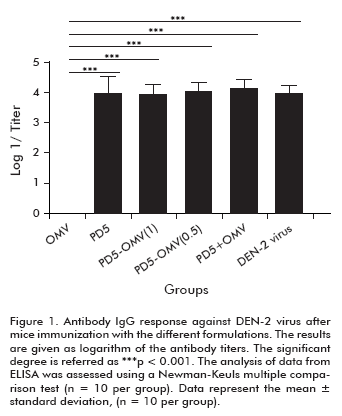
<body><![CDATA[<p><b><span lang=EN-US style='font-size:10.0pt;font-family:"Verdana","sans-serif"'>Antiviral antibody response after immunization </span></b></p>      <p><span lang=EN-US style='font-size:10.0pt;font-family:"Verdana","sans-serif"'>Three formulations, containing the recombinant protein PD5 and OMV, were inoculated in mice to evaluate the humoral immune response induced </span><span lang=EN-US style='font-size:10.0pt;font-family:"Verdana","sans-serif"; color:windowtext'>(</span><span lang=EN-US style='font-size:10.0pt;font-family: "Verdana","sans-serif"'>as stated in Materials and methods section). Two additional groups were immunized with PD5-alum and OMV-alum, respectively. After the third dose, ten mice per group were bled to obtain the sera. To determine the presence of antiviral antibodies, each serum was evaluated by a capture ELISA system. In all groups, high levels of anti-DEN-2 antibodies were detected, with statistically significant differences compared to the negative control group </span><span lang=EN-US style='font-size:10.0pt;font-family:"Verdana","sans-serif"; color:windowtext'>(</span><span lang=EN-US style='font-size:10.0pt;font-family: "Verdana","sans-serif"'>p &lt; 0.001). Additionally, all the formulations containing the PD5 protein elicited levels of antibodies similar to those induced in the control group immunized with DEN virus </span><span lang=EN-US style='font-size:10.0pt;font-family:"Verdana","sans-serif";color:windowtext'>(</span><span style='font-size:10.0pt;font-family:"Verdana","sans-serif"'><a href="#fig1"><span lang=EN-US>Figure 1</span></a></span><span lang=EN-US style='font-size:10.0pt; font-family:"Verdana","sans-serif"'>). </span></p>      <p align=center style='text-align:center'><span style='font-size:13.5pt'><img border=0 width=342 height=416 src="/img/revistas/bta/v26n3/f0105309.gif"></span><a name=fig1></a></p>      
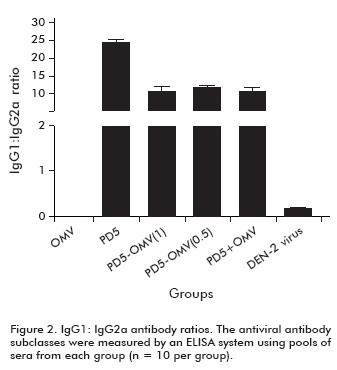
<p><span lang=EN-US style='font-size:10.0pt;font-family:"Verdana","sans-serif"'>Antiviral IgG subclasses were also determined by the same capture ELISA system using pools of sera from each group. As shown in </span><span style='font-size:10.0pt; font-family:"Verdana","sans-serif"'><a href="#fig2"><span lang=EN-US>figure 2</span></a></span><span lang=EN-US style='font-size:10.0pt;font-family:"Verdana","sans-serif"'>, in groups immunized with the protein PD5, the predominant pattern was IgG1 subtype. However, in the groups immunized with OMV as adjuvant, the ratio IgG1:IgG2a was lower than that observed in the PD5-alum group. In contrast, the pool sera from mice inoculated with the infective virus showed high levels of IgG2a compared to those of IgG1, reflected as the ratio IgG1:IgG2a &lt; 1 </span><span lang=EN-US style='font-size:10.0pt;font-family:"Verdana","sans-serif"; color:windowtext'>(</span><span style='font-size:10.0pt;font-family:"Verdana","sans-serif"'><a href="#fig2"><span lang=EN-US>Figure 2</span></a></span><span lang=EN-US style='font-size:10.0pt;font-family:"Verdana","sans-serif"'>). </span></p>      <p align=center style='text-align:center'><span style='font-size:13.5pt'><img border=0 width=337 height=370 src="/img/revistas/bta/v26n3/f0205309.gif"></span><a name=fig2></a></p>      
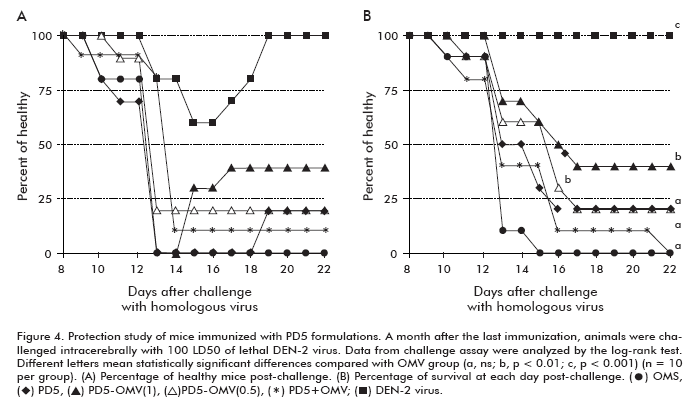
<p><b><span lang=EN-US style='font-size:10.0pt;font-family:"Verdana","sans-serif"'>Neutralizing antibodies after immunization </span></b></p>      <p><span lang=EN-US style='font-size:10.0pt;font-family:"Verdana","sans-serif"'>The functionality of the antibodies elicited by the different formulations was measured by PRNT. </span><span style='font-size:10.0pt;font-family:"Verdana","sans-serif"'><a href="#fig3"><span lang=EN-US>Figure 3</span></a></span><span lang=EN-US style='font-size:10.0pt;font-family:"Verdana","sans-serif"'> shows the neutralizing antibody response in each group. In contrast to antiviral antibody response, in the groups inoculated with formulations of OMV, independently of the formulation process, high levels of neutralizing antibodies were elicited with statistically significant differences with respect to the negative control group </span><span lang=EN-US style='font-size:10.0pt;font-family:"Verdana","sans-serif"; color:windowtext'>(</span><span lang=EN-US style='font-size:10.0pt;font-family: "Verdana","sans-serif"'>p &lt; 0.01) </span><span lang=EN-US style='font-size: 10.0pt;font-family:"Verdana","sans-serif";color:windowtext'>(</span><span style='font-size:10.0pt;font-family:"Verdana","sans-serif"'><a href="#fig3"><span lang=EN-US>Figure 3</span></a></span><span lang=EN-US style='font-size:10.0pt; font-family:"Verdana","sans-serif"'>). In case of the viral group, a low response of neutralizing antibodies was detected. </span></p>      <p align=center style='text-align:center'><span style='font-size:13.5pt'><img border=0 width=342 height=430 src="/img/revistas/bta/v26n3/f0305309.gif"></span><a name=fig3></a></p>      
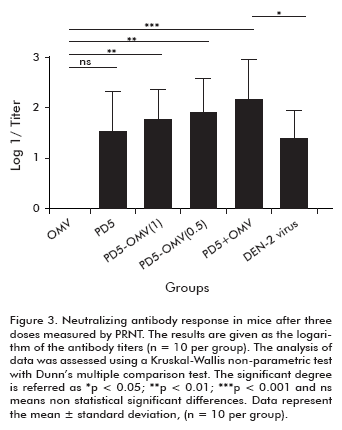
<p><b><span lang=EN-US style='font-size:10.0pt;font-family:"Verdana","sans-serif"'>Protection study </span></b></p>          <p><span lang=EN-US style='font-size:10.0pt;font-family:"Verdana","sans-serif"'>One        month after the last dose, the 10 remaining mice from each group were inoculated        by the i.c. route with a live neuro-adapted DEN-2 virus. </span><span style='font-size:10.0pt;font-family:"Verdana","sans-serif"'><a href="/img/revistas/bta/v26n3/f0405309.gif"><span lang=EN-US>Figure 4</span></a></span><span style='font-size:10.0pt;font-family:"Verdana","sans-serif"'> <span lang=EN-US>shows        the analysis of morbidity and mortality data following challenge and for        22 subsequent days. Animals immunized with the DEN-2 virus achieved a 100%        protection, however during the observation period they showed symptoms of        illness </span></span><span lang=EN-US style='font-size:10.0pt;font-family: "Verdana","sans-serif";color:windowtext'>(</span><span style='font-size:10.0pt; font-family:"Verdana","sans-serif"'><a href="/img/revistas/bta/v26n3/f0405309.gif"><span lang=EN-US>Figure 4A and 4B</span></a></span><span lang=EN-US style='font-size: 10.0pt;font-family:"Verdana","sans-serif"'>). </span></p>          
]]></body>
<body><![CDATA[<p><span lang=EN-US style='font-size:10.0pt;font-family:"Verdana","sans-serif"'>Unlike        to the results of the humoral immune response, only mice immunized with        formulations PD5-OMV</span><span lang=EN-US style='font-size:10.0pt;font-family: "Verdana","sans-serif";color:windowtext'>(</span><span lang=EN-US style='font-size:10.0pt;font-family:"Verdana","sans-serif"'>1) and PD5-OMV</span><span lang=EN-US style='font-size:10.0pt;font-family:"Verdana","sans-serif"; color:windowtext'>(</span><span lang=EN-US style='font-size:10.0pt;font-family: "Verdana","sans-serif"'>0.5) showed statistically significant differences with        respect to the negative control group in terms of percentage of survival,        </span><span lang=EN-US style='font-size:10.0pt;font-family:"Verdana","sans-serif"; color:windowtext'>(</span><span lang=EN-US style='font-size:10.0pt;font-family: "Verdana","sans-serif"'>p &lt; 0.01). The group immunized with the simple mixture        of the formulation components </span><span lang=EN-US style='font-size: 10.0pt;font-family:"Verdana","sans-serif";color:windowtext'>(</span><span lang=EN-US style='font-size:10.0pt;font-family:"Verdana","sans-serif"'>PD5 + OMV)        did not show statistically significant difference compared to the negative        control group </span><span lang=EN-US style='font-size:10.0pt;font-family:"Verdana","sans-serif"; color:windowtext'>(</span><span style='font-size:10.0pt;font-family:"Verdana","sans-serif"'><a href="/img/revistas/bta/v26n3/f0405309.gif"><span lang=EN-US>Figure 4B</span></a></span><span lang=EN-US style='font-size:10.0pt;font-family:"Verdana","sans-serif"'>). At the        end of the observation period, 40% and 20% of animals immunized with PD5-OMV</span><span lang=EN-US style='font-size:10.0pt;font-family:"Verdana","sans-serif"; color:windowtext'>(</span><span lang=EN-US style='font-size:10.0pt;font-family: "Verdana","sans-serif"'>1) and PD5-OMV</span><span lang=EN-US style='font-size: 10.0pt;font-family:"Verdana","sans-serif";color:windowtext'>(</span><span lang=EN-US style='font-size:10.0pt;font-family:"Verdana","sans-serif"'>0.5) survived,        respectively. The group that received protein PD5 alone had 20% of survival,        however did not show significant statistical differences with the OMV group        </span><span lang=EN-US style='font-size:10.0pt;font-family:"Verdana","sans-serif"; color:windowtext'>(</span><span style='font-size:10.0pt;font-family:"Verdana","sans-serif"'><a href="/img/revistas/bta/v26n3/f0405309.gif"><span lang=EN-US>Figure 4B</span></a></span><span lang=EN-US style='font-size:10.0pt;font-family:"Verdana","sans-serif"'>). </span></p>      
<p><b><span lang=EN-US style='font-family:"Verdana","sans-serif"'>DISCUSSION </span></b></p>      <p><span lang=EN-US style='font-size:10.0pt;font-family:"Verdana","sans-serif"'>In a previous work, we had evaluated a PD5-OMV formulation absorbed in aluminum hydroxide in monkeys. As a result, the PD5-OMV formulation was not able to induce antiviral and neutralizing antibodies in this model. Besides, it did not protect i<i>n vivo </i>protection assay of viral challenge </span><span lang=EN-US style='font-size:10.0pt;font-family:"Verdana","sans-serif"; color:windowtext'>(</span><span lang=EN-US style='font-size:10.0pt;font-family: "Verdana","sans-serif"'>18). For this reason, in the present work we evaluated other formulation processes to enhance the immunogenic capacity of PD5 when it is combined with OMV. </span></p>      <p><span lang=EN-US style='font-size:10.0pt;font-family:"Verdana","sans-serif"'>The OMV from <i>N. meningitidis </i>have been widely employed </span><span lang=EN-US style='font-size:10.0pt;font-family:"Verdana","sans-serif"; color:windowtext'>(</span><span lang=EN-US style='font-size:10.0pt;font-family: "Verdana","sans-serif"'>22-25) and their adjuvant capacity has been demonstrated </span><span lang=EN-US style='font-size:10.0pt;font-family:"Verdana","sans-serif"; color:windowtext'>(</span><span lang=EN-US style='font-size:10.0pt;font-family: "Verdana","sans-serif"'>19-21) . </span></p>      <p><span lang=EN-US style='font-size:10.0pt;font-family:"Verdana","sans-serif"'>One of the proposed mechanisms through which OMV may exert this adjuvant effect is by acting as ligands for several receptors that stimulate the innate immunity such as the Toll-like receptors </span><span lang=EN-US style='font-size:10.0pt; font-family:"Verdana","sans-serif";color:windowtext'>(</span><span lang=EN-US style='font-size:10.0pt;font-family:"Verdana","sans-serif"'>31). In fact, different groups have reported vaccine formulations combining the OMV and heterologous antigens from malaria </span><span lang=EN-US style='font-size: 10.0pt;font-family:"Verdana","sans-serif";color:windowtext'>(</span><span lang=EN-US style='font-size:10.0pt;font-family:"Verdana","sans-serif"'>19), <i>Haemophilus influenzae </i>type b </span><span lang=EN-US style='font-size:10.0pt; font-family:"Verdana","sans-serif";color:windowtext'>(</span><span lang=EN-US style='font-size:10.0pt;font-family:"Verdana","sans-serif"'>32), and pneumococcus </span><span lang=EN-US style='font-size:10.0pt;font-family:"Verdana","sans-serif"; color:windowtext'>(</span><span lang=EN-US style='font-size:10.0pt;font-family: "Verdana","sans-serif"'>33), with successful results. </span></p>      <p><span lang=EN-US style='font-size:10.0pt;font-family:"Verdana","sans-serif"'>The current work aimed at evaluating the influence of OMV on the immunogenicity of the recombinant protein PD5. In terms of antiviral antibodies no differences were observed among the groups immunized with recombinant protein. On the other hand, the functional antibody response was higher in the groups immunized with formulations containing the protein PD5 and OMV. These evidences suggest the proper antigenic presentation of the protein PD5 in the context of OMV independently of the formulation process. </span></p>      <p><span lang=EN-US style='font-size:10.0pt;font-family:"Verdana","sans-serif"'>In the case of the viral control group, the neutralizing antibody titers were low. However, similarly low antibody titers have been reported by other authors for the same serotype </span><span lang=EN-US style='font-size:10.0pt;font-family: "Verdana","sans-serif";color:windowtext'>(</span><span lang=EN-US style='font-size:10.0pt;font-family:"Verdana","sans-serif"'>34), and for DEN-1 </span><span lang=EN-US style='font-size:10.0pt;font-family:"Verdana","sans-serif"; color:windowtext'>(</span><span lang=EN-US style='font-size:10.0pt;font-family: "Verdana","sans-serif"'>7) and DEN-4 </span><span lang=EN-US style='font-size: 10.0pt;font-family:"Verdana","sans-serif";color:windowtext'>(</span><span lang=EN-US style='font-size:10.0pt;font-family:"Verdana","sans-serif"'>14), after immunization with one viral infective dose. A possible explanation could be related with the short-lived viremia produced in mice after virus immunization by the intraperitoneal route </span><span lang=EN-US style='font-size:10.0pt;font-family:"Verdana","sans-serif";color:windowtext'>(</span><span lang=EN-US style='font-size:10.0pt;font-family:"Verdana","sans-serif"'>35), and consequently, with the induction of a limited immune response. However, this response was sufficient to induce total protection after homologous viral challenge. </span></p>      <p><span lang=EN-US style='font-size:10.0pt;font-family:"Verdana","sans-serif"'>Moreover, it has also been described that OMV as adjuvant modulates the immune response induced by different antigens measured by the ratio IgG1:IgG2a </span><span lang=EN-US style='font-size:10.0pt;font-family:"Verdana","sans-serif"; color:windowtext'>(</span><span lang=EN-US style='font-size:10.0pt;font-family: "Verdana","sans-serif"'>36). Consistently, in the current work, the ratio IgG1:IgG2a of formulations of the protein PD5 and OMV were lower than that determined in the PD5- alum group, though the typical Th2 pattern was kept. This behavior could be explained by the soluble nature of the protein, mainly inductor of humoral immune response since the domain III is the principal target of neutralizing antibodies </span><span lang=EN-US style='font-size: 10.0pt;font-family:"Verdana","sans-serif";color:windowtext'>(</span><span lang=EN-US style='font-size:10.0pt;font-family:"Verdana","sans-serif"'>15). Additionally, in all the formulations, the alum was the base adjuvant being a potent Th2 inducer. </span></p>          <p><span lang=EN-US style='font-size:10.0pt;font-family:"Verdana","sans-serif"'>The        protection study against the homologous infective virus was the other parameter        measured. Despite the difference of this animal model with respect to the        human disease, significant differences in the percentages of survival compared        to the negative control group were attained as other indicator of a functional        immune response. In the challenge assay, only the groups immunized with        the formulations based on the interaction between the PD5 protein and the        OMV demonstrated statistical differences with respect to the negative control        group </span><span lang=EN-US style='font-size:10.0pt;font-family:"Verdana","sans-serif"; color:windowtext'>(</span><span lang=EN-US style='font-size:10.0pt;font-family: "Verdana","sans-serif"'>p &lt; 0.01). On the contrary, when both components were        simply mixed together with alum, the induced immune response was unable        to protect the animals despite the highest neutralization titers detected        in this group </span><span lang=EN-US style='font-size:10.0pt;font-family:"Verdana","sans-serif"; color:windowtext'>(</span><span style='font-size:10.0pt;font-family:"Verdana","sans-serif"'><a href="/img/revistas/bta/v26n3/f0405309.gif"><span lang=EN-US>Figure 4B</span></a></span><span lang=EN-US style='font-size:10.0pt;font-family:"Verdana","sans-serif"'>). </span></p>      
<p><span lang=EN-US style='font-size:10.0pt;font-family:"Verdana","sans-serif"'>Various candidates containing the domain III of the E protein have been evaluated by different groups and their protective capacity has been assessed in the encephalitis mouse model </span><span lang=EN-US style='font-size:10.0pt; font-family:"Verdana","sans-serif";color:windowtext'>(</span><span lang=EN-US style='font-size:10.0pt;font-family:"Verdana","sans-serif"'>3, 4, 7, 8, 13, 14). However, the best results in percentage of survival have been obtained when potent adjuvants, not suitable for human use, have been employed </span><span lang=EN-US style='font-size:10.0pt;font-family:"Verdana","sans-serif"; color:windowtext'>(</span><span lang=EN-US style='font-size:10.0pt;font-family: "Verdana","sans-serif"'>7, 8, 13). On the other hand, a tandem domain III candidate against the four dengue serotypes was developed by Chen and coworkers, although in this study, the protective capacity of the humoral response was only elicited in mice; and excluded the cell-mediated mechanisms </span><span lang=EN-US style='font-size:10.0pt;font-family:"Verdana","sans-serif"; color:windowtext'>(</span><span lang=EN-US style='font-size:10.0pt;font-family: "Verdana","sans-serif"'>12). Only Simmons and coworkers achieved an 80% survival rate against viral challenge with formulations in alum, but they used a very small number of animals per group in their study </span><span lang=EN-US style='font-size:10.0pt;font-family:"Verdana","sans-serif"; color:windowtext'>(</span><span lang=EN-US style='font-size:10.0pt;font-family: "Verdana","sans-serif"'>4). Of the candidates mentioned above, only two have been assayed in monkeys using alum, and did not protect against viral challenge </span><span lang=EN-US style='font-size:10.0pt;font-family:"Verdana","sans-serif"; color:windowtext'>(</span><span lang=EN-US style='font-size:10.0pt;font-family: "Verdana","sans-serif"'>10, 17). </span></p>      ]]></body>
<body><![CDATA[<p><span lang=EN-US style='font-size:10.0pt;font-family:"Verdana","sans-serif"'>In general, the percentages of survival obtained in this study could have been affected by the high severity of the challenge assay, manifested by the fact that, in spite of the 100% survival rate obtained in the virus-immunized group, several mice in this group became ill during the observation period. On the other hand, considering the similarity in the humoral immune response induced by the formulations containing PD5, we can suggest that a possible association between OMV and PD5 may have favored another mechanism of the immune system that was responsible for the protection obtained. Several groups have reported the lack of correlation between neutralizing antibodies and protection </span><span lang=EN-US style='font-size:10.0pt;font-family:"Verdana","sans-serif"; color:windowtext'>(</span><span lang=EN-US style='font-size:10.0pt;font-family: "Verdana","sans-serif"'>5-8, 37-39). In this sense, cell-mediated immune mechanisms could have played a role in protecting against the virus, in fact, some modulation in the IgG subclass was detected. </span></p>      <p><span lang=EN-US style='font-size:10.0pt;font-family:"Verdana","sans-serif"'>The lack of correlation between neutralizing antibodies and protection was clearly evident in the virus- immunized group. Accordingly, in this case, the cellular immune response was reflected in the ratio of IgG1:IgG2a, indicating a potent protector mechanism in this animal model. In general, the percentages of survival obtained in the study were lower than those previously reported by our group </span><span lang=EN-US style='font-size:10.0pt;font-family:"Verdana","sans-serif"; color:windowtext'>(</span><span lang=EN-US style='font-size:10.0pt;font-family: "Verdana","sans-serif"'>8). </span></p>      <p><span lang=EN-US style='font-size:10.0pt;font-family:"Verdana","sans-serif"'>Taking into account, the evidences of the present study support the OMV as one of the possible adjuvant formulation for PD5. Further studies in monkeys would be needed to confirm the capacity of PD5- OMV formulation to provide complete protection of monkeys against viral challenge. </span></p>      <p><b><span lang=EN-US style='font-family:"Verdana","sans-serif"'>ACKNOWLEDGMENTS </span></b></p>      <p><span lang=EN-US style='font-size:10.0pt;font-family:"Verdana","sans-serif"'>The authors are very grateful to Dr. Ricardo Silva and Dr. Harold Curiel for their critical reading and useful comments in the revision of the manuscript. This investigation received financial support from the Cuban Program for Dengue Vaccine Development. </span></p>      <p><b><span lang=EN-US style='font-family:"Verdana","sans-serif"'>REFERENCES </span></b></p>      <!-- ref --><p><span lang=EN-US style='font-size:10.0pt;font-family:"Verdana","sans-serif"'>1. Kurane I. Dengue hemorrhagic fever with special emphasis on immunopathogenesis. Comp Immunol Microbiol Infect Dis</span><span lang=EN-US style='font-size:11.0pt; font-family:"Arial","sans-serif";color:red'> </span><span lang=EN-US style='font-size:10.0pt;font-family:"Verdana","sans-serif"'>2007;30:329-40.</span><span lang=EN-US style='font-size:11.0pt;font-family:"Arial","sans-serif";color:blue'> </span><!-- ref --><p><span lang=EN-US style='font-size:10.0pt;font-family:"Verdana","sans-serif"'>2. Gubler DJ. Epidemic dengue/dengue hemorrhagic fever as a public health, social and economic problem in the 21st century. Trends Microbiol</span><span lang=EN-US style='font-size:11.0pt;font-family:"Arial","sans-serif";color:red'> </span><span lang=EN-US style='font-size:10.0pt;font-family:"Verdana","sans-serif"'>2002;10<b>:</b>100-3.</span><span lang=EN-US style='font-size:11.0pt;font-family:"Arial","sans-serif";color:blue'> </span><!-- ref --><p><span lang=EN-US style='font-size:10.0pt;font-family:"Verdana","sans-serif"'>3. Srivastava AK, Putnak Jr, Warren RL, Hoke CH. Mice immunized with a dengue type 2 virus E and NS1 fusion protein made in <i>Escherichia coli </i>are protected against lethal dengue virus infection. Vaccine</span><span lang=EN-US style='font-size:11.0pt;font-family:"Arial","sans-serif";color:red'> </span><span lang=EN-US style='font-size:10.0pt;font-family:"Verdana","sans-serif"'>1995;13:1251-8.</span><span lang=EN-US style='font-size:11.0pt;font-family:"Arial","sans-serif";color:blue'> </span><!-- ref --><p><span lang=EN-US style='font-size:10.0pt;font-family:"Verdana","sans-serif"'>4. Simmons M, Nelson WM, Wu SJ, Hayes CG. Evaluation of the protective efficacy of a recombinant dengue envelope B domain fusion protein against dengue 2 virus infection in mice. Am J Trop Med Hyg</span><span lang=EN-US style='font-size: 11.0pt;font-family:"Arial","sans-serif";color:red'> </span><span lang=EN-US style='font-size:10.0pt;font-family:"Verdana","sans-serif"'>1998;58:655-2.</span><span lang=EN-US style='font-size:11.0pt;font-family:"Arial","sans-serif";color:blue'> </span><p><span lang=EN-US style='font-size:10.0pt;font-family:"Verdana","sans-serif"'>5. Velzing J, Groen J, Drouet MT, van Amerongen G, Copra C, Osterhaus ADME, et al. Induction of protective immunity against Dengue virus type 2: comparison of candidate live attenuated and recombinant vaccines. </span><span style='font-size:10.0pt;font-family:"Verdana","sans-serif"'>Vaccine</span><span style='font-size:11.0pt;font-family:"Arial","sans-serif";color:red'> </span><span style='font-size:10.0pt;font-family:"Verdana","sans-serif"'>1999;17:1312-20.</span><span style='font-size:11.0pt;font-family:"Arial","sans-serif";color:blue'> </span></p>      <!-- ref --><p><span style='font-size:10.0pt;font-family:"Verdana","sans-serif"'>6. Guzmán MG, Rodríguez R, Rodríguez R, Hermida H, Álvarez M, Lazo L, et al. </span><span lang=EN-US style='font-size:10.0pt;font-family:"Verdana","sans-serif"'>Induction of neutralizing antibodies and partial protection from viral challenge in <i>Macaca fascicularis </i>immunized with recombinant dengue 4 virus envelope glycoprotein expressed in <i>Pichia pastoris</i>. </span><span style='font-size:10.0pt;font-family:"Verdana","sans-serif"'>Am J Trop Med Hyg</span><span style='font-size:11.0pt;font-family:"Arial","sans-serif";color:red'> </span><span style='font-size:10.0pt;font-family:"Verdana","sans-serif"'>2003;69:129-34.</span><span style='font-size:11.0pt;font-family:"Arial","sans-serif";color:blue'> </span><!-- ref --><p><span style='font-size:10.0pt;font-family:"Verdana","sans-serif"'>7. Hermida L, Rodríguez R, Lazo L, Bernardo L, Silva R, Zulueta A, et al. </span><span lang=EN-US style='font-size:10.0pt;font-family:"Verdana","sans-serif"'>A fragment of the envelope protein from dengue-1 virus, fused in two different sites of the meningococcal P64k protein carrier, induces a functional immune response in mice. </span><span style='font-size:10.0pt;font-family:"Verdana","sans-serif"'>Biotechnol Appl Biochem</span><span style='font-size:11.0pt;font-family:"Arial","sans-serif"; color:red'> </span><span style='font-size:10.0pt;font-family:"Verdana","sans-serif"'>2004;39:107-14.</span><span style='font-size:11.0pt;font-family:"Arial","sans-serif";color:blue'> </span><!-- ref --><p><span style='font-size:10.0pt;font-family:"Verdana","sans-serif"'>8. Hermida L, Rodríguez R, Lazo L, Silva R, Zulueta A, Chinea G, et al. </span><span lang=EN-US style='font-size:10.0pt;font-family:"Verdana","sans-serif"'>A dengue-2 Envelope fragment inserted within the structure of the P64k meningococcal protein carrier enables a functional immune response against the virus in mice. J Virol Methods</span><span lang=EN-US style='font-size:11.0pt; font-family:"Arial","sans-serif";color:red'> </span><span lang=EN-US style='font-size:10.0pt;font-family:"Verdana","sans-serif"'>2004;115:41-9.</span><span lang=EN-US style='font-size:11.0pt;font-family:"Arial","sans-serif";color:blue'> </span><!-- ref --><p><span lang=EN-US style='font-size:10.0pt;font-family:"Verdana","sans-serif"'>9. Putnak RJ, Coller BA, Voss G, Vaughn DW, Clements D, Peters I, et al. An evaluation of dengue type-2 inactivated, recombinant subunit, and live-attenuated vaccine candidates in the rhesus macaque model. </span><span style='font-size:10.0pt;font-family:"Verdana","sans-serif"'>Vaccine</span><span style='font-size:11.0pt;font-family:"Arial","sans-serif";color:red'> </span><span style='font-size:10.0pt;font-family:"Verdana","sans-serif"'>2005;23:4442-52.</span><span style='font-size:11.0pt;font-family:"Arial","sans-serif";color:blue'> </span><!-- ref --><p><span style='font-size:10.0pt;font-family:"Verdana","sans-serif"'>10. Hermida L, Bernardo L, Martín J, Álvarez M, Prado I, López C, et al. </span><span lang=EN-US style='font-size:10.0pt;font-family:"Verdana","sans-serif"'>A recombinant fusion protein containing the domain III of the dengue-2 envelope protein is immunogenic and protective in nonhuman primates. Vaccine</span><span lang=EN-US style='font-size:11.0pt;font-family:"Arial","sans-serif";color:red'> </span><span lang=EN-US style='font-size:10.0pt;font-family:"Verdana","sans-serif"'>2006;24:3165-71.</span><span lang=EN-US style='font-size:11.0pt;font-family:"Arial","sans-serif";color:blue'> </span><!-- ref --><p><span lang=EN-US style='font-size:10.0pt;font-family:"Verdana","sans-serif"'>11. Simmons M, Porter KR, Hayes CG, Vaughn DW, Putnak R. Characterization of antibody responses to combinations of a dengue virus type 2 DNA vaccine and two dengue virus type 2 protein vaccines in rhesus macaques. J Virol</span><span lang=EN-US style='font-size:11.0pt;font-family:"Arial","sans-serif";color:red'> </span><span lang=EN-US style='font-size:10.0pt;font-family:"Verdana","sans-serif"'>2006;80:9577-85.</span><span lang=EN-US style='font-size:11.0pt;font-family:"Arial","sans-serif";color:blue'> </span><!-- ref --><p><span lang=EN-US style='font-size:10.0pt;font-family:"Verdana","sans-serif"'>12. Chen S, Yu M, Jiang T, Deng Y, Qin C, Qin E. Induction of tetravalent protective immunity against four dengue serotypes by the tandem domain III of the Envelope protein. DNA Cell Biol</span><span lang=EN-US style='font-size: 11.0pt;font-family:"Arial","sans-serif";color:red'> </span><span lang=EN-US style='font-size:10.0pt;font-family:"Verdana","sans-serif"'>2007;26:361-7.</span><span lang=EN-US style='font-size:11.0pt;font-family:"Arial","sans-serif";color:blue'> </span><!-- ref --><p><span lang=EN-US style='font-size:10.0pt;font-family:"Verdana","sans-serif"'>13. Babu JP, Pattnaik P, Gupta N, Shrivastava A, Khan M, Rao PV. Immunogenicity of a recombinant envelope domain III protein of dengue virus type-4 with various adjuvants in mice. </span><span style='font-size:10.0pt;font-family:"Verdana","sans-serif"'>Vaccine</span><span style='font-size:11.0pt;font-family:"Arial","sans-serif";color:red'> </span><span style='font-size:10.0pt;font-family:"Verdana","sans-serif"'>2008;26:4655-63.</span><span style='font-size:11.0pt;font-family:"Arial","sans-serif";color:blue'> </span><!-- ref --><p><span style='font-size:10.0pt;font-family:"Verdana","sans-serif"'>14. Lazo L, Zulueta A, Hermida L, Blanco A, Sánchez J, Valdés I, et al. </span><span lang=EN-US style='font-size:10.0pt;font-family:"Verdana","sans-serif"'>The Dengue-4 envelope domain III fused twice within the meningococcal P64k protein carrier induces partial protection in mice. Biotechnol Appl Biochem</span><span lang=EN-US style='font-size:11.0pt;font-family:"Arial","sans-serif";color:red'> </span><span lang=EN-US style='font-size:10.0pt;font-family:"Verdana","sans-serif"'>2009;52:265-71.</span><span lang=EN-US style='font-size:11.0pt;font-family:"Arial","sans-serif";color:blue'> </span><!-- ref --><p><span lang=EN-US style='font-size:10.0pt;font-family:"Verdana","sans-serif"'>15. Chambers TJ, Chang S, Galler R, Rice C. Flavivirus genome organization, expression and replication. </span><span style='font-size:10.0pt;font-family: "Verdana","sans-serif"'>Annu Rev Microbiol</span><span style='font-size:11.0pt; font-family:"Arial","sans-serif";color:red'> </span><span style='font-size: 10.0pt;font-family:"Verdana","sans-serif"'>1990;44:649-88.</span><span style='font-size:11.0pt;font-family:"Arial","sans-serif";color:blue'> </span><!-- ref --><p><span style='font-size:10.0pt;font-family:"Verdana","sans-serif"'>16. Zulueta A, Hermida L, Lazo L, Valdés I, Rodríguez R, López C, et al. </span><span lang=EN-US style='font-size:10.0pt;font-family:"Verdana","sans-serif"'>The fusion site of envelope fragments from each serotype of dengue virus in the P64k protein, influence some parameters of the resulting chimeric construct. </span><span style='font-size:10.0pt;font-family:"Verdana","sans-serif"'>Biochem Biophys Res Commun</span><span style='font-size:11.0pt;font-family:"Arial","sans-serif"; color:red'> </span><span style='font-size:10.0pt;font-family:"Verdana","sans-serif"'>2003;308:619-26.</span><span style='font-size:11.0pt;font-family:"Arial","sans-serif";color:blue'> </span><!-- ref --><p><span style='font-size:10.0pt;font-family:"Verdana","sans-serif"'>17. Bernardo L, Izquierdo A, Álvarez M, Rosario D, Prado I, López C, et al. </span><span lang=EN-US style='font-size:10.0pt;font-family:"Verdana","sans-serif"'>Immunogenicity and protective efficacy of a recombinant fusion protein containing the domain III of the dengue 1 envelope protein in non-human primates. </span><span style='font-size:10.0pt;font-family:"Verdana","sans-serif"'>Antiviral Res</span><span style='font-size:11.0pt;font-family:"Arial","sans-serif";color:red'> </span><span style='font-size:10.0pt;font-family:"Verdana","sans-serif"'>2008;80:194-9.</span><span style='font-size:11.0pt;font-family:"Arial","sans-serif";color:blue'> </span><!-- ref --><p><span style='font-size:10.0pt;font-family:"Verdana","sans-serif"'>18. Valdés I, Hermida L, Martín J, Menéndez T, Gil L, Lazo L, et al. </span><span lang=EN-US style='font-size:10.0pt;font-family:"Verdana","sans-serif"'>Immunological evaluation in nonhuman primates of formulations based on the chimeric protein P64k-domain III of dengue 2 and two components of <i>Neisseria meningitidis</i>. Vaccine</span><span lang=EN-US style='font-size:11.0pt;font-family:"Arial","sans-serif"; color:red'> </span><span lang=EN-US style='font-size:10.0pt;font-family:"Verdana","sans-serif"'>2009;27:995-1001.</span><span lang=EN-US style='font-size:11.0pt;font-family:"Arial","sans-serif";color:blue'> </span><!-- ref --><p><span lang=EN-US style='font-size:10.0pt;font-family:"Verdana","sans-serif"'>19. Lowell GH, Ballou WR, Smith LF, Wirtz RA, Zollinger WD, Hockmeyer WT. Proteosome-lipopeptide vaccines: enhancement of immunogenicity for malaria CS peptides. Science</span><span lang=EN-US style='font-size:11.0pt;font-family: "Arial","sans-serif";color:red'> </span><span lang=EN-US style='font-size:10.0pt; font-family:"Verdana","sans-serif"'>1988;240:800-2.</span><span lang=EN-US style='font-size:11.0pt;font-family:"Arial","sans-serif";color:blue'> </span><!-- ref --><p><span lang=EN-US style='font-size:10.0pt;font-family:"Verdana","sans-serif"'>20. Wetzler LM. Immunopotentiating ability of neisserial major outer membrane proteins. Use as an adjuvant for poorly immunogenic substances and potential use in vaccines. Ann N Y Acad Sci</span><span lang=EN-US style='font-size:11.0pt; font-family:"Arial","sans-serif";color:red'> </span><span lang=EN-US style='font-size:10.0pt;font-family:"Verdana","sans-serif"'>1994;730:367-70.</span><!-- ref --><p class=MsoNormal><span lang=EN-US style='font-size:10.0pt;font-family:"Verdana","sans-serif"'>21. Fusco PC, Michon F, Laude-Sharp M, Minetti CA, Huang CH, Heron I, et al. Preclinical studies on a recombinant group B meningococcal porin as a carrier for a novel Haemophilus influenzae type b conjugate vaccine. Vaccine</span><span lang=EN-US style='font-size:11.0pt;font-family:"Arial","sans-serif";color:red'> </span><span lang=EN-US style='font-size:10.0pt;font-family:"Verdana","sans-serif"'>1998;16:1842-9.</span><span lang=EN-US style='font-size:11.0pt;font-family:"Arial","sans-serif";color:blue'> </span><p class=MsoNormal><span lang=EN-US style='font-size:11.0pt;font-family:"Arial","sans-serif"; color:blue'>&nbsp;</span></p>      <!-- ref --><p class=MsoNormal><span lang=EN-US style='font-size:10.0pt;font-family:"Verdana","sans-serif"'>22. Bjune G, Hoiby EA, Gronnesby JK, Arnesen O, Fredriksen JH, Halstensen A, et al. Effect of outer membrane vesicle vaccine against group B meningococcal disease in Norway. </span><span style='font-size:10.0pt;font-family:"Verdana","sans-serif"'>Lancet</span><span style='font-size:11.0pt;font-family:"Arial","sans-serif";color:red'> </span><span style='font-size:10.0pt;font-family:"Verdana","sans-serif"'>1991;338:1093-6.</span><span style='font-size:11.0pt;font-family:"Arial","sans-serif";color:blue'> </span><p class=MsoNormal><span style='font-size:11.0pt;font-family:"Arial","sans-serif"; color:blue'>&nbsp;</span></p>      ]]></body>
<body><![CDATA[<!-- ref --><p class=MsoNormal><span style='font-size:10.0pt;font-family:"Verdana","sans-serif"'>23. Sierra GV, Campa HC, Varcacel NM, Garcia IL, Izquierdo PL, Sotolongo PF, et al. </span><span lang=EN-US style='font-size:10.0pt;font-family:"Verdana","sans-serif"'>Vaccine against group B <i>Neisseria meningitidis: </i>protection trial and mass vaccination results in Cuba. NIPH Ann</span><span lang=EN-US style='font-size: 11.0pt;font-family:"Arial","sans-serif";color:red'> </span><span lang=EN-US style='font-size:10.0pt;font-family:"Verdana","sans-serif"'>1991;14:195-210.</span><span lang=EN-US style='font-size:11.0pt;font-family:"Arial","sans-serif";color:blue'> </span><p class=MsoNormal><span lang=EN-US style='font-size:11.0pt;font-family:"Arial","sans-serif"; color:blue'>&nbsp;</span></p>      <!-- ref --><p class=MsoNormal><span lang=EN-US style='font-size:10.0pt;font-family:"Verdana","sans-serif"'>24. Peeters CC, Rumke HC, Sundermann LC, Rouppe van der Voort EM, Meulenbelt J, Schuller M, et al. Phase I clinical trial with a hexavalent PorA containing meningococcal outer membrane vesicle vaccine. Vaccine</span><span lang=EN-US style='font-size:11.0pt;font-family:"Arial","sans-serif";color:red'> </span><span lang=EN-US style='font-size:10.0pt;font-family:"Verdana","sans-serif"'>1996;14:1009-15.</span><!-- ref --><p><span lang=EN-US style='font-size:10.0pt;font-family:"Verdana","sans-serif"'>25. Oster P, Lennon D, O’Hallahan J, Mulholland K, Reid S, Martin D. MeNZB: a safe and highly immunogenic tailor-made vaccine against the New Zealand <i>Neisseria meningitidis</i> serogroup B disease epidemic strain. Vaccine</span><span lang=EN-US style='font-size:11.0pt;font-family:"Arial","sans-serif";color:red'> </span><span lang=EN-US style='font-size:10.0pt;font-family:"Verdana","sans-serif"'>2005;23:2191-6.</span><span lang=EN-US style='font-size:11.0pt;font-family:"Arial","sans-serif";color:blue'> </span><!-- ref --><p><span lang=EN-US style='font-size:10.0pt;font-family:"Verdana","sans-serif"'>26. Clarke DH, Casals J. Techniques for hemagglutination and hemagglutination inhibition with arthropod-borne viruses. Am J Trop Med Hyg</span><span lang=EN-US style='font-size:11.0pt;font-family:"Arial","sans-serif";color:red'> </span><span lang=EN-US style='font-size:10.0pt;font-family:"Verdana","sans-serif"'>1958;7:561-73.</span><span lang=EN-US style='font-size:11.0pt;font-family:"Arial","sans-serif";color:blue'> </span><!-- ref --><p><span lang=EN-US style='font-size:10.0pt;font-family:"Verdana","sans-serif"'>27. López C, Sánchez J, Hermida L, Zulueta A, Marquez G. Cysteine mediated multimerization of a recombinant dengue E fragment fused to the P64k protein by Immobilized metal ion affinity chromatography. Protein Expr Purif</span><span lang=EN-US style='font-size:11.0pt;font-family:"Arial","sans-serif";color:red'> </span><span lang=EN-US style='font-size:10.0pt;font-family:"Verdana","sans-serif"'>2004;34:176-82.</span><span lang=EN-US style='font-size:11.0pt;font-family:"Arial","sans-serif";color:blue'> </span><!-- ref --><p><span lang=EN-US style='font-size:10.0pt;font-family:"Verdana","sans-serif"'>28. Fredriksen JH, Rosenqvist E, Wedege E, Bryn K, Bjune G, Froholm LO, et al. Production, characterization and control of MenBvaccine ‘‘Folkehelsa’’: an outer membrane vesicle vaccine against group B meningococcal disease. NIPH Ann</span><span lang=EN-US style='font-size:11.0pt;font-family:"Arial","sans-serif";color:red'> </span><span lang=EN-US style='font-size:10.0pt;font-family:"Verdana","sans-serif"'>1991;14:67-79.</span><span lang=EN-US style='font-size:11.0pt;font-family:"Arial","sans-serif";color:blue'> </span><!-- ref --><p><span lang=EN-US style='font-size:10.0pt;font-family:"Verdana","sans-serif"'>29. Morens DM, Halstead SB, Repik PM. Simplified plaque reduction assay for dengue viruses by semimicro methods in BHK 21 cells: comparison of the BHK suspension test with standard plaque reduction neutralization. J Clin Microbiol</span><span lang=EN-US style='font-size:11.0pt;font-family:"Arial","sans-serif";color:red'> </span><span lang=EN-US style='font-size:10.0pt;font-family:"Verdana","sans-serif"'>1985;22:250-4.</span><span lang=EN-US style='font-size:11.0pt;font-family:"Arial","sans-serif";color:blue'> </span><!-- ref --><p><span lang=EN-US style='font-size:10.0pt;font-family:"Verdana","sans-serif"'>30. Kaufman BM, Summers </span><span lang=EN-US style='font-size:11.0pt;font-family: "Arial","sans-serif";color:blue'>&nbsp;</span><span lang=EN-US style='font-size:10.0pt;font-family:"Verdana","sans-serif"'>PL, Dubois DR, Eckels KH. Monoclonal antibodies against dengue 2 virus E-glycoprotein protect mice against lethal dengue infection. Am J Trop Med Hyg</span><span lang=EN-US style='font-size:11.0pt;font-family:"Arial","sans-serif";color:red'> </span><span lang=EN-US style='font-size:10.0pt;font-family:"Verdana","sans-serif"'>1987;36:427-34.</span><span lang=EN-US style='font-size:11.0pt;font-family:"Arial","sans-serif";color:blue'> </span><!-- ref --><p><span lang=EN-US style='font-size:10.0pt;font-family:"Verdana","sans-serif"'>31. MacLeod H, Bhasin N, Massari PLM. Role of protein tyrosine kinase and Erk1/2 activities in the toll-like receptor 2-induced cellular activation of murine B cell by Neisserial porin. Clin Vaccine Immunol</span><span lang=EN-US style='font-size:11.0pt;font-family:"Arial","sans-serif";color:red'> </span><span lang=EN-US style='font-size:10.0pt;font-family:"Verdana","sans-serif"'>2008;15:630-37.</span><span lang=EN-US style='font-size:11.0pt;font-family:"Arial","sans-serif";color:blue'> </span><!-- ref --><p><span lang=EN-US style='font-size:10.0pt;font-family:"Verdana","sans-serif"'>32. Donnelly JJ, Deck RR, Liu MA. Immunogenicity of a <i>Haemophilus influenzae </i>polysaccharide-<i>Neisseria meningitides </i>outer membrane protein vaccine. J Immunol</span><span lang=EN-US style='font-size:11.0pt;font-family:"Arial","sans-serif";color:red'> </span><span lang=EN-US style='font-size:10.0pt;font-family:"Verdana","sans-serif"'>1990;145:3071-9.</span><span lang=EN-US style='font-size:11.0pt;font-family:"Arial","sans-serif";color:blue'> </span><!-- ref --><p><span lang=EN-US style='font-size:10.0pt;font-family:"Verdana","sans-serif"'>33. Giebink GS, Koskela M, Vella PP, Harris M, Le CT. Pneumococcal capsular polysaccharidemeningococcal outer membrane protein complex conjugate vaccines: immunogenicity and efficacy in experimental pneumococcal otitis media. J Infect Dis</span><span lang=EN-US style='font-size:11.0pt;font-family:"Arial","sans-serif"; color:red'> </span><span lang=EN-US style='font-size:10.0pt;font-family:"Verdana","sans-serif"'>1993;167:347-55.</span><span lang=EN-US style='font-size:11.0pt;font-family:"Arial","sans-serif";color:blue'> </span><!-- ref --><p><span lang=EN-US style='font-size:10.0pt;font-family:"Verdana","sans-serif"'>34. Bernardo L, Yndart A, Vazquez S, Morier L, Guzman MG. Antibody Responses to Asian and American Genotypes of Dengue 2 Virus in Immunized Mice. Clin Diagn Lab Immunol</span><span lang=EN-US style='font-size:11.0pt;font-family:"Arial","sans-serif"; color:red'> </span><span lang=EN-US style='font-size:10.0pt;font-family:"Verdana","sans-serif"'>2005;12:361-2.</span><span lang=EN-US style='font-size:11.0pt;font-family:"Arial","sans-serif";color:blue'> </span><!-- ref --><p><span lang=EN-US style='font-size:10.0pt;font-family:"Verdana","sans-serif"'>35. Brinton MA, Perelygin AA. Genetic resistance to flaviviruses. </span><span style='font-size:10.0pt;font-family:"Verdana","sans-serif"'>Adv Virus Res</span><span style='font-size:11.0pt;font-family:"Arial","sans-serif";color:red'> </span><span style='font-size:10.0pt;font-family:"Verdana","sans-serif"'>2003;60:43-85.</span><span style='font-size:11.0pt;font-family:"Arial","sans-serif";color:blue'> </span><!-- ref --><p><span style='font-size:10.0pt;font-family:"Verdana","sans-serif"'>36. Pérez O, Lastre M, Lapinet J, Bracho G, Díaz M, Zayas C, et al. </span><span lang=EN-US style='font-size:10.0pt;font-family:"Verdana","sans-serif"'>Immune response induction and new effector mechanisms possibly involved in protection conferred by the Cuban anti-meningococcal BC vaccine. Infect Immun</span><span lang=EN-US style='font-size:11.0pt;font-family:"Arial","sans-serif";color:red'> </span><span lang=EN-US style='font-size:10.0pt;font-family:"Verdana","sans-serif"'>2001;69:4502-8.</span><span lang=EN-US style='font-size:11.0pt;font-family:"Arial","sans-serif";color:blue'> </span><!-- ref --><p><span lang=EN-US style='font-size:10.0pt;font-family:"Verdana","sans-serif"'>37. Deubel V, Kinney RM, Exposito JJ, Cropp CB, Vorndam AV, Monath TP, et al. Dengue 2 virus envelope protein expressed by a recombinant vaccinia virus failed to protect monkeys against dengue. J Gen Virol</span><span lang=EN-US style='font-size:11.0pt;font-family:"Arial","sans-serif";color:red'> </span><span lang=EN-US style='font-size:10.0pt;font-family:"Verdana","sans-serif"'>1988;69:1921-9.</span><span lang=EN-US style='font-size:11.0pt;font-family:"Arial","sans-serif";color:blue'> </span><!-- ref --><p><span lang=EN-US style='font-size:10.0pt;font-family:"Verdana","sans-serif"'>38. Eckels KH, Dubois DR, Summers </span><span lang=EN-US style='font-size:11.0pt; font-family:"Arial","sans-serif";color:blue'>&nbsp;</span><span lang=EN-US style='font-size:10.0pt;font-family:"Verdana","sans-serif"'>PL, Schlesinger JJ, Shelly M, Cohen S, et al. Immunization of monkeys with baculovirus-dengue type-4 recombinants containing envelope and nonstructural proteins: evidence of priming and partial protection. Am J Trop Med Hyg</span><span lang=EN-US style='font-size:11.0pt;font-family:"Arial","sans-serif";color:red'> </span><span lang=EN-US style='font-size:10.0pt;font-family:"Verdana","sans-serif"'>1994;50:472-8.</span><span lang=EN-US style='font-size:11.0pt;font-family:"Arial","sans-serif";color:blue'> </span><p><span lang=EN-US style='font-size:10.0pt;font-family:"Verdana","sans-serif"'>39. Putnak R, Barvir DA, Burrous JM, Dubois DR, D’Andrea VM, Hoke CH, et al. Development of a purified, inactivated, dengue-2 virus vaccine prototype in Vero cell: immunogenicity and protection in mice and rhesus monkeys. J Infect Di</span><span lang=EN-US style='font-size:11.0pt;font-family:"Arial","sans-serif"; color:red'> </span><span lang=EN-US style='font-size:10.0pt;font-family:"Verdana","sans-serif"'>1996;174:1176-84.</span><span lang=EN-US style='font-size:11.0pt;font-family:"Arial","sans-serif";color:green'> </span></p>      <p><span lang=EN-US style='font-size:13.5pt'>&nbsp;</span></p>      <p><span lang=EN-US style='font-size:10.0pt;font-family:"Verdana","sans-serif"'>Received in July, 2009.     ]]></body>
<body><![CDATA[<br> Accepted for publication in September, 2009.</span><span lang=EN-US style='font-size:11.0pt;font-family:"Arial","sans-serif";color:red'> </span></p>      <p><span lang=EN-US style='font-size:10.0pt;font-family:"Verdana","sans-serif"'>Iris Valdés. Vaccine Division, Center for Genetic Engineering and Biotechnology, CIGB Ave. 31, PO Box 6162, Havana, Cuba. E-mail: </span><span style='font-size: 10.0pt;font-family:"Verdana","sans-serif"'><a href="mailto:iris.valdes@cigb.edu.cu"><span lang=EN-US>iris.valdes@cigb.edu.cu</span></a></span><span style='font-size:11.0pt;font-family:"Arial","sans-serif";color:#FF6600'> </span></p>      <p><span lang=EN-US style='font-size:13.5pt'>&nbsp;</span></p>  </div>  </div>       ]]></body><back>
<ref-list>
<ref id="B1">
<label>1</label><nlm-citation citation-type="journal">
<person-group person-group-type="author">
<name>
<surname><![CDATA[Kurane]]></surname>
<given-names><![CDATA[I]]></given-names>
</name>
</person-group>
<article-title xml:lang="en"><![CDATA[Dengue hemorrhagic fever with special emphasis on immunopathogenesis]]></article-title>
<source><![CDATA[Comp Immunol Microbiol Infect Dis]]></source>
<year>2007</year>
<volume>30</volume>
<page-range>329-40</page-range></nlm-citation>
</ref>
<ref id="B2">
<label>2</label><nlm-citation citation-type="journal">
<person-group person-group-type="author">
<name>
<surname><![CDATA[Gubler]]></surname>
<given-names><![CDATA[DJ]]></given-names>
</name>
</person-group>
<article-title xml:lang="en"><![CDATA[Epidemic dengue/dengue hemorrhagic fever as a public health, social and economic problem in the 21st century]]></article-title>
<source><![CDATA[Trends Microbiol]]></source>
<year>2002</year>
<volume>10</volume>
<page-range>100-3</page-range></nlm-citation>
</ref>
<ref id="B3">
<label>3</label><nlm-citation citation-type="journal">
<person-group person-group-type="author">
<name>
<surname><![CDATA[Srivastava]]></surname>
<given-names><![CDATA[AK]]></given-names>
</name>
<name>
<surname><![CDATA[Putnak Jr]]></surname>
</name>
<name>
<surname><![CDATA[Warren]]></surname>
<given-names><![CDATA[RL]]></given-names>
</name>
<name>
<surname><![CDATA[Hoke]]></surname>
<given-names><![CDATA[CH]]></given-names>
</name>
</person-group>
<article-title xml:lang="en"><![CDATA[Mice immunized with a dengue type 2 virus E and NS1 fusion protein made in Escherichia coli are protected against lethal dengue virus infection]]></article-title>
<source><![CDATA[Vaccine]]></source>
<year>1995</year>
<volume>13</volume>
<page-range>1251-8</page-range></nlm-citation>
</ref>
<ref id="B4">
<label>4</label><nlm-citation citation-type="journal">
<person-group person-group-type="author">
<name>
<surname><![CDATA[Simmons]]></surname>
<given-names><![CDATA[M]]></given-names>
</name>
<name>
<surname><![CDATA[Nelson]]></surname>
<given-names><![CDATA[WM]]></given-names>
</name>
<name>
<surname><![CDATA[Wu]]></surname>
<given-names><![CDATA[SJ]]></given-names>
</name>
<name>
<surname><![CDATA[Hayes]]></surname>
<given-names><![CDATA[CG]]></given-names>
</name>
</person-group>
<article-title xml:lang="en"><![CDATA[Evaluation of the protective efficacy of a recombinant dengue envelope B domain fusion protein against dengue 2 virus infection in mice]]></article-title>
<source><![CDATA[Am J Trop Med Hyg]]></source>
<year>1998</year>
<volume>58</volume>
<page-range>655-2</page-range></nlm-citation>
</ref>
<ref id="B5">
<label>5</label><nlm-citation citation-type="journal">
<person-group person-group-type="author">
<name>
<surname><![CDATA[Velzing]]></surname>
<given-names><![CDATA[J]]></given-names>
</name>
<name>
<surname><![CDATA[Groen]]></surname>
<given-names><![CDATA[J]]></given-names>
</name>
<name>
<surname><![CDATA[Drouet]]></surname>
<given-names><![CDATA[MT]]></given-names>
</name>
<name>
<surname><![CDATA[van]]></surname>
<given-names><![CDATA[Amerongen]]></given-names>
</name>
<name>
<surname><![CDATA[Copra]]></surname>
<given-names><![CDATA[C]]></given-names>
</name>
<name>
<surname><![CDATA[Osterhaus]]></surname>
<given-names><![CDATA[ADME]]></given-names>
</name>
</person-group>
<article-title xml:lang="en"><![CDATA[Induction of protective immunity against Dengue virus type 2: comparison of candidate live attenuated and recombinant vaccines]]></article-title>
<source><![CDATA[Vaccine]]></source>
<year>1999</year>
<volume>17</volume>
<page-range>1312-20</page-range></nlm-citation>
</ref>
<ref id="B6">
<label>6</label><nlm-citation citation-type="journal">
<person-group person-group-type="author">
<name>
<surname><![CDATA[Guzmán]]></surname>
<given-names><![CDATA[MG]]></given-names>
</name>
<name>
<surname><![CDATA[Rodríguez]]></surname>
<given-names><![CDATA[R]]></given-names>
</name>
<name>
<surname><![CDATA[Rodríguez]]></surname>
<given-names><![CDATA[R]]></given-names>
</name>
<name>
<surname><![CDATA[Hermida]]></surname>
<given-names><![CDATA[H]]></given-names>
</name>
<name>
<surname><![CDATA[Álvarez]]></surname>
<given-names><![CDATA[M]]></given-names>
</name>
<name>
<surname><![CDATA[Lazo]]></surname>
<given-names><![CDATA[L]]></given-names>
</name>
</person-group>
<article-title xml:lang="en"><![CDATA[Induction of neutralizing antibodies and partial protection from viral challenge in Macaca fascicularis immunized with recombinant dengue 4 virus envelope glycoprotein expressed in Pichia pastoris]]></article-title>
<source><![CDATA[Am J Trop Med Hyg]]></source>
<year>2003</year>
<volume>69</volume>
<page-range>129-34</page-range></nlm-citation>
</ref>
<ref id="B7">
<label>7</label><nlm-citation citation-type="journal">
<person-group person-group-type="author">
<name>
<surname><![CDATA[Hermida]]></surname>
<given-names><![CDATA[L]]></given-names>
</name>
<name>
<surname><![CDATA[Rodríguez]]></surname>
<given-names><![CDATA[R]]></given-names>
</name>
<name>
<surname><![CDATA[Lazo]]></surname>
<given-names><![CDATA[L]]></given-names>
</name>
<name>
<surname><![CDATA[Bernardo]]></surname>
<given-names><![CDATA[L]]></given-names>
</name>
<name>
<surname><![CDATA[Silva]]></surname>
<given-names><![CDATA[R]]></given-names>
</name>
<name>
<surname><![CDATA[Zulueta]]></surname>
<given-names><![CDATA[A]]></given-names>
</name>
</person-group>
<article-title xml:lang="en"><![CDATA[A fragment of the envelope protein from dengue-1 virus, fused in two different sites of the meningococcal P64k protein carrier, induces a functional immune response in mice]]></article-title>
<source><![CDATA[Biotechnol Appl Biochem]]></source>
<year>2004</year>
<volume>39</volume>
<page-range>107-14</page-range></nlm-citation>
</ref>
<ref id="B8">
<label>8</label><nlm-citation citation-type="journal">
<person-group person-group-type="author">
<name>
<surname><![CDATA[Hermida]]></surname>
<given-names><![CDATA[L]]></given-names>
</name>
<name>
<surname><![CDATA[Rodríguez]]></surname>
<given-names><![CDATA[R]]></given-names>
</name>
<name>
<surname><![CDATA[Lazo]]></surname>
<given-names><![CDATA[L]]></given-names>
</name>
<name>
<surname><![CDATA[Silva]]></surname>
<given-names><![CDATA[R]]></given-names>
</name>
<name>
<surname><![CDATA[Zulueta]]></surname>
<given-names><![CDATA[A]]></given-names>
</name>
<name>
<surname><![CDATA[Chinea]]></surname>
<given-names><![CDATA[G]]></given-names>
</name>
</person-group>
<article-title xml:lang="en"><![CDATA[A dengue-2 Envelope fragment inserted within the structure of the P64k meningococcal protein carrier enables a functional immune response against the virus in mice]]></article-title>
<source><![CDATA[J Virol Methods]]></source>
<year>2004</year>
<volume>115</volume>
<page-range>41-9</page-range></nlm-citation>
</ref>
<ref id="B9">
<label>9</label><nlm-citation citation-type="journal">
<person-group person-group-type="author">
<name>
<surname><![CDATA[Putnak]]></surname>
<given-names><![CDATA[RJ]]></given-names>
</name>
<name>
<surname><![CDATA[Coller]]></surname>
<given-names><![CDATA[BA]]></given-names>
</name>
<name>
<surname><![CDATA[Voss]]></surname>
<given-names><![CDATA[G]]></given-names>
</name>
<name>
<surname><![CDATA[Vaughn]]></surname>
<given-names><![CDATA[DW]]></given-names>
</name>
<name>
<surname><![CDATA[Clements]]></surname>
<given-names><![CDATA[D]]></given-names>
</name>
<name>
<surname><![CDATA[Peters]]></surname>
<given-names><![CDATA[I]]></given-names>
</name>
</person-group>
<article-title xml:lang="en"><![CDATA[An evaluation of dengue type-2 inactivated, recombinant subunit, and live-attenuated vaccine candidates in the rhesus macaque model]]></article-title>
<source><![CDATA[Vaccine]]></source>
<year>2005</year>
<volume>23</volume>
<page-range>4442-52</page-range></nlm-citation>
</ref>
<ref id="B10">
<label>10</label><nlm-citation citation-type="journal">
<person-group person-group-type="author">
<name>
<surname><![CDATA[Hermida]]></surname>
<given-names><![CDATA[L]]></given-names>
</name>
<name>
<surname><![CDATA[Bernardo]]></surname>
<given-names><![CDATA[L]]></given-names>
</name>
<name>
<surname><![CDATA[Martín]]></surname>
<given-names><![CDATA[J]]></given-names>
</name>
<name>
<surname><![CDATA[Álvarez]]></surname>
<given-names><![CDATA[M]]></given-names>
</name>
<name>
<surname><![CDATA[Prado]]></surname>
<given-names><![CDATA[I]]></given-names>
</name>
<name>
<surname><![CDATA[López]]></surname>
<given-names><![CDATA[C]]></given-names>
</name>
</person-group>
<article-title xml:lang="en"><![CDATA[A recombinant fusion protein containing the domain III of the dengue-2 envelope protein is immunogenic and protective in nonhuman primates]]></article-title>
<source><![CDATA[Vaccine]]></source>
<year>2006</year>
<volume>24</volume>
<page-range>3165-71</page-range></nlm-citation>
</ref>
<ref id="B11">
<label>11</label><nlm-citation citation-type="journal">
<person-group person-group-type="author">
<name>
<surname><![CDATA[Simmons]]></surname>
<given-names><![CDATA[M]]></given-names>
</name>
<name>
<surname><![CDATA[Porter]]></surname>
<given-names><![CDATA[KR]]></given-names>
</name>
<name>
<surname><![CDATA[Hayes]]></surname>
<given-names><![CDATA[CG]]></given-names>
</name>
<name>
<surname><![CDATA[Vaughn]]></surname>
<given-names><![CDATA[DW]]></given-names>
</name>
<name>
<surname><![CDATA[Putnak]]></surname>
<given-names><![CDATA[R]]></given-names>
</name>
</person-group>
<article-title xml:lang="en"><![CDATA[Characterization of antibody responses to combinations of a dengue virus type 2 DNA vaccine and two dengue virus type 2 protein vaccines in rhesus macaques]]></article-title>
<source><![CDATA[J Virol]]></source>
<year>2006</year>
<volume>80</volume>
<page-range>9577-85</page-range></nlm-citation>
</ref>
<ref id="B12">
<label>12</label><nlm-citation citation-type="journal">
<person-group person-group-type="author">
<name>
<surname><![CDATA[Chen]]></surname>
<given-names><![CDATA[S]]></given-names>
</name>
<name>
<surname><![CDATA[Yu]]></surname>
<given-names><![CDATA[M]]></given-names>
</name>
<name>
<surname><![CDATA[Jiang]]></surname>
<given-names><![CDATA[T]]></given-names>
</name>
<name>
<surname><![CDATA[Deng]]></surname>
<given-names><![CDATA[Y]]></given-names>
</name>
<name>
<surname><![CDATA[Qin]]></surname>
<given-names><![CDATA[C]]></given-names>
</name>
<name>
<surname><![CDATA[Qin]]></surname>
<given-names><![CDATA[E]]></given-names>
</name>
</person-group>
<article-title xml:lang="en"><![CDATA[Induction of tetravalent protective immunity against four dengue serotypes by the tandem domain III of the Envelope protein]]></article-title>
<source><![CDATA[DNA Cell Biol]]></source>
<year>2007</year>
<volume>26</volume>
<page-range>361-7</page-range></nlm-citation>
</ref>
<ref id="B13">
<label>13</label><nlm-citation citation-type="journal">
<person-group person-group-type="author">
<name>
<surname><![CDATA[Babu]]></surname>
<given-names><![CDATA[JP]]></given-names>
</name>
<name>
<surname><![CDATA[Pattnaik]]></surname>
<given-names><![CDATA[P]]></given-names>
</name>
<name>
<surname><![CDATA[Gupta]]></surname>
<given-names><![CDATA[N]]></given-names>
</name>
<name>
<surname><![CDATA[Shrivastava]]></surname>
<given-names><![CDATA[A]]></given-names>
</name>
<name>
<surname><![CDATA[Khan]]></surname>
<given-names><![CDATA[M]]></given-names>
</name>
<name>
<surname><![CDATA[Rao]]></surname>
<given-names><![CDATA[PV]]></given-names>
</name>
</person-group>
<article-title xml:lang="en"><![CDATA[Immunogenicity of a recombinant envelope domain III protein of dengue virus type-4 with various adjuvants in mice]]></article-title>
<source><![CDATA[Vaccine]]></source>
<year>2008</year>
<volume>26</volume>
<page-range>4655-63</page-range></nlm-citation>
</ref>
<ref id="B14">
<label>14</label><nlm-citation citation-type="journal">
<person-group person-group-type="author">
<name>
<surname><![CDATA[Lazo]]></surname>
<given-names><![CDATA[L]]></given-names>
</name>
<name>
<surname><![CDATA[Zulueta]]></surname>
<given-names><![CDATA[A]]></given-names>
</name>
<name>
<surname><![CDATA[Hermida]]></surname>
<given-names><![CDATA[L]]></given-names>
</name>
<name>
<surname><![CDATA[Blanco]]></surname>
<given-names><![CDATA[A]]></given-names>
</name>
<name>
<surname><![CDATA[Sánchez]]></surname>
<given-names><![CDATA[J]]></given-names>
</name>
<name>
<surname><![CDATA[Valdés]]></surname>
<given-names><![CDATA[I]]></given-names>
</name>
</person-group>
<article-title xml:lang="en"><![CDATA[The Dengue-4 envelope domain III fused twice within the meningococcal P64k protein carrier induces partial protection in mice]]></article-title>
<source><![CDATA[Biotechnol Appl Biochem]]></source>
<year>2009</year>
<volume>52</volume>
<page-range>265-71</page-range></nlm-citation>
</ref>
<ref id="B15">
<label>15</label><nlm-citation citation-type="journal">
<person-group person-group-type="author">
<name>
<surname><![CDATA[Chambers]]></surname>
<given-names><![CDATA[TJ]]></given-names>
</name>
<name>
<surname><![CDATA[Chang]]></surname>
<given-names><![CDATA[S]]></given-names>
</name>
<name>
<surname><![CDATA[Galler]]></surname>
<given-names><![CDATA[R]]></given-names>
</name>
<name>
<surname><![CDATA[Rice]]></surname>
<given-names><![CDATA[C]]></given-names>
</name>
</person-group>
<article-title xml:lang="en"><![CDATA[Flavivirus genome organization, expression and replication]]></article-title>
<source><![CDATA[Annu Rev Microbiol]]></source>
<year>1990</year>
<volume>44</volume>
<page-range>649-88</page-range></nlm-citation>
</ref>
<ref id="B16">
<label>16</label><nlm-citation citation-type="journal">
<person-group person-group-type="author">
<name>
<surname><![CDATA[Zulueta]]></surname>
<given-names><![CDATA[A]]></given-names>
</name>
<name>
<surname><![CDATA[Hermida]]></surname>
<given-names><![CDATA[L]]></given-names>
</name>
<name>
<surname><![CDATA[Lazo]]></surname>
<given-names><![CDATA[L]]></given-names>
</name>
<name>
<surname><![CDATA[Valdés]]></surname>
<given-names><![CDATA[I]]></given-names>
</name>
<name>
<surname><![CDATA[Rodríguez]]></surname>
<given-names><![CDATA[R]]></given-names>
</name>
<name>
<surname><![CDATA[López]]></surname>
<given-names><![CDATA[C]]></given-names>
</name>
</person-group>
<article-title xml:lang="en"><![CDATA[The fusion site of envelope fragments from each serotype of dengue virus in the P64k protein, influence some parameters of the resulting chimeric construct]]></article-title>
<source><![CDATA[Biochem Biophys Res Commun]]></source>
<year>2003</year>
<volume>308</volume>
<page-range>619-26</page-range></nlm-citation>
</ref>
<ref id="B17">
<label>17</label><nlm-citation citation-type="journal">
<person-group person-group-type="author">
<name>
<surname><![CDATA[Bernardo]]></surname>
<given-names><![CDATA[L]]></given-names>
</name>
<name>
<surname><![CDATA[Izquierdo]]></surname>
<given-names><![CDATA[A]]></given-names>
</name>
<name>
<surname><![CDATA[Álvarez]]></surname>
<given-names><![CDATA[M]]></given-names>
</name>
<name>
<surname><![CDATA[Rosario]]></surname>
<given-names><![CDATA[D]]></given-names>
</name>
<name>
<surname><![CDATA[Prado]]></surname>
<given-names><![CDATA[I]]></given-names>
</name>
<name>
<surname><![CDATA[López]]></surname>
<given-names><![CDATA[C]]></given-names>
</name>
</person-group>
<article-title xml:lang="en"><![CDATA[Immunogenicity and protective efficacy of a recombinant fusion protein containing the domain III of the dengue 1 envelope protein in non-human primates]]></article-title>
<source><![CDATA[Antiviral Res]]></source>
<year>2008</year>
<volume>80</volume>
<page-range>194-9</page-range></nlm-citation>
</ref>
<ref id="B18">
<label>18</label><nlm-citation citation-type="journal">
<person-group person-group-type="author">
<name>
<surname><![CDATA[Valdés]]></surname>
<given-names><![CDATA[I]]></given-names>
</name>
<name>
<surname><![CDATA[Hermida]]></surname>
<given-names><![CDATA[L]]></given-names>
</name>
<name>
<surname><![CDATA[Martín]]></surname>
<given-names><![CDATA[J]]></given-names>
</name>
<name>
<surname><![CDATA[Menéndez]]></surname>
<given-names><![CDATA[T]]></given-names>
</name>
<name>
<surname><![CDATA[Gil]]></surname>
<given-names><![CDATA[L]]></given-names>
</name>
<name>
<surname><![CDATA[Lazo]]></surname>
<given-names><![CDATA[L]]></given-names>
</name>
</person-group>
<article-title xml:lang="en"><![CDATA[Immunological evaluation in nonhuman primates of formulations based on the chimeric protein P64k-domain III of dengue 2 and two components of Neisseria meningitidis]]></article-title>
<source><![CDATA[Vaccine]]></source>
<year>2009</year>
<volume>27</volume>
<page-range>995-1001</page-range></nlm-citation>
</ref>
<ref id="B19">
<label>19</label><nlm-citation citation-type="journal">
<person-group person-group-type="author">
<name>
<surname><![CDATA[Lowell]]></surname>
<given-names><![CDATA[GH]]></given-names>
</name>
<name>
<surname><![CDATA[Ballou]]></surname>
<given-names><![CDATA[WR]]></given-names>
</name>
<name>
<surname><![CDATA[Smith]]></surname>
<given-names><![CDATA[LF]]></given-names>
</name>
<name>
<surname><![CDATA[Wirtz]]></surname>
<given-names><![CDATA[RA]]></given-names>
</name>
<name>
<surname><![CDATA[Zollinger]]></surname>
<given-names><![CDATA[WD]]></given-names>
</name>
<name>
<surname><![CDATA[Hockmeyer]]></surname>
<given-names><![CDATA[WT]]></given-names>
</name>
</person-group>
<article-title xml:lang="en"><![CDATA[Proteosome-lipopeptide vaccines: enhancement of immunogenicity for malaria CS peptides]]></article-title>
<source><![CDATA[Science]]></source>
<year>1988</year>
<volume>240</volume>
<page-range>800-2</page-range></nlm-citation>
</ref>
<ref id="B20">
<label>20</label><nlm-citation citation-type="journal">
<person-group person-group-type="author">
<name>
<surname><![CDATA[Wetzler]]></surname>
<given-names><![CDATA[LM]]></given-names>
</name>
</person-group>
<article-title xml:lang=""><![CDATA[Immunopotentiating ability of neisserial major outer membrane proteins: Use as an adjuvant for poorly immunogenic substances and potential use in vaccines]]></article-title>
<source><![CDATA[Ann N Y Acad Sci]]></source>
<year>1994</year>
<volume>730</volume>
<page-range>367-70</page-range></nlm-citation>
</ref>
<ref id="B21">
<label>21</label><nlm-citation citation-type="journal">
<person-group person-group-type="author">
<name>
<surname><![CDATA[Fusco]]></surname>
<given-names><![CDATA[PC]]></given-names>
</name>
<name>
<surname><![CDATA[Michon]]></surname>
<given-names><![CDATA[F]]></given-names>
</name>
<name>
<surname><![CDATA[Laude-Sharp]]></surname>
<given-names><![CDATA[M]]></given-names>
</name>
<name>
<surname><![CDATA[Minetti]]></surname>
<given-names><![CDATA[CA]]></given-names>
</name>
<name>
<surname><![CDATA[Huang]]></surname>
<given-names><![CDATA[CH]]></given-names>
</name>
<name>
<surname><![CDATA[Heron]]></surname>
<given-names><![CDATA[I]]></given-names>
</name>
</person-group>
<article-title xml:lang="en"><![CDATA[Preclinical studies on a recombinant group B meningococcal porin as a carrier for a novel Haemophilus influenzae type b conjugate vaccine]]></article-title>
<source><![CDATA[Vaccine]]></source>
<year>1998</year>
<volume>16</volume>
<page-range>1842-9</page-range></nlm-citation>
</ref>
<ref id="B22">
<label>22</label><nlm-citation citation-type="journal">
<person-group person-group-type="author">
<name>
<surname><![CDATA[Bjune]]></surname>
<given-names><![CDATA[G]]></given-names>
</name>
<name>
<surname><![CDATA[Hoiby]]></surname>
<given-names><![CDATA[EA]]></given-names>
</name>
<name>
<surname><![CDATA[Gronnesby]]></surname>
<given-names><![CDATA[JK]]></given-names>
</name>
<name>
<surname><![CDATA[Arnesen]]></surname>
<given-names><![CDATA[O]]></given-names>
</name>
<name>
<surname><![CDATA[Fredriksen]]></surname>
<given-names><![CDATA[JH]]></given-names>
</name>
<name>
<surname><![CDATA[Halstensen]]></surname>
<given-names><![CDATA[A]]></given-names>
</name>
</person-group>
<article-title xml:lang="en"><![CDATA[Effect of outer membrane vesicle vaccine against group B meningococcal disease in Norway]]></article-title>
<source><![CDATA[Lancet]]></source>
<year>1991</year>
<volume>338</volume>
<page-range>1093-6</page-range></nlm-citation>
</ref>
<ref id="B23">
<label>23</label><nlm-citation citation-type="journal">
<person-group person-group-type="author">
<name>
<surname><![CDATA[Sierra]]></surname>
<given-names><![CDATA[GV]]></given-names>
</name>
<name>
<surname><![CDATA[Campa]]></surname>
<given-names><![CDATA[HC]]></given-names>
</name>
<name>
<surname><![CDATA[Varcacel]]></surname>
<given-names><![CDATA[NM]]></given-names>
</name>
<name>
<surname><![CDATA[Garcia]]></surname>
<given-names><![CDATA[IL]]></given-names>
</name>
<name>
<surname><![CDATA[Izquierdo]]></surname>
<given-names><![CDATA[PL]]></given-names>
</name>
<name>
<surname><![CDATA[Sotolongo]]></surname>
<given-names><![CDATA[PF]]></given-names>
</name>
</person-group>
<article-title xml:lang="en"><![CDATA[Vaccine against group B Neisseria meningitidis: protection trial and mass vaccination results in Cuba]]></article-title>
<source><![CDATA[NIPH Ann]]></source>
<year>1991</year>
<volume>14</volume>
<page-range>195-210</page-range></nlm-citation>
</ref>
<ref id="B24">
<label>24</label><nlm-citation citation-type="journal">
<person-group person-group-type="author">
<name>
<surname><![CDATA[Peeters]]></surname>
<given-names><![CDATA[CC]]></given-names>
</name>
<name>
<surname><![CDATA[Rumke]]></surname>
<given-names><![CDATA[HC]]></given-names>
</name>
<name>
<surname><![CDATA[Sundermann]]></surname>
<given-names><![CDATA[LC]]></given-names>
</name>
<name>
<surname><![CDATA[Rouppe van der Voort]]></surname>
<given-names><![CDATA[EM]]></given-names>
</name>
<name>
<surname><![CDATA[Meulenbelt]]></surname>
<given-names><![CDATA[J]]></given-names>
</name>
<name>
<surname><![CDATA[Schuller]]></surname>
<given-names><![CDATA[M]]></given-names>
</name>
</person-group>
<article-title xml:lang="en"><![CDATA[Phase I clinical trial with a hexavalent PorA containing meningococcal outer membrane vesicle vaccine]]></article-title>
<source><![CDATA[Vaccine]]></source>
<year>1996</year>
<volume>14</volume>
<page-range>1009-15</page-range></nlm-citation>
</ref>
<ref id="B25">
<label>25</label><nlm-citation citation-type="journal">
<person-group person-group-type="author">
<name>
<surname><![CDATA[Oster]]></surname>
<given-names><![CDATA[P]]></given-names>
</name>
<name>
<surname><![CDATA[Lennon]]></surname>
<given-names><![CDATA[D]]></given-names>
</name>
<name>
<surname><![CDATA[O’Hallahan]]></surname>
<given-names><![CDATA[J]]></given-names>
</name>
<name>
<surname><![CDATA[Mulholland]]></surname>
<given-names><![CDATA[K]]></given-names>
</name>
<name>
<surname><![CDATA[Reid]]></surname>
<given-names><![CDATA[S]]></given-names>
</name>
<name>
<surname><![CDATA[Martin]]></surname>
<given-names><![CDATA[D]]></given-names>
</name>
</person-group>
<article-title xml:lang="en"><![CDATA[MeNZB: a safe and highly immunogenic tailor-made vaccine against the New Zealand Neisseria meningitidis serogroup B disease epidemic strain]]></article-title>
<source><![CDATA[Vaccine]]></source>
<year>2005</year>
<volume>23</volume>
<page-range>2191-6</page-range></nlm-citation>
</ref>
<ref id="B26">
<label>26</label><nlm-citation citation-type="journal">
<person-group person-group-type="author">
<name>
<surname><![CDATA[Clarke]]></surname>
<given-names><![CDATA[DH]]></given-names>
</name>
<name>
<surname><![CDATA[Casals]]></surname>
<given-names><![CDATA[J]]></given-names>
</name>
</person-group>
<article-title xml:lang="en"><![CDATA[Techniques for hemagglutination and hemagglutination inhibition with arthropod-borne viruses]]></article-title>
<source><![CDATA[Am J Trop Med Hyg]]></source>
<year>1958</year>
<volume>7</volume>
<page-range>561-73</page-range></nlm-citation>
</ref>
<ref id="B27">
<label>27</label><nlm-citation citation-type="journal">
<person-group person-group-type="author">
<name>
<surname><![CDATA[López]]></surname>
<given-names><![CDATA[C]]></given-names>
</name>
<name>
<surname><![CDATA[Sánchez]]></surname>
<given-names><![CDATA[J]]></given-names>
</name>
<name>
<surname><![CDATA[Hermida]]></surname>
<given-names><![CDATA[L]]></given-names>
</name>
<name>
<surname><![CDATA[Zulueta]]></surname>
<given-names><![CDATA[A]]></given-names>
</name>
<name>
<surname><![CDATA[Marquez]]></surname>
<given-names><![CDATA[G]]></given-names>
</name>
</person-group>
<article-title xml:lang="en"><![CDATA[Cysteine mediated multimerization of a recombinant dengue E fragment fused to the P64k protein by Immobilized metal ion affinity chromatography]]></article-title>
<source><![CDATA[Protein Expr Purif]]></source>
<year>2004</year>
<volume>34</volume>
<page-range>176-82</page-range></nlm-citation>
</ref>
<ref id="B28">
<label>28</label><nlm-citation citation-type="journal">
<person-group person-group-type="author">
<name>
<surname><![CDATA[Fredriksen]]></surname>
<given-names><![CDATA[JH]]></given-names>
</name>
<name>
<surname><![CDATA[Rosenqvist]]></surname>
<given-names><![CDATA[E]]></given-names>
</name>
<name>
<surname><![CDATA[Wedege]]></surname>
<given-names><![CDATA[E]]></given-names>
</name>
<name>
<surname><![CDATA[Bryn]]></surname>
<given-names><![CDATA[K]]></given-names>
</name>
<name>
<surname><![CDATA[Bjune]]></surname>
<given-names><![CDATA[G]]></given-names>
</name>
<name>
<surname><![CDATA[Froholm]]></surname>
<given-names><![CDATA[LO]]></given-names>
</name>
</person-group>
<article-title xml:lang="en"><![CDATA[Production, characterization and control of MenBvaccine ‘‘Folkehelsa’’: an outer membrane vesicle vaccine against group B meningococcal disease]]></article-title>
<source><![CDATA[NIPH Ann]]></source>
<year>1991</year>
<volume>14</volume>
<page-range>67-79</page-range></nlm-citation>
</ref>
<ref id="B29">
<label>29</label><nlm-citation citation-type="journal">
<person-group person-group-type="author">
<name>
<surname><![CDATA[Morens]]></surname>
<given-names><![CDATA[DM]]></given-names>
</name>
<name>
<surname><![CDATA[Halstead]]></surname>
<given-names><![CDATA[SB]]></given-names>
</name>
<name>
<surname><![CDATA[Repik]]></surname>
<given-names><![CDATA[PM]]></given-names>
</name>
</person-group>
<article-title xml:lang="en"><![CDATA[Simplified plaque reduction assay for dengue viruses by semimicro methods in BHK 21 cells: comparison of the BHK suspension test with standard plaque reduction neutralization]]></article-title>
<source><![CDATA[J Clin Microbiol]]></source>
<year>1985</year>
<volume>22</volume>
<page-range>250-4</page-range></nlm-citation>
</ref>
<ref id="B30">
<label>30</label><nlm-citation citation-type="journal">
<person-group person-group-type="author">
<name>
<surname><![CDATA[Kaufman]]></surname>
<given-names><![CDATA[BM]]></given-names>
</name>
<name>
<surname><![CDATA[Summers]]></surname>
<given-names><![CDATA[PL]]></given-names>
</name>
<name>
<surname><![CDATA[Dubois]]></surname>
<given-names><![CDATA[DR]]></given-names>
</name>
<name>
<surname><![CDATA[Eckels]]></surname>
<given-names><![CDATA[KH]]></given-names>
</name>
</person-group>
<article-title xml:lang="en"><![CDATA[Monoclonal antibodies against dengue 2 virus E-glycoprotein protect mice against lethal dengue infection]]></article-title>
<source><![CDATA[Am J Trop Med Hyg]]></source>
<year>1987</year>
<volume>36</volume>
<page-range>427-34</page-range></nlm-citation>
</ref>
<ref id="B31">
<label>31</label><nlm-citation citation-type="journal">
<person-group person-group-type="author">
<name>
<surname><![CDATA[MacLeod]]></surname>
<given-names><![CDATA[H]]></given-names>
</name>
<name>
<surname><![CDATA[Bhasin]]></surname>
<given-names><![CDATA[N]]></given-names>
</name>
<name>
<surname><![CDATA[Massari]]></surname>
<given-names><![CDATA[PLM]]></given-names>
</name>
</person-group>
<article-title xml:lang="en"><![CDATA[Role of protein tyrosine kinase and Erk1/2 activities in the toll-like receptor 2-induced cellular activation of murine B cell by Neisserial porin]]></article-title>
<source><![CDATA[Clin Vaccine Immunol]]></source>
<year>2008</year>
<volume>15</volume>
<page-range>630-37</page-range></nlm-citation>
</ref>
<ref id="B32">
<label>32</label><nlm-citation citation-type="journal">
<person-group person-group-type="author">
<name>
<surname><![CDATA[Donnelly]]></surname>
<given-names><![CDATA[JJ]]></given-names>
</name>
<name>
<surname><![CDATA[Deck]]></surname>
<given-names><![CDATA[RR]]></given-names>
</name>
<name>
<surname><![CDATA[Liu]]></surname>
<given-names><![CDATA[MA]]></given-names>
</name>
</person-group>
<article-title xml:lang="en"><![CDATA[Immunogenicity of a Haemophilus influenzae polysaccharide-Neisseria meningitides outer membrane protein vaccine]]></article-title>
<source><![CDATA[J Immunol]]></source>
<year>1990</year>
<volume>145</volume>
<page-range>3071-9</page-range></nlm-citation>
</ref>
<ref id="B33">
<label>33</label><nlm-citation citation-type="journal">
<person-group person-group-type="author">
<name>
<surname><![CDATA[Giebink]]></surname>
<given-names><![CDATA[GS]]></given-names>
</name>
<name>
<surname><![CDATA[Koskela]]></surname>
<given-names><![CDATA[M]]></given-names>
</name>
<name>
<surname><![CDATA[Vella]]></surname>
<given-names><![CDATA[PP]]></given-names>
</name>
<name>
<surname><![CDATA[Harris]]></surname>
<given-names><![CDATA[M]]></given-names>
</name>
<name>
<surname><![CDATA[Le]]></surname>
<given-names><![CDATA[CT]]></given-names>
</name>
</person-group>
<article-title xml:lang="en"><![CDATA[Pneumococcal capsular polysaccharidemeningococcal outer membrane protein complex conjugate vaccines: immunogenicity and efficacy in experimental pneumococcal otitis media]]></article-title>
<source><![CDATA[J Infect Dis]]></source>
<year>1993</year>
<volume>167</volume>
<page-range>347-55</page-range></nlm-citation>
</ref>
<ref id="B34">
<label>34</label><nlm-citation citation-type="journal">
<person-group person-group-type="author">
<name>
<surname><![CDATA[Bernardo]]></surname>
<given-names><![CDATA[L]]></given-names>
</name>
<name>
<surname><![CDATA[Yndart]]></surname>
<given-names><![CDATA[A]]></given-names>
</name>
<name>
<surname><![CDATA[Vazquez]]></surname>
<given-names><![CDATA[S]]></given-names>
</name>
<name>
<surname><![CDATA[Morier]]></surname>
<given-names><![CDATA[L]]></given-names>
</name>
<name>
<surname><![CDATA[Guzman]]></surname>
<given-names><![CDATA[MG]]></given-names>
</name>
</person-group>
<article-title xml:lang="en"><![CDATA[Antibody Responses to Asian and American Genotypes of Dengue 2 Virus in Immunized Mice]]></article-title>
<source><![CDATA[Clin Diagn Lab Immunol]]></source>
<year>2005</year>
<volume>12</volume>
<page-range>361-2</page-range></nlm-citation>
</ref>
<ref id="B35">
<label>35</label><nlm-citation citation-type="journal">
<person-group person-group-type="author">
<name>
<surname><![CDATA[Brinton]]></surname>
<given-names><![CDATA[MA]]></given-names>
</name>
<name>
<surname><![CDATA[Perelygin]]></surname>
<given-names><![CDATA[AA]]></given-names>
</name>
</person-group>
<article-title xml:lang="en"><![CDATA[Genetic resistance to flaviviruses]]></article-title>
<source><![CDATA[Adv Virus Res]]></source>
<year>2003</year>
<volume>60</volume>
<page-range>43-85</page-range></nlm-citation>
</ref>
<ref id="B36">
<label>36</label><nlm-citation citation-type="journal">
<person-group person-group-type="author">
<name>
<surname><![CDATA[Pérez]]></surname>
<given-names><![CDATA[O]]></given-names>
</name>
<name>
<surname><![CDATA[Lastre]]></surname>
<given-names><![CDATA[M]]></given-names>
</name>
<name>
<surname><![CDATA[Lapinet]]></surname>
<given-names><![CDATA[J]]></given-names>
</name>
<name>
<surname><![CDATA[Bracho]]></surname>
<given-names><![CDATA[G]]></given-names>
</name>
<name>
<surname><![CDATA[Díaz]]></surname>
<given-names><![CDATA[M]]></given-names>
</name>
<name>
<surname><![CDATA[Zayas]]></surname>
<given-names><![CDATA[C]]></given-names>
</name>
</person-group>
<article-title xml:lang="en"><![CDATA[Immune response induction and new effector mechanisms possibly involved in protection conferred by the Cuban anti-meningococcal BC vaccine]]></article-title>
<source><![CDATA[Infect Immun]]></source>
<year>2001</year>
<volume>69</volume>
<page-range>4502-8</page-range></nlm-citation>
</ref>
<ref id="B37">
<label>37</label><nlm-citation citation-type="journal">
<person-group person-group-type="author">
<name>
<surname><![CDATA[Deubel]]></surname>
<given-names><![CDATA[V]]></given-names>
</name>
<name>
<surname><![CDATA[Kinney]]></surname>
<given-names><![CDATA[RM]]></given-names>
</name>
<name>
<surname><![CDATA[Exposito]]></surname>
<given-names><![CDATA[JJ]]></given-names>
</name>
<name>
<surname><![CDATA[Cropp]]></surname>
<given-names><![CDATA[CB]]></given-names>
</name>
<name>
<surname><![CDATA[Vorndam]]></surname>
<given-names><![CDATA[AV]]></given-names>
</name>
<name>
<surname><![CDATA[Monath]]></surname>
<given-names><![CDATA[TP]]></given-names>
</name>
</person-group>
<article-title xml:lang="en"><![CDATA[Dengue 2 virus envelope protein expressed by a recombinant vaccinia virus failed to protect monkeys against dengue]]></article-title>
<source><![CDATA[J Gen Virol]]></source>
<year>1988</year>
<volume>69</volume>
<page-range>1921-9</page-range></nlm-citation>
</ref>
<ref id="B38">
<label>38</label><nlm-citation citation-type="journal">
<person-group person-group-type="author">
<name>
<surname><![CDATA[Eckels]]></surname>
<given-names><![CDATA[KH]]></given-names>
</name>
<name>
<surname><![CDATA[Dubois]]></surname>
<given-names><![CDATA[DR]]></given-names>
</name>
<name>
<surname><![CDATA[Summers]]></surname>
<given-names><![CDATA[PL]]></given-names>
</name>
<name>
<surname><![CDATA[Schlesinger]]></surname>
<given-names><![CDATA[JJ]]></given-names>
</name>
<name>
<surname><![CDATA[Shelly]]></surname>
<given-names><![CDATA[M]]></given-names>
</name>
<name>
<surname><![CDATA[Cohen]]></surname>
<given-names><![CDATA[S]]></given-names>
</name>
</person-group>
<article-title xml:lang="en"><![CDATA[Immunization of monkeys with baculovirus-dengue type-4 recombinants containing envelope and nonstructural proteins: evidence of priming and partial protection]]></article-title>
<source><![CDATA[Am J Trop Med Hyg]]></source>
<year>1994</year>
<volume>50</volume>
<page-range>472-8</page-range></nlm-citation>
</ref>
<ref id="B39">
<label>39</label><nlm-citation citation-type="journal">
<person-group person-group-type="author">
<name>
<surname><![CDATA[Putnak]]></surname>
<given-names><![CDATA[R]]></given-names>
</name>
<name>
<surname><![CDATA[Barvir]]></surname>
<given-names><![CDATA[DA]]></given-names>
</name>
<name>
<surname><![CDATA[Burrous]]></surname>
<given-names><![CDATA[JM]]></given-names>
</name>
<name>
<surname><![CDATA[Dubois]]></surname>
<given-names><![CDATA[DR]]></given-names>
</name>
<name>
<surname><![CDATA[D’Andrea]]></surname>
<given-names><![CDATA[VM]]></given-names>
</name>
<name>
<surname><![CDATA[Hoke]]></surname>
<given-names><![CDATA[CH]]></given-names>
</name>
</person-group>
<article-title xml:lang="en"><![CDATA[Development of a purified, inactivated, dengue-2 virus vaccine prototype in Vero cell: immunogenicity and protection in mice and rhesus monkeys]]></article-title>
<source><![CDATA[J Infect Di]]></source>
<year>1996</year>
<volume>174</volume>
<page-range>1176-84</page-range></nlm-citation>
</ref>
</ref-list>
</back>
</article>