<?xml version="1.0" encoding="ISO-8859-1"?><article xmlns:mml="http://www.w3.org/1998/Math/MathML" xmlns:xlink="http://www.w3.org/1999/xlink" xmlns:xsi="http://www.w3.org/2001/XMLSchema-instance">
<front>
<journal-meta>
<journal-id>1027-2852</journal-id>
<journal-title><![CDATA[Biotecnología Aplicada]]></journal-title>
<abbrev-journal-title><![CDATA[Biotecnol Apl]]></abbrev-journal-title>
<issn>1027-2852</issn>
<publisher>
<publisher-name><![CDATA[Editorial Elfos Scientiae]]></publisher-name>
</publisher>
</journal-meta>
<article-meta>
<article-id>S1027-28522009000300004</article-id>
<title-group>
<article-title xml:lang="en"><![CDATA[A fermentation process for the production of P50 from Serratia marcescens]]></article-title>
<article-title xml:lang="es"><![CDATA[Proceso de fermentación para la producción de la proteína P50 de Serratia marcescens]]></article-title>
</title-group>
<contrib-group>
<contrib contrib-type="author">
<name>
<surname><![CDATA[Espinosa]]></surname>
<given-names><![CDATA[Raúl]]></given-names>
</name>
<xref ref-type="aff" rid="A01"/>
</contrib>
<contrib contrib-type="author">
<name>
<surname><![CDATA[Abrahantes]]></surname>
<given-names><![CDATA[María del C]]></given-names>
</name>
<xref ref-type="aff" rid="A01"/>
</contrib>
<contrib contrib-type="author">
<name>
<surname><![CDATA[Valdés]]></surname>
<given-names><![CDATA[Jorge]]></given-names>
</name>
<xref ref-type="aff" rid="A01"/>
</contrib>
<contrib contrib-type="author">
<name>
<surname><![CDATA[Lugo]]></surname>
<given-names><![CDATA[Victoria]]></given-names>
</name>
<xref ref-type="aff" rid="A01"/>
</contrib>
<contrib contrib-type="author">
<name>
<surname><![CDATA[Pupo]]></surname>
<given-names><![CDATA[Marta]]></given-names>
</name>
<xref ref-type="aff" rid="A01"/>
</contrib>
<contrib contrib-type="author">
<name>
<surname><![CDATA[Aguilar]]></surname>
<given-names><![CDATA[Pedro]]></given-names>
</name>
<xref ref-type="aff" rid="A01"/>
</contrib>
<contrib contrib-type="author">
<name>
<surname><![CDATA[Millares]]></surname>
<given-names><![CDATA[Maelys]]></given-names>
</name>
<xref ref-type="aff" rid="A01"/>
</contrib>
<contrib contrib-type="author">
<name>
<surname><![CDATA[Herrera]]></surname>
<given-names><![CDATA[Inalvis]]></given-names>
</name>
<xref ref-type="aff" rid="A01"/>
</contrib>
<contrib contrib-type="author">
<name>
<surname><![CDATA[Arias]]></surname>
<given-names><![CDATA[Danae]]></given-names>
</name>
<xref ref-type="aff" rid="A01"/>
</contrib>
<contrib contrib-type="author">
<name>
<surname><![CDATA[Musacchio]]></surname>
<given-names><![CDATA[Alexis]]></given-names>
</name>
<xref ref-type="aff" rid="A02"/>
</contrib>
</contrib-group>
<aff id="A02">
<institution><![CDATA[,Center for Genetic Engineering and Biotechnology Division of Chemistry and Physics ]]></institution>
<addr-line><![CDATA[Havana ]]></addr-line>
<country>Cuba</country>
</aff>
<aff id="A01">
<institution><![CDATA[,Center for Genetic Engineering and Biotechnology Biotechnology Development Direction ]]></institution>
<addr-line><![CDATA[Havana ]]></addr-line>
<country>Cuba</country>
</aff>
<pub-date pub-type="pub">
<day>00</day>
<month>09</month>
<year>2009</year>
</pub-date>
<pub-date pub-type="epub">
<day>00</day>
<month>09</month>
<year>2009</year>
</pub-date>
<volume>26</volume>
<numero>3</numero>
<fpage>214</fpage>
<lpage>217</lpage>
<copyright-statement/>
<copyright-year/>
<self-uri xlink:href="http://scielo.sld.cu/scielo.php?script=sci_arttext&amp;pid=S1027-28522009000300004&amp;lng=en&amp;nrm=iso"></self-uri><self-uri xlink:href="http://scielo.sld.cu/scielo.php?script=sci_abstract&amp;pid=S1027-28522009000300004&amp;lng=en&amp;nrm=iso"></self-uri><self-uri xlink:href="http://scielo.sld.cu/scielo.php?script=sci_pdf&amp;pid=S1027-28522009000300004&amp;lng=en&amp;nrm=iso"></self-uri><abstract abstract-type="short" xml:lang="en"><p><![CDATA[Serratia marcescens is an opportunistic gram-negative enteric bacterium isolated from the respiratory and urinary tracts in humans. Among the secreted S. marcescens extracellular proteins, the P50 protein is produced in large amounts and plays an important role in the pathogenesis of this organism. To produce this protein, a fermentation process was studied. First, in a 2³ factorial experimental design different culture supplement as tryptone, yeast extract and peptone, were studied. In 4 L bioreactors the influence of aeration rate and agitation speed over the P50 production were studied in a 3² experimental design. Finally, the optimal growth conditions were established (28 °C, 400 rpm and 0.5 vvm), at this scale, 9.0 ODu/mL, 62% level of P50 protein expression and 220 mg/L as the higher P50 volumetric production, were obtained.]]></p></abstract>
<abstract abstract-type="short" xml:lang="es"><p><![CDATA[Serratia marcescens es una enterobacteria gram-negativa oportunista aislada de las vías respiratorias y el tracto urinario en humanos. Entre las proteínas extracelulares segregadas de S. marcescens, esta la proteína P50 la que se produce en mayores cantidades y desempeña un papel importante en la patogénesis de este microorganismo. Para producir esta proteína se ha estudiado un proceso de fermentación. En primer lugar, en un diseño experimental, factorial de 2³, se estudiaron cultivos suplementados con triptona, extracto de levadura y peptona. En bioreactores de 4L se estudio la influencia de la aireación y la velocidad de agitación sobre la producción de la P50 en un diseño experimental 3². Por último, se establecieron las condiciones óptimas de crecimiento (28 °C, 400 rpm y 0.5 vvm), a esta escala, se obtuvo el 9.0 ODu/mL, 62% de nivel de expresión de la proteína P50 y 220 mg/L como la mayor producción volumétrica de P50.]]></p></abstract>
<kwd-group>
<kwd lng="en"><![CDATA[cytotoxic protein]]></kwd>
<kwd lng="en"><![CDATA[P50]]></kwd>
<kwd lng="en"><![CDATA[Serratia marcescens]]></kwd>
<kwd lng="es"><![CDATA[proteína citotóxica]]></kwd>
<kwd lng="es"><![CDATA[proteína P50]]></kwd>
<kwd lng="es"><![CDATA[Serratia marcescens]]></kwd>
</kwd-group>
</article-meta>
</front><body><![CDATA[ <div class=Section1>      <div>      <p align=right style='text-align:right'><b><span lang=EN-US style='font-size: 10.0pt;font-family:"Verdana","sans-serif"'>RESEARCH</span></b></p>      <p align=right style='text-align:right'><span lang=EN-US>&nbsp;</span></p>      <p><b><span lang=EN-US style='font-size:13.5pt;font-family:"Verdana","sans-serif"'>A fermentation process for the production of P50 from <i>Serratia marcescens</i></span></b></p>      <p><span lang=EN-US style='font-size:13.5pt'>&nbsp;</span></p>      <p><b><span style='font-family:"Verdana","sans-serif"'>Proceso de fermentación para la producción de la proteína P50 de <i>Serratia marcescens</i></span></b><span style='font-size:11.0pt;font-family:"Arial","sans-serif";color:red'> </span></p>      <p><b><span style='font-size:13.5pt'>&nbsp;</span></b></p>      <p><b><span style='font-size:13.5pt'>&nbsp;</span></b></p>      <p><b><span style='font-size:10.0pt;font-family:"Verdana","sans-serif"'>Raúl Espinosa<sup>1</sup>, María del C Abrahantes<sup>1</sup>, Jorge Valdés<sup>1</sup>, Victoria Lugo<sup>1</sup>, Marta Pupo<sup>1</sup>, Pedro Aguilar<sup>1</sup>, Maelys Millares<sup>1</sup>, Inalvis Herrera<sup>1</sup>, Danae Arias<sup>1</sup>, Alexis Musacchio<sup>2</sup></span></b></p>      ]]></body>
<body><![CDATA[<p><sup><span lang=EN-US style='font-size:10.0pt;font-family:"Verdana","sans-serif"'>1</span></sup><span lang=EN-US style='font-size:10.0pt;font-family:"Verdana","sans-serif"'>Biotechnology Development Direction    <br> <sup>2</sup>Division of Chemistry and Physics     <br> Center for Genetic Engineering and Biotechnology, CIGB Ave. 31 / 158 and 190, Cubanacán, Playa, PO Box 6162, Havana, Cuba</span><span lang=EN-US style='font-size:11.0pt;font-family:"Arial","sans-serif";color:#FF6600'> </span></p>      <p><span lang=EN-US style='font-size:13.5pt'>&nbsp;</span></p>      <p><span lang=EN-US style='font-size:13.5pt'>&nbsp;</span></p>      <div class=MsoNormal align=center style='text-align:center'>  <hr size=2 width="100%" align=center>  </div>      <p><b><span lang=EN-US style='font-size:10.0pt;font-family:"Verdana","sans-serif"'>ABSTRACT </span></b></p>      <p><i><span lang=EN-US style='font-size:10.0pt;font-family:"Verdana","sans-serif"'>Serratia marcescens </span></i><span lang=EN-US style='font-size:10.0pt;font-family: "Verdana","sans-serif"'>is an opportunistic gram-negative enteric bacterium isolated from the respiratory and urinary tracts in humans. Among the secreted <i>S. marcescens </i>extracellular proteins, the P50 protein is produced in large amounts and plays an important role in the pathogenesis of this organism. To produce this protein, a fermentation process was studied. First, in a 2<sup>3 </sup>factorial experimental design different culture supplement as tryptone, yeast extract and peptone, were studied. In 4 L bioreactors the influence of aeration rate and agitation speed over the P50 production were studied in a 3<sup>2</sup> experimental design. Finally, the optimal growth conditions were established </span><span lang=EN-US style='font-size:10.0pt;font-family:"Verdana","sans-serif"; color:windowtext'>(</span><span lang=EN-US style='font-size:10.0pt;font-family: "Verdana","sans-serif"'>28 °C, 400 rpm and 0.5 vvm), at this scale, 9.0 ODu/mL, 62% level of P50 protein expression and 220 mg/L as the higher P50 volumetric production, were obtained.</span></p>      <p class=MsoNormal><b><span lang=EN-US style='font-size:10.0pt;font-family: "Verdana","sans-serif"'>Keywords:</span></b><span lang=EN-US style='font-size: 10.0pt;font-family:"Verdana","sans-serif"'> cytotoxic protein, P50, <i>Serratia marcescens.</i></span></p>      <div class=MsoNormal align=center style='text-align:center'>  <hr size=2 width="100%" align=center>  </div>      ]]></body>
<body><![CDATA[<p><b><span style='font-size:10.0pt;font-family:"Verdana","sans-serif"'>RESUMEN </span></b></p>      <p><i><span style='font-size:10.0pt;font-family:"Verdana","sans-serif"'>Serratia marcescens </span></i><span style='font-size:10.0pt;font-family:"Verdana","sans-serif"'>es una enterobacteria gram-negativa oportunista aislada de las vías respiratorias y el tracto urinario en humanos. Entre las proteínas extracelulares segregadas de <i>S. marcescens</i>, esta la proteína P50 la que se produce en mayores cantidades y desempeña un papel importante en la patogénesis de este microorganismo. Para producir esta proteína se ha estudiado un proceso de fermentación. En primer lugar, en un diseño experimental, factorial de 2<sup>3</sup>, se estudiaron cultivos suplementados con triptona, extracto de levadura y peptona. En bioreactores de 4L se estudio la influencia de la aireación y la velocidad de agitación sobre la producción de la P50 en un diseño experimental 3<sup>2</sup>. Por último, se establecieron las condiciones óptimas de crecimiento </span><span style='font-size:10.0pt;font-family:"Verdana","sans-serif"; color:windowtext'>(</span><span style='font-size:10.0pt;font-family:"Verdana","sans-serif"'>28 °C, 400 rpm y 0.5 vvm), a esta escala, se obtuvo el 9.0 ODu/mL, 62% de nivel de expresión de la proteína P50 y 220 mg/L como la mayor producción volumétrica de P50.</span></p>      <p class=MsoNormal><b><span style='font-size:10.0pt;font-family:"Verdana","sans-serif"'>Palabras clave:</span></b><span style='font-size:10.0pt;font-family:"Verdana","sans-serif"'> proteína citotóxica, proteína P50, <i>Serratia marcescens.</i></span><span style='font-size:11.0pt;font-family:"Arial","sans-serif";color:red'> </span></p>      <div class=MsoNormal align=center style='text-align:center'>  <hr size=2 width="100%" align=center>  </div>      <p><b><span lang=EN-US style='font-size:13.5pt'>&nbsp;</span></b></p>      <p><b><span lang=EN-US style='font-size:13.5pt'>&nbsp;</span></b></p>      <p><b><span lang=EN-US style='font-family:"Verdana","sans-serif"'>INTRODUCTION </span></b></p>      <p><i><span lang=EN-US style='font-size:10.0pt;font-family:"Verdana","sans-serif"'>Serratia marcescens </span></i><span lang=EN-US style='font-size:10.0pt;font-family: "Verdana","sans-serif"'>is an opportunistic pathogen in immunocompromised hosts </span><span lang=EN-US style='font-size:10.0pt;font-family:"Verdana","sans-serif"; color:windowtext'>(</span><span lang=EN-US style='font-size:10.0pt;font-family: "Verdana","sans-serif"'>1) and it is a source of nosocomial infections </span><span lang=EN-US style='font-size:10.0pt;font-family:"Verdana","sans-serif"; color:windowtext'>(</span><span lang=EN-US style='font-size:10.0pt;font-family: "Verdana","sans-serif"'>2). This Gram-negative enteric bacterium is often isolated from respiratory and urinary tracts in humans. <i>S. marcescens </i>causes a wide spectrum of infections such as pneumonia, meningitis, septicemia, urinary tract infection, endocarditis, conjunctivitis, and wound infection </span><span lang=EN-US style='font-size:10.0pt;font-family:"Verdana","sans-serif"; color:windowtext'>(</span><span lang=EN-US style='font-size:10.0pt;font-family: "Verdana","sans-serif"'>2-4), but the virulence mechanisms of this organism are poorly understood. </span></p>      <p><i><span lang=EN-US style='font-size:10.0pt;font-family:"Verdana","sans-serif"'>S. marcescens </span></i><span lang=EN-US style='font-size:10.0pt;font-family: "Verdana","sans-serif"'>secretes many known extracellular proteins, including chitinase, lecithinase, hemolysin, siderophore, lipase, protease, and nuclease </span><span lang=EN-US style='font-size:10.0pt;font-family:"Verdana","sans-serif"; color:windowtext'>(</span><span lang=EN-US style='font-size:10.0pt;font-family: "Verdana","sans-serif"'>4, 5). <i>S. marcescens </i>serralysin, is especially produced in the largest amounts from pathogenic clinical isolates being considered to play an important role in pathogenesis of this organism </span><span lang=EN-US style='font-size:10.0pt;font-family:"Verdana","sans-serif"; color:windowtext'>(</span><span lang=EN-US style='font-size:10.0pt;font-family: "Verdana","sans-serif"'>6-8). </span></p>      <p><span lang=EN-US style='font-size:10.0pt;font-family:"Verdana","sans-serif"'>Purified serralysin has been used in <i>in vitro </i>and <i>in vivo </i>animal models </span><span lang=EN-US style='font-size:10.0pt;font-family:"Verdana","sans-serif"; color:windowtext'>(</span><span lang=EN-US style='font-size:10.0pt;font-family: "Verdana","sans-serif"'>9), and its cytotoxic activity has been also evaluated in tumor cells </span><span lang=EN-US style='font-size:10.0pt;font-family: "Verdana","sans-serif";color:windowtext'>(</span><span lang=EN-US style='font-size:10.0pt;font-family:"Verdana","sans-serif"'>10-17). The P50 serralysin from <i>S. marcescens </i>has been also identified with similar above mentioned properties, as previously described </span><span lang=EN-US style='font-size:10.0pt;font-family:"Verdana","sans-serif";color:windowtext'>(</span><span lang=EN-US style='font-size:10.0pt;font-family:"Verdana","sans-serif"'>10). To perform further preclinical studies, in this work we studied and established the fermentation process of a particular serralysin expressed in <i>S. marcescens</i>. </span></p>      ]]></body>
<body><![CDATA[<p><b><span lang=EN-US style='font-family:"Verdana","sans-serif"'>MATERIALS AND METHODS </span></b></p>      <p><b><span lang=EN-US style='font-size:10.0pt;font-family:"Verdana","sans-serif"'>Microorganism </span></b></p>      <p><span lang=EN-US style='font-size:10.0pt;font-family:"Verdana","sans-serif"'>The isolated <i>Serratia marcescens </i>strain CMIB4202 </span><span lang=EN-US style='font-size:10.0pt;font-family:"Verdana","sans-serif";color:windowtext'>(</span><span lang=EN-US style='font-size:10.0pt;font-family:"Verdana","sans-serif"'>10) was used to prepare the master and working seed culture banks. The stocks were prepared as described </span><span lang=EN-US style='font-size:10.0pt; font-family:"Verdana","sans-serif";color:windowtext'>(</span><span lang=EN-US style='font-size:10.0pt;font-family:"Verdana","sans-serif"'>18), growing the cells at 30 ºC in tryptone soy broth and glycerol 15% </span><span lang=EN-US style='font-size:10.0pt;font-family:"Verdana","sans-serif";color:windowtext'>(</span><span lang=EN-US style='font-size:10.0pt;font-family:"Verdana","sans-serif"'>v/v). </span></p>      <p><b><span lang=EN-US style='font-size:10.0pt;font-family:"Verdana","sans-serif"'>Antibody </span></b></p>      <p><span lang=EN-US style='font-size:10.0pt;font-family:"Verdana","sans-serif"'>Polyclonal antibodies generated in sheep against the P50, were used for immunochemical analysis </span><span lang=EN-US style='font-size:10.0pt;font-family:"Verdana","sans-serif"; color:windowtext'>(</span><span lang=EN-US style='font-size:10.0pt;font-family: "Verdana","sans-serif"'>western blot). </span></p>      <p><b><span lang=EN-US style='font-size:10.0pt;font-family:"Verdana","sans-serif"'>Growth conditions</span></b><span lang=EN-US style='font-size:10.0pt;font-family:"Verdana","sans-serif"'> </span></p>      <p><b><i><span lang=EN-US style='font-size:10.0pt;font-family:"Verdana","sans-serif"'>Factorial design to establish P50 production conditions in bioreactors </span></i></b></p>      <p><span lang=EN-US style='font-size:10.0pt;font-family:"Verdana","sans-serif"'>A 2<sup>3</sup> factorial experimental design </span><span lang=EN-US style='font-size:10.0pt;font-family:"Verdana","sans-serif";color:windowtext'>(</span><span lang=EN-US style='font-size:10.0pt;font-family:"Verdana","sans-serif"'>19) was used to point out the relationships existing between the P50 protein production </span><span lang=EN-US style='font-size:10.0pt;font-family:"Verdana","sans-serif"; color:windowtext'>(</span><span lang=EN-US style='font-size:10.0pt;font-family: "Verdana","sans-serif"'>Y<sub>1</sub>), as the variable response, and the culture supplement as experimental factors. The levels of the three independent factors, tryptone </span><span lang=EN-US style='font-size:10.0pt;font-family: "Verdana","sans-serif";color:windowtext'>(</span><span lang=EN-US style='font-size:10.0pt;font-family:"Verdana","sans-serif"'>x<sub>1</sub>), yeast extract </span><span lang=EN-US style='font-size:10.0pt;font-family:"Verdana","sans-serif"; color:windowtext'>(</span><span lang=EN-US style='font-size:10.0pt;font-family: "Verdana","sans-serif"'>x<sub>2</sub>) and peptone </span><span lang=EN-US style='font-size:10.0pt;font-family:"Verdana","sans-serif";color:windowtext'>(</span><span lang=EN-US style='font-size:10.0pt;font-family:"Verdana","sans-serif"'>x<sub>3</sub>) concentrations, which were required to obtain the optimum protein production were settled up as present </span><span lang=EN-US style='font-size:10.0pt; font-family:"Verdana","sans-serif";color:windowtext'>(</span><span lang=EN-US style='font-size:10.0pt;font-family:"Verdana","sans-serif"'>1) or not present as </span><span lang=EN-US style='font-size:10.0pt;font-family:"Verdana","sans-serif"; color:windowtext'>(</span><span lang=EN-US style='font-size:10.0pt;font-family: "Verdana","sans-serif"'>-1). The factorial analysis and the statistical test of variances </span><span lang=EN-US style='font-size:10.0pt;font-family:"Verdana","sans-serif"; color:windowtext'>(</span><span lang=EN-US style='font-size:10.0pt;font-family: "Verdana","sans-serif"'>ANOVA) were performed with the Statgraphics software, v 5.1. All experiments were conducted in triplicate and carried out in bioreactors. </span></p>      <p><b><i><span lang=EN-US style='font-size:10.0pt;font-family:"Verdana","sans-serif"'>Influence of aeration rate and agitation speed to the growth conditions and P50 production </span></i></b></p>      <p><span lang=EN-US style='font-size:10.0pt;font-family:"Verdana","sans-serif"'>The influence of aeration rate in the production of P50 was studied in 4 L bioreactors </span><span lang=EN-US style='font-size:10.0pt;font-family:"Verdana","sans-serif"; color:windowtext'>(</span><span lang=EN-US style='font-size:10.0pt;font-family: "Verdana","sans-serif"'>Biolafitte, France). </span></p>      ]]></body>
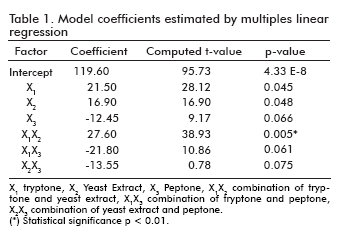
<body><![CDATA[<p><span lang=EN-US style='font-size:10.0pt;font-family:"Verdana","sans-serif"'>Three aeration conditions </span><span lang=EN-US style='font-size:10.0pt;font-family: "Verdana","sans-serif";color:windowtext'>(</span><span lang=EN-US style='font-size:10.0pt;font-family:"Verdana","sans-serif"'>0.5, 1.0, 1.5 vvm) in combination with three different agitation speeds </span><span lang=EN-US style='font-size:10.0pt;font-family:"Verdana","sans-serif";color:windowtext'>(</span><span lang=EN-US style='font-size:10.0pt;font-family:"Verdana","sans-serif"'>150 rpm, 275 rpm, 400 rpm), were selected for this study. A 3<sup>2</sup> factorial experimental design was used for the design of experimental and the resultant data analysis. </span></p>      <p><span lang=EN-US style='font-size:10.0pt;font-family:"Verdana","sans-serif"'>The data analysis was performed according to the 32 experimental design </span><span lang=EN-US style='font-size:10.0pt;font-family:"Verdana","sans-serif"; color:windowtext'>(</span><span lang=EN-US style='font-size:10.0pt;font-family: "Verdana","sans-serif"'>two independent factors: aeration rate and agitation speed, and three levels 0.5, 1.0 and 1.5 vvm), taking into account the P50 production and using the selected culture media from the 2<sup>3</sup> experimental design performed in bioreactors. </span></p>      <p><b><i><span lang=EN-US style='font-size:10.0pt;font-family:"Verdana","sans-serif"'>Conditions for P50 protein production at 4 L scale </span></i></b></p>      <p><span lang=EN-US style='font-size:10.0pt;font-family:"Verdana","sans-serif"'>The <i>Serratia marcescens </i>strain CMIB4202 was grown in 400 mL of tryptone soy broth medium from Oxoid </span><span lang=EN-US style='font-size:10.0pt; font-family:"Verdana","sans-serif";color:windowtext'>(</span><span lang=EN-US style='font-size:10.0pt;font-family:"Verdana","sans-serif"'>Basingstoke, Hampshire, England) in shake flasks </span><span lang=EN-US style='font-size: 10.0pt;font-family:"Verdana","sans-serif";color:windowtext'>(</span><span lang=EN-US style='font-size:10.0pt;font-family:"Verdana","sans-serif"'>New Brunswick Scientific Co., USA), at 28 ºC, 250 rpm for 5 h, which were used to inoculate the bioreactors. The culture media in bioreactors was composed by the minimal growth medium </span><span lang=EN-US style='font-size:10.0pt; font-family:"Verdana","sans-serif";color:windowtext'>(</span><span lang=EN-US style='font-size:10.0pt;font-family:"Verdana","sans-serif"'>MM) </span><span lang=EN-US style='font-size:10.0pt;font-family:"Verdana","sans-serif"; color:windowtext'>(</span><span lang=EN-US style='font-size:10.0pt;font-family: "Verdana","sans-serif"'>20) supplemented with 10 g tryptone/L, 10 g yeast extract/ L and 10 g glycerol/L. The fermentation process was carried out in 4 L bioreactors at 28 ºC, 400 rpm, and 0.5 vvm aeration rates. </span></p>      <p><b><i><span lang=EN-US style='font-size:10.0pt;font-family:"Verdana","sans-serif"'>Analysis </span></i></b></p>      <p><span lang=EN-US style='font-size:10.0pt;font-family:"Verdana","sans-serif"'>Cell concentrations were determined turbidometrically at 620nm </span><span lang=EN-US style='font-size:10.0pt;font-family:"Verdana","sans-serif"; color:windowtext'>(</span><span lang=EN-US style='font-size:10.0pt;font-family: "Verdana","sans-serif"'>Erma Optical Works, Japan). The expression level of proteins was determined by densitometry using the denaturing 12.5% SDS-PAGE </span><span lang=EN-US style='font-size:10.0pt;font-family:"Verdana","sans-serif"; color:windowtext'>(</span><span lang=EN-US style='font-size:10.0pt;font-family: "Verdana","sans-serif"'>21), and the resulting protein band patterns were quantified by densitometry </span><span lang=EN-US style='font-size:10.0pt; font-family:"Verdana","sans-serif";color:windowtext'>(</span><span lang=EN-US style='font-size:10.0pt;font-family:"Verdana","sans-serif"'>Molecular Analyst Package, BIORAD, USA). The protein concentration was determined by the modified method of Bradford </span><span lang=EN-US style='font-size:10.0pt;font-family: "Verdana","sans-serif";color:windowtext'>(</span><span lang=EN-US style='font-size:10.0pt;font-family:"Verdana","sans-serif"'>22). The immunodetection of P50 was performed by Western blot </span><span lang=EN-US style='font-size:10.0pt;font-family:"Verdana","sans-serif";color:windowtext'>(</span><span lang=EN-US style='font-size:10.0pt;font-family:"Verdana","sans-serif"'>23) using polyclonal antibodies generated in sheep, again hast the previously purified recombinant protein </span><span lang=EN-US style='font-size:10.0pt; font-family:"Verdana","sans-serif";color:windowtext'>(</span><span lang=EN-US style='font-size:10.0pt;font-family:"Verdana","sans-serif"'>Abrantes-Pérez MC, unpublished results). </span></p>      <p><b><span lang=EN-US style='font-family:"Verdana","sans-serif"'>RESULTS AND DISCUSSION </span></b></p>      <p><b><span lang=EN-US style='font-size:10.0pt;font-family:"Verdana","sans-serif"'>Influence of the culture supplement in the P50 production </span></b></p>      <p><span lang=EN-US style='font-size:10.0pt;font-family:"Verdana","sans-serif"'>The influence of tryptone, yeast extract and peptone as culture supplements for the P50 production, were studied. The optimal values of selected variables obtained by the regression equations and the calculated coefficients of the model are shown in </span><span style='font-size:10.0pt;font-family:"Verdana","sans-serif"'><a href="#tab1"><span lang=EN-US>table 1</span></a></span><span lang=EN-US style='font-size:10.0pt;font-family:"Verdana","sans-serif"'>. </span></p>      <p align=center style='text-align:center'><span style='font-size:13.5pt'><img border=0 width=342 height=237 src="/img/revistas/bta/v26n3/t0106309.gif"></span><a name=tab1></a></p>      
]]></body>
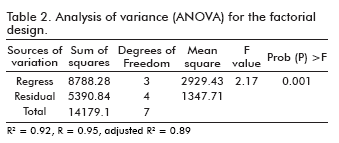
<body><![CDATA[<p><span lang=EN-US style='font-size:10.0pt;font-family:"Verdana","sans-serif"'>The significance of each coefficient was determined by student’s t-test and p values, which are listed in </span><span style='font-size:10.0pt;font-family: "Verdana","sans-serif"'><a href="#tab1"><span lang=EN-US>table 1</span></a></span><span lang=EN-US style='font-size:10.0pt;font-family:"Verdana","sans-serif"'>. The larger the magnitude of the t-value and the smaller the p-value, the more significant the corresponding coefficient </span><span lang=EN-US style='font-size:10.0pt;font-family:"Verdana","sans-serif";color:windowtext'>(</span><span lang=EN-US style='font-size:10.0pt;font-family:"Verdana","sans-serif"'>24). From the calculated values the combination of tryptone and yeast extract gave a direct relationship in the production of P50 protein. </span></p>      <p><span lang=EN-US style='font-size:10.0pt;font-family:"Verdana","sans-serif"'>The results of the analysis of variables </span><span lang=EN-US style='font-size: 10.0pt;font-family:"Verdana","sans-serif";color:windowtext'>(</span><span lang=EN-US style='font-size:10.0pt;font-family:"Verdana","sans-serif"'>ANOVA) for the factorial design are given in </span><span style='font-size:10.0pt; font-family:"Verdana","sans-serif"'><a href="#tab2"><span lang=EN-US>table 2</span></a></span><span lang=EN-US style='font-size:10.0pt;font-family:"Verdana","sans-serif"'>. The fisher F-test demonstrates a high significance for the regression model </span><span lang=EN-US style='font-size:10.0pt;font-family:"Verdana","sans-serif"; color:windowtext'>(</span><span lang=EN-US style='font-size:10.0pt;font-family: "Verdana","sans-serif"'>24). The goodness of fit of the model was checked by the determination coefficient </span><span lang=EN-US style='font-size:10.0pt; font-family:"Verdana","sans-serif";color:windowtext'>(</span><span lang=EN-US style='font-size:10.0pt;font-family:"Verdana","sans-serif"'>R<sup>2</sup>). In this case, the value of the determination coefficient </span><span lang=EN-US style='font-size:10.0pt;font-family:"Verdana","sans-serif";color:windowtext'>(</span><span lang=EN-US style='font-size:10.0pt;font-family:"Verdana","sans-serif"'>R<sup>2</sup>= 0.92) indicated that only 8% of the total variation are not explained by the model. The value of the adjusted determination coefficient </span><span lang=EN-US style='font-size:10.0pt;font-family:"Verdana","sans-serif"; color:windowtext'>(</span><span lang=EN-US style='font-size:10.0pt;font-family: "Verdana","sans-serif"'>adj.R<sup>2</sup>= 0.89) is also high, which indicates a high significance of the model </span><span lang=EN-US style='font-size:10.0pt; font-family:"Verdana","sans-serif";color:windowtext'>(</span><span lang=EN-US style='font-size:10.0pt;font-family:"Verdana","sans-serif"'>24, 25). A higher value of the correlation coefficient </span><span lang=EN-US style='font-size: 10.0pt;font-family:"Verdana","sans-serif";color:windowtext'>(</span><span lang=EN-US style='font-size:10.0pt;font-family:"Verdana","sans-serif"'>R= 0.95) signifies an excellent correlation between the independent variables. </span></p>      <p align=center style='text-align:center'><span style='font-size:13.5pt'><img border=0 width=339 height=143 src="/img/revistas/bta/v26n3/t0206309.gif"></span><a name=tab2></a></p>      
<p><span lang=EN-US style='font-size:10.0pt;font-family:"Verdana","sans-serif"'>The application of the methodology </span><span lang=EN-US style='font-size:10.0pt; font-family:"Verdana","sans-serif";color:windowtext'>(</span><span lang=EN-US style='font-size:10.0pt;font-family:"Verdana","sans-serif"'>26, 27) yielded the following regression equation which is an empirical relationship between the test variables in coded units: </span></p>      <p><span style='font-size:10.0pt;font-family:"Verdana","sans-serif"'>Y<sub>1</sub> = 119.6 + 21.5 X<sub>1</sub> + 16.9 X<sub>2</sub> -12.45 X<sub>3 </sub>+ 7.6 X<sub>1</sub>X<sub>2</sub> – 21.8 X<sub>1</sub>X<sub>3</sub> – 13.55 X<sub>2</sub>X<sub>3 </sub></span></p>      <p><span lang=EN-US style='font-size:10.0pt;font-family:"Verdana","sans-serif"'>where: </span></p>      <p><span lang=EN-US style='font-size:10.0pt;font-family:"Verdana","sans-serif"'>Y<sub>1</sub>: is the response, which characterizes the P50 production. </span><span lang=EN-US style='font-size:13.5pt'>    <br> </span><span lang=EN-US style='font-size:10.0pt;font-family:"Verdana","sans-serif"'>X<sub>1</sub>: represents tryptone. </span><span lang=EN-US style='font-size:13.5pt'>    <br> </span><span lang=EN-US style='font-size:10.0pt;font-family:"Verdana","sans-serif"'>X<sub>2</sub>: represents the yeast extract. </span><span lang=EN-US style='font-size:13.5pt'>    <br> </span><span lang=EN-US style='font-size:10.0pt;font-family:"Verdana","sans-serif"'>X<sub>3</sub>: represents the peptone. </span><span lang=EN-US style='font-size:13.5pt'>    ]]></body>
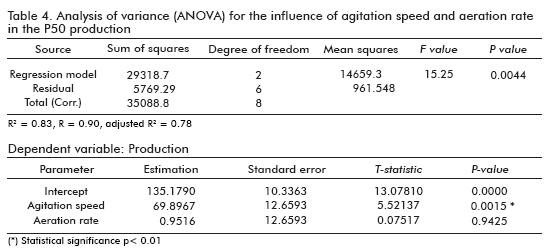
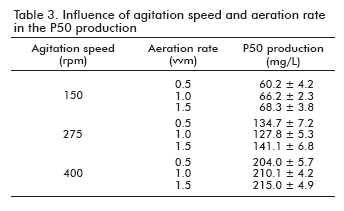
<body><![CDATA[<br> </span><span lang=EN-US style='font-size:10.0pt;font-family:"Verdana","sans-serif"'>X<sub>1</sub> X<sub>2</sub>: represents the combination of tryptone and yeast extract. </span><span lang=EN-US style='font-size:13.5pt'>    <br> </span><span lang=EN-US style='font-size:10.0pt;font-family:"Verdana","sans-serif"'>X<sub>1</sub> X<sub>3</sub>: represents the combination of tryptone and peptone. </span><span lang=EN-US style='font-size:13.5pt'>    <br> </span><span lang=EN-US style='font-size:10.0pt;font-family:"Verdana","sans-serif"'>X<sub>2</sub> X<sub>3</sub>: represents the combination of yeast extract and peptone. </span></p>      <p><span lang=EN-US style='font-size:10.0pt;font-family:"Verdana","sans-serif"'>The best values in cell growth and production of P50 protein were obtained for culture media contai ning tryptone and yeast extract. The values of expression levels for this protein were similar in this medium, when compared to that contained in its composition peptone and glycerol. </span></p>      <p><b><span lang=EN-US style='font-size:10.0pt;font-family:"Verdana","sans-serif"'>Influence of agitation speed and aeration rate in the P50 production </span></b></p>      <p><span lang=EN-US style='font-size:10.0pt;font-family:"Verdana","sans-serif"'>To study the influence of the aeration rate in the production of P50, a set of experiments were carried out in 4 L bioreactors, setting up the agitation speed and varying the aeration rate among 0.5 and 1.5 vvm. The results are shown in </span><span style='font-size:10.0pt;font-family:"Verdana","sans-serif"'><a href="#tab3"><span lang=EN-US>table 3</span></a></span><span lang=EN-US style='font-size:10.0pt; font-family:"Verdana","sans-serif"'>. As it can be observed, no influence of the aeration rate in the P50 production was detected, in spite of an increase of the P50 production as a global value, when the agitation speed was increased. </span></p>      <p align=center style='text-align:center'><span style='font-size:13.5pt'><img border=0 width=344 height=211 src="/img/revistas/bta/v26n3/t0306309.gif"></span><a name=tab3></a></p>      
<p><span lang=EN-US style='font-size:10.0pt;font-family:"Verdana","sans-serif"'>The results of the analysis </span><span lang=EN-US style='font-size:10.0pt; font-family:"Verdana","sans-serif";color:windowtext'>(</span><span lang=EN-US style='font-size:10.0pt;font-family:"Verdana","sans-serif"'>ANOVA) </span><span lang=EN-US style='font-size:10.0pt;font-family:"Verdana","sans-serif"; color:windowtext'>(</span><span lang=EN-US style='font-size:10.0pt;font-family: "Verdana","sans-serif"'>26) of variables over the P50 production gave us a statistical significant influence for the agitation speed </span><span lang=EN-US style='font-size:10.0pt;font-family:"Verdana","sans-serif"; color:windowtext'>(</span><span lang=EN-US style='font-size:10.0pt;font-family: "Verdana","sans-serif"'>p &lt; 0.0015), as shown in </span><span style='font-size:10.0pt;font-family:"Verdana","sans-serif"'><a href="#tab4"><span lang=EN-US>table 4</span></a></span><span lang=EN-US style='font-size:10.0pt; font-family:"Verdana","sans-serif"'>. However, this was not the case of the aeration rate, where no statistical significant difference was observed </span><span lang=EN-US style='font-size:10.0pt;font-family:"Verdana","sans-serif"; color:windowtext'>(</span><span lang=EN-US style='font-size:10.0pt;font-family: "Verdana","sans-serif"'>p &lt; 0.9425). This analysis of variance for the response variable, P50 production, revealed a very high significance for the regression equation </span><span lang=EN-US style='font-size:10.0pt;font-family: "Verdana","sans-serif";color:windowtext'>(</span><i><span lang=EN-US style='font-size:10.0pt;font-family:"Verdana","sans-serif"'>p <sub>model</sub> </span></i><span lang=EN-US style='font-size:10.0pt;font-family:"Verdana","sans-serif"'>&lt; 0.0044), which confirms the suitability of the linear model. The same results were obtained when the influence of such factors over the cell growth optical densities, were analyzed </span><span lang=EN-US style='font-size:10.0pt; font-family:"Verdana","sans-serif";color:windowtext'>(</span><span lang=EN-US style='font-size:10.0pt;font-family:"Verdana","sans-serif"'>data not shown). </span></p>      <p align=center style='text-align:center'><span style='font-size:13.5pt'><img border=0 width=550 height=251 src="/img/revistas/bta/v26n3/t0406309.gif"></span><a name=tab4></a></p>      
<p><b><span lang=EN-US style='font-size:10.0pt;font-family:"Verdana","sans-serif"'>Production of P50 protein from Serratia marcescens </span></b></p>      ]]></body>
<body><![CDATA[<p><span lang=EN-US style='font-size:10.0pt;font-family:"Verdana","sans-serif"'>The typical schematic fermentation process, for the production of P50 protein at 4 L scale is shown in </span><span style='font-size:10.0pt;font-family:"Verdana","sans-serif"'><a href="#fig1"><span lang=EN-US>figure 1</span></a></span><span lang=EN-US style='font-size:10.0pt;font-family:"Verdana","sans-serif"'>. The best conditions for the obtaining of the P50 protein were using 28 ºC, 400 rpm and 0.5 vvm. During the first 10 h of growth an increase in the optical density was observed. The maximum value of the specific growth rate was determined during the first 2 h of growth </span><span lang=EN-US style='font-size:10.0pt; font-family:"Verdana","sans-serif";color:windowtext'>(</span><span style='font-size:10.0pt;font-family:"Verdana","sans-serif"'>&#956;</span><span lang=EN-US style='font-size:10.0pt;font-family:"Verdana","sans-serif"'> = 1.2 h<sup>-1</sup>), being stabilized during the rest of the fermentation process at </span><span style='font-size:10.0pt;font-family:"Verdana","sans-serif"'>&#956;</span><span lang=EN-US style='font-size:10.0pt;font-family:"Verdana","sans-serif"'> = 0.2 h<sup>-1</sup>, when an increase in the expression of the P50 protein was detected. The P50 expression levels and the P50 protein production increased during the 10 h fermentation process, reaching the highest production level at this point. </span></p>      <p align=center style='text-align:center'><span style='font-size:13.5pt'><img border=0 width=563 height=530 src="/img/revistas/bta/v26n3/f0106309.gif"></span><a name=fig1></a></p>      
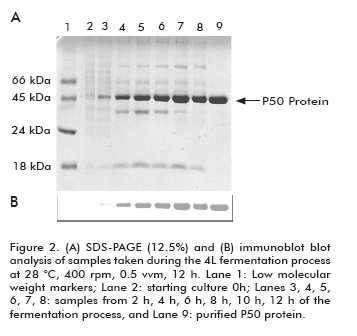
<p><span lang=EN-US style='font-size:10.0pt;font-family:"Verdana","sans-serif"'>At this scale, 9.0 ODu/mL, 62% level of P50 protein expression and 220 mg/L as volumetric production, were obtained. The biomass yield on substrate </span><span lang=EN-US style='font-size:10.0pt;font-family:"Verdana","sans-serif"; color:windowtext'>(</span><span lang=EN-US style='font-size:10.0pt;font-family: "Verdana","sans-serif"'>Y<sub>x/s</sub>) and the product yield on substrate </span><span lang=EN-US style='font-size:10.0pt;font-family:"Verdana","sans-serif"; color:windowtext'>(</span><span lang=EN-US style='font-size:10.0pt;font-family: "Verdana","sans-serif"'>Y<sub>p/s</sub>) values were 0.22 g biomass/g substrate and 0.002 g product/g substrate, respectively. Previously, it was reported that the maximum optical density obtained for the produc tion of P50 protein from <i>Serratia marcescens </i>was 2.0 ODu/mL </span><span lang=EN-US style='font-size:10.0pt; font-family:"Verdana","sans-serif";color:windowtext'>(</span><span lang=EN-US style='font-size:10.0pt;font-family:"Verdana","sans-serif"'>10). In our established conditions a four-fold increased of this parameter was obtained. </span></p>      <p><span lang=EN-US style='font-size:10.0pt;font-family:"Verdana","sans-serif"'>The same results were obtained when a comparison in the P50 production values, were performed. </span></p>      <p><span lang=EN-US style='font-size:10.0pt;font-family:"Verdana","sans-serif"'>The expression of P50 protein from <i>Serratia marcescens </i>is shown in </span><span style='font-size:10.0pt;font-family:"Verdana","sans-serif"'><a href="#fig2"><span lang=EN-US>figure 2</span></a></span><span lang=EN-US style='font-size:10.0pt; font-family:"Verdana","sans-serif"'>. As it can be observed, the P50 protein expression increased during the fermentation process. Immunochemistry analysis of P50 protein from <i>Serratia marcescens </i>obtained during the fermentation process indicated that in spite of the high level of expression, no degradation pattern was observed. As expected, a protein with approximately 50 kDa was obtained and immune-identified by the polyclonal antibodies generated against a previously purified P50 protein. </span></p>      <p align=center style='text-align:center'><span style='font-size:13.5pt'><img border=0 width=357 height=336 src="/img/revistas/bta/v26n3/f0206309.gif"></span><a name=fig2></a></p>      
<p><span lang=EN-US style='font-size:10.0pt;font-family:"Verdana","sans-serif"'>As a conclusion, a culture media for the P50 production from <i>Serratia marcescens </i>was defined. At the same time, a fermentation process in 4 L laboratory scale was implemented with a good rate of P50 production, having the singularity of no influence of the aeration rate over the P50 protein expression/production. This is the first report where the expression/ production of <i>S. marcescens </i>serralysin was studied. </span></p>      <p><b><span lang=EN-US style='font-family:"Verdana","sans-serif"'>ACKNOWLEDGEMENTS </span></b></p>      <p><span lang=EN-US style='font-size:10.0pt;font-family:"Verdana","sans-serif"'>We thank Lic. Elizabeth Díaz Lopez for her unconditional help in the preparation of this manuscript. </span></p>      <p><b><span lang=EN-US style='font-family:"Verdana","sans-serif"'>REFERENCES</span></b><b><span lang=EN-US style='font-size:10.0pt;font-family:"Verdana","sans-serif"'> </span></b></p>      ]]></body>
<body><![CDATA[<!-- ref --><p><span lang=EN-US style='font-size:10.0pt;font-family:"Verdana","sans-serif"'>1. Goullet P, Picard B. An epidemiological study of Serratia marcescens isolates from nosocomial infections by enzyme electrophoresis. J Med Microbiol</span><span lang=EN-US style='font-size:11.0pt;font-family:"Arial","sans-serif";color:red'> </span><span lang=EN-US style='font-size:10.0pt;font-family:"Verdana","sans-serif"'>1997;46:1019-28.</span><span lang=EN-US style='font-size:11.0pt;font-family:"Arial","sans-serif";color:blue'> </span><!-- ref --><p><span lang=EN-US style='font-size:10.0pt;font-family:"Verdana","sans-serif"'>2. Hejazi A, Keane CT, Falkiner FR. The use of RAPD-PCR as a typing method for <i>Serratia marcescens</i>. J Med Microbiol</span><span lang=EN-US style='font-size:11.0pt; font-family:"Arial","sans-serif";color:red'> </span><span lang=EN-US style='font-size:10.0pt;font-family:"Verdana","sans-serif"'>1997;46:913-19.</span><span lang=EN-US style='font-size:11.0pt;font-family:"Arial","sans-serif";color:blue'> </span><!-- ref --><p><span lang=EN-US style='font-size:10.0pt;font-family:"Verdana","sans-serif"'>3. Yu VL. Serratia marcescens: historical perspective and clinical review. N Engl J Med 1979;300:887-93. </span><!-- ref --><p><span lang=EN-US style='font-size:10.0pt;font-family:"Verdana","sans-serif"'>4. Aucken HM, Pitt TL. Antibiotic resistance and putative virulence factors of Serratia marcescens with respect to O and K serotypes. J Med Microbiol</span><span lang=EN-US style='font-size:11.0pt;font-family:"Arial","sans-serif";color:red'> </span><span lang=EN-US style='font-size:10.0pt;font-family:"Verdana","sans-serif"'>1998;47:1105-13.</span><span lang=EN-US style='font-size:11.0pt;font-family:"Arial","sans-serif";color:blue'> </span><!-- ref --><p><span lang=EN-US style='font-size:10.0pt;font-family:"Verdana","sans-serif"'>5. Hines DA, Saurugger PN, Ihler GM, Benedik MJ. Genetic analysis of extracellular proteins of Serratia marcescens. J Bacteriol</span><span lang=EN-US style='font-size:11.0pt;font-family:"Arial","sans-serif";color:red'> </span><span lang=EN-US style='font-size:10.0pt;font-family:"Verdana","sans-serif"'>1988;170:4141-46.</span><span lang=EN-US style='font-size:11.0pt;font-family:"Arial","sans-serif";color:blue'> </span><!-- ref --><p><span lang=EN-US style='font-size:10.0pt;font-family:"Verdana","sans-serif"'>6. Maeda H. Role of microbial proteases in pathogenesis. Microbiol Immunol</span><span lang=EN-US style='font-size:11.0pt;font-family:"Arial","sans-serif";color:red'> </span><span lang=EN-US style='font-size:10.0pt;font-family:"Verdana","sans-serif"'>1996;40:685-99.</span><span lang=EN-US style='font-size:11.0pt;font-family:"Arial","sans-serif";color:blue'> </span><!-- ref --><p><span lang=EN-US style='font-size:10.0pt;font-family:"Verdana","sans-serif"'>7. Matsumoto K, Yamamoto T, Kamata R, Maeda H. Pathogenesis of serratial infection: activation of the Hageman factor prekallikrein cascade by serratial protease. J Biochem</span><span lang=EN-US style='font-size:11.0pt;font-family: "Arial","sans-serif";color:red'> </span><span lang=EN-US style='font-size:10.0pt; font-family:"Verdana","sans-serif"'>1984;96:739-49.</span><span lang=EN-US style='font-size:11.0pt;font-family:"Arial","sans-serif";color:blue'> </span><!-- ref --><p><span lang=EN-US style='font-size:10.0pt;font-family:"Verdana","sans-serif"'>8. Maeda H, Molla A. Pathogenic potentials of bacterial proteases. Clin Chim Acta</span><span lang=EN-US style='font-size:11.0pt;font-family:"Arial","sans-serif";color:red'> </span><span lang=EN-US style='font-size:10.0pt;font-family:"Verdana","sans-serif"'>1989;185:357-67.</span><span lang=EN-US style='font-size:11.0pt;font-family:"Arial","sans-serif";color:blue'> </span><!-- ref --><p><span lang=EN-US style='font-size:10.0pt;font-family:"Verdana","sans-serif"'>9. Kamata R, Matsumoto K, Okamura R, Yamamoto T, Maeda H. The serratial 56K protease as a major pathogenic factor in serratial keratitis. Clinical and experimental study. Ophthalmology</span><span lang=EN-US style='font-size:11.0pt; font-family:"Arial","sans-serif";color:red'> </span><span lang=EN-US style='font-size:10.0pt;font-family:"Verdana","sans-serif"'>1985;92:1452-59.</span><span lang=EN-US style='font-size:11.0pt;font-family:"Arial","sans-serif";color:blue'> </span><!-- ref --><p><span lang=EN-US style='font-size:10.0pt;font-family:"Verdana","sans-serif"'>10. Abrahantes-Pérez MC, Reyes-González J, Veliz RG, Bequet-Romero M, Gómez RR, Anais GC, et al. Cytotoxic proteins combined with prodigiosin obtained from Serratia marcescens have both broad and selective cytotoxic activity on tumor cells. J Chemother</span><span lang=EN-US style='font-size:11.0pt;font-family: "Arial","sans-serif";color:red'> </span><span lang=EN-US style='font-size:10.0pt; font-family:"Verdana","sans-serif"'>2006;18:172-81.</span><span lang=EN-US style='font-size:11.0pt;font-family:"Arial","sans-serif";color:blue'> </span><!-- ref --><p><span lang=EN-US style='font-size:10.0pt;font-family:"Verdana","sans-serif"'>11. Wu J, Akaike T, Hayashida K, Okamoto T, Okuyama A, Maeda H. Enhanced vascular permeability in solid tumor involving peroxynitrite and matrix metalloproteinase. Jpn J Cancer Res</span><span lang=EN-US style='font-size: 11.0pt;font-family:"Arial","sans-serif";color:red'> </span><span lang=EN-US style='font-size:10.0pt;font-family:"Verdana","sans-serif"'>2001;92:439-51.</span><span lang=EN-US style='font-size:11.0pt;font-family:"Arial","sans-serif";color:blue'> </span><!-- ref --><p><span lang=EN-US style='font-size:10.0pt;font-family:"Verdana","sans-serif"'>12. Marty KB, Williams CL, Guynn LJ, Benedik MJ, Blanke SR. Characterization of a cytotoxic factor in culture filtrates of <i>Serratia marcescens</i>. Infect Immun</span><span lang=EN-US style='font-size:11.0pt;font-family:"Arial","sans-serif"; color:red'> </span><span lang=EN-US style='font-size:10.0pt;font-family:"Verdana","sans-serif"'>2002;70:1121-28.</span><span lang=EN-US style='font-size:11.0pt;font-family:"Arial","sans-serif";color:blue'> </span><!-- ref --><p><span lang=EN-US style='font-size:10.0pt;font-family:"Verdana","sans-serif"'>13. Carbonell GV, Amorim CR, Furumura MT, Darini ALC, Fonseca BAL, Yano T. Biological activity of <i>Serratia marcescens</i> cytotoxin. J Med Biol Res</span><span lang=EN-US style='font-size:11.0pt;font-family:"Arial","sans-serif";color:red'> </span><span lang=EN-US style='font-size:10.0pt;font-family:"Verdana","sans-serif"'>2003;36:351-59.</span><span lang=EN-US style='font-size:11.0pt;font-family:"Arial","sans-serif";color:blue'> </span><!-- ref --><p><span lang=EN-US style='font-size:10.0pt;font-family:"Verdana","sans-serif"'>14. Carbonel GV, Falcon R, Yamada AT, da Fonseca BA, Yano T. Morphological and intracellular alterations induced by <i>Serratia marcescens</i> cytotoxin. Res Microbiol</span><span lang=EN-US style='font-size:11.0pt;font-family:"Arial","sans-serif"; color:red'> </span><span lang=EN-US style='font-size:10.0pt;font-family:"Verdana","sans-serif"'>2004;155:25-30.</span><p><span lang=EN-US style='font-size:10.0pt;font-family:"Verdana","sans-serif"'>15. Chakrabarty AM. Microorganisms and cancer: quest for a therapy. J Bacteriol</span><span lang=EN-US style='font-size:11.0pt;font-family:"Arial","sans-serif";color:red'> </span><span lang=EN-US style='font-size:10.0pt;font-family:"Verdana","sans-serif"'>2003;185:</span><span lang=EN-US style='font-size:11.0pt;font-family:"Arial","sans-serif";color:blue'> </span><span lang=EN-US style='font-size:10.0pt;font-family:"Verdana","sans-serif"'>683-86. </span></p>      <!-- ref --><p><span style='font-size:10.0pt;font-family:"Verdana","sans-serif"'>16. Escobar MM, Carbonell GV, Beriam LOS, Siquiera WJ, Yano T. Cytotoxin production in phytopathogenic and entomopathogenic Serratia marcescens. Rev Latinoam Microbiol</span><span style='font-size:11.0pt;font-family:"Arial","sans-serif"; color:red'> </span><span style='font-size:10.0pt;font-family:"Verdana","sans-serif"'>2001;43:165-70.</span><span style='font-size:11.0pt;font-family:"Arial","sans-serif";color:blue'> </span><!-- ref --><p><span lang=EN-US style='font-size:10.0pt;font-family:"Verdana","sans-serif"'>17. Kida Y, Inoue H, Shimizu T, Kuwano K. <i>Serratia marcescens</i> serralysin induces inflammatory responses through protease-activated receptor 2. Infect Immun</span><span lang=EN-US style='font-size:11.0pt;font-family:"Arial","sans-serif"; color:red'> </span><span lang=EN-US style='font-size:10.0pt;font-family:"Verdana","sans-serif"'>2007;75:164-74.</span><!-- ref --><p class=MsoNormal><span lang=EN-US style='font-size:10.0pt;font-family:"Verdana","sans-serif"'>18.</span><span lang=EN-US style='font-family:"Arial","sans-serif";color:teal'> </span><span lang=EN-US style='font-size:10.0pt;font-family:"Verdana","sans-serif"'>Kirsop BE, Snell JS. Maintenance of Microorganisms. A Manual of Laboratory Methods. Harcourt Brace Jovanovich, Publishers, Academic Press, Inc </span><span lang=EN-US style='font-size:10.0pt;font-family:"Verdana","sans-serif"; color:windowtext'>(</span><span lang=EN-US style='font-size:10.0pt;font-family: "Verdana","sans-serif"'>London) LTD 1984</span><span lang=EN-GB style='font-size:10.0pt;font-family:"Verdana","sans-serif"'>.</span><p class=MsoNormal><span lang=EN-GB style='font-family:"Arial","sans-serif"; color:navy'>&nbsp;</span></p>      <!-- ref --><p class=MsoNormal><span lang=EN-US style='font-size:10.0pt;font-family:"Verdana","sans-serif"'>19. Montgomery DC. Design and Analysis of Experiments. John Wiley &amp; Sons </span><span lang=EN-US style='font-size:10.0pt;font-family:"Verdana","sans-serif"; color:windowtext'>(</span><span lang=EN-US style='font-size:10.0pt;font-family: "Verdana","sans-serif"'>3rd edition), New York 1991</span><span lang=EN-GB style='font-size:10.0pt;font-family:"Verdana","sans-serif"'>.</span><p class=MsoNormal><span lang=SV style='font-family:"Arial","sans-serif"; color:navy'>&nbsp;</span></p>      <!-- ref --><p class=MsoNormal><span lang=EN-US style='font-size:10.0pt;font-family:"Verdana","sans-serif"'>20. Sambrook J, Fritsch E, Maniatis T. Molecular Cloning: A Laboratory Manual. Cold Spring Harbor Laboratory Press, New York 1989</span><span lang=EN-GB style='font-size:10.0pt;font-family:"Verdana","sans-serif"'>.</span><!-- ref --><p><span lang=EN-US style='font-size:10.0pt;font-family:"Verdana","sans-serif"'>21. Laemmli UK. Cleavage of structural proteins during the assembly of the head of bacteriophage T4. Nature</span><span lang=EN-US style='font-size:11.0pt; font-family:"Arial","sans-serif";color:red'> </span><span lang=EN-US style='font-size:10.0pt;font-family:"Verdana","sans-serif"'>1970;227:680-5.</span><span lang=EN-US style='font-size:11.0pt;font-family:"Arial","sans-serif";color:blue'> </span><!-- ref --><p><span lang=EN-US style='font-size:10.0pt;font-family:"Verdana","sans-serif"'>22. Zor T, Selinger Z. Linearization of the Bradford protein assay increases its sensitivity: theoretical and experimental studies. Anal Biochem</span><span lang=EN-US style='font-size:11.0pt;font-family:"Arial","sans-serif";color:red'> </span><span lang=EN-US style='font-size:10.0pt;font-family:"Verdana","sans-serif"'>1996;236:302-8.</span><span lang=EN-US style='font-size:11.0pt;font-family:"Arial","sans-serif";color:blue'> </span><!-- ref --><p><span lang=EN-US style='font-size:10.0pt;font-family:"Verdana","sans-serif"'>23. Musacchio A, Carmenate T, Delgado M, Gonzalez S. Recombinant Opc meningococcal protein, folded in vitro, elicits bactericidal antibodies after immunization. Vaccine</span><span lang=EN-US style='font-size:11.0pt;font-family:"Arial","sans-serif"; color:red'> </span><span lang=EN-US style='font-size:10.0pt;font-family:"Verdana","sans-serif"'>1997;15:751-8.</span><!-- ref --><p><span lang=EN-US style='font-size:10.0pt;font-family:"Verdana","sans-serif"'>24. Akhnazarova S, Kafarov V. Experiment optimization in chemistry and chemical engineering. Mir Publications Moscow 1982</span><span lang=EN-GB style='font-size:10.0pt;font-family:"Verdana","sans-serif"'>. </span><!-- ref --><p><span lang=EN-US style='font-size:10.0pt;font-family:"Verdana","sans-serif"'>25. Khuri AI, Cornell JA. Response surfaces: Design and analysis. Marcel Dekker, Inc., New York &nbsp;1987</span><span lang=EN-GB style='font-size:10.0pt; font-family:"Verdana","sans-serif"'>. </span><!-- ref --><p><span lang=EN-US style='font-size:10.0pt;font-family:"Verdana","sans-serif"'>26. Box GEP, Wilson KB. On the experimental attainment of optimum condition. J Roy Stat Soc</span><span lang=EN-US style='font-size:11.0pt;font-family:"Arial","sans-serif"; color:red'> </span><span lang=EN-US style='font-size:10.0pt;font-family:"Verdana","sans-serif"'>1951;B13:1-45.</span><span lang=EN-US style='font-size:11.0pt;font-family:"Arial","sans-serif";color:blue'> </span><!-- ref --><p><span lang=EN-US style='font-size:10.0pt;font-family:"Verdana","sans-serif"'>27. Kenneth WY, Mak Miranda GS, Yap Wah Koon T. Formulation and optimization of two culture media for the production of tumor necrosis factor-b in <i>Escherichia coli</i>. J Chem Tech Biotechnol</span><span lang=EN-US style='font-size:11.0pt; font-family:"Arial","sans-serif";color:red'> </span><span lang=EN-US style='font-size:10.0pt;font-family:"Verdana","sans-serif"'>1995;62:289-94.</span><span lang=EN-US style='font-size:11.0pt;font-family:"Arial","sans-serif";color:green'> </span><p><span lang=EN-US style='font-size:13.5pt'>&nbsp;</span></p>      ]]></body>
<body><![CDATA[<p><span lang=EN-US style='font-size:10.0pt;font-family:"Verdana","sans-serif"'>Received in July, 2009.    <br> Accepted for publication in September, 2009.</span><span lang=EN-US style='font-size:11.0pt;font-family:"Arial","sans-serif";color:red'> </span></p>      <p><span lang=EN-US style='font-size:10.0pt;font-family:"Verdana","sans-serif"'>Raúl Espinosa. Biotechnology Development Direction. Center for Genetic Engineering and Biotechnology, CIGB. Ave. 31 / 158 and 190, Cubanacán, Playa, PO Box 6162, Havana, Cuba. E-mail: </span><span style='font-size:10.0pt;font-family:"Verdana","sans-serif"'><a href="mailto:raul.espinosa@cigb.edu.cu"><span lang=EN-US>raul.espinosa@cigb.edu.cu</span></a></span><span style='font-size:11.0pt;font-family:"Arial","sans-serif";color:#FF6600'> </span></p>      <p><span lang=EN-US style='font-size:13.5pt'>&nbsp;</span></p>  </div>  </div>       ]]></body><back>
<ref-list>
<ref id="B1">
<label>1</label><nlm-citation citation-type="journal">
<person-group person-group-type="author">
<name>
<surname><![CDATA[Goullet]]></surname>
<given-names><![CDATA[P]]></given-names>
</name>
<name>
<surname><![CDATA[Picard]]></surname>
<given-names><![CDATA[B]]></given-names>
</name>
</person-group>
<article-title xml:lang="en"><![CDATA[An epidemiological study of Serratia marcescens isolates from nosocomial infections by enzyme electrophoresis]]></article-title>
<source><![CDATA[J Med Microbiol]]></source>
<year>1997</year>
<volume>46</volume>
<page-range>1019-28</page-range></nlm-citation>
</ref>
<ref id="B2">
<label>2</label><nlm-citation citation-type="journal">
<person-group person-group-type="author">
<name>
<surname><![CDATA[Hejazi]]></surname>
<given-names><![CDATA[A]]></given-names>
</name>
<name>
<surname><![CDATA[Keane]]></surname>
<given-names><![CDATA[CT]]></given-names>
</name>
<name>
<surname><![CDATA[Falkiner]]></surname>
<given-names><![CDATA[FR]]></given-names>
</name>
</person-group>
<article-title xml:lang="en"><![CDATA[The use of RAPD-PCR as a typing method for Serratia marcescens]]></article-title>
<source><![CDATA[J Med Microbiol]]></source>
<year>1997</year>
<volume>46</volume>
<page-range>913-19</page-range></nlm-citation>
</ref>
<ref id="B3">
<label>3</label><nlm-citation citation-type="journal">
<person-group person-group-type="author">
<name>
<surname><![CDATA[Yu]]></surname>
<given-names><![CDATA[VL]]></given-names>
</name>
</person-group>
<article-title xml:lang="en"><![CDATA[Serratia marcescens: historical perspective and clinical review]]></article-title>
<source><![CDATA[N Engl J Med]]></source>
<year>1979</year>
<volume>300</volume>
<page-range>887-93</page-range></nlm-citation>
</ref>
<ref id="B4">
<label>4</label><nlm-citation citation-type="journal">
<person-group person-group-type="author">
<name>
<surname><![CDATA[Aucken]]></surname>
<given-names><![CDATA[HM]]></given-names>
</name>
<name>
<surname><![CDATA[Pitt]]></surname>
<given-names><![CDATA[TL]]></given-names>
</name>
</person-group>
<article-title xml:lang="en"><![CDATA[Antibiotic resistance and putative virulence factors of Serratia marcescens with respect to O and K serotypes]]></article-title>
<source><![CDATA[J Med Microbiol]]></source>
<year>1998</year>
<volume>47</volume>
<page-range>1105-13</page-range></nlm-citation>
</ref>
<ref id="B5">
<label>5</label><nlm-citation citation-type="journal">
<person-group person-group-type="author">
<name>
<surname><![CDATA[Hines]]></surname>
<given-names><![CDATA[DA]]></given-names>
</name>
<name>
<surname><![CDATA[Saurugger]]></surname>
<given-names><![CDATA[PN]]></given-names>
</name>
<name>
<surname><![CDATA[Ihler]]></surname>
<given-names><![CDATA[GM]]></given-names>
</name>
<name>
<surname><![CDATA[Benedik]]></surname>
<given-names><![CDATA[MJ]]></given-names>
</name>
</person-group>
<article-title xml:lang="en"><![CDATA[Genetic analysis of extracellular proteins of Serratia marcescens]]></article-title>
<source><![CDATA[J Bacteriol]]></source>
<year>1988</year>
<volume>170</volume>
<page-range>4141-46</page-range></nlm-citation>
</ref>
<ref id="B6">
<label>6</label><nlm-citation citation-type="journal">
<person-group person-group-type="author">
<name>
<surname><![CDATA[Maeda]]></surname>
<given-names><![CDATA[H]]></given-names>
</name>
</person-group>
<article-title xml:lang="en"><![CDATA[Role of microbial proteases in pathogenesis]]></article-title>
<source><![CDATA[Microbiol Immunol]]></source>
<year>1996</year>
<volume>40</volume>
<page-range>685-99</page-range></nlm-citation>
</ref>
<ref id="B7">
<label>7</label><nlm-citation citation-type="journal">
<person-group person-group-type="author">
<name>
<surname><![CDATA[Matsumoto]]></surname>
<given-names><![CDATA[K]]></given-names>
</name>
<name>
<surname><![CDATA[Yamamoto]]></surname>
<given-names><![CDATA[T]]></given-names>
</name>
<name>
<surname><![CDATA[Kamata]]></surname>
<given-names><![CDATA[R]]></given-names>
</name>
<name>
<surname><![CDATA[Maeda]]></surname>
<given-names><![CDATA[H]]></given-names>
</name>
</person-group>
<article-title xml:lang="en"><![CDATA[Pathogenesis of serratial infection: activation of the Hageman factor prekallikrein cascade by serratial protease]]></article-title>
<source><![CDATA[J Biochem]]></source>
<year>1984</year>
<volume>96</volume>
<page-range>739-49</page-range></nlm-citation>
</ref>
<ref id="B8">
<label>8</label><nlm-citation citation-type="journal">
<person-group person-group-type="author">
<name>
<surname><![CDATA[Maeda]]></surname>
<given-names><![CDATA[H]]></given-names>
</name>
<name>
<surname><![CDATA[Molla]]></surname>
<given-names><![CDATA[A]]></given-names>
</name>
</person-group>
<article-title xml:lang="en"><![CDATA[Pathogenic potentials of bacterial proteases]]></article-title>
<source><![CDATA[Clin Chim Acta]]></source>
<year>1989</year>
<volume>185</volume>
<page-range>357-67</page-range></nlm-citation>
</ref>
<ref id="B9">
<label>9</label><nlm-citation citation-type="journal">
<person-group person-group-type="author">
<name>
<surname><![CDATA[Kamata]]></surname>
<given-names><![CDATA[R]]></given-names>
</name>
<name>
<surname><![CDATA[Matsumoto]]></surname>
<given-names><![CDATA[K]]></given-names>
</name>
<name>
<surname><![CDATA[Okamura]]></surname>
<given-names><![CDATA[R]]></given-names>
</name>
<name>
<surname><![CDATA[Yamamoto]]></surname>
<given-names><![CDATA[T]]></given-names>
</name>
<name>
<surname><![CDATA[Maeda]]></surname>
<given-names><![CDATA[H]]></given-names>
</name>
</person-group>
<article-title xml:lang=""><![CDATA[The serratial 56K protease as a major pathogenic factor in serratial keratitis: Clinical and experimental study]]></article-title>
<source><![CDATA[Ophthalmology]]></source>
<year>1985</year>
<volume>92</volume>
<page-range>1452-59</page-range></nlm-citation>
</ref>
<ref id="B10">
<label>10</label><nlm-citation citation-type="journal">
<person-group person-group-type="author">
<name>
<surname><![CDATA[Abrahantes-Pérez]]></surname>
<given-names><![CDATA[MC]]></given-names>
</name>
<name>
<surname><![CDATA[Reyes-González]]></surname>
<given-names><![CDATA[J]]></given-names>
</name>
<name>
<surname><![CDATA[Veliz]]></surname>
<given-names><![CDATA[RG]]></given-names>
</name>
<name>
<surname><![CDATA[Bequet-Romero]]></surname>
<given-names><![CDATA[M]]></given-names>
</name>
<name>
<surname><![CDATA[Gómez]]></surname>
<given-names><![CDATA[RR]]></given-names>
</name>
<name>
<surname><![CDATA[Anais]]></surname>
<given-names><![CDATA[GC]]></given-names>
</name>
</person-group>
<article-title xml:lang="en"><![CDATA[Cytotoxic proteins combined with prodigiosin obtained from Serratia marcescens have both broad and selective cytotoxic activity on tumor cells]]></article-title>
<source><![CDATA[J Chemother]]></source>
<year>2006</year>
<volume>18</volume>
<page-range>172-81</page-range></nlm-citation>
</ref>
<ref id="B11">
<label>11</label><nlm-citation citation-type="journal">
<person-group person-group-type="author">
<name>
<surname><![CDATA[Wu]]></surname>
<given-names><![CDATA[J]]></given-names>
</name>
<name>
<surname><![CDATA[Akaike]]></surname>
<given-names><![CDATA[T]]></given-names>
</name>
<name>
<surname><![CDATA[Hayashida]]></surname>
<given-names><![CDATA[K]]></given-names>
</name>
<name>
<surname><![CDATA[Okamoto]]></surname>
<given-names><![CDATA[T]]></given-names>
</name>
<name>
<surname><![CDATA[Okuyama]]></surname>
<given-names><![CDATA[A]]></given-names>
</name>
<name>
<surname><![CDATA[Maeda]]></surname>
<given-names><![CDATA[H]]></given-names>
</name>
</person-group>
<article-title xml:lang="en"><![CDATA[Enhanced vascular permeability in solid tumor involving peroxynitrite and matrix metalloproteinase]]></article-title>
<source><![CDATA[Jpn J Cancer Res]]></source>
<year>2001</year>
<volume>92</volume>
<page-range>439-51</page-range></nlm-citation>
</ref>
<ref id="B12">
<label>12</label><nlm-citation citation-type="journal">
<person-group person-group-type="author">
<name>
<surname><![CDATA[Marty]]></surname>
<given-names><![CDATA[KB]]></given-names>
</name>
<name>
<surname><![CDATA[Williams]]></surname>
<given-names><![CDATA[CL]]></given-names>
</name>
<name>
<surname><![CDATA[Guynn]]></surname>
<given-names><![CDATA[LJ]]></given-names>
</name>
<name>
<surname><![CDATA[Benedik]]></surname>
<given-names><![CDATA[MJ]]></given-names>
</name>
<name>
<surname><![CDATA[Blanke]]></surname>
<given-names><![CDATA[SR]]></given-names>
</name>
</person-group>
<article-title xml:lang="en"><![CDATA[Characterization of a cytotoxic factor in culture filtrates of Serratia marcescens]]></article-title>
<source><![CDATA[Infect Immun]]></source>
<year>2002</year>
<volume>70</volume>
<page-range>1121-28</page-range></nlm-citation>
</ref>
<ref id="B13">
<label>13</label><nlm-citation citation-type="journal">
<person-group person-group-type="author">
<name>
<surname><![CDATA[Carbonell]]></surname>
<given-names><![CDATA[GV]]></given-names>
</name>
<name>
<surname><![CDATA[Amorim]]></surname>
<given-names><![CDATA[CR]]></given-names>
</name>
<name>
<surname><![CDATA[Furumura]]></surname>
<given-names><![CDATA[MT]]></given-names>
</name>
<name>
<surname><![CDATA[Darini]]></surname>
<given-names><![CDATA[ALC]]></given-names>
</name>
<name>
<surname><![CDATA[Fonseca]]></surname>
<given-names><![CDATA[BAL]]></given-names>
</name>
<name>
<surname><![CDATA[Yano]]></surname>
<given-names><![CDATA[T]]></given-names>
</name>
</person-group>
<article-title xml:lang="en"><![CDATA[Biological activity of Serratia marcescens cytotoxin]]></article-title>
<source><![CDATA[J Med Biol Res]]></source>
<year>2003</year>
<volume>36</volume>
<page-range>351-59</page-range></nlm-citation>
</ref>
<ref id="B14">
<label>14</label><nlm-citation citation-type="journal">
<person-group person-group-type="author">
<name>
<surname><![CDATA[Carbonel]]></surname>
<given-names><![CDATA[GV]]></given-names>
</name>
<name>
<surname><![CDATA[Falcon]]></surname>
<given-names><![CDATA[R]]></given-names>
</name>
<name>
<surname><![CDATA[Yamada]]></surname>
<given-names><![CDATA[AT]]></given-names>
</name>
<name>
<surname><![CDATA[da Fonseca]]></surname>
<given-names><![CDATA[BA]]></given-names>
</name>
<name>
<surname><![CDATA[Yano]]></surname>
<given-names><![CDATA[T]]></given-names>
</name>
</person-group>
<article-title xml:lang="en"><![CDATA[Morphological and intracellular alterations induced by Serratia marcescens cytotoxin]]></article-title>
<source><![CDATA[Res Microbiol]]></source>
<year>2004</year>
<volume>155</volume>
<page-range>25-30</page-range></nlm-citation>
</ref>
<ref id="B15">
<label>15</label><nlm-citation citation-type="journal">
<person-group person-group-type="author">
<name>
<surname><![CDATA[Chakrabarty]]></surname>
<given-names><![CDATA[AM]]></given-names>
</name>
</person-group>
<article-title xml:lang="en"><![CDATA[Microorganisms and cancer: quest for a therapy]]></article-title>
<source><![CDATA[J Bacteriol]]></source>
<year>2003</year>
<volume>185</volume>
<page-range>2683-86</page-range></nlm-citation>
</ref>
<ref id="B16">
<label>16</label><nlm-citation citation-type="journal">
<person-group person-group-type="author">
<name>
<surname><![CDATA[Escobar]]></surname>
<given-names><![CDATA[MM]]></given-names>
</name>
<name>
<surname><![CDATA[Carbonell]]></surname>
<given-names><![CDATA[GV]]></given-names>
</name>
<name>
<surname><![CDATA[Beriam]]></surname>
<given-names><![CDATA[LOS]]></given-names>
</name>
<name>
<surname><![CDATA[Siquiera]]></surname>
<given-names><![CDATA[WJ]]></given-names>
</name>
<name>
<surname><![CDATA[Yano]]></surname>
<given-names><![CDATA[T]]></given-names>
</name>
</person-group>
<article-title xml:lang="en"><![CDATA[Cytotoxin production in phytopathogenic and entomopathogenic Serratia marcescens]]></article-title>
<source><![CDATA[Rev Latinoam Microbiol]]></source>
<year>2001</year>
<volume>43</volume>
<page-range>165-70</page-range></nlm-citation>
</ref>
<ref id="B17">
<label>17</label><nlm-citation citation-type="journal">
<person-group person-group-type="author">
<name>
<surname><![CDATA[Kida]]></surname>
<given-names><![CDATA[Y]]></given-names>
</name>
<name>
<surname><![CDATA[Inoue]]></surname>
<given-names><![CDATA[H]]></given-names>
</name>
<name>
<surname><![CDATA[Shimizu]]></surname>
<given-names><![CDATA[T]]></given-names>
</name>
<name>
<surname><![CDATA[Kuwano]]></surname>
<given-names><![CDATA[K]]></given-names>
</name>
</person-group>
<article-title xml:lang="en"><![CDATA[Serratia marcescens serralysin induces inflammatory responses through protease-activated receptor 2]]></article-title>
<source><![CDATA[Infect Immun]]></source>
<year>2007</year>
<volume>75</volume>
<page-range>164-74</page-range></nlm-citation>
</ref>
<ref id="B18">
<label>18</label><nlm-citation citation-type="book">
<person-group person-group-type="author">
<name>
<surname><![CDATA[Kirsop]]></surname>
<given-names><![CDATA[BE]]></given-names>
</name>
<name>
<surname><![CDATA[Snell]]></surname>
<given-names><![CDATA[JS]]></given-names>
</name>
</person-group>
<source><![CDATA[Maintenance of Microorganisms: A Manual of Laboratory Methods]]></source>
<year>1984</year>
<publisher-loc><![CDATA[London ]]></publisher-loc>
<publisher-name><![CDATA[Academic Press, Inc]]></publisher-name>
</nlm-citation>
</ref>
<ref id="B19">
<label>19</label><nlm-citation citation-type="book">
<person-group person-group-type="author">
<name>
<surname><![CDATA[Montgomery]]></surname>
<given-names><![CDATA[DC]]></given-names>
</name>
</person-group>
<source><![CDATA[Design and Analysis of Experiments]]></source>
<year>1991</year>
<edition>3</edition>
<publisher-loc><![CDATA[New York ]]></publisher-loc>
<publisher-name><![CDATA[John Wiley & Sons]]></publisher-name>
</nlm-citation>
</ref>
<ref id="B20">
<label>20</label><nlm-citation citation-type="book">
<person-group person-group-type="author">
<name>
<surname><![CDATA[Sambrook]]></surname>
<given-names><![CDATA[J]]></given-names>
</name>
<name>
<surname><![CDATA[Fritsch]]></surname>
<given-names><![CDATA[E]]></given-names>
</name>
<name>
<surname><![CDATA[Maniatis]]></surname>
<given-names><![CDATA[T]]></given-names>
</name>
</person-group>
<source><![CDATA[Molecular Cloning: A Laboratory Manual]]></source>
<year>1989</year>
<publisher-loc><![CDATA[New York ]]></publisher-loc>
<publisher-name><![CDATA[Cold Spring Harbor Laboratory Press]]></publisher-name>
</nlm-citation>
</ref>
<ref id="B21">
<label>21</label><nlm-citation citation-type="journal">
<person-group person-group-type="author">
<name>
<surname><![CDATA[Laemmli]]></surname>
<given-names><![CDATA[UK]]></given-names>
</name>
</person-group>
<article-title xml:lang="en"><![CDATA[Cleavage of structural proteins during the assembly of the head of bacteriophage T4]]></article-title>
<source><![CDATA[Nature]]></source>
<year>1970</year>
<volume>227</volume>
<page-range>680-5</page-range></nlm-citation>
</ref>
<ref id="B22">
<label>22</label><nlm-citation citation-type="journal">
<person-group person-group-type="author">
<name>
<surname><![CDATA[Zor]]></surname>
<given-names><![CDATA[T]]></given-names>
</name>
<name>
<surname><![CDATA[Selinger]]></surname>
<given-names><![CDATA[Z]]></given-names>
</name>
</person-group>
<article-title xml:lang="en"><![CDATA[Linearization of the Bradford protein assay increases its sensitivity: theoretical and experimental studies]]></article-title>
<source><![CDATA[Anal Biochem]]></source>
<year>1996</year>
<volume>236</volume>
<page-range>302-8</page-range></nlm-citation>
</ref>
<ref id="B23">
<label>23</label><nlm-citation citation-type="journal">
<person-group person-group-type="author">
<name>
<surname><![CDATA[Musacchio]]></surname>
<given-names><![CDATA[A]]></given-names>
</name>
<name>
<surname><![CDATA[Carmenate]]></surname>
<given-names><![CDATA[T]]></given-names>
</name>
<name>
<surname><![CDATA[Delgado]]></surname>
<given-names><![CDATA[M]]></given-names>
</name>
<name>
<surname><![CDATA[Gonzalez]]></surname>
<given-names><![CDATA[S]]></given-names>
</name>
</person-group>
<article-title xml:lang="en"><![CDATA[Recombinant Opc meningococcal protein, folded in vitro, elicits bactericidal antibodies after immunization]]></article-title>
<source><![CDATA[Vaccine]]></source>
<year>1997</year>
<volume>15</volume>
<page-range>751-8</page-range></nlm-citation>
</ref>
<ref id="B24">
<label>24</label><nlm-citation citation-type="book">
<person-group person-group-type="author">
<name>
<surname><![CDATA[Akhnazarova]]></surname>
<given-names><![CDATA[S]]></given-names>
</name>
<name>
<surname><![CDATA[Kafarov]]></surname>
<given-names><![CDATA[V]]></given-names>
</name>
</person-group>
<source><![CDATA[Experiment optimization in chemistry and chemical engineering]]></source>
<year>1982</year>
<publisher-loc><![CDATA[Moscow ]]></publisher-loc>
<publisher-name><![CDATA[Mir Publications]]></publisher-name>
</nlm-citation>
</ref>
<ref id="B25">
<label>25</label><nlm-citation citation-type="book">
<person-group person-group-type="author">
<name>
<surname><![CDATA[Khuri AI]]></surname>
</name>
<name>
<surname><![CDATA[Cornell JA]]></surname>
</name>
</person-group>
<source><![CDATA[Response surfaces: Design and analysis]]></source>
<year>1987</year>
<publisher-loc><![CDATA[New York ]]></publisher-loc>
<publisher-name><![CDATA[Marcel Dekker, Inc.]]></publisher-name>
</nlm-citation>
</ref>
<ref id="B26">
<label>26</label><nlm-citation citation-type="journal">
<person-group person-group-type="author">
<name>
<surname><![CDATA[Box]]></surname>
<given-names><![CDATA[GEP]]></given-names>
</name>
<name>
<surname><![CDATA[Wilson]]></surname>
<given-names><![CDATA[KB]]></given-names>
</name>
</person-group>
<article-title xml:lang="en"><![CDATA[On the experimental attainment of optimum condition]]></article-title>
<source><![CDATA[J Roy Stat Soc]]></source>
<year>1951</year>
<volume>B13</volume>
<page-range>1-45</page-range></nlm-citation>
</ref>
<ref id="B27">
<label>27</label><nlm-citation citation-type="journal">
<person-group person-group-type="author">
<name>
<surname><![CDATA[Kenneth]]></surname>
<given-names><![CDATA[WY]]></given-names>
</name>
<name>
<surname><![CDATA[Mak Miranda]]></surname>
<given-names><![CDATA[GS]]></given-names>
</name>
<name>
<surname><![CDATA[Yap Wah Koon]]></surname>
<given-names><![CDATA[T]]></given-names>
</name>
</person-group>
<article-title xml:lang="en"><![CDATA[Formulation and optimization of two culture media for the production of tumor necrosis factor-b in Escherichia coli]]></article-title>
<source><![CDATA[J Chem Tech Biotechnol]]></source>
<year>1995</year>
<volume>62</volume>
<page-range>289-94</page-range></nlm-citation>
</ref>
</ref-list>
</back>
</article>