<?xml version="1.0" encoding="ISO-8859-1"?><article xmlns:mml="http://www.w3.org/1998/Math/MathML" xmlns:xlink="http://www.w3.org/1999/xlink" xmlns:xsi="http://www.w3.org/2001/XMLSchema-instance">
<front>
<journal-meta>
<journal-id>1027-2852</journal-id>
<journal-title><![CDATA[Biotecnología Aplicada]]></journal-title>
<abbrev-journal-title><![CDATA[Biotecnol Apl]]></abbrev-journal-title>
<issn>1027-2852</issn>
<publisher>
<publisher-name><![CDATA[Editorial Elfos Scientiae]]></publisher-name>
</publisher>
</journal-meta>
<article-meta>
<article-id>S1027-28522009000300006</article-id>
<title-group>
<article-title xml:lang="en"><![CDATA[Modelation of growth kinetics of mammalian cells in perfusion culture]]></article-title>
<article-title xml:lang="es"><![CDATA[Modelación de la cinética de crecimiento del cultivo en perfusión de células de mamíferos]]></article-title>
</title-group>
<contrib-group>
<contrib contrib-type="author">
<name>
<surname><![CDATA[Hernández]]></surname>
<given-names><![CDATA[Luis Y]]></given-names>
</name>
<xref ref-type="aff" rid="A01"/>
</contrib>
<contrib contrib-type="author">
<name>
<surname><![CDATA[Castro]]></surname>
<given-names><![CDATA[Diaselys]]></given-names>
</name>
<xref ref-type="aff" rid="A01"/>
</contrib>
<contrib contrib-type="author">
<name>
<surname><![CDATA[Vitón]]></surname>
<given-names><![CDATA[Pablo de la A]]></given-names>
</name>
<xref ref-type="aff" rid="A01"/>
</contrib>
<contrib contrib-type="author">
<name>
<surname><![CDATA[Pérez]]></surname>
<given-names><![CDATA[Oscar]]></given-names>
</name>
<xref ref-type="aff" rid="A02"/>
</contrib>
<contrib contrib-type="author">
<name>
<surname><![CDATA[Rodríguez]]></surname>
<given-names><![CDATA[Mercedes]]></given-names>
</name>
<xref ref-type="aff" rid="A02"/>
</contrib>
</contrib-group>
<aff id="A02">
<institution><![CDATA[,Instituto Superior Politécnico José Antonio Echeverría  ]]></institution>
<addr-line><![CDATA[Ciudad de La Habana ]]></addr-line>
<country>Cuba</country>
</aff>
<aff id="A01">
<institution><![CDATA[,Centro de Inmunología Molecular  ]]></institution>
<addr-line><![CDATA[Ciudad de La Habana ]]></addr-line>
<country>Cuba</country>
</aff>
<pub-date pub-type="pub">
<day>00</day>
<month>09</month>
<year>2009</year>
</pub-date>
<pub-date pub-type="epub">
<day>00</day>
<month>09</month>
<year>2009</year>
</pub-date>
<volume>26</volume>
<numero>3</numero>
<fpage>232</fpage>
<lpage>236</lpage>
<copyright-statement/>
<copyright-year/>
<self-uri xlink:href="http://scielo.sld.cu/scielo.php?script=sci_arttext&amp;pid=S1027-28522009000300006&amp;lng=en&amp;nrm=iso"></self-uri><self-uri xlink:href="http://scielo.sld.cu/scielo.php?script=sci_abstract&amp;pid=S1027-28522009000300006&amp;lng=en&amp;nrm=iso"></self-uri><self-uri xlink:href="http://scielo.sld.cu/scielo.php?script=sci_pdf&amp;pid=S1027-28522009000300006&amp;lng=en&amp;nrm=iso"></self-uri><abstract abstract-type="short" xml:lang="es"><p><![CDATA[Specific equations describing the behavior of cell growth, substrate use and product formation in stirred tank fermentors and cell bank-scale perfusion cultures (30 L working volume) were developed from basic mass balance equations. A third-order polynomial equation was statistically fitted to the restricted cell passage through the screen (0) obtained from experimentally run data to model the behavior of the culture with time, since a clear description of the hydrodynamics of the system has not yet been developed. The results of the simulation of the operation process with the VisSim software application using these equations agreed with the experimental data available. The model was used to analyze the influence of cell concentration, specific growth rate and specific product formation rate on the process during years 2000 and 2001, comparing the results obtained for both periods.]]></p></abstract>
<abstract abstract-type="short" xml:lang="es"><p><![CDATA[Partiendo de las ecuaciones básicas del balance de masa, se llegó a las ecuaciones particulares que describen el comportamiento del crecimiento celular, del consumo de sustrato y de la formación de producto en los fermentadores de tanque agitado y cultivo en perfusión a escala de banco (30 L de volumen de trabajo). En función de los datos reales de las corridas, se desarrolló el ajuste estadístico de un polinomio de tercer orden, al factor de paso de las células a través de la membrana del filtro rotatorio (spinfilter (0)), para describir su comportamiento en función del tiempo, ya que no se tiene una idea clara del comportamiento hidrodinámico del sistema, el cual será desarrollado en trabajos futuros. Con las ecuaciones desarrolladas y utilizando el programa VisSim, se simuló el proceso de operación, y se obtuvo una semejanza con los datos reales. En dicho modelo se analizaron la influencia de la concentración celular, la velocidad de crecimiento específica y la velocidad de formación específica de producto, durante el proceso, en los años 2000 y 2001; y se compararon ambos años.]]></p></abstract>
<kwd-group>
<kwd lng="en"><![CDATA[Perfusion culture]]></kwd>
<kwd lng="en"><![CDATA[spinfilter]]></kwd>
<kwd lng="en"><![CDATA[mammalian cells]]></kwd>
<kwd lng="en"><![CDATA[growth kinetics]]></kwd>
<kwd lng="es"><![CDATA[Cultivo en perfusión]]></kwd>
<kwd lng="es"><![CDATA[filtro rotatorio]]></kwd>
<kwd lng="es"><![CDATA[células de mamíferos]]></kwd>
<kwd lng="es"><![CDATA[cinética de crecimiento]]></kwd>
</kwd-group>
</article-meta>
</front><body><![CDATA[ <div class=Section1>      <div>      <p align=right style='text-align:right'><b><span lang=EN-US style='font-size: 10.0pt;font-family:"Verdana","sans-serif"'>RESEARCH </span></b></p>      <p align=right style='text-align:right'><span lang=EN-US>&nbsp;</span></p>      <p><b><span lang=EN-US style='font-size:13.5pt;font-family:"Verdana","sans-serif"'>Modelation of growth kinetics of mammalian cells in perfusion culture </span></b></p>      <p><b><span lang=EN-US style='font-size:13.5pt'>&nbsp;</span></b></p>      <p><b><span style='font-family:"Verdana","sans-serif"'>Modelación de la cinética de crecimiento del cultivo en perfusión de células de mamíferos</span></b><span style='font-size:11.0pt;font-family:"Arial","sans-serif";color:red'> </span></p>      <p><span style='font-size:13.5pt'>&nbsp;</span></p>      <p><span style='font-size:13.5pt'>&nbsp;</span></p>      <p><b><span style='font-size:10.0pt;font-family:"Verdana","sans-serif"'>Luis Y Hernández<sup>1</sup>, Diaselys Castro<sup>1</sup>, Pablo de la A Vitón<sup>1</sup>, Oscar Pérez<sup>2</sup>, Mercedes Rodríguez<sup>2</sup></span></b></p>      ]]></body>
<body><![CDATA[<p><sup><span style='font-size:10.0pt;font-family:"Verdana","sans-serif"'>1</span></sup><span style='font-size:10.0pt;font-family:"Verdana","sans-serif"'>Centro de Inmunología Molecular, CIM Ave. 15 esquina 216, Atabey, Playa, CP 11 600, Ciudad de La Habana, Cuba    <br> <sup>2</sup>Instituto Superior Politécnico José Antonio Echeverría Calle 114 No. 11 901 e/ 119 y 129, Marianao, Ciudad de La Habana, Cuba</span><span style='font-size:11.0pt;font-family:"Arial","sans-serif";color:#FF6600'> </span></p>      <p><span style='font-size:13.5pt'>&nbsp;</span></p>      <p><span style='font-size:13.5pt'>&nbsp;</span></p>      <div class=MsoNormal align=center style='text-align:center'>  <hr size=2 width="100%" align=center>  </div>      <p><b><span lang=EN-US style='font-size:10.0pt;font-family:"Verdana","sans-serif"'>ABSTRACT </span></b></p>      <p><span lang=EN-US style='font-size:10.0pt;font-family:"Verdana","sans-serif"'>Specific equations describing the behavior of cell growth, substrate use and product formation in stirred tank fermentors and cell bank-scale perfusion cultures </span><span lang=EN-US style='font-size:10.0pt;font-family:"Verdana","sans-serif"; color:windowtext'>(</span><span lang=EN-US style='font-size:10.0pt;font-family: "Verdana","sans-serif"'>30 L working volume) were developed from basic mass balance equations. A third-order polynomial equation was statistically fitted to the restricted cell passage through the screen </span><span lang=EN-US style='font-size:10.0pt;font-family:"Verdana","sans-serif";color:windowtext'>(</span><span lang=EN-US style='font-size:10.0pt;font-family:"Verdana","sans-serif"'>0) obtained from experimentally run data to model the behavior of the culture with time, since a clear description of the hydrodynamics of the system has not yet been developed. The results of the simulation of the operation process with the VisSim software application using these equations agreed with the experimental data available. The model was used to analyze the influence of cell concentration, specific growth rate and specific product formation rate on the process during years 2000 and 2001, comparing the results obtained for both periods.</span></p>      <p class=MsoNormal><b><span lang=EN-US style='font-size:10.0pt;font-family: "Verdana","sans-serif"'>Keywords:</span></b><span lang=EN-US style='font-size: 10.0pt;font-family:"Verdana","sans-serif"'> Perfusion culture, spinfilter, mammalian cells, growth kinetics.</span></p>      <div class=MsoNormal align=center style='text-align:center'>  <hr size=2 width="100%" align=center>  </div>      <p><b><span style='font-size:10.0pt;font-family:"Verdana","sans-serif"'>RESUMEN </span></b></p>      ]]></body>
<body><![CDATA[<p><span style='font-size:10.0pt;font-family:"Verdana","sans-serif"'>Partiendo de las ecuaciones básicas del balance de masa, se llegó a las ecuaciones particulares que describen el comportamiento del crecimiento celular, del consumo de sustrato y de la formación de producto en los fermentadores de tanque agitado y cultivo en perfusión a escala de banco </span><span style='font-size:10.0pt;font-family:"Verdana","sans-serif";color:windowtext'>(</span><span style='font-size:10.0pt;font-family:"Verdana","sans-serif"'>30 L de volumen de trabajo). En función de los datos reales de las corridas, se desarrolló el ajuste estadístico de un polinomio de tercer orden, al factor de paso de las células a través de la membrana del filtro rotatorio </span><span style='font-size:10.0pt;font-family:"Verdana","sans-serif";color:windowtext'>(</span><i><span style='font-size:10.0pt;font-family:"Verdana","sans-serif"'>spinfilter </span></i><span style='font-size:10.0pt;font-family:"Verdana","sans-serif";color:windowtext'>(</span><span style='font-size:10.0pt;font-family:"Verdana","sans-serif"'>0)), para describir su comportamiento en función del tiempo, ya que no se tiene una idea clara del comportamiento hidrodinámico del sistema, el cual será desarrollado en trabajos futuros. Con las ecuaciones desarrolladas y utilizando el programa VisSim, se simuló el proceso de operación, y se obtuvo una semejanza con los datos reales. En dicho modelo se analizaron la influencia de la concentración celular, la velocidad de crecimiento específica y la velocidad de formación específica de producto, durante el proceso, en los años 2000 y 2001; y se compararon ambos años.</span></p>      <p class=MsoNormal><b><span style='font-size:10.0pt;font-family:"Verdana","sans-serif"'>Palabras clave:</span></b><span style='font-size:10.0pt;font-family:"Verdana","sans-serif"'> Cultivo en perfusión, filtro rotatorio, células de mamíferos, cinética de crecimiento.</span><span style='font-size:11.0pt;font-family:"Arial","sans-serif"; color:blue'> </span></p>      <div class=MsoNormal align=center style='text-align:center'>  <hr size=2 width="100%" align=center>  </div>      <p><b><span lang=EN-US style='font-size:13.5pt'>&nbsp;</span></b></p>      <p><b><span lang=EN-US style='font-size:13.5pt'>&nbsp;</span></b></p>      <p><b><span lang=EN-US style='font-family:"Verdana","sans-serif"'>INTRODUCTION </span></b></p>      <p><span lang=EN-US style='font-size:10.0pt;font-family:"Verdana","sans-serif"'>Although a variety of culture formats can be applied for the growth and propagation of mammalian cells <i>in vitro</i>, the main alternatives in use are batch, fedbatch, continuous, biomass-recycle continuous </span><span lang=EN-US style='font-size:10.0pt;font-family:"Verdana","sans-serif";color:windowtext'>(</span><span lang=EN-US style='font-size:10.0pt;font-family:"Verdana","sans-serif"'>1, 2) and perfusion </span><span lang=EN-US style='font-size:10.0pt;font-family:"Verdana","sans-serif"; color:windowtext'>(</span><span lang=EN-US style='font-size:10.0pt;font-family: "Verdana","sans-serif"'>3) cultures. Perfusion cultures, equipped with a device for cell retention such as a spinfilter, can potentially reach very high cell densities </span><span lang=EN-US style='font-size:10.0pt;font-family:"Verdana","sans-serif"; color:windowtext'>(</span><span lang=EN-US style='font-size:10.0pt;font-family: "Verdana","sans-serif"'>4, 5). However, no growth models have been derived for perfusion cultures and no clear definitions of the stages of their growth kinetics are available. It is therefore essential to develop equations describing the growth kinetics of perfusion cultures, and to validate them through computer-aided simulation </span><span lang=EN-US style='font-size:10.0pt; font-family:"Verdana","sans-serif";color:windowtext'>(</span><span lang=EN-US style='font-size:10.0pt;font-family:"Verdana","sans-serif"'>6). </span></p>      <p><b><span lang=EN-US style='font-family:"Verdana","sans-serif"'>MATERIALS AND METHODS</span></b><b><span lang=EN-US style='font-size:10.0pt;font-family:"Verdana","sans-serif"'> </span></b></p>      <p><b><span lang=EN-US style='font-size:10.0pt;font-family:"Verdana","sans-serif"'>Materials</span></b></p>      <p><b><i><span lang=EN-US style='font-size:10.0pt;font-family:"Verdana","sans-serif"'>Bioreactor </span></i></b></p>      ]]></body>
<body><![CDATA[<p><span lang=EN-US style='font-size:10.0pt;font-family:"Verdana","sans-serif"'>A 41 L </span><span lang=EN-US style='font-size:10.0pt;font-family:"Verdana","sans-serif"; color:windowtext'>(</span><span lang=EN-US style='font-size:10.0pt;font-family: "Verdana","sans-serif"'>30 L working volume) fermentor was used, with a diameter of 0.27 m, a height of 0.7164 m, an effective height of 0.52 m and a propeller-type impellent with a diameter of 0.088 m, manufactured by CHEMAP AG </span><span lang=EN-US style='font-size:10.0pt;font-family:"Verdana","sans-serif"; color:windowtext'>(</span><span lang=EN-US style='font-size:10.0pt;font-family: "Verdana","sans-serif"'>CMF 400) </span><span lang=EN-US style='font-size:10.0pt; font-family:"Verdana","sans-serif";color:windowtext'>(</span><span lang=EN-US style='font-size:10.0pt;font-family:"Verdana","sans-serif"'>6). </span></p>      <p><b><i><span lang=EN-US style='font-size:10.0pt;font-family:"Verdana","sans-serif"'>Spin filters</span></i></b><i><span lang=EN-US style='font-size:10.0pt;font-family: "Verdana","sans-serif"'> </span></i></p>      <p><span lang=EN-US style='font-size:10.0pt;font-family:"Verdana","sans-serif"'>The 41 L bioreactors use cylindrical stainless steel spin filters </span><span lang=EN-US style='font-size:10.0pt;font-family:"Verdana","sans-serif"; color:windowtext'>(</span><span lang=EN-US style='font-size:10.0pt;font-family: "Verdana","sans-serif"'>CHEMAP AG) with a diameter of 0.088 m and a height of 0.152 m, fitted with a stainless steel 20 </span><span style='font-size:10.0pt; font-family:"Verdana","sans-serif"'>&#956;</span><span lang=EN-US style='font-size:10.0pt;font-family:"Verdana","sans-serif"'>m pore diameter mesh </span><span lang=EN-US style='font-size:10.0pt;font-family:"Verdana","sans-serif"; color:windowtext'>(</span><span lang=EN-US style='font-size:10.0pt;font-family: "Verdana","sans-serif"'>6). </span></p>      <p><b><i><span lang=EN-US style='font-size:10.0pt;font-family:"Verdana","sans-serif"'>Cell line</span></i></b><i><span lang=EN-US style='font-size:10.0pt;font-family: "Verdana","sans-serif"'> </span></i></p>      <p><span lang=EN-US style='font-size:10.0pt;font-family:"Verdana","sans-serif"'>The work was done with the NSO/H7 host cell line </span><span lang=EN-US style='font-size:10.0pt;font-family:"Verdana","sans-serif";color:windowtext'>(</span><span lang=EN-US style='font-size:10.0pt;font-family:"Verdana","sans-serif"'>6). </span></p>      <p><b><i><span lang=EN-US style='font-size:10.0pt;font-family:"Verdana","sans-serif"'>Culture medium</span></i></b><i><span lang=EN-US style='font-size:10.0pt;font-family: "Verdana","sans-serif"'> </span></i></p>      <p><span lang=EN-US style='font-size:10.0pt;font-family:"Verdana","sans-serif"'>A protein-free culture medium was employed throughout the study </span><span lang=EN-US style='font-size:10.0pt;font-family:"Verdana","sans-serif"; color:windowtext'>(</span><span lang=EN-US style='font-size:10.0pt;font-family: "Verdana","sans-serif"'>6). </span></p>      <p><b><span lang=EN-US style='font-size:10.0pt;font-family:"Verdana","sans-serif"'>Methods </span></b></p>      <p><b><i><span lang=EN-US style='font-size:10.0pt;font-family:"Verdana","sans-serif"'>Perfusion culture</span></i></b><i><span lang=EN-US style='font-size:10.0pt;font-family: "Verdana","sans-serif"'> </span></i></p>      <p><span lang=EN-US style='font-size:10.0pt;font-family:"Verdana","sans-serif"'>The medium was injected into the fermentor using a peristaltic pump </span><span lang=EN-US style='font-size:10.0pt;font-family:"Verdana","sans-serif"; color:windowtext'>(</span><span lang=EN-US style='font-size:10.0pt;font-family: "Verdana","sans-serif"'>Watson Marlow 504 U), a constant level was later maintained with a controller having a Watson Marlow 504 U peristaltic pump that suctions the product through the top of the spinfilter </span><span lang=EN-US style='font-size:10.0pt;font-family:"Verdana","sans-serif";color:windowtext'>(</span><span lang=EN-US style='font-size:10.0pt;font-family:"Verdana","sans-serif"'>6). </span></p>      ]]></body>
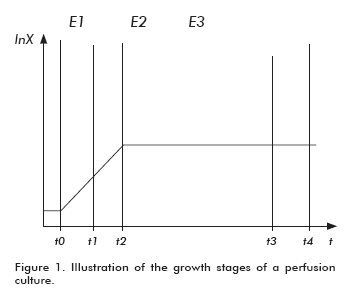
<body><![CDATA[<p><b><i><span lang=EN-US style='font-size:10.0pt;font-family:"Verdana","sans-serif"'>VisSim simulation software</span></i></b><i><span lang=EN-US style='font-size:10.0pt; font-family:"Verdana","sans-serif"'> </span></i></p>      <p><span lang=EN-US style='font-size:10.0pt;font-family:"Verdana","sans-serif"'>VisSim is a software application that simulates equations, developed by Visual Solutions. It is available for the MS/Windows and UNIX/X platforms </span><span lang=EN-US style='font-size:10.0pt;font-family:"Verdana","sans-serif"; color:windowtext'>(</span><span lang=EN-US style='font-size:10.0pt;font-family: "Verdana","sans-serif"'>6). </span></p>      <p><b><i><span lang=EN-US style='font-size:10.0pt;font-family:"Verdana","sans-serif"'>Statistical software</span></i></b><i><span lang=EN-US style='font-size:10.0pt;font-family: "Verdana","sans-serif"'> </span></i></p>      <p><span lang=EN-US style='font-size:10.0pt;font-family:"Verdana","sans-serif"'>The modelation of factor </span><span style='font-size:10.0pt;font-family:"Verdana","sans-serif"'>&#952;</span><span lang=EN-US style='font-size:10.0pt;font-family:"Verdana","sans-serif"'> was performed with Statistica for Windows version 4.3 </span><span lang=EN-US style='font-size:10.0pt;font-family:"Verdana","sans-serif";color:windowtext'>(</span><span lang=EN-US style='font-size:10.0pt;font-family:"Verdana","sans-serif"'>Stat Soft) </span><span lang=EN-US style='font-size:10.0pt;font-family:"Verdana","sans-serif"; color:windowtext'>(</span><span lang=EN-US style='font-size:10.0pt;font-family: "Verdana","sans-serif"'>6). </span></p>      <p><b><span lang=EN-US style='font-family:"Verdana","sans-serif"'>RESULTS AND DISCUSSION </span></b></p>      <p><b><span lang=EN-US style='font-size:10.0pt;font-family:"Verdana","sans-serif"'>Derivation of material balance equations</span></b><span lang=EN-US style='font-size:10.0pt; font-family:"Verdana","sans-serif"'> </span></p>      <p><span lang=EN-US style='font-size:10.0pt;font-family:"Verdana","sans-serif"'>In order to develop a mathematical model for the behavior of a fermentor operated by perfusion, the existence of three growth stages must be considered for this setting </span><span lang=EN-US style='font-size:10.0pt;font-family:"Verdana","sans-serif"; color:windowtext'>(</span><span lang=EN-US style='font-size:10.0pt;font-family: "Verdana","sans-serif"'>6, 7): 1) exponential growth at the non-stationary state </span><span lang=EN-US style='font-size:10.0pt;font-family:"Verdana","sans-serif"; color:windowtext'>(</span><i><span lang=EN-US style='font-size:10.0pt; font-family:"Verdana","sans-serif"'>E1</span></i><span lang=EN-US style='font-size:10.0pt;font-family:"Verdana","sans-serif"'>); 2) exponential growth at a continuous flow in a non-stationary state </span><span lang=EN-US style='font-size:10.0pt;font-family:"Verdana","sans-serif";color:windowtext'>(</span><i><span lang=EN-US style='font-size:10.0pt;font-family:"Verdana","sans-serif"'>E2</span></i><span lang=EN-US style='font-size:10.0pt;font-family:"Verdana","sans-serif"'>); and limited growth at a continuous flow in a stationary state </span><span lang=EN-US style='font-size:10.0pt;font-family:"Verdana","sans-serif"; color:windowtext'>(</span><i><span lang=EN-US style='font-size:10.0pt; font-family:"Verdana","sans-serif"'>E3</span></i><span lang=EN-US style='font-size:10.0pt;font-family:"Verdana","sans-serif"'>) </span><span lang=EN-US style='font-size:10.0pt;font-family:"Verdana","sans-serif"; color:windowtext'>(</span><span style='font-size:10.0pt;font-family:"Verdana","sans-serif"'><a href="#fig1"><span lang=EN-US>Figure 1</span></a></span><span lang=EN-US style='font-size:10.0pt;font-family:"Verdana","sans-serif"'>). </span></p>      <p align=center style='text-align:center'><span style='font-size:13.5pt'><img border=0 width=350 height=302 src="/img/revistas/bta/v26n3/f0110309.gif"></span><a name=fig1></a></p>      
<p><span lang=EN-US style='font-size:10.0pt;font-family:"Verdana","sans-serif"'>The first stage comprises the growth period before feeding the perfusion flow into the fermentor. The time required for this adaptive phase is very short, since the cells are under optimal conditions for their exponential propagation after inoculation. The second stage encompasses the period under perfusion flow, when the growth shows exponential kinetics before reaching the stationary phase. The third stage is a stationary growth period under perfusion flow. In theory, the duration of the first two stages is much shorter than the third stage. </span></p>      <p><b><span lang=EN-US style='font-size:10.0pt;font-family:"Verdana","sans-serif"'>Equations describing the growth kinetics of perfusion cultures</span></b></p>      ]]></body>
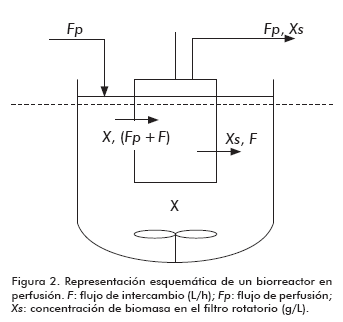
<body><![CDATA[<p><span lang=EN-US style='font-size:10.0pt;font-family:"Verdana","sans-serif"'>The analysis of growth kinetics for the first stage of the culture is similar to that usually applied to batch cultures </span><span lang=EN-US style='font-size:10.0pt;font-family:"Verdana","sans-serif";color:windowtext'>(</span><span style='font-size:10.0pt;font-family:"Verdana","sans-serif"'><a href="#fig2"><span lang=EN-US>Figure 2</span></a></span><span lang=EN-US style='font-size:10.0pt; font-family:"Verdana","sans-serif"'>)</span></p>      <p align=center style='text-align:center'><span style='font-size:13.5pt'><img border=0 width=343 height=322 src="/img/revistas/bta/v26n3/f0210309.gif"></span><a name=fig2></a></p>      
<p><span lang=EN-US style='font-size:10.0pt;font-family:"Verdana","sans-serif"'>The general mass balance equation for these systems </span><span lang=EN-US style='font-size:10.0pt;font-family:"Verdana","sans-serif";color:windowtext'>(</span><span lang=EN-US style='font-size:10.0pt;font-family:"Verdana","sans-serif"'>6) is: </span></p>      <p align=center style='text-align:center'><span style='font-size:13.5pt'><img border=0 width=336 height=37 src="/img/revistas/bta/v26n3/fr0110309.gif"></span></p>      
<p><span lang=EN-US style='font-size:10.0pt;font-family:"Verdana","sans-serif"'>Where: </span></p>      <p><i><span lang=EN-US style='font-size:10.0pt;font-family:"Verdana","sans-serif"'>Fp</span></i><span lang=EN-US style='font-size:10.0pt;font-family:"Verdana","sans-serif"'>: Perfusion flow </span><span lang=EN-US style='font-size:10.0pt;font-family: "Verdana","sans-serif";color:windowtext'>(</span><span lang=EN-US style='font-size:10.0pt;font-family:"Verdana","sans-serif"'>L/h).    <br> <i>Xo</i>: Biomass concentration in the bioreactor </span><span lang=EN-US style='font-size:10.0pt;font-family:"Verdana","sans-serif";color:windowtext'>(</span><span lang=EN-US style='font-size:10.0pt;font-family:"Verdana","sans-serif"'>g/L).    <br> </span><i><span style='font-size:10.0pt;font-family:"Verdana","sans-serif"'>&#956;</span></i><span lang=EN-US style='font-size:10.0pt;font-family:"Verdana","sans-serif"'>: specific growth rate </span><span lang=EN-US style='font-size:10.0pt; font-family:"Verdana","sans-serif";color:windowtext'>(</span><span lang=EN-US style='font-size:10.0pt;font-family:"Verdana","sans-serif"'>h<sup>-1</sup>).    <br> <i>X</i>: Biomass concentration in the bioreactor </span><span lang=EN-US style='font-size:10.0pt;font-family:"Verdana","sans-serif";color:windowtext'>(</span><span lang=EN-US style='font-size:10.0pt;font-family:"Verdana","sans-serif"'>g/L).    <br> <i>V</i>: Volume of the bioreactor </span><span lang=EN-US style='font-size: 13.5pt'>    ]]></body>
<body><![CDATA[<br> </span><i><span style='font-size:10.0pt;font-family:"Verdana","sans-serif"'>&#952;</span></i><span lang=EN-US style='font-size:10.0pt;font-family:"Verdana","sans-serif"'>: Restricted cell passage through the screen </span><span lang=EN-US style='font-size:13.5pt'>    <br> </span><i><span lang=EN-US style='font-size:10.0pt;font-family:"Verdana","sans-serif"'>F</span></i><span lang=EN-US style='font-size:10.0pt;font-family:"Verdana","sans-serif"'>: Exchange flow </span><span lang=EN-US style='font-size:10.0pt;font-family:"Verdana","sans-serif"; color:windowtext'>(</span><span lang=EN-US style='font-size:10.0pt;font-family: "Verdana","sans-serif"'>L/h). </span><span lang=EN-US style='font-size:13.5pt'>    <br> </span><i><span lang=EN-US style='font-size:10.0pt;font-family:"Verdana","sans-serif"'>Xs</span></i><span lang=EN-US style='font-size:10.0pt;font-family:"Verdana","sans-serif"'>: Biomass concentration in the spinfilter </span><span lang=EN-US style='font-size:10.0pt;font-family:"Verdana","sans-serif";color:windowtext'>(</span><span lang=EN-US style='font-size:10.0pt;font-family:"Verdana","sans-serif"'>g/L).    <br> </span><i><span style='font-size:10.0pt;font-family:"Verdana","sans-serif"'>&#945;</span></i><span lang=EN-US style='font-size:10.0pt;font-family:"Verdana","sans-serif"'>: specific death rate </span><span lang=EN-US style='font-size:10.0pt;font-family: "Verdana","sans-serif";color:windowtext'>(</span><span lang=EN-US style='font-size:10.0pt;font-family:"Verdana","sans-serif"'>h-1). </span></p>      <p><span lang=EN-US style='font-size:10.0pt;font-family:"Verdana","sans-serif"'>Factor </span><i><span style='font-size:10.0pt;font-family:"Verdana","sans-serif"'>&#952;</span></i><i><span style='font-size:10.0pt;font-family:"Verdana","sans-serif"'> </span></i><span lang=EN-US style='font-size:10.0pt;font-family:"Verdana","sans-serif"'>can be defined as the fraction of the cells entering the spinfilter </span><span lang=EN-US style='font-size:10.0pt;font-family:"Verdana","sans-serif"; color:windowtext'>(</span><span lang=EN-US style='font-size:10.0pt;font-family: "Verdana","sans-serif"'>6): </span></p>      <p align=center style='text-align:center'><span style='font-size:13.5pt'><img border=0 width=211 height=42 src="/img/revistas/bta/v26n3/fr0210309.gif"></span></p>      
<p><span lang=EN-US style='font-size:10.0pt;font-family:"Verdana","sans-serif"'>Since <i>Xs </i>and <i>X </i>change with time, </span><i><span style='font-size:10.0pt; font-family:"Verdana","sans-serif"'>&#952;</span></i><i><span style='font-size: 10.0pt;font-family:"Verdana","sans-serif"'> </span></i><span lang=EN-US style='font-size:10.0pt;font-family:"Verdana","sans-serif"'>= <i>F</i></span><span lang=EN-US style='font-size:10.0pt;font-family:"Verdana","sans-serif"; color:windowtext'>(</span><i><span lang=EN-US style='font-size:10.0pt; font-family:"Verdana","sans-serif"'>t</span></i><span lang=EN-US style='font-size:10.0pt;font-family:"Verdana","sans-serif"'>) Exponential growth in non-stationary state Since a) there is no biomass input or output, b) the death rate is negligible when compared to the growth rate, and c) at the beginning of the operation the number of cells entering the filter equals the number of cells exiting the filter and therefore the mesh of the spinfilter is clean, the following was obtained: </span></p>      <p align=center style='text-align:center'><span style='font-size:13.5pt'><img border=0 width=239 height=74 src="/img/revistas/bta/v26n3/fr0310309.gif"></span></p>      
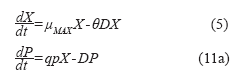
<p><span lang=EN-US style='font-size:10.0pt;font-family:"Verdana","sans-serif"'>Where: </span><span style='font-size:10.0pt;font-family:"Verdana","sans-serif"'>&#956;</span><sub><span lang=EN-US style='font-size:10.0pt;font-family:"Verdana","sans-serif"'>MAX</span></sub><i><span lang=EN-US style='font-size:10.0pt;font-family:"Verdana","sans-serif"'>: </span></i><span lang=EN-US style='font-size:10.0pt;font-family:"Verdana","sans-serif"'>Maximum specific growth rate </span><span lang=EN-US style='font-size:10.0pt; font-family:"Verdana","sans-serif";color:windowtext'>(</span><span lang=EN-US style='font-size:10.0pt;font-family:"Verdana","sans-serif"'>h<sup>-1</sup>) Which is identical to the equation for batch cultures </span><span lang=EN-US style='font-size:10.0pt;font-family:"Verdana","sans-serif";color:windowtext'>(</span><span lang=EN-US style='font-size:10.0pt;font-family:"Verdana","sans-serif"'>1). </span></p>      <p><span lang=EN-US style='font-size:10.0pt;font-family:"Verdana","sans-serif"'>Exponential growth at continuous flow in non-stationary state In the second stage, according to the literature </span><span lang=EN-US style='font-size:10.0pt; font-family:"Verdana","sans-serif";color:windowtext'>(</span><span lang=EN-US style='font-size:10.0pt;font-family:"Verdana","sans-serif"'>3, 6), perfusion flow begins and the system continues growing exponentially due to the availability of substrate for cell growth at the maximum specific growth rate. </span><span style='font-size:10.0pt;font-family:"Verdana","sans-serif"'>Starting from equation </span><span style='font-size:10.0pt;font-family:"Verdana","sans-serif"; color:windowtext'>(</span><span style='font-size:10.0pt;font-family:"Verdana","sans-serif"'>1) and with: </span></p>      ]]></body>
<body><![CDATA[<p align=center style='text-align:center'><span style='font-size:13.5pt'><img border=0 width=295 height=49 src="/img/revistas/bta/v26n3/fr0410309.gif"></span></p>      
<p><span lang=EN-US style='font-size:10.0pt;font-family:"Verdana","sans-serif"'>In this stage the filter mesh is partially clogged due to cell growth and the deposition of cell debris on the surface of the filter, thereby decreasing exchange flow </span><span lang=EN-US style='font-size:10.0pt;font-family:"Verdana","sans-serif"; color:windowtext'>(</span><span lang=EN-US style='font-size:10.0pt;font-family: "Verdana","sans-serif"'>F) until it becomes negligible in relationship to the perfusion flow </span><span lang=EN-US style='font-size:10.0pt;font-family: "Verdana","sans-serif";color:windowtext'>(</span><i><span lang=EN-US style='font-size:10.0pt;font-family:"Verdana","sans-serif"'>Fp</span></i><span lang=EN-US style='font-size:10.0pt;font-family:"Verdana","sans-serif"'>). At the same time, growth continues to follow exponential kinetics and the death rate </span><span lang=EN-US style='font-size:10.0pt;font-family:"Verdana","sans-serif"; color:windowtext'>(</span><span style='font-size:10.0pt;font-family:"Verdana","sans-serif"'>&#945;</span><span lang=EN-US style='font-size:10.0pt;font-family:"Verdana","sans-serif"'>) is negligible in relationship to the specific growth rate </span><span lang=EN-US style='font-size:10.0pt;font-family:"Verdana","sans-serif";color:windowtext'>(</span><i><span style='font-size:10.0pt;font-family:"Verdana","sans-serif"'>&#956;</span></i><i><span style='font-size:10.0pt;font-family:"Verdana","sans-serif"'> </span></i><span lang=EN-US style='font-size:10.0pt;font-family:"Verdana","sans-serif"'>= </span><i><span style='font-size:10.0pt;font-family:"Verdana","sans-serif"'>&#956;</span></i><i><sub><span lang=EN-US style='font-size:10.0pt;font-family:"Verdana","sans-serif"'>MAX</span></sub></i><i><span lang=EN-US style='font-size:10.0pt;font-family:"Verdana","sans-serif"'> </span></i><span lang=EN-US style='font-size:10.0pt;font-family:"Verdana","sans-serif"'>) </span><span lang=EN-US style='font-size:10.0pt;font-family:"Verdana","sans-serif"; color:windowtext'>(</span><span lang=EN-US style='font-size:10.0pt;font-family: "Verdana","sans-serif"'>6). </span></p>      <p><span lang=EN-US style='font-size:10.0pt;font-family:"Verdana","sans-serif"'>Therefore, the equation can be reduced to: </span></p>      <p align=center style='text-align:center'><span style='font-size:13.5pt'><img border=0 width=247 height=58 src="/img/revistas/bta/v26n3/fr0510309.gif"></span></p>      
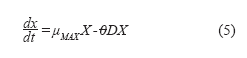
<p><span lang=EN-US style='font-size:10.0pt;font-family:"Verdana","sans-serif"'>Where: D: Dilution rate </span><span lang=EN-US style='font-size:10.0pt;font-family: "Verdana","sans-serif";color:windowtext'>(</span><span lang=EN-US style='font-size:10.0pt;font-family:"Verdana","sans-serif"'>h<sup>-1</sup>). </span></p>      <p><span lang=EN-US style='font-size:10.0pt;font-family:"Verdana","sans-serif"'>Upon solving this separable differential equation, the following is obtained </span></p>      <p align=center style='text-align:center'><span style='font-size:13.5pt'><img border=0 width=266 height=43 src="/img/revistas/bta/v26n3/fr0610309.gif"></span></p>      

<p><span style='font-size:10.0pt;font-family:"Verdana","sans-serif"'>For the substrate: </span></p>      <p align=center style='text-align:center'><span style='font-size:13.5pt'><img border=0 width=252 height=42 src="/img/revistas/bta/v26n3/fr0710309.gif"></span></p>      
<p><span lang=EN-US style='font-size:10.0pt;font-family:"Verdana","sans-serif"'>Where: </span></p>      ]]></body>
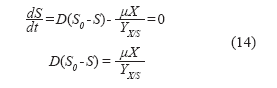
<body><![CDATA[<p><i><span lang=EN-US style='font-size:10.0pt;font-family:"Verdana","sans-serif"'>Fo</span></i><span lang=EN-US style='font-size:10.0pt;font-family:"Verdana","sans-serif"'>: Starting exchange flow </span><span lang=EN-US style='font-size:10.0pt; font-family:"Verdana","sans-serif";color:windowtext'>(</span><span lang=EN-US style='font-size:10.0pt;font-family:"Verdana","sans-serif"'>L/h).    <br> <i>So</i>: Starting substrate concentration </span><span lang=EN-US style='font-size:10.0pt;font-family:"Verdana","sans-serif";color:windowtext'>(</span><span lang=EN-US style='font-size:10.0pt;font-family:"Verdana","sans-serif"'>g/L).    <br> <i>S</i>: Substrate concentration </span><span lang=EN-US style='font-size: 10.0pt;font-family:"Verdana","sans-serif";color:windowtext'>(</span><span lang=EN-US style='font-size:10.0pt;font-family:"Verdana","sans-serif"'>g/L).    <br> <i>Yx/s</i>: Biomass/substrate yield. </span></p>      <p align=center style='text-align:center'><span style='font-size:13.5pt'><img border=0 width=273 height=51 src="/img/revistas/bta/v26n3/fr0810309.gif"></span></p>      
<p><span lang=EN-US style='font-size:10.0pt;font-family:"Verdana","sans-serif"'>Solving this first-order differential equation yields: </span></p>      <p align=center style='text-align:center'><span style='font-size:13.5pt'><img border=0 width=369 height=45 src="/img/revistas/bta/v26n3/fr0910309.gif"></span></p>      

<p><span lang=EN-US style='font-size:10.0pt;font-family:"Verdana","sans-serif"'>For the product, using the equation: </span></p>      <p align=center style='text-align:center'><span style='font-size:13.5pt'><img border=0 width=293 height=35 src="/img/revistas/bta/v26n3/fr1010309.gif"></span></p>      
<p><span lang=EN-US style='font-size:10.0pt;font-family:"Verdana","sans-serif"'>Where: </span></p>      ]]></body>
<body><![CDATA[<p><i><span lang=EN-US style='font-size:10.0pt;font-family:"Verdana","sans-serif"'>Po</span></i><span lang=EN-US style='font-size:10.0pt;font-family:"Verdana","sans-serif"'>: Starting product concentration </span><span lang=EN-US style='font-size:10.0pt; font-family:"Verdana","sans-serif";color:windowtext'>(</span><span lang=EN-US style='font-size:10.0pt;font-family:"Verdana","sans-serif"'>g/L).    <br> <i>Yp/s</i>: Product/biomass yield <i>P</i>: Product concentration </span><span lang=EN-US style='font-size:10.0pt;font-family:"Verdana","sans-serif"; color:windowtext'>(</span><span lang=EN-US style='font-size:10.0pt;font-family: "Verdana","sans-serif"'>g/L). </span></p>      <p align=center style='text-align:center'><span style='font-size:13.5pt'><img border=0 width=244 height=39 src="/img/revistas/bta/v26n3/fr1110309.gif"></span></p>      
<p><span lang=EN-US style='font-size:10.0pt;font-family:"Verdana","sans-serif"'>Applying first-order differential equations: </span></p>      <p align=center style='text-align:center'><span style='font-size:13.5pt'><img border=0 width=344 height=45 src="/img/revistas/bta/v26n3/fr1210309.gif"></span></p>      

<p><b><span lang=EN-US style='font-size:10.0pt;font-family:"Verdana","sans-serif"'>Limited growth at continuous flow in stationary state </span></b></p>      <p><span lang=EN-US style='font-size:10.0pt;font-family:"Verdana","sans-serif"'>During the final growth stage, after a large increase in substrate utilization due to the high cell densities reached by the culture, nutrient availability becomes a rate-limiting factor. This in turn leads to changes in specific growth and death rates that stabilize cell concentration at a stationary value with a magnitude that depends on substrate flow, and where growth, cell loss and death rates reach compensatory values. </span></p>      <p><span lang=EN-US style='font-size:10.0pt;font-family:"Verdana","sans-serif"'>Considering the third stage as a stationary process, biomass balance </span><span lang=EN-US style='font-size:10.0pt;font-family:"Verdana","sans-serif"; color:windowtext'>(</span><span lang=EN-US style='font-size:10.0pt;font-family: "Verdana","sans-serif"'>starting from equation </span><span lang=EN-US style='font-size:10.0pt;font-family:"Verdana","sans-serif";color:windowtext'>(</span><span lang=EN-US style='font-size:10.0pt;font-family:"Verdana","sans-serif"'>1)) can be reduced to: </span></p>      <p align=center style='text-align:center'><span style='font-size:13.5pt'><img border=0 width=243 height=75 src="/img/revistas/bta/v26n3/fr1310309.gif"></span></p>      
<p><span lang=EN-US style='font-size:10.0pt;font-family:"Verdana","sans-serif"'>Where: </span></p>      ]]></body>
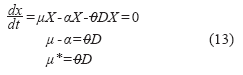
<body><![CDATA[<p><i><span style='font-size:10.0pt;font-family:"Verdana","sans-serif"'>&#945;</span></i><span lang=EN-US style='font-size:10.0pt;font-family:"Verdana","sans-serif"'>: Specific death rate </span><span lang=EN-US style='font-size:10.0pt;font-family: "Verdana","sans-serif";color:windowtext'>(</span><span lang=EN-US style='font-size:10.0pt;font-family:"Verdana","sans-serif"'>h<sup>-1</sup>).    <br> <i>A</i>: Total filtration area </span><span lang=EN-US style='font-size:10.0pt; font-family:"Verdana","sans-serif";color:windowtext'>(</span><span lang=EN-US style='font-size:10.0pt;font-family:"Verdana","sans-serif"'>m2). </span><span lang=EN-US style='font-size:13.5pt'>    <br> </span><i><span style='font-size:10.0pt;font-family:"Verdana","sans-serif"'>&#956;</span></i><i><span lang=EN-US style='font-size:10.0pt;font-family:"Verdana","sans-serif"'>*</span></i><span lang=EN-US style='font-size:10.0pt;font-family:"Verdana","sans-serif"'>: Resulting specific growth rate </span><span lang=EN-US style='font-size:10.0pt; font-family:"Verdana","sans-serif";color:windowtext'>(</span><span lang=EN-US style='font-size:10.0pt;font-family:"Verdana","sans-serif"'>h<sup>-1</sup>). </span></p>      <p><span style='font-size:10.0pt;font-family:"Verdana","sans-serif"'>Substrate balance: </span></p>      <p align=center style='text-align:center'><span style='font-size:13.5pt'><img border=0 width=277 height=88 src="/img/revistas/bta/v26n3/fr1410309.gif"></span></p>      
<p><span style='font-size:10.0pt;font-family:"Verdana","sans-serif"'>Product balance: </span></p>      <p align=center style='text-align:center'><span style='font-size:13.5pt'><img border=0 width=228 height=43 src="/img/revistas/bta/v26n3/fr1510309.gif"></span></p>      
<p><span lang=EN-US style='font-size:10.0pt;font-family:"Verdana","sans-serif"'>Finally, the biomass/substrate yield for the system was defined as: </span></p>      <p align=center style='text-align:center'><span style='font-size:13.5pt'><img border=0 width=252 height=64 src="/img/revistas/bta/v26n3/fr1610309.gif"></span></p>      
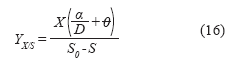
<p><span lang=EN-US style='font-size:10.0pt;font-family:"Verdana","sans-serif"'>The productivity of the perfusion culture </span><span lang=EN-US style='font-size: 10.0pt;font-family:"Verdana","sans-serif";color:windowtext'>(</span><span lang=EN-US style='font-size:10.0pt;font-family:"Verdana","sans-serif"'>g/Lh) is defined following the same logic applied to continuous culture </span><span lang=EN-US style='font-size:10.0pt;font-family:"Verdana","sans-serif"; color:windowtext'>(</span><span lang=EN-US style='font-size:10.0pt;font-family: "Verdana","sans-serif"'>1), where cell productivity in this system: </span></p>      ]]></body>
<body><![CDATA[<p align=center style='text-align:center'><span style='font-size:13.5pt'><img border=0 width=233 height=42 src="/img/revistas/bta/v26n3/fr1710309.gif"></span></p>      
<p><span lang=EN-US style='font-size:10.0pt;font-family:"Verdana","sans-serif"'>And productivity for the product: </span></p>      <p align=center style='text-align:center'><span style='font-size:13.5pt'><img border=0 width=243 height=40 src="/img/revistas/bta/v26n3/fr1810309.gif"></span></p>      
<p><span lang=EN-US style='font-size:10.0pt;font-family:"Verdana","sans-serif"'>The whole derivation of these kinetic equations has taken into account neither the influence of the spin rate of the spinfilter, nor its area </span><span lang=EN-US style='font-size:10.0pt;font-family:"Verdana","sans-serif"; color:windowtext'>(</span><span lang=EN-US style='font-size:10.0pt;font-family: "Verdana","sans-serif"'>6-8), nor the shear forces it exerts on the cells </span><span lang=EN-US style='font-size:10.0pt;font-family:"Verdana","sans-serif"; color:windowtext'>(</span><span lang=EN-US style='font-size:10.0pt;font-family: "Verdana","sans-serif"'>9, 10): </span></p>      <p align=center style='text-align:center'><span style='font-size:13.5pt'><img border=0 width=224 height=49 src="/img/revistas/bta/v26n3/fr1910309.gif"></span></p>      
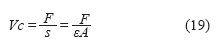
<p><span lang=EN-US style='font-size:10.0pt;font-family:"Verdana","sans-serif"'>Where: </span></p>      <p><i><span lang=EN-US style='font-size:10.0pt;font-family:"Verdana","sans-serif"'>Vc</span></i><span lang=EN-US style='font-size:10.0pt;font-family:"Verdana","sans-serif"'>: Centrifugal speed </span><span lang=EN-US style='font-size:10.0pt;font-family: "Verdana","sans-serif";color:windowtext'>(</span><span lang=EN-US style='font-size:10.0pt;font-family:"Verdana","sans-serif"'>m/s).    <br> <i>s</i>: Available area for cell passage through the membrane </span><span lang=EN-US style='font-size:10.0pt;font-family:"Verdana","sans-serif"; color:windowtext'>(</span><span lang=EN-US style='font-size:10.0pt;font-family: "Verdana","sans-serif"'>m2). </span><span lang=EN-US style='font-size:13.5pt'>    <br> </span><span style='font-size:10.0pt;font-family:"Verdana","sans-serif"'>&#949;: Membrane porosity. </span></p>      <p align=center style='text-align:center'><span style='font-size:13.5pt'><img border=0 width=207 height=36 src="/img/revistas/bta/v26n3/fr2010309.gif"></span></p>      
]]></body>
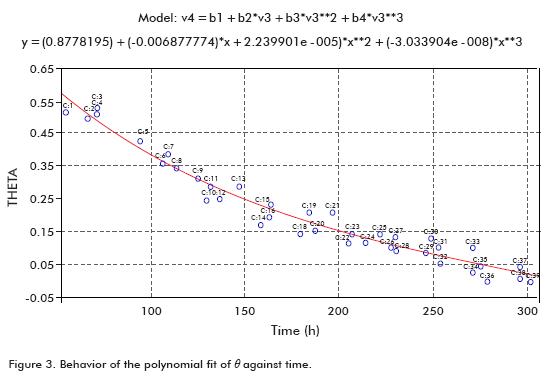
<body><![CDATA[<p><span lang=EN-US style='font-size:10.0pt;font-family:"Verdana","sans-serif"'>Where: </span></p>      <p><i><span lang=EN-US style='font-size:10.0pt;font-family:"Verdana","sans-serif"'>Vg</span></i><span lang=EN-US style='font-size:10.0pt;font-family:"Verdana","sans-serif"'>: Sedimentation speed </span><span lang=EN-US style='font-size:10.0pt;font-family: "Verdana","sans-serif";color:windowtext'>(</span><span lang=EN-US style='font-size:10.0pt;font-family:"Verdana","sans-serif"'>m/s).    <br> <i>Ø</i>: g/h to m/s conversion factor </span><span lang=EN-US style='font-size:13.5pt'>    <br> </span><i><span lang=EN-US style='font-size:10.0pt;font-family:"Verdana","sans-serif"'>rs</span></i><span lang=EN-US style='font-size:10.0pt;font-family:"Verdana","sans-serif"'>: Sedimentation flow </span><span lang=EN-US style='font-size:10.0pt;font-family: "Verdana","sans-serif";color:windowtext'>(</span><span lang=EN-US style='font-size:10.0pt;font-family:"Verdana","sans-serif"'>g/h) </span></p>      <p><b><span lang=EN-US style='font-size:10.0pt;font-family:"Verdana","sans-serif"'>Statistical modelation of </span></b><b><i><span style='font-size:10.0pt;font-family:"Verdana","sans-serif"'>&#952;</span></i></b><b><span style='font-size:10.0pt;font-family:"Verdana","sans-serif"'> </span></b></p>      <p><span lang=EN-US style='font-size:10.0pt;font-family:"Verdana","sans-serif"'>Taking data from several runs, </span><i><span style='font-size:10.0pt;font-family: "Verdana","sans-serif"'>&#952;</span></i><i><span style='font-size:10.0pt; font-family:"Verdana","sans-serif"'> </span></i><span lang=EN-US style='font-size:10.0pt;font-family:"Verdana","sans-serif"'>was calculated in order to plot it against time </span><span lang=EN-US style='font-size:10.0pt; font-family:"Verdana","sans-serif";color:windowtext'>(</span><span style='font-size:10.0pt;font-family:"Verdana","sans-serif"'><a href="#fig3"><span lang=EN-US>Figure 3</span></a></span><span lang=EN-US style='font-size:10.0pt; font-family:"Verdana","sans-serif"'>), using a polynomial fit. </span></p>      <p align=center style='text-align:center'><span style='font-size:13.5pt'><img border=0 width=555 height=382 src="/img/revistas/bta/v26n3/f0310309.gif"></span><a name=fig3></a></p>      
<p><span lang=EN-US style='font-size:10.0pt;font-family:"Verdana","sans-serif"'>The fit showed that the fraction of cells entering the spinfilter through the mesh </span><span lang=EN-US style='font-size:10.0pt;font-family:"Verdana","sans-serif"; color:windowtext'>(</span><i><span style='font-size:10.0pt;font-family:"Verdana","sans-serif"'>&#952;</span></i><span lang=EN-US style='font-size:10.0pt;font-family:"Verdana","sans-serif"'>) at the beginning of perfusion started from a maximum value at the beginning and progressively decreased with time, as described in the literature </span><span lang=EN-US style='font-size:10.0pt;font-family:"Verdana","sans-serif";color:windowtext'>(</span><span lang=EN-US style='font-size:10.0pt;font-family:"Verdana","sans-serif"'>3). </span></p>      <p><b><i><span lang=EN-US style='font-size:10.0pt;font-family:"Verdana","sans-serif"'>Simulation </span></i></b></p>      <p><span lang=EN-US style='font-size:10.0pt;font-family:"Verdana","sans-serif"'>Using the balances above, it is possible to obtain equations describing the behavior of the 41 L bioreactor: </span></p>      ]]></body>
<body><![CDATA[<p align=center style='text-align:center'><span style='font-size:13.5pt'><img border=0 width=249 height=80 src="/img/revistas/bta/v26n3/fr2110309.gif"></span></p>      
<p><span lang=EN-US style='font-size:10.0pt;font-family:"Verdana","sans-serif"'>Where: </span></p>      <p><span lang=EN-US style='font-size:10.0pt;font-family:"Verdana","sans-serif"'>qp: utilization rate </span><span lang=EN-US style='font-size:10.0pt;font-family: "Verdana","sans-serif";color:windowtext'>(</span><span lang=EN-US style='font-size:10.0pt;font-family:"Verdana","sans-serif"'>g/h). </span></p>      <p align=center style='text-align:center'><span style='font-size:13.5pt'><img border=0 width=219 height=46 src="/img/revistas/bta/v26n3/fr2210309.gif"></span></p>      
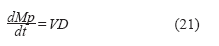
<p><span lang=EN-US style='font-size:10.0pt;font-family:"Verdana","sans-serif"'>Where: </span></p>      <p><span lang=EN-US style='font-size:10.0pt;font-family:"Verdana","sans-serif"'>Mp: Accumulated volume mass </span><span lang=EN-US style='font-size:10.0pt; font-family:"Verdana","sans-serif";color:windowtext'>(</span><span lang=EN-US style='font-size:10.0pt;font-family:"Verdana","sans-serif"'>L/h). </span></p>      <p align=center style='text-align:center'><span style='font-size:13.5pt'><img border=0 width=248 height=41 src="/img/revistas/bta/v26n3/fr2310309.gif"></span></p>      
<p><span lang=EN-US style='font-size:10.0pt;font-family:"Verdana","sans-serif"'>Where: </span></p>      <p><i><span lang=EN-US style='font-size:10.0pt;font-family:"Verdana","sans-serif"'>AcMan</span></i><span lang=EN-US style='font-size:10.0pt;font-family:"Verdana","sans-serif"'>: antibody concentration </span><span lang=EN-US style='font-size:10.0pt; font-family:"Verdana","sans-serif";color:windowtext'>(</span><span lang=EN-US style='font-size:10.0pt;font-family:"Verdana","sans-serif"'>g/L). </span></p>      <p><span lang=EN-US style='font-size:10.0pt;font-family:"Verdana","sans-serif"'>And the behavior of </span><i><span style='font-size:10.0pt;font-family:"Verdana","sans-serif"'>&#952;</span></i><i><span style='font-size:10.0pt;font-family:"Verdana","sans-serif"'> </span></i><span lang=EN-US style='font-size:10.0pt;font-family:"Verdana","sans-serif"'>was: </span></p>      ]]></body>
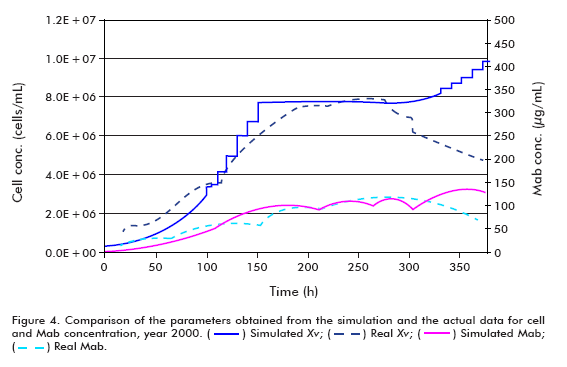
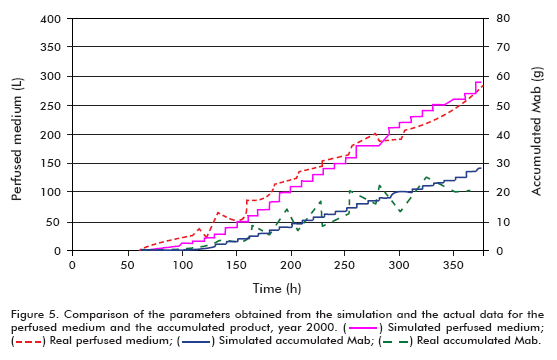
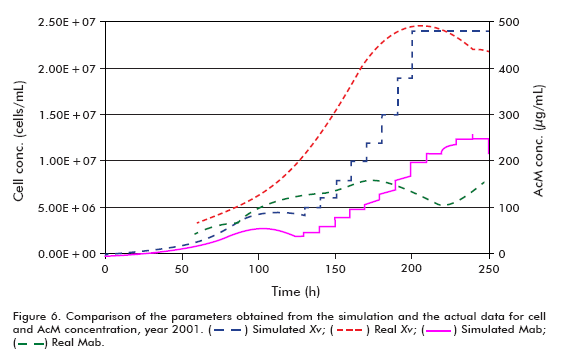
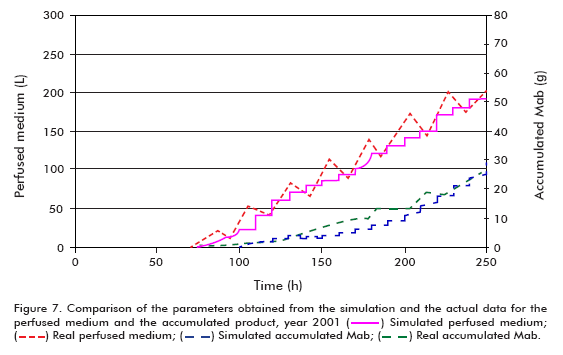
<body><![CDATA[<p><span lang=EN-US style='font-size:10.0pt;font-family:"Verdana","sans-serif"'>• For 30 L </span></p>      <p><i><span style='font-size:10.0pt;font-family:"Verdana","sans-serif"'>&#952;</span></i><i><span lang=EN-US style='font-size:10.0pt;font-family:"Verdana","sans-serif"'> = </span></i><span lang=EN-US style='font-size:10.0pt;font-family:"Verdana","sans-serif"; color:windowtext'>(</span><span lang=EN-US style='font-size:10.0pt;font-family: "Verdana","sans-serif"'>0.8778195) + </span><span lang=EN-US style='font-size: 10.0pt;font-family:"Verdana","sans-serif";color:windowtext'>(</span><span lang=EN-US style='font-size:10.0pt;font-family:"Verdana","sans-serif"'>-0.006877774)* time + </span><span lang=EN-US style='font-size:10.0pt;font-family:"Verdana","sans-serif"; color:windowtext'>(</span><span lang=EN-US style='font-size:10.0pt;font-family: "Verdana","sans-serif"'>2.239901e-5)* time 2 + </span><span lang=EN-US style='font-size:10.0pt;font-family:"Verdana","sans-serif";color:windowtext'>(</span><span lang=EN-US style='font-size:10.0pt;font-family:"Verdana","sans-serif"'>-3.033904e-8)* time 3 </span><span lang=EN-US style='font-size:10.0pt;font-family:"Verdana","sans-serif"; color:windowtext'>(</span><span lang=EN-US style='font-size:10.0pt;font-family: "Verdana","sans-serif"'>23) </span></p>      <p><span lang=EN-US style='font-size:10.0pt;font-family:"Verdana","sans-serif"'>• For runs during year 2000 </span></p>      <p><span style='font-size:10.0pt;font-family:"Verdana","sans-serif"'>&#956;</span><span lang=EN-US style='font-size:10.0pt;font-family:"Verdana","sans-serif"'> = 0.03 for <i>Xv </i>&#8804; <i>Xv </i>max </span><span lang=EN-US style='font-size: 10.0pt;font-family:"Verdana","sans-serif";color:windowtext'>(</span><span lang=EN-US style='font-size:10.0pt;font-family:"Verdana","sans-serif"'>7.68 x 10<sup>6</sup> cells/mL), where <i>Xv </i>is the cell concentration and <i>Xv </i>max, the maximum cell concentration. </span></p>      <p><span style='font-size:10.0pt;font-family:"Verdana","sans-serif"'>&#956;</span><span lang=EN-US style='font-size:10.0pt;font-family:"Verdana","sans-serif"'> = 0.005 for <i>Xv </i>&#8805; <i>Xv </i>max </span></p>      <p><span lang=EN-US style='font-size:10.0pt;font-family:"Verdana","sans-serif"'>• For runs during year 2001 </span></p>      <p><span style='font-size:10.0pt;font-family:"Verdana","sans-serif"'>&#956;</span><span lang=EN-US style='font-size:10.0pt;font-family:"Verdana","sans-serif"'> = 0.035 for <i>Xv </i>&#8804; <i>Xv </i>max = 24 x 10<sup>6</sup> cells/mL </span></p>      <p><span style='font-size:10.0pt;font-family:"Verdana","sans-serif"'>&#956;</span><span lang=EN-US style='font-size:10.0pt;font-family:"Verdana","sans-serif"'> = 0.005 for <i>Xv </i>&#8805; <i>Xv </i>max </span></p>      <p><span lang=EN-US style='font-size:10.0pt;font-family:"Verdana","sans-serif"'>The equations for the models were programmed into VisSim, obtaining the predicted curves for cell growth, AcM concentration, accumulated product and perfused medium under the influence of the following variables: starting cell concentration, maximum cell concentration, maximum specific cell growth rate, minimum specific cell growth rate, and specific product formation rate. </span></p>      <p><b><i><span lang=EN-US style='font-size:10.0pt;font-family:"Verdana","sans-serif"'>Behavior of real and simulated values for runs from years 2000 and 2001 </span></i></b></p>      ]]></body>
<body><![CDATA[<p><span lang=EN-US style='font-size:10.0pt;font-family:"Verdana","sans-serif"'>The simulation of the year 2000 runs was performed under the following conditions: Starting cell concentration </span><span lang=EN-US style='font-size:10.0pt; font-family:"Verdana","sans-serif";color:windowtext'>(</span><i><span lang=EN-US style='font-size:10.0pt;font-family:"Verdana","sans-serif"'>Xv</span></i><span lang=EN-US style='font-size:10.0pt;font-family:"Verdana","sans-serif"'>0) of 2 x 10<sup>5</sup> cells/mL, maximum cell concentration </span><span lang=EN-US style='font-size:10.0pt;font-family:"Verdana","sans-serif";color:windowtext'>(</span><i><span lang=EN-US style='font-size:10.0pt;font-family:"Verdana","sans-serif"'>Xv </span></i><span lang=EN-US style='font-size:10.0pt;font-family:"Verdana","sans-serif"'>max) of 7.68 x 10<sup>6</sup> cells/mL, maximum specific cell growth rate </span><span lang=EN-US style='font-size:10.0pt;font-family:"Verdana","sans-serif"; color:windowtext'>(</span><span style='font-size:10.0pt;font-family:"Verdana","sans-serif"'>&#956;</span><span lang=EN-US style='font-size:10.0pt;font-family:"Verdana","sans-serif"'> max) of 0.03 h<sup>-1</sup>, minimum specific cell growth rate </span><span lang=EN-US style='font-size:10.0pt;font-family:"Verdana","sans-serif";color:windowtext'>(</span><span style='font-size:10.0pt;font-family:"Verdana","sans-serif"'>&#956;</span><span lang=EN-US style='font-size:10.0pt;font-family:"Verdana","sans-serif"'> min) of 0.005 h<sup>-1</sup>, specific product formation rate </span><span lang=EN-US style='font-size:10.0pt;font-family:"Verdana","sans-serif";color:windowtext'>(</span><i><span lang=EN-US style='font-size:10.0pt;font-family:"Verdana","sans-serif"'>qp</span></i><span lang=EN-US style='font-size:10.0pt;font-family:"Verdana","sans-serif"'>) of 5 x 10<sup>-7</sup> </span><span style='font-size:10.0pt;font-family:"Verdana","sans-serif"'>&#956;</span><span lang=EN-US style='font-size:10.0pt;font-family:"Verdana","sans-serif"'>g/</span><span lang=EN-US style='font-size:10.0pt;font-family:"Verdana","sans-serif"; color:windowtext'>(</span><span lang=EN-US style='font-size:10.0pt;font-family: "Verdana","sans-serif"'>10<sup>6</sup> cells*h); using the model for <i>theta </i>in 30 L. </span></p>      <p><span lang=EN-US style='font-size:10.0pt;font-family:"Verdana","sans-serif"'>The efficiency of the model was examined by comparing the real and simulated data </span><span lang=EN-US style='font-size:10.0pt;font-family:"Verdana","sans-serif"; color:windowtext'>(</span><span style='font-size:10.0pt;font-family:"Verdana","sans-serif"'><a href="#fig4"><span lang=EN-US>Figure 4</span></a></span><span lang=EN-US style='font-size:10.0pt;font-family:"Verdana","sans-serif"'> and </span><span style='font-size:10.0pt;font-family:"Verdana","sans-serif"'><a href="#fig5"><span lang=EN-US>Figure 5</span></a></span><span lang=EN-US style='font-size:10.0pt; font-family:"Verdana","sans-serif"'>); reaching the following conclusions: </span></p>      <p><span lang=EN-US style='font-size:10.0pt;font-family:"Verdana","sans-serif"'>Comparing the simulated and actual data from year 2000, it can be observed that the model describes adequately the behavior of the examined variables up to the start of cell death. The disparity of the simulated growth curve at the end of the fermentation when compared to the real data arises from the fact that the model does not represent the stage of cell death, and therefore the increase in filter retention results in exponential growth of the cells. The difference in growth curves from the start of the simulation to time = 100 h, on the other hand, can be explained based on the cell concentration inoculated into the bioreactor. Since the actual cell concentration was higher than that used in the simulation, it does not represent the stage of death, and therefore as a consequence of the increased filter retention, the cells begin to growth exponentially, as described in other works </span><span lang=EN-US style='font-size:10.0pt;font-family:"Verdana","sans-serif";color:windowtext'>(</span><span lang=EN-US style='font-size:10.0pt;font-family:"Verdana","sans-serif"'>6, 11-15). </span></p>      <p align=center style='text-align:center'><span style='font-size:13.5pt'><img border=0 width=567 height=367 src="/img/revistas/bta/v26n3/f0410309.gif"></span><a name=fig4></a></p>      
<p align=center style='text-align:center'><span style='font-size:13.5pt'><img border=0 width=557 height=360 src="/img/revistas/bta/v26n3/f0510309.gif"></span><a name=fig5></a></p>      
<p><span lang=EN-US style='font-size:10.0pt;font-family:"Verdana","sans-serif"'>Taking into account the slopes of the curves, it can be said that the simulated model has a larger specific growth rate. </span></p>      <p><span lang=EN-US style='font-size:10.0pt;font-family:"Verdana","sans-serif"'>The simulation of the runs from year 2001 used the following conditions: starting cell concentration </span><span lang=EN-US style='font-size:10.0pt;font-family: "Verdana","sans-serif";color:windowtext'>(</span><i><span lang=EN-US style='font-size:10.0pt;font-family:"Verdana","sans-serif"'>Xv</span></i><span lang=EN-US style='font-size:10.0pt;font-family:"Verdana","sans-serif"'>0) of 2 x 10<sup>5 </sup>cells/mL, maximum cell concentration </span><span lang=EN-US style='font-size:10.0pt;font-family:"Verdana","sans-serif";color:windowtext'>(</span><i><span lang=EN-US style='font-size:10.0pt;font-family:"Verdana","sans-serif"'>Xv </span></i><span lang=EN-US style='font-size:10.0pt;font-family:"Verdana","sans-serif"'>max) of 24 x 10<sup>6</sup> cells/mL, maximum specific cell growth rate </span><span lang=EN-US style='font-size:10.0pt;font-family:"Verdana","sans-serif"; color:windowtext'>(</span><span style='font-size:10.0pt;font-family:"Verdana","sans-serif"'>&#956;</span><span lang=EN-US style='font-size:10.0pt;font-family:"Verdana","sans-serif"'> max) of 0.035 h<sup>-1</sup>, minimum specific cell growth rate </span><span lang=EN-US style='font-size:10.0pt;font-family:"Verdana","sans-serif"; color:windowtext'>(</span><span style='font-size:10.0pt;font-family:"Verdana","sans-serif"'>&#956;</span><span lang=EN-US style='font-size:10.0pt;font-family:"Verdana","sans-serif"'> min) of 0.005 h<sup>-1</sup> and specific product formation rate </span><span lang=EN-US style='font-size:10.0pt;font-family:"Verdana","sans-serif"; color:windowtext'>(</span><i><span lang=EN-US style='font-size:10.0pt; font-family:"Verdana","sans-serif"'>qp</span></i><span lang=EN-US style='font-size:10.0pt;font-family:"Verdana","sans-serif"'>) of 5 x 10<sup>-7</sup> </span><span style='font-size:10.0pt;font-family:"Verdana","sans-serif"'>&#956;</span><span lang=EN-US style='font-size:10.0pt;font-family:"Verdana","sans-serif"'>g/</span><span lang=EN-US style='font-size:10.0pt;font-family:"Verdana","sans-serif"; color:windowtext'>(</span><span lang=EN-US style='font-size:10.0pt;font-family: "Verdana","sans-serif"'>10<sup>6</sup> cells*h), using the model for <i>theta </i>in 30 L. </span></p>      <p><span lang=EN-US style='font-size:10.0pt;font-family:"Verdana","sans-serif"'>Performing a similar analysis to that described above but using the data from year 2001 </span><span lang=EN-US style='font-size:10.0pt;font-family:"Verdana","sans-serif"; color:windowtext'>(</span><span style='font-size:10.0pt;font-family:"Verdana","sans-serif"'><a href="#fig6"><span lang=EN-US>Figure 6</span></a></span><span lang=EN-US style='font-size:10.0pt;font-family:"Verdana","sans-serif"'> and </span><span style='font-size:10.0pt;font-family:"Verdana","sans-serif"'><a href="#fig7"><span lang=EN-US>Figure 7</span></a></span><span lang=EN-US style='font-size:10.0pt; font-family:"Verdana","sans-serif"'>), comparing simulated and actual curves, it can be concluded that there is a marked difference between specific growth rates. Evidently, the specific death rate influences significantly the outcome of kinetic processes, and therefore it is necessary to have a reliable numerical estimate of this variable for a more accurate fit of the model, as described in the literature </span><span lang=EN-US style='font-size:10.0pt; font-family:"Verdana","sans-serif";color:windowtext'>(</span><span lang=EN-US style='font-size:10.0pt;font-family:"Verdana","sans-serif"'>6, 11- 15). This effect carries over to the concentration of the product and, therefore, the accumulated product, but not to the perfused medium, which remains constant. </span></p>      <p align=center style='text-align:center'><span style='font-size:13.5pt'><img border=0 width=562 height=360 src="/img/revistas/bta/v26n3/f0610309.gif"></span><a name=fig6></a></p>      
<p align=center style='text-align:center'><span style='font-size:13.5pt'><img border=0 width=563 height=355 src="/img/revistas/bta/v26n3/f0710309.gif"></span><a name=fig7></a></p>      
]]></body>
<body><![CDATA[<p><b><i><span lang=EN-US style='font-size:10.0pt;font-family:"Verdana","sans-serif"'>Limitations</span></i></b><span lang=EN-US style='font-size:10.0pt;font-family:"Verdana","sans-serif"'> </span></p>      <p><span lang=EN-US style='font-size:10.0pt;font-family:"Verdana","sans-serif"'>The model does not take into account the influence of the spin rate of the spinfilter or the filtration area/ fermentor volume ratio. It also fails to consider the influence of hydrodynamic processes on the culture. Regarding the restriction factor for the passage of cells through the membrane of the spinfilter, a statistic, non phenomenological polynomial fit was used. Oxygen utilization by the culture was not balanced. </span></p>      <p><b><span lang=EN-US style='font-family:"Verdana","sans-serif"'>CONCLUSIONS </span></b></p>      <p><span lang=EN-US style='font-size:10.0pt;font-family:"Verdana","sans-serif"'>The derivation of mathematical equations describing cell behavior in perfusion fermentors, together with a statistical model fitting the observed behavior of cell passage through the mesh of the spinfilter on the 30 L bioreactor, allowed the implementation of a VisSim module to simulate the fermentation runs. This module was used to show that the variables have a marked influence on the perfusion system. Comparing simulated and actual data from year 2000, it was demonstrated that the model describes adequately the behavior of the variables until the moment in which cells start to die. The behavior of the simulated curve at the end of the run arises from the fact that the model does not take into account the stage of death, and therefore when filter retention increases, the cells start to grow exponentially. The difference in growth curves from time 0 to 100 h can be justified by the lower cellular concentration inoculated into the bioreactor under simulated conditions. A similar analysis was performed on data from year 2001, and the comparison of actual and simulated data revealed a large disparity in specific growth rates. Evidently, the specific death rate has a large influence on the outcome of kinetic processes, and therefore a reliable numerical estimate of this variable is necessary for a more accurate fit of the model, as described in the literature </span><span lang=EN-US style='font-size:10.0pt;font-family:"Verdana","sans-serif";color:windowtext'>(</span><span lang=EN-US style='font-size:10.0pt;font-family:"Verdana","sans-serif"'>6, 11-15). This effect carries over to the concentration of the product and, therefore, the accumulated product, but not to the perfused medium, which remains constant. </span></p>      <p><b><span lang=EN-US style='font-family:"Verdana","sans-serif"'>&nbsp;</span></b></p>      <p><b><span lang=EN-US style='font-family:"Verdana","sans-serif"'>REFERENCES </span></b></p>      <!-- ref --><p><span lang=EN-US style='font-size:10.0pt;font-family:"Verdana","sans-serif"'>1. Aiba</span><span lang=EN-US style='font-family:"Arial","sans-serif";color:blue'> </span><span lang=EN-US style='font-size:10.0pt;font-family:"Verdana","sans-serif"'>S, Arthur</span><span lang=EN-US style='font-family:"Arial","sans-serif"; color:blue'> </span><span lang=EN-US style='font-size:10.0pt;font-family:"Verdana","sans-serif"'>EH, Nancy</span><span lang=EN-US style='font-family:"Arial","sans-serif"; color:blue'> </span><span lang=EN-US style='font-size:10.0pt;font-family:"Verdana","sans-serif"'>FM. </span><span style='font-size:10.0pt;font-family:"Verdana","sans-serif"'>Biochemical Engineering. Edición Revolucionaria, La Habana;1970.</span><span style='font-family:"Arial","sans-serif";color:navy'> </span><!-- ref --><p><span lang=EN-US style='font-size:10.0pt;font-family:"Verdana","sans-serif"'>2. Monbouquette HG. Modeling high biomass-density cell recycle fermentors. Biotechnol Bioeng</span><span lang=EN-US style='font-size:11.0pt;font-family: "Arial","sans-serif";color:red'> </span><span lang=EN-US style='font-size:10.0pt; font-family:"Verdana","sans-serif"'>1992;39:498-503.</span><span lang=EN-US style='font-size:11.0pt;font-family:"Arial","sans-serif";color:blue'> </span><!-- ref --><p><span lang=EN-US style='font-size:10.0pt;font-family:"Verdana","sans-serif"'>3. Yabannavar VM, Singh V, Connelly N. Mammalian cell retention in a spinfilter perfusion bioreactor for mammalian cell. Biotechnol Bioeng</span><span lang=EN-US style='font-size:11.0pt;font-family:"Arial","sans-serif";color:red'> </span><span lang=EN-US style='font-size:10.0pt;font-family:"Verdana","sans-serif"'>1992;43:159-64.</span><span lang=EN-US style='font-size:11.0pt;font-family:"Arial","sans-serif";color:blue'> </span><!-- ref --><p><span lang=EN-US style='font-size:10.0pt;font-family:"Verdana","sans-serif"'>4. Hartikka M, Vihko P, Södervall M, Hakalahti L, Torniainen P, Vihko R. Radiolabelling of monoclonal antibodies: optimization of conjugation of DTPA to F</span><span lang=EN-US style='font-size:10.0pt;font-family:"Verdana","sans-serif"; color:windowtext'>(</span><span lang=EN-US style='font-size:10.0pt;font-family: "Verdana","sans-serif"'>ab’)2 fragments and novel measurement of the degree of conjugation using Eu </span><span lang=EN-US style='font-size:10.0pt;font-family:"Verdana","sans-serif"; color:windowtext'>(</span><span lang=EN-US style='font-size:10.0pt;font-family: "Verdana","sans-serif"'>III)- labeling. Eur J Nucl Med</span><span lang=EN-US style='font-size:11.0pt;font-family:"Arial","sans-serif";color:red'> </span><span lang=EN-US style='font-size:10.0pt;font-family:"Verdana","sans-serif"'>1989;15:157-61.</span><p><span lang=EN-US style='font-size:10.0pt;font-family:"Verdana","sans-serif"'>5. Tolbert</span><span lang=EN-US style='font-family:"Arial","sans-serif"; color:blue'> </span><span lang=EN-US style='font-size:10.0pt;font-family:"Verdana","sans-serif"'>WR, Feder</span><span lang=EN-US style='font-family:"Arial","sans-serif"; color:blue'> </span><span lang=EN-US style='font-size:10.0pt;font-family:"Verdana","sans-serif"'>J, in: Annual Reports on Fermentation Processes</span><span lang=EN-US style='font-family:"Arial","sans-serif";color:gray'> </span><span lang=EN-US style='font-size:10.0pt;font-family:"Verdana","sans-serif"'>1983; Vol., Ed. 39.</span><span lang=EN-US style='font-family:"Arial","sans-serif";color:navy'> </span></p>      <!-- ref --><p><span style='font-size:10.0pt;font-family:"Verdana","sans-serif"'>6. Hernández LY, Castro LD. Análisis del proceso de fermentación en perfusión del monoclonal hR3 a escala de banco. Trabajo de tesis. ISP José Antonio Echevarría 2001. Cuba.</span><span style='font-family:"Arial","sans-serif";color:teal'> </span><!-- ref --><p><span style='font-size:10.0pt;font-family:"Verdana","sans-serif"'>7. Robinson DK, Memmert KW. </span><span lang=EN-US style='font-size:10.0pt; font-family:"Verdana","sans-serif"'>Kinetics of recombinant inmunoglobulin production by mammalian cells in continuous culture. Biotechnol Bioeng</span><span lang=EN-US style='font-size:11.0pt;font-family:"Arial","sans-serif";color:red'> </span><span lang=EN-US style='font-size:10.0pt;font-family:"Verdana","sans-serif"'>1991;35:972-6.</span><span lang=EN-US style='font-size:11.0pt;font-family:"Arial","sans-serif";color:blue'> </span><!-- ref --><p><span lang=EN-US style='font-size:10.0pt;font-family:"Verdana","sans-serif"'>8. Yashwant MD, Mina DM, Renato F. Practical consideration in operation and scale-up of spinfilter based bioreactors for monoclonal antibody production. Biotechnol Prog</span><span lang=EN-US style='font-size:11.0pt;font-family: "Arial","sans-serif";color:red'> </span><span lang=EN-US style='font-size:10.0pt; font-family:"Verdana","sans-serif"'>1996;12:57-64.</span><span lang=EN-US style='font-size:11.0pt;font-family:"Arial","sans-serif";color:blue'> </span><!-- ref --><p><span lang=EN-US style='font-size:10.0pt;font-family:"Verdana","sans-serif"'>9. Favre E, Thaler T. An engineering analysis of rotating sieves for hybridoma cell retention in stirred tank bioreactors. Cytotechnology</span><span lang=EN-US style='font-size:11.0pt;font-family:"Arial","sans-serif";color:red'> </span><span lang=EN-US style='font-size:10.0pt;font-family:"Verdana","sans-serif"'>1992;12:180-7.</span><span lang=EN-US style='font-size:11.0pt;font-family:"Arial","sans-serif";color:blue'> </span><!-- ref --><p><span lang=EN-US style='font-size:10.0pt;font-family:"Verdana","sans-serif"'>10. Varecka R, Scheirer W. Use of rotating wire cage for retention of animal cells in a perfusion fermentor. Develop Biologic Standard</span><span lang=EN-US style='font-size:11.0pt;font-family:"Arial","sans-serif";color:red'> </span><span lang=EN-US style='font-size:10.0pt;font-family:"Verdana","sans-serif"'>1987;66:269-72.</span><span lang=EN-US style='font-size:11.0pt;font-family:"Arial","sans-serif";color:blue'> </span><!-- ref --><p><span lang=EN-US style='font-size:10.0pt;font-family:"Verdana","sans-serif"'>11. Reuss M, Baltes M, Schneider R, Sturm C. Optimal experimental design for parameter estimation in unstructured growth models. Biotechnol Prog</span><span lang=EN-US style='font-size:11.0pt;font-family:"Arial","sans-serif";color:red'> </span><span lang=EN-US style='font-size:10.0pt;font-family:"Verdana","sans-serif"'>1994;10:480-8.</span><span lang=EN-US style='font-size:11.0pt;font-family:"Arial","sans-serif";color:blue'> </span><!-- ref --><p><span lang=EN-US style='font-size:10.0pt;font-family:"Verdana","sans-serif"'>12. Ryu DY. Cell cycle kinetics and monoclonal antibody productivity of hybridoma cells during perfusion culture. Biotechnol Bioeng</span><span lang=EN-US style='font-size:11.0pt;font-family:"Arial","sans-serif";color:red'> </span><span lang=EN-US style='font-size:10.0pt;font-family:"Verdana","sans-serif"'>1994;44:361-7.</span><span lang=EN-US style='font-size:11.0pt;font-family:"Arial","sans-serif";color:blue'> </span><!-- ref --><p><span lang=EN-US style='font-size:10.0pt;font-family:"Verdana","sans-serif"'>13. Zeng AP, Deckewer WD. Model simulation and analysis perfusion culture of mammalian cell density. Biotechnol Prog</span><span lang=EN-US style='font-size:11.0pt;font-family:"Arial","sans-serif";color:red'> </span><span lang=EN-US style='font-size:10.0pt;font-family:"Verdana","sans-serif"'>1999;15:373-82.</span><!-- ref --><p><span lang=EN-US style='font-size:10.0pt;font-family:"Verdana","sans-serif"'>14. Dutton RL, Schare JM, Moo-Young M. Descriptive parameter evaluation in mammalian cell culture. Cytotechnology</span><span lang=EN-US style='font-size: 11.0pt;font-family:"Arial","sans-serif";color:red'> </span><span lang=EN-US style='font-size:10.0pt;font-family:"Verdana","sans-serif"'>1998;26:139-52.</span><span lang=EN-US style='font-size:11.0pt;font-family:"Arial","sans-serif";color:blue'> </span><!-- ref --><p><span lang=EN-US style='font-size:10.0pt;font-family:"Verdana","sans-serif"'>15. Haas CN. Unified kinetic treatment for growth on dual nutrients. Biotechnol Bioeng</span><span lang=EN-US style='font-size:11.0pt;font-family:"Arial","sans-serif"; color:red'> </span><span lang=EN-US style='font-size:10.0pt;font-family:"Verdana","sans-serif"'>1994;44:154-64.</span><span lang=EN-US style='font-size:13.5pt'>&nbsp;</span><p><span lang=EN-US style='font-size:13.5pt'>&nbsp;</span></p>      <p><span lang=EN-US style='font-size:10.0pt;font-family:"Verdana","sans-serif"'>Received in August, 2008.    <br> Accepted for publication in August, 2009.</span><span lang=EN-US style='font-size:11.0pt;font-family:"Arial","sans-serif";color:red'> </span></p>      <p><span style='font-size:10.0pt;font-family:"Verdana","sans-serif"'>Luis Y Hernández. Centro de Inmunología Molecular, CIM. Ave. 15 esquina 216, Atabey, Playa, CP 11 600, Ciudad de La Habana, Cuba. E-mail: <a href="mailto:yunier@cim.sld.cu">yunier@cim.sld.cu</a></span><span style='font-size:11.0pt;font-family:"Arial","sans-serif";color:#FF6600'> </span></p>      <p><span style='font-size:13.5pt'>&nbsp;</span></p>      <p><span style='font-size:13.5pt'>&nbsp;</span></p>  </div>  </div>       ]]></body><back>
<ref-list>
<ref id="B1">
<label>1</label><nlm-citation citation-type="">
<person-group person-group-type="author">
<name>
<surname><![CDATA[Aiba]]></surname>
<given-names><![CDATA[S]]></given-names>
</name>
<name>
<surname><![CDATA[Arthur]]></surname>
<given-names><![CDATA[EH]]></given-names>
</name>
<name>
<surname><![CDATA[Nancy]]></surname>
<given-names><![CDATA[FM]]></given-names>
</name>
</person-group>
<source><![CDATA[Biochemical Engineering]]></source>
<year>1970</year>
<publisher-loc><![CDATA[La Habana ]]></publisher-loc>
</nlm-citation>
</ref>
<ref id="B2">
<label>2</label><nlm-citation citation-type="journal">
<person-group person-group-type="author">
<name>
<surname><![CDATA[Monbouquette]]></surname>
<given-names><![CDATA[HG]]></given-names>
</name>
</person-group>
<article-title xml:lang="en"><![CDATA[Modeling high biomass-density cell recycle fermentors]]></article-title>
<source><![CDATA[Biotechnol Bioeng]]></source>
<year>1992</year>
<volume>39</volume>
<page-range>498-503</page-range></nlm-citation>
</ref>
<ref id="B3">
<label>3</label><nlm-citation citation-type="journal">
<person-group person-group-type="author">
<name>
<surname><![CDATA[Yabannavar]]></surname>
<given-names><![CDATA[VM]]></given-names>
</name>
<name>
<surname><![CDATA[Singh]]></surname>
<given-names><![CDATA[V]]></given-names>
</name>
<name>
<surname><![CDATA[Connelly]]></surname>
<given-names><![CDATA[N]]></given-names>
</name>
</person-group>
<article-title xml:lang="en"><![CDATA[Mammalian cell retention in a spinfilter perfusion bioreactor for mammalian cell]]></article-title>
<source><![CDATA[Biotechnol Bioeng]]></source>
<year>1992</year>
<volume>43</volume>
<page-range>159-64</page-range></nlm-citation>
</ref>
<ref id="B4">
<label>4</label><nlm-citation citation-type="journal">
<person-group person-group-type="author">
<name>
<surname><![CDATA[Hartikka]]></surname>
<given-names><![CDATA[M]]></given-names>
</name>
<name>
<surname><![CDATA[Vihko]]></surname>
<given-names><![CDATA[P]]></given-names>
</name>
<name>
<surname><![CDATA[Södervall]]></surname>
<given-names><![CDATA[M]]></given-names>
</name>
<name>
<surname><![CDATA[Hakalahti]]></surname>
<given-names><![CDATA[L]]></given-names>
</name>
<name>
<surname><![CDATA[Torniainen]]></surname>
<given-names><![CDATA[P]]></given-names>
</name>
<name>
<surname><![CDATA[Vihko]]></surname>
<given-names><![CDATA[R]]></given-names>
</name>
</person-group>
<article-title xml:lang="en"><![CDATA[Radiolabelling of monoclonal antibodies: optimization of conjugation of DTPA to F(ab')2 fragments and novel measurement of the degree of conjugation using Eu (III)- labeling]]></article-title>
<source><![CDATA[Eur J Nucl Med]]></source>
<year>1989</year>
<volume>15</volume>
<page-range>157-61</page-range></nlm-citation>
</ref>
<ref id="B5">
<label>5</label><nlm-citation citation-type="">
<person-group person-group-type="author">
<name>
<surname><![CDATA[Tolbert]]></surname>
<given-names><![CDATA[WR]]></given-names>
</name>
<name>
<surname><![CDATA[Feder]]></surname>
<given-names><![CDATA[J]]></given-names>
</name>
</person-group>
<source><![CDATA[Annual Reports on Fermentation Processes]]></source>
<year>1983</year>
<edition>39</edition>
</nlm-citation>
</ref>
<ref id="B6">
<label>6</label><nlm-citation citation-type="">
<person-group person-group-type="author">
<name>
<surname><![CDATA[Hernández]]></surname>
<given-names><![CDATA[LY]]></given-names>
</name>
<name>
<surname><![CDATA[Castro]]></surname>
<given-names><![CDATA[LD]]></given-names>
</name>
</person-group>
<source><![CDATA[Análisis del proceso de fermentación en perfusión del monoclonal hR3 a escala de banco]]></source>
<year></year>
</nlm-citation>
</ref>
<ref id="B7">
<label>7</label><nlm-citation citation-type="journal">
<person-group person-group-type="author">
<name>
<surname><![CDATA[Robinson]]></surname>
<given-names><![CDATA[DK]]></given-names>
</name>
<name>
<surname><![CDATA[Memmert]]></surname>
<given-names><![CDATA[KW]]></given-names>
</name>
</person-group>
<article-title xml:lang="en"><![CDATA[Kinetics of recombinant inmunoglobulin production by mammalian cells in continuous culture]]></article-title>
<source><![CDATA[Biotechnol Bioeng]]></source>
<year>1991</year>
<volume>35</volume>
<page-range>972-6</page-range></nlm-citation>
</ref>
<ref id="B8">
<label>8</label><nlm-citation citation-type="journal">
<person-group person-group-type="author">
<name>
<surname><![CDATA[Yashwant]]></surname>
<given-names><![CDATA[MD]]></given-names>
</name>
<name>
<surname><![CDATA[Mina]]></surname>
<given-names><![CDATA[DM]]></given-names>
</name>
<name>
<surname><![CDATA[Renato]]></surname>
<given-names><![CDATA[F]]></given-names>
</name>
</person-group>
<article-title xml:lang="en"><![CDATA[Practical consideration in operation and scale-up of spinfilter based bioreactors for monoclonal antibody production]]></article-title>
<source><![CDATA[Biotechnol Prog]]></source>
<year>1996</year>
<volume>12</volume>
<page-range>57-64</page-range></nlm-citation>
</ref>
<ref id="B9">
<label>9</label><nlm-citation citation-type="journal">
<person-group person-group-type="author">
<name>
<surname><![CDATA[Favre]]></surname>
<given-names><![CDATA[E]]></given-names>
</name>
<name>
<surname><![CDATA[Thaler]]></surname>
<given-names><![CDATA[T]]></given-names>
</name>
</person-group>
<article-title xml:lang="en"><![CDATA[An engineering analysis of rotating sieves for hybridoma cell retention in stirred tank bioreactors]]></article-title>
<source><![CDATA[Cytotechnology]]></source>
<year>1992</year>
<volume>12</volume>
<page-range>180-7</page-range></nlm-citation>
</ref>
<ref id="B10">
<label>10</label><nlm-citation citation-type="journal">
<person-group person-group-type="author">
<name>
<surname><![CDATA[Varecka]]></surname>
<given-names><![CDATA[R]]></given-names>
</name>
<name>
<surname><![CDATA[Scheirer]]></surname>
<given-names><![CDATA[W]]></given-names>
</name>
</person-group>
<article-title xml:lang="en"><![CDATA[Use of rotating wire cage for retention of animal cells in a perfusion fermentor]]></article-title>
<source><![CDATA[Develop Biologic Standard]]></source>
<year>1987</year>
<volume>66</volume>
<page-range>269-72</page-range></nlm-citation>
</ref>
<ref id="B11">
<label>11</label><nlm-citation citation-type="journal">
<person-group person-group-type="author">
<name>
<surname><![CDATA[Reuss]]></surname>
<given-names><![CDATA[M]]></given-names>
</name>
<name>
<surname><![CDATA[Baltes]]></surname>
<given-names><![CDATA[M]]></given-names>
</name>
<name>
<surname><![CDATA[Schneider]]></surname>
<given-names><![CDATA[R]]></given-names>
</name>
<name>
<surname><![CDATA[Sturm]]></surname>
<given-names><![CDATA[C]]></given-names>
</name>
</person-group>
<article-title xml:lang="en"><![CDATA[Optimal experimental design for parameter estimation in unstructured growth models]]></article-title>
<source><![CDATA[Biotechnol Prog]]></source>
<year>1994</year>
<volume>10</volume>
<page-range>480-8</page-range></nlm-citation>
</ref>
<ref id="B12">
<label>12</label><nlm-citation citation-type="journal">
<person-group person-group-type="author">
<name>
<surname><![CDATA[Ryu]]></surname>
<given-names><![CDATA[DY]]></given-names>
</name>
</person-group>
<article-title xml:lang="en"><![CDATA[Cell cycle kinetics and monoclonal antibody productivity of hybridoma cells during perfusion culture]]></article-title>
<source><![CDATA[Biotechnol Bioeng]]></source>
<year>1994</year>
<volume>44</volume>
<page-range>361-7</page-range></nlm-citation>
</ref>
<ref id="B13">
<label>13</label><nlm-citation citation-type="journal">
<person-group person-group-type="author">
<name>
<surname><![CDATA[Zeng]]></surname>
<given-names><![CDATA[AP]]></given-names>
</name>
<name>
<surname><![CDATA[Deckewer]]></surname>
<given-names><![CDATA[WD]]></given-names>
</name>
</person-group>
<article-title xml:lang="en"><![CDATA[Model simulation and analysis perfusion culture of mammalian cell density]]></article-title>
<source><![CDATA[Biotechnol Prog]]></source>
<year>1999</year>
<volume>15</volume>
<page-range>373-82</page-range></nlm-citation>
</ref>
<ref id="B14">
<label>14</label><nlm-citation citation-type="journal">
<person-group person-group-type="author">
<name>
<surname><![CDATA[Dutton]]></surname>
<given-names><![CDATA[RL]]></given-names>
</name>
<name>
<surname><![CDATA[Schare]]></surname>
<given-names><![CDATA[JM]]></given-names>
</name>
<name>
<surname><![CDATA[Moo-Young]]></surname>
<given-names><![CDATA[M]]></given-names>
</name>
</person-group>
<article-title xml:lang="en"><![CDATA[Descriptive parameter evaluation in mammalian cell culture]]></article-title>
<source><![CDATA[Cytotechnology]]></source>
<year>1998</year>
<volume>26</volume>
<page-range>139-52</page-range></nlm-citation>
</ref>
<ref id="B15">
<label>15</label><nlm-citation citation-type="journal">
<person-group person-group-type="author">
<name>
<surname><![CDATA[Haas]]></surname>
<given-names><![CDATA[CN]]></given-names>
</name>
</person-group>
<article-title xml:lang="en"><![CDATA[Unified kinetic treatment for growth on dual nutrients]]></article-title>
<source><![CDATA[Biotechnol Bioeng]]></source>
<year>1994</year>
<volume>44</volume>
<page-range>154-64</page-range></nlm-citation>
</ref>
</ref-list>
</back>
</article>