<?xml version="1.0" encoding="ISO-8859-1"?><article xmlns:mml="http://www.w3.org/1998/Math/MathML" xmlns:xlink="http://www.w3.org/1999/xlink" xmlns:xsi="http://www.w3.org/2001/XMLSchema-instance">
<front>
<journal-meta>
<journal-id>1027-2852</journal-id>
<journal-title><![CDATA[Biotecnología Aplicada]]></journal-title>
<abbrev-journal-title><![CDATA[Biotecnol Apl]]></abbrev-journal-title>
<issn>1027-2852</issn>
<publisher>
<publisher-name><![CDATA[Editorial Elfos Scientiae]]></publisher-name>
</publisher>
</journal-meta>
<article-meta>
<article-id>S1027-28522009000400004</article-id>
<title-group>
<article-title xml:lang="en"><![CDATA[A barley cystatin stably expressed in rice exhibits strong in vitro inhibitory activity against gut proteinases of rice water weevil]]></article-title>
<article-title xml:lang="es"><![CDATA[La expresión en arroz de una cistatina de cebada inhibe significativamente la actividad proteinasa digestiva del picudo acuático del arroz in vitro]]></article-title>
</title-group>
<contrib-group>
<contrib contrib-type="author">
<name>
<surname><![CDATA[Armas]]></surname>
<given-names><![CDATA[Raúl]]></given-names>
</name>
<xref ref-type="aff" rid="A01"/>
</contrib>
<contrib contrib-type="author">
<name>
<surname><![CDATA[Hernández]]></surname>
<given-names><![CDATA[Carlos]]></given-names>
</name>
<xref ref-type="aff" rid="A01"/>
</contrib>
<contrib contrib-type="author">
<name>
<surname><![CDATA[Abreu]]></surname>
<given-names><![CDATA[Daymi]]></given-names>
</name>
<xref ref-type="aff" rid="A01"/>
</contrib>
<contrib contrib-type="author">
<name>
<surname><![CDATA[Pérez]]></surname>
<given-names><![CDATA[Maylin]]></given-names>
</name>
<xref ref-type="aff" rid="A01"/>
</contrib>
<contrib contrib-type="author">
<name>
<surname><![CDATA[Cabrera]]></surname>
<given-names><![CDATA[Yeosvany]]></given-names>
</name>
<xref ref-type="aff" rid="A01"/>
</contrib>
<contrib contrib-type="author">
<name>
<surname><![CDATA[Pujol]]></surname>
<given-names><![CDATA[Merardo]]></given-names>
</name>
<xref ref-type="aff" rid="A02"/>
</contrib>
<contrib contrib-type="author">
<name>
<surname><![CDATA[Alfonso-Rubi]]></surname>
<given-names><![CDATA[Julio]]></given-names>
</name>
<xref ref-type="aff" rid="A01"/>
</contrib>
</contrib-group>
<aff id="A02">
<institution><![CDATA[,Center for Genetic Engineering and Biotechnology  ]]></institution>
<addr-line><![CDATA[Havana ]]></addr-line>
<country>Cuba</country>
</aff>
<aff id="A01">
<institution><![CDATA[,Center for Genetic Engineering and Biotechnology  ]]></institution>
<addr-line><![CDATA[Sancti Spíritus ]]></addr-line>
<country>Cuba</country>
</aff>
<pub-date pub-type="pub">
<day>00</day>
<month>12</month>
<year>2009</year>
</pub-date>
<pub-date pub-type="epub">
<day>00</day>
<month>12</month>
<year>2009</year>
</pub-date>
<volume>26</volume>
<numero>4</numero>
<fpage>321</fpage>
<lpage>327</lpage>
<copyright-statement/>
<copyright-year/>
<self-uri xlink:href="http://scielo.sld.cu/scielo.php?script=sci_arttext&amp;pid=S1027-28522009000400004&amp;lng=en&amp;nrm=iso"></self-uri><self-uri xlink:href="http://scielo.sld.cu/scielo.php?script=sci_abstract&amp;pid=S1027-28522009000400004&amp;lng=en&amp;nrm=iso"></self-uri><self-uri xlink:href="http://scielo.sld.cu/scielo.php?script=sci_pdf&amp;pid=S1027-28522009000400004&amp;lng=en&amp;nrm=iso"></self-uri><abstract abstract-type="short" xml:lang="en"><p><![CDATA[Rice water weevil, Lissorhoptrus brevirostris Suffrian (Coleoptera: Curculionidae), is one of the most important rice pests in Cuba. Here, we describe the production of transgenic rice plants expressing barley cystatin HvCPI-1 (Icy1 gene) to explore the potential of this protein for the control of rice water weevil. Rice plants (Oryza sativa L. cv IACuba-28) were transformed via Agrobacterium tumefaciens with a plasmid carrying the Icy1 gene fused to the 35S promoter and the first exon/intron/exon from rice actin-1 gene. From 65 independent transgenic lines, 62 were positive in the PCR-Southern blot analyses. The transgene was correctly translated as indicated by western- and dot-blot assays with level of expression in T¹ plants of up to 2% of the total extracted protein. The functional integrity of the protein was confirmed in vitro by a reduction of up to 90% of the cysteine-proteinase activity in the gut of rice water weevils exposed to rice leaf extracts. Moreover, proteins extracted from T² transgenic rice roots showed a significant inhibition of up to 70% at pH 4.5 and 45% at pH 6.0 of the cathepsin B-like activity in the L. brevirostris larvae gut. These results demonstrate the potential of barley cystatin as an effective compound that may be combined with other pest control methods as an alternative in the struggle against insect resistance.]]></p></abstract>
<abstract abstract-type="short" xml:lang="es"><p><![CDATA[El picudo acuático del arroz, Lissorhoptrus brevirostris Suffrian (Coleoptera: Curculionidae), es una de las principales plagas del cultivo en Cuba. En este trabajo describimos la obtención de plantas transgénicas de arroz que expresan la cistatina de cebada HvCPI-1 (gene Icy1) como un modelo para explorar la potencialidad de esta proteína en el control del picudo acuático. Se transformó arroz (Oryza sativa L. cv IACuba-28) vía Agrobacterium tumefaciens conteniendo un plásmido que porta el gen Icy1 fusionado al promotor 35S del CaMV y al primer exón/intrón/exón del gen Act-1 de arroz. De 65 líneas transgénicas independientes, 62 resultaron positivas al análisis por PCR-Southern blot. El transgen se expresó correctamente según se pudo apreciar por western y dot blot con un nivel de expresión superior al 2% de las proteínas totales extraídas en plantas Texón/intrón/exón del gen Act-1 de arroz. De 65 líneas transgénicas independientes, 62 resultaron positivas al análisis por PCR-Southern blot. El transgen se expresó correctamente según se pudo apreciar por western y dot blot con un nivel de expresión superior al 2% de las proteínas totales extraídas en plantas Texón/intrón/exón del gen Act-1 de arroz. De 65 líneas transgénicas independientes, 62 resultaron positivas al análisis por PCR-Southern blot. El transgen se expresó correctamente según se pudo apreciar por western y dot blot con un nivel de expresión superior al 2% de las proteínas totales extraídas en plantas Texón/intrón/exón del gen Act-1 de arroz. De 65 líneas transgénicas independientes, 62 resultaron positivas al análisis por PCR-Southern blot. El transgen se expresó correctamente según se pudo apreciar por western y dot blot con un nivel de expresión superior al 2% de las proteínas totales extraídas en plantas Texón/intrón/exón del gen Act-1 de arroz. De 65 líneas transgénicas independientes, 62 resultaron positivas al análisis por PCR-Southern blot. El transgen se expresó correctamente según se pudo apreciar por western y dot blot con un nivel de expresión superior al 2% de las proteínas totales extraídas en plantas T1. La integridad funcional fue confirmada por la reducción hasta un 90% de la actividad cisteino proteinasa en el extracto digestivo de larvas del picudo acuático por extractos de hojas de arroz. Además, extractos de raices de plantas transgénicas de generación T2 produjeron una inhibición significativa, 70% a pH 4.5 y 45% a pH 6.0, de la actividad tipo catepsina B en extractos del intestino de larvas de L. brevirostris. Estos resultados demuestran el potencial de la cistatina de cebada como un efectivo componente para ser usado en combinación con otras estrategias para el control de esta plaga como una alternativa contra el desarrollo de insecto resistencia]]></p></abstract>
<kwd-group>
<kwd lng="en"><![CDATA[Lissorhoptrus brevirostris]]></kwd>
<kwd lng="en"><![CDATA[cystatin]]></kwd>
<kwd lng="en"><![CDATA[transgenic rice]]></kwd>
<kwd lng="en"><![CDATA[gut proteinase activity]]></kwd>
<kwd lng="en"><![CDATA[curculionids]]></kwd>
<kwd lng="es"><![CDATA[Lissorhoptrus brevirostris]]></kwd>
<kwd lng="es"><![CDATA[cistatina]]></kwd>
<kwd lng="es"><![CDATA[arroz transgénico]]></kwd>
<kwd lng="es"><![CDATA[actividad proteinasa digestiva]]></kwd>
<kwd lng="es"><![CDATA[curculiónidos]]></kwd>
</kwd-group>
</article-meta>
</front><body><![CDATA[ <DIV class="Sect"   >        <P   align="right" ><font size="2" color="#1F1C1D" face="Verdana, Arial, Helvetica, sans-serif"><b>RESEARCH</b>      </font></P >   <FONT size="+1" color="#1F1C1D">        <P   align="right" >&nbsp;</P >       <P   > </P >       <P   ><b><font color="#201D1E" face="Verdana, Arial, Helvetica, sans-serif" size="4">A      barley cystatin stably expressed in rice exhibits strong <i>in vitro</i> inhibitory      activity against gut proteinases of rice water weevil </font></b></P >   <FONT color="#201D1E">        <P   > </P >       <P   >&nbsp;</P >       <P   ><font size="3" face="Verdana, Arial, Helvetica, sans-serif">La expresi&oacute;n      en arroz de una cistatina de cebada inhibe significativamente la actividad      proteinasa digestiva del picudo acu&aacute;tico del arroz <i>in vitro</i></font></P >       <P   >&nbsp;</P >       <P   >&nbsp;</P >   <FONT size="+1">        ]]></body>
<body><![CDATA[<P   > </P >       <P   > </P >   <FONT size="+1">        <P   ><b><font size="2" face="Verdana, Arial, Helvetica, sans-serif">Ra&uacute;l Armas<Sup>1</Sup>,      Carlos Hern&aacute;ndez<Sup>1</Sup>, Daymi Abreu<Sup>1</Sup>, Maylin P&eacute;rez<Sup>1</Sup>,      Yeosvany Cabrera<Sup>1</Sup>, Merardo Pujol<Sup>2</Sup>, Julio Alfonso-Rubi<Sup><Sup>1      </Sup></Sup></font></b></P >   <FONT size="+1"><FONT size="+1"><FONT size="+1"><FONT size="+1"><FONT size="+1"><FONT size="+1"><FONT size="+1"><FONT size="+1"><FONT size="+1"><FONT size="+1"><FONT size="+1"><FONT size="+1"><FONT size="+1"><FONT size="+1"><FONT size="+1">        <P   ><font face="Verdana, Arial, Helvetica, sans-serif" size="2"><Sup>1</Sup>Center      for Genetic Engineering and Biotechnology, CIGB. PO Box 83, Sancti Sp&iacute;ritus,      Cuba <Sup>    <br>     2</Sup>Center for Genetic Engineering and Biotechnology, CIGB Ave. 31 / 158      and 190, Cubanac&aacute;n, Playa, PO Box 6162, Havana, Cuba</font></P >       <P   >&nbsp;</P >       <P   >&nbsp;</P >   </font></font></font></font></font></font></font></font></font></font></font></font></font></font></font></font></font></font></font>    <hr>   <FONT size="+1" color="#1F1C1D"><FONT color="#201D1E"><FONT size="+1"><FONT size="+1"><FONT size="+1"><FONT size="+1"><FONT size="+1"><FONT size="+1"><FONT size="+1"><FONT size="+1"><FONT size="+1"><FONT size="+1"><FONT size="+1"><FONT size="+1"><FONT size="+1"><FONT size="+1"><FONT size="+1"><FONT size="+1"><FONT size="+1">        <P   ><b><font face="Verdana, Arial, Helvetica, sans-serif" size="2">ABSTRACT </font></b></P >   <FONT size="+1"><FONT size="+1"><FONT size="+1"><FONT size="+1">        <P   ><font face="Verdana, Arial, Helvetica, sans-serif" size="2">Rice water weevil,      Lissorhoptrus brevirostris Suffrian (Coleoptera: Curculionidae), is one of      the most important rice pests in Cuba. Here, we describe the production of      transgenic rice plants expressing barley cystatin HvCPI-1 (Icy1 gene) to explore      the potential of this protein for the control of rice water weevil. Rice plants      (Oryza sativa L. cv IACuba-28) were transformed via Agrobacterium tumefaciens      with a plasmid carrying the Icy1 gene fused to the 35S promoter and the first      exon/intron/exon from rice actin-1 gene. From 65 independent transgenic lines,      62 were positive in the PCR-Southern blot analyses. The transgene was correctly      translated as indicated by western- and dot-blot assays with level of expression      in T<Sup>1 </Sup>plants of up to 2% of the total extracted protein. The functional      integrity of the protein was confirmed in vitro by a reduction of up to 90%      of the cysteine-proteinase activity in the gut of rice water weevils exposed      to rice leaf extracts. Moreover, proteins extracted from T<Sup>2 </Sup>transgenic      rice roots showed a significant inhibition of up to 70% at pH 4.5 and 45%      at pH 6.0 of the cathepsin B-like activity in the L. brevirostris larvae gut.      These results demonstrate the potential of barley cystatin as an effective      compound that may be combined with other pest control methods as an alternative      in the struggle against insect resistance. </font></P >   <FONT size="+1"><FONT size="+1"><FONT size="+1"><FONT size="+1">        <P   ><font face="Verdana, Arial, Helvetica, sans-serif" size="2"><b>Keywords:</b>      Lissorhoptrus brevirostris, cystatin, transgenic rice, gut proteinase activity,      curculionids</font></P >   </font></font></font></font></font></font></font></font></font></font></font></font></font></font></font></font></font></font></font></font></font></font></font></font></font></font></font>   <hr>   <FONT size="+1" color="#1F1C1D"><FONT color="#201D1E"><FONT size="+1"><FONT size="+1"><FONT size="+1"><FONT size="+1"><FONT size="+1"><FONT size="+1"><FONT size="+1"><FONT size="+1"><FONT size="+1"><FONT size="+1"><FONT size="+1"><FONT size="+1"><FONT size="+1"><FONT size="+1"><FONT size="+1"><FONT size="+1"><FONT size="+1"><FONT size="+1"><FONT size="+1"><FONT size="+1"><FONT size="+1"><FONT size="+1"><FONT size="+1"><FONT size="+1"><FONT size="+1">        ]]></body>
<body><![CDATA[<P   ><b><font face="Verdana, Arial, Helvetica, sans-serif" size="2">RESUMEN </font></b></P >       <P   ><font face="Verdana, Arial, Helvetica, sans-serif" size="2">El picudo acu&aacute;tico      del arroz, Lissorhoptrus brevirostris Suffrian (Coleoptera: Curculionidae),      es una de las principales plagas del cultivo en Cuba. En este trabajo describimos      la obtenci&oacute;n de plantas transg&eacute;nicas de arroz que expresan la      cistatina de cebada HvCPI-1 (gene Icy1) como un modelo para explorar la potencialidad      de esta prote&iacute;na en el control del picudo acu&aacute;tico. Se transform&oacute;      arroz (Oryza sativa L. cv IACuba-28) v&iacute;a Agrobacterium tumefaciens      conteniendo un pl&aacute;smido que porta el gen Icy1 fusionado al promotor      35S del CaMV y al primer ex&oacute;n/intr&oacute;n/ex&oacute;n del gen Act-1      de arroz. De 65 l&iacute;neas transg&eacute;nicas independientes, 62 resultaron      positivas al an&aacute;lisis por PCR-Southern blot. El transgen se expres&oacute;      correctamente seg&uacute;n se pudo apreciar por western y dot blot con un      nivel de expresi&oacute;n superior al 2% de las prote&iacute;nas totales extra&iacute;das      en plantas Tex&oacute;n/intr&oacute;n/ex&oacute;n del gen Act-1 de arroz.      De 65 l&iacute;neas transg&eacute;nicas independientes, 62 resultaron positivas      al an&aacute;lisis por PCR-Southern blot. El transgen se expres&oacute; correctamente      seg&uacute;n se pudo apreciar por western y dot blot con un nivel de expresi&oacute;n      superior al 2% de las prote&iacute;nas totales extra&iacute;das en plantas      Tex&oacute;n/intr&oacute;n/ex&oacute;n del gen Act-1 de arroz. De 65 l&iacute;neas      transg&eacute;nicas independientes, 62 resultaron positivas al an&aacute;lisis      por PCR-Southern blot. El transgen se expres&oacute; correctamente seg&uacute;n      se pudo apreciar por western y dot blot con un nivel de expresi&oacute;n superior      al 2% de las prote&iacute;nas totales extra&iacute;das en plantas Tex&oacute;n/intr&oacute;n/ex&oacute;n      del gen Act-1 de arroz. De 65 l&iacute;neas transg&eacute;nicas independientes,      62 resultaron positivas al an&aacute;lisis por PCR-Southern blot. El transgen      se expres&oacute; correctamente seg&uacute;n se pudo apreciar por western      y dot blot con un nivel de expresi&oacute;n superior al 2% de las prote&iacute;nas      totales extra&iacute;das en plantas Tex&oacute;n/intr&oacute;n/ex&oacute;n      del gen Act-1 de arroz. De 65 l&iacute;neas transg&eacute;nicas independientes,      62 resultaron positivas al an&aacute;lisis por PCR-Southern blot. El transgen      se expres&oacute; correctamente seg&uacute;n se pudo apreciar por western      y dot blot con un nivel de expresi&oacute;n superior al 2% de las prote&iacute;nas      totales extra&iacute;das en plantas T<sub>1</sub>. La integridad funcional      fue confirmada por la reducci&oacute;n hasta un 90% de la actividad cisteino      proteinasa en el extracto digestivo de larvas del picudo acu&aacute;tico por      extractos de hojas de arroz. Adem&aacute;s, extractos de raices de plantas      transg&eacute;nicas de generaci&oacute;n T2 produjeron una inhibici&oacute;n      significativa, 70% a pH 4.5 y 45% a pH 6.0, de la actividad tipo catepsina      B en extractos del intestino de larvas de L. brevirostris. Estos resultados      demuestran el potencial de la cistatina de cebada como un efectivo componente      para ser usado en combinaci&oacute;n con otras estrategias para el control      de esta plaga como una alternativa contra el desarrollo de insecto resistencia.</font></P >       <P   ><font face="Verdana, Arial, Helvetica, sans-serif" size="2"><b>Palabras clave:</b>      Lissorhoptrus brevirostris, cistatina, arroz transg&eacute;nico, actividad      proteinasa digestiva, curculi&oacute;nidos</font></P >   </font></font></font></font></font></font></font></font></font></font></font></font></font></font></font></font></font></font></font></font></font></font></font></font></font></font></font>   <hr>   <FONT size="+1" color="#1F1C1D"><FONT color="#201D1E"><FONT size="+1"><FONT size="+1"><FONT size="+1"><FONT size="+1"><FONT size="+1"><FONT size="+1"><FONT size="+1"><FONT size="+1"><FONT size="+1"><FONT size="+1"><FONT size="+1"><FONT size="+1"><FONT size="+1"><FONT size="+1"><FONT size="+1"><FONT size="+1"><FONT size="+1"><FONT size="+1"><FONT size="+1"><FONT size="+1"><FONT size="+1"><FONT size="+1"><FONT size="+1"><FONT size="+1"><FONT size="+1">        <P   >&nbsp;</P >       <P   >&nbsp;</P >       <P   ><font face="Verdana, Arial, Helvetica, sans-serif" size="3"><b>INTRODUCTION</b></font></P >   <FONT size="+1">        <P   align="justify" ><font size="2" face="Verdana, Arial, Helvetica, sans-serif">Water weevils are      widely distributed and economically important because they feed on rice roots.      Particularly, during its larval stage the <I>Lissorhoptrus brevirostris </I>(Coleoptera:      Curculionidae), the most destructive rice pest in Cuba, may reduce yields      by 30-60% with a sever infestation (1). The semi-aquatic adults of this insect      feed on the leaves of rice and other aquatic grasses but do not cause economic      losses. The larval and pupal stages of the rice water weevil (RWW) take place,      almost completely, in flooded or water-saturated soils, where they feed on      rice roots causing important economic losses by affecting the labor and plant      growth in the infested fields. The ecology and behavioral habits of RWW make      it difficult to combat this pest. Chemical applications combined with a biological      control of entomo-pathogenic fungi against adults are being used to control      the RWW in Cuba. However, due to their potential risk on the environment,      alternative approaches should be included in conventional plant-protection      programs. We have studied digestive endoprotease activities of <I>L. brevirostris      </I>larvae and found that the anterior and middle sections of the gut express      mainly the cysteine-proteinase type, essentially cathepsin B-like (2). This      stron gly suggests that digestive cysteine-proteinases are required for their      digestion and that plants expressing cystatins would be useful for pest control.      </font></P >   <FONT size="+1">        <P   align="justify" ><font face="Verdana, Arial, Helvetica, sans-serif" size="2">Cystatins are a group      of proteins specifically inhibiting cysteine-proteinases of the papain family      C1A (3). Most of the plant cystatins, referred to as phytocystatins (PhyCys),      are small proteins with a molecular mass ranging from 11 to 16 kDa, although      some of them contain a carboxy-terminal extension with a molecular size of      &sim;23 kDa (4-6). Martinez <I>et al. </I>(7) have demonstrated that these      extended PhyCys are bifunctional inhibitors of papain and legumain cysteine-proteinases.      Several multi-PhyCys of 87 kDa have also been described (4, 8). Physiologically,      PhyCys play a double role, as regulators of the protein turnover (9) and programmed      cell death (10), and in protein defense, being able to inhibit proteinases      from heterologous predators and pathogens. This protective function is supported      by <I>in vitro </I>data on the inhibition of digestive proteinases of insects      and nematodes (8, 11) and by the enhanced resistance against insects, nematodes,      slugs and viruses obtained in transgenic plants over-expressing PhyCys (12-15).      Moreover, an-tifungal and antimite activities have also been described for      several PhyCys (5, 6, 16). The characterization of barley cystatin HvCPI-1      and variants derived from it, and the analysis of their inhibitory capacity      against both cysteine-proteinases of different origin and the growth of phytopathogenic      fungi have been reported (17, 18). </font></P >       <P   align="justify" ><font face="Verdana, Arial, Helvetica, sans-serif" size="2">It has been shown      that the ingestion of cystatins in natural or artificial diets increases mortality      and delays the development of certain curculionids such as the alfalfa weevil      <I>Hypera postica </I>and monocot weevils <I>Sitophilus oryzae </I>(19, 20).      Furthermore, protein extracts from transgenic rice seeds expressing corn cystatin      I inhibit digestive proteinases from <I>Sitophilus zeamais </I>(21). Similarly,      the gut proteinase activity in two strains of the cabbage seed weevil <I>Ceutorrhynchus      assimilis</I>, was affected <I>in vitro </I>by the oryzacystatin I (OC-I),      but surprisingly the inhibition of gut enzymes by the ingestion of OC-I transgenically      expressed <I>in planta </I>was only detected in one of the curculionid strains      (22). Bonade-Bottino <I>et al. </I>(23) observed an important reduction in      the gut cysteine-proteinase activity in another curculionid, <I>Baris coerulescens,      </I>reared with transgenic rapeseed expressing the OC-I; however, the partial      compensation of this inhibition by increasing the digestive serine-proteinase      activity allowed the larvae to overcome the effects of OC-I consumption. On      the other hand, the over-expression in rice plants of genes encoding inhibitors      of proteinases of different mechanistic classes has been successful in many      cases, producing increased resistance against insects feeding on vegetative      tissues and storage pests (21, 24-29). </font></P >       <P   align="justify" ><font face="Verdana, Arial, Helvetica, sans-serif" size="2">This paper describes      the inhibitory properties of barley cystatin HvCP-1 expressed in <I>indica      </I>rice plants cv IACuba-28 on the gut cysteine-proteinases of the RWW <I>L.      brevirostris</I>. Additionally, we report the integration of the barley <I>Icy1      </I>gene into the rice plants and the analysis of their stable expression      at the protein level of this cystatin in rice leaves and roots. These results,      together with the demonstration of the ability of transgenic rice leaves and      roots to inhibit the digestive proteinases of <I>L. brevirostris </I>at the      larval stage, make barley cystatin a possible insecticidal protein that can      be combined with other control methods for an integrated pest management system      against the RWW in Cuba. </font></P >       ]]></body>
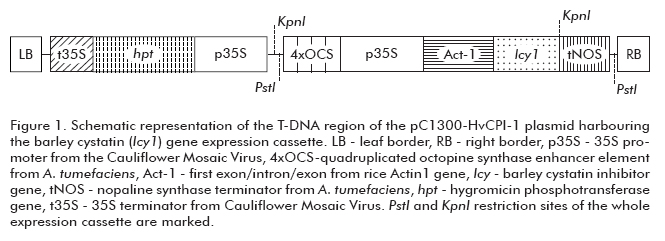
<body><![CDATA[<P   align="justify" > </P >       <P   align="justify" ><b><font size="3" face="Verdana, Arial, Helvetica, sans-serif">MATERIALS AND      METHODS</font></b></P >   <FONT size="+1">        <P   ><font size="2" face="Verdana, Arial, Helvetica, sans-serif"><b>Materials from      plants and insects</b> </font></P >   <FONT size="+1">        <P   align="justify" ><font face="Verdana, Arial, Helvetica, sans-serif" size="2">Cultures of embryogenic      calluses of <I>Oryza sativa </I>L. (cv IACuba-28) derived from seeds were      produced and maintained as described by Coll <I>et al. </I>(30). They were      routinely sub-cultured and used to transform and generate rice plants. </font></P >       <P   align="justify" ><font face="Verdana, Arial, Helvetica, sans-serif" size="2">Larvae of rice water      weevil <I>L. brevirostris </I>Suffrian (Coleoptera: Curculionidae) used in      the experiments were obtained from the rice roots collected in a rice paddy      in Sancti-Sp&iacute;ritus (Cuba). Larvae stages at third and fourth instars      were isolated and the gut was dissected, frozen in liquid nitrogen and stored      at -70 &ordm;C for later use in enzymatic inhibition assays. </font></P >       <P   ><font face="Verdana, Arial, Helvetica, sans-serif" size="2"><b>Plasmid constructs</b>      </font></P >       <P   align="justify" ><font face="Verdana, Arial, Helvetica, sans-serif" size="2">A 450 bp <I>BamHI-NcoI      </I>fragment containing the complete ORF of the barley cystatin gene (<I>Icy1</I>)      was ex-cised from the fusion expression vector pRSETA, where this gene had      been cloned by Gaddour <I>et al. </I>(18), and inserted into vector pBPFA9      (31) to obtain the plasmid pBPFA-HvCPI-1. This construction was digested with      <I>PstI </I>to obtain the <I>Icy1 </I>gene expression cassette that was then      inserted in the <I>PstI </I>site of the pCAMBIA 1300 (CAMBIA BioForge) plasmid      to yield the final pC1300-HvCPI-1 construct used in further transformation      experiments (<a href="/img/revistas/bta/v26n4/f0106409.jpg">Figure 1</a>).      </font></P >       
<P   ><font face="Verdana, Arial, Helvetica, sans-serif" size="2"><b>Plant transformation      </b></font></P >   <FONT size="+1"><FONT size="+1"><FONT size="+1"><FONT size="+1">        <P   align="justify" ><font face="Verdana, Arial, Helvetica, sans-serif" size="2">The <I>A. tumefaciens,      </I>strain EHA-105 that had been transformed with plasmid pC1300-HvCPI-1,      was used for the transformation of embryogenic calluses obtained from mature      seeds of <I>Oryza sativa </I>L. (cv IACuba-28) following the procedure described      by Hiei <I>et al</I>. (32), with minor modifications. After a selection on      50 mg/L hygromycin, surviving calluses were transferred onto a KIBAN regeneration      media (30) containing 30 g/L maltose instead of sucrose (33) plus 50 mg/L      hygromycin. Regenerated plants were individualized on an MS medium (34) containing      50 mg/L hygromycin to induce root formation. Putative primary transformants      (T<Sub>0</Sub><Sup> </Sup>generation) were acclimatized in a greenhouse, transplanted      to big plastic pots filled with soil, watered daily and grown to maturity.      </font></P >   <FONT size="+1"><FONT size="+1">        <P   align="justify" ><font face="Verdana, Arial, Helvetica, sans-serif" size="2">Seeds from self-pollinated      plants were always germinated in a hygromycin-MS medium and T<Sub>1</Sub><Sup>      </Sup>plants were transplanted to pots and grown under greenhouse conditions      (16 h light: 8 h dark photoperiod and a temperature of 28-30 &deg;C) for further      assays. </font></P >   <FONT size="+1"><FONT size="+1">        ]]></body>
<body><![CDATA[<P   ><font face="Verdana, Arial, Helvetica, sans-serif" size="2"><b>DNA analysis </b></font></P >       <P   align="justify" ><font face="Verdana, Arial, Helvetica, sans-serif" size="2">Total DNA was isolated      from leaves of transgenic and wild type rice plants (35) and PCR amplification      was performed on genomic DNA templates, using the internal primers ctgcctgaaaccgaactgc      (5&acute;) and cttctgcgggcgatttgtg (3&acute;), to amplify a <I>hpt </I>selective      gene fragment of 632 bp. The amplified products were separated by electrophoresis      in 0.8% agarose gels containing ethidium bromide for further DNA visua-lization      and transferred onto Hybond-N+ membranes (Amersham Biosciences). For PCR-Southern      blot we used a DIG-11-dUTP-labelled entire <I>hpt </I>gene. The presence of      the <I>Icy1 </I>gene in the rice genome was tested by Southern blot following      the procedure described by Potrykus and Spangenberg (36). Purified rice DNA      (10 &mu;g) was restricted with <I>KpnI</I>, electrophoresed in 0.8% agarose      gels and blotted onto Hybond-N+ membranes (Amersham Biosciences). The complete      <I>Icy1 </I>coding region labeled with DIG-11-dUTP was used as a probe. Hybridization,      post-hybridization wa-shes and immunological detection of the hybridized DIG-labeled      probes were performed following procedures recommended by manufactures of      the DIG High Prime DNA Labeling and Detection Starter Kit II (Boehringer Mannheim).      </font></P >       <P   ><font face="Verdana, Arial, Helvetica, sans-serif" size="2"><b>Rice protein extraction      and immunodetection</b> </font></P >       <P   align="justify" ><font face="Verdana, Arial, Helvetica, sans-serif" size="2">Rice leaves (100      mg) from 3 week-old plants were ground in liquid nitrogen, homogenized in      150 &mu;L of Laemmli (37) buffer and heated at 100 &ordm;C for 5 minutes.      After centrifugation for 5 minutes at 12 000 rpm, soluble protein concentration      in the supernatant was estimated following the method proposed by Bradford      (38) using BSA as a standard. Proteins extracted from leaves of T<Sub>1</Sub><Sup>      </Sup>transgenic lines (30 &mu;g each sample) were separated by SDS-PAGE in      12% polyacrylamide gels according to Laemmli (37) and transferred onto nitrocellulose      membranes (Amersham Bioscience) with an Electro Transblot apparatus (BioRad).      </font></P >   <FONT size="+1"><FONT size="+1">        <P   align="justify" ><font face="Verdana, Arial, Helvetica, sans-serif" size="2">Total protein extracts      from roots were obtained from axenic cultures of transgenic and non-transgenic      rice plants after germinating seeds for 3 weeks in an MS medium. Roots were      isolated, cut into small pieces, ground in a mortar at 4 &ordm;C and homogenized      in 100 mM phosphate buffer, pH 6.0. Protein was quantified according to Bradford      (38), using BSA as a standard. Aliquots of 10 &mu;g of proteins extracted      from T<Sub>2</Sub><Sup> </Sup>rice roots were directly applied to nitrocellulose      membranes (Amersham Bioscience) using a Hybrid-Dot-Manifold apparatus (Life      Technologies Inc). </font></P >   <FONT size="+1"><FONT size="+1">        <P   align="justify" ><font face="Verdana, Arial, Helvetica, sans-serif" size="2">Immunological staining      was carried out with the anti-HvCPI-1 antibody (produced in rabbits) at a      1:2000 dilution, followed by washes and the addition of the second antibody      (goat anti-rabbit IgG conjugated alkaline phosphatase; Sigma) at a dilution      of 1:30 000. Color was developed by the reaction of the nitroblue tetrazoilum      and 5-bromo-4-chloro-3-indolyl phosphate. Recombinant HvCPI-1 protein purified      from <I>E. coli </I>was prepared as a control. </font></P >       <P   ><font face="Verdana, Arial, Helvetica, sans-serif" size="2"><b>Inhibitory activity      of recombinant barley cystatin </b></font></P >       <P   align="justify" ><font face="Verdana, Arial, Helvetica, sans-serif" size="2">The <I>Icy </I>gene      encoding the barley cystatin HvCPI-1 was expressed as a fusion protein in      <I>E. coli </I>following Martinez <I>et al</I>. (17) and purified using His-Band      resin and elution conditions from a Ni<Sup>2+</Sup>-column according to the      manufacture&rsquo;s instructions (Novagen). Guts from third and fourth instar      larvae of <I>L. brevirostris </I>were dissected and prepared as described      by Hern&aacute;ndez <I>et al</I>. (2) to produce an enriched midgut proteinase      fraction. Protein was quantified according to Bradford (38) using BSA as the      standard. </font></P >   <FONT size="+1"><FONT size="+1">        <P   align="justify" ><font face="Verdana, Arial, Helvetica, sans-serif" size="2">The inhibitory activity      of the barley cystatin against insect digestive proteinases was assayed using      0.1% sulfanilamide-azocasein solution as the substrate. Different concentrations      of recombinant barley cystatin were pre-incubated with gut extracts (100 &mu;g)      from RWW in the assay buffer (100 mM acetate buffer, pH 4.5) at 30 &deg;C      for 30 min, before adding the substrate. The reaction was incubated for 24      h and stopped with 5% TCA (trichloroacetic acid). Undigested azocasein was      removed by centrifugation at 12 000 rpm for 5 minutes and the absorbance of      the supernatant was read at 405 nm. All assays were carried out in triplicate      and blanks were used for the spontaneous breakdown of substrates. </font></P >       <P   ><font face="Verdana, Arial, Helvetica, sans-serif" size="2"><b>Effects of transgenic      plant extracts on the gut proteinase activity of <i>L. brevirostris</i> </b></font></P >       ]]></body>
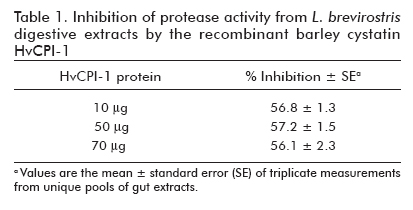
<body><![CDATA[<P   align="justify" ><font face="Verdana, Arial, Helvetica, sans-serif" size="2">Total protein extracts      from T<Sup>1 </Sup>leaves and T<Sup>2 </Sup>roots were obtained from axenic      cultures of 3-week-old transgenic and non-transgenic rice plants grown on      a hygromycin-MS medium. Leaves were ground in liquid nitrogen and homogenized      in 50 mM citrate buffer, pH 5.0 containing 3.1 mM DTT. Similarly, rice roots      were isolated, cut in small pieces, ground in a mortar at 4 &ordm;C and homogenized      in 100 mM acetate buffer, pH 4.5 or in 100 mM phosphate buffer, pH 6.0, depending      on the conditions of the further inhibitory assays, plus 3.1 mM DTT in both      buffers. Soluble proteins from root and leaf tissues were recovered from supernatants      after a centrifugation for 10 minutes at 12 000 rpm at 4 &ordm;C. In parallel,      guts from the third and fourth instar larvae of RWW were dissected and prepared      as described above. </font></P >   <FONT size="+1"><FONT size="+1"><FONT size="+1"><FONT size="+1">        <P   align="justify" ><font face="Verdana, Arial, Helvetica, sans-serif" size="2">The inhibition of      the proteolytic activity of the gut of <I>L. brevirostris </I>by the protein      extract from transgenic rice tissues was analysed <I>in vitro </I>using two      different assays. First, the inhibition of non-specific proteinase activity      was assayed using 0.1% sulfanilamide-azocasein solution as a substrate, and      leaf proteins extracted from 65 independent transgenic lines and from non-transgenic      rice. Then, the ZAA<Sup>2</Sup>MNA (N-carbobenzoxy-alanine-arginine-arginine      4-methoxy-&beta;-naphthyl amide) substrate at a concentration of 50 &mu;M      was used to determine the specific inhibition of gut cathepsin B-like activity      by root protein extracts. The specific inhibitory assay was only carried out      with roots extracted from three of those transgenic lines that showed the      highest inhibitory effects when leaf protein extracts were tested. </font></P >   <FONT size="+1"><FONT size="+1">        <P   align="justify" ><FONT size="+1"><FONT size="+1"><FONT size="+1"><FONT size="+1"><FONT size="+1"><FONT size="+1"><FONT size="+1"><FONT size="+1"><FONT size="+1"><FONT size="+1"><FONT size="+1"><FONT size="+1"></font></font></font></font></font></font></font></font></font></font></font></font><font face="Verdana, Arial, Helvetica, sans-serif" size="2">The      azocasein assay was performed with 160 &mu;g of protein extracted from the      <I>L. brevirotris </I>gut and 100 &mu;g of protein extracted from rice leaves      plus 200 &mu;g of sulfanilamide-azocasein in a final volume <FONT color="#1F1C1D">of      160 &mu;L of the assay buffer (50 mM citrate buffer, pH 5.0,) containing 2.5      mM DTT. The reaction was incubated for 24 h at 37 &ordm;C and stopped with      5% TCA. Undigested azocasein was removed by centrifugation at 12 000 rpm for      5 minutes and the absorbance was read at 405 nm with a multiskan plate reader      (SUMA, Cuba). </font></font></P >   <FONT size="+1"><FONT size="+1"><FONT size="+1"><FONT size="+1"><FONT size="+1"><FONT size="+1"><FONT size="+1"><FONT size="+1"><FONT size="+1"><FONT size="+1"><FONT size="+1"><FONT size="+1"><FONT color="#1F1C1D">        <P   align="justify" ><font face="Verdana, Arial, Helvetica, sans-serif" size="2">The inhibition of      cathepsin B-like activity from the rice water weevil guts was determined essentially      as described by Novillo <I>et al. </I>(39) with minor modifications. Fifty      micrograms of the crude gut extracts were incubated with 20 &mu;g of proteins      extracted from rice roots in 150 &mu;L of assay buffer (100 mM acetate for      pH 4.5 or 100 mM phosphate for pH 6.0) containing 2.5 mM DTT, and adding 10      &mu;L of 800 &mu;MZAA<Sub>2</Sub>MNA substrate. After 24 h of incubation at      30 &ordm;C, the mersalyl-Fast Garnet-Brij reagent was added and the absorbance      was monitored at 520 nm with a multiskan plate reader (SUMA, Cuba). </font></P >   <FONT size="+1"><FONT size="+1">        <P   align="justify" ><font face="Verdana, Arial, Helvetica, sans-serif" size="2">The percentage of      inhibition was calculated according to the equation: (1-Ai/Ac) x 100, where      Ai is the absorbance value of each sample and Ac the absorbance value of the      control sample containing non-transformed rice proteins. Gut extracts were      pre-incubated with the rice proteins for 30 min at room temperature before      adding the corresponding substrate. All proteinase activities were measured      after 24 h of reaction at their optimum pH and temperature. The assays were      carried out in triplicate, and the blanks used to account the spontaneous      breakdown of substrates without plant protein extracts were subtracted from      each sample. </font></P >       <P   align="justify" ><font face="Verdana, Arial, Helvetica, sans-serif" size="3"><b>RESULTS AND DISCUSSION</b></font></P >   <FONT size="+1">        <P   align="justify" ><font size="2" face="Verdana, Arial, Helvetica, sans-serif">It is well known      that most curculionid species use cysteine-proteinases for digestion (28,      40-42). Our previous results had shown cathepsin B-like activity as the main      proteolytic activity located in the anterior and middle gut sections of <I>L.      brevirostris </I>larvae (2). Based on this, it seemed sensible to select cysteine-proteinases      from larval guts as potential targets of cystatins in order to develop a new      control system against weevil attack. To explore this approach against RWW,      the most destructive insect pest of rice in Cuba, we first carried out <I>in      vitro </I>inhibitory assays with the recombinant barley cystatin HvCPI-1 and      proteins extracted from larval midgut from the RWW demonstrating the ability      of cystatin for inhibiting the proteinase activity in this coleopteran species      (<a href="#tab1">Table 1</a>). As shown in <a href="#tab1">table 1</a>, similar      levels of inhibition were obtained when the cystatin was tested at three different      concentrations, indicating that the amount of HvCPI-1 used in the inhibitory      assay was excessive compared to the amount of proteinases in the gut extracts.      </font></P >       <P   align="center" ><img src="/img/revistas/bta/v26n4/t0106409.jpg" width="413" height="210"><a name="tab1"></a></P >   <FONT size="+1">        
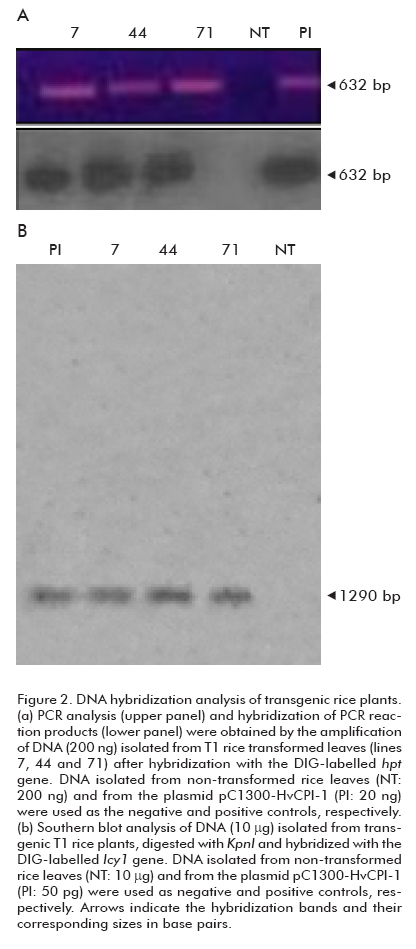
<P   align="justify" ><font face="Verdana, Arial, Helvetica, sans-serif" size="2">Based on these results,      we decided to stably express the barley cystatin in the <I>indica </I>rice      cv IACuba-28. A total of 200 embryogenic calluses were co-cultured with <I>A.      tumefaciens </I>transformed with the pC1300-HvCPI-1 plasmid. Forty-four independent      calluses were obtained (22% of callus formation) after the selection of proliferating      cells on the selective medium. The selected calluses were transferred to a      KIBAN regeneration medium where 71 independent transgenic lines were regenerated,      but only 65 of them grew to maturity under greenhouse conditions. The presence      of the <I>hpt </I>selective gene was determined by PCR-Southern blot assays      and the results revealed that 62 out of the 65 transgenic lines showed a clear      632 bp DNA band corresponding to the selective gene (<a href="#fig2">Figure      2A</a>). In addition, using Southern blot of genomic DNA purified from the      T<Sub>1</Sub> generation we demonstrated the stable integration of the barley      <I>Icy1</I> gene into the transformed rice plants. As shown in <a href="#fig2">figure      2B</a>, a single hybridization band of 1 290 kb appeared in the samples analyzed      after restriction with KpnI endonuclease. </font></P >       <P   align="center" ><img src="/img/revistas/bta/v26n4/f0206409.jpg" width="416" height="949"><a name="fig2"></a></P >   <FONT size="+1"><FONT size="+1"><FONT size="+1"><FONT color="#201D1E">        
]]></body>
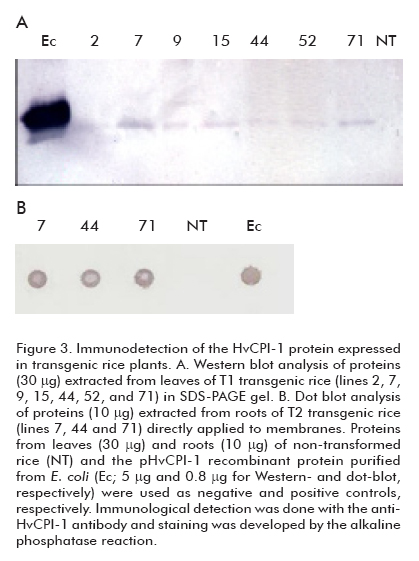
<body><![CDATA[<P   align="justify" ><font face="Verdana, Arial, Helvetica, sans-serif" size="2">To confirm the expression      of the HvCPI-1 protein encoded by the <I>Icy1 </I>gene we analyzed the proteins      extracted from rice leaves with western-blot and a single band, corresponding      to the estimated molecular size of 11.8 kDa of the HvCPI-1 protein (18), was      observed with a different intensity. This band was absent in extracts from      leaves of non-transformed rice (<a href="#fig3">Figure 3A</a>). The range      of the HvCPI-1 protein expression level was estimated on 0.25 to 2.0% of the      total soluble proteins in leaves by scanning densitometry analyses (data not      shown), showing that the transgenic rice line TL-7 had the highest amount      of cystatin (<a href="#fig3">Figure 3A</a>). Furthermore, a stronger larger      size band was detected when barley cystain was purified as a recombinant protein      from <I>E. coli </I>cultures. The larger protein size of approximately 16.04      kDa resulted from the fusion of the cystatin with the histidine tail to facilitate      the recombinant protein purification procedure. The ex-pression of HvCPI-1      in the root of the transgenic lines was also confirmed by dot blot (<a href="#fig3">Figure      3B</a>). </font></P >       <P   align="center" ><img src="/img/revistas/bta/v26n4/f0306409.jpg" width="419" height="561"><a name="fig3"></a></P >       
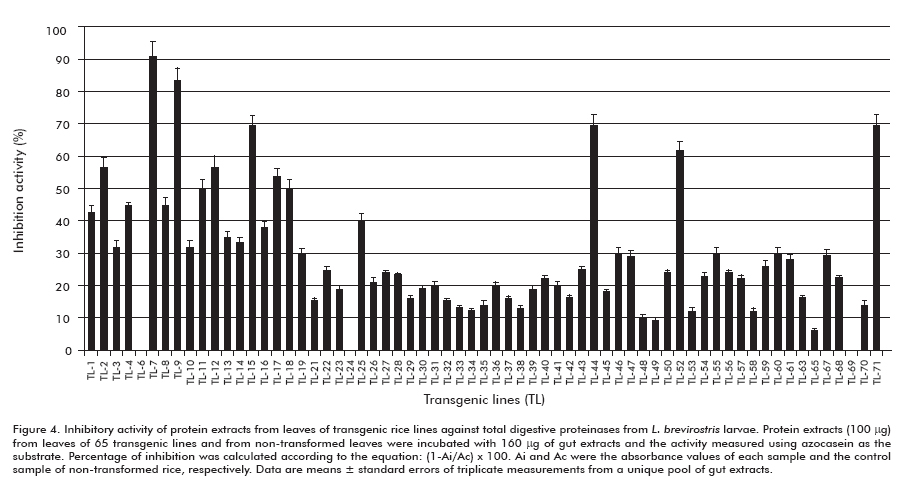
<P   align="justify" ><font face="Verdana, Arial, Helvetica, sans-serif" size="2">The amount of HvCPI-1      protein detected in these transgenic rice leaves showed an expression level      at a similar range to those quantified in rice leaves transformed with other      proteinase inhibitors that have been shown to confer resistance against insects      (24-26). </font></P >       <P   align="justify" ><font face="Verdana, Arial, Helvetica, sans-serif" size="2">Because of the difficulties      in rearing the RWW under environment-controlled conditions (43) it is almost      impossible to carry out feeding bioassays with this insect at the laboratory      level. We therefore decided to analyze whether the cystatin activity acquired      by the transgenic rice plants affects the digestive proteinases of <I>L. brevirostris      </I>larvae <I>in vitro</I>. In a first approach we analyzed the inhibition      of the total proteolytic activity of the RWW larvae guts by protein extracts      from leaves of the 65 independent transgenic rice lines, as well as from non-transformed      rice leaves. Sixty two of the 65 transgenic lines showed an inhibitory activity      that was absent in protein extracts from the non-transformed control (<a href="/img/revistas/bta/v26n4/f0406409.jpg">Figure      4</a>). The three negative rice lines (TL-6, TL-24 and TL-69) corresponded      to those that were negative in the PCR-Southern blot assays. As shown in <a href="/img/revistas/bta/v26n4/f0406409.jpg">Figure      4</a>, more than 50% of the gut proteinase activity of the <I>L. brevirostris      </I>larvae was inhibited by 100 <I>&mu;</I>g of the total soluble protein      extracted from leaves in 11 lines (TL-2, TL-7, TL-9, TL-11, TL-12, TL-15,      TL-17, TL-18, TL-44, TL-52 and Tl-71) from the 62 PCR positive transgenic      plants. Protein extracts from lines TL-15, TL-44 and TL-71 inhibited 70% of      the gut proteinase activity of the insect and particularly interesting were      the transgenic lines TL-7 and TL-9 due to their ability of inhibiting 91 &plusmn;      5% and 84 &plusmn; 4% of the gut proteinase activity of <I>L. brevirostris,      </I>respectively. </font></P >       
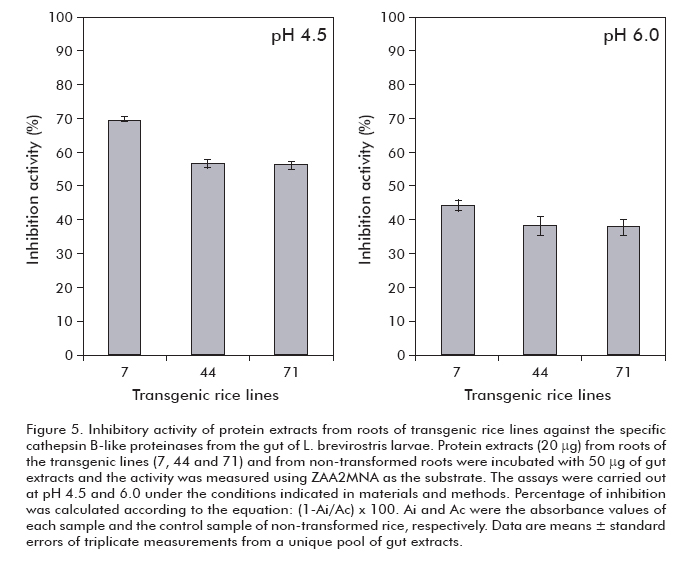
<P   align="justify" ><font face="Verdana, Arial, Helvetica, sans-serif" size="2">Considering that      the economic losses in rice are attributable primarily to larvae that feed      on rice roots, we selected transgenic lines TL-7, TL-44 and TL-71 to study      the effect of the T<Sub>2</Sub><Sup> </Sup>root protein extract on the proteolytic      activity present in the guts of the RWW larvae. Our previous results had revealed      that the digestive endoprotease activities of RWW larvae are mainly of the      cysteine-proteinase type, essentia-lly the cathepsin B-like. We had also found      that the maximum hydrolysis of the ZAA<Sup>2</Sup>MNA, the cathepsin B-like      specific substrate, occurred at pH 4.5 and 6.0, respectively (2). Taking into      account these results, we carried out the inhibitory assays under both pH      condi-tions, using the ZAA<Sub>2</Sub>MNA specific substrate. Protein extracts      from the three transgenic roots were good inhibitors of the gut cathepsin      B-like activity, parti-cularly when the reaction took place in 100 mM acetate      under pH 4.5 (<a href="/img/revistas/bta/v26n4/f0506409.jpg">Figure      5</a>). Regardless of the pH tested, extracts from transgenic line 7 showed      the maximum inhibitory effects, being able to reduce the cathepsin B-like      activity of the gut up to 70.3 &plusmn; 0.8% and 44.9 &plusmn; 1.5%, at pH      4.5 and 6.0, respectively. </font></P >   <FONT size="+1"><FONT size="+1"><FONT size="+1"><FONT size="+1"><FONT size="+1"><FONT size="+1">        
<P   align="justify" ><font face="Verdana, Arial, Helvetica, sans-serif" size="2">The two peaks of      maximum activity at pH 4.5 and 6.0 resulting from the hydrolysis of the specific      substrate ZAA<Sub>2</Sub>MNA by digestive endoproteases of <I>L. brevirostris      </I>larvae suggest the presence of at least two cysteine-proteinases. Moreover,      the gelatine-PAGE gels confirmed at least three proteinase forms at pH 5.0      (2). These results were consistent with the differences detected on the inhibitory      ability of the root protein extracts tested a pH 4.5 and 6.0, confirming the      coexistence of more than one cathepsin B-like activity in the gut extracts      of the RWW. </font></P >   <FONT size="+1"><FONT size="+1">        <P   align="justify" ><font face="Verdana, Arial, Helvetica, sans-serif" size="2"><I>In vivo </I>assays      will definitively confirm the potential of the barley cystatin gene as a defense      protein to combat RWW, but unfortunately the complex feeding habits of this      pest makes it almost impossible to develop this kind of feeding test. At this      state of the art, it is important to mention that several transgenic rice      plants expressing proteinase inhibitor encoding genes have been already proven      to have an effect against lepidopteran (24, 25) and coleopteran rice pests      (21, 28). Duan <I>et al. </I>(24) introduced the potato trypsin/chymotrypsin      inhibitor PINII into several japonica rice varieties and showed an increased      resistance to <I>S. inferens</I>; in pot experiment they found that the number      of plants with <I>S. inferens </I>symptoms in transgenic plants were significantly      lower (16-17%) than those of non transformed plants (72-100%). Xu <I>et al.      </I>(25) also reported transgenic rice carrying the cowpea trypsin inhibitor      <I>(CpTi) </I>gene with enhanced resistance to two species of rice stem borers,      <I>C. suppressalis </I>and <I>S. infestans, </I>which are major rice insect      pests. The corn cystatin CC-I expressed in rice seeds inhibited the digestive      proteinases of the <I>Sitophilus zeamais </I>(21) and the trypsin inhibitor      BTI-CMe from barley expressed in <I>indica </I>and <I>japonica </I>rice seeds      conferred resistance to <I>S. oryzae </I>(28). However, as far as we know,      there are no reports where plant proteinase inhibitors had been used as transgenes      to fight insect pests feeding on rice roots. We have only found one paper      where roots of transgenic rice plants expressing the modified oryzacystatin      OC-I&Delta;D86 conferred resistance to root predators such as the nematode      <I>Meloidogyne </I>spp (44). It is known that it is difficult to study and      combat insect pests specifically feeding on roots and it is even more difficult      if the roots are growing under water. In conclusion, the recombinant cystatin      HvCPI-1 from barley is a good inhibitor of the cysteine-proteinases present      in the gut of the RWW and it also functions properly as an inhibitor when      it is stably expressed in rice. Although we successfully expressed the HvCPI-1      gene under a constitutive promoter and confirmed its active expression in      rice roots it will be of outstanding interest to express the gene under the      control of a strong root specific promoter. </font></P >   <FONT size="+1"><FONT size="+1">        <P   align="justify" ><font face="Verdana, Arial, Helvetica, sans-serif" size="2">Furthermore, the      antifungal properties expressed by the barley cystatin HvCPI (17) combined      with its ability to inhibit the cysteine-proteinases of the gut of the RWW      (shown in this paper) also suggest that a leaf- and root-specific promoter      could be used to direct, simultaneously, the expression of the <I>Icy </I>gene      in organs attacked by pathogens and pests without altering seed quality. </font></P >       <P   align="justify" ><font face="Verdana, Arial, Helvetica, sans-serif" size="2">Insect herbivores      have developed effective strategies to elude the inhibitory effects of plant      protease inhibitors, including the use of complex digestive pro-tease systems      with proteases of different mechanistic classes acting in a coordinated manner;      the production of alternative, insensitive protease forms following the ingestion      of protease inhibitors; and the degradation of defensive protease inhibitors      using non-target, insensitive digestive proteases (45). In this context, the      development of recombinant protease inhibitors with strong inhibitory effects      that are specific to the targeted organism represents a challenging task for      the future of this strategy. From a biotechnology viewpoint, one challenge      now is to generate insect-specific cystatin variants with improved activity      against the digestive protease of the target herbivore but decreased activity      against non-target cysteine-proteases in the surrounding environment. Recently,      Goulet <I>et al</I>. (46) were able to obtain four mutants of the tomato muticystatin      unit <I>Sl</I>CYS8 that exhibited improved inhibitory activity against both      cystatin-sensitive and cystatin-insensitive digestive cysteine protease of      Colorado potato beetle, while also exhibiting lowered, or unaltered, activity      against cysteine proteases of potato leaves and protease I, the main digestive      cysteine protease of the insect predator <I>P. bioculatus.</I> </font></P >       <P   align="justify" ><font face="Verdana, Arial, Helvetica, sans-serif" size="2">In general, cystatins      are not new to human and animal diets. They occur naturally in seeds such      as those of rice and maize (47) and are present in potato tubers (48). Cystatins      also occur in human saliva (49) and are present at a high level in egg-whites      (50). Finally, the absence of target cysteine proteases in the human gut and      the negligible negative effects expected for these proteins in foods (51,      52) turn cystatins into a good candidates for the design of pest-resistant      transgenic crops intended for human use. </font></P >       ]]></body>
<body><![CDATA[<P   align="justify" ><font face="Verdana, Arial, Helvetica, sans-serif" size="2">For future perspectives      and in order to avoid their adaptation, the pyramiding approach will be an      alternative to control this rice weevil by the co-expression of genes encoding      cystatins and the <I>cry3A </I>gene from <I>Bacillus thuringiensis </I>subsp.      <I>tenebrionis</I>, which has been reported as an effective control of other      curculionids (53, 54), or with other genes with insecticidal properties. In      fact, the expression of multiple insecticidal transgenes is currently being      used by different Chinese groups to increase the efficacy of transgenic rice      against insect pests (55-57). </font></P >       <P   align="justify" ><b><font size="3" face="Verdana, Arial, Helvetica, sans-serif">ACKNOWLEDGMENTS</font></b></P >   <FONT size="+1">        <P   align="justify" ><font size="2" face="Verdana, Arial, Helvetica, sans-serif">This study was supported      by the Cuban Council of State. The authors acknowledge the kind gift of the      <I>Icy-1 </I>gene by the Dr. Isabel Diaz, Escuela T&eacute;cnica Superior      de Ingenieros Agr&oacute;nomos, Universidad Polit&eacute;cnica de Madrid.      We are also grateful to Manuel Delgado from the Estaci&oacute;n Experimental      del Arroz Sur del J&iacute;baro (Sancti-Sp&iacute;ritus) for his technical      assistance in the collection of rice water weevil larvae and to Jorge Salcedo      for his general assistance. </font></P >   <FONT size="+1">        <P   align="justify" > </P >       <P   align="justify" ><b><font face="Verdana, Arial, Helvetica, sans-serif" size="3">REFERENCES </font></b></P >       <P   align="justify" > </P >       <P   align="justify" ><font size="2" face="Verdana, Arial, Helvetica, sans-serif">1. Meneses R, Guti&eacute;rrez      A, Garc&iacute;a A, Antigua G, G&oacute;mez J. Gu&iacute;a para el trabajo      de campo en el manejo integrado de pla-gas del arroz. Cuarta edici&oacute;n      revisada y ampliada en 2001; (<FONT color="#0000FF"><a href="url:http://www.ciat.cgiar.org/riceweb/pdfs/guia_trabajo_campo.pdf">http://www.ciat.cgiar.org/riceweb/pdfs/guia_trabajo_campo.pdf</a><FONT color="#201D1E">,      active August 2009) </font></font></font></P >   <FONT size="+1"><FONT color="#0000FF"><FONT color="#201D1E">        <!-- ref --><P   align="justify" ><font face="Verdana, Arial, Helvetica, sans-serif" size="2">2. Hern&aacute;ndez      C, Pujol M, Alfonso-Rubi J, Armas R, Coll Y, P&eacute;rez M, et al. Proteolytic      gut activities in the rice water weevil, Lissorhoptrus brevirostris Sufr&iacute;an      (Coleoptera: Curculionidae). Arch Insect Biochem Physiol 2003;53:19-29.     </font></P >       <!-- ref --><P   align="justify" ><font face="Verdana, Arial, Helvetica, sans-serif" size="2">3. Rawlings ND, Morton      FR, Barrett AJ. MEROPS: the peptidase database. Nucleic Acids Res 2008;36:320-25.          </font></P >       <!-- ref --><P   align="justify" ><font face="Verdana, Arial, Helvetica, sans-serif" size="2">4. Girard C, Rivard      D, Kiggundu A, Kunert K, Gleddie SC, Cloutier C, et al. A mul-ticomponent,      elicitor-inducible cystatin complex in tomato, Solanum lycopersicum. New Phytol      2006;173:841-51.     </font></P >       <!-- ref --><P   align="justify" ><font face="Verdana, Arial, Helvetica, sans-serif" size="2">5. Mart&iacute;nez      M, Abraham Z, Gambardella M, Echaide M, Carbonero P, Diaz I. The strawberry      gene Cyf1 encodes a phytocystatin with antifungal properties. J Exp Bot 2005;56:1821-29.          </font></P >       <!-- ref --><P   align="justify" ><font face="Verdana, Arial, Helvetica, sans-serif" size="2">6. Abraham Z, Mart&iacute;nez      M, Carbonero P, D&iacute;az I. Structural and functional diversity within      the cystatin gene family of Hordeum vulgare. J Exp Bot 2006;57:4245-55.     </font></P >       <!-- ref --><P   align="justify" ><font face="Verdana, Arial, Helvetica, sans-serif" size="2">7. Mart&iacute;nez      M, D&iacute;az-Mendoza M, Carrillo L, D&iacute;az I. Carboxy terminal extended      phytocystatins are bifunctional inhibitors of papain and legumain cysteine      proteinases. FEBS Lett 2007;581:2914-18.     </font></P >       <!-- ref --><P   align="justify" ><font face="Verdana, Arial, Helvetica, sans-serif" size="2">8. Siqueira-Junior      CL, Fernandez KVS, Machado OLT, Cunha M, G&oacute;mez VM, Moura D, et al.      87 kDa tomato cystatin exhibits properties of a defence protein and forms      crystals in prosystemin over-expressing transgenic plants. Plant Physiol Biochem      2002;40:247-54.     </font></P >       <!-- ref --><P   align="justify" ><font face="Verdana, Arial, Helvetica, sans-serif" size="2">9. Kiyosaki T, Matsumoto      I, Asakura T, Funaki J, Kuroda M, Misaka T, et al. Gliadain, a gibberellin-inducible      cysteine proteinase occurring in germinating seeds of wheat, Triticum aestivum      L., specifically digests gliadin and is regulated by intrinsic cystatins.      FEBS J 2007;164:470-77.     </font></P >       <!-- ref --><P   align="justify" ><font face="Verdana, Arial, Helvetica, sans-serif" size="2">10. Solomon M, Belenghi      B, Delledonne M, Levine A. The involvement of cysteine proteases and protease      inhibitor genes in programmed cell death in plants. Plant Cell 1999;11:431-44.          </font></P >       <!-- ref --><P   align="justify" ><font face="Verdana, Arial, Helvetica, sans-serif" size="2">11. Haq SK, Atif      SM, Khan RH. Protein proteinase inhibitor genes in combat against insects,      pests, and pathogens; natural and engineering phytoprotection. Arch Biochem      Biophys 2004;431:145-59.     </font></P >       <!-- ref --><P   align="justify" ><font face="Verdana, Arial, Helvetica, sans-serif" size="2">12. Guti&eacute;rrez-Campos      R, Torres Acosta J, Saucedo-Arias LJ, G&oacute;mez-Lim MA. The use of cysteine      proteinase inhibitors to engineer resistance against potyviruses in transgenic      tobacco plants. Nature Biotech-nol 1999;17:1223-26.     </font></P >       <!-- ref --><P   align="justify" ><font face="Verdana, Arial, Helvetica, sans-serif" size="2">13. Walker AJ, Urwin      PF, Atkinson HJ, Brain P, Glen DM, Shewry PR. Transgenic Arabidopsis leaf      tissue expressing a modified oryzacystatin shows resistance to the field Deroceras      retuculatum (Mull). Transgenic Res 1999;8:95-103.     </font></P >       <!-- ref --><P   align="justify" ><font face="Verdana, Arial, Helvetica, sans-serif" size="2">14. Atkinson HJ,      Grimwood S, Johnston K, Green J. Prototype demonstration of transgenic resistance      to the nematode Rodopholus simies conferred on banana by a cystatin. Transgenic      Res 2004;13:135-42.     </font></P >       <!-- ref --><P   align="justify" ><font face="Verdana, Arial, Helvetica, sans-serif" size="2">15. Alvarez-Alfageme      F, Mart&iacute;nez M, Pascual-Ru&iacute;z S, Casta&ntilde;era P, D&iacute;az      I, Ortego F. Effects of potato plants expressing a barley cystatin on the      predatory bug Podisus maculiventris via herbivorous prey feeding on the plant.      Transgenic Res 2007;16:1-13.     </font></P >       <!-- ref --><P   align="justify" ><font face="Verdana, Arial, Helvetica, sans-serif" size="2">16. Pernas M, S&aacute;nchez-Monge      R, Lombardero M, Ateaga C, Casta&ntilde;era P, Salcedo G. Der p1 and Der F1,      the highly related and major allergens from house mites, are differentially      affected by a plant cystatin. Clinic Exp Allergy 2000;30:972-78.     </font></P >       <!-- ref --><P   align="justify" ><font face="Verdana, Arial, Helvetica, sans-serif" size="2">17. Mart&iacute;nez      M, L&oacute;pez-Solanilla E, Rodr&iacute;guez-Palenzuela P, Carbonero P, D&iacute;az      I. Inhibition of plant-pathogenic fungi by the barley cystatin Hv-CPI (gene      Icy) is not associated with its cysteine-proteinase inhibitory properties.      Mol Plant Microbe Interact 2003;16:876-83.     </font></P >       <!-- ref --><P   align="justify" ><font face="Verdana, Arial, Helvetica, sans-serif" size="2">18. Gaddour K, Vicente-Carbajosa      J, Lara P, Isabel-Lamoneda I, D&iacute;az I, Carbonero P. A constitutive cystatin-encoding      gene from barley (Icy) responds differentially to abiotic stimuli. Plant Mol      Biol 2001;45:599-08.     </font></P >       <!-- ref --><P   align="justify" ><font face="Verdana, Arial, Helvetica, sans-serif" size="2">19. Elden TC. Selected      proteinase inhibitor effects on alfalfa weevil (Coleoptera: Curculionidae)      growth and development. J Econ Entomol 1995;88:1586-90.     </font></P >       <P   align="justify" ><font face="Verdana, Arial, Helvetica, sans-serif" size="2">20. Pittendrigh BR,      Huesing JE, Shade RE, Murdock LL. Effects of lectins, CRY1A/CRY1B Bt &delta;-endotoxin,      PAPA, protease and a-amylase inhibitors on the development of the rice weevil,      Sitophilus oryzae, using an artificial seed bioassay. Entomol Exp Appl 1997;82:201-11.      </font></P >       <!-- ref --><P   align="justify" ><font face="Verdana, Arial, Helvetica, sans-serif" size="2">21. Irie K, Hosoyama      H, Takeuchi T, Iwabuchi K, Watanabe H, Abe M, et al. Transgenic rice established      to express corn cystatin exhibits strong inhibitory activity against insect      gut proteinases. Plant Mol Biol 1996;30:149-57.     </font></P >       <!-- ref --><P   align="justify" ><font face="Verdana, Arial, Helvetica, sans-serif" size="2">22. Girard C, Bonade-Bottino      M, Pham-Delegue MH, Jouanin L. Two strains of cabbage seed weevil (Coleoptera:      Curculionidae) exhibit differential susceptibility to a transgenic oilseed      rape expressing oryzacystatin I. J Insect Physiol 1998;44:569-77.     </font></P >       <!-- ref --><P   align="justify" ><font face="Verdana, Arial, Helvetica, sans-serif" size="2">23. Bonade-Bottino      M, Lerin J, Zaccomer B, Jouanin L. Physiological adaptation explains the insensitivity      of Baris coerulescens to transgenic oilseed rape expressing oryzacystain I.      Insect Biochem Mol Biol 1999;29:131-38.     </font></P >       ]]></body>
<body><![CDATA[<!-- ref --><P   align="justify" ><font face="Verdana, Arial, Helvetica, sans-serif" size="2">24. Duan X, Li X,      Xue Q, Abo-El-Saad M, Xu D, Wu R. Transgenic rice plants harboring an introduced      potato proteinase inhibitor II gene are insect resistant. Nat Biotechnol 1996;14:494-98.          </font></P >       <!-- ref --><P   align="justify" ><font face="Verdana, Arial, Helvetica, sans-serif" size="2">25. Xu D, Xue Q,      McElroy D, Mawai Y, L&iacute;der V, Wu R. Constitutive expression of a cowpea      trypsin inhibitor gene, CpTi, in transgenic rice plants confers resistance      to two major insect pests. Mol Breed 1996;2:167-73.     </font></P >       <!-- ref --><P   align="justify" ><font face="Verdana, Arial, Helvetica, sans-serif" size="2">26. Lee AI, Lee SH,      Koo JC, Chum HJ, Lim CO, Mun JH, et al. Soybean Kunitz trypsin inhibitor (SKTI)      confers resistance to the brown planthopper (Nilaparvata lugens Stal) in transgenic      rice. Mol Breed 1999;5:1-9 </font></P >       <!-- ref --><P   align="justify" ><font face="Verdana, Arial, Helvetica, sans-serif" size="2">27. Mochizuki A,      Nishizawa Y, Onodera H, Tabei Y, Toki S, Habu Y, et al. Transgenic rice plants      expressing a trypsin inhibitor are resistant against rice stem borer, Chilo      suppressalis. Entomol Exp Applicata 1999;93:171-8 </font></P >       <!-- ref --><P   align="justify" ><font face="Verdana, Arial, Helvetica, sans-serif" size="2">28. Alfonso-Rub&iacute;      J, Ortego F, Casta&ntilde;era P, Carbonero P, D&iacute;az I. Transgenic expression      of trypsin inhibitor CMe from barley in indica and japonica rice, confers      resistance to the rice weevil Sitophilus oryzae. Transgenic Res 2003;12:23-31.          </font></P >       <!-- ref --><P   align="justify" ><font face="Verdana, Arial, Helvetica, sans-serif" size="2">29. Vila L, Quilis      J, Meynard D, Britler JC, Marfa V, Murillo I, et al. Expression of the maize      proteinase inhibitor (mpi) gene in ri-ce plants enhances resistance against      the striped stem borer (Chilo suppressalis): effects on larval growth and      insect gut proteinases. Plant Biotechnol J 2005;3:187-02.     </font></P >       ]]></body>
<body><![CDATA[<!-- ref --><P   align="justify" ><font face="Verdana, Arial, Helvetica, sans-serif" size="2">30. Coll Y, Pujol      M, Castillo D, Gonz&aacute;lez A, Alfonso J, Armas R. Improvement of indica      rice (Oryza sativa) in vitro regeneration efficiency from callus mediated      by stress. Cereal Res Commu 1998;26:153-60.     </font></P >       <!-- ref --><P   align="justify" ><font face="Verdana, Arial, Helvetica, sans-serif" size="2">31. Gonz&aacute;lez-Cabrera      J, Coego-Gonz&aacute;les A, Mart&iacute;nez-Gil A, de la Riva GA, V&aacute;zquez-Padr&oacute;n      RI. Optimization of transgene expression in sugar-cane cells. Biotechnol Tech      1998;12:793-96.     </font></P >       <!-- ref --><P   align="justify" ><font face="Verdana, Arial, Helvetica, sans-serif" size="2">32. Hiei Y, Ohta      S, Komari T, Kumashiro T. Efficient transformation of rice (Oryza sativa L.)      mediated by Agrobacterium and sequence analysis of the boundaries of the T-DNA.      Plant J 1994;6:271-82.     </font></P >       <!-- ref --><P   align="justify" ><font face="Verdana, Arial, Helvetica, sans-serif" size="2">33. P&eacute;rez      M, Coll Y, Gonz&aacute;lez A, Alfonso-Rub&iacute; J, Armas R, Hern&aacute;ndez      C, et al. Influencia de la fuente de carbono y el agente gelificante sobre      la regeneraci&oacute;n de arroz indica variedad IACuba-28 a partir de callos.      Biotecnol Vegetal 2002;2:183-86.     </font></P >       <!-- ref --><P   align="justify" ><font face="Verdana, Arial, Helvetica, sans-serif" size="2">34. Murashige T,      Skoog F. A revised medium for rapid growth and bioassays with tobacco tissues      cultures. Physiol Plant 1962;15:473-97.     </font></P >       ]]></body>
<body><![CDATA[<!-- ref --><P   align="justify" ><font face="Verdana, Arial, Helvetica, sans-serif" size="2">35. Taylor B, Powell      A. Isolation of plant DNA and RNA. Focus 1982;4:4-6.     </font></P >       <!-- ref --><P   align="justify" ><font face="Verdana, Arial, Helvetica, sans-serif" size="2">36. Potrykus I, Spangenberg      G, editors. Gene transfer to plants. Springer: Berlin- Heidelberg-New York;      1995.     </font></P >       <!-- ref --><P   align="justify" ><font face="Verdana, Arial, Helvetica, sans-serif" size="2">37. Laemmli UK. Cleavege      of structural proteins during assembly of the head of bacteriophage T4. Nature      1970;277:680-85.     </font></P >       <!-- ref --><P   align="justify" ><font face="Verdana, Arial, Helvetica, sans-serif" size="2">38. Bradford MM.      A rapid and sensitive method for the quantification of microgram quantities      of protein utilizing the principle of protein-dye binding. Anal Biochem 1976;72:248-54.          </font></P >       <!-- ref --><P   align="justify" ><font face="Verdana, Arial, Helvetica, sans-serif" size="2">39. Novillo C, Casta&ntilde;era      P, Ortego F. Characterization and distribution of chymo-trypsin-like and other      digestive proteases in Colorado potato beetle larvae. Arch Insect Biochem      Physiol 1997;36:181-201.     </font></P >       ]]></body>
<body><![CDATA[<!-- ref --><P   align="justify" ><font face="Verdana, Arial, Helvetica, sans-serif" size="2">40. Baker KJE. Digestive      proteinases of Sitophilus weevils (Coleoptera: Curculionidae) and their response      to inhibitors from wheat and corn flour. Can J Zool 1982;60:3206-14.     </font></P >       <!-- ref --><P   align="justify" ><font face="Verdana, Arial, Helvetica, sans-serif" size="2">41. Matsumoto I,      Emori Y, Abe K, Arai S. Characterization of a gene family encoding cysteine      proteinases of Sitophilus zeamais (maize weevil), and analysis of the protein      distribution in various tissues including alimentary tarot and germ cells.      J Biochem 1997;121:464-76.     </font></P >       <!-- ref --><P   align="justify" ><font face="Verdana, Arial, Helvetica, sans-serif" size="2">42. Wilhite SE, Elden      TC, Brzin J, Smigocki AC. Inhibition of cysteine and aspartyl proteinases      in the alfalfa weevil midgut with biochemical and plant-derived proteinase      inhibitors. Insect Biochem Mol Biol 2000;30:1181-88.     </font></P >       <P   align="justify" ><font face="Verdana, Arial, Helvetica, sans-serif" size="2">Zhang Z, Stout MJ,      Shang H, Pousson RC. 43. A method for rearing the rice water weevil, Lissorhoptrus      oryzophilus (Coleoptera: Curclionidae), in the laboratory. The Coleopterists      Bulletin 2004;58:644-51. </font></P >       <P   align="justify" ><font face="Verdana, Arial, Helvetica, sans-serif" size="2">44. Vain P, Worland      B, Clarke MC, Richard G, Beavis M, Liu H, Kholi A, et al. Expression of an      engineered cysteine proteinase inhibitor (Oryzacystatin-I&Delta;D86) for nematode      resistance in transgenic rice plants. Theor Appl Genet 1998;96:260-71. </font></P >       <!-- ref --><P   align="justify" ><font face="Verdana, Arial, Helvetica, sans-serif" size="2">45. Broadway RM.      The adaptation of insects to protease inhibitors. In: Michaud D, editor. Recombinant      Protease Inhibitors in Plants. Landes Bioscience, Georgetown TX; 2000. p.80-8.          </font></P >       ]]></body>
<body><![CDATA[<!-- ref --><P   align="justify" ><font face="Verdana, Arial, Helvetica, sans-serif" size="2">46. Goulet MC, Dallaire      C, Vaillancourt LP, Khalf M, Badri AM, Preradov A, et al. Tailoring the specificity      of a plant cystatin toward herbivorous insect digestive proteases by single      mutations at positively selected amino acid sites. Plant Physiol 2008;146:1010-9.          </font></P >       <!-- ref --><P   align="justify" ><font face="Verdana, Arial, Helvetica, sans-serif" size="2">47. Richardson M.      Seed storage proteins: the enzyme inhibitors. Methods Plant Biochem 1991;5:259-305.          </font></P >       <!-- ref --><P   align="justify" ><font face="Verdana, Arial, Helvetica, sans-serif" size="2">48. Rodis P, Hoff      JE. Naturally occurring protein crystals in the potato. Plant Physiol 1984;74:907-11.          </font></P >       <!-- ref --><P   align="justify" ><font face="Verdana, Arial, Helvetica, sans-serif" size="2">49. Veerman ECI,      VandenKeybus PAM, Vissink A, Amerongen AVN. Human glandular salivas: their      separate collection and analysis. Eur J Oral Sci 1996;104:346-52.     </font></P >       <!-- ref --><P   align="justify" ><font face="Verdana, Arial, Helvetica, sans-serif" size="2">50. Awade AC. On      hen egg fractionation: applications of liquid chromatography to the isolation      and the purification of hen egg white and egg yolk proteins. Z. Lebensm.-Unters-Forsch      1996;202:1-14.     </font></P >       ]]></body>
<body><![CDATA[<!-- ref --><P   align="justify" ><font face="Verdana, Arial, Helvetica, sans-serif" size="2">51. Arai S, Abe K.      Cystatin-based control of insects, with special reference to oryzacystatin.      In: Michaud D, editor. Recombinant protease inhibitors in plants. Landes Bioscience,      Georgetown TX; 2000. p. 27-42.     </font></P >       <!-- ref --><P   align="justify" ><font face="Verdana, Arial, Helvetica, sans-serif" size="2">52. Atkinson HJ,      Johnston KA, Robbins M. Prima facie evidence that a phytocystatin for transgenic      plant resistance to nematodes is not a toxic risk in the human diet. J Nutr      2004;134:431-4.     </font></P >       <P   align="justify" ><font face="Verdana, Arial, Helvetica, sans-serif" size="2">53. Herrnstadt C,      Soares G, inventors; Mycogen Corporation, assignee. Control of cotton boll      weevil, alfalfa weevil, and corn rootworm via contact with a strain of Bacillus      thuringiensis. US patent 4,797,276. 1989 Jan 10. </font></P >       <P   align="justify" ><font face="Verdana, Arial, Helvetica, sans-serif" size="2">54. Bradfisch GA,      Schnepf HE, Kim L, inventors; Mycogen Corporation, assignee. Bacillus thuringiensis      isolates active against weevils. US patent 5,707,619. 1998 Jan 13. </font></P >       <!-- ref --><P   align="justify" ><font face="Verdana, Arial, Helvetica, sans-serif" size="2">55. Li G, Xu X, Xing      H, Zhu H, Fan Q. Insect resistance to Nilaparvata lugens and Cnaphalocorcis      medinalis in transgenic indica rice and the inheritance of gna+sbit transgenes.      Pest Manag Sci 2005;61:390-6.     </font></P >       <!-- ref --><P   align="justify" ><font face="Verdana, Arial, Helvetica, sans-serif" size="2">56. Han L, Wu K,      Peng Y, Wang F, Guo Y. Evaluation of transgenic rice expressing Cry1Ac and      CpTI against Chilo suppressalis and intrapopulation variation susceptibility      to Cry1Ac. Environ Entomol 2006;35:1453-9.     </font></P >       ]]></body>
<body><![CDATA[<!-- ref --><P   align="justify" ><font face="Verdana, Arial, Helvetica, sans-serif" size="2">57. Han L, Wu K,      Peng Y, Wang F, Guo Y. Efficacy of transgenic rice expressing Cry1Ac and CpTI      against the rice leaffolder, Cnaphalocrocis medinalis (Guenee). J Invertebrate      Pathol 2007;96:71-9.     </font></P >       <P   > </P >   <FONT size="+1" color="#000000">        <P   align="justify" ><font size="2" color="#201D1E" face="Verdana, Arial, Helvetica, sans-serif">Received      in November, 2009. </font>    <br>     <font face="Verdana, Arial, Helvetica, sans-serif" size="2">Accepted for publication      in December, 2009. </font></P >   <FONT size="+1" color="#201D1E">        <P   > </P >   <FONT size="+1" color="#000000">        <P   ><font size="2" color="#201D1E" face="Verdana, Arial, Helvetica, sans-serif">Ra&uacute;l      Armas. Center for Genetic Engineering and Biotechnology, CIGB. PO Box 83,      Sancti Sp&iacute;ritus, Cuba. E-mail: <A href="mailto:raul.armas@cigb.edu.cu">      <U><U><FONT color="#0000FF">raul.armas@cigb.edu.cu</font></U></U></A> </font></P >   <FONT size="+1" color="#201D1E"><FONT size="+1"><FONT color="#0000FF"><FONT color="#201D1E">        <P   > </P >   <FONT size="+1" color="#000000">        <P   > </P >       <P   > </P >       ]]></body>
<body><![CDATA[<P   > </P >       <P   align="justify" > </P >   <FONT size="+1" color="#201D1E">        <P   align="justify" > </P >       <P   align="justify" > </P >       <P   align="justify" > </P >       <P   align="justify" > </P >       <P   align="justify" > </P >       <P   > </P >       <P   > </P >   </font></font></font></font></font></font></font></font></font></font></font></font></font></font></font></font></font></font></font></font></font></font></font></font></font></font></font></font></font></font></font></font></font></font></font></font></font></font></font></font></font></font></font></font></font></font></font></font></font></font></font></font></font></font></font></font></font></font></font></font></font></font></font></font></font></font></font></font></font></font></font></font></font></font></font></font></font></font></font></font></font></font></font></font></font></font></font></font></font></font></font></font></font></font></font></font></DIV >      ]]></body><back>
<ref-list>
<ref id="B1">
<label>1</label><nlm-citation citation-type="">
<person-group person-group-type="author">
<name>
<surname><![CDATA[Meneses]]></surname>
<given-names><![CDATA[R]]></given-names>
</name>
<name>
<surname><![CDATA[Gutiérrez]]></surname>
<given-names><![CDATA[A]]></given-names>
</name>
<name>
<surname><![CDATA[García]]></surname>
<given-names><![CDATA[A]]></given-names>
</name>
<name>
<surname><![CDATA[Antigua]]></surname>
<given-names><![CDATA[G]]></given-names>
</name>
<name>
<surname><![CDATA[Gómez]]></surname>
<given-names><![CDATA[J]]></given-names>
</name>
</person-group>
<source><![CDATA[Guía para el trabajo de campo en el manejo integrado de plagas del arroz]]></source>
<year>2001</year>
<edition>4</edition>
</nlm-citation>
</ref>
<ref id="B2">
<label>2</label><nlm-citation citation-type="journal">
<person-group person-group-type="author">
<name>
<surname><![CDATA[Hernández]]></surname>
<given-names><![CDATA[C]]></given-names>
</name>
<name>
<surname><![CDATA[Pujol]]></surname>
<given-names><![CDATA[M]]></given-names>
</name>
<name>
<surname><![CDATA[Alfonso-Rubi]]></surname>
<given-names><![CDATA[J]]></given-names>
</name>
<name>
<surname><![CDATA[Armas]]></surname>
<given-names><![CDATA[R]]></given-names>
</name>
<name>
<surname><![CDATA[Coll]]></surname>
<given-names><![CDATA[Y]]></given-names>
</name>
<name>
<surname><![CDATA[Pérez]]></surname>
<given-names><![CDATA[M]]></given-names>
</name>
</person-group>
<article-title xml:lang="en"><![CDATA[Proteolytic gut activities in the rice water weevil, Lissorhoptrus brevirostris Sufrían (Coleoptera: Curculionidae)]]></article-title>
<source><![CDATA[Arch Insect Biochem Physiol]]></source>
<year>2003</year>
<volume>53</volume>
<page-range>19-29</page-range></nlm-citation>
</ref>
<ref id="B3">
<label>3</label><nlm-citation citation-type="journal">
<person-group person-group-type="author">
<name>
<surname><![CDATA[Rawlings]]></surname>
<given-names><![CDATA[ND]]></given-names>
</name>
<name>
<surname><![CDATA[Morton]]></surname>
<given-names><![CDATA[FR]]></given-names>
</name>
<name>
<surname><![CDATA[Barrett]]></surname>
<given-names><![CDATA[AJ]]></given-names>
</name>
</person-group>
<article-title xml:lang="en"><![CDATA[MEROPS: the peptidase database]]></article-title>
<source><![CDATA[Nucleic Acids Res]]></source>
<year>2008</year>
<volume>36</volume>
<page-range>320-25</page-range></nlm-citation>
</ref>
<ref id="B4">
<label>4</label><nlm-citation citation-type="journal">
<person-group person-group-type="author">
<name>
<surname><![CDATA[Girard]]></surname>
<given-names><![CDATA[C]]></given-names>
</name>
<name>
<surname><![CDATA[Rivard]]></surname>
<given-names><![CDATA[D]]></given-names>
</name>
<name>
<surname><![CDATA[Kiggundu]]></surname>
<given-names><![CDATA[A]]></given-names>
</name>
<name>
<surname><![CDATA[Kunert]]></surname>
<given-names><![CDATA[K]]></given-names>
</name>
<name>
<surname><![CDATA[Gleddie]]></surname>
<given-names><![CDATA[SC]]></given-names>
</name>
<name>
<surname><![CDATA[Cloutier]]></surname>
<given-names><![CDATA[C]]></given-names>
</name>
</person-group>
<article-title xml:lang="en"><![CDATA[A mul-ticomponent, elicitor-inducible cystatin complex in tomato, Solanum lycopersicum]]></article-title>
<source><![CDATA[New Phytol]]></source>
<year>2006</year>
<volume>173</volume>
<page-range>841-51</page-range></nlm-citation>
</ref>
<ref id="B5">
<label>5</label><nlm-citation citation-type="journal">
<person-group person-group-type="author">
<name>
<surname><![CDATA[Martínez]]></surname>
<given-names><![CDATA[M]]></given-names>
</name>
<name>
<surname><![CDATA[Abraham]]></surname>
<given-names><![CDATA[Z]]></given-names>
</name>
<name>
<surname><![CDATA[Gambardella]]></surname>
<given-names><![CDATA[M]]></given-names>
</name>
<name>
<surname><![CDATA[Echaide]]></surname>
<given-names><![CDATA[M]]></given-names>
</name>
<name>
<surname><![CDATA[Carbonero]]></surname>
<given-names><![CDATA[P]]></given-names>
</name>
<name>
<surname><![CDATA[Diaz]]></surname>
<given-names><![CDATA[I]]></given-names>
</name>
</person-group>
<article-title xml:lang="en"><![CDATA[The strawberry gene Cyf1 encodes a phytocystatin with antifungal properties]]></article-title>
<source><![CDATA[J Exp Bot]]></source>
<year>2005</year>
<volume>56</volume>
<page-range>1821-29</page-range></nlm-citation>
</ref>
<ref id="B6">
<label>6</label><nlm-citation citation-type="journal">
<person-group person-group-type="author">
<name>
<surname><![CDATA[Abraham]]></surname>
<given-names><![CDATA[Z]]></given-names>
</name>
<name>
<surname><![CDATA[Martínez]]></surname>
<given-names><![CDATA[M]]></given-names>
</name>
<name>
<surname><![CDATA[Carbonero]]></surname>
<given-names><![CDATA[P]]></given-names>
</name>
<name>
<surname><![CDATA[Díaz]]></surname>
<given-names><![CDATA[I]]></given-names>
</name>
</person-group>
<article-title xml:lang="en"><![CDATA[Structural and functional diversity within the cystatin gene family of Hordeum vulgare]]></article-title>
<source><![CDATA[J Exp Bot]]></source>
<year>2006</year>
<volume>57</volume>
<page-range>4245-55</page-range></nlm-citation>
</ref>
<ref id="B7">
<label>7</label><nlm-citation citation-type="journal">
<person-group person-group-type="author">
<name>
<surname><![CDATA[Martínez]]></surname>
<given-names><![CDATA[M]]></given-names>
</name>
<name>
<surname><![CDATA[Díaz-Mendoza]]></surname>
<given-names><![CDATA[M]]></given-names>
</name>
<name>
<surname><![CDATA[Carrillo]]></surname>
<given-names><![CDATA[L]]></given-names>
</name>
<name>
<surname><![CDATA[Díaz]]></surname>
<given-names><![CDATA[I]]></given-names>
</name>
</person-group>
<article-title xml:lang="en"><![CDATA[Carboxy terminal extended phytocystatins are bifunctional inhibitors of papain and legumain cysteine proteinases]]></article-title>
<source><![CDATA[FEBS Lett]]></source>
<year>2007</year>
<volume>581</volume>
<page-range>2914-18</page-range></nlm-citation>
</ref>
<ref id="B8">
<label>8</label><nlm-citation citation-type="journal">
<person-group person-group-type="author">
<name>
<surname><![CDATA[Siqueira-Junior]]></surname>
<given-names><![CDATA[CL]]></given-names>
</name>
<name>
<surname><![CDATA[Fernandez]]></surname>
<given-names><![CDATA[KVS]]></given-names>
</name>
<name>
<surname><![CDATA[Machado]]></surname>
<given-names><![CDATA[OLT]]></given-names>
</name>
<name>
<surname><![CDATA[Cunha]]></surname>
<given-names><![CDATA[M]]></given-names>
</name>
<name>
<surname><![CDATA[Gómez]]></surname>
<given-names><![CDATA[VM]]></given-names>
</name>
<name>
<surname><![CDATA[Moura]]></surname>
<given-names><![CDATA[D]]></given-names>
</name>
</person-group>
<article-title xml:lang="en"><![CDATA[87 kDa tomato cystatin exhibits properties of a defence protein and forms crystals in prosystemin over-expressing transgenic plants]]></article-title>
<source><![CDATA[Plant Physiol Biochem]]></source>
<year>2002</year>
<volume>40</volume>
<page-range>247-54</page-range></nlm-citation>
</ref>
<ref id="B9">
<label>9</label><nlm-citation citation-type="journal">
<person-group person-group-type="author">
<name>
<surname><![CDATA[Kiyosaki]]></surname>
<given-names><![CDATA[T]]></given-names>
</name>
<name>
<surname><![CDATA[Matsumoto]]></surname>
<given-names><![CDATA[I]]></given-names>
</name>
<name>
<surname><![CDATA[Asakura]]></surname>
<given-names><![CDATA[T]]></given-names>
</name>
<name>
<surname><![CDATA[Funaki]]></surname>
<given-names><![CDATA[J]]></given-names>
</name>
<name>
<surname><![CDATA[Kuroda]]></surname>
<given-names><![CDATA[M]]></given-names>
</name>
<name>
<surname><![CDATA[Misaka]]></surname>
<given-names><![CDATA[T]]></given-names>
</name>
</person-group>
<article-title xml:lang="en"><![CDATA[Gliadain, a gibberellin-inducible cysteine proteinase occurring in germinating seeds of wheat, Triticum aestivum L., specifically digests gliadin and is regulated by intrinsic cystatins]]></article-title>
<source><![CDATA[FEBS J]]></source>
<year>2007</year>
<volume>164</volume>
<page-range>470-77</page-range></nlm-citation>
</ref>
<ref id="B10">
<label>10</label><nlm-citation citation-type="journal">
<person-group person-group-type="author">
<name>
<surname><![CDATA[Solomon]]></surname>
<given-names><![CDATA[M]]></given-names>
</name>
<name>
<surname><![CDATA[Belenghi]]></surname>
<given-names><![CDATA[B]]></given-names>
</name>
<name>
<surname><![CDATA[Delledonne]]></surname>
<given-names><![CDATA[M]]></given-names>
</name>
<name>
<surname><![CDATA[Levine]]></surname>
<given-names><![CDATA[A]]></given-names>
</name>
</person-group>
<article-title xml:lang="en"><![CDATA[The involvement of cysteine proteases and protease inhibitor genes in programmed cell death in plants]]></article-title>
<source><![CDATA[Plant Cell]]></source>
<year>1999</year>
<volume>11</volume>
<page-range>431-44</page-range></nlm-citation>
</ref>
<ref id="B11">
<label>11</label><nlm-citation citation-type="journal">
<person-group person-group-type="author">
<name>
<surname><![CDATA[Haq]]></surname>
<given-names><![CDATA[SK]]></given-names>
</name>
<name>
<surname><![CDATA[Atif]]></surname>
<given-names><![CDATA[SM]]></given-names>
</name>
<name>
<surname><![CDATA[Khan]]></surname>
<given-names><![CDATA[RH]]></given-names>
</name>
</person-group>
<article-title xml:lang="en"><![CDATA[Protein proteinase inhibitor genes in combat against insects, pests, and pathogens, natural and engineering phytoprotection]]></article-title>
<source><![CDATA[Arch Biochem Biophys]]></source>
<year>2004</year>
<volume>431</volume>
<page-range>145-59</page-range></nlm-citation>
</ref>
<ref id="B12">
<label>12</label><nlm-citation citation-type="journal">
<person-group person-group-type="author">
<name>
<surname><![CDATA[Gutiérrez-Campos]]></surname>
<given-names><![CDATA[R]]></given-names>
</name>
<name>
<surname><![CDATA[Torres Acosta]]></surname>
<given-names><![CDATA[J]]></given-names>
</name>
<name>
<surname><![CDATA[Saucedo-Arias]]></surname>
<given-names><![CDATA[LJ]]></given-names>
</name>
<name>
<surname><![CDATA[Gómez-Lim]]></surname>
<given-names><![CDATA[MA]]></given-names>
</name>
</person-group>
<article-title xml:lang="en"><![CDATA[The use of cysteine proteinase inhibitors to engineer resistance against potyviruses in transgenic tobacco plants]]></article-title>
<source><![CDATA[Nature Biotechnol]]></source>
<year>1999</year>
<volume>17</volume>
<page-range>1223-26</page-range></nlm-citation>
</ref>
<ref id="B13">
<label>13</label><nlm-citation citation-type="journal">
<person-group person-group-type="author">
<name>
<surname><![CDATA[Walker]]></surname>
<given-names><![CDATA[AJ]]></given-names>
</name>
<name>
<surname><![CDATA[Urwin]]></surname>
<given-names><![CDATA[PF]]></given-names>
</name>
<name>
<surname><![CDATA[Atkinson]]></surname>
<given-names><![CDATA[HJ]]></given-names>
</name>
<name>
<surname><![CDATA[Brain]]></surname>
<given-names><![CDATA[P]]></given-names>
</name>
<name>
<surname><![CDATA[Glen]]></surname>
<given-names><![CDATA[DM]]></given-names>
</name>
<name>
<surname><![CDATA[Shewry]]></surname>
<given-names><![CDATA[PR]]></given-names>
</name>
</person-group>
<article-title xml:lang="en"><![CDATA[Transgenic Arabidopsis leaf tissue expressing a modified oryzacystatin shows resistance to the field Deroceras retuculatum (Mull)]]></article-title>
<source><![CDATA[Transgenic Res]]></source>
<year>1999</year>
<volume>8</volume>
<page-range>95-103</page-range></nlm-citation>
</ref>
<ref id="B14">
<label>14</label><nlm-citation citation-type="journal">
<person-group person-group-type="author">
<name>
<surname><![CDATA[Atkinson]]></surname>
<given-names><![CDATA[HJ]]></given-names>
</name>
<name>
<surname><![CDATA[Grimwood]]></surname>
<given-names><![CDATA[S]]></given-names>
</name>
<name>
<surname><![CDATA[Johnston]]></surname>
<given-names><![CDATA[K]]></given-names>
</name>
<name>
<surname><![CDATA[Green]]></surname>
<given-names><![CDATA[J]]></given-names>
</name>
</person-group>
<article-title xml:lang="en"><![CDATA[Prototype demonstration of transgenic resistance to the nematode Rodopholus simies conferred on banana by a cystatin]]></article-title>
<source><![CDATA[Transgenic Res]]></source>
<year>2004</year>
<volume>13</volume>
<page-range>135-42</page-range></nlm-citation>
</ref>
<ref id="B15">
<label>15</label><nlm-citation citation-type="journal">
<person-group person-group-type="author">
<name>
<surname><![CDATA[Alvarez-Alfageme]]></surname>
<given-names><![CDATA[F]]></given-names>
</name>
<name>
<surname><![CDATA[Martínez]]></surname>
<given-names><![CDATA[M]]></given-names>
</name>
<name>
<surname><![CDATA[Pascual-Ruíz]]></surname>
<given-names><![CDATA[S]]></given-names>
</name>
<name>
<surname><![CDATA[Castañera]]></surname>
<given-names><![CDATA[P]]></given-names>
</name>
<name>
<surname><![CDATA[Díaz]]></surname>
<given-names><![CDATA[I]]></given-names>
</name>
<name>
<surname><![CDATA[Ortego]]></surname>
<given-names><![CDATA[F]]></given-names>
</name>
</person-group>
<article-title xml:lang="en"><![CDATA[Effects of potato plants expressing a barley cystatin on the predatory bug Podisus maculiventris via herbivorous prey feeding on the plant]]></article-title>
<source><![CDATA[Transgenic Res]]></source>
<year>2007</year>
<volume>16</volume>
<page-range>1-13</page-range></nlm-citation>
</ref>
<ref id="B16">
<label>16</label><nlm-citation citation-type="journal">
<person-group person-group-type="author">
<name>
<surname><![CDATA[Pernas]]></surname>
<given-names><![CDATA[M]]></given-names>
</name>
<name>
<surname><![CDATA[Sánchez-Monge]]></surname>
<given-names><![CDATA[R]]></given-names>
</name>
<name>
<surname><![CDATA[Lombardero]]></surname>
<given-names><![CDATA[M]]></given-names>
</name>
<name>
<surname><![CDATA[Ateaga]]></surname>
<given-names><![CDATA[C]]></given-names>
</name>
<name>
<surname><![CDATA[Castañera]]></surname>
<given-names><![CDATA[P]]></given-names>
</name>
<name>
<surname><![CDATA[Salcedo]]></surname>
<given-names><![CDATA[G]]></given-names>
</name>
</person-group>
<article-title xml:lang="en"><![CDATA[Der p1 and Der F1, the highly related and major allergens from house mites, are differentially affected by a plant cystatin]]></article-title>
<source><![CDATA[Clinic Exp Allergy]]></source>
<year>2000</year>
<volume>30</volume>
<page-range>972-78</page-range></nlm-citation>
</ref>
<ref id="B17">
<label>17</label><nlm-citation citation-type="journal">
<person-group person-group-type="author">
<name>
<surname><![CDATA[Martínez]]></surname>
<given-names><![CDATA[M]]></given-names>
</name>
<name>
<surname><![CDATA[López-Solanilla]]></surname>
<given-names><![CDATA[E]]></given-names>
</name>
<name>
<surname><![CDATA[Rodríguez-Palenzuela]]></surname>
<given-names><![CDATA[P]]></given-names>
</name>
<name>
<surname><![CDATA[Carbonero]]></surname>
<given-names><![CDATA[P]]></given-names>
</name>
<name>
<surname><![CDATA[Díaz]]></surname>
<given-names><![CDATA[I]]></given-names>
</name>
</person-group>
<article-title xml:lang="en"><![CDATA[Inhibition of plant-pathogenic fungi by the barley cystatin Hv-CPI (gene Icy) is not associated with its cysteine-proteinase inhibitory properties]]></article-title>
<source><![CDATA[Mol Plant Microbe Interact]]></source>
<year>2003</year>
<volume>16</volume>
<page-range>876-83</page-range></nlm-citation>
</ref>
<ref id="B18">
<label>18</label><nlm-citation citation-type="journal">
<person-group person-group-type="author">
<name>
<surname><![CDATA[Gaddour]]></surname>
<given-names><![CDATA[K]]></given-names>
</name>
<name>
<surname><![CDATA[Vicente-Carbajosa]]></surname>
<given-names><![CDATA[J]]></given-names>
</name>
<name>
<surname><![CDATA[Lara]]></surname>
<given-names><![CDATA[P]]></given-names>
</name>
<name>
<surname><![CDATA[Isabel-Lamoneda]]></surname>
<given-names><![CDATA[I]]></given-names>
</name>
<name>
<surname><![CDATA[Díaz]]></surname>
<given-names><![CDATA[I]]></given-names>
</name>
<name>
<surname><![CDATA[Carbonero]]></surname>
<given-names><![CDATA[P]]></given-names>
</name>
</person-group>
<article-title xml:lang="en"><![CDATA[A constitutive cystatin-encoding gene from barley (Icy) responds differentially to abiotic stimuli]]></article-title>
<source><![CDATA[Plant Mol Biol]]></source>
<year>2001</year>
<volume>45</volume>
<page-range>599-08</page-range></nlm-citation>
</ref>
<ref id="B19">
<label>19</label><nlm-citation citation-type="journal">
<person-group person-group-type="author">
<name>
<surname><![CDATA[Elden]]></surname>
<given-names><![CDATA[TC]]></given-names>
</name>
</person-group>
<article-title xml:lang="en"><![CDATA[Selected proteinase inhibitor effects on alfalfa weevil (Coleoptera: Curculionidae) growth and development]]></article-title>
<source><![CDATA[J Econ Entomol]]></source>
<year>1995</year>
<volume>88</volume>
<page-range>1586-90</page-range></nlm-citation>
</ref>
<ref id="B20">
<label>20</label><nlm-citation citation-type="journal">
<person-group person-group-type="author">
<name>
<surname><![CDATA[Pittendrigh]]></surname>
<given-names><![CDATA[BR]]></given-names>
</name>
<name>
<surname><![CDATA[Huesing]]></surname>
<given-names><![CDATA[JE]]></given-names>
</name>
<name>
<surname><![CDATA[Shade]]></surname>
<given-names><![CDATA[RE]]></given-names>
</name>
<name>
<surname><![CDATA[Murdock]]></surname>
<given-names><![CDATA[LL]]></given-names>
</name>
</person-group>
<article-title xml:lang="en"><![CDATA[Effects of lectins, CRY1A/CRY1B Bt &#948;-endotoxin, PAPA, protease and a-amylase inhibitors on the development of the rice weevil, Sitophilus oryzae, using an artificial seed bioassay]]></article-title>
<source><![CDATA[Entomol Exp Appl]]></source>
<year>1997</year>
<volume>82</volume>
<page-range>201-11</page-range></nlm-citation>
</ref>
<ref id="B21">
<label>21</label><nlm-citation citation-type="journal">
<person-group person-group-type="author">
<name>
<surname><![CDATA[Irie]]></surname>
<given-names><![CDATA[K]]></given-names>
</name>
<name>
<surname><![CDATA[Hosoyama]]></surname>
<given-names><![CDATA[H]]></given-names>
</name>
<name>
<surname><![CDATA[Takeuchi]]></surname>
<given-names><![CDATA[T]]></given-names>
</name>
<name>
<surname><![CDATA[Iwabuchi]]></surname>
<given-names><![CDATA[K]]></given-names>
</name>
<name>
<surname><![CDATA[Watanabe]]></surname>
<given-names><![CDATA[H]]></given-names>
</name>
<name>
<surname><![CDATA[Abe]]></surname>
<given-names><![CDATA[M]]></given-names>
</name>
</person-group>
<article-title xml:lang="en"><![CDATA[Transgenic rice established to express corn cystatin exhibits strong inhibitory activity against insect gut proteinases]]></article-title>
<source><![CDATA[Plant Mol Biol]]></source>
<year>1996</year>
<volume>30</volume>
<page-range>149-57</page-range></nlm-citation>
</ref>
<ref id="B22">
<label>22</label><nlm-citation citation-type="journal">
<person-group person-group-type="author">
<name>
<surname><![CDATA[Girard]]></surname>
<given-names><![CDATA[C]]></given-names>
</name>
<name>
<surname><![CDATA[Bonade-Bottino]]></surname>
<given-names><![CDATA[M]]></given-names>
</name>
<name>
<surname><![CDATA[Pham-Delegue]]></surname>
<given-names><![CDATA[MH]]></given-names>
</name>
<name>
<surname><![CDATA[Jouanin]]></surname>
<given-names><![CDATA[L]]></given-names>
</name>
</person-group>
<article-title xml:lang="en"><![CDATA[Two strains of cabbage seed weevil (Coleoptera: Curculionidae) exhibit differential susceptibility to a transgenic oilseed rape expressing oryzacystatin I]]></article-title>
<source><![CDATA[J Insect Physiol]]></source>
<year>1998</year>
<volume>44</volume>
<page-range>569-77</page-range></nlm-citation>
</ref>
<ref id="B23">
<label>23</label><nlm-citation citation-type="journal">
<person-group person-group-type="author">
<name>
<surname><![CDATA[Bonade-Bottino]]></surname>
<given-names><![CDATA[M]]></given-names>
</name>
<name>
<surname><![CDATA[Lerin]]></surname>
<given-names><![CDATA[J]]></given-names>
</name>
<name>
<surname><![CDATA[Zaccomer]]></surname>
<given-names><![CDATA[B]]></given-names>
</name>
<name>
<surname><![CDATA[Jouanin]]></surname>
<given-names><![CDATA[L]]></given-names>
</name>
</person-group>
<article-title xml:lang="en"><![CDATA[Physiological adaptation explains the insensitivity of Baris coerulescens to transgenic oilseed rape expressing oryzacystain I]]></article-title>
<source><![CDATA[Insect Biochem Mol Biol]]></source>
<year>1999</year>
<volume>29</volume>
<page-range>131-38</page-range></nlm-citation>
</ref>
<ref id="B24">
<label>24</label><nlm-citation citation-type="journal">
<person-group person-group-type="author">
<name>
<surname><![CDATA[Duan]]></surname>
<given-names><![CDATA[X]]></given-names>
</name>
<name>
<surname><![CDATA[Li]]></surname>
<given-names><![CDATA[X]]></given-names>
</name>
<name>
<surname><![CDATA[Xue]]></surname>
<given-names><![CDATA[Q]]></given-names>
</name>
<name>
<surname><![CDATA[Abo-El-Saad]]></surname>
<given-names><![CDATA[M]]></given-names>
</name>
<name>
<surname><![CDATA[Xu]]></surname>
<given-names><![CDATA[D]]></given-names>
</name>
<name>
<surname><![CDATA[Wu]]></surname>
<given-names><![CDATA[R]]></given-names>
</name>
</person-group>
<article-title xml:lang="en"><![CDATA[Transgenic rice plants harboring an introduced potato proteinase inhibitor II gene are insect resistant]]></article-title>
<source><![CDATA[Nat Biotechnol]]></source>
<year>1996</year>
<volume>14</volume>
<page-range>494-98</page-range></nlm-citation>
</ref>
<ref id="B25">
<label>25</label><nlm-citation citation-type="journal">
<person-group person-group-type="author">
<name>
<surname><![CDATA[Xu]]></surname>
<given-names><![CDATA[D]]></given-names>
</name>
<name>
<surname><![CDATA[Xue]]></surname>
<given-names><![CDATA[Q]]></given-names>
</name>
<name>
<surname><![CDATA[McElroy]]></surname>
<given-names><![CDATA[D]]></given-names>
</name>
<name>
<surname><![CDATA[Mawai]]></surname>
<given-names><![CDATA[Y]]></given-names>
</name>
<name>
<surname><![CDATA[Líder]]></surname>
<given-names><![CDATA[V]]></given-names>
</name>
<name>
<surname><![CDATA[Wu]]></surname>
<given-names><![CDATA[R]]></given-names>
</name>
</person-group>
<article-title xml:lang="en"><![CDATA[Constitutive expression of a cowpea trypsin inhibitor gene, CpTi, in transgenic rice plants confers resistance to two major insect pests]]></article-title>
<source><![CDATA[Mol Breed]]></source>
<year>1996</year>
<volume>2</volume>
<page-range>167-73</page-range></nlm-citation>
</ref>
<ref id="B26">
<label>26</label><nlm-citation citation-type="journal">
<person-group person-group-type="author">
<name>
<surname><![CDATA[Lee]]></surname>
<given-names><![CDATA[AI]]></given-names>
</name>
<name>
<surname><![CDATA[Lee]]></surname>
<given-names><![CDATA[SH]]></given-names>
</name>
<name>
<surname><![CDATA[Koo]]></surname>
<given-names><![CDATA[JC]]></given-names>
</name>
<name>
<surname><![CDATA[Chum]]></surname>
<given-names><![CDATA[HJ]]></given-names>
</name>
<name>
<surname><![CDATA[Lim]]></surname>
<given-names><![CDATA[CO]]></given-names>
</name>
<name>
<surname><![CDATA[Mun]]></surname>
<given-names><![CDATA[JH]]></given-names>
</name>
</person-group>
<article-title xml:lang="en"><![CDATA[Soybean Kunitz trypsin inhibitor (SKTI) confers resistance to the brown planthopper (Nilaparvata lugens Stal) in transgenic rice]]></article-title>
<source><![CDATA[Mol Breed]]></source>
<year>1999</year>
<volume>5</volume>
<page-range>1-9</page-range></nlm-citation>
</ref>
<ref id="B27">
<label>27</label><nlm-citation citation-type="journal">
<person-group person-group-type="author">
<name>
<surname><![CDATA[Mochizuki]]></surname>
<given-names><![CDATA[A]]></given-names>
</name>
<name>
<surname><![CDATA[Nishizawa]]></surname>
<given-names><![CDATA[Y]]></given-names>
</name>
<name>
<surname><![CDATA[Onodera]]></surname>
<given-names><![CDATA[H]]></given-names>
</name>
<name>
<surname><![CDATA[Tabei]]></surname>
<given-names><![CDATA[Y]]></given-names>
</name>
<name>
<surname><![CDATA[Toki]]></surname>
<given-names><![CDATA[S]]></given-names>
</name>
<name>
<surname><![CDATA[Habu]]></surname>
<given-names><![CDATA[Y]]></given-names>
</name>
</person-group>
<article-title xml:lang="en"><![CDATA[Transgenic rice plants expressing a trypsin inhibitor are resistant against rice stem borer, Chilo suppressalis]]></article-title>
<source><![CDATA[Entomol Exp Applicata]]></source>
<year>1999</year>
<volume>93</volume>
<page-range>171-8</page-range></nlm-citation>
</ref>
<ref id="B28">
<label>28</label><nlm-citation citation-type="journal">
<person-group person-group-type="author">
<name>
<surname><![CDATA[Alfonso-Rubí]]></surname>
<given-names><![CDATA[J]]></given-names>
</name>
<name>
<surname><![CDATA[Ortego]]></surname>
<given-names><![CDATA[F]]></given-names>
</name>
<name>
<surname><![CDATA[Castañera]]></surname>
<given-names><![CDATA[P]]></given-names>
</name>
<name>
<surname><![CDATA[Carbonero]]></surname>
<given-names><![CDATA[P]]></given-names>
</name>
<name>
<surname><![CDATA[Díaz]]></surname>
<given-names><![CDATA[I]]></given-names>
</name>
</person-group>
<article-title xml:lang="en"><![CDATA[Transgenic expression of trypsin inhibitor CMe from barley in indica and japonica rice, confers resistance to the rice weevil Sitophilus oryzae]]></article-title>
<source><![CDATA[Transgenic Res]]></source>
<year>2003</year>
<volume>12</volume>
<page-range>23-31</page-range></nlm-citation>
</ref>
<ref id="B29">
<label>29</label><nlm-citation citation-type="journal">
<person-group person-group-type="author">
<name>
<surname><![CDATA[Vila]]></surname>
<given-names><![CDATA[L]]></given-names>
</name>
<name>
<surname><![CDATA[Quilis]]></surname>
<given-names><![CDATA[J]]></given-names>
</name>
<name>
<surname><![CDATA[Meynard]]></surname>
<given-names><![CDATA[D]]></given-names>
</name>
<name>
<surname><![CDATA[Britler]]></surname>
<given-names><![CDATA[JC]]></given-names>
</name>
<name>
<surname><![CDATA[Marfa]]></surname>
<given-names><![CDATA[V]]></given-names>
</name>
<name>
<surname><![CDATA[Murillo]]></surname>
<given-names><![CDATA[I]]></given-names>
</name>
</person-group>
<article-title xml:lang="en"><![CDATA[Expression of the maize proteinase inhibitor (mpi) gene in rice plants enhances resistance against the striped stem borer (Chilo suppressalis): effects on larval growth and insect gut proteinases]]></article-title>
<source><![CDATA[Plant Biotechnol J]]></source>
<year>2005</year>
<volume>3</volume>
<page-range>187-02</page-range></nlm-citation>
</ref>
<ref id="B30">
<label>30</label><nlm-citation citation-type="journal">
<person-group person-group-type="author">
<name>
<surname><![CDATA[Coll]]></surname>
<given-names><![CDATA[Y]]></given-names>
</name>
<name>
<surname><![CDATA[Pujol]]></surname>
<given-names><![CDATA[M]]></given-names>
</name>
<name>
<surname><![CDATA[Castillo]]></surname>
<given-names><![CDATA[D]]></given-names>
</name>
<name>
<surname><![CDATA[González]]></surname>
<given-names><![CDATA[A]]></given-names>
</name>
<name>
<surname><![CDATA[Alfonso]]></surname>
<given-names><![CDATA[J]]></given-names>
</name>
<name>
<surname><![CDATA[Armas]]></surname>
<given-names><![CDATA[R]]></given-names>
</name>
</person-group>
<article-title xml:lang="en"><![CDATA[Improvement of indica rice (Oryza sativa) in vitro regeneration efficiency from callus mediated by stress]]></article-title>
<source><![CDATA[Cereal Res Commu]]></source>
<year>1998</year>
<volume>26</volume>
<page-range>153-60</page-range></nlm-citation>
</ref>
<ref id="B31">
<label>31</label><nlm-citation citation-type="journal">
<person-group person-group-type="author">
<name>
<surname><![CDATA[González-Cabrera]]></surname>
<given-names><![CDATA[J]]></given-names>
</name>
<name>
<surname><![CDATA[Coego-Gonzáles]]></surname>
<given-names><![CDATA[A]]></given-names>
</name>
<name>
<surname><![CDATA[Martínez-Gil]]></surname>
<given-names><![CDATA[A]]></given-names>
</name>
<name>
<surname><![CDATA[de la Riva]]></surname>
<given-names><![CDATA[GA]]></given-names>
</name>
<name>
<surname><![CDATA[Vázquez-Padrón]]></surname>
<given-names><![CDATA[RI]]></given-names>
</name>
</person-group>
<article-title xml:lang="en"><![CDATA[Optimization of transgene expression in sugarcane cells]]></article-title>
<source><![CDATA[Biotechnol Tech]]></source>
<year>1998</year>
<volume>12</volume>
<page-range>793-96</page-range></nlm-citation>
</ref>
<ref id="B32">
<label>32</label><nlm-citation citation-type="journal">
<person-group person-group-type="author">
<name>
<surname><![CDATA[Hiei]]></surname>
<given-names><![CDATA[Y]]></given-names>
</name>
<name>
<surname><![CDATA[Ohta]]></surname>
<given-names><![CDATA[S]]></given-names>
</name>
<name>
<surname><![CDATA[Komari]]></surname>
<given-names><![CDATA[T]]></given-names>
</name>
<name>
<surname><![CDATA[Kumashiro]]></surname>
<given-names><![CDATA[T]]></given-names>
</name>
</person-group>
<article-title xml:lang="en"><![CDATA[Efficient transformation of rice (Oryza sativa L.) mediated by Agrobacterium and sequence analysis of the boundaries of the T-DNA]]></article-title>
<source><![CDATA[Plant J]]></source>
<year>1994</year>
<volume>6</volume>
<page-range>271-82</page-range></nlm-citation>
</ref>
<ref id="B33">
<label>33</label><nlm-citation citation-type="journal">
<person-group person-group-type="author">
<name>
<surname><![CDATA[Pérez]]></surname>
<given-names><![CDATA[M]]></given-names>
</name>
<name>
<surname><![CDATA[Coll]]></surname>
<given-names><![CDATA[Y]]></given-names>
</name>
<name>
<surname><![CDATA[González]]></surname>
<given-names><![CDATA[A]]></given-names>
</name>
<name>
<surname><![CDATA[Alfonso-Rubí]]></surname>
<given-names><![CDATA[J]]></given-names>
</name>
<name>
<surname><![CDATA[Armas]]></surname>
<given-names><![CDATA[R]]></given-names>
</name>
<name>
<surname><![CDATA[Hernández]]></surname>
<given-names><![CDATA[C]]></given-names>
</name>
</person-group>
<article-title xml:lang="en"><![CDATA[Influencia de la fuente de carbono y el agente gelificante sobre la regeneración de arroz indica variedad IACuba-28 a partir de callos]]></article-title>
<source><![CDATA[Biotecnol Vegetal]]></source>
<year>2002</year>
<volume>2</volume>
<page-range>183-86</page-range></nlm-citation>
</ref>
<ref id="B34">
<label>34</label><nlm-citation citation-type="journal">
<person-group person-group-type="author">
<name>
<surname><![CDATA[Murashige]]></surname>
<given-names><![CDATA[T]]></given-names>
</name>
<name>
<surname><![CDATA[Skoog]]></surname>
<given-names><![CDATA[F]]></given-names>
</name>
</person-group>
<article-title xml:lang="en"><![CDATA[A revised medium for rapid growth and bioassays with tobacco tissues cultures]]></article-title>
<source><![CDATA[Physiol Plant]]></source>
<year>1962</year>
<volume>15</volume>
<page-range>473-97</page-range></nlm-citation>
</ref>
<ref id="B35">
<label>35</label><nlm-citation citation-type="journal">
<person-group person-group-type="author">
<name>
<surname><![CDATA[Taylor]]></surname>
<given-names><![CDATA[B]]></given-names>
</name>
<name>
<surname><![CDATA[Powell]]></surname>
<given-names><![CDATA[A]]></given-names>
</name>
</person-group>
<article-title xml:lang="en"><![CDATA[Isolation of plant DNA and RNA]]></article-title>
<source><![CDATA[Focus]]></source>
<year>1982</year>
<volume>4</volume>
<page-range>4-6</page-range></nlm-citation>
</ref>
<ref id="B36">
<label>36</label><nlm-citation citation-type="book">
<person-group person-group-type="author">
<name>
<surname><![CDATA[Potrykus]]></surname>
<given-names><![CDATA[I]]></given-names>
</name>
<name>
<surname><![CDATA[Spangenberg]]></surname>
<given-names><![CDATA[G]]></given-names>
</name>
</person-group>
<source><![CDATA[Gene transfer to plants]]></source>
<year>1995</year>
<publisher-loc><![CDATA[Berlin- Heidelberg-New York ]]></publisher-loc>
<publisher-name><![CDATA[Springer]]></publisher-name>
</nlm-citation>
</ref>
<ref id="B37">
<label>37</label><nlm-citation citation-type="journal">
<person-group person-group-type="author">
<name>
<surname><![CDATA[Laemmli]]></surname>
<given-names><![CDATA[UK]]></given-names>
</name>
</person-group>
<article-title xml:lang="en"><![CDATA[Cleavege of structural proteins during assembly of the head of bacteriophage T4]]></article-title>
<source><![CDATA[Nature]]></source>
<year>1970</year>
<volume>277</volume>
<page-range>680-85</page-range></nlm-citation>
</ref>
<ref id="B38">
<label>38</label><nlm-citation citation-type="journal">
<person-group person-group-type="author">
<name>
<surname><![CDATA[Bradford]]></surname>
<given-names><![CDATA[MM]]></given-names>
</name>
</person-group>
<article-title xml:lang="en"><![CDATA[A rapid and sensitive method for the quantification of microgram quantities of protein utilizing the principle of protein-dye binding]]></article-title>
<source><![CDATA[Anal Biochem]]></source>
<year>1976</year>
<volume>72</volume>
<page-range>248-54</page-range></nlm-citation>
</ref>
<ref id="B39">
<label>39</label><nlm-citation citation-type="journal">
<person-group person-group-type="author">
<name>
<surname><![CDATA[Novillo]]></surname>
<given-names><![CDATA[C]]></given-names>
</name>
<name>
<surname><![CDATA[Castañera]]></surname>
<given-names><![CDATA[P]]></given-names>
</name>
<name>
<surname><![CDATA[Ortego]]></surname>
<given-names><![CDATA[F]]></given-names>
</name>
</person-group>
<article-title xml:lang="en"><![CDATA[Characterization and distribution of chymo-trypsin-like and other digestive proteases in Colorado potato beetle larvae]]></article-title>
<source><![CDATA[Arch Insect Biochem Physiol]]></source>
<year>1997</year>
<volume>36</volume>
<page-range>181-201</page-range></nlm-citation>
</ref>
<ref id="B40">
<label>40</label><nlm-citation citation-type="journal">
<person-group person-group-type="author">
<name>
<surname><![CDATA[Baker]]></surname>
<given-names><![CDATA[KJE]]></given-names>
</name>
</person-group>
<article-title xml:lang="en"><![CDATA[Digestive proteinases of Sitophilus weevils (Coleoptera: Curculionidae) and their response to inhibitors from wheat and corn flour]]></article-title>
<source><![CDATA[Can J Zool]]></source>
<year>1982</year>
<volume>60</volume>
<page-range>3206-14</page-range></nlm-citation>
</ref>
<ref id="B41">
<label>41</label><nlm-citation citation-type="journal">
<person-group person-group-type="author">
<name>
<surname><![CDATA[Matsumoto]]></surname>
<given-names><![CDATA[I]]></given-names>
</name>
<name>
<surname><![CDATA[Emori]]></surname>
<given-names><![CDATA[Y]]></given-names>
</name>
<name>
<surname><![CDATA[Abe]]></surname>
<given-names><![CDATA[K]]></given-names>
</name>
<name>
<surname><![CDATA[Arai]]></surname>
<given-names><![CDATA[S]]></given-names>
</name>
</person-group>
<article-title xml:lang="en"><![CDATA[Characterization of a gene family encoding cysteine proteinases of Sitophilus zeamais (maize weevil), and analysis of the protein distribution in various tissues including alimentary tarot and germ cells]]></article-title>
<source><![CDATA[J Biochem]]></source>
<year>1997</year>
<volume>121</volume>
<page-range>464-76</page-range></nlm-citation>
</ref>
<ref id="B42">
<label>42</label><nlm-citation citation-type="journal">
<person-group person-group-type="author">
<name>
<surname><![CDATA[Wilhite]]></surname>
<given-names><![CDATA[SE]]></given-names>
</name>
<name>
<surname><![CDATA[Elden]]></surname>
<given-names><![CDATA[TC]]></given-names>
</name>
<name>
<surname><![CDATA[Brzin]]></surname>
<given-names><![CDATA[J]]></given-names>
</name>
<name>
<surname><![CDATA[Smigocki]]></surname>
<given-names><![CDATA[AC]]></given-names>
</name>
</person-group>
<article-title xml:lang="en"><![CDATA[Inhibition of cysteine and aspartyl proteinases in the alfalfa weevil midgut with biochemical and plant-derived proteinase inhibitors]]></article-title>
<source><![CDATA[Insect Biochem Mol Biol]]></source>
<year>2000</year>
<volume>30</volume>
<page-range>1181-88</page-range></nlm-citation>
</ref>
<ref id="B43">
<label>43</label><nlm-citation citation-type="journal">
<person-group person-group-type="author">
<name>
<surname><![CDATA[Zhang]]></surname>
<given-names><![CDATA[Z]]></given-names>
</name>
<name>
<surname><![CDATA[Stout]]></surname>
<given-names><![CDATA[MJ]]></given-names>
</name>
<name>
<surname><![CDATA[Shang]]></surname>
<given-names><![CDATA[H]]></given-names>
</name>
<name>
<surname><![CDATA[Pousson]]></surname>
<given-names><![CDATA[RC]]></given-names>
</name>
</person-group>
<article-title xml:lang="en"><![CDATA[A method for rearing the rice water weevil, Lissorhoptrus oryzophilus (Coleoptera: Curclionidae), in the laboratory]]></article-title>
<source><![CDATA[The Coleopterists Bulletin]]></source>
<year>2004</year>
<volume>58</volume>
<page-range>644-51</page-range></nlm-citation>
</ref>
<ref id="B44">
<label>44</label><nlm-citation citation-type="journal">
<person-group person-group-type="author">
<name>
<surname><![CDATA[Vain]]></surname>
<given-names><![CDATA[P]]></given-names>
</name>
<name>
<surname><![CDATA[Worland]]></surname>
<given-names><![CDATA[B]]></given-names>
</name>
<name>
<surname><![CDATA[Clarke]]></surname>
<given-names><![CDATA[MC]]></given-names>
</name>
<name>
<surname><![CDATA[Richard]]></surname>
<given-names><![CDATA[G]]></given-names>
</name>
<name>
<surname><![CDATA[Beavis]]></surname>
<given-names><![CDATA[M]]></given-names>
</name>
<name>
<surname><![CDATA[Liu]]></surname>
<given-names><![CDATA[H]]></given-names>
</name>
<name>
<surname><![CDATA[Kholi]]></surname>
<given-names><![CDATA[A]]></given-names>
</name>
</person-group>
<article-title xml:lang="en"><![CDATA[Expression of an engineered cysteine proteinase inhibitor (Oryzacystatin-I&#916;D86) for nematode resistance in transgenic rice plants]]></article-title>
<source><![CDATA[Theor Appl Genet]]></source>
<year>1998</year>
<volume>96</volume>
<page-range>260-71</page-range></nlm-citation>
</ref>
<ref id="B45">
<label>45</label><nlm-citation citation-type="book">
<person-group person-group-type="author">
<name>
<surname><![CDATA[Broadway]]></surname>
<given-names><![CDATA[RM]]></given-names>
</name>
</person-group>
<article-title xml:lang="en"><![CDATA[The adaptation of insects to protease inhibitors]]></article-title>
<person-group person-group-type="editor">
<name>
<surname><![CDATA[Michaud]]></surname>
<given-names><![CDATA[D]]></given-names>
</name>
</person-group>
<source><![CDATA[Recombinant Protease Inhibitors in Plants]]></source>
<year>2000</year>
<page-range>80-8</page-range><publisher-loc><![CDATA[Georgetown ]]></publisher-loc>
<publisher-name><![CDATA[Landes Bioscience]]></publisher-name>
</nlm-citation>
</ref>
<ref id="B46">
<label>46</label><nlm-citation citation-type="journal">
<person-group person-group-type="author">
<name>
<surname><![CDATA[Goulet]]></surname>
<given-names><![CDATA[MC]]></given-names>
</name>
<name>
<surname><![CDATA[Dallaire]]></surname>
<given-names><![CDATA[C]]></given-names>
</name>
<name>
<surname><![CDATA[Vaillancourt]]></surname>
<given-names><![CDATA[LP]]></given-names>
</name>
<name>
<surname><![CDATA[Khalf]]></surname>
<given-names><![CDATA[M]]></given-names>
</name>
<name>
<surname><![CDATA[Badri]]></surname>
<given-names><![CDATA[AM]]></given-names>
</name>
<name>
<surname><![CDATA[Preradov]]></surname>
<given-names><![CDATA[A]]></given-names>
</name>
</person-group>
<article-title xml:lang="en"><![CDATA[Tailoring the specificity of a plant cystatin toward herbivorous insect digestive proteases by single mutations at positively selected amino acid sites]]></article-title>
<source><![CDATA[Plant Physiol]]></source>
<year>2008</year>
<volume>146</volume>
<page-range>1010-9</page-range></nlm-citation>
</ref>
<ref id="B47">
<label>47</label><nlm-citation citation-type="journal">
<person-group person-group-type="author">
<name>
<surname><![CDATA[Richardson]]></surname>
<given-names><![CDATA[M]]></given-names>
</name>
</person-group>
<article-title xml:lang="en"><![CDATA[Seed storage proteins: the enzyme inhibitors]]></article-title>
<source><![CDATA[Methods Plant Biochem]]></source>
<year>1991</year>
<volume>5</volume>
<page-range>259-305</page-range></nlm-citation>
</ref>
<ref id="B48">
<label>48</label><nlm-citation citation-type="journal">
<person-group person-group-type="author">
<name>
<surname><![CDATA[Rodis]]></surname>
<given-names><![CDATA[P]]></given-names>
</name>
<name>
<surname><![CDATA[Hoff]]></surname>
<given-names><![CDATA[JE]]></given-names>
</name>
</person-group>
<article-title xml:lang="en"><![CDATA[Naturally occurring protein crystals in the potato]]></article-title>
<source><![CDATA[Plant Physiol]]></source>
<year>1984</year>
<volume>74</volume>
<page-range>907-11</page-range></nlm-citation>
</ref>
<ref id="B49">
<label>49</label><nlm-citation citation-type="journal">
<person-group person-group-type="author">
<name>
<surname><![CDATA[Veerman]]></surname>
<given-names><![CDATA[ECI]]></given-names>
</name>
<name>
<surname><![CDATA[VandenKeybus]]></surname>
<given-names><![CDATA[PAM]]></given-names>
</name>
<name>
<surname><![CDATA[Vissink]]></surname>
<given-names><![CDATA[A]]></given-names>
</name>
<name>
<surname><![CDATA[Amerongen]]></surname>
<given-names><![CDATA[AVN]]></given-names>
</name>
</person-group>
<article-title xml:lang="en"><![CDATA[Human glandular salivas: their separate collection and analysis]]></article-title>
<source><![CDATA[Eur J Oral Sci]]></source>
<year>1996</year>
<volume>104</volume>
<page-range>346-52</page-range></nlm-citation>
</ref>
<ref id="B50">
<label>50</label><nlm-citation citation-type="journal">
<person-group person-group-type="author">
<name>
<surname><![CDATA[Awade]]></surname>
<given-names><![CDATA[AC]]></given-names>
</name>
</person-group>
<article-title xml:lang="en"><![CDATA[On hen egg fractionation: applications of liquid chromatography to the isolation and the purification of hen egg white and egg yolk proteins]]></article-title>
<source><![CDATA[Z. Lebensm.-Unters-Forsch]]></source>
<year>1996</year>
<volume>202</volume>
<page-range>1-14</page-range></nlm-citation>
</ref>
<ref id="B51">
<label>51</label><nlm-citation citation-type="book">
<person-group person-group-type="author">
<name>
<surname><![CDATA[Arai]]></surname>
<given-names><![CDATA[S]]></given-names>
</name>
<name>
<surname><![CDATA[Abe]]></surname>
<given-names><![CDATA[K]]></given-names>
</name>
</person-group>
<article-title xml:lang="en"><![CDATA[Cystatin-based control of insects, with special reference to oryzacystatin]]></article-title>
<person-group person-group-type="editor">
<name>
<surname><![CDATA[Michaud]]></surname>
<given-names><![CDATA[D]]></given-names>
</name>
</person-group>
<source><![CDATA[Recombinant protease inhibitors in plants]]></source>
<year>2000</year>
<page-range>27-42</page-range><publisher-loc><![CDATA[Georgetown ]]></publisher-loc>
<publisher-name><![CDATA[Landes Bioscience]]></publisher-name>
</nlm-citation>
</ref>
<ref id="B52">
<label>52</label><nlm-citation citation-type="journal">
<person-group person-group-type="author">
<name>
<surname><![CDATA[Atkinson]]></surname>
<given-names><![CDATA[HJ]]></given-names>
</name>
<name>
<surname><![CDATA[Johnston]]></surname>
<given-names><![CDATA[KA]]></given-names>
</name>
<name>
<surname><![CDATA[Robbins]]></surname>
<given-names><![CDATA[M]]></given-names>
</name>
</person-group>
<article-title xml:lang="en"><![CDATA[Prima facie evidence that a phytocystatin for transgenic plant resistance to nematodes is not a toxic risk in the human diet]]></article-title>
<source><![CDATA[J Nutr]]></source>
<year>2004</year>
<volume>134</volume>
<page-range>431-4</page-range></nlm-citation>
</ref>
<ref id="B53">
<label>55</label><nlm-citation citation-type="journal">
<person-group person-group-type="author">
<name>
<surname><![CDATA[Li]]></surname>
<given-names><![CDATA[G]]></given-names>
</name>
<name>
<surname><![CDATA[Xu]]></surname>
<given-names><![CDATA[X]]></given-names>
</name>
<name>
<surname><![CDATA[Xing]]></surname>
<given-names><![CDATA[H]]></given-names>
</name>
<name>
<surname><![CDATA[Zhu]]></surname>
<given-names><![CDATA[H]]></given-names>
</name>
<name>
<surname><![CDATA[Fan]]></surname>
<given-names><![CDATA[Q]]></given-names>
</name>
</person-group>
<article-title xml:lang="en"><![CDATA[Insect resistance to Nilaparvata lugens and Cnaphalocorcis medinalis in transgenic indica rice and the inheritance of gna+sbit transgenes]]></article-title>
<source><![CDATA[Pest Manag Sci]]></source>
<year>2005</year>
<volume>61</volume>
<page-range>390-6</page-range></nlm-citation>
</ref>
<ref id="B54">
<label>56</label><nlm-citation citation-type="journal">
<person-group person-group-type="author">
<name>
<surname><![CDATA[Han]]></surname>
<given-names><![CDATA[L]]></given-names>
</name>
<name>
<surname><![CDATA[Wu]]></surname>
<given-names><![CDATA[K]]></given-names>
</name>
<name>
<surname><![CDATA[Peng]]></surname>
<given-names><![CDATA[Y]]></given-names>
</name>
<name>
<surname><![CDATA[Wang]]></surname>
<given-names><![CDATA[F]]></given-names>
</name>
<name>
<surname><![CDATA[Guo]]></surname>
<given-names><![CDATA[Y]]></given-names>
</name>
</person-group>
<article-title xml:lang="en"><![CDATA[Evaluation of transgenic rice expressing Cry1Ac and CpTI against Chilo suppressalis and intrapopulation variation susceptibility to Cry1Ac]]></article-title>
<source><![CDATA[Environ Entomol]]></source>
<year>2006</year>
<volume>35</volume>
<page-range>1453-9</page-range></nlm-citation>
</ref>
<ref id="B55">
<label>57</label><nlm-citation citation-type="journal">
<person-group person-group-type="author">
<name>
<surname><![CDATA[Han]]></surname>
<given-names><![CDATA[L]]></given-names>
</name>
<name>
<surname><![CDATA[Wu]]></surname>
<given-names><![CDATA[K]]></given-names>
</name>
<name>
<surname><![CDATA[Peng]]></surname>
<given-names><![CDATA[Y]]></given-names>
</name>
<name>
<surname><![CDATA[Wang]]></surname>
<given-names><![CDATA[F]]></given-names>
</name>
<name>
<surname><![CDATA[Guo]]></surname>
<given-names><![CDATA[Y]]></given-names>
</name>
</person-group>
<article-title xml:lang="en"><![CDATA[Efficacy of transgenic rice expressing Cry1Ac and CpTI against the rice leaffolder, Cnaphalocrocis medinalis (Guenee)]]></article-title>
<source><![CDATA[J Invertebrate Pathol]]></source>
<year>2007</year>
<volume>96</volume>
<page-range>71-9</page-range></nlm-citation>
</ref>
</ref-list>
</back>
</article>