<?xml version="1.0" encoding="ISO-8859-1"?><article xmlns:mml="http://www.w3.org/1998/Math/MathML" xmlns:xlink="http://www.w3.org/1999/xlink" xmlns:xsi="http://www.w3.org/2001/XMLSchema-instance">
<front>
<journal-meta>
<journal-id>1027-2852</journal-id>
<journal-title><![CDATA[Biotecnología Aplicada]]></journal-title>
<abbrev-journal-title><![CDATA[Biotecnol Apl]]></abbrev-journal-title>
<issn>1027-2852</issn>
<publisher>
<publisher-name><![CDATA[Editorial Elfos Scientiae]]></publisher-name>
</publisher>
</journal-meta>
<article-meta>
<article-id>S1027-28522010000300002</article-id>
<title-group>
<article-title xml:lang="en"><![CDATA[Chitosan/hydroxyapatite-based composites]]></article-title>
<article-title xml:lang="es"><![CDATA[Materiales compuestos de quitosana e hidroxiapatita]]></article-title>
</title-group>
<contrib-group>
<contrib contrib-type="author">
<name>
<surname><![CDATA[Peniche]]></surname>
<given-names><![CDATA[Carlos]]></given-names>
</name>
<xref ref-type="aff" rid="A01"/>
</contrib>
<contrib contrib-type="author">
<name>
<surname><![CDATA[Solís]]></surname>
<given-names><![CDATA[Yaimara]]></given-names>
</name>
<xref ref-type="aff" rid="A01"/>
</contrib>
<contrib contrib-type="author">
<name>
<surname><![CDATA[Davidenko]]></surname>
<given-names><![CDATA[Natalia]]></given-names>
</name>
<xref ref-type="aff" rid="A02"/>
</contrib>
<contrib contrib-type="author">
<name>
<surname><![CDATA[García]]></surname>
<given-names><![CDATA[Raúl]]></given-names>
</name>
<xref ref-type="aff" rid="A03"/>
</contrib>
</contrib-group>
<aff id="A02">
<institution><![CDATA[,University of Cambridge Department of Materials Science and Metallurgy ]]></institution>
<addr-line><![CDATA[ Cambridge]]></addr-line>
<country>UK</country>
</aff>
<aff id="A03">
<institution><![CDATA[,Consejo Superior de Investigaciones Científicas Instituto de Cerámica y Vidrio ]]></institution>
<addr-line><![CDATA[Madrid ]]></addr-line>
<country>España</country>
</aff>
<aff id="A01">
<institution><![CDATA[,Universidad de la Habana Centro de Biomateriales ]]></institution>
<addr-line><![CDATA[Ciudad de La Habana ]]></addr-line>
<country>Cuba</country>
</aff>
<pub-date pub-type="pub">
<day>00</day>
<month>09</month>
<year>2010</year>
</pub-date>
<pub-date pub-type="epub">
<day>00</day>
<month>09</month>
<year>2010</year>
</pub-date>
<volume>27</volume>
<numero>3</numero>
<fpage>202</fpage>
<lpage>210</lpage>
<copyright-statement/>
<copyright-year/>
<self-uri xlink:href="http://scielo.sld.cu/scielo.php?script=sci_arttext&amp;pid=S1027-28522010000300002&amp;lng=en&amp;nrm=iso"></self-uri><self-uri xlink:href="http://scielo.sld.cu/scielo.php?script=sci_abstract&amp;pid=S1027-28522010000300002&amp;lng=en&amp;nrm=iso"></self-uri><self-uri xlink:href="http://scielo.sld.cu/scielo.php?script=sci_pdf&amp;pid=S1027-28522010000300002&amp;lng=en&amp;nrm=iso"></self-uri><abstract abstract-type="short" xml:lang="en"><p><![CDATA[In the past 20 years, there has been a growing trend towards the development and use of biomaterials for the repairing and restoration of damaged bone tissue. The calcium phosphate bioceramics have attracted great attention in the field of orthopaedics because of its similarity to the mineral component of bone tissue. They have been used as granules for example in non-load bearing small implants, such as middle ear implants, in coatings on metals as dental implants, as well as in porous implants to stimulate bone growth within the implant; and cements, which are implanted in a paste like form and harden in vivo. The clinical disadvantages associated with them are primarily focused on poor mechanical strength and slow resorption kinetics as compared with the surrounding tissue. Therefore, current studies are aimed at creating new formulations combining calcium phosphate compounds with biopolymers, in order to avoid the frequent migration of bioceramic particles from the implant site, reducing potential damage to soft tissue in the vicinity of the implant and to improve biodegradability, curing properties, mechanical strength and injectability. The aims of this paper is to bring a review of the literature concerning chitosan-hydroxyapatite composites for bone restoration, and to mention the main methods of preparation, physico-chemical and biological properties, and tissue engineering techniques using these materials.]]></p></abstract>
<abstract abstract-type="short" xml:lang="es"><p><![CDATA[En los últimos 20 años se observa una tendencia creciente del desarrollo y empleo de biomateriales para la reparación y regeneración del tejido óseo dañado. Las biocerámicas de fosfatos de calcio han despertado gran interés en el campo de la ortopedia debido a su similitud con el componente mineral del tejido óseo. Estas se han utilizado como gránulos en implantes pequeños que no tengan que soportar cargas, como el oído medio; en recubrimientos sobre metales que las refuercen, como los implantes dentales, los implantes porosos para estimular el crecimiento de un hueso dentro del implante, y los cementos que se implantan en estado pastoso y fraguan in vivo. Los inconvenientes clínicos asociados con las biocerámicas se centran fundamentalmente en la pobre resistencia mecánica y la lenta cinética de reabsorción en comparación con el tejido circundante. Es por ello que los estudios actuales están encaminados a crear nuevas formulaciones compuestas por fosfatos de calcio y biopolímeros, con vistas a evitar la migración frecuente de las partículas biocerámicas del sitio del implante, disminuir la posibilidad de daños a los tejidos blandos próximos al implante, mejorar la biodegradabilidad, las propiedades de fraguado, la resistencia mecánica y la inyectabilidad de los biomateriales. Los objetivo/s de este artículo son ofrecer una revisión de la información actualizada sobre materiales compuestos (composites) de hidroxiapatita y quitosana como sistemas soporte del tejido óseo; mencionar los principales métodos de preparación, las propiedades físico-químicas y biológicas, y las técnicas de ingeniería de tejidos que utilizan estos materiales.]]></p></abstract>
<kwd-group>
<kwd lng="en"><![CDATA[composite]]></kwd>
<kwd lng="en"><![CDATA[hydroxyapatite]]></kwd>
<kwd lng="en"><![CDATA[chitosan]]></kwd>
<kwd lng="en"><![CDATA[bone tissue]]></kwd>
<kwd lng="en"><![CDATA[bone tissue engineering]]></kwd>
<kwd lng="es"><![CDATA[composite]]></kwd>
<kwd lng="es"><![CDATA[hidroxiapatita]]></kwd>
<kwd lng="es"><![CDATA[quitosana]]></kwd>
<kwd lng="es"><![CDATA[tejido óseo]]></kwd>
<kwd lng="es"><![CDATA[ingeniería de tejido óseo]]></kwd>
</kwd-group>
</article-meta>
</front><body><![CDATA[ <DIV class="Sect"   >        <P   align="right" ><font size="2" color="#000000" face="Verdana, Arial, Helvetica, sans-serif"><b>REVIEW</b>      </font></P >       <P   align="right" >&nbsp;</P >   <FONT size="+1" color="#000000">        <P   align="left" ><font size="4" face="Verdana, Arial, Helvetica, sans-serif"><b>Chitosan/hydroxyapatite-based      composites</b></font></P >       <P   align="left" >&nbsp;</P >   <FONT size="+1">        <P   align="left" ><font size="3" face="Verdana, Arial, Helvetica, sans-serif"><b>Materiales compuestos      de quitosana e hidroxiapatita</b></font></P >       <P   align="left" >&nbsp;</P >       <P   align="left" >&nbsp;</P >       <P   align="left" ><font size="2" face="Verdana, Arial, Helvetica, sans-serif"><b>Carlos Peniche<sup>1</sup>,      Yaimara Sol&iacute;s<sup>1</sup>, Natalia Davidenko<sup>1,2</sup>, Ra&uacute;l      Garc&iacute;a<sup>3</sup></b> </font></P >       <P   align="left" ><font size="2" face="Verdana, Arial, Helvetica, sans-serif">1 Centro de Biomateriales,      Universidad de la Habana, UH Ave. Universidad e/ G y Ronda, AP 6120, CP 10      600, Ciudad de La Habana, Cuba </font>    ]]></body>
<body><![CDATA[<br>     <font size="2" face="Verdana, Arial, Helvetica, sans-serif">2 Department of      Materials Science and Metallurgy, University of Cambridge, Cambridge CB2 3QZ,      UK </font>    <br>     <font size="2" face="Verdana, Arial, Helvetica, sans-serif">3 Instituto de      Cer&aacute;mica y Vidrio, Consejo Superior de Investigaciones Cient&iacute;ficas,      CSIC Madrid 28049, Espa&ntilde;a </font></P >       <P   align="left" >&nbsp;</P >   </font></font>   <hr>   <FONT size="+1" color="#000000"><FONT size="+1">        <P   align="left" ><FONT size="+1"><FONT size="+1"><FONT size="+1"><FONT size="+1"><FONT size="+1"><FONT size="+1"><FONT size="+1"><FONT size="+1"><FONT size="+1"><FONT size="+1"><FONT size="+1"><FONT size="+1"><FONT size="+1"><FONT size="+1"><FONT size="+1"></font></font></font></font></font></font></font></font></font></font></font></font></font></font></font><font face="Verdana, Arial, Helvetica, sans-serif" size="2"><B>ABSTRACT<I>      </I></b></font></P >   <FONT size="+1"><FONT size="+1"><FONT size="+1"><FONT size="+1"><FONT size="+1"><FONT size="+1"><FONT size="+1"><FONT size="+1"><FONT size="+1"><FONT size="+1"><FONT size="+1"><FONT size="+1"><FONT size="+1"><FONT size="+1"><FONT size="+1"><FONT color="#0000FF"><FONT color="#000000">        <P   align="left" ><font face="Verdana, Arial, Helvetica, sans-serif" size="2">In the past 20 years,      there has been a growing trend towards the development and use of biomaterials      for the repairing and restoration of damaged bone tissue. The calcium phosphate      bioceramics have attracted great attention in the field of orthopaedics because      of its similarity to the mineral component of bone tissue. They have been      used as granules for example in non-load bearing small implants, such as middle      ear implants, in coatings on metals as dental implants, as well as in porous      implants to stimulate bone growth within the implant; and cements, which are      implanted in a paste like form and harden <I>in vivo</I>. The clinical disadvantages      associated with them are primarily focused on poor mechanical strength and      slow resorption kinetics as compared with the surrounding tissue. Therefore,      current studies are aimed at creating new formulations combining calcium phosphate      compounds with biopolymers, in order to avoid the frequent migration of bioceramic      particles from the implant site, reducing potential damage to soft tissue      in the vicinity of the implant and to improve biodegradability, curing properties,      mechanical strength and injectability. The aims of this paper is to bring      a review of the literature concerning chitosan-hydroxyapatite composites for      bone restoration, and to mention the main methods of preparation, physico-chemical      and biological properties, and tissue engineering techniques using these materials.      </font></P >       <P   align="left" ><font face="Verdana, Arial, Helvetica, sans-serif" size="2"><b>Keywords</b>:      composite, hydroxyapatite, chitosan, bone tissue, bone tissue engineering      </font></P >   </font></font></font></font></font></font></font></font></font></font></font></font></font></font></font></font></font></font></font>   <hr>   <FONT size="+1" color="#000000"><FONT size="+1"><FONT size="+1"><FONT size="+1"><FONT size="+1"><FONT size="+1"><FONT size="+1"><FONT size="+1"><FONT size="+1"><FONT size="+1"><FONT size="+1"><FONT size="+1"><FONT size="+1"><FONT size="+1"><FONT size="+1"><FONT size="+1"><FONT size="+1"><FONT color="#0000FF"><FONT color="#000000">       <P   align="left" ><font face="Verdana, Arial, Helvetica, sans-serif" size="2"><B>RESUMEN<I> </I></b></font></P >       <P   align="left" ><font face="Verdana, Arial, Helvetica, sans-serif" size="2">En los &uacute;ltimos      20 a&ntilde;os se observa una tendencia creciente del desarrollo y empleo      de biomateriales para la reparaci&oacute;n y regeneraci&oacute;n del tejido      &oacute;seo da&ntilde;ado. Las biocer&aacute;micas de fosfatos de calcio han      despertado gran inter&eacute;s en el campo de la ortopedia debido a su similitud      con el componente mineral del tejido &oacute;seo. Estas se han utilizado como      gr&aacute;nulos en implantes peque&ntilde;os que no tengan que soportar cargas,      como el o&iacute;do medio; en recubrimientos sobre metales que las refuercen,      como los implantes dentales, los implantes porosos para estimular el crecimiento      de un hueso dentro del implante, y los cementos que se implantan en estado      pastoso y fraguan <I>in vivo</I>. Los inconvenientes cl&iacute;nicos asociados      con las biocer&aacute;micas se centran fundamentalmente en la pobre resistencia      mec&aacute;nica y la lenta cin&eacute;tica de reabsorci&oacute;n en comparaci&oacute;n      con el tejido circundante. Es por ello que los estudios actuales est&aacute;n      encaminados a crear nuevas formulaciones compuestas por fosfatos de calcio      y biopol&iacute;meros, con vistas a evitar la migraci&oacute;n frecuente de      las part&iacute;culas biocer&aacute;micas del sitio del implante, disminuir      la posibilidad de da&ntilde;os a los tejidos blandos pr&oacute;ximos al implante,      mejorar la biodegradabilidad, las propiedades de fraguado, la resistencia      mec&aacute;nica y la inyectabilidad de los biomateriales. Los objetivo/s de      este art&iacute;culo son ofrecer una revisi&oacute;n de la informaci&oacute;n      actualizada sobre materiales compuestos (composites) de hidroxiapatita y quitosana      como sistemas soporte del tejido &oacute;seo; mencionar los principales m&eacute;todos      de preparaci&oacute;n, las propiedades f&iacute;sico-qu&iacute;micas y biol&oacute;gicas,      y las t&eacute;cnicas de ingenier&iacute;a de tejidos que utilizan estos materiales.      </font></P >       <P   align="left" ><font face="Verdana, Arial, Helvetica, sans-serif" size="2"><b>Palabras clave</b>:      composite, hidroxiapatita, quitosana, tejido &oacute;seo, ingenier&iacute;a      de tejido &oacute;seo</font></P >   </font></font></font></font></font></font></font></font></font></font></font></font></font></font></font></font></font></font></font>    <hr>   <FONT size="+1" color="#000000"><FONT size="+1"><FONT size="+1"><FONT size="+1"><FONT size="+1"><FONT size="+1"><FONT size="+1"><FONT size="+1"><FONT size="+1"><FONT size="+1"><FONT size="+1"><FONT size="+1"><FONT size="+1"><FONT size="+1"><FONT size="+1"><FONT size="+1"><FONT size="+1"><FONT color="#0000FF"><FONT color="#000000">        <P   align="left" >&nbsp;</P >       ]]></body>
<body><![CDATA[<P   align="left" ><font face="Verdana, Arial, Helvetica, sans-serif" size="2"> </font></P >       <P   align="left" > </P >   <FONT size="+1">        <P   align="left" ><font face="Verdana, Arial, Helvetica, sans-serif" size="3"><b>INTRODUCTION</b></font><font face="Verdana, Arial, Helvetica, sans-serif" size="2">      </font></P >       <P   align="left" ><font size="2" face="Verdana, Arial, Helvetica, sans-serif">Nowadays, bone infections      are among the main problems to be solved in regenerative medicine, due to      the increase in people longevity and the high incidence of accidental traumas.      According to the World Health Organization (WHO), osteoporosis is the second      sanitary assistance health problem worldwide, after the cardiovascular diseases.      For instance, up to 60 000 hip fractures are annually reported in Spain, accounting      for 20 to 22% of the hospitalization capacity at Orthopedic and Traumatology      Services (1). </font></P >   <FONT size="+1">        <P   align="left" ><font face="Verdana, Arial, Helvetica, sans-serif" size="2">There is a high prevalence      of osteoporosis in Cuba, with a relatively early average onset (before 65      years). More than three quarters of the cases suffer from moderate to severe      osteoporosis with a 19% frequency of fractures. In fact, mortality rates are      rapidly increasing among the elderly population due to combined incidence      of a hip fracture-associated falling and osteoporosis (2). For example, only      in Matanzas province 609 deaths of hip fracture from 2001 to 2007 have been      reported. Mortality increased from 1.6 to 2.0% during that period, and the      hip fracture/accident death ratio subsequently rose from 32.2 to 46.1. Moreover,      the mortality rate of hip fracture proportionally correlated with age increase      and gender; the amount of women affected almost doubled the number of men      (16.4 vs 9.5)(3). Currently, osteoporosis has been called the &quot;</font><font size="+1" color="#000000"><font size="+1"><font size="+1"><font size="+1"><font size="+1"><font size="+1"><font size="+1"><font size="+1"><font size="+1"><font size="+1"><font size="+1"><font size="+1"><font size="+1"><font size="+1"><font size="+1"><font size="+1"><font size="+1"><font color="#0000FF"><font color="#000000"><font size="+1"><font size="+1"><font face="Verdana, Arial, Helvetica, sans-serif" size="2">silent      epidemics of the XXI century</font></font></font></font></font></font></font></font></font></font></font></font></font></font></font></font></font></font></font></font></font></font><font face="Verdana, Arial, Helvetica, sans-serif" size="2">&quot;,      because of being the main cause of bone fracture hmong post-menopausal women      and in elderly people (4). Its affections are not fatal but can seriously      deteriorate the patient&acute;s quality of life by provoking clinical manifestations      of chronic pain, physical disability and esthetic problems. </font></P >       <P   align="left" ><font face="Verdana, Arial, Helvetica, sans-serif" size="2">An alternative to      these troubles consists on using bone substitutes, either to replace or to      favor the regeneration of the affected tissue. In such cases, bone tissue      extracted from the same patient is the most common alternative favoring the      best recovery. However, there is a finite amount of bone available to be selftransplanted,      also requiring a second surgical intervention. In spite of its limitations,      materials used as bone substitutes have included autogenous bone (demineralized      bone matrix), metals (titanium, stainless steel and alloys), polymers (methyl      polyacrylate), polyesthers (e.g., polylactic and polyglycolic acids), ceramics      (alum, calcium phosphates such as hydroxyapatite (HAp), tricalcium and octocalcium      phosphate, and silica-based as bioglass and silica-doped nanoapatite), tricalcium      <font face="Symbol">b</font>-phosphate (<font face="Symbol">b</font>-TCP)      macroporous implants and composites of natural or synthetic HAp with polymers,      sometimes combined with biological substances for a more appropriate presentation      (5). Research is increasingly focusing on the design and development of new      materials able to stimulate regeneration and repair of damaged bone tissues,      aiding a fast recovery of the patient and lowering the high costs of surgery      and materials available in the international market. </font></P >       <P   align="left" ><font face="Verdana, Arial, Helvetica, sans-serif" size="2">In Cuba, a natural      origin HAp was developed (Coralina, HAP-200), which has been applied successfully      as bone graft substitute and for integrated ocular implants (6). There is      also a synthetic HAp (Apafi l-G), being used in bone defect implants with      good results (5). Other HAp- and porogenic additivesbased calcium phosphate      cements (CPCs) were also developed. </font></P >       <P   align="left" ><font face="Verdana, Arial, Helvetica, sans-serif" size="2">Nevertheless, as      referred in the specialized literature, there has been a significant trend      during the last years on the development of ceramics- and polymerbased scaffolds      for tissue engineering. This is due to the excellent osteoinductive properties      of ceramic materials, instead of its low degradation, low mechanical resistance      and hard to be mold to fit the physical and geometric requirements of the      given site or bone defect. At the same time, biopolymers bear low osteoinductivity      but with better mechanical and degradation properties. Thus, biopolymer-based      calcium phosphate composites allow incorporating advantageous properties of      both types of components (7). </font></P >       <P   align="left" ><font face="Verdana, Arial, Helvetica, sans-serif" size="2">Chitosan (CS) is      one of the components most frequently used to prepare calcium phosphate composites,      because of its biocompatibility, biodegradation and innocuousness. Due to      the interest on composites based on this biopolymer, here we review the state      of the art and current trends using CS-based calcium phosphate composites,      and especially HAp. </font></P >       <P   align="left" > </P >       ]]></body>
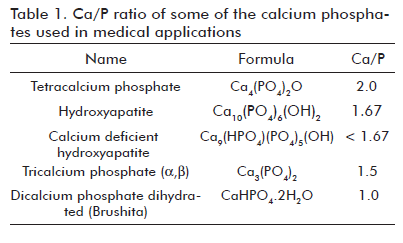
<body><![CDATA[<P   align="left" ><b><font size="3" face="Verdana, Arial, Helvetica, sans-serif">CALCIUM PHOSPHATES</font></b><font size="2" face="Verdana, Arial, Helvetica, sans-serif">      </font></P >   <FONT size="+1">        <P   align="left" ><font size="2" face="Verdana, Arial, Helvetica, sans-serif">Calcium phosphates      have been demonstrated to be the ideal biomaterials for bone implantation      during the last 30 years, because of being biocompatible, bioactive and bone-conductive.      The development of calcium phosphate-based bioceramics for clinical application      began in the 1970s, due to the failure of other previously used materials      such as: steel, cobalt alloys and poly (methyl polyacrylate). </font></P >   <FONT size="+1">        <P   align="left" ><font face="Verdana, Arial, Helvetica, sans-serif" size="2">The study of calcium      phosphate-based ceramics has focused on composites of the tertiary system      CaOP<sub>2</sub>O<sub>5</sub>-H<sub>2</sub>O, mainly hydroxyapatite (Ca<sub>10</sub>(PO<sub>4</sub>)<sub>6</sub>(OH)<sub>2</sub>)      and tricalcium phosphate (Ca<sub>3</sub>(PO<sub>4</sub>)<sub>2</sub>), du<FONT color="#FF0000"><FONT color="#000000"><FONT color="#FF0000"><FONT color="#000000"><FONT color="#FF0000"><FONT color="#000000"><FONT color="#FF0000"><FONT color="#000000"><FONT color="#FF0000"><FONT color="#000000"><FONT color="#FF0000"><FONT color="#000000"><FONT color="#FF0000"><FONT color="#000000"><FONT color="#FF0000"><FONT color="#000000"><FONT color="#FF0000"><FONT color="#000000"><FONT color="#FF0000"><FONT color="#000000">e      to its increased bioactive potential shown in several investigations (8-10).      </font></font></font></font></font></font></font></font></font></font></font></font></font></font></font></font></font></font></font></font></font></P >   <FONT color="#FF0000"><FONT color="#000000"><FONT color="#FF0000"><FONT color="#000000"><FONT color="#FF0000"><FONT color="#000000"><FONT color="#FF0000"><FONT color="#000000"><FONT color="#FF0000"><FONT color="#000000"><FONT color="#FF0000"><FONT color="#000000"><FONT color="#FF0000"><FONT color="#000000"><FONT color="#FF0000"><FONT color="#000000"><FONT color="#FF0000"><FONT color="#000000"><FONT color="#FF0000"><FONT color="#000000">        <P   align="left" ><font face="Verdana, Arial, Helvetica, sans-serif" size="2">Among them is Coralina.      This is a biomaterial obtained from white corals of the Porites porites family      which are very common in the Cuban insular shelf, and which bears a crosslinked      tridimensional structure quite similar to the human bone trabecula. It is      produced as big blocks to fill cavities and in small pieces to replace bone      fragments. More than 20 000 patients have been reported as receiving implants      of porous HAp with a 97% of bone integration. Only 3.2% of those implants      were considered as failures, mainly due to postoperative immediate sepsis      requiring biomaterial removal, tumor relapse, and mobility of implants with      poor osteosynthesis, and other causes but not to the implanted biomaterial.      Coralina application in these specialties allowed treatment and correction      of endobucal and facial bone defects, with excellent aesthetic and clinical      results (6). </font></P >       <P   align="left" ><font face="Verdana, Arial, Helvetica, sans-serif" size="2">There is also Apafi      l, a ceramic granulate of highly pure and dense synthetic HAp of different      size granules. It has been successfully applied as filling material for periodontal      and periapical defects of pathological or traumatic origin, in cystic cavities,      to fix intra-osseous dental implants, for filling of autogenous dental transplants      cavities and alveolar cavities, to remodel the alveolar edge and to recover      the dental pulp, and in rehabilitating tooth root lesions and craniotomies.      The preclinical and clinical experiences have demonstrated that Apafi l-based      HAp ceramics are biocompatible, bioactive, biologically stable and boneconductive      (11, 12). </font></P >       <P   align="left" ><font face="Verdana, Arial, Helvetica, sans-serif" size="2">Bioceramics are only      available as blocks or granules, preconditioning some limitations. Granules,      for example, are used in small implants, in non-load bearing areas as the      middle ear, or in dental implants as coating for the metals used as reinforcement,      since bioceramics are rigid and fragile. But it has been proven that these      granulated materials are able to migrate to the neighboring sites, increasing      the frequency of complications or even causing surgery failure. At the same      time, block bioceramics not always fit properly to the treated defect (13-15),      and in those few cases where a proper adaptation of the implant is achieved,      there is a potential risk of failure due to its very slow resorption kinetics      and poor mechanical strength which could result in a short-to-long term fracture.      </font></P >       <P   align="left" ><font face="Verdana, Arial, Helvetica, sans-serif" size="2">According to these      reasons, partially bioresorbable alternatives have been explored, more similar      to the bone tissue to be replaced and serving as scaffold for osteogenesis      at the same time that implant resorption occurs. In this sense, partially      resorbable ceramics of <font face="Symbol">b</font>-TCP have been developed,      obtaining macroporous granules by using an oxygen peroxide solution and yeast      powder as porogenic agents (16). </font></P >       <P   align="left" ><font face="Verdana, Arial, Helvetica, sans-serif" size="2">Nonetheless, the      bone natural mineral component is mainly non-stoichiometric HAp (of Ca/P ratio      other than 1.67) which differs from the stoichiometric HAp not only in the      chemical composition but also in crystallinity and the specific surface area,      these two properties making it more reactive in a biological environment.      Some authors mentioned that HAp biodegradation inversely correlates with the      Ca/P ratio. In other words, the calcium-deficient HAp is more biodegradable      than the stoichiometric HAp due to a low crystallinity (17). The Ca/P ratios      of some calcium phosphates used for biomedical applications are shown in <FONT color="#008000"><a href="#tab1"><font color="#0000FF">table      1</font></a><FONT color="#000000">.</font></font></font></P >       <P   align="center" ><img src="/img/revistas/bta/v27n3/t0102310.gif"><a name="tab1"></a></P >   <FONT color="#008000"><FONT color="#000000">        
<P   align="left" ><font face="Verdana, Arial, Helvetica, sans-serif" size="2">It was recently reported      the development of a calcium- deficient HAp (Ca/P ratio lower than 1.67) of      nano-structured morphology, which was doped with silicate ions to imitate      the biological apatite, which was able to increase the solubility and resorption      capacity <i>in vivo</i> of the composite materials it was designed for, also      increasing their bone-conductivity and bioactivity (18). </font></P >       ]]></body>
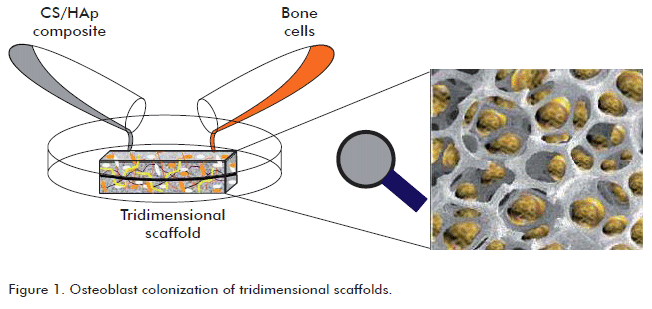
<body><![CDATA[<P   align="left" ><font face="Verdana, Arial, Helvetica, sans-serif" size="2">Simultaneously, a      whole range of possibilities arose with the discovery of CPCs in the 1980s      for using calcium phosphates in bone tissue regenerative applications. In      general, CPCs are composed of two phases, one solid and one liquid, which      form a paste at mixing and harden under physiological conditions once implanted      by injection. For this reason, they can be used in low invasive surgical procedures.      </font></P >       <P   align="left" ><font face="Verdana, Arial, Helvetica, sans-serif" size="2">Some recent studies      focused on creating acrylic bone cements modified with HAp micro and nanoparticles,      more resistant to compression and traction than the same type of materials      used for more than 40 years in orthopedics to fix the articular prosthesis      to the bone (19). </font></P >       <P   align="left" ><font face="Verdana, Arial, Helvetica, sans-serif" size="2">Another current trend      for preparing bone implant calcium phosphates comprises adding macroporosity.      This relevant property supports the fast cellular colonization of the implanted      material (<a href="/img/revistas/bta/v27n3/f0102310.gif">Figure 1</a><FONT color="#008000"><FONT color="#000000">)      by accelerating the vascularization process and, therefore, a satisfactory      repair of the bone defect (20, 21), this property having to be tightly controlled      for the bioresorption of the bone implant. Some authors consider as macroporous      materials those having pore diameters from 50 to 250 <font face="Symbol">m</font>m.      However, Kawachi <i>et al</i>. advise that the ideal pore diameter must be      above 100 <font face="Symbol">m</font>m for bioceramics (22). </font></font></font></P >   <FONT color="#008000"><FONT color="#000000">        
<P   align="left" ><font face="Verdana, Arial, Helvetica, sans-serif" size="2">The methods used      for pore formation can be divided in two major groups: emulsion formation,      to generate pores during the hardening process but followed by a thermal procedure      to achieve the required porosity, and the addition of highly soluble and non-toxic      crystalline substances, adequate to produce the required porosity during powder      mixing. This last method requires dissolving the additives once the cement      has been applied and hardened onto the bone defect. </font></P >       <P   align="left" ><font face="Verdana, Arial, Helvetica, sans-serif" size="2">The use of mannitol,      sucrose, and frozen particles of a sodium phosphate solution containing surfactant      molecules are the most established techniques to induce porosity in CPCs.      All of them support the formation of macropores on CPCs, but of deficient      crosslinking. To solve this problem, some authors have implemented pore formation      by <i>in situ</i> gas formation because of adding CaCO<sub>3</sub> to the      cement powder, followed by a reaction while mixing (23). Recently, a technique      was developed for macropore formation in CPCs by using egg albumin as foamy      agent during cement hardening (16). The same authors ran several experiments      to obtain macroporous HAp scaffolds from CPCs with the aid of hydrogen peroxide      as foamy agent, producing cements with crosslinked macroporosity of pore wider      than 200 <font face="Symbol">m</font>m, the best report on CPCs so far (24).      </font></P >   <FONT size="+1"><FONT size="+1">        <P   align="left" ><font face="Verdana, Arial, Helvetica, sans-serif" size="2">Nevertheless, it      has been demonstrated that CPCs still have a very slow resorption kinetic      and a poor mechanical strength in spite of its described advantageous properties,      both considered disadvantageous due to the weakness of the material as compared      to the surrounding tissue (25). These limitations have led to investigate      on biopolymer-based calcium phosphate composites, bearing properties which      can be incorporated to the resulting material. </font><FONT size="+1"> </font></P >   <FONT size="+1">        <P   align="left" ><font face="Verdana, Arial, Helvetica, sans-serif" size="3"><b>BIOPOLYMERS</b></font><font face="Verdana, Arial, Helvetica, sans-serif" size="2">      </font></P >       <P   align="left" ><font size="2" face="Verdana, Arial, Helvetica, sans-serif">Polymeric materials      are widely applied in the field of medical implantology, due to their similarity      to the physical-chemical properties of the living tissues which are mainly      composed of natural polymers or biopolymers such as proteins and polysaccharides      (26). These materials have been used for drug controlled release and tissue      engineering, because of being biocompatible, non-toxic and biodegradable at      physiological conditions, and showing a variable <i>in vivo</i> resorption      kinetic according to the properties of the given macromolecule. </font></P >   <FONT size="+1">        <P   align="left" ><font face="Verdana, Arial, Helvetica, sans-serif" size="2">As mentioned above,      there is a current trend on using biopolymers to formulate materials for periodontal,      maxillofacial and bone tissue engineering applications. The physical properties      of the polymeric materials are similar to those of the organic phase present      in bone tissues, in spite of having certain limitations hampering its application      in those body structures subjected to high and cyclic loads and tensions,      such as hip and knees. These properties allow establishing bone structures      through their matrices, supporting the fastest osteointegration, and resorption      of natural polymer composite materials. </font></P >       <P   align="left" ><font face="Verdana, Arial, Helvetica, sans-serif" size="2">Collagen, jelly,      alginate, chitin and CS are among the most widely studied biopolymers. CS      has been extensively reported as a versatile biopolymer, due to its excellent      properties and diverse natural sources, being considered by some groups as      the natural polymer of the 21<sup>st</sup> ce<FONT color="#0000FF"><FONT color="#000000">ntury      and with several applications in biotechnology, biomedicine and recently in      tissue engineering (27). </font></font></font></P >   <FONT color="#0000FF"><FONT size="+1" color="#000000"><FONT size="+1"><FONT size="+1">        ]]></body>
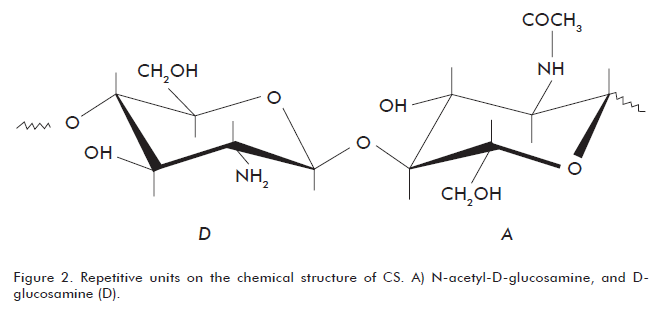
<body><![CDATA[<P   align="left" ><font face="Verdana, Arial, Helvetica, sans-serif" size="3"><b>CHITOSAN</b></font><font face="Verdana, Arial, Helvetica, sans-serif" size="2">      </font></P >       <P   align="left" ><font size="2" face="Verdana, Arial, Helvetica, sans-serif">Chitosan ((1<font face="Symbol">&#174;</font>4)-2-amino-2-desoxy-<font face="Symbol">b</font>-D-glucan)      (<a href="/img/revistas/bta/v27n3/f0202310.gif">Figure 2</a><FONT color="#008000"><FONT color="#000000">)      is industrially produced by extensive deacetylation of chitin ((1<font face="Symbol">&#174;</font>4)-2-acetamide-2-desoxy-<font face="Symbol">b</font>-Dglucan),      a polysaccharide widely found in the animal kingdom and the second in abundance      after cellulose what makes it an important renewable resource. </font></font></font></P >   <FONT size="+1"><FONT color="#008000"><FONT color="#000000">        
<P   align="left" ><font face="Verdana, Arial, Helvetica, sans-serif" size="2">Chitosan is composed      of two types of structural units randomly distributed (Bernoulli distribution)      along the chain: N-acetyl-D-glucosamine (A) and Dglucosamine (D), linked together      by glycosidic type <font face="Symbol">b</font>(1<font face="Symbol">&#174;</font>4)      bonds. In its crystalline form, CS is normally insoluble in neutral water      solutions, but soluble in diluted acidic solutions (pH&lt;&nbsp;6.0) where      glucosamine amino free groups become protonated (28). </font></P >       <P   align="left" ><font face="Verdana, Arial, Helvetica, sans-serif" size="2">Depending on the      source and preparation procedure, CS molecular weight can range from 300 to      1000 kDa with a deacetylation degree (DD) of 60 to 95%. Chitosan has been      demonstrated to be biocompatible and biodegradable, because of promoting cell      adhesion and being reabsorbed by means of hydrolysis by enzymes present in      the physiological fluids (29, 30). </font></P >       <P   align="left" ><font face="Verdana, Arial, Helvetica, sans-serif" size="2">It can be considered      a structural analog of glycosaminoglycans (GAG)(31, 32), anionic polysaccharides      generally bound to proteins by electrostatic interactions to form proteoglycans.      The last ones play a relevant function in organizing and functioning of the      extracellular matrix in human tissues (33). </font></P >       <P   align="left" ><font face="Verdana, Arial, Helvetica, sans-serif" size="2">Chitosan- and GAG-based      materials, said CS and chondroitin sulphate, have shown adequate cytocompatibylity      for bone regeneration, successfully used for cartilage repair and as artificial      skin components to treat dermal lesions. Studies comparing different materials      composed of CS and alginate, or polylactic acid (PLA), for articular tissue      engineering, showed that CS could increase adhesion and cell proliferation      <i>in vitro</i> and support a better biosynthetic activity than alginate and      PLA (34). </font></P >       <P   align="left" ><font face="Verdana, Arial, Helvetica, sans-serif" size="2">Lee <i>et al</i>.      (35) obtained a scaffold formulated with CS, GAG, collagen and loaded with      tumor growth factor <font face="Symbol">b</font>1 (TGF-<font face="Symbol">b</font>)      for its controlled release to promote articular regeneration. They improved      the mechanical properties and stability of the collagen macromolecules&acute;      crosslinking by adding CS, also inhibiting the action of collagenases. Aimin      <i>et al</i>. (36) demonstrated the antibacterial activity of CS, a subject      extensively referenced in the consulted literature (37). They evaluated CS      in experimentally-induced osteomyelitis, showing a reduction in the spread      of a<i> Staphylococcus aureus</i> infection. Sano <i>et al</i>. (38) studied      the influence of CS DD and molecular weight on the inhibition of <i>Streptococcus      sobrinus</i> 6715 in saliva treated with hydroxyapatite, and demonstrated      the potential antiplatelet effect of high molecular weight CS (5-6 kDa) and      intermediate DD (50-60%) (39). </font></P >       <P   align="left" ><font face="Verdana, Arial, Helvetica, sans-serif" size="2">Chitosan biodegradability      is another essential factor to consider when selecting biopolymers for tissue      engineering. Lysozyme is the enzyme present in biological fluids responsible      for CS degradation <i>in vivo</i>. </font></P >       <P   align="left" ><font face="Verdana, Arial, Helvetica, sans-serif" size="2">Lysozyme hydrolyzes      the <font face="Symbol">b</font>-1,4 de N-acetylglucosamine bonds close to      a glucosamine residue. By these means, lysozyme action on high DD CS (&gt;      80%) is weak, with no significant changes in the molecular weight of the hydrolyzed      CS over time. This results in long polymer degradation periods, delaying in      months the <i>in vivo</i> reabsorption of the CS-based material (40). Mao      <i>et al</i>. (41) observed a direct correlation between CS DD and cell adhesion.      A fast biodegradation could be achieved by using low DD CS, but limiting cell      adhesion. Therefore, the adequate selection of DD for the CS to be used is      critical to develop tridimensional scaffolds and control its biodegradation      and biocompatibility. </font></P >       <P   align="left" ><font face="Verdana, Arial, Helvetica, sans-serif" size="2">The abovementioned      properties of CS (42), together with its demonstrated healing and hemostatic      properties, its plasticity for presentation (microspheres, membranes and bidimensional      films, or in tridimensional scaffolds), flexibility, mucoadhesivity and wettability,      also its facility to promote bone formation by cellular osteogenesis at the      required site, among other desired properties (43), support using CS as an      excellent polymeric candidate in orthopedical applications, especially for      bone tissue engineering (44). Nevertheless, CS is not bioactive as biopolymer      and show poor mechanical properties. </font></P >       ]]></body>
<body><![CDATA[<P   align="left" ><font face="Verdana, Arial, Helvetica, sans-serif" size="2">All these explains      the growing interest on combining the bioactivity and biodegradability of      inorganic materials together with the rest of CS properties to obtain new      compound materials (composites) of improved mechanical characteristics also      favorable for bone tissue engineering (45). </font></P >       <P   align="left" ><font size="2" face="Verdana, Arial, Helvetica, sans-serif"><B><font size="3">PREPARATION      OF CS AND HAP COMPOSITES: MAIN FORMULATIONS, PROCEDURES TO OBTAIN THEM AND      APPLICATIONS</font></B> </font></P >   <FONT size="+1">        <P   align="left" ><font size="2" face="Verdana, Arial, Helvetica, sans-serif">Calcium phosphate      composites with CS matrices were extensively investigated in the last decade      for structural purposes, specifically for orthopedics and maxillofacial surgery      (46), either to fill bone defects, to increase the alveolar edge, middle ear      implants, fusion of spine vertebrae or to coat metallic prosthesis, due to      a proper filling-matrix integration (47). Those hybrid materials have been      prepared by different methods, as shown in <a href="/img/revistas/bta/v27n3/t0202310.gif">table      2</a><FONT color="#008000"><FONT color="#000000">. </font></font></font></P >   <FONT size="+1"><FONT color="#008000"><FONT color="#000000">        
<P   align="left" ><font size="2" face="Verdana, Arial, Helvetica, sans-serif"><B><font size="3">CHITOSAN      AND HAP SIMPLE MIXING METHOD</font></B> </font></P >   <FONT size="+1">        <P   align="left" ><font size="2" face="Verdana, Arial, Helvetica, sans-serif">The method of simple      Hap mixing with CS is one of the most common methods used to prepare composites,      especially tridimensional scaffolds for tissue engineering (48). The technique      consists in mixing the previously prepared ceramic powder with a CS solution      to generate a suspension as homogeneous as possible. Scaffolds are generated      from this mix as porous sponges by freezing and lyophilization (49, 50). Murugan      <i>et al</i>. (51), for example, used this approach to develop a simple procedure,      by using the wet way, to generate nanostructured compound systems (nanocomposites)      of HAp and CS in two steps: HAp precipitation in alkaline medium (pH 10.0      with NH<sub>4</sub>OH) starting from CaCl<sub>2</sub> and (NH<sub>4</sub>)<sub>2</sub>HPO<sub>4</sub>      as <FONT color="#FF0000"><FONT color="#000000"><FONT color="#FF0000"><FONT color="#000000"><FONT color="#FF0000"><FONT color="#000000"><FONT color="#FF0000"><FONT color="#000000"><FONT color="#FF0000"><FONT color="#000000">precursor      salts and further mixing of nanometric HAp with solutions at different CS      concentrations in acetic acid at a fixed temperature. </font></font></font></font></font></font></font></font></font></font></font></P >   <FONT size="+1"><FONT color="#FF0000"><FONT color="#000000"><FONT color="#FF0000"><FONT size="+1" color="#000000"><FONT size="+1"><FONT color="#FF0000"><FONT color="#000000"><FONT color="#FF0000"><FONT color="#000000"><FONT color="#FF0000"><FONT size="+1" color="#000000"><FONT size="+1">        <P   align="left" ><font face="Verdana, Arial, Helvetica, sans-serif" size="2">A similar procedure      was used by Finisie <i>et al</i>. (52) to generate HAp and CS composites in      pills. They started from a paste made up of a mix of HAp, aluminum and CS      at different proportions. Due to aluminum toxicity, they transformed it onto      sodium aluminate by using a concentrated solution of sodium hydroxide, resulting      in the formation of pores wider than 100 <font face="Symbol">m</font>m which      were generated by the hydrogen gas released by the reaction. </font></P >       <P   align="left" ><font size="2" face="Verdana, Arial, Helvetica, sans-serif"><B><font size="3">INCORPORATION      OF CS TO CPCS</font></B> </font></P >   <FONT size="+1">        <P   align="left" ><font size="2" face="Verdana, Arial, Helvetica, sans-serif">The incorporation      of CS to CPCs (<a href="#fig3">Figure 3</a><FONT color="#008000"><FONT color="#000000">)      is another very promising way to obtain composite materials, since it improves      injectability, the degradation rate, hardening properties and mechanical performance      of the resulting materials (53). In this case, a suspension of the solid fraction      is mostly obtained in the polymeric matrix with pH near 6 where there is a      fraction of CS protonated amino groups enough for solubilization, aiding to      include CS into the liquid fraction of the cement. Afterwards, an injectable      viscoelastic paste is prepared, which contains CS incorporated in the liquid      fraction of the cement and the solid fraction HAp precursors. Once injected,      the paste hardens due to the rise of pH to physiological 7.4 and the subsequent      neutralization of the amino groups. In this process, the inorganic load becomes      physically entrapped (<i>in situ</i> hardening) within the gel matrix in 5      to 8 min, an interval shorter than for control CPCs (61.7 min.) which are      devoid of CS (54). The resulting materials also show improved mechanical properties,      as resistance to compression of 15 to 25 MPa, higher than the same parameter      for the CPC alone (10.4 MPa) (55). </font></font></font></P >   </font><font size="+1" color="#000000"><font size="+1"><font size="+1"><font size="+1"><font size="+1"><font size="+1"><font size="+1"><font size="+1"><font size="+1"><font size="+1"><font size="+1"><font size="+1"><font size="+1"><font size="+1"><font size="+1"><font size="+1"><font size="+1"><font color="#0000FF"><font color="#000000"><font size="+1"><font size="+1"><font size="+1"><font size="+1"><font color="#FF0000"><font color="#000000"><font color="#FF0000"><font color="#000000"><font color="#FF0000"><font color="#000000"><font color="#FF0000"><font color="#000000"><font color="#FF0000"><font color="#000000"><font color="#FF0000"><font color="#000000"><font color="#FF0000"><font color="#000000"><font color="#FF0000"><font color="#000000"><font color="#FF0000"><font color="#000000"><font color="#FF0000"><font color="#000000"><font color="#008000"><font color="#000000"><font color="#008000"><font color="#000000"><font size="+1"><font size="+1"><font size="+1"><font size="+1"><font color="#0000FF"><font size="+1" color="#000000"><font size="+1"><font size="+1"><font size="+1"><font color="#008000"><font color="#000000"><font size="+1"><font size="+1"><font color="#008000"><font color="#000000"><font size="+1"><font size="+1"><font color="#FF0000"><font color="#000000"><font color="#FF0000"><font size="+1" color="#000000"><font size="+1"><font color="#FF0000"><font color="#000000"><font color="#FF0000"><font color="#000000"><font color="#FF0000"><font size="+1" color="#000000"><font size="+1"><font size="+1"><a name="fig3"></a></font></font></font></font></font></font></font></font></font></font></font></font></font></font></font></font></font></font></font></font></font></font></font></font></font></font></font></font></font></font></font></font></font></font></font></font></font></font></font></font></font></font></font></font></font></font></font></font></font></font></font></font></font></font></font></font></font></font></font></font></font></font></font></font></font></font></font></font></font></font></font></font></font></font></font></font></font><FONT size="+1">       <P   align="center" ><img src="/img/revistas/bta/v27n3/f0302310.gif"></P >   <FONT size="+1"><FONT color="#008000"><FONT color="#000000">        
<P   align="left" ><font face="Verdana, Arial, Helvetica, sans-serif" size="2">Taking advantage      of these facilities, some investigations have focused on CS-CPC composites      (56-62) as materials with potential application in bone tissue engineering      and for controlled release of therapeutic agents, showing very promising results      in periodontal bone defect regeneration (63). In this sense, a vast experience      has accumulated on the synthesis and characterization of compound materials      by using calcium phosphates as filling materials (<font face="Symbol">b</font>-TCP      and HAp, treated superficially or not), natural polymers (CS, sodium alginate),      and acrylics (mainly poly acrylic acid, polyacrylamide and poly(methyl methacrylate),      poly(2-hydroxyethyl methacrylate)) to restore bone tissue and as potential      controlled release systems for active ingredients (64, 65) </font></P >       ]]></body>
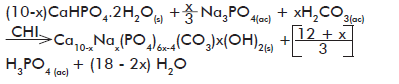
<body><![CDATA[<P   align="left" ><font size="3" face="Verdana, Arial, Helvetica, sans-serif"><b>COATING METHOD</b></font><b><font size="2" face="Verdana, Arial, Helvetica, sans-serif"></font></b><font size="2" face="Verdana, Arial, Helvetica, sans-serif">      </font></P >   <FONT size="+1">        <P   align="left" ><font size="2" face="Verdana, Arial, Helvetica, sans-serif">Calcium phosphate      composites can be obtained as coating by using electrochemical and electrophoretic      procedures, which favor the deposition of HAp and CS particles. This technique      commonly known as electrochemical deposition allows preparing hybrid materials      at room temperature, which is highly favorable considering the final biomedical      application. </font></P >   <FONT size="+1">        <P   align="left" ><font face="Verdana, Arial, Helvetica, sans-serif" size="2">Recently, Pang <i>et      al</i>. (66) developed a method of layered electrophoretic co-deposition of      the CS-HAp composite for protecting steel-made materials getting into contact      with physiological solutions. To modify the surface of shape memory materials      made up of nickel- titanium alloys and protect them from corrosion, Sun <i>et      al</i>. (67) prepared composites of heparin, HAp and bioglass in a CS polymeric      matrix as films, by cathodic electrophoretic deposition. Redepenning <i>et      al</i>. (69) also prepared HAp and CS composites by an electrochemical method,      starting from brushita and CS in alkaline medium, to coat titanium materials      (68). </font></P >       <P   align="left" ><font face="Verdana, Arial, Helvetica, sans-serif" size="2">Additionally, some      authors have studied the remarkable properties of this technique by using      biomaterials as Biovetir II, coated with nanostructured CSHAp composites to      improve the implant interaction with cells and its fixation to the subcutaneous      tissue (69), as well as for middle ear reconstruction (70). </font></P >       <P   align="left" ><font size="2" face="Verdana, Arial, Helvetica, sans-serif"><B><I><font size="3">IN      SITU </font></I><font size="3">PRECIPITATION METHOD</font></B> </font></P >   <FONT size="+1">        <P   align="left" ><font size="2" face="Verdana, Arial, Helvetica, sans-serif">In spite of the overwhelming      advantages of the abovementioned methods, it has been demonstrated that compound      systems prepared by mixing techniques, which incorporates CS into CPC, and      those coating HAp particles with CS solutions are frequently nonhomogeneous      at microscopic level because of the hard to obtain uniform distribution of      the inorganic components in the womb of the polymeric matrix. These can generate      practical inconveniences, since the lack of homogeneity can induce inflammatory      symptoms by forming voluminous fibrotic capsules of dense or granulated connective      tissue. This originates a strong rejection of the implanted material or changes      in the area surrounding the prosthesis. </font></P >   <FONT size="+1">        <P   align="left" ><font face="Verdana, Arial, Helvetica, sans-serif" size="2">In that sense, the      method of <i>in situ</i> precipitation of the bioactive inorganic component      inside the polymeric matrix, as referred in several publications as biomimetic      or bio-inspired method (71) could be more attractive to prepare this type      of composites by permitting to generate much more homogeneous systems. </font></P >       <P   align="left" ><font face="Verdana, Arial, Helvetica, sans-serif" size="2">This procedure is      nature-inspired in bone, dentin, egg and mollusk shells, etc., showing a perfect      combination of the structure and composition characteristics responsible for      the micro and macro-properties. <i>In situ</i> precipitation of calcium phosphates      allows controlling the internal architecture (structure) and the chemical      composition of the resulting materials. </font></P >       <P   align="left" ><font face="Verdana, Arial, Helvetica, sans-serif" size="2">This procedure is      based on obtaining nanostructured and crystalline composites of the biologically      active component (calcium phosphate), homogeneously disperse in the polymeric      matrix (CS) to mimic the biological apatite of the bone tissue. This supports      its application in bone tissue engineering, specifically in targeted bone      regeneration (72), and controlled release of drugs (73) and biologically active      molecules (74). </font></P >       <P   align="left" ><font face="Verdana, Arial, Helvetica, sans-serif" size="2">These materials have      being traditionally prepared by several methods. Yamaguchi <i>et al</i>. (75)      have developed a single-step co-precipitation methodology by dripping CS in      H<sub>3</sub>PO<aub>4</aub> solu<FONT color="#FF0000"><FONT color="#000000"><FONT color="#FF0000"><FONT color="#000000">tion      on a calcium hydroxide suspension. Fan <i>et al</i>. used CS biomineralization      in solid phase by soaking in a simulated biological fluid (SBF) (76). Redepenning      <i>et al</i>. mixed a solution of the biopolymer with calcium phosphate inorganic      precursors used as filling, followed by composite precipitation as hydrogel      or isolated particles (77). Hu <i>et al</i>. (78) reported an interesting      methodology, using CS hydrogels for mineralizing it via <i>in situ</i> hybridization      and controlling the process by ionic diffusion. Rusu <i>et al</i>. (79) studied      the kinetics of composite formation for CS and HAp composites prepared by      co-precipitation. In that process, pH of the CHI solution and saline precursors      (CaCl<sub>2</sub> and NaH<sub>2</sub>PO<sub>4</sub>) w<FONT color="#FF0000"><FONT color="#000000"><FONT color="#FF0000"><FONT color="#000000"><FONT color="#FF0000"><FONT color="#000000">ere      gradually increased by adding a sodium hydroxide solution, and composites      of a high degree of structural organization were obtained by using soluble      saline precursors (<font color="#333333"><a href="#frac1">equation 1</a></font><FONT color="#008000"><FONT color="#000000">).      </font></font></font></font></font></font></font></font></font></font></font></font></font></P >   </font><font size="+1" color="#000000"><font size="+1"><font size="+1"><font size="+1"><font size="+1"><font size="+1"><font size="+1"><font size="+1"><font size="+1"><font size="+1"><font size="+1"><font size="+1"><font size="+1"><font size="+1"><font size="+1"><font size="+1"><font size="+1"><font color="#0000FF"><font color="#000000"><font size="+1"><font size="+1"><font size="+1"><font size="+1"><font color="#FF0000"><font color="#000000"><font color="#FF0000"><font color="#000000"><font color="#FF0000"><font color="#000000"><font color="#FF0000"><font color="#000000"><font color="#FF0000"><font color="#000000"><font color="#FF0000"><font color="#000000"><font color="#FF0000"><font color="#000000"><font color="#FF0000"><font color="#000000"><font color="#FF0000"><font color="#000000"><font color="#FF0000"><font color="#000000"><font color="#008000"><font color="#000000"><font color="#008000"><font color="#000000"><font size="+1"><font size="+1"><font size="+1"><font size="+1"><font color="#0000FF"><font size="+1" color="#000000"><font size="+1"><font size="+1"><font size="+1"><font color="#008000"><font color="#000000"><font size="+1"><font size="+1"><font color="#008000"><font color="#000000"><font size="+1"><font size="+1"><font color="#FF0000"><font color="#000000"><font color="#FF0000"><font size="+1" color="#000000"><font size="+1"><font color="#FF0000"><font color="#000000"><font color="#FF0000"><font color="#000000"><font color="#FF0000"><font size="+1" color="#000000"><font size="+1"><font size="+1"><font size="+1"><font color="#008000"><font color="#000000"><font size="+1"><font size="+1"><font size="+1"><font size="+1"><a name="frac1"></a></font></font></font></font></font></font></font></font></font></font></font></font></font></font></font></font></font></font></font></font></font></font></font></font></font></font></font></font></font></font></font></font></font></font></font></font></font></font></font></font></font></font></font></font></font></font></font></font></font></font></font></font></font></font></font></font></font></font></font></font></font></font></font></font></font></font></font></font></font></font></font></font></font></font></font></font></font></font></font></font></font></font></font></font><FONT size="+1">       ]]></body>
<body><![CDATA[<P   align="center" ><img src="/img/revistas/bta/v27n3/fr0102310.gif"></P >   <FONT color="#FF0000"><FONT color="#000000"><FONT color="#FF0000"><FONT size="+1" color="#000000"><FONT size="+1"><FONT color="#FF0000"><FONT size="+1" color="#000000"><FONT size="+1"><FONT color="#FF0000"><FONT color="#000000"><FONT color="#FF0000"><FONT color="#000000"><FONT color="#008000"><FONT color="#000000">        
<P   align="left" ><font face="Verdana, Arial, Helvetica, sans-serif" size="2">The same group suggested      the use of salts and weak acids as precursors of calcium and phosphate ions,      instead of strong acids or bases to avoid their potential destructive effect      on the polymeric chains of CS during composite preparation. Chang <i>et al</i>.      (80) reported a similar procedure to prepare HAp and gelatine nanocomposites,      with Ca<sup>2+</sup> and PO<sub>4</sub><sup>3-</sup> ions <FONT color="#0000FF"><FONT color="#000000"><FONT color="#FF0000"><FONT color="#0000FF"><FONT color="#000000">concentrations      controlled by diffusion, through dissolution and co-precipitation processes.      </font></font></font></font></font></font></P >   <FONT color="#0000FF"><FONT size="+1" color="#000000"><FONT size="+1"><FONT color="#FF0000"><FONT color="#0000FF"><FONT size="+1" color="#000000"><FONT size="+1">        <P   align="left" ><font face="Verdana, Arial, Helvetica, sans-serif" size="2">These <i>in situ</i>      production methods have supported an adequate incorporation of inorganic fillings      inside composites&acute; structures, either at micro or nanometric scales.      Noteworthy, each of the methods referred generates a particular type of CS      and HAp composite material, with specific structural properties. </font></P >       <P   align="left" ><font face="Verdana, Arial, Helvetica, sans-serif" size="2">Considering that      the mineral phase of the bone is composed of non-stoichiometric HAp (Ca/P      ratio &lt; 1.67), it is convenient to simulate the most biological apatite      with the inorganic component on these composites. For this purpose, Pe&ntilde;a      <i>et al</i>. (81) mixed brushita powder (CaHPO<sub>4</sub> 2H<sub>2</sub>O)      <FONT color="#FF0000"><FONT color="#000000"><FONT color="#FF0000"><FONT color="#000000">with      a CS citric acid solution, and keeping the solution alkaline by adding sodium      hydroxide. The use of citric acid dissolutions as solvent is questionable      in spite of the similarity of the apatite phase to that of the final composite,      since it inhibits HAp transformation while nucleating amorphous calcium phosphates.      Besides, there was also mentioned in the literature that citrate ligands can      affect crystal and cell size because of including carboxyl groups (82). </font></font></font></font></font></P >   <FONT color="#FF0000"><FONT color="#000000"><FONT color="#FF0000"><FONT color="#000000">        <P   align="left" ><font face="Verdana, Arial, Helvetica, sans-serif" size="2">We have prepared      in our lab composites of CS and calcium-deficient HAp starting from acetic      acid solutions of HAp precursor salts (calcium acetate and NaH<sub>2</sub>PO<sub>4</sub>&#61472;H<aub>2</aub>O<FONT color="#FF0000"><FONT color="#000000"><FONT color="#FF0000"><FONT color="#000000"><FONT color="#FF0000"><FONT color="#000000">)      and CS, with control of the calcium phosphate phase to optimize hydrolysis      conditions (83). Equations <a href="#frac2">2</a> and <a href="#frac3">3</a><FONT color="#808000"><FONT color="#000000">      describe the formation steps of the non-stoichiometric apatite obtained <i>in      situ</i>, within the polymeric CS matrix. </font></font></font></font></font></font></font></font></font></P >   </font></font></font></font></font></font></font></font></font></font></font></font></font></font></font></font></font></font></font></font></font></font></font></font></font></font></font></font></font></font></font></font></font></font></font></font></font></font></font></font></font></font></font></font></font></font></font></font></font></font></font></font></font></font></font></font></font></font></font></font></font></font></font></font></font></font></font></font></font></font></font></font></font></font></font></font></font></font></font></font></font></font></font></font></font></font></font></font></font></font></font></font></font></font></font></font></font></font></font></font></font></font></font></font></font></font></font></font></font>        <p   align="center" ><font color="#000000" size="+1"><a name="frac2"></a><img src="/img/revistas/bta/v27n3/fr0202310.gif"></font></p >       
<p   align="center" ><font color="#000000" size="+1"><img src="/img/revistas/bta/v27n3/fr0302310.gif"><a name="frac3"></a></font><FONT size="+1" color="#000000"><FONT size="+1"><FONT size="+1"><FONT size="+1"><FONT size="+1"><FONT size="+1"><FONT size="+1"><FONT size="+1"><FONT size="+1"><FONT size="+1"><FONT size="+1"><FONT size="+1"><FONT size="+1"><FONT size="+1"><FONT size="+1"><FONT size="+1"><FONT size="+1"><FONT color="#0000FF"><FONT color="#000000"><FONT size="+1"><FONT size="+1"><FONT size="+1"><FONT size="+1"><FONT color="#FF0000"><FONT color="#000000"><FONT color="#FF0000"><FONT color="#000000"><FONT color="#FF0000"><FONT color="#000000"><FONT color="#FF0000"><FONT color="#000000"><FONT color="#FF0000"><FONT color="#000000"><FONT color="#FF0000"><FONT color="#000000"><FONT color="#FF0000"><FONT color="#000000"><FONT color="#FF0000"><FONT color="#000000"><FONT color="#FF0000"><FONT color="#000000"><FONT color="#FF0000"><FONT color="#000000"><FONT color="#008000"><FONT color="#000000"><FONT color="#008000"><FONT color="#000000"><FONT size="+1"><FONT size="+1"><FONT size="+1"><FONT size="+1"><FONT color="#0000FF"><FONT size="+1" color="#000000"><FONT size="+1"><FONT size="+1"><FONT size="+1"><FONT color="#008000"><FONT color="#000000"><FONT size="+1"><FONT size="+1"><FONT color="#008000"><FONT color="#000000"><FONT size="+1"><FONT size="+1"><FONT color="#FF0000"><FONT color="#000000"><FONT color="#FF0000"><FONT size="+1" color="#000000"><FONT size="+1"><FONT color="#FF0000"><FONT color="#000000"><FONT color="#FF0000"><FONT color="#000000"><FONT color="#FF0000"><FONT size="+1" color="#000000"><FONT size="+1"><FONT size="+1"><FONT size="+1"><FONT color="#008000"><FONT color="#000000"><FONT size="+1"><FONT size="+1"><FONT size="+1"><FONT size="+1"><FONT color="#FF0000"><FONT color="#000000"><FONT color="#FF0000"><FONT size="+1" color="#000000"><FONT size="+1"><FONT color="#FF0000"><FONT size="+1" color="#000000"><FONT size="+1"><FONT color="#FF0000"><FONT color="#000000"><FONT color="#FF0000"><FONT color="#000000"><FONT color="#008000"><FONT color="#000000"><FONT color="#0000FF"><FONT size="+1" color="#000000"><FONT size="+1"><FONT color="#FF0000"><FONT color="#0000FF"><FONT size="+1" color="#000000"><FONT size="+1"><FONT color="#FF0000"><FONT color="#000000"><FONT color="#FF0000"><FONT color="#000000"></font></font></font></font></font></font></font></font></font></font></font></font></font></font></font></font></font></font></font></font></font></font></font></font></font></font></font></font></font></font></font></font></font></font></font></font></font></font></font></font></font></font></font></font></font></font></font></font></font></font></font></font></font></font></font></font></font></font></font></font></font></font></font></font></font></font></font></font></font></font></font></font></font></font></font></font></font></font></font></font></font></font></font></font></font></font></font></font></font></font></font></font></font></font></font></font></font></font></font></font></font></font></font></font></font></font></font></font></font></p >   <FONT size="+1" color="#000000"><FONT size="+1"><FONT size="+1"><FONT size="+1"><FONT size="+1"><FONT size="+1"><FONT size="+1"><FONT size="+1"><FONT size="+1"><FONT size="+1"><FONT size="+1"><FONT size="+1"><FONT size="+1"><FONT size="+1"><FONT size="+1"><FONT size="+1"><FONT size="+1"><FONT color="#0000FF"><FONT color="#000000"><FONT size="+1"><FONT size="+1"><FONT size="+1"><FONT size="+1"><FONT color="#FF0000"><FONT color="#000000"><FONT color="#FF0000"><FONT color="#000000"><FONT color="#FF0000"><FONT color="#000000"><FONT color="#FF0000"><FONT color="#000000"><FONT color="#FF0000"><FONT color="#000000"><FONT color="#FF0000"><FONT color="#000000"><FONT color="#FF0000"><FONT color="#000000"><FONT color="#FF0000"><FONT color="#000000"><FONT color="#FF0000"><FONT color="#000000"><FONT color="#FF0000"><FONT color="#000000"><FONT color="#008000"><FONT color="#000000"><FONT color="#008000"><FONT color="#000000"><FONT size="+1"><FONT size="+1"><FONT size="+1"><FONT size="+1"><FONT color="#0000FF"><FONT size="+1" color="#000000"><FONT size="+1"><FONT size="+1"><FONT size="+1"><FONT color="#008000"><FONT color="#000000"><FONT size="+1"><FONT size="+1"><FONT color="#008000"><FONT color="#000000"><FONT size="+1"><FONT size="+1"><FONT color="#FF0000"><FONT color="#000000"><FONT color="#FF0000"><FONT size="+1" color="#000000"><FONT size="+1"><FONT color="#FF0000"><FONT color="#000000"><FONT color="#FF0000"><FONT color="#000000"><FONT color="#FF0000"><FONT size="+1" color="#000000"><FONT size="+1"><FONT size="+1"><FONT size="+1"><FONT color="#008000"><FONT color="#000000"><FONT size="+1"><FONT size="+1"><FONT size="+1"><FONT size="+1"><FONT color="#FF0000"><FONT color="#000000"><FONT color="#FF0000"><FONT size="+1" color="#000000"><FONT size="+1"><FONT color="#FF0000"><FONT size="+1" color="#000000"><FONT size="+1"><FONT color="#FF0000"><FONT color="#000000"><FONT color="#FF0000"><FONT color="#000000"><FONT color="#008000"><FONT color="#000000"><FONT color="#0000FF"><FONT size="+1" color="#000000"><FONT size="+1"><FONT color="#FF0000"><FONT color="#0000FF"><FONT size="+1" color="#000000"><FONT size="+1"><FONT color="#FF0000"><FONT color="#000000"><FONT color="#FF0000"><FONT color="#000000">        
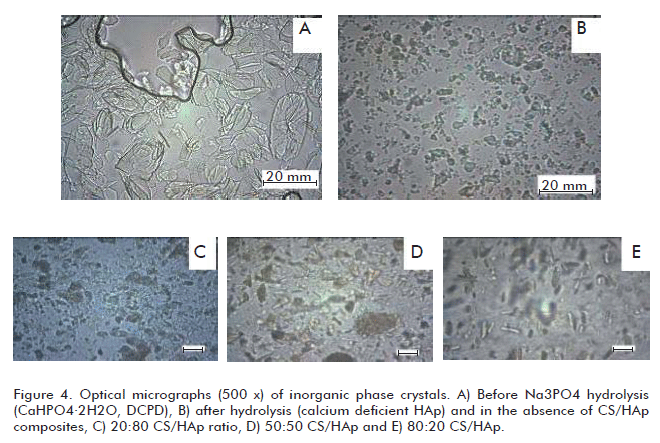
<P   align="left" ><font face="Verdana, Arial, Helvetica, sans-serif" size="2">Optical micrographs      as those shown in <a href="/img/revistas/bta/v27n3/f0402310.gif">figure      4</a><FONT color="#008000"><FONT color="#808000"><FONT color="#000000"> correspond      to the inorganic phase crystals obtained on each phase according to equations<FONT color="#808000">      <a href="#frac2"> <font color="#0000FF">2</font></a> <font color="#000000">and      <a href="#frac3">3</a>, prior to (calcium hydrogen phosphate; CaHPO<sub>4</sub>&middot;2H<sub>2</sub>O<FONT color="#FF0000"><FONT color="#000000"><FONT color="#FF0000"><FONT color="#000000">      or DCPD) and after (calcium-deficient HAp precipitated in the absence and      presence of CS) the hydrolysis with Na<sub>3</sub>PO<sub>4</sub><FONT color="#FF0000"><FONT color="#000000"><FONT color="#FF0000"><FONT color="#000000">.      </font></font></font></font></font></font></font></font></font></font></font></font></font></font></P >   <FONT color="#FF0000"><FONT color="#000000"><FONT color="#FF0000"><FONT color="#000000"><FONT color="#FF0000"><FONT color="#000000"><FONT color="#808000"><FONT color="#000000">        
<P   align="left" >&nbsp;</P >   <FONT color="#008000"><FONT color="#808000"><FONT color="#000000"><FONT color="#808000"><FONT color="#000000"><FONT color="#FF0000"><FONT color="#000000"><FONT color="#FF0000"><FONT color="#000000"><FONT color="#FF0000"><FONT color="#000000"><FONT color="#FF0000"><FONT color="#000000">        <P   align="left" ><font face="Verdana, Arial, Helvetica, sans-serif" size="2">A morphological examination      shows that in the first step, the inorganic phase precipitating under the      reaction conditions used corresponds to the typical flattened crystals of      brushita (CaHPO<sub>4</sub>&middot;2H<sub>2</sub>O<FONT color="#FF0000"><FONT color="#000000"><FONT color="#FF0000"><FONT color="#000000">).      However, after hydrolysis with Na<sub>3</sub><font color="#000000">PO<sub>4</sub>,      m</font>uch smaller crystals were obtained by formation of the expected apatite      phase (calcium-deficient HAp), achieving a complete transformation of one      crystalline phase into the other. </font></font></font></font></font></P >   <FONT color="#FF0000"><FONT color="#000000"><FONT color="#FF0000"><FONT color="#000000"><FONT size="+1"><FONT size="+1"><FONT size="+1"><FONT size="+1">        ]]></body>
<body><![CDATA[<P   align="left" ><font face="Verdana, Arial, Helvetica, sans-serif" size="2">We have recently      prepared via <i>in situ</i> composites of CS with non-stoichiometric HAp incorporating      silicate ions to generate a material of higher osteointegration to the biological      system (84). The load of antibiotics and other active principles (for example,      growth factors) into these types of tridimensional matrices could be a way      to increase cell proliferation, with faster and more efficient formation and      mineralization of the bone tissue. </font></P >       <P   align="left" ><font size="2" face="Verdana, Arial, Helvetica, sans-serif"><b><font size="3">PHYSICAL-CHEMICAL      CHARACTERIZATION OF COMPOSITE SYSTEMS OF CS AND HAP</font></b> </font></P >   <FONT size="+1">        <P   align="left" ><font size="2" face="Verdana, Arial, Helvetica, sans-serif">The physical-chemical      properties of CS and HAp are highly similar to those of the bone tissue (85).      The biodegradable, biocompatible and bone-conductive performance of these      composite materials is very relevant for future medical applications (86).      </font></P >   <FONT size="+1">        <P   align="left" ><font face="Verdana, Arial, Helvetica, sans-serif" size="2">In general, the inorganic      reinforcement of this type of composites should provide simultaneously bioactivity      together with resistance and rigidity to the resulting material, the polymeric      matrix functioning as filling. However, it has been demonstrated that the      properties of the generated material, the biological properties included,      can be improved by incorporating CS (87). </font></P >       <P   align="left" ><font size="3" face="Verdana, Arial, Helvetica, sans-serif"><b>BIODEGRADATION</b></font>    </P >   <FONT size="+1">        <P   align="left" ><font size="2" face="Verdana, Arial, Helvetica, sans-serif">Biodegradation or      the changes affecting the implanted device when exposed to the natural physiological      or simulated medium is critical and has been extensively addressed in the      literature (88, 89). Several factors can be involved: physical-chemical dissolution,      physical breakdown of bigger molecules into smaller ones by biological agents      as enzymes (90) what decreases pH at the site (91), or the properties of the      polymeric matrix used, among others (92, 93). </font></P >   <FONT size="+1">        <P   align="left" ><font face="Verdana, Arial, Helvetica, sans-serif" size="2">In the same line      of evidence, Yang <i>et al</i>. demonstrated that the degradation kinetics      can be controlled by selecting the N-acetylated CS derivative, also accelerating      its resorption (with lower DD values) due to the preferential action of lysozyme      on the glycosidic bonds between the acetylated units of the biopolymer (93).      Nevertheless, Freier <i>et al</i>. observed that lower DD CS films induce      poor cell adhesion (88). Similarly, Chatelet <i>et al</i>. showed that fibroblasts      did not proliferate on CS films regardless of its DD value, due to a tight      anchoring of these cells onto the material that prevents its further proliferation      (94). Putting all together, it suggests that biological properties of CSbased      composite materials not only depend on the acetylation/ deacetylation balance      of the natural polymer, but also on the cell type used to promote adhesion      and proliferation on the given substrate. </font></P >       <P   align="left" ><font face="Verdana, Arial, Helvetica, sans-serif" size="2">A method to evaluate      the degradation rate comprises assessing the release of Ca<sup>2+</sup><FONT color="#0000FF"><FONT color="#000000">      ions from composites submerged into a physiological medium. Results show an      increasingly faster degradation rate by increasing composites CS content.      The hydrophilic nature of the CS polymeric matrix generates a low crystallinity      in composites, subsequently rising the solubility of the system, the dissolution      speed and the release of calcium ions to the medium. This supports a gradual      rise of bioresorption resulting from the increased biopolymer content within      the composites (95). </font></font></font></P >   <FONT color="#0000FF"><FONT size="+1" color="#000000"><FONT size="+1">        <P   align="left" ><font size="3" face="Verdana, Arial, Helvetica, sans-serif"><b>MORPHOLOGY</b></font>    </P >   <FONT size="+1">        <P   align="left" ><font size="2" face="Verdana, Arial, Helvetica, sans-serif">The final morphology      of composites is another significant property influencing the functionality      of these materials. It is affected by reaction conditions, such as: concentration,      temperature, pH, 3D conformation, time and filling-matrix interaction. </font></P >   <FONT size="+1">        ]]></body>
<body><![CDATA[<P   align="left" ><font face="Verdana, Arial, Helvetica, sans-serif" size="2">Generally, composite      morphology can widely vary depending on the geometric versatility provided      by the polymeric matrix (films, micro and nanoparticles, membranes, cements,      etc.) and the intended application. Normally, morphology, size and distribution      are measured by optical and/or scanning and transmission electron microscopy      techniques. A relevant aspect is the apatite phase obtained on the surface      of the composites, which frequently appears as globular aggregates or clusters      of tiny crystals with different characteristics depending on the predominant      inorganic component in the given composite (96). For example, <font face="Symbol">b</font>-TCP      is presented as prism-like particles, the octocalcium phosphate as small clustered      plaques, quite similar to the non-stoichiometric HAp, and DCPD as wide, flattened      crystals of great size, and calcium deficient HAp generally appearing as thin      and small needles projected from a central point (<a href="/img/revistas/bta/v27n3/f0402310.gif">Figure      4</a><FONT color="#008000"><FONT color="#000000">) (97). </font></font></font></P >   <FONT color="#008000"><FONT color="#000000">        
<P   align="left" ><font size="3" face="Verdana, Arial, Helvetica, sans-serif"><b>COMPOSITION</b></font>    </P >   <FONT size="+1">        <P   align="left" ><font size="2" face="Verdana, Arial, Helvetica, sans-serif">Composition of CS/HAp      is frequently studied by infrared spectroscopy to identify the main functional      groups and the presence or absence of carbonate ions. Crystallinity and the      inorganic phases present are assessed by X-ray diffraction, and Ca and P content      determined by energy dispersive spectroscopy, while the composition of the      system is evaluated by thermogravimetry and differential thermal analysis      (98). </font></P >   <FONT size="+1">        <P   align="left" ><font face="Verdana, Arial, Helvetica, sans-serif" size="2">The individual components      of CS calcium phosphate composites show a stable physical-chemical identity;      in other words, they are neither dissolved nor completely fused one into the      other. Thus, there can be independently identified the inorganic phase and      the polymeric matrix. Nevertheless, they can interact through the reactive      amino groups on CS and the phosphate and hydroxyl groups and calcium ions      on the HAp (99). </font></P >       <P   align="left" ><font size="2" face="Verdana, Arial, Helvetica, sans-serif"><b><font size="3">BIOLOGICAL      ASSAYS OF CS/HAP COMPOSITES</font></b> </font></P >   <FONT size="+1">        <P   align="left" ><font size="2" face="Verdana, Arial, Helvetica, sans-serif">Biocompatibility      is the property of any material determining its fitness to a specific application      without inducing allergic, immunitary or any other type of reaction when getting      into contact with living tissues (100). Calcium phosphate and CS composites      have shown to be biocompatible in biological assays with different cell types      (101). </font></P >   <FONT size="+1">        <P   align="left" ><font face="Verdana, Arial, Helvetica, sans-serif" size="2">In another experimental      setting, HAp composites based on CS and alginate and soaked with drugs showed      effective as local delivery systems <i>in vitro</i> (102). Similarly, the      <i>in vitro</i> encapsulation within CS/ HAp microspheres and bone-conductivity      of human periodontal ligament fibroblasts were assessed, providing an adequate      osteogenic differentiation (103). </font></P >       <P   align="left" ><font face="Verdana, Arial, Helvetica, sans-serif" size="2">Additionally, bioactivity      is the ability to support the formation of a biologically active carboHAp      layer onto its surface, facilitating the interface junction with the bone      tissue and guaranteeing a close attachment to the bone without an interposed      fibrotic capsule. This supports the efficient material-bone integration, allowing      the presence of bone cells as required for a successful regeneration process      on the material&acute;s surface (104). Hence, the inorganic phase to be integrated      should be chemically and structurally similar to the mineral phase of the      bone. In this sense, the excellent bioactivity of HAp (105) and the presence      of the Nacetylglycosamine in CS (GAG analog) stimulate bone growth (106).      </font></P >       <P   align="left" ><font face="Verdana, Arial, Helvetica, sans-serif" size="2">Biodegradability      is another relevant property for tissue engineering systems, also considered      for its selection and with CS positively contributing to it. By these means,      a dynamic process of formation and resorption of bone tissues is established,      where these materials serve as scaffolds for tissue infiltration and replacement,      simultaneously stimulating cell growth within (107). </font></P >       <P   align="left" ><font face="Verdana, Arial, Helvetica, sans-serif" size="2">Recently, porous      tridimensional scaffolds of calcium phosphate and CS composites were generated      for bone tissue engineering (108, 109). These systems, obtained from CPCs      and CS derivatives, tricalcium phosphate/CS, alginate/HAp and CS/HAp (110)      supported fast osteoblast differentiation and growth (<a href="/img/revistas/bta/v27n3/f0102310.gif">Figure      1</a><FONT color="#008000"><FONT color="#000000">), with osteogenic effects      (111). Zhao <i>et al</i>. (112) prepared a 3D lattice of HAp/CS/gelatin (a      composite with a structure similar to that of the human bone) by <i>in situ</i>      precipitation and intended for bone tissue engineering, to induce favorable      adhesion, growth and osteogenic differentiation of cultured human mesenchymal      cells. </font></font></font></P >   <FONT color="#008000"><FONT color="#000000">        
]]></body>
<body><![CDATA[<P   align="left" ><font face="Verdana, Arial, Helvetica, sans-serif" size="2">Additionally, the      group of Zhang <i>et al</i>. (113) has published several works where they      obtained calcium/ CS porous scaffolds, alternatively incorporating bioglass      for human MG63 osteoblast cell culture. Only osteoblast cells were able to      proliferate or differentiate within all the composite materials (phenotypic      proliferation). The use of CS scaffolds together with calcium phosphate bioglass      avoid the fast degradation in the physiological medium, this process releasing      acid byproducts which could affect the osteoblast differentiation (114). </font></P >       <P   align="left" ><font face="Verdana, Arial, Helvetica, sans-serif" size="2">Also Zhao <i>et al</i>.      (115) developed hybrid biomimetic materials of HAp/CS/gelatin to analyze cell      behavior in rats. Results showed cell proliferation, de novo formation of      bone tissue and mineralization of the obtained scaffolds in only 3 weeks (116).      </font></P >       <P   align="left" ><font face="Verdana, Arial, Helvetica, sans-serif" size="2">These investigations      demonstrate the feasible use of calcium phosphate/CS tridimensional matrices      as adequate systems for scaffolds and implants in bone tissue engineering      procedures (117). The proper selection of the components for the system to      be designed will be determined by the final application of the scaffold. </font></P >       <P   align="left" ><font size="2" face="Verdana, Arial, Helvetica, sans-serif"><B><font size="3">CONCLUSIONS</font></B>      </font></P >   <FONT size="+1">        <P   align="left" ><font size="2" face="Verdana, Arial, Helvetica, sans-serif">Ceramics of calcium      phosphates as HAp, osseous CPCs and <font face="Symbol">b</font>-TCP, are      biocompatible, bioactive and osteoconductive, these properties making them      excellent materials for orthopedics. Nevertheless, their availability as granules      or blocks, the mechanical weakness of CPCs and the slow resorption or degradation      <i>in vivo</i> of all these materials limit their application and the useful      lifespan of the material with adequate characteristics, both short and long      term in the host organism. Composites formulations based on natural polymers      as CS and the range of preparation methods available allowed obtaining materials      of improved and fitted design, of increased strength and improved bone-conductivity,      homogeneity, bioactivity, biodegradability and similar to the bone tissue      to be repaired or replace. All these widen their application in the fields      of orthopedics and traumatology, more than precedent materials. Current trends      tend to develop composite tridimensional scaffolds of improved properties,      starting from inorganic materials of higher biodegradability and bioactivity      (for example, Si-doped non-stoichiometric HAp) and incorporating antibiotics      and other active principles (e.g., growth factors) into the matrix of CS or      other polymer to promote an adequate cell proliferation, and a faster and      more efficient formation and mineralization of the injured bone tissue. </font></P >   <FONT size="+1">        <P   align="left" > </P >       <P   align="left" > </P >       <P   align="left" ><font face="Verdana, Arial, Helvetica, sans-serif" size="3"><b>REFERENCES</b></font>    </P >       <!-- ref --><P   align="left" ><font size="2" face="Verdana, Arial, Helvetica, sans-serif">1. Hardiman H. Osteoporosis:      The lifelong risks. Practice Nursing 2006;17:328-33. </font></P >   <FONT size="+1">        <!-- ref --><P   align="left" ><font face="Verdana, Arial, Helvetica, sans-serif" size="2">2. Ochoa F, Pereira      O. Encuesta sobre osteoporosis en un &aacute;rea de salud. Rev Cubana Endocrinol      1997;8(2):135-41. </font></P >       <!-- ref --><P   align="left" ><font face="Verdana, Arial, Helvetica, sans-serif" size="2">3. Rodr&iacute;guez      P, Fern&aacute;ndez J, D&iacute;az O, Garrote I, Morales JM, Achiong FJ. Fallecidos      por fractura de cadera en la provincia de Matanzas. Rev M&eacute;d Electr&oacute;n      2009; 31(5). Available in: <FONT color="#3851A4"><a href="http://scielo.sld.cu/scielo.php?pid=S1684-18242009000500001-&script=sci_arttext">http://scielo.sld.cu/scielo.php?pid=S1684-18242009000500001-      &amp;script=sci_arttext</a> <FONT color="#000000">(Consulted: October 19th,      2009). </font></font></font></P >   <FONT color="#3851A4"><FONT color="#000000">        <!-- ref --><P   align="left" ><font face="Verdana, Arial, Helvetica, sans-serif" size="2">4. Jord&aacute;n      M, Pach&oacute;n L, Ponce de Le&oacute;n L, Robainas I, Moreno SE. Osteoporosis:      &iquest;Un problema de salud prevenible? Rev M&eacute;d Electr&oacute;n 2006;29(5).      Available in: <FONT color="#3851A4"><a href="http://wwwcpimtz.sld.cu/revistamedica/a%F1o2006/tema16.htm">http://wwwcpimtz.sld.cu/revistamedica/a&ntilde;o2006/tema16.htm</a>      <FONT color="#000000">(Consulted: October 19th, 2009). </font></font></font></P >   <FONT color="#3851A4"><FONT color="#000000">        <!-- ref --><P   align="left" ><font face="Verdana, Arial, Helvetica, sans-serif" size="2">5. Legr&aacute; R.      Tratamiento de los defectos &oacute;seos mediante implante con Apafil-G. Tesis      presentada para optar por el t&iacute;tulo de Especialista de Primer Grado      en Periodoncia Universidad M&eacute;dica de Guant&aacute;namo, Guant&aacute;namo,      Cuba, 2003. </font></P >       <!-- ref --><P   align="left" ><font face="Verdana, Arial, Helvetica, sans-serif" size="2">6. Gonz&aacute;lez      R. Hidroxiapatita porosa Coralina Hap-200. 15 a&ntilde;os de aplicaciones      cl&iacute;nicas. Rev Cenic Cienc Biol 2005; 36 (Especial):1-8. </font></P >       <!-- ref --><P   align="left" ><font face="Verdana, Arial, Helvetica, sans-serif" size="2">7. Mushipe MT, Revell      PA, Shelton JC. Cancerous bone repair using bovine trabecular bone matrix      particulates. Biomaterials 2002;23(2):365-70. </font></P >       <P   align="left" ><font face="Verdana, Arial, Helvetica, sans-serif" size="2">8. Bohner M. Calcium      orthophosphates in medicine: form ceramics to calcium phosphate cements. Injury      2000;31:S-D3-47. </font></P >       <!-- ref --><P   align="left" ><font face="Verdana, Arial, Helvetica, sans-serif" size="2">9. Orlovskii V, Barinov      S. Hydroxyapatite and hydroxyapatite-matrix ceramics. J Inorg Chem 2001;46:S129-49.      </font></P >       <!-- ref --><P   align="left" ><font face="Verdana, Arial, Helvetica, sans-serif" size="2">10. Pe&oacute;n E,      Fuentes G, Soares M, Galv&aacute;n JC, Ll&oacute;piz JC, Bastos IN, <i>et      al</i>. Hydroxyapatite coating by sol-gel on Ti-6Al-4V alloy as drug carrier.      J Mater Sci Mater Med 2009;20:543-7. </font></P >       <!-- ref --><P   align="left" ><font face="Verdana, Arial, Helvetica, sans-serif" size="2">11. &Aacute;lvarez      M, Carrodeguas RG, Garc&iacute;a- Menocal JA, D&iacute;az IF, Arg&uuml;elles      DM, Hern&aacute;ndez JR, <i>et al</i>. Implantation of cuban granulated hydroxyapatite      Apafill-G in pericapical bone defects. Bioceramics 1998;11:583-6. </font></P >       <!-- ref --><P   align="left" ><font face="Verdana, Arial, Helvetica, sans-serif" size="2">12. Garc&iacute;a      D, Garc&iacute;a L, P&eacute;rez MC, Su&aacute;rez M, Delgado JA, Garc&iacute;a      R, <i>et al</i>. Filling of post-extraction dental socket with hydroxyaptite      granules Apafil-GTM. Key Eng Mater 2001;192-5:925-8. </font></P >       <!-- ref --><P   align="left" ><font face="Verdana, Arial, Helvetica, sans-serif" size="2">13. Liou SC, Chen      SY. Transformation mechanism of different chemically precipitated apatitic      precursors into betatricalcium phosphate upon calcinations. Biomaterials 2002;23:4541-7.      </font></P >       <!-- ref --><P   align="left" ><font face="Verdana, Arial, Helvetica, sans-serif" size="2">14. Vallet-Reg&iacute;      M. Ceramics for medical applications. J Chem Soc Dalton Trans 2001:97-108.      </font></P >       <!-- ref --><P   align="left" ><font face="Verdana, Arial, Helvetica, sans-serif" size="2">15. Liou S, Chen      SY. Transformation mechanism of different chemically precipitated apatitic      precursors into beta-tricalcium phosphate upon calcinations. Biomaterials      2002;23:4541-7. </font></P >       <!-- ref --><P   align="left" ><font face="Verdana, Arial, Helvetica, sans-serif" size="2">16. La Serna AA.      Desarrollo y caracterizaci&oacute;n de cementos &oacute;seos macroporosos      de fosfato de calcio. Tesis presentada en opci&oacute;n al grado cient&iacute;fico      de Doctor en Ciencias T&eacute;cnicas. Instituto Superior Polit&eacute;cnico      Jos&eacute; Antonio Echeverr&iacute;a, La Habana, Cuba, 2005. </font></P >       <!-- ref --><P   align="left" ><font face="Verdana, Arial, Helvetica, sans-serif" size="2">17. Klein CPAT. Calcium      phosphate implant materials and biodegradation. In: Academish Proefschrift.      Vrije Universiteit te &Aacute;msterdam; 1988. </font></P >       <!-- ref --><P   align="left" ><font face="Verdana, Arial, Helvetica, sans-serif" size="2">18. Davidenko N,      Carrodeguas RG, Peniche C, Sol&iacute;s Y, Cameron RE. Chitosan/ apatite composite      beads prepared by <i>in situ</i> generation of apatite or Siapatite nanocrystals.      Acta Biomaterialia 2010;6:466-76. </font></P >       <!-- ref --><P   align="left" ><font face="Verdana, Arial, Helvetica, sans-serif" size="2">19. Guadarrama D.      Preparaci&oacute;n y caracterizaci&oacute;n de cementos &oacute;seos acr&iacute;licos      modificados con micro y nanopart&iacute;culas de hidroxiapatita. Tesis de      Diploma. Universidad de La Habana, La Habana, Cuba, 2009. </font></P >       <!-- ref --><P   align="left" ><font face="Verdana, Arial, Helvetica, sans-serif" size="2">20. Xie JZ, Hein      S, Wang K, Liao K, Goh KL. Influence of hydroxyapatite crystallization temperature      and concentration on stress transfer in wet-spun nanohydroxyapatitechitosan      composite fibres. Biomed Mater 2008;3(2):25014. </font></P >       <!-- ref --><P   align="left" ><font face="Verdana, Arial, Helvetica, sans-serif" size="2">21. Li J, ChenY,      Yin Y, Yao F, Yao K. Modulation of nano-hydroxyapatite size via formation      on chitosan-gelatin network film <i>in situ</i>. Biomaterials 2007;28(5):781-90.      </font></P >       <!-- ref --><P   align="left" ><font face="Verdana, Arial, Helvetica, sans-serif" size="2">22. Kawachi E, Betran      CA, Dos Reis RR, Alves OL. Biocer&acirc;micas: tend&ecirc;ncias e perspectivas      de uma &aacute;rea interdisciplinar. Quim Nova 2000;23:518-22. </font></P >       <!-- ref --><P   align="left" ><font face="Verdana, Arial, Helvetica, sans-serif" size="2">23. Alonso LM. Preparaci&oacute;n      de monolitos de fosfato de calcio por v&iacute;a hidrotermal. Tesis en opci&oacute;n      al grado de M&aacute;ster en Ciencia y Tecnolog&iacute;a de Materiales. Universidad      de La Habana, La Habana, Cuba, 2005. </font></P >       <!-- ref --><P   align="left" ><font face="Verdana, Arial, Helvetica, sans-serif" size="2">24. Delgado JA, Harr      I, Almirall A, del Valle S, Planell JA, Ginebra MP. Injectability of a macroporous      calcium phosphate cement. Key Eng Mater 2005; 284-6:157-60. </font></P >       <!-- ref --><P   align="left" ><font face="Verdana, Arial, Helvetica, sans-serif" size="2">25. Bauer T, Togawa      D. Bone graft substitutes: Towards a more perfect union. Orthopedics 2003;26:925-6.      </font></P >       <!-- ref --><P   align="left" ><font face="Verdana, Arial, Helvetica, sans-serif" size="2">26. Motz W, Bentley      C, Tasto J. Bioabsorbable implants in orthopaedics: New developments and clinical      circone applications. J Am Acad Orthop Surg 2001;9:280-8. </font></P >       <!-- ref --><P   align="left" ><font face="Verdana, Arial, Helvetica, sans-serif" size="2">27. Pastor de Abram      A, Higuera I. Generalidades in quitina y quitosano: obtenci&oacute;n, caracterizaci&oacute;n      y aplicaciones. Pastor A, editor. Pontificia Universidad Cat&oacute;lica de      Per&uacute;, Lima; 2004, p. 22. </font></P >       <!-- ref --><P   align="left" ><font face="Verdana, Arial, Helvetica, sans-serif" size="2">28. Di Martino A,      Sittinger M, Risbud MV. Chitosan: A versatile biopolymer for orthopaedic tissue-engineering.      Biomaterials 2005;26:5983-90. </font></P >       <!-- ref --><P   align="left" ><font face="Verdana, Arial, Helvetica, sans-serif" size="2">29. Prasitsilp M,      Jenwithisuk R, Kongsuwan K, Damrongchai N, Watts P. Cellular responses to      chitosan <i>in vitro</i>: the importance of deacetylation. J Mater Sci Mater      Med 2000;11:773-8. </font></P >       <!-- ref --><P   align="left" ><font face="Verdana, Arial, Helvetica, sans-serif" size="2">30. Vande VPJ, Matthew      HWT, Desilva SP, Mayton L, Wu B, Wooley PH. Evaluation of the biocompatibility      of chitosan scaffold. J Biomed Mater Res 2002;59:585-90. </font></P >       <!-- ref --><P   align="left" ><font face="Verdana, Arial, Helvetica, sans-serif" size="2">31. Dimitriu S. Polymeric      Biomaterials. Technology and Engineering, Marcel Dekker, Inc. New York; 2002,      p. 37. </font></P >       <!-- ref --><P   align="left" ><font face="Verdana, Arial, Helvetica, sans-serif" size="2">32. Tangsadthakun      C, Kanokpanont S, Sanchavanakit N, Pichyangkura R, Banaprasert T, Tabata Y,      <I>et al</I>. The influence of molecular weight of chitosan on the physical      and biological properties of collagen/chitosan scaffolds. J Biomater Sci Polymer      Ed 2007;18(2):147-63. </font></P >       <!-- ref --><P   align="left" ><font face="Verdana, Arial, Helvetica, sans-serif" size="2">33. Sechriest VF,      Miao YJ, Niyibizi C, Westerhausen-Larson A, Matthew HW, Evans CH, <i>et al</i>.      GAG-augmented polysaccharide hydrogel: a novel compatible and biodegradable      material to support chondrogenesis. J Biomed Mater Res 2000;49(4):534-41.      </font></P >       <!-- ref --><P   align="left" ><font face="Verdana, Arial, Helvetica, sans-serif" size="2">34. Cui YL, Qi AD,      Liu WG, Wang XH, H. Wang, DM Ma, <i>et al</i>. Biomimetic surface modification      of poly(L-latic acid) with chitosan and its effects on articular chondrocytes      <i>in vitro</i>. Biomaterials 2003;24:3859-68. </font></P >       <!-- ref --><P   align="left" ><font face="Verdana, Arial, Helvetica, sans-serif" size="2">35. Lee JE, Kim KE,      Kwon IC, Ahn HJ, Lee SH, Cho H, <I>et al</I>. Effects of the controlledreleased      TGF-beta 1 from chitosan microspheres on chondrocytes cultured in collagen/      chitosan/glycosaminoglycan scaffold. Biomaterials 2004;25:4163-73. </font></P >       <!-- ref --><P   align="left" ><font face="Verdana, Arial, Helvetica, sans-serif" size="2">36. Aimin C, Chunlin      H, Juliang B, Tinyin Z, Zhichao D. Antibiotic loaded chitosan bar. An <i>in      vitro</i>, <i>in vivo</i> study of a possible treatment for osteomyelitis.      Clin Orthop 1999;366:239-47. </font></P >       <!-- ref --><P   align="left" ><font face="Verdana, Arial, Helvetica, sans-serif" size="2">37. Hu SG, Jou CH,      Yang MC. Protein adsorption, fibroblast activity and antibacterial properties      of poly(3-hydroxybutric acid-co-3-hydroxyvaleric acid) grafted with chitosan      and chitooligosaccharide after immovilized hyaluronic acid. Biomaterials 2003;24:2685-93.      </font></P >       <!-- ref --><P   align="left" ><font face="Verdana, Arial, Helvetica, sans-serif" size="2">38. Sano H, Shibasaki      K, Matsukubo T, Takaesu Y. Effect of molecular mass and degree of deacetylation      of chitosan on adsorption of <I>Streptococcus sobrinus </I>6715 to saliva      treated hydroxyapatite. Bull Tokio Dent Coll 2002;43(2):75-82. </font></P >       <P   align="left" ><font face="Verdana, Arial, Helvetica, sans-serif" size="2">39. Sato T, Ishii      T, Okahata Y. <I>In vitro </I>gene delivery mediated by chitosan. Effect of      pH, serum, and molecular mass of chitosan on transfection efficience. Biomaterials      2001;22:2075-80. </font></P >       <P   align="left" ><font face="Verdana, Arial, Helvetica, sans-serif" size="2">40. Tachaboonyakiat      W, Ogomi D, Serizama T, Akashi M. Evaluation of cell adhesion and proliferation      on a novel tissue engineering scaffold containg chitosan and hydroxyapatite.      J Bioact Compat Pol 2006;21:579-89. </font></P >       <!-- ref --><P   align="left" ><font face="Verdana, Arial, Helvetica, sans-serif" size="2">41. Mao JS, Cui YL,      Wang XH, Sun Y, Yin YJ, Zhao HM, <I>et al</I>. A preliminary study on chitosan      and gelatin polyelectrolite complex cytocompatibility by cell cycle and apoptosis      analysis. Biomaterials 2004; 25:3973-81. </font></P >       <!-- ref --><P   align="left" ><font face="Verdana, Arial, Helvetica, sans-serif" size="2">42. Griffon DJ, Sedighi      MR, Schaeffer DV, Eurell JA, Johnson AL. Chitosan scaffolds: Interconnective      pore size and cartilage engineering. Acta Biomater 2006; 2:313-20. </font></P >       <!-- ref --><P   align="left" ><font face="Verdana, Arial, Helvetica, sans-serif" size="2">43. Kosaraju S, D&acute;ath      L, Lawrence A. Preparation and characterisation of chitosan microspheres for      antioxidant delivery. Carbohydr Polym 2006;64:163-7. </font></P >       <!-- ref --><P   align="left" ><font face="Verdana, Arial, Helvetica, sans-serif" size="2">44. Vande V, Matthew      HWT, Desilva SP, Mayton L, Wu B, Wooley PH. Evaluation of the biocompatibility      of chitosan scaffold. J Biomed Mater Res 2002;59:585-90. </font></P >       <!-- ref --><P   align="left" ><font face="Verdana, Arial, Helvetica, sans-serif" size="2">45. Hyeong-Ho J,      Chang-Hun L, Won-Ki L, Jin-Kook L, Hong-Chae P, Seog-Young Y. <i>In situ</i>      formation of the hydroxyapatite/ chitosan-alginate composite scaffolds. Mater      Lett 2008;62(10-11):1630-3. </font></P >       <!-- ref --><P   align="left" ><font face="Verdana, Arial, Helvetica, sans-serif" size="2">46. Sun L, Xu HH,      Takagi S, Chow LC. Fast setting calcium phosphate cementchitosan composite:      mechanical properties and dissolution rates. J Biomater Appl 2007;21(3):299-315.      </font></P >       <!-- ref --><P   align="left" ><font face="Verdana, Arial, Helvetica, sans-serif" size="2">47. Chesnutt B, Viano      AM, Yuan Y, Yang Y, Guda T, Appleford MR, <I>et al</I>. Design and characterization      of a novel chitosan/nanocrystalline calcium phosphate composite scaffold for      bone regeneration. J Biomed Mater Res A 2009;88(2):491-502. </font></P >       <!-- ref --><P   align="left" ><font face="Verdana, Arial, Helvetica, sans-serif" size="2">48. Hua Y, Ning C,      Xiaoying L, Buzhong Z, Wei C, Xiaoling S. Natural hydroxyapatite/ chitosan      composite for bone substitute materials. Eng Med Biol Soc 2005; 5:4888-91.      </font></P >       <!-- ref --><P   align="left" ><font face="Verdana, Arial, Helvetica, sans-serif" size="2">49. Nie H, Wang CH.      Fabrication and characterization of PLGA/HAp composite scaffolds for delivery      of BMP-2 plasmid DNA. J Control Release 2007;120(1-2): 111-21. </font></P >       <!-- ref --><P   align="left" ><font face="Verdana, Arial, Helvetica, sans-serif" size="2">50. Niu X, Feng Q,      Wang M, Guo X, Zheng Q. Porous nano-HA/collagen/PLLA scaffold containing chitosan      microspheres for controlled delivery of synthetic peptide derived from BMP-2.      J Control Release 2009;134(2):111-7. </font></P >       <!-- ref --><P   align="left" ><font face="Verdana, Arial, Helvetica, sans-serif" size="2">51. Murugan R, Ramakrishna      S. Bioresorbable composite bone paste using polysaccharide based nano hydroxyapatite.      Biomaterials 2004;25:3829-35. </font></P >       <!-- ref --><P   align="left" ><font face="Verdana, Arial, Helvetica, sans-serif" size="2">52. Finisie M, Josu&eacute;      A, F&aacute;vere VT, Laranjeira MCM. Synthesis of calcium-phosphate and chitosan      bioceramics for bone regeneration. An Acad Bras Cienc 2001; 73(4):525-32.      </font></P >       <!-- ref --><P   align="left" ><font face="Verdana, Arial, Helvetica, sans-serif" size="2">53. Granja P, Silva      AIN, Borges JP, Barrias CC, Amaral IF. Preparation and characterization of      injectable chitosan-hydroxyapatite microspheres. Key Eng Mater 2004; 254-6:573-6.      </font></P >       <!-- ref --><P   align="left" ><font face="Verdana, Arial, Helvetica, sans-serif" size="2">54. Carey L, Xu HHK,      Simon CG, Takagi S, Chow LC. Premixed rapid-setting calcium phosphate composites      for bone repair. Biomaterials 2005;26:5002-14. </font></P >       <!-- ref --><P   align="left" ><font face="Verdana, Arial, Helvetica, sans-serif" size="2">55. Xu H, Simon CG      Jr. Fast setting calcium phosphate-chitosan scaffold: mechanical properties      and biocompatibility. Biomaterials 2005;26:1337-48. </font></P >       <!-- ref --><P   align="left" ><font face="Verdana, Arial, Helvetica, sans-serif" size="2">56. Lian Q, Li DC,      He JK, Wang Z. Mechanical properties and <I>in vivo </I>performance of calcium      phosphate cement-chitosan fibre composite. Proc Inst Mech Eng (H) 2008; 222(3):347-53.      </font></P >       <!-- ref --><P   align="left" ><font face="Verdana, Arial, Helvetica, sans-serif" size="2">57. Zou Q, Li Y,      Zhang L, Zuo Y, Li J, Li X. Characterization and cytocompatibility of nano-hydroxyapatite/chitosan      bone cement with the addition of calcium salts. J Biomed Mater Res B Appl      Biomater 2009; 90(1):156-64. </font></P >       <!-- ref --><P   align="left" ><font face="Verdana, Arial, Helvetica, sans-serif" size="2">58. Padois K, Rodriguez      F. Effects of chitosan addition to self-setting bone cement. Biomed Mater      Eng 2007;17(5):309-20. </font></P >       <!-- ref --><P   align="left" ><font face="Verdana, Arial, Helvetica, sans-serif" size="2">59. Teng S, Lee EJ,      Wang P, Shin DS, Kim HE. Three-layered membranes of collagen/ hydroxyapatite      and chitosan for guided bone regeneration. J Biomed Mater Res B Appl Biomater      2008;87(1):132-8. </font></P >       <!-- ref --><P   align="left" ><font face="Verdana, Arial, Helvetica, sans-serif" size="2">60. Weir M, Xu HH.      High-strength <I>in situ</I>setting calcium phosphate composite with protein      release. J Biomed Mater Res A 2008;85(2):388-96. </font></P >       <!-- ref --><P   align="left" ><font face="Verdana, Arial, Helvetica, sans-serif" size="2">61. Xu H, Quinn JB,      Takagi S, Chow LC. Synergistic reinforcement of <i>in situ</i> hardening calcium      phosphate composite scaffold for bone tissue engineering. Biomaterials 2004;25(6):1029-37.      </font></P >       <!-- ref --><P   align="left" ><font face="Verdana, Arial, Helvetica, sans-serif" size="2">62. Zhang Y, Xu HH.      Effects of synergistic reinforcement and absorbable fiber strength on hydroxyapatite      bone cement. J Biomed Mater Res A 2005;75(4):832-40. </font></P >       <!-- ref --><P   align="left" ><font face="Verdana, Arial, Helvetica, sans-serif" size="2">63. Xu H, Takagi      S, Sun L, Hussain L, Chow LC, Guthrie WF, <i>et al</i>. Development of nonrigid,      durable calcium phosphate cement for use in periodontal bone repair. J Am      Dent Assoc 2006;137(8):1131-8. </font></P >       <!-- ref --><P   align="left" ><font face="Verdana, Arial, Helvetica, sans-serif" size="2">64. Fuentes G, Rojas      ML, Delgado JA, Ll&oacute;piz JC, Pe&oacute;n E. Physical chemical and thermoanalytical      characterization of cements based on synthetic hydroxyapatite. Rev Cenic Cienc      Qu&iacute;m 2006;37(2):63-8. </font></P >       <!-- ref --><P   align="left" ><font face="Verdana, Arial, Helvetica, sans-serif" size="2">65. Fuentes G, Hern&aacute;ndez      Y, Campos Y, L&oacute;pez N, Rojas NM, Pe&oacute;n E, <I>et al</I>. Composition      influence on properties of acrylic composites loaded with synthetic hydroxyapatite.      Lat Am Appl Res 2008;38:105-12. </font></P >       <!-- ref --><P   align="left" ><font face="Verdana, Arial, Helvetica, sans-serif" size="2">66. Pang X, Zhitomirsky      I. Electrophoretic deposition of composite hydroxyapatite- chitosan coatings.      Mater Character 2007;58(4):339-48. </font></P >       <!-- ref --><P   align="left" ><font face="Verdana, Arial, Helvetica, sans-serif" size="2">67. Sun F, Sask KN,      Brash JL, Zhitomirsky I. Surface modifications of Nitinol for biomedical applications.      Colloids Surf B Biointerfaces 2008;67(1):132-9. </font></P >       <!-- ref --><P   align="left" ><font face="Verdana, Arial, Helvetica, sans-serif" size="2">68. Redepenning J.      Electrolytic deposition of coatings for prosthetic metals and alloys. US Patent      7387846. June 17th, 2008. </font></P >       <!-- ref --><P   align="left" ><font face="Verdana, Arial, Helvetica, sans-serif" size="2">69. Vogt J, Brandes      G, Kr&uuml;ger I, Behrens P, Nolte I, Lenarz T, <i>et al</i>. Comparison of      different nanostructured biomaterials in subcutaneous tissue. J Mater Sci      Mater Med 2008;19(7):2629-36. </font></P >       <!-- ref --><P   align="left" ><font face="Verdana, Arial, Helvetica, sans-serif" size="2">70. Turck C, Brandes      G, Krueger I, Behrens P, Mojallal H, Lenarz T, <i>et al</i>. Histological      evaluation of novel ossicular chain replacement prostheses: an animal study      in rabbits. Acta Otolaryngol 2007;127(8):801-8. </font></P >       <!-- ref --><P   align="left" ><font face="Verdana, Arial, Helvetica, sans-serif" size="2">71. Manjubala I,      Woesz A, Pilz C, Rumpler M, Fratzl-Zelman N, Roschger P, <I>et al</I>. Biomimetic      mineral-organic composite scaffolds with controlled internal architecture.      J Mater Sci Mater Med 2005;16(12):1111-9. </font></P >       <!-- ref --><P   align="left" ><font face="Verdana, Arial, Helvetica, sans-serif" size="2">72. Kong L, Ao Q,      Wang A, Gong K, Wang X, Lu G, <i>et al</i>. Preparation and characterization      of a multilayer biomimetic scaffold for bone tissue engineering. J Biomater      Appl 2007;22(3):223-39. </font></P >       <!-- ref --><P   align="left" ><font face="Verdana, Arial, Helvetica, sans-serif" size="2">73. Teng S, Lee EJ,      Wang P, Jun SH, Han CM, Kim HE. Functionally gradient chitosan/hydroxyapatite      composite scaffolds for controlled drug release. J Biomed Mater Res B Appl      Biomater 2009;90(1):275-82. </font></P >       <P   align="left" ><font face="Verdana, Arial, Helvetica, sans-serif" size="2">74. Tang Y, Du Y,      Li Y, Wang X, Hu X. A thermosensitive chitosan/poly(vinyl alcohol) hydrogel      containing hydroxyapatite for protein delivery. </font></P >       <P   align="left" ><font face="Verdana, Arial, Helvetica, sans-serif" size="2">J Biomed Mater Res      A 2009;91(4):953-63. </font></P >       <!-- ref --><P   align="left" ><font face="Verdana, Arial, Helvetica, sans-serif" size="2">75. Yamaguchi I.,      Tokuchi K, Fukusaki H, Koyama Y, Takakura K, Monma H, <I>et al</I>. Preparation      and microstructure analysis of chitosan/hydroxiapatite nanocomposites. J Biomed      Mater Res 2001;55:20-7. </font></P >       <!-- ref --><P   align="left" ><font face="Verdana, Arial, Helvetica, sans-serif" size="2">76. Fan Y, L&uuml;      X. A study of apatite formation on natural nano-hydroxyapatite/chitosan composite      in simulated body fluid. Front Mater Sci China 2008;2(1):91-4. </font></P >       <!-- ref --><P   align="left" ><font face="Verdana, Arial, Helvetica, sans-serif" size="2">77. Redepenning J,      Venkataraman G, Chen J, Stafford N. Electrochemical preparation of chitosan/hydroxyapatite      composite coatings on titanium substrates. J Biomed Mat Res 2003;66A:411-6.      </font></P >       <!-- ref --><P   align="left" ><font face="Verdana, Arial, Helvetica, sans-serif" size="2">78. Hu Q, Li B, Wang      M, Shen J. Preparation and characterization of biodegradable chitosan/ hydroxyapatite      nanocomposite rods via <i>in situ</i> hybridization: a potential material      as internal fixation of bone fracture. Biomaterials 2004;25:779-85. </font></P >       <!-- ref --><P   align="left" ><font face="Verdana, Arial, Helvetica, sans-serif" size="2">79. Rusu V, Wilke      Ch, Ng M, Tiersch B, Fratzl P, Peter MG. Size-controled hydroxyapatite nanoparticles      as self-organized organicinorganic composite materials. Biomaterials 2005;      26:5414-26. </font></P >       <!-- ref --><P   align="left" ><font face="Verdana, Arial, Helvetica, sans-serif" size="2">80. Chang M, Ko CC,      Douglas WH. Preparation of hydroxyapatite-gelatine nanocomposites. Biomaterials      2003;24(17):2853-62. </font></P >       <!-- ref --><P   align="left" ><font face="Verdana, Arial, Helvetica, sans-serif" size="2">81. Pe&ntilde;a J,      Izquierdo-Barba I, Mart&iacute;nez A, Vallet- Reg&iacute; M. New method to      obtain chitosan/apatite materials at room temperature. Solid State Sci 2006;8:513-9.      </font></P >       <!-- ref --><P   align="left" ><font face="Verdana, Arial, Helvetica, sans-serif" size="2">82. Van der Houwen      J, Cressey G, Cressey BA, Valsami-Jones E. The effect of organic ligands on      the crystallinity of calcium phosphate. J Cryst Growth 2003;249:572-83. </font></P >       <!-- ref --><P   align="left" ><font face="Verdana, Arial, Helvetica, sans-serif" size="2">83. Sol&iacute;s      Y, Garc&iacute;a R, Davidenko N, Peniche C, Camer&oacute;n R. Preparaci&oacute;n      y caracterizaci&oacute;n de composites de hidroxiapatita deficiente en calcio      y quitosana. Rev Cenic Cienc Qu&iacute;m 2008;39(1):17-22. </font></P >       <!-- ref --><P   align="left" ><font face="Verdana, Arial, Helvetica, sans-serif" size="2">84. Davidenko N,      Carrodeguas RG, Peniche C, Sol&iacute;s Y, Cameron RE. Chitosan/apatite composite      beads prepared by <i>in situ</i> generation of apatite or Si-apatite nanocrystals.      Acta Biomaterialia 2010;6:466-76. </font></P >       <!-- ref --><P   align="left" ><font face="Verdana, Arial, Helvetica, sans-serif" size="2">85. Murugan R, Kumar      TSS, Yang F, Ramakrishna S. Hydroxyl carbonate apatite hybrid bone composites      using carbohydrate polymer. J Compos Mater 2005;39(13):1159-67. </font></P >       <!-- ref --><P   align="left" ><font face="Verdana, Arial, Helvetica, sans-serif" size="2">86. Katti K, Katti      DR, Dash R. Synthesis and characterization of a novel chitosan/montmorillonite/      hydroxyapatite nanocomposite for bone tissue engineering. Biomed Mater 2008;3(3):034122.      </font></P >       <!-- ref --><P   align="left" ><font face="Verdana, Arial, Helvetica, sans-serif" size="2">87. Mano J, Sousa      RA, Boesel LF, Neves NM, Reis RL. Bioinert, biodegradable and injectable polymeric      matrix composites for hard tissue replacement: state of the art and recent      developments. Compos Sci Technol 2004;64:789-817. </font></P >       <!-- ref --><P   align="left" ><font face="Verdana, Arial, Helvetica, sans-serif" size="2">88. Freier T, Shan      KH, Kazazian K, Shoichet M. Controlling cell adhesion and degradation of chitosan      films by N-acetylation. Biomaterials 2005;26:5872-8. </font></P >       <!-- ref --><P   align="left" ><font face="Verdana, Arial, Helvetica, sans-serif" size="2">89. Muramatsu K,      Masuda S, Yoshihara Y, Fujisawa A. <I>In vitro </I>degradation behavior of      freeze-dried carboxymethyl-chitin sponges processed by vacuum-heating and      gamma irradiation. Polym Degrad Stabil 2003;81: 327-32. </font></P >       <!-- ref --><P   align="left" ><font face="Verdana, Arial, Helvetica, sans-serif" size="2">90. Tachaboonyakiat      W, Serizawa T, Akashi M. Inorganic-organic polymer hybrid scaffold for tissue      engineering-II: partial enzymatic degradation of hydroxyapatite-chitosan hybrid.      J Biomater Sci Polym Ed 2002;13(9):1021-32. </font></P >       <!-- ref --><P   align="left" ><font face="Verdana, Arial, Helvetica, sans-serif" size="2">91. Zhou G, Li Y,      Zhang L, Zuo Y, Jansen JA. Preparation and characterization of nanohydroxyapatite/      chitosan/konjac glucomannan composite. J Biomed Mater Res A 2007; 83(4):931-9.      </font></P >       <!-- ref --><P   align="left" ><font face="Verdana, Arial, Helvetica, sans-serif" size="2">92. Weir M, Xu HH,      Simon CG Jr. Strong calcium phosphate cement-chitosan-mesh construct containing      cell-encapsulating hydrogel beads for bone tissue engineering. J Biomed Mater      Res A 2006;77(3): 487-96. </font></P >       <!-- ref --><P   align="left" ><font face="Verdana, Arial, Helvetica, sans-serif" size="2">93. Yang Y, Hu W,      Wang XD, Gu XS. The controlling biodegradation of chitosan fibers by N-acetylation      <I>in vitro </I>and <I>in vivo</I>. J Mater Sci Mater Med 2007;18:2117-21.      </font></P >       <P   align="left" ><font face="Verdana, Arial, Helvetica, sans-serif" size="2">94. Chatelet C, Damour      O, Domard A. Infuence of the degree of acetylation on some biological properties      of chitosan films. Biomaterials 2001;22:261-8. </font></P >       <!-- ref --><P   align="left" ><font face="Verdana, Arial, Helvetica, sans-serif" size="2">95. Liuyun J, Yubao      L, Li Z, Jianguo L. Preparation and properties of a novel bone repair composite:      nano-hydroxyapatite/chitosan/ carboxymethyl cellulose. J Mater Sci Mater Med      2008;19(3):981-7. </font></P >       <!-- ref --><P   align="left" ><font face="Verdana, Arial, Helvetica, sans-serif" size="2">96. Ara&uacute;jo      A, Lemos AF, Ferreira JM. Rheological, microstructural, and <I>in vitro </I>characterization      of hybrid chitosan-polylactic acid/ hydroxyapatite composites. J Biomed Mater      Res A 2009;88(4):916-22. </font></P >       <!-- ref --><P   align="left" ><font face="Verdana, Arial, Helvetica, sans-serif" size="2">97. Teng S, Lee EJ,      Yoon BH, Shin DS, Kim HE, Oh JS. Chitosan/nanohydroxyapatite composite membranes      via dynamic filtration for guided bone regeneration. J Biomed Mater Res A      2009;88(3):569-80. </font></P >       <!-- ref --><P   align="left" ><font face="Verdana, Arial, Helvetica, sans-serif" size="2">98. Yang D, Jin Y,      Zhou Y, Ma G, Chen X, Lu F, <I>et al</I>. <i>In situ</i> mineralization of      hydroxyapatite on electrospun chitosan-based nanofibrous scaffolds. Macromol      Biosci 2008;8(3):239-46. </font></P >       <!-- ref --><P   align="left" ><font face="Verdana, Arial, Helvetica, sans-serif" size="2">99. Sivakumar M,      Rao KP. Preparation, characterization, and <I>in vitro </I>release of gentamicin      from coralline hydroxyapatite-alginate composite microspheres. J Biomed Mater      Res A 2003;65(2):222-8. </font></P >       <!-- ref --><P   align="left" ><font face="Verdana, Arial, Helvetica, sans-serif" size="2">100. Krisanapiboon      A, Buranapanitkit B, Oungbho K. Biocompatibility of hydroxyapatite composite      as a local drug delivery system. J Orthop Surg 2006;14(3):315-8. </font></P >       <!-- ref --><P   align="left" ><font face="Verdana, Arial, Helvetica, sans-serif" size="2">101. Tang X, Gui      L, L&uuml; XY. Hard tissue compatibility of natural hydroxyapatite/chitosan      composite. Biomed Mater 2008;3(4):44115. </font></P >       <!-- ref --><P   align="left" ><font face="Verdana, Arial, Helvetica, sans-serif" size="2">102. Vechasilp J,      Tangtrakulwanich B, Oungbho K, Yuenyongsawad S. The efficacy of methotrexate-impregnated      hydroxyapatite composites on human mammary carcinoma cells. J Orthop Surg      2007;15(1):56-61. </font></P >       <P   align="left" ><font face="Verdana, Arial, Helvetica, sans-serif" size="2">103. Inan&ccedil;      B, Eser-El&ccedil;in A, Ko&ccedil; A, Balo&#351; K, Parlar A, Murat-El&ccedil;in      Y. Encapsulation and osteoinduction of human periodontal ligament fibroblasts      in chitosan-hydroxyapatite microspheres. J Biomed Mater Res A 2007; 82(4):917-26.      </font></P >       <!-- ref --><P   align="left" ><font face="Verdana, Arial, Helvetica, sans-serif" size="2">104. Sailaja G, Ramesh      P, Kumary TV, Varma HK. Human osteosarcoma cell adhesion behaviour on hydroxyapatite      integrated chitosanpoly( acrylic acid) polyelectrolyte complex. Acta Biomater      2006;2(6):651-7. </font></P >       <!-- ref --><P   align="left" ><font face="Verdana, Arial, Helvetica, sans-serif" size="2">105. Wu J, Liu Y,      Yang TF, Mu YH, Guo T, Li YB. Porous polyvinyl alcohol hydrogel composite      prepared and studied initially for biocompatibility. Sichuan Da Xue Xue Bao      Yi Xue Ban 2007;38(4):705-8. </font></P >       <!-- ref --><P   align="left" ><font face="Verdana, Arial, Helvetica, sans-serif" size="2">106. Kong L, Gao      Y, Cao W, Gong Y, Zhao N, Zhang X. Preparation and characterization of nano-hydroxyapatite/chitosan      composite scaffolds. J Biomed Mater Res A 2005; 75(2):275-82. </font></P >       <!-- ref --><P   align="left" ><font face="Verdana, Arial, Helvetica, sans-serif" size="2">107. Li Z, Yubao      L, Aiping Y, Xuelin P, Xuejiang W, Xiang Z. Preparation and <i>in vitro</i>      investigation of chitosan/nano-hydroxyapatite composite used as bone substitute      materials. J Mater Sci Mater Med 2005;16(3):213-9. </font></P >       <!-- ref --><P   align="left" ><font face="Verdana, Arial, Helvetica, sans-serif" size="2">108. Fulmer M, Ison      I, Hankermayer C, Constantz B, Ross J. Measurements of the solubilities and      dissolution rates of several hydroxyapatites. Biomaterials 2002;23:751-5.      </font></P >       <!-- ref --><P   align="left" ><font size="2" face="Verdana, Arial, Helvetica, sans-serif">109. Gallardo A,      Aguilar MR, Elvira C, Peniche C, San Rom&aacute;n J. Chitosan based microcomposites      from biodegradable microparticles to selfcuring hydrogels. In: Biodegradable      Systems in Tissue Engineering, CRC Press: Boca Rat&oacute;n, USA, SRJ Reis      R, editor. 2005, p. 145-62.</font></P >       <!-- ref --><P   align="left" ><font face="Verdana, Arial, Helvetica, sans-serif" size="2">110. Buranapanitkit      B, Srinilta V, Ingviga N, Oungbho K, Geater A, Ovatlarnporn C. The efficacy      of a hydroxyapatite composite as a biodegradable antibiotic delivery system.      Clin Orthop Relat Res 2004;424:244-52. </font></P >       <!-- ref --><P   align="left" ><font face="Verdana, Arial, Helvetica, sans-serif" size="2">111. Baran E, Tuzlakoglu      K, Salgado AJ, Reis RL. Multichannel mould processing of 3D structures from      microporous coralline hydroxyapatite granules and chitosan support materials      for guided tissue regeneration/engineering. J Mater Sci Mater Med 2004;15(2):161-5.      </font></P >       <!-- ref --><P   align="left" ><font face="Verdana, Arial, Helvetica, sans-serif" size="2">112. Zhao F, Grayson      WL, Ma T, Bunnell B, Lu WW. Effects of hydroxyapatite in 3-D chitosan-gelatin      polymer network on human mesenchymal stem cell construct development. Biomaterials      2006;27(9):1859-67. </font></P >       <!-- ref --><P   align="left" ><font face="Verdana, Arial, Helvetica, sans-serif" size="2">113. Zhang Y, Zhang      M. Cell growth and function on calcium phosphate reinforced chitosan scaffolds.      J Mater Sci Mater Med 2004;15(3):255-60. </font></P >       <!-- ref --><P   align="left" ><font face="Verdana, Arial, Helvetica, sans-serif" size="2">114. Zhang Z, Ni      M, Zhang M, Ratner B. Calcium phosphate-chitosan composite scaffolds for bone      tissue engineering. Tissue Eng 2003;9(2):337-45 </font></P >       <!-- ref --><P   align="left" ><font face="Verdana, Arial, Helvetica, sans-serif" size="2">115. Zhao F, Yin      Y, Lu WW, Leong JC, Zhang W, Zhang J, <I>et al</I>. Preparation and histological      evaluation of biomimetic three-dimensional hydroxyapatite/chitosan-gelatin      network composite scaffolds. Biomaterials 2002; 23(15):3227-34. </font></P >       <!-- ref --><P   align="left" ><font face="Verdana, Arial, Helvetica, sans-serif" size="2">116. Zhao F, Yin      YJ, Yao KD, Guo G, Wang BL, Zhang JY, <I>et al</I>. Tissue engineering study      on chitosan-gelatin/hydroxyapatite composite scaffolds-osteoblasts culture.      Zhongguo Xiu Fu Chong Jian Wai Ke Za Zhi 2002;16(2):130-3. </font></P >       <!-- ref --><P   align="left" ><font face="Verdana, Arial, Helvetica, sans-serif" size="2">117. Zhao F, Yin      YJ, Song XF. Study on chitosan-gelatin/hydroxyapatite composite scaffolds      preparation and morphology. Zhongguo Xiu Fu Chong Jian Wai Ke Za Zhi 2001;      15(5):276-9. </font></P >       <!-- ref --><P   align="left" ><font face="Verdana, Arial, Helvetica, sans-serif" size="2">118. Maachou H, Bal      KE, Bal Y, Chagnes A, Cote G, Alliouche D. Characterization and <I>in vitro      </I>bioactivity of chitosan/hydroxyapatite composite membrane prepared by      freezegelation method. Trends Biomater Artif Organs 2008; 22(1):15-24. </font></P >       <!-- ref --><P   align="left" ><font face="Verdana, Arial, Helvetica, sans-serif" size="2">119. Kim S, Lim B,      Sun F, Koh K, Ryu S, Kim H, <I>et al</I>. Preparation of high flexible composite      film of hydroxyapatite and chitosan. Polym Bull 2009;62(1):111-8. </font></P >       <!-- ref --><P   align="left" ><font face="Verdana, Arial, Helvetica, sans-serif" size="2">120. Jiang L, Li      Y, Wang X, Zhang L, Wen J, Gong M. Preparation and properties of nano-hydroxyapatite/chitosan/carboxymethyl      cellulose composite scaffold. Carbohydr Polym 2008;74(3):680-4. </font></P >       <!-- ref --><P   align="left" ><font face="Verdana, Arial, Helvetica, sans-serif" size="2">121. Xiao X, Liu      R, Huang Q. Preparation and characterization of nano-hydroxyapatite/polymer      composite scaffolds. J Mater Sci Mater Med 2008;19(11):3429-35. </font></P >       <!-- ref --><P   align="left" ><font face="Verdana, Arial, Helvetica, sans-serif" size="2">122. Zhang Y, Xu      HHK, Takagi S, Chow LC. <i>In situ</i> hardening hydroxyapatite-based scaffold      for bone repair. J Mater Sci Mater Med 2006; 17(5):437-45. </font></P >       <!-- ref --><P   align="left" ><font face="Verdana, Arial, Helvetica, sans-serif" size="2">123. Xu HH, Quinn      JB, Takagi S, Chow LC. Processing and properties of strong and nonrigid calcium      phosphate cement. J Dent Res 2002;81(3):219-24. </font></P >       <!-- ref --><P   align="left" ><font face="Verdana, Arial, Helvetica, sans-serif" size="2">124. Wang J, De Boer      J, De Groot K. Proliferation and differentiation of MC3T3-E1 cells on calcium      phosphate/chitosan coatings. J Dent Res 2008;87(7):650-4. </font></P >       <!-- ref --><P   align="left" ><font face="Verdana, Arial, Helvetica, sans-serif" size="2">125. Huang Z, Dong      Y, Chu C, Lin P. Electrochemistry assisted reacting deposition of hydroxyapatite      in porous chitosan scaffolds. Mater Lett 2008;62(19):3376-8. </font></P >       <!-- ref --><P   align="left" ><font face="Verdana, Arial, Helvetica, sans-serif" size="2">126. Kumar R, Prakash      KH, Cheang P, Gower L, Khor KA. Chitosan-mediated crystallization and assembly      of hydroxyapatite nanoparticles into hybrid nanostructured films. J R Soc      Interface 2008;5(21):427-39. </font></P >       <!-- ref --><P   align="left" ><font face="Verdana, Arial, Helvetica, sans-serif" size="2">127. Chen F, Wang      Z, Lin C. Preparation and characterization of nano-sized hydroxyapatite particles      and hydroxyapatite/chitosan nanocomposite for use in biomedical materials.      Mater Lett 2002;57(4):858-61. </font></P >       <!-- ref --><P   align="left" ><font face="Verdana, Arial, Helvetica, sans-serif" size="2">128. Kong L, Gao      Y, Lu G, Gong Y, Zhao N, Zhang X. A study on the bioactivity of chitosan/      nano-hydroxyapatite composite scaffolds for bone tissue engineering. Eur Polym      J 2006; 42(12):3171-9. </font></P >       <!-- ref --><P   align="left" ><font face="Verdana, Arial, Helvetica, sans-serif" size="2">129. Pramanik N,      Mishra D, Banerjee I, Maiti TK, Bhargava P, Pramanik P. Chemical synthesis,      characterization, and biocompatibility study of hydroxyapatite/chitosan phosphate      nanocomposite for bone tissue engineering applications. Int J Biomater 2009;      2009:512417. </font></P >       <P   align="left" > </P >       <P   align="left" ><font size="2" face="Verdana, Arial, Helvetica, sans-serif">Received in November,      2009.</font>    ]]></body>
<body><![CDATA[<br>     <font face="Verdana, Arial, Helvetica, sans-serif" size="2">Accepted for publication      in July, 2010. </font></P >   <font face="Verdana, Arial, Helvetica, sans-serif" size="2">Carlos Peniche, Centro    de Biomateriales, Universidad de la Habana, UH Ave. Universidad e/ G y Ronda,    AP 6120, CP 10 600, Ciudad de La Habana, Cuba      E-mail:<a href="mailto:peniche@reduniv.edu.cu">peniche@reduniv.edu.cu</a> </font></DIV >      ]]></body><back>
<ref-list>
<ref id="B1">
<label>1</label><nlm-citation citation-type="journal">
<person-group person-group-type="author">
<name>
<surname><![CDATA[Hardiman]]></surname>
<given-names><![CDATA[H]]></given-names>
</name>
</person-group>
<article-title xml:lang="en"><![CDATA[Osteoporosis: The lifelong risks]]></article-title>
<source><![CDATA[Practice Nursing]]></source>
<year>2006</year>
<volume>17</volume>
<page-range>328-33</page-range></nlm-citation>
</ref>
<ref id="B2">
<label>2</label><nlm-citation citation-type="journal">
<person-group person-group-type="author">
<name>
<surname><![CDATA[Ochoa]]></surname>
<given-names><![CDATA[F]]></given-names>
</name>
<name>
<surname><![CDATA[Pereira]]></surname>
<given-names><![CDATA[O]]></given-names>
</name>
</person-group>
<article-title xml:lang="es"><![CDATA[Encuesta sobre osteoporosis en un área de salud]]></article-title>
<source><![CDATA[Rev Cubana Endocrinol]]></source>
<year>1997</year>
<volume>8</volume>
<numero>2</numero>
<issue>2</issue>
<page-range>135-41</page-range></nlm-citation>
</ref>
<ref id="B3">
<label>3</label><nlm-citation citation-type="journal">
<person-group person-group-type="author">
<name>
<surname><![CDATA[Rodríguez]]></surname>
<given-names><![CDATA[P]]></given-names>
</name>
<name>
<surname><![CDATA[Fernández]]></surname>
<given-names><![CDATA[J]]></given-names>
</name>
<name>
<surname><![CDATA[Díaz]]></surname>
<given-names><![CDATA[O]]></given-names>
</name>
<name>
<surname><![CDATA[Garrote]]></surname>
<given-names><![CDATA[I]]></given-names>
</name>
<name>
<surname><![CDATA[Morales]]></surname>
<given-names><![CDATA[JM]]></given-names>
</name>
<name>
<surname><![CDATA[Achiong]]></surname>
<given-names><![CDATA[FJ]]></given-names>
</name>
</person-group>
<article-title xml:lang="es"><![CDATA[Fallecidos por fractura de cadera en la provincia de Matanzas]]></article-title>
<source><![CDATA[Rev Méd Electrón]]></source>
<year>2009</year>
<volume>31</volume>
<numero>5</numero>
<issue>5</issue>
</nlm-citation>
</ref>
<ref id="B4">
<label>4</label><nlm-citation citation-type="journal">
<person-group person-group-type="author">
<name>
<surname><![CDATA[Jordán]]></surname>
<given-names><![CDATA[M]]></given-names>
</name>
<name>
<surname><![CDATA[Pachón]]></surname>
<given-names><![CDATA[L]]></given-names>
</name>
<name>
<surname><![CDATA[Ponce de León]]></surname>
<given-names><![CDATA[L]]></given-names>
</name>
<name>
<surname><![CDATA[Robainas]]></surname>
<given-names><![CDATA[I]]></given-names>
</name>
<name>
<surname><![CDATA[Moreno]]></surname>
<given-names><![CDATA[SE]]></given-names>
</name>
</person-group>
<article-title xml:lang="es"><![CDATA[Osteoporosis: ¿Un problema de salud prevenible?]]></article-title>
<source><![CDATA[Rev Méd Electrón]]></source>
<year>2006</year>
<volume>29</volume>
<numero>5</numero>
<issue>5</issue>
</nlm-citation>
</ref>
<ref id="B5">
<label>5</label><nlm-citation citation-type="">
<person-group person-group-type="author">
<name>
<surname><![CDATA[Legrá]]></surname>
<given-names><![CDATA[R]]></given-names>
</name>
</person-group>
<source><![CDATA[Tratamiento de los defectos óseos mediante implante con Apafil-G]]></source>
<year></year>
</nlm-citation>
</ref>
<ref id="B6">
<label>6</label><nlm-citation citation-type="journal">
<person-group person-group-type="author">
<name>
<surname><![CDATA[González]]></surname>
<given-names><![CDATA[R]]></given-names>
</name>
</person-group>
<article-title xml:lang="es"><![CDATA[Hidroxiapatita porosa Coralina Hap-200: 15 años de aplicaciones clínicas]]></article-title>
<source><![CDATA[Rev Cenic Cienc Biol]]></source>
<year>2005</year>
<volume>36</volume>
<numero>Especial</numero>
<issue>Especial</issue>
<page-range>1-8</page-range></nlm-citation>
</ref>
<ref id="B7">
<label>7</label><nlm-citation citation-type="journal">
<person-group person-group-type="author">
<name>
<surname><![CDATA[Mushipe]]></surname>
<given-names><![CDATA[MT]]></given-names>
</name>
<name>
<surname><![CDATA[Revell]]></surname>
<given-names><![CDATA[PA]]></given-names>
</name>
<name>
<surname><![CDATA[Shelton]]></surname>
<given-names><![CDATA[JC]]></given-names>
</name>
</person-group>
<article-title xml:lang="en"><![CDATA[Cancerous bone repair using bovine trabecular bone matrix particulates]]></article-title>
<source><![CDATA[Biomaterials]]></source>
<year>2002</year>
<volume>23</volume>
<numero>2</numero>
<issue>2</issue>
<page-range>365-70</page-range></nlm-citation>
</ref>
<ref id="B8">
<label>8</label><nlm-citation citation-type="journal">
<person-group person-group-type="author">
<name>
<surname><![CDATA[Bohner]]></surname>
<given-names><![CDATA[M]]></given-names>
</name>
</person-group>
<article-title xml:lang="en"><![CDATA[Calcium orthophosphates in medicine: from ceramics to calcium phosphate cements]]></article-title>
<source><![CDATA[Injury]]></source>
<year>2000</year>
<volume>31</volume>
<page-range>S-D3-47</page-range></nlm-citation>
</ref>
<ref id="B9">
<label>9</label><nlm-citation citation-type="journal">
<person-group person-group-type="author">
<name>
<surname><![CDATA[Orlovskii]]></surname>
<given-names><![CDATA[V]]></given-names>
</name>
<name>
<surname><![CDATA[Barinov]]></surname>
<given-names><![CDATA[S]]></given-names>
</name>
</person-group>
<article-title xml:lang="en"><![CDATA[Hydroxyapatite and hydroxyapatite-matrix ceramics]]></article-title>
<source><![CDATA[J Inorg Chem]]></source>
<year>2001</year>
<volume>46</volume>
<page-range>S129-49</page-range></nlm-citation>
</ref>
<ref id="B10">
<label>10</label><nlm-citation citation-type="journal">
<person-group person-group-type="author">
<name>
<surname><![CDATA[Peón]]></surname>
<given-names><![CDATA[E]]></given-names>
</name>
<name>
<surname><![CDATA[Fuentes]]></surname>
<given-names><![CDATA[G]]></given-names>
</name>
<name>
<surname><![CDATA[Soares]]></surname>
<given-names><![CDATA[M]]></given-names>
</name>
<name>
<surname><![CDATA[Galván]]></surname>
<given-names><![CDATA[JC]]></given-names>
</name>
<name>
<surname><![CDATA[Llópiz]]></surname>
<given-names><![CDATA[JC]]></given-names>
</name>
<name>
<surname><![CDATA[Bastos]]></surname>
<given-names><![CDATA[IN]]></given-names>
</name>
</person-group>
<article-title xml:lang="en"><![CDATA[Hydroxyapatite coating by sol-gel on Ti-6Al-4V alloy as drug carrier]]></article-title>
<source><![CDATA[J Mater Sci Mater Med]]></source>
<year>2009</year>
<volume>20</volume>
<page-range>543-7</page-range></nlm-citation>
</ref>
<ref id="B11">
<label>11</label><nlm-citation citation-type="journal">
<person-group person-group-type="author">
<name>
<surname><![CDATA[Álvarez]]></surname>
<given-names><![CDATA[M]]></given-names>
</name>
<name>
<surname><![CDATA[Carrodeguas]]></surname>
<given-names><![CDATA[RG]]></given-names>
</name>
<name>
<surname><![CDATA[García- Menocal]]></surname>
<given-names><![CDATA[JA]]></given-names>
</name>
<name>
<surname><![CDATA[Díaz]]></surname>
<given-names><![CDATA[IF]]></given-names>
</name>
<name>
<surname><![CDATA[Argüelles]]></surname>
<given-names><![CDATA[DM]]></given-names>
</name>
<name>
<surname><![CDATA[Hernández]]></surname>
<given-names><![CDATA[JR]]></given-names>
</name>
</person-group>
<article-title xml:lang="en"><![CDATA[Implantation of cuban granulated hydroxyapatite Apafill-G in pericapical bone defects]]></article-title>
<source><![CDATA[Bioceramics]]></source>
<year>1998</year>
<volume>11</volume>
<page-range>583-6</page-range></nlm-citation>
</ref>
<ref id="B12">
<label>12</label><nlm-citation citation-type="journal">
<person-group person-group-type="author">
<name>
<surname><![CDATA[García]]></surname>
<given-names><![CDATA[D]]></given-names>
</name>
<name>
<surname><![CDATA[García]]></surname>
<given-names><![CDATA[L]]></given-names>
</name>
<name>
<surname><![CDATA[Pérez]]></surname>
<given-names><![CDATA[MC]]></given-names>
</name>
<name>
<surname><![CDATA[Suárez]]></surname>
<given-names><![CDATA[M]]></given-names>
</name>
<name>
<surname><![CDATA[Delgado]]></surname>
<given-names><![CDATA[JA]]></given-names>
</name>
<name>
<surname><![CDATA[García]]></surname>
<given-names><![CDATA[R]]></given-names>
</name>
</person-group>
<article-title xml:lang="en"><![CDATA[Filling of post-extraction dental socket with hydroxyaptite granules Apafil-GTM]]></article-title>
<source><![CDATA[Key Eng Mater]]></source>
<year>2001</year>
<volume>192</volume>
<page-range>925-8</page-range></nlm-citation>
</ref>
<ref id="B13">
<label>13</label><nlm-citation citation-type="journal">
<person-group person-group-type="author">
<name>
<surname><![CDATA[Liou]]></surname>
<given-names><![CDATA[SC]]></given-names>
</name>
<name>
<surname><![CDATA[Chen]]></surname>
<given-names><![CDATA[SY]]></given-names>
</name>
</person-group>
<article-title xml:lang="en"><![CDATA[Transformation mechanism of different chemically precipitated apatitic precursors into betatricalcium phosphate upon calcinations]]></article-title>
<source><![CDATA[Biomaterials]]></source>
<year>2002</year>
<volume>23</volume>
<page-range>4541-7</page-range></nlm-citation>
</ref>
<ref id="B14">
<label>14</label><nlm-citation citation-type="journal">
<person-group person-group-type="author">
<name>
<surname><![CDATA[Vallet-Regí]]></surname>
<given-names><![CDATA[M]]></given-names>
</name>
</person-group>
<article-title xml:lang="en"><![CDATA[Ceramics for medical applications]]></article-title>
<source><![CDATA[J Chem Soc Dalton Trans]]></source>
<year>2001</year>
<volume>97-108</volume>
</nlm-citation>
</ref>
<ref id="B15">
<label>15</label><nlm-citation citation-type="journal">
<person-group person-group-type="author">
<name>
<surname><![CDATA[Liou]]></surname>
<given-names><![CDATA[S]]></given-names>
</name>
<name>
<surname><![CDATA[Chen]]></surname>
<given-names><![CDATA[SY]]></given-names>
</name>
</person-group>
<article-title xml:lang="en"><![CDATA[Transformation mechanism of different chemically precipitated apatitic precursors into beta-tricalcium phosphate upon calcinations]]></article-title>
<source><![CDATA[Biomaterials]]></source>
<year>2002</year>
<volume>23</volume>
<page-range>4541-7</page-range></nlm-citation>
</ref>
<ref id="B16">
<label>16</label><nlm-citation citation-type="">
<person-group person-group-type="author">
<name>
<surname><![CDATA[La Serna]]></surname>
<given-names><![CDATA[AA]]></given-names>
</name>
</person-group>
<source><![CDATA[Desarrollo y caracterización de cementos óseos macroporosos de fosfato de calcio]]></source>
<year></year>
</nlm-citation>
</ref>
<ref id="B17">
<label>17</label><nlm-citation citation-type="book">
<person-group person-group-type="author">
<name>
<surname><![CDATA[Klein]]></surname>
<given-names><![CDATA[CPAT]]></given-names>
</name>
</person-group>
<article-title xml:lang="en"><![CDATA[Calcium phosphate implant materials and biodegradation]]></article-title>
<source><![CDATA[Academish Proefschrift]]></source>
<year>1988</year>
<publisher-name><![CDATA[Vrije Universiteit te Ámsterdam]]></publisher-name>
</nlm-citation>
</ref>
<ref id="B18">
<label>18</label><nlm-citation citation-type="journal">
<person-group person-group-type="author">
<name>
<surname><![CDATA[Davidenko]]></surname>
<given-names><![CDATA[N]]></given-names>
</name>
<name>
<surname><![CDATA[Carrodeguas]]></surname>
<given-names><![CDATA[RG]]></given-names>
</name>
<name>
<surname><![CDATA[Peniche]]></surname>
<given-names><![CDATA[C]]></given-names>
</name>
<name>
<surname><![CDATA[Solís]]></surname>
<given-names><![CDATA[Y]]></given-names>
</name>
<name>
<surname><![CDATA[Cameron]]></surname>
<given-names><![CDATA[RE]]></given-names>
</name>
</person-group>
<article-title xml:lang="en"><![CDATA[Chitosan/ apatite composite beads prepared by in situ generation of apatite or Si-apatite nanocrystals]]></article-title>
<source><![CDATA[Acta Biomaterialia]]></source>
<year>2010</year>
<volume>6</volume>
<page-range>466-76</page-range></nlm-citation>
</ref>
<ref id="B19">
<label>19</label><nlm-citation citation-type="">
<person-group person-group-type="author">
<name>
<surname><![CDATA[Guadarrama]]></surname>
<given-names><![CDATA[D]]></given-names>
</name>
</person-group>
<source><![CDATA[Preparación y caracterización de cementos óseos acrílicos modificados con micro y nanopartículas de hidroxiapatita]]></source>
<year></year>
</nlm-citation>
</ref>
<ref id="B20">
<label>20</label><nlm-citation citation-type="journal">
<person-group person-group-type="author">
<name>
<surname><![CDATA[Xie]]></surname>
<given-names><![CDATA[JZ]]></given-names>
</name>
<name>
<surname><![CDATA[Hein]]></surname>
<given-names><![CDATA[S]]></given-names>
</name>
<name>
<surname><![CDATA[Wang]]></surname>
<given-names><![CDATA[K]]></given-names>
</name>
<name>
<surname><![CDATA[Liao]]></surname>
<given-names><![CDATA[K]]></given-names>
</name>
<name>
<surname><![CDATA[Goh]]></surname>
<given-names><![CDATA[KL]]></given-names>
</name>
</person-group>
<article-title xml:lang="en"><![CDATA[Influence of hydroxyapatite crystallization temperature and concentration on stress transfer in wet-spun nanohydroxyapatitechitosan composite fibres]]></article-title>
<source><![CDATA[Biomed Mater]]></source>
<year>2008</year>
<volume>3</volume>
<numero>2</numero>
<issue>2</issue>
<page-range>25014</page-range></nlm-citation>
</ref>
<ref id="B21">
<label>21</label><nlm-citation citation-type="journal">
<person-group person-group-type="author">
<name>
<surname><![CDATA[Li]]></surname>
<given-names><![CDATA[J]]></given-names>
</name>
<name>
<surname><![CDATA[Chen]]></surname>
<given-names><![CDATA[Y]]></given-names>
</name>
<name>
<surname><![CDATA[Yin]]></surname>
<given-names><![CDATA[Y]]></given-names>
</name>
<name>
<surname><![CDATA[Yao]]></surname>
<given-names><![CDATA[F]]></given-names>
</name>
<name>
<surname><![CDATA[Yao]]></surname>
<given-names><![CDATA[K]]></given-names>
</name>
</person-group>
<article-title xml:lang="en"><![CDATA[Modulation of nano-hydroxyapatite size via formation on chitosan-gelatin network film in situ]]></article-title>
<source><![CDATA[Biomaterials]]></source>
<year>2007</year>
<volume>28</volume>
<numero>5</numero>
<issue>5</issue>
<page-range>781-90</page-range></nlm-citation>
</ref>
<ref id="B22">
<label>22</label><nlm-citation citation-type="journal">
<person-group person-group-type="author">
<name>
<surname><![CDATA[Kawachi]]></surname>
<given-names><![CDATA[E]]></given-names>
</name>
<name>
<surname><![CDATA[Betran]]></surname>
<given-names><![CDATA[CA]]></given-names>
</name>
<name>
<surname><![CDATA[Dos Reis]]></surname>
<given-names><![CDATA[RR]]></given-names>
</name>
<name>
<surname><![CDATA[Alves]]></surname>
<given-names><![CDATA[OL]]></given-names>
</name>
</person-group>
<article-title xml:lang="pt"><![CDATA[Biocerâmicas: tendências e perspectivas de uma área interdisciplinar]]></article-title>
<source><![CDATA[Quim Nova]]></source>
<year>2000</year>
<volume>23</volume>
<page-range>518-22</page-range></nlm-citation>
</ref>
<ref id="B23">
<label>23</label><nlm-citation citation-type="">
<person-group person-group-type="author">
<name>
<surname><![CDATA[Alonso]]></surname>
<given-names><![CDATA[LM]]></given-names>
</name>
</person-group>
<source><![CDATA[Preparación de monolitos de fosfato de calcio por vía hidrotermal]]></source>
<year></year>
</nlm-citation>
</ref>
<ref id="B24">
<label>24</label><nlm-citation citation-type="journal">
<person-group person-group-type="author">
<name>
<surname><![CDATA[Delgado]]></surname>
<given-names><![CDATA[JA]]></given-names>
</name>
<name>
<surname><![CDATA[Harr]]></surname>
<given-names><![CDATA[I]]></given-names>
</name>
<name>
<surname><![CDATA[Almirall]]></surname>
<given-names><![CDATA[A]]></given-names>
</name>
<name>
<surname><![CDATA[del Valle]]></surname>
<given-names><![CDATA[S]]></given-names>
</name>
<name>
<surname><![CDATA[Planell]]></surname>
<given-names><![CDATA[JA]]></given-names>
</name>
<name>
<surname><![CDATA[Ginebra]]></surname>
<given-names><![CDATA[MP]]></given-names>
</name>
</person-group>
<article-title xml:lang="en"><![CDATA[Injectability of a macroporous calcium phosphate cement]]></article-title>
<source><![CDATA[Key Eng Mater]]></source>
<year>2005</year>
<volume>284-6</volume>
<page-range>157-60</page-range></nlm-citation>
</ref>
<ref id="B25">
<label>25</label><nlm-citation citation-type="journal">
<person-group person-group-type="author">
<name>
<surname><![CDATA[Bauer]]></surname>
<given-names><![CDATA[T]]></given-names>
</name>
<name>
<surname><![CDATA[Togawa]]></surname>
<given-names><![CDATA[D]]></given-names>
</name>
</person-group>
<article-title xml:lang="en"><![CDATA[Bone graft substitutes: Towards a more perfect union]]></article-title>
<source><![CDATA[Orthopedics]]></source>
<year>2003</year>
<volume>26</volume>
<page-range>925-6</page-range></nlm-citation>
</ref>
<ref id="B26">
<label>26</label><nlm-citation citation-type="journal">
<person-group person-group-type="author">
<name>
<surname><![CDATA[Motz]]></surname>
<given-names><![CDATA[W]]></given-names>
</name>
<name>
<surname><![CDATA[Bentley]]></surname>
<given-names><![CDATA[C]]></given-names>
</name>
<name>
<surname><![CDATA[Tasto]]></surname>
<given-names><![CDATA[J]]></given-names>
</name>
</person-group>
<article-title xml:lang="en"><![CDATA[Bioabsorbable implants in orthopaedics: New developments and clinical circone applications]]></article-title>
<source><![CDATA[J Am Acad Orthop Surg]]></source>
<year>2001</year>
<volume>9</volume>
<page-range>280-8</page-range></nlm-citation>
</ref>
<ref id="B27">
<label>27</label><nlm-citation citation-type="book">
<person-group person-group-type="author">
<name>
<surname><![CDATA[Pastor de Abram]]></surname>
<given-names><![CDATA[A]]></given-names>
</name>
<name>
<surname><![CDATA[Higuera]]></surname>
<given-names><![CDATA[I]]></given-names>
</name>
</person-group>
<article-title xml:lang="es"><![CDATA[Generalidades in quitina y quitosano: obtención, caracterización y aplicaciones]]></article-title>
<person-group person-group-type="editor">
<name>
<surname><![CDATA[Pastor]]></surname>
<given-names><![CDATA[A]]></given-names>
</name>
</person-group>
<source><![CDATA[]]></source>
<year>2004</year>
<page-range>22</page-range><publisher-loc><![CDATA[Lima ]]></publisher-loc>
<publisher-name><![CDATA[Pontificia Universidad Católica de Perú]]></publisher-name>
</nlm-citation>
</ref>
<ref id="B28">
<label>28</label><nlm-citation citation-type="journal">
<person-group person-group-type="author">
<name>
<surname><![CDATA[Di Martino]]></surname>
<given-names><![CDATA[A]]></given-names>
</name>
<name>
<surname><![CDATA[Sittinger]]></surname>
<given-names><![CDATA[M]]></given-names>
</name>
<name>
<surname><![CDATA[Risbud]]></surname>
<given-names><![CDATA[MV]]></given-names>
</name>
</person-group>
<article-title xml:lang="en"><![CDATA[Chitosan: A versatile biopolymer for orthopaedic tissue-engineering]]></article-title>
<source><![CDATA[Biomaterials]]></source>
<year>2005</year>
<volume>26</volume>
<page-range>5983-90</page-range></nlm-citation>
</ref>
<ref id="B29">
<label>29</label><nlm-citation citation-type="journal">
<person-group person-group-type="author">
<name>
<surname><![CDATA[Prasitsilp]]></surname>
<given-names><![CDATA[M]]></given-names>
</name>
<name>
<surname><![CDATA[Jenwithisuk]]></surname>
<given-names><![CDATA[R]]></given-names>
</name>
<name>
<surname><![CDATA[Kongsuwan]]></surname>
<given-names><![CDATA[K]]></given-names>
</name>
<name>
<surname><![CDATA[Damrongchai]]></surname>
<given-names><![CDATA[N]]></given-names>
</name>
<name>
<surname><![CDATA[Watts]]></surname>
<given-names><![CDATA[P]]></given-names>
</name>
</person-group>
<article-title xml:lang="en"><![CDATA[Cellular responses to chitosan in vitro: the importance of deacetylation]]></article-title>
<source><![CDATA[J Mater Sci Mater Med]]></source>
<year>2000</year>
<volume>11</volume>
<page-range>773-8</page-range></nlm-citation>
</ref>
<ref id="B30">
<label>30</label><nlm-citation citation-type="journal">
<person-group person-group-type="author">
<name>
<surname><![CDATA[Vande]]></surname>
<given-names><![CDATA[VPJ]]></given-names>
</name>
<name>
<surname><![CDATA[Matthew]]></surname>
<given-names><![CDATA[HWT]]></given-names>
</name>
<name>
<surname><![CDATA[Desilva]]></surname>
<given-names><![CDATA[SP]]></given-names>
</name>
<name>
<surname><![CDATA[Mayton]]></surname>
<given-names><![CDATA[L]]></given-names>
</name>
<name>
<surname><![CDATA[Wu]]></surname>
<given-names><![CDATA[B]]></given-names>
</name>
<name>
<surname><![CDATA[Wooley]]></surname>
<given-names><![CDATA[PH]]></given-names>
</name>
</person-group>
<article-title xml:lang="en"><![CDATA[Evaluation of the biocompatibility of chitosan scaffold]]></article-title>
<source><![CDATA[J Biomed Mater Res]]></source>
<year>2002</year>
<volume>59</volume>
<page-range>585-90</page-range></nlm-citation>
</ref>
<ref id="B31">
<label>31</label><nlm-citation citation-type="book">
<person-group person-group-type="author">
<name>
<surname><![CDATA[Dimitriu]]></surname>
<given-names><![CDATA[S]]></given-names>
</name>
</person-group>
<source><![CDATA[Polymeric Biomaterials: Technology and Engineering]]></source>
<year>2002</year>
<page-range>37</page-range><publisher-loc><![CDATA[New York ]]></publisher-loc>
<publisher-name><![CDATA[Marcel Dekker, Inc]]></publisher-name>
</nlm-citation>
</ref>
<ref id="B32">
<label>32</label><nlm-citation citation-type="journal">
<person-group person-group-type="author">
<name>
<surname><![CDATA[Tangsadthakun]]></surname>
<given-names><![CDATA[C]]></given-names>
</name>
<name>
<surname><![CDATA[Kanokpanont]]></surname>
<given-names><![CDATA[S]]></given-names>
</name>
<name>
<surname><![CDATA[Sanchavanakit]]></surname>
<given-names><![CDATA[N]]></given-names>
</name>
<name>
<surname><![CDATA[Pichyangkura]]></surname>
<given-names><![CDATA[R]]></given-names>
</name>
<name>
<surname><![CDATA[Banaprasert]]></surname>
<given-names><![CDATA[T]]></given-names>
</name>
<name>
<surname><![CDATA[Tabata]]></surname>
<given-names><![CDATA[Y]]></given-names>
</name>
</person-group>
<article-title xml:lang="en"><![CDATA[The influence of molecular weight of chitosan on the physical and biological properties of collagen/chitosan scaffolds]]></article-title>
<source><![CDATA[J Biomater Sci Polymer Ed]]></source>
<year>2007</year>
<volume>18</volume>
<numero>2</numero>
<issue>2</issue>
<page-range>147-63</page-range></nlm-citation>
</ref>
<ref id="B33">
<label>33</label><nlm-citation citation-type="journal">
<person-group person-group-type="author">
<name>
<surname><![CDATA[Sechriest]]></surname>
<given-names><![CDATA[VF]]></given-names>
</name>
<name>
<surname><![CDATA[Miao]]></surname>
<given-names><![CDATA[YJ]]></given-names>
</name>
<name>
<surname><![CDATA[Niyibizi]]></surname>
<given-names><![CDATA[C]]></given-names>
</name>
<name>
<surname><![CDATA[Westerhausen-Larson]]></surname>
<given-names><![CDATA[A]]></given-names>
</name>
<name>
<surname><![CDATA[Matthew]]></surname>
<given-names><![CDATA[HW]]></given-names>
</name>
<name>
<surname><![CDATA[Evans]]></surname>
<given-names><![CDATA[CH]]></given-names>
</name>
</person-group>
<article-title xml:lang="en"><![CDATA[GAG-augmented polysaccharide hydrogel: a novel compatible and biodegradable material to support chondrogenesis]]></article-title>
<source><![CDATA[J Biomed Mater Res]]></source>
<year>2000</year>
<volume>49</volume>
<numero>4</numero>
<issue>4</issue>
<page-range>534-41</page-range></nlm-citation>
</ref>
<ref id="B34">
<label>34</label><nlm-citation citation-type="journal">
<person-group person-group-type="author">
<name>
<surname><![CDATA[Cui]]></surname>
<given-names><![CDATA[YL]]></given-names>
</name>
<name>
<surname><![CDATA[Qi]]></surname>
<given-names><![CDATA[AD]]></given-names>
</name>
<name>
<surname><![CDATA[Liu]]></surname>
<given-names><![CDATA[WG]]></given-names>
</name>
<name>
<surname><![CDATA[Wang]]></surname>
<given-names><![CDATA[XH]]></given-names>
</name>
<name>
<surname><![CDATA[H]]></surname>
<given-names><![CDATA[Wang]]></given-names>
</name>
<name>
<surname><![CDATA[DM]]></surname>
<given-names><![CDATA[Ma]]></given-names>
</name>
</person-group>
<article-title xml:lang="en"><![CDATA[Biomimetic surface modification of poly(L-latic acid) with chitosan and its effects on articular chondrocytes in vitro]]></article-title>
<source><![CDATA[Biomaterials]]></source>
<year>2003</year>
<volume>24</volume>
<page-range>3859-68</page-range></nlm-citation>
</ref>
<ref id="B35">
<label>35</label><nlm-citation citation-type="journal">
<person-group person-group-type="author">
<name>
<surname><![CDATA[Lee]]></surname>
<given-names><![CDATA[JE]]></given-names>
</name>
<name>
<surname><![CDATA[Kim]]></surname>
<given-names><![CDATA[KE]]></given-names>
</name>
<name>
<surname><![CDATA[Kwon]]></surname>
<given-names><![CDATA[IC]]></given-names>
</name>
<name>
<surname><![CDATA[Ahn]]></surname>
<given-names><![CDATA[HJ]]></given-names>
</name>
<name>
<surname><![CDATA[Lee]]></surname>
<given-names><![CDATA[SH]]></given-names>
</name>
<name>
<surname><![CDATA[Cho]]></surname>
<given-names><![CDATA[H]]></given-names>
</name>
</person-group>
<article-title xml:lang="en"><![CDATA[Effects of the controlled released TGF-beta 1 from chitosan microspheres on chondrocytes cultured in collagen/chitosan/glycosaminoglycan scaffold]]></article-title>
<source><![CDATA[Biomaterials]]></source>
<year>2004</year>
<volume>25</volume>
<page-range>4163-73</page-range></nlm-citation>
</ref>
<ref id="B36">
<label>36</label><nlm-citation citation-type="journal">
<person-group person-group-type="author">
<name>
<surname><![CDATA[Aimin]]></surname>
<given-names><![CDATA[C]]></given-names>
</name>
<name>
<surname><![CDATA[Chunlin]]></surname>
<given-names><![CDATA[H]]></given-names>
</name>
<name>
<surname><![CDATA[Juliang]]></surname>
<given-names><![CDATA[B]]></given-names>
</name>
<name>
<surname><![CDATA[Tinyin]]></surname>
<given-names><![CDATA[Z]]></given-names>
</name>
<name>
<surname><![CDATA[Zhichao]]></surname>
<given-names><![CDATA[D]]></given-names>
</name>
</person-group>
<article-title xml:lang="en"><![CDATA[Antibiotic loaded chitosan bar: An in vitro, in vivo study of a possible treatment for osteomyelitis]]></article-title>
<source><![CDATA[Clin Orthop]]></source>
<year>1999</year>
<volume>366</volume>
<page-range>239-47</page-range></nlm-citation>
</ref>
<ref id="B37">
<label>37</label><nlm-citation citation-type="journal">
<person-group person-group-type="author">
<name>
<surname><![CDATA[Hu]]></surname>
<given-names><![CDATA[SG]]></given-names>
</name>
<name>
<surname><![CDATA[Jou]]></surname>
<given-names><![CDATA[CH]]></given-names>
</name>
<name>
<surname><![CDATA[Yang]]></surname>
<given-names><![CDATA[MC]]></given-names>
</name>
</person-group>
<article-title xml:lang="en"><![CDATA[Protein adsorption, fibroblast activity and antibacterial properties of poly(3-hydroxybutric acid-co-3-hydroxyvaleric acid) grafted with chitosan and chitooligosaccharide after immovilized hyaluronic acid]]></article-title>
<source><![CDATA[Biomaterials]]></source>
<year>2003</year>
<volume>24</volume>
<page-range>2685-93</page-range></nlm-citation>
</ref>
<ref id="B38">
<label>38</label><nlm-citation citation-type="journal">
<person-group person-group-type="author">
<name>
<surname><![CDATA[Sano]]></surname>
<given-names><![CDATA[H]]></given-names>
</name>
<name>
<surname><![CDATA[Shibasaki]]></surname>
<given-names><![CDATA[K]]></given-names>
</name>
<name>
<surname><![CDATA[Matsukubo]]></surname>
<given-names><![CDATA[T]]></given-names>
</name>
<name>
<surname><![CDATA[Takaesu]]></surname>
<given-names><![CDATA[Y]]></given-names>
</name>
</person-group>
<article-title xml:lang="en"><![CDATA[Effect of molecular mass and degree of deacetylation of chitosan on adsorption of Streptococcus sobrinus 6715 to saliva treated hydroxyapatite]]></article-title>
<source><![CDATA[Bull Tokio Dent Coll]]></source>
<year>2002</year>
<volume>43</volume>
<numero>2</numero>
<issue>2</issue>
<page-range>75-82</page-range></nlm-citation>
</ref>
<ref id="B39">
<label>39</label><nlm-citation citation-type="journal">
<person-group person-group-type="author">
<name>
<surname><![CDATA[Sato]]></surname>
<given-names><![CDATA[T]]></given-names>
</name>
<name>
<surname><![CDATA[Ishii]]></surname>
<given-names><![CDATA[T]]></given-names>
</name>
<name>
<surname><![CDATA[Okahata]]></surname>
<given-names><![CDATA[Y]]></given-names>
</name>
</person-group>
<article-title xml:lang="en"><![CDATA[In vitro gene delivery mediated by chitosan: Effect of pH, serum, and molecular mass of chitosan on transfection efficiency]]></article-title>
<source><![CDATA[Biomaterials]]></source>
<year>2001</year>
<volume>22</volume>
<page-range>2075-80</page-range></nlm-citation>
</ref>
<ref id="B40">
<label>40</label><nlm-citation citation-type="journal">
<person-group person-group-type="author">
<name>
<surname><![CDATA[Tachaboonyakiat]]></surname>
<given-names><![CDATA[W]]></given-names>
</name>
<name>
<surname><![CDATA[Ogomi]]></surname>
<given-names><![CDATA[D]]></given-names>
</name>
<name>
<surname><![CDATA[Serizama]]></surname>
<given-names><![CDATA[T]]></given-names>
</name>
<name>
<surname><![CDATA[Akashi]]></surname>
<given-names><![CDATA[M]]></given-names>
</name>
</person-group>
<article-title xml:lang="en"><![CDATA[Evaluation of cell adhesion and proliferation on a novel tissue engineering scaffold containing chitosan and hydroxyapatite]]></article-title>
<source><![CDATA[J Bioact Compat Pol]]></source>
<year>2006</year>
<volume>21</volume>
<page-range>579-89</page-range></nlm-citation>
</ref>
<ref id="B41">
<label>41</label><nlm-citation citation-type="journal">
<person-group person-group-type="author">
<name>
<surname><![CDATA[Mao]]></surname>
<given-names><![CDATA[JS]]></given-names>
</name>
<name>
<surname><![CDATA[Cui]]></surname>
<given-names><![CDATA[YL]]></given-names>
</name>
<name>
<surname><![CDATA[Wang]]></surname>
<given-names><![CDATA[XH]]></given-names>
</name>
<name>
<surname><![CDATA[Sun]]></surname>
<given-names><![CDATA[Y]]></given-names>
</name>
<name>
<surname><![CDATA[Yin]]></surname>
<given-names><![CDATA[YJ]]></given-names>
</name>
<name>
<surname><![CDATA[Zhao]]></surname>
<given-names><![CDATA[HM]]></given-names>
</name>
</person-group>
<article-title xml:lang="en"><![CDATA[A preliminary study on chitosan and gelatin polyelectrolite complex cytocompatibility by cell cycle and apoptosis analysis]]></article-title>
<source><![CDATA[Biomaterials]]></source>
<year>2004</year>
<volume>25</volume>
<page-range>3973-81</page-range></nlm-citation>
</ref>
<ref id="B42">
<label>42</label><nlm-citation citation-type="journal">
<person-group person-group-type="author">
<name>
<surname><![CDATA[Griffon]]></surname>
<given-names><![CDATA[DJ]]></given-names>
</name>
<name>
<surname><![CDATA[Sedighi]]></surname>
<given-names><![CDATA[MR]]></given-names>
</name>
<name>
<surname><![CDATA[Schaeffer]]></surname>
<given-names><![CDATA[DV]]></given-names>
</name>
<name>
<surname><![CDATA[Eurell]]></surname>
<given-names><![CDATA[JA]]></given-names>
</name>
<name>
<surname><![CDATA[Johnson]]></surname>
<given-names><![CDATA[AL]]></given-names>
</name>
</person-group>
<article-title xml:lang="en"><![CDATA[Chitosan scaffolds: Interconnective pore size and cartilage engineering]]></article-title>
<source><![CDATA[Acta Biomater]]></source>
<year>2006</year>
<volume>2</volume>
<page-range>313-20</page-range></nlm-citation>
</ref>
<ref id="B43">
<label>43</label><nlm-citation citation-type="journal">
<person-group person-group-type="author">
<name>
<surname><![CDATA[Kosaraju]]></surname>
<given-names><![CDATA[S]]></given-names>
</name>
<name>
<surname><![CDATA[D’ath]]></surname>
<given-names><![CDATA[L]]></given-names>
</name>
<name>
<surname><![CDATA[Lawrence]]></surname>
<given-names><![CDATA[A]]></given-names>
</name>
</person-group>
<article-title xml:lang="en"><![CDATA[Preparation and characterisation of chitosan microspheres for antioxidant delivery]]></article-title>
<source><![CDATA[Carbohydr Polym]]></source>
<year>2006</year>
<volume>64</volume>
<page-range>163-7</page-range></nlm-citation>
</ref>
<ref id="B44">
<label>44</label><nlm-citation citation-type="journal">
<person-group person-group-type="author">
<name>
<surname><![CDATA[Vande]]></surname>
<given-names><![CDATA[V]]></given-names>
</name>
<name>
<surname><![CDATA[Matthew]]></surname>
<given-names><![CDATA[HWT]]></given-names>
</name>
<name>
<surname><![CDATA[Desilva]]></surname>
<given-names><![CDATA[SP]]></given-names>
</name>
<name>
<surname><![CDATA[Mayton]]></surname>
<given-names><![CDATA[L]]></given-names>
</name>
<name>
<surname><![CDATA[Wu]]></surname>
<given-names><![CDATA[B]]></given-names>
</name>
<name>
<surname><![CDATA[Wooley]]></surname>
<given-names><![CDATA[PH]]></given-names>
</name>
</person-group>
<article-title xml:lang="en"><![CDATA[Evaluation of the biocompatibility of chitosan scaffold]]></article-title>
<source><![CDATA[J Biomed Mater Res]]></source>
<year>2002</year>
<volume>59</volume>
<page-range>585-90</page-range></nlm-citation>
</ref>
<ref id="B45">
<label>45</label><nlm-citation citation-type="journal">
<person-group person-group-type="author">
<name>
<surname><![CDATA[Hyeong-Ho]]></surname>
<given-names><![CDATA[J]]></given-names>
</name>
<name>
<surname><![CDATA[Chang-Hun]]></surname>
<given-names><![CDATA[L]]></given-names>
</name>
<name>
<surname><![CDATA[Won-Ki]]></surname>
<given-names><![CDATA[L]]></given-names>
</name>
<name>
<surname><![CDATA[Jin-Kook]]></surname>
<given-names><![CDATA[L]]></given-names>
</name>
<name>
<surname><![CDATA[Hong-Chae]]></surname>
<given-names><![CDATA[P]]></given-names>
</name>
<name>
<surname><![CDATA[Seog-Young]]></surname>
<given-names><![CDATA[Y]]></given-names>
</name>
</person-group>
<article-title xml:lang="en"><![CDATA[In situ formation of the hydroxyapatite/ chitosan-alginate composite scaffolds]]></article-title>
<source><![CDATA[Mater Lett]]></source>
<year>2008</year>
<volume>62</volume>
<numero>10-11</numero>
<issue>10-11</issue>
<page-range>1630-3</page-range></nlm-citation>
</ref>
<ref id="B46">
<label>46</label><nlm-citation citation-type="journal">
<person-group person-group-type="author">
<name>
<surname><![CDATA[Sun]]></surname>
<given-names><![CDATA[L]]></given-names>
</name>
<name>
<surname><![CDATA[Xu]]></surname>
<given-names><![CDATA[HH]]></given-names>
</name>
<name>
<surname><![CDATA[Takagi]]></surname>
<given-names><![CDATA[S]]></given-names>
</name>
<name>
<surname><![CDATA[Chow]]></surname>
<given-names><![CDATA[LC]]></given-names>
</name>
</person-group>
<article-title xml:lang="en"><![CDATA[Fast setting calcium phosphate cement-chitosan composite: mechanical properties and dissolution rates]]></article-title>
<source><![CDATA[J Biomater Appl]]></source>
<year>2007</year>
<volume>21</volume>
<numero>3</numero>
<issue>3</issue>
<page-range>299-315</page-range></nlm-citation>
</ref>
<ref id="B47">
<label>47</label><nlm-citation citation-type="journal">
<person-group person-group-type="author">
<name>
<surname><![CDATA[Chesnutt]]></surname>
<given-names><![CDATA[B]]></given-names>
</name>
<name>
<surname><![CDATA[Viano]]></surname>
<given-names><![CDATA[AM]]></given-names>
</name>
<name>
<surname><![CDATA[Yuan]]></surname>
<given-names><![CDATA[Y]]></given-names>
</name>
<name>
<surname><![CDATA[Yang]]></surname>
<given-names><![CDATA[Y]]></given-names>
</name>
<name>
<surname><![CDATA[Guda]]></surname>
<given-names><![CDATA[T]]></given-names>
</name>
<name>
<surname><![CDATA[Appleford]]></surname>
<given-names><![CDATA[MR]]></given-names>
</name>
</person-group>
<article-title xml:lang="en"><![CDATA[Design and characterization of a novel chitosan/nanocrystalline calcium phosphate composite scaffold for bone regeneration]]></article-title>
<source><![CDATA[J Biomed Mater Res A]]></source>
<year>2009</year>
<volume>88</volume>
<numero>2</numero>
<issue>2</issue>
<page-range>491-502</page-range></nlm-citation>
</ref>
<ref id="B48">
<label>48</label><nlm-citation citation-type="journal">
<person-group person-group-type="author">
<name>
<surname><![CDATA[Hua]]></surname>
<given-names><![CDATA[Y]]></given-names>
</name>
<name>
<surname><![CDATA[Ning]]></surname>
<given-names><![CDATA[C]]></given-names>
</name>
<name>
<surname><![CDATA[Xiaoying]]></surname>
<given-names><![CDATA[L]]></given-names>
</name>
<name>
<surname><![CDATA[Buzhong]]></surname>
<given-names><![CDATA[Z]]></given-names>
</name>
<name>
<surname><![CDATA[Wei]]></surname>
<given-names><![CDATA[C]]></given-names>
</name>
<name>
<surname><![CDATA[Xiaoling]]></surname>
<given-names><![CDATA[S]]></given-names>
</name>
</person-group>
<article-title xml:lang="en"><![CDATA[Natural hydroxyapatite/ chitosan composite for bone substitute materials]]></article-title>
<source><![CDATA[Eng Med Biol Soc]]></source>
<year>2005</year>
<volume>5</volume>
<page-range>4888-91</page-range></nlm-citation>
</ref>
<ref id="B49">
<label>49</label><nlm-citation citation-type="journal">
<person-group person-group-type="author">
<name>
<surname><![CDATA[Nie]]></surname>
<given-names><![CDATA[H]]></given-names>
</name>
<name>
<surname><![CDATA[Wang]]></surname>
<given-names><![CDATA[CH]]></given-names>
</name>
</person-group>
<article-title xml:lang="en"><![CDATA[Fabrication and characterization of PLGA/HAp composite scaffolds for delivery of BMP-2 plasmid DNA]]></article-title>
<source><![CDATA[J Control Release]]></source>
<year>2007</year>
<volume>120</volume>
<numero>1</numero>
<issue>1</issue>
<page-range>111-21</page-range></nlm-citation>
</ref>
<ref id="B50">
<label>50</label><nlm-citation citation-type="journal">
<person-group person-group-type="author">
<name>
<surname><![CDATA[Niu]]></surname>
<given-names><![CDATA[X]]></given-names>
</name>
<name>
<surname><![CDATA[Feng]]></surname>
<given-names><![CDATA[Q]]></given-names>
</name>
<name>
<surname><![CDATA[Wang]]></surname>
<given-names><![CDATA[M]]></given-names>
</name>
<name>
<surname><![CDATA[Guo]]></surname>
<given-names><![CDATA[X]]></given-names>
</name>
<name>
<surname><![CDATA[Zheng]]></surname>
<given-names><![CDATA[Q]]></given-names>
</name>
</person-group>
<article-title xml:lang="en"><![CDATA[Porous nano-HA/collagen/PLLA scaffold containing chitosan microspheres for controlled delivery of synthetic peptide derived from BMP-2]]></article-title>
<source><![CDATA[J Control Release]]></source>
<year>2009</year>
<volume>134</volume>
<numero>2</numero>
<issue>2</issue>
<page-range>111-7</page-range></nlm-citation>
</ref>
<ref id="B51">
<label>51</label><nlm-citation citation-type="journal">
<person-group person-group-type="author">
<name>
<surname><![CDATA[Murugan]]></surname>
<given-names><![CDATA[R]]></given-names>
</name>
<name>
<surname><![CDATA[Ramakrishna]]></surname>
<given-names><![CDATA[S]]></given-names>
</name>
</person-group>
<article-title xml:lang="en"><![CDATA[Bioresorbable composite bone paste using polysaccharide based nano hydroxyapatite]]></article-title>
<source><![CDATA[Biomaterials]]></source>
<year>2004</year>
<volume>25</volume>
<page-range>3829-35</page-range></nlm-citation>
</ref>
<ref id="B52">
<label>52</label><nlm-citation citation-type="journal">
<person-group person-group-type="author">
<name>
<surname><![CDATA[Finisie]]></surname>
<given-names><![CDATA[M]]></given-names>
</name>
<name>
<surname><![CDATA[Josué]]></surname>
<given-names><![CDATA[A]]></given-names>
</name>
<name>
<surname><![CDATA[Fávere]]></surname>
<given-names><![CDATA[VT]]></given-names>
</name>
<name>
<surname><![CDATA[Laranjeira]]></surname>
<given-names><![CDATA[MCM]]></given-names>
</name>
</person-group>
<article-title xml:lang="en"><![CDATA[Synthesis of calcium-phosphate and chitosan bioceramics for bone regeneration]]></article-title>
<source><![CDATA[An Acad Bras Cienc]]></source>
<year>2001</year>
<volume>73</volume>
<numero>4</numero>
<issue>4</issue>
<page-range>525-32</page-range></nlm-citation>
</ref>
<ref id="B53">
<label>53</label><nlm-citation citation-type="journal">
<person-group person-group-type="author">
<name>
<surname><![CDATA[Granja]]></surname>
<given-names><![CDATA[P]]></given-names>
</name>
<name>
<surname><![CDATA[Silva]]></surname>
<given-names><![CDATA[AIN]]></given-names>
</name>
<name>
<surname><![CDATA[Borges]]></surname>
<given-names><![CDATA[JP]]></given-names>
</name>
<name>
<surname><![CDATA[Barrias]]></surname>
<given-names><![CDATA[CC]]></given-names>
</name>
<name>
<surname><![CDATA[Amaral]]></surname>
<given-names><![CDATA[IF]]></given-names>
</name>
</person-group>
<article-title xml:lang="en"><![CDATA[Preparation and characterization of injectable chitosan-hydroxyapatite microspheres]]></article-title>
<source><![CDATA[Key Eng Mater]]></source>
<year>2004</year>
<volume>254</volume>
<page-range>573-6</page-range></nlm-citation>
</ref>
<ref id="B54">
<label>54</label><nlm-citation citation-type="journal">
<person-group person-group-type="author">
<name>
<surname><![CDATA[Carey]]></surname>
<given-names><![CDATA[L]]></given-names>
</name>
<name>
<surname><![CDATA[Xu]]></surname>
<given-names><![CDATA[HHK]]></given-names>
</name>
<name>
<surname><![CDATA[Simon]]></surname>
<given-names><![CDATA[CG]]></given-names>
</name>
<name>
<surname><![CDATA[Takagi]]></surname>
<given-names><![CDATA[S]]></given-names>
</name>
<name>
<surname><![CDATA[Chow]]></surname>
<given-names><![CDATA[LC]]></given-names>
</name>
</person-group>
<article-title xml:lang="en"><![CDATA[Premixed rapid-setting calcium phosphate composites for bone repair]]></article-title>
<source><![CDATA[Biomaterials]]></source>
<year>2005</year>
<volume>26</volume>
<page-range>5002-14</page-range></nlm-citation>
</ref>
<ref id="B55">
<label>55</label><nlm-citation citation-type="journal">
<person-group person-group-type="author">
<name>
<surname><![CDATA[Xu]]></surname>
<given-names><![CDATA[H]]></given-names>
</name>
<name>
<surname><![CDATA[Simon]]></surname>
<given-names><![CDATA[CG]]></given-names>
</name>
</person-group>
<article-title xml:lang="en"><![CDATA[Fast setting calcium phosphate-chitosan scaffold: mechanical properties and biocompatibility]]></article-title>
<source><![CDATA[Biomaterials]]></source>
<year>2005</year>
<volume>26</volume>
<page-range>1337-48</page-range></nlm-citation>
</ref>
<ref id="B56">
<label>56</label><nlm-citation citation-type="journal">
<person-group person-group-type="author">
<name>
<surname><![CDATA[Lian]]></surname>
<given-names><![CDATA[Q]]></given-names>
</name>
<name>
<surname><![CDATA[Li]]></surname>
<given-names><![CDATA[DC]]></given-names>
</name>
<name>
<surname><![CDATA[He]]></surname>
<given-names><![CDATA[JK]]></given-names>
</name>
<name>
<surname><![CDATA[Wang]]></surname>
<given-names><![CDATA[Z]]></given-names>
</name>
</person-group>
<article-title xml:lang="en"><![CDATA[Mechanical properties and in vivo performance of calcium phosphate cement-chitosan fibre composite]]></article-title>
<source><![CDATA[Proc Inst Mech Eng [H]]]></source>
<year>2008</year>
<volume>222</volume>
<numero>3</numero>
<issue>3</issue>
<page-range>347-53</page-range></nlm-citation>
</ref>
<ref id="B57">
<label>57</label><nlm-citation citation-type="journal">
<person-group person-group-type="author">
<name>
<surname><![CDATA[Zou]]></surname>
<given-names><![CDATA[Q]]></given-names>
</name>
<name>
<surname><![CDATA[Li]]></surname>
<given-names><![CDATA[Y]]></given-names>
</name>
<name>
<surname><![CDATA[Zhang]]></surname>
<given-names><![CDATA[L]]></given-names>
</name>
<name>
<surname><![CDATA[Zuo]]></surname>
<given-names><![CDATA[Y]]></given-names>
</name>
<name>
<surname><![CDATA[Li]]></surname>
<given-names><![CDATA[J]]></given-names>
</name>
<name>
<surname><![CDATA[Li]]></surname>
<given-names><![CDATA[X]]></given-names>
</name>
</person-group>
<article-title xml:lang="en"><![CDATA[Characterization and cytocompatibility of nano-hydroxyapatite/chitosan bone cement with the addition of calcium salts]]></article-title>
<source><![CDATA[J Biomed Mater Res B Appl Biomater]]></source>
<year>2009</year>
<volume>90</volume>
<numero>1</numero>
<issue>1</issue>
<page-range>156-64</page-range></nlm-citation>
</ref>
<ref id="B58">
<label>58</label><nlm-citation citation-type="journal">
<person-group person-group-type="author">
<name>
<surname><![CDATA[Padois]]></surname>
<given-names><![CDATA[K]]></given-names>
</name>
<name>
<surname><![CDATA[Rodriguez]]></surname>
<given-names><![CDATA[F]]></given-names>
</name>
</person-group>
<article-title xml:lang="en"><![CDATA[Effects of chitosan addition to self-setting bone cement]]></article-title>
<source><![CDATA[Biomed Mater Eng]]></source>
<year>2007</year>
<volume>17</volume>
<numero>5</numero>
<issue>5</issue>
<page-range>309-20</page-range></nlm-citation>
</ref>
<ref id="B59">
<label>59</label><nlm-citation citation-type="journal">
<person-group person-group-type="author">
<name>
<surname><![CDATA[Teng]]></surname>
<given-names><![CDATA[S]]></given-names>
</name>
<name>
<surname><![CDATA[Lee]]></surname>
<given-names><![CDATA[EJ]]></given-names>
</name>
<name>
<surname><![CDATA[Wang]]></surname>
<given-names><![CDATA[P]]></given-names>
</name>
<name>
<surname><![CDATA[Shin]]></surname>
<given-names><![CDATA[DS]]></given-names>
</name>
<name>
<surname><![CDATA[Kim]]></surname>
<given-names><![CDATA[HE]]></given-names>
</name>
</person-group>
<article-title xml:lang="en"><![CDATA[Three-layered membranes of collagen/ hydroxyapatite and chitosan for guided bone regeneration]]></article-title>
<source><![CDATA[J Biomed Mater Res B Appl Biomater]]></source>
<year>2008</year>
<volume>87</volume>
<numero>1</numero>
<issue>1</issue>
<page-range>132-8</page-range></nlm-citation>
</ref>
<ref id="B60">
<label>60</label><nlm-citation citation-type="journal">
<person-group person-group-type="author">
<name>
<surname><![CDATA[Weir]]></surname>
<given-names><![CDATA[M]]></given-names>
</name>
<name>
<surname><![CDATA[Xu]]></surname>
<given-names><![CDATA[HH]]></given-names>
</name>
</person-group>
<article-title xml:lang="en"><![CDATA[High-strength in situ setting calcium phosphate composite with protein release]]></article-title>
<source><![CDATA[J Biomed Mater Res A]]></source>
<year>2008</year>
<volume>85</volume>
<numero>2</numero>
<issue>2</issue>
<page-range>388-96</page-range></nlm-citation>
</ref>
<ref id="B61">
<label>61</label><nlm-citation citation-type="journal">
<person-group person-group-type="author">
<name>
<surname><![CDATA[Xu]]></surname>
<given-names><![CDATA[H]]></given-names>
</name>
<name>
<surname><![CDATA[Quinn]]></surname>
<given-names><![CDATA[JB]]></given-names>
</name>
<name>
<surname><![CDATA[Takagi]]></surname>
<given-names><![CDATA[S]]></given-names>
</name>
<name>
<surname><![CDATA[Chow]]></surname>
<given-names><![CDATA[LC]]></given-names>
</name>
</person-group>
<article-title xml:lang="en"><![CDATA[Synergistic reinforcement of in situ hardening calcium phosphate composite scaffold for bone tissue engineering]]></article-title>
<source><![CDATA[Biomaterials]]></source>
<year>2004</year>
<volume>25</volume>
<numero>6</numero>
<issue>6</issue>
<page-range>1029-37</page-range></nlm-citation>
</ref>
<ref id="B62">
<label>62</label><nlm-citation citation-type="journal">
<person-group person-group-type="author">
<name>
<surname><![CDATA[Zhang]]></surname>
<given-names><![CDATA[Y]]></given-names>
</name>
<name>
<surname><![CDATA[Xu]]></surname>
<given-names><![CDATA[HH]]></given-names>
</name>
</person-group>
<article-title xml:lang="en"><![CDATA[Effects of synergistic reinforcement and absorbable fiber strength on hydroxyapatite bone cement]]></article-title>
<source><![CDATA[J Biomed Mater Res A]]></source>
<year>2005</year>
<volume>75</volume>
<numero>4</numero>
<issue>4</issue>
<page-range>832-40</page-range></nlm-citation>
</ref>
<ref id="B63">
<label>63</label><nlm-citation citation-type="journal">
<person-group person-group-type="author">
<name>
<surname><![CDATA[Xu]]></surname>
<given-names><![CDATA[H]]></given-names>
</name>
<name>
<surname><![CDATA[Takagi]]></surname>
<given-names><![CDATA[S]]></given-names>
</name>
<name>
<surname><![CDATA[Sun]]></surname>
<given-names><![CDATA[L]]></given-names>
</name>
<name>
<surname><![CDATA[Hussain]]></surname>
<given-names><![CDATA[L]]></given-names>
</name>
<name>
<surname><![CDATA[Chow]]></surname>
<given-names><![CDATA[LC]]></given-names>
</name>
<name>
<surname><![CDATA[Guthrie]]></surname>
<given-names><![CDATA[WF]]></given-names>
</name>
</person-group>
<article-title xml:lang="en"><![CDATA[Development of non-rigid, durable calcium phosphate cement for use in periodontal bone repair]]></article-title>
<source><![CDATA[J Am Dent Assoc]]></source>
<year>2006</year>
<volume>137</volume>
<numero>8</numero>
<issue>8</issue>
<page-range>1131-8</page-range></nlm-citation>
</ref>
<ref id="B64">
<label>64</label><nlm-citation citation-type="journal">
<person-group person-group-type="author">
<name>
<surname><![CDATA[Fuentes]]></surname>
<given-names><![CDATA[G]]></given-names>
</name>
<name>
<surname><![CDATA[Rojas]]></surname>
<given-names><![CDATA[ML]]></given-names>
</name>
<name>
<surname><![CDATA[Delgado]]></surname>
<given-names><![CDATA[JA]]></given-names>
</name>
<name>
<surname><![CDATA[Llópiz]]></surname>
<given-names><![CDATA[JC]]></given-names>
</name>
<name>
<surname><![CDATA[Peón]]></surname>
<given-names><![CDATA[E]]></given-names>
</name>
</person-group>
<article-title xml:lang="en"><![CDATA[Physical chemical and thermoanalytical characterization of cements based on synthetic hydroxyapatite]]></article-title>
<source><![CDATA[Rev Cenic Cienc Quím]]></source>
<year>2006</year>
<volume>37</volume>
<numero>2</numero>
<issue>2</issue>
<page-range>63-8</page-range></nlm-citation>
</ref>
<ref id="B65">
<label>65</label><nlm-citation citation-type="journal">
<person-group person-group-type="author">
<name>
<surname><![CDATA[Fuentes]]></surname>
<given-names><![CDATA[G]]></given-names>
</name>
<name>
<surname><![CDATA[Hernández]]></surname>
<given-names><![CDATA[Y]]></given-names>
</name>
<name>
<surname><![CDATA[Campos]]></surname>
<given-names><![CDATA[Y]]></given-names>
</name>
<name>
<surname><![CDATA[López]]></surname>
<given-names><![CDATA[N]]></given-names>
</name>
<name>
<surname><![CDATA[Rojas]]></surname>
<given-names><![CDATA[NM]]></given-names>
</name>
<name>
<surname><![CDATA[Peón]]></surname>
<given-names><![CDATA[E]]></given-names>
</name>
</person-group>
<article-title xml:lang="en"><![CDATA[Composition influence on properties of acrylic composites loaded with synthetic hydroxyapatite]]></article-title>
<source><![CDATA[Lat Am Appl Res]]></source>
<year>2008</year>
<volume>38</volume>
<page-range>105-12</page-range></nlm-citation>
</ref>
<ref id="B66">
<label>66</label><nlm-citation citation-type="journal">
<person-group person-group-type="author">
<name>
<surname><![CDATA[Pang]]></surname>
<given-names><![CDATA[X]]></given-names>
</name>
<name>
<surname><![CDATA[Zhitomirsky]]></surname>
<given-names><![CDATA[I]]></given-names>
</name>
</person-group>
<article-title xml:lang="en"><![CDATA[Electrophoretic deposition of composite hydroxyapatite- chitosan coatings]]></article-title>
<source><![CDATA[Mater Character]]></source>
<year>2007</year>
<volume>58</volume>
<numero>4</numero>
<issue>4</issue>
<page-range>339-48</page-range></nlm-citation>
</ref>
<ref id="B67">
<label>67</label><nlm-citation citation-type="journal">
<person-group person-group-type="author">
<name>
<surname><![CDATA[Sun]]></surname>
<given-names><![CDATA[F]]></given-names>
</name>
<name>
<surname><![CDATA[Sask]]></surname>
<given-names><![CDATA[KN]]></given-names>
</name>
<name>
<surname><![CDATA[Brash]]></surname>
<given-names><![CDATA[JL]]></given-names>
</name>
<name>
<surname><![CDATA[Zhitomirsky]]></surname>
<given-names><![CDATA[I]]></given-names>
</name>
</person-group>
<article-title xml:lang="en"><![CDATA[Surface modifications of Nitinol for biomedical applications]]></article-title>
<source><![CDATA[Colloids Surf B Biointerfaces]]></source>
<year>2008</year>
<volume>67</volume>
<numero>1</numero>
<issue>1</issue>
<page-range>132-9</page-range></nlm-citation>
</ref>
<ref id="B68">
<label>68</label><nlm-citation citation-type="">
<person-group person-group-type="author">
<name>
<surname><![CDATA[Redepenning]]></surname>
<given-names><![CDATA[J]]></given-names>
</name>
</person-group>
<source><![CDATA[Electrolytic deposition of coatings for prosthetic metals and alloys]]></source>
<year></year>
</nlm-citation>
</ref>
<ref id="B69">
<label>69</label><nlm-citation citation-type="journal">
<person-group person-group-type="author">
<name>
<surname><![CDATA[Vogt]]></surname>
<given-names><![CDATA[J]]></given-names>
</name>
<name>
<surname><![CDATA[Brandes]]></surname>
<given-names><![CDATA[G]]></given-names>
</name>
<name>
<surname><![CDATA[Krüger]]></surname>
<given-names><![CDATA[I]]></given-names>
</name>
<name>
<surname><![CDATA[Behrens]]></surname>
<given-names><![CDATA[P]]></given-names>
</name>
<name>
<surname><![CDATA[Nolte]]></surname>
<given-names><![CDATA[I]]></given-names>
</name>
<name>
<surname><![CDATA[Lenarz]]></surname>
<given-names><![CDATA[T]]></given-names>
</name>
</person-group>
<article-title xml:lang="en"><![CDATA[Comparison of different nanostructured biomaterials in subcutaneous tissue]]></article-title>
<source><![CDATA[J Mater Sci Mater Med]]></source>
<year>2008</year>
<volume>19</volume>
<numero>7</numero>
<issue>7</issue>
<page-range>2629-36</page-range></nlm-citation>
</ref>
<ref id="B70">
<label>70</label><nlm-citation citation-type="journal">
<person-group person-group-type="author">
<name>
<surname><![CDATA[Turck]]></surname>
<given-names><![CDATA[C]]></given-names>
</name>
<name>
<surname><![CDATA[Brandes]]></surname>
<given-names><![CDATA[G]]></given-names>
</name>
<name>
<surname><![CDATA[Krueger]]></surname>
<given-names><![CDATA[I]]></given-names>
</name>
<name>
<surname><![CDATA[Behrens]]></surname>
<given-names><![CDATA[P]]></given-names>
</name>
<name>
<surname><![CDATA[Mojallal]]></surname>
<given-names><![CDATA[H]]></given-names>
</name>
<name>
<surname><![CDATA[Lenarz]]></surname>
<given-names><![CDATA[T]]></given-names>
</name>
</person-group>
<article-title xml:lang="en"><![CDATA[Histological evaluation of novel ossicular chain replacement prostheses: an animal study in rabbits]]></article-title>
<source><![CDATA[Acta Otolaryngol]]></source>
<year>2007</year>
<volume>127</volume>
<numero>8</numero>
<issue>8</issue>
<page-range>801-8</page-range></nlm-citation>
</ref>
<ref id="B71">
<label>71</label><nlm-citation citation-type="journal">
<person-group person-group-type="author">
<name>
<surname><![CDATA[Manjubala]]></surname>
<given-names><![CDATA[I]]></given-names>
</name>
<name>
<surname><![CDATA[Woesz]]></surname>
<given-names><![CDATA[A]]></given-names>
</name>
<name>
<surname><![CDATA[Pilz]]></surname>
<given-names><![CDATA[C]]></given-names>
</name>
<name>
<surname><![CDATA[Rumpler]]></surname>
<given-names><![CDATA[M]]></given-names>
</name>
<name>
<surname><![CDATA[Fratzl-Zelman]]></surname>
<given-names><![CDATA[N]]></given-names>
</name>
<name>
<surname><![CDATA[Roschger]]></surname>
<given-names><![CDATA[P]]></given-names>
</name>
</person-group>
<article-title xml:lang="en"><![CDATA[Biomimetic mineral-organic composite scaffolds with controlled internal architecture]]></article-title>
<source><![CDATA[J Mater Sci Mater Med]]></source>
<year>2005</year>
<volume>16</volume>
<numero>12</numero>
<issue>12</issue>
<page-range>1111-9</page-range></nlm-citation>
</ref>
<ref id="B72">
<label>72</label><nlm-citation citation-type="journal">
<person-group person-group-type="author">
<name>
<surname><![CDATA[Kong]]></surname>
<given-names><![CDATA[L]]></given-names>
</name>
<name>
<surname><![CDATA[Ao]]></surname>
<given-names><![CDATA[Q]]></given-names>
</name>
<name>
<surname><![CDATA[Wang]]></surname>
<given-names><![CDATA[A]]></given-names>
</name>
<name>
<surname><![CDATA[Gong]]></surname>
<given-names><![CDATA[K]]></given-names>
</name>
<name>
<surname><![CDATA[Wang]]></surname>
<given-names><![CDATA[X]]></given-names>
</name>
<name>
<surname><![CDATA[Lu]]></surname>
<given-names><![CDATA[G]]></given-names>
</name>
</person-group>
<article-title xml:lang="en"><![CDATA[Preparation and characterization of a multilayer biomimetic scaffold for bone tissue engineering]]></article-title>
<source><![CDATA[J Biomater Appl]]></source>
<year>2007</year>
<volume>22</volume>
<numero>3</numero>
<issue>3</issue>
<page-range>223-39</page-range></nlm-citation>
</ref>
<ref id="B73">
<label>73</label><nlm-citation citation-type="journal">
<person-group person-group-type="author">
<name>
<surname><![CDATA[Teng]]></surname>
<given-names><![CDATA[S]]></given-names>
</name>
<name>
<surname><![CDATA[Lee]]></surname>
<given-names><![CDATA[EJ]]></given-names>
</name>
<name>
<surname><![CDATA[Wang]]></surname>
<given-names><![CDATA[P]]></given-names>
</name>
<name>
<surname><![CDATA[Jun]]></surname>
<given-names><![CDATA[SH]]></given-names>
</name>
<name>
<surname><![CDATA[Han]]></surname>
<given-names><![CDATA[CM]]></given-names>
</name>
<name>
<surname><![CDATA[Kim]]></surname>
<given-names><![CDATA[HE]]></given-names>
</name>
</person-group>
<article-title xml:lang="en"><![CDATA[Functionally gradient chitosan/ hydroxyapatite composite scaffolds for controlled drug release]]></article-title>
<source><![CDATA[J Biomed Mater Res B Appl Biomater]]></source>
<year>2009</year>
<volume>90</volume>
<numero>1</numero>
<issue>1</issue>
<page-range>275-82</page-range></nlm-citation>
</ref>
<ref id="B74">
<label>74</label><nlm-citation citation-type="journal">
<person-group person-group-type="author">
<name>
<surname><![CDATA[Tang]]></surname>
<given-names><![CDATA[Y]]></given-names>
</name>
<name>
<surname><![CDATA[Du]]></surname>
<given-names><![CDATA[Y]]></given-names>
</name>
<name>
<surname><![CDATA[Li]]></surname>
<given-names><![CDATA[Y]]></given-names>
</name>
<name>
<surname><![CDATA[Wang]]></surname>
<given-names><![CDATA[X]]></given-names>
</name>
<name>
<surname><![CDATA[Hu]]></surname>
<given-names><![CDATA[X]]></given-names>
</name>
</person-group>
<article-title xml:lang="en"><![CDATA[A thermosensitive chitosan/poly(vinyl alcohol) hydrogel containing hydroxyapatite for protein delivery]]></article-title>
<source><![CDATA[J Biomed Mater Res A]]></source>
<year>2009</year>
<volume>91</volume>
<numero>4</numero>
<issue>4</issue>
<page-range>953-63</page-range></nlm-citation>
</ref>
<ref id="B75">
<label>75</label><nlm-citation citation-type="journal">
<person-group person-group-type="author">
<name>
<surname><![CDATA[Yamaguchi]]></surname>
<given-names><![CDATA[I]]></given-names>
</name>
<name>
<surname><![CDATA[Tokuchi]]></surname>
<given-names><![CDATA[K]]></given-names>
</name>
<name>
<surname><![CDATA[Fukusaki]]></surname>
<given-names><![CDATA[H]]></given-names>
</name>
<name>
<surname><![CDATA[Koyama]]></surname>
<given-names><![CDATA[Y]]></given-names>
</name>
<name>
<surname><![CDATA[Takakura]]></surname>
<given-names><![CDATA[K]]></given-names>
</name>
<name>
<surname><![CDATA[Monma]]></surname>
<given-names><![CDATA[H]]></given-names>
</name>
</person-group>
<article-title xml:lang="en"><![CDATA[Preparation and microstructure analysis of chitosan/hydroxiapatite nanocomposites]]></article-title>
<source><![CDATA[J Biomed Mater Res]]></source>
<year>2001</year>
<volume>55</volume>
<page-range>20-7</page-range></nlm-citation>
</ref>
<ref id="B76">
<label>76</label><nlm-citation citation-type="journal">
<person-group person-group-type="author">
<name>
<surname><![CDATA[Fan]]></surname>
<given-names><![CDATA[Y]]></given-names>
</name>
<name>
<surname><![CDATA[Lü]]></surname>
<given-names><![CDATA[X]]></given-names>
</name>
</person-group>
<article-title xml:lang="en"><![CDATA[A study of apatite formation on natural nano-hydroxyapatite/chitosan composite in simulated body fluid]]></article-title>
<source><![CDATA[Front Mater Sci China]]></source>
<year>2008</year>
<volume>2</volume>
<numero>1</numero>
<issue>1</issue>
<page-range>91-4</page-range></nlm-citation>
</ref>
<ref id="B77">
<label>77</label><nlm-citation citation-type="journal">
<person-group person-group-type="author">
<name>
<surname><![CDATA[Redepenning]]></surname>
<given-names><![CDATA[J]]></given-names>
</name>
<name>
<surname><![CDATA[Venkataraman]]></surname>
<given-names><![CDATA[G]]></given-names>
</name>
<name>
<surname><![CDATA[Chen]]></surname>
<given-names><![CDATA[J]]></given-names>
</name>
<name>
<surname><![CDATA[Stafford]]></surname>
<given-names><![CDATA[N]]></given-names>
</name>
</person-group>
<article-title xml:lang="en"><![CDATA[Electrochemical preparation of chitosan/hydroxyapatite composite coatings on titanium substrates]]></article-title>
<source><![CDATA[J Biomed Mat Res]]></source>
<year>2003</year>
<volume>66A</volume>
<page-range>411-6</page-range></nlm-citation>
</ref>
<ref id="B78">
<label>78</label><nlm-citation citation-type="journal">
<person-group person-group-type="author">
<name>
<surname><![CDATA[Hu]]></surname>
<given-names><![CDATA[Q]]></given-names>
</name>
<name>
<surname><![CDATA[Li]]></surname>
<given-names><![CDATA[B]]></given-names>
</name>
<name>
<surname><![CDATA[Wang]]></surname>
<given-names><![CDATA[M]]></given-names>
</name>
<name>
<surname><![CDATA[Shen]]></surname>
<given-names><![CDATA[J]]></given-names>
</name>
</person-group>
<article-title xml:lang="en"><![CDATA[Preparation and characterization of biodegradable chitosan/hydroxyapatite nanocomposite rods via in situ hybridization: a potential material as internal fixation of bone fracture]]></article-title>
<source><![CDATA[Biomaterials]]></source>
<year>2004</year>
<volume>25</volume>
<page-range>779-85</page-range></nlm-citation>
</ref>
<ref id="B79">
<label>79</label><nlm-citation citation-type="journal">
<person-group person-group-type="author">
<name>
<surname><![CDATA[Rusu]]></surname>
<given-names><![CDATA[V]]></given-names>
</name>
<name>
<surname><![CDATA[Wilke]]></surname>
<given-names><![CDATA[Ch]]></given-names>
</name>
<name>
<surname><![CDATA[Ng]]></surname>
<given-names><![CDATA[M]]></given-names>
</name>
<name>
<surname><![CDATA[Tiersch]]></surname>
<given-names><![CDATA[B]]></given-names>
</name>
<name>
<surname><![CDATA[Fratzl]]></surname>
<given-names><![CDATA[P]]></given-names>
</name>
<name>
<surname><![CDATA[Peter]]></surname>
<given-names><![CDATA[MG]]></given-names>
</name>
</person-group>
<article-title xml:lang="en"><![CDATA[Size-controled hydroxyapatite nanoparticles as self-organized organic-inorganic composite materials]]></article-title>
<source><![CDATA[Biomaterials]]></source>
<year>2005</year>
<volume>26</volume>
<page-range>5414-26</page-range></nlm-citation>
</ref>
<ref id="B80">
<label>80</label><nlm-citation citation-type="journal">
<person-group person-group-type="author">
<name>
<surname><![CDATA[Chang]]></surname>
<given-names><![CDATA[M]]></given-names>
</name>
<name>
<surname><![CDATA[Ko]]></surname>
<given-names><![CDATA[CC]]></given-names>
</name>
<name>
<surname><![CDATA[Douglas]]></surname>
<given-names><![CDATA[WH]]></given-names>
</name>
</person-group>
<article-title xml:lang="en"><![CDATA[Preparation of hydroxyapatite-gelatine nanocomposites]]></article-title>
<source><![CDATA[Biomaterials]]></source>
<year>2003</year>
<volume>24</volume>
<numero>17</numero>
<issue>17</issue>
<page-range>2853-62</page-range></nlm-citation>
</ref>
<ref id="B81">
<label>81</label><nlm-citation citation-type="journal">
<person-group person-group-type="author">
<name>
<surname><![CDATA[Peña]]></surname>
<given-names><![CDATA[J]]></given-names>
</name>
<name>
<surname><![CDATA[Izquierdo-Barba]]></surname>
<given-names><![CDATA[I]]></given-names>
</name>
<name>
<surname><![CDATA[Martínez]]></surname>
<given-names><![CDATA[A]]></given-names>
</name>
<name>
<surname><![CDATA[Vallet-Regí]]></surname>
<given-names><![CDATA[M]]></given-names>
</name>
</person-group>
<article-title xml:lang="en"><![CDATA[New method to obtain chitosan/ apatite materials at room temperature]]></article-title>
<source><![CDATA[Solid State Sci]]></source>
<year>2006</year>
<volume>8</volume>
<page-range>513-9</page-range></nlm-citation>
</ref>
<ref id="B82">
<label>82</label><nlm-citation citation-type="journal">
<person-group person-group-type="author">
<name>
<surname><![CDATA[Van der Houwen]]></surname>
<given-names><![CDATA[J]]></given-names>
</name>
<name>
<surname><![CDATA[Cressey]]></surname>
<given-names><![CDATA[G]]></given-names>
</name>
<name>
<surname><![CDATA[Cressey]]></surname>
<given-names><![CDATA[BA]]></given-names>
</name>
<name>
<surname><![CDATA[Valsami-Jones]]></surname>
<given-names><![CDATA[E]]></given-names>
</name>
</person-group>
<article-title xml:lang="en"><![CDATA[The effect of organic ligands on the crystallinity of calcium phosphate]]></article-title>
<source><![CDATA[J Cryst Growth]]></source>
<year>2003</year>
<volume>249</volume>
<page-range>572-83</page-range></nlm-citation>
</ref>
<ref id="B83">
<label>83</label><nlm-citation citation-type="journal">
<person-group person-group-type="author">
<name>
<surname><![CDATA[Solís]]></surname>
<given-names><![CDATA[Y]]></given-names>
</name>
<name>
<surname><![CDATA[García]]></surname>
<given-names><![CDATA[R]]></given-names>
</name>
<name>
<surname><![CDATA[Davidenko]]></surname>
<given-names><![CDATA[N]]></given-names>
</name>
<name>
<surname><![CDATA[Peniche]]></surname>
<given-names><![CDATA[C]]></given-names>
</name>
<name>
<surname><![CDATA[Camerón]]></surname>
<given-names><![CDATA[R]]></given-names>
</name>
</person-group>
<article-title xml:lang="es"><![CDATA[Preparación y caracterización de composites de hidroxiapatita deficiente en calcio y quitosana]]></article-title>
<source><![CDATA[Rev Cenic Cienc Quím]]></source>
<year>2008</year>
<volume>39</volume>
<numero>1</numero>
<issue>1</issue>
<page-range>17-22</page-range></nlm-citation>
</ref>
<ref id="B84">
<label>84</label><nlm-citation citation-type="journal">
<person-group person-group-type="author">
<name>
<surname><![CDATA[Davidenko]]></surname>
<given-names><![CDATA[N]]></given-names>
</name>
<name>
<surname><![CDATA[Carrodeguas]]></surname>
<given-names><![CDATA[RG]]></given-names>
</name>
<name>
<surname><![CDATA[Peniche]]></surname>
<given-names><![CDATA[C]]></given-names>
</name>
<name>
<surname><![CDATA[Solís]]></surname>
<given-names><![CDATA[Y]]></given-names>
</name>
<name>
<surname><![CDATA[Cameron]]></surname>
<given-names><![CDATA[RE]]></given-names>
</name>
</person-group>
<article-title xml:lang="en"><![CDATA[Chitosan/apatite composite beads prepared by in situ generation of apatite or Si-apatite nanocrystals]]></article-title>
<source><![CDATA[Acta Biomaterialia]]></source>
<year>2010</year>
<volume>6</volume>
<page-range>466-76</page-range></nlm-citation>
</ref>
<ref id="B85">
<label>85</label><nlm-citation citation-type="journal">
<person-group person-group-type="author">
<name>
<surname><![CDATA[Murugan]]></surname>
<given-names><![CDATA[R]]></given-names>
</name>
<name>
<surname><![CDATA[Kumar]]></surname>
<given-names><![CDATA[TSS]]></given-names>
</name>
<name>
<surname><![CDATA[Yang]]></surname>
<given-names><![CDATA[F]]></given-names>
</name>
<name>
<surname><![CDATA[Ramakrishna]]></surname>
<given-names><![CDATA[S]]></given-names>
</name>
</person-group>
<article-title xml:lang="en"><![CDATA[Hydroxyl carbonate apatite hybrid bone composites using carbohydrate polymer]]></article-title>
<source><![CDATA[J Compos Mater]]></source>
<year>2005</year>
<volume>39</volume>
<numero>13</numero>
<issue>13</issue>
<page-range>1159-67</page-range></nlm-citation>
</ref>
<ref id="B86">
<label>86</label><nlm-citation citation-type="journal">
<person-group person-group-type="author">
<name>
<surname><![CDATA[Katti]]></surname>
<given-names><![CDATA[K]]></given-names>
</name>
<name>
<surname><![CDATA[Katti]]></surname>
<given-names><![CDATA[DR]]></given-names>
</name>
<name>
<surname><![CDATA[Dash]]></surname>
<given-names><![CDATA[R]]></given-names>
</name>
</person-group>
<article-title xml:lang="en"><![CDATA[Synthesis and characterization of a novel chitosan/montmorillonite/ hydroxyapatite nanocomposite for bone tissue engineering]]></article-title>
<source><![CDATA[Biomed Mater]]></source>
<year>2008</year>
<volume>3</volume>
<numero>3</numero>
<issue>3</issue>
<page-range>034122</page-range></nlm-citation>
</ref>
<ref id="B87">
<label>87</label><nlm-citation citation-type="journal">
<person-group person-group-type="author">
<name>
<surname><![CDATA[Mano]]></surname>
<given-names><![CDATA[J]]></given-names>
</name>
<name>
<surname><![CDATA[Sousa]]></surname>
<given-names><![CDATA[RA]]></given-names>
</name>
<name>
<surname><![CDATA[Boesel]]></surname>
<given-names><![CDATA[LF]]></given-names>
</name>
<name>
<surname><![CDATA[Neves]]></surname>
<given-names><![CDATA[NM]]></given-names>
</name>
<name>
<surname><![CDATA[Reis]]></surname>
<given-names><![CDATA[RL]]></given-names>
</name>
</person-group>
<article-title xml:lang="en"><![CDATA[Bioinert, biodegradable and injectable polymeric matrix composites for hard tissue replacement: state of the art and recent developments]]></article-title>
<source><![CDATA[Compos Sci Technol]]></source>
<year>2004</year>
<volume>64</volume>
<page-range>789-817</page-range></nlm-citation>
</ref>
<ref id="B88">
<label>88</label><nlm-citation citation-type="journal">
<person-group person-group-type="author">
<name>
<surname><![CDATA[Freier]]></surname>
<given-names><![CDATA[T]]></given-names>
</name>
<name>
<surname><![CDATA[Shan]]></surname>
<given-names><![CDATA[KH]]></given-names>
</name>
<name>
<surname><![CDATA[Kazazian]]></surname>
<given-names><![CDATA[K]]></given-names>
</name>
<name>
<surname><![CDATA[Shoichet]]></surname>
<given-names><![CDATA[M]]></given-names>
</name>
</person-group>
<article-title xml:lang="en"><![CDATA[Controlling cell adhesion and degradation of chitosan films by N-acetylation]]></article-title>
<source><![CDATA[Biomaterials]]></source>
<year>2005</year>
<volume>26</volume>
<page-range>5872-8</page-range></nlm-citation>
</ref>
<ref id="B89">
<label>89</label><nlm-citation citation-type="journal">
<person-group person-group-type="author">
<name>
<surname><![CDATA[Muramatsu]]></surname>
<given-names><![CDATA[K]]></given-names>
</name>
<name>
<surname><![CDATA[Masuda]]></surname>
<given-names><![CDATA[S]]></given-names>
</name>
<name>
<surname><![CDATA[Yoshihara]]></surname>
<given-names><![CDATA[Y]]></given-names>
</name>
<name>
<surname><![CDATA[Fujisawa]]></surname>
<given-names><![CDATA[A]]></given-names>
</name>
</person-group>
<article-title xml:lang="en"><![CDATA[In vitro degradation behavior of freeze-dried carboxymethyl-chitin sponges processed by vacuum-heating and gamma irradiation]]></article-title>
<source><![CDATA[Polym Degrad Stabil]]></source>
<year>2003</year>
<volume>81</volume>
<page-range>327-32</page-range></nlm-citation>
</ref>
<ref id="B90">
<label>90</label><nlm-citation citation-type="journal">
<person-group person-group-type="author">
<name>
<surname><![CDATA[Tachaboonyakiat]]></surname>
<given-names><![CDATA[W]]></given-names>
</name>
<name>
<surname><![CDATA[Serizawa]]></surname>
<given-names><![CDATA[T]]></given-names>
</name>
<name>
<surname><![CDATA[Akashi]]></surname>
<given-names><![CDATA[M]]></given-names>
</name>
</person-group>
<article-title xml:lang="en"><![CDATA[Inorganic-organic polymer hybrid scaffold for tissue engineering-II: partial enzymatic degradation of hydroxyapatite-chitosan hybrid]]></article-title>
<source><![CDATA[J Biomater Sci Polym Ed]]></source>
<year>2002</year>
<volume>13</volume>
<numero>9</numero>
<issue>9</issue>
<page-range>1021-32</page-range></nlm-citation>
</ref>
<ref id="B91">
<label>91</label><nlm-citation citation-type="journal">
<person-group person-group-type="author">
<name>
<surname><![CDATA[Zhou]]></surname>
<given-names><![CDATA[G]]></given-names>
</name>
<name>
<surname><![CDATA[Li]]></surname>
<given-names><![CDATA[Y]]></given-names>
</name>
<name>
<surname><![CDATA[Zhang]]></surname>
<given-names><![CDATA[L]]></given-names>
</name>
<name>
<surname><![CDATA[Zuo]]></surname>
<given-names><![CDATA[Y]]></given-names>
</name>
<name>
<surname><![CDATA[Jansen]]></surname>
<given-names><![CDATA[JA]]></given-names>
</name>
</person-group>
<article-title xml:lang="en"><![CDATA[Preparation and characterization of nanohydroxyapatite/ chitosan/konjac glucomannan composite]]></article-title>
<source><![CDATA[J Biomed Mater Res A]]></source>
<year>2007</year>
<volume>83</volume>
<numero>4</numero>
<issue>4</issue>
<page-range>931-9</page-range></nlm-citation>
</ref>
<ref id="B92">
<label>92</label><nlm-citation citation-type="journal">
<person-group person-group-type="author">
<name>
<surname><![CDATA[Weir]]></surname>
<given-names><![CDATA[M]]></given-names>
</name>
<name>
<surname><![CDATA[Xu]]></surname>
<given-names><![CDATA[HH]]></given-names>
</name>
<name>
<surname><![CDATA[Simon]]></surname>
<given-names><![CDATA[CG]]></given-names>
</name>
</person-group>
<article-title xml:lang="en"><![CDATA[Strong calcium phosphate cement-chitosan-mesh construct containing cell-encapsulating hydrogel beads for bone tissue engineering]]></article-title>
<source><![CDATA[J Biomed Mater Res A]]></source>
<year>2006</year>
<volume>77</volume>
<numero>3</numero>
<issue>3</issue>
<page-range>487-96</page-range></nlm-citation>
</ref>
<ref id="B93">
<label>93</label><nlm-citation citation-type="journal">
<person-group person-group-type="author">
<name>
<surname><![CDATA[Yang]]></surname>
<given-names><![CDATA[Y]]></given-names>
</name>
<name>
<surname><![CDATA[Hu]]></surname>
<given-names><![CDATA[W]]></given-names>
</name>
<name>
<surname><![CDATA[Wang]]></surname>
<given-names><![CDATA[XD]]></given-names>
</name>
<name>
<surname><![CDATA[Gu]]></surname>
<given-names><![CDATA[XS]]></given-names>
</name>
</person-group>
<article-title xml:lang="en"><![CDATA[The controlling biodegradation of chitosan fibers by N-acetylation in vitro and in vivo]]></article-title>
<source><![CDATA[J Mater Sci Mater Med]]></source>
<year>2007</year>
<volume>18</volume>
<page-range>2117-21</page-range></nlm-citation>
</ref>
<ref id="B94">
<label>94</label><nlm-citation citation-type="journal">
<person-group person-group-type="author">
<name>
<surname><![CDATA[Chatelet]]></surname>
<given-names><![CDATA[C]]></given-names>
</name>
<name>
<surname><![CDATA[Damour]]></surname>
<given-names><![CDATA[O]]></given-names>
</name>
<name>
<surname><![CDATA[Domard]]></surname>
<given-names><![CDATA[A]]></given-names>
</name>
</person-group>
<article-title xml:lang="en"><![CDATA[Influence of the degree of acetylation on some biological properties of chitosan films]]></article-title>
<source><![CDATA[Biomaterials]]></source>
<year>2001</year>
<volume>22</volume>
<page-range>261-8</page-range></nlm-citation>
</ref>
<ref id="B95">
<label>95</label><nlm-citation citation-type="journal">
<person-group person-group-type="author">
<name>
<surname><![CDATA[Liuyun]]></surname>
<given-names><![CDATA[J]]></given-names>
</name>
<name>
<surname><![CDATA[Yubao]]></surname>
<given-names><![CDATA[L]]></given-names>
</name>
<name>
<surname><![CDATA[Li]]></surname>
<given-names><![CDATA[Z]]></given-names>
</name>
<name>
<surname><![CDATA[Jianguo]]></surname>
<given-names><![CDATA[L]]></given-names>
</name>
</person-group>
<article-title xml:lang="en"><![CDATA[Preparation and properties of a novel bone repair composite: nano-hydroxyapatite/chitosan/ carboxymethyl cellulose]]></article-title>
<source><![CDATA[J Mater Sci Mater Med]]></source>
<year>2008</year>
<volume>19</volume>
<numero>3</numero>
<issue>3</issue>
<page-range>981-7</page-range></nlm-citation>
</ref>
<ref id="B96">
<label>96</label><nlm-citation citation-type="journal">
<person-group person-group-type="author">
<name>
<surname><![CDATA[Araújo]]></surname>
<given-names><![CDATA[A]]></given-names>
</name>
<name>
<surname><![CDATA[Lemos]]></surname>
<given-names><![CDATA[AF]]></given-names>
</name>
<name>
<surname><![CDATA[Ferreira]]></surname>
<given-names><![CDATA[JM]]></given-names>
</name>
</person-group>
<article-title xml:lang="en"><![CDATA[Rheological, microstructural, and in vitro characterization of hybrid chitosan-polylactic acid/ hydroxyapatite composites]]></article-title>
<source><![CDATA[J Biomed Mater Res A]]></source>
<year>2009</year>
<volume>88</volume>
<numero>4</numero>
<issue>4</issue>
<page-range>916-22</page-range></nlm-citation>
</ref>
<ref id="B97">
<label>97</label><nlm-citation citation-type="journal">
<person-group person-group-type="author">
<name>
<surname><![CDATA[Teng]]></surname>
<given-names><![CDATA[S]]></given-names>
</name>
<name>
<surname><![CDATA[Lee]]></surname>
<given-names><![CDATA[EJ]]></given-names>
</name>
<name>
<surname><![CDATA[Yoon]]></surname>
<given-names><![CDATA[BH]]></given-names>
</name>
<name>
<surname><![CDATA[Shin]]></surname>
<given-names><![CDATA[DS]]></given-names>
</name>
<name>
<surname><![CDATA[Kim]]></surname>
<given-names><![CDATA[HE]]></given-names>
</name>
<name>
<surname><![CDATA[Oh]]></surname>
<given-names><![CDATA[JS]]></given-names>
</name>
</person-group>
<article-title xml:lang="en"><![CDATA[Chitosan/nanohydroxyapatite composite membranes via dynamic filtration for guided bone regeneration]]></article-title>
<source><![CDATA[J Biomed Mater Res A]]></source>
<year>2009</year>
<volume>88</volume>
<numero>3</numero>
<issue>3</issue>
<page-range>569-80</page-range></nlm-citation>
</ref>
<ref id="B98">
<label>98</label><nlm-citation citation-type="journal">
<person-group person-group-type="author">
<name>
<surname><![CDATA[Yang]]></surname>
<given-names><![CDATA[D]]></given-names>
</name>
<name>
<surname><![CDATA[Jin]]></surname>
<given-names><![CDATA[Y]]></given-names>
</name>
<name>
<surname><![CDATA[Zhou]]></surname>
<given-names><![CDATA[Y]]></given-names>
</name>
<name>
<surname><![CDATA[Ma]]></surname>
<given-names><![CDATA[G]]></given-names>
</name>
<name>
<surname><![CDATA[Chen]]></surname>
<given-names><![CDATA[X]]></given-names>
</name>
<name>
<surname><![CDATA[Lu]]></surname>
<given-names><![CDATA[F]]></given-names>
</name>
</person-group>
<article-title xml:lang="en"><![CDATA[In situ mineralization of hydroxyapatite on electrospun chitosan-based nanofibrous scaffolds]]></article-title>
<source><![CDATA[Macromol Biosci]]></source>
<year>2008</year>
<volume>8</volume>
<numero>3</numero>
<issue>3</issue>
<page-range>239-46</page-range></nlm-citation>
</ref>
<ref id="B99">
<label>99</label><nlm-citation citation-type="journal">
<person-group person-group-type="author">
<name>
<surname><![CDATA[Sivakumar]]></surname>
<given-names><![CDATA[M]]></given-names>
</name>
<name>
<surname><![CDATA[Rao]]></surname>
<given-names><![CDATA[KP]]></given-names>
</name>
</person-group>
<article-title xml:lang="en"><![CDATA[Preparation, characterization, and in vitro release of gentamicin from coralline hydroxyapatite-alginate composite microspheres]]></article-title>
<source><![CDATA[J Biomed Mater Res A]]></source>
<year>2003</year>
<volume>65</volume>
<numero>2</numero>
<issue>2</issue>
<page-range>222-8</page-range></nlm-citation>
</ref>
<ref id="B100">
<label>100</label><nlm-citation citation-type="journal">
<person-group person-group-type="author">
<name>
<surname><![CDATA[Krisanapiboon]]></surname>
<given-names><![CDATA[A]]></given-names>
</name>
<name>
<surname><![CDATA[Buranapanitkit]]></surname>
<given-names><![CDATA[B]]></given-names>
</name>
<name>
<surname><![CDATA[Oungbho]]></surname>
<given-names><![CDATA[K]]></given-names>
</name>
</person-group>
<article-title xml:lang="en"><![CDATA[Biocompatibility of hydroxyapatite composite as a local drug delivery system]]></article-title>
<source><![CDATA[J Orthop Surg]]></source>
<year>2006</year>
<volume>14</volume>
<numero>3</numero>
<issue>3</issue>
<page-range>315-8</page-range></nlm-citation>
</ref>
<ref id="B101">
<label>101</label><nlm-citation citation-type="journal">
<person-group person-group-type="author">
<name>
<surname><![CDATA[Tang]]></surname>
<given-names><![CDATA[X]]></given-names>
</name>
<name>
<surname><![CDATA[Gui]]></surname>
<given-names><![CDATA[L]]></given-names>
</name>
<name>
<surname><![CDATA[Lü]]></surname>
<given-names><![CDATA[XY]]></given-names>
</name>
</person-group>
<article-title xml:lang="en"><![CDATA[Hard tissue compatibility of natural hydroxyapatite/ chitosan composite]]></article-title>
<source><![CDATA[Biomed Mater]]></source>
<year>2008</year>
<volume>3</volume>
<numero>4</numero>
<issue>4</issue>
<page-range>44115</page-range></nlm-citation>
</ref>
<ref id="B102">
<label>102</label><nlm-citation citation-type="journal">
<person-group person-group-type="author">
<name>
<surname><![CDATA[Vechasilp]]></surname>
<given-names><![CDATA[J]]></given-names>
</name>
<name>
<surname><![CDATA[Tangtrakulwanich]]></surname>
<given-names><![CDATA[B]]></given-names>
</name>
<name>
<surname><![CDATA[Oungbho]]></surname>
<given-names><![CDATA[K]]></given-names>
</name>
<name>
<surname><![CDATA[Yuenyongsawad]]></surname>
<given-names><![CDATA[S]]></given-names>
</name>
</person-group>
<article-title xml:lang="en"><![CDATA[The efficacy of methotrexate-impregnated hydroxyapatite composites on human mammary carcinoma cells]]></article-title>
<source><![CDATA[J Orthop Surg]]></source>
<year>2007</year>
<volume>15</volume>
<numero>1</numero>
<issue>1</issue>
<page-range>56-61</page-range></nlm-citation>
</ref>
<ref id="B103">
<label>103</label><nlm-citation citation-type="journal">
<person-group person-group-type="author">
<name>
<surname><![CDATA[Inanç]]></surname>
<given-names><![CDATA[B]]></given-names>
</name>
<name>
<surname><![CDATA[Eser-Elçin]]></surname>
<given-names><![CDATA[A]]></given-names>
</name>
<name>
<surname><![CDATA[Koç]]></surname>
<given-names><![CDATA[A]]></given-names>
</name>
<name>
<surname><![CDATA[Balos]]></surname>
<given-names><![CDATA[K]]></given-names>
</name>
<name>
<surname><![CDATA[Parlar]]></surname>
<given-names><![CDATA[A]]></given-names>
</name>
<name>
<surname><![CDATA[Murat-Elçin]]></surname>
<given-names><![CDATA[Y]]></given-names>
</name>
</person-group>
<article-title xml:lang="en"><![CDATA[Encapsulation and osteoinduction of human periodontal ligament fibroblasts in chitosan-hydroxyapatite microspheres]]></article-title>
<source><![CDATA[J Biomed Mater Res A]]></source>
<year>2007</year>
<volume>82</volume>
<numero>4</numero>
<issue>4</issue>
<page-range>917-26</page-range></nlm-citation>
</ref>
<ref id="B104">
<label>104</label><nlm-citation citation-type="journal">
<person-group person-group-type="author">
<name>
<surname><![CDATA[Sailaja]]></surname>
<given-names><![CDATA[G]]></given-names>
</name>
<name>
<surname><![CDATA[Ramesh]]></surname>
<given-names><![CDATA[P]]></given-names>
</name>
<name>
<surname><![CDATA[Kumary]]></surname>
<given-names><![CDATA[TV]]></given-names>
</name>
<name>
<surname><![CDATA[Varma]]></surname>
<given-names><![CDATA[HK]]></given-names>
</name>
</person-group>
<article-title xml:lang="en"><![CDATA[Human osteosarcoma cell adhesion behaviour on hydroxyapatite integrated chitosan-poly(acrylic acid) polyelectrolyte complex]]></article-title>
<source><![CDATA[Acta Biomater]]></source>
<year>2006</year>
<volume>2</volume>
<numero>6</numero>
<issue>6</issue>
<page-range>651-7</page-range></nlm-citation>
</ref>
<ref id="B105">
<label>105</label><nlm-citation citation-type="journal">
<person-group person-group-type="author">
<name>
<surname><![CDATA[Wu]]></surname>
<given-names><![CDATA[J]]></given-names>
</name>
<name>
<surname><![CDATA[Liu]]></surname>
<given-names><![CDATA[Y]]></given-names>
</name>
<name>
<surname><![CDATA[Yang]]></surname>
<given-names><![CDATA[TF]]></given-names>
</name>
<name>
<surname><![CDATA[Mu]]></surname>
<given-names><![CDATA[YH]]></given-names>
</name>
<name>
<surname><![CDATA[Guo]]></surname>
<given-names><![CDATA[T]]></given-names>
</name>
<name>
<surname><![CDATA[Li]]></surname>
<given-names><![CDATA[YB]]></given-names>
</name>
</person-group>
<article-title xml:lang="en"><![CDATA[Porous polyvinyl alcohol hydrogel composite prepared and studied initially for biocompatibility]]></article-title>
<source><![CDATA[Sichuan Da Xue Xue Bao Yi Xue Ban]]></source>
<year>2007</year>
<volume>38</volume>
<numero>4</numero>
<issue>4</issue>
<page-range>705-8</page-range></nlm-citation>
</ref>
<ref id="B106">
<label>106</label><nlm-citation citation-type="journal">
<person-group person-group-type="author">
<name>
<surname><![CDATA[Kong]]></surname>
<given-names><![CDATA[L]]></given-names>
</name>
<name>
<surname><![CDATA[Gao]]></surname>
<given-names><![CDATA[Y]]></given-names>
</name>
<name>
<surname><![CDATA[Cao]]></surname>
<given-names><![CDATA[W]]></given-names>
</name>
<name>
<surname><![CDATA[Gong]]></surname>
<given-names><![CDATA[Y]]></given-names>
</name>
<name>
<surname><![CDATA[Zhao]]></surname>
<given-names><![CDATA[N]]></given-names>
</name>
<name>
<surname><![CDATA[Zhang]]></surname>
<given-names><![CDATA[X]]></given-names>
</name>
</person-group>
<article-title xml:lang="en"><![CDATA[Preparation and characterization of nano-hydroxyapatite/chitosan composite scaffolds]]></article-title>
<source><![CDATA[J Biomed Mater Res A]]></source>
<year>2005</year>
<volume>75</volume>
<numero>2</numero>
<issue>2</issue>
<page-range>275-82</page-range></nlm-citation>
</ref>
<ref id="B107">
<label>107</label><nlm-citation citation-type="journal">
<person-group person-group-type="author">
<name>
<surname><![CDATA[Li]]></surname>
<given-names><![CDATA[Z]]></given-names>
</name>
<name>
<surname><![CDATA[Yubao]]></surname>
<given-names><![CDATA[L]]></given-names>
</name>
<name>
<surname><![CDATA[Aiping]]></surname>
<given-names><![CDATA[Y]]></given-names>
</name>
<name>
<surname><![CDATA[Xuelin]]></surname>
<given-names><![CDATA[P]]></given-names>
</name>
<name>
<surname><![CDATA[Xuejiang]]></surname>
<given-names><![CDATA[W]]></given-names>
</name>
<name>
<surname><![CDATA[Xiang]]></surname>
<given-names><![CDATA[Z]]></given-names>
</name>
</person-group>
<article-title xml:lang="en"><![CDATA[Preparation and in vitro investigation of chitosan/nanohydroxyapatite composite used as bone substitute materials]]></article-title>
<source><![CDATA[J Mater Sci Mater Med]]></source>
<year>2005</year>
<volume>16</volume>
<numero>3</numero>
<issue>3</issue>
<page-range>213-9</page-range></nlm-citation>
</ref>
<ref id="B108">
<label>108</label><nlm-citation citation-type="journal">
<person-group person-group-type="author">
<name>
<surname><![CDATA[Fulmer]]></surname>
<given-names><![CDATA[M]]></given-names>
</name>
<name>
<surname><![CDATA[Ison]]></surname>
<given-names><![CDATA[I]]></given-names>
</name>
<name>
<surname><![CDATA[Hankermayer]]></surname>
<given-names><![CDATA[C]]></given-names>
</name>
<name>
<surname><![CDATA[Constantz]]></surname>
<given-names><![CDATA[B]]></given-names>
</name>
<name>
<surname><![CDATA[Ross]]></surname>
<given-names><![CDATA[J]]></given-names>
</name>
</person-group>
<article-title xml:lang="en"><![CDATA[Measurements of the solubilities and dissolution rates of several hydroxyapatites]]></article-title>
<source><![CDATA[Biomaterials]]></source>
<year>2002</year>
<volume>23</volume>
<page-range>751-5</page-range></nlm-citation>
</ref>
<ref id="B109">
<label>109</label><nlm-citation citation-type="book">
<person-group person-group-type="author">
<name>
<surname><![CDATA[Gallardo]]></surname>
<given-names><![CDATA[A]]></given-names>
</name>
<name>
<surname><![CDATA[Aguilar]]></surname>
<given-names><![CDATA[MR]]></given-names>
</name>
<name>
<surname><![CDATA[Elvira]]></surname>
<given-names><![CDATA[C]]></given-names>
</name>
<name>
<surname><![CDATA[Peniche]]></surname>
<given-names><![CDATA[C]]></given-names>
</name>
<name>
<surname><![CDATA[San Román]]></surname>
<given-names><![CDATA[J]]></given-names>
</name>
</person-group>
<article-title xml:lang="en"><![CDATA[Chitosan based microcomposites from biodegradable microparticles to selfcuring hydrogels]]></article-title>
<source><![CDATA[Biodegradable Systems in Tissue Engineering]]></source>
<year>2005</year>
<page-range>145-62</page-range><publisher-loc><![CDATA[Boca Ratón ]]></publisher-loc>
<publisher-name><![CDATA[SRJ Reis R]]></publisher-name>
</nlm-citation>
</ref>
<ref id="B110">
<label>110</label><nlm-citation citation-type="journal">
<person-group person-group-type="author">
<name>
<surname><![CDATA[Buranapanitkit]]></surname>
<given-names><![CDATA[B]]></given-names>
</name>
<name>
<surname><![CDATA[Srinilta]]></surname>
<given-names><![CDATA[V]]></given-names>
</name>
<name>
<surname><![CDATA[Ingviga]]></surname>
<given-names><![CDATA[N]]></given-names>
</name>
<name>
<surname><![CDATA[Oungbho]]></surname>
<given-names><![CDATA[K]]></given-names>
</name>
<name>
<surname><![CDATA[Geater]]></surname>
<given-names><![CDATA[A]]></given-names>
</name>
<name>
<surname><![CDATA[Ovatlarnporn]]></surname>
<given-names><![CDATA[C]]></given-names>
</name>
</person-group>
<article-title xml:lang="en"><![CDATA[The efficacy of a hydroxyapatite composite as a biodegradable antibiotic delivery system]]></article-title>
<source><![CDATA[Clin Orthop Relat Res]]></source>
<year>2004</year>
<volume>424</volume>
<page-range>244-52</page-range></nlm-citation>
</ref>
<ref id="B111">
<label>111</label><nlm-citation citation-type="journal">
<person-group person-group-type="author">
<name>
<surname><![CDATA[Baran]]></surname>
<given-names><![CDATA[E]]></given-names>
</name>
<name>
<surname><![CDATA[Tuzlakoglu]]></surname>
<given-names><![CDATA[K]]></given-names>
</name>
<name>
<surname><![CDATA[Salgado]]></surname>
<given-names><![CDATA[AJ]]></given-names>
</name>
<name>
<surname><![CDATA[Reis]]></surname>
<given-names><![CDATA[RL]]></given-names>
</name>
</person-group>
<article-title xml:lang="en"><![CDATA[Multichannel mould processing of 3D structures from microporous coralline hydroxyapatite granules and chitosan support materials for guided tissue regeneration/engineering]]></article-title>
<source><![CDATA[J Mater Sci Mater Med]]></source>
<year>2004</year>
<volume>15</volume>
<numero>2</numero>
<issue>2</issue>
<page-range>161-5</page-range></nlm-citation>
</ref>
<ref id="B112">
<label>112</label><nlm-citation citation-type="journal">
<person-group person-group-type="author">
<name>
<surname><![CDATA[Zhao]]></surname>
<given-names><![CDATA[F]]></given-names>
</name>
<name>
<surname><![CDATA[Grayson]]></surname>
<given-names><![CDATA[WL]]></given-names>
</name>
<name>
<surname><![CDATA[Ma]]></surname>
<given-names><![CDATA[T]]></given-names>
</name>
<name>
<surname><![CDATA[Bunnell]]></surname>
<given-names><![CDATA[B]]></given-names>
</name>
<name>
<surname><![CDATA[Lu]]></surname>
<given-names><![CDATA[WW]]></given-names>
</name>
</person-group>
<article-title xml:lang="en"><![CDATA[Effects of hydroxyapatite in 3-D chitosan-gelatin polymer network on human mesenchymal stem cell construct development]]></article-title>
<source><![CDATA[Biomaterials]]></source>
<year>2006</year>
<volume>27</volume>
<numero>9</numero>
<issue>9</issue>
<page-range>1859-67</page-range></nlm-citation>
</ref>
<ref id="B113">
<label>113</label><nlm-citation citation-type="journal">
<person-group person-group-type="author">
<name>
<surname><![CDATA[Zhang]]></surname>
<given-names><![CDATA[Y]]></given-names>
</name>
<name>
<surname><![CDATA[Zhang]]></surname>
<given-names><![CDATA[M]]></given-names>
</name>
</person-group>
<article-title xml:lang="en"><![CDATA[Cell growth and function on calcium phosphate reinforced chitosan scaffolds]]></article-title>
<source><![CDATA[J Mater Sci Mater Med]]></source>
<year>2004</year>
<volume>15</volume>
<numero>3</numero>
<issue>3</issue>
<page-range>255-60</page-range></nlm-citation>
</ref>
<ref id="B114">
<label>114</label><nlm-citation citation-type="journal">
<person-group person-group-type="author">
<name>
<surname><![CDATA[Zhang]]></surname>
<given-names><![CDATA[Z]]></given-names>
</name>
<name>
<surname><![CDATA[Ni]]></surname>
<given-names><![CDATA[M]]></given-names>
</name>
<name>
<surname><![CDATA[Zhang]]></surname>
<given-names><![CDATA[M]]></given-names>
</name>
<name>
<surname><![CDATA[Ratner]]></surname>
<given-names><![CDATA[B]]></given-names>
</name>
</person-group>
<article-title xml:lang="en"><![CDATA[Calcium phosphate-chitosan composite scaffolds for bone tissue engineering]]></article-title>
<source><![CDATA[Tissue Eng]]></source>
<year>2003</year>
<volume>9</volume>
<numero>2</numero>
<issue>2</issue>
<page-range>337-45</page-range></nlm-citation>
</ref>
<ref id="B115">
<label>115</label><nlm-citation citation-type="journal">
<person-group person-group-type="author">
<name>
<surname><![CDATA[Zhao]]></surname>
<given-names><![CDATA[F]]></given-names>
</name>
<name>
<surname><![CDATA[Yin]]></surname>
<given-names><![CDATA[Y]]></given-names>
</name>
<name>
<surname><![CDATA[Lu]]></surname>
<given-names><![CDATA[WW]]></given-names>
</name>
<name>
<surname><![CDATA[Leong]]></surname>
<given-names><![CDATA[JC]]></given-names>
</name>
<name>
<surname><![CDATA[Zhang]]></surname>
<given-names><![CDATA[W]]></given-names>
</name>
<name>
<surname><![CDATA[Zhang]]></surname>
<given-names><![CDATA[J]]></given-names>
</name>
</person-group>
<article-title xml:lang="en"><![CDATA[Preparation and histological evaluation of biomimetic three-dimensional hydroxyapatite/chitosan-gelatin network composite scaffolds]]></article-title>
<source><![CDATA[Biomaterials]]></source>
<year>2002</year>
<volume>23</volume>
<numero>15</numero>
<issue>15</issue>
<page-range>3227-34</page-range></nlm-citation>
</ref>
<ref id="B116">
<label>116</label><nlm-citation citation-type="journal">
<person-group person-group-type="author">
<name>
<surname><![CDATA[Zhao]]></surname>
<given-names><![CDATA[F]]></given-names>
</name>
<name>
<surname><![CDATA[Yin]]></surname>
<given-names><![CDATA[YJ]]></given-names>
</name>
<name>
<surname><![CDATA[Yao]]></surname>
<given-names><![CDATA[KD]]></given-names>
</name>
<name>
<surname><![CDATA[Guo]]></surname>
<given-names><![CDATA[G]]></given-names>
</name>
<name>
<surname><![CDATA[Wang]]></surname>
<given-names><![CDATA[BL]]></given-names>
</name>
<name>
<surname><![CDATA[Zhang]]></surname>
<given-names><![CDATA[JY]]></given-names>
</name>
</person-group>
<article-title xml:lang="en"><![CDATA[Tissue engineering study on chitosan-gelatin/hydroxyapatite composite scaffolds-osteoblasts culture]]></article-title>
<source><![CDATA[Zhongguo Xiu Fu Chong Jian Wai Ke Za Zhi]]></source>
<year>2002</year>
<volume>16</volume>
<numero>2</numero>
<issue>2</issue>
<page-range>130-3</page-range></nlm-citation>
</ref>
<ref id="B117">
<label>117</label><nlm-citation citation-type="journal">
<person-group person-group-type="author">
<name>
<surname><![CDATA[Zhao]]></surname>
<given-names><![CDATA[F]]></given-names>
</name>
<name>
<surname><![CDATA[Yin]]></surname>
<given-names><![CDATA[YJ]]></given-names>
</name>
<name>
<surname><![CDATA[Song]]></surname>
<given-names><![CDATA[XF]]></given-names>
</name>
</person-group>
<article-title xml:lang="en"><![CDATA[Study on chitosan-gelatin/hydroxyapatite composite scaffolds preparation and morphology]]></article-title>
<source><![CDATA[Zhongguo Xiu Fu Chong Jian Wai Ke Za Zhi]]></source>
<year>2001</year>
<volume>15</volume>
<numero>5</numero>
<issue>5</issue>
<page-range>276-9</page-range></nlm-citation>
</ref>
<ref id="B118">
<label>118</label><nlm-citation citation-type="journal">
<person-group person-group-type="author">
<name>
<surname><![CDATA[Maachou]]></surname>
<given-names><![CDATA[H]]></given-names>
</name>
<name>
<surname><![CDATA[Bal]]></surname>
<given-names><![CDATA[KE]]></given-names>
</name>
<name>
<surname><![CDATA[Bal]]></surname>
<given-names><![CDATA[Y]]></given-names>
</name>
<name>
<surname><![CDATA[Chagnes]]></surname>
<given-names><![CDATA[A]]></given-names>
</name>
<name>
<surname><![CDATA[Cote]]></surname>
<given-names><![CDATA[G]]></given-names>
</name>
<name>
<surname><![CDATA[Alliouche]]></surname>
<given-names><![CDATA[D]]></given-names>
</name>
</person-group>
<article-title xml:lang="en"><![CDATA[Characterization and in vitro bioactivity of chitosan/hydroxyapatite composite membrane prepared by freezegelation method]]></article-title>
<source><![CDATA[Trends Biomater Artif Organs]]></source>
<year>2008</year>
<volume>22</volume>
<numero>1</numero>
<issue>1</issue>
<page-range>15-24</page-range></nlm-citation>
</ref>
<ref id="B119">
<label>119</label><nlm-citation citation-type="journal">
<person-group person-group-type="author">
<name>
<surname><![CDATA[Kim]]></surname>
<given-names><![CDATA[S]]></given-names>
</name>
<name>
<surname><![CDATA[Lim]]></surname>
<given-names><![CDATA[B]]></given-names>
</name>
<name>
<surname><![CDATA[Sun]]></surname>
<given-names><![CDATA[F]]></given-names>
</name>
<name>
<surname><![CDATA[Koh]]></surname>
<given-names><![CDATA[K]]></given-names>
</name>
<name>
<surname><![CDATA[Ryu]]></surname>
<given-names><![CDATA[S]]></given-names>
</name>
<name>
<surname><![CDATA[Kim]]></surname>
<given-names><![CDATA[H]]></given-names>
</name>
</person-group>
<article-title xml:lang="en"><![CDATA[Preparation of high flexible composite film of hydroxyapatite and chitosan]]></article-title>
<source><![CDATA[Polym Bull]]></source>
<year>2009</year>
<volume>62</volume>
<numero>1</numero>
<issue>1</issue>
<page-range>111-8</page-range></nlm-citation>
</ref>
<ref id="B120">
<label>120</label><nlm-citation citation-type="journal">
<person-group person-group-type="author">
<name>
<surname><![CDATA[Jiang]]></surname>
<given-names><![CDATA[L]]></given-names>
</name>
<name>
<surname><![CDATA[Li]]></surname>
<given-names><![CDATA[Y]]></given-names>
</name>
<name>
<surname><![CDATA[Wang]]></surname>
<given-names><![CDATA[X]]></given-names>
</name>
<name>
<surname><![CDATA[Zhang]]></surname>
<given-names><![CDATA[L]]></given-names>
</name>
<name>
<surname><![CDATA[Wen]]></surname>
<given-names><![CDATA[J]]></given-names>
</name>
<name>
<surname><![CDATA[Gong]]></surname>
<given-names><![CDATA[M]]></given-names>
</name>
</person-group>
<article-title xml:lang="en"><![CDATA[Preparation and properties of nano-hydroxyapatite/chitosan/carboxymethyl cellulose composite scaffold]]></article-title>
<source><![CDATA[Carbohydr Polym]]></source>
<year>2008</year>
<volume>74</volume>
<numero>3</numero>
<issue>3</issue>
<page-range>680-4</page-range></nlm-citation>
</ref>
<ref id="B121">
<label>121</label><nlm-citation citation-type="journal">
<person-group person-group-type="author">
<name>
<surname><![CDATA[Xiao]]></surname>
<given-names><![CDATA[X]]></given-names>
</name>
<name>
<surname><![CDATA[Liu]]></surname>
<given-names><![CDATA[R]]></given-names>
</name>
<name>
<surname><![CDATA[Huang]]></surname>
<given-names><![CDATA[Q]]></given-names>
</name>
</person-group>
<article-title xml:lang="en"><![CDATA[Preparation and characterization of nano-hydroxyapatite/polymer composite scaffolds]]></article-title>
<source><![CDATA[J Mater Sci Mater Med]]></source>
<year>2008</year>
<volume>19</volume>
<numero>11</numero>
<issue>11</issue>
<page-range>3429-35</page-range></nlm-citation>
</ref>
<ref id="B122">
<label>122</label><nlm-citation citation-type="journal">
<person-group person-group-type="author">
<name>
<surname><![CDATA[Zhang]]></surname>
<given-names><![CDATA[Y]]></given-names>
</name>
<name>
<surname><![CDATA[Xu]]></surname>
<given-names><![CDATA[HHK]]></given-names>
</name>
<name>
<surname><![CDATA[Takagi]]></surname>
<given-names><![CDATA[S]]></given-names>
</name>
<name>
<surname><![CDATA[Chow]]></surname>
<given-names><![CDATA[LC]]></given-names>
</name>
</person-group>
<article-title xml:lang="en"><![CDATA[In situ hardening hydroxyapatite-based scaffold for bone repair]]></article-title>
<source><![CDATA[J Mater Sci Mater Med]]></source>
<year>2006</year>
<volume>17</volume>
<numero>5</numero>
<issue>5</issue>
<page-range>437-45</page-range></nlm-citation>
</ref>
<ref id="B123">
<label>123</label><nlm-citation citation-type="journal">
<person-group person-group-type="author">
<name>
<surname><![CDATA[Xu]]></surname>
<given-names><![CDATA[HH]]></given-names>
</name>
<name>
<surname><![CDATA[Quinn]]></surname>
<given-names><![CDATA[JB]]></given-names>
</name>
<name>
<surname><![CDATA[Takagi]]></surname>
<given-names><![CDATA[S]]></given-names>
</name>
<name>
<surname><![CDATA[Chow]]></surname>
<given-names><![CDATA[LC]]></given-names>
</name>
</person-group>
<article-title xml:lang="en"><![CDATA[Processing and properties of strong and nonrigid calcium phosphate cement]]></article-title>
<source><![CDATA[J Dent Res]]></source>
<year>2002</year>
<volume>81</volume>
<numero>3</numero>
<issue>3</issue>
<page-range>219-24</page-range></nlm-citation>
</ref>
<ref id="B124">
<label>124</label><nlm-citation citation-type="journal">
<person-group person-group-type="author">
<name>
<surname><![CDATA[Wang]]></surname>
<given-names><![CDATA[J]]></given-names>
</name>
<name>
<surname><![CDATA[De Boer]]></surname>
<given-names><![CDATA[J]]></given-names>
</name>
<name>
<surname><![CDATA[De Groot]]></surname>
<given-names><![CDATA[K]]></given-names>
</name>
</person-group>
<article-title xml:lang="en"><![CDATA[Proliferation and differentiation of MC3T3-E1 cells on calcium phosphate/chitosan coatings]]></article-title>
<source><![CDATA[J Dent Res]]></source>
<year>2008</year>
<volume>87</volume>
<numero>7</numero>
<issue>7</issue>
<page-range>650-4</page-range></nlm-citation>
</ref>
<ref id="B125">
<label>125</label><nlm-citation citation-type="journal">
<person-group person-group-type="author">
<name>
<surname><![CDATA[Huang]]></surname>
<given-names><![CDATA[Z]]></given-names>
</name>
<name>
<surname><![CDATA[Dong]]></surname>
<given-names><![CDATA[Y]]></given-names>
</name>
<name>
<surname><![CDATA[Chu]]></surname>
<given-names><![CDATA[C]]></given-names>
</name>
<name>
<surname><![CDATA[Lin]]></surname>
<given-names><![CDATA[P]]></given-names>
</name>
</person-group>
<article-title xml:lang="en"><![CDATA[Electrochemistry assisted reacting deposition of hydroxyapatite in porous chitosan scaffolds]]></article-title>
<source><![CDATA[Mater Lett]]></source>
<year>2008</year>
<volume>62</volume>
<numero>19</numero>
<issue>19</issue>
<page-range>3376-8</page-range></nlm-citation>
</ref>
<ref id="B126">
<label>126</label><nlm-citation citation-type="journal">
<person-group person-group-type="author">
<name>
<surname><![CDATA[Kumar]]></surname>
<given-names><![CDATA[R]]></given-names>
</name>
<name>
<surname><![CDATA[Prakash]]></surname>
<given-names><![CDATA[KH]]></given-names>
</name>
<name>
<surname><![CDATA[Cheang]]></surname>
<given-names><![CDATA[P]]></given-names>
</name>
<name>
<surname><![CDATA[Gower]]></surname>
<given-names><![CDATA[L]]></given-names>
</name>
<name>
<surname><![CDATA[Khor]]></surname>
<given-names><![CDATA[KA]]></given-names>
</name>
</person-group>
<article-title xml:lang="en"><![CDATA[Chitosan-mediated crystallization and assembly of hydroxyapatite nanoparticles into hybrid nanostructured films]]></article-title>
<source><![CDATA[J R Soc Interface]]></source>
<year>2008</year>
<volume>5</volume>
<numero>21</numero>
<issue>21</issue>
<page-range>427-39</page-range></nlm-citation>
</ref>
<ref id="B127">
<label>127</label><nlm-citation citation-type="journal">
<person-group person-group-type="author">
<name>
<surname><![CDATA[Chen]]></surname>
<given-names><![CDATA[F]]></given-names>
</name>
<name>
<surname><![CDATA[Wang]]></surname>
<given-names><![CDATA[Z]]></given-names>
</name>
<name>
<surname><![CDATA[Lin]]></surname>
<given-names><![CDATA[C]]></given-names>
</name>
</person-group>
<article-title xml:lang="en"><![CDATA[Preparation and characterization of nano-sized hydroxyapatite particles and hydroxyapatite/chitosan nanocomposite for use in biomedical materials]]></article-title>
<source><![CDATA[Mater Lett]]></source>
<year>2002</year>
<volume>57</volume>
<numero>4</numero>
<issue>4</issue>
<page-range>858-61</page-range></nlm-citation>
</ref>
<ref id="B128">
<label>128</label><nlm-citation citation-type="journal">
<person-group person-group-type="author">
<name>
<surname><![CDATA[Kong]]></surname>
<given-names><![CDATA[L]]></given-names>
</name>
<name>
<surname><![CDATA[Gao]]></surname>
<given-names><![CDATA[Y]]></given-names>
</name>
<name>
<surname><![CDATA[Lu]]></surname>
<given-names><![CDATA[G]]></given-names>
</name>
<name>
<surname><![CDATA[Gong]]></surname>
<given-names><![CDATA[Y]]></given-names>
</name>
<name>
<surname><![CDATA[Zhao]]></surname>
<given-names><![CDATA[N]]></given-names>
</name>
<name>
<surname><![CDATA[Zhang]]></surname>
<given-names><![CDATA[X]]></given-names>
</name>
</person-group>
<article-title xml:lang="en"><![CDATA[A study on the bioactivity of chitosan/ nano-hydroxyapatite composite scaffolds for bone tissue engineering]]></article-title>
<source><![CDATA[Eur Polym J]]></source>
<year>2006</year>
<volume>42</volume>
<numero>12</numero>
<issue>12</issue>
<page-range>3171-9</page-range></nlm-citation>
</ref>
<ref id="B129">
<label>129</label><nlm-citation citation-type="journal">
<person-group person-group-type="author">
<name>
<surname><![CDATA[Pramanik]]></surname>
<given-names><![CDATA[N]]></given-names>
</name>
<name>
<surname><![CDATA[Mishra]]></surname>
<given-names><![CDATA[D]]></given-names>
</name>
<name>
<surname><![CDATA[Banerjee]]></surname>
<given-names><![CDATA[I]]></given-names>
</name>
<name>
<surname><![CDATA[Maiti]]></surname>
<given-names><![CDATA[TK]]></given-names>
</name>
<name>
<surname><![CDATA[Bhargava]]></surname>
<given-names><![CDATA[P]]></given-names>
</name>
<name>
<surname><![CDATA[Pramanik]]></surname>
<given-names><![CDATA[P]]></given-names>
</name>
</person-group>
<article-title xml:lang="en"><![CDATA[Chemical synthesis, characterization, and biocompatibility study of hydroxyapatite/chitosan phosphate nanocomposite for bone tissue engineering applications]]></article-title>
<source><![CDATA[Int J Biomater]]></source>
<year>2009</year>
<volume>2009</volume>
<page-range>512417</page-range></nlm-citation>
</ref>
</ref-list>
</back>
</article>