<?xml version="1.0" encoding="ISO-8859-1"?><article xmlns:mml="http://www.w3.org/1998/Math/MathML" xmlns:xlink="http://www.w3.org/1999/xlink" xmlns:xsi="http://www.w3.org/2001/XMLSchema-instance">
<front>
<journal-meta>
<journal-id>1027-2852</journal-id>
<journal-title><![CDATA[Biotecnología Aplicada]]></journal-title>
<abbrev-journal-title><![CDATA[Biotecnol Apl]]></abbrev-journal-title>
<issn>1027-2852</issn>
<publisher>
<publisher-name><![CDATA[Editorial Elfos Scientiae]]></publisher-name>
</publisher>
</journal-meta>
<article-meta>
<article-id>S1027-28522010000300003</article-id>
<title-group>
<article-title xml:lang="en"><![CDATA[Characterization of the immune response generated by intramuscular administration of nucleocapsid and surface antigens of Hepatitis B]]></article-title>
<article-title xml:lang="es"><![CDATA[Caracterización de la respuesta immune generada por administración intramuscular de los antígenos de superficie y nucleocápsida del virus de la Hepatitis B]]></article-title>
</title-group>
<contrib-group>
<contrib contrib-type="author">
<name>
<surname><![CDATA[Lobaina]]></surname>
<given-names><![CDATA[Yadira]]></given-names>
</name>
<xref ref-type="aff" rid="A01"/>
</contrib>
<contrib contrib-type="author">
<name>
<surname><![CDATA[García]]></surname>
<given-names><![CDATA[Daymir]]></given-names>
</name>
<xref ref-type="aff" rid="A01"/>
</contrib>
<contrib contrib-type="author">
<name>
<surname><![CDATA[Rodríguez]]></surname>
<given-names><![CDATA[Diane]]></given-names>
</name>
<xref ref-type="aff" rid="A02"/>
</contrib>
<contrib contrib-type="author">
<name>
<surname><![CDATA[La O]]></surname>
<given-names><![CDATA[Yanaisa]]></given-names>
</name>
<xref ref-type="aff" rid="A02"/>
</contrib>
<contrib contrib-type="author">
<name>
<surname><![CDATA[Aguilar]]></surname>
<given-names><![CDATA[Julio C]]></given-names>
</name>
<xref ref-type="aff" rid="A01"/>
</contrib>
</contrib-group>
<aff id="A02">
<institution><![CDATA[,Center for Genetic Engineering and Biotechnology, CIGB Animal Facilities ]]></institution>
<addr-line><![CDATA[Havana ]]></addr-line>
<country>Cuba</country>
</aff>
<aff id="A01">
<institution><![CDATA[,Center for Genetic Engineering and Biotechnology, CIGB Biomedical Research Unit Hepatitis B Department]]></institution>
<addr-line><![CDATA[Havana ]]></addr-line>
<country>Cuba</country>
</aff>
<pub-date pub-type="pub">
<day>00</day>
<month>09</month>
<year>2010</year>
</pub-date>
<pub-date pub-type="epub">
<day>00</day>
<month>09</month>
<year>2010</year>
</pub-date>
<volume>27</volume>
<numero>3</numero>
<fpage>211</fpage>
<lpage>215</lpage>
<copyright-statement/>
<copyright-year/>
<self-uri xlink:href="http://scielo.sld.cu/scielo.php?script=sci_arttext&amp;pid=S1027-28522010000300003&amp;lng=en&amp;nrm=iso"></self-uri><self-uri xlink:href="http://scielo.sld.cu/scielo.php?script=sci_abstract&amp;pid=S1027-28522010000300003&amp;lng=en&amp;nrm=iso"></self-uri><self-uri xlink:href="http://scielo.sld.cu/scielo.php?script=sci_pdf&amp;pid=S1027-28522010000300003&amp;lng=en&amp;nrm=iso"></self-uri><abstract abstract-type="short" xml:lang="en"><p><![CDATA[Multiple immunization studies have been carried out in mice and humans evaluating formulations based on the surface antigen of Hepatitis B virus (HBV) in combination with different adjuvants. Such studies explore the use of new vaccine candidates for the prevention or therapy of hepatitis B infection. We have previously reported the preclinical and clinical development of a novel nasal formulation containing the surface and nucleocapsid antigens of the HBV. The present work explores the immune response elicited in mice when this formulation was administered adsorbed in alum by intramuscular route. Mice were immunized with different antigenic proportions and the immune response was evaluated by ELISA in order to study the total IgG and the main IgG subclasses in sera. The lymphoproliferation capacity of spleen cells stimulated with each antigen was assayed. The results indicate that the formulation is very immunogenic when administered by intramuscular route, eliciting potent humoral immune responses. We also demonstrated that the inclusion of the nucleocapsid antigen in the formulation favored a deviation to a Th1 pattern of response, showed at IgG subclasses and lymphoproliferation results. The evaluation of this candidate using the parenteral route suggests the potential reduction of the number of doses and the quantity of antigen per dose with respect to the conventional HBV vaccine. The possible use of this formulation as prophylactic or therapeutic vaccine candidates was also discussed.]]></p></abstract>
<abstract abstract-type="short" xml:lang="es"><p><![CDATA[Múltiples estudios de inmunización se han llevado a cabo, tanto en ratones como en humanos, evaluando formulaciones basadas en el antígeno de superficie del virus de la hepatitis B (VHB) en combinación con diferentes adyuvantes. Estos estudios exploran el empleo de nuevos candidatos vacunales en la prevención o terapéutica de la infección por hepatitis B. Nuestro grupo ha reportado previamente el desarrollo preclínico y clínico de una novedosa formulación para uso nasal que contiene los antígenos de la superficie y nucleocápsida del VHB. El presente trabajo estudia la respuesta inmune generada en ratones cuando dicha formulación es administrada adyuvada en alúmina por la ruta intramuscular. Con este objetivo se inmunizaron ratones con diferentes proporciones de antígenos y la respuesta de anticuerpos IgG y subclases de IgG inducida en suero se evaluó por ELISA. Adicionalmente se midió la capacidad de linfoproliferación de esplenocitos estimulados con cada antígeno. Los resultados obtenidos indican que la formulación administrada por ruta intramuscular es muy inmunogénica, generando una potente respuesta humoral. Además se demuestra que la inclusión en la formulación del antígeno de la nucleocápsida favorece la desviación hacia un patrón de respuesta Th1, lo cual se muestra a nivel de las respuestas de subclases de IgG y linfoproliferación. La evaluación de este candidato por la ruta parenteral sugiere una potencial reducción del número de dosis, así como la cantidad de antígeno por dosis con respecto a la vacuna anti-VHB convencional. Adicionalmente se discute el posible empleo de esta formulación como candidato vacunal profiláctico o terapéutico.]]></p></abstract>
<kwd-group>
<kwd lng="en"><![CDATA[HBV]]></kwd>
<kwd lng="en"><![CDATA[parenteral]]></kwd>
<kwd lng="en"><![CDATA[vaccine]]></kwd>
<kwd lng="es"><![CDATA[VHB]]></kwd>
<kwd lng="es"><![CDATA[parenteral]]></kwd>
<kwd lng="es"><![CDATA[vacuna]]></kwd>
</kwd-group>
</article-meta>
</front><body><![CDATA[ <DIV class="Sect"   >        <P   align="right" ><font size="2" color="#000000" face="Verdana, Arial, Helvetica, sans-serif"><b>RESEARCH</b></font></P >       <P   align="right" >&nbsp;</P >   <FONT size="+1" color="#000000">        <P   align="left" ><font size="2" face="Verdana, Arial, Helvetica, sans-serif"><B><font size="4">Characterization      of the immune response generated by intramuscular administration of nucleocapsid      and surface antigens of Hepatitis B </font></b></font></P >       <P   align="left" >&nbsp;</P >   <FONT size="+1"><B>        <P   align="left" ><font size="3" face="Verdana, Arial, Helvetica, sans-serif">Caracterizaci&oacute;n      de la respuesta immune generada por administraci&oacute;n intramuscular de      los ant&iacute;genos de superficie y nucleoc&aacute;psida del virus de la      Hepatitis B </font></P >       <P   align="left" >&nbsp;</P >       <P   align="left" >&nbsp;</P >   </B>        <P   align="left" ><font size="2" face="Verdana, Arial, Helvetica, sans-serif"><b>Yadira Lobaina<sup>1</sup>,      Daymir Garc&iacute;a<sup>1</sup>, Diane Rodr&iacute;guez<sup>2</sup>, Yanaisa      La O<sup>2</sup>, Julio C Aguilar<sup>1</sup></b></font></P >       <P   align="left" ><font size="2" face="Verdana, Arial, Helvetica, sans-serif">1 Hepatitis B Department,      Biomedical Research Unit, </font>    ]]></body>
<body><![CDATA[<br>     <font size="2" face="Verdana, Arial, Helvetica, sans-serif">2 Animal Facilities,      Center for Genetic Engineering and Biotechnology, CIGB Ave. 31 / 158 and 190,      Cubanac&aacute;n, Playa, PO Box 6162, Havana, Cuba <A href="mailto:yadira.lobaina@cigb.edu.cu"><FONT color="#0000FF"><FONT color="#000000">      </font></font></A></font></P >       <P   align="left" >&nbsp;</P >   </font></font>   <hr>   <FONT size="+1" color="#000000"><FONT size="+1">        <P   align="left" ><font face="Verdana, Arial, Helvetica, sans-serif" size="2"><b>ABSTRACT</b><I>      </I></font></P >   <FONT size="+1"><FONT size="+1"><FONT size="+1"><FONT size="+1"><FONT size="+1"><FONT size="+1"><FONT size="+1"><FONT size="+1"><FONT size="+1"><FONT size="+1"><FONT size="+1"><FONT size="+1"><FONT size="+1"><FONT size="+1"><FONT size="+1"><FONT color="#0000FF"><FONT color="#000000"><B></B>        <P   align="left" ><font face="Verdana, Arial, Helvetica, sans-serif" size="2">Multiple immunization      studies have been carried out in mice and humans evaluating formulations based      on the surface antigen of Hepatitis B virus (HBV) in combination with different      adjuvants. Such studies explore the use of new vaccine candidates for the      prevention or therapy of hepatitis B infection. We have previously reported      the preclinical and clinical development of a novel nasal formulation containing      the surface and nucleocapsid antigens of the HBV. The present work explores      the immune response elicited in mice when this formulation was administered      adsorbed in alum by intramuscular route. Mice were immunized with different      antigenic proportions and the immune response was evaluated by ELISA in order      to study the total IgG and the main IgG subclasses in sera. The lymphoproliferation      capacity of spleen cells stimulated with each antigen was assayed. The results      indicate that the formulation is very immunogenic when administered by intramuscular      route, eliciting potent humoral immune responses. We also demonstrated that      the inclusion of the nucleocapsid antigen in the formulation favored a deviation      to a Th1 pattern of response, showed at IgG subclasses and lymphoproliferation      results. The evaluation of this candidate using the parenteral route suggests      the potential reduction of the number of doses and the quantity of antigen      per dose with respect to the conventional HBV vaccine. The possible use of      this formulation as prophylactic or therapeutic vaccine candidates was also      discussed. </font></P >       <P   align="left" ><font face="Verdana, Arial, Helvetica, sans-serif" size="2"><b>Key words</b>:      HBV, parenteral, vaccine. </font></P >   </font></font></font></font></font></font></font></font></font></font></font></font></font></font></font></font></font></font></font>   <hr>   <FONT size="+1" color="#000000"><FONT size="+1"><FONT size="+1"><FONT size="+1"><FONT size="+1"><FONT size="+1"><FONT size="+1"><FONT size="+1"><FONT size="+1"><FONT size="+1"><FONT size="+1"><FONT size="+1"><FONT size="+1"><FONT size="+1"><FONT size="+1"><FONT size="+1"><FONT size="+1"><FONT color="#0000FF"><FONT color="#000000">        <P   align="left" ><font face="Verdana, Arial, Helvetica, sans-serif" size="2"><b>RESUMEN</b><I>      </I></font></P >   <B></B>        <P   align="left" ><font face="Verdana, Arial, Helvetica, sans-serif" size="2">M&uacute;ltiples      estudios de inmunizaci&oacute;n se han llevado a cabo, tanto en ratones como      en humanos, evaluando formulaciones basadas en el ant&iacute;geno de superficie      del virus de la hepatitis B (VHB) en combinaci&oacute;n con diferentes adyuvantes.      Estos estudios exploran el empleo de nuevos candidatos vacunales en la prevenci&oacute;n      o terap&eacute;utica de la infecci&oacute;n por hepatitis B. Nuestro grupo      ha reportado previamente el desarrollo precl&iacute;nico y cl&iacute;nico      de una novedosa formulaci&oacute;n para uso nasal que contiene los ant&iacute;genos      de la superficie y nucleoc&aacute;psida del VHB. El presente trabajo estudia      la respuesta inmune generada en ratones cuando dicha formulaci&oacute;n es      administrada adyuvada en al&uacute;mina por la ruta intramuscular. Con este      objetivo se inmunizaron ratones con diferentes proporciones de ant&iacute;genos      y la respuesta de anticuerpos IgG y subclases de IgG inducida en suero se      evalu&oacute; por ELISA. Adicionalmente se midi&oacute; la capacidad de linfoproliferaci&oacute;n      de esplenocitos estimulados con cada ant&iacute;geno. Los resultados obtenidos      indican que la formulaci&oacute;n administrada por ruta intramuscular es muy      inmunog&eacute;nica, generando una potente respuesta humoral. Adem&aacute;s      se demuestra que la inclusi&oacute;n en la formulaci&oacute;n del ant&iacute;geno      de la nucleoc&aacute;psida favorece la desviaci&oacute;n hacia un patr&oacute;n      de respuesta Th1, lo cual se muestra a nivel de las respuestas de subclases      de IgG y linfoproliferaci&oacute;n. La evaluaci&oacute;n de este candidato      por la ruta parenteral sugiere una potencial reducci&oacute;n del n&uacute;mero      de dosis, as&iacute; como la cantidad de ant&iacute;geno por dosis con respecto      a la vacuna anti-VHB convencional. Adicionalmente se discute el posible empleo      de esta formulaci&oacute;n como candidato vacunal profil&aacute;ctico o terap&eacute;utico.      </font></P >       <P   align="left" ><font face="Verdana, Arial, Helvetica, sans-serif" size="2"><b>Palabras clave</b>:      VHB, parenteral, vacuna. </font></P >   </font></font></font></font></font></font></font></font></font></font></font></font></font></font></font></font></font></font></font>   <hr>   <FONT size="+1" color="#000000"><FONT size="+1"><FONT size="+1"><FONT size="+1"><FONT size="+1"><FONT size="+1"><FONT size="+1"><FONT size="+1"><FONT size="+1"><FONT size="+1"><FONT size="+1"><FONT size="+1"><FONT size="+1"><FONT size="+1"><FONT size="+1"><FONT size="+1"><FONT size="+1"><FONT color="#0000FF"><FONT color="#000000">        <P   align="left" >&nbsp;</P >       <P   align="left" >&nbsp;</P >   <FONT size="+1">        ]]></body>
<body><![CDATA[<P   align="left" ><font face="Verdana, Arial, Helvetica, sans-serif" size="3"><b>INTRODUCTION</b></font><font face="Verdana, Arial, Helvetica, sans-serif" size="2">      </font></P >       <P   align="left" ><font size="2" face="Verdana, Arial, Helvetica, sans-serif">The infection by      Hepatitis B Virus (HBV) remains as an important health problem at a global      scale in spite of the existence of very effective vaccines since the 1980&acute;s.      Two billion people alive today show evidence of past or current infection      and more than 350 million people are persistently infected. The state of chronicity      correlates with an increased risk of developing liver cirrhosis, hepatocellular      carcinoma and other complications like portal hypertension and liver failure.      As a consequence one million people die each year worldwide (1)</font></P >   <FONT size="+1">        <P   align="left" ><font face="Verdana, Arial, Helvetica, sans-serif" size="2">HBV is a unique DNA      virus that replicates in hepatocytes, such cells produce and secrete Hepatitis      B surface, e antigens (HBsAg and HBeAg, respectively) and intact virions (HBV-DNA)      in the circulation (2). The HBsAg and the core antigen (HBcAg) are the main      structural antigens of HBV. Both antigens constitute potent immunogens for      experimental animals as well as in humans acutely infected with HBV (3). HBsAg      constitutes the main protective antigen and the basis of all prophylactic      available vaccines, which has been proven over the last 20 years to be safe      and effective against HBV infection (1). However, there remains a need for      development of more potent hepatitis B vaccines, both for use as prophylactic      vaccines in poor responders to the current HBV vaccines (4) and for use in      therapeutic HBV vaccination (5, 6). </font></P >       <P   align="left" ><font face="Verdana, Arial, Helvetica, sans-serif" size="2">In the therapeutic      scenario the results coming from multiple clinical trials using candidates      based on HBsAg as unique antigen in the formulation had showed that more powerful      antigen formulations and novel adjuvant strategies are required to overcome      the state of unresponsiveness of chronic patients (6, 7). Numerous studies      in HBV-transgenic mice pointed out that the HBcAg is an antigen of choice      to increase the number of epitopes and the variety of the immune response,      even when used in combination with other antigens such as HBsAg (8, 9). These      studies also confirmed the prominent role of HBcAg as a pro-Th1 antigen (10).      </font></P >       <P   align="left" ><font face="Verdana, Arial, Helvetica, sans-serif" size="2">Our group has been      working in the design of a candidate based in the combination of HBsAg and      HBcAg antigens (11-13). Our strategy took advantage of the unique immunological      properties of the HBcAg (14) and also explored new routes of administration      and combinations of routes as a way to develop more potent and wider immune      responses (12, 15). </font></P >       <P   align="left" ><font face="Verdana, Arial, Helvetica, sans-serif" size="2">On the other hand,      HBV vaccines capable of circumventing the non-responder/inadequate responder      status of some vaccinees remain to be a specific requirement for the prophylactic      scenario. </font></P >       <P   align="left" ><font face="Verdana, Arial, Helvetica, sans-serif" size="2">It is reported that      about 4% of vaccinated newborns with conventional HBV vaccines do not reach      a prote<font color="#333333">ctive antibody level (<font face="Symbol">&sup3;</font>      10 mIU/mL) at seroconversion and 0.4% is a non-responder even after receiving      a fourth dose of vaccine (true non-responders (TNR)); while 3.6% achieved      an antibody level <font face="Symbol">&sup3;</font> 10 mIU/mL (slow responders      (SR)) only when reboosted with a fourth dose. Among children achieving protective      antibody levels at seroconversion, low responders (LRs) had an antibody level      between 11 and 40 mIU/mL at the s</font>eroconversion (5% of the total population),      while responders (Rs) had an antibody level <font face="Symbol">&sup3;</font>      40 mIU/mL (16, 17). </font></P >       <P   align="left" ><font face="Verdana, Arial, Helvetica, sans-serif" size="2">Otherwise, in healthy      adults a variegated antibody response following standard HBV vaccination is      observed, with 5-10% showing no response. It is suggested that non-responsiveness      may be associated with antigen-specific HLA determined deficiency in the T-cell      repertoire and not only with defective antigen presentation or HLA class II      affinity for hepatitis surface antigen (HBsAg) derived peptide (18). </font></P >   <FONT size="+1">        <P   align="left" ><font size="2" face="Verdana, Arial, Helvetica, sans-serif">In the present work      we evaluated the immunological response elicited in BalbC mice when administered      with a formulation containing HBV surface and core antigens adjuvated in alum      by intramuscular route and we also explored different proportions of the antigens      in the formulation. This new approach could be used in the prophylaxis of      non-responder/inadequate responder populations, and also in the development      of therapeutic strategies. </font></P >   </font></font></font></font></font></font></font></font></font></font></font></font></font></font></font></font></font></font></font></font></font></font>        <p><font size="2" color="#000000" face="Verdana, Arial, Helvetica, sans-serif"><FONT color="#0000FF">      <font color="#000000"><b><font size="3">MATERIALS AND METHODS</font></b></font></font></font></p>       ]]></body>
<body><![CDATA[<p><font size="2" color="#000000" face="Verdana, Arial, Helvetica, sans-serif"><B>Antigens      </b></font><font size="2" color="#000000" face="Verdana, Arial, Helvetica, sans-serif"><FONT color="#0000FF">      </font></font></p>   <FONT size="+1" color="#000000"><FONT size="+1"><FONT size="+1"><FONT size="+1"><FONT size="+1"><FONT size="+1"><FONT size="+1"><FONT size="+1"><FONT size="+1"><FONT size="+1"><FONT size="+1"><FONT size="+1"><FONT size="+1"><FONT size="+1"><FONT size="+1"><FONT size="+1"><FONT size="+1"><FONT color="#0000FF"><FONT color="#000000"><FONT size="+1"><FONT size="+1"><FONT size="+1"><FONT size="+1"><FONT size="+1"><FONT size="+1">        <P   align="left" ><font face="Verdana, Arial, Helvetica, sans-serif" size="2">HBsAg was produced      to more than 95% purity at the Center for Genetic Engineering and Biotechnology      production facilities (CIGB, Havana, Cuba) as a component of the commercial      HBV prophylactic vaccine, Heberbiovac-HB. HBsAg for this vaccine is expressed      and purified from the yeast <I>Pichia pastoris. </I>HBcAg was expressed in      <I>E. coli </I>strain W3110, which had previously been transformed with a      plasmid containing the entire core antigen gene under the control of a tryptophan      promoter. The resulting HBcAg had a purity of &gt;95% and measured 28 nm as      characterized by electron microscopy. The formulation containing both antigens      was obtained by simple mixture in phosphate saline buffer (PBS) (0.1 mol/L      NaCl, 2 mmol/L KCl, 10 mmol/L, Na<sub>2</sub>HPO<sub>4</sub>, 1 mmol/L KH<sub>2</sub>PO<sub>4</sub>,      pH 7.2). </font></P >   <FONT color="#FF0000"><FONT color="#000000"><FONT color="#FF0000"><FONT color="#000000"><FONT color="#FF0000"><FONT color="#000000"><FONT color="#FF0000"><FONT color="#000000">        <P   align="left" > </P >       <P   align="left" ><font face="Verdana, Arial, Helvetica, sans-serif" size="2"><B>Immunization schedules      </b></font></P >       <P   align="left" ><font face="Verdana, Arial, Helvetica, sans-serif" size="2">An immunization schedule      was carried out using groups of 10 BalbC mice, females, from 8 to 12 weeks      old each. The intramuscular (i.m.) immunization route was used, administering      a volume of 100 &micro;L per animal in the quadriceps muscle. Formulations      using different proportions (2:1, 1:1, 1:2, 0.5:0.5, respectively) of the      simple mix of the 2 &micro;g HBsAg and (x) &micro;g HBcAg antigens adjuvated      in 0.5 mg/mL of alum, were administered. An immunization group exploring the      reduction of the number of doses with the 1:1 proportion was also included.      Groups immunized with each antigen separately in alum, Heberbiovac-HB commercial      vaccine, and an alum placebo group was also used. In general the doses were      administered the days 0, 15 and 30. The sera were collected 10 days after      each dose via retro-orbital plexus. </font></P >       <P   align="left" ><font face="Verdana, Arial, Helvetica, sans-serif" size="2">Another set of experiments      were carried out evaluating, in similar immunization schedules, the former      formulation but exploring minor dose of the HBsAg in the mix (between 2 to      0.25 &micro;g). The schedule of dose used in this study was 0, 30 and 60 days.      All experiments were conducted in accordance with institutional guidelines.      </font></P >       <P   align="left" > </P >       <P   align="left" ><font face="Verdana, Arial, Helvetica, sans-serif" size="2"><B>Enzyme-linked      immunosorbent assay for determining total and subclasses IgG response </b></font></P >       <P   align="left" ><font face="Verdana, Arial, Helvetica, sans-serif" size="2">Specific IgG against      each antigen in the formulation were evaluated by an enzyme-linked immunosorbent      assay (ELISA). Briefly, high binding plates (Costar, USA) were coated with      100 &micro;L of the specific antigen at 5 &micro;g/mL in coating buffer (11      mM Na<sub>2</sub>CO<sub>3</sub>, 35 mM NaHCO<sub>3</sub>, pH 9.6) an incubated      overnight at 4 &ordm;C. Plates were blocked with 2% (w/v) skimmed milk in      phosphate saline buffer (0.1 M NaCl, 2 mM KCl, 10 mM Na<sub>2</sub>HPO<sub>4</sub>,      1 mM KH<sub>2</sub>PO<sub>4</sub>, pH 7.2) (PBS) for 1 h at 37 &ordm;C. Subsequently,      the plates were incubated with the serum samples diluted with 1% (w/v) skimmed      milk, 1% (v/v) Tween 20 in PBS, for 2 h at 37 &ordm;C. The anti-mouse IgG      peroxidase conjugate (SIGMA, USA) was incubated 1 h at 37 &ordm;C. Subsequently      the plates were incubated with the substrate solution (52 mM Na<sub>2</sub>HPO<sub>4</sub>,      25 mM citrate, 1 mg/mL OPD, 0.1% (v/v) H<sub>2</sub>O<sub>2</sub>) for 15      min at room temperature. Washes with 0.05% (v/v) Tween 20 in PBS solution      were carried out between each step three to five times. The reaction was stopped      with 3M H<sub>2</sub>SO<sub>4</sub> solution. Finally the plates were read      to 492 nm in a microtiter plate reader (Sensident Scan, Merck). </font></P >   <FONT color="#FF0000"><FONT color="#000000"><FONT color="#FF0000"><FONT color="#000000"><FONT color="#FF0000"><FONT size="+1" color="#000000"><FONT size="+1"><FONT color="#FF0000"><FONT color="#000000"><FONT color="#FF0000"><FONT color="#000000"><FONT color="#FF0000"><FONT color="#000000"><FONT color="#FF0000"><FONT color="#000000"><FONT color="#FF0000"><FONT color="#000000"><FONT color="#FF0000"><FONT color="#000000"><FONT color="#FF0000"><FONT color="#000000"><FONT color="#FF0000"><FONT color="#000000"><FONT color="#FF0000"><FONT color="#000000"><FONT color="#FF0000"><FONT size="+1" color="#000000"><FONT size="+1">        <P   align="left" ><font face="Verdana, Arial, Helvetica, sans-serif" size="2">The IgG subclass      evaluations were done using the kit ISO-2 Mouse Monoclonal Antibody Isotyping      Reagents and following the manufactured recommendations (SIGMA, USA). </font></P >       ]]></body>
<body><![CDATA[<P   align="left" ><font face="Verdana, Arial, Helvetica, sans-serif" size="2">Positive samples      for antibody titers were detected using cut off values of twice the optical      density (OD) of negative controls (preimmune serum). Each sample was analyzed      using an Excel program able to interpolate the OD values on the standard curve      consisted in a pool of hiperimmune sera of known titers. This standard curve      was included in each individual plate. Finally, the obtained results of total      IgG and subclasses were represented as logarithm of geometric mean of titer      (GMT) for each group of treatment (with a confidence interval of 95%). </font></P >       <P   align="left" > </P >       <P   align="left" ><font face="Verdana, Arial, Helvetica, sans-serif" size="2"><B>Lymphoproliferation      assays </b></font></P >       <P   align="left" ><font face="Verdana, Arial, Helvetica, sans-serif" size="2">Unfractionated splenocytes      individual suspensions were prepared per mice and incubated (10<sup>5</sup>      cells/well) for 4 days at 5% CO<sub>2</sub> and 37 &ordm;C in presence of      rHBsAg expressed in <I>Pichia pastoris </I>(provided by Heber- Biotec) or      rHBcAg (CIGB, Cuba) at 0.1 &micro;g/mL. Cells incubated with concanavalin      A (SIGMA, USA) was used as positive control and cells incubated with complete      RPMI medium were employed as negative controls. All proliferation assays (LPA)      were performed in triplicate in 96-well plates and (<sup>3</sup>H)thymidine      (<sup>3</sup>HTdR<FONT color="#0000FF"><FONT color="#000000"><FONT color="#FF0000"><FONT color="#000000"><FONT color="#0000FF"><FONT color="#000000"><FONT color="#0000FF"><FONT color="#000000">;      0.5 &micro;Ci/well; specific activity, 2.0 Ci/mmol/L; Amersham International,      Buckinghamshire, UK) was added 12 h before harvesting. Results are expressed      as stimulation index (SI), which represents the ratio between the mean of      scintillation per minute (spm) obtained in the presence and absence of antigen.      SI values <font face="Symbol">&sup3;</font> <font color="#000000">3</font>      were regarded as positive. </font></font></font></font></font></font></font></font></font></P >   <FONT color="#0000FF"><FONT size="+1" color="#000000"><FONT size="+1"><FONT color="#FF0000"><FONT size="+1" color="#000000"><FONT size="+1"><FONT color="#0000FF"><FONT color="#000000"><FONT color="#0000FF"><FONT color="#000000">        <P   align="left" > </P >       <P   align="left" ><font face="Verdana, Arial, Helvetica, sans-serif" size="2"><B>Statistical procedures      </b></font></P >       <P   align="left" ><font face="Verdana, Arial, Helvetica, sans-serif" size="2">The statistical treatment      of titers was carried out using the F test to evaluate variance homogeneity      followed by the T test in case of two group&acute;s comparisons<B>. </B>For      multiple comparisons among groups, the results were analyzed using the program      GraphPad Prism version 4.00 (GraphPad Software, USA). One-way Anova and Newman      Keuls tests were run for parametric analyses, and Kruskal Wallis and Dunn&acute;s      tests for the non parametric ones. </font></P >       <P   align="left" ><font face="Verdana, Arial, Helvetica, sans-serif" size="3"><b>RESULTS</b></font><font face="Verdana, Arial, Helvetica, sans-serif" size="2">      </font></P >   <FONT size="+1">        <P   align="left" ><font size="2" face="Verdana, Arial, Helvetica, sans-serif">The present work      describes the first immunological evaluation of a formulation containing the      HBsAg and HBcAg adjuvated in alum administered by intramuscular route. It      was designed as a study evaluating different doses and proportions of the      antigens in the formulation and also studying a possible reduction of the      number of doses and the influence of these parameters in the humoral immune      responses elicited in BalbC mice. The humoral response was evaluated measuring      total IgG titers specific for each antigen in the formulation. The main IgG      subclasses were evaluated specifically against the HBsAg, which constitutes      the main protective antigen of the current preventive vaccine. The lymphoproliferative      response against both antigens in total spleen cells was evaluated in some      groups. </font></P >   <FONT size="+1">        <P   align="left" > </P >       ]]></body>
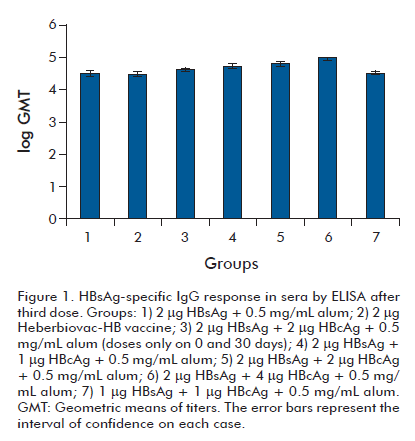
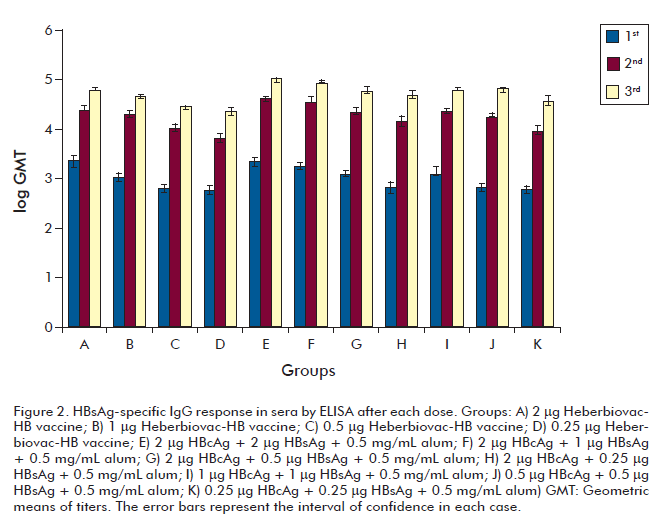
<body><![CDATA[<P   align="left" ><font face="Verdana, Arial, Helvetica, sans-serif" size="2"><B>Antigen-specific      humoral immune response in sera </b></font></P >   <B>        <P   align="left" ></P >   </B>        <P   align="left" ><font face="Verdana, Arial, Helvetica, sans-serif" size="2"><B><I>HBsAg-specific      IgG response in sera </I></b></font></P >       <P   align="left" ><font face="Verdana, Arial, Helvetica, sans-serif" size="2">HBsAg-specific total      IgG response was evaluated in sera after each dose. Seroconversion was not      observed in any tested serum ten days after the first dose; this behavior      is typical of the HBsAg, that needs the T-cell cooperation for the production      of a specific response in sera. The IgG response obtained after the third      dose was high for all groups (GMT <font face="Symbol">&sup3;</font> 10<sup>4</sup><FONT color="#0000FF"><FONT color="#000000">)      (<a href="#fig1">Figure 1</a>). </font></font></font></P >       <P   align="center" ><font size="+1" color="#000000"><font size="+1"><font size="+1"><font size="+1"><font size="+1"><font size="+1"><font size="+1"><font size="+1"><font size="+1"><font size="+1"><font size="+1"><font size="+1"><font size="+1"><font size="+1"><font size="+1"><font size="+1"><font size="+1"><font color="#0000FF"><font color="#000000"><font size="+1"><font size="+1"><font size="+1"><font size="+1"><font size="+1"><font size="+1"><font color="#FF0000"><font color="#000000"><font color="#FF0000"><font color="#000000"><font color="#FF0000"><font color="#000000"><font color="#FF0000"><font color="#000000"><font color="#FF0000"><font color="#000000"><font color="#FF0000"><font color="#000000"><font color="#FF0000"><font size="+1" color="#000000"><font size="+1"><font color="#FF0000"><font color="#000000"><font color="#FF0000"><font color="#000000"><font color="#FF0000"><font color="#000000"><font color="#FF0000"><font color="#000000"><font color="#FF0000"><font color="#000000"><font color="#FF0000"><font color="#000000"><font color="#FF0000"><font color="#000000"><font color="#FF0000"><font color="#000000"><font color="#FF0000"><font color="#000000"><font color="#FF0000"><font size="+1" color="#000000"><font size="+1"><font color="#0000FF"><font size="+1" color="#000000"><font size="+1"><font color="#FF0000"><font size="+1" color="#000000"><font size="+1"><font color="#0000FF"><font color="#000000"><font color="#0000FF"><font color="#000000"><font size="+1"><font size="+1" color="#000000"><font size="+1"><font size="+1"><font size="+1"><font size="+1"><font size="+1"><font size="+1"><font size="+1"><font size="+1"><font size="+1"><font size="+1"><font size="+1"><font size="+1"><font size="+1"><font size="+1"><font size="+1"><font size="+1"><font color="#0000FF"><font color="#000000"><font size="+1"><font size="+1"><font size="+1"><font size="+1"><font size="+1"><font size="+1"><font color="#FF0000"><font color="#000000"><font color="#FF0000"><font color="#000000"><font color="#FF0000"><font color="#000000"><font color="#FF0000"><font color="#000000"><font color="#FF0000"><font color="#000000"><font color="#FF0000"><font color="#000000"><font color="#FF0000"><font size="+1" color="#000000"><font size="+1"><font color="#FF0000"><font color="#000000"><font color="#FF0000"><font color="#000000"><font color="#FF0000"><font color="#000000"><font color="#FF0000"><font color="#000000"><font color="#FF0000"><font color="#000000"><font color="#FF0000"><font color="#000000"><font color="#FF0000"><font color="#000000"><font color="#FF0000"><font color="#000000"><font color="#FF0000"><font color="#000000"><font color="#FF0000"><font size="+1" color="#000000"><font size="+1"><font color="#0000FF"><font size="+1" color="#000000"><font size="+1"><font color="#FF0000"><font size="+1" color="#000000"><font size="+1"><font color="#0000FF"><font color="#000000"><font color="#0000FF"><font color="#000000"><font size="+1"><font size="+1"><a name="fig1"></a></font></font></font></font></font></font></font></font></font></font></font></font></font></font></font></font></font></font></font></font></font></font></font></font></font></font></font></font></font></font></font></font></font></font></font></font></font></font></font></font></font></font></font></font></font></font></font></font></font></font></font></font></font></font></font></font></font></font></font></font></font></font></font></font></font></font></font></font></font></font></font></font></font></font></font></font></font></font></font></font></font></font></font></font></font></font></font></font></font></font></font></font></font></font></font></font></font></font></font></font></font></font></font></font></font></font></font></font></font></font></font></font></font></font></font></font></font></font></font></font></font></font></font></font></font></font></font></font></font></font></font></font></font></font></font></font></font></font></font></font></font></font></font></font></font><img src="/img/revistas/bta/v27n3/f0103310.gif"></P >   </font><FONT size="+1"><FONT color="#0000FF"><FONT color="#000000">        
<P   align="left" ><font face="Verdana, Arial, Helvetica, sans-serif" size="2">In general, a trend      to elicit a superior anti-HBsAg IgG response was observed for the groups that      included HBcAg in the formulation when compared with the control group in      which the commercial vaccine was employed (group 2). This trend became statistically      significant in the case of the groups immunized with the variants (1:1) and      (1:2) (groups 5 and 6, (p &#61500;&#61472;0.05) and (p &#61500;&#61472;0.001),      respectively). The response obtained for the group that received only two      doses of the formulation (1:1) with 2 &micro;g of each antigen (group 3) did      not differ statistically from the response generated by the control group.      Similar behavior was observed for the response elicited by the group immunized      with the proportion (1:1) with 1 &micro;g of each antigen (group 7). The group      immunized with the proportion 1:2 (group 6) generated the higher anti- HBsAg      specific IgG response, differing from the rest, with the exception of group      5. </font></P >       <P   align="left" ><font face="Verdana, Arial, Helvetica, sans-serif" size="2">In the experiment      exploring minor doses of the HBsAg in the mixture the HBsAg-specific IgG responses      after three doses were similar (p &gt; 0.05) for all immunized groups with      2 or 1 microgram of each formulation (HBsAg in alum or the formulation containing      HBsAg and HBcAg in alum) (<a href="/img/revistas/bta/v27n3/f0203310.gif">Figure      2</a>). These results indicated that using the formulation containing HBsAg      in alum (resembling the anti-HBV commercial available vaccines) could reduce      the dose to 1<font face="Symbol"> m</font>g maintaining a similar IgG response;      however there was a significant reduction (p &gt; 0.05) in the anti-HBsAg      IgG titer in the group containing 0.5 &micro;g of HBsAg (group C). The results      of HBsAg-specific IgG response after three doses evidenced that the adjuvant      effect of 2 &micro;g of HBcAg allows a fourfold reduction in the HBsAg dose      without affecting the IgG response compared to groups A and E. </font></P >       
<P   align="left" ><font face="Verdana, Arial, Helvetica, sans-serif" size="2"><B><I>HBcAg-specific      IgG response in sera </I></b></font></P >       <P   align="left" ><font face="Verdana, Arial, Helvetica, sans-serif" size="2">For both experiments      the HBcAg-specific total IgG response were evaluated in sera after each dose.      Differing from the HBsAg-specific IgG response, 10 days after the first dose      seroconversion and high titers (GMT in levels close to 10<sup>4</sup>) wer<FONT color="#0000FF"><FONT color="#000000">e      observed in all tested serum. The IgG responses obtained after the third dose      were high for all groups (GMT <font face="Symbol">&sup3;</font> 10<sup>5</sup>)      (<FONT color="#0000FF"><FONT color="#000000">data not shown). </font></font></font></font></font></P >   <FONT color="#0000FF"><FONT color="#000000"><FONT color="#0000FF"><FONT color="#000000">        <P   align="left" > </P >       ]]></body>
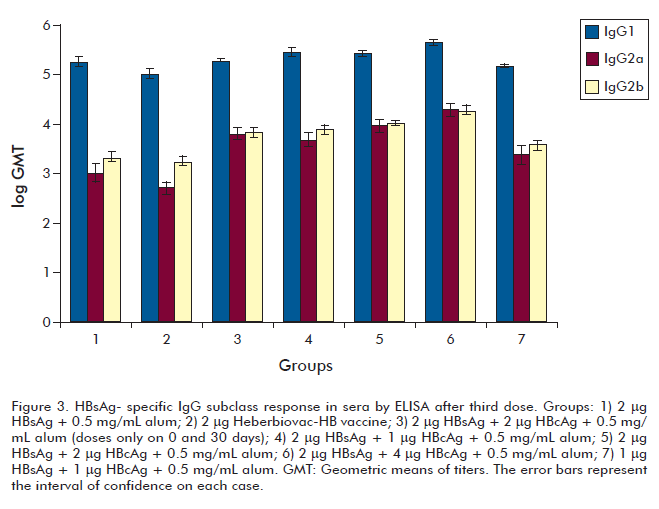
<body><![CDATA[<P   align="left" ><font face="Verdana, Arial, Helvetica, sans-serif" size="2"><B>Response of IgG      subclasses </b></font></P >   <B>        <P   align="left" ></P >   </B>        <P   align="left" ><font face="Verdana, Arial, Helvetica, sans-serif" size="2">The specific IgG      subclass response was evaluated alter the third dose (<a href="/img/revistas/bta/v27n3/f0303310.gif">Figure      3</a>). The results of an intra-group analysis showed that the serum IgG1      responses generated by all treatment groups were higher than their respective      IgG2a and IgG2b (p <font face="Symbol">&pound;</font> 0.001), however, we      observed a higher IgG2a and IgG2b responses for the groups immunized with      the formulations containing HBcAg (<a href="/img/revistas/bta/v27n3/f0303310.gif">Figure      3</a>). </font></P >       
<P   align="left" ><font face="Verdana, Arial, Helvetica, sans-serif" size="2">Group 6 generated      a significantly superior HBsAg-specific IgG1 and IgG2a response compared to      the response generated by the conventional vaccine (group 2) (p &lt; 0.05      and p &lt; 0.01, respectively). </font></P >       <P   align="left" > </P >       <P   align="left" ><font face="Verdana, Arial, Helvetica, sans-serif" size="2"><B>Lymphoproliferative      response </b></font></P >       <P   align="left" ><font face="Verdana, Arial, Helvetica, sans-serif" size="2">One month after the      third dose the proliferative response was evaluated stimulating the cells      with each antigen (HBsAg and HBcAg).Some groups of the study were selected      with this purpose. In the case of the HBsAg-specific response (<a href="/img/revistas/bta/v27n3/f0403310.gif">Figure      4</a>), a positive response for groups 2 and 6, with a trend to generate a      better proliferative response for the last was observed. </font></P >       
<P   align="left" ><font face="Verdana, Arial, Helvetica, sans-serif" size="2">The evaluation of      the HBcAg-specific proliferative response (<a href="/img/revistas/bta/v27n3/f0403310.gif">Figure      4</a>) showed a higher response for group 6 immunized with the formulation      containing HBsAg and HBcAg compared with group 8, immunized with the HBcAg      alone. </font></P >       
<P   align="left" ><font face="Verdana, Arial, Helvetica, sans-serif" size="3"><b>DISCUSSION</b></font><font face="Verdana, Arial, Helvetica, sans-serif" size="2">      </font></P >   <FONT size="+1">        <P   align="left" ><font size="2" face="Verdana, Arial, Helvetica, sans-serif">Although an effective      prophylactic vaccine against hepatitis B is commercially available since the      1980&acute;s, there remains a specific requirement for HBV vaccines capable      of circumventing the non-responder or low-responder status of some vaccines.      </font></P >   <FONT size="+1">        ]]></body>
<body><![CDATA[<P   align="left" ><font face="Verdana, Arial, Helvetica, sans-serif" size="2">Non-responsiveness      to hepatitis B virus (HBV) vaccine in adults is associated with multiple causes,      such as the HLA-C4AQ0, DRB1*0301 or DQB1*02 haplotypes (17), the insufficient      production of the specific B-cell repertoire or helper T-cell function (19),      among others. </font></P >       <P   align="left" ><font face="Verdana, Arial, Helvetica, sans-serif" size="2">Although it has been      recognized the concept of cellular and cytokine mediated HBV clearance (20,      21), in the prophylactic scenario, the HBsAg-specific antibody response is      considered the criterion of protection until now. That is why one of the challenges      in the new Hepatitis B vaccine development is to increase anti-HBsAg antibody      titers in non-/low-responders to conventional vaccines. </font></P >       <P   align="left" ><font face="Verdana, Arial, Helvetica, sans-serif" size="2">The inclusion of      HBcAg in the vaccine formulation, a second HBV antigen regarded as middle      protective and with immunoenhancing and immunomodulatory properties (10-12),      provided the formulation with special features. The bi-valence of the combined      formulation allows the generation of immune response against HBcAg, which      is highly immunogenic, and activates nonspecifically several cell types (14,      22). The generation of a broader and more potent humoral and cellular immune      response could also helps to circumvent the non-responder status to HBsAg.      </font></P >       <P   align="left" ><font face="Verdana, Arial, Helvetica, sans-serif" size="2">In the present work,      the immunogenicity of the formulation containing HBV surface and nucleocapsid      antigens administered by intramuscular route of immunization has been optimized      evaluating several doses for each antigen and different immunization schedules.      Similar to the results reported for the nasal use of this formulation (11,      12), parenteral administration generates higher humoral responses when compare      to the conventional vaccine. The immunoenhancing and immunomodulatory properties      of the HBcAg were also demonstrated employing the intramuscular route, both      at humoral and cellular levels, in agreement with a previous report (10).      </font></P >       <P   align="left" ><font face="Verdana, Arial, Helvetica, sans-serif" size="2">The formulation containing      the proportion HBsAg/ HBcAg (1:2) showed to be the most immunogenic. </font></P >       <P   align="left" ><font face="Verdana, Arial, Helvetica, sans-serif" size="2">In the first immunization      schedule it was demonstrated that the inclusion of the HBcAg in the formulation      allows the reduction of the number of doses established in conventional HBV      vaccination protocols from three to two doses. This could make an impact in      the reduction of injections to be completely protected against HBV infection.      There is an important percentage of unsafe injections, mainly in developing      countries (23). Limiting the number of injections will reduce the transmission      risk of several diseases (24). The presence of HBcAg in the formulation will      also contribute to the general protective capacity of the resulting formulation.      </font></P >       <P   align="left" ><font face="Verdana, Arial, Helvetica, sans-serif" size="2">In addition, the      inclusion of HBcAg enables the reduction of the HBsAg dose level based on      the fact that a similar specific IgG response were observed for the groups      immunized with the commercial vaccine compared to the group immunized with      the combined formulation at half dose level (groups 2 and 7). This last result      was reproduced in the second experiment, indicating that the presence of HBcAg      in the formulation allowed a fourfold reduction in the HBsAg dose. This could      potentially reduce the cost of the immunization based on the dual adjuvant      and immunogen role of HBcAg. </font></P >       <P   align="left" ><font face="Verdana, Arial, Helvetica, sans-serif" size="2">The obtained HBsAg-specific      IgG subclasses responses are in line with previous reports obtained in BalbC      and C57/Bl6 mice (10-12), indicating that the presence of HBcAg modulated      the humoral response for co-administered antigens in a pro-Th1 pattern. It      has been previously reported that these properties of the HBcAg are related      to the presence of trace amounts (5-20 ng/&micro;g protein) of bacterial RNA      encapsidated in the core particle (10). In the present work, we point out      that the strong Th1-immunomodulating properties previously reported for nasal      route could be modulated by the presence of alum in the formulations described.      However, significant differences were still detected in the HBsAg-specific      IgG2a response between the control group and the group receiving the higher      dose of HBcAg, corresponding to formulation HBs/ HBc (1:2) (group 6). A similar      behavior was seen for HBsAg-specific proliferative capacity in total spleen      cells, in this case there was also a trend to generate a higher response for      the combined formulation. </font></P >       <P   align="left" ><font face="Verdana, Arial, Helvetica, sans-serif" size="2">In general, the generated      HBcAg specific immune response was high for all groups, in accordance with      the immunological characteristic reported for this antigen (14). Interestingly,      the results reported previously for nasal administrations (11, 12), were reproduced      using a parenteral immunization route, indicating that a synergistic immunoenhancing      effect occurs when the HBsAg/HBcAg formulation is administered. </font></P >       <P   align="left" ><font face="Verdana, Arial, Helvetica, sans-serif" size="2">The present work      demonstrates that the use of the combined formulation by intramuscular route      is effective generating a potent humoral immune response, opening the possibility      of administration by different routes. Moreover, the possibility to administer      the formulation employing nasal and parenteral routes allows the development      of co-administration or combined administration strategies, useful in difficult      preventive settings or therapeutic vaccination. </font></P >       ]]></body>
<body><![CDATA[<P   align="left" ><font face="Verdana, Arial, Helvetica, sans-serif" size="2">Presented results      suggest that the formulation containing HBsAg and HBcAg administered by parenteral      routes could be potentially effective for vaccinating low/non-responders,      such as immuno-compromised patients, patients exposed to hemodialysis treatment      and old people, among others. On the other hand, such formulation could be      applied to Hepatitis B chronic patients alone or combined with mucosally administered      formulation. </font></P >       <P   align="left" ><font face="Verdana, Arial, Helvetica, sans-serif" size="2">The development of      this potent HBV vaccine formulation with attractive characteristics both for      prevention or therapeutic use, could be a future tool to control chronic infected      population&acute;s growth around the world. </font></P >       <P   align="left" ><font face="Verdana, Arial, Helvetica, sans-serif" size="2"><b><font size="3">ACKNOWLEDGMENTS</font></b>      </font></P >   <FONT size="+1">        <P   align="left" > </P >       <P   align="left" ><font size="2" face="Verdana, Arial, Helvetica, sans-serif">The present work      was financed by The Center for Genetic Engineering and Biotechnology, Havana,      Cuba. </font></P >   <FONT size="+1">        <P   align="left" > </P >       <P   align="left" ><font size="3"><b><font face="Verdana, Arial, Helvetica, sans-serif">STATEMENT      OF INTERESTS</font></b></font><font size="2" face="Verdana, Arial, Helvetica, sans-serif">      </font></P >   <FONT size="+1">        <P   align="left" ><font size="2" face="Verdana, Arial, Helvetica, sans-serif">All the authors are      employees of the Center for Genetic Engineering and Biotechnology, which owns      a patent (Method for obtaining antigenic aggregates and the use thereof in      formulations. PCT/CU01/00009, 2001) on the parenteral use of the formulation.      </font></P >   <FONT size="+1">        <P   align="left" > </P >       <P   align="left" ><font face="Verdana, Arial, Helvetica, sans-serif" size="2"><b><font size="3">REFERENCES</font></b>      </font></P >       ]]></body>
<body><![CDATA[<P   align="left" ><font size="2" face="Verdana, Arial, Helvetica, sans-serif">1. Hilleman MR. Overview      of the pathogenesis, prophylaxis and therapeusis of viral hepatitis B, with      focus on reduction to practical applications. Vaccine 2001;19:1837-48. </font></P >   <FONT size="+1">        <P   align="left" ><font face="Verdana, Arial, Helvetica, sans-serif" size="2">2. Hoofnagle JH,      Doo E, Liang TJ, Fleischer R, Lok ASF. Management of hepatitis B: summary      of a clinical research workshop. Hepatology 2007;45:1056-75. </font></P >       <!-- ref --><P   align="left" ><font face="Verdana, Arial, Helvetica, sans-serif" size="2">3. Mandell GL, Bennet      JE, Dolin R. Principles and practice of infectious diseases 5th edn (CD Rom).      New York: Churchill Livingstone, 2000. </font></P >    <!-- ref --><P   align="left" ><font face="Verdana, Arial, Helvetica, sans-serif" size="2">4. Page M, Jones      CD, Bailey C. A novel, recombinant triple antigen hepatitis B vaccine (Hepacare).      Intervirol 2001;44(2-3): 88-97. </font></P >    <!-- ref --><P   align="left" ><font face="Verdana, Arial, Helvetica, sans-serif" size="2">5. Yalcin K, Danis      R, Degertekin H, Alp MN, Tekes S, Budak T. The lack of effect of therapeutic      vaccination with a pre-S2/S HBV vaccine in the immune tolerant phase of chronic      HBV infection. J Clin Gastroenterol 2003;37:330-5. </font></P >    <!-- ref --><P   align="left" ><font face="Verdana, Arial, Helvetica, sans-serif" size="2">6. Vandepapeliere      P, Lau G, Leroux-Roels G, Horsmans Y, Gane E, Tawandee T, <I>et al</I>. Therapeutic      vaccination of chronic hepatitis B patients with virus suppression by antiviral      therapy: A randomized, controlled study of co-administration of HBsAg/AS02      candidate vaccine and lamivudine. Vaccine 2007;25:8585-97. </font></P >    <!-- ref --><P   align="left" ><font face="Verdana, Arial, Helvetica, sans-serif" size="2">7. Wettendorff M.      Therapeutic vaccination. Virus Res 2002;82:133-40. </font></P >    <!-- ref --><P   align="left" ><font face="Verdana, Arial, Helvetica, sans-serif" size="2">8. Webster GJM, Bertoletti      A. Quantity and quality of virus specific CD8 cell response: relevance to      the design of a therapeutic vaccine for chronic HBV infection. Mol Immunol      2001;38:467-73. </font></P >    <!-- ref --><P   align="left" ><font face="Verdana, Arial, Helvetica, sans-serif" size="2">9. Bertoletti A,      Naoumov NV. Translation of immunological knowledge into better treatments      of chronic hepatitis B. J Hepatol 2003;39:115-24. </font></P >    <!-- ref --><P   align="left" ><font face="Verdana, Arial, Helvetica, sans-serif" size="2">10. Riedl P, Buschle      M, Reimann J, Schirmbeck R. Binding immune-stimulating oligonucleotides to      cationic peptides from viral core antigen enhances their potency as adjuvants.      Eur J Immunol 2002;32:1709-16. </font></P >    <!-- ref --><P   align="left" ><font face="Verdana, Arial, Helvetica, sans-serif" size="2">11. Lobaina Y, Palenzuela      D, Pichardo D, Muzio V, Guillen G, Aguilar JC. Immunological characterization      of two hepatitis B core antigen variants and their immunoenhancing effect      on co-delivered hepatitis B surface antigen. Mol Immunol 2005;42:289-94. </font></P >    <!-- ref --><P   align="left" ><font face="Verdana, Arial, Helvetica, sans-serif" size="2">12. Aguilar JC, Lobaina      Y, Muzio V, Garc&iacute;a D, Pent&oacute;n E, Iglesias E, <I>et al</I>. Development      of a nasal vaccine for chronic hepatitis B infection that uses the ability      of hepatitis B core antigen to stimulate a strong Th1 response against hepatitis      B surface antigen. Immunol Cell Biol 2004;82:539-46. </font></P >    <!-- ref --><P   align="left" ><font face="Verdana, Arial, Helvetica, sans-serif" size="2">13. Aguilar A, Gonz&aacute;lez      CA, Cinza Z, Cabrera J, Veliz G, Moreno SR, <I>et al</I>. Phase I clinical      trial in healthy adults of a nasal vaccine candidate containing recombinant      hepatitis B surface and core antigens. Int J Infect Dis 2007;11:394-401. </font></P >    <!-- ref --><P   align="left" ><font face="Verdana, Arial, Helvetica, sans-serif" size="2">14. Vanlandschoot      P, Cao T, Leroux-Roels G. The nucleocapsid of the hepatitis B virus: a remarkable      immunogenic structure. Antiviral Res 2003;60(2):67-74. </font></P >    <!-- ref --><P   align="left" ><font face="Verdana, Arial, Helvetica, sans-serif" size="2">15. Iglesias E, Franch      O, Carrazana Y, Lobaina Y, Garc&iacute;a D, S&aacute;nchez J, <I>et al</I>.      Influence of aluminum-based adjuvant on the immune response to multiantigenic      formulation. Viral Immunol 2006; 19(4):712-21. </font></P >    <!-- ref --><P   align="left" ><font face="Verdana, Arial, Helvetica, sans-serif" size="2">16. Belloni C, Tinelli      C, Orsolini P, Pistorio A, Avanzini A, Moretta A, <I>et al</I>. Revaccination      against hepatitis B virus of nonresponding and low-responding infants immunised      at birth. A parallel evaluation of rubella and tetanus vaccine. Vaccine 1998;16:399-402.      </font></P >    <!-- ref --><P   align="left" ><font face="Verdana, Arial, Helvetica, sans-serif" size="2">17. De Silvestri      A, Pasi A, Martinetti M, Belloni C, Tinelli C, Rondini G, <I>et al</I>. Family      study of non-responsiveness to hepatitis B vaccine confirms the importance      of HLA class III C4A locus. Genes Immun 2001; 2(7):367-72. </font></P >    <!-- ref --><P   align="left" ><font face="Verdana, Arial, Helvetica, sans-serif" size="2">18. Alper CA. The      human immune response to hepatitis B surface antigen. Exp Clin Immunogenet      1995;12:171-81. </font></P >    <!-- ref --><P   align="left" ><font face="Verdana, Arial, Helvetica, sans-serif" size="2">19. Shokrgozar MA,      Shokri F. Enumeration of hepatitis B surface antigen-specific B lymphocytes      in responder and non-responder normal individuals vaccinated with recombinant      hepatitis B surface antigen. Immunol 2001;104;1:75-9. </font></P >    <!-- ref --><P   align="left" ><font face="Verdana, Arial, Helvetica, sans-serif" size="2">20. Bertoletti A,      Gehring AJ. The immune response during hepatitis B virus infection. J Gen      Virol 2006;87(Pt 6):1439-49. </font></P >    <!-- ref --><P   align="left" ><font face="Verdana, Arial, Helvetica, sans-serif" size="2">21. Wieland S, Thimme      R, Purcell RH, Chisari FV. Genomic analysis of the host response to hepatitis      B virus infection. Proc Natl Acad Sci USA 2004;27;101(17):6669- 74. </font></P >    <!-- ref --><P   align="left" ><font face="Verdana, Arial, Helvetica, sans-serif" size="2">22. Lazdina U, Cao      T, Steinbergs J, Alheim M, Pumpens P, Peterson DL, <i>et al</i>. Molecular      basis for the interaction of the hepatitis B virus core antigen with the surface      immunoglobulin receptor on naive B cells. J Virol 2001;75(14):6367-74. </font></P >    <!-- ref --><P   align="left" ><font face="Verdana, Arial, Helvetica, sans-serif" size="2">23. Miller MA, Pisani      E. The cost of unsafe injections. Bull World Health Organ 1999;77:808-11.      </font></P >    <!-- ref --><P   align="left" ><font face="Verdana, Arial, Helvetica, sans-serif" size="2">24. World Health      Organization. Safety of Injections: Global Facts &amp; Figures. Geneva, 2004.      </font></P >    <P   align="left" > </P >       <P   align="left" ><font size="2" face="Verdana, Arial, Helvetica, sans-serif">Received in April,      2010. </font>    <br>     <font face="Verdana, Arial, Helvetica, sans-serif" size="2">Accepted for publication      in August, 2010. </font></P >   <font size="+1" color="#000000"><font size="+1"><font size="2" face="Verdana, Arial, Helvetica, sans-serif">Yadira    Lobaina</font></font></font><FONT size="+1">, </font><font size="+1" color="#000000"><font size="+1"><font size="2" face="Verdana, Arial, Helvetica, sans-serif">Hepatitis    B Department, Biomedical Research Unit,</font></font></font> </font><font size="+1" color="#000000"><font size="+1" color="#000000"><font size="+1"><font size="2" face="Verdana, Arial, Helvetica, sans-serif">Center    for Genetic Engineering and Biotechnology, CIGB Ave. 31 / 158 and 190, Cubanac&aacute;n,    Playa, PO Box 6162, Havana, Cuba</font></font></font></font>. </font><font size="+1" color="#000000"><font size="+1"><font size="2" face="Verdana, Arial, Helvetica, sans-serif">E-mail:<font color="#0000FF">    </font><a href="mailto:yadira.lobaina@cigb.edu.cu"><font color="#0000FF">yadira.lobaina@cigb.edu.cu</font></a></font></font></font></font></font></font></font></font></font></font></font></font></font></font></font></font></font></font></font></font></font></font></font></font></font></font></font></font></font></font></font></font></font></font></font></font></font></font></font></font></font></font></font></font></font></font></font></font></font></font></font></font></font></font></font></font></font></font></font></font></font></font></font></font></font></font></font></font></font></font></font></font></font></font></font></font></font></font></font></font></font></font></font></font></font></font></font></DIV >      ]]></body><back>
<ref-list>
<ref id="B1">
<label>1</label><nlm-citation citation-type="journal">
<person-group person-group-type="author">
<name>
<surname><![CDATA[Hilleman]]></surname>
<given-names><![CDATA[MR]]></given-names>
</name>
</person-group>
<article-title xml:lang="en"><![CDATA[Overview of the pathogenesis, prophylaxis and therapeutics of viral hepatitis B, with focus on reduction to practical applications]]></article-title>
<source><![CDATA[Vaccine]]></source>
<year>2001</year>
<volume>19</volume>
<page-range>1837-48</page-range></nlm-citation>
</ref>
<ref id="B2">
<label>2</label><nlm-citation citation-type="journal">
<person-group person-group-type="author">
<name>
<surname><![CDATA[Hoofnagle]]></surname>
<given-names><![CDATA[JH]]></given-names>
</name>
<name>
<surname><![CDATA[Doo]]></surname>
<given-names><![CDATA[E]]></given-names>
</name>
<name>
<surname><![CDATA[Liang]]></surname>
<given-names><![CDATA[TJ]]></given-names>
</name>
<name>
<surname><![CDATA[Fleischer]]></surname>
<given-names><![CDATA[R]]></given-names>
</name>
<name>
<surname><![CDATA[Lok]]></surname>
<given-names><![CDATA[ASF]]></given-names>
</name>
</person-group>
<article-title xml:lang="en"><![CDATA[Management of hepatits B: summary of a clinical research workshop]]></article-title>
<source><![CDATA[Hepatology]]></source>
<year>2007</year>
<volume>45</volume>
<page-range>1056-75</page-range></nlm-citation>
</ref>
<ref id="B3">
<label>3</label><nlm-citation citation-type="book">
<person-group person-group-type="author">
<name>
<surname><![CDATA[Mandell]]></surname>
<given-names><![CDATA[GL]]></given-names>
</name>
<name>
<surname><![CDATA[Bennet]]></surname>
<given-names><![CDATA[JE]]></given-names>
</name>
<name>
<surname><![CDATA[Dolin]]></surname>
<given-names><![CDATA[R]]></given-names>
</name>
</person-group>
<source><![CDATA[Principles and practice of infectious diseases]]></source>
<year>2000</year>
<edition>5</edition>
<publisher-loc><![CDATA[New York ]]></publisher-loc>
<publisher-name><![CDATA[Churchill Livingstone]]></publisher-name>
</nlm-citation>
</ref>
<ref id="B4">
<label>4</label><nlm-citation citation-type="journal">
<person-group person-group-type="author">
<name>
<surname><![CDATA[Page]]></surname>
<given-names><![CDATA[M]]></given-names>
</name>
<name>
<surname><![CDATA[Jones]]></surname>
<given-names><![CDATA[CD]]></given-names>
</name>
<name>
<surname><![CDATA[Bailey]]></surname>
<given-names><![CDATA[C]]></given-names>
</name>
</person-group>
<article-title xml:lang="en"><![CDATA[A novel, recombinant triple antigen hepatitis B vaccine (Hepacare)]]></article-title>
<source><![CDATA[Intervirol]]></source>
<year>2001</year>
<volume>44</volume>
<numero>2-3</numero>
<issue>2-3</issue>
<page-range>88-97</page-range></nlm-citation>
</ref>
<ref id="B5">
<label>5</label><nlm-citation citation-type="journal">
<person-group person-group-type="author">
<name>
<surname><![CDATA[Yalcin]]></surname>
<given-names><![CDATA[K]]></given-names>
</name>
<name>
<surname><![CDATA[Danis]]></surname>
<given-names><![CDATA[R]]></given-names>
</name>
<name>
<surname><![CDATA[Degertekin]]></surname>
<given-names><![CDATA[H]]></given-names>
</name>
<name>
<surname><![CDATA[Alp]]></surname>
<given-names><![CDATA[MN]]></given-names>
</name>
<name>
<surname><![CDATA[Tekes]]></surname>
<given-names><![CDATA[S]]></given-names>
</name>
<name>
<surname><![CDATA[Budak]]></surname>
<given-names><![CDATA[T]]></given-names>
</name>
</person-group>
<article-title xml:lang="en"><![CDATA[The lack of effect of therapeutic vaccination with a pre-S2/S HBV vaccine in the immune tolerant phase of chronic HBV infection]]></article-title>
<source><![CDATA[J Clin Gastroenterol]]></source>
<year>2003</year>
<volume>37</volume>
<page-range>330-5</page-range></nlm-citation>
</ref>
<ref id="B6">
<label>6</label><nlm-citation citation-type="journal">
<person-group person-group-type="author">
<name>
<surname><![CDATA[Vandepapeliere]]></surname>
<given-names><![CDATA[P]]></given-names>
</name>
<name>
<surname><![CDATA[Lau]]></surname>
<given-names><![CDATA[G]]></given-names>
</name>
<name>
<surname><![CDATA[Leroux-Roels]]></surname>
<given-names><![CDATA[G]]></given-names>
</name>
<name>
<surname><![CDATA[Horsmans]]></surname>
<given-names><![CDATA[Y]]></given-names>
</name>
<name>
<surname><![CDATA[Gane]]></surname>
<given-names><![CDATA[E]]></given-names>
</name>
<name>
<surname><![CDATA[Tawandee]]></surname>
<given-names><![CDATA[T]]></given-names>
</name>
</person-group>
<article-title xml:lang="en"><![CDATA[Therapeutic vaccination of chronic hepatitis B patients with virus suppression by antiviral therapy: A randomized, controlled study of co-administration of HBsAg/AS02 candidate vaccine and lamivudine]]></article-title>
<source><![CDATA[Vaccine]]></source>
<year>2007</year>
<volume>25</volume>
<page-range>8585-97</page-range></nlm-citation>
</ref>
<ref id="B7">
<label>7</label><nlm-citation citation-type="journal">
<person-group person-group-type="author">
<name>
<surname><![CDATA[Wettendorff]]></surname>
<given-names><![CDATA[M]]></given-names>
</name>
</person-group>
<article-title xml:lang="en"><![CDATA[Therapeutic vaccination]]></article-title>
<source><![CDATA[Virus Res]]></source>
<year>2002</year>
<volume>82</volume>
<page-range>133-40</page-range></nlm-citation>
</ref>
<ref id="B8">
<label>8</label><nlm-citation citation-type="journal">
<person-group person-group-type="author">
<name>
<surname><![CDATA[Webster]]></surname>
<given-names><![CDATA[GJM]]></given-names>
</name>
<name>
<surname><![CDATA[Bertoletti]]></surname>
<given-names><![CDATA[A]]></given-names>
</name>
</person-group>
<article-title xml:lang="en"><![CDATA[Quantity and quality of virus specific CD8 cell response: relevance to the design of a therapeutic vaccine for chronic HBV infection]]></article-title>
<source><![CDATA[Mol Immunol]]></source>
<year>2001</year>
<volume>38</volume>
<page-range>467-73</page-range></nlm-citation>
</ref>
<ref id="B9">
<label>9</label><nlm-citation citation-type="journal">
<person-group person-group-type="author">
<name>
<surname><![CDATA[Bertoletti]]></surname>
<given-names><![CDATA[A]]></given-names>
</name>
<name>
<surname><![CDATA[Naoumov]]></surname>
<given-names><![CDATA[NV]]></given-names>
</name>
</person-group>
<article-title xml:lang="en"><![CDATA[Translation of immunological knowledge into better treatments of chronic hepatitis B]]></article-title>
<source><![CDATA[J Hepatol]]></source>
<year>2003</year>
<volume>39</volume>
<page-range>115-24</page-range></nlm-citation>
</ref>
<ref id="B10">
<label>10</label><nlm-citation citation-type="journal">
<person-group person-group-type="author">
<name>
<surname><![CDATA[Riedl]]></surname>
<given-names><![CDATA[P]]></given-names>
</name>
<name>
<surname><![CDATA[Buschle]]></surname>
<given-names><![CDATA[M]]></given-names>
</name>
<name>
<surname><![CDATA[Reimann]]></surname>
<given-names><![CDATA[J]]></given-names>
</name>
<name>
<surname><![CDATA[Schirmbeck]]></surname>
<given-names><![CDATA[R]]></given-names>
</name>
</person-group>
<article-title xml:lang="en"><![CDATA[Binding immune-stimulating oligonucleotides to cationic peptides from viral core antigen enhances their potency as adjuvants]]></article-title>
<source><![CDATA[Eur J Immunol]]></source>
<year>2002</year>
<volume>32</volume>
<page-range>1709-16</page-range></nlm-citation>
</ref>
<ref id="B11">
<label>11</label><nlm-citation citation-type="journal">
<person-group person-group-type="author">
<name>
<surname><![CDATA[Lobaina]]></surname>
<given-names><![CDATA[Y]]></given-names>
</name>
<name>
<surname><![CDATA[Palenzuela]]></surname>
<given-names><![CDATA[D]]></given-names>
</name>
<name>
<surname><![CDATA[Pichardo]]></surname>
<given-names><![CDATA[D]]></given-names>
</name>
<name>
<surname><![CDATA[Muzio]]></surname>
<given-names><![CDATA[V]]></given-names>
</name>
<name>
<surname><![CDATA[Guillen]]></surname>
<given-names><![CDATA[G]]></given-names>
</name>
<name>
<surname><![CDATA[Aguilar]]></surname>
<given-names><![CDATA[JC]]></given-names>
</name>
</person-group>
<article-title xml:lang="en"><![CDATA[Immunological characterization of two hepatitis B core antigen variants and their immunoenhancing effect on co-delivered hepatitis B surface antigen]]></article-title>
<source><![CDATA[Mol Immunol]]></source>
<year>2005</year>
<volume>42</volume>
<page-range>289-94</page-range></nlm-citation>
</ref>
<ref id="B12">
<label>12</label><nlm-citation citation-type="journal">
<person-group person-group-type="author">
<name>
<surname><![CDATA[Aguilar]]></surname>
<given-names><![CDATA[JC]]></given-names>
</name>
<name>
<surname><![CDATA[Lobaina]]></surname>
<given-names><![CDATA[Y]]></given-names>
</name>
<name>
<surname><![CDATA[Muzio]]></surname>
<given-names><![CDATA[V]]></given-names>
</name>
<name>
<surname><![CDATA[García]]></surname>
<given-names><![CDATA[D]]></given-names>
</name>
<name>
<surname><![CDATA[Pentón]]></surname>
<given-names><![CDATA[E]]></given-names>
</name>
<name>
<surname><![CDATA[Iglesias]]></surname>
<given-names><![CDATA[E]]></given-names>
</name>
</person-group>
<article-title xml:lang="en"><![CDATA[Development of a nasal vaccine for chronic hepatitis B infection that uses the ability of hepatitis B core antigen to stimulate a strong Th1 response against hepatitis B surface antigen]]></article-title>
<source><![CDATA[Immunol Cell Biol]]></source>
<year>2004</year>
<volume>82</volume>
<page-range>539-46</page-range></nlm-citation>
</ref>
<ref id="B13">
<label>13</label><nlm-citation citation-type="journal">
<person-group person-group-type="author">
<name>
<surname><![CDATA[Aguilar]]></surname>
<given-names><![CDATA[A]]></given-names>
</name>
<name>
<surname><![CDATA[González]]></surname>
<given-names><![CDATA[CA]]></given-names>
</name>
<name>
<surname><![CDATA[Cinza]]></surname>
<given-names><![CDATA[Z]]></given-names>
</name>
<name>
<surname><![CDATA[Cabrera]]></surname>
<given-names><![CDATA[J]]></given-names>
</name>
<name>
<surname><![CDATA[Veliz]]></surname>
<given-names><![CDATA[G]]></given-names>
</name>
<name>
<surname><![CDATA[Moreno]]></surname>
<given-names><![CDATA[SR]]></given-names>
</name>
</person-group>
<article-title xml:lang="en"><![CDATA[Phase I clinical trial in healthy adults of a nasal vaccine candidate containing recombinant hepatitis B surface and core antigens]]></article-title>
<source><![CDATA[Int J Infect Dis]]></source>
<year>2007</year>
<volume>11</volume>
<page-range>394-401</page-range></nlm-citation>
</ref>
<ref id="B14">
<label>14</label><nlm-citation citation-type="journal">
<person-group person-group-type="author">
<name>
<surname><![CDATA[Vanlandschoot]]></surname>
<given-names><![CDATA[P]]></given-names>
</name>
<name>
<surname><![CDATA[Cao]]></surname>
<given-names><![CDATA[T]]></given-names>
</name>
<name>
<surname><![CDATA[Leroux-Roels]]></surname>
<given-names><![CDATA[G]]></given-names>
</name>
</person-group>
<article-title xml:lang="en"><![CDATA[The nucleocapsid of the hepatitis B virus: a remarkable immunogenic structure]]></article-title>
<source><![CDATA[Antiviral Res]]></source>
<year>2003</year>
<volume>60</volume>
<numero>2</numero>
<issue>2</issue>
<page-range>67-74</page-range></nlm-citation>
</ref>
<ref id="B15">
<label>15</label><nlm-citation citation-type="journal">
<person-group person-group-type="author">
<name>
<surname><![CDATA[Iglesias]]></surname>
<given-names><![CDATA[E]]></given-names>
</name>
<name>
<surname><![CDATA[Franch]]></surname>
<given-names><![CDATA[O]]></given-names>
</name>
<name>
<surname><![CDATA[Carrazana]]></surname>
<given-names><![CDATA[Y]]></given-names>
</name>
<name>
<surname><![CDATA[Lobaina]]></surname>
<given-names><![CDATA[Y]]></given-names>
</name>
<name>
<surname><![CDATA[García]]></surname>
<given-names><![CDATA[D]]></given-names>
</name>
<name>
<surname><![CDATA[Sánchez]]></surname>
<given-names><![CDATA[J]]></given-names>
</name>
</person-group>
<article-title xml:lang="en"><![CDATA[Influence of aluminum-based adjuvant on the immune response to multiantigenic formulation]]></article-title>
<source><![CDATA[Viral Immunol]]></source>
<year>2006</year>
<volume>19</volume>
<numero>4</numero>
<issue>4</issue>
<page-range>712-21</page-range></nlm-citation>
</ref>
<ref id="B16">
<label>16</label><nlm-citation citation-type="journal">
<person-group person-group-type="author">
<name>
<surname><![CDATA[Belloni]]></surname>
<given-names><![CDATA[C]]></given-names>
</name>
<name>
<surname><![CDATA[Tinelli]]></surname>
<given-names><![CDATA[C]]></given-names>
</name>
<name>
<surname><![CDATA[Orsolini]]></surname>
<given-names><![CDATA[P]]></given-names>
</name>
<name>
<surname><![CDATA[Pistorio]]></surname>
<given-names><![CDATA[A]]></given-names>
</name>
<name>
<surname><![CDATA[Avanzini]]></surname>
<given-names><![CDATA[A]]></given-names>
</name>
<name>
<surname><![CDATA[Moretta]]></surname>
<given-names><![CDATA[A]]></given-names>
</name>
</person-group>
<article-title xml:lang="en"><![CDATA[Revaccination against hepatitis B virus of nonresponding and low-responding infants immunised at birth: A parallel evaluation of rubella and tetanus vaccine]]></article-title>
<source><![CDATA[Vaccine]]></source>
<year>1998</year>
<volume>16</volume>
<page-range>399-402</page-range></nlm-citation>
</ref>
<ref id="B17">
<label>17</label><nlm-citation citation-type="journal">
<person-group person-group-type="author">
<name>
<surname><![CDATA[De Silvestri]]></surname>
<given-names><![CDATA[A]]></given-names>
</name>
<name>
<surname><![CDATA[Pasi]]></surname>
<given-names><![CDATA[A]]></given-names>
</name>
<name>
<surname><![CDATA[Martinetti]]></surname>
<given-names><![CDATA[M]]></given-names>
</name>
<name>
<surname><![CDATA[Belloni]]></surname>
<given-names><![CDATA[C]]></given-names>
</name>
<name>
<surname><![CDATA[Tinelli]]></surname>
<given-names><![CDATA[C]]></given-names>
</name>
<name>
<surname><![CDATA[Rondini]]></surname>
<given-names><![CDATA[G]]></given-names>
</name>
</person-group>
<article-title xml:lang="en"><![CDATA[Family study of non-responsiveness to hepatitis B vaccine confirms the importance of HLA class III C4A locus]]></article-title>
<source><![CDATA[Genes Immun]]></source>
<year>2001</year>
<volume>2</volume>
<numero>7</numero>
<issue>7</issue>
<page-range>367-72</page-range></nlm-citation>
</ref>
<ref id="B18">
<label>18</label><nlm-citation citation-type="journal">
<person-group person-group-type="author">
<name>
<surname><![CDATA[Alper]]></surname>
<given-names><![CDATA[CA]]></given-names>
</name>
</person-group>
<article-title xml:lang="en"><![CDATA[The human immune response to hepatitis B surface antigen]]></article-title>
<source><![CDATA[Exp Clin Immunogenet]]></source>
<year>1995</year>
<volume>12</volume>
<page-range>171-81</page-range></nlm-citation>
</ref>
<ref id="B19">
<label>19</label><nlm-citation citation-type="journal">
<person-group person-group-type="author">
<name>
<surname><![CDATA[Shokrgozar]]></surname>
<given-names><![CDATA[MA]]></given-names>
</name>
<name>
<surname><![CDATA[Shokri]]></surname>
<given-names><![CDATA[F]]></given-names>
</name>
</person-group>
<article-title xml:lang="en"><![CDATA[Enumeration of hepatitis B surface antigen-specific B lymphocytes in responder and non-responder normal individuals vaccinated with recombinant hepatitis B surface antigen]]></article-title>
<source><![CDATA[Immunol]]></source>
<year>2001</year>
<volume>104</volume>
<page-range>75-9</page-range></nlm-citation>
</ref>
<ref id="B20">
<label>20</label><nlm-citation citation-type="journal">
<person-group person-group-type="author">
<name>
<surname><![CDATA[Bertoletti]]></surname>
<given-names><![CDATA[A]]></given-names>
</name>
<name>
<surname><![CDATA[Gehring]]></surname>
<given-names><![CDATA[AJ]]></given-names>
</name>
</person-group>
<article-title xml:lang="en"><![CDATA[The immune response during hepatitis B virus infection]]></article-title>
<source><![CDATA[J Gen Virol]]></source>
<year>2006</year>
<volume>87</volume>
<numero>6</numero>
<issue>6</issue>
<page-range>1439-49</page-range></nlm-citation>
</ref>
<ref id="B21">
<label>21</label><nlm-citation citation-type="journal">
<person-group person-group-type="author">
<name>
<surname><![CDATA[Wieland]]></surname>
<given-names><![CDATA[S]]></given-names>
</name>
<name>
<surname><![CDATA[Thimme]]></surname>
<given-names><![CDATA[R]]></given-names>
</name>
<name>
<surname><![CDATA[Purcell]]></surname>
<given-names><![CDATA[RH]]></given-names>
</name>
<name>
<surname><![CDATA[Chisari]]></surname>
<given-names><![CDATA[FV]]></given-names>
</name>
</person-group>
<article-title xml:lang="en"><![CDATA[Genomic analysis of the host response to hepatitis B virus infection]]></article-title>
<source><![CDATA[Proc Natl Acad Sci USA]]></source>
<year>2004</year>
<volume>27</volume>
<numero>17</numero>
<issue>17</issue>
<page-range>6669-74</page-range></nlm-citation>
</ref>
<ref id="B22">
<label>22</label><nlm-citation citation-type="journal">
<person-group person-group-type="author">
<name>
<surname><![CDATA[Lazdina]]></surname>
<given-names><![CDATA[U]]></given-names>
</name>
<name>
<surname><![CDATA[Cao]]></surname>
<given-names><![CDATA[T]]></given-names>
</name>
<name>
<surname><![CDATA[Steinbergs]]></surname>
<given-names><![CDATA[J]]></given-names>
</name>
<name>
<surname><![CDATA[Alheim]]></surname>
<given-names><![CDATA[M]]></given-names>
</name>
<name>
<surname><![CDATA[Pumpens]]></surname>
<given-names><![CDATA[P]]></given-names>
</name>
<name>
<surname><![CDATA[Peterson]]></surname>
<given-names><![CDATA[DL]]></given-names>
</name>
</person-group>
<article-title xml:lang="en"><![CDATA[Molecular basis for the interaction of the hepatitis B virus core antigen with the surface immunoglobulin receptor on naive B cells]]></article-title>
<source><![CDATA[J Virol]]></source>
<year>2001</year>
<volume>75</volume>
<numero>14</numero>
<issue>14</issue>
<page-range>6367-74</page-range></nlm-citation>
</ref>
<ref id="B23">
<label>23</label><nlm-citation citation-type="journal">
<person-group person-group-type="author">
<name>
<surname><![CDATA[Miller]]></surname>
<given-names><![CDATA[MA]]></given-names>
</name>
<name>
<surname><![CDATA[Pisani]]></surname>
<given-names><![CDATA[E]]></given-names>
</name>
</person-group>
<article-title xml:lang="en"><![CDATA[The cost of unsafe injections]]></article-title>
<source><![CDATA[Bull World Health Organ]]></source>
<year>1999</year>
<volume>77</volume>
<page-range>808-11</page-range></nlm-citation>
</ref>
<ref id="B24">
<label>24</label><nlm-citation citation-type="">
<collab>World Health Organization</collab>
<source><![CDATA[Safety of Injections: Global Facts & Figures]]></source>
<year>2004</year>
<publisher-loc><![CDATA[Geneva ]]></publisher-loc>
</nlm-citation>
</ref>
</ref-list>
</back>
</article>