<?xml version="1.0" encoding="ISO-8859-1"?><article xmlns:mml="http://www.w3.org/1998/Math/MathML" xmlns:xlink="http://www.w3.org/1999/xlink" xmlns:xsi="http://www.w3.org/2001/XMLSchema-instance">
<front>
<journal-meta>
<journal-id>1027-2852</journal-id>
<journal-title><![CDATA[Biotecnología Aplicada]]></journal-title>
<abbrev-journal-title><![CDATA[Biotecnol Apl]]></abbrev-journal-title>
<issn>1027-2852</issn>
<publisher>
<publisher-name><![CDATA[Editorial Elfos Scientiae]]></publisher-name>
</publisher>
</journal-meta>
<article-meta>
<article-id>S1027-28522010000400001</article-id>
<title-group>
<article-title xml:lang="en"><![CDATA[Cellular and molecular insights into the wound healing mechanism in diabetes]]></article-title>
<article-title xml:lang="es"><![CDATA[Particularidades celulares y moleculares del mecanismo de cicatrización en la diabetes]]></article-title>
</title-group>
<contrib-group>
<contrib contrib-type="author">
<name>
<surname><![CDATA[Berlanga-Acosta]]></surname>
<given-names><![CDATA[Jorge]]></given-names>
</name>
<xref ref-type="aff" rid="A01"/>
</contrib>
<contrib contrib-type="author">
<name>
<surname><![CDATA[Valdez-Pérez]]></surname>
<given-names><![CDATA[Calixto]]></given-names>
</name>
<xref ref-type="aff" rid="A02"/>
</contrib>
<contrib contrib-type="author">
<name>
<surname><![CDATA[Savigne-Gutierrez]]></surname>
<given-names><![CDATA[William]]></given-names>
</name>
<xref ref-type="aff" rid="A02"/>
</contrib>
<contrib contrib-type="author">
<name>
<surname><![CDATA[Mendoza-Marí]]></surname>
<given-names><![CDATA[Yssel]]></given-names>
</name>
<xref ref-type="aff" rid="A01"/>
</contrib>
<contrib contrib-type="author">
<name>
<surname><![CDATA[Franco-Perez]]></surname>
<given-names><![CDATA[Neobalis]]></given-names>
</name>
<xref ref-type="aff" rid="A02"/>
</contrib>
<contrib contrib-type="author">
<name>
<surname><![CDATA[Vargas-Machiran]]></surname>
<given-names><![CDATA[Evaristo]]></given-names>
</name>
<xref ref-type="aff" rid="A02"/>
</contrib>
<contrib contrib-type="author">
<name>
<surname><![CDATA[Poll-Marrón]]></surname>
<given-names><![CDATA[Natalia]]></given-names>
</name>
<xref ref-type="aff" rid="A02"/>
</contrib>
<contrib contrib-type="author">
<name>
<surname><![CDATA[Alvarez-Duarte]]></surname>
<given-names><![CDATA[Hector]]></given-names>
</name>
<xref ref-type="aff" rid="A02"/>
</contrib>
<contrib contrib-type="author">
<name>
<surname><![CDATA[Echeverria-Requeijo]]></surname>
<given-names><![CDATA[Héctor]]></given-names>
</name>
<xref ref-type="aff" rid="A03"/>
</contrib>
<contrib contrib-type="author">
<name>
<surname><![CDATA[Perez-Aguilar]]></surname>
<given-names><![CDATA[Rosa M]]></given-names>
</name>
<xref ref-type="aff" rid="A04"/>
</contrib>
</contrib-group>
<aff id="A02">
<institution><![CDATA[,Instituto Nacional de Angiología y Cirugía Vascular  ]]></institution>
<addr-line><![CDATA[Havana ]]></addr-line>
<country>Cuba</country>
</aff>
<aff id="A03">
<institution><![CDATA[,Hospital Clínico Quirúrgico Hermanos Ameijeiras  ]]></institution>
<addr-line><![CDATA[Havana ]]></addr-line>
<country>Cuba</country>
</aff>
<aff id="A04">
<institution><![CDATA[,Hospital Juan Manuel Márquez  ]]></institution>
<addr-line><![CDATA[ ]]></addr-line>
</aff>
<aff id="A01">
<institution><![CDATA[,Center for Genetic Engineering and Biotechnology  ]]></institution>
<addr-line><![CDATA[Havana ]]></addr-line>
<country>Cuba</country>
</aff>
<pub-date pub-type="pub">
<day>00</day>
<month>12</month>
<year>2010</year>
</pub-date>
<pub-date pub-type="epub">
<day>00</day>
<month>12</month>
<year>2010</year>
</pub-date>
<volume>27</volume>
<numero>4</numero>
<fpage>255</fpage>
<lpage>261</lpage>
<copyright-statement/>
<copyright-year/>
<self-uri xlink:href="http://scielo.sld.cu/scielo.php?script=sci_arttext&amp;pid=S1027-28522010000400001&amp;lng=en&amp;nrm=iso"></self-uri><self-uri xlink:href="http://scielo.sld.cu/scielo.php?script=sci_abstract&amp;pid=S1027-28522010000400001&amp;lng=en&amp;nrm=iso"></self-uri><self-uri xlink:href="http://scielo.sld.cu/scielo.php?script=sci_pdf&amp;pid=S1027-28522010000400001&amp;lng=en&amp;nrm=iso"></self-uri><abstract abstract-type="short" xml:lang="en"><p><![CDATA[Impaired healing in diabetes affects the resolution of both acute and chronic wounds. The vicious circle between wound chronicity and a deficient control of local infection is the cause that diabetic patients constitute 85% of all non-traumatic lower extremity amputations. From an etiological viewpoint, hyperglycemia is what triggers the onset and progression of biochemical disturbances that lead to systemic complications. In contrast to normal wound healing, physiological apoptotic clearance of inflammatory cells is prevented and the inflammatory phase is abnormally prolonged in diabetic wounds. Pro-inflammatory cytokines as tumor necrosis factor-alpha (TNF-a) and interleukin-1b (IL-1b) are increased in diabetic wounds with negative local and remote consequences. The etiopathogenic network consisting of inflammatory cytokines, local proteases, reactive oxygen and nitrogen species produces a cytotoxic and pro-degradation environment within the wound bed that impairs granulation and re-epithelialization. The nonenzymatic glycation of proteins, generating advanced glycation end-products (AGE), acts as an active pathogenic stream affecting healing. The accumulation of AGE interferes with DNA replication, cell anchoring, migration and proliferation. The binding of AGE to a receptor model (RAGE) may completely hamper the healing process. Diabetes impairs the recruitment and differentiation of bone marrow-derived stem cells, thereby limiting the availability of tissue repair cells. Re-epithelialization is also hindered by incomplete activation and/or differentiation of keratinocytes that impair migration. Novel and revolutionary pharmacological interventions are urgently needed to reduce diabetes complications, such as amputations of the lower extremities.]]></p></abstract>
<abstract abstract-type="short" xml:lang="es"><p><![CDATA[El deterioro de la cicatrización en la diabetes afecta la resolución tanto de heridas agudas como crónicas. Se establece un círculo vicioso interamplificativo entre el fenotipo crónico y el control deficiente de la infección, que determina que el 85% de todas las amputaciones no traumáticas de miembros inferiores se practiquen en individuos diabéticos. La hiperglicemia es el detonador etiopatogénico proximal en el inicio y progresión de los desórdenes bioquímicos que dan lugar a las complicaciones sistémicas. Contrario a lo que ocurre durante la cicatrización normal, la eliminación apoptótica fisiológica de las células inflamatorias se detiene, lo que provoca un anormal estancamiento de la fase inflamatoria en las heridas diabéticas. En estas, además existe una sobre-expresión de citocinas pro-inflamatorias como el factor de necrosis tumoral alfa (del inglés, TNF-a) y la interleucina-1b (IL-1b), lo que trae consigo consecuencias deletéreas de impacto local y remoto. La red etiopatogénica de citocinas inflamatorias, proteasas locales, especies reactivas al nitrógeno y al oxígeno, propician un ambiente citotóxico y pro-degradativo en el lecho de la herida, que perjudica la granulación y re-epitelización. La glicosilación no enzimática de proteínas persiste como un ingrediente patogénico activo en el deterioro del proceso de cicatrización. La acumulación anormal de productos glicosilados interfiere con la replicación del ADN, el anclaje, la migración y la proliferación celular. La diabetes afecta la liberación, el reclutamiento y la diferenciación de las células madre derivadas de médula ósea, lo que limita la disponibilidad de estas células para reparar el tejido. La re-epitelización también se altera debido a la activación y/o diferenciación incompleta de los queratinocitos, lo cual obstruye su migración. Se necesitan de forma urgente abordajes farmacológicos novedosos y revolucionarios para reducir las diversas complicaciones de la diabetes, tales como la temida amputación de miembros inferiores.]]></p></abstract>
<kwd-group>
<kwd lng="en"><![CDATA[diabetes]]></kwd>
<kwd lng="en"><![CDATA[ulcer]]></kwd>
<kwd lng="en"><![CDATA[amputation]]></kwd>
<kwd lng="en"><![CDATA[granulation]]></kwd>
<kwd lng="en"><![CDATA[re-epithelialization]]></kwd>
<kwd lng="es"><![CDATA[diabetes]]></kwd>
<kwd lng="es"><![CDATA[úlcera]]></kwd>
<kwd lng="es"><![CDATA[amputación]]></kwd>
<kwd lng="es"><![CDATA[granulación]]></kwd>
<kwd lng="es"><![CDATA[re-epitelización]]></kwd>
</kwd-group>
</article-meta>
</front><body><![CDATA[ <DIV class="Sect"   >        <P   align="right" ><font face="Verdana, Arial, Helvetica, sans-serif" size="2" color="#000000"><b>REVIEW</b></font></P >       <P   align="right" >&nbsp;</P >       <P   align="left" ><font size="2" color="#000000" face="Verdana, Arial, Helvetica, sans-serif"><B><font size="4">Cellular      and molecular insights into the wound healing mechanism in diabetes </font>    <br>    <br>     <font size="3">Particularidades celulares y moleculares del mecanismo de cicatrización      en la diabetes</font></b></font></P >       <P   align="left" >&nbsp;</P >   <FONT size="+1" color="#000000">        <P   align="left" >&nbsp;</P >       <P   align="left" ><font face="Verdana, Arial, Helvetica, sans-serif" size="2" color="#000000"><b>Jorge      Berlanga-Acosta<sup>1</sup>, Calixto Valdez-P&eacute;rezs<sup>2</sup>, William      Savigne-Gutierrez<sup>2</sup>, Yssel Mendoza-Mar&iacute;<sup>1</sup>, Neobalis      Franco-Perez<sup>2</sup>, Evaristo Vargas-Machiran<sup>2</sup>, Natalia Poll-Marr&oacute;n<sup>2</sup>,      Hector Alvarez-Duarte<sup>2</sup>, H&eacute;ctor Echeverria-Requeijo<sup>3</sup>,      Rosa M Perez-Aguilar<sup>4</sup> </b></font></P >   <FONT size="+1"><FONT size="+1"><FONT size="+1"><FONT size="+1"><FONT size="+1"><FONT size="+1"><FONT size="+1"><FONT size="+1"><FONT size="+1"><FONT size="+1"><FONT size="+1"><FONT size="+1"><FONT size="+1"><FONT size="+1"><FONT size="+1"><FONT size="+1"><FONT size="+1"><FONT size="+1"><FONT size="+1"><FONT size="+1">        <P   align="left" ><font size="2" face="Verdana, Arial, Helvetica, sans-serif" color="#000000">1      Center for Genetic Engineering and Biotechnology. CIGB Ave. 31 / 158 and 186,      Playa, PO Box 6162, Havana, Cuba </font><font color="#000000">    ]]></body>
<body><![CDATA[<br>     <font size="2" face="Verdana, Arial, Helvetica, sans-serif">2 Instituto Nacional      de Angiolog&iacute;a y Cirug&iacute;a Vascular Calzada del Cerro # 1551, Cerro,      Havana, Cuba </font>    <br>     <font size="2" face="Verdana, Arial, Helvetica, sans-serif">3 Hospital Cl&iacute;nico      Quir&uacute;rgico Hermanos Ameijeiras, Havana, Cuba </font>    <br>     <font size="2" face="Verdana, Arial, Helvetica, sans-serif">4 Hospital Juan      Manuel M&aacute;rquez </font></font></P >       <P   align="left" >&nbsp;</P >   </font></font></font></font></font></font></font></font></font></font></font></font></font></font></font></font></font></font></font></font></font>   <hr>   <FONT size="+1" color="#000000"><FONT size="+1"><FONT size="+1"><FONT size="+1"><FONT size="+1"><FONT size="+1"><FONT size="+1"><FONT size="+1"><FONT size="+1"><FONT size="+1"><FONT size="+1"><FONT size="+1"><FONT size="+1"><FONT size="+1"><FONT size="+1"><FONT size="+1"><FONT size="+1"><FONT size="+1"><FONT size="+1"><FONT size="+1"><FONT size="+1"><FONT size="+1"><FONT size="+1"><FONT size="+1"><FONT size="+1"><FONT size="+1"><FONT size="+1"><FONT size="+1"><FONT size="+1">        <P   align="left" ><font face="Verdana, Arial, Helvetica, sans-serif" size="2" color="#000000"><B>ABSTRACT</B>      </font></P >   <FONT color="#0000FF"><FONT color="#000000">        <P   align="left" ><font face="Verdana, Arial, Helvetica, sans-serif" size="2" color="#000000">Impaired      healing in diabetes affects the resolution of both acute and chronic wounds.      The vicious circle between wound chronicity and a deficient control of local      infection is the cause that diabetic patients constitute 85% of all non-traumatic      lower extremity amputations. From an etiological viewpoint, hyperglycemia      is what triggers the onset and progression of biochemical disturbances that      lead to systemic complications. In contrast to normal wound healing, physiological      apoptotic clearance of inflammatory cells is prevented and the inflammatory      phase is abnormally prolonged in diabetic wounds. Pro-inflammatory cytokines      as tumor necrosis factor-alpha (TNF-<font face="Symbol">a</font>) and interleukin-1<font face="Symbol">b</font>      (IL-1<font face="Symbol">b</font>) are increased in diabetic wounds with negative      local and remote consequences. The etiopathogenic network consisting of inflammatory      cytokines, local proteases, reactive oxygen and nitrogen species produces      a cytotoxic and pro-degradation environment within the wound bed that impairs      granulation and re-epithelialization. The nonenzymatic glycation of proteins,      generating advanced glycation end-products (AGE), acts as an active pathogenic      stream affecting healing. The accumulation of AGE interferes with DNA replication,      cell anchoring, migration and proliferation. The binding of AGE to a receptor      model (RAGE) may completely hamper the healing process. Diabetes impairs the      recruitment and differentiation of bone marrow-derived stem cells, thereby      limiting the availability of tissue repair cells. Re-epithelialization is      also hindered by incomplete activation and/or differentiation of keratinocytes      that impair migration. Novel and revolutionary pharmacological interventions      are urgently needed to reduce diabetes complications, such as amputations      of the lower extremities. </font></P >   <FONT color="#FF0000"><FONT color="#000000"><FONT color="#FF0000"><FONT color="#000000"><FONT color="#FF0000"><FONT color="#000000"><FONT color="#FF0000">        <P   align="left" ><font color="#000000" face="Verdana, Arial, Helvetica, sans-serif" size="2"><b>Keywords</b>:      diabetes, ulcer, amputation, granulation, re-epithelialization. </font></P >   </font></font></font></font></font></font></font></font></font></font></font></font></font></font></font></font></font></font></font></font></font></font></font></font></font></font></font></font></font></font></font></font></font></font></font></font></font></font>   <hr>   <FONT size="+1" color="#000000"><FONT size="+1"><FONT size="+1"><FONT size="+1"><FONT size="+1"><FONT size="+1"><FONT size="+1"><FONT size="+1"><FONT size="+1"><FONT size="+1"><FONT size="+1"><FONT size="+1"><FONT size="+1"><FONT size="+1"><FONT size="+1"><FONT size="+1"><FONT size="+1"><FONT size="+1"><FONT size="+1"><FONT size="+1"><FONT size="+1"><FONT size="+1"><FONT size="+1"><FONT size="+1"><FONT size="+1"><FONT size="+1"><FONT size="+1"><FONT size="+1"><FONT size="+1"><FONT color="#0000FF"><FONT color="#000000"><FONT color="#FF0000"><FONT color="#000000"><FONT color="#FF0000"><FONT color="#000000"><FONT color="#FF0000"><FONT color="#000000"><FONT color="#FF0000"><FONT color="#000000">        <P   align="left" ><font face="Verdana, Arial, Helvetica, sans-serif" size="2" color="#000000"><B>RESUMEN      </b></font></P >       <P   align="left" ><font face="Verdana, Arial, Helvetica, sans-serif" size="2" color="#000000">El      deterioro de la cicatrizaci&oacute;n en la diabetes afecta la resoluci&oacute;n      tanto de heridas agudas como cr&oacute;nicas. Se establece un c&iacute;rculo      vicioso interamplificativo entre el fenotipo cr&oacute;nico y el control deficiente      de la infecci&oacute;n, que determina que el 85% de todas las amputaciones      no traum&aacute;ticas de miembros inferiores se practiquen en individuos diab&eacute;ticos.      La hiperglicemia es el detonador etiopatog&eacute;nico proximal en el inicio      y progresi&oacute;n de los des&oacute;rdenes bioqu&iacute;micos que dan lugar      a las complicaciones sist&eacute;micas. Contrario a lo que ocurre durante      la cicatrizaci&oacute;n normal, la eliminaci&oacute;n apopt&oacute;tica fisiol&oacute;gica      de las c&eacute;lulas inflamatorias se detiene, lo que provoca un anormal      estancamiento de la fase inflamatoria en las heridas diab&eacute;ticas. En      estas, adem&aacute;s existe una sobre-expresi&oacute;n de citocinas pro-inflamatorias      como el factor de necrosis tumoral alfa (del ingl&eacute;s, TNF-<font face="Symbol">a</font>)      y la interleucina-1<font face="Symbol">b</font> (IL-1<font face="Symbol">b</font>),      lo que trae consigo consecuencias delet&eacute;reas de impacto local y remoto.      La red etiopatog&eacute;nica de citocinas inflamatorias, proteasas locales,      especies reactivas al nitr&oacute;geno y al ox&iacute;geno, propician un ambiente      citot&oacute;xico y pro-degradativo en el lecho de la herida, que perjudica      la granulaci&oacute;n y re-epitelizaci&oacute;n. La glicosilaci&oacute;n no      enzim&aacute;tica de prote&iacute;nas persiste como un ingrediente patog&eacute;nico      activo en el deterioro del proceso de cicatrizaci&oacute;n. La acumulaci&oacute;n      anormal de productos glicosilados interfiere con la replicaci&oacute;n del      ADN, el anclaje, la migraci&oacute;n y la proliferaci&oacute;n celular. La      diabetes afecta la liberaci&oacute;n, el reclutamiento y la diferenciaci&oacute;n      de las c&eacute;lulas madre derivadas de m&eacute;dula &oacute;sea, lo que      limita la disponibilidad de estas c&eacute;lulas para reparar el tejido. La      re-epitelizaci&oacute;n tambi&eacute;n se altera debido a la activaci&oacute;n      y/o diferenciaci&oacute;n incompleta de los queratinocitos, lo cual obstruye      su migraci&oacute;n. Se necesitan de forma urgente abordajes farmacol&oacute;gicos      novedosos y revolucionarios para reducir las diversas complicaciones de la      diabetes, tales como la temida amputaci&oacute;n de miembros inferiores. </font></P >   <FONT color="#FF0000"><FONT color="#000000"><FONT color="#FF0000"><FONT color="#000000"><FONT color="#FF0000"><FONT color="#000000"><FONT color="#FF0000">        <P   align="left" ><font color="#000000" face="Verdana, Arial, Helvetica, sans-serif" size="2"><b>Palabras      clave</b>: diabetes, &uacute;lcera, amputaci&oacute;n, granulaci&oacute;n,      re-epitelizaci&oacute;n. </font></P >   </font></font></font></font></font></font></font></font></font></font></font></font></font></font></font></font></font></font></font></font></font></font></font></font></font></font></font></font></font></font></font></font></font></font></font></font></font></font></font></font></font></font></font></font></font></font>   <hr>   <FONT size="+1" color="#000000"><FONT size="+1"><FONT size="+1"><FONT size="+1"><FONT size="+1"><FONT size="+1"><FONT size="+1"><FONT size="+1"><FONT size="+1"><FONT size="+1"><FONT size="+1"><FONT size="+1"><FONT size="+1"><FONT size="+1"><FONT size="+1"><FONT size="+1"><FONT size="+1"><FONT size="+1"><FONT size="+1"><FONT size="+1"><FONT size="+1"><FONT size="+1"><FONT size="+1"><FONT size="+1"><FONT size="+1"><FONT size="+1"><FONT size="+1"><FONT size="+1"><FONT size="+1"><FONT color="#0000FF"><FONT color="#000000"><FONT color="#FF0000"><FONT color="#000000"><FONT color="#FF0000"><FONT color="#000000"><FONT color="#FF0000"><FONT color="#000000"><FONT color="#FF0000"><FONT color="#000000"><FONT color="#FF0000"><FONT color="#000000"><FONT color="#FF0000"><FONT color="#000000"><FONT color="#FF0000"><FONT color="#000000"><FONT color="#FF0000"><FONT color="#000000">        ]]></body>
<body><![CDATA[<P   align="left" >&nbsp;</P >       <P   align="left" >&nbsp;</P >       <P   align="left" ><font size="2" face="Verdana, Arial, Helvetica, sans-serif" color="#000000"><B><font size="3">INTRODUCTION</font></B>      </font></P >   <FONT size="+1">        <P   align="left" ><font size="2" face="Verdana, Arial, Helvetica, sans-serif" color="#000000">Amputations      are often considered to be the beginning of the end for patients with diabetes,      since lower extremity ulceration is one of the several serious longterm complications      associated to DM. The deficient healing of soft peripheral tissues leads to      the onset of lower extremity ulcerations (1-3). </font></P >   <FONT size="+1"><FONT color="#FF0000">        <P   align="left" ><font color="#000000" face="Verdana, Arial, Helvetica, sans-serif" size="2">The      term &quot;diabetic foot&quot; defines the specific features of the feet of      diabetic patients, differentiating it from other conditions affecting the      lower extremities. Infection, ulceration and the destruction of deep tissues      associated with neurological abnormalities and diverse degrees of peripheral      vascular disease at the lower limbs define diabetic foot (4). Although both      neuropathy and vasculopathy, as individual entities, may co-exist and interact      in diabetic foot, substantial clinical and histological differences can be      distinguished between neuropathic and ischemic ulcer beds. Thus, neuropathy      and hypo-perfusion of lower extremity tissues are long-term complications      of hyperglycemia, which together with wound size and the host&acute;s inability      to fight local infection, determine the prognosis and the outcome. </font></P >   <FONT color="#000000"><FONT color="#FF0000"><FONT color="#000000"><FONT color="#FF0000">        <P   align="left" ><font color="#000000" face="Verdana, Arial, Helvetica, sans-serif" size="2">Throughout      evolution, wound healing has been a mechanism favoring the urgent structural      and functional restoration of an injured area; it occurs as an innate cellular      response to injury by involving two major cell functions: (1) the response      of tissue-promoting cells and (2) the transient infiltration and homing of      inflammatory cells. Diabetic wounds are a therapeutic challenge since we are      dealing with the gross clinical expression of an enormous array of biochemical      disturbances that have progressively undermined elementary biological mechanisms.      </font></P >   <FONT color="#000000"><FONT color="#FF0000">        <P   align="left" ><font color="#000000" face="Verdana, Arial, Helvetica, sans-serif" size="2">Here      we examine the current knowledge of the biology of diabetic wounds, particularly      the pro-inflammatory arm and the toxicity produced by the burden of the accumulation      of advanced glycation end-products (AGE), leading to the onset of the hard-to-heal      phenotype. The data here shown was selected from 910 reviewed papers downloaded      from Pubmed and Bioline International (<a href="http://www.bioline.org.br">www.bioline.org.br</a>)      data bases through a direct search or through the Reference Manager program.      Articles were retrieved using the following key restriction criteria: (1)      Diabetic ulcer + inflammatory infiltrate, (2) Diabetic ulcer + granulation      tissue, (3) Diabetic ulcer + epithelialization, (4) Diabetic ulcer + AGE,      (5) Diabetes + RAGE + complications, (6) Diabetic ulcer + angiogenesis, and      (6) Diabetic ulcer + growth factors. </font></P >   <FONT color="#000000"><FONT color="#FF0000"><FONT color="#000000"><FONT color="#FF0000"><FONT color="#000000"><FONT color="#FF0000">        <P   align="left" ><font size="2" color="#000000" face="Verdana, Arial, Helvetica, sans-serif"><B><font size="3">GLUCOTOXICITY</font></B>      </font></P >   <FONT size="+1" color="#000000">        <P   align="left" ><font size="2" face="Verdana, Arial, Helvetica, sans-serif" color="#000000">Although      the onset and magnitude of diabetes complications are largely influenced by      individual genetic factors, hyperglycemia is what triggers the cascade of      complications (5). The difficulty in initiating and/or sustaining a physiological      repair mechanism is one of the worst complications (6) since diabetes impairs      most, if not all, of the events involved in the healing process (<a href="/img/revistas/bta/v27n4/t0101410.gif">Table</a>).      The ulcer healing process is further complicated when lower limb hypoxia is      added to the long-term hyperglycemia-derived toxicity (7). Chronic glucotoxicity      affects most of the economy cells including those involved in the repair mechanism      as shown by <I>in vitro </I>and <I>in vivo </I>studies under short-term or      long-term exposure. Glucose toxicity is associated but not limited to: an      increasing level of superoxide anions, impaired nitric oxide (NO) synthesis      and subsequent depletion, the inhibition of protective and self-defense mechanisms      of cells, the induction of DNA damage and distribution abnormalities (8).      A general expression of this toxic effect is the resistance of cells to divide.      The high level of glucose stops the production of endothelial and fibroblastoid      cells; although the pathways leading to cell cycle arrest may differ between      lineages (9), a common toxic effector appears to be the generation of reactive      oxygen species (10). Glucose overload has been proven to inhibit endothelial      nitric oxide synthase activity by mitochondrial superoxide production, it      also imposes a pro-inflammatory program which may amplify insulin resistance      and favor the onset of a chronic inflammatory response phenotype (11;12).      As later shown, the systemic pro-inflammatory environment favors insulin resistance      and often leads to more toxicity through hyperinsulinemia, forming a toxic      vicious circle. The glucotoxicity-derived loops of oxidative stress, pro-inflammation,      and the accumulation of terminal glycation products (commonly known as AGE      - from advanced glycation end-products), disrupts the local homeostasis and      depletes the wound cells of anti-oxidant defense resources and of growth factors      and their receptors. </font></P >   <FONT size="+1"><FONT color="#FF00FF"><FONT color="#000000"><FONT color="#FF0000">        
<P   align="left" ><font size="2" color="#000000" face="Verdana, Arial, Helvetica, sans-serif"><B><font size="3">THE      INFLAMMATORY ENVIRONMENT IN THE DIABETIC WOUND</font></B> </font></P >   <FONT size="+1" color="#000000">        ]]></body>
<body><![CDATA[<P   align="left" ><font size="2" face="Verdana, Arial, Helvetica, sans-serif" color="#000000">A      chronic diabetic wound must be considered a proinflammatory organ placed in      a metabolically deregulated host. The pool of wound-derived cytokines is enriched      in the central circulation and blocks the action of insulin by phosphorylating      key substrate proteins (13). </font></P >   <FONT size="+1"><FONT color="#FF0000">        <P   align="left" ><font color="#000000" face="Verdana, Arial, Helvetica, sans-serif" size="2">Tissue      injury causes the immediate onset of acute inflammation. The inflammatory      response is characterized by patterns of several leukocyte subsets that change      in space and time and the well-defined chronology of the response is essential      for optimal repair (14). The diabetic wound does not show the orderly cascade      of events that characterizes normal wound healing; in contrast, the inflammatory      reaction in diabetic wounds is prolonged. Serial biopsies from both neuropathic      and ischemic ulcers-derived granulation tissue have indicated important histological      differences, and therefore interpretative differences, between them in the      absence of infection. The infiltration of neutrophils is intense, prolonged      and not topographically polarized particularly in neuropathic wounds. It is      not uncommon to observe a chronic infiltration preceded by an &quot;acute&quot;      inflammatory cell, co-existing with a poor accumulation of extra-cellular      matrix (ECM) in which collagen deposit is poor. In contrast, a widespread      infiltration of round cells prevail in patients suffering from bed wound ischemia.      These observations lead to the consideration that the biochemical microenvironment      in ischemic and neuropathic ulcers is different and that the inflammatory      &quot;badge&quot; corresponds to the most prevalent pathogenic component of      the wound. </font></P >   <FONT color="#000000"><FONT color="#FF0000"><FONT color="#000000"><FONT color="#FF0000">        <P   align="left" ><font color="#000000" face="Verdana, Arial, Helvetica, sans-serif" size="2">Although      chronic diabetic ulcer is installed during the inflammatory phase of the normal      healing process, this inflammatory reaction does not necessarily imply a local      physiological control of bacteria. Experimental studies have shown that macrophages      from diabetic mice phagocyte the cell detritus at a much slower rate and much      less efficiently than their non-diabetic counterparts (15). Diabetic individuals      are more susceptible to both wound infection and hyper-inflammation which      can not be pathogenically separated from the elevated levels of pro-inflammatory      cytokines as tumor necrosis factor <font face="Symbol">a</font>; (TNF-<font face="Symbol">a</font>)      and interleukin 6 (IL-6) (16). Immune-related diabetes seems to occur because      high glucose concentrations substantially disturb celldependent responses,      whereas the correction of hyperglycemia improves leukocyte chemotaxis (17).      </font></P >   <FONT color="#000000"><FONT color="#FF0000"><FONT color="#000000"><FONT color="#FF0000"><FONT color="#000000"><FONT color="#FF0000">        <P   align="left" ><font color="#000000" face="Verdana, Arial, Helvetica, sans-serif" size="2">Pro-inflammatory      cytokines are strongly up-regulated during the inflammatory phase. Data derived      from diabetic rodents have shown a deregulated expression of macrophage inflammatory      protein-2 (MIP-2) and macrophage chemoattractant protein-1 (MCP-1) which is      associated with the increased and protracted infiltration of both neutrophils      and macrophages into the wound (18). Compelling evidence indicates that neutrophils      are critical for the acquisition of a prodegradative phenotype resulting from      the imbalance between matrix synthesis and the degradation by stimulating      the synthesis of matrix metalloproteinases (MMPs) (19). In line with this,      TNF-<font face="Symbol">a</font> and interleukin 1<font face="Symbol">b</font>      (IL-1<font face="Symbol">b</font>) secreted by neutrophils trigger signals      for MMPs expression via the nuclear factor kappa B (NF<font face="Symbol">k</font>B)      common pathway. Within the context of the wound, molecular targets of MMPs      are numerous, and include not only elements of the ECM, but also locally secreted      growth factors and their receptors. The observation that diabetic wounds are      enriched in MMPs support the assumption that impaired growth factor availability      may limit healing (18, 20, 21). Prolonged neutrophils infiltration is also      linked to the overproduction within the wound area of elastase, reactive oxygen      species (ROS) and reactive nitrogen species (RNS); all with a remarkable cytotoxic      and pro-degradative potential (22, 23). In fact, high circulating and neutrophil-associated      elastase levels are attributable to a poor glycemic control and are currently      considered as risk markers for the development of diabetic angiopathy (24).      Fibronectin degradation for instance, is referred as one of the several causes      of diabetic reepithelialization failure because epidermal keratinocytes require      the interaction between fibronectin and its surface receptor integrin <font face="Symbol">a</font>5<font face="Symbol">b</font>1      to effectively migrate (25). Curiously, insulin-degrading activity has also      been demonstrated in the fluid of diabetic wounds which have been shown to      correlate with the glycated hemoglobin levels. This evidence again highlights      the importance of a strong metabolic control to ensure a linear healing process      (26). </font></P >   <FONT color="#000000"><FONT color="#FF0000"><FONT color="#000000"><FONT color="#FF0000"><FONT color="#000000"><FONT color="#FF0000"><FONT color="#000000"><FONT color="#FF0000"><FONT color="#000000"><FONT color="#FF0000">        <P   align="left" ><font color="#000000" face="Verdana, Arial, Helvetica, sans-serif" size="2">In      contrast to the increased MMP-8 and 9 displayed by the non-healing diabetic      wound, the concentration of NO is significantly reduced. Diabetic skin fibroblasts      treated with NO donor compounds increased cell proliferation, and decreased      the expression of MMP-8 and 9 in a dose-dependent manner. Thus, the fact that      NO resumes the cell proliferation program and promotes the reestablishment      of an anti-proteases effect is an argument in favor of beneficial effect of      NO in wound healing (20). </font></P >   <FONT color="#000000"><FONT color="#FF0000">        <P   align="left" ><font color="#000000" face="Verdana, Arial, Helvetica, sans-serif" size="2">An      explanation for the abnormal diabetic pro-inflammatory reaction suggests that      inflammatory cells evade apoptosis and thus extend the wound bed homing in      a non-physiological manner. Although certain forces seem to prevent apoptosis      of the inflammatory cells, other cells that are essential in granulation tissue      growth are extremely prone to committing suicide (27). TNF-<font face="Symbol">a</font>      has been largely involved in this controversial event. In addition to MMPs,      high levels of TNF-<font face="Symbol">a</font> in the wound have been identified      as a predictive molecular factor for wound closure failure (18). Type 2 diabetes      is associated with high serum levels of inflammatory cytokines such as TNF-<font face="Symbol">a</font>      (28). Within the wound context, TNF-<font face="Symbol">a</font> stimulates      its own secretion and that of IL-1<font face="Symbol">b</font>, which contributes      to a persistent inflammatory status (29) pushing the wound toward a catabolic      slope (30). In line with this, TNF-<font face="Symbol">a</font> application      causes a decrease in the tensile strength of the wound by reducing the expression      of collagen types I and III (31;32). In general, there is a sharp antagonism      between the pro-synthetic role of transforming growth factor <font face="Symbol">b</font>1      (TGF-<font face="Symbol">b</font>1) and the opposite TNF-<font face="Symbol">a</font>      effect in terms of ECM deposition, wound contraction and maturation. The latter,      through the c-Jun N-terminal kinase (JNK) pathway, inhibits Smad phosphorylation,      reducing the transcription of TGF-<font face="Symbol">b</font>1, collagen      1A, fibronectin, and alpha-smooth muscle actin (<font face="Symbol">a</font>-SMA)      (33). In fact, activation of the JNK pathway reduces insulin gene expression      and interferes with insulin action. The suppression of this pathway in obese      diabetic mice can protect cells from oxidative stress, and could therefore      be a potential therapeutic target for diabetes. Conversely, the genetic ablation      of the TNF-<font face="Symbol">a</font> receptor-1 globally improves the wound      healing response by enhancing angiogenesis, collagen production, and re-epithelialization      (34). The systemic administration of neutralizing antibodies against TNF-<font face="Symbol">a</font>      into wounded ob/ob mice triggered a complete re-epithelialization (35). </font></P >   <FONT color="#000000"><FONT color="#FF0000"><FONT color="#000000"><FONT color="#FF0000"><FONT color="#000000"><FONT color="#FF0000"><FONT color="#000000"><FONT color="#FF0000"><FONT color="#000000"><FONT color="#FF0000"><FONT color="#000000"><FONT color="#FF0000"><FONT color="#000000"><FONT color="#FF0000"><FONT color="#000000"><FONT color="#FF0000"><FONT color="#000000"><FONT color="#FF0000"><FONT color="#000000"><FONT color="#FF0000"><FONT color="#000000"><FONT color="#FF0000"><FONT color="#000000"><FONT color="#FF0000"><FONT color="#000000"><FONT color="#FF0000">        <P   align="left" ><font face="Verdana, Arial, Helvetica, sans-serif" size="2" color="#000000">TNF-<font face="Symbol">a</font>      deregulation appears to contribute to the amplification of the apoptotic process      observed in some diabetes-associated complications (34). Recent studies have      illustrated the pro-apoptogenic effect of wound-secreted TNF-<font face="Symbol">a</font>      on fibroblast populations in experimental diabetic wounds, while the intervention      with a TNF-<font face="Symbol">a</font> specific inhibitor reduced caspase      3 activity and fibroblast apoptosis by almost 50% and the capacity for the      formation of new matrix by 72% (34). The link between diabetes and apoptosis      has been further strengthened by the identification of 71 over-expressed genes      in diabetic animals that directly or indirectly regulate apoptosis and that      significantly stimulate caspases activity. Converging evidence indicates that      there is a remarkable up-regulation of apoptosis in granulation tissue-producing      cells in wounds from individuals with poorly controlled blood sugar and concomitant      microangiopathy (36). TNF-<font face="Symbol">a</font> has also been involved      in the pathogenesis of micro and macrovascular pathology (37). Thus, the high      level of fibroblastic cell apoptosis is a meaningful contributing factor for      a deficient healing response in diabetic individuals. It is also likely that      the TNF-mediated insulin resistance in the wounded tissue cells (38) could      behave as a pro-apoptogenic factor. Accordingly, an anti-TNF-<font face="Symbol">a</font>      neutralizing intervention restored insulin sensitivity and improved the healing      process (39). </font></P >   <FONT color="#000000"><FONT color="#FF0000"><FONT color="#000000"><FONT color="#FF0000"><FONT color="#000000"><FONT color="#FF0000"><FONT color="#000000"><FONT color="#FF0000"><FONT color="#000000"><FONT color="#FF0000"><FONT color="#000000"><FONT color="#FF0000"><FONT color="#000000"><FONT color="#FF0000">        <P   align="left" ><font color="#000000" face="Verdana, Arial, Helvetica, sans-serif" size="2">As      shown by in silico simulation methods, any therapeutic approach aimed toward      neutralizing TNF-<font face="Symbol">a</font>, or increasing active TGF-<font face="Symbol">b</font>1,      would be similarly effective regardless of the initial assumption of the underlying      disarrangement in the ulcerogenic process (40). </font></P >   <FONT color="#000000"><FONT color="#FF0000"><FONT color="#000000"><FONT color="#FF0000"><FONT color="#000000"><FONT color="#FF0000">        <P   align="left" ><font color="#000000" face="Verdana, Arial, Helvetica, sans-serif" size="2">Chronic      wounds, and especially diabetic foot ulcers, have a highly pro-oxidant microenvironment      which complements and amplifies the pro-inflammatory arm in the cytotoxic      cascade. Diabetic tissues produce abnormal amounts of ROS and are, at the      same time, the victims of their attack. In a systemic context, ROS contribute      to the onset of insulin resistance by inactivating the signaling pathway between      the insulin receptor and the glucose transporter system (41). Leukocytes,      especially neutrophils are a rich source of various reactive species which      are released into the wound environment. Endothelial cells and fibroblasts,      particularly senescent fibroblasts, are a prominent population in chronic      wounds, but also a potential source of ROS. Thus, the disturbed oxidant/antioxidant      balance within the chronic wound is considered a major factor in the amplification      of the inflammatory state (42) in regard to the deficient availability of      growth factors and functionality (43). Conclusively, TNF-<font face="Symbol">a</font>      inhibition is apparently sufficient to neutralize the misbehaving inflammatory      machinery in non-healing wounds, so as to assist in reprogramming the whole      local microenvironment. </font></P >   <FONT color="#000000"><FONT color="#FF0000"><FONT color="#000000"><FONT color="#FF0000"><FONT color="#000000"><FONT color="#FF0000">        <P   align="left" ><font size="2" color="#000000" face="Verdana, Arial, Helvetica, sans-serif"><B><font size="3">THE      CYTOTOXIC EFFECT OF THE ADVANCED GLYCATION END-PRODUCTS (AGE)</font></B> </font></P >   <FONT size="+1" color="#000000">        ]]></body>
<body><![CDATA[<P   align="left" ><font size="2" face="Verdana, Arial, Helvetica, sans-serif" color="#000000">Mounting      evidence indicates that the biology of the AGE-RAGE system in diabetic individuals      is a molecular trigger and amplifier of most, if not all, of the accumulative      disease complications, including impaired healing (44). Within Brownlee&acute;s      &quot;Unifying Hypothesis&quot; AGE are in second place within the apparently      distant pathogenic pieces. Hyperglycemia seems to be a major requirement in      the non-enzymatic glycation process that generates the heterogeneous group      of cytotoxic AGE compounds. Consequently, ROS are formed along with the AGE      generation process, and correspondingly, ROS hasten AGE formation, thus paving      the way for a self-perpetuating pathogenic cycle of ROS-AGE which appears      to characterize the biochemistry of diabetes (45-47). The accumulation of      AGE in cells exposed to chronic hyperglycemia and oxidative stress result      in irreversible damages even when these cells return to a normal glycemic      environment (45, 46, 48-52). </font></P >   <FONT size="+1"><FONT color="#FF0000">        <P   align="left" ><font color="#000000" face="Verdana, Arial, Helvetica, sans-serif" size="2">AGE      acts through a cell surface receptor that coincidently appears to be up-regulated      in most tissues of diabetic patients. Different receptors for AGE have been      discovered, one of these, termed RAGE (Receptor for Advanced Glycation End-Products),      initiates the intracellular signaling that disrupts cellular function. Nuclear      factor kappa-B (NF-<font face="Symbol">k</font>B) binding sites, an interferon-<font face="Symbol">g</font>      response element, and a nuclear factor-interleukin-6 DNA binding motif, are      located on the RAGE promoter region. The fact that NF-<font face="Symbol">k</font>B      controls the cellular expression of RAGE establishes a functional link between      RAGE and the inflammatory response (53;54). </font></P >   <FONT color="#000000"><FONT color="#FF0000"><FONT color="#000000"><FONT color="#FF0000">        <P   align="left" ><font color="#000000" face="Verdana, Arial, Helvetica, sans-serif" size="2">AGE-RAGE      interaction triggers the generation of pro-inflammatory cytokines, adhesion      molecules, and chemokines, thus enhancing the attraction of more inflammatory      cells? and perpetuating the inflammatory profile (55). Up-regulation of RAGE      has been described on endothelial, smooth muscle cells and mononuclear phagocytes;      while AGE tends to accumulate in non-labile dermal cutaneous proteins as collagen      and elastin, thus meaning that the skin of diabetics is physicochemically      altered. Under the microscope, diabetic skin have degenerative changes observed      as loosely arranged collagen and increased apoptotic cells. The immunohistochemical      analysis of the granulation tissue of diabetic ulcer patients indicates the      accumulation of AGE and RAGE co-expressed in productive endothelial cells      with frustrated angiogenesis. Other coexisting microscopic changes are cytoplasm      degeneration, the inability to line up and to round up as to establish an      appropriate co-opting for a vascular collar. These chemical and physical changes      occur in human skin collagen with age and appear to speed up with diabetes      (56). AGE cross-linking reactions in collagen also contribute to diabetic      circulatory complications such as dermal and vascular stiffening. This was      confirmed by the immediate toxic consequences of AGE accumulation in rats      challenged with methylglyoxal (MGO); a well-identified AGE precursor. The      animals abundantly reproduced most of the diabetic systemic complications      but within a normal glycemic environment throughout the experimental period.      It was shown that the uncontrolled prevalence of AGE/RAGE impairs the appropriate      balance required between antagonistic forces in physiological processes such      as: pro-inflammation/counter-inflammation, regeneration/ degeneration, and      vasodilation/vasoconstriction. The study also demonstrated that in the environment      of intense AGE accumulation, the granulation tissue of the wound histologically      reproduced features of the human diabetic wound bed. It was furthermore demonstrated      that the granulation tissue of the MGO-treated animals had turned into a local      pro-inflammatory organ due to the intense expression of immuno- labeled TNF-<font face="Symbol">a</font>      and IL-1<font face="Symbol">b</font> (57). This concept has recently been      extended to the periodontal tissue healing process. Again, MGO treatment efficiently      glycated collagen and fibronectin, transformed the gingival fibroblast biology      and impaired the healing process mirroring the periodontal healing failure      observed in diabetic patients (58). This demonstrates the deleterious involvement      of MGO-AGE-RAGE in diabetic tissue damage (59). Other experiments show that      diet-derived AGE significantly affects the rate of wound healing, which is      associated with AGE skin deposit (60). AGE interacts with dermal fibroblasts      and endothelial cells (61;62), while both cells express RAGE and are sensitive      to ligand interaction. Eventually they show apoptosis (63). Recent studies      have established a signaling pathway evolving to fibroblast apoptosis through      the activation of p38 and JNK pathways, leading to an enhanced caspase-3 activity      and FOXO1 transcription factor (64). This and other evidence currently place      the AGE-RAGE axis at the center of the toxic and proinflammatory cascade of      events that disturbs wound healing in diabetes (65). In summary, AGE-RAGE      interaction is so deleterious that it facilitates the onset of pro-apoptotogenic,      pro-inflammatory, pro-oxidant and pro-degradative wound environment. </font></P >   <FONT color="#000000"><FONT color="#FF0000"><FONT color="#000000"><FONT color="#FF0000"><FONT color="#000000"><FONT color="#FF0000"><FONT color="#000000"><FONT color="#FF0000"><FONT color="#000000"><FONT color="#FF0000"><FONT color="#000000"><FONT color="#FF0000">        <P   align="left" ><font size="2" color="#000000" face="Verdana, Arial, Helvetica, sans-serif"><B><font size="3">GRANULATION      AND RE-EPITHELIALIZATION PROCESSES ARE IMPAIRED IN DIABETES</font></B> </font></P >   <FONT size="+1" color="#000000">        <P   align="left" ><font size="2" face="Verdana, Arial, Helvetica, sans-serif" color="#000000">It      is known that diabetes is accompanied by the delayed and/or insufficient production      of granulation tissue. Findings show that diabetic ulcer fibroblasts are morphologically      different from their healthy counterparts. </font></P >   <FONT size="+1"><FONT color="#FF0000">        <P   align="left" ><font color="#000000" face="Verdana, Arial, Helvetica, sans-serif" size="2">Diabetic      fibroblasts are larger and widely spread. Under transmission electron microscopy      these cells reveal a large dilated endoplasmic reticulum, a lack of microtubular      structures and multiple lamellar and vesicular bodies. This abnormal morphology      provides the theoretical basis for a decreased proliferative capacity and      other abnormal traits (66, 67). It has not been established if these structural      changes are secondary to a long-term exposure to hyperglycemia and the general      cytotoxic milieu. But it has been historically well-documented that high glucose      concentrations inhibit fibroblast proliferation and induces growth factor      resistance, which tends to explain their proliferative failure. We have detected      an enhanced expression of the anti-proliferative, pro-senescent protein (68),      prohibitin in granulation tissue fibroblasts of diabetic foot ulcers as compared      with healthy subjects repairing a second degree burn (Jorge Berlanga, unpublished).      Thus, it is accepted that fibroblasts derived from chronic diabetic ulcers      have lower intrinsic proliferative capability than those collected from intact      skin areas (69). To further substantiate this assertion, it has been shown      that cultured fibroblasts from diabetic patients require the presence of multiple      supplements in addition to growth factors for their proliferation while other      data suggest a deficit of certain growth factors receptors involved in cell      proliferation (70). Dermal fibroblasts from diabetic mice exhibit abnormalities      even when grown in an <I>ex vivo </I>culture environment that has been optimized      for nutrients, growth factors, and glucose concentrations. Different <I>in      vitro </I>assays, including hypoxic or normoxic conditions, show that the      diabetic fibroblast population does not physiologically migrate as does its      healthy counterpart, and thus becomes hyporesponsive to the hypoxic challenge      (71, 72). These cells are also more prone to ischemiainduced apoptosis and      to up-regulate p53 expression than the non-diabetic controls. They are also      unable to up-regulate the Vascular Endothelial Growth Factor (VEGF) production      under hypoxic conditions whereas wild-type fibroblasts show a several fold      increase of VEGF under the same stressing conditions (73). </font></P >   <FONT color="#000000"><FONT color="#FF0000"><FONT color="#000000"><FONT color="#FF0000">        <P   align="left" ><font color="#000000" face="Verdana, Arial, Helvetica, sans-serif" size="2">Under      hypoxic conditions, Hypoxia Inducible Factor-1<font face="Symbol">a</font>      (HIF-1<font face="Symbol">a</font>) is stabilized against degradation and      up-regulates a series of genes involved in angiogenesis, glycolytic metabolism,      cell proliferation, and survival. Studies have shown that HIF-1<font face="Symbol">a</font>      protein levels are dramatically reduced in wounds from diabetic mice as compared      to their non-diabetic littermates (74-76). Hyperglycemia impairs the hypoxia-dependent      stabilization of HIF-1<font face="Symbol">a</font> against proteasomal degradation      in primary human dermal fibroblasts, human microendothelial cells, as found      in foot ulcer-derived cells (77). It has been determined that this HIF-1<font face="Symbol">a</font>      reduction accounted for a decreased DNA-binding activity and a reduced expression      of several downstream target genes, including VEGF. Conversely, the induction      of a sustained HIF-1<font face="Symbol">a</font> expression significantly      restored the wound healing process (78). </font></P >   <FONT color="#000000"><FONT color="#FF0000"><FONT color="#000000"><FONT color="#FF0000"><FONT color="#000000"><FONT color="#FF0000"><FONT color="#000000"><FONT color="#FF0000"><FONT color="#000000"><FONT color="#FF0000"><FONT color="#000000"><FONT color="#FF0000"><FONT color="#000000"><FONT color="#FF0000">        <P   align="left" ><font color="#000000" face="Verdana, Arial, Helvetica, sans-serif" size="2">The      fibrocyte, a bone marrow-derived mesenchymal progenitor cell appears to contribute      to the healing process by enriching the population of fibroblasts and myofibroblasts      (79). Laboratory evidence (80, 81) leads to the hypothesis that fibrocyte      wound recruitment and differentiation is reduced in diabetes, acting as a      limiting factor for successful and progressive granulation. </font></P >   <FONT color="#000000"><FONT color="#FF0000">        <P   align="left" ><font color="#000000" face="Verdana, Arial, Helvetica, sans-serif" size="2">Re-epithelialization      in mammals is far more complex and much slower than in lower organisms, and      demands the combined action of multiple factors for keratinocyte migration      and proliferation. Although reepithelialization failure has been largely recognized      as an essential feature of diabetes and other chronic wounds, its molecular      basis must still be fully elucidated. All pathologists distinguish the epidermis      of a chronic wound edge as a thick and hyperproliferative structure with mitotically      active keratinocytes that are apparently unable to migrate along the surface.      It has therefore been speculated that the non-healing edge keratinocytes do      not successfully complete either of two possible pathways: activation or differentiation      (82). In consonance with this, one of the main issues in chronic wound treatment      is how to revert the keratinocytes phenotype into a proper differentiating      and migratory program (82). </font></P >   <FONT color="#000000"><FONT color="#FF0000"><FONT color="#000000"><FONT color="#FF0000">        <P   align="left" ><font color="#000000" face="Verdana, Arial, Helvetica, sans-serif" size="2">The      first scientific indication that insulin is biologically relevant for skin      cells derives from the fact that insulin is an essential component for human      keratinocyte culture, demonstrating its involvement in the regulation of proliferation,      apoptosis, and metabolism (83, 84). Recent studies in this field show that      insulin contributes to the release of VEGF in skin wound cells through an      Akt1-mediated post-transcriptional mechanism (85). Glucose is known to affect      insulin action by regulating the expression of several genes including the      insulin receptor at both the transcriptional and translational levels (86).      The lack of an insulin receptor expression results in reduced skin proliferation      and abnormal differentiation <I>in vivo </I>(87). Furthermore, glucose has      been shown to have a direct toxic effect on keratinocytes. As for other cells      grown in the presence of high glucose concentrations, human epidermal keratinocytes      significantly reduce proliferation rate and replicating life span (88) and      were found to be more susceptible to apoptosis (89). Other studies also demonstrated      that hyperglycemic conditions abort the proliferative ability of keratinocytes      and their migratory response (90). Aside from the glucose-mediated direct      cytotoxic effect on the keratinocytes, the modification through AGE of type-I      collagen and other ECM proteins impairs the integrin-mediated adhesion of      keratinocytes to the basement matrix, and could thus contribute to the pa-      thogenesis of diabetic re-epithelialization failure (91). In this context,      epithelial-mesenchymal interaction plays a prime role in establishing the      profile and order of released factors regulating proliferation and differentiation      of keratinocytes (92). </font></P >   <FONT color="#000000"><FONT color="#FF0000"><FONT color="#000000"><FONT color="#FF0000"><FONT color="#000000"><FONT color="#FF0000">        ]]></body>
<body><![CDATA[<P   align="left" ><font color="#000000" face="Verdana, Arial, Helvetica, sans-serif" size="2">Recent      experiments have introduced another line of evidence that favors the roles      of c-myc and <font face="Symbol">b</font>-catenin in impairing the migration      of epithelial edges, involving mechanisms that may ultimately deplete the      pool of epidermal stem cells at the non-healing edge (91). The routine practice      of the sharp debridement of ulcers is a useful procedure for epithelial cells      to resume their activation cycle and differentiation program by transforming      chronicity to a more acute phenotype (93). </font></P >   <FONT color="#000000"><FONT color="#FF0000"><FONT color="#000000"><FONT color="#FF0000"><FONT color="#000000"><FONT color="#FF0000">        <P   align="left" ><font color="#000000" face="Verdana, Arial, Helvetica, sans-serif" size="2">Classic      experiments provide illustrative examples of the relevance of the epithelial-mesenchymal      actions and on the irreplaceable role of growth factor as a networking bridge      (94) in re-epithelialization. Skin-reconstitution studies have shown that      bone marrow stromal cells (BMSCs), in addition to dermislocalized preadipocytes      and fibroblasts, distinctively promote epidermal regeneration (95). As diabetes      proceeds with a deficient secretion of growth factors and other chemotactic      mediators in areas of tissue repair, the recruitment of circulating stromal      cells may be reduced, which is an additional blow to the already existing      high glucose-associated toxicity (96). Finally, TNF-<font face="Symbol">a</font>      has also been involved in epithelial cell arrest by deeply perturbing critical      elements of keratinocyte physiology (97). </font></P >   <FONT color="#000000"><FONT color="#FF0000"><FONT color="#000000"><FONT color="#FF0000"><FONT color="#000000"><FONT color="#FF0000">        <P   align="left" ><font size="3" color="#000000" face="Verdana, Arial, Helvetica, sans-serif"><b>CONCLUDING      REMARKS AND OUTLOOK</b></font><font size="2" color="#000000" face="Verdana, Arial, Helvetica, sans-serif">      </font></P >   <FONT size="+1" color="#000000">        <P   align="left" ><font size="2" face="Verdana, Arial, Helvetica, sans-serif" color="#000000">Diabetes      complications have a Malthusian behavior because of their unrivaled proportions      in terms of morbidity and mortality. Even with optimal management, many individuals      with diabetes become blind, develop renal failure and require amputation.      The latter is the expression of two negatively cooperating forces: (1) a deteriorated      mechanism for tissue repair and (2) an insufficient control of infection.      It was surprising to see that high glucose concentrations are toxic per se      to target cells such as cutaneous fibroblasts, even after an acute short-term      exposure. Far less unexpected was the finding that insulin is a key hormone      for skin cell physiology and homeostasis. Chronic hyperglycemia establishes      a complex biochemical interconnection with some of its parallel pathophysiological      derivatives, thus enriching the toxic profile of the diabetic individual&acute;s      environment. This context has an obvious deleterious impact in a process that      requires a twofold or three-fold cell replication to recreate novel structures      with a differentiated phenotype. There is a need to overcome major hurdles:      (1) the ulcer is the consequence of the long-term damage of diabetes to skin      tissue, nerves and vessels. (2) The architectural cells of granulation tissue      are reluctant to proliferate and secrete, and become largely susceptible to      apoptosis. Thus, the chronic phenotype is basically characterized by hypocellularity,      deficient neomatrix synthesis- organization, cell cycle arrest and the onset      of a senescent phenotype. Diabetes stamps some kind of metabolic memory as      wound fibroblasts appear reluctant to proliferate even at optimal culture      conditions. Understanding the mechanistic bases of this behavior could offer      clues on the fundamentals of wound chronicity. Surgical debridement has always      proved to be clinically useful. The former &quot;chronic into the now acute&quot;      sHIFt is the consequence of genes moved upon debridement that restore cells&acute;      proliferative advantages. Moreover, a major clinical challenge is how to keep      these wounds within a synchronic linear healing trajectory. It is likely that      the administration of exogenous growth factors could become a fueling force.      As mentioned, diabetic ulcers show a huge failure in the physiology of the      growth factors-receptors axis. The administration of natural or recombinant      growth factors (single or combined) may be interpreted as a replacement therapy.      It is likely that the therapeutic usefulness of growth factors stems from      their ability to counter-balance a variety of cell-cycle inhibiting proteins      that prevail in chronic wound G1-arrested cells. </font></P >   <FONT size="+1"><FONT color="#FF0000"><FONT color="#000000"><FONT color="#FF0000"><FONT color="#000000"><FONT color="#FF0000"><FONT color="#000000"><FONT color="#FF0000"><FONT color="#000000"><FONT color="#FF0000"><FONT color="#000000"><FONT color="#FF0000"><FONT color="#000000"><FONT color="#FF0000"><FONT color="#000000"><FONT color="#FF0000">        <P   align="left" ><font color="#000000" face="Verdana, Arial, Helvetica, sans-serif" size="2">The      introduction of live skin equivalents have also shown clinical efficacy in      the treatment of low-grade, neuropathic diabetic chronic wounds. They were      found to significantly shorten healing time. These local bioreactors appear      to nourish the wound cells with growth factors and ECM proteins that somehow      ameliorate or prevent the deficient replication and proliferation that characterizes      the diabetic wound milieu. </font></P >   <FONT color="#000000"><FONT color="#FF0000">        <P   align="left" ><font color="#000000" face="Verdana, Arial, Helvetica, sans-serif" size="2">An      important therapeutic area focuses on the down-regulation of the inflammatory      process and its collateral effects. Thus far, the target has been TNF-<font face="Symbol">a</font>      inhibition. The first evidence was provided by Doxycycline, an antibiotic      that inhibits metalloproteinases so as to TNF-<font face="Symbol">a</font>      converting enzyme (TACE). Doxycycline improved the healing of chronic diabetic      foot ulcers. The data was supported when using the therapeutic anti-TNF-<font face="Symbol">a</font>      neutralizing antibody (infliximab) that was topically administered and improved      the healing of a series of chronic ulcers of multi-factorial etiology. Irrespective      of the differences existing in these studies, TNF-<font face="Symbol">a</font>      neutralization is the common biological concept. </font></P >   <FONT color="#000000"><FONT color="#FF0000"><FONT color="#000000"><FONT color="#FF0000"><FONT color="#000000"><FONT color="#FF0000"><FONT color="#000000"><FONT color="#FF0000"><FONT color="#000000"><FONT color="#FF0000">        <P   align="left" ><font color="#000000" face="Verdana, Arial, Helvetica, sans-serif" size="2">Novel      and even more revolutionary therapeutic concepts are expected. Of particularly      significance, and not only for wound healing, is the pharmacological manipulation      of the AGE-RAGE axis. An intervention leading to the reduction of circulating      and in-tissue accumulated AGE may even reach prophylactic value. On the same      strategic line is the use of a decoy factor to prevent RAGE activation. The      hypothesis that a soluble RAGE would restore healing progression was experimentally      validated years ago. The manipulation of the AGE-RAGE axis may target more      that one etiopathogenic damage component. The integrality and polyvalence      of such an intervention would certainly contribute to improve healing in diabetic      patients. </font></P >   <FONT color="#000000"><FONT color="#FF0000"><FONT color="#000000"><FONT color="#FF0000">        <P   align="left" ><font color="#000000" face="Verdana, Arial, Helvetica, sans-serif" size="2">      <b><font size="3">REFERENCES</font></b> </font></P >   <FONT color="#000000">        <!-- ref --><P   align="left" ><font size="2" face="Verdana, Arial, Helvetica, sans-serif">1. Most RS, Sinnock      P. The epidemiology of lower extremity amputations in diabetic individuals.      Diabetes Care 1983;6(1): 87-91. </font></P >   <FONT size="+1"><FONT color="#FF0000">       <!-- ref --><P   align="left" ><font color="#000000" face="Verdana, Arial, Helvetica, sans-serif" size="2">2.      Bild DE, Selby JV, Sinnock P, Browner WS, Braveman P, Showstack JA. Lowerextremity      amputation in people with diabetes. Epidemiology and prevention. Diabetes      Care 1989;12(1):24-31. </font></P >   <FONT color="#000000"><FONT color="#FF0000"><FONT color="#000000"><FONT color="#FF0000">       <!-- ref --><P   align="left" ><font color="#000000" face="Verdana, Arial, Helvetica, sans-serif" size="2">3.      Sen CK, Gordillo GM, Roy S, Kirsner R, Lambert L, Hunt TK, <I>et al. </I>Human      skin wounds: a major and snowballing threat to public health and the economy.      Wound Repair Regen 2009;17(6):763-71. </font></P >   <FONT color="#000000"><FONT color="#FF0000">       <!-- ref --><P   align="left" ><font color="#000000" face="Verdana, Arial, Helvetica, sans-serif" size="2">4.      Singh N, Armstrong DG, Lipsky BA. Preventing foot ulcers in patients with      diabetes. JAMA 2005;293(2):217-28. </font></P >   <FONT color="#000000"><FONT color="#FF0000"><FONT color="#000000"><FONT color="#FF0000"><FONT color="#000000"><FONT color="#FF0000">       <!-- ref --><P   align="left" ><font color="#000000" face="Verdana, Arial, Helvetica, sans-serif" size="2">5.      Stratton IM, Adler AI, Neil HA, Matthews DR, Manley SE, Cull CA, <I>et al.      </I>Association of glycaemia with macrovascular and microvascular complications      of type 2 diabetes (UKPDS 35): prospective observational study. BMJ 2000;321(7258):405-12.      </font></P >   <FONT color="#000000"><FONT color="#FF0000">       <!-- ref --><P   align="left" ><font color="#000000" face="Verdana, Arial, Helvetica, sans-serif" size="2">6.      Diegelmann RF, Evans MC. Wound healing: an overview of acute, fibrotic and      delayed healing. Front Biosci 2004;9:283-9. </font></P >   <FONT color="#000000"><FONT color="#FF0000">       <!-- ref --><P   align="left" ><font color="#000000" face="Verdana, Arial, Helvetica, sans-serif" size="2">7.      Lin HI, Chu SJ, Perng WC, Wu CP, Lin ZY, Huang KL. Hyperbaric oxygen attenuates      cell growth in skin fibroblasts cultured in a high-glucose medium. Wound Repair      Regen 2008;16(4):513-9. </font></P >   <FONT color="#000000"><FONT color="#FF0000">       <!-- ref --><P   align="left" ><font color="#000000" face="Verdana, Arial, Helvetica, sans-serif" size="2">8.      Bonnefont-Rousselot D. Glucose and reactive oxygen species. Curr Opin Clin      Nutr Metab Care 2002;5(5):561-8. </font></P >   <FONT color="#000000"><FONT color="#FF0000">       <!-- ref --><P   align="left" ><font color="#000000" face="Verdana, Arial, Helvetica, sans-serif" size="2">9.      Wolf G, Schroeder R, Zahner G, Stahl RA, Shankland SJ. High glucose-induced      hypertrophy of mesangial cells requires p27(Kip1), an inhibitor of cyclin-dependent      kinases. Am J Pathol 2001;158(3):1091- 100. </font></P >   <FONT color="#000000"><FONT color="#FF0000">       <!-- ref --><P   align="left" ><font size="2" face="Verdana, Arial, Helvetica, sans-serif" color="#000000">10.      Huang JS, Chuang LY, Guh JY, Huang YJ, Hsu MS. Antioxidants attenuate high      glucose-induced hypertrophic growth in renal tubular epithelial cells. Am      J Physiol Renal Physiol 2007;293(4):1072-82.</font></P >   <FONT color="#000000"><FONT color="#FF0000">       <!-- ref --><P   align="left" ><font color="#000000" face="Verdana, Arial, Helvetica, sans-serif" size="2">11.      Lin Y, Berg AH, Iyengar P, Lam TK, Giacca A, Combs TP, <I>et al. </I>The hyperglycemia-      induced inflammatory response in adipocytes: the role of reactive oxygen species.      J Biol Chem 2005;280(6):4617-26. </font></P >   <FONT color="#000000"><FONT color="#FF0000"><FONT color="#000000"><FONT color="#FF0000">       <!-- ref --><P   align="left" ><font color="#000000" face="Verdana, Arial, Helvetica, sans-serif" size="2">12.      Sheetz MJ, King GL. Molecular understanding of hyperglycemia&acute;s adverse      effects for diabetic complications. JAMA 2002;288(20):2579-88. </font></P >   <FONT color="#000000"><FONT color="#FF0000">       <!-- ref --><P   align="left" ><font color="#000000" face="Verdana, Arial, Helvetica, sans-serif" size="2">13.      Hotamisligil GS. Inflammation and metabolic disorders. Nature 2006;444(7121):      860-7. </font></P >   <FONT color="#000000"><FONT color="#FF0000">       <!-- ref --><P   align="left" ><font color="#000000" face="Verdana, Arial, Helvetica, sans-serif" size="2">14.      Eming SA, Krieg T, Davidson JM. Inflammation in wound repair: molecular and      cellular mechanisms. J Invest Dermatol 2007;127(3):514-25. </font></P >   <FONT color="#000000"><FONT color="#FF0000"><FONT color="#000000"><FONT color="#FF0000">       <!-- ref --><P   align="left" ><font color="#000000" face="Verdana, Arial, Helvetica, sans-serif" size="2">15.      O&acute;Brien BA, Geng X, Orteu CH, Huang Y, Ghoreishi M, Zhang Y, <I>et al.      </I>A deficiency in the <I>in vivo </I>clearance of apoptotic cells is a feature      of the NOD mouse. J Autoimmun 2006;26(2):104-15. </font></P >   <FONT color="#000000"><FONT color="#FF0000">       <!-- ref --><P   align="left" ><font color="#000000" face="Verdana, Arial, Helvetica, sans-serif" size="2">16.      Borst SE. The role of TNF-alpha in insulin resistance. Endocrine 2004;23(2-3):177-82. </font></P >   <FONT color="#000000"><FONT color="#FF0000"><FONT color="#000000"><FONT color="#FF0000">       <!-- ref --><P   align="left" ><font color="#000000" face="Verdana, Arial, Helvetica, sans-serif" size="2">17.      Younes NA, Ahmad AT. Diabetic foot disease. Endocr Pract 2006;12(5):583- 92.      </font></P >   <FONT color="#000000"><FONT color="#FF0000">       <!-- ref --><P   align="left" ><font color="#000000" face="Verdana, Arial, Helvetica, sans-serif" size="2">18.      Wetzler C, Kampfer H, Stallmeyer B, PfeilscHIFter J, Frank S. Large and sustained      induction of chemokines during impaired wound healing in the genetically diabetic      mouse: prolonged persistence of neutrophils and macrophages during the late      phase of repair. J Invest Dermatol 2000;115(2):245-53. </font></P >   <FONT color="#000000"><FONT color="#FF0000"><FONT color="#000000"><FONT color="#FF0000">       <!-- ref --><P   align="left" ><font color="#000000" face="Verdana, Arial, Helvetica, sans-serif" size="2">19.      Dovi JV, He LK, DiPietro LA. Accelerated wound closure in neutrophil-depleted      mice. J Leukoc Biol 2003;73(4):448-55. </font></P >   <FONT color="#000000"><FONT color="#FF0000">       <!-- ref --><P   align="left" ><font color="#000000" face="Verdana, Arial, Helvetica, sans-serif" size="2">20.      Burrow JW, Koch JA, Chuang HH, Zhong W, Dean DD, Sylvia VL. Nitric oxide donors      selectively reduce the expression of matrix metalloproteinases-8 and -9 by      human diabetic skin fibroblasts. J Surg Res 2007;140(1):90-8. </font></P >   <FONT color="#000000"><FONT color="#FF0000">       <!-- ref --><P   align="left" ><font color="#000000" face="Verdana, Arial, Helvetica, sans-serif" size="2">21.      Nwomeh BC, Liang HX, Cohen IK, Yager DR. MMP-8 is the predominant collagenase      in healing wounds and nonhealing ulcers. J Surg Res 1999;81(2):189-95. </font></P >   <FONT color="#000000"><FONT color="#FF0000">       <!-- ref --><P   align="left" ><font color="#000000" face="Verdana, Arial, Helvetica, sans-serif" size="2">22.      Pham HT, Rich J, Veves A. Using living skin equivalents for diabetic foot      ulceration. Int J Low Extrem Wounds 2002; 1(1):27-32. </font></P >   <FONT color="#000000"><FONT color="#FF0000"><FONT color="#000000"><FONT color="#FF0000">       <!-- ref --><P   align="left" ><font color="#000000" face="Verdana, Arial, Helvetica, sans-serif" size="2">23.      Schonfelder U, Abel M, Wiegand C, Klemm D, Elsner P, Hipler UC. Influence      of selected wound dressings on PMN elastase in chronic wound fluid and their      antioxidative potential <I>in vitro</I>. Biomaterials 2005;26(33):6664-73.      </font></P >   <FONT color="#000000"><FONT color="#FF0000">       <!-- ref --><P   align="left" ><font color="#000000" face="Verdana, Arial, Helvetica, sans-serif" size="2">24.      Piwowar A, Knapik-Kordecka M, Warwas M. Concentration of leukocyte elastase      in plasma and polymorphonuclear neutrophil extracts in type 2 diabetes. Clin      Chem Lab Med 2000;38(12):1257-61. </font></P >   <FONT color="#000000"><FONT color="#FF0000">       <!-- ref --><P   align="left" ><font color="#000000" face="Verdana, Arial, Helvetica, sans-serif" size="2">25.      Stanley CM, Wang Y, Pal S, Klebe RJ, Harkless LB, Xu X, <I>et al. </I>Fibronectin      fragmentation is a feature of periodontal disease sites and diabetic foot      and leg wounds and modifies cell behavior. J Periodontol 2008;79(5):861-75.      </font></P >   <FONT color="#000000"><FONT color="#FF0000">       <!-- ref --><P   align="left" ><font color="#000000" face="Verdana, Arial, Helvetica, sans-serif" size="2">26.      Duckworth WC, Fawcett J, Reddy S, Page JC. Insulin-degrading activity in wound      fluid. J Clin Endocrinol Metab 2004; 89(2):847-51. </font></P >   <FONT color="#000000"><FONT color="#FF0000">       <!-- ref --><P   align="left" ><font color="#000000" face="Verdana, Arial, Helvetica, sans-serif" size="2">27.      Goova MT, Li J, Kislinger T, Qu W, Lu Y, Bucciarelli LG, <I>et al. </I>Blockade      of receptor for advanced glycation end-products restores effective wound healing      in diabetic mice. Am J Pathol 2001;159(2):513-25. </font></P >   <FONT color="#000000"><FONT color="#FF0000">       <!-- ref --><P   align="left" ><font color="#000000" face="Verdana, Arial, Helvetica, sans-serif" size="2">28.      Mishima Y, Kuyama A, Tada A, Takahashi K, Ishioka T, Kibata M. Relationship      between serum tumor necrosis factoralpha and insulin resistance in obese men      with Type 2 diabetes mellitus. Diabetes Res Clin Pract 2001;52(2):119-23.      </font></P >   <FONT color="#000000"><FONT color="#FF0000">       <!-- ref --><P   align="left" ><font face="Verdana, Arial, Helvetica, sans-serif" size="2" color="#000000">29.      Nwomeh BC, Yager DR, Cohen IK. Physiology of the chronic wound. Clin Plast      Surg 1998;25(3):341-56.</font></P >   <FONT color="#000000"><FONT color="#FF0000"><FONT color="#000000"><FONT color="#FF0000">       <!-- ref --><P   align="left" ><font color="#000000" face="Verdana, Arial, Helvetica, sans-serif" size="2">30.      Naguib G, Al Mashat H, Desta T, Graves DT. Diabetes prolongs the inflammatory      response to a bacterial stimulus through cytokine dysregulation. J Invest      Dermatol 2004;123(1):87-92. </font></P >   <FONT color="#000000"><FONT color="#FF0000">       <!-- ref --><P   align="left" ><font color="#000000" face="Verdana, Arial, Helvetica, sans-serif" size="2">31.      Salomon GD, Kasid A, Cromack DT, Director E, Talbot TL, Sank A, <I>et al.      </I>The local effects of cachectin/tumor necrosis factor on wound healing.      Ann Surg 1991; 214(2):175-80. </font></P >   <FONT color="#000000"><FONT color="#FF0000">       <!-- ref --><P   align="left" ><font color="#000000" face="Verdana, Arial, Helvetica, sans-serif" size="2">32.      Rapala K, Laato M, Niinikoski J, Kujari H, Soder O, Mauviel A, <I>et al. </I>Tumor      necrosis factor alpha inhibits wound healing in the rat. Eur Surg Res 1991;23(5-6):      261-8. </font></P >   <FONT color="#000000"><FONT color="#FF0000">       <!-- ref --><P   align="left" ><font color="#000000" face="Verdana, Arial, Helvetica, sans-serif" size="2">33.      Goldberg MT, Han YP, Yan C, Shaw MC, Garner WL. TNF-alpha suppresses alpha-smooth      muscle actin expression in human dermal fibroblasts: an implication for abnormal      wound healing. J Invest Dermatol 2007;127(11):2645-55. </font></P >   <FONT color="#000000"><FONT color="#FF0000"><FONT color="#000000"><FONT color="#FF0000">       <!-- ref --><P   align="left" ><font face="Verdana, Arial, Helvetica, sans-serif" size="2" color="#000000">34.      Liu R, Bal HS, Desta T, Behl Y, Graves DT. Tumor necrosis factor-alpha mediates      diabetes-enhanced apoptosis of matrix-producing cells and impairs diabetic      healing. Am J Pathol 2006;168(3):757-64.</font></P >   <FONT color="#000000"><FONT color="#FF0000"><FONT color="#000000"><FONT color="#FF0000">       <!-- ref --><P   align="left" ><font color="#000000" face="Verdana, Arial, Helvetica, sans-serif" size="2">35.      Goren I, Muller E, Schiefelbein D, Christen U, PfeilscHIFter J, Muhl H, <I>et      al. </I>Systemic anti-TNFalpha treatment restores diabetes-impaired skin repair      in ob/ob mice by inactivation of macrophages. J Invest Dermatol 2007;127(9):2259-67.      </font></P >   <FONT color="#000000"><FONT color="#FF0000"><FONT color="#000000"><FONT color="#FF0000"><FONT color="#000000"><FONT color="#FF0000"><FONT color="#000000"><FONT color="#FF0000">       <!-- ref --><P   align="left" ><font color="#000000" face="Verdana, Arial, Helvetica, sans-serif" size="2">36.      Rai NK, Suryabhan, Ansari M, Kumar M, Shukla VK, Tripathi K. Effect of glycaemic      control on apoptosis in diabetic wounds. J Wound Care 2005;14(6):277-81. </font></P >   <FONT color="#000000"><FONT color="#FF0000">       <P   align="left" ><font color="#000000" face="Verdana, Arial, Helvetica, sans-serif" size="2">37.      Zhang H, Park Y, Wu J, Chen X, Lee S, Yang J, <I>et al. </I>Role of TNF-alpha      in vascular dysfunction. Clin Sci (Lond) 2009; 116(3):219-30. </font></P >   <FONT color="#000000"><FONT color="#FF0000"><FONT color="#000000"><FONT color="#FF0000">       <!-- ref --><P   align="left" ><font color="#000000" face="Verdana, Arial, Helvetica, sans-serif" size="2">38.      Mantzoros CS, Moschos S, Avramopoulos I, Kaklamani V, Liolios A, Doulgerakis      DE, <I>et al. </I>Leptin concentrations in relation to body mass index and      the tumor necrosis factor-alpha system in humans. J Clin Endocrinol Metab      1997;82(10):3408- 13. </font></P >   <FONT color="#000000"><FONT color="#FF0000">       <!-- ref --><P   align="left" ><font face="Verdana, Arial, Helvetica, sans-serif" size="2" color="#000000">39.      Goren I, Muller E, Pfeilschifter J, Frank S. Severely impaired insulin signaling      in chronic wounds of diabetic ob/ob mice: a potential role of tumor necrosis      factor alpha. Am J Pathol 2006;168(3):765-77.</font></P >   <FONT color="#000000"><FONT color="#FF0000"><FONT color="#000000"><FONT color="#FF0000"><FONT color="#000000"><FONT color="#FF0000">       <!-- ref --><P   align="left" ><font color="#000000" face="Verdana, Arial, Helvetica, sans-serif" size="2">40.      Mi Q, Riviere B, Clermont G, Steed DL, Vodovotz Y. Agent-based model of inflammation      and wound healing: insights into diabetic foot ulcer pathology and the role      of transforming growth factor-beta1. Wound Repair Regen 2007;15(5):671-82.      </font></P >   <FONT color="#000000"><FONT color="#FF0000">       <!-- ref --><P   align="left" ><font color="#000000" face="Verdana, Arial, Helvetica, sans-serif" size="2">41.      Newsholme P, Haber EP, Hirabara SM, Rebelato EL, Procopio J, Morgan D, <I>et      al. </I>Diabetes associated cell stress and dysfunction: role of mitochondrial      and non-mitochondrial ROS production and activity. J Physiol 2007;583(Pt 1):9-24.      </font></P >   <FONT color="#000000"><FONT color="#FF0000">       <!-- ref --><P   align="left" ><font color="#000000" face="Verdana, Arial, Helvetica, sans-serif" size="2">42.      Weiss SJ. Tissue destruction by neutrophils. N Engl J Med 1989;320(6):365-76.      </font></P >   <FONT color="#000000"><FONT color="#FF0000"><FONT color="#000000"><FONT color="#FF0000">       <!-- ref --><P   align="left" ><font color="#000000" face="Verdana, Arial, Helvetica, sans-serif" size="2">43.      Altavilla D, Saitta A, Cucinotta D, Galeano M, Deodato B, Colonna M, <I>et      al. </I>Inhibition of lipid peroxidation restores impaired vascular endothelial      growth factor expression and stimulates wound healing and angiogenesis in      the genetically diabetic mouse. Diabetes 2001;50(3): 667-74. </font></P >   <FONT color="#000000"><FONT color="#FF0000">       <!-- ref --><P   align="left" ><font color="#000000" face="Verdana, Arial, Helvetica, sans-serif" size="2">44.      Peppa M, Stavroulakis P, Raptis SA. Advanced glycoxidation products and impaired      diabetic wound healing. Wound Repair Regen 2009;17(4):461-72. </font></P >   <FONT color="#000000"><FONT color="#FF0000"><FONT color="#000000"><FONT color="#FF0000">       <!-- ref --><P   align="left" ><font color="#000000" face="Verdana, Arial, Helvetica, sans-serif" size="2">45.      Brownlee M. Biochemistry and molecular cell biology of diabetic complications.      Nature 2001;414(6865):813-20. </font></P >   <FONT color="#000000"><FONT color="#FF0000"><FONT color="#000000"><FONT color="#FF0000">       <!-- ref --><P   align="left" ><font color="#000000" face="Verdana, Arial, Helvetica, sans-serif" size="2">46.      Brownlee M. The pathobiology of diabetic complications: a unifying mechanism.      Diabetes 2005;54(6):1615-25. </font></P >   <FONT color="#000000"><FONT color="#FF0000"><FONT color="#000000"><FONT color="#FF0000">       <!-- ref --><P   align="left" ><font color="#000000" face="Verdana, Arial, Helvetica, sans-serif" size="2">47.      Yao D, Brownlee M. Hyperglycemiainduced reactive oxygen species increase expression      of the receptor for advanced glycation end products (RAGE) and RAGE ligands.      Diabetes 2010;59(1):249-55. </font></P >   <FONT color="#000000"><FONT color="#FF0000">       <!-- ref --><P   align="left" ><font color="#000000" face="Verdana, Arial, Helvetica, sans-serif" size="2">48.      Yamagishi S, Matsui T. Soluble form of a receptor for advanced glycation end      products (sRAGE) as a biomarker. Front Biosci (Elite Ed) 2010;2:1184-95. </font></P >   <FONT color="#000000"><FONT color="#FF0000">       <!-- ref --><P   align="left" ><font color="#000000" face="Verdana, Arial, Helvetica, sans-serif" size="2">49.      Alexiou P, Chatzopoulou M, Pegklidou K, Demopoulos VJ. RAGE: A multiligand      receptor unveiling novel insights in health and disease. Curr Med Chem 2010;17:2232-52.      </font></P >   <FONT color="#000000"><FONT color="#FF0000">       <!-- ref --><P   align="left" ><font color="#000000" face="Verdana, Arial, Helvetica, sans-serif" size="2">50.      Ye XY, Tu Q, Tong Z, Weng YJ, Wang YF. Effects of glucose concentration fluctuation      on function of cultured bovine arterial endothelial cells. Zhonghua Xin Xue      Guan Bing Za Zhi 2010;38(3):264-7. </font></P >   <FONT color="#000000"><FONT color="#FF0000"><FONT color="#000000"><FONT color="#FF0000">       <!-- ref --><P   align="left" ><font color="#000000" face="Verdana, Arial, Helvetica, sans-serif" size="2">51.      Yamagishi S. Glycation. Nippon Rinsho 2010;68(5):809-13. </font></P >   <FONT color="#000000"><FONT color="#FF0000">       <!-- ref --><P   align="left" ><font color="#000000" face="Verdana, Arial, Helvetica, sans-serif" size="2">52.      Yamagishi S, Matsui T. Smooth muscle cell pathophysiology and advanced glycation      end products (AGEs). Curr Drug Targets 2010;11(7):875-81. </font></P >   <FONT color="#000000"><FONT color="#FF0000">       <!-- ref --><P   align="left" ><font color="#000000" face="Verdana, Arial, Helvetica, sans-serif" size="2">53.      Goldin A, Beckman JA, Schmidt AM, Creager MA. Advanced glycation end products:      sparking the development of diabetic vascular injury. Circulation 2006; 114(6):597-605.      </font></P >   <FONT color="#000000"><FONT color="#FF0000">       <!-- ref --><P   align="left" ><font color="#000000" face="Verdana, Arial, Helvetica, sans-serif" size="2">54.      Liu Y, Liang C, Liu X, Liao B, Pan X, Ren Y, <I>et al. </I>AGEs increased      migration and inflammatory responses of adventitial fibroblasts via RAGE,      MAPK and NFkappaB pathways. Atherosclerosis 2010; 208(1):34-42. </font></P >   <FONT color="#000000"><FONT color="#FF0000">       <!-- ref --><P   align="left" ><font color="#000000" face="Verdana, Arial, Helvetica, sans-serif" size="2">55.      Schmidt AM, Hofmann M, Taguchi A, Yan SD, Stern DM. RAGE: a multiligand receptor      contributing to the cellular response in diabetic vasculopathy and inflammation.      Semin Thromb Hemost 2000; 26(5):485-93. </font></P >   <FONT color="#000000"><FONT color="#FF0000"><FONT color="#000000"><FONT color="#FF0000">       <!-- ref --><P   align="left" ><font color="#000000" face="Verdana, Arial, Helvetica, sans-serif" size="2">56.      Ahmed N. Advanced glycation end products-role in pathology of diabetic complications.      Diabetes Res Clin Pract 2005;67(1):3-21. </font></P >   <FONT color="#000000"><FONT color="#FF0000">       <!-- ref --><P   align="left" ><font color="#000000" face="Verdana, Arial, Helvetica, sans-serif" size="2">57.      Berlanga J, Cibrian D, Guillen I, Freyre F, Alba JS, Lopez-Saura P, <I>et      al. </I>Methylglyoxal administration induces diabetes-like microvascular changes      and perturbs the healing process of cutaneous wounds. Clin Sci (Lond) 2005;109(1):83-95.      </font></P >   <FONT color="#000000"><FONT color="#FF0000">       <!-- ref --><P   align="left" ><font color="#000000" face="Verdana, Arial, Helvetica, sans-serif" size="2">58.      Murillo J, Wang Y, Xu X, Klebe RJ, Chen Z, Zardeneta G, <I>et al. </I>Advanced      glycation of type I collagen and fibronectin modifies periodontal cell behavior.      J Periodontol 2008;79(11):2190-9. </font></P >   <FONT color="#000000"><FONT color="#FF0000">       <!-- ref --><P   align="left" ><font color="#000000" face="Verdana, Arial, Helvetica, sans-serif" size="2">59.      Vander Jagt DL. Methylglyoxal, diabetes mellitus and diabetic complications.      Drug Metabol Drug Interact 2008;23 (1-2):93-124. </font></P >   <FONT color="#000000"><FONT color="#FF0000"><FONT color="#000000"><FONT color="#FF0000">       <!-- ref --><P   align="left" ><font color="#000000" face="Verdana, Arial, Helvetica, sans-serif" size="2">60.      Cai W, He JC, Zhu L, Chen X, Wallenstein S, Striker GE, <I>et al. </I>Reduced      oxidant stress and extended lifespan in mice exposed to a low glycotoxin diet:      association with increased AGER1 expression. Am J Pathol 2007;170(6):1893-902.      </font></P >   <FONT color="#000000"><FONT color="#FF0000">       <!-- ref --><P   align="left" ><font color="#000000" face="Verdana, Arial, Helvetica, sans-serif" size="2">61.      Lohwasser C, Neureiter D, Weigle B, Kirchner T, Schuppan D. The receptor for      advanced glycation end products is highly expressed in the skin and upregulated      by advanced glycation end products and tumor necrosis factor-alpha. J Invest      Dermatol 2006;126(2):291-9. </font></P >   <FONT color="#000000"><FONT color="#FF0000">       <!-- ref --><P   align="left" ><font color="#000000" face="Verdana, Arial, Helvetica, sans-serif" size="2">62.      Sliman SM, Eubank TD, Kotha SR, Kuppusamy ML, Sherwani SI, Butler ES, <I>et      al. </I>Hyperglycemic oxoaldehyde, glyoxal, causes barrier dysfunction, cytoskeletal      alterations, and inhibition of angiogenesis in vascular endothelial cells:      aminoguanidine protection. Mol Cell Biochem 2010; 33:9-26. </font></P >   <FONT color="#000000"><FONT color="#FF0000"><FONT color="#000000"><FONT color="#FF0000"><FONT color="#000000"><FONT color="#FF0000">       <!-- ref --><P   align="left" ><font color="#000000" face="Verdana, Arial, Helvetica, sans-serif" size="2">63.      Niu Y, Xie T, Ge K, Lin Y, Lu S. Effects of extracellular matrix glycosylation      on proliferation and apoptosis of human dermal fibroblasts via the receptor      for advanced glycosylated end products. Am J Dermatopathol 2008;30(4):344-51.      </font></P >   <FONT color="#000000"><FONT color="#FF0000">       <!-- ref --><P   align="left" ><font color="#000000" face="Verdana, Arial, Helvetica, sans-serif" size="2">64.      Alikhani M, MacLellan CM, Raptis M, Vora S, Trackman PC, Graves DT. Advanced      glycation end products induce apoptosis in fibroblasts through activation      of ROS, MAP kinases, and the FOXO1 transcription factor. Am J Physiol Cell      Physiol 2007;292(2):850-6. </font></P >   <FONT color="#000000"><FONT color="#FF0000">       <!-- ref --><P   align="left" ><font color="#000000" face="Verdana, Arial, Helvetica, sans-serif" size="2">65.      Pierce GF. Inflammation in nonhealing diabetic wounds: the space-time continuum      does matter. Am J Pathol 2001; 159(2):399-403. </font></P >   <FONT color="#000000"><FONT color="#FF0000">       <!-- ref --><P   align="left" ><font color="#000000" face="Verdana, Arial, Helvetica, sans-serif" size="2">66.      Loots MA, Lamme EN, Mekkes JR, Bos JD, Middelkoop E. Cultured fibroblasts      from chronic diabetic wounds on the lower extremity (non-insulin-dependent      diabetes mellitus) show disturbed proliferation. Arch Dermatol Res 1999;291(2-3):93-9.      </font></P >   <FONT color="#000000"><FONT color="#FF0000">       <!-- ref --><P   align="left" ><font color="#000000" face="Verdana, Arial, Helvetica, sans-serif" size="2">67.      Chen XF, Lin WD, Lu SL, Wang MJ, Ge K, Niu YW, <I>et al. </I>Study on the      biological function of dermal fibroblasts in the wounds of diabetic and non-diabetic      rats with deep burns. Zhonghua Yi Xue Za Zhi 2007;87(26):1812-6. </font></P >   <FONT color="#000000"><FONT color="#FF0000">       <!-- ref --><P   align="left" ><font color="#000000" face="Verdana, Arial, Helvetica, sans-serif" size="2">68.      Merkwirth C, Langer T. Prohibitin function within mitochondria: essential      roles for cell proliferation and cristae morphogenesis. Biochim Biophys Acta      2009; 1793(1):27-32. </font></P >   <FONT color="#000000"><FONT color="#FF0000">       <!-- ref --><P   align="left" ><font color="#000000" face="Verdana, Arial, Helvetica, sans-serif" size="2">69.      Hehenberger K, Heilborn JD, Brismar K, Hansson A. Inhibited proliferation      of fibroblasts derived from chronic diabetic wounds and normal dermal fibroblasts      treated with high glucose is associated with increased formation of l-lactate.      Wound Repair Regen 1998;6(2):135-41. </font></P >   <FONT color="#000000"><FONT color="#FF0000">       <!-- ref --><P   align="left" ><font face="Verdana, Arial, Helvetica, sans-serif" size="2" color="#000000">70.      Grazul-Bilska AT, Luthra G, Reynolds LP, Bilski JJ, Johnson ML, Adbullah SA,      et al. Effects of basic fibroblast growth factor (FGF-2) on proliferation      of human skin fibroblasts in type II diabetes mellitus. Exp Clin Endocrinol      Diabetes 2002;110(4):176-81.</font></P >   <FONT color="#000000"><FONT color="#FF0000"><FONT color="#000000"><FONT color="#FF0000">       <!-- ref --><P   align="left" ><font color="#000000" face="Verdana, Arial, Helvetica, sans-serif" size="2">71.      O&acute;Toole EA, Marinkovich MP, Peavey CL, Amieva MR, Furthmayr H, Mustoe      TA, <I>et al. </I>Hypoxia increases human keratinocyte motility on connective      tissue. J Clin Invest 1997;100(11):2881-91. </font></P >   <FONT color="#000000"><FONT color="#FF0000">       <!-- ref --><P   align="left" ><font color="#000000" face="Verdana, Arial, Helvetica, sans-serif" size="2">72.      Mogford JE, Tawil N, Chen A, Gies D, Xia Y, Mustoe TA. Effect of age and hypoxia      on TGFbeta1 receptor expression and signal transduction in human dermal fibroblasts:      impact on cell migration. J Cell Physiol 2002;190(2):259-65. </font></P >   <FONT color="#000000"><FONT color="#FF0000"><FONT color="#000000"><FONT color="#FF0000">       <!-- ref --><P   align="left" ><font color="#000000" face="Verdana, Arial, Helvetica, sans-serif" size="2">73.      Lerman OZ, Galiano RD, Armour M, Levine JP, Gurtner GC. Cellular dysfunction      in the diabetic fibroblast: impairment in migration, vascular endothelial      growth factor production, and response to hypoxia. Am J Pathol 2003;162(1):303-12.      </font></P >   <FONT color="#000000"><FONT color="#FF0000">       <!-- ref --><P   align="left" ><font face="Verdana, Arial, Helvetica, sans-serif" size="2" color="#000000">74.      Zelzer E, Levy Y, Kahana C, Shilo BZ, Rubinstein M, Cohen B. Insulin induces      transcription of target genes through the hypoxia-inducible factor HIF-1alpha/ARNT.      EMBO J 1998;17(17):5085-94.</font></P >   <FONT color="#000000"><FONT color="#FF0000"><FONT color="#000000"><FONT color="#FF0000">       <!-- ref --><P   align="left" ><font color="#000000" face="Verdana, Arial, Helvetica, sans-serif" size="2">75.      Feldser D, Agani F, Iyer NV, Pak B, Ferreira G, Semenza GL. Reciprocal positive      regulation of hypoxia-inducible factor 1alpha and insulin-like growth factor      2. Cancer Res 1999; 59(16):3915-8. </font></P >   <FONT color="#000000"><FONT color="#FF0000">       <!-- ref --><P   align="left" ><font color="#000000" face="Verdana, Arial, Helvetica, sans-serif" size="2">76.      Treins C, Giorgetti-Peraldi S, Murdaca J, Van Obberghen E. Regulation of vascular      endothelial growth factor expression by advanced glycation end products. J      Biol Chem 2001;276(47):43836-41. </font></P >   <FONT color="#000000"><FONT color="#FF0000">       <!-- ref --><P   align="left" ><font color="#000000" face="Verdana, Arial, Helvetica, sans-serif" size="2">77.      Catrina SB, Okamoto K, Pereira T, Brismar K, Poellinger L. Hyperglycemia regulates      hypoxia-inducible factor-1alpha protein stability and function. Diabetes 2004;      53(12):3226-32. </font></P >   <FONT color="#000000"><FONT color="#FF0000">       <!-- ref --><P   align="left" ><font color="#000000" face="Verdana, Arial, Helvetica, sans-serif" size="2">78.      Mace KA, Yu DH, Paydar KZ, Boudreau N, Young DM. Sustained expression of HIF-1alpha      in the diabetic environment promotes angiogenesis and cutaneous wound repair.      Wound Repair Regen 2007;15(5):636-45. </font></P >   <FONT color="#000000"><FONT color="#FF0000"><FONT color="#000000"><FONT color="#FF0000">       <!-- ref --><P   align="left" ><font color="#000000" face="Verdana, Arial, Helvetica, sans-serif" size="2">79.      Bellini A, Mattoli S. The role of the fibrocyte, a bone marrow-derived mesenchymal      progenitor, in reactive and reparative fibroses. Lab Invest 2007;87(9):858-70.      </font></P >   <FONT color="#000000"><FONT color="#FF0000"><FONT color="#000000"><FONT color="#FF0000">       <!-- ref --><P   align="left" ><font color="#000000" face="Verdana, Arial, Helvetica, sans-serif" size="2">80.      Pilling D, Buckley CD, Salmon M, Gomer RH. Inhibition of fibrocyte differentiation      by serum amyloid P. J Immunol 2003; 171(10):5537-46. </font></P >   </font></font></font></font></font></font></font></font></font></font></font></font></font></font></font></font></font></font></font></font></font></font></font></font></font></font></font></font></font></font></font></font></font></font></font></font></font></font></font></font></font></font></font></font></font></font></font></font></font></font></font></font></font></font></font></font></font></font></font></font></font></font></font></font></font></font></font></font></font></font></font></font></font></font></font></font></font></font></font></font></font></font></font></font></font></font></font></font></font></font></font></font></font></font></font></font></font></font></font></font></font></font></font></font></font></font></font></font></font></font></font></font></font></font></font></font></font></font></font></font></font></font></font></font></font></font></font></font></font></font></font></font></font></font></font></font></font></font></font></font></font></font></font></font></font></font></font></font></font></font></font></font></font></font></font></font></font></font></font></font></font></font></font></font></font></font></font></font></font></font></font></font></font></font></font></font></font></font></font></font></font></font></font></font></font></font></font></font></font></font></font></font></font></font></font></font></font></font></font></font></font></font></font></font></font></font></font></font></font></font></font></font></font></font></font></font></font></font></font></font></font></font></font></font></font></font></font></font></font></font></font></font></font></font></font></font></font></font></font></font></font></font></font></font></font></font></font></font></font></font></font></font></font></font></font></font></font></font></font></font></font></font></font></font></font></font></font></font></font></font></font></font></font></font></font></font></font></font></font></font></font></font></font></font></font></font></font></font></font></font></font></font></font></font></font></font></font></font></font></font></font></font></font></font></font></font></font></font></font></font></font></font></font></font></font></font></font></font></font></font></font></font></font></font></font></font></font></font></font></font></font></font></font></font></font></font></font></font></font></font></font></font></font></font></font></font></font></font></font></font></font></font></font></font></font></font></font></font></font></font></font></font></font></font></font></font></font></font></font></font></font></font></font></font></font></font></font></font></font></font></font></font></font></font></font></font></font></font></font></font></font></font></font></font></font></font></font></font></font></font></font></font></font></font></font></font></font></font></font></font></font></font></font></font></font></font></font></font></font></font></font></font></font></font></font></font></font></font></font></font></font></font></font></font></font></font></font></font></font></font></font></font></font></font></font></font></font></font></font></font></font></font></font></font></font></font></font></font></font></font></font></font>        <!-- ref --><p><font size="2" color="#000000"><font face="Verdana, Arial, Helvetica, sans-serif">81.      Ebeling P, Teppo AM, Koistinen HA, Viikari J, Ronnemaa T, Nissen M, et al.      Troglitazone reduces hyperglycaemia and selectively acute-phase serum proteins      in patients with Type II diabetes. Diabetologia 1999;42(12):1433-8.</font></font><p><font size="2" color="#000000"> <font face="Verdana, Arial, Helvetica, sans-serif">82.      ]]></body>
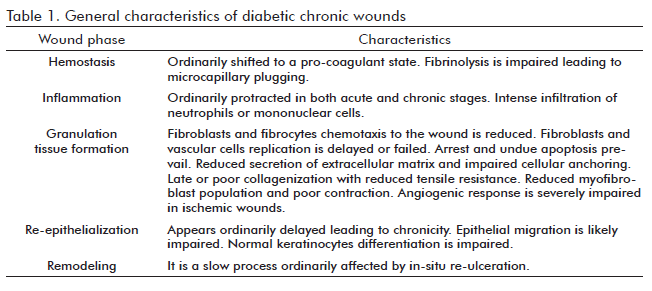
<body><![CDATA[    Morasso MI, Tomic-Canic M. Epidermal stem cells: the cradle of epidermal determination,          differentiation and wound healing. Biol Cell 2005;97(3):173-83. </font> </font></p>       <FONT size="+1" color="#000000"><FONT size="+1"><FONT size="+1"><FONT size="+1"><FONT size="+1"><FONT size="+1"><FONT size="+1"><FONT size="+1"><FONT size="+1"><FONT size="+1"><FONT size="+1"><FONT size="+1"><FONT size="+1"><FONT size="+1"><FONT size="+1"><FONT size="+1"><FONT size="+1"><FONT size="+1"><FONT size="+1"><FONT size="+1"><FONT size="+1"><FONT size="+1"><FONT size="+1"><FONT size="+1"><FONT size="+1"><FONT size="+1"><FONT size="+1"><FONT size="+1"><FONT size="+1"><FONT color="#0000FF"><FONT color="#000000"><FONT color="#FF0000"><FONT color="#000000"><FONT color="#FF0000"><FONT color="#000000"><FONT color="#FF0000"><FONT color="#000000"><FONT color="#FF0000"><FONT color="#000000"><FONT color="#FF0000"><FONT color="#000000"><FONT color="#FF0000"><FONT color="#000000"><FONT color="#FF0000"><FONT color="#000000"><FONT color="#FF0000"><FONT color="#000000"><FONT size="+1"><FONT size="+1"><FONT color="#FF0000"><FONT color="#000000"><FONT color="#FF0000"><FONT color="#000000"><FONT color="#FF0000"><FONT color="#000000"><FONT color="#FF0000"><FONT color="#000000"><FONT color="#FF0000"><FONT color="#000000"><FONT color="#FF0000"><FONT color="#000000"><FONT color="#FF0000"><FONT size="+1" color="#000000"><FONT size="+1"><FONT color="#FF00FF"><FONT color="#000000"><FONT color="#FF0000"><FONT size="+1" color="#000000"><FONT size="+1"><FONT color="#FF0000"><FONT color="#000000"><FONT color="#FF0000"><FONT color="#000000"><FONT color="#FF0000"><FONT color="#000000"><FONT color="#FF0000"><FONT color="#000000"><FONT color="#FF0000"><FONT color="#000000"><FONT color="#FF0000"><FONT color="#000000"><FONT color="#FF0000"><FONT color="#000000"><FONT color="#FF0000"><FONT color="#000000"><FONT color="#FF0000"><FONT color="#000000"><FONT color="#FF0000"><FONT color="#000000"><FONT color="#FF0000"><FONT color="#000000"><FONT color="#FF0000"><FONT color="#000000"><FONT color="#FF0000"><FONT color="#000000"><FONT color="#FF0000"><FONT color="#000000"><FONT color="#FF0000"><FONT color="#000000"><FONT color="#FF0000"><FONT color="#000000"><FONT color="#FF0000"><FONT color="#000000"><FONT color="#FF0000"><FONT color="#000000"><FONT color="#FF0000"><FONT color="#000000"><FONT color="#FF0000"><FONT color="#000000"><FONT color="#FF0000"><FONT color="#000000"><FONT color="#FF0000"><FONT color="#000000"><FONT color="#FF0000"><FONT color="#000000"><FONT color="#FF0000"><FONT color="#000000"><FONT color="#FF0000"><FONT color="#000000"><FONT color="#FF0000"><FONT color="#000000"><FONT color="#FF0000"><FONT color="#000000"><FONT color="#FF0000"><FONT color="#000000"><FONT color="#FF0000"><FONT color="#000000"><FONT color="#FF0000"><FONT color="#000000"><FONT color="#FF0000"><FONT color="#000000"><FONT color="#FF0000"><FONT color="#000000"><FONT color="#FF0000"><FONT color="#000000"><FONT color="#FF0000"><FONT color="#000000"><FONT color="#FF0000"><FONT color="#000000"><FONT color="#FF0000"><FONT color="#000000"><FONT color="#FF0000"><FONT color="#000000"><FONT color="#FF0000"><FONT size="+1" color="#000000"><FONT size="+1"><FONT color="#FF0000"><FONT color="#000000"><FONT color="#FF0000"><FONT color="#000000"><FONT color="#FF0000"><FONT color="#000000"><FONT color="#FF0000"><FONT color="#000000"><FONT color="#FF0000"><FONT color="#000000"><FONT color="#FF0000"><FONT color="#000000"><FONT color="#FF0000"><FONT color="#000000"><FONT color="#FF0000"><FONT color="#000000"><FONT color="#FF0000"><FONT size="+1" color="#000000"><FONT size="+1"><FONT color="#FF0000"><FONT color="#000000"><FONT color="#FF0000"><FONT color="#000000"><FONT color="#FF0000"><FONT color="#000000"><FONT color="#FF0000"><FONT color="#000000"><FONT color="#FF0000"><FONT color="#000000"><FONT color="#FF0000"><FONT color="#000000"><FONT color="#FF0000"><FONT color="#000000"><FONT color="#FF0000"><FONT color="#000000"><FONT color="#FF0000"><FONT color="#000000"><FONT color="#FF0000"><FONT color="#000000"><FONT color="#FF0000"><FONT color="#000000"><FONT color="#FF0000"><FONT color="#000000"><FONT color="#FF0000"><FONT color="#000000"><FONT color="#FF0000"><FONT color="#000000"><FONT color="#FF0000"><FONT color="#000000"><FONT color="#FF0000"><FONT color="#000000"><FONT color="#FF0000"><FONT color="#000000"><FONT color="#FF0000"><FONT color="#000000"><FONT color="#FF0000"><FONT color="#000000"><FONT color="#FF0000"><FONT color="#000000"><FONT color="#FF0000"><FONT color="#000000"><FONT color="#FF0000"><FONT size="+1" color="#000000"><FONT size="+1"><FONT color="#FF0000"><FONT color="#000000"><FONT color="#FF0000"><FONT color="#000000"><FONT color="#FF0000"><FONT color="#000000"><FONT color="#FF0000"><FONT color="#000000"><FONT color="#FF0000"><FONT color="#000000"><FONT color="#FF0000"><FONT color="#000000"><FONT color="#FF0000"><FONT color="#000000"><FONT color="#FF0000"><FONT color="#000000"><FONT color="#FF0000"><FONT color="#000000"><FONT color="#FF0000"><FONT color="#000000"><FONT color="#FF0000"><FONT color="#000000"><FONT color="#FF0000"><FONT color="#000000"><FONT color="#FF0000"><FONT color="#000000"><FONT color="#FF0000"><FONT color="#000000"><FONT color="#FF0000"><FONT color="#000000"><FONT color="#FF0000"><FONT color="#000000"><FONT size="+1"><FONT color="#FF0000"><FONT color="#000000"><FONT color="#FF0000"><FONT color="#000000"><FONT color="#FF0000"><FONT color="#000000"><FONT color="#FF0000"><FONT color="#000000"><FONT color="#FF0000"><FONT color="#000000"><FONT color="#FF0000"><FONT color="#000000"><FONT color="#FF0000"><FONT color="#000000"><FONT color="#FF0000"><FONT color="#000000"><FONT color="#FF0000"><FONT color="#000000"><FONT color="#FF0000"><FONT color="#000000"><FONT color="#FF0000"><FONT color="#000000"><FONT color="#FF0000"><FONT color="#000000"><FONT color="#FF0000"><FONT color="#000000"><FONT color="#FF0000"><FONT color="#000000"><FONT color="#FF0000"><FONT color="#000000"><FONT color="#FF0000"><FONT color="#000000"><FONT color="#FF0000"><FONT color="#000000"><FONT color="#FF0000"><FONT color="#000000"><FONT color="#FF0000"><FONT color="#000000"><FONT color="#FF0000"><FONT color="#000000"><FONT color="#FF0000"><FONT color="#000000"><FONT color="#FF0000"><FONT color="#000000"><FONT color="#FF0000"><FONT color="#000000"><FONT color="#FF0000"><FONT color="#000000"><FONT color="#FF0000"><FONT color="#000000"><FONT color="#FF0000"><FONT color="#000000"><FONT color="#FF0000"><FONT color="#000000"><FONT color="#FF0000"><FONT color="#000000"><FONT color="#FF0000"><FONT color="#000000"><FONT color="#FF0000"><FONT color="#000000"><FONT color="#FF0000"><FONT color="#000000"><FONT color="#FF0000"><FONT color="#000000"><FONT color="#FF0000"><FONT color="#000000"><FONT color="#FF0000"><FONT color="#000000"><FONT color="#FF0000"><FONT color="#000000"><FONT color="#FF0000"><FONT color="#000000"><FONT color="#FF0000"><FONT color="#000000"><FONT color="#FF0000"><FONT color="#000000"><FONT color="#FF0000"><FONT color="#000000"><FONT color="#FF0000"><FONT color="#000000"><FONT color="#FF0000"><FONT color="#000000"><FON    T color="#FF0000"><FONT color="#000000"><FONT color="#FF0000"><FONT color="#000000"><FONT color="#FF0000"><FONT color="#000000"><FONT color="#FF0000"><FONT color="#000000"><FONT color="#FF0000"><FONT color="#000000"><FONT color="#FF0000"><FONT color="#000000"><FONT color="#FF0000"><FONT color="#000000"><FONT color="#FF0000"><FONT color="#000000"><FONT color="#FF0000"><FONT color="#000000"><FONT color="#FF0000"><FONT color="#000000"><FONT color="#FF0000"><FONT color="#000000"><FONT color="#FF0000"><FONT color="#000000"><FONT color="#FF0000"><FONT color="#000000"><FONT color="#FF0000"><FONT color="#000000"><FONT color="#FF0000"><FONT color="#000000"><FONT color="#FF0000"><FONT color="#000000"><FONT color="#FF0000"><FONT color="#000000"><FONT color="#FF0000"><FONT color="#000000"><FONT color="#FF0000"><FONT color="#000000"><FONT color="#FF0000"><FONT color="#000000"><FONT color="#FF0000"><FONT color="#000000"><FONT color="#FF0000"><FONT color="#000000"><FONT color="#FF0000"><FONT color="#000000"><FONT color="#FF0000"><FONT color="#000000"><FONT color="#FF0000"><FONT color="#000000"><FONT color="#FF0000"><FONT color="#000000"><FONT color="#FF0000"><FONT color="#000000"><FONT color="#FF0000"><FONT color="#000000"><FONT color="#FF0000"><FONT color="#000000"><FONT color="#FF0000"><FONT color="#000000"><FONT color="#FF0000"><FONT color="#000000"><FONT color="#FF0000"><FONT color="#000000"><FONT color="#FF0000"><FONT color="#000000"><FONT color="#FF0000"><FONT color="#000000"><FONT color="#FF0000"><FONT color="#000000"><FONT color="#FF0000"><FONT color="#000000"><FONT color="#FF0000"><FONT color="#000000"><FONT color="#FF0000"><FONT color="#000000"><FONT color="#FF0000"><FONT color="#000000"><FONT color="#FF0000"><FONT color="#000000"><FONT color="#FF0000"><FONT color="#000000"><FONT color="#FF0000"><FONT color="#000000"><FONT color="#FF0000"><FONT color="#000000"><FONT color="#FF0000"><FONT color="#000000"><FONT color="#FF0000"><FONT color="#000000"><FONT color="#FF0000"><FONT color="#000000"><FONT color="#FF0000"><FONT color="#000000"><FONT color="#FF0000"><FONT color="#000000"><FONT color="#FF0000"><FONT color="#000000"><FONT color="#FF0000"><FONT color="#000000"><FONT color="#FF0000"><FONT color="#000000"><FONT color="#FF0000"><FONT color="#000000"><FONT color="#FF0000"><FONT color="#000000"><FONT color="#FF0000"><FONT color="#000000"><FONT color="#FF0000"><FONT color="#000000"><FONT color="#FF0000"><FONT color="#000000"><FONT color="#FF0000"><FONT color="#000000"><FONT color="#FF0000"><FONT color="#000000"><FONT color="#FF0000"><FONT color="#000000"><FONT color="#FF0000"><FONT color="#000000"><FONT color="#FF0000"><FONT color="#000000"><FONT color="#FF0000"><FONT color="#000000"><FONT color="#FF0000"><FONT color="#000000"><FONT color="#FF0000"><FONT color="#000000"><FONT color="#FF0000"><FONT color="#000000"><FONT color="#FF0000"><FONT color="#000000"><FONT color="#FF0000"><FONT color="#000000"><FONT color="#FF0000"><FONT color="#000000"><FONT color="#FF0000"><FONT color="#000000"><FONT color="#FF0000"><FONT color="#000000"><FONT color="#FF0000"><FONT color="#000000"><FONT color="#FF0000">     <!-- ref -->      <!-- ref --><P   align="left" ><font color="#000000" face="Verdana, Arial, Helvetica, sans-serif" size="2">83.      Wertheimer E. Diabetic skin complications: a need for reorganizing the categories      of diabetes-associated complications. Isr Med Assoc J 2004;6(5):287-9. </font></P >   <FONT color="#000000"><FONT color="#FF0000">       <!-- ref --><P   align="left" ><font color="#000000" face="Verdana, Arial, Helvetica, sans-serif" size="2">84.      Liu Y, Petreaca M, Yao M, Martins-Green M. Cell and molecular mechanisms of      keratinocyte function stimulated by insulin during wound healing. BMC Cell      Biol 2009;10:1-6. </font></P >   <FONT color="#000000"><FONT color="#FF0000">       <!-- ref --><P   align="left" ><font color="#000000" face="Verdana, Arial, Helvetica, sans-serif" size="2">85.      Goren I, Muller E, Schiefelbein D, Gutwein P, Seitz O, PfeilscHIFter J, <I>et      al. </I>Akt1 controls insulin-driven VEGF biosynthesis from keratinocytes:      Implications for normal and diabetesimpaired skin repair in mice. J Invest      Dermatol 2009;129:752-7. </font></P >   <FONT color="#000000"><FONT color="#FF0000"><FONT color="#000000"><FONT color="#FF0000">       <!-- ref --><P   align="left" ><font color="#000000" face="Verdana, Arial, Helvetica, sans-serif" size="2">86.      Hauguel-de-Mouzon S, Mrejen C, Alengrin F, Van Obberghen E. Glucose-induced      stimulation of human insulin-receptor mRNA and tyrosine kinase activity in      cultured cells. Biochem J 1995;305(Pt 1):119-24. </font></P >   <FONT color="#000000"><FONT color="#FF0000"><FONT color="#000000"><FONT color="#FF0000">       <!-- ref --><P   align="left" ><font color="#000000" face="Verdana, Arial, Helvetica, sans-serif" size="2">87.      Wertheimer E, Spravchikov N, Trebicz M, Gartsbein M, Accili D, Avinoah I,      <I>et al. </I>The regulation of skin proliferation and differentiation in      the IR null mouse: implications for skin complications of diabetes. Endocrinology      2001;142(3):1234-41. </font></P >   <FONT color="#000000"><FONT color="#FF0000">       <!-- ref --><P   align="left" ><font color="#000000" face="Verdana, Arial, Helvetica, sans-serif" size="2">88.      Terashi H, Izumi K, Deveci M, Rhodes LM, Marcelo CL. High glucose inhibits      human epidermal keratinocyte proliferation for cellular studies on diabetes      mellitus. Int Wound J 2005;2(4):298-304. </font></P >   <FONT color="#000000"><FONT color="#FF0000">       <!-- ref --><P   align="left" ><font color="#000000" face="Verdana, Arial, Helvetica, sans-serif" size="2">89.      Deveci M, Gilmont RR, Dunham WR, Mudge BP, Smith DJ, Marcelo CL. Glutathione      enhances fibroblast collagen contraction and protects keratinocytes from apoptosis      in hyperglycaemic culture. Br J Dermatol 2005; 152(2):217-24. </font></P >   <FONT color="#000000"><FONT color="#FF0000">       <!-- ref --><P   align="left" ><font color="#000000" face="Verdana, Arial, Helvetica, sans-serif" size="2">90.      Lan CC, Liu IH, Fang AH, Wen CH, Wu CS. Hyperglycaemic conditions decrease      cultured keratinocyte mobility: implications for impaired wound healing in      patients with diabetes. Br J Dermatol 2008;159(5):1103-15. </font></P >   <FONT color="#000000"><FONT color="#FF0000"><FONT color="#000000"><FONT color="#FF0000">       <!-- ref --><P   align="left" ><font color="#000000" face="Verdana, Arial, Helvetica, sans-serif" size="2">91.      Stojadinovic O, Brem H, Vouthounis C, Lee B, Fallon J, Stallcup M, <I>et al.      </I>Molecular pathogenesis of chronic wounds: the role of beta-catenin and      c-myc in the inhibition of epithelialization and wound healing. Am J Pathol      2005;167(1):59-69. </font></P >   <FONT color="#000000"><FONT color="#FF0000"><FONT color="#000000"><FONT color="#FF0000">       <!-- ref --><P   align="left" ><font color="#000000" face="Verdana, Arial, Helvetica, sans-serif" size="2">92.      El Ghalbzouri A, Hensbergen P, Gibbs S, Kempenaar J, van der SR, Ponec M.      Fibroblasts facilitate re-epithelialization in wounded human skin equivalents.      Lab Invest 2004; 84(1):102-12. </font></P >   <FONT color="#000000"><FONT color="#FF0000">       <!-- ref --><P   align="left" ><font color="#000000" face="Verdana, Arial, Helvetica, sans-serif" size="2">93.      Brem H, Tomic-Canic M. Cellular and molecular basis of wound healing in diabetes.      J Clin Invest 2007;117(5):1219-22. </font></P >   <FONT color="#000000"><FONT color="#FF0000"><FONT color="#000000"><FONT color="#FF0000">       <!-- ref --><P   align="left" ><font color="#000000" face="Verdana, Arial, Helvetica, sans-serif" size="2">94.      Frank S, Hubner G, Breier G, Longaker MT, Greenhalgh DG, Werner S. Regulation      of vascular endothelial growth factor expression in cultured keratinocytes.      Implications for normal and impaired wound healing. J Biol Chem 1995;270(21):12607-13.      </font></P >   <FONT color="#000000"><FONT color="#FF0000">       <!-- ref --><P   align="left" ><font color="#000000" face="Verdana, Arial, Helvetica, sans-serif" size="2">95.      Aoki S, Toda S, Ando T, Sugihara H. Bone marrow stromal cells, preadipocytes,      and dermal fibroblasts promote epidermal regeneration in their distinctive      fashions. Mol Biol Cell 2004;15(10):4647-57. </font></P >   <FONT color="#000000"><FONT color="#FF0000">       <!-- ref --><P   align="left" ><font color="#000000" face="Verdana, Arial, Helvetica, sans-serif" size="2">96.      Gopalakrishnan V, Vignesh RC, Arunakaran J, Aruldhas MM, Srinivasan N. Effects      of glucose and its modulation by insulin and estradiol on BMSC differentiation      into osteoblastic lineages. Biochem Cell Biol 2006;84(1):93-101. </font></P >   <FONT color="#000000"><FONT color="#FF0000"><FONT color="#000000"><FONT color="#FF0000">       <!-- ref --><P   align="left" ><font color="#000000" face="Verdana, Arial, Helvetica, sans-serif" size="2">97.      Banno T, Gazel A, Blumenberg M. Effects of tumor necrosis factor-alpha (TNF      alpha) in epidermal keratinocytes revealed using global transcriptional profiling.      J Biol Chem 2004; 279(31):32633-42. </font></P >   <FONT color="#000000"><FONT color="#FF0000"><FONT color="#000000"><FONT color="#FF0000">        <P   align="left" ><font size="2" color="#000000" face="Verdana, Arial, Helvetica, sans-serif">Received      in July, 2010. </font>    <br>     <font face="Verdana, Arial, Helvetica, sans-serif" size="2" color="#000000">Accepted      for publication in September, 2010<I>.</I> </font></P >   <FONT size="+1" color="#000000">        <P   align="left" ><font face="Verdana, Arial, Helvetica, sans-serif" size="2" color="#000000">Jorge      Berlanga-Acosta, Center for Genetic Engineering and Biotechnology. CIGB Ave.      31 / 158 and 186, Playa, PO Box 6162, Havana, Cuba. E-mail: <a href="mailto:jorge.berlanga@cigb.edu.cu">jorge.berlanga@cigb.edu.cu</a>      </font> </P >   </font></font></font></font></font></font></font></font></font></font></font></font></font></font></font></font></font></font></font></font></font></font></font></font></font></font></font></font></font></font></font></font></font></font></font></font></font></font></font></font></font></font></font></font></font></font></font></font></font></font></font></font></font></font></font></font></font></font></font></font></font></font></font></font></font></font></font></font></font></font></font></font></font></font></font></font></font></font></font></font></font></font></font></font></font></font></font></font></font></font></font></font></font></font></font></font></font></font></font></font></font></font></font></font></font></font></font></font></font></font></font></font></font></font></font></font></font></font></font></font></font></font></font></font></font></font></font></font></font></font></font></font></font></font></font></font></font></font></font></font></font></font></font></font></font></font></font></font></font></font></font></font></font></font></font></font></font></font></font></font></font></font></font></font></font></font></font></font></font></font></font></font></font></font></font></font></font></font></font></font></font></font></font></font></font></font></font></font></font></font></font></font></font></font></font></font></font></font></font></font></font></font></font></font></font></font></font></font></font></font></font></font></font></font></font></font></font></font></font></font></font></font></font></font></font></font></font></font></font></font></font></font></font></font></font></font></font></font></font></font></font></font></font></font></font></font></font></font></font></font></font></font></font></font></font></font></font></font></font></font></font></font></font></font></font></font></font></font></font></font></font></font></font></font></font></font></font></font></font></font></font></font></font></font></font></font></font></font></font></font></font></font></font></font></font></font></font></font></font></font></font></font></font></font></font></font></font></font></font></font></font></font></font></font></font></font></font></font></font></font></font></font></font></font></font></font></font></font></font></font></font></font></font></font></font></font></font></font></font></font></font></font></font></font></font></font></font></font></font></font></font></font></font></font></font></font></font></font></font></font></font></font></font></font></font></font></font></font></font></font></font></font></font></font></font></font></font></font></font></font></font></font></font></font></font></font></font></font></font></font></font></font></font></font></font></font></font></font></font></font></font></font></font></font></font></font></font></font></font></font></font></font></font></font></font></font></font></font></font></font></font></font></font></font></font></font></font></font></font></font></font></font></font></font></font></font></font></font></font></font></font></font></font></font></font></font></font></font></font></font></font></font></font></font></font></font></font></font></font></font></font></font></font></font></font></font></font></font></font></font></font></font></font></font></font></font></font></font></font></font></font></font></font></font></font></font></font></font></font></font></font></font></font></font></font></font></font></font></font></font></font></font></font></font></font></font></font></font></font></font></font></font></font></DIV >      ]]></body><back>
<ref-list>
<ref id="B1">
<label>1</label><nlm-citation citation-type="journal">
<person-group person-group-type="author">
<name>
<surname><![CDATA[Most]]></surname>
<given-names><![CDATA[RS]]></given-names>
</name>
<name>
<surname><![CDATA[Sinnock]]></surname>
<given-names><![CDATA[P]]></given-names>
</name>
</person-group>
<article-title xml:lang="en"><![CDATA[The epidemiology of lower extremity amputations in diabetic individuals]]></article-title>
<source><![CDATA[Diabetes Care]]></source>
<year>1983</year>
<volume>6</volume>
<numero>1</numero>
<issue>1</issue>
<page-range>87-91</page-range></nlm-citation>
</ref>
<ref id="B2">
<label>2</label><nlm-citation citation-type="journal">
<person-group person-group-type="author">
<name>
<surname><![CDATA[Bild]]></surname>
<given-names><![CDATA[DE]]></given-names>
</name>
<name>
<surname><![CDATA[Selby]]></surname>
<given-names><![CDATA[JV]]></given-names>
</name>
<name>
<surname><![CDATA[Sinnock]]></surname>
<given-names><![CDATA[P]]></given-names>
</name>
<name>
<surname><![CDATA[Browner]]></surname>
<given-names><![CDATA[WS]]></given-names>
</name>
<name>
<surname><![CDATA[Braveman]]></surname>
<given-names><![CDATA[P]]></given-names>
</name>
<name>
<surname><![CDATA[Showstack]]></surname>
<given-names><![CDATA[JA]]></given-names>
</name>
</person-group>
<article-title xml:lang="en"><![CDATA[Lowerextremity amputation in people with diabetes: Epidemiology and prevention]]></article-title>
<source><![CDATA[Diabetes Care]]></source>
<year>1989</year>
<volume>12</volume>
<numero>1</numero>
<issue>1</issue>
<page-range>24-31</page-range></nlm-citation>
</ref>
<ref id="B3">
<label>3</label><nlm-citation citation-type="journal">
<person-group person-group-type="author">
<name>
<surname><![CDATA[Sen]]></surname>
<given-names><![CDATA[CK]]></given-names>
</name>
<name>
<surname><![CDATA[Gordillo]]></surname>
<given-names><![CDATA[GM]]></given-names>
</name>
<name>
<surname><![CDATA[Roy]]></surname>
<given-names><![CDATA[S]]></given-names>
</name>
<name>
<surname><![CDATA[Kirsner]]></surname>
<given-names><![CDATA[R]]></given-names>
</name>
<name>
<surname><![CDATA[Lambert]]></surname>
<given-names><![CDATA[L]]></given-names>
</name>
<name>
<surname><![CDATA[Hunt]]></surname>
<given-names><![CDATA[TK]]></given-names>
</name>
</person-group>
<article-title xml:lang="en"><![CDATA[Human skin wounds: a major and snowballing threat to public health and the economy]]></article-title>
<source><![CDATA[Wound Repair Regen]]></source>
<year>2009</year>
<volume>17</volume>
<numero>6</numero>
<issue>6</issue>
<page-range>763-71</page-range></nlm-citation>
</ref>
<ref id="B4">
<label>4</label><nlm-citation citation-type="journal">
<person-group person-group-type="author">
<name>
<surname><![CDATA[Singh]]></surname>
<given-names><![CDATA[N]]></given-names>
</name>
<name>
<surname><![CDATA[Armstrong]]></surname>
<given-names><![CDATA[DG]]></given-names>
</name>
<name>
<surname><![CDATA[Lipsky]]></surname>
<given-names><![CDATA[BA]]></given-names>
</name>
</person-group>
<article-title xml:lang="en"><![CDATA[Preventing foot ulcers in patients with diabetes]]></article-title>
<source><![CDATA[JAMA]]></source>
<year>2005</year>
<volume>293</volume>
<numero>2</numero>
<issue>2</issue>
<page-range>217-28</page-range></nlm-citation>
</ref>
<ref id="B5">
<label>5</label><nlm-citation citation-type="journal">
<person-group person-group-type="author">
<name>
<surname><![CDATA[Stratton]]></surname>
<given-names><![CDATA[IM]]></given-names>
</name>
<name>
<surname><![CDATA[Adler]]></surname>
<given-names><![CDATA[AI]]></given-names>
</name>
<name>
<surname><![CDATA[Neil]]></surname>
<given-names><![CDATA[HA]]></given-names>
</name>
<name>
<surname><![CDATA[Matthews]]></surname>
<given-names><![CDATA[DR]]></given-names>
</name>
<name>
<surname><![CDATA[Manley]]></surname>
<given-names><![CDATA[SE]]></given-names>
</name>
<name>
<surname><![CDATA[Cull]]></surname>
<given-names><![CDATA[CA]]></given-names>
</name>
</person-group>
<article-title xml:lang="en"><![CDATA[Association of glycaemia with macrovascular and microvascular complications of type 2 diabetes (UKPDS 35): prospective observational study]]></article-title>
<source><![CDATA[BMJ]]></source>
<year>2000</year>
<volume>321</volume>
<numero>7258</numero>
<issue>7258</issue>
<page-range>405-12</page-range></nlm-citation>
</ref>
<ref id="B6">
<label>6</label><nlm-citation citation-type="journal">
<person-group person-group-type="author">
<name>
<surname><![CDATA[Diegelmann]]></surname>
<given-names><![CDATA[RF]]></given-names>
</name>
<name>
<surname><![CDATA[Evans]]></surname>
<given-names><![CDATA[MC]]></given-names>
</name>
</person-group>
<article-title xml:lang="en"><![CDATA[Wound healing: an overview of acute, fibrotic and delayed healing]]></article-title>
<source><![CDATA[Front Biosci]]></source>
<year>2004</year>
<volume>9</volume>
<page-range>283-9</page-range></nlm-citation>
</ref>
<ref id="B7">
<label>7</label><nlm-citation citation-type="journal">
<person-group person-group-type="author">
<name>
<surname><![CDATA[Lin]]></surname>
<given-names><![CDATA[HI]]></given-names>
</name>
<name>
<surname><![CDATA[Chu]]></surname>
<given-names><![CDATA[SJ]]></given-names>
</name>
<name>
<surname><![CDATA[Perng]]></surname>
<given-names><![CDATA[WC]]></given-names>
</name>
<name>
<surname><![CDATA[Wu]]></surname>
<given-names><![CDATA[CP]]></given-names>
</name>
<name>
<surname><![CDATA[Lin]]></surname>
<given-names><![CDATA[ZY]]></given-names>
</name>
<name>
<surname><![CDATA[Huang]]></surname>
<given-names><![CDATA[KL]]></given-names>
</name>
</person-group>
<article-title xml:lang="en"><![CDATA[Hyperbaric oxygen attenuates cell growth in skin fibroblasts cultured in a high-glucose medium]]></article-title>
<source><![CDATA[Wound Repair Regen]]></source>
<year>2008</year>
<volume>16</volume>
<numero>4</numero>
<issue>4</issue>
<page-range>513-9</page-range></nlm-citation>
</ref>
<ref id="B8">
<label>8</label><nlm-citation citation-type="journal">
<person-group person-group-type="author">
<name>
<surname><![CDATA[Bonnefont-Rousselot]]></surname>
<given-names><![CDATA[D]]></given-names>
</name>
</person-group>
<article-title xml:lang="en"><![CDATA[Glucose and reactive oxygen species]]></article-title>
<source><![CDATA[Curr Opin Clin Nutr Metab Care]]></source>
<year>2002</year>
<volume>5</volume>
<numero>5</numero>
<issue>5</issue>
<page-range>561-8</page-range></nlm-citation>
</ref>
<ref id="B9">
<label>9</label><nlm-citation citation-type="journal">
<person-group person-group-type="author">
<name>
<surname><![CDATA[Wolf]]></surname>
<given-names><![CDATA[G]]></given-names>
</name>
<name>
<surname><![CDATA[Schroeder]]></surname>
<given-names><![CDATA[R]]></given-names>
</name>
<name>
<surname><![CDATA[Zahner]]></surname>
<given-names><![CDATA[G]]></given-names>
</name>
<name>
<surname><![CDATA[Stahl]]></surname>
<given-names><![CDATA[RA]]></given-names>
</name>
<name>
<surname><![CDATA[Shankland]]></surname>
<given-names><![CDATA[SJ]]></given-names>
</name>
</person-group>
<article-title xml:lang="en"><![CDATA[High glucose-induced hypertrophy of mesangial cells requires p27(Kip1), an inhibitor of cyclin-dependent kinases]]></article-title>
<source><![CDATA[Am J Pathol]]></source>
<year>2001</year>
<volume>158</volume>
<numero>3</numero>
<issue>3</issue>
<page-range>1091- 100</page-range></nlm-citation>
</ref>
<ref id="B10">
<label>10</label><nlm-citation citation-type="journal">
<person-group person-group-type="author">
<name>
<surname><![CDATA[Huang]]></surname>
<given-names><![CDATA[JS]]></given-names>
</name>
<name>
<surname><![CDATA[Chuang]]></surname>
<given-names><![CDATA[LY]]></given-names>
</name>
<name>
<surname><![CDATA[Guh]]></surname>
<given-names><![CDATA[JY]]></given-names>
</name>
<name>
<surname><![CDATA[Huang]]></surname>
<given-names><![CDATA[YJ]]></given-names>
</name>
<name>
<surname><![CDATA[Hsu]]></surname>
<given-names><![CDATA[MS]]></given-names>
</name>
</person-group>
<article-title xml:lang="en"><![CDATA[Antioxidants attenuate high glucose-induced hypertrophic growth in renal tubular epithelial cells]]></article-title>
<source><![CDATA[Am J Physiol Renal Physiol]]></source>
<year>2007</year>
<volume>293</volume>
<numero>4</numero>
<issue>4</issue>
<page-range>1072-82</page-range></nlm-citation>
</ref>
<ref id="B11">
<label>11</label><nlm-citation citation-type="journal">
<person-group person-group-type="author">
<name>
<surname><![CDATA[Lin]]></surname>
<given-names><![CDATA[Y]]></given-names>
</name>
<name>
<surname><![CDATA[Berg]]></surname>
<given-names><![CDATA[AH]]></given-names>
</name>
<name>
<surname><![CDATA[Iyengar]]></surname>
<given-names><![CDATA[P]]></given-names>
</name>
<name>
<surname><![CDATA[Lam]]></surname>
<given-names><![CDATA[TK]]></given-names>
</name>
<name>
<surname><![CDATA[Giacca]]></surname>
<given-names><![CDATA[A]]></given-names>
</name>
<name>
<surname><![CDATA[Combs]]></surname>
<given-names><![CDATA[TP]]></given-names>
</name>
</person-group>
<article-title xml:lang="en"><![CDATA[The hyperglycemia- induced inflammatory response in adipocytes: the role of reactive oxygen species]]></article-title>
<source><![CDATA[J Biol Chem]]></source>
<year>2005</year>
<volume>280</volume>
<numero>6</numero>
<issue>6</issue>
<page-range>4617-26</page-range></nlm-citation>
</ref>
<ref id="B12">
<label>12</label><nlm-citation citation-type="journal">
<person-group person-group-type="author">
<name>
<surname><![CDATA[Sheetz]]></surname>
<given-names><![CDATA[MJ]]></given-names>
</name>
<name>
<surname><![CDATA[King]]></surname>
<given-names><![CDATA[GL]]></given-names>
</name>
</person-group>
<article-title xml:lang="en"><![CDATA[Molecular understanding of hyperglycemia’s adverse effects for diabetic complications]]></article-title>
<source><![CDATA[JAMA]]></source>
<year>2002</year>
<volume>288</volume>
<numero>20</numero>
<issue>20</issue>
<page-range>2579-88</page-range></nlm-citation>
</ref>
<ref id="B13">
<label>13</label><nlm-citation citation-type="journal">
<person-group person-group-type="author">
<name>
<surname><![CDATA[Hotamisligil]]></surname>
<given-names><![CDATA[GS]]></given-names>
</name>
</person-group>
<article-title xml:lang="en"><![CDATA[Inflammation and metabolic disorders]]></article-title>
<source><![CDATA[Nature]]></source>
<year>2006</year>
<volume>444</volume>
<numero>7121</numero>
<issue>7121</issue>
<page-range>860-7</page-range></nlm-citation>
</ref>
<ref id="B14">
<label>14</label><nlm-citation citation-type="journal">
<person-group person-group-type="author">
<name>
<surname><![CDATA[Eming]]></surname>
<given-names><![CDATA[SA]]></given-names>
</name>
<name>
<surname><![CDATA[Krieg]]></surname>
<given-names><![CDATA[T]]></given-names>
</name>
<name>
<surname><![CDATA[Davidson]]></surname>
<given-names><![CDATA[JM]]></given-names>
</name>
</person-group>
<article-title xml:lang="en"><![CDATA[Inflammation in wound repair: molecular and cellular mechanisms]]></article-title>
<source><![CDATA[J Invest Dermatol]]></source>
<year>2007</year>
<volume>127</volume>
<numero>3</numero>
<issue>3</issue>
<page-range>514-25</page-range></nlm-citation>
</ref>
<ref id="B15">
<label>15</label><nlm-citation citation-type="journal">
<person-group person-group-type="author">
<name>
<surname><![CDATA[O’Brien]]></surname>
<given-names><![CDATA[BA]]></given-names>
</name>
<name>
<surname><![CDATA[Geng]]></surname>
<given-names><![CDATA[X]]></given-names>
</name>
<name>
<surname><![CDATA[Orteu]]></surname>
<given-names><![CDATA[CH]]></given-names>
</name>
<name>
<surname><![CDATA[Huang]]></surname>
<given-names><![CDATA[Y]]></given-names>
</name>
<name>
<surname><![CDATA[Ghoreishi]]></surname>
<given-names><![CDATA[M]]></given-names>
</name>
<name>
<surname><![CDATA[Zhang]]></surname>
<given-names><![CDATA[Y]]></given-names>
</name>
</person-group>
<article-title xml:lang="en"><![CDATA[A deficiency in the in vivo clearance of apoptotic cells is a feature of the NOD mouse]]></article-title>
<source><![CDATA[J Autoimmun]]></source>
<year>2006</year>
<volume>26</volume>
<numero>2</numero>
<issue>2</issue>
<page-range>104-15</page-range></nlm-citation>
</ref>
<ref id="B16">
<label>16</label><nlm-citation citation-type="journal">
<person-group person-group-type="author">
<name>
<surname><![CDATA[Borst]]></surname>
<given-names><![CDATA[SE]]></given-names>
</name>
</person-group>
<article-title xml:lang="en"><![CDATA[The role of TNF-alpha in insulin resistance]]></article-title>
<source><![CDATA[Endocrine]]></source>
<year>2004</year>
<volume>23</volume>
<numero>2-3</numero>
<issue>2-3</issue>
<page-range>177-82</page-range></nlm-citation>
</ref>
<ref id="B17">
<label>17</label><nlm-citation citation-type="journal">
<person-group person-group-type="author">
<name>
<surname><![CDATA[Younes]]></surname>
<given-names><![CDATA[NA]]></given-names>
</name>
<name>
<surname><![CDATA[Ahmad]]></surname>
<given-names><![CDATA[AT]]></given-names>
</name>
</person-group>
<article-title xml:lang="en"><![CDATA[Diabetic foot disease]]></article-title>
<source><![CDATA[Endocr Pract]]></source>
<year>2006</year>
<volume>12</volume>
<numero>5</numero>
<issue>5</issue>
<page-range>583- 92</page-range></nlm-citation>
</ref>
<ref id="B18">
<label>18</label><nlm-citation citation-type="journal">
<person-group person-group-type="author">
<name>
<surname><![CDATA[Wetzler]]></surname>
<given-names><![CDATA[C]]></given-names>
</name>
<name>
<surname><![CDATA[Kampfer]]></surname>
<given-names><![CDATA[H]]></given-names>
</name>
<name>
<surname><![CDATA[Stallmeyer]]></surname>
<given-names><![CDATA[B]]></given-names>
</name>
<name>
<surname><![CDATA[Pfeilschifter]]></surname>
<given-names><![CDATA[J]]></given-names>
</name>
<name>
<surname><![CDATA[Frank]]></surname>
<given-names><![CDATA[S]]></given-names>
</name>
</person-group>
<article-title xml:lang="en"><![CDATA[Large and sustained induction of chemokines during impaired wound healing in the genetically diabetic mouse: prolonged persistence of neutrophils and macrophages during the late phase of repair]]></article-title>
<source><![CDATA[J Invest Dermatol]]></source>
<year>2000</year>
<volume>115</volume>
<numero>2</numero>
<issue>2</issue>
<page-range>245-53</page-range></nlm-citation>
</ref>
<ref id="B19">
<label>19</label><nlm-citation citation-type="journal">
<person-group person-group-type="author">
<name>
<surname><![CDATA[Dovi]]></surname>
<given-names><![CDATA[JV]]></given-names>
</name>
<name>
<surname><![CDATA[He]]></surname>
<given-names><![CDATA[LK]]></given-names>
</name>
<name>
<surname><![CDATA[DiPietro]]></surname>
<given-names><![CDATA[LA]]></given-names>
</name>
</person-group>
<article-title xml:lang="en"><![CDATA[Accelerated wound closure in neutrophil-depleted mice]]></article-title>
<source><![CDATA[J Leukoc Biol]]></source>
<year>2003</year>
<volume>73</volume>
<numero>4</numero>
<issue>4</issue>
<page-range>448-55</page-range></nlm-citation>
</ref>
<ref id="B20">
<label>20</label><nlm-citation citation-type="journal">
<person-group person-group-type="author">
<name>
<surname><![CDATA[Burrow]]></surname>
<given-names><![CDATA[JW]]></given-names>
</name>
<name>
<surname><![CDATA[Koch]]></surname>
<given-names><![CDATA[JA]]></given-names>
</name>
<name>
<surname><![CDATA[Chuang]]></surname>
<given-names><![CDATA[HH]]></given-names>
</name>
<name>
<surname><![CDATA[Zhong]]></surname>
<given-names><![CDATA[W]]></given-names>
</name>
<name>
<surname><![CDATA[Dean]]></surname>
<given-names><![CDATA[DD]]></given-names>
</name>
<name>
<surname><![CDATA[Sylvia]]></surname>
<given-names><![CDATA[VL]]></given-names>
</name>
</person-group>
<article-title xml:lang="en"><![CDATA[Nitric oxide donors selectively reduce the expression of matrix metalloproteinases-8 and -9 by human diabetic skin fibroblasts]]></article-title>
<source><![CDATA[J Surg Res]]></source>
<year>2007</year>
<volume>140</volume>
<numero>1</numero>
<issue>1</issue>
<page-range>90-8</page-range></nlm-citation>
</ref>
<ref id="B21">
<label>21</label><nlm-citation citation-type="journal">
<person-group person-group-type="author">
<name>
<surname><![CDATA[Nwomeh]]></surname>
<given-names><![CDATA[BC]]></given-names>
</name>
<name>
<surname><![CDATA[Liang]]></surname>
<given-names><![CDATA[HX]]></given-names>
</name>
<name>
<surname><![CDATA[Cohen]]></surname>
<given-names><![CDATA[IK]]></given-names>
</name>
<name>
<surname><![CDATA[Yager]]></surname>
<given-names><![CDATA[DR]]></given-names>
</name>
</person-group>
<article-title xml:lang="en"><![CDATA[MMP-8 is the predominant collagenase in healing wounds and nonhealing ulcers]]></article-title>
<source><![CDATA[J Surg Res]]></source>
<year>1999</year>
<volume>81</volume>
<numero>2</numero>
<issue>2</issue>
<page-range>189-95</page-range></nlm-citation>
</ref>
<ref id="B22">
<label>22</label><nlm-citation citation-type="journal">
<person-group person-group-type="author">
<name>
<surname><![CDATA[Pham]]></surname>
<given-names><![CDATA[HT]]></given-names>
</name>
<name>
<surname><![CDATA[Rich]]></surname>
<given-names><![CDATA[J]]></given-names>
</name>
<name>
<surname><![CDATA[Veves]]></surname>
<given-names><![CDATA[A]]></given-names>
</name>
</person-group>
<article-title xml:lang="en"><![CDATA[Using living skin equivalents for diabetic foot ulceration]]></article-title>
<source><![CDATA[Int J Low Extrem Wounds]]></source>
<year>2002</year>
<volume>1</volume>
<numero>1</numero>
<issue>1</issue>
<page-range>27-32</page-range></nlm-citation>
</ref>
<ref id="B23">
<label>23</label><nlm-citation citation-type="journal">
<person-group person-group-type="author">
<name>
<surname><![CDATA[Schonfelder]]></surname>
<given-names><![CDATA[U]]></given-names>
</name>
<name>
<surname><![CDATA[Abel]]></surname>
<given-names><![CDATA[M]]></given-names>
</name>
<name>
<surname><![CDATA[Wiegand]]></surname>
<given-names><![CDATA[C]]></given-names>
</name>
<name>
<surname><![CDATA[Klemm]]></surname>
<given-names><![CDATA[D]]></given-names>
</name>
<name>
<surname><![CDATA[Elsner]]></surname>
<given-names><![CDATA[P]]></given-names>
</name>
<name>
<surname><![CDATA[Hipler]]></surname>
<given-names><![CDATA[UC]]></given-names>
</name>
</person-group>
<article-title xml:lang="en"><![CDATA[Influence of selected wound dressings on PMN elastase in chronic wound fluid and their antioxidative potential in vitro]]></article-title>
<source><![CDATA[Biomaterials]]></source>
<year>2005</year>
<volume>26</volume>
<numero>33</numero>
<issue>33</issue>
<page-range>6664-73</page-range></nlm-citation>
</ref>
<ref id="B24">
<label>24</label><nlm-citation citation-type="journal">
<person-group person-group-type="author">
<name>
<surname><![CDATA[Piwowar]]></surname>
<given-names><![CDATA[A]]></given-names>
</name>
<name>
<surname><![CDATA[Knapik-Kordecka]]></surname>
<given-names><![CDATA[M]]></given-names>
</name>
<name>
<surname><![CDATA[Warwas]]></surname>
<given-names><![CDATA[M]]></given-names>
</name>
</person-group>
<article-title xml:lang="en"><![CDATA[Concentration of leukocyte elastase in plasma and polymorphonuclear neutrophil extracts in type 2 diabetes]]></article-title>
<source><![CDATA[Clin Chem Lab Med]]></source>
<year>2000</year>
<volume>38</volume>
<numero>12</numero>
<issue>12</issue>
<page-range>1257-61</page-range></nlm-citation>
</ref>
<ref id="B25">
<label>25</label><nlm-citation citation-type="journal">
<person-group person-group-type="author">
<name>
<surname><![CDATA[Stanley]]></surname>
<given-names><![CDATA[CM]]></given-names>
</name>
<name>
<surname><![CDATA[Wang]]></surname>
<given-names><![CDATA[Y]]></given-names>
</name>
<name>
<surname><![CDATA[Pal]]></surname>
<given-names><![CDATA[S]]></given-names>
</name>
<name>
<surname><![CDATA[Klebe]]></surname>
<given-names><![CDATA[RJ]]></given-names>
</name>
<name>
<surname><![CDATA[Harkless]]></surname>
<given-names><![CDATA[LB]]></given-names>
</name>
<name>
<surname><![CDATA[Xu]]></surname>
<given-names><![CDATA[X]]></given-names>
</name>
</person-group>
<article-title xml:lang="en"><![CDATA[Fibronectin fragmentation is a feature of periodontal disease sites and diabetic foot and leg wounds and modifies cell behavior]]></article-title>
<source><![CDATA[J Periodontol]]></source>
<year>2008</year>
<volume>79</volume>
<numero>5</numero>
<issue>5</issue>
<page-range>861-75</page-range></nlm-citation>
</ref>
<ref id="B26">
<label>26</label><nlm-citation citation-type="journal">
<person-group person-group-type="author">
<name>
<surname><![CDATA[Duckworth]]></surname>
<given-names><![CDATA[WC]]></given-names>
</name>
<name>
<surname><![CDATA[Fawcett]]></surname>
<given-names><![CDATA[J]]></given-names>
</name>
<name>
<surname><![CDATA[Reddy]]></surname>
<given-names><![CDATA[S]]></given-names>
</name>
<name>
<surname><![CDATA[Page]]></surname>
<given-names><![CDATA[JC]]></given-names>
</name>
</person-group>
<article-title xml:lang="en"><![CDATA[Insulin-degrading activity in wound fluid]]></article-title>
<source><![CDATA[J Clin Endocrinol Metab]]></source>
<year>2004</year>
<volume>89</volume>
<numero>2</numero>
<issue>2</issue>
<page-range>847-51</page-range></nlm-citation>
</ref>
<ref id="B27">
<label>27</label><nlm-citation citation-type="journal">
<person-group person-group-type="author">
<name>
<surname><![CDATA[Goova]]></surname>
<given-names><![CDATA[MT]]></given-names>
</name>
<name>
<surname><![CDATA[Li]]></surname>
<given-names><![CDATA[J]]></given-names>
</name>
<name>
<surname><![CDATA[Kislinger]]></surname>
<given-names><![CDATA[T]]></given-names>
</name>
<name>
<surname><![CDATA[Qu]]></surname>
<given-names><![CDATA[W]]></given-names>
</name>
<name>
<surname><![CDATA[Lu]]></surname>
<given-names><![CDATA[Y]]></given-names>
</name>
<name>
<surname><![CDATA[Bucciarelli]]></surname>
<given-names><![CDATA[LG]]></given-names>
</name>
</person-group>
<article-title xml:lang="en"><![CDATA[Blockade of receptor for advanced glycation end-products restores effective wound healing in diabetic mice]]></article-title>
<source><![CDATA[Am J Pathol]]></source>
<year>2001</year>
<volume>159</volume>
<numero>2</numero>
<issue>2</issue>
<page-range>513-25</page-range></nlm-citation>
</ref>
<ref id="B28">
<label>28</label><nlm-citation citation-type="journal">
<person-group person-group-type="author">
<name>
<surname><![CDATA[Mishima]]></surname>
<given-names><![CDATA[Y]]></given-names>
</name>
<name>
<surname><![CDATA[Kuyama]]></surname>
<given-names><![CDATA[A]]></given-names>
</name>
<name>
<surname><![CDATA[Tada]]></surname>
<given-names><![CDATA[A]]></given-names>
</name>
<name>
<surname><![CDATA[Takahashi]]></surname>
<given-names><![CDATA[K]]></given-names>
</name>
<name>
<surname><![CDATA[Ishioka]]></surname>
<given-names><![CDATA[T]]></given-names>
</name>
<name>
<surname><![CDATA[Kibata]]></surname>
<given-names><![CDATA[M]]></given-names>
</name>
</person-group>
<article-title xml:lang="en"><![CDATA[Relationship between serum tumor necrosis factoralpha and insulin resistance in obese men with Type 2 diabetes mellitus]]></article-title>
<source><![CDATA[Diabetes Res Clin Pract]]></source>
<year>2001</year>
<volume>52</volume>
<numero>2</numero>
<issue>2</issue>
<page-range>119-23</page-range></nlm-citation>
</ref>
<ref id="B29">
<label>29</label><nlm-citation citation-type="journal">
<person-group person-group-type="author">
<name>
<surname><![CDATA[Nwomeh]]></surname>
<given-names><![CDATA[BC]]></given-names>
</name>
<name>
<surname><![CDATA[Yager]]></surname>
<given-names><![CDATA[DR]]></given-names>
</name>
<name>
<surname><![CDATA[Cohen]]></surname>
<given-names><![CDATA[IK]]></given-names>
</name>
</person-group>
<article-title xml:lang="en"><![CDATA[Physiology of the chronic wound]]></article-title>
<source><![CDATA[Clin Plast Surg]]></source>
<year>1998</year>
<volume>25</volume>
<numero>3</numero>
<issue>3</issue>
<page-range>341-56</page-range></nlm-citation>
</ref>
<ref id="B30">
<label>30</label><nlm-citation citation-type="journal">
<person-group person-group-type="author">
<name>
<surname><![CDATA[Naguib]]></surname>
<given-names><![CDATA[G]]></given-names>
</name>
<name>
<surname><![CDATA[Al Mashat]]></surname>
<given-names><![CDATA[H]]></given-names>
</name>
<name>
<surname><![CDATA[Desta]]></surname>
<given-names><![CDATA[T]]></given-names>
</name>
<name>
<surname><![CDATA[Graves]]></surname>
<given-names><![CDATA[DT]]></given-names>
</name>
</person-group>
<article-title xml:lang="en"><![CDATA[Diabetes prolongs the inflammatory response to a bacterial stimulus through cytokine dysregulation]]></article-title>
<source><![CDATA[J Invest Dermatol]]></source>
<year>2004</year>
<volume>123</volume>
<numero>1</numero>
<issue>1</issue>
<page-range>87-92</page-range></nlm-citation>
</ref>
<ref id="B31">
<label>31</label><nlm-citation citation-type="journal">
<person-group person-group-type="author">
<name>
<surname><![CDATA[Salomon]]></surname>
<given-names><![CDATA[GD]]></given-names>
</name>
<name>
<surname><![CDATA[Kasid]]></surname>
<given-names><![CDATA[A]]></given-names>
</name>
<name>
<surname><![CDATA[Cromack]]></surname>
<given-names><![CDATA[DT]]></given-names>
</name>
<name>
<surname><![CDATA[Director]]></surname>
<given-names><![CDATA[E]]></given-names>
</name>
<name>
<surname><![CDATA[Talbot]]></surname>
<given-names><![CDATA[TL]]></given-names>
</name>
<name>
<surname><![CDATA[Sank]]></surname>
<given-names><![CDATA[A]]></given-names>
</name>
</person-group>
<article-title xml:lang="en"><![CDATA[The local effects of cachectin/tumor necrosis factor on wound healing]]></article-title>
<source><![CDATA[Ann Surg]]></source>
<year>1991</year>
<volume>214</volume>
<numero>2</numero>
<issue>2</issue>
<page-range>175-80</page-range></nlm-citation>
</ref>
<ref id="B32">
<label>32</label><nlm-citation citation-type="journal">
<person-group person-group-type="author">
<name>
<surname><![CDATA[Rapala]]></surname>
<given-names><![CDATA[K]]></given-names>
</name>
<name>
<surname><![CDATA[Laato]]></surname>
<given-names><![CDATA[M]]></given-names>
</name>
<name>
<surname><![CDATA[Niinikoski]]></surname>
<given-names><![CDATA[J]]></given-names>
</name>
<name>
<surname><![CDATA[Kujari]]></surname>
<given-names><![CDATA[H]]></given-names>
</name>
<name>
<surname><![CDATA[Soder]]></surname>
<given-names><![CDATA[O]]></given-names>
</name>
<name>
<surname><![CDATA[Mauviel]]></surname>
<given-names><![CDATA[A]]></given-names>
</name>
</person-group>
<article-title xml:lang="en"><![CDATA[Tumor necrosis factor alpha inhibits wound healing in the rat]]></article-title>
<source><![CDATA[Eur Surg Res]]></source>
<year>1991</year>
<volume>23</volume>
<numero>5-6</numero>
<issue>5-6</issue>
<page-range>261-8</page-range></nlm-citation>
</ref>
<ref id="B33">
<label>33</label><nlm-citation citation-type="journal">
<person-group person-group-type="author">
<name>
<surname><![CDATA[Goldberg]]></surname>
<given-names><![CDATA[MT]]></given-names>
</name>
<name>
<surname><![CDATA[Han]]></surname>
<given-names><![CDATA[YP]]></given-names>
</name>
<name>
<surname><![CDATA[Yan]]></surname>
<given-names><![CDATA[C]]></given-names>
</name>
<name>
<surname><![CDATA[Shaw]]></surname>
<given-names><![CDATA[MC]]></given-names>
</name>
<name>
<surname><![CDATA[Garner]]></surname>
<given-names><![CDATA[WL]]></given-names>
</name>
</person-group>
<article-title xml:lang="en"><![CDATA[TNF-alpha suppresses alpha-smooth muscle actin expression in human dermal fibroblasts: an implication for abnormal wound healing]]></article-title>
<source><![CDATA[J Invest Dermatol]]></source>
<year>2007</year>
<volume>127</volume>
<numero>11</numero>
<issue>11</issue>
<page-range>2645-55</page-range></nlm-citation>
</ref>
<ref id="B34">
<label>34</label><nlm-citation citation-type="journal">
<person-group person-group-type="author">
<name>
<surname><![CDATA[Liu]]></surname>
<given-names><![CDATA[R]]></given-names>
</name>
<name>
<surname><![CDATA[Bal]]></surname>
<given-names><![CDATA[HS]]></given-names>
</name>
<name>
<surname><![CDATA[Desta]]></surname>
<given-names><![CDATA[T]]></given-names>
</name>
<name>
<surname><![CDATA[Behl]]></surname>
<given-names><![CDATA[Y]]></given-names>
</name>
<name>
<surname><![CDATA[Graves]]></surname>
<given-names><![CDATA[DT]]></given-names>
</name>
</person-group>
<article-title xml:lang="en"><![CDATA[Tumor necrosis factor-alpha mediates diabetes-enhanced apoptosis of matrix-producing cells and impairs diabetic healing]]></article-title>
<source><![CDATA[Am J Pathol]]></source>
<year>2006</year>
<volume>168</volume>
<numero>3</numero>
<issue>3</issue>
<page-range>757-64</page-range></nlm-citation>
</ref>
<ref id="B35">
<label>35</label><nlm-citation citation-type="journal">
<person-group person-group-type="author">
<name>
<surname><![CDATA[Goren]]></surname>
<given-names><![CDATA[I]]></given-names>
</name>
<name>
<surname><![CDATA[Muller]]></surname>
<given-names><![CDATA[E]]></given-names>
</name>
<name>
<surname><![CDATA[Schiefelbein]]></surname>
<given-names><![CDATA[D]]></given-names>
</name>
<name>
<surname><![CDATA[Christen]]></surname>
<given-names><![CDATA[U]]></given-names>
</name>
<name>
<surname><![CDATA[Pfeilschifter]]></surname>
<given-names><![CDATA[J]]></given-names>
</name>
<name>
<surname><![CDATA[Muhl]]></surname>
<given-names><![CDATA[H]]></given-names>
</name>
</person-group>
<article-title xml:lang="en"><![CDATA[Systemic anti-TNFalpha treatment restores diabetes-impaired skin repair in ob/ob mice by inactivation of macrophages]]></article-title>
<source><![CDATA[J Invest Dermatol]]></source>
<year>2007</year>
<volume>127</volume>
<numero>9</numero>
<issue>9</issue>
<page-range>2259-67</page-range></nlm-citation>
</ref>
<ref id="B36">
<label>36</label><nlm-citation citation-type="journal">
<person-group person-group-type="author">
<name>
<surname><![CDATA[Rai]]></surname>
<given-names><![CDATA[NK]]></given-names>
</name>
<name>
<surname><![CDATA[Suryabhan]]></surname>
</name>
<name>
<surname><![CDATA[Ansari]]></surname>
<given-names><![CDATA[M]]></given-names>
</name>
<name>
<surname><![CDATA[Kumar]]></surname>
<given-names><![CDATA[M]]></given-names>
</name>
<name>
<surname><![CDATA[Shukla]]></surname>
<given-names><![CDATA[VK]]></given-names>
</name>
<name>
<surname><![CDATA[Tripathi]]></surname>
<given-names><![CDATA[K]]></given-names>
</name>
</person-group>
<article-title xml:lang="en"><![CDATA[Effect of glycaemic control on apoptosis in diabetic wounds]]></article-title>
<source><![CDATA[J Wound Care]]></source>
<year>2005</year>
<volume>14</volume>
<numero>6</numero>
<issue>6</issue>
<page-range>277-81</page-range></nlm-citation>
</ref>
<ref id="B37">
<label>38</label><nlm-citation citation-type="journal">
<person-group person-group-type="author">
<name>
<surname><![CDATA[Mantzoros]]></surname>
<given-names><![CDATA[CS]]></given-names>
</name>
<name>
<surname><![CDATA[Moschos]]></surname>
<given-names><![CDATA[S]]></given-names>
</name>
<name>
<surname><![CDATA[Avramopoulos]]></surname>
<given-names><![CDATA[I]]></given-names>
</name>
<name>
<surname><![CDATA[Kaklamani]]></surname>
<given-names><![CDATA[V]]></given-names>
</name>
<name>
<surname><![CDATA[Liolios]]></surname>
<given-names><![CDATA[A]]></given-names>
</name>
<name>
<surname><![CDATA[Doulgerakis]]></surname>
<given-names><![CDATA[DE]]></given-names>
</name>
</person-group>
<article-title xml:lang="en"><![CDATA[Leptin concentrations in relation to body mass index and the tumor necrosis factor-alpha system in humans]]></article-title>
<source><![CDATA[J Clin Endocrinol Metab]]></source>
<year>1997</year>
<volume>82</volume>
<numero>10</numero>
<issue>10</issue>
<page-range>3408-13</page-range></nlm-citation>
</ref>
<ref id="B38">
<label>39</label><nlm-citation citation-type="journal">
<person-group person-group-type="author">
<name>
<surname><![CDATA[Goren]]></surname>
<given-names><![CDATA[I]]></given-names>
</name>
<name>
<surname><![CDATA[Muller]]></surname>
<given-names><![CDATA[E]]></given-names>
</name>
<name>
<surname><![CDATA[Pfeilschifter]]></surname>
<given-names><![CDATA[J]]></given-names>
</name>
<name>
<surname><![CDATA[Frank]]></surname>
<given-names><![CDATA[S]]></given-names>
</name>
</person-group>
<article-title xml:lang="en"><![CDATA[Severely impaired insulin signaling in chronic wounds of diabetic ob/ob mice: a potential role of tumor necrosis factor alpha]]></article-title>
<source><![CDATA[Am J Pathol]]></source>
<year>2006</year>
<volume>168</volume>
<numero>3</numero>
<issue>3</issue>
<page-range>765-77</page-range></nlm-citation>
</ref>
<ref id="B39">
<label>40</label><nlm-citation citation-type="journal">
<person-group person-group-type="author">
<name>
<surname><![CDATA[Mi]]></surname>
<given-names><![CDATA[Q]]></given-names>
</name>
<name>
<surname><![CDATA[Riviere]]></surname>
<given-names><![CDATA[B]]></given-names>
</name>
<name>
<surname><![CDATA[Clermont]]></surname>
<given-names><![CDATA[G]]></given-names>
</name>
<name>
<surname><![CDATA[Steed]]></surname>
<given-names><![CDATA[DL]]></given-names>
</name>
<name>
<surname><![CDATA[Vodovotz]]></surname>
<given-names><![CDATA[Y]]></given-names>
</name>
</person-group>
<article-title xml:lang="en"><![CDATA[Agent-based model of inflammation and wound healing: insights into diabetic foot ulcer pathology and the role of transforming growth factor-beta1]]></article-title>
<source><![CDATA[Wound Repair Regen]]></source>
<year>2007</year>
<volume>15</volume>
<numero>5</numero>
<issue>5</issue>
<page-range>671-82</page-range></nlm-citation>
</ref>
<ref id="B40">
<label>41</label><nlm-citation citation-type="journal">
<person-group person-group-type="author">
<name>
<surname><![CDATA[Newsholme]]></surname>
<given-names><![CDATA[P]]></given-names>
</name>
<name>
<surname><![CDATA[Haber]]></surname>
<given-names><![CDATA[EP]]></given-names>
</name>
<name>
<surname><![CDATA[Hirabara]]></surname>
<given-names><![CDATA[SM]]></given-names>
</name>
<name>
<surname><![CDATA[Rebelato]]></surname>
<given-names><![CDATA[EL]]></given-names>
</name>
<name>
<surname><![CDATA[Procopio]]></surname>
<given-names><![CDATA[J]]></given-names>
</name>
<name>
<surname><![CDATA[Morgan]]></surname>
<given-names><![CDATA[D]]></given-names>
</name>
</person-group>
<article-title xml:lang="en"><![CDATA[Diabetes associated cell stress and dysfunction: role of mitochondrial and non-mitochondrial ROS production and activity]]></article-title>
<source><![CDATA[J Physiol]]></source>
<year>2007</year>
<volume>583</volume>
<numero>1</numero>
<issue>1</issue>
<page-range>9-24</page-range></nlm-citation>
</ref>
<ref id="B41">
<label>42</label><nlm-citation citation-type="journal">
<person-group person-group-type="author">
<name>
<surname><![CDATA[Weiss]]></surname>
<given-names><![CDATA[SJ]]></given-names>
</name>
</person-group>
<article-title xml:lang="en"><![CDATA[Tissue destruction by neutrophils]]></article-title>
<source><![CDATA[N Engl J Med]]></source>
<year>1989</year>
<volume>320</volume>
<numero>6</numero>
<issue>6</issue>
<page-range>365-76</page-range></nlm-citation>
</ref>
<ref id="B42">
<label>43</label><nlm-citation citation-type="journal">
<person-group person-group-type="author">
<name>
<surname><![CDATA[Altavilla]]></surname>
<given-names><![CDATA[D]]></given-names>
</name>
<name>
<surname><![CDATA[Saitta]]></surname>
<given-names><![CDATA[A]]></given-names>
</name>
<name>
<surname><![CDATA[Cucinotta]]></surname>
<given-names><![CDATA[D]]></given-names>
</name>
<name>
<surname><![CDATA[Galeano]]></surname>
<given-names><![CDATA[M]]></given-names>
</name>
<name>
<surname><![CDATA[Deodato]]></surname>
<given-names><![CDATA[B]]></given-names>
</name>
<name>
<surname><![CDATA[Colonna]]></surname>
<given-names><![CDATA[M]]></given-names>
</name>
</person-group>
<article-title xml:lang="en"><![CDATA[Inhibition of lipid peroxidation restores impaired vascular endothelial growth factor expression and stimulates wound healing and angiogenesis in the genetically diabetic mouse]]></article-title>
<source><![CDATA[Diabetes]]></source>
<year>2001</year>
<volume>50</volume>
<numero>3</numero>
<issue>3</issue>
<page-range>667-74</page-range></nlm-citation>
</ref>
<ref id="B43">
<label>44</label><nlm-citation citation-type="journal">
<person-group person-group-type="author">
<name>
<surname><![CDATA[Peppa]]></surname>
<given-names><![CDATA[M]]></given-names>
</name>
<name>
<surname><![CDATA[Stavroulakis]]></surname>
<given-names><![CDATA[P]]></given-names>
</name>
<name>
<surname><![CDATA[Raptis]]></surname>
<given-names><![CDATA[SA]]></given-names>
</name>
</person-group>
<article-title xml:lang="en"><![CDATA[Advanced glycoxidation products and impaired diabetic wound healing]]></article-title>
<source><![CDATA[Wound Repair Regen]]></source>
<year>2009</year>
<volume>17</volume>
<numero>4</numero>
<issue>4</issue>
<page-range>461-72</page-range></nlm-citation>
</ref>
<ref id="B44">
<label>45</label><nlm-citation citation-type="journal">
<person-group person-group-type="author">
<name>
<surname><![CDATA[Brownlee]]></surname>
<given-names><![CDATA[M]]></given-names>
</name>
</person-group>
<article-title xml:lang="en"><![CDATA[Biochemistry and molecular cell biology of diabetic complications]]></article-title>
<source><![CDATA[Nature]]></source>
<year>2001</year>
<volume>414</volume>
<numero>6865</numero>
<issue>6865</issue>
<page-range>813-20</page-range></nlm-citation>
</ref>
<ref id="B45">
<label>46</label><nlm-citation citation-type="journal">
<person-group person-group-type="author">
<name>
<surname><![CDATA[Brownlee]]></surname>
<given-names><![CDATA[M]]></given-names>
</name>
</person-group>
<article-title xml:lang="en"><![CDATA[The pathobiology of diabetic complications: a unifying mechanism]]></article-title>
<source><![CDATA[Diabetes]]></source>
<year>2005</year>
<volume>54</volume>
<numero>6</numero>
<issue>6</issue>
<page-range>1615-25</page-range></nlm-citation>
</ref>
<ref id="B46">
<label>47</label><nlm-citation citation-type="journal">
<person-group person-group-type="author">
<name>
<surname><![CDATA[Yao]]></surname>
<given-names><![CDATA[D]]></given-names>
</name>
<name>
<surname><![CDATA[Brownlee]]></surname>
<given-names><![CDATA[M]]></given-names>
</name>
</person-group>
<article-title xml:lang="en"><![CDATA[Hyperglycemia-induced reactive oxygen species increase expression of the receptor for advanced glycation end products (RAGE) and RAGE ligands]]></article-title>
<source><![CDATA[Diabetes]]></source>
<year>2010</year>
<volume>59</volume>
<numero>1</numero>
<issue>1</issue>
<page-range>249-55</page-range></nlm-citation>
</ref>
<ref id="B47">
<label>48</label><nlm-citation citation-type="journal">
<person-group person-group-type="author">
<name>
<surname><![CDATA[Yamagishi]]></surname>
<given-names><![CDATA[S]]></given-names>
</name>
<name>
<surname><![CDATA[Matsui]]></surname>
<given-names><![CDATA[T]]></given-names>
</name>
</person-group>
<article-title xml:lang="en"><![CDATA[Soluble form of a receptor for advanced glycation end products (sRAGE) as a biomarker]]></article-title>
<source><![CDATA[Front Biosci (Elite Ed)]]></source>
<year>2010</year>
<volume>2</volume>
<page-range>1184-95</page-range></nlm-citation>
</ref>
<ref id="B48">
<label>49</label><nlm-citation citation-type="journal">
<person-group person-group-type="author">
<name>
<surname><![CDATA[Alexiou]]></surname>
<given-names><![CDATA[P]]></given-names>
</name>
<name>
<surname><![CDATA[Chatzopoulou]]></surname>
<given-names><![CDATA[M]]></given-names>
</name>
<name>
<surname><![CDATA[Pegklidou]]></surname>
<given-names><![CDATA[K]]></given-names>
</name>
<name>
<surname><![CDATA[Demopoulos]]></surname>
<given-names><![CDATA[VJ]]></given-names>
</name>
</person-group>
<article-title xml:lang="en"><![CDATA[RAGE: A multiligand receptor unveiling novel insights in health and disease]]></article-title>
<source><![CDATA[Curr Med Chem]]></source>
<year>2010</year>
<volume>17</volume>
<page-range>2232-52</page-range></nlm-citation>
</ref>
<ref id="B49">
<label>50</label><nlm-citation citation-type="journal">
<person-group person-group-type="author">
<name>
<surname><![CDATA[Ye]]></surname>
<given-names><![CDATA[XY]]></given-names>
</name>
<name>
<surname><![CDATA[Tu]]></surname>
<given-names><![CDATA[Q]]></given-names>
</name>
<name>
<surname><![CDATA[Tong]]></surname>
<given-names><![CDATA[Z]]></given-names>
</name>
<name>
<surname><![CDATA[Weng]]></surname>
<given-names><![CDATA[YJ]]></given-names>
</name>
<name>
<surname><![CDATA[Wang]]></surname>
<given-names><![CDATA[YF]]></given-names>
</name>
</person-group>
<article-title xml:lang="en"><![CDATA[Effects of glucose concentration fluctuation on function of cultured bovine arterial endothelial cells]]></article-title>
<source><![CDATA[Zhonghua Xin Xue Guan Bing Za Zhi]]></source>
<year>2010</year>
<volume>38</volume>
<numero>3</numero>
<issue>3</issue>
<page-range>264-7</page-range></nlm-citation>
</ref>
<ref id="B50">
<label>51</label><nlm-citation citation-type="journal">
<person-group person-group-type="author">
<name>
<surname><![CDATA[Yamagishi]]></surname>
<given-names><![CDATA[S]]></given-names>
</name>
</person-group>
<article-title xml:lang="en"><![CDATA[Glycation]]></article-title>
<source><![CDATA[Nippon Rinsho]]></source>
<year>2010</year>
<volume>68</volume>
<numero>5</numero>
<issue>5</issue>
<page-range>809-13</page-range></nlm-citation>
</ref>
<ref id="B51">
<label>52</label><nlm-citation citation-type="journal">
<person-group person-group-type="author">
<name>
<surname><![CDATA[Yamagishi]]></surname>
<given-names><![CDATA[S]]></given-names>
</name>
<name>
<surname><![CDATA[Matsui]]></surname>
<given-names><![CDATA[T]]></given-names>
</name>
</person-group>
<article-title xml:lang="en"><![CDATA[Smooth muscle cell pathophysiology and advanced glycation end products (AGEs)]]></article-title>
<source><![CDATA[Curr Drug Targets]]></source>
<year>2010</year>
<volume>11</volume>
<numero>7</numero>
<issue>7</issue>
<page-range>875-81</page-range></nlm-citation>
</ref>
<ref id="B52">
<label>53</label><nlm-citation citation-type="journal">
<person-group person-group-type="author">
<name>
<surname><![CDATA[Goldin]]></surname>
<given-names><![CDATA[A]]></given-names>
</name>
<name>
<surname><![CDATA[Beckman]]></surname>
<given-names><![CDATA[JA]]></given-names>
</name>
<name>
<surname><![CDATA[Schmidt]]></surname>
<given-names><![CDATA[AM]]></given-names>
</name>
<name>
<surname><![CDATA[Creager]]></surname>
<given-names><![CDATA[MA]]></given-names>
</name>
</person-group>
<article-title xml:lang="en"><![CDATA[Advanced glycation end products: sparking the development of diabetic vascular injury]]></article-title>
<source><![CDATA[Circulation]]></source>
<year>2006</year>
<volume>114</volume>
<numero>6</numero>
<issue>6</issue>
<page-range>597-605</page-range></nlm-citation>
</ref>
<ref id="B53">
<label>54</label><nlm-citation citation-type="journal">
<person-group person-group-type="author">
<name>
<surname><![CDATA[Liu]]></surname>
<given-names><![CDATA[Y]]></given-names>
</name>
<name>
<surname><![CDATA[Liang]]></surname>
<given-names><![CDATA[C]]></given-names>
</name>
<name>
<surname><![CDATA[Liu]]></surname>
<given-names><![CDATA[X]]></given-names>
</name>
<name>
<surname><![CDATA[Liao]]></surname>
<given-names><![CDATA[B]]></given-names>
</name>
<name>
<surname><![CDATA[Pan]]></surname>
<given-names><![CDATA[X]]></given-names>
</name>
<name>
<surname><![CDATA[Ren]]></surname>
<given-names><![CDATA[Y]]></given-names>
</name>
</person-group>
<article-title xml:lang="en"><![CDATA[AGEs increased migration and inflammatory responses of adventitial fibroblasts via RAGE, MAPK and NFkappaB pathways]]></article-title>
<source><![CDATA[Atherosclerosis]]></source>
<year>2010</year>
<volume>208</volume>
<numero>1</numero>
<issue>1</issue>
<page-range>34-42</page-range></nlm-citation>
</ref>
<ref id="B54">
<label>55</label><nlm-citation citation-type="journal">
<person-group person-group-type="author">
<name>
<surname><![CDATA[Schmidt]]></surname>
<given-names><![CDATA[AM]]></given-names>
</name>
<name>
<surname><![CDATA[Hofmann]]></surname>
<given-names><![CDATA[M]]></given-names>
</name>
<name>
<surname><![CDATA[Taguchi]]></surname>
<given-names><![CDATA[A]]></given-names>
</name>
<name>
<surname><![CDATA[Yan]]></surname>
<given-names><![CDATA[SD]]></given-names>
</name>
<name>
<surname><![CDATA[Stern]]></surname>
<given-names><![CDATA[DM]]></given-names>
</name>
</person-group>
<article-title xml:lang="en"><![CDATA[RAGE: a multiligand receptor contributing to the cellular response in diabetic vasculopathy and inflammation]]></article-title>
<source><![CDATA[Semin Thromb Hemost]]></source>
<year>2000</year>
<volume>26</volume>
<numero>5</numero>
<issue>5</issue>
<page-range>485-93</page-range></nlm-citation>
</ref>
<ref id="B55">
<label>56</label><nlm-citation citation-type="journal">
<person-group person-group-type="author">
<name>
<surname><![CDATA[Ahmed]]></surname>
<given-names><![CDATA[N]]></given-names>
</name>
</person-group>
<article-title xml:lang="en"><![CDATA[Advanced glycation end products-role in pathology of diabetic complications]]></article-title>
<source><![CDATA[Diabetes Res Clin Pract]]></source>
<year>2005</year>
<volume>67</volume>
<numero>1</numero>
<issue>1</issue>
<page-range>3-21</page-range></nlm-citation>
</ref>
<ref id="B56">
<label>57</label><nlm-citation citation-type="journal">
<person-group person-group-type="author">
<name>
<surname><![CDATA[Berlanga]]></surname>
<given-names><![CDATA[J]]></given-names>
</name>
<name>
<surname><![CDATA[Cibrian]]></surname>
<given-names><![CDATA[D]]></given-names>
</name>
<name>
<surname><![CDATA[Guillen]]></surname>
<given-names><![CDATA[I]]></given-names>
</name>
<name>
<surname><![CDATA[Freyre]]></surname>
<given-names><![CDATA[F]]></given-names>
</name>
<name>
<surname><![CDATA[Alba]]></surname>
<given-names><![CDATA[JS]]></given-names>
</name>
<name>
<surname><![CDATA[Lopez-Saura]]></surname>
<given-names><![CDATA[P]]></given-names>
</name>
</person-group>
<article-title xml:lang="en"><![CDATA[Methylglyoxal administration induces diabetes-like microvascular changes and perturbs the healing process of cutaneous wounds]]></article-title>
<source><![CDATA[Clin Sci (Lond)]]></source>
<year>2005</year>
<volume>109</volume>
<numero>1</numero>
<issue>1</issue>
<page-range>83-95</page-range></nlm-citation>
</ref>
<ref id="B57">
<label>58</label><nlm-citation citation-type="journal">
<person-group person-group-type="author">
<name>
<surname><![CDATA[Murillo]]></surname>
<given-names><![CDATA[J]]></given-names>
</name>
<name>
<surname><![CDATA[Wang]]></surname>
<given-names><![CDATA[Y]]></given-names>
</name>
<name>
<surname><![CDATA[Xu]]></surname>
<given-names><![CDATA[X]]></given-names>
</name>
<name>
<surname><![CDATA[Klebe]]></surname>
<given-names><![CDATA[RJ]]></given-names>
</name>
<name>
<surname><![CDATA[Chen]]></surname>
<given-names><![CDATA[Z]]></given-names>
</name>
<name>
<surname><![CDATA[Zardeneta]]></surname>
<given-names><![CDATA[G]]></given-names>
</name>
</person-group>
<article-title xml:lang="en"><![CDATA[Advanced glycation of type I collagen and fibronectin modifies periodontal cell behavior]]></article-title>
<source><![CDATA[J Periodontol]]></source>
<year>2008</year>
<volume>79</volume>
<numero>11</numero>
<issue>11</issue>
<page-range>2190-9</page-range></nlm-citation>
</ref>
<ref id="B58">
<label>59</label><nlm-citation citation-type="journal">
<person-group person-group-type="author">
<name>
<surname><![CDATA[Vander Jagt]]></surname>
<given-names><![CDATA[DL]]></given-names>
</name>
</person-group>
<article-title xml:lang="en"><![CDATA[Methylglyoxal, diabetes mellitus and diabetic complications]]></article-title>
<source><![CDATA[Drug Metabol Drug Interact]]></source>
<year>2008</year>
<volume>23</volume>
<numero>1-2</numero>
<issue>1-2</issue>
<page-range>93-124</page-range></nlm-citation>
</ref>
<ref id="B59">
<label>60</label><nlm-citation citation-type="journal">
<person-group person-group-type="author">
<name>
<surname><![CDATA[Cai]]></surname>
<given-names><![CDATA[W]]></given-names>
</name>
<name>
<surname><![CDATA[He]]></surname>
<given-names><![CDATA[JC]]></given-names>
</name>
<name>
<surname><![CDATA[Zhu]]></surname>
<given-names><![CDATA[L]]></given-names>
</name>
<name>
<surname><![CDATA[Chen]]></surname>
<given-names><![CDATA[X]]></given-names>
</name>
<name>
<surname><![CDATA[Wallenstein]]></surname>
<given-names><![CDATA[S]]></given-names>
</name>
<name>
<surname><![CDATA[Striker]]></surname>
<given-names><![CDATA[GE]]></given-names>
</name>
</person-group>
<article-title xml:lang="en"><![CDATA[Reduced oxidant stress and extended lifespan in mice exposed to a low glycotoxin diet: association with increased AGER1 expression]]></article-title>
<source><![CDATA[Am J Pathol]]></source>
<year>2007</year>
<volume>170</volume>
<numero>6</numero>
<issue>6</issue>
<page-range>1893-902</page-range></nlm-citation>
</ref>
<ref id="B60">
<label>61</label><nlm-citation citation-type="journal">
<person-group person-group-type="author">
<name>
<surname><![CDATA[Lohwasser]]></surname>
<given-names><![CDATA[C]]></given-names>
</name>
<name>
<surname><![CDATA[Neureiter]]></surname>
<given-names><![CDATA[D]]></given-names>
</name>
<name>
<surname><![CDATA[Weigle]]></surname>
<given-names><![CDATA[B]]></given-names>
</name>
<name>
<surname><![CDATA[Kirchner]]></surname>
<given-names><![CDATA[T]]></given-names>
</name>
<name>
<surname><![CDATA[Schuppan]]></surname>
<given-names><![CDATA[D]]></given-names>
</name>
</person-group>
<article-title xml:lang="en"><![CDATA[The receptor for advanced glycation end products is highly expressed in the skin and upregulated by advanced glycation end products and tumor necrosis factor-alpha]]></article-title>
<source><![CDATA[J Invest Dermatol]]></source>
<year>2006</year>
<volume>126</volume>
<numero>2</numero>
<issue>2</issue>
<page-range>291-9</page-range></nlm-citation>
</ref>
<ref id="B61">
<label>62</label><nlm-citation citation-type="journal">
<person-group person-group-type="author">
<name>
<surname><![CDATA[Sliman]]></surname>
<given-names><![CDATA[SM]]></given-names>
</name>
<name>
<surname><![CDATA[Eubank]]></surname>
<given-names><![CDATA[TD]]></given-names>
</name>
<name>
<surname><![CDATA[Kotha]]></surname>
<given-names><![CDATA[SR]]></given-names>
</name>
<name>
<surname><![CDATA[Kuppusamy]]></surname>
<given-names><![CDATA[ML]]></given-names>
</name>
<name>
<surname><![CDATA[Sherwani]]></surname>
<given-names><![CDATA[SI]]></given-names>
</name>
<name>
<surname><![CDATA[Butler]]></surname>
<given-names><![CDATA[ES]]></given-names>
</name>
</person-group>
<article-title xml:lang="en"><![CDATA[Hyperglycemic oxoaldehyde, glyoxal, causes barrier dysfunction, cytoskeletal alterations, and inhibition of angiogenesis in vascular endothelial cells: aminoguanidine protection]]></article-title>
<source><![CDATA[Mol Cell Biochem]]></source>
<year>2010</year>
<volume>33</volume>
<page-range>9-26</page-range></nlm-citation>
</ref>
<ref id="B62">
<label>63</label><nlm-citation citation-type="journal">
<person-group person-group-type="author">
<name>
<surname><![CDATA[Niu]]></surname>
<given-names><![CDATA[Y]]></given-names>
</name>
<name>
<surname><![CDATA[Xie]]></surname>
<given-names><![CDATA[T]]></given-names>
</name>
<name>
<surname><![CDATA[Ge]]></surname>
<given-names><![CDATA[K]]></given-names>
</name>
<name>
<surname><![CDATA[Lin]]></surname>
<given-names><![CDATA[Y]]></given-names>
</name>
<name>
<surname><![CDATA[Lu]]></surname>
<given-names><![CDATA[S]]></given-names>
</name>
</person-group>
<article-title xml:lang="en"><![CDATA[Effects of extracellular matrix glycosylation on proliferation and apoptosis of human dermal fibroblasts via the receptor for advanced glycosylated end products]]></article-title>
<source><![CDATA[Am J Dermatopathol]]></source>
<year>2008</year>
<volume>30</volume>
<numero>4</numero>
<issue>4</issue>
<page-range>344-51</page-range></nlm-citation>
</ref>
<ref id="B63">
<label>64</label><nlm-citation citation-type="journal">
<person-group person-group-type="author">
<name>
<surname><![CDATA[Alikhani]]></surname>
<given-names><![CDATA[M]]></given-names>
</name>
<name>
<surname><![CDATA[MacLellan]]></surname>
<given-names><![CDATA[CM]]></given-names>
</name>
<name>
<surname><![CDATA[Raptis]]></surname>
<given-names><![CDATA[M]]></given-names>
</name>
<name>
<surname><![CDATA[Vora]]></surname>
<given-names><![CDATA[S]]></given-names>
</name>
<name>
<surname><![CDATA[Trackman]]></surname>
<given-names><![CDATA[PC]]></given-names>
</name>
<name>
<surname><![CDATA[Graves]]></surname>
<given-names><![CDATA[DT]]></given-names>
</name>
</person-group>
<article-title xml:lang="en"><![CDATA[Advanced glycation end products induce apoptosis in fibroblasts through activation of ROS, MAP kinases, and the FOXO1 transcription factor]]></article-title>
<source><![CDATA[Am J Physiol Cell Physiol]]></source>
<year>2007</year>
<volume>292</volume>
<numero>2</numero>
<issue>2</issue>
<page-range>850-6</page-range></nlm-citation>
</ref>
<ref id="B64">
<label>65</label><nlm-citation citation-type="journal">
<person-group person-group-type="author">
<name>
<surname><![CDATA[Pierce]]></surname>
<given-names><![CDATA[GF]]></given-names>
</name>
</person-group>
<article-title xml:lang="en"><![CDATA[Inflammation in nonhealing diabetic wounds: the space-time continuum does matter]]></article-title>
<source><![CDATA[Am J Pathol]]></source>
<year>2001</year>
<volume>159</volume>
<numero>2</numero>
<issue>2</issue>
<page-range>399-403</page-range></nlm-citation>
</ref>
<ref id="B65">
<label>66</label><nlm-citation citation-type="journal">
<person-group person-group-type="author">
<name>
<surname><![CDATA[Loots]]></surname>
<given-names><![CDATA[MA]]></given-names>
</name>
<name>
<surname><![CDATA[Lamme]]></surname>
<given-names><![CDATA[EN]]></given-names>
</name>
<name>
<surname><![CDATA[Mekkes]]></surname>
<given-names><![CDATA[JR]]></given-names>
</name>
<name>
<surname><![CDATA[Bos]]></surname>
<given-names><![CDATA[JD]]></given-names>
</name>
<name>
<surname><![CDATA[Middelkoop]]></surname>
<given-names><![CDATA[E]]></given-names>
</name>
</person-group>
<article-title xml:lang="en"><![CDATA[Cultured fibroblasts from chronic diabetic wounds on the lower extremity (non-insulin-dependent diabetes mellitus) show disturbed proliferation]]></article-title>
<source><![CDATA[Arch Dermatol Res]]></source>
<year>1999</year>
<volume>291</volume>
<numero>2-3</numero>
<issue>2-3</issue>
<page-range>93-9</page-range></nlm-citation>
</ref>
<ref id="B66">
<label>67</label><nlm-citation citation-type="journal">
<person-group person-group-type="author">
<name>
<surname><![CDATA[Chen]]></surname>
<given-names><![CDATA[XF]]></given-names>
</name>
<name>
<surname><![CDATA[Lin]]></surname>
<given-names><![CDATA[WD]]></given-names>
</name>
<name>
<surname><![CDATA[Lu]]></surname>
<given-names><![CDATA[SL]]></given-names>
</name>
<name>
<surname><![CDATA[Wang]]></surname>
<given-names><![CDATA[MJ]]></given-names>
</name>
<name>
<surname><![CDATA[Ge]]></surname>
<given-names><![CDATA[K]]></given-names>
</name>
<name>
<surname><![CDATA[Niu]]></surname>
<given-names><![CDATA[YW]]></given-names>
</name>
</person-group>
<article-title xml:lang="en"><![CDATA[Study on the biological function of dermal fibroblasts in the wounds of diabetic and non-diabetic rats with deep burns]]></article-title>
<source><![CDATA[Zhonghua Yi Xue Za Zhi]]></source>
<year>2007</year>
<volume>87</volume>
<numero>26</numero>
<issue>26</issue>
<page-range>1812-6</page-range></nlm-citation>
</ref>
<ref id="B67">
<label>68</label><nlm-citation citation-type="journal">
<person-group person-group-type="author">
<name>
<surname><![CDATA[Merkwirth]]></surname>
<given-names><![CDATA[C]]></given-names>
</name>
<name>
<surname><![CDATA[Langer]]></surname>
<given-names><![CDATA[T]]></given-names>
</name>
</person-group>
<article-title xml:lang="en"><![CDATA[Prohibitin function within mitochondria: essential roles for cell proliferation and cristae morphogenesis]]></article-title>
<source><![CDATA[Biochim Biophys Acta]]></source>
<year>2009</year>
<volume>1793</volume>
<numero>1</numero>
<issue>1</issue>
<page-range>27-32</page-range></nlm-citation>
</ref>
<ref id="B68">
<label>69</label><nlm-citation citation-type="journal">
<person-group person-group-type="author">
<name>
<surname><![CDATA[Hehenberger]]></surname>
<given-names><![CDATA[K]]></given-names>
</name>
<name>
<surname><![CDATA[Heilborn]]></surname>
<given-names><![CDATA[JD]]></given-names>
</name>
<name>
<surname><![CDATA[Brismar]]></surname>
<given-names><![CDATA[K]]></given-names>
</name>
<name>
<surname><![CDATA[Hansson]]></surname>
<given-names><![CDATA[A]]></given-names>
</name>
</person-group>
<article-title xml:lang="en"><![CDATA[Inhibited proliferation of fibroblasts derived from chronic diabetic wounds and normal dermal fibroblasts treated with high glucose is associated with increased formation of l-lactate]]></article-title>
<source><![CDATA[Wound Repair Regen]]></source>
<year>1998</year>
<volume>6</volume>
<numero>2</numero>
<issue>2</issue>
<page-range>135-41</page-range></nlm-citation>
</ref>
<ref id="B69">
<label>70</label><nlm-citation citation-type="journal">
<person-group person-group-type="author">
<name>
<surname><![CDATA[Grazul-Bilska]]></surname>
<given-names><![CDATA[AT]]></given-names>
</name>
<name>
<surname><![CDATA[Luthra]]></surname>
<given-names><![CDATA[G]]></given-names>
</name>
<name>
<surname><![CDATA[Reynolds]]></surname>
<given-names><![CDATA[LP]]></given-names>
</name>
<name>
<surname><![CDATA[Bilski]]></surname>
<given-names><![CDATA[JJ]]></given-names>
</name>
<name>
<surname><![CDATA[Johnson]]></surname>
<given-names><![CDATA[ML]]></given-names>
</name>
<name>
<surname><![CDATA[Adbullah]]></surname>
<given-names><![CDATA[SA]]></given-names>
</name>
</person-group>
<article-title xml:lang="en"><![CDATA[Effects of basic fibroblast growth factor (FGF-2) on proliferation of human skin fibroblasts in type II diabetes mellitus]]></article-title>
<source><![CDATA[Exp Clin Endocrinol Diabetes]]></source>
<year>2002</year>
<volume>110</volume>
<numero>4</numero>
<issue>4</issue>
<page-range>176-81</page-range></nlm-citation>
</ref>
<ref id="B70">
<label>71</label><nlm-citation citation-type="journal">
<person-group person-group-type="author">
<name>
<surname><![CDATA[O’Toole]]></surname>
<given-names><![CDATA[EA]]></given-names>
</name>
<name>
<surname><![CDATA[Marinkovich]]></surname>
<given-names><![CDATA[MP]]></given-names>
</name>
<name>
<surname><![CDATA[Peavey]]></surname>
<given-names><![CDATA[CL]]></given-names>
</name>
<name>
<surname><![CDATA[Amieva]]></surname>
<given-names><![CDATA[MR]]></given-names>
</name>
<name>
<surname><![CDATA[Furthmayr]]></surname>
<given-names><![CDATA[H]]></given-names>
</name>
<name>
<surname><![CDATA[Mustoe]]></surname>
<given-names><![CDATA[TA]]></given-names>
</name>
</person-group>
<article-title xml:lang="en"><![CDATA[Hypoxia increases human keratinocyte motility on connective tissue]]></article-title>
<source><![CDATA[J Clin Invest]]></source>
<year>1997</year>
<volume>100</volume>
<numero>11</numero>
<issue>11</issue>
<page-range>2881-91</page-range></nlm-citation>
</ref>
<ref id="B71">
<label>72</label><nlm-citation citation-type="journal">
<person-group person-group-type="author">
<name>
<surname><![CDATA[Mogford]]></surname>
<given-names><![CDATA[JE]]></given-names>
</name>
<name>
<surname><![CDATA[Tawil]]></surname>
<given-names><![CDATA[N]]></given-names>
</name>
<name>
<surname><![CDATA[Chen]]></surname>
<given-names><![CDATA[A]]></given-names>
</name>
<name>
<surname><![CDATA[Gies]]></surname>
<given-names><![CDATA[D]]></given-names>
</name>
<name>
<surname><![CDATA[Xia]]></surname>
<given-names><![CDATA[Y]]></given-names>
</name>
<name>
<surname><![CDATA[Mustoe]]></surname>
<given-names><![CDATA[TA]]></given-names>
</name>
</person-group>
<article-title xml:lang="en"><![CDATA[Effect of age and hypoxia on TGFbeta1 receptor expression and signal transduction in human dermal fibroblasts: impact on cell migration]]></article-title>
<source><![CDATA[J Cell Physiol]]></source>
<year>2002</year>
<volume>190</volume>
<numero>2</numero>
<issue>2</issue>
<page-range>259-65</page-range></nlm-citation>
</ref>
<ref id="B72">
<label>73</label><nlm-citation citation-type="journal">
<person-group person-group-type="author">
<name>
<surname><![CDATA[Lerman]]></surname>
<given-names><![CDATA[OZ]]></given-names>
</name>
<name>
<surname><![CDATA[Galiano]]></surname>
<given-names><![CDATA[RD]]></given-names>
</name>
<name>
<surname><![CDATA[Armour]]></surname>
<given-names><![CDATA[M]]></given-names>
</name>
<name>
<surname><![CDATA[Levine]]></surname>
<given-names><![CDATA[JP]]></given-names>
</name>
<name>
<surname><![CDATA[Gurtner]]></surname>
<given-names><![CDATA[GC]]></given-names>
</name>
</person-group>
<article-title xml:lang="en"><![CDATA[Cellular dysfunction in the diabetic fibroblast: impairment in migration, vascular endothelial growth factor production, and response to hypoxia]]></article-title>
<source><![CDATA[Am J Pathol]]></source>
<year>2003</year>
<volume>162</volume>
<numero>1</numero>
<issue>1</issue>
<page-range>303-12</page-range></nlm-citation>
</ref>
<ref id="B73">
<label>74</label><nlm-citation citation-type="journal">
<person-group person-group-type="author">
<name>
<surname><![CDATA[Zelzer]]></surname>
<given-names><![CDATA[E]]></given-names>
</name>
<name>
<surname><![CDATA[Levy]]></surname>
<given-names><![CDATA[Y]]></given-names>
</name>
<name>
<surname><![CDATA[Kahana]]></surname>
<given-names><![CDATA[C]]></given-names>
</name>
<name>
<surname><![CDATA[Shilo]]></surname>
<given-names><![CDATA[BZ]]></given-names>
</name>
<name>
<surname><![CDATA[Rubinstein]]></surname>
<given-names><![CDATA[M]]></given-names>
</name>
<name>
<surname><![CDATA[Cohen]]></surname>
<given-names><![CDATA[B]]></given-names>
</name>
</person-group>
<article-title xml:lang="en"><![CDATA[Insulin induces transcription of target genes through the hypoxia-inducible factor HIF-1alpha/ARNT]]></article-title>
<source><![CDATA[EMBO J]]></source>
<year>1998</year>
<volume>17</volume>
<numero>17</numero>
<issue>17</issue>
<page-range>5085-94</page-range></nlm-citation>
</ref>
<ref id="B74">
<label>75</label><nlm-citation citation-type="journal">
<person-group person-group-type="author">
<name>
<surname><![CDATA[Feldser]]></surname>
<given-names><![CDATA[D]]></given-names>
</name>
<name>
<surname><![CDATA[Agani]]></surname>
<given-names><![CDATA[F]]></given-names>
</name>
<name>
<surname><![CDATA[Iyer]]></surname>
<given-names><![CDATA[NV]]></given-names>
</name>
<name>
<surname><![CDATA[Pak]]></surname>
<given-names><![CDATA[B]]></given-names>
</name>
<name>
<surname><![CDATA[Ferreira]]></surname>
<given-names><![CDATA[G]]></given-names>
</name>
<name>
<surname><![CDATA[Semenza]]></surname>
<given-names><![CDATA[GL]]></given-names>
</name>
</person-group>
<article-title xml:lang="en"><![CDATA[Reciprocal positive regulation of hypoxia-inducible factor 1alpha and insulin-like growth factor 2]]></article-title>
<source><![CDATA[Cancer Res]]></source>
<year>1999</year>
<volume>59</volume>
<numero>16</numero>
<issue>16</issue>
<page-range>3915-8</page-range></nlm-citation>
</ref>
<ref id="B75">
<label>76</label><nlm-citation citation-type="journal">
<person-group person-group-type="author">
<name>
<surname><![CDATA[Treins]]></surname>
<given-names><![CDATA[C]]></given-names>
</name>
<name>
<surname><![CDATA[Giorgetti-Peraldi]]></surname>
<given-names><![CDATA[S]]></given-names>
</name>
<name>
<surname><![CDATA[Murdaca]]></surname>
<given-names><![CDATA[J]]></given-names>
</name>
<name>
<surname><![CDATA[Van Obberghen]]></surname>
<given-names><![CDATA[E]]></given-names>
</name>
</person-group>
<article-title xml:lang="en"><![CDATA[Regulation of vascular endothelial growth factor expression by advanced glycation end products]]></article-title>
<source><![CDATA[J Biol Chem]]></source>
<year>2001</year>
<volume>276</volume>
<numero>47</numero>
<issue>47</issue>
<page-range>43836-41</page-range></nlm-citation>
</ref>
<ref id="B76">
<label>77</label><nlm-citation citation-type="journal">
<person-group person-group-type="author">
<name>
<surname><![CDATA[Catrina]]></surname>
<given-names><![CDATA[SB]]></given-names>
</name>
<name>
<surname><![CDATA[Okamoto]]></surname>
<given-names><![CDATA[K]]></given-names>
</name>
<name>
<surname><![CDATA[Pereira]]></surname>
<given-names><![CDATA[T]]></given-names>
</name>
<name>
<surname><![CDATA[Brismar]]></surname>
<given-names><![CDATA[K]]></given-names>
</name>
<name>
<surname><![CDATA[Poellinger]]></surname>
<given-names><![CDATA[L]]></given-names>
</name>
</person-group>
<article-title xml:lang="en"><![CDATA[Hyperglycemia regulates hypoxia-inducible factor-1alpha protein stability and function]]></article-title>
<source><![CDATA[Diabetes]]></source>
<year>2004</year>
<volume>53</volume>
<numero>12</numero>
<issue>12</issue>
<page-range>3226-32</page-range></nlm-citation>
</ref>
<ref id="B77">
<label>78</label><nlm-citation citation-type="journal">
<person-group person-group-type="author">
<name>
<surname><![CDATA[Mace]]></surname>
<given-names><![CDATA[KA]]></given-names>
</name>
<name>
<surname><![CDATA[Yu]]></surname>
<given-names><![CDATA[DH]]></given-names>
</name>
<name>
<surname><![CDATA[Paydar]]></surname>
<given-names><![CDATA[KZ]]></given-names>
</name>
<name>
<surname><![CDATA[Boudreau]]></surname>
<given-names><![CDATA[N]]></given-names>
</name>
<name>
<surname><![CDATA[Young]]></surname>
<given-names><![CDATA[DM]]></given-names>
</name>
</person-group>
<article-title xml:lang="en"><![CDATA[Sustained expression of Hif-1alpha in the diabetic environment promotes angiogenesis and cutaneous wound repair]]></article-title>
<source><![CDATA[Wound Repair Regen]]></source>
<year>2007</year>
<volume>15</volume>
<numero>5</numero>
<issue>5</issue>
<page-range>636-45</page-range></nlm-citation>
</ref>
<ref id="B78">
<label>79</label><nlm-citation citation-type="journal">
<person-group person-group-type="author">
<name>
<surname><![CDATA[Bellini]]></surname>
<given-names><![CDATA[A]]></given-names>
</name>
<name>
<surname><![CDATA[Mattoli]]></surname>
<given-names><![CDATA[S]]></given-names>
</name>
</person-group>
<article-title xml:lang="en"><![CDATA[The role of the fibrocyte, a bone marrow-derived mesenchymal progenitor, in reactive and reparative fibroses]]></article-title>
<source><![CDATA[Lab Invest]]></source>
<year>2007</year>
<volume>87</volume>
<numero>9</numero>
<issue>9</issue>
<page-range>858-70</page-range></nlm-citation>
</ref>
<ref id="B79">
<label>80</label><nlm-citation citation-type="journal">
<person-group person-group-type="author">
<name>
<surname><![CDATA[Pilling]]></surname>
<given-names><![CDATA[D]]></given-names>
</name>
<name>
<surname><![CDATA[Buckley]]></surname>
<given-names><![CDATA[CD]]></given-names>
</name>
<name>
<surname><![CDATA[Salmon]]></surname>
<given-names><![CDATA[M]]></given-names>
</name>
<name>
<surname><![CDATA[Gomer]]></surname>
<given-names><![CDATA[RH]]></given-names>
</name>
</person-group>
<article-title xml:lang="en"><![CDATA[Inhibition of fibrocyte differentiation by serum amyloid P]]></article-title>
<source><![CDATA[J Immunol]]></source>
<year>2003</year>
<volume>171</volume>
<numero>10</numero>
<issue>10</issue>
<page-range>5537-46</page-range></nlm-citation>
</ref>
<ref id="B80">
<label>81</label><nlm-citation citation-type="journal">
<person-group person-group-type="author">
<name>
<surname><![CDATA[Ebeling]]></surname>
<given-names><![CDATA[P]]></given-names>
</name>
<name>
<surname><![CDATA[Teppo]]></surname>
<given-names><![CDATA[AM]]></given-names>
</name>
<name>
<surname><![CDATA[Koistinen]]></surname>
<given-names><![CDATA[HA]]></given-names>
</name>
<name>
<surname><![CDATA[Viikari]]></surname>
<given-names><![CDATA[J]]></given-names>
</name>
<name>
<surname><![CDATA[Ronnemaa]]></surname>
<given-names><![CDATA[T]]></given-names>
</name>
<name>
<surname><![CDATA[Nissen]]></surname>
<given-names><![CDATA[M]]></given-names>
</name>
</person-group>
<article-title xml:lang="en"><![CDATA[Troglitazone reduces hyperglycaemia and selectively acute-phase serum proteins in patients with Type II diabetes]]></article-title>
<source><![CDATA[Diabetologia]]></source>
<year>1999</year>
<volume>42</volume>
<numero>12</numero>
<issue>12</issue>
<page-range>1433-8</page-range></nlm-citation>
</ref>
<ref id="B81">
<label>82</label><nlm-citation citation-type="journal">
<person-group person-group-type="author">
<name>
<surname><![CDATA[Morasso]]></surname>
<given-names><![CDATA[MI]]></given-names>
</name>
<name>
<surname><![CDATA[Tomic-Canic]]></surname>
<given-names><![CDATA[M]]></given-names>
</name>
</person-group>
<article-title xml:lang="en"><![CDATA[Epidermal stem cells: the cradle of epidermal determination, differentiation and wound healing]]></article-title>
<source><![CDATA[Biol Cell]]></source>
<year>2005</year>
<volume>97</volume>
<numero>3</numero>
<issue>3</issue>
<page-range>173-83</page-range></nlm-citation>
</ref>
<ref id="B82">
<label>83</label><nlm-citation citation-type="journal">
<person-group person-group-type="author">
<name>
<surname><![CDATA[Wertheimer]]></surname>
<given-names><![CDATA[E]]></given-names>
</name>
</person-group>
<article-title xml:lang="en"><![CDATA[Diabetic skin complications: a need for reorganizing the categories of diabetes-associated complications]]></article-title>
<source><![CDATA[Isr Med Assoc J]]></source>
<year>2004</year>
<volume>6</volume>
<numero>5</numero>
<issue>5</issue>
<page-range>287-9</page-range></nlm-citation>
</ref>
<ref id="B83">
<label>84</label><nlm-citation citation-type="journal">
<person-group person-group-type="author">
<name>
<surname><![CDATA[Liu]]></surname>
<given-names><![CDATA[Y]]></given-names>
</name>
<name>
<surname><![CDATA[Petreaca]]></surname>
<given-names><![CDATA[M]]></given-names>
</name>
<name>
<surname><![CDATA[Yao]]></surname>
<given-names><![CDATA[M]]></given-names>
</name>
<name>
<surname><![CDATA[Martins-Green]]></surname>
<given-names><![CDATA[M]]></given-names>
</name>
</person-group>
<article-title xml:lang="en"><![CDATA[Cell and molecular mechanisms of keratinocyte function stimulated by insulin during wound healing]]></article-title>
<source><![CDATA[BMC Cell Biol]]></source>
<year>2009</year>
<volume>10</volume>
<page-range>1-6</page-range></nlm-citation>
</ref>
<ref id="B84">
<label>85</label><nlm-citation citation-type="journal">
<person-group person-group-type="author">
<name>
<surname><![CDATA[Goren]]></surname>
<given-names><![CDATA[I]]></given-names>
</name>
<name>
<surname><![CDATA[Muller]]></surname>
<given-names><![CDATA[E]]></given-names>
</name>
<name>
<surname><![CDATA[Schiefelbein]]></surname>
<given-names><![CDATA[D]]></given-names>
</name>
<name>
<surname><![CDATA[Gutwein]]></surname>
<given-names><![CDATA[P]]></given-names>
</name>
<name>
<surname><![CDATA[Seitz]]></surname>
<given-names><![CDATA[O]]></given-names>
</name>
<name>
<surname><![CDATA[Pfeilschifter]]></surname>
<given-names><![CDATA[J]]></given-names>
</name>
</person-group>
<article-title xml:lang="en"><![CDATA[Akt1 controls insulin-driven VEGF biosynthesis from keratinocytes: Implications for normal and diabetesimpaired skin repair in mice]]></article-title>
<source><![CDATA[J Invest Dermatol]]></source>
<year>2009</year>
<volume>129</volume>
<page-range>752-7</page-range></nlm-citation>
</ref>
<ref id="B85">
<label>86</label><nlm-citation citation-type="journal">
<person-group person-group-type="author">
<name>
<surname><![CDATA[Hauguel-de-Mouzon]]></surname>
<given-names><![CDATA[S]]></given-names>
</name>
<name>
<surname><![CDATA[Mrejen]]></surname>
<given-names><![CDATA[C]]></given-names>
</name>
<name>
<surname><![CDATA[Alengrin]]></surname>
<given-names><![CDATA[F]]></given-names>
</name>
<name>
<surname><![CDATA[Van Obberghen]]></surname>
<given-names><![CDATA[E]]></given-names>
</name>
</person-group>
<article-title xml:lang="en"><![CDATA[Glucose-induced stimulation of human insulin-receptor mRNA and tyrosine kinase activity in cultured cells]]></article-title>
<source><![CDATA[Biochem J]]></source>
<year>1995</year>
<volume>305</volume>
<numero>1</numero>
<issue>1</issue>
<page-range>119-24</page-range></nlm-citation>
</ref>
<ref id="B86">
<label>87</label><nlm-citation citation-type="journal">
<person-group person-group-type="author">
<name>
<surname><![CDATA[Wertheimer]]></surname>
<given-names><![CDATA[E]]></given-names>
</name>
<name>
<surname><![CDATA[Spravchikov]]></surname>
<given-names><![CDATA[N]]></given-names>
</name>
<name>
<surname><![CDATA[Trebicz]]></surname>
<given-names><![CDATA[M]]></given-names>
</name>
<name>
<surname><![CDATA[Gartsbein]]></surname>
<given-names><![CDATA[M]]></given-names>
</name>
<name>
<surname><![CDATA[Accili]]></surname>
<given-names><![CDATA[D]]></given-names>
</name>
<name>
<surname><![CDATA[Avinoah]]></surname>
<given-names><![CDATA[I]]></given-names>
</name>
</person-group>
<article-title xml:lang="en"><![CDATA[The regulation of skin proliferation and differentiation in the IR null mouse: implications for skin complications of diabetes]]></article-title>
<source><![CDATA[Endocrinology]]></source>
<year>2001</year>
<volume>142</volume>
<numero>3</numero>
<issue>3</issue>
<page-range>1234-41</page-range></nlm-citation>
</ref>
<ref id="B87">
<label>88</label><nlm-citation citation-type="journal">
<person-group person-group-type="author">
<name>
<surname><![CDATA[Terashi]]></surname>
<given-names><![CDATA[H]]></given-names>
</name>
<name>
<surname><![CDATA[Izumi]]></surname>
<given-names><![CDATA[K]]></given-names>
</name>
<name>
<surname><![CDATA[Deveci]]></surname>
<given-names><![CDATA[M]]></given-names>
</name>
<name>
<surname><![CDATA[Rhodes]]></surname>
<given-names><![CDATA[LM]]></given-names>
</name>
<name>
<surname><![CDATA[Marcelo]]></surname>
<given-names><![CDATA[CL]]></given-names>
</name>
</person-group>
<article-title xml:lang="en"><![CDATA[High glucose inhibits human epidermal keratinocyte proliferation for cellular studies on diabetes mellitus]]></article-title>
<source><![CDATA[Int Wound J]]></source>
<year>2005</year>
<volume>2</volume>
<numero>4</numero>
<issue>4</issue>
<page-range>298-304</page-range></nlm-citation>
</ref>
<ref id="B88">
<label>89</label><nlm-citation citation-type="journal">
<person-group person-group-type="author">
<name>
<surname><![CDATA[Deveci]]></surname>
<given-names><![CDATA[M]]></given-names>
</name>
<name>
<surname><![CDATA[Gilmont]]></surname>
<given-names><![CDATA[RR]]></given-names>
</name>
<name>
<surname><![CDATA[Dunham]]></surname>
<given-names><![CDATA[WR]]></given-names>
</name>
<name>
<surname><![CDATA[Mudge]]></surname>
<given-names><![CDATA[BP]]></given-names>
</name>
<name>
<surname><![CDATA[Smith]]></surname>
<given-names><![CDATA[DJ]]></given-names>
</name>
<name>
<surname><![CDATA[Marcelo]]></surname>
<given-names><![CDATA[CL]]></given-names>
</name>
</person-group>
<article-title xml:lang="en"><![CDATA[Glutathione enhances fibroblast collagen contraction and protects keratinocytes from apoptosis in hyperglycaemic culture]]></article-title>
<source><![CDATA[Br J Dermatol]]></source>
<year>2005</year>
<volume>152</volume>
<numero>2</numero>
<issue>2</issue>
<page-range>217-24</page-range></nlm-citation>
</ref>
<ref id="B89">
<label>90</label><nlm-citation citation-type="journal">
<person-group person-group-type="author">
<name>
<surname><![CDATA[Lan]]></surname>
<given-names><![CDATA[CC]]></given-names>
</name>
<name>
<surname><![CDATA[Liu]]></surname>
<given-names><![CDATA[IH]]></given-names>
</name>
<name>
<surname><![CDATA[Fang]]></surname>
<given-names><![CDATA[AH]]></given-names>
</name>
<name>
<surname><![CDATA[Wen]]></surname>
<given-names><![CDATA[CH]]></given-names>
</name>
<name>
<surname><![CDATA[Wu]]></surname>
<given-names><![CDATA[CS]]></given-names>
</name>
</person-group>
<article-title xml:lang="en"><![CDATA[Hyperglycaemic conditions decrease cultured keratinocyte mobility: implications for impaired wound healing in patients with diabetes]]></article-title>
<source><![CDATA[Br J Dermatol]]></source>
<year>2008</year>
<volume>159</volume>
<numero>5</numero>
<issue>5</issue>
<page-range>1103-15</page-range></nlm-citation>
</ref>
<ref id="B90">
<label>91</label><nlm-citation citation-type="journal">
<person-group person-group-type="author">
<name>
<surname><![CDATA[Stojadinovic]]></surname>
<given-names><![CDATA[O]]></given-names>
</name>
<name>
<surname><![CDATA[Brem]]></surname>
<given-names><![CDATA[H]]></given-names>
</name>
<name>
<surname><![CDATA[Vouthounis]]></surname>
<given-names><![CDATA[C]]></given-names>
</name>
<name>
<surname><![CDATA[Lee]]></surname>
<given-names><![CDATA[B]]></given-names>
</name>
<name>
<surname><![CDATA[Fallon]]></surname>
<given-names><![CDATA[J]]></given-names>
</name>
<name>
<surname><![CDATA[Stallcup]]></surname>
<given-names><![CDATA[M]]></given-names>
</name>
</person-group>
<article-title xml:lang="en"><![CDATA[Molecular pathogenesis of chronic wounds: the role of beta-catenin and c-myc in the inhibition of epithelialization and wound healing]]></article-title>
<source><![CDATA[Am J Pathol]]></source>
<year>2005</year>
<volume>167</volume>
<numero>1</numero>
<issue>1</issue>
<page-range>59-69</page-range></nlm-citation>
</ref>
<ref id="B91">
<label>92</label><nlm-citation citation-type="journal">
<person-group person-group-type="author">
<name>
<surname><![CDATA[El Ghalbzouri]]></surname>
<given-names><![CDATA[A]]></given-names>
</name>
<name>
<surname><![CDATA[Hensbergen]]></surname>
<given-names><![CDATA[P]]></given-names>
</name>
<name>
<surname><![CDATA[Gibbs]]></surname>
<given-names><![CDATA[S]]></given-names>
</name>
<name>
<surname><![CDATA[Kempenaar]]></surname>
<given-names><![CDATA[J]]></given-names>
</name>
<name>
<surname><![CDATA[van der]]></surname>
<given-names><![CDATA[SR]]></given-names>
</name>
<name>
<surname><![CDATA[Ponec]]></surname>
<given-names><![CDATA[M]]></given-names>
</name>
</person-group>
<article-title xml:lang="en"><![CDATA[Fibroblasts facilitate re-epithelialization in wounded human skin equivalents]]></article-title>
<source><![CDATA[Lab Invest]]></source>
<year>2004</year>
<volume>84</volume>
<numero>1</numero>
<issue>1</issue>
<page-range>102-12</page-range></nlm-citation>
</ref>
<ref id="B92">
<label>93</label><nlm-citation citation-type="journal">
<person-group person-group-type="author">
<name>
<surname><![CDATA[Brem]]></surname>
<given-names><![CDATA[H]]></given-names>
</name>
<name>
<surname><![CDATA[Tomic-Canic]]></surname>
<given-names><![CDATA[M]]></given-names>
</name>
</person-group>
<article-title xml:lang="en"><![CDATA[Cellular and molecular basis of wound healing in diabetes]]></article-title>
<source><![CDATA[J Clin Invest]]></source>
<year>2007</year>
<volume>117</volume>
<numero>5</numero>
<issue>5</issue>
<page-range>1219-22</page-range></nlm-citation>
</ref>
<ref id="B93">
<label>94</label><nlm-citation citation-type="journal">
<person-group person-group-type="author">
<name>
<surname><![CDATA[Frank]]></surname>
<given-names><![CDATA[S]]></given-names>
</name>
<name>
<surname><![CDATA[Hubner]]></surname>
<given-names><![CDATA[G]]></given-names>
</name>
<name>
<surname><![CDATA[Breier]]></surname>
<given-names><![CDATA[G]]></given-names>
</name>
<name>
<surname><![CDATA[Longaker]]></surname>
<given-names><![CDATA[MT]]></given-names>
</name>
<name>
<surname><![CDATA[Greenhalgh]]></surname>
<given-names><![CDATA[DG]]></given-names>
</name>
<name>
<surname><![CDATA[Werner]]></surname>
<given-names><![CDATA[S]]></given-names>
</name>
</person-group>
<article-title xml:lang="en"><![CDATA[Regulation of vascular endothelial growth factor expression in cultured keratinocytes: Implications for normal and impaired wound healing]]></article-title>
<source><![CDATA[J Biol Chem]]></source>
<year>1995</year>
<volume>270</volume>
<numero>21</numero>
<issue>21</issue>
<page-range>12607-13</page-range></nlm-citation>
</ref>
<ref id="B94">
<label>95</label><nlm-citation citation-type="journal">
<person-group person-group-type="author">
<name>
<surname><![CDATA[Aoki]]></surname>
<given-names><![CDATA[S]]></given-names>
</name>
<name>
<surname><![CDATA[Toda]]></surname>
<given-names><![CDATA[S]]></given-names>
</name>
<name>
<surname><![CDATA[Ando]]></surname>
<given-names><![CDATA[T]]></given-names>
</name>
<name>
<surname><![CDATA[Sugihara]]></surname>
<given-names><![CDATA[H]]></given-names>
</name>
</person-group>
<article-title xml:lang="en"><![CDATA[Bone marrow stromal cells, preadipocytes, and dermal fibroblasts promote epidermal regeneration in their distinctive fashions]]></article-title>
<source><![CDATA[Mol Biol Cell]]></source>
<year>2004</year>
<volume>15</volume>
<numero>10</numero>
<issue>10</issue>
<page-range>4647-57</page-range></nlm-citation>
</ref>
<ref id="B95">
<label>96</label><nlm-citation citation-type="journal">
<person-group person-group-type="author">
<name>
<surname><![CDATA[Gopalakrishnan]]></surname>
<given-names><![CDATA[V]]></given-names>
</name>
<name>
<surname><![CDATA[Vignesh]]></surname>
<given-names><![CDATA[RC]]></given-names>
</name>
<name>
<surname><![CDATA[Arunakaran]]></surname>
<given-names><![CDATA[J]]></given-names>
</name>
<name>
<surname><![CDATA[Aruldhas]]></surname>
<given-names><![CDATA[MM]]></given-names>
</name>
<name>
<surname><![CDATA[Srinivasan]]></surname>
<given-names><![CDATA[N]]></given-names>
</name>
</person-group>
<article-title xml:lang="en"><![CDATA[Effects of glucose and its modulation by insulin and estradiol on BMSC differentiation into osteoblastic lineages]]></article-title>
<source><![CDATA[Biochem Cell Biol]]></source>
<year>2006</year>
<volume>84</volume>
<numero>1</numero>
<issue>1</issue>
<page-range>93-101</page-range></nlm-citation>
</ref>
<ref id="B96">
<label>97</label><nlm-citation citation-type="journal">
<person-group person-group-type="author">
<name>
<surname><![CDATA[Banno]]></surname>
<given-names><![CDATA[T]]></given-names>
</name>
<name>
<surname><![CDATA[Gazel]]></surname>
<given-names><![CDATA[A]]></given-names>
</name>
<name>
<surname><![CDATA[Blumenberg]]></surname>
<given-names><![CDATA[M]]></given-names>
</name>
</person-group>
<article-title xml:lang="en"><![CDATA[Effects of tumor necrosis factor-alpha (TNF alpha) in epidermal keratinocytes revealed using global transcriptional profiling]]></article-title>
<source><![CDATA[J Biol Chem]]></source>
<year>2004</year>
<volume>279</volume>
<numero>31</numero>
<issue>31</issue>
<page-range>32633-42</page-range></nlm-citation>
</ref>
</ref-list>
</back>
</article>
