<?xml version="1.0" encoding="ISO-8859-1"?><article xmlns:mml="http://www.w3.org/1998/Math/MathML" xmlns:xlink="http://www.w3.org/1999/xlink" xmlns:xsi="http://www.w3.org/2001/XMLSchema-instance">
<front>
<journal-meta>
<journal-id>1027-2852</journal-id>
<journal-title><![CDATA[Biotecnología Aplicada]]></journal-title>
<abbrev-journal-title><![CDATA[Biotecnol Apl]]></abbrev-journal-title>
<issn>1027-2852</issn>
<publisher>
<publisher-name><![CDATA[Editorial Elfos Scientiae]]></publisher-name>
</publisher>
</journal-meta>
<article-meta>
<article-id>S1027-28522010000400002</article-id>
<title-group>
<article-title xml:lang="en"><![CDATA[Chitin and its derivatives as biopolymers with potential agricultural applications]]></article-title>
<article-title xml:lang="es"><![CDATA[La quitina y sus derivados, biopolímeros con potencialidades de aplicación agrícola]]></article-title>
</title-group>
<contrib-group>
<contrib contrib-type="author">
<name>
<surname><![CDATA[Ramírez]]></surname>
<given-names><![CDATA[Miguel Á]]></given-names>
</name>
<xref ref-type="aff" rid="A01"/>
</contrib>
<contrib contrib-type="author">
<name>
<surname><![CDATA[Rodríguez]]></surname>
<given-names><![CDATA[Aida T]]></given-names>
</name>
<xref ref-type="aff" rid="A01"/>
</contrib>
<contrib contrib-type="author">
<name>
<surname><![CDATA[Alfonso]]></surname>
<given-names><![CDATA[Luis]]></given-names>
</name>
<xref ref-type="aff" rid="A02"/>
</contrib>
<contrib contrib-type="author">
<name>
<surname><![CDATA[Peniche]]></surname>
<given-names><![CDATA[Carlos]]></given-names>
</name>
<xref ref-type="aff" rid="A03"/>
</contrib>
</contrib-group>
<aff id="A02">
<institution><![CDATA[,Centro Nacional de Investigaciones Científicas, CNIC  ]]></institution>
<addr-line><![CDATA[Ciudad de La Habana ]]></addr-line>
<country>Cuba</country>
</aff>
<aff id="A03">
<institution><![CDATA[,Centro de Biomateriales  ]]></institution>
<addr-line><![CDATA[Ciudad de La Habana ]]></addr-line>
<country>Cuba</country>
</aff>
<aff id="A01">
<institution><![CDATA[,Instituto Nacional de Ciencias Agrícolas, INCA Estación Experimental del Arroz ]]></institution>
<addr-line><![CDATA[Pinar del Río ]]></addr-line>
<country>Cuba</country>
</aff>
<pub-date pub-type="pub">
<day>00</day>
<month>12</month>
<year>2010</year>
</pub-date>
<pub-date pub-type="epub">
<day>00</day>
<month>12</month>
<year>2010</year>
</pub-date>
<volume>27</volume>
<numero>4</numero>
<fpage>270</fpage>
<lpage>276</lpage>
<copyright-statement/>
<copyright-year/>
<self-uri xlink:href="http://scielo.sld.cu/scielo.php?script=sci_arttext&amp;pid=S1027-28522010000400002&amp;lng=en&amp;nrm=iso"></self-uri><self-uri xlink:href="http://scielo.sld.cu/scielo.php?script=sci_abstract&amp;pid=S1027-28522010000400002&amp;lng=en&amp;nrm=iso"></self-uri><self-uri xlink:href="http://scielo.sld.cu/scielo.php?script=sci_pdf&amp;pid=S1027-28522010000400002&amp;lng=en&amp;nrm=iso"></self-uri><abstract abstract-type="short" xml:lang="en"><p><![CDATA[Chitin is a biodegradable polymer widely spread in nature. It is mainly obtained form crustacean shells. Chitin and its derivatives have shown to be effective in controlling plagues and plants diseases. Their mechanism of action is strongly linked to their chemical structures. These mechanisms can result from the direct action on the pathogen or can be a consequence of its capacity to induce defensive mechanisms on plants. In any case, the effect is their protection against various vegetable diseases, before and after harvest. The addition of chitin and its derivatives to the soil favours the growth and activity of many chitinolytic organisms that constitute biological controls and are natural enemies of many agents responsible for vegetable plagues and diseases, generating a synergistic effect. On the other side, these biopolymers also favour the growth and development of beneficial microorganisms that establish synergistic relationships with plants, such a as mycorrhizas or Rhizobium species. On top of that, increasing the microbial population and activity in the soil improves the properties of nutrients and their availability. As growth regulators, it has been established that these biopolymers accelerate seeds germination, the ability of plants to grow as well as the agricultural yield. It is concluded that chitin and its derivatives have great potential for applications in agriculture. It is foreseen that in the future these biopolymers will be used in greater extension, mainly for substituting actual chemical pesticides or as growth regulators.]]></p></abstract>
<abstract abstract-type="short" xml:lang="es"><p><![CDATA[La quitina es un polímero biodegradable muy abundante en la naturaleza, que se obtiene fundamentalmente del exoesqueleto de los crustáceos, y del que mucho se ha escrito por sus potencialidades de aplicación en la agricultura. Ella y sus derivados son efectivos en el control de enfermedades y plagas vegetales. Sus mecanismos de acción están vinculados a su estructura química. Pueden actuar sobre el organismo patógeno, o inducir mecanismos defensivos en las plantas, contra varias enfermedades vegetales antes y después de la cosecha. La adición de quitina y sus derivados al suelo, favorece el crecimiento y la actividad de muchos organismos quitinolíticos, por un efecto sinérgico. Estos constituyen controles biológicos y enemigos naturales de muchos agentes causales de enfermedades y plagas vegetales. Además, favorecen el crecimiento y desarrollo de microorganismos beneficiosos que establecen relaciones simbióticas con las plantas, tales como las micorrizas o especies del género Rhizobium. A su vez, incrementan la población y la actividad microbiana en el suelo, lo que mejora la disposición de nutrientes y sus propiedades. Como reguladores del crecimiento, aceleran la germinación de las semillas, el vigor de las plantas, y el rendimiento agrícola. Por tanto, por su gran potencial de aplicación en la agricultura, se augura que se utilizarán con una mayor extensión, principalmente como sustitutos de los actuales plaguicidas químicos o como reguladores del crecimiento de las plantas.]]></p></abstract>
<kwd-group>
<kwd lng="en"><![CDATA[chitin]]></kwd>
<kwd lng="en"><![CDATA[agriculture]]></kwd>
<kwd lng="en"><![CDATA[biopolymer]]></kwd>
<kwd lng="en"><![CDATA[growth regulator]]></kwd>
<kwd lng="en"><![CDATA[biological control]]></kwd>
<kwd lng="es"><![CDATA[quitina]]></kwd>
<kwd lng="es"><![CDATA[agricultura]]></kwd>
<kwd lng="es"><![CDATA[regulador del crecimiento]]></kwd>
<kwd lng="es"><![CDATA[control biológico]]></kwd>
</kwd-group>
</article-meta>
</front><body><![CDATA[ <DIV class="Sect"   >        <P   align="right" ><font size="2" color="#000000" face="Verdana, Arial, Helvetica, sans-serif"><B>REVIEW      </b></font></P >   <FONT size="+1" color="#000000"><B>        <P   align="left" >&nbsp;</P >       <P   align="left" ><font face="Verdana, Arial, Helvetica, sans-serif" size="4" color="#000000">Chitin      and its derivatives as biopolymers with potential agricultural applications</font><font face="Verdana, Arial, Helvetica, sans-serif" size="2" color="#000000"><I>      </I></font></P >       <P   align="left" >&nbsp;</P >       <P   align="left" ><font size="3" face="Verdana, Arial, Helvetica, sans-serif" color="#000000">La      quitina y sus derivados, biopol&iacute;meros con potencialidades de aplicaci&oacute;n      agr&iacute;cola</font><font size="2" face="Verdana, Arial, Helvetica, sans-serif" color="#000000"><I>      </I></font></P >   </B>        <P   align="left" >&nbsp;</P >       <P   align="left" >&nbsp;</P >       <P   align="left" ><font size="2" face="Verdana, Arial, Helvetica, sans-serif" color="#000000"><b>Miguel      &Aacute; Ram&iacute;rez<sup>1</sup>, Aida T Rodr&iacute;guez<sup>1</sup>,      Luis Alfonso<sup>2</sup>, Carlos Peniche<sup>3</sup></b> </font></P >   <FONT size="+1"><FONT size="+1"><FONT size="+1"><FONT size="+1"><FONT size="+1"><FONT size="+1"><FONT size="+1"><FONT size="+1"><FONT size="+1"><FONT size="+1">        <P   align="left" ><font size="2" face="Verdana, Arial, Helvetica, sans-serif" color="#000000">1      Estaci&oacute;n Experimental del Arroz, Instituto Nacional de Ciencias Agr&iacute;colas,      INCA Carretera a La Francia Km 1&frac12;, CP 22900, Los Palacios, Pinar del      R&iacute;o, Cuba </font>    ]]></body>
<body><![CDATA[<br>     <font size="2" face="Verdana, Arial, Helvetica, sans-serif" color="#000000">2      Centro Nacional de Investigaciones Cient&iacute;ficas, CNIC Ave. 25 e/ 158      y 190, Cubanac&aacute;n, CP 10600, Playa, Ciudad de La Habana, Cuba </font>    <br>     <font size="2" face="Verdana, Arial, Helvetica, sans-serif" color="#000000">3      Centro de Biomateriales Ave. Universidad S/N e/ G y Ronda, CP 10400, Ciudad      de La Habana, Cuba </font></P >       <P   align="left" >&nbsp;</P >   </font></font></font></font></font></font></font></font></font></font></font>   <hr>   <FONT size="+1" color="#000000"><FONT size="+1"><FONT size="+1"><FONT size="+1"><FONT size="+1"><FONT size="+1"><FONT size="+1"><FONT size="+1"><FONT size="+1"><FONT size="+1"><FONT size="+1"><FONT size="+1"><FONT size="+1"><FONT size="+1"><FONT size="+1"><FONT size="+1"><FONT size="+1"><FONT color="#0000FF"><FONT color="#000000">        <P   align="left" ><font face="Verdana, Arial, Helvetica, sans-serif" size="2" color="#000000"><B>ABSTRACT<I>      </I></b></font></P >       <P   align="left" ><font face="Verdana, Arial, Helvetica, sans-serif" size="2" color="#000000">Chitin      is a biodegradable polymer widely spread in nature. It is mainly obtained      form crustacean shells. Chitin and its derivatives have shown to be effective      in controlling plagues and plants diseases. Their mechanism of action is strongly      linked to their chemical structures. These mechanisms can result from the      direct action on the pathogen or can be a consequence of its capacity to induce      defensive mechanisms on plants. In any case, the effect is their protection      against various vegetable diseases, before and after harvest. The addition      of chitin and its derivatives to the soil favours the growth and activity      of many chitinolytic organisms that constitute biological controls and are      natural enemies of many agents responsible for vegetable plagues and diseases,      generating a synergistic effect. On the other side, these biopolymers also      favour the growth and development of beneficial microorganisms that establish      synergistic relationships with plants, such a as mycorrhizas or Rhizobium      species. On top of that, increasing the microbial population and activity      in the soil improves the properties of nutrients and their availability. As      growth regulators, it has been established that these biopolymers accelerate      seeds germination, the ability of plants to grow as well as the agricultural      yield. It is concluded that chitin and its derivatives have great potential      for applications in agriculture. It is foreseen that in the future these biopolymers      will be used in greater extension, mainly for substituting actual chemical      pesticides or as growth regulators. </font></P >       <P   align="left" ><font face="Verdana, Arial, Helvetica, sans-serif" size="2" color="#000000"><b>Keywords</b>:      chitin, agriculture, biopolymer, growth regulator, biological control. </font></P >   </font></font></font></font></font></font></font></font></font></font></font></font></font></font></font></font></font></font></font>   <hr>   <FONT size="+1" color="#000000"><FONT size="+1"><FONT size="+1"><FONT size="+1"><FONT size="+1"><FONT size="+1"><FONT size="+1"><FONT size="+1"><FONT size="+1"><FONT size="+1"><FONT size="+1"><FONT size="+1"><FONT size="+1"><FONT size="+1"><FONT size="+1"><FONT size="+1"><FONT size="+1"><FONT color="#0000FF"><FONT color="#000000">        <P   align="left" ><font size="2" face="Verdana, Arial, Helvetica, sans-serif" color="#000000"><B>RESUMEN      </b></font></P >   <FONT size="+1">        <P   align="left" ><font face="Verdana, Arial, Helvetica, sans-serif" size="2" color="#000000">La      quitina es un pol&iacute;mero biodegradable muy abundante en la naturaleza,      que se obtiene fundamentalmente del exoesqueleto de los crust&aacute;ceos,      y del que mucho se ha escrito por sus potencialidades de aplicaci&oacute;n      en la agricultura. Ella y sus derivados son efectivos en el control de enfermedades      y plagas vegetales. Sus mecanismos de acci&oacute;n est&aacute;n vinculados      a su estructura qu&iacute;mica. Pueden actuar sobre el organismo pat&oacute;geno,      o inducir mecanismos defensivos en las plantas, contra varias enfermedades      vegetales antes y despu&eacute;s de la cosecha. La adici&oacute;n de quitina      y sus derivados al suelo, favorece el crecimiento y la actividad de muchos      organismos quitinol&iacute;ticos, por un efecto sin&eacute;rgico. Estos constituyen      controles biol&oacute;gicos y enemigos naturales de muchos agentes causales      de enfermedades y plagas vegetales. Adem&aacute;s, favorecen el crecimiento      y desarrollo de microorganismos beneficiosos que establecen relaciones simbi&oacute;ticas      con las plantas, tales como las micorrizas o especies del g&eacute;nero <I>Rhizobium</I>.      A su vez, incrementan la poblaci&oacute;n y la actividad microbiana en el      suelo, lo que mejora la disposici&oacute;n de nutrientes y sus propiedades.      Como reguladores del crecimiento, aceleran la germinaci&oacute;n de las semillas,      el vigor de las plantas, y el rendimiento agr&iacute;cola. Por tanto, por      su gran potencial de aplicaci&oacute;n en la agricultura, se augura que se      utilizar&aacute;n con una mayor extensi&oacute;n, principalmente como sustitutos      de los actuales plaguicidas qu&iacute;micos o como reguladores del crecimiento      de las plantas. </font></P >   <FONT size="+1">        <P   align="left" ><font face="Verdana, Arial, Helvetica, sans-serif" size="2" color="#000000"><b>Palabras      clave</b>: quitina, agricultura, regulador del crecimiento, control biol&oacute;gico</font>.</P >   </font></font></font></font></font></font></font></font></font></font></font></font></font></font></font></font></font></font></font></font></font>   <hr>   <FONT size="+1" color="#000000"><FONT size="+1"><FONT size="+1"><FONT size="+1"><FONT size="+1"><FONT size="+1"><FONT size="+1"><FONT size="+1"><FONT size="+1"><FONT size="+1"><FONT size="+1"><FONT size="+1"><FONT size="+1"><FONT size="+1"><FONT size="+1"><FONT size="+1"><FONT size="+1"><FONT color="#0000FF"><FONT color="#000000"><FONT size="+1"><FONT size="+1">        <P   align="left" >&nbsp;</P >       ]]></body>
<body><![CDATA[<P   align="left" >&nbsp;</P >       <P   align="left" ><font size="3" face="Verdana, Arial, Helvetica, sans-serif" color="#000000"><b>INTRODUCTION</b></font><font size="2" face="Verdana, Arial, Helvetica, sans-serif" color="#000000">      </font></P >   <FONT size="+1">        <P   align="left" ><font size="2" face="Verdana, Arial, Helvetica, sans-serif" color="#000000">The      use of bioactives compatible with the environment is one of the main challenges      for modern agriculture. For this purpose, the use of chitin and its derivatives      is a promising alternative, based on its biological activity and easy-to-obtain      procedures. </font></P >   <FONT size="+1">        <P   align="left" ><font face="Verdana, Arial, Helvetica, sans-serif" size="2" color="#000000">Several      studies show the mechanisms of action and the efficiency of such active principles      in agriculture, mainly at laboratory scale and under controlled environmental      conditions. However, there are few field study reports and low reproducibility      of results, especially studies of scaling up technologies for applying those      derivatives at open field production. This has been influenced by dispersion      of the available information, and the lack of technical and practical details      required to reproduce them, among other aspects. Researches concerning these      elements, from Cuba and other countries, are gathered here to facilitate the      availability of data for applying chitin and its derivatives in agriculture,      and the investigations aimed to introduce such bioproducts in the Cuban agriculture.      </font></P >       <P   align="left" ><font size="3" face="Verdana, Arial, Helvetica, sans-serif" color="#000000"><b>GENERAL      PROPERTIES OF CHITIN AND ITS DERIVATIVES</b></font><font size="2" face="Verdana, Arial, Helvetica, sans-serif" color="#000000">      </font></P >   <FONT size="+1">        <P   align="left" ><font size="2" face="Verdana, Arial, Helvetica, sans-serif" color="#000000">Chitin      is the second most abundant polysaccharide in nature after cellulose. Chitin      bearing a high regeneration rate, with annual estimates of at least 1 x 10<sup>9</sup>      tons being synthesized and degraded every year in nature (1). This substance      is found in cellular structures of fungi (2), bacteria (3), insects (4), arachnids      (5), crustaceans (6), nematodes (7) and other invertebrates such as: annelids,      mollusks, cephalopods and hemichordates (8). </font></P >   <FONT size="+1"><FONT color="#0000FF"><FONT size="+1" color="#000000"><FONT size="+1">        <P   align="left" ><font face="Verdana, Arial, Helvetica, sans-serif" size="2" color="#000000">Chitin      is a white, partially crystalline, odorless and tasteless solid at its pure      state. It is made of N-acetyl- 2-amino-2-desoxy-D-glucose aminosaccharide      units, linked together by <font face="Symbol">b</font>(1<font face="Symbol">&reg;</font>4)      glycosidic bonds to form a linear chain, some of the residues appearing deacetylated      (9). Therefore, chitin shows a structure that resembles cellulose, except      for the carbon residue at position 2 which has an acetamide group attached      to chitin instead of the hydroxyl group of cellulose (<a href="/img/revistas/bta/v27n4/f0102410.gif">Figure</a>).      </font></P >   <FONT color="#FF00FF"><FONT color="#000000"><FONT color="#FF00FF"><FONT color="#000000"><FONT color="#FF00FF"><FONT color="#000000">        
<P   align="left" ><font face="Verdana, Arial, Helvetica, sans-serif" size="2" color="#000000">Its      properties as a product vary depending on the source from which it was obtained      and prepared. This has led to further developments to improve production methods      and to achieve more convenient properties for different uses (11). </font></P >       <P   align="left" ><font face="Verdana, Arial, Helvetica, sans-serif" size="2" color="#000000">As      Chitin is insoluble in water, a characteristic that limits its application,      working with some of its direct derivatives will be more convenient than with      the natural polymer. Chitosan is the most relevant derivative, and it can      be found in nature or can be obtained in synthetic form (<a href="/img/revistas/bta/v27n4/f0102410.gif">Figure</a>),      composed mainly by deacetylated units, influencing its chemical and biological      properties. Chitosan is soluble in diluted acid solutions, and is also among      the few cationic polymers found in nature, with amino groups able to get positive      charges and responsible in part for its potent antimicrobial activity (12,      13). </font></P >   <FONT color="#FF00FF"><FONT color="#000000">        
<P   align="left" ><font face="Verdana, Arial, Helvetica, sans-serif" size="2" color="#000000">The      high viscosity of chitosan solutions is also a relevant characteristic that      favors its biological properties, which are determined in general by a number      of factors, including the average molecular weight of the polymer, acetylation      degree and solution concentration, among others. Films and threads for dressing      can be obtained from chitosan solutions for a great number of industrial applications      (14). </font></P >       ]]></body>
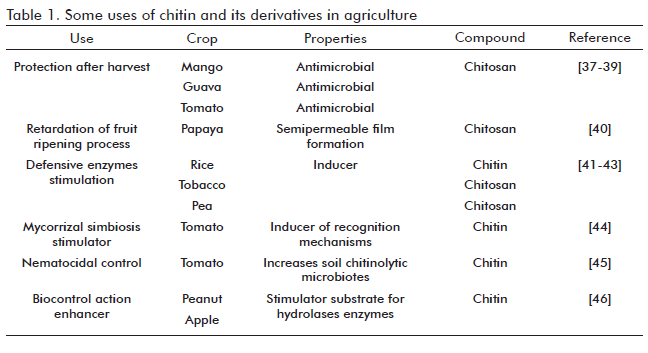
<body><![CDATA[<P   align="left" ><font face="Verdana, Arial, Helvetica, sans-serif" size="2" color="#000000">Other      chitin derivatives are oligosaccharides of 2 to 20 N-acetylglucosamine residues      in length. Their lower molecular weights provide them with chemical and biological      properties other than those of the original polymer, such as water solubility      and signaling functions during symbiotic interactions in plants (15). </font></P >       <P   align="left" ><font face="Verdana, Arial, Helvetica, sans-serif" size="2" color="#000000">Chitin      and all its derivatives share a high nitrogen content (6.14-8.3) and high      thermal and chemical stability (2). Nevertheless, they are also substrates      very susceptible to degradation by several enzyme families, this aspect derived      from their composition and natural origin (16). The presence of functional      hydroxyl and amino groups (these in the deacetylated units) support the formation      of coordination compounds (complexes) with metal ions of cooper, zinc and      iron and others, but not with those of alkaline (e.g., sodium or potassium)      or alkaline earth (e.g., calcium or magnesium) metals. These complexes show      a strong antimicrobial activity against some vegetable pathogens, being promising      agents for agricultural application (17). Moreover, they bear absorptive properties,      very useful to remove stains (18, 19), residuals from water (20), and they      are useful for other applications. All these make chitin and their derivatives      highly applicable to human activity (21). </font></P >       <P   align="left" ><font face="Verdana, Arial, Helvetica, sans-serif" size="2" color="#000000">2      aIn Cuba, over 8000 tons of lobster are captured every year, 30% corresponds      to about 1500 tons which are discarded and used as raw material for chitin      production (26). Wastes coming from other marketable species as shrimp, and      sea and freshwater crabs are also used. In fact, several procedures were developed      to prepare chitin depending on the application. For example, the method that      generates high quality and pure chitin for pharmaceutical application is regarded      as one of the first among Ibero-American countries (27). At present there      are two factories in Cuba producing this pharmaceutical-grade chitin at levels      overreaching the demands. </font></P >       <P   align="left" ><font face="Verdana, Arial, Helvetica, sans-serif" size="2" color="#000000">Additionally,      there is a process for integral processing of the wastes (28), and another      designed to prepare chitin and its derivatives for specific application in      agriculture (29). </font></P >       <P   align="left" ><font size="3" face="Verdana, Arial, Helvetica, sans-serif" color="#000000"><b>BIOLOGICAL      ACTIVITY OF CHITIN IN AGRICULTURE</b></font><font size="2" face="Verdana, Arial, Helvetica, sans-serif" color="#000000">      </font></P >   <FONT size="+1">        <P   align="left" ><font size="2" face="Verdana, Arial, Helvetica, sans-serif" color="#000000">Chitin      and its derivatives are biologically active during its interaction with plants      and microorganisms (30). Four main approaches have been identified for chitin      application in agriculture (see <a href="/img/revistas/bta/v27n4/t0102410.gif">table</a>):      </font></P >   <FONT size="+1"><FONT color="#FF00FF"><FONT color="#000000">        
<P   align="left" ><font face="Verdana, Arial, Helvetica, sans-serif" size="2" color="#000000">1.      Protection of plants from pests and diseases before and after harvest. </font></P >       <P   align="left" ><font face="Verdana, Arial, Helvetica, sans-serif" size="2" color="#000000">2.      Enhancing of antagonist microorganisms action and biological controls. </font></P >       <P   align="left" ><font face="Verdana, Arial, Helvetica, sans-serif" size="2" color="#000000">3.      Enhancing the beneficial symbiotic plant-microorganism interactions; and 4.      Regulating plant growth and development. </font></P >       <P   align="left" ><font face="Verdana, Arial, Helvetica, sans-serif" size="2" color="#000000">Some      results evidenced that polymeric chitin does not show a substantial antimicrobial      activity affecting growth and development of plant pathogens. This is determined      by its insolubility in water and compact structure. Otherwise, its deacetylated      derivative chitosan has certainly shown a potent antimicrobial activity, due      to protonation of its amino groups in solution. These results are in agreement      with those obtained for soluble chitin and chitosan oligomers at the National      Institute of Agricultural Sciences (INCA, Cuba). Moreover, positively charged      oligochitosans showed antifungal activity, which was absent in chitin oligomers      (uncharged) when compared to the control treatment (31). </font></P >       ]]></body>
<body><![CDATA[<P   align="left" ><font face="Verdana, Arial, Helvetica, sans-serif" size="2" color="#000000">Vegetal      membranes respond to polymeric chitin and its derivatives by surmounting a      cascade of enzymatic reactions which ultimately results in induced and systemic      resistance in plants (32). This has been corroborated by isolating chitin-specific      membrane receptors in soybean and rice (33). </font></P >       <P   align="left" ><font face="Verdana, Arial, Helvetica, sans-serif" size="2" color="#000000">Chitin      has also been used to enhance the efficiency of natural biological controls.      Many microorganisms acting as antagonists use chitinases against plant pests      and diseases (e.g., <I>Trichoderma </I>sp.). These enzymes are overproduced      together with other hydrolases in the presence of chitins and some of its      derivatives, increasing the efficiency of microorganisms acting as biocontrols      (34). </font></P >       <P   align="left" ><font face="Verdana, Arial, Helvetica, sans-serif" size="2" color="#000000">Recent      findings demonstrate that chitin and its derivatives can improve legume-<I>Rhizobium      </I>symbiosis. Nodulation factors excreted by <I>Rhizobium </I>sp. are 3-to-5-units      chitin fragments bound to fatty acid and protein ramifications (35). Therefore,      chitin can be provided as precursor substrate for these metabolites. Other      types of interactions (e.g., mycorrhization) have benefited from adding chitin      derivatives, as in tomato cultivation (36). </font></P >       <P   align="left" ><font face="Verdana, Arial, Helvetica, sans-serif" size="2" color="#000000">Moreover,      chitin was demonstrated to favor plant growth and development by increasing      enzyme and metabolic functions, also accelerating germination (30). </font></P >       <P   align="left" ><font face="Verdana, Arial, Helvetica, sans-serif" size="2" color="#000000"><B>Crop      protection from pests and diseases </b></font></P >       <P   align="left" ><font face="Verdana, Arial, Helvetica, sans-serif" size="2" color="#000000">Chitin      and its derivatives have been used to protect crops from diseases either before      or after harvest, directly or indirectly, depending on the specific plant-pathogen      interaction. Some results of such applications are shown in the following      by pathogen group. </font></P >       <P   align="left" ><font face="Verdana, Arial, Helvetica, sans-serif" size="2" color="#000000"><B><I>Antifungal      activity </I></b></font></P >       <P   align="left" ><font face="Verdana, Arial, Helvetica, sans-serif" size="2" color="#000000">Plants      are protected from fungi by the biological activity of chitin and its derivatives      through two main mechanisms: i) direct antifungal action of these molecules,      affecting fungal growth and development; and ii) activation of defensive mechanisms      interfering or inhibiting pathogen&acute;s development, subsequently halting      or limiting disease progression. </font></P >       <P   align="left" ><font face="Verdana, Arial, Helvetica, sans-serif" size="2" color="#000000">Regarding      chitin derivatives, especially those bearing highly reactive functional groups      as chitosan and derived compounds, they were demonstrated as having direct      antifungal activity on phytopathogenic fungi (47). This is influenced by the      compound&acute;s chemical properties and concentration. In this sense, chitosan      polymers administered at 1 g/L completely inhibited <I>Rhizoctonia solana      </I>mycelial growth, such inhibition being limited to 80% at a 500 mg/L concentration      (32). The inhibition was further reduced to 50% by decreasing the polymer      molecular weight by hydrolysis, once the hydrolyzate at 500 mg/L was applied.      A minimal 20% of inhibition was obtained by increasing chitin acetylation      degree and delivering it as colloid. Several studies confirmed these results,      highlighting the relevance of fungal type (48). <I>In vitro </I>inhibition      of mycelial growth fluctuated in a sample of 14 different phytopathogenic      fungi, depending on acetylation degree and molecular weight of the chitin      derivatives assayed. Nevertheless, a tendency towards growth inhibition was      observed by increasing both deacetylation and molecular weight of the compounds      tested. </font></P >       <P   align="left" ><font face="Verdana, Arial, Helvetica, sans-serif" size="2" color="#000000">Regarding      the mechanisms of action of chitin and its derivatives, it was established      that free amino group protonation on a slightly acidic medium enhanced antifungal      activity. Some authors point out that the positively charged compounds interact      better at chromosome level, improving the expression of genes involved in      plant resistance (43). It was also proposed that the action occurred in an      indirect manner by making Ca<sup>2+ inaccessible, essential</sup> nutrients      and minerals for the growth of filamentous fungi. There are other reports      on their interaction with the plasma membrane, interfering with its functions      as chelating agents and modifying membrane permeability (49). It is also suggested      that the activity affects Rhizopus stolonifer in influencing the balance between      biosynthesis and degradation of cell wall components. </font></P >   <FONT color="#0000FF"><FONT size="+1" color="#000000"><FONT size="+1">        ]]></body>
<body><![CDATA[<P   align="left" ><font face="Verdana, Arial, Helvetica, sans-serif" size="2" color="#000000">Results      obtained at INCA&acute;s laboratories indicate that chitosan and its oligomers      completely inhibit <I>Pyricularia grisea </I>mycelial growth at 1 g/L and      pH 5.0 in the culture medium (50). Noteworthy, the pH of the resulting solution      affects the positive charge of amino groups, since fungi growth was just slightly      inhibited at pH 6, while sporulation remained fully arrested (17). </font></P >       <P   align="left" ><font face="Verdana, Arial, Helvetica, sans-serif" size="2" color="#000000">Similarly,      the presence of chitosan at 1000 mg / L affected the growth of <I>Sarocladium      oryzae </I>by more than 40% compared to control. Some studies have remarked      the relevance of fungi family and genus on its susceptibility to chitin derivatives,      with cell wall chitin content as a factor that explains the differences observed.      Mycelial growth of some species as <I>Phythophtora parasitica </I>are inhibited      at low chitosan concentrations (i.e., 100 mg/L), while other require higher      concentrations for significant inhibition (as <I>Fusarium oxysporum radici      licopersicii</I>, over 1 g/L). </font></P >       <P   align="left" ><font face="Verdana, Arial, Helvetica, sans-serif" size="2" color="#000000">Particularly,      the artificial stimulation of plant defensive mechanisms have been studied      by adding chitin derivatives as elicitors (elicitation), since they become      generally protected by systemic resistance from several diseases (52). </font></P >       <P   align="left" ><font face="Verdana, Arial, Helvetica, sans-serif" size="2" color="#000000">Results      from investigations in rice demonstrated that seeds recovered with chitin      derivatives increase hydrolytic enzymes production, such as chitinases and      <font face="Symbol">b</font> 1, 3 glycanases which degrade chitin and 1, 3      glycans, respectively. As we know, these two types of compounds are major      cell wall components in most phytopathogenic fungi (53, 54). </font></P >   <FONT color="#FF00FF"><FONT color="#000000">        <P   align="left" ><font face="Verdana, Arial, Helvetica, sans-serif" size="2" color="#000000">Besides,      chitosan and its positively charged derivatives stimulate plants to produce      antifungal metabolites (55). In spite of these evidences, there are reports      on derivatives lacking positive charge, and even insoluble polymeric chitin,      as inducing high levels of very potent antimicrobial metabolites (e.g., phytoalexins).      Among these molecules are momilactones and oryzalexins, which completely inhibit      <I>Pyricularia grisea Sacc </I>at concentrations as low as 0.9 mg/L or even      at nanogram scale (32). </font></P >   <FONT size="+1"><FONT size="+1">        <P   align="left" ><font face="Verdana, Arial, Helvetica, sans-serif" size="2" color="#000000">Other      authors suggest that oligomers could be more effective in plants, because      of its smaller molecular size which determines easier root absorption, or      by foliar aspersion (42). In spite of the advantages of oligomers over the      natural polymer, these criteria is not absolute, as demonstrated by other      works showing the additional influence of crop type, pathogen&acute;s properties      (particularly cell wall composition), chitosan acetylation degree and solution      pH (56). </font></P >       <P   align="left" ><font face="Verdana, Arial, Helvetica, sans-serif" size="2" color="#000000">Several      crops have been evaluated for protection from diseases caused by soil fungal      pathogens by delivering chitin derivatives. For example, chitosan protects      pepper from <I>Phytium aphanidermatum </I>(57). In tomato, partially acetylated      chitosans delivered either by seed or foliar routes induced hydrolytic enzyme      production and reduced <I>Fusarium oxysporum licopersici</I>- caused lesions      (55). Other authors found a lower incidence of diseases in wheat and rice,      leading to significantly increased production yields (58). Protection was      also detected in peanut, as well as defensive mechanisms (59). </font></P >       <P   align="left" ><font face="Verdana, Arial, Helvetica, sans-serif" size="2" color="#000000">Noteworthy,      most of these investigations used chitosan and its derivatives seeking for      protection, but it was clearly established that acetylation is essential to      induce production of hydrogen peroxide and other oxygen reactive species.      These metabolites are the key components triggering enzymatic reaction pathways      which ultimately lead to systemic resistance in plants (60). </font></P >       <P   align="left" ><font face="Verdana, Arial, Helvetica, sans-serif" size="2" color="#000000">Although      uncharged, chitin and its fragments are potentially protective in plants,      mostly in monocotyledonous. Chitin but not chitosan oligomers promote several      defensive reactions in rice, wheat, arabidopsis, water melon, bean, soybean      and peanut (34, 58, 61, 62). These responses include the accumulation of pathogenesis-related      proteins (e.g., phenylamonium lyase (PAL) and <font face="Symbol">b</font>      1, 3 glycanase, chitinase and peroxidases (41)), synthesis of protease inhibitors      and phytoalexins (63), lignification (64), callose synthesis and hypersensitive      cell death reaction (65). </font></P >   <FONT color="#FF00FF"><FONT color="#000000">        <P   align="left" ><font face="Verdana, Arial, Helvetica, sans-serif" size="2" color="#000000"><B><I>Antiviral      activity </I></b></font></P >       ]]></body>
<body><![CDATA[<P   align="left" ><font face="Verdana, Arial, Helvetica, sans-serif" size="2" color="#000000">Chitin      derivatives display antiviral activity, specially the cationic ones which      are very potent at inhibiting locally-produced virus injuries. Its action      is attributed to virus infection dependence on surface charge (66). Nonetheless,      neither acetylation nor molecular weight correlates with antiviral activity,      since acetylated chitin oligomers inhibited the mosaic alfalfa virus in bean      at 0.01%. Additionally, the antiviral activity varies among plant species.      Evidences point towards two mechanisms: i) interference with virus adhesion      to leave surface; and ii) systemic transmission of resistance to other plant      organs, mediated by different enzymes as peroxidase (67, 68). </font></P >       <P   align="left" ><font face="Verdana, Arial, Helvetica, sans-serif" size="2" color="#000000">Noteworthy,      these compounds protect plants not only from mechanically but also from vector-borne      diseases (56). </font></P >       <P   align="left" ><font face="Verdana, Arial, Helvetica, sans-serif" size="2" color="#000000">Remarkably,      1% chitosan sprays were able to protect tomato from viroids, a very destructive      and hard-to- treat plant pathogen (69). </font></P >       <P   align="left" ><font face="Verdana, Arial, Helvetica, sans-serif" size="2" color="#000000">All      these results are very valuable for agriculture, due to the almost absolute      lack of chemicals able to control plant viral infections. </font></P >       <P   align="left" ><font face="Verdana, Arial, Helvetica, sans-serif" size="2" color="#000000"><B><I>Anti-bacterial      activity in plants </I></b></font></P >       <P   align="left" ><font face="Verdana, Arial, Helvetica, sans-serif" size="2" color="#000000">Chitin      derivatives can also protect plants from bacterial diseases. <I>In vitro </I>studies      demonstrated that chitosan and chitin cationic derivatives inhibit growth      of 11 different bacteria at concentrations ranging 0.008 to 0.25%, with direct      inhibition mainly depending on bacterial type and the derivative used (70).      Other reports showed that cationic derivatives inhibit growth of either gram-positive      or -negative bacteria, while the anionic ones require 15-fold concentrations      for similar effects (71). These authors also detected an inverse correlation      between chitosan molecular weight and growth inhibition, in agreement with      other reports regarding anti-bacterial activity as dependent on the assayed      bacterial type and the molecular weight of the compounds.(72). </font></P >       <P   align="left" ><font face="Verdana, Arial, Helvetica, sans-serif" size="2" color="#000000">Moreover,      the efficiency of chitosan application to inhibit bacterial infection in tomato      was demonstrated as depending on chitosan concentration (inhibition achieved      at 0.1%) and timing prior to infection (73). </font></P >       <P   align="left" ><font face="Verdana, Arial, Helvetica, sans-serif" size="2" color="#000000">In      other experiments using cationic and anionic chitosan derivatives sprayed      on tomato leaves, <I>Pseudomonas syringae </I>pv. infection was inhibited      60 to 70% with cationic, while the anionic ones were irrelevant for disease      progression. Since some of the cationic derivatives did not inhibit bacterial      growth <I>in vitro </I>but did <I>in vivo</I>, it was suggested that they      bear a dual effect, both inhibiting bacterial growth and inducing natural      defensive mechanisms in plants (56, 74). </font></P >       <P   align="left" ><font face="Verdana, Arial, Helvetica, sans-serif" size="2" color="#000000"><B><I>Nematicidal      activity </I></b></font></P >       <P   align="left" ><font face="Verdana, Arial, Helvetica, sans-serif" size="2" color="#000000">Nematodes      have been effectively controlled 0,008 aby applying chitin and chitin-like      compounds to soils (75). Once added, chitinolytic microorganisms tend to proliferate,      destroying nematode eggs and degrading the chitin-containing cuticle of young      nematodes (76). Moreover, chitin material increase ammonia emissions upon      mineralization, at concentrations toxic enough for nematodes, decreasing its      population and subsequently reducing their damage to plant roots (77). This      last effect was corroborated by adding nitrification inhibitors, which protect      soil-added chitin from degradation and further decrease nematodemediated damage      (78). As previously mentioned, the increased chitinolytic microbial population      resulted in high nematicidal activity in soil, reducing nematode injury in      tomato plants (45). </font></P >       ]]></body>
<body><![CDATA[<P   align="left" ><font face="Verdana, Arial, Helvetica, sans-serif" size="2" color="#000000">Nematode      mortality is remarkably higher for chitin than chitosan, this last of higher      nitrogen content, suggesting that the effect of increased populations of nematophagous      and nematicidal microorganisms prevail over that of ammonia at toxic levels.      (79). </font></P >       <P   align="left" ><font face="Verdana, Arial, Helvetica, sans-serif" size="2" color="#000000">This      led to designing enhanced chitin derivatives as the chitin-protein complex,      taking advantage of both nematicidal mechanisms. Results showed an effective      gradient for nematicidal activity of chitin-protein complex &gt; pure chitin      &gt;&gt; chitosan when assayed against nematodes of the <I>Heterotera </I>genus      (79). </font></P >       <P   align="left" ><font face="Verdana, Arial, Helvetica, sans-serif" size="2" color="#000000"><B><I>Post-harvest      protection of crops </I></b></font></P >       <P   align="left" ><font face="Verdana, Arial, Helvetica, sans-serif" size="2" color="#000000">Chitin      derivatives, and particularly chitosan, protect fruits from post-harvest diseases,      being used as soluble additives to provide anti-microbial properties and capable      of forming gas semi-permeable films (30). </font></P >       <P   align="left" ><font face="Verdana, Arial, Helvetica, sans-serif" size="2" color="#000000">Soft      rot damage is significantly reduced in tomato by coating with chitosan films      (39). Pre-harvest treatment in strawberry decreases infection levels and improve      fruit quality (80, 81). In carrots, chitosan application three days prior      to <I>Sclerotina sclerotium </I>inoculation decreases pathogen incidence,      resulting in smaller lesions (82). Studies in chitosan-treated pepper at storage      conditions showed that the gray mold appeared seven days after than in untreated      fruits (83). Chitin derivatives were not only used to coat fruits but also      to increase quality of sliced fruits as shown in studies of sliced red pitayas      (37) and mango (37, 84). In general, chitosan has shown a behavior similar      to that of chemical fungicides, so it can be used instead of them, with the      advantage of being a biodegradable product (85). The use of these alternatives      in agriculture is due to the lower production costs of chitin derivatives      and its advantages over the currently applied phytosanitary products. </font></P >       <P   align="left" ><font face="Verdana, Arial, Helvetica, sans-serif" size="2" color="#000000"><B>Enhanced      biopesticides </b></font></P >       <P   align="left" ><font face="Verdana, Arial, Helvetica, sans-serif" size="2" color="#000000">Many      antagonist organisms and natural biological controls exert their biological      activity through chitinase and hydrolase enzymes secretion (86)., Chitin and      its derivatives certainly increase their production by microorganisms such      as <I>Tricoderma </I>sp<I>. </I>and <I>Bacilus </I>sp., enhancing its efficiency      to control pathogenic microorganisms and pests (87). For instance, the control      of the disease was better achieved by applying a bacterium together with the      polymeric chitin in peanut than the one obtained with the microorganism alone      (34). A better control in <I>Phytophthora fragaria</I> was also obtained with      the application of chitin although, the time of exposure to chitin is relevant      for the control attained (88). </font></P >       <P   align="left" ><font face="Verdana, Arial, Helvetica, sans-serif" size="2" color="#000000">In      fact, native populations of biocontrol microorganisms become increased by      adding chitin in soils infected with pathogenic agents. Thereafter, these      endogenous control strains can be isolated, cultured and potentially used      as biological controls, as demonstrated against actinomycetes in sandy soils      (89). </font></P >       <P   align="left" ><font face="Verdana, Arial, Helvetica, sans-serif" size="2" color="#000000">Other      authors have also demonstrated a significant increase in chitinolytic microorganisms      even in very infertile soils like in dunes, improving soil microbiota and      its properties (90). </font></P >       <P   align="left" ><font face="Verdana, Arial, Helvetica, sans-serif" size="2" color="#000000">Indeed,      chitinases are enzymes relevant for biopesticide control mechanisms, being      the hydrolysis of chitin-containing media a common practice to evaluate the      efficiency of bioinsecticide organisms. </font></P >       ]]></body>
<body><![CDATA[<P   align="left" ><font face="Verdana, Arial, Helvetica, sans-serif" size="2" color="#000000">It      has been considered to add chitin derivatives to formulations containing these      microorganisms to increase biopesticide effectiveness, to provide a favorable      developmental environment and resistance against adverse conditions (46).      All these actions can contribute to improve the use of biological controls      in agriculture. </font></P >       <P   align="left" ><font face="Verdana, Arial, Helvetica, sans-serif" size="2" color="#000000"><B><I>Plant      nutrition and soil fertility </I></b></font></P >       <P   align="left" ><font face="Verdana, Arial, Helvetica, sans-serif" size="2" color="#000000">Chitin      and its derivatives show additional properties among carbohydrates, as nitrogen      content and, therefore, a low C/N ratio (1). This characteristic supports      soil microorganism proliferation, especially of those bearing chitinolytic      and proteolytic metabolism as actinomycetes. In fact, half the chitin added      to the soil becomes mineralized in less than four weeks, a result closely      related to soil pH, humidity and organic material (90). Its addition increases      both prokaryote and eukaryote microbial populations and their activities,      since they are altogether involved in chitin mineralization, including populations      of nitrogen fixation microorganisms, and methane, carbon dioxide and dinitrogen      monoxide emissions are raised (91, 92). Many of these chitinolytic organisms      establish beneficial symbiotic interactions with plants, as mycorrhiza and      <I>Rhizobium </I>spp., favoring vegetal absorption of certain nutrients and      especially nitrogen fixation. For example, amendments of chitin together with      fertilizers as urea have been used to improve soil microbiota, to control      pathogenic organisms and to strengthen plant nutrition, all these showing      better results than the controls in tomato, carnation and grazing (76, 77,      88). </font></P >       <P   align="left" ><font face="Verdana, Arial, Helvetica, sans-serif" size="2" color="#000000"><B><I>Biofertilization      enhancement </I></b></font></P >       <P   align="left" ><font face="Verdana, Arial, Helvetica, sans-serif" size="2" color="#000000">As      previously suggested, chitin has been used to enhance beneficial plant-microorganism      interactions as mycorrhization, increasing it up to 20% resulting in a significant      increase of the performance. (74, 75). This result was used to generate Ecomic,      a Cuban mycorrhiza-based biofertilizer. (93). It is suggested that the addition      of chitin could accelerate the first step in the establishment of mycorrhizal      infection, which involves breaking the fungal cell wall by plant chitinases.      </font></P >       <P   align="left" ><font face="Verdana, Arial, Helvetica, sans-serif" size="2" color="#000000">On      the other hand, and as mentioned above, nodulation factors essential to establish      a productive symbiotic legume-<I>Rhizobium </I>interaction are partially composed      of chitin oligomers (15). Certainly, N-acetylation of these molecules is a      precondition to display biological activity, while structural differences      among these compounds serve as specie-specific signature determining the <I>Rhizobium      </I>to legume association (35). Further research must address this theoretical      knowledge to avoid divergences when extrapolating <I>in vitro </I>laboratory      results obtained under semi-controlled conditions to field applications. </font></P >       <P   align="left" ><font face="Verdana, Arial, Helvetica, sans-serif" size="2" color="#000000"><B><I>Regulation      of vegetal growth and development </I></b></font></P >       <P   align="left" ><font face="Verdana, Arial, Helvetica, sans-serif" size="2" color="#000000">Favorable      changes are induced by chitin derivatives in plants and fruits metabolism.      For example, chitosan-treated tomato seeds show accelerated germination and      produced highly vigorous seedlings (94). This effect was also observed in      cereals (95), and specifically in wheat and rice, where yields were increased      at field conditions, these results are being currently scaled up to marketable      levels (58). </font></P >       <P   align="left" ><font face="Verdana, Arial, Helvetica, sans-serif" size="2" color="#000000">Our      researches revealed that the chemical nature of chitin can significantly influence      vegetal growth (96). Colloidal chitin, a degraded variant of the polymer,      accelerated seedling growth in tomato during the first 15 days as compared      to the much more slowly-degraded chitin-protein complex (remaining attached      to proteins). Nevertheless, plants treated with this last compound were more      vigorous and taller 30 days after treatment. Either the case, plants treated      with chitin derivatives showed a faster development than the untreated ones.      Soybean seeds coated with depolymerized chitin increased harvest yields in      118% compared to the control (61), and a relatively similar behavior was observed      in carrot. These effects of chitin derivatives on vegetal growth led some      groups to consider chitin as an exogenous oligosaccharin modulating the physiological      response on these crops. </font></P >       <P   align="left" ><font size="3" face="Verdana, Arial, Helvetica, sans-serif" color="#000000"><b>CONCLUSIONS</b></font><font size="2" face="Verdana, Arial, Helvetica, sans-serif" color="#000000">      </font></P >   <FONT size="+1">        ]]></body>
<body><![CDATA[<P   align="left" ><font size="2" face="Verdana, Arial, Helvetica, sans-serif" color="#000000">The      ubiquity, biological and biocompatible properties of chitin and its derivatives      settle them up as promising alternatives for agriculture. Further research      is required for laboratory results obtained under controlled conditions in      Cuba and other countries to become agricultural practice. Its antiviral activity,      together with the rest of recently-discovered properties are highly demanded      in agriculture, while others, more established and still underestimated characteristics      (e.g., antifungal and nematicidal activities) could result in great steps      towards sustainable agricultural practices, by decreasing the use of chemical      synthetic pesticides and bringing a new focus to modern phytopathology. Symbiotic      interactions of these compounds could readily impact on agriculture production      yields. They could be significantly useful under adverse conditions as in      low fertility, high salinity and heavy metal-contaminated soils, as in those      affected by prolonged drought because of climatic changes. Of course, all      these depend on gaining the focus of researchers, farmers and producers on      these compounds potentialities. In this sense, future developments for delivering      chitin and its derivatives at field scale will irremissibly be among the new      challenges to overcome. </font></P >   <FONT size="+1">        <P   align="left" > </P >       <P   align="left" ><font face="Verdana, Arial, Helvetica, sans-serif" size="3" color="#000000"><b>REFERENCES</b></font></P >       <!-- ref --><P   align="left" ><font face="Verdana, Arial, Helvetica, sans-serif" size="2">1. Gooday GW. The      ecology of chitin degradation. Adv Microb Ecol 1990;11:387-419. </font></P >   </font></font></font></font></font></font></font></font></font></font></font></font></font></font></font></font></font></font></font></font></font></font></font></font></font></font></font></font></font></font></font></font></font></font></font></font></font></font></font></font></font></font></font></font></font></font></font></font></font></font></font>        <!-- ref --><p><font face="Verdana, Arial, Helvetica, sans-serif" size="2">2. Yen MT, Mau      JL. Selected physical properties of chitin prepared from shiitake stipes.      Food Sci Technol 2007;40(3):558-63. </font><!-- ref --><p><font face="Verdana, Arial, Helvetica, sans-serif" size="2">3. Gomes RC,      Soares RMA, Nakamura CV, Souto-Padr&oacute;n T, de Souza RF, de Azevedo Soares      Sem&ecirc;do LT, <i>et al</i>. Streptomyces lunalinharesii spores contain      chitin on the outer sheath. FEMS Microbiol Lett 2008;286(1):118-23. </font><!-- ref --><p><font face="Verdana, Arial, Helvetica, sans-serif" size="2">4. Majt&aacute;n      J, B&iacute;likov&aacute; K, Markovic O, Gr&oacute;f J, Kogan G, Sim&uacute;th      J. Isolation and characterization of chitin from bumblebee (Bombus terrestris).      Int J Biol Macromol 2007; 40(3):237-41. </font><!-- ref --><p><font face="Verdana, Arial, Helvetica, sans-serif" size="2">5. Shi WB, Feng      MG. Lethal effect of Beauveria bassiana, Metarhizium anisopliae, and Paecilomyces      fumosoroseus on the eggs of <i>Tetranychus cinnabarinus</i> (Acari: Tetranychidae)      with a description of a mite egg bioassay system. Biol Control 2004;30:165-73.      </font><!-- ref --><p><font face="Verdana, Arial, Helvetica, sans-serif" size="2">6. D&iacute;az-Rojas      EI, Arg&uuml;elles-Monal WM, Higuera-Ciapara I, Hern&aacute;ndez J, Lizardi-      Mendoza J, Goycoolea FM. Determination of chitin and protein contents during      the isolation of chitin from shrimp waste. Macromol Biosci 2006;6(5):340-47.      </font><!-- ref --><p><font face="Verdana, Arial, Helvetica, sans-serif" size="2">7. Fanellia E,      Vitob MD, Jonesc JT, Giorgia CD. Analysis of chitin synthase function in a      plant parasitic nematode, <i>Meloidogyne artiellia</i>, using RNAi. Gene 2005;349:87-      95. </font><!-- ref --><p><font face="Verdana, Arial, Helvetica, sans-serif" size="2">8. Wu SD, Wu      C-S, Chen H. Cuticle structure of squid <i>Illex argentinus pen</i>. Fish      Sci 2003;69:849-55. </font><!-- ref --><p><font face="Verdana, Arial, Helvetica, sans-serif" size="2">9. Peniche C.      Estudios sobre quitina y quitosana. [Tesis en opci&oacute;n del t&iacute;tulo      de Doctor en Ciencias]. Editorial Universitaria, Universidad de La Habana,      2006. </font><!-- ref --><p><font face="Verdana, Arial, Helvetica, sans-serif" size="2">10. Tamura H,      Nagahama H, Tokura S. Preparation of chitin hydrogel under mild conditions.      Cellulose 2006;13(4):357-64. </font><!-- ref --><p><font face="Verdana, Arial, Helvetica, sans-serif" size="2">11. Rinaudo M.      Chitin and chitosan: Properties and applications. Prog Polym Sci 2006; 31(7):603-32.      </font><!-- ref --><p><font face="Verdana, Arial, Helvetica, sans-serif" size="2">12. Harish Prashanth      KV, Tharanathan RN. Chitin/chitosan: modifications and their unlimited application      potential -an overview. Trends Food Sci Technol 2007;18(3):117-31. </font><!-- ref --><p><font face="Verdana, Arial, Helvetica, sans-serif" size="2">13. Xu J, Zhao      X, Han X, Du Y. Antifungal activity of oligochitosan against Phytophthora      capsici and other plant pathogenic fungi <i>in vitro</i>. Pest Biochem Physiol      2007; 87(3):220-8. </font><!-- ref --><p><font face="Verdana, Arial, Helvetica, sans-serif" size="2">14. Pillai CKS,      Paul W, Sharma CP. Chitin and chitosan polymers: Chemistry, solubility and      fiber formation. Prog Polym Sci 2009; 34(7):641-78. </font><!-- ref --><p><font face="Verdana, Arial, Helvetica, sans-serif" size="2">15. Gil-Serrano      AM, Franco-Rodr&iacute;guez G, Tejero-Mateo P, Thomas-Oates J, Spaink HP,      Ruiz-Sainz J, <i>et al</i>. Structural determination of the lipo-chitin oligosaccharides      nodulation signals produced by Rhizobium freddii HH103. Carbohydr Res 1997;      303:435-43. </font><!-- ref --><p><font face="Verdana, Arial, Helvetica, sans-serif" size="2">16. Li J, Du      Y, Liang H. Influence of molecular parameters on the degradation of chitosan      by a commercial enzyme. Polymer Degrad Stabil 2007;92(3):515-24. </font><!-- ref --><p><font face="Verdana, Arial, Helvetica, sans-serif" size="2">17. C&aacute;rdenas      R, Ram&iacute;rez M. Efecto de los derivados de quitina y su combinaci&oacute;n      con sulfato de cobre en el comportamiento del crecimiento micelial y esporulaci&oacute;n      de un aislamiento monosp&oacute;rico del hongo <i>Pyricularia grisea</i>,      Sacc. Cultiv Tropic 2004; 25(4):89-93. </font><!-- ref --><p><font face="Verdana, Arial, Helvetica, sans-serif" size="2">18. Klimiuk E,      Gusiatin Z, Kabardo K. The effectiveness of surfactants adsorption onto chitin      and dye-modified chitin, Polish J Environ Studies 2006;15(1):95-104. </font><!-- ref --><p><font face="Verdana, Arial, Helvetica, sans-serif" size="2">19. Crini G,      Badot PM. Application of chitosan, a natural aminopolysaccharide, for dye      removal from aqueous solutions by adsorption processes. Prog Polym Sci 2008;33(4):399-447.      </font><!-- ref --><p><font face="Verdana, Arial, Helvetica, sans-serif" size="2">20. Crini G.      Recent developments in polysaccharide- based materials used as adsorbents      in wastewater treatment. Prog Polym Sci 2005; 30(1):38-70. </font><!-- ref --><p><font face="Verdana, Arial, Helvetica, sans-serif" size="2">21. Rudrapatnam      N. Chitin - The undisputed biomolecule of great potential. Crit Rev Food Sci      Nutr 2003;43(1):61-87. </font><!-- ref --><p><font face="Verdana, Arial, Helvetica, sans-serif" size="2">22. Andrade V,      Neto B, Fukushima K, Campos-Takaki G. Effect of medium components and time      of cultivation on chitin production by <i>Mucor circinelloides </i>(<i>Mucor      javanicus</i>) IFO 4570)A factorial study. Rev Iberoam Micol 2003;20:149-53.      </font><!-- ref --><p><font face="Verdana, Arial, Helvetica, sans-serif" size="2">23. Cauchie M.      Chitin production by arthropods in the hydrosphere. Hydrobiologia 2002;470(1-3):63-95.      </font><!-- ref --><p><font face="Verdana, Arial, Helvetica, sans-serif" size="2">24. Goycolea      F, Agull&oacute; E, Mato R. Fuentes y procesos de obtenci&oacute;n. In: Abram      APd, editor. Quitina y Quitosano. Obtenci&oacute;n, caracterizaci&oacute;n      y aplicaciones, Lima, Per&uacute;. Pontificia Universidad Cat&oacute;lica      del Per&uacute;, 2004, p.106-54. </font><!-- ref --><p><font face="Verdana, Arial, Helvetica, sans-serif" size="2">25. No H, Meyer      S. Preparation and characterisation of chitin and chitosan a review. J Aquat      Food Prod Technol 1995;14: 27-52. </font><!-- ref --><p><font face="Verdana, Arial, Helvetica, sans-serif" size="2">26. Le&oacute;n      ME, de Puga R, Baisre J. National report on the lobster fisheries in Cuba.      FAO Fish Rep 2001;619:197-202. </font><!-- ref --><p><font face="Verdana, Arial, Helvetica, sans-serif" size="2">27. Henriques      R, Nieto O, inventors; Instituto de Qu&iacute;mica y Biolog&iacute;a Experimental,      assignee. M&eacute;todo para obtenci&oacute;n de quitina suficientemente pura.      CU Patent 20760. 1980. </font><p><font face="Verdana, Arial, Helvetica, sans-serif" size="2">28. Garc&iacute;a      D, Oviedo C, Nieto JM, Peniche C, Henriquez RD, inventors; Instituto de Qu&iacute;mica      y Biolog&iacute;a Experimental, assignee. M&eacute;todo para el aprovechamiento      del desecho de la langosta com&uacute;n. CU Patent 21658 A1. 1996 Oct 5. </font></p>       <!-- ref --><p><font face="Verdana, Arial, Helvetica, sans-serif" size="2">29. Ram&iacute;rez      MA, Cabrera G, Guti&eacute;rrez A, Rodr&iacute;guez T. Metodolog&iacute;a      para la obtenci&oacute;n de quitosana a bajas temperaturas. Cultiv Tropic      2000;21(1):79-82. </font><!-- ref --><p><font face="Verdana, Arial, Helvetica, sans-serif" size="2">30. Hirano S.      Applications of chitin and chitosan in the ecological and environmental fields.      In: Goosen MFA, Ed., Technomic, Lancaster, PA, 1997.31-54. </font><!-- ref --><p><font face="Verdana, Arial, Helvetica, sans-serif" size="2">31. Parra Y,      Ram&iacute;rez MA. Efecto de diferentes derivados de quitina sobre el crecimiento      <i>in vitro</i> del hongo Rhizoctonia solani Kuhn. Cultiv Tropic 2002;23(2):73-5.      </font><!-- ref --><p><font face="Verdana, Arial, Helvetica, sans-serif" size="2">32. Ruen YY,      Ch W. Elicitation of rice diterpenes phytoalexins by chitin. Arch Biochem      Biophys 1993;294(3):450-5. </font><!-- ref --><p><font face="Verdana, Arial, Helvetica, sans-serif" size="2">33. Day RB, Okada      M, Ito Y, Tsukada K, Zaghouani H, Shibuya N, <i>et al</i>. Biding site for      chitin oligosaccharides in the soybean plasma membrane. Plant Physiol 2001;      126:1162-73. </font><!-- ref --><p><font face="Verdana, Arial, Helvetica, sans-serif" size="2">34. Kishore GK,      Pande S, Podile AR. Chitin-supplemented foliar application of Serratia marcescens      GPS 5 improves control of late leaf spot disease of Groundnut by activating      defence-related enzymes. J Phytopathol 2005;153:169-73. </font><!-- ref --><p><font face="Verdana, Arial, Helvetica, sans-serif" size="2">35. Staehelin      C, Schultze M, Tokuyasu K, Poinsot V, Prom&eacute; JC, Kondorosi E, <i>et      al</i>.N-deacetylation of Sinorhizobium meliloti Nod factors increases their      stability in the Medicago sativa rhizosphere and decreases their biological      activity. Mol Plant Microbe Interact 2000;13(1):72-79. </font><!-- ref --><p><font face="Verdana, Arial, Helvetica, sans-serif" size="2">36. Iglesias      R, Pombo R, Cabrera G, Fern&aacute;ndez F, Morales. D. Efecto de la quitina      y sus derivados sobre la infecci&oacute;n micorr&iacute;zica y el crecimiento      y desarrollo de las plantas de tomate.(<i>Licopersicum esculentum Mill</i>).      Cultiv Tropic 1995;16(3):43-4. </font><!-- ref --><p><font face="Verdana, Arial, Helvetica, sans-serif" size="2">37. Chien P-J,      Sheu F, Yang F-H. Effects of edible chitosan coating on quality and shelf      life of sliced mango fruit. J Food Eng 2007; 78(1):225-9. </font><!-- ref --><p><font face="Verdana, Arial, Helvetica, sans-serif" size="2">38. Thommohaway      C, Kanlayanarat S, Uthairatanakij A, Jitareerat. P. Quality of fresh-cut guava      (<i>Psidium Guajava L</i>.) as affected by chitosan treatment. Acta Horticult      2007;746:449-55. </font><!-- ref --><p><font face="Verdana, Arial, Helvetica, sans-serif" size="2">39. Bautista-Ba&ntilde;os      S. Evaluaci&oacute;n del quitosano en el desarrollo de la pudrici&oacute;n      blanda del tomate durante el almacenamiento. Rev Iber Tecnolog&iacute;a Postcosecha      2004;1:63-67. </font><!-- ref --><p><font face="Verdana, Arial, Helvetica, sans-serif" size="2">40. Alimuniar      A, Zainuddin R. An economical technique for producing chitosan. Proceedings      from the 6th International Conference on Chitosan, Poland, 16-19 August, 1994.      </font><!-- ref --><p><font face="Verdana, Arial, Helvetica, sans-serif" size="2">41. Rodr&iacute;guez      AT, Ram&iacute;rez MA, C&aacute;rdenas RM, Hern&aacute;ndez AN, Vel&aacute;zquez      MG, Bautista S. Induction of defense response of <i>Oryza sativa</i> L. against      <i>Pyricularia grisea </i>(Cooke) Sacc by treating seeds with chitosan and      hydrolyzed chitosan. Pest Biochem Physiol 2007;89:206-15. </font><!-- ref --><p><font face="Verdana, Arial, Helvetica, sans-serif" size="2">42. Falc&oacute;n      AB, Ram&iacute;rez MA, M&aacute;rquez R, Hern&aacute;ndez M. Chitosan and      its hydrolysate at tobacco-phytophthora parasitica interaction. Cultiv Tropic      2002;23(1):61-6. </font><!-- ref --><p><font face="Verdana, Arial, Helvetica, sans-serif" size="2">43. Hadwiger      LA, Ogawa T, Kuyama H. Chitosan polymer sizes effective in inducing phytoalexin      accumulation and fungal suppression are verified with synthetized oligomers.      Mol Plant Microbe Interact 1994;7(4):531-3. </font><!-- ref --><p><font face="Verdana, Arial, Helvetica, sans-serif" size="2">44. Iglesias      R, Guti&eacute;rrez A, Fern&aacute;ndez F. The influence of chitin from lobster      exoskeleton on seedling growth and mycorrhizal infection in tomate crop (<i>Licopersicum      esculentum Mill</i>). Cultiv Tropic 1994;15(2):48-9. </font><!-- ref --><p><font face="Verdana, Arial, Helvetica, sans-serif" size="2">45. Jin RD, Suh      J, Park RD, Kim YW, Krishnan HB, Kil Yong K. Effect of chitin compost and      broth on biological control of Meloidogyne incognita on tomato (<i>Lycopersicon      esculentum Mill</i>). Nematology 2005;7(1):125-32. </font><p><font face="Verdana, Arial, Helvetica, sans-serif" size="2">46. Backman P,      Rodriguez-Kabana R, Kokalis N, inventors; Auburn University, assignee. Method      of controlling foliar microorganism populations. US Patent 5,288,488, 1994      Feb 22. </font></p>       <!-- ref --><p><font face="Verdana, Arial, Helvetica, sans-serif" size="2">47. Rabea E,      Badawy MT, Stevens CV, Smagghe G, Steurbaut W. Chitosan as antimicrobial agent:      applications and mode of action. Biomacromolecules 2003;4(6):1457-65. </font><!-- ref --><p><font face="Verdana, Arial, Helvetica, sans-serif" size="2">48. Hirano S,      Nagao YN. Effect of chitosan, pectic acid on pathogenic fungi. Agric Biol      Chem 1989;58(1):24-6. </font><!-- ref --><p><font face="Verdana, Arial, Helvetica, sans-serif" size="2">49. Roller S,      Covill N. The antifungal properties of chitosan in laboratory media and apple      juice. Int J Food Microbiol 1999; 47:67-77. </font><!-- ref --><p><font face="Verdana, Arial, Helvetica, sans-serif" size="2">50. Rodr&iacute;guez      AT, Ram&iacute;rez MA, N&aacute;poles MC, C&aacute;rdenas RM. Antifungal activity      of chitosan and one its hydrolysates on <i>Pyricularia grisea Sacc fungus</i>.      Cultiv Tropic 2003;24(2):85-8. </font><!-- ref --><p><font face="Verdana, Arial, Helvetica, sans-serif" size="2">51. Cruz A, Rivero      D, Mart&iacute;nez B, Ram&iacute;rez MA, Rodr&iacute;guez AT. Efecto de la      quitosana sobre el crecimiento y desarrollo <i>in vitro</i> de <i>Sarocladium      oryzae Sawada</i>. Rev Protecci&oacute;n Veg 2004;19(2):133-6. </font><!-- ref --><p><font face="Verdana, Arial, Helvetica, sans-serif" size="2">52. Yamaguchi      T, Ito Y, Shibuya N. Oligosaccharide elicitors and their receptors for plant      defense responses. Trends Glycosci Glycotechnol 2000; 12(64):113-20. </font><!-- ref --><p><font face="Verdana, Arial, Helvetica, sans-serif" size="2">53. Hirano S,      Yamamoto T, Hayashi M, Nishida T, Inui H. Chitinase activity in seed coated      with chitosan derivatives. J Agric Biol Chem 1990; 54(10):2719-20. </font><!-- ref --><p><font face="Verdana, Arial, Helvetica, sans-serif" size="2">54. Rodr&iacute;guez      AT, Ram&iacute;rez MA, Falc&oacute;n A, Guridi F, Cristo E. Estimulaci&oacute;n      de algunas enzimas relacionadas con la defensa en plantas de arroz (<i>Oryza      sativa</i>, L.) obtenidas de semillas tratadas con quitosana. Cultiv Tropic      2004;25(3):111-5. </font><!-- ref --><p><font face="Verdana, Arial, Helvetica, sans-serif" size="2">55. Benhamou      N, Lafontaine P, Nicole JN. Induction of systemic resistance to Fusarium crown      and root rot in tomato plants by seed treatment with chitosan. Phytopathology      1994;84(12):1432-44. </font><p><font face="Verdana, Arial, Helvetica, sans-serif" size="2">56. Potential      use of chitosan in plant protection. In: Chitin and chitosan. Polish-Russian      Monograph. Eds: Struszczyk H. Pospieszny H and Gamzazade A, 1999, p. 115-      130. </font></p>       <!-- ref --><p><font face="Verdana, Arial, Helvetica, sans-serif" size="2">57. El Ghaouth      A, Arul J, Grenier J, Benhamou N, Asselin A, Belanger G. Chitosan induces      systemic resistance against <i>Phytium aphanidermatum</i> in greenhouse grown      cucumber. Phytopathology. 1994;84(9):1120-7. </font><p><font face="Verdana, Arial, Helvetica, sans-serif" size="2">58. Hadwiger      LA, inventor; Washington State University Research Foundation (Pullman, WA),      assignee. Method for treating cereal crop seed with chitosan to enhance yield      root growth, and stem strength. US patent 5,104,437. 1992 Apr 14. </font></p>       <!-- ref --><p><font face="Verdana, Arial, Helvetica, sans-serif" size="2">59. Sathibayama      M, Balasubramanian R. chitosan induces resistence components in <i>arachi      hipogaea</i> against leaf rust caused by Puccinia arachidis. Crop Prot 1998;      17:307-13. </font><!-- ref --><p><font face="Verdana, Arial, Helvetica, sans-serif" size="2">60. Kauss H,      Jeblick W, Domard A, Siegrist J. Partial acetylation of chitosan and a conditioning      period are essential for elicitation of H2O2 in surface-abraded tissues from      various plants. Adv Chitin Sci 1997; 2:94-101. </font><!-- ref --><p><font face="Verdana, Arial, Helvetica, sans-serif" size="2">61. Hirano S,      Hayashi M, Okuno S. Soybean seeds surface-coated with depolymerised chitins:      chitinase activity as a predictive index for the harvest of beans in field      culture. J Sci Food Agric 2000;81(2):205-9. </font><p><font face="Verdana, Arial, Helvetica, sans-serif" size="2">62. Wan J, Shuqun      Zhang, Stacey G. Activation of a mitogen-activated protein kinase pathway      in Arabidopsis by chitin. Mol Plant Pathol 2004;5(2):125-35. </font></p>       <!-- ref --><p><font face="Verdana, Arial, Helvetica, sans-serif" size="2">63. Nahalka J,      Nahalkov J, Gemeiner P, Blan P. Elicitation of plumbagin by chitin and its      release into the medium in Drosophyllum lusitanicum Link. suspension cultures.      Biotechnol Lett 1998;20(9):841-5. </font><!-- ref --><p><font face="Verdana, Arial, Helvetica, sans-serif" size="2">64. Maksimov      IV, Cherepanova EA, Khairullin RM. Chitin specific-peroxidases in plants.      Biochemistry (Moscow) 2003; 68(1):111-5. </font><!-- ref --><p><font face="Verdana, Arial, Helvetica, sans-serif" size="2">65. Prapagdee      B, Kotchadat K, Kumsopa A, Visarathanonth N. The role of chitosan in protection      of soybean from sudden death syndrome caused by Fusarium solani f. sp. glycines.      Bioresour Technol 2007; 98(7):1353-8. </font><!-- ref --><p><font face="Verdana, Arial, Helvetica, sans-serif" size="2">66. Pospieszny      H, Chirkov S, Atabekov L . Induction of antiviral resistance in plant by Chitosan.      Plant Sci 1991;79:63-9. </font><!-- ref --><p><font face="Verdana, Arial, Helvetica, sans-serif" size="2">67. Pospieszny      H, Giebel J. Peroxidase activity is related to th resistance aginst viruses      induced by chitosan. Chitin Enzymol 1996;2:379-83. </font><!-- ref --><p><font face="Verdana, Arial, Helvetica, sans-serif" size="2">68. Iriti M,      Sironi M, Gomarasca S, Casazza AP, Soave C, Faoro F. Cell death-mediated antiviral      effect of chitosan in tobacco. Plant Physiol Biochem 2006;44(11-12):893-900.      </font><!-- ref --><p><font face="Verdana, Arial, Helvetica, sans-serif" size="2">69. Pospieszny      H. Antiviroid activity of chitosan. Crop Prot 1997;16:105-6. </font><!-- ref --><p><font face="Verdana, Arial, Helvetica, sans-serif" size="2">70. Jeon Y-J,      Fereidoon S, Kim S-K. Preparation of chitin and chitosan oligomers and their      applications in physiological functional foods. Food Rev Int 2000;16(2):159-76.      </font><!-- ref --><p><font face="Verdana, Arial, Helvetica, sans-serif" size="2">71. Pospieszny      H, Mackowiak A, Zolobowska L, Struszczyk H. Effects of chitosan derivatives      on the growth of phytopathogenic bacteria. In: Progress on chemistry and application      of chitin and its derivatives. Polish Chitin Soc. Warsow, editor Struszczyk      H, 1996, p. 101-6. </font><!-- ref --><p><font face="Verdana, Arial, Helvetica, sans-serif" size="2">72. No H. Antibacterial      activities of chitosans and chitosan oligomers with different molecular weights      on spoilage bacteria isolated from Tofu. J Food Sci 2002;67(4): 1511-4. </font><!-- ref --><p><font face="Verdana, Arial, Helvetica, sans-serif" size="2">73. Pospieszny      H, Mackowiak A. Effect of the infection of plants by pathogenic bacteria.      Adv Chitin Sci 1997;2:759-62. </font><!-- ref --><p><font face="Verdana, Arial, Helvetica, sans-serif" size="2">74. Li Y, Chen      XG, Liu N, Liu CS, Liu CG, Meng XH, <i>et al</i>. Physicochemical characterization      and antibacterial property of chitosan acetates. Carbohydr Polym 2007;67(2):227-32.      </font><!-- ref --><p><font face="Verdana, Arial, Helvetica, sans-serif" size="2">75. Rodr&iacute;guez-Kabana      R, Morgan-Jones G, Ownley-Gintis B. Effects of chitin amendments to soil on      Hetedodera glycines, microbial population and colonization of cyst by fungi.      Nematropica 1984;14:9-25. </font><!-- ref --><p><font face="Verdana, Arial, Helvetica, sans-serif" size="2">76. Brown JA,      Neville FJ, Sarathchandra SU, Watson RN, Cox NR. Effects of chitin amendment      on plant growth, microbial populations and nematodes in soil. Newzealand Plant      Prot 1995;53:1&#150;5. </font><!-- ref --><p><font face="Verdana, Arial, Helvetica, sans-serif" size="2">77. B&eacute;lair      G, Tremblay N. The influence of chitin-urea amendments applied to an organic      soil on <i>Meloidogyne hapla </i>population and growth of green house tomatos.      Phytoprotection 1995;76(2):75-80. </font><!-- ref --><p><font face="Verdana, Arial, Helvetica, sans-serif" size="2">78. Oka Y, Pivonia      S. Effect of a nitrification inhibitor on nematicidal activity of organic      and inorganic ammonia-releasing compounds against the root-knot nematode Meloidogyne      javanica. Nematology 2003;5(4):505-13. </font><p><font face="Verdana, Arial, Helvetica, sans-serif" size="2">79. McCandliss      R, Eastwood. B, Milch RA, inventors; IGI Biotechnology, Inc. (Columbia, MD)      assignee. Nematocidally active chitin- protein complex US Patent 4,536,207.      1985 Aug 20. </font></p>       <!-- ref --><p><font face="Verdana, Arial, Helvetica, sans-serif" size="2">80. Bhaskara      MV. Effect of pre-harvest chitosan sprays on post-harvest infection by <i>Botrytis      cinerea </i>and quality of strawberry fruit. Postharvest Biol Technol 2000;20:39-51.      </font><!-- ref --><p><font face="Verdana, Arial, Helvetica, sans-serif" size="2">81. Ribeiro C,      Vicente A, Teixeira JA, Miranda C. Optimization of edible coating composition      to retard strawberry fruit senescence. Postharvest Biol Technol 2007;44(1):63-70.      </font><!-- ref --><p><font face="Verdana, Arial, Helvetica, sans-serif" size="2">82. Molloy A,      Cheah V, Koolard P. Induced resistance against <i>Sclerotina sclerotium</i>      in carrot treated with enzimatic hydrolized chitosan. Postharvest Biol Technol      2004;33:61-65. </font><!-- ref --><p><font face="Verdana, Arial, Helvetica, sans-serif" size="2">83. El Gaouth      A, Wilson A, Benhamou N. Biochemical and cytochemical aspects of the interactions      of chitosan with Botritis cinerea in bell peper. Postharvest Biol Technol      1997;12:183-94. </font><!-- ref --><p><font face="Verdana, Arial, Helvetica, sans-serif" size="2">84. Chien P,      Sheu F, Lin H. Quality assessment of low molecular weight chitosan coating      on sliced red pitayas. J Food Eng 2007;79(2):736-40. </font><!-- ref --><p><font face="Verdana, Arial, Helvetica, sans-serif" size="2">85. El Ghaouth      A, Arul J and Asselin A. Potential use of chitosan in postharvest preservation      of fruits and vegetables. In: Advances in Chitin and Chitosan, Brines CJ,      Sandfors PA and Zikakis JP (Eds.). Elsevier Applied Science, London, New York,      1992, p. 440-52 </font><!-- ref --><p><font face="Verdana, Arial, Helvetica, sans-serif" size="2">86. Choquer M,      Becker HF, Vidal-Cros A. Identification of two group A chitinase genes in      <i>Botrytis cinerea </i>which are differentially induced by exogenous chitin.      Mycol Res 2007;111(5):615-25. </font><!-- ref --><p><font face="Verdana, Arial, Helvetica, sans-serif" size="2">87. Gohel V,      Singh A, Vimal M, Ashwini P, Chhatpar HS. Bioprospecting and antifungal potential      of chitinolytic microorganisms. African J Biotechnol 2006;5(2):54-72. </font><!-- ref --><p><font face="Verdana, Arial, Helvetica, sans-serif" size="2">88. Rafferty      S, John M, Murphy G, Cassells AC. Lytic enzyme activity in peat is increased      by substrate amendment with chitin: implications for the control of Phytophthora      fragariae in fragaria vesca. Folia Geobot 2003; 38:139-44. </font><!-- ref --><p><font face="Verdana, Arial, Helvetica, sans-serif" size="2">89. Gomes RC,      Sem&ecirc;do LT, Soares RM, Alviano CS, Linhares LF, Coelho RR. Chitinolytic      activity of actinomycetes from a cerrado soil and their potential in biocontrol.      Lett Appl Microbiol 2000; 30:146-50. </font><!-- ref --><p><font face="Verdana, Arial, Helvetica, sans-serif" size="2">90. DeBoer W,      Gerards S, Gunnewiek PJAK, Modderman R. Response of the chitinolytic microbial      community to chitin amendments of dune soils. Biol Fert Soils 1999;29(2):170-7.      </font><!-- ref --><p><font face="Verdana, Arial, Helvetica, sans-serif" size="2">91. Manucharova      O, Yaroslavtsev AM, Senchenko DV, Stepanov AL, Zvyagintsev DG. Microbial transformation      of chitin in soil under anaerobic conditions. Biol Bull 2006; 33(2):191-4.      </font><!-- ref --><p><font face="Verdana, Arial, Helvetica, sans-serif" size="2">92. Manucharova      NA, Belova EV, Vorob&#146;ev AV, Polianskaia LM, Stepanov AL. Succession of      chitinolytic microorganisms in Chernozem soil. Mikrobiologiia 2005;74(5):693-8.      </font><!-- ref --><p><font face="Verdana, Arial, Helvetica, sans-serif" size="2">93. Leake JR,      Read DJ. Chitin as a nitrogen source for mycorrhizal fungi. Mycol Res 1990;94:993-5.      </font><!-- ref --><p><font face="Verdana, Arial, Helvetica, sans-serif" size="2">94. Hidalgo L,      Arg&uuml;elles W, Peniche C. Efecto de la quitosana en tratamientos a la semilla      de tomate. Rev Protecci&oacute;n Veg 1996;11(1):37-9. </font><p><font face="Verdana, Arial, Helvetica, sans-serif" size="2">95. Freepons      DE, inventor. Plant growth regulators derived from chitin. US Patent No. 4,964,894.      1990 Oct 23. </font></p>       <!-- ref --><p><font face="Verdana, Arial, Helvetica, sans-serif" size="2">96. Rodr&iacute;guez      Y, Noval B, Ram&iacute;rez M, Rodr&iacute;guez P. Efecto de diferentes fuentes      de quitina en el crecimiento de pl&aacute;ntulas de tomate. Cultiv Tropic      1998;19(3):32-6.</font>     <br>   </p>   <FONT size="+1" color="#000000"><FONT size="+1"><FONT size="+1"><FONT size="+1"><FONT size="+1"><FONT size="+1"><FONT size="+1"><FONT size="+1"><FONT size="+1"><FONT size="+1"><FONT size="+1"><FONT size="+1"><FONT size="+1"><FONT size="+1"><FONT size="+1"><FONT size="+1"><FONT size="+1"><FONT color="#0000FF"><FONT color="#000000"><FONT size="+1"><FONT size="+1"><FONT size="+1"><FONT size="+1"><FONT size="+1"><FONT size="+1"><FONT color="#0000FF"><FONT size="+1" color="#000000"><FONT size="+1"><FONT color="#FF00FF"><FONT color="#000000"><FONT color="#FF00FF"><FONT color="#000000"><FONT color="#FF00FF"><FONT color="#000000"><FONT color="#FF00FF"><FONT color="#000000"><FONT size="+1"><FONT size="+1"><FONT color="#FF00FF"><FONT color="#000000"><FONT color="#0000FF"><FONT size="+1" color="#000000"><FONT size="+1"><FONT color="#FF00FF"><FONT color="#000000"><FONT size="+1"><FONT size="+1"><FONT color="#FF00FF"><FONT color="#000000"><FONT size="+1"><FONT size="+1"><FONT size="+1">        ]]></body>
<body><![CDATA[<P   align="left" ><font size="2" face="Verdana, Arial, Helvetica, sans-serif" color="#000000">Received      in May, 2010.     <br>     Accepted for publication in December, 2010. </font></P >   <FONT size="+1">        <P   align="left" ><font face="Verdana, Arial, Helvetica, sans-serif" size="2" color="#000000">Miguel      &Aacute; Ram&iacute;rez, Estaci&oacute;n Experimental del Arroz, Instituto      Nacional de Ciencias Agr&iacute;colas, INCA Carretera a La Francia Km 1&frac12;,      CP 22900, Los Palacios, Pinar del R&iacute;o, Cuba. E-mail: <a href="mailto:miguelar@inca.edu.cu">miguelar@inca.edu.cu</a></font></P >   </font></font></font></font></font></font></font></font></font></font></font></font></font></font></font></font></font></font></font></font></font></font></font></font></font></font></font></font></font></font></font></font></font></font></font></font></font></font></font></font></font></font></font></font></font></font></font></font></font></font></font></font></font></DIV >      ]]></body><back>
<ref-list>
<ref id="B1">
<label>1</label><nlm-citation citation-type="journal">
<person-group person-group-type="author">
<name>
<surname><![CDATA[Gooday]]></surname>
<given-names><![CDATA[GW]]></given-names>
</name>
</person-group>
<article-title xml:lang="en"><![CDATA[The ecology of chitin degradation]]></article-title>
<source><![CDATA[Adv Microb Ecol]]></source>
<year>1990</year>
<volume>11</volume>
<page-range>387-419</page-range></nlm-citation>
</ref>
<ref id="B2">
<label>2</label><nlm-citation citation-type="journal">
<person-group person-group-type="author">
<name>
<surname><![CDATA[Yen]]></surname>
<given-names><![CDATA[MT]]></given-names>
</name>
<name>
<surname><![CDATA[Mau]]></surname>
<given-names><![CDATA[JL]]></given-names>
</name>
</person-group>
<article-title xml:lang="en"><![CDATA[Selected physical properties of chitin prepared from shiitake stipes]]></article-title>
<source><![CDATA[Food Sci Technol]]></source>
<year>2007</year>
<volume>40</volume>
<numero>3</numero>
<issue>3</issue>
<page-range>558-63</page-range></nlm-citation>
</ref>
<ref id="B3">
<label>3</label><nlm-citation citation-type="journal">
<person-group person-group-type="author">
<name>
<surname><![CDATA[Gomes]]></surname>
<given-names><![CDATA[RC]]></given-names>
</name>
<name>
<surname><![CDATA[Soares]]></surname>
<given-names><![CDATA[RMA]]></given-names>
</name>
<name>
<surname><![CDATA[Nakamura]]></surname>
<given-names><![CDATA[CV]]></given-names>
</name>
<name>
<surname><![CDATA[Souto-Padrón]]></surname>
<given-names><![CDATA[T]]></given-names>
</name>
<name>
<surname><![CDATA[de Souza]]></surname>
<given-names><![CDATA[RF]]></given-names>
</name>
<name>
<surname><![CDATA[de Azevedo Soares Semêdo]]></surname>
<given-names><![CDATA[LT]]></given-names>
</name>
</person-group>
<article-title xml:lang="en"><![CDATA[Streptomyces lunalinharesii spores contain chitin on the outer sheath]]></article-title>
<source><![CDATA[FEMS Microbiol Lett]]></source>
<year>2008</year>
<volume>286</volume>
<numero>1</numero>
<issue>1</issue>
<page-range>118-23</page-range></nlm-citation>
</ref>
<ref id="B4">
<label>4</label><nlm-citation citation-type="journal">
<person-group person-group-type="author">
<name>
<surname><![CDATA[Majtán]]></surname>
<given-names><![CDATA[J]]></given-names>
</name>
<name>
<surname><![CDATA[Bíliková]]></surname>
<given-names><![CDATA[K]]></given-names>
</name>
<name>
<surname><![CDATA[Markovic]]></surname>
<given-names><![CDATA[O]]></given-names>
</name>
<name>
<surname><![CDATA[Gróf]]></surname>
<given-names><![CDATA[J]]></given-names>
</name>
<name>
<surname><![CDATA[Kogan]]></surname>
<given-names><![CDATA[G]]></given-names>
</name>
<name>
<surname><![CDATA[Simúth]]></surname>
<given-names><![CDATA[J]]></given-names>
</name>
</person-group>
<article-title xml:lang="en"><![CDATA[Isolation and characterization of chitin from bumblebee (Bombus terrestris)]]></article-title>
<source><![CDATA[Int J Biol Macromol]]></source>
<year>2007</year>
<volume>40</volume>
<numero>3</numero>
<issue>3</issue>
<page-range>237-41</page-range></nlm-citation>
</ref>
<ref id="B5">
<label>5</label><nlm-citation citation-type="journal">
<person-group person-group-type="author">
<name>
<surname><![CDATA[Shi]]></surname>
<given-names><![CDATA[WB]]></given-names>
</name>
<name>
<surname><![CDATA[Feng]]></surname>
<given-names><![CDATA[MG]]></given-names>
</name>
</person-group>
<article-title xml:lang="en"><![CDATA[Lethal effect of Beauveria bassiana, Metarhizium anisopliae, and Paecilomyces fumosoroseus on the eggs of Tetranychus cinnabarinus (Acari: Tetranychidae) with a description of a mite egg bioassay system]]></article-title>
<source><![CDATA[Biol Control]]></source>
<year>2004</year>
<volume>30</volume>
<page-range>165-73</page-range></nlm-citation>
</ref>
<ref id="B6">
<label>6</label><nlm-citation citation-type="journal">
<person-group person-group-type="author">
<name>
<surname><![CDATA[Díaz-Rojas]]></surname>
<given-names><![CDATA[EI]]></given-names>
</name>
<name>
<surname><![CDATA[Argüelles-Monal]]></surname>
<given-names><![CDATA[WM]]></given-names>
</name>
<name>
<surname><![CDATA[Higuera-Ciapara]]></surname>
<given-names><![CDATA[I]]></given-names>
</name>
<name>
<surname><![CDATA[Hernández]]></surname>
<given-names><![CDATA[J]]></given-names>
</name>
<name>
<surname><![CDATA[Lizardi-Mendoza]]></surname>
<given-names><![CDATA[J]]></given-names>
</name>
<name>
<surname><![CDATA[Goycoolea]]></surname>
<given-names><![CDATA[FM]]></given-names>
</name>
</person-group>
<article-title xml:lang="en"><![CDATA[Determination of chitin and protein contents during the isolation of chitin from shrimp waste]]></article-title>
<source><![CDATA[Macromol Biosci]]></source>
<year>2006</year>
<volume>6</volume>
<numero>5</numero>
<issue>5</issue>
<page-range>340-47</page-range></nlm-citation>
</ref>
<ref id="B7">
<label>7</label><nlm-citation citation-type="journal">
<person-group person-group-type="author">
<name>
<surname><![CDATA[Fanellia]]></surname>
<given-names><![CDATA[E]]></given-names>
</name>
<name>
<surname><![CDATA[Vitob]]></surname>
<given-names><![CDATA[MD]]></given-names>
</name>
<name>
<surname><![CDATA[Jonesc]]></surname>
<given-names><![CDATA[JT]]></given-names>
</name>
<name>
<surname><![CDATA[Giorgia]]></surname>
<given-names><![CDATA[CD]]></given-names>
</name>
</person-group>
<article-title xml:lang="en"><![CDATA[Analysis of chitin synthase function in a plant parasitic nematode, Meloidogyne artiellia, using RNAi]]></article-title>
<source><![CDATA[Gene]]></source>
<year>2005</year>
<volume>349</volume>
<page-range>87-95</page-range></nlm-citation>
</ref>
<ref id="B8">
<label>8</label><nlm-citation citation-type="journal">
<person-group person-group-type="author">
<name>
<surname><![CDATA[Wu]]></surname>
<given-names><![CDATA[SD]]></given-names>
</name>
<name>
<surname><![CDATA[Wu]]></surname>
<given-names><![CDATA[C-S]]></given-names>
</name>
<name>
<surname><![CDATA[Chen]]></surname>
<given-names><![CDATA[H]]></given-names>
</name>
</person-group>
<article-title xml:lang="en"><![CDATA[Cuticle structure of squid Illex argentinus pen]]></article-title>
<source><![CDATA[Fish Sci]]></source>
<year>2003</year>
<volume>69</volume>
<page-range>849-55</page-range></nlm-citation>
</ref>
<ref id="B9">
<label>9</label><nlm-citation citation-type="">
<person-group person-group-type="author">
<name>
<surname><![CDATA[Peniche]]></surname>
<given-names><![CDATA[C]]></given-names>
</name>
</person-group>
<source><![CDATA[Estudios sobre quitina y quitosana]]></source>
<year></year>
</nlm-citation>
</ref>
<ref id="B10">
<label>10</label><nlm-citation citation-type="journal">
<person-group person-group-type="author">
<name>
<surname><![CDATA[Tamura]]></surname>
<given-names><![CDATA[H]]></given-names>
</name>
<name>
<surname><![CDATA[Nagahama]]></surname>
<given-names><![CDATA[H]]></given-names>
</name>
<name>
<surname><![CDATA[Tokura]]></surname>
<given-names><![CDATA[S]]></given-names>
</name>
</person-group>
<article-title xml:lang="en"><![CDATA[Preparation of chitin hydrogel under mild conditions]]></article-title>
<source><![CDATA[Cellulose]]></source>
<year>2006</year>
<volume>13</volume>
<numero>4</numero>
<issue>4</issue>
<page-range>357-64</page-range></nlm-citation>
</ref>
<ref id="B11">
<label>11</label><nlm-citation citation-type="journal">
<person-group person-group-type="author">
<name>
<surname><![CDATA[Rinaudo]]></surname>
<given-names><![CDATA[M]]></given-names>
</name>
</person-group>
<article-title xml:lang="en"><![CDATA[Chitin and chitosan: Properties and applications]]></article-title>
<source><![CDATA[Prog Polym Sci]]></source>
<year>2006</year>
<volume>31</volume>
<numero>7</numero>
<issue>7</issue>
<page-range>603-32</page-range></nlm-citation>
</ref>
<ref id="B12">
<label>12</label><nlm-citation citation-type="journal">
<person-group person-group-type="author">
<name>
<surname><![CDATA[Harish Prashanth]]></surname>
<given-names><![CDATA[KV]]></given-names>
</name>
<name>
<surname><![CDATA[Tharanathan]]></surname>
<given-names><![CDATA[RN]]></given-names>
</name>
</person-group>
<article-title xml:lang="en"><![CDATA[Chitin/chitosan: modifications and their unlimited application potential - an overview]]></article-title>
<source><![CDATA[Trends Food Sci Technol]]></source>
<year>2007</year>
<volume>18</volume>
<numero>3</numero>
<issue>3</issue>
<page-range>117-31</page-range></nlm-citation>
</ref>
<ref id="B13">
<label>13</label><nlm-citation citation-type="journal">
<person-group person-group-type="author">
<name>
<surname><![CDATA[Xu]]></surname>
<given-names><![CDATA[J]]></given-names>
</name>
<name>
<surname><![CDATA[Zhao]]></surname>
<given-names><![CDATA[X]]></given-names>
</name>
<name>
<surname><![CDATA[Han]]></surname>
<given-names><![CDATA[X]]></given-names>
</name>
<name>
<surname><![CDATA[Du]]></surname>
<given-names><![CDATA[Y]]></given-names>
</name>
</person-group>
<article-title xml:lang="en"><![CDATA[Antifungal activity of oligochitosan against Phytophthora capsici and other plant pathogenic fungi in vitro]]></article-title>
<source><![CDATA[Pest Biochem Physiol]]></source>
<year>2007</year>
<volume>87</volume>
<numero>3</numero>
<issue>3</issue>
<page-range>220-8</page-range></nlm-citation>
</ref>
<ref id="B14">
<label>14</label><nlm-citation citation-type="journal">
<person-group person-group-type="author">
<name>
<surname><![CDATA[Pillai]]></surname>
<given-names><![CDATA[CKS]]></given-names>
</name>
<name>
<surname><![CDATA[Paul]]></surname>
<given-names><![CDATA[W]]></given-names>
</name>
<name>
<surname><![CDATA[Sharma]]></surname>
<given-names><![CDATA[CP]]></given-names>
</name>
</person-group>
<article-title xml:lang="en"><![CDATA[Chitin and chitosan polymers: Chemistry, solubility and fiber formation]]></article-title>
<source><![CDATA[Prog Polym Sci]]></source>
<year>2009</year>
<volume>34</volume>
<numero>7</numero>
<issue>7</issue>
<page-range>641-78</page-range></nlm-citation>
</ref>
<ref id="B15">
<label>15</label><nlm-citation citation-type="journal">
<person-group person-group-type="author">
<name>
<surname><![CDATA[Gil-Serrano]]></surname>
<given-names><![CDATA[AM]]></given-names>
</name>
<name>
<surname><![CDATA[Franco-Rodríguez]]></surname>
<given-names><![CDATA[G]]></given-names>
</name>
<name>
<surname><![CDATA[Tejero-Mateo]]></surname>
<given-names><![CDATA[P]]></given-names>
</name>
<name>
<surname><![CDATA[Thomas-Oates]]></surname>
<given-names><![CDATA[J]]></given-names>
</name>
<name>
<surname><![CDATA[Spaink]]></surname>
<given-names><![CDATA[HP]]></given-names>
</name>
<name>
<surname><![CDATA[Ruiz-Sainz]]></surname>
<given-names><![CDATA[J]]></given-names>
</name>
</person-group>
<article-title xml:lang="en"><![CDATA[Structural determination of the lipo-chitin oligosaccharides nodulation signals produced by Rhizobium freddii HH103]]></article-title>
<source><![CDATA[Carbohydr Res]]></source>
<year>1997</year>
<volume>303</volume>
<page-range>435-43</page-range></nlm-citation>
</ref>
<ref id="B16">
<label>16</label><nlm-citation citation-type="journal">
<person-group person-group-type="author">
<name>
<surname><![CDATA[Li]]></surname>
<given-names><![CDATA[J]]></given-names>
</name>
<name>
<surname><![CDATA[Du]]></surname>
<given-names><![CDATA[Y]]></given-names>
</name>
<name>
<surname><![CDATA[Liang]]></surname>
<given-names><![CDATA[H]]></given-names>
</name>
</person-group>
<article-title xml:lang="en"><![CDATA[Influence of molecular parameters on the degradation of chitosan by a commercial enzyme]]></article-title>
<source><![CDATA[Polymer Degrad Stabil]]></source>
<year>2007</year>
<volume>92</volume>
<numero>3</numero>
<issue>3</issue>
<page-range>515-24</page-range></nlm-citation>
</ref>
<ref id="B17">
<label>17</label><nlm-citation citation-type="journal">
<person-group person-group-type="author">
<name>
<surname><![CDATA[Cárdenas]]></surname>
<given-names><![CDATA[R]]></given-names>
</name>
<name>
<surname><![CDATA[Ramírez]]></surname>
<given-names><![CDATA[M]]></given-names>
</name>
</person-group>
<article-title xml:lang="es"><![CDATA[Efecto de los derivados de quitina y su combinación con sulfato de cobre en el comportamiento del crecimiento micelial y esporulación de un aislamiento monospórico del hongo Pyricularia grisea, Sacc]]></article-title>
<source><![CDATA[Cultiv Tropic]]></source>
<year>2004</year>
<volume>25</volume>
<numero>4</numero>
<issue>4</issue>
<page-range>89-93</page-range></nlm-citation>
</ref>
<ref id="B18">
<label>18</label><nlm-citation citation-type="journal">
<person-group person-group-type="author">
<name>
<surname><![CDATA[Klimiuk]]></surname>
<given-names><![CDATA[E]]></given-names>
</name>
<name>
<surname><![CDATA[Gusiatin]]></surname>
<given-names><![CDATA[Z]]></given-names>
</name>
<name>
<surname><![CDATA[Kabardo]]></surname>
<given-names><![CDATA[K]]></given-names>
</name>
</person-group>
<article-title xml:lang="en"><![CDATA[The effectiveness of surfactants adsorption onto chitin and dye-modified chitin]]></article-title>
<source><![CDATA[Polish J Environ Studies]]></source>
<year>2006</year>
<volume>15</volume>
<numero>1</numero>
<issue>1</issue>
<page-range>95-104</page-range></nlm-citation>
</ref>
<ref id="B19">
<label>19</label><nlm-citation citation-type="journal">
<person-group person-group-type="author">
<name>
<surname><![CDATA[Crini]]></surname>
<given-names><![CDATA[G]]></given-names>
</name>
<name>
<surname><![CDATA[Badot]]></surname>
<given-names><![CDATA[PM]]></given-names>
</name>
</person-group>
<article-title xml:lang="en"><![CDATA[Application of chitosan, a natural aminopolysaccharide, for dye removal from aqueous solutions by adsorption processes]]></article-title>
<source><![CDATA[Prog Polym Sci]]></source>
<year>2008</year>
<volume>33</volume>
<numero>4</numero>
<issue>4</issue>
<page-range>399-447</page-range></nlm-citation>
</ref>
<ref id="B20">
<label>20</label><nlm-citation citation-type="journal">
<person-group person-group-type="author">
<name>
<surname><![CDATA[Crini]]></surname>
<given-names><![CDATA[G]]></given-names>
</name>
</person-group>
<article-title xml:lang="en"><![CDATA[Recent developments in polysaccharide- based materials used as adsorbents in wastewater treatment]]></article-title>
<source><![CDATA[Prog Polym Sci]]></source>
<year>2005</year>
<volume>30</volume>
<numero>1</numero>
<issue>1</issue>
<page-range>38-70</page-range></nlm-citation>
</ref>
<ref id="B21">
<label>21</label><nlm-citation citation-type="journal">
<person-group person-group-type="author">
<name>
<surname><![CDATA[Rudrapatnam]]></surname>
<given-names><![CDATA[N]]></given-names>
</name>
</person-group>
<article-title xml:lang="en"><![CDATA[Chitin: The undisputed biomolecule of great potential]]></article-title>
<source><![CDATA[Crit Rev Food Sci Nutr]]></source>
<year>2003</year>
<volume>43</volume>
<numero>1</numero>
<issue>1</issue>
<page-range>61-87</page-range></nlm-citation>
</ref>
<ref id="B22">
<label>22</label><nlm-citation citation-type="journal">
<person-group person-group-type="author">
<name>
<surname><![CDATA[Andrade]]></surname>
<given-names><![CDATA[V]]></given-names>
</name>
<name>
<surname><![CDATA[Neto]]></surname>
<given-names><![CDATA[B]]></given-names>
</name>
<name>
<surname><![CDATA[Fukushima]]></surname>
<given-names><![CDATA[K]]></given-names>
</name>
<name>
<surname><![CDATA[Campos-Takaki]]></surname>
<given-names><![CDATA[G]]></given-names>
</name>
</person-group>
<article-title xml:lang="en"><![CDATA[Effect of medium components and time of cultivation on chitin production by Mucor circinelloides (Mucor javanicus) IFO 4570)A factorial study]]></article-title>
<source><![CDATA[Rev Iberoam Micol]]></source>
<year>2003</year>
<volume>20</volume>
<page-range>149-53</page-range></nlm-citation>
</ref>
<ref id="B23">
<label>23</label><nlm-citation citation-type="journal">
<person-group person-group-type="author">
<name>
<surname><![CDATA[Cauchie]]></surname>
<given-names><![CDATA[M]]></given-names>
</name>
</person-group>
<article-title xml:lang="en"><![CDATA[Chitin production by arthropods in the hydrosphere]]></article-title>
<source><![CDATA[Hydrobiologia]]></source>
<year>2002</year>
<volume>470</volume>
<numero>1-3</numero>
<issue>1-3</issue>
<page-range>63-95</page-range></nlm-citation>
</ref>
<ref id="B24">
<label>24</label><nlm-citation citation-type="book">
<person-group person-group-type="author">
<name>
<surname><![CDATA[Goycolea]]></surname>
<given-names><![CDATA[F]]></given-names>
</name>
<name>
<surname><![CDATA[Agulló]]></surname>
<given-names><![CDATA[E]]></given-names>
</name>
<name>
<surname><![CDATA[Mato]]></surname>
<given-names><![CDATA[R]]></given-names>
</name>
</person-group>
<article-title xml:lang="es"><![CDATA[Fuentes y procesos de obtención]]></article-title>
<person-group person-group-type="editor">
<name>
<surname><![CDATA[Abram]]></surname>
<given-names><![CDATA[APD]]></given-names>
</name>
</person-group>
<source><![CDATA[Quitina y Quitosano: Obtención, caracterización y aplicaciones]]></source>
<year>2004</year>
<page-range>106-54</page-range><publisher-loc><![CDATA[Lima ]]></publisher-loc>
<publisher-name><![CDATA[Pontificia Universidad Católica del Perú]]></publisher-name>
</nlm-citation>
</ref>
<ref id="B25">
<label>25</label><nlm-citation citation-type="journal">
<person-group person-group-type="author">
<name>
<surname><![CDATA[No]]></surname>
<given-names><![CDATA[H]]></given-names>
</name>
<name>
<surname><![CDATA[Meyer]]></surname>
<given-names><![CDATA[S]]></given-names>
</name>
</person-group>
<article-title xml:lang="en"><![CDATA[Preparation and characterisation of chitin and chitosan a review]]></article-title>
<source><![CDATA[J Aquat Food Prod Technol]]></source>
<year>1995</year>
<volume>14</volume>
<page-range>27-52</page-range></nlm-citation>
</ref>
<ref id="B26">
<label>26</label><nlm-citation citation-type="journal">
<person-group person-group-type="author">
<name>
<surname><![CDATA[León]]></surname>
<given-names><![CDATA[ME]]></given-names>
</name>
<name>
<surname><![CDATA[de Puga]]></surname>
<given-names><![CDATA[R]]></given-names>
</name>
<name>
<surname><![CDATA[Baisre]]></surname>
<given-names><![CDATA[J]]></given-names>
</name>
</person-group>
<article-title xml:lang="en"><![CDATA[National report on the lobster fisheries in Cuba]]></article-title>
<source><![CDATA[FAO Fish Rep]]></source>
<year>2001</year>
<volume>619</volume>
<page-range>197-202</page-range></nlm-citation>
</ref>
<ref id="B27">
<label>27</label><nlm-citation citation-type="">
<person-group person-group-type="author">
<name>
<surname><![CDATA[Henriques]]></surname>
<given-names><![CDATA[R]]></given-names>
</name>
<name>
<surname><![CDATA[Nieto]]></surname>
<given-names><![CDATA[O]]></given-names>
</name>
</person-group>
<collab>Instituto de Química y Biología Experimental</collab>
<source><![CDATA[Método para obtención de quitina suficientemente pura.]]></source>
<year></year>
</nlm-citation>
</ref>
<ref id="B28">
<label>28</label><nlm-citation citation-type="">
<person-group person-group-type="author">
<name>
<surname><![CDATA[García]]></surname>
<given-names><![CDATA[D]]></given-names>
</name>
<name>
<surname><![CDATA[Oviedo]]></surname>
<given-names><![CDATA[C]]></given-names>
</name>
<name>
<surname><![CDATA[Nieto]]></surname>
<given-names><![CDATA[JM]]></given-names>
</name>
<name>
<surname><![CDATA[Peniche]]></surname>
<given-names><![CDATA[C]]></given-names>
</name>
<name>
<surname><![CDATA[Henriquez]]></surname>
<given-names><![CDATA[RD]]></given-names>
</name>
</person-group>
<collab>Instituto de Química y Biología Experimental</collab>
<source><![CDATA[Método para el aprovechamiento del desecho de la langosta común.]]></source>
<year></year>
</nlm-citation>
</ref>
<ref id="B29">
<label>29</label><nlm-citation citation-type="journal">
<person-group person-group-type="author">
<name>
<surname><![CDATA[Ramírez]]></surname>
<given-names><![CDATA[MA]]></given-names>
</name>
<name>
<surname><![CDATA[Cabrera]]></surname>
<given-names><![CDATA[G]]></given-names>
</name>
<name>
<surname><![CDATA[Gutiérrez]]></surname>
<given-names><![CDATA[A]]></given-names>
</name>
<name>
<surname><![CDATA[Rodríguez]]></surname>
<given-names><![CDATA[T]]></given-names>
</name>
</person-group>
<article-title xml:lang="en"><![CDATA[Metodología para la obtención de quitosana a bajas temperaturas]]></article-title>
<source><![CDATA[Cultiv Tropic]]></source>
<year>2000</year>
<volume>21</volume>
<numero>1</numero>
<issue>1</issue>
<page-range>79-82</page-range></nlm-citation>
</ref>
<ref id="B30">
<label>30</label><nlm-citation citation-type="book">
<person-group person-group-type="author">
<name>
<surname><![CDATA[Hirano]]></surname>
<given-names><![CDATA[S]]></given-names>
</name>
</person-group>
<article-title xml:lang="en"><![CDATA[Applications of chitin and chitosan in the ecological and environmental fields]]></article-title>
<person-group person-group-type="editor">
<name>
<surname><![CDATA[Goosen]]></surname>
<given-names><![CDATA[MFA]]></given-names>
</name>
</person-group>
<source><![CDATA[]]></source>
<year>1997</year>
<page-range>31-54</page-range><publisher-loc><![CDATA[Lancaster ]]></publisher-loc>
<publisher-name><![CDATA[Technomic]]></publisher-name>
</nlm-citation>
</ref>
<ref id="B31">
<label>31</label><nlm-citation citation-type="journal">
<person-group person-group-type="author">
<name>
<surname><![CDATA[Parra]]></surname>
<given-names><![CDATA[Y]]></given-names>
</name>
<name>
<surname><![CDATA[Ramírez]]></surname>
<given-names><![CDATA[MA]]></given-names>
</name>
</person-group>
<article-title xml:lang="es"><![CDATA[Efecto de diferentes derivados de quitina sobre el crecimiento in vitro del hongo Rhizoctonia solani Kuhn]]></article-title>
<source><![CDATA[Cultiv Tropic]]></source>
<year>2002</year>
<volume>23</volume>
<numero>2</numero>
<issue>2</issue>
<page-range>73-5</page-range></nlm-citation>
</ref>
<ref id="B32">
<label>32</label><nlm-citation citation-type="journal">
<person-group person-group-type="author">
<name>
<surname><![CDATA[Ruen]]></surname>
<given-names><![CDATA[YY]]></given-names>
</name>
<name>
<surname><![CDATA[Ch]]></surname>
<given-names><![CDATA[W]]></given-names>
</name>
</person-group>
<article-title xml:lang="en"><![CDATA[Elicitation of rice diterpenes phytoalexins by chitin]]></article-title>
<source><![CDATA[Arch Biochem Biophys]]></source>
<year>1993</year>
<volume>294</volume>
<numero>3</numero>
<issue>3</issue>
<page-range>450-5</page-range></nlm-citation>
</ref>
<ref id="B33">
<label>33</label><nlm-citation citation-type="journal">
<person-group person-group-type="author">
<name>
<surname><![CDATA[Day]]></surname>
<given-names><![CDATA[RB]]></given-names>
</name>
<name>
<surname><![CDATA[Okada]]></surname>
<given-names><![CDATA[M]]></given-names>
</name>
<name>
<surname><![CDATA[Ito]]></surname>
<given-names><![CDATA[Y]]></given-names>
</name>
<name>
<surname><![CDATA[Tsukada]]></surname>
<given-names><![CDATA[K]]></given-names>
</name>
<name>
<surname><![CDATA[Zaghouani]]></surname>
<given-names><![CDATA[H]]></given-names>
</name>
<name>
<surname><![CDATA[Shibuya]]></surname>
<given-names><![CDATA[N]]></given-names>
</name>
</person-group>
<article-title xml:lang="en"><![CDATA[Biding site for chitin oligosaccharides in the soybean plasma membrane]]></article-title>
<source><![CDATA[Plant Physiol]]></source>
<year>2001</year>
<volume>126</volume>
<page-range>1162-73</page-range></nlm-citation>
</ref>
<ref id="B34">
<label>34</label><nlm-citation citation-type="journal">
<person-group person-group-type="author">
<name>
<surname><![CDATA[Kishore]]></surname>
<given-names><![CDATA[GK]]></given-names>
</name>
<name>
<surname><![CDATA[Pande]]></surname>
<given-names><![CDATA[S]]></given-names>
</name>
<name>
<surname><![CDATA[Podile]]></surname>
<given-names><![CDATA[AR]]></given-names>
</name>
</person-group>
<article-title xml:lang="en"><![CDATA[Chitin-supplemented foliar application of Serratia marcescens GPS 5 improves control of late leaf spot disease of Groundnut by activating defence-related enzymes]]></article-title>
<source><![CDATA[J Phytopathol]]></source>
<year>2005</year>
<volume>153</volume>
<page-range>169-73</page-range></nlm-citation>
</ref>
<ref id="B35">
<label>35</label><nlm-citation citation-type="journal">
<person-group person-group-type="author">
<name>
<surname><![CDATA[Staehelin]]></surname>
<given-names><![CDATA[C]]></given-names>
</name>
<name>
<surname><![CDATA[Schultze]]></surname>
<given-names><![CDATA[M]]></given-names>
</name>
<name>
<surname><![CDATA[Tokuyasu]]></surname>
<given-names><![CDATA[K]]></given-names>
</name>
<name>
<surname><![CDATA[Poinsot]]></surname>
<given-names><![CDATA[V]]></given-names>
</name>
<name>
<surname><![CDATA[Promé]]></surname>
<given-names><![CDATA[JC]]></given-names>
</name>
<name>
<surname><![CDATA[Kondorosi]]></surname>
<given-names><![CDATA[E]]></given-names>
</name>
</person-group>
<article-title xml:lang="en"><![CDATA[N-deacetylation of Sinorhizobium meliloti Nod factors increases their stability in the Medicago sativa rhizosphere and decreases their biological activity]]></article-title>
<source><![CDATA[Mol Plant Microbe Interact]]></source>
<year>2000</year>
<volume>13</volume>
<numero>1</numero>
<issue>1</issue>
<page-range>72-79</page-range></nlm-citation>
</ref>
<ref id="B36">
<label>36</label><nlm-citation citation-type="journal">
<person-group person-group-type="author">
<name>
<surname><![CDATA[Iglesias]]></surname>
<given-names><![CDATA[R]]></given-names>
</name>
<name>
<surname><![CDATA[Pombo]]></surname>
<given-names><![CDATA[R]]></given-names>
</name>
<name>
<surname><![CDATA[Cabrera]]></surname>
<given-names><![CDATA[G]]></given-names>
</name>
<name>
<surname><![CDATA[Fernández]]></surname>
<given-names><![CDATA[F]]></given-names>
</name>
<name>
<surname><![CDATA[Morales]]></surname>
<given-names><![CDATA[D]]></given-names>
</name>
</person-group>
<article-title xml:lang="en"><![CDATA[Efecto de la quitina y sus derivados sobre la infección micorrízica y el crecimiento y desarrollo de las plantas de tomate.(Licopersicum esculentum Mill)]]></article-title>
<source><![CDATA[Cultiv Tropic]]></source>
<year>1995</year>
<volume>16</volume>
<numero>3</numero>
<issue>3</issue>
<page-range>43-4</page-range></nlm-citation>
</ref>
<ref id="B37">
<label>37</label><nlm-citation citation-type="journal">
<person-group person-group-type="author">
<name>
<surname><![CDATA[Chien]]></surname>
<given-names><![CDATA[P-J]]></given-names>
</name>
<name>
<surname><![CDATA[Sheu]]></surname>
<given-names><![CDATA[F]]></given-names>
</name>
<name>
<surname><![CDATA[Yang]]></surname>
<given-names><![CDATA[F-H]]></given-names>
</name>
</person-group>
<article-title xml:lang="en"><![CDATA[Effects of edible chitosan coating on quality and shelf life of sliced mango fruit]]></article-title>
<source><![CDATA[J Food Eng]]></source>
<year>2007</year>
<volume>78</volume>
<numero>1</numero>
<issue>1</issue>
<page-range>225-9</page-range></nlm-citation>
</ref>
<ref id="B38">
<label>38</label><nlm-citation citation-type="journal">
<person-group person-group-type="author">
<name>
<surname><![CDATA[Thommohaway]]></surname>
<given-names><![CDATA[C]]></given-names>
</name>
<name>
<surname><![CDATA[Kanlayanarat]]></surname>
<given-names><![CDATA[S]]></given-names>
</name>
<name>
<surname><![CDATA[Uthairatanakij]]></surname>
<given-names><![CDATA[A]]></given-names>
</name>
<name>
<surname><![CDATA[Jitareerat]]></surname>
<given-names><![CDATA[P]]></given-names>
</name>
</person-group>
<article-title xml:lang="en"><![CDATA[Quality of fresh-cut guava (Psidium Guajava L.) as affected by chitosan treatment]]></article-title>
<source><![CDATA[Acta Horticult]]></source>
<year>2007</year>
<volume>746</volume>
<page-range>449-55</page-range></nlm-citation>
</ref>
<ref id="B39">
<label>39</label><nlm-citation citation-type="journal">
<person-group person-group-type="author">
<name>
<surname><![CDATA[Bautista-Baños]]></surname>
<given-names><![CDATA[S]]></given-names>
</name>
</person-group>
<article-title xml:lang="es"><![CDATA[Evaluación del quitosano en el desarrollo de la pudrición blanda del tomate durante el almacenamiento]]></article-title>
<source><![CDATA[Rev Iber Tecnología Postcosecha]]></source>
<year>2004</year>
<volume>1</volume>
<page-range>63-67</page-range></nlm-citation>
</ref>
<ref id="B40">
<label>40</label><nlm-citation citation-type="confpro">
<person-group person-group-type="author">
<name>
<surname><![CDATA[Alimuniar]]></surname>
<given-names><![CDATA[A]]></given-names>
</name>
<name>
<surname><![CDATA[Zainuddin]]></surname>
<given-names><![CDATA[R]]></given-names>
</name>
</person-group>
<source><![CDATA[An economical technique for producing chitosan]]></source>
<year>16-1</year>
<month>9 </month>
<day>Au</day>
<conf-name><![CDATA[ Proceedings from the 6th International Conference on Chitosan]]></conf-name>
<conf-loc> </conf-loc>
</nlm-citation>
</ref>
<ref id="B41">
<label>41</label><nlm-citation citation-type="journal">
<person-group person-group-type="author">
<name>
<surname><![CDATA[Rodríguez]]></surname>
<given-names><![CDATA[AT]]></given-names>
</name>
<name>
<surname><![CDATA[Ramírez]]></surname>
<given-names><![CDATA[MA]]></given-names>
</name>
<name>
<surname><![CDATA[Cárdenas]]></surname>
<given-names><![CDATA[RM]]></given-names>
</name>
<name>
<surname><![CDATA[Hernández]]></surname>
<given-names><![CDATA[AN]]></given-names>
</name>
<name>
<surname><![CDATA[Velázquez]]></surname>
<given-names><![CDATA[MG]]></given-names>
</name>
<name>
<surname><![CDATA[Bautista]]></surname>
<given-names><![CDATA[S]]></given-names>
</name>
</person-group>
<article-title xml:lang="en"><![CDATA[Induction of defense response of Oryza sativa L: against Pyricularia grisea (Cooke) Sacc by treating seeds with chitosan and hydrolyzed chitosan]]></article-title>
<source><![CDATA[Pest Biochem Physiol]]></source>
<year>2007</year>
<volume>89</volume>
<page-range>206-15</page-range></nlm-citation>
</ref>
<ref id="B42">
<label>42</label><nlm-citation citation-type="journal">
<person-group person-group-type="author">
<name>
<surname><![CDATA[Falcón]]></surname>
<given-names><![CDATA[AB]]></given-names>
</name>
<name>
<surname><![CDATA[Ramírez]]></surname>
<given-names><![CDATA[MA]]></given-names>
</name>
<name>
<surname><![CDATA[Márquez]]></surname>
<given-names><![CDATA[R]]></given-names>
</name>
<name>
<surname><![CDATA[Hernández]]></surname>
<given-names><![CDATA[M]]></given-names>
</name>
</person-group>
<article-title xml:lang="en"><![CDATA[Chitosan and its hydrolysate at tobacco-phytophthora parasitica interaction]]></article-title>
<source><![CDATA[Cultiv Tropic]]></source>
<year>2002</year>
<volume>23</volume>
<numero>1</numero>
<issue>1</issue>
<page-range>61-6</page-range></nlm-citation>
</ref>
<ref id="B43">
<label>43</label><nlm-citation citation-type="journal">
<person-group person-group-type="author">
<name>
<surname><![CDATA[Hadwiger]]></surname>
<given-names><![CDATA[LA]]></given-names>
</name>
<name>
<surname><![CDATA[Ogawa]]></surname>
<given-names><![CDATA[T]]></given-names>
</name>
<name>
<surname><![CDATA[Kuyama]]></surname>
<given-names><![CDATA[H]]></given-names>
</name>
</person-group>
<article-title xml:lang="en"><![CDATA[Chitosan polymer sizes effective in inducing phytoalexin accumulation and fungal suppression are verified with synthetized oligomers]]></article-title>
<source><![CDATA[Mol Plant Microbe Interact]]></source>
<year>1994</year>
<volume>7</volume>
<numero>4</numero>
<issue>4</issue>
<page-range>531-3</page-range></nlm-citation>
</ref>
<ref id="B44">
<label>44</label><nlm-citation citation-type="journal">
<person-group person-group-type="author">
<name>
<surname><![CDATA[Iglesias]]></surname>
<given-names><![CDATA[R]]></given-names>
</name>
<name>
<surname><![CDATA[Gutiérrez]]></surname>
<given-names><![CDATA[A]]></given-names>
</name>
<name>
<surname><![CDATA[Fernández]]></surname>
<given-names><![CDATA[F]]></given-names>
</name>
</person-group>
<article-title xml:lang="en"><![CDATA[The influence of chitin from lobster exoskeleton on seedling growth and mycorrhizal infection in tomate crop (Licopersicum esculentum Mill)]]></article-title>
<source><![CDATA[Cultiv Tropic]]></source>
<year>1994</year>
<volume>15</volume>
<numero>2</numero>
<issue>2</issue>
<page-range>48-9</page-range></nlm-citation>
</ref>
<ref id="B45">
<label>45</label><nlm-citation citation-type="journal">
<person-group person-group-type="author">
<name>
<surname><![CDATA[Jin]]></surname>
<given-names><![CDATA[RD]]></given-names>
</name>
<name>
<surname><![CDATA[Suh]]></surname>
<given-names><![CDATA[J]]></given-names>
</name>
<name>
<surname><![CDATA[Park]]></surname>
<given-names><![CDATA[RD]]></given-names>
</name>
<name>
<surname><![CDATA[Kim]]></surname>
<given-names><![CDATA[YW]]></given-names>
</name>
<name>
<surname><![CDATA[Krishnan]]></surname>
<given-names><![CDATA[HB]]></given-names>
</name>
<name>
<surname><![CDATA[Kil Yong]]></surname>
<given-names><![CDATA[K]]></given-names>
</name>
</person-group>
<article-title xml:lang="en"><![CDATA[Effect of chitin compost and broth on biological control of Meloidogyne incognita on tomato (Lycopersicon esculentum Mill)]]></article-title>
<source><![CDATA[Nematology]]></source>
<year>2005</year>
<volume>7</volume>
<numero>1</numero>
<issue>1</issue>
<page-range>125-32</page-range></nlm-citation>
</ref>
<ref id="B46">
<label>46</label><nlm-citation citation-type="">
<person-group person-group-type="author">
<name>
<surname><![CDATA[Backman]]></surname>
<given-names><![CDATA[P]]></given-names>
</name>
<name>
<surname><![CDATA[Rodriguez-Kabana]]></surname>
<given-names><![CDATA[R]]></given-names>
</name>
<name>
<surname><![CDATA[Kokalis]]></surname>
<given-names><![CDATA[N]]></given-names>
</name>
</person-group>
<collab>Auburn University</collab>
<source><![CDATA[Method of controlling foliar microorganism populations]]></source>
<year></year>
</nlm-citation>
</ref>
<ref id="B47">
<label>47</label><nlm-citation citation-type="journal">
<person-group person-group-type="author">
<name>
<surname><![CDATA[Rabea]]></surname>
<given-names><![CDATA[E]]></given-names>
</name>
<name>
<surname><![CDATA[Badawy]]></surname>
<given-names><![CDATA[MT]]></given-names>
</name>
<name>
<surname><![CDATA[Stevens]]></surname>
<given-names><![CDATA[CV]]></given-names>
</name>
<name>
<surname><![CDATA[Smagghe]]></surname>
<given-names><![CDATA[G]]></given-names>
</name>
<name>
<surname><![CDATA[Steurbaut]]></surname>
<given-names><![CDATA[W]]></given-names>
</name>
</person-group>
<article-title xml:lang="en"><![CDATA[Chitosan as antimicrobial agent: applications and mode of action]]></article-title>
<source><![CDATA[Biomacromolecules]]></source>
<year>2003</year>
<volume>4</volume>
<numero>6</numero>
<issue>6</issue>
<page-range>1457-65</page-range></nlm-citation>
</ref>
<ref id="B48">
<label>48</label><nlm-citation citation-type="journal">
<person-group person-group-type="author">
<name>
<surname><![CDATA[Hirano]]></surname>
<given-names><![CDATA[S]]></given-names>
</name>
<name>
<surname><![CDATA[Nagao]]></surname>
<given-names><![CDATA[YN]]></given-names>
</name>
</person-group>
<article-title xml:lang="en"><![CDATA[Effect of chitosan, pectic acid on pathogenic fungi]]></article-title>
<source><![CDATA[Agric Biol Chem]]></source>
<year>1989</year>
<volume>58</volume>
<numero>1</numero>
<issue>1</issue>
<page-range>24-6</page-range></nlm-citation>
</ref>
<ref id="B49">
<label>49</label><nlm-citation citation-type="journal">
<person-group person-group-type="author">
<name>
<surname><![CDATA[Roller]]></surname>
<given-names><![CDATA[S]]></given-names>
</name>
<name>
<surname><![CDATA[Covill]]></surname>
<given-names><![CDATA[N]]></given-names>
</name>
</person-group>
<article-title xml:lang="en"><![CDATA[The antifungal properties of chitosan in laboratory media and apple juice]]></article-title>
<source><![CDATA[Int J Food Microbiol]]></source>
<year>1999</year>
<volume>47</volume>
<page-range>67-77</page-range></nlm-citation>
</ref>
<ref id="B50">
<label>50</label><nlm-citation citation-type="journal">
<person-group person-group-type="author">
<name>
<surname><![CDATA[Rodríguez]]></surname>
<given-names><![CDATA[AT]]></given-names>
</name>
<name>
<surname><![CDATA[Ramírez]]></surname>
<given-names><![CDATA[MA]]></given-names>
</name>
<name>
<surname><![CDATA[Nápoles]]></surname>
<given-names><![CDATA[MC]]></given-names>
</name>
<name>
<surname><![CDATA[Cárdenas]]></surname>
<given-names><![CDATA[RM]]></given-names>
</name>
</person-group>
<article-title xml:lang="en"><![CDATA[Antifungal activity of chitosan and one its hydrolysates on Pyricularia grisea Sacc fungus]]></article-title>
<source><![CDATA[Cultiv Tropic]]></source>
<year>2003</year>
<volume>24</volume>
<numero>2</numero>
<issue>2</issue>
<page-range>85-8</page-range></nlm-citation>
</ref>
<ref id="B51">
<label>51</label><nlm-citation citation-type="journal">
<person-group person-group-type="author">
<name>
<surname><![CDATA[Cruz]]></surname>
<given-names><![CDATA[A]]></given-names>
</name>
<name>
<surname><![CDATA[Rivero]]></surname>
<given-names><![CDATA[D]]></given-names>
</name>
<name>
<surname><![CDATA[Martínez]]></surname>
<given-names><![CDATA[B]]></given-names>
</name>
<name>
<surname><![CDATA[Ramírez]]></surname>
<given-names><![CDATA[MA]]></given-names>
</name>
<name>
<surname><![CDATA[Rodríguez]]></surname>
<given-names><![CDATA[AT]]></given-names>
</name>
</person-group>
<article-title xml:lang="es"><![CDATA[Efecto de la quitosana sobre el crecimiento y desarrollo in vitro de Sarocladium oryzae Sawada]]></article-title>
<source><![CDATA[Rev Protección Veg]]></source>
<year>2004</year>
<volume>19</volume>
<numero>2</numero>
<issue>2</issue>
<page-range>133-6</page-range></nlm-citation>
</ref>
<ref id="B52">
<label>52</label><nlm-citation citation-type="journal">
<person-group person-group-type="author">
<name>
<surname><![CDATA[Yamaguchi]]></surname>
<given-names><![CDATA[T]]></given-names>
</name>
<name>
<surname><![CDATA[Ito]]></surname>
<given-names><![CDATA[Y]]></given-names>
</name>
<name>
<surname><![CDATA[Shibuya]]></surname>
<given-names><![CDATA[N]]></given-names>
</name>
</person-group>
<article-title xml:lang="en"><![CDATA[Oligosaccharide elicitors and their receptors for plant defense responses]]></article-title>
<source><![CDATA[Trends Glycosci Glycotechnol]]></source>
<year>2000</year>
<volume>12</volume>
<numero>64</numero>
<issue>64</issue>
<page-range>113-20</page-range></nlm-citation>
</ref>
<ref id="B53">
<label>53</label><nlm-citation citation-type="journal">
<person-group person-group-type="author">
<name>
<surname><![CDATA[Hirano]]></surname>
<given-names><![CDATA[S]]></given-names>
</name>
<name>
<surname><![CDATA[Yamamoto]]></surname>
<given-names><![CDATA[T]]></given-names>
</name>
<name>
<surname><![CDATA[Hayashi]]></surname>
<given-names><![CDATA[M]]></given-names>
</name>
<name>
<surname><![CDATA[Nishida]]></surname>
<given-names><![CDATA[T]]></given-names>
</name>
<name>
<surname><![CDATA[Inui]]></surname>
<given-names><![CDATA[H]]></given-names>
</name>
</person-group>
<article-title xml:lang="en"><![CDATA[Chitinase activity in seed coated with chitosan derivatives]]></article-title>
<source><![CDATA[J Agric Biol Chem]]></source>
<year>1990</year>
<volume>54</volume>
<numero>10</numero>
<issue>10</issue>
<page-range>2719-20</page-range></nlm-citation>
</ref>
<ref id="B54">
<label>54</label><nlm-citation citation-type="journal">
<person-group person-group-type="author">
<name>
<surname><![CDATA[Rodríguez]]></surname>
<given-names><![CDATA[AT]]></given-names>
</name>
<name>
<surname><![CDATA[Ramírez]]></surname>
<given-names><![CDATA[MA]]></given-names>
</name>
<name>
<surname><![CDATA[Falcón]]></surname>
<given-names><![CDATA[A]]></given-names>
</name>
<name>
<surname><![CDATA[Guridi]]></surname>
<given-names><![CDATA[F]]></given-names>
</name>
<name>
<surname><![CDATA[Cristo]]></surname>
<given-names><![CDATA[E]]></given-names>
</name>
</person-group>
<article-title xml:lang="es"><![CDATA[Estimulación de algunas enzimas relacionadas con la defensa en plantas de arroz (Oryza sativa, L.) obtenidas de semillas tratadas con quitosana]]></article-title>
<source><![CDATA[Cultiv Tropic]]></source>
<year>2004</year>
<volume>25</volume>
<numero>3</numero>
<issue>3</issue>
<page-range>111-5</page-range></nlm-citation>
</ref>
<ref id="B55">
<label>55</label><nlm-citation citation-type="journal">
<person-group person-group-type="author">
<name>
<surname><![CDATA[Benhamou]]></surname>
<given-names><![CDATA[N]]></given-names>
</name>
<name>
<surname><![CDATA[Lafontaine]]></surname>
<given-names><![CDATA[P]]></given-names>
</name>
<name>
<surname><![CDATA[Nicole]]></surname>
<given-names><![CDATA[JN]]></given-names>
</name>
</person-group>
<article-title xml:lang="en"><![CDATA[Induction of systemic resistance to Fusarium crown and root rot in tomato plants by seed treatment with chitosan]]></article-title>
<source><![CDATA[Phytopathology]]></source>
<year>1994</year>
<volume>84</volume>
<numero>12</numero>
<issue>12</issue>
<page-range>1432-44</page-range></nlm-citation>
</ref>
<ref id="B56">
<label>56</label><nlm-citation citation-type="">
<person-group person-group-type="author">
<name>
<surname><![CDATA[Pospieszny]]></surname>
<given-names><![CDATA[H]]></given-names>
</name>
</person-group>
<article-title xml:lang="en"><![CDATA[Potential use of chitosan in plant protection]]></article-title>
<person-group person-group-type="editor">
<name>
<surname><![CDATA[Struszczyk]]></surname>
<given-names><![CDATA[H]]></given-names>
</name>
<name>
<surname><![CDATA[Pospieszny]]></surname>
<given-names><![CDATA[H]]></given-names>
</name>
<name>
<surname><![CDATA[Gamzazade]]></surname>
<given-names><![CDATA[A]]></given-names>
</name>
</person-group>
<source><![CDATA[Chitin and chitosan]]></source>
<year>1999</year>
<page-range>115- 130</page-range></nlm-citation>
</ref>
<ref id="B57">
<label>57</label><nlm-citation citation-type="journal">
<person-group person-group-type="author">
<name>
<surname><![CDATA[El Ghaouth]]></surname>
<given-names><![CDATA[A]]></given-names>
</name>
<name>
<surname><![CDATA[Arul]]></surname>
<given-names><![CDATA[J]]></given-names>
</name>
<name>
<surname><![CDATA[Grenier]]></surname>
<given-names><![CDATA[J]]></given-names>
</name>
<name>
<surname><![CDATA[Benhamou]]></surname>
<given-names><![CDATA[N]]></given-names>
</name>
<name>
<surname><![CDATA[Asselin]]></surname>
<given-names><![CDATA[A]]></given-names>
</name>
<name>
<surname><![CDATA[Belanger]]></surname>
<given-names><![CDATA[G]]></given-names>
</name>
</person-group>
<article-title xml:lang="en"><![CDATA[Chitosan induces systemic resistance against Phytium aphanidermatum in greenhouse grown cucumber]]></article-title>
<source><![CDATA[Phytopathology]]></source>
<year>1994</year>
<volume>84</volume>
<numero>9</numero>
<issue>9</issue>
<page-range>1120-7</page-range></nlm-citation>
</ref>
<ref id="B58">
<label>58</label><nlm-citation citation-type="">
<person-group person-group-type="author">
<name>
<surname><![CDATA[Hadwiger]]></surname>
<given-names><![CDATA[LA]]></given-names>
</name>
</person-group>
<collab>Washington State University Research Foundation</collab>
<source><![CDATA[Method for treating cereal crop seed with chitosan to enhance yield root growth, and stem strength]]></source>
<year></year>
</nlm-citation>
</ref>
<ref id="B59">
<label>59</label><nlm-citation citation-type="journal">
<person-group person-group-type="author">
<name>
<surname><![CDATA[Sathibayama]]></surname>
<given-names><![CDATA[M]]></given-names>
</name>
<name>
<surname><![CDATA[Balasubramanian]]></surname>
<given-names><![CDATA[R]]></given-names>
</name>
</person-group>
<article-title xml:lang="en"><![CDATA[chitosan induces resistence components in arachi hipogaea against leaf rust caused by Puccinia arachidis]]></article-title>
<source><![CDATA[Crop Prot]]></source>
<year>1998</year>
<volume>17</volume>
<page-range>307-13</page-range></nlm-citation>
</ref>
<ref id="B60">
<label>60</label><nlm-citation citation-type="journal">
<person-group person-group-type="author">
<name>
<surname><![CDATA[Kauss]]></surname>
<given-names><![CDATA[H]]></given-names>
</name>
<name>
<surname><![CDATA[Jeblick]]></surname>
<given-names><![CDATA[W]]></given-names>
</name>
<name>
<surname><![CDATA[Domard]]></surname>
<given-names><![CDATA[A]]></given-names>
</name>
<name>
<surname><![CDATA[Siegrist]]></surname>
<given-names><![CDATA[J]]></given-names>
</name>
</person-group>
<article-title xml:lang="en"><![CDATA[Partial acetylation of chitosan and a conditioning period are essential for elicitation of H2O2 in surface-abraded tissues from various plants]]></article-title>
<source><![CDATA[Adv Chitin Sci]]></source>
<year>1997</year>
<volume>2</volume>
<page-range>94-101</page-range></nlm-citation>
</ref>
<ref id="B61">
<label>61</label><nlm-citation citation-type="journal">
<person-group person-group-type="author">
<name>
<surname><![CDATA[Hirano]]></surname>
<given-names><![CDATA[S]]></given-names>
</name>
<name>
<surname><![CDATA[Hayashi]]></surname>
<given-names><![CDATA[M]]></given-names>
</name>
<name>
<surname><![CDATA[Okuno]]></surname>
<given-names><![CDATA[S]]></given-names>
</name>
</person-group>
<article-title xml:lang="en"><![CDATA[Soybean seeds surface-coated with depolymerised chitins: chitinase activity as a predictive index for the harvest of beans in field culture]]></article-title>
<source><![CDATA[J Sci Food Agric]]></source>
<year>2000</year>
<volume>81</volume>
<numero>2</numero>
<issue>2</issue>
<page-range>205-9</page-range></nlm-citation>
</ref>
<ref id="B62">
<label>62</label><nlm-citation citation-type="journal">
<person-group person-group-type="author">
<name>
<surname><![CDATA[Wan]]></surname>
<given-names><![CDATA[J]]></given-names>
</name>
<name>
<surname><![CDATA[Shuqun]]></surname>
<given-names><![CDATA[Z]]></given-names>
</name>
<name>
<surname><![CDATA[Stacey]]></surname>
<given-names><![CDATA[G]]></given-names>
</name>
</person-group>
<article-title xml:lang="en"><![CDATA[Activation of a mitogen-activated protein kinase pathway in Arabidopsis by chitin]]></article-title>
<source><![CDATA[Mol Plant Pathol]]></source>
<year>2004</year>
<volume>5</volume>
<numero>2</numero>
<issue>2</issue>
<page-range>125-35</page-range></nlm-citation>
</ref>
<ref id="B63">
<label>63</label><nlm-citation citation-type="journal">
<person-group person-group-type="author">
<name>
<surname><![CDATA[Nahalka]]></surname>
<given-names><![CDATA[J]]></given-names>
</name>
<name>
<surname><![CDATA[Nahalkov]]></surname>
<given-names><![CDATA[J]]></given-names>
</name>
<name>
<surname><![CDATA[Gemeiner]]></surname>
<given-names><![CDATA[P]]></given-names>
</name>
<name>
<surname><![CDATA[Blan]]></surname>
<given-names><![CDATA[P]]></given-names>
</name>
</person-group>
<article-title xml:lang="en"><![CDATA[Elicitation of plumbagin by chitin and its release into the medium in Drosophyllum lusitanicum Link: suspension cultures]]></article-title>
<source><![CDATA[Biotechnol Lett]]></source>
<year>1998</year>
<volume>20</volume>
<numero>9</numero>
<issue>9</issue>
<page-range>841-5</page-range></nlm-citation>
</ref>
<ref id="B64">
<label>64</label><nlm-citation citation-type="journal">
<person-group person-group-type="author">
<name>
<surname><![CDATA[Maksimov]]></surname>
<given-names><![CDATA[IV]]></given-names>
</name>
<name>
<surname><![CDATA[Cherepanova]]></surname>
<given-names><![CDATA[EA]]></given-names>
</name>
<name>
<surname><![CDATA[Khairullin]]></surname>
<given-names><![CDATA[RM]]></given-names>
</name>
</person-group>
<article-title xml:lang="en"><![CDATA[Chitin specific-peroxidases in plants]]></article-title>
<source><![CDATA[Biochemistry (Moscow)]]></source>
<year>2003</year>
<volume>68</volume>
<numero>1</numero>
<issue>1</issue>
<page-range>111-5</page-range></nlm-citation>
</ref>
<ref id="B65">
<label>65</label><nlm-citation citation-type="journal">
<person-group person-group-type="author">
<name>
<surname><![CDATA[Prapagdee]]></surname>
<given-names><![CDATA[B]]></given-names>
</name>
<name>
<surname><![CDATA[Kotchadat]]></surname>
<given-names><![CDATA[K]]></given-names>
</name>
<name>
<surname><![CDATA[Kumsopa]]></surname>
<given-names><![CDATA[A]]></given-names>
</name>
<name>
<surname><![CDATA[Visarathanonth]]></surname>
<given-names><![CDATA[N]]></given-names>
</name>
</person-group>
<article-title xml:lang="en"><![CDATA[The role of chitosan in protection of soybean from sudden death syndrome caused by Fusarium solani f: sp. glycines]]></article-title>
<source><![CDATA[Bioresour Technol]]></source>
<year>2007</year>
<volume>98</volume>
<numero>7</numero>
<issue>7</issue>
<page-range>1353-8</page-range></nlm-citation>
</ref>
<ref id="B66">
<label>66</label><nlm-citation citation-type="journal">
<person-group person-group-type="author">
<name>
<surname><![CDATA[Pospieszny]]></surname>
<given-names><![CDATA[H]]></given-names>
</name>
<name>
<surname><![CDATA[Chirkov]]></surname>
<given-names><![CDATA[S]]></given-names>
</name>
<name>
<surname><![CDATA[Atabekov]]></surname>
<given-names><![CDATA[L]]></given-names>
</name>
</person-group>
<article-title xml:lang="en"><![CDATA[Induction of antiviral resistance in plant by Chitosan]]></article-title>
<source><![CDATA[Plant Sci]]></source>
<year>1991</year>
<volume>79</volume>
<page-range>63-9</page-range></nlm-citation>
</ref>
<ref id="B67">
<label>67</label><nlm-citation citation-type="journal">
<person-group person-group-type="author">
<name>
<surname><![CDATA[Pospieszny]]></surname>
<given-names><![CDATA[H]]></given-names>
</name>
<name>
<surname><![CDATA[Giebel]]></surname>
<given-names><![CDATA[J]]></given-names>
</name>
</person-group>
<article-title xml:lang="en"><![CDATA[Peroxidase activity is related to th resistance aginst viruses induced by chitosan]]></article-title>
<source><![CDATA[Chitin Enzymol]]></source>
<year>1996</year>
<volume>2</volume>
<page-range>379-83</page-range></nlm-citation>
</ref>
<ref id="B68">
<label>68</label><nlm-citation citation-type="journal">
<person-group person-group-type="author">
<name>
<surname><![CDATA[Iriti]]></surname>
<given-names><![CDATA[M]]></given-names>
</name>
<name>
<surname><![CDATA[Sironi]]></surname>
<given-names><![CDATA[M]]></given-names>
</name>
<name>
<surname><![CDATA[Gomarasca]]></surname>
<given-names><![CDATA[S]]></given-names>
</name>
<name>
<surname><![CDATA[Casazza]]></surname>
<given-names><![CDATA[AP]]></given-names>
</name>
<name>
<surname><![CDATA[Soave]]></surname>
<given-names><![CDATA[C]]></given-names>
</name>
<name>
<surname><![CDATA[Faoro]]></surname>
<given-names><![CDATA[F]]></given-names>
</name>
</person-group>
<article-title xml:lang="en"><![CDATA[Cell death-mediated antiviral effect of chitosan in tobacco]]></article-title>
<source><![CDATA[Plant Physiol Biochem]]></source>
<year>2006</year>
<volume>44</volume>
<numero>11-12</numero>
<issue>11-12</issue>
<page-range>893-900</page-range></nlm-citation>
</ref>
<ref id="B69">
<label>69</label><nlm-citation citation-type="journal">
<person-group person-group-type="author">
<name>
<surname><![CDATA[Pospieszny]]></surname>
<given-names><![CDATA[H]]></given-names>
</name>
</person-group>
<article-title xml:lang="en"><![CDATA[Antiviroid activity of chitosan]]></article-title>
<source><![CDATA[Crop Prot]]></source>
<year>1997</year>
<volume>16</volume>
<page-range>105-6</page-range></nlm-citation>
</ref>
<ref id="B70">
<label>70</label><nlm-citation citation-type="journal">
<person-group person-group-type="author">
<name>
<surname><![CDATA[Jeon]]></surname>
<given-names><![CDATA[Y-J]]></given-names>
</name>
<name>
<surname><![CDATA[Fereidoon]]></surname>
<given-names><![CDATA[S]]></given-names>
</name>
<name>
<surname><![CDATA[Kim]]></surname>
<given-names><![CDATA[S-K]]></given-names>
</name>
</person-group>
<article-title xml:lang="en"><![CDATA[Preparation of chitin and chitosan oligomers and their applications in physiological functional foods]]></article-title>
<source><![CDATA[Food Rev Int]]></source>
<year>2000</year>
<volume>16</volume>
<numero>2</numero>
<issue>2</issue>
<page-range>159-76</page-range></nlm-citation>
</ref>
<ref id="B71">
<label>71</label><nlm-citation citation-type="book">
<person-group person-group-type="author">
<name>
<surname><![CDATA[Pospieszny]]></surname>
<given-names><![CDATA[H]]></given-names>
</name>
<name>
<surname><![CDATA[Mackowiak]]></surname>
<given-names><![CDATA[A]]></given-names>
</name>
<name>
<surname><![CDATA[Zolobowska]]></surname>
<given-names><![CDATA[L]]></given-names>
</name>
<name>
<surname><![CDATA[Struszczyk]]></surname>
<given-names><![CDATA[H]]></given-names>
</name>
</person-group>
<article-title xml:lang="en"><![CDATA[Effects of chitosan derivatives on the growth of phytopathogenic bacteria]]></article-title>
<source><![CDATA[Progress on chemistry and application of chitin and its derivatives]]></source>
<year>1996</year>
<page-range>101-6</page-range><publisher-name><![CDATA[Polish Chitin Soc. Warsow]]></publisher-name>
</nlm-citation>
</ref>
<ref id="B72">
<label>72</label><nlm-citation citation-type="journal">
<person-group person-group-type="author">
<name>
<surname><![CDATA[No]]></surname>
<given-names><![CDATA[H]]></given-names>
</name>
</person-group>
<article-title xml:lang="en"><![CDATA[Antibacterial activities of chitosans and chitosan oligomers with different molecular weights on spoilage bacteria isolated from Tofu]]></article-title>
<source><![CDATA[J Food Sci]]></source>
<year>2002</year>
<volume>67</volume>
<numero>4</numero>
<issue>4</issue>
<page-range>1511-4</page-range></nlm-citation>
</ref>
<ref id="B73">
<label>73</label><nlm-citation citation-type="journal">
<person-group person-group-type="author">
<name>
<surname><![CDATA[Pospieszny]]></surname>
<given-names><![CDATA[H]]></given-names>
</name>
<name>
<surname><![CDATA[Mackowiak]]></surname>
<given-names><![CDATA[A]]></given-names>
</name>
</person-group>
<article-title xml:lang="en"><![CDATA[Effect of the infection of plants by pathogenic bacteria]]></article-title>
<source><![CDATA[Adv Chitin Sci]]></source>
<year>1997</year>
<volume>2</volume>
<page-range>759-62</page-range></nlm-citation>
</ref>
<ref id="B74">
<label>74</label><nlm-citation citation-type="journal">
<person-group person-group-type="author">
<name>
<surname><![CDATA[Li]]></surname>
<given-names><![CDATA[Y]]></given-names>
</name>
<name>
<surname><![CDATA[Chen]]></surname>
<given-names><![CDATA[XG]]></given-names>
</name>
<name>
<surname><![CDATA[Liu]]></surname>
<given-names><![CDATA[N]]></given-names>
</name>
<name>
<surname><![CDATA[Liu]]></surname>
<given-names><![CDATA[CS]]></given-names>
</name>
<name>
<surname><![CDATA[Liu]]></surname>
<given-names><![CDATA[CG]]></given-names>
</name>
<name>
<surname><![CDATA[Meng]]></surname>
<given-names><![CDATA[XH]]></given-names>
</name>
</person-group>
<article-title xml:lang="en"><![CDATA[Physicochemical characterization and antibacterial property of chitosan acetates]]></article-title>
<source><![CDATA[Carbohydr Polym]]></source>
<year>2007</year>
<volume>67</volume>
<numero>2</numero>
<issue>2</issue>
<page-range>227-32</page-range></nlm-citation>
</ref>
<ref id="B75">
<label>75</label><nlm-citation citation-type="journal">
<person-group person-group-type="author">
<name>
<surname><![CDATA[Rodríguez-Kabana]]></surname>
<given-names><![CDATA[R]]></given-names>
</name>
<name>
<surname><![CDATA[Morgan-Jones]]></surname>
<given-names><![CDATA[G]]></given-names>
</name>
<name>
<surname><![CDATA[Ownley-Gintis]]></surname>
<given-names><![CDATA[B]]></given-names>
</name>
</person-group>
<article-title xml:lang="en"><![CDATA[Effects of chitin amendments to soil on Hetedodera glycines, microbial population and colonization of cyst by fungi]]></article-title>
<source><![CDATA[Nematropica]]></source>
<year>1984</year>
<volume>14</volume>
<page-range>9-25</page-range></nlm-citation>
</ref>
<ref id="B76">
<label>76</label><nlm-citation citation-type="journal">
<person-group person-group-type="author">
<name>
<surname><![CDATA[Brown]]></surname>
<given-names><![CDATA[JA]]></given-names>
</name>
<name>
<surname><![CDATA[Neville]]></surname>
<given-names><![CDATA[FJ]]></given-names>
</name>
<name>
<surname><![CDATA[Sarathchandra]]></surname>
<given-names><![CDATA[SU]]></given-names>
</name>
<name>
<surname><![CDATA[Watson]]></surname>
<given-names><![CDATA[RN]]></given-names>
</name>
<name>
<surname><![CDATA[Cox]]></surname>
<given-names><![CDATA[NR]]></given-names>
</name>
</person-group>
<article-title xml:lang="en"><![CDATA[Effects of chitin amendment on plant growth, microbial populations and nematodes in soil]]></article-title>
<source><![CDATA[Newzealand Plant Prot]]></source>
<year>1995</year>
<volume>53</volume>
<page-range>1-5</page-range></nlm-citation>
</ref>
<ref id="B77">
<label>77</label><nlm-citation citation-type="journal">
<person-group person-group-type="author">
<name>
<surname><![CDATA[Bélair]]></surname>
<given-names><![CDATA[G]]></given-names>
</name>
<name>
<surname><![CDATA[Tremblay]]></surname>
<given-names><![CDATA[N]]></given-names>
</name>
</person-group>
<article-title xml:lang="en"><![CDATA[The influence of chitin-urea amendments applied to an organic soil on Meloidogyne hapla population and growth of green house tomatos]]></article-title>
<source><![CDATA[Phytoprotection]]></source>
<year>1995</year>
<volume>76</volume>
<numero>2</numero>
<issue>2</issue>
<page-range>75-80</page-range></nlm-citation>
</ref>
<ref id="B78">
<label>78</label><nlm-citation citation-type="journal">
<person-group person-group-type="author">
<name>
<surname><![CDATA[Oka]]></surname>
<given-names><![CDATA[Y]]></given-names>
</name>
<name>
<surname><![CDATA[Pivonia]]></surname>
<given-names><![CDATA[S]]></given-names>
</name>
</person-group>
<article-title xml:lang="en"><![CDATA[Effect of a nitrification inhibitor on nematicidal activity of organic and inorganic ammonia-releasing compounds against the root-knot nematode Meloidogyne javanica]]></article-title>
<source><![CDATA[Nematology]]></source>
<year>2003</year>
<volume>5</volume>
<numero>4</numero>
<issue>4</issue>
<page-range>505-13</page-range></nlm-citation>
</ref>
<ref id="B79">
<label>79</label><nlm-citation citation-type="">
<person-group person-group-type="author">
<name>
<surname><![CDATA[McCandliss]]></surname>
<given-names><![CDATA[R]]></given-names>
</name>
<name>
<surname><![CDATA[Eastwood]]></surname>
<given-names><![CDATA[B]]></given-names>
</name>
<name>
<surname><![CDATA[Milch]]></surname>
<given-names><![CDATA[RA]]></given-names>
</name>
</person-group>
<collab>IGI Biotechnology, Inc.</collab>
<source><![CDATA[Nematocidally active chitin-protein complex]]></source>
<year></year>
</nlm-citation>
</ref>
<ref id="B80">
<label>80</label><nlm-citation citation-type="journal">
<person-group person-group-type="author">
<name>
<surname><![CDATA[Bhaskara]]></surname>
<given-names><![CDATA[MV]]></given-names>
</name>
</person-group>
<article-title xml:lang="en"><![CDATA[Effect of pre-harvest chitosan sprays on post-harvest infection by Botrytis cinerea and quality of strawberry fruit]]></article-title>
<source><![CDATA[Postharvest Biol Technol]]></source>
<year>2000</year>
<volume>20</volume>
<page-range>39-51</page-range></nlm-citation>
</ref>
<ref id="B81">
<label>81</label><nlm-citation citation-type="journal">
<person-group person-group-type="author">
<name>
<surname><![CDATA[Ribeiro]]></surname>
<given-names><![CDATA[C]]></given-names>
</name>
<name>
<surname><![CDATA[Vicente]]></surname>
<given-names><![CDATA[A]]></given-names>
</name>
<name>
<surname><![CDATA[Teixeira]]></surname>
<given-names><![CDATA[JA]]></given-names>
</name>
<name>
<surname><![CDATA[Miranda]]></surname>
<given-names><![CDATA[C]]></given-names>
</name>
</person-group>
<article-title xml:lang="en"><![CDATA[Optimization of edible coating composition to retard strawberry fruit senescence]]></article-title>
<source><![CDATA[Postharvest Biol Technol]]></source>
<year>2007</year>
<volume>44</volume>
<numero>1</numero>
<issue>1</issue>
<page-range>63-70</page-range></nlm-citation>
</ref>
<ref id="B82">
<label>82</label><nlm-citation citation-type="journal">
<person-group person-group-type="author">
<name>
<surname><![CDATA[Molloy]]></surname>
<given-names><![CDATA[A]]></given-names>
</name>
<name>
<surname><![CDATA[Cheah]]></surname>
<given-names><![CDATA[V]]></given-names>
</name>
<name>
<surname><![CDATA[Koolard]]></surname>
<given-names><![CDATA[P]]></given-names>
</name>
</person-group>
<article-title xml:lang="en"><![CDATA[Induced resistance against Sclerotina sclerotium in carrot treated with enzimatic hydrolized chitosan]]></article-title>
<source><![CDATA[Postharvest Biol Technol]]></source>
<year>2004</year>
<volume>33</volume>
<page-range>61-65</page-range></nlm-citation>
</ref>
<ref id="B83">
<label>83</label><nlm-citation citation-type="journal">
<person-group person-group-type="author">
<name>
<surname><![CDATA[El Gaouth]]></surname>
<given-names><![CDATA[A]]></given-names>
</name>
<name>
<surname><![CDATA[Wilson]]></surname>
<given-names><![CDATA[A]]></given-names>
</name>
<name>
<surname><![CDATA[Benhamou]]></surname>
<given-names><![CDATA[N]]></given-names>
</name>
</person-group>
<article-title xml:lang="en"><![CDATA[Biochemical and cytochemical aspects of the interactions of chitosan with Botritis cinerea in bell peper]]></article-title>
<source><![CDATA[Postharvest Biol Technol]]></source>
<year>1997</year>
<volume>12</volume>
<page-range>183-94</page-range></nlm-citation>
</ref>
<ref id="B84">
<label>84</label><nlm-citation citation-type="journal">
<person-group person-group-type="author">
<name>
<surname><![CDATA[Chien]]></surname>
<given-names><![CDATA[P]]></given-names>
</name>
<name>
<surname><![CDATA[Sheu]]></surname>
<given-names><![CDATA[F]]></given-names>
</name>
<name>
<surname><![CDATA[Lin]]></surname>
<given-names><![CDATA[H]]></given-names>
</name>
</person-group>
<article-title xml:lang="en"><![CDATA[Quality assessment of low molecular weight chitosan coating on sliced red pitayas]]></article-title>
<source><![CDATA[J Food Eng]]></source>
<year>2007</year>
<volume>79</volume>
<numero>2</numero>
<issue>2</issue>
<page-range>736-40</page-range></nlm-citation>
</ref>
<ref id="B85">
<label>85</label><nlm-citation citation-type="book">
<person-group person-group-type="author">
<name>
<surname><![CDATA[El Ghaouth]]></surname>
<given-names><![CDATA[A]]></given-names>
</name>
<name>
<surname><![CDATA[Arul]]></surname>
<given-names><![CDATA[J]]></given-names>
</name>
<name>
<surname><![CDATA[Asselin]]></surname>
<given-names><![CDATA[A]]></given-names>
</name>
</person-group>
<article-title xml:lang="en"><![CDATA[Potential use of chitosan in postharvest preservation of fruits and vegetables]]></article-title>
<person-group person-group-type="editor">
<name>
<surname><![CDATA[Brines]]></surname>
<given-names><![CDATA[CJ]]></given-names>
</name>
<name>
<surname><![CDATA[Sandfors]]></surname>
<given-names><![CDATA[PA]]></given-names>
</name>
<name>
<surname><![CDATA[Zikakis]]></surname>
<given-names><![CDATA[JP]]></given-names>
</name>
</person-group>
<source><![CDATA[Advances in Chitin and Chitosan]]></source>
<year>1992</year>
<page-range>440-52</page-range><publisher-loc><![CDATA[LondonNew York ]]></publisher-loc>
<publisher-name><![CDATA[Elsevier Applied Science]]></publisher-name>
</nlm-citation>
</ref>
<ref id="B86">
<label>86</label><nlm-citation citation-type="journal">
<person-group person-group-type="author">
<name>
<surname><![CDATA[Choquer]]></surname>
<given-names><![CDATA[M]]></given-names>
</name>
<name>
<surname><![CDATA[Becker]]></surname>
<given-names><![CDATA[HF]]></given-names>
</name>
<name>
<surname><![CDATA[Vidal-Cros]]></surname>
<given-names><![CDATA[A]]></given-names>
</name>
</person-group>
<article-title xml:lang="en"><![CDATA[Identification of two group A chitinase genes in Botrytis cinerea which are differentially induced by exogenous chitin]]></article-title>
<source><![CDATA[Mycol Res]]></source>
<year>2007</year>
<volume>111</volume>
<numero>5</numero>
<issue>5</issue>
<page-range>615-25</page-range></nlm-citation>
</ref>
<ref id="B87">
<label>87</label><nlm-citation citation-type="journal">
<person-group person-group-type="author">
<name>
<surname><![CDATA[Gohel]]></surname>
<given-names><![CDATA[V]]></given-names>
</name>
<name>
<surname><![CDATA[Singh]]></surname>
<given-names><![CDATA[A]]></given-names>
</name>
<name>
<surname><![CDATA[Vimal]]></surname>
<given-names><![CDATA[M]]></given-names>
</name>
<name>
<surname><![CDATA[Ashwini]]></surname>
<given-names><![CDATA[P]]></given-names>
</name>
<name>
<surname><![CDATA[Chhatpar]]></surname>
<given-names><![CDATA[HS]]></given-names>
</name>
</person-group>
<article-title xml:lang="en"><![CDATA[Bioprospecting and antifungal potential of chitinolytic microorganisms]]></article-title>
<source><![CDATA[African J Biotechnol]]></source>
<year>2006</year>
<volume>5</volume>
<numero>2</numero>
<issue>2</issue>
<page-range>54-72</page-range></nlm-citation>
</ref>
<ref id="B88">
<label>88</label><nlm-citation citation-type="journal">
<person-group person-group-type="author">
<name>
<surname><![CDATA[Rafferty]]></surname>
<given-names><![CDATA[S]]></given-names>
</name>
<name>
<surname><![CDATA[John]]></surname>
<given-names><![CDATA[M]]></given-names>
</name>
<name>
<surname><![CDATA[Murphy]]></surname>
<given-names><![CDATA[G]]></given-names>
</name>
<name>
<surname><![CDATA[Cassells]]></surname>
<given-names><![CDATA[AC]]></given-names>
</name>
</person-group>
<article-title xml:lang="en"><![CDATA[Lytic enzyme activity in peat is increased by substrate amendment with chitin: implications for the control of Phytophthora fragariae in fragaria vesca]]></article-title>
<source><![CDATA[Folia Geobot]]></source>
<year>2003</year>
<volume>38</volume>
<page-range>139-44</page-range></nlm-citation>
</ref>
<ref id="B89">
<label>89</label><nlm-citation citation-type="journal">
<person-group person-group-type="author">
<name>
<surname><![CDATA[Gomes]]></surname>
<given-names><![CDATA[RC]]></given-names>
</name>
<name>
<surname><![CDATA[Semêdo]]></surname>
<given-names><![CDATA[LT]]></given-names>
</name>
<name>
<surname><![CDATA[Soares]]></surname>
<given-names><![CDATA[RM]]></given-names>
</name>
<name>
<surname><![CDATA[Alviano]]></surname>
<given-names><![CDATA[CS]]></given-names>
</name>
<name>
<surname><![CDATA[Linhares]]></surname>
<given-names><![CDATA[LF]]></given-names>
</name>
<name>
<surname><![CDATA[Coelho]]></surname>
<given-names><![CDATA[RR]]></given-names>
</name>
</person-group>
<article-title xml:lang="en"><![CDATA[Chitinolytic activity of actinomycetes from a cerrado soil and their potential in biocontrol]]></article-title>
<source><![CDATA[Lett Appl Microbiol]]></source>
<year>2000</year>
<volume>30</volume>
<page-range>146-50</page-range></nlm-citation>
</ref>
<ref id="B90">
<label>90</label><nlm-citation citation-type="journal">
<person-group person-group-type="author">
<name>
<surname><![CDATA[DeBoer]]></surname>
<given-names><![CDATA[W]]></given-names>
</name>
<name>
<surname><![CDATA[Gerards]]></surname>
<given-names><![CDATA[S]]></given-names>
</name>
<name>
<surname><![CDATA[Gunnewiek]]></surname>
<given-names><![CDATA[PJAK]]></given-names>
</name>
<name>
<surname><![CDATA[Modderman]]></surname>
<given-names><![CDATA[R]]></given-names>
</name>
</person-group>
<article-title xml:lang="en"><![CDATA[Response of the chitinolytic microbial community to chitin amendments of dune soils]]></article-title>
<source><![CDATA[Biol Fert Soils]]></source>
<year>1999</year>
<volume>29</volume>
<numero>2</numero>
<issue>2</issue>
<page-range>170-7</page-range></nlm-citation>
</ref>
<ref id="B91">
<label>91</label><nlm-citation citation-type="journal">
<person-group person-group-type="author">
<name>
<surname><![CDATA[Manucharova]]></surname>
<given-names><![CDATA[O]]></given-names>
</name>
<name>
<surname><![CDATA[Yaroslavtsev]]></surname>
<given-names><![CDATA[AM]]></given-names>
</name>
<name>
<surname><![CDATA[Senchenko]]></surname>
<given-names><![CDATA[DV]]></given-names>
</name>
<name>
<surname><![CDATA[Stepanov]]></surname>
<given-names><![CDATA[AL]]></given-names>
</name>
<name>
<surname><![CDATA[Zvyagintsev]]></surname>
<given-names><![CDATA[DG]]></given-names>
</name>
</person-group>
<article-title xml:lang="en"><![CDATA[Microbial transformation of chitin in soil under anaerobic conditions]]></article-title>
<source><![CDATA[Biol Bull]]></source>
<year>2006</year>
<volume>33</volume>
<numero>2</numero>
<issue>2</issue>
<page-range>191-4</page-range></nlm-citation>
</ref>
<ref id="B92">
<label>92</label><nlm-citation citation-type="journal">
<person-group person-group-type="author">
<name>
<surname><![CDATA[Manucharova]]></surname>
<given-names><![CDATA[NA]]></given-names>
</name>
<name>
<surname><![CDATA[Belova]]></surname>
<given-names><![CDATA[EV]]></given-names>
</name>
<name>
<surname><![CDATA[Vorob'ev]]></surname>
<given-names><![CDATA[AV]]></given-names>
</name>
<name>
<surname><![CDATA[Polianskaia]]></surname>
<given-names><![CDATA[LM]]></given-names>
</name>
<name>
<surname><![CDATA[Stepanov]]></surname>
<given-names><![CDATA[AL]]></given-names>
</name>
</person-group>
<article-title xml:lang="en"><![CDATA[Succession of chitinolytic microorganisms in Chernozem soil]]></article-title>
<source><![CDATA[Mikrobiologiia]]></source>
<year>2005</year>
<volume>74</volume>
<numero>5</numero>
<issue>5</issue>
<page-range>693-8</page-range></nlm-citation>
</ref>
<ref id="B93">
<label>93</label><nlm-citation citation-type="journal">
<person-group person-group-type="author">
<name>
<surname><![CDATA[Leake]]></surname>
<given-names><![CDATA[JR]]></given-names>
</name>
<name>
<surname><![CDATA[Read]]></surname>
<given-names><![CDATA[DJ]]></given-names>
</name>
</person-group>
<article-title xml:lang="en"><![CDATA[Chitin as a nitrogen source for mycorrhizal fungi]]></article-title>
<source><![CDATA[Mycol Res]]></source>
<year>1990</year>
<volume>94</volume>
<page-range>993-5</page-range></nlm-citation>
</ref>
<ref id="B94">
<label>94</label><nlm-citation citation-type="journal">
<person-group person-group-type="author">
<name>
<surname><![CDATA[Hidalgo]]></surname>
<given-names><![CDATA[L]]></given-names>
</name>
<name>
<surname><![CDATA[Argüelles]]></surname>
<given-names><![CDATA[W]]></given-names>
</name>
<name>
<surname><![CDATA[Peniche]]></surname>
<given-names><![CDATA[C]]></given-names>
</name>
</person-group>
<article-title xml:lang="es"><![CDATA[Efecto de la quitosana en tratamientos a la semilla de tomate]]></article-title>
<source><![CDATA[Rev Protección Veg]]></source>
<year>1996</year>
<volume>11</volume>
<numero>1</numero>
<issue>1</issue>
<page-range>37-9</page-range></nlm-citation>
</ref>
<ref id="B95">
<label>95</label><nlm-citation citation-type="">
<person-group person-group-type="author">
<name>
<surname><![CDATA[Freepons]]></surname>
<given-names><![CDATA[DE]]></given-names>
</name>
</person-group>
<source><![CDATA[Plant growth regulators derived from chitin]]></source>
<year></year>
</nlm-citation>
</ref>
<ref id="B96">
<label>96</label><nlm-citation citation-type="journal">
<person-group person-group-type="author">
<name>
<surname><![CDATA[Rodríguez]]></surname>
<given-names><![CDATA[Y]]></given-names>
</name>
<name>
<surname><![CDATA[Noval]]></surname>
<given-names><![CDATA[B]]></given-names>
</name>
<name>
<surname><![CDATA[Ramírez]]></surname>
<given-names><![CDATA[M]]></given-names>
</name>
<name>
<surname><![CDATA[Rodríguez]]></surname>
<given-names><![CDATA[P]]></given-names>
</name>
</person-group>
<article-title xml:lang="en"><![CDATA[Efecto de diferentes fuentes de quitina en el crecimiento de plántulas de tomate]]></article-title>
<source><![CDATA[Cultiv Tropic]]></source>
<year>1998</year>
<volume>19</volume>
<numero>3</numero>
<issue>3</issue>
<page-range>32-6</page-range></nlm-citation>
</ref>
</ref-list>
</back>
</article>