<?xml version="1.0" encoding="ISO-8859-1"?><article xmlns:mml="http://www.w3.org/1998/Math/MathML" xmlns:xlink="http://www.w3.org/1999/xlink" xmlns:xsi="http://www.w3.org/2001/XMLSchema-instance">
<front>
<journal-meta>
<journal-id>1027-2852</journal-id>
<journal-title><![CDATA[Biotecnología Aplicada]]></journal-title>
<abbrev-journal-title><![CDATA[Biotecnol Apl]]></abbrev-journal-title>
<issn>1027-2852</issn>
<publisher>
<publisher-name><![CDATA[Editorial Elfos Scientiae]]></publisher-name>
</publisher>
</journal-meta>
<article-meta>
<article-id>S1027-28522010000400005</article-id>
<title-group>
<article-title xml:lang="en"><![CDATA[Factors influencing adsorption of Dermatophagoides siboney allergen extract into aluminum adjuvants]]></article-title>
<article-title xml:lang="es"><![CDATA[Factores que influyen en la adsorción del extracto alergénico del Dermatophagoides siboney en adyuvantes que contienen aluminio]]></article-title>
</title-group>
<contrib-group>
<contrib contrib-type="author">
<name>
<surname><![CDATA[Nguyen]]></surname>
<given-names><![CDATA[Cam Anh]]></given-names>
</name>
<xref ref-type="aff" rid="A01"/>
</contrib>
<contrib contrib-type="author">
<name>
<surname><![CDATA[Alonso]]></surname>
<given-names><![CDATA[Yarima]]></given-names>
</name>
<xref ref-type="aff" rid="A02"/>
</contrib>
<contrib contrib-type="author">
<name>
<surname><![CDATA[Oliva]]></surname>
<given-names><![CDATA[Yunia]]></given-names>
</name>
<xref ref-type="aff" rid="A02"/>
</contrib>
<contrib contrib-type="author">
<name>
<surname><![CDATA[Labrada]]></surname>
<given-names><![CDATA[Alexis]]></given-names>
</name>
<xref ref-type="aff" rid="A02"/>
</contrib>
<contrib contrib-type="author">
<name>
<surname><![CDATA[Mayo]]></surname>
<given-names><![CDATA[Orestes]]></given-names>
</name>
<xref ref-type="aff" rid="A03"/>
</contrib>
</contrib-group>
<aff id="A02">
<institution><![CDATA[,National Center of Bioproducts Allergens Department ]]></institution>
<addr-line><![CDATA[Havana ]]></addr-line>
<country>Cuba</country>
</aff>
<aff id="A03">
<institution><![CDATA[,National Center of Bioproducts Development Department ]]></institution>
<addr-line><![CDATA[Havana ]]></addr-line>
<country>Cuba</country>
</aff>
<aff id="A01">
<institution><![CDATA[,Biotechnology Centre Division of Medical Biotechnology ]]></institution>
<addr-line><![CDATA[Ho Chi Minh ]]></addr-line>
<country>Vietnam</country>
</aff>
<pub-date pub-type="pub">
<day>00</day>
<month>12</month>
<year>2010</year>
</pub-date>
<pub-date pub-type="epub">
<day>00</day>
<month>12</month>
<year>2010</year>
</pub-date>
<volume>27</volume>
<numero>4</numero>
<fpage>286</fpage>
<lpage>290</lpage>
<copyright-statement/>
<copyright-year/>
<self-uri xlink:href="http://scielo.sld.cu/scielo.php?script=sci_arttext&amp;pid=S1027-28522010000400005&amp;lng=en&amp;nrm=iso"></self-uri><self-uri xlink:href="http://scielo.sld.cu/scielo.php?script=sci_abstract&amp;pid=S1027-28522010000400005&amp;lng=en&amp;nrm=iso"></self-uri><self-uri xlink:href="http://scielo.sld.cu/scielo.php?script=sci_pdf&amp;pid=S1027-28522010000400005&amp;lng=en&amp;nrm=iso"></self-uri><abstract abstract-type="short" xml:lang="en"><p><![CDATA[Allergen-specific immunotherapy consists in periodic administration of allergen vaccines, particularly from House Dust Mites (HDM), for desensitization and amelioration of allergic symptoms. The mite Dermatophagoides siboney has been commonly found in house dust in the Caribbean and it is associated to allergic asthma. In order to obtain a HDM vaccine containing aluminum adjuvant that can satisfy the requirements of consistency and immunogenicity, a lyophilized allergen extract of D. siboney was adsorbed into aluminum hydroxide (AH) and aluminum phosphate (AP) gels, aiming to establish the parameters that determine the highest adsorption capacity. Allergen adsorption was measured by total protein assays and by Der s 1 allergen-specific MAb-ELISA. Immunological potency was assessed in BALB/c mice. The results showed that AH had better adsorption capacity when compared to AP. The best adsorption conditions using AH were: 0.9% NaCl at pH 8 in 30 min. Sodium phosphate - buffered solution had negative effect to the allergen adsorption into AH, when used during the process or added later. The within-batch consistency of the adsorption process in the absence of buffer was demonstrated as well as the immunogenicity of this formulation, regarding induction of allergen-specific IgG antibodies.]]></p></abstract>
<abstract abstract-type="short" xml:lang="es"><p><![CDATA[La inmunoterapia alergeno específica consiste en la administración periódica de vacunas alergénicas, particularmente del Ácaro del Polvo Casero (HDM), para la insensibilización y disminución de los síntomas alérgicos. El ácaro Dermatophagoides siboney se encuentra comúnmente en el polvo de las casas en el Caribe y se asocia con el asma alérgica. El extracto alergénico liofilizado de D. siboney se adsorbió en geles de hidróxido de aluminio (AH) y fosfato de aluminio (AP), con el fin de obtener una vacuna de HDM conteniendo aluminio que satisfaga los requerimientos de consistencia e inmunogenicidad y así establecer los parámetros que determinan una mayor capacidad de adsorción. La adsorción del alergeno se midió por el ensayo de proteínas totales y por un MAb-ELISA alergeno específico para Der s 1. La potencia inmunológica se evaluó en ratones BALB/c. Los resultados mostraron que el AH tiene una mayor capacidad de adsorción comparada con la del AP. Las mejores condiciones de adsorción usando AH fueron: 0.9% NaCl a pH 8 en 30 minutos. La solución tampón de fosfato de sodio tuvo un efecto negativo en la adsorción en AH, tanto añadida durante el proceso o al final del mismo. La consistencia entre lotes del proceso de adsorción en ausencia del tampón fue demostrada, así como la inmunogenicidad de esta formulación referida a la inducción de anticuerpos IgG alergeno específico.]]></p></abstract>
<kwd-group>
<kwd lng="en"><![CDATA[Vaccine formulation]]></kwd>
<kwd lng="en"><![CDATA[allergens]]></kwd>
<kwd lng="en"><![CDATA[adsorption process]]></kwd>
<kwd lng="en"><![CDATA[aluminum adjuvants]]></kwd>
<kwd lng="en"><![CDATA[phosphate buffer]]></kwd>
<kwd lng="es"><![CDATA[formulación de vacunas]]></kwd>
<kwd lng="es"><![CDATA[alergenos]]></kwd>
<kwd lng="es"><![CDATA[proceso de absorción]]></kwd>
<kwd lng="es"><![CDATA[adyuvantes de aluminio]]></kwd>
<kwd lng="es"><![CDATA[tampón fosfater]]></kwd>
</kwd-group>
</article-meta>
</front><body><![CDATA[ <DIV class="Sect"   >        <P   align="right" ><font size="2" color="#000000" face="Verdana, Arial, Helvetica, sans-serif"><b>RESEARCH</b>      </font></P >   <FONT size="+1" color="#000000">        <P   align="left" >&nbsp;</P >       <P   align="left" ><font size="2" face="Verdana, Arial, Helvetica, sans-serif" color="#000000"><B><font size="4">Factors      influencing adsorption of <i>Dermatophagoides siboney</i> allergen extract      into aluminum adjuvants</font></b></font></P >       <P   align="left" ><font face="Verdana, Arial, Helvetica, sans-serif"><b><font size="3">Factores      que influyen en la adsorci&oacute;n del extracto alerg&eacute;nico del <i>Dermatophagoides      siboney</i> en adyuvantes que contienen aluminio</font></b></font></P >   <FONT size="+1">        <P   align="left" >&nbsp;</P >       <P   align="left" >&nbsp;</P >       <P   align="left" ><font face="Verdana, Arial, Helvetica, sans-serif" color="#000000" size="2"><b>Cam      Anh Nguyen<sup>1</sup>, Yarima Alonso<sup>2</sup>, Yunia Oliva<sup>2</sup>,      Alexis Labrada<sup>2</sup>, Orestes Mayo<sup>3</sup></b><sup> </sup></font></P >   <FONT size="+1"><FONT size="+1"><FONT size="+1"><FONT size="+1"><FONT size="+1"><FONT size="+1"><FONT size="+1"><FONT size="+1"><FONT size="+1"><FONT size="+1">        <P   align="left" ><font size="2" face="Verdana, Arial, Helvetica, sans-serif" color="#000000">1      Division of Medical Biotechnology, Biotechnology Centre of Ho Chi Minh City,      Vietnam     <br>     2 Allergens Department, National Center of Bioproducts, Havana, Cuba     ]]></body>
<body><![CDATA[<br>     3 Development Department, National Center of Bioproducts, Havana, Cuba </font></P >       <P   align="left" >&nbsp;</P >   </font></font></font></font></font></font></font></font></font></font></font></font>    <hr>   <FONT size="+1" color="#000000"><FONT size="+1"><FONT size="+1"><FONT size="+1"><FONT size="+1"><FONT size="+1"><FONT size="+1"><FONT size="+1"><FONT size="+1"><FONT size="+1"><FONT size="+1"><FONT size="+1"><FONT size="+1"><FONT size="+1"><FONT size="+1"><FONT size="+1"><FONT size="+1"><FONT size="+1"><FONT color="#0000FF"><FONT color="#000000">        <P   align="left" ><font face="Verdana, Arial, Helvetica, sans-serif" color="#000000" size="2"><B>ABSTRACT<I>      </I></b></font></P >       <P   align="left" ><font face="Verdana, Arial, Helvetica, sans-serif" color="#000000" size="2">Allergen-specific      immunotherapy consists in periodic administration of allergen vaccines, particularly      from House Dust Mites (HDM), for desensitization and amelioration of allergic      symptoms. The mite <I>Dermatophagoides siboney </I>has been commonly found      in house dust in the Caribbean and it is associated to allergic asthma. In      order to obtain a HDM vaccine containing aluminum adjuvant that can satisfy      the requirements of consistency and immunogenicity, a lyophilized allergen      extract of <I>D. siboney </I>was adsorbed into aluminum hydroxide (AH) and      aluminum phosphate (AP) gels, aiming to establish the parameters that determine      the highest adsorption capacity. Allergen adsorption was measured by total      protein assays and by Der s 1 allergen-specific MAb-ELISA. Immunological potency      was assessed in BALB/c mice. The results showed that AH had better adsorption      capacity when compared to AP. The best adsorption conditions using AH were:      0.9% NaCl at pH 8 in 30 min. Sodium phosphate - buffered solution had negative      effect to the allergen adsorption into AH, when used during the process or      added later. The within-batch consistency of the adsorption process in the      absence of buffer was demonstrated as well as the immunogenicity of this formulation,      regarding induction of allergen-specific IgG antibodies. </font></P >       <P   align="left" ><font face="Verdana, Arial, Helvetica, sans-serif" color="#000000" size="2"><b>Keywords</b>:      Vaccine formulation, allergens, adsorption process, aluminum adjuvants, phosphate      buffer. </font></P >   </font></font></font></font></font></font></font></font></font></font></font></font></font></font></font></font></font></font></font></font>   <hr>   <FONT size="+1" color="#000000"><FONT size="+1"><FONT size="+1"><FONT size="+1"><FONT size="+1"><FONT size="+1"><FONT size="+1"><FONT size="+1"><FONT size="+1"><FONT size="+1"><FONT size="+1"><FONT size="+1"><FONT size="+1"><FONT size="+1"><FONT size="+1"><FONT size="+1"><FONT size="+1"><FONT size="+1"><FONT color="#0000FF"><FONT color="#000000">        <P   align="left" ><font face="Verdana, Arial, Helvetica, sans-serif" color="#000000" size="2"><B>RESUMEN<I>      </I></b></font></P >       <P   align="left" ><font face="Verdana, Arial, Helvetica, sans-serif" color="#000000" size="2">La      inmunoterapia alergeno espec&iacute;fica consiste en la administraci&oacute;n      peri&oacute;dica de vacunas alerg&eacute;nicas, particularmente del &Aacute;caro      del Polvo Casero (HDM), para la insensibilizaci&oacute;n y disminuci&oacute;n      de los s&iacute;ntomas al&eacute;rgicos. El &aacute;caro <I>Dermatophagoides      siboney </I>se encuentra com&uacute;nmente en el polvo de las casas en el      Caribe y se asocia con el asma al&eacute;rgica. El extracto alerg&eacute;nico      liofilizado de <I>D. siboney </I>se adsorbi&oacute; en geles de hidr&oacute;xido      de aluminio (AH) y fosfato de aluminio (AP), con el fin de obtener una vacuna      de HDM conteniendo aluminio que satisfaga los requerimientos de consistencia      e inmunogenicidad y as&iacute; establecer los par&aacute;metros que determinan      una mayor capacidad de adsorci&oacute;n. La adsorci&oacute;n del alergeno      se midi&oacute; por el ensayo de prote&iacute;nas totales y por un MAb-ELISA      alergeno espec&iacute;fico para Der s 1. La potencia inmunol&oacute;gica se      evalu&oacute; en ratones BALB/c. Los resultados mostraron que el AH tiene      una mayor capacidad de adsorci&oacute;n comparada con la del AP. Las mejores      condiciones de adsorci&oacute;n usando AH fueron: 0.9% NaCl a pH 8 en 30 minutos.      La soluci&oacute;n tamp&oacute;n de fosfato de sodio tuvo un efecto negativo      en la adsorci&oacute;n en AH, tanto a&ntilde;adida durante el proceso o al      final del mismo. La consistencia entre lotes del proceso de adsorci&oacute;n      en ausencia del tamp&oacute;n fue demostrada, as&iacute; como la inmunogenicidad      de esta formulaci&oacute;n referida a la inducci&oacute;n de anticuerpos IgG      alergeno espec&iacute;fico. </font></P >       <P   align="left" ><font face="Verdana, Arial, Helvetica, sans-serif" color="#000000" size="2"><b>Palabras      clave</b>: formulaci&oacute;n de vacunas, alergenos, proceso de absorci&oacute;n,      adyuvantes de aluminio, tamp&oacute;n fosfater. </font></P >   </font></font></font></font></font></font></font></font></font></font></font></font></font></font></font></font></font></font></font></font>   <hr>   <FONT size="+1" color="#000000"><FONT size="+1"><FONT size="+1"><FONT size="+1"><FONT size="+1"><FONT size="+1"><FONT size="+1"><FONT size="+1"><FONT size="+1"><FONT size="+1"><FONT size="+1"><FONT size="+1"><FONT size="+1"><FONT size="+1"><FONT size="+1"><FONT size="+1"><FONT size="+1"><FONT size="+1"><FONT color="#0000FF"><FONT color="#000000">        <P   align="left" >&nbsp;</P >       <P   align="left" >&nbsp;</P >       ]]></body>
<body><![CDATA[<P   align="left" ><font size="3" face="Verdana, Arial, Helvetica, sans-serif" color="#000000"><b>INTRODUCTION</b></font><font size="2" face="Verdana, Arial, Helvetica, sans-serif" color="#000000">      </font></P >   <FONT size="+1">        <P   align="left" ><font size="2" face="Verdana, Arial, Helvetica, sans-serif" color="#000000">House      dust mites, including <I>Dermatophagoides siboney </I>have been causing serious      allergic diseases worldwide, such as dermatitis, eczema and asthma. Allergen-      specific immunotherapy (SIT) is the only etiologic treatment of allergic diseases      available worldwide and capable of interfering the disease progress. (1) Allergen      vaccines prepared from native allergen proteins, including House Dust Mites      (HDM), in aqueous or adsorbed form are preferentially used for SIT. </font></P >   <FONT size="+1">        <P   align="left" ><font face="Verdana, Arial, Helvetica, sans-serif" color="#000000" size="2">Alum      adjuvants, including Alum Phosphate (AP) and Alum Hydroxide (AH), are known      to raise and modulate the immune response and are used for many human vaccines      including allergen vaccines. Achieving a high degree of adsorption is known      to be relevant for the adjuvant effect or antigen uptake, and therefore for      vaccine efficacy (2). Generally, the adsorption process is carried out by      mixing the adjuvant and the antigen, at optimal pH, temperature, solution      concentration, and appropriate stirring velocity in a defined time. There      are three major interactions in the adsorption process of the antigens into      alum adjuvants: electrostatic attraction, hydrophobic interaction and ligand      exchange. Electrostatic attraction is the most important and occurs when the      adjuvant and the antigen have opposite charges. It depends heavily on the      isoelectric point (pI) of the antigen and the point of zero charge (PZC) of      the adjuvant. Then, the adsorption process is best accomplished in the pH      interval between these two values. AH has been identified as a poorly crystalline      aluminum oxyhydroxide (3) with a PZC of 11, which favors adsorption of negatively      charged proteins at neutral pH. In contrast, AP has been classified as an      amorphous aluminum hydroxyphosphate with a PZC of 5 favoring adsorption of      positively charged proteins. The allergen extract of <I>D. siboney </I>contains      predominantly the major allergen protein Der s 1 with a pI in the range of      5.9 - 6.8. (4). Hence, theoretically, it would be readily adsorbed into AH,      taking advantage of their opposite charges in contrast to AP. <a href="/img/revistas/bta/v27n4/f0105410.gif">Figure      1</a> depicts the situation described before. Nevertheless, previous experience      has shown that the adsorption process of Der s 1 into AH can be inconsistent      and suboptimal. In fact, electrostatic attraction is only one among the three      most important interactions of the adsorption process. Hydrophobic interactions      and specially ligand exchange could also play a role in this process. In addition,      salt ions, and particularly buffers containing phosphates, commonly used in      vaccine formulation, could affect the adsorption capacity of alum adjuvants      (5). </font></P >   <FONT color="#FF00FF"><FONT color="#000000">        
<P   align="left" ><font face="Verdana, Arial, Helvetica, sans-serif" color="#000000" size="2">Hence,      the aim of this work was to select the most suitable adjuvant from AH and      AP in order to achieve consistently the highest adsorption values with a desired      immunogenic effect and to determine the optimal conditions for the adsorption      process. </font></P >       <P   align="left" ><font size="3" face="Verdana, Arial, Helvetica, sans-serif" color="#000000"><b>MATERIALS      AND METHODS</b></font><font size="2" face="Verdana, Arial, Helvetica, sans-serif" color="#000000">      </font></P >   <FONT size="+1">        <P   align="left" ><font size="2" face="Verdana, Arial, Helvetica, sans-serif" color="#000000"><B>Vaccine      formulation </b></font></P >   <FONT size="+1">        <P   align="left" ><font face="Verdana, Arial, Helvetica, sans-serif" color="#000000" size="2">A      lyophilized allergen extract of HDM <I>D. siboney </I>(VALERGEN-DS, 100 000      BU) manufactured by BIOCEN, Cuba, was used as the antigen. Der s 1 content      as measured by MAb-ELISA, was used as a concentration marker. AP 2% (Adjuphos)      and AH 2% (Alhydrogel) were obtained from Brenntag Biosector (Frederiksuund,      Denmark). The vaccine was formulated at a final Der s 1 concentration of 10      <font face="Symbol">m</font>g/mL, 1 mg/mL of either AP or AH and 0.05% of      thiomersal. Different buffers were used depending on the experimental design:      Tris-(hydroxymethyl)-aminomethan 25 mmol/L at pH 6.8 or 8.8; sodium phosphate-buffered      saline (sPBS) pH 7.2 which includes di-sodium hydrogen phosphate 8.4 mmol/L,      sodium dihydrogen orthophosphate 4 mmol/L and sodium chloride 136 mmol/L.      For the last experiment design the NaCl 0.9% unbuffered solution was used      at adjusted pH values of 7.0 or 8.0, using NaOH or HCl. Water for injection      was used in all the experiments. </font></P >   <FONT color="#FF00FF"><FONT color="#000000">        <P   align="left" ><font face="Verdana, Arial, Helvetica, sans-serif" color="#000000" size="2"><B>Analytical      methods </b></font></P >       <P   align="left" ><font face="Verdana, Arial, Helvetica, sans-serif" color="#000000" size="2">The      adsorption of the antigen onto the adjuvant gel was assessed by measuring      protein or allergen content in the vaccine&acute;s supernatant, i.e. after      a brief centrifugation separating the gel from the buffer solution. </font></P >       <P   align="left" ><font face="Verdana, Arial, Helvetica, sans-serif" color="#000000" size="2">Protein      content was assayed using Comassie-blue staining method of Bradford (6) in      a microplate format, with a Bovine Serum Albumin (BSA) standard curve, ranging      from 0 to 200 <font face="Symbol">m</font>g/mL. The absorbance at 620 nm was      measured using a Microplate reader (Multiskan MS). Samples of vaccine supernatants      were applied diluted in this assay. </font></P >   <FONT color="#FF00FF"><FONT color="#000000">        ]]></body>
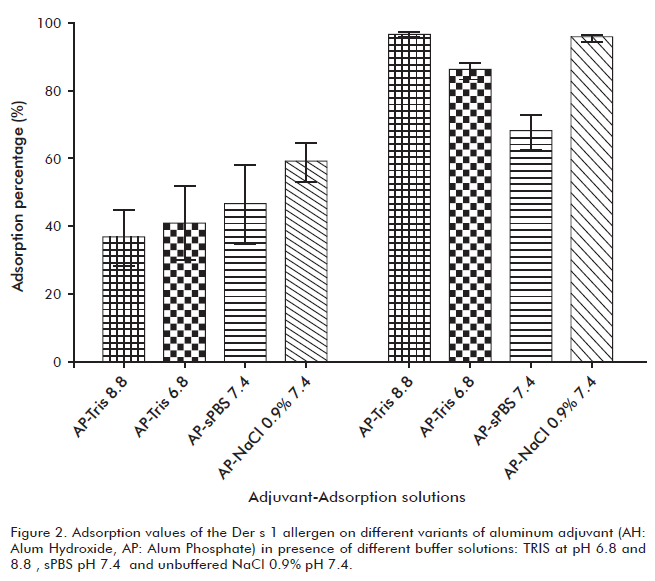
<body><![CDATA[<P   align="left" ><font face="Verdana, Arial, Helvetica, sans-serif" color="#000000" size="2">The      major allergen Der s 1 content was measured by a sandwich MAb-ELISA as described      by Serwer <I>et al</I>.(7). Briefly, Nunc Maxisorp microplates were coated      with 5F7H8F2 capture antibody (BIOCEN, Cuba). After blocking with 1% BSA and      washing out non-specific bound proteins using PBS-Tween 20, the vaccine&acute;s      supernatant samples were applied at dilutions ranging from 10 to 320. After      washing, bound Der s 1 allergen was detected using the biotin-labeled 4C1      MAb (BIOCEN, Cuba) and streptavidine peroxydase (SIGMA, USA) dilution 1:1000.      An in-house standard curve of Der s 1 was used ranging from 25 ng/mL. Reaction      was developed using 3,3&acute;,5,5&acute;-tetramethylbenzidin (TMB) and H<sub>2</sub>O<sub>2</sub>      as substrate in citrate phosphate solution, and stopped adding sulfuric acid      2.5 mol/L. Color intensity was assessed by measuring the absorbance at 450      nm using a microplate reader (Multiskan MS). </font></P >   <FONT color="#FF0000"><FONT color="#000000"><FONT color="#FF0000"><FONT size="+1" color="#000000"><FONT size="+1">        <P   align="left" ><font face="Verdana, Arial, Helvetica, sans-serif" color="#000000" size="2">Murine      allergen-specific IgG antibodies were measured by an indirect ELISA. Nunc      Maxisorp microplates were coated with 1 <font face="Symbol">m</font>g/well      of the lyophilized <I>D. siboney </I>allergen extract (BIOCEN) in sodium carbonate      - bicarbonate at pH 9.6. After incubation overnight at 4 &ordm;C and washing      out with PBS-T, blocking was performed using BSA 1% for 1 hour at 37 &ordm;C.      After washing with PBS-T, 100 <font face="Symbol">m</font>L of each mouse      sera were added into each well, diluted in 1:100 in BSA 1%, and incubated      for 2 hours at 37 &ordm;C with slow agitation. Following the washing step,      100 <font face="Symbol">m</font>L of the anti-mouse-IgG biotin conjugate (SIGMA,      USA) were applied into each well at a 1:1000 dilution, and incubated for 1      hour at 37 &ordm;C with slow agitation. Finally, after washing, 100 <font face="Symbol">m</font>L      of streptavidine peroxydase (SIGMA, USA, 1:5 000 dilution) was added and incubated      for 30 minutes at room temperature. The reaction was developed adding a tablet      of substrate mixture (Urea/H<sub>2</sub>O<sub>2</sub> and ortophenilendiamine,      OPD, SIGMA, USA) and stopped with sulfuric acid 2.5 mol/L. Color intensity      was assessed by measuring the absorbance at 450 nm using a microplate reader      (Multiskan MS). The results are expressed in optical density (OD) units. </font></P >   <FONT color="#FF00FF"><FONT color="#000000"><FONT color="#FF00FF"><FONT color="#000000"><FONT color="#FF00FF"><FONT color="#000000"><FONT color="#FF00FF"><FONT color="#000000"><FONT color="#FF00FF"><FONT color="#000000"><FONT color="#FF00FF"><FONT color="#000000"><FONT color="#FF00FF"><FONT color="#000000"><FONT color="#FF00FF"><FONT color="#000000"><FONT color="#FF0000"><FONT color="#000000"><FONT color="#FF0000"><FONT size="+1" color="#000000"><FONT size="+1">        <P   align="left" ><font face="Verdana, Arial, Helvetica, sans-serif" color="#000000" size="2"><B>Immunogenicity      study in a murine model </b></font></P >       <P   align="left" ><font face="Verdana, Arial, Helvetica, sans-serif" color="#000000" size="2">Immunogenicity      of vaccine formulation variants was tested by injecting two doses (10 <font face="Symbol">m</font>g      Der s 1) into BALB/c mice (CENPALAB, Cuba) with a 10 dayinterval by subcutaneous      route. Mice were randomly allocated in 4 groups with 6 mice in each group      (3 males and 3 females). Groups A, B and C were administered with three consecutive      pilot batches of the vaccine variant formulated with AH in saline solution      (without buffer). Group D was immunized with the negative control (AH adjuvant      in saline solution). Blood was extracted at days 0 and 17 and mice were sacrificed      at day 17. Serum allergen specific antibodies were evaluated by ELISA as described      before. </font></P >   <FONT color="#FF00FF"><FONT color="#000000">        <P   align="left" ><font face="Verdana, Arial, Helvetica, sans-serif" color="#000000" size="2"><B>Statistical      design and analysis </b></font></P >       <P   align="left" ><font face="Verdana, Arial, Helvetica, sans-serif" color="#000000" size="2">The      design of the second adsorption experiment and all the analyses were performed      using Statgraphic Centurion XV.II software (StatPoint, Inc): </font></P >       <P   align="left" ><font face="Verdana, Arial, Helvetica, sans-serif" color="#000000" size="2">A      full 2<sup>3</sup> factorial design (screening design) consisted in all combinations      of 2 levels (low and high) of the 3 experimental factors: pH, time and NaCl      concentration in unbuffered solution. All these parameters were randomly ordered      with one replicate to form the 16 runs experiment design. Experimental results      were later processed to determine each optimal response. Finally, the multiple      response optimization were used to find out the best formulation conditions.      </font></P >   <FONT color="#0000FF"><FONT size="+1" color="#000000"><FONT size="+1">        <P   align="left" ><font face="Verdana, Arial, Helvetica, sans-serif" color="#000000" size="2">Comparing      groups in the immunization experiment was performed by using two - way analysis      of variance (ANOVA) with multiple sample comparisons. Multiple range test      was used to arrange the samples into homogenous groups with no statistical      difference between their means. </font></P >       <P   align="left" ><font size="3" face="Verdana, Arial, Helvetica, sans-serif" color="#000000"><b>RESULTS</b></font><font size="2" face="Verdana, Arial, Helvetica, sans-serif" color="#000000">      </font></P >   <FONT size="+1">        <P   align="left" ><font size="2" face="Verdana, Arial, Helvetica, sans-serif" color="#000000">A      preliminary experiment was carried out to choose the best adjuvant between      AP and AH for the adsorption process and to define the best formulation solution      selecting buffers among sPBS, Tris and unbuffered NaCl . As shown in <a href="/img/revistas/bta/v27n4/f0205410.gif">figure      2</a>, the Der s 1 adsorption values of AH for all buffer solutions were higher      than those of AP. Thus, AH was chosen as the best option for next experiments.      Among the results of AH, the adsorption process using Tris (pH 8.8) and NaCl      rendered the highest adsorption percentages: 96.55% and 95.63%, respectively;      meanwhile, the lowest value was shown with sPBS. Although Tris buffer showed      the highest adsorption value, NaCl solution was chosen for further experiments      due to its well-established compatibility for the injectable route of administration,      from the lack of toxicity point of view. </font></P >   <FONT size="+1"><FONT color="#FF00FF"><FONT color="#000000">        
]]></body>
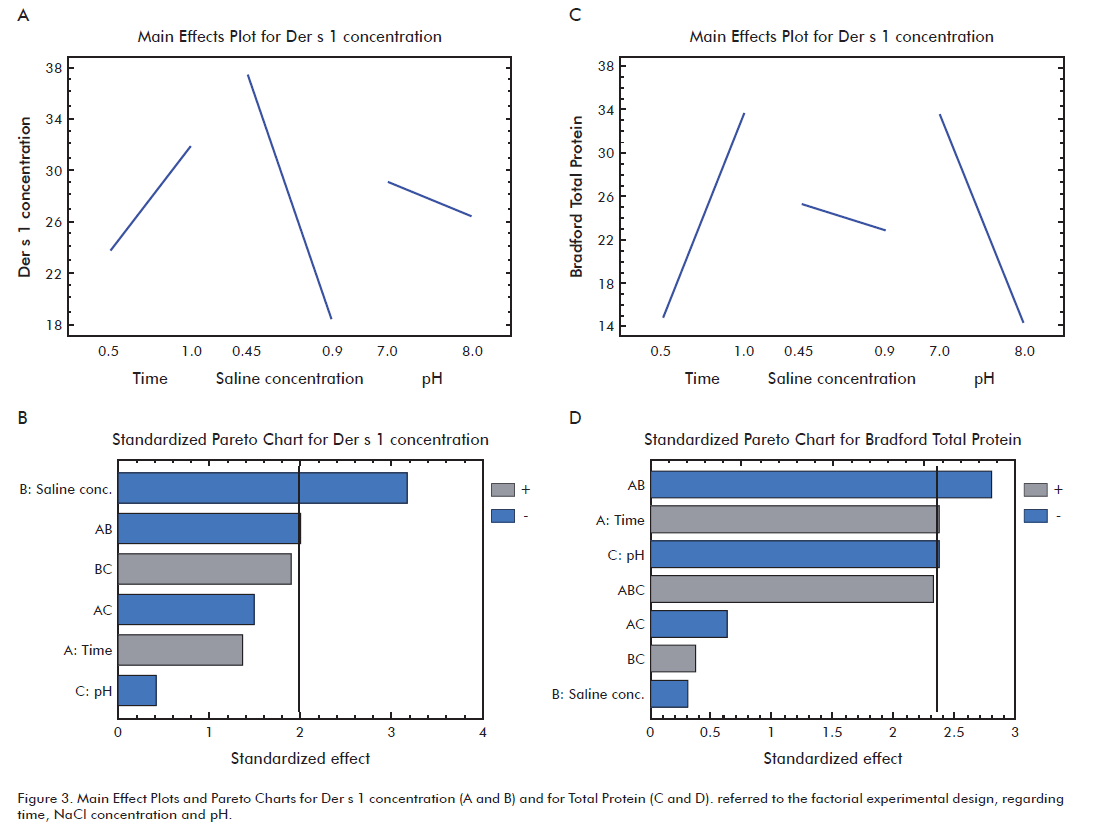
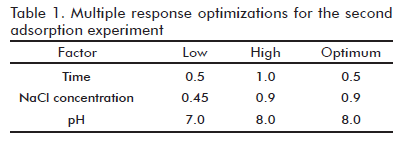
<body><![CDATA[<P   align="left" ><font face="Verdana, Arial, Helvetica, sans-serif" color="#000000" size="2">Since      AH was the best adsorptive adjuvant, a second adsorption experiment was performed      to define the optimal conditions for the adsorption process using AH. The      screening experimental design was carried out with 3 factors (adsorption time,      NaCl concentration and pH) at 2 levels (low and high) with one replicate.      NaCl solution was utilized at eight different conditions: concentrations 0.45%      and 0.9%, adjusted at pH 7 or 8, and time intervals of 0.5 and 1 hour, in      order to determine the effect of these variables on the adsorption process.      No changes of the pH values were detected during the formulation process.      </font></P >       <P   align="left" ><font face="Verdana, Arial, Helvetica, sans-serif" color="#000000" size="2">Main      Effect plots of the three variables, regarding their influence on adsorption      of the Der s 1 allergen and total protein are shown in <a href="/img/revistas/bta/v27n4/f0305410.gif">figure      3</a>. Regarding Der s 1 adsorption (the main quality parameter) the variable      with the greater (significant) effect was the NaCl concentration (<a href="/img/revistas/bta/v27n4/f0305410.gif">Figure      3B</a>): increasing this concentration from 0.45 to 0.9% significantly decreased      the amount of target antigen in the supernatant, i.e. increased the adsorption      effect (<a href="/img/revistas/bta/v27n4/f0305410.gif">Figure 3A</a>).      The influence of the other variables (time and pH) was not significant, (p      &gt; 0.05). In contrast, saline concentration was not significant regarding      adsorption of total proteins, as measured by the Bradford technique. Unexpectedly,      increasing time from 0.5 to 1 hour decreased protein adsorption values. On      the other hand, increasing pH from 7.0 to 8.0 significantly improved total      protein adsorption (<a href="/img/revistas/bta/v27n4/f0305410.gif">Figure      3C</a>). The interaction between time and saline concentration was significant      according to Pareto analysis (<a href="/img/revistas/bta/v27n4/f0305410.gif">Figure      3D</a>). Taking into account these apparently contradictory results a multiple      response optimization was performed (The results are shown in <a href="#tab1">table      1</a>). According to this approach, the optimal variant chosen for further      experiments was a saline concentration of 0.9% (corresponding to physiological      level), 0.5 hour of adsorption time and a pH value of 8.0. </font></P >       
<P   align="center" ><img src="/img/revistas/bta/v27n4/t0105410.gif"><a name="tab1"></a></P >   <FONT color="#FF00FF"><FONT color="#000000"><FONT color="#FF00FF"><FONT color="#000000"><FONT color="#FF00FF"><FONT color="#000000"><FONT color="#FF00FF"><FONT color="#000000"><FONT color="#FF00FF"><FONT color="#000000"><FONT color="#FF00FF"><FONT color="#000000">        
<P   align="left" ><font face="Verdana, Arial, Helvetica, sans-serif" color="#000000" size="2">Using      fixed optimized conditions, a third experiment was performed in order to check      if the addition of buffer (sPBS) would, in fact, affect the adsorption process,      as seen in the first preliminary experiment. AH adjuvant was used as before,      to adsorb the allergen into NaCl formulation solution in presence or absence      of sPBS buffer. </font></P >       <P   align="left" ><font face="Verdana, Arial, Helvetica, sans-serif" color="#000000" size="2">The      results of this experiment confirmed the deleterious effect of phosphate buffer      on Der s 1 adsorption. The highest adsorption values (more than 99%) were      obtained by the variants without sPBS (runs 1 and 2, <a href="#fig4">Figure      4</a>). Adding sPBS either during the adsorption process (run 3) or at the      end of this process (runs 1B and 2B), resulted both in lower and insufficient      adsorption values, ranging from 63% to 65%. </font></P >       <P   align="center" ><img src="/img/revistas/bta/v27n4/f0405410.gif"><a name="fig4"></a></P >   <FONT color="#FF00FF"><FONT color="#000000">        
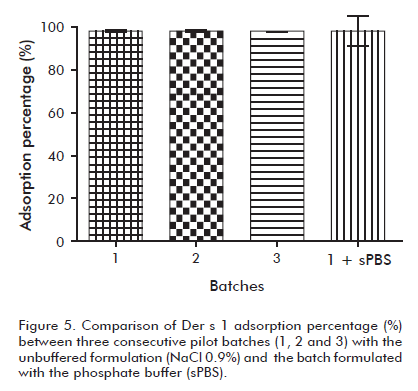
<P   align="left" ><font face="Verdana, Arial, Helvetica, sans-serif" color="#000000" size="2">The      consistency of quality parameters is a requisite of Good Manufacturing Practices      (GMP) for pharmaceutical products. After confirming the negative effect of      the phosphate containing buffer in the adsorption process, a fourth experiment      was carried out in order to test the between-batch consistency of the adsorption      process following optimal conditions, in absence of buffer. </font></P >       <P   align="left" ><font face="Verdana, Arial, Helvetica, sans-serif" color="#000000" size="2">The      Der s 1 adsorption values of three consecutive pilot scale batches prepared      in aseptic conditions are shown in <a href="#fig5">figure 5</a>. The obtained      adsorption values were 98.7% as an average, and significantly higher than      the poor adsorption reported by a batch prepared with sPBS, in aseptic conditions      as well. The consistency between batches can also be appreciated in <a href="#fig5">figure      5</a>, where error bars overlap each other, indicating that there were no      significant differences between the means (p &lt; 0.05). </font></P >       <P   align="center" ><img src="/img/revistas/bta/v27n4/f0505410.gif"><a name="fig5"></a></P >   <FONT color="#FF00FF"><FONT color="#000000"><FONT color="#FF00FF"><FONT color="#000000">        
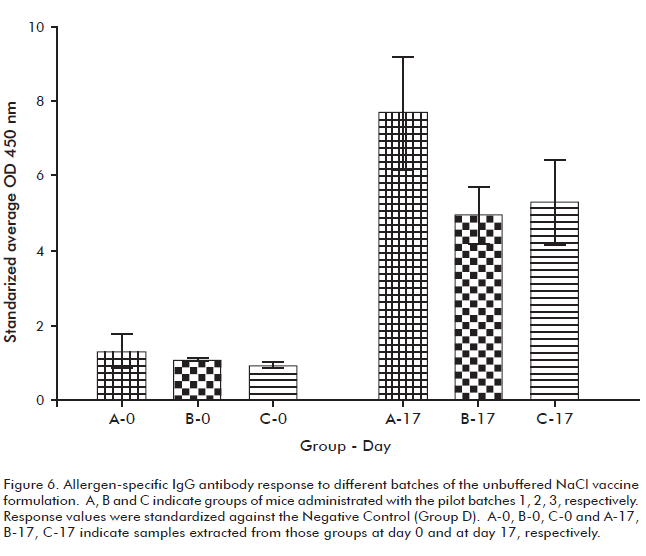
<P   align="left" ><font face="Verdana, Arial, Helvetica, sans-serif" color="#000000" size="2">For      testing the immunogenicity of the GMP pilot batches, as the ultimate quality      criterion, an immunization schedule was performed in mice. As can be noted      in <a href="/img/revistas/bta/v27n4/f0605410.gif">figure 6</a> and by      using the statistical multiple range test, IgG antibody titters were defined      to be significantly higher at day 17 (one week after the last injection) as      compared to day 0 for all groups that received the vaccine, indicating that      the vaccine evidently induced the expected allergen-specific antibody response.      Furthermore, the multiple sample ANOVA comparisons demonstrated that the differences      between batches at day 17 were statistically not significant, thus confirming      the consistency of quality parameters. </font></P >   <FONT color="#FF00FF"><FONT color="#000000">        
]]></body>
<body><![CDATA[<P   align="left" ><font size="3" face="Verdana, Arial, Helvetica, sans-serif" color="#000000"><b>DISCUSSION</b></font><font size="2" face="Verdana, Arial, Helvetica, sans-serif" color="#000000">      </font></P >   <FONT size="+1">        <P   align="left" ><font size="2" face="Verdana, Arial, Helvetica, sans-serif" color="#000000">According      to the first adsorption experiment, confirmed later by the third experiment,      phosphate containing solution affected the adsorption process, or even desorbed      already adsorbed allergen proteins. Such effect has been reported previously      for other vaccine formulations containing certain proteins (8, 9) or oligonucleotides      (10). In agreement with this result AP showed decreased adsorption capacity      as compared to AH. Taken together, these results suggest that electrostatic      attraction could be the main mechanism of adsorption of Der s 1 to alum adjuvants,      since AP and Der s 1 would have the same charge at neutral pH. One possible      explanation of a decreased adsorption in presence of phosphate ions, would      be the displacement of hydroxyl groups by phosphate ions, leading to the partial      transformation of AH into aluminum hydroxyphosphate (8, 9), leading to a decrease      of the PZC, and therefore, decreasing the ability to adsorb Der s 1. </font></P >   <FONT size="+1">        <P   align="left" ><font face="Verdana, Arial, Helvetica, sans-serif" color="#000000" size="2">According      to the last adsorption experiment and the immunization schedule, the results      obtained using non-buffered saline solutions showed high and consistent adsorption      levels and the vaccine showed to be immunogenic in mice. Buffers are commonly      used in vaccine formulations in order to maintain the pH unchanged, assuring      thus, the chemical stability of the formulation. Particularly, for injectable      drug products buffers should be compatible with physiological medium. In contrast,      our results showed no advantage in using phosphate buffered saline, a very      common buffer used for human vaccines. Nevertheless, real time stability studies      should be performed later in order to look for possible changes in pH values.      Another possibility would be to investigate other buffers compatible for the      injection route. </font></P >       <P   align="left" ><font face="Verdana, Arial, Helvetica, sans-serif" color="#000000" size="2">Adsorption      values found in our work (over 98%) are regarded as very suitable as compared      to quality specifications of marketed allergen vaccines, which usually establish      a limit of at least 90% adsorption (11). The efficacy of this formulation      could be judged by the immunogenicity in terms of allergen-specific IgG production,      using only two injections. </font></P >       <P   align="left" ><font size="3" face="Verdana, Arial, Helvetica, sans-serif" color="#000000"><b>CONCLUSIONS</b></font><font size="2" face="Verdana, Arial, Helvetica, sans-serif" color="#000000">      </font></P >   <FONT size="+1">        <P   align="left" ><font size="2" face="Verdana, Arial, Helvetica, sans-serif" color="#000000">It      is concluded that the main mechanism of the adsorption process of Der s 1      into aluminum adjuvants is the electrostatic attraction. Therefore, AH showed      advantage over AP regarding the adsorption level. NaCl solution was suitable      for this adsorption process, while PBS buffer showed a negative effect to      the adsorption of Der s 1 allergen. The consistency of the adsorption process      and vaccine immunogenicity in mice, in absence of phosphate buffer, was clearly      demonstrated. </font></P >   <FONT size="+1">        <P   align="left" ><font size="3" face="Verdana, Arial, Helvetica, sans-serif" color="#000000"><b>ACKNOWLEDGEMENT</b></font><font size="2" face="Verdana, Arial, Helvetica, sans-serif" color="#000000">      </font></P >   <FONT size="+1">        <P   align="left" ><font size="2" face="Verdana, Arial, Helvetica, sans-serif" color="#000000">We      are grateful to the colleagues at the animal facility of BIOCEN that help      us in the immunization study. </font></P >   <FONT size="+1">        <P   align="left" > </P >       <P   align="left" ><font face="Verdana, Arial, Helvetica, sans-serif" color="#000000" size="3"><b>REFERENCES</b></font><font face="Verdana, Arial, Helvetica, sans-serif" color="#000000" size="2">      </font></P >       ]]></body>
<body><![CDATA[<!-- ref --><P   align="left" ><font face="Verdana, Arial, Helvetica, sans-serif" size="2">1. Bousquet J, Lockey      R, Malling HJ. Allergen immunotherapy: therapeutic vaccines for allergic diseases.      A WHO position paper. J Allergy Clin Immunol 1998;102(4 Pt 1):558-62. </font></P >   </font></font></font></font></font></font></font></font></font></font></font></font></font></font></font></font></font></font></font></font></font></font></font></font></font></font></font></font></font></font></font></font></font></font></font></font></font></font></font></font></font></font></font></font></font></font></font></font></font></font></font></font></font></font></font></font></font></font></font></font></font></font></font></font></font></font></font></font></font></font></font></font></font></font></font></font></font></font></font></font></font></font></font></font></font></font></font></font></font></font></font>        <!-- ref --><p><font face="Verdana, Arial, Helvetica, sans-serif" size="2">2. Morefield      GL, Sokolovska A, Jiang D, HogenEsch H, Robinson JP, Hem SL. Role of aluminum-containing      adjuvants in antigen internalization by dendritic cells in vitro. Vaccine      2005;23:1588-95. </font><!-- ref --><p><font face="Verdana, Arial, Helvetica, sans-serif" size="2">3. Gupta RK.      Aluminum compounds as vaccines adjuvants. Adv Drug Deliv Rev 1998;32:155-72.      </font><!-- ref --><p><font face="Verdana, Arial, Helvetica, sans-serif" size="2">4. Ferr&aacute;ndiz      R, Casas R, Dreborg S, Einarsson R, Bonachea I, Chapman M. Characterization      of allergenic components from house dust mite <i>Dermatophagoides siboney</i>.      Purification of Der s 1 and Der s 2 allergens. Clin Exp Allergy 1995; 25:922-8.      </font><p><font face="Verdana, Arial, Helvetica, sans-serif" size="2">5. Hem SL, White      JL. Structure and properties of aluminum-containing adjuvants. In: Vaccine      Design: the Subunit and Adjuvant Approach. Powell MF and Newman MJ (editors),      New York: Plenum Press, 1995, p. 249-76. </font></p>       <!-- ref --><p><font face="Verdana, Arial, Helvetica, sans-serif" size="2">6. Bradford MM.      A rapid and sensitive method for the quantitation of microgram quantities      of protein utilizing the principle of protein-dye binding. Anal Biochem 1976;72:248-54.      </font><!-- ref --><p><font face="Verdana, Arial, Helvetica, sans-serif" size="2">7. Sewer M, Uyema      K, Labrada M, Coca MA, Gonz&aacute;lez M. Monoclonal Antibodies against Der      s 1, a Major Allergen of <i>Dermatophagoides siboney</i>. Int Arch Allergy      Immunol 2000;123:242-8. </font><!-- ref --><p><font face="Verdana, Arial, Helvetica, sans-serif" size="2">8. Vessely C,      Estey T, Randolph TW, Henderson I, Nayar R, Carpenter JF. Effects of solution      conditions and surface chemistry on the adsorption of three recombinant botulinum      neurotoxin antigens to aluminum salt adjuvants. J Pharm Sci 2006; 96:2375-89.      </font><!-- ref --><p><font face="Verdana, Arial, Helvetica, sans-serif" size="2">9. Rinella JV      Jr, White JL, Hem SL. Treatment of aluminum hydroxide adjuvant to optimize      the adsorption of basic protein. Vaccine 1996; 14(4):298-300. </font><!-- ref --><p><font face="Verdana, Arial, Helvetica, sans-serif" size="2">10. Aebig JA,      Mullen GED, Dobrescu G, Rausch K, Lambert L, Ajose-Popoola O, <i>et al</i>.      Formulation of vaccines containing CpG oligonucleotides and alum. J Immunol      Methods 2007;323:139-46. </font><!-- ref --><p><font face="Verdana, Arial, Helvetica, sans-serif" size="2">11. European      Pharmacopoeia, monograph 1063, Allergen Products. 3rd Edition, 1997.</font>    <br>   </p>   <FONT size="+1" color="#000000"><FONT size="+1"><FONT size="+1"><FONT size="+1"><FONT size="+1"><FONT size="+1"><FONT size="+1"><FONT size="+1"><FONT size="+1"><FONT size="+1"><FONT size="+1"><FONT size="+1"><FONT size="+1"><FONT size="+1"><FONT size="+1"><FONT size="+1"><FONT size="+1"><FONT size="+1"><FONT color="#0000FF"><FONT color="#000000"><FONT size="+1"><FONT size="+1"><FONT color="#FF00FF"><FONT color="#000000"><FONT size="+1"><FONT size="+1"><FONT color="#FF00FF"><FONT color="#000000"><FONT color="#FF00FF"><FONT color="#000000"><FONT color="#FF0000"><FONT color="#000000"><FONT color="#FF0000"><FONT size="+1" color="#000000"><FONT size="+1"><FONT color="#FF00FF"><FONT color="#000000"><FONT color="#FF00FF"><FONT color="#000000"><FONT color="#FF00FF"><FONT color="#000000"><FONT color="#FF00FF"><FONT color="#000000"><FONT color="#FF00FF"><FONT color="#000000"><FONT color="#FF00FF"><FONT color="#000000"><FONT color="#FF00FF"><FONT color="#000000"><FONT color="#FF00FF"><FONT color="#000000"><FONT color="#FF0000"><FONT color="#000000"><FONT color="#FF0000"><FONT size="+1" color="#000000"><FONT size="+1"><FONT color="#FF00FF"><FONT color="#000000"><FONT color="#0000FF"><FONT size="+1" color="#000000"><FONT size="+1"><FONT size="+1"><FONT size="+1"><FONT color="#FF00FF"><FONT color="#000000"><FONT color="#FF00FF"><FONT color="#000000"><FONT color="#FF00FF"><FONT color="#000000"><FONT color="#FF00FF"><FONT color="#000000"><FONT color="#FF00FF"><FONT color="#000000"><FONT color="#FF00FF"><FONT color="#000000"><FONT color="#FF00FF"><FONT color="#000000"><FONT color="#FF00FF"><FONT color="#000000"><FONT color="#FF00FF"><FONT color="#000000"><FONT color="#FF00FF"><FONT color="#000000"><FONT color="#FF00FF"><FONT color="#000000"><FONT size="+1"><FONT size="+1"><FONT size="+1"><FONT size="+1"><FONT size="+1"><FONT size="+1"><FONT size="+1">        <P   align="left" > </P >       <P   align="left" ><font size="2" face="Verdana, Arial, Helvetica, sans-serif" color="#000000">Received      in April, 2010.     <br>     Accepted for publication in December, 2010. </font></P >   <FONT size="+1">        <P   align="left" > </P >   <font face="Verdana, Arial, Helvetica, sans-serif" color="#000000" size="2">Cam    Anh Nguyen, Division of Medical Biotechnology, Biotechnology Centre of Ho Chi    Minh City, Vietnam. E-mail: <a href="mailto:camanh_nguyenphuoc@hcmbiotech.com.vn">camanh_nguyenphuoc@hcmbiotech.com.vn</a></font></font></font></font></font></font></font></font></font></font></font></font></font></font></font></font></font></font></font></font></font></font></font></font></font></font></font></font></font></font></font></font></font></font></font></font></font></font></font></font></font></font></font></font></font></font></font></font></font></font></font></font></font></font></font></font></font></font></font></font></font></font></font></font></font></font></font></font></font></font></font></font></font></font></font></font></font></font></font></font></font></font></font></font></font></font></font></font></font></font></font></font></font></font></DIV >      ]]></body><back>
<ref-list>
<ref id="B1">
<label>1</label><nlm-citation citation-type="journal">
<person-group person-group-type="author">
<name>
<surname><![CDATA[Bousquet]]></surname>
<given-names><![CDATA[J]]></given-names>
</name>
<name>
<surname><![CDATA[Lockey]]></surname>
<given-names><![CDATA[R]]></given-names>
</name>
<name>
<surname><![CDATA[Malling]]></surname>
<given-names><![CDATA[HJ]]></given-names>
</name>
</person-group>
<article-title xml:lang="en"><![CDATA[Allergen immunotherapy: therapeutic vaccines for allergic diseases. A WHO position paper]]></article-title>
<source><![CDATA[J Allergy Clin Immunol]]></source>
<year>1998</year>
<volume>102</volume>
<numero>4 Pt 1</numero>
<issue>4 Pt 1</issue>
<page-range>558-62</page-range></nlm-citation>
</ref>
<ref id="B2">
<label>2</label><nlm-citation citation-type="journal">
<person-group person-group-type="author">
<name>
<surname><![CDATA[Morefield]]></surname>
<given-names><![CDATA[GL]]></given-names>
</name>
<name>
<surname><![CDATA[Sokolovska]]></surname>
<given-names><![CDATA[A]]></given-names>
</name>
<name>
<surname><![CDATA[Jiang]]></surname>
<given-names><![CDATA[D]]></given-names>
</name>
<name>
<surname><![CDATA[HogenEsch]]></surname>
<given-names><![CDATA[H]]></given-names>
</name>
<name>
<surname><![CDATA[Robinson]]></surname>
<given-names><![CDATA[JP]]></given-names>
</name>
<name>
<surname><![CDATA[Hem]]></surname>
<given-names><![CDATA[SL]]></given-names>
</name>
</person-group>
<article-title xml:lang="en"><![CDATA[Role of aluminum-containing adjuvants in antigen internalization by dendritic cells in vitro]]></article-title>
<source><![CDATA[Vaccine]]></source>
<year>2005</year>
<volume>23</volume>
<page-range>1588-95</page-range></nlm-citation>
</ref>
<ref id="B3">
<label>3</label><nlm-citation citation-type="journal">
<person-group person-group-type="author">
<name>
<surname><![CDATA[Gupta]]></surname>
<given-names><![CDATA[RK]]></given-names>
</name>
</person-group>
<article-title xml:lang="en"><![CDATA[Aluminum compounds as vaccines adjuvants]]></article-title>
<source><![CDATA[Adv Drug Deliv Rev]]></source>
<year>1998</year>
<volume>32</volume>
<page-range>155-72</page-range></nlm-citation>
</ref>
<ref id="B4">
<label>4</label><nlm-citation citation-type="journal">
<person-group person-group-type="author">
<name>
<surname><![CDATA[Ferrándiz]]></surname>
<given-names><![CDATA[R]]></given-names>
</name>
<name>
<surname><![CDATA[Casas]]></surname>
<given-names><![CDATA[R]]></given-names>
</name>
<name>
<surname><![CDATA[Dreborg]]></surname>
<given-names><![CDATA[S]]></given-names>
</name>
<name>
<surname><![CDATA[Einarsson]]></surname>
<given-names><![CDATA[R]]></given-names>
</name>
<name>
<surname><![CDATA[Bonachea]]></surname>
<given-names><![CDATA[I]]></given-names>
</name>
<name>
<surname><![CDATA[Chapman]]></surname>
<given-names><![CDATA[M]]></given-names>
</name>
</person-group>
<article-title xml:lang="en"><![CDATA[Characterization of allergenic components from house dust mite Dermatophagoides siboney: Purification of Der s 1 and Der s 2 allergens]]></article-title>
<source><![CDATA[Clin Exp Allergy]]></source>
<year>1995</year>
<volume>25</volume>
<page-range>922-8</page-range></nlm-citation>
</ref>
<ref id="B5">
<label>5</label><nlm-citation citation-type="book">
<person-group person-group-type="author">
<name>
<surname><![CDATA[Hem]]></surname>
<given-names><![CDATA[SL]]></given-names>
</name>
<name>
<surname><![CDATA[White]]></surname>
<given-names><![CDATA[JL]]></given-names>
</name>
</person-group>
<article-title xml:lang="en"><![CDATA[Structure and properties of aluminum-containing adjuvants]]></article-title>
<person-group person-group-type="editor">
<name>
<surname><![CDATA[Powell]]></surname>
<given-names><![CDATA[MF]]></given-names>
</name>
<name>
<surname><![CDATA[Newman]]></surname>
<given-names><![CDATA[MJ]]></given-names>
</name>
</person-group>
<source><![CDATA[Vaccine Design: the Subunit and Adjuvant Approach]]></source>
<year>1995</year>
<page-range>249-76</page-range><publisher-loc><![CDATA[New York ]]></publisher-loc>
<publisher-name><![CDATA[Plenum Press]]></publisher-name>
</nlm-citation>
</ref>
<ref id="B6">
<label>6</label><nlm-citation citation-type="journal">
<person-group person-group-type="author">
<name>
<surname><![CDATA[Bradford]]></surname>
<given-names><![CDATA[MM]]></given-names>
</name>
</person-group>
<article-title xml:lang="en"><![CDATA[A rapid and sensitive method for the quantitation of microgram quantities of protein utilizing the principle of protein-dye binding]]></article-title>
<source><![CDATA[Anal Biochem]]></source>
<year>1976</year>
<volume>72</volume>
<page-range>248-54</page-range></nlm-citation>
</ref>
<ref id="B7">
<label>7</label><nlm-citation citation-type="journal">
<person-group person-group-type="author">
<name>
<surname><![CDATA[Sewer]]></surname>
<given-names><![CDATA[M]]></given-names>
</name>
<name>
<surname><![CDATA[Uyema]]></surname>
<given-names><![CDATA[K]]></given-names>
</name>
<name>
<surname><![CDATA[Labrada]]></surname>
<given-names><![CDATA[M]]></given-names>
</name>
<name>
<surname><![CDATA[Coca]]></surname>
<given-names><![CDATA[MA]]></given-names>
</name>
<name>
<surname><![CDATA[González]]></surname>
<given-names><![CDATA[M]]></given-names>
</name>
</person-group>
<article-title xml:lang="en"><![CDATA[Monoclonal Antibodies against Der s 1, a Major Allergen of Dermatophagoides siboney]]></article-title>
<source><![CDATA[Int Arch Allergy Immunol]]></source>
<year>2000</year>
<volume>123</volume>
<page-range>242-8</page-range></nlm-citation>
</ref>
<ref id="B8">
<label>8</label><nlm-citation citation-type="journal">
<person-group person-group-type="author">
<name>
<surname><![CDATA[Vessely]]></surname>
<given-names><![CDATA[C]]></given-names>
</name>
<name>
<surname><![CDATA[Estey]]></surname>
<given-names><![CDATA[T]]></given-names>
</name>
<name>
<surname><![CDATA[Randolph]]></surname>
<given-names><![CDATA[TW]]></given-names>
</name>
<name>
<surname><![CDATA[Henderson]]></surname>
<given-names><![CDATA[I]]></given-names>
</name>
<name>
<surname><![CDATA[Nayar]]></surname>
<given-names><![CDATA[R]]></given-names>
</name>
<name>
<surname><![CDATA[Carpenter]]></surname>
<given-names><![CDATA[JF]]></given-names>
</name>
</person-group>
<article-title xml:lang="en"><![CDATA[Effects of solution conditions and surface chemistry on the adsorption of three recombinant botulinum neurotoxin antigens to aluminum salt adjuvants]]></article-title>
<source><![CDATA[J Pharm Sci]]></source>
<year>2006</year>
<volume>96</volume>
<page-range>2375-89</page-range></nlm-citation>
</ref>
<ref id="B9">
<label>9</label><nlm-citation citation-type="journal">
<person-group person-group-type="author">
<name>
<surname><![CDATA[Rinella]]></surname>
<given-names><![CDATA[JV]]></given-names>
</name>
<name>
<surname><![CDATA[White]]></surname>
<given-names><![CDATA[JL]]></given-names>
</name>
<name>
<surname><![CDATA[Hem]]></surname>
<given-names><![CDATA[SL]]></given-names>
</name>
</person-group>
<article-title xml:lang="en"><![CDATA[Treatment of aluminum hydroxide adjuvant to optimize the adsorption of basic protein]]></article-title>
<source><![CDATA[Vaccine]]></source>
<year>1996</year>
<volume>14</volume>
<numero>4</numero>
<issue>4</issue>
<page-range>298-300</page-range></nlm-citation>
</ref>
<ref id="B10">
<label>10</label><nlm-citation citation-type="journal">
<person-group person-group-type="author">
<name>
<surname><![CDATA[Aebig]]></surname>
<given-names><![CDATA[JA]]></given-names>
</name>
<name>
<surname><![CDATA[Mullen]]></surname>
<given-names><![CDATA[GED]]></given-names>
</name>
<name>
<surname><![CDATA[Dobrescu]]></surname>
<given-names><![CDATA[G]]></given-names>
</name>
<name>
<surname><![CDATA[Rausch]]></surname>
<given-names><![CDATA[K]]></given-names>
</name>
<name>
<surname><![CDATA[Lambert]]></surname>
<given-names><![CDATA[L]]></given-names>
</name>
<name>
<surname><![CDATA[Ajose-Popoola]]></surname>
<given-names><![CDATA[O]]></given-names>
</name>
</person-group>
<article-title xml:lang="en"><![CDATA[Formulation of vaccines containing CpG oligonucleotides and alum]]></article-title>
<source><![CDATA[J Immunol Methods]]></source>
<year>2007</year>
<volume>323</volume>
<page-range>139-46</page-range></nlm-citation>
</ref>
<ref id="B11">
<label>11</label><nlm-citation citation-type="">
<source><![CDATA[European Pharmacopoeia: monograph 1063, Allergen Products]]></source>
<year>1997</year>
<edition>3</edition>
</nlm-citation>
</ref>
</ref-list>
</back>
</article>