<?xml version="1.0" encoding="ISO-8859-1"?><article xmlns:mml="http://www.w3.org/1998/Math/MathML" xmlns:xlink="http://www.w3.org/1999/xlink" xmlns:xsi="http://www.w3.org/2001/XMLSchema-instance">
<front>
<journal-meta>
<journal-id>1027-2852</journal-id>
<journal-title><![CDATA[Biotecnología Aplicada]]></journal-title>
<abbrev-journal-title><![CDATA[Biotecnol Apl]]></abbrev-journal-title>
<issn>1027-2852</issn>
<publisher>
<publisher-name><![CDATA[Editorial Elfos Scientiae]]></publisher-name>
</publisher>
</journal-meta>
<article-meta>
<article-id>S1027-28522010000400008</article-id>
<title-group>
<article-title xml:lang="en"><![CDATA[Chitosans as bioactive macromolecules to protect conomically relevant crops from their main pathogens]]></article-title>
</title-group>
<contrib-group>
<contrib contrib-type="author">
<name>
<surname><![CDATA[Falcón Rodríguez]]></surname>
<given-names><![CDATA[Alejandro]]></given-names>
</name>
<xref ref-type="aff" rid="A01"/>
</contrib>
<contrib contrib-type="author">
<name>
<surname><![CDATA[Rodríguez]]></surname>
<given-names><![CDATA[Aida T]]></given-names>
</name>
<xref ref-type="aff" rid="A02"/>
</contrib>
<contrib contrib-type="author">
<name>
<surname><![CDATA[Ramírez]]></surname>
<given-names><![CDATA[Miguel A]]></given-names>
</name>
<xref ref-type="aff" rid="A02"/>
</contrib>
<contrib contrib-type="author">
<name>
<surname><![CDATA[Rivero]]></surname>
<given-names><![CDATA[Deyanira]]></given-names>
</name>
<xref ref-type="aff" rid="A02"/>
</contrib>
<contrib contrib-type="author">
<name>
<surname><![CDATA[Martínez]]></surname>
<given-names><![CDATA[Benedicto]]></given-names>
</name>
<xref ref-type="aff" rid="A03"/>
</contrib>
<contrib contrib-type="author">
<name>
<surname><![CDATA[Cabrera]]></surname>
<given-names><![CDATA[Juan C]]></given-names>
</name>
<xref ref-type="aff" rid="A04"/>
</contrib>
<contrib contrib-type="author">
<name>
<surname><![CDATA[Costales]]></surname>
<given-names><![CDATA[Daimy]]></given-names>
</name>
<xref ref-type="aff" rid="A01"/>
</contrib>
<contrib contrib-type="author">
<name>
<surname><![CDATA[Cruz]]></surname>
<given-names><![CDATA[Ariel]]></given-names>
</name>
<xref ref-type="aff" rid="A02"/>
</contrib>
<contrib contrib-type="author">
<name>
<surname><![CDATA[González]]></surname>
<given-names><![CDATA[Luis G]]></given-names>
</name>
<xref ref-type="aff" rid="A05"/>
</contrib>
<contrib contrib-type="author">
<name>
<surname><![CDATA[Jiménez]]></surname>
<given-names><![CDATA[María C]]></given-names>
</name>
<xref ref-type="aff" rid="A05"/>
</contrib>
<contrib contrib-type="author">
<name>
<surname><![CDATA[Jiménez]]></surname>
<given-names><![CDATA[Leonel]]></given-names>
</name>
<xref ref-type="aff" rid="A05"/>
</contrib>
<contrib contrib-type="author">
<name>
<surname><![CDATA[Hernández]]></surname>
<given-names><![CDATA[Ileana]]></given-names>
</name>
<xref ref-type="aff" rid="A01"/>
</contrib>
<contrib contrib-type="author">
<name>
<surname><![CDATA[Gonzáles Peña]]></surname>
<given-names><![CDATA[Dianevys]]></given-names>
</name>
<xref ref-type="aff" rid="A01"/>
</contrib>
<contrib contrib-type="author">
<name>
<surname><![CDATA[Márquez]]></surname>
<given-names><![CDATA[Ramona]]></given-names>
</name>
<xref ref-type="aff" rid="A01"/>
</contrib>
</contrib-group>
<aff id="A02">
<institution><![CDATA[,Instituto Nacional de Ciencias Agrícolas Los Palacios Estación experimental del Arroz ]]></institution>
<addr-line><![CDATA[Pinar del Río ]]></addr-line>
<country>Cuba</country>
</aff>
<aff id="A03">
<institution><![CDATA[,Centro Nacional de Sanidad Agropecuaria Departamento de Protección de Plantas ]]></institution>
<addr-line><![CDATA[La Habana ]]></addr-line>
<country>Cuba</country>
</aff>
<aff id="A04">
<institution><![CDATA[,Universidad Notre Damme de la Paix Namur Facultad de Agricultura Departamento de Biología Celular Vegetal]]></institution>
<addr-line><![CDATA[ ]]></addr-line>
<country>Bélgica</country>
</aff>
<aff id="A05">
<institution><![CDATA[,Universidad de Granma Facultad de Agronomía ]]></institution>
<addr-line><![CDATA[Granma ]]></addr-line>
<country>Cuba</country>
</aff>
<aff id="A01">
<institution><![CDATA[,Instituto Nacional de Ciencias Agrícolas Departamento de Fisiología y Bioquímica Vegetal ]]></institution>
<addr-line><![CDATA[La Habana ]]></addr-line>
<country>Cuba</country>
</aff>
<pub-date pub-type="pub">
<day>00</day>
<month>12</month>
<year>2010</year>
</pub-date>
<pub-date pub-type="epub">
<day>00</day>
<month>12</month>
<year>2010</year>
</pub-date>
<volume>27</volume>
<numero>4</numero>
<fpage>305</fpage>
<lpage>309</lpage>
<copyright-statement/>
<copyright-year/>
<self-uri xlink:href="http://scielo.sld.cu/scielo.php?script=sci_arttext&amp;pid=S1027-28522010000400008&amp;lng=en&amp;nrm=iso"></self-uri><self-uri xlink:href="http://scielo.sld.cu/scielo.php?script=sci_abstract&amp;pid=S1027-28522010000400008&amp;lng=en&amp;nrm=iso"></self-uri><self-uri xlink:href="http://scielo.sld.cu/scielo.php?script=sci_pdf&amp;pid=S1027-28522010000400008&amp;lng=en&amp;nrm=iso"></self-uri><abstract abstract-type="short" xml:lang="en"><p><![CDATA[Studies were carried out as part of the Agriculture Biotechnology program, to prepare and characterize chemically and biologically different chitosans obtained from Cuban lobster chitin. Chitosan polymers were subjected to acid and enzymatic hydrolysis by using low·cost commercial enzymatic preparations, and the resulting oligosaccharide mixtures were further characterized. Their potential antimicrobial activities were also evaluated versus fungi and oomycetes, also testing their ability to induce defensive and protective responses in tobacco and rice plants against two economically relevant pests, Phytophthora nicotianae and Pyricularia grisea, respectively. With the aid of international collaboration, different oligochitosans mixtures were compared for activating defensive responses in suspension cultures of Arabidopsis thaliana cells. These results bring knowledge on the physical·chemical properties of the chitosans obtained, such as molar mass and acetylation grade, and their influence on activating defensive responses, the inhibition of growth in pathogens and the induction of resistance in tobacco and rice plants. Some of these chitosan derivatives were selected as possible active components to protect both type of cultivars, being applied at field·scale to evaluate their effects for the main natural pathogens and bringing very promising results. This research allowed us to establish a methodology for preparing oligochitosans, and results shown inhere were part of BSc, MSc and PhD theses, and were also published in more than 20 scientific papers and presented in more than 40 scientific conferences.]]></p></abstract>
<kwd-group>
<kwd lng="en"><![CDATA[chitosan]]></kwd>
<kwd lng="en"><![CDATA[enzymatic hydrolysis]]></kwd>
<kwd lng="en"><![CDATA[antifungal activity]]></kwd>
<kwd lng="en"><![CDATA[induced resistance]]></kwd>
<kwd lng="en"><![CDATA[Phytophtora nicotianae]]></kwd>
</kwd-group>
</article-meta>
</front><body><![CDATA[ <DIV class="Sect"   >        <P   align="right" ><font size="2" color="#000000" face="Verdana, Arial, Helvetica, sans-serif"><b>REPORT</b>&nbsp;</font></P >   <FONT size="+1" color="#000000">        <P   align="left" > </P >       <P   align="left" >&nbsp; </P >       <P   align="left" ><b><font color="#000000" face="Verdana, Arial, Helvetica, sans-serif" size="4">Chitosans      as bioactive macromolecules to protect conomically relevant crops from their      main pathogens</font></b><font color="#000000" face="Verdana, Arial, Helvetica, sans-serif" size="2">      </font></P >   <FONT color="#201D1E">        <P   align="left" >&nbsp;</P >       <P   align="left" >&nbsp;</P >       <P   align="left" ><font face="Verdana, Arial, Helvetica, sans-serif" color="#000000" size="2"><b>Alejandro&nbsp;Falc&oacute;n&nbsp;Rodr&iacute;guez<sup>1</sup>,&nbsp;Aida&nbsp;T&nbsp;Rodr&iacute;guez<sup>2</sup>,&nbsp;Miguel&nbsp;A&nbsp;Ram&iacute;rez<sup>2</sup>,&nbsp;Deyanira&nbsp;Rivero<sup>2</sup>,&nbsp;Benedicto&nbsp;Mart&iacute;nez<sup>3</sup>,      Juan C Cabrera<sup>4</sup>, Daimy Costales<sup>1</sup>, Ariel Cruz<sup>2</sup>,      Luis G Gonz&aacute;lez<sup>5</sup>, Mar&iacute;a C Jim&eacute;nez<sup>5</sup>,      Leonel Jim&eacute;nez<sup>5</sup>, Ileana Hern&aacute;ndez<sup>1</sup>, Dianevys      Gonz&aacute;les Pe&ntilde;a<sup>1</sup>, Ramona M&aacute;rquez<sup>1</sup></b>      </font></P >       <P   align="left" ><font face="Verdana, Arial, Helvetica, sans-serif" color="#000000" size="2">1      Departamento de Fisiolog&iacute;a y Bioqu&iacute;mica Vegetal, Instituto Nacional      de Ciencias Agr&iacute;colas La Habana, Cuba     <br>     2 Estaci&oacute;n experimental del Arroz, Instituto Nacional de Ciencias Agr&iacute;colas      Los Palacios, Pinar del R&iacute;o, Cuba     ]]></body>
<body><![CDATA[<br>     3 Departamento de Protecci&oacute;n de Plantas, Centro Nacional de Sanidad      Agropecuaria, La Habana, Cuba     <br>     4 Departamento de Biolog&iacute;a Celular Vegetal, Facultad de Agricultura,      Universidad Notre Damme de la Paix Namur, B&eacute;lgica     <br>     5 Facultad de Agronom&iacute;a, Universidad de Granma Cuba </font></P >       <P   align="left" >&nbsp;</P >   </font></font>   <hr>   <FONT size="+1" color="#000000"><FONT color="#201D1E">        <P   align="left" ><font face="Verdana, Arial, Helvetica, sans-serif" color="#000000" size="2"><B>ABSTRACT&nbsp;</b></font></P >   <FONT color="#0000FF"><FONT color="#201D1E"><FONT color="#000000">        <P   align="left" ><font face="Verdana, Arial, Helvetica, sans-serif" color="#000000" size="2">Studies      were carried out as part of the Agriculture Biotechnology program, to prepare      and characterize chemically and biologically different chitosans obtained      from Cuban lobster chitin. Chitosan polymers were subjected to acid and enzymatic      hydrolysis by using low&middot;cost commercial enzymatic preparations, and      the resulting oligosaccharide mixtures were further characterized. Their potential      antimicrobial activities were also evaluated versus fungi and oomycetes, also      testing their ability to induce defensive and protective responses in tobacco      and rice plants against two economically relevant pests, Phytophthora nicotianae      and Pyricularia grisea, respectively. With the aid of international collaboration,      different oligochitosans mixtures were compared for activating defensive responses      in suspension cultures of Arabidopsis thaliana cells. These results bring      knowledge on the physical&middot;chemical properties of the chitosans obtained,      such as molar mass and acetylation grade, and their influence on activating      defensive responses, the inhibition of growth in pathogens and the induction      of resistance in tobacco and rice plants. Some of these chitosan derivatives      were selected as possible active components to protect both type of cultivars,      being applied at field&middot;scale to evaluate their effects for the main      natural pathogens and bringing very promising results. This research allowed      us to establish a methodology for preparing oligochitosans, and results shown      inhere were part of BSc, MSc and PhD theses, and were also published in more      than 20 scientific papers and presented in more than 40 scientific conferences.</font></P >   <FONT color="#201D1E">        <P   align="left" ><font face="Verdana, Arial, Helvetica, sans-serif" color="#000000" size="2"><b>Keywords</b>:<I>&nbsp;</I>chitosan,&nbsp;enzymatic&nbsp;hydrolysis,&nbsp;antifungal&nbsp;activity,&nbsp;induced&nbsp;resistance,&nbsp;Phytophtora&nbsp;nicotianae.&nbsp;</font></P >   </font></font></font></font></font></font>   <hr>   <FONT size="+1" color="#000000"><FONT color="#201D1E"><FONT color="#0000FF"><FONT color="#201D1E"><FONT color="#000000"><FONT color="#201D1E">        <P   align="left" > </P >   <FONT color="#000000">        <P   align="justify" >&nbsp; </P >       <P   align="justify" >&nbsp;</P >       ]]></body>
<body><![CDATA[<P   align="justify" ><font color="#000000" face="Verdana, Arial, Helvetica, sans-serif" size="2"><b><font size="3">INTRODUCTION</font></b>      </font></P >   <FONT color="#201D1E">        <P   align="justify" ><font face="Verdana, Arial, Helvetica, sans-serif" color="#000000" size="2">Higher      plants are able to initiate defensive reactions in response to pathogen&acute;s      infections [1]. Those responses are triggered when the plant recognizes several      signals which are released as products of the mutual enzymatic degradation      of cell walls of both, the plants and the pathogens [2]. The resulting oligosaccharides,      also known as oligosaccharins, not only serve as primary signals of the defensive      responses, but also influence other biological responses regarding vegetal      growth and development [3, 4]. Among oligosaccharins, the cell wall pectins&acute;      oligogalacturonides, <font face="Symbol">b</font>-glucans, and the fungi cell      wall chitin and chitosan fragments are potential inducers of resistance and      protection from diverse pathogens in plants. That&acute;s the reason why they      are currently included as active components in several protective products      for agriculture [3-6]. </font></P >   <FONT color="#FF0000"><FONT color="#201D1E"><FONT color="#FF0000"><FONT color="#201D1E"><FONT color="#FF0000"><FONT color="#201D1E"><FONT color="#FF0000"><FONT color="#201D1E">        <P   align="left" ><font face="Verdana, Arial, Helvetica, sans-serif" color="#000000" size="2">Chitin      is a linear polymer of N-acetyl-glucosamine, and the second more abundant      natural polymer after cellulose. It is found on fungi cell walls and exoskeletons      of arthropods as the main production source worldwide, with more than 10 gigatons      (1 x 10<sup>13</sup> kg) produced per year. It is mainly obtained from shrimp      and crab exoskeletons, with a very small production from lobster exoskeletons      [7]. The latter are discarded in large amounts as a byproduct to the sea to      avoid environmental problems, which could be used to obtain macromolecules      highly applicable in medicine, industry and agriculture [7]. </font></P >   <FONT color="#3485FC"><FONT color="#201D1E">        <P   align="left" ><font face="Verdana, Arial, Helvetica, sans-serif" color="#000000" size="2">Chitosan,      the main chitin derivative, is a linear polymer of glucosamine monomers linked      by <font face="Symbol">b</font> 1-4 bonds and it is obtained by alkaline deacetylation.      This process produces a polymer soluble in diluted acids, which is advantageous      over chitin for agricultural use. On this field, chitosans and their derivatives      of lower molecular weights could be applied, based on their proven biological      potentialities, such as signifi-cant antimicrobial activity on the growth      and development of fungi, bacteria and oomycetes [5, 8]; protec-tion of plants      from potential pathogens and promotion of cultivar growth and development      [5, 6]. </font></P >   <FONT color="#FF0000"><FONT color="#201D1E">        <P   align="left" ><font face="Verdana, Arial, Helvetica, sans-serif" color="#000000" size="2">Both,      the direct antimicrobial activity and the induction of defensive responses      against pathogens of chitosans, are influenced by the physical-chemical properties      of the molecule, including the acetylation degree (AD) and molecular weight      (MW) [5, 9]. The lower AD of the given chitosan polymer the higher inhibitory      activity on microbial growth is obtained [5]. On the contrary, a decrease      a decrease in the MW of the given chitosan may increase or decrease its inhibitory      activity on growth, depending on the specie [5, 10]. These types of studies      are scarce on oomycetes, and there are no studies in literature analyzing      the influence of these two variables on the development of this genus. </font></P >       <P   align="justify" ><font face="Verdana, Arial, Helvetica, sans-serif" color="#000000" size="2">These      properties also influence the activation of defensive responses in plants.      Kauss and coworkers [11] demonstrated that partial acetylation and fragmentation      of chitosans were required for inducing H<sub>2</sub>O<sub>2</sub> in cucumber.      On the other hand, results from Vander <I>et al</I>. [9] indicated that chitosan      polymers with AD over 35% induced the highest Phenylalanine ammonia lyase      (PAL) and peroxidase (POD) levels in wheat leaves. Previous works on the role      of AD and MW for chitosan-based induction of defensive responses were carried      out only in isolated parts of pre- [9] or non-conditioned [11] plants but      neither in complete plants nor in the presence of pathogens. </font></P >   <FONT color="#FF0000"><FONT color="#201D1E"><FONT color="#FF0000"><FONT color="#201D1E">        <P   align="justify" ><font face="Verdana, Arial, Helvetica, sans-serif" color="#000000" size="2">Even      when there are reports of the protection of cultures against pathogens by      administering different types of chitosans [5, 12], the effect of this compound      on the <I>Nicotiana tabacum</I>-<I>Phytophthora nicotianae </I>interaction      remains to be elucidated, being only reported the partial protection against      the Tobacco Mo-saic Virus (TMV) by using oligochitosans mixtures [13]. Therefore,      there was no information about the induction of resistance against pathogens      other than the TMV in tobacco plants, nor in the evaluation of chitosan for      inducing responses in Cuban tobacco and rice species. </font></P >       <P   align="justify" ><font face="Verdana, Arial, Helvetica, sans-serif" color="#000000" size="2">Given      the current context of Cuban agriculture, it is highly relevant to have a      non-toxic natural product in origin, produced from national sources and by      affordable means, as a replacement alternative for the expensive chemical      pesticides being imported. </font></P >       <P   align="justify" ><font face="Verdana, Arial, Helvetica, sans-serif" color="#000000" size="2">The      Group of Bioactive Products (GPB) at the National Institute of Agricultural      Sciences (INCA) has experience in developing methodologies to prepare oligosaccharins      from national raw materials and eva-luating them as hormone substitutes for      <I>in vitro </I>culture, to promote root anchoring, soybean symbiosis improvement      and induction of plant resistance against diseases. Several of these results      have been already patented. </font></P >       <P   align="justify" ><font face="Verdana, Arial, Helvetica, sans-serif" color="#000000" size="2">Based      on what mentioned above, our research of chitosans focused on the following      objectives: develo-pment and adaptation of methodologies to obtain chitosans      polymers and oligomers from nationally-pro-duced lobster chitin, which show      potential biological activity in plants; to evaluate the effect of chitosans      of different AD and MW in the <I>in vitro </I>development of pathogens of      economically relevant crops; to evaluate the effect of chitosans in inducing      resistance in suspension cultures of <I>Arabidopsis </I>cells, and in tobacco      and rice plants inoculated with pathogens and; to test promising compounds      on field experiments for both crops. </font></P >       ]]></body>
<body><![CDATA[<P   align="justify" > </P >       <P   align="justify" ><font size="3"><b><font face="Verdana, Arial, Helvetica, sans-serif" color="#000000">MATERIALS      AND METHODS</font></b></font><font face="Verdana, Arial, Helvetica, sans-serif" color="#000000" size="2">      </font></P >       <P   align="left" ><font face="Verdana, Arial, Helvetica, sans-serif" color="#000000" size="2"><b>Preparation      of chitosan poly- and oligosaccharides</b> </font></P >       <P   align="left" > </P >       <P   align="left" ><font face="Verdana, Arial, Helvetica, sans-serif" color="#000000" size="2">Chitosan      polymers were obtained by basic deaetylation with NaOH at reactor scale, from      nationally obtained lobster chitin. The methodology formerly described to      obtain shrimp chitin was adapted for lobster chitin processing at the GBP      (Group of bioactive products) of INCA. Studies were carried out by applying      chitosan hydrolysis with commercial enzymatic mixes and using typical enzymology      techniques, such as: the influence of different substrates at different concentrations,      pH, temperature and others. Chitosan mixtures were characterized using mass      spectrometry technique (MALDI-TOF) for the first time to determine oligosaccharide      AD and MW simultaneously. Acid hydrolysis [14] was also tested to obtain oligochitosans.      </font></P >       <P   align="left" ><font face="Verdana, Arial, Helvetica, sans-serif" color="#000000" size="2"><b>Analysis      of the effect of chitosans on pathogen growth</b> </font></P >       <P   align="justify" ><font face="Verdana, Arial, Helvetica, sans-serif" color="#000000" size="2">The      effect of chitosan-based compounds on mycelial growth, sporulation and spores      viability were analy-zed. Pathogens were isolated from rice and tobacco plants,      and cultured in petri dishes filled with solid culture media (PDA, PDA-V8      and/or Czapek Dox culture media) containing the tested chitosan com-pounds.      Spores were incubated with chitosans prior to culturing them on chitosan-free      media or by direct germination of spores in chitosan-containing aqueous solutions.      </font></P >       <P   align="left" ><font face="Verdana, Arial, Helvetica, sans-serif" color="#000000" size="2"><b>Evaluation      of chitosan-induced plant resistance</b> </font></P >       <P   align="justify" ><font face="Verdana, Arial, Helvetica, sans-serif" color="#000000" size="2">The      activation of defensive responses was studied in suspension cultures of <I>Arabidopsis      thaliana </I>cells, and in leaves and roots of tobacco and rice plants. PAL      induction and the increase of H2O2 production in response to chitosan oligosaccharides      were determined. According to each experiment, <font face="Symbol">b</font>      1-3 glycanase, chitinase, PAL and POD enzymatic activities were assessed in      leaves and roots of tobacco and rice plants. Additionally, the induction of      resistance by applying chitosans of different AD and MW was determined in      tobacco seedlings against <I>Phytophthora nicotianae </I>(<I>Pn</I>) at bioassay      scale. It was also tested in rice, by immersing the seeds into a solution      containing chitosan polymers and oligomers prior to sowing, and fur-ther inoculating      the leaves of the resulting seedlings with <I>Pyricularia grisea</I>. </font></P >   <FONT color="#FF0000"><FONT color="#201D1E"><FONT color="#FF0000"><FONT color="#201D1E"><FONT color="#FF0000"><FONT color="#201D1E">        <P   align="left" ><font face="Verdana, Arial, Helvetica, sans-serif" color="#000000" size="2"><b>Field-scale      application of chitosans</b> </font></P >       ]]></body>
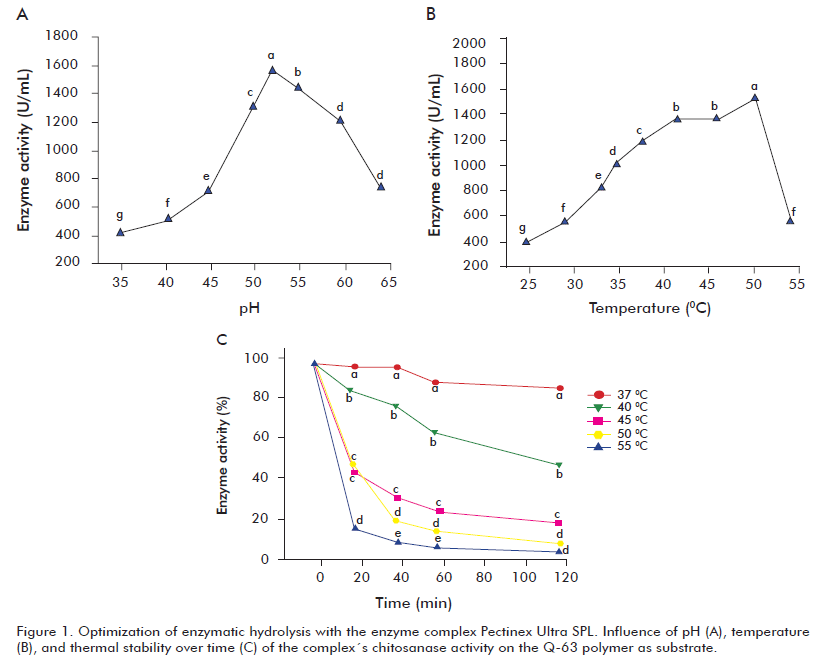
<body><![CDATA[<P   align="justify" ><font face="Verdana, Arial, Helvetica, sans-serif" color="#000000" size="2">Field      experiments were carried out in tobacco (variety Habana 92) and rice (variety      J-104) cultivars under productive conditions. Tobacco plants were applied      with compounds, by foliar aspersion of a chitosan polymer following plant      transplantation, and rice cultivars were established by immersing the seeds      into a solution containing a chitosan polymer and a chitosan hydrolysate prior      to sowing. The natural infection by major pathogens for these two crops was      evaluated as indicated on the instructives for infection scales and analyses.      </font></P >       <P   align="justify" ><font color="#000000" face="Verdana, Arial, Helvetica, sans-serif" size="2"><B><font size="3">RESULTS      AND DISCUSSION</font></B> </font></P >   <FONT color="#000000"><FONT color="#201D1E">        <P   align="left" ><font face="Verdana, Arial, Helvetica, sans-serif" color="#000000" size="2">A      methodology similar to that described for obtaining chitosan from shrimp chitin      was used to obtain chitosan polymers at bank scale. The technique was modified      according to a previous study of the influence of chitin/alkali ratio, temperature      and reaction time on the properties of the chitosan obtained. Results showed      that it is possible to generate high molar mass chitosans under homogeneous      preparation conditions (low temperature and an almost equivalent alkali/chitin      ratio), with minor modification of its secondary structure and with yields      between 74 and 80% of the source chitin. All these are economically relevant      for an efficient use in agriculture. </font></P >       <P   align="justify" ><font face="Verdana, Arial, Helvetica, sans-serif" color="#000000" size="2">On      the other hand, both acidic and enzymatic hydrolyses were studied to generate      low MW chitosan compounds. Currently, the enzymatic hydrolysis is preferred      over the acidic one, due to its sequence specificity for lysis and the respective      formation of products [7]. Nevertheless, the costs of the enzymes used must      be low enough to make it affordable for agricultural application and to obtain      products with the proper biological activity. The first studies using this      strategy showed that it is possible to generate chi-tosan hydrolyzates having      protective activity in plants, by using low cost, commercial enzyme mixes,      to improve the biological activity of the obtained chitosan derivatives. In      our study, five enzymatic complexes were assayed; allowing us to select the      most adequate and it was possible to optimize the hydrolysis conditions (<a href="/img/revistas/bta/v27n4/f0108410.gif">Figure      1</a>). Hydrolyzates and their mixes were obtained with high content of bioactive      oligosaccharides and containing the selected complex (Pectinex Ultra SPL)[14].      </font></P >   <FONT color="#FF0000"><FONT color="#201D1E">        
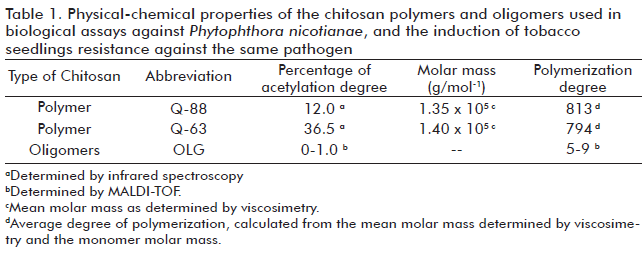
<P   align="justify" ><font face="Verdana, Arial, Helvetica, sans-serif" color="#000000" size="2">The      biological activity of chitosan oligosaccharides depends on its structure.      Otherwise, previous reports did not addressed the influence of AD on the activity      of quito-oligosaccharides while in others the AD was not determined or ambiguous      methods were used to characterize it. </font></P >       <P   align="justify" ><font face="Verdana, Arial, Helvetica, sans-serif" color="#000000" size="2">      In this work, chitosan was depolymerized by aciacidic or enzymatic hydrolysis,      by using the Pectinex Ultra SPL complex. The resulting oligosaccharides were      selectively precipitated in methanol solutions and rigorously characterized      by mass spectrometry (MALDI-TOF). The differences in the polymerization degree      (PD) and AD were well established (<a href="/img/revistas/bta/v27n4/t0108410.gif">Table      1</a>). The acidic hydrolysis produced fragments with PD up to 16 glucosamine      residues, mostly monoacetylated. More significantly, the enzymatic hydrolysis      rendered shorter fragments with a high rate of fully deacetylated chitooligomers,      showing a higher oligo size/yield ratio. Based on these evidences, we chose      the enzymatic method to prepare oligochitosans [14]. </font></P >   <FONT color="#FF0000"><FONT color="#201D1E">        
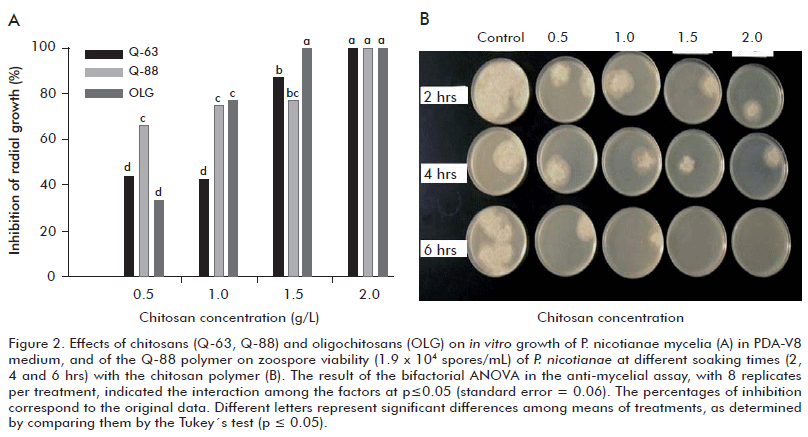
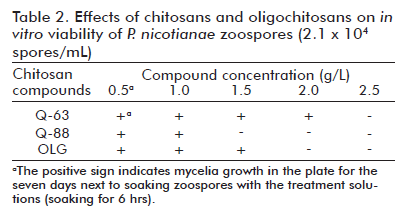
<P   align="left" ><font face="Verdana, Arial, Helvetica, sans-serif" color="#000000" size="2">Among      the biological assays, the effect of different chitosans on growth and asexual      reproduction of tobacco and rice pathogens was evaluated <i>in vitro</i>.      Significantly novel results were obtained regarding the effect of chitosans      at different lifecycle stages of the Sarocladium and Bipolaris genera. Similarly,      it was evidenced the influence of chitosan MW and AD on the different stages      of the Phytophthora nicotianae tobacco pathogen, achieving the highest inhibition      by decreasing MW down to oligomers and at the lowest AD. (<a href="/img/revistas/bta/v27n4/f0208410.gif">Figure      2</a>, <a href="#tab2">Table 2</a>). This is a highly significant result,      due to its practical relevance when preparing chitosan compounds with inhibitory      activity. </font></P >       
<P   align="center" ><img src="/img/revistas/bta/v27n4/t0208410.gif"><a name="tab2"></a></P >   <FONT color="#FF0000"><FONT color="#201D1E">        
<P   align="justify" ><font face="Verdana, Arial, Helvetica, sans-serif" color="#000000" size="2">It      was also evaluated the influence of a chitosan polymer (Q-88) on other pathogens      growth (<I>Phytium aphanidermatum</I>, <I>Sclerotium rolfsii </I>and <I>Rizoctonia      solani</I>) which were isolated from tobacco and other solanaceae, with the      first two pathogens as the most sensitive to that polymer, and studying Q-88      for the very first time in dose-response experiments. </font></P >       <P   align="justify" ><font face="Verdana, Arial, Helvetica, sans-serif" color="#000000" size="2">Based      on these results, and also considering the natural origin and biodegradable      nature of chitosan, these polymers and their derivatives were recommended      to be used for controlling soil phytopathogens in tobacco seedbeds and to      reduce the spotted grain disease in rice. </font></P >       ]]></body>
<body><![CDATA[<P   align="justify" ><font face="Verdana, Arial, Helvetica, sans-serif" color="#000000" size="2">It      was also demonstrated that it is possible to re-acetylate the high PD polymers      without affecting their PD, by working with two sets of chitooligosaccharides      of defined PD. Their capacity to induce resistance was evaluated in suspensions      of <I>Arabidopsis thaliana </I>cells, by measuring the induction of two well      known defensive markers: PAL activity and production of hydrogen peroxide      (H<sub>2</sub>O<sub>2</sub>). In this case, the completely deacetylated chitooligosacharides      induced the activation of both PAL activity and H<sub>2</sub>O<sub>2</sub>      production, and also cell death, which varied with their PD and concentration.      The ability of the oligosaccharides to increase H<sub>2</sub>O<sub>2</sub>      production and cell death was progressively inhibited by reacetylation, but      the PAL activity was unaffected. This evidenced the role of PD for generating      defensive responses on vegetal cells. </font></P >   <FONT color="#FF0000"><FONT color="#201D1E"><FONT color="#FF0000"><FONT color="#201D1E"><FONT color="#FF0000"><FONT color="#201D1E"><FONT color="#FF0000"><FONT color="#201D1E"><FONT color="#FF0000"><FONT color="#201D1E"><FONT color="#FF0000"><FONT color="#201D1E">        <P   align="left" ><font face="Verdana, Arial, Helvetica, sans-serif" color="#000000" size="2">Experiments      run in tobacco plants showed, for the very first time, the induction of systemic      responses against <i>P. nicotianae</i> by foliar aspersion, substrate application      and previous treatment of seeds with the chitosan compounds. All these demonstrate      the potentiality of these compounds to protect tobacco from its main disease      at seedbed level. The induction of resistance, either by activating defensive      responses or by reducing the infection of <i>P. nicotianae</i> was influenced      by the concentration, MW and AD of the applied compounds, and also by the      administration procedures [15]. </font></P >       <P   align="justify" ><font face="Verdana, Arial, Helvetica, sans-serif" color="#000000" size="2">      This study evidenced the benefits of protecting tobacco at field scale under      semi-controlled conditions, and also the practical relevance of preparing      chitosans with the adequate physical-chemical properties, to enhance the protective      effect. </font></P >       <P   align="justify" ><font face="Verdana, Arial, Helvetica, sans-serif" color="#000000" size="2">      In rice, the treatment of seeds of the commercial variety J-104 sensitive      to Piriculariosis (<I>Pyricularia grisea</I>) with chitosan polymers or hydrolizates      prior to sowing, activated defensive responses in plants either or not inoculated      with the pathogen, protecting the plants against infection. These assays were      carried out under semi-controlled conditions and demonstrated that it is possible      to protect this crop from this significant disease at field scale with both      types of compounds. </font></P >       <P   align="justify" ><font face="Verdana, Arial, Helvetica, sans-serif" color="#000000" size="2">      The most promising among all the chitosan-based compounds studied in this      work at field scale and under controlled or semi-controlled conditions were      assayed at open field scale in both crops. In rice, both the polymer and the      hydrolizate were studied, under conditions favoring the occurrence of Piriculariosis,      with protection being evidenced only for the chitosan hydrolizate at the concentration      assayed. </font></P >       <P   align="left" ><font face="Verdana, Arial, Helvetica, sans-serif" color="#000000" size="2">In      tobacco, taking together the results of resistance induction and antimicrobial      activity, it was decided to evaluate a chitosan polymer (Q&middot;88) by foliar      aspersion to plants (variety Habana 92), several days after transplantation      and without altering the protection schedule used by the local private producer.      In this sense, plants received the chitosan (three doses) and also the scheduled      chemical treatment, being finally evaluated for natural infection by viruses,      fungi and oomycetes. A significant protection was obtained against all the      evaluated pathogens as compared to the control, showing a dose-dependent response      for the applied chitosan and also a positive effect of the compound on production      yields. </font></P >       <P   align="justify" ><font face="Verdana, Arial, Helvetica, sans-serif" color="#000000" size="2">Due      to its dual biological action, chitosan-mediated protection of plants can      be mediated both by directly affecting pathogen growth and by activating the      systemically induced resistance (SIR) in plants. In rice, where the seeds      were treated before sowing, the protection found was the second in magnitude.      But in tobacco, where the compound was disseminated by aspersion, both effects      can be taking place, the antimicrobial action (especially against air-borne      pathogens which can get into contact the chitosan adhered to the leave) and      the SRI. The latter evidenced by the reduced infection with root and stem      pathogens after aspersion. Both mechanisms of action are vital to implement      a protective strategy in crops. </font></P >       <P   align="justify" ><font face="Verdana, Arial, Helvetica, sans-serif" color="#000000" size="3"><b>CONCLUSIONS</b></font><font face="Verdana, Arial, Helvetica, sans-serif" color="#000000" size="2">      </font></P >       <P   align="justify" ><font face="Verdana, Arial, Helvetica, sans-serif" color="#000000" size="2">      In this work, methodologies were adapted to generate different chitosan compounds      from lobster chitin. The resulting and promising polymers, and their mixes      and derivatives, were evaluated for biological activity and activation of      resistance and protection from pathogens in tobacco and rice plants. It was      demonstrated, for the very first time, the influence of certain physical-chemical      properties of chitosan derivatives on inhibiting pathogens growth and development      and also in the biology of protection of fully grown plants against them.      Our results evidenced the structure-activity relationship among the derivatives      prepared and characterized and also the biological functions evaluated. </font></P >       <P   align="left" ><font face="Verdana, Arial, Helvetica, sans-serif" color="#000000" size="2">      The first results on protection of rice and tobacco cultivars at field scale      are also shown, evidencing their relevance to design and prepare new natural,      non-toxic and nationally produced bio-pesticides to be used in agriculture.      The inclusion of chitosan as part of the integral management of pathogens      would allow reducing or substituting the application of chemicals in some      economically relevant crops, with the subsequent protection of the environment.      </font></P >       ]]></body>
<body><![CDATA[<P   align="justify" ><font face="Verdana, Arial, Helvetica, sans-serif" size="3"><b>SCIENTIFIC RELEVANCE      OF THE STUDY</b></font></P >   <FONT color="#000000"><FONT color="#201D1E">        <P   align="justify" ><font face="Verdana, Arial, Helvetica, sans-serif" color="#000000" size="2">      This work provides evidences on the potentialities of chitosan polymers, partially      hydrolyzed chitosan and oligochitosans developed in Cuba, to protect tobacco      and rice cultivars from relevant diseases which limit production yields. This      supports their potential introduction for the ecological control of pathogens      in both crops. </font></P >       <P   align="justify" ><font face="Verdana, Arial, Helvetica, sans-serif" color="#000000" size="2">      By these means, a significant amount of lobster exoskeleton is used as source      for chitin and chitosan production, two compounds of high aggregated value,      instead of discarding it into the environment with the associated contamination.      </font></P >       <P   align="justify" ><font face="Verdana, Arial, Helvetica, sans-serif" color="#000000" size="3"><b>ACKNOWLEDGEMENTS</b></font><font face="Verdana, Arial, Helvetica, sans-serif" color="#000000" size="2">      </font></P >       <P   align="left" ><font face="Verdana, Arial, Helvetica, sans-serif" color="#000000" size="2">      The authors want to thank the contribution and support of the following collaborators:      The technical team at the INCA involved in this work; Dr. Pierre Van Cutsem      (Namur University, Belgium), Dr. Silvia Bautista-Ba&ntilde;os (IPNY, Morelos,      Mexico); Dr. Miguel A Mart&iacute;nez-T&eacute;llez (CIAD, Sonora, Mexico);      Dr. Fernando Guridi (UNAH); Dr. Eduardo Ortega (University of Havana, Cuba);      Dr. Ondina Le&oacute;n (CENSA, Cuba); Dr. Ver&oacute;nica Toledo (IIT, Cuba)      and Dr. Mar&iacute;a C. N&aacute;poles (INCA, Cuba). The authors are also      grateful to MSc. Regla M C&aacute;rdenas and MSc. Elizabeth Cristo; and to      the CITMA and MES ministries for partially funding the research included in      this work. </font></P >       <P   align="left" ><font face="Verdana, Arial, Helvetica, sans-serif" color="#000000" size="3"><b>REFERENCES</b></font><font face="Verdana, Arial, Helvetica, sans-serif" color="#000000" size="2">      </font></P >       <P   align="left" > </P >   <FONT color="#000000">        <!-- ref --><P   align="justify" ><font face="Verdana, Arial, Helvetica, sans-serif" size="2">1. Agrios GN How      plants defend themselves against pathogens (Chapter six). In: Plant Pathology.      5th ed., New York, USA: Academic Press, 2005, p. 208.</font></P >   <FONT color="#201D1E">       <!-- ref --><P   align="justify" ><font face="Verdana, Arial, Helvetica, sans-serif" color="#000000" size="2">2.      Esquerr&eacute;-Tugay&eacute; MT, Boudart G, Dumas B. Cell wall degrading      enzymes, inhibitory proteins, and oligosaccharides participate in the molecular      dialogue between plants and pathogen. Plant Physiol Biochem 2000;38:157-63.      </font></P >       <!-- ref --><P   align="justify" ><font face="Verdana, Arial, Helvetica, sans-serif" color="#000000" size="2">3.      Ridley BL, O&acute;Neill MA, Mohnen D. Pectins: structure, biosynthesis, and      oligogalacturonides-related signaling. Phytochemistry 2001;57:929-67. </font></P >       <!-- ref --><P   align="justify" ><font face="Verdana, Arial, Helvetica, sans-serif" color="#000000" size="2">4.      Shibuya N, Minami E. Oligosaccharide signalling for defenses responses in      plant. Physiol Mol Plant Pathol 2001;59:223-33. </font></P >       <!-- ref --><P   align="left" ><font face="Verdana, Arial, Helvetica, sans-serif" size="2">5. Bautista-Ba&ntilde;os      S, Hern&aacute;ndez-Lauzardo AN, Vel&aacute;zquez-del Valle MG, Hern&aacute;ndez-      L&oacute;pez M, Ait Barka E, Bosquez-Molina E, <i>et al</i>. Chitosan as a      potential natural compound to control pre and postharvest diseases of horticultural      commodities. Crop Prot 2006;25:108-18. </font></P >   </font></font></font></font></font></font></font></font></font></font></font></font></font></font></font></font></font></font></font></font></font></font></font></font></font></font></font></font></font></font></font></font></font></font></font></font></font></font></font></font></font></font></font></font></font></font></font></font></font></font></font></font></font></font>        <!-- ref --><p><font face="Verdana, Arial, Helvetica, sans-serif" size="2">6. Sharathchandra      RG, Niranjan Raj S, Shetty NP, Amruthesh KN, Shetty HS. A Chitosan formulation      Elexa<sup>TM</sup> induces downy mildew disease resistance and growth promotion      in pearl millet. Crop Prot 2004;23:881-8.    <br>     </font></p>   <FONT size="+1" color="#000000"><FONT color="#201D1E"><FONT color="#0000FF"><FONT color="#201D1E"><FONT color="#000000"><FONT color="#201D1E"><FONT color="#000000"><FONT color="#201D1E"><FONT color="#FF0000"><FONT color="#201D1E"><FONT color="#FF0000"><FONT color="#201D1E"><FONT color="#FF0000"><FONT color="#201D1E"><FONT color="#FF0000"><FONT color="#201D1E"><FONT color="#3485FC"><FONT color="#201D1E"><FONT color="#FF0000"><FONT color="#201D1E"><FONT color="#FF0000"><FONT color="#201D1E"><FONT color="#FF0000"><FONT color="#201D1E"><FONT color="#FF0000"><FONT color="#201D1E"><FONT color="#FF0000"><FONT color="#201D1E"><FONT color="#FF0000"><FONT color="#201D1E"><FONT color="#000000"><FONT color="#201D1E"><FONT color="#FF0000"><FONT color="#201D1E"><FONT color="#FF0000"><FONT color="#201D1E"><FONT color="#FF0000"><FONT color="#201D1E"><FONT color="#FF0000"><FONT color="#201D1E"><FONT color="#FF0000"><FONT color="#201D1E"><FONT color="#FF0000"><FONT color="#201D1E"><FONT color="#FF0000"><FONT color="#201D1E"><FONT color="#FF0000"><FONT color="#201D1E"><FONT color="#FF0000"><FONT color="#201D1E"><FONT color="#000000"><FONT color="#201D1E"><FONT color="#000000"><FONT color="#201D1E">       <!-- ref --><P   align="justify" ><font face="Verdana, Arial, Helvetica, sans-serif" color="#000000" size="2">7.      Prashanth KVH, Tharanathan RN. Chitin/chitosan: modifications and their unlimited      application potential-an overview. Trends Food Sci Technol 2007;18:117-31      </font></P >       <!-- ref --><P   align="justify" ><font face="Verdana, Arial, Helvetica, sans-serif" size="2">8. Xu J, Zhao X,      Han X, Du Y. Antifungal activity of oligochitosan against <i>Phytophthora      capsici</i> and other plant pathogenic fungi <i>in vitro</i>. Pest Biochem      Physiol 2007;87:220-8. </font></P >   </font></font></font></font></font></font></font></font></font></font></font></font></font></font></font></font></font></font></font></font></font></font></font></font></font></font></font></font></font></font></font></font></font></font></font></font></font></font></font></font></font></font></font></font></font></font></font></font></font></font></font></font></font></font>        <!-- ref --><p><font face="Verdana, Arial, Helvetica, sans-serif" size="2">9. Vander P,      Varum KM, Domard A, El Gueddari NE, Moerschbacher BM. Comparison of the ability      of partially N-acetylated chitosans and chitooligosaccharides to elicit resistance      reactions in wheat leaves. Plant Physiol 1998;118:1353-9. </font><!-- ref --><p><font face="Verdana, Arial, Helvetica, sans-serif" size="2">10. Jeon Y-J,      Shahidi F, Kim SK. Preparation of chitin and chitosan oligomers and their      applications in physiological functional foods. Food Rev Int 2000;16:159-76.      </font><!-- ref --><p><font face="Verdana, Arial, Helvetica, sans-serif" size="2">11. Kauss H,      Jeblick W, Domard A, Siegrist J. Partial acetylation of chitosan and a conditioning      period are essential for elicitation of H<sub>2</sub>O<sub>2</sub> in surface-      abraded tissues from various plants. In: Domard A, Roberts GAF, V&aring;rum      KM (eds), Advances in Chitin Science II, Lyon, France,: J Andr&eacute; Publisher,      1997, p. 94&#150;101.     <br>     </font></p>   <FONT size="+1" color="#000000"><FONT color="#201D1E"><FONT color="#0000FF"><FONT color="#201D1E"><FONT color="#000000"><FONT color="#201D1E"><FONT color="#000000"><FONT color="#201D1E"><FONT color="#FF0000"><FONT color="#201D1E"><FONT color="#FF0000"><FONT color="#201D1E"><FONT color="#FF0000"><FONT color="#201D1E"><FONT color="#FF0000"><FONT color="#201D1E"><FONT color="#3485FC"><FONT color="#201D1E"><FONT color="#FF0000"><FONT color="#201D1E"><FONT color="#FF0000"><FONT color="#201D1E"><FONT color="#FF0000"><FONT color="#201D1E"><FONT color="#FF0000"><FONT color="#201D1E"><FONT color="#FF0000"><FONT color="#201D1E"><FONT color="#FF0000"><FONT color="#201D1E"><FONT color="#000000"><FONT color="#201D1E"><FONT color="#FF0000"><FONT color="#201D1E"><FONT color="#FF0000"><FONT color="#201D1E"><FONT color="#FF0000"><FONT color="#201D1E"><FONT color="#FF0000"><FONT color="#201D1E"><FONT color="#FF0000"><FONT color="#201D1E"><FONT color="#FF0000"><FONT color="#201D1E"><FONT color="#FF0000"><FONT color="#201D1E"><FONT color="#FF0000"><FONT color="#201D1E"><FONT color="#FF0000"><FONT color="#201D1E"><FONT color="#000000"><FONT color="#201D1E"><FONT color="#000000"><FONT color="#201D1E">       ]]></body>
<body><![CDATA[<!-- ref --><P   align="justify" ><font face="Verdana, Arial, Helvetica, sans-serif" color="#000000" size="2">12.      Trotel-Aziz P, Couderchet M, Vernet G, Aziz A. Chitosan stimulates defense      reactions in grapevine leaves and inhibits development of Botrytis cinerea.      Eur J Plant Pathol 2006;114:405-13. </font></P >       <!-- ref --><P   align="left" ><font face="Verdana, Arial, Helvetica, sans-serif" size="2">13. Zhao XM, She      XP, Du YG, Liang XM. Induction of antiviral resistance and stimulary effect      by oligochitosan in tobacco. Pest Biochem Physiol 2007;87:78-84<font color="#000000">.</font></font>    </P >       <!-- ref --><P   align="left" ><font face="Verdana, Arial, Helvetica, sans-serif" color="#000000" size="2">14.      Cabrera JC, Van Cutsem P. Preparation of chitooligo&middot;saccharides with      degree of polymerization higher than 6 by acid or enzymatic degradation of      chitosan. Biochem Eng J 2005;25:165&middot;72. </font></P >   </font></font></font></font></font></font></font></font></font></font></font></font></font></font></font></font></font></font></font></font></font></font></font></font></font></font></font></font></font></font></font></font></font></font></font></font></font></font></font></font></font></font></font></font></font></font></font></font></font></font></font></font></font></font>        <!-- ref --><p><font face="Verdana, Arial, Helvetica, sans-serif" size="2" color="#000000">15.      Falc&oacute;n AB. Chitosanas en la inhibici&oacute;n <i>in vitro</i> de Phytophthora      nicotianae Breda de Haan y en la inducci&oacute;n de resistencia en plantas      de tabaco contra este pat&oacute;geno. Doctoral Thesis in Biological Sciences.      Faculty of Biology, University of Havana, July 2009. </font><font color="#000000" size="2">    <br>     </font></p>   <FONT size="+1" color="#000000"><FONT color="#201D1E"><FONT color="#0000FF"><FONT color="#201D1E"><FONT color="#000000"><FONT color="#201D1E"><FONT color="#000000"><FONT color="#201D1E"><FONT color="#FF0000"><FONT color="#201D1E"><FONT color="#FF0000"><FONT color="#201D1E"><FONT color="#FF0000"><FONT color="#201D1E"><FONT color="#FF0000"><FONT color="#201D1E"><FONT color="#3485FC"><FONT color="#201D1E"><FONT color="#FF0000"><FONT color="#201D1E"><FONT color="#FF0000"><FONT color="#201D1E"><FONT color="#FF0000"><FONT color="#201D1E"><FONT color="#FF0000"><FONT color="#201D1E"><FONT color="#FF0000"><FONT color="#201D1E"><FONT color="#FF0000"><FONT color="#201D1E"><FONT color="#000000"><FONT color="#201D1E"><FONT color="#FF0000"><FONT color="#201D1E"><FONT color="#FF0000"><FONT color="#201D1E"><FONT color="#FF0000"><FONT color="#201D1E"><FONT color="#FF0000"><FONT color="#201D1E"><FONT color="#FF0000"><FONT color="#201D1E"><FONT color="#FF0000"><FONT color="#201D1E"><FONT color="#FF0000"><FONT color="#201D1E"><FONT color="#FF0000"><FONT color="#201D1E"><FONT color="#FF0000"><FONT color="#201D1E"><FONT color="#000000"><FONT color="#201D1E"><FONT color="#000000"><FONT color="#201D1E">       <P   align="left" > </P >   <font face="Verdana, Arial, Helvetica, sans-serif" color="#000000" size="2">Alejandro&nbsp;Falc&oacute;n&nbsp;Rodr&iacute;guez,    Departamento de Fisiolog&iacute;a y Bioqu&iacute;mica Vegetal, Instituto Nacional    de Ciencias Agr&iacute;colas La Habana, Cuba. E-mail: <a href="mailto:alfalcon@inca.edu.cu">alfalcon@inca.edu.cu</a>    </font></font></font></font></font></font></font></font></font></font></font></font></font></font></font></font></font></font></font></font></font></font></font></font></font></font></font></font></font></font></font></font></font></font></font></font></font></font></font></font></font></font></font></font></font></font></font></font></font></font></font></font></font></font></font></DIV >      ]]></body><back>
<ref-list>
<ref id="B1">
<label>1</label><nlm-citation citation-type="book">
<person-group person-group-type="author">
<name>
<surname><![CDATA[Agrios]]></surname>
<given-names><![CDATA[GN]]></given-names>
</name>
</person-group>
<article-title xml:lang="en"><![CDATA[How plants defend themselves against pathogens]]></article-title>
<source><![CDATA[Plant Pathology]]></source>
<year>2005</year>
<edition>5</edition>
<page-range>208</page-range><publisher-loc><![CDATA[New York ]]></publisher-loc>
<publisher-name><![CDATA[Academic Press]]></publisher-name>
</nlm-citation>
</ref>
<ref id="B2">
<label>2</label><nlm-citation citation-type="journal">
<person-group person-group-type="author">
<name>
<surname><![CDATA[Esquerré-Tugayé]]></surname>
<given-names><![CDATA[MT]]></given-names>
</name>
<name>
<surname><![CDATA[Boudart]]></surname>
<given-names><![CDATA[G]]></given-names>
</name>
<name>
<surname><![CDATA[Dumas]]></surname>
<given-names><![CDATA[B]]></given-names>
</name>
</person-group>
<article-title xml:lang="en"><![CDATA[Cell wall degrading enzymes, inhibitory proteins, and oligosaccharides participate in the molecular dialogue between plants and pathogen]]></article-title>
<source><![CDATA[Plant Physiol Biochem]]></source>
<year>2000</year>
<volume>38</volume>
<page-range>157-63</page-range></nlm-citation>
</ref>
<ref id="B3">
<label>3</label><nlm-citation citation-type="journal">
<person-group person-group-type="author">
<name>
<surname><![CDATA[Ridley]]></surname>
<given-names><![CDATA[BL]]></given-names>
</name>
<name>
<surname><![CDATA[O’Neill]]></surname>
<given-names><![CDATA[MA]]></given-names>
</name>
<name>
<surname><![CDATA[Mohnen]]></surname>
<given-names><![CDATA[D]]></given-names>
</name>
</person-group>
<article-title xml:lang="en"><![CDATA[Pectins: structure, biosynthesis, and oligogalacturonides-related signaling]]></article-title>
<source><![CDATA[Phytochemistry]]></source>
<year>2001</year>
<volume>57</volume>
<page-range>929-67</page-range></nlm-citation>
</ref>
<ref id="B4">
<label>4</label><nlm-citation citation-type="journal">
<person-group person-group-type="author">
<name>
<surname><![CDATA[Shibuya]]></surname>
<given-names><![CDATA[N]]></given-names>
</name>
<name>
<surname><![CDATA[Minami]]></surname>
<given-names><![CDATA[E]]></given-names>
</name>
</person-group>
<article-title xml:lang="en"><![CDATA[Oligosaccharide signalling for defenses responses in plant]]></article-title>
<source><![CDATA[Physiol Mol Plant Pathol]]></source>
<year>2001</year>
<volume>59</volume>
<page-range>223-33</page-range></nlm-citation>
</ref>
<ref id="B5">
<label>5</label><nlm-citation citation-type="journal">
<person-group person-group-type="author">
<name>
<surname><![CDATA[Bautista-Baños]]></surname>
<given-names><![CDATA[S]]></given-names>
</name>
<name>
<surname><![CDATA[Hernández-Lauzardo]]></surname>
<given-names><![CDATA[AN]]></given-names>
</name>
<name>
<surname><![CDATA[Velázquez-del Valle]]></surname>
<given-names><![CDATA[MG]]></given-names>
</name>
<name>
<surname><![CDATA[Hernández- López]]></surname>
<given-names><![CDATA[M]]></given-names>
</name>
<name>
<surname><![CDATA[Ait Barka]]></surname>
<given-names><![CDATA[E]]></given-names>
</name>
<name>
<surname><![CDATA[Bosquez-Molina]]></surname>
<given-names><![CDATA[E]]></given-names>
</name>
</person-group>
<article-title xml:lang="en"><![CDATA[Chitosan as a potential natural compound to control pre and postharvest diseases of horticultural commodities]]></article-title>
<source><![CDATA[Crop Prot]]></source>
<year>2006</year>
<volume>25</volume>
<page-range>108-18</page-range></nlm-citation>
</ref>
<ref id="B6">
<label>6</label><nlm-citation citation-type="journal">
<person-group person-group-type="author">
<name>
<surname><![CDATA[Sharathchandra]]></surname>
<given-names><![CDATA[RG]]></given-names>
</name>
<name>
<surname><![CDATA[Niranjan Raj]]></surname>
<given-names><![CDATA[S]]></given-names>
</name>
<name>
<surname><![CDATA[Shetty]]></surname>
<given-names><![CDATA[NP]]></given-names>
</name>
<name>
<surname><![CDATA[Amruthesh]]></surname>
<given-names><![CDATA[KN]]></given-names>
</name>
<name>
<surname><![CDATA[Shetty]]></surname>
<given-names><![CDATA[HS]]></given-names>
</name>
</person-group>
<article-title xml:lang="en"><![CDATA[A Chitosan formulation ElexaTM induces downy mildew disease resistance and growth promotion in pearl millet]]></article-title>
<source><![CDATA[Crop Prot]]></source>
<year>2004</year>
<volume>23</volume>
<page-range>881-8</page-range></nlm-citation>
</ref>
<ref id="B7">
<label>7</label><nlm-citation citation-type="journal">
<person-group person-group-type="author">
<name>
<surname><![CDATA[Prashanth]]></surname>
<given-names><![CDATA[KVH]]></given-names>
</name>
<name>
<surname><![CDATA[Tharanathan]]></surname>
<given-names><![CDATA[RN]]></given-names>
</name>
</person-group>
<article-title xml:lang="en"><![CDATA[Chitin/ chitosan: modifications and their unlimited application potential-an overview]]></article-title>
<source><![CDATA[Trends Food Sci Technol]]></source>
<year>2007</year>
<volume>18</volume>
<page-range>117-31</page-range></nlm-citation>
</ref>
<ref id="B8">
<label>8</label><nlm-citation citation-type="journal">
<person-group person-group-type="author">
<name>
<surname><![CDATA[Xu]]></surname>
<given-names><![CDATA[J]]></given-names>
</name>
<name>
<surname><![CDATA[Zhao]]></surname>
<given-names><![CDATA[X]]></given-names>
</name>
<name>
<surname><![CDATA[Han]]></surname>
<given-names><![CDATA[X]]></given-names>
</name>
<name>
<surname><![CDATA[Du]]></surname>
<given-names><![CDATA[Y]]></given-names>
</name>
</person-group>
<article-title xml:lang="en"><![CDATA[Antifungal activity of oligochitosan against Phytophthora capsici and other plant pathogenic fungi in vitro]]></article-title>
<source><![CDATA[Pest Biochem Physiol]]></source>
<year>2007</year>
<volume>87</volume>
<page-range>220-8</page-range></nlm-citation>
</ref>
<ref id="B9">
<label>9</label><nlm-citation citation-type="journal">
<person-group person-group-type="author">
<name>
<surname><![CDATA[Vander]]></surname>
<given-names><![CDATA[P]]></given-names>
</name>
<name>
<surname><![CDATA[Varum]]></surname>
<given-names><![CDATA[KM]]></given-names>
</name>
<name>
<surname><![CDATA[Domard]]></surname>
<given-names><![CDATA[A]]></given-names>
</name>
<name>
<surname><![CDATA[El Gueddari]]></surname>
<given-names><![CDATA[NE]]></given-names>
</name>
<name>
<surname><![CDATA[Moerschbacher]]></surname>
<given-names><![CDATA[BM]]></given-names>
</name>
</person-group>
<article-title xml:lang="en"><![CDATA[Comparison of the ability of partially N-acetylated chitosans and chitooligosaccharides to elicit resistance reactions in wheat leaves]]></article-title>
<source><![CDATA[Plant Physiol]]></source>
<year>1998</year>
<volume>118</volume>
<page-range>1353-9</page-range></nlm-citation>
</ref>
<ref id="B10">
<label>10</label><nlm-citation citation-type="journal">
<person-group person-group-type="author">
<name>
<surname><![CDATA[Jeon]]></surname>
<given-names><![CDATA[Y-J]]></given-names>
</name>
<name>
<surname><![CDATA[Shahidi]]></surname>
<given-names><![CDATA[F]]></given-names>
</name>
<name>
<surname><![CDATA[Kim]]></surname>
<given-names><![CDATA[SK]]></given-names>
</name>
</person-group>
<article-title xml:lang="en"><![CDATA[Preparation of chitin and chitosan oligomers and their applications in physiological functional foods]]></article-title>
<source><![CDATA[Food Rev Int]]></source>
<year>2000</year>
<volume>16</volume>
<page-range>159-76</page-range></nlm-citation>
</ref>
<ref id="B11">
<label>11</label><nlm-citation citation-type="book">
<person-group person-group-type="author">
<name>
<surname><![CDATA[Kauss]]></surname>
<given-names><![CDATA[H]]></given-names>
</name>
<name>
<surname><![CDATA[Jeblick]]></surname>
<given-names><![CDATA[W]]></given-names>
</name>
<name>
<surname><![CDATA[Domard]]></surname>
<given-names><![CDATA[A]]></given-names>
</name>
<name>
<surname><![CDATA[Siegrist]]></surname>
<given-names><![CDATA[J]]></given-names>
</name>
</person-group>
<article-title xml:lang="en"><![CDATA[Partial acetylation of chitosan and a conditioning period are essential for elicitation of H2O2 in surface- abraded tissues from various plants]]></article-title>
<person-group person-group-type="editor">
<name>
<surname><![CDATA[Domard]]></surname>
<given-names><![CDATA[A]]></given-names>
</name>
<name>
<surname><![CDATA[Roberts]]></surname>
<given-names><![CDATA[GAF]]></given-names>
</name>
<name>
<surname><![CDATA[Vårum]]></surname>
<given-names><![CDATA[KM]]></given-names>
</name>
</person-group>
<source><![CDATA[Advances in Chitin Science II]]></source>
<year>1997</year>
<page-range>94-101</page-range><publisher-loc><![CDATA[Lyon ]]></publisher-loc>
<publisher-name><![CDATA[J André Publisher]]></publisher-name>
</nlm-citation>
</ref>
<ref id="B12">
<label>12</label><nlm-citation citation-type="journal">
<person-group person-group-type="author">
<name>
<surname><![CDATA[Trotel-Aziz]]></surname>
<given-names><![CDATA[P]]></given-names>
</name>
<name>
<surname><![CDATA[Couderchet]]></surname>
<given-names><![CDATA[M]]></given-names>
</name>
<name>
<surname><![CDATA[Vernet]]></surname>
<given-names><![CDATA[G]]></given-names>
</name>
<name>
<surname><![CDATA[Aziz]]></surname>
<given-names><![CDATA[A]]></given-names>
</name>
</person-group>
<article-title xml:lang="en"><![CDATA[Chitosan stimulates defense reactions in grapevine leaves and inhibits development of Botrytis cinerea]]></article-title>
<source><![CDATA[Eur J Plant Pathol]]></source>
<year>2006</year>
<volume>114</volume>
<page-range>405-13</page-range></nlm-citation>
</ref>
<ref id="B13">
<label>13</label><nlm-citation citation-type="journal">
<person-group person-group-type="author">
<name>
<surname><![CDATA[Zhao]]></surname>
<given-names><![CDATA[XM]]></given-names>
</name>
<name>
<surname><![CDATA[She]]></surname>
<given-names><![CDATA[XP]]></given-names>
</name>
<name>
<surname><![CDATA[Du]]></surname>
<given-names><![CDATA[YG]]></given-names>
</name>
<name>
<surname><![CDATA[Liang]]></surname>
<given-names><![CDATA[XM]]></given-names>
</name>
</person-group>
<article-title xml:lang="en"><![CDATA[Induction of antiviral resistance and stimulary effect by oligochitosan in tobacco]]></article-title>
<source><![CDATA[Pest Biochem Physiol]]></source>
<year>2007</year>
<volume>87</volume>
<page-range>78-84</page-range></nlm-citation>
</ref>
<ref id="B14">
<label>14</label><nlm-citation citation-type="journal">
<person-group person-group-type="author">
<name>
<surname><![CDATA[Cabrera]]></surname>
<given-names><![CDATA[JC]]></given-names>
</name>
<name>
<surname><![CDATA[Van Cutsem]]></surname>
<given-names><![CDATA[P]]></given-names>
</name>
</person-group>
<article-title xml:lang="en"><![CDATA[Preparation of chitooligo-saccharides with degree of polymerization higher than 6 by acid or enzymatic degradation of chitosan]]></article-title>
<source><![CDATA[Biochem Eng J]]></source>
<year>2005</year>
<volume>25</volume>
<page-range>165-72</page-range></nlm-citation>
</ref>
<ref id="B15">
<label>15</label><nlm-citation citation-type="">
<person-group person-group-type="author">
<name>
<surname><![CDATA[Falcón]]></surname>
<given-names><![CDATA[AB]]></given-names>
</name>
</person-group>
<source><![CDATA[Chitosanas en la inhibición in vitro de Phytophthora nicotianae Breda de Haan y en la inducción de resistencia en plantas de tabaco contra este patógeno]]></source>
<year></year>
</nlm-citation>
</ref>
</ref-list>
</back>
</article>
