<?xml version="1.0" encoding="ISO-8859-1"?><article xmlns:mml="http://www.w3.org/1998/Math/MathML" xmlns:xlink="http://www.w3.org/1999/xlink" xmlns:xsi="http://www.w3.org/2001/XMLSchema-instance">
<front>
<journal-meta>
<journal-id>1027-2852</journal-id>
<journal-title><![CDATA[Biotecnología Aplicada]]></journal-title>
<abbrev-journal-title><![CDATA[Biotecnol Apl]]></abbrev-journal-title>
<issn>1027-2852</issn>
<publisher>
<publisher-name><![CDATA[Editorial Elfos Scientiae]]></publisher-name>
</publisher>
</journal-meta>
<article-meta>
<article-id>S1027-28522011000300004</article-id>
<title-group>
<article-title xml:lang="en"><![CDATA[Estimating the risk for unbalanced chromosomal aberrations in the offspring from translocation-carrying parents]]></article-title>
<article-title xml:lang="es"><![CDATA[Estimación del riesgo de descendencia con aberraciones cromosómicas desbalanceadas en progenitores portadores de translocaciones]]></article-title>
</title-group>
<contrib-group>
<contrib contrib-type="author">
<name>
<surname><![CDATA[Aguilar]]></surname>
<given-names><![CDATA[Joenith]]></given-names>
</name>
<xref ref-type="aff" rid="A01"/>
</contrib>
<contrib contrib-type="author">
<name>
<surname><![CDATA[Bacallao-Guerra]]></surname>
<given-names><![CDATA[Jorge]]></given-names>
</name>
<xref ref-type="aff" rid="A02"/>
</contrib>
<contrib contrib-type="author">
<name>
<surname><![CDATA[Bacallao-Gallestey]]></surname>
<given-names><![CDATA[Jorge]]></given-names>
</name>
<xref ref-type="aff" rid="A03"/>
</contrib>
<contrib contrib-type="author">
<name>
<surname><![CDATA[Morales]]></surname>
<given-names><![CDATA[Estela]]></given-names>
</name>
<xref ref-type="aff" rid="A04"/>
</contrib>
</contrib-group>
<aff id="A01">
<institution><![CDATA[,Centro Nacional de Genética Médica Departamento de Citogenética ]]></institution>
<addr-line><![CDATA[La Habana ]]></addr-line>
<country>Cuba</country>
</aff>
<aff id="A03">
<institution><![CDATA[,Ministerio de Ciencia, Tecnología y Medio Ambiente, CITMA Instituto de Cibernética, Matemática y Física Departamento de Matemática]]></institution>
<addr-line><![CDATA[La Habana ]]></addr-line>
<country>Cuba</country>
</aff>
<aff id="A04">
<institution><![CDATA[,Centro de Investigaciones y Referencia de Aterosclerosis de La Habana  ]]></institution>
<addr-line><![CDATA[La Habana ]]></addr-line>
<country>Cuba</country>
</aff>
<aff id="A02">
<institution><![CDATA[,Centro Nacional de Genética Médica Departamento de Asistencia Médica ]]></institution>
<addr-line><![CDATA[La Habana ]]></addr-line>
<country>Cuba</country>
</aff>
<pub-date pub-type="pub">
<day>00</day>
<month>09</month>
<year>2011</year>
</pub-date>
<pub-date pub-type="epub">
<day>00</day>
<month>09</month>
<year>2011</year>
</pub-date>
<volume>28</volume>
<numero>3</numero>
<fpage>156</fpage>
<lpage>160</lpage>
<copyright-statement/>
<copyright-year/>
<self-uri xlink:href="http://scielo.sld.cu/scielo.php?script=sci_arttext&amp;pid=S1027-28522011000300004&amp;lng=en&amp;nrm=iso"></self-uri><self-uri xlink:href="http://scielo.sld.cu/scielo.php?script=sci_abstract&amp;pid=S1027-28522011000300004&amp;lng=en&amp;nrm=iso"></self-uri><self-uri xlink:href="http://scielo.sld.cu/scielo.php?script=sci_pdf&amp;pid=S1027-28522011000300004&amp;lng=en&amp;nrm=iso"></self-uri><abstract abstract-type="short" xml:lang="en"><p><![CDATA[Reciprocal and Robertsonian translocations are structural chromosomal aberrations that can produce unbalanced gametes during meiosis. In some cases, these imbalances lead to an offspring with multiple malformations. The purpose of this study was to propose and evaluate a methodology to estimate the risk of live offspring with unbalanced chromosome aberrations (LOUCA) from parents carrying a reciprocal or Robertsonian translocation. The methodology is based on comparing the results from several widely known regression methods: multiple linear, logistic and Poisson regression. Predictive accuracy was evaluated on a database containing information on 41 families of translocations carriers from three Cuban provinces. The results yielded by the three models were quite consistent regarding variable selection (presence of chromosome 9, chromosome 21 and the existence of breaking points in the short arms of the chromosomes involved) and risk estimation. There was a 80% overlap between the classifications produced by the three methods.]]></p></abstract>
<abstract abstract-type="short" xml:lang="es"><p><![CDATA[Las translocaciones recíprocas y robertsonianas son aberraciones cromosómicas estructurales que durante la meiosis pueden originar gametos cromosómicamente desbalanceados. Estos desequilibrios pueden generar una progenie con múltiples malformaciones. El objetivo de este trabajo es proponer una metodología para estimar el riesgo de descendencia con aberraciones cromosómicas desbalanceadas compatibles con la vida, en progenitores portadores de alguna translocación recíproca o robertsoniana. La metodología combina los resultados de los métodos de regresión logística, regresión múltiple y regresión de Poisson. Por sus características, es teóricamente superior a otras variantes descritas en la literatura revisada. El riesgo se estima a partir de una base de datos que contiene información de 41 estudios de familias portadoras de translocaciones, de tres provincias de Cuba. Los resultados con los tres métodos aplicados son coherentes en la selección de las variables predictoras (presencia de cromosomas 9, cromosoma 21 y existencia de puntos de ruptura en los brazos cortos de los cromosomas involucrados) y en las estimaciones del riesgo. El 80% de las familias se clasificaron por estos métodos.]]></p></abstract>
<kwd-group>
<kwd lng="en"><![CDATA[Risk estimation]]></kwd>
<kwd lng="en"><![CDATA[translocations]]></kwd>
<kwd lng="en"><![CDATA[Poisson regression]]></kwd>
<kwd lng="en"><![CDATA[estimación del riesgo]]></kwd>
<kwd lng="es"><![CDATA[translocaciones]]></kwd>
<kwd lng="es"><![CDATA[regresión de Poisson]]></kwd>
</kwd-group>
</article-meta>
</front><body><![CDATA[ <DIV class="Sect"   >        <P   align="right" ><font size="2" color="#000000" face="Verdana, Arial, Helvetica, sans-serif"><b>RESEARCH</b></font></P >       <P   align="right" >&nbsp;</P >   <FONT size="+1" color="#000000">        <P   > </P >       <P   ><b><font face="Verdana, Arial, Helvetica, sans-serif" size="4">Estimating the      risk for unbalanced chromosomal aberrations in the offspring from translocation-carrying      parents </font></b></P >       <P   >&nbsp;</P >       <P   > </P >       <P   ><b><font face="Verdana, Arial, Helvetica, sans-serif" size="3">Estimaci&oacute;n      del riesgo de descendencia con aberraciones cromos&oacute;micas desbalanceadas      en progenitores portadores de translocaciones </font></b></P >       <P   >&nbsp;</P >       <P   >&nbsp;</P >       ]]></body>
<body><![CDATA[<P   > </P >       <P   > </P >       <P   ><b><font face="Verdana, Arial, Helvetica, sans-serif" size="2">Joenith Aguilar<Sup>1</Sup>,      Jorge Bacallao-Guerra<Sup>2</Sup>, Jorge Bacallao-Gallestey<Sup>3</Sup>, Estela      Morales<Sup>4 </Sup></font></b></P >   <FONT size="+1"><FONT size="+1"><FONT size="+1"><FONT size="+1"><FONT size="+1"><FONT size="+1"><FONT size="+1"><FONT size="+1">        <P   ><font face="Verdana, Arial, Helvetica, sans-serif" size="2"><Sup>1</Sup> Departamento      de Citogen&eacute;tica, Centro Nacional de Gen&eacute;tica M&eacute;dica.      Ave. 31, esq. 146, Cubanac&aacute;n, Playa, CP 11600, La Habana, Cuba. <Sup>    <br>     2</Sup> Departamento de Asistencia M&eacute;dica, Centro Nacional de Gen&eacute;tica      M&eacute;dica. Calle E, No. 309, esq. 15, Plaza de la Revoluci&oacute;n, CP      10600 La Habana, Cuba. <Sup>    <br>     3</Sup> Departamento de Matem&aacute;tica, Instituto de Cibern&eacute;tica,      Matem&aacute;tica y F&iacute;sica, Ministerio de Ciencia, Tecnolog&iacute;a      y Medio Ambiente, CITMA. Calle Tulip&aacute;n, esq. Panorama, Plaza de la      Revoluci&oacute;n, CP 10600, La Habana, Cuba. <Sup>    <br>     4</Sup> Centro de Investigaciones y Referencia de Aterosclerosis de La Habana.      Ave. 31, esq. 146, Cubanac&aacute;n, Playa, CP 11600, La Habana, Cuba.</font></P >   </font></font></font></font></font></font></font></font></font>        <p>&nbsp;</p><hr>   <FONT size="+1" color="#000000"><FONT size="+1"><FONT size="+1"><FONT size="+1"><FONT size="+1"><FONT size="+1"><FONT size="+1"><FONT size="+1"><FONT size="+1">        <P   ><b><font face="Verdana, Arial, Helvetica, sans-serif" size="2">ABSTRACT </font></b></P >   <FONT size="+1"><FONT size="+1"><FONT size="+1"><FONT size="+1"><FONT size="+1"><FONT size="+1"><FONT size="+1"><FONT size="+1">        <P   ><font face="Verdana, Arial, Helvetica, sans-serif" size="2">Reciprocal and Robertsonian      translocations are structural chromosomal aberrations that can produce unbalanced      gametes during meiosis. In some cases, these imbalances lead to an offspring      with multiple malformations. The purpose of this study was to propose and      evaluate a methodology to estimate the risk of live offspring with unbalanced      chromosome aberrations (LOUCA) from parents carrying a reciprocal or Robertsonian      translocation. The methodology is based on comparing the results from several      widely known regression methods: multiple linear, logistic and Poisson regression.      Predictive accuracy was evaluated on a database containing information on      41 families of translocations carriers from three Cuban provinces. The results      yielded by the three models were quite consistent regarding variable selection      (presence of chromosome 9, chromosome 21 and the existence of breaking points      in the short arms of the chromosomes involved) and risk estimation. There      was a 80% overlap between the classifications produced by the three methods.      </font></P >       ]]></body>
<body><![CDATA[<P   ><font face="Verdana, Arial, Helvetica, sans-serif" size="2"><b>Keywords:</b>      Risk estimation, translocations, Poisson regression. </font></P >   </font></font></font></font></font></font></font></font></font></font></font></font></font></font></font></font></font>   <hr>   <FONT size="+1" color="#000000"><FONT size="+1"><FONT size="+1"><FONT size="+1"><FONT size="+1"><FONT size="+1"><FONT size="+1"><FONT size="+1"><FONT size="+1"><FONT size="+1"><FONT size="+1"><FONT size="+1"><FONT size="+1"><FONT size="+1"><FONT size="+1"><FONT size="+1"><FONT size="+1">    <b><font face="Verdana, Arial, Helvetica, sans-serif" size="2">RESUMEN </font></b>        <P   ><font face="Verdana, Arial, Helvetica, sans-serif" size="2">Las translocaciones      rec&iacute;procas y robertsonianas son aberraciones cromos&oacute;micas estructurales      que durante la meiosis pueden originar gametos cromos&oacute;micamente desbalanceados.      Estos desequilibrios pueden generar una progenie con m&uacute;ltiples malformaciones.      El objetivo de este trabajo es proponer una metodolog&iacute;a para estimar      el riesgo de descendencia con aberraciones cromos&oacute;micas desbalanceadas      compatibles con la vida, en progenitores portadores de alguna translocaci&oacute;n      rec&iacute;proca o robertsoniana. La metodolog&iacute;a combina los resultados      de los m&eacute;todos de regresi&oacute;n log&iacute;stica, regresi&oacute;n      m&uacute;ltiple y regresi&oacute;n de Poisson. Por sus caracter&iacute;sticas,      es te&oacute;ricamente superior a otras variantes descritas en la literatura      revisada. El riesgo se estima a partir de una base de datos que contiene informaci&oacute;n      de 41 estudios de familias portadoras de translocaciones, de tres provincias      de Cuba. Los resultados con los tres m&eacute;todos aplicados son coherentes      en la selecci&oacute;n de las variables predictoras (presencia de cromosomas      9, cromosoma 21 y existencia de puntos de ruptura en los brazos cortos de      los cromosomas involucrados) y en las estimaciones del riesgo. El 80% de las      familias se clasificaron por estos m&eacute;todos. </font></P >       <P   ><font face="Verdana, Arial, Helvetica, sans-serif" size="2"><b>Palabras clave:</b>      estimaci&oacute;n del riesgo, translocaciones, regresi&oacute;n de Poisson.</font></P >   </font></font></font></font></font></font></font></font></font></font></font></font></font></font></font></font></font>   <hr>   <FONT size="+1" color="#000000"><FONT size="+1"><FONT size="+1"><FONT size="+1"><FONT size="+1"><FONT size="+1"><FONT size="+1"><FONT size="+1"><FONT size="+1"><FONT size="+1"><FONT size="+1"><FONT size="+1"><FONT size="+1"><FONT size="+1"><FONT size="+1"><FONT size="+1"><FONT size="+1">        <P   >&nbsp;</P >       <P   >&nbsp;</P >       <P   > </P >       <P   ><b><font face="Verdana, Arial, Helvetica, sans-serif" size="3">INTRODUCTION </font></b></P >       <P   align="justify" ><font size="2" face="Verdana, Arial, Helvetica, sans-serif">The occurrence of      reciprocal and Robertsonian translocations during meiosis may produce chromosomal      unbalances in the gametes, often leading to offspring with multiple malformations      [1, 2]. Therefore, parents from families with known translocations usually      need to know the risk or probability of appearance of the consequences of      these malformations, which include spontaneous abortion, fetal death and live      offspring with unbalanced chromosomal aberrations (LOUCA) [3].<Sup> </Sup></font></P >   <FONT size="+1"><FONT size="+1">        <P   align="justify" ><font size="2" face="Verdana, Arial, Helvetica, sans-serif">This work proposes      a methodology based on the use of generalized linear models for estimating      LOUCA risk in the offspring of parents carrying translocations. It has a solid      theoretical foundation and can be employed in clinical practice during the      process of genetic counseling. Research on this topic dates back to the seventies:      see <I>e.g. </I>Daniel in 1979 [4], Stengel-Rutkowski <I>et al</I>. in 1988      [5], Cans <I>et al</I>. in 1993 [6] and Cohen <I>et al</I>. in 1992<Sup> </Sup>[7]      and 1994 [8]. </font></P >   <FONT size="+1"><FONT size="+1"><FONT size="+1">        <P   align="justify" ><font face="Verdana, Arial, Helvetica, sans-serif" size="2">Cans <I>et al. </I>proposed,      in 1993, the use of logistic regression models for risk estimation, and the      use of additive models was also suggested two years later [9]. </font></P >       ]]></body>
<body><![CDATA[<P   align="justify" ><font face="Verdana, Arial, Helvetica, sans-serif" size="2">However, there are      theoretical and practical considerations against the use of logistic regression      as the sole tool for estimating risk. Like every other linear model, logistic      regression is very sensitive to the effects of multi-colinearity when used      for explanatory purposes (<I>i.e. </I>the selection of variables relevant      to risk estimation). In addition, it assumes the existence of a linear relationship      between the dependent variable and the predictors. </font></P >       <P   align="justify" ><font face="Verdana, Arial, Helvetica, sans-serif" size="2">To further compound      matters, data obtained from family studies fails to comply with a basic assumption      of logistic regression: that of independence between the subjects. This &ldquo;family      effect&rdquo; arises because relatives are not only genetically closer than      non relatives, but share exactly the same values for the variables describing      the translocation inherited throughout the family. </font></P >       <P   align="justify" ><font face="Verdana, Arial, Helvetica, sans-serif" size="2">The procedure proposed      here sidesteps these obstacles by using a classification into risk groups      that is based on the results from multiple and Poisson regressions, thus modifying      the structure of data from familial translocation studies. It constitutes      a combination of several complementary statistic techniques that can be used      to obtain an objective estimation of risk to be later used during genetic      counseling. </font></P >       <P   ><font size="3" face="Verdana, Arial, Helvetica, sans-serif"><b>MATERIALS AND      METHODS </b> </font></P >   <FONT size="+1">        <P   ><font size="2" face="Verdana, Arial, Helvetica, sans-serif"><b>Database </b></font></P >   <FONT size="+1">        <P   align="justify" ><font face="Verdana, Arial, Helvetica, sans-serif" size="2">The original database      contains data from 200 subjects in 41 studies of families carrying reciprocal      or Robertsonian translocations. Each family study took into account the individuals      with filial relations with respect to the purpose of each study, including      this last one. A total of 26 different translocations exhibiting unique breakpoints      are present in the data (<a href="/img/revistas/bta/v28n3/f0104311.gif">Figure 1</a>). This database,      which constitutes the result of a collaborative effort between the cytogenetic      laboratories of Havana, Havana city and Pinar del R&iacute;o, only included      karyotyped, inherited translocations between autosomal chromosomes. Breakpoints      were homogenized to a resolution of 400 bands, following the International      System for Cytogenetic Nomenclature (ISCN 2005) [10]. The length of centric      and translocated segments was measured from the breakpoint to the terminal      zone of the long and short arms, with an accuracy of 0.5 mm (G bands). Each      family study took into account the individuals with filial relations with      respect to the purpose of each study, including this last one. </font></P >       
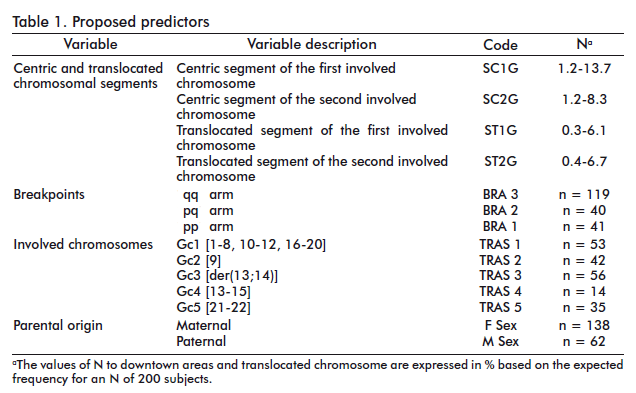
<P   align="justify" ><font face="Verdana, Arial, Helvetica, sans-serif" size="2">The <I>offspring      status</I> variable, containing six categories (non carrier, balanced carrier,      spontaneous abortion, fetal death, neonatal death and LOUCA) was restructured      as a binary variable, grouping all conditions excepting LOUCA into a single      category. Five chromosomal groups were created, based on the specific chromosome      involved in each translocation. Three categories were also created depending      on the location of the breakpoint: <I>pp</I>, <I>pq</I> and <I>qq</I>. The      parental origin of the translocation was also taken into account. The age      of the carrier parent was excluded from the analysis, as recent studies have      failed to find a link between age and LOUCA risk [11] and, in addition, a      significant portion of the data was missing for this variable. Gamete variability      was also excluded, since there were only some cases with LOUCA. <a href="/img/revistas/bta/v28n3/t0104311.gif">Table      1</a> summarizes the tentative predictors used in the models. The nominal      variables <I>chromosomal group</I> and <I>breakpoint location, </I>with five      and three categories respectively, were transformed into dummy variables whose      values are either 0 or 1 for their inclusion into the regression models. </font></P >       
<P   ><font face="Verdana, Arial, Helvetica, sans-serif" size="2"><b>Statistical analysis      </b> </font></P >       <P   align="justify" ><font face="Verdana, Arial, Helvetica, sans-serif" size="2">The methodological      strategy followed consisted on the application of three regression models,      analyzing the agreement between their results. Taking into account the limitations      of each procedure and setting aside statistical considerations, this triangulation      strategy already improves the reliability of the end result if the same data,      analyzed by different methods that part from different sets of assumptions,      yield the same outcome. Risk estimation used the same cut-off thresholds employed      for genetic counseling (Low risk: &lt; 5; Moderate risk: from 5 to 15%; High      risk: &gt; 15%). </font></P >       <P   align="justify" ><font face="Verdana, Arial, Helvetica, sans-serif" size="2">The SPSS (Statistical      Package for the Social Sciences, version 15.0) software application was used      to run the logistic and multiple linear regression models. </font></P >       ]]></body>
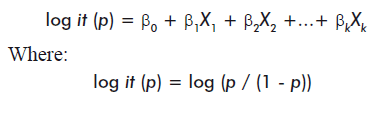
<body><![CDATA[<P   align="justify" ><font face="Verdana, Arial, Helvetica, sans-serif" size="2">The statistical package      STATA was used for Poisson regression. </font></P >       <P   ><font face="Verdana, Arial, Helvetica, sans-serif" size="2"><I><b>Logistic regression      </b> </I></font></P >       <P   align="justify" ><font face="Verdana, Arial, Helvetica, sans-serif" size="2">The results were      compared by analyzing the data with a logistic regression model (using the      200 subject database). Due care was exercised during the use of this model,      as its application for this specific case has some pitfalls. </font></P >       <P   align="justify" ><font face="Verdana, Arial, Helvetica, sans-serif" size="2">Logistic regression      [12-15] is a specific case of generalized linear models. It is used to model      a categorical response from predictors that may be indistinctly continuous      or discrete ordinals (in most cases, this response is binary). In this model,      <I>p</I> represents the probability of success and the predictors, or independent      variables, are represented by <I>Xi</I>: </font></P >       <P align="center"   ><img src="/img/revistas/bta/v28n3/fr0104311.gif" width="382" height="114"></P >   <FONT size="+1">        
<P   ><font face="Verdana, Arial, Helvetica, sans-serif" size="2">Binary logistic regression      is widely used in biomedical and epidemiological research, as the shape of      the logistic function is ideal for modeling risk and dichotomic responses,      such as the presence or absence of a specific disorder [12]. </font></P >       <P   ><font size="2" face="Verdana, Arial, Helvetica, sans-serif"><I><b>Multiple lineal      regression </b></I></font></P >   <FONT size="+1">        <P   align="justify" ><font face="Verdana, Arial, Helvetica, sans-serif" size="2">This model is described      by the equation: </font></P >       <P   align="center" ><img src="/img/revistas/bta/v28n3/fr0204311.gif" width="288" height="54"></P >       

<P   ></P >       ]]></body>
<body><![CDATA[<P   ></P >       <P   ></P >       <P   ></P >       <P   ></P >   <FONT size="+1">        <P   align="justify" ><font size="2" face="Verdana, Arial, Helvetica, sans-serif">Where Y is the dependent      variable and the subscripted X and &beta; represent the independent variables      or predictors and the parameters of the model, respectively. </font></P >   <FONT size="+1">        <P   align="justify" ><font face="Verdana, Arial, Helvetica, sans-serif" size="2"> The model was used      on a modified version of the original database that was prepared to minimize      the &ldquo;family effect&rdquo; affecting the logistic regression model described      above. In this new database the unit of analysis is the family (families are      independent from one another), and the dependent variable (defined in the      [0, 1] interval) indicates the proportion of affected individuals within each      family. In this manner, individual and family risks are one and the same.      </font></P >       <P   align="justify" ><font face="Verdana, Arial, Helvetica, sans-serif" size="2">This modification      can be introduced without problems because risk, in this dataset, is defined      by factors intrinsic to the specific translocation affecting each family,      rather than by individual traits. The variables examined in this study that      can influence the risk of appearance of LOUCA characterize only the inherited      translocation and not other pre-zygotic and post-zygotic genetic phenomena      (which can also influence risk) that vary from carrier to carrier. This work,      therefore, does not violate the underlying assumptions of its methodology.      </font></P >       <P   ><font face="Verdana, Arial, Helvetica, sans-serif" size="2"><I><b>Poisson regression      </b> </I></font></P >       <P   align="justify" ><font face="Verdana, Arial, Helvetica, sans-serif" size="2">Poisson regression      [13-15] is used for modeling counting-type variables and, especially, the      risk of appearance of low frequency events. The nature of the problem examined      in this work, therefore, lends itself to the use of Poisson regression, as      the number of cases in a family is a counting-type variable that can be used      for assignation into a risk group. </font></P >       <P   align="justify" ><font face="Verdana, Arial, Helvetica, sans-serif" size="2">From a theoretical      standpoint, this is the most adequate model (and the results support this      reasoning); therefore, its results must be assigned a larger weight when analyzing      the results of the classification into risk groups. </font></P >       ]]></body>
<body><![CDATA[<P   align="justify" ><font face="Verdana, Arial, Helvetica, sans-serif" size="2">A random variable      is said to follow a Poisson distribution if its probability function can be      written as: </font></P >       <P   > </P >   <FONT size="+1">        <P align="center"   ><font face="Verdana, Arial, Helvetica, sans-serif" size="2"><img src="/img/revistas/bta/v28n3/fr0304311.gif" width="164" height="75"></font></P >       
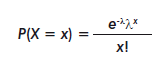
<P   align="justify" ><font size="2" face="Verdana, Arial, Helvetica, sans-serif">The basic formulation      of Poisson regression consists of writing the mean of the counting variable      as the exponent of a lineal function of the predictors: </font></P >   <FONT size="+1">        <P   > </P >   <FONT size="+1">        <P align="center"   ><font face="Verdana, Arial, Helvetica, sans-serif" size="2"><img src="/img/revistas/bta/v28n3/fr0404311.gif" width="237" height="48"></font></P >       
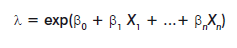
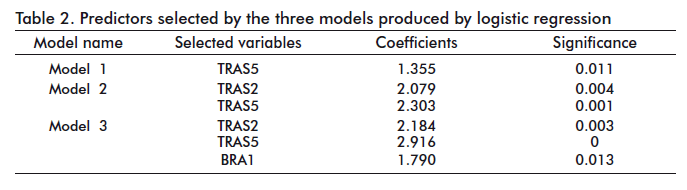
<P   align="justify" ><font size="2" face="Verdana, Arial, Helvetica, sans-serif">Due to the resulting      structure, this model was applied to the modified database; using the variable      <I>Number of LOUCA cases in the family </I>and estimating individual risk      as the number of cases in the family divided by family size. Faced with the      uncertainty of whether family size might influence the outcome, additional      models including this variable were considered and compared to models excluding      it. However, family size did not have any significant influence on the results.      </font></P >   <FONT size="+1">        <P   ><font size="3" face="Verdana, Arial, Helvetica, sans-serif"><b>RESULTS </b></font></P >   <FONT size="+1">        <P   ><font size="2" face="Verdana, Arial, Helvetica, sans-serif"><b>Logistic regression      </b> </font></P >   <FONT size="+1">        <P   align="justify" ><font face="Verdana, Arial, Helvetica, sans-serif" size="2">Model 3, predicting      LOUCA risk from variables TRAS2 (Gc2), TRAS5 (Gc5) and BRA1 (pp), was obtained      after three steps. All three variables are relevant, with signification levels      of 0.003, 0 and 0.013, respectively (<a href="/img/revistas/bta/v28n3/t0204311.gif">Table      2</a>). R<Sup>2</Sup> is a coefficient representing to what degree the observed      variability is explained by each model. This parameter behaved for each model      as follows: Model 1, 0.065; Model 2, 0.166; and Model 3, 0.228. Model 3 is      different from the two preceding models.<B> </B>After this study, the subjects      were classified according to their LOUCA risk, estimated by logistic regression      (<a href="/img/revistas/bta/v28n3/t0704311.gif">See Annex</a>). </font></P >   <FONT size="+1"><FONT size="+1">        
]]></body>
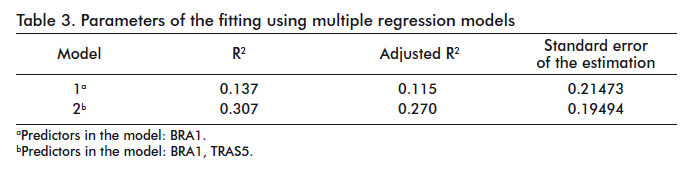
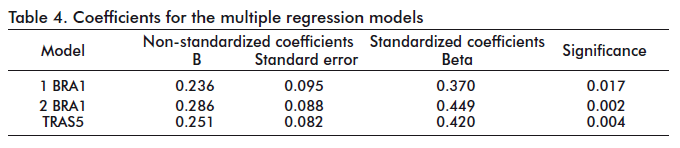
<body><![CDATA[<P   ><font face="Verdana, Arial, Helvetica, sans-serif" size="2"><b>Multiple linear      regression </b> </font></P >       <P   align="justify" ><font face="Verdana, Arial, Helvetica, sans-serif" size="2">A multiple linear      regression model was fitted to the data afterwards, using <I>frequency </I>as      the dependent variable. The fitting followed the forward method, adding variables      as long as R<Sup>2</Sup> increased, and stopping when further inclusions did      not result in significant increases of R<Sup>2</Sup>. </font></P >   <FONT size="+1"><FONT size="+1"><FONT size="+1"><FONT size="+1">        <P   align="justify" ><font face="Verdana, Arial, Helvetica, sans-serif" size="2">The best model obtained      with the forward method contains the variables TRAS5 (Gc5) and BRA1 (pp) as      predictors (adjusted R<Sup>2</Sup> = 0.27, <a href="/img/revistas/bta/v28n3/t0304311.gif">Table 3</a>).      These are variables with significant effects (0.004 and 0.002, respectively)      (<a href="/img/revistas/bta/v28n3/t0404311.gif">Table 4</a>) that were also selected by the logistic      regression model analyzed earlier. </font></P >   <FONT size="+1"><FONT size="+1">        
<P   align="justify" ><font face="Verdana, Arial, Helvetica, sans-serif" size="2">Another variable      that might be included in this model would be TRAS2; in this manner, the present      model would match the variable set of the logistic model used in the preceding      section. After this analysis, the families were classified according to LOUCA      risk. No families fell into the moderate risk category when using this model      (<a href="/img/revistas/bta/v28n3/t0704311.gif">See Annex</a>). </font></P >       
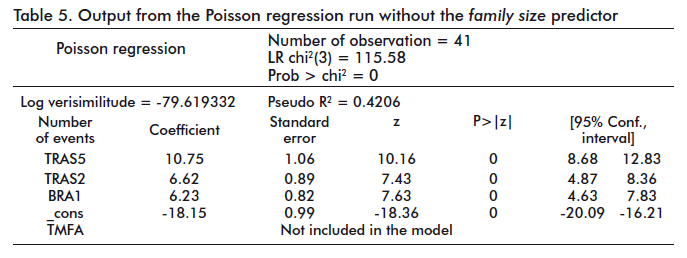
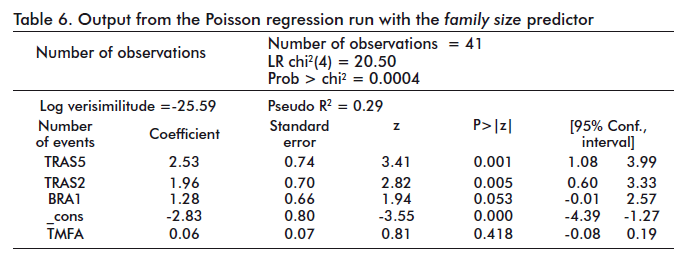
<P   ><font face="Verdana, Arial, Helvetica, sans-serif" size="2"><b>Poisson regression      </b> </font></P >       <P   align="justify" ><font face="Verdana, Arial, Helvetica, sans-serif" size="2">Poisson regression      was also applied using the family as unit of analysis, and setting the number      of LOUCA cases as dependent variable. A new variable denominated <I>family      size </I>(TMFA) was included, given that the number of affected cases depends      on family size and its addition would prevent, therefore, the occurrence of      logical impossibilities such as families with more affected than susceptible      individuals. The model was fitted with the robust regression option of the      commercially available STATA software package, in order to guarantee that      the result is resistant to the effect of outliers. TRAS5 (Gc5), TRAS2 (Gc2)      and BRA1 (pp) emerged as relevant variables (<a href="/img/revistas/bta/v28n3/t0504311.gif">Table      5</a>). Since the number of events (variable to be predicted) logically depends      on family size, the latter was included as a covariant in the model. </font></P >       
<P   align="justify" ><font face="Verdana, Arial, Helvetica, sans-serif" size="2">All other things      being equal, the variable to predict depended much more on genetic factors      than on family size (see the P value of variable TMFA in <a href="/img/revistas/bta/v28n3/t0604311.gif">table      6</a>). </font></P >   <FONT size="+1">        
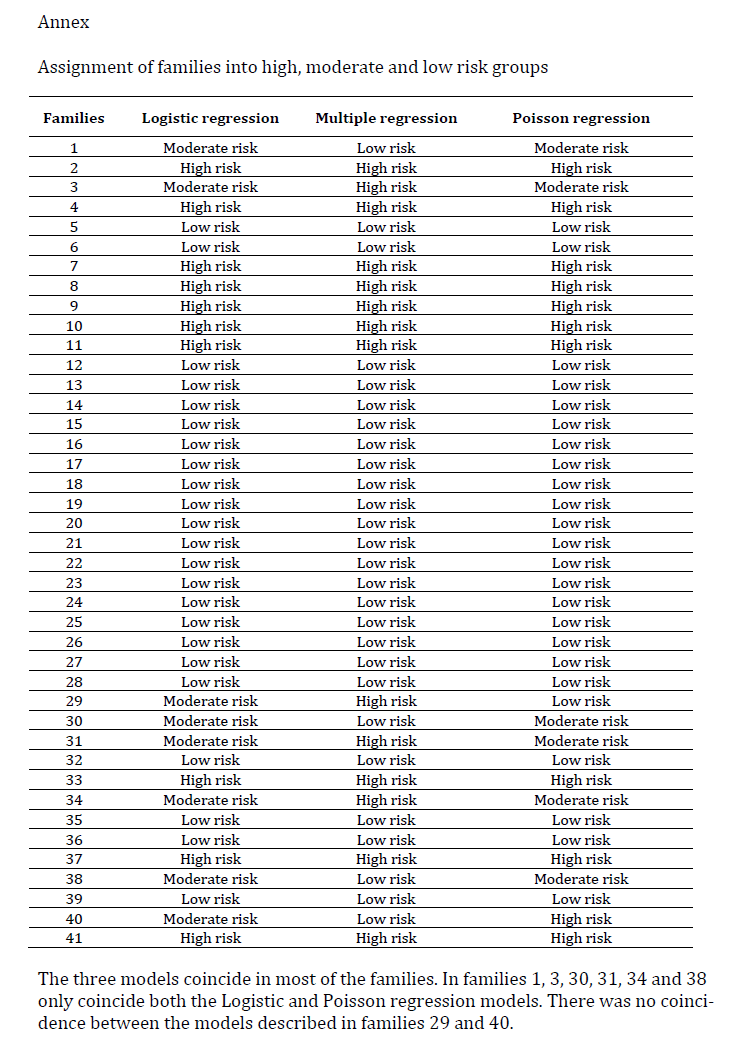
<P   align="justify" ><font face="Verdana, Arial, Helvetica, sans-serif" size="2">Of note, also, is      the fact that using the Poisson regression model resulted, again, in the inclusion      of some families in the moderate risk category (see <a href="/img/revistas/bta/v28n3/t0704311.gif">Annex</a>)      </font></P >   <FONT size="+1">        
<P   ><font size="2" face="Verdana, Arial, Helvetica, sans-serif"><b><font size="3">DISCUSSION      </font></b></font></P >   <FONT size="+1">        <P   align="justify" ><font size="2" face="Verdana, Arial, Helvetica, sans-serif">All three models      yielded similar results regarding their most relevant variables and the classification      into risk groups, whether using individuals or families as the unit of statistical      analysis. </font></P >   <FONT size="+1">        ]]></body>
<body><![CDATA[<P   align="justify" ><font face="Verdana, Arial, Helvetica, sans-serif" size="2">In the three models      there are variables indicating the presence of the trait in question that      increase risk in a significant manner. One is the presence of breakpoints      in the <I>pp </I>arms and another, the involvement of chromosomes 21 and 22.      Another variable, which in one case failed to reach statistical significance,      was the presence of chromosome 9, included in the models of Poisson and logistic      regression. Our results, similar to those of Cans <I>et al</I>. in 1993 [6],      highlight the importance of these variables for an understanding of the genetic      phenomenon under study. </font></P >       <P   align="justify" ><font face="Verdana, Arial, Helvetica, sans-serif" size="2">Cans <I>et al. </I>also      pointed out that in the case of these chromosomes, risk is even higher when      breakpoints are located in both short arms [6]. Our results, despite differences      in sample populations and analysis methods, are similar; confirming the validity      of our approach and the predictive capacity of the chosen variables. There      is a large body of research pointing at chromosome 9 for its frequent involvement      in LOUCA, based in the segregation of translocations where it is included      [16, 17]. </font></P >       <P   align="justify" ><font face="Verdana, Arial, Helvetica, sans-serif" size="2">Chromosome 22 is      also in Gc5, and therefore is singled out by all models as a risk factor.      Although no LOUCA cases involving this chromosome were found in our database,      that was not the case for the database used by Cans <I>et al</I>. 1993<Sup>      </Sup>[6]<Sup> </Sup>due to the high prevalence of t(11;22), which is linked      to the presence of this trait in the offspring. </font></P >   <FONT size="+1"><FONT size="+1"><FONT size="+1"><FONT size="+1">        <P   align="justify" ><font face="Verdana, Arial, Helvetica, sans-serif" size="2">The classification      into risk groups was identical among all three models for 80% of the families      (see <a href="/img/revistas/bta/v28n3/t0704311.gif">Annex</a>). This      result, together with the fact that all models also selected the same variables,      further underscores the relevance of the latter as predictors. In general,      Poisson regression was more accurate; <I>i.e. </I>it yielded a theoretical      risk probability closer to the &ldquo;observed&rdquo; values. The model it      produced failed only for family 34, where it yielded a risk probability far      from the actual value (<a href="/img/revistas/bta/v28n3/t0704311.gif">Annex</a>)      since two out of the three members of that family are LOUCA cases. It also      identified as significant the presence of Gc2 (chromosome 9), perhaps artificially      decreasing the theoretical risk for LOUCA due to the fact that out of the      three predictors selected by the Poisson regression (Gc5, Gc2 and &ldquo;pp&rdquo;),      this is the only one with breakpoints in the short arms of both chromosomes      involved in the translocation (&ldquo;pp&rdquo;). </font></P >       
<P   align="justify" ><font face="Verdana, Arial, Helvetica, sans-serif" size="2">Analyzing the predictive      accuracy of the Poisson regression, it is possible to see that 1) it was the      only model that correctly classified family 40, according to the data. This      family had only Gc2 (variable with a value = 1) out of the three predictors      selected by the model, demonstrating the significance of the involvement of      chromosome 9 in a translocation and its relationship with the probability      of LOUCA [18]; and 2) studies of different families with the same translocation      yielded different risk probabilities (a phenomenon that had not been observed      previously), although they continued to fall within identical risk groups.      This is accounted for by differences in the mathematical formulations of the      different models, which imply, in the case of the Poisson regression, the      use of information unique to each family and, obviously, the introduction      of differences between families that share a common translocation. </font></P >       <P   align="justify" ><font face="Verdana, Arial, Helvetica, sans-serif" size="2">There is a 95% overlap      between the Poisson and logistic regression models regarding the classification      of families into risk groups. This overlap decreased to 80% when all three      models were considered. The high coincidence between the Poisson and logistic      regression models may arise, notwithstanding the characteristics of each one,      from the fact that they use the same variables (Gc5, Gc2 and &ldquo;pp&rdquo;)      as predictors. Regarding multiple regression, it was observed that the presence      of breakpoints in the short arms (as in family 29) always produces a high-risk      translocation, independently of whether it results in LOUCA or not. </font></P >       <P   align="justify" ><font face="Verdana, Arial, Helvetica, sans-serif" size="2">The multiple regression      model selected, as predictors, the presence of breakpoints in both short arms      (&ldquo;pp&rdquo;, BRA1 = 1) and Gc5 (chromosomes 21 and 22, TRAS5 = 1). In      addition, none of the translocations in the database has both predictors simultaneously.      Given that not many combinations can produce a high-risk classification when      using this model, it is sufficient to have one of them for obtaining such      a classification, independently from the existence or noof a history of LOUCA      in the family. In this model the parameter for variable &ldquo;pp&rdquo; is      larger than that for variable Gc5; therefore, expected risk is larger when      the model is applied to a family with a translocation having both breakpoints      in short arms. </font></P >       <P   align="justify" ><font face="Verdana, Arial, Helvetica, sans-serif" size="2">Families 29 and 40      were not assigned to the same risk groups by the three models (See <a href="/img/revistas/bta/v28n3/t0704311.gif">Annex</a>).      Family 40 should be classified as high risk; however, only the Poisson model      identifies it as such, for reasons explained above. Regarding family 29, it      should be assigned to the moderate risk group, yet only the logistical regression      model does so. It should be noticed that for this last family the value produced      by the Poisson regression model came close to that of the moderate risk category.      Family 7 was misclassified by all three models as high risk, when it actually      does not have a history of LOUCA. This situation was caused by the fact that      the translocation of this family contains chromosome 22, which is part of      Gc5 (a variable to which all three models assign a large weight) and is absent      from all other cases in the database. Therefore, given that chromosome 22      is included in the same group as chromosome 21 (involved in several translocations      with a clear link to LOUCA), the family was erroneously assigned to the high      risk group. </font></P >       
<P   align="justify" ><font face="Verdana, Arial, Helvetica, sans-serif" size="2">The three proposed      models correctly assign each family to their corresponding risk group, according      to the actual data used to verify the accuracy of the prediction. The few      observed discrepancies between prediction and reality are considered normal      when using empirical estimations that depend on &ldquo;observed&rdquo; data      [19]. </font></P >       <P   align="justify" ><font face="Verdana, Arial, Helvetica, sans-serif" size="2">It is important to      recap, once again, the main results of the methodology. A technique for estimating      the risk for LOUCA was proposed that is based on the use of models. Specifically,      these estimations were performed using logistic regression with a database      of 200 individual cases, multiple regression in a database of 41 families      (corresponding to the previous 200 cases), and Poisson regression in the latter      database. Each of these methods has advantages and disadvantages that were      discussed above. </font></P >       ]]></body>
<body><![CDATA[<P   align="justify" ><font face="Verdana, Arial, Helvetica, sans-serif" size="2">Estimating LOUCA      risk goes beyond the obtention of a cold number: it entails a careful analysis      of the results obtained through all proposed methods and of the conclusions,      weighted with the experience of the specialist. The latter adds an important      part of rationality to the proposed strategy. </font></P >       <P   ><font size="2" face="Verdana, Arial, Helvetica, sans-serif"><b><font size="3">ACKNOWLEDGEMENTS      </font> </b> </font></P >   <FONT size="+1">        <P   align="justify" ><font size="2" face="Verdana, Arial, Helvetica, sans-serif">We would like to      thank the genetic counselors of the provincial Medical Genetics network from      Pinar del R&iacute;o, and especially, Lic. Olga Luisa Qui&ntilde;ones Masa      and Dr. Reinaldo Men&eacute;ndez Garc&iacute;a, for their collaboration with      this investigation. </font></P >   <FONT size="+1">        <P   align="justify" > </P >       <P   align="justify" ><b><font face="Verdana, Arial, Helvetica, sans-serif" size="3">REFERENCES </font></b></P >       <P   align="justify" > </P >       <!-- ref --><P   align="justify" ><font size="2" face="Verdana, Arial, Helvetica, sans-serif">1. Morel F, Douet-Guilbert      N, Le Bris MJ, Herry A, Amice V, Amice J, et al. Meiotic segregation of translocations      during male gametogenesis. Int J Androl. 2004;27(4): 200-12.     </font></P >   <FONT size="+1">        <!-- ref --><P   align="justify" ><font face="Verdana, Arial, Helvetica, sans-serif" size="2">2. Young ID. Risk      calculation in genetic counseling. 3rd ed. Oxford: Oxford University Press;      2007.     </font></P >       ]]></body>
<body><![CDATA[<P   align="justify" ><font face="Verdana, Arial, Helvetica, sans-serif" size="2">3. Stasiewicz-Jarocka      B, Haus O, Van Assche E, Kostyk E, Constantinou M, Ryba&#322;ko A, et al.      Genetic counseling in carriers of reciprocal chromosomal translocations involving      long arm of chromosome 16. Clin Genet. 2004;66(3):189-207. </font></P >       <!-- ref --><P   align="justify" ><font face="Verdana, Arial, Helvetica, sans-serif" size="2">4. Daniel A. Structural      differences in reciprocal translocations. Potential for a model of risk in      Rcp. Hum Genet. 1979; 51(2):171-82.     </font></P >       <!-- ref --><P   align="justify" ><font face="Verdana, Arial, Helvetica, sans-serif" size="2">5. Stene J, Stengel-Rutkowski      S. Genetic risks of familial reciprocal and Robertsonian translocation carriers.      In: Daniel A, editor. The Cytogenetics of Mammalian Autosomal Rearrangements.      New York: Alan R Liss; 1988. p. 54-61.     </font></P >       <!-- ref --><P   align="justify" ><font face="Verdana, Arial, Helvetica, sans-serif" size="2">6. Cans C, Cohen      O, Lavergne C, Mermet MA, Demongeot J, Jalbert P. Logistic regression model      to estimate the risk of unbalanced offspring in reciprocal translocations.      Hum Genet. 1993;92(6):598-604.     </font></P >       <!-- ref --><P   align="justify" ><font face="Verdana, Arial, Helvetica, sans-serif" size="2">7. Cohen O, Simonet      M, Cans C, Mermet MA, Demongeot J, Amblard F, et al. Human reciprocal translocations:      a new computer system for genetic counseling. Ann Genet. 1992;35(4):193-201.          </font></P >       <!-- ref --><P   align="justify" ><font face="Verdana, Arial, Helvetica, sans-serif" size="2">8. Cohen O, Cans      C, Mermet MA, Demongeot J, Jalbert P. Viability thresholds for partial trisomies      and monosomies. A study of 1,159 viable unbalanced reciprocal translocations.      Hum Genet. 1994; 93(2):188-94.     </font></P >       <!-- ref --><P   align="justify" ><font face="Verdana, Arial, Helvetica, sans-serif" size="2">9. Cans C, Lavergne      C. De la r&eacute;gression logistique vers un modele additif g&eacute;n&eacute;ralis&eacute;:      un exemple d&acute;application. Rev Stat Appl. 1995;43(2):77-90.     </font></P >       <!-- ref --><P   align="justify" ><font face="Verdana, Arial, Helvetica, sans-serif" size="2">10. ShafFer LG, Tommerup      N. ISCN: An International System for Human Cytogenetic Nomenclature. Memphis:      Karger; 2005.     </font></P >       <!-- ref --><P   align="justify" ><font face="Verdana, Arial, Helvetica, sans-serif" size="2">11. McKinlay Gardner      RJ, Sutherland GR, editors. Chromosome abnormalities and genetic counseling.      3rd ed. Oxford: Oxford University Press; 2004.     </font></P >       <!-- ref --><P   align="justify" ><font face="Verdana, Arial, Helvetica, sans-serif" size="2">12. Kleinbaum DG,      Klein M. Logistic regression. A self learning text. New York: Springer-Verlag;      2002.     </font></P >       <!-- ref --><P   align="justify" ><font face="Verdana, Arial, Helvetica, sans-serif" size="2">13. Agresti A. Categorical      Data Analysis. 1st ed. New York: John Wiley &amp; Sons; 1990.     </font></P >       <!-- ref --><P   align="justify" ><font face="Verdana, Arial, Helvetica, sans-serif" size="2">14. McCullagh P,      Nelder JA. Generalized Linear Models. 2nd ed. London: Chapman and Hall/CRC;      1989.     </font></P >       <!-- ref --><P   align="justify" ><font face="Verdana, Arial, Helvetica, sans-serif" size="2">15. Christensen R.      Loglinear Models. 1st ed. New York: Springer-Verlag; 1990.     </font></P >       <!-- ref --><P   align="justify" ><font face="Verdana, Arial, Helvetica, sans-serif" size="2">16. Sankoff D, Deneault      M, Turbis P, Allen C. Chromosomal distributions of breakpoints in cancer,      infertility, and evolution. Theor Popul Biol. 2002;61(4):497-501.     </font></P >       <!-- ref --><P   align="justify" ><font face="Verdana, Arial, Helvetica, sans-serif" size="2">17. Harper PS. Practical      genetic counselling. 6th ed. Verlag: Hodder Arnold; 2004.     </font></P >       <!-- ref --><P   align="justify" ><font face="Verdana, Arial, Helvetica, sans-serif" size="2">18. Panasiuk B, Danik      J, Lurie IW, Stasiewicz-Jarocka B, Lesniewicz R, Sawicka A, et al. Reciprocal      chromosome translocations involving short arm of chromosome 9 as a risk factor      of unfavorable pregnancy outcomes after meiotic malsegregation 2:2. Adv Med      Sci. 2009;54(2):203-10.     </font></P >       <!-- ref --><P   align="justify" ><font face="Verdana, Arial, Helvetica, sans-serif" size="2">19. Nussbaum RL,      Mclnnes RR, Willard HF, editors. Thompson and Thompson. Consejo gen&eacute;tico      y evaluaci&oacute;n del riesgo. 7th ed. Barcelona: Elsevier Masson; 2008.          </font></P >       <P   align="justify" > </P >       <P   ><font size="2" face="Verdana, Arial, Helvetica, sans-serif">Received in November,      2010.     <br>     Accepted for publication in September, 2011. </font></P >   <FONT size="+1">        <P   ><font face="Verdana, Arial, Helvetica, sans-serif" size="2">Jorge Bacallao-Guerra.      Departamento de Asistencia M&eacute;dica, Centro Nacional de Gen&eacute;tica      M&eacute;dica. Calle E, No. 309, esq. 15, Plaza de la Revoluci&oacute;n, CP      10600 La Habana, Cuba. E-mail:<A href="mailto:bacallao@icmaf.cu"><U><U><FONT color="#0000FF">bacallao@icmaf.cu</font></U></U></A><FONT color="#0000FF"><FONT color="#000000">.      </font></font></font>      ]]></body><back>
<ref-list>
<ref id="B1">
<label>1</label><nlm-citation citation-type="journal">
<person-group person-group-type="author">
<name>
<surname><![CDATA[Morel]]></surname>
<given-names><![CDATA[F]]></given-names>
</name>
<name>
<surname><![CDATA[Douet-Guilbert]]></surname>
<given-names><![CDATA[N]]></given-names>
</name>
<name>
<surname><![CDATA[Le Bris]]></surname>
<given-names><![CDATA[MJ]]></given-names>
</name>
<name>
<surname><![CDATA[Herry]]></surname>
<given-names><![CDATA[A]]></given-names>
</name>
<name>
<surname><![CDATA[Amice]]></surname>
<given-names><![CDATA[V]]></given-names>
</name>
<name>
<surname><![CDATA[Amice]]></surname>
<given-names><![CDATA[J]]></given-names>
</name>
</person-group>
<article-title xml:lang="en"><![CDATA[Meiotic segregation of translocations during male gametogenesis]]></article-title>
<source><![CDATA[Int J Androl]]></source>
<year>2004</year>
<volume>27</volume>
<numero>4</numero>
<issue>4</issue>
<page-range>200-12</page-range></nlm-citation>
</ref>
<ref id="B2">
<label>2</label><nlm-citation citation-type="book">
<person-group person-group-type="author">
<name>
<surname><![CDATA[Young]]></surname>
<given-names><![CDATA[ID]]></given-names>
</name>
</person-group>
<source><![CDATA[Risk calculation in genetic counseling]]></source>
<year>2007</year>
<edition>3</edition>
<publisher-loc><![CDATA[Oxford ]]></publisher-loc>
<publisher-name><![CDATA[Oxford University Press]]></publisher-name>
</nlm-citation>
</ref>
<ref id="B3">
<label>3</label><nlm-citation citation-type="journal">
<person-group person-group-type="author">
<name>
<surname><![CDATA[Stasiewicz-Jarocka]]></surname>
<given-names><![CDATA[B]]></given-names>
</name>
<name>
<surname><![CDATA[Haus]]></surname>
<given-names><![CDATA[O]]></given-names>
</name>
<name>
<surname><![CDATA[Van Assche]]></surname>
<given-names><![CDATA[E]]></given-names>
</name>
<name>
<surname><![CDATA[Kostyk]]></surname>
<given-names><![CDATA[E]]></given-names>
</name>
<name>
<surname><![CDATA[Constantinou]]></surname>
<given-names><![CDATA[M]]></given-names>
</name>
<name>
<surname><![CDATA[Rybalko]]></surname>
<given-names><![CDATA[A]]></given-names>
</name>
</person-group>
<article-title xml:lang="en"><![CDATA[Genetic counseling in carriers of reciprocal chromosomal translocations involving long arm of chromosome 16]]></article-title>
<source><![CDATA[Clin Genet]]></source>
<year>2004</year>
<volume>66</volume>
<numero>3</numero>
<issue>3</issue>
<page-range>189-207</page-range></nlm-citation>
</ref>
<ref id="B4">
<label>4</label><nlm-citation citation-type="journal">
<person-group person-group-type="author">
<name>
<surname><![CDATA[Daniel]]></surname>
<given-names><![CDATA[A]]></given-names>
</name>
</person-group>
<article-title xml:lang="en"><![CDATA[Structural differences in reciprocal translocations: Potential for a model of risk in Rcp]]></article-title>
<source><![CDATA[Hum Genet]]></source>
<year>1979</year>
<volume>51</volume>
<numero>2</numero>
<issue>2</issue>
<page-range>171-82</page-range></nlm-citation>
</ref>
<ref id="B5">
<label>5</label><nlm-citation citation-type="book">
<person-group person-group-type="author">
<name>
<surname><![CDATA[Stene]]></surname>
<given-names><![CDATA[J]]></given-names>
</name>
<name>
<surname><![CDATA[Stengel-Rutkowski]]></surname>
<given-names><![CDATA[S]]></given-names>
</name>
</person-group>
<article-title xml:lang="en"><![CDATA[Genetic risks of familial reciprocal and Robertsonian translocation carriers]]></article-title>
<person-group person-group-type="editor">
<name>
<surname><![CDATA[Daniel]]></surname>
<given-names><![CDATA[A]]></given-names>
</name>
</person-group>
<source><![CDATA[The Cytogenetics of Mammalian Autosomal Rearrangements]]></source>
<year>1988</year>
<page-range>54-61</page-range><publisher-loc><![CDATA[New York ]]></publisher-loc>
<publisher-name><![CDATA[Alan R Liss]]></publisher-name>
</nlm-citation>
</ref>
<ref id="B6">
<label>6</label><nlm-citation citation-type="journal">
<person-group person-group-type="author">
<name>
<surname><![CDATA[Cans]]></surname>
<given-names><![CDATA[C]]></given-names>
</name>
<name>
<surname><![CDATA[Cohen]]></surname>
<given-names><![CDATA[O]]></given-names>
</name>
<name>
<surname><![CDATA[Lavergne]]></surname>
<given-names><![CDATA[C]]></given-names>
</name>
<name>
<surname><![CDATA[Mermet]]></surname>
<given-names><![CDATA[MA]]></given-names>
</name>
<name>
<surname><![CDATA[Demongeot]]></surname>
<given-names><![CDATA[J]]></given-names>
</name>
<name>
<surname><![CDATA[Jalbert]]></surname>
<given-names><![CDATA[P]]></given-names>
</name>
</person-group>
<article-title xml:lang="en"><![CDATA[Logistic regression model to estimate the risk of unbalanced offspring in reciprocal translocations]]></article-title>
<source><![CDATA[Hum Genet]]></source>
<year>1993</year>
<volume>92</volume>
<numero>6</numero>
<issue>6</issue>
<page-range>598-604</page-range></nlm-citation>
</ref>
<ref id="B7">
<label>7</label><nlm-citation citation-type="journal">
<person-group person-group-type="author">
<name>
<surname><![CDATA[Cohen]]></surname>
<given-names><![CDATA[O]]></given-names>
</name>
<name>
<surname><![CDATA[Simonet]]></surname>
<given-names><![CDATA[M]]></given-names>
</name>
<name>
<surname><![CDATA[Cans]]></surname>
<given-names><![CDATA[C]]></given-names>
</name>
<name>
<surname><![CDATA[Mermet]]></surname>
<given-names><![CDATA[MA]]></given-names>
</name>
<name>
<surname><![CDATA[Demongeot]]></surname>
<given-names><![CDATA[J]]></given-names>
</name>
<name>
<surname><![CDATA[Amblard]]></surname>
<given-names><![CDATA[F]]></given-names>
</name>
</person-group>
<article-title xml:lang="en"><![CDATA[Human reciprocal translocations: a new computer system for genetic counseling]]></article-title>
<source><![CDATA[Ann Genet]]></source>
<year>1992</year>
<volume>35</volume>
<numero>4</numero>
<issue>4</issue>
<page-range>193-201</page-range></nlm-citation>
</ref>
<ref id="B8">
<label>8</label><nlm-citation citation-type="journal">
<person-group person-group-type="author">
<name>
<surname><![CDATA[Cohen]]></surname>
<given-names><![CDATA[O]]></given-names>
</name>
<name>
<surname><![CDATA[Cans]]></surname>
<given-names><![CDATA[C]]></given-names>
</name>
<name>
<surname><![CDATA[Mermet]]></surname>
<given-names><![CDATA[MA]]></given-names>
</name>
<name>
<surname><![CDATA[Demongeot]]></surname>
<given-names><![CDATA[J]]></given-names>
</name>
<name>
<surname><![CDATA[Jalbert]]></surname>
<given-names><![CDATA[P]]></given-names>
</name>
</person-group>
<article-title xml:lang="en"><![CDATA[Viability thresholds for partial trisomies and monosomies: A study of 1,159 viable unbalanced reciprocal translocations]]></article-title>
<source><![CDATA[Hum Genet]]></source>
<year>1994</year>
<volume>93</volume>
<numero>2</numero>
<issue>2</issue>
<page-range>188-94</page-range></nlm-citation>
</ref>
<ref id="B9">
<label>9</label><nlm-citation citation-type="journal">
<person-group person-group-type="author">
<name>
<surname><![CDATA[Cans]]></surname>
<given-names><![CDATA[C]]></given-names>
</name>
<name>
<surname><![CDATA[Lavergne]]></surname>
<given-names><![CDATA[C]]></given-names>
</name>
</person-group>
<article-title xml:lang="en"><![CDATA[De la régression logistique vers un modele additif généralisé: un exemple d´application]]></article-title>
<source><![CDATA[Rev Stat Appl]]></source>
<year>1995</year>
<volume>43</volume>
<numero>2</numero>
<issue>2</issue>
<page-range>77-90</page-range></nlm-citation>
</ref>
<ref id="B10">
<label>10</label><nlm-citation citation-type="book">
<person-group person-group-type="author">
<name>
<surname><![CDATA[ShafFer]]></surname>
<given-names><![CDATA[LG]]></given-names>
</name>
<name>
<surname><![CDATA[Tommerup]]></surname>
<given-names><![CDATA[N]]></given-names>
</name>
</person-group>
<source><![CDATA[ISCN: An International System for Human Cytogenetic Nomenclature]]></source>
<year>2005</year>
<publisher-loc><![CDATA[Memphis ]]></publisher-loc>
<publisher-name><![CDATA[Karger]]></publisher-name>
</nlm-citation>
</ref>
<ref id="B11">
<label>11</label><nlm-citation citation-type="book">
<person-group person-group-type="author">
<name>
<surname><![CDATA[McKinlay Gardner]]></surname>
<given-names><![CDATA[RJ]]></given-names>
</name>
<name>
<surname><![CDATA[Sutherland]]></surname>
<given-names><![CDATA[GR]]></given-names>
</name>
</person-group>
<source><![CDATA[Chromosome abnormalities and genetic counseling]]></source>
<year>2004</year>
<edition>3</edition>
<publisher-loc><![CDATA[Oxford ]]></publisher-loc>
<publisher-name><![CDATA[Oxford University Press]]></publisher-name>
</nlm-citation>
</ref>
<ref id="B12">
<label>12</label><nlm-citation citation-type="book">
<person-group person-group-type="author">
<name>
<surname><![CDATA[Kleinbaum]]></surname>
<given-names><![CDATA[DG]]></given-names>
</name>
<name>
<surname><![CDATA[Klein]]></surname>
<given-names><![CDATA[M]]></given-names>
</name>
</person-group>
<source><![CDATA[Logistic regression: A self learning text]]></source>
<year>2002</year>
<publisher-loc><![CDATA[New York ]]></publisher-loc>
<publisher-name><![CDATA[Springer-Verlag]]></publisher-name>
</nlm-citation>
</ref>
<ref id="B13">
<label>13</label><nlm-citation citation-type="book">
<person-group person-group-type="author">
<name>
<surname><![CDATA[Agresti]]></surname>
<given-names><![CDATA[A]]></given-names>
</name>
</person-group>
<source><![CDATA[Categorical Data Analysis]]></source>
<year>1990</year>
<edition>1</edition>
<publisher-loc><![CDATA[New York ]]></publisher-loc>
<publisher-name><![CDATA[John Wiley & Sons]]></publisher-name>
</nlm-citation>
</ref>
<ref id="B14">
<label>14</label><nlm-citation citation-type="book">
<person-group person-group-type="author">
<name>
<surname><![CDATA[McCullagh]]></surname>
<given-names><![CDATA[P]]></given-names>
</name>
<name>
<surname><![CDATA[Nelder]]></surname>
<given-names><![CDATA[JA]]></given-names>
</name>
</person-group>
<source><![CDATA[Generalized Linear Models]]></source>
<year>1989</year>
<edition>2</edition>
<publisher-loc><![CDATA[London ]]></publisher-loc>
<publisher-name><![CDATA[Chapman and Hall/CRC]]></publisher-name>
</nlm-citation>
</ref>
<ref id="B15">
<label>15</label><nlm-citation citation-type="book">
<person-group person-group-type="author">
<name>
<surname><![CDATA[Christensen]]></surname>
<given-names><![CDATA[R]]></given-names>
</name>
</person-group>
<source><![CDATA[Loglinear Models]]></source>
<year>1990</year>
<edition>1</edition>
<publisher-loc><![CDATA[New York ]]></publisher-loc>
<publisher-name><![CDATA[Springer-Verlag]]></publisher-name>
</nlm-citation>
</ref>
<ref id="B16">
<label>16</label><nlm-citation citation-type="journal">
<person-group person-group-type="author">
<name>
<surname><![CDATA[Sankoff]]></surname>
<given-names><![CDATA[D]]></given-names>
</name>
<name>
<surname><![CDATA[Deneault]]></surname>
<given-names><![CDATA[M]]></given-names>
</name>
<name>
<surname><![CDATA[Turbis]]></surname>
<given-names><![CDATA[P]]></given-names>
</name>
<name>
<surname><![CDATA[Allen]]></surname>
<given-names><![CDATA[C]]></given-names>
</name>
</person-group>
<article-title xml:lang="en"><![CDATA[Chromosomal distributions of breakpoints in cancer, infertility, and evolution]]></article-title>
<source><![CDATA[Theor Popul Biol]]></source>
<year>2002</year>
<volume>61</volume>
<numero>4</numero>
<issue>4</issue>
<page-range>497-501</page-range></nlm-citation>
</ref>
<ref id="B17">
<label>17</label><nlm-citation citation-type="book">
<person-group person-group-type="author">
<name>
<surname><![CDATA[Harper]]></surname>
<given-names><![CDATA[PS]]></given-names>
</name>
</person-group>
<source><![CDATA[Practical genetic counselling]]></source>
<year>2004</year>
<edition>6</edition>
<publisher-loc><![CDATA[Verlag ]]></publisher-loc>
<publisher-name><![CDATA[Hodder Arnold]]></publisher-name>
</nlm-citation>
</ref>
<ref id="B18">
<label>18</label><nlm-citation citation-type="journal">
<person-group person-group-type="author">
<name>
<surname><![CDATA[Panasiuk]]></surname>
<given-names><![CDATA[B]]></given-names>
</name>
<name>
<surname><![CDATA[Danik]]></surname>
<given-names><![CDATA[J]]></given-names>
</name>
<name>
<surname><![CDATA[Lurie]]></surname>
<given-names><![CDATA[IW]]></given-names>
</name>
<name>
<surname><![CDATA[Stasiewicz-Jarocka]]></surname>
<given-names><![CDATA[B]]></given-names>
</name>
<name>
<surname><![CDATA[Lesniewicz]]></surname>
<given-names><![CDATA[R]]></given-names>
</name>
<name>
<surname><![CDATA[Sawicka]]></surname>
<given-names><![CDATA[A]]></given-names>
</name>
</person-group>
<article-title xml:lang="en"><![CDATA[Reciprocal chromosome translocations involving short arm of chromosome 9 as a risk factor of unfavorable pregnancy outcomes after meiotic malsegregation 2:2]]></article-title>
<source><![CDATA[Adv Med Sci]]></source>
<year>2009</year>
<volume>54</volume>
<numero>2</numero>
<issue>2</issue>
<page-range>203-10</page-range></nlm-citation>
</ref>
<ref id="B19">
<label>19</label><nlm-citation citation-type="book">
<person-group person-group-type="author">
<name>
<surname><![CDATA[Nussbaum]]></surname>
<given-names><![CDATA[RL]]></given-names>
</name>
<name>
<surname><![CDATA[Mclnnes]]></surname>
<given-names><![CDATA[RR]]></given-names>
</name>
<name>
<surname><![CDATA[Willard]]></surname>
<given-names><![CDATA[HF]]></given-names>
</name>
</person-group>
<source><![CDATA[Thompson and Thompson: Consejo genético y evaluación del riesgo]]></source>
<year>2008</year>
<edition>7</edition>
<publisher-loc><![CDATA[Barcelona ]]></publisher-loc>
<publisher-name><![CDATA[Elsevier Masson]]></publisher-name>
</nlm-citation>
</ref>
</ref-list>
</back>
</article>