<?xml version="1.0" encoding="ISO-8859-1"?><article xmlns:mml="http://www.w3.org/1998/Math/MathML" xmlns:xlink="http://www.w3.org/1999/xlink" xmlns:xsi="http://www.w3.org/2001/XMLSchema-instance">
<front>
<journal-meta>
<journal-id>1027-2852</journal-id>
<journal-title><![CDATA[Biotecnología Aplicada]]></journal-title>
<abbrev-journal-title><![CDATA[Biotecnol Apl]]></abbrev-journal-title>
<issn>1027-2852</issn>
<publisher>
<publisher-name><![CDATA[Editorial Elfos Scientiae]]></publisher-name>
</publisher>
</journal-meta>
<article-meta>
<article-id>S1027-28522011000300005</article-id>
<title-group>
<article-title xml:lang="en"><![CDATA[Detection of pathogens in pigs with pneumonia in different regions of Cuba]]></article-title>
<article-title xml:lang="es"><![CDATA[Detección de patógenos en cerdos con neumonía en las diferentes regiones de Cuba]]></article-title>
</title-group>
<contrib-group>
<contrib contrib-type="author">
<name>
<surname><![CDATA[Lobo]]></surname>
<given-names><![CDATA[Evelyn]]></given-names>
</name>
<xref ref-type="aff" rid="A01"/>
</contrib>
<contrib contrib-type="author">
<name>
<surname><![CDATA[Espinosa]]></surname>
<given-names><![CDATA[Ivette]]></given-names>
</name>
<xref ref-type="aff" rid="A02"/>
</contrib>
<contrib contrib-type="author">
<name>
<surname><![CDATA[Lozada]]></surname>
<given-names><![CDATA[Yoesley]]></given-names>
</name>
<xref ref-type="aff" rid="A01"/>
</contrib>
<contrib contrib-type="author">
<name>
<surname><![CDATA[Burgher]]></surname>
<given-names><![CDATA[Yaima]]></given-names>
</name>
<xref ref-type="aff" rid="A01"/>
</contrib>
<contrib contrib-type="author">
<name>
<surname><![CDATA[Martínez]]></surname>
<given-names><![CDATA[Siomara]]></given-names>
</name>
<xref ref-type="aff" rid="A02"/>
</contrib>
</contrib-group>
<aff id="A02">
<institution><![CDATA[,CENSA Dirección de Microbiología Laboratorio de Bacteriología, Grupo de Biología Molecular]]></institution>
<addr-line><![CDATA[San José de las Lajas ]]></addr-line>
<country>Cuba</country>
</aff>
<aff id="A01">
<institution><![CDATA[,CENSA Dirección de Microbiología Laboratorio de Diagnóstico de Micoplasmas (MYCOLAB)]]></institution>
<addr-line><![CDATA[San José de las Lajas ]]></addr-line>
<country>Cuba</country>
</aff>
<pub-date pub-type="pub">
<day>00</day>
<month>09</month>
<year>2011</year>
</pub-date>
<pub-date pub-type="epub">
<day>00</day>
<month>09</month>
<year>2011</year>
</pub-date>
<volume>28</volume>
<numero>3</numero>
<fpage>161</fpage>
<lpage>163</lpage>
<copyright-statement/>
<copyright-year/>
<self-uri xlink:href="http://scielo.sld.cu/scielo.php?script=sci_arttext&amp;pid=S1027-28522011000300005&amp;lng=en&amp;nrm=iso"></self-uri><self-uri xlink:href="http://scielo.sld.cu/scielo.php?script=sci_abstract&amp;pid=S1027-28522011000300005&amp;lng=en&amp;nrm=iso"></self-uri><self-uri xlink:href="http://scielo.sld.cu/scielo.php?script=sci_pdf&amp;pid=S1027-28522011000300005&amp;lng=en&amp;nrm=iso"></self-uri><abstract abstract-type="short" xml:lang="en"><p><![CDATA[Enzootic pneumonia (EP) is characterized by high morbidity and low mortality, and although pigs of all ages are susceptible to Mycoplasma hyopneumoniae infection, a variety of other respiratory pathogens plays an important role in the development of Porcine Respiratory Disease Complex (PRDC) like Actinobacillus pleuropneumoniae, Bordetella bronchiseptica, Pasteurella multocida, Streptococcus suis, influenza virus and porcine circovirus type 2 (PCV-2). A total of 280 pig lungs with typical EP lesions were processed by molecular techniques. M. hyopneumoniae and M. hyorhinis were detected as a result of bacteriological cultures. Streptococcus suis type II, P. multocida, Streptococcus spp. and S. equisimilis were found in lung tissue samples. These results are a contribution to the knowledge of the enzootic pneumonia and the factors should be kept in mind in future works for the control of this entity. This research sets the basis for more complete studies of EP molecular epidemiology in Cuba.]]></p></abstract>
<abstract abstract-type="short" xml:lang="es"><p><![CDATA[La neumonía enzoótica (EP) se caracteriza por una alta morbilidad y baja mortalidad, y aunque los cerdos de todas las edades son susceptibles a la infección por Mycoplasma hyopneumoniae, existe una variedad de otros patógenos respiratorios que desempeñan un papel importante en el desarrollo del complejo respiratorio porcino (PRCD, siglas en inglés) como Actinobacillus pleuropneumoniae, Bordetella bronchiseptica, Pasteurella multocida, Streptococcus suis, virus de la influenza y el circovirus porcino tipo 2 (PCV-2). Un total de 280 pulmones de cerdos con lesiones típicas EP fueron procesados mediante técnicas moleculares detectándose M. hyopneumoniae y M. hyorhinis, además como resultado de cultivos bacteriológicos se detectaron Streptococcus suis tipo II, P. multocida, Streptococcus spp. y S. equisimilis a partir de muestras de tejido pulmonar. Estos resultados son un aporte al conocimiento de la neumonía enzoótica y los factores que deben tenerse en cuenta en futuros trabajos para el control de esta entidad. Esta investigación establece las bases para estudios más completos de la EP de epidemiología molecular en Cuba.]]></p></abstract>
<kwd-group>
<kwd lng="en"><![CDATA[mycoplasmas]]></kwd>
<kwd lng="en"><![CDATA[pigs]]></kwd>
<kwd lng="en"><![CDATA[enzootic pneumonia]]></kwd>
<kwd lng="en"><![CDATA[diagnostic]]></kwd>
<kwd lng="es"><![CDATA[micoplasmas]]></kwd>
<kwd lng="es"><![CDATA[cerdos]]></kwd>
<kwd lng="es"><![CDATA[neumonía enzootica]]></kwd>
<kwd lng="es"><![CDATA[diagnóstico]]></kwd>
</kwd-group>
</article-meta>
</front><body><![CDATA[ <DIV class="Sect"   >        <P   align="right" ><font size="2" color="#000000" face="Verdana, Arial, Helvetica, sans-serif"><b>RESEARCH</b></font></P >       <P   align="right" >&nbsp;</P >   <FONT size="+1" color="#000000">        <P   > </P >       <P   ><font size="4"><b><font face="Verdana, Arial, Helvetica, sans-serif">Detection      of pathogens in pigs with pneumonia in different regions of Cuba </font></b></font></P >       <P   >&nbsp;</P >       <P   > </P >       <P   ><b><font face="Verdana, Arial, Helvetica, sans-serif" size="3">Detecci&oacute;n      de pat&oacute;genos en cerdos con neumon&iacute;a en las diferentes regiones      de Cuba </font></b></P >       <P   >&nbsp;</P >       <P   >&nbsp;</P >       ]]></body>
<body><![CDATA[<P   > </P >       <P   > </P >       <P   ><b><font face="Verdana, Arial, Helvetica, sans-serif" size="2">Evelyn Lobo<Sup>1</Sup>,      Ivette Espinosa<Sup>2</Sup>, Yoesley Lozada<Sup>1</Sup>, Yaima Burgher<Sup>1</Sup>,      Siomara Mart&iacute;nez<Sup>2 </Sup></font></b></P >   <FONT size="+1"><FONT size="+1"><FONT size="+1"><FONT size="+1"><FONT size="+1"><FONT size="+1"><FONT size="+1"><FONT size="+1"><FONT size="+1"><FONT size="+1">        <P   ><font face="Verdana, Arial, Helvetica, sans-serif" size="2"><Sup>1</Sup> Laboratorio      de Diagn&oacute;stico de Micoplasmas (MYCOLAB), Direcci&oacute;n de Microbiolog&iacute;a,      CENSA. AP 10, San Jos&eacute; de las Lajas, Mayabeque, Cuba. <Sup>    <br>     2</Sup> Laboratorio de Bacteriolog&iacute;a, Grupo de Biolog&iacute;a Molecular,      Direcci&oacute;n de Microbiolog&iacute;a, CENSA. AP 10, San Jos&eacute; de      las Lajas, Mayabeque, Cuba. </font></P >       <P   >&nbsp;</P >   </font></font></font></font></font></font></font></font></font></font></font>    <hr>   <FONT size="+1" color="#000000"><FONT size="+1"><FONT size="+1"><FONT size="+1"><FONT size="+1"><FONT size="+1"><FONT size="+1"><FONT size="+1"><FONT size="+1"><FONT size="+1"><FONT size="+1">        <P   ><b><font face="Verdana, Arial, Helvetica, sans-serif" size="2">ABSTRACT </font></b></P >   <FONT size="+1"><FONT size="+1"><FONT size="+1"><FONT size="+1">        <P   ><font face="Verdana, Arial, Helvetica, sans-serif" size="2">Enzootic pneumonia      (EP) is characterized by high morbidity and low mortality, and although pigs      of all ages are susceptible to <I>Mycoplasma hyopneumoniae</I> infection,      a variety of other respiratory pathogens plays an important role in the development      of Porcine Respiratory Disease Complex (PRDC) like <I>Actinobacillus pleuropneumoniae</I>,      <I>Bordetella bronchiseptica</I>, <I>Pasteurella multocida</I>, <I>Streptococcus      suis</I>, influenza virus and porcine circovirus type 2 (PCV-2). A total of      280 pig lungs with typical EP lesions were processed by molecular techniques.      <I>M. hyopneumoniae</I> and <I>M. hyorhinis</I> were detected as a result      of bacteriological cultures. Streptococcus suis type II, <I>P. multocida</I>,      <I>Streptococcus</I> spp. and <I>S. equisimilis</I> were found in lung tissue      samples. These results are a contribution to the knowledge of the enzootic      pneumonia and the factors should be kept in mind in future works for the control      of this entity. This research sets the basis for more complete studies of      EP molecular epidemiology in Cuba. </font></P >       <P   ><font face="Verdana, Arial, Helvetica, sans-serif" size="2"><b>Keywords:</b>      mycoplasmas, pigs, enzootic pneumonia, diagnostic. </font></P >   </font></font></font></font></font></font></font></font></font></font></font></font></font></font></font>   <hr>   <FONT size="+1" color="#000000"><FONT size="+1"><FONT size="+1"><FONT size="+1"><FONT size="+1"><FONT size="+1"><FONT size="+1"><FONT size="+1"><FONT size="+1"><FONT size="+1"><FONT size="+1"><FONT size="+1"><FONT size="+1"><FONT size="+1"><FONT size="+1">        <P   ><font face="Verdana, Arial, Helvetica, sans-serif" size="2"><b>RESUMEN</b> </font></P >       ]]></body>
<body><![CDATA[<P   ><font face="Verdana, Arial, Helvetica, sans-serif" size="2">La neumon&iacute;a      enzo&oacute;tica (EP) se caracteriza por una alta morbilidad y baja mortalidad,      y aunque los cerdos de todas las edades son susceptibles a la infecci&oacute;n      por <I>Mycoplasma hyopneumoniae</I>, existe una variedad de otros pat&oacute;genos      respiratorios que desempe&ntilde;an un papel importante en el desarrollo del      complejo respiratorio porcino (PRCD, siglas en ingl&eacute;s) como <I>Actinobacillus      pleuropneumoniae</I>, <I>Bordetella bronchiseptica</I>, <I>Pasteurella multocida</I>,      <I>Streptococcus suis</I>, virus de la influenza y el circovirus porcino tipo      2 (PCV-2). Un total de 280 pulmones de cerdos con lesiones t&iacute;picas      EP fueron procesados mediante t&eacute;cnicas moleculares detect&aacute;ndose      <I>M. hyopneumoniae</I> y <I>M. hyorhinis</I>, adem&aacute;s como resultado      de cultivos bacteriol&oacute;gicos se detectaron <I>Streptococcus suis</I>      tipo II, <I>P. multocida</I>, <I>Streptococcus</I> spp. y <I>S. equisimilis      </I>a partir de muestras de tejido pulmonar. Estos resultados son un aporte      al conocimiento de la neumon&iacute;a enzo&oacute;tica y los factores que      deben tenerse en cuenta en futuros trabajos para el control de esta entidad.      Esta investigaci&oacute;n establece las bases para estudios m&aacute;s completos      de la EP de epidemiolog&iacute;a molecular en Cuba. </font></P >       <P   ><font face="Verdana, Arial, Helvetica, sans-serif" size="2"><b>Palabras clave:</b>      micoplasmas, cerdos, neumon&iacute;a enzootica, diagnostico. </font></P >   </font></font></font></font></font></font></font></font></font></font></font></font></font></font></font>   <hr>   <FONT size="+1" color="#000000"><FONT size="+1"><FONT size="+1"><FONT size="+1"><FONT size="+1"><FONT size="+1"><FONT size="+1"><FONT size="+1"><FONT size="+1"><FONT size="+1"><FONT size="+1"><FONT size="+1"><FONT size="+1"><FONT size="+1"><FONT size="+1">        <P   >&nbsp;</P >       <P   >&nbsp;</P >       <P   > </P >       <P   > </P >       <P   ><font size="3"><b><font face="Verdana, Arial, Helvetica, sans-serif">INTRODUCTION      </font></b></font></P >       <P   align="justify" ><font size="2" face="Verdana, Arial, Helvetica, sans-serif">The main clinical      sign of Enzootic pneumonia (EP) is the gradual onset of a chronic and non-productive      coughing particularly in pigs at the final stage of the production cycle.      Co-infection with the previous detailed additional pathogens results in fever,      anorexia and labored breathing [1, 2]. The disease is characterized by high      morbidity and low mortality. Pigs of all ages are susceptible to <I>Mycoplasma      hyopneumoniae</I> but it is not usually observed in animals younger than 6      weeks of age [3]. </font></P >   <FONT size="+1">        <P   align="justify" ><font face="Verdana, Arial, Helvetica, sans-serif" size="2">The prevalence of      EP is particularly high in animals of mid-finishing to slaughter age. The      severity of clinical signs dictated by the involved<I> M. hyopneumoniae</I>      strain is due to infection pressure, secondary infections and environmental      conditions [4]. When <I>M. hyopneumoniae</I> infection is not complicated      by concomitant pathogens, the disease can take a subclinical course with mild      clinical signs consisting in chronic, non-productive coughing, although gradual      can be inconsistent, and of variable intensity depending on the infecting      dose of <I>M. hyopneumoniae</I> [5]. </font></P >       <P   align="justify" ><font face="Verdana, Arial, Helvetica, sans-serif" size="2">On the other hand,<I>      M. hyorhinis</I>, isolated in the upper respiratory tract and tonsils of swine,      is a frequent pathogenic microorganism that causes polyserositis, retarded      growth, and reduced feed efficiency [6]. Furthermore, in Japan, this pathogen      has also been implicated in porcine reproductive and respiratory syndromes      [7]. In Taiwan, <I>M. hyorhinis </I>has been isolated from lung lesions of      pneumonia-infected pigs and its presence has been confirmed by antibody binding      and Western blotting studies [8] in relation to the Porcine Respiratory Disease      Complex (PRDC). </font></P >       ]]></body>
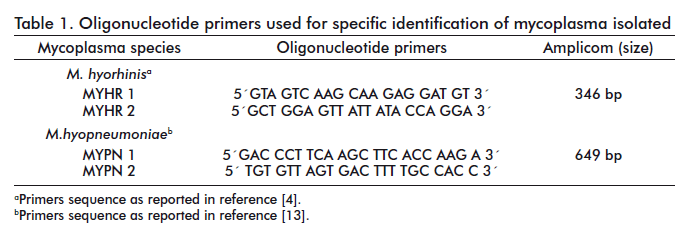
<body><![CDATA[<P   align="justify" ><font face="Verdana, Arial, Helvetica, sans-serif" size="2">PRDC is a syndrome      typically affecting 16- to 22-week-old pigs, characterized by slow growth,      poor food utilization, anorexia, fever, coughing and dyspnoea [1]. A variety      of other respiratory pathogens plays an important role in the development      of PRDC like <I>Actinobacillus pleuropneumoniae</I>, <I>Bordetella bronchiseptica</I>,      <I>Pasteurella multocida</I>, <I>Streptococcus suis</I>, influenza virus and      porcine circovirus type 2 (PCV-2) which are also potential pathogens to contribute      to PRDC [9]. </font></P >       <P   align="justify" ><font face="Verdana, Arial, Helvetica, sans-serif" size="2">In Cuba, <I>M. hyopneumoniae</I>      circulation has been studied from direct lung exudates and seroprofile studies      [10, 11], but no further studies have been carried out regarding the presence      of other swine mycoplasmas and bacteria that may be circulating in the island      associated to PRDC, hence the objective of the present work was to detect      the presence of swine mycoplasmas and bacteria from exudates of pig lungs      with typical EP lesions in different regions of the country. </font></P >       <P   align="justify" >&nbsp;</P >       <P   ><font size="3" face="Verdana, Arial, Helvetica, sans-serif"><b>MATERIALS AND      METHODS </b> </font></P >   <FONT size="+1">        <P   align="justify" ><font size="2" face="Verdana, Arial, Helvetica, sans-serif">A total of 280 pig      lungs with typical EP lesions (35 per province) was processed between October,      2007, (Pinar del R&iacute;o, Mayabeque and Matanzas provinces) and January,      2008, (Cienfuegos, Villa Clara, Ciego de Avila, Sancti Spiritus and Camag&uuml;ey).      These samples were taken in the regional slaughterhouse <I>La Espa&ntilde;ola</I>      and, in all the cases, lungs were transported to MYCOLAB to be immediately      processed with the transfer conditions established by biosafety. </font></P >   <FONT size="+1">        <P   align="justify" ><font face="Verdana, Arial, Helvetica, sans-serif" size="2">Samples were taken      in the apical, frontal, medial and diaphragmatic lobules. They were processed      as follows. A piece of pulmonary lobule that had been previously introduced      into 70 &ordm;C alcohol was flamed and an incision was made using an also      flamed scalpel to reach the pulmonary parenchyma with a sterile swab, thus      avoiding contamination due to manipulation. Swabs were introduced into Eppendorf      tubes containing 250 &micro;L of sterile PBS and centrifuged at 14 000 rpm      for 2 min. The liquid obtained was then collected. </font></P >       <P   align="justify" ><font face="Verdana, Arial, Helvetica, sans-serif" size="2">DNA was extracted      according to Fern&aacute;ndez <I>et al</I>. [12]. It was based on sample subjected      to a combination of thermal shocks and centrifugation. Strains of <I>M. hyorhinis</I>      (ATCC 10130) and <I>M. hyopneumoniae </I>(J, NCTC 10110) were used as positive      controls. Oligonucleotide primers (<a href="/img/revistas/bta/v28n3/t0105311.gif">Table</a>) and PCR      conditions used specific identification of <I>M. hyorhinis </I>and<I> M. hyopneumoniae,      </I>described by Caron <I>et al</I>. [13] and Mattson <I>et al</I>. [14].      </font></P >       
<P   align="justify" ><font face="Verdana, Arial, Helvetica, sans-serif" size="2">The mixture was prepared      using the KITPuRetaq<Sup>TM</Sup> Ready-To-Go PCR Beads kit, from BIO-RAD;      amplification was done in a volume of 25 &mu;L, in each case, 1 &mu;L of each      primer, 18 &mu;L of ultra pure water and 5 &mu;L of the problem DNA. For each      reaction, DNA from the reference strain was used as the positive control and      sterile bidistilled water was used as the negative control. The thermal profile      of the reaction for <I>M. hyopneumoniae</I> included an initial step at 95      &ordm;C for 4 min followed by 35 cycles consisting of denaturation step at      95 &ordm;C for 0.75 min, annealing at 59 &ordm;C for 1 min. and extension      at 72 &ordm;C for 2 min. A final extension step at 72 &ordm;C for 10 min was      also included. In the case of <I>M. hyorhinis, </I>the thermal profile for      the reaction included an initial step at 94 &ordm;C for 3 min, followed by      35 cycles consisting of desnaturation step at 94 &ordm;C for 1 min, annealing      at 50 &ordm;C for 1 min and extension at 72 &ordm;C for 1.5 min. A final extension      step at 72 &ordm;C for 10 min was also included. </font></P >   <FONT size="+1"><FONT size="+1">        <P   align="justify" ><font face="Verdana, Arial, Helvetica, sans-serif" size="2">All PCR reactions      were performed in Mastercycler Gradient thermocycler (Eppendorf). Aliquots      of amplified samples (5 &micro;L) were analyzed by electrophoresis 2% in agarose      gel. The gel was stained with ethidium bromide (0.5 &micro;g/mL) and photographed      under UV illumination. </font></P >       <P   align="justify" ><font face="Verdana, Arial, Helvetica, sans-serif" size="2">The samples were      cultured bacteriologically on the day they were collected, and a semiquantitative      examination for specific colony types was performed. The following media used      were: Columbia agar, Columbia agar supplemented with 5 per cent of fibrinated      sheep blood and Mac Conkey agar. Bacterial species were differentiated using      commercial test kits (Enterotube API kits; bioM&eacute;rieux). </font></P >       ]]></body>
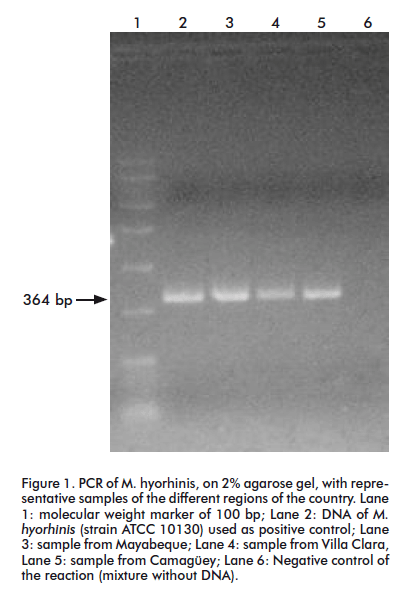
<body><![CDATA[<P   align="justify" >&nbsp;</P >       <P   ><font size="2" face="Verdana, Arial, Helvetica, sans-serif"><b><font size="3">RESULTS      AND DISCUSSION </font> </b> </font></P >   <FONT size="+1">        <P   align="justify" ><font size="2" face="Verdana, Arial, Helvetica, sans-serif">As a result of the      PCR, for detecting <I>M. hyorhinis,</I> the amplification of a 364 bp band      was observed in 44.8% of the total of the samples tested, which coincided      with that obtained by the positive control (reference strain of <I>M. hyorhinis</I>      ATCC 10130). As it can be observed in <a href="#fig1">figure 1</a>, the presence      of this species was detected in all the provinces. </font></P >       <P   align="center" ><img src="/img/revistas/bta/v28n3/f0105311.gif" width="410" height="594"><a name="fig2"></a></P >   <FONT size="+1">        
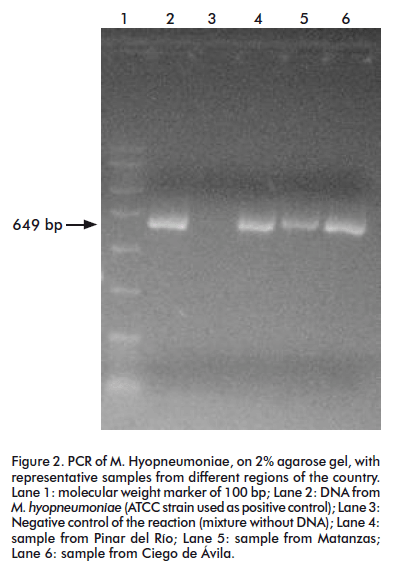
<P   align="justify" ><font face="Verdana, Arial, Helvetica, sans-serif" size="2">As results from PCR      for detecting <I>M. hyopneumoniae</I>, an amplification of 649 bp band was      observed in 14.29% of all the samples, coinciding with the obtained by positive      control (<I>M. hyopneumoniae </I>ATCC 29052 reference strain) (<a href="#fig2">Figure      2</a>). Positive samples were observed in every province: These results confirm      the presence of <I>M. hyopneumoniae </I>from lung samples coming from the      west and central part of the island.</font></P >       <P   align="center" ><img src="/img/revistas/bta/v28n3/f0205311.gif" width="393" height="573"><a name="fig2"></a></P >       
<P   align="justify" ><font face="Verdana, Arial, Helvetica, sans-serif" size="2">It must be pointed      out that the 19.84% of the samples tested were positive to <I>M. hyorhinis.      </I>This percentage coincides with that reported by Assuncao <I>et al</I>.      [5] and Palzer <I>et al</I>. [9], who referred <I>M. hyorhinis </I>as the      biggest contaminants of <I>M. hyopneumoniae</I> microbial cultures, and also      pointed out its high incidence as an agent of EP etiological picture, respectively.      </font></P >       <P   align="justify" ><font face="Verdana, Arial, Helvetica, sans-serif" size="2">Other specific bacterial      agents such as <I>Streptococcus suis </I>type II, <I>Pasteurella multocida</I>,      <I>Streptococcus </I>spp<I>.</I> and <I>Streptococcus equisimilis</I> of the      lung tissue samples were detected by bacteriological culture. This result      is similar to those obtained by Moorkamp <I>et al</I>. [15], who detected      respiratory pathogens in porcine lung tissues. </font></P >       <P   align="justify" ><font face="Verdana, Arial, Helvetica, sans-serif" size="2">Unfortunately, the      frequency distribution of micoplasma bacterial isolates could not be found      and the pulmonary volume was not weighed up, they were only samples taken      from the affected areas regardless the lesion size and affected lobules. In      this sense, studies have been conducted about the characteristics and extension      of the lesions, area and more affected lobules, finding out their correlation      with the isolate incidence or agent detection [16, 17]. </font></P >       <P   align="justify" ><font face="Verdana, Arial, Helvetica, sans-serif" size="2">The right lung has      been usually more affected than the left one, showing a more abundant bronchogenic      distribution [18] with the SEP lesions, varying according to the disease phase      and the likely secondary complications at the moment of the inspection [17].      In our case, from the 66% of the samples that resulted positive to<I> M. hyorhinis</I>,      the highest percentage (22.77%) corresponded to lesions occurring in the apical      lobule, 20.37% in the mediastinal lobule and 17.86% corresponded to lesions      in the diaphragmatic lobule. </font></P >       ]]></body>
<body><![CDATA[<P   align="justify" ><font face="Verdana, Arial, Helvetica, sans-serif" size="2">This result is similar      to those obtained by Assuncao <I>et al.</I> [5] who reported the highest number      of detection of pathogenic microorganisms<I> </I>being found in the left apical      and mediastinal lobules. On the other hand, Moorkamp <I>et al</I>. [15] and      Palzer <I>et al</I>. [9] carried out studies on the incidence percentage of      pathogenic microorganisms in swine pneumonia and their interrelation with      other agents. </font></P >       <P   align="justify" >&nbsp;</P >       <P   ><font size="2" face="Verdana, Arial, Helvetica, sans-serif"><b><font size="3">CONCLUSIONS</font></b>      </font></P >   <FONT size="+1">        <P   align="justify" ><font size="2" face="Verdana, Arial, Helvetica, sans-serif">These results are      a contribution to the knowledge of the enzootic pneumonia and the factors      should be kept in mind in future works for the control of this entity. This      research sets the basis for more complete studies of EP molecular epidemiology      in Cuba. </font></P >       <P   align="justify" >&nbsp;</P >   <FONT size="+1">        <P   ><font size="2" face="Verdana, Arial, Helvetica, sans-serif"><b><font size="3">ACKNOWLEDGEMENTS      </font> </b> </font></P >   <FONT size="+1">        <P   align="justify" ><font size="2" face="Verdana, Arial, Helvetica, sans-serif">This work was possible      thanks to a Scholarship of the Spanish Agency of International Collaboration      (AECID) and the cooperation of Dr Jos&eacute; B Poveda and his staff. </font></P >   <FONT size="+1">        <P   align="justify" > </P >       <P   align="justify" ><font size="3"><b><font face="Verdana, Arial, Helvetica, sans-serif">REFERENCES      </font></b></font></P >       <!-- ref --><P   align="justify" ><font face="Verdana, Arial, Helvetica, sans-serif" size="2">1.Stemke GW, Phan      R, Young TF, Ross RF. Differentiation of Mycoplasma hyopneumoniae, M flocculare      and M hyorhinis on the basis of amplification of a 16S rRNA gene sequence.      Am J Vet Res. 1994; 55(1):81-4.     </font></P >       <P   align="justify" ><font face="Verdana, Arial, Helvetica, sans-serif" size="2">2.Thacker EL. Porcine      respiratory disease complex &ndash; what is it and why does it remain a problem?      Pig J. 2001;48:66-70. </font></P >       <!-- ref --><P   align="justify" ><font face="Verdana, Arial, Helvetica, sans-serif" size="2">3.Sibila M, Pieters      M, Molitor T, Maes D, Haesebrouck F, Segal&eacute;s J. Current perspectives      on the diagnosis and epidemiology of Mycoplasma hyopneumoniae infection. Vet      J. 2009;181(3):221-31.     </font></P >       <P   align="justify" ><font face="Verdana, Arial, Helvetica, sans-serif" size="2">4.Thacker EL. Mycoplasmal      Disease. In: Straw BE, Zimmermann JJ, D&rsquo;Allaire S, Taylor DJ, editors.      Diseases of Swine. 9th ed. Wiley Blackwell; 2006. p. 701-17. </font></P >       <!-- ref --><P   align="justify" ><font face="Verdana, Arial, Helvetica, sans-serif" size="2">5.Assun&ccedil;&atilde;o      P, De la Fe C, Kokotovic B, Gonz&aacute;lez O, Poveda JB. The occurrence of      mycoplasmas in the lungs of swine in Gran Canaria (Spain). Vet Res Commun.      2005;29(6):453-62 </font></P >       <!-- ref --><P   align="justify" ><font face="Verdana, Arial, Helvetica, sans-serif" size="2">6.Friis NF, Feenstra      AA. Mycoplasma hyorhinis in the etiology of serositis among piglets. Acta      Vet Scand. 1994;35(1):93-8.     </font></P >       <!-- ref --><P   align="justify" ><font face="Verdana, Arial, Helvetica, sans-serif" size="2">7.Kobayashi H, Morozumi      T, Miyamoto C, Shimizu M, Yamada S, Ohashi S, et al. Mycoplasma hyorhinis      infection levels in lungs of piglets with porcine reproductive and respiratory      syndrome (PRRS). J Vet Med Sci. 1996;58(2):109-13.     </font></P >       ]]></body>
<body><![CDATA[<P   align="justify" ><font face="Verdana, Arial, Helvetica, sans-serif" size="2">8.Lin JH, Chen SP,      Yeh KS, Weng CN. Mycoplasma hyorhinis in Taiwan: Diagnosis and isolation of      swine pneumonia pathogen. Vet Microbiol. 2006;115(1-3):</font><font face="Verdana, Arial, Helvetica, sans-serif" size="2">111-6. </font></P >       <!-- ref --><P   align="justify" ><font face="Verdana, Arial, Helvetica, sans-serif" size="2">9.Palzer A, Ritzmann      M, Wolf G, Heinritzi K. Associations between pathogens in healthy pigs and      pigs with pneumonia. Vet Rec. 2008;162(9):267-71.     </font></P >       <P   align="justify" ><font face="Verdana, Arial, Helvetica, sans-serif" size="2">10.Abeledo MA, Ruano      M, Vega E, Lobo E, Ruedas D. Detecci&oacute;n de anticuerpos frente a M. hyopneumoniae      en crianzas porcinas mediante un ELISA competitivo. Rev Salud Animal. 2005;27(1):21-5.      </font></P >       <P   align="justify" ><font face="Verdana, Arial, Helvetica, sans-serif" size="2">11.Lobo E. Mycoplasma      hyopneumoniae y su relaci&oacute;n con los procesos respiratorios del cerdo.      Rev Electr&oacute;n Vet [Internet]. 2005 Oct [cited 2010 Jul 15];6(10):[about      8 p.]. Available from: <a href="http://www.veterinaria.org/revistas/redvet/n101005.html" target="_blank">http://www.veterinaria.org/revistas/redvet/n101005.html</a>.      </font></P >       <!-- ref --><P   align="justify" ><font face="Verdana, Arial, Helvetica, sans-serif" size="2">12.Fern&aacute;ndez      C, Ch&aacute;vez YR. Aplicaci&oacute;n de la reacci&oacute;n en cadena de      la polimerasa en la detecci&oacute;n de micoplasmas. Rev Salud Animal. 1996;18(1):31-4.          </font></P >       <!-- ref --><P   align="justify" ><font face="Verdana, Arial, Helvetica, sans-serif" size="2">13.Caron J, Ouardani      M, Dea S. Diagnosis and differentiation of Mycoplasma hyopneumoniae and Mycoplasma      hyorhinis infections in pigs by PCR amplification of the p36 and p46 genes.      J Clin Microbiol. 2000;38(4):1390-6.     </font></P >       <!-- ref --><P   align="justify" ><font face="Verdana, Arial, Helvetica, sans-serif" size="2">14.Mattsson JG, Bergstr&ouml;m      K, Wallgren P, Johansson KE. Detection of Mycoplasma hyopneumoniae in nose      swabs from pigs by in vitro amplification of the 16S rRNA gene. J Clin Microbiol.      1995;33(4):893-7.     </font></P >       <!-- ref --><P   align="justify" ><font face="Verdana, Arial, Helvetica, sans-serif" size="2">15.Moorkamp L, Nathues      H, Spergser J, Tegeler R, Beilage EG. Detection of respiratory pathogens in      porcine lung tissue and lavage fluid. Vet J. 2008;175(2):273-5.     </font></P >       <!-- ref --><P   align="justify" ><font face="Verdana, Arial, Helvetica, sans-serif" size="2">16.Maes D, Verdonck      M, Deluyker H, Kruif A. Enzootic pneumonia in pigs. Vet Q. 1996;18(3):104-9.          </font></P >       <!-- ref --><P   align="justify" ><font face="Verdana, Arial, Helvetica, sans-serif" size="2">17.Andrada M, Espinosa      de los Monteros A, Rodr&iacute;guez F, Fern&aacute;ndez A, Herr&aacute;ez,      P. Patog&eacute;nesis, signos cl&iacute;nicos y lesiones de la Neumon&iacute;a      Enzo&oacute;tica Porcina. Porci. 2003;(74):47-68.     </font></P >       <P   align="justify" ><font face="Verdana, Arial, Helvetica, sans-serif" size="2">18.G&oacute;mez-Villamandos      JC, Martin de las Mulas J, Quezada M, Carrasco L. Patogenia y signos cl&iacute;nicos-cuadro      lesional de la Neumon&iacute;a Micoplasmica Porcina. Porci. 1995;(27):19-33.      </font></P >       <P   align="justify" > </P >       <P   ><font face="Verdana, Arial, Helvetica, sans-serif" size="2">Received in August,      2010.     ]]></body>
<body><![CDATA[<br>     Accepted for publication in September, 2011. </font></P >       <P   ><font size="2" face="Verdana, Arial, Helvetica, sans-serif">Evelyn Lobo. Laboratorio      de Diagn&oacute;stico de Micoplasmas (MYCOLAB), Direcci&oacute;n de Microbiolog&iacute;a,      CENSA. AP 10, San Jos&eacute; de las Lajas, Mayabeque, Cuba. E-mail: <A href="mailto:elobo@censa.edu.cu">      <U><U><FONT color="#0000FF">elobo@censa.edu.cu</font></U></U></A><FONT color="#0000FF">      <FONT color="#000000">. </font></font></font></P >   <FONT size="+1"><FONT color="#0000FF"><FONT color="#000000">        <P   > </P >       <P   align="justify" > </P >   </font></font></font></font></font></font></font></font></font></font></font></font></font></font></font></font></font></font></font></font></font></font></font></font></font></font></font></font></font></DIV >      ]]></body><back>
<ref-list>
<ref id="B1">
<label>1</label><nlm-citation citation-type="journal">
<person-group person-group-type="author">
<name>
<surname><![CDATA[Stemke]]></surname>
<given-names><![CDATA[GW]]></given-names>
</name>
<name>
<surname><![CDATA[Phan]]></surname>
<given-names><![CDATA[R]]></given-names>
</name>
<name>
<surname><![CDATA[Young]]></surname>
<given-names><![CDATA[TF]]></given-names>
</name>
<name>
<surname><![CDATA[Ross]]></surname>
<given-names><![CDATA[RF]]></given-names>
</name>
</person-group>
<article-title xml:lang="en"><![CDATA[Differentiation of Mycoplasma hyopneumoniae, M flocculare, and M hyorhinis on the basis of amplification of a 16S rRNA gene sequence]]></article-title>
<source><![CDATA[Am J Vet Res]]></source>
<year>1994</year>
<volume>55</volume>
<numero>1</numero>
<issue>1</issue>
<page-range>81-4</page-range></nlm-citation>
</ref>
<ref id="B2">
<label>2</label><nlm-citation citation-type="journal">
<person-group person-group-type="author">
<name>
<surname><![CDATA[Thacker]]></surname>
<given-names><![CDATA[EL]]></given-names>
</name>
</person-group>
<article-title xml:lang="en"><![CDATA[Porcine respiratory disease complex: what is it and why does it remain a problem?]]></article-title>
<source><![CDATA[Pig J]]></source>
<year>2001</year>
<volume>48</volume>
<page-range>66-70</page-range></nlm-citation>
</ref>
<ref id="B3">
<label>3</label><nlm-citation citation-type="journal">
<person-group person-group-type="author">
<name>
<surname><![CDATA[Sibila]]></surname>
<given-names><![CDATA[M]]></given-names>
</name>
<name>
<surname><![CDATA[Pieters]]></surname>
<given-names><![CDATA[M]]></given-names>
</name>
<name>
<surname><![CDATA[Molitor]]></surname>
<given-names><![CDATA[T]]></given-names>
</name>
<name>
<surname><![CDATA[Maes]]></surname>
<given-names><![CDATA[D]]></given-names>
</name>
<name>
<surname><![CDATA[Haesebrouck]]></surname>
<given-names><![CDATA[F]]></given-names>
</name>
<name>
<surname><![CDATA[Segalés]]></surname>
<given-names><![CDATA[J]]></given-names>
</name>
</person-group>
<article-title xml:lang="en"><![CDATA[Current perspectives on the diagnosis and epidemiology of Mycoplasma hyopneumoniae infection]]></article-title>
<source><![CDATA[Vet J]]></source>
<year>2009</year>
<volume>181</volume>
<numero>3</numero>
<issue>3</issue>
<page-range>221-31</page-range></nlm-citation>
</ref>
<ref id="B4">
<label>4</label><nlm-citation citation-type="book">
<person-group person-group-type="author">
<name>
<surname><![CDATA[Thacker]]></surname>
<given-names><![CDATA[EL]]></given-names>
</name>
</person-group>
<article-title xml:lang="en"><![CDATA[Mycoplasmal Disease]]></article-title>
<person-group person-group-type="editor">
<name>
<surname><![CDATA[Straw]]></surname>
<given-names><![CDATA[BE]]></given-names>
</name>
<name>
<surname><![CDATA[Zimmermann]]></surname>
<given-names><![CDATA[JJ]]></given-names>
</name>
<name>
<surname><![CDATA[D'Allaire]]></surname>
<given-names><![CDATA[S]]></given-names>
</name>
<name>
<surname><![CDATA[Taylor]]></surname>
<given-names><![CDATA[DJ]]></given-names>
</name>
</person-group>
<source><![CDATA[Diseases of Swine]]></source>
<year>2006</year>
<edition>9</edition>
<page-range>701-17</page-range><publisher-name><![CDATA[Wiley Blackwell]]></publisher-name>
</nlm-citation>
</ref>
<ref id="B5">
<label>5</label><nlm-citation citation-type="journal">
<person-group person-group-type="author">
<name>
<surname><![CDATA[Assunção]]></surname>
<given-names><![CDATA[P]]></given-names>
</name>
<name>
<surname><![CDATA[De la Fe]]></surname>
<given-names><![CDATA[C]]></given-names>
</name>
<name>
<surname><![CDATA[Kokotovic]]></surname>
<given-names><![CDATA[B]]></given-names>
</name>
<name>
<surname><![CDATA[González]]></surname>
<given-names><![CDATA[O]]></given-names>
</name>
<name>
<surname><![CDATA[Poveda]]></surname>
<given-names><![CDATA[JB]]></given-names>
</name>
</person-group>
<article-title xml:lang="en"><![CDATA[The occurrence of mycoplasmas in the lungs of swine in Gran Canaria (Spain)]]></article-title>
<source><![CDATA[Vet Res Commun]]></source>
<year>2005</year>
<volume>29</volume>
<numero>6</numero>
<issue>6</issue>
<page-range>453-62</page-range></nlm-citation>
</ref>
<ref id="B6">
<label>6</label><nlm-citation citation-type="journal">
<person-group person-group-type="author">
<name>
<surname><![CDATA[Friis]]></surname>
<given-names><![CDATA[NF]]></given-names>
</name>
<name>
<surname><![CDATA[Feenstra]]></surname>
<given-names><![CDATA[AA]]></given-names>
</name>
</person-group>
<article-title xml:lang="en"><![CDATA[Mycoplasma hyorhinis in the etiology of serositis among piglets]]></article-title>
<source><![CDATA[Acta Vet Scand]]></source>
<year>1994</year>
<volume>35</volume>
<numero>1</numero>
<issue>1</issue>
<page-range>93-8</page-range></nlm-citation>
</ref>
<ref id="B7">
<label>7</label><nlm-citation citation-type="journal">
<person-group person-group-type="author">
<name>
<surname><![CDATA[Kobayashi]]></surname>
<given-names><![CDATA[H]]></given-names>
</name>
<name>
<surname><![CDATA[Morozumi]]></surname>
<given-names><![CDATA[T]]></given-names>
</name>
<name>
<surname><![CDATA[Miyamoto]]></surname>
<given-names><![CDATA[C]]></given-names>
</name>
<name>
<surname><![CDATA[Shimizu]]></surname>
<given-names><![CDATA[M]]></given-names>
</name>
<name>
<surname><![CDATA[Yamada]]></surname>
<given-names><![CDATA[S]]></given-names>
</name>
<name>
<surname><![CDATA[Ohashi]]></surname>
<given-names><![CDATA[S]]></given-names>
</name>
</person-group>
<article-title xml:lang="en"><![CDATA[Mycoplasma hyorhinis infection levels in lungs of piglets with porcine reproductive and respiratory syndrome (PRRS)]]></article-title>
<source><![CDATA[J Vet Med Sci]]></source>
<year>1996</year>
<volume>58</volume>
<numero>2</numero>
<issue>2</issue>
<page-range>109-13</page-range></nlm-citation>
</ref>
<ref id="B8">
<label>8</label><nlm-citation citation-type="journal">
<person-group person-group-type="author">
<name>
<surname><![CDATA[Lin]]></surname>
<given-names><![CDATA[JH]]></given-names>
</name>
<name>
<surname><![CDATA[Chen]]></surname>
<given-names><![CDATA[SP]]></given-names>
</name>
<name>
<surname><![CDATA[Yeh]]></surname>
<given-names><![CDATA[KS]]></given-names>
</name>
<name>
<surname><![CDATA[Weng]]></surname>
<given-names><![CDATA[CN]]></given-names>
</name>
</person-group>
<article-title xml:lang="en"><![CDATA[Mycoplasma hyorhinis in Taiwan: Diagnosis and isolation of swine pneumonia pathogen]]></article-title>
<source><![CDATA[Vet Microbiol]]></source>
<year>1996</year>
<volume>115</volume>
<page-range>111-6</page-range></nlm-citation>
</ref>
<ref id="B9">
<label>9</label><nlm-citation citation-type="journal">
<person-group person-group-type="author">
<name>
<surname><![CDATA[Palzer]]></surname>
<given-names><![CDATA[A]]></given-names>
</name>
<name>
<surname><![CDATA[Ritzmann]]></surname>
<given-names><![CDATA[M]]></given-names>
</name>
<name>
<surname><![CDATA[Wolf]]></surname>
<given-names><![CDATA[G]]></given-names>
</name>
<name>
<surname><![CDATA[Heinritzi]]></surname>
<given-names><![CDATA[K]]></given-names>
</name>
</person-group>
<article-title xml:lang="en"><![CDATA[Associations between pathogens in healthy pigs and pigs with pneumonia]]></article-title>
<source><![CDATA[Vet Rec]]></source>
<year>2008</year>
<volume>162</volume>
<numero>9</numero>
<issue>9</issue>
<page-range>267-71</page-range></nlm-citation>
</ref>
<ref id="B10">
<label>10</label><nlm-citation citation-type="journal">
<person-group person-group-type="author">
<name>
<surname><![CDATA[Abeledo]]></surname>
<given-names><![CDATA[MA]]></given-names>
</name>
<name>
<surname><![CDATA[Ruano]]></surname>
<given-names><![CDATA[M]]></given-names>
</name>
<name>
<surname><![CDATA[Vega]]></surname>
<given-names><![CDATA[E]]></given-names>
</name>
<name>
<surname><![CDATA[Lobo]]></surname>
<given-names><![CDATA[E]]></given-names>
</name>
<name>
<surname><![CDATA[Ruedas]]></surname>
<given-names><![CDATA[D]]></given-names>
</name>
</person-group>
<article-title xml:lang="es"><![CDATA[Detección de anticuerpos frente a M. hyopneumoniae en crianzas porcinas mediante un ELISA competitivo]]></article-title>
<source><![CDATA[Rev Salud Animal]]></source>
<year>2005</year>
<numero>1</numero>
<issue>1</issue>
<page-range>27</page-range></nlm-citation>
</ref>
<ref id="B11">
<label>11</label><nlm-citation citation-type="journal">
<person-group person-group-type="author">
<name>
<surname><![CDATA[Lobo]]></surname>
<given-names><![CDATA[E]]></given-names>
</name>
</person-group>
<article-title xml:lang="es"><![CDATA[Mycoplasma hyopneumoniae y su relación con los procesos respiratorios del cerdo]]></article-title>
<source><![CDATA[Rev Electron Vet]]></source>
<year>2005</year>
<month> O</month>
<day>ct</day>
<volume>6</volume>
<numero>10</numero>
<issue>10</issue>
</nlm-citation>
</ref>
<ref id="B12">
<label>12</label><nlm-citation citation-type="journal">
<person-group person-group-type="author">
<name>
<surname><![CDATA[Fernández]]></surname>
<given-names><![CDATA[C]]></given-names>
</name>
<name>
<surname><![CDATA[Chávez]]></surname>
<given-names><![CDATA[YR]]></given-names>
</name>
</person-group>
<article-title xml:lang="es"><![CDATA[Aplicación de la reacción en cadena de la polimerasa en la detección de micoplasmas]]></article-title>
<source><![CDATA[Rev Salud Animal]]></source>
<year>1996</year>
<volume>18</volume>
<numero>1</numero>
<issue>1</issue>
<page-range>31-4</page-range></nlm-citation>
</ref>
<ref id="B13">
<label>13</label><nlm-citation citation-type="journal">
<person-group person-group-type="author">
<name>
<surname><![CDATA[Caron]]></surname>
<given-names><![CDATA[J]]></given-names>
</name>
<name>
<surname><![CDATA[Ouardani]]></surname>
<given-names><![CDATA[M]]></given-names>
</name>
<name>
<surname><![CDATA[Dea]]></surname>
<given-names><![CDATA[S]]></given-names>
</name>
</person-group>
<article-title xml:lang="en"><![CDATA[Diagnosis and differentiation of Mycoplasma hyopneumoniae and Mycoplasma hyorhinis infections in pigs by PCR amplification of the p36 and p46 genes]]></article-title>
<source><![CDATA[J Clin Microbiol]]></source>
<year>2000</year>
<volume>38</volume>
<numero>4</numero>
<issue>4</issue>
<page-range>1390-6</page-range></nlm-citation>
</ref>
<ref id="B14">
<label>14</label><nlm-citation citation-type="journal">
<person-group person-group-type="author">
<name>
<surname><![CDATA[Mattsson]]></surname>
<given-names><![CDATA[JG]]></given-names>
</name>
<name>
<surname><![CDATA[Bergström]]></surname>
<given-names><![CDATA[K]]></given-names>
</name>
<name>
<surname><![CDATA[Wallgren]]></surname>
<given-names><![CDATA[P]]></given-names>
</name>
<name>
<surname><![CDATA[Johansson]]></surname>
<given-names><![CDATA[KE]]></given-names>
</name>
</person-group>
<article-title xml:lang="en"><![CDATA[Detection of Mycoplasma hyopneumoniae in nose swabs from pigs by in vitro amplification of the 16S rRNA gene]]></article-title>
<source><![CDATA[J Clin Microbiol]]></source>
<year>1995</year>
<volume>33</volume>
<numero>4</numero>
<issue>4</issue>
<page-range>893-7</page-range></nlm-citation>
</ref>
<ref id="B15">
<label>15</label><nlm-citation citation-type="journal">
<person-group person-group-type="author">
<name>
<surname><![CDATA[Moorkamp]]></surname>
<given-names><![CDATA[L]]></given-names>
</name>
<name>
<surname><![CDATA[Nathues]]></surname>
<given-names><![CDATA[H]]></given-names>
</name>
<name>
<surname><![CDATA[Spergser]]></surname>
<given-names><![CDATA[J]]></given-names>
</name>
<name>
<surname><![CDATA[Tegeler]]></surname>
<given-names><![CDATA[R]]></given-names>
</name>
<name>
<surname><![CDATA[Beilage]]></surname>
<given-names><![CDATA[EG]]></given-names>
</name>
</person-group>
<article-title xml:lang="en"><![CDATA[Detection of respiratory pathogens in porcine lung tissue and lavage fluid]]></article-title>
<source><![CDATA[Vet J]]></source>
<year>2008</year>
<volume>175</volume>
<numero>2</numero>
<issue>2</issue>
<page-range>273-5</page-range></nlm-citation>
</ref>
<ref id="B16">
<label>16</label><nlm-citation citation-type="journal">
<person-group person-group-type="author">
<name>
<surname><![CDATA[Maes]]></surname>
<given-names><![CDATA[D]]></given-names>
</name>
<name>
<surname><![CDATA[Verdonck]]></surname>
<given-names><![CDATA[M]]></given-names>
</name>
<name>
<surname><![CDATA[Deluyker]]></surname>
<given-names><![CDATA[H]]></given-names>
</name>
<name>
<surname><![CDATA[Kruif]]></surname>
<given-names><![CDATA[A]]></given-names>
</name>
</person-group>
<article-title xml:lang="en"><![CDATA[Enzootic pneumonia in pigs]]></article-title>
<source><![CDATA[Vet Q]]></source>
<year>1996</year>
<volume>18</volume>
<numero>3</numero>
<issue>3</issue>
<page-range>104-9</page-range></nlm-citation>
</ref>
<ref id="B17">
<label>17</label><nlm-citation citation-type="journal">
<person-group person-group-type="author">
<name>
<surname><![CDATA[Andrada]]></surname>
<given-names><![CDATA[M]]></given-names>
</name>
<name>
<surname><![CDATA[Espinosa de los Monteros]]></surname>
<given-names><![CDATA[A]]></given-names>
</name>
<name>
<surname><![CDATA[Rodríguez]]></surname>
<given-names><![CDATA[F]]></given-names>
</name>
<name>
<surname><![CDATA[Fernández]]></surname>
<given-names><![CDATA[A]]></given-names>
</name>
<name>
<surname><![CDATA[Herráez]]></surname>
<given-names><![CDATA[P]]></given-names>
</name>
</person-group>
<article-title xml:lang="es"><![CDATA[Patogénesis, signos clínicos y lesiones de la Neumonía Enzoótica Porcina]]></article-title>
<source><![CDATA[Porci]]></source>
<year>2003</year>
<numero>74</numero>
<issue>74</issue>
<page-range>47-68</page-range></nlm-citation>
</ref>
<ref id="B18">
<label>18</label><nlm-citation citation-type="journal">
<person-group person-group-type="author">
<name>
<surname><![CDATA[Gomez-Villamandos]]></surname>
<given-names><![CDATA[JC]]></given-names>
</name>
<name>
<surname><![CDATA[Martin de las Mulas]]></surname>
<given-names><![CDATA[J]]></given-names>
</name>
<name>
<surname><![CDATA[Quezada]]></surname>
<given-names><![CDATA[M]]></given-names>
</name>
<name>
<surname><![CDATA[Carrasco]]></surname>
<given-names><![CDATA[L]]></given-names>
</name>
</person-group>
<article-title xml:lang="es"><![CDATA[Patogenia y signos clinicos-cuadro lesional de la Neumonía Micoplasmica Porcina]]></article-title>
<source><![CDATA[Porci]]></source>
<year>1995</year>
<numero>27</numero>
<issue>27</issue>
<page-range>19-33</page-range></nlm-citation>
</ref>
</ref-list>
</back>
</article>