<?xml version="1.0" encoding="ISO-8859-1"?><article xmlns:mml="http://www.w3.org/1998/Math/MathML" xmlns:xlink="http://www.w3.org/1999/xlink" xmlns:xsi="http://www.w3.org/2001/XMLSchema-instance">
<front>
<journal-meta>
<journal-id>1027-2852</journal-id>
<journal-title><![CDATA[Biotecnología Aplicada]]></journal-title>
<abbrev-journal-title><![CDATA[Biotecnol Apl]]></abbrev-journal-title>
<issn>1027-2852</issn>
<publisher>
<publisher-name><![CDATA[Editorial Elfos Scientiae]]></publisher-name>
</publisher>
</journal-meta>
<article-meta>
<article-id>S1027-28522011000300009</article-id>
<title-group>
<article-title xml:lang="en"><![CDATA[Identification of a new trypsin from Spodoptera frugiperda involved in a defensive mechanism against the Bacillus thuringiensis Cry1Ca1 toxin]]></article-title>
<article-title xml:lang="es"><![CDATA[Identificación de una nueva tripsina de Spodoptera frugiperda que participa en un mecanismo de defensa contra la toxina CryCa1 de Bacillus thruringiensis]]></article-title>
</title-group>
<contrib-group>
<contrib contrib-type="author">
<name>
<surname><![CDATA[Rodríguez]]></surname>
<given-names><![CDATA[Lianet]]></given-names>
</name>
<xref ref-type="aff" rid="A01"/>
</contrib>
<contrib contrib-type="author">
<name>
<surname><![CDATA[Borrás]]></surname>
<given-names><![CDATA[Orlando]]></given-names>
</name>
<xref ref-type="aff" rid="A02"/>
</contrib>
<contrib contrib-type="author">
<name>
<surname><![CDATA[Téllez]]></surname>
<given-names><![CDATA[Pilar]]></given-names>
</name>
<xref ref-type="aff" rid="A01"/>
</contrib>
<contrib contrib-type="author">
<name>
<surname><![CDATA[Morán]]></surname>
<given-names><![CDATA[Ivis]]></given-names>
</name>
<xref ref-type="aff" rid="A01"/>
</contrib>
<contrib contrib-type="author">
<name>
<surname><![CDATA[Ponce]]></surname>
<given-names><![CDATA[Milagros]]></given-names>
</name>
<xref ref-type="aff" rid="A01"/>
</contrib>
<contrib contrib-type="author">
<name>
<surname><![CDATA[Fernández]]></surname>
<given-names><![CDATA[Yanileysis]]></given-names>
</name>
<xref ref-type="aff" rid="A01"/>
</contrib>
<contrib contrib-type="author">
<name>
<surname><![CDATA[Ayra]]></surname>
<given-names><![CDATA[Camilo]]></given-names>
</name>
<xref ref-type="aff" rid="A01"/>
</contrib>
</contrib-group>
<aff id="A02">
<institution><![CDATA[,Centro de Ingeniería Genética y Biotecnología, CIGB División de Plantas Laboratorio de Genómica Funcional de Plantas]]></institution>
<addr-line><![CDATA[La Habana ]]></addr-line>
<country>Cuba</country>
</aff>
<aff id="A01">
<institution><![CDATA[,Centro de Ingeniería Genética y Biotecnología, CIGB División de Plantas Laboratorio de Biotecnología Ambiental]]></institution>
<addr-line><![CDATA[La Habana ]]></addr-line>
<country>Cuba</country>
</aff>
<pub-date pub-type="pub">
<day>00</day>
<month>09</month>
<year>2011</year>
</pub-date>
<pub-date pub-type="epub">
<day>00</day>
<month>09</month>
<year>2011</year>
</pub-date>
<volume>28</volume>
<numero>3</numero>
<fpage>176</fpage>
<lpage>179</lpage>
<copyright-statement/>
<copyright-year/>
<self-uri xlink:href="http://scielo.sld.cu/scielo.php?script=sci_arttext&amp;pid=S1027-28522011000300009&amp;lng=en&amp;nrm=iso"></self-uri><self-uri xlink:href="http://scielo.sld.cu/scielo.php?script=sci_abstract&amp;pid=S1027-28522011000300009&amp;lng=en&amp;nrm=iso"></self-uri><self-uri xlink:href="http://scielo.sld.cu/scielo.php?script=sci_pdf&amp;pid=S1027-28522011000300009&amp;lng=en&amp;nrm=iso"></self-uri><abstract abstract-type="short" xml:lang="en"><p><![CDATA[Both, insecticidal formulations based on the entomopathogenic bacterium Bacillus thuringiensis (Bt) and transgenic plants expressing Bt Cry toxins, have been threatened by the potential appearance of insect resistance in major crop pests. With the aim of identifying genes and mechanisms triggered against a Bt Cry1-class toxin in the midgut of fall armyworm Spodoptera frugiperda, the major pest of maize in Cuba, subtractive cDNA libraries of the molecular interaction insect-Bt Cry1Ca1 toxin were constructed. Among those genes specifically regulated in response to the intoxication, one coding for a new trypsin-like serin proteinase (SfT6) was identified. Gene function analysis using RNA interference showed SfT6 plays a crucial role for the Cry1Ca1 toxicity against S. frugiperda; gene expression suppression caused a reduction of the proteolytic processing of Cry1Ca1 by the larval midgut juice and a reduced susceptibility of insects in bioassays. Our study represents the first report on S. frugiperda midgut genes differentially-expressed in response to Cry1Ca1 intoxication. Besides, we have identified and cloned the full-length cDNA sequence of a novel serine proteinase whose regulation is linked to the natural process of insect adaptation to Bt in order to survive the pathogenic process.]]></p></abstract>
<kwd-group>
<kwd lng="en"><![CDATA[Bacillus thuringiensis]]></kwd>
<kwd lng="en"><![CDATA[Spodoptera frugiperda]]></kwd>
<kwd lng="en"><![CDATA[Cry1Ca1]]></kwd>
<kwd lng="en"><![CDATA[serine-proteinase]]></kwd>
<kwd lng="en"><![CDATA[trypsin]]></kwd>
<kwd lng="en"><![CDATA[RNA interference]]></kwd>
</kwd-group>
</article-meta>
</front><body><![CDATA[ <DIV class="Sect"   >        <P   align="right" ><font size="2" color="#000000" face="Verdana, Arial, Helvetica, sans-serif"><b>REPORT</b></font></P >       <P   align="right" >&nbsp;</P >   <FONT size="+1" color="#000000">        <P   > </P >       <P   ><font size="4"><b><font face="Verdana, Arial, Helvetica, sans-serif">Identification      of a new trypsin from <I>Spodoptera frugiperda</I> involved in a defensive      mechanism against the <I>Bacillus thuringiensis</I> Cry1Ca1 toxin</font></b></font></P >       <P   >&nbsp;</P >   </font><font face="Verdana, Arial, Helvetica, sans-serif" size="3"><b>Identificaci&oacute;n    de una nueva tripsina de <i>Spodoptera frugiperda</i> que participa en un mecanismo    de defensa contra la toxina CryCa1 de <i>Bacillus thruringiensis</i></b></font><FONT size="+1" color="#000000">        <P   >&nbsp;</P >       <P   >&nbsp;</P >       <P   >&nbsp;</P >       <P   > </P >       ]]></body>
<body><![CDATA[<P   > </P >       <P   ><b><font size="2" face="Verdana, Arial, Helvetica, sans-serif">Lianet Rodr&iacute;guez<Sup>1</Sup>,      Orlando Borr&aacute;s<Sup>2</Sup>, Pilar T&eacute;llez<Sup>1</Sup>, Ivis Mor&aacute;n<Sup>1</Sup>,      Milagros Ponce<Sup>1</Sup>, Yanileysis Fern&aacute;ndez<Sup>1</Sup>, Camilo      Ayra<Sup>1 </Sup></font></b></P >       <P   ><font size="2" face="Verdana, Arial, Helvetica, sans-serif"><Sup>1</Sup> Laboratorio      de Biotecnolog&iacute;a Ambiental. <Sup>    <br>     2</Sup> Laboratorio de Gen&oacute;mica Funcional de Plantas. Divisi&oacute;n      de Plantas, Centro de Ingenier&iacute;a Gen&eacute;tica y Biotecnolog&iacute;a,      CIGB. Ave. 31 e/ 158 y 190, Cubanac&aacute;n, Playa, CP 10600, AP 6162, La      Habana, Cuba.</font></P >       <P   >&nbsp;</P >   </font>    <hr>   <FONT size="+1" color="#000000">        <P   ><b><font size="2" face="Verdana, Arial, Helvetica, sans-serif">ABSTRACT </font></b></P >   <FONT size="+1"><FONT size="+1"><FONT size="+1"><FONT size="+1"><FONT size="+1"><FONT size="+1"><FONT size="+1"><FONT size="+1"><FONT size="+1"><FONT size="+1"><FONT size="+1"><FONT size="+1"><FONT size="+1"><FONT size="+1"><FONT size="+1"><FONT size="+1"><FONT size="+1"><FONT size="+1">        <P   ><font size="2" face="Verdana, Arial, Helvetica, sans-serif">Both, insecticidal      formulations based on the entomopathogenic bacterium <I>Bacillus thuringiensis      (Bt) </I>and transgenic plants expressing <I>Bt</I> Cry toxins, have been      threatened by the potential appearance of insect resistance in major crop      pests. With the aim of identifying genes and mechanisms triggered against      a <I>Bt</I> Cry1-class toxin in the midgut of fall armyworm <I>Spodoptera      frugiperda</I>, the major pest of maize in Cuba, subtractive cDNA libraries      of the molecular interaction insect-<I>Bt</I> Cry1Ca1 toxin were constructed.      Among those genes specifically regulated in response to the intoxication,      one coding for a new trypsin-like serin proteinase (SfT6) was identified.      Gene function analysis using RNA interference showed SfT6 plays a crucial      role for the Cry1Ca1 toxicity against <I>S. frugiperda</I>; gene expression      suppression caused a reduction of the proteolytic processing of Cry1Ca1 by      the larval midgut juice and a reduced susceptibility of insects in bioassays.      Our study represents the first report on <I>S. frugiperda </I>midgut genes      differentially-expressed in response to Cry1Ca1 intoxication. Besides, we      have identified and cloned the full-length cDNA sequence of a novel serine      proteinase whose regulation is linked to the natural process of insect adaptation      to <I>Bt</I> in order to survive the pathogenic process. </font></P >       <P   ><font size="2" face="Verdana, Arial, Helvetica, sans-serif"><b>Keywords:</b>      Bacillus thuringiensis, Spodoptera frugiperda, Cry1Ca1, serine-proteinase,      trypsin, RNA interference.</font></P >   </font></font></font></font></font></font></font></font></font></font></font></font></font></font></font></font></font></font></font>   <hr>   <FONT size="+1" color="#000000"><FONT size="+1"><FONT size="+1"><FONT size="+1"><FONT size="+1"><FONT size="+1"><FONT size="+1"><FONT size="+1"><FONT size="+1"><FONT size="+1"><FONT size="+1"><FONT size="+1"><FONT size="+1"><FONT size="+1"><FONT size="+1"><FONT size="+1"><FONT size="+1"><FONT size="+1"><FONT size="+1">        <P   >&nbsp;</P >       <P   >&nbsp;</P >       ]]></body>
<body><![CDATA[<P   > </P >       <P   > </P >       <P   ><font size="3"><b><font face="Verdana, Arial, Helvetica, sans-serif">INTRODUCTION      </font></b></font></P >       <P   align="justify" ><font size="2" face="Verdana, Arial, Helvetica, sans-serif">For decades, commercial      formulations of the sporogenic bacterium <I>Bacillus thuringiensis</I> (<I>Bt</I>)      and its parasporal crystal inclusions (composed mainly by the insecticidal      Cry proteins) have been sprayed on economically important crops, sometimes      indiscriminately, for the control of major insect pests [1]. More recently,      <I>Bt cry</I> genes have been introduced into cultivable plants, particularly      cotton and maize, to produce insect-resistant <I>Bt</I>-crops that in 2009      were grown on 50.4 million ha worldwide [2]. The major concern of such widespread      use of <I>Bt </I>products deals with the possibility of the that developed      resistance by key pest species. To date, three lepidopteran pest species have      evolved substantial resistance to <I>Bt</I> sprays under field conditions      [3, 4] while the first cases of field-evolved resistance to <I>Bt</I>-crops      have been recently documented [5]. </font></P >   <FONT size="+1">        <P   align="justify" ><font size="2" face="Verdana, Arial, Helvetica, sans-serif">The <I>Bt-</I>insect      interaction is a complex multi-step process ending up in larval death when      it&rsquo;s effective. In Lepidoptera, ingested <I>Bt</I> spore and crystals      reach the extremely alkaline and reducing environment of the larval midgut      where spore germination is activated and crystal inclusions solubilize to      inactive protoxins of 130-140 kDa in size. Then, midgut serine-proteinases      transform protoxins into active toxins of 55-65 kDa after removing approximately      600 residues from the C-terminus and the first 28 N-terminal residues [6].      Activated monomers of the Cry toxins can cross the peritrophic matrix barrier      to bind specific membrane receptor(s) on epithelial target cells, where further      proteolysis may take place before pore-forming structures are formed by the      plasma membrane inserted into to disturb the ionic and osmotic balances of      the cell [7]. Finally, germinated spores swing into the insect hemolymph through      the gaps in the epithelial cells barrier left by Cry-bursted cells to colonize      the entire larval body causing septicemic death. </font></P >       <P   align="justify" ><font size="2" face="Verdana, Arial, Helvetica, sans-serif">The molecular study      of host &ndash; pathogen interaction can reveal important features of the      pathogenic process as well as identify those components of defensive mechanisms      triggered in the host. For insect-<I>Bt </I>interaction, such defensive responses      could lead to insect adaptation to the entomopathogen after continuous exposures      inducing a considerable resistance level in successive generations. One effective      approach for identifying insect genes differentially expressed during exposure      to <I>Bt </I>Cry toxins is suppression subtractive hybridization (SSH) [8].      SSH is based on an efficient subtraction step followed by a suppression step.      PCR amplification allows the enrichment of the differentially expressed genes      but suppression of those that are not differentially expressed. In addition,      a normalization step is incorporated to equalize the abundance of individual      mRNAs, in order to provide a better chance for detection of rare transcripts.      Since SSH allows the isolation of differentially expressed cDNAs without a      prior knowledge of their sequence, it is highly desirable for studying differential      gene expression in systems where information on the genomic sequence is scarce      (i.e., insects). Further, gene function studies can be accomplished <I>in      vivo </I>by RNA interference where specific gene expression is suppressed      or completely silenced after feeding larvae with a double-stranded RNA (dsRNA)      synthesized from a large fragment of the correspondent gene [9]. </font></P >       <P   align="justify" ><font size="2" face="Verdana, Arial, Helvetica, sans-serif">In the present work,      the molecular response elicited by <I>Bt </I>Cry1Ca poisoning in <I>Spodoptera      frugiperda</I> (Lepidoptera: Noctuidae), the major pest of maizein Cuba, is      investigated. Subtractive cDNA libraries enriched for <I>S. frugiperda</I>      midgut genes differentially regulated during the exposure to a sublethal dose      of the toxin were generated. Expression analysis of SSH clones showing a significant      hit in the BLAST analysis and which reflected the distribution of molecular      functions in the subtractive cDNA libraries allowed the identification of      a new trypsin-like serin proteinase (<I>SfT6</I>) that was chosen for gene      function analysis by RNAi. Gene expression suppression of <I>SfT6</I> decreased      the pathogenicity of <I>Bt</I> Cry1Ca1 in <I>S. frugiperda</I> larvae and      the protoxin activation rate by larval gut juice corroborating its crucial      role for the <I>Bt</I> Cry1Ca1 toxic pathway in this important Lepidoptera.      </font></P >       <P   ><font size="2" face="Verdana, Arial, Helvetica, sans-serif"><b><font size="3">RESULTS      AND DISCUSSION</font></b></font></P >   <FONT size="+1">        <P   align="justify" ><font size="2" face="Verdana, Arial, Helvetica, sans-serif">The present study      aimed at identifying genes and mechanisms of the lepidopteran larval gut involved      in the specific response against Cry1-class toxins of <I>B. thuringiensis</I>.      To achieve this goal, we performed the molecular analysis of <I>S. frugiperda</I>-Cry1Ca1      toxin interaction and investigated the role of a new trypsin-like serine-protease      (<I>SfT6</I>) differentially expressed in the larval midgut during the process      of <I>Bt</I> intoxication. To this end, the following strategies were used:      i) construction and characterization of subtractive cDNA libraries from the      larval midgut tissue during the interaction<I> S. frugiperda-</I>Cry1Ca1,      ii) cloning of the cDNA full-length sequence of a novel <I>S. frugiperda </I>trypsin,      named here as <I>SfT6</I>, and its sequence analysis, iii) RNAi-mediated gene      silencing of <I>SfT6</I> for function analysis through insect bioassays<I>      </I>and<I> in vitro </I>proteolytic processing of the Cry1Ca1 protoxin. </font></P >   <FONT size="+1">        <P   align="justify" ><font size="2" face="Verdana, Arial, Helvetica, sans-serif">Since a sublethal      dose of 2 &micro;g Cry1Ca1/cm<Sup>2</Sup> caused a complete inhibition of      the larval growth and less than 5% mortality in <I>S. frugiperda </I>third-instar      larvae [10], this toxin concentration was used for studying the early transcriptional      response of midgut cells from larvae fed with Cry1Ca1. The construction of      subtractive cDNA libraries enriched in larval midgut genes differentially      regulated during the intoxication process yielded fragments ranging in size      from 250 to 1000 base pairs (bp). The quality of subtracted cDNA libraries      was validated by RT-PCR amplification of an internal fragment of the constitutively      expressed <I>&beta;-actin</I> transcript, and by hybridization with radioactive      <Sup>32</Sup>P-labeled probes obtained from the unsubtracted cDNA pool [10].      In addition, the analysis of signal differentials between unsubtracted/subtracted      cDNA hybridizations allowed the identification of 86 clones that were the      most relevant according to their regulation. The DNA sequence of selected      86 clones was compared with GenBank/EMBL databases using the BLASTN/BLASTX      algorithms. According to results, 23% of the cDNA fragments showed significant      similarity to gene products involved in known biological processes; with disease/defense,      metabolism (catalytic activities) and oxidative stress being the most frequently      identified by using a Gene Ontology software. </font></P >   <FONT size="+1"><FONT size="+1"><FONT size="+1"><FONT size="+1">        ]]></body>
<body><![CDATA[<P   align="justify" ><font size="2" face="Verdana, Arial, Helvetica, sans-serif">One of the most interesting      clones of the libraries according to its expression regulation, with a significant      hit in the BLAST analysis, was a serine-proteinase named as <I>SfT6</I>. The      full-length cDNA sequence of <I>SfT6</I> was PCR cloned by RACE. A fragment      of 904 bp length was obtained that contained a 765 bp Open Reading Frame (ORF),      spanning nucleotides 57 to 821. The ORF encoded a protein consisting of 254      amino acids with a calculated molecular mass for the mature protein of 25.1      kDa and isoelectric point of 8.6. Multiple alignment and phylogenetic relationship      analysis of predicted amino acids for <I>SfT6</I> mature polypeptide denoted      that the cloned fragment belongs to a trypsin-like serine-proteinase gene.      The phylogenetic tree showed that the <I>S. frugiperda</I> <I>SfT6</I>-predicted      polypeptide is in the same branch as trypsin-like deduced proteins from most      lepidopteran annotated sequences (<a href="/img/revistas/bta/v28n3/f0109311.gif">Figure 1A</a>). Specific      alignment of <I>SfT6</I> with partial sequences of <I>S. frugiperda</I> trypsin-like      serine proteinases found in the integrative database SPODOBASE [11] yielded      only a marginal identity of 20% among them. RT-PCR reactions conducted to      investigate the developmental expression pattern of <I>SfT6</I> showed that      this gene is transcribed during the actively feeding stages of the insect      life (larvae and adult) while it is totally absent in embryonic and pupal      stages (<a href="/img/revistas/bta/v28n3/f0109311.gif">Figure 1B</a>). The accumulation rate of <I>SfT6</I>      dramatically increased during the progression from neonates to sixth larval      instar suggesting an important role of this protease for food digestion during      larval growth and development. However, the expression of <I>SfT6</I> was      visibly affected when larvae were exposed to Cry1Ca1 toxin (<a href="/img/revistas/bta/v28n3/f0109311.gif">Figure      1C</a>). <I>SfT6</I> mRNA levels were shown to rapidly decline by 15 min of      intoxication while the expression of other two larval trypsins (Sf1f02950-3-1      and Sf1f04740-5-1) remained invariable. With this result, we show for the      first time, <I>S. frugiperda</I> can mount a defensive response to a <I>Bt      </I>Cry1-class toxin based on, among others, a decreased expression in one      particular serine proteinase from the midgut [12]. </font></P >       
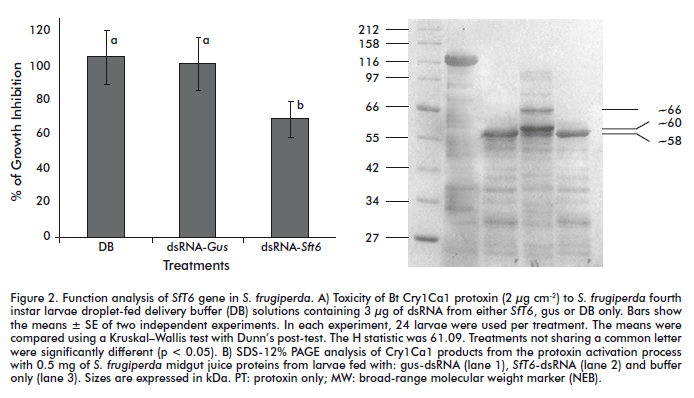
<P   align="justify" ><font size="2" face="Verdana, Arial, Helvetica, sans-serif">Considering the crucial      role of midgut serine proteinases for the proteolytic activation of Cry1-class      proteins during the <I>Bt</I> toxic pathway in Lepidoptera [6, 13], the specific      downregulation of <I>SfT6</I> expression in <I>S. frugiperda </I>larval midgut      during the early stages of Cry1Ca1 intoxication suggests a defensive mechanism      adopted by the insect to survive the pathogenic process. To prove this hypothesis,      we performed RNAi-mediated gene silencing in <I>S. frugiperda </I>by feeding      newly molted fourth-instar larvae with double-stranded RNA (dsRNA) produced      from a fragment of <I>SfT6</I> gene. As controls, two groups of insects fed      with either buffer alone (10 mM Tris-Cl, pH 7.5; 10 mM EDTA) or a nonspecific      dsRNA obtained from the <I>&beta;-glucuronidase</I> (<I>gus</I>) gene from      <I>Escherichia coli</I> were used. Both, insects&rsquo; susceptibility to      Cry1Ca1 and <I>in vitro </I>activation of Cry1Ca1 protoxins by larval midgut      juice proteases, were evaluated in <I>SfT6</I>-knockdown insects and compared      to insects from control groups. The efficacy of <I>SfT6</I>-knockdown was      investigated 48 h after the corresponding RNAi treatment by qRT-PCR analysis      on larval midgut total RNA. The results revealed that the oral administration      of dsRNA-<I>SfT6</I> caused a significant reduction of <I>SfT6 </I>gene expression      in the midgut (approx. 90% of control), while feeding with dsRNA-<I>Gus</I>      showed no effect on the <I>SfT6</I> levels, confirming the specificity of      the process for the target gene [12]. </font></P >       <P   align="justify" ><font size="2" face="Verdana, Arial, Helvetica, sans-serif">The results of Cry1Ca1      toxicity are shown in <a href="/img/revistas/bta/v28n3/f0209311.gif">Figure 2A</a>, expressed as percentage      of growth inhibition(%GI) and determined in dsRNA-treated and untreated larvae      48 h after the dsRNA feeding assay. No differences in %GI values were found      between larvae that were only fed with buffer (mocked) or nonspecific dsRNA-<I>Gus</I>.      In contrast, larvae from the group fed with dsRNA-<I>SfT6</I> were ~30% less      affected by the Cry1Ca1 protoxin in terms of %GI at the same tested concentration.      On the other hand, <I>in vitro </I>protoxin processing experiments showed      that after 1 h of Cry1Ca1 incubation with gut juice from larvae fed with nonspecific      dsRNA-<I>Gus</I>, a single band of ~58 kDa was generated that did not differ      from that obtained with gut juice from mocked (buffer-fed) larvae (<a href="/img/revistas/bta/v28n3/f0209311.gif">Figure      2B</a>, lanes 1 and 3). On the contrary, a moderate but clear decrease in      protoxin activation rate was found when midgut juice from dsRNA-<I>SfT6</I>-fed      larvae was used in the reaction (<a href="/img/revistas/bta/v28n3/f0209311.gif">Figure 2B</a>, lane      2). In this case, the midgut juice failed to completely process the Cry1Ca1      protoxin to the ~58 kDa product (the apparent activated form of Cry1Ca1 toxin      in <I>S. frugiperda</I>) but produced in addition two major partially processed      products of ~60 and ~66 kDa (<a href="/img/revistas/bta/v28n3/f0209311.gif">Figure 2B</a>, lane 2).      </font></P >       
<P   align="justify" ><font size="2" face="Verdana, Arial, Helvetica, sans-serif">In summary, our results      represent the first study on molecular defensive mechanisms triggered in the      midgut cells of <I>S. frugiperda </I>larvae after intoxication with a <I>B.      thuringiensis </I>Cry1-class toxin [10, 12]. Also, we have identified, cloned      and characterized a novel trypsin gene from the <I>S. frugiperda </I>larval      midgut that participates in a defensive mechanism elicited in response to      the <I>Bt </I>Cry1Ca1 pathogenic process [12]. We have shown that the specific      down-regulation of SfT6 serin-proteinase increases larval survival after exposure      to Cry1Ca1 in bioassays and affects <I>in vitro </I>proteolytic processing      of the protoxin in the presence of larval gut juice. Down-regulation of <I>SfT6</I>      could represent a putative defensive mechanism to reduce the amounts of activated      toxin monomers that can reach target gut cells, providing with a survival      advantage for insects feeding on Cry1Ca1-contaminated diets. In this way,      unprocessed protoxins cannot pass the peritrophic matrix and can be rapidly      eliminated during the gut clearance process. Regulation of <I>SfT6</I> expression      could become a target in a proteinase-mediated <I>Bt</I>-resistance mechanism.      Indeed, significantly reduced mRNA levels of the <I>SfT6</I> ortholog in <I>Plodia      interpunctella</I> were found in a resistant population of this insect [14].      </font></P >       <P   ><font size="3" face="Verdana, Arial, Helvetica, sans-serif"><b>ACKNOWLEDGMENTS</b></font></P >   <FONT size="+1">       <P   align="justify" ><font size="2" face="Verdana, Arial, Helvetica, sans-serif">The authors appreciate      Mr. Rafael Maura assistance on insect manipulation and dissection during RNAi      experiments. </font></P >   <FONT size="+1">        <P   > </P >   <FONT size="+1">       <P   ><b><font size="3" face="Verdana, Arial, Helvetica, sans-serif">REFERENCES </font></b></P >       <!-- ref --><P   align="justify" ><font size="2" face="Verdana, Arial, Helvetica, sans-serif">1. Federici BA. Insecticidal      bacteria: an overwhelming success for invertebrate pathology. J Invertebr      Pathol. 2005;89: 30-8.     </font></P >   <FONT size="+1">        ]]></body>
<body><![CDATA[<!-- ref --><P   align="justify" ><font size="2" face="Verdana, Arial, Helvetica, sans-serif">2. Clives J. Brief      41: Global Status of Commercialized Biotech/GM Crops: 2009. Ithaca (NY): ISAAA;      2009 [cited 2011 Jan 20]. ISAAA Brief No. 41. Available from: <FONT color="#0000FF"><a href="http://www.isaaa.org/resources/publications/briefs/41/default.asp" target="_blank">http://www.isaaa.org/resources/publications/briefs/41/default.asp</a>.          </font></font></P >   <FONT color="#0000FF"><FONT color="#000000">        <!-- ref --><P   align="justify" ><font size="2" face="Verdana, Arial, Helvetica, sans-serif">3. Tabashnik BE,      Cushing NL, Finson N, Johnson MW. Field development of resistance to <I>Bacillus      thuringiensis</I> in diamondback moth (Lepidoptera: <I>Plutellidae</I>). J      Econ Entomol. 1990;83:1671-6.     </font></P >       <!-- ref --><P   align="justify" ><font size="2" face="Verdana, Arial, Helvetica, sans-serif">4. Janmaat AF, Myers      J. Rapid evolution and the cost of resistance to Bacillus thuringiensis in      greenhouse populations of cabbage loopers, Trichoplusia ni. Proc Biol Sci.      2003;270(1530):2263-70.     </font></P >       <!-- ref --><P   align="justify" ><font size="2" face="Verdana, Arial, Helvetica, sans-serif">5. Tabashnik BE,      Van Rensburg JB, Carri&egrave;re Y. Field-evolved insect resistance to Bt      crops: definition, theory, and data. J Econ Entomol. 2009;102(6):2011-25.          </font></P >       <!-- ref --><P   align="justify" ><font size="2" face="Verdana, Arial, Helvetica, sans-serif">6. Lightwood DJ,      Ellar DJ, Jarrett P. Role of proteolysis in determining potency of Bacillus      thuringiensis Cry1Ac delta-endotoxin. Appl Environ Microbiol. 2000; 66(12):5174-81.          </font></P >       ]]></body>
<body><![CDATA[<!-- ref --><P   align="justify" ><font size="2" face="Verdana, Arial, Helvetica, sans-serif">7. Bravo A, Gill      SS, Sober&oacute;n M. Mode of action of Bacillus thuringiensis Cry and Cyt      toxins and their potential for insect control. Toxicon. 2007;49(4):423-35.          </font></P >       <!-- ref --><P   align="justify" ><font size="2" face="Verdana, Arial, Helvetica, sans-serif">8. Diatchenko L,      Lau YF, Campbell AP, Chenchik A, Moqadam F, Huang B, <I>et al</I>. Suppression      subtractive hybridization: a method for generating differentially regulated      or tissue-specific cDNA probes and libraries. Proc Natl Acad Sci USA. 1996;      93(12):6025-30.     </font></P >       <!-- ref --><P   align="justify" ><font size="2" face="Verdana, Arial, Helvetica, sans-serif">9. Turner CT, Davy      MW, MacDiarmid RM, Plummer KM, Birch NP, Newcomb RD. RNA interference in the      light brown apple moth, Epiphyas postvittana (Walker) induced by double-stranded      RNA feeding. Insect Mol Biol. 2006;15(3):383-91.     </font></P >       <!-- ref --><P   align="justify" ><font size="2" face="Verdana, Arial, Helvetica, sans-serif">10. Rodr&iacute;guez-Cabrera      L, Trujillo-Bacallao D, Borr&aacute;s-Hidalgo O, Wright DJ, Ayra-Pardo C.      Molecular characterization of <I>Spodoptera frugiperda</I>-<I>Bacillus thuringiensis</I>      Cry1Ca toxin interaction. Toxicon. 2008; 51(4):681-92.     </font></P >       <!-- ref --><P   align="justify" ><font size="2" face="Verdana, Arial, Helvetica, sans-serif">11. Fournier P. SPODOBASE      [Internet]. Paris: INRA. c2003 - [cited 2010 Mar 17]. Available from: <FONT color="#0000FF"><a href="http://bioweb.ensam.inra.fr/spodobase/" target="_blank">http://bioweb.ensam.inra.fr/spodobase/</a>      </font></font></P >   <FONT color="#0000FF"><FONT color="#000000">        <!-- ref --><P   align="justify" ><font size="2" face="Verdana, Arial, Helvetica, sans-serif">12. Rodr&iacute;guez-Cabrera      L, Trujillo-Bacallao D, Borr&aacute;s-Hidalgo O, Wright DJ, Ayra-Pardo C.      RNAi-mediated knockdown of a <I>Spodoptera frugiperda</I> trypsin-like serine-protease      gene reduces susceptibility to a <I>Bacillus thuringiensis</I> Cry1Ca1 protoxin      Environ Microbiol. 2010;12(11):2894-903.     </font></P >       <!-- ref --><P   align="justify" ><font size="2" face="Verdana, Arial, Helvetica, sans-serif">13. Oppert B. Protease      interactions with <I>bacillus thuringiensis</I> insecticidal toxins. Arch      Insect Biochem Physiol. 1999;42(1):1-12.     </font></P >       <!-- ref --><P   align="justify" ><font size="2" face="Verdana, Arial, Helvetica, sans-serif">14. Zhu YC, Oppert      B, Kramer KJ, McGaughey WH, Dowdy AK. cDNA sequence, mRNA expression and genomic      DNA of trypsinogen from the indianmeal moth, <I>Plodia interpunctella</I>.      Insect Mol Biol. 2000; 9(1):19-26.     </font></P >       <P   > </P >   <FONT size="+1">        <P   ><font size="2" face="Verdana, Arial, Helvetica, sans-serif">Camilo Ayra. Laboratorio      de Biotecnolog&iacute;a Ambiental. Divisi&oacute;n de Plantas, Centro de Ingenier&iacute;a      Gen&eacute;tica y Biotecnolog&iacute;a, CIGB. Ave. 31 e/ 158 y 190, Cubanac&aacute;n,      Playa, CP 10600, AP 6162, La Habana, Cuba. E-mail: <A href="mailto:camilo.ayra@cigb.edu.cu">      <U><U><FONT color="#0000FF">camilo.ayra@cigb.edu.cu</font></U></U></A><FONT color="#0000FF">      <FONT color="#000000">. </font></font></font></P >   </font></font></font></font></font></font></font></font></font></font></font></font></font></font></font></font></font></font></font></font></font></font></font></font></font></font></font></font></font></font></font></font></font></font></font></DIV >      ]]></body><back>
<ref-list>
<ref id="B1">
<label>1</label><nlm-citation citation-type="journal">
<person-group person-group-type="author">
<name>
<surname><![CDATA[Federici]]></surname>
<given-names><![CDATA[BA]]></given-names>
</name>
</person-group>
<article-title xml:lang="en"><![CDATA[Insecticidal bacteria: an overwhelming success for invertebrate pathology]]></article-title>
<source><![CDATA[J Invertebr Pathol]]></source>
<year>2005</year>
<volume>89</volume>
<page-range>30-8</page-range></nlm-citation>
</ref>
<ref id="B2">
<label>2</label><nlm-citation citation-type="book">
<person-group person-group-type="author">
<name>
<surname><![CDATA[Clives]]></surname>
<given-names><![CDATA[J]]></given-names>
</name>
</person-group>
<source><![CDATA[Brief 41: Global Status of Commercialized Biotech/GM Crops: 2009]]></source>
<year>2009</year>
<publisher-loc><![CDATA[Ithaca ]]></publisher-loc>
<publisher-name><![CDATA[ISAAA]]></publisher-name>
</nlm-citation>
</ref>
<ref id="B3">
<label>3</label><nlm-citation citation-type="journal">
<person-group person-group-type="author">
<name>
<surname><![CDATA[Tabashnik]]></surname>
<given-names><![CDATA[BE]]></given-names>
</name>
<name>
<surname><![CDATA[Cushing]]></surname>
<given-names><![CDATA[NL]]></given-names>
</name>
<name>
<surname><![CDATA[Finson]]></surname>
<given-names><![CDATA[N]]></given-names>
</name>
<name>
<surname><![CDATA[Johnson]]></surname>
<given-names><![CDATA[MW]]></given-names>
</name>
</person-group>
<article-title xml:lang="en"><![CDATA[Field development of resistance to Bacillus thuringiensis in diamondback moth (Lepidoptera: Plutellidae)]]></article-title>
<source><![CDATA[J Econ Entomol]]></source>
<year>1990</year>
<volume>83</volume>
<page-range>1671-6</page-range></nlm-citation>
</ref>
<ref id="B4">
<label>4</label><nlm-citation citation-type="journal">
<person-group person-group-type="author">
<name>
<surname><![CDATA[Janmaat]]></surname>
<given-names><![CDATA[AF]]></given-names>
</name>
<name>
<surname><![CDATA[Myers]]></surname>
<given-names><![CDATA[J]]></given-names>
</name>
</person-group>
<article-title xml:lang="en"><![CDATA[Rapid evolution and the cost of resistance to Bacillus thuringiensis in greenhouse populations of cabbage loopers, Trichoplusia ni]]></article-title>
<source><![CDATA[Proc Biol Sci]]></source>
<year>2003</year>
<volume>270</volume>
<numero>1530</numero>
<issue>1530</issue>
<page-range>2263-70</page-range></nlm-citation>
</ref>
<ref id="B5">
<label>5</label><nlm-citation citation-type="journal">
<person-group person-group-type="author">
<name>
<surname><![CDATA[Tabashnik]]></surname>
<given-names><![CDATA[BE]]></given-names>
</name>
<name>
<surname><![CDATA[Van Rensburg]]></surname>
<given-names><![CDATA[JB]]></given-names>
</name>
<name>
<surname><![CDATA[Carrière]]></surname>
<given-names><![CDATA[Y]]></given-names>
</name>
</person-group>
<article-title xml:lang="en"><![CDATA[Field-evolved insect resistance to Bt crops: definition, theory, and data]]></article-title>
<source><![CDATA[J Econ Entomol]]></source>
<year>2009</year>
<volume>102</volume>
<numero>6</numero>
<issue>6</issue>
<page-range>2011-25</page-range></nlm-citation>
</ref>
<ref id="B6">
<label>6</label><nlm-citation citation-type="journal">
<person-group person-group-type="author">
<name>
<surname><![CDATA[Lightwood]]></surname>
<given-names><![CDATA[DJ]]></given-names>
</name>
<name>
<surname><![CDATA[Ellar]]></surname>
<given-names><![CDATA[DJ]]></given-names>
</name>
<name>
<surname><![CDATA[Jarrett]]></surname>
<given-names><![CDATA[P]]></given-names>
</name>
</person-group>
<article-title xml:lang="en"><![CDATA[Role of proteolysis in determining potency of Bacillus thuringiensis Cry1Ac delta-endotoxin]]></article-title>
<source><![CDATA[Appl Environ Microbiol]]></source>
<year>2000</year>
<volume>66</volume>
<numero>12</numero>
<issue>12</issue>
<page-range>5174-81</page-range></nlm-citation>
</ref>
<ref id="B7">
<label>7</label><nlm-citation citation-type="journal">
<person-group person-group-type="author">
<name>
<surname><![CDATA[Bravo]]></surname>
<given-names><![CDATA[A]]></given-names>
</name>
<name>
<surname><![CDATA[Gill]]></surname>
<given-names><![CDATA[SS]]></given-names>
</name>
<name>
<surname><![CDATA[Soberón]]></surname>
<given-names><![CDATA[M]]></given-names>
</name>
</person-group>
<article-title xml:lang="en"><![CDATA[Mode of action of Bacillus thuringiensis Cry and Cyt toxins and their potential for insect control]]></article-title>
<source><![CDATA[Toxicon]]></source>
<year>2007</year>
<volume>49</volume>
<numero>4</numero>
<issue>4</issue>
<page-range>423-35</page-range></nlm-citation>
</ref>
<ref id="B8">
<label>8</label><nlm-citation citation-type="journal">
<person-group person-group-type="author">
<name>
<surname><![CDATA[Diatchenko]]></surname>
<given-names><![CDATA[L]]></given-names>
</name>
<name>
<surname><![CDATA[Lau]]></surname>
<given-names><![CDATA[YF]]></given-names>
</name>
<name>
<surname><![CDATA[Campbell]]></surname>
<given-names><![CDATA[AP]]></given-names>
</name>
<name>
<surname><![CDATA[Chenchik]]></surname>
<given-names><![CDATA[A]]></given-names>
</name>
<name>
<surname><![CDATA[Moqadam]]></surname>
<given-names><![CDATA[F]]></given-names>
</name>
<name>
<surname><![CDATA[Huang]]></surname>
<given-names><![CDATA[B]]></given-names>
</name>
</person-group>
<article-title xml:lang="en"><![CDATA[Suppression subtractive hybridization: a method for generating differentially regulated or tissue-specific cDNA probes and libraries]]></article-title>
<source><![CDATA[Proc Natl Acad Sci USA]]></source>
<year>1996</year>
<volume>93</volume>
<numero>12</numero>
<issue>12</issue>
<page-range>6025-30</page-range></nlm-citation>
</ref>
<ref id="B9">
<label>9</label><nlm-citation citation-type="journal">
<person-group person-group-type="author">
<name>
<surname><![CDATA[Turner]]></surname>
<given-names><![CDATA[CT]]></given-names>
</name>
<name>
<surname><![CDATA[Davy]]></surname>
<given-names><![CDATA[MW]]></given-names>
</name>
<name>
<surname><![CDATA[MacDiarmid]]></surname>
<given-names><![CDATA[RM]]></given-names>
</name>
<name>
<surname><![CDATA[Plummer]]></surname>
<given-names><![CDATA[KM]]></given-names>
</name>
<name>
<surname><![CDATA[Birch]]></surname>
<given-names><![CDATA[NP]]></given-names>
</name>
<name>
<surname><![CDATA[Newcomb]]></surname>
<given-names><![CDATA[RD]]></given-names>
</name>
</person-group>
<article-title xml:lang="en"><![CDATA[RNA interference in the light brown apple moth, Epiphyas postvittana (Walker) induced by double-stranded RNA feeding]]></article-title>
<source><![CDATA[Insect Mol Biol]]></source>
<year>2006</year>
<volume>15</volume>
<numero>3</numero>
<issue>3</issue>
<page-range>383-91</page-range></nlm-citation>
</ref>
<ref id="B10">
<label>10</label><nlm-citation citation-type="journal">
<person-group person-group-type="author">
<name>
<surname><![CDATA[Rodríguez-Cabrera]]></surname>
<given-names><![CDATA[L]]></given-names>
</name>
<name>
<surname><![CDATA[Trujillo-Bacallao]]></surname>
<given-names><![CDATA[D]]></given-names>
</name>
<name>
<surname><![CDATA[Borrás-Hidalgo]]></surname>
<given-names><![CDATA[O]]></given-names>
</name>
<name>
<surname><![CDATA[Wright]]></surname>
<given-names><![CDATA[DJ]]></given-names>
</name>
<name>
<surname><![CDATA[Ayra-Pardo]]></surname>
<given-names><![CDATA[C]]></given-names>
</name>
</person-group>
<article-title xml:lang="en"><![CDATA[Molecular characterization of Spodoptera frugiperda-Bacillus thuringiensis Cry1Ca toxin interaction]]></article-title>
<source><![CDATA[Toxicon]]></source>
<year>2008</year>
<volume>51</volume>
<numero>4</numero>
<issue>4</issue>
<page-range>681-92</page-range></nlm-citation>
</ref>
<ref id="B11">
<label>11</label><nlm-citation citation-type="book">
<person-group person-group-type="author">
<name>
<surname><![CDATA[Fournier]]></surname>
<given-names><![CDATA[P]]></given-names>
</name>
</person-group>
<source><![CDATA[SPODOBASE]]></source>
<year>2003</year>
<publisher-loc><![CDATA[Paris ]]></publisher-loc>
<publisher-name><![CDATA[INRA]]></publisher-name>
</nlm-citation>
</ref>
<ref id="B12">
<label>12</label><nlm-citation citation-type="journal">
<person-group person-group-type="author">
<name>
<surname><![CDATA[Rodríguez-Cabrera]]></surname>
<given-names><![CDATA[L]]></given-names>
</name>
<name>
<surname><![CDATA[Trujillo-Bacallao]]></surname>
<given-names><![CDATA[D]]></given-names>
</name>
<name>
<surname><![CDATA[Borrás-Hidalgo]]></surname>
<given-names><![CDATA[O]]></given-names>
</name>
<name>
<surname><![CDATA[Wright]]></surname>
<given-names><![CDATA[DJ]]></given-names>
</name>
<name>
<surname><![CDATA[Ayra-Pardo]]></surname>
<given-names><![CDATA[C]]></given-names>
</name>
</person-group>
<article-title xml:lang="en"><![CDATA[RNAi-mediated knockdown of a Spodoptera frugiperda trypsin-like serine-protease gene reduces susceptibility to a Bacillus thuringiensis Cry1Ca1 protoxin]]></article-title>
<source><![CDATA[Environ Microbiol]]></source>
<year>2010</year>
<volume>12</volume>
<numero>11</numero>
<issue>11</issue>
<page-range>2894-903</page-range></nlm-citation>
</ref>
<ref id="B13">
<label>13</label><nlm-citation citation-type="journal">
<person-group person-group-type="author">
<name>
<surname><![CDATA[Oppert]]></surname>
<given-names><![CDATA[B]]></given-names>
</name>
</person-group>
<article-title xml:lang="en"><![CDATA[Protease interactions with bacillus thuringiensis insecticidal toxins]]></article-title>
<source><![CDATA[Arch Insect Biochem Physiol]]></source>
<year>1999</year>
<volume>42</volume>
<numero>1</numero>
<issue>1</issue>
<page-range>1-12</page-range></nlm-citation>
</ref>
<ref id="B14">
<label>14</label><nlm-citation citation-type="journal">
<person-group person-group-type="author">
<name>
<surname><![CDATA[Zhu]]></surname>
<given-names><![CDATA[YC]]></given-names>
</name>
<name>
<surname><![CDATA[Oppert]]></surname>
<given-names><![CDATA[B]]></given-names>
</name>
<name>
<surname><![CDATA[Kramer]]></surname>
<given-names><![CDATA[KJ]]></given-names>
</name>
<name>
<surname><![CDATA[McGaughey]]></surname>
<given-names><![CDATA[WH]]></given-names>
</name>
<name>
<surname><![CDATA[Dowdy]]></surname>
<given-names><![CDATA[AK]]></given-names>
</name>
</person-group>
<article-title xml:lang="en"><![CDATA[cDNA sequence, mRNA expression and genomic DNA of trypsinogen from the indianmeal moth, Plodia interpunctella]]></article-title>
<source><![CDATA[Insect Mol Biol]]></source>
<year>2000</year>
<volume>9</volume>
<numero>1</numero>
<issue>1</issue>
<page-range>19-26</page-range></nlm-citation>
</ref>
</ref-list>
</back>
</article>