<?xml version="1.0" encoding="ISO-8859-1"?><article xmlns:mml="http://www.w3.org/1998/Math/MathML" xmlns:xlink="http://www.w3.org/1999/xlink" xmlns:xsi="http://www.w3.org/2001/XMLSchema-instance">
<front>
<journal-meta>
<journal-id>1027-2852</journal-id>
<journal-title><![CDATA[Biotecnología Aplicada]]></journal-title>
<abbrev-journal-title><![CDATA[Biotecnol Apl]]></abbrev-journal-title>
<issn>1027-2852</issn>
<publisher>
<publisher-name><![CDATA[Editorial Elfos Scientiae]]></publisher-name>
</publisher>
</journal-meta>
<article-meta>
<article-id>S1027-28522012000100004</article-id>
<title-group>
<article-title xml:lang="en"><![CDATA[Predicted proteins of Neisseria meningitidis as potential vaccine candidates: from in silico analyses to experimental corroboration]]></article-title>
<article-title xml:lang="es"><![CDATA[Proteínas predichas de Neisseria meningitidis como posibles candidatos vacunales: de los análisis in silico a la corroboración experimental]]></article-title>
</title-group>
<contrib-group>
<contrib contrib-type="author">
<name>
<surname><![CDATA[García]]></surname>
<given-names><![CDATA[Darien]]></given-names>
</name>
<xref ref-type="aff" rid="A01"/>
</contrib>
<contrib contrib-type="author">
<name>
<surname><![CDATA[Yero]]></surname>
<given-names><![CDATA[Daniel]]></given-names>
</name>
<xref ref-type="aff" rid="A02"/>
</contrib>
<contrib contrib-type="author">
<name>
<surname><![CDATA[Niebla]]></surname>
<given-names><![CDATA[Olivia]]></given-names>
</name>
<xref ref-type="aff" rid="A01"/>
</contrib>
<contrib contrib-type="author">
<name>
<surname><![CDATA[Cobas]]></surname>
<given-names><![CDATA[Karem]]></given-names>
</name>
<xref ref-type="aff" rid="A01"/>
</contrib>
<contrib contrib-type="author">
<name>
<surname><![CDATA[Perera]]></surname>
<given-names><![CDATA[Yasser]]></given-names>
</name>
<xref ref-type="aff" rid="A01"/>
</contrib>
<contrib contrib-type="author">
<name>
<surname><![CDATA[Caballero]]></surname>
<given-names><![CDATA[Evelin]]></given-names>
</name>
<xref ref-type="aff" rid="A01"/>
</contrib>
<contrib contrib-type="author">
<name>
<surname><![CDATA[Delgado]]></surname>
<given-names><![CDATA[Maite]]></given-names>
</name>
<xref ref-type="aff" rid="A01"/>
</contrib>
<contrib contrib-type="author">
<name>
<surname><![CDATA[Pajón]]></surname>
<given-names><![CDATA[Rolando]]></given-names>
</name>
<xref ref-type="aff" rid="A03"/>
</contrib>
</contrib-group>
<aff id="A02">
<institution><![CDATA[,Finlay Institute Division of Biotechnology Department of Molecular Biology]]></institution>
<addr-line><![CDATA[Havana ]]></addr-line>
<country>Cuba</country>
</aff>
<aff id="A03">
<institution><![CDATA[,University of Calgary Faculty of Medicine ]]></institution>
<addr-line><![CDATA[Calgary ]]></addr-line>
<country>Canada</country>
</aff>
<aff id="A01">
<institution><![CDATA[,Center for Genetic Engineering and Biotechnology Division of Vaccines Meningococcal Research Department]]></institution>
<addr-line><![CDATA[Havana ]]></addr-line>
<country>Cuba</country>
</aff>
<pub-date pub-type="pub">
<day>00</day>
<month>03</month>
<year>2012</year>
</pub-date>
<pub-date pub-type="epub">
<day>00</day>
<month>03</month>
<year>2012</year>
</pub-date>
<volume>29</volume>
<numero>1</numero>
<fpage>22</fpage>
<lpage>28</lpage>
<copyright-statement/>
<copyright-year/>
<self-uri xlink:href="http://scielo.sld.cu/scielo.php?script=sci_arttext&amp;pid=S1027-28522012000100004&amp;lng=en&amp;nrm=iso"></self-uri><self-uri xlink:href="http://scielo.sld.cu/scielo.php?script=sci_abstract&amp;pid=S1027-28522012000100004&amp;lng=en&amp;nrm=iso"></self-uri><self-uri xlink:href="http://scielo.sld.cu/scielo.php?script=sci_pdf&amp;pid=S1027-28522012000100004&amp;lng=en&amp;nrm=iso"></self-uri><abstract abstract-type="short" xml:lang="en"><p><![CDATA[Neisseria meningitidis serogroup B infections are a serious health threat to the world that cannot be prevented by vaccination. Here, we report an analysis of the MC58 Neisseria meningitidis genome aimed at the identification of new potential vaccine candidates. 'Hypothetical' and 'conserved hypothetical' annotated genes, together with those with putative functions related to the cell envelope, were subjected to extensive sequence similarity searches, as well as motif, cellular location, and domain analyses complemented with manual curation. As a result, a set of 35 uncharacterized ORFs, predicted to encode for surface exposed or virulence related proteins, was identified. The candidates were subdivided in three categories: 1) predicted outer membrane proteins (OMPs) unique of the Neisseria genus; 2) conserved OMPs from various genus and 3) proteins homologous to known OMPs or to proteins previously found to be immunogenic in animal models. Two of the final candidates, nmb1126 and nmb0181, were cloned and expressed in Escherichia coli. The resulting products were purified by Metal Chelating Chromatography and used to immunize mice. The recombinant proteins were capable of inducing antibodies against the native antigen in preparations of a panel of three strains and displayed bactericidal activity against the homologous strains.]]></p></abstract>
<abstract abstract-type="short" xml:lang="es"><p><![CDATA[Las infecciones producidas por el serogrupo B de Neisseria meningitidis constituyen un serio problema de salud mundial que no puede ser prevenido mediante la vacunación. En este artículo reportamos un análisis del genoma de la cepa MC58 de N. meningitidis desarrollado con el objetivo de identificar nuevos posibles candidatos vacunales. Los genes anotados como 'Hipotéticos' e 'Hipotéticos conservados', en conjunto con aquellos que pudieran presentar funciones relacionadas con la envoltura celular, estuvieron sujetos a extensos análisis de similitud de secuencia, localización celular y de motivos y dominios complementados con curación manual. Como resultado, 35 marcos de lectura abiertos no caracterizados, predichos para codificar proteínas de superficie o relacionadas con la virulencia fueron identificados. Los candidatos fueron subdivididos en tres categorías: 1) proteínas de membrana externa (PME) únicas del género Neisseria; 2) PMEs conservadas en varios géneros y 3) proteínas homólogas a PME conocidas o a proteínas previamente reportadas como inmunogénicas en modelos animales. Dos de estos candidatos, el nmb1126 y el nmb0181 fueron clonados y expresados en Escherichia coli. Los productos resultantes fueron purificados por cromatografía de afinidad a quelatos metálicos y empleados para inmunizar ratones. Las proteínas recombinantes fueron capaces de inducir anticuerpos que reconocieron el antígeno nativo del meningococo en un panel de tres cepas y que mostraron actividad bactericida contra la cepa homóloga.]]></p></abstract>
<kwd-group>
<kwd lng="en"><![CDATA[Neisseria]]></kwd>
<kwd lng="en"><![CDATA[in silico analyses]]></kwd>
<kwd lng="en"><![CDATA[open reading frames]]></kwd>
<kwd lng="en"><![CDATA[antigen]]></kwd>
<kwd lng="en"><![CDATA[vaccine]]></kwd>
<kwd lng="es"><![CDATA[Neisseria]]></kwd>
<kwd lng="es"><![CDATA[análisis in silico]]></kwd>
<kwd lng="es"><![CDATA[sistemas de lectura abierta]]></kwd>
<kwd lng="es"><![CDATA[antígeno]]></kwd>
<kwd lng="es"><![CDATA[vacuna]]></kwd>
</kwd-group>
</article-meta>
</front><body><![CDATA[ <DIV class="Sect"   >        <P   align="right" ><font size="2" color="#000000" face="Verdana, Arial, Helvetica, sans-serif"><b>RESEARCH      </b></font></P >   <FONT size="+1" color="#000000">        <P   > </P >       <P   >&nbsp;</P >       <P   ><font size="2" face="Verdana, Arial, Helvetica, sans-serif"><b><font size="4">Predicted      proteins of <I>Neisseria meningitidis</I> as potential vaccine candidates:      from <I>in silico</I> analyses to experimental corroboration</font></b></font></P >       <P   >&nbsp;</P >       <P   > </P >       <P   ><b><font size="3" face="Verdana, Arial, Helvetica, sans-serif">Prote&iacute;nas      predichas de <I>Neisseria meningitidis</I> como posibles candidatos vacunales:      de los an&aacute;lisis <I>in silico</I> a la corroboraci&oacute;n experimental      </font></b><font size="3" face="Verdana, Arial, Helvetica, sans-serif"> </font></P >       <P   >&nbsp;</P >       <P   >&nbsp;</P >       ]]></body>
<body><![CDATA[<P   > </P >       <P   > </P >       <P   ><font size="2" face="Verdana, Arial, Helvetica, sans-serif"><b>Darien Garc&iacute;a<Sup>1</Sup>,      Daniel Yero<Sup>1,2</Sup>, Olivia Niebla<Sup>1</Sup>, Karem Cobas<Sup>1</Sup>,      Yasser Perera<Sup>1</Sup>, Evelin Caballero<Sup>1</Sup>, Maite Delgado<Sup>1</Sup>,      Rolando Paj&oacute;n<Sup>1,3</Sup></b></font></P >   <FONT size="+1"><FONT size="+1"><FONT size="+1"><FONT size="+1"><FONT size="+1"><FONT size="+1"><FONT size="+1"><FONT size="+1"><FONT size="+1"><FONT size="+1"><FONT size="+1"><FONT size="+1"><FONT size="+1"><FONT size="+1"><FONT size="+1"><FONT size="+1">        <P   ><font size="2" face="Verdana, Arial, Helvetica, sans-serif"><Sup>1</Sup>Meningococcal      Research Department, Division of Vaccines, Center for Genetic Engineering      and Biotechnology, CIGB. Ave. 31, Cubanacan, PO Box 10 600, Havana, Cuba.          <br>     <Sup>2</Sup>Department of Molecular Biology, Division of Biotechnology, Finlay      Institute. Ave. 27, La Lisa, PO Box 11 600, Havana, Cuba.     <br>     3<Sup></Sup>Faculty of Medicine, University of Calgary, Heritage Medical Research      Building, Hospital Drive NW, Calgary, Canada.</font></P >       <P   >&nbsp;</P >   </font></font></font></font></font></font></font></font></font></font></font></font></font></font></font></font></font>    <hr>   <FONT size="+1" color="#000000"><FONT size="+1"><FONT size="+1"><FONT size="+1"><FONT size="+1"><FONT size="+1"><FONT size="+1"><FONT size="+1"><FONT size="+1"><FONT size="+1"><FONT size="+1"><FONT size="+1"><FONT size="+1"><FONT size="+1"><FONT size="+1"><FONT size="+1"><FONT size="+1">        <P   ><font size="2" face="Verdana, Arial, Helvetica, sans-serif"><b>ABSTRACT </b>      </font></P >   <FONT size="+1"><FONT size="+1"><FONT size="+1"><FONT size="+1"><FONT size="+1"><FONT size="+1"><FONT size="+1">        <P   ><font size="2" face="Verdana, Arial, Helvetica, sans-serif"><I>Neisseria meningitidis      </I>serogroup B infections are a serious health threat to the world that cannot      be prevented by vaccination. Here, we report an analysis of the MC58 <I>Neisseria      meningitidis </I>genome aimed at the identification of new potential vaccine      candidates. &lsquo;Hypothetical&rsquo; and &lsquo;conserved hypothetical&rsquo;      annotated genes, together with those with putative functions related to the      cell envelope, were subjected to extensive sequence similarity searches, as      well as motif, cellular location, and domain analyses complemented with manual      curation. As a result, a set of 35 uncharacterized ORFs, predicted to encode      for surface exposed or virulence related proteins, was identified. The candidates      were subdivided in three categories: 1) predicted outer membrane proteins      (OMPs) unique of the <I>Neisseria</I> genus; 2) conserved OMPs from various      genus and 3) proteins homologous to known OMPs or to proteins previously found      to be immunogenic in animal models. Two of the final candidates, <I>nmb1126      </I>and <I>nmb0181</I>, were cloned and expressed in <I>Escherichia coli</I>.      The resulting products were purified by Metal Chelating Chromatography and      used to immunize mice. The recombinant proteins were capable of inducing antibodies      against the native antigen in preparations of a panel of three strains and      displayed bactericidal activity against the homologous strains. </font></P >       <P   ><font size="2" face="Verdana, Arial, Helvetica, sans-serif"><b>Keywords:</b>      <I>Neisseria</I>, <I>in silico</I> analyses, open reading frames, antigen,      vaccine. </font></P >       ]]></body>
<body><![CDATA[<P   > </P >   </font></font></font></font></font></font></font></font></font></font></font></font></font></font></font></font></font></font></font></font></font></font></font></font>   <hr>   <FONT size="+1" color="#000000"><FONT size="+1"><FONT size="+1"><FONT size="+1"><FONT size="+1"><FONT size="+1"><FONT size="+1"><FONT size="+1"><FONT size="+1"><FONT size="+1"><FONT size="+1"><FONT size="+1"><FONT size="+1"><FONT size="+1"><FONT size="+1"><FONT size="+1"><FONT size="+1"><FONT size="+1"><FONT size="+1"><FONT size="+1"><FONT size="+1"><FONT size="+1"><FONT size="+1"><FONT size="+1">        <P   ><font size="2" face="Verdana, Arial, Helvetica, sans-serif"><B>RESUMEN </b></font></P >       <P   ><font size="2" face="Verdana, Arial, Helvetica, sans-serif">Las infecciones producidas      por el serogrupo B de <I>Neisseria meningitidis </I>constituyen un serio problema      de salud mundial que no puede ser prevenido mediante la vacunaci&oacute;n.      En este art&iacute;culo reportamos un an&aacute;lisis del genoma de la cepa      MC58 de <I>N. meningitidis </I>desarrollado con el objetivo de identificar      nuevos posibles candidatos vacunales. Los genes anotados como &lsquo;Hipot&eacute;ticos&rsquo;      e &lsquo;Hipot&eacute;ticos conservados&rsquo;, en conjunto con aquellos que      pudieran presentar funciones relacionadas con la envoltura celular, estuvieron      sujetos a extensos an&aacute;lisis de similitud de secuencia, localizaci&oacute;n      celular y de motivos y dominios complementados con curaci&oacute;n manual.      Como resultado, 35 marcos de lectura abiertos no caracterizados, predichos      para codificar prote&iacute;nas de superficie o relacionadas con la virulencia      fueron identificados. Los candidatos fueron subdivididos en tres categor&iacute;as:      1) prote&iacute;nas de membrana externa (PME) &uacute;nicas del g&eacute;nero      <I>Neisseria</I>; 2) PMEs conservadas en varios g&eacute;neros y 3) prote&iacute;nas      hom&oacute;logas a PME conocidas o a prote&iacute;nas previamente reportadas      como inmunog&eacute;nicas en modelos animales. Dos de estos candidatos, el      <I>nmb1126 </I>y el <I>nmb0181 </I>fueron clonados y expresados en <I>Escherichia      coli</I>. Los productos resultantes fueron purificados por cromatograf&iacute;a      de afinidad a quelatos met&aacute;licos y empleados para inmunizar ratones.      Las prote&iacute;nas recombinantes fueron capaces de inducir anticuerpos que      reconocieron el ant&iacute;geno nativo del meningococo en un panel de tres      cepas y que mostraron actividad bactericida contra la cepa hom&oacute;loga.      </font></P >       <P   ><font size="2" face="Verdana, Arial, Helvetica, sans-serif"><b>Palabras clave:</b>      <I>Neisseria</I>, an&aacute;lisis <I>in silico</I>, sistemas de lectura abierta,      ant&iacute;geno, vacuna. </font></P >   </font></font></font></font></font></font></font></font></font></font></font></font></font></font></font></font></font></font></font></font></font></font></font></font>   <hr>   <FONT size="+1" color="#000000"><FONT size="+1"><FONT size="+1"><FONT size="+1"><FONT size="+1"><FONT size="+1"><FONT size="+1"><FONT size="+1"><FONT size="+1"><FONT size="+1"><FONT size="+1"><FONT size="+1"><FONT size="+1"><FONT size="+1"><FONT size="+1"><FONT size="+1"><FONT size="+1"><FONT size="+1"><FONT size="+1"><FONT size="+1"><FONT size="+1"><FONT size="+1"><FONT size="+1"><FONT size="+1">        <P   > </P >       <P   > </P >       <P   > </P >       <P   >&nbsp;</P >       <P   >&nbsp;</P >       <P   ><font size="2" face="Verdana, Arial, Helvetica, sans-serif"><b><font size="3">INTRODUCTION      </font></b></font></P >       ]]></body>
<body><![CDATA[<P   ><font size="2" face="Verdana, Arial, Helvetica, sans-serif"><I>Neisseria meningitidis      </I>is the primary cause of bacterial meningitis worldwide. Despite the available      antibiotics, there is 10% mortality on a global basis and convalescent patients      may have serious sequels [1]. Serogroups A, B, C, W135 and Y are responsible      for around 95% of the cases worldwide, although serogroup B shows the highest      incidence in developed countries [2]. </font></P >       <P   ><font size="2" face="Verdana, Arial, Helvetica, sans-serif">Although a polysaccharide      vaccine has been successfully developed against several serogroups this strategy      has not been feasible for serogroup B, because of the marked structural homology      between its capsular polysaccharide and human neural antigens [3]. </font></P >       <P   ><font size="2" face="Verdana, Arial, Helvetica, sans-serif">Some alternatives,      such as the application of vaccines based on meningococcal outer membrane      vesicles (OMV) have proved successful in controlling disease outbreaks [4,      5]. However, despite this partial success, these vaccines do not confer optimal      protection against the broad panel of circulating strains, due to the variability      of the major antigenic proteins [4-6]. Therefore, the search for conserved      subcapsular proteins capable of inducing a broad and protective immune response      has become an important objective. </font></P >       <P   ><font size="2" face="Verdana, Arial, Helvetica, sans-serif">Alternative to traditional      laboratory tools, the complete genome sequencing of different strains of <I>N.      meningitidis </I>have been an accelerator to vaccine candidates study allowing      the employment of technologies like proteomics and immunoproteomics (for a      review see [7]. Also reverse vaccinology emerges as a powerful new approach      for the identifi cation of novel potential vaccine antigens. Its application      can significantly reduce the time and cost required to achieve these goals.      [8]. After the availability in 2002 of the genome sequence of the strain MC58      serogroup B <I>N. </I></font><font size="2" face="Verdana, Arial, Helvetica, sans-serif"><I>meningitidis</I>,      Pizza <I>et al</I>. introduced a novel methodology to predict outer membrane      proteins (OMPs) with potentiality to confer protection against meningococcal      infection [9]. Several antigen candidates were identified in this study. Five      of them were included in a multicomponent vaccine currently in a phase III      clinical trial [10]. Some of the antigens included in this preparation showed      extensive sequence variability and, therefore, they induced an immune response      against a limited spectrum of strains. However, by combining these proteins      in a multicomponent vaccine, they have been able to generate a broadly crossreactive      immune response [9, 11-13]. </font></P >       <P   ><font size="2" face="Verdana, Arial, Helvetica, sans-serif">Although the work      of Pizza <I>et al</I>. [9] was pioneer in this field, many other investigators      have applied variations of this method, combined with other experimental tools      to the screening for new antigen candidates in <I>Neisseria </I>and other      microorganisms. In this regard, different software combinations, including      in-house scripts, have been used in conjunction with microarrays, sucrose      gradients, and fusion screens among others, in the search for outer membrane      proteins or molecules with potential immunogenic value [14-18]. </font></P >       <P   ><font size="2" face="Verdana, Arial, Helvetica, sans-serif">In this article we      describe an alternative bioinformatics strategy using free internet servers      to analyze the genome of the same <I>N. meningitidis </I>strain that was processed      by Pizza <I>et al</I>. We focused on hypothetical open reading frames (ORFs)      and genes with putative functions related to the bacterial envelope. The degree      of conservation of the putative antigen was the fundamental criterion for      selection. The analyses of orthologous groups, motifs, domains and genetic      neighborhood were equally important to assign a possible role for some of      the genes of interest and to predict their cellular location and exposure      to the immune system. </font></P >       <P   ><font size="2" face="Verdana, Arial, Helvetica, sans-serif">Extensive literature      searches allow us to eliminate previously published genes by other groups.      As result of this work we generated a list of conserved protein candidates,      which might be located at the outer membrane of the meningococcus and/or display      immunogenic properties. Additionally, functional tests were also conducted      to demonstrate the ability of the antibodies generated against one of these      antigens to induce complement-mediated bacterial death. The complement fixation      assay is considered as the gold standard to assess the potential protective      capacity of antibodies against <I>N. meningitidis </I>[19]. </font></P >       <P   >&nbsp;</P >       <P   ><font size="3" face="Verdana, Arial, Helvetica, sans-serif"><b>MATERIALS AND      METHODS </b> </font></P >   <FONT size="+1">        <P   ><font size="2" face="Verdana, Arial, Helvetica, sans-serif"><b>Bacterial strains      and growth conditions </b></font></P >       ]]></body>
<body><![CDATA[<P   ><font size="2" face="Verdana, Arial, Helvetica, sans-serif">For recombinant protein      expression, W3110 <I>Escherichia coli </I>strain (New England BioLabs) was      transformed with previously obtained genetic constructions to express each      recombinant <I>NMB1126 </I>or <I>NMB0181 </I>proteins [20, 21], and were grown      in M9 synthetic medium supplemented with 100 &mu;g/mL ampicillin and additives      as summarized in <a href="/img/revistas/bta/v29n1/t0104112.gif">table 1</a>. </font></P >   <FONT size="+1">        
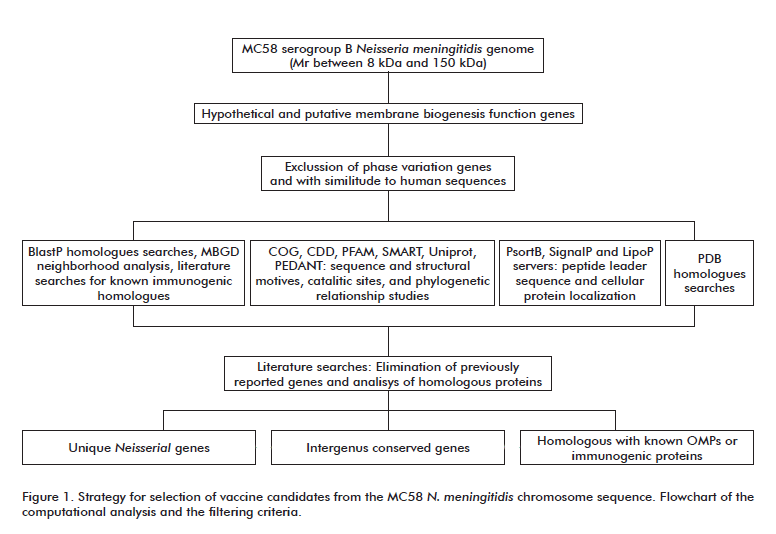
<P   ><font size="2" face="Verdana, Arial, Helvetica, sans-serif"><I>N. meningitidis      </I>strains CU385 (B:4,7:P1.19,15:ST-33), NZ124 (B:4:P1.7b,4:ST-41) and C233      (C:2a:P1.9:ST-11) obtained from Finlay Institute in Havana, were used for      Western blotting assay. One of them, the CU385 strain was also used for bactericidal      test. In general, all <I>neisseria</I>l strains were grown in a humidified      atmosphere of 5% CO2 on brain heart infusion (BHI) agar (Oxoid, Basingstoke,      United Kingdom) supplemented with an antibiotic mixture of vancomycin, colistin      and nystatin (VCN, Oxoid) at the concentration recommended by the manufacturer.      </font></P >   <FONT size="+1"><FONT size="+1">        <P   ><font size="2" face="Verdana, Arial, Helvetica, sans-serif"><b>Computer analysis      </b> </font></P >   <FONT size="+1">        <P   ><font size="2" face="Verdana, Arial, Helvetica, sans-serif">A number of computational      algorithms free available in internet were used to search for signatures characteristic      of putative OMPs and virulence related proteins from those genes annotated      as &lsquo;hypothetical&rsquo;, &lsquo;conserved hypothetical&rsquo; or with      putative functions related to the cell envelope in the genome of MC58 <I>N.      meningitidis </I>strain (Refseq NC_003112) (<a href="/img/revistas/bta/v29n1/f0104112.gif">Figure      1</a>). Genes with reported phase variation or homologous to human sequences      were firstly excluded. When ORF products had more than one paralogs in the      genome, only one of them was included. Homology searches were performed using      the Blast program and non redundant databases. Conserved domains and sequences,      as well as structural motifs, were identified by integrating COG, PFAM, PEDANT,      PDB, SMART and CDD databases searches [22-24]. MBGD database was used to study      the neighborhood of the genes of interest [25]. The degree of conservation      of the selected genes was the most important criterion for the selection of      a potential cross protective antigen. This parameter was analyzed from three      <I>N. meningitidis </I>genomes: serogroup B strain MC58, serogroup A strain      Z2491 (Refseq NC_003116.1) and serogroup C FAM18 (Refseq NC_008767). SignalP2.0      and LipoP programs [26, 27] were used to identify potential signal peptides.      PSORT was used to predict cellular localization of the gene products [28].      Extensive literature search was carried out along all the process to avoid      the selection of previously studied proteins by other researcher groups. </font></P >   <FONT size="+1">        
<P   ><font size="2" face="Verdana, Arial, Helvetica, sans-serif"><b>Expression and      purification in <i>E. coli</i> </b></font></P >       <P   ><font size="2" face="Verdana, Arial, Helvetica, sans-serif">For expression of      the <I>nmb1126 </I>and <I>nmb0181 </I>genes, previously obtained genetic constructions      were used [20]. Recombinant proteins were expressed as fusion products with      the N-terminal stabilizing segment of the P64k protein of <I>N. meningitidis</I>.      They also contained a C-terminal His-tag fusion to facilitate the purification      by IMAC (Immobilized metal ion affinity chromatography) according to manufacturer&rsquo;s      instructions (Amersham Pharmacia Biotech). Specific conditions to achieve      each purification procedure are shown in <a href="/img/revistas/bta/v29n1/t0104112.gif">table 1</a>.      A final step of dialysis against phosphate buffer, pH 8.0 was carried out      in both cases. </font></P >       
<P   ><font size="2" face="Verdana, Arial, Helvetica, sans-serif"><b>Immunization schedule      </b> </font></P >       <P   ><font size="2" face="Verdana, Arial, Helvetica, sans-serif">Six weeks old BALB/c      female mice, ten mice per group, were immunized with 20 &mu;g of the <I>NMB1126      </I>or <I>NMB0181 </I>recombinant antigens. Preimmune sera were taken one      day before the beginning of the schedule. The proteins were administered subcutaneously,      in Freund&rsquo;s Complete Adjuvant for the first dose and Freund&rsquo;s      Incomplete Adjuvant for the second (7 days) and third (14 days) doses. Animals      were bled on day 21 for the corresponding analyses. </font></P >       <P   ><font size="2" face="Verdana, Arial, Helvetica, sans-serif"><b>Western Blot against      whole cell </b></font></P >       <P   ><font size="2" face="Verdana, Arial, Helvetica, sans-serif">To assess the recognition      of the native proteins, 10 &mu;g of whole cells from the CU385 strain, grown      under the previously described conditions, were loaded into the SDS-PAGE gel      and transferred to a nitrocellulose membrane (Hybond ECL; Amersham Pharmacia      Biotech). Membranes were blocked with 5% skin milk in PBS and incubated with      a 1:100 dilution of the antisera during 3h followed by a 1:5000 dilution of      HPR-labeled anti&ndash;mouse IgG (Sigma). The revealing steps and analyses      were performed as described previously [29]. </font></P >       ]]></body>
<body><![CDATA[<P   ><font size="2" face="Verdana, Arial, Helvetica, sans-serif"><b>Complement-mediated      Bactericidal Activity </b></font></P >       <P   ><font size="2" face="Verdana, Arial, Helvetica, sans-serif">Serum bactericidal      activity against CU385 <I>N. meningitidis </I>strain was evaluated as previously      described [30]. Briefly, a pool of baby rabbit sera, previously screened for      anti-meningococcal activity, was used as complement source. The bacterial      suspension was adjusted to OD600nm 1.0 in phosphate buffered saline pH 8.0      (PBS) and incubated for 30 min at 56 &ordm;C. A bacterial pellet corresponding      to 2.5 mL of heat-inactivated bacterial suspension was added to 1.0 mL of      rabbit serum and the mixture was incubated for 50 min on ice with agitation.      Finally, bacteria were removed by centrifugation in a refrigerated centrifuge.      If the antiserum shows a 50% reduction in the number of CFU per mL after incubation      as compared to the preimmune serum at the same dilution, then is considered      as positive. </font></P >       <P   >&nbsp;</P >   <FONT size="+1"><FONT size="+1">        <P   ><font size="2" face="Verdana, Arial, Helvetica, sans-serif"><B><font size="3">RESULTS      </font></b></font></P >       <P   ><font size="2" face="Verdana, Arial, Helvetica, sans-serif"><I><b>In silico</b></I><b>      selection of putative vaccine candidates </b></font></P >       <P   ><font size="2" face="Verdana, Arial, Helvetica, sans-serif">The genome of <I>N.      meningitidis </I>serogroup B strain MC58 was examined in a search for novel      immune-exposed proteins. Genes encoding for proteins with a relative mass      (<I>M</I>r) outside the range between 8 kDa and 150 kDa were remove. ORF with      unknown or hypothetical functions assigned (conserved or not), together with      those primary annotated with a putative function related to the cell envelope      were selected. A total of 725 sequences were retrieved. </font></P >       <P   ><font size="2" face="Verdana, Arial, Helvetica, sans-serif">Similitude to human      proteins and phase variation in the expression of the genes were excluding      criteria. In the case of duplicated ORF in the MC58 genome, one of the copies      was removed to avoid redundancy. ORF products predicted by protein localization      algorithms to encode for surface associated components were selected. Proteins      homologous to those described as surface exposed in other bacteria were also      chosen, independently of the <I>in silico </I>prediction. </font></P >       <P   ><font size="2" face="Verdana, Arial, Helvetica, sans-serif">ORF products resembling      virulence-associated proteins were selected on the basis of sequence homology      or the presence of motifs typical of such proteins. Other ORF products homologous      to proteins previously reported as immunogenic, irrespective of their cellular      location, were also retained. A degree of conservation higher than 90% in      the <I>Neisseria </I>genomes studied was established as a requisite, aimed      at the selection of candidates capable of inducing broadly reactive immunological      responses. </font></P >       <P   ><font size="2" face="Verdana, Arial, Helvetica, sans-serif">Previously published      proteins by other groups were identified by literature searching and manually      removed. </font></P >       <P   ><font size="2" face="Verdana, Arial, Helvetica, sans-serif"><b>ORFs encoding      putative surface-exposed antigens identified as a result of the prediction      of subcellular localization </b></font></P >       ]]></body>
<body><![CDATA[<P   ><font size="2" face="Verdana, Arial, Helvetica, sans-serif">Several approaches      were used to determine the ORFs likely to encode proteins that are exposed      at the bacterial surface, thus representing potential vaccine components.      Of all sequences tested, 230 encoded for products with putative signal sequences      for membrane proteins that are cleaved by signal peptidase I or signal peptidase      II. PSORT server was next used to predict the cellular localization of these      proteins. A total of 93 proteins were selected based on its potential localization      at the outer membrane. They were examined in detail in terms of homology,      degree of conservation and genomic localization. Finally, a set of 28 genes      was selected and subdivided into unique <I>Neisseria </I>genes or orthologous      ORF products (<a href="/img/revistas/bta/v29n1/t0204112.gif">Table 2</a>). </font></P >       
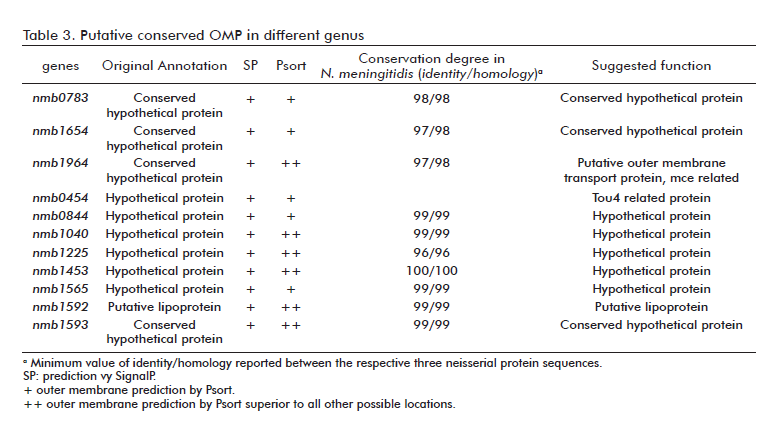
<P   ><font size="2" face="Verdana, Arial, Helvetica, sans-serif">Putative new annotations      were assigned to four genes based on overall homology and analysis of the      conserved domains: <I>nmb1333</I>, that belongs to COG4942 (Membrane-bound      metallopeptidase); <I>nmb0506 </I>included in DUF637 (possible hemagglutinin),      <I>nmb1964 </I>related to gnl|CDD|8313, pfam02470 (<I>mce </I>related protein);      and <I>nmb0454 </I>(<I>tou4</I>). In the cases of <I>nmb1333 </I>and <I>nmb0506</I>,      possible neisserial pathogenic attributes, the assignment of functions was      possible due to local homologies detected in some domains. </font></P >       <P   ><font size="2" face="Verdana, Arial, Helvetica, sans-serif">The <I>nmb1333 </I>gene      appears to be the result of mutational events that eliminated a stop codon      located upstream of the reported ATG initiation codon, resulting in the gain      of more than 200aa at the N terminus. A similar event was detected for ORF      <I>nmb1470</I>, with a corresponding addition of 70 aa., although no function      could be assigned in this particular case. Additionally, the <I>nmb0506 </I>gene      could have arisen from a fusion event between two adjacent genes as has been      observed by neighborhood analyses for other genus (data not shown). </font></P >       <P   ><font size="2" face="Verdana, Arial, Helvetica, sans-serif">Some genes were found      only in the serogroup B MC58 strain and could represent exclusive pathogenic      attributes for this serogroup (genes <I>nmb1008</I>, <I>nmb1010 </I>and <I>nmb1765</I>).      </font></P >       <P   ><font size="2" face="Verdana, Arial, Helvetica, sans-serif"><b>Products selected      for homologies to previously reported OMP or immunogenic orthologous proteins      </b> </font></P >       <P   ><font size="2" face="Verdana, Arial, Helvetica, sans-serif">In addition to the      previous putative outer membrane proteins selected, we searched for gene products      with homologies to previously reported OMPs, virulence attributes or immunogenic      proteins relevant to vaccine design. According to this concept, four genes      were characterized and finally selected (<a href="/img/revistas/bta/v29n1/t0304112.gif">Table 3</a>).      A brief characterization of each gene follows. </font></P >       
<P   ><font size="2" face="Verdana, Arial, Helvetica, sans-serif"><I>nmb0181: </I>Was      annotated as a putative outer membrane protein H in the MC58. The homology      was corroborated by its inclusion in the pfam03938 group &ldquo;OmpH, Outer      membrane protein (OmpH-like)&rdquo; suggesting a common phylogenetically related      ancestor for it and all the homologues. The outer membrane localization of      OmpH proteins has been previously documented [31, 32]. Recently, these proteins      have been associated with protection against haemorrhagic septicaemia after      vaccination of calves with a live-attenuated <I>aroA </I>derivative of <I>Pasteurella      multocida </I>B:2 [33]. </font></P >       <P   ><font size="2" face="Verdana, Arial, Helvetica, sans-serif"><I>nmb1483: </I>Contains      various conserved motifs related with cell wall biogenesis, including two      LysM, a lysin domain found in a variety of enzymes involved in bacterial cell      wall biogenesis, and a conserved region that belongs to the M23 peptidase      family. Homologies to NlpD proteins have also been detected. This kind of      proteins has been reported as an important virulence factor in <I>Yersinia      pestis </I>[34]. </font></P >       <P   ><font size="2" face="Verdana, Arial, Helvetica, sans-serif"><I>nmb1126: </I>Primary      annotated as a hypothetical protein, it is now proposed to be re-annotated      as the putative curli production assembly/transport component CsgG. Although      neighborhood analyses showed no conserved gene organization as compared to      other genus, its inclusion in COG1462 supports this conclusion. CsgG is an      outer membrane lipoprotein, highly resistant to protease digestion and required      to maintain the stability of CsgA and CsgB, structural components of the outer      cell structure named curli. </font></P >       <P   ><font size="2" face="Verdana, Arial, Helvetica, sans-serif"><I>nmb1693: </I>Phylogenetically      related to AsmA proteins (COG2982), an uncharacterized protein involved in      outer membrane biogenesis. Recently, a role for <I>Salmonella enterica </I>AsmA      protein in the invasion of epithelial cells have been suggested by Prieto      <I>et al</I>. [35] (<a href="/img/revistas/bta/v29n1/t0404112.gif">Table 4</a>). </font></P >       
]]></body>
<body><![CDATA[<P   ><font size="2" face="Verdana, Arial, Helvetica, sans-serif"><b>Immunization and      immune response </b></font></P >       <P   ><font size="2" face="Verdana, Arial, Helvetica, sans-serif">Proteins <I>NMB1126      </I>and <I>NMB0181 </I>have been previously reported by our group as potential      vaccines candidates following an alternative bioinformatic methodology based      on the prediction of putative MHC class II epitopes [21]. Taking into account      that both proteins have been selected by the two <I>in silico </I>approaches,      we decided to proceed to experimental evaluation of their immunogenic properties.      After successful expression in W3110 strain of <I>E. coli</I>, the proteins      were purified by IMAC under denaturing conditions (<a href="/img/revistas/bta/v29n1/t0104112.gif">Table      1</a>). </font></P >       
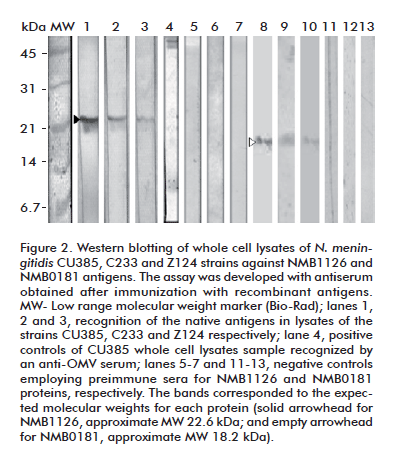
<P   ><font size="2" face="Verdana, Arial, Helvetica, sans-serif">To determine whether      the purified recombinant proteins were capable of inducing a functional immune      response, BALB/c mice were immunized as described before. The proteins were      immunogenic in adult mice, eliciting IgG antibody titers around 1:70 000 and      1:60 000 for recombinant <I>NMB1126 </I>and <I>NMB0181 </I>respectively (data      not shown). </font></P >       <P   ><font size="2" face="Verdana, Arial, Helvetica, sans-serif">The sera from immunized      animals were also capable of recognizing the native counterparts of the antigens      in whole-cell lysates of three different <I>N. meningitidis </I>strains, including      one of the serogroup C (<a href="#fig2">Figure 2</a>).</font></P >       <P align="center"   ><img src="/img/revistas/bta/v29n1/f0204112.gif" width="396" height="472"><a name="fig2"></a></P >       
<P   ><font size="2" face="Verdana, Arial, Helvetica, sans-serif">Bactericidal assays      were next conducted to test the functional capabilities of the generated antibodies.      Positive result was achieved for the recombinant antigens, with bactericidal      titers of 1:128 for <I>NMB1126 </I>and 1:64 for <I>NMB0181</I>. </font></P >       <P   >&nbsp;</P >       <P   ><font size="2" face="Verdana, Arial, Helvetica, sans-serif"><B><font size="3">DISCUSSION      </font></b></font></P >       <P   ><font size="2" face="Verdana, Arial, Helvetica, sans-serif">The discovery of      a vaccine to prevent the disease caused by <I>N. meningitidis </I>serogroup      B remains a priority in the fight against bacterial meningitis. Many strategies      have been implemented so far in the search for an effective vaccine preparation,      however, a definitive solution to this problem has not yet been found. </font></P >       <P   ><font size="2" face="Verdana, Arial, Helvetica, sans-serif">Amid this scenery,      reverse vaccinology emerges as a time saving alternative to standard experimental      searches for vaccine candidates [36]. The availability of the genomic sequence      of the strain MC58 serogroup B from the year 2000 has facilitated the application      of this methodology. </font></P >       ]]></body>
<body><![CDATA[<P   ><font size="2" face="Verdana, Arial, Helvetica, sans-serif">Pizza <I>et al. </I>searched      the <I>N</I>. <I>meningitidis </I>genome looking for possible outer membrane      proteins displaying overall sequence homology or sharing specific motifs with      known antigens [9]. They combined these efforts with high throughput techniques      to examine the immunogenic properties of more than 340 proteins. Those antigens      with protective or bactericidal activity <I>in vitro </I>and/or <I>in vivo      </I>were published. This strategy allowed this group of researchers to move      towards the evaluation of a multicomponent vaccine, based on 5 of these proteins,      which is currently in phase III clinical trial [10, 11]. Although in some      cases the individual candidates selected showed up to 54% sequence variation,      they combination was able to induce cross-reactive antibodies against a panel      that covered the broad spectrum of bacterial strains circulating in the world      [11, 37]. </font></P >       <P   ><font size="2" face="Verdana, Arial, Helvetica, sans-serif">The reverse vaccinology      approach, as has been implemented thus far, requires a large number of animals      and is very labour and time intensive [17]. Unlike Pizza <I>et al.</I>, we      fixed a homology level above 90% among the sequenced genomes of <I>N. meningitidis      </I>as one of the fundamental criteria for the selection of the candidate      genes. This is a good <I>a priori </I>indicator for a high probability of      generating a cross-reactive antibody response among different bacterial strains.      The application of this criterion was expected to reduce the number of individual      proteins needed for a multicomponent vaccine, with the consequent reduction      of costs and complexity in its production process. </font></P >       <P   ><font size="2" face="Verdana, Arial, Helvetica, sans-serif">To initiate the prediction      pipeline we only selected genes whose functions had not been fully elucidated      and were annotated with hypothetical or putative functions. This selection      gave us the advantage of working with less explored candidates. </font></P >       <P   ><font size="2" face="Verdana, Arial, Helvetica, sans-serif">The use of more than      one software application to predict possible signal peptide sequences contributed      to generate more reliable information. The LipoP server also enabled a safest      prediction of lipoproteins, which have been widely documented as important      vaccine candidates (e.g., OspA of <I>Borrelia burgdorferi </I>P6 of <I>Haemophilus      influenzae </I>and GNA1870 of <I>N. meningitidis</I>) [13, 38-40]. Lipoproteins      located at the outer membrane also offer advantages in setting up purification      procedures as compared to the typical integral beta barrel proteins of Gram-negative      bacteria [41]. </font></P >       <P   ><font size="2" face="Verdana, Arial, Helvetica, sans-serif">The study of the      genomic neighborhood, in conjunction with the analyses of conserved domains      and the homology through different servers is also a powerful tool for the      assignment and annotation of genomes [42]. Proteins displaying some degree      of homology or belonging to the same orthologous cluster, and that additionally      have their gene neighborhood preserved, have a high potential to perform similar      functions. In this sense, the structural alignment with homologous proteins      of known function could provide additional elements to support the initial      results. </font></P >       <P   ><font size="2" face="Verdana, Arial, Helvetica, sans-serif">The inclusion of      ORF products without homology with other known proteins implies the risk of      being false ORFs, but also maximizes the possibility of selecting genus specific      pathogenic attributes, which is a desirable goal. Some of the main vaccine      candidates proposed for the prevention of meningococcal disease have included      proteins with similar characteristics. One of them, the GNA1870, is one of      the most studied and successful so far [13]. </font></P >       <P   ><font size="2" face="Verdana, Arial, Helvetica, sans-serif">In this article we      presented the results of the immunological evaluation of two proteins that      were identified both by a previously MHC class II epitopes prediction and      by the <I>in silico </I>methodology proposed hear. Previously, in the article      of Paj&oacute;n <I>et al</I>., both proteins have been cloned, purified, and      used to immunize mice [21]. Nevertheless, the details of each mentioned process      and the results were only drawback. In this article we report the exact corresponding      data. These proteins were also identified by several proteomic techniques      in the study of OMV from neisserial species. At these respect, both proteins      were detected in the composition of OMV from a gna33 <I>N. meningitidis </I>serogroup      B mutant. The authors show that these OMV are able to induce bactericidal      antibodies with broader cross-protective activities than the OMV obtained      from the non mutant corresponding strain [43]. Also <I>NMB1126 </I>protein      was detected in New Zealand OMV vaccine from strain NZ98/254 and in OMV from      a <I>N. lactamica, </I>another alternative study to achieve protection against      the meningococcus [44, 45]. More recently, Tsolakos <I>et al</I>. founded      that in some growth conditions, various OMP included <I>NMB1126 </I>increased      significantly its representativity in bacterial OMV, a fact that was associated      with higher serum bactericidal titres in mice immunized with corresponding      OMV vaccine [46]. According to our results, both proteins could be contributing      to this improvement in immune responses. </font></P >       <P   ><font size="2" face="Verdana, Arial, Helvetica, sans-serif">Despite the evident      importance and benefits of using <I>in silico </I>predicting tools, any outcome      from these methods would require experimental corroboration before the final      endorsement. A successful vaccine must be able to induce a functional response      in mice, measured in either <I>in vitro </I>and/or <I>in vivo </I>tests. Ideally,      those tests must be good correlates of protection in humans [47]. The assay      of complement mediated bactericidal activity is a relatively rapid <I>in vitro      </I>test, considered as the gold standard for <I>N. meningitidis </I>[48].      The fact that the candidate <I>NMB1126 </I>was capable of induces titres of      1:128 against the homologous strain is a good indication that supports their      subsequent evaluation. Also, the recognition of the native antigen in different      strains of the same and different serogroups is a good indicator of the possibility      of induces functional response against diverse meningococci, a criterion that      is considered essential in the anti-meningococcal vaccine field. This antigen      could be included in a vaccine preparation, although a deeper characterization      is needed. </font></P >       <P   ><font size="2" face="Verdana, Arial, Helvetica, sans-serif">The results shown      above are a good example of how <I>in silico </I>and experimental analyses      can be combined to identify novel antigens whose existence has just been proposed.      The proposed methodology includes new selection strategies as compared with      previous works. The proposed candidates have the potentiality to integrate      a universal vaccine against the meningococcal disease. </font></P >       <P   ><font size="2" face="Verdana, Arial, Helvetica, sans-serif">The ability of bioinformatics      to characterize genomic sequences from pathogenic bacteria for the prediction      of genes that may encode vaccine candidates (e.g., surface localized proteins)      has been corroborated. Our study demonstrated that bioinformatics is a very      useful tool to expedite the vaccine discovery process in <I>N. meningitidis      </I>by rapidly providing a set of uncharacterized candidates for further testing.      </font></P >       ]]></body>
<body><![CDATA[<P   >&nbsp;</P >       <P   ><font size="2" face="Verdana, Arial, Helvetica, sans-serif"><B><font size="3">ACKNOWLEDGMENTS      </font> </b></font></P >       <P   ><font size="2" face="Verdana, Arial, Helvetica, sans-serif">The authors are very      grateful to Dr. Gerardo Guill&eacute;n, Dr. Carlos Duarte and Dr. Ricardo      Bringas for their critical reading and useful comments in the revision of      the manuscript. </font></P >       <P   >&nbsp;</P >       <P   ><font size="2" face="Verdana, Arial, Helvetica, sans-serif"><B><font size="3">REFERENCES      </font></b></font></P >       <!-- ref --><P   ><font size="2" face="Verdana, Arial, Helvetica, sans-serif">1. Stephens DS, Zimmer      SM. Pathogenesis, Therapy, and Prevention of Meningococcal Sepsis. Curr Infect      Dis Rep. 2002;4(5):377-86.     </font></P >   <FONT size="+1">        <!-- ref --><P   ><font size="2" face="Verdana, Arial, Helvetica, sans-serif">2. Tikhomirov E,      Santamaria M, Esteves K. Meningococcal disease: public health burden and control.      World Health Stat Q. 1997;50(3-4):170-7.     </font></P >       <!-- ref --><P   ><font size="2" face="Verdana, Arial, Helvetica, sans-serif">3. Finne J, Leinonen      M, Makela PH. Antigenic similarities between brain components and bacteria      causing meningitis. Implications for vaccine development and pathogenesis.      Lancet. 1983;2(8346):355-7.     </font></P >       <!-- ref --><P   ><font size="2" face="Verdana, Arial, Helvetica, sans-serif">4. Fredriksen JH,      Rosenqvist E, Wedege E, Bryn K, Bjune G, Froholm LO, et al. Production, characterization      and control of MenB-vaccine &quot;Folkehelsa&quot;: an outer membrane vesicle      vaccine against group B meningococcal disease. NIPH Ann. 1991;14(2):67-80.          </font></P >       <!-- ref --><P   ><font size="2" face="Verdana, Arial, Helvetica, sans-serif">5. Sierra GV, Campa      HC, Varcacel NM, Garcia IL, Izquierdo PL, Sotolongo PF, et al. Vaccine against      group B Neisseria meningitidis: protection trial and mass vaccination results      in Cuba. NIPH Ann 1991;14(2):195-10.     </font></P >       <!-- ref --><P   ><font size="2" face="Verdana, Arial, Helvetica, sans-serif">6. Perkins BA, Jonsdottir      K, Briem H, Griffiths E, Plikaytis BD, Hoiby EA, et al. Immunogenicity of      two efficacious outer membrane protein-based serogroup B meningococcal vaccines      among young adults in Iceland. J Infect Dis. 1998;177(3):683-91.     </font></P >       <!-- ref --><P   ><font size="2" face="Verdana, Arial, Helvetica, sans-serif">7. Wheeler JX, Vipond      C, Feavers IM. Exploring the proteome of meningococcal outer membrane vesicle      vaccines. Proteomics Clin Appl. 2007;1(9):1198-210.     </font></P >       <!-- ref --><P   ><font size="2" face="Verdana, Arial, Helvetica, sans-serif">8. Masignani V, Rappuoli      R, Pizza M. Reverse vaccinology: a genome-based approach for vaccine development.      Expert Opin Biol Ther. 2002;2(8):895-905.     </font></P >       <!-- ref --><P   ><font size="2" face="Verdana, Arial, Helvetica, sans-serif">9. Pizza M, Scarlato      V, Masignani V, Giuliani MM, Arico B, Comanducci M, et al. Identification      of vaccine candidates against serogroup B meningococcus by whole-genome sequencing.      Science. 2000;287(5459):1816-20.     </font></P >       <P   ><font size="2" face="Verdana, Arial, Helvetica, sans-serif">10. Snape MD, Dawson      T, Morant A, John B, Ohene-Kena R, Borrow R, et al. Program and abstract of      the 16th International Pathogenic Neisseria Conference (Rotterdam, Amsterdam).      7-12 September. 2008. Immunogenicity and reactogenicity of a novel serogroup      B Neisseria meningitidis vaccine administered from 6 months of age. Abstract      O69. </font></P >       <!-- ref --><P   ><font size="2" face="Verdana, Arial, Helvetica, sans-serif">11. Giuliani MM,      Adu-Bobie J, Comanducci M, Arico B, Savino S, Santini L, et al. A universal      vaccine for serogroup B meningococcus. Proc Natl Acad Sci USA. 2006;103(29):10834-9.          </font></P >       <!-- ref --><P   ><font size="2" face="Verdana, Arial, Helvetica, sans-serif">12. Capecchi B, Adu-Bobie      J, Di Marcello F, Ciucchi L, Masignani V, Taddei A, et al. Neisseria meningitidis      NadA is a new invasin which promotes bacterial adhesion to and penetration      into human epithelial cells. Mol Microbiol. 2005;55(3):687-98.     </font></P >       <!-- ref --><P   ><font size="2" face="Verdana, Arial, Helvetica, sans-serif">13. Masignani V,      Comanducci M, Giuliani MM, Bambini S, Adu-Bobie J, Arico B, et al. Vaccination      against Neisseria meningitidis using three variants of the lipoprotein GNA1870.      J Exp Med. 2003;197(6):789-99.     </font></P >       ]]></body>
<body><![CDATA[<!-- ref --><P   ><font size="2" face="Verdana, Arial, Helvetica, sans-serif">14. Ruckdeschel EA,      Kirkham C, Lesse AJ, Hu Z, Murphy TF. Mining the Moraxella catarrhalis genome:      identification of potential vaccine antigens expressed during human infection.      Infect Immun. 2008;76(4):1599-607.     </font></P >       <!-- ref --><P   ><font size="2" face="Verdana, Arial, Helvetica, sans-serif">15. Huntley JF, Conley      PG, Hagman KE, Norgard MV. Characterization of Francisella tularensis outer      membrane proteins. J Bacteriol. 2007;189(2):561-74.     </font></P >       <!-- ref --><P   ><font size="2" face="Verdana, Arial, Helvetica, sans-serif">16. Lewenza S, Gardy      JL, Brinkman FS, Hancock RE. Genome-wide identification of Pseudomonas aeruginosa      exported proteins using a consensus computational strategy combined with a      laboratory-based PhoA fusion screen. Genome Res. 2005;15(2):321-9.     </font></P >       <!-- ref --><P   ><font size="2" face="Verdana, Arial, Helvetica, sans-serif">17. Zhao Y, Benita      Y, Lok M, Kuipers B, van der Ley P, Jiskoot W, et al. Multi-antigen immunization      using IgG binding domain ZZ as carrier. Vaccine. 2005;23(43):5082-90.     </font></P >       <!-- ref --><P   ><font size="2" face="Verdana, Arial, Helvetica, sans-serif">18. Pajon R, Yero      D, Niebla O, Climent Y, Sardinas G, Garcia D, et al. Identification of new      meningococcal serogroup B surface antigens through a systematic analysis of      neisserial genomes. Vaccine. 2009;28(2):532-41.     </font></P >       ]]></body>
<body><![CDATA[<!-- ref --><P   ><font size="2" face="Verdana, Arial, Helvetica, sans-serif">19. Borrow R, Carlone      GM, Rosenstein N, Blake M, Feavers I, Martin D, et al. Neisseria meningitidis      group B correlates of protection and assay standardization--international      meeting report Emory University, Atlanta, Georgia, United States, 16-17 March      2005. Vaccine. 2006;24(24):5093-107.     </font></P >       <P   ><font size="2" face="Verdana, Arial, Helvetica, sans-serif">20. Yero D, Pajon      R, Niebla O, Sardinas G, Vivar I, Perera Y, et al. Bicistronic expression      plasmid for the rapid production of recombinant fused proteins in Escherichia      coli. Biotechnol Appl Biochem. 2006;44(Pt 1):27-34. </font></P >       <!-- ref --><P   ><font size="2" face="Verdana, Arial, Helvetica, sans-serif">21. Pajon R, Yero      D, Niebla O, Climent Y, Sardinas G, Garcia D, et al. Identification of new      meningococcal serogroup B surface antigens through a systematic analysis of      neisserial genomes. Vaccine. 2009;28(2):532-41.     </font></P >       <!-- ref --><P   ><font size="2" face="Verdana, Arial, Helvetica, sans-serif">22. Altschul SF,      Madden TL, Schaffer AA, Zhang J, Zhang Z, Miller W, et al. Gapped BLAST and      PSI-BLAST: a new generation of protein database search programs. Nucleic Acids      Res. 1997;25(17):3389-402.     </font></P >       <!-- ref --><P   ><font size="2" face="Verdana, Arial, Helvetica, sans-serif">23. Marchler-Bauer      A, Panchenko AR, Shoemaker BA, Thiessen PA, Geer LY, Bryant SH. CDD: a database      of conserved domain alignments with links to domain three-dimensional structure.      Nucleic Acids Res. 2002;30(1):281-3.     </font></P >       <!-- ref --><P   ><font size="2" face="Verdana, Arial, Helvetica, sans-serif">24. Marchler-Bauer      A, Anderson JB, Derbyshire MK, DeWeese-Scott C, Gonzales NR, Gwadz M, et al.      CDD: a conserved domain database for interactive domain family analysis. Nucleic      Acids Res 2007;35(Database issue):D237-40.     </font></P >       <!-- ref --><P   ><font size="2" face="Verdana, Arial, Helvetica, sans-serif">25. Uchiyama I. MBGD:      a platform for microbial comparative genomics based on the automated construction      of orthologous groups. Nucleic Acids Res. 2007;35(Database issue):D343-6.          </font></P >       <!-- ref --><P   ><font size="2" face="Verdana, Arial, Helvetica, sans-serif">26. Nielsen H, Krogh      A. Prediction of signal peptides and signal anchors by a hidden Markov model.      Proc Int Conf Intell Syst Mol Biol. 1998;6:122-30.     </font></P >       <!-- ref --><P   ><font size="2" face="Verdana, Arial, Helvetica, sans-serif">27. Juncker AS, Willenbrock      H, Von Heijne G, Brunak S, Nielsen H, Krogh A. Prediction of lipoprotein signal      peptides in Gram-negative bacteria. Protein Sci. 2003;12(8):1652-62.     </font></P >       <!-- ref --><P   ><font size="2" face="Verdana, Arial, Helvetica, sans-serif">28. Nakai K, Horton      P. PSORT: a program for detecting sorting signals in proteins and predicting      their subcellular localization. Trends Biochem Sci. 1999;24(1):34-6.     </font></P >       <!-- ref --><P   ><font size="2" face="Verdana, Arial, Helvetica, sans-serif">29. Wedege E, Froholm      LO. Human antibody response to a group B serotype 2a meningococcal vaccine      determined by immunoblotting. Infect Immun. 1986;51(2):571-8.     </font></P >       <!-- ref --><P   ><font size="2" face="Verdana, Arial, Helvetica, sans-serif">30. Delgado M, Yero      D, Niebla O, Gonzalez S, Climent Y, Perez Y, et al. Lipoprotein NMB0928 from      Neisseria meningitidis serogroup B as a novel vaccine candidate. Vaccine.      2007;25(50):8420-31.     </font></P >       <!-- ref --><P   ><font size="2" face="Verdana, Arial, Helvetica, sans-serif">31. Luo Y, Glisson      JR, Jackwood MW, Hancock RE, Bains M, Cheng IH, et al. Cloning and characterization      of the major outer membrane protein gene (ompH) of Pasteurella multocida X-73.      J Bacteriol. 1997;179(24):7856-64.     </font></P >       <!-- ref --><P   ><font size="2" face="Verdana, Arial, Helvetica, sans-serif">32. Koski P, Hirvas      L, Vaara M. Complete sequence of the ompH gene encoding the 16-kDa cationic      outer membrane protein of Salmonella typhimurium. Gene. 1990;88(1):117-20.          </font></P >       <!-- ref --><P   ><font size="2" face="Verdana, Arial, Helvetica, sans-serif">33. Ataei S, Burchmore      R, Christopher Hodgson J, Finucane A, Parton R, Coote JG. Identification of      immunogenic proteins associated with protection against haemorrhagic septicaemia      after vaccination of calves with a live-attenuated aroA derivative of Pasteurella      multocida B:2. Res Vet Sci. 2009;87(2):207-10.     </font></P >       <!-- ref --><P   ><font size="2" face="Verdana, Arial, Helvetica, sans-serif">34. Tidhar A, Flashner      Y, Cohen S, Levi Y, Zauberman A, Gur D, et al. The NlpD lipoprotein is a novel      Yersinia pestis virulence factor essential for the development of plague.      PLoS One. 2009;4(9):e7023.     </font></P >       <!-- ref --><P   ><font size="2" face="Verdana, Arial, Helvetica, sans-serif">35. Prieto AI, Hernandez      SB, Cota I, Pucciarelli MG, Orlov Y, Ramos-Morales F, et al. Roles of the      outer membrane protein AsmA of Salmonella enterica in the control of marRAB      expression and invasion of epithelial cells. J Bacteriol. 2009;191(11):3615-22.          </font></P >       <!-- ref --><P   ><font size="2" face="Verdana, Arial, Helvetica, sans-serif">36. Adu-Bobie J,      Capecchi B, Serruto D, Rappuoli R, Pizza M. Two years into reverse vaccinology.      Vaccine. 2003;21(7-8):605-10.     </font></P >       <!-- ref --><P   ><font size="2" face="Verdana, Arial, Helvetica, sans-serif">37. Jacobsson S,      Thulin S, Molling P, Unemo M, Comanducci M, Rappuoli R, et al. Sequence constancies      and variations in genes encoding three new meningococcal vaccine candidate      antigens. Vaccine. 2006;24(12):2161-8.     </font></P >       <!-- ref --><P   ><font size="2" face="Verdana, Arial, Helvetica, sans-serif">38. Murphy TF, Kirkham      C, Lesse AJ. Construction of a mutant and characterization of the role of      the vaccine antigen P6 in outer membrane integrity of nontypeable Haemophilus      influenzae. Infect Immun. 2006;74(9):5169-76.     </font></P >       <!-- ref --><P   ><font size="2" face="Verdana, Arial, Helvetica, sans-serif">39. Sigal LH, Zahradnik      JM, Lavin P, Patella SJ, Bryant G, Haselby R, et al. A vaccine consisting      of recombinant Borrelia burgdorferi outer-surface protein A to prevent Lyme      disease. Recombinant Outer-Surface Protein A Lyme Disease Vaccine Study Consortium.      N Engl J Med. 1998;339(4):216-22.     </font></P >       <!-- ref --><P   ><font size="2" face="Verdana, Arial, Helvetica, sans-serif">40. Steere AC, Sikand      VK, Meurice F, Parenti DL, Fikrig E, Schoen RT, et al. Vaccination against      Lyme disease with recombinant Borrelia burgdorferi outer-surface lipoprotein      A with adjuvant. Lyme Disease Vaccine Study Group. N Engl J Med. 1998;339(4):209-15.          </font></P >       <!-- ref --><P   ><font size="2" face="Verdana, Arial, Helvetica, sans-serif">41. Booth PJ. The      trials and tribulations of membrane protein folding in vitro. Biochim Biophys      Acta. 2003;1610(1):51-6.     </font></P >       <!-- ref --><P   ><font size="2" face="Verdana, Arial, Helvetica, sans-serif">42. Fong C, Rohmer      L, Radey M, Wasnick M, Brittnacher MJ. PSAT: a web tool to compare genomic      neighborhoods of multiple prokaryotic genomes. BMC Bioinformatics. 2008;9:170.          </font></P >       <!-- ref --><P   ><font size="2" face="Verdana, Arial, Helvetica, sans-serif">43. Ferrari G, Garaguso      I, Adu-Bobie J, Doro F, Taddei AR, Biolchi A, et al. Outer membrane vesicles      from group B Neisseria meningitidis delta gna33 mutant: proteomic and immunological      comparison with detergent-derived outer membrane vesicles. Proteomics. 2006;6(6):1856-66.          </font></P >       <!-- ref --><P   ><font size="2" face="Verdana, Arial, Helvetica, sans-serif">44. Vipond C, Suker      J, Jones C, Tang C, Feavers IM, Wheeler JX. Proteomic analysis of a meningococcal      outer membrane vesicle vaccine prepared from the group B strain NZ98/254.      Proteomics. 2006;6(11):3400-13.     </font></P >       <!-- ref --><P   ><font size="2" face="Verdana, Arial, Helvetica, sans-serif">45. Vaughan TE, Skipp      PJ, O'Connor CD, Hudson MJ, Vipond R, Elmore MJ, et al. Proteomic analysis      of Neisseria lactamica and N eisseria meningitidis outer membrane vesicle      vaccine antigens. Vaccine. 2006;24(25):5277-93.     </font></P >       <!-- ref --><P   ><font size="2" face="Verdana, Arial, Helvetica, sans-serif">46. Tsolakos N, Lie      K, Bolstad K, Maslen S, Kristiansen PA, Hoiby EA, et al. Characterization      of meningococcal serogroup B outer membrane vesicle vaccines from strain 44/76      after growth in different media. Vaccine. 2010;28(18):3211-8.     </font></P >       <!-- ref --><P   ><font size="2" face="Verdana, Arial, Helvetica, sans-serif">47. Moxon R, Rappuoli      R. Bacterial pathogen genomics and vaccines. Br Med Bull. 2002;62:45-58.     </font></P >       <!-- ref --><P   ><font size="2" face="Verdana, Arial, Helvetica, sans-serif">48. Goldschneider      I, Gotschlich EC, Artenstein MS. Human immunity to the meningococcus. I. The      role of humoral antibodies. J Exp Med. 1969;129(6):1307-26.     </font></P >       <!-- ref --><P   ><font size="2" face="Verdana, Arial, Helvetica, sans-serif">49. Vasfi Marandi      M, Harel J, Mittal KR. Identification by monoclonal antibodies of serotype      D strains of Pasteurella multocida representing various geographic origins      and host species. J Med Microbiol. 1997;46(7):603-10.     </font></P >       <!-- ref --><P   ><font size="2" face="Verdana, Arial, Helvetica, sans-serif">50. Vemulapalli R,      Duncan AJ, Boyle SM, Sriranganathan N, Toth TE, Schurig GG. Cloning and sequencing      of yajC and secD homologs of Brucella abortus and demonstration of immune      responses to YajC in mice vaccinated with B. abortus RB51. Infect Immun. 1998;66(12):5684-91.    </font></P >       <P   >&nbsp;</P >       <P   > </P >   <FONT size="+1">        <P   ><font size="2" face="Verdana, Arial, Helvetica, sans-serif">Received in December,      2010.     <br>     Accepted for publication in February, 2012.</font></P >       <P   >&nbsp;</P >       <P   > </P >       <P   > </P >       ]]></body>
<body><![CDATA[<P   ><font size="2" face="Verdana, Arial, Helvetica, sans-serif">Darien Garc&iacute;a.      Meningococcal Research Department, Division of Vaccines, Center for Genetic      Engineering and Biotechnology, CIGB. Ave. 31, Cubanacan, PO Box 10 600, Havana,      Cuba. E-mail: <a href="mailto:darien.garcia@cigb.edu.cu"> <U><U><FONT color="#0031CC">darien.garcia@cigb.edu.cu</font></U></U></A><FONT color="#0031CC"><FONT color="#000000">.      </font></font></font></P >   </font></font></font></font></font></font></font></font></font></font></font></font></font></font></font></font></font></font></font></font></font></font></font></font></font></font></font></font></font></font></font></font></font></font></DIV >      ]]></body><back>
<ref-list>
<ref id="B1">
<label>1</label><nlm-citation citation-type="journal">
<person-group person-group-type="author">
<name>
<surname><![CDATA[Stephens]]></surname>
<given-names><![CDATA[DS]]></given-names>
</name>
<name>
<surname><![CDATA[Zimmer]]></surname>
<given-names><![CDATA[SM]]></given-names>
</name>
</person-group>
<article-title xml:lang="en"><![CDATA[Pathogenesis, Therapy, and Prevention of Meningococcal Sepsis]]></article-title>
<source><![CDATA[Curr Infect Dis Rep]]></source>
<year>2002</year>
<volume>4</volume>
<numero>5</numero>
<issue>5</issue>
<page-range>377-86</page-range></nlm-citation>
</ref>
<ref id="B2">
<label>2</label><nlm-citation citation-type="journal">
<person-group person-group-type="author">
<name>
<surname><![CDATA[Tikhomirov]]></surname>
<given-names><![CDATA[E]]></given-names>
</name>
<name>
<surname><![CDATA[Santamaria]]></surname>
<given-names><![CDATA[M]]></given-names>
</name>
<name>
<surname><![CDATA[Esteves]]></surname>
<given-names><![CDATA[K]]></given-names>
</name>
</person-group>
<article-title xml:lang="en"><![CDATA[Meningococcal disease: public health burden and control]]></article-title>
<source><![CDATA[World Health Stat Q]]></source>
<year>1997</year>
<volume>50</volume>
<numero>3-4</numero>
<issue>3-4</issue>
<page-range>170-7</page-range></nlm-citation>
</ref>
<ref id="B3">
<label>3</label><nlm-citation citation-type="journal">
<person-group person-group-type="author">
<name>
<surname><![CDATA[Finne]]></surname>
<given-names><![CDATA[J]]></given-names>
</name>
<name>
<surname><![CDATA[Leinonen]]></surname>
<given-names><![CDATA[M]]></given-names>
</name>
<name>
<surname><![CDATA[Makela]]></surname>
<given-names><![CDATA[PH]]></given-names>
</name>
</person-group>
<article-title xml:lang="en"><![CDATA[Antigenic similarities between brain components and bacteria causing meningitis: Implications for vaccine development and pathogenesis]]></article-title>
<source><![CDATA[Lancet]]></source>
<year>1983</year>
<volume>2</volume>
<numero>8346</numero>
<issue>8346</issue>
<page-range>355-7</page-range></nlm-citation>
</ref>
<ref id="B4">
<label>4</label><nlm-citation citation-type="journal">
<person-group person-group-type="author">
<name>
<surname><![CDATA[Fredriksen]]></surname>
<given-names><![CDATA[JH]]></given-names>
</name>
<name>
<surname><![CDATA[Rosenqvist]]></surname>
<given-names><![CDATA[E]]></given-names>
</name>
<name>
<surname><![CDATA[Wedege]]></surname>
<given-names><![CDATA[E]]></given-names>
</name>
<name>
<surname><![CDATA[Bryn]]></surname>
<given-names><![CDATA[K]]></given-names>
</name>
<name>
<surname><![CDATA[Bjune]]></surname>
<given-names><![CDATA[G]]></given-names>
</name>
<name>
<surname><![CDATA[Froholm]]></surname>
<given-names><![CDATA[LO]]></given-names>
</name>
</person-group>
<article-title xml:lang="en"><![CDATA[Production, characterization and control of MenB-vaccine "Folkehelsa": an outer membrane vesicle vaccine against group B meningococcal disease]]></article-title>
<source><![CDATA[NIPH Ann]]></source>
<year>1991</year>
<volume>14</volume>
<numero>2</numero>
<issue>2</issue>
<page-range>67-80</page-range></nlm-citation>
</ref>
<ref id="B5">
<label>5</label><nlm-citation citation-type="journal">
<person-group person-group-type="author">
<name>
<surname><![CDATA[Sierra]]></surname>
<given-names><![CDATA[GV]]></given-names>
</name>
<name>
<surname><![CDATA[Campa]]></surname>
<given-names><![CDATA[HC]]></given-names>
</name>
<name>
<surname><![CDATA[Varcacel]]></surname>
<given-names><![CDATA[NM]]></given-names>
</name>
<name>
<surname><![CDATA[Garcia]]></surname>
<given-names><![CDATA[IL]]></given-names>
</name>
<name>
<surname><![CDATA[Izquierdo]]></surname>
<given-names><![CDATA[PL]]></given-names>
</name>
<name>
<surname><![CDATA[Sotolongo]]></surname>
<given-names><![CDATA[PF]]></given-names>
</name>
</person-group>
<article-title xml:lang="en"><![CDATA[Vaccine against group B Neisseria meningitidis: protection trial and mass vaccination results in Cuba]]></article-title>
<source><![CDATA[NIPH Ann]]></source>
<year>1991</year>
<volume>14</volume>
<numero>2</numero>
<issue>2</issue>
<page-range>195-10</page-range></nlm-citation>
</ref>
<ref id="B6">
<label>6</label><nlm-citation citation-type="journal">
<person-group person-group-type="author">
<name>
<surname><![CDATA[Perkins]]></surname>
<given-names><![CDATA[BA]]></given-names>
</name>
<name>
<surname><![CDATA[Jonsdottir]]></surname>
<given-names><![CDATA[K]]></given-names>
</name>
<name>
<surname><![CDATA[Briem]]></surname>
<given-names><![CDATA[H]]></given-names>
</name>
<name>
<surname><![CDATA[Griffiths]]></surname>
<given-names><![CDATA[E]]></given-names>
</name>
<name>
<surname><![CDATA[Plikaytis]]></surname>
<given-names><![CDATA[BD]]></given-names>
</name>
<name>
<surname><![CDATA[Hoiby]]></surname>
<given-names><![CDATA[EA]]></given-names>
</name>
</person-group>
<article-title xml:lang="en"><![CDATA[Immunogenicity of two efficacious outer membrane protein-based serogroup B meningococcal vaccines among young adults in Iceland]]></article-title>
<source><![CDATA[J Infect Dis]]></source>
<year>1998</year>
<volume>177</volume>
<numero>3</numero>
<issue>3</issue>
<page-range>683-91</page-range></nlm-citation>
</ref>
<ref id="B7">
<label>7</label><nlm-citation citation-type="journal">
<person-group person-group-type="author">
<name>
<surname><![CDATA[Wheeler]]></surname>
<given-names><![CDATA[JX]]></given-names>
</name>
<name>
<surname><![CDATA[Vipond]]></surname>
<given-names><![CDATA[C]]></given-names>
</name>
<name>
<surname><![CDATA[Feavers]]></surname>
<given-names><![CDATA[IM]]></given-names>
</name>
</person-group>
<article-title xml:lang="en"><![CDATA[Exploring the proteome of meningococcal outer membrane vesicle vaccines]]></article-title>
<source><![CDATA[Proteomics Clin Appl]]></source>
<year>2007</year>
<volume>1</volume>
<numero>9</numero>
<issue>9</issue>
<page-range>1198-210</page-range></nlm-citation>
</ref>
<ref id="B8">
<label>8</label><nlm-citation citation-type="journal">
<person-group person-group-type="author">
<name>
<surname><![CDATA[Masignani]]></surname>
<given-names><![CDATA[V]]></given-names>
</name>
<name>
<surname><![CDATA[Rappuoli]]></surname>
<given-names><![CDATA[R]]></given-names>
</name>
<name>
<surname><![CDATA[Pizza]]></surname>
<given-names><![CDATA[M]]></given-names>
</name>
</person-group>
<article-title xml:lang="en"><![CDATA[Reverse vaccinology: a genome-based approach for vaccine development]]></article-title>
<source><![CDATA[Expert Opin Biol Ther]]></source>
<year>2002</year>
<volume>2</volume>
<numero>8</numero>
<issue>8</issue>
<page-range>895-905</page-range></nlm-citation>
</ref>
<ref id="B9">
<label>9</label><nlm-citation citation-type="journal">
<person-group person-group-type="author">
<name>
<surname><![CDATA[Pizza]]></surname>
<given-names><![CDATA[M]]></given-names>
</name>
<name>
<surname><![CDATA[Scarlato]]></surname>
<given-names><![CDATA[V]]></given-names>
</name>
<name>
<surname><![CDATA[Masignani]]></surname>
<given-names><![CDATA[V]]></given-names>
</name>
<name>
<surname><![CDATA[Giuliani]]></surname>
<given-names><![CDATA[MM]]></given-names>
</name>
<name>
<surname><![CDATA[Arico]]></surname>
<given-names><![CDATA[B]]></given-names>
</name>
<name>
<surname><![CDATA[Comanducci]]></surname>
<given-names><![CDATA[M]]></given-names>
</name>
</person-group>
<article-title xml:lang="en"><![CDATA[Identification of vaccine candidates against serogroup B meningococcus by whole-genome sequencing]]></article-title>
<source><![CDATA[Science]]></source>
<year>2000</year>
<volume>287</volume>
<numero>5459</numero>
<issue>5459</issue>
<page-range>1816-20</page-range></nlm-citation>
</ref>
<ref id="B10">
<label>10</label><nlm-citation citation-type="">
<person-group person-group-type="author">
<name>
<surname><![CDATA[Snape]]></surname>
<given-names><![CDATA[MD]]></given-names>
</name>
<name>
<surname><![CDATA[Dawson]]></surname>
<given-names><![CDATA[T]]></given-names>
</name>
<name>
<surname><![CDATA[Morant]]></surname>
<given-names><![CDATA[A]]></given-names>
</name>
<name>
<surname><![CDATA[John]]></surname>
<given-names><![CDATA[B]]></given-names>
</name>
<name>
<surname><![CDATA[Ohene-Kena]]></surname>
<given-names><![CDATA[R]]></given-names>
</name>
<name>
<surname><![CDATA[Borrow]]></surname>
<given-names><![CDATA[R]]></given-names>
</name>
</person-group>
<article-title xml:lang="en"><![CDATA[Immunogenicity and reactogenicity of a novel serogroup B Neisseria meningitidis vaccine administered from 6 months of age: Abstract O69]]></article-title>
<source><![CDATA[Program and abstract of the 16th International Pathogenic Neisseria Conference (Rotterdam, Amsterdam)]]></source>
<year>7-12</year>
<month> S</month>
<day>ep</day>
</nlm-citation>
</ref>
<ref id="B11">
<label>11</label><nlm-citation citation-type="journal">
<person-group person-group-type="author">
<name>
<surname><![CDATA[Giuliani]]></surname>
<given-names><![CDATA[MM]]></given-names>
</name>
<name>
<surname><![CDATA[Adu-Bobie]]></surname>
<given-names><![CDATA[J]]></given-names>
</name>
<name>
<surname><![CDATA[Comanducci]]></surname>
<given-names><![CDATA[M]]></given-names>
</name>
<name>
<surname><![CDATA[Arico]]></surname>
<given-names><![CDATA[B]]></given-names>
</name>
<name>
<surname><![CDATA[Savino]]></surname>
<given-names><![CDATA[S]]></given-names>
</name>
<name>
<surname><![CDATA[Santini]]></surname>
<given-names><![CDATA[L]]></given-names>
</name>
</person-group>
<article-title xml:lang="en"><![CDATA[A universal vaccine for serogroup B meningococcus]]></article-title>
<source><![CDATA[Proc Natl Acad Sci USA]]></source>
<year>2006</year>
<volume>103</volume>
<numero>29</numero>
<issue>29</issue>
<page-range>10834-9</page-range></nlm-citation>
</ref>
<ref id="B12">
<label>12</label><nlm-citation citation-type="journal">
<person-group person-group-type="author">
<name>
<surname><![CDATA[Capecchi]]></surname>
<given-names><![CDATA[B]]></given-names>
</name>
<name>
<surname><![CDATA[Adu-Bobie]]></surname>
<given-names><![CDATA[J]]></given-names>
</name>
<name>
<surname><![CDATA[Di Marcello]]></surname>
<given-names><![CDATA[F]]></given-names>
</name>
<name>
<surname><![CDATA[Ciucchi]]></surname>
<given-names><![CDATA[L]]></given-names>
</name>
<name>
<surname><![CDATA[Masignani]]></surname>
<given-names><![CDATA[V]]></given-names>
</name>
<name>
<surname><![CDATA[Taddei]]></surname>
<given-names><![CDATA[A]]></given-names>
</name>
</person-group>
<article-title xml:lang="en"><![CDATA[Neisseria meningitidis NadA is a new invasin which promotes bacterial adhesion to and penetration into human epithelial cells]]></article-title>
<source><![CDATA[Mol Microbiol]]></source>
<year>2005</year>
<volume>55</volume>
<numero>3</numero>
<issue>3</issue>
<page-range>687-98</page-range></nlm-citation>
</ref>
<ref id="B13">
<label>13</label><nlm-citation citation-type="journal">
<person-group person-group-type="author">
<name>
<surname><![CDATA[Masignani]]></surname>
<given-names><![CDATA[V]]></given-names>
</name>
<name>
<surname><![CDATA[Comanducci]]></surname>
<given-names><![CDATA[M]]></given-names>
</name>
<name>
<surname><![CDATA[Giuliani]]></surname>
<given-names><![CDATA[MM]]></given-names>
</name>
<name>
<surname><![CDATA[Bambini]]></surname>
<given-names><![CDATA[S]]></given-names>
</name>
<name>
<surname><![CDATA[Adu-Bobie]]></surname>
<given-names><![CDATA[J]]></given-names>
</name>
<name>
<surname><![CDATA[Arico]]></surname>
<given-names><![CDATA[B]]></given-names>
</name>
</person-group>
<article-title xml:lang="en"><![CDATA[Vaccination against Neisseria meningitidis using three variants of the lipoprotein GNA1870]]></article-title>
<source><![CDATA[J Exp Med]]></source>
<year>2003</year>
<volume>197</volume>
<numero>6</numero>
<issue>6</issue>
<page-range>789-99</page-range></nlm-citation>
</ref>
<ref id="B14">
<label>14</label><nlm-citation citation-type="journal">
<person-group person-group-type="author">
<name>
<surname><![CDATA[Ruckdeschel]]></surname>
<given-names><![CDATA[EA]]></given-names>
</name>
<name>
<surname><![CDATA[Kirkham]]></surname>
<given-names><![CDATA[C]]></given-names>
</name>
<name>
<surname><![CDATA[Lesse]]></surname>
<given-names><![CDATA[AJ]]></given-names>
</name>
<name>
<surname><![CDATA[Hu]]></surname>
<given-names><![CDATA[Z]]></given-names>
</name>
<name>
<surname><![CDATA[Murphy]]></surname>
<given-names><![CDATA[TF]]></given-names>
</name>
</person-group>
<article-title xml:lang="en"><![CDATA[Mining the Moraxella catarrhalis genome: identification of potential vaccine antigens expressed during human infection]]></article-title>
<source><![CDATA[Infect Immun]]></source>
<year>2008</year>
<volume>76</volume>
<numero>4</numero>
<issue>4</issue>
<page-range>1599-607</page-range></nlm-citation>
</ref>
<ref id="B15">
<label>15</label><nlm-citation citation-type="journal">
<person-group person-group-type="author">
<name>
<surname><![CDATA[Huntley]]></surname>
<given-names><![CDATA[JF]]></given-names>
</name>
<name>
<surname><![CDATA[Conley]]></surname>
<given-names><![CDATA[PG]]></given-names>
</name>
<name>
<surname><![CDATA[Hagman]]></surname>
<given-names><![CDATA[KE]]></given-names>
</name>
<name>
<surname><![CDATA[Norgard]]></surname>
<given-names><![CDATA[MV]]></given-names>
</name>
</person-group>
<article-title xml:lang="en"><![CDATA[Characterization of Francisella tularensis outer membrane proteins]]></article-title>
<source><![CDATA[J Bacteriol]]></source>
<year>2007</year>
<volume>189</volume>
<numero>2</numero>
<issue>2</issue>
<page-range>561-74</page-range></nlm-citation>
</ref>
<ref id="B16">
<label>16</label><nlm-citation citation-type="journal">
<person-group person-group-type="author">
<name>
<surname><![CDATA[Lewenza]]></surname>
<given-names><![CDATA[S]]></given-names>
</name>
<name>
<surname><![CDATA[Gardy]]></surname>
<given-names><![CDATA[JL]]></given-names>
</name>
<name>
<surname><![CDATA[Brinkman]]></surname>
<given-names><![CDATA[FS]]></given-names>
</name>
<name>
<surname><![CDATA[Hancock]]></surname>
<given-names><![CDATA[RE]]></given-names>
</name>
</person-group>
<article-title xml:lang="en"><![CDATA[Genome-wide identification of Pseudomonas aeruginosa exported proteins using a consensus computational strategy combined with a laboratory-based PhoA fusion screen]]></article-title>
<source><![CDATA[Genome Res]]></source>
<year>2005</year>
<volume>15</volume>
<numero>2</numero>
<issue>2</issue>
<page-range>321-9</page-range></nlm-citation>
</ref>
<ref id="B17">
<label>17</label><nlm-citation citation-type="journal">
<person-group person-group-type="author">
<name>
<surname><![CDATA[Zhao]]></surname>
<given-names><![CDATA[Y]]></given-names>
</name>
<name>
<surname><![CDATA[Benita]]></surname>
<given-names><![CDATA[Y]]></given-names>
</name>
<name>
<surname><![CDATA[Lok]]></surname>
<given-names><![CDATA[M]]></given-names>
</name>
<name>
<surname><![CDATA[Kuipers]]></surname>
<given-names><![CDATA[B]]></given-names>
</name>
<name>
<surname><![CDATA[van der Ley]]></surname>
<given-names><![CDATA[P]]></given-names>
</name>
<name>
<surname><![CDATA[Jiskoot]]></surname>
<given-names><![CDATA[W]]></given-names>
</name>
</person-group>
<article-title xml:lang="en"><![CDATA[Multi-antigen immunization using IgG binding domain ZZ as carrier]]></article-title>
<source><![CDATA[Vaccine]]></source>
<year>2005</year>
<volume>23</volume>
<numero>43</numero>
<issue>43</issue>
<page-range>5082-90</page-range></nlm-citation>
</ref>
<ref id="B18">
<label>18</label><nlm-citation citation-type="journal">
<person-group person-group-type="author">
<name>
<surname><![CDATA[Pajon]]></surname>
<given-names><![CDATA[R]]></given-names>
</name>
<name>
<surname><![CDATA[Yero]]></surname>
<given-names><![CDATA[D]]></given-names>
</name>
<name>
<surname><![CDATA[Niebla]]></surname>
<given-names><![CDATA[O]]></given-names>
</name>
<name>
<surname><![CDATA[Climent]]></surname>
<given-names><![CDATA[Y]]></given-names>
</name>
<name>
<surname><![CDATA[Sardinas]]></surname>
<given-names><![CDATA[G]]></given-names>
</name>
<name>
<surname><![CDATA[Garcia]]></surname>
<given-names><![CDATA[D]]></given-names>
</name>
</person-group>
<article-title xml:lang="en"><![CDATA[Identification of new meningococcal serogroup B surface antigens through a systematic analysis of neisserial genomes]]></article-title>
<source><![CDATA[Vaccine]]></source>
<year>2009</year>
<volume>28</volume>
<numero>2</numero>
<issue>2</issue>
<page-range>532-41</page-range></nlm-citation>
</ref>
<ref id="B19">
<label>19</label><nlm-citation citation-type="journal">
<person-group person-group-type="author">
<name>
<surname><![CDATA[Borrow]]></surname>
<given-names><![CDATA[R]]></given-names>
</name>
<name>
<surname><![CDATA[Carlone]]></surname>
<given-names><![CDATA[GM]]></given-names>
</name>
<name>
<surname><![CDATA[Rosenstein]]></surname>
<given-names><![CDATA[N]]></given-names>
</name>
<name>
<surname><![CDATA[Blake]]></surname>
<given-names><![CDATA[M]]></given-names>
</name>
<name>
<surname><![CDATA[Feavers]]></surname>
<given-names><![CDATA[I]]></given-names>
</name>
<name>
<surname><![CDATA[Martin]]></surname>
<given-names><![CDATA[D]]></given-names>
</name>
</person-group>
<article-title xml:lang="en"><![CDATA[Neisseria meningitidis group B correlates of protection and assay standardization: international meeting report Emory University, Atlanta, Georgia, United States, 16-17 March 2005]]></article-title>
<source><![CDATA[Vaccine]]></source>
<year>2006</year>
<volume>24</volume>
<numero>24</numero>
<issue>24</issue>
<page-range>5093-107</page-range></nlm-citation>
</ref>
<ref id="B20">
<label>20</label><nlm-citation citation-type="journal">
<person-group person-group-type="author">
<name>
<surname><![CDATA[Yero]]></surname>
<given-names><![CDATA[D]]></given-names>
</name>
<name>
<surname><![CDATA[Pajon]]></surname>
<given-names><![CDATA[R]]></given-names>
</name>
<name>
<surname><![CDATA[Niebla]]></surname>
<given-names><![CDATA[O]]></given-names>
</name>
<name>
<surname><![CDATA[Sardinas]]></surname>
<given-names><![CDATA[G]]></given-names>
</name>
<name>
<surname><![CDATA[Vivar]]></surname>
<given-names><![CDATA[I]]></given-names>
</name>
<name>
<surname><![CDATA[Perera]]></surname>
<given-names><![CDATA[Y]]></given-names>
</name>
</person-group>
<article-title xml:lang="en"><![CDATA[Bicistronic expression plasmid for the rapid production of recombinant fused proteins in Escherichia coli]]></article-title>
<source><![CDATA[Biotecnol Appl Biochem]]></source>
<year>2006</year>
<volume>44</volume>
<numero>1</numero>
<issue>1</issue>
<page-range>27-34</page-range></nlm-citation>
</ref>
<ref id="B21">
<label>21</label><nlm-citation citation-type="journal">
<person-group person-group-type="author">
<name>
<surname><![CDATA[Pajon]]></surname>
<given-names><![CDATA[R]]></given-names>
</name>
<name>
<surname><![CDATA[Yero]]></surname>
<given-names><![CDATA[D]]></given-names>
</name>
<name>
<surname><![CDATA[Niebla]]></surname>
<given-names><![CDATA[O]]></given-names>
</name>
<name>
<surname><![CDATA[Climent]]></surname>
<given-names><![CDATA[Y]]></given-names>
</name>
<name>
<surname><![CDATA[Sardinas]]></surname>
<given-names><![CDATA[G]]></given-names>
</name>
<name>
<surname><![CDATA[Garcia]]></surname>
<given-names><![CDATA[D]]></given-names>
</name>
</person-group>
<article-title xml:lang="en"><![CDATA[Identification of new meningococcal serogroup B surface antigens through a systematic analysis of neisserial genomes]]></article-title>
<source><![CDATA[Vaccine]]></source>
<year>2009</year>
<volume>28</volume>
<numero>2</numero>
<issue>2</issue>
<page-range>532-41</page-range></nlm-citation>
</ref>
<ref id="B22">
<label>22</label><nlm-citation citation-type="journal">
<person-group person-group-type="author">
<name>
<surname><![CDATA[Altschul]]></surname>
<given-names><![CDATA[SF]]></given-names>
</name>
<name>
<surname><![CDATA[Madden]]></surname>
<given-names><![CDATA[TL]]></given-names>
</name>
<name>
<surname><![CDATA[Schaffer]]></surname>
<given-names><![CDATA[AA]]></given-names>
</name>
<name>
<surname><![CDATA[Zhang]]></surname>
<given-names><![CDATA[J]]></given-names>
</name>
<name>
<surname><![CDATA[Zhang]]></surname>
<given-names><![CDATA[Z]]></given-names>
</name>
<name>
<surname><![CDATA[Miller]]></surname>
<given-names><![CDATA[W]]></given-names>
</name>
</person-group>
<article-title xml:lang="en"><![CDATA[Gapped BLAST and PSI-BLAST: a new generation of protein database search programs]]></article-title>
<source><![CDATA[Nucleic Acids Res]]></source>
<year>1997</year>
<volume>25</volume>
<numero>17</numero>
<issue>17</issue>
<page-range>3389-402</page-range></nlm-citation>
</ref>
<ref id="B23">
<label>23</label><nlm-citation citation-type="journal">
<person-group person-group-type="author">
<name>
<surname><![CDATA[Marchler-Bauer]]></surname>
<given-names><![CDATA[A]]></given-names>
</name>
<name>
<surname><![CDATA[Panchenko]]></surname>
<given-names><![CDATA[AR]]></given-names>
</name>
<name>
<surname><![CDATA[Shoemaker]]></surname>
<given-names><![CDATA[BA]]></given-names>
</name>
<name>
<surname><![CDATA[Thiessen]]></surname>
<given-names><![CDATA[PA]]></given-names>
</name>
<name>
<surname><![CDATA[Geer]]></surname>
<given-names><![CDATA[LY]]></given-names>
</name>
<name>
<surname><![CDATA[Bryant]]></surname>
<given-names><![CDATA[SH]]></given-names>
</name>
</person-group>
<article-title xml:lang="en"><![CDATA[CDD: a database of conserved domain alignments with links to domain three-dimensional structure]]></article-title>
<source><![CDATA[Nucleic Acids Res]]></source>
<year>2002</year>
<volume>30</volume>
<numero>1</numero>
<issue>1</issue>
<page-range>281-3</page-range></nlm-citation>
</ref>
<ref id="B24">
<label>24</label><nlm-citation citation-type="journal">
<person-group person-group-type="author">
<name>
<surname><![CDATA[Marchler-Bauer]]></surname>
<given-names><![CDATA[A]]></given-names>
</name>
<name>
<surname><![CDATA[Anderson]]></surname>
<given-names><![CDATA[JB]]></given-names>
</name>
<name>
<surname><![CDATA[Derbyshire]]></surname>
<given-names><![CDATA[MK]]></given-names>
</name>
<name>
<surname><![CDATA[DeWeese-Scott]]></surname>
<given-names><![CDATA[C]]></given-names>
</name>
<name>
<surname><![CDATA[Gonzales]]></surname>
<given-names><![CDATA[NR]]></given-names>
</name>
<name>
<surname><![CDATA[Gwadz]]></surname>
<given-names><![CDATA[M]]></given-names>
</name>
</person-group>
<article-title xml:lang="en"><![CDATA[CDD: a conserved domain database for interactive domain family analysis]]></article-title>
<source><![CDATA[Nucleic Acids Res]]></source>
<year>2007</year>
<volume>35</volume>
<numero>Databaseissue</numero>
<issue>Databaseissue</issue>
<page-range>D237-40</page-range></nlm-citation>
</ref>
<ref id="B25">
<label>25</label><nlm-citation citation-type="journal">
<person-group person-group-type="author">
<name>
<surname><![CDATA[Uchiyama]]></surname>
<given-names><![CDATA[I]]></given-names>
</name>
</person-group>
<article-title xml:lang="en"><![CDATA[MBGD: a platform for microbial comparative genomics based on the automated construction of orthologous groups]]></article-title>
<source><![CDATA[Nucleic Acids Res]]></source>
<year>2007</year>
<volume>35</volume>
<numero>Databaseissue</numero>
<issue>Databaseissue</issue>
<page-range>D343-6</page-range></nlm-citation>
</ref>
<ref id="B26">
<label>26</label><nlm-citation citation-type="journal">
<person-group person-group-type="author">
<name>
<surname><![CDATA[Nielsen]]></surname>
<given-names><![CDATA[H]]></given-names>
</name>
<name>
<surname><![CDATA[Krogh]]></surname>
<given-names><![CDATA[A]]></given-names>
</name>
</person-group>
<article-title xml:lang="en"><![CDATA[Prediction of signal peptides and signal anchors by a hidden Markov model]]></article-title>
<source><![CDATA[Proc Int Conf Intell Syst Mol Biol]]></source>
<year>1998</year>
<volume>6</volume>
<page-range>122-30</page-range></nlm-citation>
</ref>
<ref id="B27">
<label>27</label><nlm-citation citation-type="journal">
<person-group person-group-type="author">
<name>
<surname><![CDATA[Juncker]]></surname>
<given-names><![CDATA[AS]]></given-names>
</name>
<name>
<surname><![CDATA[Willenbrock]]></surname>
<given-names><![CDATA[H]]></given-names>
</name>
<name>
<surname><![CDATA[Von Heijne]]></surname>
<given-names><![CDATA[G]]></given-names>
</name>
<name>
<surname><![CDATA[Brunak]]></surname>
<given-names><![CDATA[S]]></given-names>
</name>
<name>
<surname><![CDATA[Nielsen]]></surname>
<given-names><![CDATA[H]]></given-names>
</name>
<name>
<surname><![CDATA[Krogh]]></surname>
<given-names><![CDATA[A]]></given-names>
</name>
</person-group>
<article-title xml:lang="en"><![CDATA[Prediction of lipoprotein signal peptides in Gram-negative bacteria]]></article-title>
<source><![CDATA[Protein Sci]]></source>
<year>2003</year>
<volume>12</volume>
<numero>8</numero>
<issue>8</issue>
<page-range>1652-62</page-range></nlm-citation>
</ref>
<ref id="B28">
<label>28</label><nlm-citation citation-type="journal">
<person-group person-group-type="author">
<name>
<surname><![CDATA[Nakai]]></surname>
<given-names><![CDATA[K]]></given-names>
</name>
<name>
<surname><![CDATA[Horton]]></surname>
<given-names><![CDATA[P]]></given-names>
</name>
</person-group>
<article-title xml:lang="en"><![CDATA[PSORT: a program for detecting sorting signals in proteins and predicting their subcellular localization]]></article-title>
<source><![CDATA[Trends Biochem Sci]]></source>
<year>1999</year>
<volume>24</volume>
<numero>1</numero>
<issue>1</issue>
<page-range>34-6</page-range></nlm-citation>
</ref>
<ref id="B29">
<label>29</label><nlm-citation citation-type="journal">
<person-group person-group-type="author">
<name>
<surname><![CDATA[Wedege]]></surname>
<given-names><![CDATA[E]]></given-names>
</name>
<name>
<surname><![CDATA[Froholm]]></surname>
<given-names><![CDATA[LO]]></given-names>
</name>
</person-group>
<article-title xml:lang="en"><![CDATA[Human antibody response to a group B serotype 2a meningococcal vaccine determined by immunoblotting]]></article-title>
<source><![CDATA[Infect Immun]]></source>
<year>1986</year>
<volume>51</volume>
<numero>2</numero>
<issue>2</issue>
<page-range>571-8</page-range></nlm-citation>
</ref>
<ref id="B30">
<label>30</label><nlm-citation citation-type="journal">
<person-group person-group-type="author">
<name>
<surname><![CDATA[Delgado]]></surname>
<given-names><![CDATA[M]]></given-names>
</name>
<name>
<surname><![CDATA[Yero]]></surname>
<given-names><![CDATA[D]]></given-names>
</name>
<name>
<surname><![CDATA[Niebla]]></surname>
<given-names><![CDATA[O]]></given-names>
</name>
<name>
<surname><![CDATA[Gonzalez]]></surname>
<given-names><![CDATA[S]]></given-names>
</name>
<name>
<surname><![CDATA[Climent]]></surname>
<given-names><![CDATA[Y]]></given-names>
</name>
<name>
<surname><![CDATA[Perez]]></surname>
<given-names><![CDATA[Y]]></given-names>
</name>
</person-group>
<article-title xml:lang="en"><![CDATA[Lipoprotein NMB0928 from Neisseria meningitidis serogroup B as a novel vaccine candidate]]></article-title>
<source><![CDATA[Vaccine]]></source>
<year>2007</year>
<volume>25</volume>
<numero>50</numero>
<issue>50</issue>
<page-range>8420-31</page-range></nlm-citation>
</ref>
<ref id="B31">
<label>31</label><nlm-citation citation-type="journal">
<person-group person-group-type="author">
<name>
<surname><![CDATA[Luo]]></surname>
<given-names><![CDATA[Y]]></given-names>
</name>
<name>
<surname><![CDATA[Glisson]]></surname>
<given-names><![CDATA[JR]]></given-names>
</name>
<name>
<surname><![CDATA[Jackwood]]></surname>
<given-names><![CDATA[MW]]></given-names>
</name>
<name>
<surname><![CDATA[Hancock]]></surname>
<given-names><![CDATA[RE]]></given-names>
</name>
<name>
<surname><![CDATA[Bains]]></surname>
<given-names><![CDATA[M]]></given-names>
</name>
<name>
<surname><![CDATA[Cheng]]></surname>
<given-names><![CDATA[IH]]></given-names>
</name>
</person-group>
<article-title xml:lang="en"><![CDATA[Cloning and characterization of the major outer membrane protein gene (ompH) of Pasteurella multocida X-73]]></article-title>
<source><![CDATA[J Bacteriol]]></source>
<year>1997</year>
<volume>179</volume>
<numero>24</numero>
<issue>24</issue>
<page-range>7856-64</page-range></nlm-citation>
</ref>
<ref id="B32">
<label>32</label><nlm-citation citation-type="journal">
<person-group person-group-type="author">
<name>
<surname><![CDATA[Koski]]></surname>
<given-names><![CDATA[P]]></given-names>
</name>
<name>
<surname><![CDATA[Hirvas]]></surname>
<given-names><![CDATA[L]]></given-names>
</name>
<name>
<surname><![CDATA[Vaara]]></surname>
<given-names><![CDATA[M]]></given-names>
</name>
</person-group>
<article-title xml:lang="en"><![CDATA[Complete sequence of the ompH gene encoding the 16-kDa cationic outer membrane protein of Salmonella typhimurium]]></article-title>
<source><![CDATA[Gene]]></source>
<year>1990</year>
<volume>88</volume>
<numero>1</numero>
<issue>1</issue>
<page-range>117-20</page-range></nlm-citation>
</ref>
<ref id="B33">
<label>33</label><nlm-citation citation-type="journal">
<person-group person-group-type="author">
<name>
<surname><![CDATA[Ataei]]></surname>
<given-names><![CDATA[S]]></given-names>
</name>
<name>
<surname><![CDATA[Burchmore]]></surname>
<given-names><![CDATA[R]]></given-names>
</name>
<name>
<surname><![CDATA[Christopher Hodgson]]></surname>
<given-names><![CDATA[J]]></given-names>
</name>
<name>
<surname><![CDATA[Finucane]]></surname>
<given-names><![CDATA[A]]></given-names>
</name>
<name>
<surname><![CDATA[Parton]]></surname>
<given-names><![CDATA[R]]></given-names>
</name>
<name>
<surname><![CDATA[Coote]]></surname>
<given-names><![CDATA[JG]]></given-names>
</name>
</person-group>
<article-title xml:lang="en"><![CDATA[Identification of immunogenic proteins associated with protection against haemorrhagic septicaemia after vaccination of calves with a live-attenuated aroA derivative of Pasteurella multocida B:2]]></article-title>
<source><![CDATA[Res Vet Sci]]></source>
<year>2009</year>
<volume>87</volume>
<numero>2</numero>
<issue>2</issue>
<page-range>207-10</page-range></nlm-citation>
</ref>
<ref id="B34">
<label>34</label><nlm-citation citation-type="journal">
<person-group person-group-type="author">
<name>
<surname><![CDATA[Tidhar]]></surname>
<given-names><![CDATA[A]]></given-names>
</name>
<name>
<surname><![CDATA[Flashner]]></surname>
<given-names><![CDATA[Y]]></given-names>
</name>
<name>
<surname><![CDATA[Cohen]]></surname>
<given-names><![CDATA[S]]></given-names>
</name>
<name>
<surname><![CDATA[Levi]]></surname>
<given-names><![CDATA[Y]]></given-names>
</name>
<name>
<surname><![CDATA[Zauberman]]></surname>
<given-names><![CDATA[A]]></given-names>
</name>
<name>
<surname><![CDATA[Gur]]></surname>
<given-names><![CDATA[D]]></given-names>
</name>
</person-group>
<article-title xml:lang="en"><![CDATA[The NlpD lipoprotein is a novel Yersinia pestis virulence factor essential for the development of plague]]></article-title>
<source><![CDATA[PLoS One]]></source>
<year>2009</year>
<volume>4</volume>
<numero>9</numero>
<issue>9</issue>
<page-range>e7023</page-range></nlm-citation>
</ref>
<ref id="B35">
<label>35</label><nlm-citation citation-type="journal">
<person-group person-group-type="author">
<name>
<surname><![CDATA[Prieto]]></surname>
<given-names><![CDATA[AI]]></given-names>
</name>
<name>
<surname><![CDATA[Hernandez]]></surname>
<given-names><![CDATA[SB]]></given-names>
</name>
<name>
<surname><![CDATA[Cota]]></surname>
<given-names><![CDATA[I]]></given-names>
</name>
<name>
<surname><![CDATA[Pucciarelli]]></surname>
<given-names><![CDATA[MG]]></given-names>
</name>
<name>
<surname><![CDATA[Orlov]]></surname>
<given-names><![CDATA[Y]]></given-names>
</name>
<name>
<surname><![CDATA[Ramos-Morales]]></surname>
<given-names><![CDATA[F]]></given-names>
</name>
</person-group>
<article-title xml:lang="en"><![CDATA[Roles of the outer membrane protein AsmA of Salmonella enterica in the control of marRAB expression and invasion of epithelial cells]]></article-title>
<source><![CDATA[J Bacteriol]]></source>
<year>2009</year>
<volume>191</volume>
<numero>11</numero>
<issue>11</issue>
<page-range>3615-22</page-range></nlm-citation>
</ref>
<ref id="B36">
<label>36</label><nlm-citation citation-type="journal">
<person-group person-group-type="author">
<name>
<surname><![CDATA[Adu-Bobie]]></surname>
<given-names><![CDATA[J]]></given-names>
</name>
<name>
<surname><![CDATA[Capecchi]]></surname>
<given-names><![CDATA[B]]></given-names>
</name>
<name>
<surname><![CDATA[Serruto]]></surname>
<given-names><![CDATA[D]]></given-names>
</name>
<name>
<surname><![CDATA[Rappuoli]]></surname>
<given-names><![CDATA[R]]></given-names>
</name>
<name>
<surname><![CDATA[Pizza]]></surname>
<given-names><![CDATA[M]]></given-names>
</name>
</person-group>
<article-title xml:lang="en"><![CDATA[Two years into reverse vaccinology]]></article-title>
<source><![CDATA[Vaccine]]></source>
<year>2003</year>
<volume>21</volume>
<numero>7-8</numero>
<issue>7-8</issue>
<page-range>605-10</page-range></nlm-citation>
</ref>
<ref id="B37">
<label>37</label><nlm-citation citation-type="journal">
<person-group person-group-type="author">
<name>
<surname><![CDATA[Jacobsson]]></surname>
<given-names><![CDATA[S]]></given-names>
</name>
<name>
<surname><![CDATA[Thulin]]></surname>
<given-names><![CDATA[S]]></given-names>
</name>
<name>
<surname><![CDATA[Molling]]></surname>
<given-names><![CDATA[P]]></given-names>
</name>
<name>
<surname><![CDATA[Unemo]]></surname>
<given-names><![CDATA[M]]></given-names>
</name>
<name>
<surname><![CDATA[Comanducci]]></surname>
<given-names><![CDATA[M]]></given-names>
</name>
<name>
<surname><![CDATA[Rappuoli]]></surname>
<given-names><![CDATA[R]]></given-names>
</name>
</person-group>
<article-title xml:lang="en"><![CDATA[Sequence constancies and variations in genes encoding three new meningococcal vaccine candidate antigens]]></article-title>
<source><![CDATA[Vaccine]]></source>
<year>2006</year>
<volume>24</volume>
<numero>12</numero>
<issue>12</issue>
<page-range>2161-8</page-range></nlm-citation>
</ref>
<ref id="B38">
<label>38</label><nlm-citation citation-type="journal">
<person-group person-group-type="author">
<name>
<surname><![CDATA[Murphy]]></surname>
<given-names><![CDATA[TF]]></given-names>
</name>
<name>
<surname><![CDATA[Kirkham]]></surname>
<given-names><![CDATA[C]]></given-names>
</name>
<name>
<surname><![CDATA[Lesse]]></surname>
<given-names><![CDATA[AJ]]></given-names>
</name>
</person-group>
<article-title xml:lang="en"><![CDATA[Construction of a mutant and characterization of the role of the vaccine antigen P6 in outer membrane integrity of nontypeable Haemophilus influenzae]]></article-title>
<source><![CDATA[Infect Immun]]></source>
<year>2006</year>
<volume>74</volume>
<numero>9</numero>
<issue>9</issue>
<page-range>5169-76</page-range></nlm-citation>
</ref>
<ref id="B39">
<label>39</label><nlm-citation citation-type="journal">
<person-group person-group-type="author">
<name>
<surname><![CDATA[Sigal]]></surname>
<given-names><![CDATA[LH]]></given-names>
</name>
<name>
<surname><![CDATA[Zahradnik]]></surname>
<given-names><![CDATA[JM]]></given-names>
</name>
<name>
<surname><![CDATA[Lavin]]></surname>
<given-names><![CDATA[P]]></given-names>
</name>
<name>
<surname><![CDATA[Patella]]></surname>
<given-names><![CDATA[SJ]]></given-names>
</name>
<name>
<surname><![CDATA[Bryant]]></surname>
<given-names><![CDATA[G]]></given-names>
</name>
<name>
<surname><![CDATA[Haselby]]></surname>
<given-names><![CDATA[R]]></given-names>
</name>
</person-group>
<article-title xml:lang="en"><![CDATA[A vaccine consisting of recombinant Borrelia burgdorferi outer-surface protein A to prevent Lyme disease: Recombinant Outer-Surface Protein A Lyme Disease Vaccine Study Consortium]]></article-title>
<source><![CDATA[N Engl J Med]]></source>
<year>1998</year>
<volume>339</volume>
<numero>4</numero>
<issue>4</issue>
<page-range>216-22</page-range></nlm-citation>
</ref>
<ref id="B40">
<label>40</label><nlm-citation citation-type="journal">
<person-group person-group-type="author">
<name>
<surname><![CDATA[Steere]]></surname>
<given-names><![CDATA[AC]]></given-names>
</name>
<name>
<surname><![CDATA[Sikand]]></surname>
<given-names><![CDATA[VK]]></given-names>
</name>
<name>
<surname><![CDATA[Meurice]]></surname>
<given-names><![CDATA[F]]></given-names>
</name>
<name>
<surname><![CDATA[Parenti]]></surname>
<given-names><![CDATA[DL]]></given-names>
</name>
<name>
<surname><![CDATA[Fikrig]]></surname>
<given-names><![CDATA[E]]></given-names>
</name>
<name>
<surname><![CDATA[Schoen]]></surname>
<given-names><![CDATA[RT]]></given-names>
</name>
</person-group>
<article-title xml:lang="en"><![CDATA[Vaccination against Lyme disease with recombinant Borrelia burgdorferi outer-surface lipoprotein A with adjuvant: Lyme Disease Vaccine Study Group]]></article-title>
<source><![CDATA[N Engl J Med]]></source>
<year>1998</year>
<volume>339</volume>
<numero>4</numero>
<issue>4</issue>
<page-range>209-15</page-range></nlm-citation>
</ref>
<ref id="B41">
<label>41</label><nlm-citation citation-type="journal">
<person-group person-group-type="author">
<name>
<surname><![CDATA[Booth]]></surname>
<given-names><![CDATA[PJ]]></given-names>
</name>
</person-group>
<article-title xml:lang="en"><![CDATA[The trials and tribulations of membrane protein folding in vitro]]></article-title>
<source><![CDATA[Biochim Biophys Acta]]></source>
<year>2003</year>
<volume>1610</volume>
<numero>1</numero>
<issue>1</issue>
<page-range>51-6</page-range></nlm-citation>
</ref>
<ref id="B42">
<label>42</label><nlm-citation citation-type="journal">
<person-group person-group-type="author">
<name>
<surname><![CDATA[Fong]]></surname>
<given-names><![CDATA[C]]></given-names>
</name>
<name>
<surname><![CDATA[Rohmer]]></surname>
<given-names><![CDATA[L]]></given-names>
</name>
<name>
<surname><![CDATA[Radey]]></surname>
<given-names><![CDATA[M]]></given-names>
</name>
<name>
<surname><![CDATA[Wasnick]]></surname>
<given-names><![CDATA[M]]></given-names>
</name>
<name>
<surname><![CDATA[Brittnacher]]></surname>
<given-names><![CDATA[MJ]]></given-names>
</name>
</person-group>
<article-title xml:lang="en"><![CDATA[PSAT: a web tool to compare genomic neighborhoods of multiple prokaryotic genomes]]></article-title>
<source><![CDATA[BMC Bioinformatics]]></source>
<year>2008</year>
<volume>9</volume>
<page-range>170</page-range></nlm-citation>
</ref>
<ref id="B43">
<label>43</label><nlm-citation citation-type="journal">
<person-group person-group-type="author">
<name>
<surname><![CDATA[Ferrari]]></surname>
<given-names><![CDATA[G]]></given-names>
</name>
<name>
<surname><![CDATA[Garaguso]]></surname>
<given-names><![CDATA[I]]></given-names>
</name>
<name>
<surname><![CDATA[Adu-Bobie]]></surname>
<given-names><![CDATA[J]]></given-names>
</name>
<name>
<surname><![CDATA[Doro]]></surname>
<given-names><![CDATA[F]]></given-names>
</name>
<name>
<surname><![CDATA[Taddei]]></surname>
<given-names><![CDATA[AR]]></given-names>
</name>
<name>
<surname><![CDATA[Biolchi]]></surname>
<given-names><![CDATA[A]]></given-names>
</name>
</person-group>
<article-title xml:lang="en"><![CDATA[Outer membrane vesicles from group B Neisseria meningitidis delta gna33 mutant: proteomic and immunological comparison with detergent-derived outer membrane vesicles]]></article-title>
<source><![CDATA[Proteomics]]></source>
<year>2006</year>
<volume>6</volume>
<numero>6</numero>
<issue>6</issue>
<page-range>1856-66</page-range></nlm-citation>
</ref>
<ref id="B44">
<label>44</label><nlm-citation citation-type="journal">
<person-group person-group-type="author">
<name>
<surname><![CDATA[Vipond]]></surname>
<given-names><![CDATA[C]]></given-names>
</name>
<name>
<surname><![CDATA[Suker]]></surname>
<given-names><![CDATA[J]]></given-names>
</name>
<name>
<surname><![CDATA[Jones]]></surname>
<given-names><![CDATA[C]]></given-names>
</name>
<name>
<surname><![CDATA[Tang]]></surname>
<given-names><![CDATA[C]]></given-names>
</name>
<name>
<surname><![CDATA[Feavers]]></surname>
<given-names><![CDATA[IM]]></given-names>
</name>
<name>
<surname><![CDATA[Wheeler]]></surname>
<given-names><![CDATA[JX]]></given-names>
</name>
</person-group>
<article-title xml:lang="en"><![CDATA[Proteomic analysis of a meningococcal outer membrane vesicle vaccine prepared from the group B strain NZ98/254]]></article-title>
<source><![CDATA[Proteomics]]></source>
<year>2006</year>
<volume>6</volume>
<numero>11</numero>
<issue>11</issue>
<page-range>3400-13</page-range></nlm-citation>
</ref>
<ref id="B45">
<label>45</label><nlm-citation citation-type="journal">
<person-group person-group-type="author">
<name>
<surname><![CDATA[Vaughan]]></surname>
<given-names><![CDATA[TE]]></given-names>
</name>
<name>
<surname><![CDATA[Skipp]]></surname>
<given-names><![CDATA[PJ]]></given-names>
</name>
<name>
<surname><![CDATA[O'Connor]]></surname>
<given-names><![CDATA[CD]]></given-names>
</name>
<name>
<surname><![CDATA[Hudson]]></surname>
<given-names><![CDATA[MJ]]></given-names>
</name>
<name>
<surname><![CDATA[Vipond]]></surname>
<given-names><![CDATA[R]]></given-names>
</name>
<name>
<surname><![CDATA[Elmore]]></surname>
<given-names><![CDATA[MJ]]></given-names>
</name>
</person-group>
<article-title xml:lang="en"><![CDATA[Proteomic analysis of Neisseria lactamica and N eisseria meningitidis outer membrane vesicle vaccine antigens]]></article-title>
<source><![CDATA[Vaccine]]></source>
<year>2006</year>
<volume>24</volume>
<numero>25</numero>
<issue>25</issue>
<page-range>5277-93</page-range></nlm-citation>
</ref>
<ref id="B46">
<label>46</label><nlm-citation citation-type="journal">
<person-group person-group-type="author">
<name>
<surname><![CDATA[Tsolakos]]></surname>
<given-names><![CDATA[N]]></given-names>
</name>
<name>
<surname><![CDATA[Lie]]></surname>
<given-names><![CDATA[K]]></given-names>
</name>
<name>
<surname><![CDATA[Bolstad]]></surname>
<given-names><![CDATA[K]]></given-names>
</name>
<name>
<surname><![CDATA[Maslen]]></surname>
<given-names><![CDATA[S]]></given-names>
</name>
<name>
<surname><![CDATA[Kristiansen]]></surname>
<given-names><![CDATA[PA]]></given-names>
</name>
<name>
<surname><![CDATA[Hoiby]]></surname>
<given-names><![CDATA[EA]]></given-names>
</name>
</person-group>
<article-title xml:lang="en"><![CDATA[Characterization of meningococcal serogroup B outer membrane vesicle vaccines from strain 44/76 after growth in different media]]></article-title>
<source><![CDATA[Vaccine]]></source>
<year>2010</year>
<volume>28</volume>
<numero>18</numero>
<issue>18</issue>
<page-range>3211-8</page-range></nlm-citation>
</ref>
<ref id="B47">
<label>47</label><nlm-citation citation-type="journal">
<person-group person-group-type="author">
<name>
<surname><![CDATA[Moxon]]></surname>
<given-names><![CDATA[R]]></given-names>
</name>
<name>
<surname><![CDATA[Rappuoli]]></surname>
<given-names><![CDATA[R]]></given-names>
</name>
</person-group>
<article-title xml:lang="en"><![CDATA[Bacterial pathogen genomics and vaccines]]></article-title>
<source><![CDATA[Br Med Bull]]></source>
<year>2002</year>
<volume>62</volume>
<page-range>45-58</page-range></nlm-citation>
</ref>
<ref id="B48">
<label>48</label><nlm-citation citation-type="journal">
<person-group person-group-type="author">
<name>
<surname><![CDATA[Goldschneider]]></surname>
<given-names><![CDATA[I]]></given-names>
</name>
<name>
<surname><![CDATA[Gotschlich]]></surname>
<given-names><![CDATA[EC]]></given-names>
</name>
<name>
<surname><![CDATA[Artenstein]]></surname>
<given-names><![CDATA[MS]]></given-names>
</name>
</person-group>
<article-title xml:lang="en"><![CDATA[Human immunity to the meningococcus: I. The role of humoral antibodies]]></article-title>
<source><![CDATA[J Exp Med]]></source>
<year>1969</year>
<volume>129</volume>
<numero>6</numero>
<issue>6</issue>
<page-range>1307-26</page-range></nlm-citation>
</ref>
<ref id="B49">
<label>49</label><nlm-citation citation-type="journal">
<person-group person-group-type="author">
<name>
<surname><![CDATA[Vasfi Marandi]]></surname>
<given-names><![CDATA[M]]></given-names>
</name>
<name>
<surname><![CDATA[Harel]]></surname>
<given-names><![CDATA[J]]></given-names>
</name>
<name>
<surname><![CDATA[Mittal]]></surname>
<given-names><![CDATA[KR]]></given-names>
</name>
</person-group>
<article-title xml:lang="en"><![CDATA[Identification by monoclonal antibodies of serotype D strains of Pasteurella multocida representing various geographic origins and host species]]></article-title>
<source><![CDATA[J Med Microbiol]]></source>
<year>1997</year>
<volume>46</volume>
<numero>7</numero>
<issue>7</issue>
<page-range>603-10</page-range></nlm-citation>
</ref>
<ref id="B50">
<label>50</label><nlm-citation citation-type="journal">
<person-group person-group-type="author">
<name>
<surname><![CDATA[Vemulapalli]]></surname>
<given-names><![CDATA[R]]></given-names>
</name>
<name>
<surname><![CDATA[Duncan]]></surname>
<given-names><![CDATA[AJ]]></given-names>
</name>
<name>
<surname><![CDATA[Boyle]]></surname>
<given-names><![CDATA[SM]]></given-names>
</name>
<name>
<surname><![CDATA[Sriranganathan]]></surname>
<given-names><![CDATA[N]]></given-names>
</name>
<name>
<surname><![CDATA[Toth]]></surname>
<given-names><![CDATA[TE]]></given-names>
</name>
<name>
<surname><![CDATA[Schurig]]></surname>
<given-names><![CDATA[GG]]></given-names>
</name>
</person-group>
<article-title xml:lang="en"><![CDATA[Cloning and sequencing of yajC and secD homologs of Brucella abortus and demonstration of immune responses to YajC in mice vaccinated with B. abortus RB51]]></article-title>
<source><![CDATA[Infect Immun]]></source>
<year>1998</year>
<volume>66</volume>
<numero>12</numero>
<issue>12</issue>
<page-range>5684-91</page-range></nlm-citation>
</ref>
</ref-list>
</back>
</article>
