<?xml version="1.0" encoding="ISO-8859-1"?><article xmlns:mml="http://www.w3.org/1998/Math/MathML" xmlns:xlink="http://www.w3.org/1999/xlink" xmlns:xsi="http://www.w3.org/2001/XMLSchema-instance">
<front>
<journal-meta>
<journal-id>1027-2852</journal-id>
<journal-title><![CDATA[Biotecnología Aplicada]]></journal-title>
<abbrev-journal-title><![CDATA[Biotecnol Apl]]></abbrev-journal-title>
<issn>1027-2852</issn>
<publisher>
<publisher-name><![CDATA[Editorial Elfos Scientiae]]></publisher-name>
</publisher>
</journal-meta>
<article-meta>
<article-id>S1027-28522012000100007</article-id>
<title-group>
<article-title xml:lang="en"><![CDATA[Highlights on the First Annual Convention of the Philippine Wound Care Society "Revisiting Wound Care: Principles and Management in the Clinical Setting", Manila, February 9-10, 2012]]></article-title>
<article-title xml:lang="es"><![CDATA[Apuntes de la Primera Convención Anual de la Sociedad Filipina para el Cuidado de las Heridas "El cuidado de heridas revisitado: Principios y manejo en el escenario clínico", celebrada en Manila, 9 y 10 de Febrero de 2012]]></article-title>
</title-group>
<contrib-group>
<contrib contrib-type="author">
<name>
<surname><![CDATA[Raíces]]></surname>
<given-names><![CDATA[Manuel]]></given-names>
</name>
<xref ref-type="aff" rid="A01"/>
</contrib>
</contrib-group>
<aff id="A01">
<institution><![CDATA[,Center for Genetic Engineering and Biotechnology Business Development Department ]]></institution>
<addr-line><![CDATA[Havana ]]></addr-line>
<country>Cuba</country>
</aff>
<pub-date pub-type="pub">
<day>00</day>
<month>03</month>
<year>2012</year>
</pub-date>
<pub-date pub-type="epub">
<day>00</day>
<month>03</month>
<year>2012</year>
</pub-date>
<volume>29</volume>
<numero>1</numero>
<fpage>38</fpage>
<lpage>40</lpage>
<copyright-statement/>
<copyright-year/>
<self-uri xlink:href="http://scielo.sld.cu/scielo.php?script=sci_arttext&amp;pid=S1027-28522012000100007&amp;lng=en&amp;nrm=iso"></self-uri><self-uri xlink:href="http://scielo.sld.cu/scielo.php?script=sci_abstract&amp;pid=S1027-28522012000100007&amp;lng=en&amp;nrm=iso"></self-uri><self-uri xlink:href="http://scielo.sld.cu/scielo.php?script=sci_pdf&amp;pid=S1027-28522012000100007&amp;lng=en&amp;nrm=iso"></self-uri><abstract abstract-type="short" xml:lang="en"><p><![CDATA[Last 9-10th February 2012, the Philippine Wound Care Society, celebrated its first annual convention entitled "Revisiting Wound Care: Principles and Management in the Clinical Setting", at Manila, Philippines. Several experts from different specialties and countries discussed about basic pathophysiology of wounds, their diagnosis and assessment, compression therapies, role of different medical and surgical subspecialties including ancillary services, wound care by nurse and dieticians, chronic leg wound due to peripheral arterial disease, venous stasis ulcers, lymphedema, decubitus ulcers and, finally, diabetes foot ulcers (DFUs). In parallel to the Wound convention, a set of Workshop/Demo classes were held on the 2nd day by companies specializing in wound care products. On February 10th, the company Chemway Pharma, in coordination with the Center for Genetic Engineering and Biotechnology (CIGB) of Havana, Cuba, organized a Product Launch symposium, where two experts from Cuba and one from Philippines talked about Heberprot-P, a novel Cuban product to induce fast and high quality healing of DFUs. This symposium was entitled "Intralesional Human Recombinant Epidermal Growth Factor (Heberprot-P) for the treatment of advanced diabetic foot ulcers" and consisted on three lectures, two of them given by the Cuban specialists Dr. Manuel Raíces and Dr. Arístides l. García, who respectively brought details on the genesis of Heberprot-P and its healing results in DFU patients. The symposium was closed with the lecture of Dr. Rainan Gloria from Philippines, who showed the positive evolution of three Philippine DFU patients under Heberprot-P therapy.]]></p></abstract>
<abstract abstract-type="short" xml:lang="es"><p><![CDATA[La Sociedad Filipina para el Cuidado de las Heridas celebró su primera convención anual titulada "El cuidado de heridas revisitado: principios y manejo en el escenario clínico", los días 9 y 10 de febrero en Manila, Filipinas. Varios expertos discutieron sobre la fisiopatología básica de las heridas, su diagnóstico y atención, las terapias por compresión, la función de las subespecialidades médicas y quirúrgicas, incluidos los servicios secundarios, el cuidado de las heridas por enfermeros y dietistas, las heridas crónicas en las extremidades derivadas de la enfermedad arterial periférica, las úlceras por estasis venosa, linfoedema, úlceras decúbito, y por último, las úlceras del pie diabético (UPD). En paralelo, durante el segundo día compañías especializadas en productos para el cuidado de las heridas impartieron talleres y clases demostrativos. En uno de ellos, la compañía Chemway Pharma, en coordinación con el Centro de Ingeniería Genética y Biotecnología (CIGB) de La Habana, Cuba, organizó un simposio para el lanzamiento de productos, en el que dos expertos cubanos, los doctores Manuel Raíces y Arístides l. García, junto con el Dr. Rainan Gloria, de Filipinas, presentaron, en tres momentos, el Heberprot-P, un novedoso producto cubano que induce una rápida y eficiente curación de las UPD. El simposio se denominó "Administración intralesional del factor de crecimiento epidérmico humano recombinante (Heberprot-P) para el tratamiento de úlceras del pie diabético avanzadas". Se abundó en la génesis de ese producto y sus resultados positivos. En la tercera de las charlas se mostraron los efectos satisfactorios en tres pacientes filipinos aquejados de UPD.]]></p></abstract>
<kwd-group>
<kwd lng="en"><![CDATA[Diabetes]]></kwd>
<kwd lng="en"><![CDATA[Conference]]></kwd>
<kwd lng="en"><![CDATA[Wound care]]></kwd>
<kwd lng="en"><![CDATA[diabetic foot ulcer]]></kwd>
<kwd lng="en"><![CDATA[Heberprot-P]]></kwd>
<kwd lng="es"><![CDATA[Diabetes]]></kwd>
<kwd lng="es"><![CDATA[congreso]]></kwd>
<kwd lng="es"><![CDATA[cuidado de heridas]]></kwd>
<kwd lng="es"><![CDATA[úlcera de pie diabético]]></kwd>
<kwd lng="es"><![CDATA[Heberprot-P]]></kwd>
</kwd-group>
</article-meta>
</front><body><![CDATA[ <DIV class="Sect"   >        <P   align="right" ><font size="2" color="#000000" face="Verdana, Arial, Helvetica, sans-serif"><B>REPORT</b></font></P >       <P   align="right" >&nbsp;</P >   <FONT size="+1" color="#000000"><B>        <P   align="justify" > </P >       <P   align="justify" ><font size="4" face="Verdana, Arial, Helvetica, sans-serif">Highlights on the      First Annual Convention of the Philippine Wound Care Society &ldquo;Revisiting      Wound Care: Principles and Management in the Clinical Setting&rdquo;, Manila,      February 9-10, 2012 </font></P >       <P   align="justify" >&nbsp;</P >       <P   align="justify" > </P >   <FONT size="+1">        <P   ><font size="3" face="Verdana, Arial, Helvetica, sans-serif">Apuntes de la Primera      Convenci&oacute;n Anual de la Sociedad Filipina para el Cuidado de las Heridas      &ldquo;El cuidado de heridas revisitado: Principios y manejo en el escenario      cl&iacute;nico&rdquo;, celebrada en Manila, 9 y 10 de Febrero de 2012 </font></P >       <P   >&nbsp;</P >       <P   >&nbsp;</P >       ]]></body>
<body><![CDATA[<P   > </P >       <P   > </P >       <P   ><font size="2" face="Verdana, Arial, Helvetica, sans-serif">Manuel Ra&iacute;ces      </font></P >   </font></B>        <P   ><font size="2" face="Verdana, Arial, Helvetica, sans-serif">Business Development      Department. Center for Genetic Engineering and Biotechnology, POBox 6162 Havana,      Cuba.</font></P >   </font>        <p>&nbsp;</p>   <hr>   <FONT size="+1"></font><FONT size="+1" color="#000000"><FONT size="+1">        <P   > </P >   <B>        <P   ><font size="2" face="Verdana, Arial, Helvetica, sans-serif">ABSTRACT </font></P >   </B>        <P   align="justify" ><font size="2" face="Verdana, Arial, Helvetica, sans-serif">Last February </font><font size="+1" color="#000000"><font size="+1"><font size="2" face="Verdana, Arial, Helvetica, sans-serif">9-10<sup>th</sup></font></font></font><font size="2" face="Verdana, Arial, Helvetica, sans-serif">,      the Philippine Wound Care Society, celebrated its first annual convention      entitled &ldquo;Revisiting Wound Care: Principles and Management in the Clinical      Setting&rdquo;, at Manila, Philippines. Several experts from different specialties      and countries discussed about basic pathophysiology of wounds, their diagnosis      and assessment, compression therapies, role of different medical and surgical      subspecialties including ancillary services, wound care by nurse and dieticians,      chronic leg wound due to peripheral arterial disease, venous stasis ulcers,      lymphedema, decubitus ulcers and, finally, diabetes foot ulcers (DFUs). In      parallel to the Wound convention, a set of Workshop/Demo classes were held      on the 2nd day by companies specializing in wound care products. On February      10th, the company Chemway Pharma, in coordination with the Center for Genetic      Engineering and Biotechnology (CIGB) of Havana, Cuba, organized a Product      Launch symposium, where two experts from Cuba and one from Philippines talked      about Heberprot-P, a novel Cuban product to induce fast and high quality healing      of DFUs. This symposium was entitled &ldquo;Intralesional Human Recombinant      Epidermal Growth Factor (Heberprot-P) for the treatment of advanced diabetic      foot ulcers&rdquo; and consisted on three lectures, two of them given by the      Cuban specialists Dr. Manuel Ra&iacute;ces and Dr. Ar&iacute;stides l. Garc&iacute;a,      who respectively brought details on the genesis of Heberprot-P and its healing      results in DFU patients. The symposium was closed with the lecture of Dr.      Rainan Gloria from Philippines, who showed the positive evolution of three      Philippine DFU patients under Heberprot-P therapy. </font></P >   <FONT size="+1"><FONT size="+1"><FONT size="+1"><FONT size="+1">        <P   ><font size="2" face="Verdana, Arial, Helvetica, sans-serif"><b>Keywords: </b>diabetes,      conference, wound care, diabetic foot ulcer, Heberprot-P. </font></P >   </font></font></font></font></font></font>    <hr>   <FONT size="+1" color="#000000"><FONT size="+1"><FONT size="+1"><FONT size="+1"><FONT size="+1"><FONT size="+1">        <P   align="justify" > </P >   <FONT size="+1">        ]]></body>
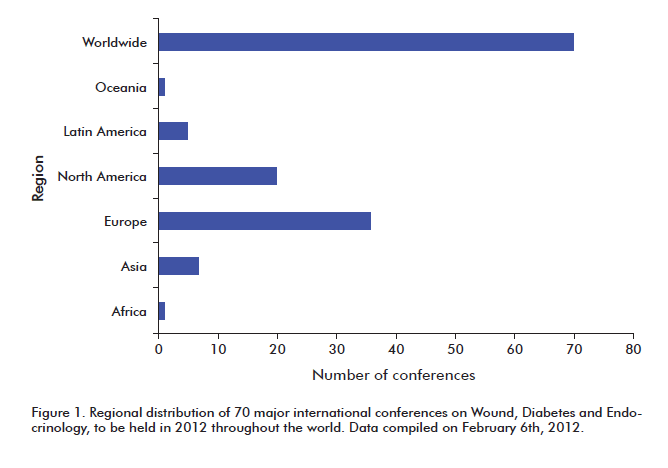
<body><![CDATA[<P   align="justify" ><font size="2" face="Verdana, Arial, Helvetica, sans-serif"><B>RESUMEN </b></font></P >   </font></font></font></font></font></font></font>        <P   align="left" ><font size="2" face="Verdana, Arial, Helvetica, sans-serif">La Sociedad Filipina      para el Cuidado de las Heridas celebr&oacute; su primera convenci&oacute;n      anual titulada &quot;El cuidado de heridas revisitado: principios y manejo      en el escenario cl&iacute;nico&quot;, los d&iacute;as 9 y 10 de febrero en      Manila, Filipinas. Varios expertos discutieron sobre la fisiopatolog&iacute;a      b&aacute;sica de las heridas, su diagn&oacute;stico y atenci&oacute;n, las      terapias por compresi&oacute;n, la funci&oacute;n de las subespecialidades      m&eacute;dicas y quir&uacute;rgicas, incluidos los servicios secundarios,      el cuidado de las heridas por enfermeros y dietistas, las heridas cr&oacute;nicas      en las extremidades derivadas de la enfermedad arterial perif&eacute;rica,      las &uacute;lceras por estasis venosa, linfoedema, &uacute;lceras dec&uacute;bito,      y por &uacute;ltimo, las &uacute;lceras del pie diab&eacute;tico (UPD). En      paralelo, durante el segundo d&iacute;a compa&ntilde;&iacute;as especializadas      en productos para el cuidado de las heridas impartieron talleres y clases      demostrativos. En uno de ellos, la compa&ntilde;&iacute;a Chemway Pharma,      en coordinaci&oacute;n con el Centro de Ingenier&iacute;a Gen&eacute;tica      y Biotecnolog&iacute;a (CIGB) de La Habana, Cuba, organiz&oacute; un simposio      para el lanzamiento de productos, en el que dos expertos cubanos, los doctores      Manuel Ra&iacute;ces y Ar&iacute;stides l. Garc&iacute;a, junto con el Dr.      Rainan Gloria, de Filipinas, presentaron, en tres momentos, el Heberprot-P,      un novedoso producto cubano que induce una r&aacute;pida y eficiente curaci&oacute;n      de las UPD. El simposio se denomin&oacute; &quot;Administraci&oacute;n intralesional      del factor de crecimiento epid&eacute;rmico humano recombinante (Heberprot-P)      para el tratamiento de &uacute;lceras del pie diab&eacute;tico avanzadas&quot;.      Se abund&oacute; en la g&eacute;nesis de ese producto y sus resultados positivos.      En la tercera de las charlas se mostraron los efectos satisfactorios en tres      pacientes filipinos aquejados de UPD.</font></P >   <FONT size="+1" color="#000000"><FONT size="+1"><FONT size="+1"><FONT size="+1"><FONT size="+1"><FONT size="+1"><FONT size="+1"><FONT size="+1">        <P   ><font size="2" face="Verdana, Arial, Helvetica, sans-serif"><b>Palabras clave:</b>      diabetes, congreso, cuidado de heridas, &uacute;lcera de pie diab&eacute;tico,      Heberprot-P. </font></P >   </font></font></font></font></font></font></font></font>    <hr>   <FONT size="+1" color="#000000"><FONT size="+1"><FONT size="+1"><FONT size="+1"><FONT size="+1"><FONT size="+1"><FONT size="+1"><FONT size="+1">        <P   align="justify" > </P >       <P   align="justify" > </P >       <P   align="justify" >&nbsp;</P >       <P   align="justify" >&nbsp;</P >       <P   align="justify" ><font size="3" face="Verdana, Arial, Helvetica, sans-serif"><B>INTRODUCTION </b></font></P >       <P   align="justify" ><font size="2" face="Verdana, Arial, Helvetica, sans-serif">Wounds, ulcers and      chronic lesions, as consequence of metabolic disorders, are serious issues      in almost all modern societies. When searching at the Internet about meetings      dealing with wound healing, endocrinology and diabetes, a quick search offered      the impressive amount of 70 international conferences targeting these three      issues just in 2012 (<a href="/img/revistas/bta/v29n1/f0107112.gif">Figure      1</a>), and counting. Probably this census just evidences the huge challenge      of inducing the healing of complex lesions such as those associated to peripheral      arterial disease, venous stasis ulcers, lymphedema, decubitus ulcers and diabetes      foot ulcer among others. </font></P >       
<P   align="left" ><font size="2" face="Verdana, Arial, Helvetica, sans-serif">It is well known      that wound healing is an intricate process in which the skin (or another organ-tissue)      repairs itself after injury [1]. In normal skin, the epidermis and dermis      coexists in steady-state equilibrium, forming a protective barrier against      the external environment. Once the protective barrier is broken, the physiologic      process of wound healing is immediately set in motion. The classic model of      wound healing is divided into three or four sequential, yet overlapping, phases      [2]: i) hemostasis, ii) inflammatory, iii) proliferative, and, iv) remodeling.      However, as this process is not only complex but fragile, it is susceptible      to interruption or failure leading to the formation of non-healing chronic      wounds [3], a situation that is becoming global as human lifespan increases.      Factors which may contribute to this situation include venous or arterial      disease, elderly, infection and diabetes [4]. </font></P >       ]]></body>
<body><![CDATA[<P   align="justify" ><font size="2" face="Verdana, Arial, Helvetica, sans-serif">Diabetes mellitus      (DM) is a disorder in which blood sugar (glucose) levels are abnormally high,      because of the insufficient/absence of insulin body production to process      glucose levels, which is known as hyperglycemia and the main hindrance for      wound healing among diabetic patients. The worldwide incidence of DM is about      285 million of people in 2011, with estimates of reaching 466 million by the      year 2030. Among the DM-associated illnesses, Diabetic Foot Ulcers (DFU) represents      a significant source of morbidity and mortality, increasingly becoming a health      problem for almost all societies [5]. </font></P >       <P   align="justify" ><font size="2" face="Verdana, Arial, Helvetica, sans-serif">The therapeutic management      of diabetic patients carrying DFUs is currently based on: metabolic control,      debridement, moist cures, wound dressing, local pressure off-loading, antimicrobial      treatment of infections, and revascularization procedures, when indicated.      However, even in such a case and regardless of a highly trained medical team,      it is really hard to turn ulcer evolution toward healing. A great number of      diabetic patients do not respond to treatments, mainly if complications exist      (infections, the lack of arterial irrigation characteristic of the diabetic,      and other health conditions) resulting in a high statistic of DFU amputations      [6]. </font></P >       <P   align="justify" ><font size="2" face="Verdana, Arial, Helvetica, sans-serif">It was an </font><font size="2" face="Verdana, Arial, Helvetica, sans-serif">      opportunity to attend and lecture about DFU treatment with Heberprot-P at      the First annual convention organized by the Philippine Wound Care Society,      entitled &ldquo;Revisiting Wound Care: Principles and Management in the Clinical      Setting&rdquo;. As a result, this report is aimed at reviewing </font><font size="+1" color="#000000"><font size="+1"><font size="+1"><font size="+1"><font size="+1"><font size="+1"><font size="+1"><font size="+1"><font size="2" face="Verdana, Arial, Helvetica, sans-serif">from      our point of view </font></font></font></font></font></font></font></font></font><font size="2" face="Verdana, Arial, Helvetica, sans-serif">the      most relevant information shared by all the participants, and also the companies      at the Convention Fair. The Cuban participation in this important meeting      was intended to distribute relevant data about the Integral care of DFU patients      with Heberprot-P, a goal accomplished thank to the sponsorship of Chemway      in partnership with Heber Biotec and the Center for Genetic Engineering and      Biotechnology (CIGB) of Havana, Cuba. </font></P >       <P   align="justify" >&nbsp;</P >       <P   align="justify" ><font size="2" face="Verdana, Arial, Helvetica, sans-serif"><B><font size="3">THE      PHILIPPINE WOUND CARE SOCIETY </font></b></font></P >       <P   align="justify" ><font size="2" face="Verdana, Arial, Helvetica, sans-serif">The Philippine Wound      Care Society was founded on September 9th, 2009 [7]. This society gather together      physicians from different specialty teams and allied services (wound care      nursing, physical therapy, nutritionist and others) with the goal of bringing      together professionals involved in wound care. The membership is mainly formed      by doctors from various subspecialties, such as: general surgery, thoracic      and cardiovascular surgery/vascular surgery, plastic surgery, dermatology,      internal medicine, endocrinology and rehabilitation medicine, and allied specialty      members (including nursing and physical therapy). </font></P >       <P   align="justify" ><font size="2" face="Verdana, Arial, Helvetica, sans-serif">The society celebrated      its First Annual convention entitled &ldquo;Revisiting Wound Care: Principles      and Management in the Clinical Setting&rdquo; on February 9-10th, 2012, at      the Century Park Hotel, Manila, Philippines [8]. In parallel with the convention,      several Workshops were held on the 2nd day of the meeting, organized by companies      specialized in Wound Care products. </font></P >       <P   align="justify" >&nbsp;</P >       <P   align="justify" ><font size="2" face="Verdana, Arial, Helvetica, sans-serif"><B><font size="3">THE      CONFERENCE </font> </b></font></P >       <P   align="justify" ><font size="2" face="Verdana, Arial, Helvetica, sans-serif">The organizers succeeded      in getting the participation of several regional leaders to the Philippine&rsquo;s      meeting, among them: Dr. Sadanori Akira, from Japan, President of the Wound      Union of Healing Societies; Dr. Gerit D. Mulder, Director of the Wound Treatment      and Research Center from United States of America; Prof. Coling Song, Founder      of the Asian Wound Healing Association Plastic, Reconstructive &amp; Aesthetic      Surgery of Singapore; and Prof. Joon Pio Hong, Plastic Surgery, Member of      the ASAN Cancer and Diabetes Center of South Korea. All of them are outstanding      personalities in the field of wound care. Personally, I was impressed with      the spirit and motivation of the Philippines speakers as well as with the      passion of Sr. Sivagame D/O Maniya, from Singapore, who is an internationally      awarded nurse in specialized Advanced Wound Care. </font></P >       ]]></body>
<body><![CDATA[<P   align="justify" ><font size="2" face="Verdana, Arial, Helvetica, sans-serif">The opening speech      of the Philippines Annual Convention was given by the President of the Philippine      Wound Care Society, Dr. Martin Anthony Villa. Followed a message from Dr.      Sadonori Akita, President of the World Union of Wound Healing Societies (WUWHS),      who remarked the importance of the national societies and the role of multidisciplinary      specialists in wound care, sharing some valuable data since 1990 until now      about the evolution of gross sales in Japan of medicines for bed sores and      skin ulcer treatment, showing how new biological treatments at the beginning      of the 21st century had succeeded as novel and very efficient therapies together      with the family of previously registered products (mainly of chemical nature).      Dr. Akita dedicated part of his lecture to promote the next celebration of      the 4th Congress of the World Union of Wound Healing Societies to be held      in Yokohama, Japan, next September 2nd-6th, 2012 [9]. The next speaker was      Dr. Colin Song, who gave another message on behalf of the Asian Wound Healing      Association (ASWA), remarking the challenges of facing wound healing in Asia.      Summarizing this part of the meeting, these three speakers emphasized in the      need of sticking together professionals involved in wound care, in order to      offer the best possible attention to patients&rsquo; wounds as well as to      set up the conditions for offering better care in the future. </font></P >       <P   align="justify" ><font size="2" face="Verdana, Arial, Helvetica, sans-serif">Once finalized this      part of the opening ceremony, the Convention started covering the following      topics: 1) General Principles of Wound Care, 2) Peripheral Arterial Occlusive      Disease. 3) Venous stasis ulcers &amp; lympedema and 4) Diabetic Foot (program      available at [8]). </font></P >       <P   align="justify" ><font size="2" face="Verdana, Arial, Helvetica, sans-serif">Many speakers shared      their procedures to treat wounds covering the basic elements of healing, the      same as described in the &lsquo;world state of the art in wound healing&rsquo;.      Other emphasized in the need to extend the amount, quality and participation      of medical and scientific exchanges regarding professional seminars, public      forums, public education programs, online media use as Facebook, blogs, tweeter,      smartphones, etc., to aware the medical staff and wound patients on the latest      healing procedures. These efforts include boosting the role of Professional      Society Web Portals to enable cooperation among all countries. </font></P >       <P   align="justify" ><font size="2" face="Verdana, Arial, Helvetica, sans-serif">During the convention,      several speakers talked about their own experiences in treating different      types of wounds (chronic, pressure, neuropathic, traumatic, surgical, neoplastic,      arterial, venous, vasculitis, wounds), mentioning those elements that failed      in contributing to the complex mechanism of healing and proposing actions,      according their own view, to minimize this situation. Among the most mentioned      elements were: the selection of appropriate moist dressing, the control of      exudates and the orthopedic measurement to avoid recurrence. </font></P >       <P   align="justify" ><font size="2" face="Verdana, Arial, Helvetica, sans-serif">In a second lecture,      Dr. Akira offered details about a clinical trial under preparation on the      use of autologous adipose-derived stem cells in chronic radiation injuries.      This therapy is being applied in ongoing clinical trials targeting myocardial      infarction, breast reconstruction, spinal injury, wound healing (fistula),      liver cirrhosis, urinary incontinence, burger&acute;s disease, burns and other      entities, in a multinational program. </font></P >       <P   align="justify" ><font size="2" face="Verdana, Arial, Helvetica, sans-serif">Dr. Jeffrey Niezgoda,      from USA, spoke about the role of hyperbaric chambers in the control of infection      in complex DFUs and how this therapy stimulates healing. It was interesting      to see a lecture about the first therapy addressed to stimulate wound healing      based in an intellectually protected food supplement registered with the commercial      name of Abound. Dr. Jesus Fernando Inciong, the presenting author, gave details      about the role of particular amino acids as Arginine, Glutamine and Leucine      in promoting cell division by regulating protein synthesis, stimulating wound      healing in consequence. Among the main candidates to receive this therapy      are patients carrying &lsquo;acute and hard to heal&rsquo; wounds including      pressure and venous leg ulcers, diabetic foot ulcers, burn injuries and non-healing      surgical wounds. </font></P >       <P   align="justify" ><font size="2" face="Verdana, Arial, Helvetica, sans-serif">Several speakers      described in their lectures their abilities as surgeons to establish open      bypass surgery in compromised limbs, the use of surgical procedures in early      wound stabilization and closure, infection control, protection of essential      structures as bond, joint, tendon, ligands and vessels addressed to preserve      leg function, limb length as aesthetics. </font></P >       <P   align="justify" ><font size="2" face="Verdana, Arial, Helvetica, sans-serif">Dr. Joon Pio Hong      talked about limb salvage procedures mentioning micro-vascularization techniques,      topic application of epidermal growth factor to promote wound healing, and      the use of human adipose-derived stem cells (ADIPOPLUS) to promote healing      in ischemic diabetic ulcers and in Crohn&acute;s Fistula, this last with the      peculiarity that ADIPOPLUS was injected directly into the wound bed. </font></P >       <P   align="justify" ><font size="2" face="Verdana, Arial, Helvetica, sans-serif">The use of traditional      medicinal methods for wound care was described by Dr. Jaime Z Galvez Tan,      from Philippines, who discussed about the positive role of acupuncture, herbal      medicine (guava, aloe, turmeric, Gotu kola, and honey) topically applied on      different type of wounds. </font></P >       <P   align="justify" ><font size="2" face="Verdana, Arial, Helvetica, sans-serif">During the session      addressing DFUs, practically all the speakers described the complexity of      this type of pathology and the classical procedures to treat DFUs, covering:      infection control, debridement, dressing, microsurgery, skin-graft application      and orthopedic measurement. </font></P >       ]]></body>
<body><![CDATA[<P   align="justify" ><font size="2" face="Verdana, Arial, Helvetica, sans-serif">Lectures on the use      of Heberprot-P were imparted the last day of the meeting, to recall the attention      of the audience and key regional leaders about the efficiency and positive      impact of this therapy in promoting efficient and fast wound healing. Dr.      Manuel Ra&iacute;ces and Dr. Aristides Garcia from Cuba and Dr. Rainan Gloria      from Philippines, talked about the novelty and impact of locating a human      recombinant growth factor directly into the wound bed of DFU-bearing patients.      This was a promising informative action, considering the product is neither      launched nor even registered in Philippines, to aware the leaders of opinion      from that country about DFU management just few weeks prior to the Heberprot-P      official registration. In this regard, the lectures had successful impact      on the audience, since basic information was given to participants and we      were able to make evident the clinical benefits of Heberprot-P compared to      conventional and in-use novel therapies. Participants from other countries      were also update on the use of Heberprot-P, its general background of use      and possible territorial expansion, probably years before the product will      be available in their respective countries. </font></P >       <P   align="justify" ><font size="2" face="Verdana, Arial, Helvetica, sans-serif">In summary, the Conference      gained the attention on wound care, and brought together specialists and clinicians      from several countries interested in solving such a diverse medical entity      worldwide. Some of the novelties for treating them would be available in the      near future, and others, like Heberprot-P, can be opening new oportunities      for traditionally unmet medical needs as UPDs. </font></P >       <P   align="justify" >&nbsp;</P >       <P   ><font size="2" face="Verdana, Arial, Helvetica, sans-serif"><B><font size="3">ACKNOWLEDGMENTS      </font> </b></font></P >       <P   ><font size="2" face="Verdana, Arial, Helvetica, sans-serif">The author thanks      to Mr. Julien Tripet, General Manager Chemway Pharma (Philippines), for critical      reading of the manuscript and valuable comments together with the support      during the Philippine&rsquo;s meeting. </font></P >       <P   >&nbsp;</P >       <P   ><font size="2" face="Verdana, Arial, Helvetica, sans-serif"><B><font size="3">REFERENCES      </font></b></font></P >       <!-- ref --><P   align="justify" ><font size="2" face="Verdana, Arial, Helvetica, sans-serif">1. Nguyen DT, Orgill      DP, Murphy GF. Chapter 4: The Pathophysiologic Basis for Wound Healing and      Cutaneous Regeneration. In: Orgill D, Blanco C, editors. Biomaterials for      Treating Skin Loss. Cambridge/Boca Raton: Woodhead Publishing (UK/Europe)      &amp; CRC Press (US); 2009. p. 25-57.     </font></P >       <P   align="justify" ><font size="2" face="Verdana, Arial, Helvetica, sans-serif">2. Stadelmann WK,      Digenis AG, Tobin GR. Physiology and healing dynamics of chronic cutaneous      wounds. Am J Surg. 1998;176(2A Suppl):26S-38S. </font></P >       ]]></body>
<body><![CDATA[<!-- ref --><P   align="justify" ><font size="2" face="Verdana, Arial, Helvetica, sans-serif">3. Garg HG, Longaker      MT, editors. Scarless Wound Healing. New York: Marcel Dekker, Inc; 2000.     </font></P >       <!-- ref --><P   align="justify" ><font size="2" face="Verdana, Arial, Helvetica, sans-serif">4. Enoch S, Price      P. Cellular, molecular and biochemical differences in the pathophysiology      of healing between acute wounds, chronic wounds and wounds in the aged [Internet].      Bridgend: World Wide Wounds; 2004 [cited 2012 Mar 12]. Available from: <a href="http://www.worldwidewounds.com/2004/august/Enoch/Pathophysiology-Of-Healing.html" target="_blank">      <U><U><FONT color="#0000FF">www.worldwidewounds.com/2004/august/Enoch/Pathophysiology-Of-Healing.html</font></U></U></A><FONT color="#0000FF"><FONT color="#000000">.          </font></font></font></P >   <FONT color="#0000FF"><FONT color="#000000">        <!-- ref --><P   align="justify" ><font size="2" face="Verdana, Arial, Helvetica, sans-serif">5. International      Diabetes Federation. IDF Diabetes Atlas. 5th edition. Brussels(Belgium): International      Diabetes Federation; 2011.     </font></P >       <!-- ref --><P   align="justify" ><font size="2" face="Verdana, Arial, Helvetica, sans-serif">6. Most RS, Sinnock      P. The epidemiology of lower extremity amputations in diabetic individuals.      Diabetic Care. 1983;6:87-91.     </font></P >       <!-- ref --><P   align="justify" ><font size="2" face="Verdana, Arial, Helvetica, sans-serif">7. The Philippine      Wound Care Society [Internet]. Manila: The Society. 2009 [cited 2012 Mar 12].      Available from: <a href="http://www.philippinewoundcaresociety.org/" target="_blank">      <U><U><FONT color="#0000FF">www.philippinewoundcaresociety.org</font></U></U></A><FONT color="#0000FF"><FONT color="#000000">.          </font></font></font></P >   <FONT color="#0000FF"><FONT color="#000000">        ]]></body>
<body><![CDATA[<P   align="justify" ><font size="2" face="Verdana, Arial, Helvetica, sans-serif">8. 1st Annual Convention      of the PWCS &ldquo;Revisiting Wound Care: Principles and Management in the      Clinical Setting&rdquo; [Internet]. Manila: The Philippine Wound Care Society.      2012 [cited 2012 Mar 12] Available from: <a href="http://www.philippinewoundcaresociety.org/p/annual-convention.html" target="_blank">      <U><U><FONT color="#0000FF">http://www.philippinewoundcaresociety.org/p/annual-</font></U><FONT color="#0000FF"><U>convention.html</U></font></U></A><FONT color="#0000FF"><FONT color="#000000">.      </font></font></font></P >   <FONT color="#0000FF"><FONT color="#000000">        <!-- ref --><P   align="justify" ><font size="2" face="Verdana, Arial, Helvetica, sans-serif">9. 4<FONT color="#0000FF"><FONT color="#000000"><Sup>th</Sup>      Congress of the World Union of Wound Healing Societies, WUWHS 2012 [Internet].      Tokio: The Union. c2012 [updated 2012 Mar 21; cited 2012 Mar 26]. Available      from: </font><font size="+1" color="#000000"><font size="+1"><font size="+1"><font size="+1"><font size="+1"><font size="+1"><font size="+1"><font size="+1"><font color="#0000FF"><font color="#000000"><font color="#0000FF"><font color="#000000"><font color="#0000FF"><font color="#000000"><font size="2" face="Verdana, Arial, Helvetica, sans-serif"><a href="http://wuwhs2012.com/" target="_blank">      <u><u><font color="#0000FF">http://wuwhs2012.com</font></u></u></a><font color="#0000FF"><font color="#000000">.    </font></font></font></font></font></font></font></font></font></font></font></font></font></font></font></font></font></font></font></P >       <P   align="justify" >&nbsp;</P >   <FONT color="#0000FF"><FONT color="#000000"><FONT size="+1"><FONT size="+1">        <P   align="justify" > </P >       <P   ><font size="2" face="Verdana, Arial, Helvetica, sans-serif">Manuel Ra&iacute;ces.      Business Development Department. Center for Genetic Engineering and Biotechnology,      POBox 6162 Havana, Cuba. E-mail:<a href="mailto:manuel.raices@cigb.edu.cu"><U><U><FONT color="#0000FF">manuel.raices@cigb.edu.cu</font></U></U></A><FONT color="#0000FF"><FONT color="#000000">.</font></font></font></P >   </font></font></font></font></font></font></font></font></font></font></font></font></font></font></font></font></font></font></DIV >      ]]></body><back>
<ref-list>
<ref id="B1">
<label>1</label><nlm-citation citation-type="book">
<person-group person-group-type="author">
<name>
<surname><![CDATA[Nguyen]]></surname>
<given-names><![CDATA[DT]]></given-names>
</name>
<name>
<surname><![CDATA[Orgill]]></surname>
<given-names><![CDATA[DP]]></given-names>
</name>
<name>
<surname><![CDATA[Murphy]]></surname>
<given-names><![CDATA[GF]]></given-names>
</name>
</person-group>
<article-title xml:lang="en"><![CDATA[The Pathophysiologic Basis for Wound Healing and Cutaneous Regeneration]]></article-title>
<person-group person-group-type="editor">
<name>
<surname><![CDATA[Orgill]]></surname>
<given-names><![CDATA[D]]></given-names>
</name>
<name>
<surname><![CDATA[Blanco]]></surname>
<given-names><![CDATA[C]]></given-names>
</name>
</person-group>
<source><![CDATA[Biomaterials for Treating Skin Loss]]></source>
<year>2009</year>
<page-range>25-57</page-range><publisher-loc><![CDATA[Cambridge/Boca Raton ]]></publisher-loc>
<publisher-name><![CDATA[Woodhead Publishing (UK/Europe) & CRC Press (US)]]></publisher-name>
</nlm-citation>
</ref>
<ref id="B2">
<label>2</label><nlm-citation citation-type="journal">
<person-group person-group-type="author">
<name>
<surname><![CDATA[Stadelmann]]></surname>
<given-names><![CDATA[WK]]></given-names>
</name>
<name>
<surname><![CDATA[Digenis]]></surname>
<given-names><![CDATA[AG]]></given-names>
</name>
<name>
<surname><![CDATA[Tobin]]></surname>
<given-names><![CDATA[GR]]></given-names>
</name>
</person-group>
<article-title xml:lang="en"><![CDATA[Physiology and healing dynamics of chronic cutaneous wounds]]></article-title>
<source><![CDATA[Am J Surg]]></source>
<year>1998</year>
<volume>176</volume>
<numero>^s2A</numero>
<issue>^s2A</issue>
<supplement>2A</supplement>
<page-range>26S-38S</page-range></nlm-citation>
</ref>
<ref id="B3">
<label>3</label><nlm-citation citation-type="book">
<person-group person-group-type="author">
<name>
<surname><![CDATA[Garg]]></surname>
<given-names><![CDATA[HG]]></given-names>
</name>
<name>
<surname><![CDATA[Longaker]]></surname>
<given-names><![CDATA[MT]]></given-names>
</name>
</person-group>
<source><![CDATA[Scarless Wound Healing]]></source>
<year>2000</year>
<publisher-loc><![CDATA[New York ]]></publisher-loc>
<publisher-name><![CDATA[Marcel Dekker, Inc]]></publisher-name>
</nlm-citation>
</ref>
<ref id="B4">
<label>4</label><nlm-citation citation-type="book">
<person-group person-group-type="author">
<name>
<surname><![CDATA[Enoch]]></surname>
<given-names><![CDATA[S]]></given-names>
</name>
<name>
<surname><![CDATA[Price]]></surname>
<given-names><![CDATA[P]]></given-names>
</name>
</person-group>
<source><![CDATA[Cellular, molecular and biochemical differences in the pathophysiology of healing between acute wounds, chronic wounds and wounds in the aged]]></source>
<year>2004</year>
<publisher-loc><![CDATA[Bridgend ]]></publisher-loc>
<publisher-name><![CDATA[World Wide Wounds]]></publisher-name>
</nlm-citation>
</ref>
<ref id="B5">
<label>5</label><nlm-citation citation-type="book">
<collab>International Diabetes Federation</collab>
<source><![CDATA[IDF Diabetes Atlas]]></source>
<year>2011</year>
<edition>5</edition>
<publisher-loc><![CDATA[Brussels ]]></publisher-loc>
<publisher-name><![CDATA[International Diabetes Federation]]></publisher-name>
</nlm-citation>
</ref>
<ref id="B6">
<label>6</label><nlm-citation citation-type="journal">
<person-group person-group-type="author">
<name>
<surname><![CDATA[Most]]></surname>
<given-names><![CDATA[RS]]></given-names>
</name>
<name>
<surname><![CDATA[Sinnock]]></surname>
<given-names><![CDATA[P]]></given-names>
</name>
</person-group>
<article-title xml:lang="en"><![CDATA[The epidemiology of lower extremity amputations in diabetic individuals]]></article-title>
<source><![CDATA[Diabetic Care]]></source>
<year>1983</year>
<volume>6</volume>
<page-range>87-91</page-range></nlm-citation>
</ref>
<ref id="B7">
<label>7</label><nlm-citation citation-type="book">
<source><![CDATA[The Philippine Wound Care Society]]></source>
<year>2009</year>
<publisher-loc><![CDATA[Manila ]]></publisher-loc>
<publisher-name><![CDATA[The Society]]></publisher-name>
</nlm-citation>
</ref>
<ref id="B8">
<label>8</label><nlm-citation citation-type="book">
<source><![CDATA[1st Annual Convention of the PWCS: Revisiting Wound Care: Principles and Management in the Clinical Setting]]></source>
<year>2012</year>
<publisher-loc><![CDATA[Manila ]]></publisher-loc>
<publisher-name><![CDATA[The Philippine Wound Care Society]]></publisher-name>
</nlm-citation>
</ref>
<ref id="B9">
<label>9</label><nlm-citation citation-type="book">
<source><![CDATA[4th Congress of the World Union of Wound Healing Societies, WUWHS 2012]]></source>
<year>2012</year>
<publisher-loc><![CDATA[Tokio ]]></publisher-loc>
<publisher-name><![CDATA[The Union]]></publisher-name>
</nlm-citation>
</ref>
</ref-list>
</back>
</article>