<?xml version="1.0" encoding="ISO-8859-1"?><article xmlns:mml="http://www.w3.org/1998/Math/MathML" xmlns:xlink="http://www.w3.org/1999/xlink" xmlns:xsi="http://www.w3.org/2001/XMLSchema-instance">
<front>
<journal-meta>
<journal-id>1027-2852</journal-id>
<journal-title><![CDATA[Biotecnología Aplicada]]></journal-title>
<abbrev-journal-title><![CDATA[Biotecnol Apl]]></abbrev-journal-title>
<issn>1027-2852</issn>
<publisher>
<publisher-name><![CDATA[Editorial Elfos Scientiae]]></publisher-name>
</publisher>
</journal-meta>
<article-meta>
<article-id>S1027-28522012000400003</article-id>
<title-group>
<article-title xml:lang="en"><![CDATA[Improvements to the evaluation process for diagnostic quality in laboratories using the SUMA technology]]></article-title>
<article-title xml:lang="es"><![CDATA[Mejoras en el proceso evaluativo de la calidad del diagnóstico en los laboratorios con tecnología SUMA]]></article-title>
</title-group>
<contrib-group>
<contrib contrib-type="author">
<name>
<surname><![CDATA[Rego-Díaz]]></surname>
<given-names><![CDATA[Alfredo]]></given-names>
</name>
<xref ref-type="aff" rid="A01"/>
</contrib>
<contrib contrib-type="author">
<name>
<surname><![CDATA[Pérez-Molina]]></surname>
<given-names><![CDATA[Héctor]]></given-names>
</name>
<xref ref-type="aff" rid="A02"/>
</contrib>
<contrib contrib-type="author">
<name>
<surname><![CDATA[López-Brauet]]></surname>
<given-names><![CDATA[Liliena]]></given-names>
</name>
<xref ref-type="aff" rid="A02"/>
</contrib>
<contrib contrib-type="author">
<name>
<surname><![CDATA[Carlos-Pías]]></surname>
<given-names><![CDATA[Niurka]]></given-names>
</name>
<xref ref-type="aff" rid="A01"/>
</contrib>
</contrib-group>
<aff id="A02">
<institution><![CDATA[,Centro de Inmunoensayo, CIE Departamento de Control de la Calidad ]]></institution>
<addr-line><![CDATA[ ]]></addr-line>
</aff>
<aff id="A01">
<institution><![CDATA[,Centro de Inmunoensayo, CIE Departamento de Matemática y Programación Aplicada ]]></institution>
<addr-line><![CDATA[La Habana ]]></addr-line>
<country>Cuba</country>
</aff>
<pub-date pub-type="pub">
<day>00</day>
<month>12</month>
<year>2012</year>
</pub-date>
<pub-date pub-type="epub">
<day>00</day>
<month>12</month>
<year>2012</year>
</pub-date>
<volume>29</volume>
<numero>4</numero>
<fpage>234</fpage>
<lpage>237</lpage>
<copyright-statement/>
<copyright-year/>
<self-uri xlink:href="http://scielo.sld.cu/scielo.php?script=sci_arttext&amp;pid=S1027-28522012000400003&amp;lng=en&amp;nrm=iso"></self-uri><self-uri xlink:href="http://scielo.sld.cu/scielo.php?script=sci_abstract&amp;pid=S1027-28522012000400003&amp;lng=en&amp;nrm=iso"></self-uri><self-uri xlink:href="http://scielo.sld.cu/scielo.php?script=sci_pdf&amp;pid=S1027-28522012000400003&amp;lng=en&amp;nrm=iso"></self-uri><abstract abstract-type="short" xml:lang="en"><p><![CDATA[The Immunoassay Center (CIE) is a Cuban institution dedicated to develop the SUMA (Ultra Micro Analytical System), a diagnostic system currently applied in programs of prenatal and neonatal screening, epidemiological surveillance, and certification of donated blood, organs and placentas. In order to guarantee the quality of diagnosis with this technology, CIE has implemented a system of quality assessment for SUMA laboratories that is continuously improved and refined. The present work describes the currently implemented quality assessment system and how it solves the limitations of conventional quality control schemes in immunoassay laboratories. This objective was met by incorporating the reliability index and index of coefficients of variation, in an effort to provide a more rounded analysis that combines the examination of different types of quality controls (internal and external). These analyses were incorporated into the automated quality evaluation software currently employed by SUMA technology laboratories (Quality Assurance System; SAC 2.0), yielding measurable improvements to the quality evaluation process.]]></p></abstract>
<abstract abstract-type="short" xml:lang="es"><p><![CDATA[El Centro de Inmunoensayo es una institución cubana que desde hace varios años se dedica al desarrollo de la tecnología SUMA (Sistema Ultra Micro Analítico), que se emplea en programas de pesquisa prenatal y neonatal, vigilancia epidemiológica, certificación de sangre, órganos y placenta. Con el objetivo de garantizar la calidad del diagnóstico con esta tecnología, el Centro de Inmunoensayo ha desarrollado y perfeccionado su sistema de evaluación de la calidad. Este artículo describe el sistema que permitió solucionar las limitaciones de los esquemas convencionales para el control de la calidad en los laboratorios de inmunoensayos. Para ello se incorporaron dos estadígrafos: índice de fiabilidad e índice de coeficientes de variación, con el objetivo de combinar el análisis de dos tipos de control de la calidad (el control interno y el control externo), y lograr un análisis integral. La variante descrita se ha añadido al sistema automatizado que evalúa la calidad de los laboratorios con tecnología SUMA (Sistema para el Aseguramiento de la Calidad, SAC 2.0), y mejora la eficacia y eficiencia del proceso evaluativo.]]></p></abstract>
<kwd-group>
<kwd lng="en"><![CDATA[Quality control]]></kwd>
<kwd lng="en"><![CDATA[immunoassay]]></kwd>
<kwd lng="en"><![CDATA[SUMA technology]]></kwd>
<kwd lng="es"><![CDATA[control de calidad]]></kwd>
<kwd lng="es"><![CDATA[inmunoensayo]]></kwd>
<kwd lng="es"><![CDATA[tecnología SUMA]]></kwd>
</kwd-group>
</article-meta>
</front><body><![CDATA[ <DIV class="Sect"   >        <P align="right"   ><font size="2" color="#000000" face="Verdana, Arial, Helvetica, sans-serif"><b>RESEARCH      </b></font></P >   <FONT size="+1" color="#000000">        <P   >&nbsp;</P >       <P   ><font size="4" face="Verdana, Arial, Helvetica, sans-serif"><b>Improvements to      the evaluation process for diagnostic quality in laboratories using the SUMA      technology </b></font></P >       <P   >&nbsp;</P >       <P   ></P >       <P   > </P >       <P   ><font size="3"><b><font face="Verdana, Arial, Helvetica, sans-serif">Mejoras      en el proceso evaluativo de la calidad del diagn&oacute;stico en los laboratorios      con tecnolog&iacute;a SUMA </font></b></font></P >       <P   > </P >       <P   > </P >       ]]></body>
<body><![CDATA[<P   >&nbsp;</P >       <P   >&nbsp;</P >       <P   ><font size="2" face="Verdana, Arial, Helvetica, sans-serif"><b>Alfredo Rego-D&iacute;az<Sup>1</Sup>,      H&eacute;ctor P&eacute;rez-Molina<Sup>2</Sup>, Liliena L&oacute;pez-Brauet<Sup>2</Sup>,      Niurka Carlos-P&iacute;as<Sup>1</Sup></b></font></P >   <FONT size="+1"><FONT size="+1"><FONT size="+1"><FONT size="+1"><FONT size="+1"><FONT size="+1"><FONT size="+1"><FONT size="+1">        <P   ><font size="2" face="Verdana, Arial, Helvetica, sans-serif"><Sup>1</Sup> Departamento      de Matem&aacute;tica y Programaci&oacute;n Aplicada, Centro de Inmunoensayo,      CIE. Calle 134 y Ave. 25, Cubanac&aacute;n, Playa, La Habana, Cuba.    <br>     </font><font size="2" face="Verdana, Arial, Helvetica, sans-serif"><Sup>2</Sup>      Departamento de Control de la Calidad, CIE. </font></P >       <P   >&nbsp;</P >       <P   >&nbsp;</P >   </font></font></font></font></font></font></font></font></font>   <hr>   <FONT size="+1" color="#000000"><FONT size="+1"><FONT size="+1"><FONT size="+1"><FONT size="+1"><FONT size="+1"><FONT size="+1"><FONT size="+1"><FONT size="+1">        <P   ><b><font size="2" face="Verdana, Arial, Helvetica, sans-serif">ABSTRACT </font></b></P >   <FONT size="+1"><FONT size="+1"><FONT size="+1"><FONT size="+1">        <P   align="justify" ><font size="2" face="Verdana, Arial, Helvetica, sans-serif">The Immunoassay Center      (CIE) is a Cuban institution dedicated to develop the SUMA (Ultra Micro Analytical      System), a diagnostic system currently applied in programs of prenatal and      neonatal screening, epidemiological surveillance, and certification of donated      blood, organs and placentas. In order to guarantee the quality of diagnosis      with this technology, CIE has implemented a system of quality assessment for      SUMA laboratories that is continuously improved and refined. The present work      describes the currently implemented quality assessment system and how it solves      the limitations of conventional quality control schemes in immunoassay laboratories.      This objective was met by incorporating the reliability index and index of      coefficients of variation, in an effort to provide a more rounded analysis      that combines the examination of different types of quality controls (internal      and external). These analyses were incorporated into the automated quality      evaluation software currently employed by SUMA technology laboratories (Quality      Assurance System; SAC 2.0), yielding measurable improvements to the quality      evaluation process. </font></P >   <FONT size="+1">        <P   ><font size="2" face="Verdana, Arial, Helvetica, sans-serif"><b>Keywords:</b>      Quality control, immunoassay, SUMA technology. </font></P >   </font></font></font></font></font></font></font></font></font></font></font></font></font></font>   <hr>   <FONT size="+1" color="#000000"><FONT size="+1"><FONT size="+1"><FONT size="+1"><FONT size="+1"><FONT size="+1"><FONT size="+1"><FONT size="+1"><FONT size="+1"><FONT size="+1"><FONT size="+1"><FONT size="+1"><FONT size="+1"><FONT size="+1"><FONT size="+1">        ]]></body>
<body><![CDATA[<P   > </P >       <P   ><b><font size="2" face="Verdana, Arial, Helvetica, sans-serif">RESUMEN </font></b></P >       <P   align="justify" ><font size="2" face="Verdana, Arial, Helvetica, sans-serif">El Centro de Inmunoensayo      es una instituci&oacute;n cubana que desde hace varios a&ntilde;os se dedica      al desarrollo de la tecnolog&iacute;a SUMA (Sistema Ultra Micro Anal&iacute;tico),      que se emplea en programas de pesquisa prenatal y neonatal, vigilancia epidemiol&oacute;gica,      certificaci&oacute;n de sangre, &oacute;rganos y placenta. Con el objetivo      de garantizar la calidad del diagn&oacute;stico con esta tecnolog&iacute;a,      el Centro de Inmunoensayo ha desarrollado y perfeccionado su sistema de evaluaci&oacute;n      de la calidad. Este art&iacute;culo describe el sistema que permiti&oacute;      solucionar las limitaciones de los esquemas convencionales para el control      de la calidad en los laboratorios de inmunoensayos. Para ello se incorporaron      dos estad&iacute;grafos: &iacute;ndice de fiabilidad e &iacute;ndice de coeficientes      de variaci&oacute;n, con el objetivo de combinar el an&aacute;lisis de dos      tipos de control de la calidad (el control interno y el control externo),      y lograr un an&aacute;lisis integral. La variante descrita se ha a&ntilde;adido      al sistema automatizado que eval&uacute;a la calidad de los laboratorios con      tecnolog&iacute;a SUMA (Sistema para el Aseguramiento de la Calidad, SAC 2.0),      y mejora la eficacia y eficiencia del proceso evaluativo. </font></P >   <FONT size="+1">        <P   ><font size="2" face="Verdana, Arial, Helvetica, sans-serif"><b>Palabras clave:</b>      control de calidad, inmunoensayo, tecnolog&iacute;a SUMA. </font></P >   </font></font></font></font></font></font></font></font></font></font></font></font></font></font></font></font>   <hr>   <FONT size="+1" color="#000000"><FONT size="+1"><FONT size="+1"><FONT size="+1"><FONT size="+1"><FONT size="+1"><FONT size="+1"><FONT size="+1"><FONT size="+1"><FONT size="+1"><FONT size="+1"><FONT size="+1"><FONT size="+1"><FONT size="+1"><FONT size="+1"><FONT size="+1">        <P   > </P >       <P   > </P >       <P   align="justify" >&nbsp;</P >       <P   align="justify" >&nbsp;</P >       <P   align="justify" ><font size="3" face="Verdana, Arial, Helvetica, sans-serif"><b>INTRODUCTION </b></font></P >       <P   align="justify" ><font size="2" face="Verdana, Arial, Helvetica, sans-serif">The Immunoassay Center      (CIE) [1] is a research-production complex for the development and production      of reagents and instrumentation for medical diagnosis. Its flagship product      line is the Ultra Micro Analytical System (SUMA) [2], a technology including      both equipment and reagents for performing enzyme immunoassays. It has very      low production costs and is, therefore, particularly well suited for health      program requiring the analysis of large numbers of samples. </font></P >       ]]></body>
<body><![CDATA[<P   align="justify" ><font size="2" face="Verdana, Arial, Helvetica, sans-serif">There are over 750      laboratories in different countries currently employing SUMA technology, of      which approximately one third is located in Cuba. </font></P >       <P   align="justify" ><font size="2" face="Verdana, Arial, Helvetica, sans-serif">Due to the significant      social and economic impact of its diagnostic technologies, CIE has prioritized      and implemented, for over a decade, quality control programs to assess diagnostic      quality and reliability among the network of laboratories based on its technological      platform. </font></P >       <P   align="justify" ><font size="2" face="Verdana, Arial, Helvetica, sans-serif">These programs have      been designed following schemes described in the specialized literature [3-5],      and are constantly improved based on the experience gained as clients of quality      control programs sponsored by leading international institutions of the field      [6, 7]. However, they are not perfect, as evidenced by the occasional detection      of laboratories where, despite satisfactory quality assessment scores, deficiencies      can still be detected. </font></P >       <P   align="justify" ><font size="2" face="Verdana, Arial, Helvetica, sans-serif">Implementing an effective      quality management system is an involved endeavor requiring technical skill      and experience. Nevertheless, it must be remembered that for many diseases,      the financial costs of deploying such a system are substantially offset by      the potential economic and social costs of diagnostic errors. </font></P >       <P   align="justify" ><font size="2" face="Verdana, Arial, Helvetica, sans-serif">Measurement errors      (differences between the value yielded by a determination and the actual value)      are an inevitable part of the daily work in diagnostic laboratories. These      errors are classified in random errors (varying unpredictably in both magnitude      and sign), systematic errors (whose value remains constant when the determination      is repeated under the same conditions) and gross, or avoidable errors [4,      5, 8, 9]. Implementing a quality control system capable of detecting the appearance      of experimental errors is a necessary step for taking corrective steps in      a timely manner. </font></P >       <P   align="justify" ><font size="2" face="Verdana, Arial, Helvetica, sans-serif">Most laboratory control      systems use conventional ISO 15189-compliant quality control schemes (based      on the analysis of internal and external quality control) [4]. But the experience      provided by more than a decade using and analyzing this type of control scheme      has highlighted as limitations: i) impossible to compare the imprecision of      a specific laboratory with that of other laboratories analyzing the same control;      ii) Insufficient sampling frequency; and iii) limitations of control charts.      </font></P >       <P   align="justify" ><font size="2" face="Verdana, Arial, Helvetica, sans-serif">In a conventional      quality control scheme, the results of internal laboratory controls are analyzed      in the target laboratory itself. Since this information is not available externally,      it is impossible to compare the imprecision of a specific laboratory with      that of a group of laboratories analyzing the same internal control. </font></P >       <P   align="justify" ><font size="2" face="Verdana, Arial, Helvetica, sans-serif">This limitation becomes      especially intractable whenever the instrumentation at the laboratories under      comparison has been provided by different manufacturers, as in this case the      information is often stored in different or incompatible formats. One possible      solution for this problem is the application of Laboratory Information Management      Systems &ndash;LIMS&ndash; [10], which provide a unified mechanism for data      storage. </font></P >       <P   align="justify" ><font size="2" face="Verdana, Arial, Helvetica, sans-serif">In an effort to devise      procedures enabling the analysis of imprecision at one laboratory against      that of a group of laboratories participating in a control scheme, as well      as to bring quality control systems to the market, some companies have increased      the number of reference controls and provided software applications that facilitate      data storage and standardize its storage formats. In this arrangement, quality      control data are eventually sent to a centralized data reception and processing      point [11]. </font></P >       <P   align="justify" ><font size="2" face="Verdana, Arial, Helvetica, sans-serif">In the case of insufficient      sampling frequency, the number of external controls sent by the evaluator      to each laboratory in the context of an external control quality program has      to be equal to or larger than the number of internal control batches processed      by each laboratory on a monthly basis, to estimate accuracy using different      batches of an internal quality control. Such a requirement stems from the      fact that the inaccuracy and imprecision of the results vary with each different      reagent batch. If this condition is not met, it would then be impossible to      detect systematic errors in each batch. </font></P >       ]]></body>
<body><![CDATA[<P   align="justify" ><font size="2" face="Verdana, Arial, Helvetica, sans-serif">External quality      control programs [6, 7] use a constant number of external controls per assay      per month, even though the number of reagent batches the laboratory will use      during this period is not always predictable. </font></P >       <P   align="justify" ><font size="2" face="Verdana, Arial, Helvetica, sans-serif">Regarding limitations      of control charts, one of its fundamental requirements is the use of a sample      size larger enough to be representative of the population, so as to calculate      the necessary parameters (mean, standard deviation, upper and lower bounds)      to be represented. Nevertheless, whenever analytical runs are performed in      a laboratory, the number of internal control results stored per assay in each      batch will increase from zero to value n, and in some laboratories the number      of internal controls may be small (less than 20 measurements, for example).      In this case, sample averages may be different from population averages (calculated      by processing a representative number of controls), meaning that there is      no guarantee that the data will follow a normal distribution. </font></P >       <P   align="justify" ><font size="2" face="Verdana, Arial, Helvetica, sans-serif">Currently, SUMA Technology      is in the process of decentralizing its laboratories, creating Integrated      Active Screening Centers (CEPAI) in each municipality of the country and,      therefore, decreasing the number of samples processed per laboratory. This      compounds the sample size problem even further, as it leads to the situation      described above in a high number of cases. </font></P >       <P   align="justify" ><font size="2" face="Verdana, Arial, Helvetica, sans-serif">In a previous publication      on the topic [12] we illustrated the advantages of a combined analysis of      both controls, showing how the application of Westgard rules has improved      the evaluation system [13, 14]. Taking into account the limitations of conventional      quality control schemes, we propose below an algorithm for their solution.      </font></P >       <P   align="justify" > </P >       <P   >&nbsp;</P >       <P   ><font size="2" face="Verdana, Arial, Helvetica, sans-serif"><B><font size="3">MATERIALS      AND METHODS </font></b></font></P >   <FONT size="+1">        <P   ><font size="2" face="Verdana, Arial, Helvetica, sans-serif"><b>Materials </b></font></P >   <FONT size="+1">        <P   ><font size="2" face="Verdana, Arial, Helvetica, sans-serif"><I><b>Internal controls      </b> </I></font></P >       <P   align="justify" ><font size="2" face="Verdana, Arial, Helvetica, sans-serif">This work used the      internal controls normally included with each quantitative immunoassay kit      (the variant described here is not applied to qualitative assays). </font></P >       ]]></body>
<body><![CDATA[<P   align="justify" ><font size="2" face="Verdana, Arial, Helvetica, sans-serif">One control is included      per plate to be read [1], with an eight-digit identification code (XXYYKKZZ)      with XX standing for manufacturing month, YY the manufacturing year, KK the      expiry month and ZZ the expiry year. </font></P >       <P   ><font size="2" face="Verdana, Arial, Helvetica, sans-serif"><I><b>Instruments      </b></I></font></P >       <P   align="justify" ><font size="2" face="Verdana, Arial, Helvetica, sans-serif">Readings were made      by using a fluorimeter plate reader for ultramicro ELISA plates, PR model      [1] with the aid of a plate washer model MW [1], (both from Tecnosuma S.A.,      Cuba). </font></P >       <P   ><font size="2" face="Verdana, Arial, Helvetica, sans-serif"><I><b>Information      technology support </b></I></font></P >       <P   align="justify" ><font size="2" face="Verdana, Arial, Helvetica, sans-serif">This work used a      database server installed at the Quality Control and Assurance Unit of the      Immunoassay Center (CIE) [1] to store the results of quality controls to laboratories      using SUMA technology. </font></P >       <P   ><font size="2" face="Verdana, Arial, Helvetica, sans-serif"><I><b>Software applications      </b> </I></font></P >       <P   align="justify" ><font size="2" face="Verdana, Arial, Helvetica, sans-serif">The selected statistical      parameters were incorporated into the Quality Assurance System package (SAC,      version 2.0). </font></P >       <P   align="justify" > </P >       <P   ><b><font size="2" face="Verdana, Arial, Helvetica, sans-serif">Methods </font></b></P >       <P   ><font size="2" face="Verdana, Arial, Helvetica, sans-serif"><I><b>Determination      of analyte concentrations </b></I></font></P >       ]]></body>
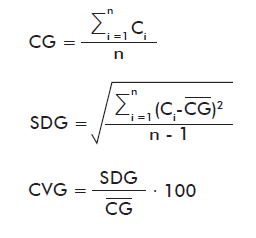
<body><![CDATA[<P   align="justify" ><font size="2" face="Verdana, Arial, Helvetica, sans-serif">The plate fluorimeter      uses an electronic control system, an optical system, high precision positioning      systems, a data acquisition system and an application called SRS v1.9 <I>StripsReaders      Software</I> [1]. It obtains a quantitative value proportional to the fluorescent      signal emitted by each well of the assay plate, which consists of 96 circularly      shaped reaction wells [1] arranged into rows (A..H) and columns (1..12). </font></P >       <P   align="justify" ><font size="2" face="Verdana, Arial, Helvetica, sans-serif">The columns are actually      strips of wells placed on a rectangular supporting frame, so that unused strips      can be removed if necessary. In a full plate, the first 12 positions are used      for a standard curve (6 duplicated points), position G1 is used for an internal      quality control, and the remaining wells are used for patient samples. Two      or three times per month, an external quality control sample is placed in      one of the positions habitually used for patient samples. </font></P >       <P   align="justify" ><font size="2" face="Verdana, Arial, Helvetica, sans-serif">The software controlling      the plate reader [1] measures the fluorescence of each reaction well and calculates      analyte concentrations by interpolation into a standard curve of six points      of known concentrations, included in the plate. The concentration of each      point of the standard curve is entered into the control software for every      reagent batch. </font></P >       <P   align="justify" ><font size="2" face="Verdana, Arial, Helvetica, sans-serif">A graphical representation      of the standard curve is obtained by plotting its six points in a fluorescence      <I>vs. </I>concentration chart (the fluorescence of each point is defined      as the mean of its duplicates). The software selects the function best fitting      the points of the chart (cubic spline, line segments or an exponential function),      which it then uses to calculate, from the measured sample fluorescence values      (F<Sub>i</Sub>), the concentration of the analyte (C<Sub>i</Sub>). </font></P >   <FONT size="+1"><FONT size="+1"><FONT size="+1"><FONT size="+1"><FONT size="+1"><FONT size="+1">        <P   align="justify" ><font size="2" face="Verdana, Arial, Helvetica, sans-serif">The analysis of internal      controls uses their mean, standard deviation, coefficient of variation and      reliability index, calculated for each batch (one batch of internal control      contains a set of reagent kit [1]): </font></P >       <P   align="justify" > </P >       <P   align="center" ><font size="2" face="Verdana, Arial, Helvetica, sans-serif"><img src="/img/revistas/bta/v29n4/fr0103412.gif" width="254" height="236"></font></P >       
<P   align="justify" > </P >       <P   align="justify" ><font size="2" face="Verdana, Arial, Helvetica, sans-serif">where: </font></P >       <P   align="justify" ><font size="2" face="Verdana, Arial, Helvetica, sans-serif">CG: Average of the      concentrations from the group of laboratories (calculated from the controls      processed by all the laboratories). </font></P >   <FONT size="+1"><FONT size="+1">        ]]></body>
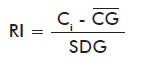
<body><![CDATA[<P   align="justify" ><font size="2" face="Verdana, Arial, Helvetica, sans-serif">C<Sub>i</Sub>: Concentration      of each internal control (obtained by processing a single plate). </font></P >   <FONT size="+1"><FONT size="+1"><FONT size="+1">        <P   align="justify" ><font size="2" face="Verdana, Arial, Helvetica, sans-serif">n: Number of controls      reported by all the laboratories </font></P >   <FONT size="+1"><FONT size="+1">        <P   align="justify" ><font size="2" face="Verdana, Arial, Helvetica, sans-serif">SDG: Standard deviation      of the group of laboratories </font></P >   <FONT size="+1"><FONT size="+1">        <P   align="justify" ><font size="2" face="Verdana, Arial, Helvetica, sans-serif">CVG: Coefficient      of variation of the group of laboratories </font></P >   <FONT size="+1"><FONT size="+1">        <P   align="justify" ><font size="2" face="Verdana, Arial, Helvetica, sans-serif">Inaccuracy is measured      with the reliability index (RI) [15], which represents the number of standard      deviations spanned by the difference between the control and the group average:      </font></P >       <P   align="center" ><img src="/img/revistas/bta/v29n4/fr0203412.gif" width="139" height="71"></P >   <FONT size="+1"><FONT size="+1">        
<P   align="justify" ></P >       <P   align="justify" ></P >       <P   align="justify" > </P >       <P   align="justify" ><font size="2" face="Verdana, Arial, Helvetica, sans-serif">where: </font></P >       ]]></body>
<body><![CDATA[<P   align="justify" ><font size="2" face="Verdana, Arial, Helvetica, sans-serif">RI: Reliability index      of the Ci internal control. </font></P >   <FONT size="+1"><FONT size="+1">        <P   align="justify" ><font size="2" face="Verdana, Arial, Helvetica, sans-serif">Imprecision is measured      with the Index of Coefficients of Variation (CVI) [16, 17], which relates      the imprecision of the laboratory under analysis to that of the remaining      laboratories processing the same control. </font></P >   <FONT size="+1"><FONT size="+1">        <P   align="justify" > </P >       <P   align="center" ><img src="/img/revistas/bta/v29n4/fr0303412.gif" width="139" height="72"></P >       
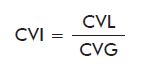
<P   align="justify" > </P >       <P   align="justify" ><font size="2" face="Verdana, Arial, Helvetica, sans-serif">where: </font></P >       <P   align="justify" ><font size="2" face="Verdana, Arial, Helvetica, sans-serif">CVL: Coefficient      of Variation for the laboratory under analysis. </font></P >   <FONT size="+1"><FONT size="+1">        <P   align="justify" > </P >       <P   ><b><font size="2" face="Verdana, Arial, Helvetica, sans-serif"><I>Evaluation      of inaccuracy for a specific time period </I></font></b></P >       <P   align="justify" ><font size="2" face="Verdana, Arial, Helvetica, sans-serif">An RI value is computed      for each internal control processed in the laboratory using the expression      above, obtaining the following set of data: </font></P >       ]]></body>
<body><![CDATA[<P   align="center" ><img src="/img/revistas/bta/v29n4/fr0403412.gif" width="518" height="49"></P >       
<P   align="justify" ></P >       <P   align="justify" ></P >       <P   align="justify" > </P >       <P   align="justify" ><font size="2" face="Verdana, Arial, Helvetica, sans-serif">where: </font></P >       <P   align="justify" ><font size="2" face="Verdana, Arial, Helvetica, sans-serif">Lab<sub>[i]</sub>:      Laboratory i identification. </font></P >   <FONT size="+1"><FONT size="+1"><FONT size="+1">        <P   align="justify" ><font size="2" face="Verdana, Arial, Helvetica, sans-serif">Ens<sub>[j]</sub>:      Assay j identification (alpha-fetoprotein in the present study). </font></P >   <FONT size="+1"><FONT size="+1"><FONT size="+1">        <P   align="justify" ><font size="2" face="Verdana, Arial, Helvetica, sans-serif">RI[L]: reliability      index for the control tested. </font></P >   <FONT size="+1"><FONT size="+1">        <P   align="justify" ><font size="+1" color="#000000"><font size="+1"><font size="+1"><font size="+1"><font size="+1"><font size="+1"><font size="+1"><font size="+1"><font size="+1"><font size="+1"><font size="+1"><font size="+1"><font size="+1"><font size="+1"><font size="+1"><font size="+1"><font size="+1"><font size="+1"><font size="+1"><font size="+1"><font size="+1"><font size="+1"><font size="+1"><font size="+1"><font size="+1"><font size="+1"><font size="+1"><font size="+1"><font size="+1"><font size="+1"><font size="+1"><font size="+1"><font size="+1"><font size="+1"><font size="+1"><font size="+1"><font size="+1"><font size="+1"><font size="+1"><font size="+1"><font size="+1"><font size="+1"><font size="+1"><font size="+1"><font size="+1"><font size="+1"><font size="+1"><font size="+1"><font size="+1"><font size="2" face="Verdana, Arial, Helvetica, sans-serif">Lab<sub>[i]</sub>.Ens<sub>[j]</sub>.RI[L]</font></font></font></font></font></font></font></font></font></font></font></font></font></font></font></font></font></font></font></font></font></font></font></font></font></font></font></font></font></font></font></font></font></font></font></font></font></font></font></font></font></font></font></font></font></font></font></font></font></font><font size="2" face="Verdana, Arial, Helvetica, sans-serif">:      Data subset formed by the values of the reliability index (RI) for each internal      quality control processed in the laboratory. </font></P >   <FONT size="+1"><FONT size="+1"><FONT size="+1"><FONT size="+1"><FONT size="+1"><FONT size="+1"><FONT size="+1"><FONT size="+1">        <P   align="justify" ><font size="2" face="Verdana, Arial, Helvetica, sans-serif">The results of calculations      can be plotted in a chart of RI <I>vs. </I>sequential measurement number,      as shown in <a href="/img/revistas/bta/v29n4/f0103412.gif">figure 1</a>. </font></P >   <FONT size="+1"><FONT size="+1"><FONT size="+1"><FONT size="+1">        
]]></body>
<body><![CDATA[<P   align="justify" > </P >       <P   >&nbsp;</P >       <P   ><font size="2" face="Verdana, Arial, Helvetica, sans-serif"><B><font size="3">RESULTS      AND DISCUSSION</font> </b></font></P >   <FONT size="+1">        <P   align="justify" ><font size="2" face="Verdana, Arial, Helvetica, sans-serif">Introducing the reliability      index (RI) and the Index of Coefficients of Variation (CVI) in the analysis      of internal controls bypasses the limitations outlined in the introductory      section. </font></P >   <FONT size="+1"><FONT size="+1"><FONT size="+1"><FONT size="+1"><FONT size="+1">        <P   ><font size="2" face="Verdana, Arial, Helvetica, sans-serif"><b>Mean for quantifying      relative imprecision </b></font></P >       <P   align="justify" ><font size="2" face="Verdana, Arial, Helvetica, sans-serif">Previous quality      control systems developed by CIE [1] analyzed the behavior of internal quality      controls through Westgard rules [13, 15], which can be individually applied      by each laboratory. The ability to use the information from all internal controls      analyzed by every laboratory under study enabled the calculation of CVI during      the evaluation system. </font></P >   <FONT size="+1"><FONT size="+1">        <P   ><font size="2" face="Verdana, Arial, Helvetica, sans-serif"><b>Solution to sample      size limitations </b></font></P >       <P   align="justify" ><font size="2" face="Verdana, Arial, Helvetica, sans-serif">Taking into account      that each reaction plate [1] processed in a specific laboratory includes an      internal control, whose measured value is stored in a centralized database      at CIE [1], it is straightforward to calculate the reliability index (RI)      in order to represent graphically the inaccuracy of all measurements performed      by every laboratory in the network. </font></P >   <FONT size="+1"><FONT size="+1">        <P   ><font size="2" face="Verdana, Arial, Helvetica, sans-serif"><b>Solution to control      charts limitations </b></font></P >       <P   align="justify" ><font size="2" face="Verdana, Arial, Helvetica, sans-serif">The limitation of      control charts regarding the requirement of a minimum number of measurements      in order to present results accurately and reliably is bypassed by using reliability      index (RI) charts. </font></P >   <FONT size="+1"><FONT size="+1">        ]]></body>
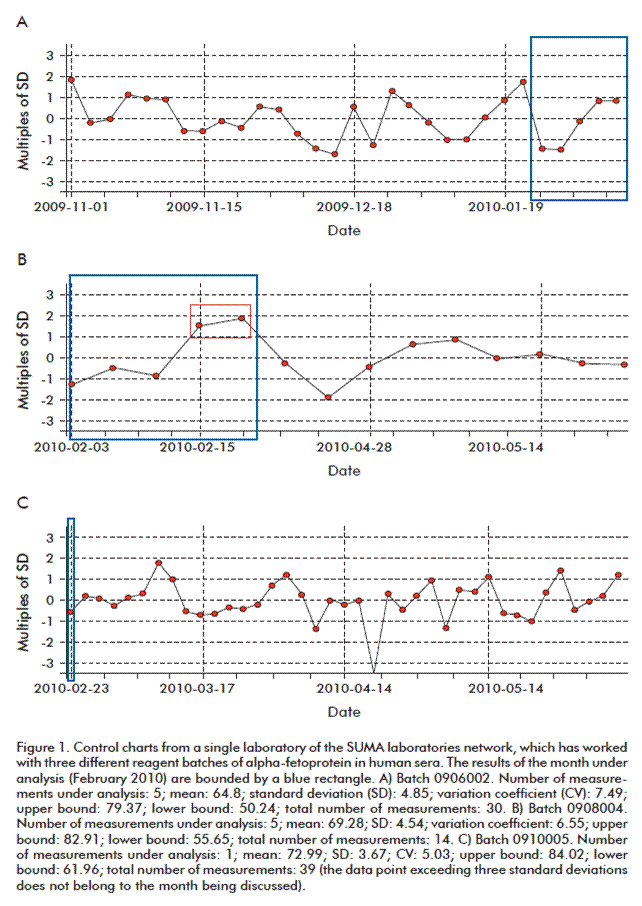
<body><![CDATA[<P   align="justify" ><font size="2" face="Verdana, Arial, Helvetica, sans-serif">The current version      of the Quality Assurance System software used in the network of SUMA laboratories      (SAC 2.0) makes use of these statistical parameters to improve the efficacy      of the quality assessment process, solving the limitations of conventional      quality control schemes. </font></P >       <P   align="justify" ><font size="2" face="Verdana, Arial, Helvetica, sans-serif"><a href="/img/revistas/bta/v29n4/f0103412.gif">Figure      1</a> contains three conventional control charts corresponding to a laboratory      that has gone through 3 different reagent batches (0906002, 0908004 and 0910005)      in the course of a single month, processing a total of 11 plates (equivalent      to 11 internal controls). As it can be observed in the <a href="/img/revistas/bta/v29n4/f0103412.gif">figure 1</a>,      none of the measurements deviates above three standard deviations (for the      month 02-2010), calculated from laboratory results. </font></P >       
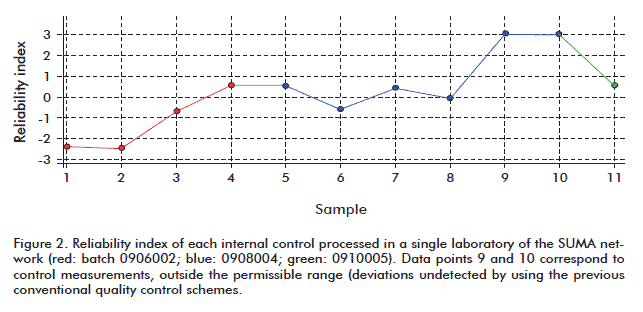
<P   align="justify" ><font size="2" face="Verdana, Arial, Helvetica, sans-serif"><a href="/img/revistas/bta/v29n4/f0203412.gif">Figure      2</a>, produced from the same data set, reveals however that when RI per analytical      run is charted, measurements 9 and 10 of the internal control yield concentration      values larger than 3 units; that is, exceeding three standard deviations (but      calculated with data from all laboratories processing this same control).      </font></P >       
<P   align="justify" ><font size="2" face="Verdana, Arial, Helvetica, sans-serif">The contradicting      results obtained when using control charts or, alternatively, RI charts, stem      from the fact that the former analyze data variability by comparison with      the standard deviation generated with its own data, whereas the RI chart analyzes      data variability in the context of the data generated by all network laboratories      processing the same control. </font></P >       <P   align="justify" ><font size="2" face="Verdana, Arial, Helvetica, sans-serif">Whenever the variability      of the data generated by a specific laboratory is higher than that of the      network of laboratories processing the same control, or the mean calculated      in the laboratory is significantly different from the mean calculated with      data from all laboratories, the possibility arises that some data points may      well fall within a range of 3 laboratory standard deviations (and therefore,      meet the assay&rsquo;s acceptance criteria) but outside the permissible range      of 3 standard deviations in the RI chart, thereby illustrating the usefulness      of this statistic tool (<a href="/img/revistas/bta/v29n4/f0203412.gif">Figure 2</a>). </font></P >       
<P   align="justify" ><font size="2" face="Verdana, Arial, Helvetica, sans-serif">The limitations described      above have been previously pointed out by other authors [11], who have demonstrated      that the combination of an External Quality Control Program with control charts      and Westgard rules [13, 14] does not always guarantee the efficacy of the      quality evaluation process. </font></P >       <P   align="justify" >&nbsp;</P >       <P   ><font size="2" face="Verdana, Arial, Helvetica, sans-serif"><b><font size="3">CONCLUSIONS</font></b></font></P >   <FONT size="+1">        <P   align="justify" ><font size="2" face="Verdana, Arial, Helvetica, sans-serif">The improvements      to the quality evaluation process described above were introduced during 2011      into the system for the automated quality evaluation of SUMA laboratories      (SAC 2.0), producing an increase of over 1% in the number of deficient laboratories      per month (this process is run on a monthly basis) and demonstrating their      effectiveness for the detection of deviations that would otherwise remain      undetected under conventional control quality schemes. </font></P >   <FONT size="+1">        <P   align="justify" ><font size="2" face="Verdana, Arial, Helvetica, sans-serif">Thanks to the presence      of internal controls into the diagnostic kits, this alternative has been implemented      without incurring additional expenses; an important advantage for CIE in its      dual role as manufacturer and supervisor. </font></P >       ]]></body>
<body><![CDATA[<P   align="justify" ><font size="2" face="Verdana, Arial, Helvetica, sans-serif">Based on the above,      we affirm that the implementation of this new evaluation methodology will      have a positive impact on the quality of the results obtained in SUMA laboratories,      which are involved in the programs of prenatal screening, neonatal screening,      epidemiological surveillance and blood certification in Cuba, as well as in      different health programs in the countries where this technology is sold (Mexico,      Venezuela, Argentina and Brazil). </font></P >       <P   align="justify" > </P >       <P   align="justify" >&nbsp;</P >       <P   align="justify" ><font size="3" face="Verdana, Arial, Helvetica, sans-serif"><b>REFERENCES </b></font></P >       <!-- ref --><P   align="justify" ><font size="2" face="Verdana, Arial, Helvetica, sans-serif">1. Centro de Inmunoensayo.      Tecnolog&iacute;a SUMA, aplicaciones y uso. La Habana: Editorial Ciencias      M&eacute;dicas; 2007.     </font></P >       <!-- ref --><P   align="justify" ><font size="2" face="Verdana, Arial, Helvetica, sans-serif">2. Tecnosuma Internacional      S.A. [Internet]. La Habana: Tecnosuma Internacional S.A.; c2012 [cited 2012      Mar 20]. Available from: <a href="http://www.tecnosuma.com" target="_blank">http://www.tecnosuma.com</a>      </font></P >       <!-- ref --><P   align="justify" ><font size="2" face="Verdana, Arial, Helvetica, sans-serif">3. Whitehead TP.      Advances in quality control. Adv Clin Chem. 1977;19:175-205.     </font></P >       <!-- ref --><P   align="justify" ><font size="2" face="Verdana, Arial, Helvetica, sans-serif">4. Oficina Nacional      de Normalizaci&oacute;n. NC ISO 15189. Laboratorios cl&iacute;nicos - Requisitos      particulares para la calidad y la competencia (ISO 15189:2007, IDT). La Habana:      Oficina Nacional de Normalizaci&oacute;n; 2008.     </font></P >       <!-- ref --><P   align="justify" ><font size="2" face="Verdana, Arial, Helvetica, sans-serif">5. Oficina Nacional      de Normalizaci&oacute;n. NC ISO 9000. Sistemas de gesti&oacute;n de la calidad_Fundamentos      y vocabulario [ISO 9000:2005, (Traducci&oacute;n certificada), IDT]. La Habana:      Oficina Nacional de Normalizaci&oacute;n; 2005.     </font></P >       <P   align="justify" ><font size="2" face="Verdana, Arial, Helvetica, sans-serif">6. Centers for Disease      Control and Prevention (CDC) [Internet]. Atlanta: CDC; c2012 [cited 2011 Sep      1]. Available from: <a href="http://wwwn.cdc.gov/nsqap/public/default.aspx" target="_blank">http://wwwn.cdc.gov/nsqap/public/default.aspx</a>      </font></P >       <!-- ref --><P   align="justify" ><font size="2" face="Verdana, Arial, Helvetica, sans-serif">7. Fundaci&oacute;n      Bioqu&iacute;mica Argentina (FBA) [Internet]. Buenos Aires: FBA; c2003 [cited      2011 Jun 1]. Available from: <a href="http://www.fba.org.ar/default.asp?" target="_blank">http://www.fba.org.ar/default.asp?</a>      </font></P >       <!-- ref --><P   align="justify" ><font size="2" face="Verdana, Arial, Helvetica, sans-serif">8. Glossary of QC      terms - Westgard QC [Internet]. Madison: Westgard QC; c2009 [updated 2012      Mar 20; cited 2012 Mar 20]. Available from: <a href="http://www.westgard.com/glossary.htm" target="_blank">http://www.westgard.com/glossary.htm</a>      </font></P >       <!-- ref --><P   align="justify" ><font size="2" face="Verdana, Arial, Helvetica, sans-serif">9. Oficina Nacional      de Normalizaci&oacute;n. NC ISO 5725-1. Exactitud (veracidad y precision)      de m&eacute;todos de medici&oacute;n y resultados - Parte 1: Principios generales      y definiciones (ISO 5725-1:1994, IDT). La Habana: Oficina Nacional de Normalizaci&oacute;n;      2005.     </font></P >       <!-- ref --><P   align="justify" ><font size="2" face="Verdana, Arial, Helvetica, sans-serif">10. Laboratory Informatics      Institute. LIMSbook and Buyers Guide. 2nd Edition. Atlanta: Laboratory Informatics      Institute, Inc.; 2012.     </font></P >       ]]></body>
<body><![CDATA[<!-- ref --><P   align="justify" ><font size="2" face="Verdana, Arial, Helvetica, sans-serif">11. QCNet [Internet].      Irvine: Bio-Rad Laboratories, Inc.; c2012 [updated 2012 Mar 20; cited 2012      Mar 20]. Available from: <a href="http://www.qcnet.com" target="_blank">http://www.qcnet.com</a>      </font></P >       <!-- ref --><P   align="justify" ><font size="2" face="Verdana, Arial, Helvetica, sans-serif">12. Rego A, P&eacute;rez      H, L&oacute;pez L, Carlos N. Integral evaluation of quality in diagnostic      laboratory networks. Biotecnol Apl. 2009; 26(2):151-5.     </font></P >       <!-- ref --><P   align="justify" ><font size="2" face="Verdana, Arial, Helvetica, sans-serif">13. Westgard JO,      Barry PL, Hunt MR, Groth T. A multi-rule Shewhart chart for quality control      in clinical chemistry. Clin Chem.1981; 27(3):493-501.     </font></P >       <!-- ref --><P   align="justify" ><font size="2" face="Verdana, Arial, Helvetica, sans-serif">14. Westgard JO,      Barry PL. Improving Quality Control by use of Multirule Control Procedures.      In: Westgard JO, Barry PL. Cost-Effective Quality Control: Managing the quality      and productivity of analytical processes. Washington, DC: AACC Press; 1986.      p. 92-117.     </font></P >       <!-- ref --><P   align="justify" ><font size="2" face="Verdana, Arial, Helvetica, sans-serif">15. Gozzo ML, Barbaresi      G, Giocoli G, Zappacosta B, Zuppi C. Long-term retrospective control procedures      for monitoring analytical performance of laboratory instruments. Clin Chem.      1984;30(1):145-9.     </font></P >       <!-- ref --><P   align="justify" ><font size="2" face="Verdana, Arial, Helvetica, sans-serif">16. Randox Laboratories      Ltd. [Internet]. Antrim: Randox Laboratories Ltd.; c2012 [updated 2012 Mar      20; cited 2012 Mar 20]. Available from: <a href="http://www.randox.com/qc%20software.php" target="_blank">http://www.randox.com/qc%20software.php</a>      </font></P >       <!-- ref --><P   align="justify" ><font size="2" face="Verdana, Arial, Helvetica, sans-serif">17. NIST/SEMATECH      e-Handbook of Statistical Methods [Internet]. New York: The National Institute      of Standards and Technology (NIST); 2012. Available from: <A href="http://www.itl.nist.gov/div898/handbook/apr/section4/apr47.htm" target="_blank">      <U><U><FONT color="#0000FF">http://www.itl.nist.gov/div898/handbook/apr/section4/apr47.htm<font color="#000000">.    </font></font></U></U></A></font></P >   <FONT color="#0000FF"><FONT color="#000000">        <P   align="justify" > </P >       <P   align="justify" > </P >       <P   align="justify" >&nbsp;</P >       <P   align="justify" >&nbsp;</P >       <P   align="justify" ><font size="2" face="Verdana, Arial, Helvetica, sans-serif">Received in July,      2011.     <br>     </font><font size="2" face="Verdana, Arial, Helvetica, sans-serif">Accepted      in July, 2012. </font></P >       <P   align="justify" > </P >       <P   align="justify" > </P >       ]]></body>
<body><![CDATA[<P   align="justify" >&nbsp;</P >       <P   align="justify" >&nbsp;</P >       <P   align="justify" ><font size="2" face="Verdana, Arial, Helvetica, sans-serif"><I>Alfredo Rego-D&iacute;az</I>.      Departamento de Matem&aacute;tica y Programaci&oacute;n Aplicada, Centro de      Inmunoensayo, CIE. Calle 134 y Ave. 25, Cubanac&aacute;n, Playa, La Habana,      Cuba. E-mail: <A href="mailto:inprogram2@cie.sld.cu"> <U><U><FONT color="#0000FF">inprogram2@cie.sld.cu</font></U></U></A><FONT color="#0000FF"><FONT color="#000000">.      </font></font></font></P >   </font></font></font></font></font></font></font></font></font></font></font></font></font></font></font></font></font></font></font></font></font></font></font></font></font></font></font></font></font></font></font></font></font></font></font></font></font></font></font></font></font></font></font></font></font></font></font></font></font></font></font></font></font></font></font></font></font></font></font></font></font></font></font></font></font></font></font></font></font></font></font></font></font></font></font></font></font></font></font></DIV >      ]]></body><back>
<ref-list>
<ref id="B1">
<label>1</label><nlm-citation citation-type="book">
<collab>Centro de Inmunoensayo</collab>
<source><![CDATA[Tecnología SUMA, aplicaciones y uso]]></source>
<year>2007</year>
<publisher-loc><![CDATA[La Habana ]]></publisher-loc>
<publisher-name><![CDATA[Editorial Ciencias Médicas]]></publisher-name>
</nlm-citation>
</ref>
<ref id="B2">
<label>2</label><nlm-citation citation-type="book">
<source><![CDATA[Tecnosuma Internacional S.A.]]></source>
<year>2012</year>
<publisher-loc><![CDATA[La Habana ]]></publisher-loc>
<publisher-name><![CDATA[Tecnosuma Internacional S.A.]]></publisher-name>
</nlm-citation>
</ref>
<ref id="B3">
<label>3</label><nlm-citation citation-type="journal">
<person-group person-group-type="author">
<name>
<surname><![CDATA[Whitehead]]></surname>
<given-names><![CDATA[TP]]></given-names>
</name>
</person-group>
<article-title xml:lang="en"><![CDATA[Advances in quality control]]></article-title>
<source><![CDATA[Adv Clin Chem]]></source>
<year>1977</year>
<volume>19</volume>
<page-range>175-205</page-range></nlm-citation>
</ref>
<ref id="B4">
<label>4</label><nlm-citation citation-type="book">
<source><![CDATA[Oficina Nacional de Normalización. NC ISO 15189.: Laboratorios clínicos - Requisitos particulares para la calidad y la competencia (ISO 15189:2007, IDT)]]></source>
<year>2008</year>
<publisher-loc><![CDATA[La Habana ]]></publisher-loc>
<publisher-name><![CDATA[Oficina Nacional de Normalización]]></publisher-name>
</nlm-citation>
</ref>
<ref id="B5">
<label>5</label><nlm-citation citation-type="book">
<source><![CDATA[Oficina Nacional de Normalización. NC ISO 9000: Sistemas de gestión de la calidad - Fundamentos y vocabulario (ISO 9000:2005, (Traducción certificada), IDT)]]></source>
<year>2005</year>
<publisher-loc><![CDATA[La Habana ]]></publisher-loc>
<publisher-name><![CDATA[Oficina Nacional de Normalización]]></publisher-name>
</nlm-citation>
</ref>
<ref id="B6">
<label>6</label><nlm-citation citation-type="">
<source><![CDATA[Centers for Disease Control and Prevention (CDC)]]></source>
<year>2012</year>
<publisher-loc><![CDATA[Atlanta ]]></publisher-loc>
</nlm-citation>
</ref>
<ref id="B7">
<label>7</label><nlm-citation citation-type="book">
<source><![CDATA[Fundación Bioquímica Argentina (FBA)]]></source>
<year>2003</year>
<publisher-loc><![CDATA[Buenos Aires ]]></publisher-loc>
<publisher-name><![CDATA[FBA]]></publisher-name>
</nlm-citation>
</ref>
<ref id="B8">
<label>8</label><nlm-citation citation-type="book">
<source><![CDATA[Glossary of QC terms &#150; Westgard QC]]></source>
<year>2009</year>
<publisher-loc><![CDATA[Madison ]]></publisher-loc>
<publisher-name><![CDATA[Westgard QC]]></publisher-name>
</nlm-citation>
</ref>
<ref id="B9">
<label>9</label><nlm-citation citation-type="book">
<collab>Oficina Nacional de Normalización</collab>
<source><![CDATA[NC ISO 5725-1. Exactitud (veracidad y precision) de métodos de medición y resultados: Parte 1: Principios generales y definiciones (ISO 5725-1:1994, IDT)]]></source>
<year>2005</year>
<publisher-loc><![CDATA[La Habana ]]></publisher-loc>
<publisher-name><![CDATA[Oficina Nacional de Normalización]]></publisher-name>
</nlm-citation>
</ref>
<ref id="B10">
<label>10</label><nlm-citation citation-type="book">
<collab>Laboratory Informatics Institute</collab>
<source><![CDATA[LIMS book and Buyers Guide]]></source>
<year>2012</year>
<edition>2</edition>
<publisher-loc><![CDATA[Atlanta ]]></publisher-loc>
<publisher-name><![CDATA[Laboratory Informatics Institute]]></publisher-name>
</nlm-citation>
</ref>
<ref id="B11">
<label>11</label><nlm-citation citation-type="book">
<source><![CDATA[QCNet]]></source>
<year>2012</year>
<publisher-loc><![CDATA[Irvine ]]></publisher-loc>
<publisher-name><![CDATA[Bio-Rad Laboratories, Inc.]]></publisher-name>
</nlm-citation>
</ref>
<ref id="B12">
<label>12</label><nlm-citation citation-type="journal">
<person-group person-group-type="author">
<name>
<surname><![CDATA[Rego]]></surname>
<given-names><![CDATA[A]]></given-names>
</name>
<name>
<surname><![CDATA[Pérez]]></surname>
<given-names><![CDATA[H]]></given-names>
</name>
<name>
<surname><![CDATA[López]]></surname>
<given-names><![CDATA[L]]></given-names>
</name>
<name>
<surname><![CDATA[Carlos]]></surname>
<given-names><![CDATA[N]]></given-names>
</name>
</person-group>
<article-title xml:lang="en"><![CDATA[Integral evaluation of quality in diagnostic laboratory networks]]></article-title>
<source><![CDATA[Biotecnol Apl]]></source>
<year>2009</year>
<volume>26</volume>
<numero>2</numero>
<issue>2</issue>
<page-range>151-5</page-range></nlm-citation>
</ref>
<ref id="B13">
<label>13</label><nlm-citation citation-type="journal">
<person-group person-group-type="author">
<name>
<surname><![CDATA[Westgard]]></surname>
<given-names><![CDATA[JO]]></given-names>
</name>
<name>
<surname><![CDATA[Barry]]></surname>
<given-names><![CDATA[PL]]></given-names>
</name>
<name>
<surname><![CDATA[Hunt]]></surname>
<given-names><![CDATA[MR]]></given-names>
</name>
<name>
<surname><![CDATA[Groth]]></surname>
<given-names><![CDATA[T]]></given-names>
</name>
</person-group>
<article-title xml:lang="en"><![CDATA[A multi-rule Shewhart chart for quality control in clinical chemistry]]></article-title>
<source><![CDATA[Clin Chem]]></source>
<year>1981</year>
<volume>27</volume>
<numero>3</numero>
<issue>3</issue>
<page-range>493-501</page-range></nlm-citation>
</ref>
<ref id="B14">
<label>14</label><nlm-citation citation-type="book">
<person-group person-group-type="author">
<name>
<surname><![CDATA[Westgard]]></surname>
<given-names><![CDATA[JO]]></given-names>
</name>
<name>
<surname><![CDATA[Barry]]></surname>
<given-names><![CDATA[PL]]></given-names>
</name>
</person-group>
<article-title xml:lang="en"><![CDATA[Improving Quality Control by use of Multirule Control Procedures]]></article-title>
<person-group person-group-type="editor">
<name>
<surname><![CDATA[Westgard]]></surname>
<given-names><![CDATA[JO]]></given-names>
</name>
<name>
<surname><![CDATA[Barry]]></surname>
<given-names><![CDATA[PL]]></given-names>
</name>
</person-group>
<source><![CDATA[Cost-Effective Quality Control: Managing the quality and productivity of analytical processes]]></source>
<year>1986</year>
<page-range>92-117</page-range><publisher-loc><![CDATA[Washington, DC ]]></publisher-loc>
<publisher-name><![CDATA[AACC Press]]></publisher-name>
</nlm-citation>
</ref>
<ref id="B15">
<label>15</label><nlm-citation citation-type="journal">
<person-group person-group-type="author">
<name>
<surname><![CDATA[Gozzo]]></surname>
<given-names><![CDATA[ML]]></given-names>
</name>
<name>
<surname><![CDATA[Barbaresi]]></surname>
<given-names><![CDATA[G]]></given-names>
</name>
<name>
<surname><![CDATA[Giocoli]]></surname>
<given-names><![CDATA[G]]></given-names>
</name>
<name>
<surname><![CDATA[Zappacosta]]></surname>
<given-names><![CDATA[B]]></given-names>
</name>
<name>
<surname><![CDATA[Zuppi]]></surname>
<given-names><![CDATA[C]]></given-names>
</name>
</person-group>
<article-title xml:lang="en"><![CDATA[Long-term retrospective control procedures for monitoring analytical performance of laboratory instruments]]></article-title>
<source><![CDATA[Clin Chem]]></source>
<year>1984</year>
<volume>30</volume>
<numero>1</numero>
<issue>1</issue>
<page-range>145-9</page-range></nlm-citation>
</ref>
<ref id="B16">
<label>16</label><nlm-citation citation-type="book">
<source><![CDATA[Randox Laboratories Ltd.]]></source>
<year>2012</year>
<publisher-loc><![CDATA[Antrim ]]></publisher-loc>
<publisher-name><![CDATA[Randox Laboratories Ltd.]]></publisher-name>
</nlm-citation>
</ref>
<ref id="B17">
<label>17</label><nlm-citation citation-type="book">
<source><![CDATA[NIST/SEMATECH e-Handbook of Statistical Methods]]></source>
<year>2012</year>
<publisher-loc><![CDATA[New York ]]></publisher-loc>
<publisher-name><![CDATA[The National Institute of Standards and Technology (NIST)]]></publisher-name>
</nlm-citation>
</ref>
</ref-list>
</back>
</article>