<?xml version="1.0" encoding="ISO-8859-1"?><article xmlns:mml="http://www.w3.org/1998/Math/MathML" xmlns:xlink="http://www.w3.org/1999/xlink" xmlns:xsi="http://www.w3.org/2001/XMLSchema-instance">
<front>
<journal-meta>
<journal-id>1027-2852</journal-id>
<journal-title><![CDATA[Biotecnología Aplicada]]></journal-title>
<abbrev-journal-title><![CDATA[Biotecnol Apl]]></abbrev-journal-title>
<issn>1027-2852</issn>
<publisher>
<publisher-name><![CDATA[Editorial Elfos Scientiae]]></publisher-name>
</publisher>
</journal-meta>
<article-meta>
<article-id>S1027-28522013000100002</article-id>
<title-group>
<article-title xml:lang="en"><![CDATA[Excitotoxicity and neuronal death in epilepsy]]></article-title>
<article-title xml:lang="es"><![CDATA[Excitotoxicidad y muerte neuronal en la epilepsia]]></article-title>
</title-group>
<contrib-group>
<contrib contrib-type="author">
<name>
<surname><![CDATA[Lorigados]]></surname>
<given-names><![CDATA[Lourdes]]></given-names>
</name>
<xref ref-type="aff" rid="A01"/>
</contrib>
<contrib contrib-type="author">
<name>
<surname><![CDATA[Orozco]]></surname>
<given-names><![CDATA[Sandra]]></given-names>
</name>
<xref ref-type="aff" rid="A02"/>
</contrib>
<contrib contrib-type="author">
<name>
<surname><![CDATA[Morales]]></surname>
<given-names><![CDATA[Lilia]]></given-names>
</name>
<xref ref-type="aff" rid="A03"/>
</contrib>
<contrib contrib-type="author">
<name>
<surname><![CDATA[Estupiñán]]></surname>
<given-names><![CDATA[Bárbara]]></given-names>
</name>
<xref ref-type="aff" rid="A03"/>
</contrib>
<contrib contrib-type="author">
<name>
<surname><![CDATA[García]]></surname>
<given-names><![CDATA[Iván]]></given-names>
</name>
<xref ref-type="aff" rid="A04"/>
</contrib>
<contrib contrib-type="author">
<name>
<surname><![CDATA[Rocha]]></surname>
<given-names><![CDATA[Luisa]]></given-names>
</name>
<xref ref-type="aff" rid="A05"/>
</contrib>
</contrib-group>
<aff id="A02">
<institution><![CDATA[,Instituto Mexicano del Seguro Social Centro Médico Nacional Siglo XXI ]]></institution>
<addr-line><![CDATA[ ]]></addr-line>
<country>México</country>
</aff>
<aff id="A03">
<institution><![CDATA[,Centro Internacional de Restauración Neurológica Departamento de Neurofisiología ]]></institution>
<addr-line><![CDATA[La Habana ]]></addr-line>
<country>Cuba</country>
</aff>
<aff id="A04">
<institution><![CDATA[,Centro Internacional de Restauración Neurológica, Cirén Servicio de Neurocirugía ]]></institution>
<addr-line><![CDATA[La Habana ]]></addr-line>
<country>Cuba</country>
</aff>
<aff id="A05">
<institution><![CDATA[,Centro de Investigación y de Estudios Avanzados Laboratorio Farmacobiología ]]></institution>
<addr-line><![CDATA[DF ]]></addr-line>
<country>México</country>
</aff>
<aff id="A01">
<institution><![CDATA[,Centro Internacional de Restauración Neurológica Departamento de Inmunoquímica ]]></institution>
<addr-line><![CDATA[La Habana ]]></addr-line>
<country>Cuba</country>
</aff>
<pub-date pub-type="pub">
<day>00</day>
<month>03</month>
<year>2013</year>
</pub-date>
<pub-date pub-type="epub">
<day>00</day>
<month>03</month>
<year>2013</year>
</pub-date>
<volume>30</volume>
<numero>1</numero>
<fpage>9</fpage>
<lpage>16</lpage>
<copyright-statement/>
<copyright-year/>
<self-uri xlink:href="http://scielo.sld.cu/scielo.php?script=sci_arttext&amp;pid=S1027-28522013000100002&amp;lng=en&amp;nrm=iso"></self-uri><self-uri xlink:href="http://scielo.sld.cu/scielo.php?script=sci_abstract&amp;pid=S1027-28522013000100002&amp;lng=en&amp;nrm=iso"></self-uri><self-uri xlink:href="http://scielo.sld.cu/scielo.php?script=sci_pdf&amp;pid=S1027-28522013000100002&amp;lng=en&amp;nrm=iso"></self-uri><abstract abstract-type="short" xml:lang="en"><p><![CDATA[Epilepsy is a recurrent, often progressive neurological disorder with a chronic evolution, affecting 1 to 2 % of the world population. Research with experimental models and imaging analysis of diseased patients have been used to show that recurrent episodes produce oxidative stress, most of which is related to neuronal excitability phenomena. It is known that the excessive stimulation of glutamate receptors results in neurotoxicity; a process that, under the denomination of excitotoxicity, is thought to constitute the principal cellular death mechanism behind different disorders of the central nervous system, including epilepsy. Paradoxically, although the signaling pathways, molecular mechanisms and sites of action of excitotoxicity have received considerable attention since the 1970s, little is known about their relevance to CNS disorders. Further detail is necessary about the fundamental role of neuronal death and the mechanisms, particularly those relevant to neurological pathogenesis, that are engaged whenever glutamate receptors are excessively stimulated, as the results would aid considerably the development of timely clinical interventions delaying the evolution of these disorders. We review clinical and experimental data on the relevant alterations of the glutamatergic system, cell death pathways, and the activation of caspases and members of the Bcl-2 gene family involved in the process as modulators of cell death during epilepsy. The findings support the hypothesis that excitotoxic processes as well as both apoptotic and necrotic neuronal cell death phenomena converge in drug-resistant epilepsy.]]></p></abstract>
<abstract abstract-type="short" xml:lang="es"><p><![CDATA[La epilepsia es una afección neurológica de evolución crónica, recurrente, casi siempre progresiva, que afecta del 1 al 2 % de la población mundial. Modelos experimentales y estudios de imágenes neurológicas de pacientes con este padecimiento muestran que las crisis recurrentes provocan estrés oxidativo, relacionado fundamentalmente con la excitabilidad neuronal. La estimulación excesiva de los receptores de glutamato induce neurotoxicidad, un proceso que se ha definido como excitotoxicidad. Se considera que este puede ser el principal mecanismo de muerte celular en numerosas afecciones del sistema nervioso central, incluida la epilepsia. Desde los años 70 se han estudiado con profundidad las vías de señalización, los mecanismos moleculares y los sitios de acción relacionados con la excitotoxicidad; aunque de forma muy limitada en las enfermedades del sistema nervioso central. En particular, deberán evaluarse con especial cuidado la función crucial de la muerte neuronal y los mecanismos que se potencian con la sobreactivación de los receptores de glutamato, principalmente los relativos a las enfermedades neurológicas, con el fin de intervenir de manera oportuna para retardar el desarrollo de estas afecciones neurológicas. Se repasan las evidencias clínicas y experimentales sobre las alteraciones del sistema glutamatérgico, las vías de muerte celular, la activación de las caspasas y de la familia de genes Bcl-2 involucrados, como moduladores de la muerte celular en la epilepsia. Tales hallazgos sustentan que en la epilepsia farmacorresistente convergen procesos excitotóxicos y de muerte neuronal apoptótica y necrótica.]]></p></abstract>
<kwd-group>
<kwd lng="en"><![CDATA[excitotoxicity]]></kwd>
<kwd lng="en"><![CDATA[apoptosis]]></kwd>
<kwd lng="en"><![CDATA[necrosis]]></kwd>
<kwd lng="en"><![CDATA[epilepsy]]></kwd>
<kwd lng="es"><![CDATA[excitotoxicidad]]></kwd>
<kwd lng="es"><![CDATA[apoptosis]]></kwd>
<kwd lng="es"><![CDATA[necrosis]]></kwd>
<kwd lng="es"><![CDATA[epilepsia]]></kwd>
</kwd-group>
</article-meta>
</front><body><![CDATA[ <DIV class="Sect"   >        <P   align="right" ><font size="2" color="#000000" face="Verdana, Arial, Helvetica, sans-serif"><b>REVIEW      </b></font></P >       <P   align="right" >&nbsp;</P >   <FONT size="+1" color="#000000">        <P   > </P >       <P   ><b><font size="4" face="Verdana, Arial, Helvetica, sans-serif">Excitotoxicity      and neuronal death in epilepsy </font></b></P >       <P   >&nbsp;</P >       <P   > </P >       <P   ><font size="3" face="Verdana, Arial, Helvetica, sans-serif"><b>Excitotoxicidad      y muerte neuronal en la epilepsia </b></font></P >       <P   >&nbsp;</P >       <P   >&nbsp;</P >       ]]></body>
<body><![CDATA[<P   > </P >       <P   > </P >       <P   ><b><font size="2" face="Verdana, Arial, Helvetica, sans-serif">Lourdes Lorigados<Sup>1</Sup>,      Sandra Orozco<Sup>2</Sup>, Lilia Morales<Sup>3</Sup>, B&aacute;rbara Estupi&ntilde;&aacute;n<Sup>3</Sup>,      Iv&aacute;n Garc&iacute;a<Sup>4</Sup>, Luisa Rocha<Sup>5</Sup></font></b><FONT size="+1"><FONT size="+1"><FONT size="+1"><FONT size="+1"><FONT size="+1"><FONT size="+1"><FONT size="+1"><FONT size="+1"><FONT size="+1"><FONT size="+1"><FONT size="+1"><FONT size="+1"></font></font></font></font></font></font></font></font></font></font></font></font></P >   <FONT size="+1"><FONT size="+1"><FONT size="+1"><FONT size="+1"><FONT size="+1"><FONT size="+1"><FONT size="+1"><FONT size="+1"><FONT size="+1"><FONT size="+1"><FONT size="+1"><FONT size="+1">        <P   ><font size="2" face="Verdana, Arial, Helvetica, sans-serif"><Sup>1</Sup> Departamento      de Inmunoqu&iacute;mica, Centro Internacional de Restauraci&oacute;n Neurol&oacute;gica,      Cir&eacute;n. Ave. 25, No. 15805 e/ 158 y 160 Playa, CP 11300, La Habana,      Cuba. <Sup>    <br>     2</Sup> Centro M&eacute;dico Nacional Siglo XXI, Instituto Mexicano del Seguro      Social, IMSS, M&eacute;xico. <Sup>    <br>     3</Sup> Departamento de Neurofisiolog&iacute;a, Centro Internacional de Restauraci&oacute;n      Neurol&oacute;gica, Cir&eacute;n. La Habana, Cuba. <Sup>    <br>     4</Sup> Servicio de Neurocirug&iacute;a, Centro Internacional de Restauraci&oacute;n      Neurol&oacute;gica, Cir&eacute;n. La Habana, Cuba. <Sup>    <br>     5</Sup> Laboratorio Farmacobiolog&iacute;a, Centro de Investigaci&oacute;n      y de Estudios Avanzados, Cinvestav, Sede Sur, DF, M&eacute;xico. </font></P >       <P   >&nbsp;</P >       <P   >&nbsp;</P >   </font></font></font></font></font></font></font></font></font></font></font></font></font>   <hr>   <FONT size="+1" color="#000000"><FONT size="+1"><FONT size="+1"><FONT size="+1"><FONT size="+1"><FONT size="+1"><FONT size="+1"><FONT size="+1"><FONT size="+1"><FONT size="+1"><FONT size="+1"><FONT size="+1"><FONT size="+1">        ]]></body>
<body><![CDATA[<P   ><font size="2" face="Verdana, Arial, Helvetica, sans-serif"><B>ABSTRACT </b></font></P >   <FONT size="+1"><FONT size="+1"><FONT size="+1"><FONT size="+1"><FONT size="+1"><FONT size="+1"><FONT size="+1"><FONT size="+1"><FONT size="+1"><FONT size="+1"><FONT size="+1">        <P   ><font size="2" face="Verdana, Arial, Helvetica, sans-serif">Epilepsy is a recurrent,      often progressive neurological disorder with a chronic evolution, affecting      1 to 2 % of the world population. Research with experimental models and imaging      analysis of diseased patients have been used to show that recurrent episodes      produce oxidative stress, most of which is related to neuronal excitability      phenomena. It is known that the excessive stimulation of glutamate receptors      results in neurotoxicity; a process that, under the denomination of excitotoxicity,      is thought to constitute the principal cellular death mechanism behind different      disorders of the central nervous system, including epilepsy. Paradoxically,      although the signaling pathways, molecular mechanisms and sites of action      of excitotoxicity have received considerable attention since the 1970s, little      is known about their relevance to CNS disorders. Further detail is necessary      about the fundamental role of neuronal death and the mechanisms, particularly      those relevant to neurological pathogenesis, that are engaged whenever glutamate      receptors are excessively stimulated, as the results would aid considerably      the development of timely clinical interventions delaying the evolution of      these disorders. We review clinical and experimental data on the relevant      alterations of the glutamatergic system, cell death pathways, and the activation      of caspases and members of the Bcl-2 gene family involved in the process as      modulators of cell death during epilepsy. The findings support the hypothesis      that excitotoxic processes as well as both apoptotic and necrotic neuronal      cell death phenomena converge in drug-resistant epilepsy. </font></P >       <P   ><font size="2" face="Verdana, Arial, Helvetica, sans-serif"><b>Keywords:</b>      excitotoxicity, apoptosis, necrosis, epilepsy. </font></P >   </font></font></font></font></font></font></font></font></font></font></font></font></font></font></font></font></font></font></font></font></font></font></font></font>   <hr>   <FONT size="+1" color="#000000"><FONT size="+1"><FONT size="+1"><FONT size="+1"><FONT size="+1"><FONT size="+1"><FONT size="+1"><FONT size="+1"><FONT size="+1"><FONT size="+1"><FONT size="+1"><FONT size="+1"><FONT size="+1"><FONT size="+1"><FONT size="+1"><FONT size="+1"><FONT size="+1"><FONT size="+1"><FONT size="+1"><FONT size="+1"><FONT size="+1"><FONT size="+1"><FONT size="+1"><FONT size="+1">        <P   ><font size="2" face="Verdana, Arial, Helvetica, sans-serif"><B>RESUMEN </b></font></P >       <P   ><font size="2" face="Verdana, Arial, Helvetica, sans-serif">La epilepsia es una      afecci&oacute;n neurol&oacute;gica de evoluci&oacute;n cr&oacute;nica, recurrente,      casi siempre progresiva, que afecta del 1 al 2 % de la poblaci&oacute;n mundial.      Modelos experimentales y estudios de im&aacute;genes neurol&oacute;gicas de      pacientes con este padecimiento muestran que las crisis recurrentes provocan      estr&eacute;s oxidativo, relacionado fundamentalmente con la excitabilidad      neuronal. La estimulaci&oacute;n excesiva de los receptores de glutamato induce      neurotoxicidad, un proceso que se ha definido como excitotoxicidad. Se considera      que este puede ser el principal mecanismo de muerte celular en numerosas afecciones      del sistema nervioso central, incluida la epilepsia. Desde los a&ntilde;os      70 se han estudiado con profundidad las v&iacute;as de se&ntilde;alizaci&oacute;n,      los mecanismos moleculares y los sitios de acci&oacute;n relacionados con      la excitotoxicidad; aunque de forma muy limitada en las enfermedades del sistema      nervioso central. En particular, deber&aacute;n evaluarse con especial cuidado      la funci&oacute;n crucial de la muerte neuronal y los mecanismos que se potencian      con la sobreactivaci&oacute;n de los receptores de glutamato, principalmente      los relativos a las enfermedades neurol&oacute;gicas, con el fin de intervenir      de manera oportuna para retardar el desarrollo de estas afecciones neurol&oacute;gicas.      Se repasan las evidencias cl&iacute;nicas y experimentales sobre las alteraciones      del sistema glutamat&eacute;rgico, las v&iacute;as de muerte celular, la activaci&oacute;n      de las caspasas y de la familia de genes Bcl-2 involucrados, como moduladores      de la muerte celular en la epilepsia. Tales hallazgos sustentan que en la      epilepsia farmacorresistente convergen procesos excitot&oacute;xicos y de      muerte neuronal apopt&oacute;tica y necr&oacute;tica. </font></P >       <P   ><font size="2" face="Verdana, Arial, Helvetica, sans-serif"><b>Palabras clave:</b>      excitotoxicidad, apoptosis, necrosis, epilepsia.</font></P >   </font></font></font></font></font></font></font></font></font></font></font></font></font></font></font></font></font></font></font></font></font></font></font></font>    <hr>   <FONT size="+1" color="#000000"><FONT size="+1"><FONT size="+1"><FONT size="+1"><FONT size="+1"><FONT size="+1"><FONT size="+1"><FONT size="+1"><FONT size="+1"><FONT size="+1"><FONT size="+1"><FONT size="+1"><FONT size="+1"><FONT size="+1"><FONT size="+1"><FONT size="+1"><FONT size="+1"><FONT size="+1"><FONT size="+1"><FONT size="+1"><FONT size="+1"><FONT size="+1"><FONT size="+1"><FONT size="+1">        <P   >&nbsp;</P >       <P   >&nbsp;</P >       <P   > </P >       <P   > </P >   <FONT size="+1">        ]]></body>
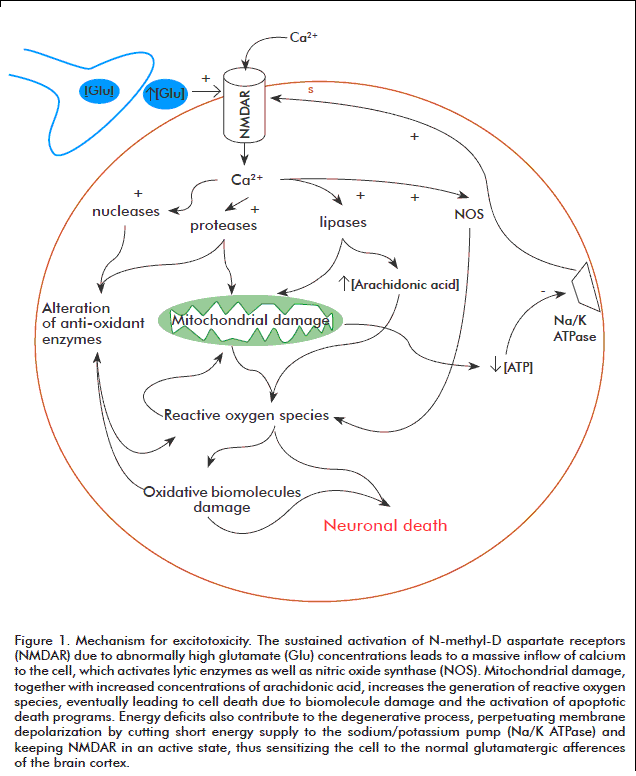
<body><![CDATA[<P   > </P >       <P   ><font size="2" face="Verdana, Arial, Helvetica, sans-serif"><B><font size="3">INTRODUCTION</font>      </b></font></P >       <P   align="justify" ><font size="2" face="Verdana, Arial, Helvetica, sans-serif">Glutamate receptor-mediated      excitotoxicity not only plays an important role in neural development, differentiation      and synaptic plasticity [1, 2], but is regarded as the principal mechanism      for cell death in a number of disorders of the central nervous system (CNS),      including brain trauma, neurodegenerative disorders and epilepsy [3-6]. </font></P >   <FONT size="+1">        <P   align="justify" ><font size="2" face="Verdana, Arial, Helvetica, sans-serif">Glutamate is the      ultimate excitatory neurotransmitter of mammalian CNS. Accurate control of      glutamatergic neurotransmission is of paramount importance, due to its involvement      in both excitotoxic cell death and neural signaling [2]. Early descriptions      of excitotoxicity-mediated cell death mentioned increases in cell volume,      vacuolization of the cytoplasm and loss of membrane integrity; all of which      are consistent with a necrotic mechanism for this event [7-10]. Later evidence,      however, has demonstrated that this process can also be associated with apoptotic      hallmarks such as the degradation of DNA at internucleosomal sites and the      activation of caspases [11-13]. In addition, recent publications have pointed      at autophagy, induced as the result of sustained cellular stress, as the mechanism      behind excitotoxicity-induced non-apoptotic cell death [2]. Increased glutamate      receptor activity levels would, therefore, induce the expression of pro-apoptotic      proteins such as p53, leading to cell damage and death mediated by apoptosis      or autophagy [14-16]. The latter would be induced as a response to acute excitotoxic      damage [17, 18]. </font></P >       <P   align="justify" ><font size="2" face="Verdana, Arial, Helvetica, sans-serif">Despite the large      body of knowledge accrued on the signaling pathways and the sequence of events      taking place during excitotoxicity, little is known about its role in the      CNS or the molecular mechanisms underlying its effects. It is clear, however,      that far from being a uniform process, excitotoxic cell death in the brain      actually represents a continuum going from necrosis to apoptosis and autophagy.      This review discusses the cellular and molecular mechanisms of excitotoxicity      and its effect on the process of neuronal death taking place during epilepsy.      </font></P >       <P   align="justify" >&nbsp;</P >       <P   align="justify" > </P >       <P   ><font size="2" face="Verdana, Arial, Helvetica, sans-serif"><B><font size="3">CONCEPT      OF EXCITOTOXICITY </font></b></font></P >   <FONT size="+1">        <P   align="justify" ><font size="2" face="Verdana, Arial, Helvetica, sans-serif">A number of different      experimental and clinical findings on the potential toxicity of excitatory      aminoacids have provided the foundation for excitotoxic theory, which postulates      the existence of a direct link between neuronal degeneration and glutamate      receptor hypersensitivity or excessive levels of endogenous glutamate [19].      Excitotoxicity is therefore a mechanism promoting cell death through the hyper      activation of glutamatergic receptors or its analogues. This hyper activation      leads to excess calcium (Ca<Sup>2+</Sup>) inflow to the cell, where this ion      is sequestered inside mitochondria, leading to metabolic dysfunction, the      generation of free radicals, the activation of proteases, phospholipases,      endonucleases, nitric oxide synthase, and the inhibition of protein synthesis      [20]. </font></P >   <FONT size="+1"><FONT size="+1"><FONT size="+1">        <P   align="justify" ><font size="2" face="Verdana, Arial, Helvetica, sans-serif">For calcium homeostasis      to be lost, regulatory mechanisms for this ion, including the calcium pump,      the sodium/calcium (Na<Sup>+</Sup>/Ca<Sup>2+</Sup>) exchanger and calcium      buffering proteins, must first be overflowed. Once these systems saturate,      excess calcium accumulates inside the mitochondrial matrix. This accumulation      depolarizes the mitochondrial membrane by two different mechanisms: first,      the increased concentration of positive ions in the mitochondrial matrix decreases      the chemo-osmotic potential across the membrane (leading in turn to reduced      rates of adenosine triphosphate (ATP) synthesis), and second, the activation      of mitochondrial transition pores (a mechanism normally used to shunt calcium      back to the cytosol), which can lead to irreversible membrane depolarization      if calcium unbalance is prolonged [21, 22]. High calcium concentrations in      the mitochondrial matrix also promote the generation of free radicals, which      promote the peroxidation of membrane lipids, the synthesis of nitric oxide      and the activation of enzymes involved in the catabolism of proteins, phospholipids      and nucleic acids. In addition, nitric oxide can act as a retrograde messenger,      further contributing to the excitotoxic effect of glutamate by enhancing its      release from pre-synaptic terminals [23] (<a href="/img/revistas/bta/v30n1/f0102113.gif">Figure 1</a>).      </font></P >   <FONT size="+1"><FONT size="+1"><FONT size="+1"><FONT size="+1">        
]]></body>
<body><![CDATA[<P   align="justify" ><font size="2" face="Verdana, Arial, Helvetica, sans-serif">Additional contributions      to cellular damage are provided by the activation of nitric oxide synthase,      whose reaction products react with superoxide anions to yield peroxynitrite,      and the activation of poly-adenosine diphosphate ribose-polymerase (PARP),      triggered by free radical-mediated DNA damage [24, 25]. </font></P >       <P   align="justify" >&nbsp;</P >       <P   align="justify" > </P >       <P   ><font size="3" face="Verdana, Arial, Helvetica, sans-serif"><B>EXCITOTOXICITY      AND EPILEPSY </b></font></P >   <FONT size="+1">        <P   align="justify" ><font size="2" face="Verdana, Arial, Helvetica, sans-serif">There is evidence      supporting the hypothesis that the neurodegenerative changes associated with      human epilepsy arise from persistent discharges in the glutamate pathway.      The mechanism is relatively simple: excess glutamate release leads to repeated      depolarization-repolarization cycles in glutamate terminals, until glutamate      reaches toxic concentrations and, finally, the excitotoxic degeneration of      post-synaptic neurons takes place [26, 27]. </font></P >   <FONT size="+1">        <P   align="justify" ><font size="2" face="Verdana, Arial, Helvetica, sans-serif">Micro-dialysis studies      in humans and animal models have demonstrated an association between prolonged      convulsive activity and the duration of the epileptic episode due to significant      increases in glutamate levels [28]. It is well known that neuronal over excitation      by glutamate can trigger epileptic seizures, and that the effect of directly      applying glutamate to the amygdala is similar to that of propagated activation      [29]. Using agonists of the &alpha;-amino-3-hydroxy-5-methyl-4-isoxazolpropionic      acid receptor has been shown to delay the development of propagated activation      at the amygdala in mice [30]. </font></P >       <P   align="justify" ><font size="2" face="Verdana, Arial, Helvetica, sans-serif">The activation of      N-methyl-D-aspartate receptors is a mediator of cell death during the epileptic      state [31], and the use of MK-801, an antagonist for this receptor, prevents      the occurrence of spontaneous seizures in animal models [32]. Kainate receptors,      specifically the GluR6 subunit, are known to participate in epileptogenesis      as inducers [33, 34]. </font></P >       <P   align="justify" ><font size="2" face="Verdana, Arial, Helvetica, sans-serif">In general, excitotoxic      damage to the neurons of epileptic patients is mediated by excessive calcium      inflow during seizures [35]. The resulting high levels of calcium trigger      a sequence of events that includes the activation of nitric oxide synthase,      thereby interfering with oxidative metabolism and generating free radicals      that ultimately damage the neuronal membrane. Pro-caspases are activated likewise,      and neuronal death eventually takes place by necrosis, apoptosis or autophagy.      </font></P >       <P   align="justify" >&nbsp;</P >       <P   align="justify" > </P >       ]]></body>
<body><![CDATA[<P   ><font size="2" face="Verdana, Arial, Helvetica, sans-serif"><B><font size="3">EXCITOTOXICITY      IN EXPERIMENTAL MODELS OF EPILEPSY</font> </b></font></P >   <FONT size="+1">        <P   align="justify" ><font size="2" face="Verdana, Arial, Helvetica, sans-serif">The limitations for      studying epilepsy in humans have led to the development of experimental models      reproducing this condition. It should be noticed, however, that existing models      fail to accurately reproduce the behavioral manifestations of this disease,      especially in the case of motor alterations. </font></P >   <FONT size="+1">        <P   align="justify" ><font size="2" face="Verdana, Arial, Helvetica, sans-serif">Animal epilepsy models      are classified as either acute or chronic. The former are implemented through      the delivery of convulsant drugs or the application of electrical stimulation;      the latter, while harder to implement, provide a closer approximation to the      physiopathology of this disorder in humans, although both are capable of producing      partial and generalized seizures. In addition, true epilepsy models reproduce      the recurrence of ictal manifestations characterizing this disease in humans.      The ultimate challenge when using experimental models to study epilepsy is      to determine which, of the many alterations stemming from a specific brain      injury, is causally linked to the subsequent development of epilepsy. </font></P >       <P   align="justify" ><font size="2" face="Verdana, Arial, Helvetica, sans-serif">Oxidative stress      plays an important role in cellular damage and death induced by recurrent      seizures. The free radicals generated during oxidative stress have long been      acknowledged as part and parcel of excitotoxicity, due in part to the fact      that prolonged, sustained seizures generate macromolecular damage in the cells      that is related, above all, to neuronal excitability. </font></P >       <P   align="justify" ><font size="2" face="Verdana, Arial, Helvetica, sans-serif">Animal models have      been used to study two specific types of epileptic events: prolonged (20 to      30 min) febrile crises and long epileptic seizures (5 to 6 h), the latter      induced through the systemic delivery of cholinergic agonists (pilocarpine)      or by unilateral injection of glutamatergic agonists into the hippocampus      of experimental rats (kainic acid, a glutamate analog). Using models of febrile      crises, neonatal hypoxia and spasms, it has been possible to demonstrate that      developing neurons are less vulnerable to cellular damage and survive much      better than fully grown neurons. For instance, the hippocampal neurons of      animals with immature brains placed under an anoxic environment continue to      react to synaptic stimuli for a longer time and require more prolonged exposures      to completely and irreversibly destroy their neural circuits [36]. Immature      brains also appear to be more resistant to the toxic effects of glutamate      than mature ones [37]. Mark <I>et al</I>. [38] demonstrated that the amount      of calcium entering a pyramidal neuron is directly related to the animal&rsquo;s      age: during the first three days of life, glutamate increases calcium concentration      only by marginal amounts; however, in days 21 to 25 there is a marked increase      in intracellular calcium concentration and soma volume, while dendrites retract.      This relatively higher resistance stems from a lower density of active synapses,      lower energy requirements and, in general, the relative immaturity of the      biochemical cascades leading to cell death, explaining why young individuals      are less vulnerable than adults to the cell loss taking place after prolonged      epileptic seizures [39-41]. </font></P >       <P   align="justify" ><font size="2" face="Verdana, Arial, Helvetica, sans-serif">The most popular      models of excitotoxicity employing adult animals are those based on the use      of kainic acid and pilocarpine. These are models of epilepsy of the temporal      lobe, induced by the unilateral or systemic injection of these compounds at      convulsant doses, causing excitotoxic damage at the pyramidal neurons of hippocampus      and the hilar region. Damage depends on dosage, species and line of the animal,      but the result in all cases is neuronal death at vulnerable regions, the proliferation      of astrocytes and increased glial fibers. For these reasons, the models based      on systemically administering kainic acid or pilocarpine are widely used for      studying generalized tonic-clonic convulsions or the epileptic state, whose      neuroanatomical substrate is temporal mesial sclerosis [42-46]. </font></P >       <P   align="justify" ><font size="2" face="Verdana, Arial, Helvetica, sans-serif">One of the first      changes taking place after the injection of kainic acid is the induction of      messenger RNA (mRNA) coding for heat shock proteins (HSPs) of varying molecular      weights (HSP27, HSP70 and HSP72), whose expression levels increase consequently.      HSP72, particularly, is constitutively expressed in the mammalian brain, and      exhibits increased concentrations among sensitive neuronal populations of      the hippocampus [47]. The expression of these chaperones seems to prevent      the misfolding of newly synthesized proteins in kainic acid-vulnerable populations.      During the two weeks following administration of the convulsant, these proteins      are transported to the most distal zones along dendrites and axons. Both HSP70      and HSP72 have been shown to play a protective role in this process, although      they are unable to rescue damaged cells from excitotoxic death. While the      overexpression of HSP27 and HSP70 <I>in vivo </I>protects from excitotoxic      damage [47, 48], excessively high levels of HSP72 can be noxious to the cell      [49-51]. </font></P >       <P   align="justify" ><font size="2" face="Verdana, Arial, Helvetica, sans-serif">Three to five hours      after the injection of kainic acid, mRNA coding for cFos and cJun are also      induced, increasing the concentrations of their respective proteins at vulnerable      regions of the hippocampus and dentate gyrus [52]. cFos immunoreactivity at      the dentate gyrus disappears after six hours, but remains high at the hippocampus,      suggesting an association of cell death with high cFos levels. However, a      prolonged increase in cFos is poorly predictive, and is not a necessary condition      for neuronal excitotoxic damage to take place [53, 54]. cJun levels have also      been found to be high at the hippocampus and the dentate circumvolution for      24 hours after an epileptic seizure. The meaning of this increase is unclear,      as cJun is considered both a marker of delayed cell death after epileptic      seizures, and a potential marker for neuronal survival upon excitotoxic damage      [52]. </font></P >       <P   align="justify" ><font size="2" face="Verdana, Arial, Helvetica, sans-serif">Regarding signaling      mechanisms across the cell membrane, it has been observed that tissue plasminogen      activator (tPA), an extracellular serine protease, appears to be necessary      for cell death to take place, as knock-out tPA or plasminogen mice are relatively      resistant to excitotoxicity. This effect seems to be mediated by the interaction      of tPA with laminin, an extracellular matrix protein [55]. In addition, it      has been shown that increases in the expression of the specific Fas receptor      ligand (FasL) at hippocampus and granule cells of the dentate gyrus, three      hours after the injection of kainic acid, are related with signaling across      the cell membrane [56]. FasL expression at the granule cells of the dentate      gyrus decreases six hours after the administration of kainic acid, although      FasL immunoreactivity remains high at the hippocampus. The relevance of the      latter finding is highlighted by the fact that binding of FasL to Fas activates      its death domain, to which the Fas-associated death domain (FADD) then binds,      activating in turn caspase 8, which acts upon effector caspases leading to      cell death by apoptosis. The availability of Fas transgenic mice has been      invaluable for examining the role of the Fas/FasL system in excitotoxic cell      death signaling [56]. </font></P >       <P   align="justify" ><font size="2" face="Verdana, Arial, Helvetica, sans-serif">The role of members      of the <I>bcl-2 </I>gene family in this process remains to be elucidated.      A preliminary study observed reductions in the concentration of the Bcl-2      protein and increases in Bax mRNA in mouse hippocampus after the systemic      administration of kainic acid [57]. Finer studies employing Northern blotting      have detected that Bax mRNA (but not those coding for Bcl-2 and Bcl-x) is      induced from hour 6 to 24 at the hippocampus of rats receiving kainic acid.      The hippocampal concentration of Bcl-2, Bcl-x and Bax, measured by Western      blotting and immunohistochemistry, is similar in cells that eventually die      and in survivors [58]. Possibly, the effects exerted by members of the Bcl-2      family do not depend on global changes at the protein level, but rather on      changes of their subcellular location. Apoptotic cell signaling through the      mitochondrial pathway is triggered by Bax binding to the mitochondrial membrane      and the release of cytochrome c to the cytosol, followed by binding to the      apoptotic protease activation factor Apaf1 in the presence of ATP as well      as the activation of caspase 9, which in turn activates different effector      caspases. The mechanism whereby cytochrome c is released from the mitochondria      into the cytosol remains unclear, but seems to require an interaction between      Bcl-2, Bcl-x, Bax, and voltage-dependent ion channels controlling the release      of cytochrome c. It has been argued that the Bax/Bcl-2 ratio plays an essential      role in determining whether the cell enters apoptosis [59]. </font></P >       ]]></body>
<body><![CDATA[<P   align="justify" ><font size="2" face="Verdana, Arial, Helvetica, sans-serif">Excitotoxicity resulting      from the intraperitoneally delivery of kainic acid also induces the caspase      3 mRNA and increases procaspase 3 levels in some neurons at vulnerable regions      of the hippocampus [60, 61]. Some neurons express the active (cleaved-off)      17 kDa fragment of caspase 3 [62], demonstrating the involvement of caspases      in at least some hippocampal neurons and, therefore, the existence of an apoptotic      component for cell death in hippocampal subpopulations. It should be noted,      however, that Western blotting experiments have demonstrated the presence      of PARP bands of 89 kDa and lower molecular weights, evidencing that fragmentation      of the latter also involves proteases other than caspases and suggesting indiscriminate      death by necrosis [61]. </font></P >       <P   align="justify" ><font size="2" face="Verdana, Arial, Helvetica, sans-serif">One result of excitotoxic      damage affecting preferentially hilar region cells [63] is that mossy fibers      from the granule cells of the dentate gyrus become disconnected from their      targets. This differentiation results in the sprouting of mossy axonal branches      along the supragranular region and the molecular layer of the dentate gyrus      [64, 65]. However, fiber sprouting after seizures is less evident in young      animals [10, 66]. Fiber sprouting is associated with the expression of GAP-43      at the supragranular layer during the first week, and at the entire molecular      layer after a month [67]. An increase of the 25 kDa synaptosome-associated      protein (SNAP25) has been detected at neurons and the molecular layer of the      dentate gyrus during the days following kainic acid-induced excitotoxic injuries      [68, 69]. The participation of specific trophic signals in the development      of these aberrant connections seems likely, but their function remains contentious.      Brain-derived neurotrophic factor, as well as the TrkB receptor in dentate      gyrus neurons, possibly modulate the trophism of these cells during the formation      of plastic ramifications to re-innervate the zones destroyed by kainic acid.      It has also been suggested that brain-derived neurotrophic factor plays a      protective role by attenuating oxidative stress [70, 71]. </font></P >       <P   align="justify" >&nbsp;</P >       <P   align="justify" > </P >       <P   ><font size="2" face="Verdana, Arial, Helvetica, sans-serif"><B><font size="3">NEURONAL      DEATH AND EPILEPSY </font></b></font></P >   <FONT size="+1">        <P   align="justify" ><font size="2" face="Verdana, Arial, Helvetica, sans-serif">Apoptosis is a characteristic      form of programmed cell death that is under control of a common genetic program      across differing cell types. It is usually triggered at the level of individual      cells, rather than at the level of entire tissues. Among the first morphological      changes cells exhibit when the apoptotic process starts are the condensation      of their cytoplasm and cell shrinkage, together with changes in nuclear structure.      Chromatin is condensed and forms dense, compact patches against the nuclear      envelope, after which the latter forms invaginations and the nucleus is fragmented      into membranous structures containing variable amounts of chromatin. In a      similar manner, the cell membrane starts producing blebs and ends up fragmented      in clusters of variable-sized vesicles containing intact organelles that are      not fused with lysosomes. These vesicles, denominated apoptotic bodies, are      quickly phagocytosed by neighboring cells. One of the most physiologically      relevant consequences of neuron death by apoptosis is, therefore, that no      intracellular material is released to the interstitial milieu [72]. </font></P >   <FONT size="+1">        <P   align="justify" ><font size="2" face="Verdana, Arial, Helvetica, sans-serif">Seizure-induced neuronal      death does not negate the molecular complexity of neural death due to neurodegeneration.      Whether neuronal death is apoptotic or necrotic remains controversial. Based      on the classical definition and the morphological features typical of necrosis,      this constitutes the most frequent mechanism of death for brain neurons after      a seizure [7-10, 13, 73], and many authors argue that neuronal death by necrosis      is the dominant post-seizure cell death mechanism [73, 74]. However, the involvement      of apoptosis cannot be readily dismissed, as biochemical studies have established      that members of the Bcl-2 family and caspases are involved in post-seizure      cell death. In addition, DNA fragments whose sizes are multiples of 180-200      base pairs, early endonuclease activation and DNA fragmentation (originally      described as apoptotic hallmarks) have all been found in cells programmed      to die, and p53 has been shown to accumulate at the nucleus of kainic acid-vulnerable      neurons, concurrently with increases in the concentration of cell death receptors      and their ligands. Apoptotic mechanisms are, therefore, involved in the process      of cell death [11-13, 75-78]. </font></P >       <P   align="justify" ><font size="2" face="Verdana, Arial, Helvetica, sans-serif">Alterations in the      Bcl-2 family of proteins and the proteolytic cleavage of pro-caspases 1 and      3 have been described, in addition to the detection of several markers of      apoptotic cell death in different experimental models of epilepsy: caspases      are activated by seizures, as are neuronal death receptors and Bcl-2 family      members [62, 76, 78-83]. Increases in serum Bcl-2 for patients with temporal      lobe epilepsy have been found to correlate with the duration of the disease,      seizure frequency and disorder severity [84]. </font></P >       <P   align="justify" ><font size="2" face="Verdana, Arial, Helvetica, sans-serif">Gene <I>p53</I> was      the first apoptotic regulator found to be damaged by seizures [85]. It has      been shown that levels of both its mRNA and the protein itself increase, based      functionally on 1) the binding of p53 to DNA takes place after the seizures      [86], and 2) the expression of Bax increases with the seizures [57, 87]. A      known inhibitor of p53 synthesis has been shown to protect against kainic      acid excitotoxicity [88]. <I>p53</I>-defficient mouse neurons are resistant      to seizures and apoptosis induced by excitotoxins [89]. However, the consequences      of p53 alterations on seizure-induced neuronal death are not completely clear,      due to the multiple roles of p53. In general, the data support that caspases,      Bcl-2 and p53 all get involved in some form after seizures. </font></P >       <P   align="justify" ><font size="2" face="Verdana, Arial, Helvetica, sans-serif">We have discussed      the classical division into apoptosis or necrosis; two processes that can      take place independently, sequentially and even simultaneously [79, 90], depending      on stimulus type and intensity. A model is suggested providing continuity      between the classical apoptotic cascade mediated by caspases and cellular      necrosis or lysis [91]. Intermediate scenarios would be 1) programmed cell      death, similar to apoptosis, 2) caspase-independent cell death and 3) programmed      cell death, similar to necrosis. This criterion is important, especially for      analyzing cell death during neurological processes [92]. </font></P >       ]]></body>
<body><![CDATA[<P   align="justify" ><font size="2" face="Verdana, Arial, Helvetica, sans-serif">A study performed      by our group on drug-resistant temporal lobe epilepsy patients demonstrated      the involvement of both neuronal death processes (necrosis and apoptosis),      as evidenced by increased immunoreactivity to Annexin V and by the results      of a Tunnel assay in neocortical tissue (<a href="/img/revistas/bta/v30n1/f0202113.gif">Figure 2</a>).      This indicated that cell death in this brain area might be apoptotic, without      dismissing the possibility of necrotic cell death, as the Tunnel+ marker has      been shown to associate with both processes [93]. In addition, we demonstrated      the presence of redox unbalances in these patients [94], a phenomenon that      would lead to cell death due to mitochondrial dysfunction caused by mitochondrial      membrane depolarization. During later studies by electron microscopy, we were      able to observe both necrotic and apoptotic cells in these tissues (<a href="/img/revistas/bta/v30n1/f0302113.gif">Figure      3</a>). These evidences may help in the development of neuroprotective strategies      against the cell death processes triggered by epilepsy. </font></P >       
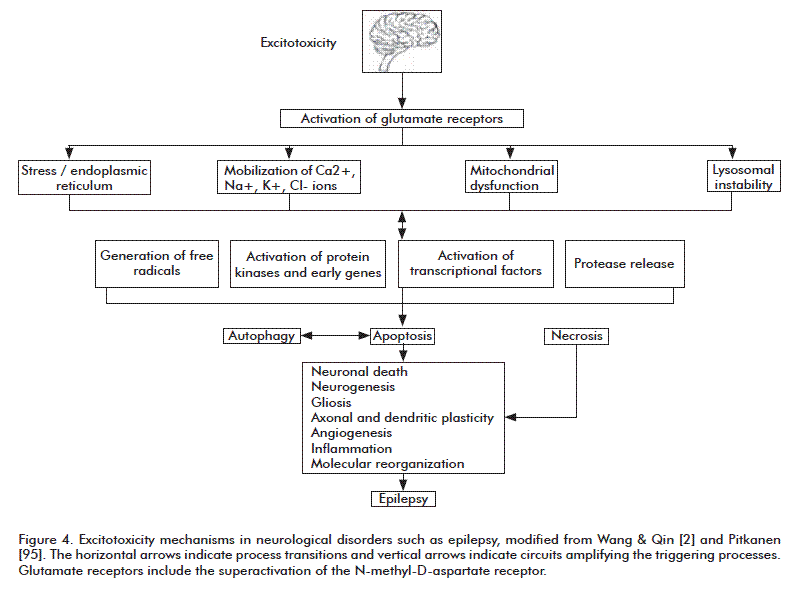
<P   align="justify" >&nbsp;</P >       <P   align="justify" > </P >       <P   ><font size="3" face="Verdana, Arial, Helvetica, sans-serif"><B>CONCLUSIONS </b></font></P >   <FONT size="+1">        <P   align="justify" ><font size="2" face="Verdana, Arial, Helvetica, sans-serif">Contradictory findings      regarding epilepsy abound in the experimental literature, due among other      causes to the many models currently in use and difficulties inherent to trying      to reproduce all the characteristics of this disease in different species.      Studies in humans have targeted different locations of epileptogenic foci,      times of evolution of the disorder, type and age at first seizure and other      parameters. Further research is undoubtedly required to completely characterize      the action of these cell death mechanisms during seizures, in order to establish      an interaction procedure that can attenuate epileptic damage (<a href="/img/revistas/bta/v30n1/f0402113.gif">Figure      4</a>) summarizes the proposed mechanisms for excitotoxicity during neurological      disorders. </font></P >   <FONT size="+1">        
<P   align="justify" ><font size="2" face="Verdana, Arial, Helvetica, sans-serif">Although the signaling      pathways and sequence of events taking place during excitotoxicity have been      extensively studied since the 1970s, knowledge about excitotoxicity in the      CNS, its molecular mechanisms and action sites is still lacking. Careful evaluations      of the essential roles of both neuronal death and the mechanisms recruited      during overexcitation of glutamate receptors in neurological disorders are      necessary to devise timely clinical interventions that can delay the development      of diseases such as epilepsy. The most recent findings have demonstrated the      convergence of excitotoxic processes together with apoptotic and necrotic      neuronal death in drug-resistant epilepsy. </font></P >       <P   >&nbsp;</P >   <FONT size="+1"><B>        <P   ><font size="3" face="Verdana, Arial, Helvetica, sans-serif">ACKNOWLEDGEMENTS      </font></P >   </B>        <P   align="justify" ><font size="2" face="Verdana, Arial, Helvetica, sans-serif">We would like to      acknowledge the contributions of licentiates Leticia Neri Baz&aacute;n and      H&eacute;ctor V&aacute;zquez Espinosa, as well as the support of the Unit      for Medical Research on Neurological Disorders of the Specialty Hospital,      20<Sup>th</Sup> Century National Medical Center, belonging to the Mexican      Welfare Institute (IMSS). This research was funded by Conacyt (project 98386).      </font></P >       <P   align="justify" >&nbsp;</P >   <FONT size="+1"><FONT size="+1"><FONT size="+1">        ]]></body>
<body><![CDATA[<P   align="justify" > </P >       <P   align="justify" ><font size="3" face="Verdana, Arial, Helvetica, sans-serif"><B>REFERENCES </b></font></P >       <!-- ref --><P   align="justify" ><font size="2" face="Verdana, Arial, Helvetica, sans-serif">1. Yang JL, Sykora      P, Wilson DM, 3rd, Mattson MP, Bohr VA. The excitatory neurotransmitter glutamate      stimulates DNA repair to increase neuronal resiliency. Mech Ageing Dev. 2011;132(8-9):405-11.          </font></P >   <FONT size="+1">        <!-- ref --><P   align="justify" ><font size="2" face="Verdana, Arial, Helvetica, sans-serif">2. Wang Y, Qin ZH.      Molecular and cellular mechanisms of excitotoxic neuronal death. Apoptosis.      2010; 15(11):1382-402.     </font></P >   <FONT size="+1">        <!-- ref --><P   align="justify" ><font size="2" face="Verdana, Arial, Helvetica, sans-serif">3. Severino PC, Muller      Gdo A, Vandresen-Filho S, Tasca CI. Cell signaling in NMDA preconditioning      and neuroprotection in convulsions induced by quinolinic acid. Life Sci. 2011;89(15-16):570-6.          </font></P >   <FONT size="+1">        <!-- ref --><P   align="justify" ><font size="2" face="Verdana, Arial, Helvetica, sans-serif">4. Araujo IM, Carreira      BP, Carvalho CM, Carvalho AP. Calpains and delayed calcium deregulation in      ex-citotoxicity. Neurochem Res. 2010; 35(12):1966-9.     </font></P >       ]]></body>
<body><![CDATA[<!-- ref --><P   align="justify" ><font size="2" face="Verdana, Arial, Helvetica, sans-serif">5. Wang Y, Denisova      JV, Kang KS, Fontes JD, Zhu BT, Belousov AB. Neuronal gap junctions are required      for NMDA receptor-mediated excitotoxicity: implications in ischemic stroke.      J Neurophysiol. 2010;104(6):3551-6.     </font></P >       <!-- ref --><P   align="justify" ><font size="2" face="Verdana, Arial, Helvetica, sans-serif">6. Farooqui AA, Ong      WY, Horrocks LA. Glutamate receptors and their association with other neurochemical      parameters in excitotoxicity. In: Farooqui AA, Ong WY, Horrocks LA, editors.      Neurochemical aspects of excitotoxicity. New York: Springer; 2008. p. 105-36.          </font></P >       <!-- ref --><P   align="justify" ><font size="2" face="Verdana, Arial, Helvetica, sans-serif">7. Fujikawa DG, Shinmei      SS, Cai B. Kainic acid-induced seizures produce necrotic, not apoptotic, neurons      with internucleosomal DNA cleavage: implications for programmed cell death      mechanisms. Neuroscience. 2000;98(1):41-53.     </font></P >       <!-- ref --><P   align="justify" ><font size="2" face="Verdana, Arial, Helvetica, sans-serif">8. Fujikawa DG, Shinmei      SS, Cai B. Seizure-induced neuronal necrosis: implications for programmed      cell death mechanisms. Epilepsia. 2000; 41 Suppl 6:S9-13.     </font></P >       <!-- ref --><P   align="justify" ><font size="2" face="Verdana, Arial, Helvetica, sans-serif">9. Ebert U, Brandt      C, Loscher W. Delayed sclerosis, neuroprotection, and limbic epileptogenesis      after status epilepticus in the rat. Epilepsia. 2002;43 Suppl 5:86-95.     </font></P >       ]]></body>
<body><![CDATA[<!-- ref --><P   align="justify" ><font size="2" face="Verdana, Arial, Helvetica, sans-serif">10. Kubova H, Druga      R, Lukasiuk K, Suchomelova L, Haugvicova R, Jirmanova I, <I>et al</I>. Status      epilepticus causes necrotic damage in the mediodorsal nucleus of the thalamus      in immature rats. J Neurosci. 2001; 21(10):3593-9.     </font></P >       <!-- ref --><P   align="justify" ><font size="2" face="Verdana, Arial, Helvetica, sans-serif">11. Bengzon J, Mohapel      P, Ekdahl CT, Lindvall O. Neuronal apoptosis after brief and prolonged seizures.      Prog Brain Res. 2002;135:111-9.     </font></P >       <!-- ref --><P   align="justify" ><font size="2" face="Verdana, Arial, Helvetica, sans-serif">12. Henshall DC,      Araki T, Schindler CK, Lan JQ, Tiekoter KL, Taki W, <I>et al</I>. Activation      of Bcl-2-associated death protein and counter-response of Akt within cell      populations during seizure-induced neuronal death. J Neurosci. 2002;22(19):8458-65.          </font></P >       <!-- ref --><P   align="justify" ><font size="2" face="Verdana, Arial, Helvetica, sans-serif">13. Liou AK, Clark      RS, Henshall DC, Yin XM, Chen J. To die or not to die for neurons in ischemia,      traumatic brain injury and epilepsy: a review on the stress-activated signaling      pathways and apoptotic pathways. Prog Neurobiol. 2003;69(2):103-42.     </font></P >       <!-- ref --><P   align="justify" ><font size="2" face="Verdana, Arial, Helvetica, sans-serif">14. Dong XX, Wang      Y, Qin ZH. Molecular mechanisms of excitotoxicity and their relevance to pathogenesis      of neurodegenerative diseases. Acta Pharmacol Sin. 2009;30(4):379-87.     </font></P >       ]]></body>
<body><![CDATA[<!-- ref --><P   align="justify" ><font size="2" face="Verdana, Arial, Helvetica, sans-serif">15. Qin ZH, Tao LY,      Chen X. Dual roles of NF-kappaB in cell survival and implications of NF-kappaB      inhibitors in neuroprotective therapy. Acta Pharmacol Sin 2007;28(12):1859-72.          </font></P >       <!-- ref --><P   align="justify" ><font size="2" face="Verdana, Arial, Helvetica, sans-serif">16. Zhang XD, Wang      Y, Zhang X, Han R, Wu JC, Liang ZQ, <I>et al</I>. p53 mediates mitochondria      dysfunction-triggered autophagy activation and cell death in rat striatum.      Autophagy. 2009;5(3):339-50.     </font></P >       <!-- ref --><P   align="justify" ><font size="2" face="Verdana, Arial, Helvetica, sans-serif">17. Shacka JJ, Lu      J, Xie ZL, Uchiyama Y, Roth KA, Zhang J. Kainic acid induces early and transient      autophagic stress in mouse hippocampus. Neurosci Lett. 2007;414(1):57-60.          </font></P >       <!-- ref --><P   align="justify" ><font size="2" face="Verdana, Arial, Helvetica, sans-serif">18. Wang Y, Dong      XX, Cao Y, Liang ZQ, Han R, Wu JC, <I>et al</I>. p53 induction contributes      to excitotoxic neuronal death in rat striatum through apoptotic and autophagic      mechanisms. Eur J Neurosci. 2009; 30(12):2258-70.     </font></P >       <!-- ref --><P   align="justify" ><font size="2" face="Verdana, Arial, Helvetica, sans-serif">19. Olney JW. Excitatory      transmitters and epilepsy-related brain damage. Int Rev Neurobiol. 1985;27:337-62.          </font></P >       ]]></body>
<body><![CDATA[<!-- ref --><P   align="justify" ><font size="2" face="Verdana, Arial, Helvetica, sans-serif">20. Haglid KG, Wang      S, Qiner Y, Hamberger A. Excitotoxicity. Experimental correlates to human      epilepsy. Mol Neurobiol. 1994;9(1-3):259-63.     </font></P >       <!-- ref --><P   align="justify" ><font size="2" face="Verdana, Arial, Helvetica, sans-serif">21. Nicholls DG,      Ward MW. Mitochondrial membrane potential and neuronal glutamate excitotoxicity:      mortality and millivolts. Trends Neurosci. 2000;23(4):166-74.     </font></P >       <!-- ref --><P   align="justify" ><font size="2" face="Verdana, Arial, Helvetica, sans-serif">22. Murchison D,      Griffith WH. Mitochondria buffer non-toxic calcium loads and release calcium      through the mitochondrial permeability transition pore and sodium/calcium      exchanger in rat basal forebrain neurons. Brain Res. 2000;854(1-2):139-51.          </font></P >       <!-- ref --><P   align="justify" ><font size="2" face="Verdana, Arial, Helvetica, sans-serif">23. Almeida A, Heales      SJ, Bolanos JP, Medina JM. Glutamate neurotoxicity is associated with nitric      oxide-mediated mitochondrial dysfunction and glutathione depletion. Brain      Res. 1998;790(1-2):209-16.     </font></P >       <!-- ref --><P   align="justify" ><font size="2" face="Verdana, Arial, Helvetica, sans-serif">24. Olney JW. New      insights and new issues in developmental neurotoxicology. Neurotoxicology.      2002;23(6):659-68.     </font></P >       ]]></body>
<body><![CDATA[<!-- ref --><P   align="justify" ><font size="2" face="Verdana, Arial, Helvetica, sans-serif">25. Struzynska L.      A glutamatergic component of lead toxicity in adult brain: the role of astrocytic      glutamate transporters. Neurochem Int. 2009;55(1-3):151-6.     </font></P >       <!-- ref --><P   align="justify" ><font size="2" face="Verdana, Arial, Helvetica, sans-serif">26. Pereno GL. Fisiopatolog&iacute;a      de la epilepsia del l&oacute;bulo temporal: revisi&oacute;n del proceso de      muerte neuronal a la neuroplasticidad. Rev Argentina Cienc Comportamiento.      2010;2(1):46-57.     </font></P >       <!-- ref --><P   align="justify" ><font size="2" face="Verdana, Arial, Helvetica, sans-serif">27. Eid T, Williamson      A, Lee TS, Petroff OA, de Lanerolle NC. Glutamate and astrocytes-key players      in human mesial temporal lobe epilepsy? Epilepsia. 2008;49 Suppl 2:42-52.          </font></P >       <!-- ref --><P   align="justify" ><font size="2" face="Verdana, Arial, Helvetica, sans-serif">28. Ueda Y, Yokoyama      H, Nakajima A, Tokumaru J, Doi T, Mitsuyama Y. Glutamate excess and free radical      formation during and following kainic acid-induced status epilepticus. Exp      Brain Res. 2002;147(2):219-26.     </font></P >       <!-- ref --><P   align="justify" ><font size="2" face="Verdana, Arial, Helvetica, sans-serif">29. Morimoto K, Fahnestock      M, Racine RJ. Kindling and status epilepticus models of epilepsy: rewiring      the brain. Prog Neurobiol. 2004; 73(1):1-60.     </font></P >       ]]></body>
<body><![CDATA[<!-- ref --><P   align="justify" ><font size="2" face="Verdana, Arial, Helvetica, sans-serif">30. Rogawski MA,      Kurzman PS, Yamaguchi SI, Li H. Role of AMPA and GluR5 kainate receptors in      thedevelopment and expression of amygdala kindling in the mouse. Neuropharmacology.      2001;40(1): 28-35.     </font></P >       <!-- ref --><P   align="justify" ><font size="2" face="Verdana, Arial, Helvetica, sans-serif">31. Deshpande LS,      Lou JK, Mian A, Blair RE, Sombati S, Attkisson E, <I>et al</I>. Time course      and mechanism of hippocampal neuronal death in an in vitro model of status      epilepticus: role of NMDA receptor activation and NMDA dependent calcium entry.      Eur J Pharmacol. 2008;583(1):73-83.     </font></P >       <!-- ref --><P   align="justify" ><font size="2" face="Verdana, Arial, Helvetica, sans-serif">32. Rice AC, DeLorenzo      RJ. NMDA receptor activation during status epilepticus is required for the      development of epilepsy. Brain Res. 1998; 782(1-2):240-7.     </font></P >       <!-- ref --><P   align="justify" ><font size="2" face="Verdana, Arial, Helvetica, sans-serif">33. Ullal G, Fahnestock      M, Racine R. Time-dependent effect of kainate-induced seizures on glutamate      receptor GluR5, GluR6, and GluR7 mRNA and Protein Expression in rat hippocampus.      Epilepsia. 2005;46(5):616-23.     </font></P >       <!-- ref --><P   align="justify" ><font size="2" face="Verdana, Arial, Helvetica, sans-serif">34. Vincent P, Mulle      C. Kainate receptors in epilepsy and excitotoxicity. Neuroscience. 2009;158(1):309-23.          </font></P >       ]]></body>
<body><![CDATA[<!-- ref --><P   align="justify" ><font size="2" face="Verdana, Arial, Helvetica, sans-serif">35. Lado FA, Laureta      EC, Moshe SL. Seizure-induced hippocampal damage in the mature and immature      brain. Epileptic Disord. 2002;4(2):83-97.     </font></P >       <!-- ref --><P   align="justify" ><font size="2" face="Verdana, Arial, Helvetica, sans-serif">36. Cherubini E,      Ben-Ari Y, Krnjevic K. Anoxia produces smaller changes in synaptic transmission,      membrane potential, and input resistance in immature rat hippocampus. J Neurophysiol.      1989;62(4):882-95.     </font></P >       <!-- ref --><P   align="justify" ><font size="2" face="Verdana, Arial, Helvetica, sans-serif">37. Stafstrom CE,      Holmes GL. Effects of uncontrolled seizures. Neural changes in animal models.      Adv Exp Med Biol. 2002;497:171-94.     </font></P >       <!-- ref --><P   align="justify" ><font size="2" face="Verdana, Arial, Helvetica, sans-serif">38. Marks JD, Friedman      JE, Haddad GG. Vulnerability of CA1 neurons to glutamate is developmentally      regulated. Brain Res Dev Brain Res. 1996; 97(2):194-206.     </font></P >       <!-- ref --><P   align="justify" ><font size="2" face="Verdana, Arial, Helvetica, sans-serif">39. Albala BJ, Moshe      SL, Okada R. Kainic-acid-induced seizures: a developmental study. Brain Res.      1984;315(1):139-48.     </font></P >       ]]></body>
<body><![CDATA[<!-- ref --><P   align="justify" ><font size="2" face="Verdana, Arial, Helvetica, sans-serif">40. Bender R, Baram      TZ. Do prolonged febrile seizures injury hippocampal neurons? Insights from      animal models. In: Baram TZ, Shinnar S. editors. Febrile seizures. San Diego:      Academic Press. 2002. p.583-7.     </font></P >       <!-- ref --><P   align="justify" ><font size="2" face="Verdana, Arial, Helvetica, sans-serif">41. Berger ML, Tremblay      E, Nitecka L, Ben-Ari Y. Maturation of kainic acid seizure-brain damage syndrome      in the rat. III. Postnatal development of kainic acid binding sites in the      limbic system. Neuroscience. 1984;13(4):1095-104.     </font></P >       <!-- ref --><P   align="justify" ><font size="2" face="Verdana, Arial, Helvetica, sans-serif">42. Ben-Ari Y, Tremblay      E, Riche D, Ghilini G, Naquet R. Electrographic, clinical and pathological      alterations following systemic administration of kainic acid, bicuculline      or pentetrazole: metabolic mapping using the deoxyglucose method with special      reference to the pathology of epilepsy. Neuroscience. 1981;6(7):1361-91.     </font></P >       <!-- ref --><P   align="justify" ><font size="2" face="Verdana, Arial, Helvetica, sans-serif">43. Ben-Ari Y. Limbic      seizure and brain damage produced by kainic acid: mechanisms and relevance      to human temporal lobe epilepsy. Neuroscience. 1985;14(2):375-403.     </font></P >       <!-- ref --><P   align="justify" ><font size="2" face="Verdana, Arial, Helvetica, sans-serif">44. Schwob JE, Fuller      T, Price JL, Olney JW. Widespread patterns of neuronal damage following systemic      or intracerebral injections of kainic acid: a histological study. Neuroscience.      1980; 5(6):991-1014.     </font></P >       ]]></body>
<body><![CDATA[<!-- ref --><P   align="justify" ><font size="2" face="Verdana, Arial, Helvetica, sans-serif">45. Sloviter RS.      The neurobiology of temporal lobe epilepsy: too much information, not enough      knowledge. C R Biol. 2005;328(2):143-53.     </font></P >       <!-- ref --><P   align="justify" ><font size="2" face="Verdana, Arial, Helvetica, sans-serif">46. Sperk G, Lassmann      H, Baran H, Seitelberger F, Hornykiewicz O. Kainic acid-induced seizures:      dose-relationship of behavioural, neurochemical and histopathological changes.      Brain Res. 1985;338(2):289-95.     </font></P >       <!-- ref --><P   align="justify" ><font size="2" face="Verdana, Arial, Helvetica, sans-serif">47. Anguelova E,      Smirnova T. Differential expression of small heat shock protein 27 in the      rat hippocampus and septum after fimbria-fornix lesion. Neurosci Lett. 2000;280(2):99-102.          </font></P >       <!-- ref --><P   align="justify" ><font size="2" face="Verdana, Arial, Helvetica, sans-serif">48. Valentim LM,      Geyer AB, Tavares A, Cimarosti H, Worm PV, Rodnight R, <I>et al</I>. Effects      of global cerebral ischemia and preconditioning on heat shock protein 27 immunocontent      and phosphorylation in rat hippocampus. Neuroscience. 2001;107(1):43-9.     </font></P >       <!-- ref --><P   align="justify" ><font size="2" face="Verdana, Arial, Helvetica, sans-serif">49. Planas AM, Soriano      MA, Estrada A, Sanz O, Martin F, Ferrer I. The heat shock stress response      after brain lesions: induction of 72 kDa heat shock protein (cell types involved,      axonal transport, transcriptional regulation) and protein synthesis inhibition.      Prog Neurobiol. 1997;51(6):607-36.     </font></P >       ]]></body>
<body><![CDATA[<!-- ref --><P   align="justify" ><font size="2" face="Verdana, Arial, Helvetica, sans-serif">50. Planas AM, Soriano      MA, Ferrer I, Rodriguez Farre E. Kainic acid-induced heat shock protein-70,      mRNA and protein expression is inhibited by MK-801 in certain rat brain regions.      Eur J Neurosci. 1995;7(2):293-304.     </font></P >       <!-- ref --><P   align="justify" ><font size="2" face="Verdana, Arial, Helvetica, sans-serif">51. Yenari MA, Fink      SL, Sun GH, Chang LK, Patel MK, Kunis DM, <I>et al</I>. Gene therapy with      HSP72 is neuroprotective in rat models of stroke and epilepsy. Ann Neurol.      1998;44(4):584-91.     </font></P >       <!-- ref --><P   align="justify" ><font size="2" face="Verdana, Arial, Helvetica, sans-serif">52. Pozas E, Ballabriga      J, Planas AM, Ferrer I. Kainic acid-induced excitotoxicity is associated with      a complex c-Fos and c-Jun response which does not preclude either cell death      or survival. J Neurobiol. 1997;33(3):232-46.     </font></P >       <!-- ref --><P   align="justify" ><font size="2" face="Verdana, Arial, Helvetica, sans-serif">53. Gass P, Herdegen      T. Neuronal expression of AP1 proteins in excitotoxic neurodegenerative disorders      and following nerve fiber lesions. Progr Neurobiol. 1995;47(4-5):257-90.     </font></P >       <!-- ref --><P   align="justify" ><font size="2" face="Verdana, Arial, Helvetica, sans-serif">54. Kasof GM, Mandelzys      A, Maika SD, Hammer RE, Curran T, Morgan JI. Kainic acid-induced neuronal      death is associated with DNA damage and a unique immediate-early gene response      in c-fos-lacZ transgenic rats. J Neurosci. 1995;15(6):4238-49.     </font></P >       ]]></body>
<body><![CDATA[<!-- ref --><P   align="justify" ><font size="2" face="Verdana, Arial, Helvetica, sans-serif">55. Chen ZL, Strickland      S. Neuronal death in the hippocampus is promoted by plasmin-catalyzed degradation      of laminin. Cell. 1997;91(7):917-25.     </font></P >       <!-- ref --><P   align="justify" ><font size="2" face="Verdana, Arial, Helvetica, sans-serif">56. Tan Z, Levid      J, Schreiber SS. Increased expression of Fas (CD95/APO-1) in adult rat brain      after kainate-induced seizures. Neuroreport. 2001; 12(9):1979-82.     </font></P >       <!-- ref --><P   align="justify" ><font size="2" face="Verdana, Arial, Helvetica, sans-serif">57. Gillardon F,      Wickert H, Zimmermann M. Up-regulation of bax and down-regulation of bcl-2      is associated with kainate-induced apoptosis in mouse brain. Neurosci Lett.      1995;192(2): 85-8.     </font></P >       <!-- ref --><P   align="justify" ><font size="2" face="Verdana, Arial, Helvetica, sans-serif">58. Lopez E, Pozas      E, Rivera R, Ferrer I. Bcl-2, Bax and Bcl-x expression following kainic acid      administration at convulsant doses in the rat. Neuroscience. 1999;91(4):1461-70.          </font></P >       <!-- ref --><P   align="justify" ><font size="2" face="Verdana, Arial, Helvetica, sans-serif">59. Gillardon F,      Klimaschewski L, Wickert H, Krajewski S, Reed JC, Zimmermann M. Expression      pattern of candidate cell death effector proteins Bax, Bcl-2, Bcl-X, and c-Jun      in sensory and motor neurons following sciatic nerve transection in the rat.      Brain Res. 1996;739(1-2):244-50.     </font></P >       ]]></body>
<body><![CDATA[<!-- ref --><P   align="justify" ><font size="2" face="Verdana, Arial, Helvetica, sans-serif">60. Faherty CJ, Xanthoudakis      S, Smeyne RJ. Caspase-3-dependent neuronal death in the hippocampus following      kainic acid treatment. Brain Res Mol Brain Res. 1999;70(1):159-63.     </font></P >       <!-- ref --><P   align="justify" ><font size="2" face="Verdana, Arial, Helvetica, sans-serif">61. Ferrer I, Lopez      E, Blanco R, Rivera R, Krupinski J, Marti E. Differential c-Fos and caspase      expression following kainic acid excitotoxicity. Acta Neuropathol. 2000;99(3):245-56.          </font></P >       <!-- ref --><P   align="justify" ><font size="2" face="Verdana, Arial, Helvetica, sans-serif">62. Henshall DC,      Chen J, Simon RP. Involvement of caspase-3-like protease in the mechanism      of cell death following focally evoked limbic seizures. J Neurochem. 2000;74(3):1215-23.          </font></P >       <!-- ref --><P   align="justify" ><font size="2" face="Verdana, Arial, Helvetica, sans-serif">63. Kienzler F, Norwood      BA, Sloviter RS. Hippocampal injury, atrophy, synaptic reorganization, and      epileptogenesis after perforant pathway stimulation-induced status epilepticus      in the mouse. J Comp Neurol. 2009;515(2):181-96.     </font></P >       <!-- ref --><P   align="justify" ><font size="2" face="Verdana, Arial, Helvetica, sans-serif">64. Sloviter RS,      Zappone CA, Harvey BD, Frotscher M. Kainic acid-induced recurrent mossy fiber      innervation of dentate gyrus inhibitory interneurons: possible anatomical      substrate of granule cell hyper-inhibition in chronically epileptic rats.      J Comp Neurol. 2006;494(6):944-60.     </font></P >       ]]></body>
<body><![CDATA[<!-- ref --><P   align="justify" ><font size="2" face="Verdana, Arial, Helvetica, sans-serif">65. Tauck DL, Nadler      JV. Evidence of functional mossy fiber sprouting in hippocampal formation      of kainic acid-treated rats. J Neurosci. 1985;5(4): 1016-22.     </font></P >       <!-- ref --><P   align="justify" ><font size="2" face="Verdana, Arial, Helvetica, sans-serif">66. Bender R, Dub&eacute;      C, Baram TZ. Mossy fiber sprouting into the inner molecular layer of the dentate      gyrus follows prolonged febrile seizures in immature rat model. Epilepsia.      2000;41(suppl 7):76-9.     </font></P >       <!-- ref --><P   align="justify" ><font size="2" face="Verdana, Arial, Helvetica, sans-serif">67. Bendotti C, Pende      M, Samanin R. Expression of GAP-43 in the granule cells of rat hippocampus      after seizure-induced sprouting of mossy fibres: in situ hybridization and      immunocytochemical studies. Eur J Neurosci. 1994;6(4):509-15.     </font></P >       <P   align="justify" ><font size="2" face="Verdana, Arial, Helvetica, sans-serif">68. Boschert U, O&rsquo;Shaughnessy      C, Dickinson R, Tessari M, Bendotti C, Catsicas S, <I>et al</I>. Developmental      and plasticity-related differential expression of two SNAP-25 isoforms in      the rat brain. J Comp Neurol. 1996;367(2):177-93. </font></P >       <!-- ref --><P   align="justify" ><font size="2" face="Verdana, Arial, Helvetica, sans-serif">69. Geddes JW, Hess      EJ, Hart RA, Kesslak JP, Cotman CW, Wilson MC. Lesions of hippocampal circuitry      define synaptosomal-associated protein-25 (SNAP-25) as a novel presynaptic      marker. Neuroscience. 1990;38(2):515-25.     </font></P >       <!-- ref --><P   align="justify" ><font size="2" face="Verdana, Arial, Helvetica, sans-serif">70. Numakawa T, Matsumoto      T, Numakawa Y, Richards M, Yamawaki S, Kunugi H. Protective Action of Neurotrophic      Factors and Estrogen against Oxidative Stress-Mediated Neurodegeneration.      J Toxicol. 2011;2011:405194.     </font></P >       <!-- ref --><P   align="justify" ><font size="2" face="Verdana, Arial, Helvetica, sans-serif">71. Numakawa T, Suzuki      S, Kumamaru E, Adachi N, Richards M, Kunugi H. BDNF function and intracellular      signaling in neurons. Histol Histopathol. 2010;25(2):237-58.     </font></P >       <!-- ref --><P   align="justify" ><font size="2" face="Verdana, Arial, Helvetica, sans-serif">72. Elmore S. Apoptosis:      a review of programmed cell death. Toxicol Pathol. 2007;35(4):495-516.     </font></P >       <!-- ref --><P   align="justify" ><font size="2" face="Verdana, Arial, Helvetica, sans-serif">73. Fujikawa DG,      Shinmei SS, Zhao S, Aviles ER, Jr. Caspase-dependent programmed cell death      pathways are not activated in generalized seizure-induced neuronal death.      Brain Res. 2007;1135(1):206-18.     </font></P >       <!-- ref --><P   align="justify" ><font size="2" face="Verdana, Arial, Helvetica, sans-serif">74. Uysal H, Cevik      IU, Soylemezoglu F, Elibol B, Ozdemir YG, Evrenkaya T, <I>et al</I>. Is the      cell death in mesial temporal sclerosis apoptotic? Epilepsia. 2003;44(6):778-84.          </font></P >       <!-- ref --><P   align="justify" ><font size="2" face="Verdana, Arial, Helvetica, sans-serif">75. Uysal H, Cevik      IU, Soylemezoglu F, Elibol B, Ozdemir YG, Evrenkaya T, <I>et al</I>. Is the      cell death in mesial temporal sclerosis apoptotic? Epilepsia. 2003;44(6):778-84.          </font></P >       <!-- ref --><P   align="justify" ><font size="2" face="Verdana, Arial, Helvetica, sans-serif">76. Narkilahti S,      Nissinen J, Pitkanen A. Administration of caspase 3 inhibitor during and after      status epilepticus in rat: effect on neuronal damage and epileptogenesis.      Neuropharmacology. 2003;44(8):1068-88.     </font></P >       <!-- ref --><P   align="justify" ><font size="2" face="Verdana, Arial, Helvetica, sans-serif">77. Pollard H, Charriaut-Marlangue      C, Cantagrel S, Represa A, Robain O, Moreau J, <I>et al</I>. Kainate-induced      apoptotic cell death in hippocampal neurons. Neuroscience. 1994;63(1):7-18.          </font></P >       <!-- ref --><P   align="justify" ><font size="2" face="Verdana, Arial, Helvetica, sans-serif">78. Sloviter RS,      Dean E, Sollas AL, Goodman JH. Apoptosis and necrosis induced in different      hippocampal neuron populations by repetitive perforant path stimulation in      the rat. J Comp Neurol. 1996;366(3):516-33.     </font></P >       <!-- ref --><P   align="justify" ><font size="2" face="Verdana, Arial, Helvetica, sans-serif">79. Charriaut-Marlangue      C, Ben-Ari Y. A cautionary note on the use of the TUNEL stain to determine      apoptosis. Neuroreport. 1995;7(1):61-4.     </font></P >       <!-- ref --><P   align="justify" ><font size="2" face="Verdana, Arial, Helvetica, sans-serif">80. Roy M, Hom JJ,      Sapolsky RM. HSV-mediated delivery of virally derived anti-apoptotic genes      protects the rat hippocampus from damage following excitotoxicity, but not      metabolic disruption. Gene Ther. 2002;9(3):214-9.     </font></P >       <!-- ref --><P   align="justify" ><font size="2" face="Verdana, Arial, Helvetica, sans-serif">81. Yamamoto A, Murphy      N, Schindler CK, So NK, Stohr S, Taki W, <I>et al</I>. Endoplasmic reticulum      stress and apoptosis signaling in human temporal lobe epilepsy. J Neuropathol      Exp Neurol. 2006; 65(3):217-25.     </font></P >       <!-- ref --><P   align="justify" ><font size="2" face="Verdana, Arial, Helvetica, sans-serif">82. Schindler CK,      Pearson EG, Bonner HP, So NK, Simon RP, Prehn JH, <I>et al</I>. Caspase-3      cleavage and nuclear localization of caspase-activated DNase in human temporal      lobe epilepsy. J Cereb Blood Flow Metab. 2006;26(4):583-9.     </font></P >       <!-- ref --><P   align="justify" ><font size="2" face="Verdana, Arial, Helvetica, sans-serif">83. Yamamoto A, Schindler      CK, Murphy BM, Bellver-Estelles C, So NK, Taki W, <I>et al</I>. Evidence of      tumor necrosis factor receptor 1 signaling in human temporal lobe epilepsy.      Exp Neurol. 2006;202(2):410-20.     </font></P >       <!-- ref --><P   align="justify" ><font size="2" face="Verdana, Arial, Helvetica, sans-serif">84. Kilany A, Raouf      ER, Gaber AA, Aloush TK, Aref HA, Anwar M, <I>et al</I>. Elevated serum Bcl-2      in children with temporal lobe epilepsy. Seizure. 2012; 21(4):250-3.     </font></P >       <!-- ref --><P   align="justify" ><font size="2" face="Verdana, Arial, Helvetica, sans-serif">85. Sakhi S, Bruce      A, Sun N, Tocco G, Baudry M, Schreiber SS. p53 induction is associated with      neuronal damage in the central nervous system. Proc Natl Acad Sci USA. 1994;91(16):7525-9.          </font></P >       <!-- ref --><P   align="justify" ><font size="2" face="Verdana, Arial, Helvetica, sans-serif">86. Liu H, Cao Y,      Basbaum AI, Mazarati AM, Sankar R, Wasterlain CG. Resistance to excitotoxin-induced      seizures and neuronal death in mice lacking the preprotachykinin A gene. Proc      Natl Acad Sci USA. 1999;96(21):12096-101.     </font></P >       <!-- ref --><P   align="justify" ><font size="2" face="Verdana, Arial, Helvetica, sans-serif">87. Lopez-Meraz ML,      Wasterlain CG, Rocha LL, Allen S, Niquet J. Vulnerability of postnatal hippocampal      neurons to seizures varies regionally with their maturational stage. Neurobiol      Dis. 2010;37(2):394-402.     </font></P >       <!-- ref --><P   align="justify" ><font size="2" face="Verdana, Arial, Helvetica, sans-serif">88. Culmsee C, Zhu      X, Yu QS, Chan SL, Camandola S, Guo Z, <I>et al</I>. A synthetic inhibitor      of p53 protects neurons against death induced by ischemic and excitotoxic      insults, and amyloid beta-peptide. J Neurochem. 2001;77(1):220-8.     </font></P >       <!-- ref --><P   align="justify" ><font size="2" face="Verdana, Arial, Helvetica, sans-serif">89. Morrison RS,      Wenzel HJ, Kinoshita Y, Robbins CA, Donehower LA, Schwartzkroin PA. Loss of      the p53 tumor suppressor gene protects neurons from kainate-induced cell death.      J Neurosci. 1996;16(4):1337-45.     </font></P >       <!-- ref --><P   align="justify" ><font size="2" face="Verdana, Arial, Helvetica, sans-serif">90. Zeiss CJ. The      apoptosis-necrosis continuum: insights from genetically altered mice. Vet      Pathol. 2003;40(5):481-95.     </font></P >       <!-- ref --><P   align="justify" ><font size="2" face="Verdana, Arial, Helvetica, sans-serif">91. Schmechel DE.      Apoptosis in neurodegenerative disorders. In: Hannum YA, Boustany RM, editors.      Apoptosis in neurobiology. Washington DC: CRC Press; 1999. p. 23-48.     </font></P >       <!-- ref --><P   align="justify" ><font size="2" face="Verdana, Arial, Helvetica, sans-serif">92. Martin LJ. Neuronal      cell death in nervous system development, disease, and injury (Review). Int      J Mol Med. 2001;7(5):455-78.     </font></P >       <!-- ref --><P   align="justify" ><font size="2" face="Verdana, Arial, Helvetica, sans-serif">93. Lorigados L,      Orozco S, Morales L, Garc&iacute;a I, Estupi&ntilde;&aacute;n B, Bender JE,      <I>et al</I>. Muerte neuronal en la neocorteza de pacientes con epilepsia      del l&oacute;bulo temporal resistente a f&aacute;rmacos. Neurolog&iacute;a.      2008;23(9):555-65.     </font></P >       <!-- ref --><P   align="justify" ><font size="2" face="Verdana, Arial, Helvetica, sans-serif">94. Lopez J, Gonzalez      ME, Lorigados L, Morales L, Riveron G, Bauza JY. Oxidative stress markers      in surgically treated patients with refractory epilepsy. Clin Biochem. 2007;40(5-6):292-8.          </font></P >       <!-- ref --><P   align="justify" ><font size="2" face="Verdana, Arial, Helvetica, sans-serif">95. Pitkanen A. Drug-mediated      neuroprotection and antiepileptogenesis: animal data. Neurology. 2002;59(9      Suppl 5):S27-33.     </font></P >       <P   align="justify" >&nbsp;</P >       <P   align="justify" >&nbsp;</P >   <FONT size="+1">        <P   align="justify" > </P >       <P   align="justify" > </P >       <P   align="justify" ><font size="2" face="Verdana, Arial, Helvetica, sans-serif">Received in November,      2011.     <br>     Accepted in August, 2012. </font></P >       <P   align="justify" >&nbsp;</P >       <P   align="justify" >&nbsp;</P >       <P   align="justify" > </P >       ]]></body>
<body><![CDATA[<P   align="justify" > </P >       <P   ><i><font size="2" face="Verdana, Arial, Helvetica, sans-serif">Lourdes Lorigados</font></i><font size="2" face="Verdana, Arial, Helvetica, sans-serif">.      Departamento de Inmunoqu&iacute;mica, Centro Internacional de Restauraci&oacute;n      Neurol&oacute;gica, Cir&eacute;n. Ave. 25, No. 15805 e/ 158 y 160 Playa, CP      11300, La Habana, Cuba. E-mail: <A href="mailto:lourdes.lorigados@infomed.sld.cu">lourdes.lorigados@infomed.sld.cu</a>.      </font></P >   </font></font></font></font></font></font></font></font></font></font></font></font></font></font></font></font></font></font></font></font></font></font></font></font></font></font></font></font></font></font></font></font></font></font></font></font></font></font></font></font></font></font></font></font></font></font></font></font></font></font></DIV >      ]]></body><back>
<ref-list>
<ref id="B1">
<label>1</label><nlm-citation citation-type="journal">
<person-group person-group-type="author">
<name>
<surname><![CDATA[Yang]]></surname>
<given-names><![CDATA[JL]]></given-names>
</name>
<name>
<surname><![CDATA[Sykora]]></surname>
<given-names><![CDATA[P]]></given-names>
</name>
<name>
<surname><![CDATA[Wilson]]></surname>
<given-names><![CDATA[DM 3rd]]></given-names>
</name>
<name>
<surname><![CDATA[Mattson]]></surname>
<given-names><![CDATA[MP]]></given-names>
</name>
<name>
<surname><![CDATA[Bohr]]></surname>
<given-names><![CDATA[VA]]></given-names>
</name>
</person-group>
<article-title xml:lang="en"><![CDATA[The excitatory neurotransmitter glutamate stimulates DNA repair to increase neuronal resiliency]]></article-title>
<source><![CDATA[Mech Ageing Dev]]></source>
<year>2011</year>
<volume>132</volume>
<numero>8-9</numero>
<issue>8-9</issue>
<page-range>405-11</page-range></nlm-citation>
</ref>
<ref id="B2">
<label>2</label><nlm-citation citation-type="journal">
<person-group person-group-type="author">
<name>
<surname><![CDATA[Wang]]></surname>
<given-names><![CDATA[Y]]></given-names>
</name>
<name>
<surname><![CDATA[Qin]]></surname>
<given-names><![CDATA[ZH]]></given-names>
</name>
</person-group>
<article-title xml:lang="en"><![CDATA[Molecular and cellular mechanisms of excitotoxic neuronal death]]></article-title>
<source><![CDATA[Apoptosis]]></source>
<year>2010</year>
<volume>15</volume>
<numero>11</numero>
<issue>11</issue>
<page-range>1382-402</page-range></nlm-citation>
</ref>
<ref id="B3">
<label>3</label><nlm-citation citation-type="journal">
<person-group person-group-type="author">
<name>
<surname><![CDATA[Severino]]></surname>
<given-names><![CDATA[PC]]></given-names>
</name>
<name>
<surname><![CDATA[Muller Gdo]]></surname>
<given-names><![CDATA[A]]></given-names>
</name>
<name>
<surname><![CDATA[Vandresen-Filho]]></surname>
<given-names><![CDATA[S]]></given-names>
</name>
<name>
<surname><![CDATA[Tasca]]></surname>
<given-names><![CDATA[CI]]></given-names>
</name>
</person-group>
<article-title xml:lang="en"><![CDATA[Cell signaling in NMDA preconditioning and neuroprotection in convulsions induced by quinolinic acid]]></article-title>
<source><![CDATA[Life Sci]]></source>
<year>2011</year>
<volume>89</volume>
<numero>15-16</numero>
<issue>15-16</issue>
<page-range>570-6</page-range></nlm-citation>
</ref>
<ref id="B4">
<label>4</label><nlm-citation citation-type="journal">
<person-group person-group-type="author">
<name>
<surname><![CDATA[Araujo]]></surname>
<given-names><![CDATA[IM]]></given-names>
</name>
<name>
<surname><![CDATA[Carreira]]></surname>
<given-names><![CDATA[BP]]></given-names>
</name>
<name>
<surname><![CDATA[Carvalho]]></surname>
<given-names><![CDATA[CM]]></given-names>
</name>
<name>
<surname><![CDATA[Carvalho]]></surname>
<given-names><![CDATA[AP]]></given-names>
</name>
</person-group>
<article-title xml:lang="en"><![CDATA[Calpains and delayed calcium deregulation in excitotoxicity]]></article-title>
<source><![CDATA[Neurochem Res]]></source>
<year>2010</year>
<volume>35</volume>
<numero>12</numero>
<issue>12</issue>
<page-range>1966-9</page-range></nlm-citation>
</ref>
<ref id="B5">
<label>5</label><nlm-citation citation-type="journal">
<person-group person-group-type="author">
<name>
<surname><![CDATA[Wang]]></surname>
<given-names><![CDATA[Y]]></given-names>
</name>
<name>
<surname><![CDATA[Denisova]]></surname>
<given-names><![CDATA[JV]]></given-names>
</name>
<name>
<surname><![CDATA[Kang]]></surname>
<given-names><![CDATA[KS]]></given-names>
</name>
<name>
<surname><![CDATA[Fontes]]></surname>
<given-names><![CDATA[JD]]></given-names>
</name>
<name>
<surname><![CDATA[Zhu]]></surname>
<given-names><![CDATA[BT]]></given-names>
</name>
<name>
<surname><![CDATA[Belousov]]></surname>
<given-names><![CDATA[AB]]></given-names>
</name>
</person-group>
<article-title xml:lang="en"><![CDATA[Neuronal gap junctions are required for NMDA receptor-mediated excitotoxicity: implications in ischemic stroke]]></article-title>
<source><![CDATA[J Neurophysiol]]></source>
<year>2010</year>
<volume>104</volume>
<numero>6</numero>
<issue>6</issue>
<page-range>3551-6</page-range></nlm-citation>
</ref>
<ref id="B6">
<label>6</label><nlm-citation citation-type="book">
<person-group person-group-type="author">
<name>
<surname><![CDATA[Farooqui]]></surname>
<given-names><![CDATA[AA]]></given-names>
</name>
<name>
<surname><![CDATA[Ong]]></surname>
<given-names><![CDATA[WY]]></given-names>
</name>
<name>
<surname><![CDATA[Horrocks]]></surname>
<given-names><![CDATA[LA]]></given-names>
</name>
</person-group>
<article-title xml:lang="en"><![CDATA[Glutamate receptors and their association with other neurochemical parameters in excitotoxicity]]></article-title>
<person-group person-group-type="editor">
<name>
<surname><![CDATA[Farooqui]]></surname>
<given-names><![CDATA[AA]]></given-names>
</name>
<name>
<surname><![CDATA[Ong]]></surname>
<given-names><![CDATA[WY]]></given-names>
</name>
<name>
<surname><![CDATA[Horrocks]]></surname>
<given-names><![CDATA[LA]]></given-names>
</name>
</person-group>
<source><![CDATA[Neurochemical aspects of excitotoxicity]]></source>
<year>2008</year>
<page-range>105-36</page-range><publisher-loc><![CDATA[New York ]]></publisher-loc>
<publisher-name><![CDATA[Springer]]></publisher-name>
</nlm-citation>
</ref>
<ref id="B7">
<label>7</label><nlm-citation citation-type="journal">
<person-group person-group-type="author">
<name>
<surname><![CDATA[Fujikawa]]></surname>
<given-names><![CDATA[DG]]></given-names>
</name>
<name>
<surname><![CDATA[Shinmei]]></surname>
<given-names><![CDATA[SS]]></given-names>
</name>
<name>
<surname><![CDATA[Cai]]></surname>
<given-names><![CDATA[B]]></given-names>
</name>
</person-group>
<article-title xml:lang="en"><![CDATA[Kainic acid-induced seizures produce necrotic, not apoptotic, neurons with internucleosomal DNA cleavage: implications for programmed cell death mechanisms]]></article-title>
<source><![CDATA[Neuroscience]]></source>
<year>2000</year>
<volume>98</volume>
<numero>1</numero>
<issue>1</issue>
<page-range>41-53</page-range></nlm-citation>
</ref>
<ref id="B8">
<label>8</label><nlm-citation citation-type="journal">
<person-group person-group-type="author">
<name>
<surname><![CDATA[Fujikawa]]></surname>
<given-names><![CDATA[DG]]></given-names>
</name>
<name>
<surname><![CDATA[Shinmei]]></surname>
<given-names><![CDATA[SS]]></given-names>
</name>
<name>
<surname><![CDATA[Cai]]></surname>
<given-names><![CDATA[B]]></given-names>
</name>
</person-group>
<article-title xml:lang="en"><![CDATA[Seizure-induced neuronal necrosis: implications for programmed cell death mechanisms]]></article-title>
<source><![CDATA[Epilepsia]]></source>
<year>2000</year>
<volume>41</volume>
<numero>^s6</numero>
<issue>^s6</issue>
<supplement>6</supplement>
<page-range>S9-13</page-range></nlm-citation>
</ref>
<ref id="B9">
<label>9</label><nlm-citation citation-type="journal">
<person-group person-group-type="author">
<name>
<surname><![CDATA[Ebert]]></surname>
<given-names><![CDATA[U]]></given-names>
</name>
<name>
<surname><![CDATA[Brandt]]></surname>
<given-names><![CDATA[C]]></given-names>
</name>
<name>
<surname><![CDATA[Loscher]]></surname>
<given-names><![CDATA[W]]></given-names>
</name>
</person-group>
<article-title xml:lang="en"><![CDATA[Delayed sclerosis, neuroprotection, and limbic epileptogenesis after status epilepticus in the rat]]></article-title>
<source><![CDATA[Epilepsia]]></source>
<year>2002</year>
<volume>43</volume>
<numero>^s5</numero>
<issue>^s5</issue>
<supplement>5</supplement>
<page-range>86-95</page-range></nlm-citation>
</ref>
<ref id="B10">
<label>10</label><nlm-citation citation-type="journal">
<person-group person-group-type="author">
<name>
<surname><![CDATA[Kubova]]></surname>
<given-names><![CDATA[H]]></given-names>
</name>
<name>
<surname><![CDATA[Druga]]></surname>
<given-names><![CDATA[R]]></given-names>
</name>
<name>
<surname><![CDATA[Lukasiuk]]></surname>
<given-names><![CDATA[K]]></given-names>
</name>
<name>
<surname><![CDATA[Suchomelova]]></surname>
<given-names><![CDATA[L]]></given-names>
</name>
<name>
<surname><![CDATA[Haugvicova]]></surname>
<given-names><![CDATA[R]]></given-names>
</name>
<name>
<surname><![CDATA[Jirmanova]]></surname>
<given-names><![CDATA[I]]></given-names>
</name>
</person-group>
<article-title xml:lang="en"><![CDATA[Status epilepticus causes necrotic damage in the mediodorsal nucleus of the thalamus in immature rats]]></article-title>
<source><![CDATA[J Neurosci]]></source>
<year>2001</year>
<volume>21</volume>
<numero>10</numero>
<issue>10</issue>
<page-range>3593-9</page-range></nlm-citation>
</ref>
<ref id="B11">
<label>11</label><nlm-citation citation-type="journal">
<person-group person-group-type="author">
<name>
<surname><![CDATA[Bengzon]]></surname>
<given-names><![CDATA[J]]></given-names>
</name>
<name>
<surname><![CDATA[Mohapel]]></surname>
<given-names><![CDATA[P]]></given-names>
</name>
<name>
<surname><![CDATA[Ekdahl]]></surname>
<given-names><![CDATA[CT]]></given-names>
</name>
<name>
<surname><![CDATA[Lindvall]]></surname>
<given-names><![CDATA[O]]></given-names>
</name>
</person-group>
<article-title xml:lang="en"><![CDATA[Neuronal apoptosis after brief and prolonged seizures]]></article-title>
<source><![CDATA[Prog Brain Res]]></source>
<year>2002</year>
<volume>135</volume>
<page-range>111-9</page-range></nlm-citation>
</ref>
<ref id="B12">
<label>12</label><nlm-citation citation-type="journal">
<person-group person-group-type="author">
<name>
<surname><![CDATA[Henshall]]></surname>
<given-names><![CDATA[DC]]></given-names>
</name>
<name>
<surname><![CDATA[Araki]]></surname>
<given-names><![CDATA[T]]></given-names>
</name>
<name>
<surname><![CDATA[Schindler]]></surname>
<given-names><![CDATA[CK]]></given-names>
</name>
<name>
<surname><![CDATA[Lan]]></surname>
<given-names><![CDATA[JQ]]></given-names>
</name>
<name>
<surname><![CDATA[Tiekoter]]></surname>
<given-names><![CDATA[KL]]></given-names>
</name>
<name>
<surname><![CDATA[Taki]]></surname>
<given-names><![CDATA[W]]></given-names>
</name>
</person-group>
<article-title xml:lang="en"><![CDATA[Activation of Bcl-2-associated death protein and counter-response of Akt within cell populations during seizure-induced neuronal death]]></article-title>
<source><![CDATA[J Neurosci]]></source>
<year>2002</year>
<volume>22</volume>
<numero>19</numero>
<issue>19</issue>
<page-range>8458-65</page-range></nlm-citation>
</ref>
<ref id="B13">
<label>13</label><nlm-citation citation-type="journal">
<person-group person-group-type="author">
<name>
<surname><![CDATA[Liou]]></surname>
<given-names><![CDATA[AK]]></given-names>
</name>
<name>
<surname><![CDATA[Clark]]></surname>
<given-names><![CDATA[RS]]></given-names>
</name>
<name>
<surname><![CDATA[Henshall]]></surname>
<given-names><![CDATA[DC]]></given-names>
</name>
<name>
<surname><![CDATA[Yin]]></surname>
<given-names><![CDATA[XM]]></given-names>
</name>
<name>
<surname><![CDATA[Chen]]></surname>
<given-names><![CDATA[J]]></given-names>
</name>
</person-group>
<article-title xml:lang="en"><![CDATA[To die or not to die for neurons in ischemia, traumatic brain injury and epilepsy: a review on the stress-activated signaling pathways and apoptotic pathways]]></article-title>
<source><![CDATA[Prog Neurobiol]]></source>
<year>2003</year>
<volume>69</volume>
<numero>2</numero>
<issue>2</issue>
<page-range>103-42</page-range></nlm-citation>
</ref>
<ref id="B14">
<label>14</label><nlm-citation citation-type="journal">
<person-group person-group-type="author">
<name>
<surname><![CDATA[Dong]]></surname>
<given-names><![CDATA[XX]]></given-names>
</name>
<name>
<surname><![CDATA[Wang]]></surname>
<given-names><![CDATA[Y]]></given-names>
</name>
<name>
<surname><![CDATA[Qin]]></surname>
<given-names><![CDATA[ZH]]></given-names>
</name>
</person-group>
<article-title xml:lang="en"><![CDATA[Molecular mechanisms of excitotoxicity and their relevance to pathogenesis of neurodegenerative diseases]]></article-title>
<source><![CDATA[Acta Pharmacol Sin]]></source>
<year>2009</year>
<volume>30</volume>
<numero>4</numero>
<issue>4</issue>
<page-range>379-87</page-range></nlm-citation>
</ref>
<ref id="B15">
<label>15</label><nlm-citation citation-type="journal">
<person-group person-group-type="author">
<name>
<surname><![CDATA[Qin]]></surname>
<given-names><![CDATA[ZH]]></given-names>
</name>
<name>
<surname><![CDATA[Tao]]></surname>
<given-names><![CDATA[LY]]></given-names>
</name>
<name>
<surname><![CDATA[Chen]]></surname>
<given-names><![CDATA[X]]></given-names>
</name>
</person-group>
<article-title xml:lang="en"><![CDATA[Dual roles of NF-kappaB in cell survival and implications of NF-kappaB inhibitors in neuroprotective therapy]]></article-title>
<source><![CDATA[Acta Pharmacol Sin]]></source>
<year>2007</year>
<volume>28</volume>
<numero>12</numero>
<issue>12</issue>
<page-range>1859-72</page-range></nlm-citation>
</ref>
<ref id="B16">
<label>16</label><nlm-citation citation-type="journal">
<person-group person-group-type="author">
<name>
<surname><![CDATA[Zhang]]></surname>
<given-names><![CDATA[XD]]></given-names>
</name>
<name>
<surname><![CDATA[Wang]]></surname>
<given-names><![CDATA[Y]]></given-names>
</name>
<name>
<surname><![CDATA[Zhang]]></surname>
<given-names><![CDATA[X]]></given-names>
</name>
<name>
<surname><![CDATA[Han]]></surname>
<given-names><![CDATA[R]]></given-names>
</name>
<name>
<surname><![CDATA[Wu]]></surname>
<given-names><![CDATA[JC]]></given-names>
</name>
<name>
<surname><![CDATA[Liang]]></surname>
<given-names><![CDATA[ZQ]]></given-names>
</name>
</person-group>
<article-title xml:lang="en"><![CDATA[p53 mediates mitochondria dysfunction-triggered autophagy activation and cell death in rat striatum]]></article-title>
<source><![CDATA[Autophagy]]></source>
<year>2009</year>
<volume>5</volume>
<numero>3</numero>
<issue>3</issue>
<page-range>339-50</page-range></nlm-citation>
</ref>
<ref id="B17">
<label>17</label><nlm-citation citation-type="journal">
<person-group person-group-type="author">
<name>
<surname><![CDATA[Shacka]]></surname>
<given-names><![CDATA[JJ]]></given-names>
</name>
<name>
<surname><![CDATA[Lu]]></surname>
<given-names><![CDATA[J]]></given-names>
</name>
<name>
<surname><![CDATA[Xie]]></surname>
<given-names><![CDATA[ZL]]></given-names>
</name>
<name>
<surname><![CDATA[Uchiyama]]></surname>
<given-names><![CDATA[Y]]></given-names>
</name>
<name>
<surname><![CDATA[Roth]]></surname>
<given-names><![CDATA[KA]]></given-names>
</name>
<name>
<surname><![CDATA[Zhang]]></surname>
<given-names><![CDATA[J]]></given-names>
</name>
</person-group>
<article-title xml:lang="en"><![CDATA[Kainic acid induces early and transient autophagic stress in mouse hippocampus]]></article-title>
<source><![CDATA[Neurosci Lett]]></source>
<year>2007</year>
<volume>414</volume>
<numero>1</numero>
<issue>1</issue>
<page-range>57-60</page-range></nlm-citation>
</ref>
<ref id="B18">
<label>18</label><nlm-citation citation-type="journal">
<person-group person-group-type="author">
<name>
<surname><![CDATA[Wang]]></surname>
<given-names><![CDATA[Y]]></given-names>
</name>
<name>
<surname><![CDATA[Dong]]></surname>
<given-names><![CDATA[XX]]></given-names>
</name>
<name>
<surname><![CDATA[Cao]]></surname>
<given-names><![CDATA[Y]]></given-names>
</name>
<name>
<surname><![CDATA[Liang]]></surname>
<given-names><![CDATA[ZQ]]></given-names>
</name>
<name>
<surname><![CDATA[Han]]></surname>
<given-names><![CDATA[R]]></given-names>
</name>
<name>
<surname><![CDATA[Wu]]></surname>
<given-names><![CDATA[JC]]></given-names>
</name>
</person-group>
<article-title xml:lang="en"><![CDATA[p53 induction contributes to excitotoxic neuronal death in rat striatum through apoptotic and autophagic mechanisms]]></article-title>
<source><![CDATA[Eur J Neurosci]]></source>
<year>2009</year>
<volume>30</volume>
<numero>12</numero>
<issue>12</issue>
<page-range>2258-70</page-range></nlm-citation>
</ref>
<ref id="B19">
<label>19</label><nlm-citation citation-type="journal">
<person-group person-group-type="author">
<name>
<surname><![CDATA[Olney]]></surname>
<given-names><![CDATA[JW]]></given-names>
</name>
</person-group>
<article-title xml:lang="en"><![CDATA[Excitatory transmitters and epilepsy-related brain damage]]></article-title>
<source><![CDATA[Int Rev Neurobiol]]></source>
<year>1985</year>
<volume>27</volume>
<page-range>337-62</page-range></nlm-citation>
</ref>
<ref id="B20">
<label>20</label><nlm-citation citation-type="journal">
<person-group person-group-type="author">
<name>
<surname><![CDATA[Haglid]]></surname>
<given-names><![CDATA[KG]]></given-names>
</name>
<name>
<surname><![CDATA[Wang]]></surname>
<given-names><![CDATA[S]]></given-names>
</name>
<name>
<surname><![CDATA[Qiner]]></surname>
<given-names><![CDATA[Y]]></given-names>
</name>
<name>
<surname><![CDATA[Hamberger]]></surname>
<given-names><![CDATA[A]]></given-names>
</name>
</person-group>
<article-title xml:lang="en"><![CDATA[Excitotoxicity: Experimental correlates to human epilepsy]]></article-title>
<source><![CDATA[Mol Neurobiol]]></source>
<year>1994</year>
<volume>9</volume>
<numero>1-3</numero>
<issue>1-3</issue>
<page-range>259-63</page-range></nlm-citation>
</ref>
<ref id="B21">
<label>21</label><nlm-citation citation-type="journal">
<person-group person-group-type="author">
<name>
<surname><![CDATA[Nicholls]]></surname>
<given-names><![CDATA[DG]]></given-names>
</name>
<name>
<surname><![CDATA[Ward]]></surname>
<given-names><![CDATA[MW]]></given-names>
</name>
</person-group>
<article-title xml:lang="en"><![CDATA[Mitochondrial membrane potential and neuronal glutamate excitotoxicity: mortality and millivolts]]></article-title>
<source><![CDATA[Trends Neurosci]]></source>
<year>2000</year>
<volume>23</volume>
<numero>4</numero>
<issue>4</issue>
<page-range>166-74</page-range></nlm-citation>
</ref>
<ref id="B22">
<label>22</label><nlm-citation citation-type="journal">
<person-group person-group-type="author">
<name>
<surname><![CDATA[Murchison]]></surname>
<given-names><![CDATA[D]]></given-names>
</name>
<name>
<surname><![CDATA[Griffith]]></surname>
<given-names><![CDATA[WH]]></given-names>
</name>
</person-group>
<article-title xml:lang="en"><![CDATA[Mitochondria buffer non-toxic calcium loads and release calcium through the mitochondrial permeability transition pore and sodium/calcium exchanger in rat basal forebrain neurons]]></article-title>
<source><![CDATA[Brain Res]]></source>
<year>2000</year>
<volume>854</volume>
<numero>1-2</numero>
<issue>1-2</issue>
<page-range>139-51</page-range></nlm-citation>
</ref>
<ref id="B23">
<label>23</label><nlm-citation citation-type="journal">
<person-group person-group-type="author">
<name>
<surname><![CDATA[Almeida]]></surname>
<given-names><![CDATA[A]]></given-names>
</name>
<name>
<surname><![CDATA[Heales]]></surname>
<given-names><![CDATA[SJ]]></given-names>
</name>
<name>
<surname><![CDATA[Bolanos]]></surname>
<given-names><![CDATA[JP]]></given-names>
</name>
<name>
<surname><![CDATA[Medina]]></surname>
<given-names><![CDATA[JM]]></given-names>
</name>
</person-group>
<article-title xml:lang="en"><![CDATA[Glutamate neurotoxicity is associated with nitric oxide-mediated mitochondrial dysfunction and glutathione depletion]]></article-title>
<source><![CDATA[Brain Res]]></source>
<year>1998</year>
<volume>790</volume>
<numero>1-2</numero>
<issue>1-2</issue>
<page-range>209-16</page-range></nlm-citation>
</ref>
<ref id="B24">
<label>24</label><nlm-citation citation-type="journal">
<person-group person-group-type="author">
<name>
<surname><![CDATA[Olney]]></surname>
<given-names><![CDATA[JW]]></given-names>
</name>
</person-group>
<article-title xml:lang="en"><![CDATA[New insights and new issues in developmental neurotoxicology]]></article-title>
<source><![CDATA[Neurotoxicology]]></source>
<year>2002</year>
<volume>23</volume>
<numero>6</numero>
<issue>6</issue>
<page-range>659-68</page-range></nlm-citation>
</ref>
<ref id="B25">
<label>25</label><nlm-citation citation-type="journal">
<person-group person-group-type="author">
<name>
<surname><![CDATA[Struzynska]]></surname>
<given-names><![CDATA[L]]></given-names>
</name>
</person-group>
<article-title xml:lang="en"><![CDATA[A glutamatergic component of lead toxicity in adult brain: the role of astrocytic glutamate transporters]]></article-title>
<source><![CDATA[Neurochem Int]]></source>
<year>2009</year>
<volume>55</volume>
<numero>1-3</numero>
<issue>1-3</issue>
<page-range>151-6</page-range></nlm-citation>
</ref>
<ref id="B26">
<label>26</label><nlm-citation citation-type="journal">
<person-group person-group-type="author">
<name>
<surname><![CDATA[Pereno]]></surname>
<given-names><![CDATA[GL]]></given-names>
</name>
</person-group>
<article-title xml:lang="es"><![CDATA[Fisiopatología de la epilepsia del lóbulo temporal: revisión del proceso de muerte neuronal a la neuroplasticidad]]></article-title>
<source><![CDATA[Rev Argentina Cienc Comportamiento]]></source>
<year>2010</year>
<volume>2</volume>
<numero>1</numero>
<issue>1</issue>
<page-range>46-57</page-range></nlm-citation>
</ref>
<ref id="B27">
<label>27</label><nlm-citation citation-type="journal">
<person-group person-group-type="author">
<name>
<surname><![CDATA[Eid]]></surname>
<given-names><![CDATA[T]]></given-names>
</name>
<name>
<surname><![CDATA[Williamson]]></surname>
<given-names><![CDATA[A]]></given-names>
</name>
<name>
<surname><![CDATA[Lee]]></surname>
<given-names><![CDATA[TS]]></given-names>
</name>
<name>
<surname><![CDATA[Petroff]]></surname>
<given-names><![CDATA[OA]]></given-names>
</name>
<name>
<surname><![CDATA[de Lanerolle]]></surname>
<given-names><![CDATA[NC]]></given-names>
</name>
</person-group>
<article-title xml:lang="en"><![CDATA[Glutamate and astrocytes: key players in human mesial temporal lobe epilepsy?]]></article-title>
<source><![CDATA[Epilepsia]]></source>
<year>2008</year>
<volume>49</volume>
<numero>^s2</numero>
<issue>^s2</issue>
<supplement>2</supplement>
<page-range>42-52</page-range></nlm-citation>
</ref>
<ref id="B28">
<label>28</label><nlm-citation citation-type="journal">
<person-group person-group-type="author">
<name>
<surname><![CDATA[Ueda]]></surname>
<given-names><![CDATA[Y]]></given-names>
</name>
<name>
<surname><![CDATA[Yokoyama]]></surname>
<given-names><![CDATA[H]]></given-names>
</name>
<name>
<surname><![CDATA[Nakajima]]></surname>
<given-names><![CDATA[A]]></given-names>
</name>
<name>
<surname><![CDATA[Tokumaru]]></surname>
<given-names><![CDATA[J]]></given-names>
</name>
<name>
<surname><![CDATA[Doi]]></surname>
<given-names><![CDATA[T]]></given-names>
</name>
<name>
<surname><![CDATA[Mitsuyama]]></surname>
<given-names><![CDATA[Y]]></given-names>
</name>
</person-group>
<article-title xml:lang="en"><![CDATA[Glutamate excess and free radical formation during and following kainic acid-induced status epilepticus]]></article-title>
<source><![CDATA[Exp Brain Res]]></source>
<year>2002</year>
<volume>147</volume>
<numero>2</numero>
<issue>2</issue>
<page-range>219-26</page-range></nlm-citation>
</ref>
<ref id="B29">
<label>29</label><nlm-citation citation-type="journal">
<person-group person-group-type="author">
<name>
<surname><![CDATA[Morimoto]]></surname>
<given-names><![CDATA[K]]></given-names>
</name>
<name>
<surname><![CDATA[Fahnestock]]></surname>
<given-names><![CDATA[M]]></given-names>
</name>
<name>
<surname><![CDATA[Racine]]></surname>
<given-names><![CDATA[RJ]]></given-names>
</name>
</person-group>
<article-title xml:lang="en"><![CDATA[Kindling and status epilepticus models of epilepsy: rewiring the brain]]></article-title>
<source><![CDATA[Prog Neurobiol]]></source>
<year>2004</year>
<volume>73</volume>
<numero>1</numero>
<issue>1</issue>
<page-range>1-60</page-range></nlm-citation>
</ref>
<ref id="B30">
<label>30</label><nlm-citation citation-type="journal">
<person-group person-group-type="author">
<name>
<surname><![CDATA[Rogawski]]></surname>
<given-names><![CDATA[MA]]></given-names>
</name>
<name>
<surname><![CDATA[Kurzman]]></surname>
<given-names><![CDATA[PS]]></given-names>
</name>
<name>
<surname><![CDATA[Yamaguchi]]></surname>
<given-names><![CDATA[SI]]></given-names>
</name>
<name>
<surname><![CDATA[Li]]></surname>
<given-names><![CDATA[H]]></given-names>
</name>
</person-group>
<article-title xml:lang="en"><![CDATA[Role of AMPA and GluR5 kainate receptors in the development and expression of amygdala kindling in the mouse]]></article-title>
<source><![CDATA[Neuropharmacology]]></source>
<year>2001</year>
<volume>40</volume>
<numero>1</numero>
<issue>1</issue>
<page-range>28-35</page-range></nlm-citation>
</ref>
<ref id="B31">
<label>31</label><nlm-citation citation-type="journal">
<person-group person-group-type="author">
<name>
<surname><![CDATA[Deshpande]]></surname>
<given-names><![CDATA[LS]]></given-names>
</name>
<name>
<surname><![CDATA[Lou]]></surname>
<given-names><![CDATA[JK]]></given-names>
</name>
<name>
<surname><![CDATA[Mian]]></surname>
<given-names><![CDATA[A]]></given-names>
</name>
<name>
<surname><![CDATA[Blair]]></surname>
<given-names><![CDATA[RE]]></given-names>
</name>
<name>
<surname><![CDATA[Sombati]]></surname>
<given-names><![CDATA[S]]></given-names>
</name>
<name>
<surname><![CDATA[Attkisson]]></surname>
<given-names><![CDATA[E]]></given-names>
</name>
</person-group>
<article-title xml:lang="en"><![CDATA[Time course and mechanism of hippocampal neuronal death in an in vitro model of status epilepticus: role of NMDA receptor activation and NMDA dependent calcium entry]]></article-title>
<source><![CDATA[Eur J Pharmacol]]></source>
<year>2008</year>
<volume>583</volume>
<numero>1</numero>
<issue>1</issue>
<page-range>73-83</page-range></nlm-citation>
</ref>
<ref id="B32">
<label>32</label><nlm-citation citation-type="journal">
<person-group person-group-type="author">
<name>
<surname><![CDATA[Rice]]></surname>
<given-names><![CDATA[AC]]></given-names>
</name>
<name>
<surname><![CDATA[DeLorenzo]]></surname>
<given-names><![CDATA[RJ]]></given-names>
</name>
</person-group>
<article-title xml:lang="en"><![CDATA[NMDA receptor activation during status epilepticus is required for the development of epilepsy]]></article-title>
<source><![CDATA[Brain Res]]></source>
<year>1998</year>
<volume>782</volume>
<numero>1-2</numero>
<issue>1-2</issue>
<page-range>240-7</page-range></nlm-citation>
</ref>
<ref id="B33">
<label>33</label><nlm-citation citation-type="journal">
<person-group person-group-type="author">
<name>
<surname><![CDATA[Ullal]]></surname>
<given-names><![CDATA[G]]></given-names>
</name>
<name>
<surname><![CDATA[Fahnestock]]></surname>
<given-names><![CDATA[M]]></given-names>
</name>
<name>
<surname><![CDATA[Racine]]></surname>
<given-names><![CDATA[R]]></given-names>
</name>
</person-group>
<article-title xml:lang="en"><![CDATA[Time-dependent effect of kainate-induced seizures on glutamate receptor GluR5, GluR6, and GluR7 mRNA and Protein Expression in rat hippocampus]]></article-title>
<source><![CDATA[Epilepsia]]></source>
<year>2005</year>
<volume>46</volume>
<numero>5</numero>
<issue>5</issue>
<page-range>616-23</page-range></nlm-citation>
</ref>
<ref id="B34">
<label>34</label><nlm-citation citation-type="journal">
<person-group person-group-type="author">
<name>
<surname><![CDATA[Vincent]]></surname>
<given-names><![CDATA[P]]></given-names>
</name>
<name>
<surname><![CDATA[Mulle]]></surname>
<given-names><![CDATA[C]]></given-names>
</name>
</person-group>
<article-title xml:lang="en"><![CDATA[Kainate receptors in epilepsy and excitotoxicity]]></article-title>
<source><![CDATA[Neuroscience]]></source>
<year>2009</year>
<volume>158</volume>
<numero>1</numero>
<issue>1</issue>
<page-range>309-23</page-range></nlm-citation>
</ref>
<ref id="B35">
<label>35</label><nlm-citation citation-type="journal">
<person-group person-group-type="author">
<name>
<surname><![CDATA[Lado]]></surname>
<given-names><![CDATA[FA]]></given-names>
</name>
<name>
<surname><![CDATA[Laureta]]></surname>
<given-names><![CDATA[EC]]></given-names>
</name>
<name>
<surname><![CDATA[Moshe]]></surname>
<given-names><![CDATA[SL]]></given-names>
</name>
</person-group>
<article-title xml:lang="en"><![CDATA[Seizure-induced hippocampal damage in the mature and immature brain]]></article-title>
<source><![CDATA[Epileptic Disord]]></source>
<year>2002</year>
<volume>4</volume>
<numero>2</numero>
<issue>2</issue>
<page-range>83-97</page-range></nlm-citation>
</ref>
<ref id="B36">
<label>36</label><nlm-citation citation-type="journal">
<person-group person-group-type="author">
<name>
<surname><![CDATA[Cherubini]]></surname>
<given-names><![CDATA[E]]></given-names>
</name>
<name>
<surname><![CDATA[Ben-Ari]]></surname>
<given-names><![CDATA[Y]]></given-names>
</name>
<name>
<surname><![CDATA[Krnjevic]]></surname>
<given-names><![CDATA[K]]></given-names>
</name>
</person-group>
<article-title xml:lang="en"><![CDATA[Anoxia produces smaller changes in synaptic transmission, membrane potential, and input resistance in immature rat hippocampus]]></article-title>
<source><![CDATA[J Neurophysiol]]></source>
<year>1989</year>
<volume>62</volume>
<numero>4</numero>
<issue>4</issue>
<page-range>882-95</page-range></nlm-citation>
</ref>
<ref id="B37">
<label>37</label><nlm-citation citation-type="journal">
<person-group person-group-type="author">
<name>
<surname><![CDATA[Stafstrom]]></surname>
<given-names><![CDATA[CE]]></given-names>
</name>
<name>
<surname><![CDATA[Holmes]]></surname>
<given-names><![CDATA[GL]]></given-names>
</name>
</person-group>
<article-title xml:lang="en"><![CDATA[Effects of uncontrolled seizures: Neural changes in animal models]]></article-title>
<source><![CDATA[Adv Exp Med Biol]]></source>
<year>2002</year>
<volume>497</volume>
<page-range>171-94</page-range></nlm-citation>
</ref>
<ref id="B38">
<label>38</label><nlm-citation citation-type="journal">
<person-group person-group-type="author">
<name>
<surname><![CDATA[Marks]]></surname>
<given-names><![CDATA[JD]]></given-names>
</name>
<name>
<surname><![CDATA[Friedman]]></surname>
<given-names><![CDATA[JE]]></given-names>
</name>
<name>
<surname><![CDATA[Haddad]]></surname>
<given-names><![CDATA[GG]]></given-names>
</name>
</person-group>
<article-title xml:lang="en"><![CDATA[Vulnerability of CA1 neurons to glutamate is developmentally regulated]]></article-title>
<source><![CDATA[Brain Res Dev Brain Res]]></source>
<year>1996</year>
<volume>97</volume>
<numero>2</numero>
<issue>2</issue>
<page-range>194-206</page-range></nlm-citation>
</ref>
<ref id="B39">
<label>39</label><nlm-citation citation-type="journal">
<person-group person-group-type="author">
<name>
<surname><![CDATA[Albala]]></surname>
<given-names><![CDATA[BJ]]></given-names>
</name>
<name>
<surname><![CDATA[Moshe]]></surname>
<given-names><![CDATA[SL]]></given-names>
</name>
<name>
<surname><![CDATA[Okada]]></surname>
<given-names><![CDATA[R]]></given-names>
</name>
</person-group>
<article-title xml:lang="en"><![CDATA[Kainic-acid-induced seizures: a developmental study]]></article-title>
<source><![CDATA[Brain Res]]></source>
<year>1984</year>
<volume>315</volume>
<numero>1</numero>
<issue>1</issue>
<page-range>139-48</page-range></nlm-citation>
</ref>
<ref id="B40">
<label>40</label><nlm-citation citation-type="book">
<person-group person-group-type="author">
<name>
<surname><![CDATA[Bender]]></surname>
<given-names><![CDATA[R]]></given-names>
</name>
<name>
<surname><![CDATA[Baram]]></surname>
<given-names><![CDATA[TZ]]></given-names>
</name>
</person-group>
<article-title xml:lang="en"><![CDATA[Do prolonged febrile seizures injury hippocampal neurons?: Insights from animal models]]></article-title>
<person-group person-group-type="editor">
<name>
<surname><![CDATA[Baram]]></surname>
<given-names><![CDATA[TZ]]></given-names>
</name>
<name>
<surname><![CDATA[Shinnar]]></surname>
<given-names><![CDATA[S]]></given-names>
</name>
</person-group>
<source><![CDATA[Febrile seizures]]></source>
<year>2002</year>
<page-range>583-7</page-range><publisher-loc><![CDATA[San Diego ]]></publisher-loc>
<publisher-name><![CDATA[Academic Press]]></publisher-name>
</nlm-citation>
</ref>
<ref id="B41">
<label>41</label><nlm-citation citation-type="journal">
<person-group person-group-type="author">
<name>
<surname><![CDATA[Berger]]></surname>
<given-names><![CDATA[ML]]></given-names>
</name>
<name>
<surname><![CDATA[Tremblay]]></surname>
<given-names><![CDATA[E]]></given-names>
</name>
<name>
<surname><![CDATA[Nitecka]]></surname>
<given-names><![CDATA[L]]></given-names>
</name>
<name>
<surname><![CDATA[Ben-Ari]]></surname>
<given-names><![CDATA[Y]]></given-names>
</name>
</person-group>
<article-title xml:lang="en"><![CDATA[Maturation of kainic acid seizure-brain damage syndrome in the rat: III. Postnatal development of kainic acid binding sites in the limbic system]]></article-title>
<source><![CDATA[Neuroscience]]></source>
<year>1984</year>
<volume>13</volume>
<numero>4</numero>
<issue>4</issue>
<page-range>1095-104</page-range></nlm-citation>
</ref>
<ref id="B42">
<label>42</label><nlm-citation citation-type="journal">
<person-group person-group-type="author">
<name>
<surname><![CDATA[Ben-Ari]]></surname>
<given-names><![CDATA[Y]]></given-names>
</name>
<name>
<surname><![CDATA[Tremblay]]></surname>
<given-names><![CDATA[E]]></given-names>
</name>
<name>
<surname><![CDATA[Riche]]></surname>
<given-names><![CDATA[D]]></given-names>
</name>
<name>
<surname><![CDATA[Ghilini]]></surname>
<given-names><![CDATA[G]]></given-names>
</name>
<name>
<surname><![CDATA[Naquet]]></surname>
<given-names><![CDATA[R]]></given-names>
</name>
</person-group>
<article-title xml:lang="en"><![CDATA[Electrographic, clinical and pathological alterations following systemic administration of kainic acid, bicuculline or pentetrazole: metabolic mapping using the deoxyglucose method with special reference to the pathology of epilepsy]]></article-title>
<source><![CDATA[Neuroscience]]></source>
<year>1981</year>
<volume>6</volume>
<numero>7</numero>
<issue>7</issue>
<page-range>1361-91</page-range></nlm-citation>
</ref>
<ref id="B43">
<label>43</label><nlm-citation citation-type="journal">
<person-group person-group-type="author">
<name>
<surname><![CDATA[Ben-Ari]]></surname>
<given-names><![CDATA[Y]]></given-names>
</name>
</person-group>
<article-title xml:lang="en"><![CDATA[Limbic seizure and brain damage produced by kainic acid: mechanisms and relevance to human temporal lobe epilepsy]]></article-title>
<source><![CDATA[Neuroscience]]></source>
<year>1985</year>
<volume>14</volume>
<numero>2</numero>
<issue>2</issue>
<page-range>375-403</page-range></nlm-citation>
</ref>
<ref id="B44">
<label>44</label><nlm-citation citation-type="journal">
<person-group person-group-type="author">
<name>
<surname><![CDATA[Schwob]]></surname>
<given-names><![CDATA[JE]]></given-names>
</name>
<name>
<surname><![CDATA[Fuller]]></surname>
<given-names><![CDATA[T]]></given-names>
</name>
<name>
<surname><![CDATA[Price]]></surname>
<given-names><![CDATA[JL]]></given-names>
</name>
<name>
<surname><![CDATA[Olney]]></surname>
<given-names><![CDATA[JW]]></given-names>
</name>
</person-group>
<article-title xml:lang="en"><![CDATA[Widespread patterns of neuronal damage following systemic or intracerebral injections of kainic acid: a histological study]]></article-title>
<source><![CDATA[Neuroscience]]></source>
<year>1980</year>
<volume>5</volume>
<numero>6</numero>
<issue>6</issue>
<page-range>991-1014</page-range></nlm-citation>
</ref>
<ref id="B45">
<label>45</label><nlm-citation citation-type="journal">
<person-group person-group-type="author">
<name>
<surname><![CDATA[Sloviter]]></surname>
<given-names><![CDATA[RS]]></given-names>
</name>
</person-group>
<article-title xml:lang="en"><![CDATA[The neurobiology of temporal lobe epilepsy: too much information, not enough knowledge]]></article-title>
<source><![CDATA[C R Biol]]></source>
<year>2005</year>
<volume>328</volume>
<numero>2</numero>
<issue>2</issue>
<page-range>143-53</page-range></nlm-citation>
</ref>
<ref id="B46">
<label>46</label><nlm-citation citation-type="journal">
<person-group person-group-type="author">
<name>
<surname><![CDATA[Sperk]]></surname>
<given-names><![CDATA[G]]></given-names>
</name>
<name>
<surname><![CDATA[Lassmann]]></surname>
<given-names><![CDATA[H]]></given-names>
</name>
<name>
<surname><![CDATA[Baran]]></surname>
<given-names><![CDATA[H]]></given-names>
</name>
<name>
<surname><![CDATA[Seitelberger]]></surname>
<given-names><![CDATA[F]]></given-names>
</name>
<name>
<surname><![CDATA[Hornykiewicz]]></surname>
<given-names><![CDATA[O]]></given-names>
</name>
</person-group>
<article-title xml:lang="en"><![CDATA[Kainic acid-induced seizures: dose-relationship of behavioural, neurochemical and histopathological changes]]></article-title>
<source><![CDATA[Brain Res]]></source>
<year>1985</year>
<volume>338</volume>
<numero>2</numero>
<issue>2</issue>
<page-range>289-95</page-range></nlm-citation>
</ref>
<ref id="B47">
<label>47</label><nlm-citation citation-type="journal">
<person-group person-group-type="author">
<name>
<surname><![CDATA[Anguelova]]></surname>
<given-names><![CDATA[E]]></given-names>
</name>
<name>
<surname><![CDATA[Smirnova]]></surname>
<given-names><![CDATA[T]]></given-names>
</name>
</person-group>
<article-title xml:lang="en"><![CDATA[Differential expression of small heat shock protein 27 in the rat hippocampus and septum after fimbria-fornix lesion]]></article-title>
<source><![CDATA[Neurosci Lett]]></source>
<year>2000</year>
<volume>280</volume>
<numero>2</numero>
<issue>2</issue>
<page-range>99-102</page-range></nlm-citation>
</ref>
<ref id="B48">
<label>48</label><nlm-citation citation-type="journal">
<person-group person-group-type="author">
<name>
<surname><![CDATA[Valentim]]></surname>
<given-names><![CDATA[LM]]></given-names>
</name>
<name>
<surname><![CDATA[Geyer]]></surname>
<given-names><![CDATA[AB]]></given-names>
</name>
<name>
<surname><![CDATA[Tavares]]></surname>
<given-names><![CDATA[A]]></given-names>
</name>
<name>
<surname><![CDATA[Cimarosti]]></surname>
<given-names><![CDATA[H]]></given-names>
</name>
<name>
<surname><![CDATA[Worm]]></surname>
<given-names><![CDATA[PV]]></given-names>
</name>
<name>
<surname><![CDATA[Rodnight]]></surname>
<given-names><![CDATA[R]]></given-names>
</name>
</person-group>
<article-title xml:lang="en"><![CDATA[Effects of global cerebral ischemia and preconditioning on heat shock protein 27 immunocontent and phosphorylation in rat hippocampus]]></article-title>
<source><![CDATA[Neuroscience]]></source>
<year>2001</year>
<volume>107</volume>
<numero>1</numero>
<issue>1</issue>
<page-range>43-9</page-range></nlm-citation>
</ref>
<ref id="B49">
<label>49</label><nlm-citation citation-type="journal">
<person-group person-group-type="author">
<name>
<surname><![CDATA[Planas]]></surname>
<given-names><![CDATA[AM]]></given-names>
</name>
<name>
<surname><![CDATA[Soriano]]></surname>
<given-names><![CDATA[MA]]></given-names>
</name>
<name>
<surname><![CDATA[Estrada]]></surname>
<given-names><![CDATA[A]]></given-names>
</name>
<name>
<surname><![CDATA[Sanz]]></surname>
<given-names><![CDATA[O]]></given-names>
</name>
<name>
<surname><![CDATA[Martin]]></surname>
<given-names><![CDATA[F]]></given-names>
</name>
<name>
<surname><![CDATA[Ferrer]]></surname>
<given-names><![CDATA[I]]></given-names>
</name>
</person-group>
<article-title xml:lang="en"><![CDATA[The heat shock stress response after brain lesions: induction of 72 kDa heat shock protein (cell types involved, axonal transport, transcriptional regulation) and protein synthesis inhibition]]></article-title>
<source><![CDATA[Prog Neurobiol]]></source>
<year>1997</year>
<volume>51</volume>
<numero>6</numero>
<issue>6</issue>
<page-range>607-36</page-range></nlm-citation>
</ref>
<ref id="B50">
<label>50</label><nlm-citation citation-type="journal">
<person-group person-group-type="author">
<name>
<surname><![CDATA[Planas]]></surname>
<given-names><![CDATA[AM]]></given-names>
</name>
<name>
<surname><![CDATA[Soriano]]></surname>
<given-names><![CDATA[MA]]></given-names>
</name>
<name>
<surname><![CDATA[Ferrer]]></surname>
<given-names><![CDATA[I]]></given-names>
</name>
<name>
<surname><![CDATA[Rodriguez Farre]]></surname>
<given-names><![CDATA[E]]></given-names>
</name>
</person-group>
<article-title xml:lang="en"><![CDATA[Kainic acid-induced heat shock protein-70, mRNA and protein expression is inhibited by MK-801 in certain rat brain regions]]></article-title>
<source><![CDATA[Eur J Neurosci]]></source>
<year>1995</year>
<volume>7</volume>
<numero>2</numero>
<issue>2</issue>
<page-range>293-304</page-range></nlm-citation>
</ref>
<ref id="B51">
<label>51</label><nlm-citation citation-type="journal">
<person-group person-group-type="author">
<name>
<surname><![CDATA[Yenari]]></surname>
<given-names><![CDATA[MA]]></given-names>
</name>
<name>
<surname><![CDATA[Fink]]></surname>
<given-names><![CDATA[SL]]></given-names>
</name>
<name>
<surname><![CDATA[Sun]]></surname>
<given-names><![CDATA[GH]]></given-names>
</name>
<name>
<surname><![CDATA[Chang]]></surname>
<given-names><![CDATA[LK]]></given-names>
</name>
<name>
<surname><![CDATA[Patel]]></surname>
<given-names><![CDATA[MK]]></given-names>
</name>
<name>
<surname><![CDATA[Kunis]]></surname>
<given-names><![CDATA[DM]]></given-names>
</name>
</person-group>
<article-title xml:lang="en"><![CDATA[Gene therapy with HSP72 is neuroprotective in rat models of stroke and epilepsy]]></article-title>
<source><![CDATA[Ann Neurol]]></source>
<year>1998</year>
<volume>44</volume>
<numero>4</numero>
<issue>4</issue>
<page-range>584-91</page-range></nlm-citation>
</ref>
<ref id="B52">
<label>52</label><nlm-citation citation-type="journal">
<person-group person-group-type="author">
<name>
<surname><![CDATA[Pozas]]></surname>
<given-names><![CDATA[E]]></given-names>
</name>
<name>
<surname><![CDATA[Ballabriga]]></surname>
<given-names><![CDATA[J]]></given-names>
</name>
<name>
<surname><![CDATA[Planas]]></surname>
<given-names><![CDATA[AM]]></given-names>
</name>
<name>
<surname><![CDATA[Ferrer]]></surname>
<given-names><![CDATA[I]]></given-names>
</name>
</person-group>
<article-title xml:lang="en"><![CDATA[Kainic acid-induced excitotoxicity is associated with a complex c-Fos and c-Jun response which does not preclude either cell death or survival]]></article-title>
<source><![CDATA[J Neurobiol]]></source>
<year>1997</year>
<volume>33</volume>
<numero>3</numero>
<issue>3</issue>
<page-range>232-46</page-range></nlm-citation>
</ref>
<ref id="B53">
<label>53</label><nlm-citation citation-type="journal">
<person-group person-group-type="author">
<name>
<surname><![CDATA[Gass]]></surname>
<given-names><![CDATA[P]]></given-names>
</name>
<name>
<surname><![CDATA[Herdegen]]></surname>
<given-names><![CDATA[T]]></given-names>
</name>
</person-group>
<article-title xml:lang="en"><![CDATA[Neuronal expression of AP1 proteins in excitotoxic neurodegenerative disorders and following nerve fiber lesions]]></article-title>
<source><![CDATA[Progr Neurobiol]]></source>
<year>1995</year>
<volume>47</volume>
<numero>4-5</numero>
<issue>4-5</issue>
<page-range>257-90</page-range></nlm-citation>
</ref>
<ref id="B54">
<label>54</label><nlm-citation citation-type="journal">
<person-group person-group-type="author">
<name>
<surname><![CDATA[Kasof]]></surname>
<given-names><![CDATA[GM]]></given-names>
</name>
<name>
<surname><![CDATA[Mandelzys]]></surname>
<given-names><![CDATA[A]]></given-names>
</name>
<name>
<surname><![CDATA[Maika]]></surname>
<given-names><![CDATA[SD]]></given-names>
</name>
<name>
<surname><![CDATA[Hammer]]></surname>
<given-names><![CDATA[RE]]></given-names>
</name>
<name>
<surname><![CDATA[Curran]]></surname>
<given-names><![CDATA[T]]></given-names>
</name>
<name>
<surname><![CDATA[Morgan]]></surname>
<given-names><![CDATA[JI]]></given-names>
</name>
</person-group>
<article-title xml:lang="en"><![CDATA[Kainic acid-induced neuronal death is associated with DNA damage and a unique immediate-early gene response in c-fos-lacZ transgenic rats]]></article-title>
<source><![CDATA[J Neurosci]]></source>
<year>1995</year>
<volume>15</volume>
<numero>6</numero>
<issue>6</issue>
<page-range>4238-49</page-range></nlm-citation>
</ref>
<ref id="B55">
<label>55</label><nlm-citation citation-type="journal">
<person-group person-group-type="author">
<name>
<surname><![CDATA[Chen]]></surname>
<given-names><![CDATA[ZL]]></given-names>
</name>
<name>
<surname><![CDATA[Strickland]]></surname>
<given-names><![CDATA[S]]></given-names>
</name>
</person-group>
<article-title xml:lang="en"><![CDATA[Neuronal death in the hippocampus is promoted by plasmin-catalyzed degradation of laminin]]></article-title>
<source><![CDATA[Cell]]></source>
<year>1997</year>
<volume>91</volume>
<numero>7</numero>
<issue>7</issue>
<page-range>917-25</page-range></nlm-citation>
</ref>
<ref id="B56">
<label>56</label><nlm-citation citation-type="journal">
<person-group person-group-type="author">
<name>
<surname><![CDATA[Tan]]></surname>
<given-names><![CDATA[Z]]></given-names>
</name>
<name>
<surname><![CDATA[Levid]]></surname>
<given-names><![CDATA[J]]></given-names>
</name>
<name>
<surname><![CDATA[Schreiber]]></surname>
<given-names><![CDATA[SS]]></given-names>
</name>
</person-group>
<article-title xml:lang="en"><![CDATA[Increased expression of Fas (CD95/APO-1) in adult rat brain after kainate-induced seizures]]></article-title>
<source><![CDATA[Neuroreport]]></source>
<year>2001</year>
<volume>12</volume>
<numero>9</numero>
<issue>9</issue>
<page-range>1979-82</page-range></nlm-citation>
</ref>
<ref id="B57">
<label>57</label><nlm-citation citation-type="journal">
<person-group person-group-type="author">
<name>
<surname><![CDATA[Gillardon]]></surname>
<given-names><![CDATA[F]]></given-names>
</name>
<name>
<surname><![CDATA[Wickert]]></surname>
<given-names><![CDATA[H]]></given-names>
</name>
<name>
<surname><![CDATA[Zimmermann]]></surname>
<given-names><![CDATA[M]]></given-names>
</name>
</person-group>
<article-title xml:lang="en"><![CDATA[Up-regulation of bax and down-regulation of bcl-2 is associated with kainate-induced apoptosis in mouse brain]]></article-title>
<source><![CDATA[Neurosci Lett]]></source>
<year>1995</year>
<volume>192</volume>
<numero>2</numero>
<issue>2</issue>
<page-range>85-8</page-range></nlm-citation>
</ref>
<ref id="B58">
<label>58</label><nlm-citation citation-type="journal">
<person-group person-group-type="author">
<name>
<surname><![CDATA[Lopez]]></surname>
<given-names><![CDATA[E]]></given-names>
</name>
<name>
<surname><![CDATA[Pozas]]></surname>
<given-names><![CDATA[E]]></given-names>
</name>
<name>
<surname><![CDATA[Rivera]]></surname>
<given-names><![CDATA[R]]></given-names>
</name>
<name>
<surname><![CDATA[Ferrer]]></surname>
<given-names><![CDATA[I]]></given-names>
</name>
</person-group>
<article-title xml:lang="en"><![CDATA[Bcl-2, Bax and Bcl-x expression following kainic acid administration at convulsant doses in the rat]]></article-title>
<source><![CDATA[Neuroscience]]></source>
<year>1999</year>
<volume>91</volume>
<numero>4</numero>
<issue>4</issue>
<page-range>1461-70</page-range></nlm-citation>
</ref>
<ref id="B59">
<label>59</label><nlm-citation citation-type="journal">
<person-group person-group-type="author">
<name>
<surname><![CDATA[Gillardon]]></surname>
<given-names><![CDATA[F]]></given-names>
</name>
<name>
<surname><![CDATA[Klimaschewski]]></surname>
<given-names><![CDATA[L]]></given-names>
</name>
<name>
<surname><![CDATA[Wickert]]></surname>
<given-names><![CDATA[H]]></given-names>
</name>
<name>
<surname><![CDATA[Krajewski]]></surname>
<given-names><![CDATA[S]]></given-names>
</name>
<name>
<surname><![CDATA[Reed]]></surname>
<given-names><![CDATA[JC]]></given-names>
</name>
<name>
<surname><![CDATA[Zimmermann]]></surname>
<given-names><![CDATA[M]]></given-names>
</name>
</person-group>
<article-title xml:lang="en"><![CDATA[Expression pattern of candidate cell death effector proteins Bax, Bcl-2, Bcl-X, and c-Jun in sensory and motor neurons following sciatic nerve transection in the rat]]></article-title>
<source><![CDATA[Brain Res]]></source>
<year>1996</year>
<volume>739</volume>
<numero>1-2</numero>
<issue>1-2</issue>
<page-range>244-50</page-range></nlm-citation>
</ref>
<ref id="B60">
<label>60</label><nlm-citation citation-type="journal">
<person-group person-group-type="author">
<name>
<surname><![CDATA[Faherty]]></surname>
<given-names><![CDATA[CJ]]></given-names>
</name>
<name>
<surname><![CDATA[Xanthoudakis]]></surname>
<given-names><![CDATA[S]]></given-names>
</name>
<name>
<surname><![CDATA[Smeyne]]></surname>
<given-names><![CDATA[RJ]]></given-names>
</name>
</person-group>
<article-title xml:lang="en"><![CDATA[Caspase-3-dependent neuronal death in the hippocampus following kainic acid treatment]]></article-title>
<source><![CDATA[Brain Res Mol Brain Res]]></source>
<year>1999</year>
<volume>70</volume>
<numero>1</numero>
<issue>1</issue>
<page-range>159-63</page-range></nlm-citation>
</ref>
<ref id="B61">
<label>61</label><nlm-citation citation-type="journal">
<person-group person-group-type="author">
<name>
<surname><![CDATA[Ferrer]]></surname>
<given-names><![CDATA[I]]></given-names>
</name>
<name>
<surname><![CDATA[Lopez]]></surname>
<given-names><![CDATA[E]]></given-names>
</name>
<name>
<surname><![CDATA[Blanco]]></surname>
<given-names><![CDATA[R]]></given-names>
</name>
<name>
<surname><![CDATA[Rivera]]></surname>
<given-names><![CDATA[R]]></given-names>
</name>
<name>
<surname><![CDATA[Krupinski]]></surname>
<given-names><![CDATA[J]]></given-names>
</name>
<name>
<surname><![CDATA[Marti]]></surname>
<given-names><![CDATA[E]]></given-names>
</name>
</person-group>
<article-title xml:lang="en"><![CDATA[Differential c-Fos and caspase expression following kainic acid excitotoxicity]]></article-title>
<source><![CDATA[Acta Neuropathol]]></source>
<year>2000</year>
<volume>99</volume>
<numero>3</numero>
<issue>3</issue>
<page-range>245-56</page-range></nlm-citation>
</ref>
<ref id="B62">
<label>62</label><nlm-citation citation-type="journal">
<person-group person-group-type="author">
<name>
<surname><![CDATA[Henshall]]></surname>
<given-names><![CDATA[DC]]></given-names>
</name>
<name>
<surname><![CDATA[Chen]]></surname>
<given-names><![CDATA[J]]></given-names>
</name>
<name>
<surname><![CDATA[Simon]]></surname>
<given-names><![CDATA[RP]]></given-names>
</name>
</person-group>
<article-title xml:lang="en"><![CDATA[Involvement of caspase-3-like protease in the mechanism of cell death following focally evoked limbic seizures]]></article-title>
<source><![CDATA[J Neurochem]]></source>
<year>2000</year>
<volume>74</volume>
<numero>3</numero>
<issue>3</issue>
<page-range>1215-23</page-range></nlm-citation>
</ref>
<ref id="B63">
<label>63</label><nlm-citation citation-type="journal">
<person-group person-group-type="author">
<name>
<surname><![CDATA[Kienzler]]></surname>
<given-names><![CDATA[F]]></given-names>
</name>
<name>
<surname><![CDATA[Norwood]]></surname>
<given-names><![CDATA[BA]]></given-names>
</name>
<name>
<surname><![CDATA[Sloviter]]></surname>
<given-names><![CDATA[RS]]></given-names>
</name>
</person-group>
<article-title xml:lang="en"><![CDATA[Hippocampal injury, atrophy, synaptic reorganization, and epileptogenesis after perforant pathway stimulation-induced status epilepticus in the mouse]]></article-title>
<source><![CDATA[J Comp Neurol]]></source>
<year>2009</year>
<volume>515</volume>
<numero>2</numero>
<issue>2</issue>
<page-range>181-96</page-range></nlm-citation>
</ref>
<ref id="B64">
<label>64</label><nlm-citation citation-type="journal">
<person-group person-group-type="author">
<name>
<surname><![CDATA[Sloviter]]></surname>
<given-names><![CDATA[RS]]></given-names>
</name>
<name>
<surname><![CDATA[Zappone]]></surname>
<given-names><![CDATA[CA]]></given-names>
</name>
<name>
<surname><![CDATA[Harvey]]></surname>
<given-names><![CDATA[BD]]></given-names>
</name>
<name>
<surname><![CDATA[Frotscher]]></surname>
<given-names><![CDATA[M]]></given-names>
</name>
</person-group>
<article-title xml:lang="en"><![CDATA[Kainic acid-induced recurrent mossy fiber innervation of dentate gyrus inhibitory interneurons: possible anatomical substrate of granule cell hyper-inhibition in chronically epileptic rats]]></article-title>
<source><![CDATA[J Comp Neurol]]></source>
<year>2006</year>
<volume>494</volume>
<numero>6</numero>
<issue>6</issue>
<page-range>944-60</page-range></nlm-citation>
</ref>
<ref id="B65">
<label>65</label><nlm-citation citation-type="journal">
<person-group person-group-type="author">
<name>
<surname><![CDATA[Tauck]]></surname>
<given-names><![CDATA[DL]]></given-names>
</name>
<name>
<surname><![CDATA[Nadler]]></surname>
<given-names><![CDATA[JV]]></given-names>
</name>
</person-group>
<article-title xml:lang="en"><![CDATA[Evidence of functional mossy fiber sprouting in hippocampal formation of kainic acid-treated rats]]></article-title>
<source><![CDATA[J Neurosci]]></source>
<year>1985</year>
<volume>5</volume>
<numero>4</numero>
<issue>4</issue>
<page-range>1016-22</page-range></nlm-citation>
</ref>
<ref id="B66">
<label>66</label><nlm-citation citation-type="journal">
<person-group person-group-type="author">
<name>
<surname><![CDATA[Bender]]></surname>
<given-names><![CDATA[R]]></given-names>
</name>
<name>
<surname><![CDATA[Dubé]]></surname>
<given-names><![CDATA[C]]></given-names>
</name>
<name>
<surname><![CDATA[Baram]]></surname>
<given-names><![CDATA[TZ]]></given-names>
</name>
</person-group>
<article-title xml:lang="en"><![CDATA[Mossy fiber sprouting into the inner molecular layer of the dentate gyrus follows prolonged febrile seizures in immature rat model]]></article-title>
<source><![CDATA[Epilepsia]]></source>
<year>2000</year>
<volume>41</volume>
<numero>suppl7</numero>
<issue>suppl7</issue>
<page-range>76-9</page-range></nlm-citation>
</ref>
<ref id="B67">
<label>67</label><nlm-citation citation-type="journal">
<person-group person-group-type="author">
<name>
<surname><![CDATA[Bendotti]]></surname>
<given-names><![CDATA[C]]></given-names>
</name>
<name>
<surname><![CDATA[Pende]]></surname>
<given-names><![CDATA[M]]></given-names>
</name>
<name>
<surname><![CDATA[Samanin]]></surname>
<given-names><![CDATA[R]]></given-names>
</name>
</person-group>
<article-title xml:lang="en"><![CDATA[Expression of GAP-43 in the granule cells of rat hippocampus after seizure-induced sprouting of mossy fibres: in situ hybridization and immunocytochemical studies]]></article-title>
<source><![CDATA[Eur J Neurosci]]></source>
<year>1994</year>
<volume>6</volume>
<numero>4</numero>
<issue>4</issue>
<page-range>509-15</page-range></nlm-citation>
</ref>
<ref id="B68">
<label>68</label><nlm-citation citation-type="journal">
<person-group person-group-type="author">
<name>
<surname><![CDATA[Boschert]]></surname>
<given-names><![CDATA[U]]></given-names>
</name>
<name>
<surname><![CDATA[O'Shaughnessy]]></surname>
<given-names><![CDATA[C]]></given-names>
</name>
<name>
<surname><![CDATA[Dickinson]]></surname>
<given-names><![CDATA[R]]></given-names>
</name>
<name>
<surname><![CDATA[Tessari]]></surname>
<given-names><![CDATA[M]]></given-names>
</name>
<name>
<surname><![CDATA[Bendotti]]></surname>
<given-names><![CDATA[C]]></given-names>
</name>
<name>
<surname><![CDATA[Catsicas]]></surname>
<given-names><![CDATA[S]]></given-names>
</name>
</person-group>
<article-title xml:lang="en"><![CDATA[Developmental and plasticity-related differential expression of two SNAP-25 isoforms in the rat brain]]></article-title>
<source><![CDATA[J Comp Neurol]]></source>
<year>1996</year>
<volume>367</volume>
<numero>2</numero>
<issue>2</issue>
<page-range>177-93</page-range></nlm-citation>
</ref>
<ref id="B69">
<label>69</label><nlm-citation citation-type="journal">
<person-group person-group-type="author">
<name>
<surname><![CDATA[Geddes]]></surname>
<given-names><![CDATA[JW]]></given-names>
</name>
<name>
<surname><![CDATA[Hess]]></surname>
<given-names><![CDATA[EJ]]></given-names>
</name>
<name>
<surname><![CDATA[Hart]]></surname>
<given-names><![CDATA[RA]]></given-names>
</name>
<name>
<surname><![CDATA[Kesslak]]></surname>
<given-names><![CDATA[JP]]></given-names>
</name>
<name>
<surname><![CDATA[Cotman]]></surname>
<given-names><![CDATA[CW]]></given-names>
</name>
<name>
<surname><![CDATA[Wilson]]></surname>
<given-names><![CDATA[MC]]></given-names>
</name>
</person-group>
<article-title xml:lang="en"><![CDATA[Lesions of hippocampal circuitry define synaptosomal-associated protein-25 (SNAP-25) as a novel presynaptic marker]]></article-title>
<source><![CDATA[Neuroscience]]></source>
<year>1990</year>
<volume>38</volume>
<numero>2</numero>
<issue>2</issue>
<page-range>515-25</page-range></nlm-citation>
</ref>
<ref id="B70">
<label>70</label><nlm-citation citation-type="journal">
<person-group person-group-type="author">
<name>
<surname><![CDATA[Numakawa]]></surname>
<given-names><![CDATA[T]]></given-names>
</name>
<name>
<surname><![CDATA[Matsumoto]]></surname>
<given-names><![CDATA[T]]></given-names>
</name>
<name>
<surname><![CDATA[Numakawa]]></surname>
<given-names><![CDATA[Y]]></given-names>
</name>
<name>
<surname><![CDATA[Richards]]></surname>
<given-names><![CDATA[M]]></given-names>
</name>
<name>
<surname><![CDATA[Yamawaki]]></surname>
<given-names><![CDATA[S]]></given-names>
</name>
<name>
<surname><![CDATA[Kunugi]]></surname>
<given-names><![CDATA[H]]></given-names>
</name>
</person-group>
<article-title xml:lang="en"><![CDATA[Protective Action of Neurotrophic Factors and Estrogen against Oxidative Stress-Mediated Neurodegeneration]]></article-title>
<source><![CDATA[J Toxicol]]></source>
<year>2011</year>
<volume>2011</volume>
<page-range>405194</page-range></nlm-citation>
</ref>
<ref id="B71">
<label>71</label><nlm-citation citation-type="journal">
<person-group person-group-type="author">
<name>
<surname><![CDATA[Numakawa]]></surname>
<given-names><![CDATA[T]]></given-names>
</name>
<name>
<surname><![CDATA[Suzuki]]></surname>
<given-names><![CDATA[S]]></given-names>
</name>
<name>
<surname><![CDATA[Kumamaru]]></surname>
<given-names><![CDATA[E]]></given-names>
</name>
<name>
<surname><![CDATA[Adachi]]></surname>
<given-names><![CDATA[N]]></given-names>
</name>
<name>
<surname><![CDATA[Richards]]></surname>
<given-names><![CDATA[M]]></given-names>
</name>
<name>
<surname><![CDATA[Kunugi]]></surname>
<given-names><![CDATA[H]]></given-names>
</name>
</person-group>
<article-title xml:lang="en"><![CDATA[BDNF function and intracellular signaling in neurons]]></article-title>
<source><![CDATA[Histol Histopathol]]></source>
<year>2010</year>
<volume>25</volume>
<numero>2</numero>
<issue>2</issue>
<page-range>237-58</page-range></nlm-citation>
</ref>
<ref id="B72">
<label>72</label><nlm-citation citation-type="journal">
<person-group person-group-type="author">
<name>
<surname><![CDATA[Elmore]]></surname>
<given-names><![CDATA[S]]></given-names>
</name>
</person-group>
<article-title xml:lang="en"><![CDATA[Apoptosis: a review of programmed cell death]]></article-title>
<source><![CDATA[Toxicol Pathol]]></source>
<year>2007</year>
<volume>35</volume>
<numero>4</numero>
<issue>4</issue>
<page-range>495-516</page-range></nlm-citation>
</ref>
<ref id="B73">
<label>73</label><nlm-citation citation-type="journal">
<person-group person-group-type="author">
<name>
<surname><![CDATA[Fujikawa]]></surname>
<given-names><![CDATA[DG]]></given-names>
</name>
<name>
<surname><![CDATA[Shinmei]]></surname>
<given-names><![CDATA[SS]]></given-names>
</name>
<name>
<surname><![CDATA[Zhao]]></surname>
<given-names><![CDATA[S]]></given-names>
</name>
<name>
<surname><![CDATA[Aviles]]></surname>
<given-names><![CDATA[ER Jr]]></given-names>
</name>
</person-group>
<article-title xml:lang="en"><![CDATA[Caspase-dependent programmed cell death pathways are not activated in generalized seizure-induced neuronal death]]></article-title>
<source><![CDATA[Brain Res]]></source>
<year>2007</year>
<volume>1135</volume>
<numero>1</numero>
<issue>1</issue>
<page-range>206-18</page-range></nlm-citation>
</ref>
<ref id="B74">
<label>74</label><nlm-citation citation-type="journal">
<person-group person-group-type="author">
<name>
<surname><![CDATA[Uysal]]></surname>
<given-names><![CDATA[H]]></given-names>
</name>
<name>
<surname><![CDATA[Cevik]]></surname>
<given-names><![CDATA[IU]]></given-names>
</name>
<name>
<surname><![CDATA[Soylemezoglu]]></surname>
<given-names><![CDATA[F]]></given-names>
</name>
<name>
<surname><![CDATA[Elibol]]></surname>
<given-names><![CDATA[B]]></given-names>
</name>
<name>
<surname><![CDATA[Ozdemir]]></surname>
<given-names><![CDATA[YG]]></given-names>
</name>
<name>
<surname><![CDATA[Evrenkaya]]></surname>
<given-names><![CDATA[T]]></given-names>
</name>
</person-group>
<article-title xml:lang="en"><![CDATA[Is the cell death in mesial temporal sclerosis apoptotic?]]></article-title>
<source><![CDATA[Epilepsia]]></source>
<year>2003</year>
<volume>44</volume>
<numero>6</numero>
<issue>6</issue>
<page-range>778-84</page-range></nlm-citation>
</ref>
<ref id="B75">
<label>75</label><nlm-citation citation-type="journal">
<person-group person-group-type="author">
<name>
<surname><![CDATA[Uysal]]></surname>
<given-names><![CDATA[H]]></given-names>
</name>
<name>
<surname><![CDATA[Cevik]]></surname>
<given-names><![CDATA[IU]]></given-names>
</name>
<name>
<surname><![CDATA[Soylemezoglu]]></surname>
<given-names><![CDATA[F]]></given-names>
</name>
<name>
<surname><![CDATA[Elibol]]></surname>
<given-names><![CDATA[B]]></given-names>
</name>
<name>
<surname><![CDATA[Ozdemir]]></surname>
<given-names><![CDATA[YG]]></given-names>
</name>
<name>
<surname><![CDATA[Evrenkaya]]></surname>
<given-names><![CDATA[T]]></given-names>
</name>
</person-group>
<article-title xml:lang="en"><![CDATA[Is the cell death in mesial temporal sclerosis apoptotic?]]></article-title>
<source><![CDATA[Epilepsia]]></source>
<year>2003</year>
<volume>44</volume>
<numero>6</numero>
<issue>6</issue>
<page-range>778-84</page-range></nlm-citation>
</ref>
<ref id="B76">
<label>76</label><nlm-citation citation-type="journal">
<person-group person-group-type="author">
<name>
<surname><![CDATA[Narkilahti]]></surname>
<given-names><![CDATA[S]]></given-names>
</name>
<name>
<surname><![CDATA[Nissinen]]></surname>
<given-names><![CDATA[J]]></given-names>
</name>
<name>
<surname><![CDATA[Pitkanen]]></surname>
<given-names><![CDATA[A]]></given-names>
</name>
</person-group>
<article-title xml:lang="en"><![CDATA[Administrat: ion of caspase 3 inhibitor during and after status epilepticus in rat: effect on neuronal damage and epileptogenesis]]></article-title>
<source><![CDATA[Neuropharmacology]]></source>
<year>2003</year>
<volume>44</volume>
<numero>8</numero>
<issue>8</issue>
<page-range>1068-88</page-range></nlm-citation>
</ref>
<ref id="B77">
<label>77</label><nlm-citation citation-type="journal">
<person-group person-group-type="author">
<name>
<surname><![CDATA[Pollard]]></surname>
<given-names><![CDATA[H]]></given-names>
</name>
<name>
<surname><![CDATA[Charriaut-Marlangue]]></surname>
<given-names><![CDATA[C]]></given-names>
</name>
<name>
<surname><![CDATA[Cantagrel]]></surname>
<given-names><![CDATA[S]]></given-names>
</name>
<name>
<surname><![CDATA[Represa]]></surname>
<given-names><![CDATA[A]]></given-names>
</name>
<name>
<surname><![CDATA[Robain]]></surname>
<given-names><![CDATA[O]]></given-names>
</name>
<name>
<surname><![CDATA[Moreau]]></surname>
<given-names><![CDATA[J]]></given-names>
</name>
</person-group>
<article-title xml:lang="en"><![CDATA[Kainate-induced apoptotic cell death in hippocampal neurons]]></article-title>
<source><![CDATA[Neuroscience]]></source>
<year>1994</year>
<volume>63</volume>
<numero>1</numero>
<issue>1</issue>
<page-range>7-18</page-range></nlm-citation>
</ref>
<ref id="B78">
<label>78</label><nlm-citation citation-type="journal">
<person-group person-group-type="author">
<name>
<surname><![CDATA[Sloviter]]></surname>
<given-names><![CDATA[RS]]></given-names>
</name>
<name>
<surname><![CDATA[Dean]]></surname>
<given-names><![CDATA[E]]></given-names>
</name>
<name>
<surname><![CDATA[Sollas]]></surname>
<given-names><![CDATA[AL]]></given-names>
</name>
<name>
<surname><![CDATA[Goodman]]></surname>
<given-names><![CDATA[JH]]></given-names>
</name>
</person-group>
<article-title xml:lang="en"><![CDATA[Apoptosis and necrosis induced in different hippocampal neuron populations by repetitive perforant path stimulation in the rat]]></article-title>
<source><![CDATA[J Comp Neurol]]></source>
<year>1996</year>
<volume>366</volume>
<numero>3</numero>
<issue>3</issue>
<page-range>516-33</page-range></nlm-citation>
</ref>
<ref id="B79">
<label>79</label><nlm-citation citation-type="journal">
<person-group person-group-type="author">
<name>
<surname><![CDATA[Charriaut-Marlangue]]></surname>
<given-names><![CDATA[C]]></given-names>
</name>
<name>
<surname><![CDATA[Ben-Ari]]></surname>
<given-names><![CDATA[Y]]></given-names>
</name>
</person-group>
<article-title xml:lang="en"><![CDATA[A cautionary note on the use of the TUNEL stain to determine apoptosis]]></article-title>
<source><![CDATA[Neuroreport]]></source>
<year>1995</year>
<volume>7</volume>
<numero>1</numero>
<issue>1</issue>
<page-range>61-4</page-range></nlm-citation>
</ref>
<ref id="B80">
<label>80</label><nlm-citation citation-type="journal">
<person-group person-group-type="author">
<name>
<surname><![CDATA[Roy]]></surname>
<given-names><![CDATA[M]]></given-names>
</name>
<name>
<surname><![CDATA[Hom]]></surname>
<given-names><![CDATA[JJ]]></given-names>
</name>
<name>
<surname><![CDATA[Sapolsky]]></surname>
<given-names><![CDATA[RM]]></given-names>
</name>
</person-group>
<article-title xml:lang="en"><![CDATA[HSV-mediated delivery of virally derived anti-apoptotic genes protects the rat hippocampus from damage following excitotoxicity, but not metabolic disruption]]></article-title>
<source><![CDATA[Gene Ther]]></source>
<year>2002</year>
<volume>9</volume>
<numero>3</numero>
<issue>3</issue>
<page-range>214-9</page-range></nlm-citation>
</ref>
<ref id="B81">
<label>81</label><nlm-citation citation-type="journal">
<person-group person-group-type="author">
<name>
<surname><![CDATA[Yamamoto]]></surname>
<given-names><![CDATA[A]]></given-names>
</name>
<name>
<surname><![CDATA[Murphy]]></surname>
<given-names><![CDATA[N]]></given-names>
</name>
<name>
<surname><![CDATA[Schindler]]></surname>
<given-names><![CDATA[CK]]></given-names>
</name>
<name>
<surname><![CDATA[So]]></surname>
<given-names><![CDATA[NK]]></given-names>
</name>
<name>
<surname><![CDATA[Stohr]]></surname>
<given-names><![CDATA[S]]></given-names>
</name>
<name>
<surname><![CDATA[Taki]]></surname>
<given-names><![CDATA[W]]></given-names>
</name>
</person-group>
<article-title xml:lang="en"><![CDATA[Endoplasmic reticulum stress and apoptosis signaling in human temporal lobe epilepsy]]></article-title>
<source><![CDATA[J Neuropathol Exp Neurol]]></source>
<year>2006</year>
<volume>65</volume>
<numero>3</numero>
<issue>3</issue>
<page-range>217-25</page-range></nlm-citation>
</ref>
<ref id="B82">
<label>82</label><nlm-citation citation-type="journal">
<person-group person-group-type="author">
<name>
<surname><![CDATA[Schindler]]></surname>
<given-names><![CDATA[CK]]></given-names>
</name>
<name>
<surname><![CDATA[Pearson]]></surname>
<given-names><![CDATA[EG]]></given-names>
</name>
<name>
<surname><![CDATA[Bonner]]></surname>
<given-names><![CDATA[HP]]></given-names>
</name>
<name>
<surname><![CDATA[So]]></surname>
<given-names><![CDATA[NK]]></given-names>
</name>
<name>
<surname><![CDATA[Simon]]></surname>
<given-names><![CDATA[RP]]></given-names>
</name>
<name>
<surname><![CDATA[Prehn]]></surname>
<given-names><![CDATA[JH]]></given-names>
</name>
</person-group>
<article-title xml:lang="en"><![CDATA[Caspase-3 cleavage and nuclear localization of caspase-activated DNase in human temporal lobe epilepsy]]></article-title>
<source><![CDATA[J Cereb Blood Flow Metab]]></source>
<year>2006</year>
<volume>26</volume>
<numero>4</numero>
<issue>4</issue>
<page-range>583-9</page-range></nlm-citation>
</ref>
<ref id="B83">
<label>83</label><nlm-citation citation-type="journal">
<person-group person-group-type="author">
<name>
<surname><![CDATA[Yamamoto]]></surname>
<given-names><![CDATA[A]]></given-names>
</name>
<name>
<surname><![CDATA[Schindler]]></surname>
<given-names><![CDATA[CK]]></given-names>
</name>
<name>
<surname><![CDATA[Murphy]]></surname>
<given-names><![CDATA[BM]]></given-names>
</name>
<name>
<surname><![CDATA[Bellver-Estelles]]></surname>
<given-names><![CDATA[C]]></given-names>
</name>
<name>
<surname><![CDATA[So]]></surname>
<given-names><![CDATA[NK]]></given-names>
</name>
<name>
<surname><![CDATA[Taki]]></surname>
<given-names><![CDATA[W]]></given-names>
</name>
</person-group>
<article-title xml:lang="en"><![CDATA[Evidence of tumor necrosis factor receptor 1 signaling in human temporal lobe epilepsy]]></article-title>
<source><![CDATA[Exp Neurol]]></source>
<year>2006</year>
<volume>202</volume>
<numero>2</numero>
<issue>2</issue>
<page-range>410-20</page-range></nlm-citation>
</ref>
<ref id="B84">
<label>84</label><nlm-citation citation-type="journal">
<person-group person-group-type="author">
<name>
<surname><![CDATA[Kilany]]></surname>
<given-names><![CDATA[A]]></given-names>
</name>
<name>
<surname><![CDATA[Raouf]]></surname>
<given-names><![CDATA[ER]]></given-names>
</name>
<name>
<surname><![CDATA[Gaber]]></surname>
<given-names><![CDATA[AA]]></given-names>
</name>
<name>
<surname><![CDATA[Aloush]]></surname>
<given-names><![CDATA[TK]]></given-names>
</name>
<name>
<surname><![CDATA[Aref]]></surname>
<given-names><![CDATA[HA]]></given-names>
</name>
<name>
<surname><![CDATA[Anwar]]></surname>
<given-names><![CDATA[M]]></given-names>
</name>
</person-group>
<article-title xml:lang="en"><![CDATA[Elevated serum Bcl-2 in children with temporal lobe epilepsy]]></article-title>
<source><![CDATA[Seizure]]></source>
<year>2012</year>
<volume>21</volume>
<numero>4</numero>
<issue>4</issue>
<page-range>250-3</page-range></nlm-citation>
</ref>
<ref id="B85">
<label>85</label><nlm-citation citation-type="journal">
<person-group person-group-type="author">
<name>
<surname><![CDATA[Sakhi]]></surname>
<given-names><![CDATA[S]]></given-names>
</name>
<name>
<surname><![CDATA[Bruce]]></surname>
<given-names><![CDATA[A]]></given-names>
</name>
<name>
<surname><![CDATA[Sun]]></surname>
<given-names><![CDATA[N]]></given-names>
</name>
<name>
<surname><![CDATA[Tocco]]></surname>
<given-names><![CDATA[G]]></given-names>
</name>
<name>
<surname><![CDATA[Baudry]]></surname>
<given-names><![CDATA[M]]></given-names>
</name>
<name>
<surname><![CDATA[Schreiber]]></surname>
<given-names><![CDATA[SS]]></given-names>
</name>
</person-group>
<article-title xml:lang="en"><![CDATA[p53 induction is associated with neuronal damage in the central nervous system]]></article-title>
<source><![CDATA[Proc Natl Acad Sci USA]]></source>
<year>1994</year>
<volume>91</volume>
<numero>16</numero>
<issue>16</issue>
<page-range>7525-9</page-range></nlm-citation>
</ref>
<ref id="B86">
<label>86</label><nlm-citation citation-type="journal">
<person-group person-group-type="author">
<name>
<surname><![CDATA[Liu]]></surname>
<given-names><![CDATA[H]]></given-names>
</name>
<name>
<surname><![CDATA[Cao]]></surname>
<given-names><![CDATA[Y]]></given-names>
</name>
<name>
<surname><![CDATA[Basbaum]]></surname>
<given-names><![CDATA[AI]]></given-names>
</name>
<name>
<surname><![CDATA[Mazarati]]></surname>
<given-names><![CDATA[AM]]></given-names>
</name>
<name>
<surname><![CDATA[Sankar]]></surname>
<given-names><![CDATA[R]]></given-names>
</name>
<name>
<surname><![CDATA[Wasterlain]]></surname>
<given-names><![CDATA[CG]]></given-names>
</name>
</person-group>
<article-title xml:lang="en"><![CDATA[Resistance to excitotoxin-induced seizures and neuronal death in mice lacking the preprotachykinin A gene]]></article-title>
<source><![CDATA[Proc Natl Acad Sci USA]]></source>
<year>1999</year>
<volume>96</volume>
<numero>21</numero>
<issue>21</issue>
<page-range>12096-101</page-range></nlm-citation>
</ref>
<ref id="B87">
<label>87</label><nlm-citation citation-type="journal">
<person-group person-group-type="author">
<name>
<surname><![CDATA[Lopez-Meraz]]></surname>
<given-names><![CDATA[ML]]></given-names>
</name>
<name>
<surname><![CDATA[Wasterlain]]></surname>
<given-names><![CDATA[CG]]></given-names>
</name>
<name>
<surname><![CDATA[Rocha]]></surname>
<given-names><![CDATA[LL]]></given-names>
</name>
<name>
<surname><![CDATA[Allen]]></surname>
<given-names><![CDATA[S]]></given-names>
</name>
<name>
<surname><![CDATA[Niquet]]></surname>
<given-names><![CDATA[J]]></given-names>
</name>
</person-group>
<article-title xml:lang="en"><![CDATA[Vulnerability of postnatal hippocampal neurons to seizures varies regionally with their maturational stage]]></article-title>
<source><![CDATA[Neurobiol Dis]]></source>
<year>2010</year>
<volume>37</volume>
<numero>2</numero>
<issue>2</issue>
<page-range>394-402</page-range></nlm-citation>
</ref>
<ref id="B88">
<label>88</label><nlm-citation citation-type="journal">
<person-group person-group-type="author">
<name>
<surname><![CDATA[Culmsee]]></surname>
<given-names><![CDATA[C]]></given-names>
</name>
<name>
<surname><![CDATA[Zhu]]></surname>
<given-names><![CDATA[X]]></given-names>
</name>
<name>
<surname><![CDATA[Yu]]></surname>
<given-names><![CDATA[QS]]></given-names>
</name>
<name>
<surname><![CDATA[Chan]]></surname>
<given-names><![CDATA[SL]]></given-names>
</name>
<name>
<surname><![CDATA[Camandola]]></surname>
<given-names><![CDATA[S]]></given-names>
</name>
<name>
<surname><![CDATA[Guo]]></surname>
<given-names><![CDATA[Z]]></given-names>
</name>
</person-group>
<article-title xml:lang="en"><![CDATA[A synthetic inhibitor of p53 protects neurons against death induced by ischemic and excitotoxic insults, and amyloid beta-peptide]]></article-title>
<source><![CDATA[J Neurochem]]></source>
<year>2001</year>
<volume>77</volume>
<numero>1</numero>
<issue>1</issue>
<page-range>220-8</page-range></nlm-citation>
</ref>
<ref id="B89">
<label>89</label><nlm-citation citation-type="journal">
<person-group person-group-type="author">
<name>
<surname><![CDATA[Morrison]]></surname>
<given-names><![CDATA[RS]]></given-names>
</name>
<name>
<surname><![CDATA[Wenzel]]></surname>
<given-names><![CDATA[HJ]]></given-names>
</name>
<name>
<surname><![CDATA[Kinoshita]]></surname>
<given-names><![CDATA[Y]]></given-names>
</name>
<name>
<surname><![CDATA[Robbins]]></surname>
<given-names><![CDATA[CA]]></given-names>
</name>
<name>
<surname><![CDATA[Donehower]]></surname>
<given-names><![CDATA[LA]]></given-names>
</name>
<name>
<surname><![CDATA[Schwartzkroin]]></surname>
<given-names><![CDATA[PA]]></given-names>
</name>
</person-group>
<article-title xml:lang="en"><![CDATA[Loss of the p53 tumor suppressor gene protects neurons from kainate-induced cell death]]></article-title>
<source><![CDATA[J Neurosci]]></source>
<year>1996</year>
<volume>16</volume>
<numero>4</numero>
<issue>4</issue>
<page-range>1337-45</page-range></nlm-citation>
</ref>
<ref id="B90">
<label>90</label><nlm-citation citation-type="journal">
<person-group person-group-type="author">
<name>
<surname><![CDATA[Zeiss]]></surname>
<given-names><![CDATA[CJ]]></given-names>
</name>
</person-group>
<article-title xml:lang="en"><![CDATA[The apoptosis-necrosis continuum: insights from genetically altered mice]]></article-title>
<source><![CDATA[Vet Pathol]]></source>
<year>2003</year>
<volume>40</volume>
<numero>5</numero>
<issue>5</issue>
<page-range>481-95</page-range></nlm-citation>
</ref>
<ref id="B91">
<label>91</label><nlm-citation citation-type="book">
<person-group person-group-type="author">
<name>
<surname><![CDATA[Schmechel]]></surname>
<given-names><![CDATA[DE]]></given-names>
</name>
</person-group>
<article-title xml:lang="en"><![CDATA[Apoptosis in neurodegenerative disorders]]></article-title>
<person-group person-group-type="editor">
<name>
<surname><![CDATA[Hannum]]></surname>
<given-names><![CDATA[YA]]></given-names>
</name>
<name>
<surname><![CDATA[Boustany]]></surname>
<given-names><![CDATA[RM]]></given-names>
</name>
</person-group>
<source><![CDATA[Apoptosis in neurobiology]]></source>
<year>1999</year>
<page-range>23-48</page-range><publisher-loc><![CDATA[Washington DC ]]></publisher-loc>
<publisher-name><![CDATA[CRC Press]]></publisher-name>
</nlm-citation>
</ref>
<ref id="B92">
<label>92</label><nlm-citation citation-type="journal">
<person-group person-group-type="author">
<name>
<surname><![CDATA[Martin]]></surname>
<given-names><![CDATA[LJ]]></given-names>
</name>
</person-group>
<article-title xml:lang="en"><![CDATA[Neuronal cell death in nervous system development, disease, and injury (Review)]]></article-title>
<source><![CDATA[Int J Mol Med]]></source>
<year>2001</year>
<volume>7</volume>
<numero>5</numero>
<issue>5</issue>
<page-range>455-78</page-range></nlm-citation>
</ref>
<ref id="B93">
<label>93</label><nlm-citation citation-type="journal">
<person-group person-group-type="author">
<name>
<surname><![CDATA[Lorigados]]></surname>
<given-names><![CDATA[L]]></given-names>
</name>
<name>
<surname><![CDATA[Orozco]]></surname>
<given-names><![CDATA[S]]></given-names>
</name>
<name>
<surname><![CDATA[Morales]]></surname>
<given-names><![CDATA[L]]></given-names>
</name>
<name>
<surname><![CDATA[García]]></surname>
<given-names><![CDATA[I]]></given-names>
</name>
<name>
<surname><![CDATA[Estupiñán]]></surname>
<given-names><![CDATA[B]]></given-names>
</name>
<name>
<surname><![CDATA[Bender]]></surname>
<given-names><![CDATA[JE]]></given-names>
</name>
</person-group>
<article-title xml:lang="es"><![CDATA[Muerte neuronal en la neocorteza de pacientes con epilepsia del lóbulo temporal resistente a fármacos]]></article-title>
<source><![CDATA[Neurología]]></source>
<year>2008</year>
<volume>23</volume>
<numero>9</numero>
<issue>9</issue>
<page-range>555-65</page-range></nlm-citation>
</ref>
<ref id="B94">
<label>94</label><nlm-citation citation-type="journal">
<person-group person-group-type="author">
<name>
<surname><![CDATA[Lopez]]></surname>
<given-names><![CDATA[J]]></given-names>
</name>
<name>
<surname><![CDATA[Gonzalez]]></surname>
<given-names><![CDATA[ME]]></given-names>
</name>
<name>
<surname><![CDATA[Lorigados]]></surname>
<given-names><![CDATA[L]]></given-names>
</name>
<name>
<surname><![CDATA[Morales]]></surname>
<given-names><![CDATA[L]]></given-names>
</name>
<name>
<surname><![CDATA[Riveron]]></surname>
<given-names><![CDATA[G]]></given-names>
</name>
<name>
<surname><![CDATA[Bauza]]></surname>
<given-names><![CDATA[JY]]></given-names>
</name>
</person-group>
<article-title xml:lang="en"><![CDATA[Oxidative stress markers in surgically treated patients with refractory epilepsy]]></article-title>
<source><![CDATA[Clin Biochem]]></source>
<year>2007</year>
<volume>40</volume>
<numero>5-6</numero>
<issue>5-6</issue>
<page-range>292-8</page-range></nlm-citation>
</ref>
<ref id="B95">
<label>95</label><nlm-citation citation-type="journal">
<person-group person-group-type="author">
<name>
<surname><![CDATA[Pitkanen]]></surname>
<given-names><![CDATA[A]]></given-names>
</name>
</person-group>
<article-title xml:lang="en"><![CDATA[Drug-mediated neuroprotection and antiepileptogenesis: animal data]]></article-title>
<source><![CDATA[Neurology]]></source>
<year>2002</year>
<volume>59</volume>
<numero>9^s5</numero>
<issue>9^s5</issue>
<supplement>5</supplement>
<page-range>S27-33</page-range></nlm-citation>
</ref>
</ref-list>
</back>
</article>