<?xml version="1.0" encoding="ISO-8859-1"?><article xmlns:mml="http://www.w3.org/1998/Math/MathML" xmlns:xlink="http://www.w3.org/1999/xlink" xmlns:xsi="http://www.w3.org/2001/XMLSchema-instance">
<front>
<journal-meta>
<journal-id>1027-2852</journal-id>
<journal-title><![CDATA[Biotecnología Aplicada]]></journal-title>
<abbrev-journal-title><![CDATA[Biotecnol Apl]]></abbrev-journal-title>
<issn>1027-2852</issn>
<publisher>
<publisher-name><![CDATA[Editorial Elfos Scientiae]]></publisher-name>
</publisher>
</journal-meta>
<article-meta>
<article-id>S1027-28522013000400008</article-id>
<title-group>
<article-title xml:lang="en"><![CDATA[Identification of the first antagonist peptide that inhibits biological effects of interleukin-15]]></article-title>
<article-title xml:lang="es"><![CDATA[Identificación de la primera molécula peptídica que inhibe efectos biológicos de la interleucina-15]]></article-title>
</title-group>
<contrib-group>
<contrib contrib-type="author">
<name>
<surname><![CDATA[Santos]]></surname>
<given-names><![CDATA[Alicia]]></given-names>
</name>
<xref ref-type="aff" rid="A01"/>
</contrib>
<contrib contrib-type="author">
<name>
<surname><![CDATA[Reyes]]></surname>
<given-names><![CDATA[Osvaldo]]></given-names>
</name>
<xref ref-type="aff" rid="A01"/>
</contrib>
<contrib contrib-type="author">
<name>
<surname><![CDATA[Cabrales]]></surname>
<given-names><![CDATA[Ania]]></given-names>
</name>
<xref ref-type="aff" rid="A01"/>
</contrib>
<contrib contrib-type="author">
<name>
<surname><![CDATA[Rodríguez]]></surname>
<given-names><![CDATA[Yunier]]></given-names>
</name>
<xref ref-type="aff" rid="A01"/>
</contrib>
<contrib contrib-type="author">
<name>
<surname><![CDATA[Geronimo]]></surname>
<given-names><![CDATA[Haydee]]></given-names>
</name>
<xref ref-type="aff" rid="A01"/>
</contrib>
<contrib contrib-type="author">
<name>
<surname><![CDATA[Garay]]></surname>
<given-names><![CDATA[Hilda E]]></given-names>
</name>
<xref ref-type="aff" rid="A01"/>
</contrib>
<contrib contrib-type="author">
<name>
<surname><![CDATA[Arrieta]]></surname>
<given-names><![CDATA[Celia A]]></given-names>
</name>
<xref ref-type="aff" rid="A01"/>
</contrib>
<contrib contrib-type="author">
<name>
<surname><![CDATA[Ojeda]]></surname>
<given-names><![CDATA[Miriam]]></given-names>
</name>
<xref ref-type="aff" rid="A01"/>
</contrib>
<contrib contrib-type="author">
<name>
<surname><![CDATA[Machado]]></surname>
<given-names><![CDATA[Ana C]]></given-names>
</name>
<xref ref-type="aff" rid="A01"/>
</contrib>
<contrib contrib-type="author">
<name>
<surname><![CDATA[Suarez]]></surname>
<given-names><![CDATA[José]]></given-names>
</name>
<xref ref-type="aff" rid="A01"/>
</contrib>
<contrib contrib-type="author">
<name>
<surname><![CDATA[Ancisar]]></surname>
<given-names><![CDATA[Julio A]]></given-names>
</name>
<xref ref-type="aff" rid="A01"/>
</contrib>
<contrib contrib-type="author">
<name>
<surname><![CDATA[Vázquez]]></surname>
<given-names><![CDATA[Mariela]]></given-names>
</name>
<xref ref-type="aff" rid="A01"/>
</contrib>
<contrib contrib-type="author">
<name>
<surname><![CDATA[Guillén]]></surname>
<given-names><![CDATA[Gerardo]]></given-names>
</name>
<xref ref-type="aff" rid="A01"/>
</contrib>
<contrib contrib-type="author">
<name>
<surname><![CDATA[Chico]]></surname>
<given-names><![CDATA[Araceli]]></given-names>
</name>
<xref ref-type="aff" rid="A02"/>
</contrib>
<contrib contrib-type="author">
<name>
<surname><![CDATA[Estévez]]></surname>
<given-names><![CDATA[Miguel]]></given-names>
</name>
<xref ref-type="aff" rid="A02"/>
</contrib>
<contrib contrib-type="author">
<name>
<surname><![CDATA[Llopiz]]></surname>
<given-names><![CDATA[Alexey]]></given-names>
</name>
<xref ref-type="aff" rid="A01"/>
</contrib>
<contrib contrib-type="author">
<name>
<surname><![CDATA[Noda]]></surname>
<given-names><![CDATA[Jesús]]></given-names>
</name>
<xref ref-type="aff" rid="A01"/>
</contrib>
<contrib contrib-type="author">
<name>
<surname><![CDATA[Sánchez]]></surname>
<given-names><![CDATA[Aniel]]></given-names>
</name>
<xref ref-type="aff" rid="A01"/>
</contrib>
<contrib contrib-type="author">
<name>
<surname><![CDATA[Silengo]]></surname>
<given-names><![CDATA[Lorenzo]]></given-names>
</name>
<xref ref-type="aff" rid="A03"/>
</contrib>
<contrib contrib-type="author">
<name>
<surname><![CDATA[Altruda]]></surname>
<given-names><![CDATA[Fiorella]]></given-names>
</name>
<xref ref-type="aff" rid="A03"/>
</contrib>
<contrib contrib-type="author">
<name>
<surname><![CDATA[Perea]]></surname>
<given-names><![CDATA[Silvio]]></given-names>
</name>
<xref ref-type="aff" rid="A01"/>
</contrib>
</contrib-group>
<aff id="A02">
<institution><![CDATA[,Hospital Clínico Quirúrgico Hermanos Ameijeiras  ]]></institution>
<addr-line><![CDATA[La Habana ]]></addr-line>
<country>Cuba</country>
</aff>
<aff id="A03">
<institution><![CDATA[,University of Torino  ]]></institution>
<addr-line><![CDATA[ ]]></addr-line>
<country>Italy</country>
</aff>
<aff id="A01">
<institution><![CDATA[,Centro de Ingeniería Genética y Biotecnología, CIGB  ]]></institution>
<addr-line><![CDATA[La Habana ]]></addr-line>
<country>Cuba</country>
</aff>
<pub-date pub-type="pub">
<day>00</day>
<month>12</month>
<year>2013</year>
</pub-date>
<pub-date pub-type="epub">
<day>00</day>
<month>12</month>
<year>2013</year>
</pub-date>
<volume>30</volume>
<numero>4</numero>
<fpage>317</fpage>
<lpage>319</lpage>
<copyright-statement/>
<copyright-year/>
<self-uri xlink:href="http://scielo.sld.cu/scielo.php?script=sci_arttext&amp;pid=S1027-28522013000400008&amp;lng=en&amp;nrm=iso"></self-uri><self-uri xlink:href="http://scielo.sld.cu/scielo.php?script=sci_abstract&amp;pid=S1027-28522013000400008&amp;lng=en&amp;nrm=iso"></self-uri><self-uri xlink:href="http://scielo.sld.cu/scielo.php?script=sci_pdf&amp;pid=S1027-28522013000400008&amp;lng=en&amp;nrm=iso"></self-uri><abstract abstract-type="short" xml:lang="en"><p><![CDATA[Interleukin-15 (IL-15) is a pro-inflammatory cytokine that is expressed in several autoimmune and inflammatory diseases. We have identified the 36-45 sequence KVTAMKCFLL on human IL-15 that is recognized by a soluble form of recombinant hIL-15Ra-Fc fusion protein. This sequence synthesized as a 10 aa. peptide binds to the IL-15Raand was able to block the biological activity of IL-15 in two IL-15 dependent cells lines. Using alanine scan strategy we identified a more active peptide by replacing the second Lys in the sequence for the polar non-charged amino acid threonine. Moreover, soluble IL-15Rawas quantitated by a newly developed enzyme-linked immunosorbent assay (ELISA) using the P8 peptide as capture in samples of synovial fluid from patients with rheumatoid arthritis (RA) and osteoarthritis (OA). This research won the 2012 Award of the Cuban National Academy of Sciences.]]></p></abstract>
<abstract abstract-type="short" xml:lang="es"><p><![CDATA[La interleucina-15 (IL-15) es una citocina proinflamatoria que se expresa en varias enfermedades autoinmunes e inflamatorias. Se identificó la secuencia 36-45 KVTAMKCFLL de la IL-15 humana, reconocida por la proteína de fusión hIL-15Ra-Fc soluble. Esta secuencia, sintetizada como un péptido de 10 aminoácidos, se une a la IL-15Ray bloquea la actividad biológica de la IL-15 en dos líneas celulares dependientes de IL-15. Mediante la estrategia de barrido de Ala, se detectó un péptido más activo por sustitución de la segunda lisina de la secuencia del péptido por el aminoácido polar, no cargado, treonina. Usando el péptido P8 en el paso de captura de un ensayo por inmunoabsorción ligado a enzimas (ELISA), recientemente desarrollado, se cuantificó IL-15Ra soluble en fluido sinovial de pacientes con artritis reumatoide (AR) u osteoartritis (OA). Este trabajo mereció el Premio Anual de la Academia de Ciencias de Cuba, en el año 2012.]]></p></abstract>
<kwd-group>
<kwd lng="en"><![CDATA[antagonist]]></kwd>
<kwd lng="en"><![CDATA[cytokine]]></kwd>
<kwd lng="en"><![CDATA[IL-15]]></kwd>
<kwd lng="en"><![CDATA[peptide]]></kwd>
<kwd lng="en"><![CDATA[alpha receptor]]></kwd>
<kwd lng="es"><![CDATA[antagonista]]></kwd>
<kwd lng="es"><![CDATA[citoquina]]></kwd>
<kwd lng="es"><![CDATA[IL-15]]></kwd>
<kwd lng="es"><![CDATA[péptido]]></kwd>
<kwd lng="es"><![CDATA[receptor alfa]]></kwd>
</kwd-group>
</article-meta>
</front><body><![CDATA[ <DIV class="Sect"   >        <P align="right"   ><font size="2" color="#000000" face="Verdana, Arial, Helvetica, sans-serif"><B>REPORT      </b></font></P >   <FONT size="+1" color="#000000"><B>        <P   > </P >       <P   >&nbsp;</P >       <P   ><font size="4" face="Verdana, Arial, Helvetica, sans-serif">Identification of      the first antagonist peptide that inhibits biological effects of interleukin-15      </font></P >       <P   > </P >       <P   >&nbsp;</P >       <P   ><font size="3" face="Verdana, Arial, Helvetica, sans-serif">Identificaci&oacute;n      de la primera mol&eacute;cula pept&iacute;dica que inhibe efectos biol&oacute;gicos      de la interleucina-15 </font></P >       <P   > </P >       <P   > </P >   </B>        ]]></body>
<body><![CDATA[<P   >&nbsp;</P >       <P   >&nbsp;</P >       <P   ><font size="2" face="Verdana, Arial, Helvetica, sans-serif"><b>Alicia Santos<sup>1</sup>,      Osvaldo Reyes<sup>1</sup>, Ania Cabrales<sup>1</sup>, Yunier Rodr&iacute;guez<sup>1</sup>,      Haydee Geronimo<sup>1</sup>, Hilda E Garay<sup>1</sup>, Celia A Arrieta<sup>1</sup>,      Miriam Ojeda<sup>1</sup>, Ana C Machado<sup>1</sup>, Jos&eacute; Suarez<sup>1</sup>,      Julio A Ancisar<sup>1</sup>, Mariela V&aacute;zquez<sup>1</sup>, Gerardo Guill&eacute;n<sup>1</sup>,      Araceli Chico<sup>2</sup>, Miguel Est&eacute;vez<sup>2</sup>, Alexey Llopiz<sup>1</sup>,      Jes&uacute;s Noda<sup>1</sup>, Aniel S&aacute;nchez<sup>1</sup>, Lorenzo Silengo<sup>3</sup>,      Fiorella Artruda<sup>3</sup>, Silvio Perea<sup>1</sup> </b></font></P >   <FONT size="+1"><FONT size="+1"><FONT size="+1"><FONT size="+1"><FONT size="+1"><FONT size="+1"><FONT size="+1"><FONT size="+1"><FONT size="+1"><FONT size="+1"><FONT size="+1"><FONT size="+1"><FONT size="+1"><FONT size="+1"><FONT size="+1"><FONT size="+1"><FONT size="+1"><FONT size="+1"><FONT size="+1"><FONT size="+1"><FONT size="+1"><FONT size="+1"><FONT size="+1"><FONT size="+1"><FONT size="+1"><FONT size="+1"><FONT size="+1"><FONT size="+1"><FONT size="+1"><FONT size="+1"><FONT size="+1"><FONT size="+1"><FONT size="+1"><FONT size="+1"><FONT size="+1"><FONT size="+1"><FONT size="+1"><FONT size="+1"><FONT size="+1"><FONT size="+1"><FONT size="+1"><FONT size="+1"><FONT size="+1"><FONT size="+1"><FONT size="+1"><FONT size="+1"><FONT size="+1">        <P   > </P >   <FONT size="+1">        <P   ><font size="2" face="Verdana, Arial, Helvetica, sans-serif"><sup>1</sup> Centro      de Ingenier&iacute;a Gen&eacute;tica y Biotecnolog&iacute;a, CIGB. Ave. 31      e/ 158 y 190, Cubanac&aacute;n, Playa, CP 11600, La Habana, Cuba. </font>    <br>     <font size="2" face="Verdana, Arial, Helvetica, sans-serif"><sup>2</sup> Hospital      Cl&iacute;nico Quir&uacute;rgico Hermanos Ameijeiras. La Habana, Cuba.    <br>     </font><font size="2" face="Verdana, Arial, Helvetica, sans-serif"><sup>3</sup>      University of Torino, Italy. </font></P >       <P   >&nbsp;</P >       <P   >&nbsp;</P >   </font></font></font></font></font></font></font></font></font></font></font></font></font></font></font></font></font></font></font></font></font></font></font></font></font></font></font></font></font></font></font></font></font></font></font></font></font></font></font></font></font></font></font></font></font></font></font></font></font>   <hr>   <FONT size="+1" color="#000000"><FONT size="+1"><FONT size="+1"><FONT size="+1"><FONT size="+1"><FONT size="+1"><FONT size="+1"><FONT size="+1"><FONT size="+1"><FONT size="+1"><FONT size="+1"><FONT size="+1"><FONT size="+1"><FONT size="+1"><FONT size="+1"><FONT size="+1"><FONT size="+1"><FONT size="+1"><FONT size="+1"><FONT size="+1"><FONT size="+1"><FONT size="+1"><FONT size="+1"><FONT size="+1"><FONT size="+1"><FONT size="+1"><FONT size="+1"><FONT size="+1"><FONT size="+1"><FONT size="+1"><FONT size="+1"><FONT size="+1"><FONT size="+1"><FONT size="+1"><FONT size="+1"><FONT size="+1"><FONT size="+1"><FONT size="+1"><FONT size="+1"><FONT size="+1"><FONT size="+1"><FONT size="+1"><FONT size="+1"><FONT size="+1"><FONT size="+1"><FONT size="+1"><FONT size="+1"><FONT size="+1"><FONT size="+1">        <P   ><FONT size="+1"><FONT size="+1"><FONT size="+1"><FONT size="+1"><FONT size="+1"><FONT size="+1"></font></font></font></font></font></font><B><font size="2" face="Verdana, Arial, Helvetica, sans-serif">ABSTRACT      </font></B> </P >   <FONT size="+1"><FONT size="+1"><FONT size="+1"><FONT size="+1"><FONT size="+1"><FONT size="+1">        ]]></body>
<body><![CDATA[<P   ><font size="2" face="Verdana, Arial, Helvetica, sans-serif">Interleukin-15 (IL-15)      is a pro-inflammatory cytokine that is expressed in several autoimmune and      inflammatory diseases. We have identified the 36-45 sequence KVTAMKCFLL on      human IL-15 that is recognized by a soluble form of recombinant hIL-15R</font><font size="+1" color="#000000"><font size="+1"><font size="+1"><font size="+1"><font size="+1"><font size="+1"><font size="+1"><font size="+1"><font size="+1"><font size="+1"><font size="+1"><font size="+1"><font size="+1"><font size="+1"><font size="+1"><font size="+1"><font size="+1"><font size="+1"><font size="+1"><font size="+1"><font size="+1"><font size="+1"><font size="+1"><font size="+1"><font size="+1"><font size="+1"><font size="+1"><font size="+1"><font size="+1"><font size="+1"><font size="+1"><font size="+1"><font size="+1"><font size="+1"><font size="+1"><font size="+1"><font size="+1"><font size="+1"><font size="+1"><font size="+1"><font size="+1"><font size="+1"><font size="+1"><font size="+1"><font size="+1"><font size="+1"><font size="+1"><font size="+1"><font size="+1"><font size="+1"><font size="+1"><font size="+1"><font size="+1"><font size="+1"><font size="+1"><font size="+1"><font size="+1"><font size="2" face="Verdana, Arial, Helvetica, sans-serif">&alpha;</font></font></font></font></font></font></font></font></font></font></font></font></font></font></font></font></font></font></font></font></font></font></font></font></font></font></font></font></font></font></font></font></font></font></font></font></font></font></font></font></font></font></font></font></font></font></font></font></font></font></font></font></font></font></font></font></font></font><font size="2" face="Verdana, Arial, Helvetica, sans-serif">-Fc      fusion protein. This sequence synthesized as a 10 aa. peptide binds to the      IL-15R</font><font size="+1" color="#000000"><font size="+1"><font size="+1"><font size="+1"><font size="+1"><font size="+1"><font size="+1"><font size="+1"><font size="+1"><font size="+1"><font size="+1"><font size="+1"><font size="+1"><font size="+1"><font size="+1"><font size="+1"><font size="+1"><font size="+1"><font size="+1"><font size="+1"><font size="+1"><font size="+1"><font size="+1"><font size="+1"><font size="+1"><font size="+1"><font size="+1"><font size="+1"><font size="+1"><font size="+1"><font size="+1"><font size="+1"><font size="+1"><font size="+1"><font size="+1"><font size="+1"><font size="+1"><font size="+1"><font size="+1"><font size="+1"><font size="+1"><font size="+1"><font size="+1"><font size="+1"><font size="+1"><font size="+1"><font size="+1"><font size="+1"><font size="+1"><font size="+1"><font size="+1"><font size="+1"><font size="+1"><font size="+1"><font size="+1"><font size="+1"><font size="+1"><font size="2" face="Verdana, Arial, Helvetica, sans-serif">&alpha;</font></font></font></font></font></font></font></font></font></font></font></font></font></font></font></font></font></font></font></font></font></font></font></font></font></font></font></font></font></font></font></font></font></font></font></font></font></font></font></font></font></font></font></font></font></font></font></font></font></font></font></font></font></font></font></font></font></font><font size="2" face="Verdana, Arial, Helvetica, sans-serif">and      was able to block the biological activity of IL-15 in two IL-15 dependent      cells lines. Using alanine scan strategy we identified a more active peptide      by replacing the second Lys in the sequence for the polar non-charged amino      acid threonine. Moreover, soluble IL-15R</font><font size="+1" color="#000000"><font size="+1"><font size="+1"><font size="+1"><font size="+1"><font size="+1"><font size="+1"><font size="+1"><font size="+1"><font size="+1"><font size="+1"><font size="+1"><font size="+1"><font size="+1"><font size="+1"><font size="+1"><font size="+1"><font size="+1"><font size="+1"><font size="+1"><font size="+1"><font size="+1"><font size="+1"><font size="+1"><font size="+1"><font size="+1"><font size="+1"><font size="+1"><font size="+1"><font size="+1"><font size="+1"><font size="+1"><font size="+1"><font size="+1"><font size="+1"><font size="+1"><font size="+1"><font size="+1"><font size="+1"><font size="+1"><font size="+1"><font size="+1"><font size="+1"><font size="+1"><font size="+1"><font size="+1"><font size="+1"><font size="+1"><font size="+1"><font size="+1"><font size="+1"><font size="+1"><font size="+1"><font size="+1"><font size="+1"><font size="+1"><font size="+1"><font size="2" face="Verdana, Arial, Helvetica, sans-serif">&alpha;</font></font></font></font></font></font></font></font></font></font></font></font></font></font></font></font></font></font></font></font></font></font></font></font></font></font></font></font></font></font></font></font></font></font></font></font></font></font></font></font></font></font></font></font></font></font></font></font></font></font></font></font></font></font></font></font></font></font><font size="2" face="Verdana, Arial, Helvetica, sans-serif">was      quantitated by a newly developed enzyme-linked immunosorbent assay (ELISA)      using the P8 peptide as capture in samples of synovial fluid from patients      with rheumatoid arthritis (RA) and osteoarthritis (OA). This research won      the 2012 Award of the Cuban National Academy of Sciences. </font></P >   <FONT size="+1">        <P   ><font size="2" face="Verdana, Arial, Helvetica, sans-serif"><B>Keywords:</B>      antagonist, cytokine, IL-15, peptide, alpha receptor. </font></P >       <P   > </P >   </font></font></font></font></font></font></font></font></font></font></font></font></font></font></font></font></font></font></font></font></font></font></font></font></font></font></font></font></font></font></font></font></font></font></font></font></font></font></font></font></font></font></font></font></font></font></font></font></font></font></font></font></font></font></font></font>    <hr>   <FONT size="+1" color="#000000"><FONT size="+1"><FONT size="+1"><FONT size="+1"><FONT size="+1"><FONT size="+1"><FONT size="+1"><FONT size="+1"><FONT size="+1"><FONT size="+1"><FONT size="+1"><FONT size="+1"><FONT size="+1"><FONT size="+1"><FONT size="+1"><FONT size="+1"><FONT size="+1"><FONT size="+1"><FONT size="+1"><FONT size="+1"><FONT size="+1"><FONT size="+1"><FONT size="+1"><FONT size="+1"><FONT size="+1"><FONT size="+1"><FONT size="+1"><FONT size="+1"><FONT size="+1"><FONT size="+1"><FONT size="+1"><FONT size="+1"><FONT size="+1"><FONT size="+1"><FONT size="+1"><FONT size="+1"><FONT size="+1"><FONT size="+1"><FONT size="+1"><FONT size="+1"><FONT size="+1"><FONT size="+1"><FONT size="+1"><FONT size="+1"><FONT size="+1"><FONT size="+1"><FONT size="+1"><FONT size="+1"><FONT size="+1"><FONT size="+1"><FONT size="+1"><FONT size="+1"><FONT size="+1"><FONT size="+1"><FONT size="+1"><FONT size="+1">        <P   ><font size="2" face="Verdana, Arial, Helvetica, sans-serif"><B>RESUMEN </b></font></P >       <P   ><font size="2" face="Verdana, Arial, Helvetica, sans-serif">La interleucina-15      (IL-15) es una citocina proinflamatoria que se expresa en varias enfermedades      autoinmunes e inflamatorias. Se identific&oacute; la secuencia 36-45 KVTAMKCFLL      de la IL-15 humana, reconocida por la prote&iacute;na de fusi&oacute;n hIL-15R</font><font size="+1" color="#000000"><font size="+1"><font size="+1"><font size="+1"><font size="+1"><font size="+1"><font size="+1"><font size="+1"><font size="+1"><font size="+1"><font size="+1"><font size="+1"><font size="+1"><font size="+1"><font size="+1"><font size="+1"><font size="+1"><font size="+1"><font size="+1"><font size="+1"><font size="+1"><font size="+1"><font size="+1"><font size="+1"><font size="+1"><font size="+1"><font size="+1"><font size="+1"><font size="+1"><font size="+1"><font size="+1"><font size="+1"><font size="+1"><font size="+1"><font size="+1"><font size="+1"><font size="+1"><font size="+1"><font size="+1"><font size="+1"><font size="+1"><font size="+1"><font size="+1"><font size="+1"><font size="+1"><font size="+1"><font size="+1"><font size="+1"><font size="+1"><font size="+1"><font size="+1"><font size="+1"><font size="+1"><font size="+1"><font size="+1"><font size="+1"><font size="+1"><font size="2" face="Verdana, Arial, Helvetica, sans-serif">&alpha;</font></font></font></font></font></font></font></font></font></font></font></font></font></font></font></font></font></font></font></font></font></font></font></font></font></font></font></font></font></font></font></font></font></font></font></font></font></font></font></font></font></font></font></font></font></font></font></font></font></font></font></font></font></font></font></font></font></font><font size="2" face="Verdana, Arial, Helvetica, sans-serif">-Fc      soluble. Esta secuencia, sintetizada como un p&eacute;ptido de 10 amino&aacute;cidos,      se une a la IL-15R</font><font size="+1" color="#000000"><font size="+1"><font size="+1"><font size="+1"><font size="+1"><font size="+1"><font size="+1"><font size="+1"><font size="+1"><font size="+1"><font size="+1"><font size="+1"><font size="+1"><font size="+1"><font size="+1"><font size="+1"><font size="+1"><font size="+1"><font size="+1"><font size="+1"><font size="+1"><font size="+1"><font size="+1"><font size="+1"><font size="+1"><font size="+1"><font size="+1"><font size="+1"><font size="+1"><font size="+1"><font size="+1"><font size="+1"><font size="+1"><font size="+1"><font size="+1"><font size="+1"><font size="+1"><font size="+1"><font size="+1"><font size="+1"><font size="+1"><font size="+1"><font size="+1"><font size="+1"><font size="+1"><font size="+1"><font size="+1"><font size="+1"><font size="+1"><font size="+1"><font size="+1"><font size="+1"><font size="+1"><font size="+1"><font size="+1"><font size="+1"><font size="+1"><font size="2" face="Verdana, Arial, Helvetica, sans-serif">&alpha;</font></font></font></font></font></font></font></font></font></font></font></font></font></font></font></font></font></font></font></font></font></font></font></font></font></font></font></font></font></font></font></font></font></font></font></font></font></font></font></font></font></font></font></font></font></font></font></font></font></font></font></font></font></font></font></font></font></font><font size="2" face="Verdana, Arial, Helvetica, sans-serif">y      bloquea la actividad biol&oacute;gica de la IL-15 en dos l&iacute;neas celulares      dependientes de IL-15. Mediante la estrategia de barrido de Ala, se detect&oacute;      un p&eacute;ptido m&aacute;s activo por sustituci&oacute;n de la segunda lisina      de la secuencia del p&eacute;ptido por el amino&aacute;cido polar, no cargado,      treonina. Usando el p&eacute;ptido P8 en el paso de captura de un ensayo por      inmunoabsorci&oacute;n ligado a enzimas (ELISA), recientemente desarrollado,      se cuantific&oacute; IL-15R</font><font size="+1" color="#000000"><font size="+1"><font size="+1"><font size="+1"><font size="+1"><font size="+1"><font size="+1"><font size="+1"><font size="+1"><font size="+1"><font size="+1"><font size="+1"><font size="+1"><font size="+1"><font size="+1"><font size="+1"><font size="+1"><font size="+1"><font size="+1"><font size="+1"><font size="+1"><font size="+1"><font size="+1"><font size="+1"><font size="+1"><font size="+1"><font size="+1"><font size="+1"><font size="+1"><font size="+1"><font size="+1"><font size="+1"><font size="+1"><font size="+1"><font size="+1"><font size="+1"><font size="+1"><font size="+1"><font size="+1"><font size="+1"><font size="+1"><font size="+1"><font size="+1"><font size="+1"><font size="+1"><font size="+1"><font size="+1"><font size="+1"><font size="+1"><font size="+1"><font size="+1"><font size="+1"><font size="+1"><font size="+1"><font size="+1"><font size="+1"><font size="+1"><font size="2" face="Verdana, Arial, Helvetica, sans-serif">&alpha;</font></font></font></font></font></font></font></font></font></font></font></font></font></font></font></font></font></font></font></font></font></font></font></font></font></font></font></font></font></font></font></font></font></font></font></font></font></font></font></font></font></font></font></font></font></font></font></font></font></font></font></font></font></font></font></font></font></font><font size="2" face="Verdana, Arial, Helvetica, sans-serif">      soluble en fluido sinovial de pacientes con artritis reumatoide (AR) u osteoartritis      (OA). Este trabajo mereci&oacute; el Premio Anual de la Academia de Ciencias      de Cuba, en el a&ntilde;o 2012. </font></P >       <P   ><font size="2" face="Verdana, Arial, Helvetica, sans-serif"><b>Palabras clave:</b>      antagonista, citoquina, IL-15, p&eacute;ptido, receptor alfa.</font></P >   </font></font></font></font></font></font></font></font></font></font></font></font></font></font></font></font></font></font></font></font></font></font></font></font></font></font></font></font></font></font></font></font></font></font></font></font></font></font></font></font></font></font></font></font></font></font></font></font></font></font></font></font></font></font></font></font>    <hr>   <FONT size="+1" color="#000000"><FONT size="+1"><FONT size="+1"><FONT size="+1"><FONT size="+1"><FONT size="+1"><FONT size="+1"><FONT size="+1"><FONT size="+1"><FONT size="+1"><FONT size="+1"><FONT size="+1"><FONT size="+1"><FONT size="+1"><FONT size="+1"><FONT size="+1"><FONT size="+1"><FONT size="+1"><FONT size="+1"><FONT size="+1"><FONT size="+1"><FONT size="+1"><FONT size="+1"><FONT size="+1"><FONT size="+1"><FONT size="+1"><FONT size="+1"><FONT size="+1"><FONT size="+1"><FONT size="+1"><FONT size="+1"><FONT size="+1"><FONT size="+1"><FONT size="+1"><FONT size="+1"><FONT size="+1"><FONT size="+1"><FONT size="+1"><FONT size="+1"><FONT size="+1"><FONT size="+1"><FONT size="+1"><FONT size="+1"><FONT size="+1"><FONT size="+1"><FONT size="+1"><FONT size="+1"><FONT size="+1"><FONT size="+1"><FONT size="+1"><FONT size="+1"><FONT size="+1"><FONT size="+1"><FONT size="+1"><FONT size="+1"><FONT size="+1">        <P   >&nbsp;</P >       <P   >&nbsp;</P >       <P   > </P >       <P   > </P >   <FONT size="+1"><B>        ]]></body>
<body><![CDATA[<P   ><font size="3" face="Verdana, Arial, Helvetica, sans-serif">INTRODUCTION </font></P >       <P   ></P >   </B>        <P   ><font size="2" face="Verdana, Arial, Helvetica, sans-serif">The development of      biologic agents, that selectively block the effects of pro-inflammatory cytokines,      has provided a major advance in the treatment of Rheumatoid arthritis (RA).      This is a chronic autoimmune disease which affects 1 % of the population and      is associated with significant morbidity and increased mortality. Imbalances      in pro- and anti-inflammatory cytokines promote induction of autoimmunity,      inflammation and joint destruction in RA [1]. Currently available TNF-&alpha;      and IL-6 targeting biologic agents are highly effective. However, about 40      % of RA patients who receive a TNF inhibitor fail to achieve an adequate response      and other patients discontinue TNF-blocking agents within the first year of      treatment [2]. Therefore, other cytokines are being tested as targets in the      clinic with promising results [3, 4]. </font></P >   <FONT size="+1">        <P   ><font size="2" face="Verdana, Arial, Helvetica, sans-serif">IL-15 is a proinflammatory      cytokine associated with several autoimmune diseases, particularly RA [5,      6]. Soluble IL-15 has been detected in synovia of patients with RA mainly      expressed by macrophages, fibroblasts, and endothelial cells [7, 8], and there      it recruits circulating memory T cells in the synovial membrane and may up      regulate TNF-&alpha;, IL-17, and other pro-inflammatory cytokines [9-11].      Moreover, soluble IL-15 appears to be an important contributor to osteoclastogenesis      contributing to bone erosion [12, 13]. Other two functional forms of IL-15      have been identified: IL-15R-independent membrane-bound IL-15 [14, 15] and      membrane IL-15 anchored through IL-15R&alpha; [16], although they have been      less studied in RA. </font></P >       <P   ><font size="2" face="Verdana, Arial, Helvetica, sans-serif">Several studies have      generated different IL-15 antagonists, such as neutralizing antibodies directed      against IL-15 itself or alternatively, against IL-2R/IL-15R</font><font size="+1" color="#000000"><font size="+1"><font size="+1"><font size="+1"><font size="+1"><font size="+1"><font size="+1"><font size="+1"><font size="+1"><font size="+1"><font size="+1"><font size="+1"><font size="+1"><font size="+1"><font size="+1"><font size="+1"><font size="+1"><font size="+1"><font size="+1"><font size="+1"><font size="+1"><font size="+1"><font size="+1"><font size="+1"><font size="+1"><font size="+1"><font size="+1"><font size="+1"><font size="+1"><font size="+1"><font size="+1"><font size="+1"><font size="+1"><font size="+1"><font size="+1"><font size="+1"><font size="+1"><font size="+1"><font size="+1"><font size="+1"><font size="+1"><font size="+1"><font size="+1"><font size="+1"><font size="+1"><font size="+1"><font size="+1"><font size="+1"><font size="+1"><font size="+1"><font size="+1"><font size="+1"><font size="+1"><font size="+1"><font size="+1"><font size="+1"><font size="+1"><font size="2" face="Verdana, Arial, Helvetica, sans-serif">&alpha;</font></font></font></font></font></font></font></font></font></font></font></font></font></font></font></font></font></font></font></font></font></font></font></font></font></font></font></font></font></font></font></font></font></font></font></font></font></font></font></font></font></font></font></font></font></font></font></font></font></font></font></font></font></font></font></font></font></font><font size="2" face="Verdana, Arial, Helvetica, sans-serif">,      mutant IL-15 molecules, and soluble fragments of the IL-15R&alpha; chain linked      to the immunoglobulin Fc element, that have been shown to be effective both      in animal models and humans [17-19]. </font></P >       <P   ><font size="2" face="Verdana, Arial, Helvetica, sans-serif">We focused our studies      on finding an antagonist of IL-15/IL-15R&alpha; binding because IL-15R&alpha;      is a specific IL15 subunit receptor that plays an important role in different      mechanisms of action described for IL-15, and it has been shown that the IL-15/IL-15R&alpha;      complex is more active than IL-15 alone [20, 21]. We have identified a small      peptide corresponding to the sequence 36-45 of IL-15 (KVTAMKCFLL) named P8,      which specifically binds to IL-15R&alpha; and exhibits an antagonist effect      on IL-15 activity [22]. </font></P >       <P   ><font size="2" face="Verdana, Arial, Helvetica, sans-serif">Moreover, we prepared      a series of single points, Ala-substituted P8 peptide analogs to evaluate      contribution of their individual amino acid side chains to IL-15R&alpha; binding.      As a result, we have identified the peptide [K6T]P8 exhibiting a ten-fold      enhanced antagonist activity. Both wild type P8 and this more active analog      [K6T]P8 inhibit secretion of TNF-&alpha;, a validated target in RA [23]. Finally,      we used P8 peptide in immunoassays to determine the presence of soluble IL-15R&alpha;      in synovial fluid and its potential role in inducing reverse signaling through      membrane-bound IL-15 on cells from synovial fluid. Interestingly, we found      higher levels of IL-15R&alpha; in RA compared with osteoarthritis (OA), and      also we found that there is a positive relationship between these high levels      of IL-15R&alpha; and high levels of IL-6 in RA but not in OA [24].</font></P >       <P   >&nbsp;</P >       <P   > </P >       <P   > </P >       ]]></body>
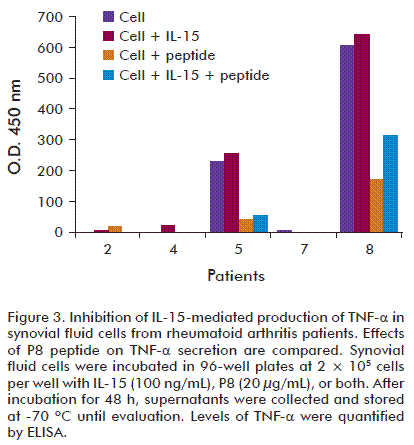
<body><![CDATA[<P   ><font size="3" face="Verdana, Arial, Helvetica, sans-serif"><B>RESULTS</B> </font></P >   <FONT size="+1">        <P   ><font size="2" face="Verdana, Arial, Helvetica, sans-serif"><b>Identification      of a binding sequence to IL-15R</b></font><b><font size="+1" color="#000000"><font size="+1"><font size="+1"><font size="+1"><font size="+1"><font size="+1"><font size="+1"><font size="+1"><font size="+1"><font size="+1"><font size="+1"><font size="+1"><font size="+1"><font size="+1"><font size="+1"><font size="+1"><font size="+1"><font size="+1"><font size="+1"><font size="+1"><font size="+1"><font size="+1"><font size="+1"><font size="+1"><font size="+1"><font size="+1"><font size="+1"><font size="+1"><font size="+1"><font size="+1"><font size="+1"><font size="+1"><font size="+1"><font size="+1"><font size="+1"><font size="+1"><font size="+1"><font size="+1"><font size="+1"><font size="+1"><font size="+1"><font size="+1"><font size="+1"><font size="+1"><font size="+1"><font size="+1"><font size="+1"><font size="+1"><font size="+1"><font size="+1"><font size="+1"><font size="+1"><font size="+1"><font size="+1"><font size="+1"><font size="+1"><font size="+1"><font size="+1"><font size="2" face="Verdana, Arial, Helvetica, sans-serif">&alpha;</font></font></font></font></font></font></font></font></font></font></font></font></font></font></font></font></font></font></font></font></font></font></font></font></font></font></font></font></font></font></font></font></font></font></font></font></font></font></font></font></font></font></font></font></font></font></font></font></font></font></font></font></font></font></font></font></font></font></font></b></P >   <FONT size="+1">        <P   ><font size="2" face="Verdana, Arial, Helvetica, sans-serif">The peptide spot      synthesis approach was used to identify regions of IL-15 involved in the binding      to IL-15R&alpha;. The cellulose sheets displays 22 peptides that comprise      entire human IL-15 sequence were incubated with IL-15R&alpha; fused to Fc      of human IgG1. We observed a strong signal on spot 8 corresponding to the      36-45 sequence KVTAMKCFLL on mature IL-15 [22]. No positive spots were observed      when cellulose was incubated with human antibody IgG1, ruling out the possibility      that IL-15R&alpha;-Fc occurred on binding through its Fc region. </font></P >       <P   ><font size="2" face="Verdana, Arial, Helvetica, sans-serif"><b>P8 competitively      inhibits the binding of IL-15 to IL-15R</b></font><b><font size="+1" color="#000000"><font size="+1"><font size="+1"><font size="+1"><font size="+1"><font size="+1"><font size="+1"><font size="+1"><font size="+1"><font size="+1"><font size="+1"><font size="+1"><font size="+1"><font size="+1"><font size="+1"><font size="+1"><font size="+1"><font size="+1"><font size="+1"><font size="+1"><font size="+1"><font size="+1"><font size="+1"><font size="+1"><font size="+1"><font size="+1"><font size="+1"><font size="+1"><font size="+1"><font size="+1"><font size="+1"><font size="+1"><font size="+1"><font size="+1"><font size="+1"><font size="+1"><font size="+1"><font size="+1"><font size="+1"><font size="+1"><font size="+1"><font size="+1"><font size="+1"><font size="+1"><font size="+1"><font size="+1"><font size="+1"><font size="+1"><font size="+1"><font size="+1"><font size="+1"><font size="+1"><font size="+1"><font size="+1"><font size="+1"><font size="+1"><font size="+1"><font size="2" face="Verdana, Arial, Helvetica, sans-serif">&alpha;</font></font></font></font></font></font></font></font></font></font></font></font></font></font></font></font></font></font></font></font></font></font></font></font></font></font></font></font></font></font></font></font></font></font></font></font></font></font></font></font></font></font></font></font></font></font></font></font></font></font></font></font></font></font></font></font></font></font><font size="2" face="Verdana, Arial, Helvetica, sans-serif">      a</font></b><font size="2" face="Verdana, Arial, Helvetica, sans-serif"><b>nd      IL-15 biological activity </b> </font></P >       <P   ><font size="2" face="Verdana, Arial, Helvetica, sans-serif">Competitive ELISA      was performed to test the binding specificity of the P8 peptide to IL-15R&alpha;.      The sequence corresponding to spot 8 (KVTAMKCFLL) was synthesized as a soluble      linear 10 aa. peptide. IL-15R&alpha;-Fc and different concentrations of P8      peptide were co-incubated with IL-15 immobilized in the plate and the bound      IL-15R&alpha;-Fc was detected with HRP-conjugated goat anti-human IgG or with      an antibody anti IL-15R&alpha; development in goat; and latter incubated with      HRP-conjugated mouse anti-goat IgG. Both immunoassays showed similar results.      As shown in <a href="#fig1">figure 1</a>, the P8 peptide displaces the binding      of IL-15R&alpha; to hIL-15 in a dose-dependent manner. </font></P >       <P align="center"   ><img src="/img/revistas/bta/v30n4/f0108413.gif" width="415" height="358"><a name="fig1"></a></P >       
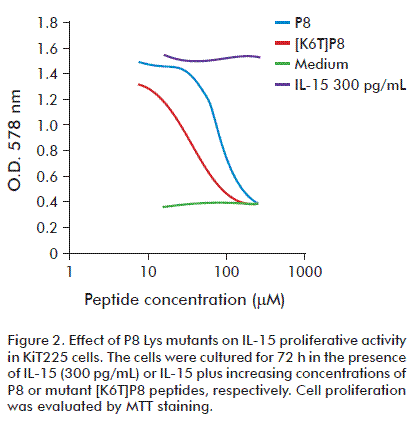
<P   ><font size="2" face="Verdana, Arial, Helvetica, sans-serif">Biological activity      of P8 peptide was tested for its ability to inhibit IL-15 activation of cell      proliferation of two IL-15 dependent cell lines: the murine CTLL-2 cell line      and the human KiT225 cell line that expresses the trimeric receptor IL-15R&alpha;</font><font size="+1" color="#000000"><font size="+1"><font size="+1"><font size="+1"><font size="+1"><font size="+1"><font size="+1"><font size="+1"><font size="+1"><font size="+1"><font size="+1"><font size="+1"><font size="+1"><font size="+1"><font size="+1"><font size="+1"><font size="+1"><font size="+1"><font size="+1"><font size="+1"><font size="+1"><font size="+1"><font size="+1"><font size="+1"><font size="+1"><font size="+1"><font size="+1"><font size="+1"><font size="+1"><font size="+1"><font size="+1"><font size="+1"><font size="+1"><font size="+1"><font size="+1"><font size="+1"><font size="+1"><font size="+1"><font size="+1"><font size="+1"><font size="+1"><font size="+1"><font size="+1"><font size="+1"><font size="+1"><font size="+1"><font size="+1"><font size="+1"><font size="+1"><font size="+1"><font size="+1"><font size="+1"><font size="+1"><font size="+1"><font size="+1"><font size="+1"><font size="+1"><font size="2" face="Verdana, Arial, Helvetica, sans-serif">&beta;&gamma;</font></font></font></font></font></font></font></font></font></font></font></font></font></font></font></font></font></font></font></font></font></font></font></font></font></font></font></font></font></font></font></font></font></font></font></font></font></font></font></font></font></font></font></font></font></font></font></font></font></font></font></font></font></font></font></font></font></font><font size="2" face="Verdana, Arial, Helvetica, sans-serif">.      The P8 peptide inhibited IL-15-induced proliferation in a dose-dependent manner      at plateau concentrations of 300 pg/mL of IL-15 in the KiT225 human leukemia      cell line, showing a 50 % inhibitory concentration (IC50) of 130 &micro;M      (<a href="#fig2">Figure 2</a>). The inhibitory effect of the P8 peptide was      also dependent on IL-15 concentration in the CTLL-2 cell line and the P8 peptide      alone was unable to affect the proliferation of these cells induced by IL-2      [23]. </font></P >       <P align="center"   ><img src="/img/revistas/bta/v30n4/f0208413.gif" width="415" height="423"><a name="fig2"></a></P >       
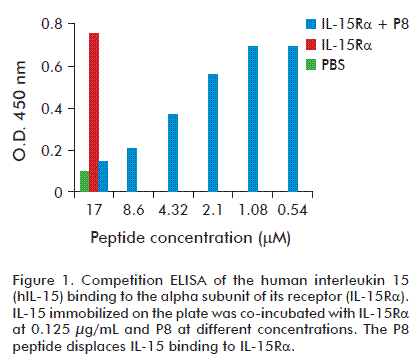
<P   ><font size="2" face="Verdana, Arial, Helvetica, sans-serif">Therefore, with the      aim to study the contribution of each amino acid to the antagonist effect      of P8 peptide and reduce its IC50 (130 &mu;M), we synthesized a family of      single Ala mutants of this peptide. Then, they were evaluated by preincubation      with IL-15R&alpha;, and subsequently, the resulting mixtures were added onto      IL-15-coated surfaces in order to measure the ability of each synthetic peptide      to competitively inhibit IL-15/IL-15R&alpha; complex formation. We found that      Phe and Cys are important for peptide binding to IL-15R&alpha;. Other single      point mutations were investigated and the second Lys in the sequence was replaced      by the polar non-charged amino acid threonine. Interestingly, we found </font><font size="2" face="Verdana, Arial, Helvetica, sans-serif">that      the replacement of Lys41 by Thr generated the peptide [K6T]P8 of higher antagonist      activity than P8 in CTLL-2 cell proliferation assays, showing an IC50 value      of 24 &mu;M [23]. </font></P >       <P   ><font size="2" face="Verdana, Arial, Helvetica, sans-serif">In order to assess      activity of P8 and its analog [K6T]P8 on other IL-15-induced biological effects,      we measured the effect of these peptides on TNF-&alpha; secretion. Synovial      cells from RA patients with high levels of IL-15 in synovial fluids were incubated      with P8 and the mutant [K6T]P8 in the presence of IL-15 for 72 h, and then,      TNF-&alpha; levels were determined by ELISA. We found that both peptides inhibited      TNF-&alpha; secretion from a pool of synovial cells and, in agreement with      previous results obtained for IL-15-dependent cell lines, [K6T]P8 was more      inhibitory on TNF-&alpha; secretion than the P8 peptide (<a href="#fig3">Figure      3</a>). </font></P >       ]]></body>
<body><![CDATA[<P align="center"   ><img src="/img/revistas/bta/v30n4/f0308413.gif" width="412" height="443"><a name="fig3"></a></P >       
<P   ><font size="2" face="Verdana, Arial, Helvetica, sans-serif"><b>Usefulness of      P8 peptide as a tool for detecting IL-15R</b></font><b><font size="+1" color="#000000"><font size="+1"><font size="+1"><font size="+1"><font size="+1"><font size="+1"><font size="+1"><font size="+1"><font size="+1"><font size="+1"><font size="+1"><font size="+1"><font size="+1"><font size="+1"><font size="+1"><font size="+1"><font size="+1"><font size="+1"><font size="+1"><font size="+1"><font size="+1"><font size="+1"><font size="+1"><font size="+1"><font size="+1"><font size="+1"><font size="+1"><font size="+1"><font size="+1"><font size="+1"><font size="+1"><font size="+1"><font size="+1"><font size="+1"><font size="+1"><font size="+1"><font size="+1"><font size="+1"><font size="+1"><font size="+1"><font size="+1"><font size="+1"><font size="+1"><font size="+1"><font size="+1"><font size="+1"><font size="+1"><font size="+1"><font size="+1"><font size="+1"><font size="+1"><font size="+1"><font size="+1"><font size="+1"><font size="+1"><font size="+1"><font size="+1"><font size="+1"><font size="2" face="Verdana, Arial, Helvetica, sans-serif">&alpha;</font></font></font></font></font></font></font></font></font></font></font></font></font></font></font></font></font></font></font></font></font></font></font></font></font></font></font></font></font></font></font></font></font></font></font></font></font></font></font></font></font></font></font></font></font></font></font></font></font></font></font></font></font></font></font></font></font></font></font></b></P >       <P   ><font size="2" face="Verdana, Arial, Helvetica, sans-serif">We used the P8 peptide      as capture to measure the IL-15R&alpha; level in synovial fluid from patients      with RA (n = 18) or OA (n = 17) using our previously developed ELISA [16].      Soluble IL-15R&alpha; (sIL-15R&alpha;) was detected in 100 % of RA patients      (18/18) and in 82.3 % of OA patients (14/17). That was the first report on      detecting sIL-15R&alpha; in synovial fluid. A significant increase in concentrations      of sIL-15R&alpha; was observed in synovial fluid collected from RA patients      compared to those from OA patients (Figure 1 in reference [24]). </font></P >       <P   >&nbsp;</P >       <P   > </P >       <P   > </P >       <P   ><font size="3" face="Verdana, Arial, Helvetica, sans-serif"><B>RELEVANCE OF THE      STUDY </b></font></P >   <FONT size="+1">        <P   ><font size="2" face="Verdana, Arial, Helvetica, sans-serif">The first antagonist      peptide described for IL-15 which specifically binds to IL-15R&alpha; subunit      and inhibits cell proliferation and proinflammatory cytokine secretion induced      by IL-15 was obtained in this work. The strategy described summarizes the      identification, assessing of its biological activities and its capacity as      a tool to detect IL-15R&alpha;. Therefore, this peptide is a potential drug      as blocker of IL-15 in diseases such as RA, and can be used as immunoreagent      to detect IL-15R&alpha; in biological fluids. These results have two patents      granted. </font></P >       <P   >&nbsp;</P >   <FONT size="+1">        <P   > </P >       ]]></body>
<body><![CDATA[<P   > </P >       <P   ><font size="3" face="Verdana, Arial, Helvetica, sans-serif"><B>ACKNOWLEDGEMENTS      </b></font></P >   <FONT size="+1">        <P   ><font size="2" face="Verdana, Arial, Helvetica, sans-serif">We thank the following      collaborators of the CIGB for their contribution to this work: Karelia Cosme,      Noraylis Lorenzo, Dagmara Pichardo, Sonia Gonz&aacute;lez and Yordanka Masforrol.      </font></P >       <P   >&nbsp;</P >   <FONT size="+1">        <P   > </P >       <P   > </P >       <P   ><font size="3" face="Verdana, Arial, Helvetica, sans-serif"><B>REFERENCES </b></font></P >       <!-- ref --><P   ><font size="2" face="Verdana, Arial, Helvetica, sans-serif">1. McInnes IB, Schett      G. Cytokines in the pathogenesis of rheumatoid arthritis. Nat Rev Immunol.      2007;7(6):429-42.    </font></P >       <!-- ref --><P   ><font size="2" face="Verdana, Arial, Helvetica, sans-serif">2. Rubbert-Roth A,      Finckh A. Treatment options in patients with rheumatoid arthritis failing      initial TNF inhibitor therapy: a critical review. Arthritis Res Ther. 2009;11      Suppl 1:S1.     </font></P >       <P   ><font size="2" face="Verdana, Arial, Helvetica, sans-serif">3. Maini RN, Taylor      PC. Anti-cytokine therapy for rheumatoid arthritis. Annu Rev Med. 2000;51:207-29.      </font></P >       <P   ><font size="2" face="Verdana, Arial, Helvetica, sans-serif"> 4. McInnes IB, Liew      FY. Cytokine networks-towards new therapies for rheumatoid arthritis. Nat      Clin Pract Rheumatol. 2005;1(1):31-9. </font></P >       <P   ><font size="2" face="Verdana, Arial, Helvetica, sans-serif">5. McInnes IB, al-Mughales      J, Field M, Leung BP, Huang FP, Dixon R, <I>et al</I>. The role of interleukin-15      in T-cell migration and activation in rheumatoid arthritis. Nat Med. 1996;2(2):175-82.      </font></P >       <P   ><font size="2" face="Verdana, Arial, Helvetica, sans-serif">6. Carroll HP, Paunovic      V, Gadina M. Signalling, inflammation and arthritis: Crossed signals: the      role of interleukin-15 and -18 in autoimmunity. Rheumatology (Oxford). 2008;47(9):1269-77.      </font></P >       <!-- ref --><P   ><font size="2" face="Verdana, Arial, Helvetica, sans-serif"> 7. McInnes IB, Gracie      JA, Harnett M, Harnett W, Liew FY. New strategies to control inflammatory      synovitis: interleukin 15 and beyond. Ann Rheum Dis. 2003;62 Suppl 2:ii51-4.          </font></P >       <P   ><font size="2" face="Verdana, Arial, Helvetica, sans-serif">8. Oppenheimer-Marks      N, Brezinschek RI, Mohamadzadeh M, Vita R, Lipsky PE. Interleukin 15 is produced      by endothelial cells and increases the transendothelial migration of T cells      <I>In vitro</I> and in the SCID mouse-human rheumatoid arthritis model <I>In      vivo</I>. J Clin Invest. 1998;101(6):1261-72. </font></P >       <P   ><font size="2" face="Verdana, Arial, Helvetica, sans-serif">9. McInnes IB, Leung      BP, Sturrock RD, Field M, Liew FY. Interleukin-15 mediates T cell-dependent      regulation of tumor necrosis factor-alpha production in rheumatoid arthritis.      Nat Med. 1997;3(2):189-95. </font></P >       <P   ><font size="2" face="Verdana, Arial, Helvetica, sans-serif">10. Ferretti S, Bonneau      O, Dubois GR, Jones CE, Trifilieff A. IL-17, produced by lymphocytes and neutrophils,      is necessary for lipopolysaccharide-induced airway neutrophilia: IL-15 as      a possible trigger. J Immunol. 2003;170(4):2106-12. </font></P >       ]]></body>
<body><![CDATA[<P   ><font size="2" face="Verdana, Arial, Helvetica, sans-serif">11. Verri WA Jr,      Cunha TM, Ferreira SH, Wei X, Leung BP, Fraser A, <I>et al</I>. IL-15 mediates      antigen-induced neutrophil migration by triggering IL-18 production. Eur J      Immunol. 2007;37(12):3373-80. </font></P >       <!-- ref --><P   ><font size="2" face="Verdana, Arial, Helvetica, sans-serif">12. Ogata Y, Kukita      A, Kukita T, Komine M, Miyahara A, Miyazaki S, <I>et al</I>. A novel role      of IL-15 in the development of osteoclasts: inability to replace its activity      with IL-2. J Immunol. 1999;162(5):2754-60.     </font></P >       <P   ><font size="2" face="Verdana, Arial, Helvetica, sans-serif">13. Miranda-Carus      ME, Benito-Miguel M, Balsa A, Cobo-Ibanez T, Perez de Ayala C, Pascual-Salcedo      D, <I>et al</I>. Peripheral blood T lymphocytes from patients with early rheumatoid      arthritis express RANKL and interleukin-15 on the cell surface and promote      osteoclastogenesis in autologous monocytes. Arthritis Rheum. 2006;54(4):1151-64.      </font></P >       <!-- ref --><P   ><font size="2" face="Verdana, Arial, Helvetica, sans-serif">14. Budagian V, Bulanova      E, Orinska Z, Pohl T, Borden EC, Silverman R, <I>et al</I>. Reverse signaling      through membrane-bound interleukin-15. J Biol Chem. 2004;279(40):42192-201.          </font></P >       <!-- ref --><P   ><font size="2" face="Verdana, Arial, Helvetica, sans-serif">15. Neely GG, Epelman      S, Ma LL, Colarusso P, Howlett CJ, Amankwah EK, <I>et al</I>. Monocyte surface-bound      IL-15 can function as an activating receptor and participate in reverse signaling.J      Immunol. 2004;172(7):4225-34.     </font></P >       <P   ><font size="2" face="Verdana, Arial, Helvetica, sans-serif">16. Dubois S, Mariner      J, Waldmann TA, Tagaya Y. IL-15Ralpha recycles and presents IL-15 In trans      to neighboring cells. Immunity. 2002;17(5):537-47. </font></P >       <!-- ref --><P   ><font size="2" face="Verdana, Arial, Helvetica, sans-serif">17. Baslund B, Tvede      N, Danneskiold-Samsoe B, Petersen J, Petersen LJ, Schuurman J, <I>et al</I>.      A novel human monoclonal antibody against IL-15 (humax-IL15) in patients with      active rheumatoid arthritis (RA): results of a double-blind, placebocontrolled      phase I/II trial. Arthritis Rheum. 2003;48 Suppl 9:S1706.     </font></P >       <P   ><font size="2" face="Verdana, Arial, Helvetica, sans-serif">18. Kim YS, Maslinski      W, Zheng XX, Stevens AC, Li XC, Tesch GH, <I>et al</I>. Targeting the IL-15      receptor with an antagonist IL-15 mutant/Fc gamma2a protein blocks delayed-type      hypersensitivity. J Immunol. 1998;160(12):5742-8. </font></P >       <P   ><font size="2" face="Verdana, Arial, Helvetica, sans-serif">19. Ruchatz H, Leung      BP, Wei XQ, McInnes IB, Liew FY. Soluble IL-15 receptor alpha-chain administration      prevents murine collagen-induced arthritis: a role for IL-15 in development      of antigen-induced immunopathology. J Immunol. 1998;160(11):5654-60. </font></P >       <P   ><font size="2" face="Verdana, Arial, Helvetica, sans-serif">20. Rubinstein MP,      Kovar M, Purton JF, Cho JH, Boyman O, Surh CD, <I>et al</I>. Converting IL-15      to a superagonist by binding to soluble IL-15Ralpha. Proc Natl Acad Sci USA.      2006;103(24):9166-71. </font></P >       <!-- ref --><P   ><font size="2" face="Verdana, Arial, Helvetica, sans-serif">21. Mortier E, Quemener      A, Vusio P, Lorenzen I, Boublik Y, Grotzinger J, <I>et al</I>. Soluble interleukin-15      receptor alpha (IL-15R alpha)-sushi as a selective and potent agonist of IL-15      action through IL-15R beta/gamma. Hyperagonist IL-15 x IL-15R alpha fusion      proteins. J Biol Chem. 2006;281(3):1612-9.     </font></P >       <P   ><font size="2" face="Verdana, Arial, Helvetica, sans-serif">22. Santos A, Cabrales      A, Reyes O, Ger&oacute;nimo H, Rodr&iacute;guez Y, Garay H, Arrieta C, Silva      R, Guillen G. Identification of an interleukin-15 antagonist peptide that      binds to IL-15R</font><font size="+1" color="#000000"><font size="+1"><font size="+1"><font size="+1"><font size="+1"><font size="+1"><font size="+1"><font size="+1"><font size="+1"><font size="+1"><font size="+1"><font size="+1"><font size="+1"><font size="+1"><font size="+1"><font size="+1"><font size="+1"><font size="+1"><font size="+1"><font size="+1"><font size="+1"><font size="+1"><font size="+1"><font size="+1"><font size="+1"><font size="+1"><font size="+1"><font size="+1"><font size="+1"><font size="+1"><font size="+1"><font size="+1"><font size="+1"><font size="+1"><font size="+1"><font size="+1"><font size="+1"><font size="+1"><font size="+1"><font size="+1"><font size="+1"><font size="+1"><font size="+1"><font size="+1"><font size="+1"><font size="+1"><font size="+1"><font size="+1"><font size="+1"><font size="+1"><font size="+1"><font size="+1"><font size="+1"><font size="+1"><font size="+1"><font size="+1"><font size="+1"><font size="2" face="Verdana, Arial, Helvetica, sans-serif">&alpha;</font></font></font></font></font></font></font></font></font></font></font></font></font></font></font></font></font></font></font></font></font></font></font></font></font></font></font></font></font></font></font></font></font></font></font></font></font></font></font></font></font></font></font></font></font></font></font></font></font></font></font></font></font></font></font></font></font></font><font size="2" face="Verdana, Arial, Helvetica, sans-serif">.      Biotecnol Apl. 2008;25(4):320-4. </font></P >       <P   ><font size="2" face="Verdana, Arial, Helvetica, sans-serif">23. Savio AS, Acosta      OR, Perez HG, Alvarez YR, Chico A, Ojeda MO, <I>et al</I>. Enhancement of      the inhibitory effect of an IL-15 antagonist peptide by alanine scanning.      J Pept Sci. 2012;18(1):25-9. </font></P >       <P   ><font size="2" face="Verdana, Arial, Helvetica, sans-serif">24. Machado Diaz      AC, Chico Capote A, Arrieta Aguero CA, Rodriguez Alvarez Y, Garcia Del Barco      Herrera D, Estevez Del Toro M, <I>et al</I>. Proinflammatory soluble interleukin-15      receptor alpha is increased in rheumatoid arthritis. Arthritis. 2012;2012:943156.      </font></P >       <P   >&nbsp;</P >       ]]></body>
<body><![CDATA[<P   >&nbsp;</P >   <FONT size="+1"><FONT size="+1">        <P   ><font size="2" face="Verdana, Arial, Helvetica, sans-serif"><i>Alicia Santos</i>.      Centro de Ingenier&iacute;a Gen&eacute;tica y Biotecnolog&iacute;a, CIGB.      Ave. 31 e/ 158 y 190, Cubanac&aacute;n, Playa, CP 11600, La Habana, Cuba.      E-mail: <A href="mailto:alicia.santos@cigb.edu.cu"> <FONT color="#0000FF">alicia.santos@cigb.edu.cu</font></A><FONT color="#0000FF"><FONT color="#000000">.      </font></font></font></P >   </font></font></font></font></font></font></font></font></font></font></font></font></font></font></font></font></font></font></font></font></font></font></font></font></font></font></font></font></font></font></font></font></font></font></font></font></font></font></font></font></font></font></font></font></font></font></font></font></font></font></font></font></font></font></font></font></font></font></font></font></font></font></font></font></font></font></DIV >      ]]></body><back>
<ref-list>
<ref id="B1">
<label>1</label><nlm-citation citation-type="journal">
<person-group person-group-type="author">
<name>
<surname><![CDATA[McInnes]]></surname>
<given-names><![CDATA[IB]]></given-names>
</name>
<name>
<surname><![CDATA[Schett]]></surname>
<given-names><![CDATA[G]]></given-names>
</name>
</person-group>
<article-title xml:lang="en"><![CDATA[Cytokines in the pathogenesis of rheumatoid arthritis]]></article-title>
<source><![CDATA[Nat Rev Immunol]]></source>
<year>2007</year>
<volume>7</volume>
<numero>6</numero>
<issue>6</issue>
<page-range>429-42</page-range></nlm-citation>
</ref>
<ref id="B2">
<label>2</label><nlm-citation citation-type="journal">
<person-group person-group-type="author">
<name>
<surname><![CDATA[Rubbert-Roth]]></surname>
<given-names><![CDATA[A]]></given-names>
</name>
<name>
<surname><![CDATA[Finckh]]></surname>
<given-names><![CDATA[A]]></given-names>
</name>
</person-group>
<article-title xml:lang="en"><![CDATA[Treatment options in patients with rheumatoid arthritis failing initial TNF inhibitor therapy: a critical review]]></article-title>
<source><![CDATA[Arthritis Res Ther]]></source>
<year>2009</year>
<volume>11</volume>
<numero>^s1</numero>
<issue>^s1</issue>
<supplement>1</supplement>
<page-range>S1</page-range></nlm-citation>
</ref>
<ref id="B3">
<label>3</label><nlm-citation citation-type="journal">
<person-group person-group-type="author">
<name>
<surname><![CDATA[Maini]]></surname>
<given-names><![CDATA[RN]]></given-names>
</name>
<name>
<surname><![CDATA[Taylor]]></surname>
<given-names><![CDATA[PC]]></given-names>
</name>
</person-group>
<article-title xml:lang="en"><![CDATA[Anti-cytokine therapy for rheumatoid arthritis]]></article-title>
<source><![CDATA[Annu Rev Med]]></source>
<year>2000</year>
<volume>51</volume>
<numero>^s1</numero>
<issue>^s1</issue>
<supplement>1</supplement>
<page-range>207-29</page-range></nlm-citation>
</ref>
<ref id="B4">
<label>4</label><nlm-citation citation-type="journal">
<person-group person-group-type="author">
<name>
<surname><![CDATA[McInnes]]></surname>
<given-names><![CDATA[IB]]></given-names>
</name>
<name>
<surname><![CDATA[Liew]]></surname>
<given-names><![CDATA[FY]]></given-names>
</name>
</person-group>
<article-title xml:lang="en"><![CDATA[Cytokine networks-towards new therapies for rheumatoid arthritis]]></article-title>
<source><![CDATA[Nat Clin Pract Rheumatol]]></source>
<year>2005</year>
<volume>1</volume>
<numero>1^s1</numero>
<issue>1^s1</issue>
<supplement>1</supplement>
<page-range>31-9</page-range></nlm-citation>
</ref>
<ref id="B5">
<label>5</label><nlm-citation citation-type="journal">
<person-group person-group-type="author">
<name>
<surname><![CDATA[McInnes]]></surname>
<given-names><![CDATA[IB]]></given-names>
</name>
<name>
<surname><![CDATA[al-Mughales]]></surname>
<given-names><![CDATA[J]]></given-names>
</name>
<name>
<surname><![CDATA[Field]]></surname>
<given-names><![CDATA[M]]></given-names>
</name>
<name>
<surname><![CDATA[Leung]]></surname>
<given-names><![CDATA[BP]]></given-names>
</name>
<name>
<surname><![CDATA[Huang]]></surname>
<given-names><![CDATA[FP]]></given-names>
</name>
<name>
<surname><![CDATA[Dixon]]></surname>
<given-names><![CDATA[R]]></given-names>
</name>
</person-group>
<article-title xml:lang="en"><![CDATA[The role of interleukin-15 in T-cell migration and activation in rheumatoid arthritis]]></article-title>
<source><![CDATA[Nat Med]]></source>
<year>1996</year>
<volume>2</volume>
<numero>2^s1</numero>
<issue>2^s1</issue>
<supplement>1</supplement>
<page-range>175-82</page-range></nlm-citation>
</ref>
<ref id="B6">
<label>6</label><nlm-citation citation-type="journal">
<person-group person-group-type="author">
<name>
<surname><![CDATA[Carroll]]></surname>
<given-names><![CDATA[HP]]></given-names>
</name>
<name>
<surname><![CDATA[Paunovic]]></surname>
<given-names><![CDATA[V]]></given-names>
</name>
<name>
<surname><![CDATA[Gadina]]></surname>
<given-names><![CDATA[M]]></given-names>
</name>
</person-group>
<article-title xml:lang="en"><![CDATA[Signalling, inflammation and arthritis: Crossed signals: the role of interleukin-15 and -18 in autoimmunity]]></article-title>
<source><![CDATA[Rheumatology (Oxford)]]></source>
<year>2008</year>
<volume>47</volume>
<numero>9^s1</numero>
<issue>9^s1</issue>
<supplement>1</supplement>
<page-range>1269-77</page-range></nlm-citation>
</ref>
<ref id="B7">
<label>7</label><nlm-citation citation-type="journal">
<person-group person-group-type="author">
<name>
<surname><![CDATA[McInnes]]></surname>
<given-names><![CDATA[IB]]></given-names>
</name>
<name>
<surname><![CDATA[Gracie]]></surname>
<given-names><![CDATA[JA]]></given-names>
</name>
<name>
<surname><![CDATA[Harnett]]></surname>
<given-names><![CDATA[M]]></given-names>
</name>
<name>
<surname><![CDATA[Harnett]]></surname>
<given-names><![CDATA[W]]></given-names>
</name>
<name>
<surname><![CDATA[Liew]]></surname>
<given-names><![CDATA[FY]]></given-names>
</name>
</person-group>
<article-title xml:lang="en"><![CDATA[New strategies to control inflammatory synovitis: interleukin 15 and beyond]]></article-title>
<source><![CDATA[Ann Rheum Dis]]></source>
<year>2003</year>
<volume>62</volume>
<numero>^s2</numero>
<issue>^s2</issue>
<supplement>2</supplement>
<page-range>ii51-4</page-range></nlm-citation>
</ref>
<ref id="B8">
<label>8</label><nlm-citation citation-type="journal">
<person-group person-group-type="author">
<name>
<surname><![CDATA[Oppenheimer-Marks]]></surname>
<given-names><![CDATA[N]]></given-names>
</name>
<name>
<surname><![CDATA[Brezinschek]]></surname>
<given-names><![CDATA[RI]]></given-names>
</name>
<name>
<surname><![CDATA[Mohamadzadeh]]></surname>
<given-names><![CDATA[M]]></given-names>
</name>
<name>
<surname><![CDATA[Vita]]></surname>
<given-names><![CDATA[R]]></given-names>
</name>
<name>
<surname><![CDATA[Lipsky]]></surname>
<given-names><![CDATA[PE]]></given-names>
</name>
</person-group>
<article-title xml:lang="en"><![CDATA[Interleukin 15 is produced by endothelial cells and increases the transendothelial migration of T cells in vitro and in the SCID mouse-human rheumatoid arthritis model in vivo]]></article-title>
<source><![CDATA[J Clin Invest]]></source>
<year>1998</year>
<volume>101</volume>
<numero>6^s2</numero>
<issue>6^s2</issue>
<supplement>2</supplement>
<page-range>1261-72</page-range></nlm-citation>
</ref>
<ref id="B9">
<label>9</label><nlm-citation citation-type="journal">
<person-group person-group-type="author">
<name>
<surname><![CDATA[McInnes]]></surname>
<given-names><![CDATA[IB]]></given-names>
</name>
<name>
<surname><![CDATA[Leung]]></surname>
<given-names><![CDATA[BP]]></given-names>
</name>
<name>
<surname><![CDATA[Sturrock]]></surname>
<given-names><![CDATA[RD]]></given-names>
</name>
<name>
<surname><![CDATA[Field]]></surname>
<given-names><![CDATA[M]]></given-names>
</name>
<name>
<surname><![CDATA[Liew]]></surname>
<given-names><![CDATA[FY]]></given-names>
</name>
</person-group>
<article-title xml:lang="en"><![CDATA[Interleukin-15 mediates T cell-dependent regulation of tumor necrosis factor-alpha production in rheumatoid arthritis]]></article-title>
<source><![CDATA[Nat Med]]></source>
<year>1997</year>
<volume>3</volume>
<numero>2^s2</numero>
<issue>2^s2</issue>
<supplement>2</supplement>
<page-range>189-95</page-range></nlm-citation>
</ref>
<ref id="B10">
<label>10</label><nlm-citation citation-type="journal">
<person-group person-group-type="author">
<name>
<surname><![CDATA[Ferretti]]></surname>
<given-names><![CDATA[S]]></given-names>
</name>
<name>
<surname><![CDATA[Bonneau]]></surname>
<given-names><![CDATA[O]]></given-names>
</name>
<name>
<surname><![CDATA[Dubois]]></surname>
<given-names><![CDATA[GR]]></given-names>
</name>
<name>
<surname><![CDATA[Jones]]></surname>
<given-names><![CDATA[CE]]></given-names>
</name>
<name>
<surname><![CDATA[Trifilieff]]></surname>
<given-names><![CDATA[A]]></given-names>
</name>
</person-group>
<article-title xml:lang="en"><![CDATA[IL-17, produced by lymphocytes and neutrophils, is necessary for lipopolysaccharide-induced airway neutrophilia: IL-15 as a possible trigger]]></article-title>
<source><![CDATA[J Immunol]]></source>
<year>2003</year>
<volume>170</volume>
<numero>4^s2</numero>
<issue>4^s2</issue>
<supplement>2</supplement>
<page-range>2106-12</page-range></nlm-citation>
</ref>
<ref id="B11">
<label>11</label><nlm-citation citation-type="journal">
<person-group person-group-type="author">
<name>
<surname><![CDATA[Verri]]></surname>
<given-names><![CDATA[WA Jr]]></given-names>
</name>
<name>
<surname><![CDATA[Cunha]]></surname>
<given-names><![CDATA[TM]]></given-names>
</name>
<name>
<surname><![CDATA[Ferreira]]></surname>
<given-names><![CDATA[SH]]></given-names>
</name>
<name>
<surname><![CDATA[Wei]]></surname>
<given-names><![CDATA[X]]></given-names>
</name>
<name>
<surname><![CDATA[Leung]]></surname>
<given-names><![CDATA[BP]]></given-names>
</name>
<name>
<surname><![CDATA[Fraser]]></surname>
<given-names><![CDATA[A]]></given-names>
</name>
</person-group>
<article-title xml:lang="en"><![CDATA[IL-15 mediates antigen-induced neutrophil migration by triggering IL-18 production]]></article-title>
<source><![CDATA[Eur J Immunol]]></source>
<year>2007</year>
<volume>37</volume>
<numero>12^s2</numero>
<issue>12^s2</issue>
<supplement>2</supplement>
<page-range>3373-80</page-range></nlm-citation>
</ref>
<ref id="B12">
<label>12</label><nlm-citation citation-type="journal">
<person-group person-group-type="author">
<name>
<surname><![CDATA[Ogata]]></surname>
<given-names><![CDATA[Y]]></given-names>
</name>
<name>
<surname><![CDATA[Kukita]]></surname>
<given-names><![CDATA[A]]></given-names>
</name>
<name>
<surname><![CDATA[Kukita]]></surname>
<given-names><![CDATA[T]]></given-names>
</name>
<name>
<surname><![CDATA[Komine]]></surname>
<given-names><![CDATA[M]]></given-names>
</name>
<name>
<surname><![CDATA[Miyahara]]></surname>
<given-names><![CDATA[A]]></given-names>
</name>
<name>
<surname><![CDATA[Miyazaki]]></surname>
<given-names><![CDATA[S]]></given-names>
</name>
</person-group>
<article-title xml:lang="en"><![CDATA[A novel role of IL-15 in the development of osteoclasts: inability to replace its activity with IL-2]]></article-title>
<source><![CDATA[J Immunol]]></source>
<year>1999</year>
<volume>162</volume>
<numero>5</numero>
<issue>5</issue>
<page-range>2754-60</page-range></nlm-citation>
</ref>
<ref id="B13">
<label>13</label><nlm-citation citation-type="journal">
<person-group person-group-type="author">
<name>
<surname><![CDATA[Miranda-Carus]]></surname>
<given-names><![CDATA[ME]]></given-names>
</name>
<name>
<surname><![CDATA[Benito-Miguel]]></surname>
<given-names><![CDATA[M]]></given-names>
</name>
<name>
<surname><![CDATA[Balsa]]></surname>
<given-names><![CDATA[A]]></given-names>
</name>
<name>
<surname><![CDATA[Cobo-Ibanez]]></surname>
<given-names><![CDATA[T]]></given-names>
</name>
<name>
<surname><![CDATA[Perez de Ayala]]></surname>
<given-names><![CDATA[C]]></given-names>
</name>
<name>
<surname><![CDATA[Pascual-Salcedo]]></surname>
<given-names><![CDATA[D]]></given-names>
</name>
</person-group>
<article-title xml:lang="en"><![CDATA[Peripheral blood T lymphocytes from patients with early rheumatoid arthritis express RANKL and interleukin-15 on the cell surface and promote osteoclastogenesis in autologous monocytes]]></article-title>
<source><![CDATA[Arthritis Rheum]]></source>
<year>2006</year>
<volume>54</volume>
<numero>4^s2</numero>
<issue>4^s2</issue>
<supplement>2</supplement>
<page-range>1151-64</page-range></nlm-citation>
</ref>
<ref id="B14">
<label>14</label><nlm-citation citation-type="journal">
<person-group person-group-type="author">
<name>
<surname><![CDATA[Budagian]]></surname>
<given-names><![CDATA[V]]></given-names>
</name>
<name>
<surname><![CDATA[Bulanova]]></surname>
<given-names><![CDATA[E]]></given-names>
</name>
<name>
<surname><![CDATA[Orinska]]></surname>
<given-names><![CDATA[Z]]></given-names>
</name>
<name>
<surname><![CDATA[Pohl]]></surname>
<given-names><![CDATA[T]]></given-names>
</name>
<name>
<surname><![CDATA[Borden]]></surname>
<given-names><![CDATA[EC]]></given-names>
</name>
<name>
<surname><![CDATA[Silverman]]></surname>
<given-names><![CDATA[R]]></given-names>
</name>
</person-group>
<article-title xml:lang="en"><![CDATA[Reverse signaling through membrane-bound interleukin-15]]></article-title>
<source><![CDATA[J Biol Chem]]></source>
<year>2004</year>
<volume>279</volume>
<numero>40</numero>
<issue>40</issue>
<page-range>42192-201</page-range></nlm-citation>
</ref>
<ref id="B15">
<label>15</label><nlm-citation citation-type="journal">
<person-group person-group-type="author">
<name>
<surname><![CDATA[Neely]]></surname>
<given-names><![CDATA[GG]]></given-names>
</name>
<name>
<surname><![CDATA[Epelman]]></surname>
<given-names><![CDATA[S]]></given-names>
</name>
<name>
<surname><![CDATA[Ma]]></surname>
<given-names><![CDATA[LL]]></given-names>
</name>
<name>
<surname><![CDATA[Colarusso]]></surname>
<given-names><![CDATA[P]]></given-names>
</name>
<name>
<surname><![CDATA[Howlett]]></surname>
<given-names><![CDATA[CJ]]></given-names>
</name>
<name>
<surname><![CDATA[Amankwah]]></surname>
<given-names><![CDATA[EK]]></given-names>
</name>
</person-group>
<article-title xml:lang="en"><![CDATA[Monocyte surface-bound IL-15 can function as an activating receptor and participate in reverse signaling]]></article-title>
<source><![CDATA[J Immunol]]></source>
<year>2004</year>
<volume>172</volume>
<numero>7</numero>
<issue>7</issue>
<page-range>4225-34</page-range></nlm-citation>
</ref>
<ref id="B16">
<label>16</label><nlm-citation citation-type="journal">
<person-group person-group-type="author">
<name>
<surname><![CDATA[Dubois]]></surname>
<given-names><![CDATA[S]]></given-names>
</name>
<name>
<surname><![CDATA[Mariner]]></surname>
<given-names><![CDATA[J]]></given-names>
</name>
<name>
<surname><![CDATA[Waldmann]]></surname>
<given-names><![CDATA[TA]]></given-names>
</name>
<name>
<surname><![CDATA[Tagaya]]></surname>
<given-names><![CDATA[Y]]></given-names>
</name>
</person-group>
<article-title xml:lang="en"><![CDATA[IL-15Ralpha recycles and presents IL-15 In trans to neighboring cells]]></article-title>
<source><![CDATA[Immunity]]></source>
<year>2002</year>
<volume>17</volume>
<numero>5^s2</numero>
<issue>5^s2</issue>
<supplement>2</supplement>
<page-range>537-47</page-range></nlm-citation>
</ref>
<ref id="B17">
<label>17</label><nlm-citation citation-type="journal">
<person-group person-group-type="author">
<name>
<surname><![CDATA[Baslund]]></surname>
<given-names><![CDATA[B]]></given-names>
</name>
<name>
<surname><![CDATA[Tvede]]></surname>
<given-names><![CDATA[N]]></given-names>
</name>
<name>
<surname><![CDATA[Danneskiold-Samsoe]]></surname>
<given-names><![CDATA[B]]></given-names>
</name>
<name>
<surname><![CDATA[Petersen]]></surname>
<given-names><![CDATA[J]]></given-names>
</name>
<name>
<surname><![CDATA[Petersen]]></surname>
<given-names><![CDATA[LJ]]></given-names>
</name>
<name>
<surname><![CDATA[Schuurman]]></surname>
<given-names><![CDATA[J]]></given-names>
</name>
</person-group>
<article-title xml:lang="en"><![CDATA[A novel human monoclonal antibody against IL-15 (humax-IL15) in patients with active rheumatoid arthritis (RA): results of a double-blind, placebocontrolled phase I/II trial]]></article-title>
<source><![CDATA[Arthritis Rheum]]></source>
<year>2003</year>
<volume>48</volume>
<numero>^s9</numero>
<issue>^s9</issue>
<supplement>9</supplement>
<page-range>S1706</page-range></nlm-citation>
</ref>
<ref id="B18">
<label>18</label><nlm-citation citation-type="journal">
<person-group person-group-type="author">
<name>
<surname><![CDATA[Kim]]></surname>
<given-names><![CDATA[YS]]></given-names>
</name>
<name>
<surname><![CDATA[Maslinski]]></surname>
<given-names><![CDATA[W]]></given-names>
</name>
<name>
<surname><![CDATA[Zheng]]></surname>
<given-names><![CDATA[XX]]></given-names>
</name>
<name>
<surname><![CDATA[Stevens]]></surname>
<given-names><![CDATA[AC]]></given-names>
</name>
<name>
<surname><![CDATA[Li]]></surname>
<given-names><![CDATA[XC]]></given-names>
</name>
<name>
<surname><![CDATA[Tesch]]></surname>
<given-names><![CDATA[GH]]></given-names>
</name>
</person-group>
<article-title xml:lang="en"><![CDATA[Targeting the IL-15 receptor with an antagonist IL-15 mutant/Fc gamma2a protein blocks delayed-type hypersensitivity]]></article-title>
<source><![CDATA[J Immunol]]></source>
<year>1998</year>
<volume>160</volume>
<numero>12^s9</numero>
<issue>12^s9</issue>
<supplement>9</supplement>
<page-range>5742-8</page-range></nlm-citation>
</ref>
<ref id="B19">
<label>19</label><nlm-citation citation-type="journal">
<person-group person-group-type="author">
<name>
<surname><![CDATA[Ruchatz]]></surname>
<given-names><![CDATA[H]]></given-names>
</name>
<name>
<surname><![CDATA[Leung]]></surname>
<given-names><![CDATA[BP]]></given-names>
</name>
<name>
<surname><![CDATA[Wei]]></surname>
<given-names><![CDATA[XQ]]></given-names>
</name>
<name>
<surname><![CDATA[McInnes]]></surname>
<given-names><![CDATA[IB]]></given-names>
</name>
<name>
<surname><![CDATA[Liew]]></surname>
<given-names><![CDATA[FY]]></given-names>
</name>
</person-group>
<article-title xml:lang="en"><![CDATA[Soluble IL-15 receptor alpha-chain administration prevents murine collagen-induced arthritis: a role for IL-15 in development of antigen-induced immunopathology]]></article-title>
<source><![CDATA[J Immunol]]></source>
<year>1998</year>
<volume>160</volume>
<numero>11^s9</numero>
<issue>11^s9</issue>
<supplement>9</supplement>
<page-range>5654-60</page-range></nlm-citation>
</ref>
<ref id="B20">
<label>20</label><nlm-citation citation-type="journal">
<person-group person-group-type="author">
<name>
<surname><![CDATA[Rubinstein]]></surname>
<given-names><![CDATA[MP]]></given-names>
</name>
<name>
<surname><![CDATA[Kovar]]></surname>
<given-names><![CDATA[M]]></given-names>
</name>
<name>
<surname><![CDATA[Purton]]></surname>
<given-names><![CDATA[JF]]></given-names>
</name>
<name>
<surname><![CDATA[Cho]]></surname>
<given-names><![CDATA[JH]]></given-names>
</name>
<name>
<surname><![CDATA[Boyman]]></surname>
<given-names><![CDATA[O]]></given-names>
</name>
<name>
<surname><![CDATA[Surh]]></surname>
<given-names><![CDATA[CD]]></given-names>
</name>
</person-group>
<article-title xml:lang="en"><![CDATA[Converting IL-15 to a superagonist by binding to soluble IL-15Ralpha]]></article-title>
<source><![CDATA[Proc Natl Acad Sci USA]]></source>
<year>2006</year>
<volume>103</volume>
<numero>24^s9</numero>
<issue>24^s9</issue>
<supplement>9</supplement>
<page-range>9166-71</page-range></nlm-citation>
</ref>
<ref id="B21">
<label>21</label><nlm-citation citation-type="journal">
<person-group person-group-type="author">
<name>
<surname><![CDATA[Mortier]]></surname>
<given-names><![CDATA[E]]></given-names>
</name>
<name>
<surname><![CDATA[Quemener]]></surname>
<given-names><![CDATA[A]]></given-names>
</name>
<name>
<surname><![CDATA[Vusio]]></surname>
<given-names><![CDATA[P]]></given-names>
</name>
<name>
<surname><![CDATA[Lorenzen]]></surname>
<given-names><![CDATA[I]]></given-names>
</name>
<name>
<surname><![CDATA[Boublik]]></surname>
<given-names><![CDATA[Y]]></given-names>
</name>
<name>
<surname><![CDATA[Grotzinger]]></surname>
<given-names><![CDATA[J]]></given-names>
</name>
</person-group>
<article-title xml:lang="en"><![CDATA[Soluble interleukin-15 receptor alpha (IL-15R alpha)-sushi as a selective and potent agonist of IL-15 action through IL-15R beta/gamma. Hyperagonist IL-15 x IL-15R alpha fusion proteins]]></article-title>
<source><![CDATA[J Biol Chem]]></source>
<year>2006</year>
<volume>281</volume>
<numero>3</numero>
<issue>3</issue>
<page-range>1612-9</page-range></nlm-citation>
</ref>
<ref id="B22">
<label>22</label><nlm-citation citation-type="journal">
<person-group person-group-type="author">
<name>
<surname><![CDATA[Santos]]></surname>
<given-names><![CDATA[A]]></given-names>
</name>
<name>
<surname><![CDATA[Cabrales]]></surname>
<given-names><![CDATA[A]]></given-names>
</name>
<name>
<surname><![CDATA[Reyes]]></surname>
<given-names><![CDATA[O]]></given-names>
</name>
<name>
<surname><![CDATA[Gerónimo]]></surname>
<given-names><![CDATA[H]]></given-names>
</name>
<name>
<surname><![CDATA[Rodríguez]]></surname>
<given-names><![CDATA[Y]]></given-names>
</name>
<name>
<surname><![CDATA[Garay]]></surname>
<given-names><![CDATA[H]]></given-names>
</name>
<name>
<surname><![CDATA[Arrieta]]></surname>
<given-names><![CDATA[C]]></given-names>
</name>
<name>
<surname><![CDATA[Silva]]></surname>
<given-names><![CDATA[R]]></given-names>
</name>
<name>
<surname><![CDATA[Guillen]]></surname>
<given-names><![CDATA[G]]></given-names>
</name>
</person-group>
<article-title xml:lang="en"><![CDATA[Identification of an interleukin-15 antagonist peptide that binds to IL-15Ra]]></article-title>
<source><![CDATA[Biotecnol Apl]]></source>
<year>2008</year>
<volume>25</volume>
<numero>4^s9</numero>
<issue>4^s9</issue>
<supplement>9</supplement>
<page-range>320-4</page-range></nlm-citation>
</ref>
<ref id="B23">
<label>23</label><nlm-citation citation-type="journal">
<person-group person-group-type="author">
<name>
<surname><![CDATA[Savio]]></surname>
<given-names><![CDATA[AS]]></given-names>
</name>
<name>
<surname><![CDATA[Acosta]]></surname>
<given-names><![CDATA[OR]]></given-names>
</name>
<name>
<surname><![CDATA[Perez]]></surname>
<given-names><![CDATA[HG]]></given-names>
</name>
<name>
<surname><![CDATA[Alvarez]]></surname>
<given-names><![CDATA[YR]]></given-names>
</name>
<name>
<surname><![CDATA[Chico]]></surname>
<given-names><![CDATA[A]]></given-names>
</name>
<name>
<surname><![CDATA[Ojeda]]></surname>
<given-names><![CDATA[MO]]></given-names>
</name>
</person-group>
<article-title xml:lang="en"><![CDATA[Enhancement of the inhibitory effect of an IL-15 antagonist peptide by alanine scanning]]></article-title>
<source><![CDATA[J Pept Sci]]></source>
<year>2012</year>
<volume>18</volume>
<numero>1^s9</numero>
<issue>1^s9</issue>
<supplement>9</supplement>
<page-range>25-9</page-range></nlm-citation>
</ref>
<ref id="B24">
<label>24</label><nlm-citation citation-type="journal">
<person-group person-group-type="author">
<name>
<surname><![CDATA[Machado Diaz]]></surname>
<given-names><![CDATA[AC]]></given-names>
</name>
<name>
<surname><![CDATA[Chico Capote]]></surname>
<given-names><![CDATA[A]]></given-names>
</name>
<name>
<surname><![CDATA[Arrieta Aguero]]></surname>
<given-names><![CDATA[CA]]></given-names>
</name>
<name>
<surname><![CDATA[Rodriguez Alvarez]]></surname>
<given-names><![CDATA[Y]]></given-names>
</name>
<name>
<surname><![CDATA[Garcia Del Barco Herrera]]></surname>
<given-names><![CDATA[D]]></given-names>
</name>
<name>
<surname><![CDATA[Estevez Del Toro]]></surname>
<given-names><![CDATA[M]]></given-names>
</name>
</person-group>
<article-title xml:lang="en"><![CDATA[Proinflammatory soluble interleukin-15 receptor alpha is increased in rheumatoid arthritis]]></article-title>
<source><![CDATA[Arthritis]]></source>
<year>2012</year>
<volume>2012</volume>
<numero>^s9</numero>
<issue>^s9</issue>
<supplement>9</supplement>
<page-range>943156</page-range></nlm-citation>
</ref>
</ref-list>
</back>
</article>