<?xml version="1.0" encoding="ISO-8859-1"?><article xmlns:mml="http://www.w3.org/1998/Math/MathML" xmlns:xlink="http://www.w3.org/1999/xlink" xmlns:xsi="http://www.w3.org/2001/XMLSchema-instance">
<front>
<journal-meta>
<journal-id>1027-2852</journal-id>
<journal-title><![CDATA[Biotecnología Aplicada]]></journal-title>
<abbrev-journal-title><![CDATA[Biotecnol Apl]]></abbrev-journal-title>
<issn>1027-2852</issn>
<publisher>
<publisher-name><![CDATA[Editorial Elfos Scientiae]]></publisher-name>
</publisher>
</journal-meta>
<article-meta>
<article-id>S1027-28522014000100006</article-id>
<title-group>
<article-title xml:lang="en"><![CDATA[Stoichiometry equation to describe the growth of the Pleurotus ostreatus ceba-gliie-po-010606 strain]]></article-title>
<article-title xml:lang="en"><![CDATA[Ecuación estequiométrica para describir el crecimiento de Pleurotus ostreatus cepa ceba-gliie-po-010606]]></article-title>
</title-group>
<contrib-group>
<contrib contrib-type="author">
<name>
<surname><![CDATA[Pineda-Insuasti]]></surname>
<given-names><![CDATA[Julio A]]></given-names>
</name>
<xref ref-type="aff" rid="A01"/>
</contrib>
<contrib contrib-type="author">
<name>
<surname><![CDATA[Soto-Arroyave]]></surname>
<given-names><![CDATA[Claudia P]]></given-names>
</name>
<xref ref-type="aff" rid="A02"/>
</contrib>
<contrib contrib-type="author">
<name>
<surname><![CDATA[Beltrán]]></surname>
<given-names><![CDATA[Luis]]></given-names>
</name>
<xref ref-type="aff" rid="A03"/>
</contrib>
</contrib-group>
<aff id="A02">
<institution><![CDATA[,Pontificia Universidad Católica del Ecuador, PUCESI  ]]></institution>
<addr-line><![CDATA[Imbabura ]]></addr-line>
<country>Ecuador</country>
</aff>
<aff id="A03">
<institution><![CDATA[,Universidad Ignacio Agramonte Loynaz Departamento de Ingeniería Química ]]></institution>
<addr-line><![CDATA[Camagüey ]]></addr-line>
<country>Cuba</country>
</aff>
<aff id="A01">
<institution><![CDATA[,Centro Ecuatoriano de Biotecnología del Ambiente, CEBA  ]]></institution>
<addr-line><![CDATA[Imbabura ]]></addr-line>
<country>Ecuador</country>
</aff>
<pub-date pub-type="pub">
<day>00</day>
<month>03</month>
<year>2014</year>
</pub-date>
<pub-date pub-type="epub">
<day>00</day>
<month>03</month>
<year>2014</year>
</pub-date>
<volume>31</volume>
<numero>1</numero>
<fpage>48</fpage>
<lpage>52</lpage>
<copyright-statement/>
<copyright-year/>
<self-uri xlink:href="http://scielo.sld.cu/scielo.php?script=sci_arttext&amp;pid=S1027-28522014000100006&amp;lng=en&amp;nrm=iso"></self-uri><self-uri xlink:href="http://scielo.sld.cu/scielo.php?script=sci_abstract&amp;pid=S1027-28522014000100006&amp;lng=en&amp;nrm=iso"></self-uri><self-uri xlink:href="http://scielo.sld.cu/scielo.php?script=sci_pdf&amp;pid=S1027-28522014000100006&amp;lng=en&amp;nrm=iso"></self-uri><abstract abstract-type="short" xml:lang="en"><p><![CDATA[This work was aimed at developing a proximate stoichiometric equation to describe the growth of Pleurotus ostreatus mushroom strain ceba-gliie-po-010106 on picking beans (Phaseolus vulgaris) waste. Empirical formulas were established for the residue of fresh dried picking beans (CH1.81O0.81N0.15) and the biomass of the fungal strain (CH1.83O0.84N0.26). The elemental composition of these materials and the ashes was determined. The stoichiometric coefficients obtained further supported the estimation of parameters relevant for fungal growth characterization: theoretical biological efficiency (867.49 g of fungal dry matter (FDM)/kg of substrate dry matter), mean coefficient of breath (0.77 CO2/mol O2 consumption), specific air consumption (1.36 m3/kg FDM) and metabolic heat (16 576.47 kJ/kg FDM).]]></p></abstract>
<abstract abstract-type="short" xml:lang="es"><p><![CDATA[Se desarrolló una ecuación estequiométrica aproximada que describe el crecimiento de la cepa ceba-gliie-010106 de Pleurotus ostreatus sobre residuos de la cosecha del fréjol (Phaseolus vulgaris). Se establecieron fórmulas empíricas para el residuo del fréjol fresco seco (CH1.81O0.81N0.15) y la biomasa de la cepa del hongo (CH1.83O0.84N0.26). Para ello se determinó la composición elemental de estas materias primas y su contenido de cenizas. Los coeficientes estequiométricos permitieron estimar parámetros relevantes del proceso de crecimiento; entre ellos: la eficiencia biológica teórica (867.49 g de materia seca del hongo (MSH)/kg de materia seca del sustrato), el coeficiente medio de respiración (0.77 mol CO2/mol O2), el consumo específico de aire para el proceso de crecimiento (1.36 m3/kg MSH), así como el calor metabólico (16 576.47 kJ/kg MSH).]]></p></abstract>
<kwd-group>
<kwd lng="en"><![CDATA[Pleurotus ostreatus]]></kwd>
<kwd lng="en"><![CDATA[solid fermentation]]></kwd>
<kwd lng="en"><![CDATA[edible fungus]]></kwd>
<kwd lng="en"><![CDATA[stoichiometry]]></kwd>
<kwd lng="es"><![CDATA[Pleurotus ostreatus]]></kwd>
<kwd lng="es"><![CDATA[fermentación sólida]]></kwd>
<kwd lng="es"><![CDATA[hongo comestible]]></kwd>
<kwd lng="es"><![CDATA[estequiometría]]></kwd>
</kwd-group>
</article-meta>
</front><body><![CDATA[ <DIV class="Sect"   >        <P   align="right" ><font size="2" color="#000000" face="Verdana, Arial, Helvetica, sans-serif"><b>RESEARCH      </b> </font></P >       <P   align="right" >&nbsp;</P >   <FONT size="+1" color="#000000">        <P   > </P >       <P   ID="LinkTarget_523" ><font face="Verdana, Arial, Helvetica, sans-serif" size="4"><B>Stoichiometry      equation to describe the growth of the <I>Pleurotus</I> <I>ostreatus </I>ceba-gliie-po-010606      strain </b></font></P >       <P   ID="LinkTarget_523" >&nbsp;</P >   <B>        <P   ><font face="Verdana, Arial, Helvetica, sans-serif" size="3">Ecuaci&oacute;n estequiom&eacute;trica      para describir el crecimiento de <I>Pleurotus ostreatus</I> cepa ceba-gliie-po-010606</font><font face="Verdana, Arial, Helvetica, sans-serif" size="2">      </font></P >       <P   >&nbsp;</P >       <P   >&nbsp;</P >       <P   ><font size="2" face="Verdana, Arial, Helvetica, sans-serif">Julio A Pineda-Insuasti<sup>1</sup>,      Claudia P Soto-Arroyave<sup>2</sup>, Luis Beltr&aacute;n<sup>3</sup></font></P >   </B>        ]]></body>
<body><![CDATA[<P   ID="LinkTarget_534" ><font face="Verdana, Arial, Helvetica, sans-serif" size="2"><Sup>1 </Sup>Centro      Ecuatoriano de Biotecnolog&iacute;a del Ambiente, CEBA. Ibarra, Imbabura,      Ecuador.    <br>     </font><font face="Verdana, Arial, Helvetica, sans-serif" size="2"><Sup>2      </Sup>Pontificia Universidad Cat&oacute;lica del Ecuador, PUCESI. Ibarra,      Imbabura, Ecuador.     <br>     </font><font face="Verdana, Arial, Helvetica, sans-serif" size="2"><Sup>3      </Sup>Departamento de Ingenier&iacute;a Qu&iacute;mica, Universidad Ignacio      Agramonte Loynaz. Camag&uuml;ey, Cuba. </font></P >   <FONT size="+1"><FONT size="+1"><FONT size="+1"><FONT size="+1">        <P   ID="LinkTarget_538" >&nbsp;</P >       <P   ID="LinkTarget_538" >&nbsp;</P >   </font></font></font></font></font>    <hr>   <FONT size="+1" color="#000000"><FONT size="+1"><FONT size="+1"><FONT size="+1"><FONT size="+1"><FONT size="+1"><FONT size="+1">        <P   ><font face="Verdana, Arial, Helvetica, sans-serif" size="2"><B>ABSTRACT </b></font></P >       <P   ><font face="Verdana, Arial, Helvetica, sans-serif" size="2">This work was aimed      at developing a proximate stoichiometric equation to describe the growth of      <I>Pleurotus ostreatus</I> mushroom strain ceba-gliie-po-010106 on picking      beans (<I>Phaseolus vulgaris</I>) waste. Empirical formulas were established      for the residue of fresh dried picking beans (CH<Sub>1.81</Sub>O<Sub>0.81</Sub>N<Sub>0.15</Sub>)      and the biomass of the fungal strain (CH<Sub>1.83</Sub>O<Sub>0.84</Sub>N<Sub>0.26</Sub>).      The elemental composition of these materials and the ashes was determined.      The stoichiometric coefficients obtained further supported the estimation      of parameters relevant for fungal growth characterization: theoretical biological      efficiency (867.49 g of fungal dry matter (FDM)/kg of substrate dry matter),      mean coefficient of breath (0.77 CO<Sub>2</Sub>/mol O<Sub>2</Sub> consumption),      specific air consumption (1.36 m<Sup>3</Sup>/kg FDM) and metabolic heat (16      576.47 kJ/kg FDM). </font></P >   <FONT size="+1"><FONT size="+1"><FONT size="+1"><FONT size="+1"><FONT size="+1"><FONT size="+1"><FONT size="+1"><FONT size="+1"><FONT size="+1"><FONT size="+1"><FONT size="+1"><FONT size="+1"><FONT size="+1"><FONT size="+1"><FONT size="+1"><FONT size="+1"><FONT size="+1"><FONT size="+1">        <P   ><font face="Verdana, Arial, Helvetica, sans-serif" size="2"><B>Keywords: </B><I>Pleurotus      ostreatus</I>, solid fermentation, edible fungus, stoichiometry. </font></P >   </font></font></font></font></font></font></font></font></font></font></font></font></font></font></font></font></font></font></font></font></font></font></font></font></font>    <hr>   <FONT size="+1" color="#000000"><FONT size="+1"><FONT size="+1"><FONT size="+1"><FONT size="+1"><FONT size="+1"><FONT size="+1"><FONT size="+1"><FONT size="+1"><FONT size="+1"><FONT size="+1"><FONT size="+1"><FONT size="+1"><FONT size="+1"><FONT size="+1"><FONT size="+1"><FONT size="+1"><FONT size="+1"><FONT size="+1"><FONT size="+1"><FONT size="+1"><FONT size="+1"><FONT size="+1"><FONT size="+1"><FONT size="+1">       <P   ><font face="Verdana, Arial, Helvetica, sans-serif" size="2"><B>RESUMEN </b></font></P >       <P   ID="LinkTarget_529" ><font face="Verdana, Arial, Helvetica, sans-serif" size="2">Se desarroll&oacute;      una ecuaci&oacute;n estequiom&eacute;trica aproximada que describe el crecimiento      de la cepa ceba-gliie-010106 de <I>Pleurotus</I> <I>ostreatus</I> sobre residuos      de la cosecha del fr&eacute;jol (<I>Phaseolus vulgaris</I>). Se establecieron      f&oacute;rmulas emp&iacute;ricas para el residuo del fr&eacute;jol fresco      seco (CH<Sub>1.81</Sub>O<Sub>0.81</Sub>N<Sub>0.15</Sub>) y la biomasa de la      cepa del hongo (CH<Sub>1.83</Sub>O<Sub>0.84</Sub>N<Sub>0.26</Sub>). Para ello      se determin&oacute; la composici&oacute;n elemental de estas materias primas      y su contenido de cenizas. Los coeficientes estequiom&eacute;tricos permitieron      estimar par&aacute;metros relevantes del proceso de crecimiento; entre ellos:      la eficiencia biol&oacute;gica te&oacute;rica (867.49 g de materia seca del      hongo (MSH)/kg de materia seca del sustrato), el coeficiente medio de respiraci&oacute;n      (0.77 mol CO<Sub>2</Sub>/mol O<Sub>2</Sub>), el consumo espec&iacute;fico      de aire para el proceso de crecimiento (1.36 m<Sup>3</Sup>/kg MSH), as&iacute;      como el calor metab&oacute;lico (16 576.47 kJ/kg MSH). </font></P >   <FONT size="+1"><FONT size="+1"><FONT size="+1"><FONT size="+1"><FONT size="+1"><FONT size="+1"><FONT size="+1"><FONT size="+1"><FONT size="+1"><FONT size="+1"><FONT size="+1"><FONT size="+1"><FONT size="+1"><FONT size="+1"><FONT size="+1"><FONT size="+1"><FONT size="+1"><FONT size="+1">        ]]></body>
<body><![CDATA[<P   ><font face="Verdana, Arial, Helvetica, sans-serif" size="2"><B>Palabras clave</B>:      <I>Pleurotus ostreatus</I>, fermentaci&oacute;n s&oacute;lida, hongo comestible,      estequiometr&iacute;a. </font></P >   </font></font></font></font></font></font></font></font></font></font></font></font></font></font></font></font></font></font></font></font></font></font></font></font></font></font></font></font></font></font></font></font></font></font></font></font></font></font></font></font></font></font></font>    <hr>   <FONT size="+1" color="#000000"><FONT size="+1"><FONT size="+1"><FONT size="+1"><FONT size="+1"><FONT size="+1"><FONT size="+1"><FONT size="+1"><FONT size="+1"><FONT size="+1"><FONT size="+1"><FONT size="+1"><FONT size="+1"><FONT size="+1"><FONT size="+1"><FONT size="+1"><FONT size="+1"><FONT size="+1"><FONT size="+1"><FONT size="+1"><FONT size="+1"><FONT size="+1"><FONT size="+1"><FONT size="+1"><FONT size="+1"><FONT size="+1"><FONT size="+1"><FONT size="+1"><FONT size="+1"><FONT size="+1"><FONT size="+1"><FONT size="+1"><FONT size="+1"><FONT size="+1"><FONT size="+1"><FONT size="+1"><FONT size="+1"><FONT size="+1"><FONT size="+1"><FONT size="+1"><FONT size="+1"><FONT size="+1"><FONT size="+1"><B>        <P   ></P >   </B>        <P   >&nbsp;</P >       <P   >&nbsp;</P >       <P   ><font face="Verdana, Arial, Helvetica, sans-serif" size="2"><B><font size="3">INTRODUCTION      </font></b></font></P >       <P   ><font face="Verdana, Arial, Helvetica, sans-serif" size="2">The Earth produces      an estimate of 146 billion tons of living matter, known as Biomass, yearly      [1]. Those resources have a great potential to face the challenges of decreased      availability of traditional non-conventional fuels sources and to prevent      the risks to stable food supply in most countries. </font></P >       <P   ><font face="Verdana, Arial, Helvetica, sans-serif" size="2">One of the possible      ways to take advantage of those wastes is to use them for edible fungi production      [2]. A quarter of all the cereal wastes annually discarded could be used to      produce fresh edible fungi, enough for a daily supply of 250 g to more than      four million people [3]. There is a very significant increase in mushroom      and truffles production worldwide. According to the analysis by Toland and      Lucier [4] on the data provided by the United Nations Food and Agriculture      Organization (FAO), the worldwide production of that food rich on proteins      and nutrients have exponentially raised from 1961 to 2009, and it duplicates      every 13.02 years. <I>Pleurotus ostreatus</I>, also known as oyster mushroom,      is one of the most extensively cultivated mushrooms either in warm or hot      climates. However, mushroom cultivation techniques are mostly empirical and      many of the methods remain unpublished or are protected by several patents      [5-14]. Therefore, mechanistic approaches are demanded to develop more efficient      biological processes for that purpose [15]. Such procedures comprise the expression      of process&rsquo; mathematical models and implementing optimization procedures      based on computational modeling [16]. In this sense, process design has become      a mathematical programming task, being identified by several authors as a      design in transit from <I>in vitro</I> to <I>in silico</I> [15, 17, 18]. </font></P >       <P   ><font face="Verdana, Arial, Helvetica, sans-serif" size="2">One of the primary      contributions to bioprocess modeling comes from identifying a stoichiometric      model by establishing the mass relationships among the main raw materials      [19]. These models results in, either, a simplified analysis expressed in      terms of a global stoichiometric equation describing the process from a non-structured      perspective, or more complex ones, with a system of several equations describing      the balances of cellular metabolism and cell-culture medium interactions [19,      20]. </font></P >       <P   ><font face="Verdana, Arial, Helvetica, sans-serif" size="2">Following this strategy      and after an unsuccessful exhaustive review of the literature on this topic,      we decided to develop a stoichiometric equation to describe the growth of      the <I>P. ostreatus</I> basidiomicete on industrial wastes. Thus, a stoichiometric      equation was obtained, describing the growth of the <I>P. ostreatus</I> Ecuadorian      strain ceba-gliie-po-010106 on picking beans&rsquo; harvest waste. </font></P >       <P   >&nbsp;</P >       ]]></body>
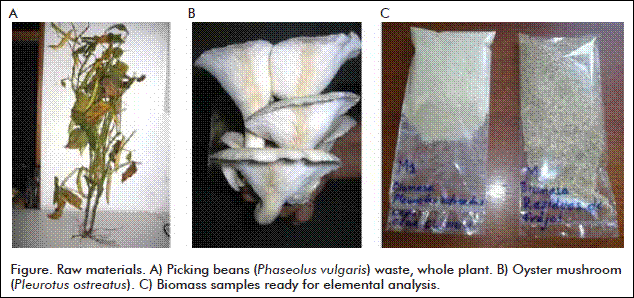
<body><![CDATA[<P   > </P >       <P   ><font face="Verdana, Arial, Helvetica, sans-serif" size="2"><B><font size="3">MATERIALS      AND METHODS </font></b></font></P >   <B>        <P   ><font face="Verdana, Arial, Helvetica, sans-serif" size="2">Strain </font></P >   </B>        <P   ><font face="Verdana, Arial, Helvetica, sans-serif" size="2">The <I>P. ostreatus</I>      Ecuadorian strain ceba-gliie-po-010106 was provided by the Ecuadorian Center      of Environmental Biotechnology (CEBA). It was preserved in Agar-Malt extract      at 4 &ordm;C until use. </font></P >       <P   ><font face="Verdana, Arial, Helvetica, sans-serif" size="2"><B>Raw materials      </b></font></P >       <P   ><font face="Verdana, Arial, Helvetica, sans-serif" size="2"><FONT color="#201D1E">Two      raw materials were used to develop the empirical formulas: <FONT color="#000000">picking      beans<FONT color="#201D1E"> (<FONT color="#000000"><I>Phaseolus vulgaris</I><FONT color="#201D1E">)      harvest wastes, the entire plant, and the <I>P. ostreatus</I> biomass. P<FONT color="#000000">icking      beans<FONT color="#201D1E"> waste samples were used as primary raw material,      being collected from the production communities <FONT color="#000000">La Concepci&oacute;n,      Salinas and Ambuqu&iacute; at the Imbabura and Carchi provinces (<a href="/img/revistas/bta/v31n1/f0106114.gif">Figure</a>).      </font></font></font></font></font></font></font></font></font></P >   <FONT color="#201D1E"><FONT color="#000000"><FONT color="#201D1E"><FONT color="#000000"><FONT color="#201D1E"><FONT color="#000000"><FONT color="#201D1E"><FONT color="#000000"><FONT color="#201D1E">        
<P   ><font color="#000000" face="Verdana, Arial, Helvetica, sans-serif" size="2"><B>Fresh      picking beans waste sampling procedure </b></font></P >   <FONT color="#000000">        <P   ><font face="Verdana, Arial, Helvetica, sans-serif" size="2">Both, the picking      beans waste and the mushroom biomass were sampled following the procedures      described by Oakland [21]. For three months, three 14-kg samples of picking      beans waste were collected every month, sun-dried after harvesting, for a      total of 9 samples. The procedure used for monthly processing is described      in the following. The three samples were separately grinded to a 9-mm size      in a hammer hog and further mixed. The mix was extended on the floor in a      4 m<Sup>2 </Sup>square area. The square was divided in four even quadrants,      and a 1 kg portion of the mix was collected from each quadrant, and further      grinded with a manual grinder down to a 1 mm in size. It was extended again      in the floor in a 1 m<Sup>2 </Sup>square area, divided in four even quadrants.      Samples of 25 g were collected from each quadrant and mixed for a final sample      of 100 g for each month. Samples were packed in polystyrene bags and stored      at 4 &ordm;C during the sampling period (<a href="/img/revistas/bta/v31n1/f0106114.gif">Figure</a>).      </font></P >   <FONT size="+1"><FONT size="+1"><FONT size="+1"><FONT size="+1">        
<P   ><font face="Verdana, Arial, Helvetica, sans-serif" size="2"><B><I>P. ostreatus</I>      biomass sampling procedure </b></font></P >       <P   ><font face="Verdana, Arial, Helvetica, sans-serif" size="2">The monthly-harvested      picking beans waste was used for mushroom production at the CEBA production      plant. The biomass produced by the three first sprouts of the fruiting body      was stockpiled, during 51 days. After that time there was no significant mushroom      growth. The growth medium for fungal biomass production was used without nutrient      supplementation. Three samples 1-kg each were harvested every month, for a      final amount of 9 kg. The mushroom biomass obtained every month was dried      until constant weight in an oven at 70 &ordm;C. It was further grinded in      a manual grinder and extended on a 1 m<Sup>2</Sup> square table, which was      subdivided in four even quadrants, and 25 g were collected from each quadrant      and mixed to homogeneity. The final sample of 100 g was stored at 4 &ordm;C      during the sampling period. Three samples 100 g-each were obtained. </font></P >   <FONT size="+1"><FONT size="+1">        ]]></body>
<body><![CDATA[<P   ><font face="Verdana, Arial, Helvetica, sans-serif" size="2"><B>Biomass culture      procedure by solid fermentation </b></font></P >       <P   ><font face="Verdana, Arial, Helvetica, sans-serif" size="2">The picking beans      waste samples were grinded down to 9 mm in size and the humidity was set to      70 %. Polypropylene bags were filled with 300 g of substrate and further pasteurized      in a sterilizer at 103.46 kPa for 30 min. When the substrate reached room      temperature, it was inoculated with 4 % dry base. Samples were incubated at      a constant temperature of 20 &ordm;C for 51 days. The relative humidity was      kept at an average of 85 % to avoid hyphal contamination, and after the sprout      of the first primordium, it was raised to 90 %. Fifteen days later, the mushroom      was harvested, with an average size of 8 cm. The experiment was conducted      with three bags as replicates. </font></P >       <P   ><font face="Verdana, Arial, Helvetica, sans-serif" size="2"><B>Elemental composition      analytical technique </b></font></P >       <P   ><font face="Verdana, Arial, Helvetica, sans-serif" size="2">Samples were analyzed      at the Center of Research Services and Chemical Analyses (CISAQ), of the National      University of Loja, Ecuador. The elemental analysis was done with a PerkinElmer,      model 2400, series II equipment [22]. This technique provides the total content      of carbon, hydrogen, nitrogen and sulfur for a wide range of samples either      organic or inorganic, solid or liquid, by using the Pregl-Dumas&rsquo; classical      method [22, 23]. This method consists on the combustion of a sample of known      mass at high temperature (approximately 900 &ordm;C) in the presence of pure      oxygen. The process releases carbon dioxide, water and nitrogen. The gasses      are passed through special columns which absorb the carbon dioxide and water.      A column carrying a thermal conductivity detector separates the nitrogen from      any carbon dioxide or water residue, and the resulting nitrogen content is      measured. The instrument must be previously calibrated by analyzing a pure      standard of known nitrogen content. Then, the signal of an unknown nitrogen      concentration sample is measured by the thermal conductivity detector, and      converted into the equivalent nitrogen content value [24, 25]. </font></P >       <P   ><font face="Verdana, Arial, Helvetica, sans-serif" size="2"><B>Calculation of      raw materials empirical formulas </b></font></P >       <P   ><font face="Verdana, Arial, Helvetica, sans-serif" size="2">Data corresponding      to carbon, hydrogen, nitrogen and sulfur were obtained from fresh picking      beans waste and mushroom fruiting body biomass by the technique previously      described. Oxygen content was calculated as the remaining elemental composition      difference, in disregard of other elements present in significant amounts.      Elements&rsquo; concentrations in the solid phase were determined for the      organic fraction once subtracted the ashes present in the sample. These data      were used to calculate the relative atomic mass ratio for each element, by      the ratio of the element&rsquo;s mass fraction over its atomic mass. The atomic      mass ratio could be deduced from these relative atomic mass ratios, by dividing      each element value over that of carbon, the final value being expressed per      carbon atom-gram. The empirical formulas of the raw materials used on this      work do not include sulfur, due to its very low proportions and, therefore,      its irrelevance for stoichiometric balances. </font></P >       <P   ><font face="Verdana, Arial, Helvetica, sans-serif" size="2"><B>Proposal of a      simplified stoichiometric model </b></font></P >       <P   ><font face="Verdana, Arial, Helvetica, sans-serif" size="2">It started from considering      the aerobic cell growth as a simplified mechanism, expressed through a simplified      stoichiometric equation. It describes the transformation of fresh picking      beans substrate, together with a nitrogen supplement in form of ammonia and      oxygen as reactants, into products due to the presence of the mushroom as      biocatalyst. The resulting reaction products considered were the <I>P. ostreatus</I>      biomass, CO<Sub>2</Sub> and water: </font></P >       <P align="center"   ><img src="/img/revistas/bta/v31n1/fr0106114.gif" width="481" height="34"></P >   <FONT size="+1"><FONT size="+1">        
<P   ><font face="Verdana, Arial, Helvetica, sans-serif" size="2">The stoichiometric      coefficients were determined from a balance per element from equation (1)      [19]: </font></P >       ]]></body>
<body><![CDATA[<P align="center"   ><img src="/img/revistas/bta/v31n1/fr0206114.gif" width="294" height="132"></P >       
<P   ><font face="Verdana, Arial, Helvetica, sans-serif" size="2">Where: </font></P >       <P   ><font face="Verdana, Arial, Helvetica, sans-serif" size="2">&alpha;, &beta;,      &gamma;, &delta; and &epsilon;<B> </B>are stoichiometric coefficients expressed      as moles of the respective compound per mol of fungal dry matter (mol/mol      FDM). </font></P >       <P   ><font face="Verdana, Arial, Helvetica, sans-serif" size="2">x<Sub>i</Sub>: hydrogen      content on the molecule per carbon atom-gram. </font></P >   <FONT size="+1"><FONT size="+1">        <P   ><font face="Verdana, Arial, Helvetica, sans-serif" size="2">y<Sub>i</Sub>: oxygen      content on the molecule per carbon atom-gram. </font></P >   <FONT size="+1"><FONT size="+1">        <P   ><font face="Verdana, Arial, Helvetica, sans-serif" size="2">z<Sub>i</Sub>: nitrogen      content on the molecule per carbon atom-gram. </font></P >   <FONT size="+1"><FONT size="+1">        <P   ><font face="Verdana, Arial, Helvetica, sans-serif" size="2">There were only five      equations available for 5 variables; hence, another equation was required.      A recommended alternative for this scenario is the electron balance [19, 26].      It implies to calculate the reduction degree of the species involved (&lambda;).      This factor is defined as the number of moles of electrons available per carbon      atom-gram to be transferred to O<sub>2</sub>, during the full combustion of      a given compound to render CO<sub>2</sub>, H<sub>2</sub>O and N<sub>2</sub>.      For carbon, 4 electrons are free electrons to be transferred, with 1 for hydrogen,      -2 for oxygen and -3 for nitrogen [19]. Positive and negative values stand      for electrons either to be donated or accepted, respectively. Accordingly,      the reduction degree for CO<sub>2</sub>, H<sub>2</sub>O and NH<sub>3</sub>      is null. An electron balance from equation (1) leads to the following expression:</font></P >       <P align="center"   ><img src="/img/revistas/bta/v31n1/fr0306114.gif" width="264" height="32"></P >       
<P   ><font face="Verdana, Arial, Helvetica, sans-serif" size="2">Where: &lambda;<Sub>FF</Sub>      and &lambda;<Sub>XV</Sub> are the reduction degrees of fresh picking beans      waste and mushroom biomass (electrons/mol). </font></P >   <FONT size="+1"><FONT size="+1"><FONT size="+1"><FONT size="+1">        <P   ><font face="Verdana, Arial, Helvetica, sans-serif" size="2">In this way, equations      (2) through (6) form a system of linear algebraic equations with a single      solution for each variable. </font></P >       ]]></body>
<body><![CDATA[<P   ><font face="Verdana, Arial, Helvetica, sans-serif" size="2"><B>Parameters derived      from the stoichiometric equation </b></font></P >       <P   ><font face="Verdana, Arial, Helvetica, sans-serif" size="2">Relevant factors      related to mushroom biomass production can be derived from the stoichiometric      equation (1), such as: theoretical biological efficiency (BE), mean coefficient      of breath (CB; mol CO<Sub>2</Sub>/mol O<Sub>2</Sub>), specific volumetric      air consumption (q<Sub>Air</Sub>) and the metabolic heat (-&#8710;H<sub>M</sub>):      </font></P >   <FONT size="+1"><FONT size="+1"><FONT size="+1"><FONT size="+1"><FONT size="+1"><FONT size="+1">        <P align="center"   ><img src="/img/revistas/bta/v31n1/fr0406114.gif" width="317" height="60"></P >       
<P   ><font face="Verdana, Arial, Helvetica, sans-serif" size="2">Where: </font></P >       <P   ><font face="Verdana, Arial, Helvetica, sans-serif" size="2">BE: biological efficiency      (g FDM/kg SDM) </font></P >       <P   ><font face="Verdana, Arial, Helvetica, sans-serif" size="2">SDM: substrate dry      matter </font></P >       <P   ><font face="Verdana, Arial, Helvetica, sans-serif" size="2">MM<Sub>XV</Sub>:      molecular mass of the ash-free biomass (g/mol) </font></P >   <FONT size="+1"><FONT size="+1">        <P   ><font face="Verdana, Arial, Helvetica, sans-serif" size="2">A<Sub>FF</Sub>: ash      of fresh picking beans waste (g/mol) </font></P >   <FONT size="+1"><FONT size="+1">        <P   ><font face="Verdana, Arial, Helvetica, sans-serif" size="2">MM<Sub>FF</Sub>:      molecular mass of the ash-free fresh picking beans waste (g/mol) </font></P >   <FONT size="+1"><FONT size="+1">        <P   ><font face="Verdana, Arial, Helvetica, sans-serif" size="2">A<Sub>XV</Sub>: biomass      ashes (g/mol); </font></P >       ]]></body>
<body><![CDATA[<P align="center"   ><img src="/img/revistas/bta/v31n1/fr0506114.gif" width="290" height="66"></P >   <FONT size="+1"><FONT size="+1">        
<P   ><font face="Verdana, Arial, Helvetica, sans-serif" size="2">Where: </font></P >       <P   ><font face="Verdana, Arial, Helvetica, sans-serif" size="2">q<Sub>Air</Sub>:      volumetric specific air consumption (m<Sup>3</Sup>/kg MSH) </font></P >   <FONT size="+1"><FONT size="+1"><FONT size="+1"><FONT size="+1">        <P   ><font face="Verdana, Arial, Helvetica, sans-serif" size="2">MM<Sub><Sub>O2</Sub></Sub>:      oxygen molecular mass (g/mol) </font></P >   <FONT size="+1"><FONT size="+1"><FONT size="+1">        <P   ><font face="Verdana, Arial, Helvetica, sans-serif" size="2">y<Sub><Sub>O2</Sub></Sub>:      air oxygen fraction (mol O<Sub>2</Sub>/mol total); </font></P >   <FONT size="+1"><FONT size="+1"><FONT size="+1"><FONT size="+1"><FONT size="+1">        <P   ><font face="Verdana, Arial, Helvetica, sans-serif" size="2">&rho;<Sub>Air</Sub>:      air density (kg/m<Sup>3</Sup>) </font></P >       <P align="center"   ><img src="/img/revistas/bta/v31n1/fr0606114.gif" width="133" height="46"></P >   <FONT size="+1"><FONT size="+1"><FONT size="+1"><FONT size="+1">        
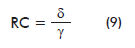
<P   ><font face="Verdana, Arial, Helvetica, sans-serif" size="2">Where RC is the respiration      coefficient </font></P >       <P   ><font face="Verdana, Arial, Helvetica, sans-serif" size="2">According to Ertola      <I>et al.</I> [19], the heat released during the metabolic process is proportional      to the number of electrons to be transferred to oxygen during the reaction      [27]. The mean value (Q<Sub>0</Sub>) deduced from a large number of reactions      was 115.137 kJ/electron. Following these results and also based on a dimensional      analysis, the metabolic heat was calculated and expressed in kJ/kg FDM by      the equation: </font></P >       <P align="center"   ><img src="/img/revistas/bta/v31n1/fr0706114.gif" width="340" height="44"></P >   <FONT size="+1"><FONT size="+1">        

]]></body>
<body><![CDATA[<P   ID="LinkTarget_343" ><font face="Verdana, Arial, Helvetica, sans-serif" size="2">Where: </font></P >       <P   ID="LinkTarget_344" ><font face="Verdana, Arial, Helvetica, sans-serif" size="2">(-&Delta;H<Sub>M</Sub>):      stoichiometric metabolic heat (kJ/kg FDM). </font></P >   <FONT size="+1"><FONT size="+1">        <P   ><font face="Verdana, Arial, Helvetica, sans-serif" size="2">&lambda;<Sub>FF</Sub>:      reduction degree of the fresh picking beans waste (electrons/mol). </font></P >   <FONT size="+1"><FONT size="+1">        <P   ID="LinkTarget_346" ><font face="Verdana, Arial, Helvetica, sans-serif" size="2">Results computed      for parameters of equations (7) through (10) depend on the results obtained      once calculated the remaining variables on equation (1). They include those      of the empirical formulas for the substrate and the biomass, and also the      stoichiometric coefficients. </font></P >       <P   ID="LinkTarget_346" >&nbsp;</P >       <P   > </P >       <P   ><font face="Verdana, Arial, Helvetica, sans-serif" size="3"><B>RESULTS AND DISCUSION      </b></font></P >       <P   ID="LinkTarget_349" ><font face="Verdana, Arial, Helvetica, sans-serif" size="2">Determining the empirical      formulas for biomass of the fresh picking beans waste and the <I>P. ostreatus</I>      mushroom is highly relevant to establish the stoichiometric equation describing      the growth of the selected<I> P. ostreatus</I> strain, and also for the stoichiometric      equation balance and the calculation of its coefficients. <a href="/img/revistas/bta/v31n1/t0106114.gif">Table      1</a> summarizes the elemental composition and the estimated values for relative      atomic relationships/ratios of the fungal biomass, starting from measurements      of the collected samples. </font></P >       
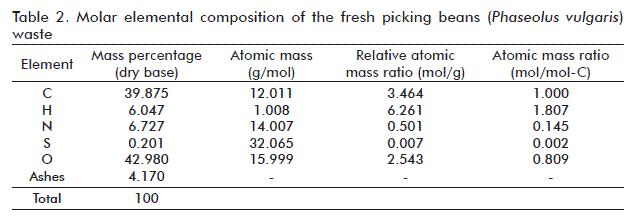
<P   ><font face="Verdana, Arial, Helvetica, sans-serif" size="2">The <I>P. ostreatus</I>      nitrogen levels were among the highest for a biomass tested [28], as expected      from a fungal biomass. Instead, carbon levels were low, if we compare them      to a list of elemental composition reported for forty agriculture matters      [29]. This could explain the relatively high atomic mass ratio calculated      for the oxygen, almost twice the value reported for many microorganisms. The      ashes content was comparable to the lowest values reported by S&aacute;nchez      and Mata [30] for eleven edible fungi species, and was closer to that of <I>Pleurotus      sajour-caju</I> (5.84 %). </font></P >       <P   ><font face="Verdana, Arial, Helvetica, sans-serif" size="2">Results for elemental      composition and the calculation of relative atomic mass ratios of the fresh      picking beans waste, starting from the measurement of collected samples, are      shown in <a href="/img/revistas/bta/v31n1/t0206114.gif">table 2</a>. </font></P >       
]]></body>
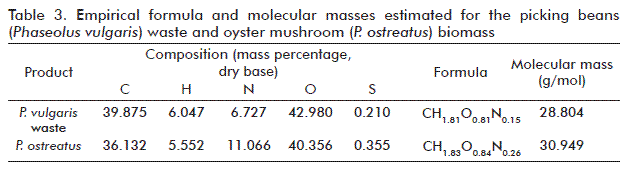
<body><![CDATA[<P   ><font face="Verdana, Arial, Helvetica, sans-serif" size="2">The chemical carbon      composition of the fresh picking beans waste was in the same order of the      values reported by Parikh <I>et al.</I> [28] for biomass grown on waste from      different sources. According to that group, the carbon content was only higher      than those reported for rice hull (40.6 %) and cotton stems (41.3 %). By the      contrary, hydrogen and oxygen contents were average compared to equivalent      results [28]. </font></P >       <P   ><font face="Verdana, Arial, Helvetica, sans-serif" size="2">Data obtained from      empirical formulas for the two highest components, subject of elemental analysis,      are shown in <a href="/img/revistas/bta/v31n1/t0306114.gif">table 3</a>. They were used to deduce      the process&rsquo; stoichiometry. Significant values from <a href="/img/revistas/bta/v31n1/t0206114.gif">table      2</a> and <a href="/img/revistas/bta/v31n1/t0306114.gif">table 3</a> were further applied for calculation,      in spite of showing just two decimal digit values in the case of the formulas.      </font></P >       
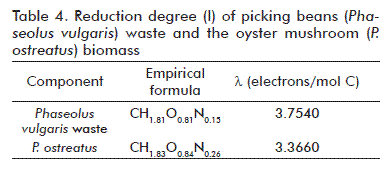
<P   ><font size="2" face="Verdana, Arial, Helvetica, sans-serif">There was a marked      difference in the elemental composition of <i>P. ostreatus</i>, compared to      that reported for <i>Aspergillus niger</i> (CH<sub>1.72</sub>O<sub>0.55</sub>N<sub>0.17</sub>)      [31, 32], which was quite more similar to that of the <i>Kluyveromyces marxianus</i>      yeast (CH<sub>1.94</sub>O<sub>0.76</sub>N<sub>0.17</sub>) [33]. The elemental      composition does not vary for the most dissimilar biomasses; but growth conditions,      either nutritional or environmental, are responsible for small variations      [28]. This composition places the <i>P. ostreatus</i> strain ceba-gliie-po-010606      with a molecular mass slightly above the mean value established for microorganisms,      approximately of 25 g/mol [19].</font></P >   <FONT size="+1"><FONT size="+1"><FONT size="+1"><FONT size="+1"><FONT size="+1"><FONT size="+1">    <H3   align="justify" ID="LinkTarget_307" ><font size="2" face="Verdana, Arial, Helvetica, sans-serif"><B>Calculation of      the stoichiometric coefficients </b></font></H3 >   <FONT size="+1">        <P   ><font face="Verdana, Arial, Helvetica, sans-serif" size="2">The stoichiometric      equation and the balances were established from data shown in <a href="#tab4">table      4</a> as follows: </font></P >       <P align="center"   ><img src="/img/revistas/bta/v31n1/t0406114.gif" width="387" height="171"><a name="tab4"></a></P >       
<P align="center"   ><img src="/img/revistas/bta/v31n1/fr0806114.gif" width="515" height="44"></P >       
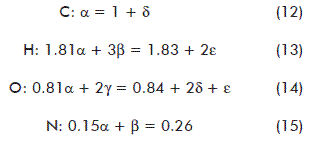
<P align="center"   ><img src="/img/revistas/bta/v31n1/fr0906114.gif" width="307" height="141"></P >   <FONT size="+1">        
<P   ><font face="Verdana, Arial, Helvetica, sans-serif" size="2">The reduction degree      for the solid waste was calculated from data shown in <a href="/img/revistas/bta/v31n1/t0306114.gif">table      3</a>. Data summarized in <a href="#tab4">table 4</a> was used to calculate      the biomass of the fruiting body of <I>P. ostreatus</I>. With this information,      the electron balance of equation (6) was set: </font></P >       

<P align="center"   ><img src="/img/revistas/bta/v31n1/fr1006114.gif" width="267" height="23"></P >       
<P   ><font face="Verdana, Arial, Helvetica, sans-serif" size="2">The solution for      the system equations (8) through (12) provided the stoichiometric coefficients:      &alpha; = 1.2689; &beta; = 0.0790; &gamma; = 0.3494; &delta; = 0.2689; &epsilon;      = 0.3495. They were used to formulate the stoichiometric equation. Due to      its simplicity, only two digits were reported for the stoichiometric coefficients      (17): </font></P >       ]]></body>
<body><![CDATA[<P align="center"   ><img src="/img/revistas/bta/v31n1/fr1106114.gif" width="538" height="43"></P >   <H3   align="justify" ID="LinkTarget_311" ><font size="2" face="Verdana, Arial, Helvetica, sans-serif"><B>Parameters estimated      with the stoichiometric equation </b></font></H3 >   <FONT size="+1"><B>        
<P   ><font size="2" face="Verdana, Arial, Helvetica, sans-serif"><I>Theoretical biological      efficiency </I></font></P >   </B>        <P   ><font size="2" face="Verdana, Arial, Helvetica, sans-serif">Taking into account      the amount of ashes and water of picking beans waste, and also that of <I>P.      ostreatus</I> biomass, it was estimated that the expected biological efficiency      from this system is 867.49 g FDM/kg SDM. This result arises as a model for      the efficiency that must be achieved for certain substrates and strain specific      conditions. Several authors have optimized the growth medium for different      <I>P. ostreatus</I> strains [34]. Otherwise, the maximal efficiency reported      for the process at 20 &ordm;C was 261.89 g FDM/kg SDM [35]. Hence, these levels      could have been further improved, since they represent just 30.18 % of the      estimated theoretical value according to our results. Noteworthy, the biological      efficiency depends not only on the attained nutritional balance, but also      on other environmental aspects such as: the water retention capacity of the      substrate, aeration and the relative humidity at different culture phases,      among others [3]. </font></P >   <FONT size="+1">        <P   ><font face="Verdana, Arial, Helvetica, sans-serif" size="2"><B><I>Mean coefficient      of breath </I></b></font></P >       <P   ><font face="Verdana, Arial, Helvetica, sans-serif" size="2">As defined for this      parameter, the coefficient reached 0.77 mol CO<Sub>2</Sub>/mol O<Sub>2,</Sub>      a relatively low value compared to that reported for the fungal aerobial growth.      The breath coefficients commonly derive from increased demands for energy      to synthesize the enzyme complexes required to produce simple sugar molecules      during growth, as reported for <I>A. niger</I> growth on citric wastes [36].      Another plausible explanation comes from the CO<Sub>2</Sub> retention that      occurs in growth bags, which could slightly modify the fungal growth metabolism.      </font></P >   <FONT size="+1"><FONT size="+1"><FONT size="+1"><FONT size="+1"><FONT size="+1"><FONT size="+1">        <P   ><font face="Verdana, Arial, Helvetica, sans-serif" size="2"><B><I>Specific air      consumption </I></b></font></P >       <P   ><font face="Verdana, Arial, Helvetica, sans-serif" size="2">The air consumption      was calculated for normal temperature and pressure conditions, being estimated      as 1.36 m<Sup>3</Sup>/kg FDM. This indicator demonstrates that the fungal      growth demands a non-significant amount of air to produce a ton of product.      </font></P >   <FONT size="+1"><FONT size="+1">        <P   ><font face="Verdana, Arial, Helvetica, sans-serif" size="2"><B><I>Metabolic heat      </I></b></font></P >       <P   ><font face="Verdana, Arial, Helvetica, sans-serif" size="2">According to equations      (10) and (17), metabolic heat was estimated as the heat release equivalent      to 16 576.47 kJ/kg FDM. A huge amount of energy is normally released in the      form of heat during solid fermentation processes due to metabolic activity      [37]. This parameter is scarcely estimated by experimentation, being most      frequently calculated from stoichiometric balances [38] similar to those developed      in our work. For example, Gonz&aacute;lez <I>et al.</I> reported metabolic      heat values for the growth of <I>A. niger</I> of 16 000 kJ/kg FDM, very similar      to ours. This implies that the adjusted stoichiometric equation generates      values which are in agreement with those previously reported for fungal growth.      </font></P >       <P   >&nbsp;</P >       ]]></body>
<body><![CDATA[<P   ><font face="Verdana, Arial, Helvetica, sans-serif" size="2"><B><font size="3">CONCLUSIONS      </font></b></font></P >       <P   ><font face="Verdana, Arial, Helvetica, sans-serif" size="2">A proximate stoichiometric      equation was developed to describe the aerobial growth of the Ecuatorian <I>P.      ostreatus</I> strain ceba-gliie-po-010106 on local picking beans (<I>Phaseolus      vulgaris</I>) harvest wastes. Empirical formulas were established to describe      the elemental composition of fresh sun-dried picking beans waste (CH<Sub>1.81</Sub>O<Sub>0.81</Sub>N<Sub>0.15</Sub>)      and that of the mushroom biomass (CH<Sub>1.83</Sub>O<Sub>0.84</Sub>N<Sub>0.26</Sub>).      </font></P >   <FONT size="+1"><FONT size="+1"><FONT size="+1"><FONT size="+1"><FONT size="+1"><FONT size="+1"><FONT size="+1"><FONT size="+1"><FONT size="+1"><FONT size="+1"><FONT size="+1"><FONT size="+1">        <P   ><font face="Verdana, Arial, Helvetica, sans-serif" size="2">The stoichiometry      proposed supports the estimation of key parameters for the development of      fungal solid fermentation processes, based on mathematical models with a mechanistic      approach. They included the theoretical biological efficiency (867.49 g FDM/kg      SDM), the mean respiration coefficient (0.77 mol CO<Sub>2</Sub>/mol O<Sub>2</Sub>),      the specific air consumption to grow (1.36 m<Sup>3</Sup>/kg FDM) and the metabolic      heat (16 576.47 kJ/kg FDM). </font></P >       <P   >&nbsp;</P >   <FONT size="+1"><FONT size="+1"><FONT size="+1"><FONT size="+1"><FONT size="+1"><FONT size="+1">        <P   > </P >       <P   ><font face="Verdana, Arial, Helvetica, sans-serif" size="2"><B><font size="3">ACKNOWLEDGEMENTS      </font> </b></font></P >       <P   ><font face="Verdana, Arial, Helvetica, sans-serif" size="2">The research resulting      on this publication was funded by the National Secretary of Higher Education,      Science, Technology and Innovation of Ecuador (SENESCYT), through a Scholarship      granted in 2008. </font></P >       <P   >&nbsp;</P >       <P   > </P >       <P   ><font face="Verdana, Arial, Helvetica, sans-serif" size="3"><B>DECLARATION OF      CONFLICT OF INTERESTS </b></font></P >       ]]></body>
<body><![CDATA[<P   ><font face="Verdana, Arial, Helvetica, sans-serif" size="2">The authors declare      the absence of conflicts of interests. </font></P >       <P   >&nbsp;</P >       <P   > </P >       <P   ><font face="Verdana, Arial, Helvetica, sans-serif" size="3"><B>REFERENCES </b></font></P >       <!-- ref --><P   ><font face="Verdana, Arial, Helvetica, sans-serif" size="2">1. &Aacute;lvarez-Castillo      A, Garc&iacute;a-Hern&aacute;ndez E, Dom&iacute;nguez-Dom&iacute;nguez MM,      Granandos-Baeza J, Aguirre-Cruz A, Morales-Cepeda A, <I>et al.</I> Aprovechamiento      integral de los materiales lignocelul&oacute;sicos. Rev Iberoam Polim. 2012;13(4):140-50.          </font></P >       <!-- ref --><P   ><font face="Verdana, Arial, Helvetica, sans-serif" size="2">2. Chukwurah NF,      Eze SC, Chiejina NV, Onyeonagu CC, Ugwuoke KI, Ugwu FSO, <I>et al.</I> Performance      of oyster mushroom (Pleurotus ostreatus) in different local agricultural waste      materials. Afr J Biotechnol. 2012;11(37):8979-85.     </font></P >       <!-- ref --><P   ><font face="Verdana, Arial, Helvetica, sans-serif" size="2">3. Mane VP, Patil      SS, Syed AA, Baig MM. Bioconversion of low quality lignocellulosic agricultural      waste into edible protein by Pleurotus sajor-caju (Fr.) Singer. J Zhejiang      Univ Sci B. 2007;8(10):745-51.     </font></P >       ]]></body>
<body><![CDATA[<!-- ref --><P   ><font face="Verdana, Arial, Helvetica, sans-serif" size="2">4. Pineda-Insuasti      J, Ramos-Sanchez LB. Producci&oacute;n de prote&iacute;nas comestibles con      fuentes alternativas de materias primas. Axioma. 2013;1(10):5-9.     </font></P >       <P   ><font face="Verdana, Arial, Helvetica, sans-serif" size="2">5. &Aacute;lvaro      H, inventor; Garrigues Fongs, S.L., assignee. Procedimiento para la obtenci&oacute;n      de una composici&oacute;n de un substrato para el cultivo de hongos. Spain      patent ES 2 166 337 A1. 2000 Jul 24. </font></P >       <P   ><font face="Verdana, Arial, Helvetica, sans-serif" size="2">6. Dunn-Coleman NS,      Michaels TJ, inventors; Monterey Mushrooms, Inc., assignee. Composting process      for the production of mushroom cultivation substrates. United States patent      US 4848026 A. 1989 Jul 18. </font></P >       <P   ><font face="Verdana, Arial, Helvetica, sans-serif" size="2">7. Giovannozzi G,      Luigi P, Baldo R, Porri A, D`Annibale A, Perani C, inventors; Consiglio Nazionale      Delle Ricerche, Universita' Studi Della Tuscia, assignee. Process for the      production of cellulose paper pulps by biodelignification vegetative masses.      United States patent US 6379495 B1. 2002 Abr 30. </font></P >       <P   ><font face="Verdana, Arial, Helvetica, sans-serif" size="2">8. Hisakazu I, Oaza      S, Hanishina-Gun N, inventors; Hisakazu Ikeda, assignee. Obtaining edible      material fron fungus-digested medium. Europe patent EP 0357320 A2. 1989 Aug      22. </font></P >       <P   ><font face="Verdana, Arial, Helvetica, sans-serif" size="2">9. Ikeda H, inventor;      Ikeda H, assignee. Edible material containing mushroom. United States patent      US 5028441 A. 1991 Jul 2. </font></P >       <P   ><font face="Verdana, Arial, Helvetica, sans-serif" size="2">10. Kok T, inventor;      Everbloom Mushroom (Pte) Ltd., assignee. Mushrooms cultivation. Europe patent      EP 0248636 A3. 1987 Jun 2. </font></P >       <P   ><font face="Verdana, Arial, Helvetica, sans-serif" size="2">11. Ladisch M, Kohlman      K, Westgate P, Weil J, Yang Y, inventors; Purdue Research Foundation Office      of Technology Transfer, assignee. Processes for treating cellulosic material.      United States patent US 5846787. 1998 Jul 11. </font></P >       <P   ><font face="Verdana, Arial, Helvetica, sans-serif" size="2">12. Mee H, inventor;      The Kinoko Company, assignee. Method for growing wood mushroom. United States      patent US 4127965. 1978 Dec 5. </font></P >       ]]></body>
<body><![CDATA[<P   ><font face="Verdana, Arial, Helvetica, sans-serif" size="2">13. Suryanarayan      S, Mazundar K, inventors; Biocon India Limited, assignee. Solid state fermentation.      United States patent US 6197573 B1. 2001 Mar 6. </font></P >       <P   ><font face="Verdana, Arial, Helvetica, sans-serif" size="2">14. Toth E, Toth      L, Heltay I, inventors; Licencia Talalmanyokat Ertekesito Vallalat, assignee.      Mushroom growing process. United States patent US 3996038. 1976 Dec 7. </font></P >       <!-- ref --><P   ><font face="Verdana, Arial, Helvetica, sans-serif" size="2">15. Kiparissides      A, Koutinas M, Kontoravdi C, Mantalaris A, Pistikopoulos EN. Closing the loop      in biological systems modeling - From the in silico to the in vitro. Autom&aacute;tica.      2011;47(6):1147-55.     </font></P >       <!-- ref --><P   ><font face="Verdana, Arial, Helvetica, sans-serif" size="2">16. Rodr&iacute;guez-Fern&aacute;ndez      M, Balsa-Canto E, Egea JA, Banga JR. Identifiability and robust parameter      estimation in food process modeling: Application to a drying model. J Food      Eng. 2007;83(3):374-83.     </font></P >       <!-- ref --><P   ><font face="Verdana, Arial, Helvetica, sans-serif" size="2">17. Nfor BK, Verhaert      PD, van der Wielen LA, Hubbuch J, Ottens M. Rational and systematic protein      purification process development: the next generation. Trends Biotechnol.      2009;27(12):673-9.     </font></P >       <!-- ref --><P   ><font face="Verdana, Arial, Helvetica, sans-serif" size="2">18. Lam M. In silico      dynamic optimisation studies for batch/fed-batch mammalian cell suspension      cultures producing biopharmaceuticals [dissertation]. London: Imperial College;      2009.     </font></P >       ]]></body>
<body><![CDATA[<!-- ref --><P   ><font face="Verdana, Arial, Helvetica, sans-serif" size="2">19. Ertola R, Yantorno      O, Mignone C. Microbiolog&iacute;a industrial. Washington: OEA; 1994.     </font></P >       <P   ><font face="Verdana, Arial, Helvetica, sans-serif" size="2">20. Sinclair CG.      Cin&eacute;tica de los procesos microbianos. In: Bu'lock JD, Kristiansen B,      editors. Biotecnolog&iacute;a b&aacute;sica. Zaragoza: Editorial Acribia S.A.;      1991. p. 75-133. </font></P >       <P   ><font face="Verdana, Arial, Helvetica, sans-serif" size="2">21. Oakland J. Statistical      process control. 5th ed. Oxford: Butterworth-Heinemann Ltd.; 2003. </font></P >       <!-- ref --><P   ><font face="Verdana, Arial, Helvetica, sans-serif" size="2">22. Vassilev SV,      Baxter D, Andersen LK, Vassileva CG. An overview of the composition and application      of biomass ash. Part 2. Potential utilisation, technological and ecological      advantages and challenges. Fuel. 2013;105:19-39.     </font></P >       <!-- ref --><P   ><font face="Verdana, Arial, Helvetica, sans-serif" size="2">23. Thompson M, editor.      CHNS Elemental Analysers Report. AMC Technical Briefs [internet]. 2008 Apr      [cited 2013 Jan 6];(29):[2 p.]. Available from: <a href="http://www.rsc.org/images/CHNS-elemental-analysers-technical-brief-29_tcm18-214833.pdf" target="_blank">http://www.rsc.org/images/CHNS-elemental-analysers-technical-brief-29_tcm18-214833.pdf</a>.          </font></P >       <P   ><font face="Verdana, Arial, Helvetica, sans-serif" size="2">24. Francis FJ, editor.      Wiley Encyclopedia of Food Science and Technology. 2nd ed. England: John Wiley      and Sons; 1999. </font></P >       <!-- ref --><P   ><font face="Verdana, Arial, Helvetica, sans-serif" size="2">25. PerkinElmer.      2400 Series II CHNS/O Elemental Analysis. Organic Elemental Analysis. Waltham:      PerkinElmer, Inc.; c2013 [cited 2013 Jan 6]; Available from: <a href="http://www.perkinelmer.com/Catalog/Product/ID/N2410650" target="_blank">http://www.perkinelmer.com/Catalog/Product/ID/N2410650</a>.          </font></P >       <!-- ref --><P   ><font face="Verdana, Arial, Helvetica, sans-serif" size="2">26. McNeil B, Harvey      LM. Practical fermentation technology. England: John Wiley &amp; Sons, Ltd.;      2008 </font></P >       <!-- ref --><P   ><font face="Verdana, Arial, Helvetica, sans-serif" size="2">27. Castellanos J,      Garc&iacute;a A, Herrera N, Rodr&iacute;guez J, P&eacute;rez A. Estimaci&oacute;n      del calor de reacci&oacute;n en el transcurso de bioprocesos. Centro Az&uacute;car.      2002;28(1):37-46.     </font></P >       <!-- ref --><P   ><font face="Verdana, Arial, Helvetica, sans-serif" size="2">28. Parikh J, Channiwala      SA, Ghosal GK. A Correlation for calculating elemental composition from proximate      analysis of biomass materials. Fuel. 2007;86(12-13):1710-9.     </font></P >       <!-- ref --><P   ><font face="Verdana, Arial, Helvetica, sans-serif" size="2">29. Cuiping L, Chuangzhi      W, Yanyongjie, Haitao H. Chemical elemental characteristics of biomass fuels      in China. Biomass Bioenerg. 2004;27(2):119-30.     </font></P >       <!-- ref --><P   ><font face="Verdana, Arial, Helvetica, sans-serif" size="2">30. S&aacute;nchez      JE, Mata G. Hongos comestibles y medicinales en Iberoam&eacute;rica: investigaci&oacute;n      y desarrollo en un entorno multicultural. Tapachula: El Colegio de la Frontera      Sur; 2012.     </font></P >       ]]></body>
<body><![CDATA[<!-- ref --><P   ><font face="Verdana, Arial, Helvetica, sans-serif" size="2">31. Vargas-Moreno      JM, Callej&oacute;n-Ferre AJ, P&eacute;rez-Alonso J, Vel&aacute;zquez-Mart&iacute;      B. A review of the mathematical models for predicting the heating value of      biomass materials. Renew Sust Energ Rev. 2012;16(5):3065-83.     </font></P >       <!-- ref --><P   ><font face="Verdana, Arial, Helvetica, sans-serif" size="2">32. Shen J, Zhu S,      Liu X, Zhang H, Tan J. The prediction of elemental composition of biomass      based on proximate analysis. Energ Convers Manage. 2010;51(5):983-7.     </font></P >       <!-- ref --><P   ><font face="Verdana, Arial, Helvetica, sans-serif" size="2">33. Y&eacute;pez      B, Converti A, Maugeri F. Intrinsic activity of inulinase from <I>Kluyveromyces      marxianus</I> ATCC 16045 and carbon and nitrogen balances. Food Technol Biotechnol.      2006;44(4):479-83.     </font></P >       <!-- ref --><P   ><font face="Verdana, Arial, Helvetica, sans-serif" size="2">34. Andrino A, Morte      MA, Honrubia M. Caracterizaci&oacute;n y cultivo de tres cepas de <I>Pleurotus      eryngii</I> (Fries) Qu&eacute;let sobre sustratos basados en residuos agroalimentarios.      An Biol. 2011;(33):53-66.     </font></P >       <P   ><font face="Verdana, Arial, Helvetica, sans-serif" size="2">35. Pineda J, Ramos      L, Soto C. Cin&eacute;tica del crecimiento de Pleurotus ostreatus en la etapa      de producci&oacute;n del cuerpo fruct&iacute;fero. ICIDCA. 2013;47(3):56-61.      </font></P >       <!-- ref --><P   ><font face="Verdana, Arial, Helvetica, sans-serif" size="2">36. Dimian AC, Sorin      C. Chemical processing design: Computer-aided case study. Weinheim: Wiley      VCH Verlag GmbH &amp; Co. KGaA; 2008.     </font></P >       <P   ><font face="Verdana, Arial, Helvetica, sans-serif" size="2">37. Mitchell D, Krieger      N, Berovic M, editors. Solid-state fermentation bioreactors: Fundamentals      of design and operation. New York: Springer; 2006. </font></P >       <!-- ref --><P   ><font face="Verdana, Arial, Helvetica, sans-serif" size="2">38. Gonz&aacute;lez      DM, Echevarr&iacute;a HR, Hern&aacute;ndez AP. Termodin&aacute;mica para ingenieros      qu&iacute;micos. La Habana: Editorial F&eacute;lix Varela; 2006.     </font></P >       <P   >&nbsp;</P >       <P   >&nbsp;</P >       <P   > </P >       <P   > </P >       <P   ><font face="Verdana, Arial, Helvetica, sans-serif" size="2">Received in November,      2013.     <br>     Accepted in January, 2014. </font></P >       ]]></body>
<body><![CDATA[<P   >&nbsp;</P >       <P   >&nbsp;</P >       <P   > </P >       <P   > </P >       <P   ><i><font face="Verdana, Arial, Helvetica, sans-serif" size="2">Julio A Pineda-Insuasti</font></i><font face="Verdana, Arial, Helvetica, sans-serif" size="2">.      Centro Ecuatoriano de Biotecnolog&iacute;a del Ambiente, CEBA. Ibarra, Imbabura,      Ecuador. E-mail: <A href="mailto:pinsuasti@yahoo.com"> <U><U><FONT color="#0000FF">pinsuasti@yahoo.com</font></U></U></A><FONT color="#0000FF"><FONT color="#000000">.      </font></font></font></P >   <FONT color="#0000FF"><FONT color="#000000"><B>        <P   ></P >   </B>        <P   > </P >   </font></font></font></font></font></font></font></font></font></font></font></font></font></font></font></font></font></font></font></font></font></font></font></font></font></font></font></font></font></font></font></font></font></font></font></font></font></font></font></font></font></font></font></font></font></font></font></font></font></font></font></font></font></font></font></font></font></font></font></font></font></font></font></font></font></font></font></font></font></font></font></font></font></font></font></font></font></font></font></font></font></font></font></font></font></font></font></font></font></font></font></font></font></font></font></font></font></font></font></font></font></font></font></font></font></font></font></font></font></font></font></font></font></font></font></font></font></font></font></font></font></font></font></font></font></font></font></font></font></font></font></font></font></font></font></font></font></font></font></font></font></font></font></font></font></DIV >      ]]></body><back>
<ref-list>
<ref id="B1">
<label>1</label><nlm-citation citation-type="journal">
<person-group person-group-type="author">
<name>
<surname><![CDATA[Álvarez-Castillo]]></surname>
<given-names><![CDATA[A]]></given-names>
</name>
<name>
<surname><![CDATA[García-Hernández]]></surname>
<given-names><![CDATA[E]]></given-names>
</name>
<name>
<surname><![CDATA[Domínguez-Domínguez]]></surname>
<given-names><![CDATA[MM]]></given-names>
</name>
<name>
<surname><![CDATA[Granandos-Baeza]]></surname>
<given-names><![CDATA[J]]></given-names>
</name>
<name>
<surname><![CDATA[Aguirre-Cruz]]></surname>
<given-names><![CDATA[A]]></given-names>
</name>
<name>
<surname><![CDATA[Morales-Cepeda]]></surname>
<given-names><![CDATA[A]]></given-names>
</name>
</person-group>
<article-title xml:lang="en"><![CDATA[Aprovechamiento integral de los materiales lignocelulósicos]]></article-title>
<source><![CDATA[Rev Iberoam Polim]]></source>
<year>2012</year>
<volume>13</volume>
<numero>4</numero>
<issue>4</issue>
<page-range>140-50</page-range></nlm-citation>
</ref>
<ref id="B2">
<label>2</label><nlm-citation citation-type="journal">
<person-group person-group-type="author">
<name>
<surname><![CDATA[Chukwurah]]></surname>
<given-names><![CDATA[NF]]></given-names>
</name>
<name>
<surname><![CDATA[Eze]]></surname>
<given-names><![CDATA[SC]]></given-names>
</name>
<name>
<surname><![CDATA[Chiejina]]></surname>
<given-names><![CDATA[NV]]></given-names>
</name>
<name>
<surname><![CDATA[Onyeonagu]]></surname>
<given-names><![CDATA[CC]]></given-names>
</name>
<name>
<surname><![CDATA[Ugwuoke]]></surname>
<given-names><![CDATA[KI]]></given-names>
</name>
<name>
<surname><![CDATA[Ugwu]]></surname>
<given-names><![CDATA[FSO]]></given-names>
</name>
</person-group>
<article-title xml:lang="en"><![CDATA[Performance of oyster mushroom (Pleurotus ostreatus) in different local agricultural waste materials]]></article-title>
<source><![CDATA[Afr J Biotechnol]]></source>
<year>2012</year>
<volume>11</volume>
<numero>37</numero>
<issue>37</issue>
<page-range>8979-85</page-range></nlm-citation>
</ref>
<ref id="B3">
<label>3</label><nlm-citation citation-type="journal">
<person-group person-group-type="author">
<name>
<surname><![CDATA[Mane]]></surname>
<given-names><![CDATA[VP]]></given-names>
</name>
<name>
<surname><![CDATA[Patil]]></surname>
<given-names><![CDATA[SS]]></given-names>
</name>
<name>
<surname><![CDATA[Syed]]></surname>
<given-names><![CDATA[AA]]></given-names>
</name>
<name>
<surname><![CDATA[Baig]]></surname>
<given-names><![CDATA[MM]]></given-names>
</name>
</person-group>
<article-title xml:lang="en"><![CDATA[Bioconversion of low quality lignocellulosic agricultural waste into edible protein by Pleurotus sajor-caju (Fr.) Singer]]></article-title>
<source><![CDATA[J Zhejiang Univ Sci B]]></source>
<year>2007</year>
<volume>8</volume>
<numero>10</numero>
<issue>10</issue>
<page-range>745-51</page-range></nlm-citation>
</ref>
<ref id="B4">
<label>4</label><nlm-citation citation-type="journal">
<person-group person-group-type="author">
<name>
<surname><![CDATA[Pineda-Insuasti]]></surname>
<given-names><![CDATA[J]]></given-names>
</name>
<name>
<surname><![CDATA[Ramos-Sanchez]]></surname>
<given-names><![CDATA[LB]]></given-names>
</name>
</person-group>
<article-title xml:lang="es"><![CDATA[Producción de proteínas comestibles con fuentes alternativas de materias primas]]></article-title>
<source><![CDATA[Axioma]]></source>
<year>2013</year>
<volume>1</volume>
<numero>10</numero>
<issue>10</issue>
<page-range>5-9</page-range></nlm-citation>
</ref>
<ref id="B5">
<label>5</label><nlm-citation citation-type="">
<person-group person-group-type="author">
<name>
<surname><![CDATA[Álvaro]]></surname>
<given-names><![CDATA[H]]></given-names>
</name>
</person-group>
<source><![CDATA[Procedimiento para la obtención de una composición de un substrato para el cultivo de hongos]]></source>
<year></year>
</nlm-citation>
</ref>
<ref id="B6">
<label>6</label><nlm-citation citation-type="">
<person-group person-group-type="author">
<name>
<surname><![CDATA[Dunn-Coleman]]></surname>
<given-names><![CDATA[NS]]></given-names>
</name>
<name>
<surname><![CDATA[Michaels]]></surname>
<given-names><![CDATA[TJ]]></given-names>
</name>
</person-group>
<source><![CDATA[Composting process for the production of mushroom cultivation substrates]]></source>
<year></year>
</nlm-citation>
</ref>
<ref id="B7">
<label>7</label><nlm-citation citation-type="">
<person-group person-group-type="author">
<name>
<surname><![CDATA[Giovannozzi]]></surname>
<given-names><![CDATA[G]]></given-names>
</name>
<name>
<surname><![CDATA[Luigi]]></surname>
<given-names><![CDATA[P]]></given-names>
</name>
<name>
<surname><![CDATA[Baldo]]></surname>
<given-names><![CDATA[R]]></given-names>
</name>
<name>
<surname><![CDATA[Porri]]></surname>
<given-names><![CDATA[A]]></given-names>
</name>
<name>
<surname><![CDATA[D`Annibale]]></surname>
<given-names><![CDATA[A]]></given-names>
</name>
<name>
<surname><![CDATA[Perani]]></surname>
<given-names><![CDATA[C]]></given-names>
</name>
</person-group>
<source><![CDATA[Process for the production of cellulose paper pulps by biodelignification vegetative masses]]></source>
<year></year>
</nlm-citation>
</ref>
<ref id="B8">
<label>8</label><nlm-citation citation-type="">
<person-group person-group-type="author">
<name>
<surname><![CDATA[Hisakazu]]></surname>
<given-names><![CDATA[I]]></given-names>
</name>
<name>
<surname><![CDATA[Oaza]]></surname>
<given-names><![CDATA[S]]></given-names>
</name>
<name>
<surname><![CDATA[Hanishina-Gun]]></surname>
<given-names><![CDATA[N]]></given-names>
</name>
</person-group>
<source><![CDATA[Obtaining edible material fron fungus-digested medium]]></source>
<year></year>
</nlm-citation>
</ref>
<ref id="B9">
<label>9</label><nlm-citation citation-type="">
<person-group person-group-type="author">
<name>
<surname><![CDATA[Ikeda]]></surname>
<given-names><![CDATA[H]]></given-names>
</name>
</person-group>
<source><![CDATA[Edible material containing mushroom]]></source>
<year></year>
</nlm-citation>
</ref>
<ref id="B10">
<label>10</label><nlm-citation citation-type="">
<person-group person-group-type="author">
<name>
<surname><![CDATA[Kok]]></surname>
<given-names><![CDATA[T]]></given-names>
</name>
</person-group>
<source><![CDATA[Mushrooms cultivation]]></source>
<year></year>
</nlm-citation>
</ref>
<ref id="B11">
<label>11</label><nlm-citation citation-type="">
<person-group person-group-type="author">
<name>
<surname><![CDATA[Ladisch]]></surname>
<given-names><![CDATA[M]]></given-names>
</name>
<name>
<surname><![CDATA[Kohlman]]></surname>
<given-names><![CDATA[K]]></given-names>
</name>
<name>
<surname><![CDATA[Westgate]]></surname>
<given-names><![CDATA[P]]></given-names>
</name>
<name>
<surname><![CDATA[Weil]]></surname>
<given-names><![CDATA[J]]></given-names>
</name>
<name>
<surname><![CDATA[Yang]]></surname>
<given-names><![CDATA[Y]]></given-names>
</name>
</person-group>
<source><![CDATA[Processes for treating cellulosic material]]></source>
<year></year>
</nlm-citation>
</ref>
<ref id="B12">
<label>12</label><nlm-citation citation-type="">
<person-group person-group-type="author">
<name>
<surname><![CDATA[Mee]]></surname>
<given-names><![CDATA[H]]></given-names>
</name>
</person-group>
<source><![CDATA[Method for growing wood mushroom]]></source>
<year></year>
</nlm-citation>
</ref>
<ref id="B13">
<label>13</label><nlm-citation citation-type="">
<person-group person-group-type="author">
<name>
<surname><![CDATA[Suryanarayan]]></surname>
<given-names><![CDATA[S]]></given-names>
</name>
<name>
<surname><![CDATA[Mazundar]]></surname>
<given-names><![CDATA[K]]></given-names>
</name>
</person-group>
<source><![CDATA[Solid state fermentation]]></source>
<year></year>
</nlm-citation>
</ref>
<ref id="B14">
<label>14</label><nlm-citation citation-type="">
<person-group person-group-type="author">
<name>
<surname><![CDATA[Toth]]></surname>
<given-names><![CDATA[E]]></given-names>
</name>
<name>
<surname><![CDATA[Toth]]></surname>
<given-names><![CDATA[L]]></given-names>
</name>
<name>
<surname><![CDATA[Heltay]]></surname>
<given-names><![CDATA[I]]></given-names>
</name>
</person-group>
<source><![CDATA[Mushroom growing process]]></source>
<year></year>
</nlm-citation>
</ref>
<ref id="B15">
<label>15</label><nlm-citation citation-type="journal">
<person-group person-group-type="author">
<name>
<surname><![CDATA[Kiparissides]]></surname>
<given-names><![CDATA[A]]></given-names>
</name>
<name>
<surname><![CDATA[Koutinas]]></surname>
<given-names><![CDATA[M]]></given-names>
</name>
<name>
<surname><![CDATA[Kontoravdi]]></surname>
<given-names><![CDATA[C]]></given-names>
</name>
<name>
<surname><![CDATA[Mantalaris]]></surname>
<given-names><![CDATA[A]]></given-names>
</name>
<name>
<surname><![CDATA[Pistikopoulos]]></surname>
<given-names><![CDATA[EN]]></given-names>
</name>
</person-group>
<article-title xml:lang="en"><![CDATA[Closing the loop in biological systems modeling - From the in silico to the in vitro]]></article-title>
<source><![CDATA[Automática]]></source>
<year>2011</year>
<volume>47</volume>
<numero>6</numero>
<issue>6</issue>
<page-range>1147-55</page-range></nlm-citation>
</ref>
<ref id="B16">
<label>16</label><nlm-citation citation-type="journal">
<person-group person-group-type="author">
<name>
<surname><![CDATA[Rodríguez-Fernández]]></surname>
<given-names><![CDATA[M]]></given-names>
</name>
<name>
<surname><![CDATA[Balsa-Canto]]></surname>
<given-names><![CDATA[E]]></given-names>
</name>
<name>
<surname><![CDATA[Egea]]></surname>
<given-names><![CDATA[JA]]></given-names>
</name>
<name>
<surname><![CDATA[Banga]]></surname>
<given-names><![CDATA[JR]]></given-names>
</name>
</person-group>
<article-title xml:lang="en"><![CDATA[Identifiability and robust parameter estimation in food process modeling: Application to a drying model]]></article-title>
<source><![CDATA[J Food Eng]]></source>
<year>2007</year>
<volume>83</volume>
<numero>3</numero>
<issue>3</issue>
<page-range>374-83</page-range></nlm-citation>
</ref>
<ref id="B17">
<label>17</label><nlm-citation citation-type="journal">
<person-group person-group-type="author">
<name>
<surname><![CDATA[Nfor]]></surname>
<given-names><![CDATA[BK]]></given-names>
</name>
<name>
<surname><![CDATA[Verhaert]]></surname>
<given-names><![CDATA[PD]]></given-names>
</name>
<name>
<surname><![CDATA[van der Wielen]]></surname>
<given-names><![CDATA[LA]]></given-names>
</name>
<name>
<surname><![CDATA[Hubbuch]]></surname>
<given-names><![CDATA[J]]></given-names>
</name>
<name>
<surname><![CDATA[Ottens]]></surname>
<given-names><![CDATA[M]]></given-names>
</name>
</person-group>
<article-title xml:lang="en"><![CDATA[Rational and systematic protein purification process development: the next generation]]></article-title>
<source><![CDATA[Trends Biotechnol]]></source>
<year>2009</year>
<volume>27</volume>
<numero>12</numero>
<issue>12</issue>
<page-range>673-9</page-range></nlm-citation>
</ref>
<ref id="B18">
<label>18</label><nlm-citation citation-type="book">
<person-group person-group-type="author">
<name>
<surname><![CDATA[Lam]]></surname>
<given-names><![CDATA[M]]></given-names>
</name>
</person-group>
<source><![CDATA[In silico dynamic optimisation studies for batch/fed-batch mammalian cell suspension cultures producing biopharmaceuticals (dissertation)]]></source>
<year>2009</year>
<publisher-loc><![CDATA[London ]]></publisher-loc>
<publisher-name><![CDATA[Imperial College]]></publisher-name>
</nlm-citation>
</ref>
<ref id="B19">
<label>19</label><nlm-citation citation-type="book">
<person-group person-group-type="author">
<name>
<surname><![CDATA[Ertola]]></surname>
<given-names><![CDATA[R]]></given-names>
</name>
<name>
<surname><![CDATA[Yantorno]]></surname>
<given-names><![CDATA[O]]></given-names>
</name>
<name>
<surname><![CDATA[Mignone]]></surname>
<given-names><![CDATA[C]]></given-names>
</name>
</person-group>
<source><![CDATA[Microbiología industrial]]></source>
<year>1994</year>
<publisher-loc><![CDATA[Washington ]]></publisher-loc>
<publisher-name><![CDATA[OEA]]></publisher-name>
</nlm-citation>
</ref>
<ref id="B20">
<label>20</label><nlm-citation citation-type="book">
<person-group person-group-type="author">
<name>
<surname><![CDATA[Sinclair]]></surname>
<given-names><![CDATA[CG]]></given-names>
</name>
</person-group>
<article-title xml:lang="es"><![CDATA[Cinética de los procesos microbianos]]></article-title>
<person-group person-group-type="editor">
<name>
<surname><![CDATA[Bu'lock]]></surname>
<given-names><![CDATA[JD]]></given-names>
</name>
<name>
<surname><![CDATA[Kristiansen]]></surname>
<given-names><![CDATA[B]]></given-names>
</name>
</person-group>
<source><![CDATA[Biotecnología básica]]></source>
<year>1991</year>
<page-range>75-133</page-range><publisher-loc><![CDATA[Zaragoza ]]></publisher-loc>
<publisher-name><![CDATA[Editorial Acribia S.A.]]></publisher-name>
</nlm-citation>
</ref>
<ref id="B21">
<label>21</label><nlm-citation citation-type="book">
<person-group person-group-type="author">
<name>
<surname><![CDATA[Oakland]]></surname>
<given-names><![CDATA[J]]></given-names>
</name>
</person-group>
<source><![CDATA[Statistical process control]]></source>
<year>2003</year>
<edition>5</edition>
<publisher-loc><![CDATA[Oxford ]]></publisher-loc>
<publisher-name><![CDATA[Butterworth-Heinemann Ltd]]></publisher-name>
</nlm-citation>
</ref>
<ref id="B22">
<label>22</label><nlm-citation citation-type="journal">
<person-group person-group-type="author">
<name>
<surname><![CDATA[Vassilev]]></surname>
<given-names><![CDATA[SV]]></given-names>
</name>
<name>
<surname><![CDATA[Baxter]]></surname>
<given-names><![CDATA[D]]></given-names>
</name>
<name>
<surname><![CDATA[Andersen]]></surname>
<given-names><![CDATA[LK]]></given-names>
</name>
<name>
<surname><![CDATA[Vassileva]]></surname>
<given-names><![CDATA[CG]]></given-names>
</name>
</person-group>
<article-title xml:lang="en"><![CDATA[An overview of the composition and application of biomass ash. Part 2. Potential utilisation, technological and ecological advantages and challenges]]></article-title>
<source><![CDATA[Fuel]]></source>
<year>2013</year>
<volume>105</volume>
<page-range>19-39</page-range></nlm-citation>
</ref>
<ref id="B23">
<label>23</label><nlm-citation citation-type="journal">
<person-group person-group-type="author">
<name>
<surname><![CDATA[Thompson]]></surname>
<given-names><![CDATA[M]]></given-names>
</name>
</person-group>
<article-title xml:lang="en"><![CDATA[CHNS Elemental Analysers Report]]></article-title>
<source><![CDATA[AMC Technical Briefs]]></source>
<year>2008</year>
<month> A</month>
<day>pr</day>
<volume>29</volume>
<page-range>2</page-range></nlm-citation>
</ref>
<ref id="B24">
<label>24</label><nlm-citation citation-type="book">
<person-group person-group-type="author">
<name>
<surname><![CDATA[Francis]]></surname>
<given-names><![CDATA[FJ]]></given-names>
</name>
</person-group>
<source><![CDATA[Wiley Encyclopedia of Food Science and Technology]]></source>
<year>1999</year>
<edition>2</edition>
<publisher-loc><![CDATA[England ]]></publisher-loc>
<publisher-name><![CDATA[John Wiley and Sons]]></publisher-name>
</nlm-citation>
</ref>
<ref id="B25">
<label>25</label><nlm-citation citation-type="book">
<collab>PerkinElmer</collab>
<source><![CDATA[2400 Series II CHNS/O Elemental Analysis. Organic Elemental Analysis]]></source>
<year>2013</year>
<publisher-loc><![CDATA[Waltham ]]></publisher-loc>
<publisher-name><![CDATA[PerkinElmer, Inc.]]></publisher-name>
</nlm-citation>
</ref>
<ref id="B26">
<label>26</label><nlm-citation citation-type="book">
<person-group person-group-type="author">
<name>
<surname><![CDATA[McNeil]]></surname>
<given-names><![CDATA[B]]></given-names>
</name>
<name>
<surname><![CDATA[Harvey]]></surname>
<given-names><![CDATA[LM]]></given-names>
</name>
</person-group>
<source><![CDATA[Practical fermentation technology]]></source>
<year>2008</year>
<publisher-loc><![CDATA[England ]]></publisher-loc>
<publisher-name><![CDATA[John Wiley & Sons, Ltd.]]></publisher-name>
</nlm-citation>
</ref>
<ref id="B27">
<label>27</label><nlm-citation citation-type="journal">
<person-group person-group-type="author">
<name>
<surname><![CDATA[Castellanos]]></surname>
<given-names><![CDATA[J]]></given-names>
</name>
<name>
<surname><![CDATA[García]]></surname>
<given-names><![CDATA[A]]></given-names>
</name>
<name>
<surname><![CDATA[Herrera]]></surname>
<given-names><![CDATA[N]]></given-names>
</name>
<name>
<surname><![CDATA[Rodríguez]]></surname>
<given-names><![CDATA[J]]></given-names>
</name>
<name>
<surname><![CDATA[Pérez]]></surname>
<given-names><![CDATA[A]]></given-names>
</name>
</person-group>
<article-title xml:lang="es"><![CDATA[Estimación del calor de reacción en el transcurso de bioprocesos]]></article-title>
<source><![CDATA[Centro Azúcar]]></source>
<year>2002</year>
<volume>28</volume>
<numero>1</numero>
<issue>1</issue>
<page-range>37-46</page-range></nlm-citation>
</ref>
<ref id="B28">
<label>28</label><nlm-citation citation-type="journal">
<person-group person-group-type="author">
<name>
<surname><![CDATA[Parikh]]></surname>
<given-names><![CDATA[J]]></given-names>
</name>
<name>
<surname><![CDATA[Channiwala]]></surname>
<given-names><![CDATA[SA]]></given-names>
</name>
<name>
<surname><![CDATA[Ghosal]]></surname>
<given-names><![CDATA[GK]]></given-names>
</name>
</person-group>
<article-title xml:lang="en"><![CDATA[A Correlation for calculating elemental composition from proximate analysis of biomass materials]]></article-title>
<source><![CDATA[Fuel]]></source>
<year>2007</year>
<volume>86</volume>
<numero>12-13</numero>
<issue>12-13</issue>
<page-range>1710-9</page-range></nlm-citation>
</ref>
<ref id="B29">
<label>29</label><nlm-citation citation-type="journal">
<person-group person-group-type="author">
<name>
<surname><![CDATA[Cuiping]]></surname>
<given-names><![CDATA[L]]></given-names>
</name>
<name>
<surname><![CDATA[Chuangzhi]]></surname>
<given-names><![CDATA[W]]></given-names>
</name>
<name>
<surname><![CDATA[Yanyongjie]]></surname>
</name>
<name>
<surname><![CDATA[Haitao]]></surname>
<given-names><![CDATA[H]]></given-names>
</name>
</person-group>
<article-title xml:lang="en"><![CDATA[Chemical elemental characteristics of biomass fuels in China]]></article-title>
<source><![CDATA[Biomass Bioenerg]]></source>
<year>2004</year>
<volume>27</volume>
<numero>2</numero>
<issue>2</issue>
<page-range>119-30</page-range></nlm-citation>
</ref>
<ref id="B30">
<label>30</label><nlm-citation citation-type="book">
<person-group person-group-type="author">
<name>
<surname><![CDATA[Sánchez]]></surname>
<given-names><![CDATA[JE]]></given-names>
</name>
<name>
<surname><![CDATA[Mata]]></surname>
<given-names><![CDATA[G]]></given-names>
</name>
</person-group>
<source><![CDATA[Hongos comestibles y medicinales en Iberoamérica: investigación y desarrollo en un entorno multicultural]]></source>
<year>2012</year>
<publisher-loc><![CDATA[Tapachula ]]></publisher-loc>
<publisher-name><![CDATA[El Colegio de la Frontera Sur]]></publisher-name>
</nlm-citation>
</ref>
<ref id="B31">
<label>31</label><nlm-citation citation-type="journal">
<person-group person-group-type="author">
<name>
<surname><![CDATA[Vargas-Moreno]]></surname>
<given-names><![CDATA[JM]]></given-names>
</name>
<name>
<surname><![CDATA[Callejón-Ferre]]></surname>
<given-names><![CDATA[AJ]]></given-names>
</name>
<name>
<surname><![CDATA[Pérez-Alonso]]></surname>
<given-names><![CDATA[J]]></given-names>
</name>
<name>
<surname><![CDATA[Velázquez-Martí]]></surname>
<given-names><![CDATA[B]]></given-names>
</name>
</person-group>
<article-title xml:lang="en"><![CDATA[A review of the mathematical models for predicting the heating value of biomass materials]]></article-title>
<source><![CDATA[Renew Sust Energ Rev]]></source>
<year>2012</year>
<volume>16</volume>
<numero>5</numero>
<issue>5</issue>
<page-range>3065-83</page-range></nlm-citation>
</ref>
<ref id="B32">
<label>32</label><nlm-citation citation-type="journal">
<person-group person-group-type="author">
<name>
<surname><![CDATA[Shen]]></surname>
<given-names><![CDATA[J]]></given-names>
</name>
<name>
<surname><![CDATA[Zhu]]></surname>
<given-names><![CDATA[S]]></given-names>
</name>
<name>
<surname><![CDATA[Liu]]></surname>
<given-names><![CDATA[X]]></given-names>
</name>
<name>
<surname><![CDATA[Zhang]]></surname>
<given-names><![CDATA[H]]></given-names>
</name>
<name>
<surname><![CDATA[Tan]]></surname>
<given-names><![CDATA[J]]></given-names>
</name>
</person-group>
<article-title xml:lang="en"><![CDATA[The prediction of elemental composition of biomass based on proximate analysis]]></article-title>
<source><![CDATA[Energ Convers Manage]]></source>
<year>2010</year>
<volume>51</volume>
<numero>5</numero>
<issue>5</issue>
<page-range>983-7</page-range></nlm-citation>
</ref>
<ref id="B33">
<label>33</label><nlm-citation citation-type="journal">
<person-group person-group-type="author">
<name>
<surname><![CDATA[Yépez]]></surname>
<given-names><![CDATA[B]]></given-names>
</name>
<name>
<surname><![CDATA[Converti]]></surname>
<given-names><![CDATA[A]]></given-names>
</name>
<name>
<surname><![CDATA[Maugeri]]></surname>
<given-names><![CDATA[F]]></given-names>
</name>
</person-group>
<article-title xml:lang="en"><![CDATA[Intrinsic activity of inulinase from Kluyveromyces marxianus ATCC 16045 and carbon and nitrogen balances]]></article-title>
<source><![CDATA[Food Technol Biotechnol]]></source>
<year>2006</year>
<volume>44</volume>
<numero>4</numero>
<issue>4</issue>
<page-range>479-83</page-range></nlm-citation>
</ref>
<ref id="B34">
<label>34</label><nlm-citation citation-type="journal">
<person-group person-group-type="author">
<name>
<surname><![CDATA[Andrino]]></surname>
<given-names><![CDATA[A]]></given-names>
</name>
<name>
<surname><![CDATA[Morte]]></surname>
<given-names><![CDATA[MA]]></given-names>
</name>
<name>
<surname><![CDATA[Honrubia]]></surname>
<given-names><![CDATA[M]]></given-names>
</name>
</person-group>
<article-title xml:lang="es"><![CDATA[Caracterización y cultivo de tres cepas de Pleurotus eryngii (Fries) Quélet sobre sustratos basados en residuos agroalimentarios]]></article-title>
<source><![CDATA[An Biol]]></source>
<year>2011</year>
<numero>33</numero>
<issue>33</issue>
<page-range>53-66</page-range></nlm-citation>
</ref>
<ref id="B35">
<label>35</label><nlm-citation citation-type="journal">
<person-group person-group-type="author">
<name>
<surname><![CDATA[Pineda]]></surname>
<given-names><![CDATA[J]]></given-names>
</name>
<name>
<surname><![CDATA[Ramos]]></surname>
<given-names><![CDATA[L]]></given-names>
</name>
<name>
<surname><![CDATA[Soto]]></surname>
<given-names><![CDATA[C]]></given-names>
</name>
</person-group>
<article-title xml:lang="es"><![CDATA[Cinética del crecimiento de Pleurotus ostreatus en la etapa de producción del cuerpo fructífero]]></article-title>
<source><![CDATA[ICIDCA. Sobre los derivados de la caña de azúcar]]></source>
<year>2013</year>
<volume>47</volume>
<numero>3</numero>
<issue>3</issue>
<page-range>56-61</page-range></nlm-citation>
</ref>
<ref id="B36">
<label>36</label><nlm-citation citation-type="book">
<person-group person-group-type="author">
<name>
<surname><![CDATA[Dimian]]></surname>
<given-names><![CDATA[AC]]></given-names>
</name>
<name>
<surname><![CDATA[Sorin]]></surname>
<given-names><![CDATA[C]]></given-names>
</name>
</person-group>
<source><![CDATA[Chemical processing design: Computer-aided case study]]></source>
<year>2008</year>
<publisher-loc><![CDATA[Weinheim ]]></publisher-loc>
<publisher-name><![CDATA[Wiley VCH Verlag GmbH & Co. KGaA]]></publisher-name>
</nlm-citation>
</ref>
<ref id="B37">
<label>37</label><nlm-citation citation-type="book">
<person-group person-group-type="author">
<name>
<surname><![CDATA[Mitchell]]></surname>
<given-names><![CDATA[D]]></given-names>
</name>
<name>
<surname><![CDATA[Krieger]]></surname>
<given-names><![CDATA[N]]></given-names>
</name>
<name>
<surname><![CDATA[Berovic]]></surname>
<given-names><![CDATA[M]]></given-names>
</name>
</person-group>
<source><![CDATA[Solid-state fermentation bioreactors: Fundamentals of design and operation]]></source>
<year>2006</year>
<publisher-loc><![CDATA[New York ]]></publisher-loc>
<publisher-name><![CDATA[Springer]]></publisher-name>
</nlm-citation>
</ref>
<ref id="B38">
<label>38</label><nlm-citation citation-type="book">
<person-group person-group-type="author">
<name>
<surname><![CDATA[González]]></surname>
<given-names><![CDATA[DM]]></given-names>
</name>
<name>
<surname><![CDATA[Echevarría]]></surname>
<given-names><![CDATA[HR]]></given-names>
</name>
<name>
<surname><![CDATA[Hernández]]></surname>
<given-names><![CDATA[AP]]></given-names>
</name>
</person-group>
<source><![CDATA[Termodinámica para ingenieros químicos]]></source>
<year>2006</year>
<publisher-loc><![CDATA[La Habana ]]></publisher-loc>
<publisher-name><![CDATA[Editorial Félix Varela]]></publisher-name>
</nlm-citation>
</ref>
</ref-list>
</back>
</article>