<?xml version="1.0" encoding="ISO-8859-1"?><article xmlns:mml="http://www.w3.org/1998/Math/MathML" xmlns:xlink="http://www.w3.org/1999/xlink" xmlns:xsi="http://www.w3.org/2001/XMLSchema-instance">
<front>
<journal-meta>
<journal-id>1027-2852</journal-id>
<journal-title><![CDATA[Biotecnología Aplicada]]></journal-title>
<abbrev-journal-title><![CDATA[Biotecnol Apl]]></abbrev-journal-title>
<issn>1027-2852</issn>
<publisher>
<publisher-name><![CDATA[Editorial Elfos Scientiae]]></publisher-name>
</publisher>
</journal-meta>
<article-meta>
<article-id>S1027-28522014000300004</article-id>
<title-group>
<article-title xml:lang="en"><![CDATA[Elucidation of the effects of inoculum size and age on lipase production by Geotrichum candidum]]></article-title>
<article-title xml:lang="es"><![CDATA[Determinación del efecto del tamaño y la edad del inóculo en la producción de lipasa por Geotrichum candidum]]></article-title>
</title-group>
<contrib-group>
<contrib contrib-type="author">
<name>
<surname><![CDATA[Resende Maldonado]]></surname>
<given-names><![CDATA[Rafael]]></given-names>
</name>
<xref ref-type="aff" rid="A01"/>
</contrib>
<contrib contrib-type="author">
<name>
<surname><![CDATA[Fernandes Medeiros Burkert]]></surname>
<given-names><![CDATA[Janaína]]></given-names>
</name>
<xref ref-type="aff" rid="A02"/>
</contrib>
<contrib contrib-type="author">
<name>
<surname><![CDATA[Aguiar-Oliveira]]></surname>
<given-names><![CDATA[Elizama]]></given-names>
</name>
<xref ref-type="aff" rid="A03"/>
</contrib>
<contrib contrib-type="author">
<name>
<surname><![CDATA[Durrant]]></surname>
<given-names><![CDATA[Lúcia]]></given-names>
</name>
<xref ref-type="aff" rid="A04"/>
</contrib>
<contrib contrib-type="author">
<name>
<surname><![CDATA[Mazutti]]></surname>
<given-names><![CDATA[Márcio A]]></given-names>
</name>
<xref ref-type="aff" rid="A01"/>
</contrib>
<contrib contrib-type="author">
<name>
<surname><![CDATA[Maugeri Filho]]></surname>
<given-names><![CDATA[Francisco]]></given-names>
</name>
<xref ref-type="aff" rid="A01"/>
</contrib>
<contrib contrib-type="author">
<name>
<surname><![CDATA[Rodrigues]]></surname>
<given-names><![CDATA[Maria I]]></given-names>
</name>
<xref ref-type="aff" rid="A01"/>
</contrib>
</contrib-group>
<aff id="A02">
<institution><![CDATA[,Federal University of Rio Grande Chemistry Engineering Department ]]></institution>
<addr-line><![CDATA[Rio Grande-RS ]]></addr-line>
<country>Brazil</country>
</aff>
<aff id="A03">
<institution><![CDATA[,Federal University of Bahia Multidisciplinary Institute on Health ]]></institution>
<addr-line><![CDATA[Vitória da Conquista-BA ]]></addr-line>
<country>Brazil</country>
</aff>
<aff id="A04">
<institution><![CDATA[,University of Campinas Food Engineering Faculty Food Science Department]]></institution>
<addr-line><![CDATA[Campinas-SP ]]></addr-line>
<country>Brazil</country>
</aff>
<aff id="A05">
<institution><![CDATA[,Federal University of Santa Maria Chemistry Engineering Department ]]></institution>
<addr-line><![CDATA[Santa Maria-RS ]]></addr-line>
<country>Brazil</country>
</aff>
<aff id="A06">
<institution><![CDATA[,University of Campinas Food Engineering Faculty Food Engineering Department]]></institution>
<addr-line><![CDATA[ ]]></addr-line>
</aff>
<aff id="A01">
<institution><![CDATA[,University of Campinas Technical College of Campinas Food Department]]></institution>
<addr-line><![CDATA[Campinas-SP ]]></addr-line>
<country>Brazil</country>
</aff>
<pub-date pub-type="pub">
<day>00</day>
<month>09</month>
<year>2014</year>
</pub-date>
<pub-date pub-type="epub">
<day>00</day>
<month>09</month>
<year>2014</year>
</pub-date>
<volume>31</volume>
<numero>3</numero>
<fpage>216</fpage>
<lpage>221</lpage>
<copyright-statement/>
<copyright-year/>
<self-uri xlink:href="http://scielo.sld.cu/scielo.php?script=sci_arttext&amp;pid=S1027-28522014000300004&amp;lng=en&amp;nrm=iso"></self-uri><self-uri xlink:href="http://scielo.sld.cu/scielo.php?script=sci_abstract&amp;pid=S1027-28522014000300004&amp;lng=en&amp;nrm=iso"></self-uri><self-uri xlink:href="http://scielo.sld.cu/scielo.php?script=sci_pdf&amp;pid=S1027-28522014000300004&amp;lng=en&amp;nrm=iso"></self-uri><abstract abstract-type="short" xml:lang="en"><p><![CDATA[Lipases are extremely versatile enzymes with large industrial applications and they have been the subject of investigation over the last few years. A great variety of microorganisms can produce this enzyme, such as pluricellular fungi, but their growth need to be optimized due to the variations amongst experiments, which influence the results and reproducibility of the process. The aim of this work was to study the best conditions for inoculum size and age of Geotrichum candidum NRRLY-552, to reduce the variability of the inoculum. The optimized inoculum procedure was determined as: 1 circular area (0.79 cm2) of the solid medium containing cells and spores added to 100 mL of culture medium (5.0 % w/v of peptone, 0.1 % w/v of NaNO3, 0.1 % w/v of MgSO4 and 1.0 % w/v of soybean oil) incubated for 15 h at 30 °C, 250 rpm and with an initial pH of 7.0. This procedure permitted to reduce the experimental error from 30 to 20 % and it has been applied successfully in different studies since then.]]></p></abstract>
<abstract abstract-type="short" xml:lang="es"><p><![CDATA[Las lipasas son enzimas extremadamente versátiles. Se utilizan en varias aplicaciones industriales, y han sido objeto de atención recientemente. Una diversidad de microrganismos puede producirlas, tales como los hongos pluricelulares. Sin embargo, para el estudio de estas enzimas se debe optimizar su crecimiento, debido a las variaciones entre los experimentos, que influyen en los resultados y en la reproducibilidad de los procesos. El objetivo de este trabajo fue investigar el tamaño y la edad idóneos del inóculo Geotrichum candidum NRRLY-552, con el fin de reducir su variabilidad. El procedimiento optimizado para el inóculo se determinó como una zona circular (0.79 cm2) de medio sólido, que contenía células y esporas, añadido a 100 mL de medio de cultivo (peptona 5.0 % p/v, NaNO3 0.1 % p/v, MgSO4 0.1 % p/v y aceite de soya 1.0 % p/v) que se incubaron durante 15 h a 30 °C, 250 rpm, con un pH inicial de 7.0. Este procedimiento permitió reducir el error experimental de 30 a 20 %, y se ha aplicado con éxito en varios estudios.]]></p></abstract>
<kwd-group>
<kwd lng="en"><![CDATA[lipase]]></kwd>
<kwd lng="en"><![CDATA[solid inoculum]]></kwd>
<kwd lng="en"><![CDATA[soybean oil]]></kwd>
<kwd lng="en"><![CDATA[factorial design]]></kwd>
<kwd lng="en"><![CDATA[Geotrichum candidum]]></kwd>
<kwd lng="es"><![CDATA[lipasa]]></kwd>
<kwd lng="es"><![CDATA[inóculo sólido]]></kwd>
<kwd lng="es"><![CDATA[aceite de soya]]></kwd>
<kwd lng="es"><![CDATA[diseño factorial]]></kwd>
<kwd lng="es"><![CDATA[Geotrichum candidum]]></kwd>
</kwd-group>
</article-meta>
</front><body><![CDATA[ <DIV class="Part"   >        <P align="right"   ><font size="2" color="#000000" face="Verdana, Arial, Helvetica, sans-serif"><b>RESEARCH</b>      </font></P >       <P align="right"   >&nbsp;</P >   <FONT size="+1" color="#000000">        <P   > </P >       <P   ><font size="4" face="Verdana, Arial, Helvetica, sans-serif"><b>Elucidation of      the effects of inoculum size and age on lipase production by <I>Geotrichum      candidum</I></b></font><font size="2" face="Verdana, Arial, Helvetica, sans-serif">      </font></P >       <P   >&nbsp;</P >       <P   ><font size="3" face="Verdana, Arial, Helvetica, sans-serif"><b>Determinaci&oacute;n      del efecto del tama&ntilde;o y la edad del in&oacute;culo en la producci&oacute;n      de lipasa por <I>Geotrichum candidum </I></b></font></P >       <P   >&nbsp;</P >       <P   >&nbsp;</P >   <FONT size="+1">        <P   ></P >       ]]></body>
<body><![CDATA[<P   > </P >   <FONT size="+1">        <P   ><b><font size="2" face="Verdana, Arial, Helvetica, sans-serif">Rafael Resende      Maldonado<sup>1</sup>, Jana&iacute;na Fernandes Medeiros Burkert<sup>2</sup>,      Elizama Aguiar-Oliveira<sup>3</sup>, L&uacute;cia Durrant<sup>4</sup>, M&aacute;rcio      A Mazutti<sup>5</sup>, Francisco Maugeri Filho<sup>6</sup>, Maria I Rodrigues<sup>6</sup>      </font></b></P >   <FONT size="+1"><FONT size="+1"><FONT size="+1"><FONT size="+1"><FONT size="+1"><FONT size="+1"><FONT size="+1"><FONT size="+1"><FONT size="+1"><FONT size="+1"><FONT size="+1"><FONT size="+1"><FONT size="+1"><FONT size="+1">        <P   > </P >   <FONT size="+1">        <P   ><font size="2" face="Verdana, Arial, Helvetica, sans-serif"><sup>1</sup> Food      Department, Technical College of Campinas, University of Campinas, Campinas-SP,      Brazil.</font>    <br>     <font size="2" face="Verdana, Arial, Helvetica, sans-serif"><sup>2</sup> Chemistry      Engineering Department, Federal University of Rio Grande, Rio Grande-RS, Brazil.          <br>     </font><font size="2" face="Verdana, Arial, Helvetica, sans-serif"><sup>3</sup>      Multidisciplinary Institute on Health, Federal University of Bahia, Vit&oacute;ria      da Conquista-BA, Brazil.     <br>     </font><font size="2" face="Verdana, Arial, Helvetica, sans-serif"><sup>4</sup>      Food Science Department, Food Engineering Faculty, University of Campinas,      Campinas-SP, Brazil.     <br>     </font><font size="2" face="Verdana, Arial, Helvetica, sans-serif"><sup>5</sup>      Chemistry Engineering Department, Federal University of Santa Maria, Santa      Maria-RS, Brazil.     <br>     </font><font size="2" face="Verdana, Arial, Helvetica, sans-serif"><sup>6</sup>      Food Engineering Department, Food Engineering Faculty, University of Campinas,      Campinas-SP, Brazil. </font></P >       <P   >&nbsp;</P >       ]]></body>
<body><![CDATA[<P   >&nbsp;</P >   <FONT size="+1"><FONT size="+1"><FONT size="+1"><FONT size="+1"><FONT size="+1"><FONT size="+1"><FONT size="+1"><FONT size="+1"><FONT size="+1"><FONT size="+1"><FONT size="+1"><FONT size="+1">    </font></font></font></font></font></font></font></font></font></font></font></font></font></font></font></font></font></font></font></font></font></font></font></font></font></font></font></font></font></font>    <hr>   <FONT size="+1" color="#000000"><FONT size="+1"><FONT size="+1"><FONT size="+1"><FONT size="+1"><FONT size="+1"><FONT size="+1"><FONT size="+1"><FONT size="+1"><FONT size="+1"><FONT size="+1"><FONT size="+1"><FONT size="+1"><FONT size="+1"><FONT size="+1"><FONT size="+1"><FONT size="+1"><FONT size="+1"><FONT size="+1"><FONT size="+1"><FONT size="+1"><FONT size="+1"><FONT size="+1"><FONT size="+1"><FONT size="+1"><FONT size="+1"><FONT size="+1"><FONT size="+1"><FONT size="+1"><FONT size="+1">        <P   ></P >       <P   > </P >   <FONT size="+1">        <P   > </P >       <P   ><b><font size="2" face="Verdana, Arial, Helvetica, sans-serif">ABSTRACT</font></b><font size="2" face="Verdana, Arial, Helvetica, sans-serif">      </font></P >       <P   ><font size="2" face="Verdana, Arial, Helvetica, sans-serif">Lipases are extremely      versatile enzymes with large industrial applications and they have been the      subject of investigation over the last few years. A great variety of microorganisms      can produce this enzyme, such as pluricellular fungi, but their growth need      to be optimized due to the variations amongst experiments, which influence      the results and reproducibility of the process. The aim of this work was to      study the best conditions for inoculum size and age of <I>Geotrichum candidum</I>      NRRLY-552, to reduce the variability of the inoculum. The optimized inoculum      procedure was determined as: 1 circular area (0.79 cm<sup>2</sup>) of the      solid medium containing cells and spores added to 100 mL of culture medium      (5.0 % w/v of peptone, 0.1 % w/v of NaNO<sub>3</sub>, 0.1 % w/v of MgSO<sub>4</sub>      and 1.0 % w/v of soybean oil) incubated for 15 h at 30 &deg;C, 250 rpm and      with an initial pH of 7.0. This procedure permitted to reduce the experimental      error from 30 to 20 % and it has been applied successfully in different studies      since then. </font></P >   <FONT size="+1"><FONT size="+1"><FONT size="+1"><FONT size="+1"><FONT size="+1"><FONT size="+1"><FONT size="+1">        <P   ><font size="2" face="Verdana, Arial, Helvetica, sans-serif"><b>Keywords:</b>      lipase, solid inoculum, soybean oil, factorial design, <I>Geotrichum candidum</I>.      </font></P >   </font></font></font></font></font></font></font></font></font></font></font></font></font></font></font></font></font></font></font></font></font></font></font></font></font></font></font></font></font></font></font></font></font></font></font></font></font></font>   <hr>   <FONT size="+1" color="#000000"><FONT size="+1"><FONT size="+1"><FONT size="+1"><FONT size="+1"><FONT size="+1"><FONT size="+1"><FONT size="+1"><FONT size="+1"><FONT size="+1"><FONT size="+1"><FONT size="+1"><FONT size="+1"><FONT size="+1"><FONT size="+1"><FONT size="+1"><FONT size="+1"><FONT size="+1"><FONT size="+1"><FONT size="+1"><FONT size="+1"><FONT size="+1"><FONT size="+1"><FONT size="+1"><FONT size="+1"><FONT size="+1"><FONT size="+1"><FONT size="+1"><FONT size="+1"><FONT size="+1"><FONT size="+1"><FONT size="+1"><FONT size="+1"><FONT size="+1"><FONT size="+1"><FONT size="+1"><FONT size="+1"><FONT size="+1">        <P   ><font size="2"><b><font face="Verdana, Arial, Helvetica, sans-serif">RESUMEN</font></b></font><font size="2" face="Verdana, Arial, Helvetica, sans-serif">      </font></P >       <P   > </P >       <P   ><font size="2" face="Verdana, Arial, Helvetica, sans-serif">Las lipasas son enzimas      extremadamente vers&aacute;tiles. Se utilizan en varias aplicaciones industriales,      y han sido objeto de atenci&oacute;n recientemente. Una diversidad de microrganismos      puede producirlas, tales como los hongos pluricelulares. Sin embargo, para      el estudio de estas enzimas se debe optimizar su crecimiento, debido a las      variaciones entre los experimentos, que influyen en los resultados y en la      reproducibilidad de los procesos. El objetivo de este trabajo fue investigar      el tama&ntilde;o y la edad id&oacute;neos del in&oacute;culo <I>Geotrichum      candidum</I> NRRLY-552, con el fin de reducir su variabilidad. El procedimiento      optimizado para el in&oacute;culo se determin&oacute; como una zona circular      (0.79 cm<sup>2</sup>) de medio s&oacute;lido, que conten&iacute;a c&eacute;lulas      y esporas, a&ntilde;adido a 100 mL de medio de cultivo (peptona 5.0 % p/v,      NaNO<sub>3</sub> 0.1 % p/v, MgSO<sub>4</sub> 0.1 % p/v y aceite de soya 1.0      % p/v) que se incubaron durante 15 h a 30 &deg;C, 250 rpm, con un pH inicial      de 7.0. Este procedimiento permiti&oacute; reducir el error experimental de      30 a 20 %, y se ha aplicado con &eacute;xito en varios estudios. </font></P >   <FONT size="+1"><FONT size="+1"><FONT size="+1"><FONT size="+1"><FONT size="+1"><FONT size="+1">        ]]></body>
<body><![CDATA[<P   ><font size="2" face="Verdana, Arial, Helvetica, sans-serif"><b>Palabras clave:</b>      lipasa, in&oacute;culo s&oacute;lido, aceite de soya, dise&ntilde;o factorial,      <I>Geotrichum candidum</I>. </font></P >   </font></font></font></font></font></font></font></font></font></font></font></font></font></font></font></font></font></font></font></font></font></font></font></font></font></font></font></font></font></font></font></font></font></font></font></font></font></font></font></font></font></font></font></font>   <hr>   <FONT size="+1" color="#000000"><FONT size="+1"><FONT size="+1"><FONT size="+1"><FONT size="+1"><FONT size="+1"><FONT size="+1"><FONT size="+1"><FONT size="+1"><FONT size="+1"><FONT size="+1"><FONT size="+1"><FONT size="+1"><FONT size="+1"><FONT size="+1"><FONT size="+1"><FONT size="+1"><FONT size="+1"><FONT size="+1"><FONT size="+1"><FONT size="+1"><FONT size="+1"><FONT size="+1"><FONT size="+1"><FONT size="+1"><FONT size="+1"><FONT size="+1"><FONT size="+1"><FONT size="+1"><FONT size="+1"><FONT size="+1"><FONT size="+1"><FONT size="+1"><FONT size="+1"><FONT size="+1"><FONT size="+1"><FONT size="+1"><FONT size="+1"><FONT size="+1"><FONT size="+1"><FONT size="+1"><FONT size="+1"><FONT size="+1"><FONT size="+1">        <P   > </P >       <P   >&nbsp;</P >       <P   >&nbsp;</P >       <P   ><font size="2" face="Verdana, Arial, Helvetica, sans-serif"><b><font size="3">INTRODUCTION      </font></b></font></P >   <FONT size="+1"><FONT color="#0018E4">        <P   ><font size="2" color="#000000" face="Verdana, Arial, Helvetica, sans-serif">Lipases      (triacylglycerol acyl hydrolases, E.C. 3.1.1.3) are enzymes with considerable      physiological significance and industrial potential [1-3]. They have several      applications in organic chemistry and pharmaceutical processes, detergent      formulations, biosurfactant synthesis, oleochemical industry, dairy and agrochemical      industries, paper manufacture, nutrition, cosmetics, and more recently in      biofuel production, among other uses [4-9]. Due to their wide-range significance,      lipases remain the subject of intensive studies focused particularly on their      structural characterization, elucidation of action mechanisms, kinetics, sequencing      and cloning of lipase genes and general performance characterization. </font></P >   <FONT size="+1" color="#000000">        <P   ><font size="2" face="Verdana, Arial, Helvetica, sans-serif">Additionally, the      development and management of the microorganism inoculum through various production      stages have a definite effect on the subsequent performance of the process.      In commercial industrial fermentation processes, it is well known that the      age and density of the inoculum used directly influences on the duration of      the lag phase, specific growth rate, biomass yield, sporulation and quality      of the final product, and hence on production costs [10,11]. Therefore, few      researchers have investigated these variables in lipases and other enzymes      production [12-14]. </font></P >       <P   ><font size="2" face="Verdana, Arial, Helvetica, sans-serif">Previously, substrate      concentration, pH and inoculum size were found to be the most important factors      for lipase production by P<I>enicillium cyclopium</I> by using response surface      methodology [15, 16]. A strong interaction was also detected between the primary      and secondary inoculums on a two-stage inoculum system [17]. Moreover, the      inoculum size was an important factor in an experimental design to obtain      high enzymatic activity [18]; this variable was also relevant in the production      of an alkaline protease by <I>Bacillus mojavensis</I> [19]. </font></P >       <P   ><font size="2" face="Verdana, Arial, Helvetica, sans-serif">Recent studies on      the production, efficiency and application of lipases from <I>Geotrichum</I>      sp. and <I>G. candidum</I> NRRL-Y 552 [20-24], remarked the importance of      inoculum variables such as size, volume and age for lipase production by <I>Geotrichum</I>      sp. through an optimized experimental design. Significantly, the best result      of 35 U/mL was obtained with 0.78 cm<sup>2</sup> of inoculum size, 50 mL of      inoculum volume medium and 12 h of inoculum age using corn steep liquor and      soybean oil in fermentation medium [25]. </font></P >   <FONT size="+1"><FONT size="+1">        <P   ><font size="2" face="Verdana, Arial, Helvetica, sans-serif">Additionally, it      is very common to obtain fungal spores for fermentation using a spore solution,      but that methodology is very imprecise. </font></P >       ]]></body>
<body><![CDATA[<P   ><font size="2" face="Verdana, Arial, Helvetica, sans-serif">Therefore, the aim      of this work was to develop an optimized inoculum procedure for lipase production      by <i>Geotrichum candidum</i> NRRLY-552, including the use of a solid circular      area (SCA) containing spores as an inoculum alternative methodology. This      procedure allowed to reduce the inoculum variability under the tested conditions      and to improve standardization, reliability and reproducibility parameters      of lipase activity results. The inoculums size and age were investigated and      a fractional factorial design was used to show the impact of experimental      modifications on lipase production. </font></P >       <P   >&nbsp;</P >       <P   ><font size="2" face="Verdana, Arial, Helvetica, sans-serif"><b><font size="3">MATERIALS      AND METHODS</font></b> </font></P >   <FONT size="+1">        <P   ><font size="2" face="Verdana, Arial, Helvetica, sans-serif"><b>Inoculum procedures      </b> </font></P >   <FONT size="+1">        <P   ><font size="2" face="Verdana, Arial, Helvetica, sans-serif"><I>Geotrichum candidum</I>      NRRLY-552, an imperfect fungus, was provided by the Agricultural Research      Service Collection. It was cultivated in Yeast Malt Extract Agar (YMEA) slants      (0.3 % (w/v) malt extract, 0.3 % (w/v) yeast extract, 0.5 % (w/v) peptone,      1.0 % (w/v) glucose and 3.0 % (w/v) agar) for 48 h at 30 &ordm;C, and stored      at 4-5&deg;C until use [24]. The inoculum medium was composed of (w/v): 5.0      % peptone, 0.1 % NaNO<sub>3</sub>, 0.1 % MgSO<sub>4</sub> and 1.0 % soybean      oil, with an initial pH = 7.0; the fungus was incubated for 24 h at 30 &deg;C      and 250 rpm. </font></P >   <FONT size="+1"><FONT size="+1"><FONT size="+1"><FONT size="+1">        <P   ><font size="2" face="Verdana, Arial, Helvetica, sans-serif">The traditional procedure      for inoculum preparation consists of transferring one loopful of cells and      spores from the YMEA slants to 10 mL of inoculum medium. After incubation,      the total volume was transferred to an erlenmeyer of 500 mL containing 100      mL of the same inoculum medium and incubated at the same conditions. </font></P >       <P   ><font size="2" face="Verdana, Arial, Helvetica, sans-serif">A different procedure      was studied for the optimization of inoculum concerning the size and age.      First, from the YMEA slants, spores and cells were suspended in 1 mL of sterile      distilled water by scraping the surface with a loop, this volume was then      poured on a Petri dish containing YMEA and spread with a Drigalski spatula;      incubation proceeded for 48 h and at 30 &deg;C. After this incubation, the      surface of the agar medium on the Petri dishes were uniformly covered by the      mycelium and its spores, supporting the assumption that a fixed inoculum size      will always provide a very similar concentration of cells, and consequently,      spores. From these YMEA Petri dishes, solid circular areas (SCA) were cut      off by pressing the edge of a sterilized test tube with a specific diameter      (&oslash;) on the agar medium covered with cells and spores; the SCA were      then removed carefully and transferred to an erlenmeyer of 500 mL containing      100 mL of inoculum medium volume (IMV). </font></P >       <P   ><font size="2" face="Verdana, Arial, Helvetica, sans-serif"><b>Effect of the      inoculum size </b></font></P >       <P   ><font size="2" face="Verdana, Arial, Helvetica, sans-serif">The effect of inoculum      size was investigated in the production of lipase by <I>G. candidum</I> NRRLY-552.      Fermentation medium composition and incubation conditions were the same as      applied for the inoculum, except for the fermentation time which was 72 h.      </font></P >   <FONT color="#FFFF00">        <P   ><font color="#000000" size="2" face="Verdana, Arial, Helvetica, sans-serif">Firstly,      from 1 to 4, solid circular areas (SCA) of 1.54 cm<sup>2</sup> (&oslash; =      1.4 cm) were used to prepare the inoculum, then, the fermentation medium was      inoculated at 10 % (v/v) using the resulting inoculum. The lipase activity      and pH were determined during fermentation and the best result was considered      for the next test. </font></P >   <FONT color="#000000"><FONT size="+1"><FONT size="+1">        ]]></body>
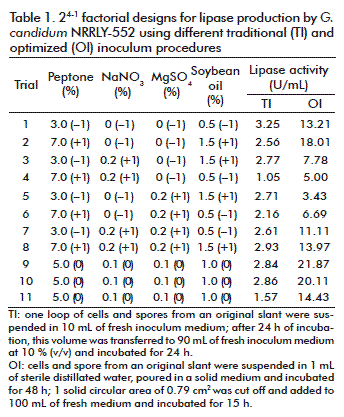
<body><![CDATA[<P   ><font size="2" face="Verdana, Arial, Helvetica, sans-serif">In sequence, two      variables were studied: SCA of 0.79 and 1.54 cm<sup>2</sup>, and IMV from      50 to 300 mL to determine the best inoculum size. The lipase activity and      pH were determined during the incubation time, and the best conditions selected      to make a third test to define the inoculum size. </font></P >   <FONT size="+1"><FONT size="+1">        <P   ><font size="2" face="Verdana, Arial, Helvetica, sans-serif">Based on the results      obtained at the first and second tests, four new fermentations were finally      conducted using SCA of 0.79 and 1.54 cm<sup>2</sup>, and IMV of 50 and 100      mL at the same fermentation conditions. The lipase activity and pH were determined      during the fermentation time. </font></P >   <FONT size="+1"><FONT size="+1">        <P   ><font size="2" face="Verdana, Arial, Helvetica, sans-serif"><b>Effect of inoculum      age </b></font></P >       <P   ><font size="2" face="Verdana, Arial, Helvetica, sans-serif">The effect of inoculum      size was investigated in the production of lipase by <I>G. candidum</I> NRRLY-552.      Fermentation medium composition and incubation conditions were the same as      applied for the inoculum, except for the fermentation time which was 72 h.      </font></P >       <P   ><font size="2" face="Verdana, Arial, Helvetica, sans-serif">The inoculum was      prepared using one SCA of 0.79 cm<sup>2</sup> (&oslash; = 1.0 cm) and 100      mL of inoculum medium. The incubation time of the inoculum varied from 15      to 48 h and the lipase activity and pH were determined as response during      the fermentation time. </font></P >   <FONT size="+1"><FONT size="+1">        <P   ><font size="2" face="Verdana, Arial, Helvetica, sans-serif">After the determination      of the optimum inoculum conditions (inoculum size and age), a 2<sup>4-1</sup>      experimental design with 3 central points was conducted for two different      inoculums procedures: traditional and optimized. For the first factorial design,      the traditional inoculum was applied as described above; for the second factorial      design, the optimized inoculum was obtained with 1 solid circular area (SCA)      of 0.79 cm<sup>2</sup>, 100 mL of inoculum medium incubated for 15 h. The      independent variables studied were the concentrations (w/v) of: peptone (3.0-7.0      %), MgSO<sub>4</sub> (0-0.2 %), NaNO<sub>3</sub> (0-0.2 %) and soybean oil      (0.5-1.5 %) in the composition of the fermentation medium; the response analyzed      was the lipase activity (U/mL). Fermentation proceeded for 48 h at 30 &deg;C      and 250 rpm. The matrix, with coded and real values for the independent variables      and the response values obtained, is presented in <a href="#tab1">table 1</a>;      the results were analyzed using the software Statistica 7.0 Statsoft Inc.      </font></P >       <P align="center"   ><img src="/img/revistas/bta/v31n3/t0104314.gif" width="342" height="415"><a name="tab1"></a></P >   <FONT size="+1"><FONT size="+1"><FONT size="+1"><FONT size="+1"><FONT size="+1"><FONT size="+1"><FONT size="+1"><FONT size="+1">        
<P   ><font size="2" face="Verdana, Arial, Helvetica, sans-serif">In order to analyze      the reproducibility of the process, four new trials with the optimized inoculum      were carried out under the optimum conditions (central points; w/v): 5 % peptone,      0.1 % MgSO<sub>4</sub>, 0.1 % NaNO<sub>3</sub>, and 1.0 % soybean oil; initial      pH of 7.0. Fermentation was carried out at 30 &deg;C and 250 rpm. Lipase activity      and pH were measured during fermentation time. </font></P >   <FONT size="+1"><FONT size="+1"><FONT size="+1"><FONT size="+1">        <P   ><font size="2" face="Verdana, Arial, Helvetica, sans-serif"><b>Lipase assay </b></font></P >       <P   ><font size="2" face="Verdana, Arial, Helvetica, sans-serif">Lipase activity was      measured using a titrimetric assay, titrating with 0.05 M NaOH and using emulsified      olive oil as substrate. The reaction mixture consisted of 19 mL of an olive      oil/Arabic gum emulsion (5 % w/v olive oil and 5% w/v Arabic gum) in 100 mM      potassium phosphate buffer, pH 7.0. This mixture was homogenized in a blender      for 3 min and the enzyme reaction started by adding 1 mL of culture supernatant.      The assay was carried out at 37 &ordm;C and 200 rpm for 30 min. The reaction      was then stopped by adding 20 mL of acetone-ethanol 1:1 (v/v), and the amount      of fatty acids produced titrated with 0.05 M NaOH to pH 11.0 using an automatic      titration apparatus (Mettler DL21). One unit of lipase activity (U) was defined      as the amount of enzyme that releases 1 &mu;mol of fatty acid per minute under      the assay conditions [22, 24, 26]. </font></P >       ]]></body>
<body><![CDATA[<P   >&nbsp;</P >       <P   ><font size="3" face="Verdana, Arial, Helvetica, sans-serif"><b>RESULTS AND DISCUSSION      </b> </font></P >   <FONT size="+1">        <P   ><font size="2" face="Verdana, Arial, Helvetica, sans-serif"><b>Effect of inoculum      age </b></font></P >   <FONT size="+1">        <P   ><font size="2" face="Verdana, Arial, Helvetica, sans-serif">Initially, four experiments      were carried out to evaluate the influence of the inoculum size on lipase      production. In the first experiment one SCA with 1.54 cm<sup>2</sup> (&oslash;      = 1.4 cm) was added to the inoculums medium, while in the second, third and      fourth experiments were added 2, 3 and 4 SCA with 1.54 cm<sup>2</sup>, respectively.      There was a decrease in lipase activity with an increase in inoculum size      (number of SCA) during the fermentation time (<a href="#fig1">Figure 1A</a>).      The highest activity (15.8 U/mL) was obtained with 1 SCA after 48 h, a value      about 6 times higher than with 4 CSA, suggesting that a smaller number of      spores added to the same substrate volume is better to obtain higher levels      of lipase activity during fermentation. </font></P >       <P align="center"   ><img src="/img/revistas/bta/v31n3/f0104314.gif" width="338" height="636"><a name="fig1"></a></P >   <FONT size="+1"><FONT size="+1"><FONT size="+1"><FONT size="+1">        
<P   ><font size="2" face="Verdana, Arial, Helvetica, sans-serif">This fact can be      related to a typical phenomenon found in mycology: the self-inhibition of      fungal spore germination. Many fungal spores exhibit a crowding effect [27-29],      in which the spores contain a prepackaged self-inhibitor that prevents germination      under crowded conditions. Another effect observed was that fungi with small      inoculum sizes produced a transient mycelial stage with the mycelium length      inversely proportional to the inoculum size [30]. This effect was also obtained      in the production of cellulase by <I>Trichoderma reesei</I> Rut C-30, in which      the average dimension of the pellet seemed to be inversely proportional to      the inoculum size [31]. </font></P >       <P   ><font size="2" face="Verdana, Arial, Helvetica, sans-serif">Based on these first      results, two different values of SCA were chosen: 1.54 cm<sup>2</sup> (&oslash;      = 1.4 cm) and 0.79 cm<sup>2</sup> (&oslash; = 1.0 cm), since the first analysis      suggested that the smaller the inoculum size, the more efficient the process.      In addition, different IMV from 50 to 300 mL were also evaluated, their lipase      activities shown in <a href="#tab2">table 2</a>; the pH data are not presented.      The highest activities were obtained with a SCA of 0.79 cm<sup>2</sup> and      an IVM of 50 mL (trial 1) and 100 mL (trial 2), were 7.53 and 7.74 U/mL obtained      after 24 and 48 h, respectively. These results reinforce the hypothesis that      the smaller quantity of spores in the inoculums, the greater lipase activity      obtained. It was previously observed that <I>Geotrichum</I> sp. inoculum size      and volume had a negative effect on lipase production [25]. </font></P >       <P align="center"   ><img src="/img/revistas/bta/v31n3/t0204314.gif" width="342" height="385"><a name="tab2"></a></P >   <FONT size="+1"><FONT size="+1"><FONT size="+1"><FONT size="+1">        
<P   ><font size="2" face="Verdana, Arial, Helvetica, sans-serif">Finally, based on      the best results obtained so far, the effect of inoculum size was evaluated      using inoculum conditions of SCA 0.79 and 1.54 cm<sup>2</sup> (&oslash; =      1.0 and 1.4 cm) and IMV of 50 and 100 mL. Lipase activities obtained are presented      in <a href="#fig2">figure 2</a>. The highest lipase activity of 13.20 U/mL      was obtained at 37 h in trial 2: SCA 0.79 cm<sup>2</sup> and IMV 100 mL. For      comparison, the optimized inoculum defined for <I>Geotrichum</I> sp. consists      of the same SCA 0.79 cm<sup>2</sup> but IMV 50 mL [25]. </font></P >       <P align="center"   ><img src="/img/revistas/bta/v31n3/f0204314.gif" width="337" height="418"><a name="fig2"></a></P >   <FONT size="+1"><FONT size="+1"><FONT size="+1"><FONT size="+1"><FONT size="+1"><FONT size="+1">        
]]></body>
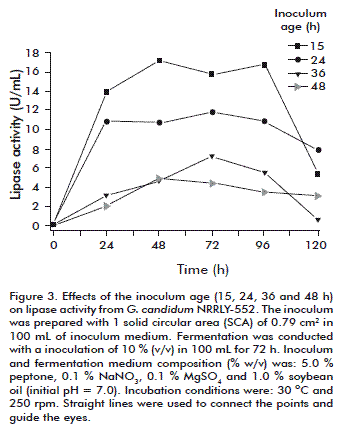
<body><![CDATA[<P   ><font size="2" face="Verdana, Arial, Helvetica, sans-serif">Spore cultivation      on a solid medium is rarely mentioned in the literature, but in practical      fermentation studies, this technique considerably reduces variations in the      quantity of spores used to make the inoculums, and the results obtained were      reproducible as compared with those obtained using spore measurement. There      was reported the production of xylanase by <I>Pleurotus ostreatus</I> SYJ042      following the same methodology as used in the present work, <I>i.e.</I>, spore      cultivation on a solid medium and the transference of SCA to the inoculum      medium; the same SCA (0.79 cm<sup>2</sup>) was determined using four 0.5 cm      diameter disks (&oslash;). The authors stated that smaller SCA and larger      volumes were ideal for inoculum preparation [32]. In another study, it was      shown with soil bacteria that the decreased inoculum size resulted in significant      increases in the viable counts, assessed as colony forming units on solid      media [12]. </font></P >   <FONT size="+1"><FONT size="+1">        <P   ><font size="2" face="Verdana, Arial, Helvetica, sans-serif">The pH analysis for      all the tests (data not shown), revealed that pH values dropped to around      6.0-6.5 during the first 24 h of fermentation and increased almost to 8.0      at the end, when the lipase activity starts to decrease. That high pH value      is not favorable to lipase production profiles, as demonstrated in <a href="#fig1">Figure      1b</a>, an effect commonly observed with <I>G. candidum</I> [22, 24]. </font></P >       <P   ><font size="2" face="Verdana, Arial, Helvetica, sans-serif"><b>Inoculum age </b></font></P >       <P   ><font size="2" face="Verdana, Arial, Helvetica, sans-serif">The influence of      the inoculum age was analyzed using the best conditions determined for the      inoculum size: 1 SCA, 0.79 cm<sup>2</sup>, and IMV 100 mL. As shown in <a href="#fig3">figure      3</a>, a 15-h inoculum showed the best results in terms of lipase activity      levels, around 16.5 U/mL from 48 to 96 h. The age of inoculum is highly variable      depending on the process, cultivation conditions, medium composition and the      microorganism, among other factors. The best condition for the inoculum age      of <I>G. candidum</I> determined in this work was shorter than in previous      studies using different microorganisms. In fact, it was optimal because of      reducing the total fermentation time and increasing productivity. Inoculum      age values of 18 and 96 h were previously obtained during alkaline protease      production by <I>Bacillus mojavensis</I> [19] and <I>Bacillus</I> sp. [33],      respectively. Nevertheless, considering lipase production from <I>Geotrichum</I>      sp. [25], the inoculum age was set as 12 h, a result quite similar to that      obtained in this study with <I>G. candidum</I>. The pH data are not shown      but followed the same profile as described earlier (<a href="#fig1">Figure      1 b</a>).</font></P >       <P align="center"   ><img src="/img/revistas/bta/v31n3/f0304314.gif" width="336" height="431"><a name="fig3"></a></P >   <FONT size="+1"><FONT size="+1">        
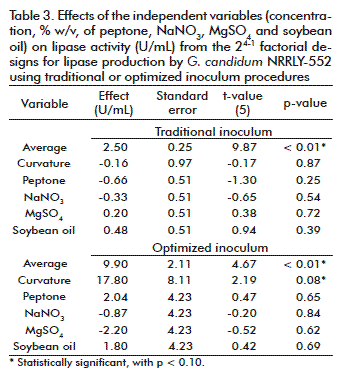
<P   ><font size="2" face="Verdana, Arial, Helvetica, sans-serif"><b>Comparison of      lipase production using different inoculums procedures </b></font></P >       <P   ><font size="2" face="Verdana, Arial, Helvetica, sans-serif">It is known that      factorial designs can also be used to compare the results obtained with modifications      not directly included in the independent variables analyzed [34]. Therefore,      two 2<sup>4-1</sup> factorial designs were applied to investigate the variability      of lipase production with the optimized inoculums, and also with the traditional      inoculum procedure (<a href="#tab1">Table 1</a>). The aim was to investigate      the variability of the experiments with different inoculum procedure, not      to compare both conditions in relation to their lipase activities. For that      reason, the central points conditions were the same already been applied for      <I>G. candidum</I> cultivation (inoculum and fermentation medium). </font></P >   <FONT size="+1"><FONT size="+1">        <P   ><font size="2" face="Verdana, Arial, Helvetica, sans-serif">Considering the traditional      inoculum (<a href="#tab1">Table 1</a>), the central points (trials 9, 10 and      11) resulted in an average activity of 2.42 &plusmn; 0.74 U/mL and the variables      conditions (trials 1 to 8) resulted in an average activity of 2.51 &plusmn;      0.67 U/mL, respectively. The deviation observed at the central points corresponded      to 30.58 % of the main value, a high deviation that must be avoided. The analysis      of the effect (<a href="#tab3">Table 3</a>) showed that with the traditional      inoculum, the different conditions in medium composition did not influence      lipase activity and were not statistically significant, which can be seen      clearly from the average activities and its deviation mentioned above and      in the average activity and its deviation (2.50 &plusmn; 0.25 U/mL) considering      all experiments (trials 1 to 11). This suggests that there were problems in      respect to the standardization and reproducibility of the inoculum conditions,      which did not respond well to the variation in medium composition because      of its own variation. That effect was not observed with the optimized inoculum.      </font></P >       <P align="center"   ><img src="/img/revistas/bta/v31n3/t0304314.gif" width="338" height="370"><a name="tab3"></a></P >       
<P   ><font size="2" face="Verdana, Arial, Helvetica, sans-serif">According to the      results (<a href="#tab1">Table 1</a>) with the optimized inoculum, at the      central points conditions (trials 9, 10 and 11) the lipase activities resulted      in an average value of 18.80 &plusmn; 3.89 U/mL and at the variables conditions      (trials 1 to 8) the average activity was 9.90 &plusmn; 5.01 U/mL. Considering      all experiments (trial 1 to 11) the average activity was 9.90 &plusmn; 2.11      (<a href="#tab3">Table 3</a>). These values reflect the variability of results:      at the same conditions, the central points presented a deviation of 20.69      % from the main value. Therefore, a well-defined inoculum avoids an extra      variability to the study and allows more confidence in the responses obtained.      At first, the analysis of the effects of the independent variables (<a href="#tab3">Table      3</a>) showed that with the optimized inoculum all the variables were not      statistically significant in the range studied (p &lt; 0.10). But after modifying      the inoculum curvature it became statistically significant, indicating that      the central point conditions were better for lipase production. This is in      agreement with the fact that this conditions are already been used for inoculum      and fermentation medium composition. </font></P >       ]]></body>
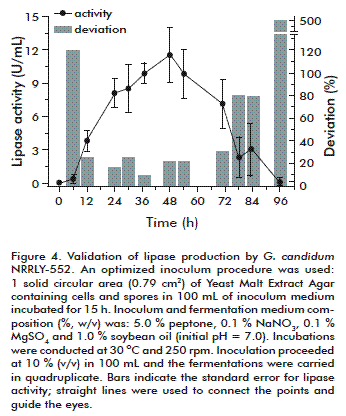
<body><![CDATA[<P   ><font size="2" face="Verdana, Arial, Helvetica, sans-serif">The reproducibility      of the results was assessed with four new trials using the optimized inoculum      at the same conditions of the central points; the results are presented in      <a href="#fig4">figure 4</a>. The highest level of lipase activity was achieved      between 24 and 54 h; the error in relation to the average values was around      20 %, which is acceptable for fermentation using filamentous fungi. After      48 h, lipase activity was 11.51 &plusmn; 2.52 U/mL and its deviation 21.91      % of the main value. In a previous study, using an optimized inoculum procedure      and an optimized medium composition but with <I>Geotrichum</I> sp., the maximum      lipase activity obtained was 35.2 &plusmn; 0.8 U/mL, its deviation corresponding      to 2.27 % of the main value [25].</font></P >       <P align="center"   ><img src="/img/revistas/bta/v31n3/f0404314.gif" width="344" height="414"><a name="fig4"></a></P >       
<P   ><font size="2" face="Verdana, Arial, Helvetica, sans-serif">At this point, it      is important to state that the optimized inoculum procedure here presented      was lately applied for the optimization of medium composition for <I>G. candidum</I>      cultivated in peptone [24], achieving a maximum lipase activity of 16.3 &plusmn;      0.8 U/mL with a deviation of 5 % of the main value. Recently, the inoculum      procedure was also applied to the optimization of yeast hydrolysate and corn      steep liquor instead of peptone in medium composition, and the maximum lipase      activities obtained were 18.4 &plusmn; 0.8 and 21.7 &plusmn; 2.4 U/mL after      48 h, respectively [35, 36]. Deviations were equivalent to 4.3 and 9.5 % of      the main value, respectively. From these results is possible to observe that      the optimization of the inoculum procedure in this study was valid. </font></P >       <P   ><font size="2" face="Verdana, Arial, Helvetica, sans-serif">The pH data are not      presented but it behaved as expected, with a slow decrease around 24 h followed      by an increase until reaching 8.0 after 54 h, further increased until 8.8      after 96 h of fermentation. As previously discussed, the pH value of 8.0 is      detrimental for lipase activity as can be seen in <a href="#fig4">figure 4</a>,      with lipase activity showing a drop starting after 54 h to almost 1.0 U/mL      at 96 h. </font></P >       <P   >&nbsp;</P >       <P   ><font size="3" face="Verdana, Arial, Helvetica, sans-serif"><b>CONCLUSIONS </b></font></P >   <FONT size="+1">        <P   ><font size="2" face="Verdana, Arial, Helvetica, sans-serif">The conditions determined      in this study with respect to inoculum size and age contributed to improve      lipase production by <I>G. candidum</I> NRRL Y-552 and to reduce the variability      on fermentation results. From this study it was possible to obtain a maximum      lipase activity of 11.51 &plusmn; 2.52 U/mL after 48 h with an optimized inoculum.      This result is valid since it was possible to obtain smaller deviations (~20      %) than those obtained with the traditional inoculum (~30 %), which support      much more reliable studies, especially about other important factors. </font></P >   <FONT size="+1">        <P   ><font size="2" face="Verdana, Arial, Helvetica, sans-serif">The inoculum strategy      presented here has been applied successfully in lipase production by <I>G.      candidum</I>, resulting in 16.3 &plusmn; 0.8 U/mL (48 h) in shaken flasks      [24], 21 &plusmn; 0.7 U/mL (54 h) in a bench-scale stirred reactor and 20      U/mL (30 </font><font size="2" face="Verdana, Arial, Helvetica, sans-serif">h)      in an airlift bioreactor [21]. It was also used for lipase production by <I>Geotrichum</I>      sp. in shaken flasks, achieving 35.20 &plusmn; 0.80 U/mL [25], and to improve      it by <I>Fusarium oxysporum</I> with a 60 % increase [2]. The errors observed      by those authors were around 5 % of the main values of activities, which represent      a great achievement in fungi cultivation. </font></P >       <P   >&nbsp;</P >       <P   > </P >   <FONT size="+1" color="#D70000">        ]]></body>
<body><![CDATA[<P   ><font size="3"><b><font color="#000000" face="Verdana, Arial, Helvetica, sans-serif">ACKNOWLEDGEMENTS      </font></b></font></P >   <FONT size="+1" color="#000000">        <P   ><font size="2" face="Verdana, Arial, Helvetica, sans-serif">The authors would      like to thank the Funda&ccedil;&atilde;o de Amparo &agrave; Pesquisa do Estado      de S&atilde;o Paulo (FAPESP, Brazil), the Conselho Nacional de Desenvolvimento      Cient&iacute;fico e Tecnol&oacute;gico (CNPq, Brazil), and the Coordena&ccedil;&atilde;o      de Aperfei&ccedil;oamento de Pessoal de N&iacute;vel Superior (CAPES, Brazil)      for their financial support. </font></P >       <P   >&nbsp;</P >   <FONT size="+1">        <P   > </P >       <P   ><b><font size="3" face="Verdana, Arial, Helvetica, sans-serif">REFERENCES </font></b></P >       <P   ><font size="2" face="Verdana, Arial, Helvetica, sans-serif">1. Alberghina L,      Schmid RD, Verger R, editors. Lipases: structure, mechanism and genetic engineering,      Weinheim: VCH; 1991. </font></P >       <!-- ref --><P   ><font size="2" face="Verdana, Arial, Helvetica, sans-serif">2. Maldonado RR,      Macedo GA, Rodrigues MI. Lipase production using microorganisms from different      agro-industrial by products. Int J App Scien Tech. 2014;4(1):108-15.     </font></P >       <!-- ref --><P   ><font size="2" face="Verdana, Arial, Helvetica, sans-serif">3. Treichel H, de      Oliveira D, Mazutti MA, Di Luccio M, Oliveira JV. A review on microbial lipases      production. Food Bioprocess Technol. 2010;3(2):182-96.     </font></P >       ]]></body>
<body><![CDATA[<!-- ref --><P   ><font size="2" face="Verdana, Arial, Helvetica, sans-serif">4. Aravindan R, Anbumathi      P, Viruthagiri T. Lipase applications in food industry. Ind J Biotech. 2007;6:141-58.          </font></P >       <!-- ref --><P   ><font size="2" face="Verdana, Arial, Helvetica, sans-serif">5. Gandhi NN. Applications      of lipase. J Amer Oil Chem Soc. 1997;74(6):621-34.     </font></P >       <P   ><font size="2" face="Verdana, Arial, Helvetica, sans-serif">6. Gopinath SCB,      Anbu P, Lakshmipriya T, Hilda A. Strategies to Characterize Fungal Lipases      for Applications in Medicine and Dairy Industry. BioMed Res Int. 2013;Article      ID 154549. [cited 2014 Dic 16]. Available from: <A href="http://dx.doi.org/10.1155/2013/154549" target="_blank">      <FONT color="#0000FF">http://dx.doi.org/10.1155/2013/154549</font></A><FONT color="#0000FF"><FONT color="#000000">.      </font></font></font></P >       <!-- ref --><P   ><font size="2" face="Verdana, Arial, Helvetica, sans-serif">7. Ribeiro BD, de      Castro AM, Coelho MA, Freire DM. Production and use of lipases in bioenergy:      a review from the feedstocks to biodiesel production. Enzyme Res. 2011;2011:615803.          </font></P >       <!-- ref --><P   ><font size="2" face="Verdana, Arial, Helvetica, sans-serif">8. Sharma R, Chisti      Y, Banerjee UC. Production, purification, characterization, and applications      of lipases. Biotechnol Adv. 2001;19(8):627-62.     </font></P >       <!-- ref --><P   ><font size="2" face="Verdana, Arial, Helvetica, sans-serif">9. Tan T, Lu J, Nie      K, Deng L, Wang F. Biodiesel production with immobilized lipase: A review.      Biotechnol Adv. 2010;28(5):628-34.     </font></P >       <P   ><font size="2" face="Verdana, Arial, Helvetica, sans-serif">10. Monhaghan MM,      Gagliardi SL, Streicher AL, Demian JE. Culture preservation and inoculum development.      In: Demain AL, Davies JE, editors. Manual of Industrial Microbiology and Biotechnology.      2nd ed. Washington: ASM Press; 1999. </font></P >       <!-- ref --><P   ><font size="2" face="Verdana, Arial, Helvetica, sans-serif">11. Stanburry PF,      Whitatker J, Hall SJ. Principles of Fermentation Technology. Oxford: Pergamon,      1995.     </font></P >       <!-- ref --><P   ><font size="2" face="Verdana, Arial, Helvetica, sans-serif">12. Davis KE, Joseph      SJ, Janssen PH. Effects of growth medium, inoculum size, and incubation time      on culturability and isolation of soil bacteria. Appl Environ Microbiol. 2005;71(2):826-34.          </font></P >       <!-- ref --><P   ><font size="2" face="Verdana, Arial, Helvetica, sans-serif">13. Kumar R, Mahajan      S, Kumar A, Singh D. Identification of variables and value optimization for      optimum lipase production by <I>Bacillus pumilus</I> RK31 using statistical      methodology. Nat Biotechnol. 2011;28(1):65-71.     </font></P >       <!-- ref --><P   ><font size="2" face="Verdana, Arial, Helvetica, sans-serif">14. Teng Y, Xu Y.      Culture condition improvement for whole-cell lipase production in submerged      fermentation by <I>Rhizopus chinensis</I> using statistical method. Bioresour      Technol. 2008;99(9):3900-7.     </font></P >       ]]></body>
<body><![CDATA[<!-- ref --><P   ><font size="2" face="Verdana, Arial, Helvetica, sans-serif">15. Vanot G, Deyris      V, Guilhem MC, Phan Tan Luu R, Comeau LC. Optimal design for the maximization      of <I>Penicillium cyclopium</I> lipase production. Appl Microbiol Biotechnol.      2001;57(3):342-5.     </font></P >       <!-- ref --><P   ><font size="2" face="Verdana, Arial, Helvetica, sans-serif">16. Vanot G, Valerie      D, Guilhem MC, Phan Tan Luu R, Comeau LC. Maximizing production of <I>Penicillium      cyclopium</I> partial acylglycerol lipase. Appl Microbiol Biotechnol. 2002;60(4):417-9.          </font></P >       <!-- ref --><P   ><font size="2" face="Verdana, Arial, Helvetica, sans-serif">17. Sen R, Swaminathan      T. Response surface modeling and optimization to elucidate and analyze the      effects of inoculum age and size on surfactin production. Biochem Eng J. 2004;21(2):141-8.          </font></P >       <!-- ref --><P   ><font size="2" face="Verdana, Arial, Helvetica, sans-serif">18. Kammoun R, Naili      B, Bejar S. Application of a statistical design to the optimization of parameters      and culture medium for alpha-amylase production by <I>Aspergillus oryzae</I>      CBS 819.72 grown on gruel (wheat grinding by-product). Bioresour Technol.      2008;99(13):5602-9.     </font></P >       <!-- ref --><P   ><font size="2" face="Verdana, Arial, Helvetica, sans-serif">19. Beg QK, Sahai      V, Gupta R. Statistical media optimization and alkaline protease production      from <I>Bacillus mojavensis</I> in a bioreactor. Process Biochem. 2003;39(2):203-9.          </font></P >       ]]></body>
<body><![CDATA[<!-- ref --><P   ><font size="2" face="Verdana, Arial, Helvetica, sans-serif">20. Asses N, Ayed      L, Bouallagui H, Ben Rejeb I, Gargouri M, Hamdi M. Use of <I>Geotrichum candidum</I>      for olive mill wastewater treatment in submerged and static culture. Bioresour      Technol. 2009;100(7):2182-8.     </font></P >       <!-- ref --><P   ><font size="2" face="Verdana, Arial, Helvetica, sans-serif">21. Burkert JF, Maugeri      F, Rodrigues MI. Optimization of extracellular lipase production by <I>Geotrichum</I>      sp. using factorial design. Bioresour Technol. 2004;91(1):77-84.     </font></P >       <!-- ref --><P   ><font size="2" face="Verdana, Arial, Helvetica, sans-serif">22. Burket JFM, Maldonado      RR, Maugeri F, Rodrigues MI. Comparison of lipase production by <I>Geotrichum      candidumin </I>stirred and airlift fermenters. J Chem Tech Biotechnol. 2005;80(1):61-7.          </font></P >       <!-- ref --><P   ><font size="2" face="Verdana, Arial, Helvetica, sans-serif">23. Kamimura ES,      Mendieta O, Sato HH, Pastore G, Maugeri F. Production of Lipase from <I>Geotrichum</I>      sp. and Adsorption Studies on Affinity Resin. Braz J Chem Eng. 1999;16(2):102-12.          </font></P >       <!-- ref --><P   ><font size="2" face="Verdana, Arial, Helvetica, sans-serif">24. Maldonado RR,      Panciera AL, Macedo GA, Mazutti MA, Maugeri F, Rodrigues MI. Improvement of      lipase production from <I>Geotrichum</I> sp. in shaken flasks. Chem Ind Chem      Eng Quart. 2012;18(3):459-64.     </font></P >       ]]></body>
<body><![CDATA[<!-- ref --><P   ><font size="2" face="Verdana, Arial, Helvetica, sans-serif">25. Maldonado RR,      Burkert JFM, Mazutti MA, Maugeri F, Rodrigues MI. Evaluation of lipase production      by <I>Geotrichum candidum </I>in shaken flasks and bench-scale stirred bioreactor      using different impellers. Biocat Agric Biotechnol. 2012;1(2):147-51.     </font></P >       <P   ><font size="2" face="Verdana, Arial, Helvetica, sans-serif">26. Freire DM, Teles      EM, Bon EP, Sant&rsquo; Anna GL, Jr. Lipase production by <I>Penicillium restrictum</I>      in a bench-scale fermenter : effect of carbon and nitrogen nutrition, agitation,      and aeration. Appl Biochem Biotechnol. 1997;63-65:409-21. </font></P >       <P   ><font size="2" face="Verdana, Arial, Helvetica, sans-serif">27. Aver&rsquo;yanov      AA, Lapikova VP, Pasechnik TD, Zakharenkova TS, Baker CJ. Self-inhibition      of spore ger<I>mination via reactive oxygen in the fungus Cladosporium cucumerinum</I>,      causal agent of cucurbit scab. Eur J Plant Path. 2011;130(4):541-50. </font></P >       <P   ><font size="2" face="Verdana, Arial, Helvetica, sans-serif">28. Griffin DH. Fungal      physiology. 2nd ed. New York:Willey-Liss; 1994. </font></P >       <!-- ref --><P   ><font size="2" face="Verdana, Arial, Helvetica, sans-serif">29. Macko V, Staples      RC, Yaniv Z, Granados RR. Self-inhibitors of fungal spores germination - The      fungal spore. New York: Academic Press; 1976.     </font></P >       <!-- ref --><P   ><font size="2" face="Verdana, Arial, Helvetica, sans-serif">30. Kulkarni RK,      Nickerson KW. Nutritional control of dimorphism in Ceratocystis ulmi. Exp      Mycol. 1981;5(2):148-52.     </font></P >       <!-- ref --><P   ><font size="2" face="Verdana, Arial, Helvetica, sans-serif">31. Domingues FC,      Queiroz JA, Cabral JM, Fonseca LP. The influence of culture conditions on      mycelial structure and cellulase production by Trichoderma reesei Rut C-30.      Enzyme Microb Technol. 2000;26(5-6):394-401.     </font></P >       <!-- ref --><P   ><font size="2" face="Verdana, Arial, Helvetica, sans-serif">32. Qinnghe C, Xiaoyu      Y, Tiangui N, Cheng J, Qiugang M. The screening of culture condition and properties      of xylanase by white-rot fungus <I>Pleurotus ostreatus</I>. Proc Bioch. 2004;39(11):1561-6.          </font></P >       <!-- ref --><P   ><font size="2" face="Verdana, Arial, Helvetica, sans-serif">33. Genckal H, Tari      C. Alkaline protease production from alkalophilic <I>Bacillus</I> sp. isolated      from natural habitats. Enz Microb Technol. 2006; 39(4):703-10.     </font></P >       <P   ><font size="2" face="Verdana, Arial, Helvetica, sans-serif">34. Rodrigues MI,      Iemma AF. Planejamento de Experimentos e Otimiza&ccedil;&atilde;o de Processos.      2nd ed. Campinas: Caritas; 2009. </font></P >       <!-- ref --><P   ><font size="2" face="Verdana, Arial, Helvetica, sans-serif">35. Maldonado RR,      Aguiar-Oliveira E, Pozza EL, Costa FAA, Maugeri Filho F, Rodrigues MI. Production      of lipase from <I>Geotrichum candidum</I> using corn steep liquor in different      bioreactors. J Amer Oil Chem Soc. 2014; 91(12):1999-2009.     </font></P >       <P   ><font size="2" face="Verdana, Arial, Helvetica, sans-serif">36. Maldonado RR,      Aguiar-Oliveira E, Pozza EL, Costa FAA, Mazutti MA, Maugeri F, <I>et al</I>.      Application of yeast hydrolysate in extracellular lipase production by <I>Geotrichum      candidum</I> in shaken flasks, stirred tank and airlift reactors. Can J Chem      Eng. Accepted in November, 2014. </font></P >   <FONT size="+1"><FONT color="#0000FF"><FONT color="#000000">        <P   > </P >       ]]></body>
<body><![CDATA[<P   >&nbsp;</P >       <P   >&nbsp;</P >       <P   ><font size="2" face="Verdana, Arial, Helvetica, sans-serif">Received in June      2014.    <br>     </font><font size="2" face="Verdana, Arial, Helvetica, sans-serif">Accepted      in December 2014. </font></P >       <P   >&nbsp;</P >       <P   >&nbsp;</P >       <P   > </P >       <P   ><i><font size="2" face="Verdana, Arial, Helvetica, sans-serif">Rafael Resende      Maldonado</font></i><font size="2" face="Verdana, Arial, Helvetica, sans-serif">.      Food Department, Technical College of Campinas, University of Campinas, Campinas-SP,      Brazil. E-mail: <A href="mailto:ratafta@yahoo.com.br"> <FONT color="#0000FF">ratafta@yahoo.com.br</font></A><FONT color="#0000FF"><FONT color="#000000">.      </font></font></font></P >   </font></font></font></font></font></font></font></font></font></font></font></font></font></font></font></font></font></font></font></font></font></font></font></font></font></font></font></font></font></font></font></font></font></font></font></font></font></font></font></font></font></font></font></font></font></font></font></font></font></font></font></font></font></font></font></font></font></font></font></font></font></font></font></font></font></font></font></font></font></font></font></font></font></font></font></font></font></font></font></font></font></font></font></font></font></font></font></font></font></font></font></font></font></font></font></font></font></font></font></font></font></font></font></font></font></font></font></DIV >      ]]></body><back>
<ref-list>
<ref id="B1">
<label>1</label><nlm-citation citation-type="book">
<person-group person-group-type="author">
<name>
<surname><![CDATA[Alberghina]]></surname>
<given-names><![CDATA[L]]></given-names>
</name>
<name>
<surname><![CDATA[Schmid]]></surname>
<given-names><![CDATA[RD]]></given-names>
</name>
<name>
<surname><![CDATA[Verger]]></surname>
<given-names><![CDATA[R]]></given-names>
</name>
</person-group>
<source><![CDATA[en]]></source>
<year>1991</year>
<publisher-loc><![CDATA[Lipases ]]></publisher-loc>
<publisher-name><![CDATA[structure, mechanism and genetic engineering, Weinheim: VCH]]></publisher-name>
</nlm-citation>
</ref>
<ref id="B2">
<label>2</label><nlm-citation citation-type="journal">
<person-group person-group-type="author">
<name>
<surname><![CDATA[Maldonado]]></surname>
<given-names><![CDATA[RR]]></given-names>
</name>
<name>
<surname><![CDATA[Macedo]]></surname>
<given-names><![CDATA[GA]]></given-names>
</name>
<name>
<surname><![CDATA[Rodrigues]]></surname>
<given-names><![CDATA[MI]]></given-names>
</name>
</person-group>
<article-title xml:lang="en"><![CDATA[Lipase production using microorganisms from different agro-industrial by products]]></article-title>
<source><![CDATA[Int J App Scien Tech]]></source>
<year>2014</year>
<volume>4</volume>
<numero>1</numero>
<issue>1</issue>
<page-range>108-15</page-range></nlm-citation>
</ref>
<ref id="B3">
<label>3</label><nlm-citation citation-type="journal">
<person-group person-group-type="author">
<name>
<surname><![CDATA[Treichel]]></surname>
<given-names><![CDATA[H]]></given-names>
</name>
<name>
<surname><![CDATA[de Oliveira]]></surname>
<given-names><![CDATA[D]]></given-names>
</name>
<name>
<surname><![CDATA[Mazutti]]></surname>
<given-names><![CDATA[MA]]></given-names>
</name>
<name>
<surname><![CDATA[Di Luccio]]></surname>
<given-names><![CDATA[M]]></given-names>
</name>
<name>
<surname><![CDATA[Oliveira]]></surname>
<given-names><![CDATA[JV]]></given-names>
</name>
</person-group>
<article-title xml:lang="en"><![CDATA[A review on microbial lipases production]]></article-title>
<source><![CDATA[Food Bioprocess Technol]]></source>
<year>2010</year>
<volume>3</volume>
<numero>2</numero>
<issue>2</issue>
<page-range>182-96</page-range></nlm-citation>
</ref>
<ref id="B4">
<label>4</label><nlm-citation citation-type="journal">
<person-group person-group-type="author">
<name>
<surname><![CDATA[Aravindan]]></surname>
<given-names><![CDATA[R]]></given-names>
</name>
<name>
<surname><![CDATA[Anbumathi]]></surname>
<given-names><![CDATA[P]]></given-names>
</name>
<name>
<surname><![CDATA[Viruthagiri]]></surname>
<given-names><![CDATA[T]]></given-names>
</name>
</person-group>
<article-title xml:lang="en"><![CDATA[Lipase applications in food industry]]></article-title>
<source><![CDATA[Ind J Biotech]]></source>
<year>2007</year>
<volume>6</volume>
<page-range>141-58</page-range></nlm-citation>
</ref>
<ref id="B5">
<label>5</label><nlm-citation citation-type="journal">
<person-group person-group-type="author">
<name>
<surname><![CDATA[Gandhi]]></surname>
<given-names><![CDATA[NN]]></given-names>
</name>
</person-group>
<article-title xml:lang="en"><![CDATA[Applications of lipase]]></article-title>
<source><![CDATA[J Amer Oil Chem Soc]]></source>
<year>1997</year>
<volume>74</volume>
<numero>6</numero>
<issue>6</issue>
<page-range>621-34</page-range></nlm-citation>
</ref>
<ref id="B6">
<label>6</label><nlm-citation citation-type="journal">
<person-group person-group-type="author">
<name>
<surname><![CDATA[Gopinath]]></surname>
<given-names><![CDATA[SCB]]></given-names>
</name>
<name>
<surname><![CDATA[Anbu]]></surname>
<given-names><![CDATA[P]]></given-names>
</name>
<name>
<surname><![CDATA[Lakshmipriya]]></surname>
<given-names><![CDATA[T]]></given-names>
</name>
<name>
<surname><![CDATA[Hilda]]></surname>
<given-names><![CDATA[A]]></given-names>
</name>
</person-group>
<article-title xml:lang="en"><![CDATA[Strategies to Characterize Fungal Lipases for Applications in Medicine and Dairy Industry]]></article-title>
<source><![CDATA[BioMed Res Int]]></source>
<year>2013</year>
<page-range>154549</page-range></nlm-citation>
</ref>
<ref id="B7">
<label>7</label><nlm-citation citation-type="journal">
<person-group person-group-type="author">
<name>
<surname><![CDATA[Ribeiro]]></surname>
<given-names><![CDATA[BD]]></given-names>
</name>
<name>
<surname><![CDATA[de Castro]]></surname>
<given-names><![CDATA[AM]]></given-names>
</name>
<name>
<surname><![CDATA[Coelho]]></surname>
<given-names><![CDATA[MA]]></given-names>
</name>
<name>
<surname><![CDATA[Freire]]></surname>
<given-names><![CDATA[DM]]></given-names>
</name>
</person-group>
<article-title xml:lang="en"><![CDATA[Production and use of lipases in bioenergy: a review from the feedstocks to biodiesel production]]></article-title>
<source><![CDATA[Enzyme Res]]></source>
<year>2011</year>
<volume>2011</volume>
<page-range>615803</page-range></nlm-citation>
</ref>
<ref id="B8">
<label>8</label><nlm-citation citation-type="journal">
<person-group person-group-type="author">
<name>
<surname><![CDATA[Sharma]]></surname>
<given-names><![CDATA[R]]></given-names>
</name>
<name>
<surname><![CDATA[Chisti]]></surname>
<given-names><![CDATA[Y]]></given-names>
</name>
<name>
<surname><![CDATA[Banerjee]]></surname>
<given-names><![CDATA[UC]]></given-names>
</name>
</person-group>
<article-title xml:lang="en"><![CDATA[Production, purification, characterization, and applications of lipases]]></article-title>
<source><![CDATA[Biotechnol Adv]]></source>
<year>2001</year>
<volume>19</volume>
<numero>8</numero>
<issue>8</issue>
<page-range>627-62</page-range></nlm-citation>
</ref>
<ref id="B9">
<label>9</label><nlm-citation citation-type="journal">
<person-group person-group-type="author">
<name>
<surname><![CDATA[Tan]]></surname>
<given-names><![CDATA[T]]></given-names>
</name>
<name>
<surname><![CDATA[Lu]]></surname>
<given-names><![CDATA[J]]></given-names>
</name>
<name>
<surname><![CDATA[Nie]]></surname>
<given-names><![CDATA[K]]></given-names>
</name>
<name>
<surname><![CDATA[Deng]]></surname>
<given-names><![CDATA[L]]></given-names>
</name>
<name>
<surname><![CDATA[Wang]]></surname>
<given-names><![CDATA[F]]></given-names>
</name>
</person-group>
<article-title xml:lang="en"><![CDATA[Biodiesel production with immobilized lipase: A review]]></article-title>
<source><![CDATA[Biotechnol Adv]]></source>
<year>2010</year>
<volume>28</volume>
<numero>5</numero>
<issue>5</issue>
<page-range>628-34</page-range></nlm-citation>
</ref>
<ref id="B10">
<label>10</label><nlm-citation citation-type="book">
<person-group person-group-type="author">
<name>
<surname><![CDATA[Monhaghan]]></surname>
<given-names><![CDATA[MM]]></given-names>
</name>
<name>
<surname><![CDATA[Gagliardi]]></surname>
<given-names><![CDATA[SL]]></given-names>
</name>
<name>
<surname><![CDATA[Streicher]]></surname>
<given-names><![CDATA[AL]]></given-names>
</name>
<name>
<surname><![CDATA[Demian]]></surname>
<given-names><![CDATA[JE]]></given-names>
</name>
</person-group>
<article-title xml:lang="en"><![CDATA[Culture preservation and inoculum development]]></article-title>
<person-group person-group-type="editor">
<name>
<surname><![CDATA[Demain]]></surname>
<given-names><![CDATA[AL]]></given-names>
</name>
<name>
<surname><![CDATA[Davies]]></surname>
<given-names><![CDATA[JE]]></given-names>
</name>
</person-group>
<source><![CDATA[Manual of Industrial Microbiology and Biotechnology]]></source>
<year>1999</year>
<edition>2</edition>
<page-range>0</page-range><publisher-loc><![CDATA[Washington ]]></publisher-loc>
<publisher-name><![CDATA[ASM Press]]></publisher-name>
</nlm-citation>
</ref>
<ref id="B11">
<label>11</label><nlm-citation citation-type="book">
<person-group person-group-type="author">
<name>
<surname><![CDATA[Stanburry]]></surname>
<given-names><![CDATA[PF]]></given-names>
</name>
<name>
<surname><![CDATA[Whitatker]]></surname>
<given-names><![CDATA[J]]></given-names>
</name>
<name>
<surname><![CDATA[Hall]]></surname>
<given-names><![CDATA[SJ]]></given-names>
</name>
</person-group>
<source><![CDATA[Principles of Fermentation Technology]]></source>
<year>1995</year>
<publisher-loc><![CDATA[Oxford ]]></publisher-loc>
<publisher-name><![CDATA[Pergamon]]></publisher-name>
</nlm-citation>
</ref>
<ref id="B12">
<label>12</label><nlm-citation citation-type="journal">
<person-group person-group-type="author">
<name>
<surname><![CDATA[Davis]]></surname>
<given-names><![CDATA[KE]]></given-names>
</name>
<name>
<surname><![CDATA[Joseph]]></surname>
<given-names><![CDATA[SJ]]></given-names>
</name>
<name>
<surname><![CDATA[Janssen]]></surname>
<given-names><![CDATA[PH]]></given-names>
</name>
</person-group>
<article-title xml:lang="en"><![CDATA[Effects of growth medium, inoculum size, and incubation time on culturability and isolation of soil bacteria]]></article-title>
<source><![CDATA[Appl Environ Microbiol]]></source>
<year>2005</year>
<volume>71</volume>
<numero>2</numero>
<issue>2</issue>
<page-range>826-34</page-range></nlm-citation>
</ref>
<ref id="B13">
<label>13</label><nlm-citation citation-type="journal">
<person-group person-group-type="author">
<name>
<surname><![CDATA[Kumar]]></surname>
<given-names><![CDATA[R]]></given-names>
</name>
<name>
<surname><![CDATA[Mahajan]]></surname>
<given-names><![CDATA[S]]></given-names>
</name>
<name>
<surname><![CDATA[Kumar]]></surname>
<given-names><![CDATA[A]]></given-names>
</name>
<name>
<surname><![CDATA[Singh]]></surname>
<given-names><![CDATA[D]]></given-names>
</name>
</person-group>
<article-title xml:lang="en"><![CDATA[Identification of variables and value optimization for optimum lipase production by Bacillus pumilus RK31 using statistical methodology]]></article-title>
<source><![CDATA[Nat Biotechnol]]></source>
<year>2011</year>
<volume>28</volume>
<numero>1</numero>
<issue>1</issue>
<page-range>65-71</page-range></nlm-citation>
</ref>
<ref id="B14">
<label>14</label><nlm-citation citation-type="journal">
<person-group person-group-type="author">
<name>
<surname><![CDATA[Teng]]></surname>
<given-names><![CDATA[Y]]></given-names>
</name>
<name>
<surname><![CDATA[Xu]]></surname>
<given-names><![CDATA[Y]]></given-names>
</name>
</person-group>
<article-title xml:lang="en"><![CDATA[Culture condition improvement for whole-cell lipase production in submerged fermentation by Rhizopus chinensis using statistical method]]></article-title>
<source><![CDATA[Bioresour Technol]]></source>
<year>2008</year>
<volume>99</volume>
<numero>9</numero>
<issue>9</issue>
<page-range>3900-7</page-range></nlm-citation>
</ref>
<ref id="B15">
<label>15</label><nlm-citation citation-type="journal">
<person-group person-group-type="author">
<name>
<surname><![CDATA[Vanot]]></surname>
<given-names><![CDATA[G]]></given-names>
</name>
<name>
<surname><![CDATA[Deyris]]></surname>
<given-names><![CDATA[V]]></given-names>
</name>
<name>
<surname><![CDATA[Guilhem]]></surname>
<given-names><![CDATA[MC]]></given-names>
</name>
<name>
<surname><![CDATA[Phan Tan Luu]]></surname>
<given-names><![CDATA[R]]></given-names>
</name>
<name>
<surname><![CDATA[Comeau]]></surname>
<given-names><![CDATA[LC]]></given-names>
</name>
</person-group>
<article-title xml:lang="en"><![CDATA[Optimal design for the maximization of Penicillium cyclopium lipase production]]></article-title>
<source><![CDATA[Appl Microbiol Biotechnol]]></source>
<year>2001</year>
<volume>57</volume>
<numero>3</numero>
<issue>3</issue>
<page-range>342-5</page-range></nlm-citation>
</ref>
<ref id="B16">
<label>16</label><nlm-citation citation-type="journal">
<person-group person-group-type="author">
<name>
<surname><![CDATA[Vanot]]></surname>
<given-names><![CDATA[G]]></given-names>
</name>
<name>
<surname><![CDATA[Valerie]]></surname>
<given-names><![CDATA[D]]></given-names>
</name>
<name>
<surname><![CDATA[Guilhem]]></surname>
<given-names><![CDATA[MC]]></given-names>
</name>
<name>
<surname><![CDATA[Phan Tan Luu]]></surname>
<given-names><![CDATA[R]]></given-names>
</name>
<name>
<surname><![CDATA[Comeau]]></surname>
<given-names><![CDATA[LC]]></given-names>
</name>
</person-group>
<article-title xml:lang="en"><![CDATA[Maximizing production of Penicillium cyclopium partial acylglycerol lipase]]></article-title>
<source><![CDATA[Appl Microbiol Biotechnol]]></source>
<year>2002</year>
<volume>60</volume>
<numero>4</numero>
<issue>4</issue>
<page-range>417-9</page-range></nlm-citation>
</ref>
<ref id="B17">
<label>17</label><nlm-citation citation-type="journal">
<person-group person-group-type="author">
<name>
<surname><![CDATA[Sen]]></surname>
<given-names><![CDATA[R]]></given-names>
</name>
<name>
<surname><![CDATA[Swaminathan]]></surname>
<given-names><![CDATA[T]]></given-names>
</name>
</person-group>
<article-title xml:lang="en"><![CDATA[Response surface modeling and optimization to elucidate and analyze the effects of inoculum age and size on surfactin production]]></article-title>
<source><![CDATA[Biochem Eng J]]></source>
<year>2004</year>
<volume>21</volume>
<numero>2</numero>
<issue>2</issue>
<page-range>141-8</page-range></nlm-citation>
</ref>
<ref id="B18">
<label>18</label><nlm-citation citation-type="journal">
<person-group person-group-type="author">
<name>
<surname><![CDATA[Kammoun]]></surname>
<given-names><![CDATA[R]]></given-names>
</name>
<name>
<surname><![CDATA[Naili]]></surname>
<given-names><![CDATA[B]]></given-names>
</name>
<name>
<surname><![CDATA[Bejar]]></surname>
<given-names><![CDATA[S]]></given-names>
</name>
</person-group>
<article-title xml:lang="en"><![CDATA[Application of a statistical design to the optimization of parameters and culture medium for alpha-amylase production by Aspergillus oryzae CBS 819.72 grown on gruel (wheat grinding by-product)]]></article-title>
<source><![CDATA[Bioresour Technol]]></source>
<year>2008</year>
<volume>99</volume>
<numero>13</numero>
<issue>13</issue>
<page-range>5602-9</page-range></nlm-citation>
</ref>
<ref id="B19">
<label>19</label><nlm-citation citation-type="journal">
<person-group person-group-type="author">
<name>
<surname><![CDATA[Beg]]></surname>
<given-names><![CDATA[QK]]></given-names>
</name>
<name>
<surname><![CDATA[Sahai]]></surname>
<given-names><![CDATA[V]]></given-names>
</name>
<name>
<surname><![CDATA[Gupta]]></surname>
<given-names><![CDATA[R]]></given-names>
</name>
</person-group>
<article-title xml:lang="en"><![CDATA[Statistical media optimization and alkaline protease production from Bacillus mojavensis in a bioreactor]]></article-title>
<source><![CDATA[Process Biochem]]></source>
<year>2003</year>
<volume>39</volume>
<numero>2</numero>
<issue>2</issue>
<page-range>203-9</page-range></nlm-citation>
</ref>
<ref id="B20">
<label>20</label><nlm-citation citation-type="journal">
<person-group person-group-type="author">
<name>
<surname><![CDATA[Asses]]></surname>
<given-names><![CDATA[N]]></given-names>
</name>
<name>
<surname><![CDATA[Ayed]]></surname>
<given-names><![CDATA[L]]></given-names>
</name>
<name>
<surname><![CDATA[Bouallagui]]></surname>
<given-names><![CDATA[H]]></given-names>
</name>
<name>
<surname><![CDATA[Ben Rejeb]]></surname>
<given-names><![CDATA[I]]></given-names>
</name>
<name>
<surname><![CDATA[Gargouri]]></surname>
<given-names><![CDATA[M]]></given-names>
</name>
<name>
<surname><![CDATA[Hamdi]]></surname>
<given-names><![CDATA[M]]></given-names>
</name>
</person-group>
<article-title xml:lang="en"><![CDATA[Use of Geotrichum candidum for olive mill wastewater treatment in submerged and static culture]]></article-title>
<source><![CDATA[Bioresour Technol]]></source>
<year>2009</year>
<volume>100</volume>
<numero>7</numero>
<issue>7</issue>
<page-range>2182-8</page-range></nlm-citation>
</ref>
<ref id="B21">
<label>21</label><nlm-citation citation-type="journal">
<person-group person-group-type="author">
<name>
<surname><![CDATA[Burkert]]></surname>
<given-names><![CDATA[JF]]></given-names>
</name>
<name>
<surname><![CDATA[Maugeri]]></surname>
<given-names><![CDATA[F]]></given-names>
</name>
<name>
<surname><![CDATA[Rodrigues]]></surname>
<given-names><![CDATA[MI]]></given-names>
</name>
</person-group>
<article-title xml:lang="en"><![CDATA[Optimization of extracellular lipase production by Geotrichum sp. using factorial design]]></article-title>
<source><![CDATA[Bioresour Technol]]></source>
<year>2004</year>
<volume>91</volume>
<numero>1</numero>
<issue>1</issue>
<page-range>77-84</page-range></nlm-citation>
</ref>
<ref id="B22">
<label>22</label><nlm-citation citation-type="journal">
<person-group person-group-type="author">
<name>
<surname><![CDATA[Burket]]></surname>
<given-names><![CDATA[JFM]]></given-names>
</name>
<name>
<surname><![CDATA[Maldonado]]></surname>
<given-names><![CDATA[RR]]></given-names>
</name>
<name>
<surname><![CDATA[Maugeri]]></surname>
<given-names><![CDATA[F]]></given-names>
</name>
<name>
<surname><![CDATA[Rodrigues]]></surname>
<given-names><![CDATA[MI]]></given-names>
</name>
</person-group>
<article-title xml:lang="en"><![CDATA[Comparison of lipase production by Geotrichum candidumin stirred and airlift fermenters]]></article-title>
<source><![CDATA[J Chem Tech Biotechnol]]></source>
<year>2005</year>
<volume>80</volume>
<numero>1</numero>
<issue>1</issue>
<page-range>61-7</page-range></nlm-citation>
</ref>
<ref id="B23">
<label>23</label><nlm-citation citation-type="journal">
<person-group person-group-type="author">
<name>
<surname><![CDATA[Kamimura]]></surname>
<given-names><![CDATA[ES]]></given-names>
</name>
<name>
<surname><![CDATA[Mendieta]]></surname>
<given-names><![CDATA[O]]></given-names>
</name>
<name>
<surname><![CDATA[Sato]]></surname>
<given-names><![CDATA[HH]]></given-names>
</name>
<name>
<surname><![CDATA[Pastore]]></surname>
<given-names><![CDATA[G]]></given-names>
</name>
<name>
<surname><![CDATA[Maugeri]]></surname>
<given-names><![CDATA[F]]></given-names>
</name>
</person-group>
<article-title xml:lang="en"><![CDATA[Production of Lipase from Geotrichum sp. and Adsorption Studies on Affinity Resin]]></article-title>
<source><![CDATA[Braz J Chem Eng]]></source>
<year>1999</year>
<volume>16</volume>
<numero>2</numero>
<issue>2</issue>
<page-range>102-12</page-range></nlm-citation>
</ref>
<ref id="B24">
<label>24</label><nlm-citation citation-type="journal">
<person-group person-group-type="author">
<name>
<surname><![CDATA[Maldonado]]></surname>
<given-names><![CDATA[RR]]></given-names>
</name>
<name>
<surname><![CDATA[Panciera]]></surname>
<given-names><![CDATA[AL]]></given-names>
</name>
<name>
<surname><![CDATA[Macedo]]></surname>
<given-names><![CDATA[GA]]></given-names>
</name>
<name>
<surname><![CDATA[Mazutti]]></surname>
<given-names><![CDATA[MA]]></given-names>
</name>
<name>
<surname><![CDATA[Maugeri]]></surname>
<given-names><![CDATA[F]]></given-names>
</name>
<name>
<surname><![CDATA[Rodrigues]]></surname>
<given-names><![CDATA[MI]]></given-names>
</name>
</person-group>
<article-title xml:lang="en"><![CDATA[Improvement of lipase production from Geotrichum sp. in shaken flasks]]></article-title>
<source><![CDATA[Chem Ind Chem Eng Quart]]></source>
<year>2012</year>
<volume>18</volume>
<numero>3</numero>
<issue>3</issue>
<page-range>459-64</page-range></nlm-citation>
</ref>
<ref id="B25">
<label>25</label><nlm-citation citation-type="journal">
<person-group person-group-type="author">
<name>
<surname><![CDATA[Maldonado]]></surname>
<given-names><![CDATA[RR]]></given-names>
</name>
<name>
<surname><![CDATA[Burkert]]></surname>
<given-names><![CDATA[JFM]]></given-names>
</name>
<name>
<surname><![CDATA[Mazutti]]></surname>
<given-names><![CDATA[MA]]></given-names>
</name>
<name>
<surname><![CDATA[Maugeri]]></surname>
<given-names><![CDATA[F]]></given-names>
</name>
<name>
<surname><![CDATA[Rodrigues]]></surname>
<given-names><![CDATA[MI]]></given-names>
</name>
</person-group>
<article-title xml:lang="en"><![CDATA[Evaluation of lipase production by Geotrichum candidum in shaken flasks and bench-scale stirred bioreactor using different impellers]]></article-title>
<source><![CDATA[Biocat Agric Biotechnol]]></source>
<year>2012</year>
<volume>1</volume>
<numero>2</numero>
<issue>2</issue>
<page-range>147-51</page-range></nlm-citation>
</ref>
<ref id="B26">
<label>26</label><nlm-citation citation-type="journal">
<person-group person-group-type="author">
<name>
<surname><![CDATA[Freire]]></surname>
<given-names><![CDATA[DM]]></given-names>
</name>
<name>
<surname><![CDATA[Teles]]></surname>
<given-names><![CDATA[EM]]></given-names>
</name>
<name>
<surname><![CDATA[Bon]]></surname>
<given-names><![CDATA[EP]]></given-names>
</name>
<name>
<surname><![CDATA[Sant'Anna]]></surname>
<given-names><![CDATA[GL Jr]]></given-names>
</name>
</person-group>
<article-title xml:lang="en"><![CDATA[Lipase production by Penicillium restrictum in a bench-scale fermenter: effect of carbon and nitrogen nutrition, agitation, and aeration]]></article-title>
<source><![CDATA[Appl Biochem Biotechnol]]></source>
<year>1997</year>
<volume>63</volume>
<page-range>65:409-21</page-range></nlm-citation>
</ref>
<ref id="B27">
<label>27</label><nlm-citation citation-type="journal">
<person-group person-group-type="author">
<name>
<surname><![CDATA[Aver'yanov]]></surname>
<given-names><![CDATA[AA]]></given-names>
</name>
<name>
<surname><![CDATA[Lapikova]]></surname>
<given-names><![CDATA[VP]]></given-names>
</name>
<name>
<surname><![CDATA[Pasechnik]]></surname>
<given-names><![CDATA[TD]]></given-names>
</name>
<name>
<surname><![CDATA[Zakharenkova]]></surname>
<given-names><![CDATA[TS]]></given-names>
</name>
<name>
<surname><![CDATA[Baker]]></surname>
<given-names><![CDATA[CJ]]></given-names>
</name>
</person-group>
<article-title xml:lang="en"><![CDATA[Self-inhibition of spore germination via reactive oxygen in the fungus Cladosporium cucumerinum, causal agent of cucurbit scab]]></article-title>
<source><![CDATA[Eur J Plant Path]]></source>
<year>2011</year>
<volume>130</volume>
<numero>4</numero>
<issue>4</issue>
<page-range>541-50</page-range></nlm-citation>
</ref>
<ref id="B28">
<label>28</label><nlm-citation citation-type="book">
<person-group person-group-type="author">
<name>
<surname><![CDATA[Griffin]]></surname>
<given-names><![CDATA[DH]]></given-names>
</name>
</person-group>
<source><![CDATA[Fungal physiology]]></source>
<year>1994</year>
<edition>2</edition>
<publisher-loc><![CDATA[New York ]]></publisher-loc>
<publisher-name><![CDATA[Willey-Liss]]></publisher-name>
</nlm-citation>
</ref>
<ref id="B29">
<label>29</label><nlm-citation citation-type="book">
<person-group person-group-type="author">
<name>
<surname><![CDATA[Macko]]></surname>
<given-names><![CDATA[V]]></given-names>
</name>
<name>
<surname><![CDATA[Staples]]></surname>
<given-names><![CDATA[RC]]></given-names>
</name>
<name>
<surname><![CDATA[Yaniv]]></surname>
<given-names><![CDATA[Z]]></given-names>
</name>
<name>
<surname><![CDATA[Granados]]></surname>
<given-names><![CDATA[RR]]></given-names>
</name>
</person-group>
<source><![CDATA[Self-inhibitors of fungal spores germination - The fungal spore]]></source>
<year>1976</year>
<publisher-loc><![CDATA[New York ]]></publisher-loc>
<publisher-name><![CDATA[Academic Press]]></publisher-name>
</nlm-citation>
</ref>
<ref id="B30">
<label>30</label><nlm-citation citation-type="journal">
<person-group person-group-type="author">
<name>
<surname><![CDATA[Kulkarni]]></surname>
<given-names><![CDATA[RK]]></given-names>
</name>
<name>
<surname><![CDATA[Nickerson]]></surname>
<given-names><![CDATA[KW]]></given-names>
</name>
</person-group>
<article-title xml:lang="en"><![CDATA[Nutritional control of dimorphism in Ceratocystis ulmi]]></article-title>
<source><![CDATA[Exp Mycol]]></source>
<year>1981</year>
<volume>5</volume>
<numero>2</numero>
<issue>2</issue>
<page-range>148-52</page-range></nlm-citation>
</ref>
<ref id="B31">
<label>31</label><nlm-citation citation-type="journal">
<person-group person-group-type="author">
<name>
<surname><![CDATA[Domingues]]></surname>
<given-names><![CDATA[FC]]></given-names>
</name>
<name>
<surname><![CDATA[Queiroz]]></surname>
<given-names><![CDATA[JA]]></given-names>
</name>
<name>
<surname><![CDATA[Cabral]]></surname>
<given-names><![CDATA[JM]]></given-names>
</name>
<name>
<surname><![CDATA[Fonseca]]></surname>
<given-names><![CDATA[LP]]></given-names>
</name>
</person-group>
<article-title xml:lang="en"><![CDATA[The influence of culture conditions on mycelial structure and cellulase production by Trichoderma reesei Rut C-30]]></article-title>
<source><![CDATA[Enzyme Microb Technol]]></source>
<year>2000</year>
<volume>26</volume>
<numero>5</numero>
<issue>5</issue>
<page-range>6):394-401</page-range></nlm-citation>
</ref>
<ref id="B32">
<label>32</label><nlm-citation citation-type="journal">
<person-group person-group-type="author">
<name>
<surname><![CDATA[Qinnghe]]></surname>
<given-names><![CDATA[C]]></given-names>
</name>
<name>
<surname><![CDATA[Xiaoyu]]></surname>
<given-names><![CDATA[Y]]></given-names>
</name>
<name>
<surname><![CDATA[Tiangui]]></surname>
<given-names><![CDATA[N]]></given-names>
</name>
<name>
<surname><![CDATA[Cheng]]></surname>
<given-names><![CDATA[J]]></given-names>
</name>
<name>
<surname><![CDATA[Qiugang]]></surname>
<given-names><![CDATA[M]]></given-names>
</name>
</person-group>
<article-title xml:lang="en"><![CDATA[The screening of culture condition and properties of xylanase by white-rot fungus Pleurotus ostreatus]]></article-title>
<source><![CDATA[Proc Bioch]]></source>
<year>2004</year>
<volume>39</volume>
<numero>11</numero>
<issue>11</issue>
<page-range>1561-6</page-range></nlm-citation>
</ref>
<ref id="B33">
<label>33</label><nlm-citation citation-type="journal">
<person-group person-group-type="author">
<name>
<surname><![CDATA[Genckal]]></surname>
<given-names><![CDATA[H]]></given-names>
</name>
<name>
<surname><![CDATA[Tari]]></surname>
<given-names><![CDATA[C]]></given-names>
</name>
</person-group>
<article-title xml:lang="en"><![CDATA[Alkaline protease production from alkalophilic Bacillus sp. isolated from natural habitats]]></article-title>
<source><![CDATA[Enz Microb Technol]]></source>
<year>2006</year>
<volume>39</volume>
<numero>4</numero>
<issue>4</issue>
<page-range>703-10</page-range></nlm-citation>
</ref>
<ref id="B34">
<label>34</label><nlm-citation citation-type="book">
<person-group person-group-type="author">
<name>
<surname><![CDATA[Rodrigues]]></surname>
<given-names><![CDATA[MI]]></given-names>
</name>
<name>
<surname><![CDATA[Iemma]]></surname>
<given-names><![CDATA[AF]]></given-names>
</name>
</person-group>
<source><![CDATA[Planejamento de Experimentos e Otimização de Processos]]></source>
<year>2009</year>
<edition>2</edition>
<publisher-loc><![CDATA[Campinas ]]></publisher-loc>
<publisher-name><![CDATA[Caritas]]></publisher-name>
</nlm-citation>
</ref>
<ref id="B35">
<label>35</label><nlm-citation citation-type="journal">
<person-group person-group-type="author">
<name>
<surname><![CDATA[Maldonado]]></surname>
<given-names><![CDATA[RR]]></given-names>
</name>
<name>
<surname><![CDATA[Aguiar-Oliveira]]></surname>
<given-names><![CDATA[E]]></given-names>
</name>
<name>
<surname><![CDATA[Pozza]]></surname>
<given-names><![CDATA[EL]]></given-names>
</name>
<name>
<surname><![CDATA[Costa]]></surname>
<given-names><![CDATA[FAA]]></given-names>
</name>
<name>
<surname><![CDATA[Maugeri Filho]]></surname>
<given-names><![CDATA[F]]></given-names>
</name>
<name>
<surname><![CDATA[Rodrigues]]></surname>
<given-names><![CDATA[MI]]></given-names>
</name>
</person-group>
<article-title xml:lang="en"><![CDATA[Production of lipase from Geotrichum candidum using corn steep liquor in different bioreactors]]></article-title>
<source><![CDATA[J Amer Oil Chem Soc]]></source>
<year>2014</year>
<volume>91</volume>
<numero>12</numero>
<issue>12</issue>
<page-range>1999-2009</page-range></nlm-citation>
</ref>
<ref id="B36">
<label>36</label><nlm-citation citation-type="journal">
<person-group person-group-type="author">
<name>
<surname><![CDATA[Maldonado]]></surname>
<given-names><![CDATA[RR]]></given-names>
</name>
<name>
<surname><![CDATA[Aguiar-Oliveira]]></surname>
<given-names><![CDATA[E]]></given-names>
</name>
<name>
<surname><![CDATA[Pozza]]></surname>
<given-names><![CDATA[EL]]></given-names>
</name>
<name>
<surname><![CDATA[Costa]]></surname>
<given-names><![CDATA[FAA]]></given-names>
</name>
<name>
<surname><![CDATA[Mazutti]]></surname>
<given-names><![CDATA[MA]]></given-names>
</name>
<name>
<surname><![CDATA[Maugeri]]></surname>
<given-names><![CDATA[F]]></given-names>
</name>
</person-group>
<article-title xml:lang="en"><![CDATA[Application of yeast hydrolysate in extracellular lipase production by Geotrichum candidum in shaken flasks, stirred tank and airlift reactors]]></article-title>
<source><![CDATA[Can J Chem Eng]]></source>
<year>2014</year>
<month> N</month>
<day>ov</day>
<page-range>Accepted</page-range></nlm-citation>
</ref>
</ref-list>
</back>
</article>